


- Collection:
- Western Airlines Annual Reports
- Title:
- Western Air Lines Annual Report 1968
- Creator:
- Western Air Lines, Inc.
- Date of Original:
- 1969-03-03
- Subject:
- Annual reports
Corporation reports
Finance
Investor relations
Corporations--Investor relations
Shareholder information
Western Airlines - Location:
- United States, California, Los Angeles County, Los Angeles, 34.05223, -118.24368
- Medium:
- annual reports
- Type:
- Text
- Format:
- application/pdf
- External Identifiers:
- Metadata URL:
- https://dlg.usg.edu/record/delta_wal-ar_wal-ar-1968
- Digital Object URL:
- https://dlg.galileo.usg.edu/do:delta_wal-ar_wal-ar-1968
- Language:
- eng
- Bibliographic Citation (Cite As):
- Cite as: [Title], Western Airlines Serial Publications, Delta Flight Museum
- Original Collection:
- Western Airlines Serial Publications
- Holding Institution:
- Delta Flight Museum
- Rights:
-

Highlights of 1968
Operating 1968 1967 Change
Seat miles produced 7,096,229,000 5,879,442,000 + 21%
Seat miles sold 3,841,864,000 3,327,160,000 + 15%
Passengers carried 5,692,947 5,107,672 + 11%
Passenger load factor -- actual % 54.1 56.6 -
2.5 Pts
--
breakeven point % 50.7 49.5 + 1.2 Pts
Financial
Operating revenues $221,952,867 $192,481,649 + 15%
Operating income $ 19,681,421 $ 25,339,604 -
22%
Net earnings $ 8,435,770 $ 12,221,465 -
31%
Cash dividends paid $ 4,893,544 $ 4,888,874 -
Common stock outstanding 4,901,734 4,893,244 -
Earnings per share $ 1.72 $ 2.50 -
31%
Cash dividends per share (annual rate) $ 1.00 $ 1.00 -
Shareholders' equity $ 93,862,286 $ 90,016,046 + 4%
Shareholders' equity per share $ 19.15 $ 18.40 + 4%
Cash and short-term securities $ 27,870,420 $ 21,871,520 + 27%
Working capital $ 25,205,041 $ 19,584,782 + 29%
Property and equipment at cost $404,674,981 $288,598,572 + 40%
Long-term debt $183,718,216 $ 80,188,843 + 129%
Number of employees at year end 8,919 7,282 + 22%
Wages and salaries paid $ 71,884,941 $ 57,974,743 + 24%
Western Air Lines Inc. 1968 Annual Report
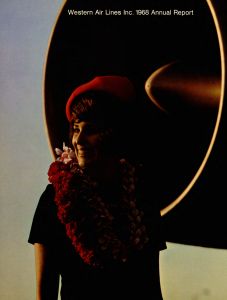
Cover: Stewardess Kathy Lawrence
smilingly displays the typical attitude
of Western's employees as they
look forward to the addition of Hawaii
to the company's route system.
President's Letter 2
Review of the Year 4
Corporate Citizenship 22
Ten Years of Growth 24
Balance Sheet 26
Earnings and Retained Earnings 28
Source and Application of Funds 29
Notes to Financial Statement 30
Accountants' Report 30
1
President's Letter To Shareholders, Employees, Customers and Friends:
Although a record year in many respects and one in which the company prepared
itself for future growth, 1968 did not live up to our expectations in terms of
earnings.
The decline in earnings, from $2.50 a share in 1967 to $1.72 a share for 1968,
resulted from a number of factors that affected not only Western, but the airline
industry as a whole. A number of carriers were affected even more adversely
than Western.
One of the most important of these factors was inflation. The cost of almost
everything the company bought in 1968 increased significantly --
jet fuel, wages,
landing fees and rentals, parts, equipment and outside services.
In the past, Western has been able to stay ahead of inflation by increasing its
production with larger and more efficient aircraft and thereby reduce unit costs
and hold down its break-even load factor. In 1968, however, even larger-than-
normal increases in seat mile production did not provide a reduction in unit costs
but only permitted the company to hold the line at 2.85 cents per seat mile
produced.
Although seat miles sold and revenues increased by 15 percent, these gains
were not sufficient to offset 21 percent increases in seat mile production and
expenses.
While not producing the desired level of profit in 1968, Western's expansion
programs are necessary to keep the company competitive and capable of taking
advantage of growth opportunities in the future. Consuming a large amount of
the company's resources and energies in 1968 were programs whose greatest
benefits will be realized in future years: introduction of 17 short-range and five
intercontinental-range jets, installation of a Jet Age reservations system, con
struction of new facilities, participation in a record number of route cases and
increased emphasis on building up the company's cargo traffic.
The year 1969 began on a positive note when, on January 4, the Civil Aeronautics
Board, as part of its Transpacific Route Case decision, granted routes to Western
between 11 points on the Mainland and Hawaii.
This is the most important route award in the 43-year history of the company.
When fully implemented, this award will add 20,561 miles to Western's present
route system of 14,156 miles.
The Civil Aeronautics Board has estimated that 3.4 million passengers will travel
between the Mainland and Hawaii in 1970 and that Western will carry 14.7 per
cent of the market, or 500,000 passengers, making it the third largest carrier in
the Mainland-Hawaii market.
Western was named for its routes in the domestic phase of the case. The inter
national phase, which involves awards from the Mainland to points beyond Hawaii,
is, as of this writing, being reviewed by the President of the United States.
Western's award is not included in that presidential review.
On January 27, we announced that Western's service would be inaugurated on
April 27. Subsequent to that announcement, the Civil Aeronautics Board post
poned the effective date of the domestic decision from March 5 to April 14, which
will not affect our plans, assuming no further changes in the domestic decision.
Our initial pattern of service will consist of 41 roundtrips a week between Honolulu
and nine points on the Mainland with the Boeing 707-300C Intercontinental jets
that were added to our fleet in 1968.
2
At the first quarterly meeting of 1969, your board of directors approved an
agreement for the purchase of additional aircraft that will permit the company
to expand its Hawaii service late this year and again in 1970. The aircraft to be
delivered under the purchase agreement, which is subject to lender approval and
the completion of financing, are described in the Equipment and Facilities section
of this report.
Western's expansion will continue in 1969. Thirteen additional Boeing 737 twin-
jets are being placed in service in the first half of the year and six new long
bodied Boeing 727 trijets and four additional Boeing 707 Intercontinental jets
are scheduled for delivery in the last four months of the year.
The challenge that faced the company in 1968 will be present again in 1969:
when high-density jet aircraft are first placed in service, the supply frequently
exceeds the demand and load factors build up slowly. This will be true for Western
particularly in the early part of the year, prior to the inauguration of service to
Hawaii.
Part of the increased capacity will be absorbed by new services which recently
were authorized by the CAB, such as Denver-Calgary nonstops and Twin Cities-
Phoenix, Twin Cities-Las Vegas and Twin Cities-San Diego nonstops. The addi
tional aircraft also will be used to inaugurate improved service on existing routes.
Western's management is mindful of the scope of its task in reversing the losses
which began to develop in the fourth quarter of 1968. The achievement of this will
be made more difficult by new and increased competition, the development of new
markets which may not be immediately profitable and the pressures of inflation.
This responsibility is being faced in 1969 resolutely and with diligence. Your con
tinuing support will assist us in this endeavor.
March 3,1969
ajl c. *i ~i
Qs * -i
President
3
Review of the Year Earnings Earnings in 1968 were $8,435,770, or $1.72 a share, compared to
$12,221,465, or $2.50 a share, in 1967. Per-share earnings for 1968 are based
on 4,901,734 shares of stock and for 1967 on 4,893,244 shares outstanding as of
December 31 in each year. Assuming conversion of convertible debentures, 1968
earnings are equivalent to $1.64 a share.
Operating income totaled $19,681,421, equal to nine percent of operating
revenues, compared to $25,339,604, or 13 percent of revenues, in 1967.
Earnings before taxes totaled $13,160,770, or $2.68 a share.
Provision for taxes on income totaled $4,725,000, or 96 cents a share. Included
is approximately $600,000 occasioned by the surtax enacted by Congress in 1968.
Of the provision, $2,182,000 was for deferred taxes, $3,011,000 for current taxes
and $1,705,000 in lieu of investment credits realized against taxes payable. The
gross provision of $6,898,000 was reduced by $2,173,000 for amortization of
deferred investment credit essentially over the life of the related equipment.
All investment credits generated through 1967 have been applied. Carried
forward for reduction of future taxes payable is the unapplied part of the 1968
generation totaling $8,496,000. This amount was transferred from deferred federal
taxes on income to deferred investment credit and $708,000 was amortized to
income in 1968. Accordingly, the deferred investment credit remaining for amorti
zation to income of future years amounts to $15,135,000. Since the creation of
the investment credit law the company has credited $6,085,699 to income.
Revenues Total operating revenues for 1968 were $221,952,867, highest in the
company's history and a 15 percent increase over the previous year.
Of Western's revenue dollar, 93 percent was derived from passenger traffic
(79 percent coach and 14 percent from deluxe). Express, freight and excess
baggage accounted for four percent, mail for two percent and all other sources
one percent.
The number of passengers carried in 1968 increased 11 percent. Seat miles
sold increased somewhat faster, however--15 percent --when the average trip
length of Western's passengers increased from 651 miles in 1967 to 675 miles.
The use of discount fares continued to increase during the year. Forty-four
percent of seat miles sold were purchased at a discount, compared to 39 percent
4
in the previous year. In spite of the increase, the average revenue per seat mile
sold was the same for both years, 5.37 cents, because of a $2 fare increase on
the Los Angeles-Las Vegas route and the replacement of Electras with jets at
slightly higher fares in a number of markets.
Fifty-four percent of discount travel was in the use of excursion fares; family
plan represented 13 percent, military 12 percent, children's half fares 11 percent
and youth stand-by 10 percent.
On January 16, 1969, following weeks of discussions between the Civil Aero
nautics Board and airline executives, the CAB established a formula for fare
increases on domestic routes (not including Hawaii and Alaska) that the board
estimated would increase trunkline revenues by 3.8 percent. The formula was
particularly directed at increasing the per-mile yield on short routes and widening
the differential between first class and coach fares. It provided for a $3 increase
in first class fares, a $2 increase in coach fares on segments up to 500 miles
and a $1 increase in coach fares on segments of 500-1800 miles.
Western filed the necessary tariffs immediately and the increases became
effective February 20 on all but intra-California routes, which are awaiting the
approval of the state Public Utilities Commission. The increases in fares filed
with P.U.C. are somewhat lower than those authorized by the CAB in order to
match the corresponding filings of other carriers.
Had the increases been in effect for all domestic routes throughout 1968,
Western would have realized approximately $6 million in additional revenues.
Expenses Total operating expenses for 1968 amounted to $202,271,446, a 21
percent increase over 1967.
Contributing to the increase was a 21 percent increase in seat miles produced
and the continuing upward spiral of costs for labor, materials, services, airport
landing fees and rentals.
Wages and salaries increased 24 percent, depreciation 25 percent and other
expenses 18 percent.
Addition of five Boeing 707-300C Intercontinental jets and 17 Boeing 737 twin-
jets in the latter part of the year contributed to an increase in depreciation costs
from $20,085,842 for 1967 to $25,050,993 for 1968. Both of the new aircraft types
are being depreciated over a period of 12 years, beginning when each aircraft
goes into service.
In the past, increases in seat mile production with jet aircraft have resulted
in significant reductions in unit costs. In 1968, however, because of inflation, the
21 percent increase in seat miles produced did not result in an overall reduction
in cost per seat mile produced, but did permit the company to hold the unit cost
to 2.85 cents per seat mile produced compared to 2.84 cents in 1967.
The company's breakeven load factor (percentage of seats produced which
must be sold to cover expenses) increased from 49.5 percent in 1967 to 50.7
largely because of an increase in interest charges from $3 million in 1967 to $6.5
million in 1968. This resulted from increased borrowings to cover the cost of the
22 new aircraft delivered during 1968 and the increased cost of borrowed funds.
While the company continues to follow a conservative accounting approach
and ordinarily does not defer current expenses for future amortization, the intro
duction of the Boeing 737 fleet of 30 aircraft (17 delivered in 1968) and the train
ing related to this program was of such magnitude that the company deferred
Following Page: Included in the many small communities which
received their first jet service when Western introduced Boeing 737s in
1968 was Sheridan, Wyoming, in the heart of the cattle country.
5
Brief Statement of Earnings
1968 1967
Western's revenues came from:
Passengers
Coach $174,924,828 $150,087,785
Deluxe 30,828,463 28,438,767
205,753,291 178,526,552
Express, freight and
baggage 9,331,361 7,581,113
Mail 4,127,583 4,221,459
Other income 3,083,569 2,387,498
222,295,804 192,716,622
Western's expenses were:
Wages and salaries 71,884,941 57,974,743
Social security, group
insurance and retirement
plans 6,650,184 6,049,573
Taxes 8,640,863 13,378,786
Aircraft fuels 27,190,628 21,936,906
Depreciation and
amortization
....
25,050,993 20,085,842
Materials and repairs . .
17,366,088 16,820,826
Utilities and services
.
16,062,717 12,765,527
Service to passengers 11,059,337 8,688,000
Rentals and landing fees. 7,666,906 6,229,073
Advertising and publicity 5,784,646 6,020,353
Insurance 4,603,488 2,914,761
Interest 6,535,940 3,011,202
Other costs 5,363,303 4,619,565
213,860,034 180,495,157
Net earnings $ 8,435,770 $ 12,221,465
Brief Balance Sheet
1968 1967
Western owns:
Cash and short-term
securities $ 27,870,420 $ 21,871,520
Receivables due from
others 17,954,873 16,185,954
Federal income taxes
refundable 3,426,967
Maintenance and
operating supplies .
8,624,401 6,314,423
Buildings and
improvements, net .
11,424,108 9,512,014
Flight and other
equipment, net .
256,435,162 149,503,637
Deposits on new equipment .
16,927,291 24,090,535
Prepaid expenses. 3,308,028 2,584,947
Deferred charges and other .
3,067,900 1,278,921
349,039,150 231,341,951
Western owes:
Payables due to
vendors and others 31,225,178 22,146,783
Federal income taxes --
current and deferred
.
20,344,000 26,818,025
Deferred investment credits 15,135,000 7,107,000
Tickets sold but not yet
used 3,251,843 3,562,627
Notes payable --
current and long-term .
185,220,843 81,691,470
255,176,864 141,325,905
Excess of what is owned
over what is owed, or
shareholders' equity $ 93,862,286 $ 90,016,046
$1,000,460 as of December 31,1968. This expense is being amortized over the first
three productive years of the 737 aircraft. No costs were deferred relative to the
introduction of Boeing 707-300C Intercontinentals.
Finances The company is in a sound financial condition. Working capital totaled
$25,205,041 at the close of 1968, up from $19,584,782 at the end of 1967. The addi
tional aircraft orders (cancelable under certain conditions) announced early in
1969 and lower than anticipated earnings will require further expansion of the
company's financial structure.
The ratio of current assets to current liabilities was $1.70 to $1.00, practically
the same ratio as at the close of 1967. However, in keeping with the expanding
size of the company (total assets were up $117,697,199 over 1967), current assets
increased by $14,227,845 and current liabilities by $8,607,586.
As indicated in the Statement of Source and Application of Funds, operations
provided $36,462,452, the net increase in borrowings supplied $73,797,373 and
the sale of debentures provided $30 million toward the aggregate of $140,752,617.
Of this amount, $128,421,282 was used for aircraft, property and equipment,
$4,893,544 for the payment of cash dividends, $1,000,460 for Boeing 737 pre
operating costs and $5,620,259 was added to working capital.
The company's long-term debt increased $103,529,373 during 1968 and at year
Reservations agent Janet Donovan uses one of
the company's new ACCU-RES video display agent
sets to give her immediate access to all the
information she needs to complete a transaction.
8
end totaled $183,718,216. The changes in the debt structure included an expan
sion of the bank loan revolving fund from $90 million to $130 million and the
issuance early in 1968 of 5Va percent convertible subordinated debentures due
February 1,1993, totaling $30 million. The first debenture conversions were made
in December in the amount of $268,000. The conversion price per share was
$36.75 as originally set and still effective.
During the year, the company used $60,300,000 of the bank revolving fund and
drew down $15 million of the $40 million insurance company funds arranged in
1967. At the close of 1968, $24,700,000 remained available under the bank revolv
ing fund and $25 million under insurance company agreements. Of the latter, $15
million was drawn in January 1969; the balance is contemplated for March.
The nature and extent of the required additional financing is being explored
with the company's underwriters and other financial advisors.
Further data relative to the company's long-term debt is set forth in Note 2 to
the Financial Statements.
Dividends For the 18th consecutive year, shareholders of Western received cash
dividends in 1968. Quarterly dividends of 25 cents a share were paid on February
19, May 27, August 19 and November 25 for a total payment of $1 a share.
At the first regular board meeting of 1969, held in San Francisco on January 27,
a quarterly dividend of 25 cents was voted, payable March 3 to shareholders of
record on February 12.
Annual Meeting The 1969 meeting of shareholders will be held at the Beverly
Hilton Hotel, Beverly Hills, California, on April 24. On or about March 20, stock
holders will receive a formal notice of the meeting and proxy material.
Shareholders, Stock and Debentures At the close of 1968, there were 4,901,734
shares of Western Air Lines common stock issued and outstanding, compared to
4,893,244 shares at the end of 1967.
At year's end, 809,036 shares were reserved for conversion of the 51/4 percent
convertible subordinated debentures sold early in 1968 and 186,200 shares
reserved for stock options outstanding or available for grant under the company's
qualified stock option plan.
Holders of the company's convertible debentures received interest at the rate
of 51/4 percent on August 1, 1968, and February 1, 1969. The conversion price
remains at $36.75 a share.
AVERAGE REVENUE PER
CONSUMER PRICE INDEX PASSENGER MILE
The company's stock was held by approximately 23,000 shareholders.
At the 1968 annual meeting of shareholders in Beverly Hills in April, 80.8 per
cent of all shares were voted in person or by proxy.
Shareholders' equity in 1968 increased to $93,862,286, or $19.15 a share, from
1967 equity of $90,016,046, or $18.40 a share, a four percent increase.
Equipment and Facilities Western accomplished two major re-equipment pro
grams in 1968: the introduction of new aircraft in record numbers and the switch
over to a fully computerized reservations and communications system.
In the last seven months of 1968, 22 new jet aircraft were delivered to the
company--five Boeing 707-300C Intercontinentals and 17 Boeing 737 twinjets.
The 151-passenger 707s are the largest aircraft ever operated by Western.
Two of the aircraft were offered in a bid to the Military Airlift Command for con-
10
tract flying, but, because of a reduction in the need for civilian augmentation of
military airlift, the contract that was offered to Western did not provide enough
volume to make it economically feasible for the company to accept it. However,
the company was awarded a "call" contract, subject to increased needs of the
military, but to date has not been called upon to participate in MAC contract flying.
The long-range 707s, which will be used to implement the company's Hawaii
routes on April 27, were used effectively on the company's longer routes during
the latter part of 1968, as well as on extra sections to Mexico City during the
Olympic Games in October.
Delivery of the 737s brought the end of the piston era on Western's route
system. The last three of the company's Douglas DC-6B's were retired from serv
ice in July. As the 107-passenger twinjets took over flights in California commuter
markets and on shorter segments throughout the Mountain States and Midwest,
the Lockheed Electras which had been used in these markets were modified for
service in Alaska and for all-cargo flights.
In addition to being selected by the U.S. Olympic
Committee to carry U.S. athletes and officials to the
XIX Olympiad in Mexico City, Western carried the teams
of five other countries as well as thousands of other
athletes, officials and spectators.
11
A $4 million modification program converted three Electras to all-cargo con
figuration and five to cargo-passenger configuration. Introduction of the Electras
in Alaska in November permitted the company to withdraw from service the six
Lockheed Constellations that were acquired in the 1967 merger with Pacific
Northern Airlines. The all-cargo Electras were placed in service in February 1969.
At year's end, the company fleet consisted of 64 aircraft--five 707-300C's, 27
Boeing 720B's, three Boeing 720s, 17 Boeing 737s and 12 Lockheed Electras.
Three of the four Electras which were not converted are for sale, as are the Con
stellations which were retired in 1968. The DC-6B's were sold early in 1969.
Scheduled for delivery in the first half of 1969 are 13 additional 737 twinjets
and, in September and October, six Boeing 727-200 trijets.
In January 1969, the company entered into an agreement for the purchase of
12 additional aircraft--three Boeing 747s, five Boeing 707-300C's and four Boeing
727-200s. The order is conditional on lender approval and the arrangement of
satisfactory financing of the purchase.
Two of the 707s are for delivery in October 1969, one for November, one for
December and one for January 1970.
The wide-body 747 "Jumbo Jets" are for delivery in October and December
1970 and June 1971. The additional 727-200 trijets are for 1970 delivery --two in
May and two in June.
Introduction of Western's ACCU-RES reservations system in October also was
a major undertaking. The system uses two IBM 360-65 computers as central data
processors and is linked to company reservations, sales and airport offices
throughout 12 western states by some 23,000 miles of communications lines.
Preparations for the switchover to the new system required the installation of 625
agent inquiry sets, extensive programming and the training of 2,700 agents.
In addition to storing and supplying reservations and flight information, the
$9.2 million system provides message-switching control for on-line and interline
reservations and, along with a leased IBM 360-30 computer, serves as a vital
tool in the compilation of financial and traffic data, maintenance records and
scheduling, inventory status and other management information.
Approximately $12 million in new facilities were constructed in 1968 for use
by the company. Included were a Transportation Center at San Francisco Inter
national Airport to house reservations, maintenance and training activities and a
similar facility at Denver. Both of these buildings will be leased by the company.
In addition, Western built an all-purpose facility at Anchorage International Airport
for maintenance shops, a flight kitchen and air cargo operations and a six-story
warehouse at Los Angeles International Airport.
A 737 electronic flight simulator for use in training crew members was put in
service in 1968 and an order was placed for a $11/4 million 727 simulator that
will be delivered in 1970.
Sales and Service Western carried 5,692,947 passengers in 1968, an 11 percent
increase over the previous year.
Passenger revenues increased 15 percent, from $178,526,552 in 1967 to
$205,753,291 in 1968.
The company's overall passenger load factor decreased from 56.6 percent in
1967 to 54.1 percent in 1968.
Revenues from air cargo shipments (freight, express, excess baggage, air mail
and regular first class mail) increased from $11,802,572 in 1967 to $13,458,944.
Credit card purchases, other than the industry's Universal Air Travel Plan,
during 1968 increased 34 percent over the previous year.
Among the major events participated in by sales and service personnel during
the year were introduction of new aircraft, the switchover to the new and highly
versatile computerized ACCU-RES reservations system, the Olympic Games in
Mexico, unprecedented training and the challenge of increased competition.
By the latter part of 1968, every city served by Western Air Lines had all jet or
jet-powered service. In Alaska, the service is provided with jets and jet-powered
Lockheed Electras. At all other points on the company's route system, service is
provided with four-engine jets or Western's new Boeing 737 twinjets. The 737s,
which first made their appearance on Western's routes in July, were introduced
with major sales campaigns at 28 cities during the year.
Conversion of three Electras to cargo configuration
permitted the company to inaugurate all-cargo service
early in 1969. Five other Electras were converted to
passenger/cargo configuration in 1968 for use in Alaska.
13
Introduction of the new reservations system in October brought to sales and
service personnel a valuable new tool. Reservations department, ticket office
and airport terminal employees now have at their finger tips, instantaneous access
to reservations records, seat inventory, flight status, ticketing information and
other data which is needed to sell seats and process passengers.
In the past, if a passenger booked a reservation by telephone and later went
to a ticket office to purchase his ticket, the agent would have to place a call to
reservations. A reservations agent would have to answer the call, go to the file
where the reservation information was stored, verify the details and give it to the
agent who called. Today, that same ticket agent can use a typewriter-like inquiry
set to obtain the same data directly from the central file where it is stored elec
tronically. Valuable time is saved and more information is available from one
central location.
Other advantages of ACCU-RES include: computer storage of seat availability
and bookings has been expanded from three months in the previous system to
one year in the new; a passenger who is on the waiting list can be automatically
accommodated and the office which listed him notified if a seat becomes available
through a cancellation; if a flight schedule is changed, passengers who were
booked on the original flight will be re-accommodated on a new flight and the
booking office notified; if a passenger is given a time limit for purchasing his
ticket and fails to do so, the computer will automatically notify the booking office
and the customer can be reminded.
Although a difficult system to assimilate, as are all sophisticated systems of this
magnitude, ACCU-RES is now providing the most comprehensive reservations
and flight information ever available to Western's passengers.
The XIX Olympiad in Mexico put Western into the international travel limelight.
In addition to being selected by the U.S. Olympic Committee as the airline to
carry its athletes and officials, Western carried the complete squads of five other
nations and thousands of other athletes, officials and spectators from many
parts of the world.
The Olympics was regarded by the company as an opportunity to demonstrate
its sales and service capabilities and create an image of excellence that would
be projected far beyond the limits of its own route system --one that would convey
long-range benefits.
Because of a shortage of hotel rooms in Mexico City, the company worked
with the Mexican government to provide accommodations for U.S. visitors in
private homes. Special reservations and sales offices were set up in Olympic
Village and at key hotels throughout Mexico City. Employees worked long hours
to devise systems and procedures that would insure that every passenger would
be handled efficiently both going to and returning from the Games.
The results were outstanding and passenger reaction gratifying. The company
created not only a positive image for itself but materially assisted Mexico in estab
lishing the 1968 Olympics as one of the best organized in history.
Throughout the travel industry Western Air Lines is known as a company with
aggressive and imaginative sales programs.
In 1968, while pushing ahead with new programs to stimulate the development
of travel, the company received recognition for its past efforts.
Among the honors were a Merit Award from the National Association of Travel
Organizations and a series of advertising awards.
14
Chic and colorful, this new winter uniform --
modeled by Valerie Nohlgren -- is now being
worn by Western's stewardess corps.
15
V
KETCHIKAN
VANCOUVER
HELENA
\ \ butte billings
W. YELLOWSTONE
SHERIDAN
PIERRE
IDAHO FALLS
BOSTON
RAPID CITY SIOUX FALLS
MILWAUKEE^
,,
CHICAGO"
POCATELLO
SALT
LAKE
.CITY
OMAHA
CHEYENNE
RENO
DENVER
LAS VEGAS
} TULSA
OKLAHOMA CITY MEMPHIS
ONTARIO
PALM SPRINGS
PHOENIX
'ALBUQUERQUE DALLAS
BIRMINGHAM
FORT WORTH
NEW ORLEANS
HOUSTON
MEXICO CITY
ACAPULO
KING
\ SALMON
KENAI
HOMER
KODIAK
ANCHORAGE
CORDOVA
YAKUTAT
WESTERN AIR LINES SYSTEM
PROPOSED ROUTES
Hawaii Routes Effective April 14,1969
HONOLULU
HILO
.
JUNEAU
SITKA L
m
CALGARY
SEATTLE GREAT FALLS
TACOMA
MINNEAPOLIS
ST. PAUL
PORTLAND
"HARTHDRD^>^
NEW YOR'k/NEWARK
PHILADELPHIA
WASHINGTON, D.C./BALTIMORE
HUNTSVILLE
ATLANTA
SAN DIEGO
AMPA 'ST. PETERSBURG
\ \ CLEARWATER
SAN ANTONIO
SACRAMENTO
SAN FRANCISCO
OAKLAND
SAN JOSE
LOS ANGELES
LONG BEACH
MIAMI/
TORT LAUDERDALE
Western was the only airline to win a NATO award in 1968. The company was
cited for the excellence of its travel promotions with special recognition being
given to the company's joint promotion in Europe to encourage travel to the U.S.,
for the efforts of the company's Tokyo sales office in developing travel from the
Orient to the U.S. and for the company's Ski Western America, Take A Sunbreak
and North Country Adventures programs.
Heading a list of 21 advertising awards Western has received in recent years
was the Socrates High Award for 1968. The only national prize in transportation
advertising, the Socrates was awarded to Western for its newspaper advertising.
The company is the only three-time winner. Western's advertising awards were
received for all aspects of advertising, and in Japan as well as the U.S.
Travel agents, long considered Western's sales partners, continued to play an
important role in company marketing programs, contributing approximately 40
percent of the company's net passenger sales.
While continuing its efforts to promote passenger travel during 1968, Western
also made a commitment to increased participation in cargo traffic.
In addition to acquiring three all-cargo aircraft and five dual configuration
planes in the Electra conversion program, the company accelerated its cargo
sales activities. Additional cargo sales representatives were appointed at key
cities and all facets of cargo marketing were speeded up.
Western's first all-cargo service, from Los Angeles to Anchorage via San Fran
cisco and Seattle/Tacoma, from Los Angeles to the Twin Cities and from San
Francisco to the Twin Cities via Denver, was inaugurated in February 1969.
Personnel and Management Western's growth in 1968 created 1,637 new jobs
in the communities served by the company as the number of employees increased
from 7,282 at December 31, 1967, to 8,919 at the end of 1968.
Wages and salaries amounted to $71,884,941--approximately 36 percent of
operating expenses --compared to $57,974,743, or 35 percent of operating
expenses, in the previous year.
Covered by agreements with unions are 86.5 percent of total employees.
Contracts were signed during the year with flight superintendents (dispatchers)
and pilots. Agreements which cover mechanics and stewardesses are being
negotiated at the present time; contracts covering passenger service and clerical
employees will be open for negotiation during 1969.
Arthur F. Kelly, Western's senior vice president-sales and a 32-year employee
of the company, was elected to the board of directors in October 1968. He suc
ceeds Alexander Warden of Great Falls, who retired as an active board member
for reasons of health and was named a director-emeritus.
At its first meeting of 1969, held in San Francisco on January 27, the board of
directors voted to recommend to stockholders that Kirk Kerkorian, who recently
purchased more than one million shares of Western stock through a tender offer,
and two of his associates --
Fred Benninger and William Singleton --be elected
to the board at the annual meeting of April 24, subject to the approval of the Civil
Aeronautics Board. The size of the board was increased from 15 to 18 to accom
modate the new members.
New officers elected during the year were Robert O. Kinsey, vice president and
assistant to the president; Lawrence H. Lee, assistant vice president-industrial
relations; Richard B. Rainey, assistant vice president-research; and Gordon
Pearce, corporate secretary.
18
Elevated from assistant vice president were: Willis R. Balfour, vice president-
agency and interline sales; Henry M. deButts, vice president-Washington, D.C.;
Harry L. White, vice president-sales administration; and Eugene D. Olson, vice
president-data processing and systems. Rick O. Hammond, assistant treasurer,
also was elected assistant secretary.
Route Development The year 1968 was one of the most active periods in com
pany history in the field of route development. In a continuing effort to obtain
needed long-haul routes, the company aggressively prosecuted applications for
new authority and sought to eliminate operating restrictions in order to improve
public service and increase operating efficiency on its route system.
The most significant development occurred at the end of the year when the
Civil Aeronautics Board released its decision in the Transpacific Route Case. In
the domestic phase of the decision, which was announced on January 4, 1969,
Western was granted routes to Honolulu and Hilo from these Mainland points:
In anticipation of expanded service to Hawaii,
Western signed a conditional agreement early in 1969
for the purchase of three giant Boeing 747s
for delivery in 1970 and 1971.
19
Anchorage, San Francisco/Oakland/San Jose, Los Angeles/Ontario/Long Beach,
San Diego, Phoenix, Denver and Minneapolis-St. Paul.
When fully implemented, these routes would increase Western's route mileage
by 20,561 miles --from 14,156 miles at the end of 1968 to 34,717 miles.
The company is preparing to inaugurate service on these new routes on April 27.
Other cases concluded in 1968 were:
Denver-Calgary Service--Western's applications to the CAB and to the Cana
dian Air Transport Committee for authority to operate nonstop service between
Denver and Calgary, a route which the company previously operated on a multi
stop basis only, were approved. The service was inaugurated on December 1.
Twin Cities Nonstops--Early in 1968 the company applied to the CAB for
authority to eliminate a Salt Lake City stop on Las Vegas-Twin Cities flights,
Phoenix and Denver stops on San Diego-Twin Cities flights and a Denver stop
on Phoenix-Twin Cities flights. The company was granted permanent authority
to operate San Diego-Twin Cities, Phoenix-Twin Cities and Las Vegas-Twin Cities
nonstops in December and the service was inaugurated on February 1, 1969.
Salt Lake City-Las Vegas-Southern California Service-- Involved was the ques
tion of competition for Western between Los Angeles and Salt Lake City (non-stop
and via Las Vegas) and between San Diego and Las Vegas (nonstop and via Palm
Springs). A local service carrier was authorized to operate these routes and
competitive service was inaugurated during the year.
Subpart "M" Procedure --
Early in 1968, the CAB adopted a new regulation
known as Subpart "M," which established an expedited procedure forthe process
ing of applications by local service carriers seeking nonstop authority over routes
currently served with one or more intermediate stops. As a result, a local service
carrier obtained authority and began competitive nonstop service with Western
on the Phoenix-Denver route and, early in 1969, received competitive nonstop
authority between Salt Lake City and Denver.
The board recently adopted a similar regulation, called Subpart "N," for trunk
carriers. The procedure, effective March 1, 1969, is designed to expedite the
removal of intermediate stop and long-haul restrictions for trunklines that carry
20 percent or more of the traffic on the route. The new rule applies only to opera
tions within the 48 contiguous states.
BREAKEV
ACTUAL
i
fEN LOAD FACTOR AND
LOAD FACTOR
X
m uO^CtC
u
1964 65 66 67 68
Cases in which hearings were held during the year but in which no final deci
sions have been rendered were:
Service to Albuquerque Case--The Examiner in this case recommended
Western for Albuquerque-Las Vegas and Albuquerque-San Francisco routes and
other carriers for routes from Albuquerque to Los Angeles, Chicago and Dallas/
Fort Worth. Western, which is seeking additional authority, and other carriers
requested the CAB to review the Examiner's recommendations. On January 23,
the board announced it would do so.
Reopened Pacific Northwest-Southwest Service Investigation --
In the original
case, the CAB authorized certain carriers, but not Western, to provide long-haul
service between the Pacific Northwest and the Texas/Oklahoma/Louisiana and
Kansas/Missouri areas but deferred for the reopened case the issues of turn
around service between the Pacific Northwest and Salt Lake City/Denver and
between the Southwest cities and Salt Lake City/Denver. The company is an
applicant for all the major markets within the area covered by this proceeding.
20
The Examiner did not recommend approval of the company's application. The
CAB is currently reviewing the Examiner's decision.
Twin Cities-California Service--A proceeding to determine if Western's tem
porary authority for Los Angeles-Twin Cities and San Francisco-Twin Cities non
stop service should be made permanent and to determine if competitive service
is required on these routes. The Examiner recommended permanent authority
for Western and selected another carrier to provide competition on both routes.
The CAB voted to review the Examiner's findings; a final decision is pending.
Denver-Twin Cities Service--To determine the need for additional service on
a route which Western presently serves exclusively. The Examiner recommended
that a local service carrier be permitted to compete with Western. The CAB voted
to review the recommendation; its decision is pending.
Two other cases in which Western was an applicant were the Dallas/Fort
Worth-Phoenix Nonstop and Memphis/Huntsville/Birmingham-Los Angeles Serv
ice. In both cases the Examiner recommended other carriers. Western, along with
other applicants, petitioned for board review of the recommendation. The board
has announced it will review the Examiners' decisions in both cases.
Cases in which hearings have been held but no decision issued include:
Southern Tier Competitive Nonstop--A case to investigate the need for addi
tional service in 18 markets which lie along the southern part of the U.S., from
California to Georgia and Florida. Western is seeking to serve all markets cov
ered by the proceeding. An Examiner's decision in February 1969 recommended
routes for several carriers but not Western. The company is seeking board review.
Twin Cities-Milwaukee Long Haul Investigation --
Hearings were held in Janu
ary 1969. An Examiner's recommendation is expected later this year. The case
is concerned with service from the Twin Cities and/or Milwaukee to Portland/
Seattle and to Boston, New York, Philadelphia and Washington. Western is seek
ing to serve all markets covered by the case.
Service to Omaha and Des Moines --
Hearings were held in late 1968 to deter
mine the need for service between Omaha and Des Moines and West Coast, Mid
west and East Coast points. Western's application includes requests for routes
from Omaha to Los Angeles, San Francisco, Portland, Seattle, Minneapolis/St.
Paul, Chicago, Washington and New York, and from Des Moines to certain of
the same points. The Examiner's decision is expected later this year.
Other cases which have been set down for hearings:
Additional Service to San Diego--Western has applied for authority from San
Diego to Chicago, New York, Washington and to remove the one-stop restriction
on existing San Diego-Denver flights. Hearings will begin on March 18.
Pacific Northwest-California Service Investigation --
Numerous other carriers
are seeking authority to provide additional competitive nonstop service from
Seattle and Portland to points in California, including a number of satellite air
ports. Western has applied for certain additional authority, including San Diego-
Seattle/Portland nonstop rights. Hearings begin on March 25.
Two cases instituted in 1968 but not set down for hearings are the Service to
Salt Lake City case, involving service between Salt Lake City and Chicago, New
York, Washington and San Francisco, and a Phoenix-Portland/Seattle Nonstop
case, in which the company seeks to eliminate its mandatory Los Angeles stop
on existing Phoenix-Portland/Seattle flights.
GROWTH
VS. OPEf
IN SEAT-MIL
IATING REVE
ES SOLD
NUES
c-
/
/ ,A'
INCREASE
-100
21
Corporate Citizenship
Jaime Salazar Fortis
Fred Pitcher
In Mexico City, 19-year-old Jaime Salazar Fortis is studying to become an air
craft mechanic under a Western Air Lines scholarship.
In Los Angeles, San Francisco and other cities, unskilled workers who had been
regarded as hard-core unemployed are getting on-the-job training for new careers.
And, in Asia and Colorado--6,000 miles apart --Laotian children and American
Indians remember the gentle smile and tender care of a Western stewardess.
These are a few of the ways in which Western and its employees are responding
to the needs of people, at home and abroad.
Jaime Salazar is the first young Mexican to benefit from a scholarship program
established by Western in 1968. The program was developed when the company's
newspaper subscription number was drawn for the grand prize in a subscribers'
raffle conducted by the Mexico City newspaper, Excelsior. The prize was an
apartment building valued at $75,000.
Rather than use the building or proceeds from it for corporate purposes, the
company donated it to the Mexican government with the request that it be con
verted to a scholarship fund for needy and deserving Mexicans who want to
study air transportation at the government-operated International Center of Civil
Aviation Training. Additional scholarships will be awarded. Western's winning
ticket will provide aviation education for needy Mexicans for years to come.
In addition to participating in the National Alliance of Businessmen program to
provide jobs for hard-core unemployed at key cities on the company's system,
Western works closely with government and private organizations to fill jobs and
provide career counseling to minority groups and others who need assistance.
In March of 1968, 11 Alaska businessmen who represent all areas of the
state and a cross-section of its business and industrial community were appointed
by the governor to the Western-sponsored Alaska Business Council. Nine other
prominent business and education leaders in the U.S. agreed to serve as advisors,
willing to lend their knowledge and experience to aid Alaska's development.
The program is the first of its kind ever created by an airline.
In a series of meetings during the year, the business council established a
scholarship program and awarded 11 scholarships to young Alaskans, partici
pated in the development of a manpower training program for Eskimo and Indian
youth, created a Trade Fair that will display Alaska's wares outside the state,
inaugurated industrial tours of the state and laid the groundwork for other pro
grams to promote the economic development of Alaska.
As a corporation, Western holds memberships in hundreds of community-
service organizations --
chambers of commerce, junior chambers, service clubs
and business development groups. Annual financial contributions through estab
lished charitable organizations are increasing as the company grows.
Individual employees also contribute money, time and their experience.
Stewardess Judy Derenthal, who early in 1968 was granted a three-month
leave of absence to serve with the Thomas A. Dooley Foundation in Laos as nurse,
teacher and entertainer, is back at her Denver base. There she continues to
donate free time to Indian children, church work and a children's hospital.
Fred Pitcher is a Western pilot. In an effort to encourage young people, particu
larly those who live in low-income areas, to stay in school and to acquaint them
with the jobs waiting for them in the aviation industry, he makes frequent visits
during his off-duty hours to Los Angeles schools and colleges.
Western is proud of these and other employees who make similar contributions.
In spite of the obvious limitations on the company's resources, the scope and
variety of Western's involvement in community needs is continuing to widen.
22
Ten Years of Growth1
Financial
1968 1967 1966"
Revenues:5
Passenger . . .
$ 205,753 178,527 164,186
Express, freight and excess baggage . . .
9,331 7,581 6,848
Mail
. . .
4,128 4,221 4,255
Other
. . .
2,741 2,153 1,895
Total Revenues
. . .
221,953 192,482 177,184
Operating Expenses:5
Depreciation and amortization . . .
25,051 20,085 15,779
Payroll . . .
71,885 57,975 47,350
Other
. . .
105,335 89,082 77,708
Total Operating Expenses . . .
202,271 167,142 140,837
Operating Income5 . . .
19,682 25,340 36,347
Interest5
. . .
(6,536) (3,011) (3,239)
Other Income and Expenses --
Net5 . . .
15 17 775
Earnings before Taxes on Income5 . . .
13,161 22,346 33,883
Taxes on Income5
. . .
4,725 10,125 15,558
Net Earnings from Operations5 . . .
8,436 12,221 18,325
Gain on Major Dispositions of Property (Less
Applicable Income Taxes)5 -- -- --
Net Earnings5 . . .
$ 8,436 12,221 18,325
Shareholders
Net earnings from operations per share2 . . .
$ 1.72 2.50 3.79
Gain on disposition of property per share2 --
--
--
Total
. . .
$ 1.72 2.50 3.79
Dividends paid per share:
Cash3
. . .
$ 1.00 1.00 1.00
Stock -- -- --
Shares outstanding --
actual5 . . .
4,902 4,893 4,835
--
adjusted2'5 . . .
4,902 4,893 4,835
Shareholders'equity --
total5 . . .
$ 93,862 90,016 81,750
Shareholders'equity -- a share2 . . .
19.15 18.40 16.91
Working capital5 . . .
25,205 19,585 18,047
Long-term debt5 . . .
183,718 80,189 54,867
Property and equipment -- net5 . . .
284,787 183,106 145,771
Total assets5 . . .
349,039 231,342 192,008
Operations
Route miles at end of year . . .
14,156 14,156 13,075
Airplanes operated at end of year:
Boeing 720-B . . .
27 27 22
Boeing 720 . . .
3 3 3
Boeing 707-300C . . .
5 -- --
Boeing 707 --
leased -- -- --
Boeing 737 . . .
17 -- --
Lockheed Electra . . .
12 12 12
Other aircraft --
piston powered --
9 11
Airplane miles flown5 . . .
60,125 51,692 42,830
Ton miles produced5 . . .
891.001 728,200 585,378
Ton miles sold5 . . .
418,856 360,791 314,137
Seat miles produced5 . . .
7,096,229 5,879,442 4,800,901
Seat miles sold5 . . .
3,841,864 3,327,160 2,898,088
Express, freight & mail ton miles sold5 . . .
47,446 38,940 33,070
Passengers carried . . .
5,692,947 5,107,672 4,700,839
Express, freight & mail tons carried . . .
58,129 48,579 42,714
Passenger load factor --
actual % . . .
54.1 56.6 60.4
--
breakeven point % .... . . .
50.7 49.5 47.9
Average length in miles per passenger trip .... . . .
675 651 616
Operating expenses per seat mile produced .... . . .
$ .0285 .0284 .0293
Average revenue per seat mile sold . . .
$ .0537 .0537 .0567
Employees at end of year . . .
8,919 7,282 6,294
'All financial data in this report give effect, retroactively throughout the periods prior to 1968, to the merger of Pacific Northern
Airlines into Western on July 1, 1967, which was accounted for as a pooling of interests.
2Based on shares of the Company outstanding at the close of the respective periods, adjusted to give retroactive effect to stock
dividends, the May 1964 three-for-one split, and the equivalent outstanding shares of Pacific Northern Airlines, Inc., merged into
the Company on July 1, 1967.
24
1965 1964 1963 1962 19614 1960 1959
129,704 121,928 103,183 89,837 67,442 71,577 66,209
5,991 5,897 5,055 4,747 3,833 3,775 3,325
3,135 2,962 2,603 2,659 2,364 2,300 2,113
1,768 2,095 3,472 2,878 2,935 3,022 2,734
140,598 132,882 114,313 100,121 76,574 80,674 74,381
14,676 12,980 12,373 14,605 12,033 11,040 7,665
38,731 34,500 30,114 27,108 22,837 23,982 22,179
62,391 57,650 50,969 47,997 38,848 38,740 33,108
115,798 105,130 93,456 89,710 73,718 73,762 62,952
24,800 27,752 20,857 10,411 2,856 6,912 11,429
(2,553) (2,491) (2,916) (2,725) (1,930) (1,428) (1,280)
253 783 621 472 (140) 439 180
22,500 26,044 18,562 8,158 786 5,923 10,329
10,337 12,493 9,252 4,130 443 3,365 5,483
12,163 13,551 9,310 4,028 343 2,558 4,846
883 --
191 889 807 86 302
13,046 13,551 9,501 4,917 1,150 2,644 5,148
2.52 2.81 1.93 0.83 0.07 0.53 1.27
0.18 -
0.04 0.19 0.17 0.02 0.08
2.70 2.81 1.97 1.02 0.24 0.55 1.35
0.80 0.65 0.37 0.33 0.33 0.33 0.27
-- -- -- -- --
5% 4%
4,826 4,826 1,965 1,965 1,965 1,965 1,575
4,826 4,826 4,826 4,826 4,826 4,826 3,807
67,361 57,748 46,988 39,061 35,574 35,854 27,610
13.96 11.97 9.74 8.09 7.37 7.43 7.25
11,522 8,274 5,031 12,315 5,369 16,757 10,961
47,411 33,938 41,106 48,856 39,018 25,097 26,563
124,096 99,928 93,284 80,052 69,865 46,833 44,808
157,973 138,335 125,806 115,266 95,258 78,836 74,565
13,075 12,991 12,991 13,086 12,368 12,368 12,656
18 12 10 7 4 --
2 2 2 2
o o
-
12 12 12 12
12 6 5
12 21 21 22 25 37 41
36,554 36,746 33,388 29,551 25,239 30,410 29,988
483,033 450,856 400,395 348,854 256,572 237,118 224,665
244,588 231.303 191,229 159,658 121,850 127,609 120,753
4,016,921 3,794,648 3,335,083 2,746,549 1,967,313 2,016,690 1,854,525
2,243,695 2,124,582 1,753,037 1,435,992 1,080,189 1,150,785 1,095,399
26,435 24,625 20,622 19,786 16,315 15,214 13,574
3,807,706 3,717,189 2,970,909 2,270,455 1,659,323 1,841,863 1,809,991
33,511 30,956 25,890 25,256 20,378 19,829 18,417
55.9 56.0 52.5 52.3 54.9 57.0 59.0
46.2 44.4 44.3 48.6 55.4 56.5 56.3
589 572 590 633 651 625 605
.0288 .0277 .0280 .0327 .0375 .0366 .0339
.0578 .0574 .0589 .0626 .0624 .0622 .0604
5,068 4,719 4,126 3,713 3,418 3,347 3,586
'Cash dividends per share for periods prior to January 1, 1967 are stated on the basis of the Company's shares (exclusive of equiv
alent Pacific Northern shares) outstanding at the date such dividends were declared as adjusted for stock dividends and the stock
split.
4Five other major carriers were struck from July 8 to August 19, 1966; Western's operations were adversely affected by a strike in
1961.
5000 omitted.
Western Air Lines Inc. Balance Sheet
December 31,1968 with comparative figures for 1967
ASSETS 1968
Current Assets:
Cash $ 21,895,337
Short-term securities (approximating market) 5,975,083
Receivables 17,954,873
Federal income taxes refundable (Note 1) 3,426,967
Maintenance and operating supplies 8,624,401
Prepaid expenses 3,308,028
Total Current Assets 61,184,689
Property and Equipment at Cost:
Flight equipment 331,460,810
Ground equipment 56,286,880
Deposits on purchase contracts (Note 3) 16,927,291
404,674,981
Less allowance for depreciation and maintenance 119,888,420
284,786,561
Deferred Charges and Other Assets:
Boeing 737 preoperating costs, net 1,000,460
Other items 2,067,440
3,067,900
$349,039,150
1967
$21,871,520
16,185,954
6,314,423
2,584,947
46,956,844
226,298,763
38,209,274
24,090,535
288,598,572
105,492,386
183,106,186
1,278,921
1,278,921
$231,341,951
See accompanying notes to financial statements
Western Air Lines Inc. Balance Sheet
December31,1968 with comparative figures for 1967
LIABILITIES 1968 1967
Current Liabilities:
Accounts payable $ 16,189,708 $ 12,518,764
Accrued salaries and wages 7,971,475 5,647,819
Accrued liabilities 7,063,995 3,980,200
Unused transportation 3,251,843 3,562,627
Accrued federal income taxes (Note 1) . . . .
-
160,025
Current maturities of long-term debt 1,502,627 1,502,627
Total Current Liabilities 35,979,648 27,372,062
Long-Term Debt (Note 2) 183,718,216 80,188,843
Deferred Credits (Note 1):
Deferred federal taxes on income 20,344,000 26,658,000
Unamortized investment credits 15,135,000 7,107,000
35,479,000 33,765,000
Shareholders' Equity (Notes 2 and 5):
Common stock --
$1.00 par value per share
Authorized 10,000,000 shares
Issued 4,901,734 and 4,893,244 shares .
4,901,734 4,893,244
Capital in excess of par value 19,139,909 18,844,385
Retained earnings 69,820,643 66,278,417
93,862,286 90,016,046
$349,039,150 $231,341,951
27
Western Air Lines Inc. Statement of Earnings and Retained Earnings
For the year ended December 31,1968 with comparative figures for 1967
L
Operating Revenues: 1968 1967
Passenger $205,753,291 $178,526,552
Express, freight and excess baggage 9,331,361 7,581,113
Mail 4,127,583 4,221,459
Other 2,740,632 2,152,525
221,952,867 192,481,649
Operating Expenses:
Flying operations 50,056,928 39,587,944
Maintenance 30,114,796 27,471,090
Passenger service 21,086,034 16,323,837
Aircraft and traffic servicing 36,943,382 29,733,283
Marketing and administrative 39,019,313 33,940,049
Depreciation and amortization (Note 6) 25,050,993 20,085,842
202,271,446 167,142,045
Operating Income 19,681,421 25,339,604
Other Income (Expenses):
Interest expense (6,535,940) (3,011,202)
Interest income 342,937 234,973
Other expense -- net (327,648) (216,910)
Earnings before Taxes on Income 13,160,770 22,346,465
Taxes on Income (Note 1) 4,725,000 10,125,000
Net Earnings
$1.72 per share in 1968 and $2.50 in 1967
based on outstanding shares ($1.64 per share
in 1968 assuming conversion of debentures) 8,435,770 12,221,465
Retained Earnings at Beginning of Year 66,278,417 58,945,826
74,714,187 71,167,291
Cash Dividends Paid
Annual rate --$1.00 per share 4,893,544 4,888,874
Retained Earnings at End of Year (Note 2) $ 69,820,643 $ 66,278,417
See accompanying notes to financial statements
28
Western Air Lines Inc. Statement of Source and Applications of Funds
For the year ended December 31,1968 with comparative figures for 1967
1968 1967
Funds Provided:
Net earnings
. .
$ 8,435,770 $ 12,221,465
Add back
Depreciation and maintenance reserve provision . .
26,239,220 21,498,917
Deferred income taxes
. .
2,182,000 3,931,045
Charge equivalent to investment credits
. .
1,705,000 2,363,953
Amortization of investment credits
. .
(2,173,000) (1,054,953)
Loss on dispositions of property . .
73,462 268,302
Total from operations
. .
36,462,452 39,228,729
Sale of 51/4% convertible subordinated debentures
.... . .
30,000,000 -
Increase in other long-term debt
. .
73,797,373 25,321,182
Proceeds from disposition of property . .
452,796 681,154
Exercise of stock options and warrants . .
39,996 932,850
Total
. .
140,752,617 66,163,915
Funds Applied:
Purchase of airplanes, property and equipment . ^ .... . .
128,421,282 59,637,747
Payment of cash dividends
. .
4,893,544 4,888,874
Boeing 737 preoperating costs . .
1,000,460 --
Other items
. .
817,072 100,133
135,132,358 64,626,754
Increase in working capital . .
5,620,259 1,537,161
Total
. .
$140,752,617 $ 66,163,915
29
Notes to Financial Statements
Note 1. Taxes on Income. The 1968 provision for income taxes is sum
marized as follows:
Current income taxes $3,011,000
Deferred income taxes 2,182,000
Charge equivalent to investment credits 1,705,000
6,898,000
Amortization of investment credits 2,173,000
$4,725,000
The unapplied investment credit of $8,496,000 available for reduction
of future taxes payable was deemed in 1968 to be amortizable in view of
the provisions made for deferred taxes. Accordingly, the year 1968 in
cluded related amortization of $708,000 and thus increased net earnings
equivalent to 14* a share.
Federal income tax returns have been examined by the U.S. Treasury
Department through 1966. The examination for the years 1964, 1965, and
1966 was concluded with a partial disallowance of accelerated depreci
ation previously taken on tax returns and accordingly required the pay
ment of taxes for prior years which previously had been classified as
deferred. Therefore, quarterly payments made in 1968 are now refundable.
The effect on earnings was not material.
Note 2. Long-Term Debt (Unsecured). On December 31, 1968, long-term
debt was as follows:
$130,000,000 revolving fund credit until December 31,
1969at
which time notes outstanding are convert
ible into a term note due December 31, 1975, with
equal quarterly payments commencing on March 31,
1970. The interest on all notes is 1/4% over the
bank's prime commercial rate
51/4% promissory notes (authorized $30,000,000) due
September 1, 1981, with payments of $1,000,000 a
year starting 1970 and increasing to $4,000,000 a
year in 1976
6%% promissory notes (authorized $40,000,000) due
September 1, 1984, with payments of $1,000,000 a
year starting in 1970, increasing to $2,000,000 a year
in 1975, and further increasing to $7,000,000 a year
starting in 1982
5% to 6% promissory notes due 1969 to 1972 ....
5,188,843
155,488,843
Less current maturities 1,502,627
153,986,216
51/4% convertible subordinated debentures due
February 1, 1993, with sinking fund payments of
$1,500,000 a year starting in 1979 29,732,000
$183,718,216
The following schedule shows the amount of long-term debt maturing
in each of the five years subsequent to December 31, 1968:
1969 $ 1,502,627
1970 15,562,627
1971 22,132,627
1972 21,310,961
1973 20,630,000
Pursuant to the loan agreements, the Company borrowed $15,000,000 in
January 1969 and contemplates it will borrow the remaining $34,700,000
in 1969.
Reserved for conversion of debentures are 809,036 shares of common
stock at $36.75 per share (subject to adjustments in certain cases). During
1968, $268,000 principal amount of debentures were converted into 7,290
shares of common stock. The difference between the principal amount of
the debentures surrendered and the par value of the common stock
$105,300,000
30,000,000
issued, which net of unabsorbed costs amounted to $256,728, was credited
to capital In excess of par value.
The related agreements with the bank and the insurance companies
provide among other things (including restrictions on additional borrow
ings) conditions and requirements which operate to restrict retained earn
ings from cash dividend distribution. The indenture for the debentures
also contains a requirement which operates to restrict retained earnings
from cash dividend distribution. At December 31,1968, these requirements
operated to restrict retained earnings from cash dividend distribution in
the amount of $60,981,693 leaving $8,838,950 not so restricted.
Note 3. Commitments and Contingent Liabilities. Jet aircraft and other
items on order at December 31, 1968 represented purchase commitments
of approximately $70,000,000 in excess of related deposits.
The estimated minimum annual rentals under long-term leases, with
expiration dates ranging to 1997, were approximately $2,750,000 at
December 31, 1968.
In January 1969 the Company entered into purchase agreements for
additional aircraft which are expected to cost approximately $135,000,000.
These agreements are subject to cancellation under certain conditions
and will require arrangements for the necessary financing.
Note 4. Retirement Plans. The cost of retirement plans charged to oper
ating expense in 1968 totaled $1,845,303.
Note 5. Stock Options. At December 31, 1968, options were outstanding
for the purchase of 133,900 shares of common stock by officers at an
average option price of $40.70 per share. An additional 52,300 shares
were reserved for issuance of future options. During the year, an option
for 1,200 shares was exercised. The difference between the par value of
the shares issued and the proceeds upon exercise, which amounted to
$38,796, has been credited to capital in excess of par value.
Note 6. Depreciation and Amortization. Depreciation for book purposes
is computed on the straight-line basis. Depreciation for 1968 amounted to
$24,100,304 and amortization of expendable parts (included in Mainte
nance and Operating Supplies) amounted to $812,214, and amortization
of Boeing 737 Preoperating Costs amounted to $138,475.
Accountants' Report
The Board of Directors
Western Air Lines, Inc.:
We have examined the balance sheet of Western Air Lines, Inc. as of
December 31, 1968 and the related statement of earnings and retained
earnings for the year then ended. Our examination was made in accord
ance with generally accepted auditing standards, and accordingly in
cluded such tests of the accounting records and such other auditing
procedures as we considered necessary in the circumstances. We pre
viously made a similar examination of the financial statements for 1967.
In our opinion, the accompanying balance sheet and statement of earn
ings and retained earnings present fairly the financial position of Western
Air Lines, Inc. at December 31, 1968 and the results of its operations for
the year then ended, in conformity with generally accepted accounting
principles applied on a basis consistent with that of the preceding year.
Also, in our opinion, the accompanying statement of source and appli
cation of funds for the year ended December 31, 1968 presents fairly the
information shown therein.
Los Angeles, Calif.
February 24, 1969
/L
imp --'
Board of Directors
Otis Chandler, Vice Chairman-Board of Directors, Times Mirror and
Publisher, Los Angeles Times, Los Angeles, California
Hugh W. Darling, Darling, Mack, Hall & Call, Attorneys-at-Law,
Los Angeles, California
Terrell C. Drinkwater, President, Western Air Lines, Inc.
Leonard K. Firestone, President, Firestone Tire & Rubber Co. of California,
Los Angeles, California
Judge James D. Garibaldi, Garibaldi, Lane, Sharman & Sausser,
Los Angeles, California
Arthur F. Kelly, Senior Vice President-Sales, Western Air Lines, Inc.
Art Linkletter, Linktetter Enterprises, Inc., Los Angeles, California
`Goodrich Lowry, Former Chairman of the Board, Northwest Bancorporation,
Minneapolis, Minnesota
`Donald H. McLaughlin, Chairman of the Board, Homestake Mining Company,
San Francisco, California
Edwin W. Pauley, Chairman of the Board, Pauley Petroleum, Inc.,
Los Angeles, California
Stanley R. Shatto, Executive Vice President-Transportation, Western Air Lines, Inc.
J. Judson Taylor, Senior Vice President and Treasurer, Western Air Lines, Inc.
Vernon O. Underwood, President, Young's Market Co., Inc., Los Angeles, California
Harry J. Volk, Chairman of the Board, Union Bank, Los Angeles, California
`John M. Wallace, Honorary Chairman of the Board, Walker Bank & Trust Company,
Salt Lake City, Utah
`Alexander Warden, Newspaper Consultant, Great Falls, Montana
Howard C. Westwood, Covington & Burling, Attorneys-at-Law, Washington, D.C.
`Sidney F. Woodbury, President, Pine Street Company, Portland, Oregon
Arthur G. Woodley, Vice President-Alaska, Western Air Lines, Inc.
Seattle, Washington
Richard W. Wright, Executive Vice President and Secretary,
Mountain States Employers Council, Inc., Denver, Colorado
Director-Emeritus
31
Corporate Officers
Terrell C. Drinkwater, President and Director
Stanley R. Shatto, Executive Vice President-Transportation and Director
J. Judson Taylor, Senior Vice President, Treasurer and Director
Arthur G. Woodley, Vice President-Alaska and Director
Arthur F. Kelly, Senior Vice President-Sales and Director
Jack M. Slichter, Vice President-Government and Industry Affairs
John R. Summerfield, Vice President-Economic Planning
Gerald P. O'Grady, Vice President-Properties and Facilities
Robert O. Kinsey, Wee President and Assistant to the President
Gordon Pearce, Corporate Secretary and Director of Law
Richard B. Ault, Vice President-Engineering
Willis R. Balfour, Vice President-Agency and Interline Sales
Harold W. Caward, Vice President-Flight Operations
Charles J. J. Cox, Wee President and Controller
Henry M. deButts, Vice President-Washington, D.C.
Richard P. Ensign, Vice President-In Flight Services
Anton B. Favero, Vice President-Maintenance
Bert D. Lynn, Vice President-Advertising and Sales Promotion
J. P. Maginnis, Vice President-Procurement
Harold A. Olsen, Vice President-Cargo Sales
Eugene D. Olson, Vice President-Data Processing and Systems
Luis Pasquel, Vice President-Mexico
Philip E. Peirce, Vice President-Ground Services
Ray Silvius, Vice President-Public Relations
Harry L. White, Vice President-Sales Administration
Peter P. Wolf, Vice President-Communications
Charles S. Fisher, Assistant Vice President-Flight Schedules
Joseph M. Fogarty, Assistant Vice President-Maintenance and Overhaul
Rick O. Hammond, Assistant Secretary and Assistant Treasurer
Ernest T. Kaufmann, Assistant Vice President-Regulatory Affairs
Larry H. Lee, Assistant Vice President-Industrial Relations
Jack S. Neel, Jr., Assistant Vice President-Transportation Services
Richard B. Rainey, Jr., Assistant Vice President-Research
S. J. Rogers, Assistant Vice President-Tariffs
32
General Offices
Western Air Lines Building, 6060 Avion Drive
Los Angeles International Airport
Los Angeles, California 90009
Stock Registrars
Bank of America National Trust & Savings Assn.
111 West Seventh Street, Los Angeles, California 90014
The Chase Manhattan Bank
1 Chase Manhattan Plaza, New York, New York 10015
Stock Transfer Agents
Security Pacific National Bank
124 West Fourth Street, Los Angeles, California 90014
Chemical Bank
20 Pine Street, New York, New York 10015
Debenture Trustee
The Chase Manhattan Bank
1 Chase Manhattan Plaza, New York, New York 10015
Stock Listings
Listed and traded on
New York Stock Exchange
Pacific Coast Stock Exchange
General Counsel
Hugh W. Darling
Darling, Mack, Hall & Call
523 West Sixth Street, Los Angeles, California 90014
Independent Accountants
Peat, Marwick, Mitchell & Co.
629 South Spring Street, Los Angeles, California 90014
Annual Meeting
Fourth Thursday in April