


- Collection:
- Western Airlines Annual Reports
- Title:
- Western Air Lines Annual Report 1965
- Creator:
- Western Air Lines, Inc.
- Date of Original:
- 1966-02-28
- Subject:
- Annual reports
Corporation reports
Finance
Investor relations
Corporations--Investor relations
Shareholder information
Western Airlines - Location:
- United States, California, Los Angeles County, Los Angeles, 34.05223, -118.24368
- Medium:
- annual reports
- Type:
- Text
- Format:
- application/pdf
- External Identifiers:
- Metadata URL:
- https://dlg.usg.edu/record/delta_wal-ar_wal-ar-1965
- Digital Object URL:
- https://dlg.galileo.usg.edu/do:delta_wal-ar_wal-ar-1965
- Language:
- eng
- Bibliographic Citation (Cite As):
- Cite as: [Title], Western Airlines Serial Publications, Delta Flight Museum
- Original Collection:
- Western Airlines Serial Publications
- Holding Institution:
- Delta Flight Museum
- Rights:
-

1926 1966 :'
Board of Directors
OTIS CHANDLER, Publisher, Los Angeles Times
& Vice President, Times-Mirror Co.,
Los Angeles, California
HUGH w. DARLING, Darling, Shattuck, Hall & Call
Attorneys-at-Law, Los Angeles, California
TERRELL c. DRINKWATER, President
Western Air Lines, Inc.
GOODRICH LOWRY, Chairman of the Board
Northwest Ban corporation, Minneapolis, Minnesota
DONALD H. MC LAUGHLIN, Chairman of the Board
Homestake Mining Co., San Francisco, California
EDWIN w. PAULEY, Chairman of the Board
Pauley Petroleum, Inc., Los Angeles, California
STANLEY R. SHATTO, Senior Vice President-
Operations, Western Air Lines, Inc.
J. JUDSON TAYLOR, Senior Vice President and
Treasurer, Western Air Lines, Inc.
VERNON o. UNDERWOOD, President, Young's Market
Co., Inc., Los Angeles, California
HARRY J. VOLK, President, Union Bank
Los Angeles, California
JOHN M. WALLACE, Chairman of the Board
Walker Bank & Trust Co., Salt Lake City, Utah
ALEXANDER WARDEN, Newspaper Consultant
Great Falls, Montana
HOWARD c. WESTWOOD, Covington & Burling
Attorneys-at-Law, Washington, D.C.
Directors Emeriti
ROBERT E. DRISCOLL, Honorary Chairman of the Board
First National Bank of the Black Hills, Rapid City,
South Dakota
SIDNEY F. WOODBURY, President
Pine Street Co., Portland, Oregon
Executive Staff
Senior Officers
TERRELL c. DRINKWATER, President
STANLEY R. SHATTO, Senior Vice President-Operations
MARVIN w. LANDES, Senior Vice President-Service
ARTHUR F. KELLY, Senior Vice President-Sales
J. JUDSON TAYLOR, Senior Vice President and Treasure,
DOMINIC P. RENDA, Senior Vice President-
Legal and Secretary
G. G. BROODER, Senior Vice President
Operations Division
STANLEY R. SHATTO, Senior Vice President
ANTON B. FAVERO, Vice President-Maintenance
HAROLD w. CAWARD, Vice President-Flight Operations
TERRELL s. SHRADER, Vice President-Industrial Relations
RICHARD B. AULT, Tfice President-Engineering
PETER P. WOLF, Assistant Vice President and
Director of Communications
CHARLES s. FISHER, Assistant Vice President and
Director of Flight Schedules
JAMES w. STONE, SJistem Chief Pilot
Service Division
MARVIN w. LANDES, Senior Vice President
PHILIP E. PEIRCE, Vice President-Ground Senices
RICHARD P. ENSIG:--:, Vice President-InFlight Services
Sales Division
ARTHUR F. KELLY, Senior Vice President
BERT D. LYNN, Vice President-Advertising and Sales Promotion
HARRY L. WHITE, Director of Sales Administration
WILLIS R. BALFOUR, Director of Agency and Interline Salei
s. J. ROGERS, Director of Traffic
RAY SILVIUS, Director of Public Relations
MEMPHIS E. SULLIVAN, Special Assistant
to the Senior Vice President
Treasury Division
J. JUDSON TAYLOR, Senior Vice President and Treasurer
CHARLES J. J. cox, Vice President and Controller
KENNETH w. KENDRICK, Director of Purchasing and Stores
H. s. GRAY, Director of Budget
EUGENE D. OLSON, Assistant Treasurer
legal Division
DOMINIC P. RENDA, Senior Vice President and Secretar;
JOHN w. SIMPSON, Assistant Secretary and Director of Law
THOMAS M. MURPHY, Director of State and Community Affairs
JAMES L. MITCHELL, Assistant Vice President
and Director of Research
JAMES M. KEEFE, Director of Properties
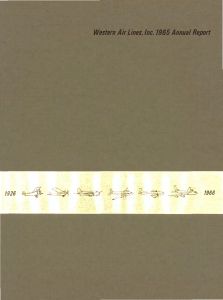
Our cover Rcprciwnting the progress that has been made in airline snvicc during WcstC'rn\ ,lQ years of operation arc six :1ircraft that play<d im-
portant roles in the cotnpany's growl h: the Douglas M-2, Fokker F-10, Douglas DC-3, Douglas DC-GB, Lockheed Ekctra, and Boeing 720B fanjet.
OPERATING
Seat miles produced
Seat miles sold
Passengers carried .
Passenger load factor - actual %
- breakeven point %
FINANCIAL
Total operating revenues
Operating income .
Net earnings .
Cash dividends paid .
Common stock outstanding
Earnings per share
Cash dividends per share .
Total shareholders' equity .
Shareholders' equity per share
Cash and short-term securities
Working capital
Properties and equipment at cost .
Long-term debt .
Number of employees at year end
Wages and salaries paid
* Increased to an annual rate of $1 .00 in 1966.
Highlights of 1965
1965 1964
3,616,702,000 3,388,541,000
2,045,158,000 1,964,512,000
3,574,793 3,532,978
56.5 58.0
46.3 44.6
$123,599,314 $117,644,586
$ 22,991,955 $ 26,898,495
$ 12,130,688 $ 13,351,027
$ 3,433,752 $ 2,789,923
4,292,190 4,292,190
$ 2.83 $ 3.11
$ 0.80* $ 0.65
$ 62,710,025 $ 54,013,089
$ 14.61 $ 12.58
$ 14,731,294 $ 22,421,395
$ 11,502,712 $ 8,826,579
$171,541,844 $142,382,008
$ 41 ,640,000 $ 26,970,000
4,420 4,092
$ 32,902,116 $ 29,039,955
President's Letter 3
Year in Review 5
Ten Years of Growth 18
Balance heet 2 0
Earnings and Retained Earnings 2 2
Sourc and Application of Funds 23
Notes to Financial tat ments 24
Accountants' R port 24
1
To Shareholders, Employees, Customers and Friends:
Pictured on the ad joining page is Mrs. Maude
Campbell of Los Angeles. In June 1926, she bor-
rowed a flying suit, helmet and goggles and, with
the help of a ladder, climbed into the open cockpit
. of Western's first airplane for a flight from Salt
Lake City to Los Angeles and became the first
woman passenger to fly on Western. Still a Western
customer after almost four decades, she is typical of
the loyal WAL passengers to whom we owe a debt
of gratitude.
Inserted in the inside back cover of this report
is a booklet which describes other important
"firsts" in the history of the company. It was writ-
ten by Bill Henry, leading Los Angeles Times col-
umnist, who was one of the driving forces behind
the formation of Western and one of its original
stockholders.
As Western nears the completion of 40 years
of service, which will be celebrated on April 1 7, all
of us who are now associated with the company-
its officers, directors and employees - do so with a
sincere appreciation for the contributions to air
transportation that were made by the Maude
Campbells, Bill Henrys and countless thousands of
other passengers, investors and employees who sus-
tained the growth of a struggling infant through
its most difficult days.
Western's 40th year of operation was a suc-
cessful one in which the company had excellent
earnings, achieved record revenues and carried
more passengers than ever before.
As forecast in the 1964 report to shareholders,
1965 was a year of transition in which the com-
pany increased the size of its jet fleet substantially,
retired a majority of its piston planes, expanded its
maintenance facilities and improved many of its
terminal, ticket office, reservations and other pas-
senger service areas.
These changes, while vital to the long-range
growth and future performance of the airline, pro-
duced only a small increase in seat mile produc-
tion. At the same time, Western faced intensified
competition on some of its most heavily traveled
routes. As a result, our earnings did not match
those of 1964, an unusually good year in which
Western led the airline industry by almost every
yardstick of performance.
We are optimistic about the future. The com-
pany is financially strong and well-equipped. Its
route system has been strengthened by the addition
of Acapulco, Yellowstone Park and additional
flights to Mexico City. During the year, we vigor-
ously pursued route applications which we hope
will provide expansion of the company's system in
the near future.
In the first half of 1966, we will increase our
seat mile production by 15 percent over the same
period of 1965 and offer to the traveling public the
finest product available in air travel today. We
believe it will be a good year for Western.
Your continued support and patronage will
assist us in making it so.
\.a..-,..fQ <:.
~
PRESIDENT
February 28, 1966
3
Passenger boardings on Western fiights fiuctuate
... by the month of the year
4
... and by the day of the week
Earnings
Western Air Lines earned $12,130,688, or $2.83 a
share, in 1965, second highest earnings in the com-
pany's 40-year history. It was the 17th consecutive
year in which the airline has reported a profit.
This compares with profits of $13,351,027,
or $3.11 a share, in 1964.
Per-share earnings for both years are based on
the 4,292,190 shares of stock outstanding.
The 1965 earnings were realized mainly from
operations, totaling $11,247,272, or $2.62 per
share. Gain on disposition of property produced
$883,416, or 21 cents a share.
Operating income totaled $22,991,955, equal
to 18.6 percent of operating revenues, compared to
$26,898,495, or 22.9 percent of revenues, in 1964.
Earnings from operations before taxes were
$21,147,272, or $4.93 a share. Provision for taxes
on income, both current and deferred, totaled
$9,900,000, or $2.31 a share.
As disclosed previously, Western has elected to
amortize the investment credits to earnings over a
period corresponding to the productive life of the
related property. Included in 1965 earnings was
Western's Income & Outgo
81.8% from coach passenger services
10.9% from deluxe passenger services -
3.0% from express, freight and rxcess baggage
1.4% from mail
2.9% from all other sources, including property gains
The Year in Review
$580,000 arising from the investment credit.
Deferred for credit to future years has been an
additional $4,337,000, which is $1,548,000 in
excess of the amount deferred at the close of 1964.
Much discussion in financial circles has been
directed toward the rate of return on investment
being earned by the airline industry. Because air-
line earnings improved significantly during 1965,
much of the discussion has centered on possible
action the Civil Aeronautics Board might take to
hold down airline earnings through fare reductions
or other action. Western remains hopeful that the
CAB will evaluate the industry's earnings position
over a period of time and with an awareness of the
industry's continuing need for investment capital
rather than take a short-range or "keyhole" view of
the industry's financial position.
Western's rate of return for 1965 approxi-
mated 14.9 percent exclusive of the earnings flow-
ing from the investment credit, compared with
18.7 percent for 1964. (The investment credit is
excludable for rate purposes in accordance with
the related law which created the provision.)
28.7% for wages, salaries and employee benefits
10.0% for local, state and federal taxes
I 0. 1 % for aircraft fuels
10.8% for depreciation
9.4% for materials and repairs
6.9% for retained earnings
2. 7% for cash dividends
21.4% for all other expenses
5
Dividends
For the 15th consecutive year, shareholders of
Western Air Lines received cash dividends in 1965.
Quarterly dividends of 20 cents a share were paid
on March 1, May 31, August 16, and November
29 for a total payment of 80 cents a share.
At the first regular board meeting of 1966,
held in San Francisco on January 31, the quarterly
dividend rate was increased to 25 cents a share ( or
$1 a year) effective with the dividend payable on
March 7 to stockholders of record on February 16.
Annual Meeting
The 1966 meeting of shareholders will be held at
the Beverly Hilton Hotel, Beverly Hills, on April
28. On or about March 18, stockholders will
receive a formal notice of the meeting and proxy
material.
Revenues
Operating revenues for 1965 established a record
high for the company, totaling $123,599,314, com-
pared to $117,644,586 in 1964.
The 5.1 percent increase during 1965 was
below the growth rate experienced in recent years
largely for two reasons: intensified competition
along the Pacific Coast and lower than usual
increases in seat mile production.
In both cases, the effect was more pronounced
in the first quarter of the year. During that period,
seat mile production increased only 2.3 percent as
the company began to withdraw from service a
number of its piston-powered DC-6B's which were
scheduled for retirement and which could not com-
pete favorably with jet aircraft flying the same
routes at reduced fares.
As the company added six new Boeing 720B
fanjets to its schedule pattern and phased out a
number of DC-6B piston planes, seat mile produc-
tion grew- from the 2.3 percent increase in the
first quarter to five percent for the second quarter,
6
9.1 percent for the third quarter and 10.l in the
fourth quarter for an overall increase of 6. 7 percent
for the year.
Seat miles sold, 2.6 percent below 1964 in the
first quarter of 1965, were up 2.8 percent in the
second quarter, 5.3 percent in the third quarter
and 10.4 percent in the fourth quarter for an over-
all increase of 4.1 percent for the year.
Although the yield per seat mile sold declined
slightly on most of the company's routes because of
the increased number of promotional fares, the
substitution of Boeing 720B Fanjet Commuter
fares for the lower DC-6B Thriftair fares on Los
Angeles-San Francisco/Oakland and Los Angeles-
Las Vegas routes resulted in an overall systemwide
increase in yield from 5.67 cents in 1964 to 5. 71
cents in 1965.
Of Western's income dollar, 92. 7 percent was
derived from passenger traffic ( 81.8 percent from
coach and 10.9 percent from deluxe). Express,
freight and excess baggage accounted for 3 per-
cent, mail for 1.4 percent and all other sources for
2. 9 percent.
Expenses
Total operating expenses for 1965 amounted to
$100,607,359, up 10.9 percent over 1964. Costs
other than depreciation were up 10.1 percent and
depreciation increased 16 percent.
The increase in depreciation costs during the
year from $11,718,062 to $13,596,263, was
incurred largely through the addition of six Boeing
720B fanjets, allied ground equipment and
machinery installed in the company's new jet over-
haul shops and expanded main maintenance base
at Los Angeles.
The increase in expenses other than deprecia-
tion resulted from the costs incurred in the produc-
tion of additional seat miles, introduction of jet
engine overhaul facilities and from the continuing
upward spiral of labor, materials, services, airport
landing fees and terminal rentals, and local taxes.
The cost of seat miles produced increased dur-
ing the year, from 2.68 cents per mile in 1964 to
2.78 cents in 1965.
The breakeven load factor ( percentage of
seats produced which must be sold to produce a
breakeven of expenses and income ) increased
from 44.6 percent in 1964 to 46.3 percent in 1965.
Finances
Western closed the year 1965 in strong financial
condition. Current assets at year end were equiva-
lent to $1.70 for every $1 of current liabilities, com-
pared to a ratio of $1.35 to $1 at the end of 1964.
1964
11ES
Pauengers
Coach .. $10tM8,440 $ 97,885,129
Del~. 18,716,879 13,546,912
116,565.319 111,432,041
~.fteigltt-Ud
baggage . ~8,555 3,718,470
Mail . ...... 1,730,084 1,560,611
Other
. . . 1,877,533 1,786,920
-Gain on
1,693,416
125 .. 674,907 118,498,042
. 29,039,955
QIU
.
Jan, 2,87!,590
. . ., . . 14,412,402
Aircraft fuels . . . . 11,916,95"5
Depreciatiqn and
amortizath>n
.... 11,718,062
Materials ~ repairs 11,410040
Utilities anti &,sog,793
Service to p.- 4,023,212
l.entals ind lancl
fees .... 3,599,210 3,313,110
Advertising and 3,741,207 3,243,993
Insurance . .
>"
2,490,247 2,121,579
Interest
. . . 2,105,096 1,946,968
Other costs . . 2,292,057 2,025,356
113,544,219 105 147 015
&T,M&NDCCS $ 12,130,688 $ 18,351,027
Scat Miles Produced Passenger Revenues
by Aircraft 1jpe by Class of Service
millions of dollars
in billions
120
100
80
-
60
electra 40
pTsiori" 20
'61 '62 '63 '64 '65 '61 '62 '63 '64 '65
Deluxe Coach
7
In order to provide the additional funds
required for the acquisition of aircraft and equip-
ment ordered during the year, Western, late in
1965, negotiated a new agreement with the bank
and insurance companies to whom the company
owed $41,640,000 at December 31, 1965.
The new credit agreements will consolidate
the outstanding loans into the new agreements, and
provide for a $55,000,000 aggregate line of credit
which will permit Western to borrow an addi-
tional $13,360,000 as required. The bank portion
of the credit, which amounts to $25,000,000, is in
the form of a revolving fund credit until March 31,
1969. During this period, the interest rate on the
revolving credit is percent in excess of the prime
commercial rate but in no event to be less than
4 percent or more than 5 percent. On March
31, 1969, the balance then owing to the bank will
become a term loan repayable over a five-year
period with an interest rate of 5 percent.
The new credit agreements with the insurance
companies provide for $30,000,000 of long-term
funds repayable between 1970 and 1980 and car-
rying an interest rate of 5 percent. The terms of
these credit agreements are explained in more
detail in Footnote 2 of the Notes to the Financial
Statements.
The additional funds provided by the new
credit agreements, plus anticipated internal funds
to be generated, will, in the opinion of the com-
pany, provide adequate financing for all aircraft
and equipment now on order.
The removal of the provisions for current
payments of the long-term debt is a prime reason
for the increase in working capital from $8,826,579
to $11,502,712 at the close of 1965. The State-
ment of Source and Application of Funds for 1965
( with comparative figures for 1964) further
explains both the sources of $45,410,523 in funds
and the usage thereof totaling $42,734,390.
Cash and short-term securities declined from
$22,421,395 at the end of 1964 to $14,731,294 at
December 31, 1965, and total current a sets
8
Below: Pilots in ground school typify increasing em/Jhasis
Western places on training of employees.
9
decreased from $34,146,311 to $27,987,436 at the
close of 1965. These decreases were accomplished
by the revisions made to the loan agreements dur-
ing 1965 and 1966 to permit the company to lower
both working capital and the related level of long-
term debt.
Shareholders and Stock
At the close of 1965, there were 4,292,190 shares
of Western Air Lines common stock issued and
outstanding.
The stock was held by approximately 20,000
stockholders residing in each of the 50 states and
several foreign countries, almost triple the number
who held stock prior to the May 1964 three-for-
one stock split.
At the 1965 annual meeting of shareholders
held in Los Angeles in April, 91.8 percent of all
shares were voted in person or by proxy.
Shareholders' equity in 1965 increased to a
record $62,710,025, or $14.61 a share, compared
to 1964 equity of $54,013,089, or $12.58 a share.
In April, the symbol for Western's stock was
changed from "WSX" to "WAL" on the New York
and Pacific Coast stock exchanges.
Equipment
Western moved closer to an all-jet fleet during
1965, taking delivery on six Boeing 720B fanjets
and ordering for future delivery additional 720B's
and a fleet of new twin-jet Boeing 737s.
Delivery of the 720B's during 1965 (January,
March, May, June [2] and July) increased the
company's fleet of the four-engine jets to 18.
Addition of four others in 1966 will increase
the fleet to 22 720B's by July and permit the com-
pany to complete the phase-out of its Douglas
DC-6B piston planes in the latter part of the year.
After long and careful study, Western ordered
as the eventual succes or to its Electras a fleet of 16
short-range Boeing 737s for delivery in 1968 and
1969 and took options for nine additional 73 7 .
10
Below: W AL's all-jet fleet of the future will include short-
range Boeing 737, ordered in 1965.
WE STER
----
11
Below: Modern jets and traditional mariachis make
Acapulco popular addition to WAL system.
To facilitate training for the twin-jet fleet, the
company also ordered for delivery in 1967 a 737
simulator which will electronically duplicate the
actual airplane in a ground trainer and permit
company pilots to be trained on the new Boeing
plane even before the first aircraft is delivered.
Early in 1966, the company ordered two
additional 720B's and obtained an option for two
more, all for delivery in 1967.
During 1965, the company sold eight
DC-6B's and leased one and, at year's end, oper-
ated 18 Boeing 720B's, 12 Lockheed Electra prop-
jets and five DC-6B's.
Facilities
In addition to completing the move into its new
headquarters and expanded main maintenance
base at Los Angeles International Airport, Western
continued to improve and expand its passenger
and cargo service facilities at a number of points
on the system during 1965 and participated in the
planning of airport terminal improvement for the
future at other locations.
To provide improved reservations services in
the company's No. 1 traffic-generating city, Los
Angeles reservations offices were moved from their
downtown location to the refurbished building
which formerly housed company headquarters.
At Denver, the company moved its arrival
and departure activities to a new concourse which
provides all-weather passenger loading bridges and
comfortable waiting areas. A new main terminal
building is scheduled for completion in April.
Passenger loading bridges were completed at
Portland and increased at Los Angeles and Seattle;
construction was begun on a new Western board-
ing facility at San Francisco, new terminals at Aca-
pulco, Palm Springs, Sacramento and San Diego,
additional aircraft gate positions at Phoenix and
loading bridges at Minneapolis/St. Paul.
Below: "Fanjet Commuter" service) introduced in 1965)
offers four-engine jets at low fares.
Sales and Service
The best on-time record in the domestic airline
industry, improvements in the product for the
comfort and convenience of the business traveler
and continued development of tour packages and
low-cost services to stimulate greater vacation and
pleasure travel were the goals and accomplishments
of Western's 1965 marketing program.
Western's excellent on-time record proved to
14
be a valuable sales tool throughout the year.
According to figures supplied to the Civil Aeronau-
tics Board by domestic airlines for the top passen-
ger markets of the U.S., Western moved into the
No. 1 on-time position in February and through
November (latest figures available) led the indus-
try for the year.
Western boarded 3,574,793 passengers during
the year, greatest number in company history.
Passenger revenues also established a new record of
$116,565,319, compared to $111,432,041 in 1964,
the previous high.
Although remaining among the highest in the
industry, the company's overall load factor
decreased from 58 percent in 1964 to 56.5 percent
in 1965.
Revenues from air cargo shipments ( freight,
express, excess baggage, air mail and regular first
class mail) increased to $5,538,639 for 1965 from
$5,279,081 in 1964.
The Civil Aeronautics Board established a
new mail rate effective June 19, 1965, which
reduced the rate of compensation for all the domes-
tic trunklines, including Western. The line haul
charge was reduced from 30.1 7 cents per mail ton
mile to 27.15 cents per mail ton mile. This reduc-
tion results in a decrease in the total rate of mail
compensation for Western of approximately 7.4
percent. However, revenues from mail increased
from $1,560,611 in 1964 to $1,730,084 in 1965.
At the same time, the CAB instituted an inves-
tigation to determine the proper rate of compensa-
tion to be paid beginning January 1, 1967, either
on the same basis now in effect, or on the basis of
a new priority mail plan to be formulated by the
Post Office Department for the consolidation of
air mail and first class mail into a single class of
priority mail to be moved by whatever transporta-
tion means are most appropriate to attain overnight
delivery of 95 percent of all priority mail.
Highlighting Western's campaign to obtain a
larger share of the huge business travel market,
which continues to represent the major share of all
air travel, was the inauguration on April 1 of
Western's "Fan jet Commuter" service between Los
Angeles and San Francisco / Oakland. Operated
with 720B fanjets at a fare of $13.50 - lowest per-
mile jet fare in the U.S. - the service wa extended
into the plea ure travel field in July when it was
established on the Los Angeles-Las Vegas and Las
Vegas-San Francisco routes, providing a "triangle"
of low fare jet commuter services between the
three cities.
Speeded-up baggage handling, improved
reservations service and continued emphasis on
streamlined ticketing procedures also were stressed
for the convenience of the air traveler.
In order to provide even greater speed and
accuracy in handling its rapidly growi~g number
of passenger reservations, Western has ordered for
introduction in 1968 an electronic reservations and
communications system which will use IBM's most
advanced computing equipment. Using television-
like devices at ticket counters and reservations
offices throughout the system, more than 500
agents at a time will be able to "talk" with the com-
puters to obtain all information pertinent to a pas-
senger's travel plans. Capable of storing more than
300 million characters of information and of dis-
playing information on the agent set screens at a
rate of more than 3,000 words per minute, the sys-
tem will provide a new dimension in service to
Western's passengers. The computer also will be
used for electronic switching of messages from point
to point on the company's route system and for
processing payrolls, accounting reports, mainte-
nance records and other data needed for manage-
ment decisions.
Two of the most famous vacation areas on the
North American continent- Yellowstone Park and
Acapulco, Mexico- were added to the company's
route system during the year.
Western resumed flights to Yellowstone in
June after a 17-year absence, upon completion of a
new airport. Working with tour operators, travel
agents and other airlines throughout the U.S., the
company made Yellowstone a focal point of its
major summertime promotion, "North Country
Adventure ~' which annually promotes vacation
travel to the Pacific Northwe t, Canada, Alaska,
Montana, W yomin g, South Dakota and
Minnesota.
Already boasting some of the finest winter
15
resort areas in the West, the company added still
another in Acapulco, the sun-and-sea resort on the
west coast of Mexico. Twelve special weekend
flights were operated between Los Angeles and
Acapulco in December and regular daily service
was inaugurated to Acapulco in the first month of
the new year. Also added to Western's Mexico serv-
ice for 1966 was an additional daily nonstop flight
between Los Angeles and Mexico City, resulting in
an overall increase of 50 percent in Mexico service,
from 14 flights a week to 21 flights a week.
Many of the factors which have contributed
to Western's growth in the past again received
emphasis during 1965: Cooperation with travel
agents, who produced approximately 38 percent of
the company's passenger revenues, through educa-
tional seminars, familiarization trips and the mar-
keting of numerous tour packages; expansion of
the use of non-airline credit cards, which Western
pioneered among airlines in 1959; increased atten-
tion to group travel and convention sales, which
increased 20 percent during the year; and
expanded sales effort in military and government
travel, which increased 27 percent on WAL's sys-
tem during the year.
Promotion of winter vacation travel, which
has contributed to the growth of traffic to "Sun
Country" resorts, continues to be Western's largest
single advertising and sales campaign of the year.
Highlighting the 1965 program was the prepara-
tion and distribution of a full-color, eight-page Sun-
day newspaper supplement- first of its kind to be
used to develop travel in the West-which
described to more than four million subscribers in
northern cities the many attractions of "Sunbreak"
areas on the company system.
Western also joined with government and
resort organizations in Utah to promote new fam-
ily skiing centers in that state. In 1966, these efforts
are being expanded to include other popular win-
ter sports areas on the company's system, including
those in Colorado, California, Nevada, Montana,
16
South Dakota, Idaho, the Pacific Northwest and
Canada.
Route Development
On February 7, 1966, the company received the
disappointing news that the U.S. Court of Appeals
for the District of Columbia had affirmed an order
by the Civil Aeronautics Board, issued on Decem-
ber 14, 1965, denying Western's application to
serve Hawaii.
On three separate occasions during 1965 the
Court had returned to the CAB its decisions on
Western's application for California-Hawaii route
authority and right up until the Court's final deci-
sion in February 1966 the company had remained
hopeful that the Hawaii route that was first given
to Western in December 1960 would finally be
implemented by a favorable court decision.
As a result of this final verdict, the company
has filed a new application for service to Hawaii
and beyond to the Orient for inclusion in the new
route proceeding that will be held to again review
the air service needs of the vast Pacific area.
Extensive hearings were held in 1965 in the
Pacific Northwest-Southwest Service Investigation,
an examination of the need for new and improved
air service from the Pacific Northwest, through
Utah and Colorado, to the Texas-Oklahoma-
Louisiana area and the Kansas-Missouri area. In
addition to Western, nine domestic trunklines and
several local service carriers are seeking authority
to serve these routes.
The Bureau of Operating Rights, a part of the
CAB's staff, recommended to the CAB that it
grant Western authority to provide service between
Salt Lake City and Denver, on the one hand, and
Dallas, Fort Worth, Houston, and San Antonio,
on the other hand. This would permit Western to
link these major Texas cities with the Northern
Rocky Mountain area, including Colorado, Utah,
Wyoming, Idaho, Montana, and Alberta, Canada.
Western is the only applicant in the proceeding that
could provide this service, of particular benefit to
the oil industry - an important segment of the
Southwest and the Northern Rocky Mountain area
economy. Briefs to the Examiner were filed Decem-
ber 20, and in addition to the Texas-Utah, Colo-
rado, Wyoming, Idaho, Montana, Alberta, Can-
ada area, Western is pressing for the routes to the
Pacific Northwest which the BOR recommended
for two of the other trunkline applicants. An exam-
iner's decision is expected in the spring of 1966,
with a CAB decision by the end of 1966.
In 1965, the United States Government con-
cluded negotiations with Mexico and Canada
which provide for new air service by U.S. carriers
to those countries. The Air Transport Agreement
between the United States and Mexico was
extended to June 30, 1970, and Acapulco was
added to Western's Los Angeles-San Diego-Mexico
City route. The Civil Aeronautics Board granted
Western an interim exemption to serve Acapulco
as a co-terminal with Mexico City pending com-
pletion of a normal certificate proceeding in 1966.
The new Air Transport Agreement between
the United States and Canada authorizes for U.S.
carriers, among other things, several routes of inter-
est to Western, including a Los Angeles/San Fran-
cisco-Vancouver route and a Los Angeles-Toronto
route. Western and several other carriers are appli-
cants for this new authority. In addition, the new
Canadian bilateral agreement establishes Denver
as a co-terminal with Great Falls on Western's pres-
ent Calgary route. Hearings on applications for the
new U.S.-Canada routes will be held in 1966.
Personnel
Ten years ago, when Western operated only pi ton
aircraft and carried fewer than a million passen-
gers a year, the company employed 69 men and
women for each airplane it flew. Average annual
salary per employee was $5,500 and the company's
total assets were equivalent to $11,000 per
employee.
In 1965, Western provided jobs for 126
employees for each airplane in its fleet; wages and
salaries totaled $32,902,116, an average of $7,700.
There were 4,420 employees on the employment
roster as of December 31, and Western's assets were
equal to $32,200 per employee.
Western is justifiably proud of the contribu-
tions its employees, among the most experienced in
the airline industry, have made to the development
of air transportation. Their ability to comprehend
and put to practical use the increasingly complex
technologies of the Jet Age has produced an
upsurge of public and investor confidence that is
unmatched in the history of the industry.
Eighty-nine percent of Western's employees
are represented by five labor unions. Contracts
were signed during the year with the pilots and dis-
patchers. Agreements which cover the company's
mechanics, stewardesses and clerks will be open for
negotiation in 1966.
Six Western vice presidents were elevated to
the newly created position of senior vice president
and eight assistant vice presidents elected vice presi-
dent by the company's board of directors.
The new senior vice presidents are Stanley R.
Shatto, operations; Marvin W Landes, service;
Arthur F Kelly, sales; J. Judson Taylor, treasury;
Dominic P. Renda, legal; and G. G. Brooder.
Elevated to vice presidents were Richard B.
Ault, engineering; Harold W Caward, flight opera-
tions; Charles J. J. Cox, controller; Richard P.
Ensign, in-flight services; Anton B. Favero, main-
tenance; Bert D. Lynn, advertising and sales pro-
motion; Philip E. Peirce, ground services; and
Terrell S. Shrader, industrial relations.
Elected assistant vice presidents were Charles
S. Fisher, flight chedule ; James L. Mitchell,
research; and Peter P. Wolf, communications.
Eugene D. 01 on, former assistant controller, was
elected assi tant trea urer.
17
Ten Years of Growth
1965 1964 1963 1962 1961* 1960 1959 1958* 1957 1956*
Financial Revenues: **
Passenger . $ 116,565 111,432 93,913 81,170 59,737 64,356 59,194 31,459 39,243 26,249
Express, freight and excess baggage . 3,808 3,718 3,248 2,964 2,271 2,473 2,256 1,305 1,596 954
Mail 1,730 1,561 1,320 1,427 1,231 1,393 1,295 732 1,067 775
Other 1,496 934 946 809 1,013 855 508 474 313 210
Total Revenues 123,599 117,645 99,427 86,370 64,252 69,077 63,253 33,970 42,219 28,188
Operating Expenses:**
13,596
Depreciation and amortization . 11,718 9,762 11,895 11,211 10,000 6,643 4,136 3,01 I 2,294
Payroll . 32,902 29,040 24,749 21,840 17,987 19,478 17,704 11,947 14,335 10,283
Other 54,109 49,988 43,598 41,254 32,864 33,323 27,696 16,831 20,076 13,009
Total Operating Expenses . 100,607 90,746 78,109 74,989 62,062 62,801 52,043 32,914 37,422 25,586
Operating Income** 22,992 26,899 21,318 11,381 2,190 6,276 11,210 1,056 4,797 2,602
Interest** (2,105) (1,947) (2,322) (2,286) (1,889) (1,330) (1,127) (1,023) (780) (394)
Other Income and Expenses-Net** 260 799 621 483 ( 119) 438 180 74 . 90 31
21,147 25,751 19,617 9,578 182 5,384 10,263 107 4,107 2,239
Provision for Taxes on Income** . 9,900 12,400 9,800 4,875 125 3,050 5,456 227 2,233 1,205
Net Earnings from Operations** 11,247 13,351 9,817 4,703 57 2,334 4,807 ( 120) 1,874 1,034
Extraordinary Items (Less Applicable Income Taxes):**
Gain on disposition of property 883 191 889 807 105 210 1,522 528 2,010
Write-down of aircraft (583) (578 )
Net Earnings** $ 12,130 13,351 9,425 5,014 864 2,439 5,017 1,402 2,402 3,044
--- - - - - - - - -
Shareholders Net earnings from operations per sharet . $ 2.62 3.11 2.29 1.10 0.01 0.54 1.47 (0.04) 0.65 0.38
Extraordinary items per sharet . 0.21 (0.09) 0.07 0.19 0.03 0.06 0.50 0.18 0.73
Total. $ 2.83 3.11 2.20 1.17 0.20 0.57 1.53 0.46 0.83 1.11
Dividends paid per share:
--- --
Casht $ 0.80t 0.65 0.37 0.33 0.33 0.33 0.27 0.24 0.23 0.22
Stock 5% 4% 4% 4% 4%
Shares outstanding-actual** 4,292 4,292 1,431 1,431 1,431 1,431 1,041 928 849 779
- adjusted**t . 4,292 4,292 4,292 4,292 4,292 4,292 3,273 3,034 2,886 2,751
Shareholders' equity- total** $ 62,710 54,013 43,452 35,601 32,017 32,584 24,545 18,996 17,469 14,991
Shareholders' equity- a sharet 14.61 12.58 10.12 8.29 7.46 7.59 7.50 6.26 6.05 5.45
Working capital** $ 11,503 8,827 6,580 12,364 5,505 16,841 11,518 5,320 4,688 4,600
Long-term debt** 41,640 26,970 32,940 39,488 36,097 24,790 25,272 19,748 16,827 9,677
Properties and equipment - net** . 107,803 79,953 71,162 62,859 58,493 33,302 37,546 31,035 24,652 17,216
Total assets** . 142,324 124,172 111,202 98,830 85,697 72,433 67,223 49,596 44,017 32,075
Operations Route miles at end of year . 9,687 9,474 9,474 9,545 8,827 8,827 8,827 9,153 8,799 6,350
Airplanes at end of year:
Boeing 720-B 18 12 10 7 4
Boeing 707 - leased . 2 2
Lockheed Electra II 12 12 12 12 12 6 5
Douglas DC-6B 5 14 14 16 19 27 27 27 21 14
Other aircraft- piston powered 4 5 8 14 16
Airplane miles flown** 32,343 32,442 29,035 25,262 20,624 25,996 25,689 16,449 21,986 14,851
Ton miles produced** 434,881 401,999 352,038 307,570 224,819 207,554 196,178 123,416 137,640 86,196
Ton miles sold** . 212,818 203,539 168,002 137,492 101,232 109,316 103, 74 l 56,710 74,468 48,481
Scat miles produced** 3,616,702 3,388,541 2,929,673 2,402,344 1,718,854 1,776,076 1,623,007 981,740 1,175,071 740,174
Seat miles sold** 2,045,158 1,964,512 1,615,189 1,307,173 957,560 1,034,481 982,010 533,443 702,727 458,131
Expre s, freight & mail ton miles old** 16,099 14,136 12,291 11,574 8,987 9,538 8,899 5,309 7,118 4,667
Pas engers carried 3,574,793 3,532,978 2,812,640 2,128,225 1,529,137 1,721,619 1,689,278 970,498 1,379,653 928,746
Express, freight & mail tons carried . 21 ,898
18,992 16,250 16,037 12,364 13,354 12,792 8,010 11,537 8,200
Passenger load factor - actual % 56.5
58.0 55.1 54.4 55.7 58.2 60.5 54.3 59.8 61.9
- breakeven point % 46.3
44.6 43.6 48.0 55.5 53.3 50.0 54.1 53.5 56.G
Averag length in miles per passrngrr trip 572 556 574 614 626 601 581 550 509 493
Average revenue per pass<'nger mile . $ .0571
.0567 .0582 .0623 .0632 .0626 .0605 .0595 .0558 .0573
Employees at end of year 4,420 4,092 3,513 3,078 2,794 2,730 2,962 2,547 2,773 2,343
18 tBased on shares outstanding at close of respective periods adjusted to give
19
retroactive cff ect to stock dividends and to the May 1964 three-for-one stock split.
*Operations were adversely affected by strike. **000 omitted.
:j:In reased to an annual rate of$ 1.00 in 1966.
Western Air Lines Inc. Balance Sheet
Assets
CURRENT ASSETS:
Cash ....
Short-term securities ( approximating market)
Receivables:
Traffic balances ( net of allowance for
doubtful accounts $125,000)
U.S. and State Government Departments
Other . . . . . . . . . . . . . .
Expendable parts and supplies .
Prepaid expenses . . . .
TOTAL CURRENT ASSETS .
Deposits on equipment purchase contracts (Note 3)
Properties and equipment at cost:
Flight equipment . . . . . .
Buildings on and improvements to leased property . .
Other property and equipment ( including construction
in progress) . . . . . . . . . . . . . .
Less allowance for depreciation and maintenance
Def erred charges and other assets . . . . . . . . . . . .
See accompanying notes to financial statements
20
December 31
1965
$ 3,226,341
11,504,953
7,568,715
1,094,514
164,662
8,827,891
2,641,137
1,787,114
27,987,436
5,923,190
145,650,100
10,857,005
15,034,739
171,541,844
63,738,444
107,803,400
609,723
$142,323,749
December 31
1964
$ 4,338,795
18,082,600
7,466,941
876,649
673,448
9,017,038
1,687,777
1,020,101
34,146,311
9,673,244
119,191,490
4,736,322
18,454,196
142,382,008
62,428,561
79,953,447
398,819
$124,171,821
Liabilities
CURRENT LIABILITIES :
Accounts payable .
Accrued salaries and wages
Other accrued liabilities
Air travel plan deposits . .
Unused transportation . .
Federal taxes on income (Note I) .
Current maturities of long-term debt
TOTAL CURRENT LIABILITIES . . .
Long-term debt (Note 2) . . . . . . .
Deferred federal taxes on income (Note 1 )
Deferred investment credits (Note 1) . .
SHAREHOLDERS' EQUITY (Notes 2 and 5):
Common stock-$1.00 par value per share
Authorized 10,000,000 shares
Issued 4,292,190 shares .
Capital in excess of par value
Retained earnings . . . . .
$
December 31
1965
7,074,014
3,075,472
2,034,713
281,775
1,945,166
2,073,584
16,484,724
41,640,000
17,152,000
4,337,000
4,292,190
16,500,126
41,917,709
62,710,025
$142,323,749
$
December 31
1964
7,006,248
2,642,393
1,646,482
293,675
1,940,163
5,820,771
5,970,000
25,319,732
26,970,000
15,080,000
2,789,000
4,292,190
16,500,126
33,220,773
54,013,089
$124,171,821
21
Western Air lines Inc. Statement of Earnings and Retained Earnings
OPERATING REVENUES:
Passenger . . . . . . . . . . .
Express, freight and excess baggage .
Charter and other transport service
Mail . . . . . . . .
Incidental revenue - net . . . .
OPERATING EXPENSES:
Flying operations
Maintenance . . .
Passenger service .
Aircraft and traffic servicing .
Promotion and sales . . . .
General and administrative .
Depreciation and amortization (Note 6)
Operating Income . . .
OTHER INCOME ( EXPENSES) :
Interest expense . .
Interest income . . . . .
Other expense - net . . .
Earnings before Taxes on Income .
PROVISION FOR TAXES ON INCOME (Note I)
NET EARNINGS FROM OPERATIONS .
GAIN ON DISPOSITION OF PROPERTY ( Less
Applicable Income Taxes)
NET EARNINGS . . . . . . . .
RETAINED EARNINGS AT BEGINNING OF YEAR .
CASH DIVIDENDS PAID
$0.80 per share in 1965 and $0.65 in 1964 .
RETAINED EARNINGS AT END OF YEAR (Note 2)
See accompanying notes to financial statements
22
December 31
1965
$116,565,319
3,808,555
579,589
1,730,084
915,767
123,599,314
24,368,243
17,701,842
8,809,333
16,055,632
14,942,638
5,133,408
13,596,263
100,607,359
22,991,955
(2,105,096 )
382,177
(121,764)
21,147,272
9,900,000
11,247,272
883,416
12,130,688
33,220,773
45,351,461
3,433,752
$ 41,917,709
December 31
1964
$111,432,041
3,718,470
152,190
1,560,611
781,274
117,644,586
22,957,569
16,301,799
7,835,866
14,245,901
13,086,494
4,600,400
11,718,062
90,746,091
26,898,495
(1,946,968)
853,456
(53,956 )
25,751,027
12,400,000
13,351,027
13,351,027
22,659,669
36,010,696
2,789,923
$ 33,220,773
Western Air lines Inc. Statement of Source and Application of Funds
FUNDS PROVIDED:
Net earnings . . . . . . . . . . .
Less gain on disposition of property .
Net earnings from operations . . . .
Add back
Depreciation and maintenance reserve provision .
Deferred income taxes . . . . . . .
Charge equivalent to investment credit .
Total from operations
Increase in long-term debt . . .
Proceeds from disposition of property, net of taxes
Flight equipment lease/sale contracts
Total
FUNDS APPLIED:
Purchase of airplanes and other property, buildings
and equipment . . . .
Payment of cash dividends .
Reduction of long-term debt .
Other items . . . . . . .
Increase in working capital
Total . . . .
December 31
1965
$12,130,688
883,416
11,247,272
13,979,818
2,072,000
1,548,000
28,847,090
14,670,000
1,893,433
16,563,433
45,410,523
39,223,742
3,433,752
76,896
42,734,390
2,676,133
$45,410,523
December 31
1964
$13,351,027
13,351,027
12,326,276
3,040,000
1,826,000
30,543,303
88,617
182,509
271,126
30,814,429
19,798,803
2,789,923
5,970,000
9,572
28,568,298
2,246,131
$30,814,429
23
Notes to Financial Statements
Note 1. Taxes on Income. Federal income tax returns have
been examined by the U. S. Treasury Department through
1963. The 1965 provision for income taxes is summarized
as follows:
Charged to Operations:
Current income taxes ... .. . ........... $ 6,280,000
Def erred income taxes ............... .
Charge equivalent to investment credits,
net of amortization of $580,000 ...... .
Applicable to Gain on Disposition
of Property ...... ... .. . .... . .. ..... .
2,072,000
1,548,000
9,900,000'
810,000
-----
$10,710,000
Investment credits are being amortized to income over the
lives of the related equipment.
Note 2. Long-Term Debt (Unsecured). On December 31, 1965,
long-term notes payable of $20,970,000 to a bank and
$20,670,000 to insurance companies were outstanding. New
loan agreements signed in January 1966 provide for the
exchange of these notes for new notes and will permit addi-
tional borrowings of $13,360,000 as required. The aggregate
loans ( including amounts not yet borrowed) are summarized
as follows:
Bank Loans:
$25,000.000 in a revolving fund credit until March
31, 1969 at interest not to exceed 5%. Notes
outs tan ding on March 31, 196 9 will be converted
into a 5% term note due in 1974, with equal
monthly payments commencing in July 1969.
Insurance Company Loans:
$30,000,000 in 5 % notes due in 1981 , with
payments of $1,000,000 per year starting in 1970
and increasing to $4,000,000 a year in 1976.
The related agreements with the bank and insurance com-
panies provide among other things (including restrictions on
additional borrowings) conditions and requirements which
at December 31, 1965 operated to restrict retained earnings
from cash dividend distribution in the amount of $37 .073.048.
leaving $4,844,661 not so restricted.
Note 3. Commitments and Contingent Liabilities. Jet aircraft
and other major items on order at D ecember 31, 1965
represented purchase commitments of approximately
$96,000,000 in excess of related deposits.
The estimated minimum annual rentals under long-term
leases, with ex.piration dates ranging to 1991, were approxi-
mately $1,000,000 at D ecember 31, 1965.
Note 4. Retirement Plans. The costs of retirement plans charged
to operating expense in 1965 totaled $1,513,4 14, including
$73,164 for past-service costs, thereby leaving approximately
$587,000 unfunded at December 31, 1965.
Note 5. Options to Purchase Common Stock. On April 23, 1965 ,
options for 6,000 shares were granted at $33.33 a share
under the company's stock option plan for officers which
reserved 210,000 shares of the corporation's authorized and
unissued stock for the purposes of the plan. As of December
31, 1965, options were outstanding to purchase a total of
133,500 shares at option prices aggregating $5,236,230
( approximate fair market value on days of grant). The
options are generally exercisable in equal annual increments
over a five-year period.
Note 6. Depreciation. The six Boeing 720B fanjet aircraft
acquired in 1965 are being depreciated over useful lives
estimated to end December 31, 1975, with residual values
of $100,000 per aircraft.
The estimated useful lives on the 12 Boeing 720B fanjet
aircraft owned on January 1, 1965, were accordingly
extended to December 31, 1975, and residual values reduced
to $100,000 per aircraft, thereby reducing depreciation
expense for 1965 by approximately $575,000 and increasing
net earnings for the year by approximately $300,000.
PEAT, MARWICK, MITCHELL & Go.
CERTI1"I'ED PUBLIC ACCOUNTANTS
829 SOUTH SPRlNO STREET
LOS .t.NOBLES,CALIP. 90014
The Board of Directors
Western Air Lines, Inc.:
We have examined the balance sheet of
Western Air Lines, Inc. as of December 31, 1965
and the related statement of earnings and retained
earnings for the year then ended. Our examination
was ma.de in accordance vith generally accepted
auditing standards, and accordingly included such
tests of the accounting records and such other
auditing procedures as we considered necessary in
the circumstances. We previously ma.de a similar
examination of the financial statements for 1964.
In our opinion, the accompanying balaiice
sheet and statement of earnings and retained earnings
present fairly the financial position of Western Air
Lines, Inc. at December 31, 1965 and the results of
its operations for the year then ended, in confonnity
vith generally accepted accounting principles applied
on a basis consistent vith that of the preceding year.
Also, in our opinion, the accompanying statement of
source and application of funds for the year ended
December 31, 1965 presents fairly the information
shown therein.
February 9, 1966
By Bill Henry
--
/"'.,"'
/; ~ .
"'. . l
The Wright plane in flight, September 1908.
0 pposite: 18 years later, crowd at Vail Field
watches Western begin Los Angeles-Salt Lake City
service. Lower Right: First stop on eastbound fiights
was Las Vegas.
Ety years can seem like a long, long time or
of no more consequence than the blink of an eye,
depending on your measuring stick. In the life of
commercial aviation, forty years is the whole bit.
So Western Air Lines, sole survivor of the hand-
ful of pioneer private contractors to carry United
States mail starting in 1926, is more than just the
oldest U.S. airline-its history encompasses the entire
lifetime of the business.
It would be in the best tradition of historians,
looking back to those beginnings, to tell how the men
who chipped in to organize Western were far-sighted
geniuses who foresaw that in 1966 commercial avi-
ation would be what it is today, a financial and tech-
nical collossus which is the major means of passenger
and mail transportation in the world.
It wouldn't be true.
Western Air actually came into being in April
1926 largely because businessmen in Los Angeles felt
that they had been side-tracked by the government-
operated transcontinental airline which flew from New
York to San Francisco. Few of them had ever flown.
Most of them were inclined to regard aviators as a
brave but unbusinesslike breed, but they were deter-
mined that Los Angeles should no longer remain one
day farther away from New York than San Francisco.
But, being businessmen, and successful in their
own fields, they made up their minds to apply the
Left: Early Western stewardess provides "latesf'
in-fiight service. Lower Le/ t: Tri-motor Fokker F-10
was used on Los Angeles-San Francisco ,,model
airway~' Right: Luxury aloft in a ~stern four-
engine Fokker F-32.
same resourcefulness to their pioneer airline. Behind
the skill and daring of their pilots they threw the full
weight of sound business judgment.
When the uncertainties of single-engine aircraft
became apparent, they branched out to pioneer the
tri-motor Fokker. When the need for better com-
munication developed, Western's Herbert Hoover Jr.
helped develop the air-ground two-way radio. The
radio compass, the forerunner of many of today's
radio navigation systems, was invented and perfected
by Western's engineers. As passenger traffic increased,
the first in-flight meal service was provided in 1928;
four-engine aircraft were added in 1930. The uncer-
tainties of weather were reduced through application
of the "air mass analysis" system of weather fore-
casting to Western's operations by Irving Krick.
This introduction of free enterprise type methods
to what previously had been a rather haphazard
operation brought safety and success to Western Air
during its first half-dozen years and enabled it to
survive while all of the other pioneering commercial
airlines were passing out of the picture, having failed
or been absorbed.
Western's successful operation brought national
attention. It was selected by the Guggenheim Fund
for the Promotion of Aeronautics to operate a "model
airway" between Los Angeles and San Francisco in
1928 and this route today is not only the most heavily
traveled in the world but provides commuter flights
at the lowest per-mile jet fares in the United States.
Left: Westnn's "model airway" also included the
mo.rt e>.:tensiV(' weather reporting system ever
attempted. Lower Le/ t: Passengers Jneparc to go
ashore at Catalina Island after fiight on Western's
Sikorsky flying boat. OjJposite: Pilots Jimmy James
(left) and Fred Kelly with Herbert Hoover Jr., the
company's suf1erintendcnt of communications.
Those were st1rnng days, when aviation was
young. The first air passengers thought of themselves,
with some reason, as hardy daredevils. The first stock-
holders thought of themselves as contributors to a civic
enterprise rather than as investors in a going business,
but their combination of skilled operation and sound
business management made Western the first airline
ever to pay its stockholders a dividend.
As Western progressed, it expanded. The com-
pany had its ups and downs, less by its own fault than
through the uncertainties of politics. Cancellation of
all private air mail contracts by President Roosevelt
in 1934, following charges of collusion between airline
officials, rocked the industry to its foundations. West-
ern was forced to pull back from its expanding routes
and had a struggle to survive.
But survive it did. And today's passengers who
step aboard a Western airliner to en joy a "Hunt
Breakfast" or a "Champagne Flight:' secure in the
proven fact that they're safer and more comfortable
than they could be in their own automobile, may not
be aware of it but they are luxuriating in the comfort
and safety which was established as Western's policy
in those pioneer days of the Roaring Twenties.
About the author:
Bill Henry, Los Angeles Times columnist, is
a veteran newsman who has gained international
recognition as a war correspondent, radio and
television news analyst, presidential appointee to
various committees and a longtime participant
in U.S. Olympic Committee activities. He is
the author of An Appro v ed History of the
Olympic Games. He received the National
Headliners Award twice, as an outstanding
columnist and for radio reporting, and has
received a number of other major awards for
outstanding service to journalism. He also was
honored by the International Olympic Commit-
tee and by the Freedoms Foundation. A native
Californian, he was one of the original stock-
holders of Western Air Express and has followed
the company's growth throughout its 40 years.
Western Air Lines is indebted to him for writing
these recollections of the company's early days.