


- Collection:
- Western Airlines Annual Reports
- Title:
- Western Air Lines Annual Report 1964
- Creator:
- Western Air Lines, Inc.
- Date of Original:
- 1965-02-23
- Subject:
- Annual reports
Corporation reports
Finance
Investor relations
Corporations--Investor relations
Shareholder information
Western Airlines - Location:
- United States, California, Los Angeles County, Los Angeles, 34.05223, -118.24368
- Medium:
- annual reports
- Type:
- Text
- Format:
- application/pdf
- External Identifiers:
- Metadata URL:
- https://dlg.usg.edu/record/delta_wal-ar_wal-ar-1964
- Digital Object URL:
- https://dlg.galileo.usg.edu/do:delta_wal-ar_wal-ar-1964
- Language:
- eng
- Bibliographic Citation (Cite As):
- Cite as: [Title], Western Airlines Serial Publications, Delta Flight Museum
- Original Collection:
- Western Airlines Serial Publications
- Holding Institution:
- Delta Flight Museum
- Rights:
-

Western Air Lines, Inc. 1964 Annual Report
Highlights of 1964
Operating
Seat miles produced
Seat miles sold
Passengers carried
Passenger load factor --
actual %
--
breakeven point %
Financial
Total operating revenues
Operating income
Net earnings
Cash dividends paid
Common stock outstanding
Earnings per share
Cash dividends per share (current annual rate of $0.80) .
Total shareholders' equity
Shareholders' equity per share
Cash and short-term securities
Working capital
Properties and equipment at cost
Long-term debt
Number of employees at year end
Wages and salaries paid
`Adjusted to give retroactive effect to the May 1964 three-for-one stock split.
1964 1963
3,388,541,000 2,929,673,000
1,964,512,000 1,615,189,000
3,532,978 2,812,640
58.0 55.1
44.6 43.6
$117,644,586 $ 99,427,036
$ 26,898,495 $ 21,317,947
$ 13,351,027 $ 9,424,826
$ 2,789,923 $ 1,573,803
4,292,190 4,292,190
$ 3.11 $ 2.20
$ 0.65* $ 0.37
$ 54,013,089 $ 43,451,984
$ 12.58 $ 10.12
$ 22,421,395 $ 16,227,395
$ 8,826,579 $ 6,580,448
$142,382,008 $121,725,177
$ 26,970,000 $ 32,940,000
4,092 3,513
$ 29,039,955 $ 24,748,998
WESTERN'S ROUTES
PROPOSED ROUTES
Western Air Lines, Inc. 1964 Annual Report
3 President's Letter
5 Year in Review
18 Ten Years of Growth
20 Balance Sheet
22 Earnings and Retained Earnings
23 Source and Application of Funds
24 Notes to Financial Statements
24 Accountants' Report
25 Directors and Executive Staff
Brief Statement of Earnings
1964 1963
WESTERN'S REVENUES CAME FROM:
Passengers
Coach $ 97,885,129 $ 77,209,226
Deluxe 13,546,912 16,703,444
111,432,041 93,912,670
Express, freight and baggage . .
3,718,470 3,247,853
Mail 1,560,611 1,320,254
Other income 1,786,920 1,585,724
Gain on disposition of property . .
-
333,939
118,498,042 100,400,440
WESTERN'S EXPENSES WERE:
Wages and salaries 29,039,955 24,748,998
Social security, group insurance
and retirement plans ....
2,871,590 2,321,131
Taxes 14,412,402 11,194,149
Aircraft fuels 11,916,955 10,550,751
Depreciation and aircraft
write-down 11,718,062 10,980,060
Materials and repairs 11,410,040 9,724,424
Utilities and services 6,503,793 5,186,520
Service to passengers 4,023,212 3,095,603
Rentals and landing fees ....
3,313,110 2,966,259
Advertising and publicity ....
3,243,993 2,722,875
Insurance 2,721,579 3,466,687
Interest 1,946,968 2,322,109
Other costs 2,025,356 1,696,048
105,147,015 90,975,614
NET EARNINGS $ 13,351,027 $ 9,424,826
Financial Statements in Brief
Brief Balance Sheet
1964 1963
WESTERN OWNS:
Cash and short-term securities
. .
$ 22,421,395 $ 16,227,395
Owed by others 9,017,038 8,848,113
Expendable parts and supplies . .
1,687,777 1,661,804
Building, construction and
improvements, net 7,566,885 2,509,904
Flight and other equipment, net .
72,386,562 68,651,705
Deposits on new equipment . . .
9,673,244 11,081,171
Prepaid expenses 1,020,101 1,649,715
Deferred charges and other . . .
398,819 571,756
124,171,821 111,201,563
WESTERN OWES:
Owed to vendors and others
. .
11,588,798 11,464,612
Federal income taxes --
current and deferred
. . .
20,900,771 15,311,443
Deferred investment credits
. .
2,789,000 963,000
Tickets sold but not yet used .
1,940,163 1,910,524
Notes payable --
current and long-term . . .
32,940,000 38,100,000
70,158,732 67,749,579
EXCESS OF WHAT IS OWNED
OVER WHAT IS OWED, OR
SHAREHOLDERS' EQUITY
. . . .
$ 54,013,089 $ 43,451,984
8.9% for retained earnings
2.4% for cash dividends
20.0% for all other expenses
4
YEAR IN REVIEW
EARNINGS
Earnings reached an all-time high of $13,351,027, or
$3.11 a share, in 1964, the 16th consecutive year in
which the company has reported a profit.
The previous record was set in 1963 when earnings
were $9,424,826, or $2.20 a share.
Per-share earnings for both years are based on the
4,292,190 shares of stock outstanding since May 1964
when a three-for-one stock split became effective.
Western's 1964 earnings were derived entirely from op
erations.
Operating income totaled $26,898,495, equal to
22.9 percent of total operating revenues, compared to
$21,317,947, or 21.4 percent of 1963 operating revenues.
Earnings before taxes totaled $25,751,027, or $6 a
share; the provision for taxes, both current and deferred,
amounted to $12,400,000, equal to $2.89 a share.
Deferred investment tax credits amounted to $2,789,000
as of December 31, 1964, compared with $963,000 at
December 31, 1963. These deferred amounts represent
the unamortized investment credit, allowed as a deduction
from federal income taxes, related to the purchase of air
craft and equipment as provided by the Revenue Acts of
1962 and 1964. Western has elected to follow the ac
cepted practice of amortizing these credits to earnings
over the productive life of the related equipment, rather
than use the alternate accounting method of taking the full
amount into income in the year in which the investment
credit is realized.
DIVIDENDS
For the 14th consecutive year, shareholders of Western
Air Lines received cash dividends in 1964.
The cash dividend rate was increased twice during the
year. At its February meeting, the board of directors in
creased the dividend from 35 cents to 45 cents a share.
This was paid on dividends of March 6 and May 15. Fol
lowing the three-for-one stock split, a dividend of 15 cents
a share was paid on the new shares on August 3.
At its October meeting, the board of directors again
increased the dividend rate --to 20 cents a share, effec
tive with the dividend paid on November 6. This resulted
in a total payment equal to 65 cents on the new shares
during the year.
At the first regular board meeting of 1965, held in Las
Vegas on January 25, a quarterly dividend of 20 cents
was voted, payable on March 1 to stockholders of record
on February 10.
REVENUES
Operating revenues for 1964 exceeded $100 million for
the first time in the company's 39-year history, totaling
$117,644,586, an 18.3 percent increase over 1963.
The number of passengers carried increased 25.6 per
cent and seat miles sold increased 21.6 percent.
Although the number of passengers carried and total
revenues reached new highs, the yield per seat mile sold
decreased from 5.82 cents in 1963 to 5.67 cents for 1964.
The continuing decline in yield resulted from increased
use of coach travel, a further decline in deluxe travel and
expansion of the company's low-cost "Thriftair" service
which operates in the Los Angeles-San Francisco, Los
Angeles-Oakland and Los Angeles-Las Vegas markets.
Seat miles sold in coach service increased 30 percent,
while deluxe decreased 25.9 percent.
Western's income dollar was derived from: passenger
traffic, 94 percent (82.6 percent from coach and 11.4
percent from deluxe); express, freight and excess bag
gage, 3.2 percent; mail, 1.3 percent; all other sources,
1.5 percent.
EXPENSES
Total operating expenses for 1964 amounted to $90,746,
091, up 16.2 percent over 1963. Costs other than depre
ciation increased 15.6 percent and depreciation increased
20 percent.
Contributing to the depreciation increase were the
addition of Boeing 720B fanjets to the fleet and the accel
eration of Electra depreciation. Under the revised depre
ciation policy, the company's Electras will be depreciated
to a residual value of approximately $100,000 per aircraft
by the end of 1966.
The 12 Boeing 720B's in the Western fleet at the end
of 1964 are presently scheduled for depreciation to a resid
ual value of approximately $700,000 per aircraft in 1973.
The increase in costs other than depreciation during
1964 accompanied an expansion of 15.7 percent in seat
mile production. And, although the cost of labor, services
and materials continued to increase, the cost of produc-
5
ing a seat mile was held to 2.68 cents, compared to 2.67
cents in 1963.
The break-even load factor (percentage of seats pro
duced which must be sold to produce a break-even of
expenses and income) increased from 43.6 percent in
1963 to 44.6 percent in 1964, largely because of the 2.6
percent decline in the revenue yield per seat mile sold.
The provision for taxes (both currently payable and
deferred), though materially greater than in 1963 because
of increased earnings, is at a lower effective rate. The
rate reduction resulted from favorable changes of the
1964 Revenue Act and the beneficial effect of the invest
ment credit referred to in the Earnings section.
FINANCES
Western continues in a sound financial condition.
As indicated in the Statement of Source and Applica
tion of Funds, $30,543,303 was provided by operations
(earnings before reduction for depreciation, deferred
taxes and charge equivalent to investment credit). Funds
disbursed included $3,461,351 for the new headquarters
and maintenance facility and $16,337,452 for aircraft and
Every Wednesday morning, the 27 officers and department
directors who make up the executive staff of Western Air
Lines meet to review the company's progress, discuss new
developments and exchange ideas on the need for new
programs. These face-to-face problem-solving sessions,
involving every department of the company, permit West
ern's management to make the timely decisions that are
required by the company's rapid growth and the increas
ing complexity of airline operations.
Marvin W. Landes, Vice President-Service Harold W. Caward, Flight Operations
other property; $5,970,000 for payments on long-term
debt; and $2,789,923 in cash dividends to shareholders.
Working capital totaled $8,826,579, an increase of
$2,246,131 over 1963. The ratio of current assets to
current liabilities was $1.35-to-$l, slightly higher than
for 1963.
Cash and short-term securities totaled $22,421,395, an
increase of $6,194,000 over December 31, 1963.
Long-term debt at December 31, 1964, totaled $26,-
970,000, consisting of $6,300,000 of notes payable to
bank and $20,670,000 payable to insurance companies,
exclusive of current maturities of $5,970,000. A full sum
mary of debt, interest rates and repayment schedules is
shown in Note 2 of the financial statements.
At December 31, 1964, deferred federal taxes on in
come amounted to $15,080,000, including $3,040,000
for the year 1964.
Effective January 1, 1965, a new credit agreement with
the Bank of America was negotiated to provide for bor
rowings up to $15,000,000 on a revolving basis during
a two-year period, ending March 1, 1967. The balance as
of that date will then be repayable over a subsequent four-
year period. These funds are intended for use in the financ
ing of the six Boeing 720B's which will be delivered in
1965.
Coincident with this credit agreement, changes were
made in all credit agreements to reduce the amount of
required working capital, permitting the company to lower
long-term debt and to reduce the need for short-term
securities.
Interest on debt amounted to $1,946,968 in 1964, com
pared to $2,322,109 for 1963. Interest income from short
term investments (cash in excess of current needs) totaled
$800,000, compared to $500,000 in 1963.
SHAREHOLDERS AND STOCK
On April 23, 1964, at the company's annual meeting,
Western Air Lines shareholders voted to increase the num
ber of authorized shares from 2,000,000 to 10,000,000
shares of $1 par value stock and approved a three-for-one
split of the shares outstanding.
The vote on the amendment was 1,284,297 in favor
and 9,795 opposed; 90.5 percent of all shares were voted
in person or by proxy at the meeting.
The action, which became effective on May 4, increased
the number of Western shares outstanding from 1,430,-
730 to 4,292,190.
At the close of 1964, the stock was held by approxi
mately 14,000 stockholders, residing in each of the 50
states and several foreign countries.
Shareholders' equity in 1964 increased to an all-time
high of $54,013,089, or $12.58 a share, compared to
or
h'/C R Ve AR
_
IT 4 U St Rr'iR
(S ) 93
/ Lo 3/1
'/ LZ) (/C9)
/ / 5~ /IS
/07
Z7 3 5*
( (Cj )
2oS
/C5 / 7 5"
35 7
5*0 i 3o *
4r14
,004 /, VtV
IT
J. Judson Taylor, Vice President and Treasurer
1963 equity of $43,451,984, or $10.12a share (adjusted).
On the New York Stock Exchange, 2,585,500 shares of
the company's stock were traded during the year. On
the Pacific Coast Stock Exchange, 174,795 shares were
traded.
BOARD OF DIRECTORS
Since the last annual report to shareholders, several
important changes have been made relating to the board
of directors.
In July, Vernon 0. Underwood, president, treasurer and
chief executive officer of Young's Market Company of Los
Angeles, was elected to the board to replace the late
Hector C. Haight.
Mr. Haight, Los Angeles businessman, who had been
a member of the board since 1950, was stricken by a
heart attack and died on May 13.
In October, Otis Chandler, publisher of the Los Angeles
Times, was elected to the board to succeed Sidney F.
Woodbury, president of the Pine Street Company of Port
land, who retired from the Western board after 15 years
of service to become a director-emeritus.
Also announcing his retirement as an active director to
become a director-emeritus was Robert E. Driscoll, hono
rary chairman of the board, First National Bank of the
Black Hills, Rapid City, South Dakota, after 13 years on
Western's board.
In January of 1965, L. Welch Pogue, senior partner of
the Washington, D.C. law firm, Pogue and Neal, and a
member of Western's board since 1949, resigned from the
board to avoid possible conflict of interest in the activities
of his law firm which had been retained to represent
another major airline on CAB route matters.
At the first regular board meeting of 1965 in Las Vegas
on January 25, Howard C. Westwood, senior partner in
the Washington, D.C. law firm of Covington & Burling,
who has specialized in air transportation matters, and
J. Judson Taylor, the company's vice president, treasurer
and chief financial officer, were elected to the board.
ANNUAL MEETING
The 1965 meeting of shareholders will be held at the
Beverly Hilton Hotel, Beverly Hills, on April 22. On or
about March 15, stockholders will receive a notice of
the meeting and proxy material.
EQUIPMENT
During 1964, Western took delivery of two Boeing 720B
fanjet aircraft and ordered five others for delivery in 1965.
Addition of the two 122-passenger 720B's, one in May
and the other in September, increased the jet fleet to
12 planes and permitted the company to increase the
number of passenger seat miles produced by 15.7 per
G. G. Brooder, Vice President
cent over 1963, from 2.9 billion seat miles in 1963 to
3.4 billion in 1964.
The first of six aircraft to be delivered in 1965 (one
which was ordered in 1963) was received in January. One
will be delivered in March, one in May, two in June and
one in July, increasing the jet fleet to 18 aircraft.
Four of the new planes will be equipped with 146 seats
for use in the company's new Jet Commuter service on
the highly competitive Los Angeles-San Francisco/Oak
land route. Introduction of this service on April 1 and its
extension to other high-density routes later in the year,
will permit the company to dispose of a majority of its
piston-powered Douglas DC-6B's during 1965.
At year's end, Western operated a fleet of 38 aircraft
--
the 12 720B fanjets, 12 Lockheed Electra M's and 14
DC-6B's.
As the company converts its fleet to jet aircraft, flight
crews who are being upgraded to 720B's must undergo
extensive retraining. To reduce the time that planes must
be held out of service for training flights, Western ac
quired a jet simulator in 1964. The trainer is a full-scale
electronic duplicate of the 720B which will permit crews
to become thoroughly familiar with the characteristics of
the aircraft, "fly" complete airline trips and encounter
every possible flight condition without leaving the ground.
Under Western's Federal Aviation Agency-approved
simulator training program, crews will become fully quali
fied with fewer actual flights in the aircraft, training will
8
Jet simulator pilots use closed-circuit television system to make visual "landings" at this model airport.
Willis R. Balfour, Agency and Interline Sales
New jet engine test cell permits Western to run-up its fanjet engines after overhaul.
Terrell S. Shrader, Industrial Relations
Fully instrumented test cell control panel.
be more comprehensive and jet training costs will be
greatly reduced.
The simulator, which is installed in the company train
ing building, provides visual flight references through a
closed-circuit color television system which scans a three-
dimensional model of an airport and surrounding terrain
and projects the picture in the pilot's windshield.
FACILITIES
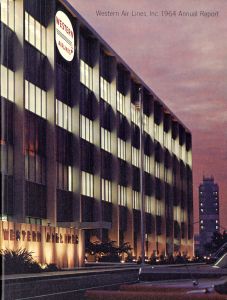
In January 1965, construction of a new company head
quarters and expanded main maintenance base was com
pleted. Located at the entrance to Los Angeles Interna
tional Airport, the attractive new $5.2 million building
contains the company's administrative offices, modern
maintenance shops and a hangar which can accommo
date three large jet aircraft.
Maintenance facilities include shops which will permit
the company to overhaul its own jet engines and a special
engine test cell.
The old headquarters, which Western has occupied
since 1947, will be refurbished for use by an expanded
Los Angeles reservations center and by other departments.
During the year, the company moved into modernized
Anton B. Favero, Maintenance; FI. S. Gray, Budget
Richard B. Ault, Engineering
New "Cafe Ole" cup for Fiesta Flights to Mexico
terminal facilities at Seattle and participated in planning
which will provide new structures or improvements at
Rapid City, Yellowstone Park, Portland and Sacramento in
1965 and at San Diego, Palm Springs, San Francisco and
Denver in 1966.
Western also is continuing to provide passenger con
veniences with new all-weather passenger loading bridges
already installed at Los Angeles, San Francisco and Seattle
and others planned for Portland, Denver and Minneapolis/
St. Paul.
SALES AND SERVICE
Despite increased service by competitors on many of the
company's routes, Western boarded a record 3,532,978
passengers in 1964, compared to 2,812,640 in 1963, an
increase of 25.6 percent.
Passenger revenues increased 18.7 percent, from
$93,912,670 in 1963 to $111,432,041 for 1964.
The overall load factor increased to 58 percent, com
pared to 55.1 percent for 1963.
Revenues from air cargo shipments (freight, express,
excess baggage, air mail and regular first class mail)
increased from $4,568,107 in 1963 to $5,279,081 in
1964.
Following a theme of "Expand the Market," Western's
1964 sales and service efforts were directed toward de
veloping new sources of company business.
Planned programs were based on the continuing expan
sion of low-cost service, benefits of group travel, extended
credit plans, improved handling of customers and their
baggage and closer working relationships with travel
agents, tour operators, hotels, other airlines and surface
carriers.
Responding to public demand for economy service, the
company continued to lead the domestic airline industry
in this area, providing 88 percent of its product at aircoach
or economy fares.
The low-cost ($11.43) Thriftair service --established in
1962 on the Los Angeles-San Francisco route and ex
panded to Los Angeles-Las Vegas in December 1963 --
was extended to Los Angeles-Oakland in the summer of
1964. The success of Thriftair was instrumental in making
Western the No. 1 airline at Los Angeles International Air-
Spacious new hangar will accommodate three jet aircraft.
12
Bert D. Lynn, Advertising and Sales Promotion; Philip E. Peirce, Ground Services
port during the first six months of 1964, as the company
boarded approximately 20 percent of the total traffic.
Approximately six percent of Western's passenger rev
enues were derived from Los Angeles-San Francisco/Oak
land Thriftair service last year. Late in 1964, the Los
Angeles-San Francisco segment was subjected to con
siderable diversion following the introduction of three-
engine jet shuttle service by another carrier.
In order to improve its position in this, the most heavily
traveled air route in the world--though not the most profit
able --
the company will launch an all-out effort on April 1
with four-engine, 146-passenger Boeing 720B fanjets
which were ordered early in 1964 for this purpose.
The company made numerous improvements in its
service to communities throughout the 12-state system.
Included were: first pure-jet service to Sacramento; exten
sion of Electra service to Denver-Calgary and Salt Lake
City-Great Falls routes; improved Long Beach-San Fran
cisco and Palm Springs-San Francisco service; and sub
stitution of 720B's for Electras on the Los Angeles-San
Diego-Mexico City route, which at year's end gave Western
all-fanjet service to Mexico.
Richard P. Ensign, In-Flight Services
Memphis E. Sullivan, Traffic James L. Mitchell, Research
To increase its participation in convention business and
to stimulate group vacation travel, Western broadened its
group fares to include groups of 25 with no previous
affinity and in early 1965, filed tariffs to extend the fares
to all domestic cities on the system.
Western, which pioneered the use of non-airline credit
cards for air travel, continued to expand its credit facili
ties. Already honoring American Express, BankAmericard,
Diners' Club, Hilton Carte Blanche, the industry-wide Uni
versal Air Travel Plan, Western's own Charge-A-Flight and
the "Fly Now --Pay Later" plan, the company broadened
some of its agreements to include installment payment
Ray Silvius, Public Relations
plans for terms up to 24 months, others to include ground
tours and limited travel on other airlines which is in con
junction with travel on Western.
Continuing to take advantage of the natural vacation
areas on the WAL system, the sales force produced and
sold a record number of packaged tours in conjunction
with hotels, railroads, bus and steamship companies,
other airlines and U-drive companies.
Major emphasis was placed on the company's 13th
annual wintertime "Sun Break" campaign, an expanded
summertime "Fly North" program, a "Let's Go Mexico"
campaign which featured publication of a special full-
color Sunday supplement and, to participate in New York
World's Fair traffic, interline circle trips to the East via
Canada and Mexico City.
To increase the company's identification and sales in
off-line areas, the company expanded its Eastern, Midwest
and Southern region marketing activities by establishing
new offices in New York and Chicago and extending the
area supervised by the company's Dallas office.
Familiarization tours and seminars were conducted for
travel agents, who, during 1964, accounted for 38 percent
of WAL passenger revenues.
Western, the first airline to offer special baggage rates
for golf equipment, extended the special rate to ski and
bowling gear during the year.
Charles J. J. Cox, Controller and Assistant Treasurer
Stanley R. Shatto, Vice President-Operations
The company streamlined many of its reservations,
baggage-handling and check-in procedures for added pas
senger convenience, introduced in-flight service innova
tions which provided improved food and beverage service
and, through the establishment of a high level working
group which analyzes day-to-day flight movements, made
substantial improvements in the company's on-time
operations.
ROUTE DEVELOPMENT
Western continued to seek long-haul additions to its route
system in 1964.
In addition to filing new applications, the company con
tinued its long battle for a route to Hawaii. Still outstand
ing at the beginning of 1964 was the Civil Aeronautics
Board's decision on a petition for reconsideration which
Western had filed on November 29, 1963. In the petition,
the company asked the CAB to reconsider its decision of
November 8, 1963, in which it terminated by a 3-2 vote
both the domestic and international phases of the Trans
pacific Route Case without either granting or denying
Western's applications for California-Hawaii domestic au-
James W. Stone, System Chief Pilot
Kenneth W. Kendrick, Purchasing and Stores
thority. The minority members favored giving California-
Hawaii authority to Western in accordance with the board's
decision of December 7, 1960.
In order to protect its legal rights while awaiting a deci
sion on the petition, the company filed on January 6,1964,
a petition with the United States Court of Appeals for the
District of Columbia Circuit, requesting that it review and
set aside the CAB's November 8, 1963, decision.
On March 3, 1964, the CAB denied Western's petition
for reconsideration.
On May 12, 1964, Western argued its case before the
court, taking the position that federal law requires the
CAB to act on outstanding applications after a proceeding
has been completed and also requires that authorization
for a new service be issued when a finding is made, such
as was made in this case, that additional service is re
quired by public convenience and necessity. The CAB in
its decisions of November 8, 1963 and March 3, 1964,
did not revoke the findings made in its decision of Decem
ber 7,1960, that new California-Hawaii service is required,
but instead has attempted to hold those findings in abey
ance pending a future proceeding.
A decision is expected from the court in the near future.
The company continues to remain hopeful that these legal
issues will be resolved successfully and that Western will
be permitted to inaugurate the service originally author
ized by the CAB between California and Hawaii.
During the year, Western filed an application with the
CAB for routes between the Pacific Northwest and major
cities in the Southwest and Midwest. This application will
be heard in the CAB's new route proceeding known as
the Pacific Northwest-Southwest Service Investigation, in
which hearings are scheduled to begin during 1965. The
company's application seeks authority to provide the first
one-carrier service over several major routes which will
serve the following cities: Seattle/Tacoma, Portland, Spo
kane, Boise, Salt Lake City, Albuquerque, Casper, Denver,
Wichita, Kansas City, St. Louis, Oklahoma City, Tulsa, Dal
las/ Ft. Worth, San Antonio, Houston, and New Orleans.
The company also filed an application during the year
for authority to provide service between Los Angeles on
the one hand, and Toronto/Montreal, Canada, on the
other; and between Minneapolis/St. Paul, on the one
hand, and Toronto/Montreal on the other. The company
also has pending before the CAB an application to provide
service between Vancouver, Canada, and Seattle, Port
land, and San Francisco/Los Angeles. These applications
for Canadian service are under consideration in connec
tion with negotiations now in progress between the United
States and Canada. If these negotiations result in a bi
lateral agreement which will authorize a U.S. carrier to
Charles S. Fisher, Flight Schedules
Peter P. Wolf, Communications
provide the proposed new service, then the CAB will con
duct hearings on these and other applications in order to
determine which of the carrier-applicants should be se
lected. These hearings would probably be held during 1965.
On January 6, 1965, Western terminated its service to
Huron, South Dakota, under a CAB order authorizing such
service to be taken over by a federally subsidized carrier,
North Central Airlines. This action is a part of a program
to delete from Western's system cities which do not gen
erate enough traffic to justify trunkline service without
federal subsidy.
International negotiations between the governments of
the United States and Mexico conducted during May and
June resulted in the extension of the bilateral agreement,
under which the company operates its Los Angeles-San
Diego-Mexico City route, from August 15, 1964, to June
30, 1965. Negotiations between the United States and
Mexico for a new bilateral agreement will be held prior to
the expiration of the present agreement.
PERSONNEL
As of December 31, there were 4,092 employees on West
ern's employment roster, compared to 3,513 in 1963.
Wages and salaries amounted to $29,039,955 in 1964.
Recognizing the contribution each employee makes to
ward the success of the company, Western introduced a
new employee recognition program in 1964 which features
an annual awards dinner for employees who complete 25,
30, 35 or 40 years of service and annual luncheons for
employees who complete 10, 15 or 20 years.
Receiving engraved plaques which symbolize the com
pany's appreciation for their service were two employees
with 35 years of service, 13 with 30 years, 43 with 25
years, 183 with 20 years and 305 with 15 years of service.
Ninety percent of Western's employees are represented
by five labor unions. Agreements which cover the com
pany's pilots, mechanics and dispatchers will be open for
negotiation during 1965; work rule discussions also will
be held with stewardesses and clerks, whose basic con
tracts run until 1966.
During the underwriter's 1964 reporting period, a total
of $492,532 in insurance benefits was paid to employees
and their families for hospitalization ($428,498), accident
and sickness coverage ($22,034) and group life insurance
($42,000); 3,643 employees participated in the group
insurance program.
As of December 31, there were 1,762 employees eligi
ble (by length of service) to participate in the company's
insured, contributory retirement income program; 1,219
of these employees actually participated in the program,
now in its 13th year of operation.
Arthur C. Smith, Sales Administration
John VJ. Simpson, Law Director and Assistant Secretary
Ten Years of Growth
Financial
Shareholders
Operations
Revenues:**
Passenger
Express, freight and excess baggage
Mail
Other
Total Revenues
Operating Expenses:**
Depreciation and amortization
Payroll
Other
Total Operating Expenses
Operating Income**
Interest**
Other Income and Expenses --
Net**
Provision for Taxes on Income**
Net Earnings from Operations**
Extraordinary Items (Less Applicable Income Taxes) :**
Gain on disposition of property
Write-down of aircraft
Net Earnings**
Net earnings from operations per share! .
Extraordinary items per share! . .
Total
Dividends paid per share.-
Cash!
Stock
Shares outstanding --actual** . . . .
--
adjusted**! . . .
Shareholders'equity --
total** . .
Shareholders'equity --a share! . . . .
Working capital**
Long-term debt**
Properties and equipment --
net** . . .
Total assets**
Route miles at end of year
Airplanes at end of year:
Boeing 720-B
Boeing 707 --leased
Lockheed Electra II
Douglas DC-6B
Other aircraft --
piston powered . . .
Airplane miles flown**
Ton miles produced**
Ton miles sold**
Seat miles produced**
Seat miles sold**
Express, freight & mail ton miles sold**.
.
Passengers carried
Express, freight & mail tons carried . . .
Passenger load factor --
actual %
--
breakeven point %
Average length in miles per passenger trip .
Average revenue per passenger mile . . .
Employees at end of year
1964
$111,432
3,718
1,561
934
117,645
11,718
29,040
49,988
90,746
26,899
(1,947)
799
25,751
12,400
13,351
$ 13,351
$ 3.11
3.11
0.65
4,292
4,292
$ 54,013
12.58
8,827
26,970
79,953
124,172
9,474
12
12
14
32,442
401,999
203,539
3,388,541
1,964,512
14,136
3,532,978
18,992
58.0
44.6
556
$ .0567
4,092
f Based on shares outstanding at close of respective periods adjusted to give
*Operations were adversely affected by strike.
*000 omitted.
1963 1962 1961* 1960 1959 1958* 1957 1956* 1955
93,913 81,170 59,737 64,356 59,194 31,459 39,243 26,249 28,756
3,248 2,964 2,271 2,473 2,256 1,305 1,596 954 1,185
1,320 1,427 1,231 1,393 1,295 732 1,067 775 862
946 809 1,013 855 508 474 313 210 236
99,427 86,370 64,252 69,077 63,253 33,970 42,219 28,188 31,039
9,762 11,895 11,211 10,000 6,643 4,136 3,011 2,294 2,151
24,749 21,840 17,987 19,478 17,704 11,947 14,335 10,283 11,057
43,598 41,254 32,864 33,323 27,696 16,831 20,076 13,009 13,775
78,109 74,989 62,062 62,801 52,043 32,914 37,422 25,586 26,983
21,318 11,381 2,190 6,276 11,210 1,056 4,797 2,602 4,056
(2,322) (2,286) (1,889) (1,330) (1,127) (1,023) (780) (394) (262)
621 483 (119) 438 180 74 90 31 10
19,617 9,578 182 5,384 10,263 107 4,107 2,239 3,804
9,800 4,875 125 3,050 5,456 227 2,233 1,205 1,860
9,817 4,703 57 2,334 4,807 (120) 1,874 1,034 1,944
191 889 807 105 210 1,522 528 2,010 38
(583) (578) -- -- -- -- -- -- --
9,425 5,014 864 2,439 5,017 1,402 2,402 3,044 1,982
2.29 1.10 0.01 0.54 1.47 (0.04) 0.65 0.38 0.72
(0.09) 0.07 0.19 0.03 0.06 0.50 0.18 0.73 0.01
2.20 1.17 0.20 0.57 1.53 0.46 0.83 1.11 0.73
0.37 0.33 0.33 0.33 0.27 0.24 0.23 0.22 0.25
-- -- --
5% 4% 4% 4% 4% --
1,431 1,431 1,431 1,431 1,041 928 849 779 743
4,292 4,292 4,292 4,292 3,273 3,034 2,886 2,751 2,728
43,452 35,601 32,017 32,584 24,545 18,996 17,469 14,991 12,430
10.12 8.29 7.46 7.59 7.50 6.26 6.05 5.45 4.56
6,580 12,364 5,505 16,841 11,518 5,320 4,688 4,600 2,784
32,940 39,488 36,097 24,790 25,272 19,748 16,827 9,677 3,484
71,162 62,859 58,493 33,302 37,546 31,035 24,652 17,216 11,208
111,202 98,830 85,697 72,433 67,223 49,596 44,017 32,075 23,332
9,474 9,545 8,827 8,827 8,827 9,153 8,799 6,350 5,525
10 7 4
-- --
2 2
12 12 12 6 5 --
14 16 19 27 27 27 21 14 8
-- --
--
4 5 8 14 16 23
29,035 25,262 20,624 25,996 25,689 16,449 21,896 14,851 18,335
352,038 307,570 224,819 207,554 196,178 123,416 137,640 86,196 100,015
168,002 137,492 101,232 109,316 103,741 56,710 74,468 48,481 54,999
2,929,673 2,402,344 1,718,854 1,776,076 1,623,007 981,740 1,175,071 740,174 870,596
1,615,189 1,307,173 957,560 1,034,481 982,010 533,443 702,727 458,131 514,677
12,291 11,574 8,987 9,538 8,899 5,309 7,118 4,667 5,828
2,812,640 2,128,225 1,529,137 1,721,619 1,689,278 970,498 1,379,653 928,746 1,092,578
16,250 16,037 12,364 13,354 12,792 8,010 11,537 8,200 10,332
55.1 54.4 55.7 58.2 60.5 54.3 59.8 61.9 59.1
43.6 48.0 55.5 53.3 50.0 54.1 53.5 56.6 51.3
574 614 626 601 581 550 509 493 471
.0582 .0623 .0632 .0626 .0605 .0595 .0558 .0573 .0559
3,513 3,078 2,794 2,730 2,962 2,547 2,773 2,343 2,130
effect to stock dividends and to the May 1964 three-for-one stock split.
Western Air Lines Inc, Belance Sheet December 31, 1964, with comparative figures for 1963
Assets
CURRENT ASSETS:
Cash
Short-term securities (approximating market) . ,
Receivables:
Traffic balances (net of allowance for
doubtful accounts $125,000) ....
U.S. and State Government Departments . .
Other
Expendable parts and supplies
Prepaid expenses
TOTAL CURRENT ASSETS
Deposits on equipment purchase contracts (Note 3) . .
Properties and equipment at cost:
Flight equipment
Buildings on and improvements to leased property .
Other property and equipment (including construction
in progress)
Less allowance for depreciation and maintenance .
Deferred charges and other assets
See accompanying notes to financial statements
1964 1963
$ 4,338,795 $ 3,550,685
18,082,600 12,676,710
7,466,941 6,591,951
876,649 956,493
673,448 1,299,669
9,017,038 8,848,113
1,687,777 1,661,804
1,020,101 1,649,715
34,146,311 28,387,027
9,673,244 11,081,171
119,191,490 106,433,995
4,736,322 4,738,364
18,454,196 10,552,818
142,382,008 121,725,177
62,428,561 50,563,568
79,953,447 71,161,609
398,819 571,756
$124,171,821 $111,201,563
20
Liabilities
1963
1964
CURRENT LIABILITIES:
Current maturities of long-term debt (Note 2).
Accounts payable
Accrued salaries and wages
Other accrued liabilities
Air travel plan deposits
Unused transportation
Federal taxes on income --
estimated (Note 1)
TOTAL CURRENT LIABILITIES
. . . .
$ 5,970,000
7,006,248
2,642,393
1,646,482
293,675
1,940,163
5,820,771
25,319,732
Long-term debt (Note 2)
Deferred federal taxes on income (Note 1)
Deferred investment credits (Note 1)
. .
26,970,000
15,080,000
2,789,000
Shareholders' Equity (Notes 2, 5 and 6):
Common stock --$1.00 par value per share
Authorized 10,000,000 shares
Issued 4,292,190 and 1,430,730 shares
.
Capital in excess of par value
Retained earnings
4,292,190
16,500,126
33,220,773
54,013,089
$124,171,821
$ 5,160,000
6,658,513
2,698,200
1,808,699
299,200
1,910,524
3,271,443
21,806,579
32,940,000
12,040,000
963,000
1,430,730
19,361,585
22,659,669
43,451,984
$111,201,563
WESTERN AIR LINES, INC.
Statement of Earnings and Retained Earnings
For the year ended December 31, 1964, with comparative figures for 1963
1964 1963
OPERATING REVENUES:
Passenger $111,432,041 $ 93,912,670
Express, freight and excess baggage 3,718,470 3,247,853
Charter and other transport service 152,190 205,031
Mail 1,560,611 1,320,254
Incidental revenue --
net 781,274 741,228
117,644,586 99,427,036
OPERATING EXPENSES:
Flying operations 22,957,569 20,818,768
Maintenance 16,301,799 13,303,710
Passenger service 7,835,866 6,694,820
Aircraft and traffic servicing 14,245,901 12,270,573
Promotion and sales 13,086,494 11,096,120
General and administrative 4,600,400 4,162,991
Depreciation and amortization 11,718,062 9,762,107
90,746,091 78,109,089
Operating Income 26,898,495 21,317,947
OTHER INCOME (EXPENSES):
Interest expense (1,946,968) (2,322,109)
Interest income 853,456 639,465
Other expense --
net (53,956) (18,463)
Earnings before Taxes on Income 25,751,027 19,616,840
PROVISION FOR TAXES ON INCOME (Note 1) 12,400,000 9,800,000
NET EARNINGS FROM OPERATIONS 13,351,027 9,816,840
EXTRAORDINARY ITEMS (Less Applicable Income Taxes):
Gain on disposition of property --
190,939
Write-down of piston aircraft --
(582,953)
NET EARNINGS 13,351,027 9,424,826
RETAINED EARNINGS AT BEGINNING OF YEAR 22,659,669 14,808,646
36,010,696 24,233,472
CASH DIVIDENDS PAID
$0.65 per share in 1964 and $0.37 in 1963 2,789,923 1,573,803
RETAINED EARNINGS AT END OF YEAR (Note 2) $ 33,220,773 $ 22,659,669
See accompanying notes to financial statements
WESTERN AIR LINES, INC.
Statement of Source and Application of Funds
For the year ended December 31, 1964, with comparative figures for 1963
1964 1963
FUNDS PROVIDED:
From operations
Net earnings $13,351,027 $ 9,424,826
Add back
Depreciation and maintenance
reserve provision 12,326,276 11,097,084
Deferred income taxes 3,040,000 5,791,000
Charge equivalent to investment credit
. . .
1,826,000 798,000
Total from operations 30,543,303 27,110,910
From other sources
Proceeds from disposition of property,
net of current taxes 88,617 536,715
Flight equipment lease/sale contracts 182,509 958,626
271,126 1,495,341
Total 30,814,429 28,606,251
FUNDS APPLIED:
Purchase of airplanes and other property
and equipment 16,337,452 24,438,314
Construction of new hangar and general office
building ($5,202,993 at December 31, 1964)
. . .
3,461,351 1,741,642
Payment of cash dividends 2,789,923 1,573,803
Reduction of long-term debt 5,970,000 6,548,357
Other items 9,572 87,788
28,568,298 34,389,904
Increase (decrease) in working capital 2,246,131 (5,783,653)
Total $30,814,429 $28,606,251
Notes to Financial Statements
note i. taxes on income. Federal income tax returns have been
examined by the U.S. Treasury Department through 1962. The
1964 provision for income taxes is summarized as follows:
Current income taxes $ 7,534,000
Deferred income taxes 3,040,000
Charge equivalent to investment credit,
net of amortization of $502,000 ....
1,826,000
$12,400,000
Investment credits are being amortized to income over the lives
of the related equipment.
note 2. long-term debt (unsecured). The long-term debt is
summarized as follows:
Bank Loans:
Outstanding
December 31,
1964
Annual
Payments on
Principal
Final
Maturity
5% notes payable $ 930,000 $ 600,000 1966
5%% notes payable 2,930,000 960,000 1967
5%% notes payable 6,400,000 2,400,000 1967
Insurance Company Loans
41/2% notes payable 7,920,000 1,200,000 1970
5V2% notes payable 5,760,000 600,000* 1975
6y4% notes payable 9,000,000
32,940,000
810,000 1975
Less current maturities 5,970,000
$26,970,000
`Effective September 1, 1966.
The related agreements with the bank and insurance com
panies, as amended in January 1965, provide among other
things (including restrictions on additional borrowings) con
ditions and requirements which at December 31, 1964 oper
ated to restrict retained earnings from cash dividend distribu
tion in the amount of $24,894,194, leaving $8,326,579 not so
restricted.
NOTE 3. COMMITMENTS AND CONTINGENT LIABILITIES. At Decem
ber 31, 1964, the company had on order six Boeing 720B fan-
jet aircraft. One of these aircraft was delivered in January
1965 and five are scheduled for delivery by July 1965. These
aircraft together with orders for other major items represented
purchase commitments at December 31, 1964 of approxi
mately $29,500,000 in excess of the related deposits.
The estimated minimum annual rentals under long-term
leases, with expiration dates ranging to 1991, were approxi
mately $1,000,000 at December 31, 1964.
note 4. retirement plans. The costs of retirement plans charged
to operating expense in 1964 totaled $1,129,376, including
$73,164 for past-service costs, thereby leaving approximately
$660,000 unfunded at December 31, 1964.
note 5. stock split. On April 23, 1964, the shareholders voted
to increase the number of authorized shares from 2,000,000 to
10,000,000 and approved a three-for-one stock split effective
May 4, 1964. Accordingly, $2,861,460 (par value of shares
issued) was transferred from Capital in Excess of Par Value
to Common Stock.
note 6. options to purchase common stock. The shareholders
approved on April 23, 1964 a stock option plan for officers
which reserved 210,000 shares of the corporation's authorized
and unissued stock for the purposes of the plan. On May 1,
1964, options were granted for 127,500 shares at an op
tion price of $39.50 a share (the fair market value on the
day of grant) which represent total option prices aggregating
$5,036,250. The options are exercisable in equal annual incre
ments over a five-year period.
Accountants' Report
Peat, Marwick, Mitchell 8c Co.
CERTIFIED PUBLIC ACCOUNTANTS
24
The Board of Directors
Western Air Lines, Inc.:
We have examined the balance sheet of Western Air
Lines, Inc. as of December 31, 1964 and the related statement
of earnings and retained earnings for the year then ended.
Our examination was made in accordance with generally accepted
auditing standards, and accordingly included such tests of the
accounting records and such other auditing procedures as we
considered necessary in the circumstances. We have previously
made a similar examination of the financial statements for 1963
In our opinion, the accompanying balance sheet and
statement of earnings and retained earnings present fairly the
financial position of Western Air Lines, Inc. at December 31,
1964 and the results of its operations for the year then ended,
in conformity with generally accepted accounting principles
applied on a basis consistent with that of the preceding year.
Also, in our opinion, the accompanying statement of source and
application of funds presents fairly the information shown
therein. r\
Los Angeles, California
February 9, 1965
Board of Directors
OTIS CHANDLER, Publisher, Los Angeles Times
Los Angeles, California
HUGH W. DARLING, Darling, Shattuck, Hall & Call
Attorneys-at-Law, Los Angeles, California
TERRELL C. DRINKWATER, President
Western Air Lines, Inc.
GOODRICH LOWRY, President,
Northwest Bancorporation, Minneapolis, Minnesota
DONALD H. McLAUGHLIN, Chairman of the Board
Homestake Mining Co., San Francisco, California
EDWIN W. PAULEY, Chairman of the Board
Pauley Petroleum, Inc., Los Angeles, California
STANLEY R. SHATTO, Vice President-Operations
Western Air Lines, Inc.
J. JUDSON TAYLOR, Vice President and Treasurer
Western Air Lines, Inc.
Executive Staff
Senior Officers
TERRELL C. DRINKWATER, President
STANLEY R. SHATTO, Vice President-Operations
MARVIN W. LANDES, Vice President-Service
ARTHUR F. KELLY, Vice President-Sales
J. JUDSON TAYLOR, Vice President and Treasurer
DOMINIC P. RENDA, Vice President-Legal and Secretary
G. G. BROODER, Vice President
Operations Division
STANLEY R. SHATTO, Vice President
ANTON B. FAVERO, Assistant Vice President
and Director of Maintenance
HAROLD W. CAWARD, Assistant Vice President
and Director of Flight Operations
TERRELL S. SHRADER, Assistant Vice President
and Director of Industrial Relations
RICHARD B. AULT, Assistant Vice President
and Director of Engineering
PETER P. WOLF, Director of Communications
CHARLES S. FISHER, Director of Flight Schedules
JAMES W. STONE, System Chief Pilot
Service Division
MARVIN W. LANDES, Vice President
VERNON 0. UNDERWOOD, President, Young's Market Co.
Los Angeles, California
HARRY J. VOLK, President, Union Bank
Los Angeles, California
JOHN M. WALLACE, Chairman of the Board
Walker Bank & Trust Co., Salt Lake City, Utah
ALEXANDER WARDEN, Publisher, Tribune-Leader
Great Falls, Montana
HOWARD C. WESTWOOD, Covington & Burling
Attorneys-at-Law, Washington, D.C.
Directors Emeriti
ROBERT E. DRISCOLL, Honorary Chairman of the Board
First National Bank of the Black Hills
Rapid City, South Dakota
SIDNEY F. WOODBURY, President
Pine Street Co., Portland, Oregon
Sales Division
ARTHUR F. KELLY, Vice President
BERT D. LYNN, Assistant Vice President and Director of
Advertising and Sales Promotion
ARTHUR C. SMITH, Assistant Vice President
and Director of Sales Administration
WILLIS R. BALFOUR, Director of Agency and Interline Sales
RAY SILVIUS, Director of Public Relations
MEMPHIS E. SULLIVAN, Director of Traffic
Treasury Division
J. JUDSON TAYLOR, Vice President and Treasurer
CHARLES J. J. COX, Controller and Assistant Treasurer
KENNETH W. KENDRICK, Director of Purchasing and Stores
H. S. GRAY, Director of Budget
Legal Division
DOMINIC P. RENDA, Vice President and Secretary
JOHN W. SIMPSON, Assistant Secretary and Director of Law
THOMAS M. MURPHY, Director of State and Community Affairs
JAMES L. MITCHELL, Director of Research
JAMES M. KEEFE, Director of Properties
PHILIP E. PEIRCE, Assistant Vice President
and Director of Ground Services
RICHARD P. ENSIGN, Assistant Vice President
and Director of In-Flight Services
39 years of continuous operation in serving the west
General Offices
Western Air Lines Building
6060 Avion Drive
Los Angeles International Airport
Los Angeles 9, California
Registrars
Bank of America National Trust &
Savings Assn.
Ill West Seventh Street
Los Angeles 14, California
The Chase Manhattan Bank
1 Chase Manhattan Plaza
New York 15, New York
Stock Transfer Agents
Security First National Bank
124 Wes Fourth Street
Los Angeles 14, California
Chemical Bank New York Trust Co.
20 Pine Street
New York 15, New York
Stock Listings
Listed and traded on
New York Stock Exchange and
Pacific Coast Stock Exchange
General Counsel
Hugh W. Darling
Darling, Shattuck, Hall & Call
523 West Sixth Street
Los Angeles 14, California
Auditors
Peat, Marwick, Mitchell & Co.
629 South Spring Street
Los Angeles 14, California
Annual Meeting
Fourth Thursday in April
DESIGNED BY CONRAD CAPUNE LITHOGRAPHED BY GRAPHIC PRESS, INC.