


- Collection:
- Western Airlines Annual Reports
- Title:
- Western Air Lines Annual Report 1958
- Creator:
- Western Air Lines, Inc.
- Date of Original:
- 1959-02-20
- Subject:
- Annual reports
Corporation reports
Finance
Investor relations
Corporations--Investor relations
Shareholder information
Western Airlines - Location:
- United States, California, Los Angeles County, Los Angeles, 34.05223, -118.24368
- Medium:
- annual reports
- Type:
- Text
- Format:
- application/pdf
- External Identifiers:
- Metadata URL:
- https://dlg.usg.edu/record/delta_wal-ar_wal-ar-1958
- Digital Object URL:
- https://dlg.galileo.usg.edu/do:delta_wal-ar_wal-ar-1958
- Language:
- eng
- Bibliographic Citation (Cite As):
- Cite as: [Title], Western Airlines Serial Publications, Delta Flight Museum
- Original Collection:
- Western Airlines Serial Publications
- Holding Institution:
- Delta Flight Museum
- Rights:
-

m
HIGHLIGHTS OF 1958
1958 * 1957
Seat miles produced 981,740,000 1,175,071,000
Seat miles sold 533,443,000 702,727,000
Passengers carried 970,498 1,379,653
Total operating revenues $ 33,970,204 42,218,951
Operating income 1,055,791 4,796,714
Net income 1,402,340 2,401,914
Dividends paid:
Cash $ 731,861 660,002
Stock 807,238 755,492
Common stock outstanding 927,920 882,483
Income per share 1.51 2.72
Dividends per share:
Cash--annual rate 0.80 0.80
Stock 4% 4%
Total shareholders' equity 18,996,428 17,469,192
Shareholders' equity per share 20.47 19.80
Cash and U.S. Government securities $ 6,520,798 7,332,034
Working capital 5,319,511 4,688,158
Investment in property and equipment 46,319,339 38,412,441
Long-term debt 19,748,000 16,827,000
Number of employees
Wages and salaries paid
2,547
$11,946,734
2,773
14,334,769
Operations were suspended from February 21 to June 10, 1958, because of a strike.
V J
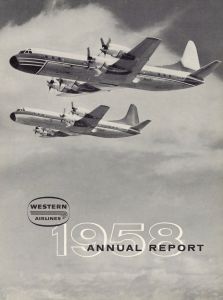
THE COVER
During a lengthy series of performance tests, Lockheed
Electra prop-jets race through southern California
skies at 400 miles-per-hour. Western Air Lines
will introduce Electra/Flight to key western cities in 1959,
marking the company's entry into the commercial jet
age with a fleet of airliners designed for efficient
operation over the WAL system.
THE PRESIDENT'S LETTER
General Offices
Western Air Lines Building
6060 Avion Drive
Los Angeles International Airport
Los Angeles 45, California
Registrars
Bank of America National Trust &
Savings Assn.
660 South Spring Street
Los Angeles 14, California
The Chase Manhattan Bank
11 Broad Street
New York 15, New York
Stock Transfer Agents
Security-First National Bank of Los
Angeles
561 South Spring Street
Los Angeles 14, California
New York Trust Co.
100 Broadway
New York 15, New York
Trustee for Debentures
Union Bank
760 South Hill Street
Los Angeles 14, California
Stock Listings
Listed and traded on
New York Stock Exchange and
Pacific Coast Stock Exchange
General Counsel
Darling, Shattuck & Edmonds
Attorneys-at-Law
523 West Sixth Street
Los Angeles 14, California
Auditors
Peat, Marwick, Mitchell & Co.
618 South Spring Street
Los Angeles 14, California
To Shareholders, Employees, Customers and Friends:
For Western Air Lines, as well as most of the domestic airline
industry, 1958 proved to be a year filled with problems. There was an
unprecedented wave of major strikes, a further contraction of profit
margins and costly preparation for the commercial jet age. Despite these
difficulties, Western and the industry moved into a new year convinced
of the promise which lies ahead, assured by a resilience which seems
unparalleled in the tradition of American business.
The company suffered a lengthy pilots strike. However, traffic tem
porarily lost was recovered speedily by an aggressive program of sales
and service. Due in large part to the unusual efforts of company
personnel, who were patient and loyal during a long period of enforced
idleness, Western succeeded in producing a profit and in continuing
its regular dividend policy. The most significant single statistic, which
justifies the promise held for 1959, is that operating revenues for the
concluding six months of 1958 increased almost 12 per cent over those
for the same period in 1957.
Within a few months, Western will be operating the prop-jet
Electras in regular service. For some time our personnel and operations
have been geared for the introduction of these jet-age aircraft, looking
ahead to the competitive advantages which they will provide.
On April 17, 1959, Western will become the first commercial airline
in the nation to complete 33 years of continuous operation. The coming
year, in which we will have an opportunity to provide our best service
to the people of the fastest-developing region in our hemisphere, should
be the best in the long history of Western Air Lines.
I 4JULc.
Annual Meeting
Fourth Thursday in April
at General Offices
February 20, 1959 PRESIDENT
Western Air Lines Building
Los Angeles International Airport
Los Angeles 45, California
Published as an information
service for the shareholders,
employees, customers and friends
of Western Air Lines by the Public
Relations Department of the Ad
ministration Division.
THIRTY-THIRD ANNUAL REPORT
EARNINGS
$1.51 a Share for 1958
Western Air Lines in 1958 earned a total of
$1,402,340, or $1.51 a share based on the 927,920 shares
of stock outstanding on December 31.
Net gains from the disposal of property amounted to
$1,522,386, or $1.64 a share, while operations, reflecting
the severe impact of an Air Line Pilots Association
strike which forced suspension of operations from
February 21 to June 10, resulted in a net loss of
$120,046, or $.13 a share.
By comparison, the 1957 net income of the company
was $2,401,914, equivalent to $2.72 a share, including
profit realized from the disposal of property of $528,077,
or $.60 a share, adjusted for the 1958 stock dividend.
More meaningful, however, is the substantial increase
in operating income reported for the last half of 1958,
the period following the strike, as compared to the same
1957 period. Operating income for the final six months
of 1958 amounted to $3,656,000, materially in excess of
the $2,290,000 realized in the final half of the previous
year.
DIVIDENDS
Eighth Successive Year
Cash dividends to its shareholders were paid by
Western Air Lines during 1958 for the eighth consecu
tive year. In addition, a stock dividend was distributed
for the third successive year.
Regular quarterly dividends of $.20 a share were paid
on March 10, May 15, August 15 and November 15,
and a 4 per cent stock dividend was forwarded to share
holders on March 20.
Dividend declarations were announced at directors'
meetings in San Diego, Los Angeles, San Francisco and
Salt Lake City as the company continued its long-stand
ing policy of holding quarterly business sessions in key
cities on the company system.
At the February 18, 1959 meeting in Mexico City,
the board of directors declared the first quarterly cash
dividend of the new year and also ordered distribution
of a 4 per cent stock dividend. The $.20 cash dividend
is payable on March 20 and the stock dividend on April
3 to all shareholders of record on March 6.
REVENUES
Promising Second Half
Operating revenues of Western Air Lines for 1958
were $33,970,204, down 19.5 per cent from the record
$42,218,951 of the previous year. V*.
Significantly, operating revenues for the last six
months of 1958 were $25,271,000, up 11.9 per cent over
the comparable 1957 period. This improvement mirrored
to some extent the widespread business upturn which
became apparent in September and October, as con
trasted with the recession which became evident during
the same months of 1957, and reflected the intensified
sales and service efforts of the company.
Principal revenue sources were substantially the same
as in 1957 with passenger traffic accounting for 92.6 per
cent; freight, express and excess baggage 3.8 per cent;
mail 2.2 per cent; and other operating revenues 1.4 per
cent.
Revenues for the year benefitted from the interim
fare increase of 4 per cent, plus $1 a ticket, granted by
the Civil Aeronautics Board on February 10, and from
--
BRIEF BALANCE SHEET
Western owns: 1958 1957
Cash and U.S. Government
securities $ 6,520,798 7,332,034
Owed by others 5,769,421 3,462,603
Expendable parts and
supplies 662,276 922,432
Buildings and improvements,
net 2,129,052 2,249,539
Flight and other equipment,
net 28,905,983 22,402,940
Deposits on new equipment 4,208,493 6,476,711
Prepaid expenses 1,131,126 834,973
Deferred charges and other 268,389 335,844
49,595,538 44,017,076
Western owes:
Owed to vendors and others 5,047,091 4,267,780
Federal income taxes--
current and deferred 2,699,272 3,147,672
Tickets sold but not yet used 904,747 1,105,432
Notes payable-
current and long-term.... 18,700,000 13,905,000
Debentures 3,248,000 4,122,000
30,599,110 26,547,884
Excess of what is owned
over what is owed, or
shareholders' equity $18,996,428 17,469,192
further CAB action, on October 20, authorizing elimina
tion of roundtrip discounts, reduction of family-plan
discounts from 50 to 3314 per cent, and restriction of
promotional stopover privileges.
An additional stimulant to revenues will become effec
tive on March 1, 1959 when the two-part CAB ruling
becomes applicable to intrastate operations in California.
It is possible that in 1959 the CAB finally will act on
the long and complex record developed in the General
Passenger Fare Investigation, a proceeding which was
instituted in November 1957. It is hoped that after a
realistic appraisal of the record the board will permit
fare increases in line with the value of air service now
being rendered, and in order to meet the continuing
upward spiral of operating expenses.
STATEMENT OF SOURCE AND
DISPOSITION OF FUNDS FOR 1958
Source of funds:
Net income $1,402,340
Depreciation and other
non-cash charges 4,386,682
Deferred federal taxes on
income 230,000
Sale of capital stock
Bank notes $2,000,000
7,305
Insurance company notes.. 3,995,000
Less reductions in
long-term notes
5,995,000
2,200,000 3,795,000
9,821,327
Disposition of funds:
Planes and other equipment
including contract deposits 8,458,113
Dividends:
Cash 731,861
Increase in Working
Capital 631,353
$9,821,327
J
Star of the company's television advertising is the entertaining
"Relaxed Bird," seen here in a scene from the newest of a
prize-winning series of films. In Mexico, he speaks Spanish.
EXPENSES
Operating Costs Held
Operating expenses of Western Air Lines during
1958 were $32,914,413, compared to $37,422,237 in the
previous year.
While operating revenues for the last half of 1958
were 11.9 per cent above those for the same period 1957,
operating expenses were held to an increase of 6.5 per
cent. This favorable improvement in the operating ratio
underscored the increase in operating income which
occurred in the last half of 1958.
While most expense classifications reflected a decrease
due to the suspension of company services during the
strike, depreciation, promotion and sales, and general
and administrative costs were up over the previous year.
Depreciation is a continuing expense not susceptible
to contraction. In addition, the 1958 figures show the
additional provision for nine new DC-6B aircraft intro
duced into the Western fleet during the year.
Within the promotion and sales category it was
possible to reduce variable expenses during the strike
period; however, these reductions were more than offset
by the need for increased programs to regenerate traffic
for the favorable second-half period.
The general and administrative category includes,
proportionately, more fixed costs which could not be
curtailed than other categories and, in addition, includes
an increasing burden of property taxes.
These categories also reflect the management decision
to retain all supervisory personnel on the payroll during
the pilots strike in order to perform essential duties,
handle extraordinary responsibilities which developed
during the period of labor unrest, and prepare for the
swift and orderly resumption of operations.
Members of the Western Air Lines Board of Directors and
executive staff who provided leadership for the company
during 1958 are (left to right, standing) Arthur F. Kelly, vice
president-sales; D. P. Renda, vice president-legal and sec
retary; Hugh W. Darling, director and general counsel; Terrell
C. Drinkwater, president and director; Harry J. Volk, director;
J. Judson Taylor, vice president and treasurer; Alexander
Warden, director; G. G. Brooder, vice president; Thomas M.
Murphy, assistant to the president; L. Welch Pogue, director;
Stanley Gewirtz, vice president-administration; Marvin W.
Landes, vice president-service; Hector C. Haight, director;
Charles J. J. Cox, controller and assistant treasurer; and
Stanley R. Shatto, vice president-operations and director.
Seated are (left to right) Sidney F. Woodbury, director; Dr.
Donald H. McLaughlin, director; John M. Wallace, director;
Dudley Swim, director; and Robert E. Driscoll Sr., director.
Not present was Goodrich Lowry, director. Western's board
represents many regions served by the company system.
FINANCES
Strong Capital Position
Working capital of Western Air Lines on December
31 was $5,319,511, an increase of $631,353 during the
year. The ratio of current assets to current liabilities was
$1.61 to $1, almost identical to that reported at the close
of 1957.
The financial statement of the company for 1957
disclosed a firm commitment of approximately $26,000,-
000 related to the equipment program initiated in 1956.
At the end of 1957, $12,000,000 remained available
under the 1956-57 loan agreements, leaving $14,000,000
to be covered by depreciation, deferred taxes, earnings
and, if necessary, additional borrowings.
For 1958, the financial statement sets forth a remain
ing commitment of $17,500,000, of which $4,000,000 is
expected to be provided through an engine-lease arrange
ment now under negotiation. Of the remaining $13,-
500,000, $6,000,000 will be provided by additional
funds to be drawn during 1959 under the terms of the
1956 financing plan. Balance of the funds required dur
ing the period between the close of 1958 and early 1960
is expected to be provided from operational sources,
enumerated above, in the amount of $7,500,000.
SHAREHOLDERS AND STOCK
Equity at All-Time High
On the final day of 1958, there were issued and out
standing 927,920 shares of Western Air Lines common
stock, 79,379 shares more than the total of 848,541 out
standing at the close of the previous year.
Included in the increase were 35,483 shares distrib
uted as a 4 per cent stock dividend, 43,053 shares issued
upon conversion of debentures, and 843 shares issued
through exercise of stock options.
Shareholders' equity at the close of 1958 was a record
$18,996,428, equivalent to $20.47 a share, an increase
of $1,527,236 over the 1957 total equity of $17,469,192,
or $19.80 a share, adjusted for the 1958 stock dividend.
Ownership of the company's stock continued to be
widespread.
On the New York Stock Exchange, 319,000 shares of
Western stock were traded in 1958 at prices ranging
from a low of 1914 to a high of 2814, with a closing price
of 2734, up $7 a share from the final 1957 price of 2034.
On the Pacific Coast Stock Exchange, 14,901 shares
were traded. The year's low was 1914, high was 27%,
and the closing level was 2714, also up $7 from the
previous year.
At a special meeting of stockholders held at the Los
Angeles general offices on December 15, election of a
13-man board of directors headed by the company's
president brought to a close more than two years of
complex litigation involving action taken by share
holders in 1956 to change the method of electing direc
tors from cumulative to straight voting of stock.
1 he special meeting followed clarifying decisions of
the Superior Court of California and the Court of
Chancery of Delaware on the voting-method issue. In
accordance with the shareholders' amendment of the
company's certificate of incorporation, and confirming
court rulings, voting at the meeting was by the straight
method. Dissident directors who had opposed the change
did not stand for re-election.
With shareholders in attendance representing in per
son or by proxy 75.93 per cent of all qualified shares,
the new board was elected without opposition. In all,
702,208 of the 924,757 shares, qualified for balloting
were cast for the 13 nominated directors.
EQUIPMENT
Ready for the Jet Age
In close cooperation with officials of the Lockheed
Aircraft Corporation and the Allison Division of Gen
eral Motors Corporation, personnel of Western Air
Lines worked throughout 1958 in preparation for the
company's introduction of the prop-jet.
Vehicle for the entry, scheduled for Summer 1959,
will be the tested Lockheed Electra prop-jet, a 400-mile-
per-hour transport now in production for 15 major air
lines serving five continents. Western expects to be the
first airline to offer prop-jet service on the heavily trav
eled Pacific Coast routes, and plans to introduce Electra/
Flight to key western cities during the year ahead. Deliv
ery of the first plane in a fleet of nine Electras is sched
uled for June 1959. Five of the new aircraft will be
placed in service this year, four in 1960.
Western's personnel worked throughout 1958 in preparation
for the company's entry into the commercial jet age. Here
veteran supervisors attend special Electra training course.
Checking the magnetronic "memory drum," heart of Western's
new electronic reservations system, are Tony Villodas, Tele
register Corp. field service manager, and Jack M. Slichter,
WAL passenger services director, at newcentral control center.
Integration of the Electra fleet into the company's
schedule patterns by early 1960 will provide passenger
carrying capacity double that of Western's 1955 opera
tions. Considered by company engineers to be ideally
suited for the company's system, the Electra is designed
to operate efficiently for the 550-mile average Western
passenger's air trip.
Western's management has not yet made a decision
to acquire turbo-jet aircraft, but is continuing to study
available equipment, as well as proposed aircraft, in an
effort to find an intermediate-range airliner which will
provide efficient and economical utilization on the com
pany's relatively short-haul system.
While preparing for the Electra, Western in 1958
acquired nine additional Douglas DC-6B airliners, and
operated six of them in 87-passenger aircoach configura
tion. During the year, the company sold three DC-6Bs,
and in 1959 will convert the aircoaches to 95-passenger
configuration. The program calls for modification of
seven planes.
DC-8 operations were cut back in preparation for the
transfer to local service airlines of operating rights at
smaller cities. As a result, the company disposed of three
DC-3s. Three Convair 240s were disposed of during the
year.
At the close of the year, the Western fleet was com
posed of 35 planes, including 21 60-passenger deluxe
DC-6Bs, six 87-passenger DC-6B aircoaches, six 40-
passenger Convair 240s and two 22-passenger DC-3s.
Setting a fast pace for the year ahead, Western on
January 13, 1959 flashed into operation the Resetron, a
new concept in reservations-by-electronics perfected dur
ing more than two years of study and testing by the
company's passenger service experts.
The revolutionary network, which now links sales
offices, reservations centers and airport ticket counters
in every city on the system for swift replies to requests
for flight reservations, was designed and built specifi
cally to meet the particular needs of Western by the
Teleregister Corporation, pioneer in the production of
electronic systems for stock exchanges, banks and
industries.
Working at split-second speeds, the Resetron enables
ticket agents at 96 locations to determine seat availability
on as many as 60,000 flight segments up to six months
in advance. Agents also are able to sell or to cancel
space for passengers by electronic controls installed and
maintained by contract engineers of the company from
which the equipment is leased.
Heart of the network is a magnetronic "memory"
drum, located in a new reservations control center at the
company's Los Angeles International Airport headquar
ters. At the selling end of the vast electronic network
are agent sets, no larger than conventional adding
machines.
Automatic transactions through agent sets are being
channeled through 38 locations in the Los Angeles area,
21 sites in San Francisco, and at city ticket offices, airport
counters and reservations centers in San Diego, Long
Beach, Oakland, Portland, Seattle, Tacoma, Las Vegas,
Phoenix, Salt Lake City, Denver, Minneapolis and St.
Paul. In other cities on the system, transactions are
being made through teletype machines and tape trans
mitters which send information to the "memory" drum
through the same equipment at nearly the same speeds
as the agent sets.
SALES AND SERVICE
Campaigns Win Traffic
Imaginative exploitation of newly established routes
and services, an intensive campaign promoting winter-
vacation travel, and a program planned to regenerate
strike-impaired traffic were highlights of the company's
sales and service effort during 1958.
Despite the suspension of all company flight services
for nearly one-third of the year, Western carried 970,-
498 passengers during 1958, a decrease of 29.7 per cent
from the previous year's record.
Total passenger revenues for the year were $31,459,-
203, down 19.8 per cent from $39,243,111 in 1957.
Deluxe services accounted for 70 per cent of the 1958
passenger revenues, as contrasted with 75 per cent in
the previous year, while aircoach services contributed
30 per cent, up from 25 per cent in 1957, demonstrating
continuation of the rising trend in public acceptance of
Western's economy flights.
Cargo revenues totaled $1,304,919, down only 18.2
per cent from the 1957 figure of $1,596,246 in spite of
the lengthy suspension of service. Mail revenues, includ
ing service payments for both regular air mail and the
non-priority transportation of surface mail by air, were
$732,441 during the year, compared to $1,067,404 in
1957. Mail payments, for service rendered, accounted
for only 2 per cent of Western's income dollar, reflecting
the company's continuing status as a subsidy-free carrier.
Passenger load factor was 54.3 per cent for the short
ened operating year as 533,443,000 of the 981,740,000
seat-miles produced were sold to the traveling public.
The decline of 5.5 points in the load factor can be
attributed largely to the business recession and the post
strike period in which traffic had to be regenerated.
Results of an expanded program of advertising and
promotion, necessarily concentrated in the second half
of the year, were apparent in accelerated traffic gains
during the winter months. On January 4, 1959, a new
passenger-traffic record was set for the second time in 36
days when 6,393 air travelers boarded Western planes
within 24 hours.
Sales emphasis continued on the Phoenix and Mexico
City routes, highlighted by a major campaign announc
The combination of attractive routes, carefully designed serv
ice and imaginative promotion attracted famous personalities
to Western Air Lines flights during 1958, as it has for the past
33 years. Among leading figures in the entertainment world
who enjoyed WAL service during the year were (left to right)
ing inauguration of aircoach flights to Mexico on
December 1 as economy counterparts of the company's
popular "Fiesta Flights'' aboard deluxe aircraft.
"Take a Sun Break'' was the keynote of a four-months
advertising campaign designed to emphasize the attrac
tions of the system's winter-resort cities. At the same
time, the biggest "tie-in'' promotional campaign ever
conducted by the company was organized in cooperation
with leading fashion houses and manufacturers of resort
wear.
The company's television advertising, featuring the
famous "Relaxed Bird,'' won national recognition during
the year, including an award from the American News
paper Publishers Association. For the first time, the
company signed contracts for year-round TV commer
cials in principal metropolitan centers. Television adver
tising was inaugurated in Mexico City during the year
with a Spanish-speaking "Relaxed Bird.''
A new series of travel posters, employing an unusual
art technique, was introduced and will be widely dis
tributed during 1959.
A variety of promotional activity drew attention to
the company's services during 1958, with Western's
now-famed San Francisco cable car winning top honors
in a score of civic appearances.
Sales centers were opened in Portland and Palo Alto,
and service facilities were inaugurated at the new down
town airlines terminal in San Francisco.
Charter activities were increased during the last half
of 1958 with the result that special flights earned $256,-
428 for the year.
Cary Grant, top Hollywood star for more than a decade;
Margot Fonteyn, favorite British ballerina; Kim Novak, leading
filmland glamour star; and Cantinflas, Mexico's internation
ally famed entertainer. For many years known as "the skyway
of the stars," Western continues as a show business favorite.
Highlight of Western's new "Fiesta Flights" between Los
Angeles and Mexico City is a tempting service of frosty
parfaits and French pastries served from a unique aisle cart.
Keeping pace with the growth of agency, interline,
government and military sales, the company expanded
this area of its organization in 1958.
The impact of interline business is illustrated by the
fact that Western now maintains interline traffic agree
ments with 95 other air carriers throughout the world,
including Central and South American operators tied
in with the company's Mexican services.
PERSONNEL
Reorganization for Future
The company suffered a major loss on September 9
in the death of Mr. Paul E. Sullivan, vice president-
administration and secretary of the corporation. A 28-
year veteran of the air transportation industry, Mr.
Sullivan had served Western since 1930 and had been
a member of the executive staff since 1945.
In October, reorganization of principal responsibilities
within the company was accomplished by the election
of Mr. Stanley Gewirtz as vice president-administration
and Mr. D. P. Renda, vice president-legal, as corporate
secretary.
Mr. Gewirtz, an attorney and former vice president
and assistant to the president of the Air Transport Asso
ciation of America, the industry organization represent
ing the nation's scheduled air carriers, was selected by
the board of directors to take over direction of the com
pany division which includes personnel, public rela
tions, labor relations, government affairs and flight
schedules.
Mr. Renda, who will continue to serve as head of
Western's legal division, a position he has held since
his election to that office in 1954, assumed additional
duties as corporate secretary. He has been with the
company since 1946.
Elected as assistant secretaries were Mr. William C.
Jennings, corporate law department director, and
Mr. John W. Simpson, administrative law department
director.
Despite severe burdens placed upon more than 2,000
company employees who had to be furloughed during
the pilots union strike, the company closed the year
with a personnel roster reflecting one of the highest
seniority standings in the airline business.
Headed by Western's senior employee, Mr. W. Edgar
Eatchel who was awarded the first 30-year service pin
in the company's history, 46.3 per cent of employees
were credited with more than five years of seniority
at the end of 1958. More than one-quarter of all per
sonnel are entitled to wear 10-year service emblems,
and a select 2.5 per cent have been awarded 20-year pins.
The company is expanding its employee relations
programs to provide necessary orientation for the 20.3
per cent of personnel who have been with Western less
than one year.
As of December 31, the company's employment ros
ters carried the names of 2,547 employees, a decrease
of 8 per cent from the previous year. Sixty-nine per cent
of employees are men, 31 per cent are women. More
than 2,200 employees, representing 87 per cent of total
personnel, are represented by the seven labor unions
with which the company has agreements.
Western reached agreements with five unions during
the year, including a pact with the International Associ
ation of Machinists which was approved an unprece
dented 11 weeks in advance of scheduled negotiations.
Agreements with the dispatchers and the stewardesses
will be opened for negotiation in 1959; all other agree
ments are effective until at least 1960.
Four major airlines, in addition to Western, were
grounded by strikes in 1958. The first pilots strike in
the company's 33-year history suspended all operations
for 108 days, equivalent to 29.6 per cent of the year.
Issues in the strike were settled when an arbitration
award was handed down on November 19 providing for
a contract which will remain in effect until October 1,
1960.
During the year, most Western employees partici
pated in the company's inclusive group insurance pro
gram, with 93.6 per cent subscribing to one or more
types of coverage offered. Group hospitalization insur
ance attracted 88.7 per cent of eligible personnel, while
84.6 per cent availed themselves of accident and sickness
coverage and 69.6 per cent purchased life insurance
under the plan jointly financed by the company and
its employees.
A total of $289,631 in insurance benefits was paid to
employees and their family members in 1958, including
$192,078 to defray hospitalization expenses, $85,553
in accident and sickness benefits, and $12,000 in life
insurance.
On December 31, 920 eligible employees were par
ticipating in the company's retirement income program,
now in its seventh year of operation. Cost of retirement
plans during 1958 was $513,402 for past and current
services. Remaining past-service cost of the insurance
program will be funded over the next six years and is
expected to require annual payments of $106,000.
Throughout the year, the company maintained its
free and reduced-rate transportation plan for employees
and their families. Several thousand space-available
passes were issued to personnel for trips on the company
system, and an almost equal number of passes was
obtained from other scheduled airlines through a pro
gram of reciprocal agreements. This privilege continued
to be one of the most attractive "fringe benefits" for
company employees.
--
BRIEF STATEMENT OF INCOME
Western's income came from:
Passengers
Express, freight and baggage
Mail
Gain on disposal of property
Other income
1958*
$31,459,203
1,304,919
732,441
2,120,386
560,193
36,177,142
1957
39,243,111
1,596,246
1,067,404
708,077
443,301
43,058,139
Western's expenses were:
Wages and salaries 11,946,734 14,334,769
Social security, group
insurance and
retirement plans 909,524 1,086,628
Gasoline and oil 5,126,302 6,309,060
Materials and repair parts.. 2,254,901 3,350,555
Depreciation 4,135,612 3,010,894
Advertising and publicity... 1,410,912 1,297,259
For service to passengers.. 1,595,177 2,271,800
Rentals and landing fees... 941,473 980,205
Insurance 743,948 822,425
Interest 1,023,340 780,419
Taxes 2,032,759 3,754,855
Utilities and services 1,667,328 1,491,331
Other costs 986,792 1,166,025
34,774,802 40,656,225
Net Income $ 1,402,340 2,401,914
'Operations were suspended from February 21
to June 10,1958, because of a strike.
V J
Representing the company's skilled corps of flying hostesses,
Western's Mary Lou Talbot won honors as top domestic
airline stewardess at 1958 international contest held at Miami.
In February, selected management-level personnel
attended the second phase of a graduate seminar at the
University of Washington for development of mana
gerial abilities in preparation for assumption of increased
company responsibility. Conducted by faculty members
of the graduate College of Business Administration, the
special course emphasized advanced training in em
ployee relations and job motivation.
During the year, programs of scientific employee selec
tion and wage-and-salary analysis were activated by the
personnel department, as was a specialized plan for pro
curement of highly qualified stewardess candidates. A
schedule of employee training classes utilized to near-
capacity the new facilities of the Western Air Lines
Training Center adjoining the general offices at Los
Angeles.
The Westernaire Federal Credit Union, operating
from the company's general offices, provided savings and
loan service to 80.2 per cent of employees during a
record year. At the close of 1958, total assets of the
WFCU were $1,287,310; net earnings for the year were
reported as $70,455.
This complex flight simulator in the Western Air Lines Train
ing Center is a key in the development of crew proficiency.
ROUTE DEVELOPMENT
Completion of a Program
In 1958, Western Air Lines brought to virtual com
pletion an important phase of its long-range program to
modernize the company's 9,153-mile route system. The
transfer of operating rights at 16 smaller communities
to subsidized local service carriers should result in sub
stantial operating economies.
In the Seven States Area Investigation, the Civil
Aeronautics Board, in accordance with its policy of
separating trunkline from subsidized local service oper
ations wherever possible, authorized suspension of West
ern service at Rochester, Mankato, Brookings, Spearfish,
Hot Springs, Chadron, Alliance and Scottsbluff.
Working closely with local service carriers to insure
the continuance of air service to the traveling public
through orderly transition, the company has scheduled
suspension of its flights so there will be no interruption
of Western's service until the smaller airlines are pre
pared to provide service tailored to local needs.
On February 16, 1959, Western withdrew service
from Rochester; on March 1, 1959, the company
planned to suspend flights at Brookings, Mankato and
Spearfish as North Central Airlines succeeded to service
rights; by April 1, 1959, Frontier Air Lines is scheduled
to replace Western at Hot Springs and the three
Nebraska cities.
On December 9, 1958, in a "press release decision" in
the Montana Local Service Case, the CAB indicated it
would grant final approval early in 1959 for elimination
of the company's services at Lewistown, Cut Bank, Jack-
son, Logan and Ogden. It is anticipated that obligations
at these points will be transferred to subsidized local
service carriers during the first half of 1959.
Earlier in this route-modernization program, the com
pany's flights were suspended at Cedar City, and service
rights terminated to Richfield and St. George.
In an earlier press release, the CAB stated its intention
to deny the company's application for authority to oper
ate turnaround service between Minneapolis-St. Paul
and Chicago, indicating that award of the route would
go to Eastern Air Lines and Capital Air Lines. The
company plans to file a petition for reconsideration of
the final CAB decision, which is expected early in 1959.
Western's authority to provide service to Phoenix
was made permanent when the U.S. Court of Appeals
for the District of Columbia denied an appeal of the
1957 CAB decision in the Service to Phoenix Case.
In 1958, the CAB issued a press release stating that
it intended to defer decision on all applications in the
Dallas to the West Service Case for contemporaneous
decision with a newly inaugurated Southern Transcon
tinental Service Case, a complex proceeding which is
expected to involve the entire southern tier of states
from California to Florida.
At hearings scheduled to begin in April 1959, West
ern will request authority to provide service between San
Francisco-Oakland and Los Angeles to Dallas-Fort
Worth and Houston via the intermediate cities of San
Diego, Las Vegas, Phoenix, Albuquerque, El Paso and
San Antonio.
Hearings are scheduled to open on March 10, 1959
in the Pacific Southwest Service Case, which involves
an examination of the air service needs of an area
bounded by San Francisco, Reno, Las Vegas, San Diego
and the Pacific coastline. In this proceeding, the com
pany will request authority to operate direct service
between Los Angeles, Sacramento and Reno; direct
service between San Francisco and Las Vegas, which
would provide one-carrier flights between the Pacific
Northwest and the Nevada resort city; and, permission
to provide San Diego-Long Beach-San Francisco and
Palm Springs-Ontario-San Francisco service by elimina
tion of a restriction now requiring stops at Los Angeles.
The company also will oppose vigorously proposals
for unnecessary duplication of the services it now is
providing over routes in the area included in this case.
Announcement of new bilateral conferences between
the United States and Canada early in 1959 may vitalize
the company's long-dormant U.S. authority to serve
Calgary in the Province of Alberta by international
agreement.
To the south, the U.S.-Mexico pact under which the
company operates its 1,555-mile Los Angeles-Mexico
City route is scheduled for review prior to its June 30,
1959 expiration date. Western, in company with other
carriers operating under terms of the pact, anticipates
renewal of the agreement through negotiation between
the two governments.
Western Air Lines route-development programs
conducted during 1958 were culminated by virtual
completion of a major phase of the company's
long-range system-modernization plans. Impor
tant changes in the 9,153-mile Western system are
illustrated in this map which shows permanent
routes and cities in bold type (LOS ANGELES),
cities from which the company's services are
expected to be withdrawn during 1959 in light type
(ALLIANCE), proposed routes as broken lines, and
cities which WAL is seeking to serve in italic type
(CALGARY).
In accordance with Civil Aeronautics Board policy
of separating trunkline from local service opera
tions wherever possible, the company's obligations
already have been terminated at Rochester, Minn.,
and Cedar City, Richfield and St. George, Utah.
Upon completion of the expected transfer of smaller
communities to subsidized local service carriers,
34 key western cities will enjoy improved and more
efficient WAL service. Successful completion of
pending route-development cases could add 11
new major centers to the company's network in
the near future.
J
A DECADE OF GROWTH
financial summary 1958* 195"7 1956* 1955 1954 1953 1952 1951 1950 1949
Revenues:**
Passenger $ 31,459 39,243 26,249 28,756 22,423 20,302 16,250 13,688 11,395 8,471
Express, freight and excess baggage... 1,305 1,596 954 1,185 968 846 662 507 497 313
Mail 732 1,067 775 862 764 875 719 1,212 2,090 2,504
Other 474 313 210 236 326 853 964 875 264 246
Total Revenues 33,970 42,219 28,188 31,039 24,481 22,876 18,595 16,282 14,246 11,534
Operating Expenses:**
Depreciation 4,136 3,011 2,294 2,151 1,761 1,718 1,019 998 1,124 1,335
Payroll 11,947 14,335 10,283 11,057 9,239 8,367 7,067 6,084 5,353 4,855
Other 16,831 20,076 13,009 13,798 11,505 10,300 7,674 6,666 6,133 4,374
Total Operating Expenses 32,914 37,422 25,586 27,006 22,505 20,385 15,760 13,748 12,610 10,564
Operating Income** 1,056 4,797 2,602 4,033 1,976 2,491 2,835 2,534 1,636 970
Other Income and Expenses--net** 1,171 18 2,331 (201) 333 (56) (103) 280 (196) (258)
2,227 4,815 4,933 3,832 2,309 2,435 2,732 2,814 1,440 712
Provision for Taxes on Income** 825 2,413 1,889 1,850 850 1,250 1,500 1,425 690 391
Net Income** $ 1,402 2,402 3,044 1,982 1,459 1,185 1,232 1,389 750 321
Earnings per share0 $1.51 2.72 3.62 2.38 1.81 1.48 1.54 2.25 1.27 0.54
Dividends paid per share:
Cash0 0.79 0.76 0.72 0.80 0.54 0.54 0.54 0.44 _ _
Stock 4% 4% 4% -- -- -- -- -- -- --
Shares outstanding**0 928 882 841 834 804 803 803 617 589 589
Shareholders' equity--total** $ 18,996 17,469 14,991 12,430 10,786 9,746 8,991 6,396 5,045 4,295
Shareholders' equity--a share0 20.47 19.80 17.82 14.90 13.42 12.14 11.20 10.36 8.56 7.29
Working capital** 5,320 4,688 4,600 2,784 1,490 755 1,364 435 981 243
Long-term debt** 19,748 16,827 9,677 3,484 3,755 2,072 2,903 1,924 2,231 3,113
Properties and equipment--net** 31,035 24,652 17,216 11,208 13,146 9,844 9,702 6,588 6,621 7,171
Total assets** $ 49,596 44,017 32,075 23,332 20,204 18,123 18,564 13,802 10,657 10,579
operating statistics 1958* 1957 1956* 1955 1954 1953 1952 1951 1950 1949
Route Miles 9,153 8,799 6,350 5,525 5,525 5,525 5,016 5,016 5,016 4,727
Available Ton Miles** 123,416 137,640 86,196 100,015 80,261 68,580 48,557 43,036 44,515 32,034
Revenue Ton Miles** 56,710 74,468 48,481 54,999 42,669 38,088 31,434 27,549 24,697 16,383
Passengers and Tonnage Carried:
Revenue passengers 970,498 1,379,653 928,746 1,092,578 834,910 838,732 774,079 691,322 619,624 422,193
Mail tons 3,754 5,367 4,034 4,897 3,283 3,284 3,243 3,419 2,150 1,359
Express and freight tons 4,256 6,170 4,166 5,435 4,276 4,206 3,729 3,191 3,396 2,435
Revenue Miles Flown:**
Airplane miles 16,449 21,896 14,851 18,335 15,842 14,450 12,631 11,487 11,783 9,496
Passenger seat miles 981,740 1,175,071 740,174 870,596 721,255 613,814 453,332 401,720 414,169 299,503
Passenger miles 533,443 702,727 458,131 514,677 402,255 359,965 298,931 259,693 233,118 155,747
Mail ton miles 2,159 3,092 2,212 2,621 1,669 1,610 1,358 1,449 978 567
Express and freight ton miles 3,150 4,026 2,455 3,207 2,556 2,100 1,524 1,282 *
,442 926
Other Statistics:
Passenger load factor % 54.3 59.8 61.9 59.1 55.7 58.6 66.0 64.7 56.3 52.0
Average length in miles per
passenger trip 550 509 493 471 482 429 386 376 376 369
Average revenue per passenger mile... $.0595 .0558 .0573 .0559 .0557 .0564 .0544 .0527 .0489 .0544
Number of employees end of year 2,547 2,773 2,343 2,130 1,864 1,813 1,649 1,459 1,279 1,226
Operations were suspended trom February 21 to June 10, 1958, and from January 9 to March 22, 1956, because of strikes.
0 Based on shares outstanding at close of respective periods adjusted for stock dividends paid in 1958, 1957 and 1956.
000 omitted.
STATEMENT OF INCOME
For the year ended
December 31,1958
(with comparative
figures for 1957)
Operating Revenues: 1958* 1957
Passenger $31,459,203 $39,243,111
Express, freight and excess baggage 1,304,919 1,596,246
Charter and other transport service 325,432 147,827
Mail 1,067,404
Incidental revenue (net) 148,209 164,363
33,970,204 42,218,951
Operating Expenses:
Flying operations 10,233,643 12,533,097
Maintenance 4,262,936 6,094,328
Passenger service 2,692,591 3,556,375
Aircraft and traffic servicing 4,921,652 5,763,615
Promotion and sales 4,616,833 4,596,057
General and administrative 2,051,146 1,867,871
Depreciation 4,135,612 3,010,894
32,914,413 37,422,237
Operating Income 1,055,791 4,796,714
Non-Operating Income:
Gain on disposition of property (Note 1) 2,120,386 708,077
Other 86,552 131,111
2,206,938 839,188
Non-Operating Charges:
Interest 1,023,340 780,419
Other 12,049 40,400
1,035,389 820,819
Income before Taxes on Income 2,227,340 4,815,083
Provision for Taxes on Income (Note 2) 825,000 2,413,169
Net Income (Note 1) $ 1,402,340 $ 2,401,914
Operations were suspended from February 21 to June 10,1958, because of a strike.
STATEMENT OF SURPLUS
For the year ended
December 31,1958
earned surplus
Amount as of December 31,1957 $ 9,640,104
Net income for 1958 1,402,340
Excess of proceeds over par value of:
43,053 shares of stock issued upon conversion
of debentures
843 shares issued under restricted stock option plan....
Excess of market value over par value of 35,483 shares
paid as a stock dividend (Note 3)
11,042,444
Dividends paid:
Cash--$0.80 a share, annual rate 731,861
Stock--4% (Note 3) 807,238
Amount as of December 31, 1958 (Note 4) $ 9,503,345
capital surplus
$ 6,980,547
807,108
6,462
771,046
8,565,163
$ 8,565,163
Current Assets:
Cash
U.S. Treasury Bills at cost and accrued interest ..
Receivables:
Traffic balances (net of allowance
for doubtful accounts $50,000)
U.S. and State Government Departments
Other (Note 4)
Expendable parts and supplies
Prepaid expenses
Total Current Assets
1958 1957"
$ 3,535,824 $ 5,337,991
2,984,974 1,994,043
3,049,283 2,443,467
1,018,038 838,393
1,702,100 180,743
5,769,421 3,462,603
662,276 922,432
1,131,126 834,973
14,083,621 12,552,042
Sundry securities 96,524 94,221
Properties and equipment at cost:
Flight equipment
Buildings on and improvements to leased property
Other property and equipment
Less allowance for depreciation
Deposits on equipment purchase contracts (Note 5)
38,759,630 31,268,978
3,873,092 3,794,637
3,686,617 3,348,826
46,319,339 38,412,441
15,284,304 13,759,962
31,035,035 24,652,479
4,208,493 6,476,711
171,865 241,623
$49,595,538 $44,017,076
Deferred charges
BALANCE SHEET as of December 31, 1958
(with comparative figures for 195"7)
Current Liabilities:
Current portion of long-term notes payable
Accounts payable
Accounts payable--taxes collected from others
Accrued salaries and wages
Other accrued liabilities
Air travel plan deposits
Unused transportation
Federal taxes on income (estimated)
Total Current Liabilities
Long-term debt (Note 4):
Notes payable to bank
Notes payable to insurance companies
4%% convertible subordinated debentures
due June 1, 1971
Deferred federal taxes on income (Note 2)
Commitments and contingent liabilities (Note 5)
Retirement plans (Note 6)
Shareholders' Equity:
Common stock--$1.00 par value per share
Authorized 2,000,000 shares (Notes 4 and 7)
Issued 927,920 and 848,541 shares respectively
Capital surplus
Earned surplus (Note 4)
liabilities
1958
$ 2,200,000
1,935,620
814,153
1,134,403
846,715
316,200
904,747
612,272
8,764,110
5,220,000
11,280,000
3,248,000
19,748,000
2,087,000
927,920
8,565,163
9,503,345
18,996,428
$49,595,538
195T
$ 1,200,000
1,544,416
523,799
1,407,370
486,620
305,575
1,105,432
1,290,672
7,863,884
4,700,000
8,005,000
4,122,000
16,827,000
1,857,000
848,541
6,980,547
9,640,104
17,469,192
$44,017,076
NOTES TO FINANCIAL STATEMENTS
Note 1. Net Income. Gain on disposition of property after taxes
totaled $1,522,386 and net loss from operations $120,046.
Note 2. Taxes on Income. Federal income tax returns through the
year 1956 have been examined by the U.S. Treasury Department.
Provision has been made for all known income tax liabilities.
The policy of the company is to provide in the years when tax
depreciation exceeds normal depreciation by including in the pro
vision for income taxes the amounts necessary to offset the esti
mated effect on federal income taxes which will occur in the years
when depreciation recordable on the books of account will be more
than that allowable for federal tax purposes. Accordingly, taxes
on income in 1958 includes a) provision of $222,000 for current
excess tax depreciation and b) credit for $240,000 representing the
return to income of prior provision related to assets sold in 1958.
The provision for current federal and state taxes totals $843,000.
Note 3. Stock Dividends. On March 20, 1958, the company paid
a stock dividend of 4% on the shares outstanding as of February 21,
1958. For the 35,483 shares thus issued earned surplus was charged
$807,238, with $771,046 (net of expenses) being transferred to
capital surplus and $35,483 to capital stock. The charge to earned
surplus was based upon the closing price of $22.75 a share on the
New York Stock Exchange on February 6, 1958, the day preceding
the declaration by the Board of Directors.
Note 4. Long-Term Debt. The
loans summarize as follows:
bank and insurance company
Bank Loans Payable Maturity
1956 Agreement for $6,000,000
borrowed in 1956. Interest 4%
$100,000 a
month
Jan. 2,
1962
1957 Agreement for $3,000,000--
$1,000,000 borrowed in 1957 and
$2,000,000 in 1958. Interest 5%
$50,000
monthly effective
Oct. 1, 1961
Sept. 1,
1966
Insurance Company Loans Payable Maturity
1956 Agreement for $12,000,000--
$6,000,000 borrowed in 1957.
Interest 4%%
$1,200,000
annually effective
Sept. 1, 1962
Sept. 1,
1970
1957 Agreement for $6,000,000--
$2,005,000 borrowed in 1957 and
$3,995,000 in 1958. Interest 5%%
$600,000
annually effective
Sept. 1, 1966
Sept. 1,
1975
The $6,000,000 remaining under the 1956 insurance company agree
ment is to be available between July 1959 and December 1960, and
carries a commitment fee of % of 1%.
The convertible subordinated debentures are subject to a sinking
fund requirement of 5% per annum effective May 31, 1961, and 10%
per annum effective May 31, 1966, with maturity on June 1, 1971.
The debentures, which are subordinated to the bank and insurance
company debt, are convertible into common stock of the company
based on a conversion price per share adjustable for, among other
things, stock dividends. The effective price as of December 31,1958
was $19.59 and 165,799 shares of the authorized unissued stock of
the company were reserved for such conversion. The related trust
indenture also provides for retirement by call at a price of 104%
through May 31, 1959, decreasing annually until June 1, 1969, when
the call price becomes face value.
The 1956 and 1957 agreements with the bank and the insurance
companies and the trust agreement governing the debentures
provide among other things (including restrictions on additional
borrowings) conditions and requirements which limit the amount
of earned surplus distributable as cash dividends. As a result,
earned surplus as of December 31, 1958, which may be applied to
the payment of cash dividends is limited to $3,115,846.
The current portion of long-term notes payable reflected in current
liabilities includes the stipulated payments due on the bank loan in
1959 amounting to $1,200,000 and in addition $1,000,000 to offset a
portion of the receivable, included in current assets and derived
from the sale of Douglas DC-6B aircraft, which upon collection in
January 1959 was remitted to the bank and insurance companies in
accordance with the related agreements.
Note 5. Commitments and Contingent Liabilities. At December
31, 1958, the company had on order nine Lockheed Electra propjet
aircraft, with delivery scheduled for five in 1959, starting in June,
and four in early 1960.
These aircraft together with orders for spare engines and other
major items represent a commitment in excess of deposits made at
December 31, 1958, of approximately $17,500,000. (See Note 4 for
related financing.) However, negotiations are in process to lease
instead of purchase all Electra engines. The completion of these
negotiations will reduce the above purchase commitment by ap
proximately $4,000,000 and will create a related rental commitment.
As of December 31, 1958, the company was contingently liable for
claims and lawsuits in which it is or may be a defendant, but man
agement and its counsel believe the ultimate liability, if any, will not
materially affect the financial statements.
Note 6. Retirement Plans. The company has an insured con
tributory retirement plan for all eligible employees, including offi
cers, and in addition, the company is negotiating in accordance
with the pilots' labor agreement a "variable pension plan," to be
based on pilots' current services, of the trusteed type which is
subject to approval by the Treasury Department. The cost of these
plans charged to operating expense in 1958 totals $513,402 for both
current and past services. Management contemplates that the
remaining past service cost of the insured plan will be funded over
a period of approximately six years and will require annual pay
ments of $106,000.
Note 7. Options to Purchase Capital Stock. Through December
31, 1958, 32,203 shares (including 843 shares in the year 1958) have
been issued under a restricted stock option plan for officers and
key employees approved by the shareholders in 1951. The option
prices ranged from $8.19 to $17.47 a share, representing a total
option price and total fair value when first exercisable of $392,189,
and a total fair value at dates when exercised of $610,446. At Decem
ber 31, 1958 options for 3,367 shares were outstanding and exercis
able within five years from the dates granted; the prices average
$16.19 a share and represent a total option price and a total fair
value when first exercisable of $54,510.
Pi.a i. Makwk'k Mitch i:i i. <S: ( <>
a in
The Board of Directors
Western Air Lines, In'.:
We have examined the balance 3heet of
Western Air Liner, Ir;-. as of December 31, !95P
and the related statements of income and surplus
for the year th-'n ended. Our examination war
made in accordance with generally accepted auditing
standards, and accordingly included such tests of
the accounting record? and such other auditing
procedures as we considered necessary ir. the
circumstances.
In our opinion, the accompar.yir.g balance
sheet and statements of income and surplus present
fairly the financial position of Western Air Lines,
Ir.c. at December 31, 1958 and the results of its
operations for the year then ended, in conformity
with generally accepted accounting principles
applied on a basis consistent with that f the
preceding year.
))/UAJsOZ-CJt,
Los Angeles, California
February 13, 1958
EXECUTIVE STAFF S'
f* '
Terrell C. Drinkwater
President
Stanley R. Shatto
Vice President--Operations
Marvin W. Landes
Vice President--Service
Arthur F. Kelly
Vice President--Sales
J. Judson Taylor
Vice President and Treasurer
I
D. P. Renda
Vice President--Legal and Secretary
\ i
Stanley Gewirtz
Vice President--Administration
G. G. Brooder
Vice President
Charles J. J. Cox
Controller and Assistant Treasurer
William C. Jennings
Assistant Secretary
John W. Simpson
Assistant Secretary
Thomas M. Murphy
Assistant to the President
BOARD OF DIRECTORS
Hugh W. Darling
Darling, Shattuck & Edmonds, Attorneys-at-Law
Los Angeles, California
Terrell C. Drinkwater
President
Western Air Lines, Inc.
Robert E. Driscoll, Sr.
Honorary Chairman, Board of Directors
First National Bank of the Black Hills
Rapid City, South Dakota
Hector C. Haight
International Division
Hughes Aircraft Co.
Culver City, California
Goodrich Lowry
President, Northwest Bancorporation
Minneapolis, Minnesota
Dr. Donald H. McLaughlin
President, Homestake Mining Co.
San Francisco, California
L. Welch Pogue
Pogue & Neal, Attorneys-at-Law
Washington, D.C.
Stanley R. Shatto
Vice President--Operations
Western Air Lines, Inc.
Dudley Swim
Monterey, California
Harry J. Volk
President, Union Bank
Los Angeles, California
John M. Wallace
Chairman, Board of Directors
Walker Bank & Trust Co.
Salt Lake City, Utah
Alexander Warden
Publisher, Great Falls Tribune-Leader
Great Falls, Montana
Sidney F. Woodbury
President, Pine Street Co.
Portland, Oregon