


- Collection:
- Pacific Northern Airlines Annual Reports
- Title:
- Pacific Northern Airlines Annual Report 1965
- Creator:
- Pacific Northern Airlines, Inc.
- Date of Original:
- 1966-04-08
- Subject:
- Annual reports
Corporation reports
Pacific Northern Airlines - Location:
- United States, Alaska, Anchorage Municipality, Anchorage, 61.21806, -149.90028
- Medium:
- annual reports
- Type:
- Text
- Format:
- application/pdf
- External Identifiers:
- Metadata URL:
- https://dlg.usg.edu/record/delta_pna-ar_pna-ar-1965
- Digital Object URL:
- https://dlg.galileo.usg.edu/do:delta_pna-ar_pna-ar-1965
- Language:
- eng
- Bibliographic Citation (Cite As):
- Cite as: [Title], Pacific Northern Airlines Serial Publications, Delta Flight Museum
- Original Collection:
- Pacific Northern Airlines Serial Publications
- Holding Institution:
- Delta Flight Museum
- Rights:
-

01
~1}>(1
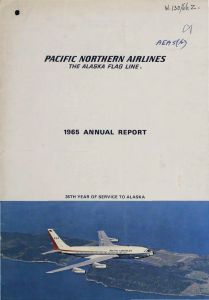
PACIFIC NORTHERN AIRLINES
THE ALASKA FLAG LINE
1965 ANNUAL REPORT
35TH YEAR OF SERVICE TO ALASKA
Highlights
of
1965
1965 1964
Operating Revenues $17,019 ,000 $15,127,000
Operating Expenses $15,191 ,000 $14,597,000
Operating Profit $ 1,828,000 $ 530,000
Special Credits $ 626,000 $ 1,622,000
Net Earnings and Special Credits $ 1,494 ,000 $ 1,622,000
Net Per Share $1.40 $1 .52
Retained Earnings $ 2 ,998,000 $ 1,504,000
Stockholders' Equity $ 4,651 ,000 $ 3,157,000
Stockholders' Equity Per Share $4.35 $2.96
Revenue Passenger Miles 198,537,000 160,070 ,000
Total Revenue Ton-Miles 31 ,771 ,000 27,765,000
Passenger Load Factor 47 0
37 Yo
Plane Load Factor 66 % 57 %
Average Number of Employees 660 631
Ton-Miles of Traffic Per Employee 48 ,000 44,000
System Performance Factor 98.4 % 98.2 %
To the
Stockholders
of
Pacific
Northern
Airlines,
Inc.:
In every respect 1965 was the most successful of Pacific Northern's thirty-
four years of <?peration in Alaskan service. The outlook for 1966 appears
to be even more favorable.
Financial
Net profits and special credits in 1965 amounted to $1 ,494,000, or $1.40
per share after income taxes of $956,000. The Company's operating profit
of $1 ,828,000, after depreciation charges of $1 ,079,000, represents more
than a three-fold increase over last year. Total revenues of $17,019,000
were the highest in the Company's history and reflect improvement of 12
percent over 1964 which was also a record year. Stockholders' equity at
the close of 1965 was $4,651 ,000 or $4.35 per share, an increase of 4 7
percent during the year.
Investment credits applied against 1965 tax payments amounted to $250,-
000 leaving an unused investment credit of $463,000 which can be applied
to reduce future income taxes. The U. S. Treasury Department h as audited
and accepted the Company's income tax returns through 1962.
Sales and Operations
As shown in the following summary, Pacific Northern's record growth in
traffic and productivity during 1965 represents continuation and acceler-
ation of the favorable trend of the past ten years:
2
Revenue Total Ton-Miles of
Calendar Passenger Revenue Traffic per
Year Miles Ton-Miles Employee
1965 198,537,000 31 ,771 ,000 48,000
1964 160,070,000 27,765,000 44,000
1963 137,848,000 23,228,000 36,000
1962 128,819,000 22,166,000 35,000
1961 122,629,000 20,619,000 33,000
1960 116,304,000 18,293,000 30,000
1959 113,389,000 17,013,000 27,000
1958 105,595,000 15,937,000 26,000
1957 105,820,000 15,564 000 25,000
1956 96,427,000 14,218 000 25,000
Over three-fourths of the Company's 1965 system traffic was carried in jet
aircraft.
In June of 1965, Pacific Northern expanded its jet services to include daily
non-stop jet schedules between Anchorage, the largest city in the state, and
Juneau, the capital of Alaska. Also for the first time non-stop service was
established between Juneau and Seattle, a service improvement not other-
wise possible had competition continued on this route necessitating both
carriers to make an intermediate stop for traffic at Ketchikan.
Pacific Northern's 1965 system revenue passenger load factor was 4 7 per-
cent, compared to 37 percent for last year. The plane load factor (pas-
senger, mail and air cargo) of 66 percent during 1965 establishes a new
all-time record for the Company and compares to an average of 4 7 percent
for all domestic airlines. The Company's system performance factor, that
is, scheduled trips completed, continued above 98 percent and the record
of on-time arrivals and departures ranked with the highest in the industry.
C. A. B. Proceedings
In its final decision in the Pacific Northwest-Alaska Air Service Case, the
Civil Aeronautics Board made basic changes in the mainland-Alaska com-
petitive route pattern effective June 1, 1965. Pan American's rights to
serve Ketchikan and Juneau were suspended for a period of seven years.
Pacific Northern was given exclusive authority to serve those markets from
Seattle-Tacoma and also was awarded the right to carry local Ketchikan-
Juneau traffic. Except for a seven-year suspension of Portland as a co-
terminal with Seattle-Tacoma, the Civil Aeronautics Board did not disturb
Pacific Northern's routes to Alaska or within Alaska. However, the Board
did create modified competitive authorizations for other carriers on the
Seattle-Anchorage route and the Anchorage-Juneau route for a period of
seven years. Alaska Airlines was added as a third carrier on the Seattle-
Anchorage non-stop route subject to a through service restriction. Cordova
Airlines was extended to Juneau making it possible, subject to a two-stop
restriction, for Cordova to provide limited competition with Pacific North-
ern between Anchorage and Juneau. The Company's traffic gain resulting
from exclusive operating rights in Southeastern Alaska far outweighs the
minor traffic diversion made possible by the competitive changes in the
other routes.
In June of 1965, the Civil Aeronautics Board instituted the Trans-Pacific
Route Investigation which includes the issue of the possible need for new
and additional air service between Hawaii and the continental United
States. Pacific Northern is an applicant for routes between Anchorage and
Honolulu and between Seattle-Tacoma/ Portland and Honolulu, and has
moved for consolidation of its application in the Trans-Pacific Route Inves-
tigation.
In December of 1965, the Civil Aeronautics Board established final mail
rates for Pacific Northern for the three-year period beginning October 1,
1962 and ending September 30, 1965. The Board's order contained the fol-
lowing findings:
"The Board has reviewed in detail all available data giving due
regard to current trends in traffic, revenues, and expenses. These
data indicate that Pacific Northern has in fact reached the point
of economic self-sufficiency and no longer requires subsidization
by the Board, and that the outlook for the future appears favor-
able for maintaining such subsidy-free status. The carrier's
reported operating profit for the twelve months ended September
30, 1965 was $1 ,122,048. This amount, which contains no sub-
sidy, is clearly indicative of Pacific Northern's ability to earn a
fair return on its investment without subsidy support. Therefore,
we have determined that, for the period October 1, 1965 forward ,
the rate of compensation for Pacific Northern shall be the service
mail rate payable to the carrier unde outstanding orders of the
Board. Such a rate will provide the carrier the opportunity to plan
ahead in confidence and, under economical and efficient man-
agement, to earn a fair return on its investment."
3
4
Jet Equipment
During the past month the Company has successfully concluded tripartite
equipment negotiations with Braniff Airways and The Boeing Company.
The agreement provides that Braniff will sell one Boeing 720 to Pacific
Northern and the Company in turn has agreed to assign to Braniff its con-
tract with The Boeing Company relating to its B-727 jet program. Under
this arrangement Braniff will obtain delivery of B-727 jet aircraft much
earlier than would otherwise have been possible, and Pacific Northern will
be able to meet its immediate requirements for expansion of its jet fleet
by acquiring an additional Boeing 720 identical to those which it presently
owns and operates. The price of the airplane is $3. 75 million and will be
financed by long-term loans through amendment of existing bank loan
agreements. This arrangement will provide the Company with almost the
identical capacity it would have obtained from its B-727 program and will
reduce debt financing requirements by approximately $13 million.
These negotiations do not alter the Company's objective to offer jet ser-
vice on all its routes after completion of proposed improvements to several
smaller airports within Alaska. In addition to three Boeing 720's the Com-
pany will continue to operate its six Lockheed Constellation 7 49 aircraft.
Outlook
Operating results for the year ahead will undoubtedly show improvement
over 1965 because they will reflect a full year of the new competitive
pattern which was in effect only during the latter half of the past year.
Additionally, the economic outlook of the areas served by Pacific Northern
continues to improve. After the 1964 earthquake the Federal Government
made long-term, low-cost capital available for reconstruction purposes,
which in turn encouraged private capital for commercial expansion that
goes beyond the reconstruction stage. Major developments in the petro-
leum industry and rapid growth in population have increased air travel
over the Company's routes substantially above normal growth rates. These
factors , together with the highly advantageous solution of the current
phase of the Company's jet equipment program, should produce favorable
results in 1966 and assure continued progress in the future.
April 8, 1966.
~~
PRESIDENT AND
GENERAL MANAGER
PACIFIC NORTHERN AIRLINES~INC. (AN ALASKA CORPORATION)
Statement of Earnings and Retained Earnings
Year Ended December 31, 1965
Operating revenues:
Passenger .
U. S. mail and air cargo
Other
Total operating revenues
Operating expenses :
Flying and ground operations
Maintenance
Selling and advertising
General and administrative
Depreciation and amortization ( Note 2 ) .
Operating profit
Non-operating expenses:
Interest
Other expenses, net
Net earnings before Federal and state income taxes .
Federal and state income taxes ( Note 1 ):
Current
Deferred .
Net earnings
Special credits relating to prior years :
Depreciation and aircraft overhaul reserve
adjustments (Note 2) .
Final mail payments from C. A. B. (Note 1) .
Related Federal and state income taxes, including
deferred tax provision of $198,880
Net earnings and special credits
Retained earnings, January 1, 1965 .
Retained earnings, December 31 , 1965 .
See accompanying notes to financial statements.
$8,507,122
3,053,815
1,460,424
1,089,612
1,079,575
447,957
7,562
467,062
37,517
386,276
691 ,653
1,077,929
451,818
$13,138,637
3,607,726
272,426
17,018,789
15,190,548
1,828,241
455,519
1,372,722
504,579
868,143
626,111
1,494,254
1,504,127
$ 2,998,381
5
6
PACIFIC NORTHERN AIRLINES~INC. (AN ALASKA CORPORATION)
Balance Sheet, December 31, 1965
ASSETS
Current assets :
Cash
Receivables, less reserve
Expendable parts and supplies (less obsolescence
reserve of $13 7,996 ) .
Prepaid expenses, principally insurance .
Total current assets .
Investments, principally cash surrender value of life insurance
Operating properties and equipment
at cost (Notes 1 and 2 ):
Flight equipment
Flight equipment deposits
Other property and equipment
Less depreciation and aircraft overhaul reserves
Deferred charges, net of amortization:
Preoperating expenses
Lease deposits and other .
$17,521,035
163,029
1,464,839
19,148,903
8,778,069
254,168
147,137
LIABILITIES AND STOCKHOLDERS' EQUITY
Current liabilities:
Current installments on long-term debt
Accounts payable and accrued liabilities .
Federal and state income taxes (Note 1)
Air travel plan deposits
Advance ticket sales
Total current liabilities
Long-term debt, less current installments ( Note 5) .
Provision for deferred income taxes .
Stockholders' equity:
Common stock-$1 par value per share. Authorized
2,000,000 shares; issued 1,068,109 shares
Paid-in surplus-no change during 1965
Retained earnings (Note 5) .
Contingent liabilities and commitments (Notes 1, 3 and 4)
See accompanying notes to financial statements.
$1,068,109
584,905
1,653,014
2,998,381
$ 1,405,419
2,915,034
215,701
163,962
4,700,116
177,671
10,370,834
401 ,305
$15,649,926
$1 ,197,347
2,421 ,910
720,138
70,975
269,767
4,680,137
5,771 ,475
546,919
4,651 ,395
$15,649,926
Notes to Financial Statements
(1} See President's report for information concerning U. S. mail pay, Federal income taxes
and equipment purchase commitments.
(2) Adjustment of aircraft overhaul and depreciation reserves
In 1965, the Company adjusted aircraft overhaul reserves from a provisioning to an amortiza-
tion basis, effective October 1, 1962. The depreciation reserves relating to jet engine residual
values were concurrently adjusted. The adjustments reduced depreciation expense for 1965
and for prior years by $22,627 and $49,5-83, respectively, and reduced aircraft overhaul ex-
pense for 1965 and for prior years by $183,172 and $336,693, respectively.
(3) Long-term leases
Minimum annual rentals under leases expiring more than three years from December 31,
1965 aggregate $284,300.
(4) Retirement plans
The costs of retirement plans charged to operating expense in 1965 totaled $475,048, includ-
ing $65,977 for past-service costs, thereby leaving approximately $359,996 of past-service
benefits unfunded at December 31, 1965.
(5) Long-term debt
Long-term debt consists of $6,343,822 of notes, secured by first and second mortgages on flight
equipment, at interest rates of 5 to 6 percent of which $1 ,097,347 is due within one year,
and $625,000 of unsecured, subordinated debt at interest rates of 5 to 6 percent of which
$100,000 is due within one year. Included in the unsecured debt is the unamortized balance
of $240,000 of 6 percent subordinated debentures issued in 1961 with detachable warrants
which entitle the holders to purchase 88,800 shares of the capital stock of the Company for
$4.50 per share.
Among other provisions, certain of the documents covering the Company's long-term borrow-
ings require that the Company shall maintain specified amounts of working capital and shall
not declare or pay any dividends or purchase, redeem or otherwise acquire for value any of
its capital stock.
Accountants' Report
The Board of Directors
Pacific Northern Airlines, Inc. :
We have examined the balance sheet of Pacific Northern Airlines, Inc. as of December 31,
1965 and the related statement of earnings and retained earnings for the year then ended.
Our examination was made in accordance with generally accepted auditing standards, and
accordingly included such tests of the accounting records and such other auditing procedures
as we considered necessary in the circumstances.
In our opinion, the accompanying balance sheet and statement of earnings and retained
earnings present fairly the :financial position of Pacific Northern Airlines, Inc. at December
31, 1965 and the results of its operations for the year then ended, in conformity with gener-
ally accepted accounting principles applied, except for the noted change ( which we approve)
in method of determining aircraft overhaul reserves, on a basis consistent with that of the
preceding year.
Seattle, Washington
April 8, 1966
PEAT, MARWICK, MITCHELL & CO.
7
8
PACIFIC NORTHERN AIRLINES
DIRECTORS :
G. P. O'GRADY Washington, D. C.
PAUL W. KITTO Seattle, Washington
R. A. ROWAN Los Angeles, California
M. B. KIRKPATRICK Anchorage, Alaska
C. W. NELSON Seattle. Washington
H. A. OLSEN Seattle, Washington
A. G. WOODLEY Seattle, Washington
OFFICERS :
A. G. WOODLEY President and General Manager
H. A. OLSEN Vice President- Traffic and Sales
J. H. FOSTER Vice President- Engineering and Maintenance
FELIX AUBUCHON Vice President- Alaska Operations
T. D. STUART Vice President- Industrial Relations
C. W. NELSON Secretary-Treasurer
M. E. DIAMOND Assistant Secretary
D. B. HART Assistant Secretary
GENERAL COUNSEL : G. P. O'G rady, 1625 Eye Street N. W., Washington, D. C.
GENERAL OFFICES : Seattle -Tacoma International Airport, Seattle, Washington .
CITY TICKET OFFICES : San Francisco, Portland, Seattle, Ketchikan, Juneau, Cordova, Anchorage, Kenai, Homer,
Kodiak, King Salmon, Yakutat.
AUDITORS : Peat, Marwick, Mitchell & Co.
TRANSFER AGENTS : Bankers Trust Company, New York, New York; Bank Of America, N.T. & S.A., San Francisco, California.
REGISTRARS : Manufacturers Hanover Trust Company, New York, New York; Crocker -Citizens National Bank,
San Francisco, California.
COM MON STOCK LISTED: American Stock Exchange, Pacific Coast Stock Exchange.
Pacific Northern Hangar and General Offices, Seattle-Tacoma International Airport, largest airline facility in the Pacific Northwest
The routes of Pacific Northern serve the growth areas
of Alaska where over 80% of the population resides and where
most of the major economic developments are taking place.