


- Collection:
- Hughes Airwest Annual Reports
- Title:
- Hughes Airwest corporate profile 1977
- Creator:
- Hughes Air Corp.
- Publisher:
- Hughes Airwest
- Date of Original:
- 1977
- Subject:
- Annual reports
Corporation reports
Hughes Airwest - Location:
- United States, California, City and County of San Francisco, San Francisco, 37.77493, -122.41942
- Medium:
- annual reports
- Type:
- Text
- Format:
- application/pdf
- External Identifiers:
- Metadata URL:
- https://dlg.usg.edu/record/delta_haw-ar_haw-ar-1977
- Digital Object URL:
- https://dlg.galileo.usg.edu/do:delta_haw-ar_haw-ar-1977
- Language:
- eng
- Bibliographic Citation (Cite As):
- Cite as: [Title], Hughes Airwest Serial Publications, Delta Flight Museum
- Original Collection:
- Hughes Airwest Serial Publications
- Holding Institution:
- Delta Flight Museum
- Rights:
-

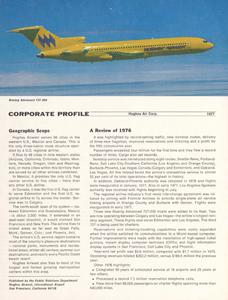
Boeing Advanced 727-200
CORPORATE PROFILE
Hughes Air Corp.
1977
Geographic Scope
A Review of 1976
Hughes Airwest serves 56 cities in the
western U.S., Mexico and Canada. This is
the only three-nation route structure oper-
ated by a U.S. regional airline.
It flies to 49 cities in nine western states
(Arizona, California, Colorado, Idaho, Mon-
tana, Nevada, Oregon, Utah and Washing-
ton), or more cities within this territory than
are served by all other airlines combined.
In Mexico, it provides the only U.S. flag
carrier service to five cities more than
any other U.S. airline.
In Canada, it was the first U.S. flag carrier
to serve Edmonton and the first U.S. re-
gional airline to fly across the border. Ser-
vice was to Calgary.
The north-south span of its system be-
tween Edmonton and Guadalajara, Mexico
is about 2,500 miles. If extended in an
east-west direction, it would connect San
Francisco and New York.The airline flies to
inland areas as far east as Great Falls,
Mont.; Denver, Colo.; and Phoenix, Ariz.
The airlines U.S. service region contains
most of the countrys pleasure destinations
national parks, monuments and recrea-
tional areas; winter ski centers; summer sun
destinations; and nearly every Pacific Coast
beach resort.
Hughes Airwest also flies to most of the
largest and fastest growing metropolitan
centers within this area.
Published by the Public Relations Department
Hughes Airwest, International Airport
San Francisco, California 94128
It was highlighted by record-setting traffic, new nonstop routes, delivery
of three new flagships, improved reservations and ticketing and a profit for
the fifth consecutive year.
Passengers exceeded four million for the first time and they flew a record
number of miles. Cargo also set records.
Nonstop service was introduced along eight routes: Seattle-Reno, Portland-
Reno, Salt Lake City-Southern California (Los Angeles and Orange County),
Burbank-Phoenix, Las Vegas-Canada (Calgary and Edmonton), and Oakland-
Las Vegas. All this helped boost the airlines competitive service to almost
52 per cent of its total operationsthe highest in history.
In addition, Oakland-Phoenix authority was obtained in 1976 and flights
were inaugurated in January, 1977. Also in early 1977, Los Angeles-Spokane
authority was received with flights beginning in July.
The regional airline industrys first route interchange agreement was ini-
tiated by joining with Frontier Airlines to provide single-plane air service
linking airports in Orange County and Burbank with Denver. Flights were
inaugurated in early 1977.
Three new Boeing Advanced 727-200 trijets were added to its fleet. Two
are now operating between Calgary and Las Vegasthe airlines longest non-
stop segment. These flights also serve Edmonton and Los Angeles. The third
727 is being used for charters.
Reservations and ticketing-handling capabilities were vastly expanded
when the airline switched its communications to a Miami-based computer.
Further improvements were made with the installation of high-speed ticket
printers, instant display computer terminals (CRTs) and flight information
display systems in San Francisco, Salt Lake City and Phoenix.
Year-end net profit was $3.6 million, compared with $1.7 million in 1975.
Operating revenues totaled $202.2 million, versus $169.5 million the previous
year.
Other 1976 highlights:
Completed 30 years of scheduled service at 18 airports and 25 years at
two others.
Processed a record 7.3 million reservation telephone calls.
Flew more than 88,000 passengers on charter flights spanning more than
540,000 miles.
Major
Facilities
The People
Who Make
It Work
Sundance
Fleet
San Francisco International Airport (mailing address)
San Francisco, California 94128
(Area Code 415) 573-4000; TELEX 34-9431
Hughes Airwest industry code: RW
INTERNATIONAL HEADQUARTERS
International headquarters is at 3125 Clearview Way at Hillsdale
Boulevard in San Mateo, Calif. midway between San Francisco
and San Jose.
This is the $6.2-million home and operational nerve center for the
only scheduled airline based in the San Francisco Bay Area.
Around-the-clock flight operations in the western portion of the
North American continent are directed from this facility. It also
houses one of the industrys most modern reservation centers.
Hughes Airwest also is the only airline with a flight attendant train-
ing school in the Bay Area.
MAINTENANCE CENTER
The maintenance and engineering base is at Sky Harbor Interna-
tional Airport in Phoenix the only such facility in Arizona.
Here, work on the airlines fleet, as well as on outside contracts,
is done by a personnel force of about 500 skilled supervisors,
mechanics, engineers, avionics and instrument specialists, supply
clerks and support staff.
Some 1.6 million man-hours at a cost of about $18.5 million are
spent annually to exceed high FAA-required standards of safety and
performance for its fleet.
The airline has reached beyond the confines of its daily operation
and signed many outside contracts that have included work on
small executive aircraft and on DC-9 jets for McDonnell Douglas
Corp., Air Canada, the U.S. Air Force and Turkish Airlines, to name
a few.
The Phoenix facility also is certificated by the Federal Aviation
Administration to perform repair and service on DC-9 jets and F-27
aircraft of other airlines.
Billings for this outside work in 1976 exceeded $1.2 million.
A work force of nearly 4,100 is employed throughout the system.
It is led by a management team comprised of a board of directors,
officers and 450 management personnel.
More than 525 pilots and nearly 650 flight attendants are based
in San Francisco, Las Vegas, Seattle and Phoenix.
Five labor unions represent segments of the work force. They are:
Air Line Pilots Association (ALPA), pilots and flight attendants; Air
Line Employees Association (ALEA), stations, reservations and cleri-
cal personnel: Aircraft Mechanics Fraternal Association (AMFA),
mechanics and cleaners; International Association of Machinists and
Aerospace Workers (lAMAW), supply clerks; and Transport Workers
Union (TWU), flight dispatchers.
Nearly 400 telephone sales agents are based in Phoenix, Los An-
geles, Seattle and at the airlines International Headquarters.
A total of 42 aircraft perform more than 800 arrivals and departures
a day. The fleet consists of*:
Three Boeing Advanced 727-200 trijets (155 passengers)
Twenty-one DC-9-30 jets (103 passengers)
Thirteen DC-9-10 and DC-9-15 jets (75 passengers)
Five F-27 Fairchild propjets (40 passengers)
These numbers reflect the active fleet status as of Dec. 31, 1976.
They are changing due to aircraft sales, deliveries or leasing. (As of
July 1,1977, one more DC-9-30 had been added to the fleet and nine
DC-9-30S and two 727-200s were on order.)
Future Many route applications, pending Civil Aero-
Exoansion Board approval, could lead to future ex-
pension. They include:
Nonstop routes within the airlines system
linking Calgary and Edmonton with Los Angeles
and San Francisco; Los Angeles and San Fran-
cisco with resort cities in western Mexico; Seattle
and Portland with Fresno and Phoenix; Oakland
with Reno; and Reno with Salt Lake City.
Routes expanding the existing system in sev-
eral route cases to Albuquerque, Milwaukee, Des
Moines, Minneapolis/St. Paul, Cincinnati, Dayton,
Columbus, Indianapolis, Louisville, Nashville, Kan-
sas City, St. Louis, Chicago, Vancouver, New Or-
leans and six cities in Texas (Dallas/Ft. Worth,
Houston, El Paso, San Antonio, Corpus Christi and
Midland/Odessa).
The top 10 cities based on passenger boardings in 1976 are:
Las Vegas 626,129
Phoenix 419,502
Los Angeles 345,659
San Francisco 300,974
Seattle 280,030
Santa Ana (Orange County)
Salt Lake City 186,780
Spokane 155,303
Tucson 139,971
Portland - 116,591
236,052
Full-staff sales offices are located in 18 major cities it flies to
in the U.S., Mexico and Canada. They are Boise, Calgary, Edmonton,
Guadalajara, Las Vegas, Los Angeles, Oakland, Ontario, Phoenix,
Portland, Salt Lake City, San Diego, San Francisco, San Jose, Santa
Ana, Seattle, Spokane and Tucson.
City ticket offices are located in 12 cities: Anaheim (Disneyland),
Edmonton, Las Vegas, Salt Lake City, San Francisco, Seattle, Sun
Valley (seasonal), Guadalajara, Guaymas, La Paz, Mazatlan and
Puerto Vallarte.
Full-time marketing personnel also are in Sydney, Australia; Tokyo,
Japan; San Jose, Costa Rica; New York City; Mexico City; and Hono-
lulu cities to which the airline does not operate scheduled flights.
This multi-nation sales effort is supported by the most advanced
computerized communications systems in the transportation indus-
try. They are called SITA (for Socit Internationale de Telecommu-
nications Aeronautiques) and ARINC (for Aeronautical Radio, Inc.).
Through these two organizations, Hughes Airwest can instantly
communicate and exchange passenger reservation information with
more than 300 airlines around the world.
The assets of Air West, Inc. were purchased in April, 1970 by
Hughes Air Corp., which operates the airline as Hughes Airwest.
The predecessor carrier was formed in 1968 by the merger of
three pioneer airlines in the West: Pacific Air Lines (based in San
Francisco), Bonanza Air Lines (Phoenix) and West Coast Airlines
(Seattle).
Pacific began scheduled passenger service as Southwest Airways
in 1946 and became Pacific Air Lines 10 years later. Bonanza started
as a flight school and charter service at Las Vegas in June, 1945 and
operated its first scheduled flights in August, 1946. West Coast
started service in March, 1946; in August, 1952, it purchased Empire
Air Lines, a feeder carrier that was established in April, 1944 under
the name Zimmerly Air Transport, later Zimmerly Airlines.
Hughes Air Corp. is a privately held company with the majority
of its stock owned by Summa Corporation, headquartered in Las
Vegas, Nevada. Summa is a diversified firm with interests in hotels,
helicopter manufacturing, real estate and other fields. It was wholly
owned by Howard Hughes, industrialist and aviation pioneer, who
died April 6, 1976.
Hughes Airwest is one of only a few airlines in the world that is
providing technological, managerial and training assistance as well
as consulting services to overseas air transportation companies
most in Third World nations.
It currently maintains contracts with airlines in Nepal, Mauritania
and Saudi Arabia.
It has completed contracts with airlines in Burma, Japan, Liberia
and Ghana.
These countries use Hughes Airwests skills to help them develop
air transportation systems tailored to their particular and varied
needs.
The airline has had as many as 200 of its experienced employes
and their families at one time assigned to its programs overseas.
Top 10
Cities
Sales
Offices
A Brief
Look Back
Overseas
Business
Programs
The Major The company contributes its share to the economy
Exnenses increasing payroll and other costs required
^ to operate a major air transportation company.
The largest expense in 1976 was for salaries
$73.7 million, or 13 per cent more than the $65.3
million payroll in 1975.
The bulk of the companys payroll burden is in
four cities where most management personnel and
pilots and flight attendants are based. The total 1976
salaries paid in each city were: Phoenix, $22.7 mil-
lion; San Francisco, $16 million; Las Vegas, $10.1
million; and Seattle, $9.9 million.
The second highest expense was for aircraft fuel.
In 1976 it jumped 48.5 per cent to $34 million from
$23 million.
Purchased items, including aircraft parts, inven-
tory materials and consumable items, rose 8 per cent
to more than $16.6 million from $15.4 million.
Property and other taxes, plus licenses, increased
21 per cent to more than $8.1 million from $6.7
million.
Landing fees, which were paid to all the airlines
airports for the privilege of providing passenger air
service, rose 9 per cent to $4.7 million from $4.3
million.
The cost of facility rentals and other related ser-
vices jumped 20 per cent to $4.8 million from $4
million.
All these dollars were paid to various municipal,
state and federal agencies in the nine western states,
Canada and Mexico.
Financial Results
(Add 000)
1976
1975
1974
1973
1972
1971
1970
Operating revenues
$202,162
$169,493
$159,914
$130,107
$96,701
$96,231
$85,204
Operating expenses
195,489
166,729
147,545
123,823
94,176
98,001
92,245
Operating earnings (loss)
6,673
2,764
12,369
6,284
2,525
(1,770)
(7,041)
Non-operating earnings (loss)
(1,629)
(336)
(2,324)
(1,437)
(615)
(1,548)
(5,049)
Net earnings (loss) before taxes
5,044
2,428
10,045
4,847
1,910
(3,318)
(12,090)
Provision for taxes
1,400
725
2,100
180
(13)
Net earnings (loss)
3,644
1,703
7,945
4,667
1,910
(3,318)
(12,077)
Performance
1976
1975
1974
1973
1972
1971
1970
Revenue passenger miles
1,654,730t
1,496,983
1,443,426
1,259,908
891,373
881,890
892,611
Available seat miles
3,108,909t
2,840,686
2,600,620
2,456,863
1,875,100
1,919,294
1,985,701
Load factor (per cent seats filled)
53.2
52.7
55.5t
51.3
47.5
45.9
45.0
Average density (passengers per mile)
47.2t
45.9
47.1
41.2
38.8
34.3
31.5
Passenger boardings
4,038,8111
3,700,519
3,662,179
3,365,910
2,557,975
2,731,127
2,898,258
Yield (revenue per passenger mile in cents)
10.77t
10.17
9.54
8.62
8.64
8.77
7.87
Average passenger trip miles
410t
405
394
374
348
323
308
Average passenger fare
44.12t
41.12
37.58
32.27
30.11
28.31
24.24
Cargo boarded (tons)
18,885
17,941
18,054
17,799
14,750
19,140t
19,014
Cargo ton miles
8,876t
8,464
8,308
7,811
6,012
6,952
6,057
Block hourstotal
121,383
115,162
113,799
123,932t
94,720
109,452
123,725
Aircraft hourstotal
99,990
95,167
93,380
103,2011
79,070
91,109
102,556
Revenue departures performed
139,769
137,574
143,517
157,664
124,348
146,570
163,7711
Revenue block hours
119,185
113,370
.111,630
121,225t
92,222
107,208
121,114
Revenue aircraft hours (airborne)
98,049
93,599
91,699
100,836t
76,850
89,136
100,273
Revenue ton miles
174,334t
158,149
152,675
133,737
95,106
95,125
94,917
Available ton miles
386,756t
352,733
321,681
300,630
229,777
237,625
248,485
Revenue aircraft miles flown
35,046t
32,594
30,624
30,614
22,989
25,695
28,313
Scheduled aircraft miles
35,153t
32,736
30,952
30,864
23,104
25,959
28,739
Scheduled aircraft miles completed
34,749t
32,308
30,307
30,371
22,908
25,602
28,195
Completion percentage
98.9
98.7
97.9
98.4
99.2t
98.6
98.1
On-time % (within 15 minutes of schedule)
Add 000.
84.8
84.2
77.1
83.7
84.7
85.4t
85.2
tAII-time annual record.
Results affected by severely restricted service during a four-month labor dispute that ended in mid-April, 1972.
Printed
in U.S.A.