


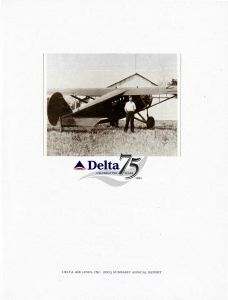
- Collection:
- Delta Air Lines Annual Reports
- Title:
- Delta Air Lines annual report 2003
- Creator:
- Delta Air Lines, Inc.
- Date of Original:
- 2003
- Subject:
- Annual reports
Corporation reports
Delta Air Lines
Finance
Investor relations
Corporations--Investor relations - Location:
- United States, Georgia, Fulton County, Atlanta, 33.749, -84.38798
- Medium:
- annual reports
- Type:
- Text
- Format:
- application/pdf
- External Identifiers:
- Metadata URL:
- https://dlg.usg.edu/record/delta_dal-ar_dal-ar-2003
- Digital Object URL:
- https://dlg.galileo.usg.edu/do:delta_dal-ar_dal-ar-2003
- Language:
- eng
- Bibliographic Citation (Cite As):
- Cite as: [Title], Delta Air Lines Serial Publications, Delta Flight Museum
- Original Collection:
- Delta Air Lines Serial Publications
- Holding Institution:
- Delta Flight Museum
- Rights:
-

DELTA AIR LINES, INC. 2003 SUMMARY ANNUAL REPORT
192 9~1939:
FROM HUFF DALAND DUSTERS TO DELTA AIR SERVICE
A few years ago, it was called impossible to fly ...
the day of the airplane is surely here.
- C.E. Woolman
Those who knew Delta's founder and first CEO, C.E. Woolman, might have described
him as a man with good business sense, tenacity and the vision to see twists of fate as
opportunity. Woolman loved aviation, but with flight still in its early years, agriculture
seemed a more certain career. Ironically, it was because of his position as a Louisiana
agricultural agent that Woolman became involved in commercial aviation.
Woolman had frequently observed the crop dusting experiments of entomologist
Dr. B.R. Coad, who was convinced that aerial dusting would be the best way to combat
the boll weevil that was wreaking havoc on the South's economy. In 1923, the work of
Coad and his team came to the attention of Huff Daland Manufacturing, which formed a
crop dusting division, Huff Daland Dusters, that began operations in 1924. The following
year, Woolman joined the company and managed the agricultural side of the business.
Making smart use of resources, Woolman took dusting operations to South America
during cotton's off-season and began an airmail and passenger route
between Peru and Ecuador.
In Peru, local revolutionary activities made conditions unsafe, and in
1928 Woolman returned to the U.S., where he found Huff Daland attempting
to sell the dusting division. He quickly organized a group of businessmen
who purchased the equipment and formed a new company, Delta Air
Service, named for the Mississippi Delta region it served. On June 17, 1929.
Delta operated its first passenger flight over a route that stretched from Dallas, Texas
to Jackson, Mississippi.
At the time, starting an air service without an airmail route to subsidize passenger
revenues was a bold financial venture. With the onset of the Depression, in 1930 Delta
suspended its fledgling passenger service. However, the company held its own, expanding
crop dusting operations and running a variety of aircraft-related businesses for revenue.
Finally, in 1934, Delta was awarded an airmail contract and was thus able to resume
passenger service.
2003 SUMMARY ANNUAL REPORT
1950,1959:
THE JET AGE
The next phase of aviation development,
the second 50 years, will be just as
remarkable as the first 50.
- C.E. Woolman
Delta came into its own as a leader in the airline industry during the sos, earning recognition
by Forbes for its decade of growth. Important new routes were added through expansion
and by merging with Chicago and Southern Airlines, including service to Washington , D.C.,
New York and the Caribbean. It was during this time that Delta listed with the Ne~ York
Stock Exchange, marking an important milestone in the company's history.
Several innovations during the sos also helped establish Delta as a leader. In the mid-
sos, Delta was an early pioneer of the hub and spoke system, a concept that greatly
increased efficiency and flexibility by concentrating maintenance, operations and food
services in hub cities. The Jetway, a Delta first, was also put into service.
By 1956, all Delta aircraft carried radar, and in 1959, Delta was the first airline to offer .
the speed and comfort of a true jet flight with the DC-8.
2003 SUMMARY ANNUAL REPORT
3
4
1960,1969:
FULL SPEED AHEAD
I'm optimistic about the future of air transportation.
The introduction of the jets has created a lot of
problems. But this industry grew up on problems -
and it grew because it solved them.
- C.E. Woolman
The momentum of the jet age continued into the '60s as Delta flew farther and faster
than ever. Awarded the Southern Transcontinental route, for the first time Delta flights
spanned the U.S. from east to west. In 1960, Delta's first Convair 880 jet set a speed
record, flying ocean-to-ocean in just over three and a half hours. The following year,
Delta flew the first non-stop flight between Atlanta and Los Angeles and
also offered the first jet service between the Caribbean and the U.S.
west coast.
In 1965, Delta was the first airline in the world with DC-9
service. Route extensions gave Delta a presence in the country's
major space centers, significantly expanding its cargo operations as it
served the aerospace industry.
In the midst of a decade of aviation firsts for Delta, founder C.E. Woolman passed
away and crop dusting operations ceased, marking the end of an era.
DELTA AIR LI NE
S, INC.
I 990~
PRESENT:
GLOBAL ALLIANCES
We have the opportunity to contribute
in some measure to the cause of better
international understanding.
- C.E. Woolman
Delta flew internationally as early as 1953, but it was during the '90s that the airline
established a true global presence. Purchasing important Pan Am routes in 1991 dramati-
cally extended Delta's reach across the Atlantic. Later in the decade came the first t_
icket
sales via Delta's website, expanded Latin American service, the first international cargo
alliance and recognition by Air Transport World as Global Airline of the Year. Twice during
this period Delta sponsored the International Olympic Games and transported the Olympic
flame to the games from Greece.
In 2001 , Delta, Air France, AeroMexico and Korean Air formed SkyTeam, an alliance
that gave international travelers more options and greater flexibility. Delta, together with its
domestic and international codeshare partners, now offers flights to more than 430 cities in
84 countries.
2003 SUMMARY ANNUAL REPORT
7
8
LETTER TO SHAREOWNERS, CUSTOMERS AND EMPLOYEES
During 2004, Delta marks its 75th year of operation. Earlier portions of this annual report recount the
growth of our airline from a tiny crop duster to a global carrier, and the spirit of our employees who
throughout the years have been the heart of Delta. Even as we celebrate such proud accomplishments,
however, our company remains focused on the future and the challenges of the rapidly changing airline
industry. We are pursuing a strategy that addresses these issues. Our course of action is intended to allow
our airline to regain a strong competitive position, achieve long,term sustained profitability, and
move forward to Delta's 100th anniversary - and beyond.
As many of you may know, Delta's leadership structure is
undergoing changes involving the three signatories of this
letter as a result of Leo Mullin's decision to retire from Delta as
of May I, 2004. Jerry Grinstein, a 16-year veteran of Delta's
Board of Directors, became Chief E
xecutive Officer at the
beginning of 2004. Jack Smith, a current board member and
presiding director, will become the non-executive chairman of
the board at the 2004 shareowners' meeting in April. The
three of us have worked closely together for many years. In
recent months, we have concentrated our efforts on ensuring
a smooth transition and determining the best strategic
direction for Delta, as this document outlines.
A PERMANENTLY ALTERED MARKETPLACE
Delta faces significant challenges and important decisions in
the period ahead as a result of an aviation environment that
has been dramatically and permanently altered. The events of
September 11, 2001
, served as a springboard for many of these
changes - but clear market demand for low fares as well as
new developments within the low-cost carrier model have
made these changes permanent. As a result, Delta has reached
a crucial juncture that will determine our ability to compete
effectively over the long term .
Low-cost carriers first gained significant market position during
the economic downturn of the early 1990s, reflecting a more
price-sensitive market. These carriers generally shared certain
characteristics, including reduced fares due to lower costs;
minimal debt loads; targeted high-traffic point-to-point routes
rather than high-cost, hub-and-spoke operations; employees
with low seniority and limited benefits; and minimal passenger
amenities. Despite the bare-bones nature of these operations,
service was typically reliable based on the simpler point-to-
point systems, and fares were very competitive, in keeping
with the carriers' low-cost structure.
Low-cost carriers generally remained niche players throughout
the extended boom time of the mid- and late-90s. Meanwhile,
costs at the major hub-and-spoke airlines, including Delta,
continued to climb. The stronger traffic during this period and
business travelers' willingness to absorb higher air fares
successfully masked the growing disparity in cost structure
between the network airlines and the low-cost carriers - at
least temporarily.
Following September 11, however, these trends came to an
abrupt halt. Passenger traffic and revenue plummeted.
Corporate travel budgets were sliced. Network airlines' losses
and debt mounted. As low-cost carriers began to grow again
in the once-more price-conscious environment, fares fell to
DEL
TA AIR LINES, INC.
From left to right:
LEO F. MULLIN, Chairman, GERALD GRINSTEIN, Chief Executive Officer,
JOHN F. SMITH, JR., Presiding Director
levels last seen in the early 90s. Network carriers were
required to match those fares in order to compete, which
inevitably resulted in continuing losses.
What has changed? Two important factors have permanently
altered the airline industry and its traditional cycles. First. the
Internet has transferred pricing power from the airlines to the
customer. Second. even more importantly, a new low-cost
business model has emerged that offers passengers both lower
fares and attractive amenities - as well as strategic adjustments
in route structure. JetBlue is operating transcontinental flights;
Southwest has altered its 30-year strategy of avoiding major
hub airports and will now fly from Philadelphia; and AirTran
has announced plans to install in-flight entertainment. to note
a few examples.
As the new low-cost-carrier business model continues to
succeed and grow. the customer and investor base for such
airlines will also grow, and the number of competitors will
multiply. In the meantime, it has yet to be determined if
network airlines can continue to obtain a fare premium - at
least in some markets - based on their more extensive global
networks and more attractive frequent flyer programs. It is
clear, however, that the number of routes where this is
possible and the amount of premium is shrinking.
REGAINING A STRONG COMPETITIVE
POSITION
Even before the events of September I I, Delta was keenly aware
of the importance of maintaining a strong competitive position.
Through diligent and consistent commitment to cost
management, our airline regularly achieved unit operating costs
that were among the lowest of the network carriers. Following
September I I. we moved quickly to institute a program of
additional innovative cost reduction and revenue generation
initiatives. setting as our goal a 15% improvement in fuel-
neutralized unit costs. Last year. this effort produced substantial
benefits. The program remains in place in 2004. driven by a
high degree of corporate commitment and urgency.
Despite this progress, however. Delta's losses have continued.
totaling more than $3 billion for the 2001 - 2003 period. While
some airlines have succeeded in significantly reducing their
costs through restructuring as a result of bankruptcy or near-
bankruptcy, our unit costs in 2003 grew from among the lowest
of the network carriers to among the highest. The disparity
between Delta and other network carriers is the result of pilot
costs which are significantly higher than our competitors. We
believe it is essential for Delta to reduce these costs if we are to
compete effectively in the current marketplace.
2003 SUMMARY ANN UAL REPORT
9
10
At the time of this report, Delta and the Air Line Pilots
Association (ALPA), which represents our pilots, are engaged
in discussions to address this issue, but no agreement has been
reached. Because Delta's goal is to regain a competitive industry
position and achieve sustained profitability, our company's
frequently stated position is that any agreement with ALPA
must allow Delta to compete and succeed over the long-term.
ADDITIONAL STEPS TOWARDS SUSTAINED
PROFIT ABILITY
Clearly, the most pressing requirement for Delta is to achieve
a cost structure that is fully competitive in the current airline
marketplace. At the same time, however, our company is
taking steps that:
Address our debt load
Reassess our business plan
Ensure excellent customer service by giving Delta employees
the tools needed to provide that service
DEBT LOAD
By the end of 2003, Delta's debt load had increased
significantly, our shareowners' equity was negative and most
of our aircraft were encumbered. Repairing the damage to
our balance sheet requires a comprehensive strategy that
not only addresses costs but also establishes a realistic,
disciplined plan which , over time, rebuilds our financial
position. Delta is engaged in this process now, and we are
committed to seeing it through to completion.
STRATEGIC REASSESSMENT
As part of Jerry Grinstein's new role at Delta and the
intensifying competitive pressures occurring in the airline
industry, we initiated a full strategic reassessment of our
company's business plan at the end of 2003. The purpose of
this project, which is in progress, is to review every aspect of
our operation, our resources and our strategy to ensure we
have an updated, accurate understanding of Delta's strengths
and how to best build upon them . The process is intended
not only to review the current strategy, but also to rethink our
competitive effectiveness. Our objective is to ensure that we
have in place by the middle of 2004 a comprehensive, realistic
business strategy that addresses the industry environment
and Delta's overarching goal of long-term, sustained success.
CUSTOMER SERVICE
Commitment to excellent customer service was a founding
principle when Delta's first passenger flight departed 75 years
ago. Today, the airline business continues to be a highly
competitive service industry. Delta's success depends on the
performance of our employees who have the responsibility
each day to deliver superior service to our passengers. Providing
Delta people with the tools and the support they need to do
the jobs they know so well how to do - and want to do - is
crucial if we are to restore service and customer relationships
to the highest possible level.
Some essential components of this effort are already in place.
We've invested in innovative technology to improve our
customers' airport experience. We've shortened or eliminated
the time spent waiting in line for routine service related to
passenger check-in and boarding as well as flight delays. At the
same time, we're ensuring that Delta agents or telephone access
to assistance is close by should unexpected problems arise.
In addition, refurbished aircraft interiors and new uniforms
are on track to bring a fresh new look to Delta. We're also
renovating some facilities, including recently announced
improvements at our New York-JFK terminal. These are
essential investments to maintain competitiveness and better
serve Delta's customers.
DELTA AIR LINES, INC.
LOOKING AHEAD
Delta now stands at a crucial crossroad, fully aware of the
difficulties and dangers ahead. Despite these challenges, we
believe our company can succeed. We are addressing the
immediate issues of running a great airline, as indicated by
service-related operational statistics that are the best in our
history and rising customer approval rankings. At the same
time, we are taking the steps necessary to position our
company for the long term.
E
very company holds within its collective hands the power to
shape the future. Given the skilled, dedicated, committed spirit
that has long-characterized the people of Delta Air Lines, we
believe the shape of the future will be a proud achievement
shared by the team today and for generations to come.
Gerald Grinstein , Chief Executive Officer
Leo F. Mullin, Chairman of the Board
John F
. Smith, Jr., Presiding Director
A NOTE OF SINCERE APPRECIATION
On behalf of Delta's Board of Directors, the current management
team , and our airline and its subsidiaries' 70,600 employees
worldwide, we would like to add a note of sincere appreciation
to Leo Mullin for his service and significant contributions to
our company.
During the first years of Leo's tenure, he successfully directed
efforts to rebuild our airline's spirit, its focus on customers,
and its financial standing. Following the tragic events of
September I I, 200 I, Leo led the company and the industry
with strength and determination through the most unsettled
time in aviation history. He has been the primary architect in
the construction of Delta's network of international and
domestic partnerships, including the fast-growing SkyTeam
global alliance and our expanding marketing relationships
with Continental and Northwest. In addition, Leo success-
fully established Atlanta as a new gateway to Latin America.
Under his leadership, Delta emerged as a technology leader,
using innovative approaches to significantly improve customer
service and reduce costs.
We are enormously grateful to Leo for the role he has played
in these achievements and many more, and for the character.
courage and commitment which have characterized his career
with Delta. He has made important and lasting contributions
to this company, and we wish him and his fam ily the very
best in the years to come.
Gerald Grinstein. Chief Executive Officer
John F
. Smith. Jr .. Presiding Director
2003 SUMMARY ANNUAL REPORT
11
OFFICERS
GERALD GRINSTEIN LEE A. MACENCZAK HARLAN R. BENNETT
Chief E
xecutive Officer Senior Vice President - Sales Vice President - Revenue
and Distribution Management
M. MICHELE BURNS
Executive Vice President and PAUL G. MATSEN HAROLD L. BEVIS
Chief Financial Officer Senior Vice President - International Vice President - Public Affairs
and Alliances
ROBERT L. COLMAN DOUG BLISSIT
Executive Vice President - GREGORY L. RIGGS Vice President - Network Analysis
Human Resources Senior Vice President - General
Counsel WALTER A. BRILL
VICK.I B. ESCARRA Vice President - Deputy General
12 Executive Vice President and THOMAS J. SLOCUM Counsel
Chief Marketing Officer Senior Vice President - Corporate
Communications ROBERT T. Cl RULNICK
EDWARD H. BASTIAN Vice President - Finance -
Senior Vice President - Finance and RAYVALEIKA Operations. In-Flight & ACS
Controller Senior Vice President - Technical
Operations PAULETTE L. CORBIN
VINCENT F
. CAMINITI Vice President - Airport Customer
Senior Vice President - Profitability JAMES M. WHITEHURST Service - West
Initiatives Senior Vice President - Finance,
Treasury and Business Development JACK A. DAULTON
ANTHONY N. CHARAF Vice President - Corporate Security
Senior Vice President - Delta Air Logistics SHARON WIBBEN
Senior Vice President - In-Flight CHRISTOPHER A. DUNCAN
W. LAMAR CHESNEY Service Vice President - Finance and Chief
Senior Vice President - Supply Chain Risk Officer
Management D. SCOTT YOHE
Senior Vice President - Government TERRY M. ERSKINE
RICHARD W. CORDELL Affairs Vice President - Labor Relations
Senior Vice President - Airport
Customer Service J. MARK BALLOUN CAROLYN EZZELL
Vice President - Corporate Strategic Vice President - Atlantic Region
SUBODH KARNIK Planning
Senior Vice President - Network and MICHELLE MCKINNEY FRYMIRE
Revenue Management R. MICHAEL BELL Vice President - Finance -
Vice President - Schedule Marketing & International
JOSEPH C. KOLSHAK Development
Senior Vice President - PAUL GRAVES
Flight Operations GERALD A. BEMIS Vice President - Global Diversity &
Vice President - Line Maintenance Community Affairs
Operations
DELTA AIR LI NES, INC.
HANK HALTER
Vice President - Finance and
Assistant Controller
TODD G. HELVIE
Vice President - Corporate Tax
LESLIE P
. KLEMPERER
Vice President - Deputy General Counsel
and Secretary
JOSEPH LICITRA
Vice President - Airport Customer
Service - East
JOHN C. MARSHALL
Vice President - Corporate Safety
and Compliance
JAMES V. MAUCERE
Vice President - Maintenance
Base Operations
FRED BUTTRELL
President and Chief E
xecutive Officer -
Delta Connection, Inc.
JEFFREY T. FISHER
Vice President and Chief F
inancial Officer -
Delta Connection , Inc.
OFFICERS
PATRICE G. MILES
Vice President - Consumer Marketing
LEON A. PIPER
Vice President - Worldwide Benefits
and Health Resources
UDO RIEDER
Vice President - Engineering and
Planning
DAVID J. SMITH
Vice President - Global Rewards
and Recognition
JOHN J. VARLEY
Vice President - Associate General
Counsel
WILLIAM F
. WANGERIEN
Vice President - Operations
Planning, Control and Reliability
DELTA SUBSIDIARIES
W. E. (SKIP) BARNETTE
President - ASA Holdings, Inc.,
and Atlantic Southeast Airlines, Inc.
RANDY D. RADEMACHER
President - Comair Holdings, LLC,
and Comair, Inc.
JOHN N. SELVAGGIO
President - SongTM
2003 SUMMARY ANN UAL REPORT
PATRICK H. WILDENBURG, JR.
Vice President - Corporate Operations
and Real E
state Strategy
LEMUEL R. WIMBISH
Vice President - Airport Customer
Service - Atlanta Worldport
SUSAN T. HUDSON
Assistant Secretary
CURTIS ROBB
President and Chief E
xecutive Officer -
Delta Technology, LLC
Chief Information Officer -
Delta Air Lines, Inc.
13
BOARD OF DIRECTORS
EDWARD H. BUDD
Retired Chairman of the Board
and Chief Executive Officer,
The Travelers Corporation
DAVID R. GOODE
Chairman of the Board, President
and Chief E
xecutive Officer,
Norfolk Southern Corporation
JOHN F
. SMITH , JR.
Retired Chairman of the Board
and Chief E
xecutive Officer,
General Motors Corporation
LARRY D. THOMPSON
Senior Fellow, Brookings Institution;
former Deputy Attorney General of
the United States
BOARD COMMITTEES
as of March I, 2004
AUDIT
Edward H. Budd, Chair
George M.C. Fisher
John F. Smith, Jr.
Joan E
. Spero
BENEFIT FUNDS
INVESTMENT
Andrew J. Young, Chair
James M. Kilts
John F
. Smith, Jr.
Joan E. Spero
CORPORATE GOVERNANCE
John F
. Smith. Jr., Chair
James M. Kilts
Larry D. Thompson
Andrew J. Young
FINANCE
George M.C. Fisher, Chair
Edward H. Budd
David R. Goode
Larry D. Thompson
PERSONNEL &
COMPENSATION
David R. Goode, Chair
Edward H. Budd
George M.C. Fisher
GERALD GRINSTEIN
Chief E
xecutive Officer,
Delta Air Lines, Inc.
Not pictured:
GEORGE M.C. FISHER
Retired Chairman of the Board
and Chief Executive Officer,
Eastman Kodak Company
JOAN E. SPERO
President,
Doris Duke Charitable Foundation
James M. Kilts, Leo F
. Mullin and Andrew J. Young are not
standing for re-election at the 2004 Annual Meeting of
Shareowners
DELTA BOARD COUNCIL
REPRESENTATIVES
CHRISTOPHER L. MUISE
Supervisory and
Administrative
WILLIAM M. MOREY
Reservation Sales and City
Ticket Offices
KENNETH R. NOWLING
Technical Operations
LARRY J. STITES
Airport Customer Service
and Air Logistics
DALE C. WILLIAMS
In-Flight Service
REPRESENTATIVE OF AIR LINE PILOTS
ASSOCIATION, INTERNATIONAL
CAPTAIN DAVE A. MILLER
Associate non-voting member of the Board of Directors
DELTA AIR LINES, INC.
CORPORATE GOVERNANCE
Delta is proud of its history of good corporate governance. We
believe that sound corporate governance practices are essential
to gain the trust of all our stakeholders - our customers, our
employees, our shareowners, our business partners and the
public. We operate under governance practices that are
transparent, up-to-date and appropriate for our industry.
For many years, Delta's Board of Directors has been composed
of a substantial majority of independent directors. The Board
established the Audit Committee, the Corporate Governance
Committee and the Personnel & Compensation Committee
to focus on particular responsibilities. The Board has historically
limited membership on these key committees to independent
directors, and these committees operate under written charters.
Since 1998, the Board and its committees have followed
corporate governance principles that guide their composition
and operation.
After the adoption of the Sarbanes-Oxley Act and extensive
review of our corporate governance practices. the Board of
Directors took the following actions:
Amended the written charter of each of the Audit.
Corporate Governance and Personnel & Compensation
Committees to comply with the Act and revised New York _
Stock Exchange listing standards.
Updated our corporate governance principles. which relate
to the Board's composition , function , structure and
responsibilities.
Adopted director independence standards to clearly set
forth how we define and test director independence.
Designated three members of our Audit Committee as
Audit Committee Financial E
xperts.
Appointed a Presiding Director to chair executive sessions of
the Board and posted that director's email address on our
website to facilitate communications with shareowners.
Separated the offices of ch ief executive officer and chairman
of the board.
Responded to the approval of two shareowner proposals
at the 2003 Annual Meeting. The board adopted a policy
requiring shareowner approval of certain future severance
arrangements for senior executives, and it decided to expense
stock options in 2005. once the Financial Accounting
Standards Board adopts a standardized valuation method.
Adopted communication procedures for employees and those
outside of Delta to alert us to accounting, auditing, internal
control or financial reporting issues, and established Audit
Committee procedures to address these issues.
Strengthened the oversight of our ethics and compliance
program, revised our Code of Ethics and Business Conduct
for employees and adopted a Code of Ethics and Business
Conduct for our Board of Directors. Changes in these areas
are described on page 28 of this summary annual report.
You can view the charters of the Audit, Corporate Governance
and Personnel & Compensation Committees, the Board's
corporate governance principles. its director independence
standards and its policy on requiring shareowner approval
for certain severance arrangements on our Corporate Gover-
nance website at delta.com/inside/investors/corp_info/corp_
governance/index.jsp. Additionally, you may obtain a copy
of these materials by contacting Delta's Investor Relations.
The Board of Directors periodically r~views our c_
orporate
governance practices and compares them to emerging best
practices and changes in the law and New York Stock
E
xchange listing standards. The Board understands the
importance of good corporate governance and will take steps
to update Delta's practices as appropriate, reflecti~g the
changes on Delta's Corporate Governance website.
2003 SUMMARY ANNUAL REPORT
15
16
SAFETY, HEALTH AND ENVIRONMENT
Continued Excellence in the Face of Challenge
Delta's commitment to continuous improvement extends beyond
aviation to encompass the people, communities and environment that
we touch around the world. The safety and health of Delta employees
and customers, the well--being of the more than 300 communities we
serve, the protection of our equipment and the environment - these
are Delta's highest values.
Despite the challenging economic factors of the last several years, Delta
continues to excel in the areas of safety, health and the environment.
Since 1997, Delta has carried more than 800 million passengers without
a single loss or fatality. In 2003, we set new records for flight safety. OSHA
(Occupational Safety and Health Administration) recognized Delta for
our outstanding employee protection program. And we achieved our best
environmental scorecard ever, reducing air emissions and hazardous waste
to their lowest points since tracking began.
DELTA AIR LINES , INC.
From left to right: A. Charles Tutt, Director - Flight Operations received Delta's fifth annual Flight Safety Award. The award is presented to a
flight crew or team that has made the most significant contribution to flight safety at Delta during the previous year. B. Delta continues to be an
industry leader in integrating new innovative equipment that reduces employee ergonomic injuries while improving efficiency. C. Employees
participate at Delta's annual "household waste to work day," which provides Delta employees with the opportunity to ensure household waste
such as paints, thinners and oil are disposed of responsibly.
HEALTH & SAFETY -
TAKING A PROACTIVE APPROACH
Delta led the industry in preventing OSHA-recordable injuries
in 2003, our sixth consecutive year of top performance. In
addition, aircraft damage and the number of flight incidents
dropped to all-time lows last year as well.
The health and safety programs that drive those results all
share the same clearly defined objective: no injuries to
employees and customers, no damages to equipment and no
practices that compromise the health and well-being of our
employees and customers. For Delta, the key to accomplish-
ing that objective is prevention.
For example, Delta uses ergonomics, the engineering science
concerned with the relationship between people and
machines, to find new ways to prevent strain- and sprain-
type injuries. In fact, Delta is one of the few airlines to have
a full-time ergonomist on staff. Delta also spearheaded the
Ergonomic Alliance, an OSHA and airline industry partner-
ship, to identify best practices for reducing ergonomics-related
injuries. In addition, we are incorporating new ergonomically
designed equipment (as shown above) and technologies to
further reduce repetitive motion injuries.
Delta continues to raise the bar on workplace safety. We
are the first and, to date, the only airline to be admitted
to the OSHA VPP (Voluntary Protection Program). Now,
along with meeting the normal OSHA workplace standards,
our Atlanta maintenance facility, with its 6,000 employees,
has elected to adhere to an additional set of rigorous world-
class safety standards. Two STAR site designations have
been bestowed on this facility. Other Delta locations are in
the process of applying for this program.
COMPLIANCE & QUALITY ASSURANCE -
STAYING ON TOP OF THE DETAILS
At Delta, prevention goes hand in hand with tracking and
evaluation. To elevate the level of excellence in our safety and
health programs, we remain diligent and proactive in identifying
problems before they result in an accident or injury. This applies
not only to Delta's day-to-day operations, but also the overall
operations of Delta and our codeshare partners.
EMERGENCY PLANS & OPERATIONS -
ALWAYS READY
Delta continuously prepares to respond to an emergency, major
or minor - whether it affects passengers, employees or busi-
ness operations. Our business continuity planning spans the
continuum of functional areas at Delta - from customer service
to flight operations. Response plans are in place to ensure that
Delta's critical processes, technology and infrastructure remain
functional 24 hours a day, seven days a week. Moreover, we put
those plans to the test through real-world exercises. For exam-
ple, in 2003 we moved a large segment qf our around-!he-clock
operations control personnel to an alternate location, then
moved them back the next day - without skipping a beat.
Business continuity is a key component of customer service.
Delta is the industry leader in utilizing technology to enhance the
airport experience for customers. As such, Delta passengers have
come to rely on our convenient check-in kiosks and Delta Direct
telephones to speed their journey to their departure gates. Our
business continuity planning is designed to ensure that the tech-
nologies that support those operations continue to perform.
FLIGHT SAFETY -
FOCUSING ON PERFORMANCE
Delta's culture emphasizes providing superior levels of safety.
Over the last five years, we have reduced our accident rate by
2003 SUMMARY ANNUAL REPORT
17
75 percent. On top of that, our 2003 flight safety record is
the best in Delta's history: approximately 7,000 pilots flying
2,000 flights per day, 607,000 takeoffs and landings per year
- zero serious accidents.
Delta's Flight Safety Department is the foundation for our
remarkable flight safety performance. Flight Safety oversees
Delta's entire flying operation, focusing on any incident,
irregularity or event that could impact the safety of our
aircraft operations.
Delta leads the industry in using emerging technology to
enhance flight safety. In 2000, Delta launched its Flight
Operations Quality Assurance (FOQA) program. The pro-
gram includes equipping our aircraft with mini-flight-data
recorders that document how the aircraft and the flight crew
are performing in all phases of flight. Presently, 40% of the
Delta fleet is equipped, with additional aircraft being upgraded
monthly. By the end of 2004, Delta is scheduled to have the
largest FOQA-equipped fleet in the world, with 330 aircraft in
the program.
Emerging technology is also helping Delta enhance naviga-
tion performance. Our newly installed EGPWS (Enhanced
Ground Proximity Warning System) and GPS {Global
Positioning System) provide pilots with enhanced navigation
data. And our new PWS (Predictive Wind Shear System), an
on-board Doppler radar system, helps detect dangerous
downdrafts and microbursts. Nearly I 00% of the Delta fleet is
now equipped with PWS.
Delta is also pioneering new ways to reduce in-flight
turbulence-related injuries. We are partnering with NASA_
and new technology vendors in the development of onboard
turbulence detection and avoidance systems.
The safe transportation of hazardous materials is a major prior-
ity to Delta, not only for the safety of our passengers and
employees, but also for the continued support of our cargo
customers. Delta is a leader in the airline industry in develop-
ing detailed requirements for the safe handling of hazardous
materials during flight, with particular attention to the han-
dling of important medical research shipments. In addition,
members of Delta's Dangerous Goods Management Group are
deeply involved in the development of both United States
regulations and the international law governing the handling
of Dangerous Goods shipments.
ENVIRONMENT AL SERVICES -
MEETING THE CHALLENGES
Delta is committed to minimizing the impact that our opera-
tions have on the environment. From reducing emissions from
our ground support and aircraft equipment to partnering
with The Nature Conservancy, we continuously focus on
new ways to improve Delta's environmental performance. The
result: a better environment for everyone and greater operating
efficiencies for Delta.
ENVIRONMENT AL INITIATIVES -
INTO ACTION
Delta continues to spearhead a variety of environmental
initiatives focused on reducing waste and air emissions.
Waste Reduction: Delta works hard to identify opportunities
to further reduce, recycle. reuse or change the process in
general to prevent the generation of hazardous waste. In
2003, we reduced our hazardous waste by 21 % over the pre-
vious year. And since 1997, Delta has reduced hazardous
waste by 7 4% - representing both a significant cost savings
and reduction in environmental impact.
Recycling programs are another way Delta reduces waste. For
instance, Habitat for Humanity receives $1 .00 for every
printer cartridge Delta recycles. Since our recycling program
began in 2002, we've donated more than $25 ,000.
Air Emissions Reductions: Delta continuously works to
reduce air emissions from its stationary sources. aircraft,
ground support equipment and processes. In '2003, we
reduced air emissions from our maintenance operations by
over 20%. We are increasing fuel efficiency throughout our
fleet and reducing costs and air pollution emissions from our
aircraft at the same time.
In 2003, Delta continued its commitment to voluntary emis-
sion reduction programs in California and Texas. These
programs help reduce emissions from ground support equip-
ment and assist these areas in achieving National Ambient Air
Quality standards. For example, to date Delta has converted 46
pieces of fuel burning equipment at our Dallas/Ft. Worth opera-
tion to electric equipment, which generates zero air pollutants.
ENVIRONMENT AL OUTREACH -
STRENGTHENING OUR COMMITMENT
Delta supports a variety of community-based environmental
organizations. In addition to working with The Georgia
Conservancy and the U.S. Fish and Wildlife Agency, Delta
continues to partner with The Nature Conservancy for land
and water conservation projects in . Cumberland 'Island,
Georgia, The Altamaha River, Georgia, The Great Salt Lake
Shorelands Preserve (GSLSP), Utah, and a wetlands preserve in
Santiago, Chile.
We also support those organizations by volunteering our time
or by serving as advisors on their boards. Delta employees
serve on the boards of the Clean Air Campaign, The Georgia
Air and Waste Management Association, and The International
Leadership Council of The Nature Conservancy.
2003 SUMMARY ANNUAL REPORT
19
20
LC)BAL l)I\/ERSITY AN[) C'OMMUNJ'TY AFFAIRS
A History of Giving Back
Delta's long--standing commitment to the communities we serve began
with our first passenger flight 75 years ago. Today, that commitment has
expanded globally, as we continue to find new ways of giving back to the
people and communities who honor us with their loyalty.
Delta's Global Diversity and Community Affairs programs play an impor--
tant role in our future. We recognize that true community stewardship must
be reflected both internally in the inclusive environment we create for all
employees and externally through strong partnerships with community
organizations and non--profits that strive to meet an existing need. Going
forward, we will continue to be a giving company that creates value out of
diversity and community partnerships for our employees, our customers and
our shareowners.
DELTA AIR LINES , INC.
From left to right: A. Sharon Wibben, Sr. VP - In Flight Services and E
xecutive Sponsor for the Latin American and Hispanic Employee Network
{LAHEN), and Celina Blanco-Boscan , Sr. Engineer - Cabin Systems and President of LAH EN, enjoy the success of the LAH EN kick-off event.
B./C. African-American Employee Network (AAEN) members volunteer their time to care for senior citizens on MLK Day. MLK "A Day On,
Not A Day Off" invites the entire family to reap the rewards of community service.
LEADERSHIP - THE FOUNDATION OF
OUR COMMITMENT
Inclusion: Delta leaders are leading the way in building a
workplace where all of our employees feel included. Our
leaders share a set of common beliefs about the role of diver-
sity management that is at the heart of our efforts to build an
inclusive environment. We believe that:
Diversity must be understood to have individual and
organizational relevance.
Diversity management techniques and theories must be
learned and practiced by our workforce.
It is the leaders' role to create an environment where dif-
ferences can be understood and experienced as a valuable
asset to the business.
In building the organizational capacity and capability to
create value out of diversity, we are helping to build a
stronger Delta.
Leading by Example: Our leadership has demonstrated their
commitment to building a culture capable of creating value
out of diversity. In 2003. over 300 of our top executives
participated in an intensive diversity exercise designed to
challenge and reshape their attitudes and beliefs about the
value of diversity. The question of why valuing diversity has
business relevance was thoroughly examined. Following the
sessions, leaders worked with their teams to create diversity
action plans for each of their business units. These action
plans will provide an effective means to measure our prog-
ress against our stated goals and objectives.
Our leaders continued to lead by example in demonstrating
their strong stewardship commitment by working and serving
the many communities in which our employees and customers
live and work. In 2003, Delta officers served on the Board of
Directors for more than 50 community and non-profit organi-
zations. In addition, they made financial contributions at a rate
that eclipsed previous giving levels. The increased visibility and
presence of our leaders in the diverse communities we serve
demonstrates our strong commitment to establishing strong
and lasting relationships.
CHANGING THE FACE OF THE FUTURE
Employee Network Groups: Delta remains committed to our
Employee Network Groups, which foster an environment of
inclusion and provide opportunities for professional develop-
ment for their membership. In 2003. Delta launched a new
employee group, the Latin American-Hispanic Employee
Network. This network, along with the African-American ,
the Gay and Lesbian and the Women's Employee Networks,
encourages participation by employees of every background
to join them as they support Delta's business goals and cre-
ate value for the company. Last year, the groups provided
knowledge and insight into their communities for our mar-
keting efforts. In addition, they were active participants in
our community volunteer events. The African-American
Employee Network, for example. was a key partner in solicit-
ing volunteers for the 2003 Martin Luther King "A Day
On, Not a Day Off" project. The Gay and Lesbian Employee
Network joined the Community Partners volu'nteer team to
recruit more than 500 walkers and raise funds for AIDS Walk
Atlanta. In addition, the Women's Employee Network
donated hundreds of volunteer hours to Girls, Inc. and
Habitat for Humanity.
Pipeline Building: While Delta is proud of the inclusive
environment we have created for today's workfor~e. we also
remain committed to building a diverse talent pipeline
2003 SUMMARY ANNUAL REPORT
21
From left to right: A./8. Delta, the largest airline supporting youth aviation camps, sponsored the Atlanta Aviation Career Education Camp,
Flight Line Camp, and Dream Flight 2003. C. Supply Chain employees participate in the Georgia Women's Business Council Luncheon.
to become the leaders of tomorrow. This commitment
translates into programs to attract individuals of every back-
ground to the airline industry and partnerships with
professional organizations to provide scholarships and
recruiting opportunities in fields where women and minori-
ties are traditionally underrepresented.
Each year a committee of Delta pilots who are members of
the Organization of Black Airline Pilots (OBAP), and other
employees from across the system, volunteer to make the
dreams of future aviators come true through ACE Camps,
Flight Line Camp and a company-sponsored Dream Flight.
ACE Camps: For the fourth consecutive year, Delta and OBAP
have teamed up to provide Aviation Career Education (ACE)
Camps for a multi-cultural group of teens age 14 to 18. These
weeklong camps give students firsthand knowledge of what
it takes to be successful in the aviation industry.
Flight Line: Delta and OBAP worked with the Flight School,
an Atlanta-based pilot training school, to provide instruction
for camp participants. Students received 15 hours of inten-
sive flight training and related instruction from FAA certified
flight instructors. Students who successfully passed all acad-
emy qualifications, training and exams conducted a "solo
flight." This type of intermediate-level training bridges the
gap for qualified, aspiring future pilots to develop knowledge
and begin training to become commercial aviators.
Dream Flight: A Delta Boeing 757 Dream Flight flew from
Atlanta to Washington, D.C., carrying more than I 00 stu-
dents and their chaperones from ACE and Flight Line Camps,
Atlanta Public Schools, Aviation Career Enrichment camp
and the Civil Air Patrol to visit the Air and Space Museum at
the Smithsonian Institute.
Partnerships with Professional Organizations: Delta continues
to partner with professional organizations to identify and
develop potential Delta employees. Examples of the organi-
zations we support include the Society of Hispanic
Professional Engineers, the National Society of Black
Engineers, the National Society of Black MBAs, the National
Society of Hispanic MBAs and Women in Aviation
International.
Supplier Diversity: Delta is committed to providing procure-
ment opportunities to small, minority and women-owned
businesses. The key element of success lies in our ability
to establish partnerships with certified suppliers that can
provide quality products and services in a competitive and
global environment. During 2003, Delta spent more than
$128 million with minority and women-owned businesses.
Successful relationships were formed with companies such as
Robart Transportation, Inc., a third-party transportation and
logistics provider. In 2003, Robart was awarded a three-
year contract for truckload transportation, valued at over
$5.5 million. Other diverse suppliers provide ground support
services, perishable cargo, newspaper and magazine distri-
bution and batteries.
Fostering strategic business relationships with diverse suppli-
ers is a key strategy for Supplier Diversity. In November 2003,
the supplier diversity team successfully held its second
annual Supplier Diversity "Summit," bringing together five of
Delta's key diverse suppliers with the Supply Chain
Management leadership team. The primary purpose of the
summit is to strengthen supplier relationships by providing
a forum for Delta's key diverse suppliers to meet face to face
with the leaders in Supply Chain.
2003 SUMMARY ANNUAL REPORT
23
Jessica's Cure Te
tll:.'
to Cure Diabetes 0
A.Delta
Each year. Supply Chain Management presents the Supplier
Diversity Star Award to a small , minority- and women-owned
business. The 2003 Star Award was presented to Orville
Bailey, President of B2e Markets. Heebok Jung, CEO of Total
Enterprises, and Janice Bryant Howroyd, CEO of Act I.
In addition. two individuals within the Supply Chain organi-
zation are recognized for their outstanding achievements in
the development and utilization of minority-owned. women-
owned and small businesses.
OUR UNWAVERING COMMITMENT
AS A GIVING COMPANY
Community Support: Despite the challenges our company
and industry have faced in recent years. the generosity of
Delta and our employees has not wavered. In fact. in 2003.
Delta donated more than $16 million in support to commu-
nity and non-profit organizations.
Foundation Giving: The Delta Air Lines Foundation was estab-
lished in 1968 as Delta's company-managed giving program.
The Foundation provides endowed funds to organizations that
meet its focused giving priorities. The Foundation also manages
the Matching Gifts to Education program that enables Delta
employees and retirees to participate with the Delta Foundation
in providing support to accredited colleges and universities.
Under this program. the Foundation matches cash contribu-
tions made by employees or retirees to eligible institutions.
In 2003 . the Delta Foundation awarded more than $3.2 mil-
lion to some 50 non-profit organizations and over 400
colleges and universities.
In-Kind Donations: In 2003. Delta donated more than $9 mil-
lion in air transportation to hundreds of worthy community
organizations.
Employee Giving and Engagement: Volunteerism has long
been a defining characteristic of Delta and a common denom-
inator among all Delta employees. Every day, Delta people
around the world give of their hearts. their time and their
energy to help those in need. Whether supervising. mentoring.
fundraising or providing muscle power. Delta employees
remain active in the support of their communities.
Community Partners is Delta's employee volunteer program.
providing community outreach. creating opportunities for
employees to connect with their community and enhancing
Delta's presence in the communities we serve. In 2003. our
Community Partners team recruited more than 5,000 Delta
employees to participate in programs throughout the Delta
system to donate more than I 00.000 hours of their time to
the community. reflecting a commitment of $1 ,650.000.
Through community partnerships and the volunteerism of
Delta employees. our commitment to the communities we
serve continues to grow.
MAKING THE MOST IMPACT
In the past. Delta has supported a wide variety of community
programs. Even though hundreds of organizations and
causes are worthy of Delta's support. it is not possible to
contribute to all of them in a meaningful way.
We believe we can make the biggest difference in the lives of
others by strategically focusing our support in three key
areas: Health and Wellness. Leadership Development and
Cultural Understanding.
Health and Wellness: Delta supports organizations that
address some of society's most formidable diseases. Exam-
ples of these organizations include March of Dimes. Juvenile
Diabetes Research Foundation. Children's Miracle Network.
American Red Cross and CARE.
Leadership Development: Delta supports programs that help
foster the development of strong character. leadership skills
and positive self-esteem as well as programs that teach per-
sonal development. conflict resolution and team building.
Delta contributes to SafeAmerica. Boy and Girl Scouts of
America. Boys and Girls Clubs and the Organization of Black
Airline Pilots ACE Camp program.
Arts and Culture: The arts and cultural activities. whether
they are fine art. music or other creative endeavors. enhance
a community's quality of life. Delta takes seriously its sup-
port of organizations that help bring the wonder and
richness of human creativity to the communities we serve.
Promoting understanding and appreciation for cultural diver-
sity has become a top priority for Delta.
KEY PARTNERSHIPS IN THE COMMUNITY
Delta believes in supporting organizations that wa_
nt to form
lasting partnerships in the community to help people in
need. Our approach is focused and hands-on. recognizing
that through strong relationships and true collaboration. we
can initiate positive change.
The United Way: One of Delta's key partners, in the
community is the United Way. As the nation's leading
community solutions provider. United Way invests in
and allocates resources to make the greatest possible impact
in communities across America. More than 17.000 employ-
ees contribute to local United Way organizations served
by Delta.
In 2003. Delta and our employees contributed more than
$3.4 million in cash and in-kind travel donations to hundreds
2003 SUMMARY ANNUAL REPORT
25
of United Way agencies in our hub cities. In 2003, a United
Way industry comparison announced Delta first in giving
among all airlines.
American Red Cross: In 2003, Delta committed more than$ I
million to support American Red Cross disaster relief efforts
and initiatives to support active American troops in the mili-
tary theater.
Delta was honored by the American Red Cross with both the
"Regional Good Neighbor of the Year" award for the Southeast
region and the "National Good Neighbor of the Year" award,
their top corporate recognition. This honor is given annually
to an organization that has made a significant humanitarian
contribution to the local, national or international community
in support of the American Red Cross.
Delta also supports the American Red Cross with blood
donations from our employees. Delta's participation in blood
drives is a very important part of the American Red Cross
commitment to ensure a safe and adequate blood supply.
As the largest donor of blood in the Southeast Region, Delta
is working to set the standard for a better community blood
supply, having donated 5,730 pints of blood in 2003. More
than 25% of Delta's employees donated blood last year.
CARE: CARE is one of the world's largest private interna-
tional humanitarian organizations. committed to helping
families in poor communities improve their lives and elimi-
nating poverty. CARE also provides relief to people devastated
by natural disasters and other emergencies.
Delta supports CARE with more than $300,000 of air travel
each year, promoting educational projects in Latin America.
In addition. Delta is a major sponsor of the CARE 5-Mile Run
in Atlanta. Georgia. More than I 00 runners raised funds and
awareness for needs of neighbors in developing countries.
Delta is the official airline of the CARE Corps, where volun-
teers have the opportunity to visit and interact with people
in South America. The program gives participants the chance
to experience a foreign country and learn about some of the
challenges that face people in poverty in those nations.
Children's Miracle Network: Children's Miracle Network
(CMN) is an international non-profit organization dedicated
to helping children through fundraising and awareness for
more than 170 children's hospitals throughout North America.
Each year, these hospitals treat more than 17 million children
afflicted with diseases. injuries and birth defects. Children's
Miracle Network hospitals treat children with cancer. pediatric
AIDS. muscular dystrophy, heart disease, leukemia. sickle cell
anemia, asthma and accident trauma.
Each year. Delta donates a charter flight to carry the CMN
champions to Disney World for the annual Awards
Celebration. At this event, Delta is a proud sponsor of the
Delta Miracle Awards. an evening dedicated to honoring
celebrities and Delta employees who give generously to help
children. In addition. in 2003. Delta sponsored two hours of
the national broadcast that helps to benefit more than
12 million children each year.
Juvenile Diabetes Research Foundation: Juvenile Diabetes
Research Foundation's mission is to find a cure for diabetes
and its complications through the support of research. It
is the leading charitable funder and advocate of juvenile
(type I) diabetes research worldwide.
Juvenile Diabetes Research Foundation receives more than
$750,000 in monetary and in-kind support from Delta. In
2003. Delta sponsored the Walks to Cure Diabetes in Atlanta.
Cincinnati and Salt Lake City. More than 550 employees
raised $ I 00,000 for diabetes research .
BUILDING ON A STRONG FOUNDATION
At Delta. we take pride in our community partnerships and the
positive results they have generated. We recognize that the
communities we serve have supported us, and their loyalty
has enabled us to grow into the world airline we proudly oper-
ate today. Honoring that support and loyalty through our
continued community engagement and service will remain a
fundamental value for our company and our people.
In the face of trying and difficult circumstances. the Delta
family has continued to give and serve in record numbers in
the communities where we live and work. This commitment
is a testimony to the indomitable spirit of the people of Delta
and the bright future that lies ahead.
2003 SUMMARY ANNUAL REPORT
27
28
ETHICS AND BUSINESS CONDUCT
Our longstanding policy at Delta has been to adhere to the
highest ethical standards of business conduct and to comply
fully with the letter and spirit of the law. This commitment is
a basic principle of the company's operations. Our Board of
Directors believes that our commitment to ethical conduct is
the personal responsibility of each manager and employee of
the company. No other objective has a higher priority.
We recently revised the Delta Code of Ethics and Business
Conduct for our employees and adopted a Code of Ethics and
Business Conduct for the Board of Directors. These new codes
comply with the requirements of the Sarbanes-Oxley Act and
the revised New York Stock Exchange listing standards.
The company has in place an Ethics and Compliance
Committee. composed of three senior officers of the company.
This Committee, charged with oversight of all company ethics
and compliance matters, reports to the Audit Committee. The
Board of Directors has also designated the General Counsel as
the company's Chief Ethics and Compliance Officer, with
day-to-day responsibility for the operation of the ethics and
compliance program. In 2003. the company established a
cross-functional council of Delta vice presidents, which
extends the reach of the Ethics and Compliance Committee in
obtaining information and educating employees on ethics and
compliance matters.
We have always had an open door policy, encouraging our
employees to report matters that might violate laws or our eth-
ics and business conduct standards. Since 1994. we have
sponsored a toll-free 24-hour Helpline. Employees can confi-
dentially or anonymously make reports in any number of
languages and receive responses to these reports after a review
is completed by the company. As disclosed on our website,
this toll-free Helpline is now available to anyone outside the
company who wants to report an accounting, auditing, inter-
nal control or financial reporting matter related to Delta.
Because we may become aware of possible violations of law
or ethics and business conduct matters from sources other
than the Helpline reports, our managers know to promptly
notify particular company officers when a complaint is
received. We have procedures in place to investigate all com-
plaints, and the Audit Committee has established policies for
the expedited handling of complaints related to accounting,
auditing, internal control or financial reporting.
We take complaints seriously, and retaliation against an
employee who in good faith raises a concern or reports mis-
conduct is not tolerated. Delta will take appropriate disciplinary
action against anyone who engages in retaliatory conduct.
From left to right: A. Every year, Delta carries over one hundred million passengers. We have a responsibility to protect the privacy of information
that our customers entrust to us when t~ey choose Delta as their airline. B. We strive every day to earn our reputation for operational excellence
and customer service. We begin with an unwavering conviction that safety - always the first concern of our customers _ can never be
compromised. C. Delta is committed to providing all employees with a safe and secure work environment. All employees must learn and
consistently follow the safety rules that apply to their jobs.
DELTA AIR LI NE
S, INC.
30
CONSOLIDATED FINANCIAL HIGHLIGHTS
YEARS ENDED DECEMBER 31, 2003 AND 2002
2003
Operating revenues (millions) $ 13,303
Operating expenses (millions) $ 14,089
Operating loss (millions) $ (786)
Operating margin (S.9)%
Net loss (millions) $ (773}
Diluted loss per share $ (6.40}
Passenger mile yield 12.49(:
Operating revenue per available seat mile 9.90(:
Passenger revenue per available seat mile 9.17(:
Operating cost per available seat mile 10.48(:
Dividends declared on common stock (millions) $ s
Dividends per common share 5.0Q(:
Common shares issued and outstanding at year end (thousands) 123,545
CONSOLIDATED OPERATING HIGHLIGHTS
YEARS ENDED DECEMBER 31, 2003 AND 2002
2003
Revenue passengers enplaned (thousands) 104,452
Revenue passenger miles (millions) 98,674
Available seat miles (millions) 134,383
Passenger load factor 73.4%
Breakeven passenger load factor 78.1%
Cargo ton miles (millions) 1,404
Cargo ton mile yield 33.08(:
Fuel gallons consumed (millions) 2,370
Average aircraft fuel price per gallon. net of hedging gains 81.78(:
Number of aircraft in fleet at year end 833
Average age of aircraft fleet at year end (years) 8.9
Average aircraft utilization (hours per day)* 7.3
End of year full-time equivalent employees 70,600
* This calculatwn includes aircraft temporarily grounded during each year.
DELTA Al R LIN ES. I NC.
2002 Change
~
$ 13,305 -
$ 1
4,6 1
4 (3.6)%
$ ( 1
,309) 40.06 %
(9.8)% 3.9 pts
$ (1 ,272) 39.2 %
$ ( I 0.44) 38.7 %
12.03q: 3.4 %
9_
39q: 5.4 %
8.69q: 5.5 %
10.31 q: 1.6 %
$ 12 (58.3)%
10.ooq: (50.0)%
123,359 0.2 %
2002 Change
107,048 (2.4)%
I 02,029 (3.3)%
1
41.719 (5.2)%
72.0% 1.4pts
79.6% ( 1.5)pts
1
,495 (6.1)%
30.62q: 8.0 %
2,51
4 (5.7)%
66_94q: 22.2 %
83 1 0.2 %
9.0 ( 1
.1) %
7.3 -
75,100 (6.0)%
CONDENSED CONSOLIDATED STATEMENTS OF OPERATIONS
FOR THE YEARS ENDED DECEMBER 31, 2003, 2002 AND 2001
IN MILLIONS. EXCEPT PER SHARE DATA 2003 2002
Operating Revenues:
Passenger s 12,323 $ 12,321
Cargo 464 458
Other, net 516 526
Total operating revenues 13,303 13,305
Operating Expenses:
Salaries and related costs 6,342 6, 165
Aircraft fuel 1,938 1
,683
Depreciation and amortization 1,202 1
,148
Contracted services 886 1
,003
Landing fees and other rents 858 834
Aircraft maintenance materials and outside repairs 630 711
Aircraft rent 727 709
Other selling expenses 479 539
Passenger commissions 211 322
Passenger service 325 372
Restructuring, asset writedowns, pension settlements and related items. net 268 439
Appropriations Act reimbursements (398) -
S
tabilization Act compensation - (34)
Other 621 723
Total operating expenses 14,089 14,6 1
4
Operating Loss (786) (1,309)
Other Income (Expense):
Interest expense (732) (646)
Interest income 36 36
Gain (loss) from sale of investments, net 321 (3)
Gain (loss) on extinguishment of debt, net - (42)
Fair value adjustments of SFAS 133 derivatives (9) (39)
Miscellaneous income ( expense). net (19) I
Total other income (expense) (403) (693)
Loss Before Income Taxes (1,189) (2,002)
Income Tax Benefit 416 730
Net Loss (773) . (1 ,272)
Preferred Stock Dividends (17) (15)
Net Loss Available to Common Shareowners s (790) $ (1 ,287)
Basic and Diluted Loss per Share s (6.40) $ ( I 0.44)
2003 SUMMARY ANNUAL REPORT
200 1
$ 12.964
506
409
13,879
6,124
1
,8 17
1
,283
1
,016
780
31
801
737
616
540
466
1
,119
-
(634)
816
I 5,481
(1,602)
(499)
89
127
-
68
(47)
(262)
( 1
,864)
648
(1 ,216)
( 1
4)
$ (1,230)
$ (9.99)
32
CONDENSED CONSOLIDATED BALANCE SHEETS
DECEMBER 31, 2003 AND 2002
IN MILLIONS
ASSETS
Current Assets:
Cash and cash equivalents
Restricted cash
Accounts receivable, net of an allowance for uncollectible accounts of
$38 at December 31 , 2003, and $33 at December 31 , 2002
Income tax receivable
E
xpendable parts and supplies inventories, net of an allowance for
obsolescence of $183 at December 31
, 2003 and 2002
Deferred income taxes
Prepaid expenses and other
Total current assets
Property and Equipment:
Flight equipment
Accumulated depreciation
Flight equipment, net
~
Flight and ground equipment under capital leases
Accumulated amortization
Flight and ground equipment under capital leases, net
Ground property and equipment
Accumulated depreciation
Ground property and equipment, net
Advance payments for equipment
Total property and equipment, net
Other Assets:
Investments in associated companies
Goodwill
Operating rights and other intangibles, net of accumulated amortization
of $ I 79 at December 3 I, 2003 , and $ I 72 at December 3 I, 2002
Restricted investments for Boston airport terminal project
Other noncurrent assets
Total other assets
Total assets
DELTA AIR LINES, INC.
2003 2002
$ 2,710 $ 1
,969
207 134
662 292
- 319
202 164
710 668
476 356
4,967 3,902
21,008 20,295
(6,497} (6, I 09)
14,511 14,186
463 439
(353} (297)
110 142
4,477 4,270
(2,408} (2,206)
2,069 2,064
62 132
16,752 16,524
21 174
2,092 2,092
95 102
286 417
2,143 1
,509
4,637 4,294
$ 26,356 $ 24.720
CONDENSED CONSOLIDATED BALANCE SHEETS
DECEMBER 31, 2003 AND 2002
IN MILLIONS, E
XCEPT SHARE DATA
LIABILITIES AND SHAREOWNERS' (DEFICIT) EQUITY
Current Liabilities:
Current maturities of long-term debt
Current obligations under capital leases
Accounts payable. deferred credits and other accrued liabilities
Air traffic liability
Taxes payable
Accrued salaries and related benefits
Accrued rent
Total current liabilities
Noncurrent Liabilities:
Long-term debt
Long-term debt issued by Massachusetts Port Authority
Capital leases
Postreti rement benefits
Accrued rent
Pension and related benefits
Other
Total noncurrent liabilities
Deferred Credits:
Deferred gains on sale and leaseback transactions
Deferred revenue and other credits
Total deferred credits
Commitments and Contingencies
Employee Stock Ownership Plan
Preferred Stock:
Series B ESOP Convertible Preferred Stock. $1 .00 par value. $72.00 stated and liquidation value:
5,839,708 shares issued and outstanding at December 31 . 2003. and 6,065,489 shares issued
and outstanding at December 31 , 2002
Unearned compensation under Employee Stock Ownership Plan
Total Employee Stock Ownership Plan Preferred Stock
Shareowners' (Deficit) Equity:
Common stock. $1 .50 par value: $450,000,000 authorized: 180,915.087 shares issued at December 31 .
2003, and 180,903,373 shares issued at December 31 , 2002
Additional paid-in capital
Retained earnings
Accumulated other comprehensive loss
Treasury stock at cost. 57,370.142 shares at December 3 I, 2003 . and 57,544.168 shares
at December 3 I. 2002
Total shareowners ( deficit) equity
Total liabilities and shareowners (deficit) equity
2003 SUMMARY ANNUAL REPORT
2003 2002
$ 1,002 $ 666
19 27
1,759 1,921
1,308 1,270
915 862
1,285 1,365
336 344
6,624 6,455 33
10,962 9,576
498 498
78 100
2,253 2,282
701 739
4,886 3,242
204 93
19,582 16,530
426 478
108 100
534 578
420- 437
{145) ( 173)
275 264
271 271
3,272 3,263
844 1
,639
{2,338) (1,562)
{2,708) (2,718)
(659) 893
$ 26,356 $ 24.720
34
CONDENSED CONSOLIDATED STATEMENTS OF CASH FLOWS
FOR THE YEARS ENDED DECEMBER 31, 2003, 2002 AND 2001
IN MILLIONS 2003 2002
Cash Flows From Operating Activities:
Net loss $ (773} $ (1 ,272)
Adjustments to reconcile net loss to cash provided by
operating activities:
Asset and other writedowns 47 287
Depreciation and amortization 1,230 1
,181
Deferred income taxes (416} (41 I)
Fair value adjustments of SFAS 133 derivatives 9 39
Pension. postretirement and postemployment expense in excess
of payments S32 177
(Gain) loss on extinguishment of debt. net - 42
Dividends (less than) in excess of equity income 30 (3)
(Gain) loss from sale of investments. net {321} 3
Changes in certain current assets and liabilities:
Decrease (increase) in receivables 317 (243)
Increase in current restricted cash {73} (134)
(Increase) decrease in prepaid expenses and other current assets (90) (35)
Increase (decrease) in air traffic liability 38 46
(Decrease) increase in other payables. deferred credits and
accrued liabilities (301} 675
Other. net 224 (67)
Net cash provided by operating activities 4S3 285
Cash Flows From Investing Activities:
Property and equipment additions:
Flight equipment. including advance payments (382} (922)
Ground property and equipment. including technology (362} (364)
Decrease (increase) in restricted investments related to the
Boston airport terminal project 131 58
Decrease in short-term investments. net - 5
Proceeds from sales of flight equipment IS 100
Proceeds from sales of investments 32S 24
Other. net 13 (IO)
Net cash used in investing activities (260} ( I.I 09)
Cash Flows From Financing Activities:
Payments on long-term debt and capital lease obligations (6S0} (734)
Cash dividends {19} (39)
Issuance of long-term obligations 1,774 2,554
Issuance of long-term debt by Massachusetts Port Authority - -
(Payments on) proceeds from short term obligations and notes payable. net {IS2} (1 ,144)
Make-whole payments on extinguishment of ESOP Notes (IS} (42)
Payment on termination of accounts receivable securitization {2S0) -
Other. net {140) ( 12)
Net cash provided by financing activities S48 583
Net (Decrease) Increase In Cash and Cash Equivalents 741 (241)
Cash and cash equivalents at beginning of year 1,969 2,210
Cash and cash equivalents at end of year $ 2,710 $ 1
,969
Supplemental disclosure of cash paid (refunded) for:
Interest. net of amounts capitalized $ 71S $ 569
Income taxes $ (402) $ (649)
Non-cash transactions:
Aircraft delivered under seller-financing $ 718 $ 705
Aircraft capital leases from sale and leaseback transactions $ - $ 52
DELTA AIR LINES. INC.
2001
$ (1,2 16)
339
1
,283
(648)
(68)
419
-
51
( 127)
47
-
60
(215)
274
37
236
(2,321)
(472)
(485)
238
66
286
(8)
(2,696)
(173)
(40)
2,335
498
701
-
-
( 15)
3,306
846
1.364
$ 2,210
$ 490
$ ( I 03)
$ 77
$
INDEPENDENT AUDITORS' REPORTS
TO THE BOARD OF DIRECTORS AND SHAREOWNERS
OF DELTA AIR LINES, INC.:
We have audited the consolidated balance sheets of Delta Air Lines,
Inc. and subsidiaries (the "Company") as of December 31 , 2003 and
2002, and the related consolidated statements of operations, cash flows
and shareowners' ( deficit) equity for the years then ended. Such con-
solidated financial statements and our report thereon, dated March 12,
2004, (which are not included herein). expressing an unqualified opin-
ion and including explanatory paragraphs relating to (I) the Company's
change in its method of accounting for goodwill and other intangible
assets, effective January I, 2002. to conform with Statement of Financial
Accounting Standards No. 142. and (2) the application of procedures
relating to certain revised disclosures in Notes 5, 9, 16 and 21 related to
the 200 I consolidated financial statements that were audited by other
auditors who have ceased operations and for which we have expressed
no opinion or other form of assurance other than with respect to such
disclosures, are included in the Company's 2003 Annual Report on
Form I 0-K. The accompanying condensed consolidated financial state-
ments are the responsibility of the Company's management. Our
responsibility is to express an opinion on such condensed consolidated
financial statements in relation to the complete consolidated financial
statements. The consolidated financial statements for the year ended
December 31 , 200 I, before the revisions discussed in Notes 5, 9, 16,
and 21 to the consolidated financial statements, were audited by other
auditors who have ceased operations. Those auditors expressed an
unqualified opinion on those financial statements in their report dated
January 23, 2002. Their report contained an explanatory paragraph
related to the Company's change in its method of accounting for deriv-
ative instruments and hedging activities effective July I, 2000 as
discussed in Note 4 to the consolidated financial statements.
In our opinion, the information set forth in the accompanying con-
densed consolidated balance sheets as of December 31, 2003 and 2002,
and the related condensed consolidated statements of operations and
cash flows for the years then ended is fairly stated in all material respects
in relation to the basic consolidated financial statements from which it
has been derived.
Atlanta, Georgia
March 12, 2004
The following is a copy of the audit report previously issued by Arthur
Andersen LLP in connection with Delta's Annual Report for the year
ended December 31. 200 I. This audit report has not been reissued by
Arthur Andersen LLP
TO DELTA AIR LINES, INC.:
We have audited the accompanying consolidated balance sheets of
Delta Air Lines, Inc. (a Delaware corporation) and subsidiaries as of
December 31 , 200 I and 2000, and the related consolidated statements
of operations, cash flows and shareowners' equity for each of the three 35
years in the period ended December 3 I, 200 I. These financial state-
ments are the responsibility of the company's management. Our
responsibility is to express an opinion on these financial statements
based on our audits.
We conducted our audits in accordance with auditing standards gener-
ally accepted in the United States. Those standards require that we plan
and perform the audit to obtain reasonable assurance about whether
the financial statements are free of material misstatement. An audit
includes examining, on a test basis, evidence supporting the amounts
and disclosures in the financial statements. An audit also includes
assessing the accounting principles used and significant estimates
made by management, as well as evaluating the overall financial state-
ment presentation. We believe that our audits provide a reasonable
basis for our opinion.
In our opinion, the financial statements referred to above present fairly,
in all material respects, the consolidated financial position of Delta Air
Lines, Inc. and subsidiaries as of December 31, 200 I and 2000, and the
consolidated results of their operations and their cash flows for each of
the three years in the period ended D~cember 31 , 200 I, in conformity
with accounting principles generally accepted in the United States.
As discussed in Note 4 to the consolidated financial statements, effec-
tive July I, 2000, Delta Air Lines, Inc. changed its method of accounting
for derivative instruments and hedging activities.
Atlanta, Georgia
January 23, 2002
2003 SUMMARY ANNUAL REPORT
DELTA DOMESTIC DESTINATIONS
GULF OF MEXICO
DELTA CONNECTION IV
AMHICAN lAG lE
2004 Delta Air lines. All Rights Reserved
ATLANTIC OCEAN
Effective March 2004. Flights are subject
to change without notice.
- - Delta Air Lines route
- - Codeshare routes operated by one
of Delta's Worldwide PartnersTM
Destination served by Delta Air Lines
* Seasonal service
Time zone (Legislated standard time
zones shown. Observed time may
differ.)
ARCTIC
OCEAN
Refer to the Europe inset
on opposite pape for routes
within Europe.
Effective March 2004. Flights are subJect
to change without notice.
- Delta Air Lines route
- Codeshare routes operated by one
of Delta's Worldwide PartnersTM
Codeshare route via French Rall
connection
Destination served by Delta Air Lines
No local traffic rights in this market
Time zone (Legislated standard 11me
zones shown. Observed time may
differ.)
Routes within Europe are shown on the
Europe inset
Routes w1th1n Southeast Asia are shown
on the Southeast Asia inset.
The routes 1nd1cated are ,ntended to reflect only the
dest1nat1ons of Delta Atr Lines and us airline partners;
these lines do not reflect the actual routes flown to the
destinations
,.. PHILIPPINES
' I
40
DELTA'S AIRCRAFT FLEET
Mainline Aircraft Fleet
Our long-term agreement with The Boeing Company (Boeing) covers
firm orders, options and rolling options for certain aircraft through cal-
endar year 2017. This agreement supports our plan for disciplined
growth, aircraft rationalization and fleet replacement. It also gives us
certain flexibility to adjust scheduled aircraft deliveries and to substitute
between aircraft models and aircraft types. The majority of the aircraft
under firm order from Boeing will be used to replace older aircraft.
In October 2003, we entered into a definitive agreement to sell 11
B-73 7-800 aircraft to a third party immediately after those aircraft are
delivered to us by the manufacturer in 2005. As of December 31, 2003,
we had deferred delivery of one B-737-800 aircraft and plan to exercise
our right to defer delivery of an additional seven B-737-800 aircraft.
scheduled for delivery in 2005, until 2008. In February 2004. we
announced our intention to seek to sell two B-777-200 aircraft sched-
uled for delivery in 2005. In conjunction with this announcement. we
also disclosed our intention to either acquire other Boeing aircraft in
place of the three B-777-200 aircraft scheduled for delivery in 2006 or
seek to sell these three aircraft. We have no scheduled mainline aircraft
deliveries in 2004
Our long-term plan is to reduce our mainline aircraft fleet to three
family types. We believe fleet standardization will improve reliability
and produce long-term cost savings. Consistent with this plan. we
retired our last B-727 aircraft in April 2003. Due to weak traffic, we
temporarily grounded the entire MD- I I fleet by the end of January
2004. As a result of these actions. beginning in 2004. we will operate
a mainline fleet composed entirely of two-pilot, two-engine aircraft.
Our fleet at December 31
, 2003 includes the following 23 aircraft
which have been temporarily grounded: 13 MD-I 1
, five B-767-200,
four B-737-200 and one B-767-300ER aircraft (included in our fleet
table). Other fleet activity included the conversion of 36 B-757-200
aircraft from mainline to Song configuration. and the sublease of two
MD- I I aircraft to World Airways (these two aircraft are excluded
from our fleet table).
Regional Jet Aircraft Fleet
Our regional jet operations offer service to small and medium-sized
cities. and enable us to supplement mainline frequencies and service
to larger cities. In 2000, our wholly owned subsidiaries. Atlantic
Southeast Airlines. Inc. (ASA) and Comair Inc. (Comair). entered
into agreements with Bombardier. Inc. to purcha,
se a total of 94
Canadair Regional Jet (CRJ) aircraft, including 69 CRJ-200 aircraft
with a mix of 40 and 50 seats, and 25 CRJ-700 aircraft with 70 seats.
ASA and Comair also received options to purchase 406 CRJ aircraft
through 20 I 0. At December 31 . 2003. all 69 CRJ-200 aircraft have
been delivered. During 2004, all remaining firm CRJ-700 aircraft are
scheduled for delivery.
On February 27. 2004 we entered into an agreement to purchase 32 CRJ-200 air-
craft to be delivered in 2005. In conjunction with this agreement, we entered into
a facility with a third party to finance, on a secured basis at the time of acquisition ,
the future deliveries of these regional jet aircraft. Borrowing under this facility
( 1) will be due in installments for 15 years after the date of borrowing and (2) bear
interest at LIBOR plus a margin.
ASA retired its last EMB-120 turbo prop aircraft in August 2003. ASA continues to
operate ATR-72 turbo prop aircraft. while Comair operates an all-jet fleet.
Aircraft Fleet at December 31 , 2003
Current Fleet
Operating Capital Average
Aircraft Type Owned Lease Lease Total Age
8-73 7-200 6 36 10 52 18.8
8-737-300 - - 26 26 17.1
8-737-800 71 - - 71 3.2
8-757-200 77 3 4 1 121 12.3
8-767-200 15 - - 15 20.6
8-767-300 4 - 24 28 13.9
8-767-300ER 51 - 8 59 7.9
8-767-400 21 - - 21 2.8
8-777-200 8 - - 8 3.9
MD-I I 8 - 5 13 9.7
MD-88 63 - 57 120 1
3.5
MD-90 16 - - 16 8. 1
ATR-72 4 - 15 1
9 9.5
CRJ- 1
00/200 106 - 123 229 4.2
CRj-700 35 - - 35 0.9
Total 485 39 309 833
Aircraft Delivery Schedule at December 3 1, 2003
Delivery in Calendar Year Ending
After
Aircraft on Firm Order 2004 2005 2006 2007 2007 Total
8-737-800 - 18(1
)
1
9 23 I 61
8-777-200 - 2 3 - - 5
CRJ-700 23 - - - - 23
Total 23 20 22 23 I 89
(I) In October 2003. we entered into a definitive agreement with a third party to sell I I B-737-800
aircraft immediately after those aircraft are delivered to us by the manufacturer in 2005. These
I I B-737-800 aircraft are included in the above table because we continue to have a contractual
obligation to purchase these aircraft from the manufacturer.
DELTA AIR LIN ES , INC.
DELTA'S AIRCRAFT FLEET
Aircraft on Option at December 31, 2003
Delivery in Calendar Year Ending
Aircraft on
Option'1
1 2004 2005 2006 2007
8-73 7-600/700/800 - 7 1
0 22
8-757-200(21 - 3 6 6
8-767-300/300ER - I 2 2
8-767-400 - I . 2 2
8-777-200 - 2 I 3
CRJ- 1
00/200 - 29 42 31
CRj-700(l) - 22 30 30
Total - 65 93 96
After
2007 Total
21 60
5 20
5 10
1
9 24
1
4 20
69 171
70 152
203 457
Rolling
Options
226
37
8
-
9
-
-
280
(I) Aircraft options have scheduled delivery slots, while rolling options replace
options and are assigned delivery slots as options expire or are exercised.
(2) On October I 6, 2003, Boeing announced that it will discontinue production
of 757 model aircraft at the end of 2004 We are discussing with Boeing the
implications of this announcement on our options and rolling options for
757 aircraft after 2004.
(3) While our agreement with the manufacturer enables us to exercise the
options indicated in this table. our collective bargaining agreement with
ALPA limits the number of jet aircraft certificated for operation with between
51 and 70 seats that may be operated by other US carriers (including ASA
and Comair) using the Delta flight code. This limit is currently 58 aircraft but
potentially could increase in the future depending on certain actions related
to the extent of flying performed by Delta pilots. Based on our current fleet
and block hour plans, we will reach the current limit by the end of 2004. and
we are unable to predict when or if that limit will increase.
SHAREOWNER INFORMATION
Transfer Agent, Registrar. and Dividend Paying Agent
for Common Stock
Registered shareowner inquiries related to stock transfers, address changes,
lost stock certificates, dividend payments or account consolidations should
be directed to:
Wells Fargo Shareowner Services5M
Shareowner Relations Department
P. 0 . Box 64854
St. Paul, MN 55164-0854
Telephone (800) 259-2345 or (651) 450-4064
www.wellsfargo.com/shareownerservices
Shareowner Service Plus Plan5M
Investors may purchase Delta common stock under this program, which is
sponsored and administered by Wells F
argo Shareowner Services5M. All cor-
respondence and inquiries concerning the program should be directed to:
Delta Air Lines. Inc.
c/o Wells Fargo Shareowner Services5
M
P
.O. Box 64863
St. Paul. MN 55 164-0863
Telephone (800) 259-2345 or (65 1) 450-4064
Form I 0-K and Other Financial Information
A copy of the Form I 0-K for the year ended December 31
, 2003 filed by
Delta with the SEC is available on Delta's website at www.delta.com or the
SEC's website at www.sec.gov, or may be obtained without charge by call- .
ing (866) 240-0597.
Electronic Availability of Annual Meeting Materials
A copy of this Summary Annual Report can be found on www.delta.com.
Registered shareowners and participants in the Delta Family-Care Savings
Plan may elect to receive future annual meeting materials electronically by
signing up at www.delta.com/inside/investors/index.jsp.
Investor Relations
Telephone inquiries related to financial information may be directed to
Delta Investor Relations at (866) 715-2170.
Independent Auditors
Deloitte & Touche LLP
19 1 Peachtree Street, N.E.. Suite 1500
Atlanta, GA 30303-1924
Common Stock
DAL Delta's Common Stock is traded on the New York Stock
IBIDD E
xchange under the ticker symbol DAL. As of December 31,
NYSE. 2003, there were 22.401 re~istered owners of common stock.
Availability of Equal Employment Opportunity Report
A copy of Delta's Equal Employment Opportunity Report is available
without charge upon written request to:
Delta Air Lines, Inc. - Equal Opportunity, Department 955
P
.O. Box 20706
Atlanta, GA 30320-600 I
Delta is a Delaware corporation headquartered in Atlanta. Georgia. Delta is
subject to government regulation under the Federal Aviation Act of 1958,
as amended, as well as many other federal, state and foreign laws.
Delta Air Lines. Inc. provides air transportation for passengers and freight throughout the United States
and around the world. As of March I. 2004. Delta (including its wholly-owned subsidiaries. Atlantic
Southeast Airlines. Inc. and Comair. Inc.) served 206 domestic cities in 47 states. the District of
Columbia. Puerto Rico and the U.S. Virgin Islands. as well as 48 cities in 32 countries. With its domes-
tic and international codeshare partners. Delta's route network covers 264 domestic cities in 47 states.
and 230 cities in 84 countries.
Based on calendar 2003 data. Delta is the second-largest carrier in terms of passengers carried. and
third-largest as measured by operating revenues and revenue passenger miles flown. Delta is a leading
U.S. transatlantic airline serving the largest number of nonstop markets and offering the second-most
daily flight departures. Among U.S. airlines. Delta has the second-most transatlantic passengers.
DELTA AIR LINES, INC.
P.O. Box 20706, Atlanta, Georgia 30320-6001
(404) 715-2600
www.delta.com