


- Collection:
- St. Paul's Church of Augusta Collection
- Title:
- Index - baptisms, confirmations, marriages, and burials, 1820-1913
- Contributor to Resource:
- St. Paul's Church (Augusta, Ga.)
Georgia. Department of Archives and History - Date of Original:
- 1820/1913
- Subject:
- Church membership--Georgia--Augusta
St. Paul's Church (Augusta, Ga.)
Initiation rites--Religious aspects--Episcopal Church
Augusta (Ga.)--History--19th century
Augusta (Ga.)--History--20th century
Burial--Georgia--Augusta
Cemeteries--Georgia--Augusta
Genealogy--Georgia--Augusta
Genealogy--Georgia
Church records and registers--Georgia--Augusta - Location:
- United States, Georgia, Richmond County, Augusta, 33.47097, -81.97484
- Medium:
- church records
indexes (reference sources) - Type:
- Text
- Format:
- application/pdf
- Description:
- Saint Paul's Church, Augusta, Georgia, Index -- Baptisms, Confirmations, Marriages, Burials, 1820-1913. 152 pages. Images from a handwritten bound volume encompassing a roughly alphabetical index of names of people baptized, confirmed, married, or buried by the clergy of Saint Paul's Church between the years 1820 and 1913, although some entries are dated earlier than 1820. Baptismal records indicate date of baptism or date of birth. Confirmation records include names of communicants, i.e. those who took communion on a particular date. Some burial records list age of deceased. Interpolated material includes a typescript detailing the early history of Saint Paul's Church, a table of statistics of rites performed, a map of the Saint Paul's churchyard and a list of names and locations for grave markers in the churchyard. The Index was prepared for Saint Paul's Church by unidentified members of the Augusta Genealogical Society prior to its preservation on microfilm February 9, 1960 by Horace Mewborn of the Georgia Department of Archives and History. Digital images converted from microfilm of a handwritten bound volume in the possession of Saint Paul's Church Augusta. Original materials: JPG files from 1960 microfilm.
- External Identifiers:
- Metadata URL:
- https://dlg.galileo.usg.edu/id:spcag_spcagc_spc12
- Digital Object URL:
- https://dlg.galileo.usg.edu/do:spcag_spcagc_spc12
- Language:
- eng
- Extent:
- 86 pages
- Holding Institution:
- St. Paul's Church (Augusta, Ga.)
- Rights:
-

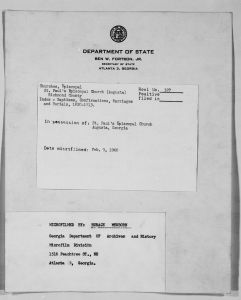
DEPARTMENT DF STATE
BEN W. FDRTSON, JR. SECRETARY OF STATE
ATLANTA 3, GEORGIA
Churches, Episcopal St. Paul's Episcopal Qiurch (Augusta)
Richmond CountyIndex - Baptisms, Confirmations, Karriaees
and Burials, 1620-1913,
Reel No,
Positive filed in
In possession of: St, Paul's Episcopal Church Augusta, Georgia
Date microfilmed: Feb. 9, I960
MICROFILMED BYl HORACE MEWBORN Georgia Department OF Archives- and Histoiy Microfilm Division 1516 Peachtree ST, NE Atlanta 9, Georgia,
EISTGRY OF S' ^AUL*S CHURCH
The planting of the Church in Augusta, is due in large measure to the "Society for the Propagation of the Gospel in Foreign Parts" and the history of St. Paulas is identified very closely with the early history of the tovm itself.
The town was originally laid out in 1735,"having been selected as a military post by Oglethorpe and named Augusta in honor of one of the royal princesses". Ci Roger de Lacy, an Indian agent wis one of its first settlers, and it soon became a great mart for Indian trade, superior to any other, either in South Carolina of Georgia," " A garrison was kept here, at the expense of t the Trustees of the Colony of Georgia."
A Clergyman of the Church of England accompanied the first body of settlers, who came to Savannah, February 12. 1733. He was succeeded by others so that the town was never ibng; without the ministrations of Religion. There is no record, however, that anyone was sent to Augusta for the first fifteen years.
In 1748-9 the Rev. Bartholomew Touberbuhler, Missionary to Savanr.ah v/hile on a visit to England "petitioned the Society for additional help, stat-
ing that there are now about three thousands perscais in Georgia, and no other
minister of the Church of England in the province--- This petition was favor-
able entertained, cooroborated as it w^sby a memorial from the principal In-
habitants of Augusta, stating the Spiritual destitution of the place.
The
Jonothan Copp, v/as in 1751 sent over as missionary to Augusta. This
ge^ntlenn wea a native of Connecticut, and a graduate of Yale College; but
there being no Bishop in America, he was obliged to go to England for orders.
Y.hen in December, 1750, He was ordained deacon and priest, by Dr. Sherlock,
Bishop of London, Before his arrival, the gentleman of Augusta had built a
handsome and convenient Church; opposite one of the curtains of the fort, and
so near as to be protected by its guns, which was the fartherst point the Church
of England had yet penetrated into the Indial territory. The inhabitants also
agreed to build a parsonage, cultivate the glebe, and give L 20 Per year towards
his salery. Such ecidence of zeal inspired Mr. Copp with high hopes of comfort
and success; but when he reached there, though,he found a congregation of nearly
one hundred persons and eight communicants, he did not find any parsonage or
glebe-land and had but little hope of receiving even the L 20 per year offered
by the committee. Separated from any brother Clergyman by one hundred and thirty
miles of wilderness, on the frontier of civilization bordering on the Indian
Territory, and daily liable to the merciless attacks of savages, T.ith but little
to cheer, and much to discouratre, with small emolument and arduous labor, he continued in the work of a missionary until 1756, when he was invited to the
rectorship of St. John*s parish. South Carolina, where he labored until he died
in 1762,
In March, 17th 1758, the General Assembly of the Colony of C-eorgia passed an act to divide the province into parishes."to establish religious worship there accordin'^ to the Rites and Ceremonies of the Church' of England and also..to empower the Churchwardens and Vestrymen of the respective Parishes to assess solis for the repair of Churches,the relief of the poor and other parrocial services"
This act farther provides, that the District of Augusta, (including what v/as afterward known as Richmond and Columbia Counties) "shal be and continue forever a parish by the name of the parish of St. Paul" and that " the Church erected in the town of Augusta, with the cemetary or burial place thereto belong ing, shall be the parish Church and burial place of St. Paul"
In the year 1764, the Rev.Samuel Trink , was sent to Augusta by the S.P.G He found on his arrival " A glebe of Y^ifteen acres and a good parsonage, belonging to St. Paul's parish, and in his first report, he says the population of Augusta w'as at that time 450 ..hites, 501 slaves and about 90 Chickasau Indians.
2 History of St. Paul's Church
After a ministry of some three years he removed to Savannah and was succeeded, A.D. 176?v by the Rev, Edward Ellington
Ke reported to the Society in 1768, that there was no place of worship except St, Paul's Church within one hundred miles of Augusta in any direction. He-labored faithfully to supply this destitution , generally setting out on wionday and traveling for forty miles, ferforming divine Service at three different places, ten miles apart, on the three following days, and returning home on Friday, During his ministry of three years in St, Paul's Phrieh, he travelled in the discharge of his duties, about three thousand miles, baptising 428 persons, married 62 couples, and raised the number of communicants from Seven to Forty After his removal in 1770, the Parish seems to have had no resident missionary or Clergyman for many years.
During this period the original Church edifice fell into decay or was destroyed, and the glebe belonging to the Parish was confiscated by the General Assembly and applied to the endowment of an Acpademy.
Tn 1782, the Grand Jury of Richmond County presented as a grivance the want of a house of worship in Augusta and other places in the County"
And the 'General Assembly accordingly passed an act, July 1783, to lay out
the reserve lands in the City of Augusta in acre lots, which act requires "
commisioners" To reserve one of the first lots, for the building of a Church or
house of worship to the Divine Being, by w'^hose blessing the Independence of the
United States has been established, and a reserve of ten other lots for public
uses, the monies arising from such sales, After defraying the Charges of the
building said Churoh
--
for erecting an Academy of learning In trust for sole use of said Church and Accademy.
Under this act the second St. Paul's vms erected on the site of the first in 1786. It was a plane vjooden structure and removed in 1818 to make room for the present edifice,
ln'1789, the Hey. li-. Palmsr, who was officiating in St. Paul's Churoh was requested by the General Assembly then sitting in Augusta to prepare a suitable form of prayer and discourse for the Thamksgiving appointed by Congress for the establishment of our national Independence. The C-ovenor and legislature attended this service in a body and afterwards passed a vote of thanks to lir. Palmes.
Nothing farther is known of the history of this gentleman or of his ministry in St. Paul's Parish.
The ?,ev. Adam Boyd, an Episcopal Clergyman generally officiated here from about 1790 to 1798-9. hhen he removed to Katcher, or New Orleans and there died a few years afterwards.
For the next twenty years, the 'the parish vas virtually dead,The Churoh building seems to have been controlled by the trustees of th Richmond Academy and o, open to the use of Army demonstrations. It continued to be the only house of * worship in the place for some years.
After the organization of presbyterian Society hare in 1804, that body for a time rented the church from the Trustees. " Prom the rent of pews in that building funds were raised for the support of the minister and other current expenses of the Church,"
In liay 1809, the Trustees of the Academy declined renting "St. Paul's Churoh" to the Session of the I-Yesbyterian Churoh for the special use of that congregation on the plea that it ought not to be given up to the oontroll of any one particular denomination, but should be free to all."
A Page 3-Church History
REVIVAL OF THE PARISH
Afew years later,steps were taken to revive the Church in Augusta and
the Legislature on the 13th day of December 1816, incorporated John Mille^e,
John Carter, Valentine Valker, George Walton, Thomas ..atkins, Richard Tubaan,
Edward F. Campbell, Augustine Slaughter, Freeman Walker, Joseph Hutchtos^.
William M. Bowling, Walter Leigh, John A. Barnes,
Barnes, and their successors in office by the name and style of The trustees
of the.Protestant Episcopal Society of the City of Augusta and County of Richmond,
and authorised and empowered the Trustees of Richmond
Trustees aforenamed an acre of land on which to erect a Church, being those two
lots on Jackson Street between Walker and 'Watkins, (at i-resent 1870)
by the George R. Rosel Company) After voting to accept this lot, April 3. IS
and resolving to save money to erect a Church edifice, by
=tock at
a share, the trustees of the Society afterwards with the consent of
,
determined to place the building "on the lot at the V.est end corner ^
and
Washington Sts., being the same whereon the old Episcopal Church formaly
;.iy .oth 1817, they resolved that the proposed Church should contain eigh ^ ,
valued at $ 200.00 each and that persons who had already subscribed for s
should have the option of withdrawing their names or subscribe under the ne .
arranfeirient#
April 27, 1818, The trustees resolved to employ h'r, John Lund to build the Church on the plan submitted by himself for the sum of 524,000.00. he furnishing the necessary materials
The corner stone was laid with liasonio Ceremonies, on the afternoon of V.ednesday January 27, 181S. and the building completed and ready for use in the Spring of the following year.
On the 2Sth of July 1819 the Rev. Hugh Smith of Brooklyn H.Y. was calls'! to the Church at a salary of 82600. the Church in addition to defraying the_ expense of his removal to Augusta and also to permit him to be absent during the Summer I'.onths until inbred to the climate.
Smith took charge of the Parish in arch 1820, and upon Easter ^cn-lay April 3 of the same year, the first election of Ardens and Vestrymen under the present organization was held.
The Church was Consecrated by the Bishop (Bowen) of South Carolina on the 20th day of larch 1821.
The following is his letter of Consecration as copied at the time in the Records of the Vestry.
" Forasmuch as, to sundry persons professing themselves to be Protestant Episcopal Church, and others desirous to become so, i^abitants of the
ty of Augusta, in the State of Georgia, it appeared expedient that a plaL of worship should be erected for the religions use of themselves and their families. Where they might worship God according to the Letinies and Canons of mhf ProtLt^nt Episcopal Church, in the United States of America.- And forasmuch
as' tbe pious purpose of those persons having been accomplished and by the combined exertLns and liberal contributions of themselves and Others, A spacious Church edifice having been erected completed and furnished. I have been requested to consecrate the same, according to the form and manner of the Peotestant Episcopal
Church in the United States of America.-
^ ^
How therefore, be it know, unto all men that in pursuence of the -iesire of
the Vestry duly represented to me, the building erected completed an furnished
af above mentiLed. is set apart from all unhallowed common and worldly uses
j
hv solinn prav6r
God bo be from and forever
afterthe date of this instrument , a temple holy to the LORD, for the performance therin of all the acts anf offices of Christian worship according to the doctrines
ritual and Canons of the Protestant Episcopal Church in the United St^es of America, and to be known and designated by the name and title of -t. Paul s Church, Augusta.Church this tvientieth (20th) day if l.arch in the Year of our
Lord one thousand, eight hundred and twenty one (1821^ Rev. Hugh Smith A.K. being
?ohncLrre and George ..ebster. Wardens and Augustine .laughter Richard Tubman. Sdvmrd F. Campbell. Freeman Webster Alexander Cunningham, Charles Laburan, Louis c. Ccaannteilon and ThosimigsneHd. : PleantnhaVneisetrlymEeovnretnhe, reBoisfh.op of the Protestant Episcopal
'^Church in the State of South Carolina.
Page 4 Churcsh History
ilr. Smith remained in charge of the Parish twelve years, until the end of ii.roh 1832, During his rectorship he recorded in the Parish Register 141 Baptisms, 69 Confirmation6,wi26uCDmmuaioants, added fepew or by removal 50 Carriages and 65 Burials. His ministry, after deducting 1`or deaths, removals etc. showa a gain in the Parish of 57 communicants.
After leaving Augusta Mr. Smith became Rector of Christ Church, Hartford Conn, from v/henoe he removed in a fevf years to Stl Peters Church, New York Ee v;as Rector of this Church until hdst.death.
He v;as succeeded in the Rectorship of A. Paul *s Church, Augusta by the Bgv. Edward Eugene Ford, Deacon then residing in Morristown New Jersey.
Hr. Ford came to the parish in April 1832 and v/as ordained to the priesthood by the Bishop of South Carolina in the fall of the same year. He had sole charge of the Parish until the Spring of 1861; when he tendered his resignation to the Vestry in a letter dated April 4, 1861,
The Vestry in Reply "^efuse to destroy a relation which has existed in.'n unbroken harmony for twenty jilnes years in ^vhioh he has spent the best energies of his life in building up the parish in faithfully preaching the (iospel in the Church in establishing her practical benevolence amongst us, and in all things illustrating t..e character of a devoted pastor and faithful servant of the Lord and minister of his Word winning from his people their full confidence and their undying love"-------
" and grant him leave of absence for two years from the 1st of June and with a salary of $ 1200 Per an, during his absence."
Dr. Ford died at ..oodstock Floyd County Georgia, on Christmas Eve 1862 His body was placed under the alter of St, Faulj*s Church the following Sunday Bishop Blloit officiating and pronouncing a memorial discourse, other clergymen v/ere present and assisted in the services,
ivmong the recorded fruits of his ministry are 816 Baptisms,276 Confirmations 172 Marriages and 465 Communicants added anew and by removal. He left in the parish 100 communicants.
During his Rectorship the Sunday SohoolIIouse was built in 1843 and the Rectory purchased in 1847. In IC&y 1850 the Rector, V.ardens, and Vestry gave their consent to H. E. Gardener Jr .Esq. 'Its, Gardener and Miss M.G. Jones to erect the Church of The Atonement as a "Free Church".
July 8th 1861 The Vestry unanimously elected the Rev. V.illiam H. Clakke then Rector of St, Peters Church, Rome, Ga. Assistant Rector of the Parish until June 1863, with a salary of ; 1200 a year and the use of the Parsonage" This call was accepted and the Assistant Rector took charge of the parish on the First Sunday in Augusta 1861, In January 1863 after the death of Dr, Ford He vms unanimously called to the rectorship of the Parish,
2iliss3onaries:
Johnathan Copp 1751-1756- 5 years
GamueX'Frlnk-~ 1764-1767- 3 years
~a'(fi'vard iSlYington 1767-1770- 3 Years
Ho Missionery or Clergyman for many years
Adam Boyd
1780-1798 V.'as a resident
of Augusta but did not officiate in St, Paul's as it vrtis used by other denominations from 1786 to 1818
CERTIFICATE OF AUTHENTICITY
This is to certify that the microphotographs appearing on this reel are the accurate^ complete and official reproductions of:
Chxirches, %)iscopal St, Paul's ?^iscopal Church (Augusta) Richmond Co\mty
Index - Baptisms, Confirmations, Marriages
Reel No. 327 Positive filed in
and Burials, 1820-1913.
i i
In'Possession of: St. Paul's Episcopal Church Augusta, Georgia
Date microfilmed: Feb, 9, I960
As reproduced by' the Microfilm Division of the Georgia Department of Archives and History, under the jurisdiction of the Georgia Department of State, Ben W, Fortson, Jr,, Secretary of State.
It is further certified that the microphotographic processes were accoiq^lished in a manner and ori a film which meets with the requirements of the National Bureau of Standards for permanent microphotographic copy.