


- Collection:
- St. Paul's Church of Augusta Collection
- Title:
- How our Church Came to Georgia
- Creator:
- Lawrence, James B. (James Bolan), 1878-
- Contributor to Resource:
- St. Paul's Church (Augusta, Ga.)
Georgia. Department of Archives and History - Publisher:
- Milwaukee, Wis. : Morehouse Publishing Co.
- Date of Original:
- 1820/1960
- Subject:
- Episcopal Church--Georgia
Georgia--History
St. Paul's Church (Augusta, Ga.)
Augusta (Ga.)--History - Location:
- United States, Georgia, Richmond County, Augusta, 33.47097, -81.97484
- Medium:
- church records
chapters (layout features) - Type:
- Text
- Format:
- application/pdf
- Description:
- "How Our Church Came to Georgia," by the Rev. James B. Lawrence, 8 pages, no date, is Chapter 10 in a teaching series titled How Our Church Came to Our Country.The passage ends with a series of questions. A footer indicates the publisher as Morehouse Publishing Co, Milwaukee, WI, the official publisher of worship materials for the Episcopal Church. The mention of the Right Rev. Frederick Focke Reese as Episcopal Bishop of Georgia at the time suggests the material was published no later than 1934 when Bishop Reese retired. The Rev. James B. Lawrence was Rector of Calvary Episcopal Church, Americus, Georgia, from 1904-1951. The chapter mentions the founding of Saint Paul's Church, Augusta, Georgia. Original materials: JPG files from 1960 microfilm.
- External Identifiers:
- Metadata URL:
- https://dlg.galileo.usg.edu/id:spcag_spcagc_spc05
- Digital Object URL:
- https://dlg.galileo.usg.edu/do:spcag_spcagc_spc05
- Language:
- eng
- Extent:
- 7 pages
- Holding Institution:
- St. Paul's Church (Augusta, Ga.)
- Rights:
-

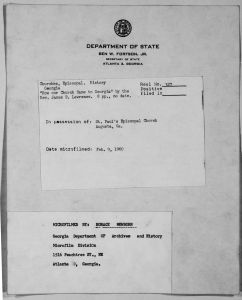
DEPARTMENT DF STATE BEN W. FORTSON, JR. SECRETARY OF STATE ATLANTA 3, GEORGIA
Churches, ^i)iscopal. History Georgia
"How our Church Came to Georgia" hy the Rev. James B. Lawrence. 8 pp,, no date.
Reel No. ?27 Positive filed In
In pessession of; St. Paul's J^iscopal Church Augusta, Ga.
Date microtilmed; Feb. 9, I960
MICROFILMED BTl HCR^_ ICWBORN_
Georgia Departnent OF Microfilm Division 1516 Peachtree ST,, NE Atlanta 9, Georgia,
Archives:
and History
Jloto ([^ur Cijurdj Came to d^ur Country
X. now OOK CIIIKCII CAMK 'I'O )k('.l A
By the Rev. James B. Lawrence
I. Colonial, 1733'1782 OX November l/ih, 1/32, the
/inn, a galley of two hundred tons, set sail irom Gravesend wuh the tirst emigrants to the Colony of Georgia. Hie Rev. Henry Herbert, D.U., with the single purpose othfe ccaorlionngistfso, rantdhewsiiplinrnituualleeneoerdshopoef of reward, accompanied them on the voyage. On January 13th. 1733, they first sighted land, and on the 20th they landed at Beaufort. S, C. Here they were hospitably enterMined until lanuary 30th, when they embarked on aolasnlotaotpionofboseavtsentfyortothnes palnadceonwhfeivree General James Oglethorpe had chosen a site for the new colony. 1 hus. on
February 12th, 1733, they finally landed at Vamacraw Bluff on the Savannah River, and having offered thanksgiving to God for their prosperous voyage and safe arrival, they set about the work of building whav icbsoenlrotonwyr,ethmweahcineitneyd, ooftnhSraeavecacnomnuaonhnt.thosfDrii.nllHneteshrse-, he set sail for England. He died on the return voyage and his body rests in its watery grave until that great dgiavye wuphetnhetihredeeaadrt.h and the sea shall
A site was aiijiointed for a church and a sufficient glebe for the minister Of the many missionaries who gave tnhaehi.r osnelryvicoense troemthaeincehduracnhy icnoSnsaivdaenr
OLD CHRIST CHURCH. S.AVANNAH. GA.
How Our Church Came to Our Country
able length of time. (Jf ilje others, two did work whose intluence lasts to this day. in JFoehbnruWaryes,le1y736a,rraivneddreimn aiSnaevdanunnatihl December, 1737. It was during this time that a Sunday-school was organized under the superintendence of Mr. Delamotte, which--still in operation-- is the oldest Sunday-school in the
CbyhatrhleestBoins,hooprdaoifneLdodnedaocno,nhaendarprrivieesdt in Savannah in January, 1746, and re mained in charge of the church until his death in December, 1766. It was during this time that the first Christ Church was built. In 1746 President csSiotdevepeshreaednndswewintrhdostseoh:finitg,"lTeitsh,reebmruoationfassoatfoskitetlheies-
wthoartldt.hirItyt woars faolrstoy dpuerrisnognsthims ettimaet Wesley's house--a meeting which he afterwards described as the second
ton." Finally, on July 7th, 1750, the sltiuesrvheemnietnenetGnotehforatghniean,ivfaiernsrdstacrthyoeuoretfigothhftehjueadsntiacnbai---
period in the rise of Methodism. versary of the victory gained by Ogle-
In December, 1738, the Rev. George Win hSitaevfaienlndachambeeintogGtheeorognialy, thpearcihshurchhe ever had. He devoted most of his time and eloquence to building a home for orphans, which he named "Bethesda" and placed in charge of James WHahbiteerfsihealdm.laidOntheMfairrscthb2ri5ctkh,of17t4h0e, hmimain. Hbueilmdiandge. thiTrtheiesnwvoorykageasbsaocrrboesds
thorpe over the Spaniards at Fredearnidca,cotmhemobduiiolduisn,g", w"laasrgdee, dbiceaatuetdifutlo, bthueildwinogrswhiaps oefnlAarlgmedighinty17G6o6d,.buTrnheids in 1796, rebuilt during the years 18011806, and replaced in 1838 by the one which now stands, a memorial to the sacred history of the state.
When, on February 15th. 1736. General Oglethorpe began to build the
the Atlantic when voyages were fort and town of Frederica, St. Si-
dangerous, and ten distinct visits to mon's Island, as a protection against
Georgia, chiefly in the interest of Bethesda. Of a sermon preached in
Spanish aggression, he was accompanied by his secretary and chaplain,
blienhaslafyso:f th"Ie hhaopmpeenBedensjaomoninafFtrearnktoattend one of his sermons, in the cteonudresed toof fiwnihsihchwi1thpaerccoelilveecdtion.l,e ainndI silently resolved that he should get nothing from me. I had in my pocket afohuar nsdifluvlerofdoclolaprsp,e' r amndonefiyv,e thpriesteoloesr osoffgteonld, .anAd scohneclpurdoecdeetdoedg,ivIe bthegeacnotpo-
the Rev. Charles Wesley, who until hsuisppdlieepdatrhtuerereginimtehnet afnodlloiwnhinagbitJaunltys twabitbhythbeuilsdeirnvgicewsitohf bthaseemCehnutr,chl.oweAr and upper stories was built, and in the upper story the services were held. aTnhdisAmugisussiotan,, wliaksesuthpopsleiedinwSitahvcalnenrgahy bRyevtohleutSio.nP. . G. until the close of the
per. Another stroke of oratory made me ashamed of that, and determined
It was organized into a parish in 1808 by several planters who had
me tn give the silver; and he finished settled on the island for the purpose of
so admirably that I emptied my pocket cultivating indigo at first, and after-
awnhdolalyil,"into the collector's dish, gold
wards the more lucrative crop of cotton. In 1840 the church was greatly
voRteudt tthhee imnfalnuewncheo oinf hthisosleifdeaytos dtheeGuirch in Savannah, was the Rev. Bartholomew Zouberbuhler. Born in St. Gall, Switzerland, educated in
iennonuegehd omforneepyairfso;r bduotinthgertehewawsonrokt. One day a swarm of bees was found busy about the steeple of the church. Investigation proved that the steeple
How Our Church Came to Our Country
wanads fmilolendeywietnhohuognheyre. aliTzhedis twoadsosotlhde, gneescteisosnaroyf rtehpisaiirnsc.ideOnwt,inthget"oBtehee-HsuivgeMissionary Society" was formed which emulated the busy bee in its work for missions.
After the war between the States tfhaiisthfcuhlulracyh rewaadsersgiuvenntil s1e8r7v9ic,ews hbeny the parish was reorganized by the Rev. A. G. P. Dodge, Jr. This devoted priest and fervent missionary gave his services for the upbuilding of the work until 1898 when he closed his eenardtohwlymceanrtefeorratnhde cgoennteirnouuastliyonleofft tahne pwahriicshh,haansdbeaelsno iansfturunmd,enthtael iinncofmouenodfing and maintaining fully two-thirds of the missions in the diocese of Georgia. gCrhoOuunrncdhM, bAyarucaghudsi2staa2,sdt,rwoau1s9s1bf6iu,rernSewtd.hictPohautdlhe'es-
nempThSP(swolaeliopaamdtrhnyevcecoeyeiticqdoaeutoliTw,lnibfiytrnieteaciDldatelhttsbeihaivarleskeastiehnetyneonePeaIlsynlnaeaSWndrdcatoieraPrtotae)SniercnstsoeheighrpdtCevehilepoeroaesFnfutwotwfnsNobtrtoaortryeis.becmymsetttlhsooiaseetonrnhimottyeyhueC,msnvYhdomieudeefaoreamccunrrhhaess-t fyaaloWolwatitGtHMIfeinuihhncopnnofnmchuotata""ohpredouiititnnstaoteWFnioacrhriuhnssonkebhoinoewiegstnhy,muhCithfrdpttou,raeItaeeaih.erwsSmfhsntmttndreunahhueedeCtcbbriwn,aeBitshbsicashellybdaeeseNherauilhenytoscCirirn.thaeoteabfgrhSehduvvaiwuateCyanBarpeeurtetessevmloPhittrorar,slctaiaevyeeehsuIouuatciwonfatwenCrnnnpaoitopuPnddsooehsstetleshrl'utrlli,nfoeearleseaauylaiscnoarft,cmhcnnranaheettftchaeatghetfteamaelevFCshordietCynntoieeeotrrahhnpddfotsioeeysSehulesaiivmbCoeneysinnriurtateosudcuvhgeoodsghmFsb,ntihdeetufus'hleotsr,acitdrdahrtbuwreeMtrcahucrnetietrraslairwtphier,nedgteaHiotteahbe,iRsitbodPdoooAtaseuphftiieuivfplsnoofnrptmranlaas,iapoRaogrrtlosnEynswsoordc,uoemacsomcosnupittsenaronnoihheoouogtreesrytssldudngeeeee--;-ffrr-.,,
stroyed a large portion
of the city. This irrep-
aisrabmleouarnnedd hbisytorthice leonss-
tccihhreuurrcchhdioatchteuseslargdaeen.sdtroTythhedee
tswoeoacskonbdtuhielbtupiillndaicne1g81o9wf hatinhcdhe
Twhaes fifrisntisShet.dPamul's17w8a6s.
built in 1750 and is best
dinegscrliebtetedr byadtdhreesfsoeldlowto-
tlhisehinTgrusttheees Cfoolroneystaobf-
Georgia in America:
ioosaethonletrffaefan""vrbtttTasATtiiehe,hnohhdeuhegnGeaegam:nTeluptfd,ftnhsoaroeteiwoktlatnrolhefanocNgneliiwtepsuhadtMiamnhenialhndegeibutlIIreoymenntTMrihhwbnoIaaCenlgowibbymtcfohiinrnhttoepsaaSserahtnnrieirhsdeiaetttpeess---l,
ST. PAUL'S CHURCH, AUGUSTA. GA. THE RUINS AFTER THE FIRE OF MARCH 22. 1916
How Our Church Came to Our Country
omtaoancbtohbegtpTfpvitylWlDWhnihhhaiertysiatolunecuotcotaceenehaeeaptt"""mriaoleetruolaweka,nndyitetytWWWsetrndebresrheieIdgCrGnmoodkendnlbienooneseedeionffudhneoc,thesHtahruweroSMhedsrdfeush,tioyaaacFbcro,fuphnihhodoetsrebmlensaooooeHteocob,pgeaaelfndtsiniedalrsgrlhvvhvserrnto,sitJ,oPGatJttdltatghctynecaeeechPasgthuGtotnlaanerhe.iairrlerawdoeamw;Oiur,nilolooehybMaytnrelnraecbsswnesl.eFnouhdynnabledowlnegpkeioborossaiufSMrn,otlnstoriSChceithu,orshawystnaasdurtamghRohaaaoartiocitrhatsFgdnoeectvitdtvedo,cnhpdoeaeniwardsCdrhLfrwiHetiymgededstozshgahetl.aoelaeete,rhtSei'MugatoeseyhtwrnaynfyxtyailaAhlMHiemeatea;f.enalemtclmbnochtiae-tineegsranxlvletleqn,ubfcno.SsliwfoauesnpdIe"ponsuttsrulusnosnornSslCheenoohttebratwreailSet^f,imrhdoemuHsildetDtloeonrrucyhaiitoaicSteslOPalmgleeheoachctyoibbyilOfetsas.oenre.rtatbnetsheiomulrosgoitadhtftcebmeaeoyvoia.tucDfaDpClmnenkheanaidaiaunwahnynrnceauodnnieodsaisaonrketoevagehmnaksipwodsdmRHsfnautafrTnsiunanaes,wiusuddnntCaugbegnottrib,ptfawotselesiOmdlirlelognhliluoebRiicnefeayitrsgHtnrsuovoneenldaegssooESloiefrneuntOlngOlsooenoatihcedm.elrtrrhteboxnuotoicmolahsfiirrssstodya*eese--fss----flf,t,,,t
"That the `Book of Common Prayer' of the Protestant Episcopal Church in the United States, ratified by a convention of the said Church and made of force on the 1st October, 1790, be aCdhouprtcehd, sufobrjectthteo spurcehseanltterabtyionthaiss shall hereafter be agreed by the officiating minister of Christ Church and the Vestry thereof." ChAunrcohtheinr iGnecoidregniat, wshaoswrienagchhionwg othuet toward the organized life of the nation-wide Church, occurred when the Rev. John V. Bartow, rector of Christ Church, Savannah, presented to the General Convention which met May 23, 1811, in Trinity Church, New Haven, a certificate of his appointment to attend the Convention signed by the wCharudrcehnsinanthdevceisttyryofofSathvean"nEaphi.scSotpatael of Georgia." The Convention passed a resolution stating that the "Protestant Episcopal Church in the State of Georgia, not being organized, and not having, in Convention, acceded to the ccoopnasltitCuthiuornchofin tthhee PUrnoitteesdtaSnttateEspios-f Anomt ebrieca,adtmheittRedev.a Mmre.mBbaerrtowof ctahnis-
II. Organization, 1783-1840
House, but he be allowed the privilege of an honorary seat."
Thus in Colonial days these three cChhurricsthesC--huCrhcrhi,st FCrehduercrihc,a,SaavnadnnaSht. Peda.ul'sTChehyurchha, dAubgeuesnta--suwppelrieedfouwnidthclergy, who, sent out by the Society for the Propagation of the Gospel, owed their allegiance to the Crown of England. Therefore when, on July 21, 1782, British rule came to a close ianndGeworitghioa,utthseuCpphourrtc,h,wwasithaolmutosctleargnyndeihaidla, teodn.ly Ybeutritehde;sebeudt siotwwn awsassonmoet time before a fully organized Church
aryI,t w18a2s3,notht autnttihlethPeri2m4athryofCFonebverun-tmioent ionfStht.ePcaluelr'gsyCahnudrclhai,tyAuogfuGsteao,tf^oiar organization. Three clergymen were present, the Rev. Edward Matthews, rector of Christ Church, St. Simon's oIsflaCndh,ristht eCRhuevrc.hA, bSiaevl aCnnaarthe,r,anRdectthoer CRehvu.rcHhu, gAhuSgmusittah., RFeicvtoerloayf Sdte.lPegaautle'ss from Savannah and Augusta were present. Rules of order and a constitution and canons were adopted, and the Convention acceded to the consti-
was developed.
tution and canons of the Church in the
At a meeting of the Vestry of Christ United States. As clerical deputies to
C17h9u3r,ch,weSavfainndnaha, hreelsdoluintioDnecepmasbseerd, twhaerdGeMnearttahleCwos,nvtheentRioenv,. tAhebieRleCv.arEtedr-,
How Our Church Came to Our Country
acnhdosenth;etheRelavy. deHpuugtihes wSmeriethGeworegree gTiari,nciotynfCirhmuerdchc,laCsoselusm, abnuds.consecrated
JWon. eHs,azAznatrhdo.ny Barclay, and William 111. Bishop Blliott, 1841-1866
Only the last-named clerical and the first-named lay deputy attended the session of 1^3, at which the Church in the State of Georgia was rCeocneviveendtioinn.to union with the General
Although the diocese was now orgbaenfoizreedi,tthwearse twoehraevteoibtse omwannybiysheoaprs. From 1798 until his death, October 28, 1801, the Rt. Rev. Robert Smith, D.D., Bishop of South Carolina, by ccoornrdeistpioonndoefnctehekeCpthiunrcthouicnh Gweitohrgtihae On April 26, 1815, his successor, Bishop Theodore Dehon, consecrated bCuhirlidsitngC)h,uracnhd, Scaovnafinrnmaehd (atheclasessconodf about fifty. This is the first visit of a bBiisshhoopp NtoathGancoieiml Ba.oweHn,isgavsuececpeissscoor-, pwahlicahidtouonktipl ltahcee yinea1r83b8e.forIen hthisatdyeaetahr Bishop Jackson Kemper visited Geor-
Several efforts were made to solve the episcopal problem of the diocese. tOhneeSoofutthhweseestw. asAtnoohthaevre waabsisthoopunfioter tFhleoreipdias,coAplaalbcaamrae, oafndonGe eboisrhgoiap.unBdeurt the plans attempted all failed. At last the Convention which met in Grace Church, Clarkesville, May 5, 1840, elected the Rev. Stephen Elliott, Jr., and on February 28, 1841, he was consinecr1a8t0e6d, fhirestwBaisshonpotofquGieteortghiair.tyB-foivrne ytieoanr.s oWlditaht tthhee etinmtheuosifashmis ocof nysoecurtah-, with splendid poise of mind and body, full of God's grace, and with a heart of oak, he began at once to devote himself to the difficult task before him. With a list of eight clergy, five cmhuunrcichaenst,s,twhoe munisdseiorntoso, kantdo 3b2u3ildcomupthe Church in the state largest in area east of the Mississippi.
He devoted much pains to the in-
Jcaremaesse Houfnta, wnhaotivheadmbieneinstrmya. deJdoehan-
cMonichaoenl's JCahnuuracrhy, C2h,arle1s8t3o5n,, ainnd oSrt-.
dained priest in the same place on No-
vember 25, 1836, was the first native
Georgian to enter the ministry of this
Cmhaunrcah. PrOanyeerdaByoohke. gaIvte waasyoluikneg
leaven. The young man, Thomas F.
Scott, came into the Church, and fin-
ally became the first Bishop of Ore-
gon. Influenced by our beautiful
liturgy and by the imposing character
of Bishop Elliott, William Bacon
Stevens entered the ministry, ulti-
mPeantenlsyyltvoabneiac.omeAtmheonfgoumrthanByisohtohperosf,
sHpeencirayl Km.enRteioens, ashporuilndcebeof mmaidsesioonf-
aries, who devoted his entire ministry
BISHOP ELLIOTT
to Tthoegedtihoecersew.ith the increase of the
How Our Church Came to Our Country
ministry, Christian education occupied a large part of the Bishop's thoughts.
gation of sixteen communicants writes in 1873: "The minister would have
The seminary for girls which he starved, with his sick family, had it
founded at Montpelier cost him not not been for the kind assistance of
only anxious care but his private fortbueneen ;aabnadndaoltnheodu,gthhethries ascrehowolohmaesnloynegt living who are grateful for the lessons learned and the inspiration received there. Bishop Elliott, with Bishop Otey and Bishop Polk, formed that great triumvirate which founded
afrnidenodfs Cionl. CWhrist C, ohufrMcha,coSna.v"annah, BisIht ohpasEblelieonttsebeengawnithhiws heaptisccooupraatgee. It required no less courage for the cRotn. seRcervat.edJoshenconWd .BiBsheocpkwoifthG, eoDrg.Dia.,, April 2d, 1868, to face the new condi-
the University of the South at Sewstrauncetei.on Heofwathsecarselafvuels,forantdhe Sint-. oiSnftettphhheeecnfio'rsustnCtprhayur.rischhe, sSfaovrancnolaohr,edwa]>seoopnlee
twioansstowphiucthfcaoitnhfraonndtecdouhriamg.e iHntios mtaeskn ahnadrd wtimomesenanwd hboeinwgerterainuendderingoitnhge school of adversity. \\'ell did the new bishop do his work. His wonderful
At the time of Bishop Elliott's death in 1866, the clergy list shows twenty-
voice, bringing out the full meaning of the services, at once arrested the
five clergymen resident in the diocese, amnidnismterisinsigonsto, wtwheonstey-eciogmhtmpuanricisahnetss
aoBtretaectnkotwriyoitnhinorfethahides, hppeuealorpepirltes.altiWtsrtaehcnetenedd.BilsahHrogipes
nSutemvebnesresdaimd oorfehtihma:n "2H,0i0s0.chaBraischteorp, congregations wherever he went, and
like his body, was majestic and sym-
mgleotrryic;alit wwiatsh thmeannloyblesttreemngptlhe oafnda
noble soul. His mind was of large
ccaarlieb.reHainsdelocquulteinvcaetedwaws itthhe soeudtubluorusst
opfouariwngelli-tssteolrfedt,hwroeulgl-htraliinpesd, innotet llwecett,
mtforoeurmcehleyodf,f awthsietbhyAlatnCagra.es"ltahliaan'sds, dweiwth, cobaulst
IV. Later Days camWehteon atnheenWd,atrhebreetwceaemnetthoeaSntaetneds with it the old ideas, institutions and ctoivtihliezaotliodnr.egiBmies,hoapndEwllhioentt itbedlioendgehde dthieed Saolsuot.h nTehweretimnoews, dnaewwneiddeausp,ona changed condition of things. The times were hard for a quarter of a century. Stipends were difficult to raise, even in the larger congregations, wirrheigleutlharelympisasiido.naOriensewmeirsesipoonoarrlyy iannda small town ministering to a congre-
BISHOP BECKWITH
How Our Church Came to Our Country
twhaescloikuersae roofyahlispreopgirsecsosp.al visitations theHcehucrocnhtininuteod ththeesmwaolrlker otfowpnusshainndg ovlidllapgaersi,shwehsilgereinw tahnedlanregwerocnietiseswtehree formed, so that when he died, November 23, 1890, the number of comttiihnTaginPnmdicoaaunrkbtssledino.f tOhhenisedoeifopcitsehcseoepdaihsteatidnigsmuiotshhreefoundation of the Appleton Church Home for orphan children, in Macon, which will always be a monument to the greatness of the bishop, and to the liberality of the generous donor whose name it bears. cloBseutwwiteh mbruiestf bmrienngtioonurofstmoreyn tsotilal
tinenasefemwisyseioanrsargyreawctitvoitsyu.ch Tahne ewxtoernkt tAhcactoirtdiwngalsy,tooonmuOchctofobrerone7, bis1h9o0p7., Georgia was divided. Bishop Nelson elected to administer the new diocese, the northern part of the state, and became the first Bishop of Atlanta.
On May 20, 1908, the Rt. Rev. Frederick F. Reese, D.D., was consecrated fourth bishop of the diocese of Georgia, in Christ Church, Savannah, and under his wise administration the gGreeoartgwiaotrhkirgtoye-osnoen.cleIrngythmeendiomciensiestoefr wtoitshev4e,9n7ty5-tchoremempuanriischaenstsa;nidn mthiessidoinoscese of Atlanta thirty-two clergymen minister to sixty parishes and mis-
living. The Rt. Rev. Cleland Kin- sions, containing 5,466 communicants.
loch Nelson, D.D., consecrated on February 24th, 1892, as third Bishop
Compare these totals with those with which Bishop Elliott began his epis-
of Georgia, developed an episcopate whose chief characteristic is its in-
cceospsatoeurinC1h8u4r1c,hahnads cseoemetoinwGhaetorsguica-.
CLASS WORK ON " HOW OUR CHURCH
CAME TO GEORGIA"
PREPARATION FOR THE LESSON T aHbGoGSSttSGCXoecyf.tt.oeeeiscaaFsoootPltetttlaehoteerrrs.LeohsshangggerssscourearGiiteeytuglaawiStoy.hg.o.rgoWEs"fttceionaetaosepnofusscAtTthnbsireetotosiyiyehGmrtrfcndaeooofyoBoedeal.Brfffoopr.inftiirtwayGicfobshgAoGlu'hEafiaeietsnll,orahcevlo"sCstpetokoh"ar.hhffggrgHnweiooguSstiirrsCrvhlaiiior;tlTlasoc"eeeoluaitU"hlhvnrwono"aAftoesfinrAidininoecnniysirnbndalferdcsgyeolmi;haonHrt"niifhamw"nvhCHbyittSSeaeshthihoaischtosCtesuotooahUUeintrhktoorokoc:iynnasfnirhshoPRnpiiitaltttcrdie"tsheevcooaaeavlA,iddeyn"esss-rfl. bWAmemaaPhnreoosyTrsitscHehiakvbeE?neleronwFah(mIp2eReo)awirSnodhTtWfesotahhFfaoeKIJtrfVoinshEhcgtnaeotonMeWfteaIvoEceNfentsrUgletlhaaTycern?aEedm:SU. Henoi(o1twon)
TEACHING THE LESSON I1.. TCeoGllleoonarigablioau?Dtaythse. first missionary to
2. 3. 4.
GWTehiAMvhlileumaisgts?suotihsomtetwnaea.otsrhytionfrSgaymoocoofieufStsytt..hmePaeu"nBl'sefeoClhlHouiwrvceehd",
II1..
2. 43..
OWHWHiowaroonhhglwwiuobaatGhttinisoeitwhdzowtonoihaaodrap?stegksi?ioatGGncthha.aeeeertnoeerdtsghritoaioeaalfcteceCilsctoeooosbnmfeoeverfotehgonfeartietninhoiCenzithte?oRduuh?reccavhhd-
III. Bishop Elliott.
21.. 34..
TWWGeiivnhhlletaaottssootwdmhmieedeletlh-Chkriehennusgodurwoclathnbs?foomourftenehBdiisdusihcdeaoptphiiosecEno?lblpiraointtetg..
IV1.. 243... 5.
TWWWWN.gagCahhhhtiimheaaoaaar.?uetttrDwwcdiwtshliaaiidetesythhristenetp.hhtrehhtpeeheirsCseieesrisenvcSecbtihnoltiiasdtneWthidfecoooacpaobnrescfisd.tsdeiihGvtosioioetptiionno?ersgoGG?ifaee?toohrre--
PUm.ISIIEI) IIY MORKIIOUSR PUUMSHINO CO.. .MlIiWAI'KER. WIf*.
TATC CAPITOL
DEPARTMENT DF STATE BEANTLCWAORN.ETTFAAOR3YR, OTOPSESDOTARNTaE,iAJR.
DEPARTMENT OP ARCHIVES AND HISTORY 1S1R PEACHTREE STREET, N.W.
ATLANTA 9, DEOROIA
CERTIFICATE OF AUTHENTICITY
This is to certify that the microphotographs appearing on this reel are the acciorate, complete and official reproductions of:
Churches, ^b^scopal, History Georgia
"How our Church Came to Georgia" by the Rev. James B. Lawrence. 8 pp., no date.
_ , Reel No.^22 ,
In pessession of: St. Paul's Episcopal Church Augusta, Ga.
Date microfilmed: Feb. 9, I960
As reproduced by the Microfilm Division of the Georgia Department of Archives and History, under the jurisdiction of the Georgia Department of State, Ben W. Fortson, Jr., Secretary of State.
It is further certified t)at the microphotographlo processes were accon?)lished in a manner and oh a film which meets with the requirements of the National Bureau of Standards for permanent microphotographic copy.
laCamera operator