


- Collection:
- Georgia Historic Books
- Title:
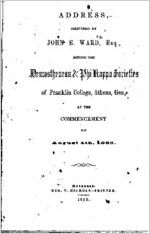
- Address delivered by John E. Ward, Esq. before the Demosthenian & Phi Kappa Societies of Franklin College, Athens, Geo., at the commencement on August 4th, 1853
- Creator:
- Ward, John Elliott, 1814-1902
- Contributor to Resource:
- University of Georgia. Demosthenian Society
University of Georgia. Phi Kappa Society - Publisher:
- Ward, John Elliott, 1814-1902 Address delivered by John E. Ward, Esq. : before the Demosthenean & Phi Kappa Societies of Franklin College, Athens, Geo., at the commencement on August 4th, 1853. Savannah : Geo. N. Nichols, 1853.
- Date of Original:
- 1853
- Subject:
- Conduct of life
Baccalaureate addresses--Georgia--Athens - Location:
- United States, Georgia, Clarke County, Athens, 33.96095, -83.37794
- Medium:
- books
texts (document genres) - Type:
- Text
- Format:
- application/pdf
- Local Identifier:
- gb5108
- External Identifiers:
- Metadata URL:
- https://dlg.galileo.usg.edu/id:dlg_zlgb_gb5108
- Digital Object URL:
- https://dlg.galileo.usg.edu/georgiabooks/do-pdf:gb5108
- Extent:
- 23 p. ; 22 cm.
- Holding Institution:
- University of Georgia. Libraries
- Rights:
-

ADDRESS,^
DELIVERED BY
*
.
*b
E. WARD, Esq.,
BEFORE THE
of Franklin College, Athens, Geo.,*
AT THE
COMMENCEMENT
ON
, loO8.
GEO. ?!. NICHOLS --PRINTER.
1853.
^
, uwiv. UP GEORGIA LIBRARIES
ATHENS, August 4th, 1853. Mr. JNO. E. WARD :
Dear Sir--In accordance with a resolution passed by the " Demosthenean Society," we, the undersigned, with pleasure tender to you the sincere and grateful ac knowledgements of the Society for the able and eloquent address which you have this morning delivered before them; and request of you a copy of the same for publication.
Very respectfully,
T. W. WALKER, W. A. CLARK, J. H. HULL, Committee. J. F. BAKER, A. POU,
ATHENS, August 4th, 1853. Gentlemen--I compliance with the request contained in your note, this morning received, I herewith send you a copy of my address. Will you present to the Demosthenian Society my most grateful acknowledgements for the kind indulgence with which that address was received, and accept for yourselves, individually, my thanks for the flattering manner, in which you have communicated their appro val and their wishes.
Very respectfully and cordially yours, JOHN E. WARD.
Messrs. T. W. WALKER, W. A. CLARK, J. H. HULL, J. F. BAKER, A. POD, Committee.
ADDRESS
Gentlemen of the Phi Kappa and Demoslhenean So cieties--I cannot be insensible to the honor of being the public organ of your sentiments on the present occasion. Yet as I look around me on the band of youthful aspi rants, lingering for an hour to bid adieu to the past, ere they rush forward with an enthusiasm which no reverse has chastened, to grasp the prizes which the future un rolls so temptingly before them, the feeling that stirs within my heart is not one allied to personal honor, the thought which occupies my mind is not, how shall I acquit myself? but how shall I interest these eager minds ? What subject shall I present to them, by which I may hope to win them for a little while, from the gay promises of hope, and the alluring visions of fancy? To satisfy you, it must be a subject which will not alto gether withdraw your minds from that career about which they delight to hover. To satisfy myself, it must be one, from which shall naturally spring thoughts, not altogether unworthy to connect themselves with this era in your history. Thoughts not altogether un worthy to endure, and, in some degree, to shape those new forms, which your being is henceforth to assume. There is a subject which meets all these requisitions-- which condenses in a single word the varied interests of the past, the present, and the future--a subject whose significance extends not only to every condition
possjble to us, but to every form of existence through out the wide reaching realms of God's universe.
Your minds will doubtless forerun my utterance of the word LIFE.
Life, not as it glows in yonder *un, or endows with seeming self-action, the Planets which wheel their silent course around it--not life as it stirs in the dark recesses of our earth, and with that combination of good and evil which marks a fallen world, sends up now the molten lava to desolate, and now the green herb and shady tree, and delicately tinted flower, to beautify-- uot life even as it throbs in our pulses, sends its quick, bounding torrent through our veins, and its vigor to our limbs; but life, as it gives birth to thought and feeling, as it shapes the character and decides the destiny, not of the individual man alone, but of the social and polit ical world in which he dwells.
A wide range, enfolding within its ample verge the germ of thoughts, which it would require not an hour or a day, but all time, fully to evolve, enforce and illus trate.
I cannot hope, therefore, to place before you a perfect picture, but only to sketch with a rapid pencil, a few prominent traits of my subject--looking at it, not in its subtle workings, in those remote recesses to which the Psychologist follows it, to mark with microscopic glance its minutest phenomenon, but as it comes forth visibly in action, to be seen and judged of all men, a wide ' spreading tree, giving shelter and healthful fruit to many, or shedding a Upas blight, on all that approach within its influence.
In its great elements, human life is every where, and at al! times, the same. The greatest poet of Rome,
makes his hero exclaim, when thrown upon a foreign shore, and among an unknown people,
Sun: hie etiam sua praemia laudi-- Sunt lachrymae rerum et mentem mortalja tangunt.
[ Virgil, l*t B., tinea 461-2.
And more than sixteen hundred years later, Shakspeare
wrote--
" One touch of nature makes the whole world kin."
To lie in the arms of love, in the purity and uncon sciousness of infancy--to sport through the live-long summer day, with an untroubled conscience, and a heart careless of the morrow, is the earliest experience of life to each of us. None are too poor to have enjoyed it; none have had wealth enough to retain it. We look not for fruit from the graceful flower. When it has waved for awhile in the summer breeze, adorning the earth with beauty, and filling the air with fragrance, the ends of its being have been accomplished. And such is childhood, with no object beyond itself, but that self so exquisite in beauty, retaining still so much of the glory of that world .from which it .sprung, that it is our best blessing, our most efficient teacher, as it has been pronounced by the lips of unerring wisdom, our purest earthly example, and safest earthly guide. But this age of gold soon passes. Childhood merges into yonth-- the life of instinct into the life of passion. The uncon sciousness, the aimlessness, which left the child the pas sive recipient of the influences, that distilled gently like dews from Heaven above, or rose like foul exhalations from the earth beneath, or from the darker world under the earth, is no more. The graceful sapling, swayed by every breeze, has stiffened into the tree, which it requires force to bend. A new element has entered into the life. From the soul bursts no longer the child's cry " I wish," but with more or less imperfect utter-
ance, it shapes the manly syllables, " I will," and thus the mystic trinity in man's nature stands complete-- the heart to feel, the intelligence to perceive, the will to execute. And from this " I will," springs all the good which has ennobled, and all the evil which has desolated our world. This closed against the human race the gates of Paradise, and sent man forth to con tend for a habitation with the beasts of the forest, and this has made the wilderness to blossom as the rose, has subdued its savage denizens, has built cities, and foun ded States, has made the winds and the waves its servants, and has taught the very lightning of Heaven to do its bidding. Man's will! In this in subjection to that omnipotent power which sustains as it has crea ted all, seems concentrated the life of the world; of this, with such a meaning as reverence to the highest permits, it may be said " it speaks, and it is done."
Two things then are necessary to the perfect developement of the life of man--First, a strong unconquer able will, and next, a will which turns to the attraction of truth and honorj as readily as the needle to the magnet. A will which knows no ruler beneath the skies, and which to him
" Who sitteth on that only throne, That time can never shake."
turns with unquestioning and unhesitating submission Before that throne ever bend with reverence ; from your ranks will go forth to th 9MorId no false friend, no mur derous foe, no destroyer of innocence, no betrayer of his country, " for God and his Angels are in every spot where virtue trembles and resists. " The will which is too proud to bend to Heaven, bends to some lower in fluence ; forsaking truth and honor, it comes within the sphere of low and little passions^ of selfish ambition or
avarice, of envy or hate, or those licentious pleasures which steal their slender chains insensibly around us, and hold us in a disgraceful and hopeless bondage.
Let not the enemy who has stricken the sword from our hands, who has bound us- with chains, who has im prisoned us within dungeons, upon which the sun never shone, dream that he has conquered us, while our wills remain unsubdued. Those will burst the bars and bolts of the prison, shiver the'chains from the limbs, and from these very chains, forge new arms for the freeman.
"Eternal spirit of the chainiess mini], Brightest in dungeons liberty thou art, For there thy habitation i* the heart."'
"The heart which love of thae alone can bind, And when thy sons to falters are consigned,
To fetter?, aud the damp vaults day less gloom. Their country conquers with their martyrdom,
And freedom's fame finds wiiigs ou every wind."
And if thus powerful the will of the individual man, what may we not say, of the will of the many, of a nation, of the race. Here lies the best hope of free dom, here the promise of its certain triumph. Say not, think not, that history contradicts this hope; cast not your eyes gloomily to prostrate Hungary--her people willed not; they bad but wished lor lr:edo:n, or they had bee.n free. Look not to enslaved France. " Tast ing the fruits of liberty before they had well ripened, their flavor was harsh and bitter, and she.turned from them to.the sweeter poisons of servitude. This is but for a time. France is sleeping on the lap of Delilah, traitorously chained, but not yet shorii^of strength; let the cry be once heard, the Philistines Ls upon thee, and at once that sleep will be broken, and those chains will be as flax in the fire; her sun is darkened, but it is only for a moment, it is but an Eclipse, though all birds of evij oaten have begun to scream, and all ravenous
2
10
beasts have gone forth to prey, thinking it to be midnight.' Wo to them if they be abroad when the rays again shine forth."
But my present subject is the life of the individual, and to that I return. I .have said that a strong un conquerable will is necessary to the perfect developement of the life of man. In so often as we fail of this, we fail of being men, and return to the passivity of childhood, suffering ourselves .to be driven hither and thither, by influences from without, or by our own way ward impulses. No less important is the right direction of the will; this makes the difference between the good and the bad man--between Angel and Devil, for angels, as well as men, God made
" Perfect, not immutable." " And good he made (hem, but to persevere He left it in (heir power, ordained their will, By nature free, not overruled by fate."
Herein then, lies our freedom, and by the turning of this helm, the will, the whole ship of our being, with all its precious freight of honor and happiness, is to be steered to a haven of assured success, or to shame and the bitterness of despair. Of the young man especially is this true; he has few, if any, steps to retrace; he stands at that point at which the different roads, traver sing the great plain of life, open before him. He is to ehoose now whether he is to live for himself or for man kind--whether he will call himself a man of pleasure, still continuing the slave of his instinct, still sporting, like a child, through the long hours of advancing life,
" PlinaeA with a rattle, tickled with a straw,"
or with a graver, but still with a selfish purpose, will give himself to business, in the pursuit of avarice, or of ambition, toiling through the day, watching through the night, trembling at every sound which may threaten his
11
hoarded gains, or his painfully acquired renown--or whether, rising above all selfishes impulses, to that arena to which only end this noblest son may attain, seeing from that lofty eminence what lower spirits per ceive not, that virtue is but another name for pleasure, truth and justice only confer immortality, he resolves, that to virtue, to truth and justice, he will devote him self--that as a soldier, he will do battle for the right, as a statesman, will scheme and act for the right; as ascholar, will investigate and weigh only to discover, and will speak and write only to enforce the right. In a word, that his will, receiving its direction from the only unerring source, shall guide his life to the only true glory, and the only unfading happiness.
History, it has been said, is Philosophy, teaching by example. Let us turn for a while to her lessons.
In those ages, just preceding the discovery of print ing, which men have termed the dark ages, because the little light our world contained, instead of shedding its rays, like the light of Heaven, far and wide, was con centrated in a few Monkish Houses, there arose a class of men, the greatest students the world has ever known. No antiquated manuscript escaped their keen investiga tion--they travelled in foreign lands, wherever a scholar resided, that they might receive from his lips the lessons of his experience. They toiled by day and watched by night, shut from the pure air and cheering light of Heaven, in dusky chambers, breathing unhealthful odors, and this, not lor months, but through the years of joy ous youth, and active manhood, and even decrepid age, till tardy death seized his victim at last, crucible in band, watching the last effect of that process, by which he confidently hoped to bid defiance to his power, to renew the vigor of his youth, and to make himself master of
.12
inexhaustible wealth. Here was will indeed, but will exerted for purely selfish ends--and what has it done for those who exercise it ? They have disappeared from the earth, and their very names forgotten, or remem bered only as a byword and a mockery. The only result of their labors has been one undesigned by them, the accidental discovery of chemical truths. As far as their conscious self-directed intelligent life was concerned, they are as if they had never been ; to them it was a failure--its pleasures, its honors, were all sacrifi ced, and they reaped nothing.
Now turn to a different scene and a later time. Enter again with me the room of the student. There again the crucible and the retort are doing their work under thi? direction of an intelligent mind; but they work not for gold and gems, but to confer on the individual some power f .rbidden to the race. His will directed by the law of charity, the law of Heaven, shall force from them sefrets, guarded by whose spell, the laborer may fear lessly bear his lamp amid the explosive gasses of the mine ; whose spell shall unclasp to the students earnest gaze, another and most interesting volume of nature's works, and shall give to man new arms for battling dis ease. The homage of every intelligent mind, the grat itude of every feeling heart, a life of honor, and an immortality of renown, were the meed of Sir Humphrey Davy.
From a little island in the Mediterranean, a widowed mother sends her orphan son to a military school in France, a land which he shall one day tread as a ruler. Look at him, a pale and quiet student, without fortune, and with few friends--who would pn diet for him the stupendous power which he is one day to grasp, and to hold with a hand of iron ? Yet pale and quiet as he is,
13
a close observer would mark perhaps, in the earnest eye, so full of revery, in the stillness of the features, at an a^e when they usually reflect every rapidly varying emo tion, the indication of the steadfast will. A steadfast will indeed,--by whose force that lonely orphan boy shall "ride on the whirlwind and direct the storm" of the wildest anarchy earth has ever known ; by whose force he shall subdue into his most obsequious slaves, a nation, that infuriated with long oppression, and intoxi cated with one draught of freedom, had just shaken item its neck, and trodden under its feet, the yoke of a line of kings, held for more than seven centuries; by whose force he should make these slaves the instrument for mastering other nations, should overthrow thrones, should trample crowns in the dust, make beggars of kings, and kings of beggars, till Europe should be at his feet. "Yet there is a point in the history of the most distinguished favorites of fortune, in which they feel the inconstancy of human fame -- with some, their sun looses its splendour by the calm and giand descent of nature--with some, it sinks in clouds and storms--with some, it is stricken in its meridian splendour, and plunged into disastrous eclipse--but to all, the fated hour comes." On the 5th of May, eighteen hundred and seven, the child Charles Napoleon, died at the Hague, and from the heart of this mighty conqueror, is wrung the bitter cry " to live is to suffer." Napoleon, the most powerful Monarch of Europe, now mournfully and anxiously asks, again and again, to whom shall I leave all this? Still, the restless demon within him cries " Excelsior, " and upon the altar of his ambition he bound as an offering even his undying love for Jose phine,* and what was the end, the consummation of all ?
'Abbott.
14
A few years of bitter captivity, and a grave on a lonely
rock in a distant sea. Titan like, he had piled Pelion
upon Ossa, but Jove was stronger than he, and he was
buried beneath their ruins.
" Goaded by ambitions sting, The Hero sunk into the King, Then he fell--so perish all Who would men by man enthral."
" For thou forsooth must be n King,
And don the purple vest,
As if that foolish robe could wring,
Remembrance from thy brenst.
Where is that fadd garment, where
The ge\vgaws thon wert fond to wear,
'
The star, the string, the crest,
Vain forward child of Empire, say,
Are all thy playthings snatched away. "
While the young Corsican was preparing at Brienne,
for future triumphs, the world was witnessing the results
of a will no less powerful, but guided by principles "as
high above those of the mere warrior, as is the blue vault
of Heaven above us, to the low earth we tread beneath
our feet."
Will indeed had he, who, while the down of earliest
manhood was yet upon his cheek, made his way across
interminable forests, through whose deep recesses no
sounds had echoed, but those of craving and rage from
the beasts which they sheltered, or the war-song and
the war-whoop of their sullen, smileless masters, to bear
the remonstrance of the Governor of Virginia to the
French Commander of Fort UuQuesne.
But his was a will that moved ever in the path of
duty, the path of honor and of true renown--a will
which led him over every obstacle, through every diffi
culty, directly to his ends--a will, which by its elastic
force could inspire his followers with somewhat of his
own unconquerable power--which, now across ice-bound
streams through the darkness of a winter's night, brings
15
*
.
men enfeebled by illness, worn down by fatigue, their bodies scarcely protected from the cold by necessary clothing, their feet marking thrir steps with blood, to attack and to conquer too, an enemy in full strength and flushed with recent triumphs, and now performs the yet ftiore difficult task of subduing the rage of a soldiery, mad with suffering and burning for revenge, into its own stillness--a stillness at which only foo's scoff--the wise see the iron purpose that lies beneath it. He gave no thrones, but he bestowed on a people the nobler gift of freedom--he gave no crown, but the world does him homage.
" Where may tfio wearied eye repose, When gazing on the great--
Where neither guilty glory glows, Nor despicable state.
Yes, on the first, the last, the best, The Cincinnaius of the West,
Whom envy dared not hale, Bequeathed the name of Washington,' To make man blush, there was but one."
There are few indeed whom life places in positions ao prominent as those occupied by these two great leadersof their respective nations. Yet each man hag a work to do, and in its doing, each may receive a lesson from studying in their results, the great principles which guided them.
The first important exercise of the will which life presents to us, is in the choice of that work, and in nothing perhaps, is the individual character more mani fested than in the direction it gives to this important step in our career. Sometimes indeed, we have no choice--necessity shuts us up to one path--but more frequently in our land and time, a young man stand* amidst what a Frenchman would call an embarrassment of richest As he looks now on the merchant's golden? heaps, and now on the honors which await professional.
merit, in the different careers of law, medicine and di vinity, and as he listens to the stirring tones in which fame proclaims the glory of the triumphant soldier or the successful statesman, the hesitating youth is ready to exclaim--
" How happy coulj 1 be with either, Were I'ulher dear clmrmer aviay."
.' *
And too often coqueting, now with one and now with another, he fails to make a decided choice of any. This is the worst of all HTOIS--far better is it to choose a profession, for which our natural powers have not lilted us, or which is unpleasing to our tastes, than to stand an idler among life's busy thousands--better work in any form than idleness. .Idleness is moral death ; ii is so in all lands, and in all times, but especially so in our land and in our time.
Glance for a moment at the aspects of life in another country, under institutions differing widely from our own. Sre the English noble, as he was and as he is ; not as History presents him, for there we see only the few names which were distinguished from the herd, by the fact that they had found their work, but as he appears in the pages of the pleasant Pepys, or the graver Evelyn, or to come to a day nearer our own, as he is represented by the humorous Addison. A graceful trifler, or at best an agreeable gentleman--a saunter in the Park, a sail on the Thames, a ride to Richmond, with an occasional appearance at Court, and a decorous attendance upon the Church services, such was the life of London--and in the country, Sir Roger Decoverly, whose most im portant business was a Fox hunt, was a fair illustration of what constituted a gentleman. Strange would it have seemed to mon of that day, that noblemen should work for the advancement of the laboring classes, should
17
conduct Penny Magazines, and lecture at Lyceums and Mechanics Institutes, and that a Royal Prince should not only suggest, hut by his own personal efforts greatly promote, if not altogether insure, the success of a world's fair.
Perhaps it might have seemed yet more surprising, could they have forseen that their activity would be come in time so great, that England* could not furnish them with sufficient work, and that they would be com pelled to find employment by the management of our domestic affairs, kindly relieving us from all the duties and responsibilities imposed on us by Heaven, and ask ing in return only, that we should acknowledge England as the world's great moral luminary, from which we in our darkened sphere receive all our light, except per haps, a few faint moonlight beams which reach us through the medium of some novelist, who has caught her inspiration from an Exeter Hall address.
If in other lands there are no men that are not work ing men, emphatically it is true, in our land, where all the materials of social, individual, and political advance ment lie scattered around us, waiting only the plastic power of mind to give them form and cohesion. Here we stand in a territory of such vast extent that we may almost exclaim, " the whole boundless continent is ours," and while the mighty seas that wash our shores on the East and West, bring to us the wealth, the luxu ries, the inventions and the arts of every clime, and of every land, no time-hallowed wrongs obstruct our pro gress. We have no mountains piled up by the mistakes of the past to level. No crooked ways to make straight. A plain path is before us. Let us on without delay, without pause--the world is pressing upon us, and if we . stand idly, we shall be trodden under foot. Choose
3
18
.- "''
then jour work as you will, but choose it quickly. Every moment of indecision is so much of your life lost--so much to be substracted from the great results of your being. " Laborare est orare," said the old Monk. We may change the precept slightly without lessening its truth, and say, " Laborare est vivere." Through our work only do we acquire that earthly immortality for which all thirst--to die, to be as we had never been," how the soul shudders at the thought, even when the considerations with which eternity invests this subject are omitted. It is in our power to avoid this dreaded doom, so to stamp our impress on our land, on our age, that we cannot be forgotten. . Make that impress a beneficent one; let your ambition be to serve the hu man race, even though it be but by the invention of some useful machine for lessening labor and increasing wealth, and while that fulfils its purpose, the better part of life, the power to bless will still be yours.
And what shall we say of him, whose life-work has been to elevate mankind, to unfold great truths, to de liver a people from oppression, to develop the resources and form the character of a State ? Will Socrates and Plato, will Luther and Melancton ever die ? Shall the echoes of Switzerland ever cease to repeat the name of Tell, or Hampden be forgotten in the halls of England? Removed from our sight, do not Kepler and Newton still live in our thoughts ? Do we not see them in the starry Heavens, and commune with them, and feel our spirits stirred with their glory, as new Planets verify the Astronomer's predictions, and Comets, returning from regions beyond the reach of vision, almost beyond the reach of thought, wheel their majestic course in silence to the appointed place, at the appointed moment, bear ing testimony to the truth of those great principles first
announced by them. It may be said perhaps, that iife awards such honors to few, but is not this because few toil for them, few deserve them. He who would reap\ like Socrates must not sport like Alcibiades. I have said that in its great elements, human life is everywhere and at all times the same. I might have added, that these elements have been wrought by varying circum stances into countless diversities of form. At some of these diversities it may not be unimportant to glance; they are signs in our Heavens, by the observation of which we may recognize our position in the sea of time, and direct our future course.
And first, let us look at that old Greek life which was so emphatically the developementof the individual man. In that land of beauty, under those glowing skies, and by that sea of multitudinous smiles, to live was to enjoy. Nothing else was worth the name of life, and all that could minister enjoyment of the senses or to the nobler intellect, was carried to a pitch of refinement never known elsewhere. The Sculptor chizzled his dream oi beauty, the Painter gave form and colSr to his voluptu ous imaginings, the Poet roused the soul by his lyrics, or created another and a nobler life in his dramas. Per icles charmed the ear with his eloquence, and Plato in the groves of Academus, raised men to communion with the Gods. But amid all the wealth of art and philoso phy, no thought beyond the individual life seems to have had place. To have an open eye to beauty, an eye : which should see the Nymphs in every grove, and the Naiads by every stream, a mind which could reason of fate and free will, or speculate respecting the subtle es sence which we call spirit, whether it were of air or fire, from earliest morn till
'
Diem clause componet vesper Olyropo,
<* * **
dtich were the high attainments of Grecian life, and they were high attainments. Higher in the career they chose, human powers could not go. The Poet still drinks from the fount at which Homer and Pindar filled their urns. The Metaphysician still delights in the sub lime reasoning of Plato. The Logician still shapes his thesis on the forms of Aristotle, and the world still turns to the Apollo of the Vatican, and the Venus of the Medician gallery for the highest forms of beauty and of grace. Much was done by the Grecian mind to make life beautiful, to strew our pathway with roses, to glorify the earth, and deify man. But what remains of it all-- some beautiful dreams and subtle disquisitions--admira tion for the men who did so much--regretful pity that they could do no more.
We turn from Greece to Rome, and every where we see the manifestations of a new life. It is no longer the individual, but the State that rules; the will of the invidual is absorbed in the will of the State.
Dulcc et decus est pro patria mori,
was the spirit of'all. You have saved Rome, but des troyed your son, said Coriolanus, but we read not that Volumnia repented her success.
In this absorption of all private interest in the inter ests of the Commonwealth, we have the secret of the stern nature of the Roman. How should he be pitiful to others, who had no pity on himself? To him the last and highest development of life was unknown; it had yet no existence, or only an existence scarce con scious among a remote and despised Oriental race. The germ of this development is the elevation of the indivi dual and of the commonwealth, not as ultimate ends, but as means towards the elevation of the race. The noble ideal of ibis noblest form of life, is universal bro-
21
therhood. In its realization shall be embodied the loveliest dreams of human advancement which ever vis ited the wrapt imagination of the poet, or allured the philosopher from his speculation by its glorious promise. And this life is, or may be ours; ours too, is the life of Rome, with its noble self-devotion, its fervent patriot ism; and ours, if we will, the life of Greece, elevated to the highest intellectual power, and pervaded by the spirit of beauty. .
It has been objected to the present aspect of life in America, that material interests are all absorbing; that the real leaves no place in the mind for the nobler ideal. That such is the tendency of our social condition, can not be denied ; it is the penalty we pay for unexampled prosperity. In other lands where acquisition is more difficult, there is less stimulus to continued labor-- men pause to refresh themselves on the way, and satis fied with moderate wealth, retire while they are still capable of enjoyment, to the repose which the labor of youth and manhood has earned. In the leisure thus obtained, they cultivate the arts which adorn, and the ideas which ennoble life. In America, as we grasp one prize, another more dazzling is displayed to lure us on. We climb to the summit of what seemed an inaccessible mountain, only to find loftier and yet loftier peaks lifting themselves into the sky. We press eagerly on ; the repose and the enjoyment which in youth we had promised' ourselves as'the early reward of our activity, receding, still receding, till it passes beyond the sphere of our vision, and we perceive only the glittering piles of wealth or the insignia of power, which at first regar ded as means to a more noble end, become at length our ultimate aims. Shall we desire less material pros perity that we may escape its accompanying dangers ?
t
22
Shall we surrender ourselves to its influence, and say as
some have said, this is the mission of America, this her
work, to develop the world's vast material resources, and
thus to bestow comfort on starving millions. This is
but the smallest segment of that grand circle of gjory
and blessing for which Heaven designed us. Let the
oppressed exile who conies to us from the dungeons.of Austria and Italy find freedom among us; let him who
has left a hovel in Ireland, and whose steps famine and
despair have tracked, find here a home, and food, and smiling hopes. These are the gifts of Him who crea
ted this last found continent, so wide in extent, so fertile in soil, and who has made the shadow of the white man
deadly to the children of the land; all that we have
done in this has been not to place obstructions in the
way of Heaven's mercy. But shall this be all ? Is our
mission indeed no more ? No! let the poor exile find here food for the mind as well as for the body--let him
be elevated, not only in material comforts, but in the
nobler spiritual life; here let him find schools, the birth
place of mind, and here let churches reflect on those
minds the light of Heaven, till they may
" Like some stained web i' the sun,
Grow pure by being purely shone upon."
*
Nor for ourselves will we sacrifice the mind to the body. Some of the luxuries, some of the gorgeous displays of
other lands we may be compelled to resign, but all that
adds a true grace to life, all that refines the manners, ot expands the mind, or ennobles the spirit, shall be ours.
Science shall spread her stores before our youth--Art
shall unfold her inventions to lighten our labors, and per.
feet their results--Painting, and Poetry, and Sculpture,
shall soften, and beautify, and elevate our being. Wealth
we will still accumulate--power we will still pursue.
We will work for these in every honest way that life
presents to us, counting no place low in which we may do a good and useful work, for a nobler end, and that end to us shall be to extend to every intelligent mind in our land, all humanizing and all ennobling influences. Already the competitor of England in the useful arts, and in all that ministers to physical comforts, it shall be our coveted reward, our aim, and it may be our attain ment to breathe into American life that quick sense of beauty, that true appreciation of grace and harmony, which shall mould all around us, not into the vain frip pery and sentimentalisrn of France, and not into the oppressive gorgeousness of Russia, but into the refined elegance and classic simplicity of Greece and Italy. To elevate our own individual life, to bestow the like no bility on the lives of all who come within the sphere of our influence, and thus to make our land the most at tractive, as it is the freest land on earth, are the motives I present to you by which to direct your future course. I say not there are none higher, but those which are higher dwell on sacred ground. To approach them we must put off the shoes from our feet; to present them must be the office of one whose lips have been touched with fire from the altar. No inglorious life, however, will that be which, moving ever upward to the highest individual attainment, is guided by the widest philan thropy and the purest patriotism. May such be your course, a course as happy as honorable, since
" Semita certe Tranquillac per virtutem patet emica vita."