


- Collection:
- Georgia Historic Books
- Title:
- Bob : the story of our mocking-bird
- Creator:
- Lanier, Sidney, 1842-1881
- Publisher:
- New York, Scribner
- Date of Original:
- 1899
- Location:
- United States, Georgia, 32.75042, -83.50018
- Medium:
- books
- Type:
- Text
- Format:
- application/pdf
- Local Identifier:
- gb5086
- External Identifiers:
- Metadata URL:
- https://dlg.galileo.usg.edu/id:dlg_zlgb_gb5086
- Digital Object URL:
- https://dlg.galileo.usg.edu/georgiabooks/do-pdf:gb5086
- Extent:
- 64 p.: ill. ; 22 cm.
- Holding Institution:
- University of Georgia. Libraries
- Rights:
-

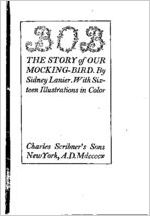
THE STORY of OUR MOCKING-BIRD. By Sidney Lanier. With Six teen Illustfations in Color
Charles Scribners Sons New York, A.D. Mdccccx
Copyright, 1883, hy The Independent Copyright, 1899, hy Mary Day Lanier
L Prefatory Note
>HE poet Sidney Lanier loved to swing in full-muscled walks through the fields and woods; to take the biggest bow and quiver out of the archery implements provided for himself and his brood of hoys, and with them trail ing at his heels, to tramp and shoot at rovers; to hestride a springyhorse and ride through the mountains and the valleys, noting what they were pleased to show of tree and bird and beast life. He could feel the honest savage instinff of the hunter fand lose it in his first sight of a stags death-eyesJ. A rare birds nest with eggs produced in him the rapture vouchsafed to barbarian Boy, along with the divine suggestions vouchsafed to the Poet. This may he worth while to say to those of Laniers readers who may think of him as a sensitive, delicate man of letters, and who must see in most of his writing evidences of extreme sensibility. It was this habit of a prafHcal, face-to-face conversation with nature which, joined with the artists instinct, makes the
sketch of "Bob" so veraciousa picture ofa bird-indi vidual and a bird-species. Laniers wife and chil dren remember well the delight the birdhadfor his brother artist; how the amusedflute would trill with extravagant graces to the silent but heedful wonder of the caged one. Every surprising token of intelli gence, of affetJion, of valor displayed hy Boh was hailed hy Mr. Lanier with a boys ecstacy over a pet, and a poets thankfulness of a beautiful work of the Creator.
"There is, doubtless, no need to assure the reader that the events of Bobs life as hereinafter depitted are historically true; he was acquired hy one of the poets hoys, who, forbidden to rob nests, remembers his fear, on the way home with Boh in his straw hat, that the account of the birds helpless condition would not serve as a fair and reasonable excuse for keep ing him as a pet.
The illustrations which form so important a part of the effort to make a piflure of Bob, are unusual in their origin and in their method. Mr. Dugmore made photographic studies of a young mocking-bird,
or, rather, of a number ofyoung mocking-birds, the photographs were colored by him, and the plates from these photographs were printed in color. cfhe variety of rare tints in any birds plumage, their extreme delicacy, and the infinitely fine gradations of shading have almost always baffled the artist and the printer. cfhe present attempt to reproduce Mr. Dugmores masterly pictures in color shows at least a handsome advance in the difficult art.
Charles Day Lanier.
OEIober, 1899.
List of Illustrations
From Photographs made from Life and colored by A. R. Dugmore
"Boh lying in a lump"
To face page 4
"To increase the volume of his rudimentary
feathers"
8
"Throw his head back and open his yellow-
lined beak"
1O
"He scrambled to the bars of the cage which
his feeble companion was unable to do"
14
"For it was his own image in the looking-
glass of a bureau"
28
"His hath"
30
"When he smoothed Ms feathers"
32
"And as many times slid down the smooth
surface of tlie mirror and wounded himself
upon the perilous pin-cushion"
34
"The most elegant, trim . . . little dandy" 38
"A sidelong, inquiring posture of the head,
. . . Is she gone?"
40
"He eats very often"
42
"Bob never negleffs to wife his beak after
each meal"
44
"He stretches his body until he seems incredi
bly tall"
50
"When he is cold he makes himself into a
round ball offeathers"
52
"When hisfeathersfall. He is then unspeak
ably dejefikd. . . . every feather dropped
from his tail"
56
" We have only to set Bobs cage where a spot
of sunshine u>illfall on it. . . . up goes his
beak, and he is off"
58
BOB
f The Mocking-Bird
Superb and sole, upon a plumed spray That oer the general leafage boldly grew, He summd the -woods in song; or iypic drew The watch of hungry hawks, the lone dismay Of languid doves when long their lovers stray, And all birds passion-plays that sprinkle dew At morn in brake or bosky avenue. Whatfer birds did or dreamed, this bird could say. Then down he shot, bounced airily along The sward, twitched in a grasshopper, made song Midflight, perched, prinked, and to his art again. Sweet Science, this large riddle read me plain: How may the death of that dull insert he The life ofyon trim Shakspere on the tree ?
BOB
OT that his name ought to be Bob at all. In respeSt of his behavior during a certain tryingpe riod which I am presently to recount, he ought to be called Sir Philip Sidney: yet, by virtue of his con duct in another very trou-
OB blesome business which I will relate, he has equal claim to be known as Don Quixote de la Mancha: while, in consideration that he is the Voice ofhis whole race, singing the passions of all his fellows better than any one could sing his own, he is clearly en titled to be named Wil liam Shakspere. For Bob is our mocking-
bird. HeJell to us out of OB the top of a certain great pine in a certain small city on thesea-coast ofGeorgia. In this tree and a host of his lordly fellows which tower over that little city, the mocking-birds abound in unusual numbers. They love the prodigious masses ofthe leaves, and the gen erous breezes Jrom the neighboring GulfStream,
C3 ]
OB and, most of all, the infi nite Jlood of the sunlight which is so rich and cor dial that it will make even a man lift his head towards the sky, as a mocking-bird lifts his beak, and try to sing something or other. About three years ago, in a sandy road which skirts a grove of such tall pines, a wayfarerJbund Bob ly ing in a lump. It could not
[4 ]
have been more than aJew
OB
days since he was no bird
at all9 only an egg with
possibilities. The Jinder
brought him to our Jence
and turned him over to a
young man who had done
us the honor to come out of
a Strange Country and live
at our house about sixyears
before. Gladly received by
this last. Bob was brought
within, andjamily discus-
[51
OB sions were held. He could not be put back into a tree: the hawks would have had him in an hour. The origi nal nest was not to bejbund. We struggled hard against committing the crime as we had always considered it of caging a bird. But Jinally it becameplain that there was no other resource. Infhffi, we were obliged to recognize that he had come
to usfrom the hand ofPro
OB
vidence, and, though we
are among the most steady-
going democrats of this
Republic, we were yet suf
ficiently acquainted with
the etiquette of courts to
know that one does not re
fuse the gift ofthe King.
Dimly hoping, therefore,
that we might see our way
clear to devise some means
ofgiving Bob an education
I tlM I IUNAL t>tOUNU
that wouldjit hiinfor aforester, we arranged suitable accommodations Jbr him, and he ivas tended with motherly care. He repaid our attentions from the very beginning. He immediately began to pick up injlesh and to in crease the volume ofhis ru dimentary feathers. Soon he commenced to call Jbr hisjbod as lustily as any
spoiled child. When it was
CC)
O
brought, he would throw
his head back and open
his yellow-lined beak to a
width which no one would
credit who did not see it.
Into this enormous cavity,
whichseemedalmost larger
than the bird, his protec
tress would thrust and
the more vigorously the bet
ter he seemed to like it
ball after ball of the yolk
ofhard-boiled egg mashed up, with Irish potato. How, from this dry com pound which was his only Jure except an occasional worm off the rose-bushes^ Bob could have wrought the surprising nobleness of spirit which he displayed about six weeks aufter he came to us .. . is a matter which I do not believe the most expansive application
of Mr. Herbert Spencers OB theory of the genesis of emotion could even remote ly account for. I refer to the occasion when hejairly earned the title ofSirPhilip, Sidney. A short time after he became our guest a cou ple of other Jtedgelings were brought and placed in his cage. One of these soon died, but the other continuedjbr some time longer
I. .
r;o
to drag out a drooping ex istence. One day, when Bob was about six weeks old, his usual ration had been delayed, owing to the pres sure ofother duties upon his attendant. He was not slow to make this circumstance known by all the language available to him. He was very hungry indeed and was squealing with every appearanceofentreaty and
ofindignation when at last : Q the lady of the house was able to bring him his breakJast. He scrambled to the bars of the cage which \ hisfeeble companion was unable to do took theprof fered ball of egg-and-potatojiercely in hisbeak, and then, instead ofswallowing ity deliberatelyjlappedback to his sick guest in the cor ner and gave him the whole
IVJWML.
I
o/^Y without tasting a mor- \ sel. Now when Sir Philip Sid- \ ney was being carried off \ the battle-field of Zutphen I with ajearful wound in his thigh, he became very \ thirsty and beggedjbr wa- \ ter. As the cup was handed him, a dying soldier who lay near cast upon it a look ! ofgreat longing. This Sid- \ ney observed: refusing the
cup, he ordered that it should be handed to the soldier, saying, "His ne cessity is greater than mine"
-^~;: on g-^R^ Mocking - bird
is called Bob just as a goat is called Billiy/ or Nan.* as a parrot is called Poll, as a squirrel is called Bunny, or as a cat is called Pussy or Tom. In spite of the suggestionsjbrced upon us by the similarity ofhis be havior to that of the sweet young gentleman of Zutphen, our bird continued
to bear the common appel
OB
lation of his race and no
efforts on the part of those
who believe in the Jitness
of things have availed to
change the habits ofBobs
friends in this particular.
Bob he was, is, and will
probably remain.
_
Perhaps under a weight
ier title he would not have
thriven so prosperously.
His growth was amazing
in body and in mind. By the time he was two months old he clearly showed that he was going to be a singer. About this period certain little Jeeble trills and ex perimental whistles began to vary the monotony ofhis absurd squeals and chir rups. The musical busi ness, and the marvellous work of^feathering him-
y occupied his thoughts
continually. I cannot but OB suppose that he superin tended the disposition of the black, white and gray markings on his wings and his tail as they succes sively appeared: he cer tainly manufactured the pigments with which those colors were laid on, some where within himself, -- and all out of egg-andpotato. How he ever got
[ '9 ]
the idea of arranging his Jeather characteristics exaclly as those of all other male mocking-birds are
i
! arranged--is more than I \ know. It is equally beyond \ me to conceive why he did \ not--while he was about [ it--exert his individuality \ \ to the extent of some little j peculiar black dot or white stripe whereby he could at least tell himself"from any
other bird. Hisfailure to \ Jgf} Q /> attend to this last matter was afterwards the cause ofagreatbattlefrom which Bob would have emerged \ in a plight as ludicrous as any of Don Quixote's,-- \ considering the harmless \ | and unsubstantial nature \ \ ofhis antagonist--had not \ [ this view of his behavior \ been changed by the cour- \ j age and spirit with which \
he engaged his enemy, the gallantry with which he continued thejight, and the goodfaithful blood which he shed while it lasted. In all these particulars his battle fairly rivalled any encounter of the muchbruised Knight ofla Mancha. He was about a year old when it happened, and thejight took place a long
wayjrom his native heath. OB He was spending the sum mer at a pleasant country home in Pennsylvania. He had appeared to take just as much delight in the cloverJields and mansionstudded hills of this lovely region as in the lonesome forests and sandy levels of his native land. He had sung, and sung: even in his dreams at night his sensi-
C 23 ]
& O B tive little soul would often get quite too Jull and he would pour Jbrth raptur ous bursts of sentiment at any time between twelve o^clock and daybreak. If our health had been as little troubled by broken slumber as was his, these melodies in the late night would have been glorious; but there were some of us who had gone into the coun-
try especially to sleep; and we werejinally driven to swing the sturdy songster high up in ouroutsideporch at night, by an apparatus contrived with careful re ference to cats. Several of these animals in the \ neighborhood had longed, unspeakably Jbr Bob ever I since his arrival. We had ' seen them eyeing himjrom behind bushes and through \
C -5 ]
windows, and had once rescued himfrom one who had thrust a paw between the very bars of his cage. That cat was going to eat him, art and all, with no compunction in the world. His music seemed to make no more impression on cats than Keats9s made on crit ics. If only some really discriminating person had been by with a shot-gun
when The Quarterly thrust OB its paw into poor Endymion's cage! One day at this countryhouse Bob had been let out of his cage and allowed tojty about the room. He had cut many antics, to the amusement ofthe company, when presently we left him, to go down to din ner. What occurred aufterward was very plainly told
by circumstantial evidence when we returned. As soon as he was alone, he had availed himself of his unusualfreedom to go explor ing about the room. In the course of his investigation he suddenlyfound himself confronted by . . . it is impossible to say what he considered it. If he had been reared in the woods he wouldprobably have re-
garded it as another mock
OB
ing-bird,--jbr it was his
own image in the looking-
glass of a bureau. But he
had never seen any member
of his race except thefor
lorn little unfledged speci
men which he hadjedatsix
weeks of age, and which
bore no resemblance to this
tall, gallant, bright-eyed
figure in the mirror. He
had thus had no opfiortu-
nity to generalize his kind; and he knew nothing what ever of his own personal appearance except thepar tial hints he may have gained when he smoothed hisfeathers with his beak after his bath in the morn ing. It may therefore very well be that he took this sudden apparitionfor some Chimcera or dire monster which had taken advan-
tage ofthejamilifs tempo
OB
rary absence to enter the
room, with evil purpose.
Bob immediately deter-
mined to defend the prem
ises. Hejlew at the invader,
literally beak and claw.
But beak and claw taking
no hold upon the smooth
glass, with each attack he
slid struggling down to the
Jbot ofthe mirror. Now it
so happened that a pin-
cushion lay at this point, which bristled not only with Jims but with needles which had been tempora rily left in it and which were nearly as sharp at the eye-ends as at the points. Upon these Botfs poor claws came down with Jury: he felt the wounds and saw the blood: both he attributed to the strokes of his enemy, and this roused
him to new rage. In order OB to give additional momen tum to his onset he would retire towards the othe~ side ofthe room and thence Jly at theJoe. Again and again he charged: and as many times slid down the smooth surface ofthe mir ror and wounded himself upon theperilouspin-cush ion. As I entered, being Jirst upjrom table, he was
[ 33 ]
' ' in the at of fluttering down against the glass. The counterpane on the bed, the white dimity cover ofthe bureau, thepin-cush ion, all bore the bloody re semblances of his feet in variousplaces, and showed how many times he had sought distantpoints in or der to give himself a run ning start. His heart was beating violently, and his
feathers were ludicrously
OB
tousled. And all against
the mere shadow of him
self! Never was there such
a temptationJbr the head
ofafamily to assemble his
people and draw a prodi
gious moral. But better
thoughts came :for, after
ally was it not probable
that the poor bird was de
fending--or at any rate
believed he was defending
[ 35 ]
^ o n --the rights and proper
ties of his absent masters against aJoe of unknown power? All the circum stances go to show that he made the attack with a faithful valor as reverent as that which steadied the lance of Don Quixote against the windmills. In after days, when his cage has been placed among the boughs ofthe trees, he has
not shown any warlike OB feelings against the robins and sparrows that passed about, but only ajriendly interest. At this .present writing, Bob is the most elegant, trim, electric, persuasive, cunning, tender, coura geous, artistic little dandy ofa bird that mind can im agine. He does not confine himself to imitating the]
[ 37 ]
songs of his tribe. He is a creative artist. I was wit ness not long ago to the se lection and adoption by him of a rudimentary whistlelanguage. During an ill ness itJell to my lot to sleep in a room alone with Bob. In the early morning^ when a lady--to whom Bob is passionately attached -- would make her appear ance in the room, he would
salute her with a certain OB joyful chirrup which ap pears to belong to him pe culiarly. I have not heard itfrom any other bird. But sometimes the lady would merely open the door, make an inquiry, and then re tire. It was now necessary for his artistic soul tojind some form of expressing grief. For this purpose he selected a certain cry al-
[ 39 ]
most identical with that of the cow-bird--an inde scribably plaintive, longdrawn^ thin whistle. Day after day I heard him make use of these expres sions. He had never done so before. The mournful one he would usually ac- ' company, as soon as the door was shut, with a side long inquiring posture of the head, which was a
clear repetition of the lov er*s Is she gone? Is she really gone?
HERE is one
particular in which Bob's habits cannot be recommended. He eats very often. Injact if Bob should hire a cook, it would be absolutely necessaryJbr him to write down his hours Jbr her guidance; and this writing would look very much like a time-table of the Pennsylvania, or the Hudson River, or the
Old Colony, Railroad. He would have to say: "Brid get will be kind enough to get me my breakfast at the Jbllowing hours: 5,
3.30, 5.40, 6, 6.13, 6.30, 6.43, 7, 7.20,
7*40, 8 (and so on, every Jifteen or twenty minutes, until 12 M.J; my dinner at 12,12.20,12.40,1, 1.13, I.JO (and so on every Jifteen or twenty
minutes until 6p.m.); my
supper is irregular, but I
wish Bridget particularly
to remember that I always
eat whenever I awake in
the night, and that I usu
ally awake Jour or Jive
times between bedtime and
daybreak" With all this
eating, Bob never neglects
to wihe his beak after
J.
U
each meal. This he does by
drawing it quickly, three
orfour times on each side, OB against his perch. I never tire of watching his motions. There does not seem to be the leastJridtion between any of the com ponent parts of his sys tem. They all work, give, play in and out, stretch, contract, and serve his desires generally with a smoothness and soft pre cision truly admirable.
[ 45 ]
Merely to see him leap Jrom his perch to thejloor ofhis cage is to me a neverJailing marvel. It is so instantaneous, and yet so quiet: clip,, and he is down, with his head in thefoodcup: I can compare it to nothing but the stroke of Fate. It is perhaps a strained association of the large with the small: but when he suddenly leaps
down in this instantaneous OB way, I alwaysJeel as if, while looking down upon the three large Forms of the antique Sculpture, ly ing in severepostures along ike ground^ I suddenly
>
heard the clip of thefatal \ shears. His repertory of songs is extensive. Perhaps it would \ have been much more so \ Uif his lti/fe had been in the ;
woods where he would have had the opportunity to hear the endlessly-various calls of his race. SoJar as we can see, the stock of songs which he now sings must have been brought in his own mindfrom the egg, or from somefurther source whereofwe know nothing. He certainly never learned these calls: many of the birdsofwhom hegivesper-
feel imitationshave been al OB ways beyond his reach. He does not apprehend readily a new set of tones. He has caught two or three musical phrasesjrom having them whistled near him. No sys tematic attempt, however, has been made to teach him anything. His proce dure in learning theseJew tones was peculiar. He would not, onjtrst hearing
them, make any sign that he desired to retain them, beyond a certain air ofat tention in his posture. Up on repetition on a differ ent day, his behavior was the same: there was no attempt at imitation. But sometime afterward, quite unexpectedly, in the hila riousJLow ofhis birdsongs would appear a perfect re production ofthe whistled
tones. Like a great artist
B
he was rather aboveJutile
and amateurish efforts. He
took things into his mind,
turned them over, and,
when he wasperfectly sure
ofthemJzrought ihemforth
with perfection and with
unconcern.
He has his little joke. His
favorite response to the en
dearing terms of the lady
whom he loves is to scold
her. Of course he under- ' stands that she under- ' stands his wit. He uses ' for this purpose the angry ' warning cry which mock- \ ing-birds are in the habit ofemploying to drive away intrudersJrom their nests. At the same time he ex presses his delight by a peculiar gesture which he always uses when pleased. He extends his right wing
and stretches his leg along
OB
the inner surface of it as
Jar as he is able.
He has great capacities in
the way ofelongating and
contracting himself. When
he is curious, or alarmed,
he stretches his body until
he seems incredibly tall and
ofthe size ofhis neck all the
way. When he is cold, he
makes himselfinto a round
ball offeathers.
[ 53 1
THINK I envy him most when he goes to sleep. He takes up one leg somewhere into his bosom, crooks the other a trifle, shortens his neck, closes his eyes,--and it is done. He does not ap pear to hover a moment in the borderland between sleeping and waking but hops over the line with the same superb decision with
which he drops from his OB perch to theJLoor. I do not think he ever has anything on his mind after he closes his eyes. It is my beliefthat he never committed a sin of any sort in his whole life. There is but one time when he ever looks sad. This is during the season when his feathers Jail. He is then unspeakably deje&ed. Never a note do we get
[ 55 ]
^ THINK I
him most when he ges t sleefl- He fakes lift one leg somewhere into his bosom, crooks the other a trifle, shortens his neck, closes his eyes,--and it is done. He does not ap pear to hover a moment \ in the borderland between ; sleeping and waking but \ hops over the line with the j same superb decision with
[ 54 ]
.
which he drops from his OB perch to thejloor. I do not think he ever has anything on his mind a/fter he closes his eyes. It is my beliefthat he never committed a sin of any sort in his whole life. There is but one time when he ever looks sad. This is during the season when his feathers foil. He is then unspeakably dejecled. Never a note do we get
C 55 ]
O./? Jrom him until it is over. Nor can he be blamed. Last summer not only the usual \ loss took place, but every I feather dropped from his \ tail. His dejeclion during \ this period was so extreme I that we could not but be lieve he had some idea of his personal appearance under the disadvantage of no tail. This was so ludi crous that his most ardent
lovers could scarcely be hold him without a smile; and it appeared to cut him to the soul that he should excite such sentiments. But in a surprisingly short time his tail-feathers grew out again, the rest of his apparel reappeared fresh and new, and he lifted up his head: insomuch that whenever we wish to Jill the house with a gay, con-
[ 57 ]
Jident, dashing, riotous, innocent, sparkling glory ofjubilation, we have only to set Bob's cage where a spot of sunshine will Jail on it. His beads of eyes glisten, hisjbrm grows in tense, up goes his beak, and he is off. Finally we have sometimes discussed the question: is it better on the whole, that Bob should have lived in
a cage than in the wild-
OB
wood? There are conflict
ing opinions about it: but
one ofus is clear that it is.
He argues that although
there are many songs which
are never heard, as there
are many eggs which never
hatch, yet the general end
of a song is to be heard,
as that of an egg is to be
hatched. Hefurther argues
that BoWs life in his cage
L sv ]
J20B has been one long blessing to severalpeople who stood in need of him: whereas in the woods, leaving aside the probability of hawks and bad boys, he would not have been likely to gain oneappreciative listenerJbr a single half-hour out of each year. And, as I have already mercifully released you Jrom several morals (continues this disputant)
which I might have drawn OB from Bob, I am resolved that nopower on earth shall prevent mefrom drawing thisjinal one.--We have heard much of " theprivi leges of genius " of "the right of the artist to live out his own existencefree from the conventionalities of society" of "the unmorality of art " and the like. ButJ do protest that
[ 61 ]
the greater the artist, and the more profound hispity toward the fellow-man for whom he passionately works, the readier will be his willingness to forego the privileges of genius and to cage himselfin the conventionalities, even as the mocking-bird is caged. His struggle against these will, I admit, be the great est: he willfeel the bitterest
sense of their uselessness OB in restraining him from wrong-doing. But, never theless, one consideration will drive him to enter the door and get contentedly on his perch: hisfellow-men, his fellow-men. These he can reach through the re spectable bars of use and wont; in his wild thickets of lawlessness they would never hear him, or, hear-
I
ing, would never listen. In truth this is the sublimest of self-denials, and none but a very great artist can compass it: to abandon the sweet green forest of liberty, and live a whole luife behind needless constraints,Jbr the more fierjeft service of hisfellowmen.
[ 64 J
Epilogue
f
To Our Mocking-Bird
Died of a Caf, May, 1878
I
Trillets of humor,--shrewdest whistle-wit,-- Contralto cadences ofgrave desire Sack as frofa off the passionate Indian pyre
Drift down through sandal-adoredflames that split About the slim young widow who doth sit
And sing above,--midnights of tone entire,-- Tissues of moonlight shot with songs offire;-- Bright drops of tune, from oceans infinite Of melody, sipped off the thin-edged wave And trickling down the beak,--discourses brave Of serious matter that no man may guess,-- Good-fellow greetings, cries of light distress--
All these hut now within the house we heard: 0 Death, wast tkou too deaf to hear the bird?
II
Ah me, though never an ear for song, thou hast A tireless tooth for songsters: thus of late Thou camest,Death, thou Cat! and leap'st my gate,
And, long ere Love couldfollow, thou hadst passed Within and snatched away, how fast, howfasf,
My bird--wit,songs, and all--thy richestfreight Since thatfell time when in some wink offate Thy yellow claws unsheathed and stretched, and cast Sharp hold on Keats, and dragged him slow away, And harried him with hope and horrid play-- Ay, him, the world's best wood-bird, wise with
song-
Till than hadst wrought thine own last mortal wrong.
'Twas wrong! 'twas -wrong! I care not, wrong's the word--
To munch our Keats and crunch our mocking bird.
Ill
Nay, Bird; my griefgainsays the Lord's best right. The Lord was fain, at some late festal time, That Keats should set all Heaven's woods in
rhyme, And thou in bird-notes. Lo, this tearful night, Methinks I see thee, fresh from death's despite,
Perched in a palm-grove, wild with pantomime, O'er blissful companies couched in shady thyme, --Methinks I hear thy silver whistlings bright Mix with the mighty discourse of the wise, Till broad Beethoven, deaf no more, and Keats, 'Midst of much talk, uplift their smiling eyes, And mark the music of thy wood-conceits, And halfway pause on some large, courteous word, And call thee "Brother? 0 thou heavenly Bird!
Baltimore, 1878.