


- Collection:
- Georgia Historic Books
- Title:
- Reminiscences of famous Georgians : embracing episodes and incidents in the lives of the great men of the state : embracing episodes and incidents in the lives of the great men of the state : vol. II / by Lucian Lamar Knight
- Creator:
- Knight, Lucian Lamar, 1868-1933
- Publisher:
- Knight, Lucian Lamar, 1868-1933. Reminiscences of famous Georgians; embracing episodes and incidents in the lives of the great men of the state, also an appendix devoted to extracts from speeches and addresses. 2nd ed. Atlanta, Ga., Franklin-Turner, 1907-08.
- Date of Original:
- 1907/1908
- Subject:
- American literature--Georgia
Georgia--Biography - Location:
- United States, Georgia, 32.75042, -83.50018
- Medium:
- books
texts (document genres) - Type:
- Text
- Format:
- application/pdf
- Local Identifier:
- gb0173b
- External Identifiers:
- Metadata URL:
- https://dlg.galileo.usg.edu/id:dlg_zlgb_gb0173b
- Digital Object URL:
- https://dlg.galileo.usg.edu/georgiabooks/do-pdf:gb0173b
- Extent:
- 2 v. illus. 19 cm.
- Holding Institution:
- University of Georgia. Libraries
- Rights:
-

.^mmmfmnff*
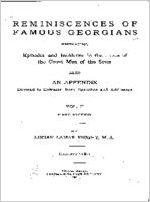
RBM INISC ENCBS OF FAMOUS GEORGIANS
EMBRACING
Episodes and Incidents in the i-i/es of the Great Men of the State
AN APPBNDIX
Devoted to Extracts from Speeches and Addresses
VOL. II
FIRST EDITION
BY LUCIAN LAMAR KNIGHT, M. A.
ILLUSTRATED
Atlanta, Oeorpia FRANK1AN TURNER COMPANY
COPYRIGHT, 1908, uv I.UCIAN" LA&TAR KNIGHT
DKDICATED
TO
MY CHERISHED ALMA MATERS - GEORGIA AND PRINCETON AND TO ONE OF Gentle Voice and Velvet Footstep
FOREWORD.
Volume II completes the work which the writer has devoted to the memories of Georgia's great men; and, in sheathing" the reminiscent pen, he desires to make grateful acknowledgment of the public favor which has enabled him to conclude this labor of love. The shortcomings of the work can not be more apparent to the severest critic than they are to the author himself; but they exist in spite of the fact that the thought of financial profit has never once entered his head, and that he has persistently and firmly refused to commercialize the work by paying" obsequious tribute to living Georgians whose ability to cliiie with Croesus does not entitle them to rank with Cicero. From cover to cover it has been inspired by the purest dictates of devotion to the commonwealth; and, if it touches at times upon the only issues which have ever estranged and divided Georgians, it breathes none of the bitterness of reconstruction.
With what languor of spirit the writer .two years ago in broken health came to this remote rim of the far West, in search of the balmy elixir, can not be told upon this introductory page; but, amid the surroundings of exile, off the coast of Southern California, he conceived the idea of making this sentimental excursion into the Arcadian realm of Georgia memories. It seemed to him that the work was needed. Not only the old who delight in retro spection, but the young, who are spurred to emulation by
vi
FOREWORD.
the objective force of example, look witli absorbed inter est upon the shifting" scenes of the reminiscent panorama, It is said that one of the most illustrious of ancient gen erals felt the martial fires burn withm him simply bv look ing upon the statue of Alexander of Macetlon. Never theless, the dry chronicles of past events are too much like the calcareous contents of the Roman catacombs. They need to be revivified and reupholsterecl. The writer's design has been to avoid the beaten hig'hways of historic travel and to light the great epochal periods of the State with anecdotes and episodes borrowed from the lives of the great men who have made the common wealth illustrious. Georgia's history is so rich in unique and dramatic material that it requires only the fewest touches from the artist's brush to make it rival the au tumnal woods; and the field of exploitation into which the writer has dared to thrust his pen taxes him only with the exercise of taste and. judgment in the blending of ex quisite colors.
Love's labor is always light; and, though the task of producing two ponderous volumes within the brief space of two years has kept him bound like Prometheus to the rock, he has scarcely felt the gentle fetters. He has daily waxed stronger and younger at his work; but the exhil arating cordial has not come from the vineyards of the San Gabriel valley. It has been distilled, in memory's alembic, on the distant slopes of the Blue Ridge Moun tains. More invigorating' than ocean breeze or upland ozone has .been the task of weaving this simple tapestry of reminiscent threads. It has kindled the rudely glow and stirred the sluggish blood and made the heart beat faster. All other scenes have been excluded; and, alike
FOREWORD.
vil
by clay and by night, his visions have ever been of Geor gia. On an island of enchantment he has dwelt m an at mosphere of dreams; and, deaf to the siren, voices of the sunset sea, his thoughts have traveled silently and softly eastward like pilgrims journeying; to the Holy Land.
Into whatever strangle waters the mariner's compass. may drift upon the ocean currents, the faithful needle al ways points toward the North Star; and, seemingly con trolled by the same magnetic influence, the writer's heart throughout all his wandering's has turned toward the beckoning light in. the home skies. Nor could the heart of the Israelite on the banks of the Euphrates have turned more loving'ly toward the broken arches of the Temple. Whether along" the castled Rhine, or upon the Swiss Alps or among the Italian lakes, he has felt the tugging of silken ties which were woven of Georgia sunbeams; and, on the distant shore of the Pacific, he has been like an old transplanted, vine which, fashioned for a certain habitat and accustomed to a definite admixture of the ele- merits, refuses with its swollen tendrils to grip an alien soil, and, under the caresses of the most indulgent sky, still pleads throug'h its withered leaves for the far-off hills on which it grew. If he has wandered along- the Pacific seashore it has been to hear the Atlantic roll at the base of Tyhee light three thousand miles away. If he has turned toward the Sierra peaks it has been to gaze upon Yonah mountain. 111 the purple stretches of the Blue Ridg-e caravan. Kven the far-famed Yosemite has worn the bridal robes and sounded the organ anthems of Tallulah; while over the darkened canopy the old .fa miliar stars have crept and, in the silent watches of the night, the voice of the exile has cried out: "O Georgia,
Vlii
FOREWORD.
take me back to your red old hills though I come like a child to sleep on his mother's breast."
Under such conditions the necessity of relinquishing the work which has been the author's solace and physician awakens the acutest pang. The labor has been one of lofty fellowship. To hold communion with the shades of great men who, in obedience to the mystic \vand of fancy, have come from moldering urns to cheer an exile's solitude; to hear them speak in the welcome accents which were known to other men and times; to follow them around the circuit, to sit with them at the fireside and to listen to them in the anecdotal love-feasts of the evening hour, has been almost like living upon Mount Olympus, in the cloud-encompassed sanctuary of the im mortal gods. But throughout this protracted sojourn among the glorious spirits the writer has felt the same mingled awe and humility of mind which he felt one summer afternoon when wandering among the great se quoias in the Mariposa groves he fancied that, under the subtle spell of metempsychosis and beside the shores of another sea, the great Georgians lived again!
Three famous natives of the State whose names have not been mentioned in the body of this work, but whose renown has reached all lands and captivated all hearts, are the Georgia peach, the Georgia watermelon and the Georgia woman. Richer products of an indulgent soil than ever grew in the g-ardeii of the old Hesperides, they have been an ever-increasing1 well-spring of delight and joy to the children of men; and, if Orion, in "wandering through the stellar spaces, should ever lose his boasted gems, let Georgia tremble and beware. For the old hunter needs only to put his foot for an evening's stroll upon the
FOREWORD.
IX
descending stairways of the Blue Ridge, and whether he is best pleased with the magnolia walks of old Savannah, with the cedar groves of beautiful Augusta, or with the stately oaks which brow the heights of young Atlanta, it is certain that he will covet Georgia's proud tiara; and, when he returns in triumph to the firmament, it will be to flaunt three jewels which will pale the memory of his lost treasure and fill the whole summer heavens with the praises of his belt.
But the muse becomes impatient; and the writer only begs to add that, whatever may be the shortcomings of the present volume, he craves for it the same indulgent favor which has been accorded to the first, and which, within the brief space of six months, has passed into two complete editions. If the work shall serve the happypurpose of comforting old age with pleasant recollections and of stimulating youth to resolute endeavor, the time which the writer has consumed in bringing it forth will not be time misspent or wasted ; and, if it ministers to the reader but a tithe of the happiness which it has given to the author, it will not be an unwelcome addition to the literature of Georgia, whatever its omissions or its de fects. In the magnificent phrase of Carlyle only the Shakespeares and the Mil tons are permitted "to roll through the country of thought, bearing fleets of traffick ers and assiduous pearl-fishers on their waves." Such is not the ambitious errand of this unpretentious work. But, still, may not the humblest of the craftsmen aspire to be come in his modest sphere of labor what the great phi losopher, in speaking of the unstudied poetry of Robert Burns, has called an humble Valclusa fountain, at whose
brink the tired traveler may sometimes pause "to drink of its clear waters and to rmtse among; its rocks and pines?"
L.UCIATST LA:\IAR KXIGHT.
Avaloii, Santa Catalina Island, California. March 2. \ 008.
CONTENTS. PART I.
CHAPTER I. GEORGIA'S FIRST SECESSION CONVENTION . .... ....... ...... i
CHAPTER II. WHY ONI,V THREE; SIGNERS ?......................,........, 27
CHAPTER- III. NANCV HART .................... . ....... ,.,..... . . .... 37
CHAPTER IV.
THE WAI/TONS ... ............................... ...... ... 43
CHAPTER V. JOSIAH TATTNAI.I, ................ . ......................... 67
CHAPTER- VI. JOHN FORSYTE: : DIPLOMAT ..... . . .......... .......... ... 73
CHAPTER VII.
' TROUP : TUB I -I ER/CUIvBS OK STATe K.IGHTS .................. S2
;.
CHAPTER VIII.
BEKRTEN : T.HK AMERICAN CICERO. ... ...................... 94
:
CHAPTER- IX.
i THE CRAWFORBS. .......... ................................. in
CHAPTER X.
JOHN MH.LISDGE: PATRIOT AND PATRON OF HIGHER. EDUCA TION ............ ..................................... . 126
X1I
CONTENTS.
CHAPTER XI.
Page.
CR.AWFORD W, LONG: THE DISCOVERER OF ANESTHESIA. .. 135
CHAPTER XII.
JOHN ANI> JOSEPH LE CONTE : THE GEMINI OF THE SCIEN TIFIC HEAVENS . . ............ .............. ........ 148
CHAPTER XIII.
THE LONGSTREETS....... ................................. 164
CHAPTER XIV. AUGUSTUS B. LONGSTB.EET : AUTHOR OF GEORGIA SCENES . . 174
CHAPTER XV. JAMES LONGSTREET: LEE'S OLD WARHORSE. .. ............ 185
CHAPTER XVI. SIDE-LIGHTS FROM THE STEPHENS LETTERS ............... 226
CHAPTER XVII. YANCEY : THE ORATOR OF SECESSION. ...
... ............. 241
CHAPTER XVIII. GEORGIA'S SECOND SECESSION CONVENTION ........
CHAPTER XIX. KELL : THE MATE OF THE ALABAMA ........... .......
CHAPTER XX. GEORGIA'S GREAT SEAL IN NOVA SCOTIA'S HIGHLANDS ..... 291
CHAPTER XXI. HERSCHEL V. JOHNSON ............ ....... ..
........ 300
CHAPTER XXII.
ORIGIN OF MEMORIAL DA.Y ........ ............ ........
307
CONTENTS.
xiii
CHAPTER XXIII.
Page.
SENATOR Hire's ADVENT .................. ................ 313
CHAPTER XXIV.
GEORGIANS AS PEACE-MAKERS .............................. 323
CHAPTER XXV.
I/AMAR'S REFUSAL, TO OBEY LEGISLATIVE INSTRUCTIONS. .... 333
CHAPTER XXVI. GRADY'S WIT AND HUMOR. .................................. 340
CHAPTER XXVII. SOME NOTED GEORGIA FAMILIES. ............................ 354
CHAPTER XXVIII. rf RICHARD H. CLARE: CAVALIER AND GKaijjLl.oGiST. ......... 370
CHAPTER XX^E^f SPEAKER CHARLES F. CRISP ................................. 380
CHAPTER XXX. GEORGIA'S PRINCE OF EVANGELISTS ........................ 392
CHAPTER XXXI. GEORGIA POST-BELLUM ORATORS ....... .................... 399
CHAPTER XXXII. PEN-PICTURES OE Two GEORGIANS .......................... 434
CHAPTER XXXIII. GEORGIA'S INDUSTRIAL CAPTAINS ........................... 44
CHAPTER XXXIV. SNAP-SHOTS AT GEORGIA'S GOVERNORS .. .................. 451
xiv
CONTENTS.
CHAPTER XXXV.
Fage.
LOOKING FAR BACKWARD. .................. ............... 470
CHAPTER XXXVI, ECHOES OF REVOLUTIONARY DAVS ........ ............ ..... 478
CHAPTER XXXVII. SALMAGUNDI ...,.,.. ............... . ...... .............. 487
CHAPTER XXXVIII. OLLA PODRIDA ............................................. 500
CHAPTER XXXIX. SUDDEN- FATALITIES AMONG EMINENT GEORGIANS ....... . - 515
CHAPTER- XL.
DRIFTWOOD ................................................. 523
CHAPTER XLI. GEOGRAPHICAL MEMORIALS OF FAMOUS GEORGIANS .......... 535
CHAPTER XLII. GEORGIA'S SPANISH-AMERICAN HEROES. .............. ...... 541
CHAPTER XLHI. AVALON. (POEM.) .................. ..... ... ............. 546
PART II. APPENDIX.
Page.
ACCUMULATION. N. J. Hammond............................. 702
APPOMATTOX. Gen. C. A. Evans. ............................. 704
BISHOP JAMES O. ANDREW, Bishop Geo. F. Pierce........... 599
BRETHREN FOREVER RECONCILED- John Temple Graves. .... 700
CHAMPIONSHIP OF GOVERNOR COLQuiTT. Gen. Henry R. Jackson 628
CHICKAMAUGA. Gen. John B. Gordon. ............ .... ... 565
DENOUNCING MAHONE IN THE U. S. SENATE. Benj. H. Hill. 630
DIXIE'S PHANTOM HOSTS, N. E. Harris. .................... 562
ELOQUENT ECHOES. ........................................ 698
EULOGY OF JUDGE X,OCHRAJNTE. Rev. J. B. Hawthorne.. ...... 675
EXHORTATION TO EMORY'S SONS. Bishop Geo. F. Pierce..... 702
GENIUS. Thos. E. Watson, .... ........................... 701
GEORGIA WEEPS FOR HILL. Chief Justice James Jackson..... 625
GEORGIA WELCOMES L/AFAYETTE. Gov. Geo. M. Troup, ..... 586
GETTYSBURG. Gen. John B. Gordon .... .................... 610
GRADY. Dr. H. C. White.......... ......................... 656
GREAT THOUGHTS IMMORTAL. John T. Boifeuillet... ...... 582
HESITATE BEFORE You VOTE LIQUOR BACK. Henry W. Grady. 695
IMMORTALITY. Judge H. D. D. Twiggs.................. .... 568
JEFFERSONIANS RALLY TO YOUR FLAG. Thos. E. Watson,.... 670
JUSTICE TO THE COTTON STATBIS. Thcs. E. Watson........... 642
lyABOR AND EDUCATION. Chief Justice O. A Lochrane. ....... 621
L. Q- C. IVAMAR. Bishop Warren A. Candler. ................ 593
I,EE AND GRANT AS EXEMPLARS OF AMERICAN MANHOOD. Gen.
John B. Gordon............... ...........
.. ........ 673
MCKINI.EY'S MISSION OF RECONCILIATION. Harry Stilwell
Edwards....... ........... ........... .. ............... 662
NOMINATING Ww. J. BK.YAN. Judge H. T. Lewis. ........... 643
PAINT ANOTHER STAR ON THE FLAG FOR TEXAS. Senator
Walter T. Colquitt. ........... ........ ................. 575
PARTY SPIRIT. Gen. Mirabeau B. Lamar. ... .... ....:..... 57*
PATRIOT OR PARTISAN. Gen. Mirabeau B. Lamar.. ........ . . 705
PAUL OR NERO. Seaborn Wright............................. 57
PESSIMISM OR OPTIMISM:. Wna. H. Fleming. ................ 7 4
xvi
CONTENTS.
Page. PICKET'S CHARGE AT GETTYSBURG. N. E. Harris ........... 614 POPULAR INDEBTEDNESS To HIGHER EDUCATION. N. J. Ham-
READY TO ILLUSTRATE GEORGIA. Gen. Francis S. Bartow. .. 587
ROBERT E. LEE. Judge Emory Speer. ....................... 558
SOCIAL COKSBRVATISM. Chancellor "Walter B. Hill. .......... 633
STAND BACK, IT is NOT LAWFUL To ENTER HERE. John
MacPherson Eerrien...................................... 583
STRONG DRINK. Thos. E. Watson. ... ................. .... 706
SUNSET AND DAWN THE BOUNDARIES oF THE REPUBLIC, Judge
Emory Speer.......................................... 700
THE ACHIEVEMENT OF THE OREGON. Judge Emory Speer. . . 698
THE AMERICAN CITIZEN. Gen. Henry R. Jackson........... 699
THE CLAIMS Of THE UNIVERSITY. Gen. P. W. Meldrini. . . . . 635
THE COUNTRY'S HOPE THE COUNTRY HOME. Henry "W. Grady. 677
- THE DAUGHTER OF DIXIE THE PRESERVER OF THE FAITH.
John Temple Graves. ...............................
. 551
THE FAIR LAND OF THE SOUTH, Gen. Henry R. Jackson . . 645
THE FAMILY PHYSICIAN. Judge Howard Van Epps. .... . . . 687
THE FLAG OF THE UNION. Wm. H- Fleming. ............ . . 685
THE GERM OF PATRIOTISM THE LOVE OF HOME. Henry W.
Grady......................................... .......... 639
THK HIDDEN FACE. Thos. E. Watson .....
............ 703
THE IDEAL COMMONWEALTH. Bishop Geo. F. Pierce. . . ..... 699
THE INITIATIVE OF THE PRESIDENT. Judge Emory Speer. .. . 667
THE LIBRARY A GREAT TREE. Prof. J- S. Stewart........... 703
THE NEW AMERICA. Judge Emory Speer, ......... ......... 605
THE OLD SOLDIER'S EPITAPH. Judge Jno. H. Martin. ......... 707
THE OLD SOUTHERN HOME. Thos. E. Watson....... ........ 590
THE PARADISE SIDE oF THE RivER oF LIFE. John L. Harde-
man...........................................
..... . 690
THE PRIVATE SOLDIER. Gen. A, J. West. ................... 640
THE SOUTH TO THE RESCUE. Wm. S. Witham.............. 649
THE YOUNG MEN OP THE SOUTH LOYAL TO THE VETERANS.
Henry W. Grady........................................ 602
THE WESTERNER THE TYPICAL AMERICAN. Zach. Lamar
Cobb..................... ............................... 646
CONTENTS.
xvii
Page. Too MANY RECONCILIATIONS BESPEAK TOO MANY DIFFER
ENCES. Ju-lge J. M. Griggs................ ............. 554 TRIBUTE To JULIAN HARTRIDGE. Hiram B. Bell.. ............ 579 Two MOUNTAINEER PATRIOT GRAVES. Clark Howell, Jr..... 618 UNDUE FREEDOM OF SPEECH. Gen. Mirabeau B. Lamar. .... 588 WARREN MAYS. Judge H. D. D. Twiggs..................... 597 WASHINGTON Aisrb LEE. Gen, L,. Q. C. L,amar................ 665
ARRANGED ACCORDING TO AUTHORS.
Page BARTOW, GBN. FRANCIS S. ......................... ......... 587 BELL, HIRAM P............................................ 579 BERRIEN, JOHN MACPHERSON. .............................. 583 BOIFBUILLET, JOHN T................................... .... 582 CANDI.EK, BISHOP WARREN A. .............................. 593
COBBj ZACH L,AMAR....................... .................. 646
COI.QUITT, WALTER T ....................................... 575
EDWARDS, HARRY STILWELL. .......................... ..... _66?_ EVANS, GEM. C. A ..,*.... ................................. 704
FLEMING, WM. H.............. .........................685, 704
GORDON, GEN. JOHN B...... ........................ 565, 610, 673 GRADY, HENRV W. . . ........... ........ ... .602, 639, 677, 695
GRAVES, JOHN TEMPLE. ...................................551, 700 GR.IGGS, JUDGE J. M................. ....................... 554
HAMMOND, N. J..........................................681, 702 HARDEMAN, JOHN I,. ............ ........................... 690 HARRIS, N. B.. - - - .......................................562, 614 HAWTHORNE, REV. J. B............................... .... 675
HILL, BENJ. H .................................. ........... 630 HILL, CHANCELLOR WALTER. B...................... ....... 633
HowELL, Cr,ARK, JR. ........................................ 618 JACKSON, GEN. HENRY R. ........... ............ .628, 645, 699
JACKSON, CHIEF" JUSTICE JAMES. .................. .......... 625
LAMAR, JUSTICE L. Q. C.............................. ...... 665 IJAMAR, GEN. MIRABEAU B. ........................ .571, 588, 705
xvill
CONTENTS.
Page.
LEWIS, JUDGE H. T....................... ..... ............ 643
LOCHRANE, CHIEF JUSTICE O. A......... .............. . .. 621
MARTIN, JUDGE JOHN H................ . .
MELDRIM, GEN. P. W. ...................
PIERCE, BISHOP GEORGE F................
SPEER, JUDGE EMORY. ....... ............
STEWART, PRO^. J. S............ .......
TROUP, Gov. GEO. M. .............. ........ .......... .
586
TWIGGS, JUDGE H. IX D. . . . . ......
..............568, 597'
WATSON, THOS. 15. . . . ... ...
..... .590, 642, 670, 701, 703, 706
WEST, GEN. A. J............................................ 640
WHITE, DR. H. C............................................ 656
WITIIAM, WM. S. .......... . . ..................... ........ 649
WRIGHT, SEABORN ......................................... 570
VAN KFPS, JUDGE: HOWARD .... . . ....... .................. 687
ILLUSTRATIONS.
Opposite Page AVALON. ................ ... .,_............... .Frontispiece. BIRTHPLACE OE SENATOR HILL. ... .......... ............ 3x6 BULLOCH, ARCHIBALD. ......... ........ ...... . . .......... 26 ..CRAWEORD, WM. H ............ ..... .............. ...... in HILL, WALTER B........ ... .... ..................... .... 518 JENKINS, CHAS. J ..................... .................... 291 JOHNSON, HERSCHET, , V..... ............................... 300 JONES, NOBLE WIMBERLY. ..................... ............. 9 LE CONTE, JOHN . . . .... ............................ .... 148 LE CONTE, JOSEPH. ................. ....... ............ 153 LIBERTY HALL: THE HOME OF ALEXANDER H. STEPHENS. .. 226 LONG-STRBBT, JAMES. .......... .... ................ ........ 185 MEADOW GARDEN : THE HOME OF GEORGE WALTON. ........ 58 MURDER OF GEN. MCINTOSH. ................ ............... 87 OGLETHORPE, JAMES EDWARD. ..... .... .......... ........ 470 YABTCEY, WM. I/ . .......................................... 241
REMINISCENCES OF FAMOUS
CHAPTER L
Georgia's First Secession Convention.
S OON after the news of the battle of Ivexington, traveling- by slow stages, reached the lower spurs of the Appalachian chain of mountains and spread toward the Southeast, Georgia's first secession convention was held at Tondee's Tavern, in Savannah, on July 4, 1775, exactly one year to the hour before the Declaration of Independence was signed at Philadelphia.
Archibald Bulloch was called to the chair and George Walton was stationed at the secretary's desk. They were two of the boldest liberty Boys in the colony; and the unanimous vote by which they were summoned to official positions in the historic assemblage served to foreshadow the radical action which was about to be taken by the de termined body of patriots. Seized with alarm, the loyal ists sought to disguise the fears which they secretly enter tained by ridiculing the quarters in which the convention met. "Can anything good come out of Nazareth ?" was asked in the mildewed accents of the old sneer. But Tondee's Tavern was not an inappropriate birthplace for the cause of liberty; and it was not the first time in the his-
2
REMINISCENCES OF FAMOUS GEORGIANS,
tory of the world that an humble wayside inn was called
upon to furnish the rude cradle of emancipation. Laughter is sometimes premature; and, though Rome
was once saved by the cackling1 of Juno's geese, it was not decreed that Georgia should be kept within the British allegiance by the same musical notes. The loyalists could well afford to employ the mild explosives until the real cannonade commenced. Further down the road lurked heaviness of spirit; and before Yorktown sealed even tually the bloody volume which Lexington opened many an ounce of vermilion was destined to redden the king's highway and many an anxious sigh was fated to fill the
Tory lungs which were then seeking by forced mirth to
drown the young voice of Yankee Doodle.
Georgia until now had been conservative. Perhaps, of all the original thirteen colonies, she had been the favorite of the mother-country: an affectionate distinction quite often conferred upon the youngest member of the house hold. Yet, it could not be said that Georgia was less
ardently devoted to the cause of liberty than was either Virginia or Massachusetts. The very charter of the colony committed her to the love of freedom by making her an asylum for indigent but honest prisoners for debt. She cherished the traditions of Runnymede; and she lacked neither the bold initiative nor the patriotic fear lessness which was needed for the approaching crisis.
But there were good reasons for tempering the rash counsels of impatience with the prudent safeguards of conservatism. Under the original charter, Georgia, for
twenty-one years, had been faithfully served by the old
GEORGIA'S FIRST SECESSION CONVENTION.
3
trustees, without fee or emolument; and some of them were still in life, including- the illustrious founder of the colony, General Oglethorpe. She bore the Teutonic name of the Brunswick house and she felt constrained by the obligations of the baptismal vow to respect the scepter of the Georges. Moreover, she had been peculiarly fortu nate in most of her dealings with the British crown. Pros perity had filled the coffers of the thrifty merchants and enlarged the smokehouses and the corncribs of the indus trious planters ; immigration had commenced to pour into the fertile lowlands from the other colonies; and she had experienced none of the ill-usage which nurtures the spirit of discontent. Governor Reynolds and Governor Ellis were both mild-mannered men, and Governor Wright, who had been the royal vicegerent in the executive chair since 1760, was not of the Pisistratus order of tyrants. Indeed, until the passage of the obnoxious Stamp Act, the royal governor was well beloved by the people of Geor gia; and even then it was freely admitted that the zeal of the old royalist was not inspired by unfriendliness toward the colonial aspirations, but was born of fidelity to the crown interests of the realm. Such considerations served to keep Georgia in the loyal ranks, though twelve colonies were represented in the Continental Congress at Phila delphia and were inclined to shoot reproachful glances to ward the loyal province which, solitary and alone, still floated the English colors.
Nevertheless, when the news of the battle of Lexington summoned the patriots together at Tondee's Tavern, the fighting blood of the colony was at last aroused. Del egates were chosen to the Continental Congress ; an exec utive council was named to direct the affairs of the colony
4
REMINISCENCES OF FAMOUS GEORGIANS.
in the pending" crisis, and other radical measures were adopted indicative of the change of mind which had come over the youngest of the colonial group. True to the filial instinct of allegiance, the convention, before ad journing, petitioned the king once more to heed the pro test of the aggrieved colonies; and, even with the Mace donian cry from the New England hills ringing in the ears of the defiant patriots, the way was paved for return ing, in the course of time, to the ancient shelter of the crown. But the olive branch was rejected. The issue of grim battle was joined; and the bloody grapple was soon to commence. Though it was not an act of formal sepa ration from the mother-country, it virtually slipped the bonds of allegiance and committed Georgia to the great revolt, whose opening challenge was the Declaration of Independence and whose culminating scene was the sur render at Yorktown.
Despite the conservatism which delayed the action of Georgia, it must not be supposed that there was any prev alence of apathy within the province toward the unjust impositions of the British Parliament. On the contrary, it was maintained that an imperial tax upon the colonies without voice in the home councils was most unjust; and formal protest was made in London through Benjamin Franklin. The passage of the Stamp Act provoked uni versal indignation. Governor Wright's life was threat ened ; and James Habersham, president of the King's Council, was actually waylaid and forced to seek shelter behind the royal guns. On the anniversary of the king's accession to the throne, the Liberty Boys took possession of the streets of Savannah, perverting the governor's
GEORGIA'S FIRST SECESSION CONVENTION.
5
proclamation into an opportunity for burning- in effigy some of the king's representatives; and no stamps were used in Georgia, under the Act of 1765, except such as were needed to clear the vessels which left the harbor of SaVannah and which were liable to seizure upon the high seas, if unable to produce certificates.
Of course the repeal of the Stamp Act temporarily im proved the situation. But the fires were only smoldering-; and, when Governor Wright, who thought it wise to keep an armed force at the executive elbow, made requisition upon the Provincial Assembly for supplies, under the pro visions of the mutiny bill, the sleeping spirit of resistance was once more i-n flames. If Kngland was determined to employ force, some of the patriotic lawmakers at least were resolved that Georgia should not pay for the luxury of being coerced into submission; and the Lower refused to join the Upper House in voting the appropriation.
To explain the terms used, the L-ower House was the popular branch or House of Commons, -whose members were elected by the people; while the Upper House -was the King's Council or House of Lords, whose vacancies were filled by royal appointment. Naturally the former, being in touch with the masses, was inclined to be radical; and Governor Wright, like old King Charles, spent more than one sleepless night in grieving over the stubbornness of the Commons. To show the strong feeling of discon tent which prevailed in Georgia in consequence of the colonial policy of Great Britain, the Legislature was not in session when the Massachusetts circular addressed to the Provincial Assemblies of America, advising union against the oppressive acts of Parliament, was received; but ex-Speaker Alexander Wylly, who afterwards be-
6
REMINISCENCES OF FAMOUS GEORGIANS.
came an avowed Tory on the issue of separation, under took to answer the letter in sympathetic terms.
However, under the speakership of Dr. Noble W. Jones, the Lower House took an aggressive stand, which greatly angered Governor Wright. Certain communica tions from other colonies were spread upon the minutes and strong resolutions of endorsement were adopted. Governor Wright was anxious to conciliate the Liberty Boys because he knew that the republican sentiment was growing in the colony, but one issue succeeded another until finally, in sheer desperation, he was compelled to exercise the royal prerogative of dissolution.
Nothing of special interest now occurred until develop ments at last brought to the front an intrepid old patriot who was marked to become the first victim of political persecution in Georgia: Jonathan Bryan. It little oc curred to the royal governor when he dissolved the Lower House that trouble might be brewing in the King's Coun cil. He took it for granted that the sober-minded old men who sat in the upper chamber were too well inocu lated with the royal virus to become infected by the heret ical epidemic. But he was destined to be regaled with an unexpected dish.
In repealing the iniquitous Stamp Act the British Par liament had not relinquished the right to tax the colonies; and in 1768 various articles of merchandise were sub jected to burdensome duties. The people of Savannah, in mass-meeting assembled, agreed to use none of the ar ticles upon which the tax was levied. Jonathan Bryan presided over the gathering; and the spectacle which he
GEORGIA'S FIRST SECESSION CONVENTION.
7
presented was somewhat anomalous. He was an old man whose locks were snowy white; and, at this time, the fires of liberty burned chiefly in the veins of the ardent youth of the province. Besides possessing large means, he also belonged to the King's Council; and, if most of the graybeards were disposed to be conservative by reason of the frosty touch of age, the proneness to submit to the oppres sive yoke was doubly true of the grave elders whose en joyment of the royal dispensations made them lean un consciously toward the golden circlet.
But there was no unction in the speech and no charm of magic in the gift of sovereigns to flatter this old patri arch of liberty. Bent though he was with age, he was yet ablaze with zeal in the sacred cause of freedom. He dared to protest against the British exactions. Consequently, orders soon came from London commanding the old man's suspension; and Jonathan Bryan quit the King's Council. Time went on. Eventually he was restored to favor; but again he incurred the royal displeasure. He was present at the meeting held in Savannah to protest against the passage of the Boston Port Bill and to raise funds for the sufferers. It put the offender beyond the Ppale of forgiveness, in the eyes of the graybeards whose legs were crossed under the king's mahogany, and as soon as Governor Wright called the Council together some one moved to expel Mr. Bryan. The old man arose.
"If such is the feeling which the Council entertains," said he, "I will retire at once. It is unnecessary to put the motion."
Thereupon he withdrew to engage no more in the serv ice of King George.
Included among the heirlooms of the Bryan family
8
REMINISCENCES OF FAMOUS GEORGIANS.
in Georgia, there is still preserved an old silver piece of priceless value inscribed to the sturdy patriot for espousing the liberties of the people of Georgia at the sacrifice of high official position. Joseph Bryan, the father of the old patriot, was living in South Carolina when General Oglethorpe landed on the bluffs of the Sa vannah river; and, being in sympathy with the philan thropic spirit of, the colonial enterprise, he crossed over into Georgia and helped to clear the wilderness in -which the colony was planted. He then returned to South Caro lina. But Jonathan Bryan, when he was old enough to shift for himself, came to Georgia to live. Joseph Bryan, his son, afterwards represented Georgia in the United States Senate, and his descendants are still numbered, among the best citizens of the State.
Though past the patriarchal limit of years at the time of the Revolutionary outbreak, Mr. Bryan participated in the defense of Georgia soil; and, upon the fall of Savan nah, was captured, sent to New York and imprisoned on Long Island. The circumstances of the old man's arrest are too interesting to be omitted. Three nights after the reduction, of Savannah, a party of armed men. were se cretly dispatched from the Phoenix, a rnan-of-war lying in the harbor, and given instructions to take the old man a prisoner. He was supposed to have sought refuge on his plantation across the Savannah River, and the arrest ing officers, moving stealthily up Union Creek, under cover of darkness, found him at the place indicated, and with his son, James, placed him on board one of the prison ships.
In vain his daughter, Mrs. Morel, sued for the release of her aged father. She even went down on her knees, it
GEORGIA'S FIRST SECESSION CONVENTION.
9
is said, to the British commander. But Commodore Hyde Parker was obdurate. The old man had been too great ai\ offender against the British crown. Consequently, fee ble though he was with advanced years, Mr. Bryan was sent North; and, after being transferred from one prison ship to another, he was eventually incarcerated on Long Island. However, an exchange was effected in the course of time, and, returning home, he survived the Revolution, witnessed the adoption of the Federal Constitution, and died in 1788 : Georgia's Pylean-Nestor of Independence.
Another conspicuous landmark among the early pa triots whose name must now be mentioned again was Noble Wimberly Jones. He was the son of Noble Jones, one of the pioneer settlers who came to Georgia with the illustrious founder; and, though the elder Jones at an ad vanced age still held the office of colonial treasurer and espoused the king's side to the very last, the younger Jones was an uncompromising Whig. The first of Geor gia's long line of patriotic physicians, Dr. Jones had for some time been prominent in the Lower House; and Gov ernor Wright, in reporting to the London authorities, had complained of the obstreperous rebel. In 1768 he had been elected Speaker; but when, in 1770, he was reelected, Governor Wright refused to sanction the choice and ordered another ballot,
However, instead of obeying the executive behest, the House passed resolutions commending Dr. Jones for the courageous stand which he had taken in support of the people against the crown. Moreover, it declared that the sentiment of approbation which was entertained for the
10
REMINISCENCES OF FAMOUS GEORGIANS.
Speaker could not be lessened by any slight which might be put upon him in opposition to the unanimous voice of the Commons. The answer of Governor Wright was an act dissolving- the House.
Matters stood still for some time; and Governor Wright, taking1 advantage of the lull, sailed for King-land, leaving a Georgian in charge of the colony, James Haber sham, who, to quote the language which he used in -writing to the Earl of Hillsboro, was no Liberty Boy. Mr. Habersham was president of the King's Council; and, though he shared to some extent the popular feeling, he felt con strained to act as an oath-bound officer of the crown. Again, the Lower House met and twice elected Dr. Jones only to have the action vetoed by the lieutenant-governor, \vho had received positive instructions from the king. Thereupon, Dr. Jones stepped aside, and Archibald Bulloch was elected. This was substituting a Roland for an Oliver; but the House having receded, the election was approved. However, on looking over the minutes, Mr. Habersham observed discourteous items and frictional ir ritation followed which caused him to dissolve the House. At this stage Governor Wright returned, decorated with baronial titles. But he found that the cause of the king had not suffered from any lack of loyalty on the part of
James Habersham.
This faithful old servitor of the crown came to Georgia to aid Whitefield in the work of the Orphan Asylum at Bethesda, and in time succeeded the great divine in con trol of the enterprise. Later he engaged in business ac tivities and established the first large commercial house in Savannah. He died in 1775, leaving two sons, John and Joseph, both of whom were among the boldest of the
GEORGIA'S FIRST SECESSION CONVENTION. 11
Whigs. Dr. James Habersham, whose name also appears in the Revolutionary lists, was doubtless another son.
Dr. Jones continued to be an active worker in the patri otic ranks, despite the loss of the Speaker's gavel and the parental admonitions of an aggrieved sire. He was sub sequently included among the bold Whigs whose names were attached to the calls for the first provincial meetings in the interest of liberty, and he was also chosen on the first delegation to represent Georgia in the Continental Congress, but, on account of the illness of his father, who at the time was lying at the point of death, he was de tained at home. An uncompromising patriot, he pos sessed abilities which gave him an influence of unusual character and extent; and, in view of the courageous stand which he took in the forefront of what was un doubtedly at the start an unpopular movement in the youngest of the royal colonies, he well deserves the poetic sobriquet which, reaching back to the earliest gray dawn of liberty in Georgia, describes him as one of the morning stars.
Notwithstanding the frequent and emphatic protests of the bold patriots of Georgia against the arbitrary course of the Britsh crown, there was little talk of actual separa tion and little desire for anything beyond mere redress of grievances, except on the part of some few violent ex tremists, until Parliament passed the Boston Port Bill in 1774. This was, perhaps, the most drastic measure en acted by the London lawmakers to punish the rebellious colonies; but, to make matters still worse, Parliament re voked the charter of Massachusetts and required all per sons charged with crime to be sent to Kngland for trial.
12
REMINISCENCES OF FAMOUS GEORGIANS.
Though the heaviest suffering was entailed upon New England whose commerce it suspended, the other colonies were given due warning of what they, too, might expect; but the harsh legislation also served to develop the sense of kinship which separate colonial charters, rival interests, and inadequate facilities of travel, had tended to obscure.
What called for the Boston Port Bill was the famous episode of the tea chests. While the imperial tax now rested only upon tea, the Puritan colonists of New Eng land were determined to eliminate the beverage from the bill of fare, until the oppressive duty should be removed; and only the most pronounced Tory deigned to moisten his throat with the forbidden liquid. The story of the Boston tea party is one of the familiar classics of Amer ican history. To the youthful imagination, it rivals the legends of the adventurous Spaniards, DeSoto and Ponce de lycon; and the youngest child in the nursery can prate of the bold men who, in the guise of Indians, went on shipboard and plunged the outlawed merchandise into the sea. This provoked the retaliatory act, which was de signed to close the Boston harbor; but, instead of reduc ing the indignant patriots to submission, it fired the whole Atlantic seaboard into grim resistance and foreshadowed the nemesis of the Continental army under George "Wash ington.
Even the loyal colony of Georgia felt the tie of allegi ance yield ; and nothing except the most persistent efforts on the part of Governor Wright prevented the province from sending delegates to Philadelphia. On July 20, 1774, there appeared in the Georgia Gazette a call for the patriots to meet in Savannah for the purpose of taking radical action; and the stout Whigs who sounded this
GEORGIA'S FIRST SECESSION CONVENTION. 13
earliest bug'Ie-note were Noble W. Jones, Archibald Bulloch," John Houston and John Walton, the signer's broth er. Pursuant to this call, the patriots met at Tondee's Tavern on July 27th following- and John Glen, the chief justice of the colony, presided. To give some idea as to who the early patriots were, the following committee of thirty-one, which includes the colonial ancestors of many present-day Georgians, was appointed to report resolu tions : John Glen, Joseph Clay, John Smith, Noble W. Jones, L/yrnan Hall, Win. Young, Edward Telfair, Sam uel Farley, George Walton, Joseph Habersham, Jonathan Bryan, Jonathan Cochran, George Mclntosh, John Benefield, William Gibbons, Benjamin Andrew, John Winn, John Stirk, Archibald Bulloch, John Screven, John Stacy, Henry Davis Bourquin, Elisha Butler, William Baker, Parmenus Wey, John Baker, John Mann, Sutton Banks, David Zubly, and John Morel. The resolutions were out spoken in character, condemning as tyrannous the closing of the Boston harbor, arid emphasizing the injustice of taxation without representation. Moreover, Knglish sub jects in the wilds of North America were held to be enti tled to the same rights and privileges as Knglish subjects in the environs of London. But action upon the resolu tion was delayed. It appeared that some of the upper par ishes were not represented and it was desired to give the whole province an opportunity to be heard. Consequently an adjournment was taken until August loth, but, in the meantime, a committee was appointed to raise funds for the Boston sufferers. William Kwen, William Young, Joseph Clay, John Houston, Noble W. Jones, Kdward Telfair, John Smith, Samuel Parley and Andrew Wells were given this task to perform, and in due time six hun-
14
REMINISCENCES OF FAMOUS GEORGIANS.
dred barrels of rice and several bags of money were for warded to Boston,
On August joth the assemblage met again, but the counteractive agencies of Governor Wright were appar ent ; and only five out of eleven parishes were represented. It was known that heroic measures of redress were sought. This deterred many parishes from sending dele gates, especially since the royal governor had issued warn ing* proclamations. Moreover, some of the delegates who responded to the call thought it best to be conservative. It has already been stated that the Sons of Liberty were, with few exceptions, young men whose fathers were staunch old royalists; and some of them were doubtless held in check by the fear of parental displeasure. Besides, it must be added that the growth of the Revolutionary doctrines had been much more rapid in the towns than in the rural districts; and the colony had recently undergone an expansion which considerably increased the area of the latter. Savannah and Sunbury were the chief incubators of liberty, while the new parishes, which Governor Wright had lately opened up, were almost wholly the abodes of conservatism. Consequently, the utmost which could be done was to adopt the resolutions above mentioned, and even this mild course was disapproved by the stern elders who thought that Georgia was ill-requiting the royal ben efits. If some of the wealthy aristocrats were upon the side of liberty most of the landed gentry still posed as the bulwarks of the crown. Yet, even among the poorer classes, there was an inclination toward the reigning sov ereign whose father was the Brunswick prince for whom the colony was christened and whose own name was George III.
GEORGIA'S FIRST SECESSION CONVENTION. 15
Indignant because the most radical action was not taken by the provincial assemblage, the representatives from St. John's parish withdrew. This left the patriotic body still feebler, and it was decided to adjourn until the Legisla ture should meet, the idea being to get the Lower House, which represented the whole province, to elect delegates to the Continental Congress. But the plan failed to work. Governor Wright thwarted the designs of the patriots by adjourning the Legislature at the critical moment, and the provincial assemblage was forced either to adjourn with out further ado or to go through the mock formality of choosing delegates whose credentials would be compara tively worthless. It was decided to take the latter course, and Noble W. Jones, Archibald Bulloch and John Hous ton were elected.
However, since the question of legality might be raised upon minority credentials, the delegates did not repair to Philadelphia. Instead, they dispatched a communication informing the Continental Congress of the facts and stat ing that, while Georgia seemed to be tardy and irresolute, the province would be ready to evince at the proper time an uncompromising devotion to the patriotic cause. This document bore emphasis, from the most radical stand point, to the fact that Georgia was sincerely attached to the mother-country, regardless of the influences which were slowly but surely goading her to defy the edicts of the crown.
But there was one parish in Georgia which needed no further time for preparation and which was altogether too impatient to abide the slow processes of conversion which were necessary to bring- the colony at large to the patri otic altars. This was the parish of St. John, one of the
16
REMINISCENCES OF FAMOUS GEORGIANS.
wealthiest of all the political subdivisions of the province. Perhaps the zeal of the parish was due largely to the sym pathetic bond of kinship between the Puritaa settlers at Midway and the Puritan sufferers in New England: and decidedly the largest contributions to the New England fund came from St. John's parish, which was later to furnish two signers to the Declaration : Lyman Hall and Button Gwinnett. But Dr. Hall was destined to be Geor gia's first representative in the Continental Congress, and to sit alone for several months in the august assemblage of patriots. On withdrawing from the Provincial Con gress the parish of St. John decided to take independent action. Accordingly, Dr. Hall was sent to Philadelphia; and, in due season, he took his seat in the Continental Congress as the accredited delegate from the parish of St. John in the colony of Georgia. This bold leadership among the parishes is to-day monumentalized in the county which includes the historic Midway settlement and which bears the sacred name of Liberty.
Within the next few days came the news of the battle of Lexington. It brought the appeal of blood which Georgia could not resist. On the evening of May n, 1775, six young- adventurers broke into the powder mag azine at Savannah and took possession of the stores of ammunition. The beardless captain of the band was Major Joseph Habersham. He was the son of the old royalist, James Habersham, who ran the colony while Governor Wright was in England. He fought through the Revolution, and, when the Federal government was duly organized, he became postmaster-general under
GEORGIA'S FIRST SECESSION CONVENTION. 17
Washington. The other raiders were Noble W. Jones, Edward Tel fair, Joseph Clay, William Gibbons and John Milledg"e. Some of the captured booty was stored in. se cure vaults and cellars for future use, some sent to South Carolina, and some forwarded to Boston where, in the great battle of Bunker Hill, it was destined to weave the heroic shroud of General Warren.
Another call was now issued for the patriots to meet in Savannah. It was signed by the same old advance guard of liberty, -with the exception that George Walton's name was substituted for John Walton's, and the meeting1 was held on June 22d following. Besides designating an ad interim Council of Safety, which included such repre sentative men of the colony as William Kwen, Edward Telfair, George Walton, Joseph Habersham, Samuel Elbert, John Glen, William Le Conte, and others, it was de cided to summon the -whole province together in conven tional assembly on July 4th ensuing. There now remained but little trace of the conservative sentiment which had hitherto kept Georgia from sending delegates to Philadel phia. The most intense excitement prevailed; and the signs in the sky caused the royal governor to shudder with painful forebodings as he anxiously surveyed the distant horizon and noted the dusky banners of the fast oncoming storrn.
This \vas the status of affairs in the midst of which Georgia's first secession convention, on July 4, 1775, met at Tondee's Tavern in Savannah. An eloquent sermon from Dr. Zubly solemnized the patriots for the serious business which was soon to be transacted, and, with Archi bald Bulloch in the chair and George Walton at the sec-
18
REMINISCENCES OF FAMOUS GEORGIAN'S.
retary's desk, the historic assemblage was ready to pro ceed. The first duty was to choose an executive coun cil in which to lodge the government of the province, and the members appointed were: George Walton, president ; William Kwen, Stephen Drayton, Noble W. Jones, Basil Cooper, Edward Telfair, John B. Girardeau, John Smith, Jonathan Bryari, William Gibbons, John Martin, Oliver Bowen, Ambrose Wright, Samuel Klbert, Joseph Habersham and Francis H. Harris. To the Continental Con gress five delegates were elected : Noble W. Jones, Lyman Hall, John Houston, Archibald Bulloch and John J. Znbly. But only three attended the adjourned session of the Continental Congress, Dr. Jones and Dr. Hall being detained at home. All of the parishes were represented in the notable convocation. Indeed, no subsequent as semblage was ever more harmonious; and, if the Sons of Liberty, according to Governor Wright, acted like drunk en men, they were intoxicated with the Pentecostal wine of the new freedom. The die was cast. Georgia's first secession ordinance was \vritten, and the colonial gem, which bore the name of the Brtmswick prince, was now transferred from King- George's coronet to Young Lib erty's brow.
But the convention, which remained in session for sev eral days, was not unmindful of the steps which were needed to insure Georgia protection. It was necessary to provide the sinews of war. A schooner was commis sioned by the Congress and put in command of two stout patriots, Oliver Bowen and Joseph Habersham, who were already in possession of information which promised to yield substantial results; and, within the next few days,
GEORGIA'S FIRST SECESSION CONVENTION.
19
nine thousand pounds of powder fell to Georgia's share in a haul which the officers made in connection with some adventurous South Carolinians. It was the first capture made by the first vessel commissioned for naval warfare in the Revolution.
However, this was not the powder which Governor Wright was expecting1 from the British depot of supplies. The helpless condition of the royal cause had induced the Governor to send dispatches both to General Gage and to Admiral Graves asking for immediate reenforcements. But the letters were intercepted by good Whigs who sus pected the character of the contents, and who, using the same envelopes, substituted fictitious letters stating that the situation in Georgia was perfectly tranquil. Though the letters in due time reached the proper destination, there was naturally no response; and Governor Wright was puzzled for an explanation until years afterwards, when he chanced to meet General Gage in London.
For the military defense of the State, the Kirst Battal ion of Georgia troops was constituted with Lachlan McIntosh as colonel, Samuel Elbert as lieutenant-colonel, and Joseph Habersham as major. In the course of time other battalions were added and Colonel Mclntosh event ually became General Mclntosh. But an unfortunate duel with Button Gwinnett, in which the latter fell, induced General Mclntosh to seek an assignment to service in an other field, and Colonel Elbert succeeded him at the head of the Georgia troops. However, General Mclntosh re turned to Georgia in the course of time to aid in the re capture of Savannah, and was second in command to General Lincoln. He achieved marked distinction in the Revolution, especially under General Washington, but
20
REMINISCENCES OF FAMOUS GEORGIANS.
at home he "was unfortunately the victim of divided senti ment, though an impartial sifting- of the evidence shows that he was not the party at fault. Colonel Elbert was made brigadier-general at the battle of Brier Creek. Though the engagement was disastrous to the Americans, due largely to the strategic blunders of General Ashe, it brought honors to the brave Georgian, every member of whose command was either killed, wounded or taken pris oner. Just before the fall of Savannah Colonel Klbert urged General Howe to fortify Brewton Hill; but the commanding officer overruled the suggestion, and, sad to relate, Brewton Hill, in grim confirmation of the Geor gian's foresight, furnished the precise spot on which the British troops landed. In 1785 General Klbert was made Governor.
But the fortunes of war were destined to bring other Georgians to the front. General James Screven, who was killed at the battle of Midway Church, -was an able officer, to whose memory the United States Congress voted a monument, but the shaft has never been erected. General KHjah Clarke* was an illiterate man who lived on the northern frontier of the State; but he was an tinterrified dealer in buckshot. He waged relentless warfare against the Tories, and at the battle of Kettle Creek he is credited with the victory which overcame the noted ringleader of the band, Colonel Boyd. Subsequently, when Augusta fell for the second time into the hands of the British, he conducted the defenseless \vives and children of the Broad River region to an asylum of safety in Kentucky; and the effort of Cornwallis to thwart him gave rise to the battle
* Though General Clarke was an illiterate man, the county which contains the classic city of Athens with the State University and the Iucy Cohb Institute, and which is therefore the Georgia Attica, bears the name of the rustic rifleman.
GEORGIA'S FIRST SECESSION CONVENTION. 21
of King's Mountain. His son Jchti, who after-wards be came Governor of Georgia, participated in some of the border campaigns, though at the time only an immature youth. General John Twiggs was another distinguished soldier of the Revolution, whose services the State will always remember. Like General Clarke, he, too, lived on the upper frontier near Augusta, but he was an ac complished man, refined and polished, though largely selfeducated. He married the sister of David Kmanuel; and, coming to Georg-ia from Maryland some time before the Revolution, he -was not long in winning the spurs of knighthood. He fought few engagements in which he was not successful; and in this respect was perhaps unequaled by any Georgian. Indeed, he is said to have been the nightmare of the dreaded Tarleton. General David K. Twiggs was his son, and Judge H. D. D. Twiggs, of Savannah, is one of his descendants. Both General Clarke and General Twiggs distinguished themselves after the Revolution in campaigns against the Indians.
General James Jackson first came to the front at the battle of Cowpens. During the last years of the war-he commanded an independent legion similar to the partisan bands which were led by General Clarke and General Twiggs; and he aided in the recapture of the two princi pal strongholds of the State : Augusta and Savannah. In 1780 he met Lieutenant-Governor Wells on the field of honor, inflicting mortal wounds but receiving" no serious hurt; and at the siege of Augusta he barely escaped as sassination at the hands of an insubordinate British de serter who belonged to the legion. Perhaps not one of the Revolutionary patriots experienced more hairbreadth escapes than the adventurous young officer who was des-
22
REMINISCENCES OF FAMOUS GEORGIANS.
tinecl to attain to the very highest civic honors, and to link an already glorious name with the expurgation of the Yazoo fraud.
Like the heroes of faith, the brave men who illustrated Georgia in the dark clays of the Revolution are too numer ous even to be catalogued; but, among the gallant host of true and tried Georgians whose names appear on the bloody scroll are: Colonel John Dooly, Colonel Thomas Dooly, Major John Berrien, Colonel Wm. Glascock, Cap tain John Baker, Ignatius and Benjamin Few, Stephen Heard, Thomas Glascock, John Mclntosh and David Kmanuel.
It is only fair to the martial prowess of the brave troops who guarded the home soil to say that Georgia, in the forepart of the struggle for independence, was the vic tim of incompetent generalship on the part of the com manding officers who were put in charge of the South ern department. To possess St. Augustine had been Geor gia's darling ambition since the first outbreak of hostili ties. The Florida border had always been a thorn in the side of the colony; and, between, the outlaws and the sav ages, it was destined to furnish additional complications. In the hands of the English St. Augustine proved an al most invincible base of operations, but the town could easily have been taken by an early assault. General Charles Lee recognized the strateg-ic importance of pos sessing St. Augustine, but he was called to New York before the campaign could be undertaken. General Howe sent an expedition against the stronghold, but it was wholly inadequate and disaster followed. General Howe also committed fatal blunders in the defense of Savannah, which was both defectively and insufficiently garrisoned;
GEORGIA'S FIRST SnCUSSION CONVENTION.
23
and he barely escaped being1 courtmartialed for the slaughterhouse tragedy which opened the sea-gates of Georgia to the British invaders and inaugurated the bloody carnival whose butcheries \vere to redden the far thest hills. Of course, Georgia will always be grateful to General Benjamin Lincoln for the g-allaiit defense which he made of the State, especially in the ever-memo rable siege of Savannah, in which Count Pulaski and Ser geant Jasper fell mortally wounded. But he was largely to blame for the ignominious defeat of General Ashe at Brier Creek, and it was not until General Nathanael Greene was put in charge of the Southern department that the British were finally expelled from Georgia soil. He sent General Light-Horse Harry Lee and General Andrew Pickens to aid Clarke and Twiggs and Jackson in the recapture of Augusta, and General Anthony Wayne to take charge of the operations around Savannah. They came in good time to the relief of the well-nigh drenched and exhausted State whose overpowered defend ers were still bravely fighting the combined Tories and Bluecoats ; and they rendered efficient service to Geor gia, for which they received due recognition. In the final capitulation of Savannah, Major John Habersham bore the negotiations and General James Jackson was deputed to receive the keys of the city.
Not long after the adjournment of the famous conven tion, Governor Wright was arrested and imprisoned in the executive mansion by the same daring party of volun teers who had broken into the powder magazine in the early summer. In spite of the most vigilant effort to cap ture the raiders, Governor Wright was himself captured
24
REMINISCENCES OF FAMOUS GEORGIANS.
by the very patriots whose punishment he sought. Walk ing- up to the surprised vicar of royalty, who was sur rounded at the time by several members of the King's Council, Major Joseph Habersham, the leader of the pa triotic posse, quietly said:
"Sir James, you are under arrest." Taken wholly unawares, Sir James was probably for the first time in his life bereft of the King's English. But he soon found himself at the same moment quite as help lessly abandoned by the King-'s Council. For, the sage advisers of the administration, applying the prudent max ims of wisdom to the practical ends of self-preservation, happened to remember that they had pressing engage ments elsewhere in Savannah, and, without ceremonious adieus, left Sir James to entertain the unannounced ar rivals.
Supposing that Major Habersham was heavily support ed by military reenforcements in the background, the royal Governor offered no resistance to the interesting program arranged by the captors. The fortunes of war had converted the executive mansion into the colonial bastile. But, luckily for Sir James, he subsequently es caped and took passage for England, leaving Georgia to work out her own salvation, which she proceeded to do with orthodox zeal.
However, on the fall of Savannah into the hands of the British, in 1778, Sir James recrossed the Atlantic and re sumed once more the reins of government. The first act of the returning chief magistrate was to offer amnesty to all who \vere willing to renounce the Whig cause; and the temporary success of the Redcoats resulted in the manu facture of Tories in wholesale quantities. At one time when the State was completely overrun by the British, it
GEORGIA'S FIRST SECESSION CONVENTION. 25
looked as if the flag" of Kng-land was again to become the imperial guardian of Georgia soil, but gradually the for tunes of war restricted inch by inch the domain of the royal governor until he found himself once more impaled within the boundaries of Savannah. In vain he sum moned the Rump Parliaments and issued the executive edicts to punish the rebellious subjects of King George. The shadow of Yorktowri was beginning: to fall across the royal arms.
Towards the last, disasters multiplied thick and fast about the old vicegerent, whose splendid estates one by one fell into the hands of the Americans, and whose nu merous official titles became at last the grimmest of mock eries. He could see from his open window the smoke of his burning barns. He could feel the tightening cordon. He could hear the approaching tramp of the victorious cohorts. But he bore himself like one of the princes of the blood, and Georgians in unaffected admiration for Sir James can not fail to be proud of the fact that the name of the colony is indissolubly associated with the name of the Knglish nobleman who, amid the direst per ils of the Revolution, was so unflinchingly steadfast in his allegiance to the House of Brunswick.
Such were the primitive means of communication in colonial times that it was not until August 10, 1776, that Georgia was apprised, either by official report or by oral rumor, of what had taken place in Philadelphia. On the day in question, a copy of the Declaration of Independ ence was brought to Savannah by a courier mounted on horseback, who also bore a letter from John Hancock. Without delay Archibald Bulloch convened the Executive
26
REMINISCENCES OF FAMOUS GEORGIANS.
Council and in formal session read the glorious document which severed the last link between the crown and the colonies. It was not inappropriate that the old patriot who, on July 4, 1775, had called Georgia's first secession convention to order should have been accorded this high ' lor.
Together with the Executive Council, he then repaired f ;he public square and read the document again to the as ^embled populace of Savannah. It was received with ao amatioiis of great enthusiasm. But still again the clocumerit "was read, ere the sun intoxicated by the musical accents lit the western horizon into sympathetic flames. This time it was.read to the Georgia battalion at the L*berty Pole in front of Tonclee's Tavern, the historic rendez vous >f the patriots. It fired the hearts and steeled the nerves of the soldier boys, who were soon to make the lusty echoes ring on the battlefield. At the command of Colonel Mclntosh thirteen volleys were fired indicative of the fair sisterhood of sovereign States which comprised the Continental union. Later in the day the tables were spread in the open air and the dignitaries dined under the cedars.
But the final ceremonies took place after nightfall, \vhen the bonfires \vere kindled and the mortal ashes of King George were consigned in effigy to the dust. The red glare of the torch, the sharp flash of the bayonets and the struggling moonbeams' misty light, recalled the burial of Sir John Moore. It was an evening never to be for gotten. But Archibald Bulloch soon fell asleep; and the Declaration of Independence sealed the lips of the old patriot who presided over Georgia's first secession con vention.
CHAPTER II.
Wliy Only Three Signers ?
W HY was Georgia represented on the Declara tion of Independence by only three signers, when she was represented by five delegates in the Continental Congress of 1776? Though the youngest of the original thirteen colonies, she was far from being the least populous or the least patriotic; and the compara tively small space which she occupies on the time-honored scroll of American liberty is wholly out of proportion to her recognized importance in the sisterhood of imperial provinces. Tell it not in Gath; but the answer to this historical conundrum involves an episode of singular in terest in the early history of the patriotic cause in Geor gia, and shows how one of the very brightest of the lights of liberty suffered extinction.
The Georgia signers were Button Gwinnett, Lyman Hall and George Walton. But Archibald Bulloch and John Houston were also members of the Congressional delegation. Mr. Bulloch was detained in Georgia by official duties, being at the time President of the Executive Council and acting governor; and it was neither politic nor wise for the chief magistrate to leave the State when an outbreak of war was imminent. Mr. Houston repaired
(27)
28
REMINISCENCES OF FAMOUS GEORGIANS.
to Philadelphia, but he was soon back again in Georgia for the purpose of combating the hostile influence of an ex-patriot who, having- returned to the standard of the king, was at work in the field with perverted missionary zeal, seeking to prevent the drift toward separation and to extinguish the revolutionary flames which he had helped to kindle. The political backslider in question was Rev. John J. Zubly.
Dr. Zubly was the first pastor of the old Independent Presbyterian church of Savannah, an organization which was not more wedded to the Shorter Catechism than to the principles of civil liberty, and which in historic har mony with Presbyterian traditions, proceeded at the first drum-tap to entwine the continental flag with the old blue banner of the kirk, and to meet the issues of the Revolution like the Covenanters met the advancing foe among the Scottish hills. The distinguished divine came from St. Gall,* in Switzerland, and is said to have boasted an ancestry whose strong Protestant bias reached back to forefathers who started the Swiss reformation under Zwingli. Not only a theologian and a scholar, but also an orator of marked attainments, he preached to large congregations in Savannah, and sometimes the Estab lished Church was quite deserted on Sundays by parish ioners who \vere eager to hear the eloquent dissenter.
Against the oppressive measures of Parliament he in veighed with an emphasis which admitted of no doubtful interpretation. But he was not satisfied to hurl thunder bolts from the pulpit. He resorted to the pamphlet. Ar-
* Some patriotic wag: who took offense at the course of Dr. Zubly said that
WHY ONLY THREE SIGNERS?
29
ticle aftsr article dealing with the obnoxious acts of the British government came from the caustic pen of the bold preacher. He was prominent in the meetings which pro tested against the Boston Port Bill; and, when the Pro vincial Congress met in Savannah soon after the battle of Lexington, he was one of the delegates. Moreover, the Provincial Congress immediately upon convening ad journed to the old Independent church to hear an eloquent sermon from Dr. Zubly; and he rose to the occasion, tak ing some text from the Pauline Kpistles which dealt with the law of liberty. To show what striking figures of speech the learned doctor could use, he wrote to some English correspondent, about this time, stating that if the colonies were bound together by ropes of sand, it should be remembered that sand and blood made an excellent ce ment.
Naturally such an eloquent voice was coveted for the continental councils in Philadelphia, and Dr. Zubly was elected together with Noble W. Jones, Archibald Bulloch, L,yman Hall and John Houston to represent Georgia in the Continental Congress of 1775. At first he hesitated to accept the unsolicited honor because of the prolonged ab sence from Savannah and the consequent relinquishment of pastoral work, which the duty of representing the col ony in Philadelphia involved. However, Mr. Houston went before the congregation and explained the situation fully, and, being largely dominated by the Sons of Lib erty, the old Independent church, independent in name and independent in zeal for American freedom, consented to make the sacrifice for the sake of the patriotic cause.
But, arrived in Philadelphia, Dr. Zubly began percepti-
30
REMINISCENCES OF FAMOUS GEORGIANS.
bly to weaken. Seeing the Continental Congress bent upon immediate separation, he found that he was more Tory than Whig; and, to cap the climax, he declared from his seat that a republic was little better than a gov ernment of devils. This was strange language for one whose blood was derived from the free cantons of Switzerland; and Americans who live to-day peaceably and happily under the folds of the national flag, and who suggest no thought of pandemonium, can hardly be ex pected to applaud such an undemocratic sentiment. How ever, it must be said in justice to Dr. Zubly that, while he had strongly advocated resistance to the oppressive acts of Parliament, and had boldly stigmatized taxation with out representation, he had not gone so far as to preach ab solute separation from the crown of England. It was the plan of Dr. Zubly to seek redress of grievances within the limits of urgent protest, but not to the extent of open re volt. He considered himself an Knglish subject. B.ut on the other hand it must be said, in justice to those who were ready to dissolve the bonds of union, that, in up holding the principles of the great charter, they, too, ac quitted themselves like loyal Englishmen who bent the knee in the true allegiance.
Perhaps Dr. Zubly, like more than one reluctant pa triot, might eventually have acquiesced in the majority sentiment; but an unfortunate incident occurred in the progress of the session which served to bar him from fu ture affiliation with the colonial patriots, even though, underneath the horns of his own altar lie crouched among the penitents. Seeing that radical steps were to be taken, he undertook privately to communicate with Gov ernor Wright. He was divulging no star-chamber secret
WHY ONLY TPIREn SIGNERS?
3L
and betraying no public trust; but the watchword of the hour was liberty. In some way the designs of Dr. Zubly were discovered, and he was confronted with exposure on the floor of the Continental Congress. Realizing that his influence was destroyed and his usefulness ended in Phil adelphia, he withdrew from the patriotic councils, and re turned to Georgia.
But Dr. Zubly was not to remain idle. Though he was powerless among the assembled lawmakers in Philadel phia, he was not debarred from appealing to the inhabi tants of the colony; and he went before the people, re solved to check, if possible, the movement toward separa tion. Many communicants withdrew from the Independ ent church. Some were converted by the eloquent logic of the wily doctor, and some retained membership only because of an inherent conservatism. He began to thun der again from the pulpit. He resorted once more to the pamphlets. But it was now to stem the republican tide.
Another Provincial Congress was held early m the year following, but there was no adjournment to hear Dr. Zubly preach. Archibald Bulloch, Button Gwinnett, Ly~ man Hall, George Walton and John Houston were elected to the Continental Congress. It has already been stated that Mr. Bulloch was detained at home by reason of ad ministrative duties. The others repaired to Philadelphia. But news at length reached the Quaker City to the effect that Dr. Zubly, instead of converting" bad sinners, was converting good Whigs and that Georgia was apt to turn Tory unless the designs of the preacher were checkmated.
32
REMINISCENCES OF FAMOUS GEORGIANS.
Times of excitement are always favorable to the reck less use of hyperbole; but, while the accounts were felt to be exaggerated, it was thought best to dispatch one of the members of the congressional delegation to Georgia to combat the heretical doctrines of Dr. Zubly and to hold the colony to the formulas of the true faith. Upon Mr. Houston devolved the task; and, since he had gone before the congregation of the old Independent church the year previous to ask that Dr. Zubly be allowed to represent the colony, he felt the responsibility of the commission. Like the epigrammatic Cassar, he "was soon able to say it Veni, vidi_, vici." But he reached the Continental Congress too late to participate in the momentous drama of signing the immortal protest against oppression. The bonfires had been kindled in the streets of Philadelphia, and from the belfry of old Independence Hall the sweet siren of liberty had commenced to sing.
It is sorely to be regretted that the name of the patriotic Georgian was not appended to the Great Charter of liber ty, for he was no less wedded to the sacred cause than were the men whose names "were inscribed upon the death less roll of honor. He was in just desert if not in actual fact one of the Georgia signers. Mr. Houston was the son of old Sir Patrick Houston, a baronet whose conserv ative inclinations were so partial to the fence that he was denounced first by the Tory and then by the Whig gov ernment, perhaps unjustly by the latter; but he gave the patriotic cause two sons, John and William, -whose kneejoints were too stiff with the starch of liberty to crook in
WHY ONLY THREE, $fGNRS?
33
obsequious homage to the king1. Mr. Houston was twice Governor, and died in 1796 well advanced in years.
As for Dr. Zubly, he was banished from Savannah in 1777 and took refuge in South Carolina; but when the town fell into the hands of the British in 1778, he re turned to Savannah and resumed pastoral work among" the uncontaminated members of the flock who drank the kind's tea. But he "was not the same man. Broken in health, and in fortune, he failed rapidly and died in 1781 on the eve of the evacuation of the city by the British. Thus sank into ignominious eclipse one of the brightest luminaries that lit the g'ray horizon of the Revolutionary dawn in Georgia.
George Walton, who sprang" from an old Virginia family, became the most distinguished member of the group of signers. He was twice Governor, six times Con gressman, an officer in the Revolution, Chief Justice of the State, judge of the superior court and United States Senator. Dr. Hall afterwards occupied the gubernatorial chair. He was an eminent physician from Connecticut, who early became the foremost champion, of liberty in the parish of St. John, and who was sent by the parish as an independent delegate to the Continental Congress, before the colony at large was sufficiently aroused to demand rep resentation. He lived at Sunbury, where Governor Wright located the head of the republican disaffection in Georgia, stating that it came from the Puritan settlers who had imbibed too freely the vicious principles of Oli ver Cromwell.
Button Gwirmett was an Knglishman who became iden
tified with the colony only four years before the Declara-
34
RKMINISCJlNCnS OP FAMOUS GEORGIANS,
tion was signed; but the short period of his residence in the colony only serves to lay emphasis upon his zeal in the cause. He, too, lived at Sunbury, but the thrifty little town which in the old colonial days was an enterprising commercial center, sufficiently infused with the patriotic ardor to give two signers to the Declaration of Independ ence, is to-day numbered among the buried towns of Georgia, and as if the very memories of the Revolution had germinated upon the sacred spot, it sleeps enfolded in an evergreen mantle of bermuda. Soon after the war be gan, Mr. Gwinnett became involved in personal difficul ties with General L-achlan Mclntosh, growing out of the latter's appointment to the brigadier-generalship in pref erence to the former; and, chagrined at his subsequent defeat for Governor, Gwiiinett challenged Mclntosh, who was quoted to him as having" expressed very great satis faction with the result of the election.
The combatants met at sunrise within the limits of the present city of Savannah, measured off twelve paces and fired. Both were wounded in. the thigfh. Gwinnett lin gered nearly two \veeks before death came to end the struggles of the unfortunate signer. Mclntosh recovered, but popular feeling in the State was such that, acting upon the advice of friends, he sought an assignment for the time being in another part of the field. He returned soon after the fall of Savannah to aid in the recapture of the city. However, it was only to find that the smoldering" ' fires of hostility were ready to break out afresh. Yet he lived to see the feudal spark extinguished and to represent Georgia in the Continental Congress.
Though popular sentiment was against General Mcln tosh, it was largely because of Mr. Gwinnett's prestige as
WHY ONLY THRHB SIGNERS?
35
one of the signers. The evidence shows that the latter was clearly the aggressor, and that when president of the Executive Council, he asserted his authority as commander-in-chief of the army to the extent of ignoring- General Mclntosh, especially in the ill-advised campaign which he himself org-anized for the reduction of East Florida, Gen eral Mclntosh was an able tactician. He distinguished himself under Washington, whose esteem and confidence he possessed ; and when, the latter visited Georgia m 1791, General Mclntosh acted as special escort. He was presi dent of the Georgia division of the Society of the Cincin nati, and was an unusually handsome man, tall and erect, with an impressive military carriage. It is said that in youth no Indian could compete with him in fleetness of foot. He belonged to the famous clan which John Moore Mclntosh planted at Darien, and which was characterized by all the robust traits which belonged to the parent stock in the distant highlands of Scotland.
On the floor of the Continental Congress Georgia was represented from time to time by some of her ablest talent, and Dr. Lyman Hall was not required to sit alone for any g'reat while in the austere councils at Philadelphia. In cluded among the delegates who, from first to last, repre sented Georgia in the Continental Congress, were Abra ham Baldwin, Nathan Bronson, Archibald Bulloch, Jo seph Clay, William Pew, William Gibbons, Button Gwinnett, John Habersham, L,yman Hall, John Houston, Wil liam Houston, Richard Howley, Noble W. Jones, Edward Langworthy, Lachlan Mclntosh, William Pierce, Edward Telfair, George Walton, John Walton, Joseph Wood and John J. Zubly. If one member of the group proved him self recreant to the high '.rust it must be remembered that
36
REMINISCENCES OF FAMOUS GEORGIANS.
even the apostolic band, at the 'communion table of the Last Supper, "was darkened by the envious brow of an Iscariot, who marred the gentle brotherhood. But Dr. Zubly was neither an Iscariot nor an Arnold, and, "without brooding' upon the fallen meteor that forsook the troubled heavens, Georgia is content to rejoice in the fixed stars -which, pure and bright and steadfast, illuminated the stel lar fields.
CHAPTER III.
Nancy Hart.
A MONG the heroines of history an exalted rank must be assigned to the Boadicea of the Revolu tion Nancy Hart.* Born of the race of Ama zons, she was one of the most courageous masterpieces of her sex; but for much of her prestige in the war de partment she was indebted to an unheroic blemish which would have kept Helen of Troy safe in Sparta, prevented the Trojan war and robbed the classic \vorld of Homer's Iliad. Moreover, it would have rendered an Egyptian queen as unattractive to the eyes of courtship as was ever an Egyptian mummy of the Hyksos dynasty; it would likewise have spoiled the Biblical legend of Queen Esther and mutilated the exquisite romance of Mary Queen of Scots.
She was cross-eyed! Some one has said that if Cleopatra's nose had been slightly tilted it would have chaiig-ed the countenance of medieval times. It sounds suspiciously like Douglas Jerrold. Certainly it is true that if the ill-starred Em-
* Nancy Hart's maiden name was Nancy Morgan. She came from North
Revolution. Her husband, Captain Benjamin Hart, came from Kentucky; and his brother, Thomas Hart, was the father-in-law of Henry Clay and the uncle of Thomas Hart Benton.
(37)
38
RHMINISCttNCBS OP FAMOUS GEORGIANS.
f
press had been cross-eyed she could never have captivated I the famous general who, lured by the fatal charm of beau- i ty, scorned the plebian Hoovers of the Tiber to pluck the i imperial blossom of the Nile; and equally is it true that | unless the Georgia war-queen had been cross-eyed she | could never have held five British officers at bay with an - \ old blunderbuss which might have hung fire when she tried to shoot.
It was during the troublous clays of Toryism in upper Georgia that Nancy Hart, in an humble cabin of the back woods, electrified the whole tragic theater of war with the story of her bold capture. Up to this time, it surpassed anything- in the entire Revolutionary annals; and, calling across the sea to Prance, it challenged, the prowess of the Maid of Orleans. Both Savannah and Augusta had be come the strongholds of the British ; and all the frontier belt had commenced to swarm with Tories, whose battlecry was havoc. General Elijah Clarke had recently trans ported most of the women and children of the Broad River settlement to the Holston region of Kentucky, pre paratory to waging1 direful warfare against the human wolves and jackals that infested the thickets of up per Georgia at this period. But Nancy Hart had not traveled in the wake of the noted rifleman. She may have had some intimation of the part which she -was expected to play in the Tory extermination. At any rate, she was squared for action when the curtain rose upon the little drama which was destined to exhibit her feminine pluck in the most amazing degree, and to start her hitherto un heralded name upon the circuit rounds of Christendom,
Suggestive as the situation was of danger for the live targets who shivered in front of the fowling-piece, it was
NANCY HART.
39
also spiced with some flavor of humor to behold five Tory protectors of the realm terrorized by an undaunted edition of Georgia pluck, who, instead of wearing- the spike-tail of the Continental army, wore the petticoat of the calico brigade. Given to bloody deeds of violence as the Tories were, they were like helpless babes in the wood as they stood before the flashing eyes of this war-shod Diana of the forest. They were naturally perplexed. Never before had they looked into the barrel of an old shotgun behind which were stationed such an infernal pair of optics. If red-hot coals had risen from the ground underneath and taken the place .of eyeballs in the grim sockets above the cheekbone, they could not have flashed more defiantly the brimstone message of the lower world. It was unde niably an embarrassing moment; for each member of the squad thoug'ht in his consternation that she was aiming her buckshot at him, and, like an upright piece of lumber whose business it was to prop the ceiling, he stood riveted to the floor.
At last one of them, recovering from the paralytic spell, ventured forward to wrest the weapon from her hand, but instantly as lightning he received the leaden charge into his bosom and fell lifeless upon the timbers. Before another member of the party could advance, she had snatched another musket and proceeded to hold herself in readiness for the second victim. But he was loath to approach, for it was evident at this stage of the g-ame that the lady of the house knew how to shoot. She might ap pear to be looking in all directions, but she could see straight ahead.
Succor now arrived. Captain Hart, having learned of the visit of the Tories, appeared upon the doorstep in
40
REMINISCENCES OF FAMOUS GEORGIANS.
good time to see liis wife drilling" the squad in defensive tactics. But he reached the house none too soon. Time was now most precious. Another moment might have chang'ed the whole aspect of thing's. Well it was, too, that the sturdy frontiersman brought substantial reeriforcein eiits, for an ill-directed shot might have liberated some of the best blood of the colonies. As it was, with the aid of the stout muscles which the neighbors lent to the task of making- the prisoners secure, the entire bunch was cap tured, and in less than half an hour, from the ends of g'ood strong pieces of hemp, all of the Tories who survived the little drama in the backwoods cabin were left dancing- in mid-air to the tune of Yankee Doodle.
Cunning strategy made possible the dramatic situation in which Nancy PI art was enabled successfully to defy the Tory band. She lacked none of the elements of Spartan courage, but, added to the dare-devil spirit of the en raged lioness, she also possessed unusual presence of mind. Under the guise of feminine simplicity, she induced the Tories to believe that she was an easy mark. It seems that the first demand of the visitors, -who arrived rather early in the forenoon, was for something to appease the pangs of hunger. Breakfast had already been served, and Captain Hart having rejoined the frontier g'uarcl, she was attending to various household duties. But she stopped everything else to serve the travelers in the most obsequious style of the wayside tavern. Not by the least token did she exhibit the weakness of fear or betray the strategem which was quietly lurking behind her shrewd eyebrows. She disarmed them completely of all suspi-
NANCY HART.
41
cion and urged them to feel perfectly at home while she prepared the utensils in. the big" open fireplace for dispens ing1 warm hospitality to the unexpected arrivals. Lest she might appear to be lacking" in courtesy to the strangers she also instructed the children to look after the gentlemen, and busily she applied herself to the task of provid ing another meal. Finally when the Tories, having stacked arms, were beginning, like Jack Falstaff, "to take their ease in their inn," she managed to engage them in an opposite corner of the room; and, falling back upon her own armory, she snatched an old fowling-piece from the wall and instantly leveled the weapon at the breast plates of the surprised emissaries of John Bull. As she did so, she dispatched one of the youngsters of the house hold to the place where Captain Hart could be found, urging him to hasten to the house at once with ablebodied help; and she also stationed her eldest daughter, Sukey, directly in the rear to fill the post of supply agent in the event another load of buckshot was required to keep the visitors bunched until recnforcenients could ar rive. Then followed in quick succession the events which have already been narrated. Captain Hart duly came upon the scene; the Tories were made secure, and Nancy Hart lowered her musket. Thus an unprotected woman in the danger-infested thickets of upper Georgia during the darkest hour of the struggle for independence, had not only outwitted and outbraved the whole band of To ries, but had added another immortal name to the heroic roster of the Revolution.
Though memorialized in the county which bears her name, there seems to be little certainty concerning the pre-
42
REMINISCENCES OF FAMOUS GEORGIANS.
cise spot in which the heroine lies buried; but she needs no help from the devices of bronze or marble to keep her memory ablaze about the hearthstones of the Georgia commonwealth. She has ever been the fireside favorite of the Georgia home. In the drama of the Revolution she claims the enthusiastic plaudits of the Georgia youngster above all the other characters. She outstrips Washington and overtops L,aFayette and surpasses Sergeant Jasper; and, though only an ill-favored country dame, yet in childhood's verdict, hers is the lustiest shout and hers the truest 'weapon of all the hurrying host whose quick step answered the battle-cry of Lexing'ton.
Granting' that her eyes were crossed, they were true enough to sentinel the Georgia forest in the hour of dan ger, and, like twin stars upon the morning sky, they were glorious enough to light the dawn of liberty. Whereever she lies buried it is hallowed earth in which she rests. Even Westminster Abbey migiit sue to enshrine the ashes of this homely heroine of the Georgia back woods, who, on the historic page, shares the austere com pany of scepterecl sovereigns and receives the kneeling vows of subject princes from afar. It is enough to know that the courts of liberty are all the brighter for the lus ter which she lent to the annals of the Revolution; and, borrowing the beautiful illusion of the old Germanic myth, it is easy to imagine how the entrance to the great Val halla must have swarmed with the spirits of the brave de parted as the Georgia heroine mounted the immortal hill, and how the solitude of Jean d'Arc, unbroken through the lapse of seven centuries, must have brightened with the electrical announcement that Nancy Hart had come.
CHAPTER IV.
The Waltons.
O N board the g'ood ship Welcome "which anchored in the waters of the Delaware on October 3, 168:2, and which brought the celebrated William Penn to the future port of Philadelphia, came the pioneer Walton. If the sturdy immigrant was an orthodox member of the Church of Kiigland, he was in rather strange com pany for enjoying the close communion of an ocean voyage; arid in justice to the rules of evidence, he must be classed among the devout Friends whose manner of dress bespoke no leaning- towards the fashion-plates, and whose habit of speech evinced an emphatic preference for the sacred pronoims. Concerning this sweet-spirited sect to which an irreverent world - has given the name ol Quakers, 'it is said that Charles the Second was only too eager to issue the colonial land-grant in the hope of rid ding England of the obnoxious bonnet. But to show how the subtle irony of fate underlay the peevish act of the spoiled Stuart, he little suspected at the time that the writ of ejectment, which he signed with such an impatient stab at the inkbottle, was the charter of the rebel colony within whose borders the bonfires of liberty were to be kindled. Robert Waltoii himself may have helped to lay off the
(43)
44
RnMINISCRNCES OF FAMOUS GEORGIANS.
town block in which Independence Hall was afterwards built, and to which an illustrious grandson was destined to repair for the purpose of participating in the momen tous little drama of July 4, 1776.
Prom what district of England the pioneer Walton hailed is unknown. But Liverpool is situated on the west ern edge of what was formerly the parish of Walton; and the name is still borne within the vicinage by an enterpris ing metropolis of several thousand inhabitants. Thoug'h the evidence is not conclusive, it raises the presumption that possibly in this portion of England \vere located the ancestral seats of the Walton family. Both the noted Bishop Walton, -who edited the Polyglot edition of the English Bible, and the celebrated Izaak Walton, who wrote the Complete Ang-ler, to become on the banks of the Thames river the most famous caster of nets since the days of the Galilean fishermen, may have been kinsmen of the pioneer Walton who was separated from them in point of time only by some fifty years.
Robert Walton doubtless lived and died in,Philadelphia. The name which he broug'ht to the new world is to-day legion in Pennsylvania. But the good Cavalier blood which coursed the veins of the Quaker immigrant event ually impelled some of the younger Waltons to join the fox-hunters in the Virginia midlands; and, before the next century was well advanced, two members of the household appeared in the gay colony of Captain John Smith. They were George and Robert Walton, presuma bly sons of the pioneer. They located in Prince Edward county, and they married sisters, Martha and Sally
THE, WALTONS.
45
Hughes, each of whom possessed handsome dowries. But Robert appears to have died early, leaving two sons, John and George, the latter of whom was destined to become the famous signer of the Declaration.
The statement that George \Valtoti, the signer, was born in Frederick county, Virginia, is erroneous. He was born in Prince Edward county in 1749. It is true that he began life in straightened circumstances; but this may have been the result of speculative misfortunes. Too proud to lean upon the wealthy uncle* for whom he was named, the self-reliant boy became apprenticed to a carpenter. He worked industriously at the bench, but it soon began to appear that the lad was intended for higher things. He possessed an inordinate thirst for knowledge, and no Athenian youth, at the fount of Minerva, ever bent more eag'erly to quaff the Pierian pearls of wisdom. Unable during the day to find the leisure for mental culture, and anxious to save the expense of an oil lamp, he managed to con his lessons at night by the light of pine fag gots which he collected in the neighboring forests, and upon the pabuKim of borrowed books his acqviisitive mind
" Old George Walton owned a plantation of 2,700 acres on Bush River. He lived about four 'miles north of what is now Meherrin Station, on the Southern Railway : and, when the British cavalry leg-ions of Colonel Tarleton reached the latter place. Mr. Walton caught rumor of the hostile advance in time to drive his cattle into the swamp and to guard his valuables- He was quite an old man at the time, exceed ingly weak and feeble, but he undertook in person secretly to bury an earthen jar of gold coins, containing several thousand English crowns- How far from the house the old man went to bury the gold no one knows. Some say he was gxjne thirty min-
availing. Either the anxiety or the exertion -was too much for him and returning to the house almost breathleaa he died the next morning. Fruitless efforts for moitj than fifty years were made to discover the whereabouts of the earthen jar ; and
Walton's hidden wealth. Patty Walton, who was one of several children, married the writer's great-grandfather, Woodson Knight, in Prince Edward county, Vir ginia, on June 18. 1781.
46
REMINISCENCES OF FAMOUS GEORGIANS.
in the course of time waxed unusually strong- So im pressed was the master -with the lad's determination to succeed that he released him voluntarily from the' articles of agreement some time before the apprenticeship was due to expire and allowed him to retain the fruits of his labor. Thereupon young1 Walton at the age of twenty set out to seek Dame Kortune.
Savannah was the traveler's port of destination. The chief town in the prosperous colony of Oglethorpe, it offered attractive inducements to permanent settlers of the right kind; and, in the office of Henry Yonge, Ksq., he began.'to prepare for admission to the bar. It was only natural that the youth who had invoked the aid of pine faggots in order to master his first lessons should find success an easy conquest. Small items of information sometimes possess large significance. It appears from the old files that the youthful barrister in 1774 submitted an important legal opinion to Edward Tel fair. He was only twenty-five at the time; but the fact that he was consulted in matters of law by one of the wealthiest mer chants of Savannah, shows the professional prominence which he must already have attained. Fees began to in crease until matrimonial ventures were soon warranted; and in 1777 he led to the marriage altar the beautiful Dorothy Camber, who was the daughter of an Knglish nobleman.
But other matters were to enlist the zeal and to enlarge the reputation of the young lawyer. The storm-clouds of the Revolution were beginning to gather, and the fiery bolt was soon to descend upon the commons of Lexington. Georgia was loath to sever the tie of allegiance to the British crown and to raise the standard of revolt against
THE WALTONS.
47
the house for which she was named. At first the Liberty Boys comprised only a handful of adventurous patriots, who were credited -with far more zeal than discretion. It was all right to urge redress of grievances within the limits of respectful protest, but to advocate separation was to offend the delicate ear of the loyal colony whose devotion to the king- was worthy of the old Cavalier traditions. Before the tide of public sentiment could be turned it was necessary for some radical change to oc cur. It required hardihood of the most pronounced type for Mr. Walton to antagonize his wealthy clientele and to jeopardize his professional advancement. Mor xDver, it invited the proscription which attaches to rebellion, perhaps outlawry and death. The distinguished advocate in whose office he had begun the study of law was an out spoken loyalist whose property was eventually confiscated. It seemed at the time as if every dictate of self-interest and every safeguard of common prudence argued against an espousal of the patriotic cause. But, regardless of the consequences involved, one of the earliest enthusiasts to defy the crown of England and to preach the crusade of independence from the very housetops was George Wal ton.
What kindled the rebellious ardor of the young' patriot was the arbitrary act of the British Parliament in revok ing the charter of Massachusetts and in passing the Bos ton Port Bill, the effect of which was to suspend the com merce of New England. Though it was urged that the mischievous Puritans, whose ties of attachment to the king were never strong, had brought the trouble upon themselves, Mr. Walton was not slow to recognize the
48
RtiMINISCMNCMS OP FAMOUS GEORGIANS.
inherent injustice of the principle by which, the colonies were taxed without representation; and he was present at the public meeting- which was held at Tondee's Tavern in Savannah, on July 27, 1774. However, the Walton whose name was attached to the call was not Georg'e Wal ton, but John Walton, an elder brother; and be it said to the credit of the Walton family, that more than one bearer of the name was able in the old pre-revolutionary days to pronounce the shibboleths of freedom.
But, while George Walton's name was not attached to the call itself, both his vote and his voice were registered in. the meeting which followed, and he made the -walls of Tondee's Tavern resound with the echoes of more than one impassioned speech. He was named on the committee of thirty-one members to draft resolutions similar to those adopted by the northern colonies; and, though warned in a proclamation from the royal Governor to proceed no further, under the penalty of being held for treason, the committee met and drafted resolutions of the most drastic and unequivocal character. The rig'ht of Parliament to tax the colonies under existing" conditions was traversed; the tyrannous act of which Massachusetts was the victim was condemned; and the sympathies of the patriotic ele ment in Georgia were extended to the sufferers in New England. In order to give the upper parishes an op portunity to be present, action upon the resolutions was delayed until August 10, 1774- It was hoped by the champions of liberty to secure at the adjourned meeting an election of delegates to the Continental Congress. But the friends of the king controlled the assemblage and nothing was done further than to adopt the resolutions and to vote funds for relief. The representatives from
THE WANTONS,
49
St. John's parish withdrew in utter disgust. Subse quently another effort was made to elect delegates with better success, but only five out of eleven, parishes were represented; and the <leleg~ates chosen failed to repair to Philadelphia because of defective credentials. However, JJr. layman Hall eventually took his seat in the Continen tal Congress as the accredited delegate fi-om the parish of St. John.
If Georgia was not represented by solid delegations in l'ie early sessions of the Continental Congress, it was not 1'ie fault of George Waltoii, whose voice was familiar to every hamlet in the colony of Georgia. Side by side with Archibald Bulloch and John Houston and Jonathan Bryan and Noble W. Jones and Joseph Clay and Kdward Telfair, he endeavored to swing Georgia into the patriotic columns ; but in vain. However, events soon transpired which confirmed the prophetic forecast of Mr. Walton, and served to unite the colony in defiance of King George. These culminated in the battle of L-exington. Following' the news of the engagement, which broke at last the spell of apathy in Georgia, Mr. Walton, on June 21, 1775, united with Archibald Bulloch, Noble W. Jones and John Houston, in calling another meeting at Tonclee's Tavern to take place on the clay following, the declared object of which was to appoint a committee of vigilance and to take steps looking toward federation -with the sister colonies.
Pursuant to this call the meeting was held and the first Council of Safety was the result. Mr. Walton was one of the members chosen, and subsequently when the personnel of the body was modified he became the executive head. But the most radical step which was taken by the local
50
REMINISCENCES OP FAMOUS GEORGIANS.
patriots o* Savannah was in the call for another provin cial congress to meet at Tondee's Tavern on July 4, 1775, for the undisguised purpose of committing Georgia to the cause of freedom.
Maturer in years, Mr. Bulloch was chosen president of the historic convocation which met in Savannah on July 4, 1775, but Mr. Walton was stationed at the secretary's desk, in recognition o.f the signal part which he had played in the preliminary drama. The voice of the king- was no longer supreme in the assemblage. It was the hour of triumph for the Sons of Liberty; and, if some few old royalists still adhered to the cause of the king, most of the representatives were upon the side of the colonies. The tie of allegiance was virtually dissolved and the center of colonial gravitation was transferred from London to Philadelphia. On account of the volume of business which needed to be transacted the meeting remained in session for several days. Mr. Walton was not included among the delegates who were chosen at this time to the Continental Congress, but he was made president of the Council of Safety and served on several important com mittees, including the committee of four appointed to issue an. address to the people of Georgia; and he was given the honor of formulating the document which set forth the reasons which impelled the colony to adopt this course, an honor similar to the one which devolved upon Robert Toombs when Georgia seceded the second time on January 19, 1861.
But T iher provincial assembly was held in Savannah
THE WALTONS.
51
six months later, at which was chosen another delegation to the Continental Congress. It was late in the session when the former one was chosen, and the tenures of office soon expired. This time George Walton was among1 the delegates, and he arrived upon the scene in Philadelphia in time to unite with Button Gwirmett and Lyman Hall in signing the Great Charter of American Independence in the old home of Robert Walton. Excepting only an interval of one year, when he occupied the Governor's chair for the first time, he continued to represent Georgia in the Continental Congress until the close of the Revolu tion.
The zeal of Mr. Walton in kindling the fires of inde pendence was not confined to home soil. On the eve of the assembling of the Continental Congress to which he was elected the eloquent patriot was in Virginia, reenforcing the accents of the great forest-born Demosthenes Patrick Henry. But he spoke chiefly for Georgia, whose exposed frontier he described in dramatic colors, dealing especially with the likelihood of assaults from the Florida Indians and outlaws, and the strategic importance of possessing St. Augustine. Knthused by the orator's plea, the convention at Williamsburg agreed to recruit three hundred men to serve in the Georgia battalion; and, writing to Colonel Mclntosh of the successful appeal, he declared that if the Virginia spirit actuated the country at large "the inhabitants of all Europe converted into devils could not harm her in the least."
But Mr. Walton was not the man to clutch the pen with an impatient tightening of the fingers, when the Declara tion of Independence was to be signed, and, when the issue of battle was joined between the king and the colo-
52
RfiMI&ISCENCES OP FAMOUS GEORGIANS.
f
nies, to display any timid or craven reluctance in grasping the sword. For the deliberate act of affixing his signa- 1 ture to the immortal protest, he was willing to face the f consequences. He was, therefore, among- the first to en- * list; and, if General Howe had acted upon the advice of Mr. \Valtoii, who was at the time commanding" colonel of the First Georgia battalion, the fall of Savannah into the hands of the British in 1778 might have been averted. He \varned General Howe of the secret passage through the swamp by means of which the enemy could gain ac cess to the city from the rear; but, when the Bluecoats under Colonel Campbell began to land upon Girardeau's Bluff, he appeared to be mindful of everything else save the necessity of guarding this rear avenue of approach.
Considering the numerical difference in the fighting strength of the two armies, the ratio being- something like six to one in favor of the British, it was the fatal blunder of the whole war in Georgia; and it almost cost the life of Colonel Walton. Posted on the south common to guard the road leading to the Great Ogechee ferry, he under took the perilous responsibility with perfect confidence, supposing that General Howe had taken the requisite pre cautions. But he was destined to be most painfully sur prised. Conducted by a negro guide through the swamp, the enemy soon reached the ground which Colonel Wal ton, at the head of only one hundred infantry militiamen, was expected to guard, falling upon him with heavy fire. But he held the ground, like Horatius held the bridge, until weak from the loss of blood he reeled and fell. It was not long before the entire army of General Howe re treated before the sulphurous charge, and the British en sign soon supplanted the Continental flag upon the ram-
THE IVALTON S.
5S-
parts. Dark and ominous was the cloud which now brooded over Georgia; but the deepening1 shadows bright en the evening1 star, and, when the real truth became known, the surrounding- gloom only served to intensify the heroic fidelity of Colonel Walton.
Judge T. P. U. Charlton is authority for the statement that the signer limped from the effects of his wound until the time of his death. The tenderness which character ized the domestic affections of the wounded officer is dis closed in a letter which he dispatched to Mrs. Walton. soon after the engagement took place, and which shows that he still gave to Mrs. Walton the same romantic affection which he once gave to Dorothy Camber. Without dis guising the serious nature of his wound he assured her that many such cases were known to eventuate in recov ery; and he also told her that, while he was anxious to do everything' he could to make the woman he loved per fectly happy, she must know that he was governed by the rule of honor and must not expect, in times like the pres ent, to enjoy greater tranquillity than fell to the lot of her neighbors.
Tortured by anxiety Mrs. Walton, who was not allowed to cross the British lines, kept in touch with the wounded officer from the South Carolina side of the river. Until the crisis was safely passed Colonel Walton remained in Savannah, but eventually proceeded to Sunbury, where he was held as a prisoner of war until finally exchanged. At first the British authorities refused to surrender Mr. Walton for anything less than a brigadier-general. He was considered too important a orize to relinquish without
54
REMINISCENCES OF FAMOUS GEORGIANS.
first driving; a bargain; but, since his term of office was about to expire in the Continental Congress, he was event ually exchanged for a naval captain. An additional trib ute to the mischievous activity of Mr. Walton, in the eyes of the royal government, is furnished by the list of rebels whose property was confiscated in 1782 by the Tory leg islature, and Mr. Walton's name is near the top of the heroic list of honor. On being- paroled the liberated pa triot set out for Augusta, where he was soon to be invested with the gubernatorial dignities.
While Mr. Walton was chafing- under the restraints of imprisonment an unsuccessful effort was made to capture Savannah with the help of Count D'Estaing; and, con sequent upon the withdrawal of the French fleet, many of the Whig families fled to the upper part of the State. The seat of government for the time being was transferred to Augusta, but ere long- the Great Seal was destined to be come an Tshmaelite. wandering- from one place of safety to another, before the advancing tide of the British inva sion. It was a time of great unrest. On account of the demoralized condition of the Whig cause, the absence from home of hundreds who were serving in the Conti nental army on remote fields or suffering imprisonment, the high-handed arrogance of the Tories, the fatalities of the recent seige and the privations of prolonged conflict in what was now the chief theater of war, it was perhaps altogether Georgia's darkest hour. But, to make matters still worse, there were unfortunate divisions within the Whig camp; and General Mclntosh's return to Georgia was not the only apple of discord. Dissatisfaction was felt with the existing civil administration whose executive head was said to have been illegally elected, there being
THH WALTONS.
55
no quorum present when the choice was made; and, though John Wereat had called an election for some defi nite date in the near future, an opposition movement was organized in the meantime and another assembly consti tuted which chose George Walton Governor and William Glascock Speaker, and which proceeded to name another executive council. Though it was claimed that Mr. Wal ton instigated this revolt, there is little evidence to show that there was anything to make him conspicuous in the movement beyond his pre-eminent talents and his distin guished services. However, the schism proved of short duration. The divided Whig household was reunited by the next regular assembly, which elected Richard Howley Governor, reelected William Glascock Speaker and commissioned George Walton to represent Georgia in the Continental Congress.
But an unfortunate episode in the life of Mr. Walton, which dates back to this turbulent era of discord, must not be overlooked. Though General Mclntosh, eager to aid in the rescue of Georgia soil from British domination, had returned home soon after the fall of Savannah, bearing a letter of high praise from General Washington, and hop ing to encounter no further hostility in consequence of the tragic duel with Mr. Gwmnett, he had not been long in charge of the State defense under General Lincoln before a communication which purported to come from William Glascock, Speaker of the House, was forwarded to the Continental Congress, presumably by Governor Walton, protesting in formal terms against the return of General Mclntosh to Georgia, and requesting the supreme author ities to designate some remote field of service to which
56
REMINISCENCES OF FAMOUS GEORGIANS.
General Mclntosh might be sent. In consequence of what appeared to be an executive request from the State of Georgia, an order was eventually received which directed General Mclntosh's removal early in 1780. Of course the old soldier, who recognized, in all this persecution, the malevolent handiwork of his enemies, demanded an in vestigation. Since the document was wholly fictitious, Speaker Glascock was prompt to disclaim any knowledge or connection with the affair. Moreover, he addressed a communication to the Continental Congress in which he denounced the former one as fraudulent and spoke in the most cordial terms of General Mclntosh. Some time af ter the Revolution an inquiry into the facts was made by the State legislature, with the result that General Mcln tosh was given a vote of confidence and the conspiracy to injure an officer of proven ability and patriotism scath ingly denounced. Though circumstantial indications pointed to the executive chambers from which the docu ment was forwarded to Philadelphia, Governor Walton's character for strict probity was too well recognized to admit of cavil. Besides, he was an avowed friend to Gen eral Mclntosh. It was at the suggestion of Mr. Walton that the old soldier had requested an assignment tempo rarily to some other field of service in order to give the feeling of hostility consequent upon the death of Mr. Gwinnett an opportunity to subside; and, furthermore, Mr. Walton had written him not long prior to his return that the condition of things in Georgia was still sadly de moralized due to factional differences and misunderstand ings. General Mclntosh issued no challenge, which is cer tainly conclusive evidence of his own feelings in the mat ter. Moreover, Mr. Walton's talents forbid the assump tion that he could possibly have committed an act which
THE WALTONS.
57
bore the earmarks of sttipidity, and it was only the exec utive stationery which gave the supposition the least tinge of color. If the document came from the executive de partment it was the work either of some misguided friend or of some malicious enemy within the walls who took advantage of fiduciary opportunities to commit an act of injustice which in the unsettled condition of the times it was hoped might escape detection. But in neither event does it presuppose the connivance of Mr. Walton; and, to add the final touch of evidence, at the very same leg islative session which investigated and exposed the fraud in question, Mr. Walton was made Chief Justice of the commonwealth. Under the old system which existed in colonial times there were eight associate justices and one Chief Justice who administered the law, and the same cus tom continued in vogue until the adoption of the new Constitution. Mr. Walton was also repeatedly returned to the Continental Congress, and again elected Governor in 1789. Moreover, he became Georgia's representative in the United States Senate, and he also wore the superior court errnine for nearly fifteen years, presiding first over the Eastern circuit and afterwards over the Middle cir cuit. Twice Governor, several times Congressman, signer of the Declaration of Independence, colonel of the First Battalion, United States Senator, Chief Justice, and supe rior court judge, it is doubtful if any man in the entire history of the State has been more signally honored than Mr. Walton ; and not since the days of Aladdin's fabled lamp has such an illumination been shed upon the roman tic page as was destined to come from the torch of pinefaggots which was kindled in the old Virginia attic.
58
REMINISCENCES OF FAMOUS GEORGIANS,
Besides signing the Declaration of Independence, Mr. Walton was one of Georgia's representatives in the con vention which framed the Federal Constitution, the other members of the delegation being William Few, Abraham Baldwin, William Pierce, William Houston and Nathan iel Pendleton. But he continued to represent Georgia for several terms in the Continental Congress, serving, with an interim of only one year, from 1776 to 1781. With Robert Morris and George Clymer he was appointed to transact such continental business as was necessary to be done in Philadelphia; and with George Taylor he was appointed to confer with the Indians at Easton, Pennsyl vania. He was also on the treasury board of the commit tee on naval affairs, and it was at the stiggestion of Mr. Walton in 1780 that the treasury board was empowered to draw bills of exchange aggregating one hundred thousand dollars, at ninety days, upon Benjamin Franklin, United States Minister at the court of Versailles.
Though Mr. Walton was too constantly employed in the public service to accumulate any large property, he possessed some means; and, dying intestate, his widow was required to give bond in the sum of twenty-five thou sand dollars. He owned a summer home on the Sand Hills and a winter home' at Meadow Garden, near Au gusta, to which town h^-seems to have moved from Sa vannah sometime after - the Revolution; and he was an ideal host of the pfcturesque regime when the powdered wig and the knee-buckle were in vogue. Both Washing ton and LaFayette were hits guests at different times, be ing entertained at Meado^ Garden, which is now the property of Augusta Chap^er/^bf the Daughters of the American Revolution. In prot^f of the fact that he lived
MEADOW GARDEN, THE HOME OF GEORGB WAI/TON, NEAR AUGUSTA.
THE WALTONS.
59
well, he is said to have been tortured at frequent Intervals by the gout. Impetuous and high-strung1, he was never theless exceedingly gentle about the home fireside and de rived perennial happiness from the domestic endearments. The successful outcome of the great struggle with Kngland caused him to be deeply revered, especially for the historic act of signing the Declaration; and he lived to be the last of the illustrious Georgia trio. This was not because he was given prolonged vitality, but because he was the youngest member of the immortal group of pa triots who represented the youngest colony in underwrit ing the Great Charter of freedom.
Kven through the medium of this desultory sketch it must be seen that the very highest post of distinc tion among the colonial patriots of Georgia belongs to Mr. Walton. No other man was so constantly or so lavishly rewarded with the very loftiest stations within the popular gift; and, according to the testimony of his generation, he must have towered like a pyramid among his contemporaries. Down to the end of his days he was devoted to his books; and, in testimony of his zeal for the cause of education he was one of the founders of Frank lin College. He was devoted to Georgia; and, in charges to the grand jury, he often dilated upon the future great ness of the State. But he deplored the lack of historical information by which her merits were to be gauged and he expected to devote the eventide of an Illustrious life to compiling the Georgia annals with the same austere in strument which had signed the Declaration; but death intervened to prevent even the historic Muse from claim ing the pen which was sacred to the scroll of liberty.
60
REMINISCENCES OF FAMOUS GEORGIANS.
Mr. Walton's death occurred at Meadow Garden, on February 2, 1801, and is said to have been hastened by grief over the loss of his eldest son, Thomas Camber Walton, whose talents gave promise of unusual distinction. The cause of the signer's death, in the full meridian of life, when occupying- the superior court judgeship, is un known. The State legislature being in session, the inter ment occurred with formal honors in the family burial-
ground of Colonel Robert Watkins, the signer's nephew, at Rosney: but the body was exhumed some fifty years later and placed under the monument in Augusta, erected to the Georgia signers. Lyman Hall's remains were
brought at the same time from his old plantation near Shell Bluff, in Burke county, and placed in the same re ceptacle. But the grave of Button Gwinnett, though sup
posed to be in the South Broad Street Cemetery in Savan nah, was unmarked; and the signer who fell in the un fortunate duel with General Mclntosh still sleeps in the heart of the bustling metropolis which first folded him. to rest. Mr. Walton's grave was also unmarked, but resi dents of the locality were still living -who remembered the exact spot in which he was buried. Moreover, 011 remov ing the bones from Rosney to Augusta, traces of the ball
which shattered his thigh at the fall of Savannah were plainly detected.
John Walton, the signer's brother, was also among the very earliest champions of liberty in the colony of Geor gia- He was one of the four bold patriots who signed the first call for the Liberty Boys to meet in Tonclee's Tavern
on July 27, 1774, to protest against the tyrannical meas
ures of Kngland. In the famous Provincial Congress
THE WALTONS.
61
which met on July 4, I/7S, he represented the parish of .St. Paul and served on the committee which was appoint ed to prepare an address to Governor Wrig-ht, apprising him of what had been done. Subsequently he was named on the Council of Safety, and in 1778 he was chosen to the Continental Congress and sig'ned the Articles of Confed eration. He died in 1783. while occupying- the office of surveyor of Richmond county, possessed of larg-e means, ,and William Glascock and George Walton were his exec utors. Another brother, Robert "Waltori, was an officer in the Revolution.
But several other members of the family have moved to Georgia from Virginia at different times, and, among1 present-day Georgians who represent this sturdy colo nial stock are Judg'e Alexander R. Walton, of Au gusta, judge of the court of ordinary ; Miss Josephine Walton, of New York, one of Georgia's most gifted edu cators, and Archdeacon W. M. Walton, of Atlanta. The Hillyers also inherit the Walton blood, and ex-Governor Charles T. O'Ferrell and Colonel Chas. E. Wingo, of Vir ginia, married into the Virginia branch. George Walton Reab, of Augusta, the grandson of Madame LeVert, is ithe only living descendant of the signer.
George Walton's son, who survived him, bore the pa ternal given-name. Soon after the defeat of the Seminoles he received from Andrew Jackson, in 1821, while residing at Pensacola, the appointment of Secretary of the Territory of Kast Florida, which office he held under Old Hickory as the Territorial Governor; and, in recognition of the conspicuous pioneer part which he played in Floridian affairs, one of the counties of the State bears the name of the younger Walton. He possessed much of his
62
REMINISCENCES OF FAMOUS GEORGIANS.
father's genius, but his chief claim to distinction is derived through his daughter, Octavia, who became the foremost woman of the ante-bellum period in the South, and who, though less than twelve years old at the time of her fa
ther's appointment, claimed the honor of naming the State capital, which in the musical language of the Seminoles she christened Tallahassee, or Beautiful L,and.
Octavia Walton L,eVert, the signer's granddaughter, was born at Bellevue, near Augusta, in 1810, and twentysix years later became the wife of Dr. Henry LeVert, of Mobile, Ala., whose father came to America as fleet sur geon under Rochambeau. Though endowed with a beauty which suggested the sweetheart of Mark Antony rather than the sister of Csesar, young Octavia was distinguished even in girlhood by an intellect of surpassing brilliancy; and much of the prestige which Madame L,eVert achieved years later when she became the toast of two hemispheres was prefigured. Enabled by reason of ample means to enjoy the delights of travel and hailed wherever she went as the beautiful granddaughter of the signer, it is only fair to suppose that the bewitching damsel who was dubbed "the belle of the Union" before she was out of her teens must have attracted suitors \vhose courtship of fered both purse and pedigree. Yet she was not loath to bestow her affections upon the modest man of science whom she met while bent upon an errand of charity which took her to one of the hospitals.
Perhaps the most striking mental characteristic of this remarkable woman was the ease with which she acquired foreign languages. She is said to have caught even the
THE WALTONS.
63
idioms and the mannerisms. She spoke fluently most of the tongues of modern Europe; and her accomplishments in this respect began when she was quite young". Letters and dispatches often came to her father in French and Spanish when he held the office of Territorial Secretary', and her knowledge of both languages was so accurate that he could rely implicitly upon her translations, though she was still in short skirts. Several years after her marriage, while attending a court ball in London, she delighted the ambassadors from France, Spain and Italy by talking with each in his own tongue, an accomplishment which no other lady present could boast. At another time she completely captivated the Pope of Rome by this same won derful familiarity with the European tongues. It seems that the Holy Father had been employing French and Spanish in the conversational interview, and thinking1 it might suit him better to employ Italian, she requested him to speak in his own tongue, which she understood per fectly well. Madame LeVert was always proud of the fact that she inherited the blood of the signer, and the ances tral strain was undoubtedly an open sesame to the aristo cratic doorknobs of European society; but the gifted American woman was indebted for her social triumphs less to the genealogical chart than to the recognized genius which placed her in the very front rank of the world's great women. Yet, strange to say, her early edu cation, like Timothy's, was chiefly her mother's and her grandmother's work, barring the months which she spent under an old Scotch tutor.
Madame LeVert's intimate friends embraced some of the world's celebrities. Sfoe was visited at her home in
64
REMINISCENCES OF FAMOUS GEORGIANS.
Mobile by Kossuth, the Hungarian patriot; Frederika Bremer, the Swedish novelist; L/ady Emmeline Stuart Wortley, the daughter of the Duke of Rutland, by whom she was presented to the queen on her first visit to Eng land ; Joseph Jefferson, the famous actor, and by many others of equal note. Moreover, she included among- her literary correspondents men like Washington Irving, Henry Clay, Millard Fillmore, Kclwin Booth, Kdward Everett and Henry W. Longfellow. She also kept a scrapbook which abounded in many precious memorials of her friendships. Twice she crossed the water; and her impressions of European life are most charmingly preserved in "Souvenirs of Travel." It was at the sug gestion of Lamartine that she took up the pen for the purpose of recording her memoirs. At Florence, Italy, she was the recipient of marked attentions from the Brownings; and at Ferrara she was so impressed by the manner in -which the home of the poet Ariosto was pre served that she returned to America enthusiastic over the idea of purchasing Mount Vernon, and she became in the South what Mrs. Harrison Gray Otis was in the North: the leader of the movement to rescue the home of Wash ington.
LaFayette's last visit to this country marked an evermemorable date in the girlhood's calendar of Madam LeVert. The old paladin of liberty was anxious to meet the widow of the signer, Octavia's grandmother, but she was too feeble to undertake the journey from home and Octavia was sent in her stead. She was entrusted with a miniature of her grandfather, by whom the old soldier had been entertained on his former visit to Georgia, and to whom he was still endeared by the lingering memories of the Revolution. But he scarcely needed the help of the
Tfflt WALTONS.
05
portrait to recall the features of Mr. Walton; and he was struck with the resemblance between the little gh'l and the signer. Moreover, he was delighted because she could talk to him in French.
Another girlhood reminiscence upon which Madame LeVert loved to dwell was the manner in which she be came acquainted with Washington Irving. It was in a stage-coach back in the early thirties soon after the return of Mr. Irving from Spain. Octavia Walton was traveling with her mother between Saratoga and New York when she chanced to fall into conversation with an exceedingly affable stranger who, during the early part of the journey, had been little inclined to talk, but, overhearing some bright remark from the girl, had ceased to be taciturn. One topic of conversation followed another, and finally he touched upon bull-fights, recalling the particular one which he had last witnessed in Madrid.
"Stop," said Octavia Walton; "you are Washington Irving!"
"Yes," said he, "but how did you know?" Smilingly she informed the author of the Sketch Book that Mr. Slidell, who had told her about this same bull fight, stated that his companion at the time was Washing ton Irving. Dating from this chance acquaintance, an in timate friendship ensued; and the great author often re called the sparkling wit of the beautiful Georgia girl whom he met in the old stage-coach.
Another one of Madame LeVert's warm personal friends, with whom she frequently corresponded, was Henry Clay; and, when the monument to the great orator and statesman was unveiled in New Orleans, she deliv-
66
REMINISCENCES OF FAMOUS GEORGIANS.
ered an address which is said to have been characterized by rare beauty of thought and diction. It is not surpris ing" that one -who possessed such ethereal charms as Octavia Walton should have been the recipient of many flat tering' regards, and that even as Madame LeVert she should still continue to exact adoring homage from the great host of admirers whom she still kept in willing; thralldom. More than one sonnet blossomed in the tri umphant train of this gifted woman whose career was an Appian Way of conquest; and not the least beautiful of the tributes which her personality inspired "was the apos- trophe which she drew from the harp of General Mirabeau B. Larnar.
Though Dr. I^eVert cared far less for society than for science he fairly adored the woman of genius who bore his name with such an air of queenliness among- the royal ties, and who requited his affection with an ardor which the deepest devotion alone can feel. He died soon after the war, and Madame L,eVert spent the remaining years of her life between New York and Augusta, The beauti ful city of the Gulf Coast was no longer the same after the palatial home on Government street ceased to enshrine the brilliant hostess who had been so long the beloved oc cupant. But it was kindly ordered that this dear old lady of the old regime in whose sweet face the lines of beauty were still distinct should close her days near the old home of the Waltons in her native State; and, thoug-h Georgia has produced more than one gifted woman whose genius suggests the efflorescence of the mountain laurel, yet in view of her manifold accomplishments it is necessary for thought to scale the very highest summit of the Blue Ridge to salute the Magnolia Grandiflora of Georgia wo manhood : Octavia Walton LeVert.
CHAPTER V.
Josiah Tattnall.
W RITTEN high upon the honor-roll of the early commonwealth, like the signature of John Hancock upon the Great Charter of American liberty, is the name of Josiah Tattnall. But the head of the ancient household was an tinconipromi sing old serv itor of the king who stubbornly refused to draw his sword against the flag of Kngland. The elder Tattnall, whose Christian name was also Josiah, had been an officer of some repute in the colonial \vars and had twice been wounded upon the field of battle. Consequently, though he had taken no part in the Whig- uprising against the Brit ish oppression, it was thought that, after the Declaration of Independence had been signed and the province had joined the free sisterhood of States, he would be ready to espouse the sacred cause; and upon this belief, he was offered the command of the forces raised for the defense of Savannah. But the old man shook his head. He ap preciated the compliment. It was an honor -which enlisted his deepest gratitude. He also felt that the measures of Parliament called for redress. But he could not assail the crown of the Georges. Still, upon the other hand, he was unwilling to wage war with his own flesh and blood.
(67)
68
REMINISCENCES OF FAMOUS GEORGIANS.
It was an embarrassing situation for an old fighter whose passion for arms impelled him toward the front. But Georgia was no place for neutrals. The issue of battle had been joined. If he remained it was to fight either for her or against her. According-ly he prepared to quit the province.
Every Georgian who has wandered through the clreanry paths of beautiful Boiiaveiiture Cemetery, near Savan nah, will appreciate in some measure the sacrifice "which the staunch old royalist was called upon to make when he suffered the ordeal of expatriation, on the eve of the American Revolution. This ideal resting-place which is now swept by trailing mosses and sentineled by ancient Druids centuries old, was the Arcadian home of Josiah Tattnall. It came to him through the Mulrynes, into which family he had married. He had laid off the \valks. He had planted the live oaks. He had beautified the spot until it brooked no rival among all the beauteous home steads around Savannah. It had furnished the scenes of his courtship in the ardent days when he went a-wooing. It had been the home of his maturer heart-beats. He had hoped to make it the asylum of his old age and the sep ulchre of his entombed ashes. But the time had come for the elder Tattnall to lift the Byronic sigh of separation. He was about to go into exile, perhaps never to return. And the supreme test of the old hero's devotion to the royal house was well sealed in the groan which escaped his lips -when, looking backward through the mulberries, he tried to say, amid broken sobs : "Bonaventure, fare thee well."
Too young to appreciate fully the underlying1 pathos of
JOSIAH TATTNALL.
69
the situation, was the lad of tender years who accompa nied the exile upon this unwelcome departure from Geor gia. Liverpool, in England, became the port of the voy agers; but, after placing" young- Josiah in school at Eton, under the care of an uncle, the elder Tattnall recrossed the Atlantic ocean to Nassau, in New Providence, where he continued to reside for an extended period. It looked as if young Josiah were destined to become an English man. But such was not the decree of the fates. The arena chosen for his future achievements was on the op posite side of the intervening waters. The biographical accounts are meager. But young Josiah Tattnall .appears to have given his guardian uncle some trouble upon the score of his future sphere of activities. Consequently an academic career of only eighteen months at Eton was fol lowed by an apprenticeship at sea. To prevent the boy's return to Georgia, the uncle succeeded in getting him a place on board a man-of-war. The special interest of the captain was enlisted on behalf of the youthful novice and the vessel -was soon making rapid headway toward dis tant India.
But futile are the attempts of men to arrest the looms of destiny. The spindles continue to unwind the threads in accordance with the preconcerted plan and the wheels receive no set-back. Fate is like Alexander : it always conquers. Most of the members of the crew proved to be Americans. Mutinies followed. The malcontents were transferred from ship to ship. The younger Tattnall -was among the number. On board one of the vessels which bore the British flag1, he submitted the patriotic cause to the issue of the sword's point; and, in the duel, his an tagonist was wounded. Without the knowledge either of his uncle or of his father, the lad procured some money
70
REMINISCENCES OF FAMOUS GEORGIANS.
through his godfather, who had once been in Savannah, but now lived in England, and he managed, with the help of this small bounty, to work his way to America.
Penniless and friendless, young Josiah Tattnall at last reached the mouth of the Savannah River. Going ashore upon the upper side, he traveled through South Carolina on foot and finally crossed into Georgia at Perrysburg. Here obtaining definite information, he hastened at once to join the army of General Wayne at Kbenezer. But it was too late to take any part in the struggle which was now about to end. Terms were already under considera tion, looking toward the evacuation of Savannah. Gov ernor Wright was soon to sail for England. However, the youthful outcast had returned to the home of his an cestors. He had given proof of the patriotic impulse \vhich had brought him hither. He could yet retrieve the fortunes of his family; and, full of the ardor known only to the youth of eighteen years, he stood upon the thresh old of what was soon, to prove an almost unparalleled ca reer of achievement.
Despite the Toryism of the elder Tattnall, the Revolu tionary blood of the youthful patriot was considered in no wise attainted, and he was rapidly promoted in the military service of the State until he attained the rank of brigadier-general. He undoubtedly possessed the true mettle of the soldier, and it was the most tantalizing ca price of fate to be denied the privilege of drawing his sword in the great struggle for independence. But he gave marked evidence of his soldiership in occasional sal lies against the Indians. He was also called upon in 1786
71
to quell an insurrection which had broken out among" the slaves on the waters of Abercorn Creek, perhaps the only outbreak of the kind ever known in Georgia. The slaves were led b}' certain notorious negro brigands, who had acted with the British in the seige of Savannah.
After serving1 in both branches of the State Legislature, he was elected to the United States Senate to succeed James Jackson, when the later resigned the toga to devote himself to the extinguishment of the Yazoo fraud. On account of the value of his services to the State of Georgia he was given all the rights and titles to the old family es tate at Bonaventure. Moreover, he was called to the office of Governor, and while occupying the executive chair he was given the privilege of signing- an act which absolved his honored father of the guilt of attainder, and restored him to the full dignity of citizenship, under the laws of the commonwealth. It is believed that the act in question is the only one on file in -which \vords of grateful comment precede the executive signature. At the same session of the Legislature he was honored by having his name be stowed upon one of the counties of the State.
But the unfortunate straining of an artery made it nec essary for the chief executive before he had long been an incumbent of the office to relinquish the reins of adminis tration. He afterwards went to the West Indies where he died, but he was brought home and buried at Bonaven ture. Though not quite forty at the time of his death, he had achieved unusual distinction and won his State's un dying gratitude and affection. Two sons survived him, both of whom possessed the fighting spirit: Colonel Ed ward Fenwick Tattnall, an officer of some note in the
72
REMINISCENCES Of FAMOUS GEORGIANS.
United States army, who 'was wounded in the War of 1812; and Commodore Josiah Tattnall, who served under Stephen Decatur at Algiers, was wounded in the Mexican War, and won lasting honors at the head of his fleet be fore the castle of San Juan. The Tattnalls of Georgia, like the Quinceys of Massachusetts, have been fruitful in the production of Josiahs, each of whom has brought in creased honors to the illustrious patronymic.
CHAPTER VL
John Forsyth,, Diplomat.
L ITTLE is heard nowadays of John Forsyth, but in the archives of the national capitol the distin guished Georgian is ranked among the ablest of American diplomats. It was through the skillful nego tiations of Mr. Forsyth that the whole of the peninsular of Florida was acquired by the United States government from Spain in 1819. The consideration involved was five million dollars; but, considering the strategic impor tance no less than the marvelotis fertility of this semitropical stretch of land at the entrance to the Gulf of Mex ico, the far-reaching benefits to be derived from the ac quisition were immeasurably in excess of the cost.
At the time of this colossal deal in real estate Mr. For syth was United States Minister at the court of Madrid; and it was chiefly for the purpose of consummating- this particular transaction that he had received this important appointment from President Moiiroe.
The demand for the purchase of Florida had originated in Georgia. Since the time of Og"lethorpe, the Spaniards in Florida had been the troublesome enemies of the com monwealth ; and it was nothing unusual for predatory bands of Spanish marauders to cross the border-line into
(73)
74
REMINISCENCES OP FAMOUS GEORGIANS.
Georgia on expeditions of plunder. Later the hazard to life and property had been increased by lawless bands of white adventurers, Seminole Indians and escaped fu gitive slaves, who had settled in upper Florida beyond the federal jurisdiction.
To put an end to the depredations which were retard ing" the development of South Georgia, the purchase of Florida seemed to be imperative; and Mr. Forsyth, from his seat in Washington, brought every conceivable argu ment to bear upon the administrative councils. He not only pictured the horrors of nightmare from which the people of South Georgia were suffering1 at the hands of savages and outlaws, but he also emphasized the para mount importance to the United States government o the whole Florida peninsulai, which, holding the key to the Gulf of Mexico, would always be an incubator of trouble until it floated the American flag.
Unanswerable as was the logic of this appeal, it "was not until General Jackson, in 1818, invaded Florida, defeated the Seminole Indians and captured Pensacola' that the idea of purchasing Florida from the Spanish government was seriously entertained. Then arose the crisis in which Mr. Forsyth as ambassador to Madrid was given authori ty to negotiate with Ferdinand VII. Nor was it long be fore the sagacious Georgia statesman was instrumental in concluding an agreement by virtue of which, barring the purchase of Louisiana from Napoleon in 1803, Uncle Sam acquired the largest strip of property which he had ever bought in open market.
It hardly needs to be said that Mr. Forsyth was an ex traordinary man. Apart from the achievement already
JOHN FORSYTH, DIPLOMAT.
75
mentioned, the most cursory glance at his career in public life will establish this fact; for he was Congressman, Governor, Senator and Cabinet officer, besides Minister to Spain. The descriptive accounts of the distinguished Georgian represent him as being1 an exceedingly affable and courtly man. Rather under the medium height, he lacked the towering proportions of Mr. Crawford, but he was strikingly handsome in appearance and gravely digniied in demeanor.
As an orator he was scarcely the inferior of Judge Berrien, who was styled the American Cicero. On one occa sion he crossed swords with Judge Berrien in an argument which lasted for three days. It was on the question of the tariff, which was the vital topic of the Jackson adminis tration. The discussion took place at the great anti-tariff convention "which was held in the fall of 1832 at Milledgeville, Judge Berrien opposing and Mr, Forsyth supporting the famous measure. Mr. Forsyth was at this time the leader of the Jackson party in the United States Senate, and though the resolution which he advocated in the con vention was finally lost, it was found that the majority vote cast against the resolution came from the minority poll of counties. This resulted in the withdrawal from the convention of all the administration supporters under the lead of Mr. Forsyth.
Some one writing in the Boston Post, years ago, under the fascinating spell of the Georgian's eloquence, declared that the rhythmic accents of Mr. Forsyth's voice suggest ed the musical notes of the ^olian harp. Still another has compared him to Judge Story, stating" that while he spoke rapidly, his words mingled in the most exquisite of har monies. And Mr. Benton, of Missouri, who was for
76
REMINISCENCES OP FAMOUS GEORGIANS.
many years his colleague, says that for resourcefulness of argument and for readiness in debate upon almost every topic he had no superior on the floor of the American Sen ate.
Controvertialist though Mr. Forsyth was, he seldom betrayed violent passion, and was never known to irritate an antagonist in debate by rude thrusts or harsh repartees. This was not because he "was not high-spirited. He was like the average Georgian in having temper to spare. But he was diplomatic. He was Lord Chesterfield, minus his powdered wig and his knee-buckles. He observed at all times the urbanities of the courtier, and if he now and then inflicted wounds upon an adversary, it was not with the meat-axe, but -with the rapier. Refinement is often only smooth veneer, but with Mr. Korsyth it was innate gentility; and, even when at rare intervals he indulged in satire, his accents were like echoes from the Horacean harp. Men who are cast in this delicate mold are often inclined to be patrician, but not so with Mr. Forsyth. He was all duke and all democrat.
But Mr. Forsyth had need of all his accomplishments in dealing with the wily Spaniard. The predicament in which Ferdinand found himself at this time induced him to do what under ordinary circumstances the proud Span ish temper would have made him scorn to consider, name ly, to sell an acre of the imperial territory. But Ferdinand was in pretty mtich the same plight as was old King" John of Kngland when, forceps in hand, he called upon the London. Jews, and, meeting at first -with some slight de murrer, he proceeded to extract teeth until finally he ex tracted something else. He wanted money.
JOHN PORSYTH, DIPLOMAT.
77
The splendid empire which Charles V bequeathed to Phillip II in 1555 was perhaps the princeliest legacy ever left by sire to son. It embraced the most favored regions of the known world, including- Mexico and Peru, both fabulous empires within themselves. But the defeat of the Spanish Armada was the beginning1 of the end; and the hour-hand upon the dial-plate of destiny, having marked the zenith of Castilian noon, began to creep slowly backward. First went the Netherlands, and then fol lowed province after province until at last the colonial pos sessions of Spain were all gone. In 1898 Cuba alone re mained of all the once magnificent Spanish holdings in the western hemisphere; but even the Gem of the Antilles has at last ceased to sparkle in the crown of Alphoiiso.
Perhaps the heaviest losses which Spain ever suffered occurred under the very sovereign with whom Mr. Forsyth was called upon to deal, Ferdinand VII; and, like the distracted Queen of Denmark, he could say "one loss doth tread upon another's heels, so fast they follow." Tempo rarily deprived of the kingdom, following the French in vasion under Murat in 1808, Ferdinand had been restored to power upon the downfall of Napoleon in Kurope; and, seemingiy to make up for lost time, he had clutched the scepter with the most autocratic hand, causing the con stitution adopted in 1812 to be abrogated. The royal gentleman who lived at St. Petersburg could hardly have been more arrogant. But it was too late in the day for absolutism outside of the frozen steppes of Russia. The seeds of democratic doctrines were beginning to sprout even west of the Pyrennees, and the demand of the op pressed masses everywhere was for constitutional checkreins upon arbitrary power.
7S
REMINISCENCES OF FAMOUS GEORGIANS.
Nor, in the case of Spain, did the popular overtures for reform stop here. The South American colonies had commenced to revolt. At last even loyal Peru was threat ening1 to unfurl the flag; of independence from the slopes of the Andes; and further up the coast line old Mexico \vas chafing under the yoke like an infuriated bull in the Spanish arena.
Such was the status of affairs which confronted Ferdi nand VII of Spain when Mr. Forsyth arrived in Madrid. He was willing to relinquish Florida because he needed funds to subdue the refractions colonies; but the very nature of the crisis made it necessary for Ferdinand to get as much as possible for the title deeds to the peninsular. It went against the grain to part with Florida for more than one reason. Besides the old standing protest which came from Spanish pride, the strip was valuable property, whether regarded from the productive standpoint of Ceres or from the strategic outlook of Mars. Moreover, it is \vell known that sentiment largely governs the poetic Spaniard, to whom Florida was something more than an area of wild land in North America worth so much an acre. It was the L,ancl of Flowers, and far back in the dim legendary days it was thought to conceal the fabled fountain of youth. Ponce de Iveon, the old Governor of Porto Rico, who discovered the peninsular, supposed it to be an island, and whether because the discovery was made on Kaster Sunday Pascha Florida or because the trop ical luxuriance suggested the name, he called it Florida; and he died believing that the magical waters nourished the perennial blooms. This has always been one of the beautiful myths of Spain; told in the story-books and sung in the cradle lullabies; and it could not have been an
JOHN FORSYTH, DIPLOMAT.
79
easy thing- for the nursling' of romance to surrender the Land of Flowers.
But there was no alternative; revenues -were required. Ferdinand wanted considerably more than Mr, Forsyth was willing1 to pay. He wanted something- for sentiment, but Mr, Forsyth, who was above taking any unfair ad vantage, knew that Ferdinand would have to come down from the high limb on which he perched. No other power was willing to purchase dirt which lay under Uncle Sam's window, and money was what Ferdinand needed. Con sequently the upshot of the interview was that the Spanish sovereign agreed to relinquish Florida for five million dollars, figures which Mr. Korsyth thought to be fair, and upon the basis of this agreement Florida became the prop erty of the United States.
So marked was the prestig-e for diplomatic adroitness which Mr. Forsyth evinced in consummating the purchase of Florida that he became the premier of two subsequent administrations. But he did not at once return home. He remained at the Court of Madrid for nearly five years, enjoying the high favor of the Spanish dons and becoming quite an adept in the use of the Spanish language. It is likely that he -witnessed several bull-fights, but history is reticent upon the subject. And after all, the remarkable thing is that Mr. Forsyth should have consummated an affair of such magnitude as the purchase of Florida upon terms which seem to have made him no less popular in Madrid than in Washington.
At last Mr. Forsyth was recalled from Spain by an election to Congress. He had already served in both
80
suzMINISC&NCES OF FAMOUS GEORGIANS.
houses, but Georgia at this time was having" trouble with the United States government over the Indian, tribes, and President Adams and Governor Troup were exchanging some very warm communications. It was thoug'ht that Mr. Forsyth could be of material help to the State in the national councils, since he was equally as pronounced as Governor Troup in advocating State rights; and, taking his seat in Washing-ton, he is said to have made the most masterful speech which was delivered in Congress upon the question of the Indian troubles.
Two years later he succeeded Governor Troup in the executive chair at Milledg'eville; but, declining to stand for reelection, he was chosen to succeed Air. Berrien in the Senate, the latter having resigned the toga to enter Presi dent Jackson's first Cabinet as Attorney-General. In'the Senate Mr. Forsyth became the eloquent champion of the admini strati on in the debate over the removal of deposits from the United States banks.
In 1834, President Jackson's former Cabinet having been dissolved on account of an episode which is fully discussed in another connection, Mr. Forsyth became Sec retary of State; and this position, at the virtual helm of affairs, he continued to hold until released by death. Some of the most difficult problems with which the United States government had been called upon to deal since the War of 1812 came up during the premiership of Mr. Forsyth, and the fact that the able Georgian con tinued to hold office for eight years and under two dis tinct administrations is proof sufficient of the diplomatic finesse "which he brought to the bureau of State.
L,ittle more remains to be added. Born in Frederick
JOHN FORSYTH, DIPLOMAT,
81
county, Virginia, 011 October 2-2, 1780, Mr. Forsytli came to Georgia when only four years of age. He was of g-ood old Revolutionary stock, the elder Forsyth having- been an officer of Virginia troops. Graduating with honors from Princeton, Mr. Forsyth began the practice of law in Aitgusta. It speaks in very emphatic terms of his profes sional prestige that the first political honor accorded him was the office of Attorney-General of Georgia. From 1811 to 1818 he represented the State in Congress, and was then sent to the Senate, in which body he was serving when appointed United States Minister to Spain.
On returning home from Madrid, Mr. Forsyth was destined to spend the remainder of his life in Washing-ton, barring the single term which he spent as the occupant of the executive chair at Milleclgeville. As Congressman, Senator and Secretary of State he was identified with af fairs at the seat of g-overnment for more than, twenty-five years. The end came in Washington on October 21, 1841, on the day immediately preceding his sixty-first an niversary. Mr. Forsyth married Clara, the daughter of Dr. Josiah Meigs, president of Franklin College. One of the counties of Georgia and also the county seat of Monroe county bear the name of the great Georgian, whose ashes rest in the Congressional Cemetery on the banks of the Potomac at 'Washington. Stout apostle of State rights though Mr. Forsyth was. it is not inappropriate that the great American diplomat should sleep in the heart of the national capital; and, if he received at the hands of posterity the recognition to \vhich he is duly en titled, his memory would be fragrant with the evergreen peninsula which he has added to the national domain.
CHAPTER Vir.
Troup, the Hercules of State Rights.
MORE than thirty-five years before Georgia se ceded from the Union in 1861, old Governor George M. Troup sounded the tocsin of war in the ears of Uncle Sam. It was an audacious thing for the chief magistrate to do, for he was merely the executive head of an isolated commonwealth. But Governor Troup won. The issue joined between the State and Federal governments concerned the question of Indian titles. But State sovereignty was involved, and Governor Troup planted himself squarely upon State rights. He gave the President of the United States to understand that the sov ereign statehood of Georgia was not to be violated; that the soil of Georgia was not subject to trespass even at the hands of the United States government, and that any effort to trample the honor of Georgia in the dust would be promptly met with armed resistance. He was aii un compromising' old Scotchman. "If I have not right on my side/' said he, *T will surrender; but I will not com promise with any man nor with any set of men."
The blast which Governor Troup sounded upon his war-trumpet was unquestionably hostile. Moreover, it came from good stout lungs, which conveyed no hint of
(82)
TROUP, THE HERCULES OF STATE RIGHTS.
83
tuberculosis. It was the cry of 1825 to 1861. It startled Kennesaw mountain. It shook the scenes of Jackson's ^henandoah campaign. It crossed the Potomac into Pennsylvania, and, taking" the road to Gettysburg, it thun dered about the ears of Round Top.
At one time it looked as if Governor Troup might lose; and then it was that he sent the famous war message to the Legislature in which he used the memorable utterance:
"'The arguwietit is exhausted; you -tmtst stand by your arms I"
But, as the sequel shows, there was no occasion for bloodshed. Georgia's chief magistrate could not be in timidated. He refused to yield one foot of ground, and confronting1 the United States government in the attitude of grim defiance, he stood firm-footed: an invincible old fortress, whose iron mortars were mounted upon granite walls.
The apple of discord, in this particular controversy, was not "the negro in the woodpile." Nevertheless, the dis turber of the peace belonged to the colored population. To find an explanation of the scene above described it is necessary to go back some two decades. In 1802, it will be remembered, Georgia ceded to the United States gov ernment all of her western lands with the express under standing that what remained within her borders -was to be cleared of Indian titles. The terms o the compact were sufficiently explicit; but, as time "went on, the authorities in Washington showed little disposition to redeem the na tional obligation.
Finally the State Legislature, in 1823, after listening to the executive message prepared by the new incumbent,
8i
REMINISCENCES OF FAMOUS GEORGIANS.
directed the Governor to take the matter up at once with the Secretary of War, and, if need be, to adopt vigorous measures. Accordingly Governor Troup began immedi ate correspondence. The result was that two very emi nent Georgians, for whom counties \vere afterwards named, Duncan G. Campbell and James Meriwether, were appointed as commissioners to negotiate with the M us cogee or Creek Indians who still occupied an extensive tract between the Flint and the Chattahoochee rivers. The' upper part of the State was also still hi possession of the Cherokees, but the frontier belt which Georgia wore at this time extended no further north than the foothills. Consequently the more serious problem just at present concerned the Creeks.
Now, the Cre'eks were divided into what were known as the Upper and Lower Creeks. The former, under Al exander McGillivray, lived in Alabama, and the latter, tinder William Mclntosh, dwelt in Georgia. Both chiefs were Scotchmen, but Mclntosh had an Indian mother. The Upper Creeks opposed any cession of land whatever and withdrew from the conference, being influenced, it is said, by Cherokee chiefs, and by corrupt Indian agents, among whom was one named Crowell.
However, the Lower Creeks acquiesced, and since the lands involved belong-ed wholly to them, the Lower Creeks now met at Indian Springs on February 12, 1825, and entered into treaty negotiations, ceding all the Geor gia lands and agreeing to the removal westward by Sep tember i, 1826. They were to receive acre for acre of equivalent land and four hundred thousand dollars in money. Nothing could have been fairer. Crowell him self attested the instrument, and the treaty was ratified by
TROUP, THE HERCULES OF STATE, RIGflTS. "86
Congress. Thereupon Governor Troup prepared to sur vey the lands, having secured the ready consent of all the chiefs through General Mclntosh.
But unforeseen difficulties \vere now brewing" in the shades of the forest. The unfriendly Indians, piqued by the relinquishment of the Georgia lands, \vere bent upon the death of the brave chief who was held responsible. He was accordingly condemned in general council, under color of what was claimed to be an unwritten law, exact ing forfeiture of life for such an ofrense. Quite a party, numbering in all one hundred and seventy Indians, un dertook to execute the sentence, and proceeding furtively to the home of General Mclntosh, which was located on the banks of the Chattahooch.ee, near the present town of Carrollton, they concealed themselves under cover of the woods until just before dawn on May i, 1825. They were provided with lightwood knots for setting" fire to the house, and were also well armed.
Before emerging from ambush they first sent an inter preter, James Hutton, along with two Indians to ascer tain, without arousing suspicion, what temporary sojour11ers the Mclntosh abode sheltered. In an outhouse in the yard, which was usually allotted to guests, the chief's son was found sharing the apartment with an old peddler. But the spies had barely put foot upon the doorstep before the young man, guided by instinct, scented clanger, and leaped at one bound through the open window. He was fired upon in the distance, but the shots failed to over take the mercurial youth.
And now the entire body of Indians surrounded the
86
REMINISCENCES OF FAMOUS GEORGIANS.
house in which General Mclntosh lay and began to light the faggots. The stifling smoke awoke the brave chief only to greet him with the crackling flames and to show him in the funeral glare of the red torches what deadly peril surrounded him. It was the most lurid dawn upon which he had ever looked; and, fully comprehending the awful horror of the \vild scene, he realized that he was now to perish amid the blazing rafters of his home. But the proud okl Indian spirit nerved his sinews and fired his arteries. He was determined to die game; and, though denied the honors of equal battle, he could at least greet the shades of his ancestors with the war-cry of his tribe.
Behind barricaded doors, with the aid of an Indian friend who was the only occupant of the place except him self, he returned for several moments the blasting fire which came from the red belt. But an entrance was soon forced; and, hurling himself upon the invaders who now rushed in, the faithful ally was the first to fall, riddled with bullets. General Mclntosh, retreating up the stair way in the suffocating smoke, fired shot after shot as he went, making the foul murderers pay heavy cost for the life which they were now about to take. But at last the brave chief lay prostrate upon the floor bleeding from countless wounds. And now the fiendish glee of the red devils filled the air with the most infernal music of pande monium. They sang and danced and shouted about the mutilated body while the flames underneath and around roared and seethed. It was like the glimpse which one might get at hell-gate.
Still the brutal instincts of the savages were not yet fully gorged. The brave chief was next dragged by the heels into the yard, and while his lips yet breathed the
DEATH OB GSN. WM. McINTOSH.
TROUP, THE HERCULES OF STATE RIGHTS.
87
challenge of an unsubdued old warrior, the bloody knife was plunged into his heart- It straightway ended the death struggles. And now lifting- his mangled face to the fading dawn stars, \Villiarn JVIcIntosli, chief of the Muscogees, bravest of the brave, slept the heavy sleep of his fathers.
Rapine was next added to the measure of revenge which already included murder and arson. Everything of value about the place, which they were not able to carry off, they ruthlessly destroyed, like the savage hordes of Attilla. The devastation was made complete, and the rising sun found the home of the brave chief an undistinguishable mass of ruins.
Georgia has always felt some twinge of conscience over the sad fate of Mclntosh. It is said, on good authority, that the Indian chief, realizing the imminence of danger, had sent to Milledgeville for armed protection, and though it was readily promised it was never received. General Mclntosh was at all times the staunch friend of Georgia. In the War of 1812 he had resisted the most tempting overtures of the British emissaries; and, espous ing the American cause, he had earned the rank of briga dier. Later he had fought under General Jackson in the campaign against the Semmole Indians in Florida. He was ever marked by an unswerving integrity of character, and brought additional prestige to the Highland clan which included General Lachlan Mclntosh, of Revolu tionary prowess. Governor Troup and General Mclntosh were first cousins, the former's mother being a Mclntosh and his own full name being George Mclntosh Troup. Though he had no Indian blood in his veins, Governor
88
REMINISCENCES OF FAMOUS GEORGIANS.
Troup possessed the courage of his kinsman, as the crisis which he was now called upon to meet fully attests.
Widespread demoralization followed the death of Gen eral Mclntosh; and Crowell seems to have improved his opportunity as the prime instigator of mischief. De mand was made upon President Adams for the agent's re moval. However, the application was not granted, and instead General Gaines was dispatched to Georgia to quell the dissentions. He became hand in glove with the agent; reported against the treaty; resisted the efforts of the State to inquire into Crowell's conduct, and in various other ways trifled with the liberties of Georgia upon her own soil.
To cap the climax, President Adams ordered the sur vey to stop; and he furthermore resubmittecl the treaty to Congress. On the other hand, Governor Troup was de termined to make the survey and to show the chief mag istrate at Washington that he was dealing with one of the sovereign States of the American Union. However, he notified the White House that operations would be sus pended until the Legislature could meet; and then paying his respects to General Gaines, he declared that he would not be transgressing the public law if he sent him back to Washington in chains! Still Crowell continued to demor alize the Indians; Gaines remained in Georgia, and no efforts were put forth to avenge the foul murder of Mc lntosh.
At last the Legislature met and Governor Troup once more addressed himself to the task in hand. The Federal government, having assembled troops at Fort Mitchell, on
TROUP, THE HBRCULES OF STATE RIGHTS.
89
the Chattahoochee River, he proceeded to strengthen the militia and to prepare for iron arguments. Thus squared for action, orders were given to the surveyors to proceed.
Meanwhile the disaffected chiefs met in Washington on January 24, 1826, and drew up another treaty, prescribing different boundaries and extending the date of removal westward. Though Georgia's two Senators demurred, and John Forsyth in the House made an eloquent protest, this treaty was ratified and the old one superseded.
But Governor Troup refused to budge. He planted himself squarely upon the old treaty and directed the sur veyors to continue at work. No opposition was offered until spring. President Adams then gave orders for the arrest of any surveyors found on the lands of the Creek Indians excluded by the new treaty, and notified Governor Troup that he "was prepared to use whatever force was needed. But Governor Troup promptly gave orders for the arrest of any one who undertook to interfere with the survey ; and at the same time he commanded the officers of the militia to keep in readiness.
He also wrote to Washington and stated that he stood immovably upon the old treaty, which was perfectly legal and valid, having been attested by Crowell himself; that Georgia had given him positive instructions, and that he expected to maintain the sovereignty of the State, come what might. Moreover, he declared that the first decisive act of hostility would cause the United States to be re garded as the public enemy of Georgia. "We might con stitutionally have appealed to you," said he, "for defense against invasion, but you yourselves are the invaders ; and, what is more, the unblushing allies of savages whose cause you have adopted."
90
REMINISCENCES OF FAMOUS GEORGIANS.
This appeared to touch the button. But there was no bloodshed. Wiser counsel prevailed in Washing-ton when it was seen that Georgia was prepared at any cost to keep inviolate the doctrine of State sovereignty within her bor ders. The surveyors were not arrested; the survey was duly completed; and, on November 25, 1827, the acqui escence of the malcontents was finally obtained, Congress authorizing; an additional payment of twenty-eight thou sand dollars to appease the recalcitrant tribes. Governor Troup was the victor. He had refused to compromise Georgia's integrity. He had forced the issue to final set tlement; and all the crawfishing which was done to bring about this changed condition of affairs \vas done by Uncle Samuel.
Undoubtedly it was the Governor's brave stand which, in giving emphasis to the doctrine of State sovereignty, also helped to bring about the eventual removal of the Cherokee Indians in 1838. The Creeks whom General Mclntosh commanded were neither as progressive nor as stalwart as the gifted Cherokees, though many noble characters \vere found among them. The Cherokees con stituted the most important tribe of Indians in the eastern part of the United States. They adopted the customs and usages of civilization, and formed themselves into an or ganized nation, founded upon constitutional law. More over, they were the only North American Indians who possessed an alphabet. It was the invention of an Indian half-breed named Sequoia, who was known among the whites as George Guess; and perhaps it will surprise the general reader to know that the coJossal trees of Califor-
TROUP, THE HERCULES OF STATE RIGHTS.
91
nia are called the Sequoias* in honor of the modern Cad mus who devised the alphabet of the Cherokee Indians.
Some remarkable orators were also produced among the Cherokees, including John Ross and Major Ridge, who made eloquent protests in Washington against the removal; and nothing in the whole history of the State is more pathetic than the picture of the noble Cherokee Indians as, driven out under the scorpion lash from the beautiful North Georgia mountains, they looked in silence for the last time upon the burial-places of the dead and then sullenly and sadly moved toward the sunset.
Some additional data will now, in conclusion, be needed to satisfy the curiosity of the reader. Governor Troup was of Georgia birth, but he was born in what is now Alabama, at Mclntosh Bluff, on the Tombigbee River, in 1780. He was educated at Princeton; began the practice of law under the tutelage of Governor James Jackson in Savannah, and rose rapidly to the front. Before he was of age he was offered, but declined, legislative honors. He probably took his cue from old Governor Jackson, who once did the same thing. But the next year he went to Milledgeville as Chatham's representative.
In 1806 he entered Congress and was successively reelected for four terms; he warmly supported the admin-
* The Sequoias are of two kinds, the Sequoia Gigantea and the Sequoia Sempefvirens, the former producing the larger specimens. One of the monarehs of this variety, -which came under the writer's observation, measured more than eighty feet in circumference. They grow upon the slopes of the high Sierras, usually at an altitude of six thousand feet above the sea, and except for the lightning's bolt, seem to defy successfully the hand of time. It is the opinion of scientific scholars, like Muir and Burroughs, that the California Sequoias, which are to-day in the full vigor of strength, date back to the days of Abraham.
92
REMINISCENCES OF FAMOUS GEORGIANS.
istrations of Jefferson and Madison. In 1816 he was pro moted from the House to the Senate, but resigned two years later. He held the office of Governor from 1823 to 1827, and was then returned to the Senate. In 1852 he was nominated for President of the United States on what was known as the secession ticket, put out by the ex treme State rights convention of Alabama. This was in compliment to the bold stand which he had taken in the Indian affair, and also because he was born on what was afterwards Alabama soil. Governor Troup was one of the earliest advocates of the lottery system employed in the distribution of the public lands. He died in 1850 at his home in Laurens county near the present town of Dublin.
Electioneering was an evil which old Governor Troup regarded as an evidence of human depravity but little removed from original sin.. He could never be prevailed upon to solicit suffrage, further than to give an account of his stewardship. It is sorely to be regretted that he failed to reduce his views on the subject to writing for distribution among the politicians of later decades and more advanced methods. He belong'ed to what was known as the Crawford party, and, on the death of Mr. Crawford, he became the party leader, his supporters be ing called Troupers as distinguished from Clarkites, who followed Governor John Clarke. Because of the rigid ethics which he prescribed for his political conduct, he was twice defeated by his antagonist for gubernatorial honors in narrow contests. But he finally won in 1823 and again in 1825, the second time as the first Governor ever elect
ed by popular vote in Georgia.
Old Governor Troup in matters of dress was a noncon-
TROUP, THE HERCULES OF STATE RIGHTS.
93
formist. He paid as little heed to the edicts of fashion as lie did to the postulates of Buddha; and, without being indifferent to the opinions of the person who might choose to criticise, he dressed to please the individual upon whom the garments hung". The traditions all agree in describing- the essential details of his costume, which em braced a blue coat with brass buttons, a buff vest and a fur cap. Such an outfit cotilcl hardly be regarded with in difference even by the most apathetic. Like the stout veto of the old Governor, it was calculated to arrest proceed ings; and furthermore, like the character of the man him self, it was bold to challenge the most rigid scrutiny. To complete the outline portraiture of his personal appear ance, his complexion was florid, his eyes blue, and his hair non-committal, but with evident predilections for the tint seen on the outer rim of the rainbow. In place of beard or moustache he wore diminutive side-burns, whose chief office seemed to be to call attention to those firm-set lips which sviggested the barred entrance to Warwick Castle. He held his head erect and his shoulders back as he walked, and, on doffing his hat disclosed an ample fore head, from around -which the starched bristles seemed to thrust themselves forward like needle points to indicate the old Governor's route of march. Altogether he was one of the most unique, one of the most courageous, and orte of the most patriotic of all the public men of Georgia ; and his own rugged character is the only quarry which can furnish the memorial granite worthy to bear the name of Georgia's stout apostle of State rigfhts, George McIntosh Troup.
CHAPTER VIII.
Berrieiu the American Cicero.
THE upper branch of Congress, in the year 1829, included some of the ablest leaders of the ante bellum period of American politics. It was the beginning of what may be termed the golden age of the Senate. The high-water mark of forensic oratory was reached in the year following by the invincible giant of New England in his famous tilt -with the redoubtable son of South Carolina. It was not the day of the millionairepolitician, but the day of the orator-statesman. In the chair sat the shaggy-haired old nullifier, John C. Calhoun. Before him on either side of the chamber were ranged men whose equals have not appeared since then upon the public stage. Wrapped in deep thought there sat the eagle-eyed and lion-headed Webster, the great cham^ pion of the Federal Union. Henry Clay was still in the Lower House; but the great compromiser's son-in-law was there, Thomas H. Benton, who, because of his fight against paper currency, was called "Old Bullion." Be sides these, it was easy also to distinguish Robert Y. Hayne and Theodore Ereylinghuysen. And within this circle of orators when the genius of eloquence like the sun at midday was in full meridian splendor, John Mac-
BERRIEN, THE AMERICAN CICERO.
5
Pherson Berrien, of Georgia, stood so conspicuous for polished oratory in debate that he was dubbed by his colleagues and known until his death as the American
Cicero.
Nor was it any flower-potted commencement speech of \ the geranium family which secured for Mr. Berrien this \ unique distinction. He was not given to sentimentality,
\ but, on the other hand, was trained to argument. In the \ phrase of Beaconsfield applied to Lord Stanley, he was
"the Rupert of debate." But the intrepid charge was ever made "with the polished blade. It was impossible for Mr. Berrien to speak upon any subject without giving it an interest borrowed from his own classic molds of ex pression. Ornatene^ss of style was rarely the end at which he aimed. But his commonest respirations were breathed in an atmosphere of culture, and his simplest every-day thoughts naturally clothed themselves in the garniture of elegance. He spoke the court language of the Augustan age; and, to show that strength was united to grace in the diction which he lent to practical ends, it was actually upon the mill-grinding topic of the tariff that Mr. Berrien^ in voicing the protest of the State of Georgia, made him self immortal among American orators.
The Georgia Senator was not given to much speaking, but he spoke upon vital issues, and he spoke to be heard. He brought new light to the question under consideration. But above everything else he was an orator. It is not sur prising to read in the old prints an enthusiastic rhapsody from one of Mr. Berrien's admirers in which it is declared that, \vhile Patrick Henry was a thunderbolt and Henry Clay was a bugle-horn, it was reserved for the eloquent Georgian alone to embody in the nineteenth century the
96
REMINISCENCES OF FAMOUS GEORGIANS.
magnificent polish of the Roman school. If this sounds too far-fetched, it will emphasize the same fundamental idea differently to say that the nearest approach to Mr. Berrien among American public speakers was perhaps made by Kdward Everett.
Mr. Berrien was called from the United States Senate in 1829, soon after making the speech to which allusion has just been made, to enter the Cabinet of President Jackson as Attorney-General. It was probably the mas terful eloquence of the Georgia Senator in denouncing the oppressive inequalities of the tariff and in supporting the protest so ably with the proofs of logic that^ caused him to be selected as the legal adviser of the presidential board. General Jackson was not in favor of the high protective policy which was destined in the near future to call forth Calhoun's doctrine of nullification; but event ually it seemed to become an administration measure which received the support of the Jackson party in Con gress. Complications arose which prevented the admin istration from accomplishing' the repeal, and this entailed the condition of affairs which brought the great nullifier to the front and started between President and Vicepresident the feudal animosity which subsequent develop ments were soon to feed.
It was just at this crisis in the history of the govern ment that one of the most sensational episodes ever known in the social life of Washington took place, the result of which was not only the complete dissolution of President Jackson's Cabinet, but also the signboard notice of the great divide between Whigs and Democrats. For, what-
BERRIEN, THE, AMERICAN CICBRO.
97
ever may have been the underlying- cause of divergence, the event which now occurred signalized the parting- of the ways; and Mr. Berrien was one of the erstwhile sup porters of General Jackson who now took the Whig route. The dynamite which produced this tremendous upheaval and wrought this violent cataclysm was dressed in petti coats ; and the modest label which stamped the dainty package of nitro-g-lycerin was
Peggy O'Neill.
This bewitching disturber of the peace of Washington was the daughter of an innkeeper at whose popular tavern many of the national legislators sojourned. "Old Hick ory" himself, when in Washing-ton, patronized the wellkept establishment, and held in very high respect the plain people who ran the hotel. Just before the Jackson ad ministration opened Peggy O'Neill, who had married a purser in the United States navy, was bereaved by the death of her husband, who had committed suicide in the Mediterranean, and, though she now returned to Wash ington as the widow Timberlake, she -was still Peggy O'Neill to all the town gossip of the national capital. Gay and vivacious, the multitude of her maiden charms made quite natural the return to her maiden address. She had been christened Margaret. But of course such an oldfashioned name possessed too much avoirdupois to match such an ethereal bit of womanhood. She was, therefore, called Peggy, and not since Peg Woffington held the Lon don stage in the clays of Garrick -was the name ever linked with associations more dramatic.
If Peggy O'Neill brought her weeds to Washington she
98
REMINISCENCES OF FAMOUS GEORGIANS.
kept them under lock and key; and in front of the state ly mirror which hung- in her boudoir she cultivated the art of looking1 young until she fairly rivaled the month of May. Nor were the horns of the moon many times re filled before the grave old Senator from Tennessee, Ma jor John H. Eaton, was kneeling at the feet of the dash ing widow. General Jackson had been elected, but had not yet taken his seat as President when Major Eaton called upon the future occupant of the White House, and, in the confidence which Tennesseeans were permitted to exchange, he whispered something" in the old soldier's ear.
"Why, of course, Major," said the old hero of New Orleans, with an arch smile playing upon his rugged cheek-bones, "if she is willing1 to put up with you, take her by all means."
General Jackson knew that there had been some talk about Peggy O'Neill. But he put no faith in gossip. Years before he had taken the part of an injured woman who had subsequently become his wife and who had con tinued, under the happiest of circumstances, to share his lot until just before the presidential election, when she had fallen asleep in the old man's tender arms. Mrs. Jackson had always believed in Peggy O'Neill. Why should he listen to Washing-ton gossip ? Still, he was glad that Major Eaton had taken the step which was cal culated to keep tongues from wagging; and he encour aged the nuptials. Moreover, it must be remembered that General Jackson was not an aristocrat of the Bourbon type. He was an unpretentious man of the people. As for Major Eaton, he may have contemplated an altogether different sort of alliance. But Cupid is given to strange antics. The gallant knight of the toga was smitten. Or-
BERRIEN, THE AMERICAN CICERO.
09
ders were sent to the nurserymen for hot-house plants to be left at the O'Neill tavern; and in due time sweet Peggy O'Neill became Mrs. John II. Katon.
Such marriages are not unusual in the brilliant centers accustomed to sensational denouements; and, flavored with the spice of romance though the affair was, it would very soon have been forgotten or remembered only as an incident in the social life of Washington had not an ap pointment been made, in the summer months, which lifted it out of the draw ing"- room circles and made it the burn ing issue of American politics : Peggy O'NeilFs new hus band was called into President Jackson's Cabinet as Sec retary of War!
The ironies of fate are frequently most keen; but noth ing could possibly surpass the well-nigh tragic humor which underlay this appointment to ofhce. Innocent him self of any belligerent feelings, Major Katon became the storm-center of the new administration: he was the hus band of the beautiful Bellona whom the dames of Wash ington tabooed. He must have been pathetically con scious of the double sense in which he represented the bureau of hostilities.
However, it will be impossible to realize the actual plight in which the War Secretary found himself without knowing what followed. No sooner was it announced that Major Katon was scheduled to enter the Cabinet of President Jackson than the leaders of Washington society began to prepare for an aggressive campaign; and Pres ident Jackson was soon to find that he had urgent need of all the good stout fibres of the forest monarch after which
100 REMINISCENCES OF FAMOUS GEORGIANS.
he had been nicknamed, "Old Hickory." Nay more; for Achilles himself would soon have exhausted the fighting strength of the Myrmidons in this fierce battle with the Amazons of social Washington. It required far less nerve to defy the United States bank, or indeed the British troops under General Packingham than it did to face the batteries of this martial band of female warriors. But General Jackson was not the man to yield at first sight of the enemy, however terrifying- the approach might be; and Henry IV planted the standard of Navarre less defi antly at Ivry than General Jackson did the standard of O'Neill in Washington. The tavern-sign of the old guest house became the war banner of the new rebellion. In due time the War Secretary took his place at the Presi dent's council board; but the sequel shows that this in vestiture did not by any means involve the recognition of Mrs. Eaton as one of the Cabinet ladies. It only sounded the bugle-call to battle.
Every effort was made to induce President Jackson to rescind the executive canon which made it necessary for social Washington to extend even the most formal cour tesies to Mrs. Eaton. The pastor of the church which he had been in the habit of attending sought first by indirect and then by direct methods of approach to warn him against the woman about whom there was so much scan dal ; but, after hearing the ministerial protest, he remained still unconvinced and continued to give the benefit of the doubt to Mrs. Eaton. Later on he invited Dr. Campbell, the minister in question, and also Dr. Ely, to come before the Cabinet, which invitation they accepted. But the old general insisted upon conducting the examination him self ; and, when the interview was over, he merely turned to the members of the Cabinet and said:
\jBRARY
BBRRIBN, THE
"You see, gentlemen, it is just as I told you. Where's the proof?"
If the War Secretary was present the situation must have been very embarrassing. Still he could not have been otherwise than gratified at the blunt Scotch verdict of the old general, who was the sworn friend of the O'Neill tavern. But the investigation failed to accom plish the pacific object sought, even in the President's own household, for Mrs. Donelson, his niece, who was keeping house for him, refused to call upon Mrs. Katon. Thereupon the President suggested that she had better return to the Tennessee mountains. This she did, remain ing away until the presidential anger had subsided; and Mrs. Andrew Jackson, Jr., in the domestic economy, took the place of the absentee.
At the Katon nuptials Mr. Berrien had been present as one of the invited guests; but, strange to say, he had heard none of the gossip concerning Peggy O'Neill. However, he was not to remain long in ignorance of what was the live issue in Washington. All the members of the Cabinet who had wives were duly apprised of the so cial crusade against Mrs. Katon. And naturally the con dition of affairs was most awkward ; for there were three
lemmme partners squareiy reiusea to can upon ivirs. Eaton. It not only divided the Cabinet into the married and the non-married factions, but it also intensified the already sharp antagonism between. General Jackson and Mr. Calhotm, for the Vice-President, being among the
102 REMINISCENCES OF FAMOUS GEORGIANS.
benedicts, could not uphold the President's championship of Mrs. Eaton. The situation was painfully embarrassing to the War Secretary, but it was hardly less embarrassing to the Cabinet members who were bound by the most chiv alrous sense of honor to observe the social regulations which were much older than the Jacksonian edicts.
Daily the complications grew more and more serious, and it began to look as if an open rupture might occur at any moment. General Jackson, without employing" the polite phrases of the French court, had already intimated the duty of Cabinet ladies. He was determined that Mrs. Eaton should be recognized. But the Cabinet members, who fell under the ban of the President's displeasure, were equally determined that neither General Jackson nor any one else should legislate for them In matters of established etiquette. So far as the member from Georgia is con cerned, it is safe to say that Mr. Berrien was the last man in the world who could be deliberately discourteous to Major Eaton or rudely unchivalrous to Mrs. Eaton. He was an old Southern aristocrat. Not even General Jack son himself could precede him in extending knightly pro tection to an unfortunate member of the weaker sex; but he reasoned with sound logic that his first allegiance was to Mrs. Berrien.
Now it happened that the Secretary of State, Martin Van Buren, was not only an old widower, but also an ac complished diplomat accustomed to the use of finesse. Being unencumbered with domestic cares and anxious perhaps for political reasons to cultivate the old general, he promptly espoused the cause of Mrs. Eaton and under took by subtle methods to accomplish the difficult end in view. Neither the English nor the Russian ambassador
BERRfEN, THE AMERICAN CICERO.
103
happened to be married. They both agreed to further the plans of the wily little magician; and both in time gave elegant receptions to which Peggy was invited and at which she was shown signal honors by the hosts.
Still it was said to be impossible to hold together any cotillion in which Mrs. Eaton took part. It was evident that the crusade against the beautiful Bellona was not only most pronounced but also most universal. At one of the social functions Mr. Van Buren persuaded the wife of the minister from Holland to sit by the side of Mrs. Eaton at dinner. This she agreed to do with some reluc tance and allowed herself to be escorted to the table; but, on discovering that Mrs. Eaton occupied the seat of hon or, she deliberately turned around and walked from the room. It is said that General Jackson was so incensed when he learned of the slight to his fair protege that it was all he could do to keep from giving the lady's hus band his passport back to Amsterdam.
Following- the diplomatic receptions, an elaborate din ner was at last held in the East Room of the White House. Upwards of eighty guests were invited, including the chief g-overnment officials and ladies; and the British minister himself escorted Mrs. Eaton to her place at the feast, which was next to the President. But only the court fa vorites and sycophants of the administration deigned to smile upon the fair beauty, against whom Washington society was steeled, in spite of the most persistent effort of the nation's chief executive to put down what he con sidered an outrageous libel upon an unfortunate woman. It is difficult to withhold from old General Jackson un stinted respect for the uncompromising fidelity with which he stood by Mrs. Eaton, against whom he believed that
104 REMINISCENCES OF FAMOUS GEORGIANS.
the only charge which could possibly be proven was that she was an innkeeper's daugiiter. Rugged old Demo crat, the course which he took was thoroughly noble; but he failed to appreciate the full force of the social insur rection. In the end the old hero of New Orleans was obliged to haul down the O'Neill standard and to run up the white flag of York.
Nevertheless, months elapsed before General Jackson was brought to capitulation. He still sought in various ways to overcome the opposition to Mrs. Eaton. Finally he threatened to dissolve the Cabinet unless the wives of Cabinet members should observe his wishes at least so far as to leave cards. But he was informed that he had no right to exert official power to regulate social intercourse. Anger now obtained the mastery over judgment, and President Jackson straightway charged the married mem bers of the Cabinet with conspiring against Katon to oust him from the portfolio of war. But nothing could have been further from the facts. General Jackson realized that he had spoken hastily; offered blunt apologies ; and, what promised to be an upheaval of Vesuvian violence, was for the time being averted.
But week followed week without seeming; to develop any occasion for calling together President Jackson's Cabinet, and executive business began to suffer. At last it was announced that John MacPherson Berrien, Attor ney-General ; Samuel D. Ing-hram, Secretary of the Treas ury, and John Branch, Secretary of the Navy, had re signed from the Cabinet of President Jackson. -To dis guise the underlying cause of the rupture, Mr. Van Buren was at the same time appointed Minister to England;
BERR1EN, THE AMERICAN CICERO.
10&
Postmaster-General Barry was made Minister to Spain and Major Katon became Territorial Governor of Florida. Thus the President's official household was completely dissolved by the burning issue which was fleshed in the beautiful personality of Mrs. Katon. Altogether it was one of the most unique and, at the same time, one of the most collossal sensations ever known in the social life of the nation's capital.
The result was far-reaching". John C. Calhoun missed and Martin Van Buren clinched the presidential office, largely because of the altered fortunes which the Katon episode brought about; for Jackson employed every agency of the administration to further the aspirations of Van Buren and to thwart the ambitions of Calhoun. It is the most conservative of statements to say that when all the returns are tabulated it can be shown that Peggy O'Neill produced more real havoc in high society than any other woman on record since Helen of Sparta started the Trojan War.
Mrs. Katon survived the sensational episode until the late seventies. She is said to have been quite popular at the Court of Madrid when Major Katon became United States Minister to Spain. Sometime after the death of her husband, which occurred in 1856., she married an Italian dancing-master by the name of Antonio Bachignani, who was more than thirty years her junior. The divorce court brought her release from this last affinity; and, having reached the advanced age of eighty-four years, Peggy O'Neill-Timberlake-Katon-Bachignani bade adieu to the world upon whose dramatic stage she had eclipsed the ovations to the London lass and even antici pated the laurels of the divine Sarah.
1106 REMINISCENCES OP FAMOUS GEORGIANS.
\ Soon after the Cabinet explosion, Mr. Berrien returned ito Georgia. Being surfeited with politics for the present fhe resumed the practice of law in Savannah. It was not until 1840, when all was at last quiet along" the Potomac, that he signalized his return to public life by resuming his old seat in the United States Senate. Meanwhile, John Forsyth had become Secretary of State. This was the portfolio held by the shrewd old widower, Martin Van Buren, who was now Minister to Kngland, pluming him self for the presidential campaign of 1836. He was the only member of President Jackson's council board who made any capital out of the Cabinet wreckage wrought by Peggy O'Neill. It was not immediately upon the reor ganization of the Cabinet that Mr. Forsyth was given the portfolio of State. He was called to this post in 1834. But he retained the same office under President Van Buren.
Mr. Berrien lacked the diplomatic gifts which Mr. For syth possessed. The two men were often contrasted be cause they frequently differed upon public questions and sometimes met in joint debate. But in no respect did they diverge more widely than in this one. Like Mr. Forsyth, Mr. Berrien was cultured and elegant; but he sometimes lacked tact. He believed in directness. Tenacious of con\ viction he refused to hedge, and, given to speaking openly ''.what he thought about men and measures, he was some times severely caustic and developed bitter antagonisms. But this mental peculiarity only increased the resemblance wnich he bore to the ancient senator who exposed the artful Catiline.
The judge knew nothing of political makeshifts and ex pedients, and, being somewhat of an aristocrat, he was
BERRIEN, THE AMERICAN CICERO.
107
indebted for his favor with the masses to his recognized abilities which unquestionably were of the very highest order. He was far from agreeing with the Karl of Roscommon that the people are always in the wrong but he considered himself in nowise bound to obey the popular behest in the matter of legislative action. He thought that public leaders, who bestowed careful thought and trained powers upon governmental issues, and who oc cupied seats of responsibility in high forums, were ca pable of directing and shaping public opinion. If this was the least trine autocratic it certainly evinced little of the time-serving spirit of the present-day politician who is afraid to make the simplest move on the chessboard without first hearing from the county of Buncombe. Mr. Berrien seldom gaged the popular wind-currents when addressing himself to intricate problems of legislation. He was not equipped for statesmanship in the school of the weather prophet.
At one time Mr. Berrien even drew upon himself the formal censure of the Georgia Legislature for supporting the national bank measure of 1841, which he knew to be unpopular but which he felt to be wise. On this occasion he was warmly defended by Mr. Toombs, who had just entered the legislative arena in Georgia; but the Demo cratic element proved the stronger and the Whig Senator was roundly scored. Still Mr, Berrien continued to move upon the same lofty plane. He took issue with the Whigs afterwards and resigned from the Senate in 1845 only to be returned in 1847; but six years later he put himself out of the race by supporting the defeated State-rights candidate for Governor in 1851, and by giving what ap peared to be an indifferent support to the compromise
108
REMINISCENCES OF FAMOUS GEORGIANS.
measures of 1850. Though Mr. Berrien was an ardent friend of the Union he was little disposed to treat with the partisan element of the North which was menacingconstitutional liberties. In refusing1 to offer for reelection in 1852, he avowed his steadfast devotion to the Union but also affirmed his absolute fidelity to the South; and he preferred to retire rather than sacrifice to the ends of victory either the dictates of conscience or the convictions of judgment. Mr. Toombs was given the toga which Mr, Berrien now relinquished; but though at this time Mr. Toombs helped to extinguish the secession fires in Geor gia, he soon became, on the floor of the United States Senate, the flaming sword of the Southern hosts.
Mr. Berrien was never an extreme partisan. But early in the thirties he identified himself with the Whig party in politics, and remained in the ranks until the organiza tion dissolved. In 1844 he was made chairman of the State convention, and such was the national prestige which he enjoyed at this time that the delegates to the Baltimore convention were instructed to give the vote of Georgia to Mr. Berrien for Vice-President on the ticket with Henry Clay. He was not sufficiently in accord with the Democratic policies to ally himself with the Demo cratic party when the old Whig banner went down, but he cast his lot with the American or Know-Nothing1 party, and the last ever seen of Judge Berrien in public was when the old statesman, bent with age, presided over the State convention in 1854; but he was even then the Old Man Kloquent.
If the surroundings of nativity have any effect upon the development of character it is easy to understand the
BERRinN, THE AMERICAN CICERO.
109
patriotic impulse which from the cradle largely deter mined the career of Mr. Berrien. He was born in the State of New Jersey on August 23, 178-1, in the house * from which General Washington some two years later issued his farewell address to the Continental Army, fol lowing the evacuation of New York by the British.
But the influence of environment was strongly reenforced by the bias of heredity; for his father was Major John Berrien, an officer of note on the staff of General Washington, and afterwards Georgia's State Treasurer, while his mother was Margaret MacPherson, whose brother John, was aide-de-camp to General Montgomery, and fell with his gallant commander upon the heights of Quebec.
After graduating from Princeton at the unusual ag'e of sixteen, he began to read law under Joseph Clay in Savannah, and was duly admitted to the bar. On account of his rare gifts as an advocate and his ready grasp of legal principles, he was remarkably successful from the very start. The existence of the military spirit was pre supposed by the circumstances which attended his advent into life; and the War of 1812 found Mr. Berrien in the saddle as regimental commander of cavalry troops. From i^io to 1821 he occupied the bench of the Eastern judi cial circuit of Georgia, whence originated the title by
iei ghbo rliood
line in Somerset county. Bet-ween the two points lies the famous battle-ground, and, during- the -writer's college days at Princeton, lie often wandered across the historic field to the ancient landmark which rises beyond. The Georgia Mercers
ton. The old Berrien homestead at RocVy Hill was built by Peter B
110
REMINISCENCES OF FAMOUS GEORGIANS.
which he was still commonly hailed even in the palmy days of his senatorial laurels. He engaged once more in the general practice after his retirement from the bench; but the penchant for politics soon induced him to court the brilliant arena in which he was destined to achieve his most signal triumphs as an orator.
Nor could emphasis more weighty be laid upon the al most unrivaled eloquence of Mr. Berrien than the action of the people of Georgia who, without waiting for the eloquent advocate to mount the customary legislative rounds, placed him at once in the Senate of the United States over which the great Nullifier was presiding; and if in that august forum it was reserved for Daniel Web ster, of Massachusetts, to dispute the crown with the im mortal orator of Greece, it was reserved for John MacPherson Berrien, of Georgia, in the smoothest of polished rhetoric to challenge the silvery accents of the matchless orator of Rome.
WM. HARRIS CRAWPORD.
CHAPTER IX.
The Crawfords.
J OHN CRAWFORD, who came to America during the middle of the seventeenth century and settled up on the James River in Virginia, not far from the site of the present city* of Richmond, was the pioneer of the Crawford family in America. He came from the county of Lanark, in the south of Scotland, made famous by the border legends of the renowned Sir Walter. The facts concerning most of the early pioneer settlers are some what meagre; but the time and place of landing rather' indicate that John Crawford was an ardent supporter of the House of Stuart and that, after the execution of the hapless Charles, he joined the Cavalier exodus to James town to escape the rigors of persecution which marked the Puritan commonwealth under Cromwell. Tradition asserts that he belonged to the Scottish nobility, being the youngest son of an Karl Crawford whose pedigree was much longer than his rent-roll, and whose descent was
from no less a chief in Scotland than William'Wallace. Like the good old miller of Tennyson's rhyme, the av
erage American is disposed to smile at the claims of long descent and to look with skeptical disdain upon the boast of heraldry; but the Virginia Cavaliers, with some ex-
(111)
112 REMINISCENCES OF FAMOUS GEORGIANS.
ceptions, of course, were of noble birth. They were not only the followers of the king- but they wore the trappings of the knight; and, bred in the purple, they continued to be aristocrats even in the solitudes of the savage wilder ness. Indeed, the same characteristic was patent all through the American Revolution; and, among the arch republican rebels who defied the crown of England and proclaimed the principle of human equality, the greatest aristocrat of all was the peerless commander-in-chief who led the Continental armies. Nor was the same trait less regnant in the character of the South's ideal hero : Rob ert E. Lee.
It may seem at variance with the spirit of free institu tions to lay an undue emphasis upon antecedents; but, even in democratic America, the aristocracy of blood is recognized and the world which professes to condemn the hungry Esau for despising" his birthright can not with consistent logic criticise the well-fed Virginian for parad ing his coat-of-arms. And, after all, the Cavalier who speeds to Jamestown in quest of ancestral decorations is in reality no worse an offender against American democ racy than the Puritan who hies to Plymouth Rock. For, lo, in the heraldic boast of the New England aristocrat, the Mayflower, which bore the Pilgrim pack of the Elder Brewster has become, in the slow evolutions of time, as patrician a sprout as ever bloomed in the colonial fields, and could it only have been transferred to Erance in the Reign of Terror it would surely have been pruned by the steel of Robespierre.
Worship of ancestors and respect for ancestors must not be confused. The one is rooted in the doctrines of Confucius; the other is grounded upon the fifth com-
THE CRAWFORDS.
11
mandment of the Decalogue. In support o the conten tion that the Crawford family is connected with some of the noblest names in Scotland, it appears that the mother of William Wallace was a Crawford, of Craw ford-moor, a district which has been immortalized by the famous clan of Douglas. Moreover, the records of Lanark show that the first Earl of Douglas derived some of his landed prop erty from his wife, who was either a daughter or a grand daughter of Sir John Crawford. The claim is further supported by the stalwart proportions which have fre quently characterized the male members of the line. It is well known that the celebrated Wm. H. Crawford, of Georgia, stood more* than six feet in height, resembling Saul who, from his shoulders and upward, towered above the hosts of Israel. He is said to have looked fairly ma jestic, and, if the accounts which have been preserved are true to life, he might have passed for the reincarnation of the hero of Bannockburn. But the same characteristic was possessed in lesser degree by other bearers of the name; and the Crawford who stood less than six feet in height was accounted an effeminate offshoot from the parent stock and not an aristocratic scion of the blood.
The pioneer Crawford on coming to the new world must have brought with him the proverbial sturdiness of the Scotch highlanders, i not the heroic insignia of the Wallace arms; for, in the role of the Virginia frontiers man, he proved himself worthy not only of the long line of ancestors from which he is said to have sprung, but of the equally distinguished line of offspring which, stretch-
114 REMINISCENCES OF FAMOUS GEORGIANS.
ing from his cabin door, has become interwoven with the history of almost every State in the Union.
John Crawford is thought to have lost his life in the famous uprising- in Virginia known as Bacon's Rebellion; but, descended from him in direct succession, were three David Crawfords, each of whom inherited his sturdy frame and exemplified his prowess amid the perils of the Virginia frontier. They were large property-owners, op erated numerous slaves and exercised wide influence in colonial affairs.
One of the tandem, Captain David Crawford, achieved unusual distinction. He also reached the phenomenal age of one hundred years; but Klizabeth Crawford, his wife, added another year to this remarkable record and died at the ripe age of one hundred and one. Indeed, the family records show that the Crawfords have been noted for lon gevity fully as much as for stature, and that the average age of the members who have reached maturity has been eighty-seven. The maximum limit seems to have been one hundred and fifteen.
However, it was from the last of the Davids that most of the Crawfords who have attained prominence in public affairs have sprung, and, though the migrations of the household have been wide-spread, it is perhaps in Geor gia that the family tree has borne the most illustrious fruit.
Kor more than a century the Crawfords clung to the ancestral settlements along the James; but toward the time of the American Revolution, when Georgia was be ginning to take the lead of the British colonies in material growth, some of the more youthful members of the fam ily, yielding to the migratory instincts of the Aryan race,
THE CRAWFORDS.
115
quit the old Virginia homesteads and followed the Blue Ridge mountain trails toward the South.
First came Joel Crawford. He tarried for a time in upper South Carolina; but, dissatisfied with the sterile lands of the Abbeville district, he forded the Savannah shallows and entered the colony of Oglethorpe. He lo cated upon the rich alluvial lands, several miles north of Augusta, being so well satisfied with the first haltingplace on Georgia soil that he cared to press no further into the virgin wilderness. Perched upon the emigrant wagon which brought the household goods of Joel Crawford into Georgia was a lad of fourteen years who, boylike, no doubt relished the adventurous expedition to the full. Except for his rather overgrown proportions, he seemed to differ in no important respect from the average run of country-bred youngsters and perhaps attracted little at tention ; but this raw young stripling was none other than the great William H. Crawford, destined to become United States Senator, Ambassador to France, Secretary of the Treasury, and, save for an unfortunate attack of paralysis, President of the United States.*
Susannah, who married Nathaniel Barnett, also came to Georgia about the same time, and from this pioneer household has sprung the distinguished family of Barnetts, including William Barnett, who represented Geor gia in the fifteenth Congress; and, if the writer is not mistaken, Hon. Nathan Barnett, who was for many years
116 REMINISCENCES OF FAMOUS GEORGIANS.
Secretary of State, belonged to this same connection. Be sides the Barnetts, other well-known Georgia households into which the Crawfords have intermarried are the Hamiltons and the Yanceys.
Next came Peter Crawford. He married his first cous in Mary, who was the daug-hter o Captain Charles Crawford, while he was the son of John Crawford, He came to Georgia soon after the nuptial knot was tied and set tled in Columbia county, not far from his Uncle Joel. He represented Georgia in the national L/egislature and achieved high eminence; but better known to fame is his still more distinguished son, George W. Crawford, who became Attorney-General, Governor, member of Congress and Secretary of War under President Taylor.
While an occupant of the executive chair, Governor Crawford signalized his devotion to the State in a way which can never be forgotten by the people of Georgia.
It recalled the integrity of the public official in the best days of the Roman republic. On account of the strin gency of the times the credit of the State had become sorely impaired, and to protect the imperiled honor of Georgia, Governor Crawford voluntarily pledged his pri vate fortune to the extent of one hundred and fifty thou sand dollars. The unselfishness of the act was an objectlesson in patriotism. It thrilled the entire commonwealth. But, far beyond the borders of the State, it reached to the utmost limits of the continent. The great heart of the nation itself was stirred. Georgia's good name was re deemed, and the credit of restored confidence was chiefly due to the patriotic purse of George W. Crawford.
THE CRAWFORDS.
1IT
Continuing to be an active factor in public affairs down to the outbreak of the Civil War, Governor Crawford pre sided over the famous secession convention in 1861, and, though he had been an ardent Union man up to this time, he cordially espoused tjie ordinance that placed Georgia in revolt; and nothing, except the infirmities of over three score years, prevented him from taking- the field. He ap pears to have been the wealthiest of the Georgia Crawfords; but, like the patriotic Robert Morris, of Philadel phia, he made his individual fortune the bulwark of the public honor.
Major Joel Crawford, who fought under General John Floyd against the Creek Indians, represented Georgia in Congress, and surveyed the boundary line between Geor gia and Alabama, was the son of Captain Charles Crawford, who following in the wake of his brothers, Joel and Peter, came to Georgia soon after the Revolution and settled in Columbia county, near the Savannah River. Major Joel Crawforcl was the uncle of Governor George W. Crawford and the first cousin of Hon. William H. Crawford.
Another son of Captain Charles Crawford to achieve some prominence was Dr. Nathan Crawford, who is said to have been the first physician to perform successfully the surgical operation of placing a silver plate on a broken skull. He lived on Kiokee Creek, in Columbia county, not far from the famous meeting-house of Daniel Mar shall, who was the pioneer of the Baptist church in Geor gia, baptizing the first converts and erecting the first rude tabernacle in this remote belt of the northern frontier. The act incorporating the little primitive church bears
US REMINISCENCES OF FAMOUS GEORGIANS.
the date of December 23, 1789, and designates the mem bers of the young flock as "Anabaptists."
Somewhat more distantly removed in point of kinship was Judge Martin J. Crawford. He was not, like the Crawfords above mentioned, descended from the last of the Davids, but sprang from Michael Crawford, who was David's brother. Judge Crawford was by no means the least distinguished of the Crawfords who have illus trated Georgia. Withdrawing from Congress at the out break of the war, he organized the Third Georgia Regi ment of cavalry, which he commanded as colonel until placed on the staff of Major-General Howell Cobb. Soon after the war he resumed the ermine of the Chattahoochee circuit, which he had worn some twenty years before, but in 1880 he was elevated to the Supreme bench as the suc cessor of Judge Logan E. Bleckley, who temporarily re tired ; and he spent the remaining years of his life in the serene altitudes of this august court, serving with Chief Justice James Jackson, Willis A. Hawkins, whose tenure of office was all too brief, Alexander M. Speer and Sam uel Hall.
Just a word about the habitats of the Georgia Craw fords. William H. Crawford lived at Lexington. He left the old home in Columbia county shortly after at taining manhood. George W. Crawford lived in Colum bia county at Belair, 'which was the name given to his extensive plantation. Major Joel Crawford lived first at Sparta and then at Milledgeville; while Judge Martin J. Crawford for the greater part of his life resided at Columbus.
THE CRAWFORDS.
119
Mention has already been made of the fact that Wil liam H. Crawford was a man of immense proportions. The heroic build of the great statesman suggested the colossal mold of the ancient Titans, but he was not in the adolescent days of the academy student possessed of the pulchritude which characterized him in the American Senate. Indeed, Joseph B. Cobb, who was well acquaint ed with him at this period of his life, says that he was not only ungraceful but positively awkward.
Mr. Cobb was the author of a book entitled "Leisure Hours," which has long been out of print, but, imbedded in one of the chapters of this forgotten volume, is an inci dent narrated of the school-days of Mr. Crawford. He was an assistant, at the time, of Dr. Waddell in the acade my which the latter opened in Columbia county; but he was called an "usher." In order to vary the commence ment exercises at the end of the year, it was decided to present Addison's Cato, and to Mr. Crawford was as signed the stellar role of impersonating the stern Ro man. He good-naturedly accepted the honor, but Mr. Cobb says that the burly usher was constitutionally un fitted in every way to act the part, and that the boys, dur ing the rehearsals made great sport of the play, especially when Mr. Crawford's giant strides and stentorian accents took the stag'e. Kach repetition of the preliminary re citals called forth some amusing episode.
"But on the night of the grand exhibition," says the account, "an incident occurred which effectually broke up the denouement of the tragedy. Crawford had conducted the senate scene with fair success, though too boisterous ly, perhaps, for so solemn an occasion, and had even man aged to struggle through the apostrophe to the soul; but,
120
REMINISCENCES OF FAMOUS GEORGIANS.
when the dying scene behind the curtain came to be en acted, Cato's groan of agony was bellowed out with such hearty good earnest as totally to scare the tragic muse and to set prompter, players and audience into the most unrestrained fit of laughter. This was the future states^ man's first and last theatrical attempt."
Connected with the mission which carried Mr. Crawford in 1813 to the court of Napoleon, Dr. Nathan H. Crawford, who vividly recalled the great diplomat, has preserved in addition to the episode of the imperial recep tion, some savory incidents which have probably not here tofore fallen under the eyes of the general reader. They are taken from letters written by Dr. Crawford in the early eighties.
Since the journey to France was made during the haz ardous days of the War of 1812, it was necessary for Mr. Crawford to travel in an armed vessel; and grave cau tions were issued to the commanding officer to avoid, if possible, an engagement at sea while Mr. Crawford was on board. Hardly was the vessel well out to sea before it was fired upon by an Knglish ship; and with the first report of powder Mr. Crawford came on deck. He was promptly ordered back into the cabin, as the captain had been given strict orders to convey him safely to France. But the sound of another gun from the British vessel brought him back again almost instanter. Said the captain:
"You must go down into the cabin, Mr. Crawford, or I shall be obliged to put you under guard."
But Mr. Crawford was too excited to obey at once
THB CRAWFORDS.
121
even if he caught at all the captain's orders, which is quite problematical.
"Give them a broadside," exclaimed the enthusiastic diplomat, paying little heed to the danger which he in curred. "Give them a broadside."
The balls were flying thick, but the only answer which the captain returned was to send Mr. Crawford back into the cabin with positive instructions not to come out again until danger was past. This time he obeyed orders. The vessel succeeded in escaping1, and Mr. Crawford was duly landed at Havre.
During the sojourn in Paris, which lasted two years, Mr. Crawford was at one time taken quite ill with what proved to be bilious fever, and when convalescent he asked his French servant, without consulting the doctor, if he knew whether there was in the city such things as turnip salad and hog jowl.
"Oh, yes," replied the servant with unaffected sur prise, "but in Paris we feed the salad to the cows."
"Never mind," said Mr. Crawford. "You get me a peck of turnip salad, a hog's jowl and a pot big enough to hold them both. Then get me some cornmeal bread well baked, and I will show you how a gentleman can enjoy himself."
With some slight demurrer the orders were executed. Mr. Crawford prepared the meal unassisted, ate the entire repast, including both hog jowl and turnip salad, and proceeded at once to get well. He declared that it was the first substantial meal that he had eaten since he left Geor gia, and that he was starved nearly to death.
According to the same authority, Mr. Crawford was still in Paris when the combined armies besieged the
122 REMINISCENCES OP FAMOUS GEORGIANS.
French capital, and was frequently to be seen on the for tifications during the bombardment of the city, to all ap pearances perfectly composed as if in no immediate peril. He was the last of the foreign ambassadors to leave the Parisian court; and, hoisting the flag of the United States over his dwelling", he was instrumental in saving millions of dollars put under his protection.
Dr. Crawford states that when Mr. Crawford, during the presidential campaign of 1824, was stricken with paralysis, he was stopping at the home of Governor James Barbour in Orange county, Virginia. Though he lived several years after this calamitous stroke, he was never again the same man; and in consequence of this misfor tune, he barely missed what he seemed to be on the eve of attaining: the presidential chair.
Among the surviving children of Mr. Crawford was Dr. Nathaniel Macon Crawford, who became president of Mercer University, an eminent theologian and an elo quent orator. But to show how the prophets can be mis taken, Major Joel Crawford, writing in the late thirties to his Virginia cousin, Rev. William Crawford, thought Macon lacked enterprise and ambition. But Macon in time proved the fallacy of this forecast.
Before putting the final seal to this memorabilia of the Crawford family some brief mention should be made of Frank Armstrong Crawford, who increased the social prestige of this distinguished Southern household by be coming the wife of Commodore Cornelius Vanderbilt, of New York. She was the daughter of Robert Leighton Crawford, whose father, Rev. William Crawford, of
THE CRAWFORDS.
123
Ixmisa county, Virginia, was the grandson of David Orawford, who has already been mentioned as the com mon ancestor of many distinguished bearers of the name. This revered old gentleman seems also to have been the custodian of the Crawford archives, having received many important items of information concerning" the family from his father, Hon. Nathan Crawford, whose memory at the age of eighty-eight was as clear as crystal and reached far back into the misty stretches beyond the Revolution.
The marriage in question took place on August 21, 1869, at London, Ontario, where the Crawfords were spending1 the summer months. Through the Commo dore's mother, Phoebe Hand, the Vanderbilts and the Crawfords were already distantly related, Phoebe Hand being the sister of Obadiah Hand, who was Miss Crawford's great-grandfather. Hon. J. L. Hand, of Pelham, belongs to this same family connection. The weddingwas the most brilliant event of the social season, and the charms of the beautiful young bride who had won the heart of the Gotham millionaire were heralded in the newspaper prints on both sides of the water. An elegant coach attached to the Pacific Kxpress carried the bridal party to Saratoga, which was then the summer capital of fashion and the gay Mecca of all the social caravans. Mrs. Cornelius Vanderbilt was the toast of the hour.
Nor did she forget her own people in the great metrop olis to which she was called. It was just after the war, and the South was suffering1 from the pathetic conse quences of defeat. What money the impoverished sec tion received from Northern philanthropy went chiefly to endow negro schools and colleges, while the Southern
124 REMINISCENCES OF FAMOUS GEORGIANS.
youth of the white race gathered at poverty-stricken in stitutions to equip themselves for the momentous re sponsibilities and problems of the future.
Perhaps it was her silent influence rather than her au dible plea which constrained Commodore Vanderbilt to extend his munificent liberality toward the South; but she nevertheless led the great philanthropist to look with sympathetic eyes upon the material needs of her people, and when the princely gift was announced which caused the turrets of Vanderbilt University to spring into ex istence at Nashville, Tennessee, there flashed into the pub lic mind the story of the Hebrew maiden who was sum moned to the court of Persia to share the royal throne of Ahasuerus.
First and last, Commodore Vanderbilt's gift to the institution which he founded reached the magnificent ag gregate of one million dollars. Bishop H. M. McTyeire, into whose hands the trust was placed for the establish ment of the institution, was connected with the Crawfords by marriage.
Quite an interesting story attaches to the Christian name of Mrs. Vanderbilt. Her father, Robert Leighton Crawford, and Maj or Frank Armstrong were devoted friends of the Damon and Pythias type, and they each agreed, in the ardor of this somewhat romantic attach ment, that the first child born to either should be named for the other. The compact was sealed without any con sultation with the oracles; and of course the gods are always jealous of any infringement upon the rights of Olympus. In the course of time a son was born to Ma jor Armstrong, who duly and appropriately received the name of Robert Leighton Crawford, but, when the stork
THE CRAWPORDS.
125
visited the home of Mr. Crawford, the little stranger proved to be a girl. Nevertheless she was christened Frank Armstrong".
Despite the masculine name to which she fell heir, she seems to have developed into the most fascinating- bit of femininity; and, if the accounts are only half true, she must have fairly caught into her winsome spirit the subtle charm of her own sunny landscape and have cast the spell of her gentle personality upon every one with whom she came in contact. Indeed, the descriptive adjectives which have been applied to her suggest the Dauphiness of France whose portraiture has been so charmingly pictured in the Attic prose of Edmund Burke. But the comparison must not be pressed too far, for, though bred in the purple, she belonged to the old regime of Southern womanhood, and, like the concealed violet which makes the whole forest sweet yet hides in the shadow of the oak, this shy Ala bama girl shunned rather than courted the garish throng. She bespoke the Lucile of Owen Meredith, being taught to regard the home as her highest and holiest sphere; and, without any of the vain arts of the coquette, she won the heart of the modern Croesus and became the adored mis tress of the house of Vanderbilt.
CHAPTER X.
John Milledge; Patriot and Patron of Higher Education.
T HOMAS JEFFERSON, in the modest epitaph which he wrote for his tomb at Monticello, named three landmarks of his life by which he preferred to be remembered: the Declaration of Independence, the Statutes of Virginia for religious freedom, and the State University at Charlottesville. Man of the people though he was, he considered of paramount importance the cause of higher education. Not only were leaders demanded to supply the vacant places in the ranks, but germinal centers of influence were required to stimulate the development of thought. Moreover, the wise statesman fully realized that the uplifting forces which were needed to elevate the great masses must come from above as well as from be neath.
Strictly speaking, the distinction of being the father of the State University at Athens belongs to Abraham Bald win. He devised the charter which received legislative enactment in 1784; and, being made president of the board of trustees, he was the recognized head of the institution for sixteen years, resigning this responsible position only when the great enterprise was successfully launched in 1801. Dr. Josiah Meigs, of Connecticut,
(126)
JOHN MILLEDGE.
327
then took charge upon the recommendation of Mr. Bald win, who was himself from New England and an old Yale man. With William Few, in 1787, Mr. Baldwin signed the Federal Constitution for Georgia; and, in the debates of the Continental Congress, it is said that he was largely responsible for .the conservative sentiment which resulted in the creation of the United States Senate. Later on he succeeded to the toga.
But next in rank among the friends of higher education in Georgia, just after the Revolution, was old Gov. John Milledge, whose grandfather came to Georgia with Oglethorpe. He does not appear to have been one of the original charter members of the board of trustees of the State University, but he hastened at once to support the cause. He reasoned that the success of republican government depended, in the last analysis, upon the intel ligence of the people, and that the proposed institution was needed to supplement what were then the crude be ginnings of the present common-school system, namely, the private schools and tutorships which were patronized by the thrifty planters.
Luckily for Franklin College, by which name the Uni versity was first known, Governor Milledge possessed am ple means as well as advanced ideas; and he belonged to the public-spirited class of citizens whose purse-strings are never too tightly drawn when the call is made for con tributions. He was first appointed on the committee to select the most available location; and, the choice falling upon the rich Oconee uplands in "what was then Jackson, but now Clarke county, the generous patron of education drew his own personal check for the purchase-money and deeded to the trustees the entire tract, which embraced nearly seven hundred acres of land.
128 REMINISCENCES OF FAMOUS GEORGIANS.
On the wooded heights, overlooking the river, were laid the foundations of the future seat of learning; and the town which soon rose in guardianship about the cradled infant was, in honor of the cultured capital of ancient Attica, christened Athens. Besides the tract pur chased by Governor Milledge, the University owned other lands which the State in lieu of ready funds had donated. The value of real estate in the virgin solitudes of upper Georgia was not very great in the early pioneer days; but the State's gift eventually yielded one hundred thou sand dollars, and Governor Milledge's contribution brought thirty thousand dollars additional. The chair of ancient languages to-day commemorates the benevolence of the old Governor.
It was not an auspicious beginning". The first rude structure was built of logs, in the rough style of the rifleman's cabin which suggested that architects were perhaps coming but had not yet arrived. Nevertheless, from this little sprig of Arcady have sprung the shelter ing boughs of the great system embraced in what is to-day known as the University of Georgia. To the edu cational initiative furnished by this young plant o the North Georgia woods is also due the impulse which years later resulted in the great denominational schools of Emory and Mercer.
In recognition of the pioneer work of Abraham Bald win in founding the State University, his name, in 1802, was given to the new county of Baldwin; while the county-site, in honor of the man who had been the most liberal benefactor of the institution, was called Milledgeville; and Milledgeville, becoming" soon afterwards the capital of the State, continued to be the seat of govern-
JOHN MILLBDGB.
ment down to the days of reconstruction. Moreover, John Milledge himself was called to the office of Gov ernor, and he barely missed the privilege of occupying the executive mansion in the city which bore his distin guished patronymic.
Full of the love of adventure, the struggle for inde pendence came in good season to feed the roistering in stincts of the young cavalier who, in the quest of novel excitement, could keep abreast wit'n the doughtiest Knight of the Round Table. Though less than sixteen years of age when the news of the battle of T^exington reached Georgia, his fighting blood was fully aroused. In the famous raid which was made upon the powder magazine in Savannah, under the bold command of Ma jor Joseph Habersharn, young Milledge was included among the conspirators who planned and executed the bold scheme of reprisal; and more than one keg of pow der was given free transportation from British to Ameri can vaults upon the stalwart shoulders of the confessed rebel.
Bent upon bringing the bold patriots to justice, the royal governor, James Wright, offered one hundred pounds reward for the capture of the raiders. But the monetary inducement failed to accomplish the desired result; and, emboldened, by the successful issue of the exploit, the young Liberty Boys essayed some few weeks later to effect the capture of Governor Wright. The plans were duly made, and the opportune moment found them at the door of the executive mansion. Governor Wright was not prepared for the visit. If he expected to
130 REMINISCENCES OF FAMOUS GEORGIANS.
receive inside help at the last moment he was probably surprised to find some of the court retainers of John Bull disporting1 the feathers of the imperial bird. Realizing the helplessness of the situation, he submitted to imprison ment within the walls of his own dwelling, which now bristled into the iron barbs of Whitehall, but floated an other emblem than the British lion.
"What part young Milledge bore in the earlier cam paigns of the Revolution, following the outbreak of se rious hostilities, is not furnished by the scant data which is now accessible, but he seems to have taken some part in the operations about Savannah, and to have barely escaped the clutches of the Redcoats when Savannah was taken by the British troops in 1778.
But another hairbreadth escape awaited the youthful patriot in the wilderness stretches between Savannah and Charleston; and it was only by an unexpected turn of luck that he was rescued from the most ignominious fate to which a soldier can be doomed. James Jackson, an other stout young Revolutionary firebrand, shared the adventurous expedition. It was just after the fall of Savannah, in 1779. Rather shabbily clad, they looked like Diana's foresters, ready for some moonlight es capade; but they were bending1 toward South Carolina to join the command of General Moultrie. Danger lurked in almost every shadow along the roadside, but the rag ged paladins of liberty took little counsel of fear as they trudged- gaily along through the dense umbrage of the forest. But they had not proceeded many miles beyond
the Savannah- River, when the silence of the surrounding wo"oHdsalwt!a"s broken by the ominous command:
Thrust into the middle of the path from the adjoining thickets, stood an arresting- body of soldiers. But, in stead of wearing the hostile garb of the British regulars, they wore the welcome uniform of the Continental army. Instantly the first shock of the encounter was over. But not the second. They had barely commenced to breathe in calmer respirations before they found that they were in greater peril than ever; and now they heard accents upon the lips of the men who stood before them which were calculated to call forth the pallor of death. What they heard was:
"Spies!"
In vain they expostulated. Circumstances were against them. They behaved pluckily enough, but they were not wearing the regimentals; spies were known to be lurk ing- in the neighborhood; they answered the description of the secret service men. Apparently the end had come. They could see themselves dangling- in the air. Was it for this that they had espoused the cause of American Independence: to die as traitors to the holy cause of liberty to be attainted for all time to come in the memory of those who should succeed them ? Innocent as they knew themselves to be, the very thought was horrifying. They stood dazed paralyzed. If they changed color it was not from the fear of death, but from the fear of something which was ten thousand times worse than death to the brave man: dishonor.
But rescue now came in the most unexpected arrival upon the scene of Major Peter Devaux, who was known
132 REMINISCENCES OF FAMOUS GEORGIANS.
to all parties. Introductions were made, apologies of fered, congratulations extended; and what promised to be one of the most serious of tragedies was converted into one of the most joyful of impromptu celebrations. The regulars felt relieved that they had not shed inno cent blood, and the pedestrians rejoiced that they were enabled to continue the journey without having- lost any red corpuscles and, better still, "without having sacrificed the honor of true soldiers in the Continental army. Un der all the circumstances it looks like the most marvelous interposition of divine Providence on behalf of the two men who were destined to play such important roles in the history of the young commonwealth.
It has already been stated that the grandfather of old Governor Milledge came to Georgia with the illustrious founder. He could, therefore, boast an honorable lineage which carried him back through the pioneer days to the very fountainhead of the colonial stream. The com panion and friend of Oglethorpe, who brought the family name to Georgia was Richard Milledge, and two sons accompanied him on the voyage; Richard and John. John was the father of the future Governor; and from Oglethorpe himself the elder John Milledge received his commission as commander of troop, bearing date March 29, 1742. He held various positions of responsibility; and, while serving in the colonial House of Assembly, was appointed on the committee to confer with Benjamin Franklin, who was Georgia's agent in dealing with Great Britain. The discovery of an old receipt, dated July 5, 1763, bears witness to his connection with the Established
JOHN MILLEDGE.
133
Church of England, and also credits him with the owner ship of pew-sittings in famous old Christ Church, in Sa vannah, obtained in consideration of six pounds and ten shillings.
Savannah was the boyhood's home of Governor Milledge, who was born in the Forest City in 1757. After receiving1, mainly under private tutors, an educational equipment which was both thorough and well advanced, he began the practice of law with signal success, and was made Attorney-General of the State when only twentythree, being- probably the youngest barrister upon whom the office has ever been conferred, but he was well salted by the experiences of the Revolutionary struggle. From 1792 to 1802, with possibly one term omitted, John Milledge represented Georgia in Congress. He then quit Washington to become Governor of Georgia, holding the executive reins for four years. The capital was then located at Louisville, but the removal to Milledgeville took place the year following1 Governor Milledge's retirement from office, and Governor Jared Irwin was the first executive to live at the new seat of government. With James Jackson and Abraham Baldwin, Governor Milledge served on the commission appointed to con summate the cession of Georgia's western lands to the United States government in 1802. On retiring from the Governor's office, he was chosen to succeed James Jack son, his lifelong friend, in the Federal Senate, and he wore the toga until 1809. He then quit the public serv ice and retired to his plantation near Augusta, where the closing years of his life were spent. He died in 1818.
Though Governor Milledge accumulated considerable property as the result of thrifty habits and good fees, he
134 REMINISCENCES OF FAMOUS GEORGIANS.
also married wealth, his wife, who was a Miss Galphm, bringing him substantial accessions. Captain John Milledge, who was for several years State librarian, an en thusiastic exponent of the military spirit and an able lawyer, was the Governor's grandson. The portrait of Governor Milledge, which hangs upon the walls of the State capitol, was painted by his talented granddaughter, Miss Kate Klliott Milledge. It delineates upon canvas, with the delicate touch of the sympathetic artist, the strong features of the sturdy old patriot in whose fidelity Georgia never trusted in vain, and to whom the com monest wild flowers which grew along the Savannah mar gins were more beautiful than the crown gems of the British regalia in the Tower of London.
CHAPTER XI.
Crawford W. Long: The Discoverer of Anesthesia.
P ERHAPS no thoughtful man will challenge the statement that the greatest boon to suffering hu manity which the centuries have yet evolved from the laboratory of science is the discovery of anesthesia. The beautiful mycology of the old Greeks told of an obscure fountain in the realm of shades from which the spirit after death was first permitted to imbibe forgetfulness before the final passage to the Elysian fields. But the search of the ancient scientists to find an anodyne for pain was unrewarded; and the magical nepenthe was only the laughing irony of the Homeric legend. Even the gifted Arabs, who specialized in the domain of chem istry, were baffled in the quest for the mysterious fugitive ; and, if they could have found it, they would gladly have used it to invite oblivion when, driven out from the an cient stronghold of Granada, the poor vanquished Moors looked for the last time upon the wasted Court of Lions in the dismantled, but still regal, halls of the old Alhambra.
Like the fiddling Nero, the complex life of the modern * world continued to multiply the persecutions to which
(135)
136 REMINISCENCES OF FAMOUS GEORGIANS.
human flesh was exposed and the tortured victim con tinued still to suffer the supremest agonies, and to wel come the grave itself rather than endure the dreaded ordeal of the knife. At last the baffled look of hopeless despair began to settle upon the faces of the most san guine physicians; and it seemed as if in all the world there was no answer to the fevered cry which had first gone up to the pitiless heavens from the old Chaldean plains. But an unheralded practitioner of medicine, who lived among1 the foothills of upper Georgia, remote from the iron highways of travel, now suddenly discovered in his modest workshop what had baffled the most studi ous researches of the ancients; and, shouting, after the age-long" quest, "Kureka! Kureka!" he snatched the se cret from, the jealous gods and gave the priceless boon to men.
What an infuriated council board there musi have been on Mount Olympus! But was the arm of Jupiter Tonans stricken with paralysis that no thunderbolt was seized with which to cleave the aspiring skull of this modern ^Esculapius ? Or did Jove himself inhale the magic ether; and, feeling" the subtle influence steal into his drowsy pulses, let the unhurled weapon fall from his nerveless grasp ? Whatever be the explanation, the bene factor passed unscathed. But who is this mere man -whose name deserves to be written upon the ethereal arch that the uplifted eyes of mortals might trace the letters in characters of stars? On an unpretentious headstone, steeped in the honeysuckles and guarded by the ever greens, in beautiful Oconee Cemetery, on the hills of Athens, the visitor may read the name:
Crawford W. Long.
CRAWPORD W. LONG.
137
It was in the little town of Jefferson that the wonder ful discovery, which was destined to mark an epochal date in the calendar of medicine and to write the initial chapter in the text-book of modern surgery, was made by the youthful country doctor, who was still six months short of twenty-seven. In the office with Dr. Long at Jefferson were four pupils, whose ag"es ran from nineteen to twenty-one. They found the young teacher strict in exacting1 thorough work, but, like themselves, full of boyish enthusiasm and love of fun; and quite naturally the association was one of boon companionship which sometimes bore lively fruit in harmless frolics.
The topic of discussion on one occasion being1 the in halation of nitrous oxide gas, one of the pupils asked the doctor to make some of the mixture for the class, so that the effects could be tested. He lacked at the time the necessary means for producing the gas, but he told the students that inhalation of sulphuric ether was sup posed to produce the same results. One of the boys had already inhaled ether while at school; and, remember ing the exhilaration, was eager to repeat the experience. Accordingly the ether was obtained; and, after giving it to the youth, the doctor inhaled some of the fumes himself and then gave it to the others. The natural con sequences followed; and from this time on occasional ether romps enlivened the sessions of the Jeffersonian School of Therapeutics.
If Dr. lyong himself at times, when under the influence of ether, became so furiously excited that the boys, re versing the order of discipline, found it difficult to con trol the professor, it was remembered only as an amusingincident of the day. But the effects of the discovery were
138
REMINISCENCES OF FAMOUS GEORGIANS.
not to be limited to madcap sprees of subtle intoxication. For, on recovering- from the ether celebrations, Dr. Long frequently observed that his flesh was sorely bruised, yet he was conscious of having- felt no pain while under the power of the drug.
He was now vaguely groping in the uncertain belt of darkness which bordered upon the greatest discovery of modern times. Familiarity with the phenomenon at length suggested to the practical imagination of the young doctor the idea of using ether to prevent pain in surgical operations. And, becoming enthused with the mental suggestion which seized him with the sudden force of an inspiration, he determined at the earliest opportunity to make the experiment.
Nor was he long- kept on the anxious bench. For, even before the days of the iron horse, and even in an out-ofthe-way country town such as Jefferson was, severity-five years agx>, an occasion sometimes arose for surgical hero ics. The first patient to whom Dr. Long administered ether for operating purposes was James M. Venable, a student in the local academy, who lived on the outskirts of the village. He was troubled with two large tumors on the back of the neck. The young man had delayed taking radical steps to obtain relief because, like most of the descendants of Adam, he dreaded the knife. But after talking with Dr. Long about the effect of ether in producing insensibility to pain, he decided to undergo an operation and to have one of the tumors extirpated.
From an ordinary napkin applied to the nostrils he began inhaling the ether before the operation commenced and continued until the operation was over. The delicate
CRAfVFORD W. LONG.
109
task was successfully accomplished; and much to the delight of the young physician he found that his theory worked. (9n coming' out from under the influence of the ether the patient declared that he had not felt the slightest pain from the operation, and that he could hardly believe that the tumor had been removed until it was shown to him afterwards. The operation dispelled the rrightmare of centuries; for the knife had been to the ordeal of surgery what the guillotine of the French Revolution had been to the Reign of Terror.
The date of the operation was March 30, 18421 Subsequently about one month later Dr. Long ex tracted the remaining tumor from the neck of Mr. Venable. Likewise he performed other operations; for all of which he obtained good witnesses. If Dr. Long did not hasten to announce the discovery with an obsequious flourish of trumpets, it was due to the characteristic modesty of the man; and, so far as converting- it into profit by means of some secret device or patent is con cerned, he thought as little of appropriating to himself what belonged to humanity as he thought of establishing an individual private sanitarium in the mountains of the moon. It was not the age of monopoly. The Amalga mated Oil Trust lived only in the golden wonder of Aladdin's lamp. Moreover, he belonged to an openhearted race of people, whose finger-clutch had been taught to grip the sword-hilt rather than the moneybag1. But if some Napoleonic financier of the latest modern school had chanced upon the humane discovery, alas, alas; for, if his power had matched his avarice, he would have cornered the universal realm of space and raised the price of ether on the remotest outpost of the solar system.
140 REMINISCENCES OF FAMOUS GHORGIANS.
L-uckily the honor fell to the lot of an obscure country practitioner without influence, or reputation, or prestige, who, like the Scotch doctor in the tale of lan Maclaren, sought only the good of his fellow men, sometimes with out fee, but always without fail; and so it was Crawford W. Long, who unlocked the barred door with the open sesame and gave to the world the noblest discovery in medical science since the days of Hippocrates.
Twenty years after an event which, according to the family Bible, occurred at Danielsville, Georgia, on No vember i, 1815, young Crawford Long graduated from the State University, at Athens, in the class with Francis S. Bartow. He afterwards went directly to Philadel phia, where he entered the medical department of the University of Pennsylvania. On receiving his diploma, in 1839^ he located at Jefferson, where he remained for several years; but he moved eventually to Athens, in or der to establish an office more central to his widening practice; which now extended over a radius of many miles. He continued to reside in Athens until 1878, when, at the age of sixty-three, he passed away; one of the most unassuming of men, yet one of the greatest of public benefactors. Dr. Joseph Jacobs, whose successful career was launched under Dr. Long, when, as clerk in the pharmacy which the latter opened at one time in Athens, he began to nil prescriptions, says that the only recompense or reward which Dr. Long ever sought was the recognition of what he had done for mankind, and that if there ever lived an unselfish man it was the dis coverer of anesthesia.
CRAWFORD W. LONG.
141
But Dr. Long1 came dangerously near losing the credit of the discovery which the scientific world, somewhat loath at first to believe that anything good could come out of Nazareth, is now beginning to award him with belated apologies. And he laid some basis for the hesi tant verdict of the general public in the tardiness with which he moved. Either because he was affected with what doctors sometimes call "mental inertia," or because he was waiting for some capital case which was more likely to rivet" the public attention, he made no haste to publish the results of his experiments in the medical journals or to secure for himself in any way the recogni tion to which he was entitled. He was enabled to sub stantiate with affidavits what he had done; but he waited until 1849 before making the first advances toward printer's ink. And it was not long1 before three rival claimants appeared upon the scene to contest the ethereal honors: Horace Wells, of Hartford, Connecticut, and W. T. G. Morton and Charles T. Jackson, of Boston, Massachusetts.
Was it foreordained that the discovery of anesthesia should be released at this particular crisis in the world's affairs, regardless of the individual who might happen to be the liberating medium? At any rate, it seems that quite independently the suitors above named arrived at the same goal of research. But they were all behind the Georgia physician. Wells was a dentist. It was while experimenting with nitrous oxide gas in the dental labo ratory that he became acquainted with the anesthetic principle; but it was not until November 2t 1844, that he made the experiment, tzvo years and six months after 'Long. Morton was also a dentist. But he possessed the commercial instinct well-developed and stood outside the
142 RBMINISCMNCHS OF FAMOUS GEORGIANS.
ethical pale. He manufactured for the professional trade what he' called "letheon," a preparation of sulphuric ether disguised with aromatic oils. Drs. Warren, Heywood and Bigelow, physicians in charge of the Massachusetts Hospital of Surgery, consented to try letheon in an operating1 case and asked Morton to administer the ether, which -was done on September 30, 1846, more them fon/r years after Long's experiment a\t Jefferson. Dr. Bigelow subsequently published an account of the opera tion in the official organs. This was the first formal an nouncement of the discovery to the scientific world; but, if Morton had the advantage of the more brilliant stage, he still lacked the proof of the prior title. Dr. Oliver Wendell Holmes suggested that the new form of narcosis be called anesthesia; and to the famous autocrat, there fore, belongs the honor of supplying- the name. How ever, Morton subsequently patented the preparation as "letheon" and sought by means of the trademark to clinch the accruing shekels. "
And now for the part played by Dr. Jackson. At dif ferent times he seems to have held the office of State geologist in three of the New Kngland States, but was also an experienced chemist and an active practitioner of medicine. He does not claim to have made any applica tion of the anesthetic principle himself, but only to have suggested the idea to Morton; and down to the close of his somewhat checkered career the sad refrain of his song1 was: "I gave the idea to Morton." He appears to have been quite an active incubator of ideas; for he also claimed to have suggested the telegraph to Morse. But evidence shows that he really did sugg-est the idea to Morton, and still further, it seems that while the patent
CRAWFORD W. LONG.
143
was taken out in Morton's name Jackson was to share in the profits, but the ethical- conscience of the practitioner in good standing made him averse to having the trans action disclosed. He was only an implied partner, who was to share royalties while Morton was to monopolize honors. But Morton must have thought that Jackson's ideas came too high. At any rate, the members of the firm quarreled.
Crossing the Atlantic, Jackson first set up his claim to the discovery of anesthesia in Kngland. Then followed an extended controversy between the rival claimants in which the personality of the real claimant was quite over looked. The French Academy tried to settle the dispute by diplomatically awarding medals to both parties. Jack son accepted, but Morton declined the divided compli ment and appealed to Congress for compensation. There upon arose the friends of Wells, who showed two years priority over Morton; but even Wells himself was more than two years behind the modest Georgian. Ix>ng~ was probably poorer in pocket than any of the other claim ants, but he disdained to seek Congressional recompense. Nevertheless, in the interest of truth, his claims to the discovery of anesthesia were ably presented by Senator William C. Dawson; and Congress, which did not sit as a committee of award or pose as a Paris, refused to grant the prayer of the New England suitors, being- more than half convinced that the honor belonged to Georgia's modest country doctor.
Impelled, no doubt, by the desire to thwart Morton, Jackson himself came to Georgia in 1854 to visit lx>ng-; and, on hearing the full particulars of the experiment at
144 REMINISCENCES OF FAMOUS GEORGIANS.
Jefferson, he admitted to Long, in the presence of Hon. C. W. Anderson, that he was undoubtedly the first to use ether as an anesthetic in surgical operations, and he was candid enough to publish this avowal in the Boston Medical and Surgical Journal, of April n, 1861, five years later. Still he, claimed to be the first to possess the idea, and he proposed to Long- that they pool interests and g-o before Congress. But the Georgian, like an un willing- spinster, failed to see the attractiveness of the proposed offer of wedlock.
The revolutions of the wheel of time are never blocked by the issues of contending factions. At last the con testants were all removed from the arena of debate. But the argument still went on, and the spirits of the rival claimants still contended on the battle-field. Hartford, jealously espousing the cause of Wells, built him an eleg-ant monument commemorating his alleged achievement as the sole discoverer of anesthesia. Boston, not wish ing to discriminate between her own representatives, paid tribute in memorial stone to the unknown discoverer, whoever he might be; but evidently she gave the benefit of the doubt to Morton and celebrated with great eclat, in 1896, the semi-centennial anniversary of the successful experiment in the Massachusetts hospital. But poor Boston has yet to be convinced that the boundaries of the world are beyond the sentinel rounds of Bunker Hill.
Despite the uproar m Ephesus caused by the rival claimants, the consensus of scientific opinion at the pres ent time is clearly in favor of the claim of Dr. Long1 to the discovery of anesthesia; and the International Kncyclopedia, which is the latest authoritative work of reference, regards the issue as fully established. Almost every one now concedes that the claims of Wells, whose
CRAWFORD W. LONG.
145
experiment was made in 1844, extend no further than to the use of nitrous oxide gas, which for the purposes of general fcrgery can not be substituted for ether. With respect to the claims of Morton and Jackson, it is shown by the evidence that Jackson merely suggested the idea to Morton some time prior to the date of the public test, and that it was not until 1846 that the first experiment was made wjth letheon in the Massachusetts Hospital. Whereas, in opposition to all the other claims, it can be shown that as early as 1842 Crawford W. Long- both
discovered and applied the anesthetic principle of sul-' phuric ether, which he sought to guard by no secret patent and to appropriate to no selfish end. To one who wishes to know the truth, it lies before him in all the transparency of crystal.
I>r. Marion Sims, of New York, an eminent physician and philanthropist, himself undertook, during the late seventies, to sift thoroughly the whole mass of evidence from top to bottom, and, as the result of his investiga tions, he published an article in which, while recognizing the credit due the New Kngland claimants, he accorded the honor of the first use of anesthesia to Dr. Long. In this connection, it may be said that many of the profes sional bodies throughout the country supported by formal action the contention of the Georgia claimant, beginning with the Georgia Medical Society, several years before the war. Following the death of the great discoverer, Mr. Stephens, in 1879, at the State University, suggested
that the two Georgians whose services best entitled them to be honored in Statuary Hall in Washington were
146 REMINISCENCES OP FAMOUS GEORGIANS.
James Edward Oglethorpe, the founder of the colony, and Crawford W. Long, the discoverer of anesthesia; and in accordance with this suggestion, Colonel B. C. Yancey at the next session of the State Legislature introduced an appropriate resolution.
Another marked recognition of the claims of Dr. Longwas the generous action of Mr. Henri L. Stuart, of New York, in presenting to the Georgia Legislature the hand some life-size portrait of the great discoverer, which to day hangs upon the walls of the State capital in Atlanta. The painting was done by one of the foremost artists of the country, wholly at the expense of Mr. Stuart, who sought, in this graceful manner, to pay an individual tribute to one of the world's greatest benefactors; and the formal presentation to the General Assembly was made in 1879 by General John B. Gordon, then United States Senator from Georgia. Mr. Stuart himself was present on this memorable occasion, Following- the cere monies he left for Athens to visit the grave of Dr. Long, and was fatally stricken with paralysis shortly after his arrival. Being without family ties or connections at the North, arrangements were made to bury him in Athens near the ashes of the great man whose claims he recog nized and whose services to mankind he sought to honor.
In conclusion, it only remains to be said in tribute to the memory of the great philanthropist that were it not the disclosure of the sacred oracles that in some higher and nobler sphere of existence, he had waked once mo-re, to labor without weariness and to toil without fatigue eternity's true rest! no sweeter dews of sleep
r
CRAWFORD W. LONG.
could He upon him, beside the winding waters on the hills of Athens, than the tranquil slumbers of his own skyborn anesthesia. But better than- the fountain of in sensibility he has found the fountain of youth. He has passed to the feet of the Great Physician; and from the serene heights of an undiscovered country, where no anodyne is ever needed, he can look down upon the ever growing miracle which, under Providence, he was per mitted to perform: the miracle of mingling the sleeping liquid of Lethe's fabled fountain with the healing waters of Bethesda's pool.
CHAPTER XII.
John and Joseph Le Conte: The Gemini of the Scientific Heavens.
UNDER the spreading boughs of an ample shade tree on the campus of the State University at Berkeley, California, stands a memorial which bears the familiar names of two of the most noted of American scientists; John and Joseph Le Conte. They sleep upon the neighboring hillside, which slopes toward the Bay of San FYancisco; and, through the leafy vistas of the luxuriant foliage, may be caught occasional glimpses of the Golden Gate. They are not forgotten tenants of the little, silent village which occupies the green escarpment. The students who idolized them in life still honor them in death by visiting the graves of the old professors at whose feet they sat; and all Californians cherish the memory of the brilliant brothers who, besides contributing to the scientific world some of the richest achievements of the nineteenth century, laid the foundations of one of the greatest institutions of learning west of the Rocky Mountains.
But the Le Contes were not enrolled among the native sons of the great West. On the far side of the continent, among the trailing mosses and the whispering live oaks of
(148)
JOHN IvE CONTB.
JOHN AND JOSEPH LB CONTB.
149
old Liberty county, in the Georgia lowlands, the parish register^ disclose the following entries: "John Le Conte, born December 4, 1818; Joseph Le Conte, born February 26, 1823." Consequently, in the Indian vernacular, which the natives of the Pacific slope still apply to the newcomers, they were classed among the tenderfoots. However, the sturdy stock from which they sprang and the pioneer life to which they succeeded on becoming residents of the new Eldorado soon transformed them into seasoned veterans of the warpath.
Born of an exceptional Georgia parentage, which on the one side was French Huguenot and on the other English Puritan, the fusion of the two historic strains doubtless accounts for the strong religious bias which characterized the scientific work of both men. They be held the imprint of the divine signet upon the minutest particle of matter; and, though they took no ecclesias tical orders and wore no canonical vestments, they were nevertheless interpreters of the divine thought, ordained by the invisible anointing of genius. They dealt more largely with the material than with the supernatural ora cles of revelation, because they ministered in the sphere of the natural sciences. But no member of the Aaronic priesthood could have been more devout in maintaining the true worship of Jehovah; and, if they delved in the deep geological quarries, it was only to ground the king dom of righteousness upon the sure testimony of the rocks.
Throughout the vicissitudes of more than fifty years of studious research, the L,e Contes were permitted by the happiest of fortunes to labor side by side. Both honor graduates :>f the University of Georgia, they were
160 RHMINISCBNCES OF FAMOUS GEORGIANS.
in the faculty at Athens during- the early fifties. Prior to this time they were separated during the brief season which each gave to the practice of .medi cine ; but never afterwards, except for one year when John was professor of chemistry in the College of Physi cians and Surgeons in New York. This was the profes sional alma mater of both men. John practiced medi cine in Savannah until called to the chair of physics in Franklin College. Joseph practiced medicine in Macon, where his most intimate friend was his wife's uncle, Kugenius A. Nisbet, the g^reat jurist. But he did not long remain in Macon, being attracted to Cambridge, Mas sachusetts, by the fame of the renowned Agassiz, whose genius was the most .precious asset of Harvard. Ac companied by his cousin, William. Louis Jones, who sug gested the idea of post-graduate work at the New Kngland school, he put himself under the tutelage of the great scientist and enjoyed the rare privilege of cruising1 with his preceptor not only along the New England coast, but among the Florida reefs. On returning to Georgia he served his novitiate at teaching1 for one year in old Oglethorpe College, near Milledgeville, and then hastened to join his brother in the faculty of Franklin College. Thus began the lifelong comradeship of the two Le Contes in the .scientific ranks. In 1856 they were jointly called to the South Carolina College at Columbia, and in 1869 to the California University at Berkeley ; and they re mained together until death dissolved the bond of union.
Nothing could have been .sweeter tha^i the mutual at tachment of the two brothers who were bound together ,not only by the ties of blood, but by the affinities of ^genius. Together, for more than fifty years, they bent
JOHN AND JOSEPH LE CONTE.
151
over the crucibles and roamed the fields and mused upon the great problems of the universe. Boys together in Georgia, they seemed, in spite of gray beards and wrinkled foreheads, to be again boys tog-ether in Cali fornia as, adjusting- the microscope to the granite rocks of the Sierra ranges, they reviewed the story of the planet's childhood and read the fairy tales of the -great wonder-book whose magic lore surpasses even the mystic charm of the Arabian Nights. And together they pre dicted comets and weighed worlds and measured stellar distances until they became known in the furthest uni versities of Europe as the Gemini of the scientific heavens.
The adventurous days of the old stagecoach and the lightning era of the steam locomotive were just begin ning to overlap, when the long distance across the great plains was made on the first transcontinental line, whose trailing smoke threaded the Rocky Mountains. Both the Indian and the highwayman still menaced the lives of the passengers along the perilous route. But the trip appears to have been made without serious mishap. John was upon the scene some six months in advance of the opening of the institution to take part in the work of preliminary organization. Except as superintendent of the old nitre plant at Columbia, South Carolina, during the Civil War, he could lay claim to little experience as an administrator, but he possessed executive ability of the highest order, seeing which the regents insisted upon putting him at the head of the institution for the first year. But the responsibilities of the president's office were supplemental to the duties of the professorship;
^NCES OF FAMOUS GEORGIANS.
and, being- above everything- else a man of science and a scholar, he refused to bear the administrative burden any longer than was necessary to launch the great enterprise. He then concentrated his energies upon the department of physics. However, it became apparent, in the course of time, that his strong- hand was again needed at the helm. This time an assistant was given him; and he once more assumed the office of president, which he held continuously from 1875 to 1881. He then retired, to assume no more the executive responsibilities. The infirmities of age were creeping on apace, and he wished to spend the tranquil eventide of his life in the untrammelecl pursuit of his favorite studies. He died in 1891 at the ripe ag-e of seventy-three; and, considering- the val iant pioneer service which he rendered to the institution, he well deserves to be honored as the Father of the University of California.
During1 the half century which he gave to scientific research and experiment, he published over one hundred papers on scientific subjects. He specialized in the do main of physics; but his mind rang-ed and his interest extended over the whole realm of natural phenomena. Dr. Joseph L,e Conte says that, even in his own depart ment of geology, especially when it bordered upon phys ics, he consulted him with the greatest confidence. "In a word," added the great g-eologist, "whenever clearness of thought or accuracy of statement, on any scientific subject, was required, I instinctively turned to him as to an encyclopedia. He wrote an elaborate treatise on physics which was destroyed in the burning of Columbia, South Carolina. He pondered long- before he took the pen; and the amount of his published work bears no re-
JOHN AND JOSEPH LB CONT&'
153
lation to the abundance o his knowledge or to the wealth of his original thought."
But-Joseph Le Conte was destined to attain the widest celebrity and to occupy the largest place in the public eye, by reason of his masterful effort to harmonize the scientific theory of evolution with the Biblical story of Genesis. He, too, like John Le Conte, was perfectly at home in all the varied fields of natural science. But geology was the department in which he specialized; and from the pen of Joseph Le Conte have come the standard authorities of the present day. He could read the rocks as readily as he could read the newspapers or the maga zines upon his study table; but the wonderful characters in which the record of creation was lettered he recognized to be the handwriting of the Great Author, who in the beginning created the heavens and the earth.
To quote the autobiography of Dr. Le Conte, he was extremely reluctant to accept the new theory of evolution. He recognized the scientific credentials which it bore, but he possessed the religious instinct and cherished the or thodox traditions. He finally accepted the unpopular doc trine ; but, on the principle that between the daughters of Truth there can be no family quarrel, he sought to harmonize the apparent conflict. The result was an adjustment which completely satisfied the mind of the great scholar. Construing the new theory in the light of the book of Genesis, he beheld law proceeding from God; and, interpreting the Book of Genesis in the light of the new theory, he beheld God operating through law. "Let there be light" was to him the very language of evolution itself: the primal command of the divine Crea-
154 REMINISCENCES OF FAMOUS GEORGIANS.
tor addressed to second causes. He took the position that either the days themselves were prolonged geological periods, or else that the intervals which separated the days were such; and, in support of this contention which seemed to be reenforced by the poetic character of the book, he found that the word "day" was given various shades of meaning" within the limits of the Bible itself. But he adduced arguments from countless sources to show that he had reached the true basis of hermaneutics.
On account of the mediatorial office which he as sumed toward the great controversy, he became the live target for orthodox religious criticism on both sides of the water. It was claimed that he was perverting the truth of Scripture in the interest of modern atheism. He resented the hostility of the church, not only because he was himself devoutly religious, but because he was doing what he conceived to be fully as much for religion as for science in reconciling the apparent contradiction between two divine revelations. However, he was only suffering the fate of the forerunner; and, if he was not spared to see the hostility of the religious world completely sub side, he lived long enough to see eminent theologians ac quitted of heresy for adopting- the scientific view. He wit nessed the turn of the new century and died in 1901 at the advanced age of seventy-eight years, having filled the geo logical chair at Berkeley for more than three decades.
Whatever may be said in flippant humor of the Dar winian theory that men are descended from monkeys, it must readily be admitted that the doctrine of organic evolution has been embraced and defended by some of the world's greatest intellects. The honor of introducing the doctrine belongs to the celebrated French savant,
JOHN AND JOSEPH LE CONTE.
155
Jean Lamarck, who sacrificed his eyesight by constant peer-jfig into microscopic dust, and spent his last years in Miltonic blindness. It was the office of Darwin by con tinued, research and experiment to commend it to the scientific mind. The work of Huxley was to present it in attractive garb to the popular reader. While upon Herbert Spencer was laid the task of generalizing- the doctrine into a universal law of nature. But the func tional part assigned to Joseph Le Conte, in the grand scheme of development, namely, the duty of presenting it to the world's religious thought, was scarcely less impor tant; and, in the event the theory of evolution is ever universally accepted by the church, he will rank above them al] in the homage which he will claim from admir ing Christendom. For, if he was not the first great American scientist to link his name to the championship of the theory of evolution, he was at least the first man of eminence, on either side of the water, o baptize it with the sacred rites of the church, and to b.ring it into the fold of the faith.
The Le Contes were scientific scholars by right of in heritance as well as by virtue of distinguished attain ments. This statement is sufficiently attested by the bare fact that they were the sons of Louis Le Conte, the cele brated naturalist, for whom the Le Conte pear was christened. Than Louis Le Conte there were few orig inal thinkers who made larger or richer contributions to the scientific thought of the world, during the first half of the last century; but he failed to publish riis discov eries except "through the medium oi private letters. The result was that men less gifted in the line of original
156 REMINISCENCES OF FAMOUS GEORGIANS.
research but more dextrous in the use of the pen, were given the credit which rightfully belonged to the elder Le Conte. He was born in the State of New Jersey, at tended Columbia College and studied medicine under the celebrated Dr. Hossack. But, eventually coming to Geor gia, he settled in Liberty county, near Walthoursville, and wooed and won Ann Quarterman, who belonged to the famous old Midway settlement. Inheriting large means, he operated more than two hundred slaves on the rich alluvial bottom lands and proceeded to astonish the old settlers by the application of advanced methods to the art of farming. Mathematics, astronomy, geology, zoology and physics were included among his accomplish ments ; and, like the Village Schoolmaster, he caused the rustics of the neighborhood to marvel in wide-eyed won der "how one small head could carry all he knew." But his favorite studies were chemistry and botany. In the attic of his farmhouse he fitted up a chemical labora tory in which he often worked far into the night; whilst included among his plantation novelties was a botanical garden, in which he cultivated many rare bulbous plants, some of which were brought from the Cape of Good Hope. Though he took little pains to exploit his achievements, it was nothing unusual for him to entertain foreign visitors who were attracted to Liberty county from all parts of the world to witness the experiments of the modest Georgia scientist.
But the genius for scientific investigation which Louis Le Conte transmitted to his children was derived from ancestral sources still further remote, and "was shared by collateral kinsmen. Scarcely less gifted than himself was his brother John Eaton Le Conte, who is even bet-
JOHN AND JOSEPH LE CONTB.
157
ter^known at the present day in some respects because of the voluminous literature by which he is represented in the scientific libraries. He entered the United States army as a topographical engineer whose duty it was to make surveys; but he eventually retired with the rank of major to devote himself to the study of natural history, for which he possessed an inherited aptitude and in which he became one of the recognized authorities of the time, writing and publishing rrfany valuable papers. John Lawrence Le Conte, the distinguished entomologist, who rose to be president of the American Association for the Promotion of Science, was his son.
But not the least talented of the scientific scholars who have illustrated the Le Conte connection was Dr. William Louis Jones, whose mother was, by marriage, a halfsister of Louis Le Conte. "With the varied accomplish ments for \vhich the Le Conte family is noted, Dr. Jones has filled, at different times, the chairs of chemistry, geology and history at the State University, and has been the executive head of the agricultural station. He occupied the chair of biology during the writer's under graduate days at Athens ; and, while the mischievous boys nicknamed him "Icthyosaurus" in honor of the famous prehistoric lizzard, and called him "Icthy" for short, they possessed very great respect for Dr. Jones, and en joyed the recitation hour which they spent on the top floor of the old library building. Though Dr. Jones has written many valuable papers, evincing his rare culture and his original research, it is much to be regretted that he has never concentrated his energies upon the produc tion of some elaborate masterpiece like the famous geo logical work of Joseph Le Conte. Two of his sons are
158 REMINISCENCES OF FAMOUS GEORGIANS.
the inheritors of his scientific bent of mind. Dr. Louis H. Jones, the well-known physician, and Samuel Percy Jones, the accomplished geologist, while another son, Alexander R. Jones, is one of the leading lawyers of Seattle, Washington.
Except for an unfortunate policy which, measured by present-day institutional standards, was exceedingly nar row, the L,e Contes might have remained in their native State and have given to their alma mater the distin guished talents which have placed them in the front rank of American scientists. But Dr. Church, though in many respects an administrator of rare excellence, was ultraconservative. In the exercise of discipline he took the position that the university system was too advanced to meet the needs of the immature students who attended Franklin College, and he sought to keep the hoys in check by means of the primitive instrument of juvenile torture concerning which Solomon on one occasion spoke in very high terms.
But the Le Contes refused to cooperate with Dr. Church in applying kindergarten methods to the control of ma triculants many of whom could have sprouted beards as long as Ingomar's had not the barbarian appendages been somewhat out of fashion at the time in gentle Athens. Against the policy of paternalism the brothers rebelled. They regarded such measures of discipline not only as below the standard of the ordinary high school but as little removed from the tactics of the nursery, and they declined to execute orders which they thought were cal culated to suppress rather than to encourage true manli ness. Consequently, Dr. Church complained to the board
JOHN AND JOSEPH LB CONTB.
159
of trusses that the Le Contes were guilty of insubordi nation ; and, since some of the members were fossils who belonged to the Paleozoic period, the Le Con-tes were sub jected to the frown of the august powers.
Another matter which served to accentuate the breach lay in the sphere of doctrine. The Le Contes accepted the geological theory of creation which Dr. Church abhorred as the rankest heresy and attributed to the Machiavellian craft of old Nick himself. But the doctrine -was distaste ful at the time to all the orthodox churchmen; and the Le Contes were regarded as the sowers of dangerous seed. This in spite of the fact that both were men of blameless lives and pure morals. Too proud to remain in the fac ulty, under such adverse conditions, the brothers resigned, and Franklin College awoke eventually to realize that, worse than the base Indian who threw away only one pearl of surpassing value, she had been blind enough to relinquish two. More in grief than in bitterness, the LeContes quit Georgia, first to become joint instructors of the youth of South Carolina, on the opposite side of the Savannah River, but eventually, upon the Sierra slopes, to become twin-giants in the Titanic group of the great Sequoias.
But the story is not yet fully told. The Le Contes were not the only members of the faculty who withdrew from the classic groves of Athens in consequence of the famous rupture of 1856. Upon the issues already indicated, the faculty seems to have been divided into two hostile faolions. William LeRoy Broun and Charles S. Venahle were also among" the advanced thinkers who felt the chjH blast of the northwest wind; and they, too, decided to
160 REMINISCENCES OF FAMOUS GEORGIANS.
carry their wares to other markets. Professor Broun eventually returned, but Professor Venable took the path of the raven. He went to the University at Charlottesville, became the noted adjutant on the staff of General Robert K. Lee during1 the Civil War, and afterwards com piled the popular text-books on mathematics.
At the time of the upheaval in the faculty, Mrs. John Le Conte was one of the reigning belles of Athens; but another rare beauty with whom she divided the social scepter was Mrs. Craig, formerly Miss Lizzie Church. She was old Dr. Church's daughter. This meant that the war -which divided the Areopagus was carried into the town and renewed under the chandeliers of the Athenian parlors. It recalled the rumpus which once occurred in Jupiter's dining-room. But unhappily there was no Paris to award the prize. Bach lady possessed a host of enthu siastic followers who toasted her as the queen paramount. Not only the men but the women themselves took up the fight, and Mr. Gus Hull says that it was only the con servative influence of the elderly element which prevented another War of the Roses.
Leaving Georgia together in 1856, the joint fortunes of the two Le Contes continued unbroken until 1891. At last, when the lifelong comradeship was dissolved, it was John who led the way. This was to be expected. He was the elder of the twain. Bereft and disconsolate, Jo seph now walked alone in the shadows. Despite the hap piest of home surroundings, he missed the companion with whom he had roamed the starry meadows. Though he made frequent trips to his lodge in the Yosemite Val-
JOHN AND JOSEPH LB CONTB.
161
ley he was never quite the same. Nor were the Berkeley students slow to mark the change in "Professor Joe." In place of the buoyancy of spirit there crept a languor and a weariness. But they understood, and, whenever he grew strangely silent or failed to hear some question which was asked, they knew he was thinking of John. Under normal conditions, the old scientist was the live liest of boon companions. He loved Milton and Burns. He could play the flute. He could dance the highland fling. He could narrate the prize anecdote and spin the blue-ribbon yarn at any gathering1 of the old settlers. Moreover, he possessed the Georgia darkey's keen sense of the ridiculous, and the peal of his laughter around the campfire awoke the merriest echo in all the mountains. But gradually the old man grew more and more reticent. It was no ordinary grief which he nursed; and, while he kept his great brain and his active pen busy to the last, he was like one who sat in the purple hazes of the twi light at the water's edge and waited for the soft dip of the muffled oar.
What memories of the forgotten by-gones come back like the fireflies to illuminate the eventide of life only the aged dreamer with the silver locks can possibly tell. Then it is that the reminiscent fancies seem to be given the freest wing-. Yesterdays come trooping back in an end less caravan of spectral phantoms. Springs are pressed; and, from the hidden chambers of thought, imprisoned images leap forth like the fabled genii of the vase. The charter of the winds permits the old man to borrow from every hedge of hawthorn. The faded photographs are re touched ; the withered leaves are again fragrant in the
162 REMINISCENCES OF FAMOUS GEORGIANS.
rose-jar; and the lost companions of another era step from the portraits on the wall to move in the rhythmic cir cles of the dance. Perhaps, best of all, some voice longsilent awakes once more upon lips of coral and some queen of hearts returns from Canterbury to be crowned again at Westminster.
Joseph L,e Conte was not too busy to make frequent drafts upon an old bank in which all men are depositors the bank which never suspends specie payment in hard times the bank which is proof against fire and theft and panic whose surplus grows as the years multiply, and whose hoarded coins still sparkle when the luster upon the baser gold is gone the bank of Auld Lang Syne. Step by step he retraced the intricate windings of the path which ran in and out among the shadows and which stretched from the day-dreams of two beardless boys in the Georgia lowlands to the realized ambitions of two bent old graybeards on the Sierra slopes, Kven exclud ing the softer colors which were borrowed from woman's touch, it could hardly be said that the retrospect lacked in any degree the prismatic hues of romance; for the mar riage tie itself is not closer than the bond which exists between two strong men whose lives are in perfect unison.
However, the backward look was not more satisfying to the old scientist than was the forward. He often pene trated into the realm of eschatology. The insatiate instinct of the eager searcher after truth made him long to tear aside the veil, Bmt, in brooding upon the great problems of the future life, it was not to voice the morbid doubts of the melancholy Dane. Like the great Sir Isaac New ton he not only recognized the limitations of the human intellect but he felt the sense of finite dependence; and
JOHN AND JOSEPH LB CONTE.
163
such questions as he was not able to solve by the flickerin^ligfht of reason he calmly and quietly adjourned to the mysterious Sometime when the slow deductions of logic should be at last supplanted by the immediate grasp of revealed truth. If there was one thing" more than another which characterized the great scientist it was an implicit belief, in the unseen realities. He possessed an unfalter ing1 trust. In an age of materialistic philosophy he sound ed the minstrel note of Bryant's Thanatopsis; and, just as the forest oak when the storm is abroad grips the gray granite of the hillside, so Joseph L,e Conte, amid the howl ing winds of atheism, gripped the eternal verities. His cruse of oil never lacked and his lamp of faith burned so high above the fog-belt that it fairly illuminated the open book of nature and lit the path before him like the magic star that blazed the way of the Magi.
At the foot of the scaffold poor Barnaby Rudge said to the simple companion, who was soon to follow him through the iron door: "Hugh, we will know? what makes the stars shine now." It was substantially the thought of the great scientist. Out in the green fields and among; the grey rocks he had often looked up to the spangled arch and said : "Some day it will all be plain." The wisest as well as the simplest minds have felt the bewildering pressure of the great mysteries. The best estate of reason is only the hazy twilight of the early dawn. Even hope itself is but the herald-lark among" the hemlocks. But faith is the morning star on the world's horizon; and the same benignant ray, which spleridored the dungeon gloom of the humblest child of the brain of Charles Dick ens, enabled the great scientist to thread the shadows when Joseph went to meet John L,e Conte.
CHAPTER XHL
The Longstreets.
S OMK time during the year 1657 there settled in what was then the Dutch colony of New Nether lands art emigrant from the low country by the name of Dirk S toffels Langestraat. Unlike most of the pioneer settlers who sought the western hemisphere dur ing the seventeenth century, to escape the rigors of re ligious persecution, the Dutch colonists, who crossed the Atlantic at this time, were not driven out by the ecclesi astical scourge. The days of the Inquisition were over in the Netherlands, and only the graybeards could now re call the bloody harvests of the Duke of Alva. National autonomy had been achieved, and commerce had com menced to flourish. In the famous naval conflicts of 1652 and 1654 the Dutch fleet had overcome the English ships which, staggering as it seemed, with the conquered wine of the Spanish Armada, were forced to yield the coveted domain of Neptune; and, on the great ocean highway, the flag1 of the Netherlands was now supreme.
It was the Augustan age of the Dutch republic, and the thrifty lowlanders who now embarked for the West were animated in no small measure by the jingo spirit of the Dutch imperialism. They went forth to strengthen the
(164)
THE LONGSTREETS.
165
colonial outposts of the motherland. If there was any dissatisfaction with the ancestral home it was due solely to the lack of elbow room. The little patch of ground about the Zuyder Zee had not been "fashioned in the prod igality of nature," nor had the dykes been able always to stay the invading- waters. It is the crowning tribute to the genius of the Dutch people that they have succeeded in accomplishing such prodigies of growth under such meager limitations; for lacking1 the means of lateral ex pansion, they seem to have lifted themselves, like the ancient Greeks, into the realm of ideas. And no wonder the world to-day bows with an extra dip of courtesy to the little queen of Holland!
The vessels which returned to Amsterdam in the sev enteenth century, ladened with rich cargoes, brought fab ulous stories from the Dutch colony of New Netherlands. They told of vast unbroken tracts of forest, reaching back to the deep solitudes of the Great Lakes. And to the Dutch imagination it 'was almost like describing heaven to speak of an Kldorado where lands were plentiful and where freeholders were not compelled to live in cramped quarters, every acre of which, in spite of clear deeds of title, was held in feudal bondage to that savage old overlord: the North Sea.
Naturally the eyes of many of the more venturous burghers were turned toward the sunset; and among the number who now took the westward journey was the pioneer Langestraat. It was during the somewhat arbi trary administration of Peter Stuyvesant that the enter prising trader landed upon Manhattan Island, and the Dutch supremacy was coming to an end. As soon as the British flag- was hoisted upon the Dutch settlement New
166 REMINISCENCES OF FAMOUS GEORGIANS.
Netherlands was abbreviated into New York; and event ually, under the modifying influence of the Knglish con quest, Langestraat was anglicised into L,ongstreet. Dirk Langestraat, therefore, become "Dick" Longstreet; but he has since been known among" his numerous descendants by the more reverent name of Richard.
Very little is known of the sturdy immigrant who brought the Longstreet escutcheon to America; but, judging from the strongly marked family traits, he must have possessed the typical virtues which Washington Irvmg has so delightfully pictured in the early Knickerbock ers. He was no doubt given to heroic exhibitions of stubbornness such as would have done honor to his an cestors at the seige of Leyden; and he was perhaps equal ly partial to unabridged spells of taciturnity spent in the cloudy incense of tobacco smoke. But between the puffs of his pipe he could probably do as much hard thinking as any sober-minded Dutchman on the island; and it was to the pioneer work of this nonchalant but industri ous type of burghers from the low country that the great metropolis of the new world owes the solid foundations upon which its financial temples and its commercial tow ers have since been lifted.
In the days of Richard Longstreet the colony of New York boasted less than eight thousand inhabitants, but the progressive spirit of the little community was already be ginning to indulge in imperial dreams, and to project moving pictures upon the spacious canvas of the future. To show the bargaining instincts of the early Dutch traders it is said that the whole of Manhattan Island
THE, LON'GSTRE,BTS.
was acquired from the Indians for only sixty guilders, whiclj^m present day American currency is equivalent to about twenty-five dollars. Is it any wonder that such a cradle should have rocked a Vanderbilt?
It was only an intervening1 stretch of water which separated the colony of New York from the colony of New Jersey; and the next bearer of the name to be mentioned in the Georgia records was William Longstreet, who was born in the latter colony near Monmouth in 1760. He took an active part in the Revolutionary struggle, but was too young to achieve official distinc tion; and, as soon as independence was recognized, he drifted southward to Georgia, locating in Augusta, which was then the capital of the State. Here he continued to reside; and from this ancestral abode have sprung the distinguished Longstreets who have illustrated Georgia both in letters and in arms. But William Longstreet himself, as the sequel shows, was destined to make close approaches to fame, and by an altogether different route.
At least twenty years before Robert Fulton became known to the scientific world as the inventor of the steam boat, William Longstreet was making crude experiments with the steam propeller on the Savannah River near Augusta, It was fully as early as the year 1787 that he first conceived the idea of applying steam as a motive power to navigation; and, after tinkering all day, he would sometimes lie awake all night thinking of the won derful engine which he felt sure would in time revolu tionize the commerce of the globe. The inspired prophets of the olden days were not able to read the future more
368 REMINISCENCES OF FAMOUS GEORGIANS.
distinctly than was William Longstreet. He could see the ocean greyhounds plowing through the high seas. He could almost hear the screech of the steam whistle.
It is by no means certain that William Long-street failed to inherit the money-making instincts of his an cestors, but devotion to his ideal kept him poor. To ob viate unnecessary expense he constructed his boilers of heavy oak timbers girt about with strong iron bands, and managed to do most of the work himself. He was not successful at first, but year after year he toiled away at his task with undiminished enthusiasm.
The first installment of the debt which the world event ually pays with good interest to men who are really great is ridicule. ICver since the time of Noah the man who has built in advance of his generation has been obliged to encounter the sharp note of derision ; and Longstreet's repeated failures with the steamboat made him the target for the shallow wits of the neighborhood. The idea of making iron swim on the water in an age not given to miracles, at least of the Elisha sort, was treated as the vagary of an escaped lunatic; and his neighbors stood by and harassed him pretty much as the amused antedilu vians did the old patriarch when he was building the ark. But nevertheless in both cases the craft floated. He was told that it contradicted every law of reason to suppose that iron could be made to move about at -will upon the water without oar or sail. In the local prints appeared frequent squibs dedicated to the persistent inventor; and one of them, which has floated down to the present time, showing how the near-sighted skeptics ridiculed the ex periment, is cast in doggerel verse with frequent varia tions of the question:
THE LONGSTRBETS.
169
"Can you row the boat ashore,
*
Billy boy, Billy boy?"
Such an assault was enough to undermine the pa tience of Job, even had the assailants confined themselves to prose; but, good-naturedly reminding his critics that his time to laugh would soon come, he continued to prose cute his labors with grim earnestness. However, if en ergy refused to lag, money sometimes gave out. Now and then he would have to turn his hand to other lines of work iri order to replenish his funds. At one time he applied to Governor Telfair for State aid, and the letter, dated September 26, 1790, is still preserved in the execu tive archives. But the chief magistrate shared the pre vailing infidelity and returned an answer in the negative.
More than fifteen years now elapsed, but at last the time came when Longstreet could face his critics with an ex ultant smile of satisfaction. The triumph was belated, but none the less complete. Taking on board such of his friends as could be prevailed upon to make the venture, he pointed his odd-looking little vessel toward the deep "water, and the experiment now "worked like a charm. First he moved with the current, and then, reversing the lever, he moved against the current, but in either case with equal ease; and, after traveling several miles with his delighted passengers, he brought the craft safely to shore. The movement of the boat evoked the lustiest shouts from the spectators who now crowded about the dock to vote the returning hero a Roman triumph. Those who, fearing the boilers might explode, had gone out in skiffs to gather up the remnants, now came back soundly
170 REMINISCENCES OF FAMOUS GEORGIANS.
converted to the true faith. William Longstreet had won.
But the heralds were most too slow in proclaiming the news to Christendom. For, while the Georgia inventor was meeting1 with every kind of discouragement as he toiled away upon his rude engine in Augusta, another mechanical genius was in Paris experimenting- with his submarine diver. It was Robert Fulton. He had been invited over to the French capital by the United States Minister, Robert Living-ston, and instead of being ham pered by slender means or contemptuous slurs, he was warmly encouraged by the far-sighted Napoleon, who was then First Consul of France. Fulton possessed what Longstreet lacked: influential friends at court, and un limited resources. The favoring gales wafted him on to early success, and he was soon engaged in devising the famous steamboat with which hjs name has ever since been universally associated. Nevertheless the credit of the first real demonstration belongs to William Longstreet, for it was as early as 1806 that he successfully ap plied steam to navigation. But the fleet-footed Mercury was on the side of Robert Fulton.
Too intent upon perfecting the invention to give any thought to the patent office in Washington, William Longstreet slept over his rights, but some of his friends in the year following" were about to set out for the seat of gov ernment on his behalf, when the news came from New York that the trial trip of the Clermont on the waters of the Hudson had been successfully accomplished. Thus William Long-street was thwarted of his well-earned re ward ; but, derided and belittled though he was, he barely
THE LONGSTRBgTS.
171
missed being celebrated in song and story as the author of th^ colossal achievement which changed the whole method of ocean travel and which fairly illuminated the giant portals of the most wonderful of all the centuries.
Other misfortunes crowded upon the hapless inventor. He shortly afterwards set up two large gins in Augusta which were propelled by steam. They worked admirably and promised handsome returns, but not long after com pletion they were destroyed by fire. Subsequently he erected at St. Marys two steam mills, but they were both destroyed in the War of 1812. By this time the enter prise of William Longstreet was completely discouraged. Heartbroken over his repeated misfortunes and disap pointments, he was in some respects like the great Italian navigator "who failed to link his name to the vast hemi sphere which he had been the first to discover and who passed away in almost unknown obscurity at Valladolid, among the hills of Spain. The unrewarded inventor died in 1814, and though prevented, like Tantalus, from clutch ing the fruit which "waved in the air just over him, fullorbed and golden, he must, nevertheless, be recognized as the ill-starred forerunner of Robert Fulton in the evolu tion of the modern steamboat.
Thus the honor of producing the first steamboat was denied to Georgia, but the first steamboat to cross the Atlantic ocean was launched from Georgia "waters, and was christened "The Savannah," in honor of the port from which it sailed. The jealous chroniclers have not been able to withhold from Georgia the record of this uncontested fact. The palm has been officially awarded to the
172 REMINISCENCES OP FAMOUS GEORGIANS.
Empire State. It was William Scarborough, of Savannah, an enterprising merchant and planter of large means, who gave the steamboat to international commerce in 1819. The trial trip was made between Savannah and Charles ton, and, among the distinguished passengers on board was President Monroe. Afterwards, sailing from Sa vannah, the vessel touched first at Liverpool, then at Co penhagen, and anchored finally in the mouth of the Neva at St. Petersburg. It was everywhere an object of curi ous interest; and the story goes that some o the specta tors on one of the Scandinavian docks, seeing the smoke from the engine stack, thought the vessel was on fire and volunteered to aid the crew in extinguished the flames. In spite of the ludicrous phases of the voyage, it marked an eventful epoch. For harvests of vaster magnitude have never sprung from the rich prairie lands of the great West than from the furrows plowed by the keel of this pioneer boat; and, as the vessel rode the huge ocean swells the fingers of unseen mermaids were slowly but surely turning another page in the book of time.
Before coming1 to Georgia the inventor, William L,ongstreet, wedded Hannah Fitz-Randolph, the daughter of an ancient house, whose derivation was Norman-French. Most of the members of the family have since dropped the pugnacious syllable in front of the hyphen, changing the name into plain American Randolph; and it was from this same patrician stock that John Randolph, of Roanoke, who also inherited the blood of Pocahontas, traced his descent. To William Longstreet and Hannah Fitz-
THE LONGSTREETS.
173
iKandolph five children were born: James, Rebecca, Gil bert, /'ftigustus B. and William, all of whom except James were born in Georgia. Augustus B. IvOngfstreet became the noted author of "Georgia Scenes." He also achieved distinction as an educator in four States, Geor gia, Louisiana, South Carolina and Mississippi, and was in addition an eminent jurist and an eloquent Methodist divine. James, the eldest of the household, moved over into Edgefield district in South Carolina, where another James soon afterwards appeared, and this James became years later the commander' of the famous first corps of the Army of Northern Virginia, known throughout the Confederate lines and styled in all the subsequent litera ture of the great conflict as "Lee's Old Warhorse."
CHAPTER XIV.
Augustus B. Longstreet, Author of " Georgia Scenes."
G EORGIANS hold in peculiar reverence the mem ory of Judge Augustus B. Longstreet. He was not only a humorist who entertained his genera tion with whimsical stories and droll observations upon current events, but also a raconteur who pictured the life of an eventful era of Georgia history, in colors which sug gest a mirror held up to nature. In the genial style no less than in the racy subject-matter of his writings, he an ticipated the less humorous if more finished pen of Lord Macaulay. It was the province of the latter to portray the social as .well as the political phases of English his tory, to deal with manners and customs and occupations, and to infuse into the musty chronicles of England an at mosphere of romance. In "Georgia Scenes" the author has reproduced the Georgia of the old days when our grandfathers talked of Yorktown and King's Mountain, and our grandmothers played on the old-fashioned spinet. He describes "the horse-swaps" and "the gander-pullings" and "the shooting-matches" and "the village fights" which rippled the surface of life in Georgia seventy-five years ago; and he even preserves the rural dialect, including
(174)
AUGUSTUS B. LONGSTREBT.
175
the attaint idioms and colloquialisms which were then in vogue.
Unhappily, be it said., the work is not as widely known nor as generally read at the present time as it used to be years ago. This is because the multiplied activities of the modern publishing house have continued to deluge the State with wave after wave of inundating floods. Moreover, new conditions have since arisen; new prob lems need to be considered and solved, and "Georgia Scenes" belongs to an old epoch which has long since been left behind in the march of progress. This is all true enough; but in some respects at least the past can never be bettered. And we need to go back now and then to the old homesteads to wade in the old streams to walk under the old trees to drink out of the old oaken bucket and to hold communion with the simpler race of people in whose eyes a guinea never glistened. Just as there have been in times past a Balzac revival and a Byron revival, so there will come eventually, in Georgia at least, a Longstreet revival; and "Georgia Scenes" will be taken down from the bookshelf to be read with an exhalation of "wonder.
Perhaps the best introduction to Judge I^ongstreet will be to present an extract from the charming volume to which refei'ence has just been made; but in looking" over the table of contents one is struck at once with the em barrassment which is said to arise from riches. How ever, the first sketch in the book will serve the purpose. It is briefly entitled "Georgia Theatricals/' but the story will keep the reader guessing until the last paragraph is reached.
176 . REMINISCENCES OF FAMOUS GEORGIANS.
"If my memory fail me not," ays Judge I/ongstreet, "the tenth of June, 1809, found me at about eleven o'clock in the forenoon, ascending- a long and gentle slope in what was called 'the Dark Corner' of Lincoln. I believe it took its name from the moral darkness which reigned over that portion of the county at the time of which I am speaking1. If, in this point of view, it was but a shade darker than the rest of the county, it was inconceivably dark. If any man can name a trick or sin which had not been commit ted at the time of which I am speaking, in the very focus of all the county's illumination, Lincolnton, he must him self be the most inventive of the tricky, and the very Judas of sinners. Since that time, however all humor aside Lincoln has become a living proof that 'light shineth in darkness/ Could I venture to mingle the sol emn with the ludicrous, even for the purpose of honorable contrast, I could adduce from this county numerous in stances of the most wonderful transitions from vice and folly to virtue and holiness which have ever, perhaps, been witnessed since the days of the apostolic ministry. So much, lest it be thought by some that what I am about to relate is characteristic of the county in which it oc curred.
"Whatever may be said of the moral condition of the Dark Corner at the time just mentioned, its natural con dition was anything but dark. It smiled in all the charms of spring", and spring" borrowed an additional charm from its undulating grounds, its luxuriant woodlands, its spor tive streams, its vocal birds and its blushing flowers. Rapt with the enchantment of the season and the scene around me, I was slowly rising- the slope when I was startled by loud profane and boisterous voices, which
AUGUSTUS B. LONGSTREET.
177
seemed to proceed from a thick covert of undergrowth abou^two hundred yards in advance of me, and about one hundred to the right of my road.
" 'You kin, kin you?' " 'Yes, I kin. Don't hold me, Nick Stovall. The fight's made up and my soul if I don't jump down his throat and gallop every chitterling out of him before he can say quit.'
" 'Now, Nick, don't hold him ! Jist let the wildcat come and I'll tame him. Ned'11 see me a fair fight! Won't you, Ned?'
( ' 'Oh yes, I'll see you a fair fight, blast my old shoes if I don't.'
" "That's sufficient, now let him come.'
"Thus they \vent on, with countless oaths interspersed which I dare not even hint at, and with much that I could not distinctly hear. In mercy's name, thought I, what band of ruffians has selected this holy season and this heavenly retreat for such pandemonlac riots ? I quick ened my gait and came nearly opposite to the thick grove whence the noise proceeded, when my eyes caught indis tinctly at intervals through the foliage of the dwarf oak and hickories which intervened glimpses of a man who seemed to be in a violent struggle; and I could occasion ally catch those deep-drawn emphatic oaths which men in conflict titter when they deal blows. I dismounted and hurried to the spot with all speed. I had overcome about half the space which separated it from me when I saw the combatants come to the ground, and after a short struggle, I saw the uppermost one for I could not see the other make a heavy plunge with both his thumbs
ITS REMINISCENCES OF FAMOUS GEORGIANS.
and at the same instant I heard a cry in the accents of keenest torture:
** 'Knough! My eye's out!' "I was so completely horror-struck that I stood trans fixed for a moment to the spot where the cry met me. The accomplices in the hellish deed which had been per petrated had all fled. At least, I thought so, for they were not to be seen. " "Now, blast your corn-shucking hide/ said the victor, as he rose from the ground, 'come cuttin' your shines 'bout me agin, next time I come to the court-house, will you. Get your old eye in agin if you can!' "At this moment he saw me for the first time. He look ed excessively embarrassed, and was moving off when I called him, in a tone emboldened by the sacredness of my office and the iniquity of his crime: " 'Come back, you brute, and assist me in relieving your fellow mortal whom you have ruined forever!' **My rudeness subdued his embarrassment in an instant, and he tauntingly replied, with an upturned nose: *' 'You needn't kick before you're spurred. There ain't nobody there, nor hain't been nuther. I was just seein' how I could 'a' fout.'
"So saying, he bounded to his plow which stood in the corner of the fence about fifty yards beyond the battle ground. And would you believe it ? his report was true. All that I had heard and seen was nothing more or less than a Lincoln rehearsal, in which the youth who had just left me had played the parts of all the characters in a court-house fight. I went to the ground from whichhe had risen, and there were the prints of his two thumbs, plunged up to the balls in the mellow earth, about the
AUGUSTUS B. LONGSTRBBT.
179
distance of a man's eyes apart; and the ground around was broken up as if two stags had been engaged upon it/*
Among the unique characters that Judge Longstreet has given to literature, each of them clear-cut and dis tinct types, may be mentioned Ned Brace, Miss Aurelia Emma Theodosia Augusta Crump, Prof. Michael St. John, the two champion fighters, Bob Durham and Bill Stallings, and last but not least, that arch-fomenter of vil lage feuds, Ransy Sniffle. It is impossible to resist the temptation to reproduce Judge L-ongstreet's description of this last-named individual:
"Now there happened to reside in the county just al luded to," says he, "a little fellow by the name of Ransy Sniffle: a sprout of Richmond who, in his earlier claysr had fed copiously upon red clay and blackberries. This, diet had given to Ransy a complexion that a corpse would have disdained to own; besides an abdominal rotundity that was quite unprepossessing. Long spells of fever and ague, too, in Ransy's youth, had conspired with clay and blackberries to throw him quite out of the order of na ture. His shoulders were fleshless and elevated, his head large and flat, his neck slim and translucent, while his arms, hands, fingers and feet, were lengthened out of all proportion to the rest of his frame. His joints were large and his limbs were small, and as for flesh, he could not with propriety be said to have any. Those parts which nature usually supplies with the most of this article the calves of the leg" for instance presented on him the ap pearance of so many well-drawn blisters. His height was just five feet nothing, and his average weight, in black-
180 REMINISCENCES OF FAMO-US GEORGIANS.
berry season, ninety-five. I have been thus particular in describing him for the purpose of showing- what a great matter a little fire sometimes kindleth. There was noth ing1 on this earth which delighted Ransy so much as a fight. He never seemed fairly alive except when he was witnessing, fomenting or talking about a fight. Then, indeed, his deep-sunken gray eyes assumed something of a living fire and his tongue acquired a volubility that bor dered on eloquence."
After achieving eminence at the bar as an eloquent ad vocate and distinction on the bench as an able and up right jurist, Judge Longstreet at the mature age of fortyeight entered the itinerant ranks of the Methodist minis try and became an earnest evangel of the good news. Giving up all political ambitions, he turned his back upon an assured election to Congress and applied himself zeal ously to theological studies until he was ready to go be fore the conference. This was nearly fifteen years after he had written and published "Georgia Scenes."
Dr. Scott says that when the time fixed for the exami nation came the candidate for licensure "tripped on gram mar." This sounds anomalous in the man who was al ready the literary lion of the State and was shortly to be come the college president. But, though he wielded the most graceful and fluent pen, he gave little thought to the technical rules by which he was unconsciously gov erned, and he resembled, in this respect, the summer nightingale which floods the whole listening landscape with divinest melody without knowing one single prin ciple of the heavy science of harmonics.
But even had Judge Longstreet possessed, what is not
AUGUSTUS B. LONGSTRHHT.
181
lik^y, an indifferent acquaintance with English syntax or had he been guilty of an occasional solecism of style, he would still have been at home in the companionship of the greatest masters of English literature. It is morally certain that gentle Bobbie Burns would have "gang a kennm wrang" if given an awkward Knglish sentence to parse; and even William Shakespeare would have failed in composition if he had dared to insist that the stab of Brutus was "the most unkinclest cut of all,"
Humor played an adjunctive part in the preaching of Judge Longstreet. But it was never studied or forced; it was always spontaneous; and Bishop Fitzgerald well observes that it was the author of "Georgia Scenes" who pioneered the way for Sam Jones. But he was never quite so "ultra-humorous" as was the noted evangelist. The fashion was not unwelcome, though it marked an innovation in the grave science of homiletics which, twenty centuries old, reached back with hardly a smirk to the days of the Galilean fishermen. Equipped with such unusual gifts the jurist-divine became an effective preacher.
But Judge Longstreet was not destined to ride the cir cuit. In the year following his ordination he was called to preside over the affairs of Emory College which, then but recently organized, needed an astute hand at the helm. Judge L/ongstreet was the man to whom the friends of the institution instinctively turned and he brought to the oversight of the young1 educational plant an administra tive ability which amply justified the choice. He subse quently became president of the University of Mississippi,
182 REMINISCENCES OP FAMOUS GEORGIAN'S.
then president of Centenary College, in Louisiana, after wards president of South Carolina College, and finally again president of the University of Mississippi. He died in Oxford, Mississippi, in 1870, at the advanced age of eighty years. His daughter Jenny became the first wife of L. Q. C. Lamar.
Judge Linton Stephens, who heard Judge Longstreet preach in Athens in 1842, after he had become an edu cator of some repute, says that he was as captivating as ever, but disposed at times to be rather too academic, and he quotes Judge Long-street as saying in the long prayer: "Lord, we can hardly generalize much less specify our sins."
Karly in life Judge Longstreet became an intimate friend of George McDuffie, of South Carolina, and the contact is said not only to have stimulated his intellec tual development, but to have fixed his political views. He was an uncompromising defender of State rights, and, even when sobered by the softening influences of the cloth, he could hardly restrain himself from invoking" the terrors of the Last Judgment upon the opposing school of politics.
However, he overcame the temptation to which Michaelangelo yielded. The great Florentine artist when summoned to Rome to paint his renowned masterpiece upon the walls of the Sistine Chapel in the Vatican, thought an excellent opportunity had now come for pay ing off old scores; and accordingly he painted his enemies in the group of hopeless outcasts who at the bottom of the picture were made to suffer the eternal tortures of the damned. But if Judge Longstreet was less vindictive and
AUGUSTUS B. LONGSTRHHT.
183
severe, he was at least careful not to put his enemies into Paradrae.
Added to his full quiver of pulpit weapons Judge Longstreet could play the flute to perfection, and was also an excellent singer. It was not unusual for the early Meth odist preachers, who possessed the requisite vocal timber, to render pulpit solos; and the sacred melodies were sometimes more effective than the pious exhortations. Judge Longstreet could hold his own with the best talent of the church in lifting- the loud hosannas; and he fre quently sang the songs in the old hymnal to tunes of his own composition, making the rafters fairly ring- with the vibrant harmonies. But he entered into no envious com petition with the great masters; and, as gathering years multiplied, he shifted the emphasis to other accomplish ments.
Identified with so many varied interests, political, edu cational and religious, Judge Longstreet little dreamed that his claims to the remembrance of coming generations would rest upon the little volume which he wrote in his younger days, and which it is said he afterwards wished he had never written. He disliked the idea of being re membered as a humorist, for he felt that he had done other things which were far more worthy of preservation. Indeed, during the days of the slavery agitation no man in Georgia advocated State rights more strenuously than did Judge Longstreet. He even established and edited the Augusta Sentinel for the purpose of shaping public opinion; and he exercised at this critical time an influence which was possessed by few leaders in "Washington. Whether at the bar, before the jury-box, in the pulpit o the Methodist church,or in the office of the college presi-
184 REMINISCENCES OF FAMOUS GEORGIANS.
dent, he was an extraordinary man, full o solid resources and wise expedients. Yet whatever may have been the cultured attainments of Judge Longstreet, he was essen tially a humorist; and this sparkling attribute bubbled up from the fountain spring's of his rugged nature like the crystal waterfall from the great heart of the mountains. It was not a momentary phosphorescence of the twilight, but a luminous star upon the brow of the summer even ing. With the most benignant ray, it looked down upon Georgia; it embellished her legends; it gemmed her joys; it soothed and silvered her sorrows. Nor could the most partial friend of the old jurist wish for him a sweet er or a happier immortality than his delightful humor has established for him upon the pages of "Georgia Scenes."
JAMES IX5NGSTRBET.
CHAPTER XV.
James Longstreet, " Lee's Old Warhorse/'
T HK days of reconstruction in the South were days of wormwood. They engendered bitter passions. They entailed bitter memories. It is doubtful if the Anglo-Saxon race since the time of William the Con queror has ever been called upon to suffer such indignities and outrages in the name of law as were wantonly perpe trated at the South during the iniquitous carpetbag era which followed the surrender at Appomattox. It was enough to fire the blood of men less given to eruptive out bursts of passion than were the descendants of the proud old race of English Cavaliers. And few, indeed, who were not animated by the craven spirit of the truckler were willing quietly to submit themselves to an ordeal which not only reduced them, for the time being at least, to the level of servitude but which made them virtually bondsmen to the emancipated slave. The ordeal in ques tion lacked only the flesh-writhing torture of the galleyirons ; and the condition of affairs was well calculated to revive the famous apostrophe of Madam Roland: "O Liberty, what crimes are committed in thy name!"
Upon the attitude of resistance assumed by the South at large toward the military measures of reconstruction
(185)
186 REMINISCENCES OF FAMOUS GEORGIANS.
it will throw the whitest of calcium lights to cite the sim ple but significant fact that the arteries of the Dixie plant er were rippled by the very purest blood of the American Revolution. The tabulated reports of the bureau of statis tics in Washington will show that no section of the country has been less exposed than the South to the mod ifying influences of foreign immigration. This statement is cited in no spirit of protest against the tides which are pouring westward, especially from the north of Europe, but is adduced merely for the purpose of showing that the unalloyed Americanism which nred the colonies to resist the Stamp Act still abides in the South, and that the blood of the men who composed the flower of Lee's army was essentially the blood of the continental patriots who tracked the snows at Valley Forge and won the victory at Yorktown.
But the dominant element of the white population at the South was not composed entirely of fiery Hotspurs. Scattered throughout the section there were scores of non chalant Scotch-Irishmen from Ulster and numbers of easy-going", pipe-smokers from old Amsterdam. Both were the sworn enemies of oppression, whose credentials were written in the ancestral crimson of Londonderry and Leyden. They were accustomed to long sieges as well as to grim battles in the interest of local self-government and human rights. But they were less impulsive and emo tional ; seldom given to hanging their hats upon the horns of the moon. They were disposed to take counsel of their cool heads rather than of their hot veins; and they were stubborn enough to stem the popular current, if satisfied they were right. Seeing what they believed to be the futility of resisting the strong arm of the conqueror, they
JAMBS LONGSTRBBT.
187
advocated the policy of acquiescence, not only as the vir tue of i^scessity, but as the means of redress most likely to accomplish the removal of the incubus.
This explains the course of more than one conscien tious but outlawed councilor who, during- the days of reconstruction, suffered the ordeal of proscription. The South can never forgive nor forget the renegades who truckled to the party in power solely from the base in stincts of greed; but the generation is at last beginning (a come upon the scene which can weigh and measure calmly the motives of the men who, without the obsequi ous unctions of the time-server or the sinister promptings of the sycophant, honestly accepted the military measures , of reconstruction and preferred to suffer odium rather than to renounce principle. To this comparatively small but heroic class belongs the subject of this sketch.
On the deck of a steamboat which was plowing up the Hudson River, in the fall of 1838, there stood a youth of eighteen whose grandfather had forestalled Robert Ful ton in applying steam to navigation. But the young man was much less concerned with the mechanism of the boat or indeed with the picturesque scenery along the route than he was with the objective point toward which he journeyed; and, even without the help of the old witch of the Catskills, it was evident that, while his glances loitered along the palisades, his thoughts brooded among the highlands. Through some relative, who lived in Ala bama, into which State the young" man's family had lately moved, he was fortunate enoug-h to hold an appointment to the military school at West Point, and he was now on
188 REMINISCENCES OF FAMOUS GEORGIANS.
his way to the Academy to master the heroic science of battle. The most unpracticed eye could tell at once that he possessed in abundant measure the crude materials of soldiership. He lacked the Parisian polish, but his rugged face, like his well-knit and muscular frame, suggested the Gibraltar substance. It was easy to see that an iron will reenforced an iron constitution; and though in erectness of bearing he resembled one of the pine-tree sentinels on the Blue Ridge declivities, it was not likely that such an abode of strength could be swayed by popular wind storms or shaken by elemental thunderbolts. He prom ised to make a fighter of the Garibaldi type dogged and determined. But was the forecast likely to be realized? The splendid expectations of the breakfast table are not always matched by the backward surveys of the evening meal. Watch him as he climbs the winding1 roadway, from the steamboat landing to the plateau on the heights above, and see him as he inscribes, upon the office register, an unpretentious name which is destined, in two great wars, to be thundered amid the reverberations of cannon and to be extolled in no faint accents by the military critics of two hemispheres:
James Longstreet.
If the appearance of the youth on board the steamer foreshadowed the future lieutenant-general, the record of the student at West Point was well calculated to chal lenge the prophetic forecast. He graduated sixtieth in a class of sixty-two men, only t'wo steps removed from the "Very mudsills! But General Grant, who graduated the year following, made little improvement upon the record. He stood considerably more than half way down the list.
JAMES LONGSTRBgT.
189
However, some men are quick to grasp but slow to apply. James IJbngstreet was just the opposite. He was quick to apply but slow to grasp. This was specially true of the mastery of dull text-books. But he could make instant practical use of what he knew. Moreover, to quote his own language, he cared more for the real school of the soldier horsemanship and sword-practice than he did for the prescribed routine of the academic curriculum.
Despite the low grade of scholarship which he achieved at the institution, he was fully equipped for successful leadership at the head of the gray battalions; and, before the great civil conflict was over, the man who graduated at the foot of the class was the acknowledged leader of all his fellow students upon the battlefield, and admittedly one of the greatest soldiers of modern times.
Graduating with James Longstreet in 1842 were D. H. Hill, A. P. Stewart, Lafayette McLaws, R. H. Anderson, William Rosecrans and John Pope. All of these achieved high rank as officers, the first four under Lee and the last two under Grant; but none quite equaled the record of James Longstreet, whose commission as lieutenant-gen eral antedated Stonewall Jackson's, and whose command of the famous First Corps of the Army of Northern Vir ginia began with the life of the immortal corps itself.
How the nickname originated is perhaps unknown, but General Longstreet, throughout his undergraduate days at West Point, was known among his brother cadets as "Old Pete." The appellation was not entirely discarded even as late as the time of the Civil War. This is shown by an amusing incident. Until word was first received
190 REMINISCENCES OP FAMOUS GEORGIANS.
by General Longstreet from General E. P. Alexander, who was in charge of the artillery at Gettysburg", it was not known for certain by General Pickett that he was to make the famous charge upon Cemetery Hill, and the prearranged signal from General Longstreet was to be an inclination of the head. On the eve of the historic sally the gallant Virginian wrote home to his wife: "If Old Pete nods, it may be good-by forever."
Early in the junior year at West Point young Ivongstreet became possessed of the idea that the pulley was not of much importance to the soldier. lie failed to see how he could make the subject of any practical use in marshal ing troops on the battlefield. Consequently, when he reached the chapter in mechanics which discussed the pul ley, he gave it only sidelong glances; and, whistling an airy tune, he turned the pages lightly until he came upon problems which promised to be of greater helpfulness to the utilitarian cadet. - But, in the distribution of emphasis upon particular topics of study, the opinions of the student and the views of the professor sometimes clash; and, as luck would have it, at the midyear examination Longfstreet was sent to the blackboard to elucidate some problem in the pulley. The future hero of the Wilderness was certainly now in the dense underbrush. Nevertheless, he marched courage ously forward. He remembered how the figure looked in the text-book, and he trusted to the god of war, in some miraculous way, to furnish him reenforcements. But Mars must have been taking an afternoon siesta, for when L,ongstreet completed his scholarly treatise upon the pul-
JAMHS
Icy.he was told that he had failed to pass. The demonstratio^ itself was not without the rare merit of original ity. Indeed, it gave the examining committee new ideas upon an ancient subject, but it was thought to be too much at variance with the accepted axioms of Pythagoras.
Longstreet was stumped.
However, it was the gracious custom of the governing authorities to give the flunkers another chance after all the classes had been examined. This allowed the delin quent two days in which to review mechanics, and he specialized upon the pulley. For the next forty-eight hours he fairly wrestled with the pulley. Like Jacob at Peniel, he said to his antagonist: "I will not let thee go except thou bless rne." He ate with the pulley. He slept with the pulley. He rode horseback with the pulley. And, in the end, he mastered the subject, but all the while he kept saying to himself: "Cui bono?" He could see no practical use in the pulley for James Longstreet, except to get him through West Point. On the second trial the professors were too wily to tax the student with the sub ject of the pulley. It was the sheer perversity of fate that, after making himself an authority upon this branch of human knowledge, he should not be called upon to dis play his scholastic acquirements, but should rather be catechized at random on the entire year's course.
Nevertheless, he managed to pass.
Again, at the final commencement he was subjected to another crucial test. The lapse of time had made the pro fessors somewhat forgetful. He was sent to the black board to elucidate that same old problem of the pulley f
But he was ready this time. Even old Euclid himself could not have surpassed that demonstration. It was"
192 REMINISCENCES OF FAMOUS GEORGIANS.
soundly orthodox according- to the most rigid standards. Long-street fairly amazed the professors. Down to the last day of his life he continued to live on intimate terms -with his old friend, the pulley; but he died firmly con vinced of the fact that so far as he was concerned the pulley -was like the picturesque feather on the topknot of the eagle: intended more to embellish the headpiece than to further the flight of the imperial bird.
Most of the West-Pointers won speedy distinction upon the fields of Mexico, and Long-street was among the num ber. He entered the lists as second lieutenant, but after the battle of Churubusco he was breveted captain for meritorious conduct; and, making another leap, some three weeks later, at the battle of El Molino del Rey, he was commissioned major. In the assault upon Chapultepec he was severely -wounded, but such was the gal lantry displayed by the young officer, amid the blindingfires of this terrific eng-ag'ement, that he was honorably commended by the commanding officer, General Winfield Scott, in his report of the battle. The struggle soon afterwards came to an end; but, long before the bugles sang truce, some of the oldest veterans in the service were beginning to note with an eye of envy the ascendant star of Longstreet's military genius.
Underneath the warlike garb of the soldier is often cloaked the peaceful heart of the lover. The bullets of the cartridgebox and the beatitudes of the mailpouch often run neck and neck races in bearing the missives of the battlefield. Perhaps there was more than one youthful officer in the bloody trenches beyond the Rio Grande who
JAMES LONGSTREET.
19tf
possessed the luxury of a sweetheart among the Virginia mountains. It is safe to say that there were hundreds who surrendered to Highland Mary while still bidding1 de fiance to Santa Anna. But the pen of romance is re stricted for the present to the adventures of James Longstreet. Throughout the Mexican campaign, young- Longstreet served under General John Garland, an intrepid old fighter of the Virginia stock. Among- the precious as sets of General Garland was an attractive daughter to whom the youth had been paying court for some time,. and from whom he had already received the pledge of requited affection. But the paternal consent was still needed to seal the compact. Between the Garlands and. the Longstreets there was no feudal enmity of the Ve rona type, but the young officer was too good a tactician to broach the subject of matrimony too soon to the head of the Garland household. He wished to take no risk which might cause him to lose the coveted maiden who to his fond eyes at least was ten times fairer than the dow ered daughter of the Capulets. He preferred to await the psychological moment. This came in the sanguinary wake of the storming of Chapultepec and he could now plead his cause not only with the beseeching" palms of vic tory, but also with the bleeding wounds of valor. How ever, when the youthful hero was able to leave the hospi tal, General Garland was in Virginia. Thereupon young Longstreet, somewhat relieved to escape an interview which he had timidly dreaded, notwithstanding his cour age in front of the Mexicans, entrusted the all-important question to the tender mercies of Uncle Sam.
"Can I have Marie Louise?" wrote the bashful officer,
194 REMINISCENCES OF FAMOUS GEORGIANS.
summarizing- the whole purport of the letter in one brief sentence and signing- the document with an air of pride which Napoleon himself, could not have discounted when he asked for the royal princess of the House of Hapsburg.
"Yes," came the answer in due time from General Gar land, "you can have Marie Louise."
Less than six months later, on March 8, 1848, at the old Garland home-place in Lynchburg, Virginia, the joy ful nuptials were duly solemnized. It was an ideal lovematch. Airs. Longstreet for more than forty years con tinued to be the faithful helpmeet of the brave soldier to whom she plig'htecl her maiden troth. Though other hearts were destined to change in the years to come, hers ever wore the unaltered faith of happier days. She died on December 29, 1889, at Gainesville. Kigfht years later, on September 8 7 1897, which date marked the fiftieth an niversary of the battle of El Molino del Rey, he was again united in marriage, this time at the executive man sion in Atlanta, to Hllen Dortch, daughter of the late Col onel James S. Dortch, an accomplished member of the Georgia bar; and if this brilliant and noble lady, who g-ave herself to the comfort of the old hero's last years on earth, was denied the privilege of sharing the meridian splendor of his martial victories, it was still the office of her devoted wifehood to kindle the tranquil starlight of his wintry skies and to close in death the eyelids of the Old Warhorse to await on Georgia's hills the touch of dawn.
At the outbreak of the Civil War in 1861 Longstreet was filling the unheroic role of paymaster in the United
JAMBS LONGSTRHBT.
195
States ajmy, with the rank of major; but, resigning- this easy berth, he g-ave his sword to the cause of Southern rights. He was not an anti-unionist. On the contrary, he was an ardent friend of the Pederal government. He was enlisted under the old flag. He bore the wounds of Chapultepec. But he was also an out-and-out Southerner. He could not fight against his own people. He looked with dread upon secession, and he cared nothing for slavery. He was a soldier rather than a politician. He could argue better with bullets than with words. In deed, he had never cast a vote in any election before the war; but his sympathies were with the South. Conse quently he doffed the uniform which he had worn on the Mexican battlefields and donned the uniform of the Dixie gray.
Commissioned at once with the rank of brigadier-gen eral in the Confederate army, he made his initial appear ance upon the scene of hostilities at the first battle of Manassas. He took no active part in the general engage ment, having" been stationed at Blackburn's Ford to en gross the enemy's reserves ; but he displayed such skill and prowess in repelling the preliminary assault which was made at this point, that General Beauregard gave him official credit for much of the result which followed. He enabled the Confederate troops to enter into the actual battle not only with the confidence of seasoned veterans, but with the prestige of victorious combat.
Perhaps it is not generally known that the plan of the first battle of Manassas was changed at the last moment. The original design contemplated an attack upon the ene my's rear at Centerville. But the orders miscarried, and the battle was fought fortuitously on the Confederate
196 REMINISCENCES OF FAMOUS GEORGIANS.
side. Neither the Northern nor the Southern troops were well seasoned for fighting at this early stage of hos tilities ; but the Southern troops were under the best control. Numerically stronger even after the arrival of General Johnston, who reached the scene of action upon the morning" of the battle the Federals gained some slight advantage at the start, but the heroic stand of Gen eral Jackson, who earned in this engagement the name of Stonewall, reversed the tide of battle, and threw the Fed eral lines into utter panic. However, except for the initial victory at Blackburn's Ford, the Confederate forces might have been _overpowered before the time of this dramatic episode. Consequently General Longstreet was given due credit, and soon after the engagement he was promoted to the rank of major-general.
In the parlance of the curbstone, the first battle of Manassas was an eye-opener. Prior to this time it was the prevalent opinion beyond the Potomac that the secession malady was an epidemic which could be suppressed in ninety days. But the first battle of Manassas caused this hasty prognostic to be revised, and, since the engage ment along the banks of the historic little stream of Bull Run, was the first serious grapple between the opposing armies, it served to emphasize the character of the ap proaching- struggle. The North was thrown into the greatest consternation, the South into the wildest enthu siasm ; and, across the water in Kngland, it became the settled conviction, especially among the upper classes, that the Southerners were the better fighters.* It looked like
*THe British aristocracy sympathized -with the South because the wealthy
the Feudal System which inaugurated the era of knighthood and chartered the nobility of Kngland in the time of William the Conquerer.
JAMES LONGSTREBT.
197
success for the South; and, General Long-street was al ways* of the opinion that, by pursuing McDowell into Washington, the Confederates might have captured the Federal capital at the very commencement of the war.
Early in the Peninsular campaign it fell to the lot of General Long-street to command Joseph H- Johnston's rear guard, enabling the modern Fabius to accomplish his masterful retreat before McClellan. It is strange that the popular historian lias not bestowed more emphasis upon this strategic coup which was one of the most ef fective in the annals of the entire war. From first to last Long-street engaged nine brigades of the Federal army, captured nine pieces of artillery, conquered two miles of ground and inflicted upon the enemy a loss of two thou sand men killed, wounded and taken prisoners. Indeed,. so completely demoralized was the Federal front that all further idea of pursuit was abandoned and Johnston was left free to choose another field of operations.
Though Longstreet took conspicuous part in the Seven Days' Fight around Richmond, it was at the second battle of Manassas that he scored his greatest military achieve ment by arriving- upon the scene of action in the very nick of time and hurling disaster upon the confident col umns of the Federals. It will be remembered that before the famous engagement took place Pope and Lee were facing each other on the banks of the Rappahannock. Detached from the main army Stonewall Jackson sought to gain the Union rear by cutting across the mountains. This he accomplished in short order. He forced Pope to turn squarely around, and Pope, thinking he had only
198 REMINISCENC12S OF FAMOUS GEORGIANS.
Jackson to face at Manassas, expected to make quick work of the Confederate columns by changing front.
But he failed to reckon upon the approach of Longstreet.
In order to join Stonewall Jackson at the critical mo ment, it was necessary to thread the dangerous defile of Thoroughfare Gap. But Long-street was the man to ac complish the perilous enterprise. The utmost vigilance was required, for the tedious march might have been balked and the glorious sequel have remained unwritten had not all the requirements been rigidly met. It may be well to cite an incident here to show the alertness which was needed to detect the wiles of the Federals. While the long" column was moving" on through the mountains the brigades in advance were suddenly observed to halt. Per plexed at the unexpected interruption., Long-street rode hurriedly to the front to be told that a courier from Gen eral Lee had brought orders to proceed no further. The shrewd intuitions of the commanding officer detected at once a ruse of the enemy. He asked for the bearer of the message. The individual sought could still be seen dim ly through the intervening1 thickets. Horsemen were sent in hot pursuit. He was soon overtaken and brouglit be fore Longstreet. Found on examination to be a spy, he was given ten minutes in which to prepare for an ex change of worlds. Before the noose was adjusted about his neck he confessed everything1 . Whereupon it was learned that he had been intent for months upon the dis covery of important secrets in the Confederate camps. As soon as he could be dispatched, the long columns re sumed the tiresome march toward Manassas, and the out line of a man swing-ing- from the limb of a tree near the
JAMES LONGSTR&ET.
199
ro.adside told of the swift justice which had been meted to.th^ate informant.
Meanwhile Jackson's detachment was waiting in pain ful suspense for L-ongstreet's arrival. The bold Vir ginian had played sad havoc with the Federal rear, but at nightfall Pope had commenced to wheel his gigantic columns in preparation for the morrow's holocaust. Eighteen thousand Confederates against seventy thou sand Federals meant drooping folds for the flag1 of Dixie, unless reeiiforcements in good time should come upon the field. But Jackson felt that he could implicitly rely upon Longstreet. All night long the exhausted fighters lay sleepless in the Virginia starlig'ht, catching at every faint breath of air that rippled the forest solitudes. None of the subalterns expected anything but death. They knew that Lee was far away across the mountains. They be lieved that Jackson was invincible against ordinary odds, but they hardly dared to hope that he could pluck victory from such an awkward situation.
Colonel Nat Harris, who participated in the second bat tle of Manassas, describes in the speech which he made as orator at the Louisville reunion in 1905 the awful anxiety which filled the hearts of the Confederate troops as the morning dawned upon the eventful day which ushered in the battle. He says the brave boys in gray, realizing- that an awful death-grapple was at hand, stood almost speech^less in the cold chill of the early dawn, but suddenly the boom of a cannon was heard in the hazy distance coming from the direction of Thoroughfare Gap, some fifteen miles off. Then a mighty shout arose along the whole line, rising higher and higher like a Southern tornado, and these words shaped themselves out from the echoes
^0 REMINISCENCES OF FAMOUS GEORGIANS.
in the hills : "Hurrah, boys, hurrah ! That's Long-street's bulldog's barking. We are all right now."
Following- the battle of Fredericksburg, which resulted in the utter repulse of Burnside and the substitution of Hooker in command of the Federal army in Virginia, L-ongstreet, who had taken possession of the impregnable heights about the town and had organized the Confeder ate victory in advance, was made lieutenant-general. He was put at once in command of the famous First Corps of the Army of Northern Virginia, and was ever afterwards known as "L-ee's Old Warhorse," having received this affectionate soubriquet from the illustrious chieftain him self. The command of the Second Corps was entrusted to Stonewall Jackson, who was soon to be called to his mar tial reward without ever once having encountered the stigma of defeat. Though Jackson fell in the fight at Chancellorsville, the Confederate victory was so overwhelrring1 and the Federal army under General Hooker was so completely demoralized that General L-ee promptly decided upon the invasion of Pennsylvania. Jackson was gone but L/ongstreet was left; and the ends to be g-ained justified him in crossing the Potomac-
Tt is well known that Longstreet opposed the plan upon which the battle of Gettysburg was fought. He does not appear to have gone quite so far as Mr. Davis in oppos ing the invasion of Pennsylvania; but, -while he recog nized it to be offensive in strategy he expected it to be defensive in tactics. He advocated the interposing of the Confederate army between Gettysburg and Washington in order to compel the enemy, through anxiety for the
JAMES LONGSTMEE.T.
201
endangered capital, to choose another base of operations andio fight under circumstances less favorable to success. The suggestion was undoubtedly sound from the stand point of defensive strategics. But there were difficulties in the way of withdrawing from Gettysburg. Moreover, General Lee, encouraged by the results of the Virginia campaign and the splendid morale of the victorious Southern army, was bent upon aggressive tactics by which he hoped to end the war.
Nevertheless, Longstreet was entrusted with the com mand of the right wing of Lee's.army at Gettysburg. He gave impetus to the main operations, including the fa mous charge of General Pickett; and, though the decisive battle of the war was numbered among the Confederate losses, it is absolutely certain that the history of human warfare since the beginning of time contains no record of heroism more superb than was displayed by the daunt less Southern army in this supreme encounter of the great conflict between the sections.
Following the battle of Gettysburg, Longstreet, with five brigades, was sent to reenforce the Army of the Ten nessee under General Bragg. At the battle of Chickamauga by an opportune assault he carried the day; but an unfortunate quarrel ensued between Bragg and Longstreet, occasioned by the failure of Bragg to pursue the enemy, and, after an unsuccessful assault upon Knoxville, Longstreet again joined Lee in Virginia. In the battle of the Wilderness General Longstreet was severely wounded in the neck and shoulders. As in the case of Jackson the bullet came from the fire of his own men; but he recovered in time to command the First Corps through all the important engagements which still re-
202 REMINISCENCES OF FAMOUS GEORGIANS.
mained. He took part in the terrific fighting around Pe tersburg and participated in the last tragic scene at Ap^ pomattox. On the evening before the surrender he con stituted one of the pathetic group which was gathered about the campfire of Lee in the last sad council of war; and, among the tear-stained cheeks which met the sor rowful gaze of the great chieftain in the flitful glare of the pine faggots, none spoke of deeper anguish for the failure of the Southern cause than the bronzed face of James Longstreet.
Spiced with the flavor of more than common interest are the circumstances under which the Old Warhorse received amnesty from the United States government. Moreover, they served to throw some light upon the sub sequent career of the famous ex-Confederate general. Soon after the war, General Longstreet, who was stop ping in Washington, chanced to meet General Grant. It was before the latter was made President. When about to separate, the victor of Appomattox asked the Old Warhorse if he did not wish to be pardoned. General Longstreet quickly replied that he had done nothing for which to ask pardon, but stated that he wished to be restored to amnesty since he expected to remain under the United States flag-. General Grant thereupon promised to rec ommend the removal of his disabilities, and the old West Point comrades shook hands and parted.
At first President Johnson was doggedly opposed to extending clemency to the Confederate leaders. He con sidered General Longstreet one of the chief offenders. Several times the Old Warhorse called at the executive
JAMES LONGSTRBHT. f
203
mansion only to be told that further time was needed for considering- the application. At last the President flatly refused with characteristic bluntness.
"No," said he, "there are three persons in the South who can never receive amnesty: Mr. Davis, General Lee and yourself. You have given the Union too much trouble."
"But, Mr. President," demurred General Longstreet, with an apposite quotation from Scripture, "the ones who are forgiven most love most."
"Yes," replied the stubborn chief magistrate, "you have good authority for what you say, but you are too great an offender."
Nevertheless, the disabilities of General Longstreet were soon removed. At the approaching session of Con gress General Pope, who was at the head of military af fairs in Georgia, sent in a list of names of prominent Georgians for whom he asked the removal of disabilities; and, though General Long-street's name was not among the number, it was added at the special request of General Grant. No effort was made to strike the name of the old soldier from the list and General Loiigstreet received am nesty soon after General Lee.
James Longstreet, at the close of the Civil War, was the most widely known if not indeed the most truly beloved of all the paladins of Lee. Both in the numer ical order of his corps and in the date of his commission as lieutenant-general in the Confederate Army he out ranked the great high priest of battle : Stonewall Jack son. Not even "Lee's Right Arm," made nerveless in
204 REMINISCENCES OF FAMOUS GEORGIANS.
the forest glooms at Chancellorsville, could surpass Lee's Old Warhorse. It was universally conceded that of all the Confederate marshals who rode at the head of the gray battalions and plunged into the sulphurous smoke of the bloody arbitrament not one of them eclipsed Longstreet in the heroic illustration which he gave to the chiv alrous traditions of the Southland. More than once the tide of adverse battle was victoriously turned by Longstreet's timely arrival upon the scene of action, when it seemed as if Achilles himself had come to the rescue of the Greeks at the head of the Myrmidons. See him at Second Manassas hastening to the relief of Stonewall Jackson in the gray twilight of the early dawn and con verting the anticipated victory of General Pope into the nightmare of disastrous defeat. See him at Chickamatiga, wheeling" around the bend in the bloody lane to the reenforcement of Bragg, pouring the red hail of the Inferno into the receding ranks of the dismayed adversary and driving the Federal columns under Cook and Crittenden to the very base of Lookout Mountain beyond the plain of Chattanooga. In whatever corps of the army it was the lot of the Confederate soldier to serve, he reveled in the story of Longstreet's prowess he thrilled at the men tion of Longstreet's name. The trusted lieutenant of the great commander-in-chief, it was Longstreet who shared the most intimate counsels and executed the most difficult orders of Lee, never once to be censured by the .stainless captain whom he served. If there was an officer of troop in all the army who was idolized by the Southern soldier and dreaded by the Northern foeman it was the intrepid commander of the gallant First Corps of the Army of Northern Virginia. Such was the man who, at the last
JAMES LONGSTRE&T.
205
pathetic council of war upon the banks of the Rappahaiinocl^ could look back upon his long career of service on the field of battle without finding upon his laurels one solitary stain or stigma and who, in the chorus of loud acclaim that welcomed the returning hero back to Dixie, could catch no note of discord in the melody of universal approbation.
But swift and sudden are the changes which ofttimes mark the revolutions of the wheel of fortune. Two years after the surrender at Appomattox the advent of the sum mer months found James Long-street beginning the strug gle of life anew in the city of New Orleans. It was not an easy thing for an old soldier who had been trained in the exercise of the sword and who had spent his best days on the battlefield to grapple with younger and fresher spirits in the marts of trade. But he had commenced to catch the smile of Dame Fortune. He earned from the cotton brokerage business an income more than sufficient for maintenance, and also served an insurance company in the capacity of president. He enjoyed the esteem of every one from the highest to the lowest. Neither was his personal integrity aspersed nor his war record as sailed. He towered above criticism. He gave precedence to no one among the veterans of the Lost Cause. But General Longstreet was called upon at this juncture to give his opinion in regard to the political crisis. It was just at the commencement of the bitter days of recon struction. Passion was paramount. Keeling1 was intense. The air was filled with denunciations of the Federal gov ernment. It was largely the inevitable outcome of the most flagrant of iniquities; for the saturnalia of recon struction in the South has never been surpassed since the
206 REMINISCENCES OF FAMOUS GEORGIANS.
reign of Nero. But General Long-street felt himself constrained to stem the popular tide. The answer which he returned was not delayed, either through uncertainty of mind or from fear of consequence. It was clear-cut and unequivocal. He was neither a time-server nor a diplomat accustomed to the cunning jugglery of words; he spoke with blunt frankness. He was fully alive to the outrages which were put upon the South, but he de plored what he believed to be the harmfulness of resisting the constituted authorities. Moreover, he felt obligated by the terms of his Appomattox parole to support the laws of Congress. He reasoned like an old soldier. He had not been trained in the dialectics of the forum. He knew nothing of makeshifts or evasions. Consequently he urged the South to submit to the military measures of Congress. He lined himself squarely with the reconstructionists.
What followed it is vain to describe without the pen of Dante. The vials of wrath were instantly unloosed upon the devoted head of James L,ongstreet. In the news papers, about the home firesides, upon the sidewalk pave ments, he was denounced with the most violent invectives and characterized by the most descriptive epithets. No choice bit of language, applied either to Benedict Arnold or Aaron Burr, was considered too savory with the asso ciations of treason to be conferred upon James L/ongstreet. It is needless to say that the temperate zone was wholly unrepresented in the treatment accorded to the fallen idol. If it failed to bespeak the Kquator it suggested the Aurora Borealis. Friends of the day before became utter strangers who craved no introduction; old war comrades passed him upon the streets unrecognized; fellow church-
JAMES LONGSTREET.
207
members forgot the sweet charities of the Christian reli gion *nd assumed an air of frigidity which suggested the climatic rigors of the arctic region. Naiisen in trying to find the North Pole could not have been greeted less cordially by the icebergs which he encountered be yond the New Siberian Isles. But yesterday the name of Longstreet might have stood against the world; to-day, there were none who were poor enough to do him rev erence.
Such an unparalleled drop in the barometer was cal culated to upset the recollections of the oldest inhabitant. It was something new to the experience of James Longstreet. Business began to decline; another head was soon chosen for the insurance company; destitution began to stare him in the face. Never was alteration more com plete or ostracism more pronounced. It was an unpopular course which he had taken, but one which he had been impelled to take from conscientious scruples; one which subsequent developments in large measure served to jus tify; one which Governor Brown took with like results; which Mr. Stephens advocated without leaving the Demo cratic party, and which General Lee himself is said to have counseled and approved. It was the cruelest irony of fate which denied the Old Warhorse an immortal deathbed upon the heights of fame only to feed him upon the bitter herbs of humiliation; but it put his heroism to the test of bloodless battles more galling than the fires of Manassas. Others quailed under the terrific bombard ment. But General Longstreet had no excuses to offer and no apologies to make. He accepted the obloquy which his course involved. He keenly felt the averted gaze of the Southland for whose sake he had bared his
208 REMINISCENCES OF FAMOUS GEORGIANS.
bosom to the storm of battle. But he took the example of the N'azarene in the judgment hall of Pilate. He re turned no answer; and planting- himself solidly upon the ground which he believed to be right he stood unshaken like the old pyramid of Ghizeh.
Perhaps if General L/ongstreet, like Governor Brown, had ceased, after the days of reconstruction, to affiliate with the party in power, he might have incurred no last ing measure of ill-will, but he put himself beyond the pale of forgiveness by remaining within the Republican fold. The people of the South have ever been dominated by the proud spirit of an imperious ancestry across the waters. The descendants of the men who followed kings could not submit without resistance to the humiliation of being g-overnecl by the slaves of whom they were for merly the masters; and such was the unvarnished status of affairs when the ex-slave owner was disfranchised, and the emancipated slave himself was not only accorded the right of ballot, but actually put in control of the gov ernmental functions. It will probably take another gen eration for the feeling of passionate resentment to subside. The attitude of the South toward the old hero might have constituted an incentive toward the course which he was led to adopt had he been influenced by the childishness of pique, but he was actuated by the belief that in support ing1 the Republican policies he could best aid the authori ties at Washington, and, at the same time, best serve the interests of the South. There is no reason to believe that he was actuated by other motives, even though he accepted political office under Republican administrations.
IAMES LONGSTREET.
209
The circumstances under which he became an office-holder of the government may be briefly told. Some two years after m"e sacrifice which General Long-street made of him self upon the altar of reconstruction, General Grant en tered the White House in Washington; and immediately upon taking the oath of office he summoned General Longstreet to the capitol. Before General L/ongstreet could reach Washington his appointment as Surveyor of Customs at New Orleans had been sent to the Senate. It was not an exalted position. In no sense was it an equivalent for what General Longstreet had suffered in the loss of public favor. He could not regard it either as a reward or as a bid; but since he had voluntarily and freely given his support to the Federal government, he saw no reason why he should decline the post which promised him an honest livelihood.
Nevertheless if anything was needed to embitter the popular odium in which General Longstreet was already held, it was the acceptance of Republican appointment. Forgetful of the fact that he had never voted in any election prior to the war, he was charged with desertion from the Democratic fold. Ignoring- the heroic service which he had rendered upon the battlefields of the war, he was even charged with treason to the Southland, The proscription against the old hero was written upon the doorposts of nearly every home in Dixie.
One of the finest masterpieces of Italian sculpture pictures the sleeping- Ariadne deserted by the forgetful Theseus, whom she had faithfully befriended. It was even so that the critics of the old soldier pictured the re cumbent Southland deserted by the forgetful Long-street,
14 r
21O REMINISCENCES OF FAMOUS GEORGIANS.
whom she had decorated with the military stars. But the analogy can not be too closely pressed, for the ancient legend adds that the reason why Theseus abandoned Ariadne was that the course was urged upon him by Mi nerva, the Goddess of Wisdom. It will be hard to prove that the South befriended Longstreet more than Longstreet befriended the South. It will be equally hard to prove that he ever deserted the Southland; but, if in order to accomplish what he believed was for the best interests of his section he appeared to do so, shall he be denied the privilege of pleading that the necessity for this course was urged upon him by that sagest of all coun sellors and that most imperial of all potentates: the voice of Minerva ?
All the official honors and emoluments combined "which General Longstreet received from the Republican party are not a bagatelle compared with what he might have re ceived from the Democratic garners. He was never at any time in close touch or fellowship with the party lead ers in the State. He was only an humble partaker of the victorious spoils. The refusal to accord to him the fullest measure of his convictions is both ungenerous and un just ; and however pronounced may be the verdict of condemnation due to the surviving passions of the hour there is at least one humble private citizen among the Democrats of Dixie who dares to believe that the gold was never coined and the office never created that could bribe the old bulldog of battle who, under the smoke of the shrieking shells, illustrated the dauntless spirit of the South and belted the fame of Confederate valor around the world.
JAMBS LONGSTRBBT.
211
But the criticism which has rested with the heaviest weigh(*upon General Long-street is the one which charges him with the loss of the battle of Gettysburg, in conse quence of the disobedience of Lee's orders. It seems anomalous at the very start that an old West Pointer who was noted for being on time should be made the victim of such an indictment. But the allegations have become historic. Kor more than thirty years the critics of the old soldier have sought to fasten upon him the responsi bility for the loss of the decisive battle of the war, but, in the lig-ht of all the evidence adduced from the official records and from the individual survivors of the great struggle, the contentions remain unproven. This state ment is deliberately made after the most searching in vestigation of the war documents.
To state the contentions briefly, it is charged by the critics of General Longstreet * that being opposed to fighting- an offensive battle at Gettysburg he was balky and stubborn; that he disobeyed the commanding officer's orders to attack at sunrise on the morning' of July 2d; that again ordered to attack with half the army on the morning1 of July 3d, he complied at leisure by sending only Pickett's division, supported by some of Hill's troops, and that in consequence of the behavior of General Longstreet the battle was lost.
Two significant facts in regard to the charges can not fail to elicit surprise: they were not made until General Lee had been laid to rest in the chapel vault at Lexington, and they were not made until General Longstreet had commenced to suffer political proscription. Ten years
* I,ee and Longstreet at High Tide.
212 REMINISCENCES OF FAMOUS GEORGIANS.
had elapsed since the battle of Gettysburg.* The fame of General Lee was in no sense dependent upon the convic tion of General Longstreet. He ranked already among the world's great captains whether judged by friend or foe. tie possessed the plaudits of the world's great mili tary critics. Splendid in his isolation, serene in his equi poise, sublime in his moral grandeur, he brooked no rival in all the mountain range, but towered above the cloudbelt like the snow-crowned sovereign of the Alps.
General Lee himself assumed full responsibility for the loss of Gettysburg. This may be due in part to his gen erous nature and in part to his sense of obligation as commander-iii-chief. It is \vell known that General Lee often took upon himself the mistakes of subalterns, but he was too good a soldier and too wise a disciplinarian to with hold just censure when orders were disregarded, and, among all the official reports of General Lee from first to last it will be impossible to find an expression which in timates in the slightest degree that he considered General Long-street guilty of violating commands. In view of the fact that Gettysburg- was the decisive battle of the war it is all the more likely that such an entry of censure would have been found had such an infraction of disci pline really occurred.
Taking up first the alleged order for an attack at sun rise on the morning of July 2d, it is useless to search through the official documents for such an order. It is not to be found in the published records. Kqually re markable is it that none of the members of General Lee's personal staff were aware of the issuance of such an order. Colonel W. H. Taylor, Colonel Charles Marshall,
* See I,ee and I,ongstreet at High Tide.
JAMES LONGSTRBHT.
213
Colonel Charles S. Venable and General A. L, Long, all of .whdlhi were, aides to General Lee at Gettysburg, were frank to admit that they knew of no order for an attack at sunrise. The positive declaration of General Long'street upon the subject is that never at any time was he given orders by General Lee to open an attack at any specified moment, for General Lee knew that when the Old Warhorse had his troops in position no time was ever lost. -He states that the only order which he re ceived from General Lee reached him some time in the forenoon, being an order to attack the enemy on the Kmmetsburg road; that he obeyed the command as promptly as possible, and that, after an almost unparalleled fight, the enemy was dislodged. General Lee himself corrobo rates this declaration. Another important fact to be con sidered is that after the infraction of discipline is alleged to have taken place on the morning of July 2d, General Lee again on the morning of July 3d entrusted to General Longstreet the command of half the army of Northern Virginia. This hardly looks as if orders had been vio lated. General Lee was not slow at the proper time to relieve General Kwell and to criticise General Hill; but here is an extraordinary situation. General Longstreet is charged by his critics with having been guilty of the most wanton act of disobedience on the morning of July 2d, but General Lee, instead of pronouncing censure upon the Old Warhorse, singles him out again on the morning of July 3d to direct the last momentous operations of what was fully realized to be: the most decisive battle of the war.
It is claimed that if the attack had been made at sunrise the enemy would have been less prepared to resist. This
214 REMINISCENCES OF FAMOUS GEORGIANS.
General Sickles denies. He confronted General Longstreet in the second day's fight at Gettysburg and lost one of his limbs in the engagement. But whatever the out come might have been the question is purely speculative. It fully appears from the evidence that General Lee, how ever, was undecided at what point to strike until eleven o'clock in the forenoon. For General Longstreet to have made the attack at sunrise would have been impossible. Twenty miles of forest intervened at that hour between certain portions of his corps. It was near the middle of the day before the orders from General Lee came, and no sooner had the shadows commenced to slant in the op posite direction than Longstreet's columns were seen to move along the Emmettsburg road. The orders were not to seize Round Top, but to occupy an elevated piece of ground known as the Peach Orchard, from which Cem etery Hill could be subsequently assailed. This was suc cessfully accomplished according to the official report of General Lee himself, but General Longstreet says that it was the hardest three hours' fighting ever done on any battlefield.
With respect to the charge that Longstreet sent Pick et's division unsupported on the bloody incline toward Cemetery Heights at an hour too late for the successful accomplishment of the perilous enterprise it may be said that McLaws and Hood, who commanded the other di visions of Longstreet's corps, were engaged under Lee's directions in protecting the Confederate flank from as sault at the hands of some twenty thousand Federal troops massed behind Round Top. This was done it is true upon Longstreet's representations, but Lee saw the danger and promptly acquiesced. It was Long-street's
JAMES LONGSTREET.
215
hope that Lee might abandon the idea of sending Picket! upon the perilous expedition, but Lee felt that the only promise of definite success lay in aggressive tactics for which he believed the superb prowess of the army was fully prepared. The deadly climb was to have been made earlier in the day, but it was nine o'clock before Pickett himself appeared upon the scene, and since Pickett had been chosen by General Lee to make the charge no one else could be substituted. Little time was lost in prepara tion, and then the bloody march commenced under cover of the batteries in charge of General K- P. Alexander. General Longstreet says that when he gave the orders to General Pickett to mount the steeps his voice failed him and that he could only point in pathetic silence to the solemn heights of death, but he adds that with the lightest spring the brave officer leaped into the saddle and was soon leading his division to the crimson holocaust upon the slopes. Before the smoke of the engagement had lifted it was evident that the charge had involved the most tremendous slaughter, but the clearer air revealed that, while Pickett himself had escaped, his noble division was no more. Two-thirds of his gallant men had fallen. But the fault could hardly be laid at the door of General Longstreet. The Federals were too securely entrenched upon the heights.
Perhaps it will throw some light upon the loss of Get tysburg to inquire into the whereabouts at this particular time of General J. E. B. Stuart. The failure of this gal lant cavalry commander to appear upon the scene caused the battle of Gettysburg to be fought under circumstances
216 REMINISCENCES OF FAMOUS GEORGIANS.
which were not altogether anticipated. It is well known that Lee, with the prestige of two successful years in Vir ginia, had crossed the Susquehanna at the head of an army well equipped and conditioned for the purpose of ending the war with one masterful and effective blow; but not quite so thoroughly understood is it that General Stuart was left on the east side of the Blue Ridge to keep General Lee posted in regard to the movements of the enemy. This General Stuart failed to do; and crossing the Potomac at Seneca, below where Hooker made the passage, he soon found the entire Union army interposed between himself and General Lee. Edward A. Pollard, himself a Virginian, in discussing the issue of the battle of Gettysburg, finds everything to admire in the conduct of General Longstreet and attributes the disaster to Gen eral Stuart. "The situation/' says he, "was one in which General Lee found himself in the mountains of Pennsyl vania with the eyes of his army put out." Moreover, he adds that General Lee was about to relinquish his hold upon the Susquehanna when Reynolds corps was unex pectedly encountered at Gettysburg. The success of the first day's battle was not carried beyond the town because in the absence of the cavalry General Lee knew nothing of the strength of the enemy's position, and, night coming on, he clared not make an attack upon what might prove the whole Federal army entrenched under cover of dark ness. Reforming on the hills, the enemy secured the ad vantage of position, but General Lee, encouraged by re peated victories over tremendous odds, determined to give battle, with the result that the tide of Confederate triumph was disastrously checked and the further inva sion of Pennsylvania was abandoned.
JAMBS LONGSTREBT.
217
Ger^ral W. N. Pendleton was the first responsible au thority who sought to hold General Longstreet account able for the loss of Gettysburg. It was in 1873. General Pendleton made the statement upon the lecture platform that General Lee declared in his presence that he had or dered General Longstreet to make an attack at sunrise on the morning of the second day. Oral declarations are always liable to misconstruction. The reasons already set forth at some length create the quite natural supposi tion that General Pendleton may have misunderstood General Lee. General Lee may have wished such an at tack to be made; he may have expected General Longstreet to make it; but there is no evidence to show that such an attack was ordered. General Fitzhugh Lee sub sequently joined the chorus of critics by charging that, if General Longstreet had made an early morning assault upon Round Top as he was ordered to do, the strong-hold could have been taken; but the official reports show that the order given to General Longstreet was not to move upon Round Top but to occupy an elevated portion up the Emmettsburg road. General Gordon also rehearsed the charges against General Longstreet in his Reminiscences of the Civil War, and to General Longstreet this endorse ment of the charges was like the last rent in the mantle of Ciesar. He was not surprised when either Casca or Cassius struck, but he little expected to feel the trenchant blade of the noble Brutus. In justice to General Gordon it may be said that he was impelled more by zeal for his beloved chieftain than by animosity toward his brother Georgian. It was not that he loved Longstreet less but that he loved Lee more. He was the gallant Sir Lance lot of the Confederate knights. However, General Gor-
218 REMINISCENCES OF FAMOUS GEORGIANS.
don frankly admits the hearsay character of his own evi dence. He only commanded a brigade at Gettysburg, was several miles distant from General Longstreet, and was chiefly concerned only in the first day's engagement. Moreover, what he says on the subject is embraced in a footnote. He entertained the highest respect for the military genius of General Longstreet, with whom he di vided in part the honors of Appomattox.
Greater rapidity of movement and earlier delivery of blows might have brought the Confederate cause success at the battle of Gettysburg had success been vouchsafed to the gray battalions by the god of battles. But to prove that General Longstreet failed to employ all possible de spatch in executing the orders of General Lee will require the summoning of more witnesses than have heretofore been examined in the trial of this issue, and much shorter still will be the testimony toward proving that General Longstreet on any single occasion ever disobeyed the instructions of his commanding" officer on the field of battle.
Two letters selected at random from the group which the old Warhorse received at different times from Gen eral Lee may furnish an illuminating" spark to the discus sion. Addressing General Longstreet soon after he went to reenforce General Bragg in 1863, he wrote: "I want you badly; you can not get back too soon." In another communication written just after the war he said : "If you become as good a merchant as you were a soldier I shall be content. No one will then excel you." This hardly sounds as if General Lee shared the convictions entertained by the critics of General Longstreet.
Though the charges against General Longstreet were
' TAMES LONGSTREET.
219
made apparently in the interest of General Lee, they were net necessary to establish the prowess of that immortal commander among- the great captains of the world. Un der all the circumstances which surrounded him the plan upon which General Lee fought the battle of Gettysburg has been approved by the ablest masters of military sci ence. This fact taken in connection with the well-known opposition of General Long-street has furnished the basis for the charge; but the loss of Gettysburg can be ex plained upon other grounds consistent \vith the most un qualified recognition of the genius of Lee. Having suc cessively outwitted four Union generals in the Virginia campaigns McClellan and Pope and Burnside and Hooker he was justified in the confidence which he put in the splendid prowess of his troops and was fully jus tified in the bold aggressive stroke by which with one fell blow he hoped to end the effusion of blood and to estab lish the Confederate republic. Moreover, it was both dif ficult and hazardous to withdraw from the situation in which the Confederate army was placed. True enough the Federal army occupied the heights; but, against rel atively greater odds than confronted him at Gettysburg, he had won numerous battles upon the home soil. It was probably just what Napoleon and Caesar under like circumstances would have done; and Northern men like Horace Greeley and Charles Francis Adams and Alex ander K. McClure and EHsha Benjamin Andrews and George R. Wendling and Theodore Roosevelt have not been slow to rank him in soldiership even above General Grant. But, admitting for the sake of argument that Lee was not as great in offensive as in defensive tactics, it is difficult under all the circumstances to find any flaw in the
220 REMINISCENCES OF FAMOUS GEORGIANS.
plans on which he fought the battle of Gettysburg1. It looks as if he might have succeeded. But the loss of the battle can not be laid at the door of James Longstreet. The responsibility must be credited to some higher power. If General- Stuart, who was the very incarnation of vigi lance, had not been mysteriously kept on the other side of the mountains; if General Jackson, who was Lee's right arm, had not been transferred to higher scenes; if movements could have been made with greater haste; if blows could have been delivered with greater force, then the Federals might have been dislodged. But, eliminating the hypothetical factors from the problem, it must be ad mitted in the light of subsequent events that General Lee failed to win the decisive battle of the war not so much in default of human, agencies, which were only secondary causes, as by virtue of providential overrulings which de creed that in the interest of human liberty the sovereign powers which were battling under hostile banners should be welded by the fires of conflict into one indissoluble union of indestructible States.
Well nigh forty years of patient suffering upon the cross of obloquy was the penalty which James Longstreet paid for the unwelcome advice which he gave the Southern people in the summer of 1867. The disinter estedness of his motives could not be seen in the murky atmosphere which beclouded the passionate hour of re construction. It was felt that he had abandoned the brave people to whom he was bound by the hearthstone ties of kindred. The scars of the Wilderness were all forgotten. Against the fatal blunder which he had now committed
JAMES LONGSTRE&T.
221
the fight at Fredericksburg, the victory at Second Manassa* and the glorious route of the Federal army at Chickamauga counted for naught. Ignored, eclipsed, can celed were all the bloody fields of carnage on which he had bared his bosom to the fires of battle. But he bowed his neck in patient submission to the yoke. He never once uttered an impatient word or murmur of complaint. He belonged to the old heroic order of the Stoics. He faced the bitter invectives of the Southern people as calmly as he had faced the iron mortars of the embattled foe at Gettysburg. But far more withering was the hostile fire of the beloved Southland than was ever the belching thun ders of the Northern batteries; and, instead of lastingthrough only four short years of angry battle, it lasted through four long decades of silent suffering.
Even to the critics who challenged his military record the Old Warhorse was at first disposed to return no an swer, feeling that silence was the best antiseptic for slan der and that history was the true guardian and avenger of heroes. Without arrogating to himself any monopoly of martial honors he believed that the pillars of his de fense were the battle-fields of his country ; and it was not until Henry Grady, representing the Philadelphia Times, called upon him in the early seventies and voiced the ar guments of the editor in the notes of the siren, that the old hero broke the seal of his taciturnity and yielded to an interview in which for the first time he undertook the vindication of his course at Gettysburg. Perhaps the ex planation of his non-communicative attitude for so lengthy an interval is sufficiently set forth by the bare statement that the strictures upon his military record so long delayed struck him speechless with astonishment.
222 REMINISCENCES OF FAMOUS GEORGIANS.
He was the most completely surprised man in the coun try when he learned for the first time from the, Virginia dispatches, eight years after the surrender at Appomattox, that he had disobeyed the orders of General Lee. What was the use to protest? The sentence o outlawry had been pronounced upon him throughout the South. The immortal captain of the gray battalion had joined the shadowy ranks of Confederates who slept in the Vir ginia valley. Nevertheless the articles were written and some twenty years later, in the cool twilight of the even ing tide he penned the magnificent story of his achieve ments, entitled: "Prom Manassas to Appomattox."
The last years of the old soldier's life were spent in comparative retirement at his home near Gainesville on the Blue Ridge slopes of upper Georgia. Added to the swarming brood of misfortunes which seemed to desert him only at the graveside, he suffered the loss by acci dental burning of his beautiful old-time Southern man sion on the outskirts of the town; but this bereavement added no new element of suffering to the experience of the man whose whole life had been one of trial by the ordeal of fire. It was an ideal homeplace at Gainesville in which he expected to end his days. The library rep resented the choice accumulations of his lifetime. The furnishings recalled the simple but beautiful civilization of the old South. The terraces told of the love of beauty which was still fresh and young in the heart of the old hero. He continued to farm on the hillside to which the neighbors gave the name of Gettysburg, but he lived in an unpretentious cottage which bore little resemblance to
JAMMS LONGSTR&&T.
223
the stately pile. Among" the precious war relics which fed the j^evouring flames was the uniform which he had worn on the battlefield; but he was given another hand some outfit of gray at the time of the Confederate reunion in Atlanta in 1898.
To show that the warm fires of affection still burned under the frosty veneer of the popular attitude, it was only necessary for the old hero to come before the public on some occasion devoted to the memories of the Civil War. I can never forget the thrill of enthusiasm which stirred the heart of the vast assemblage gathered about the statue of Benjamin H. Hill in Atlanta in 1886, when the old hero, decked in his military accoutrements, came upon the platform, all aglow with the splendid look of the old days, to be locked in the outstretched arms of Jefferson Davis. It brought hosannas to the lips and tears to the eyes of the coldest spectator of that magnificent scene. Unrolling the panorama of the years, it lifted for the time being the sentence of obloquy; it made the bitter memories of re construction fade before the glorious recollections of car nage and once more the name of Longstreet, firing the sluggish blood of the old veterans, became the battle music of the victorious field.
Similar was the reception which he met when he at tended the great reunion to meet his old comrades in arms. It seemed that the worship of the old her-o had been revived. He could not be accorded too many hon ors. Bent and weary veterans were ready to follow him again. All the way from Texas hobbled an old soldier, one leg and one arm removed by the grim surgery of bat tle. He wanted to see his old commander. The generdl was sleeping when he came to the room door. "Let me
224 REMINISCENCES OF FAMOUS GEORGIANS.
enter softly," said he to Mrs. Longstreet. "I'll try not to wake him. I've come all the way from Texas. I want to see my old commander."
Was it the sweet touch of some-guardian angel that awoke the old general at this moment ? It could not have been the sound of the cautious footfalls upon the carpet. The approach of the silent figure toward the bedside was like the tread of snowflakes upon the mountain air. But the old soldiers looked into each other's eyes; they clasped each other about the neck; they talked of the old war times, and then they separated, each indebted to the other for an hour of sunbeams. It seemed as if the old soldiers who stood in the border gloom of the better land had caught through the chinks in the palace gate an inkling of the perfect peace which was soon to be the reward of weary hearts beyond the walls.
But, except on occasions like the ones described, the attitude of the South toward General Longstreet under went no change. Until the last moment of his life the averted gaze of his own people was the portion of the pa tient sufferer. He longed for the time to come when the South would fully understand and respect his motives. Instead of loving her any the less he loved her all the more, because of what he had suffered at her hands. The least evidence of thoughtfulness, the slightest touch of tenderness always brought the tears into the old man's eyes.
Though he suffered from an incurable malady which sapped his strength and weakened his vitality from day to day, it was only the physical counterpart of the gnaw ing grief which preyed upon his heart. Except in the restored love of his fellow countrymen of the South, there
JAMES LONGSTREET.
225
was for him no balm in Gilead. Like Arthur, he was eager to be cured of his wound, but, stubborn old bull dog- 0i battle, he refused to purchase the panacea by what h~ believed to be the sacrifice of the best interests of his people; he refused to frame the accents of recantation in order to secure the writ of pardon; and he suffered the consequent pangs of alienation and estrangement with as much heroic fortitude and equanimity of spirit as he had endured the lacerating gashes of the lead in the bloody tangles of the Wilderness.
Nothing could have been more pathetic than the wan picture which the old hero of Gettysburg presented as he lay propped upon his pillow in his hillside home and looked for the last time upon the drapery of the moun tains. He was still waiting for the long anticipated hour to come the hour of reconciliation the hour of am nesty the hour of restoration. On the earthward side he waited like the old Spaniard, who sat beneath the roses of his seaside villa and watched in vain for the return ing sails of the lost Armada; but on the heavenward side he waited, like the old Ulysses, whose thoughts were "be yond the baths of all the western stars," whose valiant deeds in years to come and in lands afar were to be set to minstrel strains, and who, bent and feeble, longed for his bark to quit the shore that in some golden dawn be yond the sunset he might "touch the Happy Isles and see the Great Achilles."
CHAPTER XVI.
Side-Lights from the Stephens* Letters.
B ETWEEN the Stephens brothers, Alexander H. and lyinton, there began, in the late thirties, an in terchange of letters which continued with only casual interruptions until the death of Judge Stephens, in the early seventies. The correspondence embraces three of the most important decades of American history, and incidentally throws some interesting' side-lights upon the public issues of'this vexed period. But in vain will the eye of' the historical student search through the files for some definite and authentic information concerning the conference at Hampton Roads. This remains among the unsolved riddles of the historical puzzle-box. Still, the letters contain many savory morsels, and they not only at test the wonderful versatility of the two brothers, who, like the celebrated L,ord Brougham, were perfectly at home in all departments of human thought, but they also emphasize the warmth of an attachment which is to-day one of the beautiful memories of the commonwealth.
Mr. Stephens was very fond of quoting Scripture. Both his private letters and his public speeches bear copious
(226)
SIDE-LIGHTS PROM THE STEPHENS' LETTERS. 227
testimony to his familiarity with the Knglish Bible. It was fit so much a professional accomplishment as it "vvas a pious habit, rooted in. early training. He read his wellthumbed talisman almost daily ; and without being" a theo logian or a higher critic, he was an authority on the KingJames Version. But just before the war, when address ing an audience in Augusta on the issues of th nresidential campaign, he alluded somewhat loosely to an incident of the New Testament, and an extract from a letter which Judge Stephens addressed him soon afterwards shows how the wily jurist caught Homer nodding.
"Now, you may open your eyes," said he, "for I am going to peek a flaw in a Scriptural allusion which you made at Augusta. You spoke of those who held Stephen's clothes while he was being stoned to death. Now, I make a point on each of the words which I have underscored ; those, held and Stephen's. I shall take them up in the reverse order. In the first place, then, so far as the rec ord shows, there was nothing done to Stephen's clothes. The account speaks of the clothes which belonged to the witnesses. In the next place, what they did was not to hold them, but to lay them at the feet of somebody. In the last place the clothes were guarded--not held and thjy were guarded by one person only, and not by severalyas you imply in the -word those. The clothes-minder was no less a personage than Paul. Now, I want you to re view the history and either own up or tell me why you won't."
The Biblical blunder no doubt afforded Judge Stephens great amusement. It was also perhaps his first opportuni ty of detecting his brother in error; and he enjoyed it all the more when he thought of the letters which he used
228 REMINISCENCES OF FAMOUS GEORGIANS.
to get from Crawfordville when an undergraduate stu dent at Athens, and which were always full of sag-e ad vice, embellished with the sanctions of Holy Writ.
Some idea of "the diplomatic dinners" which were given in Washington during the ante-bellum days may be gathered from the descriptive account which Mr. Ste phens gives of a function which he attended soon after taking his seat in Congress in 1842. The dinner was given by Messrs. Archer and Berrieii, the latter of whom was Georgia's representative in the Senate.
"I enclose you my invitation card," writes Mr. Ste phens, "so that you can begin at the beginning, as Benton said in his speech on Texas. The hour was half-past six o'clock. I was there to the minute, only three others having come earlier. * * * Mr. Archer sat at one end of the table and Mr. Berrien at the other. Mrs. Berrien, the only lady present, sat near the middle of the table, with the French Minister on her right and the British Minister on her left. The table was decorated with flow ers and filled with glass, but nothing eatable was to be seen, except some jellies and strawberries. Kverything was handed around by servants. First soup, then fish, then beef, then something else, I know not what; then sweetbreads, then birds, then beans and asparagus, then strawberries, then charlotte russe, then ice cream, and then cherries and apples. A change of plates took place at each course. Six wineglasses stood near each plate, and in them we first had sherry, immediately after soup, then Madeira, claret, champagne, brandy and hock, just what each wanted at all times. The candles were lighted
SIDE-LIGHTS FROM THE STEPHENS' LETTERS. 229
as dark came on and we left the table at half-past ten and repaired to the drawing-room, where coffee was served in the banding- order. The whole affair passed off very well and nobody got drunk. The servants who handed meat were called waiters; those who served wine were called butlers. They "were all colored but one, who was a French cook; and all wore silk gloves and had on aprons. Packenham the British Minister was decidedly the best looking man in the crowd. He wore a white vest with an upright collar and a dark coat with bright metal buttons. The French Minister, whose name I do not know how to spell, is a pleasant fellow. The Brazilian Charge is dark and sprightly and tries to show off like a fice in company. The Belgian Charge is an angular looking, sober-minded man of reflection. Mrs. Berrieii, -who is quite attractive, seemed to entertain the two Ministers about her very well."
The daily routine observed by Mr. Stephens during the first session of Congress which he attended is de scribed thus :
"I arise exactly at half-past eight and get ready for breakfast in just twenty minutes; the next ten I spend sitting by the fire in a large arm-chair, looking over the morning papers, just to see if there is anything new to talk about at breakfast, which is announced at nine. After breakfast I smoke a cigar, or rather two or three, finish the papers, and then read miscellaneous matter until twelve. I then go to the House and remain during the session, which generally continues until about three. I then return and write letters until dinner, which begins at four o'clock and lasts generally about an hour. I then
230 REMINISCENCttS OF FAMOUS GEORGIANS.
resume \vriting1 until tea, at six; but I remain only.about five minutes at tea, and then return to close my corre spondence by seven, -when the mail closes. I then read until twelve o'clock, after which I know but little until half-past eight next cla}r."
Mr. Stephens resided at this time on Capital Hill, not far from his legislative post of duty, and near the site of the present library of Congress. Judge Story and Judge Ewing stopped at the same place; and Mr. Stephens has narrated some very bright things which were said at the table. Judge lowing, it seems, was an inveterate punster, and was constantly indulging1 his fondness for this variety of wit; but Judge Story very seldom jested. Mr. Ste phens quotes Judge Story as having said that he never told but one joke, which he used to tell on all occasions until Webster stole it from him and then had the impu dence to tell it in his presence, -which caused him to for swear ?-H anecdote. But, while Judge Story was not of the airrient order of jesters, he had plenty of humor. Mr. Stephens says that he was one of the most incessant talk ers he ever heard, but that he always talked "good sense," in spite of the fact that he very seldom failed to have his i r.'-le of brandy at dinner.
Howell Cobb resided in the immediate neighborhood of Mr. Stephens on Capital Hill; and the two young statesmen, who were now on the threshold of public life in Washington, were very warm personal friends, thoug-h not political allies, Mr. Cobb being a Democrat and Mr. Stephens a Whig. An incident which Mr. Stephens nar-
SIDE-LIGHTS FROM THE STEPHENS' LETTERS. 231
rates yt the expense of Mr. Cobb is told in a letter dated May 4, 1844 :
"You know that hack-drivers," said he, "are acquainted with everybody in town. Well, Cobb, in the usual way, walked up to a company of hack-drivers and asked them if any one of the number could drive him to Mr. McFadclen's. All sang- out, 'Yes, sir; yes, sir;' and Mr. Cobb hopped into the finest cab in the bunch and soon rolled off. After a while the hackman asked : 'Where was it you wanted to go to?' To Mr. McFadden's,' replied Mr. Cobb. *\Yhat street does he live on,' inquired the hackman, now fully exposing his ignorance. 'I don't know,' said Mr. Cobb, rather hotly; 'you told me you could carry me there and you must.' The result was that Cobb spent nearly half the clay riding about over Wash ing-ton in a hack, but he was finally landed at the door of Mr. McFaclden."
Another social gathering1 which Air. Stephens attended in Washing-ton proved to be unusually prolific in anec dotes, and one of these, told by Judge Crittenden, of Kentucky, at the expense of Henry Clay, makes an au thentic contribution, to the yarns which the personality of the great Whig- candidate for President has put into cir culation. As narrated by Mr. Stephens, in his letter to Juclg-e Stephens, dated February 23, 1845, the story in substance is as follows :
Judge Crittenden, it seems, had just received a letter from a friend in Ivexington who told him that Mr. Clay, on the morning after his defeat, came to his office as usual; and, surprised at seeing* him, some stranger who was present, remarked :
232 REMINISCENCES OF FAMOUS GEORGIANS.
"Why, Mr. Clay, have you come from home this early in the morning?"
"Yes," replied the old Roman, "and walked at that." And, pulling out his watch, he told the stranger exactly how many minutes it had taken him to walk the distance. This surprised the other members of the group, all of whom were old acquaintances; and one of them spoke out and said: "Why, indeed, Mr. Clay, you ought to enter the great foot-race to come off on Long Island next month." "No," replied Mr. Clay, shaking his head dolefully; "if I were to win they would find some way of counting me out. I'll not enter."
Judge Stephens, writing from Macon, Georgia, \vhere the Supreme Court was then in session on July 14, 1860, narrates an amusing incident of Chief Justice Joseph Hen ry Lumpkin. The old jurist had not been in the best of health for some time, and Mrs, Lumpkin, becoming un easy about him, had reached Macon one morning1 before breakfast, accompanied by her son, Miller. Of course, Judge Lumpkin was as much surprised as he was delight ed at his unexpected good fortune. But he happened to be engaged at the time in preparing an important decision, and when he came to deliver his opinion in court he be gan by apologizing for the desultory manner in which he expected to perform the task, stating that while he was engaged in preparing the decision circumstances beyond his control had broken in upon him. This amused some of the lawyers present who happened to be aware of the character of the interruption, and among the number was Judge Stephens, who, wishing to have some fun at the
SIDELIGHTS FROM THE, STEPHENS' LBTTE.RS. 233
expens* of the Chief Justice, acquainted Mrs. Ivurnpkin with what had taken place in the courtroom.
"At the supper-table last night," said Judge Stephens, in narrating the incident, "I told Mrs. Lumpkin, who sat just opposite me, that she ought to haul the judge over the coals. She, of course, wanted to know why, and I told her because the judge had called her a circumstance. The judge's reply was that I had reported him incorrectly as he had said 'circumstances,' using the word in the plural. 'So you did/ I replied, 'but you said circum stances had broken in upon you and as I knew nothing had broken in upon you except your wife and son, I took Mrs. Lurn^pkjn to be one circumstance and Miller another. With feigned annoyance he told me that I ought to be ashamed of myself; but he joined heartily in the laughter. I then told Mrs. L-umpkin that the worst was yet to come, for the judge had said that the circumstances which had broken in upon him were beyond his control. This caused another outburst, but I hastened to add that he didn't fool anybody; for, through all his assumed air of martyrdom his secret delight was plainly apparent to all, and the way every one read the story was that he was so tickled at the pleasant surprise he had received that he couldn't help telling right out in the court-house that his wife had come to see him."
Even so far back as 1850, Mr. Stephens was greatly im pressed \vith the miraculous feats of the printing-press, which, during the night hours, reproduced the long con gressional debates in time to be read by the members at the breakfast-table; and, commenting upon the extraor-
234 REMINISCENCES OF FAMOUS GEORGIANS.
dinary achievement, he contrasted present and past meth ods of publishing- speeches.
"The first debates of Parliament," observed he, "were written by Dr. Johnson and published in the Gentleman's Magazine in 1740. He was barely able to g-et notes of the speeches from his seat in the gallery; and he wrote them out in his garret. I have been entertained lately in read ing them. Johnson did not g-ive the names of the speak,, ers, and the whole account was narrated as the fictitious report of proceeding's in the legislative councils of the island of lyilliput. But the questions were stated with such an analogy that no one could mistake the caricature and they were read with avidity all over Kngland.''
"That," he continued, "was the commencement of par liamentary reports; and the published speech of Pitt, which overthrew the Walpole ministry, and which to-day survives as one of the brightest ornaments of British elo quence, was written by Johnson in his garret, and until publication was never seen by the great orator, -who was afterwards Rarl of Chatham. Johnson disclosed this fact himself in rather an interesting way. The speech was highly lauded at a table where Johnson and others were seated. The old rascal could not act the part of Junius and remain sub umbra; his vanity was so great that he had to let it out. It -was afterwards disclosed that all the published debates of that period were written by John son, and the old Tory-Dog said he always took care that . the Whigs should not get the better of the arg-ument." *
"But he missed it in Pitt's speech; for whatever he migfht have thought, the people were of the opinion that Pitt carried his point. Perhaps Johnson was partial to him individually. I mention this incident only to show
SIDE-LIGHTS PROM THE STEPHENS' LETTERS. 235
the revolutions which time has made. I suppose I am withiM the bounds of truth when I say that in one night, after the adjournment of Congress and before the morn ing- session begins, the Globe office will throw off more printed matter than all London could have done one hun dred years ago in one month."
Toward the close of the same letter Mr. Stephens touched upon the subject of politicians. He made it" clear that he entertained very little regard for this partic ular class of time-servers, declaring" that they only cor rupted and debased the people. Said he :
"The happiness of the masses seldom enters into the minds of those who ambitiously aspire to rule. Hence, in the records of the past, there is little to read about except the wars of kings and princes, the intrigaies of courts and the chang'es of dynasties. The only history of the world, in which the great majority of men have any interest, is the account which tells them of the origin and progTess of the useful arts and sciences. The authors of these have been the real benefactors of mankind."
"From this list, it is true, I would not exclude a few of the statesmen who have, at long intervals, dotted the an nals of the past; but I should allow the name of 110 mere politician and trickster who panders to the baser passions for power, to have a place therein, unless to hold it up to scorn or hatred as the name of some daring pirate. My word for it, politicians are the enemies of -mankind."
Mr. Stephens realized more than forty thousand dollars from the publication of his monumental work 011 "The
236 REMINISCENCES OF FAMOUS GEORGIANS.
War Between the States." Moreover, it served to give enduring- permanence to his already established reputation for sagacious statesmanship. But the author entertained serious misgivings as to the success of the work. Having gone to Philadelphia to supervise the publishing of the book, he wrote back to his brother on February 13, 1868 :
"I have become disgusted not only with the introduc tion, but with the whole work. If matters had not gone so far, I should have pitched the whole thing into the fire and retired to my den, there to live out my days, few or many, in perfect seclusion. I am now fully convinced that writing is not my forte. I have no forte. I am fit for nothing and ought never to have attempted to do what nature never designed me to do. Had I received your letter sooner the introduction would have been thorough ly remodeled. I have lost all desire to see the book out. I now feel as if it would be a fortunate thing for me if something should occur to arrest its further progress and to prevent its ever seeing the light."
It has already been observed in the former volume that the epitaph for Mr. Stephens's famous dog, Rio, so long the pet of Liberty Hall, was written by Judge Liiiton Ste phens. The full inscription is as follows:
Rio: Here Rests the Remains of what in Life was a Satire on the Human Race, And an Honor to his own:
A Faithful Dog.
But the fondness of Judge Stephens for canine pets is
SIDE-LIGHTS FROM THE STEPHENS' LETTERS. 237
still further attested by his deep-seated grief over the loss of, his %wn dog, Pompey. Returning- home from court one summer afternoon, fatigued with his heavy day's work, he says that he almost reeled to the ground when one of the little negroes on the place came running out to the front gate with the sad intelligence that his favorite dog was dead. Said he: '"There are few people in this world who would believe how much I was affected by the fate of a dog a mere dog nothing but a dog. He was nevertheless a great deal to me. Poor old Pompey will never welcome me any more. I have never been so much affected by any death outside of my own race, not even in the warm and tender-hearted days of my childhood. My poor old dog-! My poor old dog! If he has a spirit still existing and cognizant of the scene from which his body has departed, he feels to-day a grateful pleasure in the tears which his beloved master is shedding over his grave."
Mention has already been made of the monument which Lord Byron caused to be erected over his favorite dog at Newstead Abbey. Sir Walter Scott possessed the same passionate fondness for the faithful canine; and the magnificent Gothic shaft which Scotland has erected in the heart of Edinburgh to the memory of her greatest literary genius contains the figure of his favorite dog1 which, crouching at the feet of the immortal novelist, tells the passer-by that the shaggy companion of his strolls has become the mute custodian of his fame.
Judge Stephens thoug-ht that the speech Mr. Stephens delivered in the House on January 15, 1855, contrasting
238 REMINISCENCES OF FAMOUS GEORGIANS.
the resources of Georgia and Ohio, and shattering- the specious argument of Representative Campbell, was the greatest effort of his public career up to that time. The speech touched upon certain practical aspects of the ques tion of slavery, and Judge Stephens was completely cap tivated by what he considered the original ideas which it set forth. Indeed, he almost lost sigfht of his judicial re serve in the warmth of his somewhat extravagant praise. "Your speech, in view of its novelty and its probable ef fects/' observed Judge Stephens, "is the greatest and grandest of your whole life, and is not surpassed by any in American history." Nevertheless he was candid enough to tell him that what he said in boastfnlness of his record as one which was not made for an hour or for an electioneering" campaign but for all time, "sounded too much like Thomas H. Benton, of Missouri."
Outwardly there was little resemblance between Alex ander H. and Ivinton Stephens, though they were both frail. The former was an invalid from childhood, but he reached the patriarchal age and accomplished the most prodigious amount of -work, being still in active harness when death overtook him in the executive mansion. The latter was never in appearance as delicate as he was in fact. He was rather heavily built, and being an indus trious worker, he was credited with more strength than he really possessed. Perhaps the vigor of his moral and intellectual backbone lent additional color to the popular impression; but he died in the very prime of his useful ness, having barely attained the age of fifty. The person ality of the Great Commoner still lingers in the memory
SIDE-LIGHTS FROM THE STEPHENS' LETTERS. 239
of the present generation, but the eyes which looked upon Linton Stephens are now few in number and dim with years, However, Professor James D. Waddell has pre served the following1 pen and ink sketch :
"In statue Judge Stephens stood six feet, with more bone and muscle than flesh. All the features of his face were distinctly marked. His forehead, broad at the base, grew still broader as it ascended. In youth, his hair -was dark brown and thick, inclined to curl and crisp. Later on it whitened somewhat but scarcely thinned. His eyes were deep-set and blue in color, wearing an expression of thought fulness and sometimes of almost unearthly sad ness when in. repose, but, in moments of hilarity sparkling with mirth and tenderness; \vhilst on occasions which called into exercise the heroic virtues or excited the sterner passions, they flashed forth a flame which was ter rible to the transgressor. His nose, fashioned after the Roman rather than the Grecian mould, was large and prominent; his chin broad rather than sharp, lent Spar tan resolution to the expression of his face; his head, like Napoleon's and Franklin's, grew larger after he had passed his third decade."
Professor Waddell says that the handwriting of Judge Stephens was remarkably legible. Moreover, he states that he wrote with such care and precision that his letters reminded him of the manuscript of John Quincy Adams, of whom it was affirmed that he never made an alteration on the written page during the last fifty years of his life. Judge Stephens was very fond of metaphysics. He also enjoyed art. Among the poets his favorites were Burns and Byron. Pie cared little for Paradise Lost, because of what he termed the ostensible effort to manufacture the
240 REMINISCENCES OF FAMOUS GEORGIANS.
Miltonic grandeur. The Bible was at his tongue's end, and so thorough was his knowledge of Shakespeare that he could almost recite the entire repertoire of the great dramatist. But the most distinguishing characteristic of the man was his fidelity to principle. "Give me principle," said he, "and I will fight on and fight ever and die fight ing-. But when yon take away principle I have no longer any contest and I say to you *O Israel, to your tents.' "
WILLIAM LOWNDKS YANCBY.
CHAPTER XVIL
Yancey, the Orator of Secession.
W HAT Wenclell Phillips was to the anti-slavery crusade of the New England States William L. Yancey, a Georgian by birth, was to the movement of secession at the South : an agitator of con summate eloquence, who, without the leverage of public office, molded the opinions of the masses upon the great political issues of the clay, bringing- them eventually face to face in the supreme encounter of the bayonet. The forum of appeal from which Phillips fired the imagination of the Puritan was furnished by the New Kng-lancl lecture Jyceum. But Yancey took the hustings; and, though he often swept convention halls and swayed great popular assemblies in crowded auclitormms, most of his speeches were delivered in the open air, upon rude improvised platforms, built under the boughs of forest oaks. Both men, at the start, and, indeed, until the very last, were the leaders of unpopular innovations ; \vere eagerly heard but roundly abused ; suffered ostracism, but received ova tions ; were in the beginning scant of followers, but afterwards commanders of great cohorts. Both \vere looked upon as extremists. If Phillips "was the "fanatic," Yancey was the "fire-eater." But in the end both trl-
. -r2 REMINISCENCES OF FAMOUS GEORGIANS.
umphed. Yancey may have been the less cultured, in the strictly classical sense of the term, but he was the more impassioned. Naturall}^ the outcome of the war has glorified the achievement of Phillips. But, even the great orator of anti-slavery has been dwarfed by the dramatic figures "which have since arisen in New England, and is not by any means as well remembered as some of the lesser lights of the succeeding period; while Yancey, the great orator of secession, sleeps in the charnels of Mont gomery, forgotten almost, amid the very torch-memorials of his fame. The forerunner is not unlike the dawn star. He heralds the sunburst of some great reform and then calmly melts his own taper in the fiery furnace which his beams have lit.
Perhaps it is useless to deny that more than one histo rian of the ante-bellum era has credited the departure of secession to the colossal leadership of Robert Toombs. But an intimate study of the underlying forces which wrought the exodus of 1861 will show that the impetuous Georgian, was not the Moses of that movement. He was, indeed, the senatorial thunclerer, who broug'ht to the great debates upon the slavery question both the clear vision and the clarion voice of the inspired Hebrew prophet who predicted the destruction of the Temple. He was also the -.ifuriated Samson who at the last twined his strong arms around the pillars. But he was not the bold leader who, in the earlier stages of the agitation, marked out an in dependent orbit for the separate star of Dixie. He advo cated the compromise measures of 1850, poured oil upon the troubled waters of the anti-Union outbreak in Geor gia, counseled peace in the hope of eventual security with in the Union, and remained in the United States Senate
YANCEY, THE ORATOR OF SECESSION.
243
until 1861. The man who stoically and stubbornly re fused to accept the compromise measures of 1850; who believed that all such legislation was but a net of cobwebs woven for Niagara; who preached secession as the only ark of safety and the only bow of promise for the en dangered institutions of the Southland, and who, amid all the vicissitudes of an unparalleled campaign, led the pro-slavery hosts, from an Egypt which they were loath to leave to an Israel which they could not enter, was William !_,. Yancey.
That he led an unsuccessful cause is fully established by the record of events; but that he was in any sense an unpatriotic leader of men is neither the verdict of truth nor the judgment of history. He saw as clearly as did Abraham Lincoln that a Union could not long ex ist, half slave and half free. He deplored faction; he desired peace; he cherished the traditions of the past. But he felt that the time had come for separation, since the organic harmony had been destroyed. Better two separate roof-trees whose smoke might mingle in the azure common than one household filled with fireside ene mies, bleeding on the ancient hearthstone. He believed that the South was able to maintain an independent, sepa rate self-government; and, if he realized that slavery was doomed to eventual extinction, he felt that the South was capable of solving her own domestic problems and of issuing-, if need be, at the proper time an edict of emanci pation. It was decreed in the wisdom of an allwise Prov idence that the American nation, in the interest of hu man liberty, should be an impregnable Gibraltar, lifting an imperial light. But even the divine plan of destiny Itself fails to discount the sound logic which, under the
244 REMINISCENCES OF FAMOUS GEORGIANS.
circumstances of the hour, inspired the great orator of secession.
It is not difficult to understand the dominating power of Yaiicey when it is called to mind that, in addition to the strong convictions which he held upon the vital issues of the time, he also possessed a presence of unusual per sonal attractiveness and a voice whose musical compass has rarely been equaled. Manner, speech, g'esture, all combined to produce that subtle influence upon an audi ence called magnetism; and John Goode, of Virginia, says it was worth a trip across the continent just to hear him pronounce the name of Alabama. He was a dynamo of electrical intensity; in other words, a Mirabeau. But he was seldom given to wild gesticulation and rarely paced up and clown before an audience as orators are -wont to do in the heat of great excitement. It is said of IVIcDufne that he was sometimes known in his opening sentence to rap violently upon his desk when addressing the United States Senate, and that, before he sat down, he had literally torn off the lapels of his coat. But Yaii cey spoke with much greater composure. He occupied an unusually small area of floor space, and seemed to grip the ground on which he was standing. He made his re serve power felt by all who heard him; and, without appearing to exhaust his strength, he could speak unin terruptedly for hours and hold his audience spellbound throug'h every syllable. This was the man whose per sistent arguments m time solidified the entire Southland; whose bugle-call in 1861 was heeded by seven sovereign States; and who, in rallying the scattered clans under the banner of secession, was Dixie's Roderick Dhu.
YANCEY, THE ORATOR OF SECESSION.
245
The ani^stral home of the Yancey family \vas among the Welch mountains, and the plucky emblem of the ad venturous household was the untamed eagle. Four brothers brought the name to America in 1642. They came over with Sir William Berkeley, the old colonial governor of Virginia, and settled in the fertile region of the James River. True to the mountaineer instincts of the parental clan, the Yanceys, in the years which fol lowed the migration, proved to be stubborn fighters of the old Llewellyn line, seldom given to aggressive acts of violence, but taught from the cradle to resist encroach ments. The name is found on all the muster-rolls of the various conflicts, beginning with the French and Indian, wars and ending with the Spanish-American fiasco; and the distinguished Confederate General Rodes, of North Carolina, was of the Yancey blood on the maternal side.
Benjamin Cudworth Yancey, who, after leaving the navy, settled in South Carolina, was one of the most bril liant young- lawyers at the Palmetto bar. He occupied at one time the little brick office at Abbeville with John C. Calhouii, and he moved in the legal galaxy which included the great nullifier; also lyangdon Cheves, styled "the Hercules of the United States Bank," and William L-owndes, characterized by Henry Clay as the wisest man he ever knew. But, dying at the age of thirty-four, his career was prematurely cut short. Yet some idea of his prestige as an advocate may be derived from the fact that his widow was awarded an unusually handsome fee soon after his death on account of an important suit in which as counsel he had had no opportunity, to render service; but such was the weight which the bare name of Yancey had given to the claims involved that his widow was
246 REMINISCENCES OF FAMOUS GEORGIANS.
made the beneficiary of this remarkable concession. In 1808 the youthful barrister wooed and won Caroline Bird, daughter of William Bird, of Warren county, Geor gia. Three of the kinsmen of this excellent lady married signers of the Declaration of Independence; and to her sister, Mrs. Robert Cunning-ham, belongs the honor of having projected the Mount Vernon Association to rescue the home of Washington from the hands of speculators. But she herself with even greater claim to distinction was destined to become the mother of one of the foremost men of his day and time: William Lowncles Yaiicey.
It was at the maternal home in Warren count}', Geor gia, that the future orator of secession was born, on Au gust 10, 1814, near the Falls of the Ogeechee. Soon aft er \vards the family returned to South Carolina ; but the father dying three years later, the mother came back to Georgia. And. besides William, she brought an infant in arms, Benjamin Cuchvorth, Jr., who, in. an extraordinary succession of honors, was to be president of the Alabama Senate; to serve in three different State legislatures South Carolina. Alabama and Georgia; to represent the United States government at the Court of Argentina under President Buchanan, and to be an honored trustee of the State University at Athens. Moreover, he was to decline the appointment of Minister Plenipotentiary to France. As soon as the boys were old enough, the wid owed mother moved to Hancock county, Georgia, to give them the benefit of schooling at the famous Mount Zion Academy near Sparta; and she later became the wife of the noted principal, Dr. Nathan S. S. Beman.
If the future orator of secession owed much to the in fluence of this ripe scholar and experienced educator, he
YANCEY, THE, ORATOR OF SECESSION.
247
was s*l more deeply indebted to the wise guardianship of an exceptional Georgia mother, who not only super vised his home lessons, but also cultivated his budding1 eloquence; and the first speech -which she taught him to declaim, with singular warmth of animation, and grace of gesture, was that stern old orthodox hymn of Zion:
"On Jordan's stormy banks I stand." Reminiscent as the speech no doubt was of the pious paths in which this devout Hannah had led her young Samuel it was nevertheless an odd piece for declamation. But the disposition to smile is checked by the ominous notes of prophecy contained in the doleful anthem; for the speech seemed to foreshadow the turbulent years ahead and to picture the uncompromising attitude of the man who, amid the wildest tumults of passion, refused to yield the ground on which he had set his colors afloat. What if success came to him at last when he was worn out and exhausted \vith the long struggle? The hand which sealed his triumph signed his death warrant and made him pay for his laurels with his life.
Going' North, when Dr. Bcnian resigned the Academy to resume pastoral work, Yancey spent eleven years among the people with whom his political convictions were destined to bring him afterwards into sharp colli sion; but to quote his own language, he "acquired some good practical ideas from the Yankees." He expected to locate in Georgia, but chance developed an acquaintance with Benjamin F. Perry, afterwards Governor of South Carolina, and he settled at Greenville in that State where, somewhat at variance with his subsequent views, he ed ited an out-and-out Union newspaper and became an anti-
3J48 REMINISCENCES OF FAMOUS GEORGIANS.
nullification spokesman of the most pronounced type. But, if his political tenets at this time were not indicative of -what the future had in store for the embryo leader, his oratorical achievements were, for before he had acquired the manly art of using- the razor he had fairly bewitched the public assemblies accustomed to hearing Calhoun and McDuffie.
Soon after being admitted to the bar for which, while gleaning in other fields, he had found time to prepare, the young advocate married an accomplished South Caro lina lady of considerable wealth, Miss Sarah Caroline Karle, whose marriage portion included thirty-five slaves. This substantial acquisition to his material holding's was not without corresponding" changes in his angle of vision. It put him in the class of wealthy landowners, and con firmed an already strong* bias toward agricultural pur suits. Likewise it sobered him at the start \vith conserv ative responsibilities and made him ever afterwards an avowed champion of the South's peculiar institution. One of the products of this happy union -was Captain Goodloe H. Yaricey, of the Prison Commission of Geor gia. The future propagandist of secession expected to remain in South Carolina, but an unfortunate quarrel which terminated in fatal results induced him voluntarily to leave Greenville, and, Alabama being- then in the ten der years of Statehood, he decided to cast his lot with the growing1 commonwealth west of the Chattahoochee.
Locating at Oakland, in the Black Belt near Cahawba, the old capital of the State, he became an industrious planter and was soon thrifty enough to make another purchase of farm property near Wetumpka. But mis fortune often presses hard upon the heels of prosperity;
YANCEY, THE ORATOR OF SECESSION.
249
and,, whift visiting the latter place in the summer of 1839, he met with an untoward disaster. The overseer of the Yancey plantation at Oakland and the overseer of the neighboring plantation were bitter enemies, and the lat ter, with the Borgia instincts, deliberately poisoned the spring which he knew the former frequented. But it so happened that the intended victim took another route, on this particular clay, while the slaves, passing in the neigh borhood, stopped to drink at the pool of death. Few of the poor negroes escaped, and it proved ruinous to Mr. Yancey, sweeping away what he had accumulated and in volving1 him in heavy debt. But he refused to invoke the protection of the bankruptcy act; and, after six years of retirement, he again took up law and journalism with re newed vig-or, established headquarters at Wetumpka, be gan to make his influence felt all over Central Alabama, and in time met all his obligations dollar for dollar.; Ca lamities are sometimes only the bugle-calls to higher things. It is the breaking up of the nest on the mountain eyrie that forces the .young eaglet to beat the air with his outstretched wings;/ but, the exercise repeated over and over again, under the wise tuition of the mother bird, he is soon able, in the calmest of giant circles, to explore the crystal palace of the sun.' And so the misfortune which befell the young owner of the Dallas county plantation cost him many sleepless nights and anxious days, but "it started Yancey upon the road toward the leadership of the Southern hosts.
Alabama in 1840 was safely Democratic, but Whigs were plentiful in number and they seldom forgot election day. It was now that Yancey for the first time entered
250 REMINISCENCES OP FAMOUS GEORGIANS.
the arena of politics. As the choice of the Democrats for the State legislature he found himself well backed but also warmly opposed. He advocated banking1 reform within constitutional limits, and made numerous speeches over the county with telling1 results. On one occasion he was present at an unfriendly meeting" and spoke against an unjust resolution. It was like stemming- the Nile cata racts, but he captured the assemblage. The crowd roared and the resolution was lost. It w~as the first but not the last attempt of an assemblage to put Yancey down; nor -was it the last successful effort of Yancey to subdue the mob. He won. the fight. But he could not go the entire journey with the radical reform contingent, most of whom were Whigs. He spoke against the proposed re form measure with great eloquence. It was only an im promptu speech, but it was full of the Promethean fire. "I have not yet found myself," said he, "in that passion for reform which stands ready to barter right for gx>ld. No, sir. Better far, in my estimate, that your banks in ruin shall cover the earth than that your hands should erect to preserve them an institution founded upon the broken fragments of your Constitution." Mr. Yancey \vas now barely twenty-six, but Chief Justice Stone, who became acquainted with his wonderful powers at this time, says that he thought then and thought ever after wards that he was the greatest orator he ever heard.
Two years later the youthful orator, who refused to stand for reelection to the House, took his seat in the Senate; and again he made the atmosphere electrical. Whenever it was known that Yancey was to speak the galleries were packed. An eloquent Irishman by the name of Robert Dougherty was the leader of the opposi-
YANC&Y, THE ORATOR OF SECESSION.
251
tioii,. and few members of the body had the hardihood to cross swords with him in debate because of his ready repartee. But he met more than his match when Yancey entered the Senate. On one occasion he very warmly as sailed Andrew Jackson, and declared among other things that the Muscovy drake could not fly in the wake of the eagle. Now "Old Hickory" had always been the ideal hero of the impulsive Yancey; and, in spirited reply, he seized upon the figure of the ardent Irishman. "True," said he, "never was the soaring eagle in his pride of place hawked at and brought low by the moping owl. In the heaven of his fame, bathed in the sun's glittering efful gence, he still calmly makes his splendid gyrations, un scathed by the missiles of his impotent foes."
In touching upon the high-water points in the career of William !_,. Yancey, it will be impossible to follow closely the chronological chart. Details will have to be omitted. Twice elected to Congress, Mr. Yancey served for three years in the National House, and then resigned in 1847. Far in advance of his party he was an uncompromising advocate of Southern rights; but he felt hampered in the legislative harness and leaned toward the larger oppor tunities of the popular forum: Like the fettered bird of liberty he looked toward the blue commons. But, on leaving Coiig'ress, he paid his respects to the Northern Democrats in the picturesque style of the Catiline ora tions, and he charged them with plotting against the lib erties of the South. It is probable that the consciousness of his great mission was beginning to dawn upon him., though he had formed no definite plans for the future be-
252
REMINISCENCES OF FAMOUS GEORGIANS.
yond the active resumption of the practice of law. But he clearly foresaw the impending crisis; and, realizing that if he had any part to play in the drama of events, it was in the role of an agitator among the masses, he now proceeded to put himself in the best position for taking up the gauntlet of the stern argument which was destined to reach at last the crimson climax of secession and to bristle into the iron logic of the battlefield.
However, it must not be supposed that the genius of the eloquent Southerner was unappreciated at the na tional capital; for, quite the reverse, he was the marvel of Washington. The fiery zeal with which he engaged in the deliberations of the body captivated both the floors and the galleries., and he seldom rose to speak without receiving" an ovation. He was even dubbed with the name of the famous orator of the British Parliament: Charles James Fox.
One of the enlivening episodes of his congressional ca reer was an affair of honor with Thomas !_,. Clingman, of North Carolina, growing out of the debate over the annexation of Texas, which Clingman opposed but which Yancey favored. Karly m the debate it seems that Cling man had made an unusually impassioned speech, and it was agreed among- the colleagues of the brilliant young representative from Alabama that he should answer it, though he had not been long in commission. So to Yan cey the task was assigned. He spoke with wonderful elo quence, and indulged in very severe language, which furi ously exasperated the Tar Heel orator, and Mr. Cling man subsequently demanded an explanation of certain parts of the speech. This Yancey refused to give, on the ground that what he had said fully explained itself.
YANCBY, THE ORATOR Of SECESSION.
253
Thereupon the challenge to mortal combat was issued and
accepted. Wind \vas caught of the proposed duel, but the bellig-
erants succeeded in eluding the clutches of the peace of ficers and met in the woods near Beltsville, Maryland, on the old turnpike road, about twelve miles from Washing ton. Just as the first round was fired without effect a squad of policemen rushed upon the scene and further hostilities -were suspended. But, before quitting" the field, negotiations were opened up between, the parties which resulted in mutual adjustments and the rivals shook hands and agreed to consider the dispute ended. The oppo nents of dueling sought but failed to make an example of the principals, and. the resolution introduced in the Na tional House for an investigation was defeated. How ever, since the code duello was outlawed in the State of Alabama, the situation at home was not without compli cations ; but the State legislature, over the Governor's veto, passed an Act relieving Yancey of political disa bilities. Nor was this an affront to the Governor, for he was Yancey's fast friend and had merely acted as the oath-bound executor of the law of the State.
Still it was not until he had received the vindication of an overwhelming reelection that he resigned his seat in Congress never again to hold public office under the United States government. Nearly fifteen years -were yet to elapse before the outbreak of the war. He was not quite prepared at this time to advocate the ultima thule of redress, but even then the dream of an independent orbit for the South was beginning to fill the mind and to fire the heart of the great orator, for he felt it to be the only ultimate solution of the vexed problem. And now
^54 REMINISCENCES OP FAMOUS GEORGIANS.
he began to take up, on the convention floors and in the great popular assemblies at the South, that masterful leadership in the exercise of which he was destined often to be fiercely assailed, sometimes to be sorely discouraged, but from which he was not to be driven by intimidation or threats until Alababma, the storm-center of the agita tion, had become the cradle of the young" Confederate na tion and over the Statehouse in Montgomery stood the imperial star of Dixie.
Yancey's acknowledged leadership was soon to bear most radical fruit in what is known as the Alabama plat form of 1848. This clear-cut declaration of principles may be said to have inaugurated in the slave States the first popular movement against the hostile challenge of the Wilmot proviso. Until now the territories had been regarded as common property belonging- alike to all the people, North and South, but the new heretical doctrine taught that they were open to free-soilers only and not to slaveholders. It was proposed to keep slavery out of California, and what made the aggressive act all the more unwelcome to Mr. Yancey was that it came from the party with which he had been in active affiliation. He was not prepared to enter the Whig camp, and he there fore sought to bring the Democracy to \vhere he stood. He attended the State convention prepared to take the first step in this direction. Buttoned up in his coat pocket were the famous resolutions; and, after the committee had reported milder measures of protest, he caused his own resolutions to be read. Then he took the floor, and such eloquence as rolled from the lips of the impassioned speaker! He boldly arraigned the Northern Democratic
YANCEY, THE ORATOR OF SECESSION.
255
party for the fierce assault made upon the rights and lib erties of the South, declaring" that he never wanted to meet with them again in common fellowship until they came back to the old moorings of Democracy; and he bore down upon the convention with such masterful sway that all timid opposition was overcome. He dictated the platform which put Alabama far in the lead of all the other Southern States upon the burning issues of the day, and he also drafted the address to the people. In the swift change of politics the bold leader had. become the man of the hour, and the name most frequently pro nounced about the firesides of the State was "Yancey."y
At first it looked as if he had stormed the whole South ern Democracy into revolt. Conventions in Virginia and Florida endorsed the Alabama platform, and so did the Alabama and Georgia legislatures. But the Southern temperament is peculiarly emotional, and when Yancey several weeks later, after making a circuit of the courts, returned to Montgomery, where he now lived, he found that reaction had commenced to set in and that news papers which were formerly friends were now calling him the "fire-eater." The sober second thought of the people was beginning to recoil from the threatened catastrophe of disunion and to move toward the compromises of con servatism. And later on the breach was widened when ' the National Democratic convention in Baltimore, refus ing to take the advanced ground of the Alabama plat form, Yancey withdrew though most of the delegation remained, and he refused to support Cass, who was the reputed if not the real father of squatter sovereignty. At first the South was inclined to accept the Cass doctrine, but it was subsequently found to be more inimical to
^56 REMINISCENCES OF FAMOUS GEORGIANS.
slavery than the direct assault of abolitionism itself, be cause more craftily disguised. It was at the Baltimore convention that Mr. Yancey first made the issue that the platform of principles should precede the choice of can didates; but the convention -was in no mood to listen.
Again the fierce partisan fires raged and crackled around the great orator, and he now relinquished the leadership of the party but not the leadership of the cause. Arrow after arrow was loosed against the pro scribed leader from the ranks of the opposition. But he repelled the bitter assaults by declaring that an unpopular position had no terrors to drive him from the dictates of his conscience. It was an hour of peculiar stress; nor did the political cauldron cease to boil with the close of the presidential campaign of 1848. As the time for de ciding the territorial question drew near the anxious friends of the Union, on both sides of the sectional line, began to voice the apprehensive forebodings which called for the compromise measures of 1850. Mr. Yancey was not a compromiser, and he fought the proposed plan of adjustment with great vehemence. He saw the ultimate parting of the ways. If any good whatever was to be ac complished by the conciliatory measures it would be only tentative and temporary, and he now openly advocated separation. He was not an enemy of the Union, but in order to protect constitutional liberties and to insure peace he thought it time to depart; and, even clown to the close of his life, he never once considered the time so opportune or the provocation so great as it -was in 1850. But sup ported by Toombs and Cobb and Stephens the compro mise measures were adopted; an armistice was now de-
YANCEY, THE ORATOR OF SECESSION.
257
clared between the hostile camps; and'for the time being at least Yancey had. lost.
Frequently coupled upon the tongues of enthusiastic citizens of Alabama in the ante-bellum days and echoed over all the adjacent States \vere two electrical names: Yancey and Milliard. These two men were neighbors in the same town, both orators and both leaders of men. Moreover, they were in the habit of facing each other in the heated campaigns of Alabama politics for more than twenty years. No other two men met half so often or shared near so equally the honors of the hustings. Though they represented opposing views and principles and possessed "widely different tastes and temperaments, they enjoyed each other's mutual respect and rarely in dulged in personal animosities.
Mr. Milliard embodied the diplomatic and belle-lettre type of oratory; Mr. Yancey the dynamic and impas sioned. According- to one who heard them often, "Hal liard's friends likened Yancey to the leveling rush of the storm; Yancey's friends likened Milliard to the repose of nature when the rainbow spanned the sky." Sepa rately they had large followings, for each was an orator who seldom failed to pack benches or to stir assemblies. But whenever they met in joint debate the interest was specially keen. The people flocked to hear them for miles around, and the tilt was the topic of conversation for weeks afterwards.
One of the very few passages between the two men",' still recalled, though somewhat dimly, after an interval
258 REMINISCENCES OF FAMOUS GEORGIANS.
of more than fifty years, awards the palm to Mr. Yancey. It seems that Mr. Milliard, who was very seldom at fault in making" classical allusions., spoke on one occasion of the man -who, in order to acquire notoriety, fired the tem ple of Minerva. Mr. Yancey in reply confessed never to have read of the alleged mishap to Minerva. But he re membered an account of the burning1 of Kphesus \vith the big1 dome, and also recalled the motive for the act. "I could not imagine," said he, "why my learned friend should have fallen into so strange a misquotation until I reflected upon the probable cause. I once had an ally who could hardly be called an. accomplished scholar, but he was.very successful in winning public honors. On one occasion he made an allusion to classic literature so ridic ulous that Mr. Hilliard felt justified in saying" that he was more familiar with the ear-marks of cattle than with the dog-ears of books. But, having failed to elevate that gentleman to the level of the classics, Mr. Hilliard has himself most graciously descended to the level of the rustics."
Henry W. Hilliard was an exceptional public man. Not only was he an ornament to the hustings, but, hold ing the Hcensure of the Methodist church, he frequently spoke from the pulpit to immense congregations. He served three terms in Congress; declined the mission to Portugal; accepted the mission to Belgium ; opposed se cession; was appointed brigadier-general in the Confed erate service; voted the Republican ticket after the war; became Minister to Brazil under the Hayes administra tion and achieved some distinction in literature. The last few days of his life were chiefly spent in Georgia.
YANCEY, THB ORATOR OF SECESSION.
259
With the passage of the compromise measures of 1850, the drift of the slave States toward secession was tempo rarily checked, and the agitation was not to be renewed for some time to come. Mr. Yancey was now an outcast and an exile from the old party affiliations. He improved the temporary lull by building up an immense law prac tice in Montgomery, but he continued to be the recog nized champion of extreme Southern rights and only awaited the turn of developments. Some of the critics of the bold Southern leader have claimed that he was characterized by an overweening ambition and that he sought by putting- himself at the head of an independent, uprising; to pose as the Napoleon of another Krench Rev olution. But, while Yancey incurred the inevitable en mities which have fallen to the lot of all agitators, there is nothing to prove that he was actuated by sinister or sel fish motives.
The lowest ebb in the political fortunes of the now al most completely discouraged leader followed the enact ment of the Kansas-Nebraska measure which seemed to establish the contention of the compromise advocates that slavery was secure within the Union; and what Mr. Yancey suffered at this time bore counterpart only in the experience of the New England abolitionists who, like himself, stood in the forefront of an unpopular move ment. He took no active part in the campaign of 1852, but supported what was called the secession or extreme Southern rights ticket headed by Troup and Quitman, which received only the barest sprinkling of support.
And now there began to loom above the horizon of national politics, with marked presidential aspirations, a man who had once been the warm personal friend of
260 REMINISCENCES OF FAMOUS GEORGIANS.
Yancey but who had now severed the bonds of attach ment by becoming the pronounced advocate of squatter sovereignty. It was Stephen A. Douglas. He was per mitted for the time being to witness the humiliation of Yancey, but the time "was coming when his own political overthrow "was to be ascribed to the power of the now prostrate man of Gaza, who, leading the revolt from the Charleston convention, was to thwart him of the coveted prize which then glistened almost \vithin his grasp.
Misled by the declaration of the Cincinnati platform, which seemed to accept the challenge of the new Repub lican anti-slavery organization at the North, Mr. Yancey supported Mr. Buchanan in 1856. He thought the Dem ocratic party "was coming at last to his own position. But in this hope he was disappointed, for the support of the administration "was given to the Douglass experiment in Kansas. Nevertheless the failure of the scheme was soon to open up for the Southern leader an assured avenue of return to popular favor. The cry which arose from the bleeding soil of Kansas fully justified the position -which he had taken. The absurd principle of compromise had failed to "work. Moreover, Harriet Beecher Stowe's book, "Uncle Tom's Cabin," was beginning to supply fuel to the kindling fires of passion. In~ the signs of the times Yancey could now read the downfall of Doug lass ; but better still he saw his own people flocking to the standard which they had so long refused to follow.
The tide had commenced to turn.
On June 15, 1858, Mr. Yancey wrote to James S. Slaughter, a Georgian, what has ever since been known as "the scarlet letter." It became celebrated in the liter ature of the day as the most radical of declarations, for
YANCBY, THB ORATOR OP SECESSION.
261
it'declared that the remedy for Southern wrongs was in organization for prompt resistance to the next aggres sion ; that salvation could not come through parties, sec tional or national; that the proper course was to do as the fathers did: organize committees all over the cotton States, and thus, at the proper moment, when the South ern heart had been fired and the Southern mind had been instructed, revolution could be precipitated by one con certed act. This letter, which disclosed the ideal now fully developed in the mind of the great leader, was too frank to escape criticism and many were the dissenting voices \vhich now broke forth. But the famous John Brown raid upon Harper's Ferry was scheduled to occur within the next few weeks, and thousands of cautious conservatives \vere at last converted to Yancey's side. Alabama now seemed to be drifting even more rapidly than South Carolina toward secession; but the whole South in the rush of the oncoming storm "was beginning to heed the bugle call of Yancey.
It was an undivided Democracy -which met in Mont gomery to choose delegates to the famous Charleston convention of 1860. Kven the strong 'Union element in the upper part of the State yielded the fight. Yancey was again in the ascendant. The delegates chosen were in structed to stand squarely upon the Alabama platform of 1848; and off they put like a Macedonian phalanx to the aristocratic old Southern city by the sea. It was in the spirit of concession to the Southern wing of the party that the National Democratic organization, in the midst of the violent sectional agitation, agreed to meet in this remote corner of the Southland; but this act of condescension
262 REMINISCENCES OF FAMOUS GEORGIANS.
seemed to exhaust the conciliatory olive-branches of the party which, on account of the Northern preponderance, was beginning- to wear the anti-slavery badge.
While the platform committee was at work, during the first four days of the convention, Mr. Yancey is said to have manifested great impatience for the final battle upon the convention floor. Such was his anxiety for the main issue that he took no part in the preliminary skirmishes, and he often walked the streets at night when every one else was in bed. At last the gage of battle was joined. The Southern members of the committee, with the aid of Western delegates, shaped the majority report, declaring that the right to settle in the territories was not to be im paired by territorial legislation; while the Northern members filed the minority report which proposed to leave the question as heretofore to the Supreme bench. An other clash between the reports was in the effort of the Northern or Douglas element to break the unit rule in order to secure an accession of strength from some of the less cohesive Southern delegations. But the Douglas wing of the party, rallying the greater numbers upon the floor, the minority report of the committee was adopted,
Yancey endeavored to prevent this result, making one of the most eloquent speeches ever heard upon the floors of any convention assemblage; but he wound his silvery horn in vain. The die was cast. The National Demo cratic party had refused to adopt the plank which was made imperative for the protection of Southern interests, and the success of the Democratic ticket offered no as surance of better conditions.
And so the bolt began. Yancey was the first to leave the hall. But he no long-
YANCBY, THE ORATOR OP SECESSION.
263
er led a corporal's guard. Behind him not only marched the solid Alabama delegation but bristled also the ban ners of seven States. And still more were to follow later. It marked the beginning' of the fatal schism which gave the fall election to Mr. Lincoln, and hurried the South into secession. Mr. Yancey has been accused of having precipitated this condition of affairs because he saw no other way except by disrupting the party to bring about the crisis which would lash the South into the radical course which he was anxious to see adopted. But the truth is that he discerned little more encouragement in Democratic than in Republican success and to him at least the only avenue of redress seemed to be in an independent course.
Subsequently an interview is said to have taken place between Douglas and Yancey in Washington in which the latter was offered the second place on the ticket, but he spurned the overture. At the adjourned meeting of the Democratic convention in Baltimore, Douglas and Johnson were put forth, the vice-presidential candidate being Herschel V. Johnson, of Georgia, while the bolting delegates nominated Breckinriclge and L,ane. In support of the Southern ticket he made an extended to.ur of the North; and, crossing the Ohio back again into the South., he was everywhere greeted with the most enthusiastic ovations, and he moved toward Montgomery like Csesar upon the Appian Way. But the election of Mr. Lincoln followed, and, one by one, as the slave States sadly but firmly took the final remedy of secession, the stars, which represented the Southern sisters, dropped from the azure field of the old flag.
2f}4 REMINISCENCES OF FAMOUS GEORGIANS.
With the organization of the Confederate States gov ernment, In sight of the hearthstone fires of the great orator of secession, it was not inappropriate that Mr. Yancey should have been chosen, to welcome the chief executive to Montgomery. He was afterwards tendered the choice of certain, portfolios in the Confederate Cabi net, but temperamentally unfitted for the irksome routine of portfolio duties lie chose rather to head the commission which was sent abroad to secure recognition from the European powers. Despite the brilliant victories achieved by the South in the opening years of the war the diplo matic errand was unsuccessful. On returning- home Mr. Yancey entered the Confederate Senate, m which body he spent the remainder of his life: eloquent, impassioned, brilliant to the last. If he sometimes opposed the policies of Mr. Davis it was from the purest of patriotic motives; and the personal altercation with Mr. Hill grew out of his opposition to the establishment of the proposed Con federate Supreme Court.
But he had long* been suffering from an incurable dis order; and, amid the excitement of the turbulent ante bellum campaigns, he had often failed to listen to the dic tates of prudence. L,ike the stricken eagle of the Byronic r':^nza, whose last glance caught his own feather on the filial dart, Mr. Yancey realized too late that, in voicing his unrivaled eloquence, he had nursed the pinion which impelled the steel. He had literally -worn himself out in the great cause to which he had so constantly devoted his colossal energies, and seeking1 his tranquil country home where the spirit of repose wooed him to peaceful slumber, the most remarkable man, in some respects, which an eventful era had produced, passed away in his
YANCBY, THE ORATOR OF SECESSION.
265
forty-eighth 3*ear, on August 27, 1863. He had lived to see the Confederate flag1 triumphant 'upon nearly every battlefield of the war; and, like the eager child who chases the butterfly from flower to flower, he had tracked the beautiful emblem of the beloved Southland from vic tory to victory. But he had seen the earthward droop of the bending" arch, and he was ready to close his eyes in the last long sleep when the heavy-hearted couriers from the Susquehanna brought home the tragic tale of Get tysburg. He never heard the news of another fight!
But was it an unkind Providence which took him from mortal scenes ere the final clash on the Rappahannock had dissolved the beautiful empire of his dreams? He died before the old ship of Dixie could enter port; but I love to think of Yancey seated in the prow of the old vessel like Palinurus steering the bark which bore the Trojan. Faithful to the last he kept his hand upon the helm and his eyes on the stars; and then, touched to sleep by Somnus with the branch moistened in L-ethean dew, he plunged heavily into the sea. But, falling over board, his stiffened fingers still clutched an iron frag ment of the rudder.
The death of Yancey occurring' amid the smoke and din of contending- armies and the subsequent collapse of the Southern cause, bringing to the front new issues, changed conditions and fresh leaders, has caused the great orator of secession to be temporarily forgotten. At least the full recognition of -what he wrought has not yet come. But it can not be long delayed. For the philo sophic historian is beginning to exhume the old records, to weigh the relative claims of the great party leaders, and to analyze the hidden facts and forces which shaped
266 REMINISCENCES OF FAMOUS GEORGr^NS.
the course of the South before the war; and the part played by Yancey upon the public stage is too intimately interwoven with the history of the stormy ante-bellum period for the great leader to be deprived eventually of the niche to which he is entitled in the historic Pantheon.
"Ivife's fitful fever o'er," thought barkens back to the little school rostrum in the town of Sparta. Once more a lad in knee-trousers is thrilling an audience o the sim pler times with the war-cry of an old anthem; and never was the battle-blast of Zibn lifted upon sweeter lungs. Yet strange and startling- omen! For, was ever sooth sayer or siren or sibyl such an ambassador of fate to fore cast the coming years ? But, the turbid waves now crossed, may not the battered old warrior, who stood so long on Jordan's stormy banks, have found in the beck oning stretches of the serener distance, "sweet fields beyond the swelling flood" ?
CHAPTER XVIII.
Georgia's Second Secession Convention.
A T two o'clock, 011 the afternoon of January 19, 1861, there broke from the windows of the old State-house in Milledgeville the solemn an nouncement that Georgia, having adopted the ordinance of secession, was again in full possession of her sov ereign rights as an independent commonwealth and was ready to act with her sister States of the South in form ing another compact of federation. Momentous as was the action of the historic assemblage in severing the bonds which reached back to the Revolution, the news was re ceived on the streets of Milledgeville with demonstra tions of great joy. Bells were rung and bonfires were kindled. It signalized an eventful step which in the end was to be retraced in fratricidal blood. But the necessity seemed to be imperious; and, by an extraordinary co incidence, this radical course was taken on the birthday anniversary of the illustrious soldier who was soon to command the Southern hosts: General Lee.
In spite of the jubilee spirit which the ordinance of se cession evoked, Georgia was loath to quit the Union whose organic existence was in part derived from the blood of Southern patriotism and whose history was al^
268 REMINISCENCES OF FAMOUS GEORGIANS.
most wholly written with the pen of Southern statesman ship. It was not in the hope of saving- African slavery but in the effort to preserve constitutional liberty that the
decisive step was eventually taken. Anti-secession sen timent was strong- to the Very last, and hundreds advo
cated secession not because they loved the Union less but because they loved the Constitution more. The same con servative feeling- which characterized the colony in rais ing- the flag- of revolt against Hug'1 and made the State
hesitate to adopt the ultimate recourse of secession in
1861.
f
Four States preceded 'Georgia in severing the bonds
of union, viz. : South Carolina, Mississippi, Florida and
Alabama. Upon Georgia's action the success or failure
of the Southern exodus in large measure depended. This
was clue in part to her geographical location and in part to her prestige among the slaveholdiiig States. The is
sues at stake only tended to strengthen the conservative bias; and Georgia became the battle-ground of the most stubborn contest between the rival parties. In breathless
excitement the North looked on, hoping that the action of Georgia might check the drift toward disunion.
Hxcept to address the State legislature soon after Pres ident Lincoln's election, Mr. Toombs, who -was regarded as the leader of the secession movement in Georgia, took
no active part in the State canvass, but remained at the national capital until January 7, 1861, -when he made his
celebrated farewell speech. However, Howell Cobb, who had quit the cabinet of President Buchanan, was in the field and two recent converts to the secession ranks were
zealously at work: Eugenius A. Nisbet and Thomas R. R. Cobb. The former was an ex-Associate Justice of the
GEORGIA'S SECOND SECESSION CONVENTION. 269
Supreme Court and an ex-Congressman. In keeping- with the judicial temperament, he -was calm and reserved in manner., but what he said possessed great weight because of his profound legal scholarship and his blameless char acter. The latter was an eminent lawyer, whose cham pionship of secession marked his entrance for the first time into the arena of politics and whose religious enthu siasm caused him to be likened to Peter the Hermit. An other eloquent apostle of secession, whose tongue was tireless in spreading the Revolutionary flames, was Fran cis S. Bartow, an enthusiastic young Hotspur from Sa vannah. But the opposing side was represented by men like Herschel V. Johnson, the Stephens brothers, Alex ander H. and I_,inton, and Georgia's incomparable orator, Benjamin H. Hill. In view of such an array it is not surprising that Georgia's action should have been em barrassed when, like the perplexed traveler in an unfa miliar region, she stood at the parting of the ways.
But events were soon to furnish the determining fac tors. On December 28, 1860, came the news of the burn ing of Fort Moultrie in Charleston Harbor. It proved an effective argument. Francis S. Bartow was address ing an enthusiastic audience, in Atlanta, when telegraphic tidings from across the Savannah River, announcing the incendiary act, reached the platform. Amid the wildest excitement, the dispatch was read; and, flourishing the paper in the already passionate air, he exclaimed in lan guage which carried the tide of feeling still higher:
"Can you talk of cooperation when you hear the thun der of cannon and the clash of sabers from South Caro-
270 REMINISCENCES Of FAMOUS GEORGIANS.
Una? Is the noble old State to be left alone? Awake, men, awake ! Acquit yourselves like Georgians !"
From all over the vast assemblage came the lusty shouts, and the volume of sound seemed to roll in pro phetic thunder southward to join the approaching- volleys of Fort Sumter. Bartow was soon to fall in the bloodred arms of Manassas. But no premonition of his ap proaching death could chill the voice which rang upon the resonant air or darken the brow whose arch lifted the rising star of Dixie. The fame of the brilliant young enthusiast, who subsequently resigned his seat in the Con federate Congress at Montgomery to lead his regiment to battle in Virginia, will always breathe the sentiment with which he started to the front. Objection was raised to his taking the guns " which belonged to the State. "But," said he, "I go to illustrate Georgia."
Resolved that "the State should profit by the lesson of Fort Moultrie, Governor Brown no sooner received the intelligence from Charleston than he directed General A. R. L,awton to seize Fort Pulaski, at the mouth of the Savannah River. The order was executed on January 3,, 1861. Since Georgia was still in the Union, this ex ecutive step was technical treason; but the bold initiative was fully justified by the issues at stake. Governor Brown knew Georgia well enough to feel reasonably safe in anticipating the action of the secession convention, and, notwithstanding the well-deserved reputation for con servatism which Georgia possessed, she was credited with the most aggressive act of defiance which came from the disaffected belt.
This was the status of affairs in the midst of which the great secession convention assembled at Milledgeville, on
GEORGIA'S SECOND SECESSION CONVENTION. 271
Janua ry 16, 1861, and no abler convocation was ever seen in Georgia since the colonial patriots met at Tondee's Tavern to defy the crown of Kngland. The fore most men of the State were chosen for the grave commis sion which brought the patriotic hosts of Georgia into formal conclave. George W. Crawford, one of Georgia's most distinguished ex-Governors, held the gavel, and Al bert R, Lamar, an able young journalist, whose trenchant pen has perhaps never been surpassed, performed the sec retarial duties. Toombs was on hand, imperious and elo quent. With the prestige of long-established leadership, he was the central figure of the distinguished gathering. In his physical and intellectual prime, he was the perfect flower of manhood; and keyed for the great fight which was shortly to begin, he was in. very truth the impas sioned Mirabeau. I^ined upon the side with the great secession leader were Thomas R. R. Cobb, Eug-enius A. Nisbet, Augustus Reese and Francis S. Bartow. But on the other side of the deacl-line, ready to return the dra matic and drastic fire, were Alexander and L,inton Ste phens, Hiram Warner, Herschel V- Johnson and Ben jamin H. Hill. It will not be time wasted to inspect the personnel of the gathering somewhat in detail. Looking over the sea of anxious faces whose grave calm is only the prophetic herald of the approaching storm, it is easy to recognize the following notables: Alfred H. Colquitt, Henry L. Benning, Hiram P. Bell, Richard H. Clark, Samuel Hall, Henry R. Jackson, A. R, Wright, D. P. Hill, L. J. Glenn, D. C. Campbell, Augustus H. Kenan, William T. Wofford, Henry D. McDaniel, Washington Poe, David J. Bailey, William H. Dabney, W. M. Browne, Goode Bryan, William B. Fleming, Henry R.
272 REMINISCENCES OF FAMOUS GEORGIANS.
Harris, H. R. Casey, T. M. Furlow, Alexander Means, Willis A. Hawkins, Augustus H. Hansell, P. W. Alex ander, S. B. Spencer, J. P. Logan, N. A. Carswell, Carey W. Stiles, John L. Harris, Thomas P. Stafford and Parinedus Reynolds.
Hon. Ho well Cobb and Governor Joseph EX Brown were invited to sit with the delegates. Thotigh the action of the convention was foreshadowed to some extent by the returns of the ballot-box in the preceding' election, there was still argumentative ground in the plea for delay. Political lines were completely abolished, and party -watch words and shibboleths were all fused in the single issue which overshadowed all others : secession.
Addresses from two visiting State commissioners, James L,. Orr, of South Carolina, ancl John G. Shorter, of Alabama, eloquently set forth the action of neighboring commonwealths, and urged Georgia to take the same de cisive step. These preliminary pipings greatly comforted the secessionists. But the clear note of challenge also served to arotise the antis.
The advance skirmishes having been concluded, it was time for the serious operations to begin; and the issue -was precipitated by Judge Nisbet, -who introduced a reso lution favoring immediate secession and asking a commit tee to be named to report an ordinance. In lieu of this proposed action ex-Governor Herschel V. Johnson offered a substitute breathing the spirit of resistance and rehears ing the story of repeated wrongs, but advocating a con vention of all the Southern States to meet in Atlanta for the purpose of devising some concerted plan of action.
GEORGIA'S SECOND SECESSION CONVENTION. 273
The gist of the substitute was disunion if necessary, but Union if possible.
In support of the substitute Governor Johnson, both the Stepheiises and Benjamin H. Hill made eloquent speeches, in which it was urged that the most positive iron-clad in structions from the ballot-box could not militate against the wisdom of this sound course which was distinctly in the interest of Southern rights. But Judge Nisbet, Mr. Toombs and Mr. Cobb stubbornly opposed postponement. They declared all delays to be dangerous. It -was evident that both sides were actuated by the strongest love for the Union and by the deepest desire to see the wrongs from which the State was suffering fully redressed. The constitutional right of secession was not traversed; and the only difference of opinion concerned the propriety of exercising" the right to accomplish the end in view. Stub bornly as the substitute was opposed, it might have car ried but for the arg-ument of Mr. Cobb, who took the po sition that better terms could be made outside the Union than within. It was the opinion of Mr. Stephens that the eloquent Athenian turned the tide of battle by this mas terful but mistaken argument; and the fact serves to em phasize the strength of the ties which still bound Georgia to the Union. At last the vote was taken. Governor Johnson's substitute was rejected and Judge Nisbet's res olution was adopted by a vote of one hundred and sixty yeas against one hundred and thirty nays.
This virtually settled the issue. The rest was purely formal. Patriotic solicitude for the welfare of the State in this solemn crisis was too deep to admit of any demon stration which was not tempered by the gravest decorum;
274 REMINISCENCES OF FAMOUS GEORGIANS.
but the excitement was most intense. It is not always the strongest and deepest passion whose force is vented in trumpet tones of thunder. Sometimes the wildest waves of emotion break only against the breast; and such was the profound feeling" which characterized most of the del egates to the secession convention, even upon the victo rious side.
The adoption of Judge Nisbet's resolution necessitated, at this stag*e of the proceedings, the appointment of the ordinance committee of seventeen members and the dele gates named were: Eugenius A. Nisbet, chairman; Robert Toombs, Herschel V. Johnson, Francis S. Bartow, Henry L. Banning. W. M. Browne, G. D, Rice, R. H. Trippe, T. R. R. Cobb, A. H. Kenan, A. H. Stephens, D. P. Hill, B. H. Hill, E. W. Chastain, A. H. Colquitt and Augustus Reese.
It will be observed that secessionists and anti-secession ists both were put upon the committee. This was because the sovereign voice of Georgia had been registered ; and it was logically expected that both parties should unite in shaping the ordinance which was to constitute Georgia's declaration of independence. Judge Nisbet drafted the ordinance which was duly reported to the convention, de claring the ordinance of 1788 to be rescinded and the State of Georgia to be in full possession of her sovereign rights.
Before the question was put upon the passage of the ordinance Mr. Hill made one more final effort to save the day for the anti-secessionists by moving in lieu thereof the adoption of Governor Johnson's substitute; and on the motion the vote stood yeas one hundred and thirty-three,
GEORGIA'S SECOND SECESSION CONVENTION, 275
nays, one hundred and sixty-four, showing1 slight varia tions in the figures but no essential change in the result. Judge Nisbet then moved the adoption of the committee's ordinance. All hope of keeping1 Georgia within the Union being lost, many of the anti-secessionists supported the ordinance and the ballot stood two hundred and eight yeas and eighty-nine nays, forty-four anti-secessionists having joined the secession camp. On this last ballot Mr. Hill voted for the ordinance; but Mr. Stephens, Judge Warner and Governor Johnson, still demurred.
But the ordinance was eventually signed by all the members of the secession convention, only six of the whole number signing the document under protest. The dissenters were: James P. Simmons, Thomas M. McRae, F. H. Latimer,- David Welchel, P. M. Bird and James Simrnoiis. This formal act of attesting the document was consummated in the presence of the Governor, Statehouse officers and judges. The great seal of the State was at tached and the eventful scene was invested with all the solemnity which attended the signing of the immortal scroll, amid the blazing bonfires of Philadelphia in 1776.
It has been observed that the grave sense of responsi bility tempered somewhat the demonstration of applause with which the members of the convention themselves greeted the passage of the ordinance of secession. But this restraint was not shared by the multitudes at large, to whom the news of the convention's action came like the spark which ignites the powder fuse and explodes the shell. All over Georgia the news was borne on the crests of wild flames and voiced from the brazen lungs of delir ious bells.
276 REMINISCENCES OP FAMOUS GEORGIANS.
But among the riotous multitudes there were many sadhearted men who, while loyal to Georgia, deplored the necessity which had forced this radical step. They were willing to share the fortunes of Georgia for weal or for woe, but they felt more like weeping than rejoicing when they looked back upon the old union and thought of the blood which had sprinkled the doorposts and the lintels. Perhaps they also glanced ahead and caught sickening sight of the crimson holocaust. But the die was cast. Georgia had spoken the word which meant. separation. Not without moistened eyelids, but resolutely and firmly she had crossed the threshold of the old homestead and now stood listening for kindred voices in the twilight hush of the gray Confederate dawn.
Georgia's chivalric prowess upon the battlefield was represented by an illustrious host. John B. Gordon and James Longstreet and Joseph Wheeler and William J. Hardee became lieutenant-generals. Howell Cobb, LaFayette McLaws, W. H. T. Walker, Ambrose R. Wright and P. M. B. Young became major-generals. Besides, the State furnished to the brigadier lists between forty and fifty gallant sons. Francis S. Bartow and Thomas R. R. Cobb, who advocated the secession cause with such burning eloquence, both fell at the head of intrepid col umns, the former at Manassas in 1861, and the latter at Fredericksburg, in 1862. Regiments could not be or ganized fast enough to satisfy the martial enthusiasm of Georgians, who were eager to enlist; and, from Sumter to Appornattox, through all the vicissitudes of success and failure and through all the bitter ordeals of hunger and cold and sickness and fatigue and battle they followed
GEORGIA'S SECOND SECESSION CONVENTION. 277
the fortunes of the tattered banner with an unwearying devotion. Victory in the end was denied because in the interest of human liberty it was the decree of Providence that the American people should be one; but often redo lent with the purest incense of immortality are the sacri fices of the vanquished. In the wisdom of the gx>ds it was decreed that Troy should fall. But worthy of the harp of Homer was the theme of Trojan valor; and no purer wine ever flashed in the banquets of Olympus than stained the chariot wheel of the conquering1 Greek when, around the walls of burning1 Ilium, he dragged the man gled heart of Hector.
CHAPTER XIX.
John Mclntosh Kell, the Mate of the Alabama.
B ENEATH the waters of the English Channel lies all that is mortal of the ill-starred Alabama. The fame of the great Confederate privateer, enriched with countless exploits upon the high seas, can' never die. The story of her last fight is lettered in enduring charac ters upon the historic page. It will stir the pulse of the Southern youth and charm the fireside of the Southern home as long- as memory survives. Nay more; it de serves to be embalmed among the leg-ends of the Eng lish-speaking world, and to be recited with quivering lips and kindling looks as long as the exploits of the old Vikings have any charms for the Anglo-Saxon race.
From the jubilant hour when she started upon her first cruise to the tragic moment when she sank to her last port, the record of this gallant rover of the deep remained unchallenged in all the watery lists. Though free to wan der iip and down the ocean highway, she committed no act of lawless violence which could catise her crew to blush; no deed of plunder which was not fully justified as the legitimate spoil of war. It was not the Robin Hood of Sherwood Forest whose tactics she transferred to the leafless realm of Neptune; it was not the bird or beast of
(278)
JOHN M'IN TOSH KBLL.
LIIC LI cctaui c-uccti ing eii gusic;
necl like lilies on her deck!
\Vorthy to rank with the greatest of naval captains was her gallant commander, Raphael Semmes. No bucca neer or pirate was he, outlawed by the code of nations. This chivalrous viking" of the sea was an irreproachable Southern gentleman ; the very fleur-de-lis of what we love to think of in the South as the old school. Though most of his exploits were upon the water, he belonged to the order of Horseshoe Knights. He wielded the Damascas blade in the silken gauntlet. He sounded the chal lenge in the courteous accents of the tournament. For true chivalry allied to true nobility he was another Sir Walter Raleigh; and, in paying court to womanhood, he was surpassed by none since the bravest knight in Kngland knelt to the virgin queen.
Under all the circumstances, it was not the least strange that when, on the tragic day which witnessed the fate of the Alabama, he was rescued by an English private yacht and landed upon an Knglish dock, the mother country should have received him with open arms. She could not officially recognize the Confederate government, because diplomatic considerations made her hesitant and cautious;
280 REMINISCENCES OF FAMOUS GEORGIANS.
but she could honor the heroic Semmes. And, even with the smoke of the victorious ironclad in sight of the piers of Portsmouth she gave the defeated captain an ovation which, beginning at the water's edge, reached to the mountains of Northumberland.
Alas! the sword which he had dropped into the sea, saying, "Rest thee, ExcaKbur; thy grave is with the Ala bama," was fated to lie forever among4 the timbers of the old wreck in the British channel. But another weapon, forged of the finest tempered steel which the armories of Sheffield could produce, was bestowed upon him by the British public. And one of the noblest of Knglish ladies made for him an exquisite flag of silk. It is said that the illusion, kindled by the sentiment was so perfect that he fancied himself again on a June morning in the home harbor of Mobile, receiving once more the old flag from the pure hands of one of the sweet daughters of Dixie.
But worthy to be linked in lasting comradeship \vith Semmes is the Alabama's gallant mate, a Georgian true and tried, John Mclntosh Kell. He survived his superior officer by more than twenty years, but he has siiice joined him in the great Valhalla, and together they will always be associated in the thrilling memories of the war". Kell was foreordained to be an ocean fighter. He sprang' from the sturdy old clan of Mclntosh, which meant that his fingers in cradled infancy were tutored to clutch the sword. He was born in sight of the billows on the Geor gia sea front; and he loved the great wide ocean which ever beckoned to him like the Lady of the Lake. He watched the ships go out, and he watched the ships come
JOHN M'lNTOSH KELL.
281
in. Fie heard the wild tumult of the midnight storm upon the beach, and to him it was the border minstrelsy of mu sic.
If the happiest clay of the lad's life was the day that brought him the coveted appointment to the naval school at Annapolis, the saddest day beyond all question was the fateful one, off the coast of France, when the Alabama sank to rest and the naval career of John Mclntosh Kell was over. In an hour of anguish the chestnut hair of the young officer changed into the color of his uniform.
Othello's occupation was gone. He had been trained in the school of the sailor; he understood no other pro fession. Trtade and business had no attractions for him; and he no aptitude for them. He was an old weatherbeaten, storm-tossed mariner of Mars. It was not an easy task to turn to something else when the sun was be ginning to go clown the steep and the shadows were lengthening eastward.
But the mate of the Alabama put his hand to the plow, and, instead of plowing1 the seas, he began to plow the soil. He settled clown at Sunnyside in the heart of the Georgia midlands, and there he remained in obscure retirement, eking out an humble livelihood, until President Davis, in 1886, visited Atlanta to be present at the unveiling of the Ben Hill monument. Then it was that, moved by the old war memories, Georgia called him out from his retreat and made him adjutant-general of the State. Well-be stowed and well-merited compliment to valor. The gu bernatorial chair itself would not have been too good for Kell. But an unwritten law as old as the Federal Consti tution has ever discriminated against the sailor; and, while lavishing the richest favors upon the landsmen with
282 REMINISCENCES OF FAMOUS GEORGIANS.
the military plume, it has persistently withheld the high est political honors from the naval heroes of the nation.
It was the little ship Stmiter that bore the first naval commission from the Confederate States government; and, 011 June 3, 1861, the diminutive war vessel blithely put out to sea, bearing the banner of the bars. Semmes was captain; Kell was first-lieutenant. Her initial cap ture was the Golden Rocket; but two days earlier she had chased the Brooklyn over several leagues of "water and given that panic-stricken vessel an experience compared with which the \vorst sort of nightmare was an oasis in the desert.
The Sumter was not an ironclad, and she was indebted for her terror-producing" reputation to intrepid exhibitions of valor on the part of her crew rather than to proofs of armor. Nor was she specially built for fighting purposes. She was an old steamer overhauled and remodeled, but what she lacked in modern equipment she made up in bold initiative. To show how completely she was de pendent upon the prowess of her crew it was barely six months before she was found to be unseaworthy and had to be sold in Tripoli for old lumber; yet, during this period, what havoc had she not played with the.contraband commerce of the United States. Indeed, even after it was discovered that she was unfit longer to weather the gales, she continued, amid the ravages of galloping consumption, to perform the most astonishing feats of audacity, making more than one vigorous capture when she was by no means certain of her next breath. And she almost seemed to say with the victorious emphasis
TOHN M'lNTOSH KBLL.
283
added to the old death shout: "We who are about to die salute you."
But brilliant as was the record of the Sumter, it was destined to be far surpassed by the Alabama; and, after the lapse of more than forty years, what tingling sensa tions the very mention of the name excites! The famous Confederate cruiser -which now became the terror of the seas was built at Birkenhead, Kngland. It left the British naval clocks bearing simply the number -which it registered in the series of vessels constructed by the shipbuilders; but some Northern correspondent making a kangaroo leap in the dark jumped to the conclusion that "two hun dred and ninety rebel sympathizers among the moneyed English people had built this Confederate pirate." Cap tain Kell says the vessel was built for speed rather than for battle, but her means of defense were good. She car ried nine hundred tons burden and was two hundred and thirty feet in length, thirty-two feet hi breadth and twen ty feet in depth. Her engine was three hundred horse power, and her armament consisted of eight guns. The crew embraced, twenty-four officers and one hundred and twenty men.
Such were the tabulated statistics of the Alabama when she steamed out of the British waters during the latter part of August, 1862, to begin her brilliant career upon the deep. She had her future to make, but she possessed substantially the same crew which had immortalized the Sumter. Compared with the present day cruiser, or in deed \vith the vessel from which she received her death blow in the British channel, she was an inferior boat. She carried no armor plate; the Kearsarge did. But she be
284 REMINISCENCES OF FAMOUS GEORGIANS.
gan to plow the seas with what seemed to be an invincible: keel. She met no vessel freighted with supplies or ammu nition for the enemy which she failed to capture. The boldest seaman started when her name was mentioned;. and, without resorting1 to base or piratical means of plun der, she filled the whole ocean with the terror of her rec ord from the equatorial hot-baths to the northern lights.
To quote an English newspaper: "If suddenly upon theIndian ocean an unexpected red fire was seen in the dis tance, mingled with dim clouds of smoke, which rolled: away before the wind, men knew instinctively that Semmes was at work and was hoarding" and burning" some Yankee trader to the water's edge; and captains, home ward bound -with precious cargoes, caught sight of the strange craft and rejoiced with joy unspeakable that they sailed under the Union Jack and not under the Stars and Stripes."
Looking- over the old war files, it is found that the Ala bama is credited with sixty-six prizes; the Sumter with twenty-seven. Tog-ether they made more captures than all the other vessels of the Confederate naval service com bined ; and together they must be credited, in the aggre gate of property captured or destroyed, with more than half of the grand total of values which in the end reached the astounding- sum of thirteen million five hundred thou sand dollars. But the bulk of the honor belongs to the. Alabama.
For two years the terrible Dreadnaught scoured the seas and bore aloft the victorious Confederate colors, but no, mortal ship can keep the sea forever. At last in an evil hour, when undergoing needed repairs, she accepted the challenge of the ironclad Kearsarge, ignorant o the_-
JOHN M'lNTOSH K&LL.
285
armor which that vessel carried, and down beneath the waters of the Knglish Channel, after an immortal strug gle, she sank no more to ride the billows.
It was an unequal combat, an exhausted wooden cruiser against an irori-clad vessel of the stoutest timbers. The Alabama had long" been tossed upon the seas; she had "known few idle moments. But she was now worn out with her cruises, and she was fated to succumb at last not to the prowess of her foe, but to the sheer burden of accu mulated trophies. And since her home had been upon the waves it was fitting" that her grave should be beneath the waters. Nor could spot more glorious have been chosen for her deathbed than that bloody tilt-yard of immemorial tournaments : the British Channel.
Nothing in the history of the war is more thrilling than the story of the Alabama's stormy red burial at sea. On the tranquil Sabbath morning that witnessed the tragic duel the Confederate cruiser was lying off the coast of France near Cherbourg. It was June 19, 1864. The Al abama was in-prepared for an engagement, but soon the Federal ironclad, which had for several hours been lying; stealthily in wait, under cover of the early dawn, now hove in sight and gave the challenge. In the light of what was afterwards disclosed, the Kearsarge possessed more men, carried heavier metal and was chain-plated under her outside planking. But Semmes was ignorant of this preponderating advantage, and, rather than seek safety in ignoble flight, he decided to give battle.
The Titanic grapple which ensued was watched by thousands of spectators from the neighboring bluffs. It
2S6 REMINISCENCES OF FAMOUS GEORGIANS.
was something1 altogether rare in the annals of naval con flict to see two ships like giant wrestlers engaged in sin gle combat. At first the plan of action resolved itself into an artillery duel at wide range, but ere long the vessels came into closer quarters and the struggle grew mo mentarily more desperate. Not far off hovered an Eng lish yacht ready to offer timely assistance when the criti cal hour should come; and fortunate it was for the crew of the doomed vessel that the Deerhouiid was near at hand.
Prom the start the Alabama was at perilous disadvan tage. She could inflict no serious injury upon, the protect ed vitals of her foe, but she was herself exposed to the most deadly fire. Was the old ship now bereft of the divine protection when it seemed that heretofore all the hierarchy of the gods was on her side? Twice she was heavily stricken. The last shot brought disaster. And it proved to be the death-blow of the gallant cruiser which, in an unrivaled valedictory, was at last to quit the sea.
The Alabama had commenced to sink !
All at once the hearts of the brave crew stood still. Hrstwhile they had throbbed so loudly in the fever heat that they Had seemed to wake the very drum beats amid the awful pauses of the battle. But now with appalling suddenness there burst upon them the full meaning* of that woeful word of the inferno, "L/ost!" An eventful hour in history had come; the stormy career of the Red Rover was about to end. Slowly but surely the vessel was going down.
After all, the beloved old ship was not immortal! Yet what man on board was not ready to share her glorious
JOHN M'lNTOS-H KELL.
287
sleep ? Lower and lo\ver she sank. And now let the stars retire into the funeral chapel of the night, and let the sun don the black sables of the last great clay, for the Ala bama, lulled by the music of her own guns, is about to draw the drapery of her couch about her and lie down to endless dreams!
It was an awful moment. But, amid the wild delirium of the scene, arose the placid figure of Raphael Semmes and near him stood Lieutenant Kell, resolute and calm. In an unwavering voice of command the captain gave the last orders. Still lower sank the vessel, but, not till the very muzzles of the guns were under water were the crew ready to quit the ship. Kven then the spirit of the Old Guard took possession of the unsubdued captain, and he scornfully repelled the very thought of surrender. That word was not in the vocabulary of Raphael Semmes. Collecting the wounded and causing the boats to be low ered, he now calmly stood upon the deck until the last tragic moment; and then, weak from the loss of blood, he leaped into the sea. For an instant only his unvanquishecl blade flashed in the sulphurous air. But it was destined never to feel the iron clutch of the conqueror; for an unseen water-spright plucked it from the grasp of the struggling- seaman and bore it to the bosom of the Alabama.
In the blinding water Lieutenant Kell was separated from Captain Semmes, but when he was finally rescued by the Deerhound he found the beloved officer lying un conscious upon the floor of the yacht. The inertia of Captain AVinslow in offering succor to the helpless crew has exposed him to very just censure. For many of the men perished, and most of those who survived were in-
288 REMINISCENCES OF FAMOUS GEORGIANS.
debted to the rescue work of the Deerhound. It is said that when Achilles slew the Queen of the Amazons, he was so moved by the marvelous beauty of the lifeless woman who had fought so bravely that he fairly wept. But was the sea too salty that Captain Winslow had no tears to shed over the beautiful ruins of the Alabama? Much nearer the mark is the guess that Achilles and Winslow were cast in two different molds; and, indeed, the New York Sun has -well observed that the negligence of Cap tain Winslow was proof of the fact that the victorious officer had been well shaken by the fight and that the Ala bama had not ceased to be an object of terror even when she lay upon the bottom of the sea. Still it must be said, in justice to Captain Winslow, that he recovered self-pos session in time to render some assistance toward the last.
And so the battle ended. It brought an unexpected check to the career of the brilliant Confederate warship, and the privateer whose name had so long been the syn onym of terror upon all the high seas -was now no more. The Alabama lay fathoms deep beneath the waves, but it was some consolation to know that the gallant cruiser could never be captured; that no alien flag could ever float from her masthead; that no beam or spar or sail could ever fall into the hands of her enemies; that she slept upon the field and amid the scenes of her glorious battles; and, last, but not least, that an ocean channel was required to mete the dimensions of her grave when an ocean girdle was far too small to belt the boundaries of her fame!
Under all the circumstances of the great naval conflict,
JOHN M'IN TOSH KELL.
it is not surprising; that Winslow should be less well re membered, in connection with the famous engagement than Semmes, thoug-h the Federal ironclad sank the Con federate cruiser in an hour's fight. An impartial critic has truthfully said that the world at large does not sym pathize with the feeling- of the Northern people toward the Confederate admiral. Yet, if Semmes was a bucca neer and a pirate, no such homage would be accorded him by enthusiastic thousands in both hemispheres; and Winslow, instead, would be immortalized for ridding- the seas of such a desperado. It is because of an unsullied. record of daring; exploits that the story of the Alabama has become one of the most exciting romances of the sea; an epic in itself worthy of the same harp which has im mortalized the fate of Troy.
But this exception in favor of the vanquished does not stand alone, for history affords many striking parallels. The renown of Warsaw is to-day embalmed in the tragic fall of Kosciusko while the classic Greek-sung glories of Thermopylae are inseparable from the Spartan deathshout of L-eonidas. The triumph of Wellington at Wa terloo has not eclipsed the romance of Napoleon; and, in the distant years to come, fame's loudest blast will sound to all the listening world the name of Lee.
It is not an idle boast to say that the Alabama will al ways sail the historic main. On the seas of memory the phantom ship which still bears Semmes and Kell can never be submerged. The record of the old sea rover will be handed down from sire to son, like an heirloom of priceless value in every heroic household throughout the world; and poets will tell it years to come as Ticknor told it years ago in regnant rhyme:
REMINISCENCES OP FAMOUS GEORGIANS.
The billows plunge like steeds that bear The knights with snow-white crests,
The sea winds blare like bugles -where The Alabama rests.
Old glories from their splendor-mists Salute with trump and hail
The sword that held the ocean lists Against the world in mail.
And down from England's storied MUs, From lyric slopes of France,
The old bright wine of valor fills The chalice of romance.
For here was Glory's tourney -field, The tilt-yard of the sea;
The battle-path of kingly wrath And kinglier courtesy.
And down the deeps, in sur s heaps, The gold, the gem, the pearl,
In one broad blaze of splendor, belt Great England like an earl.
And there they rest the princeliest Of earth's regalia gems,
The starlight of our Southern cross, The sword of Raphael 3emmes.
CHARLES J. JENJUNS.
CHAPTER XX.
Georgia's Great Seal in Nova Scotia Highlands.
TORN from the executive chair of the State by the iron hand of the military power for refusing" to unlock the door of the treasury, Governor Charles J. Jenkins was determined that the great seal of the com monwealth should never be profaned by the touch of the military usurper; and, bearing it across the Canadian border line, he kept it secretly hid among the highlands of Nova Scotia until the tragic drama of reconstruction had been finally enacted and the sovereign rights of Geor gia under the Constitution had been fully recognized by the authorities at Washington.
It was most appropriate that the Legislature of the State, in expressing- the popular appreciation of this he roic service on the part of Governor Jenkins, should not only have stamped it by solemn enactment upon legisla tive parchment, but should also have memorialized it with indelible inscription upon monumental gold.
But, in order to understand the popular impulse which crystallized into this act of gratitude, it is necessary to review somewhat carefully the preceding events of this turbulent period, which, though variously characterized by many descriptive names, is technically known as the era of reconstruction.
(291)
292 REMINISCENCES OP FAMOUS GEORGIANS.
Immediately following the discontinuance of armed, hostilities in. 1865, Governor Brown was arrested and Georg-ia put under military control, with General J. H. Wilson temporarily in command. Since Governor Brown had already been paroled, he was promptly released on making complaint before the proper authorities; but, being" unable to exercise the vested functions of chief magistrate, he resigned the office which he had occupied for four consecutive terms. President Johnson thereupon appointed James Johnson, of Columbus, to serve the State as provisional governor,
Taking" charge of the executive machinery at Milledgeville, Governor Johnson called a convention for the pur pose of formally organizing the \vork of reconstruction. But in the preliminary election the exercise of the suffrage was restricted. Those who had taken no part in the war and those who had taken the oath of amnesty were al lowed to vote, exception, however, being- made of those' who had held office before the war and had afterwards served in the Confederate ranks. This limitation of the franchise excluded from the polls many of the foremost men of Georgia.
The convention which duly assembled at Milledgeville proceeded, under Federal instructions, to repeal the ordi nance of secession, to abolish slavery in Georgia and to frame another State Constitution, But before consent ing to recognize Georgia as reconstructed President John son further required that the State debt incurred in prose cuting the war should be repudiated. Objection was made to this stipulation, but reluctant acquiescense was finally yielded. An election for Governor was ordered and Charles J. Jenkins, of Augusta, was elected; but the
GEORGIA'S GREAT SEAL IN NOVA SCOTIA. 293
inauguration of the Governor-elect was postponed until the assembling; of the State legislature.
Georgia being now recognized by President Johnson as reconstructed, was again invested with the dignity of statehood, by the administration at least; and Governor Jenkins was formally inaugurated on December 14, 1865, the Legislature having- duly assembled. Besides ratifying the thirteenth amendment to the Constitution of the United States, relative to the abolition of slavery, the Legislature also elected Herschel V. Johnson and Alex ander H. Stephens United States Senators. It looked as if the ordeal of reconstruction was at last most happily over, and that the future was approaching- under fair skies and benignant promises.
But the meeting1 of Congress which shortly ensued in augurated another tyrannical reign of King Bayonet, by developing an irreconcilable difference of opinion between the executive and legislative departments of the Federal government as to what reconstruction involved. The issue between the two departments was precipitated by the flat refusal of Congress to seat either the Senators who had been commissioned by the State Legislature or the Representatives who had been chosen in the preceding popular election at the polls.
This clash of opinion was based upon conflicting the ories of the Federal government. President Johnson held that it was not in the power of the State to secede and that since the ordinance of secession was null and void, Georgia had never left the Union, constructively at least. Though she had raised the flag of hostile resistance, it
294 REMINISCENCES OF FAMOUS GEORGIANS.
was held by the chief magistrate that she had never ceased to be, in the contemplation of law, an integral part of the Federal system. Consistently with this conception of the underlying principles he held that, while such per sons as resisted the authority of the general government should suffer the forfeiture of citizenship, it nevertheless remained that all who had not resisted and all who were subsequently pardoned for resisting: together constituted -within the limits of the Union an existing body politic which possessed the inherent rights of statehood.
Congress, on the other hand, insisted that the seceding States were not only virtually but actually out of the Union as soon as they had once been recognized as bel ligerents. Moreover, it "was held that President Johnson had no authority vested in him for recognizing the State governments, and that Georgia, being conquered terri tory, was under the immediate control of Congress like other territorial possessions. It is needless to say that the views of President Johnson were shared by many men in Congress, but the dominant party rendered the legis lative judgement. This was rather an inconsistent stand for the Republican party to take, for it tacitly recognized while it undertook to combat the irrepressible doctrine of State rights. It may be further said in this connection that Mr. Lincoln himself had held that such was the nature of the Federal government that State autonomy would be immediately restored upon the cessation of hostilities. Mr. Seward had concurred in this opinion and General Grant and General Sherman had acted upon this assump tion in the paroles which they promptly gave to Confeder ate officers and leaders.
The situation which resulted was nondescript and
GEORGIA'S GRttAT SEAL IN1' NOVA SCOTIA.
295
anomalous; and it might have been ridiculously gro tesque had it not also been tragic. According1 to Presi dent Johnson, Georgia was already reconstructed, but ac cording to Congress she was so much wild land which needed to be tamed and subdued. The struggle between the two departments was long' protracted and the status of affairs in Georgia, pending' the settlement of this dis pute, was that, while the political machinery of the State continued in operation, the military guardians remained on duty in the pay of Congress, being retained for espi onage and censorship.
Such an arbitrary course was not calculated to sweeten the embrace of welcome which the general government professed to offer, nor was it calculated to increase the feeling of submission at the South. Tlie situation having been gracefully accepted, subsequent relations might have been harmonious and pleasant; but fresh irritation was now given to wounded sensibilities. _[f Georgia, recog nized as an imperial State by one branch of the govern ment, was nevertheless treated as an outcast by another and menaced upon her own soil by militai-y satraps, be sides being overrun by scallawags, bureau agents and carpetbaggers, who poisoned, the mind and fleeced the hide of the negro into whose hands the ballot was prema turely put, ye gods, what cause did she yet lack for righteous indignation and resentment!
It was in the midst of this condition of affairs that Con gress demanded of the South the ratification of the Fourteenth amendment as the condition precedent to the reinstatement of "the erring1 sisters." With irrefutable logic the Legislature of Georgia refused to ratify the
296 REMINISCENCES OF FAMOUS GEORGIANS.
amendment on the gound that if Georgia was only a terri tory and not a State she had no right to vote upon the question at all; and, contrariwise, if Georgia was really a State and not a territory, Congress had no right to impose upon her the enactment of a body from which her chosen representatives were excluded.
This made the issue. But before the situation was ren dered critical by further complications, Governor Jenkins went to Washington for the purpose of testing before the Supreme Court of the United States the Constitutional validity of negro suffrage,* He was overruled, however, and returned home. Impressed with the gravity of the situation, Governor Brown also went to Washington at this time, and being convinced of the futility of resistance, he came back to Georgia and took the bold stand which marked the beginning of his long political ostracism.
Under an Act of Congress, passed early in the year 1867, Georgia was grouped with Alabama and Florida in what v. as known as the third military district, and Major-General Pope was made "chief of police." Then began the reign of terror in Georgia which brought Ben jamin H. Hill to the front as the champion of righteous popular indignation. The negroes now voted for the first time and the registration lists, which were supervised by the Federal authorities, contained as many blacks as whites.
An election being held for delegates to another State constitutional convention, thirty-three blacks were chosen, but the blacks were superior to many of the 'whites. This mongrel body amended the Constitution, committed Geor gia to Republican pledges and ordered another election for Governor and State-house officers. It also submitted
GEORGIA'S GRBA-T SEAL IN NOVA SCOTIA. 297
to the people the question of changing" the seat of gov ernment from MiHedgeville to Atlanta, which was not an unwise move, since Atlanta had become an important railway center. Thus disposing of the business on hand the convention was now ready to adjourn.
But the hotel bills of the delegates still needed to be paid. General Meade having superseded General Pope as commander of the military district thereupon directed GovernoT Jenkins to draw a warrant upon the treasury for the purpose of defraying the conventional expenses. But Governor Jenkins did not think that the taxpayers of Georgia should be required to pay for the elaborate spread which the military government had ordered, and he firmly refused to issue the desired draft. On receiving this note General Meade immediately removed Governor Jenkins from office, detailing General Thomas H. Ruger to act as Governor; and, to avoid any unpleasant hitch in the proceedings which might arise from other quar ters, Captain C. F. Rockwell was appointed to act as treasurer.
It was now" the victorious high-tide of the military regime in Georgia; but Governor Jenkins was deter mined to uphold the honor of the commonwealth and he quietly departed into exile, taking not only four hundred thousand dollars in cash and leaving an empty treasury for the military administration, but also taking the great seal of the State, which he vowed should never be af fixed to any document which did not express the sover eign will of the people of Georgia. Depositing- the money to the credit of the State in one of the New York banks, he then crossed the Canadian border-line into Nova Sco-
298 REMINISCENCES OF FAMOUS GEORGIANS.
tia, where he kept the insignia of statehood until Georgia was at last emancipated from the bonds of the military despotism and stood forth in her majesty once more an imperial commonwealth.
Following the departure of Governor Jenkins from the State an election for Governor resulted in the choice of Rufus K. Bulloch, and the restricted condition of the ballot is well evidenced by the fact that General John B. Gordon, the illustrious hero of Appomattox, was the un successful opposing- candidate. The legislature -which met in 1868 ratified the fourteenth amendment and Gov ernor Bulloch was inaugurated; but Joshua Hill and H. V. M. Miller, who were duly elected United States Senators, were refused seats until the session had almost expired. Nevertheless the members of the lower House were duly seated, and Georgia's electoral vote was count ed for the Democratic candidate. An effort to expel the negro members from the State legislature delayed and complicated matters somewhat, but the fifteenth amend ment was ratified in 1870 and, soon afterwards, an Act was passed formally admitting Georgia once more into the Union.
Before the era of reconstruction was over Governor Bulloch, who had been assailed \vith all kinds of ugly charges, quit the chair of office and left the State, leaving Benjamin Conley at the helm; but he subsequently re turned to Georgia, and, insisting- upon an investigation, he was finally tried and acquitted. He continued to re side in Georgia, devoting himself to the material upbuild ing of the State, and he eventually converted obloquy into esteem, becoming one of the most active promoters of helpful public enterprises.
GEORGIA'S GREAT S%AL IN'NOVA SCOTIA. 299
Governor James M. Smith having been elected and in augurated Governor under the Act of Congress which re stored to Georgia the full dignity of Statehood, Governor Jenk'ins at length emerg-ed from his retirement with the great seal of the commonwealth, and, in restoring the pre cious property to the executive department, he expressed the satisfaction that never had it once been desecrated by the hand of the military usurper.
The legislature of Georgia suitably acknowledged the fidelity of Governor Jenkins by adopting commendatory and appreciative resolutions in which the Governor then in office was authorized to have made without delay and presented to Governor Jenkins a facsimile of the great seal to bear the inscription: "Presented to Charles J. Jenkins by the State of Georgia. In arduis fidelis."
Never was laurel more worthily bestowed upon Roman victor. Governor Jenkins had been the author of the famous Georgia platform adopted by the State conven tion of 1850 and he was to be the chairman of the great constitutional convention of 1877, besides winning and wearing many other distinguished honors in the gift of the commonwealth. But the service for which he will be longest remembered is the one which took him in exile to the highlands of Nova Scotia and which drew from the heart of Georgia the tribute of gold: "In arduis fi delis."
CHAPTER XXI.
Herschel V. Johnson.
O NE of the most commanding figures upon the stage of public life in Georgia during- the Titan era of ante-bellum politics was Herschel V. Johnson. Governor Johnson was twice the chief executive of Geor gia, elected first in 1853 and again in 1855. He was also judge of the superior court, United States Senator, Con federate States Senator, and candidate for Vice-Presi dent on the ticket with Stephen A. Douglas. In the State convention of 1861 he stoutly opposed secession and in troduced the famous Johnson Stibstitute for the ordinance drafted by Judge Nisbet. As an orator Herschel V. Johnson moved in the Demosthenian group which in cluded Tooinbs and Stephens and Cobb and Hill and Lumpkin.
Born in Burke county, Georgia, on September 18, 1812, Governor Johnson graduated from the State University and immediately took up the study of law in Augusta, where he practiced his profession successfully for several years. Shortly after attaining his majority he married Mrs. Walker, daughter of William Polk, judge of the Supreme Court of Maryland. She was a niece of Presi dent James K. Polk and cousin of General Leonidas Polk,
(300)
HBRSCHSL V. JOHNSON.
HERSCHEL V. JOHNSON,
301
the distinguished soldier-bishop who was killed in the battle of Kennesaw Mountain while courageously defend ing' Georgia soil. In 1839 Governor Johnson benight an extensive plantation in Jefferson county, and exchanged the dust and smoke of the crowded thoroughfares for the bucolic life of the country fields.
But, in turning- his thoughts to agricultural pursuits, Governor Johnson still retained his allegiance to Blackstone. He was merely realizing one of the ambitions of his boyhood when he bought the plantation in Jefferson, and he little thought of relinquishing his professional ca reer. He still maintained an office to which clients seemed to encounter little difficulty in finding the doorknob. But an impulse fully as strong as the inclination which made him court the rustic muses, likewise urged him into the arena of public life.
With a love for politics -which amounted almost to a passion he made his first appearance on the hustings in 1840; but, to show the unselfish patriotism of the future statesman, he declined to accept an offered nomination for Congress and took the stump for the nominee of his party, speaking in every part of the district. Judge Rich ard H. Clark has preserved an interesting- picture of Gov ernor Johnson as he appeared during this initial cam paign. "Governor Johnson was then but twenty-eight years of age," says Judge Clark. "His form was large and bulky, his face smooth and beardless, and his whole appearance seemed to give the impression that he was only an overgrown boy. Kxpecting1 little when he arose, and seeing his evident trepidation at the start, the hearer was nevertheless soon surprised into listening to one of the most powerful orators in the State or the Union. His
302 REMINISCENCES OF FAMOUS GEORGIANS.
bulky form gave yet more force to his sledge-hammer blows, and his oratory seemed to he wholly without con scious effort or design. The campaign gave him an im mense reputation throughout Georgia."
Being an ardent Democrat, enthusiastic for party suc cess, and well fitted by natural and acquired gifts to wage oratorical battles on the hustings, Governor Johnson fre quently crossed swords with the Whig leaders; and among the number -who drew the sparks from his tem pered steel was Mr. Stephens, Mr. Stephens and Gov ernor Johnson had much in common. They were almost exactly the same age; they were members of the same class at Athens; they were members of the same church, both being Presbyterians. But they differed in politics at this time most irreconcilably; and, growing- out of politi cal misunderstanding's, an open rupture occurred the re sult of which was that Mr. Stephens challenged Governor Johnson to mortal combat. However, Governor John son, feeling1 that he had nothing whatever to gain and much to hazard by submitting his differences with Mr. Stephens to this sort of arbitration, refused without loss of prestige to confront his rival on the field. They eventu ally became fast friends and political allies with the ap proach of the war, and the disintegration of the old party organizations.
The political contests between Mr. Stephens and Gov ernor Johnson usually resulted in alternating victories for the rival champions; but sometimes neither appeared to have gained the advantage. They were altogether differ ent in the methods which they employed. Stephens was described as wielding- the Damascus blade and Johnson as brandishing the battle-axe; and Stephens was subtle
HERSCHBL V. JOHNSON.
303
where Johnson was crushing. It may be said in this con nection that Mr. Stephens on account of his extremely delicate physical organization was one of the most sen sitive men in Georgia. This was why it happened that he managed to get into far more personal difficulties than General Toombs, who was naturally much more turbu lent than Mr. Stephens. Not only his encounter with Judge Cone, but his challenges to Governor Johnson and to Mr. Hill grew out of the same sensitive disposition. However, it may be said that there were few men who possessed greater courage than Mr. Stephens either moral or physical.
Governor Johnson was defeated for Congress in 1843 on account of the overwhelming Whig vote in the dis trict; but in 1844 he successfully canvassed the State on the Polk ticket, and in 1847 Governor Towns, who had just defeated him by the narrowest margin for the guber natorial nomination, gracefully honored him with an ap pointment to the United States Senate to fill the unexpired term of Walter T. Colquitt. After relinquishing the toga he became judge of the Ocmulgee circuit. Be ing" an ardent State sovereignty man, Governor Johnson was not pleased with the compromise measures of 1850, though Howell Cobb, one of the leading Democrats of Congress, had given them his support. Without favoring disruption he boldly advocated Southern rights and re fused to endorse the action of the State convention, which framed the Georgia platform. This famous emollient, which temporarily wrought the soothing effect of pour ing oil on the troubled waters, was nevertheless an awk ward compound, composed of irreconcilable ingredients. It reaffirmed State rights, but accepted the compromise
304 REMINISCENCES OF FAMOUS GEORGIANS,
measures and avowed no hostility to the Union. How ever, it was apparently the only thing to be done under the circumstances; and Cobb and Toombs and Stephens all stood together at this crisis. Mr. Cobb subsequently ran for Governor on this platform as the candidate of the new Constitutional Union party, and was triumphantly elected over Charles J. McDonald, the Southern rights candidate whom Governor Johnson supported. However, in 1852, Governor Johnson induced the minority wing of the Geor gia Democracy to rejoin the national organization in sup port of Franklin Fierce; and the success of the Demo cratic ticket at the polls restored comparative quiet. But four years later the amazing1 strength of the great antislavery giant began to revive the peril which menaced State rights.
Mean-while, having received the Democratic nomina tion for chief executive, Governor Johnson resigned the judgeship, and in 1853 was elected over Charles J. Jenkins, the author of the Georgia platform, by five hundred and ten votes, a victory of marked significance, consider ing the high character of his opponent. In 1855 he was reelectecl over combined Democratic and Know-Nothing opposition. The Whig- party had disappeared; and va rious organizations were rising.
As the -war approached, Governor Johnson, without yielding his convictions upon the question of State sov ereignty, began to lean more decidedly toward the Union as he contemplated the threatened consequences of dis ruption. He did not wish to see Southern rights wan tonly disregarded or imperiled, but he wished to pre serve the Union if possible. Representing the wing of
HERSCBEL V. JOHNSON.
the party yyhich took this position, he advocated the nomi nation of Stephen A. Douglas as the only man in the country who could command the Southern vote which was needed to insure national success. But the party split with the result that Breckinridge and Lane became the candidates of the Southern Democrats in 1860; and Governor Johnson was put upon the ticket with Stephen A. Douglas as the candidates of the Union Democrats. The American party put Bell and Kverett in the field; and the sequel was Mr. Lincoln's election.
Though Governor Johnson strongly opposed secession. and recommended his substitute which proposed a con ference of all the Southern States to meet in Atlanta for the purpose of discussing the situation, he nevertheless acquiesced in the will of the majority and signed the or dinance. During the struggle he ably represented Geor gia in the Confederate Senate, and no member of the body was more unremittingly or eloquently active in ad vancing the cause of the Confederate government. On being' chosen Georgia's senatorial representative in Rich mond he made an impassioned speech which sounded the true ring of the battle-field. Said he : "There can be no backward step. All that is clear to man is now involved in the struggle: society, liberty, home. We can not will not yield to vassalage and subjugation. The bleed ing bones of one hundred thousand soldiers slain in bat tle would be clothed in tongues of fire to curse to ever lasting infamy the man who \vhispers, yield!"
After the war Governor Johnson presided over the first coinstitutional convention which met in 1865 ; and the ye;ar following he was elected with Alexander H. Ste-
20
306 REMINISCENCES OF FAMOUS GEORGIANS.
phens to the United States Senate; but, Congress having chosen to differ with President Johnson 011 the issues of reconstruction, the rigiit of Georgia to participate in the national councils was denied. Governor Johnson op posed the military measures of Congress, but he advo cated no violent protest. In 1872 he was elected judge of the Middle Circuit and continued to serve the State upon the bench until his death in 1880. Governor John son was one of the most finished literary scholars as well as one of the foremost public men of Georgia; but he was in almost every respect an extraordinary man, who like the renowned astronomer whose name he bore liter ally lifted himself above the ranges of detraction and wrote his name upon the stellar heavens.
CHAPTER XXII.
Origin of Memorial Day.
G EORGIA was the first of all the. States in the Union to inaugurate what has since become the universal custom of decorating annually the graves of the heroic dead; and the initial ceremonies which ushered this beautiful fiesta into life were held on April 26, 1866, in L/inwood Cemetery upon the banks of the Chattahoochee River at Columbus. The patriotic Southern woman within whose loyal and loving heart the idea first took definite form was Mrs. Roswell Kllis; but the author of Memorial Day was then only an enthusi astic young girl, known and loved as Lizzie Rutherford.
During the dark days of the war there existed at Co lumbus, in common with many other towns and cities throughout the Confederate belt, an Aid Society, the pa triotic object of which was to help the cause of the South by every means within the power of the gentler sex. Garments were sent to the boys at the front. The wound ed in the hospitals were nursed and the dead were given the rites of Christian burial. Some of the hardest fight ing incident to the last days of the war took place on the
(307)
308 REMINISCENCES OF FAMOUS GEORGfANS.
slopes around Columbus. Consequently the offices of the Aid Society "were called into frequent requisition, and loving hands -were kept constantly employed. Mrs. Ab salom H. Chappell was the first president. But she "was soon succeeded by Mrs. Robert Carter, who held office until the Aid Society was merged into the Ladies' Memo rial Association.
When the war closed it was thought that the work of the Aid Society was virtually ended. And, indeed, with the cause of the South lost or, rather, overcome by the force of superior numbers, it seemed that very little was left for such an organization to accomplish beyond the simple task of seeing" that the graves in the cemeteries were not neglected. The idea of setting apart some par ticular day. in the year to be observed as Memorial Day still lay hidden in the realm of beautiful things.
But Miss Lizzie Rutherford, who -was full of the love of romance, now began to read an unusually fascinating novel which had just come from the pen of the Baroness Tautphceus, entitled, "The Initials." It was from the pages of this suggestive story that she turned with the suddenness of an inspiration to the little flower garden of her home, which even then under January skies was be ginning to gather blooms. And into that look the thought of Memorial Day crept. Why not set apart some fixed time to be annually observed for laying flow ers upon the graves of the soldier boys of Dixie? If the South, impoverished by the desolations of -war, could illafford costly monuments or handsome pensions she at least had flowers upon every hillside which she could lay upon the hallowed shrines of her sleeping heroes.
And so at the suggestion of this young girl a meeting
ORIGIN OF MEMORIAL DAY.
309
of the Aicl Society was soon afterwards held at the resi dence of Mrs. John Tyler to discuss the proposition. As it happened, Miss Rutherford was unable to be present on account of a message which had summoned her to the bedside of a relative in Montgomery; but her plan was presented and adopted with great enthusiasm. And, un der the new charter subsequently framed, the Aid So ciety became the Ladies' Memorial Association.
Since the new organization now called into life was the pioneer and forerunner of all the similar movements or ganized throughout the country, the pen of the writer should pause long* enough to give the names of the offi cers. They were: Mrs. Robert Carter, president; Mrs, R. A. Ware, first vice-president; Mrs. J. M. McAllister, second vice-president; Mrs. M. A. Patten, treasurer, and Mrs. Charles J, Williams, secretary.
Though duly organized for the purpose of keeping fresh and fragrant the memories of the Old Gray Jacket, no fixed elate had been set for the observance of Memo rial Day, but, upon the return of Miss Rutherford, the twenty-sixth of April was selected. This date not only registered the mature glories of the vernal season, but also marked the anniversary of General Johnston's surrender at Greensboro, North Carolina, and the virtual cessation of hostilities between the sections. All were satisfied, and accordingly, on the twenty-sixth of April, the first Memo rial Day ever set apart in this country for paying tribute to the heroic dead was observed in Columbus. Colonel J. N. Ramsey, an eloquent member of the local bar and an old soldier, was the first Memorial Day orator. The exer-
I
310 REMINISCENCES OF FAMOUS GEORGIANS.
cises were held in St. Luke's Methodist church; and fol lowing* the impressive programme at the church the mul titudes repaired to Linwood Cemetery where the graves of the dead soldier boys were sprinkled with flowers.
Of course the observance of Memorial Day has since been invested with greater military pomp. In all the Southland there is no town or village which does not to day take special pride in commemorating the story of the Lost Cause on the twenty-sixth of April; and, in like manner, the patriotic people of the North gather in the Federal cemeteries to do honor to the men who wore the blue. But it must be remembered that it "was from the simple and unpretentious ceremonies held in Columbus that the call to this beautiful festival of Memory first "went forth, and it must have made the heart of the Georgia girl unspeakably happy to find that her modest idea had taken the whole country, North and South, as if by storm, and had fairly dedicated to the shrines of valor the whole smiling \vardrobe of the spring.
Next to Miss L-izzie Rutherford the credit which at taches to the origin of Memorial Day belongs to Mrs. Charles J. Williams; for it was the pen of this sweetspirited and gifted Georgia woman that framed the' nu merous letters written for the public urging the organi zation of like patriotic bodies and the universal adoption of Memorial Da}^. Tt was not alone the beauty of the thought itself but the delicate and subtle power of the eloquent appeal to patriotic memories and emotions by which the heart of the country was moved, and Mrs. Wil liams has ever since shared with her fair rival in the homage which the multiplying years have broug-ht.
ORIGIN OF MEMORIAL DAY.
311
Because of the frequent appearance of her letters in the public prints and the unremitting constancy of her devo tion to* the Southern cause, she is now more widely known in connection with the origin of Memorial Day than is Mrs. Kills hex-self, to -whom the initial impulse must be attributed; and the general public is under obligations to the Ladies' Memorial Association of Columbus for the little booklet which briefly enumerates the part contribu ted by each toward the making of Memorial Day. Mrs. Williams was the last person in the world to claim for herself the credit which belonged to another, but such was the zeal with which she labored to bring1 about the universal adoption of the idea suggested by Mrs. Kllis that she has won for herself an abiding place in the affec tions of the Southern, people who will never permit her to abdicate an empire which is peculiarly her own.
It can hardly strike the thoughtful observer as the least strange that the custom of Memorial Day which has now assumed the mature proportions of an annual festival should have originated in the South, for the South has always been the home of flowers. Moreover, it was the area of invasion. The burning plowshares of battle pre pared the soil for an imperial harvest of heroic legends and associations. Besides, the history of the world bears frequent \vitness to the fact that the sweetest blooms of sentiment have ever sprung from the bitter tears which have salted the ashes of defeat. Yet another reason lies in the fact that the heroism of the Southern soldier was inspired not only by his resolute fidelity to principle, but by his paramount allegiance to the gentler sex. And when the Southern woman had buckled on his belt and printed upon bis brow a mother's or a sweetheart's kiss,
312 REMINISCENCES OF FAMOUS GEORGIANS.
he sallied forth to the wars like an armored knight to re vive the old romantic days of chivalry and to write with his good sword or his brave musket on many an ensan guined field of battle the bloody sequel of the tournament. If heroism alone could have prevailed he would not have lost the unequal fight and, around the fireside of an aftertime, he would have told in another key the story of Appomattox. But the omnipotent God held the scales of battle; and, while the North was elated with her triumph the South was left to her memories. It was in this sor rowful extremity that the Southern woman with the heart of Ruth turned to her brave champion; and not only had she laurels for the living but forget-me-nots for the dead. In the first gray mists of the early morning, the sweet Marys of the Southland, shedding- tears and bearing incense, sought the sepulchre in which lay buried the Templar Knights of the Southern Cross. It was love's unspeakable tribute of devotion. And so in the genial lap of the Southland and in the warm heart of the Georgia, woman the beautiful thought of Memorial Day wn:; born.
CHAPTER XXHI.
Senator Hill's Advent.
O N the platform of the old college chapel at Athens during the commencement exercises m the sum mer of 1844 there sat two United States Senators whose reputations were international: John MacPherson Berrien, of Georgia, and William C. Preston, of South Carolina. Both were orators; and they keenly enjoyed the eloquent graduating speeches to which they gave care ful attention. But there was one member of the class who fairly transported the old Senators. He presented the appearance of an overgrown youth. He stood six feet in height, but he lacked the rounded proportions arid the handsome features which he came to possess in later years. He presented the picture of rugged strength, de spite the pallor which evinced the student; and his strong face indicated intellectual reserve power. But the au dience was little prepared for the cyclonic outburst of eloquence which this country-bred youngster was about to liberate. His subject was Torquato Tasso; and he had scarcely commenced to portray the eccentricities of the rnad Italian poet before it was evident from the mag netic thrill which electrified the old chapel building that an orator was casting his subtle spell of enchantment upon
(313)
314 REMINISCENCES OF FAMOUS GEORGIANS.
the assemblage. His voice was musical, his thought orig inal, his diction superb. Kach rhythmic sentence seemed to lift the old Senators higher and higher. The orator's successive leaps were registered in the kindling looks which they fixed1 upon him ; and when at last he ceased to speak, they both arose in obedience to the same irresisti ble impulse and congratulated the young speaker upon the most eloquent effort of the kind which they had ever heard. It was an auspicious moment into -which the threads of fate were strang'ely drawn; for, looking some thirty years ahead, the youthful speaker was destined to occupy, in the world's highest arena, the seat of one of the Senators who congratulated him, and to become .'in volved in heated controversy with the successors of the other. The future statesman who graduated on this oc casion with the first honors of his class was Benjamin H. Hill.
In bearing- off the premier honors Mr. Hill redeemed an obligation which he gave his parents some four years before, when he left the old homestead in Troup county to enter the freshman class at Athens. The experience of sending his older brother to college had made the head of the family somewhat indisposed to extend further pa tronage to the higher institvrtions of learning. Though William Pinckiiey Hill was brilliantly endowed, he was not excessively studious; and when the war for Texan independence began, the martial inclinations to clutch the musket were so strong that the academic groves of Athens were soon exchanged for the bloody fields of Mexico. But young Ben Hill possessed the cravings of the scholar, and Dr. John P, Moreland, who once tutored him, de-
SENATOR HILL'S ADVENT.
316
clared that his acquisitive powers of mind were such that he could easily master six lessons to the ordinary stu dent's one In the plea which the lad made for higher educational advantages his mother and his aunt both joined, and offered to assist him with small saving's; and finally his father agreed to contribute the remainder. If the promise to take the first honor -was not made to ex tort the paternal consent it was solemnly taken before the ambitious boy left home; and, in the course of time, it was faithfully redeemed. On driving into Athens in the fall of 1840 to begin his colleg-e career it is said that Mr. Hill, who wore a suit of home-made jeans, was about the rawest-looking countryman who had ever come to town. .Rut he possessed what many young- matricu lants unfortunately lack: mental and moral fibre. He ap plied himself with assiduous zeal to his text-books, and he continued to climb from month to month until he reached at last the very highest round of scholarship. Moreover, in the argumentative tilts of the Demostheiiian Society he laid the foundation of his great forensic achievements; and if at the time of his graduation he still bore the linger ing suggestions of the field, he was beginning to awaken the coming- accents of the Senate.
Before passing on, some additional mention, should be made of William Pinckney Hill. It has already been stated that he possessed remarkable gifts. On emerging1 from the smoke of the Mexican campaigns he began to preach, and is said to have fairly surpassed Bishop Pierce, whose ministerial eloquence began to bud at the same time; but, unlike Bishop Pierce, who exchanged the law for the ministry. William Phickney Hill exchanged the ministry for the law. He settled in Texas, became an
316 REMINISCENCES OF FAMOUS GEORGIANS.
eloquent advocate at the bar and an influential public man, and Judge Ben Hill states that his father considered him the most gifted member of the family. In the opinion of the late Jeremiah Black, who heard him argue some case in the United States Supreme Court, he possessed few superiors as an advocate and in the event the Confederacy had established an appellate court of final jurisdiction it is said that the ermine of Chief Justice would have been worn by William Piiickney Hill. He died several years ago, but his name is borne by his distinguished nephew, the present city attorney of Atlanta, whose father Dr. John S. Hill, was one of Senator Hill's younger brothers.
The Hills are of Scotch-Irish extraction, but possess also an admixture of Welsh blood. John Hill, the Sen ator's father, was born in North Carolina, to which State it is supposed that the original immigrant came from the north of Ireland; and in all probability the famous colonial orator, Benjamin Hill, was an ancestor of the Georgia statesman. On quitting the Tar Heel country, John. Hill located first in Jasper county at a place which subsequently acquired the name of Hillsboro, and which on February 14, 1823, became the birthplace of the fu ture Senator. But the head of the family afterwards crossed over into Troup county and established the fam ily residence at Long Cane, where Mr. Hill's boyhood days were spent. The household was large, Mr. Hill be ing" the fifth of six sons, and the seventh of nine children; and in religious faith the teachings of John Wesley were devoutly accepted.
Mr. Hill's professional success was pronounced from
OF SENATOR I1II.L.
SENA TOR HJLL.'S ADVENT.
317
the very start: and soon after his admission to the bar he married Miss Caroline K- Holt, of Athens, who was his old sweetheart when an undergraduate student. It was an ideal love match; and it not only insured the future felicity of the young lawyer, but it furnished the fireside inspiration to which he ascribed much of his success in later years. The Holts have long been prominent in the political and social life of Georgia; and from this happy matrimonial alliance have sprung- Judge Benjamin H. Hill, the ranking justice of the appellate court bench, and Hon. Charles D. Hill, the present solicitor-general of the Atlanta circuit. At different times Mr. Hill resided in Athens, LaGrange and Atlanta, and he represented in Congress the famous ninth district of Georgia.
The dramatic episodes in the eventful public career of Mr. Hill have already been set forth in other connections, and the design of this chapter is merely to supplement the data which has elsewhere been presented. He was an able lawyer whose mastery of the great fundamental prin ciples of the legal profession was equally as pronounced as was his prestige as an. advocate. It is said that he only read three novels during his entire lifetime. He gave his thought and his study to the weightier kinds of literature, arid such an equipment well befitted the man who was fashioned for one of the stormiest eras of American poli tics. He earned at the practice of the law the largest fees which were known in his day at the bar; and if he failed to accumulate a fortune it was because of misplaced con fidence and bad investments on the one hand and on the other because of an ambition to serve his country in the public councils. Consequently he was kept comparatively poor; but what was lost to the bar was gained by the
318 REMINISCENCES OF FAMOUS GEORGIANS.
State and by the South at large in the magnificent pro tests against secession and reconstruction, in the superb ''Notes on the Situation," in the scathing rebuke to Blaine and in the withering" denunciation of Mahone.
On account of Mr. Hill's conspicuous prominence dur ing the war in supporting the administrative policies of President Davis and in seeking to the very last to keep the smoldering cause of the Confederacy ablaze, it is somewhat singular that his home in L,aGrange, Georgia, should have escaped destruction at the hands of fire-fiends when the torch was being so ruthlessly applied in the same locality to the dwelling-places of other so-called arch-offenders. The reason is best told by Mr. Hill him self:
"During the month of April, 1865," said he, "the Fed eral army, under General Wilson, passed from Alabama into Georgia, just prior to the surrender of General Johnston and General L,ee. The main army under General Wilson entered Georgia at Columbus, but a detachment of Federal soldiers under Colonel L/aGrange four thou sand, I understand entered the State at West Point, which was only some sixteen miles distant from where I then resided. Hearing of the approach of the army, I hastened homeward; and while standing in the ashes of Atlanta, seventy miles away, I received two messages simultaneously: the one telling me that my own house was burning and the other that General Lee had surren dered.
"Imagine my surprise on returning home to find that my house had not been burned, that my family had not
SENATOR HILL'S A&VHNT.
319
been disturbed, and that a Federal soldier had not put his foot on rny premises, the most conspicuous place in the town. Every other citizen, perhaps, had been visited. This 'was a mystery which I was unable to solve. I ex pected to suffer above any other citizen of the town. Yet I did not suffer at all. It was the general talk. No one doubted niy fidelity to the Confederacy, because at that very moment, and for two months before, I had been the only -public man in the Confederacy on the stump tryingto rally the people against unconditional surrender.
"Of course the event was of sufficient consequence to induce me to make an effort to explain the mystery. I was told on inquiry that at the battle of West Point a young Federal officer who was a favorite with Colonel LaGrangfe was among the wounded, and that while his hurt was not serious, it prevented him from going on with the Federal forces. I fortunately had a niece living in the town of West Point whose husband was a physician and a surgeon. Knowing, as was afterwards reported, that the act would be altogether agreeable to me, he went and offered his services to take the young wounded Fed eral officer to his home and care for him. That I sup posed had something to do with it. Then, my slaves, who were faithful and devoted to the last hour, claimed that they had g'one to the Federal headquarters while the troops were encamped in the town and had interposed for the protection of my family. That I supposed also had something to do with it. But I was still to find the true explanation.
"In the month of May, after all the armies had sur rendered, a detachment of Federal soldiers came to LaGrange, and, at two o'clock in the morning^ arrested me
"~
320
REMINISCENCES OF FAMOUS GEORGIANS.
and took me off to Atlanta. It was while I was waitingthere for transportation to Fort LaFayette that a gentle man came to see me, saying; that he had come directly from Colonel LaGrange, who was then in the city of Macon, and that he had received from that officer himself the facts in explanation of the mystery of my singular exemption from pillage on that occasion. What he said in substance was that sometime during- the summer or fall of 1864, while the armies of General Johnston and General Sherman were north of Atlanta, a number of ladies of Northern birth who had been residing1 in the South, and who had passed safely through General Johnston's lines under passports from the Confederate gov ernment, on returning home were captured in General Sherman's lines and carried to his headquarters under suspicion of being spies. They were of course required to give an account of themselves.
"It turned out that these ladies happened to be among the number of those who had written to me frequently at Richmond asking my advice as to whether under the circumstances of privation and suffering in the Southern States I thought it best for them to leave the people from whom they had received so many marks of kindness, though Northern ladies, and to go back home; and, if such was my advice, to give them the proper means of getting through the lines. I sent them what they needed and advised them to go.
"I never heard from them any more. But when these ladies were required, at General Sherman's headquarters, to give an account of themselves, they were naturally quite exuberant over the treatment which they had re ceived from me. Colonel LaGrange was at that time in
SENATOR HJLL'S ADVENT.
321
General Sherman's headquarters; I think, an officer on his staff. He became acquainted \vith these ladies and heard* the story which they told. As he approached the town of L,aGrange the place of my residence, the facts detailed to him by these ladies came to his recollection, and he informed this gentleman that when he came within two miles of my residence he stopped his whole command, and gave orders that not a soldier was to put his foot upon rny premises under any pretext. That was the solu tion of the mystery."
If Mr. Hill was prompt in redeeming the promise to carry off the first honor he was equally prompt in fulfill ing the public expectations begfotten by his graduation speech in Athens. The ink was scarcely dry on his diplo ma before he was forging to the front at the bar. He was conscious of his powers, without being in the least vain or egotistical like men of brilliant gifts are more than apt to be until experience has made them wiser; and he was not afraid to cross swords with any antagonist in debate. At first his achievements were restricted to the court-room, but his gifts as an orator were too marked to be monopolized by the treadmill of professional rou tine ; and he was soon arousing the echoes of the hust ings. In politics he entered the American or Know-Noth ing camp; and, being among the minority hosts, he suf fered defeat first at the hands of Hiram Warner for Con gress and afterwards at the hands of Joseph K- Brown for Governor. But, in the famous campaign of 1856, he placed himself among the foremost campaigners of the State by meeting Alexander H. Stephens at Lexington,
21 r
322 REMINISCENCES OF FAMOUS GEORGIANS,
and on the day. after confronting- Robert Toombs at Washington. He was only thirty-two at this time; and , Mr. Stephens and Mr. Toombs were orators of established national reputation and in the prime of life. But the plucky young orator is said to have divided the honors on both occasions; and it was the joint debate at Lexington which called forth the challenge to mortal combat, which Mr. Hill subsequently received from Mr. Stephens on account of the famous Judas episode. Kven down to the time of secession Mr. Hill continued to be on the mi nority side; but, in the Confederate Senate, he found at last the forum for -which he was fitted. It was perhaps in the clays of reconstruction that the eloquence of Mr. Hill framed the most withering- philippics and pronounced the most scathing; denunciations; but this period of his life has already been fully covered. Emerging1 from the temporary obscuration to -which he was consigned by reason of the political conditions of 1870, he was sent to Congress; and in less than two months he won national honors in the celebrated tilt with Mr. Blaine and hewed an open path to the Senate. But long before reaching the exalted forum in which, as the idol of his people, he was to spend the remainder of his days he had verified the predictions -which he had called forth by his graduation speech at Athens when Torquato Tasso was his theme and Berrien and Preston were his auditors.
CHAPTER XXIV.
Georgians as Peace-makers.
T HE spirit of national brotherhood which has come at last to reconcile the differences between the North and the South is in no small measure th'.-
result of three eloquent speeches delivered by three dis
tinguished Georgia orators on three separate occasions;
ind the Spanish-American War only added the seal of
boll.ood to the fraternal sentiment which the speeches in
question evoked. L. Q. C. Lamar, when representing- the
State of Mississippi in the National House of Representa
tives, in 1874, delivered the first; Benjamin H. Hill, be
fore the same body in 1876, delivered the second, and
TT_._.__ ~\~X.T
!"._-_ _1__
_i J-U ,, -U__ ,..--,,.<- _-C j-U _ ~\T ____ T?-_ _1_ -_ J
^jOrtHJIl, CbptClcill}' t-*ll LllC 1C*_LU1 C JJletL-HJllll, 111
J. 11C -L,tSL
Davs of the Confederacy," were also effective agents in
her contributing f.
iters was the famous to'
lard during the seventie
iking over the old files t
was everywhere kindle_d b__y, t_h_ .splendid aj
eloquent ^
Captain that the efi
prejudice T
it decided
irerlooked by many observant p-hich -was made by the Gate City
jf Captain J. F. Burke ; and, in
of the tn 5 of the
md by the a alZayingr
(323)
324
REMINISCENCES OF FAMOUS GEORGIANS.
Mr. Lamar's great speech was delivered on the death of Senator Charles Sumner, of Massachusetts. Before the war Mr. Sumner had been one of the most uncom promising- of partisans. He represented the extreme ele ment of New England and assailed with great warmth the institution of slavery at the South, ranging" himself in this respect with William Lloyd Garrison and Wendell Phillips. Both in and out of Congress, he was unremit tingly active in arousing1 popular sentiment against the institution.
It was in consequence of this zealous espousal of the anti-slavery crusade that he provoked the impulsive Southern temper of Senator Preston S. Brooks, of South Carolina, who, forgetting the proprieties of the place in the excitement of the moment, struck him over the head \vith a walking-cane in the United States Senate chamber.
But after the bugles sang truce at Appomattox and the institution of slavery was buried in the grave of the Southern Confederacy, Mr. Sumner became as zealous in his efforts to reunite the once divided sections as he had formerly been active in precipitating; hostilities. Not only did he preach brotherhood but he even went so far as to advocate that all memorials of victory be stricken from the battle-flag's. This proposition was, of cotirse, entirely too Utopian. It was a concession which the ex ultant spirit of the North, in the very nature of things, was not prepared to grant," and a favor which the chiv alrous spirit of the South, wedded as she herself was to martial glory, could not deign to ask.
But Mr. Sumner was a statesman and a scholar. He was not a soldier. The policy which he advocated cost him the temporary support of many enthusiastic admir-
GEORGIANS AS PEACE-MAKERS.
325
evs in New England, but it won him friends in other parts of the country; and, during the silent years which
have followed his noble act of unselfish patriotism, the .laureis of history have been growing1 greener upon his brow.
When Mr. Sumner died, the Massachusetts delegation in the National House of Representatives called upon Mr. L,amar and asked him to second, with appropriate remarks, the resolutions which were to be introduced on the day following. This he readily agreed to do. It was a task which involved some hazard to his political ambi tions, unless he chose to discharge it in the most per functory and non-committal sort of way; but he realized that an opportunity was at hand. It mattered not that the time for preparation was short or that the personal acquaintance which he possessed with the great New England orator was only' slight. He had long" been eager for just such an occasion.
Mr. Lamar's speech was historic. Without apologizing for the attitude of the South upon the great issues -which divided the country in 1861, he even undertook by the most subtle and delicate thread of argument to vindicate the Southern contention; but he also paid tribute to the honesty of conviction and to the sincerity of purpose which actuated the patriotic hosts of the North. Liter ally speaking, he was between Scylla and Charybdis. He was confronted at every step and on either side by springs which were sensitive to the softest touch. But, instead of arousing the animosities of sectional strife, he revealed the fundamental kinship and the essential oneness of the American people, and he invoked the spirit of national
326 REMINISCENCES OF FAMOUS GEORGIANS.
brotherhood in language whose impressive accent can never be forgotten. Unlike the stereotyped eulogy, it thrilled the vast assemblage. To give the speech in full is impossible, but some idea of the spirit which it breathed may be catight front the concluding sentence, which was uttered in the orator's richest key:
"O my countrymen," said he, "let us know one an other and we will love one another."
Voice and gesture and manner were adjuncts which Mr. L-amar effectively used in producing the profound impression which the speech made; but without the breadth of mind and the warmth of heart which Mr. Lamar possessed the effect could never have been wrought. Occurring' only nine years after the war the achievement was truly remarkable. Said an enthusiastic Republican, leader : "We almost forg'ot to respect Sumner in respect ing L/amar"; and R. W. Pattersoii, one of Georgia's most gifted orators, in commenting upon this great speech, has most brilliantly characterized it as "the Appian Way through which the banished cohorts of the Confederacy passed back into the heart of the republic/'
The only criticism which the speech evoked in either section was due to garbled accounts. Two years later Mr, Lamar's constituents commissioned, him to represent the State of Mississippi in the United States Senate. FVom the duties of this exalted forum he was subse quently called into President Cleveland's cabinet, and eventually he was permitted to close his distinguished career of usefulness on the Supreme Bench of the United States.
GEORGIANS AS PEACE-MAKHRS.
327
Mr. .Hill's famous speech was made in reply to James G. Blame's arraignment of the .South's alleged treatment of Federal prisoners at Andersoiiville. Great as Mr. Blaine* admittedly was in the attributes of statesmanship, he was not above the methods which are only too often employed by H men in public life to further political inter ests and aspirations; and, being an avowed candidate for the presidential nomination, at the hands of the Repub lican party, in 1876, be soug'ht to increase his popularity among the extremists of the North by airing some of the old moth-eaten charges of complaint against the South. This particular charge about the treatment of Northern prisoners at Anclersonville had been, doing yeoman, serv ice in every political campaign since the surrender, and now, on the eve of another great battle of ballots, it was revived with increased emphasis.
In the course of an impassioned speech, Mr. Blaine made some extremely harsh and bitter statements. They required an answer. Not an answer made up of mere fulminations of rhetoric, taut an. answer based upon an in timate knowledge of the facts : such an answer as would dig a grave, erect a monument and write an epitaph for this miserable libel once and forever.
Mr. Hill had just taken his seat as a member of the Forty-fourth Congress. He had not been in commission two months; and, though it was customary for new mem bers to remain silent during the first session, he felt that he could not occupy his seat and allow the charge to go unanswered when he possessed the authoritative infor mation which was needed effectually to quash the slan
derous indictment. He was perhaps the only man on the Democratic side
328 REMINISCENCES OF FAMOUS GEORGIANS.
of the House who could do this. Having" been a member of the Confederate Senate, in which body he distinguished himself as the most eloquent champion of the policy of Mr. Davis, and having- been furthermore an intimate per sonal friend of the chief executive, he could speak as the official mouthpiece of the Confederate government at Richmond.
Another reason for taking the floor was that Mr. Blaine, in making his speech, seemed to direct his glances toward Mr. Hill as if he considered him the proper man to answer the charges, provided they could be answered; and, if not, he was the one to admit by his silence under fire that the charges were true.
In spite of these considerations, which had the some what compulsory effect of forcing- Mr. Hill into the arena of debate, there were some of his overly-anxious Demo cratic friends who doubted the propriety of an answer from Mr. Hill at this critical juncture, thinking that per haps the success of the Democratic ticket might be en dangered by what was almost sure to prove an unequal contest with the Republican Hercules.
But the subsequent proceeding's failed to justify these apprehensions.
With only one night in which to prepare himself for the gladiatorial combat with his distinguished antagonist, Mr. Hill was ready next morning when the session opened; and, being recognized by the chair, soon after roll-call, he launched his fiery shafts at the plumed knight with an eloquence which completely upset all calculations.
The Democrats were lifted to the highest pitch of en-
GEORGIANS AS PEACE-MAKERS.
328
thusiasm. The Republicans \vere utterly dismayed. Mr. Blaine sat stoically in his seat, but under the veil of out ward composure it was evident that he was ill at ease. Napoleon had met his match. The foeman was Welling ton and the field was Waterloo.
Instead of losing" his calm equipoise as his colleagues gravely feared and his adversaries shrewdly calculated, Mr. Hill preserved throughout the debate an unruffled front. One by one he parried the assaults of his antag onist, meeting denunciation with argument and crushing slander with fact. The intensity of his feelings bore him aloft repeatedly upon aquiline flights of the most entranc ing eloquence; but he never once verged upon intemper ance of speech. He was fortified at all points. He knew the facts. But above everything else he was the complete master of himself. He told the story of Andersonville in such a way as to drive it home ', but he was careful while exposing the true animus of the charge to say nothing which was calculated to inflame the passions of war. He appealed to the better impulses of the hour by invoking the spirit of national brotherhood. This was one of his characteristic outbursts:
"O, Mr. Speaker, why can not gentlemen on the other side rise to the height of this great argument of patriot ism ? Is the bosom of the country always to be torn with this miserable sectional debate whenever a presidential election is pending? To that great debate of half a cen tury before secession there were left no adjourned ques tions. The victory of the North was absolute and God knows the submission of the South was complete."
Meeting the charge of Mr. Blaine that there were Con federates in the House who were going to combine with
330 REMINISCENCES OF FAMOUS GEORGIANS.
allies from the North for the purpose of controlling- the government, Mr. Hill told the gentleman from Maine that he brought him an unwelcome message.
"Sir," declared he, "my message is this : There are no Confederates in this House; there are now no Confeder ates anywhere; there are no Confederate schemes, ambi tions, hopes, desires or purposes here. But the South is here and here she intends to remain. Go on and pass your qualifying" acts ; trample upon the Constitution you have sworn to support; abnegate the pledges of your fathers; incite raids upon our people and multiply your infidelities until they shall be like the stars of heaven or the sands of the seashore, without number ; but know this, for all your iniquities the South will never again seek a remedy in the madness of another secession. We are here; we are in the house of our fathers ; our brothers are now compan ions, and we are here to stay, thank God !"
This reply not only answered in effective terms the speech of Air. Blame, but it was largely instrumental in bringing about the immense popular vote which the Dem ocratic candidates, Tilclen and Hendricks, received in the fall election, and it furthermore resulted in Mr. Hill's subsequent election to the United States Senate.
Mr. Grady's celebrated effort at the banquet of the New England Society of New York, in 1886, is still fresh in the public mind. On receiving the invitation, the orator realized that an opportunity of unusual magnitude con fronted him, and instead of laying- the hothouse under tribute for an effusive bouquet of rhetoric he went to New York prepared to continue the work which Mr. L,amar
GEORGIANS AS PtiACE-MAKERS.
331
and Mr, Hill had commenced. The result was another leaf in the laurel crown of American eloquence, and the question which he put to the New England banqueters and which evoked such an enthusiastic response from the New England hills is to-day ringing- upon the lips of em bryonic yQuiig orators from every school rostrum in the South :
"Will New England permit the prejudice of war to re main in the hearts of the conquerors when it has died in the hearts of the conquered? Will she withhold, save in strained courtesy, the hand which straight from his sol dier's heart Grant offered to L,ee at Appomattox ?"
Though only an unpretentious private citizen from whose shoulders was suspended no cloak of office, and to whose credit be it said that, like Epainmondas, he coveted and took from the republic naught except honor, this elo quent peacemaker was destined to wield an influence which more than one United States Senator would have given his toga to possess, and to be perhaps the only man without official rank in American history whose monu ment was reared by funds received from almost every State in the Union.
Mr. Gracly accepted only one more invitation to speak at the North. This bore fruit in the last great effort of his life; the discussion of the race problem at the ban quet of the Merchants Association in Boston in 1889. It was the orator's masterpiece, and from first to last it was characterized not only by profound wisdom but by martyr earnestness of purpose. Mr. Gracly must have realized, subconsciously at least, that this was to be his valedictory address. The fatal malady \vhich was des tined to terminate his career within two short weeks was
332 REMINISCENCES OF FAMOUS GEORGIANS.
even then beginning' to clutch at the vital threads. He stood on the austere heights of martyrdom. He spoke as one who was about to depart, and the light which suffused his face as he charmed his Boston audience was caught from the border-lamps of another world. No wonder the speech made Plymouth Rock twice historic. It was a plea from the gates ajar. It was a prayer for brotherhood, set to the music of the celestial harp. It far eclipsed the New York speech, but the New York speech made it pos sible.
Returning- home from Boston, the great orator took his bed to leave it no more except for the charnels of Westview Cemetery, on the outskirts of Georgia's capital. In the delirium of dissolution he still held up the olive branch ; and to quote the language of the brilliant Graves, "he died literally loving a nation into peace." Some said he could not be spared. But the God who knew when to give him knew when to take him, and He it was who set the hour. The circumstances of his death served to ac centuate the import of his message, and no soldier on the battlefield ever died more truly for his cause. With the plaudits of his countrymen still ringing" in his ears he fell asleep, and the sections, reconciled and reunited, came like the Sisters of Bethany to bend over his couch of flowers. Nor was it unmeet that the death angel should descend upon the Christmas-tide to claim the gentle peacemaker, whose whole life embodied the sweetness of the Christ mas anthem.
CHAPTER XXV.
Lamar's Refusal to Obey Legislative Instructions.
WHATKVKR may be said concerning the sound Democratic essence of the doctrine that repre sentatives in their official relations should be governed by the wishes of their constituents, it is certain ly a principle behind which the demagogue and the politi cian have often sought refuge, and to which the states man has sometimes found it difficult to yield assent. It requires no hardihood to take the path of least resistance. E,ven the jumping-jack in the nursery can perform the liveliest antics if some one else pulls the string;. To sur render the convictions which trained intellects have de rived from prolonged research and study is something which an honest man can not conscientiously do, however great may be his anxiety to retain his official revenues or to gratify his political friends who control the ballot-box; and perhaps the most courageous act in the life of L,. QC. Lamar was witnessed in the United States Senate chamber, on February 15, 1878, when, refusing to obey the telegraphed instructions of the Mississippi Legisla ture, he deliberately voted against the famous Bland bill which was then pending. The spectacle of moral courage which Mr. Lamar exhibited in the speech which he made
(333)
334 REMINISCENCES OF FAMOUS GEORGIANS,
on this occasion was worth more to the country at large than all the silver bullion in Uncle Sam's treasury vaults, and it made Georgia's heart fairly thrill with maternal pride.
In the opinion of Mr. T_,amar, the Bland bill, which pro vided for the resumption of silver coinage on the basis of 412 grains to the dollar, was calculated to impair the credit of the g-overnment without affording the desired means of relief. This conclusion was neither hastily formed nor lightly entertained. He had carefully studied the monetary question, reading whatever authorities he could find upon the subject; and he had come to the con clusion that he could not conscientiously support the bill.
But he was not satisfied to assume an attitude which was purely negative, and, throwing the full \veight of his influence against the passage of the measure, he took an active part in the discussion, both in the committee room and on the floor. He fully expected the criticism which followed. Ignoring his past record, the newspapers of the State denounced him for acting with heedless disregard for the welfare of the people whose embarrassed condition at this time, on account of the financial stringency, was most acute. But he was not in the least deterred.
Fearing the consequences of Mr. lyamar's pronounced opposition to the bill, the Legislature of Mississippi which was then in session, sought to convert him to the popu lar way of thinking by adopting the following set of reso lutions which were worded to include both of Mississippi's Senators, but which were intended specially for him, since Senator Walthal was already advocating" the measure.
LAMAR'S REFUSAL TO OBEY INSTRUCTIONS, 335
The resolutions which were immediately transmitted to Washington read :
"WHEREAS. In the judgment of the Legislature of the State of Mississippi and the people whom they represent, the act now pending before the Congress of the United States reinonetizing silver will restore public confidence and relieve existing- distress, and will not violate the faith of the general government nor impair the national credit; therefore, be it
"Resolved, That our Senators be instructed and our representatives requested to vote for the act reinonetizing silver and to use whatever influence they may have to secure the passage of the bill."
What was he to do? The explicit terms in which the resolutions \vere couched permitted only one interpreta tion. The representatives whose responsibility was to the people direct were simply requested, but the Senators whose commissions "were derived from the State Legis lature were distinctly instructed. Never before had the harmonious relations existing between himself and his constituents been strained or disturbed, and he was sorely perplexed. Without incurring the least censure he might have bowed in this supreme moment to the majesty of the people of Mississippi and have acquiesced in. the legisla tive instructions; but he felt that he could not yield with out sacrificing his dignity as an American Senator and his convictions of duty which \vere far more deeply rooted than his political ambitions. Regardless of consequences he was prepared to act; and, when the vote was taken on the bill, Mr. Lamar sent the instructions of the Missis sippi Legislature to the secretary's desk to be read to the Senate. Thereupon he arose and said:
336 REMINISCENCES OP FAMOUS GEORGIANS.
"Mr. President: Between these resolutions and my con victions there is a gulf which I can not pass. Of my love for the State of Mississippi I can not speak; my life alone can tell it. My gratitude for all the honor her people have done me no words can express; I am best proving it by doing to-day what I think their true interests and their character require me to do.
"During my life in the State of Mississippi it has been my privilege to assist in the education of more than one generation of her youth; to have given the impulse to wave after wave of the young manhood which has passed into the troubled sea of her social and political life; upon them I have always tried to impress the belief that truth was better than falsehood, honesty better than policy, courage better than cowardice.
"To-day my lesson confronts me. To-day I must be true or false, honest or cunning, faithful or unfaithful to my people. Kven in this hour of their legislative displeas ure and disapprobation I can not vote as these resolutions direct. I can not and will not shirk the responsibility which my position imposes. My duty as I see it I will do; and I will vote against this bill.
"When that is clone my responsibility is ended. My reasons for my vote will be given to my people. Then it will be for them to determine if adherence to my honest convictions has disqualified me from representing them; whether a difference of opinion upon a difficult and com plicated subject to which I have given patient, long-con tinued, conscientious study, to which I have brought en tire honesty and singleness of purpose and upon which I have spent whatever ability God has given me, is now to separate us; whether the difference is to override the
LAMAR'S REFUSAL TO OBEY'INSTRUCTIONS. 337
complete unison of thought, sympathy and hope which on all other and, as I believe, more important subjects binds us together,
'"Beiore them I must stand or fall, but be their present decision what it may, I know that the time is not far dis tant when they will recognize my action to-day as wise and just; and, armed -with honest convictions of duty, I shall calmly await results, believing" in the utterance of a great American who never trusted his country in vain, that 'truth is omnipotent and public justice certain.' "
It is safe to say that no speech of equal length ever cre ated so dramatic an impression upon the Senate cham ber. Irrespective of political affiliations, every one who heard the speech was forced to admire the rare quality of moral courage which the brave speaker evinced. But the courageous act which awoke the senatorial plaudits unsealed the vials of wrath in Mississippi. Even the si lence of Mr. Davis at Beauvoir was broken in deprecating protest against the principle involved which he thought to be undemocratic and unsafe; and this declaration of dis approval from the old Confederate chieftain, who was soon to receive from Mr. L,amar in the United States Sen ate the noblest championship in the famous tilt with Mr. Hoar, only tended to increase the storm which threatened to engulf the once popular idol.
But Mr. Lamar went before the people of Mississippi. Though not in the best of health at the time, the campaign has ever since been memorable in the history of Mississip pi politics. He spoke in every part of the State and he spoke with wonderful power. He resorted to none of the arts of the political poser, but in terms' of statesmanship
J38 RKMINISCENC&S OF FAMOUS' GEORGIANS.
and eloquence he g*ave the reasons which induced him to oppose the Bland bill; and such was the enthusiasm which he aroused over the State that long- before the cam paign was concluded it was evident that from the moun tains to the sea the first and last choice of Mississippi for the senatorial seat was L,. Q. C. L-amar.
How much easier it is to follow than to stem the pop ular current? But no man ever became a hero who was satisfied to drift. The test of character is opposition. Lofty outlooks and broad horizons mean that mountains must be climbed. Smooth seas may be the delight of summer voyagers, but they have never been known to pro duce skillful mariners. The giant athlete of the forest is the robust pupil of the storm.
But the love of fickle applause is undoubtedly one of the dominant weaknesses of human nature, and compar atively few men possess the sublime faith or the moral fibre to appeal from an unpopular no-~w. They seem to be unwilling- to encounter the frown of public sentiment. But men who have been courageous enougfh to follow con viction regardless of consequences have seldom failed, when supported by correct principles, to win before the great tribunal of history. Right is eternally rig-ht, and, though like the true sovereig-n it may abide in exile for a season, it can not be denied an eventual coronation.
The issue of success or failure is never finally deter mined by the impulsive opinion of the moment, but is left to the sifted judgment of the years. Many an un seasoned plaudit has jarred upon the awakened conscience of ail after-time; and the searchlight of the Greek phi-
LAMAR'S REFUSAL TO OBEY* INSTRUCTIONS. 339
losopher would surely be needed to find the Jew or the Gentile who approves the shout which the excited mob gave to the decision of Pilate. The martyrs of the first centm'y who were butchered in the Roman arena for pro claiming an unpopular doctrine are to-day honored with aureoles upon the cathedral walls; and the execrated ac cents with which the Christian centuries commenced have since furnished not only the belfry chimes to which they listen, but the very banners under which they march.
CHAPTER XXVI,
Grady's Wit and Humor.
GRADY was charmingly Hibernian in his peculiar type of intellect. Though other strains of blood united in his veins and brought to his character the mingled contributions of many lands, his racial kin ship to old Tom Moore was always strikingly in evidence. It was not only perfectly patent to the most casual ac quaintance that he had scaled the castle tower in Ireland and kissed the celebrated wonder called the Blarney Stone, but, through all his fluent and florid English, there rippled the lakes of Killarney and echoed the harp-songs of Tara. But along with the minstrelsy of the Dublin bard he also possessed much of Sheridan's wit, and the Attic salt was perhaps the most pungent characteristic of the man who lacked in the fullest measure neither Burke's oratory nor Kmmet's patriotism. Some one asked him on one occa sion why he was so glib of speech.
"Because," said he, "my father was an Irishman and my mother was a woman."
This was one of the typical sparks from Grady's dyna mo. He seldom disappointed the expectant ear put for ward to catch something bright, especially if he was at all in the mood for banter. But his retorts were like sheet-
(340)
GRADY'S WIT AND HUMOR,
341
lightning', luminous and sudden, but invariably harmless. He was rarely known to wound the sensibilities even of an * inveterate enemy by concealing- under his repartee either the stiletto or the wasp. Kxcept toward the very last, he wrote few editorials and made few speeches in which he failed to indulge his mirth-loving" propensities. Though h* possessed the happy faculty of investing1 the most drowsy subject with an interest which few could approximate, it almost required the lash of compulsion co drive him into writing upon topics which either for bade or restricted the indulgence of playful humor; and, in this respect, he was not unlike the mountain stream which invariably grows sullen when forced to loiter in deep pools, but which fairly lifts arcadian rainbows when allowed to ripple on the rocks.
As long as he lived the great orator was g;iven to play ing boyish pranks, but perhaps the most amusing of all his practical jokes was the one in which he tried to get even with the old merchant who refused to advertise in the Rome Commercial. This happened years ago when Grady first entered newspaper ranks. Returning to the office after his unsuccessful interview, he wrote an adver tisement which he handed to the foreman, calling for cats of all kinds to be delivered at the old man's office next morning.
Now it happened that the old man was not partial to cats. Of this antipathy most of his fellow-townsmen, of course, knew nothing; but all who read the squib won dered why any sane man should be advertising for cats. For the supply of this particular sort of live stock was always greater than the demand. Nevertheless, the ad-
342 REMINISCENCES OF FAMOUS GEORGIANS.
vertisement was answered. Cats of all kinds were brought to the old merchant's door. There were black cats and white cats, and gray cats and spotted cats, cats male and cats female, cats with families and cats without. families cats, cats, cats. The old man was completely overcome with astonishment. But he was worse than be wildered. Pie was mad.
Just then Grady came up. The arch-conspirator want ed to see what was happening in the neighborhood. He stood before the irate merchant like an apostle with an aureole, the very picture of innocence. Brit the old man was not deceived by the evangelical looks of the offender.
"Sir," said he, glaring- at him like the Bengal member of the cat tribe, "yon did this!"
"Yes," returned the young' editor, now pleading- guilty to the soft impeachment. "You see it pays'to advertise m the right paper."
Still the old man was not appeased. He eschewed pro fanity, biit he gave the culprit his choice of all the names in the cat family, from the caterpillar to the cataract. It was an exciting" day in Wall Street. But, when calmer moments came, the old merchant began to realize the wisdom of judicious advertising. Moreover, he became Grady's fast friend, and he continued clown to the close of his life to be the most enthusiastic admirer of the bril liant Georgian. But he never forgot the experience of this eventfi.il forenoon, and ever afterwards in order to make the old man hmgh until the tears stood in his eyes, it was only necessary to broach the subject of cats.
Reverting" to the famous New Kngland banquet speech which, in the brief space of twenty minutes, laid the
CRADY'S WIT AND H.UMOR.
343
foundations for an established national fame, Mr. Grady had hardly caught into his oratorical sails the first breeze from the Boston harbor before the jester was at work. But nothing" could have served to put him en rapport with his cultured audience more prompt^ or more completely than the apropos joke which he told of the old preacher who was the victim of mischievous urchins. For he wanted the Puritan banqueters to put faith in the message which he was about to deliver, and he sought to encourag'e this bestowal of confidence by narrating the most wonder ful exhibition of faith on record since the trial of Abra ham on Mount Moriah.
''There was an old preacher once," said he, "who told some boys of the Bible lesson he was going to read in the morning-. The boys finding the place, g'luecl together the connecting' pages. The next morning he read on the bot tom of the page : 'When Noah was one hundred and twen ty j-ears old he took unto himself a wife who was' turn ing the page 'one hundred and forty cubits long1 , forty cubits wide, built of gopher wood and covered with pitch inside and out.' He was naturally puzzled at this. He read it again, verified it, and then said : 'My friends, this is the first time I ever met this in the Bible, but I accept it as an evidence of the assertion that we are fearfully and wonderfully made.' "
Grady had the greatest knack in the world of unexpect edly turning corners ; and while tears were coursing down one street smiles were speeding up another; and they sometimes collided. General Sherman was probably the most surprised as well as the most amused man at the banquet when the orator in one of his rhetorical somer saults suddenly landed upon the famous march to the
344 REMINISCENCES OF FAMOUS GEORGIANS.
sea with the remark that the people down in Georgia thought General Sherman was an able man, but "kinder careless about fire." This droll comment was hardly ar ticulated before the speaker had ag-ain chang-ed his mood, and in the very next breath, which seemed to strike an ^olian harp-string", he hastened to observe that another brave and beautiful city had risen upon the ashes which he had left behind in 1864; that somehow Atlanta had managed to catch the sunshine into the brick and mortar of her homes and that within her walls not one ignoble prejudice or memory survived.
Grady's wit was always well pointed, and sometimes it was even more effective than tabulated statistics in sup porting" the contentions of argument. Such was the case when, some few years before he died, he pointed out Georgia's industrial shortcomings. Another type of ora tor might have upbraided the State in terms of burning" re buke, and have wound up by saying, "O Shame, where is thy blush?" But Mr. Grady said:
"Once I attended an unusually sad funeral in Pickeiis county; the deceased, an unfortunate fellow of the onegallus brigade, whose breeches struck him underneath the arm-pits. They cut through solid marble to make his grave; yet the little headstone they put above him came from Vermont. They buried him in the heart of a pine forest and yet the rude coffin was imported from Cincin nati. They buried him in touch of an iron mine, and yet the shovel they used was imported from Pittsburgh They buried him by the side of the best sheep-grazing1 country on earth, and yet the bands they used in lowering his
GRADY'S WIT AND HUMOR.
345
body were brought from the North. The South furnished nothing for that funeral but the hole in the ground and the corpse. There they put him away and the clods rat tled down upon him; and they buried him in a New York coat and a pair of shoes from Boston and a pair of breeches from Chicago and a shirt from Cincinnati, leav ing nothing for him to carry into the next world with him to remind him of the country for which he fought for four years but the chill of blood in his veins and the marrow in his bones."
The section of Georgia in which the scene of this inci dent is laid is now one of the thriftiest portions of the State; and the marble quarries alone have produced an output of enormous wealth, furnishing the material for statehouse building's and other palatial structures in vari ous parts of the Union.
While in Boston on his last visit, Mr. Grady was the guest of the Bay State Club, and he spoke before this Democratic body after delivering his great speech on the race problem before the Merchants Association. Captain Evan P, Howell, his friend and partner, was with him at the time, and, in the course of his speech, he used Captain Howell as an illustration of what progress the South had made since the late unpleasantness.
"You may not believe it," said he, "but when my part ner came out of the war he didn't have any breeches. That is an actual fact. Well, his wife, one of the best women the Lord ever made, reared in the lap of luxury, took her old woollen dress which she had worn during the war and cut the treasured garment into pantaloons.
346 REMINISCENCES OP FAMOUS GEORGIANS.
She rigged him out again, and with five dollars in gold as his capital he went to work. He first scraped up boards enough from the ashes of his home to put an humble roof over his head, and then he was ready for business. To show how he has prospered he has now three pairs of breeches with him and several pairs at home."
Few writers have ever succeeded in describing" the woebegone sensations of sea-sickness, but Mr. Grady is one of the small number to whom the palm must be awarded. He says that when he first saw the briny deep it was not his soul that leaped to his lips, but his breakfast, and that no one need ever tell him again that hell is a lake of fire and brimstone, it is a trip at sea without a self-acting stopvalve and a copper-bottom stomach. "I do believe," he continues, "that if I had tied a cannonball to a bread crumb and swallowed them both the bread crumb would have come up bringing the cannon-ball "with it in short or der." At last he says it became a sort of dismal joke to send anything clown. Most voyagers get over the malady after the first hard day's experience; but not so with this long sufferer. He says that he lay for three days like an old volcano, desolate and haggard, but with an exceed ingly active crater. Recalling the wonderfvil descriptive powers which men of literary genius have possessed^ lie says that he knows of no one whose yawping" verse could lend itself readily to the celebration of sea-sickness unless it be Walt Whitman.
Among all the queer freaks of character which the author of "Old Curiosity Shop" encountered in the drift-
GRADY'S WIT AND HUMOR.
347
wood of the London highway, he met no specimen quite so odd or unique as the hero of Patchwork Palace, an eccentric old ragpicker whom Mr. Grady has sketched with the pen of an artist under the name of Mortimer Pitts. In reading- the beautiful skit over again it seems to me that the sympathetic and soulful pen -which delin eated this character possessed all the sweet human tender ness which belonged to the masterful touch of Dickens. At any rate, I am sure that not since Geoffrey Crayon fell asleep at Sunnyside has one arisen, North or South, whose peculiar genius better fitted him to wear the velvet mantle of Washington Irving.
The story is most charmingly told. It fairly sparkles with humor, but it also overflows with pathos and makes the eye sue for the handkerchief to keep the tears back. The ragged old Ishmaelite of the streets wanted a home. It had been the dream of his wandering life. At last he gets together three dollars with which he buys a perch of ground on one of the steepest hillsides in the -whole re gion, and then he begins to collect wreckage of every de scription, piecing; the odd scraps together in the weirdest fashion and lifting the structure day by clay until the strange mosaic is at last finished and stands forth the de spair of architects and the contradiction of gravity. In going to and from town I often passed the comical shack, which stood on Spring- street. It was no airy fabric of the imagination, but an actual place of abode. It resembled Russian anarchy of the rankest sort, but nevertheless it embodied the saving principle of the republic. The pile completed, the old man took possession with the most delicious feeling of satisfaction, for at last he had found a home. And Mr. Grady acids that the sun of Austerlitz
348 REMINISCENCES OF FAMOUS GEORGIANS.
never brought greater happiness to the heart of Napoleon than the hour of realized ambition brought to the heart of that humble ragpicker, Mortimer Pitts.
Years ago, when an undergraduate student in the town of Athens, the writer was an inmate of the Grady home, and I can not forbear an allusion to the gentle woman from whom Mr. Grady derived some of his most distin guishing traits. The familiar adage that great men in variably have great mothers is confirmed afresh by the sweet face which now rises up before me in thought. For the beautiful poise of character which enabled Mr. Grady to move so tranquilly through an era of great political unrest came from the serene woman who was never known in all her life to harbor an unkind resentment. And, likewise, it was the ever-present example as well as the faithful precept of this good mother in Israel that im pressed upon the lad in knee trousers the divine lesson of forgiveness and that planted in the nursery cradle of the future peacemaker the seed of the New Knglaiid olive branch.
Nor am I quite sure that Mr. Grady's pronounced wit was exclusively the paternal gift. For the elder Grady is recalled by those who knew him in Athens as an un usually quiet man, courteous and brave, but given to the formulas of business rather than to the bonmots of con versational banter. At any rate, the quick lightning-flash of ideas and the genial sunbeam play of emotions which belong proverbially to the Irish temperament were sub stantially reenforced by the Huguenot strain, for Mrs. Grady, in the old college days of which I speak was by
GRADY'S WIT AND HUMOR.
a49
long1 odds the merriest member of the fireside group. She may have lacked the vocal accomplishments of Miriam, but she possessed all the jubilant notes of that g'entle Jew ish minstrel; and, looking" back to the old times in Ath ens, it seems that all that part of the wide field of memory is fairly lit with the sweet smile she used to wear.
And how she could play the old games! More than once at backgammon she was known to defeat that re doubtable antagonist, Professor Strahan, who valiantly carried the appeal to checkers in order to rescue his van quished laurels. At "animal whist," an innocent sub stitute for the game -which an orthodox Methodist house hold was obliged to outlaw, but which furnished the basic principles of the compromise without the evil associations of the standard deck, Mrs. Grady was certainly an adept; and if she had ever acquired the art of playing poker she could no doubt have bankrupted any steamboat captain 011 the Mississippi River. But she seemed to derive the greatest zest from an old game called "Proverbs," and she carried off the honors of the game with an ease which would have captivated old Solomon himself. Nor was this dear old lady above any of the simple delights and pleasures so clear to the heart of happy childhood.
But Mrs. Grady had two other hobbies. living in one of the negro cabins near by there were two piccaninnies in which she took an unusual interest. They were twins, named respectively Hattie Maude and Mattie Claude. But which was Hattie and which was Mattie I could never tell. They \vere as black as crows, and looked as much alike as two buckets of tar. It must have puzzled the old negro mammy herself to know which one to spank. But Mrs. Grady says that she learned to tell them apart
350 REMINISCENCES OF FAMOUS GEORGIANS.
eventually because Mattie Claude had "a dab of dawn on the end of her nose."
Sometimes Mrs. Grady went visiting-; but, no matter how early she donned her bonnet, it always took the pow ers of darkness to bring- her back; for it was invariably past nightfall when she lifted the latch of the front g-ate. But let me hasten to add that it -was not her fault. The places she visited were ever loath to see her leave. The very flowers in the yard knew when she came; the door mat smiled; the windows brightened, and the verandas ran out to meet her with an arm-clutch of welcome. It is no wonder that even the inanimate objects took part in the greeting", for she was the best of company, being ri valed in this respect among- the women I have known only by Mrs. Ann Sharp. She could beat any doctor in Athens in furnishing- tonic for the sick-room, and even the most hopeless old case of rheumatism wore an aspect of cheerfulness when she was near. The Beulah-air which she brought seemed to come from the cloud-rests of the Delectable mountains. God bless her! If every child in Athens did not know that she could teach the very song-bird to be happy it would almost have been thought that she had plagiarized the sonnets of the Spring-!
During- all the years which have come and gone since I left Athens I have never once heard it thunder without being1 reminded of an infirmity perhaps the only one which belong-ed to Mrs. Grady. She could never bear to hear the unearthly noise in the upper regions, and, whenever the coarse guttural of the storm king would begin to mutter around the horizon, Mrs. Grady would retreat to her bedroom to escape the awful intonations.
GRADY'S WJT AND HUMOR.
351
The logic of flight into such an asylum may prove baf fling to one who is unacquainted with the intuitions of womankind ; but, nevertheless, in that city of refuge, betwe,en pillows of down which she desperately employed as pillars of defense, Mrs. Grady would keep an eye upon the window for the flag" of truce and anxiously await the cessation of hostilities. She was a Methodist and I a Presbyterian, and I used to spout Calvinism more for the sake of conversation than in the hope of conquest. But of course it did no good ; for under the weather conditions prevailing in North Georgia she could never be converted to my way of thinking. It was foreordained that Mrs. Grady should live in terror of thunder. She could detect it miles off; in fact, she could hear it coming before it crossed the equator. And I am inclined to think that probably the hardest praying Mrs. Grady has ever done in the year has been, clone about the time of the equinox.
Still I have secretly thought that she was far more afraid of thunder than she was of lightning-, for I have often seen her in situations of real clanger when it seemed that she had all the fighting spirit of the Maid of Or leans. And such fortitude as she displayed in the ordeals of affliction has never been eclipsed since the old martyrs died in the arena at Rome. More than seventy years have now passed over her head. She has known many sor rows and troubles, but in hours of darkness her calm brow has always lifted the band of starlight. And she has ever borne her faith in tranquil regions too high above the clouds to be disturbed by the restless atheism of the winds. The years have touched her lightly, and even now the wintry time is coming on in the rich November fo liage of the orange groves of Florida. Long1 may the
352 REMINISCENCES OF FAMOUS GEORGIANS.
sky look kindly down upon this beautiful old woman, and may her going- at the last be only an exchange of ever greens !
What I knew as the Grady home in Athens was not the old-time mansion in which the great orator was born, but an attractive little red cottage of modern architecture which overlooked the home of Mr. King across the way and surveyed the windings of the valley which lay be tween two gentle ridges on the outskirts of the town. It never occurred to me., when I was in college, to ask why the little cottage was painted red any more than to ask why the old hills of North Georgia were the same color. But I have often wondered since, and I have reached the conclusion that after Mr. Grady finished cele brating President Cleveland's election in 1884 he shipped some of the paint to Athens. At any rate, It was here that Mrs. Grady lived with her daughter, Mattie, in the sweetest of fireside climates. Professor Strahan and I were the first outsiders to be admitted into the charmed circle; he on the score of intimate acquaintance, I on the ground of kinship. Afterwards came Joe Jarrell and Will Kennon. And, with what spice of variety, in what charm of rotation, the Attic nights succeeded the Arcadian days! Rem Crawford and Nash Broyles and Tom Reed sometimes came out; but, best of all, there was often there the Maid of Athens. And, whether the name she bore was Cobb or Chandler, or Crawford, or Talmadge, or Nicholson, she always received the admiring homage that knighthood pays to beauty. But why did I touch that spring? L,ook what precious ointment pours from the alabaster box! See what fairy phantoms fill the de-
GRADY'S WIT AND HUMOR.
353
serted halls! O Byron, you wrote too soon, O Tenny son, dream once more!
Alas! I have often thought how good it would be to keep young always in the light of the old times to live the old life unbroken to dream the old dreams on and on. More than one heavy heart in. the gloom of the olives has lifted the sigh of the Nazarene felt the longing" of the backward look. But the calendar mocks, and the cares multiply, and the years move on. The grimmest of jesters sometimes is life. Bitter its sarcasms, keen its ridicules, remorseless its ironies. Even its Canas some times enfold its Calvarys; and the blushing wine-vats
feed the bleeding cross. Still memory lingers, and, whenever I look backward,
I can always see that little red cottage on the slopes of Athens, smiling upon me like an Indian summer. The subtle fragrance of the vines the genial warmth of the open firesides the sounds of familiar voices have reached through all the intervening years. For the choicest of golden recollections cluster about the Grady home, the sweetest songs are in its hedges, the richest grapes are on its walls. Others may pass it by unnoticed. For them it may be only an humble heather blossom of the highlands, but for me that little red cottage on the slopes of Athens will ever wear in memory the peerless bloom of the Lancastrian rose. And underneath it I can almost fancy that the fount for which the Spaniard sought lies hidden, for whenever I am worn and weary I have only to wander back along the old paths, mount the steps and lift the latch of the Grady home and, under that hal lowed roof, the air brightens, the shadows lift, the heart grows young and the siren sings again!
CHAPTER XXVII
Some Noted Georgia Families.
S OMK time prior to the American Revolution the fertile area of land embraced in what is now Co lumbia county, on the extreme eastern edge of the State, was acquired by treaty conveyance from the In dians; and among- the earliest of the white settlers to light his cabin fires in the virgin solitudes of this border wilderness was Colonel William Candler. Krom the va rious accounts which have been preserved, he was far su perior to the average frontiersman of the late colonial pe riod, not only in his vigorous mentality, but in his wide information. He seems to have enjoyed advantages which might have impelled him toward the populous eeiiters. But he was cast in the iron mold of the pioneer whose mission is to subdue the primeval forest; and, brushing aside the dull commentaries of William Blackstone, he reached for the tawny buckskins of J"imrod.
Tradition asserts that Colonel Candler came from Ire land, but whether from Belfast or from Dublin there is some lack of agreement. However, in the absence of any positive information upon the subject, the strong- Pro testant bias of the Candler family raises the presumption in favor of the metropolis of Ulster. He is supposed to
(854)
SOME NOTED GEORGIA FAMILIES.
355
have been quite a lad when he quit the land of the sham rock, and coming to this country with his father, who may have been a supporter of Charles Edward, he located first In North Carolina. But the Tar Heel province was not prosperous, and when Governor Wright opened up to set tlement the new territory north of Augusta, Colonel Candler came into Georgia.
At the outbreak of hostilities with Hug-land he held the office of deputy surveyor under Governor Wright, and, in common with most of the thrifty occupants of the pioneer belt, he was not at first in sympathy with the radical doc trines of the Liberty Boys, whose shibboleth was separa tion from the British crown. But he was too courageous a-man and too loyal a patriot to -withhold his support from the continental, cause when the tie of allegiance was once severed; and, organizing an independent regiment which he seems to have commanded throughout the entire strug gle, he proceeded at once to execute dire vengeance upon the Tories and Redcoats. Georgia and South Carolina furnished the principal fighting- ground, although he made occasional sorties into other States. He accompanied General Elijah Clarke on the famous expedition to Ken tucky when the great partisan leader undertook to convey the helpless wives and children of the Broad River region to some secure place of shelter, remote from the perils of the exposed frontier; and he also appears to have partici pated in the battle of King's Mountain, which engagement grew out of an attempt on the part of General Cornwallis to obstruct the path of General Clarke toward the bluegrass country. Later he took part in the siege of Au gusta.
With the restoration of peace along the Savannah bor-
356 REMINISCENCES OF FAMOUS GEORGIANS.
tier Colonel Cancller laid by the implements of war and returned to the bucolic life of the country gentleman. But the plow-handle was not to monopolize the energies of the man to whom the \vhole neighboring: region looked instinctively for leadership; and he was called at once to the office of probate judge.' The choice for this position of one who does not appear to have been by profession a lawyer lays an eloquent emphasis upon the keen sense of justice and the strict integrity of character which by im plication must have belonged to William Candler.
Moreover, when the first legislative assembly met under the new State government, it was this same sturdy pa triot-pioneer who was chosen to represent Columbia county in the commonwealth councils. He seemed to be the coming1 man of the frontier belt. But on the threshold of this splendid career of usefulness he re ceived the orders of the Fell Sergeant and died in 1789 at the age of fifty-two.
However, this stout pioneer, whose career was sudden ly bounded when the sun was barely \vest of the meridian, has succeeded to patriarchal rank and reverence in being the progenitor of one of the most remarkable tribes in Georgia. It is not invidious to say that few families in the State have been more distinguished than the Candlers. They have given to the State and to the nation an array of talented representatives such as can hardly be dupli cated in the familistic life of any common wealth in the Union. On the field of battle, in the pulpit, in the forum, on the hustings, in the marts of trade, in the school-room and on the bench, they have illustrated Georgia in all the
SOME NOTED GEORGIA FAMILIES.
357
varied spheres of useful activity, producing judges, legislators, governors, divines, educators, merchants and fi nanciers.
About the time of the Revolution one of the daughters of Colonel William Candler married into the famous Few family, which was represented among the pioneer settlers of Columbia county by three brothers, William, Benjamin and Tgnatius, whose father, out of respect for the Welch traditions, doubled the initial letter of the family name. William Few became one of the foremost men of the State. He represented Georgia in the Continental Con gress and also in the convention which framed the Fed eral Constitution, being" one of the signers of the original instrument which prescribed the fundamental principles of the young" republic.
From the matrimonial alliance between the Fews and the Cancllers sprang1 the celebrated Dr. Ignatius A. Few, the first president of Kmory College. Dr. Few began life as a lawyer and was inclined at the start, so it is said, to be a free-thinker, but by coming in contact with the hum ble Methodist itinerants whom he entertained under his roof from time to time, he was led to embrace the Wesleyaii faith. lie abandoned the practice of law and became the pioneer scholar and teacher of Methodism in Georgia. On both sides of the house Dr. Few could boast of some of the best Revolutionary blood in the State, for among the obstreperous rebels who were named by the royal leg islature as being specially obnoxious to the crown of Kngland were William Candler and Benjamin Few.
Obeying the Biblical injunction to be fruitful, Colonel William Candler left eleven children to inherit his mod-
358 REMINISCENCES OF FAMOUS GEORGIANS.
est patrimony and to attest his orthodox anxiety for the perpetuation of the race. They have carried his name into every State, but most of his descendants who have at tained to prominence in Georgia have derived existence through the youngest member of this household group, whose Christian name was Daniel. Daniel Candler was born in Columbia county in 1779, and married Sarah Slaughter, but like his father he was cut off in his prime, and died at the age of thirty-eight. Several children survived him, of whom it is necessary to consider, in this connection, only two, Samuel C. Candler and Daniel G. Candler. Both were typical scions of the Candler stock, progressive and wide-awake men, fond of the hearthstone fires and loyal to the home ties, but impelled toward the arena of public affairs by an influence as svibtle and as sovereign as the law of gravitation. This family charac teristic sug-g-ests the key to many of the vexed problems which are to-day fretting the national life, for the ideal of citizenship is the harmonious adjustment on the part of each individual citizen of the true relations in no wise an tagonistic or remote which exist between the fireside and the forum. Another one of the Candler brothers who de serves incidental mention was Ezekiel Slaughter Candler. He was Comptroller-General of Georgia for twelve years under the old ante-bellum regime, and was "widely known and respected. But to return now to the other brothers.
Samuel C. Candler was born at the ancestral home in Columbia county, in 1809, the year of grace which is sig nalized in history by the advent of Tennyson and Dar win and Gladstone and Lincoln. He grew to manhood
SOMJ3 NOTED GEORGIA PAMIL1HS.
359
under the paternal roof-tree; but going to Cherokee coun ty for nis helpmeet, -who was Miss Martha Beall, he rep resented first Cherokee county and then Carroll county in the State legislature, and afterwards fought against the Seminole Indians in Florida. He attended the famous Charleston convention of 1861, and, being an ardent Union man, he supported Mr. Douglas for the presiden tial nomination. It was neither the popular nor the politic thing1 to do at this crisis of public affairs in Georgia, but he preferred to take counsel of patriotism rather than of expediency, and he believed the support of the Union can didates to be the patriotic course. He was burned in effi gy for adhering to the national Democracy in defiance of the popular protest, but in addition to possessing the ap proval of conscience, he enjoyed the congenial fellowship of such choice spirits as Hiram Warner and Absolom H. Chappell. Nevertheless, in common with them also he recognized the sovereignty of the State, and when the ordinance of secession was adopted he allignecl himself upon the side of the commonwealth. From such an un usual sire it is not surprising that an illustrious progeny should have sprung*.
In keeping with the traditional Cancller record for in crease, eleven children were born to Samuel C. Candler, and, of this number, four were destined to attain to the highest honors. Milton A. Candler, who married Kliza, daughter of Cong'ressman Charles Murphy, himself rep resented Georgia in Congress for two consecutive terms. Asa G. Candler is the distinguished manufacturer and financier -whose name has become familiar to the business world in both hemispheres. Warren A. Candler is the eloquent and able bishop of the Southern Methodist
360 REMINISCENCES OF FAMOUS GEORGIANS.
Church, -who received the degree of Doctor of Divinity before he was thirty-one, and who was afterwards called to the executive head of Kmory College, the institution founded by his kinsman, Dr. Ignatius A. Few. Last but not least, John Slaughter Candler has served Georgia both on the superior and on the Supreme Court benches; and, notwithstanding" his crippled limbs, has been an ac tive and influential figure in the military life of the State, reaching the rank of colonel of the First Infantry, and be ing- among the first to enlist in the volunteer service during the Spanish-American War. Besides the foregoing, men tion should also be made of Ezekiel S- Candler, of Mis sissippi, who has distinguished himself in two professions, the law and the pulpit, and whose son of the same name has represented Mississippi in Cong-ress; and William E^eall Candler, an enterprising and successful merchant of Villa Rica, Georgia. The Candlers have always been dominated by strong- religious convictions, but equally marked has been the disposition of the individual mem bers of the family to think for themselves. Milton A. Candler and William B. Candler are pronounced Presby terians, Warren A., Asa G. and John S. are devout Methodists. While somewhat alone but undaunted, Kzekiel S. Candler preaches the wholesome doctrine of im mersion and represents the great denomination which bears the name of the forerunner. In the list of grand children is Charles Murphy Candler, who has served in both branches of the State legislature, is to-day one of the most potential factors in the industrial development of Georgia, and, if the oracles have been correctly inter preted, may yet succeed to the gubernatorial honors.
SOME NOTED GEORGIA FAMILIES.
361
Daniel G. Candler was born at the old homestead in Columbia county in 1813. He enjoyed the distinction of fighting" under two flags, first in the United States army throughout two Indian campaigns, and afterwards in the Confederate army as captain of the famous Banks County Guards. He was an outspoken man, well posted upon live topics, courageous and straightforward. Such qualities always command respect, and Daniel G. Candler -was three times elected mayor of Gainesville, besides occupy ing at one time an important judgeship. He married Miss Nancy Caroline Matthews, an accomplished lady who bore him twelve children, the eldest of whom was Alien Daniel Candler, destined to reach the highest political distinction. Entering the Confederate army as a private, this last named representative of the line, eventu ally became a colonel, in command of the Fourth Geor gia Regiment. He was slightly wounded at Kennesaw Mountain, and in the fight at Jonesboro he lost an eye. Both injuries were sustained in defense of Georgia soil. Jonesboro was at this time the home of the gallant young" officer, who was teaching school at this place when the war broke out; and subsequent to the war he received the first installment of the popular gratitude in being elected mayor of the town. Later, he moved to Gaines ville and soon became mayor also of this progressive little metropolis of the mountains, succeeding his father. Col onel Candler was not a lawyer by profession, but a con tractor. He built the Gainesville, Jefferson and Southern Railroad, and also in part the Gainesville and Dahlonega Railroad. But he possessed the penchant of the Candler family for politics; and, after serving Georgia in both House and Senate, he was finally, in 1882, elected to
362 REMINISCENCES OF FAMOUS GEORGIANS.
Congress, defeating the eloquent and brilliant Kmory Speer, who had twice swept the district, and who in the last conflict had won the election by four thousand votes as an independent candidate. He served several terms iri Congress and then retired to resume business re sponsibilities in Gainesville. But, in 1894, he was again called by the sovereign voice of the State into public of fice, receiving- from Governor Northen the appointment to the secretaryship of State, made vacant by the death of General Philip Cook. He was repeatedly reelected to this office until \ 898, when he was chosen to succeed Governor Atkinson in the gubernatorial chair. The cam paign synchronized "with the victorious issues of the Span ish-American War and the Democratic candidate went into office with flying- colors, but he was forced to subrnit to the somewhat amusing- badinage of the audacious newspaper men who clubbed him as the One-eyed Plowboy of Pigeon Roost. Perhaps the sonorous soubriquet helped to swell the large majority which he polled in the election. It resounded throughout the State from border to border and no doubt served to strengthen the grip which he already held upon the masses. At any rate, in filling the office of Governor of Georgia he proceeded to show the people that he was actuated by an eye single to the welfare of the commonwealth. He also exemplified the traditional virtues of the Candler stock in rearing a family of eleven children, most of whom still reside in Georgia. Governor Candler has never been defeated for any political office to which he aspired; and, though he was forty years of age when he first solicited the popular suffrage, he has since occupied nearly every important office in the gift of the people. He is now engaged in
SOME NOTED GEORGIA FAMILIES.
363
compiling the State records. Perhaps there is no man who i-s more at home in the Georgia archives than Gov ernor. Candler. In his effort to burnish the memories of the Georgians who have passed away he resembles the old Cameronian of the Scottish border; while in his sleepless devotion to the welfare of the State he is like the watchman on the tower.
Few Georgia families have been more prominent in the political, religious and social life of the State than the Hillyers; but this fine old family which to-day embodies the best traditions and ideals of the South was first plant ed in New Knglancl in the early pioneer days of the Pil grim Fathers. The original immigrant was John Hillyer, who settled at Granby, Connecticut, some ten years after the Mayflower dipped anchor at Plymouth Rock. Dr. Asa Hillyer, a descendant of the old Puritan pioneer, was a surgeon in the American Revolution; and his son, Shaler Hillyer, was the first of the family to quit the New England homestead and to follow the mountain trails of the Appalachian range toward the warmer lati tudes of the far South. It was not later than 1796 when Shaler Hillyer located in the fertile uplands of Wilkes county; and he belonged to the advance guard of upper frontiersmen whose sinewy arms when not swinging the axe were clutching the musket. Life in the frontier belt of upper Georgia in the days of the Cherokee Indians was not altogether Arcadian; and something more than cord ed muscles was needed to subdue the primeval forest and to open the highways for advancing civilization. But no one who knows Shaler Hillyer's descendants will ques-
364 REMINISCENCES OF FAMOUS GEORGIANS.
tion the ring of true metal with which the pioneer's axe awoke the forest solitudes. Three sons attained marked distinction. Junius became an American Congressman, and was also distinguished at the bar and on the bench. John K. and Shaler G. became Baptist clergymen of high rank. The former went to Texas; but the latter re mained in Georgia, and, in addition to pulpit honors achieved note as an educator and wrote several books. They were all long-lived men. Junius was well advanced in the seventies at the time of his death, and John and Shaler were verging- closely upon the nineties. Junius Hillyer married Jane Watkins, a niece of old Governor Peter Karly and a grand-niece of George Walton, one of the Georgia Signers. She was the daug'hter of Thomas Watkins, who was a lineal descendant of the roistering pioneer who came to America with Captain John Smith and settled at Jamestown. From this union of two his toric strains : the Cavalier and the Puritan, each of which ran back in unbroken links to the earliest colonial settle ments in the new world, there sprang" four sons who have achieved prominence: Dr. Kben Hillyer, of Rome, an eminent physician, Judge George Hillyer, of Atlanta, who has occupied the superior court bench, attained numerous political and professional honors, and is to-day one of Georgia's leading financiers, being" at the head of the great canal project to connect the Mississippi River with the Atlantic seaboard; Henry Hillyer, of Atlanta, another able lawyer and financier, and Carleton Hillyer, of Au gusta, for many years auditor of the Georgia Railroad. Among1 other members of the family, Rev. J, L. D. Hillyer has been conspicuously identified with the prohibition crusade; and William Hurd Hillyer, in addition to the
SOME NOTED GEORGI'A FAMILIES.
365
marked business instinct which has long been one of the recognized family characteristics, has also developed un usual literary gifts, having published numerous essays and poems, some of which have been said to evince the touch of Emerson.
Of late years the Calhoun name, which is perhaps the most illustrious in the annals of South Carolina, has ac quired additional prestige on the Georgia side of the Sa vannah River. From the famous Abbeville district in the early part of the last century came Dr. A. B. Calhoun, Dr. E. N. Calhoun and Hon. James M. Calhoun. Dr. A. B. Calhoun, who married Miss Susan Wellborn., -was an able practitioner of medicine, who represented Coweta county in the secession convention. His son, Dr. A. W. Calhoun, is one of the most eminent specialists in the country, having not only a reputation but a clientele which is national in extent; while another son, Judge Andrew E. Calhoun, is judge of the criminal division of Atlanta's city court. Hon. James M. Calhoun was mayor of Atlanta during- the turbulent war period, when firm hands were needed at the helm. His son, Judge William Lowndes Calhoun, has been judge of the court of ordi nary and mayor. Dr. E. N. Calhoun was one of Geor gia's most prominent physicians in ante-bellum days. Hon. Patrick Calhoun, who once resided in Georgia and who is to-day one of the greatest railway magnates in the country, residing at present in San Francisco, is a grand son of the great nullifier.
The Speer family is another distinguished household, which has suffered no loss of prestige in being trans-^
366 REMINISCENCES OF FAMOUS GEORGIANS.
planted from South Carolina to Georgia soil. Alexander Speer was one of the foremost men of the Palmetto State. Though a minister of the gospel, his superb oratory and his original force of mind made him a factor in public affairs; and he was frequently honored with high civic positions. It is said that he was never defeated for any office to which he aspired; and the fact is all the more remarkable since he lived in the Abbeville district yet differed with Mr. Calhoun on the issvie of nullification. He settled in Georgia in 1833, but continued to be an ac tive force in political as well as in religious assemblies. Two sons inherited his pronounced intellectual gifts: Judge Alexander M. Speer and Dr. Kustace W. Speer. Judge Speer was an eminent jurist who served the State with distinction on the Supreme Bench. Dr. Speer was an eloquent theologian and man of letters. In the Meth odist pulpit he preached with a power which packed the religious assemblies and challenged the best efforts of Bishop Pierce. The writer has seldom listened to an ora tor whose magnetism in the pulpit was greater than Dr. Speer's; and in addition to intense physical and men tal energy of style he possessed the most exquisite Eng lish diction, reminiscent of the Addison period. He oc cupied for sometime the chair of belles-lettres in the fac ulty at Athens. Judge Kmory Speer, the distinguished occupant of the Federal bench of the Southern district of Georgia, is his son; and the brilliant jurist inherits his father's oratorical and literary graces in the fullest de gree, being perhaps the most eloquent man on the Federal bench in America. Concerning his judicial attainments it suffices to say that his rulings are seldom reversed and that his opinions are cited as standard authorities. Be-
SOME NOTED GEORGIA FAMILIES.
367
fore being elevated to the bench he represented the fa mous Ninth district of Georgia in Congress for two con secutive terms as an independent Democrat. Major Dan iel N. Speer and Colonel Win. J. Speer, both of whom have held the office of State Treasurer of Georgia, belong to this same distinguished family connection.
To mention all the Georgia families which have been prolific in distinguished names is impossible, but no list is complete which fails to include the Irimans, the Howells, the Sibleys, the Grants, the Phinizys, the Hamiltons, the Charltons, the Hodgsons, the Hunnicutts, the Hardemans, the Ormes, the Lesters, the Peepleses, the Hammoncls, the Riclleys, the Forts, and the Winships.
With the briefest mention of the Waddells it will be necessary to close this random sketch of Georgia fami lies. The pioneer immigrant who came from the north of Ireland intended to disembark at Savannah, but rough weather along the voyage drove the vessel out of the true course, and, landing at Charleston, he pressed through the interior of the country until he came to the fertile valley of the Yadkin in what was then the province of North Carolina. This was several years prior to the Revolution; and the strong Scotch-Irish love of freedom which characterized the settlers in the western part of the State distinguished the newcomer, who was deeply imbued with the doctrines which afterwards found his torical expression in the famous Mecklenburg Declara tion. On the eve of the great' outbreak his son, Moses
368 REMINISCENCES OP FAMOUS GEORGIANS,
Waddell, destined to become the foremost educator in the South, was born in Iredell county, North Carolina, on July 29, 1770. His youthful accomplishments revealed his intellectual aptitudes and foreshadowed to some ex tent his future career. Before he was fourteen he mas tered Euclid and learned to speak both Latin and Greek. He taught private schools in Georg-ia and South Carolina for some time before he entered the ministry, arid among his pupils were John C. Calhoun, James L. Pettigrew, Hugh S. Legare, A. B. t^ong-street, George McDuffie, and William H, Crawford. Even after he entered the pulpit, he continued his school-room work without inter ruption. At Willington, South Carolina, he built up one of the most famous academies on the Atlantic coast, di viding- the honors with Nathan S. S. Beman, who organjzecl the noted school at Mount Zion. On the death of President Finley, the trustees first turned to Dr. Beman, but his wife's health was poor and he was then contem plating- an early departure from the State. But next the choice fell upon Dr. Waddell. He accepted the difficult position; and from 1817 to 1829 he served the State University in what may be termed the formative period of the institution. Dr. Waddell was an able disciplina rian, He ruled with an iron hand. But the exigencies of the time required such an administration. He found the life of the State's educational fountain head at very low ebb; but, when he relinquished the executive reins, the school was enjoying vigorous growth. Going back to Willing-ton, he revived the Academy and continued to teach until overtaken by ill health, when he returned to Athens and died at the home of his son, Prof. James P. Waddell. Prof. James P. Waddell was for many years
SOMH NOTED GEORGIA'FAMILIES.
369
the professor of ancient languages at Athens; and he in turn was eventually succeeded by his son, Prof. William Henry Wadclell, who in addition to his literary and lingtii.stie gifts, possessed also the poetic pen. Another son of Dr. Moses Wadclell was the distinguished Dr. John N. Wadclell, who was first president of the University of Mississippi, and afterwards chancellor of the Southwest ern Presbyterian University at Clarksville, Tennessee. His son. Colonel J. O. Wadclell, is one of the leading planters of Georgia. The trustees of the University dur ing' old Dr, Waddell's administration were: William H. Crawford, George R. Gilmer, John MacPherson Berrien, George M. Troup, Thomas W. Cobb, Duncaii G. Camp bell, Augustin S. Clayton, Dr. James Nisbet, and Dr. Henry Hull; a galaxy of Georgia's most distinguished men.
CHAPTER XXVIII.
Richard H. Clark: Cavalier and Genealogist.
M ORE than any other man the writer has ever known, Judge "Dick" Clark embodied the typ ical graces of the old-time Southern gentleman. Like the Corinthian column he blended solidity with ele gance and added purity to strength. Nothing could de flect his character in the slightest degree from the perpen dicular. It was planted rigidly in iron sockets. It was squared to plumb-line and horizontal plane. But it was smoothly polished and surmounted with exquisite capi tals. He was the prince of cavaliers the most ardent worshiper of womankind, swiftly and easily surpassing any other man of my acquaintance" in the chivalrous de votion which he paid to the fair sex. The date of the fashion-plate or the texture of the gown were matters which gave him very little thought; and the courtly bow which he bestowed upon the humblest daughter of Mother Eve was never surpassed even by Sir Philip Sidney in the throne-room of Elizabeth. So prone was the old jurist to be considerate that the tender sympathies of his heart were often at variance with the stern dictates of his judgment; but Lycurgus in Sparta could not admin ister law with more inflexible firmness. He was not so
(370)
RICHARD H. .CLARK..
371
great a judge as John L. Hopkins or Cincinnatus Peeples, but it was marvelous the almost perfect poise in which he held the balances. I have heard both his charges to ju ries and his admonitions to culprits, and such was the wisdom which seemed at all times to preside over the un shaken redoubt that instinctively I thought of the Temple of Minerva, planted upon the solid rock of the Acropolis.
In an age of the world so wholly given to sordid accu mulation it seemed that Judge Clark was out of place. He belonged to the time when knighthood was in flower. He carried the imagination centuries back. For the man ners which he exemplified in the common affairs of every day life bore the baronial hallmark of the old nobility; and he seemed to have stepped from one of the medieval portraits which might have hung1 upon the walls of Kenilworth. It is well known to the members of the Georgia bar that the life of Judge Clark was steeped in the heav iest of glooms. He was acquainted with sorrow in mani fold forms. But who could ever tell from the haloes which he wore about him like the bands of Saturn that he had been kneeling among the olive-trees of Gethsemane ? He was like the planet sometimes seen upon the evening sky: its career may be run in darkness, but its lamp is lit with daylight. He smiled outwardly while he suffered inwardly; and not since the days of apostolic persecution has the man lived of whom it can be said more truthfully than it can be said of him that his life was both an anguish and an anthem. He sang the "Te Deurn" while he walked the "Via Dolorosa."
Well do I remember an incident which happened years ago when Judge Clark was occupying quarters in the
372 REMINISCENCES OF FAMOUS GEORGIANS.
basement of the present court-house in Atlanta before the superstructure was completed. The story illustrates the playful humor of the old jurist who, even amid the aus tere surroundings of the court-room, was not above an occasional jest. Some case was on trial which I do not now recall, and Charlie Hill was then as now solicitor. If I remember correctly one of the lawyers was arguing a point of law to the judge when suddenly there flew into the court room a chicken which, without the least regard for the solemnities of the place, began to cackle in the liveliest barnyard fashion. Of course it relaxed the pro ceeding's of the court-room, and the antics of the tres passer were beginning" to throw things into lively con fusion when Judge Clark rapped on the desk for silence.
"Mr. Sheriff," said he, "please arrest that chicken and bring him before the bar of the court!"
This was the signal for another outburst of laughter. The sheriff with the aid of two deputies soon executed the judicial orders. But sentence was not pronounced. The disturber of the peace was committed at once into the hands of the bailiff for safe custody, barring another outbreak, and the trial of the case resumed.
Upon another occasion, when the lawyers in some case were making up the jury panel one of the talesmen asked to be stricken from the list. The judge inqtiirecl if he had any good excuse to offer. He hemmed and hawed and then finally made some plea about business engagements being imperative. This, of course, could not be accepted in the trial of an important issue, for the ends of justice must always precede the interests of business. So the judge told him that he would have to serve. But the man was in dead earnest. For some reason he was anxious
RICHARD H. CLARK.
373
to get off. He tried another tack. Whether he was tell ing the truth or only feigning he now told the judge that he was troubled with an affection o the epidermis which gave him very great discomfiture.
"Is it the itch ?" inquired Judge Clark, speaking- in plain every-day Anglo-Saxon.
"Yes, your honor," replied the man, somewhat ashamed to make the confession in such familiar terms.
"Well, then," said he, "scratch him off, Mr. Sheriff, and call the next witness."
Solicitor Hill undoubtedly increased the store of the old judge's happiness. He kept him constantly amused with his droll comments and his witticisms. Judge Clark has often declared that he never wearied of hearing Char lie Hill speak, for, though he had heard him year after year address the jury-box on substantially the same is sues, he never seemed to grow commonplace. He pos sessed for the old jurist all the infinite variety of the stareyed Sorceress. Sometimes Judge Clark would purposely draw his fire just for the pure love of banter. It was al ways "Solicitor Hill" when court was in session, but in variably it was "Charlie" when court adjourned. If they disagreed now and then about the temperature of the court-room or the arrangement of the docket it was only the friction incident to the most congenial natures, such an affectionate sparring as might have occurred between Jacob and Joseph in the old ancestral courts at Bethel.
One day I heard Solicitor Hill make an amusing com ment which seemed to tickle the old jiidge very much. He was talking about "boys," whom he declared to be in-
-M
REMINISCENCES OF FAMOUS GEORGIANS.
variably bad, but specially pestiferous between the ages of ten and fifteen. "Whenever you meet one, gentlemen of the jury/* said he, "just haul back and knock him down; for if he isn't just coming out of devilment he's just going in." Narrating his own boyish experience he told how his mother used to whip him when he got into mischief and how inspired by her own pious example he used to get down on his knees when he knew trouble was coming and ask God to give his mother "a change of heart."
The secret of Mr. Hill's power in addressing the jurybox lies in the lightning play of an unusual intellect en riched by the keenest sense of humor and by the widest range of general reading. He is the best equipped man in Georgia for the office which he has filled so long and so ably; and I can not wonder that it was ever the de light of the old judge to hear him. Such bubbling springs of humor! Such familiarity with books! Such musical echoes from the forensic eloquence of an illustrious sire! Mr. Hill sustained to Judge Clark almost the same rela tionship that Dickens did to him: he made most of his smiles, and was in very truth the lamplighter of his dark ened streets.
It is said that the tired traveler, while lingering at the green oasis, forgets the sultry breath and the burning sands of the desert: and. now that the old jurist has been called into the radiant upper courts, it must afford the solicitor no small degree of satisfaction to know that he was instrumental in brightening the old man's passage through the vale of tears with occasional glimpses of the greener palms. Nor do I doubt that Mr. Hill, in the trial of cases in the court-room, has often missed the tranquil
RICHARD H. CLARK,
375
face and the kindly voice and the gentle footfall of "Old Judge Dick,"
Perhaps the most striking mental characteristic of the old judge was his remarkable memory for genealogical data. He not only knew everybody in Georgia of any consequence but he also knew exactly how they \vere re lated, what they did, and all about them. He was ac quainted with the ailments of Aunt Mary Ann and the tribulations of Uncle Peter. If there was anything dark or crooked in the family annals it rarely escaped the eye of this all-seeing antiquarian; he knew the black sheep as well as the white sheep that grazed on the Grampian Hills. If there were any sharp dealings in the old an cestral market-place they were entered upon the ledger of Judge dark's mind as faithfully as they were re corded in the Book of Doom; and if there were any of the forefathers -who were tethered in the old Tolbooth, he could expatiate upon the very fibers of the hemp.
It is no exaggeration to say that Judge Clark seemed to have on the end of his tongue the record of all the family Bibles and all the church registers in Georgia and to be an encyclopedia of the minutest information upon all such topics. Some may have thought that the old judge was more partial to the parish archives than to the Pauline epistles, but this was not true except in so far as he cared much less for the field-guns of theology than for the field-blossoms of religion. He was brimful of the purest sentiment, and though he wrote no verse himself, he wandered with all the minstrels and kept scrapbooks loaded like autumn garners with fugitive song-sheaves.
376 REMINISCENCES OF FAMOUS GEORGIANS.
He kept the keenest pair of eyes and the sharpest pair of scissors constantly at \vork in seaching for the beautiful, and, weighted down though he was with heavy crosses, he was still like the child among the butterflies.
But Judge Clark was specially fond of reminiscences. He often wrote charmingly of the early days when he rode on horseback from Savannah to Albany to begin the practice of law. If there was anything- which tended to mar the exquisite style in which the old judge wrote it was the punctilious regard which he gave to micro scopic details. He -wanted to leave nothing out which would be of the least interest. Indeed, he wrote like the old Florentine painted, but sometimes the perspective was lost. Still it can hardly be said that the colors were lack ing-. In view of both the abundance and the accuracy of his information it is sorely to be regretted that he was prevented by the irksome routine of the bench from in dulging the passion which he felt at times for literary labor, and such occasional articles as he managed to write for the papers, during' intervals of leisure, show what might have been expected from so rich a pen had opportunities and inclinations been equally yoked.
Richard H. Clark was born at Spring-field, in Effingham county, Georgia, on March 24, 1824, of parents who came from New England. It is said that his greatgreatgrandfather established at Dorchester, Massachusetts, the first paper mills which were ever known in the English colonies. He was connected also by ties of blood with the noted Charles Sumner, but the kinship was not close. The father of Judge Clark seems to have wooed the Muses at times, for he is credited with the composition of
RICHARD H. CLARK.
377
the odes which were sung- in Savannah at the laying" of the corner-stone of the Greene-Pulaski monument. This explains in large measure the place which was given to sentiment in Judge Clark's mental construction. More over, on the maternal side he sprang- from the French Huguenots, tracing his lineage back to Henry 'Gindrat, who settled in South Carolina before the Revolution.
Soon after being admitted to the bar in Savannah, he located at Albany, being induced by the overtures which this sprightly young town of the pioneer belt was making to youthful energies. It was before the days of railroad development in South Georgia, and he traversed the dis tance on horseback. He resided in Albany for twentyfour years and then moved to Atlanta. Taking an in terest in politics he was several times honored by his con stituents, and served with Joseph K. Brown in the State Senate of 1849. He also attended the secession conven tion in 1861. At the outbreak of the war he was ele vated to the bench of the Southwestern Circuit, which kept him from going to the front. Soon after coming to Atlanta he was made judge of the city court, and, upon relinquishing this position, he became judge of the Stone Mountain circuit, which office he held until his death.
Twice married, Judge dark's first wife was Miss Har riet G. Charlton, and his second Miss Anna Maria Lott. Several children sprang from these unions, only two of whom survived him, both invalid daughters, but women of fine spiritual and mental culture. Never robust in health, Judge Clark suffered at times from physical disa bilities, but he was always alert and vigorous in mind.
Perhaps the largest service which Judge Clark ever rendered Georgia was in the preparation of the State
378 REMINISCENCES OF FAMOUS GEORGIANS.
Code in conjunction with Thomas R. R. Cobb and David Irwin, being appointed by Governor Brown on this im portant commission because of his recognized legal schol arship. In the apportionment of the work, part one fell to the share of Judge Clark, and the result of his labor was the compilation of that section of the work which stands to-day substantially as it came from his pen, attest ing the thoroughness with which he performed the task assigned.
While still wearing the judicial ermine of the Stone Mountain circuit, Judge Clark died in his apartments in the old Markham House on the fourteenth of February, 1896, in the seventy-second year of his age. On the af ternoon before he died I called to see him, little dreaming that the end was so near. He was unusually bright and cheerful and talked for some time. Before I left he asked me to open the window. "I \vant the light to come in," he said; and I left the old man looking dreamily and hap pily through the casement into the outer world which was now beginning to take on the violet hues of sunset. Little did I dream that it was the dear old jurist's last look through the open window. The next morning Judge Clark was gone. The long struggle was ended. The heavy shadows had all lifted and the beautiful light had come at last.
Buried on one of the hills overlooking the Ocmulgee, near Macon, Judge Clark is in death the neighbor of Governor Colquitt, who lies in the adjacent area. Years ago they entered public life together, and together they are now waiting for the trumpet call upon the river banks.
In Tennyson's poetic sob of "In Memoriam" it is said
RICHARD H. CLARK:.
379
of gentle Arthur Hallam that from his ashes naught could spring; but the violets of Kngland. If the graces which embellished the character and beautified the life of this unsullied gentleman of the old school could flower above the sod of Rose Hill cemetery, it would not be alone the violets which would canopy the couch of Judge Clark but the lilacs and the lilies. Nature's nobleman! Scion of the proud old race of Cavaliers! Gentlest of the Georgians! You are not forgotten. But, if the world should e'er forget where you are sleeping, it wjll still be on your breast that Georgia will round her sweetest dewdrops ; and, when the crowning day shall come, you can wear in the crystal light no fairer coronet than just the shining band that belts your heart of gold !
CHAPTER XXIX
Speaker Charles F. Crisp.
I F Charles F. Crisp failed to become an actor of the Shakespearean school, it was not because he lacked either the strong" bias of .heredity or the local influ ence of environment. He was born at Sheffield, England, on January 29, 1845, of actor-parents who were touring the British Isles; and, from the earliest days of cradledom he was accustomed to the sonorous accents of the Bard of Avon. However, the Crisps were not enrolled among the subjects of the young Queen Victoria. They came from the wide continental domain of Uncle Sam, and they represented the best ancestral strains of the American Revolution as well as the best traditions of the American stage.
Perhaps there are Georgians still living who recall the engagements which the Crisps played in making1 the the atrical rounds of the State during1 the old ante-bellum days. The substantial box receipts, the enthusiastic ova tions, and the high professional standard "which the Crisp name symbolized to the theater-going public, were all well calculated to arouse the latent ambition of the youth whose veins were by no means strangers to the dramatic fire. Besides, Booth and Forrest needed successors in the
(380)
SPEAKER CHARLES P. CRISP.
381
stellar roles which they were soon to relinquish. But the tragic mantle possessed few attractions for the future par liamentarian and statesman who was scheduled to succeed to the honors of Ho well Cobb in presiding" over the American House of Representatives.
The fact that Mr. Crisp was born under the English colors might have prevented him from reaching the presi dential chair because of an ancient paragraph in the Fed eral Constitution; but the accident of birth could hardly be said to have discredited the sturdy Americanism of the Georgia Congressman.
Indeed, he only tarried long enough upon foreign soil to prepare for the journey homeward. The very same year which ushered him into life found him speeding upon the ocean highway toward New York. Considering the tender age of the passenger, he was somewhat preco cious in tasting the experiences of foreign travel; and, though not predestined to life on the ocean wave, he was certainly "rocked in the cradle of the deep."
Between. Savannah and Macon most of Mr. Crisp's early school-days were spent, and afterwards he appears to have gone to Virginia to complete his education. But, the war coming on, he was too full of the martial spirit to linger over dull text-books, and before he was sixteen he was trudging through the Virginia marshes, belted in the Confederate gray. The company to which he be longed was Company K of the Tenth Regiment of Vir ginia Volunteers, and was attached to the famous Stone wall Brigade, which, to quote the felicitous language of Senator John W. Daniel, "made its debut in history at the
382 REMINISCENCES OF FAMOUS GEORGIANS.
first battle of Manassas and bore its shredded battle-flags in the last conflict at Appomattox."
Young as he was, the lad developed superior fighting qualities. He became a lieutenant in the company and toward the close of the struggle he was made a prisoner of war. But the student was never quite lost in the sol dier, and he always carried a book in his knapsack from which he managed to read during the leisure lapses of army life.
As soon as the war was over, Lieutenant Crisp joined his parents at Kllaville, Georgia, where he began the study of law. However, he was admitted to the bar at Americus, which subsequently became his home. From the very start he evinced the ambitious spirit and the intel lectual aptitude which taken in conjunction are almost in variably the prophetic symbols of success. The doorway through which he entered into the arena of politics was the office of solicitor-general of the Southwestern cir cuit ; and, proving his capacity in this important position which has been the starting-point of so many brilliant careers, his promotion to the bench soon followed. Elect ed twice to the judgeship, he resigned the ermine in 1882 to enter the race for Congress. He was successful in the contest which followed, and from this time on to the end of his life, the theater of his activities was transferred to Washington.
Once elected to the National House, the genius of the Georgia jurist for statesmanship of the highest order be came apparent and he was subsequently six times reelected without substantial opposition. Judge Crisp was
SPEAKER CHARGES P. CRISP.
383
not an orator in the popular sense. He possessed none of the sophomoric attributes of the boisterous declaimer. Though fluent he was not florid of speech. He preferred argument to ornamentation, and spoke to convince rather than to please. He possessed animation, but what he said was characterized by the pellucid crystal of the mountain stream rather than by the impetuous vaulting" of the cata ract. He was not given to verbal preparation but he was prone by reason of the judicial instinct to weigh the spe cific gravity of words. He spoke like one who was read ing the scales. The effect was to convey the impression of unusual reserve power. Moreover, he possessed an intuitive grasp of the true governmental principles; and, amid the most turbulent scenes of debate in the popular branch of Congress, he seldom lost his calm poise of man ner or his deferential attitude toward an antagonist. He was an undisputed master of the art of disputation.
Consequently, when Mr. Carlisle, whose election was in jeopardy, refused, on the assembling of the Fiftieth Congress, to appoint the Committee on Klections which was to decide the contest and referred the matter to the House, it is not surprising that Mr. Crisp, of Georgia, should have been called to the chairmanship. The posi tion was one which levied the most exacting demands upon the resources of the incumbent. But Mr. Crisp proved that he was the man for the place, and he consid erably enhanced both his prestige upon the floor and his reputation throughout the country, by the manner in which he acquitted himself.
But the Republicans triumphed at the polls in the suc ceeding congressional election. Speaker Reed assumed the g-avel which Mr. Carlisle relinquished, and Mr. Car-
384 REMINISCENCES OF FAMOUS GEORGIANS.
Hsle became the leader of the Democratic minority upon the floor. However, the stalwart Kentuckian was soon called by the Blue Grass State to wear the senatorial toga, and, upon the retirement of Mr. Carlisle, the minority leadership devolved upon Mr. Crisp, who fell heir to this position more by reason of his sheer fitness than by virtue of his rank in the committee assignments. Some idea of the qualities which he brought to the task of directing the Democratic maneuvers upon the floor may be derived from the soubriquet applied to Mr. Crisp by Amos J, Gumming-, of New York, who styled him "the John Bright of the American Commons."
It was during1 the Fifty-first Congress that the country was regaled by the unhappy discussion of the celebrated force bill which sought to put the ballot-box at the South under bayonet supervision and to reenact the infamous saturnalia of reconstruction. To prevent the contem plated injustice it was necessary not only to hurl the red-hot javelins of debate but to make skillful use, at the proper moment, of such precautionary and protective measures as were afforded by the rules of procedure. In the sparring which ensued over the proposed legislation, Mr. Crisp evinced the most intimate knowledge of the science by which deliberative bodies are governed, and Speaker Reed, whose arbitrary tactics were already be ginning to sprout and whose sympathetic leanings were toward the measure in question, was constrained to keep within the limits established by the manual. Happily for the deepening sense of national brotherhood, the contem plated ballot-reform bill was defeated. The entire Geor-
SPEAKER CHARLES'F. CRISP.
385
gia delegation stood in opposition to the proposed scheme like the Macedonian phalanx, but to Mr. Crisp in large measure belongs the credit of the victorious finale.
Democracy having swept the country in the elections which ensued, the Fifty-second Congress bent the knee of allegiance to the Jeffersonian principles and called Charles F. Crisp to the speakership of the House. In the caucus -which preceded the formal ballot he was op posed by some of the best men in the party, among the number being Roger Q. Mills, of Texas, and he received the nomination only by the narrowest margin; but. in the chair of office, so conspicuously marked was his knowl edge of parliamentary law, his fairness in making decis ions even when party interests were involved, his calm and courteous bearing1 under the most provocative as saults of partisan antagonism and his prestige for states manship, that he was virtually unopposed for reelection. Thus not only over the Fifty-second but also over the Fifty-third Congress he held the gavel, arid in the opinion of both sides of the chamber his efficiency as a presiding officer was unsurpassed.
On each of the occasions which \vitnessecl the election of Mr. Crisp to the Speakership, the Republican candi date was Thomas B. Reed, of Maine. Again, when the Fifty-fourth Congress assembled the same contestants were upon the field. Mr. Crisp received the solid Demo cratic support, but the Republicans were once more in control of the government, and Mr. Reed was elected. On assuming the gavel Mr. Reed immediately promul gated the rules by virtue of which he became known as the Czar. They were not only innovations upon the es-
386 REMINISCENCES OF FAMOUS GEORGIANS.
tablished precedents of the House but they were depart ures from the time-honored prescriptions of parliament ary law. He insisted upon counting as present all mem bers of the opposition who were observed to be in the hall, but who were constructively absent by virtue of refusing" to respond when the roll was called. Despotic and dicta torial as the rule was, in ignoring- the minority rights Speaker Reed was sustained by the dominant faction to which he belonged. Since then the Democrats have never regained the ascendancy in Congress and the rule has been continuously enforced. Some lively passages-atarms occurred between Speaker Reed and Mr. Crisp, dur ing the stormy days of the Fifty-fourth Congress; and on more than one occasion the presiding officer beheld, in the person of the Georgia Congressman, another Daniel come to judgment.
But the critical moment in the public life of Mr. Crisp came in 1894 when Governor Northen tendered him, on the death of Senator Colquitt, the vacant seat in the up per branch of Congress. This unsolicited compliment was made in recognition of the distinguished services which Mr. Crisp had rendered to the State and in defer ence to the evident wishes of the people of Georgia. But Mr. Crisp, who was then occupying the Speaker's chair, felt that he was fettered by official obligations which he could not afford to disregard; and, suppressing the dic tates of ambition, he declined the proffered honor.
Thrice Cassar is said to have put away the crown which was offered him by Mark Antony upon the Lupercal, The incident is found in none of the authentic histories
SPEAKER CHARLES F. CRISP.
387
and is perhaps due solely to the dramatic instinct of the Shakespearean imagination. But, supposing" the story to be true, the virtuous example of the great Roman gen eral, in repelling- three separate times the imperial em blem, was an act which involved no greater sacrifice and bespoke no truer patriotism than the self-abnegating course of the conscientious Georgian in refusing only once the senatorial toga.
To represent Georgia in the United States Senate had been the dream of Mr. Crisp since first entering the arena of politics. He had made no effort to disguise an ambi tion which was both legitimate and honorable. Temper amentally he was better fitted for the sober councils of the upper branch of Congress than for the violent wran gles of the popular chamber. Moreover, when the ap pointment was tendered, he received assurances from more than one senatorial aspirant in the State to the ef fect that he would have no opposition before the Georgia legislature; and, among the recognized candidates who gave him this magnanimous pledge was Hon. Augustus O. Bacon. The coveted prize seemed to be fairly glitter ing within the grasp of the great Georgian. But rather than abandon what he considered to be his post of duty at the national capital he preferred to lay his cherished ambition upon the altar: an act of unselfish devotion which suggested the sacrifice of Iphigenia. He allowed the proffered honor of representing Georgia in the United States Senate to pass unappropriated. Thereupon the appointment was tendered to Hon. Patrick Walsh, and the legislature, which met in the winter following, con firmed the appointment of Mr. Walsh for the unexpired term and for the long term gave the vacant seat to Mr. Bacon.
388 REMINISCENCES OF FAMOUS GEORGIANS.
However, the people of Georgia were bent upon re warding the faithful servant, and on the resignation of Senator Gordon in 1896 he was overtured to enter the race. Being no longer bound by the obligations of the speakership, he took the field; but he insisted upon going directly before the people, in order that no mistake might be made in ascertaining the popular preference. It was the time when free silver and sound money were the differ entiating terms which divided the Democratic hosts, and feeling throughout the State ran high. Several joint de bates between Speaker Crisp and Hon. Hoke Smith en livened the campaign. Mr. Smith, who was then Sec retary of the Interior in President Cleveland's Cabinet, took the sound-money side, while Speaker Crisp took the free-silver side, and the discussions which followed were worthy of the best days of the hustings in Georgia. Mr. Smith was not an avowed candidate for the senatorial toga and merely sought to bring Georgia to the support of the administration upon the financial question. But Georgia was partial to the plume of William J. Bryan. She preferred free silver, and when the sentiment of the State upon the monetary problem was registered Mr. Smith withdrew from the Cabinet to give his vote to the Democratic nominee. In the ballots which were cast for Mr. Crisp the lines between the opposing factions were very loosely drawn, and he received the support of many who differed with him upon the financial policy of the government, but who admired his character and desired to recompense his patriotic unselfishness. County after county endorsed him for the senatorial seat until the whole State became an enthusiastic herald in acclaiming him the choice of the people of Georgia for the office to
SPEAKER CHARLES F. CRISP.
389
which he aspired. But the days of Mr. Crisp were num bered. Throughout the campaign the pallor of disease had been slowly deepening and, exactly one week before the legislature assembled to ratify the action of the peo ple expressed at the polls, death intervened, substituting the celestial for the senatorial bays and adding the eter nal to the temporal reward.
The cause of Mr. Crisp's death was heart trouble, from which he suffered at times the most acute paroxysms of pain. He died on October 23, 1896, at Dr. Holmes' San itarium in Atlanta^ whither he was compelled to betake himself amid the excitements of the campaign. He was succeeded in the House by his gifted son, Hon. Charles R. Crisp, the present judge of the city court of Americus, while Hon. Alexander Stephens Clay fell heir to the senatorial toga.
Though it was little suspected at the time by the en thusiastic multitudes who witnessed the famous joint debates, Mr. Crisp was an intense sufferer throughout the entire canvass, and it was sheer will power alone which kept him upon his feet- The -writer well remem bers the attack which he sustained at Albany immediately after the discussion, which took place under the old Chautauqua tent, was concluded. The speech was one of Mr. Crisp's best. Despite an air of weariness which he wore upon the platform, he spoke with great vigor and with marvelous effect, calling forth round after round of applause from the delighted audience; but on returning to the home at which he was stopping he was seized with an attack of his old malady, which made it
390 REMINISCENCES OF FAMOUS GEORGIANS.
necessary to send for the doctor post haste. Yet he re covered only to renew immediately the active work of the canvass; and few surmised the real nature of the trouble which was destined eventually to end his brave life. Indeed, when later on he was compelled to aban don public speaking;, thousands were surprised and some few partisan critics ventured to suggest that he was actu ated by the apprehension of defeat. But the gallant foeman -who had received and returned his fire upon the hustings was prompt to rebuke the mistaken surmise. He may not have been aware of the deadly inroads which the malady was making but he recognized the Spartan virtues of his antagonist.
Mr. Crisp's last speech was made at Rome. Con gressman John W. Maddox, who was to introduce him to the audience, called at the hotel an hour in advance of the appointed time to consult the speaker's wishes, and much to his surprise he found him writhing in pain. As soon as the paroxysm had partially passed, he urged him in justice to himself to cancel the engagement, since he was in no physical condition to speak. But Mr. Crisp protested.
"No," said he, "I shall soon be better.- The speaking has been announced and the people expect to hear me. I am ready to accompany you to the platform."
Knowing how weak he was, Judge Maddox says that he expected to see him fall at any moment. "But," added the ex-Congressman, "he held the audience spellbound for more than an hour and he made an argument \vhich for vigor of thought could hardly have been surpassed." Still Judge Maddox entreated him to make no more speeches during the canvass, and to this earnest exhor-
SPEAKER CHARLES P. CRJSP.
391
tation he finally yielded. Time went on. At last the fe verish mid-summer heat died out of the air and the cool days began to come; but, when the song- of the reapers was lifted in the harvest fields, there flashed in the mel low sunlight another scythe, and the pale invalid saw the bright tints creep for the last time over the autumnal forest. On the eve of the assembling of the legislature he realized with pathetic satisfaction that he was the choice of the people of Georgia for the coveted seat in the Amer ican Senate; but, like the old Hebrew prophet on the heights of Nebo, he only surveyed the land which he was destined never to enter. It may have been something bet ter upon which his eyes were to feast. At any rate, the journey was over, and, in the sweet phrase of the Knglish laureate, "God's finger touched him and he slept."
CHAPTER XXX.
Georgia's Prince of Evangelists.
IT is by no means an extravagant statement to say that when death, in the summer of 1906, suddenly checked the career of Samuel Porter Jones it robbed the religious harvest-field of one of the most unique, if not indeed of one of the most successful, evangelists of modern times. Mr. Jones may have lacked the eloquence of Whitefield. He was not an orator in the forensic sense of the term. But he possessed the humor of Mark Twain. He also understood what many otherwise great and well-equipped preachers have utterly failed to under stand : human nature. Preachers no less than doctors are concerned with the treatment of diseases. Hence the term curate which the preacher often bears. The one seeks to cure the ills of the body; the other to cure the ills of the soul. Yet how widely the two sometimes di verge? In the making of doctors it is considered of little importance to know how to mix prescriptions unless the human system is first mastered. Some knowledge must be possessed of the individual patient into whom the pre scription is poured. But in the making1 of preachers the human system is often completely ignored. The chief desideratum is how to exegete the text; and herein lies
(392)
GEORGIA'S PRINCE OF EVANGELISTS.
393
the whole philosophy of empty benches. Mr. Jones not only knew the text from which he preached but he knew the man to whom he preached. The creator of Little Nell knew no better how to touch the spring- of human tenderness; and upon the keyboard of the heart he played like one of the great German masters.
Such being the secret of the preacher's power, it was not alone the common people who heard him gladly but the Pharisees and the Scribes. Some affected to depre cate what they considered the buffoonery and clownishness of the court jester; and, indeed, the witticisms which he sometimes employed to expose the foibles and short comings of men were by no means as classical as the Sa tires of Horace. But he was never in any sense the mountebank. The humor of Sam Jones was perfectly natural, spontaneous, unstudied. Moreover, it was in variably employed to emphasize and to illustrate truth. He could no more keep from being humorous than one of the geysers of the Yellowstone could keep from gush ing1 upwards; but humor with Sam Jones was so in grained with practical theology and hard common sense that many of his severest censors were candid enough to admit that he was one of the greatest instrumentalities for good employed in the whole world-wide field of evangelism.
In the extent to which Mr. Jones employed humor in preaching he completely revolutionized the traditions of the pulpit. It was effective because it attached to the peculiar genius of the man. But most deplorable have been the consequences in producing an army of shallow imitators who, encouraged by his success, have sought to emulate his example "without possessing either his spirit or his gift.
394 REMINISCENCES OF FAMOUS GEORGIANS.
Great as were the opportunities of Mr, Jones to con vert his talents into money it can not be said that the labors of the noted evangelist were in the least tinctured by mercenary greed. Though it is true that he accumu lated some property it is equally true that in worldly goods he could have been far richer had he given his en tire time to lecture work. No favorite of the American platform was in greater demand; but he lectured only at intervals. What he earned in this way went chiefly to support religious enterprises and institutions in "which he was specially concerned. He may have had his faults; but be his shortcomings what they may, he was gener ous and open-hearted, fearless and outspoken, tireless and unremitting; a devoted minister of the gospel; and, in the eyes of the world, he courted no higher distinction than to be an humble fisherman of Lake Gennesaret, suc cessful in casting his nets, not for mammon but for man.
The old Biblical adage that a prophet is not without honor save in his own country and among his own people, could not be applied to Sam Jones. In the tabernacle at Cartersville, surrounded by the oaks of his boyhood, he always preached to packed houses and to intent congre gations. The multitudes flocked to hear him wherever he preached, and from the Atlantic to the Pacific and from the Lakes to the Gulf, he was hailed as the leading evan gelist of the times. Until the very last he continued to maintain his magnetic hold upon the masses. Nor was it alone his peculiar humor which made his preaching at tractive; for his humor was only adjunctive to what'was really his greatest gift: the power of simplifying truth.
GEORGIA'S PRINCH OF EVANGELISTS.
395
He was an undisputed master of the art of illustration. No one could use happier tropes or similes. They were drp.wn chiefly from observation and experience, and they were oftentimes more effective than argument because they crystallized thought in the clearest of concrete forms.
The writer has often heard Sam Jones, and he doubts if the man ever lived who could thread his way more surely or more effectively through the emotional laby rinths than could this wonderful man who had doubtless not bestowed an hour's thought upon the mechanical com position of his sermon. This is not equivalent to saying1 that he made little or indifferent preparation. On the contrary he spent his life in gathering materials to be used in preaching; but he seldom prepared his discourse in the way habitual to most preachers, in which respect he was like Henry Ward Beecher. He was not averse to the pen, which he constantly employed in writing for the press; but, except in his younger days, he seldom made what the ministers call manuscript preparation. In speaking, he took the advice of the linnet and made his notes as he went.
It is not invidious to say that the palmiest days of the great evangelist, Dwight L. Moody, failed to eclipse the record of Mr. Jones either in the congregations which he drew or in the works which he wrought; and, whatever may be said of the genuineness of revival conversions, he cleared the atmosphere if he sometimes jarred the ele ments and he swelled the muster-rolls of Immanuel's army as few evangelists have ever done in all the blood less crusades of the church militant. In the psalm-sing ing quality of courage he led the very Ironsides of Crom well. Tom Watson, in comparing the Georgia evangel-
396 REMINISCENCES OF FAMOUS GEORGIANS.
ist with Dr. Talmage, says that on the first night at any given place, the one might draw equally as well as the other, but that before the end of the week Dr. Talmage would be preaching- to empty benches, while Mr. Jones would be turning" hundreds away unable to give them ac commodations.
To continue the figurative analysis, Dr. Talmage was like a reservoir whose proportions are ample but which needs constantly to be refilled. On the other hand, Mr. Jones was like a stream of transparent crystal whose foun tain source is hidden far up in the mountains, among the rocks and the ferns. He ran like Tennyson's Brook; and, if he sometimes meandered from the old beaten homiletical highway, it was in quest of greener fields and sweeter airs. It was in the great throbbing heart-centers of pop ulation, amid the roar and rush of city life, among the teeming1 millions of feverish toilers, that his life's work -was chiefly done, but he seldom preached without catch ing1 into his sermons the clover breath of the Galilean fields. He kept in touch with the outer \vorld. He loved to roam through the woods and to fish in the streams and to soar with the skylark, and, though he was not without some of the credentials of scholarship, he preferred Ar cadia to Athens.
Soon after entering the ministry, Mr. Jones quit the itinerant ranks. This was to be expected. He was too unique, too unconventional, too different from other men, to work in ecclesiastical harness. He craved the charter of the winds and the license of the song-bird. Accord ingly he became an evangelist; and it was not long before he made the continent his parish. It is useless to con-
GEORGIA'S PRINCE OP EVANGELISTS.
397
tend that one who exercised such marvelous sway over the great masses "was not possessed of tremendous power, and that, in resisting" the temptation to divert it to his own personal advantage, in an age given to accumulation, he was not actuated and impelled by the most inflexible moral principles.
In the advocacy of temperance reform, Mr. Jones was moved by the ever-present consciousness of the grave peril from which, like the great St. Augustine, he had been miraculously rescued; for he was at one time ap parently the most dissolute and hopeless victim of intem perate habits. The success of the great prohibition fight in Atlanta in 1887 was largely due to him, in conjunction with Henry Gracly and Dr. Hawthorne. He died nearly twelve months in advance of the recent enactment of State prohibition in Georgia; but he undoubtedly helped to prepare the way for the final and unexpected triumph of reform. He had planted the seed; and, just as the ghost of Caesar marshaled the victorious field of Phi'Iippi, and the shade of Theseus rallied the Greeks at Marathon, so the spirit of Sam Jones directed the bat tle which was fought and won in July last under the dome of the capitol. To Henry Grady also the credit is in part clue, for he too belonged to "the dead but sceptered sovereigns" who from the urn still ruled the hosts of temperance in Georgia.
Mr. Jones used to say that the most sincere compli ment which he ever received from any source came from an old negro; and, though the terms in which it was con veyed were somewhat dubious, still the circumstances under which it was tendered excluded any sinister inter pretation. Approaching the evangelist one day, after he
S98 REMINISCENCES OF FAMOUS GEORGIANS.
had finished one of his simple and direct sermons to the brother in black, the old negro said:
"Well, Brudder Jones, you sho' do preach like er nig ger. You may have er white skin, but you got er black heart."
Nature's outgushing tribute from an humble but honest source and freighted with an eloquence of warm sincerity which many of the hollow compliments expressed in terms far more classical sadly lack! Not black, indeed, but golden from core to circumference was the big manly heart of Sam Jones. Viewed from the human stand point it ceased to beat all too soon. But the master of the vineyard knew when to call the laborer home; and, when Sam Jones passed under the shining arches into the ra diant upper court of the Temple, his arms were full of golden trophies. The end came when he was hastening home to be present at the festive gathering which always took place in Cartersville on the anniversary,of his mar riage. But greater joy still was in store for the tired evangelist. He was going home to rest among anthems and friends and flowers yet not to Cartersville this time, but to Jerusalem the Golden, the city of the Great King.
CHAPTER XXXI.
Georgia's Post-Bellum Orators.
IT is frequently affirmed with some degree of force that post-bellum conditions are not so conducive to the development of oratory as were conditions in the good old Demosthenian days, when Colquitt and Berrien and Toombs and Stephens and Cobb and Hill electrified the husting's. This may be due in part to historical per spective or rather to what seems to be an irresistible proneness of the mind to idealize the past. On the other hand, the observation rests upon some basis of fact. With the multiplicity of newspapers, due to the introduction of the modern telegraph, which enables the Associated Press to sweep the entire globe before breakfast, with an electric broom, it has come to pass that the average citizen is won derfully well-informed. He gets the news of the world diamond-dashed with the morning's dew. The great na tional issues are threshed and sifted; the arguments which the orator makes, having been anticipated upon the printed page are quite familiar, if not perchance even threadbare, when he steps upon the public stage; and the feelings of men accustomed to think for themselves are no longer like dry pieces of tinderwood exposed to burning sparks.
(399)
40C REMINISCENCES OF FAMOUS GEORGIANS.
From the ancient days of the Grecian republic down to the time of Morse, oratory was one of the chief vehicles through which intelligence was imparted to the masses. It is hardly correct to say that the orator performed the reportorial duties of the newsgatherer, but he embodied to some extent the functions of the modern magazine; and, in the eloquent era of the stump, when people for miles around flocked to hear the joint debates and to picnic under the Arcadian boughs, much of what they heard was in the nature of fresh information. This is one rea son why the eager multitudes bent forward with such feverish thirst to imbibe the liquid syllables; they were like desert caravans halting at some green oasis.
To-day it is vastly different; but still it can not be said that nature has destroyed the obsolete molds in which the true orator was cast. Georgia's forensic lists will show that, while the dispensation has changed, the apostles of the new covenant lack none of the inspirational fire which characterized the prophets of the old; and that Troup and Forsyth and Clarke and Crawford and Berrien and lyUinpkin and Colquitt and Hill and Toombs and Stephens and Johnson have found worthy successors in Gracly and Speer and L/ochrane and Watson and Bacon and Graves and Patterson and Wright and DuBignon and Black.
Conceding to the press every scintilla of the influence which it undoubtedly possesses, the briefest epitome of reasons will suffice to show that the orator can never be entirely superseded so long as men have nerves to be keyed or pulses to be stirred by the bugle note. The artic ulate offspring of emotion, oratory must always be nat-
GEORGfA'S POST-BELLUM ORATORS.
401
ural to men who are deeply moved; and however marked may be the disposition of brain, under the influence of disciplinary conditions, to govern the impulses of blood, it will never succeed in effectually calming" red corpuscles. Shakespeare, in the Merchant of Venice, makes Portia say to the servant girl that, while the brain may devise laws for the blood, "a hot temper will o'erleap a cold decree," which is only another way of affirming that men can not divorce themselves entirely from feeling". It is perhaps safe to say that the time will never come when rational creatures who are healthily conditioned will be satisfied to reason in the cold deductions of Kuclid, apart from the color-infusing" warmth which comes from ruddy veins and lusty pulse-beats and quick sympathies and ge nial lightning- plays of imagination. Too suggestive of the bloodless empire of death is the bare thought; and worse than any plague of Kgfyptian boils would be such an outbreak of syllogisms.
Moreover, it often happens that, after reason has wrought conviction, the impulse to action is still lacking until the blood is stirred by some masterful touch of the hidden chords; and, in this fundamental need of human nature, is not the charter of eloquence made perpetual ? Not only the demands of progress, but the necessities of reform, the exposure of fraud and the denunciation of injustice and oppression, require the offices of eloquence; and the very conditions which produce Catilines will al ways demand Ciceros. Like all the fine arts, oratory is of divine origin. It pervades the pages of Scripture from beginning to end, and molds the revealed thought of God in the fervent speech of the prophets. Nothing is more
J2
REMINISCENCES OF FAMOUS GEORGIANS.
absurd than the idea that the well-being1 and happiness of the race of mankind under the divine government will ever permit the retirement of the orator; and such, in deed, is the strength of the family tie that if eloquence is ever outlawed it will carry into exile both music and soner.
In the nature of thing's, an orator's equipment involves physical and intellectual attributes of the highest order, but true eloquence essentially considered is an expression of soul; and to be soul-stirring- it is first necessary to be soul-stirred. This is basic and fundamental. It often happens that an earnest man is not eloquent, but it never happens that an eloquent man is not earnest. This is why the great orators have appeared to emerge from the great crises of history: the periods of unusual stir and up heaval. But earnestness necessitates and presupposes con viction. The man who has no definite or radical views upon any subject can never aspire to the heights of true oratory; and, though his voice may be "as musical as Apollo's lute strung with his hair," his words will be like sounding brass in Vulcan's forge. If he lacks not oil in his lamp, he lacks at least the fire-kindling spark which is needed to ignite the wick, and sooner or later he will write himself among" the Kgremonts, concerning whom Lord Beaconsfield has declared: "They said nothing to be re membered and did nothing to be recalled."
Indeed, so rooted is oratory in earnestness that even humor is excluded from the great masterpieces of elo quence. Senator Beveridge in an able article upon this subject well observes that the immortal things are all se-
GEORGIA'S POST-BELLUM ORATORS.
403
rious. Mirth is allied to the lighter but not the deeper chords of human nature. It dwells in the ripple of the gentle waterfall, but not in the music of the majestic sea; and only the most solemn earnestness can stir the master passion or strike the keynote of the immortal symphonies. The gift of oratory is often associated with the gift of humor, and in lighter moods the mirth-provoking- impulse may be most effectively indulged; but, when the orator is ready "to move the eminence of men's affections/' he bolts the door of humor. If he only wishes to skirt the river's bank the fiddle will readily suffice; but, if he ex pects to scale the ethereal heights, he must tune his harp to the music of the spheres. Perhaps Irish wit is equally as celebrated as Irish eloquence. At any rate, the droller ies of Patrick are proverbial. But no glint of humor lights the immortal pleas which Ireland has lifted at the bar of history; and the great masterpieces which Burke and Sheridan and O'Connell and Kmmet and Grattan have bequeathed to all time are as profoundly solemn as the organ peals of Westminster Abbey.
Since the limitations of the present chapter forbid an enti ance upon the domain of ante-bellum days, the force of the foregoing observation may be well illustrated in the oratorical example of the distinguished jurist and advo cate Judge Osborne A, Lochrane. In the quality of wit he was perhaps never surpassed even by the creator of Bob Acres; but, in the great speech which he delivered at the State University in 1879, and which General Toornbs declared to be the most superb effort ever delivered on such an occasion, the eloquent orator never once touched the spring of humor. He was seeking to impress upon
404 REMINISCENCES OP FAMOUS GEORGIANS.
the young men at Athens the dignity of labor and the re sponsibilities imposed by education.
Likewise it may be said that in. the greatest of Henry Grady's speeches, the one which he delivered on the race problem in Boston, there is hardly the sug'gestion of hu mor. Every one who has heard the great evangelist, Sam P. Jones, in a series of meetings, will remember that it was usually in the opening skirmishes that he made the largest use of the playful batteries. Perhaps the most humorous speaker the writer has ever heard is Wm. S. Witham, the well-known banker. In the power to excite laughter it is doubtful if he was ever surpassed by Sun set Cox or by Private John Alien; but when this prince of jesters finally reaches the point upon which he wishes to lay special emphasis in order to arouse the bankers to adopt some needed reform, he begins at once to hark from the tomb in the most sepulchral tone of the Meth odist hymn-book.
But to return to Juclg'e IvOchrane, he possessed the most poetic fancy and the most tropical imagination which has ever been known among Georgia orators, unless excep tion is made of Judge Joseph Henry Lumpkin; and such characteristics united to the Irish temperament were well calculated to produce the most effective results. It is dif ficult to understand how one whose mind is cast in the judicial mold and whose employment brings him in cold contact with the hard basic principles of jurisprudence has either time or inclination to cultivate the emotional na ture ; but Judge L/ochrane's eloquence, even upon the bench, was like the Tugalo River at Tallulah Falls,- it rolled in music over granite rocks, and lifted rainbows while it molded cataracts.
GEORGIA'S POST-BELLUM ORATORS.
405
To the ambitious Georgia youth nothing1 can be more stimulating- than the story of this Irish lad, who, cross ing the Atlantic at a tender age and beginning- life be hind a drug-store counter in the town of Athens, became eventually the Chief Justice of the State and one of the foremost advocates at the Georgia bar. It was Judge Lumpkin who discovered and spurred the genius of this gifted child of Erin. Hearing him speak at some tem perance meeting, the Chief Justice, who sat in the audi ence, was completely electrified; and learning how he had been chosen an honorary member of the Phi Kappa So ciety by enthusiastic students who were attracted to the. bright town boy, and how in idle moments he had written
.great orator's advice, and the time came when he not only occupied his high seat, but even shared his eloquent lau rels. Though young Lochrane's tastes were already well formed, he was perhaps influenced by no one more than by Joseph Henry Lumpkin, and he in turn stimulated the oratorical genius of Howard Van Epps whose ability to mingle colors upon his easel must have been conferred by the same good fairy of the Netherlands who touched the brush of Sir Anthony Van Dyke.
Elsewhere the writer has paid elaborate and fulsome tribute to Henry W. Grady, to whose memory both jour nalistic and kindred ties bind him in peculiar reverence; ,but there are some respects in which even the silvertongued evangel of the new South is surpassed by Judge Kmory Speer, In the first place, Mr, Grady lacked not
406 REMINISCENCES OF FAMOUS GEORGIANS.
only the vocal resources but the impressive personality which belongs to the eloquent Federal jurist. Than Judge Speer there are few handsomer men; and he possesses in marked degree the physical vigor which is needed to sup plement the intellectual fibre in the equipment of the ora tor. Though accustomed to hearing- the great orators of Georgia from earliest boyhood I never knew what depths of unsounded music lay hidden in some of the words of the English language until I heard them upon the lips of Kmory Speer. Moreover, to tones which in themselves are peculiarly musical, he imparts the added charm of dis tinct enunciation, and the pictorial emphasis of graceful gesture. Though Mr. Grady with almost Shakespearean insight was master of the hidden chords of feeling and in the velvet flow of diction, was perhaps rivaled only by John Temple Graves, it is the writer's opinion that he spoke too rapidly to produce the lingering cadences in which the ear delights. This can not be said of Judge Speer. Without the least suggestion of hesitation or pe dantry, he rises height upon height., with the calmest stroke of wing-, like an eagle flying homeward to the Swiss summits; and this figure suggests the metaphor which Senator Benjamin H. Hill with prophetic foresight employed on one occasion when he introduced Judge Speer, then barely grown, to an audience in Atlanta, de scribing the youthful speaker as an eaglet whose un fledged wings would one day lift him to some sun-bright eyrie.
To find the counterpart of Judge Speer among the ante-bellum orators of Georgia it is necessary to go back to the days of John MacPherson Berrien, the American Cicero. In the classic type of oratory it must be appar-
GEORGIA'S POST-BELLUM ORATORS.
407
ent to every one -who is at all familiar with the traditions of the State that the resemblance is by no means fanciful. The first time the writer ever heard Judge Speer was when he delivered the annual address for the Young Men's Library Association in Atlanta; and one sentence of the speech containing an apostrophe to Daniel Webster has lingered in memory through more than two decades. "The fame of his statesmanship," said the speaker, "has illustrated the flag of our country wherever its gorgeous folds have streamed, and will prove as enduring- as the granite mountains of his childhood's home." Similar to this eloquent outburst was another one which Congress man Tom Bell gave me years ago, when Judge Speer -was stumping the mountain districts for Congress on the In dependent ticket. Pointing to old Moxant Yonah, whose blue turrets rose in sight, he declared that independence would constitute the foundations of the true Democracy so long as her granite bulwarks continued to salute the stars.
In politics Judge Speer has developed many bitter an tagonisms by reason of his Republican sympathies and affiliations; but every one must concede his superb gifts as an orator. Though the tranquil life of the bench is not so conducive to oratory as the heated atmosphere of the hustings, Judge Speer's eloquence has frequently been called into requisition. He was chosen to deliver the centennial oration at the State University in 1901 and the Storrs Foundation lectures at historic old Yale in 1906. He spent his adolescent years in the Confederate army, but on the birthday and at the birthplace of General Grant in Galena, Ohio, he eulogized the victor of Appomattox. He has also stirred the hearts of the old soldiers by his
408 REMINISCENCES OF FAMOUS GEORGIANS.
great lecture on Lee. The fact that his eloquence has not disturbed his qualifications for the bench or diminished his fidelity to the ermine is attested by the contributions which he has found time to make to the literature of the law and by the confirmation which the Supreme Court of the United States has given to his decisions, notably in the famous Greeiie and Gaynor case, which has recently re ceived final adjudication. In the person of Judge Speer upon the bench, the austere dignity of the tribunal of jus tice is well sustained. He presides with an air of majesty which suggests the Napoleonic court, and adds the impe rial brow to the solemn robe of the Lord Chancellor.
One of the last scenes to fade from the writer's mem ory when the end of life approaches \vill be the one en acted on the stage of De Give's opera-house in Atlanta on the occasion of the Grady memorial exercises in 1889, when John Temp'e Graves registered the achievement and received the ovation which placed him at one bound in the front rank of Southern orators. Among* the speakers upon the platform wer.e General Gordon and Judge Van Kpps and Professor H. C. White and Judge Benjamin H. Hill and Patrick Walsh and Julius L. Brown and Albert H. Cox and Water B, Hill. Such an array of orators is rarely assembled on any occasion; and they spoke with surpassing eloquence. Though tortured by neuralgic pains, Professor White delivered an exquisite gem. Both of the Hills spoke in the happiest vein known to each. Judge Van Epps began with an electrical sen tence which rang throughout the speech. Mr. Brown and Mr. Cox both touched responsive chords which caused the
GEORGIA'S POST-BELLUM ORATORS.
409
tears to moisten eyes unused to weeping. General Gor don, who was then Governor, spoke in brief but stirring accents such as the battle-scarred old hero alone could wake. Mr. Walsh, who came up from Augusta, contrib uted an eloquent note, and Judge W. R. Hammond read the Chi Phi resolutions with impressive emphasis.
But still it was reserved for Mr. Graves to touch the magnetic current which awoke the loudest thunders. He was known to be a writer of exceptional brilliancy of diction, but he came to the platform unheralded by any pronounced achievement in the line of oratory, unless perhaps it was the address which he had some time previ ously delivered in Athens. Most of his adult life had been spent at remote points: Jacksonville and Rome, and, though he had even been sent to national conventions, both his strong intellectual face and his musical voice were new to many of his auditors. In rhythmic tones he began: "I am one among the thousands who loved him, and I stand with the millions who lament his death." He caught the ear of the vast crowd at once; and his mu sical accents combined with his slight figure to create the illusion that Kugenius A. Nisbet had come back to life. Sentence by sentence the orator continued to mount high er and higher, holding his audience in breathless silence and suspense, until his full rounded periods were at last completed amid the wildest tumult of applause. Such metrical diction was never before encountered outside the lids of Milton; and one enthusiastic listener who sat in the gallery was so completely overcome that, unable to suppress his emotion, he arose to his feet and shouted at the very top of his lungs that Henry Grady's successor had arrived. In the order of speakers, General Gordon
410 REMINISCENCES OF FAMOUS GEORGIANS.
followed Mr. Graves; but even the words of Mercury were harsh after the song- of Apollo.
It was an occasion whose display of electrical intensity can never be forgotten; but some who were present at the great cotton convention in New Orleans in 1905 say that it was almost, if not quite, equaled by Tom Watson, in sounding the roll of States at the close of his magnificent appeal for aggressive action on the part of the South. Of this the writer can not speak; but he was present at the memorial meeting in Atlanta. One of the swelling sen tences of the great speech has since been inscribed upon the Gracly monument.: "And when he died he was liter ally loving a nation into peace." It almost seemed as if the praises of the dead orator were being sung in the glorified accents of his own eloquence; and to some ex tent it served to mitigate the feeling of grief to realize that, while Gracly was dead, true oratory still survived.
Since the delivery of this speech the voice of Mr. Graves has rung from nearly every Chautauqua platform in the United States, and has charmed the most distin guished forums; and if it be true of Mr. Grady that he leaped from a banquet revelry into national fame, it may be said of Mr. Graves that he made the same leap from a funeral feast. With the courage of pronounced convic tions, he has not hesitated to advocate the segregation of the races, preaching- his doctrine even from the platform of the Chicago University; and he has also been an ad vocate of prohibition. He has never been afraid to es pouse an unpopular cause, and, in suggesting to Mr. Bryan at the Chattanooga banquet some time ago that he consider the propriety of presenting Mr. Roosevelt's name to the national Democratic convention, he acted not
GEORGIA'S POST-BELLUM ORATORS.
411
only with courteous candor, but with characteristic de fiance of popular opposition, Krom the editorial sanctum of the Atlanta Georgian Mr. Graves has recently been summoned to the editorial chair of the Neiu York Ameri can; and, relinquishing- senatorial aspirations, he has ac cepted the call to the metropolis. The loss to the State is beyond computation; but the sacrifice is softened by the assurance that with greatly multiplied opportunities for brilliant distinction and for useful service he \vill con tinue to cherish the traditions of Dixie in the wider arena.
The writer's first acquaintance with oratory in Georgia began far back in the seventies when he used to accompany his grandfather to the Capitol during- the long1 sum mer sessions of the State Legislature. Speaker Bacon then wore a beard which Aaron might well have envied, and which, both in silken gloss and in rhythmic flow, fairly rivaled the speaker's limpid Kriglish. It is said that when the young statesman from Bibb began to dream larger dreams and to cherish hopes which involved excur sions into the rural districts of Georgia, he was forced to sacrifice his beard upon the altar of politics. Whatever may be the truth of this story, Mr. Bacon is serving his third term in the United States Senate; and to note the rejuvenating effects he looks twenty years younger to-day than he looked some thirty years ago when, with patri archal accompaniments, he filled the speaker's chair.
Among the eloquent Georgians whose voices still ring in memory above the din of more than three decades the writer vividly recalls Fleming- duBignon and Pope Bar row and W. D. Tutt and Lucius M. Lamar and Robert
412 REMINISCENCES OF FAMOUS GEORGIANS.
Falligant. Never was a lad more completely captivated by an orator than I was under the Circean spell of duBignon's eloquence. It was both ornate and fluent. He seldom used his hands to emphasize his words; but what need has one for gfesttire whose flexibilities of voice are correspondent to all the chords of music ? It is little short of calamitous to the whole commonwealth that ill health has retired this brilliant Georgian all too soon from the lists in which he lifted the brightest shield. But scarcely inferior to duBignon was W. D. Tutt. If less classical he was more vehement; and at times he made the very walls tremble. Yet this intense orator who seemed to have caught some of the sparks from the anvil of Demosthenes, has been content to bury himself in the woods of North Georgia.
Another vivid recollection brings to mind the electrical speech of Tom Watson in the famous gubernatorial con vention of 1880. It was the most effective short speech which the writer has ever heard. The vast assemblage was intolerant of further outbursts of oratory, but when this slender youth took the floor and began to speak the most profound silence composed the hall. It mattered not that he supported one of the weaker candidates. He lifted the convention to the very highest pitch of enthu siasm. This was during the stormy times which followed the resignation of General Gordon from the United States Senate and when Governor Colquitt exposed himself to the burning shafts of criticism by appointing Joseph E. Brown to the vacant seat. It was in the midst of this heated campaign that the writer heard General Gordon for the first time; and the old hero of Appomattox was perhaps never more eloquent than when in his physical
GEORGIA'S POST-BELLUM ORATORS.
413
and intellectual prime he undertook on this occasion to repel the harsh charges by -which he was assailed. Gov ernor Colquitt and Governor Brown also made speeches before the campaign was concluded; and General A. R. Law ton, who was contesting the senatorial toga with Governor Brown likewise spoke. The result of the cam paign is well known : Governor Colquitt was reelected and Governor Brown's appointment was confirmed.
It is one of the writer's deepest regrets that his advent into life was not so timed as to accord him the privilege of hearing the South's incomparable orator, Benjamin H. Hill; but, having heard Toombs and Stephens and Jack son, he feels that he has caught some of the echoes of the iron days. In the famous race for the governorship Mr. Stephens, pale and wan, made an effective speech in At lanta. Within less than six months of the end of life, the vital forces of the invalid were almost completely ex hausted. He was not the Stephens of the secession con vention, nor the Stephens of the great congressional de bates; but seated in his armchair upon the platform there was something in the pathetic spectacle of this attenu ated old man which seemed to touch the deepest chords. The lightning flash of the eye and the silvery ring of the voice were both gone., but enough of the orator was left to show what Rome possessed when Cicero was young.
Henry R. Jackson in the course of the same campaign made an impassioned speech which made the blood fairly tingle, but on another occasion some few years later when Captain Harry Jackson was running for Congress, the cfd man sounded an even warmer note. He was not in cluded among the announced speakers; but he sat upon the platform, and. \vhe_tt Captain Jackson had finishext
414 REMINISCENCES OF FAMOUS GHORGIANS.
speaking- loud calls were made for the old general. Shaking with the intense electrical energy which always characterized him when about to speak, the old man stepped to the front. One of the vicious incidents of the campaign had been the publication of anonymous letters by some one inimical to the interests of Captain Jackson, and, seizing upon this circumstance, the old man pro ceeded to explode one of the most terrific shells known to the artillery of speech. He spoke of the habits of animals who prowled through the night shadows and lurked in the foul recesses of the earth, and, with this parting shot which suggested the lurid scorn of Dante, he bade him adieu. "Skulking miscreant of the dust! Than what thou art I could not wish thee worse. Go with thy kindred rep tiles, crawl and die."
The only time I ever heard General Toombs was at the State funeral of Mr. Stephens. But the old man was himself tottering upon the brink of the grave, and he could only speak in broken sobs. He was like an old castle-keep through whose ruins the bitter night wind sighs and mourns and weeps, but which in pristine days has hurled the defiance of the rocks. It was a spectacle of unspeakable pathos; and perhaps more than any word which was spoken it served to unlock the floodgates.
In the race which Mr. Stephens made for Governor in 1883 he was unsuccessfully opposed by the greatest crim inal lawyer of the State: General Lucius J. Gartrell. Though General Gartrell had been to Congress it was in the court-house that he had won his most distinguished laurel. Like old Judge Walter T. Colquitt, it was noth-
GEORGIA'S POST-BELLUM ORATORS.
415
ing unusual for General Gartrell to get down upon his knees before the jury in pleading for his client's life; and such was the severe strain upon his vocal organs involved in the celebrated defence of Games Chisholm that his tongue was swollen for weeks. In the exaggerated re ports of the day it turned black and clung to the roof of his mouth. But this was far-fetched; the truth being that his tongue was slightly discolored by inflammation. Mr. Chisholm, whose acquittal he secured, is credited with having killed his man on each corner of the old ICimball House. In his prime he was one of the most des perate men in Georgia, but in later years he was brought to the penitential altar and became one of the most devout members of the Second Baptist church of Atlanta. Since General Gartrell's day the distinction of being- the greatest criminal lawyer of Georgia has perhaps devolved upon Judge H. D. D. Twiggs, of Savannah. Judge Twiggs is an advocate of transcendent gifts; and Tom Watson, who has often tilted with him before the jury-box., says that he has never met his equal, and that in some of his flights of eloquence he has fairly rivaled General Toombs. But Judge Twiggs has also delivered many eloquent speeches on memorial and literary occasions. Another eminent criminal lawyer of Georgia is John R. Cooper, of Macon. Though only forty years of age, he has fre quently been engaged to defend clients in murder trials in other States. Among eloquent prosecuting officers, Charles D. Hill, of Atlanta, has long enjoyed an undis puted preeminence; but, in the recent trial of the Rawling's family, in South Georgia, the accomplishments of Solicitor William K- Thomas have been distinctly em phasized. In the prosecution of whitecaps in the Fed-
-416 REMINISCENCES OF FAMOUS GEORGIANS.
eral court before Judge Newman the writer has heard few abler speeches than were made back in the nineties by Colonel Tinney Rucker.
On the civil side of the leg-al practice Georgia has pro duced so much distinguished talent that, without making invidious distinctions, it is virtually impossible to men tion names; but of all the lawyers whom the writer has heard in court-house arguments he has never found the superior of Judge John Iv. Hopkins. In the calm equi poise of manner which indicates reserve power, in pellucid statement and in vigorous thought he is the model of forensic speakers; and lawyers, who are competent to judge and who have opportunities to know, say that both in the technicalities of the practice and in the principles of the science his knowledge of the law is most profound. In being chosen to head the commission which was ap pointed in 1893 to revise the Code of Georgia, his pro fessional scholarship and erudition were distinctly em phasized ; indeed, all the more so, since his colleagues were Clifford Anderson, of Macon, and Joseph R. Lamar, of Augusta. The sturdy characteristics of Judge Hopkins upon the bench have been severely tested. On the resignation of Judge John D. Pope in 1870 lie was chosen to preside over the Atlanta circuit. It was an era of pronounced lawlessness, due to the demoralized condi tions entailed by reconstruction. Kvery road leading into Atlanta was infested with ruffians and desperadoes; highway robberies were committed not only under cover of darkness, but in broad open daylight; and murders were frequent occurrences. In the opinion of many it was thought to be the turning-point in Atlanta's history; and, in the event the judicial reins had been held by one
GEORGIA'S POST-BELLUM ORATORS.
417
less fearless and less determined than Judge Hopkins, the history of the subsequent decades might have been vastly different. But he was the man for whom the emergent hour called. Evil-doers beheld in the stern visage of Judge Hopkins the very incarnation of Judgment Day; and such was the rigid inflexibility with which he en forced the law in the trial and punishment of guilty par ties that he completely put an end to the reign of terror in local affairs and bequeathed to his successor a juris diction which was unsurpassed in Georgia for law-abid ing tranquillity and for well-regulated public morals.
One of the eloquent old Romans whose voice upon the hustings and in the court-room revived the lusty echoes of the ante-bellum days was Thomas Hardeman, Jr. Kew men have bequeathed more fragrant names to the com monwealth than this gifted Georgian. The sturdy charactenstics which he derived from his \Velsh ancestors \vere softened by the courtly manner which suggested that some of his forefathers must have lived in feudal castles and fought in Norman tournaments. He made fewspeeches -which failed to evince the most intense love for his native State; and he clothed his thoughts in the dra pery of language which told of the gleanings of leisure hours in the fields of literature. What a pity it is that the stenographer's pen has not preserved even the off hand efforts of this genuine Georgia orator whose un premeditated sentences were said to have been gems which expressed the perfection of the lapidary's art. He served in Congress until the outbreak of the war, anc during the struggle served with gallantry on the field He sought the governorship in the eighties, but on ao
418 REMINISCENCES OP FAMOUS GEORGIANS.
count of political complications he was not successful. So far as his fame is concerned it made little difference; for while he would have adorned the gubernatorial chair he could have borrowed no additional honor from the most exalted civic station.
Soon after the writer entered college it was announced that General Gordon and Mr, Bacon were to meet in joint debate at I^exington. This was the old home of William Jrl. Craw ford; and it was also the scene of the famous tiltbet ween Mr. Stephens and Mr. Hill. Without consult ing1 Dr. Mell, several of the boys decided to steal away from college in good time to reach the battle-ground \vhich was only some twenty miles away; and the risk of being1 heavily demerited was more than compensated by the rare oratorical treat. Perhaps no two men in the State were more unlike than General John B. Gordon and Hon. Augustus O. Bacon. The former argued to the jury; the latter to the court. General Gordon, with the prestige of Appomattox and "with the record of senatorial service, possessed the advantage. He was also more at home in the forum of popular appeal. From first to last he swayed the great audience with the utmost ease; and he made things decidedly warm for some of the support ers of Major Bacon, including Colonel L-arry Gantt, who sat on the platform. Besides, his voice rang like a clari on ; and, when he raised it to the highest pitch, it seemed to wake all the echoes of the forest. Unused to speaking in the open air, Major Bacon's voice was husky; but, from the argumentative point of view, his speech was more cogent and more compact than General Gordon's,
GEORGIA'S POST-BELLUM ORATORS.
419
and bespoke the able constitutional lawyer. Moreover, while General Gordon more highly pleased. Major Bacon more sincerely flattered the crowd; for lie converted his auditors for the time being- into occupants of the supreme bench and spoke to Mr. Plowman in the velvet vernacular of Mr. Syntax.
Mention has already been made in another connection of the famous tilt between Dr. William H. Feltoii and Hon. E. G. Simmons, in the State Legislature. This is one of the most vivid of the writer's recollections. In the course of an eloquent speech Dr. Felton had declared that: if he were to be sent to the Legislature for the next thousand years he would continue to support the meas ure which he was then advocating; until it was finally adopted. This led Mr, Simmons, who was on the other side of the question, to designate Dr. Felton "the great political She of Georgia," basing* the epithet upon Rider Haggard's then recent novel. To every one who has read the weird romance, the application is at once appar ent ; but Dr. Felton who had not read the book miscon strued the language into an offensive implication. Shak ing in every fiber, he arose to his feet, and what Macaulay gave Barere with his pen Dr. Felton gave Mr. Sim mons with his tongue; one of the very worst excoriations known to Chaucer's English. Though Mr. Simmons sub sequently explained the phraseology which he had used. Dr. Felton was too highly incensed to be reconciled at once, and he continued for days to register an abnormal temperature. Altogether it was one of the most dra matic incidents which the Georgia Legislature has evolved since the war; and no one who witnessed the impressive sc<:ne can ever recall it without thinking of the seismic fire-peak in the neighborhood of Naples.
420 REMINISCENCES OP FAMOUS GEORGIANS.
Before the investigating committee of the State Legis lature some time in the nineties, when the convict lease system of Georgia -was under fire, it was the writer's privilege to witness some able sparring between Georgia lawyers, conspicuous among -whom were Judge John L. Hopkins, Colonel N. J. Hamrnond, Judge W. C. A dam son and Hon. Hamilton McWhorter. It was the de light of the legislative members to follow the adroit moves and to hear the close-cut arguments of Judge Hopkins, than whom Georgia has produced no abler lawyer. Judge Adamson also made an effective speech which was highly complimented; but Colonel Hammond in the course of his powerful arraignment of the convict-lease system in cidentally touched upon the political mistake of conferring prematurely the elective franchise upon the negro; and the argument which he made upon this point I can never forget. He drew an analogy between the negro and the Hebrew races, both of which had suffered bondage. The former were the descendants of savages ; the latter were the seed of Abraham. Before God's chosen, people, on being released from slavery in Egypt, were finally qualified for citizenship in the land of Canaan, they were required to wander for forty years in the wilder ness ; and, at the end of this time Caleb and Joshua were, of all the Israelites who left Kgypt, the only two who were spared to enter the Promised L-and. Yet the negro, who possessed no such ancestry as the Israelites, and .who sprang from the jungles of the dark continent, was im mediately clothed with the birthright of an Anglo-Saxon freedom which the best blood of the Revolution had been expended to maintain ; and, if the enfranchisement of the negro was not an adroit move on the part of the political
GEORGIA'S POST-BELLUM ORATORS.
421
powers, it was in the nature of the most unparalleled com pliment to Southern civilization.
In the front rank of Georgia orators belongs Colonel J. C. C. Black. The \vriter first heard him speak in 1882, when he was a candidate to succeed Mr. Hill in the United States Senate for the long term, and the impres sion which he then made is still most vivid. With refer ence to certain criticisms which were pronounced upon his platform he declared in an impassioned outburst which threatened to unloose the ceiling- that neither the altars of sacrifice nor the fires of martyrdom could move him from the position he had taken. The address which he delivered on the unveiling of the Hill monument sev eral years later is one of the memorial classics of Geor gia; and the speech which he delivered at the dedica tion of Chickarnauga Park monument is another gem. But going back to the early eighties it is still thrilling to recall the eloquent speech of young Benj. H. Hill, who reluctantly consented to make the race for the short term to succeed his illustrious father. He was not in robust health at the time; and, on account of the poor ventila tion of the hall, he was overcome by the heat and reeled to the floor. But fresh currents of air obtained by ad justing the window-sashes and by removing the conges tion around the speaker's desk, soon brought the brilliant youth to consciousness. Leaping to his feet, he electri fied the great audience at once with the famous shout of the Plantagenet: "Richard is himself again!" and he continued his magnificent speech amid the wildest enthu siasm. To-day Judge Hill is the ranking- judge of the
422 REMINISCENCES OF FAMOUS GEORGIANS.
appellate court of Georgia; the worthy son of an honored sire. In passing" it may be said that Colonel John Tem ple Graves shared this same experience. On an exces sively warm day in the lieat of midsummer he arose to present the name of Honorable William J. N~orthen, his old preceptor, to the State convention, and in the follow.ing- clear-cut sentence he began: "To the waiting; ear of this convention I bear the mention of a name which stands for sound politics in Georgia." But before he had fully sounded the brilliant keynote, the scene about him became indistinct, the blood left his face and he fell forward. Thougii too ill, on being' revived, to make an elaborate presentation, he mustered up enough strength in one rythmic and ringing sentence to present the Governor's name, and the grreat hall fairly shook with the storm which followed.
If any space within the limits of this chapter is given to the men who have illustrated Georgia in the sphere of sacred oratory it -will be necessary to dismiss this phase of the subject. But mention should be made of the courageous address of ex-Congressman William H. Flem ing, at the State University, in discussing the elective franchise from the standpoint of full justice to the negro; and also of the eloquent speech of Judge James M. Griggs, delivered in Congress at the time of the Span ish-American War, in which he informed the country that the South was weary of eternal welcomes back to the Union. On the floor of the Georgia Legislature the writer has heard Warner Hill sound more than one rich note and take more than one bold stand which must have delighted the spirit of his illustrious grandfather, Judge Hiram Warner. Not only in the Speaker's chair., but in
GEORGIA'S POST-BELLUM ORATORS.
423
the grapple of forensic debate, John I). Little has succeed ed worthily to the honors of Judge William A.; and Joseph G. Camp ha? graduated from the legislative school of oratory into one of the prime %vorites of the lecture platform, whose voice is familiar to the shores o both oceans. Than Seaborn Wright's, there is to-day in Geor gia no sweeter tongTie. It rings like a silver trumpet upon the Georgia hustings; and Judge Moses Wright is also one of the eloquent sons of the State. But bugle-notes even from cradledom -were bound to ring on the lips of boys whose father was the glorious Augustus R. Wrigiit, of the old congressional halls. Judge Hal. T. Lewis's speech in nominating Bryan at the'Chicago convention in 1896 is one of the richest memories of the lamented jurist, whose death has only added another name to the list of victims which the heavy work of the Supreme Court of Georgia has sent to premature graves. But, speaking of the Supreme bench of Georgia, it has seldom been more ably adorned than it is at present. Chief Justice William H. Fish is an orator of marked ability, superior even in this respect to his distinguished predecessor, Juclg'e Thomas J. Simmons. Both in wealth of fancy and in grace of diction Judge Joseph Henry lyumpkm rivals his illustrious grandfather, the great Chief Justice, and also Marcus W. Beck is among the very first of Georgia ora tors ; and Judge Beverly D. Evans, Judge Samuel C. Atkinson and Judge Horace M. Holdeii have all won bril liant oratorical laurels at the Georgia bar. Nor must the name of Attorney-General John C. Hart be omitted; for the State has never been represented in this high office by an advocate more eloquent or learned. On the death of
Senator Hill in 1882, Peter F. Smith delivered in the
424 REMINISCENCES OF FAMOUS GEORGIANS.
State legislature one of the most exquisite eulogies which the event called forth; and A. G. McCurry performed the like brilliant service in 1883 for Mr. Stephens. It has been several years since the writer heard Senator Steve Clay, but it was then easy to forecast his senatorial lau rels. Clarke Howell in both sections of the country has continued the work of Henry Grady in arousing1 the spirit of national brotherhood; and Henry Richardson, whose voice is now silent, has performed the work and received the reward of the peacemaker. Upon the bright orator ical role belong; also Henry G. Turner, John W. Maddox, Thomas G. L,awson, William G. Brantley, Spencer R. Atkinson, Robert T. Daniel, William M. Howard, Thomas W. Hardwick, William A. Dodson, and countless others; but to mention all the orators who have appeared upon the public stage in Georgia since the war is too rrmch like differentiating the star dust of the Milky Way.
Nor has Georgia been less notably represented in the pulpit of sacred than in the forum of secular eloquence. It nuist be remembered that even the great Whitefield himself g'ave the bloom of his oratory to the famous or phan asylum at Bethesda, and that the devout Wesleys kindled the fires of Methodism around the live oaks of B runswick. Echoes from the lips of saintly men like Bishop Klhott and Robert Quarterman and Thomas Gouklingf and Charles C. Jones and Isaac Axson and Samuel Cassels and Daniel Baker still resound along the Altamaha; while battle-shouts from the lung's of stout old warriors like Jesse Mercer and Daniel Marshall and IvOvick Paerce and John S. Wilson and Jesse Boring- still
GEORGIA'S POST-BELLUM ORATORS.
425
break against the foothills, though the holy men who woke them have long been numbered among the heavy sleepers. In no State of the whole Union have the tradi tions of sacred eloquence been fuller or richer than in the State whose catalogue of saints includes the fragrant names above written.
But perhaps the prince of pulpiteers in Georgia was Bishop George K. Pierce. No other wearer of the sacred cloth has been so repeatedly or so insistently compared with General Toombs, either in the gigantic swing of his battle-axe or in the bold sweep of his imagination; and it fairly makes the blood tingle to see the rich glow come back into the face of the old graybeard when he quotes some fine paragraph or pictures some rich scene wrought by the wizard spell of this peerless orator of Methodism. Only an occasional address or sermon has survived; but Chrysostom with his golden lips never surpassed the fragments which time has spared to tell of this man's wonderful power over an audience, whether assembled in the village meeting-house or in the stately temple courts of the metropolis.
The g'reatest orator it has been the writer's privilege to hear was Benjamin M. Palmer, the noted Presbyterian divine. Though he was born in South Carolina and la bored chiefly in New Orleans, he was educated at the State University at Athens, and was in part at least Geor gian. He was more than eighty years of age when I heard him preach, but if ever an old man preached with the fire of youth it was Dr. Palmer. He was almost totally blind, but this fact was not patent from the vigor ous appearance which he presented in the pulpit, as he planted his feet squarely upon the platform and brought
4*6 R&MINISCBNCBS OP FAMOUS GEORGIANS.
his clenched first clown with an emphatic pound upon the inspired evangel. Without a note he threaded his elo quent way through the most elaborate argument, adorned with the most exquisite charms of rhetoric and closed by the most soul-stirring- appeal; and though he preached for more than an hour, he held his great congregation fairly spellbound. As I sat in the audience and listened to the old man eloquent, I could not help recalling what Major Charles A'forris had once said of him, "when lecturing- to the sophomore class at Athens. To quote the remark in substance only, he declared that when Dr. Palmer arose to deliver the commencement address before the college years before, he thought he "was undoubtedly the home liest looking" man he had ever seen, and bore an unexaggerated resemblance to the hairy mammal from which he might have descended. "But before he was through," said Major Morris, **I was of an altogether different opinion concerning his personal aspect and I fancied that the handsome mail before me was Magnus Apollo sweep ing his golden lyre." This incident was cited to show the transforming power of eloquence upon the speaker as \vell as the mesmeric effect upon the audience. Some time after the writer heard him preach in Atlanta, he de livered the annual oration at the great Confederate re union in lyouisville, and the reports state that the rebel tones which he awoke actually lifted the roof of the as sembly hall and fairly intoxicated the Kentucky colonels.
Another great pulpit orator whom the writer esteems it the rarest of privileges to have heard was an eminent Episcopalian, Bishop John W. Eeckwith. To an im pressive appearance he added a voice of unusual register and compass. He could sound any musical note from the
GEORGIA'S POST-BELLUM ORATORS.
427
shrillest call of the forest warbler to deepest organ tone of the mountain cataract. He also possessed an intellec tual equipment which few men have ever brought to the sacred desk. But he was also the most modest of men; and, on being; asked upon one occasion to preach before the queen in Westminster Abbey, he graciously declined an honor which the average ecclesiastic would have been only too eager to clutch.
But scarcely inferior to this eloquent bishop of the Church of Knglancl ranks Dr. J. B. Hawthorne, the dis tinguished Baptist divine who was largely instrumental in carrying Atlanta for prohibition in the famous municipal compaign of 1887. One more fearless in voicing his con victions, whether concerning men or measures, it has never been the writer's privilege to hear in the pulpit; but while he could fairly wake the thunders of Sinai,, he could also sound the beatitudes and paint the apocalypse and sweep the Daviclic harp. Over his spacious forehead I remember it was the habit of an errant ringlet to wan der in electrical moments \vhen the preacher was deeply moved ; and since he towered more than six feet in the pulpit it was easy for the fancy to imagine that the clouds were settling1 upon Chimborazo. The admirers of Daniel W. Voorhees used to call the great Indiana orator "the tall sycamore of the Wabash.'' But he was far less commanding in personal appearance than the great di vine; and I doubt if in his boldest senatorial nights he ever sounded richer notes than the congregations of Dr. Hawthorne were accustomed to hearing from Sabbath to Sabbath in the days when he was easily Atlanta's fore most preacher.
In some respects Dr. Len. G. Broughton has succeeded
428 REMINISCENCES OP FAMOUS GEORGIANS.
to the place formerly held in Georgia by Dr. Hawthorne, though he occupies another local pulpit of the same de nomination. He is absolutely fearless, and is perhaps the boldest censor of public morals which the State has yet known. If he lacks the classic eloquence, he possesses the dramatic fire of Dr. Hawthorne ; and in personal features he bears an extraordinarily striking resemblance to the late eminent Knglish tragedian, Sir Henry Irving. One of the best known of Georgia's present-day divines, Dr. B rough ton, has filled London pulpits by special engage ment on frequent occasions, and has lectured and preached in many parts o the United States. He is an unsurpassed organizer, and besides erecting" an immense auditorium, he has established an institutional church, which touches the community at every point and embraces almost every phase of work known to religions enterprise. The Bible conference which is one of the notable achievements of Dr. Broughton is attended annually by thousands of peo ple from all parts of the State, and is addressed by emi nent speakers from both halves of the globe.
It has been observed that Dr. Broughton strikingly re sembled Sir Henry Irving. Another eloquent Georgia clergyman whose physical counterpart was included among the celebrities of the stage was Dr. James G. Armstrong, an Episcopalian clergyman of transcendent gifts, \vho by reason of an unfortunate episode in his life was forced to relinquish the ministerial robes. He was the walking image of John Wilkes Booth; and because of an obvious limp there were some who actually believed that he was the great actor himself. Another thing which fed the illusion was Dr. Armstrong's passionate devotion to Shakespeare and Goethe. He seldom preached with-
GEORGIA'S POST-BELLUM ORATORS.
429
out taxing; the capacity of St. Philip's church; and, when he left the ministry, thousands flocked to hear him lecture at De Give's opera-house on favorite themes. He was deeply philosophic in his molds and tendencies of thought; and possessed one of the largest libraries in Georgia, devoted chiefly to the works of the great scien tific thinkers. Death came to him with unexpected sud denness while seated one evening in his library, and he realized what had been Long-fellow's dearest wish, to sleep among his beloved books. The writer will always cherish the memory of Dr. Arrnstong- to whom he was at tached by the tenderest of ties. Lightly may the sod of Westview press thee, g-entle friend, until the morning comes to \vake thee on the hills.
This panoramic sequence of thumbnail sketches is already too lengthy to admit of further extension, except by way of the briefest individual mention. But the writer can not forbear an allusion to Dr. James T. Leftwich. He was an old pastor under whom the writer sat when he was far too young to appreciate the superb oratory which fell from the lips of this eloquent man of God; but years later it was my pearl of privilege to hear him when bent and feeble and almost blind he preached for the last time in the pulpit of the Central Presbyterian Church. It was an ornate g~em of classic eloquence worthy to have marked the exit of Cicero or Paul; and the last words of the sermon are still ringing in memory's ear: "If the shadow weavers are at work," said he, "take hope and courage even from the night; and remember that above it shine the stars and that beyond it lies the dawn."
430 REMINISCENCES OF FAMOUS GEORGIANS.
Two other men of singular eloquence, whose impress upon the writer lies perhaps the deepest, are Givens B. Strickier and Theron H. Rice. Dr. Strickler was an argumentative theologian whose discourses were pro found masterpieces of sacred logic. It was the delight of numerous members of the local bar who \vere not even church members to hear him preach; and I once heard an enthusiastic Blackstonian declare that, if Dr. Strickler had studied law he "would have made the ablest constitu tional advocate in Georgia, He subsequently resigned the pulpit to accept the chair of systematic theology in Union Seminary at Richmond. Dr. Rice, who succeeded him, may be likened to the apostle John. He possesses an intellect of exceptional vigor, well stored and well equipped; but he is even more distinctly characterized by the glow of spirit which distinguished the sweet dreamer of Patmos. He has been a tower of strength in the synod of Georgia, and though handicapped of late by ill health, due to a constitution somewhat frail, it is hoped that he will soon regain his normal tone and strength. He has declined calls to some of the foremost American pulpits, and even to the faculty of Princeton Seminary, which has offered him the chair of homiletics.
Dr. W. W. I^andrum is an orator of marked attain ments as well as an able theologian. It has not been the writer's good fortune to hear Dr, John E- White, but no minister of the gospel in Georgia enjoys greater prestige for sermonic eloqvtence than the gifted successor of the lamented Dr. Henry McDonald. Than Dr. Edward H. Harriett few men have been cast in gentler molds or al lured congregations more lovingly to brighter worlds. In the elocutionary gift Dr. C. P. Bridewell has seldom
GEORGIA'S POST-BELLUM ORATORS.
431
been excelled; arid I have heard Charles R. Nisbet regis ter notes which I verily believe his glorious old grandfather,, Eugenius A. Nisbet never surpassed on the Geor gia hustings or in the halls of Congress. Bishop Warren A. Candler, Bishop B. J. Keiley, Bishop C. K. Nelson, Dr. James \V. Lee, Dr. James E. Dickey, Dr. S- Y. Jarneson, Dr. J. T. Plunkett, Rev. S. R. Belk and Rev. Richard Orme Flinn must also be .added to the list of eloquent Georgians whose silvery accents in the sanctuary are wor thy of the best traditions of the pulpit.
Whatever tends to sublimate the emotions also tends to enrich the equipment of the orator. The finer the timber of the instrument the sweeter the tones which issue from the harp. This is why the minister is sometimes the most eloquent of men. If he can only drop the ecclesiastical mannerisms he can register the grandest of the Demosthenian notes. He is supposed to speak with the best of motives, from the purest of hearts, upon the greatest of themes. He addresses men and women who are fully convinced of the uncertainties of human life. The mys teries of religion rivet the imagination. The future is an undiscovered country of which the dullest listener is prone to dream, even though he be not awed, upon the one hand, by its arid wastes and its burning sands or wooed, upon the other, by its crystal fountains and its vernal blooms; and the man of God, whose solemn office it is by divine anointment, from Sabbath to Sabbath, in the midst of dire perils, to picture forth eternities and to deal in immortalities, needs only to believe what he professes, and he will verily usurp the pillars of the cheru bim to light the gates of Eden with his flaming sword.
432 REMINISCENCES OF FAMOUS GEORGIANS.
If there is anything" which is positively a weariness to the flesh it is to hear some minister of the gospel preach from the great Pauline texts of scripture in a key which suggests the bleat of Mary's lamb. It may sound ex travagant to say that never was the time riper for pulpit oratory of the Pentecostal brand than it is to-day. Fren zied finance and political graft and corruption in high places never called more lustily for the prophet Daniel to read the handwriting on the walls of Babylon. Men are perfectly familiar with the essentials of religion. They know the plan of salvation as well as they know the imiltiplication table or the moral law; and if they have not learned it in twenty centuries, they will not learn it in twenty millenniums. They do not need to be con vinced. They only need to be persuaded. It is unneces sary to stir the dust of Thomas Aquinas; dialectics may well be left to the schoolmen. Still less do the times de mand that the stern seed of the church be planted in the flower-pots of Arabia. It is the duty of the preacher neither to bend rainbows nor to sprout geraniums. To signalize the approach of the enemy there is only one thing required of the watchman on the walls : to wind the horn with full volume and with clear blast. "If the trumpet give forth an uncertain sound who shall prepare himself for the battle?"
L-ess incense and more dynamite is what the altar to-day needs. The alabaster box of precious ointment may still be used to anoint the weary feet of the Nazarene, but it can not do the work of the Leyden jar or take the place of the old dynamo which the apostle touched when he awoke the cloven tongues of Pentecost. Men are needed to-day in the pulpit who can preach to congregations like Paul
GEORGIA'S POST-BELLUM ORATORS.
433
Revere rode to Lexington on the eve of the Revolution; men who can rouse the sluggish pulse-beat like Peter the Hermit who, cross in hand, pointed Europe to the Hol}^ Sepulchre. In an age like the present the noblest nursery for pulpit oratory is offered; and all that is needed to make the air electrical is bold earnestness rooted in profound convictions. Men must have mes sages if they be orators. But given these conditions, the redoubts of infidelity, the castles of agnosticism and the strongholds of entrenched worldliness will feel the bursting shells from an army of impassioned Whitefields. Felix before Paul \vill once more tremble on his throne and Ahab in his chariot will again be halted by Klijah. The pulpit is no stage for histrionic strides and schoolboy declamation ; but the momentous issues of religion require an anointing of apostolic fire and for heaven-born elo quence the pulpit of the farthest hamlet of the mountains should be fully as proverbial and equally as far-famed as the old Bema of Athens.
CHAPTER XXXIL
Pen-Pictures of Two Georgians.
R OBERT TOOMBS may have lacked the imperial revenues, but he possessed the prince-bountiful instincts of the Count of Monte Christo. It will be remembered that he was the dominating- figure of the great constitutional convention of 1877. This was the last public service which the great national outlaw ever rendered the State; and, among the permanent amend ments which he engrafted upon the organic law, was the one forbidding the policy of State aid to public enterprises, such as railways and expositions. He held that the credit of the State should not be loaned. At times the principle has appeared to offer some embarrassment to industrial development, but, on the whole, it has brought much needed protection. As the result of this radical measure General Toombs is said to have locked the door of the State treasury and to have buried the key.
But on August the sixteenth, before the \vork of the convention was half accomplished, an unusual crisis was presented. The State Treasurer sent word to President Charles J. Jenkins, who held the gavel, that he could honor no further warrants for conventional expenses, the twenty-five thousand dollars appropriated by the lyegisla-
(434)
PHN-PICTURES OF TWO GEORGIANS.
4*5
ture having- been exhausted. Most of the delegates were poor mem, dependent upon per diem receipts. It was in the midst of great financial prostration. The effort to raise the money by subscription required time and in volved risk. But General Toombs, at this juncture, stepped into the breech, saying- in his characteristic way that if Georgia was unable to pay her debts, he would pay them for her. Accordingly he sold some dozen or more United States bonds, placed the proceeds to the credit of President Jen kins and took certificates for the same, re lying- upon the honor of the State to make the amount good. Thus the convention was enabled to proceed. With his own private means General Toombs had main tained the credit of Georgia. The members rising, ac corded him an enthusiastic vote of thanks for his noblehearted patriotism; and the old man, touched by the trib ute, bent upon the desk his great lion head, now hoared by the frosts of sixty-eight winters, and wept.
Another characteristic act of generosity on the part of General Toombs evinces the warmth of his lifelong friendship for Mr. Stephens. The incident has been pre served in the charming little autobiography of Colonel Richard Malcolm Johnston. Soon after the nomination of Horace Greeley for President in 1872, Mr. Stephens, who was bitterly opposed to his election, started a news paper in Atlanta primarily for the purpose of defeating the ticket in Georgia. It shows how deeply the feelings of the great Democrat were enlisted in the campaign ; for ordinarily he was content with the oratorical leverage of the stump. The enterprise was an unfortunate one for
436
REMINISCENCES OF FAMOUS GEORGIANS.
Mr. Stephens; for he was not an experienced business man, and he failed to bestow the proper amount of vigi lance upon the financial end of the venture. If any money was realized from the ill-fated undertaking", it failed to reach the bank account or to line the pockets of the great commoner; and when the campaign was over he felt in honor bound to give his promissory notes for an amount which mortgaged his hard earnings for many long months to come. As soon as General Toombs became apprised of the status of affairs, his warm sympathetic regard for Mr. Stephens spurred his movements toward Atlanta. He lost no time in calling- upon the creditors; and, after he had purchased the outstanding obligations to the amount of several thousand dollars, he carried them to Mr. Stephens. Tossing the papers into his lap with an air of g*ay abandon as if he had done nothing very remarka ble, he said:
"Here, Alex., are those notes you gave those Atlanta people; use them to light the fire."
Almost every one knows that Mr. Stephens was an inveterate whistplayer; and he played the game like he steered the ship of State: as though it were heavily freighted with the destinies of mankind. It was nothing unusual for him to be seen at Crawfordville absorbed in the enjoyment of his favorite pastime, with eye-brows knit and forehead bent in the brownest of brown studies; but he also enjoyed the relaxation of the game when in Washington, and often played with Colonel Johnston, who would run down for ail evening's visit from Balti more, where he was then living. But the two old cronies
were never partners. They had tried the experiment once and thev had not spoken for weeks following1 ; for Mr. Stephens had so wounded the feelings of Colonel Johnston by his irritating" comments upon an occasional misplay that the latter finally threw down his hand and left the room. At last when they made up they agreed never again to play as partners; for they were both high-strung and they desired to retain each other's friendship, now that they had buried the hatchet. And while for more than twenty years afterwards they continued to play whist at the same table, they were invariably on opposing" sides. Colonel Johns ton says that he never knew any one who could get so angrily excited at times m playing whist to enjoy the game like Mr. Stephens. And from what others have reported of similar experiences it is no doubt true that some of the pleasantest hours which the invalid statesman ever spent were in playing- whist when his part ner "knew how,"
This amusing anecdote at the expense of Mr. Stephens, who was always boyish looking, is told of the visit which he made to Charleston in 1839: Being- fatigued on his arrival at the hotel, he availed himself of a sofa, which was near at hand, and endeavored to make himself as easy as possible. Thomas Chapin and John M. Anthony, two well-known merchants who had frequently stopped at the house, were his traveling- companions. Presently the good lady of the house came in and found the two lastnamed gentlemen and what she took to be some country boy occupying the easy lounge. Her manner was perfect ly kind if somewhat patronizing, when she turned and said to the youthful member of the group: "My son, let
,8 REMINISCENCES OP FAMOUS GEORGIANS.
the gentlemen have this seat." Of course, the g-entlemen in question were greatly amused and the warm-hearted landlady "was very much annoyed when she afterwards learned that her "son" was the important personag-e of the house, and soon to be the lionized guest of the beautiful city between the rivers.
Wholly fictitious is the anecdote which represents some burly Georgian, first Mr. Toombs and then Jutlg^e Cone, as sayingf to Mr. Stephens that if his ears were pinned back and his head was greased he could swallow him whole, and which represents Mr. Stephens as retorting' that if the swallower couM actually do this he would have more brains in his stomach than he ever had in his head. Perhaps the anecdote has been told around nearly every stove in Georgia. But neither General Toombs nor Judge Cone could have been so stupid as to make the boorish remark, which is supposed to have called forth the fa mous retort; and General Toombs and Air. Stephens, it must be remembered, though sometimes at variance upon political issues, were devoted lifelong friends. Some of the graybeards have actually gone so far as to say that they heard Mr. Stephens make the reply in question; but Uncle Kphraim could also swear that "he seed Marse Henry's ghost." Such solemn asserverations must all be taken in the Pickwickian sense. To find the author of the famous retort it is necessary to take down from the book shelves one of Sir Walter Scott's novels.
Within the limits of authentic tradition the nearest ap proach to this specimen of ^astronomical humor dates back to the presidential contest of 1860, when Mr. Ste-
PEN-PICTURES OF TW-O GEORGIANS.
439
phens, who supported the Douglas ticket, engaged in joint debate with Colonel Ranse Wright, afterwards General A. R. Wright, who supported the American or KnowNothing candidates.
Colonel Wrig-ht -was one of the ablest campaigners in the State, and 011 this particular occasion he made one of his best efforts. But the effect of the speech was broken by the skill fill manner in which Mr. Stephens parried one of his clever witticisms. It was amusingly told by Colonel Wright that Mr. Stephens was reported to have said that metaphorically speaking-, he could eat Ben Hill for break fast, Ranse Wright for dinner and Bob Trippe for sup per; and of course this ridiculous yarn brought down the house. The laugh was long- and continuous as the audi ence gazed upon the diminutive storage room of the in valid statesman and thought of the little man with the big appetite.
But it came Mr. Stephens's turn to speak; and, after denying that he had made such a statement, he added that if he had contemplated a feast of the character described, he would certainly have changed the order; he would have taken Ben Hill for breakfast, Bob Trippe for dinner, and, remembering the advice of his mother, always to eat light suppers, he would have tipped off with his friend Colone! Wright. The building' fairly shook with the mirth which followed this sally. Colonel Wright realized that he was -worsted in the tilt, but he joined heartily in the laugh at his expense.
CHAPTER XXXIII.
Georgia's Industrial Captains.
I N 1792 an ingenious young mechanic, who had accu mulated enough money by making1 nails to pay his way through Yale College, came direct from Con necticut to Georgia. He was related either by blood or by marriage to Mrs. Nathanael Greene, the widow of the distinguished Revolutionary soldier; and, while he was visiting the Mulberry Grove plantation near Savannah., Mrs. Greene called his attention to the very great difficul ties involved in separating the lint from the seed of the cotton plant. It came about in this wise : Some cottonplanters from the neighborhood were dining at the Greene plantation when the problem in question became the topic of discussion, Instantly she thought of this young stranger whose genius lay in the realm of mechanics. They told her to see him at once. This she did.
Without delay the young man went to work. He knew nothing' about cotton. But, procuring some uncleaned fiber, he took it to his room and all through the winter he labored over his task. To increase the handicap under which he worked, the young mechanic was obliged to manufacture his own. implements. But at length he suc ceeded. The patient hours which he spent in his room
(440)
GEORGIA'S INDUSTRIAL. CAPTAINS.
441
at last bore fruit in the production of the cotton gin. It was destined to create an industrial revolution and to im mortalize the young mechanic 'whose name was EH Whitney.
Up to this time there was no profit in the cultivation of cotton; and less than, five hundred bales were exported .annually to Kurope from the whole South. To-day the cotton plant is Dixie's glory. Millions of bales are har vested each year, and the staple is used to clothe both hemispheres. Undoubtedly the invention of the cotton gin tended to make the South an agricultural region and to rivet the institution of slavery upon this section. It stimulated the production of cotton; and quadrupled, within the first decade, the amount of slave labor required upon the Southern plantations. But in the end it was des tined to prove an vmmixed blessing to all countries and to all races.
In the opinion, of Lord Macaulay, the United States of America was more deeply indebted to Eli Whitney than Russia was to Peter the Great. Yet the gifted young me chanic suffered the usual fate of inventors. Some un scrupulous scoundrel, realizing the possibilities of the wonderful machine, broke into the building in which the cotton gin was concealed and carried the priceless treasure off. Before Mr. Whitney could devise another model the machine was being manufactured at various points.
Complications ensued, and the young mechanic re turned to Connecticut But he formed an alliance with capital and began to contest his rights in the courts. Though he established his claims finally he failed to real ize the returns to which he was properly entitled, and died comparatively poor. Still he fared much better than some
OP FAMOUS GEORGIANS.
other Georgia inventors. William Lon^street solved the problem of steam navigation in 1806, but it was Robert Fulton who received the credit. Dr. F. R. Goulding, the author of Young Marooners, devised the first sewing ma chine ever constructed to lighten the labor of the industri ous seamstress, but the honor was awarded to Klias Ho we.
Georgia was one of the first States in the Union to foresee the possibilities of the iron horse, and to lay crossties and steel rails upon the highway of progress. . In cluded among the railway pioneers whose names deserve to be embalmed in the solid metal which has wrought the substantial miracles of the industrial ag~e are men like John P. King', \V. \V. Gordon, Thomas Purse, Oliver H. Prince, W. M. Wadley, Mark A- Cooper. Joseph Winship, ~Lf. P. Grant, John T. Grant, G. J. Foreacre and 1C. W. Cole, and the advance guard have been ably folr lowed by such worthy successors as General E. P. Alex ander, Major J. F. Hanson, Governor Joseph K. Brown, Major Campbell Wallace, Richard Peters, Samuel Spen cer, Captain W. G. Raoul, H. M. Atkinson, Kclward C. Peters, Joel Hurt, Preston S. Arkwright and D. G. Purse, some of whom in addition to steam, have also dealt \vith the electric spark. It was under the management of John P. King that the Georgia Railroad, the oldest in the State, was successfully projected. The charter was granted in 1833 and the crude engines were lumbering between Augusta and Union Point in 1837. Mr. King succeeded George M. Troup in the United States Senate. William W. Gordon was the first president of the old Central. The father of General W. W. Gordon, he was one of the
GEORGIA'S INDUSTRIAL CAPTAINS.
443
most progressive of the early magnates; and, in recogni tion of his pioneer work, his name has been given to one of the counties of Georgia. But he was ably reenforced by an accomplished lieutenant. This was Thomas Purse, the first superintendent. At a mass meeting in Savannah some pessimistic speaker advanced the opinion that five thousand dollars could not be raised for the proposed rail road. But Mr. Purse by way of enthusiastic rejoinder, declared that five hundred thousand dollars was going to be raised and that he was ready to pledge this amount. Within the next few weeks the requisite sum was sub scribed and Mr. Purse himself negotiated the loan for nearly half a million dollars. Captain D. G. Purse, his son, enjoys the unique distinction of having built the road between Savannah and Tybee. It was claimed that the proper sort of roadbed could not be built through this swamp without the expenditure of an. immense sum of money for piling1 ; but Captain Purse agreed to do the work at comparatively small cost. The plan of the shrewd.., practical engineer was to veneer the embank ments with marsh sod. This excited great ridicule on the part of the old conservatives, who classed it -with the proposition of Gulliver to extract sunbeams from cucum bers. .But the road, which has since made Tybee one of the favorite seaside resorts of the Atlantic coast, was duly built; and to quote an expert opinion, it is said to have no superior in the United States. Captain Purse has been for years the president of the Savannah Chamber of Commerce; and, though verging upon the patriarchal estate, is still projecting fresh enterprises for the material upbuilding of the South.
444 REMINISCENCES OF FAMOUS GEORGIANS.
But the writer is too loyal to the journalistic traditions to admit that even the builders of gigantic railways can take precedence over the stalwart champions of the press among the industrial factors of the iron age. It is im possible to review the story of Southern development since Appomattox without thinking- of Henry W. Grady. He was both the peacemaker and the architect of resur rected Dixie. But the wizard spells by which the miracle was wrought are not to be referred exclusively to the wand of this musical enchanter. On more than one news paper throughout the South there were quietly at work scores of men whose influence in solving the problem of Southern rehabilitation was most pervasive and pro nounced ; and, even in association with Mr. Grady on the Constitution's staff, were two men whose labors in the vanguard of progress were most unremitting: William A. Hemphill and Kvan P. Howell. Though Colonel Hemphill was trained for business rather than for pro fessional life, he developed an inherent taste for public speaking and made an effective advocate. He was practi cal rather than imaginative, but direct and vigorous; and he laid the economic foundations vipon which the paper was built. On the other hand, Captain Howell was equipped for forensic tilts. He was solicitor-general -of the Atlanta circuit in the Lycurgan days of Judge John L. Hopkins, and he was the peer of the ablest lawyers who came before the court. In the writer's opinion Captain Howell's equal as an anecdotal speaker has rarely ap peared. But his gift in this respect was always subserv ient to practical ends; and it was mainly for the purpose of making* his efforts count more effectively in the up building of the South that after the war he abandoned law
GEORGIA'S INDUSTRIAL CAPTAINS.
445
for journalism. An uncompromising- fighter in time of v/ar, Captain Howell became an unremitting \vorker in. time of peace; and many of the most vigorous and pungent editorials which appeared in the paper came from Captain Howell's resourceful pen. On returning home, after General Lee's surrender, with only five dollars to be g-in life anew, he went to work amid the ashes of Geor gia's capital, and, to quote the words of Mr. Charles K. Currier, he became the very embodiment of the Atlanta spirit. Open-handed and warm-hearted, he lost the first thousand dollars of his hard earnings by the failure of an old Confederate soldier to whom he advanced the amount. But he was not dismayed. He continued to work with an invincible optimism, and success came at last. He might have accumulated an immense fortune, but he gave to every cause which his pen advocated and his heart ap proved.
Inheriting both his strong intellect and his newspaper instinct, it was only natural that his distinguished son, Clarke Howell, on the death of Mr. Grady, should be called to the managing editor's desk; and upon the stal wart shoulders of the young editor has descended both the upbuilder's and the peacemaker's mantle. At various points throughout the North Mr, Howell has eloquently voiced the plea for national brotherhood; and at home he has been one of the anointed captains of the industrial hosts. He has served on the national Democratic com mittee and presided with grace over both branches of the General Assembly of Georgia; and, though defeated in the campaign of 1907 for Governor, it is the prophetic opinion entertained by many wise seers that his defeat was in no sense of the word a Waterloo, but only a back-
446 REMINISCBNCnS OP FAMOUS GEORGIANS.
set on the Danube to be followed by an Austerlitz. From an intimate personal acquaintance which reaches back over many years, the writer is prepared to state without hesitation that, while Clark Howell has not escaped the enmities incident to one who battles in the open, he is to day the most lovable man in Georgia politics ; and, though outdistanced in the gubernatorial race, it yet remains to be disclosed that in some future sprint he will fail to cap ture the Olympian laurels. The changes of time have at length made Clark Howell editor-in-chief, and Roby Rob inson business manager of the Atlanta Constitution; and the paper was never in abler or in better hands. Albert Howell, Jr., another son of Captain Kvan P. Howell, is one of the foremost members of the Georgia bar.
But numerous instances are not lacking- to show the power of the press in the affairs of modern life. It was from the helm of the Atlanta Journal that Governor Hoke Smith stepped into the Cabinet of President Cleve land in 1893 ; and from the Attg-itsta Chronicle that 'Hon. Patrick Walsh, in 1894, was called to don the toga relin quished by Senator Alfred H. Colqiiitt; and to show the potentional influence which the journalistic pen has exer cised upon the making of Georgia historj^, it is only neces sary to cite some of the conspicuous names which have been identified with the active forces of newspaperdom since the war. The list includes : Alexander H. Stephens, General Mirabeau B. Lamar, Patrick Walsh, General Am brose R. Wright, Major J. K. Hanson, Judge Cincinnatus Peeples, Samuel Barnett, John H. Kstill, Governor Herschel V. Johnson, Henry W. Hilliard, Dr. H. V. M. Mil ler, P. W. Alexander, General Henry R. Jackson, James Gardner, Albert R. Lamar, Pleasant A. Stovalt, John
-GEORGIA'S INDUSTRIAL CAPTAINS.
447
Temple Graves, James R. Gray, Henry H. Cabaniss, Thomas W. Loyless, L-inclsey Johnson, F. H. Richardson, C- R. Pendleton, John T. Boifeullet, Seaborn Wright, Thomas K- Watson, Joel Chandler Harris and countless others whom even to mention would necessitate another volume of Famous Georgians.
On February 8, 1908, an enterprise of colossal magni tude and vital import to the whole country was inau gurated in Atlanta under the name of the Atlantic and Great Western Canal Association, and Judge George Hillyer, of the Railroad Commission, was unanimously chosen to head the movement. The far-reaching benefits to be derived from the organization are sufficiently inti mated in the purpose of the enterprise which, stated in a nutshell, is to connect the South \vith the West and the West with the South by means of an artificial waterway which -will meet the demands for cheaper transportation by establishing direct communication between the Mis sissippi River and the Atlantic Seaboard.
Three States were represented at the meeting at which this great project was launched Georgia, Alabama and Tennessee and the strong personnel of the membership which includes some of the South's foremost business men and financiers, not only lends dignity and momentum to the proposed undertaking, but imparts the added prophecy of success. Besides Judge Hillyer, the other Georgians included among the officers are the following: Vice-presidents C. P. Goodyear, of Brunswick:; Oswald R. Eve, of Augusta; W. J. Kincaid, of Griffin; Iv. H. Chappell, of Columbus; J. Pope Brown, of Hawkihsville;
448 REMINISCENCES OP FAMOUS GEORGIANS.
Tomlinson Fort, formerly of Rome, but now living in Chattanooga, Tennessee; W. E. McCaw, of Macon; John A. Betjeman, of Albany; W. B. Stillwell, of Savannah, and Harry Hodgson, of Athens. Walter G. Cooper, of Atlanta, was made secretary and treasurer.
To accomplish the result it will be the broad policy of the association to create public sentiment in favor of bet ter waterways throughout the country at large, and to urge upon Congress the expediency of liberal appropria tions for river and harbor improvements to aggregate not less than fifty million dollars per annum; and since the navigability of streams is impaired by the wholesale slaughter of timber lands it will also be an ancillary ob ject of the association to secure forest preservation, espe cially in the Appalachian range. In furtherance of the general plan of campaign, resolutions were adopted com mending Senator Bacon for introducing the measure which provides for a survey of the canal route, and also urging Congress to adopt the wise course above outlined.
The organization of this mammoth association grew directly out of the banquet of the Atlanta Chamber of Commerce held on the previous evening for the purpose of considering" the economics of distribution especially with reference to the section of which Atlanta is the center. President Asa G. Candler presided, and eloquent addresses were made by Senator Francis G- Newlands, of Nevada, a member of the Inland Waterways Commis sion, who was the special guest of honor; Hon. S. G. McLendon, of the Railroad Commission, and Governor Hoke Smith, one of whose platform planks in the race for Governor committed him to the crusade for cheaper rates of transportation.. It was shown that the proposed canal
GEORGIA'S INDUSTRIAL CAPTAINS.
449
route from Cairo, Illinois, to Rome, Georgia, and thence from Rome to Atlanta and from Atlanta to Macon and from Macon to Brunswick was so favored by intervening streams that the labor of construction was greatly simpli fied. In consequence of State prohibition, Governor Smith informed the guests that it was necessary to drink the toasts in sparkling Chattahoochee, but that this com pulsive edict insured clear heads for solid work on the morrow.
Elsewhere it has been stated that the first steamship to cross the Atlantic ocean was built by William Scarbor ough, of Savannah, and christened with the name of the Georgia town from whose port it sailed. Mr. Scarbor ough possessed great wealth, derived from extensive plan tations and vast commercial enterprises, and it was pri marily for the purpose of developing his immense inter ests that he built the pioneer ocean steamer. The vessel was constructed at EHzabethtown, N. J. Pinewood was used for fuel, and instead of wheel houses, heavy canvas was used to protect the rotary turbines. It was in 1819 that the famous transatlantic trip was made. Mark A. Cooper and Joseph Winship were among the pioneer builders of iron foundaries in upper Georgia, and the re sultant plants became the largest in the State. The first national bank to be chartered in the South was the At lanta National Bank, which was organized in the sixties by General Alfred Austell. In the manufacture and mar keting of cotton no list of the industrial captains of Geor gia is complete which fails to include the Sibleys, the Phinizys and the Inmans; and the lumber interests of
450 REMINISCENCES OF FAMOUS GEORGIANS.
South Georgia are inseparable from the Tifts. The first international cotton exposition of 1881 which stimulated the great industrial exhibits at New Orleans and Nash ville and Augusta and again at Atlanta in 1895, was due to the enterprise of far-sighted and public-spirited Geor gians like H. I. Kimball, Benjamin E. Crane, Governor Joseph K- Brown, S. M, Inman, R. J. Lowry, R. F. Maddox, George Winship, Richard Peters, Dr. R. D. Spalding, Evan P. Howell, B. F. Abbott, Judge John L. Hopkins, Captain James W. English, Sidney Root, J. C. Peck, J. D. Turner, Marion C. Kiser, F. P. Rice and L. P. Grant. This list is of course only suggestive. To men tion all of the sturdy individual factors who have contrib uted to Georgia's industrial development is impossible; but it suffices to say that in aggressive enterprise, In public spirit and in patriotic unselfishness no State in the Union can discount the superb record of Georgia's business men.
NoTK Another Georgian who deserves front rank among the in dustrial captains is Colonel John P. Fort. On his plantation in Dougherty county. Colonel Fort bored the first artesian well in Geor gia. He is therefore the originator of the artesian well system which has rescued the malarial districts of Georgia, Florida, Alabama and Mississippi. He is a brother of Colonel Tomlinson Fort, of Chatta nooga, Tenn, His father was the late Dr. Tomlinson Fort, of Milledgeville, one of the pioneers of railway development in Georgia.
CHAPTER XXXIV.
Snap-Shots at Georgia's Governors.
G OVERNOR HENRY D. M'DANIEL was occu pying the executive chair at the time of President Cleveland's election in the fall of 1884; and, soon after the dramatic invasion of the State Legislature by Henry Grady, who performed the audacious act of ad journing the body in the name of Democracy's triumph ant standard-bearer, it was decided to call upon Governor McDaniel with the good news. In the party who sought tlie executive quarters were Mr. Grady, Captain Evan P. Howell and Mr. Donald M. Bain, all of whom were high priests in the local Democratic Sanhedrim, They bore an immense flag with which to signalize the announcement, and rushing toward the stairway, they mounted the flight six steps at the time in melodramatic reproduction of Pickett's charge at Gettysburg'. Governor McDaniel was deeply engrossed in official correspondence when Mr. Gradj^ and Mr. Bain seized him, and before he could fully comprehend the nature of the interruption, he found himself ensconced in the folds of the Star-spangled Ban ner.
"What does this mean7" he inquired. "Is Cleveland really elected ?"
C451)
452 REMINISCENCES OP FAMOUS GEORGIANS.
Like the average Southern Democrat, he was disposed to be skeptical of the returns from the presidential elec tion. Since the time of Buchanan there had been no Dem ocratic incumbent of the White House; and though Tilden had been fairly elected, he had not been allowed to take the oath of office. However, the nature of the pres ent interruption, the jubilant expression upon the faces of the visitors and the national ensign, all bore testimony to the purport of the message; but the news was too good to be true. Without answering1 the Governor's question in direct words, Mr. Gracly, with suppressed excitement, merely said:
"You must come down stairs." "But what do you wish me to do?" hesitated the Gov ernor. "We will show you what to do," replied the bold spokesman. Thoug'h it looked very much as if the Governor was being" kidnaped by Robin Hood's men, he consented to the program of the captors. They bore him clown the stairway, through an eager throng of exultant Democrats, including" Statehouse officials, legislators and citizens, and planted him finally on the steps of the postoffice building on the opposite side of the street. He was then told to address the crowd. Unexpected as the demand was upon the resources of the Governor, he waxed eloquent. Cheer after cheer went up from the throats of the assembled multitude as the resonant sentences of the Governor fell upon the receptive air; and, in the opinion of many warm admirers who were present, Governor McDaniel fairly surpassed himself in the electrical ten-minutes speech which he made on this occasion.
SNAP-SHOTS AT GEORGIA'S GOVERNORS.
458
Soon after reconstruction, when Governor John B. Gordon was representing Georgia for the first time in the United Slates Senate, a contest arose in the upper branch of Congress over the seating of a negro who duly claimed the tog'a as the accredited senatorial representative from one of the Southern States, The possibility of such an event of course grew out of the issues of reconstruc tion, which involved the disfranchisement of the Southern white man who participated in the Confederate revolt, and who evinced any marked predilection for the Demo cratic ticket. It is needless to say that the Southern Sen ators, without ignoring the political rights of the exslave, were exceedingly "wroth over the evident purpose of the Republican party to humiliate the South.
General Gordon, who was never known to be silent in the halls of Congress when Southern rights were threat ened, or Southern honor assailed, spoke in eloquent pro test against the proposed high-handed act of usurpation; but before the question came to a vote in the Senate he was called to Georgia upon urgent business of very great importance. He "was loath to leave Washington, at this critical moment -when the paramount issue was to "be de cided, but, happily, he succeeded in pairing with Senator Hawley, of Connecticut, and he took the train for Geor gia, feeling that the vital interests which he represented were in no wise imperiled.
Nor was this sense of security premature or unauthor ized. Than General Hawley there was no man in the United States Senate whose probity of character tallied more strictly with the stern old Roman standard. But in times of great excitement the balances are peculiarly sensitive and are often disturbed by insignificant straws;
454 REMINISCENCES OF FAMOUS GEORGIANS.
yet quite naturally at such times the sphere of mischief assigned to the practical joker is very greatly enlarged and he seldom fails to g'O the full length of his license. Though General Gordon was not easily victimized, he had too much at stake in the present instance to be en tirely proof against the designs of the conspirators, and he fell an easy prey to the fowler's net.
On the eventful evening" when the vote was taken in Washington., the whole country was breathless with sup pressed excitement; but the feeling was of course intensi fied in the South. The people of Atlanta by scores and hundreds flocked to the Constitution office to read the bulletins and the little yellow slips of paper "which fluttered down to the noisy crowd on the sidewalk pos sessed much greater significance for the time being at least to the eager multitude than the fabled leaves of the Sibyls. One of the first to arrive upon the scene was General Gordon, whose appearance was the signal for an enthusiastic outburst; but pressing" up the long spiral stairway into the editorial sanctum above, the battlescarred old hero of Appomattox "was given the privilege of reading the messages fresh from the keyboards.
But just at the moment when excitement was most acute the telegraph editor was seized with an inspiration. To think is to act, "with one trained to the emergencies of newspaper work; and hastily snatching the pen while an arch smile illuminated the curves of his forehead and dented the corners of his mouth, he wrote out the follow ing bogus dispatch which was soon placed in the hands of General Gordon:
"The contest is ended and the brother in black is seated. When the name of General Hawley, of Connecticut, was
SNAP-SHOTS AT GEORGIA'S GOVERNORS.
455
called he arose in his place and voted aye. This elected the negro by one vote."
Gravely adjusting- his spectacles, General Gordon scanned the mischievous parchment. Despite the ear marks of fraud, he was for the moment completely de ceived. As soon as he caught the tenor of the message he instantly changed color and relaxing- his hold upon the slip of paper, he exclaimed :
"Treachery!" "What is the matter, General?" came the perfectly nat ural question, from one of the by-standers who caught the ominous syllables and observed the unwonted pallor. "Matter enough," returned General Gordon, springing from his chair, which he was now unable to keep longer since he had learned that the negro was seated. "Why, General Hawley/' he said, "has betrayed me. He has placed a negro over my people, and I can never forgive him." Realizing the effect which the bogus dispatch had pro duced, the telegraph editor soug'ht at once to put matters to rights, but at this critical moment the exact status of affairs was wired from Washington and General Gordon was given the genuine telegram to read. This conveyed the welcome information that the negro had been refused the seat and that the Senator from Connecticut had not voted at all. To say that General Gordon felt relieved when he learned the full trtith is to employ language which is al together too colorless. He was the happiest man in At lanta. He could hardly have looked more benignant if Grant and Lee had changed places under the imaginary apple tree at Appomattox, and he had been told on the
456 REMINISCENCES OP FAMOUS GEORGIANS.
ninth of April, 1865, that the independence of the South was recognized.
"Here," said the General, addressing" one of the office boys; "get us enough cigars to gfo around. Thank God, I couldn't believe it, I couldn't believe it."
In founding- this truthful story it is hardly necessary to repeat the well-known fact that General Gordon was largely instrumental in redeeming- both South Carolina and Louisiana from the thraldom of carpetbag rule, and that, after returning to Washington, he delivered one of the greatest speeches ever heard in the United States Sen ate along the line of keeping the government in the hands of the Anglo-Saxon.
Back in the early sixties, "when Governor Candler was a captain in the Confederate army, he was camping on one occasion with his command near a company of Mississippians on Pearl River. After being engaged on picket duty for twenty-four hours and exposed during the night to an incessant down-pour of rain, the Georgia boys returned to camp on the morning of the second day drenched and exhavisted and proceeded to spread the wet blankets on the honeysuckle bushes to dry. Nothing of interest occurred for several hours to ruffle the monoto nous routine of camp life, but late in the evening an un gainly young Mississippian who wore an aggrieved look approached the commanding' officer's tent.
"Captain/' said he, in tones of ill-suppressed anger, "one of your men has stolen my blanket and refuses to give it up."
Just at this moment the alleged culprit, who proved to
SNAP-SHOTS AT GBORGIA'S GOVERNORS.
457
be an old grayhaired Presbyterian elder, appeared with the blanket in question.
''Captain," he protested, "this man is mistaken. Here is the blanket. We captured it from the Yankees last fall. You will recognize it at once because you have slept tinder it yotirself time and again."
Thereupon the Georgia officer carefully scrutinized the disputed article of property and finding- from the pecu liar marks which it bore that it unmistakably belonged to the old elder, he turned to the Mississippi youngster and said:
"My friend, he is right. This is his blanket. You have made some mistake/''
"Yes," retorted he, unable to contain himself longer, "that's just the way with you Georgians. One of you will He about something and another will swear it is true. If you will shed your stripes I will lick you before you can say jack-rabbit."
Thus challenged, the little captain, who was game to the core, proceeded to shed his stripes and to square him self for action. On came the burly young Mississippian, and for several minutes the most desperate grapple en sued. Governor Candler afterwards said it was un doubtedly the hardest fight for the same length of time in which he was ever engaged.
Neither belligerent knew the other's name, but years 'afterward when Governor Candler was representing1 the ninth district in Congress he told the story to Kdward Barrett, who was then the Washington correspondent for the Atlanta Constitution, and the brilliant newspaper man of course slapped it into print. Reading the graphic ac count among others was Private John Alien, of Missis-
458 REMINISCENCES OI- FAMOUS GEORGIANS.
sippi, whose curiosity was at once piqued. The noted humorist of Congress lost no time in seeking.the Wash ington correspondent.
"Who gave you the story?" inquired Private John. "Why, Congressman Candler, of Georgia/' replied Mr. Barrett. "Was he the blamed little captain?" asked Private John. "Yes," returned the correspondent, wondering what was coming1 next. "Well/' said Mr. Alien, giving" vent to the most violent outburst of laughter, "I was the other fellow." Before the day was over the belligerents were again brought together, but, instead of renewing the fight, they laugiietl and talked over the old wartimes; but the inci dent which seemed to tickle them both most -was the one of the two Confederate soldiers who, wholly unacquaint ed with each other, fought the pitched battle for the old army blanket on Pearl River.
Most of Georgia's distinguished men have served an apprenticeship at the teacher's desk; but Governor Wil liam J. Northen before entering the political arena was engaged for nearly twenty years in teaching- the young idea how to shoot. Incidentally it may be said that the profession has never evolved an abler representative than Governor Northen; and he has since continued to be the scholar in politics. Succeeding Dr. Carlisle P. Beman at the head of the famous Mount Zion Academy, he taught more than one youngster who was destined to come to the front in public affairs; but, like the wise king" of Israel, hf believed in the wholesome application of the rod.
SNAPSHOTS AT GEORGIA'S GOVERNORS.
459
it is told that on one occasion some nineteen students, becoming rebellious, were given the choice between two extremes- expulsion or cassation. The stern professor was determined to permit no infraction of the rules of dis cipline. He clearly defined the issue, and having once deliberately spoken he was less amenable to change than was the law of the Medes and Persians. Ten chose to re turn to school duties by way of the birch, but nine still de murred and accordingly suffered the consequences. It was not the purpose of Governor Northen to punish the boys who voluntarily accepted the terms of readmission, but this intention the professor kept to himself until the decision was final ry rendered. Later on four or five of the others applied for readmission, doubtless hoping to be equally as fortunate in escaping the terrors of the lash. But they applied too late to be treated as volunteers ; and, though they were taken back, they were first required to strip.
Another remedial dose of the same prescription was destined to bear unexpected results years afterwards. In the hot resentment born of bruised flesh and injured feel ings, one of the boys threatened to punish the professor on reaching the adult stage. "Wait till I am grown," said he, "and I will get even for this day's work.'* Though the professor attached no importance to the threat, it was too much out of the usual run of predictions to be lightlv forgotten; and, when he was running for Governor the first time, an incident occurred which served to revive it. He was stopping- at some hotel, and, ex hausted by the fatigue of the campaign, he wished to rest. But up came a card. Glancing at the piece of pasteboard, he recognized the name of the student whose solemn vow
460 REMINISCENCES OF FAMOUS GEORGIANS.
was still unexecuted. He hardly knew what to expect. It might be imperiling the gubernatorial honors, but he agreed to see the visitor. In rushed the man, breathless with excitement.
"Professor," said he, "I've ridden fifteen miles to tell you that I am doing1 all I can to see you elected Governor, and that I am going to get you as many votes as you gave me licks at old Mount Zion."
Except for the exigency of ill health, Governor Northen might have been satisfied to spend the remainder of his days in listening to the buzz of Greek verbs. It was useful work in which he was engaged; and such work is only too often undervalued. But Georgia was calling him, through the agency of mysterious events, into higher spheres of usefulness. Behind the plow, in the ruddy and robust activities of country life, his health be gan to improve. He was sent first to the House and then to the Senate. Subsequently he became president of the State Agricultural Society. This was the stepping-stone to the governorship. Twice he filled the gubernatorial chair, being elected each time by rousing majorities. He was the steadfast friend of the educational interests of Georgia, and enjoyed the satisfaction while Governor of seeing two institutions in which he was peculiarly inter ested successfully launched the Georgia Normal and In dustrial College at Milledgeville and the State Normal School at Athens, In 1892 Mercer University conferred upon him the degree of L-L-.D.
Since retiring from public office Governor Northen has been active in seeking to induce the best class of immi grants to locate in Georgia. Besides he has advocated with great power many important moral reforms, and has
SNAP-SHOTS AT GEORGIA'S GOVERNORS. 461
sought by eloquent appeal and wise suggestion to mini mize the friction between the races. Devoutly religious, he has been for years the executive head of the Southern Baptist convention, and the recognized lay leader in the ecclesiastical councils. Altogether Georgia has been served by .no purer or better man than William J. North en.
Perhaps the characteristic which most distinguished Governor William Y. Atkinson was an invincible deter mination. As a fighter he was fully as much opposed to compromise as to surrender, and he was seldom known to relinquish an undertaking short of success. Of course, it was necessary for this trait of character to be supple mented by an unusual genius for political leadership to render possible the extraordinary career which placed him in the gubernatorial chair of the State before he was forty years of age. He entered the race for Governor in the face of what seemed to be certain defeat. It was true that he had made an excellent record as Speaker of the House, and as chairman of the State Democratic executive com mittee, but he had dared to oppose General Evans. Gen eral Evans was an old soldier who had been close to Lee and Davis; and, having announced early in the year, much to the satisfaction of the masses, he seemed to be moving with irresistible momentum toward the gov ernorship.
But the ambitions young statesman from Meriwether decided to contest the gubernatorial prize. Friends en deavored to dissuade him, but they might as well have argued with the rapids of the Chattahoochee River.
462 REMINISCENCES OF FAMOUS GEORGIANS.
Against the shrewd advice of the weather-prophets he took the field apparently to be sacrificed; but as the cam paign proceeded he developed surprising- strength.
Not only his singular eloquence, which was both in cisive and fiery, but also his capacity for political organ ization was put to the most rigid test in the weeks which followed; and, finally General E^vans, who was only an amateur in the unfamiliar g-ame of politics, having- spent most of his life since the surrender at Appomattox in al luring men to brighter -worlds, abandoned the fight and relinquished the prize to his youthful competitor. It is worthy of note in this connection to state that General Kvans was the chosen orator at the unveiling of the Gor don equestrian statue in Atlanta, and at the dedication of the Davis memorial in Richmond. On the field of Appornattox this gallant soldier commanded Gordon's famous division. He was the very genius of battle while the war lasted; but when the war ended he became the gentlest evangel of peace.
But the grim inflexibility of purpose which character ized Governor Atkinson was still more strikingly ex hibited on another occasion. Soon after being inaugu rated as Governor, he was seized with a malady which required heroic treatment. Never robust or vigorous in health, it was gravely doubted if he could stand an op eration ; but he told the doctors to proceed. Accordingly he was taken to Dr. Holmes's sanitarium just across the street from the executive mansion and put under the knife. He was willing to undergo the operation without an anesthetic; but it was thought best to administer ether. When the ordeal was over, the brows of the at tendant physicians \vere still knit with professional mis-
SNAP-SHOTS AT GEORGIA'S GOVERNORS.
463
givings. The likelihood of recovery seemed small. In deed, the reports from the sickroom were far from reas suring' and the death of the Governor was momentarily expected.
He lay unconscious tor hours. At last he rallied some what; aiid s whether it was the words or only the looks of the doctors that told him 'to be prepared for the worst, he filed an emphatic demurrer and proceeded to issue from the pillow an executive proclamation to the effect that he was going to g'et well. Feeble though he was, he spoke with an emphasis which showed that the same old will power was at work; and the herald smile which played about the set lips told of the doughty knight who was ready to measure lances with any comer upon the field of combat, even though death itself was the foeman at whose feet he hurled the challenge.
It took the physicians completely by surprise; and, realizing that such an invincible optimism was an effective adjunct to the resources of the clinic, they began to enter tain fresh hope. Governor Atkiiison improved from day to day, grew strong enough not only to resume official duties, but to enter another campaign and to complete another term of office; and it "was not until he withdrew to private life that he was prostrated with the fatal illness which retired him all too soon from the arena of public usefulness. It was the relentless purpose of the grim fighter which had turned once more the tide of battle; but just as Waterloo came at last to Napoleon, so defeat came at last to Governor Atkinson, and the brave man calmly surrendered to the old victor whose triumph im plies no humiliation to the vanquished.
Governor Atkinson's chief claim to remembrance in the
464 REMINISCENCES OP FAMOUS GEORGIANS.
years to come will rest upon the bill creating- the Georgia Normal and Industrial College at Milledgeville, which signalized the extension of State aid for the first time to the practical education of women. Jt was an exhibition of far-sighted statesmanship on the part of the youthful lawmaker, who not only introduced the measure, but led the fight against strong opposition. Beyond the chival rous performance of an act of justice to the fair sex, he reasoned that the proposed legislation was likely to ac complish beneficent results. The soundness of this con tention has been well attested by the logic of nearly twen ty years of successful experiment; and the Georgia Nor mal and Industrial College, under the wise administrative direction, first of Dr. Harris Chappell, and afterwards of Or. M. M. Parks, the present able incumbent, has become admittedly one of the most useful institutions of the State, equipping annually hundreds of young girls for the prac tical duties and responsibilities of life under the new re gime of twentieth century conditions.
On the night after Joseph M. Terrell announced him self in the race for Governor, the late Chancellor Walter B. Hill was making a speech in Savannah at a banquet of the University alumni; and, impressed with certain dec larations in the platform of the Democratic aspirant, he said:
"If Joe Terrell lives up to that platform, he will eclipse the record of the past ten years in the service which he will render to the cause of education."
Recently the new Chancellor David C. Barrow spoke of the retiring chief executive as "Georgia's educational
SNAP-SHOTS AT GEORGIA'S GOVERNORS.
*4(i5
Governor" j and even the most cursory glance at the syl labus of the Terrell administration will suffice to show in what manner the Democratic candidate redeemed, the pledges of the campaign.
In the first place, it was during Governor Terrell's in cumbency of the executive chair that agricultural instruc tion was introduced into the common schools of the State; that uniform text-books were adopted; and that direct annual appropriations were increased from eight hundred thousand, to one million dollars. Moreover, the Govern or's influence was most potentially felt in the passage of the bill appropriating one hundred thousand dollars for the establishment of an agricultural college in connection with the University of Georgia, and he was also instru mental hi securing large individual donations.
But the culminating achievement of the Terrell admin istration was the establishment of high-grade agricultural schools in the eleven congressional districts of the State, the funds for the maintenance of "which are derived from the inspection of oils and fertilizers. Since the revenues arising from this source came largely from the pockets of the farmers, he thought it only fair that the money should be returned in some beneficial and practical way to the rural districts of Georgia. To the accomplishment of this purpose, which constituted one of the pledges of the cam paign, he bent every executive energy, both night and day, but repeated rebuffs and discouragements delayed the final enactment of the measure until the session of 1906. Nor did he stop with the initial success of securing the passage of the legislative act. This was only the be ginning. Besides selecting strong boards of trustees, he
466 REMIN/SCtiNCtiS OF FAMOUS GEORGIANS.
attended in person the preliminary meeting's and sought the cooperative assistance not only of the United States Bureau of Agriculture, but also of the Southern Educa tional Board of New York, devoting- to this end his entire summer vacation.
As the result of an anomalous condition of affairs, Governor Terrell enjoys the unique distinction of hayingoccupied the executive chair longer than any other in cumbent since the adoption of the Constitution of 1877. Some three years ag-o the legislature passed a bill chang ing' the time for the annual sessions from the late fall to the early summer, and since the inauguration of the Gov ernor hinged upon the assembling of the Legislature, the effect of the measure was to acid eight months to Gov ernor Terrell's second term of office, by deferring' the in duction, of Governor Smith into executive responsibilities until the following; June. When the effect of the bill be came apparent to Governor Terrell he promptly vetoed it, with an explanation of the reasons for doing' so; but both House and Senate, in compliment to the Governor, nev ertheless passed the bill over the executive protest.
Governor Terrell started life between the furrows. This means that he has been the steadfast friend of the Georgia farmer. But he has been true to all the multi plied obligations and responsibilities which high official dom has imposed. In both branches of the General As sembly he made bis impress felt upon legislation, and his view was always the broad one. Though he was the avowed champion of the agricultural interests of the State, he did riot believe in sacrificing the higher to the
SNAP-SHOTS AT GEORGIA'S GOVERNORS.
467
lower educational demands. In the office of attorneygeneral he- appeared twelve separate times for Georgia in the United States Supreme Court and won every case which he argued. To say that Governor Terrell has been one of the most popular of all the chief executives of Georgia is to say much, but still not all, for in the felicitous phrase of Dr. John E. White the career of this genial pub lic servant has been styled "the Gulf-stream of Georgia politics." Despite the horrified outburst of old Aunt Liza, political honors have not spoiled Governor Terrell. Some one told her that Joe had gotten politics in his head, but otherwise he was all right. "Well/' said Aunt Liza, "if he's got 'em lie's got 'em since he growed up. He didn't have any of dem thing's in his head when I kept it combed.''
Governor Hoke Smith, the present incumbent of the executive chair, whether measured by the test of achieve ment or by the gauge of avoirdupois, must be included .among" the robust sons of Anak. He stands more than six feet in height, a tower of solid flesh, built like a fortress upon a hill, whose purpose is not only to repel the assatilts of the adversary, but to spy the furthest outpost of the enemy's camp. If he has ever known a day's illness the fact has not been registered upon his stalwart frame, and is stoutly contradicted by his ruddy color which sug gests the hour of sunrise upon the turrets of Mount Mitchell.
But, to quote in substance the words of Mr. Bryan, the physical giant enfolds the mental giant; and brain as well as brawn sug-gests an affluence of material in nature's workshop. Though largely self-made, he is also well-
468
REMINISCENCES OP FAMOUS GEORGIANS,
derived. With respect to antecedents he is both Cavalier and Puritan, and inherits the fighting streaks of both stocks. This trait of the Governor's character is recog nized by all who have met him, whether before the jury or on the hustings. He was fairly bred upon the issues of battle. lyike Patroclus, he could have worn the armor of Achilles and neither Greek nor Trojan would have been the wiser. On the borders of Philistia he could have borne the shield of Saul and the substitute would not have been detected either in the lack of physical inches or in the propulsive force with which he hurled the javelin.
In keeping- with the mammoth proportions of Governor Smith, he is also perhaps the largest taxpayer of all the distinguished Georgians who have occupied the Govern or's chair. The financial sacrifice implied in the relinquishment of an immense law practice in order to serve the public in official stations whose recompense is purely nominal, shows that the measure of Governor Smith's ambition is not to be filled by mere sordid accumulations.
Most of Georgia's Governors have reached the execu tive chair by the customary legislative rounds. But Gov ernor Smith has discarded the traditional ladder. Inci dental to his professional activities he acquired the At lanta Journal; and, utilizing the Briarean arms of the press to propagate his reform doctrines and to extend his influence, he advocated the nomination of Grover Cleve land in 1892 in preference to David B. Hill. This bore fruit in his appointment to the secretaryship of the inte rior in President Cleveland's second Cabinet. He relin quished the portfolio before the expiration of his official tenure in order to support Mr. Bryan, with \vhose mone tary views the administration was not in accord; and, though Mr. Smith himself protested against the financial
SNAP-SHOTS AT GEORGIA'S GOVERNORS.
469
plank, he felt constrained to support tlie nominee of the national Democratic convention.
Withdrawing from official life, he devoted himself largely to professional and private interests until 1906, when he entered the gubernatorial race. The campaign is memorable in the history of Georgia politics, not only for protracted length, but for dramatic interest. Konr of Georgia's ablest sons constituted the opposition: Clarke Howell, Richard B. Russell, John H. Kstill and James M. Smith. But Georgia was ripe for reform, and Governor Smith was ushered into official responsibilities by an un precedented majority at the polls. Two of the radical spokes in the Governor's electioneering- wheel were the regulation of railroads and the purification of the ballot. With respect to the former he sought to curb the power of the common carriers, to check the issuance of passes and to secure the redtiction of freight rates. With respect to the latter he advocated the elimination of the corrupt and ignorant negro vote.
Though prohibition was not an issue in the campaign, Governor Smith promptly signed the measure "which an unexpected ripening of the anti-barroom sentiment seemed to demand, and which placed Georgia for the first time since the days of the old trustees under the white flag of temperance. Governor Smith's administration has been entirely too short to present an area of any great magni tude to the retrospective glance. But he has applied him self with vigor to the redemption of his campaign pledges ; and has declined what promises to be an unopposed race for the United States Senate, an office which has long been the coveted goal of his political ambition, in order to seek reelection as Governor of Georgia and to consummate the work of reform.
CHAPTER XXXV.
Looking Far Backward,
M OST of the school histories contain such meager accounts of General James Edward Oglethorpe that the average Georgian possesses very little information concerning the truly remarkable man who founded the youngest of the thirteen colonies. He moved in the distinguished coterie which included Samuel John son, the great lexicographer, Exlmond Burke, the famous orator; Sir Joshua Reynolds; the noted painter; Oliver Goldsmith, the illustrious poet, and James Boswell. who wrote the immortal biography of Dr. Johnson. The fact that it was the intention of 13os\vell to write the life of Ogiethorpe shows the position of prominence to which the great philanthropist attained in Tturopean affairs.
It was under Prince Rugene of Savoy that General Ogiethorpe won his military spurs in the foreign wars; but he also fought under the famous Duke of Alarlborough. The possession of the philanthropic spirit is rarely found among men who are called by the exigencies of for tune to the ownership of vast entailed estates. One who has never lived in .England can little appreciate the strong conservative tendencies which exist among the wealthy landowners. The desire to augment the ancestral hold-
(470)
JAMES EDWARD OGLUTHHOORP3J.
LOOKING FAR BACKWARD.
471
ings f-uid the'countless interests which need to be safe guarded are such that the average man of Targe means has little thought to bestow upon the suffering masses who live beyond the hedge-rose walls which bound his acres ; and almost invariably it will be observed that men of this patrician type, if not educated in the select school of the Levite., are at least too busy to practice the altruistic phil osophy of the Good Samaritan. Consequently the benev olent bias of General Oglethorpe is all the more unique and exceptional , and it excites no wonder that both Alex ander Pope and Hannah More were moved to address him in poetic rhapsodies.
On entering Parliament his large property assets and his high official position of course gave him wide influ ence ; and he used it largely to accomplish humane re forms. In the prisons of .liiigland at this time there were many virtuous and upright men who suffered the humil iating penalty of imprisonment for debt; and it was noth ing unusual for men of genius to experience the forfeiture of freedom by failing to meet the demands of some irate creditor. To realize what choice spirits were often in carcerated within the walls of the Marshalsea it is only necessary to read Dickcns's '"L,ittle Dorrit." The wish to afford such inmates an opportunity to begin life anew, under conditions less brutally hedged by iron furnished the inspirational acorn in which the colony of Georgia was cradled; and the fundamental principle which pro hibits imprisonment for debt is eternally embedded, in the organic law of the commonwealth.
It seems that General Oglethorpe despaired of modify ing the system itself; and this method of relief appeared to offer the only solution. He secured the co-operation of
472 RnMINISCENCES OP FAMOUS GEORGIANS.
other wealthy men like himself who agreed to act as trus tees and patrons, and he also obtained from Parliament the requisite land grant, tog-ether with an appropriation, not large, but generous; and, by virtue of this concession, Georgia was the only one of the English colonies in North America whose existence was derived through the legis lative functions of the g-overnment, all the other colonies being- created by patents obtained direct from the crown. In test of the true philanthropy which inspired this colo nial enterprise, General Oglethorpe, instead of deputizing the command of the expedition to some one else, under took the arduous task in person and cheerfully exchanged the luxuries of an Kng-lish manor for the privations of an American frontier settlement. Ten full years, embittered by wars with the Spaniards in which he himself led the fig-ht, were spent in planting- the colony of Georgia; and then he resigned the great trust.
Whatever may be the truth involved in the statement that he was offered the command of the English forces at the outbreak of the Revolution, it is certain that he was alive at the time and one of the most eminent soldiers of the age. However, he was verg-ing- upon the century mark when he died in 1785; and he was probably too old to be offered the important commission in question. But if such an offer was declined by General Oglethorpe, it was less because of the infirmities of four-score years than because of the instinct of fatherhood which forbade him to take tip arms against the colony which he had planted in the wilds of North America.
On the second voyage of General Oglethorpe to Geor gia, in 1736, there accompanied him two consecrated
LOOKING PAR BACKWARD.
473
young divines of the Church of England: John and Charles VYesley. They belong'ecl to the sect1 of separatists who, because of the strictest adherence to the most rigid code of piety, were picturesquely called "Methodists." They possessed also the missionary spirit. Being1 an orthodox churchman, General Og'lethorpe was natu rally solicitous for the religious welfare of the colony of which he was himself the philanthropic founder; but he was fully aware of the fact that the wilderness stretches of the new world offered few attractions to the youthful novitiate in the sacred orders.
But the principles which g~overned the non-conformists induced them to look with some favor upon the austere habits of life which the frontier settlements were calcu lated to encourage. It must be said that the ascetic no tions which controlled the Methodists of this early day were but little removed from the rigid 'prescriptions of monasticism. But an incident which probably served more than anything else to induce the Wesley s to accom pany Og'lcthorpe to America was the imprisonment at one time of the father of the Hpworth household., old Samuel Wesley, who was one of the innocent victims of the ini quitous prison system which it was the plan of Og'lethorpe to reform.
However, the missionary enterprise failed to produce the contemplated results. It is needless to say that the religious ideals of the youthful clergymen proved to be entirely too apostolic to meet the practical requirements of every-day life in the wilderness belt of colonial Georgia. Charles Wesley, who had engaged himself to Og'lethorpe in the capacity of private secretary, was the first to re turn. More delicately molded than his brother, the poetic
474 RUMINISCENCBS OF FAMOUS GEORGIANS.
temperament of the great hymn writer soon wearied of the Western solitudes; but, before leaving Georgia for England he composed some of the most beautiful of all the anthems which are to-day the common treasure of the church universal.
John Wcsley labored chiefly among" the Indians, but he was not successful in making* many converts. JNTor were his labors more effective among" the whites. The fault was not in the lack of fire. He preached with g'reat force and power. The trouble was m the austerity of his rig-oroi.ts gospel messages. He saw that the effort which, he was making" promised to bear little fruit. Congrega tions dwindled and interest almost entirely ceased.
But an episode of sensational accompaniments fur nished the immediate occasion of his departure from the colonial field. Despite the saintliness of life and character which marked the sojourn of John Wesley on the Geor gia frontier, he was made the victim of slanderous charges growing out of his refusal to administer the sacrament to an iridig-nant female member of his congregation to whom he was once tacitly eng'ag'ed. Refusing" to recognize the validity of the warrant which was issued for his arrest, he secretly left Savannah one Sunday evening- after clmrch service, and. making- his way through South Caro lina, took passage for England. Since the disappearance of the young divine synchronized with the flight of cer tain notorious characters from the colony, and since the indictment was based upon unsavory morsels of gos sip, there was every aspect of g'uilt connected with the hasty exodus. But subsequent investigations and discoveries established his innocence beyond peradventure. On his return to England lie laid the foundations of Meth-
LOOKING FAR BACKWARD.
476
ociism, If. is said that the Moravians, -with whom he journeyed on the outgoing voyage to America, so im pressed him by the calmness which they exhibited during an ocean storm that he was disposed to doubt the genu ineness of his own conversion prior to meeting them, and that he made haste, on reaching L,onclon, to cultivate Peter Rohler, from whom he derived the doctrine of saving grace.
Next to the Wesleys, the most noted divine of the Church of England whose name is associated with the early colonial history of Georgia, was the great oratorevang'elifit, George Whitefield, in whose honor one of the counties of the State was subsequently christened. It was on the invitation of John Wesle}*, who needed help in preaching to the Indians, that the eloquent voting clergy man, relinquished the brilliant world of London and sought the obscure wilds of North America. But much to his surprise he found upon his arrival in Savannah that the labors of John Weslcy had been discontinued, and that the zealous pioneer of Methodism, disheartened and discouraged, had returned to Kngland to continue the independent religious course which was destined to add an invincible band of Ironsides to the great denomina tional army of Christendom.
The situation was somewhat embarrassing to the new arrival. But other work was at hand. He saw that an orphan asylum was needed, and, having secured five hun dred acres of land, he laid at Bethesda the foundation of the famous institution to which the remainder of his life was devoted. Up and down the continent and on both
476
REMINISCENCES OF FAMOUS GEORGIANS.
sides of the water he electrified the multitudes with his wonderful eloquence; but in his zeal for converting the masses he never once allowed the orphan asylum to be for gotten. He also enlisted the substantial bounty of Lady Hunting-ton.
It chanced that Benjamin Kranklin was on one occasion in an audience to which Whitefield was preaching-. He perceived soon after the sermon began that it was the piirpose of the great divine to raise funds for the orphan asylum; but he mentally resolved not to be included among1 the contributors. An inventory of what was in his pockets included some loose copper change, four dol lars in silver and five pistols in gold. The story goes that as the great orator proceeded the heart of the New Eng land philosopher began to soften, and he concluded first to give the copper. But another stroke of oratory made him vote the silver also; and finally, -when Whitefield sat down, he decided that the gold would have to go too. Consequently, everything- he had in his pockets was emp tied into the plate.
This illustrates the remarkable mesmeric effect which the preaching of Whitefield is said to have wrought. He was perhaps the most eloquent Englishman of his day in the pulpit, and lyord Chesterfield went so far as to declare that he was the most eloquent man he ever heard. Just be fore the Revolution the orphan asylum was destroyed by fire; but it was subsequently rebuilt and still survives.
Mr. Whiteneld crossed the Atlantic at least seven times. He is said to have preached not less than eighteen thou sand sermons, most of which were delivered in the open air to vast congregations. He is buried at Newburyport, Massachusetts, at which place he died on the day follow-
LOOKING FAR BACKWARD.
477
mg an extraordinary discourse in which he had stood in the pulpit for two solid hours. Like the Wesleys, his relations with the Church of England were somewhat strained. He was included among; the dissenters; but, while he was Methodist in ecclesiastical polity, he was sti'ongly Calvanistic in theological doctrine. Traditional echoes of Whitefield's preaching, like broken fragments of orchestral music, still haunt the Atlantic seaboard from the woods of Maine to the Florida reefs.
CHAPTER XXXVi.
Echoes of Revolutionary Days.
T WO distinguished soldiers of the Revolution who located in Georgia after the surrender of Cornwallis were General Nathanael Greene and Gen eral Anthony Way lie, both of whom had been instru mental in repelling the British from Georgia soil. In 1780 General Greene had become entrusted with the com mand of the Southern department and had organized the campaign which resulted, in the recapture of the State; and General Wayne had been in charge of the movements which culminated in the evacuation of Savannah by the Redcoats, Georgia's gratitude was substantially ex pressed in handsome plantations which brought the old soldiers to this State to live.
General Wayne was unfortunate enough at one time to become the agent of old Governor Jackson's enemies, and upon the face of the returns he was sent to Congress; but Governor Jackson contested the election and revealed the fraud by which the result had been accomplished. It was made perfectly apparent that General Wayne himself was an innocent party to the corrupt transaction; and Gen eral Jackson, who shared the respect of the people of Georgia for General Wayne, concerning whose integrity
(478)
KCHOttS OF REVOLUTIONARY DAYS-
479
there was no breath of suspicion, filed the contest more for the purpose of thwarting1 his enemies than with the desire to oust his gallant rival, who had deputized him in 1782 to receive the surrender of Savannah. In the new election which was subsequently ordered neither candi date entered the race, and John Millcdge was elected. Soon after this political episode an Indian outbreak on the northwest frontier led to his appointment by President Washington as conimander-in-chief of the armies dis patched against the redmeii. Resuming- the activities of military life, he never again returned to Georgia; but, dying" on the shores of Lake Erie some four years later, he was taken for biirial to his native town of Chester, in the State of Pennsylvania.
General Greene continued to reside in Georgia until the time of his death, which occurred from sunstroke at his home. Mulberry Grove, about fourteen, miles from Sa vannah, 011 June 19, 1/86. The old traditional account of the funeral obsequies of General Greene states that the body was placed for temporary keeping in the vault of the Jone"s family, but that subsequently when the commit tee appointed by the city council to supervise the removal visited the vault, the remains could not be found. It baf fled every one to know what had become of the ashes of the illustrious old Revolutionary hero. The State was painfully conscious of the imputation of neglect which might possibly attach to the affair in the eyes of the pub lic. But the mystery of the strange disappearance of General Greene's body continued for more than one hun dred years to wear the thick veil of Kgyptian darkness. At last, under the searchlight of the most diligent investi gation, the metallic casket, containing what was clearly
480 REMINISCENCES OF FAMOUS GEORGIANS,
proven to be the remains of General Greene, was found in one of the old cemeteries of Savannah. The marks of identification were the fragments of the silver inscription plate which still retained some of the letters of his name; the brass buttons of the uniform worn by the major-gen eral in the continental army, and also the skull bones which tallied with the description of General Greene's head, which was unusually large. The State of Rhode Island was anxious to furnish sepulture for the remains of the great soldier, but the consent of all the relatives "was given to the reinterment of the ashes in Savannah ; and under the stately monument which had long1 borne his name in the heart of the Forest City all that was mortal of General Nathanael Greene, after the lapse of more than one hundred years, was for the second time laid to rest in Georgia's lap.
Another distinguished hero of independence who sleeps in Georgia soil is "Light Horse Harry Lee," the father of the immortal captain of the Southern armies. Gen eral Henry Lee was one of the most gallant cavalry offi cers in the continental service; and, after winning in the northern campaign the dashing soubriquet by which he has ever since been known, he came at the head of his legion to the defense of Augrista, and'was instrumental in recovering the stronghold. Some time after the Rev olution he wrote his "Memoirs of the War in the South ern Department." He was elected Governor of Virginia and was also sent to Congress; and it was while he was serving in Congress that he pronounced the famous eu logy on Washington, in which he spoke of the great Vir ginian as "first in war, first in peace and first in the hearts of his countrymen." At the outbreak of the War of 1812
ECHOES OP REVOLUTIONARY DAYS.
481
he was commissioned a major-general, but before he could enter upon his military duties he was wounded while in the act of aiding- a friend, Alexander C. Harison, editor of the Baltimore Federal Republican., whose prop erty was attached by a mob of political opponents. From the effects of the wound he never recovered. In the hope that an ocean trip might prove of some benefit, he sailed for the West Indies. But he failed to lincl the coveted balm; and, while visiting1 friends at Dungeness, on Cum berland Island, he died.
Kxamples of individual prowess were by no means rare in Georgia during the period of the American Revo lution. Fort Morris, near Sunbury., was at one time in charge of Colonel John Mclntosh; and two British offi cers, Colonel Fuser and Colonel Prevost, proceeding at the head of strong forces from St. Augustine, one by land and one by water, expected to meet at Sunbury and to compel the reduction of the fortress. Arriving upon the scene, Fuser summoned the Georgia officer to surren der the stronghold, but instead of acceding to this order he returned the polite invitation: "Come and take it." In the meantime Fuser became apprised of the fact that Prevost had returned to St. Augustine; and, raising- the seige, he withdrew to Frederica. In commemoration of the courageous incident, the State of Georgia presented Colonel Mclntosh a sword bearing the inscription: "Come and take it." Colonel Mclntosh was a nephew of General Lachlan Mclntosh. He was also the father of Colonel Tohn S. Mclntosh, who fell in the Mexican War.
At the time Savannah was fruitlessly besieged by the
482 REMINISCENCES OF FAMOUS GEORGIANS.
French and American forces there was some very gallant fighting' done by Georgians; and, when Count Pulaski fell mortally wounded, Captain Thomas Glascock, -who be longed to the count's legion, rushed forward and amid the heaviest down-poitr of leaden hail, rescued the brave leader. The Polish officer was placed on board an American vessel. But surgical efforts were unavailing, and, dying several days later, between Savannah and -Charleston, he was buried at sea. The attempt to save the life of the gallant officer was unsuccessful, but Glas cock deserves to rank with Pulaski and Jasper among1 the heroes of the war for independence. Captain Glas cock came of an old Augusta family. He was the son of William Glascock, who was once Speaker of the Georgia House of Representatives. He subsequently attained the rank of brigadier-general, was quite noted as an Indian fighter and also represented Georgia in Congress.
Another dramatic episode of the Revolution in Georgia -dates back to the eve of the famous siege of Savannah; and, more than any other recorded incident of the whole war period, it suggests the clever headwork of the crafty Ulysses. On hearing" of the approach of County cl'Kstaing1 to aid the Americans in an effort to recapture the town, the British officer in command ordered the out posts to fall back into Savannah. Among the number to receive the orders was a body of troops under Captain French at Sunbury, some one hundred strong; and, com ing by way of the coast inlets and canals, Captain French also undertook to bring five vessels whose combined crew numbered about forty sailors. Delayed by headwinds, the
ECHOES OF REVOLUTIONARY DAYS.
483
detachment at length landed about fifteen miles from Sa vannah and sought to enter the city unobserved. But the Americans were duly apprised of the landing, and Colonel John White undertook to make the capture. The plan by which he proposed to accomplish this result ex cited laughter; but it nevertheless involved the stoutest hardihood. Taking only six men to assist in the enter prise, he betook himself to the neighborhood of the Brit ish camp under cover of night, and proceeded to light numerous fires the effect of which was to deceive the ene my in regard to the strength of the adventurous band. The ruse "was augmented by loud noises and hasty move ments mingled "with the clatter of horses hoofs; and both ends of the camp became dismayed by the menacing activ ities of the ubiquitous squad. An immense force was thought to be at hand, whose cordon of fire was com pletely belting the camp, and in the midst of the confu sion, Colonel White dashed into the presence of the com manding officer:
"Surrender at once, sir," said he. "My men are restless to make an attack and can not be much longer restrained. If they fall upon you they will cut you to pieces."
Before an answer could be returned one of Colonel White's confederates, leaving his companions in the dark ness, came up and asked where the artillery should be placed. But Colonel White told him to curb the impa tience of the men, since he was about to receive the Brit ish officer's surrender. To prevent an ignominious slaughter, Captain French agreed to the terms of capitu lation. Thereupon six guides were ordered to take charge of the prisoners, nearly one hundred and fifty in all, and six men soon emerged from the forest glooms to
484 REMINISCENCES OF FAMOUS GEORGIANS.
act the part of escort, while Colonel White "withdrew to curb the impatient horsemen. It was not until the Brit ish troops were safely secured within the American lines that it was learned that the six deputies comprised the whole force of attack; and in the meantime the vessels in the river, being divested of the supplies on board, were left in flames to recnforce the beacons upon the hills.
Perhaps the most amusing" incident which an excursive trip through the musty archives of colonial times has brought to light is embodied in the effort of South Caro lina to swallow Georgia on the eve of the Revolutionary outbreak. But Georgia was in no wise anxious to repeat the experience of Jonah in the whale's belly even for the brief space of three days, and accordingly the proposed act of deglutition was never consummated. The way in which Georgia came to be invited to accept the portfolio of the Interior Department of South Carolina is as fol lows : Some time in the fall of 1776 a resolution was passed by the Legislature of the Palmetto State seeking to bring about a union between South Carolina and Georgia in the interest of mutvial protection. It was proposed that the two States should be organized into one and that in view of the riper age ancl much greater importance of the Palmetto colony, the new State should be called by the name of South Carolina. The eloquent bearer of this modest proposal was Colonel William Henry Drayton, and he made an elaborate address before the Provincial Assembly. He painted in idyllic colors the benefit to be derived from the proposed coalition; but, according to Georgia's way of thinking, the capital -was to be on the
485
wrong side of the river. Moreover, she was not pleased with the idea of relinquishing' her name, and while the Stuart Jine was highly respectable, she preferred to retain the Brunswick appellation. But the suitor threatened unless the offer was accepted to build a town opposite Savannah on the South Carolina side of the stream and to bring Georgia to terms by competitive measures. Kxcept for this note of defiance the matter might have been lightly dismissed; but like the sting in the tail of the honeybee, the last part of the speech was highly exasper ating'. Several ardent rejoinders were made and Colonel Dray tori was sent home without much comfort. Never theless, it seems that numerous tracts and dodgers, which emanated from South Carolina, were distributed broad cast over Georgia for the purpose of producing a change of sentiment. This made old Governor John Treutlen very angry, and he issued a proclamation offering one hundred pounds sterling- for Colonel Drayton's arrest. Safe on the South Carolina banks of the river, Colonel Drayton penned an answer which was written in very red ink, but he was careful to keep away from the ferryboat. Thus by an adroit counter-move on the part of the chief executive the effort to destroy the autonoirry of Georgia was completely frustrated, and, though the proposed mer ger might have accomplished good results in resisting" the tide of British invasion, it must to-day make even South Carolina smile when she thinks of, the time when she tried to swallow the Empire State of the South.
Though Archibald Bulloch was president of the execu tive council when Georgia separated from the British
486 REMINISCENCES OP FAMOUS GEORGIANS.
Crown, and was by virtue of this fact, in effect at least, Georgia's first Governor, still Mr. Bulloch and Mr. Gwinnett both held office under the provisional government; and Jt was reserved for John A. Treutlen to be inaugu rated as Georgia's first Governor under the constitutional regime of statehood. But fate often exacts the most ex orbitant tribute in return for honors bestowed upon men; and the most tragic of deaths awaited Georgia's first chief magistrate. Driven out of Savannah when the capital fell into the hands of the British, soon after his retirement from office, Governor Treutlen escaped into South Caro lina only to be drawn and quartered by the Tories. The foul deed of brutality was performed in the presence of his family, who looked on in helpless horror. It seems that, under the pretext of wanting food, the disguised assassins induced him to open the door of his blockhouse with the result that he fell unsuspectingly into the mur derous trap. Perhaps of all the Governors of Georgia he has likewise fared the worst in post-mortem distributions of favor; for no county bears his name and no memorial of any kind attests his services. Not even the plainest headstone marks the spot where Georgia's first Governor sleeps forgotten.
CHAPTER XXXVII.
Salmagundi.
D R. J. L. M. CURRY, who represented the United States government at the court of Madrid under President Cleveland, received many marks of sig nal favor from the Spanish dons with whom he seems: to have been the most popular of all the American diplo mats. It was the fortune of Dr. Curry to be in Madrid at the time of the present sovereign's birth; and when the young" Alphonso was presented to the grandees of Spain as the new king who, by virtue of his father's death some months before, was born a sovereign, the United States Minister was accorded the honor of meet ing the royal infant within an hour of his advent. Un adorned by even the simplest vestments of the royal wardrobe the little stranger,, who possessed no badge or mark to distinguish him from the child of the humblest peasant in Spain, was borne upon a platter of gold into the hall of the palace to receive the homage of his kneel ing subjects and the felicitations of his friends and neigh bors.
The pleasant relations existing between the Amer ican ambassador and the Spanish court were such that years later when the crown was formally placed upon the
(,487)
488 REMINISCENCHS OF FAMOUS GEORGIANS.
brow of the youthful sovereign, the United States gov ernment was specially requested to commission Dr. Curry to attend the impressive ceremonies. Though he received many distinguished compliments both at home and abroad, he never felt quite so highly flattered by any incidental tribute as by this distinguished mark of regard from the royal family at Madrid. Dr. Curry was born in Lincoln county, Georgia, in 1825. He belonged to the famous Lamar family of this State, being a grand son of Basil Lamar and a cousin of L. Q. C. Lamar. He was a minister of the gospel, served in Confederate and Eederal Congresses, was commissioned a colonel in the Southern army, and was the trustee of the Slater-Peabody fund. He died well advanced in years. Major Manly B. Curry, his son, an officer in the United States army, married the daughter of Senator Augustus O. Bacon, and, while stationed in Atlanta, was the victim . of an automobile accident which proved almost Instantly fatal. The gallant officer was buried in the National Cemetery at Arlington.
Chief Jtistice Logan E. Bleckley's analysis of the Eng lish alphabet Is one of the curiosities of literature. It ex hibits a knowledge of philology "which is remarkable in one -whose life was largely devoted to the technicali ties and principles of civil law. According to Judge Bleckley's process of simplification the number of alpha betic letters is reduced to five; and these, by the aid of consonant signs, are carried through twenty-one varia tions. The first letter is O. It has no variation. The second is I. It has one variation, which is Y. The third
SALMAGUNDI.
489
is U. It has two variations, Q and W. The fourth is A. It has four variations, H, J, K, R. The fifth is E. It has fourteen variations, in eight of -which the It sound is full and strong", and in six quite thin and weak. The eight are B, C, D, G, P, T, V and Z; the six are P, L r M, N, S, and X. Summing- up, we have one O, two I's, three U's, five A's and fifteen E's, Of the whole number O is 1-26, I 1-13, U 1-9 plus, A a fraction less than 1-5, E 1-2 and two over. Properly arranged the twenty-six charac ters would stand thus : O, I, Y, U, Q, W, A, H, J, K, R, T, B, C, D, G, P, T, V, Z, F, L, M, N, S, X. This places the solitary O first; and in regular succession the others follow in the order of progression, each letter being ac companied by the progeny of which it is said to be the parent. One of the amusing episodes in the life of Judge Bleckley was his college course at Athens. He was in the close neighborhood of seventy when puzzled by some ab struse problem in higher mathematics he decided to at tend the State University; and accordingly he spent one day in the Sophomore class, one day in the Junior class, and one day in the Senior class. He considered himself ever after\vards an alumnus of the institution; and his alma mater in turn is proud of the phenomenal record of the old jurist.
On Jaunary i, 1908, the white flag of State prohibi tion was unfurled over Georgia for the first time since the old trustees surrendered the charter of the colony and Georgia became an Knglish province. It was the Utopian dream of the colonial fathers to evolve an ideal state of society from the wilderness tract between the Altamaha
490 REMINISCENCES OF FAMOUS GEORGIANS.
and the Savannah rivers. This was due to the benevolent scheme of colonization in which the enterprise originated; and to gain the desired goal both slavery and rum were outlawed. However, slaves were bought and sold in the other colonies. To meet the demands of competition, especially in New Kngland, it was necessary to rescind the enactment about slaves,* and the demand for slave labor was still further increased by the invention of the cotton-gin.
But whisky was also craved. The strenuous life of the western frontier was not conducive to temperance. Per haps the original immigrants might have waived the stimulant without complaint, but roistering Virginians and thirsty Tarheels began to pour into the State; and some of them were like Sir Toby Belch in "Twelfth Night." The gallant old cavalier was obliged to toast the fair sex so long" as there was a passage in his throat or a drink in Illyria. Consequently it was not long" before Georgia became a land of corn and wine. Slavery con tinued to exist until President Lincoln's emancipation proclamation was issued in 1863 or rather until Lee and Johnston surrendered in 1865, when the proclamation went into effect. But alcohol continued to "bide a wee."
Though local option had placed more than two-thirds of the counties of the State in the dry column and had forced the liquor traffic to betake itself from the rural
* " Rev. George Whitefield and Hoti. James Habersham possessed great in-
could not prosper without slave labor. Mr. Whitefield, on the other hand, was \n favor of negro slavery on tlie "broad ground of philanthropy. He boldly de clared that it would be of great advantage to the African to be brought from His barbarous surroundings arid placed among civilized Christians." Joel Chandler Harris, in Stories of Gsergia.f. 173.
SALMAGUNDI.
491
districts to the "cities of refuge," it was not supposed that the prohibition cause was on the eve of attaining an end which only the most sanguine enthusiasts had ever expected to see accomplished. In the campaign which pre ceded the historic legislative session, the prohibition issue was not sprung. But the prohibition sentiment had been slowly ripening- at the fireside; and at last the mellow fruit required only the slightest jar to unloose the stem.
It is more than likely that the race riot, which occurred in Atlanta some months previous, had much to do with precipitating the battle royal between the prohis and the antis. In the legislature the cause of prohibition was cham pioned by Judge W. A. Covington, Hon. Seaborn Wright, Dr. L. G. Hardman, W. J. Neel, Quincy L. Williford and others. All were men of marked intellect and influence; and Mr. Wright had once been the candidate for governor on the prohibition ticket. Since the close of the session, Mr. Neel, who was one of the purest men in Georgia's public service, has been called from earthly scenes.
Most of the conservative business men of the State deplored the reopening of the prohibition right; and, al most entirely alone among1 the influential newspapers of the State, the Atlanta Georgian ran up the prohibition flag and stepped into the open. This courageous cham pionship of the cause in the teeth of tremendous opposi tion placed John Temple Graves and Pred L. Seely among1 the recognized prohibition leaders. But among- other tireless and eloquent workers were William D. Upshaw,
492 REMINISCENCES OF FAMOUS GEORGIANS.
J. C. Solomon, J. B. Richards, Bishop Warren A. Candler, Dr. John K. White, DuPont Guerry, J. I,. D. Hillyer, W. J. Neel, and hosts of noble women. No sooner \vere the measures introduced in the State Legislature than cooperative steps were taken on the outside to arouse the whole State of Georgia; and repeated mass-meeting's were held. Moreover, the prohibitionists took possession of the corridors and gfalleries of the State capitol and en couraged the legislative champions "with shout and bravo until the proposed legislation passed both Houses. Gov ernor Hoke Smith's signature alone was needed. But this was soon affixed with the gold pen<which was furnished by Mr. H. Y. McCord; and the greatest reform battle ever known in Georgia was fought and Avon. The affix ing1 of the executive signature added the final stroke to the epitaph of John Barleycorn, whose future tabernacle of abode in Georgia was among1 the hie jacets of the dead.
The effect was far-reaching-. Within the next few weeks Alabama took the same radical step; and Florida and Texas beg-ati to exhibit signs of anxiety to join the reform movement. Mr. Seely and Mr. Upshaw both car ried the missionary flag into other States, and Mr. Up shaw at the present moment is fighting for the cause in the shadow of the Alamo and arousing" the echoes along1 the Rio Grande. But the great prohibition victory in Georgia could never have been achieved without the con tributory labors of the old leaders whose pioneer exer tions made possible the Appian Way of triumph: Sam P. Jones, Dr. J. B. Hawthorne, Henry W. Grady and Walter B. Hill.
SA L,MA G UNDI.
493
When the news was flashed over the wires in the fall of 1907 that Judge Olin Wellborn, of Los Ang-eles, had fined the Santa Fe Railroad three hundred and thirty thousand dollars for granting rebates, it is safe to say that more than one Georgian felt a thrill of admiration for the courageous Federal jurist on the far Pacific slope without knowing that Judge Wellborn was a native of the Blue Ridge slopes. Still the courageous nature of the act itself was too much in keeping with the traditions of the old mountain range to fail to suggest some kinship, whether immediate or remote. Born at Gumming, Geor gia, on June 18, 1843, he was educated partly at Emory College and partly at Chapel Hill, North Carolina, and is still in vigorous health, though well advanced in the frosty sixties. Soon after being admitted to the Georgia bar, he moved to Dallas, Texas, and subsequently, for four successive terms, represented the Lone Star State in Congress. But, like the course of empire, he continued to move further westward, and in 1887 he settled in Cali fornia, locating first at San Diego and afterwards at Los Angeles. It was during" President Cleveland's second administration that he was elevated to the bench of the Southern District of California; and the succession of honors to which this presidential appointment was the fitting climax notably attests the unusual abilities of the recipient. To achieve distinction in three separate States of the Union is an honor which, in the very nature of things, is very rarely accorded to one man; but this is nevertheless the triple trophy which belongs to Judge Wellborn, who, since the days of Matthew Hall McAl-
lister, is the first Georgian to wear the Federal ermine upon the Pacific coast. Though prevented by judicial re-
494 REMINISCENCES OF FAMOUS GEORGIANS.
straints from exhibiting" the Promethean fire, he is an orator whose superior is unknown in the far West; and, like all who evince the true gift of eloquence, he possesses the courage of genuine convictions. He believes that powerful as well as weak offenders should stand in awe of the thunders of Mount Sinai; and, since the rendering' of his famous decision, the old couplet will have to be revised :
"The law condemns the man or woman Who steals the goose from off the common, But lets the greater felon loose Who steals the common from the goose."
Strictly in keeping- with the statement which has just been made to the effect that few men are permitted to at tain distinction in more than o.ne State, it is nevertheless true that in all parts of the Union Georgians are nobly illustrating" the traditional prowess of the old homeland. Mention has already been made in another connection of General Mirabeau B. L-amar, who became the second president of the Texas Republic. But many other native Georgians have attained distinction under the Lone Star. Richard B. Hubbard became Governor of the State and was sent by the United States government on an errand of diplomacy to the Orient. David B. Culberson repre sented Texas in the United States Senate, in which body his eloquent son, Charles A. Culberson, is his worthy suc cessor. The Colquitts and the Johnsons have also sprung1 from the eastern shores of the Chattahoochee. At Kl Paso young Zack Lamar Cobb stands at the head of the local bar; and, besides achieving fame and fortune, is
SALMA G UNDI.
495
sounding eloquent notes which will some day wake the echoes of his grandfather at the nation's capitol. Another bearer of this proud old Georgia name is achieving" en gineering honors at Clifton, Arizona, This is Lamar Cobb, Jr.
In New Mexico, the prestige of the State has been brilliantly maintained by Judge William H. Pope, whose rapid rise has been little short of phenomenal. Leaving Georgia in the early nineties tinder the compulsive lash of ill-health, he sought the high altitudes of the western plateau. He first engaged in reporterial \vork on the Santa Ke Neiv Mexican; but, laying aside the journal istic pen, he began the practice of law. Success was al most instant; and he was soon called upon to discharge the duties of assistant Attorney-General. Later he be came judge of the first instance in the Philippine Islands; and, upon the bench of the archipelago, he attracted the attention of Governor-General William H. Taft, the pres ent Secretary of War. The climate proving too oppres sive he eventually returned home to occupy an associate judgeship on the Supreme bench of New Mexico; and to this position he has recently been reappointed by Presi dent Roosevelt. Reared in the old school of Democracy, the significant recognition which Judge Pope has received at the hands of a Republican administration speaks in ex alted terms both of his attainments as a jurist and of his sturdy characteristics as a man; and Georgia is justifi ably proud of the enduring record which this brilliant representatives is carving for himself upon the adamant
of the Rockies.
But New Mexico possesses another rare Georgian in the person of Hon. James S. Fielder, who stands at the
496 REMINISCENCES OF FAMOUS GEORGIANS.
head of the territorial bar. At Seattle, in the State ol Washington, Dr. M. A. Matthews preaches to packed congregations and enjoys the distinction of being the most magnetic divine on the Pacific slope. Likewise Alexander R. Jones is among; the leading lawyers of the State. Re- > turning" to Los Angeles, Dr. Henry S. Orme sustains to the medical profession of California the same high rela tionship which Dr. Frank H. Orme sustains to the medi cal profession of Georgia.
On the eastern side of the continent Henry B, Gray is Lieutenant-Governor of Alabama and is scheduled in the immediate future to succeed to the executive chair. Wil liam H. Cobb? at Elkins, West Virginia, is one of the fore most lawyers of the State. In Washington, D. C., it has been reserved for a Georgian in the person of Claud N. Bennett to establish the Congressional Bureau of Infor mation, which has deservedly made the orig-inator of the enterprise famous; and, on the staff of the Washington Herald, James B. Nevin is producing paragraphs -which fairly scintillate with the -wit of his noted ancestors: the Underwoods. At Pr meeton, Dr. Woodrow Wilson, who once practiced law in Atlanta, and who married Miss Axson, of Georgia, presides over one of the greatest of American universities; and in Brooklyn Ivy Lee is at the head of the publicity department of the Pennsyl vania Railroad. In New York, Henry L. Rosenfeld has become assistant to the president of one of the greatest insurance companies in the world, and William H. Black has compiled the corporation laws of New York and New Jersey, and achieved distinction in Manhattan politics. Joseph H. Johnson and Stanhope Sams and Rem Crawford and Robert Adamson have also come to the front.
SALMA G UNDL
497 i
Dr. William H, Tutt, Colonel R. T. Wilson, the Straus brothers, George Foster Peabody, Edward H. Buchanan and Marion Verdery have made fame and fortune in the financial world; and, within the past few months, the journalistic Napoleon has called to the editorship of the New York American the most eloquent tribune of Geor gia newspaperdom ; John Temple Graves,
With the single exception of Alexander H. Stephens,, the longest record of service among Georgia Congressmen in the National House of Representatives belongs to Hon. James H. Blount, Sr., of Macon. He took his seat in the Forty-third Congress in 1873 and remained in active commission until the close of the Kifty-second Congress in 1893. He represented the Sixth district of Georgia in ten consecutive sessions, covering a period of twenty years. Mr. Stephens was twelve separate times elected to Congress, making" an aggregate of twenty-four years. But the tenure of the great commoner was broken. He served eight terms before the war and four terms after the war. Mr. Blount served ten terms in succession.
On leaving Congress in 1893, Mr. Blount was sent by President Cleveland as special commissioner to the Hawaian Islands; and, upon the recommendation of Mr. Blount, the chief magistrate reversed the policy of Presi dent Harrison with reference to annexation; and the archipelago became an independent republic. It was shown that conditions had been misrepresented ; and that, however great might be the desirability of annexing Ha waii, it was neither expedient nor right under existing conditions to put such a policy into effect. Consequently,
498 REMINISCENCES OP FAMOUS GEORGIANS.
it was not until the natives had been given an opportunity to speak for themselves, through the untrammeled agen cies of free popular government, that annexation was eventually accomplished.
In arresting action until the opportune moment had arrived, it can not be denied that Mr, Blount placed the ethical attitude of the government beyond the possibility of just criticism. Since the Spanish-American War, the honor of serving1 the country in the judicial affairs of the Philippine Islands has devolved upon Hon. James H. Blount, Jr. ; and perhaps no man in the United States .to-day speaks with greater individual influence both North .and South upon the administrative policy of the govern ment in the island than Judge Blount. He has written several fine articles for the magazines and delivered nu merous effective addresses.
Next to Mr. Blount in. tenure of service ranks Con gressman Leonidas F. Livingston, who has been in con stant commission since 1891 ; and the fact that he has been nine times elected to Congress from the Atlanta district, when he lives near Covington, which is forty miles from the metropolis, speaks in eloquent terms of his shrewd political generalship and his efficient labors in Washing ton. Congressman Rufus K. L/ester, of Savannah, was also serving his ninth consecutive term in Congress at the time of his tragic death in 1906. Hon. Henry G. Turner, who was one of Georgia's ablest sons, and who spent his last days on the Supreme bench, served in Congress six teen years, from 1881 to 1897.
Speaker Charles F. Crisp served for thirteen years, and Congressman Charles L. Bartlett, who took his seat in 1895, has measured an equivalent period. Judge John
SALMA G UNDI.
499
W. Maddox and Hon. Carter Tate each served for twelve years, both representing- districts which contained famous battle-grour-ds, the former being rich in the memories of Dr. Felton and the latter memorable for the campaigns of Emory vSpeer. Judge W. C. Adamson, Hon. E. B. Lewis,Judge James M. Griggs, Hon. W. M. Howard and Hon. W. G. Brantley were all elected to Congress in 1897, and are, therefore, at present each credited with eleven years of efficient service in the national House.
General Philip Cook served ten years, Governor Alien D. Candler eight years and General P. M. B. Young eight years. Georgia is ably represented at the present time by the following' delegation: L,. K. Livingston, Charles L. Bartlett, W. C. Adamson, J. M. Griggs, E- B. Lewis, W. M. Howard, W. G. Brantley, Thomas W. Hardwick, Thomas M. Bell, Gordon L,ee and Congress man Edwards. In the Senate, Hon. Augustus O. Ba con and Hon. Alexander Stephens Clay are ably serving1 the Empire State, Major Bacon having been elected in 1894 to succeed Alfred H. Colquitt, whose unexpired term was completed by Patrick Walsh, and Mr. Clay having been elected in 1896 to succeed General John B. Gordon.
CHAPTER XXXVIII.
Olla Podrida.
D URING the session of the State Legislature which passed the famous prohibition bill in the summer of 1907 President John W. Akin made a ruling which is likely to live among the humorous traditions of the capitol. It is based rigidly upon the immemorial can ons of senatorial etiquette, but it states what in bold type is well calculated to shock the Cavalier instincts of the chivalrous Georgian; and well it was for the accom plished presiding- officer that it contained the saving grace of humor.
Senator L-. G. Hardman, it seems, while discussing the merits of his bill to provide for the registration of trained nurses, was under fire. Senator J. P. Knight and Senator Camp, who ran the opposition batteries, proposed to amend the measure by providing" that nothing in the act should be construed to prohibit the author of the bill, Dr. Hardman, from having two nurses, either trained or in process of training, to attend him whenever necessity re quired.
In the cross-firing which ensued Senator Knight grew eloquently warm. Question after question was put to Dr. Hardman, to all of which he returned unruffled answers.,
(500)
OLLA PODRIDA
But Senator Knight, instead of addressing" him in the time-honored fashion of the upper legislative branch as "the Senator from the thirty-second," yielded to the force of unconscious habit and in the language of the lower house addressed him as "the gentleman," an appellation which ordinarily conveys no offense. .However, it was more than the strict presiding- officer could stand; and- he brought down the gavel with an ominous rap upon the desk.
"It Js an exceedingly disagreeable duty," said he, "to call any member of this body to task, but -when an open violation of the rules of the Senate is observed I have no option. For some time past I have noticed with some de gree of surprise that Senators appeared to forget them selves and to address Senators in debate as gentlemen. The Senator from the sixth is an old offender. L,et me state once for all that there are no gentlemen in the Sen ate of Georgia ; for when the commissioners of the people once enter this chamber they cease to be gentlemen and become Senators."
Though amusingly phrased, it was nevertheless an in contestable law of senatorial etiquette, being indeed the lex non scripta, which is fully as old as the Roman eagles ; and in the nature of things there was no appeal from the decision of the chair. Senator Knight, whose lineage con nected him -with the old order of chivalry, and whose name suggested crusades and tournaments, was rather nonplused to have his status defined in such naked terms, but he signified his acquiescence in the president's decision, and, gasping for ozone, he resumed his seat, having no further questions to ask.
502 REMINISCENCES OF FAMOUS GEORGIANS.
Frank L.. Stanton, the gifted Georgia poet, was intro duced on one occasion by young Thomas R. R. Cobb to Mr, Kemp, of Atlanta, and subsequently, -when under the influence of the beverage which is said to have inspired "Tarn O'Shanter," he obtained from Mr. Kemp a sum in exchange for which he g*ave the following poetic ac knowledgment, which will compare favorably with any impromptu squib which ever came from the pen of Byron:
"My dear Mr. Kemp, If I ever wear hemp Instead of these stiff linen collars, I tope it -will be When I'm perfectly free From your excellent loan of ten dollars."
Perhaps the largest individual taxpayer in Georgia is Hugh T. Iiimaii, He is a man of few words, blunt in manner and scrupulously exacting in business transac tions. But he possesses the g*enerous instincts of the Inman family and is given to the doing of magnificent things. Several years ago he gave to the aged ministers' fund of the Southern Presbyterian church the sum of $125,000, provided an equivalent sum was raised, and when the conditions were met he promptly consummated the gift. Not long since the city of Atlanta undertook to build a new pump at the waterworks plant to cost be tween one hundred thousand and two hundred thousand dollars, and legal difficulties having been encountered which threatened to delay the construction and to im pair the health of the community, Mr. Inman stepped into the breach. It was contended that one city council
OLLA PODRIDA.
503
could not bind another to the specific terms of the contract which was then pending1, but Mr. Inman turned to city attorney Wm. P. Hill and said:
"'There's no law to prevent me from buying' a pump if I want a pump, and I'll buy this pump myself and take my chances of getting- the money back from future coun cils."
The offer bespoke Mr. Inman's pride and confidence in his home town, but it also bespoke his practical philan thropy and his civic patriotism. Being submitted in proper form it was duly accepted by the local authorities, but the offer was so unusual that the agent of the con struction company thought it best to investigate the com mercial status of the financier. To this course of proced ure which "was prompted by sound business precautions, Mr. Innian offered'no demurrer, stating- that he was not connected with any business firm and was not quoted by the commercial agencies, and that consequently it was the proper thing to do. But Alderman Key convulsed the council meeting by saying that if the contractors felt any hesitation about taking Mr. Inman's notes, he would cheerfully consent to endorse them himself. Very little investigation was needed to satisfy the agent, and all em barrassment in the way of constructing the much-needed pump was obviated.
Mr. Inman's sense of humor is quite acute. An elder in the Presbyterian church, he has always been very lib eral in supporting- the church work, but on one occasion it was discovered that his soir's contribution was much larger than his own; and one of the officers good-na turedly informed him of the fact.
"That's easily explained," said he. "Ed has a pa to help him and I haven't."
504 REMINISCENCES OF FAMOUS GEORGIANS.
Mr. Inman comes from one of the most noted families of this entire section. Originally from Kast Tennessee, the Inmaiis have been identified with the financial, relig ious and social life of Georgia since the close of the Civil War. John H. Inman went to New York and became one of the g'reatest railway magnates of the Hast. But Sam uel M. Inman and Hugh T. Inman, together with an uncle, Walker P. Inman, identified themselves with At lanta, being- engaged chiefly in the cotton business, but they established branch houses in various parts of the South and they enrolled themselves eventually among' the Dixie Vanclerbilts. Zealous Presbyterians, they have all been characterized by loyal devotion to the church. Mr. S.- M. Inman has been called Atlanta's model citizen. Be sides his check he has always been ready to contribute both his time and his thought to Atlanta's upbuilding. At one time when the great International Cotton States Ex position was threatened with embarrassment, Mr. Inman's check for fifty thousand dollars enabled the great enter prise to weather the crisis. To the Presbyterian Orphan age be made the tender of his former eleg-aiit old home on Peters street; and to the Agnes Scott Institute he has recently given fifty thousand dollars, in addition to many large previous donations. Such men are rare in any com munity ; and though Atlanta has scores of public-spirited men of wealth, she has none -who surpass the Inmans,
It is something- of which to boast that the first college ever chartered in the world to confer degrees upon women belong-s to Georgia in the possession of historic old Wesleyan at Macon. This institution grew out of the great
OLLA PODRIDA.
505
educational awakening which took place among the Geor gia Methodists in the early thirties. Emory College was the first fruit of the new movement, but at the same time an institution for the higher education of women was agi tated. Many arguments, which appear very amusing at the present time, were made against the alleged folly of the new departure. But the charter was granted in 1838. Bishop George F. Pierce was the first president, and the first class graduated in 1840.* Though Georgia to-day is reenforced by many splendid institutions for the higher education of women, the premier honors of pioneerhood belong to this modest queen mother of female seminaries. Mr.. I,awton B. Kvans, who is good authority, states that the father of female education in Georgia was Duncan G. Campbell, who tried to convert the State Legislature as early as 1825.
But, while conservative Georgia has never been lackingin chivalry toward the fair sex, it was not until the cur rent year that a commission to hold official position under the laws of this State was ever issued to one of the daugh ters of Kve. Governor Hoke Smith -was the chief execu tive to signalize the march of progress by performing the executive act in question; and the distinction of being the first woman in Georgia to hold a commission as a State officer belongs to Mrs. Maud Barker Cobb. On the resig nation of Judge C. J. Wellborn as State librarian, Gov ernor Smith, upon the endorsement of the entire Statehouse contingent, promptly appointed Mrs. Cobb to the
February 27, 1908, at the advanced age of eighty-six: years, in in the world to receive a college diploma.
506 REMINISCENCES OP FAMOUS GEORGIANS.
vacant post. Mrs. Cobb for some time past had held the non-commissioned office of assistant State librarian un der Judge Wellborn; and, in this subordinate sphere of service it is said that she acquired an intimate acquaint ance \vith every volume in the alcoves and became of in valuable assistance to parties seeking- important informa tion. Mrs. Cobb is the daughter of a Union soldier and the widow of the late Thomas R. R. Cobb, one of Geor gia's most prominent and gifted young" lawyers. Con cerning the statute under which the appointment was made, there is an interesting" story. It was enacted in 1896 in the interest of Miss Helen JDortch, who then held the office of assistant State librarian, and was a strong political friend of Governor W. Y. Atkinson. But an old soldier stepped upon the scene in the months which fol lowed, and before Miss Dortch could reap the accruing" benefit, she had become Airs. James Long-street.
Georgia has produced some noted authors. Richard Malcolm Johnston's "Dukesboro Tales" were among" the most popular stories published in ante-bellum days. "Georgia Scenes," by Judge A. B. Long-street, and "Ma jor Jones's Courtship," by Wm. T. Thompson are still among- the humorous classics. "The Young Marooners," by Dr. F. R. Goulding, divides the honors with "Robinson Crusoe" and "Swiss Family Robinson," Since it first ap peared in the early fifties, bearing- the imprimatur of some London publishing" house, it has passed into numberless editions and has been translated into nearly every tongue of modern Europe.
Major Charles H. Smith has immortalized the rustic
OLLA PODRIDA.
507
philosophy of "Bill Arp," and Joel Chandler Harris, whose pen is still busy producing books and editorials for hungry i-eaders, is known the world over as the creator of "Uncle Remus." Augusta Kvans Wilson, who ranks among* the most popular of present-day American novel ists, was born in Columbus, and Mary Johnston and Lil lian Bell were both partially educated in Atlanta, the for mer at Mrs. Ballard's school on Peachtree. Maurice Thompson, who wrote "Alice of Old Vincennes" and other popular novels, lived for many years in North Geor gia, chiefly at Calhoun. Will N. Harben has given to lit erature an inimitable Georgia Cracker in "Abner Daniel," besides producing many other capital stories, both long and short. Mary K. Bryan, whose initial story "Manch" appeared in the eighties, is still adding to the number of her fascinating volumes. Professor William Henry Peck wrote many stories for the weekly press, but nothing bet ter than "The Stone Cutter of Lisbon," for which it is said that the Nezv York ledger paid him five thousand dollars. Harry Stillwell ltd.wards ranks easily next to Mr. Harris in the authorship of negro dialect stories, and ho is the only man in Georgia who has ever won a tenthousand-dollar prize. This is the glittering- trophy -which Mr. Edwards received for writing- "Sons and Fathers." Among the successful writers of Georgia fiction must also be included Hon. Henry W, Hilliard, Judge Thomas M. Norwood, Thomas E. Watson, Clifford A. Lanier, John B. Lamar, Maria J. Westmoreland, Matt Crim, "Betsy Hamilton," "Sarge Plunkett," Mrs. J. K. OhI, Mrs. Corinne Stocker Horton, Mary Jackson, now Mrs. Webster Davis, "Clinton Dangerneld," Julian Harris, Robert Adamson, Linton C. Hopkins, Mrs. Leonora Beck Ellis,
508 REMINISCENCES OF FAMOUS GEORGIANS.
Mrs. Annie H. Smith, Mrs. Myrta I^ockett Avary, Mrs. William King, Lollie Belle Wylie, LaFayette McLaws and Henry Clay Fairman.
In the department of historical literature Georgia will never be able to cancel the debt which she owes to Colonel Charles C. Jones, whose laborious and exhaustive re searches into the early colonial and commonwealth an nals have, like "Gibbons Decline and Fall of the Roman Empire," rendered all further investigation of the subject superfluous. Colonel Jones has been honored by histori cal and archeological societies on both sides of the water, and has received the degree of LL.D. from one of the foremost institutions of the North. But even more wide ly proclaimed than the labors of Colonel Jones, whose pen was restricted almost exclusively to Georgia antiquities, are the works of Thomas E. Watson, whose volumes, dealing with the evolution of popular rights and leaders, have placed him in the forefront of twentieth century au thors. Though he has sketched both Jefferson and Jack son, perhaps his greatest book is the one which deals with the "Man of Destiny"; and his pen linked to the genius of the "Strange Enigma" which he has helped the world to interpret will always be associated with the martial exploits of the first Napoleon.
Among the earlier writers upon historical lines were McCall and Stevens, who wrote the first histories of Geor gia, Governor George R. Gilmer, Colonel Absolom H. Chappell, Major Stephen H. Miller, Judge Garnett An drews, Rev. George White and Colonel William H. Sparks. At intervals of leisure, during the days of re construction, Mr. Stephens wrote his great "Constitution al History of the War Between the States," which is one
OLLA PODRIDA.
509
of the landmarks of Southern literature; and, to mention writers still more recent, General John B. Gordon has contributed "Reminiscences of the Civil War,'* Dr. James W. Lee "A Pictorial History of Methodism" and nu merous other rich volumes, Colonel Isaac W. Avery "Georgia from 1850 to 1880"; Dr. George G. Smith "Georgia and the Georgia People" ; Lawton B. Evans "A School History of Georgia; Colonel John C. Reed "The Brothers' War" and "What I Know of the Kuklux"; Professor Joseph T. Derry "The Story of the Confeder ate States" and other volumes; Mrs. Helen Dortch Longstreet "Lee and Longstreet at High Tide," and John Mclntosh Kell "Recollections of a Naval Life." Also important contributions to historical literature have been made by Major Charles H. Smith, Joel Chandler Harris, Dr. R. J. Massey, Captain William H. Harrison, Major Charles W. Hubner, Dr. W. J. Scott, Colonel T. K. Oglesby, Charles Edgeworth Jones, Augustus L. Hull, Lydia A. Field, Frances Letcher Mitchell and Mary A.
H. Gay. To the literature of the law Thomas R. R. Cobb has
contributed his superb "work oil "Slavery," and Judge John L. Hopkins, Judge Emery Speer, Judge Howard Van Epps and Colonel John C. Reed have also produced works which have become standard authorities. Among essay writers Major Charles W. Hubner, Dr. James G. Armstrong, William Hurd Hillyer and Dr. W. J. Scott must be placed in the front rank of Georgia writers. Hon. W. L. Scruggs has contributed some rare diplomatic and historical papers and volumes, notably upon South Amer ican republics ; Mrs. L. T. Hodges has compiled the poems of Thomas H. Shivers, in addition to other splendid lit-
510 REMINISCENCES OP FAMOUS GEORGIANS.
erary work, and Mrs. William H. Felton has \vritten some of the most brilliant letters which have appeared in the newspaper prints upon current and general topics since the war.
Perhaps in no department of literature has better "work been done by Georgians than in the department of biog raphy. Judge T. P. U. Charlton's life of Jackson is per haps the oldest. W. M. Browne and Richard Malcolm Johns tori have written the best life of ''Alexander H. Stephens," though Henry Cleveland has produced another excellent \vork. Professor James E>. Waddell has written the life of lyinton Stephens; Professor P. H. Mell the life of Chancellor Mell, and Samuel Boykin has edited the memorial of Howell Cobb. Judge Benjamin H. Hill, with great ability and excellence, has compiled the life of his father, and Pleasant A. Stovall has written an enter taining volume on General Toombs. In addition .to writ ing many exquisite poems and sketches, Mrs. lyollie Belle Wylie has compiled the writings of Judge Richard H. Clark; Bishop O. P. Fitzgerald has written the life of Judge A. B. lyongstreet, and Dr. George G. Smith has written the biographies of George K. Pierce and James O. Andrew. In the department of moral and didactic literature Georgia is ably represented by Dr. A. A. Lipscomb, Bishop W. A. Candler, Bishop Atticus G. Haygood, Dr. J. W. I^e, Chancellor P. H. Mell and Dr. H. H. Tucker.
But perhaps the most unique volume which has lately come from the press is the remarkable epic story by Joseph M. Brown, entitled "Astyanax." More than thir ty-five years were spent by the gifted author in bringing the romance to perfection; but it will doubtless give him
OLLA PODRIDA.
511
an enduring" fame. Apart from the interest which at taches to an exquisite love story, in \vhich the hero is none other than the son of Trojan Hector, the volume deals with the early American antiquities; and from the archeological standpoint is perhaps the most notable contribu tion which has been made during the past half century to American literature.
Within recent months one of Georgia's sweetest sing ers has joined the choir invisible: James Ryder Randall, the author of "Maryland, My Maryland." Concerning1 this exquisite war-poem which has thrilled the lovers of martial music "wherever the drum-tap has sounded, it was the opinion of the great New Rngland autocrat, Dr. Holmes, that no country on the globe could match the superb anthem. To feel that the minstrel who has so often waked the voice of melody will lightly touch the chords no more for mortal ears, is to experience the acutest pang of parting; but in no other sense can it be said that Randall is dead. The echoes which the master's touch has loosened will always ring among the arches of the old cathedral.
Though RandaU's genius is inseparably associated with the name of Maryland, it was in Georgia that the greater part of his life was spent and the major portion of his work was done. He lived at short intervals in other sec tions of the South, but his adopted home State was Geor gia, and Georgia will treasure his ashes. Doubtless from every nook and corner of the commonwealth will come bath the banker's check and the widow's mite to swell the monumental fund of which ex-Congressman William H.
512 REMINISCENCES OF FAMOUS GEORGIANS.
Fleming-* is the custodian. Georgia is too mindful of the debt of gratitude which is due the gentle bard to stint the modest tribute which is needed to rear his memorial in Augusta. But great is the pity that the hand which is stretched forth in belated post-mortem homage to empty the baskets of silver upon his ashes should not have been extended long ago in timely recompense to lighten his la bors. Some while back an old war comrade, who knew of his efforts to make buckle and tongue meet, said to him : "Well, Randall, you can hardly expect immortality and house rent, too."
It is an old story, of course, retold with minor varia tions ; but one almost shudders to think how such choice spirits as Randall and L-anier and Hayne have been forced to grind at the treadmill of daily toil when the fire of poetry burned within them like an altar flame "of purest ray serene." They longed to soar in the blue empyrean, but like an Alpine eagle whose pathetic lot instead of fan ning the mountain air of Switzerland is to beat the iron bars of his cag"e, they were doomed to drag upon the earth in helpless bondage the wings which were fashioned for the ether. Despite the humdrum, it is marvelous what they actually accomplished ; and in no sense of the word can it be said that chill penury either "repressed the no ble rage" or "froze the genial current" of soulful song.
* Several years ago Mr. If ]eming performed the same service for Richard Henry
monument to Paul H. Hayiie, Mr. Fleming proposed that a monument also be erected to the author of "The Summer Rose," About J6oo was raised for each memorial, and accordingly the shaft was duly raised. Mr. Wilde's body was brought from New Orleans and buried on the Sand Hills ; but later, the discovery "being made that the grave 'was almost completely obliterated, the bones -were eschumed and reinterred in the city cemetery and the grave appropriately marked.
OLLA PODRIDA.
613
But the question of Carlyle recurs: "Will the courser of the sun work softly in the harness of a drayhorse ? His hoofs are of fire and his path is through the heavens, bringing light to all lands. Will he lumber on mud high ways, dragging ale for earthly appetites from door to door?"
Next to the genius which differentiated Mr. Randall fiom all other men his most regnant characteristic was his faith. He not only loved but he lived his religion; and no priest or prelate ever served, the altars with purer zeal or with holier consecration; and, if not another in spired Psalmist of the Temple Courts of Israel, he at least embodied, the sublime notes of the Ambrosian chant. To realize the devoted spirit of this gentle singer it is only necessary to read his "Resurgam," in the qualifying light of this fact, namely, that the exquisite song-leaf was not loosened from his pen by the mellow touch of the autumnal frost, but was ripened into perfected rhyme under the meridian blaze of an August sun; and Mr. Fleming, with faultless poetic taste and critical acumen, considers this sacred gem superior even to Cardinal Newman's "Lead, Kindly Light." Both exhale the religious sentiment and embody the deep sense of finite dependence upon the infinite, but, to quote in substance the words of the cultured Augustan, the latter implies some shade of doubt and makes no mention of the Christ; the latter utters the divine name in the tenderest accents of the apostle John. To one who like Randall knew the chart and spoke the language and caught the border signals of "the undiscovered country," death could not have been an unkind keeper of the postern gate.
t14 REMINISCENCES OP FAMOUS GEORGIANS.
Rest thee in peace, sweet bugler of the battle strain \ Though it was to the god of war that them didst dedicate thy martial lay,, it was to the Prince of Peace that thou didst yield thy captive heart. In the gentlest of the chiv alries thou didst ever bend the knightly knee; and if we did not know full well that thou hadst clutched the lyre of life, we could ask the dawn to wake for thee no sweeter paradise of song" than, in the minstrel echoes of thy harp, to prolong the music of thy "Maryland."
CHAPTER XXXIX.
Sudden Fatalities Among Eminent Georgians.
P ERHAPS only few Georgians of the present gen eration recall Oliver H. Prince. He was an ex ceptionally brilliant man -who came to Georgia in early youth from the State of Connecticut; and, havingbeen appointed by the Georgia Legislature to lay off the county of Bibb, he afterwards located in the city of Macon. He compiled two of the earliest digests of Georgia laws, and took high rank at the bar. But he was also prominent in public affairs, and was sent to the United States Senate. Mention is made of Mr. Prince in this connection because of the singular nature of his death. He was returning by water from the North, whither he had gone to superintend the publication of his second digest. The steamer on which he traveled was the Home; and, being overpowered by an Atlantic storm, the vessel with nearly every one on board sank in the turbulent waters off Cape Hatteras. This was m 1837.
Mr. Prince was also remarkably gifted with the lit erary instinct which he possessed in combination with the most delicious sense of humor. Indeed, some of the best short stories which went the rounds of the day descriptive of Georgia village life came from the pen of the distin-
(515)
516 REMINISCENCES OF FAMOUS GEORGIANS.
g-uished lawyer and statesman, who gave to literature only the leisure intervals of relaxation which he plucked from the grind of the professional treadmill. He seemed to attach no special value to the sketches, most of which have long- since perished. But under the title of "The Militia Drill" Judg'e L-ongstreet has preserved one of the best of the bunch in "Georgia Scenes' 1 ; and, though he does not disclose the author's identity, it is credited by common tradition to Oliver H. Prince, This almost for gotten Georgian was also one of the pioneers of railway development in this State, and was chosen to preside over the first convention ever held in the interest of the iron highway of civilization.
Never, perhaps, in the history of the Georgia bar has an advocate died more literally in the harness than Washington Dessau. The death of this brilliant lawyer, while engaged in making an argument of singular power before the Supreme Court of Georgia, constitutes one of the most tragic and impressive episodes of the capital. Mr. Dessau was an orator with few equals; but unlike most men of such rare gifts, he preferred the court-room to the legislative hall, and was usually at his best when discussing some difficult point of law before the court of final resort.
On this particular occasion he waxed, unusually elo quent, and neither the thunder-peal of his voice nor the Ugh tiling-- flash of his eye suggested that the vital forces were well-nigh spent. He was never apparently in better health, nor did he begin to look the fifty-two years which registered the mature vigor of his physical and intellec-
SUDDEN FATALITIES.
517
tual prime. If any one had been asked to pick out from the entire court-room the victim for whom the invisible messenger was waiting at the door, he would not have selected the strong man who, with thews of iron corded in the grapple of weighty argument, resembled Hercules slaying the Nemean Lion or Samson lifting the gates of Gaza. But the hour was about to strike. Suggesting cer tain legal difficulties one of the members of the court requested Mr. Dessau to argue the point which he indi cated from the bench.
''Your honor," said he, "permit me to thank you. The friction of two minds causes the spark of truth to scintilate."
This was the eloquent advocate's last sentence. With the accents of courtesy upon his lips he fell to the floor like an old knight of the tournament. He was borne to an adjoining room where every effort was made to strengthen the weak pulse and to recall the departed color. But in vain. The solemn awe which fell upon the specta tors of the tragic scene was most profound. Seldom have men been more deeply affected. The brilliant aphorism which was destined to linger to the latest times in the tra ditions of the court-room seemed to reverberate through the silent chamber of death like the intonations of thun der and to cause the dullest imagination to realize how appropriate it was, since the time had come for him to soar from the sight of man, that his own lofty eloquence should supply the rocket wings. Mr. Dessau's death oc curred in 1904. He was survived by his wife, who was a grandniece of old Governor Gilmer.
518 REMINISCENCES OF FAMOUS GEORGIANS.
Congressman Rufus EX Lester's tragic death in Wash ington during the congressional session of 1906 added still another chapter to the pathetic volume which records the heavy losses which Georgia has sustained from sud den and unexpected bereavements. Verg'ing upon seven ty years of age, the old man, who was in search of his lit tle grandchild, about whom he had become uneasy, climbed tremblingly into the roof of the hotel in which he was a griest, and, stepping upon what proved to be the skylight over the hall below, the brittle glass gave way and the old man fell, bleeding, to his last sleep. Colonel Lester had represented the first district of Georgia in Congress for many years, and had been at one time presi dent of the State Senate. In the gubernatorial race of 1880 he had also been one of the strongest candidates in opposition to the reelection of Governor Colquitt. Be loved and honored, he typified the courteous Southern gentleman of the old school.
Another sad dispensation which seemed to challenge the Calvinistic doctrine that the stroke of the Grim Reaper is never ill-timed was the death of Chancellor Walter B. Hill, on the threshold of what promised to be an adminis tration of surpassing" fruitfulness and vigor for the State University at Athens; and perhaps not since the passing of Henry W. Grady in manhood's prime from the pub lic stage has the death of any one man been more deep ly deplored throughout the South.
The choice of Mr. Hill for the chancellorship of the State University marked an innovation upon the tradi tional custom which had demanded with the strong pre-
WALTER B. HILL.
SUDDEN FATALITIES.
519
scriptive force which amounts to law that the govern mental reins should be entrusted to some minister of the gospel; but it could well be said of Mr. Hill that while he did not exercise the ministerial office he possessed the ministerial gift. The Hebrew prophet Daniel was a statesman at the court of Babylon. He was never given the prophetic office, but he possessed the prophetic gift in an eminent degree; and no ordained member of the priesthood was ever more devout under circumstances of peculiar trial.
It was even so with this consecrated layman. One of the most distinguished members of the Georgia bar, he was an otitspokeii advocate of temperance reform and an eloquent spokesman whose clarion voice was always upon the moral side of the great issues which he ven tured to discuss. It is not invidious to say that few law yers have possessed the intellectual equipment of Walter B. Hill. He also cherished the profession to which he was an ornament; but when his alma mater besought him to relinquish his professional activities for the chancellor's chair at Athens he readily made the sacrifice which meas ured in the scale of dollars was considerable. The fare well banquet which was tendered him by the Macon bar is one of the sweetest memories of the State; and he entered upon his work at Athens with a zeal which was prophetic of large achievements. He carried the institu tion to the people; he devised liberal plans for enlarge ment and extension; he put himself in touch with distin guished educators at the North, and also secured hand some donations from wealthy benefactors, chief among" them being George Foster Peabody, who, in addition ,to his check for fifty thousand dollars, has made other sub stantial gifts.
520 REMINISCENCES OF FAMOUS GEORGIANS.
It was under the administration of Chancellor Hill that the campus was extended to the south in order to in clude an area of nine hundred acres; and he was also in strumental in the erection of many new buildings. In deed, such were the changes wrought within the brief period of his chancellorship that the magnificent cluster of structures which he left behind at his death bore little resemblance to the antiquated assemblage of old ruins which \vere known to the students of an earlier decade. He also made internal improvements ; and he was dream ing" of still larger and greater possibilities when he fell asleep.
But Chancellor Hill found an able successor in David C. Barrow, another product of the institution, and for merly professor of mathematics, whom the boys, by way of affectionate endearment, call "Uncle Dave." It re quires no field-glass to see that the future prosperity of the State University under Chancellor Barrow is assured. Though the State University was not the first institution in the country to inaugurate the radical departure of call ing distinguished laymen to the government head of affairs, the policy has since been observed by Wesleyan in the selection of Hon. DuPont Gtierry, and by Princeton in the choice of Dr. Wooclrow Wilson.
Another great loss to the State by what seemed to be the most wanton caprice of fate was involved in the tragic end of Samuel Spencer, the president of the South ern Railway system. En route from Washington, D. C., to some point in North Carolina on a hunting trip which he was taking by way of needed relaxation, Mr. Spencer
SUDDEN FATALITIES.
521
perished in a wreck not far from the Virginia State line. It occurred just about the hour of dawn on Thanksgiving Day, November 29, 1906; and the special coach in which he traveled was completely demolished. Though fire added an element of horror to the tragic scene, it is likely that Mr. Spencer perished while asleep and that death, despite the marks of brutal violence, was not ungentle.
To say that Mr. Spencer at the time of this melancholy accident was perhaps the foremost factor in the industrial progress of the South is to state an obvious fact in very simple terms. He was an undisputed genius in the de partment of civil engineering, and Mr. Pierrepont Mor gan, to whom the pathetic news came with almost paralyz ing effect, even went so far as to declare that the great railway president was unequaled. Seasoned by the hard ships of army life, though yet a lad when the war broke out, he graduated with premier honors from two State universities: Georgia and Virginia.
But he began at the bottom round of the ladder. The writer recalls in this connection an incident which was told him years ago by Mr, Walter C. Henderson, whose boyhood clays were spent in Columbus, Georgia. Young Spencer was swimming under a culvert of the Southwest ern. Railway near the town when he noticed a crevice through which the water was seeping. It was too small to be apparent except to the most practiced eye, but it was likely to prove disastrous unless stopped. He reported the matter at once and workmen were sent to make an exami. nation. They failed to find the leak at first; but Mr. Spen cer accompanied them in person the next time and pointed it out. This is said to have been the first signal stroke of the future railway magnate's mechanical genius; and the
522 REMINISCENCES OF FAMOUS GEORGIANS.
battle auspiciously commenced was already half won. In the end he was one of the handful of men who dominated the railway enterprise of the globe. Mr. Spencer married one of the twin daughters of General Henry L. Banning", whose gallantry on the battlefield brought him the solid soubriquet of "Old Rock/' and whose professional at tainments placed him upon the Supreme bench. Reese Crawford married the other. Two sons, H. B. Spencer, one of the vice-presidents of the Southern Railway, and Vivian Spencer, an able lawyer of New York City, have inherited much of the mental power characteristic of both sides of the house-
Mr. Spencer is buried in Washington, D. C. He left an ample estate, and apart from the income which he derived from judicious investments, he earned a salary which was larger than President Roosevelt's, Steadfastly loyal to the South, he sought in every way to promote the industrial development of this section. He took peculiar interest in the Georgia School of Technology, and at the close of an address which he delivered to the graduating class on June 16, 1904, he sounded what was perhaps the keynote of his life in an utterance which he quoted from old Chancellor L,ipscomb: ''Young gentlemen, let truth be the spinal column of your characters into which tvery rib is set and on which the brain itself reposes."
CHAPTER XL,
Driftwood.
B KFORK the Georgia Bar Association, at Warm Springs, on July 2, 1896, Colonel N. J. Hammond read a paper on the subject of "Georgia Driftwood," in which he threw some important sidelights upon several obscure phases of Georgia history; and in cidentally he alluded to the celebrated transaction known as the "Yazoo Fraud." It will be recalled that old Gov ernor James Jackson resigned his seat in the United States Senate for the purpose of fighting the illegal con veyance. Some of the most influential men in the State were concerned in the transfer of the western wild lands of Georgia, among the number being Governor Jackson's senatorial colleague, General James Gunn. The various tracts included thirty-five million acres and the considera tion named was five hundred thousand dollars. In due course of time the iniquitous transfer was rescinded, and with solemn ceremonies the records of the whole affair were fired by means of solar heat. Soon afterwards Georgia ceded her territorial possessions west of the Chattahoochee River to the United States government for certain stipulated benefits in return; and the Federal au thorities undertook to deal with the disappointed pur-
(523)
524 REMINISCENCES OF FAMOUS GEORGIANS.
chasers. Naturally there were many suits instituted. Some of them reached the Supreme Court, and it was while engaged in investigating- the old Georgia cases which had been tried before this high tribunal that Colo nel Hammond unearthed the old documents bearing upon this dramatic episode.
Without seeking to detract in the least from the fame of old Governor Jackson, who is entitled to the full credit of having- thwarted the designs of the speculators, Colonel Hammond states that there was much of politics involved in what he calls "the grand-stand play" of the rescinding act. He admits that he had not read all the evidence, but upon the allegations of the preamble which were supposed to have been worded as severely as the facts themselves would authorize, he asserts that there is no warrant for believing that the entire membership of the former Legis lature, with only one notable exception, could have been bribed by the conspirators, and he repels the charge as an unjust aspersion upon the fair fame of the common wealth. He says that political excitement was running unusually high at the time, and that every man who voted for the bill, however good his previous character, was luridly decorated with the most opprobrious epithets and consigned to penal fellowship with Catiline and Judas. But in spite of the sudden frenzy of protest which the vio lent opposition of Governor Jackson aroused over the State, Colonel Hammond is disposed to believe that the incident has been most too highly colored by the pen of the historian.
"If the bid had been eight hundred thousand dollars/' says he, "instead of five hundred thousand, we may well doubt whether we would ever have heard of the Yazoo
DRIFTWOOD.
525
Fraud." Small as was the consideration involved in the transfer, he cites the fact that in 1625 the whole of Man hattan Island, on which New York is now situated, was purchased from the Indians for only sixty guilders, or less than twenty-five dollars; and he is disposed to think that the sale of the wild western lands might not have been an unmixed evil, since the plan of having" them colo nized in large bodies offered superior advantages in some respects to the policy of dividing them into small parcels as required under the new constitution of 1798. To show further that the sum involved was in itself no indi cation of fraud, as land was then valued, he cites the mere song for which the whole vast territory of Louisiana was acquired by President Jefferson in 1803 from the great Emperor Napoleon.
Colonel Hammond also punctures the boast which Georgia is fond of making to the effect that she gave two States to the American Union. "The truth is," states Colonel Hammond, "that, after long delay, we reluctantly ceded the territory for a large and valuable consideration; and, besides the strip twelve miles wide along our whole northern border, we received twelve hundred and fifty thousand dollars out of the first proceeds of the sales. The United States government set apart a half million of acres to pay claims against the lands, agreed to extinguish the Indian titles to the remainder of the lands within the State limits, paid three million dollars to settle the Yazoo suits and six million dollars to purchase the Yazoo scrip." Colonel Hammond adds that when, in 1824, the gov ernment was trying to adjust accounts with Georgia, the various sums expended in the Yazoo litigation were duly brought forward; but, being- anxious to preserve th
52d REMINISCENCHS OF FAMOUS GEORGIANS.
truth of history rather than to justify the famous Yazoo deal, Colonel Hammond quotes Governor Troup as con tending" at the time of his celebrated clash with the Fed eral authorities, that the territory in question at the low est market valuation was worth nearly an hundred mil lion of dollars, and that Georgia was obsequiously de manding from Uncle Sam no gratuitous favors.
One of the most unique characters in the early history of the State was old Governor George Matthews, to whom belongs the somewhat doubtful honor of having signed the measure to which allusion has just been made, namely, the Yazoo Fraud. It is nowhere charged that Governor Matthews was himself included among the con spirators who sought to make capital out of the wild lands of Georgia, He appears to have been an innocent party to the transaction. But the old Governor is by no means indebted to this dramatic episode of the early days for the savory recollections which have kept his name from being overlooked. He possessed the saving grace of humor; and, during the strenuous pioneer days of statehood this genial commodity was none too common. But the drol lery of the old Governor lay not so much in what he said as in what he did. He was the humorist in action rather than in speech.
Perhaps the most amusing conceit of Governor Mat thews was the value to his countrymen which he unhesi tatingly placed upon his own war record in the struggle for independence. It might have been difficult for the old fellow to explain why he rose no higher than the rank of colonel when fresh brigadiers were commissioned after
DRIFTWOOD.
527
each engagement; but he refused to admit that, m all the ranks of the continental army, there was an officer of troops who understood military science better than he did, or rendered greater service to American liberty, with the single exception of General Washington, under whom he served at Brandywine. It fully appears from the evi dence that he made good use of his trusty weapon both in the campaigns against the Indians and in the conflicts with the British. Nor does he stand alone among the great soldiers of the world in paying himself military honors, for an illustrious precedent suggests itself in the person of the famous Roman general who has told poster ity into how many parts Gaul was divided.
If Governor Matthews failed to write an exhaustive commentary upon his military career it was because he was not an adept in the use of the quill. It was like grubbing stumps in new ground for the old Governor to write letters; and he was probably the first man since the days of Hengist and Horsa who could write "coffee" with out using one single letter employed in the correct spell ing; he wrote the word "kauphy." This is one of the curiosities of literature to which the astute Disraeli can not lay claim. The honor belongs to Governor Matthews. It is said that when filling the executive chair the old Governor's habit was first to outline what he wanted to say and then to call in some one else whose business it was to convert the raw material into good grammar. However, Governor Matthews could read. This was an accomplishment in which the executive took peculiar de light; and even when he read to himself he invariably read aloud.
528 REMINISCENCES OF FAMOUS GEORGIANS.
But the old Governor possessed the most wonderful memory of which the early traditions have left any ac count. It is said that when tax-collector for Augusta county, in the State of Virginia, he knew every soul in the county by name, and that when serving in Congress as Georgia's representative he was able to reproduce verbat im an important document which had been misplaced. This sounds like the story which is told of old Seneca who, after hearing a poem read only once, could repro duce the entire composition line for line.
Some time after retiring from the office of chief mag istrate Governor Matthews was nominated by President John Adams for Governor of the Territory of Missis sippi ; but, opposition was so great on account of the Yazoo affair that the appointment was afterwards revoked. This so nettled the old Governor that he put out at once for Philadelphia determined to thrash the President. Arriving at the door of the executive mansion he pounded the knocker with an ominous noise which quickened the pace of the timid servant who obeyed the summons; and soon the ex-Governor stood in the austere presence of Mr. Adams.
"This is the President of the United States, I presume," said the old Governor, in accents which were far more ominous than inquisitive.
The President gave an affirmative answer. "Well, sir," continued the old man. "My name is Matthews. Sometimes I am called Governor Matthews; but I was also colonel of troops at the battle of Brandywine. Sir, I understand that you nominated me for Gov ernor of the Territory of Mississippi and then withdrew the apointment. If you did not know me, sir, you should
DRIFTWOOD.
529
not have made the appointment. If you did know me, sir, you should have let the appointment stand. Now, sir, un less you can give me satisfaction, the office you fill will afford you no protection; for I am here to settle this matter."
The weather outlook in Philadelphia at this particular moment was somewhat inclement. But the clouds drift ed. President Adams knew exactly how to pacify Gov ernor Matthews. He first inquired how the old Gov ernor's boys were getting- along-; and then he announced bis intention of appointing John supervisor of the public revenue for Georg-ia. Though the old Governor's boys had been involved in the big- land sale, the appointment stood and Governor Matthews returned to Georgia sat isfied.
Despite the rough exterior of the old Governor, he was cast in superior molds. He was twice an occupant of the executive office and was one of Georgia's first representa tives in Congress under the new federal Constitution. It seems that after serving at Brandywine he was trans ferred to the Southern wing of the army and fought un der General Greene. This was what decided him to cast his lot in Georgia. He acquired an extensive tract on Broad river soon after the war closed, and in 1786 he moved his family from Virginia. The last act of the old man's life was an effort as agent for the United States to acquire Florida by treaty negotiations. But the consti tuted authorities with whom he dealt were insurgents whose power to act Spain refused to recognize, and Mr. Madison was unwilling to accept. The excitement brought on fever from which Governor Matthews never rallied, and he died in 1812.
580 REMINISCENCES OF FAMOUS GEORGIANS.
To find the origin of political parties in Georgia it is necessary to go back to an old feudal difference between two very distinguished Georgians : William H. Crawford and John Clarke. They began to differ when they were both very young men just entering public life, and they continued to differ until they were both removed from the stage of action. Indeed, so bitter were the personal enmities which estranged the two men and so loyal the partisan followers which each possessed that the old strife was perpetuated down to the time of secession. Mr. Crawford became one of the foremost men of the nation. He represented the United States government at the court of France, became United States Senator and Secretary of the Treasury and narrowly missed the presidential chair. Governor Clarke, whose father was the famous Elijah Clarke of the Revolution, became himself an offi cer of high rank in the military service of the State, at taining the commission of major-general, and was also twice elected Governor.
Kxcept for the fact that both were men of fiery temper, they possessed very little in common. Mr. Crawford was an educated man whose whole appearance was patrician and whose manners were distinctively aristocratic. Gov ernor Clarke was an illiterate man, being only slightly removed in this respect from his father. But marked in tellectual and moral traits gave him an acknowledged leadership. He was an aggressive man, prone to argue with swords rather than with syllogisms, and more at home upon the Indian trails than in the velvet interviews of the parlor.
Perhaps the first open rupture between the two men oc curred when Judge Charles Tail in his official capacity
DRIFTWOOD.
531
witnessed an affidavit which involved some very serious charges against General Clarke. The attorney for the man whose disclosures implicated the general was Mr. Crawford; and, since Mr. Crawford was an intimate friend and an old law-partner of Judge Tait's, the gen eral leaped to the conclusion that they were yoked in ma licious conspiracy to rob him of his good name. In censed and indignant, he memorialized the State legis lature, alleging that he was the victim of an outrageous plot; but the State Legislature, in the absence of any proof to this effect, properly refused to grant the desired redress. This induced General Clarke to write a pamphlet in which he undertook an elaborate vindication.
Personal difficulties followed. Judge Tait and General Clarke met by chance when riding one day in opposite directions; and the horse-whip was brought into vigor ous play. If the traditional accounts are trustworthy, Judge Tait, who subsequently became United States Sen ator, failed to measure up to the heroic standard expected of the man who had challenged Judge Dooly. But Mr. Crawford and General Clarke met by definite arrang-ement with hostile intent. They were both men of un doubted courag-e; and Mr. Crawford, in an exchange of shots on the field of honor, had killed Peter Van Alien, a cousin by marriage of Martin Van Buren. However, the present meeting entailed no tragic results, though Mr. Crawford was wounded in the wrist.
Nevertheless, in the antagonisms which followed, two distinct parties were formed in Georgia. With some few exceptions, the wealthy landowners supported Mr. Craw ford. The occupant of the small farms favored General Clarke. Mr. Crawford also drew support from the edu cated classes; and the fact that, in the year following1, he
532 REMINISCENCES OF FAMOUS GEORGIANS.
was sent to the United States Senate proves that his fol lowers were dominant.
In the absence of Mr. Crawford from the State, George M. Troup was the recognized lieutenant in charge of the Crawford forces; and, on the disablement of Mr. Crawford, he became the latter's political legatee. Twice Gen eral Clarke defeated Mr. Troup for Governor; but, in 1823, Mr. Troup won, defeating Matthew Talbot, the candidate of the Clarke party, and in 1825 he was reelected, defeating General Clarke himself. In the mean time the electorate had been shifted from the legislature to the people direct; and Mr. Troup was the first Gov ernor of Georgia ever elected by popular vote. Though the Crawford party had become the Troup party, the "Clarkeites" still retained the old name and confronted the "Troupers" in fierce hostility at every precinct. On the subsequent issues the Clarke party was absorbed by the Democratic organization while the Troup party was merged into the Whig fold; and it was not until the eve of the bloody arbitrament that the old enmities were fi nally reconciled.
Whence originated the expression "Georgia Cracker" ? The antiquarian who will answer this conundrum with proof to satisfy the questioner will incur the gratitude of posterity for all time to come. In the New International Kncyclopedia it is said that the term was derived from the custom of the poor whites in the mountainous dis tricts of the South whose practice it was to crack the corn which they ate. Colonel Richard Malcolm Johnston car ries the genesis back to the time of the American Revo lution when, among the followers of General Francis Ma rion, in the guerilla warfare which he conducted in the
DRIFTWOOD.
533
Carolina swamps, there were a number of Georgia ran gers who were unusually expert m handling the rifle, the crack of which was heard with great alarm by the Brit ish soldiers, who referred to the riflemen as "Georgia Crackers." Bill Arp theorizes that, when the thrifty Scotchmen, who lived about Darien, came in contact with the worthless elements of the upper country, they called them "crackers" from an old Gaelic word which meant "idlers" or "boasters." But Lawton B. E/vans, whose "School History of Georgia" is an excellent epitome of things Georgian, says that the term may easily have originated in the accomplishments of the wagon-drivers of North Georgia. In the days which antedated the ironhorse, they developed the most marvelous skill in cracking the whip, making the reports sound like rifle-shots fired in quick succession. It will be seen from this digest of opinions that the authorities are somewhat at variance; but whatever may be the true parentage of the expression it came to be applied to the mountain whites who lived in North Georgia; and sometimes the term is applied to Georgians generally by people in other States when dis posed to sneer or in speaking with the broad license of good-natured raillery.
"With the rarest exceptions, Georgia has been signally fortunate in the character of the men who have been en trusted with the governmental affairs of the State; and few trusted officials have ever sought by corrupt means to reap profits at the public expense. The finger of re proach is still pointed toward the City Hall in Philadel phia and the State-house building- in Albany, New York, as monumental proofs of the corrupt virus which has been injected into American officialdom, each structure
v , REMINISCENCES OF FAMOUS GEORGIANS.
having cost millions of dollars beyond the original ar chitect's estimate. But be it said to the everlasting" credit of old Georgia, that the magnificent State capitol was not only built within the figures of the original appropriation, but that, after every nail had been driven there was still money unexpended which went back into the treasury of the State.
It was during the administration of Gov. Henry D. McDaniel, one of the ablest of Georgia's chief execu tives, that the work was commenced; and the members of the commission to whom the honor of supervising the construction was entrusted, consisted of Governor Mc Daniel, as chairman, General Phil Cook, General K. P. Alexander, Captain E. P. Howell, Colonel W. W. Thom as, and Judge A. L,. Miller. True and tried men all of them; but, without praising too highly the wisdom of the appointing power, let us do our State and our people at large the credit to say that they were simply Georgians. The work, begun in 1883, was completed in 1889, and the dedicatory oration was delivered by General A. R. L-awton, of Savannah.
Reverting briefly to the chairman, it is of more than passing interest to note that he was the youngest mem ber of the secession convention of 1861. He also drafted the law for the taxation of railroads, which has since been adopted in other States. One incident of the guberna torial convention of 1883, which the writer recalls, well illustrates the public estimate of Governor McDaniel. As soon as the nomination had been made General P. M. B. Young, who had supported another candidate, I think, Governor Boynton, leaped into a chair and cried out in stentorian tones: "We have lost the fight; but we feel no humiliation in being defeated by such a man as Henry D. McDaniel."
CHAPTER XLL
Geographical Memorials of Famous Georgians.
S OME of the most illustrious men of Georgia fill comparatively unknown graves in unfrequented nooks and corners of the commonwealth; and in several pathetic instances no memorial shafts or head stones of any kind mark the last halting-places of these patriot-pilgrims. But, in justice to the sense of gratitude \vhich Georgia rarely fails to exhibit in some way to ward those who have faithfully served her, it may be said that many of the names which have hopelessly escaped the sculptor's chisel are nevertheless preserved in the territo rial subdivisions of the State as well as in the archives of the various departments of the government.
During the old colonial days the territory of Georgia was subdivided into parishes after the old English fash ion ; but, with the advent of the commonwealth, the soil was reapportioned into counties. The desire to honor those who had been the earliest champions of liberty sug gested the names which were first selected; and Chat ham, Effingham, Burke, Richmond, Wilkes, Camden and Glynn were the geographical compliments which Georgia paid to the staunch friends of the colonies across the wa ters. Liberty memorialized the bold stand for independ-
(535)
536 REMINISCENCES OP FAMOUS GEORGIANS.
ence which was taken by the parish of St. John; while "Washington and Franklin, representing respectively the military and the civil side of the struggle, were the patriot leaders who deserved to be first considered. Only one more county was left in the distribution of territory which was made just after the Revolution, and this county was named Greene, in honor of General Nathanael Greene. Besides taking an active part in the defense of Georgia during the Revolution, General Greene subsequently took up his residence in this State and was eventually buried in Georgia soil. He was, therefore, the first Georgian to have a county named in his honor. Moreover, the city of Sa vannah erected an impressive shaft in commemoration of his services.
This disposed of all the territory which Georgia had to apportion just after the Revolution, but as new territory was acquired from the Indians, with the steady growth of population toward the north and west, and as old ter ritory needed to be subdivided with the congestion of trade and commerce, fresh counties were formed.
It was not until 1790 that the manufacture of counties was resumed; and the legislative mills at this time turned out only two, the first of which was christened Columbia, in honor of the great discoverer whose name had been respectfully kept in reserve; while the second was called Klbert in honor of General, afterwards Governor, Samuel Elbert.
In 1793 several new counties were named for Geor gians : Oglethorpe, in honor of General James Oglethorpe, the illustrious founder of the colony; Bryan, for
GEOGRAPHICAL MEMORIALS.
537
Jonathan Bryan, an early colonial patriot; Screven, for General James Screven; and Mclntosh, in honor of the family of which there were several noted members: John More, General L,achlan, Colonel John, Colonel John S. and much later General William Mclntosh. Another county created at this time was named for John Hancock, whose bold signature heads the immortal Declaration; another for General Montgomery, who fell at Quebec; still another for Dr. Joseph Warren, who fell at Bunker Hill.
In 1796 Bulloch county was organized and named for Archibald Bulloch, the first Governor of Georgia under the commonwealth, and the distinguished ancestor of President Roosevelt. Jackson was named for General James Jackson, the famous Governor who fought the Yazoo Kraud; Jefferson, for President Thomas Jeffer son,, and Lincoln, for General Benjamin Lincoln, the Rev olutionary patriot who served for some time in Georgia.
With the incoming of the new century several more counties were added from time to time. Those named for Georgians were Clarke, in honor of General KHjah Clarke; Baldwin, for Abraham Baldwin; Jones, for James Jones, who aided General Jackson in defeating- the Yazoo Fraud, and not for Noble Wimberly Jones, as many suppose on account of his eminent services; Twiggs, in honor of General John Twiggs; Wilkinson, for Gen eral Joseph Wilkinson, and Wayne, in honor of General Anthony Wayne. General Wayne not only defended Georgia soil during the Revolution but he lived in Geor gia after the struggle and was elected to Congress. Tatt-
, J REMINISCENCES OP FAMOUS GEORGIANS.
nail was also named for Governor Josiah Tattnall, and Telfair for Governor Edward Telfair. Counties named for favorites outside of Georgia were Madison, Putnam, Morgan, Jasper, Laurens and Pulaski.
It began to look as if the Georgia signers of the Dec laration were to be slighted, but in 1818 the famous trio who had long1 been dead were given liberal slices of Geor gia soil: Walton, for Governor George Walton; Hall, for Dr. Lyman Hall, and Gwinnett, for Button Gwinnett. Among other Georgians similarly honored within the next few years, were Jared Irwin, Joseph Habersham and William Rabun, all Governors except Joseph Habersham, who was an illustrious Revolutionary patriot; also Col onel Daniel Appling.
Between 1820 and 1860 counties were named in honor of the following noted Georgians; Captain Samuel Butts, who was killed by the Indians in 1814; Duncan G. Camp bell and James Meriwether, who negotiated important treaties with the Creeks; Governor John Houston, Col onel John Dooly, Dr. W. W. Bibb, who represented Georgia in Congress and was afterwards territorial Gov ernor of Alabama; Stephen Upson, an able lawyer of Lexington; Colonel Benjamin Taliaferro; Governor George M. Troup; William H. Crawford, Secretary of the Treasury, United States Senator, Ambassador to France, and superior court judge; Charles Harris, an eminent lawyer of Savannah; Governor Matthew Talbot; Colonel John Baker, of the Revolution; Nicholas Ware, United States Senator; General Daniel Stewart; Stephen Heard; Thomas W. Cobb, United States Sen ator, and judge of the superior court; John Forsyth, Sec retary of State, United States Senator, and Governor;
GEOGRAPHICAL MEMORIALS.
589
Governor George R. Giltner; Governor Wilson Lumpkin; Thomas W. Murray; John Paulding, one of the captors of Major Andre; General John Floyd, who served in the Indian campaigns; Major Freeman Walker; Na thaniel Macon; Dr. Richard Banks; John Macpherson Berrien, United States Senator and member of Cabinet; R. M, Charlton; Augustin S. Clayton; General D, S. Clinch; Major Francis Dade; William C. Dawson, United States Senator; Colonel J. W. Fannin; * Robert M. Echols; Charles Dougherty; General Thomas Glascock; W. W. Gordon; Hugh A. Haralson; Nancy Hart; Governor John Houston; Herschel V. Johnson, United States Senator, Governor, and Democratic candidate for Vice-President; Andrew J. Miller; John A. Quitman; Rev. George White, compiler of White's Historical Col lection of Georgia; General Jett Thomas; Governor Georg-e Towns; Dr. William Terreli; Captain John Wilcox., and General William Worth.
Cherokee, Catoosa, Coweta and Muscogee counties were named for Indian tribes; Chattooga, Chattahoochee and Oconee for rivers, and Union for the American sis terhood of States. Cass county, which was named in 1832 for General Lewis Cass, was changed to Bartow in 1861 in honor of Colonel Francis S. Bartow, who fell at Manassas, one of the first of Confederate martyrs.
Those not Georgians for whom counties were named during this period were General "Light Horse Harry'* Lee, who died while visiting friends at Dungeness, and was buried on Cumberland Island; Patrick Henry, Sergeant John Newton, General LaFayette, Baron De-
5-10 REMINISCENCES OF FAMOUS GEORGIANS.
Kalb, Count Pulaski, Zebulon M. Pike, Charles Carroll of Carrollton, Commodore Stephen Decatur, James Monroe, William Lowndes, John Randolph, General Francis Marion, General Thomas Sumter, John C. Calhoun, Henry Clay, Daniel Webster, Colonel John Laurens, George McDuffie, James K. Polk, Zachary Taylor, George Whitefield, Preston S. Brooks, Stephen A. Doug las, General Andrew Pickens, Franklin Pierce, and Rob ert Fulton. In 1870 Dodge county was laid off and named for William K. Dodge. It is interesting to note how many of the above names "were borne by distin guished South Carolinians. Georgia has never been lack ing in affectionate esteem for her sister State across the river.
In 1905 eight new counties were formed by subdivid ing old ones to meet the necessities arising from new cen ters of congestion; and the counties formed were : Crisp, in honor of Speaker Charles F. Crisp; Jenkins, in honor of Governor Charles J. Jenkins, who bore the great seal of Georgia into exile; Ben Hill, in honor of Georgia's great orator and statesman; Tift, in honor of the family which has been so conspicuous in the development of Southwest Georgia; Turner, in honor of Henry G. Turner, whom President Cleveland declared to be the ablest man in Con gress ; Grady, in honor of Henry W. Grady, great oratorjournalist who electrified the nation; Stephens, in honor of the Confederate Vice-President, Alexander H. Ste phens, and Toombs, in honor of the immortal Mirabeau of Secession.
CHAPTER XLII.
Georgia's Spanish-American Heroes.
THE Spanish-American War, which attested the fi delity of the South to the old flag by reviving once more the fighting spirit of the bloody six ties, brought many Georgians to the fore. Chief among the number was General Joseph Wheeler. Though the locks of the old soldier was fast whitening with the dust of the almond tree, he was as eager for the fray as the most unseasoned young cadet in the Academy at West Point, In deference to his war record in the Confederate army he was commissioned with the rank of major-gen eral ; and in both hemispheres he proceeded to embellish a brow already richly bound with victorious laurels.
Another gray war horse whose impulsive ardor defied the autumnal frosts was General W. W. Gordon. In vested with the rank of brigadier-general he was first sta tioned in Southern Florida, but was afterwards appointed on the commission to supervise the evacuation of Porto Rico by the Spanish troops. Both officers probably found it difficult to recognize themselves in the uniform of the United States army; and they doubtless felt like the old veteran who declared that he could march well enough to "Yankee Doodle," but if any fighting was to be done the band would have to strike up "Dixie."
(541)
642 REMINISCENCES OF FAMOUS GEORGIANS.
Georgia more than furnished her quota to the volun teer ranks; and, in the initial assignments to duty, Col onel A. R. Lawton, of Savannah, commanded the First Regiment; Colonel Oscar J. Brown, of the United States army, the Second; and Colonel John $. Candler, of At lanta, the Third. The writer well remembers how the whole of North Georgia felt the patriotic thrill when it was announced that John Candler was going" to the front. He was crippled in both limbs; and, though no one doubt ed the courage of the brave officer who had been an ac tive and influential figure in the military life of Georgia, it was not supposed that he would dare to volunteer for the Cuban campaign. The exigencies of war, especially in an unfamiliar region and against an insidious foe, seemed to call for men whose physical equipment was of the hardiest character. But John Candler was not satis fied to be included among the stay-at-homes. At first he encountered difficulties in securing appointment; but he finally vanquished all opposition.
"I can ride as well as the next man," said he. "I can't run, of course; but I don't think Uncle Sam is lookingfor men who can run."
Upon the strength of this logic Colonel Candler was duly commissioned. ~L,ater on he resigned, becoming discourag'ed over the outlook for hostilities; and Colonel Robert L. Berner, of Horsyth, succeeded him in com mand. He too became restless as time advanced; and, though he went to Cuba, he failed to secure the coveted opportunity for heroic distinction. Most of the glories of the Spanish-American War were corning the water route; and the brave boys in camp could only fret and
GEORGIA'S SPANISH-AMERICAN HEROES. 543
chafe under what seemed to be the unfair discriminations of the war god.
On the water Georgia was ably represented by men like Tom Brumby, Albon Hodgson and Austin Davis. Lieutenant Brumby enjoyed the unique distinction of be ing flag lieutenant to Admiral Dewey on board the fa mous battleship Olympia. He is also credited by one of the war correspondents, Mr. E. W. Harden, of the Chica go Tribune, with having suggested the plan of the battle. Moreover, it devolved upon Lieutenant Brumby to hoist the American flag over the surrendered citadel; and this simple act on the part of the Georgia seaman not only announced the formal occupation of the Philippine Is lands by the United States government, but also pro claimed the radical change of national policy which, re versing the precedents of one hundred years, elected to keep the American flag afloat upon the land breezes of the Orient.
Albon Hodgson, on the Brooklyn, and Austin Davis, on the Oregon, nobly illustrated the Cavalier blood of two splendid old Georgia families. But the latter, after mak ing the ever-memorable cruise around the Horn and par ticipating in the glorious annihilation of Cervera's fleet, was destined to fall in the famous Boxer uprising near Peking in 1900. Brought back to America the gallant officer was interred in the National Cemetery at Arling ton, the old home of General Lee on the banks of the Potomac,
Hmory Winship, a nephew of General Phil Cook, was another brave Georgia boy who participated in the hon ors of war. In command of the Bologna, a sixty-foot tug captured from the Spanish near Malabon in the Phil-
644 RBMINISCBNCBS OP FAMOUS GEORGIANS.
ippine Islands, he succeeded in accomplishing the hazard ous errand for which he volunteered, viz.; to ascertain the enemy's strength. He was five times wounded in the en gagement ; but "with extraordinary nerve he managed to direct the movements of the boat until the enterprise was fully accomplished. Even then he said nothing about his own condition until he had seen to the comfort of his disabled men. In speaking of the Georgian's coolness, Commodore Tausig, of the Bennington, declared that it was instrumental in saving the lives of one hundred and twenty-five men. Though he commanded only one of several boats engaged in the reconnoitering commission, he seems to have been the master-spirit of the adventur ous expedition.
Among the landsmen who were wounded in the Phil ippine campaign were Lieutenant Isaac Newell and Lieutenant James V. Heidt, the former a son of Captain T. F. Newell, of Milledgeville, and a grandson of Gov ernor Alfred H. Colquitt and the latter a son of Dr. John W. Heidt, a Confederate veteran to whom belongs the honor of having devoted four gallant boys to the service of the United States. Captain George H. Portson, who fell at Pasig, was a Georgian by birth. He lived at Elberton until he was well grown and then moved to Seattle. At the first outbreak of hostilities he enlisted vrith the Washington troops and started for the seat of war in the Philippines only to surrender his brave life upon the altar.
Returning home encircled with the glories of Manilla Bay, Lieutenant Brumby was the hero of the hour in Georgia. The most enthusiastic demonstration was planned in honor of the gallant officer. Admiral Dewey
GEORGIA'S SPANISH-AMERICAN HEROES.
545
himself accepted an invitation to be present; but later on the old hero sent word that he was unable to come. Per haps it was unavoidable, but Dewey stock began immedi ately to drop in the local market.
However, the young" hero was on hand, and in the pres ence of over fifty thousand people assembled about the en trance to the capitol grounds, he received an elegant sword. Clarke Howell, the president of the State Senate, introduced Goyernor Candler, who in turn made the speech of presentation; and such an ovation as came from the lusty throats of the vast assemblage when the jeweled weapon at last rested in the hands of the modest hero. Sea-fighter though he was, Tom Brumby faced the great concourse of people like an embarrassed schoolgirl at com mencement. He knew better what to do and felt more at home when riding over the perilous torpedoes in Manila Bay. The moisture came into his eyes and the tremor into his voice as he stammered his simple thanks and modestly told the great audience that he deserved little credit for doing what was no more and no less than a sail
or's duty. Unobserved by many in the vast throng, whose eyes
were riveted upon the hero, there quietly sat in the back ground an old lady who was bent with the weight of near ly fourscore years. It was Tom Brumby's mother. Per haps the sweetest lesson of the whole hour was written in the withered face of this serene old woman, who typified the maternal spirit of the commonwealth. But ere many weeks had softened the echoes of applause, the brave lieu tenant was summoned to another scene of triumph, and the spectacle presented on the grounds of Georgia's State capitol was only the first part of the hero's welcome home.
CHAPTER XLHL
Avalon.
W HATEVER be the robe divine Her grace may choose to don, No duchess of the royal line Can smile like Avalon. I've seen her change through all the charms
Of beauty day by day, Yet ever bear within her arms
The dowry of the May.
Clouds sometimes float but seldom frown Upon her circling hills,
And sunbeams lift the sapphire crown That golden starlight fills;
And. domed by azure airs above, An emerald landscape lies,
Such as the Amo never wove Beneath the Tuscan skies.
From every height green vistas catch The softest seas of blue,
And myriads flow'rets leap to match The rainbow's variant hue.
(546)
No sordid marts of mammon mar This gem of ether birth
That heaven lit for some bright star And only lent to earth.
Such is the holy vesper calm The island valley keeps,
Enfold it must the bed of balm In which King Arthur sleeps;
The sceptered knight whose guileless heart Gave not one beat to fear,
Yet, wounded by the loveless dart, Still beat for Guinevere.
Wherever spread the rival climes The traveled guest recalls,
Wherever cling the clustering vines Around the hearthstone walls,
Sweet Avalon, for all who roam, Such gifts to thee are given,
Thou only needst the hearts of home To wear the hues of heaven!
LUCIAN LAMAR KNIGHT.
APPENDIX.
APPENDIX.
THE DAUGHTER OF DIXIE THE PRESERVER OF THE FAITH.
The daughter of Dixie is the preserver of the faith. She has builded a well in the wilderness of commerce. She has made an oasis in the desert of trade and here in this sacred ceremony she has preserved one last and lin gering" altar of sentiment in the cold but splendid temple dedicated to mammon and material gain.
Men may die and systems change, but the woman of the South holds an unshaken faith through passing years. She gave her heart and her hope in 1861 to the cause that "rose without shame and fell without dishonor." And for forty-two years she has fed the fires of this altar, pure as a vestal virgin and loyal as the priestess who in the failure of a sacrifice, offered herself upon the altar of her love. Serving without seeking, loving without leaving, remembering without hating, baptized in tradition, con secrated through suffering, perfect in faith and glorious in good works, she is to-day as she was in the beginning-, unchanged and unchanging, loving and loyal, unfeigned and unfearing, unawed and unrepentant and please God "unreconstructed" forever!
With a reverence that can find no voice in words, we salute the constancy with which Southern women keep
(551)
552 REMINISCENCES OF FAMOUS GEORGIANS.
watch above the graves of these Confederate dead. And with all our hearts, with all our traditions, with all our tender memories, with all our overflowing1 love, we join them in this bivouac which their deathless devotion makes on this consecrated ground. The faith is worthy of the royal dead and the priestess is not less noble than her shrine.
The South to-day from Richmond to the Rio Grande is studded with these graves of soldiers. They fell on fields of battle fighting; for the principles and convictions of the soil from which they came. We love them. We honor them. We call them heroes, because they are dead because they died for us. And we love, honor and praise them justly. They did gallant deeds. They re flected the luster of Southern heroism through all ages and into every land. They illustrated the courage and chivalry of the South in blood drops that have empurpled every field from Austin to Appomattox. They fought like lions; they endured like martyrs, and they bore the tattered flag1 of the sovereign States through gloom and joy, through sunshine and through storm with an,heroic faith, a matchless patience and a splendid patriotism that will live as long as the fame of Jackson and the name of Lee.
I have not one heart-throb that does not do them honor. There is no act of homage that I would not esteem it a privilege to offer to the soldiers and the leaders of this illustrious company.
If I held the keys of the new world's Westminster I would build a stately mausoleum where, free from criti cism and secure from blame, might repose the ashes of
APPENDIX,
553
that stainless gentleman who lived and died, the first and last President of the Confederate States.
If I could rob Nature of the richest floral crown she wears I would lay the fragrant emblem upon the glorious dead who fell on old Manassas's plain.
If I could weave a diadem of stars, I would crown the martyred warriors of Gettysburg.
If, reaching- to those shadowy clouds, I could catch a whispering wind and soothe its murmur to music sweet, I would mingle with the sad echoes of Chancellorsville a miserere that would wing its way to Jackson's soul in heaven.
If I could sweep the harp-strings of my jarring spirit with master hand, and tune its discord to divinest melody, I would chant seraphic requiem above the innumerable undistinguishable host of Southern dead; and
"Ah, if in song or speech, In major .or minor key,
I could to the end of ages reach, I would whisper the name of Lee."
John Temple Graves.
[Extract from an address delivered at Greensboro, Georgia, on Confederate Memorial Day, April 26, 1907.]
554 REMINISCENCES OF FAMOUS GEORGIANS.
TOO MANY RECONCILIATIONS BESPEAK TOO MANY DIFFERENCES.
Thirty-five years have rolled by since Sherman's "march to the sea." Another generation has come and gone since the great soldier-president wrote, "Let us have peace." From that day to this good hour reconciliation has followed reconciliation until it would seem that "one doth tread upon another's heels, so fast they follow."
Knowing all this, Mr- Speaker, I thought I was justified in believing that the sections had been harmonized long before I came upon the stage of action here, but almost daily I am told that I was grievously mistaken; that an other war has been necessary to completely harmonize the North and the South; that another "march through Georgia from Atlanta to the sea" has been necessary to completely blot out sectional bitterness and hate.
The great heart of the South did not pulsate in unison with the recent demand for war. Indeed, our people op posed the war with Spain. They could see but disaster to themselves and little good to other sections of the Union. But the war came, and now it is being1 declared all over the country that there were no truer, braver, better or more patriotic soldiers in all our army than the boys who volunteered from the States of the old Confederacy.
Some affect great surprise at the loyal devotion to the flag displayed by our people of the Southern States. Many would overwhelm us with thanks for our part in that struggle. There is no need for surprise or thanks, sir.
Every member of this House who could get the oppor tunity to do so declared on this floor a year ago that in
APPENDIX.
555
the event of war the sons of the men who had built up the civilization of the old South, the sons of the men who had fought under the Stars and Bars from '61 to '65, would be found standing1 shoulder to shoulder with the sons of the men who during that soul-trying time had defended the Stars and Stripes, all righting for the honor and glory of that sunburst flag" of liberty and light. Kvery act of the people of the South from Appomattox to Santiago has been a declaration of devotion and a loyal sacrifice to the Union, and nothing but the blindness of unbelief has prevented its acknowledgment long ago. Surprise and thanks have gone hand in hand here, Mr. Speaker, and the people of the South neither deserve the one nor expect the other. Georgia but did her duty, as did Massachu setts, as both will always perform it regardless of conse quences, once they have determined where duty leads.
I have never been at war with my fellow citizens^ and it causes a feeling akin to pain to hear iterated and reiter ated that my fellow countrymen are now reconciled to me. I have always been an American, and the bonds which certain well-intentioned gentlemen are continually weaving with which to rebind me to the Union are galling to the flesh. More than half of us have never been un reconciled, and we are weary of eternal welcomes to the place we have always known as home. We have never left our father's house, and while the principles for which they fought and the memory of what they suffered is dear to us still, it is impossible for us to enjoy the hilarious feast and the fatted calf of the prodigal's return. I have no authority to speak for others, Mr. Speaker, but it would seem to me equally, if not more, difficult for the man who laid down his arms in '65 and, with the oath of
556 REMINISCENCES OP FAMOUS GEORGIANS-
allegiance fresh from his lips and heart, turned his ener gies to the rehabilitation of his home and the reestablishrnent of the Union, to enjoy a prodigal's feast every day in the week and every week in the year, at so many of which he is made to play the part of host and to supply the fatted calf as well as the prodigal.
The ambition of the President is a noble one. To live in history as the restorer of peace to long contending sec tions is a proud eminence, fit to stir "fierce ambition in a Caesar's mind." Par be it from me to question his words or his motives. That he earnestly desires the peace for which he so eloquently spoke in Georgia's capitol I shall not question here. I but declare the simple truth. There was already peace between the North and the South. If my neighbor is my friend we do not daily rush into each other's arms with protestations of eternal friendship and undying love. Honest friendship needs not such. If we have been enemies in the past and now are friends, we do not discuss our differences or our dead. The first we buried with the honest handshake that closed the chasm. The last are sacred.
The President's march through Georgia was a splen did pageant. Georgians, always loyal and true, vied with each other in showing hospitality to the nation's chief executive. "They threw their caps as they would hang them on the horns of the moon, shouting their approba tion" ; but, Mr. Speaker, the sons who threw their caps in '98 are not more loyal than the fathers were from the day they grounded their arms in '65 and renewed their broken allegiance to the Union. "The holy faith that warmed the sires" inspired the sons in '98; Then let us have done with these constantly recurring reconciliations of the sections.
APPENDIX.
557
Speaking for myself, the son of a Confederate soldier, while I thank the President for the honor he would now do our martyred dead, and while I shall not be found blindly opposing" the consummation of his purpose, I dare declare the truth: the people of the South do not ask it. The unknown dead who sleep amid the high mountains of Virginia and in the green valleys of Tennessee and Kentucky, -whose graves are washed by the turbulent waters of the Mississippi, and whose last requiem is whis pered by the meandering Chickamauga, the rippling Rappahannock and the historic James, are a heritage of eter nal glory to the people of the South.
"On Fame's eternal camping ground Their silent tents are spread."
They are ours; they sleep well as they are, and God forbid that their bones should ever be made the football of party politics. We accept the words of the President in good faith, Mr. Speaker; but we insist that this shall be the last reconciliation of the sections. Let this be the final ratification of the treaty of peace. Too many recon ciliations bespeak too many differences. Let this last march through Georgia end forever the differences of half a century. Let it obliterate all traces of that other march whose blackened trail marked the close of actual war. Let the hegira of 1861 be forever swallowed up in the pilgrimage of 1898. Let us turn our faces to the morning; you of the North cherishing your memories as we of the South shall ever cherish ours, all pressing forward in union to a realization of the patriot's hope and the poet's dream
558 REMINISCENCES OF FAMOUS GEORGIANS.
"Columbia, gem of the ocean, The home of the brave and the free
The shrine of each patriot's devotion A world offers homage to thee."
James M. Griggs.
[Extract from a speech delivered in the National House of Representatives on February 4, 1899.]
ROBERT E. LEE.
Convinced that in the field the army of Lee is uncon querable, General Grant swiftly transfers his army to the south of the James. He intends to surprise Petersburg, and compel the evacuation of Richmond. But Lee's pen etration is not at fault. The slumbers of the people of the Confederate capital are disturbed by the tramp of march ing1 thousands. It is the tireless quickstep of Lee's fight ers hastening at top speed to find their foe. In all the history of human strife, never is march more fateful. The steam flotilla, and the pontoon bridges of General Grant have given his army a start of many hours. He is now south of the James. Petersburg, gateway to the Confederate capital, is almost within his grasp. Lee's army is north of the river many miles away. The most untutored of all those desperate men knew the danger to their cause as well as Lee himself. No sound in those fierce ranks, save the clank of accoutrements, the tread of rushing thousands, and the stern commands of their officers. With set and rigid faces, parched throats, and untiring muscles, onward, ever onward, press those ter-
APPENDIX.
559
rible men in gray. Not in vain now, the grind and train ing of years of furious fighting, hard marching and slen der rations. Not in vain through their great hearts streams the hero blood, flowing down from far distant sires, who rolled back from German forests the fierce legions of Varus; from Saxons who had hurled from the trenches at Hastings the mail-clad warriors of the'Conqueror; from Crusaders who had "swarmed up the breach at Ascalon" ; from yeomanry who had cloven down the chivalry of France at Agincourt and Poitiers, from ragged continentals who had won American independ ence. And when the first blush of dawn breaks on Peters burg, the last stronghold of the Confederacy, and the charging columns of Grant rush to the attack, up rises from the trenches the rebel yell, out breaks the riven bat tle flag, down come the rifles with steady aim, and forth blaze the withering volleys, which tell the Army of the Potomac that the men of Manassas, Fredericksburg-, Antietam, Chancellorsville, the Wilderness, Spottsylvania and Cold Harbor have again arrived on time.
As predicted by General Lee, the siege of Petersburg" is but a question of days. Held by a mistaken policy im movably in his lines, his unequaled powers as a strategist are now of no avail. His enemy finds him at will. His bright sword, whose lightning-play for so long- has parried every thrust, and again and again has flashed over the guard, and disabled his foe, now held fast as if on an anvil, may be shattered by the hammer of Grant. His is soon a phantom army. The lean and hungry faces seem to belong to shadows without bodies. The winter falls, their uniform is a rude patchwork of rags. On those rare occasions, when there are cattle to kill, the green
660 REMINISCENCES OF FAMOUS GEORGIANS.
hides are eagerly seized and fashioned into rough buskins to protect bare and bleeding feet from the stony and frozen ground. Often their ration is a little parched corn, sometimes corn on the cob. Jocular to the last, "Les Miserables" they call themselves, appropriating, with pro nunciation which would have startled the author, the title - of Victor Hugo's famous novel, which, reprinted in Rich mond on wrapping paper, affords some of them solace through those awful days.
"Day and night, for months," writes one of Lee's bi ographers, "an incessant fire without one break rained down upon them all known means of destruction. Their constancy during those dismal days of winter never failed. Night came, they lay down in their trenches where cold and the enemy's shells left them no repose. Snow, hail, wind, rain, cannon fire, starvation, they had to bear all without a ray of hope."
Their lines stretch from below Richmond on the north side of the James to Hatchers Run far to the south of Petersburg. In front of them, supplied with every com fort and every munition of war is a mighty army. In many places the Federal and Confederate lines are not a dozen yards apart. Finally, with thirty-three thousand men, Lee is holding forty miles of trenches, and every night his men unroll their thin blankets and unloose their shoestrings with deep forebodings of what the morrow may bring. Officers and men know that the end is at hand, but their desperate courage never falters, and when at last the powerful army of Sherman is detached to as sail his right flank and Lee is compelled to withdraw the infantry from his line to meet this movement, in the ab sence of defenders, Grant as if on parade marches over
APPENDIX.
561
the Confederate lines, Richmond falls, and, after a brief interval of heroic unavailing; strife, the Army of Northern Virginia is annihilated. The fearless remnant of his worn and wasted veterans, surrounded at Appomattox by ten times their number, without a word of unldndness from their brave foemen, whom they had so often defeated, so long held at bay, with all the honors of war, surrendered their battle-riven standards.
Then came that ever to be remembered scene, .when his loving- veterans gather at the side of their general, press his hands, touch his clothing and caress his horse. In simple, manly words he said: "Men, we have fought through the war together. I have done my best for you. My heart is too full to say more." And then came the last order to the Army of Northern Virginia, read through tears which wash the grime of battle from the veterans' faces, not tears of anger or humiliation, but tears of sympathy for him, of exultation and pride for the martial honor, even to the humblest private, his leader ship had won, honor preserved to them with arms in their hands, by the terms of the surrender, the proudest heri tage to the latest times of that hero strain. Aye, more, a heritage of valor and potency now and forever at the com mand of our reunited land, which the powers of earth may well heed in all the contingencies threatening1 to our welfare the future may have in store.
And then came that sad autumnal day so many years ago, yet so near to us who wore the gray, as standing with wife and loved ones to invoke on his frugal table the blessing of the Master he loved and served, he sank to rise no more. Oh, what then did foe and friend say of
562 REMINISCENCES OF FAMOUS GEORGIANS.
Lee? Much was said, but all was said by one, in the words of the Arthurian legend:
"Ah, Sir Lancelot, there thou liest. Thou wert head of all Christian knights, and now, I dare say, thou wert the courtliest knight that ever bore shield * * * * and thou wert the kindest man that ever strake with sword; and thou wert the goodliest person that ever came among press of knights; and thou wert the meekest man and the gentlest that ever ate in hall among ladies; and thou wert the sternest knight to thy mortal foe that ever put spear in rest." Judge Emory Speer.
[Extract from an address, in the Storr's Foundation Series, delivered at New Haven, Connecticut, before the students of Yaie University Law School in 1906.]
DIXIE'S PHANTOM HOSTS.
Do you start and tremble now and then, as the faces of the dead return upon you ? Have you felt to-day the hand-shake of friends long gone, and do you see, oh, com rades, the -white tents dotting the fields again, the boys in camp or lined in front with columns closed, while the torn banner of our Southern cause floats above them, all unconquered, as the hearts that beat beneath its folds ? Do you sometimes, comrades, in your waking hours behold as in a dream the armies of the South come back to life again, just as they appeared some forty-odd years ago, when they stood up all over this land in battle line to resist the invasion of their homes ? Old soldiers of the Con federacy ! how many times have you seen, as in a vision
APPENDIX.
563
of the night, those magnificent armies marching" along the dusty highways of Virginia, over the dun fields of Mississippi or Tennessee, or where the white cotton blooms hide the old red hills of Georgia, or the Texas prairies stretch away to the horizon, all officered and ready and proud and victorious, as in the days forever gone ? I can close my old eyes, comrades, and see again the iron squadrons of the Army of Northern Virginia as I once saw them rising up to take their places in the battle line. I can hear the bugle-call of Stuart, of L/omax, and of Fitzhugh Lee, and I can see the plumed lines of caval ry ride forward to feel the foe and ascertain his strength; the old infantry columns are there, too, bronzed and pow der-stained veterans of a hundred battles, for the boys are all in line, and at their head ride the generals, each in his appointed place as of yore.
Why, comrades, there's Jackson in the flank, and lyongstreet and Hill in the center, while Kwell and Karly and Gordon are riding to the front just like they used to do when you and I were there together.
I can see the old battle-flags, worn and bullet-scarred, and hear the drums' call to arms, the long roll beat, as the lines advance, and the pale faces of the men, set and stern, look out toward the "wavering ranks of blue in the dis tance. Now I can see the march and the counter-march, the charge and the counter-charge, and the red line of fire on the battle front. Anon, the whirl of platoons and bat talions, the shrill crack of the rifle, the hoarse roar of the cannon as the great guns are unlimbered, and the bronzed artillerymen dash into place for the awful death-grapple. They dress their lines, comrades, these old generals, and salute their tattered veterans once again.
564 REMINISCENCES OF FAMOUS GEORGIANS.
Jackson, on the old sorrel, rides down the line, with the battle light on his face and hear how the boys cheer as they catch sight of his rusty uniform and his old slouch cap.
There is A. P. Hill come to life again from the ditches of Petersburg, and D. H. Hill and Pickett and Pendleton and Rhodes and Anderson and Ramseur and Bartow and Thomas and Cobb and Kvans and Benning; and Doles and Walker, and you, too, general, and you, too, ordering the phantom legions into battle, while the red cross waves at the head of the column, and the shouts of the dauntless heroes break again the long silence of the grave.
And, lo! out from the midst, as at the Wilderness, or Chancellorsville, or Spottsylvania, comes the great com mander, God's vicegerent in Fame's grand legion of honor, with his sword newly drawn, and the fire of his mighty soul shining in his face, to lead his ranks to vic tory against the foe!
My comrades, I can always see this army in the sky, this phantom host of dead heroes; they are my comrades, mine to love and remember. Earth's hate and deadliest opposition can never take them from me. God bless their * heroic memories to-day!
"On Fame's eternal camping ground
Their silent tents are spread,
fj
And glory guards with solemn round
ij
The bivouac of the dead."
';
N. H. Harris. ^
[Hxtract from an address delivered at the Confederate Veterans 4 Reunion in Louisville, Kentucky, on June 15, 1905.]
APPENDIX.
565
CHrCKAMAUGA.
Gradually the mighty wrestlers grew weary and faint and silence reigned again in the shell-shivered forest. It was, however,, only a lull in the storm. On the extreme Union left the restless Confederates were again moving into line for a last and tremendous effort. The curtain of night slowly descended and the powder-blackened bay onets and flag's over the hostile lines were but dimly seen in the dusky twilight. Wearily the battered ranks in gray moved again through the bullet-scarred woods, over the dead bodies of their brothers who fell in the early hours. Nature mercifully refused to lend her light to guide the unyielding armies to further slaughter. But the blazing muzzles of the rifles now served as guides and the first hour of darkness was made hideous by resounding small arms. The carnage was appalling1. "Enough of blood and death for one day," was the language of the bravest hearts which throbbed with anquish at the day's slaughter and with anxiety as to the morrow's work.
Night after the battle! None but a soldier can realize the import of those four words. To have experienced it, felt it, endured it, is to have witnessed a phase of war al most as trying as the battle itself. The night after a battle is dreary and doleful enough to a victorious army, cheered by triumph. To the two armies whose blood was still flowing- long after the sun went down upon the LaFayette road which had now become the bloody lane of Chickamauga, neither of them victorious, but each so near the other as to hear the groans of the wounded and dying in the opposing- ranks, the scene was indescribably oppres-
566
REMINISCENCES OF FAMOUS GEORGIANS.
sive. The faint moonlight, almost wholly shut out by dense foliage, added to the wiercl spell of the sombre scene. In every direction were dimly-burning" tapers car ried by nurses and relief corps searching for the wounded. All over the field lay the unburied dead, their pale faces made ghastlier by streaks of blood" and clotted hair and black stains of powder left upon their lips when they tore off with their teeth the ends of deadly cartridges. Such was the night between the battles at Chickamaviga.
At nine o'clock on the Sabbath morning' as the church bells of Chattanooga summoned the children to Sunday-, school the signal guns, sounding through the forests at Chickamauga, called the bleeding armies again to battle. The troops of Longfstreet had arrived. That officer was assigned to the command of the Confederate left, D. H, Hill to the Confederate right. On this latter wing of Bragg's army were the troops of John C. Breckinridge, W. H. T. Walker, Patrick Cleburne and A. P. Stewart, with Cheatham in reserve. The bloody work was inau gurated by Breckinridge's assault upon the Union left *
* * Charging columns of blue and gray now rushed together and both were shivered in the fearful impact. But Bates, of Tennessee, pressed furiously forward, cap tured the Union artillery and drove the Federals to their breastworks. Again the scene was quickly changed Fresh Union batteries and supporting infantry with des perate determination, overwhelmed and drove back tem porarily the Confederates led by the knightly Stewart. Still further westward L,ongstreet drove his column like a wedge into the Union right center, ripping asunder the steady line of the Federal divisions. In this whirlwind of battle, amid its thunders and blinding flashes rode the he-
APPENDIX.
567
roic Hood, encouraging his men, only to fall himself des perately wounded. But the first Union line was captured. Onward, still onward swept the Confederate columns. Sheridan hims'elf rode among1 his troops, rallying his broken lines, and endeavoring to check the resistless Southern advance; but the Confederate momentum scat tered these decimated Union lines and compelled, them to join the retreating columns.
And now in the furious tempest came one of those strange, unexpected lulls; but the storm was only gather ing fresh fury. Its lightnings were next to flash and its thunders to roll around Horseshoe summit. Along that crest the remaining troops of Rosecraii's left wing planted themselves for stubborn resistance; one of the most stubhorn recorded in history. But up the long slopes the exulting Confederate ranks moved in majestic march. As they neared the summit a sheet of flame frorp Union rifles and heavy guns blazed into their faces. Before the blast the charging Confederates staggered, bent and broke. Reforming at the foot of the slope these dauntless men in gray moved again to still more determined assault upon the Union lines planted on the crest. Through the blinding fires they rushed to a hand-to-hand conflict. With bayonets and clubbed muskets the resolute Federals pierced and beat back' the charging Confederates; but, roaring like a cyclone through the forest the battle-storm raged.
Battery answered battery, deepening the unearthly din and belching from heated throats the consuming1 iron hail. The woods caught fire from the flaming shells and scorched the bodies of dead and dying. At the close of the day the Union forces had been driven from every
568 REMINISCENCES OP FAMOUS GEORGIANS.
portion of the field, save this alone, and as the sun sank behind the cliffs of Lookout Mountain, hiding- his face from one of the bloodiest scenes enacted by human hands, this heroic remnant of Rosecran's army withdrew to the rear, leaving the entire field of Chickamauga to the bat tered but triumphant and shouting Confederates. Gen eral John B. Gordon.
IMMORTALITY.
I stood upon the deck of a great steamer. There was no land in sight. We were in the center of a great circle. Kverywhere the vast concave dome of blue met a horizon of water. No matter where we were, day after day, that great circle met the eye. It seemed a type of the endless circle of eternity. I saw the sun sweep with his chariot of fire across the vast blue dome and touch the sea. From his golden shield, crimson lightning pierced the clouds and he cradled himself upon a thousand fiery wave-wings, and he quivered and hung, burning and glowing, upon the sea ; and the sea, burning, drank all his glow ; then threw the veil of an infinite splendor over the pale, glowing god.
Above the vermilion horizon the cloud-islands of sun down stood empurpled and transfigured; gradually the purple and red grew paler an/3 suddenly, aye, in the twin kling of an eye, the orb of life and light sank into the sea and chilly darkness wrapped the world in night. This seemed the awful type of death; but / sazv him rise again. The glorious god of life and light again flung his red flame upon the swelling sea; and, as if to strengthen the
APPENDIX.
569
faith of the witness and lookers on of this grand resurrec tion, he again performed the old, old miracle of turning water into wine. Rising still higher, he bathed the sea and sky in his own radiant and immortal light.
The sun sets and rises. The stars set beneath the hori zon, but they rise again. A thousand, thousand suns and spheres, in the majestic harmony of the universe, rolling ,on burning wheels, continue in their celestial dance. Wheeling into infinite space the majestic procession of God's created life disappear in their endless cycles; but they reappear again. New love and life thrill from the spheres, as the dewdrops trickle from the clouds, and em brace nature, as the cool night does the earth.
Three years ago I was in Switzerland, and, standing in the vale of Chamouni before sunrise, I gazed for the first time upon that majestic monarch of the Alpine range Mount Blanc. So lofty did it lift its awful dome of ice and snow, that the morning star seemed to hang like a jewel upon its snowy plume. I saw the rising sun bathe his brow in purple and in gold, and his rays, falling upon the million facets of his giant, jagged glacier, seemed a veritable explosion of jewels. I gazed until my dilating soul, enrapt, transfused into the mighty vision, seemed li fted to heaven; and the unbidden question trembled upon my quivering lips, "Oh! thy kingly spirit," throned among the hills, "who sunk thy sunless pillars deep in earth?" "Who filled thy face with rosy light?" Then came the answer, like an Alpine echo "God." "Who made yon ice-fields, that tremble on thy shaggy sides and form the frightful avalanche that shoots down in its fearful, maddening plunge to the valleys at thy feet?" The answer thunders "God."
570 REMINISCENCES OF FAMOUS GEORGIANS.
God is everywhere. His face is written all over nature; unerring1 design is stamped over all His wondrous works. Let us hope arid believe that our departed brothers have taken their place in that vast heavenly circle of ligiit and life; a circle which will burn and blaze with unextinguishable flame; and when their names are called in the grand lodge above, they will answer, "here," at rest. At rest, 'where their lights will ever burn in a glorious im mortality and where they will ever sing praises and hosannahs around the eternal throne of the "Grand, Kxalted Ruler of the Universe." Judge H. D. D. Tztnggs.
[Kxtract from an address delivered before the Savannah Lodge of the Benevolent and Protective Order of Elks on December 3, 1005-]
PAUL OR INTER O?
The contest between the forces of good and evil is as old as the history of men. Twenty centuries ago Nero reigned in the palace of the Caesars. He was master of the destinies of men and nations. He stood upon a pin nacle, "sun flashed"; his power to bless or save was world-wide. The brief span of his public life is the crown of infamy in human history. Fidelity to truth was to him an unmeaning term, conviction of duty the dream of fools. He was a coward, and, like all cowards, a brute. The tears of women and children shone as jewels to his distorted vision. The groans of men in agony, the sound of breaking hearts was music to his ears. "The torches which lit his garden," says the historian, "were human
APPENDIX.
571
candelabra, and as they, writhing in torture, burned to their sockets, he feasted and sang" until the charred feet o his expiring torches dropped into darkness. He died as he had lived, a mountebank, a coward and a fool."
In the shadow of Nero's palace lived an humble tentmaker, yet a man with royal brain and the kingliest heart that ever beat in human, breast. His mind was the store house of great thoughts, his heart the sanctuary of holy feelings. His courage rose supreme over all human tor ture. He lived for others. He looked out upon the tor tured, troubled ocean of humanity and moved by divinest pity, stepped into the waters. He perished, but when the light of "immortal beauty had covered his face" he passed from the pain of sacrifice to the glory of martyrdom.
Nero was the embodiment of human selfishness; Paul the incarnation of sacrifice. They were the captains of their time in the rival armies which since the dawn of history have contended for the mastery of men and na tions. We are in the midst of the conflict to-day, there can be no neutrals. We are enlisted under the black flag of Nero or the white banner of Paul. On which side will the men of this republic stand? Seaborn Wright.
[Extract from an address delivered in Atlanta during the famous Prohibition Campaign of 1907. ]
PARTY SPIRIT.
Party spirit is more to be shunned than any other vice, not only for its disastrous consequences, but because of the proneness of nature to run into it. We are all more or less at times secretly tinctured with the feeling-, and have
572 REMINISCENCES OF FAMOUS GEORGIANS.
to rise superior to it by the force of reason and virtue; and he will not be able to do it who parleys for a single moment with his duty. The vice is a deceitful one. It often wears the mask of patriotism, and under this flat tering- disguise it wins the tmdiscerning like a harlot in array. The vicious woo it, enamored of its prostitutions; whilst many worthy citizens and public men are reduced to its embrace from its outward similitude to virtue.
But no matter in what bosom it finds its way, or in what assembly it may prevail, wherever it strikes its pois onous roots it never fails sooner or later to extirpate every virtuous sentiment and generous impulse. It is a baneful upas that permits no moral flower to nourish in its shade. The individual that bows to its dominion can never g-enerate a noble purpose. The politician who con sults its authority is recreant to liberty, and the nation that shall become drunk \vith its infernal fires will most assuredly forfeit the favor of heaven and become the selfinflicter of a righteous punishment. Its march is from folly to madness, from madness to crime, from crime to death. Its votaries may change their living", but to be a violent partisan once is to be a partisan for life. He is a spellbound being whose infatuations may drive him as occasions require from turpitude to turpitude until the very blood of infancy becomes the Falernian of his revels.
It is useless to confirm these truths by historical ex ample; for what is all history but a record of the bloody march of faction ? Hvery page is burdened with wars, not for the sacred liberties of man, but for the unhallowed exaltations of contending aspirants. Do you turn to the ancient mistress of the world ? Where is the patriot that doth not sigh at the civil strifes that seated Sylla upon
APPENDIX.
573
bleeding1 Rome and his rival on the ruins of Carthage? Do you look to that sea-encircled nation whose resentful roses would not bloom together ? Who doth not mark in the broils of York and Lancaster a melancholy monument of the folly and madness of party ? Or will you turn for a moment to that lovely region of the olive and the vine, where the valleys are all smiling and the people are all cheerful ? Who that hath a spark of nature in his soul doth not weep at the horrid atrocities perpetrated under the name of liberty by Robespierre and his bloody coad jutors during the reign of the Jacobin faction m revolu tionary France ?
These examples, by way of melancholy warning" may serve to show the unnatural lengths into which deluded and infatuated man will hurry when once enlisted under the prescriptive banner of party.
But, if any other exhibition of its direful effects be wanting-, it is furnished in the history of a people whose career is familiar to us all. Look at Mexico. A few years ago she awoke from a lethargy of centuries and in the majesty of eight million of people shook CastilKan bondage from her like dewdrops from a lion's mane. But see her now the miserable victim of self-oppress ion and debasement torn to pieces by civil discord bleeding at every pore by party rage her resources exhausted, her strength defied and her very name despised. These are the bitter fruits of that dreadful mania which makes a whole people offer up at the shrine of demagogues that devotion and sacrifice which is due alone to country. Mexico had the chivalry to conquer without the virtue to profit by it. Her patriots achieved independence and demagogues ruined her hopes. Enemy as she is to us, I
574 REMINISCENCES OF FAMOUS GEORGIANS.
am not a foe to her freedom; for, .next to the safety and welfare of my own land, I should rejoice to see our free principles and liberal institutions ingrafted into her gov ernment so that they might finally spread their benign in fluence over the whole continent of America.
Once we had the promise of this in the opening career of a bold champion of freedom, who, sick of the woe of his distracted country, called upon the virtuous of all par ties to unite with him in the expulsion of faction and in the chastisement of a bloated priesthood. He published to his countrymen a system of government which prom ised to be order, stability and safety. It was received with acclamation. Thousands gathered around his standard. They came with high hopes and devoted hearts. The cannon soon spoke upon the mountains and the enemies of order trembled. Foes fled before him. Rebellion hicl his head, and even audacious bigotry quailed in the glance of his eye. He was born to command and all voices hailed him the saviour of his country.
But mark the sequel. No sooner was he firmly planted in power the ideal of the people with every obstacle removed to the introduction of this new order of things, all eyes expecting, and all hearts desiring" it, when lo! the veil the silver veil was drawn aside, and instead of the mild features of the patriot, the foul visage of Mokanna. with its terrific deformity burst upon the aston ished nation and "grinned horribly a ghastly smile." And did not thousands of weapons leap indignantly from their scabbards to avenge the perfidy ? No, surely. His duped and deluded followers "dropped some natural tears, but wiped them soon," and, instead of seeking merited ven geance for the treachery, they became more closely wed-
APPENDIX.
575
ded to the traitor; so that he still went on conquering and to conquer over Zacatecas and stamped in the burning" characters of hell his eternal shame on the walls of Bexar.
And do you ask the moral of this tale? The discern ing mind will read it in. the awful truth that party is as cruel as the grave; and its bonds are as strong" as death; and there is no receding from its unhallowed infatuation, and that he who enrolls his name under its bloody flag divorces himself from humanity and forever sells his soul to the power of darkness. Let us all profit by the lesson and flee from the danger. General Mirabeau B. L,amar.
[Extract from an address delivered, in 1836, before the Senate of the Texas Republic on assuming the gavel as Vice-President, The compiler is indebted for this rare gem of eloquence to Hon, Thos. J. Chappell, General L,amar's nephew,]
PAINT ANOTHER STAR ON THE FLAG OF TEXAS.
The Senator from Louisiana has undertaken to prove that the acquisition of Texas will be ruinous to Louisiana; but the logic which he employs is neither convincing nor commendable. The lands of Texas will be cultivated in sugar and cotton, whatever may be the fate of the meas ure which is now pending, nor will the protective tariff be able to avert the menace which he imagines. More over, the argument is entirely too provincial. If properly carried out the honorable Senator would have no diffi culty ere long in proving- that he should be the only sugarplanter in Louisiana.
576 REMINISCENCES OF FAMOUS GEORGIANS.
I would ask the honorable Senator to elevate himself as a statesman to a point from "which he can view the wide circle of our growing country, consider its origin and mark its rapid progression in population, prosperity and power. Cities, villages and towns are now seen thriving and prosperous where a few years since the wolf and the wildcat found safe and solitary retreats. The forest has retired before the onward march of civilization. The hills are crowned with orchards, the valleys wave with har vests, while railroads, canals and navigable streams are laden with the products of labor and industry. From a mere handful of persecuted emigrants we have a country nourishing twenty million of people. The mighty tide of immigration, constantly swollen by increasing numbers, is now beating restlessly the base of the Rocky Moun tains. Will the statesman close his eyes to the condition of the country for a century to come and adopt the time serving policy of an hour, by refusing a valuable heritage to posterity, for fear it may diminish the price of a pound of sugar and clog the sale of a quart of molasses ? Such an argument can not have a feather's weight in the minds of the intelligent and patriotic people of Louisiana, who will look to the welfare of posterity, to the interests of their children and to the glory and power of their coun try. Cheap and fertile lands where the poor may find comfortable homes and cultivate the arts of peace can not be made an argument against the acquisition of Texas.
The Senator from Louisiana has fully satisfied us of his disregard to the opinions and wishes of his State. He seems to fancy that an obstinate adherence to his own will, in defiance of public sentiment, is an evidence of in dependence and firmness which will entitle him to admira-
APPENDIX.
57T
tion. For my own part I shall neither laud nor sympa thize with any man who becomes a -willing sacrifice upon the altar of his own conceit. We are but the agents throtigh whom the people govern themselves;. and it can never be an enviable office for the representative to brand the people who have honored him and imagine that he gives evidence of his superiority by treating the intelli gence of his constituents with contempt.
But, sir, the most remarkable part of the speech which the Senator has made was his ill-timed and unnecessary assault upon General Jackson. The honorable Senator from New Hampshire had alluded to the interest, which the old soldier and statesman had taken in this great question, and urg*ed the adoption of the measure at an early day that this additional consolation migiit be af forded him before he passed to that "bourne from which no traveler returns." This allusion has not only been deemed a sufficient reason to charge the Senator from New Hampshire with a -want of self-respect and a con tempt for the Senate, but as a justification for represent ing General Jackson as a poisonous tree, whose roots de filed the earth and whose branches spread disease and contamination through the body politic.
I had not supposed that there lived through the length and breadth of this land one man w-ho indulged such malevolence toward the tottering1, declining, dying patriot. After having devoted a long life in the camp and in the Cabinet, to public service, when he stands on life's last plank on the grave's crumbling verge breathing the inspirations of eternity, the warmest affections of his heart still clustering about the altars of his country, he dares speak to her counsellors in accents of remonstrance
578 REMINISCENCES OP FAMOUS GEORGIANS.
and love; and for this the Senator from Louisiana de nounces his admonitions as pestilential and poisonous. Is there another living man, no matter how bitter his en mity may have been in younger life, whose feelings have, not been, mellowed into kindness, who is not willing to forgive and forgfet the strifes and rivalries of ambition and strew flowers around the opening tomb of the dying hero and statesman? With him the whisperings of earth ly glory are hushed and even an enemy might forget his errors and remember only his virtues. Above all, the Senator who represents that proud city whose foundationstones drank the old soldier's willing blood, shed in her defense, should not, in the American Senate, and in the face of the American people, have so far forgotten him self and the people who have honored him, as to have spit his gall upon, the character and feelings of their pre server and defender. General Jackson, however, will not find it necessary to extract an epitaph or covet praise from his revilers; for his memory will live forever in the hearts of his countrjrmen.
It will not only be a cause of joy to General Jackson to witness the annexation of Texas to the Union, but to thousands of others whose hearts like his rejoice in the wealth, power and glory of the nation. Let us at once, by decisive action, secure the half-alienated affections of this infant republic. How important is this acquisition to the "West! How deeply interesting to the Valley of the Mis sissippi ! How important to people our continent with kindred spirits who worship at the same altars of free dom and religion to press farther and farther the terri tory upon which a hostile foot can tread to secure for ever national ramparts that will guarantee the nation's safety and peace!
APPENDIX.
Sir, the people of Texas are our countrymen; they ave been reared in our midst; many of them have been he companions of our childhood and the trusty friends f riper years. They have fed around the same board; laed in infanc aroun h s
not strangers; they have helped to defend our own sc they bear the scars of battle fought in sustaining the < banner. Bid them welcome as brethren to share with a common heritage; and, by passing the resolution upon your table, paint another star on our flag, under the wings of that proud bird which is the symbol of the nation's glory. Walter T. Colquitt.
[Extract from a speech delivered in the United States Senate on February 20, 1845, in favor of the annexation of Texas.]
TRIBUTE TO JULIAN HARTRIDGE.
We are prepared for the demise of the aged and the in firm. We watch the flickering of life's feeble lamp with emotions similar to those with which we look upon the mellow glow of the summer sunset. The grave loses something of its terrors when we contemplate it as the last resting-place of a weary pilgrimage. Ignoring- the sad truth that humanity is subjected to the universal law of suffering and death, we assign to life's duration the limit which age alone prescribes. We seem to forget that
580
REMINISCENCES OP FAMOUS GEORGIANS.
"Leaves have their time to fall, And flowers to -wither at the North wind's breath
And stars to set but all, Thou hast all seasons for thine own, O Death."
Death palsies the arm of the warrior, and he drops from his nerveless grasp the shattered spear. It stills the tongue of the orator and the senate and the forum are silent. It severs the chord in the tide of song- and the harp of the minstrel hangs upon the willow. It drinks from the blushes of beauty the mingled hues of the rose and the lily and the reptiles of the grave banquet upon the lips our own have touched. Kvery age and every clime is monumental with its symbols and still we are startled when its victim is selected from the strong-, suddenly stricken down in the full-orbed splendor of manhood's high meridian. The estimation in which the lamented Hartridge was held by the people of his native State is shown by the honors conferred upon him living and the grief with which they mourn him dead. Born in the city of* Savannah, he spent the gambols of his boyhood and won the triumphs of his manhood in that beautiful me tropolis which keeps vigil like a weeping vestal over the last repose of his silent ashes.
His countrymen have twined for his memory the wreath of % laurel and cypress, the insignia of their pride and the symbol of their sorrow; and his friends have dropped upon his new-made grave friendship's last offer ing: the tribute of tears.
"But strew his ashes to the wind Whose sword or voice has served mankind And is he dead whose glorious mind
APPENDIX.
581
Lifts thine on high? To live in hearts we leave behind
Is not to die."
All that is left to us of Julian Hartridge is the heritage of his wisdom, the light of his example and the memory of his virtues. Time will mitigate our grief; and, in the rush and whirl of busy life, other thoughts will engage our attention; but there is a sad home in the sunny South within whose broken circle there are bleeding hearts for the healing of which earth has no balm.
"For time makes all but true love old; The burning thoughts that then were told Run molten still in memory's mold
And will not cool Until the heart itself be cold
In Lethe's pool."
The influence of wealth, the resources of learning, and the authority of power, all stand dumb and helpless in the presence of death. It is the solution of all the rivalries, struggles and achievements of time. Surrounded with blighted hopes and funeral trains, the broken heart- of humanity still presses the question of the suffering patri arch of Uz : "If a man die shall he live again?" The quivering spirit whose insatiable thirst for immortality attests the divinity of its origin and the duration of its destiny, kindles with joy as it catches the response from the rejected Nazarene at Bethany: "I am the resurrection and the life."
"Poor -wanderers of a stormy day From place to place were driven
And fancy's flash and reason's ray Serve but to light the troubled way
There's nothing true but heaven.
582 REMINISCENCES OF FAMOUS GEORGIANS.
"And false the light on glory's plume As fading hues of even
And love and joy and beauty's bloom Are blossoms gathered for the tomb--
There's nothing lives but heaven."
Hiram P. Bell.
[K^tract from an address delivered in National House of Repre sentatives on February 13, 1879.]
GREAT THOUGHTS IMMORTAL.
Looking1 back at the ages that have rolled by in the revolutions of time, what have we remaining" of the past but the thoughts of men ? Where is magnificent Babylon with her palaces, her artificial lakes and hanging gardens that were the pride and luxury of her vicious inhabitants; where is majestic Nineveh, that proud mistress of the Kast with her monuments of commercial enterprises and prosperity? Alas! they are no more. Tyre, that great city, into whose lap the treasures of the world were poured, she, too, is no more. The waves of the sea now roll where once stood the immense and sumptuous palaces of Tyrian wealth. Temples, arches and columns may crumble to pieces and be swept into the sea of oblivion; nature may decay and races of men come and go like the mists of the morning before the rising sun, but the proud monuments of Henry Grady's mincl will survive the \vrecks of matter and the shocks of time.
On the Piedmont heights peacefully sleeps the fresh ness of the heart of the New South, cut down in the grandeur of his fame and in the meridian of his powers,
APPENDIX.
583
in the glory of his life and in the richest prime of his royal manhood. His brow is wreathed with laurel. Costly marble "will mark the place of his head, and beau tiful flowers bloom at his feet. There the birds will carol their vespers, and gentle breezes, breathe fragrance o'er his grave. The sun in his dying splendor, ere sinking to rest amid the clouds that veil the "golden gate/' will lin ger to kiss the majestic monument reared by loving hearts, and with a flood of beauty bathe it in heavenly glory. And then the blush fades, even as it fades from the face of a beautiful woman. Shadows begin to climb the hill side, and nature sleeps, lulled by the soft music of the singing1 wind. The stars, the bright forget-me-nots of the angels, come out to keep their vigils o'er the sleeping dust of him whose soul hath gone
"To that fair land upon whose strand No wind of .winter moans."
John T. Boifeuillet.
[Extract from an address delivered at the Grady memorial Ex ercises in Macon on December 27, 1889.
"STAND BACK I IT IS NOT LAWFUL TO ENTER HERE."
MR. PRESIDENT : If there is no one who is disposed to engage in the debate at this moment, I will proceed as far as my strength will permit to discharge my own duty on this momentous occasion. And if I should be so for tunate as to gain the ear of the Senate, they must do me the favor to yield it to gentler tones than those by which
5-84 REMINISCENCES OP FAMOUS GEORGIANS.
it has been recently greeted. I have neither the inclina tion nor the physical ability to imitate, in this respect, the honorable Senator who has preceded me. No, sir. I would speak to you the words of truth and soberness, not languidly or coldly or without emotion, but in the spirit and with the feeling which may become an American Senator appealing- to the intelligence and to the patriot ism of his associates.
The honorable Senator forbears to discuss the question of constitutional power. He assumes that. Sir, it is always convenient to assume what it is difficult to prove and the Senator from Ohio has profited by the observ ance of the maxim. He addresses himself, therefore, to the question of expediency; and the expediency of in corporating a foreign State into this Union is maintained on the ground that this incorporation is necessary to en able us successfully to compete with England for the commerce of the world. Broken as it is into fragments, in the progress of the Senator's remarks, this is the head and front, the sum and substance of the argument which he has addressed to the Senate. Without intending to scan the statistical facts which he has presented to us or to examine in detail the conclusions to which they have conducted him, I desire simply to inform the honorable Senator and to remind the Senate that there is no single fact which he has stated, in relation to the commercial rivalry of Great Britain, which did not exist or might not with as little license have been imagined to exist, when the treaty for the annexation of Texas was under discus sion as at the present moment. All the considerations which he has urged to-day in support of this joint reso lution existed then, yet that treaty was rejected by an un-
APPENDIX.
535
precedented majority of the American Senate, not for want of power, but because it was unexpedient to ratify it; and the Senator from Ohio concurred in that rejec tion. I prefer the first sober thought of the honorable Senator to that which has grown up after an exciting canvass, even enforced as the latter is by the thunder of his eloquence.
But, sir, it is not expedient for me to do what in my judgment, the Constitution forbids. I may not therefore exercise my imagination in picturing to myself or in rep resenting to the Senate the brilliant advantages or the alarming evils which may result from the consummation of this measure. Say that these advantages may realize the loftiest and most sanguine hopes of the advocates; say that the evils which are anticipated are but the phan toms of the imagination; concede that Texas is indeed a terrestrial paradise in which the South may repose in the undisturbed enjoyment of her peculiar institution, rev eling amid the luxuries which a genial climate and a pro lific soil combine to produce, still, sir, the boon, tempting as it would be, is denied me. I may not enter the portals of this paradise. The Constitution forbids it. I hear the warning voice of Washington admonishing me to be ware, lest in the indulgence of sectional feeling I may contribute to break asunder the bonds of our common union. I hear and obey the stern, prohibitory mandate of the guardian genius of my country, "Stand back! It is not lawful to enter here." John MacPherson Berrien.
[Extract from a speech delivered in the United States Senate o February 25, 1845, in opposition to the Annexation of Texas.]
REMINISCENCES OF FAMOUS GEORGIANS.
GEORGIA WELCOMES LAFAYETTE.
Welcome, Lafayette! 'Tis little more than ninety years since the founder of this State first set foot upon the bank on which you stand. To-day four hundred thousand peo ple open their arms and their hearts to receive you. Thanks to the kind providence which presides over hu man affairs, you were called to the standard of independ ence in the helplessness of the American Revolution and you have graciously been spared that in your last days the glory of an empire migiit be reflected upon your coun tenance, amid the acclamations of millions. For you the scenes which are to come will be comparatively tranquil; the waters no longer turbulent but placid. No more dread of dungeons; no more fear of tyrants for you. Oh, sir, what consolation it must be to one who has passed through seas of trouble to know that between you and them are the countless bayonets which guard the bless ings of freedom! Welcome, General! Friend of Lib erty, welcome! Thrice welcome to Georgia! George Mclntosh Troup.
[Extract from an address delivered on the bluffs of the Savannah river on the occasion of the visit of General Lafayette to Georgia in 1825.]
APPENDIX.
READY TO ILLUSTRATE GEORGIA ON THE BATTLEFIELD.
My countrymen, I must be candid. You may be more patient than I. You may see more hope on the horizon. But I can discern no prospect of deliverance short of the most radical of measures. It may end in an appeal to the bloody arbitrament of arms. But let it so end. I am tired of this endless controversy between the sections of our country; I am wearied with seeing1 this threatening1 cloud forever above our heads. If the storm is to come and it seems to me as though it must be its fury ever so great and its bavoc ever so dire I court it now in the day of my vigor and strength. If any man is to peril life and fortune and honor in defense of our rights I sue to be that man. And let it come no-w. I am ready to march under Georgia's flag1. Put it not off until to-mor row or next day; we shall not be stronger for waiting. I do not wish to destroy the government. I am a Union man in every fiber of my heart. I honor the Union. I love the Union. I have gloried in its mission of human ity, in its heroic birth, in its youthful struggles, in the grandeur of its maturity. God never launched a nation on a more magnificent career. It has been the home of the oppressed and the asylum of the desolate from every land. In it to-day are wrapped the hopes of universal man. But I will peril all, all, before I will abandon our rights under the Constitution or submit to be governed, within the Union, by an unprincipled majority! Francis S. Barto-w.
[General Bartow <was one of the earliest victims of the war,
588 REMINISCENCES OF FAMOUS GEORGIANS.
being killed at the first battle of Manassas. He was an ardent secessionist and delivered many eloquent speeches over the State similar to the one from which the above extract is taken. Just before leaving for the front he said : "I go to illustrate Georgia."]
UNDUE FREEDOM OF SPEECH.
Indeed I can not conceive anything- more incompatible with honor and justice than an attempt to accomplish by defamation what can not be achieved by truth and reason. If unable to answer the arguments of an opponent we have no right to retort upon him; having no evidence to sustain the charge of venality and corruption, it is base ness in the extreme to impute to him any unworthy mo tives of action. A well-regulated mind will never do it. We are all prone to err, and the same indulgence we would claim for ourselves, a generous temper will extend to others. Who shall decide whether an error proceed from the head or the heart ?
To none has God imparted the gift of scrutinizing the secret workings of intellect; neither has He empowered any to dive into the recesses of the soul and pass unerring judgment on the purity of its promptings. Why then should we be so ready to ascribe the deductions of the mind to guilty aberrations of the heart ? This high pre rogative of arraigning1 upon suspicion and condemning1 without evidence should be abandoned by the wise and good, to the exclusive exercise of those who, conscious of the instability of their own principles, would estimate the rest of mankind by themselves. Perhaps there may be some propriety in that individual's denying the exist-
APPENDIX,
589
ence of a virtue which he never felt and it may be allowed in him to ascribe to his neighbor such degenerate influ ences as comport with his own experience. And, if to this lofty privilege be added the enviable accomplishment of insulting without provocation and overwhelming whom he insults with a flood of rhetorical billingsgate, the character is at once completed of a soulless defamer whose daring licentiousness, however admired by the vul gar and vicious, can not fail to be heart-sickening to the man of refinement as well as to the considerate patriot who feels the least concern for the -welfare of society and the preservation of public morals.
If any member of this honorable body should be dis posed to indulge in a course so inconsistent with the dig nity of his station I would respectfully remind such that he who daubs his neighbor with mud must first soil his own hands. And so with this infuriated and intolerant debatant. In pouring upon his antagonist the venom of his spite, he spatters himself -with a portion of his own poison. He may utter truths; but truth, in the foul lan guage of malice, ceases to be lovely, and to clothe it in such disgusting- and revolting habiliments is as criminal as the violation of its purity. I know very well that it is not always in the power of a patriot and a good man when warring against what he conceives to be danger ous error or political enormity to temper his speech to the frigid canons of platonic philosophy. I blame no honest warmth. But to express in strong terms our deep ab horrence of crime and to gibbet its convicted votaries up to public infamy and scorn is altogether a different thing to that habitual crimination and indiscriminate vitupera tion which hate inspires when argument is wanting.
590 REMINISCENCES OF FAMOUS GEORGIANS.
Intemperate language, bold assertions and personal in vective can never be productive of any good in debate. It can not elucidate truth; it can not dethrone error; it can not enlighten the understanding', but it may enkindle the devouring fires of hate and discord, and arouse all those demoniac passions which convert the heart in which they riot into a turbulent and rebelious pandemonium. Let me entreat you then to indulg-e in no habit so hostile to justice and dangerous to tranquillity. I invite you to cultivate harmony, indulge in mutual confidence and cher ish among you the growth of social affection. By these means you \vill not only render yourselves more worthy of the station you occupy, with higher qualifications for its duties, but you \vill be doubly useful by way of exam ple and happier within yoursejves. At a time when licen tiousness prevails in debate, he who makes the best use of freedom of speech abuses it the least. General Mirabeau B. Lamar.
[Extract from an address delivered, in 1836, before the Senate of the Texas Republic on assuming the gavel as Vice-President.]
THE OLD SOUTHERN HOME.
Ah, that old Southern home! You can call it up in your minds to-night; so can I. Just as when the soldiers in camp sang tb.e song which reminded them of home, "each one recalled a different name, but all sang- Annie Laurie" ; so to-night, when I speak of home, of the old home of the South, each one of you will recall a different scene- hut it will be the old home of the South before the war
APPENDIX.
The noble trees stood about the house. It may not have been a mansion it was more frequently a cottage but not the less commodious and comfortable for that. The noble trees, the oak, the hickory, the maple, the rubycrested holly that had stood there for generation after g-eiieration. How delightful it was in the spring to no tice when the sap would begin to rise and swell the buds, stirring them with life until some morning when we stepped out, the tender flags of green floated over all the grove. You remember how the trees moaned when the wind moaned; how they roared when the storm raged; how they sighed when the hushed night fell down. Do you remember how the mockingbird chased his mate in and out among the boughs, she pretending not to want to buee cceaLuuggihiit-, wvviLthii tuhicaiLt pirceLtty cuoqquuieeutriyy wwihiiitc-hii bueeliuounggbs tLoU alul the more refined specimens of the feminine gender throughout the \vorld; not discouraging him by getting too far from him, not making him lose heart in the chase, just staying far enough apart to keep up the lover's ardor but at length they came to terms in the old, old way, and the nest was built for the little family that was to come.
As the summer went on, and as the trees took on the full leaf, how beautiful it was to see the mottled shadows which softened the blazing sunlight of our Southern sun; and at night every leaf upon the oak seemed to be a look ing-glass, and the moonbeams, like pretty girls, were look ing at themselves in it. And, then, you remember the evenings after supper, when the old people gathered on the front veranda to talk of old times, how we children used to stretch out on the floor, listen to the katydids in the old trees, and, with that lullaby in our ears, go to sleep in that innocent sleep of childhood.
592 REMINISCENCES OP FAMOUS GEORGIAN'S.
On one side of the houseyard stood the orchard; you remember it ? The trees were not those grafted ones from the nurseries. They were seedling's; their lineage ran back, perhaps, to the Indian days. How brilliantly beautiful was her royal highness, the peach tree, standing there arrayed in her robe of pink, breathing- subtle incense upon the amorous air, trembling when the lover-wind threw his arms around her, blissful at the touch and the kiss of the sunbeams the fairest, daintiest daughter that nature ever led forth to greet an April day! And you re member the apple orchard the May apple, that was yel low, sweet and tender; the June apple which reminded you of "Araby the Blest," and the common, but most sat isfactory, old horse apple. The nurserymen have done wonders since then, but they have not beat these three old favorites. There was the old apple tree in which the blue birds made their nests, and you loved to go there and see the nest, and later, the fledged birds. And as you gazed in rapt admiration at the wonderful wreath of blossoms that crowned the apple tree, you wondered to yourself whether the Queen of Sheba when she went to visit the Jewish king, ever wore a tiara so magnificent as that; and whether Solomon in all his glory ever had a mantle so beautiful as the drifted apple blooms beneath the tree the drifted blossoms that suggested a snowstorm in some far-off paradise, where even the snowflakes had learned to blush, and to breathe the fragrance of sweet old recol^ lections ?
And you must not forget the flower garden. Ah, that beauty spot in the home of the old South. Many a time now you walk down its path, side by side with your mother gathering- flowers. You remember where the lilac
APPENDIX.
59&
bush stood; you remember where the hyacinth and the snowdrop first came up; you remember -where the rose bush stood; you remember the pansy and violet beds; and, although to-day, roses are as red as ever, and pinks as sweet, there are no flowers that are quite the same to you, as the roses, the pinks and the violets, the old-fash ioned flowers that used to grow in the old home garden in that home of the old South.
Where is it now ? Oh, the home of the old South,, where is it? It is gone. It is a piece of property yet, but it is not the home any more. * * * Can we not re call the homes of the old South ? Shall we not do it ? Let the cry of the farmer be, "Back to the country home !** Let's quit this breaking up and going to town. Let's go back and plant our banners on the old red hills and swear by the God that made us we will redeem the old home of the old South. Thomas H. Watson.
[Extract from an address delivered at the grand rally of the Farmers National Union in Atlanta on January 22, 1907-!
L. Q. C. LAMAR.
From the home of his boyhood, from the academic groves where his youth was passed and where in after years he loved to wander, from among those who earliest honored him and "who loved him to the last, I have come to pay a tribute to the memory of the illustrious dead. Emory College proudly and tenderly held him the most honored of her sons; and to-day she mourns him with a
594 REMINISCENCES OF FAMOUS GEORGIANS.
doting- mother's grief. When he was sixteen years of age he came to her adoption and was matriculated as a mem ber of the freshman class of 1841. Four years he wor shiped at her altars and learned at her feet; and when, in the class of 18451 he went forth from her halls with Pierce and Hardeman and Flewellyn and Jones, he went forth as a strong" man to run the race of honor and useful ness "which closed when he fell asleep in this goodly city. # * * * Q ^j s distinguished services in peace and in war, at home and abroad, in the lecture-room of the University and in legislative halls, in the Cabinet and on the bench, there are many here who have more perfect knowledge than I. With the details of that stainless rec ord which he made between his graduation, in 1845 and. his coronation in 1893, you are all familiar. Many of you were actors with him in the history of that dramatic period.
Speaking for his alma mater, it is my office to recall the traits of his wonderful character by which he won and held the admiration o.f this great nation and by which he endeared himself to the people of the section to which he peculiarly belong-ed. From his youth up Justice L,amar was a man of courage. He had the courage of his convic tions, because he had convictions. All the traditions of his college life and the village of Oxford is full of .them represent him as an honest seeker of truth. * * * With Knierson his \vhole life seemed to say: "I look upon the simple and childish virtues of veracity and honesty as the root of all that is sublime in character." This high faith simplified all questions which he was called to con sider, disentangled all issues from the influence of per sonal interests and political policies and left him free to
APPENDIX.
595
determine the line of his action by great principles of right from which with him there -was no appeal. * * * He was an orator, cogent in argument, elevated in. sentiment, elegant in diction, fervent in appeal, graceful in manner and impressive in bearing; but I can not help thinking that much of his wondrous eloquence was the efflorescence of his heroic devotion to truth. Eloquence is far more dependent upon moral conditions than upon any other. An unworthy nature can not arise to the heights of ora tory. Eloquence is not the fluttering of the ground-bird, but the soaring of the eagle!
I do not underestimate the mental powers of Justice L/amar. They were extraordinary, amounting to real ge nius. Few men of our day have combined such varied intellectual excellences in such marked degree. But the crowning glory of this truly great man was his moral character; his attributes of unfaltering- courage and in vincible integrity. His virtues ofttimes outran and de fied public opinion. He poured forth no ambiguous voices in the market-place that he might catch the fleeting plaud its of a clay. He was strong1 enough to be a voice crying in the wilderness, unblessed of popular power, in order to prepare the way of a higher life and a more enduring prosperity for his country. He was a man of foresight; and he could on occasion, when his action seemed to meet -with popular disapprobation, say : "I know that the time is not far distant when they will recognize my action to-day as wise and just; and, armed with the honest convictions of my duty, I shall calmly await results." But, even on such expressions of his forethought, we catch the tones of an uncalculating fidelity to principle.
And now, at last, this stainless gentleman, this astute
596 REMINISCENCES OF FAMOUS GEORGIANS.
statesman, this incorruptible judge, this humble Christian, has gone to his long- home, and the mourners go about the streets. Multiplied thousands in every walk of life and in every section of his country bless his name to-day with tearful benedictions. Mississippi, the State of his adop tion, mourns for him as her Chevalier Bayard, the idol of her heart; Georgia, his native State, who in his long ab sence has never ceased to love him and to wish him back home, presses her dead son to her bosom with unuttera ble sorrow, disconsolate as Rachael, refusing to be com forted because he is not; and all the nation mourns this knightly man who lived without fear and who died with out reproach.
Over the river they rejoice as they welcome the weary pilgrim home. Longstreet, his friend and teacher and al most father, greets him there. The patient Christian mother has found again the loyal son for whom she has waited all these years: and the son has found the mother \vhose sweet face was enshrined in heart and memory through all the days that he walked on earth without her. Thank God that he lived and labored among us \ Thank God for the triumph he has won! Thank God that, at last, when he could do no more he was permitted to come home to die! Sweet be his rest in his sepulchre on the banks of the Ocmulgee, singing sadly to the sea, until the earth and the sea shall give up their dead and God shall wipe away all tears from our eyes and there shall be no more death, neither sorrow nor crying, nor any more pain! Bishop Warren A. Candler.
[Extract from the funeral address delivered in the Mulberry Street Methodist Church, in Macon, Georgia, on January 25% 1893, Bishop Candler at this time being President of Emory College.]
APPENDIX.
597
"WARREN MAYS.
There are those, sir, who in the exercise of critical taste decry a florid and ornate style of oratory; I do not. I love the beautiful wherever I find it, whether in nature or in art, and I never could see why our-ideas, the children of our brain, should be dressed in rags when they could be clad in royal purple. The strong- wing of the golden eagle which cleaves the air is not weakened by the beauty of its plumage, and while Warren Mays enriched his vocabu lary with the highest decorations of rhetoric, he never "cultivated the foliage to the prejudice of the fruit." There was another element in the mental organization of Warren Mays which could not fail to impress all who came in contact with him. I refer to his thorough inde pendence, his utter self-reliance. It was rarely the case, if ever, that in the midst of the most trying perplexities or emergencies he ever sought the aid or advice of older or more experienced members of the bar. If difficulties arose in his pathway, they seemed but to energize his faculties; he grappled with them sternly and alone, and he sought the truth through the bewildering mazes of casu istry with dauntless pluck. It is not unfrequently the case that we find in the journey of life men of brilliant parts who, so to speak, are intellectual serfs brainy men who lack the nerve and intrepidity to assert themselves in the midst of peril in the face of the storm; but occasionally, sir, we find a man whose brain is his castle, and within its wonderful bastions and winding halls the intrepid spirit, in spite of the besieging tempest, maintains and asserts its grand sovereignty. Warren Mays was such a'man.
598 REMINISCENCES OP FAMOUS GEORGIANS.
When his mind reached a conclusion., it was as firmly fixed in the soil as mountain granite, and, possessing" the courage of his convictions, he did not hesitate to enter the lists with the boldest knigiit and lock shields \vith the most skillful adversary.
I can not forbear, sir, in this connection, to refer to an incident in his career as a legislator. * * * This oc curred at a night session of the House; but there was upon the occasion a full attendance of the members. War ren Mays closed the debate. His voice had not yet been heard in the hall. The fell disease which finally tri umphed over his frail body and indomitable will had stealthily commenced its inroads, and for the greater part of the session he had been unable to dischargee his legisla tive duties on account of ill health. He rose to his feet in the midst of profound silence, for his haggard face at once awakened the sympathies of his auditory. Sir, his intellect never asserted itself with more masculine bold ness and vig"or; he had not spoken ten minutes before every ear was bent and every eye fixed upon him with rapt attention. The gaslight shed its flood of mellow rays full upon the face of this pale child of genius, and, sir, as his rich voice, full of music, filled the spacious hall and galleries like a deep-toned organ, I looked in admira tion upon him, and my heart thrilled with pride for my junior colleague. He sat down amidst the thunders of applause. A vote was taken and the motion was over whelmingly defeated.
It were idle, sir, to speculate upon the possibilities of such a man. If the frail body had been equal to the un conquerable spirit and he had lived beyond the meridian of life, I believe his genitis would have soared to empy-
APPENDIX.
599
rean heights that he would have found the atmosphere where great jurists have Jived, and inscribed his name upon the eternal dome of thought, glittering with stars. It was not,- however, so ordered. We shall never again hear the music of his voice, nor again clasp his warm hand in friendly greeting. He has crossed the dark river, and his active brain, so full of potent energies, is forever at rest.
I saw him, sir, not a g'reat while before he passed away from life, and though the hand of death was then strong upon him, the undaunted spirit, which had for months kept his head above the drowning tide, was still strug gling with hope, against the dread adversary.
I said to him: "Warren, old fellow, how are you to day ?" "Oh, I'm better. I'll soon be all right." L/et us hope and believe that these were prophetic words that he is better now and that he is all right, in a home beyond the stars, where the weary are at rest. Judge PI. D. D. Tiviggs.
[Extract from an address delivered on the death of Hon. Warren Mays.]
BISHOP JAMES O. ANDREW.
Whatever grandeur may mark the conception of a mind limited to a mortal range, whatever achievements of statesmanship or heroism may shed luster upon a charac ter belonging- only to the empire of time, whatever de partment of this little sphere may be occupied and magni-
600 REMINISCENCES OF FAMOUS GEORGIANS.
fied by genius viewed in the light of an eternity which must surely come, is nothing less than nothing.
"When fame's great trump has blown its loudest blast, Though long the sound, the echo sleeps at last."
The loftiest ambition whose enterprise and hope are circumscribed within the limits of time, whatever the theater of its exploits or the success of its plans, leaves its subject far below what is attainable in the way of honor and fame. That is most valuable which is most useful. The highest types of humanity are exponents of the truth and power of the Christian religion. The man of shining" talents and splendid performances is like the glare of a comet which sweeping majestically through the heavens will attract all eyes while the sun in his regular and con stant circuit, giving light to the wayfarers of earth and shedding fertility upon our gardens and our fields shines on without note or comment; but when the flaming me teor is passed and is forgotten, the steady sun, unexhaust ed and inexhaustible, still beams and burns, creation's light and joy.
While yet upon the earth Bishop Andrew was my text embodied and alive. A good name was his portion; he won it; he maintained it; it survives him. The odor fills the land. The day of his death, however calamitous to the church and to the world, was to him better than the day of his birth. The latter introduced him to a world of labor and sorrow; the other to an immortality of being and of blessedness. His Hie was known and read of all men. He lived long and he lived well. His youth and his manhood were alike radiant with the beauty of holi ness. There is no blot upon his history; no reproach
APPENDIX.
601
upon his g-ood name. He has left a heritage to his chil dren richer than money, more desirable than lands, more precious than diamonds. To the church his example is a legacy of instruction and encouragement, of inspiring memories and imperishable hopes; and his interceding cry for the brethren was familiar to the ear of heaven!
But who can ever forget the dignity and grandeur of his character as displayed in the contest of 1844 before the general conference at New York ? Then and there fanaticism and conservatism shook hands like Herod and Pilate and conspired to make him a victim all innocent though they allowed him to be. Arrested without accu sation, judged without trial, condemned without being asked to speak for himself, deposed from his high office without law and contrary to law, amid it all he bore him self as a man, without passion or recrimination. There was no bravado, no rude defiance, nor sycophant whining, no lugubrious appeals to public sympathy. Calm, pa tient, silent, he committed his cause to God and bided his time. The Southern church, with its self-denying minis try, its six hundred thousand members, its papers, its in stitutions of learning and its glorious revivals is the vindi cation of his course and the reward of his fidelity. In all the families of our widespread Methodism his name is a household word. Our children, our colleges, our churches are called after him. And now that he has left us, the savor of his hallowed character lingers a perfume and a benediction, reminding us of the heaven to which he has gone. His soul was full of peace and joy. There were no distressing doubts, no gloomy fears to shade the clos ing hours of his well-spent life. And the memory of his gracious words remains behind like the evening star shin ing over the place where his sun went down.
602 REMINISCENCES OF FAMOUS GEORGIANS.
And now, young- men, accept this feeble tribute to the memory of that great and good man, who loved you, prayed for you, pointed you to heaven and led the way. L-et his life be your pattern and guide. Adopt his princi ples, imitate his habits. Devote yourselves like him to the service of God and man. He lived to be old; you may depart in your prime. Readiness to die is the best preparation for life. A place is vacant in the house o God. Who \vill fill it? A sentinel has fallen upon the watch-tower of Zion; who will be baptized for the dead? You are the pride of your fathers, the joy of your moth ers, the delight of your friends; walk worthy of these blessed affections; fulfil the hopes of your family; meet the demands of your country; enter upon the service of the church; serve your generation by the \vill of God, and so live that the day of your death will be better than the clay of your birth. And then, when earth weeps over your departure, heaven shall rejoice in your coronation. Bishop G-eorge F. Pierce.
[Extract from the Commencement Sermon delivered at Kniory College on July 16, 1871.]
THE YOUNG MEN OF THE SOUTH LOYAL TO THE VETERANS.
Where is the young- man in the South who has spoken one word in disparagement of our past or has worn light ly the traditions of our fathers? The world has not equaled the unquestioning reverence and underlying loy alty of the young men of the South to the memory of our
APPENDIX.
603
fathers. History has not equaled the cheerfulness and he roism with -which they bestirred themselves amid the pov erty which was their legacy and holding- the inspiration of the past to be better than rich acres and garnered wealth, went out to do their part in rebuilding1 the fallen fortunes of the South and restoring1 her fields to their pristine beau ty. Wherever they have driven in the market-place, put ting youth against experience, poverty against capital in the shop, earning in the light of their forges and the sweat of their faces the bread and meat required for those de pendent upon them in the forum, eloquent by instinct, able though unlettered on the farm locking the sunshine in their harvests and spreading the showers on their fields everywhere my heart has been with them, and I thank God they are comrades and countrymen of mine. I have stood with them shoulder to shoulder as they met new conditions without surrendering old faiths and I have been content to feel the grasp of their hands and the throb of their hearts, and hear the music of their quick step as they marched ttnfearing into new and untried ways. If I should attempt to prostitute the generous en thusiasm of these my comrades to my own ambition, I should be unworthy. If any man enwrapping himself in the sacred memories of the old South, should prostitute them to the hiding of his weakness, or the strengthening of his failing fortunes, that man would be unworthy. If any man for his own advantage should seek to divide the old South from the new, or the new for the old to sep arate these that in love hath been joined together to estrange the son from his father's grave and turn our children from the monuments of our dead, to embitter the closing days of our veterans with suspicion of the sons
604 REMINISCENCES OF FAMOUS GEORGIANS.
who shall follow them this man's words are unworthy and are spoken to the injury of his people.
Some one has said in derision that the old men of the South, sitting down amid their ruins, reminded him "of the Spanish hidalgos sitting in the porches of the Alhambra, and looking out to sea for the return of the lost Armada." There is pathos but no derision in this picture to me. These men were our fathers. Their lives were stainless. Their hands were daintily cast, and the civili zation they builded in tender and engaging grace hath not been equaled. The scenes amid which they moved, as princes among men, have vanished forever. A grosser and material day has come, in which their gentle hands could garner but scantily, and their guileless hearts fend but feebly. Let them sit, therefore, in the dismantled porches of their homes, into which dishonor hath never entered, to which discourtesy is a stranger and gaze out to the sea, beyond the horizon of which their armada has drifted forever. And though the sea shall not render back for them the Arguses that went down in their ship, let us build for them in the land they love so well a stately and enduring temple its pillars founded in justice, its arches springing to the skies, its treasuries filled with substance; liberty walking in its corridors; art adorning its walls; religion filling its aisles with incense and here let them rest in honorable peace and tranquillity until God shall call them hence to "a house not made with hands, eternal in the heavens." H. W. Grady.
[Hxtract from an address delivered at the Augusta Exposition in 1887.]
APPENDIX.
THE NEW AMERICA.
And what part shall the trained mentality and genuine patriotism of these Southern States play in the great drama of new America? To my mind, of all others the most disastrous result of our Civil War upon the South ern people is the indifference to national matters of the most vital concern, to which the masses of our white men have become habituated. We hear but one side of every public question, and I fear not always the right side. The folkmote of the Anglo-Saxon, the great gathering of the masses to hear joint debates between leaders of political thought, once so common in the South, have practically disappeared from our system. When great men in Vir ginia, like Patrick Henry and John Randolph; in South Carolina like McDuffie and Calhoun and Pettigrew; in Georgia like John McPherson Berrien, Walter T. Colquitt, John Forsyth, Alexander H. Stephens, Herschel V. Johnson, Robert Toombs and Benjamin H. Hill, met thousands of the people who assembled to hear the discus sion of public topics, the whole plane of popular mentality was elevated, the whole current of popular thought was quickened and clarified. Thus informed and guided, the franchise of the elector was exercised with intelligent pa triotism. With each recurring debate the powers of the orators themselves were enhanced. The receptive and plastic soul of youth, thrilled with the inspiration that fell from eloquent tongues, found ambition kindled to like endeavor. Mothers, wives and maidens caught the inspi ration of "thoughts that breathe and words that burn" and added the persuasive and irresistible charm of femi-
606 REMINISCENCES OF FAMOUS GEORGIANS.
nine influence, to quicken the ambition of sons, husbands and lovers. Was it strange, then, that in the halls of na tional legislation the constructive influence of Southern statesmen was as effective in results as they themselves were conspicvious for the possession of every quality which "doth master, sway and move the citadel of man's affection?" Is this true now? Have not the arts of machine politicians been substituted for eloquence like that -which "shook the arsenal and fulmined over Greece from Macedon to Artaxerxes' throne?' 1 Do we, Ameri cans of these Southern States, devoted as we actually are to the principles of rational and sound government, exer cise in the policies of our country that effective force which should properly belong to our numbers, wealth and thought ?
The theory of our Constitution is that every American citizen is sovereign. How long shall these sovereigns quiver under the party lash? Shall we forever support a measure because it is said to be to the party's interest or shall we inquire in the words of Henry Clay, "Is the meas ure right, will it conduce to the general happiness, to the elevation of national chracter?" Shall we forever vote without regard to the character or capacity of a can didate because he has secured a party nomination, or shall we again recur to the test of Thomas Jefferson: "Is he honest, is he capable, is he faithful to the Constitu tion?" We are sovereigns, it is true, but are we not sov ereigns in exile? Oh, when shall the king enjoy his own again ?
Here the old English strain saturated with the princi ples of individual freedom and popular sovereignty is pre served in all of its pristine purity. If this he an average
APPENDIX.
607
Southern audience, more than ninety-nine per cent, of my hearers are literally descended from sages or patriots of the Revolution, whose heroism and constancy made the nation possible. If the roll of this mighty gathering should be called almost every name might be found in the register of births and deaths in the parish churches of the British Isles. Southern men of the homogeneous Ameri can, stock were the chief architects who builded the nation. The eloquence of a Southern man in the House of Bur gesses in Virginia stirred the spirit of resistance to the tyranny of the British ministry. A Southern man draft ed'the Declaration, of Independence. A Southern man led the armies of the Revolution, presided over the con vention that framed, the Constitution, and -was the first President of the United States. And, after the organiza tion of the government, for more than thirty-six years, only one term excepted, Southern men occupied the chair of the executive. A Southern man was the Chief Justice who found the Constitution a skeleton and whose majestic decisions clothed and vitalized it with life and beauty. A Southern man was that far-sighted political philosopher who added the territory to the -westward of the Missis sippi. A Southern man, contributed by our own beloved Georgia, that incomparable diplomat, John Forsyth, added to the Union the peninsula of Florida, ail empire in Itself. A Southern man announced to the Holy Al liance, then In all the insolent flush of its power, that we should consider any attempt on its part to extend its sys tem to any portion of this hemisphere as dangerous to our peace and safety. This was the Monroe Doctrine. It was thus a Southern President who, in the language of a modern historian, "put fire into those few momentous
608 REMINISCENCES OF FAMOUS GEORGIANS.
though moderate sentences and made them glow like the writing- of Belshazzar's Feast." It was a Southern Presi dent who annexed to a Union the great empire of Texas, and who crowned the standards of our victorious armies by the treaty of Guadaloupe Hidalgo, completing and ex panding the symmetry of our system by the Territories of Arizona, New Mexico, Utah and that magnificent domain now comprehended in the great State of California. It will thus be seen that, save in the purchase of Alaska and the recent acquisitions, every step of American expan sion has been accomplished under the administration of Southern Presidents. Such were the principles of South ern men, such their effective, constructive statesmanship, such their conceptions of national power when Southern men thought for themselves, and by their forceful and fearless character and commanding- statesmanship im pressed their opinions upon the national councils for the welfare of the people and the safety of the republic.
There is a new South, it is true, but the old South is here. It is here in its homogeneous American population. It is here in the veritable blood and brain of those men who made it the synonym of all that was courageous and lofty in statesmanship. It is here in the stern fighting qualities of those armies of the gray who, for so long1 and against such fearful odds, upheld with their bayonets the failing fortunes of the Confederacy, men whom the great est military critics of modern times have declared the most incomparable soldiers the world has ever seen. It lives in the sons of the blood, aye, in the survivors them selves. It went to the front with Wheeler, that noble Georgian, when with all the experiences of more than a hundred battles, all careless of the sheeted hail of death
APPENDIX.
609
which poured from the machine g-uns and mausers of the Spaniard, It was heard in the fierce charging yell of Texan Rough Riders of Roosevelt at Gausimas. It flamed -with desperate unshrinking valor in the heart of Richmond Pearson Hobson when he steered the Merrimac into the jaws of death in Santiago Bay. It stead ied the constant soul of Brumby as he stood by Dewey on the bridge of the Olyrnpia at Manila. It nerved the heart of Emory Winship when, with five Filipino balls in his body, all unaided, he fought his gun at Malabon until his comrades were saved. It winged its way heav enward with the fleeting soul of Worth Bagley as on the deck of the Winslow he died the patriot's death. It thrilled many a nameless hero who, in the chaparral of Cuba or the jungles of Luzon, wearing the blue as his father wore the gray, betrayed the same heroic spirit which in the days long past glorified American manhood on the green slopes of Manassas, in the holocaust of Malvern Hill, in the rush of Jackson's Corps at Chancellorsville, in the Bloody Angle, at the explosion of the Cra ter, in the long, wasting agony at Petersburg, in the blood and carnage at Chickamauga, Atlanta, and on a thousand fields to live in song and story to the latest times. Oh, my countrymen, shall the sons of this same heroic strain who knew not fear, deceived by phantoms, baseless as the fabric of dreams, forever yield the sov ereignty of the citizen ? Shall they give up to party what was meant for mankind ? Shall they surrender the influ ence which their opinions, their convictions and their votes should legitimately exert upon the councils of the nation? "Shall we forever having1 eyes see not and hav-
610 REMINISCENCES OF FAMOUS GEORGIANS,
ing- ears hear not the thing's that so nearly concern our temporal salvation?" If so, then we deserve the stigma of the Roman, "We are slaves. The bright sun rises to its course and lights a race of slaves. It sets and its last beam falls on a slave." BtTt when by party the surren der of the birthright of freemen is demanded, if we shall exclaim with old John Adams, "It has been my living sentiment, and by the blessing of God it shall be my dying sentiment, Independence now, and Independence forever," then truly that star in our flag1 which glistens to the name of Georgia will be scintillant with added and resplendent glories, and will receive into its augmented luster the ra diance of all the other stars which typify the beauteous and unbroken sisterhood of the Union. Thus rejoicing1 in the political freedom of the individual, in constitutional liberty for the masses, and bestowing- these blessing-s upon distant islands of the sea, our people, under the provi dence of God, shall, to our appointed time, pursue the paths of righteousness and peace,
"One flag, one land, one heart, one hand. One nation, evermore."
Judge Emory Speer.
[Closing paragraphs of the Alumni address delivered at the Cen tennial Celebration of the University of Georgia, June 18, 1901. \
GETTYSBURG.
The fiercest struggle is now for the possession of Little Round Top. Standing- on the rugged summit, like a lone sentinel, is seen an erect but slender form clad in the
APPENDIX.
611
uniform of a Union officer. It is Warren, Meade's chief of engineers. With practical eye he sees at a glance that, quickly seized, that rock-ribbed hill would prove a Gibral tar amidst the whirling currents of the battle, resisting its heaviest shocks. Staff and couriers are summoned, who quickly bear his messages to the Union leaders. Veterans from Hancock and Sickles respond at a doublequick and with them the gray veterans of Long-street are now in Herculean wrestle. Wilcox's Alabamians and Barksdale's Mississippians seize a Union battery and rush on. The Union lines under Humphreys break through Barksdale's left. Wright's Georgians and Perry's Floridians are hurled against Humphreys and break him Jn turn. Amidst the smoke and fury, Sickles, with thigh bone shivered, sickens and falls from his saddle into the arms of his soldiers. Sixty per cent, of Hancock's veter ans go down with four of his gallant brigadiers. The impetuous Confederate leaders, Barksdale and Semmes, fall and die, but their places are quickly assumed by the next in command. The Union forces of Vincent and Weed, with Hazlett's artillery, have reached the summit, but all three are killed. The apex of Little Round Top is the point of deadliest struggle. The day ends; and thus ends the battle.
As the last rays of the setting sun fall upon the sum mit they are reflected upon the batteries and bayonets of the Union soldiers. The embattled hosts sleep upon their arms. The stars look down at night upon a harrowingscene of pale faces all over the field and of sufferers in the hospitals behind the lines : an army of dead and wounded numbering over twenty thousand!
The third day's struggle was the bloody postscript to
612 REMINISCENCES OF FAMOUS GEORGIANS.
the battle of the first and second. There was a pause. Night had intervened. It was only a pause for breath. Of sleep there was little for the soldiers, perhaps none for the throbbing brains of the great chieftains. Victory to Lee meant Southern independence. Victory to Meade meant an inseparable Union. The life of the confederacy, the unity of the republic: these were the stakes of July 3d. The decisive blow at Meade's left center was planned for the early morning. The morning came and the morn ing passed. The Union right, impatient at the Confed erate delay, opens fire on Lee's left. The challenge is an swered and the Union trenches are carried. But Ruger sweeps down and recovers them. High noon is reached, but the assault on the left center is still undelivered. With every moment of delay, Lee's chances are diminishing with geometrical progression.
At last, the heavy signal guns break the heavy silence and summon the gray lines of infantry to the charge. Pickett's Virginians are leading. Down the long slope and up the next the majestic column sweeps. With Na poleonic skill, Meade's artillerists turn the galling fire of all adjacent batteries upon the advancing Confederates. The heavy Southern guns hurl shot and shell above the Southern lines and into the Union ranks on the summit. The air quivers and the hills tremble. Onward, still on ward, the Southern legions press. Through a tempest of indescribable fury, they rush toward the crest. The Confederate leaders, Garnett and Trimble and Kemper, fall in the storm, the first dead, the others down and dis abled. On the Union side, Hancock and Gibbon are borne bleeding to the rear. Still onward press the men in gray, their ranks growing thinner, their lines shorter, as the
APPB.NDIX.
613
living press toward the center to fill the great gaps left by the dead. Nearly every mounted officer goes down. Riderless horses are flying hither and thither. Above the battle's roar is heard the familiar Southern yell. It proclaims fresh hope, but false hope. Union batteries are seen to limber up and galloping horses carry them to the rear. The Confederate shout is provoked by a mis apprehension. These guns are not disabled. They do not fly before the Confederate lines for fear of capture. It is simply to cool their heated throats. And into their places quickly wheel the fresh Union grins. Like burn ing lava from volcanic vents they pour a ceaseless torrent of fire into the now thin Confederate ranks. The South ern left is torn to fragments. Quickly the brilliant Alex ander, his ammunition almost exhausted, flies at a furi ous gallop with his batteries to the support of the dissolv ing Confederate infantry. Here and there his horses and riders go down and check his artillery's progress. His brave gunners cut loose the dead horses, seize the wheels, whirl the guns into position, and hurl the hot grape and canister into the faces of the federals. The Confeder ates rally under the impulse and rush onward. At one instant, the gray jackets and flashing bayonets are plainly seen in the July sun. At the next, they disappear, hidden from view as the hundreds of belching cannon conceal and envelop them in sulphurous smoke. The brisk west wind lifts and drives the smoke from the field, revealing; the Confederate banners close to the rock wall!
Will they go over? Look! They are over; and in the Union lines. The left center is pierced. But there is no Union panic; no general flight. The Confederate battle-flags and the Union banners are floating side by
6x4 REMINISCENCES OF FAMOUS GEORGIANS.
side, face to face, breast to breast, are the hostile hosts. The heavy guns are silent. The roar of artillery has given place to the rattle of rifles and the crack of pistol shots as the officers draw their side-arms. The awful din and confusion of close combat is heard as men batter and brain each other with clubbed muskets. The brave young Pennsylvanian, Lieutenant Gushing", shot in both thighs, still stands by his guns. The Confederates seize them but he surrenders them only with his life.
One Southern leader is left. It is the heroic Armisteacl. He calls around him the shattered Southern rem nants. Lifting- his hat on the point of his sworcl he or ders "Forward!" on the second line and falls mortally wounded amidst the culminating fury of Gettysburg's fires. The collision had shaken, the continent. For three days the tumult and roar around Cemetery Heights and Round Top seemed the echo of the internal commotion which ages before had heaved these hills above the sur rounding plain. General John B. Gordon.
PICKETT'S CHARGE AT GETTYSBURG.
The fortunes of the Confederacy had mounted higher and higher. The First Manassas, the seven fateful fields around Richmond, the Second Manassas, Fredericksburg and Chancellorsville had all been fought and gained and Southern valor seemed to be invincible.
Now, at length, Lee's grand army stood on the soil of the old Keystone State, at bay, before the frowning heights of Cemetery Ridge, Gulps Hill and Round Top or
APPENDIX.
615
Devil's Den. For two days the Union forces had been driven and overwhelmed by the fierce attacks of the South ern soldiery; but now, reenforced and sternly defiant, the enemy held an almost impregnable position on the barbed ridges around Gettysburg-. The battle had ebbed and flowed with alternate success, til], like Napoleon at Wa terloo, Lee at last determined to stake his all on a single charge.
Pickett's division of Virginians was fresh and resolute; it numbered five thousand men, in three splendid brigades, under Armistead, Garnett and Kemper; and Lee ordered it with a supporting column of nearly ten thousand men, to take the salient on the left center of the Federal line, bending toward Cemetery Ridge.
It was an awful undertaking-. Kor nearly one solid mile these brave soldiers must charge in the face of the entire Union Army of seventy-five thousand men, en trenched on the cannon-crowned heights and equipped with the finest enginery of destruction in the world. We wonder now why such a charge -was even attempted; but then all the South imagined that Lee's army was invin cible. There was no failing of heart in the rank and file when the order was given to prepare for the charge, though Long-street tells us that so vivid was the impend ing vision of death to him that he could riot syllable the command, but could only point upward in silence to the heights.
Yet the leader and his men went forth -without the quiver of a muscle. In the very midst of the awful can nonading that preceded the advance the soldiers of the division, sheltering themselves in the thick woods at the bottom of the slope, spent the time indulging in harmless
616 REMINISCENCES OF FAMOUS GEORGIANS.
jokes and pleasant converse, as if they had been ordered only to a dress parade or a picnic on the grounds near by.
But now the order comes, "Up men and away!" and up they g-o, the rebel yell breaking- the echoes of the hills and shaking1 the leaves of the trees round about.
-At first the enemy withheld his fire, as if the whole Union army \vere overwhelmed with admiration at the daring of such an undertaking. Then suddenly the crest grew red with flame, the guns spake, and from every side the shrapnel dropped, the grapeshot hurtled and the musketry hissed. One hundred and fifty pieces of artil lery poured their iron missiles of death into the oncoming ranks.
The head of the charging- column sank into the ground, as if the earth had opened before it the supports melted away in confusion and defeat, but still that devoted line rushed forward- up the slant in the very face of the hurt ling hailstorm over the outworks, into the citadel itself those brave boys dashed, their banners torn, their guns shattered, their leaders prostrate, until at last in the bloodred salient the gallant Armistead raises his hat on his sword in place of a flag for his Virginia boys to rally upon, and then falls pierced with many wounds on the dark and gory ground, as the shouts of victory reach his dying ear.
Ivook! Comrades, it is high tide at Gettysburg! All the powers of heaven, earth and hell gaze down with won der on that charge. The fortunes of eight millions of people hang on it. Will it succeed? Has Lee "grown so great that he embarrassed God?" Was there no place left in the domain of providence for the Southern Confeder acy ? No, it did not succeed. It pierced the Federal center,
APPENDIX'.
617
and if the supports had only followed, as the great com mander ordered, perhaps two independent nations might have lived to-day, hard by each other, on this American soil. But God willed it otherwise.
Yet never was charge like this. McDonald pierced the Austrian center at Wagram, and his master put a ducal coronet on his brow, and a marshal's star on his breast. Napoleon's old guard broke its frothing1 flood of valor on the English rocks at Waterloo; the Six Hundred rode down an army at Balaklava, but Pickett's five thousand men pierced the Union center at Gettysburg1, on the most impregnable ridge on earth, and in the face of the fiercest fire that ever destroyed an army in the annals of time. Five thousand men went up, but only one-third came back. Oh, what pathos in that scene; when its battletorn leader, with tears in his manly eyes, stood in the presence of the great commander, and said, "General, my noble division has been swept away."
The bravery of those gallant Virginia soldiers, in whose veins the blood of the Puritan and Cavalier had mingled together, sanctified their defeat, and made a name for Anglo-Saxon courage that has filled the world with ad miration for nearly half of a century.
"Oh, that charge of Pickett's heroes, In its chivalry sublime,
Shall go sounding down the ages, Sung by poets, penned by sages,
Who record it for all time."
N. -E. ffatrris.
[Extract from an address delivered at the Confederate Veterans* Reunion in Louisville, Kentucky, on June 15, 1905.]
REMINISCENCES OF FAMOUS GEORGIANS.
TWO MOUNTAINEER PATRIOT GRAVES.
In the mountains of my State, in a county remote from the quickening touch of commerce, and railroads and telegraphs so far removed that the sincerity of its rugged people flows unpolluted from the spring- of nature two vine-covered mounds, nestling" in the solemn silence of a country churchyard, suggest the text of my response to the sentiment to which I am to speak to-night. A seri ous text, Mr. Toastmaster, for an occasion like this, and yet out of it there is life and peace and hope and pros perity, for in the solemn sacrifice of the voiceless grave can the chiefest lesson of the republic be learned, and the destiny of its real mission be unfolded- So bear with me while I lead you to the rust-stained slab, which for a third of a century since Chickamauga has been kissed by the sun as it peeped over the Blue Ridge, melting- the tears with which the mourning night had bedewed the inscrip tion :
"Here lies a. Confederate soldier. He died for his country."
The September day which brought the body of this mountain hero to that home among the hills which had smiled upon his infancy, been gladdened by his youth, and strengthened by his manhood, was an ever-memorable one with the sorrowing concourse of friends and neigh bors who followed his shot-riddled body to the grave. And of that number no man gainsaid the honor of his death, lacked full loyalty to the flag for which he fought, or doubted the justice of the cause for which he gave his life.
APPENDIX.
619
Thirty-five years have passed; another war has called its roll of martyrs; again the old bell tolls from the crude latticed tower of the settlement church; another great pouring of sympathetic humanity, and this time the body of a son, wrapped in the stars and stripes, is lowered to its everlasting- rest beside that of the father who sleeps in the stars and bars.
There were those there who stood by the grave of the Confederate hero years before, and the children of those were there, and of those present no one gainsaid the honor of the death of this hero of El Caney, and none were there but loved, as patriots alone can love, the glorious flag that enshrines the people of a common country as it enshrouds the form that will sleep forever in its blessed folds. And on this tomb will be written:
"Here lies the son of a Confederate soldier. He died for his country."
And so it is that between the making of these two graves human hands and human hearts have reached a solution of the vexed problem that has baffled human will and human thought for three decades.
*
*
*
ik
*
*
Drawing alike from all sections of the Union for her heroes and her martyrs, depending alike upon North, South, Kast and West for her glorious victories, and weeping with sympathy with the widows and the stricken mothers wherever they may be, America, incarnated spirit of liberty, stands again to-day the holy emblem of a household in which the children abide in unity, equality, love and peace. The iron sledge of war that rent asun der the links of loyalty and love has welded them together
620 REMINISCENCES OF FAMOUS GEORGIANS.
again. Ears that were deaf to loving appeals for the burial of sectional strife, have listened and believed when the muster guns have spoken. Hearts that were cold to calls for trust and sympathy have awakened to loving confidence in the baptisms of their blood.
Drawing inspiration from the flag of our country, the South has shared not only the dangers, but the glories of the war. In the death of brave young Bagby at Car denas, North Carolina furnished the first blood in the tragedy. It was Victor Blue, o South Carolina, who, like the Swamp Kox of the Revolution, crossed the fiery path of the enemy at his pleasure, and brought the first official tidings of the situation as it existed in Cuba, It was Brumby, a Georgia boy, the flag lieutenant of Dewey, who first raised the stars and stripes over Manila. It was Alabama that furnished Hobson glorious Hobson who accomplished two things the Spanish navy never yet has done sunk an American ship, and made a Spanish man-of-war securely float.
The doubter may scoff, and the pessimist may croak, but even then they must take hope at the picture pre sented in the simple and touching incident of eight Grand Army veterans, with their silvery heads bowed in sym pathy, escorting the lifeless body of the Daughter of the Confederacy from Narragansett to its last long rest at Richmond.
When that great and generous soldier, U. S. Grant, gave back to Lee, crushed, but ever glorious, the sword he had surrendered at Appomattox, that magnanimous deed said to the people of the South : "You are our broth ers." But when the present ruler of our grand republic on awakening to the condition of war that confronted
APPENDIX.
621
him, -with his first commission placed -the leader's sword in the hands of those gallant Confederate commanders, Joe Wheeler and Fitzhugh Lee, he wrote between the lines in living letters of everlasting light the words : "There is but one people of this Union, one flag alone for all." Clarke Hoivell, Jr.
[Extract from an address delivered at the Peace Jubilee in Chicago on October 19, 1808.]
LABOR AND EDUCATION.
The whitest hands that ever flashed in the glow and sparkle of jewels have been adorned with the needle in the labors of domestic duty. The tiniest feet that ever fell as soft as snow falling on snow have worked in life's most rugged pathways. Peter the Great worked with his hands as a shipbuilder at Amsterdam and yet, from the Chinese Wall to the Weischel and from the Arctic ocean to Mount Ararat, he swayed as emperor of all the Russias. FWraday, who labored as a bookkeeper, was cov ered with knightly orders and sank into his final restingplace at Hampton Court, the residence of kings. Ben jamin Franklin, whose name every flash of lightning, with its tongue of fire, speaks amid roars of thunder to the world, labored as a journeyman printer. Von Liebig, who owed to pecuniary aid his first visit to Paris, died honored by the Grand Duke of Hesse as an hereditary baron.
It is a mistake greatly to be deplored in this age that too often we associate the honors of this world only with
622 REMINISCENCES OP FAMOUS GEORGIANS.
official stations or professional employments, and thus mislead the youth of the country into false positions, un fitting- their talents- The very highest planes of human g-lory have been reached by men whose lives have been devoted to the labor o the arts and sciences. Political aspirants often wither from the fields of history while names like Newton's or Fulton's cross the continents and go rolling down the corridors of fame forever.
True fame breathes in a nation's language, mingles with its songs, is warbled by its cradles. Barbaric splen dors and trinkets may please the multitude as the passing glory of some resplendent pag'eant but the names carved into history will live in memory when the splendors have been splintered and the pageants crumbled into dust.
I would to-day utter a word in favor of those whose lives of labor were cradled among early discouragements and disappointments and yet who have made for history a still wider page of glory.
The Simplon, with its cloud-capped battlements carved out of the adamant of the Alps, spanning the tumultuous torrents that sweep and dash below; the electric tele graph, flashing its thoughts from continent to continent; the steam-engine, driving ships across the ocean like things of life; the sunlight, when death has folded its arms around the mother, taking for her children the image of the lost and speaking- from the photograph her last looks of love the whole tide of progress which has contributed so largely to the comforts and conveniences as well as to the elevation of our race, have come from the men who have toiled. Labor is the discipline which has trained the grandest type of manhood. The highest hon ors have been showered on those who return from the
APPENDIX.
623
raging-, surging sea of life, crowned with the victory of success. Under the inspiration of labor the canvas glows with the coloring of genius, marble moulds like wax under the chisel of the artist, material wealth develops into colossal proportions and trade swells the arteries of commerce until the whole world is encircled with the quickened pulse of prosperity.
Labor is honorable; and, inspired by education, has reaped, with its scythe of history, the fullest and richest harvest of glory. Laplace became the cabinet officer of the great Napoleon. Aristotle, the son of a doctor, mar ried the sister of a king and became the tutor of Alex ander the Great, making the monarch's march of victory, from the Thebes to the Danube and from the Hellespont to the Nile, a march of diffused science wherever the road was opened by the sword. Morse received the French cross of the Legion of Honor and was decorated by con tinental Kurope, receiving four hundred thousand francs as an honorary and personal reward for his useful labors. Jenner obtained twenty thousand sterling from Kngland and eight thousand from India as the reward of his great labors and discoveries. If Sir Humphrey Davy, by ex periments at Clifton on the use of gases in disease ac quired so proud a fame, what honors of the State and na tion should be given to Dr. Crawford W. Long? And the day is not far distant, I trust, when the name of one who brought into active application the means of alleviat ing pain who dried the tears of affection hanging- over some loved one in anticipation of some fearful anguish of heart in the remedial agencies of surgery -will be hon ored.
Turn where we will, illustrations rise thick around tis
624 REMINISCENCES OF FAMOUS GEORGIANS.
that the greatest compensations of both wealth and honor have fallen on the men who toiled. Few names are pre served from the general oblivion that creeps over the men who have lived. But few have gone up like Shake speare's to overflow the world with its fame. Or Gen eral lice's, like a new-born star to the heavens where a people's love ascends in clouds of incense around it. Methinks I see through the cloud-draped arch above us that knightly form as it stands on the bridge of fame, "having washed away the blood of battles in the waters of glory" and calmly awaiting- the embrace of immortality. Or Na poleon's, gliding in solemn sentry along the corridors of history, leaving a trailing light of glory behind it. If we think that we can hold the world in our hands or write our names on it with our fingers, we will be signally dis appointed unless we have labored in the springtime of our youth.
What a glorious inheritance youth is! If we could only stay the hand of time what a glorious privilege it would be to live! But, while discovery has spanned the rivers and unraveled the mountains, no device has yet been discovered to turn back the hand of time or recall the yesterdays. Day by day, youth falls backward. The blooms and blossoms of life wither.
But one thing remains to us all: memory. And the whole panorama of existence is reflected there as in a mir ror. How important that every act of life should be per formed with the knowledge that it shall soon be placed as in a picture for conscience to gaze at in the future. Then let us realize that the great duty and labor of youth is to acquire information; let us improve the opportuni ties that surround us in youth; let us realize the wealth
APPENDIX.
625
and worth of education and lay its foundations broad and deep in our own minds. Then will we be able to apply labor to profitableness and create pictures in memory that conscience will light up "like the smile of a god." -Judge O. A. Lochrane.
[Extract from an address delivered before the Literary Societies of the University of Georgia at the Commencement of 1879.]
GEORGIA WEEPS FOR HILL.
Less than twelve months agro the State was draped in weeds of mourning; and, with the circle of the entire sisterhood, she bowed her head in sorrow and wept over the fresh grave of the chief magistrate of the Union. The rude and ruthless manner of his taking off, the pro tracted, weary and sad footsteps of the great sufferer through the dark valley of the shadow of death, the pa tient heroism with which he endured the anguish all struck the great chords of the American heart whose throbbing vibrations made a spontaneous and indignant wail throughout the land. It was fit, sir, that Georgia officially should take part in that funeral and she did so from her heart.
But Garfield, Mr. Chairman, was not Georgia's child. He was the son of one of her sisters and she sorrowed then as one of a great family. She stands now by the bier of her own offspring, whose cradle she rocked, whose early footsteps she watched, in whose growth she ex panded, too, and in whose fame she gloried as her own.
Well may she weep. He was all Georgian. In the midst of the great red belt which encircles the body of
626 REMINISCENCES OF FAMOUS GEORGIANS.
the old State, from the Savannah to the Chattahoochee, his eyes first say the light; and the blood which fed his magnificent physique flowed from that heart which now. throbs in anguish over his remains. If honey hung upon his lips, Georgia bees gathered it from Georgia flowers and hoarded it there. If the silver ring1 of his eloquence fascinated attention and moved all hearts with the magic of its music, that silver was dug" from Georgia mines be neath her own red hills. If the sword of his logic, wield ed for her in the Senate chamber of the Union, flashed and cut like a Damascus blade, the material was Georgia steel, manufactured and tempered in her own workshops. If the broad shield which he raised in her defense averted every blow and blunted every javelin which her traducers hurled at her honor and her heart, it came from the sturdy oak and the granite mountains, native to Georgia soil.
Oh, sir, this great Georgian was altogether Georgian; and while his patriotism did expand and compass the Union in its wide embrace, his heart-strings clustered close to the mother who was all in all to him. True pa triotism always did and always will burn brighter at the fireside. Thence its rays will shine over all the land, and warm all the hearts within the reach of its radiance to the remotest verge of the whole country. If it burn not here at home it will warm nothing.
Sir, his career was not unlike the course of the sun in the heavens : its morning, its noon, its setting in a cloudy west. Steadily it rose higher and higher. The bar, the forum, the hustings, were all flooded with the illumina tion ; and when, full-orbed, it culminated in the zenith, all eyes looked upon Georgia's senator in the American Senate and neither Crawford, nor Troup, neither For-
APPENDIX.
627
syth nor Berrien, illustrated Georgia with a richer, I had almost said, sir, with so rich a radiance.
And there he shone, a sun without a spot upon its disk. But evening came; and the sun went down to rise no more upon earthly scenes. It is not the clear^ tranquil sun that is most beautifully grand. It is when the clouds encompass the king- of day that he draws the richest drapery around his couch, and more beautiful than morning-'s beams, grander than noontide glory, is the light which the sinking1 sun sheds upon the clouds which skirt the horizon he has left behind. Mr. Hill sank amid the clouds of deep afliction. And the twilight was long; but Oh, how surpassingly beautiful 1
Would that I could add a word of comfort to yonder widowed and withered heart. I believe it was Washing ton Irving who compared the man to the strong, massive oak and the wife to the sinuous and tender vine which wraps all the tendrils of her love around him. The higher this great man grew, the higher still grew this loving vine, still clinging, clinging; and when he fell, she fell, too. And still the tendrils clasp the dead trunk. Poor, broken, bruised, bleeding vine, unclasp that embrace. Tlie noble tree is not there. A divine hand has transplanted him to a richer soil, a purer atmosphere. lre long the same divine, gentle, loving1 hand will move thee again to his side; and He, who pronounced you one here, will re unite you there, to grow together forever in the hearts of holiness in the garden of the L,ord. Chief Justice James Jackson.
[Extract from an address delivered at the Memorial Services in the Representative Chamber at the State Capitol in Atlanta on August 18, 1882.]
RMINISCNCB$ OP FAMOUS GEORGIANS.
CHAMPIONSHIP OF GOVERNOR COLQUITT.
It has been contended by gentlemen who possess my highest esteem that Governor Colquitt's supporters, hav ing themselves adopted the two-thirds rule for the control of the convention, and Governor Colquitt having failed to obtain a two-thirds vote, the majority could not honor ably recommend him for election, nor could he honorably present himself as a candidate to the people.
This is a conclusion which I can not accept. My whole nature rises in resistance to it. If I be allowed to refer to myself, I have no hesitancy in saying1 that, were my name placed before such a convention and were I to lose the nomination, not simply by failing to secure a twothirds vote in my favor, but by a two-thirds vote against me, and I were to be satisfied that this result had been reached through the belief of charges involving my in tegrity or my personal honor, made falsely against me, I would unfurl my flag of resistance though it might seem to others the frailest o rags!
I would write my declaration of war, though the words might be traced on the sands of the seashore! I would challenge the jurisdiction of any nominating- political con vention to pronounce condemnation upon me unheard! I would, indeed, appeal to my own people for a hearing! I would call forth each of my peers to listen to my words and look an honest man in the eye; and if, after all, the verdict should be rendered against me, while the hair would grow whiter on my head and the wrinkles grow deeper in my brow, and the very earth, upon the verge of my grave, crumble and falter beneath my feet, I would
APPENDIX.
629
at least sink into the embrace of death proudly conscious of carrying with me a heart which had not been untrue to itself, which had not tamely yielded to the despotism of a lie. A man's country may call upon him for the sac rifice of his time, his limb, his life; but for the sacrifice of his honor, never, never, never! That is something between himself and his God. And let us beware, my countrymen, lest, in the excitement of temporary conflict, we trample upon heaven-born principles which must out live the stars!
Under these circumstances, the fact that I was myself at one time opposed to Governor Colquitt and that I too have made complaints of him never in public, but among my friends has made me feel the more restless and the more anxious to repair any mischief which might possi bly result from any word of mine. Before the wrongs which, in my judgment, have been inflicted upon him, anything of which I have been led to complain, is forced "to pale its ineffectual fire." And now, as the canvass draws to a close, as far as I arn capable of forming a correct judgment, the letter which he wrote at the be ginning remains unanswered, and in all essentials is an adequate defense. Therefore have I raised my voice in his support and will hereafter cordially give him my vote.
Gen. Henry R. Jackson.
[Extract from an address delivered near the close of the famous gubernatorial campaign of 1880.]
REMINISCENCES OF FAMOUS GEORGIANS.
DENOUNCING MAHONE IN THE UNITED STATES SENATE.
Then, sir, I conceive that the gentleman spoke truly when he said I do not know zuhat he is. What is he? Every one has understood that he voted with the Demo crats. Did he not support Hancock for the Presidency? Did not the Senator support Hancock for the presidency, I ask him? Dumb! Did he not act with the Democratic party in the national election? And was not the Senator from Virginia himself a Democrat? That is the ques tion. Why attempt to evade ?
Gentlemen, I commend him to you. Is there a man on that side of the chamber who doubts that the Senator was sent to this body as a Democrat ? Is there a man on this floor who doubts it? Is there a man in Virginia who doubts it? Yet up to this good hour it was not known on this side of the chamber or in the country how he would vote in this case, or whether he was still a Demo crat. I maintain that he is. The Senator from New York seemed to have information that some one who was elected as a Democrat was not, and I \vent to work to find out who it was. It seems that I have uncovered him. For months the papers of the country have been discussing and debating how the Senator would vote. No one could know, no one could tell, no one could guess. I . have been a truer friend to the Senator than he has been to himself. I have maintained always that, when it came to the test, the Senator would be true to his commission; that the Senator would be true to the Democratic profes sion which he made when elected. He will not rise in
APPENDIX.
631
this presence and say that he could have been elected to the Senate as a Republican. He will not rise in the Senate and say that he could have been elected to the Senate if he had given notice that on the organization *of this body he would vote with the Republicans. He will not say it.
The gentleman has made some remarks about the cau cus. I have no objection to a gentleman remaining out of a caucus. That is not the question. I have no objec tion to a gentleman being independent. That is not the question. I have no objection to a gentleman being a readjuster in local politics. That is not the question. I have no objection to a man dodging; from one side to another on such a question. With that I have nothing to do. That is a matter of taste with him. But I do object to any man coming into this high council, sent here by one sentiment, commissioned by one party, pro fessing to be a Democrat and, after he gets here, acting with the other party. If the gentleman wants to be what he so proudly said, a man; when he changes opinion, as he had a right to do; when he changed party affiliations, as he had a right to do; he should have gone to the peo ple of Virginia and said : You believed me to be a Demo crat when you gave me this commission; while I differed with many of you on the local question of the debt, I was with you cordially in national politics, I belonged to the national Democratic party; but I feel it to be my duty to cooperate with the Republican party and I return you the commission which you gave me. If the gentleman had done that and then gone to the people of Virginia and asked them to renew his commission upon his change of opinion, he would have been entitled to the eulogy of
632 REMINISCE ?CES OP FAMOUS GEORGIANS.
manhood, which he pronounced upon himself with such theatrical style. I like manhood.
Once more I say, it is far from me to desire to do the Senator an injury. I have nothing but the kindest feel ing- for him. He is very much mistaken if he supposes that I have any personal enmity against him. I had never spoken to the gentleman in my life until I met him a few days ago. But I have done what the newspapers could not do, both sides having been'engaged in the effort for months; I have done what both parties could not do, what the whole country could not do: I have brought out the Senator from Virginia.
And now, in the kindest spirit, knowing the country from which the honorable gentleman comes, identified as I am with its fame and its character, loving as I do every line of its history, revering as I do the long list of great names, I perform the friendly office, unasked, of making a last appeal to the honorable Senator, whatever other fates may befall him, to be true to the trust which the proud people of Virginia gave him; and whoever else may be disappointed, whoever else may be deceived, whoever else may be offended at the organization of the Senate, I appeal to the gentleman to be true to the people, to the sentiment, to the party which he knows commis sioned him to a seat in this body. Benj. H. Hill.
[Kxtract from the last speech delivered in the United States Senate by Mr. Hill, the date being March 14, iSSl, and the subject "Fidelity to Trust." It was an impromptu deliverance called forth by the political attitude of Mr. Mahone.]
APPENDIX.
SOCIAL CONSERVATISM.
There is in society a saving force to which no name has been given. The best illustration I can find for it is in the power of a great ship to right herself amid the buf feting of the waves. Now and then comes some great, rolling sea and to the timid eye it appears as if the im pending billow must certainly engulf the craft. It sweeps up into a mountain wall and then tumbles down upon the ship with a crash and with a roar. For a moment the vessel is stunned, and then as the spray dashes off the decks, she seems., somehow, like a thing of life to adjust herself anew in the seething caldron of the spent and broken sea. So there is in society an inherent conserva tism, a self-righting capacity which meets the shock of revolutionary thoughts and movements.
For instance, the last twenty years have witnessed ad vances in the municipalization of monopolies which at the beginning of the period would have seemed fatal to individual liberty and the right of private property. They were denounced as dangerous, yet now they have come, and are here to stay, and we see somehow that liberty and property rights are still secure. For another illustration, take the very radical social experiment of woman's suf frage. It has been adopted in British colonies, in several of the Western States and partially in one Southern State. The only positive affirmation we can make on the subject is this: The prophecies of both sides have been falsified. It certainly has not produced the ideal social conditions predicted by its advocates. On the other hand, it certainly has not disrupted the family life nor brought
634 REMINISCENCES OP FAMOUS GEORGIANS.
any of the dire calamities feared by its opponents. The reforming wave spent itself against the inherent social conservatism, and the man who makes tip his opinion on the subject will do so by seeking the net result of the ad vantage on the one side and of the disadvantage on the other quite different from the hopes and fears that pre ceded the experiment.
So in religion, the good men of the Middle Ages thought that the helio-theory of the universe would be fatal to the authority of the Bible, and good men in the nineteenth century have had their hearts trembling lest the theory of evolution would pull down the whole spirit ual temple upon their heads; but these shocks have come and religion still remains indestructible in the souls of men.
Be, then, of good courage. This is a rational universe; or if you prefer to state the same fact otherwise, God is in His world; or you may take the quaint blending of humor and philosophy in the statement of the same truth by James Russell Lowell: "The more I learn, the more my confidence in the general good sense and honest inten tions of mankind, increases. ... I take great comfort in God. I think that he is considerably amused with us sometimes, but that He likes us on the whole, and would not let us get at the matchbox as carelessly as He does unless He knew that the frame of His Universe was fire proof ! "
And this security against irreparable mischief in our human handling of the "matchbox" which the Almighty has left within our reach is not a ground for relaxation of honest endeavor on our part, but rather a strong in centive to it. It is not only because some are faithful that
APPENDIX.
35
the careless are safe from ignorance, error and passion. Pessimism and foreboding paralyze energy, but a sure confidence in the general sanity of things is the strongest inspiration to work, because it enables you to feel that your work is worthily bestowed and that your energies are put forth in a scheme of things where work and worth will tell.
A modern prophet says; "In our civilized society the old allegories yet have a meaning; the old myths are still true. Into the Valley of the Shadow of Death-yet often leads the path of Duty; through the streets of Van ity Eair walk Christian and Faithful; and on Greatheart's armour rings the clanging1 blows. Ormuzd still fights with Ahrirnan, the Prince of Light with the powers of Dark ness. To him who will hear, the clarions of battle call. How they call, and, call, and call, 'till the heart swells that hears them ! Strong- soul, high endeavor the world needs them now. Chancellor Walter B. Hill.
[Extract from an address delivered to the graduating class at the Commencement of 1903.]
THE CLAIMS OF THE UNIVERSITY.
The making of the citizen is the highest duty of the State, Every child within the boundaries of the common wealth should be afforded the advantages of higher edu cation. Education conies down from the heights; it nev er rises from the depths. Our sons should not be required to become exiles to fit themselves for active life. The period of youth is the time of first impressions. Then it
636 R&UINISCENCBS OF FAMOUS GEORGIANS,
is that habits are formed, convictions upon moral, relig ious and political questions fixed, taste becomes correct or vitiated and ideas of life elevated or depraved.
It may be true that we are, to a certain extent, a crude and provincial people, but it is nevertheless true that the life of this state is clean and wholesome. Among all our people, from those who dwell where the sunlight kisses the mountains to those who live 'neath the shadows of the ever sing-ing- pines, there is a rugged honesty, a generous hospitality, a love of liberty, a personal courage and a reverence for womanhood and Godhood, which I verily believe are unsurpassed by the dwellers in any other land.
I am broad and catholic. Therefore believe me when I tell you that after a close observation for a period of over a third of a century that I attribute the success of the alumni of the University in active life to the fact that during1 the formative period of life they are brought into daily contact and intimate association with good men and better women and were inspired with high ideals. If the result of foreign education were only the lack of adapta tion by the individual to the demands of active life at home, then no one, perhaps, would have a right to cornplain, but -when the Georgian educated abroad brings back to his home false dogmas in religion, morals and govern ment, or, if not false, at least not in harmony with the principles held dearest by us, then the pernicious effects become general, and the evil widespread.
There has never been a period in the world's history which required in a larger degree than the present the exercise of the highest and most active intelligence in agriculture, commerce, manufacture, finance, science arid government. Crude labor pays neither the employer nor
APPENDIX.
637
the employed. The day is a day of brain, not brawn; of fact, not fancy; of force of thought, not of mere elegance of expression. We move in straight lines, not in curved ones. In morals, as in geometry, the straight line measures the shortest distance. We can best reach an ob ject by going directly to it. There must be no lost motion in the machinery of life. We travel now from Joppa to Jerusalem by steam. Fulton's Clermont has become the Oceanic; the rude bridge of wood or stone is replaced by one like that over the Frith of Forth; the spinningwheel has developed into the modern factory, with its thousands of spindles, its army of operatives, its stupen dous power of corporate wealth; the agricultural chemist has restored the worn-out soil; the hydraulic engineer has made fertile the arid lands; the mechanical engineer, by a thousand forms of labor-saving machinery, has enabled the "man" to throw away the "hoe" and to stand erect, the image of his Maker; the village water wheel has become Niagara chained, and the tallow dip is lost in electric glory; the stylus has been succeeded by the type writer; the printer by the Mergenthaler; the hand press by Hoe's octuple; the mad rushing train is stopped in an instant by compressed air, and we no longer fret the marble with the sculptor's chisel, but summon the same wizard to do our bidding.
The possibilities of this power, compressed or liquid, reach far beyond reason's ken, or imagination's vagrant fancy. Anesthesia, the Roentgen ray, antiseptic sur gery, together with the knowledge of the laws of hygiene and sanitation, have minimized pain and suffering and have increased the duration of human life. To such a degree of perfection has science attained that we can get
638 REMINISCENCES OF FAMOUS GEORGIANS.
from the laboratory an egg or a beefsteak, a ruby or a diamond. From the waste product of the gas retort the most delicate colors, the perfume of flowers, the flavor of fruits.
Wonderful indeed are the changes that have been wrought by the alumni in active life in every land; It is a far cry from the bows and arrows of our ancestors to the high explosives, the smokeless powder, the Krags and Mausers of to-day; from the war galleys of Diodorus Siculus to the modern battleships- of Schley and Dewey. It is a far cry indeed from Morse to Marconi \
Our own alumni have been active in life. Many of the stars that are set in glory in our southern sky take their names from your honored roll. Strike these stars from the firmament and you make darkness visible. The rays of the setting sun of the last century fell upon Georgia's college. The light of a new era is now waking into life a great distinctive southern university, whose teachings, while they shall remain true to the legends and laws, the principles and politics, the courage and courtesy of the past, will yet breathe a broader philosophy and inspire higher ideals of scholarship.
In these days of moral cowardice, of sharp practice, of mountebank religion and politics, when "brazen impu dence challenges public confidence," the alumni of the university should stand for all that is best and highest and truest in the life of the State. Let us stand by the Uni versity and for the University, whether it be on athletic field or senate floor!
Sir, our fond mother has grown older since you and I abided with her, but she is very fair to us. Her servants may serve her well, riches may come to her and the state
APPBNDI-X,
6398
generously provide for her, but at last her real strength, her greatness and her glory must be found in the active life, and in the love and devotion of her own sons. Peter W. Meldrim.
[Extract from an address delivered at the University Banquet, held in Atlanta in 1902.]
THE GERM OF PATRIOTISM THE LOVE OF HOME.
The man who kindles the fire on the hearthstone of an honest and righteous home burns the best incense to lib erty. He does not love mankind least who loves his neighbor most. The germ of the best patriotism is the love that a man has for the home he inhabits, for the soil he tills, for the trees that give him shade, and the hills that stand in his pathway. I teach my son to love Geor gia to love the soil that he stands on the body of my old mother the mountains that are her springing breasts, the broad acres that hold her substance, the dimpling val leys in which her beauty rests, the forests that sing her songs of lullaby and of praise, and the brooks that run with her rippling1 laughter. The love of home deep root ed and abiding" that blurs the eyes of' the dying" soldier with the vision of an old homestead amid green fields and clustering trees that follows the busy man through the clamoring world, persistent though put aside, and 1 at last draws his tired feet from the highways and leads him through shady lanes and well-remembered paths until, arnid scenes of his boyhood, he gathers up the broken
640 REMINISCENCES OF FAMOUS GEORGIANS.
threads of his life and owns the soil his conqueror this this lodged on the heart of the citizen is the saving princi ple of our government. We note the barracks of our standing- army with its rolling drum and its fluttering flag as points of strength and protection. But the citizen standing in the doorway of his home contented on his threshold his family gathered about his hearthstone while the evening of a well-spent day closes in scenes and sounds that are dearest he shall save the Republic when the drum tap is futile and the barracks are exhausted. Henry W. Grady.
[Extract from an address ,on "Centralization" delivered before the Literary Societies of the University of Virginia on June 25,
THE PRIVATE SOLDIER.
Take from our history the devotion and gallantry of the private soldier and few indeed would have been the laurels entwining1 the memories of our departed leaders. The private soldier gloried in the fame and renown o their immortal chieftains, and with forgotten graves were themselves content. As long as Lookout Mountain rears its head above the bloody fields of Chickamauga, like the Chimborazo of the Andes, so long will the glory won by Confederate soldiers live in history.
See this flag with its stars and stripes! We honor it, we respect it, and we will defend it with our lives; but the flag" with its stars and bars that floated over the victc
APPENDIX.
641
rious Legions of Manassas and Shiloh is the flag of our hearts.
Some of you were blessed in being spared to participate in the great reunion of Richmond in May last, and in standing at the grave of President Davis in Hollywood cemetery. Overlooking the James is the bronze figure of our first, last and only President.
We could not refrain from contrasting it with Alexan der the Great, who stood on the banks of the Ganges and sighed for more worlds to conquer; Jefferson DavJs standing- on the banks of the James in bronze, the per sonification of chivalry, will live forever in the hearts of his people.
When Jefferson Davis was fighting- and bleeding1 in the battles of Churubusco and Cerrogordo, Abraham Lincoln was denouncing the war with Mexico as unconstitutional.
When Jefferson Davis was leading the gallant Mississippians in the bloody charge of Buena Vista, the North ern multitudes were yet applauding the eloquence ot the statesman from Ohio, who had declared in the halls of Congress of the United States that the Mexicans should receive the Americans with bloody hands and welcome them to hospitable graves.
Jefferson Davis was the hero of Buena Vista, and Bue na Vista made General Taylor President.
Disfranchised and in chains Jefferson Davis was nobler than Caesar with a senate at his heels. He created a na tion, he followed its bier, he wrote its epitaph, and died the idol of his people. Gen, A. J. West.
[Extract from an address delivered at the convention of the Georgia Division of the United Confederate Veterans in Augusta on November 12, 1907.]
REMINISCENCES OF FAMOUS GEORGIANS.
JUSTICE TO THE COTTON STATES.
The heart of the South is with this convention. What we do here will be watched with eager eyes. Our people are stirred as they have not been since the evil days of reconstruction, when the indomitable white men of the South rose up amid the ashes of their homes to. throw off an alien yoke and to assert the principle of home rule.
Let us deliberate earnestly, decide wisely, and act promptly. Then as we go home we will go as messen gers from this great assembly to arouse the South for an industrial struggle against wrong; to arouse her as in the old days the fleet-footed runners of Scotland kindled Argyle's fires on Highland peaks to call the clans to battle.
I turn to the representatives of North Carolina. Have you got the courage ? Your forefathers bore the brunt of the fight at King's Mountain, the decisive battle of the Revolutionary War; over your dauntless lines floated the last flag of the Confederacy at Appomattox. North Carolinians! Are you ready for this fight ?
I turn to the delegation from South Carolina. You are the sons of those who gave to their State the proud title of the "Harry Hotspur of the Union." Sons of a State whose fearless volunteers gained at Fort Moultrie the first victory of American arms over the trained soldiers and sailors of England. Have you the courage for this fight?
I turn to Texas, and ask have you got it ? You are the sons of those heroes who at the Alamo gave the most splendid illustration of American heroism that this coun try has ever known. Sons of heroes who accomplished
APPENDIX.
643
there what Leonidas did not accomplish at Thermopylae, have you got it ?
Men of Tennessee, Mississippi, Louisiana! Have you got it? You are the sons of those militiamen who fol lowed Andrew Jackson down to this city, and within a few miles of where we now stand gave to the veterans of Wellington, who had put to flight the eagles of Napoleon Bonaparte on every battlefield in Spain, the worst whip ping that English troops had ever received before, or have ever received since. Men of the South ! Get up and form your line of battle. Every man of our glorious section should stand foot to foot, shoulder to shoulder, and move hand in hand, heart to heart. One motive should be su preme. Let there be no Republicans, no Populists, no Democrats, but simply Southern men who stand together for the common rights of our native land. Thomas H.
Watson.
[This is the peroration of Mr. Watson's dramatic speech de livered before the great Cotton Convention at New Orleans, on January 25, 1905.]
NOMINATING WILLIAM J. BRYAN.
Mr. President and Gentlemen of the Convention: I do not intend to make a speech, but simply, in behalf of the delegation on this floor from the State of Georgia, to place in nomination, as the,Democratic candidate for the presidency of the United States, a distinguished citizen, whose very name is an earnest of success, whose political record will insure Democratic victory and whose life and
644 REMINISCENCES OF FAMOUS GEORGIANS.
character are loved.and honored by the American people. Should public office be bestowed as a reward for public
service ? Then no man more than he merits this reward. Is public office a public trust? Then in no other hands can be more safely lodged this greatest trust in the gift of a great people. Was public office created for the wel fare of the public and for the prosperity of the country? Then, under his leadership in the approaching- campaign, may we confidently hope to achieve these great ends in human government. In the political storms which have hitherto swept over this country he has stood on the field of battle, among the leaders of the Democratic hosts, like Saul among the Israelites, head and shoulders above the rest. As Mr. Prentiss said of the immortal Clay so we can truthfully say of him that "his civic laurels will not yield in splendor to the brightest chaplet that ever bloom ed upon a warrior's brow."
Sir, he needs no speech to introduce him to this con vention. He needs no encomium to commend him to the people of the United States. Honor him, fellow Demo crats, and you will honor yourselves. Nominate him and you will reflect credit upon the party you represent. Place in his hands the Democratic standard and you will have a leader worthy of your cause and will win for yourselves the plaudits of your constituents and the blessings of pos terity. I refer, fellow citizens, to the Hon. William J. Bryan, of the State of Nebraska. fudge Henry T. Leivis.
[Full text of the speech delivered in the National Democratic Convention at Chicago in 1806, nominating William J. Bryan for
President.]
APPENDIX.
THE FAIR LAND OF THE SOUTH.
On the other hand behold our section the fair land of the South! Radiant in the soft sunlight which warmed her breast into generous fertility, she stood before the civilized world as the favorite child of a bountiful provi dence. The loyalty of black slave to white master, the fertility of her fields, and the industry of her sons, had produced a wealth sufficient to enable a portion of her children to devote their time to affairs of state. She gov erned this Union for more than seventy years, but with a purpose so honest, a hand so gentle, and a heart so purfe, that heaven smiled upon this Southern queen. Her daughters excelled the storied beauty of the Orient and her sons, in all that proclaimed true and noble manhood, had placed themselves upon an elevation which made them the envy of the struggling- masses of the North. The civilization that produced these results must be de stroyed ! The North had the population, and precisely as the gem of purest ray serene may be overwhelmed by brass and lead and iron so the South fell! But from the date of her fall to the present moment I have been en tering my protest against the wanton and cruel falsehood which seeks to fasten upon her fair form the horrors of the African slave trade, and the occasional unfortunate results of slavery. The stern glory of Sparta, the rich beauty of Athens, the splendors of imperial Rome, the brilliancy of ancient Carthage, all pale before the glories of the old South the Sunny South of our forefathers of Washington, of Jefferson, of Madison, and, last but not least, of Ivce; and it is a source of profound satisfac-
646 REMINISCENCES OF FAMOUS GEORGIANS.
tion that I am able here to-night once again to raise my voice in denunciation of the foul slanders which would put a single stain upon her fair limbs, and once more to fervently utter the prayer that the same principles which made her the most beautiful of the creations of God and man may prevail in the future government of my country, and may bring to my fellow countrymen everywhere peace, prosperity and good will I But let the truth of history prevail, and each youth who first sees the light in this sunny clime will, wherever his wanderings may chance carry him, proudly exclaim: "Thank God! I belong to the blood and lineage of the South!" Gen eral Henry R. Jackson.
THE WESTERNER THE TYPICAL AMERICAN.
I make bold to say the Westerner is the typical Ameri can because he has all those virtues -which have gone to make this country great and he retains none of those prejudices which once divided the other two great sec tions of our Union, and because of the fact that from the earliest days the Westerner has been the leader both in the development and in the broad-minded statesmanship of his time.
When the colonies were oppressed and Thomas Jeffer son penned the immortal Declaration of Independence, his home at Monticello was in the extreme western bor der of the then inhabited country. When Henry Clay settled the dispute between the master minds of the North and South by his Missouri compromise, he hailed from
- --
APPENDIX.
-
647
the then far Western country of Kentucky. After Web ster and Calhoun, the giant intellects of their respective sections, had left upon the pages of history the most mag nificent debates ever known to language, but after which the great question of secession or union still remained un settled, only to be finally decided by the sword which left upon the battlefield the best blood of the North and the South forever to remain a reel stain upon our history, it was for the West to give to the nation a leader who was firm in his conviction and determination, but yet who was broadminded and liberal in his statesmanship. A com moner, reared close to nature, he was inspired by the pur est patriotism, and with his martyred name left to pos terity the record of having been the loftiest character of all of our Presidents. Desiring only to preserve the Union, the grandeur of his statesmanship was displayed at the Hampton Road conference, where he said to Alex ander H. Stephens that all lie wished for was to write across the top of the articles of agreement the word "Un ion." Though every drop of my blood comes from those Southerners who \vere loyal to the Confederacy, and though I am proud of their record, I would feel unworthy of their name, in this day of light and liberality, if I did not stand beside Henry Watterson in proclaiming my ad miration for Abraham Lincoln.
It was the misfortune of the United States that the Puritan landed at Plymouth Rock and the Cavalier at Jamestown; far better would it have been had they set tled together at either point. The differences between the two have been exaggerated by the prejudices that grew out of politics. After the Northerner and Southerner have been in our West a few years it is difficult to-dis-
648 REMINISCENCES OF FAMOUS GEORGIANS.
tinguish between the two, yet from the colonial days down to the present time the northern States have been domi nated by Puritan thought while the South has been led by Cavalier spirit. Facing- each other across the Mason and Dixon line, they have imagined a greater difference between themselves than really exists. As politics be came more intense and as the questions leading to the Civil War became more aggravated, the feeling in both people warmed to bitterness. They looked upon the Ma son and Dixon line as the division between them and all that was bad. The most bitter in the North regarded it as a line between loyalty and rebellion. The hot-headed in the South proclaimed it a line between truth and trade.
But, my friends of Arizona, standing here to-day, even though the people of the old North and of the old South do not realize it, we know this line of historical discord has a greater signification than can be found in its old associations. As the Statue of Liberty stands in New York harbor, pointing1 the immigrant to American free dom, so this line of history in its course Westward points to the country of typical Americans; where there is no North and no South; where the immigrants coming from Pennsylvania and Virginia, from Georgia and New York, meet upon common ground and, in following its course find that, when the Mason and Dixon line reaches the foothills of the Rocky Mountains, it sinks into oblivion and in its place arises our Kmpire of the West; where the former Northerner and the former Southerner have laid aside the prejudices of the old States and now march arm in arm in the progress of the nation; where there is but one God and one country, and no sectional prejudice.
I have stood in Mexico City and have looked upon the
APPENDIX.
Twin Peaks to the eastward with their crests of snow and have thought what an inspiration they must have been to the Aztec patriots as they stood mighty sentinels against the invading- armies of the Spanish Conqueror; and so to-day we of the West, looking back upon the pages of American history, see two lofty peaks, rising as giants among the men of their time, Abraham Lincoln, the commoner and statesman, and Robert E. Lee, the sol dier and general, both with characters as lofty as the peaks of Mexico and with crowns as pure and white as the everlasting snows. Zach Lamar Cobb.
[Extract from an address delivered before the Arizona Miners Association at Phoenix, Arizona, November id, 1906,]
THE SOUTH TO THE RESCUE.
Mr. Chairman, Ladies and Gentlemen: Especially the ladies, for I've learned that, in our State, the hand that rocks the cradle is the hand that signs the checks. [Laughter.] I beg to announce to you in the beginning that the greatest charm of this speech will be its brevity. While the "conclusion" of every address is far down the line of thought, and always the last part of every speech [laughter], I will give you a practical demonstration of how the last can be made the first by telescoping my con- ' elusion into my prelude, provided I am so fortunate as to proceed with your attention for the brief space of five minutes without the slip of the clutch or a puncture, to my carefully-arranged impromptu remarks. [Laughter.]
I come to you from the land beyond the Potomac, the
650 REMINISCHNCB5 OF FAMOUS GEORGIANS.
home of the mockingbird, and where the cape jasmine blooms; a land flowing with butter, milk and money. [L,oud laughter.] I left our farmers engaged in tearing down old barns and building larger ones to hold the un precedented crops of 1907. I left a number of our banker friends trying to arrange for the cash price of attending this convention, [daughter.] I left a people happy and prosperous in the prospect of a fifteen-cent cotton crop. I left the borrower and the lender walking side by side en gaged in peaceful conversation. This is not the old South of which I speak, nor is this the new South that furnishes this fascinating story of our condition, but it is the Great South which I represent; the South which before the Civil War stood first in commerce, first in agriculture, and first in the halls of the national Congress, and which comes to-day marching with the tread of a giant on to its former supremacy, which in its present pace of wealth is once more to become the gold end of our great republic. [Applause.] I am from the land whose people on every street and by-way go laughing", and come laughing; where peace and plenty sit down together at every board. Yet I am scarce across the border of "Mason and Dixon" line when I am told that great strikes are on up here, that anarchy in its arrogance stalks up and down unmolested; that the "Black Hand" and the "Mafia" societies are here, eluding justice and detection; that the drought has shrunk up your berry crop, and your codfish are coursing toward foreign shores [laughter], and that listed securi ties, more properly called twisted securities, are on the shoot-de-chute [continued laughter] ; and that impending financial distress stares you all in the face with an oncom ing panic beside which '93 is but a baby. Every crowd
APPENDIX.
651
that I have met up here are going around singing" that old Methodist hymn, "Change and decay in all around I see." [Laughter.]
Mow, I come to-day bringing this company of stall-fed financiers words of cheer and consolation in the announce ment that this country shall not have a financial panic. [Laughter and applause.] Be it remembered, our country never had, nor can it ever have, a panic at that season of the year when the cotton crop of the South is moving- to take its place of power in the world of commerce. Be it remembered that it was the early shipments of the "fleecy staple," in the year '93, which crossed the ocean and turned the tide of the yellow metal toward our American shores, thus breaking1 the greatest panic of all the ag~es. [Cheers.] I am here to tell you that the huge cotton crop now being garnered will produce enough of quick cold cash to quench the flame of a dozen panics. [Cheers.] As in the battle of New Orleans, the breastwork of cotton bales placed by the command of 'General Jackson saved that city and our country from the invasion of a foreign foe, so I tell you that our present crop of 1907 will save our country from the predicted financial trouble. The cotton crop is beginning to move on its way to Europe, and the balance of trade is coming our way. With it the fear of panic weakens, confidence is on our right, and on our left, so that before two months have passed this king of commerce shall drive away all signs of trouble, restore all trade to normal condition, and the people of the North and the people of the South will join in singing that old Baptist song-:
"Deliverance day is corning, Let troubles be forgotten,
652 REMINISCENCES OF FAMOUS GEORGIANS.
And as we draw our dividend, Give our thanks to Old King Cotton."
Yes, I left our people harvesting" a billion bushels of grain, with which to feed the world. They are gathering the only crop of sugar this country produces, and all the rice we eat, while their export of the main crop this year will excel in value all the gold and silver which was mined from the earth last year. Bring to me all o the grain, all of the provisions, all of the feedstuffs, all of the steel, and all of the iron of the forty-seven States of this great Union, which was exported last year, and I will sell the cotton crop of 1907 and pay you cash, and yet have money enough left to capitalize two hundred national banks. [Loud applause.]
Why, I have just read where one of your eminent bank ers has proclaimed that we have reached the climax of our prosperity. I take issue with this apostle of finance, who thus speaks in the midst of our unhalting growth. I want to announce to you that we have a long" way to travel be fore we shall have reached the capstone of our commercial growth and prosperity. [Cheers.] A little more than a hundred years ago one-fifth of this country's population lived in the single State of Virginia, but now we have a hundred cities with more population than the entire State of Virginia had at that time. Then two stage-coaches carried the passengers between Philadelphia and New York. Now it requires one hundred trains to perform the same service, and the passengers are so numerous the roads can't haul 'em all, so they kill some. [Laughter,] Then the fine in a common court of pleas ranged from ten dollars to one hundred dollars. Now it has grown to be as large as twenty-nine million at a single shot. [Loud
APPENDIX.
653
laughter.] Then the stage-coach was managed by and belonged to the people who paid for it. Now the common carrier is controlled by the commoner legislator [laugh ter], who is too often directed by the flannel-mouth dem agogues of modern politics. [Laughter and applause.] Then a man had to travel a hundred miles to bank his business, now if a man is deprived of banking facilities in his community, all he has to do is to notify me, and 1 will send him a bank by mail. [Great laughter.] No! We have not yet reached the climax of our prosperity.
Years ago our farmer drove his steer and cart to town, and carried a small basket with a few eggs to sell; now he rides in a carriage and carries his cash in sacks to a bank of deposit. I congratulated him, and asked: "Is this the climax?" "No," says he, "when I sell this year's crop I will carry a barrel, not a bag1, and instead of a carriage, ride in an automobile." [Laughter,]
Years ago our bankers lived in cottages; now they live in painted homes with carpeted floors and large yards. Their business has grown so that the adding- machine has become a necessity. As I congratulate the banker, I ask: "Is this the climax?" He says: "No. I am building a home on the corner of easy street and velvet avenue, and I am on a trade to swap our adding machines for shovels." [Loud laughter.]
I turn to our horny-handed yeoman, as he draws his three to five dollars per day, and who once earned his living by the sweat of his brow, but who now earns it by the sweat of somebody else's brow, who in olden days spent part of his time in jail, and the other part in fear of going to jail for debt, and as I congratulate him ask: "Is this the climax?" He says, "No, we are going to
654 RBM1NJSCBNCBS OP PAMOVS GEORGIANS.
strike for eight hours' pay and four hours' work, and I am here to tell you it is better to be 'on the outside looking in than on the inside looking out.' " [Loud laughter.]
In those early days this republic covered territory only about as large as the present State of Texas, now the power of America's domain comes through the golden gate of the twentieth century, lighted by a sun which rises upon our glorious flag in the East, and sets amid the Stars and Stripes in the West. A country so broad that when it is six o'clock p. m. on Altoos Island, in Alaska, it is nine-fifty a. m. on the east coast of Maine. When the New York banker retires for the night, late though it be, the Kilippino is sending off his early mail, which he closes with that significant request: "Send us your col lections." As Governor Folk said, "The sun never sets on the Missouri mule," so we can now say of our great and extended possessions. [Laughter and applause.]
How does this prophet of prosperity conclude that our zenith has been reached, and by what X-ray has he meas ured the gold buried in the American mines ?
By what rule of mathematics has he figured the ungarnered crop of 1907, and weighed the cotton of Georgia, and measured the wheat of Minnesota, and estimated the rice of South Carolina, and counted the corn of Iowa, and added up the dollars paid for the tobacco of North Caro lina, and the golden fruit of Florida, and the lumber of Alabama, and the silver of Colorado, and the wool of California, and the iron of Pennsylvania and the coal of Ohio, and the nutmegs of Connecticut?
He can count the wheat in the granary, but he can't measure it in the fields of the mighty West.
He can count the gold in the vaults, but not that in the :verlasting hills.
APPENDIX.
655
He can estimate the crops in store, but not the crops yet unexpressed by the will of the Divine Benefactor.
Climax! No! Not while dividends multiply, and sur plus grows, and wages increase, and exports double, and mines are opening, and factories building, and warehouses enlarging.
America's prosperity follows in the wake of national duty, and the climax of that prosperity will have been reached only when our whole duty is done, and that duty will be done when there is no more strife between capital and labor, and when two blocks on a short street in our metropolis can not disturb the whole financial fabric of the realms. [Loud applause.] Our duty will be done when there are no more nations left struggling to attain that freedom which we enjoy and no more islands of the sea stretching out to us their pleading hands for relief, and when that flag shall float everywhere.
"Whose white stands for law, And whose red stands for love;
Whose blue for the hopes our fathers sawIn a large liberty."
[Loud applause.]
Look! Whose commerce is that girding the globe? Yours.
Whose wire* are those stretching from pole to pole? Yours.
Whose civilization has become the standard of the na tions of the earth? Yours.
What big bird is that rising where the morning sun rises, and resting where the evening sun sets, whose eagle
656 REMINISCENCES OP FAMOUS GEORGIANS.
eye is never out of sight of the Old Glory flag"? Yours; all yours.
****** While the great South is to America what the sun is to the earth, "shall the foot say to the hand, 'We have no need of thee?' " No, we come, as did King Ahaziah to Jehonadab, saying: "Is thine heart right as my heart is with thy heart? If it be, give me thine hand." So, in the admonition of Georgia's immortal Benjamin H. Hill, let us all remember that "he who saves his coun try saves himself, saves all things, and all things saved bless him. He who lets his country die, dies himself, lets all things die, dies himself ignobly and all things dying curse him." [Loud and prolonged applause.]
William S. Withatn.
[Kxtract from an address delivered before the American Bankers Association at Atlantic City, New Jersey, in the annual convention of 1907. Mr. Witham was introduced to the convention as the pres ident of one hundred and four separate banks. He is perhaps the foremost representative of the humorous type of oratory in Georgia, and is known as the Mark Twain of American finance.]
GRADY.
My Friends companions in a common grief: My heart is yet too full of sorrow's bitterness to frame in fit ting terms the tribute I would wish to pay the gracious memory of our beloved dead. Save one who bears my name, he whom we buried yesterday was my dearest
APPENDIX.
657
'friend on earth. Our friendship, born of close compan ionship amid academic groves where we together caught " the inspirations that come to wakening1 intellects, and nursed the high resolves that budding youth projects as guides along the future pathway of the man, was nour ished as -we grew to man's estate, and in these latter years so closely knit by constant intercourse, reciprocal respect each for the other's judgments, wishes and desires, and mutual confidences of hopes and fears, of sacred interests and fond ambitions, that when he died a great and fervent glow seemed gone from out my life, and desolation laid its icy touch upon my heart.
How can I speak at Henry Grady's funeral! What may I say that others have not said; that will not, in our history, be written; for a nation mourns him and a conti nent deplores his untimely taking off, as the passing of the brighest hope that cheered the future of our common country's rehabilitated life.
That he was worthy all the homage cultured men may pay to genius, talent, intellect, and wit, his works and reputation that survive beyond the grave will abundantly attest. That he was worthy all the plaudits honest men accord to truth and justness, integrity and honor, none dares stand here and interpose the faintest shadow of a doubt. That he was worthy all the sacred tears that gen tle women and blessed little children may not refrain from showering on his grave as tribute to his tenderness, his gentleness, his abounding love for all things human, we, who knew him best, who shared the golden flood of sunshine his personality evoked and the sweetest, softest harmonies of the music of his life, we come, a cloud of witnesses, to testify.
658 REMINISCENCES OF FAMOUS GEORGIANS.
He was truly great, if earthly greatness may be meas ured by the lofty aspirations men conceive for bettering their fellow men's estate or by the success with which they realize ideals. His ambition was of the sort that makes men kings not petty officers and led him to aim to teach a mighty nation how best its glorious destiny might be achieved. His ample view looked far beyond the nar row policies of strife and selfishness and partisan conten tions that mark the statesmanship of lesser men and coun seled the broader, more effective lines of peace and love, of patience and forbearance.
He was wise, and thousands came to him for counsel. The University his loved and loving alma mater whose smiles had brigiitened the endeavors of his youth, called him to her councils in his maturer years and to-day she sits upon her classic hills, a Niobe, in tears and clad in mourning for him ; chiefest among1 her brilliant sons foremost among her guardians and advisers.
He was good, and for all the thousand chords of human emotions he played upon with facile pen and tongue of matchless eloquence he ever held a heart in tender sym pathy with childhood's innocence, the mother's love, the lover's passion, the maiden's modesty, the sinner's peni tence and the Christian's faith.
One consolation comes to us, his sorrowing- friends to day. Around his bier no fierce contentions wage un seemly strife for offices left vacant by his death. He held no place that may be filled by gift of man. He filled no office within the power of governments or peoples to be stow. He served the public but was no public servant. He was a private citizen and occupied a unique position in the commonwealth, exalted, beyond the meed of patron-
APPENDIX.
659
age, won by virtue of his individual qualities and held at pleasure of his genius and by the grace of God.
Full well I know that, in God's providence, no one man's death may halt the march of time to ultimate events or change the increasing purpose that through the ages runs, but this I do believe, that this man's death has slowed the dial of our country's progress to full fruition of its happiness, prosperity and peace. To those of us who stand in history midway between a national life our fathers founded and wrecked in throes of revolution and of war, and another in the future, bright with fair prom ises but ill-defined as yet in form, with darkling- clouds casting grim shadows across the lines along which it must be achieved, he was our chosen leader and our trusted champion. No one of us will be tardy in acknowledg ment that he stood head and shoulders above us all and towered at the very front. That time will bring a suc cessor in the leadership we reverently pray and confidently hope, but meanwhile our generation is camped in bivouac by the path of history awaiting the birth and coming of another chief.
Of all his usefulness to nation, state and town; of all that he contributed to the glory of our country's history the brave defense of its unsullied past; the wise direc tion of its present purposes; the high ideals of its future progress of these, others with equal knowledge may speak more fittingly than I. I come especially to pay a simple tribute (time and occasion serve for nothing more) to the man himself my boyhood's, manhood's compan ion, friend and lover. When on the day he died I nursed my selfish grief within the sacred precincts of a home which he had often beautified and rendered joyous by his
660 REMINISCENCES OF FAMOUS GEORGIANS.
presence; in the city of his birth; among- the lanes his boyish feet had trod, amid the scenes where his genius had first been plumed to flight where he had felt the first touch of manhood's aspirations and ambitions where he had pressed his maiden suit of sacred love where his dead hero-father lay at rest and where the mon umental shaft is reared to the base of which it was his ar dent hope that he might bring1 his son to anoint him with the glories and the graces of a hero race I thought no other sorrow could be as keen as mine. But, lo, my neigh bors shared an universal grief and draped their homes with sable tokens of their mourning hearts; the very children in the streets stopped in their Christmas play and spoke in whispers as in the presence of a dread calamity; and here I find myself but one among1 a multitude to whom that great and noble heart had given of its gra cious bounty and drawn them to himself by bonds of everlasting love that caused their tears to flow as freely a3 my own.
He was the very embodiment of love. A loving man; a man most lovable. Affection for his fellows welled from out his heart and overwhelmed in copious flood all brought within its touch. His love inspired counter-love in men of all degree. The aged marked his coming with a brightening smile; the young fell down and worshiped him. Unselfishness, the chiefest virtue men may claim, was possessed by him in unsurpassed degree. His gen erosity passed quiet and far beyond the lines marked out by charity and overflowed the limits fixed by prudence. In fine, the gentler graces all were his.
"His gentleness, his tenderness, his fair courtesy Were like a ring of virtue 'bout him set, And god-like charity the center where all met."
APPENDIX.
661
Science and religion alike declare that force is inde structible. Some eaten from one and some the other the inspiration that gives them faith and blessed hope that that great thing we call the soul may live and work beyond that accident which we call death, which comes with all the terrors of unfathomable mystery to free the fretting spirit from its carnal chains.
He had no special knowledge nor cared for none of scientific theory or philosophic speculation, but he had gained from deep religious thought not technical theolo gy, perhaps, but true religion, the same that taught him to "visit the widows and fatherless in their affliction and to keep himself unspotted from the world" he had gained from this a deep, abiding conviction in a life beyond the grave. That this is .true I know; for often we have talked of these great mysteries and, closeted together, have weighed the doubts the increasing- knowledge of the centuries has brought, and I have never known a man whose convictions were as firm, and who, frankly and squarely meeting every doubt, retained unshaken faith with all his heart and soul and mind.
He held it truth with him who sings, To one clear harp in divers tones, That men must rise on steppping-stones Of their dead selves to higher things.
Great spirit that which was loosed but yesterday from mortal tenement we sadly laid to rest thy sorrowing friends send after thee, along the shimmering lines that guide thy flight from earth to glory, this fervent prayer tempering our agony and comforting our desolation that God, in His infinite wisdom, may count thy faith deserv-
662 RBMINISC&NCHS OF FAMOUS GEORGIANS.
ing such reward in heaven as we would measure to thy works on earth. Professor ff. C. White.
[Extract from an address delivered at the Grady memorial ex ercises in Atlanta on December 27, 1889.]
McKINLEY'S MISSION OF RECONCILIATION.
To every man is given a mission, be he ever so humble, else were life but a purposeless expression of that power which created it. Looking" backward through the long" perspectives, we see dimly how civilization has developed, how the spark of liberty has been guarded and cherished. We see the giant epoch makers of our race battling in the mists, and around them the dumb, formless masses of men surging back and forth in an endless struggle. We catch the faint flash of light where the jewel in the heavenly javelin falls as the angel of God hurls it forward to the new boundaries of freedom. The light grows ! that which was a fitful gleam becomes a star, a planet, a sun ablaze in the noonday of our century. With the light came the tumult; and the fight raged about us as it did about our fathers in the ages passed; as it will about the unborn millions "when we lay down our weapons and sink into the shadow. Alas, but the sun of liberty looked down, when the smoke lifted, on a saddened people. The nation writhed in agony as the new epoch struggled to the light. William McKinley found the nation's wounds yet bleed ing; the nation's heart charged with bitterness; section arrayed against section, brother, against brother. He came with but half the confidence of one section to meet
APPENDIX.
663
the almost unbroken distrust of another; but he came, at the right moment as the right man always comes, as he always will come to that people chosen of God to carry the standard of liberty and execute his will.
As he walked among" us frank, free, trusting and un-
Carded, with a plea in his voice, honesty in his every eament and a manly assurance of friendship in the clasp of his hand, his mission unfolded to the knowledge of men. It was a mission of peace.
How well William McKinley understood the Southern heart we know now. Why, look you, fellow citizens, did he ever ask a Southern man to deny his convictions, to recede one step from the principles that governed him ? When delay of the first act for the delivery of the millions who suffered under a vicious old world system became no longer possible, when the cry of humanity could no longer be disregarded by the brave and free, and he laid hand on the sword, did he question the Southern veteran or the South's superb youth as to the flag? Did he question the loyalty of Fitzhugh L,ee? Did he pat a watch on Brumby, on Bagley, on Winship, on Hobson, or, put other men in their places to make history? When he came to this city and there was placed on his breast a memorial of the cause he had fought, did he receive it with a frown ? What was it he said in Atlanta when in his grand appeal for peace he reached the Confederate dead ? Listen :
"The time has now come in the evolution of sentiment and feeling under the providence of God when, in the spirit of fraternity, we should share with you in the care of the graves of the Confederate soldiers.
"The cordial feeling now happily existing between the North and the South prompts this gracious act, and if it
664 REMINISCENCES OF FAMOUS GEORGIANS.
needs further justification, it is found in the gallant loyalty to the Union and the flag- so conspicuously shown in the year just passed by the sons and grandsons of these heroic dead."
Oh, fellow citizens, he knew you better than at first you knew him. He knew you better than you knew your selves. His was the genius of intuition. He appealed with confidence to the great, warm, generous heart of the South, to that love of country, that love of home, that love of religion, which find their asylum here to-day as they found it through the century past. He found where your heart strings were, and touching them with unerring skill, whispered, "America" in the sacred chambers of your Hfe. He won you, in spite of politics, by the beauty of his superb faith in you and in the ideals you worship. Car rying the sword, after a four years' struggle, he broke down the defenses of the land; carrying the olive branch, he stormed and "won your hearts in a few short days. It was his supreme triumph. It was the South's supreme tribute. No man ever won a greater victory over a peo ple than the victory he has won over you; no victory is destined for a harvest so grand. Kor where he found distrust, he left faith; where he found strife he left peace; where he found bitterness, he left love; and where he found an open wound he poured his dissolving" life, a pre cious ointment to soothe and to heal.
I speak of his mission as executed; it is not given to man to interpret the ways of God, but surely I may take the words of our dying friend as carrying with them something of that light which the soul gains when it poises for flight where the sunset of life mingles with the dawn of eternity's one matchless day. What was "God's way ?"
APPENDIX.
665
To whom these strange -words following no utterance save farewell ? It seems to me that we may. read in them only the realization of a soul that its mission was ended under the decree of the power which directed it. It seems to me that as it trembled in the white radiance of its Creator's presence, it turned a moment, in loving1 explanation, still faithful, still thoughtful of the sorrowing millions. This ended, in loving- submission, in words that can never per ish from the American heart, he greeted his great Com mander. My friends, if there is anything in the faith which sustains the human race in this twentieth century, and I am not here to doubt it, William McKinley died with one hand clasped in ours and the other in the hand of God! There was for him no shadow, no valley of death. He died on the summit of the mountain, as a grand day dies, beyond him the radiant glares of heaven, around him the friendly stars. Harry Stillivell Edwards.
[Extract from an address delivered at the Academy of Music in Macon, September 15, ipol.j
WASHINGTON AND LEE.
The soul of Washington was pure and cold like an Al pine glacier; the soul of L,ee was limped and warm, like the waters of the Indian Ocean. Both were just, mag nanimous and modest. Washington, however, was born with a love for command. Kven those who beheld him for the first time intuitively recognized in him a master; for the. intensity of his will placed him in authority over
666 REMINISCENCES OP FAMOUS GEORGIANS,
men as naturally as the sweep of pinion and the strong: grasp of talons place the eagle in the kingship of birds. To Lee self-assertion was a thing unknown. His growth into universal favor was the result of a slowly dawning consciousness in the popular mind of his retiring merit and transcendent excellence. Washington wooed glory, like a proud, noble and exacting lover, and won her. Lee sought not glory; he turned away from her. But glorysought him and overtook him and threw her everlasting halo around him; while he, all unconscious of his immor tality, was following after duty. Washington, though in a great measure he began and conducted to a successful end a great revolution, has never had accorded to him by history the title of a great military genius. Lee, by his splendid generalship and grand battles, wrung homage from the lips of his bitterest enemies and inspired his armies, always inferior to the enemy in numbers and ap pointment, to endure sacrifices and perform prodigies of valor which excited the wonder and admiration of the world. Washington was a man of strictest integrity and sublime virtue, and there is much in his public life which evinces a profound sense of a Divine providence in hu man affairs, but he could not, I apprehend, be called pious. Lee, with the same majestic morality, with the same im posing virtues of truthfulness, courage and justice, blend ed the sweet and tender graces of a holy heart and a Christian life. Both were patriots, but Washington stood 0 before the world an avowed revolutionist. The move ment which he led was an acknowledged insurrection against established authority. He drew his sword to sever the connection between colonies and their parent country, between subjects and their legitimate sovereigns: a connection which rested on historic foundation and un-
APPHNDIX.
667
disputed legal rig-hts. But there was not in Lee nor in Lee's cause one single element of revolution or rebellion. Conservative in his nature and education, unswerving in his loyalty to the power which for him was paramount to all others, the cause for which he drew his sword was founded upon historic rights, public morality and consti tutional law. It has been said that General Lee belongs to civilization. Aye, he belongs to civilization! But let it not be forgotten for such will be the record of impartial history that it was the Southern type of civilization which produced him! And now that a sublime self-im molation has fixed him on the topmost pinnacle of fame, let his immortal lineage look down forever upon the ages, the perfect representative of the mighty struggle, the glo rious purpose and the long-sustained moral principle of the heroic race from which he sprang. /,. Q. C. Lamar.
[Extract from a letter written by Senator Lamar and read at Vicksburg, Miss., on the anniversary of General Lee's birth, Jan uary 19, 1871. It was just after the South was plunged into deep mourning by the unexpected death of the illustrious soldier; and Senator Lamar being prevented by official engagements from at tending the anniversary exercises, sent the communication from which the above passages were taken.]
THE INITIATIVE OF THE PRESIDENT.
One other illustration and I have done. On antipodean soil and waters, less than a year gone, Russia and Japan were in the deadliest grapple of furious and murderous warfare. While the conflicts have been frequent, and the
668 REMINISCENCES OF FAMOUS GEORGIANS.
slaughter terrible, between the opposing armies, there is yet little disparity of numbers. On one side are ar rayed the huge men of that fierce Slavonic race, from whose regions of ices and snows in centuries past many devastating- armies have gone forth to prey on fairer lands. Said the historian Allison: "The meanest peasant in Russia is impressed with the belief that his country is destined to subdue the world. The rudest nomad of the steppes pants for the period when a second Timour is to open the gates of Durbend and let loose upon southern Asia the long pent-up forces of the northern wilds," In 1842 the same historian predicted that in 1900 Russia would have a population of one hundred and twenty mil lions. In 1900 its population was one hundred and thirtysix millions. It is a brave and warlike people. The thun der of their artillery in the environs of Paris sounded the death knell of Napoleon's empire. They have tethered their horses and kindled their bivouac fires in the garden of the Tuilleries, and amid the ancient ruins which en compass that famous city on the Golden Horn, which had witnessed the decline of the Roman, and the rise of the Moslem empire. Confronting them were the forces of the island kingdom, the little brown men of Nippon. To de clare of that marvelous army that its officers and privates were heroes to a man is but imperfectly to state the fierce love of country, the hunger for military glory, the strange joy in battle, and the terribly efficient skill with which these intrepid islanders handle the deadliest weapons of modern war. To the amazement of the world in not a single conflict have they been defeated. Their torpedo squadron dashes into Port Arthur and shatters the battle ships of Russia. Their unremitting assault upon that Gi-
APPENDIX.
braltar of the Kast destroys its exterior defenses. Inch by inch, and foot by foot, with bayonet, rifle and hand grenade they have driven the Russians into their interior lines. By desperate and successive advances their guns now command the harbor of the besieged city. They sink the last of the Russian fleet, and Port Arthur falls. The entire force of Japan is concentrated upon the Russian army in the field. No skill of scientific entrenchment, no bail of explosives, no mitraille from machine gun, shell fire, or rifles stop the little brown men. They drive the gigantic Russian army from Mukden, the ancient city of the Tartar kings. Russia is now fighting for its very life. Vladivostok, proudly named "TDominator of the Kast," is in danger. In the meantime the last fleet of Rus sian battleships has come around the world to raise the blockade of Port Arthur, and to sever the army of Japan from its base of supplies. But there is Togo. In swift encounter, gun fire, torpedo fare, hiss of shells, roar of bursting boilers, explosions of magazines, cries of the dying, the Russian fleet sinks beneath the waters of Japan. The world stands aghast. Then intervenes the great im pulsive heart, the immovable will, the mighty influence of the President of our country. The belligerents hear his benignant offer, his unselfish prayer. An armistice is de clared. The plenipotentiaries meet in a quiet New Knglancl town. At times it seems as if all efforts were vain. The President perseveres. From his own simple home he is in constant touch with the representatives of Russia and Japan, with the Kmperor and with the Czar. He im parts to them a share of the broad, kindly and humane motives which inspire him. The nations of the world, with expectancy beyond compare, regard the unwonted
670 REMINISCENCES OF FAMOUS GEORGIANS.
scene. With the sympathy of a mighty people and the prayers of good men of every faith, it is not possible that he shall fail. And finally the triumph for humanity comes and peace to bleeding, starving and agonized millions.
The measure of his reward is the comforting assur ance of the gentle Master: "Blessed are the peace makers for they shall be called the children of God." And, as it upheld him, gave him all confidence and trust and sustained him, in that reward his country shall ever share. "Length of days is in her right hand, and in her left hand, riches and honor. Her ways are ways of pleas antness and all her paths are peace." Judge Emorv Speer.
[Extract from an address in the Storr's Foundation Series deliv ered at New Haven Conn., before the students of Yale University Law School in 1006.]
JEFFERSONJANS, RALLY TO YOUR FLAG.
The party which I represent does not think that it can do its work in a day, or in one campaign. It does not delude itself with vain imaginations. But it does say that all reforms must start somewhere. No matter how small the beginning, if it is right it is not to be despised. A million acorns may fall to the ground and never pro duce an oak; but whenever you gaze upon the majestic oak the royal tree which has resisted the storms of a hundred years, which shelters the fowls of the air amid its boughs and the beasts of the field beneath its shade, re member that there was a time when all the life and great-
APPENDIX.
671
ness and beauty of the towering1, broad-branched oak was held in the dainty little cup which nature made for the acorn.
To the remotest regions of the earth have penetrated the organized hosts of Christianity, rearing" temples wherever the human family makes a home; and, as ages go, it has not been so long since the enormous energies of Christianity were bound up in the lives of twelve mon eyless, persecuted wanderers in Judea.
Let no man be ashamed of being in the minority. Let him be ashamed, only, of being in the wrong.
The extent that we allow our liberties to be encroached upon, we have been cowards, renegades to principle, recre ants to duty. We can restore our government to right principles if we will, but we have no time to lose.
Civil liberty, as we know it, did not happen by accident. Your ballot, your right to vote was not picked up in the highway. Kvery privilege we enjoy has been wrested from the oppressor, cost the lives of brave men, has been drenched with martyr blood. What we call Christian civilization was once the protest of a despised minority, the vision of men who were in advance of their times.
To the ordinary man, the rough block of marble, just from the quarry, is a block of marble, and it is nothingmore. In his hands, it would never be anything1 more. But the sculptor, looking upon the same rude block, sees "an angel within the stone," and, deftly with his chisel, he works and works till that which was in his mind is bodied forth in the stone, and the world possesses an Apollo, a Greek slave, a Venus "a thing of beauty and a joy forever." So there can never be good government, wise government, just laws, happy conditions till some
672 REMINISCENCES OF FAMOUS GEORGIANS.
statesman conceives the ideal, and works with all his soul and heart and mind to bring forth into actual exist ence that which he has conceived.
The People's Party has not founded itself upon any temporary issue, any trivial grievance. It has linked its fortunes to the eternal principles of human brotherhood and the undying- purpose that liberty and equality shall not forever be trodden under foot. No defeats can dis courage us. No ridicule or abuse or misrepresentation can daunt us. From the passion and the prejudice of to day we appeal to the sober, second thought of to-morrow. Looking neither to the right nor to the left, we go march ing on proud to do battle for the sacred principles of popular self-government.
Talk to me of reward ? What more do I need than that of having unfurled the standard of Jeffersoniaii De mocracy in its darkest hour, when those who had prom ised to die for it had deserted ? It is an honor to champion a great cause, no matter how heavy the task. There is glory in defending the right, no matter how goes the tide of success. There is inspiration in working- for the plain people, when they cheer you on as they are cheer ing us.
Jeffersonians! Your flag was pulled down at St. I^ouis, and you were left without leaders, I have picked up your flag from the ground where it lay, and I call upon you to rally to it. Refuse, and you have done violence to your own sense of right. Refuse, and you have put party above principle. Rise above prejudice, rise to the full courage of your convictions, and we at once create a ro bust opposition to the Republican party which will doom it to overwhelming" defeat, restore the rule of the people
APPENDIX.
673
and bring back to us, once more, the rule of patriotic men under wise and equitable laws. Thomas H. Watson.
[Extract from an address delivered at a banquet given in honor of Mr. Watson during the presidential campaign of 1904, in which he was the People's party candidate for president of the United States.]
LEE AND GRANT AS EXAMPLES OF AMERICAN MANHOOD.
The strong1 and salutary characteristics of "both L,ee and Grant should live in history as an inspiration to corn ing generations. Posterity will find nobler and more wholesome incentives in their high attributes as men than in their brilliant careers as warriors. The luster of a stainless life is more lasting than the fame of any soldier; and, if General Lee's self-abnegation, his unblemished purity, his triumph over alluring temptations and his un wavering consecration to all life's duties, do not lift him to the morally sublime and make him a fit ideal for young men to follow, then no human conduct can achieve such position. And the repeated manifestation of General Grant's truly great qualities : his innate modesty, his free dom from every trace of vainglory or ostentation, his magnanimity in victory, his genuine sympathy for his brave and sensitive foemen and his inflexible resolve to protect paroled Confederates against any assault and to vindicate, at whatever cost, the sanctity of his pledge to the vanquished, will give him a place in history no less renowned and more to be envied than that secured by his
674 REMINISCENCES OF FAMOUS GEORGIANS.
triumphs as a soldier or his honors as a civilian. The
Christian invocation -which came from his dying lips, on
Mount McGregor, summoning- the spirit of peace and
. .unity and equality for-all of his countrymen, made a fit
ting close to the life of this illustrious American.
:
Scarcely less prominent in American annals than the record of these two lives, should stand a catalogue of the thrilling- incidents which illustrate the nobler phase of sol dier life. The unseemly things which occurred in the great conflict between the States should be forgotten, or at least forgiven, and no longer permitted to disturb com plete harmony between North and South. American youth, in all sections, should be taught to hold in per petual remembrance, all that was great and good on both sides; to comprehend the inherited convictions for which saintly women suffered and patriotic men died; to recog nize the unparalleled carnage as proof of unrivaled cour age; to appreciate the singular absence of personal ani mosity and the frequent manifestation between those brave antagonists of a good fellowship such as had never before been witnessed between hostile armies.
It will be a glorious day for our country when all the children within its borders shall learn that the four years of fratricidal war between the North and the South was waged by neither side with criminal or unworthy intent, but by both to protect what they conceived to be threat ened rights and imperiled liberty; that the issues which divided the sections were born when the republic was born and were forever buried in an ocean of fraternal blood. We shall then see that, under God's providence, every sheet of flame from the blazing rifles of the con tending armies, every whizzing shell that tore through
APPENDIX.
675
- the forests at Shiloh and Chancellorsville, every cannonshot that shook Chickamauga's hills and thundered around the heights of Gettysburg1 and all the blood and tears that were shed are yet to become contributions to the upbuilding of American manhood and to the future de fense of American freedom. The Christian church re ceived its baptism of peiitecostal power as it emerged from the shadows of Calvary and went forth to its world wide work with a greater unity and a diviner power. So the republic, rising from its baptism of blood, with a na tional life more robust, a national union more complete, and a national influence ever widening, shall go forward forever in its benign mission to humanity. General John
B. Gordon.
EULOGY ON JUDGE LOCHRANE.
I feel that I can do more than bury my friend. No one in this vast assemblage of his neighbors and countrymen will take offense if I praise him. L,ike Caesar, he was am bitious ; but, unlike Csesar, his ambition was lawful, no ble, unselfish. He rose to places of power, but the man does not live who will say that he ever used his power to wrong or oppress a human being". Like all other mortals he had his faults, but in the presence of his great virtues they are almost forgotten.
"He was a friend to man, of soul sincere; In action faithful and in honor clear."
Nature cast him in the noblest mould. He had a great
676 REMINISCENCES OF FAMOUS GEORGIANS.
mind and a great heart. One could scarcely look upon him and not be reminded of the words of Hamlet:
"A combination and a form. Where every god did seem to set his seal To give the world assurance of a man."
We shall miss him in the noble profession which he adorned with his gifts; his rare attainments; his manly bearing and his .unflinching integrity. One of the dis tinguished judges of this State, on receiving the tidings of his death, said: "I^ochrane belonged to that class of Irishmen from which have sprung such men as Curran, Grattan and O'Connell, and, under the same circum stances which surrounded those great men, he would have been the peer of any of them." fie gave a national repu tation to the Georgia bar. As Chief Justice of the Su preme Court of the State his decisions were marked by a profound erudition and a complete mastery of the ques tions involved.
He was an honest man. He never descended to any of those dexterities by which judges and juries are some times misled. He never won a victory at the expense of truth or right or honor or self-respect. He was an ora tor. Nature bestowed upon him an imagination of won derful fertility. But it was always in complete subjection to his common sense and to his good taste. No interrup tion could confuse him. No impertinent question could check his thunder in mid-volley. He was always master of himself. He possessed a voice of marvelous flexibility and sweetness and power. It was responsive to every shade of thought and emotion responsive as the thun der to the lightning and like the thunder it turned from sudden terror into lingering music.
APPENDIX.
677
Most of all he will be missed at his own fireside. What a man does and is in the circle of his own family is the best test of his character. Give me the man whose foot fall on the threshold of home is the signal for joy. Give me the man who comes from the cares of business not to complain of his hard lot but to pour the oil of gladness into the heart of his trusting wife. Give me the man whose children believe that they have the best father in the world. Such a man was O. A. Lochrane. More than any man I ever knew he possessed those virtues which make home a refuge from trouble, a habitation of peace and a very gate to heaven.
The smile still lingers on his face with which he fell asleep. He felt that he was simply going to another home to await the coming- of his loved ones, and he seemed to say: "Tell me not good-night, but in some fairer clime bid me good-morning." There is no midway abode be tween this world of sorrow and that land where there is no more night. For it is written that "when we are ab sent from the body we are present with the Lord."
"The eye that shuts in the dying hour
Will open the next in bliss. The welcome sounds on the heavenly shore
Hre the farewell is hushed on this."
Rev. /. B. Hawthorne, D.D.
THE COUNTRY'S HOPE THE COUNTRY HOME.
Character, like corn, is dug from the soil. A contented rural population is not only the measure of the nation's strength but the nursery of the great leaders who have
678 REMINISCENCES 'OF FAMOUS GEORGIANS.
made this country what it is. Washington was born and lived in the country. Jefferson was a farmer. Henry Clay rode his horse to the mill in the slashes. Webster dreamed amid the solitude of Marshfield. Lincoln was a rail-splitter. Our own Hill walked between the handles of the plow. Brown peddled barefoot the product of his patch, Stephens found immortality under the trees of his country home. Toombs and Cobb and Calhoun were country gentlemen, and afar from the cities' maddening strife established that greatness that is the heritag-e of their people. The cities produce very few leaders. Al most every man in our history formed his character in the leisure and deliberation of village or country life, and drew his strength from the drugs of the earth even as a child draws his from his mother's breast. In the diminu tion, of this rural population, virtuous and competent, pa triotic and honest, living" beneath its own roof-tree, build ing its altars by its own hearthstone and shrining in its own heart its liberty and its conscience, there is abiding cause for regret. In the corresponding growth of our cities already center-spots of danger, with their idle classes, their sharp rich and poor, their corrupt politics, their consorted thieves, and their clubs and societies of anarchy and socialism I see a pressing and impending danger. Let it be noted that the professions are crowded, that middlemen are multiplied beyond reason, that the factories can in six months supply the demand of twelve that machinery is constantly taking the place of men that labor in every department bids against itself until it is mercilessly in the hands of the employer, that the new comers are largely recruits of the idle and dangerous classes, and we can appreciate something of the danger
APPENDIX.
679
that comes -with this increasing1 movement to strip the
villages and the farms and send an increasing volume into
the already overcrowded cities. This is but one phase of
that tendency to centralization and congestion which is
threatening the liberties of this people and the life of this
republic.
*
*
*
*
*
*
A few days ago I stood on a hill in Washington. My heart thrilled as I looked on the towering marble of my country's capitol and a mist gathered in my eyes as, stand
ing there, I thought of its tremendo^ls significance: the powers there assembled and the responsibilities there centerecl its presidents, its congresses, its courts, its gath ered treasure, its army, its navy, and its sixty millions of
citizens. It seemed to me the best and mightiest sight that the sun could find in its wheeling course this ma
jestic home of a republic that has taught the world its
best lessons of liberty and I felt that if wisdom, and
justice, and honor abided therein, the world would stand
indebted to this temple on which my eyes rested, and in which the ark of rrry covenant was lodged for its final up lifting and regeneration.
A few days later I visited a country home. A modest, quiet house sheltered by great trees and set in a circle of
field and meadow, gracious with the promise of harvest
barns and cribs well filled and the old smokehouse odor
ous with treasure the fragrance of pink and hollyhock
mingling1 with the aroma of garden and orchard, and resonant with the hum of bees and poultry's busy cluck ing inside the house, thrift, comfort and that cleanli
ness that is next to godliness the restful beds, the open fireplace, the books and papers, and the old clock that had
680 REMINISCENCES OF FAMOUS GEORGIANS.
held its steadfast pace amid the frolic of weddings, that had welcomed in steady measure the newborn babes of the family, and kept company with the watchers of the sick bed, and had ticked the solemn requiem of the dead; and the well-worn Bible that, thumbed by fingers long since stilled, and blurred with tears of eyes long since closed, held the simple annals of the family, and the heart and conscience of the home. Outside stood the master, strong and wholesome and upright; wearing1 no man's collar; with no mortgage on his roof, and no lien on his ripening harvest; pitching his crops 1 in his own wisdom, and selling them in his own time in his chosen market; master of his lands and master of himself. Near by stood his aged father, happy in the heart and home of his son. And as they started to the house the old man's hand rested on the young man's shoulder, touching it with the knighthood of the fourth commandment, and lay ing there the unspeakable blessing of an honored and grateful father. As they drew near the door the old mother appeared; the sunset falling on her face, soften ing its wrinkles and its tenderness, lighting up her pa tient eyes, and the rich music of her heart trembling on her lips, as in simple phrase she welcomed her husband and son to their home. Beyond was the good wife, true of touch and tender, happy amid her household cares, clean of heart and conscience, the helpmate and the buck ler of her husband. And the children, strong and sturdy, trooping down the lane with the lowing herd, or "weary of simple sport, seeking, as truant birds do, the quiet of the old home-nest. And I saw the night descend on that home falling gently as from the wings of the unseen dove. And the stars swarmed in the bending skies the
APPENDIX.
681
trees thrilled with the cricket's cry the restless bird called from the neighboring wood aiid the father, a simple man of God, gathering the family about him, read from the Bible the old, old story of love and faith, and then went down in prayer, the baby hidden amid the folds of its mother's dress, and closed the record of that simple day by calling down the benediction of God on the family and the home!
And as I gazed the memory of the great capitol faded from my brain. Forgotten its treasure and its splendor. And I said, "Surely here here in the homes of the peo ple, is lodged the ark of the covenant of my country. Here is its majesty and its strength. Here the beginning of its
power and the end of its responsibility." The homes of the people; let us keep them pure and independent, and all will be well with the republic. H. W. Grady.
[Extract from an address delivered at Elberton, Georgia, in the summer of 1889.]
POPULAR INDEBTEDNESS TO HIGHER EDUCATION.
What has the educated man done for the world ? Take Maury, educated free in the Naval Academy of the Unit ed States. He has mapped out the bottom of the ocean and found out the currents of the air until men navigate the waters and sail the ether as readily as they traverse the land. All that agriculture and commerce enjoy from such sources to-day is in large measure due to that freely educated man. Morse, a graduate of Yale, in 1810, once only a portrait painter, fond of chemistry, fond of philos-
682 ' RBMINrSCBNCES OP FAMOUS GEORGIANS,
ophyf listening- to Dana lecture on electro-magnetism, -was seized with a bright idea which has made the lightning1 the newsboy of the world. Another educated man from Yale, in 1792, wandered down into Georgia as a schoolteacher. He sat with Mrs. General Greene, watching a negro woman pick cotton from the seed at the rate of one pound per day. The lady said: "Mr. Whitney, can you not invent something1 that will improve upon that ?" He put his trained mind to work and made the cottongin, which to-day gives wealth to our State and clothes the world. Sir Humphrey Davy was an educated man. In 1812 there came crowding upon the people the declara tion that ninety-two men had been destroyed by fire-damp in a mine in Cornwall. The miners conferred about the matter and went to the educated man Davy and said: "Kind out a remedy for this great evil." In two years of study and toil and experiment he produced that little lamp which every miner wears on his cap-front down deep in the bowels of the earth; and he thereby saved all that wealth which comes from mining. When asked to take out a patent he said : "My good friend, I never thought of such a thing. I have struggled only for the good of humanity, and, if I have succeeded, the conscious ness of having done good is my highest reward."
But these affect the physical. Examine the moral. Go to I^uther, the great author of the Reformation, himself begging for bread to get an education, taken up by a char itable woman and sent to the University, and then de claring against the dominant religion. "With Melancthon, who had been educated at two universities by the munifi cence of an uncle, he made the great struggle which brushed away the clouds and let the sun of free thought
APPENDIX.
683
shine on earth. If, in the world's history, universities only once in a hundred years made such men it would justify all the expenditure which men could make for higher education and lower education both. Moses was "learned in all the wisdom of Egypt," when he was chos en to lead the people away from bondage. Paul's "much learning," which made Felix tremble upon his throne, spread Christianity abroad. Everywhere, in every age, God has selected grand men for grand purposes; and, while an uneducated man may be colossal in his propor tions, he is never finished until he is trained by maturer minds.
I know that certain politicians are in the habit of talk ing1 to "the horny-handed sons of toil" and scouting Latin and Greek and all those things which exercise the mind, giving it grappling-hooks and enabling it to climb; but I have no respect for such speakers. The world knows that educated people are the strongest people everywhere. It has been so from time immemorial. Take an ancient ex ample. Sparta and Athens, under Lycurgus and Solon. Except when bent on conquest, the boundary of L-acedemonia was the Spartan's prison walls. At Athens the genius of commerce sat like Briareus guarding Jove against the revolted gods; and, while it rendered her people secure, it poured the wealth of the world into her coffers. True, Spartan women cut off their hair for bow strings and Spartan warriors made Thermopylae immor tal. But Marathon and Salamis emblazon the pages of Athenian history; and Spartan warriors ran .and Spar tan women wailed when Epaminondas was victor at Iveuctra. , But suppose it were otherwise. Grant that sturdy Sparta was victorious, who would see children
684 REMINISCENCES OF FAMOUS GEORGIANS.
whipped to death in the market-place as examples of physical endurance? Who can tolerate their ingrained treachery or contemplate without horror their practicing" murder upon innocent Helots that they might become skilled in butchery ? What virtuous mind would prefer that society which furnished Homer with his unfaithful Helen to that in which the marital relation was held so sacred that even in time of war, when a bearer of dis patches to King Philip was arrested, those letters from his queen were returned with the seals unbroken ?
Let those who will, speak against culture. The gentler as well as the sterner sex demand it. We need it for wo man as well as for man. I would have her as frug"al as Dorcas, as constant as Ruth, and as devoted as Mary. But^I would educate her up to the wisdom of Solomon. They who are to be the nurses and mothers of the men whp are to guide this old commonwealth to glory can not longer be struggling in the dark. They must be educated; highly educated. They must keep abreast with the age.
"The woman's cause is man's; they rise or sink Together; dwarfed or God-like, bond or free, If she be small, slight-natured, miserable, How shall men grow? but work no more alone; Let man be more of woman, she of man, He gain in sweetness and in moral height, Nor lose the wrestling thews that throw the world; She mental breadth nor lose in childward care, Nor lose the childlike in the larger mind, Till at the last she set herself to man, X,:ke perfect music unto noble words."
JV. J. Hantmond.
[Extract from an address delivered by invitation before the General Assembly of Georgia, on August 8, 1889, upon the subject of higher education.}.
APPENDIX.
THE FLAG OF THE UNION.
Soldiers of the Sixth Regiment: As the representative of his excellency, the Governor, I have the honor to pre sent to you in the name of the State of Georgia, this ban ner, under whose silken folds you will hereafter march in pace or in war, as the God of fate may decree.
With unfeigned patriotic pride, I point you to the fact that this is the old flag of the Union, that Union for whose cementing and freedom in the Revolution of 1776, these Southern colonies made such glorious contribution of statesmen and. soldiers.
It is the same flag that in 1812 waved over Southern men under the indomitable leadership of Andrew Jack son at the battle of New Orleans, when British foes lay for the second time humbled at the feet of American valor.
It is the same flag that in 1846 floated proudly over that army of Southern soldiers who marched into Mex ico, one of the handsomest, bravest, knightliest bands of warriors that ever faced a foe.
It is the same flag that by Southern hands and South ern hearts, amid the storm of shot and shell, was planted at last in victory on the heights of Monterey, and the same flag that caught the enraptured gaze of that soldier without stain, the bravest of the brave, Colonel Jefferson Davis, when amid carnage and death, he twice saved the day at Buena Vista.
Yes, again, it is the same flag with the same stars and stripes, that after four years of the bloodiest civil war recorded in the annals of time, was raised in victory at
689 REMINISCENCES OF FAMOUS GEORGIANS.
Appomattox, to receive the homage of our peerless Lee, when the stars and bars had gone down in defeat, but not in dishonor.
And here in the shadow o the monument, in the mar ble presence of Lee and Jackson and Walker and Cobb, and of that private soldier fitly lifted above them all be cause he oftenest bared his breast to the storm of battle here in the presence of these sacred memorials of our dead, 1 turning" our backs to the night, and our faces to the morning1, we rejoice that we can still look upon the flag of the Union, and in the spirit of Daniel Webster, invoke from Almighty God the blessing that when life is done and our eyes are closing upon all earthly scenes, "their last lingering glance may behold the broad ensign of the republic full high advanced, its arms and trophies streaming in all their original lustre, not a single stripe erased and not a single star obscured, bearing for its motto no such miserable interrogatory as 'What is all this worth ?' or those other words of delusion and folly, 'Liberty first and Union afterward/ but everywhere, spread all over in characters of living light and blazing on all its ample folds as it floats over the land and over the sea, and in every wind under the whole heavens, that other sentiment dear at last to every American heart, ^Liberty and Union, now and forever, one and insepara ble/ "
Yes, thank heaven, it is our flag-, ours in past achieve ments, ours in present allegiance, and ours in future glory.
May the God of the nations grant that never again shall our people be summoned from their peaceful homes by the loud tocsin of war; but if this is not to be our lot,
APPENDIX.
987
and duty should call to arms, I charge you, soldiers of the Sixth Regiment, by the glorious memory of the past, I charge you that you suffer no stain upon this flag, but guard it with your lives and with your sacred honor. William H. Fleming.
[Kxtract from an address delivered in presenting the American flag to the Sixth Georgia Regiment on Memorial Day.]
THE FAMILY PHYSICIAN.
B*ar back in the mythological days o which Homer sang, J^Esculapius used medicines to heal diseases; and such was his success that his contemporaries loved him living and deified him dead, erecting a temple in his honor and offering up to him supplications and prayers. As early as four hundred and sixty years before the advent of the Savior, in the day-dawn of secular history, Hip pocrates, "the Father of Medicine," as the world has loved to call him since, systematized both its theory and its prac tice, expelling religious superstition and fanaticism from it with something of the wrath in which the Divine Mas ter drove out the money-changers from the temple at Je rusalem. He was first among men to separate medicine from priestcraft, to base the practice upon inductive phi losophy and to direct exclusive attention to the natural history of disease. But he did vastly more. He enter tained an exalted conception of the character of the phy sician which found expression in what is known as the Oath of Hippocrates. He called it, I think, the jusjurandum: the oath to do right. He prescribed the formula
688 RBMINISCENC&S OF FAMOUS GEORGIANS.
of an oath which, it is said, is not dissimilar to the oaths of Masonic and other societies at the present time, by which he bound all persons entering" the medical profes sion in a pledge of fealty. The average student at the present day knows much more about anatomy, physiol ogy and pathology than he did, much more about the the ory of diseases and of remedies, but it is possible that along ethical lines there has been but little advance beyond the tenets of the stern old man who, five centuries before Christ, realized that he was a gentleman engaged in a sacred office.
Negligent ignorance on the part of the family physi cian is no less than moral crime. The demand which is made upon his knowledge is ofttimes instant and emer gent and he has no opportunity to repair the consequences of past idleness. It is this one thing more than any other which produces in the public mind a feeling of almost su perstitious veneration for the profoundly learned and deeply conscientious doctor. So much of mystery en velops the subject of disease and death that it becomes a struggle of the intellect to -withhold almost divine honors from the mere man who, by dint of study, of patient re search, of philosophic deduction, of iron will, can thrust his firm hand between disease and death and snatch back the soul that is riding out on the tide.
It is certainly true in reference to doctors that the way to the crown is the way of the cross: the via dolorosa. The one who would attain the high honors of his profes sion must take up his cross daily and follow his chosen mistress. There is not a day in all of a doctor's lifetime for a wasted hour. Midnight lamps must burn. Tem ples must throb. Brows must knit in concentrated
APPENDIX.
689
thought fulness. Vices must be scourged out with whips of cords. Even harmless pleasure, in many instances, must be denied, simply because the doctor is engaged in a deathless feud with death and has leisure for naught save strategy and war.
lan MacLaren, in his charming story entitled, "A Doc tor of the Old School," pictures an ideal doctor in the person of Dr. William McL/ure. "It was mighty to see him come into the sick-room, for the verra look o' him was victory." The dear old doctor "who did his best for the need of every man, woman and child in a wild strug gling district in the north of Scotland, year in and year out, in the snow and in the heat, in the dark and in the light, without rest and without holiday, for forty years," and who always became embarrassed when a fee was ten dered him, "seeing that he did all for mercy's sake."
The family physician ought to inspire confidence. He can not work miracles, but, like Caesar, he can make the very air around him breathe the words: "Quid times? Ccesarewi -uehis." And permit me to add that he should have a heart. He is not merely the hireling whose pres ence is paid for according to the number of his visits, but he is also the wise counsellor and the generous friend; and it is on this higher plane of professional efficiency that his greatness asserts itself.
It is not enough that he has noted the last gasp of his expiring patient. The bereaved ones in the shaded room next to the death-chamber require and receive his care; and the mute sympathy of his presence in the church and at the grave and the delicate consolations of his friendly attentions subsequently rendered all enthrone him in the
690 REMINISCENCES OP FAMOUS GEORGIANS.
household heart and obtain for him the exalted honor of being that loved and trusted friend whom we proudly call: our family physician. Judge Howard Van Epps.
[Extract from an address delivered to the graduates of the Southern Medical College in Atlanta, April 30, 1896.]
"THE PARADISE SIDE OF THE RIVER OF LIFE."
I shall not pause to ask if woman should be educated. But I do ask should she not be given an equal start in the race of life? Shall she not receive an industrial educa tion at the hands of the State? Is she not fitted for it? Is she not entitled to it? Does not the State owe it to her?
I know you will think I am sailing far away from the paradise side of life, when I speak of sending a girl to a school of technology. But I am not. I would not have her with mouth and eye masquerading 'neath the oil and blackness of the machine-shop, but with "lips like a thread of scarlet" and "eyes like the fishpools in Heshbon by the gate of Bath-rabbim."
Smiles tells us that "when a Frenchman was praising Sir John Sinclair, the artist who invented ruffles, the Baronet shrewdly remarked that some merit was due also to the man who added the shirt." In these days, however, it should be said much merit is due to the woman who made them both.
Anticipation of trouble and sorrow is but a great ser pent to rob us of our ECden. It behooves us then to drive him away from our firesides, and to teach woman that
APPENDIX.
691
come what will, she can be self-reliant, self-sustaining. Kve was tempted because she had nothing1 to do. After, the Almighty spoke to her as well as to Adam, "in the sweat of thy face." That which then was the sentence of banishment, to-day must be the countersign to pass the watchful cherubim. Go forth and work was the sesame that opened the doors for them to pass outward. Work must be the sesame to throw wide the gates for them to reenter paradise.
Woman Is entitled to practical training for positions as well as her brother. The tapering finger that can draw from harp or organ tones that melt the heart, can as gracefully touch the keys of the typewriter. The hand that sketches landscapes is none the less capable of trac ing an architect's plans. She who can stitch the sinuous windings of serpentine and feather-edge and rick-rack can soon frame the pattern for weaving carpet or silk. The power that gives rapidity to her spoken words per haps may be turned into stenography, with its rapidity of preserving the words of others. She that knows so well the art of giving a delicacy to other perfume that she uses can learn to extract the same from violet and rose and even from the less favored products of nature. The good resolutions that open a new diary on New Year's day perchance may be utilized in the art of bookkeeping. Her love of the beautiful and the delicacy of her every touch should be traced in her engraving on stone and copper and steel. Her inclinations to paint perhaps we had better pass that by.
'Twas the hand of Georgia's daughter that prepared the silk a century and a half ago that was wrought into a dress for England's Queen, in which she robed herself for the festivities of her birthday.
692 REMINISCENCES OP FAMOUS GEORGIANS.
'Twas the hand of a little girl that one Sunday after noon in September, 1876, touched a key that shot the spark along twenty-two thousand feet of wire which breathed its fiery breath into fifty-two thousand pounds of explosive beneath the rocks of Hallett's Reef, and gave it life to rise up, Atlas-like, with a world upon its shoul ders which it threw into the sea. Hercules hath never done the like. The father's brain planned the little daughter's hand sent forth the earthquake that robbed Hell Gate of its terrors and removed the dangers of which commerce with its siren song had so often wooed the mariner.
Solomon's ideal woman lives to-day. Do you know her ? With the exception of the tapestry and the silk and the purple, she is in every village. I had almost said in every household; and how is she paid? Has she not earned from the State the rights of its sons? Who has built up Georgia with great men? "Her children rise up and call her blessed, her husband also, and he praiseth her." Then let him, let the State which he claims to be, stretch forth his hand and give to woman as a son. "Give her of the fruits of her hand and let her own words praise her in the gates."
To-day in sixty-three counties in the State of Georgia of 1,958 white teachers in the public schools, 1,017 are women; and in the rest of the United States of 291,777 public school teachers nearly two-thirds, 184,953, are females, making an army of willing-., patient, weary ones, doing a man's work for smaller pay male teachers aver aging $50 per month and female only $38. Why should not her pay for the same services be the same as man's ? Is it that a cheap woman is fully equal to a high-priced
APPENDIX.
693
man ? Is the work of a $40 woman equal to the brain of a $50 man? Is it an admission that 125 per cent, of mail's equals 100 per cent, of woman's ability? Shame, shame, on manhood. "An honest day's pay for an honest day's work."
The State owes her an equal advantage with her sons. It owes it because they are bone of one bone and flesh of one flesh. It owes it by reason of her father, as well as the boy's, paying- the taxes. The State owes it to her by reason of what she has done for the State. She has not given victories to your armies, but her breath was the inspiration of your soldiers.
Her soft hands softened the lint and bandages she made. Her hand cooked for the wounded, and smoothed his pillow and she it was that hovered over the dying couch and closed the eyes of "somebody's darling." She was the angel of the hospital.
"She pauses, she stands By his bedside all silent. She lays her white hand On the brow of the boy. A light finger Is pressing Softly, softly the sore wounds. The hot blood-stained dressing Slips from them. A comforting quietude steals Thro* the racked frame, and throughout it he feels The slow sense of a merciful, mild neighborhood. Something smooths the tossed pillow. Beneath a grey head Of rough serge two intense eyes are bent over him; And thrill thro* and thro' him. The sweet form before him It is surely Death's angel, Life's last vigil keeping". A soft voice says, 'Sleep.* And he sleeps he is sleeping."
It is no poet's dream. The pallid face on many a hos pital couch has been soothed and brightened, and many a
694 REMINISCENCES OF FAMOUS GEORGIANS.
Georgia boy has been lulled to rest by the sweet voice, "Sleep/'
But how about man? Since the beginning of time he has tried to take care of himself and has g-enerally suc ceeded in having- the State to answer to his prayers. So I need not mention what the State should do for him.
If this paradise that is to be the universe, and to be all around us, is to be made by our Adam and Eve, the re moving- the fears of Kve and giving- her the means of hon orable remunerative work will not drive the cherubim from his sentry post until man is kept from his forbidden fruit. And does he yet seek it ? So to-day man's longing" after wealth is marshaling a host of cherubim. Rush ing, rushing, ever rushing for wealth, overworking, un der-resting, worrying and tormenting himself to-day and dreaming terrible dreams to-night, man is not waiting for his wife to tempt him. The naming sword is flashinglurid lightning before his eyes. His brain reels and unless he halts, paradise is lost.
Man should not spurn wealth. The paradise of life is broad enough for the universe, but it is concentrated in the little domain called home. The glory of the State pales without the nres of the family altar. Jove and Mi nerva -would how their heads to be garlanded as L,ares and Penates. The opening of the doors of Cornelia's home and the exhibition of her jewels enriches and enno bles a people far more than the opening the temple of Janus and the display of an army's trophies.
It is home that must make this. There are human homes more beautiful than those of which the mermaids dream homes where quiet contentment is fashioned by loving hearts' beats into more precious pearls that He hid
APPENDIX.
695
in ocean's depths homes where no unholy longing after wealth mars their quiet and their peace. It is in these homes where paradise is regained. The sheen from the shield of Minerva is brightest when it catches up and re flects the fires from the altar of Vesta.
The want of contentment, the lack of obedience to law and authority forfeited the richest estate that man was ever heir to. A yearning for too much knowledge and an ambition to be a god outlawed him from the fairest land the virgin world contained. Kden is gone, unless in our homes we have contentment, we have a reverence for au thority, we seek for pure knowledge and truly make wo man the helpmeet of man. A paradise of the universe is but the paradise of home. John L. Hardeman.
[Extract from an address delivered before the societies of the State University at Athens, on July 9, 1888.]
HESITATE BEFORE YOU VOTE LIQUOR BACK.
My friends, hesitate before you vote liquor back into Atlanta. Keep it an exile and an outcast. Don't trust it. It is both insidious and powerful. To-night it enters an humble home to strike the roses from a woman's cheek, and to-morrow it challenges this republic in the halls of Congress. To-day it strikes a crust from the lips of a starving child, and to-rnorrow levies tribute upon the government itself. There is no cottage in this city hum ble enough to escape it; no palace strong enough to shut it out. It defies the law when it can not coerce suffrage. It is flexible to cajole but merciless in victory. It is the
696 REMINISCENCES OP FAMOUS GEORGIANS.
mortal enemy of peace and order. The despoiler of men, the terror of women, the cloud that shadows the face of children, the demon that has dug more graves and sent more souls unshrived to judgment than all the pestilences that have wasted life since God sent the plagues upon Kgypt, and all the wars that have been fought since Joshua stood beyond Jericho.
O my countrymen, loving God and humanity do not bring this grand old city again under the dominion of strong drink. It can profit no man by its return. It can uplift no industry, revive no interest, remedy no wrong. It comes to riot in the ruin of your sons. It conies to mislead human souls and to crush human hearts under its rumbling" wheels. It comes to bring gray-haired mothers down in shame and sorrow to the grave. It comes to turn the wife's love into shame; her pride into despair. It comes to still the laughter upon the lips of little chil dren. It comes to stifle all the music of the home and to fill it with silence and desolation. It comes to ruin your body and mind, to wreck your home, to destroy your prospects, to waste your possessions, and to light your fires of doom '. Will you vote it back ?
But one word more. I never spoke to you from deeper convictions than I speak to-night. I beg of you in the in terest of peace and fairness to give this experiment an impartial test. Note what it has done already in a year of imperfect trial. Give it two years more. Then if it fails it will fall; if it is good it will stand. If you are in doubt what you should do give us the benefit of the doubt. Give the doubt to the churches of this city, that stand unbroken in this cause. Give the doubt to the twenty thousand prayers that ascend nightly from the
APPENDIX.
897
women and children of Atlanta; prayers uttered so silent ly that you can not hear their whispered accents but so sincerely that they speed their soft entreaty through the sing-ing hosts of heaven into the heart of the living God. If you are in doubt as to what your duty is turn this once to your old mother whose gray hairs can plead with you as nothing else can. Remember how she has loved you all your life. Take her old hand in yours. Look into her eyes fearlessly as you did when you were a barefoot boy and say: '*! have run my politics all my life, and now I am going to give one vote to you. How shall I cast it ?" Watch the tears start from her shining1 eyes, feel the lump rising in her throat, and tell me if that is not better than "personal liberty." If you are in doubt ask your wife; ask her who, years ago, put her little hand in yours and adoring and trusting left the old home-nest and went out with you into the unknown world. Re member how she has stood by you and how she has lived for you and how she has carried your sorrows on her own; and ask her how you shall vote.
Mothers, go to your son on election morning, call him back to the time when he learned God's name at your knees and, wake when he would at night, he would find your soft eyes above him and your loving hands about him, and say: "My son, find your way in memory this morning to those old days when nothing stood between us, and when these old hands sheltered you and protected you." Wives, go to your husbands, not in pique or in criticism, but with a love and a tenderness that will break through their pride and their indifference, I^ay your hus band's hand lovingly on the heads of the little ones, the pride of your life and his, in whose tender veins his btood
698 REMINISCENCES OF FAMOUS GEORGIANS.
and yours runs commingled O you who bent down into the very jaws of death that you might give them to him go, go to him and say: "My husband, -whatever you do to-day, let it be for these little ones and for me." Henry W. Grady.
[Extract from a speech delivered in Atlanta, Georgia, in 1888 against voting whisky back into Atlanta.]
ELOQUENT ECHOES.
The Achievements of the Oregon. And what Ameri can is there whose heart does not leap with pride when he recalls the achievements of the Oregon? The great bat tleship is lying far to the northward in a harbor on our Pacific coast. A telegram from the Secretary of the Navy flashes to her commander the story of the destruction of the Maine, and the duty of the Oregon. In an instant her gigantic propellers begin to revolve. "Her guide the Southern Cross," her mighty engines are driving the ship on her pathway to glory. Spurning alike the tornadoes that hurl across tropic seas, the blistering heat that stifles along the line, the gales that howl around Cape Horn, and the tides that rage with pent-up fury in Magellan Straits, the glorious ship storms on her way,
"Past lands of quiet splendor where pleasant waters lave, Past lands whose mountain ramparts fling back the crashing wave,"
ind turning her dauntless prow to the northward, she scarcely checks her arrowy speed until with not a broken K>lt and not a rivet started she sweeps grandly into line,
APPENDIX.
699
ready, aye ready, "with the thunder of her guns to smite the Spaniard to his doom in Santiago Bay. Judge Em ory Speer.
[Extract from the alumni oration delivered at the centennial celebration of the University of Georgia, June 18, 1901.]
The American Citizen. Sublime reflection! that the American citizen is the subject only of thought. Kxalting prerogative! that wherever he goes or whoever he may be, whether seated in the executive mansion the nation's chief or following his plow in the broad blaze of the noonday sun in the western wilderness, he recognizes no material medium between himself and the soul of all thought, of all law, of all truth, and that when he kneels he kneels alone to his God. General Henry R. Jackson.
The Ideal Commonituealth.--We must prepare for the future. The conflict for dominion between light and darkness is progressing; the crisis is at hand. We must come up to the help of the Lord against the mighty. The young should be enlisted as conscripts of the kingdom. Catechisms, Sunday-schools, family religion, pastoral care, religious education, should all be levied upon if we would save the landmarks of mortality from the inunda tions of vice and draw over the nation the shield of Om nipotence. Put the Bible in every house, an evangelical teacher in every school, a man of God in every pulpit; stir up, vitalize, intensify every agency for good in the church, multiply by faith and prayer revivals of religion; seek the instruction and conversion of the young; and
700 REMINISCENCES OP FAMOUS GEORGIANS.
then we shall have a state of society so bright, beautiful -and blessed that time will have no emblem of it in the past but Eden and eternity, no type in the future but heaven. Bishop George P. Pierce.
[Kxtract from a sermon preached in Augusta, Georgia, March 19, 1862, before the Bible Convention of the Confederate States.]
Sunset and Datum the Boundaries of the Republic. It is sunset at Jolo and Zamboanga and dawn on New Eng land's rugged coast. The last glance of the god of day iis reflected from the bayonet of the lonely sentinel who walks his beat on the uttermost island of that distant ar chipelago. The rosy blush "of incense-breathing morn" glorifies these historic waters and the rushing floods of his oncoming light bathe the marble of that shaft in Washington which commemorates a nation's love for the Father of his Country. Throughout his diurnal progress, if progressive at all, that self-same orb has rejoiced that not for a moment has he been able to lose sight of the Stars and Stripes. Judge Emory Speer.
Brethren Forever Reconciled. Beautiful are the scenes of unity which the Spanish-American war has painted upon the canvas of our country's history: sons of Con federate veterans, and sons of Union soldiers marching with locked step against a common enemy while the brass bands of Union regiments blow their breath in joyous currents through the martial strains of "Dixie." Battle fields in foreign countries baptized with the blood of the blue and the blood of the gray shed in crimson sacrifice
APPENDIX.
701
to the sentiment of our national honor. Old Joe Wheeler, that brave old Confederate horseman, fairly blazing in blue as he led the Union cavalry down the crimson slope of San Juan; a grandson of Lincoln and a grandson of Grant serving1 gallantly and gladly upon the staff of the Virginia gentleman who in 1865 wore the uniform of a Confederate general and the historic name of Fitzhugh
L/ee. Hobson and Bagley and Winship and Blue, of the best blood of the old South, g-lorifying by their courage and daring, and two of them by their patriot deaths the hero traditions of the new republic. While everywhere the flower of chivalry of the new South, wrapping in the folds of the spang-led banner the faded jacket of gray which was their heritage of heroism and bearing in their records the last expression of a loyal faith, have
come with confident lips and beating hearts to say: "Here! If our fathers sought with glorious honesty to
dissolve the Union, we have fought with not less signal courage to maintain the honor of our country's flag."
John Temple Graves.
Genius.--But oh, the men of genius! What would the world be without them ? They carry the fleeting glories of nature into the imperishable custody of the canvas; they catch the passing dream of beauty and chain it forever in the marble hands of the statue. They sing to us, and the \vorld listens, delighted, melted, inspired. They play for us and the light of their thoughts illuminate the way for all men down the corridors of time, till time shall be
no more. The man of talent we must have, for life has its routine, its drudgery its drays to draw, its wood to hew, its wheels to turn, its prosaic commonplaces which
702 REMINISCENCES OF FAMOUS GEORGIANS.
must be regarded. But what would life be without its bugle calls to higher and better things, the sunbursts of inspiration which reveal to our delighted vision the high tablelands of human nobility and human happiness; die divine unwritten noiseless music within our innermost na tures which only the man of genius can awaken? Thomas E. Watson.
Accumulation.--Some men have natural aptitude for accumulation as others have for music. Yet such men, if they will sink all else in the struggle for money, may be come contemptibly rich and will be richly contemptible Let no man desiring to be useful so seek wealth. Let every one prefer to leave his children an example to fol low rather than a fortune to spend. Let every man fear lest when he shall be pointed out as worth his million some neighbor will respond, "Yes, and worth nothing but his million." N. J. Hammond.
Exhortation to Emory's Sons.--As the earth drinketh in the rain which cometh oft upon it, so let your minds absorb religious ideas and principles and then, as in na ture's chemistry, the moisture drawn by the solar ray comes up to nourish the roots and mature the plant, theae sacred deposits of truth will feed your virtues, array your characters in the bloom and beauty of holiness and ripen your soul for the garner of the skies. This institution was designed to be the exponent of the church's convic tions and the instrument of her usefulness to the youth of the land. And Emory, like Joseph, has been a bough by
APPENDIX.
703
the well whose branches have run over the wall; and the benediction of heaven has rested upon her, soft and pleas ant as the morning dews that fell on Zion's hill. Bishop
George F. Pierce.
The Hidden Face.--The Grecian painter, Timanthes, depicting the sacrifice of Iphigenia, could express on the face of every one else present the grief which was felt at the approach of the awful doom of the devoted maiden; but, unable to throw into her father's face the agony in separable from the hour, the artist drew a mantle over the features of Agamemnon, and thus made the hidden face the most touching of all. So, at the funeral of Alexander H. Stephens, where orators of celebrity were delivering memorial eulogies, Robert Toombs, the greatest orator of them all, was more eloquent than all, though he said nothing. Thomas E. Watson.
The Library a Great Tree.--I like to think of the libra ry as a great tree whose roots grow down into every stratum of life and into every mine of truth; whose trunk, strong and enduring, shall stand against time; whose branches shall grow out and cover with their benignant shade every home in the community; and opening up ward shall be an inspiration for a higher life. Here will the old delight to come and listen to the shepherds of old, telling their tales anew under this hawthorn in the dale. Here will the husbandman come and in bucolic measures catch new meaning in his work, and go whistling over the furrowed land where peace and plenty abound. Here
704 REMINISCENCES OF FAMOUS GEORGIANS.
will the laborer come, and amid the buzz of saw and the whirr of machinery will find the dignity of labor as he converses with Palissy and Watts and Morse, who toiled while their companions slept. Here will the young and fair come, and as they listen to the strains of some .^Eolian harp, to paean of Greeks, to English battle hymn, or our own "America," will take courage and keep bright the fire of liberty, I^et us plant this tree in every community, let us nurture it, and dig about it and prune it of all that is false and spurious. The showers of God's blessing's will fall upon it; the sunlight of His love will shine upon it, causing- it to bring forth much fruit. In the rustle of its leaves will be heard the grand anthems of the ages the good, the beautiful and the true. /. S. Stewart.
Pessimism and Optimism.--The pessimist, "sailing the Vesuvian bay," listens for the dreaded rumbling" of the distant mountain blind to the wondrous beauties of earth and sky about him. The optimist, floating down the placid upper stream, pictures to himself an endless panorama of peaceful landscapes deaf to the thundering cataract of Niagara just below him. But, better than pes simism and better than optimism is that philosophy which faces facts as they are and courageously interprets their meaning. William If. Fleming.
[Extracts from an address delivered at the University of Georgia, during the commencement of 1906, on Slavery and the Race Prob lem in the South.]
Appoinattox.--The Confederacy was breathing" out its life. Its last drops of blood were dripping from its veins. Its spirit drifted away, leaving1 a rich inheritance of vir-
APPENDIX.
705
tues for the use of the whole country. Its catafalque was the broad bosom of its defenders. On its gray casket was spread the beautiful flag which its heroes had borne through four years of war and its body was buried to rise no more, but no man knows the place of its grave, Gen eral Clement A. Evans.
[Extract from an address delivered on the unveiling of the Gordon Monument on the capitol grounds in Atlanta, May 25, 1907.]
Patriot or Partisan. He whose conduct is inspired by public spirit and whose efforts are regulated by the prin ciples of honor and justice, is the true patriot. The par tisan is he whose purposes are low and selfish whose means are immoral whose argument is violence; who, yielding his conscience to the keeping of some "Mag nus Apollo," hopes by mean servility to climb into facti tious importance and infamous distinction. Does any question of public policy arise, he labors not by patient investigation and reflection to ascertain whether it be sound in principle and salutary in practice. He never asks, Is it right ? Is it wrong ? His inquiries are limited to a solitary question What sayeth our leader ? If he approve, it is right; if not, it, is wrong". Than such a "public servant" I can not conceive of anything1 more de testable, and surely the Legislature of a country can not be confided to more unworthy hands. Yet such is the common character of the partisan the pseudo-patriot who is frequently able to sustain himself in free republi can government against the assaults of truth and reason, by identifying1 his fortunes with some popular commotion
706 REMINISCENCES OF FAMOUS GEORGIANS.
or by yoking himself to the car of some political "lion" of the day, and ever and anon crying to the multitude, "Great is Diana of Kphesus." General Mirabeau B.
Strong Drink.----It is a warrior whom no victory can satisfy, no ruin satiate. It pauses at no Rubicon to con sider, pitches no tents at night, goes into no quarters for winter. It conquers amid the burning- plains of the South where the phalanx of Alexander halted in mutiny. It conquers amid the snowdrifts of the North where the Grand Army of Napoleon found its winding sheet. Its monuments are in every burial ground. Its badges of triumph are the weeds -which mourners wear. Its song of victory is the wail that was heard in Ramah "Rachel crying for her children and weeping because they are not."
The sword is mighty, and its bloody traces reach across time, from Nineveh to Gravelotte, from Marathon to Gettysburg. Yet mightier is its brother, the wine-cup. I say "brother," and history says "brother." Castor and Pollux never fought together in more fraternal harmony. David and Jonathan never joined .in more generous rivalry. Hand in hand, they have come down the cen turies, and upon every scene of carnage, like vulture and shadow, they have met and feasted.
Yea; a pair of giants, but the greater is the wine-cup. The sword has a scabbard, and is sheathed; has a con science, and becomes glutted with havoc; has pity, and ^ives quarter to the vanquished. The wine-cup has no
APPENDIX.
707
scabbard and no conscience; its appetite is a cancer which grows as you feed it; to pity, it is deaf; to suffering, it is blind.
The sword is" the lieutenant of Death, but the wine-cup his captain; and if ever they come home to him from the wars bringing- their trophies, boasting of their achieve ments, I can imagine that Death, their master, will meet them with garlands and song, as the maidens of Judea met Saul and David. But as he numbers the victories of each, his pean will be "The sword is my Saul, who has slain his thousands; but the wine-cup is my David, who has slain his tens of thousands." Thos. B. Watson.
The Old Soldier's Epitaph. Comrades, our ranks are being rapidly thinned by the grim reaper, Death. We are all going1 clown the western or sunset de cline of life- Some have passed and the others are approaching man's allotted time of life, three score and ten years. It is highly improbable that all of us who are assembled here to-day will ever meet again, with ranks unbroken. There \vill doubtless be some miss ing faces, some vacant seats. Let us strengthen the ties which unite us as a band of brothers, pledge anew our love and friendship for each other and ever \valk up rightly before man and before God. Let us keep fresh and green, nurtured with love and affection, the dear memories of our loved comrades who have crossed over the river of life, and now repose in the life immortal. May your joys be many, and may no sorrows disturb your days, nor griefs distract your nights. May the
708 REMINISCENCES OF FAMOUS GEORGIANS.
gates of plenty, peace, honor, and happiness be ever open to you and yours. It is my heartfelt prayer to our mer ciful heavenly Father, that when life's battle is ended, that ^ach one of you may be borne in the arms of heaven's angels to Paradise. I sincerely desire that when your epitaph is engraved upon the marble slab that will mark your last earthly resting- place, that there shall be inscribed thereon the grandly sugg'estive and impressive -words, than which none import more exalted honor: "He was a Confederate Soldier." Jtidge John ff. Marfin.
I JM
X-
Abbott, Col. B. F. ........... .450 ' Adams, Charles Francis. ..... .219
Adams, John ............... .528 Adams, John Quincy. So, 88-90, 239 Adamson, Judge W. C. . . .420, 499 Adamson, Robert ........... .507 Akin, John W., President of
the State Senate. ....... 500-501 Alabama, the Story of the. . . .
278 et seq. Alexander, Gen. E. P. ........
TOO, 215, 442, 534 Alexander, P. W. ....... .272, 446 Alien, Private John.. .... .457-458 Anderson, C. W. ............. 44 Anderson, Col. Clifford. ..... .416 Anderson, Gen. R. H......... 189 Andrew, Bishop James O.....5IO Andrew, Benj................ 13 Andrews, EHsha Benj....... .219 Andrews, Eliza ............. .509 Andrews, Judge Garnett. .... .508 Anesthesia, the discoverer of
(see Dr. Crawford W. Long) 135 et seq.
Appling, Col. Daniel. ........ .538 Arkwright, P. S- ............ .442 Armstrong, Dr. J. G. .428-429, 509 Ashe, General ............... 20 Atkinson, Governor Wm. Y. . .
461-464, 506 Atkinson, H. M. ............ .442 Atkinson, Judge Samuel C. . . .423 Atkinson, Judge Spencer R. . .424
Austell, Gen. Alfred. ........ .449 Avary, Myrta Lockett. ...... .508 Avery, Col. J. W. ........... .509 Axson, Rev. I. S. K. ........ .424
Bachanani, Antonio .......... 105 Bacon, Augustus O., United
States Senator ............ .387 411? 418-419, 448, 488, 499
Bailey, David J. ............. .271 Bain, Donald M. .............451 Baker, Rev. Daniel. ......... .424 Baker, Col. John. .......... 13, 22 Baker, Col. Wm. ............. 13 Baldwin, Abraham, founder of
the State University and U. S. Senator ................ 35
58, 126, 128, 133, 537 Banks, Dr. Richard. ......... .539 Banks, Button ............... 13 Barnett, Dr. E. H. ...........430 Barnett, Nathan .............115 Barnett, Nathaniel ........... 115 Barnett, Samuel ............ .446 Barnett, William ............ 115 Barnetts, The ............... 115 Barrett, Ed. ............ .457, 458 Barrow, Chancellor David C. .
464, 52o Barrow, Pope, U. S. Senator. .411 Bartlett, Chas. L., Judge and
Congressman ............. .498 Bartow, Gen. Francis S., Ad-
vocate of Secession, killed at First Manassas. .... 140, 269-270
271, 274, 276, 539, Appendix Beaconsfield, Lord. ........... 95 Beauregard, General.......... 195 Beck, Judge M. W. ......... .423
Beckwith, Bishop John W.426-427 Belk, Rev. S. R. ............ .431 Bell, Hiram P., Congressman.
277, Appendix
710
INDEX.
Bell, Thos. M., Congressman. . 407, 409
Beneneld, John .............. 13 Bennett, Claud N. .......... .496 Berming, Gen. Henry L. ("Old
Rock") ........... .271, 274, 522 Benton, Thos. Hart.37, 74, 94, 238 Beman, Dr. Carlisle P. .......458 Beman, Dr. Nathan S. S. .....
246, 247, 248 Berkeley, Sir William. ...... .245 Berner, Col. Robert L,. ...... .542 Bcrrren, Maj. John. ...... .22, log Berrien,_ John McPherson (the
American Cicero), U. S. Senator and Cabinet Member, 75; Sketch, 94-126, 228,
313, 322, 369, 406. Betjeman, John A. ...........448
Bibb, Dr. W. W., U. S. Senator ...................... .538
Bird, Caroline .............. .246 Bird, William .............. .246
Black, Col. J. C. C., Congressman ........... .421, Appendix
Black, William H........... .496 Blame, James G- ........ .327, 33O Bleckley, Chief Justice Logan
E)...............-..iiS, 588-589 Blount, . J. H., Sr., Congress-
man ................... 497-498 Bohler, Peter ,........,..,., .476 Boifeuillet John T.447, Appendix BBooootthh,, iJxochlwninW.i.lk..es.....................42084
Boring, Rev. Jesse, .......... .424
Boston Port Bill.. ..n, 12. 28, 47
Boswell, James ............. .470 Bourquin, Henry Davis. ...... 13 Boyd, Colonel, Tory leader. . . 20 Bowen, Captain Oliver. ...... 18
%A y Gj V: Boykm, Samuel s :..:.:.::.:.:.:.:.:.:.51g0
Bragg, ................. .200, 218
Branch, John ................ 104
Brantley, Win, G., Congress-
man ................. .424, 499
Bremen, Frederika ........... 64
Bridewell, Rev. C. P. ........ .430 Bronson, Gov. Nathan. ....... 35 Brooks, Preston S. ...... .324, 540
Broughton, Dr. L. G. ... .427, 428
Broun, Prof. Wm. LeRoy. .... 159
Brown, John ....... ... . .261 'Brown. Joseph E., War Gov-
ernor, Chief Justice, Railroad
President, and United States Senator ......,'....... .270, 272
292, 296, 377, 412, 442, 450
Brown, Joseph M., author and
ex-Railroad Commissioner . .
^10, 511
Brown, Julius L,. ........ .\ .. .408 Brown, J. Pope, ex-Railroad
Commissioner ............ .447 Brown, Col. Oscar J. ........ .542
Browne, W. M. ., . . .271, 274, 510 Broyles, Judg-e Nash. ....... .352
Brumby, Lieut. T. M. . . . .543-545 Bryan, Jonathan, colonial pa-
triot and first victim of poHtical persecution Jn Georgia
6-9, 13, 18, 49, 537
Bryan, James ................ S
Bryan, Joseph, (i) Friend of Og-lethorpe ................ 8
Bryan, Joseph, (2) U. S. Senator ....................... 8
Bryan Mary E, author
507
Bryan Wm. J... 338, 410, 467, 468
-Bn ucli mnan, TE?. IHT. ............ .407
Buchanan, James. ....... .246, 260
Bulloch, Archibald, colonial pa-
triot and President of Exec-
utive Council, sketch. .. 1-26, 27 2g> ^ 3S 4Q> jo> 4g5> 4g6> S3?
BuUoch Gov. Rufus B.......2QS
^. cr. j. F. ........ .^ BuA Edmund . ......... I2S> 47O
Burns, Robert. . ......... ..161, 181
Burnside, General. ...... .200, 219
Butler, Elisha ............... 13
Butts, Capt. Samuel. ........ .538
711
Cabaniss, I-I. H. ............. -447 Calhoun, Dr. A. B. ......... .36-5 Calhoun, Dr. A, W. ......... .365 Calhoun, Dr. E- N. .......... .365 Calhoun, John C...,...p4, 96, 101
105, 245, 247, 365, 540 Calhoun, Judge A. E- ........365 Calhoun, Judge W. L. ....... .365 Calhoun, Col. James M. - . . . . .365 Calhoun, Patrick ........... .365 CaJhouns, The ............... 365 Camden, Dorothy (Mrs. Geo.
Walton) .................. 46 Camp, J. G. ................. .423 Campbell, Colonel ........... 52 Campbell, Duncan G. ......... 84
369, 503, 53S Campbell, Dr. ................ 100 Campbell, D. C. ............. .271 Candler, Alien Daniel, Govern
or and Congressman. .. .361-365 456-458, 545
Candler. Asa G-, manufactur er ani financier. .. .359, 360, 448
Candler, Chas. Murphy, manu facturer and State Senator..360
Candler, Daniel ............. 358 Candler, Daniel G. .......... .361 Candler, Ezekiel S-, Comptroll
er-General of Georgia. .... .358 Candler, Ezekiel S (2)...358, 360 Candler, Ezekiel S. (3) Con
gressman from Mississippi. .360 Candler, John S-, ex-Associate
Justice of the Supreme Court
360, $42 Candler, Milton A., Congress-
,rnan ................. .359, 360 Candler, S. C. .......... .358, 359 Candler, Warren A., Bishop of
the M. E- Church, South. 359-360
43i, 492, 510, Appendix Candler, William, Colonel in the
American Revolution . -.354-358 Candler, Wm. B............ .360 Candlers, The ........... 354-363
Carlisle, J. G. .......... .383, 384 Carroll, Chas................. 540 Cars-well, N. A. ..............272 Carter, Mrs. Robt. ...... .308, 309
Casey, H. R. ................ .272 Cass, Lewis.............. 255, 539 Cassels, Rev. Samuel. ....... .424 Chappell, Col- Absalom H....5o8 Chappell, Mrs. A. H. ........ .305 Chappell, Dr, Harris. ........494 Chappell, L. H. ............. .447 Chappell, T. J. ........ .Appendix Charltqn, R. M., U. S. Senator
and jurist ................ .539 Charlton, T. U. P., author and
jurist ................ ..53, 510 Chastain, E- W. ............. .274 Cherokees, The ............ .90-91 Chesterfield, Lord. ........76, 476 Cheves, Langdon ........... .245 Chisholrn, Gaines ........... .415 Church, Dr. Alonzo. .... . .158-160 Church, Lizzie (Mrs. Craig)..i6o Clark, Richard H., jurist and
genealogist. -. .271, 301-310, 380 Clarke, Gen. Elijah, soldier of
the American Revolution. . . 20
Clarke,
John,
23, 38, 355, 530, 537 Governor. .. .21, 92
530-533 Clay, Alexander Stephens, U.
S. Senator.............423, 449 Clay, Joseph, colonial patriot. .
13, 17- 35, 49, 109 Clay, Henry. ....... .64, 65, 94, 95
168, 230-232, 245, 540 Clayton, Judge Augustin S.- .-
359, 539 Cleveland, Grover. . .326, 352, 388
446, 4Si, 468, 493, 497, 54 Clinch, Gen. D. H........... .339 Clingman, Thos. L. ......252, 253 Clymer, George .."............ 58 Cobb, Howell, soldier and
statesman, anecdote. .. . .230-231 256, 268, 272, 276, 303-304, 381
Cobb, T. R. R., soldier and statesman ............. .268-269 271, 273, 276, 378, 509
Cobb, T. R. R. (2) ...... .501, 506 Cobb, Joseph B. .............. 119 Cobb, Lamar, Jr ............. .495 Cobb, Mrs. Maud Barker. .505-506 Cobb, Zach Lamar. .494, Appendix Cobb, Wrn. H ................ 496 Coehran, Jonathan. ........... 13 Cole, E.. W .................. 442 Colquitt, Alfred H., Governor
and U. S. Senator. .271, 274, 378 386, 412, 446, 496, 544
Colquitt, Walter T., U. S. Senator, orator and jurist. .... : 3O3 414, Appendix
Conley, Gov. Benj. .......... .298 Cook, Gen. Phil. 362, 499, 534, 543 Cooper, Basil. ................ 18 Cooper, John R. ............ .415 Cooper, Mark A. ....... .442, 449 Cooper, W. G. .............. .448 Covington, Judge W. A. ..... .491 Cox, Albert H. ............. .408 Crawford. Capt. Chas. . . . 116, 117 Crawford; Capt. David. . .... .114 . Crawford, Elizabeth .......... 1 14 Crawford, Frank Armstrong
(Mrs. Cornelius Vanderbilt)
Crawford, George W., Cove..
Crawford, William Harris, diplomat and statesman, 92, 113, 115, 117 ; anecdote, 119-120, 121, 368, 369, 530-533. 53-
Crawfords, The .......... 111-125 Crane, Benj . E. .............. 450 Creeks, The. .......... .84, 86-87 Crim,, Matt .................. 507 Crisp, Chas, F,, Speaker of the
National House of Representatives. .... .380-393, 498, 540 Crisp, Judge Chas. R. ...... . .389 Crittenden, Judge .......... .231 Cromwell, Oliver. ....... .33, in Crowell, Indian agent. .... .84, 88 Culbersoa, Chas. A., U. S. Senator from Texas. ......... .494 Culberson, D. B., U- S- Senator from Texas ........... .494 Cunniiigham, Mrs. Robert. . . . .246 Currier, Chas. E. ........... -445 Curry, Dr. J. L- M-, diplomat and statesman. ........ .487-488 Curry, Manly B. ............ .488
D Dabney, Wm. H. ............ .271
'1
Crawford' 'prtcr -
Crawford, R 1 1 1 : '. ! 1 : :
Crawford, Rem. . . v 352, 496 Crawford, Robert Leighton . . .
123, 124 Crawford, Rev. Wm. ......... 122
Dessau, Washington
.
Dewey, Admiral ........ . .543-545 DeSoto, Ferdinand .......... 12 Dickens,, Chas ............ 163, 471 Dickey, Dr. James E. ....... .431
INDEX.
713
Dooly, Col. John. ........ .22, 538 Dooly, Judge John M.,......s^i Dooly, Col. Thos. ............ 22 Dortch, Ellen (Mrs. James
Longstreet) ........... 194, 509 Douglas, Stephen A. .... .259, 260
262, 263, 300, 305, 540 Drayton, Stephen ............ 18 Drayton, William H. . . , . .484-485
E
i^l^^^ir;
EchoJ^ Revoiutionary' Dagsj*
1S-'^^:-,-C0 '
Parley, Samuel .............. 13 Felton, Dr. Wm. H......4ig, 499 Felton, Mrs. Wm. H. ....... .510 Ferdinand VII ............ .74-78 Few, Benj ............... .22, 357 Few, Ignatius. ........... .22, 357 Few, Ignatius A., D.D. ...... .357 Few, Wm. ....... .35, 58, 127, 357 Field, Lyda A. .............. .509 Fielder, James S. ........... .495 Fielder, Herbert ............ .509 *?$% wZ H! .'.' ^
Elbh t ' Sa " "l" Gen' r' i' 'and5 7
r 'n
EllTott Biih'on'
J5]I p
^
' T-y yS n ?n ..............
eirt iS .4 <*
Ellisi Mrs. Leonora'Beck.'..'!.'507
Forea'cre, j! G. ..'.'.'.'.'.'.'.'. '. '.'.'. .'443
Forsyth, John, diplomat and
Fosrtta,teDsmr.anT. o..m.7li3n-s8o1n, .S.g.,..1.0.6.,
538 .450
p J g j- Tcwnlinson. .. . .448, 450
ElyiU'tDrrf0rd) 37' |g
Inj?i?s^'c^rj-.w.'.'.-. .'.-.-".'.^o
Evans, CGen.J Cl?nSnt A.V.446'. 469 461, 462, Appendix
Evans, Lawton B. ...... .505, 533 Evans, Judge B. D. ......... .423 Eve, Oswald R. ............. .447 Everett, Ed,w. ............. 64, 96 Ewen, "Wm., colonial patriot..
13, 17, 18 Ewing, Tudge .............. .230
.E
Fairman, Henry Clay. ....... .508 Eannin, Col. J. W- .......... .539 Falligant, Judge Robert. ..... .412
46 r
??InkTi CB?nj.Ge0'. 4H58; 476/536
^i^Exs.?^' I70;^7;\s!
g-Iow, Col. T. M. ......... ..g
e'
.............. .4
G
Gage, General ............... 19 Gardner, James ............. .446 Garland, Gen. John. ..... 193, 194 Garrison, Wm. Lloyd- ....... .324 Gartrell, Gen. L. J. ..... .414, 415 Geographical Memorials of Fa-
motis Georgians ....... -535-541 George III .................. 14 Georgia Cracker, origin of the
expression ............ .522-523 Georgia Gazette ............. 12
714
INDEX.
Georgia Scenes .............. 174
Georgia's First Secession Con-
vention ................... 1-26
Georgia's Industrial Captains.
440-451
Georgia's Post-bellum Orators.
399-434
Georgia's Prince of Kvangel-
ists (Rev. Sam P. Jones)302-399
Georgia's Seal in Nova Sco-
tia's Highlands .........291-300
Georgia's Second Secession
Convention ...... ......267-277
Georgia's Spanish - American
Heroes ...... ......... .541-547
Gibbons, Wm., colonial patriot
13, 17, 18, 35
Gilmer, Gov. George R. ...... .369
508, 517, 539
Girardeau, John B............ 18
Glascock, Col. Win. ...... .22, 50
55, 57, 6r, 482
Glascock, Gen. Thos. . .2.3, 482, 539
Glen, John, Colonial Chief Jus-
tice .................... .13, 17
Glenn, Col. L. J. ............ .271
,
........... .
Goode, John ................ .244
Goodyear, C. P. ............. .447
Gordon, Gen. John B., U. S.
Senator, Governor, soldier
and statesman, 146, 217-218,
276, 408, 412, 418; anecdote,
452-456, 490, 509.
Gordon, W. W. ......... .442, 539
Gordon, Gen. W. W. . .. . .442, 541
Goulding, Rev. Thos. ........ .424
Goulding, Rev. F~. R., D.D.,
author ................442, 450
Grady, Henry W., journalist,
and orator, 221, 323, 330-333;"
wit and humor, 340-354, 397,
405, 406, 451, 492, 518, 540,
Appendix.
Grant, Col. John T. ......... .442
Grant, Col. L. P. ........ .442, 450
Grant, Gen. U. S. -. ..189, 294, 407
Graves, John Temple, journal-
ist and orator. .406, 411, 422, 447" 491, 497, Appendix
Gray, Henry B,, Lieut.-Gov. of Alabama ...... ............496
Gray, James R., editor....... .447 Greeley, Horace. ..,.,... .219, 435 Greene, Gen. Nathanaei....... 23
478-480, 539, 530 Greene, Mrs. Nathanaei. .... .440 Griggs, James M., jurist and
Congressman.422, 409, Appendix , Guess, George (Sequoia) , . , . . 90
Guerry, DuPont. ........ .492, 520 Gunn, Gen. James. ...........523 Gwinnett, signer of the Decla-
ration of Independence, 16, 19, 27, 30; killed in duel by Gen. Mclntosh, 33~34, 51, 5&, 60, 486, 538.
H
Habersham, Gov. James, Royalist. ......... .4, lo-ri, 16, 490
Habersham, Dr. James....... II Habersham, Maj. John, coloni-
.............. Habersham, Maj, Joseph, colo. nial patriot, 10, 13; corn-
mands raid ag-ainst powder magazine, 16-17; arrests Gov. Wright, 18, 19, 129, 538. Hall, Dr. Lyman, signer of the Declaration of Independence
13, 16, 18, 27, 29. 33.. 35, 49, 51 60, 538
Hall, Judge Samuel. .... .118, 271 Hamilton, Betsy (Mrs. Plow-
man) ......................507 Hamiltons, The ............. ,367 Hammond, Nathaniel J,, Con-
gressman .,.,..420-421, 523-526 Appendix
Hammond, Judge W. R. ..... .409 Hammonds, The ............ .367 Hancock, John. ....... .25, 67, 537 Hand, Judson L- ............. 123 Hand. Phoebe ................ 123
INDEX.
-
715
Hand, Obadiah ............. .123 Hansell, Judge A. H. ........ .272 Hanson, Alex. C. ........... .481 Hanson, Maj. J. F. ......442, 446 Haralson, Hugh A., Congress-
man ...................... .539 Harbin, Will N., author. ..... .507 Hardee, Gen. Wm. J......... .276 Hardeman, Thos., Jr., Con-
Hill, Judge Benj. H. .... .316, 317 4 8, 421, 422, 510
Hill, Chas. D. . .316, 372, 373, 415 Hill, David B. ...............468 Hill, Dr. John S. ............ .316 Hill, H. Warner. ............ .422 Hill, John .................. .316 Hill, Joshua, Congressman. .. .298 Hill, Chancellor Walter B....5J8
gressman ................. .417
520, 408, 464, 492, Appendix &
Hardeman, Capt. John L. .....
Hill, William Pinckney (l) . . .
Appendix Hardemans, The ............ .367
315-316 Hill, William Pmckney (2) ...
Harden, E. W. ............... 343 Hardman, Dr. L. G. ..... .491, 500 Hardwick, Thos. W., Congress-
man ................. .424, 499 Harris, Chas. ..... .......... .538 Harris, Francis H. ........... 18 Harris, Henry R., Congress-
man ...................... .272 Harris, Joel Chandler, author.
3l6, 503 Milliard, Henry W., Congress-
man. ......... .357, 358, 446, 5O7 Hillyer, Dr. Asa. ............ .353 Hillyer, Carlton ............ .364 Hillyer, Dr. Eben.. ...........364 Hillyer, Judge George. .. .364, 447 Hillyer, Henry ............. .364 Hillyer, John ............... .364
447, 507, 509 Harris, John L. ............. .272
Hillyer, Rev. Jno F. ........ .364 Hillyer, Jtmius, Congressman
Harris, Julian ...............507 Harris, Col. N. E. .199, Appendix Harrison, Capt. W. H. ...... .500
and jurist ................ .364 Hillyer, Rev. J. L,. D.....364, 492 Hillyer, Shaler ............... .363
Hart, Captain. ............ .37, 38 Hart, Judge Jno. C. ......... .423 Hart, Nancy. . .^-. .... .37-42, 539 Hawley, Sen. ....... .413, 454, 455 Hawthorne, Rev. J. B . D.D. . .397
Hillyer, Rev. Shaler G. ...... .364 Hillyer, Wm. Kurd. ..... .364, 509 Hoar, Senator .............. .337 Hodttes, Mrs. L. T ........ .509 Hodgson, Lieut. Albon. .. .. . .543
427, 428, 492, Appendix Haygood, Bishop Atticus G. ..510 Hayne, Robert Y. ............ 94 Heard, Stephen .............. 22
Hodgson, Harry ............ .448 Hodgsons, The ............. .307 Holden, Judge Horace M. . .. .423 Holmes, Dr. O. W. ........... 142
Heidt Dr John W ....... 544 Heidt, Lieut. J. V. ........544 Hemphill, Col. W. A. ........444 Henderson, W. C. ........... .521
Holmes Sanitarium. .... .389, 462 Holt, Caroline E. (Mrs. Benj.
H- Hill) ................. .316 Hopkins, Judge Jno. L. ...... .371
Henry, Patrick. ........... .51, 95 Hill, Benj ................... .316 Hill, Benj. H., U. S. Senator,
statesman and orator, 223,
416-417, 420, 444, 450, <9 Hopkins, Linton C. ......... .507 Hossack, Dr. ................ 156 Houston, Gov. John.... 13, IS, 18
264, 269, 271, 273, 274, 296; Senator Hill's Advent, 313323; Reply to Blaine, 327331, 406, 413, 423, 540, Appendix.
27, 29, 31, 32, 35, 538 Houston, Wm. ........ .32, 35, 58 Houston, Sir Patrick. ........ 32 Howard, W. M., Congressman
424, 499
INDEX.
Howe, General .............. 22 Howe, Elias ................ -443 Howell, Albert, Jr. .......... .446 Howell, Clark. ...... .424, 445-446
469, 545, Appendix Howell, Capt. Evan P. ...... .345
444-445, 446, 450, 45I> 534 Howells, The ............... .367 Howley, Goy. Rich, ....... .35, 55 Hubbard, Rich B., Governor of
Texas .................... -494 Hubner, Maj. Chas. W. ..... .509 Hughes, Martha ............. 44 Huerhes, Sally ............... 44 Hull, A. I,. .............. 160, 509 Hull, Dr. Henry. ............ .369 Hunnicutts, The ............ .367 Huntington, Lady ........... -471 Hurt, Joel .................. -442 Hutton, James ............... 85 Huxley, Prof. ................ 155
I Independent Presbyterian
Church ................. .28, 32 Ingraham, Sam D. ........... 104 Inman, Hugh T. ........ .502, 504 Inman, John H. ............. .504 Inman, S. M. ............ .450-504 Inman, W. P. .............. .504 Inmans, The............. 367, 449 Irving, Sir Henry. .......... .428 Irving, Washington. ....... .64, 65
Jackson, Stonewall....... 189, 196
'
198, 199, 200
Jacobs, Dr. Joseph. ........... 140
Jameson, Dr. S. Y. .......... .431
Jarrell, Dr. Jos. G. .......... .352
Jasper, Sergeant. . .23, 42, 482, 538
Jean d'Arc .................. 42
Jefferson, Joseph ............. 64
Jefferson, Thomas. . . 126, 525, 537
Jenkins, Gov. Chas. J. ... .291-300
434, 54O
Jerrold, Douglas ............. 37
Johnson, Andrew. ...... .292, 293
294, 295
Johnson, Herschel V., Govern-
o r, U. S. Senator, a candidate
for Vice-President .262, 269, 271
272, 273, 274, 275, 293, 300-307
446, 539
Johnson, Lindsey ........... .447
Johnson, Mary ............. .507
Johnson, Samuel ........... .470
Johnston, Gen. Jos. K. 196, 197, 490
Johnston, Rich. Malcorn. .... .423
437, 506, 510, 32
Jones, Alex. R. ..... .T... .T. .158
Jones, Col, C. C. ............ .508
Jones, Rev. C. C. ...'........ .424
Jones, C. E. ................" .509
Jones, James ................ 537
Jones, Dr. L- H. .............. 158
Jones, Dr. Noble Wimberley,
T
J
Jackson, Andrew, So, 87, 96; PegRy O'Neill Episode, 96105 201
Jackson, Mrs. Andrew, Jr....iol
colonial patriot...6, 9-11, 13, 15
29, 35, 49, 537
Jones, Samuel Percy... ... 158 Jones, Rev. Samuel Porter,
evangelist. .... .392-399- 404, 492 Jones, Dr. W. I...... 150, 157, l=;8
Jackson, Dr. Chas. T.I4I, 143, I4S
Jackson, Gen. Henry R., diplo-
K
-"' mat, orator and soldier.271, 413- ,
414, 446, Appendix Kearsarge, The. .... .283, 284, 285
Jackson, Gov. James, patriot
Kell, Captain John Mclntosh
and soldier. .... .21, 73, 81, 130
(the mate of the Alabama) .
133, 478, 523, 524, 537
278-291, 509
Jackson, Chief Justice James.
Kenan, A. H. ........... .271, 274
Ti8, Appendix Kennon, Will ............... .352
King, John P., U. S. Senator and railway magnate.... 74, 4^?.
King, Mrs. Wm. ............ .508 Keiley, Bishop B. J. ......... .431 Key, James L................ 503 Kimball, H. I. .............. .450 Kincaid, W. J. .............. .447 Knight, Sen. J. P. ..... .500-501 Kossuth, Louis .............. 64
r
L LaPayette, General. ... .42, 58, 64 Lamar, Albert R. ...... 77271, 446 Lamar, Basil .............. ..488 Lamar, John B. ............. .507 Lamar, Judge Jos. R. ........ .416 Lamar, Col Lucius M........412 Lamar, L. Q. C., Senator, ju-
rist and Cabinet member,
323-327, 488; refusal to obey legislative instructions . .333-340 Lamar, Gen. M. B., President of Texas Republic. .66, 446, 494
Appendix Lamartine ........ .... ...... 64 Lanarck, Jean .... .. .....155
Laiidrum, Dr. W. W. ........ -4TO Langestraat, Dirk Stoffels (see
Longstreet) ............... 164 Langworthy, Edw. ........ .35, $8 Lanier, Clifford A. .......... .507
Latimer, P. H. .............. .275 Lawson, Thos. G., Congress-
man . . ..... . . ... 424
Lawton, Gen. A. R., soldier and diplomat. ........ .270, 412, 534
Lawton, Col. A. R. ......... ..542 Laurens, Col. John. ......... .540 Le Conte, Dr. John. ...... 148-165 Le Conte, Dr. John paton.156, 157 Le Conte^ John Lawrence. .... 157 Le Conte, Dr. Joseph. .... 148-165 Le Conte, Louis. ............. 155 Le Conte, Wm. .............. 17 Le Contes, The. .......... 148-165
Legare, Hugh S. ............ .368 Lee Gen. Chas............... 23
Lee, Gen. Fitzhugh. ......... .317 Lee, Gordon, Congressman. . .499 Lee, Gen. Henry (Light-Horse
Harry) ........ .23, 480-481, 539 Lee, Ivy L................... 496 Lee, Rev. James W., D.D. ....
431, 509, 510 Lee, Gen. Robert E.I 12, 300, 201
202, 203, 204, 207, 211, 212, 213
216, 217, 218, 219, 220, 267. 408
445, 490, 543
Lee's Old War Horse (James
T Lone-street) ...
... 185-225
Lester, Rufus E., Congress-
man ...................408, 508
testers, The ............... .367
Le Vert Madame (Octavia
Walton) ......
.......62-66
Lewis, Judge Hal T. ........ -4?3
._
_,
Appendix
-Lewis, E. B., Congressman... 499
Liberty Boys........... I, 4, 6, 47
Little, Judge W. A. ......... .423
Little, John D. ...............423
Lincoln, Gen. Benj..... 19, 23, 537 Lincoln, Abraham. ...... .243, 294
.
3O5, 49O
Livmgston, Robt ........... 170
Livingston, L. P., Congress-
T "" ,,::;
. - 498
Lochrane, Chief Justice O. A.
399, 403-405, Appendix Logan, Dr. J. P. ............. .272 Long, Gen. A. L. ........... .212
Long, Dr. Crawford W. (the discoverer of anesthesia)...
'
135-148
Longfellow ...... ........... 64
Longstreet, Judge A. B., 173; sketch, 174-184, 368, 500, 506, 516
Longstreet, Gilbert ........... 173 Longstreet, James ........... 185
Longstreet, Gen. James, Lees Old War Horse. . . . 185-225. 276
Longstreet, Mrs. James.......
194, 224, 506, 509 Longstreet, Rebecca .......... 173
718
INDHrvXie. {<*.<;*" ,v-^-rw
^r;:;
Longstreet, Longstreet,
Richard ......... 164 Wm., inventor. . . .
167-172, 443
LLLLLLPouuooooHwwmymnnlggeeneppsnsrsdkkttysrerriiy,,eenns.,ee,,TCtt..s,JCW a.,u.phW W.dtm Ti..gei.h..fneRe....2.J..J3u....(J2.s..2.,.H..t)i....c2-.....e3......3......,J.....o.....24-s....140e....654p....4,,.h-...444145124750473754003
M
M M M M M Maaaaaarrrsrrssltstbiihhennoyaa,,rl,lllo,,JJDuougRrChd.hengo,vleR..D.,.JDCuJ..kh.a,eanH ..s,i...eo..,lf........,....,.,A.....,..,1p....xp....7....e,.n,..2454d1702i1x62948 M M M MMMeeaeaseiaatytgittxnd-thhrshsseee,,,),wwDCDGssr,l,r.ea,..nRrG..JaAe.oov.l.sv(e...i.Mx.a.M.h.Gr....s..e....c...A.u...J.....o.....h.........n.........,.F.....58....o2r.,..6,r.--...542212799S229676i
Mell, Chancellor P. H.......-5IO
1Sv K : : : ; ; : : : McAHister,
~MMcr-Ar*lllpiHstnenr,
Matthew Hall-. ..493 (*M f-nrs. OJ. "RM........ 3->oT9ri
MrPnrfv "; Yp -- 'gf
SS^HenryD:;^-;424
1 Cs anecdote ......... .451-452, 534
Se^Rev ^J
Mi& 'Srs&js iMvieerrTiwweettnheerr, jTaamm.e Higher Education. . 126-135, 479
MjJWg. Capt. John g) . . . ..,,,
Milled^' Kate EUiott
"i'^l
McDuffie, Geo. ..... ,i
M M MaacccWalauhrleoanyrt,,erLl,aonrJdu,d..g..e......H..a..m..,.i..l..to,..n.,..411274340
M M M MaaagandcdrePnidss,hoosexm nJr,,osahoJnJunnad,m.g..Me.e.s..a..Jr.n.g...o.a.....r..e.W ..t3..9....0,...-...3C...9...o1...n,...14509319983
Maddox, Col. Marion, Gen.
R. F. ......... .450 Francis. .. . .533, 540
Hapoleon,...... .74, 120, 170, 104 219, 259
Neel, W. J. ............ -49** 493
INDEX.
719
Nelson, Bishop C. K. ........ .431 Nevin, James B. ............ .496 Newell, Lieut. Isaac. ........ .544 Newell, Capt. T. P. ......... .544 Newman, Judge W. T. ...... .416 Newton, Sir Isaac............ 162 Newton, Sergeant John. ..... .539 Nisbet, Rev. C. R. .......... .431 Nisbet, Judge Eugenius A., an-
thor of secession ordinance, 150, 268-269, 271, 272, 274, 300
409, 431 Nisbet, Dr. James. .......... .369 Northen, Gov. W. J., 362, 386,
422; anecdote ........ .459-461 Norwood, Thos. M., U. S. Sen-
ator and jurist. ........... .507
O
O'Ferrall, Chas T. ........... 61
oOghleTth^or-pej,.VG:e.n?. 4J6a'.m.4e7s0-47E2d:-1$
8|^- (Mrs:-Joh^ g i^-i*: ^
Pendleton, Gen. W. N. ...... .217 Pen Pictures of Two Georgi-
ans (Toombs and Stephens) 434-44O
Peters, E. C. ................ .442 Peters, Richard.......... 442, 450 Phillips, Wendell. ....... .241, 324 Phinizys, The. .......... .367, 449 Pickens, General. ........ .23, 540 Pickett, General. 190, 211, 214, 215 Pierce, Franklin ............ .540 Pierce, Bishop Geo. F. ...... .424
505, 510, Appendix Pierce, Lovlck .............. .424 Pierce, Wm. .............. .35, 58 Pike, Zebulon M. ........... .540 Plunkett, Dr. J. T. .......... .431
Plunkett, Sarge .............. 507 Poe, Washington ........... .271
Pollard, E. A. ............... .216 !^ K -------------- -3OO, S4O
E ^j^:::::i&w/S Polk, Gen. L- F. ............ .300
g~^~HD ::=I
|^;J^y^:.- J?
vO^rrr?, jTaammcebs LL,. .............. .'2l7g2
r
Palmer, Dr. Benj. M. ... .425-426 Parker, Com. Hyde. .......... 9 Parks, Dr. M. M. ......... ...464 Paulding, John .......'....... 539 Patten, Mrs. M. A. ...........309 Patterson, R. W. ........... .326 Peabody, Geo. Foster. .. . .497, 519 Peck, Prof. W. H............ 507 Peck, J. C. ............... ...450 Peeples, Judge Cincinnatus. . .
371, 446 Pendleton, C. R. ............ .447 Pendleton, Nathaniel ........ 58
p utolarsk.i.,..C..o.u.n..t.. .....2.3.,444822,, 553185, -5^1460
Purse, Capt. D. G. .......... -443 Purse, Thos. ............ .442, 443
Q
Quarterman, Ann ............ 156 Quarterman, Rev. Robt....... 424 Quincy, Josiah ............... 72 Qnitman, Jno. A. ........... .539
R
Rabim, Gov. Wm............ .538 Randall, James Ryder. ... .511-513 Randolph, John.......... 172, 540 Ransy Sniffle ............ 179-180
720
Raoul, Capt. W. G. .
. .442
Reab, Geo. Walton. .
. . 61
Reconstruction.......
t seq
Reed, Col. John C. . .
.59
Reed, Speaker Thos. '- .-383, .
Reed, Thos. W. ........
...353
Reese, Augustus ........ , 274
Reynolds, Governor ....
.. 3
Reynolds, Sir Joshua- . .
470
Reynolds, Parmedus . . .
..273
Richards, J. E. .........
..492
Richardson, F. H. ...... , 447
Rice, G. D. ............
.274
Rice, F. P.......... ....
. 45
Rice, Rev. T. H., D.D. .
43
Ridsre, Maior ..........
Ridleys, The ..........
'367
Rockwell, Capt. C. F. .. .
.297
Rodes, General .........
.245
Roland, Madame -..,-.,
.185
Roosevelt, Theo. . . . .219, 410, 495
522, 537
Root, Sidney ...........
Rosecrans, Gen. Wm. . . .
Rosenfeld, Henry L,. . . . .
Ross, John .............
Rucker, Col. T. W. .....
.416
Ruger, Gen. T. H., .....
.217
Rurinymede...... ......
2
Russell, Judge R B. ... , ..469
Rutherford, Lizzie (Mrs. Ro:
well Eliis) ............ -307--313
Rutherford, Mildred ....
5<X>
Sams, Stanhope ............ .496 "Salmagundi" ........... .487-500 Savannah, The .............. 171 Savoy, Prince Eugene of. . . . .470 Scarborough, Wm. ....... 171-173 Scott, Dr. W. J. ......... 180, 509 Screven, Gen. James. .... .20, 537
Seely, Fred L- .......... .491, 492 Semmes, Admiral Raphael. ...
279-280, 285, 287
Sequoias, The ............. .90-91 Seward, "Wm. H. ............ .294 Shakespeare ...... ...... ... 181 Sharp, Mrs. Ann. ........... .350 Sherman, Gen. W. T.394, 343, 344 Shivers, Thos. L,. ........... .509 Shorter, J. G................. 272 Sibleys, The ........... .367, 449 Simmons, E. G. ............. .419 Simmons, James ............ .275
.Simmons, James P. ......... .275 Simmons, Judge T. J. ....... .423 Sims, Dr. Marion. ............ 145 Slaughter, James S ...... .260-261 Smith, Mrs. Annie H........ .508 Smith, Maj. Chas. H. (Bill
Arp) ................. 506, 509 Smith, Dr. G. G. ........ .509, 510
Smith, Hoke, Secretary of the Interior and Governor. .,.. .388 446, 448, 467-469
Smith, James M., Governor. . .398 Smith, James M., of Ogle-
thorpe ......... ...........469 Smith, Capt. John. ........... 44 Smith, John .............. 13, 18 Smith, Peter Francisco. ..... .423
Snap-Shots at Georgia's Gov ernors ......... .......451-470
Solomon, J. C. .............. -492 Sons of Liberty. ....... 14, 18, 29 Spalding, Dr. R. D. ......... .450 Sparks, Wm. H. ........... ...508 Speer, Rev. Alex. ............366 Speer, Judge Alex M. ....... .366 Speer, Maj. D. N. ........... .366 '
Speer, Judge Emory, Congress man and Federal Jurist. . . . .362 366, 405-408, 497, 509, Appendix
Speer, Rev. Eustace W., D.D. .366 Spencer, Herbert ............ 155 Spencer, H. B................ 522 Spencer, Samuel. .... .442, 520-522 Spencer, S. B. .............. .272 Spencer, Vivian ...... ...... .522 Stacy, John .................. 13 Stafford, Thos. P. ........... .272 Stamp Act................ 3, 4, 5
INDEX.
721
Stanley, Lord ................ 95
Stanton, Frank L., anecdote. .501
Stephens, Alex. H., Confeder-
ate Vice-President, Congress-
man and Governor, 145;
Correspondence with Judge
Stephens, 226-240, 256, 269,
271, 273, 274, 275, 293, 302,
3O3, 321, 413, 414, 434-440,
446, 497, 508, 509, 540, Ap-
pendix.
Stephens, Judge Linton, 182;
Correspondence with Alex-
ander H., 226-240, 269, 271,
510.
Stewart, Gen. A. P. .......... 189
Stewart, Gen. Daniel, ........ .508
Stewart, Prof. J. S. ...-Appendix
Stiles, Carey W. ............ .272
Stilbwell, W. B. ............. .448
Stirk, John .................. 13
Stone, Chief Justice. ........ .250
Story, Judge ............ .75, 230
Stovall, Pleasant A......44&, 5*o
Stricklerr Rev. Givens B., D.0.430
Stowe, Harriet Beecher. . .. . . .260
Stuart, Heiiri L. ............. 146
**"?!*' *ien- ,?'- B- .-215-216, 220
Sudden Natalities Among Em-
inent Georgians ....... .515-523
Sumner, Chas., 324; Lamar's
Eulogy of .......... .Appendix
Sumter, The
....... .282, 284
bumter, (_.en. Inos. ......... .540
T
Taft, Wm. H. .............. .495 Tait, Judge Charles. ......... .531 Talbot, Gov. Matthew. . . . .85, 538 Talmage, Dr. T. DeWitt. .... .396 Tate, Carter, Congressman. .. .499 TaHaferro, Col. Benj ......... 538 Tattnall, Josiah, Loyalist...... 69 Tattnall, Josiah, Governor and
General ............ .67-72, 538 Tattnall, Josiah, Commodore. . 72 Taylor, Col. W. H. .......... .212
Taylor, Zachary ............ .212 TeHair, Gov. Edward... 13, 17, 18
35, 4&, 49, i6ft> 53^ Terrell, Gov. J. M. .......464-467 Terrell, Dr. Wm............. 539 Thomas, Gen. Jett. .......... .539 Thomas, W. E. ............. .415 Thomas, W. W. ............. .534 Thompson, Maurice ......... .507 Thompson, "Win. T. ......... .506 Ticknor, Dr. &. O. ...........289 Tifts, The .................. .540 Tondee's Tavern..i, 3, 13, 17, 26
48, 49, 50, 60 Toombs, Robert, U. S- Senator,
soldier and statesman. . .50, 107 108, 242, 256, 268, 271, 273, 274 303, 322, 413, 414, 425, 434-440
540 Towns, Gov. Geo. W-3O3, 343, 539 Treutlen, Gov., first Constitu-
tional Chief Executive. .485-486 Tripp, Judge R. H., Congress-
man and jurist. .>..... .274, 439 Troup, George M., U. S. Sena-
tor and Governor, So; The Hercules of State Rights. .82-94
259, 369, 442, 526, 532, 538 Appendix
Tucker, Dr. H. H. ........... .510 Turner, Henry G., Congress-
man and j urj st . .. .424, 498, 540 Turner, Dr. J. D. ........... .450 Tutt, W. D. .............411, 412
Tutt, Dr. Wm. H. ............497 Twain, Mark ................ 392
Twiggs, Gen. David E- ....... 21 Twiggs, Judge H. D. D. ...... 21
Appendix Twiggs, Gen. John. ... .21, 23, 537 Tyler, Mrs. John. ........... .309
U
Uncle Remus ............... .507 Upshaw, W. D. ............. .492 Upson, Stephen ............. .538
722
INDEX.
,V
TTS CAHTn, 5r> S*. Sn-.v.v:::^-!S
Vanderbilt, Commodort S^53 '
.vgSiitT Mr;/' -corneS125 (Frank Armstrong Craw-
ford) ........ 122-125 Van Epps, Judge Howard. . . . .405
VirenabKl,e,
T
408,
James M.
509, Appendix ........... 138
Venable, CoI..Chas. S....I59, 212
Verdery, Marion T .......... .497
Voorhees, Dan W. .......... .427
"W
Waddell, James D. . . . . . .239, 510 Waddell, Prof. James P......368
Waddell, Dr. Jno. N........ .369 Waddell, Col. J. O. ........... ^60 W...a.-d_d-- ell, _D.r. -M-ooss.es..t!9, 367-368 Waddell, Prof. Wm. H. ..... .369
Wadley, W. M. . ............ .442 "Wallace, Maj. Campbell...... 442 Wallace, Sir William. . . . .Hi, 113
Walsh, Patrick, U. S. Senator. 387, 408, 446, 409
Walker, Maj. Freeman, U. S. Senator ......... ........ .539
Walker, Gen. W. H. T. ...... .276 Walton, Judge Alex. R. ...... 61 Walton, Bishop .............. 44
Walton, George (i), Uncle of
Siener. ..... ...... ......44-4^ Walton, George (a\ Signer of ~
the Declaration of Independ- ' ence, Governor, U. S. Sesm-
tor, Congressman and jurist, I, 17, 18, 27, 31, 35; sketch, 42-66, 538.
Walton, George (3), Territo-
rial Secretary for East Florida. ..... ... ... ... ... ... 62
Walton, Izaak ............... 44
Walton, Josephine ........... 61
Walton, John, colonial patriot,
Wa*3l>tonI>/?> Robert (J) ' TMr 35> 48; sketch, 60-61. 6l
W^J Rert <"> fathe'r ^ 4S
$* ^ck:::::::: S
Walton, Rev. W. M. ......... 61 Ware, Nicholas, U. S. Senator. 538 Ware, Mrs. R. A, ........... .309
Warner, Judge Hiram2.74...2.7.5. .23721I Warren, Gen. Joseph. ..... 17,' 537 Watson> Thos . B Congress-
man, candidate of Populist
Party for President, and au thor. .... .395, 410, 412, 415, 447 507, 508, Appendix
Wayne, Gen. Antony. ..... .S3, 70 478-480, 537
Webster, Daniel. .94, no, 407, 54O W --el.ch. el., D_ avid ............. .275 Wellborn, Judge C- J. ........505 Wellborn, Judge Olin. ....... .493 Wells, Andrew .............. i: Wells, Ijeut.-Gov. ............ 1 Wells, Dr. Horace. .. 141, 142, 14. Wereat, John ................ 55 Wesley, Charles .........473-474 Wesley, John ........... -473-475 Wesleyan Female College. . .. .504 Westmorland, Mafia J...... -5O7 Wey, Parmenus ............. 13 Wheeler, Gen. Joseph. ........541 White, Col. John. ....... .483, 4?4 White, Prof. H. C. .408, Appendix White, Pr. Jno. E. ...... .430, 467 White, Rei. Geoige. . . . . .508, 539 Why Only Three Signers?. .27, 36 Wilcox, Capt. John. ......... .539 Wilkinson, Gen. Joseph. ..... .537 Williams, Mrs. C. J. ......309-311 Williford, Q. L. ..............491 Wilson, Augusta Evans. ..... .507 Wilson, Gen. J. H. .......... .292 Wilson, Rev. Jno. S. ........ .425
Wilson, Col. R. T. ......... ..497 Wilson, Dr. Woodrow- - - -496, 520 Winslow, Captain ....... .287-289 Winship, Ivieut. Emory. . -543-544
S ?; ::::::: ::
.
j Wright, Gen. A. R. ..... .^ ,76
1 V/Tigl-vt, Judg^ Augustes "R..,
; Congressman and jurist. . . . .423
| Wright, Judge Moses ........ .423
! Wright, Seaborn. ..'. .423, 447, 491
!
Appendix
'{ Wng-ht, Gov. James, royalist. .
\
4, ^4-^5, ^, 24-25, 30, 70, 129
Wylie, Lollie Belle. ..... .508, 510 Wylly, Speaker Alex. ........ 5
,, Y
^^S^^. 0 :^
.......
J45
H
al?
SSSg?:.V.V.V.-. ....:....,, 4
2
Zubly, David ................ 13 Zubly, Rev. John J-, 13, 17, 18;
ttirns Tory and suffers banishment. ..... ...... ... .27-36 Z-wmgH .......... ........... 28