


- Collection:
- Georgia Historic Books
- Title:
- Facts about Georgia : a state rich in resources and opulent in opportunities / published under the auspices of the Georgia Chamber of Commerce, compiled and edited by Louis N. Geldert
- Creator:
- Geldert, Louis Napoleon
- Contributor to Resource:
- Georgia Chamber of Commerce, Atlanta
- Publisher:
- Geldert, Louis Napoleon. Facts about Georgia : a state rich in resources and opulent in opportunities / published under the auspices of the Georgia Chamber of Commerce ; compiled and edited by Louis N. Geldert. Atlanta, Ga. : Foote & Davies, 1916.
- Date of Original:
- 1916
- Subject:
- Georgia--Economic conditions
- Location:
- United States, Georgia, 32.75042, -83.50018
- Medium:
- books
texts (document genres) - Type:
- Text
- Format:
- application/pdf
- Local Identifier:
- gb0082
- External Identifiers:
- Metadata URL:
- https://dlg.galileo.usg.edu/id:dlg_zlgb_gb0082
- Digital Object URL:
- https://dlg.galileo.usg.edu/georgiabooks/do-pdf:gb0082
- Extent:
- 277 p., [1] leaf of plates : ill. ; 27 cm.
- Holding Institution:
- University of Georgia. Libraries
- Rights:
-

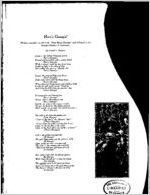
Heres Georgia!
Written especially for the book, "Facts About Georgia," and dedicated to tbe Georgia Chamber of Commerce.
By Frank L. Stanton
Queen o the richest Promised Land,
Heres Georgia!
Ringed and wreathed with a golden hand,
__
Heres Georgia!
"With a winnin smile for her lovers true,
Bright as light in her skits of blue,
Shes tellin the country "Howdy-dot "
Here9 Georgia I
Singin the song of Hoe and Home, Heres Georgia!
Fields light-white with the fleecy foam, Heres Georgiaf
^tf/hcre the corn hangs heavy and climbs so high It tells the gold in the mines 4 Good-by," And hides the nifts from the mornin sky.
Heres Georgia!
So homey-fair and hearty fine, Heres Georgia!
Shinin star o the states in line. Heres Georgia I
Just let em move to the musics sound To win the rize for the golden ground, Shell match em swingin the world around,
Heres Georgia!
She calls to the listening eole$ far From, Georgia.f
"Come to the land o the fifornin* Star," (Thats Georgia!)
Come, from the cabin and sky-line dome! Come, as the bee flies to the comb! Come, to the land where the worlds at home!"
(Thats Georgia /)
Call o the golden-hearted hills Of Georgia!
The gold-dee^ mines and the whirrin mills Of Georgia!
Clear as the mornins trumpet-call, The notes o the message rise and fall; 14 Hearts to hold you and homes for all
In Georgia!"
Her tables creak with the plenty spread By Georgia;
With Peace herself for to bless the bread For Georgia;
The welcome word is the word we know;
Gods own land, where the good things grow; The Horn o Plentys the "horn we Wow
In Georgia!
LIBRARIES
OF ft
STATE OF GEORGIA
1916
NAT E. HARRIS Governor
PHILIP COOK Secretary of State
W. J. SPEER Treasurer
WILLIAM A. WRIGHT Comptroller-General and Insurance Commissioner
CLIFFORD WALKER Attorney-General
M. L. BRITTAIN Superintendent of Schools
J. D. PRICE
H. M. STANLEY
Commissioner of Agriculture Commr. of Commerce and Labor
J. D. LINDSAY ........ Pension Commissioner
W. H. FISH ...... Chief Justice Supreme Court S. W. MCCALLIE ......... State Geologist DR. H. F. HARRIS ..... Secretary of Board of Health R. B. RUSSELL ..... Chief Judge Court of Appeals JOHN C. HART ......... Tax Commissioner
C. M. CANDLER ..... Chairman Railroad Commission J. VAN HOLT NASH ........ Adjutant-General
R. E. DAVIDSON ..... Chairman Prison Commission C. S. ARNOW ...... Game and Fish Commissioner MRS. M. B. COBB ........... Librarian
GEORGIA CHAMBER OF COMMERCE
STATE-WIDE ACTIVITIES
INCORPORATED, MACON
EXECUTIVE OFFICE, ATLANTA
President C. J. HADEN, Atlanta
OFFICERS:
Secretary-Manager E. Y. CLARKE, Atlanta
Treasurer T. C. ERWIN, Atlanta
WILMER L. MOORE Atlanta
VICE-PRESIDENTS
SAM TATE CRAWFORD WHEATLEY
Tate
Americus
RORERT F. MADDOX Atlanta
COMMITTEE ON PUBLICATION OF "FACTS ABOUT GEORGIA"
C. J. HADEN
H. G. HASTINGS
R. F. MADDOX
EXECUTIVE COMMITTEE
L. R. AKIN, Brunswick P. M. ATKINSON, Madison B. G. BRUMBY, Marietta J. W. CALLAHAN, Bainbridge
E. B. CLARK, LaGrange R. T. COLE, Newnan J. A. DAVIS, Albany S. J. FAIRCLOTH, Quitman B. H. GROOVER, Reidsville
J. LzRoY HANKINSON, Augusta
H. G. HASTINGS, Decatur L. P. HILLYER, Macon
HARRY HODGSON, Athens ST. ELMO MASSENGALE, Atlanta
MOSES WRIGHT, Rome
G. OGDEN PERSONS, Forsyth JOHN A. SMITH, Gainesville
R. P. SPENCER, Columbus R. T. JONES, Canton
W. A. WINBURN, Savannah
FACTS ABOUT GEORGIA
A State Rick
in
Resources
and
Opulent
. in
Opportunities
Putlisked Under tlie Auspices of tne
Georgia Chamber of Commerce
PRICE $1.00
ATLANTA. GEORGIA PRESS OF FOOTE 4? DAVIES COMPANY
1916
Compiled and Edited by
Louis N. GELDERT
COPYRIGHT. 1916 By
GEORGIA CHAMBER COMMERCE
SMILING IGEORGIA
CONTRIBUTED BY
GEORGIA STATE BOARD OF ENTOMOLOGY
E. LEE WORSHAM. STATE ENTOMOLOGIST
MISS ANNIESHARP, ARTIST
LIST OF GEORGIA PRODUCTS CONTAINED IN ABOVE MAP
APPLES BANANAS BARLEY BLACKBERRIES BLACK WALNUTS CANTALOUPES CHERRIES
CHESTNUTS CORN COTTON ENGLISH WALNUTS FIGS GRAPES GRAPE FRUIT
GROUND PEAS LEMONS OATS OLIVES ORANGES PEACHES
PEARS
PECANS PERSIMMON PLUMS POMEGRANATE RICE STRAWBERRIES SUGAR CANE
TOBACCO WATERMELON WHEAT
Tore word
| T IS THE purpose of this hook to speak with accu "* racy the truth about Georgia. That it might he free of that undue partisan praise which often blemishes pub lications of this kind, an editor -was engaged not native to the soil. He was reared in the North and has had wide experience in industrial research. Confident that the truth -was enough, our instructions to him were to keep -within the bounds of authenticated facts, and -wher ever in doubt, to keep on the safe side. Before going to the printer, his manuscript -was reviewed by a committee of capable and careful business men.
A State possessing more square miles than any other east of the Mississippi River; growing a greater variety of agricultural products than any other in the Union; en joying six out of the seven distinct climates of the United States; ranking among the first three in the development of water-power and in the production of gran ite, marble, potatoes, peaches and -watermelons ; among the first half dozen in the volume of standard minerals; second in cotton; fourth in the value of its agri cultural products; with a lower than average tax rate, and a very high public credit; is worthy of the profound consideration of all those looking for new fields of enterprise.
The Georgia Chamber of Commerce was organized for the public welfare. It is not a party, directly or indirectly, to any undertaking of private gain, ^iVe seek to induce no citizens or new investments by exaggerated statements. All who are concerned to know more of Georgia on any particular subject matter than is contained in this volume, are invited to -write us. \Ve will respond with the fullest information at our command.
GEORGIA CHAMBER OF COMMERCE,
^L^t^^ President.
GEORGIA STATE
GEORGIA
A State of Advantageous Oppor-
tunities
Georgia, the largest state east of the Mississippi River, and one of the original thirteen states of the Union, is teeming with opportunities for the farmer and artisan for those who would work, or play or simply rest. Marvelously rich in climates, soils, minerals, forests, fruits and flowers, with excellent schools, thrivV . ing cities and towns, ports beyond compare, and industrial acf% tivities growing and extending with amazing rapidity, there is so -i . much of it that its nearly three million busy people are unequal 5 in numbers to the task of development. _^ There is enough and to spare, and in the spirit of the founders C; of the Colony in 1733, who adopted as their motto non sibi ^,~ sed aliis (not for themselves, but for others), Georgia smiles its welcome and extends its invitation to the people of other states and countries, where the rigors of climate and other con ditions are less favorable to successful husbandry, to come and share in its abundant resources.
There is no room in Georgia for the lazy and shiftless, but for ambitious, self-respecting peoples, who, independent of sex, recog nize the dignity of honest labor, who fear God, revere the sanc tity of the home, and are amenable to law and order, there is a , ( hearty welcome, a fair field, a kindly soil and a golden harvest ^, to be gathered. Nature has done her part. The lap of Georgia ; has been lavishly heaped with advantageous opportunities. Men / and women with enterprise and moderate means are needed to V develop what Nature has so bountifully provided.
Sunny, Smiling Georgia! Sir Richard Montgomery, to whom the Lord Proprietors of the Carolinas had granted part of it in 1717, wherewith to establish his proposed Margravate of Azilla, described it as a veritable paradise, "the most delightful country," where, he said, "the flowers bloomed earlier, the birds sang sweeter, the water was colder and purer, the air was always balmy, and winter was not known." Sir Richard never gained his paradise, but others did, and as they journeyed farther from the coast and upward into the West and North, new delights were ex perienced, soils and zones of climate and vegetation were found in numberless variety, and each could choose a home-site to
// a wall was built around Georgia it could be made entirely selfsupporting. Any crop possible to raise be tween the Frigid and Tropical Zones can be matured in Georgia, suf ficient to support ten times tHe States present population.
><><$
The difficulties involved in an attempt to present within the compass of this book the agricul tural potentialities of Georgia would be appre ciated by any one who tried to place the At lantic Ocean inside a barrel with the aid of a teacup. Perhaps no one but a relative stranger to the state would make the attem.pt at all.
Atlanta--Capital City of Gteorgia--Leads the En tire South in Bank Clearings ana Postal .Receipts.
Capital invested in Man ufacturing in Atlanta in 1914--$36,096,000.
IO
FACTS ABOUT GEORGIA
accord with his own ideals. The same freedom of choice exists to-day in Georgia.
The story of how a retired business man of the West, having attained a modest competency, found his ideal home in Georgia, is interesting. Having traveled far and wide in vain search, he was one of a dining party at a seaside home in California, and being urged for his reasons why he would not abide among them, explained that he was looking for a better country, where it was not "always afternoon," where the summer was not too hot and the winter was short but bracing; where there were no mos quitoes and the nights were cool but not chilly. He wanted a place where he could do something or grow something, and keep from rusting by mixing work with his play. Living in that coun try must be cheap, labor plentiful and cheap, good shooting and fishing to be had, with the conveniences of life, the society of con genial neighbors, and easy access to the big centers of popula tion by frequent and rapid train service.
He did not want any lodge in a vast wilderness, and while de siring plenty of leisure he wanted also some work and something to achieve. His friends laughed at his Utopian dream, but one old gentleman quietly informed him that all unconsciously he had been describing the country, climate and conditions actually existing in a section of North Georgia. That our idealist found what he sought, and has been a prosperous and happy planter in his Dreamland for the ten years since that time, goes without saying.
It is the purpose of this book to so interest the prospective settler, investor and developer, in the wide extent and diversity of Georgias resources, that they will look this way, and looking,
FACTS ABOUT GEORGIA
ii
see and be satisfied, that here can be found their own Utopia, the land of their dreams, "Where peace and plenty cheer the laborers rest."
Georgia beckons also to its own wanderers. The home folks are beginning to raise enough fatted calves to provide feasts for the whole army of prodigal sons and daughters, and the possums are fat and saucy and lay low on the branches. Georgias bosom is warm and broad and her arms are extended wide in cordial
invitation.
The man who wants twenty-five or fifty acres of such land as Georgia offers would have to pay for it in Iowa, Illinois, Kansas, Nebraska, or almost anywhere in the middle west, from $100 to $200 an acre. He can not only get the same land in Georgia at from $30 to $40 an acre, but he gets along with it a climate and a soil that enables him to make at least two, -ind sometimes three, crops in a single year, where in the colder and more severe climates of the north and middle west he can make but one.
When this fact becomes generally known there is no question whatever that Georgia farm values will experience a greater spurt than they have yet shown in all the history of their recent rapid advance. This information is being gradually spread, and it is that which, as much as anything else, is preserving and increasing Georgia farm values at a time when other real estate is at a com parative standstill.
Atlanta Skyline 1916 Hub of 'New Industrial South--Oner 500 manitfacturing plants
Value of manufactured products of Atlanta in 1914 given by V. 8. Cen sus at $41,313,000.
12
FACTS ABOUT GEORGIA
Take the world over and nowhere has agriculture shown quicker or more generous response in profits to intelligent ef fort than in Georgia soil. You may get from an acre as much as $3,000 in a single year-- it has been (Lone--or, you may get as little as $25 by merely scratch ing the soil.
$> <$<?>
The history of Georgia is proudly cherished by its people of the present generation, who might well emulate the great works of its founders and builders, and while viewing the records of the past, they can not fail to be vividly re minded of the obliga tion to build well for future.
HERMITAGE: OLD PLANTATION RELIC NEAR SAVANNAH
Early History or tne Georgians
The early history of Georgia is crowded to repletion with romance and tragedy. They dominate every page, from the sad story of Robert Castell, the English architect, whose death in a debtors prison so shocked the sensibilities of Sir James Oglethorpe that he sought and obtained Royal authority to establish a colony for poor debtors, and hence Georgia; to that stupendous catastrophe of war that devastated the entire State, and badly bent but could not break the spirit and purpose of a proud and resourceful people.
In its inception, the colony of Georgia was both military and philanthropic. Like the ancient Knights Templar, the Oglethorpe settlers were assigned to police duty, to protect the real
FACTS ABOUT GEORGIA
crusaders, the planters, from Spanish buccaneers of the south, who were seriously threatening the Carolina colonists. The "baby" colony became known also as the "Sentinel" colony. At the decisive battle of "Bloody Marsh," on St. Simons Island, July 7, 1742, Spain lost a continent, and Oglethorpe, his task com pleted, sheathed his sword, devoted another year to the adminis trative construction of Ris ideal colony, returned to England, mar ried happily, and spent the balance of his long life in honored activities at home. Thus endeth all true romances.
In the ten years of Oglethorpes paternal governorship, Georgia had grown strong in numbers, in agriculture, commerce, thrift and high ideals of humanity. With thirty-five families, 130 in all, the city of Savannah, on the Yamacraw Bluffs, had been founded in January 1733, and as an early example of civic planning, it remains to-day the highest type of the City Beautiful.
Sir James Edward Oglethorpe was swayed by lofty impulses, and had the constructive ability and strength of character to mould men to his liking. In philanthropy and practical socialism he was far in advance of his times. He was as well a soldier, statesman, scholar, and conscientious exponent of Christian prin ciples. Georgia is justly proud of her founder, and of the exalted ideals of government he inaugurated. Together with the board of trustees he represented, he served without pecuniary compensation, and spent freely of his own funds in the scheme
Commemorating Philan thropic seal of the city's Founder.
OGLETHORPE MONUMENT, CITY OP SAVANNAH, ERECTED IN 1909
FACTS ABOUT GEORGIA Sk. of colonization. Oglethorpe was still alive in England at ninety years of age, when the trouble arose between the old country and its colonies, and he stoutly refused to be a party to the co ercion of "his people," as he called them.
The first agricultural ventures of the colonists were in mulberry trees for silk worm culture, and in indigo plants, but these proving unsuccessful, they turned to the lines of least resistance, and rice, corn and cotton soon became the staple crops. Commerce with the home country was established. Augusta was founded in 1735. Other settlements and trading posts followed. Schools were built, often before churches. More settlers came, attracted by the reports of fertile soil and kindly climate. Came the Salzburgers with their religious fervor and frugality; the Moravians, who did not tarry long to leave their non-combative impress on the population, but moved on to Pennsylvania; the Scotch High landers, with their fighting blood, their rugged strength and mas terful ways; many Huguenots, and some Hebrews.
The Wesleys, Charles and John, came, and preached, got home sick, and returned. Came Whitefield and preached, and deeply enriched the religious life of the entire country. Under Ogle thorpe, slavery was inhibited, likewise all spirituous liquors. The first Sunday School in the world was established in Savannah
SAVANNAHS TRIBUTE TO OGLETHORPKS FUIKND, CHIEF TOMOCHICHI
FACTS ABOUT GEORGIA
SAVANNAHS BKAtrTIFCL BOXAVENTURE CEMETERY
under Wesley. The first orphan asylum in America was built for Whitefield. Oglethorpe placated the Indians by kindness and just treaties, won their friendship, and saved his people from the bloody massacres and outrages that were experienced in other early settlements.
In 1752 the trustees of the colony relinquished their charter, and Georgia became an independent province, with a local assem bly. Then the head-right policy was adopted, giving to every male 200 acres of land, with 50 acres additional for each child. That was the true foundation of Georgias industrial prosperity, or as some one said "that placed the rock of conscious independence beneath our feet, and the crown of industrial glory upon our head."
Then, too, came the Puritans, 350 of them, with their bibles, hymn books and 1500 slaves. The bars to slavery had been let down by Oglethorpes successor, as a necessity of successful competition with the sister colonies. This particular group of Puritans was an offshoot of the flock at Dorchester, Massa chusetts, and 56 years before had migrated to South Carolina,
First Sunday School in the world, established by John Wesley in Savannah, and perpetu ated by George Whitefield at "Bethesda," by which name the famous first Orphan Asylum in America is known
<$> <S> >
A hundred and fifty miles of coast, as the crow flies, and numbers of good harbors put Georgia in touch with the ports of the world; every advantage of the Panama Canal is hers.
As Georgia and the South are destined to be come of paramount im portance as a meat pro ducing section of Am erica, so from Georgia's splendid, ports will de part the continuous car goes of animal food that will appaise the hunger of Europe.
Historic Savannah--Syl van City 'by the Sea--
Her Port is Georgia's Priae
i6
FACTS ABOUT GEORGIA
and founded there another Dorchester, but when they removed
bodily in 1752 to Georgia and settled in the Parish of St. John, now Liberty County, they called their new home "Midway."
All pervasive has been the uplifting influence of this pious, God-fearing sect upon the lives and characters of the people of Georgia. In numbers, importance and material possessions they waxed mightily. It was estimated that in 1776 one-third of the wealth of the Colony was in the Parish of St. John. Sunbury, the port, was a rival of Savannah in shipping. Rice was their main crop for export. The second church building of the Midway congregation, erected in 1792, still stands, and is the Mecca of the faithful. Annually they gather there from all over the state and country the sons and daughters of those devoted ances tors who builded a race of God-fearing strain that permeates the entire social structure of the United States.
In the Revolutionary war, Georgia was the scene of many bloody battles, and many heroic deeds. Industries suffered se verely, and numbers of prosperous communities, wiped out or scattered by the Tory troops, were never rebuilt, and only slight evidence remains of the pulsating life that there once obtained.. So there are really some dead towns in Georgia. Of the heroes of that war, Georgia had its full quota and more, and in the moulding of the new nation, its patriots and statesmen stand in history among the foremost, in self-sacrifice, wise counsel, and executive leadership. Family pride in descent from Revolu tionary and Colonial ancestors is justly strong among Geor gians. Hereditary traits of character persist through the gen erations, and strength and honesty of purpose, loyalty to friends,
FACTS ABOUT GEORGIA
justice to foes, gentleness of manner, chivalric devotion to wo mankind, hospitality to strangers and broad charity, are as com monly found among the piney wood or mountain-side cabins of the poorer whites, as in the home of affluence and refinement.
After the Revolution, and the departure of the British sol diers, many of whom did not depart at all, by the way, but re mained and cast their lot in Georgia or the wilds further west came many new settlers. The north of Ireland contributed of its best families. From England and Scotland came more of that desirable strain that already predominated here. New Englands sons and daughters came, and New York and Pennsylvania and New Jersey people came, and many stayed. From Virginia and the Carolinas hosts of the same staunch stock migrated to Geor gias blossoming hills and plains. Soon the Empire State of the South became first of all states in agricultural, commercial and educational progress.
Georgias development after the Revolution was bifocal. The colonial families whose activities had centered at Savannah, to gether with the new accessions from the old country, occupied the southern portion of the State, while the settlement of North Georgia radiated from Wilkes county. These people were mainly from the colonies to the northeast, and had followed the eastern foothills of the Appalachian Mountains from old Virginia.
Settlement of the State northward and westward began to crowd the native Creeks and Cherokees into the hill country, and rapid expansion brought serious problems in statesmanship. Bit ter fueds arose in .politics. Hot blood ran in many veins, and needed to be let to cool by sword thrust or bullet puncture. The
Embowered in its trees and flowers, Savannah is busy and prosperous
The whole city speaks the word "welcome."
i8
FACTS ABOUT GEORGIA
Code Duello was considered the Court of Honor, and hardly a day passed but gentlemen of Georgia adjusted their differences by mortal combat. The code was punctiliously adhered to, and the custom long prevailed, even when prohibited by laws that were more honored in the breach than in the observance. In this present day and generation it is hard to conceive the conditions that cost the country so many noble lives; among the earliest, that of Button Gwinnett, one of the signers of the Declaration of Independence.
In his Georgia Landmarks, Memorials and Legends, Historian L. L. Knight throws light on this subject. "For the paramount sway of the duelling pistol in a State like Georgia," he says, "there were sound reasons. To begin with, the partisanship of the Revolution entailed upon us a host of feudal animosities. It also engendered the military spirit, to which life on the frontier gave constant exercise, through the ever-present dread of an Indian outbreak. Children at play revelled in the use of toy weapons, with which they stormed imaginary forts and citadels. The long protracted feud between Clark and Crawford, at a later period, divided the State into two hostile camps, in consequence of which there were personal wrangles and disputes without number."
CASCADE ON TOCCOA CREEK. STEPHENS COUNTY
FACTS ABOUT GEORGIA
"Scores of the best families of our State traced descent from the Nobility of England; and there was ingrained in the very nature of the average Georgian an inherent love of personal en counter, as old as the tilt-yards of the Norman Conqueror. While the main body of our population was of English origin, there was an intermingling of two other strains in which the duel found a congenial soil; the Scotch-Irish, grim and silent, tena cious of personal opinion, untaught to yield an inch of ground, and the French Hugenot, fiery and impulsive, full of the military spirit, and prone, without thought of consequences, to seek the bubble, Reputation, at the Cannons mouth."
Toocoa Falls, Stephens County, 187 feet high.
<$> <s> <e>
The highlands of Geor gia abound in impres sive scenic views -- mountain torrents, wa terfalls, cascades, wind ing streams, with back grounds of towering heights, or undulating hills.
The Roof Garden of Georgia is luxuriant in flowers and woods. Its valleys and, mountain sides are ideal for apple and other fruit culture and afford unlimited opportunities for profit able farming. Good fish ing and shooting abound near excellent hotels, and camping parties find their summer paradise.
Macon, with eighty manufactories, has also twenty educational in stitutions, including ~Wesleyan, the first char tered female college in the world
The value of Macon's manufactured products in 1914 was $18,861,000. Fourteen railroad lines radiate in all directions.
2O
FACTS ABOUT GEORGIA
With a population of 82,554 in 1790, Georgia had reached 340,989 in 1820, and 1,057,286 in 1860. During every decade up to 1840, its rate of increase in population was higher than that of the United States. The present population of the State, 2,776,513, is thirty-three and one-half times its 1790 population, and during the same period the population of the United States has multiplied only twenty-three times.
Not in numbers only was Georgia notably progressive during its first half century of statehood, but in education, science, com mercial relations and wealth, as well as in agriculture. Railway construction began in the early thirties, a complete system being planned from the start. Cotton factories multiplied and grew fn output. The first had been built near Washington in 1811. New towns were springing up. Mechanics were in demand and held in high esteem. Labor was everywhere respected.
In educational endeavor Georgia was an acknowledged leader. The first State University in the United States was established in Athens, Georgia, in 1784. The first free manual training school was started there in 1803. The Constitution of the State of Geor gia, adopted in 1777, had stipulated that "schools should be erected in each county, and supported at the general expense of the State," and these were established accordingly, and granted lands and money to provide permanent funds to assist in their support. At St. Marys in Camden County and at Augusta, are two dis tinguished examples of these County Academies, with endow ments dating from 1783. The first female college in the United States, with authority to grant diplomas to women, was estab lished at Macon, Ga., in 1836, the Wesleyan Female College.
In scientific research and invention Georgia also shows well in the lead. The illustrious discoverer of anesthesia, Dr. Crawford W. Long, was a Georgian, a modest country doctor in the town of Jefferson when in March 1842, at 27 years of age, he first employed sulphuric ether in a surgical operation. No greater
FACTS ABOUT GEORGIA
21
name or fame has any man in the whole world of medical science. The first patent issued for a steam boat was issued by the
State of Georgia, by legislative act, in February 1788, to Isaac Briggs and William Longstreet. It was before the Federal Con stitution was operative, and while the states were acting under the Articles of Confederation. It was also the only patent ever issued by the State. This was two decades before Fultons suc cessful experiment in steam navigation.
Georgia must also be accredited with the first steamboat to cross the Atlantic (1819), under steam power, the Savannah, which was built in New York for Georgia people and with Geor gia capital.
The Rev. Francis R. Goulding at Eatonton, Ga., first invented the sewing machine, and had one in practical use in his household two years before Howe took out his patent. Being engrossed in ministerial and literary duties, the commercial possibilities did not appeal to him forceably, and Howe "beat him" to the patent office.
The invention of the cotton gin by Eli Whitney in 1793, at Mulberry Grove, near Savannah, while he was living at the home of the widow of General Nathaniel Greene, of Revolutionary fame, was one of the most notable events of history. It fixed slavery as an institution upon the South. It created an industry, the ramifications of which have quickened the heart-beats of the entire world. King Cotton, "the Snow of Southern Summer," as Henry Timrod terms it, became the undisputed ruler of the destinies of the Southern States, and still dominates the commerce of the United States. Its story is briefly told elsewhere within ftiese covers.
In common with other colonies, Georgia, under its charter, extended from the coast westward to the great Mother of Waters, the Mississippi River. The early years of statehood were en livened by an episode of much dramatic interest, known to history
Macon, the Geographical center of the State, is in the Heart of the Famous Peach Section, and open to River Navigation to the Atlantic Ocean.
Within a radius of fifty miles of Macon are 100,000 people. Four thou sand carloads of fruit shipped from Macon dis trict annually.
22
FACTS ABOUT GEORGIA
The expurgation of the records in the Yazoo fraud case, while the atrical in its climax, showed the true temper of Georgians in their devotion to honest prac tices and principles
Relics of the Cherokee's occupation abound in North Georgia. Flint arrow heads are fre quently found and burial mounds give evi dence of an advanced civilisation long before contact with the white race.
Many fascinating le gends are extant of the coming of De 8ota and his Spaniards, and their life among the Indians about Mt. Yonah, where gold and- precious stones were -plentiful and led to bloody games of hide and seek.
as "the Yazoo Fraud." Certain land speculators, for a small con sideration, obtained a grant from the legislature in 1794, of the entire country now embraced in the states of Alabama and Missis sippi. James Jackson, a United States Senator from Georgia, and a veritable fire eater in temper, spurred by righteous wrath, resigned, returned home in post haste, and, backed by public sen timent, succeeded in having the legislative act rescinded. The public burning of the official records of this transaction, in the grounds of the then Capitol, at Louisville, by fire from Heaven sun-glass rays as a vindication of the honor of the State, was the crowning thrill of the drama. But the curtain did not drop for many years, and the bitter animosities engendered resulted in many duels and much bloodshed.
In 1802, the territory in question was transferred to the United States government, and the new states were carved from it, but the contract was involved in many respects, among others with the treaty rights of the Cherokee Indians to the lands where they were being continually more circumscribed by the encroach ment of white settlements. Numerous conflicts occurred be tween the state and federal governments. The sad story of the enforced removal of the enlightened and law-abiding Cherokees, by United States troops, in 1838, to the lands that had been chosen for them west of the Mississippi, was only equalled in the annals of Anglo-Saxon brutality by the Acadian expulsion from Nova Scotia nearly a century earlier. But the Cherokees were not the only Indians in the country to suffer injustice at the hands of the Great White Father.
FACTS ABOUT GEORGIA
The Mexican war drew many of Georgias sons to the front through its call of patriotism and promise of adventure. In fact Georgia has been at the front in all of the Nations activities, in every line of human endeavor. In Congress there have been no greater constructive statesmen or more powerful orators, in the realm of jurisprudence no more distinguished advocates or judges, in the field of diplomacy, in the sciences and arts, in educational circles and in the pulpit or lecture forum, no abler or more force ful men than .those from the Great Empire State of the South.
In the lamentable conflict of arms between the Northern and Southern States of the Union (1861-1865), Georgia bore a con spicuous part. Its fertile lands provided very largely to the sus tenance of the Southern armies, and when Sherman broke "the back-bone of the Confederacy," as Georgia was called, the war was over. Prof. J. T. Derry, in "Georgia: Historical and Indus trial," summarizes the story of "the War," and its causes as fol lows:
"This war was the outgrowth of a long struggle for the balance of power between the commercial and manufacturing states on the one side, and the purely agricultural states on the other, in combination with opposing theories as to the real nature of our Federal Union. This struggle became manifest in 1820 on the application of Missouri for admission into the Union with a con stitution allowing slavery, an institution which differentiated the opposing groups of states. The opposition to the admission of Missouri was not based on moral grounds, but on the idea that it gave to the South a preponderance of influence. By the Missouri
Among the gallant sol diers of Georgia in the war for independence were Elijah Clarke, James Jackson, John Dooly, Samuel Eloert, John Twiggs, Wm. Few and Lachlan Mclntosh, and among its leading statesmen of that time were Lyman Hall, But ton Gwinnett, George Walton, Archibald Bulloch, and Abraham Bald win.
The illustration on these pages is of a scene at BrunswicTc, Wiher e Georgia pine, naval stores and cotton are transferred from railroad trains to ships for conveyance across the seven seas. Brunswiclc is still a great naval store depot, notivithstanaing the reduo* ed supply of turps from Georgia.
FACTS ABOUT GEORGIA Compromise, the dangerous dispute was settled for a time; but the acquisition of new territory from Mexico in 1848 re-opened the old quarrel, and slavery, now opposed by some on moral grounds, but by the great majority for reasons purely political, became the occasion of the most stupendous conflict of modern times."
At this writing, in this year of grace, 1916, when all Europe is engaged in such a gigantic and bloody strife as almost passes human comprehension, Prof. Berrys superlative seerns mild, and by comparison the Civil War of America sinks into insignificant littleness, but from the point and time of view of this writing there is no question of its having been "the most stupendous." Regarding Georgias part in the war the Professor continues: "In this fierce struggle, for which Georgia furnished ninety-four regiments and thirty-six battalions, embracing every arm of the service, the blood of her sons was freely poured out on every battlefield from Pennsylvania to the Mississippi, and from the Ohio to the Gulf, and (if we include the thousands who had emi grated to the states west of the Father of Waters), in every im portant combat through the bounds of the Trans-Mississippi de partment of the Southern Confederacy. On Georgias soil were fought the great battles of Chickamauga, Resaca, New Hope
TYPICAL NEGRO CABIN HOME IN THE PINEY WOODS
FACTS ABOUT GEORGIA Church, Kennesaw Mountain, Peachtree Creek, two fierce battles at Atlanta, Jonesboro, and numerous smaller engagements and skirmishes. Shermans march to the sea, when almost the entire military force of the State was absent in Virginia or Tennessee, scattered ruthless destruction along its path, and the final disas trous close of the long-continued war wrecked the hopes and fortunes of her people."
Dark days followed the war in Georgia, as in the entire South; but men there were of pluck, energy and perseverance who soon wrought the redemption of their state. Theirs are household names, and the record of their strength of purpose and wise counsel, during the times that tried mens souls, constitute the most precious annals of the people. "They did not yield in base sub mission to oppression and wrong," says Prof. Derry, "but main taining their rights in every legitimate way, shared at length in the final triumph of the whole South, in the courts and Congress of the Nation."
Gradually the inertia that followed the catastrophe was over come in spite of tremendous odds and there dawned in earnest a new era of home building, of town and city building, and of state building. So was born that "Georgia Spirit," which binds all sec-
RESIDENCE STREET IN OXE OP GEORGIAS SMALL CITIES
FACTS ABOUT GEORGIA
tions of the State into one progressive and constructive force for < a bigger and better future.
In the meanwhile, however, the huge National wave of emigra tion carried hundreds of thousands of Georgians into the Great West to help in building new state units. Texas was perhaps the greatest gainer by the migration from Georgia. According to the Governor of Texas, there were 800,000 Georgians and their de scendants in that State in 1915. Their numbers in other states, in all occupations of life, would constitute a mighty host. New York and Chicago have proved to be strong loadstones to their adventurous and ambitious spirits. Wherever he is, however, at home or abroad, the true Georgian is a man of mark. No state in the Union has been less exposed to the modifying influence of foreign immigration, and therefore its people are in the main of the purest blood of the American Revolution.
The New Georgia, lusty, strong and purposeful, is made up of the natives, and sons and daughters of natives, of all sections of the country, and in her greeting to all comers, she knows no North, no South, no East, no West.
Bowed Down with Ap-
FACTS ABOUT GEORGIA
27
HOME OP A GEORGIA FARXI MANAGER
Advantages in Temperature and
Climate
It is not hotter in Georgia in summer than it is in the North ern and Western states and Georgias summer days are shorter. In proof of this, and for the benefit of many living in those sec tions, by whom this statement may possibly be questioned, and who, without having really investigated the matter, may have held the contrary opinion, the accompanying tables are published. They were prepared at our request by the United States Weather Bureau, from official data.
These figures show that the average annual highest temperature during the last five years was actually lower in Georgia by a frac tion of a degree, than in the Northern states. The difference be tween the average lowest temperature in Georgia, and that of the North, was 35 degrees in favor of this State. There were 50 days in Georgia when the maximum average was 90 or above against 21 days in the North, but the small fraction of a day when the highest was 32 or below here, as compared to the 44 days there, is a fair offset.
Secretary of Agriculture Houston says: "In point of climate and in length of growing season, the South has a material advantage over the rest of the nation."
<S> <$> <S>
Farm buildings in Geor gia do not have to be constructed to withstand zero weather and bliz zards, and with much cheaper lumber the cost of such buildings is con siderably below that of the Northern States.
<$><$><$>
Cattle and hogs can graze in the open 365 days in the year in Cen tral and South Georgia in luxuriant meadows of Alfalfa and Glover, and other growing crops, and without expense of gathering and feeding, be made into prime meat.
28
FACTS ABOUT GEORGIA
It has been suggested that the reason why Georgias climate is more equable is that in the South in summer the time between sunrise and sunset is so much shorter, and in winter so much longer. The records show, for instance, that as between Buffalo, N. Y., and Savannah, Ga., which are of about the same longitude, the longest day of the year at the former city is six hours and six minutes longer than the shortest day, while there is only four hours difference between the longest day in Savannah and its shortest day. In other words, Buffalos long summer day has fifty-four minutes more sun than Savannahs, while Savannah has exactly an hour more of sunshine on its short winter day than Buffalo. These facts to Georgias advantage are not commonly known or considered.
The table clearly shows the greater precipitation in Georgia,
and its consequent advantage in the raising of many staple crops.
Fruit orchards in the State derive a decided benefit from the greater rainfall.
The duration of the crop season, shown in the last column, indicates the average time between the last killing frost of spring and the first in the fall. Two months more of growing season in Georgia, is, as the farmers cat says, "not to be sneezed at." It readily accounts for the two crops a year that are frequently grown on the same ground here, and are always possible.
TABLE I. NORMAL MONTHLY AND ANNUAL MEAN TEMPERATURES AT SELECTED STATIONS IN GEORGIA
Stations:
Jan. Feb. Mch. Apr. May June July Aug. Sept. Oct. Nov. Dec. Annual
Athens ....................42.0 44.1 52.3 60.1 69.8 76.1 78.3 77-2 72.0 61.5 51.2 43.5 60.5
Atlanta ....................42.7 45.1 52.8 60.7 69.1 757 78.6 77-2 72.1 61.6 51.8 43.9 60.9
Clayton ................... 40.2 39.9 50.7 56.0 65.5 71.7 74.4 74-6 68.5 S7-0 48.4 40.6 57.3
Rome ..................... 42.7 44.0 53.5 61.3 69.4 76.2 79.7 78.8 73.1 61.8 51.2 44.2 61.5
Augusta .............. .....47.0 50.1 56.4 64.3 72.5 78.9 81.7 80.0 74.9 64.3 54.4 47.4 64.3
Columbus ................. 46.5 48.4 59.8 64.9 72.6 79.3 81.1 80.8 77.0 66.1 55.7 48-2 65.3
Fitzgerald ................. 49.7 SLO 61.3 64.8 74.6 79.7 81.7 81.3 76.9 66-5 57-3 49-8 66.2
Macon ..................... 46.8 48.3 56.9 63.9 72.6 78.0 81.2 80.2 75.6 64.5 54.6 46.5 64.1
Millen .....................47-3 48.8 58.5 64.4 73-5 79.7 81.8 81.0 76.0 65-0 55-3 48.2 65.0
Americus ..................48.1 50.2 59.1 65.4 74.6 80.6 82.3 81.0 76.5 66.1 56.5 49.5 65.8
Bainbridge ................ 42.0 44.1 52.3 60.1 69.8 76.1 78.3 77-2 72-0 61.5 51.2 43.5 60.5
Brunswick .................53.2 54.2 61.0 67.4 75.1 79.6 82.6 82.2 78.4 70.3 61.7 55.5 68.4
Savannah .................. Si-3 53-4 61.4 67.2 74.6 79.9 81.5 80.9 77.6 67.8 59.4 52.2 67.0
Quitman ................... 51.4 53-8 59-7 66.3 74-O 79.2 81.7 80.7 76.4 66.9 58.2 51.4 66.6
FACTS ABOUT GEORGIA
29
Meteorological Data at Selected Stations Based on the Averages for the s-Year Period, 1910 to 1914 Inclusive.
V
IM
3
Stations
-u rt
ISsfi
WH
Georgia Cities. Atlanta ........... . 100
.104
.104
.101
CD
I*
3
u
J_l t->
0) P
>, v
o 3a -o2
to rt
rt
Q
>> Pfe gfe
rt O
3 o Q E"u
o-:s & aa> V
u O,
.^
.K0
o.^x o "o S ^
JH SR ^;g 52>
f. 28
41
IS
5r o
IS 55
0
36
47
12
22
80
0
Average ....... . IO2.6 Tt- Q 536 0.4
28.4
Northern Cities.
Des Moines, Iowa...105 -29 37 50
127
Minneapolis, Minn. . IOO -31
14
79
159
Springfield, Ills. .104 -18 42 36
IIO
Columbus, Ohio . . . .104 - 7 24 33
in
Indianapolis, Ind. . . 103 -16 26 36
no
Harrisburg, Pa. .too -14 15 27
97
Albany, N. Y. .......104 -18
9 44
129
.103
5 50
126
102.8 -19-5 21-5 44.36 Difference
between averages . O.2 35-3 3i.i 44-32 82.7
i
a
-4-J
Saoo.
i:Cm CrDt
oh B Z r^ a
<JfW
215
4376 241
226434 45.64
52.94
46.01 241.6
29.11 27.05 31-71
35-97 37.85 35-90 29-75 30.25
31.82
14.19
183
1 66 203 189 187 103 162 184
184.6
57
^^^H
^H ^^^^^^^^^^^^^^^^^H B ^^^^^^^^HH ^^^H ^^^^^^HHH
^H
1
TABLE II. NORMAL MONTHLY AND ANNUAL PRECIPITATION AT SELECTED STATIONS IN GEORGIA (In Inches and Hundredths)
Stations:
Jan. Feb. Mch. Apr. May June July Aug. Sept. Oct. Nov. Dec. Annual
Athens ............... .....5.05 5-39 5-19 3-72 3-66 4.57 4.87 5.22 3.51 2.52 2.85 4.12 50.67
Atlanta ....................5.55 6.79 6.99 5.83 4-48 3-99 4- 24 4-47 3-41 2.31 3.33 4.58 49.17
Clayton ................... 4.68 5-1 5-57 4-o8 3-41 5-97 7-3 7-^9 S-OI 3-93 3-52 6.52 69.26
Rome .................... .4.72 4-64 5.70 4-20 3.42 4.06 4.00 3.88 2.53 2.59 3.31 4.75 47.62
Augusta ...................3.87 4.42 4.66 3.29 3.19 4.49 4.78 5-32 3.47 2.33 2.66 3.53 46.04
Columbus .................3.56 6.27 5.31 3.46 3.06 4.09 6.09 5.01 3.28 2.62 2.63 4.88 50.31
Fitzgerald .................3.36 4-31 476 3.98 3.71 4.42 5.92 4.98 3.80 2.74 2.46 3.65 47.95
Macon ..................... 3.51 4-49 5-44 3-97 3- 2 4.08 4.50 4.56 2.92 2.04 2.89 4.32 45.87
Millen .................. ...3.14 4-74 3-6g 2.51 3.11 5.34 5.82 4.97 3-64 2.54 1.97 3.24 44.48
Americus ..................4.08 5.03 5-52 3-55 3-22 4-5 5-14 5-12 3-24 2.19 2.73 3.76 48.08
Bainbridge ................ 3.35 5.00 4.71 3-85 2.93 4.72 6.48 5-74 3-9i 2.40 1.50 4.14 48.73
Brunswick .................3.27 2.48 3-M 3-42 3-75 6.03 6.38 5.16 7.01 4.59 1.76 2.56 49.55
Savannah ..................3.56 4-43 3-p8 3.13 3.23 6.44 7.86 6.41 4.43 2.08 1.99 4.47 52.01
Quitman ...................3.04 2.99 3.67 2.63 3.68 5.39 6.89 7.82 5.41 3.03 2.13 3.05 49.73
OFTIHFRRESESTPEURANOOSIOFDTNEUWDCBIENSEDTTTAEWFRTREEOESIMNNAMGTGHERAOIEPCRUPLGLRAITAESUTPARAASKRLIELCDLDOIMENBPPYGAARTRFTHERMDEOESW W NTTEIT,OAHFSTHHSOOEPTWRRHIINNEBRGGURLSTETEOAANUTGTEHTOSHEF.
THE AVERAGE LENGTH Of THE CROP-GROWING SEASO^ IN DAYS
FACTS ABOUT GEORGIA
Georgia s Educational Facilities
By M. L. BBITTAHT, State Superintendent of Schools. The public school system of Georgia is new, compared with that of many other states. By nature the Georgian has pronounced individualism and passed with difficulty from the old idea of the private school or academy. Beginning with the year 1870, how ever, the feeling that education is a public duty has grown more strongly each year, and is so well entrenched in popular favor that even the old-line politicians who still oppose it at heart, are care ful to guard this fact from the public. The State appropriates $2,700,000 to the public schools. In addition the cities, towns, and thirty-nine counties give more than two million dollars from local taxation. In this way many, even of the most remote rural districts have supplemented the State appropriation, lengthened their school terms from five to nine months, erected excellent school buildings, and made it practically impossible to get out of reach of an education. Within the last ten years the public four-year high schools have increased from 4 to 81 and the private and denominational
GEORGIA SCHOOL OF TECHNOLOGY. ATLANTA
FACTS ABOUT GEORGIA from 4 to 24. Every town, city, and almost every village in the State now has at least a three-year high school, and during the last ten years something more than three million dollars has been spent upon these buildings. An important feature of the State high school work is that represented by the eleven district agri cultural institutions for the special training of farmers boys and girls.
In addition to the elementary and secondary facilities men tioned, higher education has made rapid progress. The University and its branches compose a chain of colleges extending to every part of the State. The center is the University at Athens the College of Liberal Arts. The State College of Agriculture, in the same city, increases the scope of its influence each year through its extension work, and is helping the farmers in prac tically all the counties. In Atlanta the Georgia School of Tech nology is recognized as the foremost institution of its kind in the South, and has nearly a thousand students preparing for the various positions in the technical and mechanical world. At Dahlonega there is another branch of the University doing ex cellent work in the mountains, while the Medical College at Au gusta is that part of the university system which trains young doctors. There are three normal schools for teachers, one for
BAINBRIDGE HIGH SCHOOL, COST $45,000
FACTS ABOUT GEORGIA
33
North, South and Middle Georgia, at Athens, Valdosta and Mil-
ledgeville, respectively.
Besides these activities of the State there are notable educa tional institutions under private and denominational auspices. Atlanta has recently become a center with the gift of Asa Candler of $1,000,000 to the Emory University. Plans are already .under way to make this the largest and wealthiest Methodist insitution in the South. In another part of the city the Presby terian Church has bought land for the new Oglethorpe Uni versity, and one of the buildings is nearly completed. Agnes Scott College at Decatur and Cox College at College Park are well known colleges for young women. At Macon the Baptists have Mercer University for young men, and the Methodists have
RocTvoille Academy, Putnam County, 11 miles east of Eatonton.
Typical country school, showing Boys' Manual Training Department and Girls' Domestic Sci ence work.
Vocational training is gaining rapid headway in the public schools of Georgia.
The Georgia School of Technology ^ in Atlanta has inaugurated night classes in winter and summer courses are also contemplated.
34
FACTS ABOUT GEORGIA
Wesleyan, the oldest in the world for young women. Shorter College at Rome, and Brenau at Gainesville, and a half dozezn others in different parts of the State attract pupils not only from Georgia but from all over the land.
Georgia lost the greater part of her wealth during the Civil War, and naturally had her greatest poverty and illiteracy during the dark years of reconstruction following this period. In spite of the fact that the white people have had to provide educational facilities for the negro as well as for their own race, they have shouldered the burden with determination, and few, if any, states in the Union have a greater decrease in illiteracy or sounder educational progress since 1870.
Georgia's moral and business influence is unanimously behind the stringent laws that went into effect May i, 1916, prohibiting the manufacture or sale of zvines, or spirituous or malt liquors, within the boundaries of the State. Its lawmakers and law en forcers, backed by the solid concensus of public opinion, are de termined to free the State entirely from the incubus of intemper ance. Georgians are essentially a church-going people, clean lived, moral, and law-abiding.
GRADED SCHOOL, QUITMAN, BROOKS-COUNTY
FACTS ABOUT GEORGIA
35
INDUSTRIAL HIGH SCHOOL, COLUMBUS
Mineral Resources
Georgia is rich in mineral resources beyond computation. Its geological multi formation accounts for an unusual diversity of minerals, which for commercial purposes cover a range not ex ceeded by any geographical division of the same area in the world. The northern central section of the coastal plain, which extends from the coast to what is termed the Fall Line running from Augusta through Milledgeville and Macon to Columbus, has clay and fine kaolin deposits enough to maintain the combined potteries of the world. The Piedmont Plateau which averages 1200 feet in elevation above the sea, and extends from the Fall Line as a belt of a hundred miles or more wide, to the foot hills of the Appalachian Mountains, is rich in granite slate, clays and mica, with gold and other minerals in workable quantities. The northern mountain section, much of which is nearly inaccessable and only partly explored, is known to contain varying quantities of marble, granite, gold, mica, copper, iron, coal, bauxite, man ganese, ocher, asbestos, corundum and talc. Upwards of twentythree different kinds of minerals are now mined in Georgia in commercial quantities. Mining operations have thus far barely scratched the surface of this great wealth, although the mineral products of the State in 1913 were valued at $6,525,792. They
There are not five Hun dred forms in the State that have not clay of good quality to make brick and tile. Out of this the intelligent farmer can make build ing material and tile for draining his land.
<$> <S> <S>
Opportunities are every where to lie found in Georgia, for new indus tries to use the raw ma terials of the mines and quarries.
$> $> <>
T.he lavishness with which nature has be stowed her gifts upon Georgia is nowhere more apparent than in the extraordinary va riety and range of what may lie termed the sec ondary mineral re sources of this fortunate state.
FACTS ABOUT GEORGIA probably reached seven million dollars in 1915, as new mines are being constantly discovered and opened, and old ones redeveloped. The European War, too, has greatly stimulated the mining of mica, bauxite and allied minerals.
The State of Georgia maintains a Geological Department under the State Geologist, Dr. S. W. McCallie, who, with his staff of experts, is at the service of all land owners whose properties show indications of mineral wealth. The general and specific investi gations of the department are continuous, and any one interested, by the payment of postage fees, may obtain its bulletins and survey reports, or receive the benefit of its accumulated fund of technical information concerning the States abundant resources. Address, STATE GEOLOGIST, Atlanta, Ga.
Martle Marble is one of- the products that have made Georgia famous. The marble deposits of the State are so extensive that it has been estimated that all the monumental landmarks in the world could be reproduced from them without serious diminution. They occur in the northwestern corner of the State, through Fannin, Gilmer, Pickens and Cherokee counties. One large deposit, more than 60 miles long, from two to three miles wide, and from 150
STONE MOUNTAIN, DEKALB COUNTY--SOLID GRANITE, 686 FEET HIGH
FACTS ABOUT GEORGIA
37
to 200 feet deep, contains not less than five hundred billion cubic feet of marble. Quarrying for building purposes began about 1850 but not until 1884 did the marble industry assume any com mercial importance. About that time, when Georgia itself was erecting a handsome Capitol building of Indiana sandstone, Geor gia marble began to attract attention throughout the country for its infinitely superior quality as building material, and for its peculiar adaptability to decorative and monumental purposes. It is now shipped to nearly every state in the Union, and to Canada in annually increasing quantities.
Wholly or in part, Georgia marbles have been used in the con struction of such notable and costly buildings as the Cocoran Art Galleries, Washington, D. C.; the State Capitols of Rhode Island, Minnesota, Kentucky and Arkansas; the United States Govern ment Building in Boston; the New York Stock Exchange; the Royal Bank of Canada, in both Montreal and Winnipeg; St. Lukes Hospital, New York; the Illinois State Memorial at Vicksburg; the L. & N. Passenger Station, Louisville, Ky.; and among the many buildings in Atlanta, the Candler, Carnegie Library and the Terminal Station.
The durability of Georgia marble has been demonstrated to equal or exceed that of any other marble on the worlds markets.
CLAY BED. DRY BRANCH, TWIGGS COUNTY
FACTS ABOUT GEORGIA It varies in color almost to the degree of riot, ranging from nearly pure white, through greys, pinks, yellows and blues, to black. A condition peculiar to Georgia marbles is that these colors occur in regular formations.
In actual production of marble, Georgia now ranks next to Vermont, of all the states. The value of Georgias marble out put in 1913 was $1,101,997.
Granites
Georgias supply of granite rock is also inexhaustible, and it is another product for which the State has become particularly noted. The value of the output in 1913 was $906,470, which item does not include the cost of finishing processes. The entire Piedmont region, comprising 61 counties, is included in the gran ite field, although it is now quarried in merchantable quantities in only ten counties. Of most importance are the Stone Mountain and Lithonia areas. The stone from these quarries is mainly used for structural purposes, and for roads, curbing and paving. Exceptionably beautiful monumental granite is obtained from the Oglesby-Lexington area. The chief type of Georgia granite are biotite, the common type, muscovite-biotite, and biotite-bearing muscovite. Texturally they are even-grained and massive,
KIMSEY ORB BANK (BROWN IRON ORE), SUGAR HILL, BARTOW COUNTY
FACTS ABOUT GEORGIA
39
poryphritic, and gneissoid, or banded. Twelve tests of the crush ing strength of the fine-grained brotite-bearing granite from Stone Mountain, ranged from 12,000 to 28,000 pounds per square inch, and averaged over 16,000 pounds per square inch. .
Stone Mountain, in DeKalb county, only a few miles from Atlanta, is one of the largest solid granite monoliths in the world. It is of impressive interest as a geological phenomenon. Contrary to all rules of geology, it rises 686 feet above the sur rounding plain, and stands a solid dome-like mass of rock, seven miles in circumference. Engineers have estimated that there is in this one base at least sixteen billion cubic feet of workable stone.
A project is now on foot, under the auspices of the United Daughters of the Confederacy, to carve in deep bas-relief on the nearly perpendicular side of Stone Mountain, a colossal monu mental panorama to commemorate the heroic deeds of the Confed erate Armies. The opportunity here afforded for a mile or more of gigantic sculptured figures of men and horses, fifty or more feet in height, with all of the paraphernalia of war, and the sug gested solid rock chambers for relics and archives, can nowhere be equalled, and challenges imagination. The mountain side, and an extensive tract of land on the plain at the base of the moun-
MANGANESE WASHER, SATTERFIELD MINE, BARTOW COUNTY
FACTS ABOUT GEORGIA tain to provide a National Park, from which to view this sub lime achievement, when completed, have already been deeded to the organization.
Bauxite The first discovery of bauxite in America was in Floyd county, Georgia, in 1887, and later, deposits were found in Polk, Bartow, Gordon, Chattooga, Walker and Wilkinson counties. The only other states where it is mined are Arkansas and New Mexic . Bauxite is used to some extent in the manufacture of fine em ery wheels, and in making fire brick, but it is in the main con verted into metal aluminum or alum. It is in increasing demand by the aluminum refineries of New York and Pennsylvania. The ore occurs in large pockets and in beds, and is mined like iron ore.
Clays
*
The combined output of the clays and clay products of Georgia in 1913 was $3,017,290.00, and exceeds in value the production of any other mineral. Clays are classed as one of the States in exhaustible resources, and present a great variety, every useful kind being found in practically every county. The finest of white
GEORGIA VITRIFIED BRICK AND CLAY PLANT, HARLEM, COLUMBIA COUNTY
FACTS ABOUT GEORGIA burning kaolin is mined in the central southern section of the State, and the entire product is shipped to Northern potteries, where it is used for the manufacture of high-grade china, and for paper filler. In thickness of beds and in purity, the Georgia clays exceed those of any other state. There is no economic rea son why potteries should not be successfully operated on a large scale in Georgia, and the opportunity invites investment. The alluvial and residual clays of the Piedmont and mountain sections provide a superior quality of common building brick.
GoU
Omitting Spanish traditions, the first record of the discovery of gold in Georgia was in White county in 1828, and from that time until the sensational discoveries in California, Georgia pro duced practically the entire supply of gold for the United States So important had the industry become that in 1838 the govern ment established a branch mint at Dahlonega, where, up to its discontinuance in 1861, there were coined 1,381,784 pieces of money, of the value of $6,115,569. The largest annual produc tion of gold in the State was in 1843, when it totaled $582,782.
ENTRANCE TO FOSSIL IRON ORE MINE, ESTELLE, WALKER COUNTY
FACTS ABOUT GEORGIA The total gold yield of the state to date has been approximately $17,500,000. Since 1843 tne production has fluctuated from year to year, and gradually decreased, due mainly to the exhaustion of the old placer mines. Gold occurs throughout the entire sec tion of the State, north of the Fall Line. The ore veins vary from a few inches to more than twenty feet in thickness, but show generally low values, averaging from $6.00 to $15.00 per ton.
Pig Iron and Coke The production of pig iron in Georgia in 1913 was estimated at 130,000 tons, and is constantly increasing. The latest figures of by-product coke ovens output was for 1912, for coke, 13,535 short tons, valued at $56,580; tar, 668,561 gallons, value $24,337; and gas for light and fuel, 475,386,000 cubic feet, valued at $528,578.
Iron
The iron deposits of the State are of considerable extent throughout the northwestern section. The common ores are the brown, or limonite, and the fossil, or hermatite ores. Magnitite
OCHBE DRYING SHED, NEAR CARTEHSVILLE, BARTOW COUNTY
FACTS ABOUT GEORGIA
43
also occurs. There are great possibilities of production, but only 153,360 tons, to the value of $237,870, were mined in 1913, and hardly more either year since. The brown ores are most abun dant in Polk, Bartow and Floyd counties, but workable deposits are found all through the section. The red or fossil ores are confined to Dade, Walker, Chattooga and Catoosa counties. The outcroppings of the beds extend for 175 miles, and in many places the ore can be economically mined to a depth of several hundred feet.
Asbestos
Practically all the asbestos found in the United States has been in Georgia, only one other state having shown a deposit. It is confined chiefly to the Piedmont Plateau, and is used for elec trical insulation, steam pipe and boiler coverings, fire-proof paints, and for fireproofing building girders, plaster partitions, etc. The finer varieties are spun and woven into fireproof cloth.
Coal
The coal measures of Georgia are confined to Sand, Lookout and Pigeon Mountains, in Dade, Walker and Chattooga counties.
YONAH PLACER GOLD MINE, WHITE COUNTY
44
FACTS ABOUT GEORGIA
and cover an area of approximately 170 square miles. They form an extension of the Alabama fields. The coal is of a high heating value and used for steam and cooking purposes. Only 255,626 tons were mined in 1913. Engineers estimate an avail able supply of 920,000,000 tons. At the present state of mining this would last at least 1500 years, and warm the toes of many generations of Georgians.
J^Liscellaneous
Barytes, or heavy spar are mined in Bartow and Murray coun ties.
Cements, both natural and Portland, are made in large quan tities in the State, from the limestones and shales so aboundant throughout the northwestern section. .The largest cement plant in the South is located at Rockmart in Polk county. Limestones for building construction and road making are abundant in the northern section. The most important variety is the Knox Dolo mite, from which is produced practically all the lime used in the State.
A particularly fine quality of Georgia slate is on the market,
BULL SLUICE POWER HOUSE AND DAM, CHATTAHOOCHEE RIVER, FULTON COUNTY
FACTS ABOUT GEORGIAthe Polk county slate of a dark blue to black, and the Bartow county slate, of a greenish color.
Talc and soapstone have been found in a number of localities. Several copper mines are operated in the extreme northern part of the State, and copper also occurs in a wider range. All varieties of corundum have been found in Georgia with the exception of emery. The chief output is from a mine in Rabuh county.
Quantities of Fullers Earth Extensive deposits of Fullers earth occur in Decatur, Bibb Twiggs, Columbia and other counties near the fall line. Georgia stands third in the production of Fullers earth, Arkansas and Florida only exceeding it. The main use of this clay-like sub stance is in decolorizing and clarifying oils and fats. Marls of good quality are found in South Georgia and on ac count of the phosphoric acid and potash contained, they provide a satisfactory natural fertilizer. Graphite is mined extensively in Bartow county and is found in a number of other counties. Manganese is found in the same section as the brown iron ores, and a number of productive deposits have been worked contin-
CHEMICAL AND PHYSICAL LABORATORY, TUBMAN HIGH SCHOOL, AUGUSTA
Augusta's Plaza--A civic center combining archi tectural beauty with practical business con
venience and comfort. Augusta has become a mecca for winter visit ors from the North.
46
FACTS ABOUT GEORGIA
uoqsly for many years. It was formerly shipped to England, but now finds a ready market with American steel manufacturers.
Mica is widely distribued throughout the Piedmont Plateau, and has a considerable production.
The ocher mines of Georgia produce nearly half the ocher out put of the United States. These mines are all in Bartow county, near Cartersville, and the deposits are confined to a narrow belt about eight miles long and less than two miles wide. It finds its principal market in England and Scotland where it is used in the manufacture of linoleums and -oilcloths. A deposit of serpetine occurs in Cherokee county, and is used for interior dec orations, stairways, mantels, and statuary pedestals.
CR.oad-Making Material
Tripoli, used largely for making scouring soaps and polishing powders is found in several localities in Murray, Whitfield and Chattooga counties. Sand and gravel are both widely distributed throughout the entire State, and all varieties of stone used in modern highway construction occur in large quantities in many sections. No state in the union possesses a greater variety of road-making material than the State of Georgia. Even precious stones are found in variety in the State. No systematic mining for gems has been undertaken, but accidental finds from time to time include diamonds, rubies, amethysts, rose quartz, rutilated quartz, smoky quartz, agates, jaspers, opals, beryls, garnets, rutiles and moonstones.
FACTS ABOUT GEORGIA
47
Forest Resources of Georgia
BY ROLAND M. HARPER, Ph. D.
About 60 per cent, of the area of Georgia is still wooded, and although much of the forest has been severely culled, it will probably average 5,000 feet (board measure) per acre at the present time, making the total stand of timber about one hundred and fifteen billion feet. In 1913 the U. S. Bureau of Corpora tions, in the course of a searching investigation of the lumber industry of the United States, reported 11,130,000 acres owned or leased by lumbermen in Georgia (outside of 19 mountain counties with a combined area of 5602 square miles, or nearly one-tenth of the State), with the following stand of merchantable timber, in billion feet: Long-leaf pine (doubtless including slash pine also), 18.5, short-leaf pine (two species, and probably also bastard pine and spruce pine), 13.2, cypress (two species), 2.8, and hardwoods, 11.5. This does not include small and worthless timber, and a considerable area of wood lots, etc., on farms. Leaving the mountains out of the estimate excludes all the white pine and hemlock in Georgia, but takes in all the cypress, all the long-leaf pine except that in Floyd county, and about threefourths of the short-leaf pine and half the hardwood. If the average lifetime of a tree in Georgia is 100 years, the annual yield of timber would be 2 per cent, of the total stand, or slightly over two billion feet.
According to the last government census, there were in this State in 1910, 2,083 active sawmills, which cut during the preced-
Augusta is an important cotton market, a center of textile industry, and perhaps the only city in the South owning a large water power de velopment.
48
FACTS ABOUT GEORGIA
Dr. Harper, who has a more intimate knowl edge of the woods and fields of Georgia than any other man in or out of the State, points out that the fears of the conservationists have been exaggerated and that our timber is not disap pearing as fast as some people have imagined.
<> $> <S>
Less than twenty-five per cent, of the lumber produced in Georgia re ceives any further indus trial handling in the state.
<$> <$>
Georgia has been too generally content with shipping crude materials and primary products, and too ready to accept from, other states the things which it might better produce at home.
POND CYPRESS IN 20-MILE CREEK, COFFEE COUNTY
ing year 1,342,249,000 feet of lumber, valued at $17,100,776.00 This amount was exceeded by only 14 other states, and four of those are considerably larger than Georgia. Adding to this the large amounts cut for crossties, poles, posts, fuel and miscella neous purposes, and wasted in clearing land, logging, turpentin ing and otherwise, it is evident that some kinds of wood,at least, are being cut faster than they are reproducing themselves. But the exhaustion of our forests, and particularly of our most abundant and important tree, the long-leaf yellow pine (often called Georgia pine) is not coming as soon as some have pre dicted.
It will be interesting to quote one or two of the gloomiest predictions that have been made on this point. In September, 1899, the following item appeared in The Forester, a magazine published in Washington, D. C, (now called American Forestry) : "The timber supply of Georgia has been estimated by lumbermen of that State as sufficient to last only nine years at the present rate of sawing, 2,600,000 feet daily. The timber resources of the state at present are placed at one and a half million acres, calcu lated to saw three thousand feet to the acre." This was probably taken from some lumber journal, and doubtless applies to longleaf pine only; but the amount of that timber in Georgia even
FACTS ABOUT GEORGIA
49
now, seven or eight years after the time set for its exhaustion, is greater than the 1899 estimate just given, and almost as much as was estimated by the government census in 1880!
In 1904 the writer clipped from a Massachusetts weekly paper a stereotyped article containing a cut of a solitary long-leaf pine in Houston county, Georgia, with the statement that that species "is now seen only in a few large tracts remote from the rail roads." But if the author of that article had gone a hundred miles farther south he would have found the same tree the prevailing timber on thousands of square miles.
The increasing use of coal, iron, concrete, corrugated paste board, etc., as substitutes for wood has upset some of the calcu lations of the conservationists and "calamity howlers," and be-
POND CYPRESS, IN SHALLOW DRIED-UP POND, LOWNDES COUNTY
There is enough cypress in Georgia to make shin gles to cover every house in New York City, with enough lumber left to manufacture a million barrels of 55 gallons
capacity each. ><$><
While northern paper mills are paying on the average &ZS.37 for the wood to make a ton of paper, Georgia is throw ing away many thou sands of cords of pulp wood every day, only a cord anil a half of which is needed to make a ton of Kraft paper worth $70.
$> <S> <S>
There are wonderful op portunities for the paper industry in Georgia, tut great industries do not spring from opportuni ties without individual initiative.
FACTS ABOUT GEORGIA
The young hickory trees in the mountains of North Georgia are ideal for making buggies, wagons, farm imple ments, all Kinds of tool handles and the supply is almost inexhaustible.
One small factory in the mountains is making saddletrees for a large trade in the United States, and is shipping to three foreign coun tries.
Georgia long has been a leader in the turpen tine industry. The value of the spirits of turpen tine and rosin produced in 1909 was seven mil lion dollars, which was a million less than in 1899.
VIRGIN FOEEST, WESTERN SLOPE, FORT MOUNTAIN, MURRAY COUNTY
sides, the forests reproduce themselves faster than some who have observed the devastation along the main highways of travel have imagined. The fact that the manufacturers of long-leaf pine and cypress lumber have begun in the last few years to advertise their products extensively in newspapers and magazines seems to indicate that the supply now tends to exceed the demand, and there is no immediate danger of a timber famine. Our forests will continue to be an important asset until that distant day when all the land is occupied by fields and buildings.
The statistics for lumber cut in Georgia in 19x19 have been given above. In the same year the State produced $101,558 worth of laths, $921,271 worth of shingles, $6,929,000 worth of naval stores, $138,036 worth of tanbark and tanning extract, and large quantities of cooperage stock, veneering, crossties, poles, posts, fence-rails, baskets, firewood, etc. The $101,888 worth of honey and beeswax reported from Georgia in that year came partly from cultivated plants and weeds, such as cotton and clover, but probably mostly from the forests. Other minor forest products, for which no statistics are obtainable, are maple syrup, fruits, nuts, holly branches and other evergreen decorations, shade trees, medicines and dyes.
The forests vary greatly in composition and density in different parts of the State; and for prospective investors who are not familiar with conditions in Georgia the following brief geograph ical sketch will be of interest.
The sandstone and chert ridges and broad fertile valleys of Northwest Georgia were originally covered with short-leaf pines
FACTS ABOUT GEORGIA
and a great variety of hardwoods, but the valleys are now mostly under cultivation.
The high rugged mountain region of Northeast Georgia con tains most of the same trees as Northwest Georgia, and white pine and hemlock in -addition. Owing principally to the broken topography, the forests are more nearly in a primeval condition than in any other equal area in the State.
Middle Georgia, the Piedmont region, is moderately hilly, with red clayey soils derived from granite and gneiss. It was originally wooded with short-leaf pines, oaks, hickories, etc., and some longleaf pine in the western part, but the forests are now mostly confined to slopes too steep or rocky for profitable cultivation.
Three-fifths of the State, from Augusta, Milledgeville, Macon and Columbus southward, known as South Georgia, belongs to the coastal plain. At the inner or upper edge of this division there is a narrow belt of sand-hills, characterized by long-leaf pine, black-jack oak, and other trees that thrive in poor soils. South of that is a wider belt of fertile red hills, somewhat similar in aspect to Middle Georgia, but with quite a number of trees that are confined to the coastal plain or nearly so, such as black and spruce pine, cypress, and magnolia.
Between these red hills and the coast is the long-leaf pine region proper, or wiregrass country. At its inland edge, particu larly along the Flint River, is the lime-sink region, with more ponds than streams. The middle portion is more hilly, with run-
One small town in Mid dle Georgia makes buggy
bodies for three buggy factories in Ohio, two in Indiana, and sends more than two thousand bodies abroad each year.
CABBAGE PALMETTO IN PINE FLATS, GLYNN COUNTY
The poplar that goes into these buggy bodies is from Georgia forests, where there are still standing many thous ands of acres of this valuable timber.
<$> <8> <$>
By new methods of con trolled distillation tur pentine and rosin may b e extracted from stumps and light wood, by processes that per mit the manufacture of paper from the extract ed chips. Naval stores industry will boom.
FACTS ABOUT GEORGIA
ning water on every square mile, and the country within fifty miles of the coast and around Okefinokee Swamp is essentially flat. Throughout the long-leaf pine region lumbering and turpen tining were more important than agriculture until near .the end of the nineteenth century. The islands along the coast and a belt of rich soil along the Southern border of the State have more hardwoods than long-leaf pine.
The forty commonest trees in Georgia at the present time, arranged as nearly as possible in order of abundance, with approximate percentage, common and technical names, and gen eral distribution of each, are listed below. The accuracy of the
Georgia has a bird popu lation of about seventyfive million, all the year round. About seventy per cent, of them are in sectivorous, and all of them eat insects at some time of the year.
It is estimated that the above bird population eats daily an average of sixty thousand bushels of insects.
In Maine or California, you may be sitting in a Georgia chir, as chairs made from native woods are shipped from one factory in Dalton to nearly every state in the Union, to the value of over -$200,000 an nually.
VIRGIN FOREST OF LONG LEAF PINE, SUMTER COUNTY
FACTS ABOUT GEORGIA
53
HEMLOCK TAN-BARK, NO. SIDE OF FORT MOUNTAIN, MURRAY COUNTY
percentage figures can not be guaranteed, but they are based on personal observations in about 125 counties, and are much better than none at all. The technical names are inserted because some times two or more species have the same common name.
13% Long-leaf pine (Pinus palustris). Abundant within 150 miles of the coast, and extending inland to Augusta, Macon and Rome.
10% Sh^>rt-leaf, loblolly or old-field pine (Pinus Taeda). Common except in Northeast Georgia.
8% Short-leaf pine (Pinus echinata). Common in northern half, rarer southeastward.
5% Red oak (Quercus falcata). Distribution similar to the pre ceding.
4% Sweet gum (Liquidambar Styraciflua). Common throughout. 3% Pond cypress (Taxodium imbricariurn). Mostly in southeastern third. Abundant in Okefinokee Swamp. 3% Slash pine (Pinus Elliottii). Long-leaf pine region and sea islands. 3% Poplar (Liriodendron Tulipifera). Common, especially north ward. 2% (River) cypress (Taxodium distichum). Along creeks and rivers in the coastal plain. ^ 2% White oak (Quercus alba). Common, especially northward. 2% Beech (Fagus grandifolia). Common outside of long-leaf pine region. 2% Black-jack oak (Quercus Marylandica). Common, especially in Middle Georgia. 2% Water oak (Quercus nigra). Common except in mountains. 2% (Red) maple (Acer rubrum). In swamps and along streams throughout. 2% Dogwood (Cornus florida). In dry woods, throughout. 2% Post oak (Quercus stellata). Mostly in northern half. 2% Willow (Salix nigra). Along streams of all sizes. 2% White pine (Pinus Strobus). Mountains of Northeast Georgia. 2% Black-jack or turkey oak (Quercus Catesbaei). Sandy soils, mostly in southern half. 2% Bay (Magnolia glauca). Swamps, mostly in coastal plain. 2% Sycamore (Platanus occidentalis). Along streams, outside of the long-leaf pine region. 2% Black pine (Pinus serotina). Sandy swamps in coastal plain. 2% Bastard pine (Pinus Virginiana). Rocky hills in northern quarter.
Georgia has some of the 'best game preserves in the United States and game WreJs are plenti ful.
<J> <$><$>
With the present laws enforced, an abundance of game is assured.
On one acre of Georgia soil enough black wal nut can lie grown to manufacture more than a hundred gram.d pianos.
Georgia occupies a strategic position as re gards the world's mar kets, commanding the West Indies and Cen tral and South America, towards which American trade is growing with special rapidity.
54
FACTS ABOUT GEORGIA
Georgia-made farm im plements, the wood of which is native yellow pine and mountain oak, are used in Illinois and Indiana. Six carloads were shipped to those states in one month in 1915 from Tifton, which also ships implements and tool handles to all parts of the South.
Scientists have recently demonstrated that twen ty gallons of OS per cent, ethyl alcohol may be obtained from a cord of yellow pine sawdust, or hogged waste. What a chance in Georgia for producing a cheap in dustrial alcohol for mo tors, fuel, lighting, heat ing and the miscellane ous arts f
DENSE GROWTH OF SLASH PINE IN OKEFINOKEE SWAMP
2% Black gum (Nyssa biflora). Swamps and ponds in coastal plain. i% Chestnut (Castanea dentata). Mostly in mountains. * i% Cedar (Juniperus Virginiana). Commonest in Northwest Geor gia. i% Hickory (Hicoria alba). Rich uplands, mostly in northern half. i% Black gum (Nyssa sylvatica). Mostly in northern half. i% Birch (Betula nigra). Along creeks and rivers. i% (Pignut) hickory (Hicoria glabra). Widely distributed. i% Persimmon (Diospyros Virginiana). Old fields mostly. i% Magnolia (Magnolia grandiflora). Hammocks in coastal plain. i% Spanish oak (Quercus coccinea). Dry wot>ds, northward. i% Spruce pine (Pinus glabra). Hammocks in coastal plain. i% Black oak (Quercus velutina). Mostly in northern half. i% Turkey oak (Quercus cinerea). Long-leaf pine forests. i% Chestnut oak (Quercus Prinus). Mostly in mountains. i% Tupelo gum (Nyssa uniflora). Swamps, mostly in coastal plain. i% Swamp chestnut oak (Quercus Michauxii). Mostly in southern half. i% Water oak (Quercus laurifolia). Cgastal plain hammocks.
There are about loo other trees in the State, making less than i per cent. each. Georgia probably has more different species of trees than any other State in the Union except Florida. (Even Texas and California, with their much larger area and more diversified climates, do not surpass it in this respect).
The pines make up about 40 per cent, of our forests, other ever greens 6 per cent, and oaks 20 per cent. All our trees grow also in one or more of the adjoining states, with one exception, the Georgia oak, which is confined to a few counties in Middle Georgia.
FACTS ABOUT GEORGIA
55
Altitudes, Population and Farm
Ownership
Within the borders of the State of Georgia are nine recognized zones of temperature, corresponding to the varying levels from .the sea to the 4,728 foot tip of its highest mountain. Over half of the State is in the coastal plain, with an altitude of 5 feet or less. North of this is the so-called Piedmont Plateau, a belt of a hundred miles or so wide, with altitudes from 350 to 1,200 feet. In the northern section are the real mountains, with their
GOOD COUNTRY ROAD, DEKALB COUNTY
The thriving city of Fitzgerald, in Middle South Georgia, now of 10,000 population, is unique in that it was founded in the piney woods in 1895 by a col ony of Federal soldiers and their families, froM the North, under the leadership of P. H. Fitz gerald, of Indianapolis. Inspired by memories of the balmy air and sun shine, and the bounti ful crops of Georgia dur ing their hasty march to the sea with General Sherman, they planned
and built the new city
on ideal lines, and
there, amid the bustle of commerce, many
comrades of the blue and gray, in vigorous old age, are daily fra
ternizing.
FACTS ABOUT GEORGIA
Among the foothills of North Georgia, in Haoerstiam County, in what is known, as Y on all Land, along the main line of the Southern Railway, near Baldwin and Alto, there is a com munity of Northern families, who have found the homes of their dreams. They are peach enthusiasts, among other things, and having spent their ear lier lives in commercial and professional pur suits in New York, Chi cago, Winnepeg, Toron to, or London, now de rive Sotft. pleasure ana profit from growing the fruit of fruits in Geor gia. Ideal homes are theirs--the social life of country and golf club, the comradeship o f friends and associates, with all the outdoor freedom and health most desired by city folks.
GOOD COUNTRY ROAD, TIFT COUNTY
rich limestone valleys and wooded peaks and ridges. The coast, as the proverbial crow might fly, extends for about a hundred miles, but in straight lines, touching a-mile-apart points of the main land, it is 160 miles. Numerous islands, tropically luxuriant in vegetation, provide a labyrinth of facinating waterways, and bays and harbors abound. Savannah, Brunswick and St. Marys are the chief ports.
Fish and Game in Okefinokee Of the States 59,475 square miles of area, only 540 are what
can be termed "under water." The historic Okefinokee Swamp, in the southeast corner of the State, where the St. Marys and the song-famed Suwanee rivers have their source, one flowing into, the Atlantic and the other into the Gulf of Mexico, thereby making an island, as it were, of the State of Florida, accounts for nearly all this submerged area. In this vast marsh are several lakes and fair sized islands, and considerable timber of various kinds, which is being cut and marketed by the lumber company that owns it. As the swamp is generally from 112 to 125 feet above the sea level and not far from the coast, the present genera-
FACTS ABOUT GEORGIA
57
tion will probably see it scientifically drained and cultivated. Its agricultural potentialities are inconceivably enormous.
Of Georgias 2,609,121 population, as given by the 1910 census, 2,070,471 was rural and only 538,650 urban. Forty-six per cent, were negroes. At the same rate of increase as during the pre vious ten years, 17.7 per cent. the population would now be 2,840,028. The increase of whites in the decade referred to was 21.2 and of negroes 13.7. There are 52 counties in the State, which contain cities and towns as follows: 200,000 population, I; over 50,000, i; over 25,000, 2; over 10,000, 5; over 5,000, 14; over 2,500, 22; under 2,500, 516. Of the 1,431,802 white inhabitants in 1910 there were only 15,072 who had been born in foreign countries, and 25,672 who had one or both parents born abroad. Of the native whites 229,295 were born in other states than Georgia.
Georgians A11 Over Country
Since "the war," by which term the civil conflict of the sixties is generally referred to, there have been comparatively few Georgia incomers, but many outgoers. Through the seventies and eighties and even later, hardly a family in the State escaped more or less depletion by migration to the West, following the
NINETY-FOOT DAM OF GA. BY. & POWER CO.. TALULAH VAUJS, BABUN COUNTY.
There are more motor cars owned in Georgia than in any other South ern State.
FACTS ABOUT GEORGIA
many losses by death in the war, which had also impoverished the country. The task of rebuilding was made harder by political conditions "and bitter memories. Many family remnants pulled up stakes and found new homes in newer lands. A natural spirit of restlessness prevailed. Young people failed to see, or seeing, failed to realize, the wealth of opportunities all about them in Georgia, but sought the pots of gold at the foot of the alluring Western rainbows, or in the busy marts of Northern cities. Like the thirsting mariners of that often-told story, who, begging for water of a passing ship, were not aware that they were in the fresh, out-flowing stream of the Amazon, and had but to dip it up to be satisfied, they abandoned their rich home heritage. But many of them are now coming back.
Poem that Brought Them Back
Frank L. Stanton, Georgias own poet and sweet song singer, tells how, a short time after the appearance in the "Constitution," of his poem entitled, "Wheres the Georgia Train," he was accosted in his office by a robust six-footer, who, with assumed ferocity accused him of bringing about a heap of trouble. "I was doing well in Texas," said the stranger, "when one day my wife saw that * * * poem of yours, and I couldnt stand her tears and entreaties, so had to sell out and move back to old
, GRAVEL ROAD NEAR .AUGUSTA,. RICHMOND COUNTY
FACTS ABOUT GEORGIA
59
Georgia." One of the stanzas of the poem that brought that prodigal family home is as follows:
She said "I know these Texas skies are mighty blue and bright; There's lots o' joy by day time, an' rosy dreams at night; But I'm thinkin' of my Georgia home--each dear loved hill and
plain,
An' all I'm wantin for to know is--Where's the Georgia train?"
The actual agricultural population of Georgia by the 1910 census was 1,784,668. The total area of the State is 37,584,000 acres. Only 12,298,017 of these acres were "improved." or under cultivation. Allowing five million acres for pasturage, and ten million for forests and mineral claims, there are 10,285,883 un used arable acres, available for farming. All this in addition to the very large percentage of so-called "improved" lands that are not really cultivated, and the opportunity for more intensive cultivation of the lands already under the plow. Divided into 80 acre tracts, the ten million and odd unused lands would pro vide for 128,571 new farmers. The average value of farm lands in the State was $13.74 per acre. The average net return from the cultivated land was $19.08 an acre. The total number of farms in 1910 was 291,027, an increase of 138,626 since 1880. Of these, 100,047 were operated by owners and 190,180 by tenants. Of tenants there are enough.
In 1880 there had been 76,451 ownership farms and 62,175
Links in the new Dixie Highway are being rap idly closed up in Geor gia.
MACADAMIZED ROAD NEAK SAVANNAH, CHATHAM COUNTY
6o
FACTS ABOUT GEORGIA
tenant farms. The average size of the Georgia farms had de creased continuously from 440.9 acres in 1850 to 92.6 acres in 1910. Many of the old baronial plantations have been sub divided and sold or rented hence the rapid reduction in the average size of the "farms." There are still quite a few of the big plantation units left; some operated by their owners, who, by modern methods, by the use of power tractors, gang plows and two-horse cultivators, and by rotation and diversification of crops, are being richly rewarded for their labors. They are proving beyond question, too, the splendid opportunities for thrifty farmers in Georgia.
There died in this State in December, 1915, a man, who from his lands had accumulated a fortune estimated at four million dollars. He had started with only the proverbial shoe string. He had had no grub stake no property inheritance. His was said to be the largest cultivated farm in the State. A few years ago his cotton crop, sold in one lot, brought him a check for $160,000. He employed an army of negroes, ruled his domain like a feudal king, raised cattle and hogs, fruits, hay and grain, and vegetables by the train load, and used science and common sense to attain the one desired end. As an example of what can be done with Georgia soil his lifes work was truly worthy.
PEACHTREE HOAD (ASPHALT MACADAM) NEAR ATLANTA
FACTS ABOUT GEORGIA
61
Finance, Banks and Taxation
Georgia's Splendid Credit in Financial Circles
There is no state in the Union whose credit ranks higher than that of Georgia. With total property values as returned for taxation approximately one billion dollars, the States outstanding bonded debt is only $6,530,000, back of which as an asset is also the Western & Atlantic Railroad, 138 miles long, owned wholly by the State, and variously estimated to be worth from twelve to twenty million dollars, without a dollar of encumbrance. The railroad now brings the State an annual rental of $420,012, which will be considerably increased under a new lease soon to be made.
This valuable railroad was built by the State in 1836, between Cartersville and Atlanta (then called "Terminus"). It was operated for some years at a heavy loss, and at one time was offered for sale at a ridiculously low figure, but as no purchaser could be found, the legislators boldly decided to issue more bonds and complete the road to the State line and to Chattanooga, Tenn. The wisdom of this action was soon demonstrated.
Georgia was engaged in banking as well as railroading in the early days, and operated the Central Bank at Miledgeville, then
MACON-PEREY PUBLIC ROAD (SAND CLAY) NEAR MACON, BIBB COUNTY
62
FACTS ABOUT GEORGIA
the capital. The failure of this institution in 1840 caused a big public scandal, and, together with the railroad construction, was
responsible for the State debt, which at one time amounted to
nearly ten million dollars. The depositors lost nothing by the
failure as the State made good. Georgia has faithfully kept its
constitutional pledge to the annual reduction of the bonded debt, and the income from .the railroad property more than covers these payments, besides the 50 per cent, of it that goes annually to the school fund.
Under the State constitution of 1877, provision was made by the creation of a sinking fund, to reduce this bonded indebtedness at the rate of $100,000 a year. About three and one-half million of these bonds matured in 1915, and a refunding issue, of serial bonds, at 4/l2 per cent, found a purchaser among Georgias own citizens, at a premium of $17.82 on each $1,000. No better demonstration than this could be had of the States splendid credit and the patriotic resourcefulness of its people.
It is not generally known that in the thirties of the last century, the country was so rich that the Federal Government, finding in its treasury some $28,000,000 that it did not know what else to do with, divided the amount pro rata among the states. New York is reported to have put her allotment into loans on New
ROAD VIEW NEAR ALBANY
FACTS ABOUT GEORGIA York City real estate, and multiplied it many fold. Wisconsin divided her share among the taxpayers. What other states did with theirs deponent knoweth not, but Georgias one million and odd dollars of the big Federal dividend went into the State Bank to be loaned on farm lands, and disappeared in the cavernous maw of insolvency.
The credit of Georgias counties is maintained on an equally sound basis, the State constitution prohibiting the issuance of bonds above seven per cent, of the taxable values, while strict laws regarding bond validations afford still further protection to the investor.
Georgias banks, conservative in management and successful in operation, have always been characterized by a liberal policy toward agricultural and industrial enterprises, and the man who maintains a good credit has no trouble in financing his efforts. As an illustration of this, when the European war temporarily tied up cotton shipments, it was the Georgia banks that carried the Georgia farmer and merchant through the crisis. A quarter of a century ago State banks were few and far between; now there are 700 of them and 114 National banks, an average of more than five to each county.
The following table, compiled from the records of State Treas-
SHELL ROAD NEAR BRUNSWICK. GLYNN COUNTY
64
FACTS ABOUT GEORGIA
urer and Bank Examiner Wm. J. Speer, shows the standing of the 700 State banks September 21, 1915, as compared with the end of 1913 and 1914. The effect of the depression caused by the war, and the subsequent rapid recovery, is apparent:
RESOURCES.
Dec., 1913. Dec., 1914. Sept., 21, 1915.
Loans and Discounts . . . $ 98,348,400.11 $106,078,901.06 $105,854,815.48
1,145,916.16
1,777,387.76 1,672,898.30
Bonds and Stocks ...... 6,360,692.37
6,006,454.68 7,326,304.28
Banks Furn., Fixtures.. 7,033,662.74 Other Real Estate ..... Included in above.
5,618,451.94 5,721,315.08 i,897,733-04 2,211,423.95
23,595,223.16 13,837,504-63 17,239,057-33
Cash and Cash Items.. 12,418,139.19
6,442,397.46 7,467,920.33
712,863.41
737,894.57 1,316,196.13
Total ............ $149,614,897.14 $142,396,725-14 $140,809,931.88
Like a young giant feeling Ms muscles for the first time, and mar veling at their strength, Georgia today, is begin ning to take account of its wealth. It has always 'been known that Geor gia was a land of riches, but just How rich it was no one has bothered to find out. Now that other states and countries are put to the test of their industrial adaptability and natural resources, Georgia, too, is examin ing the foundations of its power, and Georgia marvels at the variety of nature within her borders, and the va riety of opportunity and occupation. The world is cordially invited to come and take part in developing the State's resources.
LIABILITIES.
Dec., 1913. Dec., 1914. Sept., 21, 1915.
$ 28,895,513.67
Surplus & Net Profits .. 16,514,360.65
Due To Banks ......... 7,491,153-68
Unpaid Dividends ......
47,386.72
91,441,535.27
Bills Payable .......... 4,881,771-37
Other Liabilities ....... 413,175.78
$ 29,077,067.65 $ 28,467,061.67
16,691,555.74 16,947,864.77
3,881,615.47 5,469,673-26
27,008.05
17,016.09
71,066,043.54 77,859,662.82
20,964,098.80 19,321,081.62
689,335.90 727,571.65
Total ............ $149,614,897.14 $142,396,725.14 $148,809,931.88
One of the twelve Federal Reserve or "regional" banks estab lished under the recent currency law is located in Atlanta. It
BLUB RIDGE MARBLE WORKS, NELSON. PICKINS COUNTY
FACTS ABOUT GEORGIA
FARM HOME OF COMMISSIONER J. D. PEICE, OCONEE COUNTY
was opened November r, 1914, to serve the territory of the sixth reserve district, including Georgia, Alabama, Florida, and parts of Louisiana, Mississippi and Tennessee. It has already proven of inestimable value to this section, in giving a more elastic cur rency, helping the local banks at the season when a great deal of money is needed for the cotton crops, and making it generally easier to obtain money for legitimate purposes. . The Atlanta Federal Reserve Bank is headed by Hon. Joseph McCord, as governor. Its weekly statement at the close of business on December. 30, showed total resources of $19,259.711.
Tax Rates are Low in Georgia
Georgias tax rate is limited by the constitution of the State to a maximum of five mills, or five dollars on each $1,000 of prop erty returned. The average rate of taxation in the counties of the State is eight mills, or $8.00 on each $1,000. These rates will compare favorably with those of any state in the Union, and are less than prevail in many of them. Property generally is taxed on a basis of approximately 60 per cent, of its market value. Georgias municipal tax rates are, comparatively speaking, below the average in most other states.
As the result of a new tax equalization law which went into effect in Georgia in 1914, taxable values were increased by about eighty million dollars, enabling the state tax commission to reduce the State tax from five to four and one-half dollars on each $1,000. In 1915 this was $4.80. The total taxable values as returned to the State in 1915 were $951,763.572. State Tax
While the corn produc tion of Georgia amount ed to sixty-four million bushels in 1915, it was necessary to import a total of ten million bushels.
Georgia raised 338,000 tons of hay in 1915, and yet bought from other states more than 130,000 tons, worth about two million bushels.
The yield of oats in Georgia in 1915 was in excess of seventeen mil lion bushels, more than four million bushels, however, were bought from other states.
The wheat crop of Georgia in 1915 was three million bushels-- just a third as much as was bought from other states during the year.
66
FACTS ABOUT GEORGIA
Commissioner John C. Hart expresses the opinion that under the poreation of the equalization act the State tax should be still further materially reduced, and says that in fact, if all property was returned at a fair valuation, a rate of two dollars on each
$1,000 would give the State all the revenue it requires. As an illustration of the growth and development of the State, there was an increase in the tax return values of improved farm lands from $195,343,616 in 1913, to $237,699,369 in 1915.
Investors have learned that there is no better security for loans in the world than Georgia farm lands. Hence loans, where needed, are easily obtainable, and the farms themselves soon yield
the profits with which to pay them off. Ten large insurance, trust and bonding companies which have loans in Georgia aggre gating $16,000,000 have placed about sixty per cent, of the amount
on farm lands. With a record of loans in the State since 1889, nine of these companies write that they have never had a farm loan overdue, and never lost a dollar by default, while one of the ten ha_d a small loss, admittedly through its own ignorance of conditions, in the entire 25 years experience. There is never a time when any honest farmer in Georgia is unable to get the money he needs for the making of crops or for extending and increasing his farm facilities.
FARM HOME OF MRS. M. E. JUDD, NEAR DALTON
FACTS ABOUT GEORGIA
67
Home Market for Georgia s Products
"Our soil and climate are so varied that we can produce all the grains, fruits, vegetables and fibres known to the Temperate Zone and some known to the semi-tropics. And to crown all these we have water power that can be made to generate perhaps as much as sixty million horse-power."
While Franklin K. Lane, Secretary of the Interior, in making the above statement in his annual report for 1915, referred to the United States as a whole, he might have made it with equal truth of the State of Georgia alone, excepting only the figures indicat ing the horse-power that can be generated from the water courses, which, in Georgia, are not less than 1,000,000.
It is indeed singular that Georgia, the one State in the Union that can probably grow every crop that can be grown in all states, has been enslaved so long by one crop alone, and that one indi genous to only a few states. Strangely, too, this one is not a food crop. Cotton has brought heaps of money to Georgia, and will naturally continue to be the States chief source of wealth, but that money has heretofore gone out again to pay the farmers
VIEW OF PAIRVIEW FARM, PALMETTO
FACTS ABOUT GEORGIA
of other states for the food products of their lands for the necessities as well as the luxuries of life all of which can be produced in abundance here, at lower cost than in the North and West, and for much less than Georgians have paid, when the ex pense of merchandising and transportation are considered.
Bringing Coals to Newcastle
Now Georgia is awake. It realizes that to supply its own ready-made but neglected home market alone will be no small task. Just how great that market is can only be estimated. It has been variously stated at from $150,000,000 to $200,000,000 a year in food stuffs alone. Early in 1915, in order to get an idea of the products of other states that were consumed in Geor gia, the State Agricultural Department obtained from the whole sale and commission merchants in the cities of Atlanta and Macon the figures representing their total sales for the past year of some 23 leading items. The following table, compiled from these reports, shows the sales in Atlanta, the current price and the percentage that came from outside the State. The last column shows the percentage of the Macon sales of outside products:
A state's wealth con sists of the sum total of material and tangible goods on which it is possible to place a money value. By rights it should include the sea, rivers, harbors, cli mate, mountains, and scenery. Georgia is rich because its climate is varied and the land it self varied. It is not all mountains or lowlands. The people in North Georgia can not furnish the things that are eas ily won on the coastal
plain. Variety of na ture makes variety of opportunity, and occu pation. The farm comes first in Georgia, but minerals are not far behind. It is the min eral wonderland of the country and is begin ning to attract world-
attention.
Kind
Quantity
Current Prices Mayl
9 1*13-
Per Cent. From Outride
Georgia
Outside Prod ucts S Id in
Macon
3,117,000 bu. $ 0.90
Wheat .......
1. 60
Hay ......... 5,690 cars 14-24 per ton.
Oats ......... 2,888 cars 00.65 bu.
Mixed feed . .
955 cars 22.50-35 ton
594,500 bbl. 7.25
Potatoes
Sweet ......
813 cars 1.25 bu.
New Irish . 193,810 dols. 7.00 bu.
Winter Irish 1,203 cars
.60 bu.
Cand Sweet 23,200 cases i.60
Peas
Stock ......
57 cars 1.50 bu.
White ...... 41,000 bu.
2.50 to 4
Cand Peaches 22,000 cases i.60
Cand Tmtoes 256,500 cases i-iS
Cand Syrup . 25,000 cases .30 gallon
Eggs ......... 340,200 dols. .16 to 3oc dz
Poultry ...... 475,900 dols.
.15 lb.
Rutabagas . . .
176 cars
.50 bu.
269 cars 1.75 sack
Honey ....... 23,800 dols.
.15 lb.
544 cars
Lima Beans . .
56 cars 4.05 bu.
Peanuts ......
57 cars
.06 lb.
98.6 IOO. 99.67
99.21 53-3 too.
39.1 71.2
IO7O8..
8.8 78.8 o.
IO40O..
47.6 48.1
IOO. IOO.
57 06.94
IOO. IOO.
Q3 A 87-5 97.1 91.8 56.8 97 .8
802..6
IOO. IOO.
IOO.
o.
IOO. 0.
6460..4
IOO. IOO.
0. IOO. IOO. IOO.
Atlanta and Macon are but two of the many distributing points in Georgia. It will be apparent therefore that the three million bushels of other state corn sold in Atlanta was only a small part
FACTS ABOUT GEORGIA
69
of the outside corn brought to the State, notwithstanding the fact
that over sixty million bushels were produced in Georgia during the same time. This state grew 3,S75,ooo bushels of wheat in
1915, and over two million bushels of outside wheat were sold in Atlanta. Nearly six hundred thousand barrels of flour from other state mills were sold in Atlanta that year. Georgia has several busy flour mills, but there is evidently room in the State for more mills as well as more wheat growers. Seventeen million bushels of oats were produced that year in this State, and nearly three thousand cars of oats from other states were marketed in Atlanta alone. North Georgia can produce wheat equal to the best. Georgia soil is unsurpassed for growing tomatoes, but Atlanta consumed a quarter of a million cases of them canned, and all from other states. Look at but further comment on the figures would seem to be superfluous.
MRS. W. W. MONK, CHAMPION FARMER OF THE SOUTHEAST
Many northern people whose wealth enables them to choose from the whole world, have found their ideal winter home in Georgia. Col Oliver H. Payne, of New Tork, is one of these, and from November to May is - generally on his beautiful estate in Thomas County. Near Thomasville is the fa mous winter colony of millionaires, their com bined estates aggregat ing 2,1,000 acres. J. Wyman Jones, of New York, was the pioneer winter colonist some thirty years ago. Senator Mark Hanna, of Cleve land, was one of the earliest. His daughters, Mrs. R. R. Ireland and Mrs. Colburn Haskill, now spend their winters there.
FACTS ABOUT GEORGIA One of Georgias Famous Products
M0SK-MELONS
FACTS ABOUT GEORGIA
Ready-Maae Opportunities
There is no need for any Georgia farmer to buy for his family or employees a pound of grain, or a pound of hay or forage, or of meat, dairy products, vegetables or fruits; and there should be no need for any resident of Georgia, rural or urban, to buy any of these from other states. Georgia soil and climate are allsufficient for its home requirements. Yet the case can be cited of a wholesale grocer and grain merchant in Middle Georgia, doing only a comparatively moderate business at that, who in one recent year sent his checks for over $300,000 to states North, to pay for corn, oats, hay, meat, lard, flour and meal to supply local demands, when every dollars worth of it might have been pro duced in his own county.
It was conservatively estimated by the editor of a Georgia farmers journal a few years ago that there was sent out of the State in one year to pay for things that should have been produced at home, sixty million dollars for corn, forty million for oats, the same amount for meats and dairy and poultry products, twentyfive million for hay and ten million for mules and horses. This is a strange situation, in view of the fact that the lands in the
EXHIBIT OF HAMS BY BOYS' PIG CLUBS, ATLANTA. 1915
FACTS ABOUT GEORGIA North and West where these products were grown, are worth two or three times an acre the value of the lands in Georgia where they could have been grown. There is a reason. After the war the Southern farmer was forced by poverty to grow cotton, the one crop that Northern states could not grow, and for which the North gladly paid cash. Naturally it is difficult to get the average Georgia farmer to give up his lifelong habit of depending on cotton for a living. Great progress has been made in this direction, however, in the past few years and home farming is becoming popular, but the results as far as the sup plying the market is concerned are, as yet hardly perceptible, and the constantly increased requirements of the industrial population are not touched. Cotton No Longer Best Crofi
It is significant of the general acceptance of this view of the situation, that of the hundreds of articles received from Southern farmers in a recent best-crop competition inaugurated by a lead ing agricultural journal, not one gave cotton the preference, and
FIGS MATURE PROFUSELY IN GEORGIA
FACTS ABOUT GEORGIA
73
the wide range of best-crop results thus submitted varied with location, conditions and men. No one crop was any longer claimed as "best," but its name proved to be "legion." The con sensus of opinion, too, was in favor of intensive rather than extensive farming. There is more money in making a small piece of land produce the largest crop at the smallest cost, than in looking to big acreage for big profits. This applys to cotton as well as to other crops.
Bankers Helft Diversify Crofis
There is an encouraging tendency among bankers in Georgia and the South generally to promote intensive and diversified production by favoring such prudent methods in the granting of farm credits. One group of Georgia banks has established a special credit rating for farmers whose operations do not exceed the planting of more than fifty per cent, of their cultivated land in any one crop, and whose remaining acres shall be planted in food crops for the maintenance of the family and the live stock of the farm. Applicants for loans must signify the number of hogs, hens, beef cattle, dairy cattle, the area of the home garden, and other pertinent details.
In choosing his chief crop the prospective Georgia farmer who
PAEM HOME NEAR ASHBUKN, TUKXER COUNTY
Two fine samples of what the State produces.
Both Horse and Buggy were "Made in Georgia."
74
FACTS ABOUT GEORGIA
is prudent will naturally study the markets and best methods of cultivation, in advance, and not be led blindly by the many records of big profits from small acreages, into fields of which he has no knowledge. In the East and North, however, there are many first-rate farmers who have learned by hard experience to profitably cultivate the levels, or hillsides, or among jocks, and can make more corn or wheat or potatoes to the acre than even Western farmers. This is no reflection on the Western farmer, however, but is due to physical conditions. When these experi enced Eastern agriculturists realize how much more they could do with Georgia soils, in Georgias favoring climates, with their longer growing season, which for some products is continuous throughout the year, and with our accessibility to ready-made markets and big trade centers, they may hasten to accept this, the cordial invitation of the Georgia Chamber of Commerce, to come to Georgia and investigate the subject for themselves.
Produce More on Cheaper Land
There are about forty-four persons to the square mile in Geor gia, and a diversity of opportunity such as no other state in the Union can offer, considering our railroads, seaports and proximity to the Eastern markets. Massachusetts has 408.8 persons to the square mile, Rhode Island 508.5, Connecticut 231.3, New Jersey 337.7 and Pennsylvania 171.0.
The conditions in Georgia provide an unusual opportunity for the Northern or Western farmer to move to Georgia, and on
FACTS ABOUT GEORGIA
75
cheaper lands, grow the same general farm crops and raise the same kind of live stock with which he is familiar, with the assurance that he will have a market right at hand for all he produces, and at good prices. By the use of good farming methods to which he is accustomed he can make more money here, and he can also engage in growing some of the many profitable specialties, to say nothing of cotton, and still be 36 or less hours from the New York market.
Assistance in Finding Homes
There is not a county in Georgia where farm land can not be bought for as low as ten dollars an acre, which, by using grit and gumption, can be brought to a high state of cultivation. Higher prices of course prevail in accordance with present improvements, proximity to railroads or ports and with many other conditions. High-class lands under advanced cultivation might cost from $50 to $100 an acre, but compared to the values of similar lands in the North their cheapness will be apparent. The Georgia Chamber of Commerce is equipped, through the parent organiza tion, or through its various town and county units, to assist all serious inquirers for definite information concerning the oppor tunities the State affords for home seekers.
UP-TO-DATE BARN AND SILO ON COLQL'ITT COUNTY FARM
76
FACTS ABOUT GEORGIA
Transportation Facilities
With all its undeveloped lands, no one can get very far from a railroad in Georgia. Its transportation system taps all sections, covers the State like network, and connects all cities, towns and nearly all villages, with each other, and with the outside world. There are 7,326 miles of main-line tracks in the State, which, in proportion to its area, is greater than any other state south of Virginia. The mileage built since 1889 was 3,370. From the earliest history of railroading it has been the policy of the State Legislature to promote the development of transportation facili ties. There are over 1,500 shipping stations on these roads, with 750 express stations. Frequent trains bring the most remote rural districts into close touch with the trading centers.
In addition to the purely local roads, ten important trunk lines supply fast mail, passenger and freight service to the big city markets of the country in all directions. These trunk lines are the Southern Railway, the Atlantic Coast Line, the Seaboard Air Line, the Atlanta, Birmingham & Atlantic, the Louisville & Nash-
At Lela, in Decatur County, is the 1^,000
acre farm domain of J. 8. Cummlngs. In cluding those at work in saw mill and lumber ing, there are TOO peo ple on the farm, which produces all the meat they use, and which would otherwise cost from Si/50 to $1,000 a month. They also raise practically all the other food used. Mr. .Cummings has his own ice and cold storage 'plant. He has 500 head of cat
tle, including a large herd of thorough-bred Herefords. On his horse farm are some of the finest riding and driving stock in the state, and for hogs, sheep, tur keys, ducks and chick ens, few anywhere can surpass him.
HOME OF MRS. JTJDD, NEAR DAT/TON
FACTS ABOUT GEORGIA
77
REAR VIEW OF PACKING PLANT AT MOULTR1E
ville, the Nashville, Chattanooga & St. Louis, the Atlanta & West Point, the Central of Georgia, and the Georgia Railroad.
Freight and express rates are fixed by the State Railroad Com mission, the powers of which are much wider than its name would imply. It is in reality a public utilities commission, with authoritative jurisdiction as well over all terminal stations, electric railway, power and light companies, and express, gas and cotton compress companies. The State itself owns an important railroad line, the Western & Atlantic, from the lease of which it receives an annual income of nearly half a million dollars. Several boat lines touch at the ports of Savannah, Brunswick, Darien, and St. Marys.
Navigation Goes Far Inland
River navigation is a considerable factor in the States com merce. Macon, at the geographical center of the State, reaches the sea at Darien by a line of self-propelled steel barges down the Ocmulgee and Altamaha rivers; the Savannah River below Augusta a distance of 250 miles has been an important com mercial waterway since Oglethorpes time; and the Chattahoochee and Apalachicola rivers, comprising a navigable waterway of 435 miles, carry Columbus freights to the Gulf. The Appalachicola River also receives the waters of the Flint River, now navigable as far as Albany. Other important rivers are the Oconee, which is navigable to Milledgeville, the former capital of the state; the St. Marys, which forms a large part of the Georgia-Florida boundary, and the Coosa and Oostanaula, which give Rome the
Georgia is increasing rapidly in live stock production. Five years ago only 4,000 Head an nually were received at the Atlanta stock yards. In 1915 there were 50,000. Over 30,000 hogs were killed in Atlanta in 1915. That city has become recognized in the cattle markets of the West, where there is a demand for Southern-
raised stock, on ac count of its running lighter in weight, with smaller cuts, more eas ily handled. Five years ago two carload or fifty head a week glutted the market. To-day 30 car loads a week do not supply the demand and "Western beef is sold in Atlanta in ever increas ing quantities.
Exhibit of Boys' Corn Clubs at Southeastern Fair in Atlanta, 1915.
FACTS ABOUT GEORGIA
distinction of being the only North Georgia city that can boast of navigation. A well defined project is on foot to open the Chattahoochee to navigation to Atlanta, by building a series of dams and locks, and by deepening the channel. United States army engineers declare it to be entirely practical, and there is a bill now before Congress to provide for the work. The potential hydro-electric power that would be developed by this means would go a long way towards meeting the cost. A large section of country and many people would be benefited by the improvement.
The Railroad Commission not only enforces adequate and efficient service by the roads, but it gives other valuable aid to shippers of agricultural and industrial products. It establishes special commodity rates on vegetables and fruits and prescribes special fast trains for perishable commodities.
The railroads and express companies greatly supplement the commission in this service. The Southern Express Company maintains a market bureau to assist in bringing together the pro ducers and the consumers, and issues frequent bulletins and lists of growers and dealers. The Southern, Central of Georgia, A., B. & A., and the Georgia Southern & Florida railroads main tain similar bureaus, for the purpose of assisting farmers along their lines in introducing new methods, in diversification of crops, and in the reaching of profitable markets.
Thousands of Boys pres ent to tell how they made big corn crops.
FACTS ABOUT GEORGIA
79
MAIN BUILDING, AGRICULTURAL COLLEGE, ATHENS
The State College of Agriculture
Organized Promotion of Better Farming
The State College of Agriculture at Athens, of which Dr. A. M. Soule is president, is doing a splendid work for Georgia, in helping the farmer increase the value of his acreage, as well as in preparing students to become scientific experts, to supply the pressing demand for agricultural investigators, advisors, and teachers, not only in the schools and colleges of the country, but with large industrial enterprises, railroads, and State and Federal Government departments of agriculture. It is part of the state University system, and ranks with the highest institutions for agricultural instruction in the country. It offers exceptional opportunities for boys, whether raised on farms or in towns, to qualify for the highest places in this wide field of usefulness.
The college is well equipped in all departments, housed in handsome, recently constructed buildings with every modern facility for study, and surrounding it are 830 acres devoted to practical farming demonstration, all provided by the State. It provides a four-year course for a liberal and thorough training in agronomy, soil fertility, animal and dairy husbandry, horticulture, forestry, farm mechanics and cotton industry. General training in chemistry, physics, botany, biology, English and mathematics is also provided. One year courses are provided for men of limited time and means, and courses of three months and of ten
TJie development of Georgia's resources has only begun. Their dis covery and utilization hold out great possibili^ ties of adding to the mammoth total of the state's wealth. It is the opportunity to go forth and find that has ab sorbed the entire Amer ican people for the past century, but Georgia has been a land that has been passed over in the search, and its lat ent potentialities are conspicuously inviting. It is only recently, for 'instance, that the peo ple of South Georgia have discovered that they could have rich clover and alfalfa meadows on which to graze and fatten hogs 365 days in each year.
8o
FACTS ABOUT GEORGIA
days, for those who are actually engaged in farming and desire to learn what they can at a minimum of cost. Co-ordinated with the State College are eleven District Agricultural Colleges, in locations convenient to the homes of the students and all efficiently equipped and maintained by the State.
The activities of the State College in extension work, in carrying the message of improved methods directly to the people on the farms, are particularly noteworthy. In this work, which is co-operated in by the State and United States Agricultural De partments, the resources of Georgia are being developed more broadly and swiftly than otherwise would be possible. These activities are briefly summarized by Editor Charles A. Whittle of the State College, as follows:
75 County Agents in Farm Demonstration Work 8,685 Members of Boys Corn Clubs in 129 Counties 927 Members of Boys Four-Crop Clubs 420 Members of Boys Oat Clubs. 3,987 Members of Girls Canning Clubs in 41 Counties 40 County Agents in Girls Club and Domestic Science Work 368 Members of Poultry Clubs.
MAURICE CHOWDER, CHAMPION BOY FARMER, HIS PRIZE MARE AND CROPS
FACTS ABOUT GEORGIA
81
200 Home Demonstrators in Home Economics 798 Members of Pig Clubs
1,475 Meetings for Farmers during last year, attendance 207,116
5 Four-Day Extension Schools, attendance, 5,332 250,000 Readers reached weekly in Georgia with Column of Agricultural information in weekly papers. 5,000 reached weekly in Live Stock Campaign now in prog ress
5 Experts in Dairy and Beef Industry constantly at work among farmers of the State.
4 Organizers of clubs for boys and girls almost constantly in the field
5 District Agents who supervise county agents and club work 3 Experts in Cereal and Fertilizer Tests working in various parts of the State 3 Experts in Soil Survey work i Expert Horticulturist in Field work Tons of letters and literature sent out from the College of Agriculture on request of farmers Thousands to see instructive exhibits at various fairs in the State.
BUNCH Of WHITE FACKS OX FARM OF ,T. T. AXDEESON, COBB COT.STY
82
FACTS ABOUT GEORGIA
A unique plan for popu lating Decatur County farms with thorough bred hogs has been put in operation by the Board of Trade at Bainbridge. The State Bank of that city finances the scheme by presenting 25 boys with 25 registered DurocJersey sows, supplying also the registered boar for breeding purposes. From the first Utter each boy 'must return to the bank two sows, which in turn will be given to two more boys, on the same terms, and so on, ad lib. The pigs must be raised accord ing to instructions. The growth of that club is expected to beat com pound interest and fur nished new problems in school mathematics.
75 BUSHELS OF CORN TO ACHE, M. MILLER, HOUSTON COUNTY
The Federal Government funds provided by the Smith-Lever bill, and made available in 1914, were increased by the necessary State appropriation of an equal amount in 1915. This adds ma terially to the possibilities of this form of service to the fanner and will enable the work to be carried into all counties.
Georgia has been a pioneer in extension work among the farmers, and in some lines it has lead. The first corn club ever organized is claimed for Newton County, Georgia, in 1904, when 101 boys were enrolled by the county school superintendent, Mr.
FACTS ABOUT GEORGIA
G. C. Adams. It touched a heretofore neglected phase of edu cation, and the State College took it up the following year. Geor
gia was also first in the use of newspaper plate, by which a large
proportion of the farmers are reached weekly.
Increasing Average Yield per Acre
As one result of the boys corn clubs and .county agents work,
1
the total corn crop of the State has been increased one hundred per cent, in ten years. The average yield per acre has been more than doubled. Nearly 10,000 boys were enrolled in the corn
FULL COTTON BOLLS
The total exports of
Georgia, products from
the port of Savannah
to foreign ports in 1915
amounted to seventeen
million dollars. Coun
tries to which these
were shipped include
Denmark, France, Ger
many, Greece, Italy,
Holland, Norway, Por
tugal, Russia, Spain, Sweden, England, Can ada, Australia, New Zealand, 3outh Africa, West Indies, Chile, Ar gentine, Brazil, South Africa, China and Japan. Savannah's 'bank clear' ings in 1915 exceeded a quarter of a billion dol lars, these per capita clearings "being $2,831, which is far above the average city of the same sine. The keen worldvisioning business spirit of its people predicates Savannah's glorious fu ture.
84
FACTS ABOUT GEORGIA
contest in 1915, and a large number of them proved that it was possible to grow more than one hundred bushels of corn per acre. The champion corn grower of the State is Ben Leath of Ken sington, Ga., who grew 214 bushels on one acre in 1915, valued at $214.71, and at a cost of $32.05. It has been demon strated also that boys with four crops on three acres, have made a net profit of from $250 to $300 in one season. One acre each was planted in corn, cotton and oats, the oats followed by cow peas.
Girls Canning Clitbs Popular
It has also been demonstrated that it is possible in Georgia to grow enough tomatoes on one-tenth of an acre to produce a net profit of $90, which is at the rate of $360 per acre. At the South eastern Fair in 1915, certificates of honor for growing not less than 2,500 pounds of tomatoes on one-tenth of an acre were given to 41 girls, the best record made being 5,460 pounds:
Because of the single crop system of the Southern States cotton the fertility of the soil in many localities has steadily decreased. Vegetable matter of humus has become scant because of the clean cropping and methods that have been in vogue of burning stalks, grass and other humus-making material, instead
HAPPY BAKN-YARD FAMILY IN GEORGIA
FACTS ABOUT GEORGIA of turning them under. This great lesson in farming is being stressed by the college demonstrators in Georgia, on every occa sion, with noticeably good results. It is not uncommon now to see Georgia farmers bringing leaves from the forests as they do in Europe, to spread on the land and plow under. These progress ive agencies are above all teaching the farmers of the State to diversify their crops, to make place in crop rotation for legumes to which the soil and climate of Georgia are so well adapted. Legumes and live stock are advocated as the two greatest soilbuilding agencies needed in this section. Improving Breed of Live Stock
The College of Agriculture is active and helpful in building up the live stock industry in Georgia. Splendid progress is being made in introducing pure-bred stock, and strong strains from the most noted herds in the country have been transplanted to the State. The agricultural department of the Central Railroad of Georgia has been of valuable assistance in this work. Two experts in dairying working by co-operative arrangements be tween the College and the United States Department of Agricul ture, are constantly visiting farmers, helping them to secure good
HAULING EVE BY TRACTOR. BONA ALLENT FARM
86
FACTS ABOUT GEORGIA
stock, and teaching them how to market high-grade dairy pro ducts. Three experts are interesting farmers in the beef-cattle industry, influencing them to produce suitable feed crops, and helping to find markets for fattened beeves.
Georgia is already a leading state in swine production, and many pure-bred herds are to be found here. Many farmers have found big profits in hogs. Hog cholera, which is not as prevalent in this State as in some other sections of the country, is being vigorously combated, however, with serum. One expert is con stantly in the field co-operating with the county agents in intro ducing serum wherever needed. In Decatur County the swine industry is rapidly becoming of paramount importance. The State College and Federal experts are co-operating there to the end that the cholera may be completely eradicated. It has been demonstrated that pork can be produced in Georgia cheaper than elsewhere. On peanuts, corn and legumes, indigenius to this climate, hogs thrive wonderfully. The Agricultural College is promoting the industry extensively, by showing farmers the kind of crops best suited to the most economical production of swine.
Along with other evidence of a desire to start right in the cattle business, is found the desire to have a silo. The college experts
NINETY ACRES OF IRISH POTATOES 30 BUSHELS TO AN ACHE
FACTS ABOUT GEORGIA simply can not meet the demand for advice and superintendence in silo construction. To fill the silos economically the college carries along a campaign in favor of the best crops to be used.
Draft horses for farm use are being urged upon Georgia farmers with marked success. Georgia has been buying from ten to twelve million dollars worth of mules from other states each year, when Georgia is as well adapted to producing colts as any state in the Union. This is being demonstrated by the college, and thousands have been induced to use Percheron stallions as a foundation for the future horse industry. Demonstrate What can be Grown
As Georgia can grow any farm crop that any other states can grow, and many that other states can not grow, because of its favoring climate and varying soils and altitudes, the State College aims to show how the largest possible use may be made of the won derful opportunities. In order to demonstrate to farmers what crops can be grown, that they are not accustomed to grow, test plats have been established throughout the State. Various soil types are used, and various cereals are sown, where cotton alone is the crop of independent. Great emphasis is laid on the use of
FIFTY-SIX BUSHELS OF CORN TO ACRE, B. 6. DANIELS, MILLEN
FACTS ABOUT GEORGIA legume in the system of farming the college is promoting. Fer tilizer tests are made on various soil types to show how to fertilize economically.
A vigorous seed propaganda is carried on by the College to induce the farmers to use pedigreed seed, instead of the hap hazard, get-it-where-you-can varieties. How to select good seed, and how to keep it pure bred is being taught the farmers and club boys throughout the State. Not only is the volume of yield a consideration, but the seeds resistance to disease and insects is of vital value. Orchardists Get Valuable Hel'p
In horticultural fields the College is also of great assistance and co-operates with the State Department of Entomology in expert service among the apple and peach orchardists and growers of citrus fruits. Its scientific knowledge of spraying, pruning and grafting is at the service of all. In truck gardening and marketing the College is giving valuable help. In fact, in all its activities this most important State institution has proven of in calculable benefit to Georgia.
SUGAR CANE, R. N. HIGHSMITH, PIERCE COUNTY
FACTS ABOUT GEORGIA
89
The State Agricultural Department
It' Scope and Many Activities
The Georgia Department of Agriculture, headed by Commis sioner J. D. Price, is charged with the enforcement of the many important laws governing this Mother of all Industries. Not the least of these laws is that requiring the registration of the different brands of fertilizer offered for sale by manufacturers, which registration must show the brand name, the guaranteed analysis and the name and address of the maker. When ap proval is granted the manufacturer is qualified to purchase State tax tags, one of which must be attached to every sack of fertilizer offered for sale. The manufacturer is further required to report to the department all fertilizr and meal sold in the State, giving the brand name, the name and address of the purchaser and the number of sacks.
Quite as important is the enforcement of the Pure Food and Drug laws. Under these laws inspectors are constantly on the road, watching for violations, taking samples of food, feed and
UP TO HIS NECK IN A ROSE BED
FACTS ABOUT GEORGIA drugs offered for sale, and forwarding them to the State Cehmist for analysis. Prompt action is taken by the department when violations of the laws are found.
The Agricultural Department is required to enforce also the laws regulating the sale of oil and gasoline. The State Oil Inspector has a staff of local inspectors covering all points in the State where oil or gasoline is stored in tanks for distribution. The local inspectors make rigid tests, collect fees and report all irregularities, and the department acts accordingly.
The chemical laboratories of this department, under the State Chemist, analyze all samples submitted by the inspectors and re port to the commissioner. Under the direction of an expert bacteriologist the laboratories grow soil bacteria for leguminous crops, and these are distributed to the farmers of the State at actual cost of distribution 25 cents an acre which is the lowest at which they are provided by any state.
The Department of Agriculture is prepared to advise and assist everyone in the State who is ambitious to improve his lands or
AN EXHIBIT AT SOUTHEASTERN FAIK, ATLANTA, 1815
FACTS ABOUT GEORGIA crops, and outside parties seriously desiring information with a view to an agricultural location in Georgia may have the benefits of this valuable service by addressing the State Agricultural Com missioner, Capitol building, Atlanta. Aids Farmers to Find Markets
The Georgia Department of Agriculture in 1914 added to its functions a market exchange to aid farmers to find markets for their produce. It has proved helpful in so many instances that it is being extended and strengthened as rapidly as possible. Commissioner J. D. Price states, however, that the work is badly handicapped in cases of very large shipments by the lack of con nections outside the State. He therefore heartily approves the movement launched at the annual meeting of the Southern Com mercial Congress at Charleston, S. C, in December, 1915, when resolutions emanating from the Southern States Association of Agricultural Commissioners were presented and adopted, call ing for the creation by United States Congress of a special unit system of National organization for facilitating and developing the marketing and distribution of farm products.
This proposition contemplates a new department of the govern-
SHEEP AND CATTLE GRAZING ON FARM OF J. D. PRICE
FACTS ABOUT GEORGIA
Thousands of acres of improved farms, with houses and barns, can be Had in Georgia at from $35 to $15 on acre, that by supplying the necessary lime, will make permanent stands of alfalfa, giving from four to six cuttings,
and as many tons of hay, a year, and this after it has furnished grazing for hogs. The cotton farmers in the state are paying $25 a ton for western alfalfa hay for their stock. Not even in Kansas, whose boast has been that al falfa brought its pros perity, are the returns per acre from alfalfa so profitable as in Geor gia. Experienced, alfalfa growers nave no diffi culty in raising bumper crops the first year they are in this State.
CORN AND PEAS, I. A. FULLWOOD, TIFT COUNTY
ment, entirely separate from any existing department, and com posed of township, county and state units, starting with the individual farmers, and concentrating in a National chamber or commission of agriculture, which would be truly democratic in principle. The resolutions were endorsed by the agricultural commissioners of Georgia, Virginia, Tennessee, Alabama, North and South Carolina and Texas. This project is independent of the National Association of State Marketing Officials, organized at Chicago in November, 1915, and which proposes to accomplish the same object without congressional action.
FACTS ABOUT GEORGIA
93
Cotton
"The Snow of Southern Summer
The chief money crop of Georgia is cotton. It has been inseperably associated with the history of the State since a few months after its settlement by the Oglethorpe colonists. While cotton will doubtless for many years continue to be the States foremost agricultural resource, its almost complete dominance of the commercial life of the people, whereby their prosperity has been at the mercy of the worlds market, dependent on the rise and fall of price, seems likely to be nearing an end. The tendency, strengthened by the condition created by the European war, is to get away from the single crop idea, and grow at home the many
"BANK ACCOUNT" COTTON- THREE BALES TO ACRE
A sample of diversity of staple crops was af forded by the Chatham County Farm near Sa vannah in 1915, when exceptional results were obtained from 175 acres of corn (45 'bushels an acre), 75 acres of cot ton, 75 acres of peas, (SO acres of hay, 15 acres of sugar-cane, 30 acres of Irish potatoes, 17 acres of sweet potatoes, 7 acres of alfalfa, 5 acres of oats, 3 acres of Japanese cane, 2 acres of Kudzu grass, 3 acres of melons, and 10 acres of miscellaneous vegetables. In addition there were 20 steers fattened for killing, 20 heifers kept for breed ing and 100 hoas raised for meat. That hai dly deserves to be called a "poor farm."
94
FACTS ABOUT GEORGIA
Velvet beans are a fa vorite crop with many Georgia farmers, and their acreage is increas ing yearly. A three-fold ad-vantage is claimed for these beans. They gather nitrogen from the air, and transfuse it into the land. The Utter alone is worth more than #25 an acre to the land as fertilizer. The husks may be fed to stock while the beans bring an excellent price when ground for oil and feed. In many sections big cotton crops are grown without fertilizer other than the bean little left on the land the previous year. Beans are threshed in ordinary cotton gins. Eastern farmers who something new about them in Georgia.
KING COTTON AT SOUTHEASTERN FAIR
necessary food products that Georgians now purchase from other states.
Until Texas, with its tremendously greater area, began to grow cotton extensively, Georgia led all other states in its production now it is second.
Came Over With Oglethorfie
Cotton plants grown as a curiosity in the gardens of the Salzburgers at Ebenezer, from Egyptian seed one of them had brought over, gave an idea of its commercial possibilities and its particular adaptability to this climate, to Phillip Nutter, late of Chelsea, England, who planted it on a more extensive scale in 1734. James Habersham is credited with having sent the first bale of lint to England the following year. Richard Leak, who was then said to be the largest cotton grower in the State, with a hundred acres under cultivation, is on record in 1788 as urging the Philadelphia Society to use its influence to encourage the growing of cotton.
No incentive was needed, however, after the invention of the cotton gin by Eli Whitney in 1793. This marvel of ingenuity was able to separate the lint from the seed of a single bale of cotton in a few hours, when theretofore a grown man could not do it
FACTS ABOUT GEORGIA
95
by hand in a year. Then the export trade began to increase
mightily year by year, creating a whole world of industry, and
bringing fabulous prosperity to Georgia planters. The cotton
production of the country at the period of the Civil War was
two and two-thirds million bales. Georgia alone had exceeded that figure in production in 1911, while the total production of the country that year was over sixteen million bales. The cotton crop brings to Georgia for lint and seed from $125,000,000 to $200,000,000 a year. The price varies with the volume of pro duction and the market conditions. The average cost of growing cotton, including fertilizer for forcing the crop, is at least eight cents a pound. But even with cotton selling at twelve or fourteen cents, the average Georgia farmer can not become a Croesus, when he buys his fodder and family food stuffs, especially when they have been brought from a distance and have accumulated merchandising as well as freight charges. He has paid dearly for his lesson, but he has learned it.
Northern farmers settling in Georgia naturally plant more or less cotton as soon as they learn the way of it. The planting season is from about March 15 to May i, and it does equally well on a soil of sandy loam or red clay. It is grown successfully in
GHAZIXG IN ALFALFA IN FEBRUARY IN SOUTH GEORGIA
WA --o^r
WILL COVER 40 A, OK COT.OK, K
TI1E SK STORAGK. B
COMWJSTM>. AS I MKHC1IAN-
FACTS ABOUT GEORGIA
97
nearly every county in the State, and yields abundantly when properly fertilized and cultivated- The picking season begins in August and lasts almost until Christmas, with October and November as the heaviest months. After the cotton is ginned it is baled in 500 pound bales, and if to be shipped it is compressed at one of the central shipping points. Georgia's crop is either exported, shipped to New England mills or made into fabrics at the mills within the State. A few years ago it was estimated that nearly one-half of Georgia's cultivated land was planted in cotton. There are about 5,000 cotton gins in the State.
Fourth in Cotton Manufacture
In the manufacture of cotton goods Georgia stands fourth in the Union, being excelled by Massachusetts, North Carolina and South Carolina. In ante-bellum days it led all Southern states in this respect. Although the first cotton factory had been built in Georgia in 1811, the industry had its real beginning in 1828, when the Georgia Factory was built at Whitehall, near Athens. In 1900 there were only 68 cotton mils in the State, with a capacity of 817,345 spindles and 19,398 looms. In 1915 there were 165 mills with 2,214,850 active spindles and 42,773 looms, using over 300,000,000 pounds of cotton, and producing fine fabrics and yarns to the value of $63,794,145.
The bumper cotton crop in history was in 1911, when the total product of the country was in round numbers 16,000,000 bales, of which Georgia's portion was 2,768,627 bales. The average price that year was 9.69 cents. The following year, with a reduc tion of nearly a million bales in production, the average price was 12.05 cents. Up jumped Georgia's crop again to 2,316,601 bales in 1913, and the price was fairly good, too, at 13.07, and the farmers were correspondingly happy. Another bumper crop, almost equal to that of 1911, was in the fields in 1914, when like a thunderbolt came the European war, and the Kaiser's big guns three thousand miles away on the Belgium frontier, knocked cot ton down to seven cents, and caused Southern farmers to lose a prospective income of $300,000,000.
State Combats Cotton's Foes
A few years ago half a bale of cotton to the acre was con sidered a fair yield, but he is a poor farmer these days who does not make a bale an acre, while two bales an acre is not uncommon and even three have been grown in some instances. Insect pests and plant diseases generally are vigorously combated by the State Board of Entomology, which is under the direction of State Entomologist E. Lee Worsham. It has done notable work in
Georgia farmers find ready money for pea nuts from, the oil mills, a number of which have been established in South Georgia especially for this crop, while many cotton oil mills have adapted their ma* chinery to it. One large land owner in Miller County in 1916 planted peanuts in every acre formerly given over to cotton, and has erected an oil mill for his own and his neighbors' crops. There is also ready money in porlc made from peanuts gathered by hogs, and the ex perience of the Moultrie PacTcing Company has demonstrated that pea nut-fed hogs produce quite as superior lard as corn-fed hogs.
98
FACTS ABOUT GEORGIA
meeting the onslaught of the pestiferous boll weevil, that Mexican insect bandit that preys on cotton fields. Dr. W. D. Hunter, plant insect specialist of the U. S, Bureau of Entomology, asserts that Georgia's preparedness to keep out this enemy is better than that of any other Southern state. The Georgia department is success fully developing several highly specialized varieties of cotton, with extra long fibre and greater yield per acre. One of these, known as "Dixafin," is an upland staple, that brings from three to five cents a pound more than the common variety. The "services of this department are at the command of farmers whenever needed.
In addition to the cotton fibre of commerce there is a valuable secondary product known as linters--the very fine lint obtained from the seed after it is ginned. Of linters, Georgia produces from 50,000 to 110,000 bales a year.
Xne Royal Consort--Queen Cotton Seed
About thirty years ago it was discovered that cotton seed, which, previous to that time, except for planting purposes, was thrown into discard heaps or used for fertilizer, was in itself a source of great wealth. Therewith the cotton seed oil industry
"UPRIGHT" COTTON ON BASTING'S FARM. TROTTE COUNTY
FACTS ABOUT GEORGIA
99
COLLEGE METHOD OF CORN GROWING DEMONSTRATED
was created and grew rapidly. There are now 170 cotton oil mills in Georgia, with an annual production of more than $20,000,000. Cotton seed oil possesses peculiar dietetic and hygienic properties. It is used extensively for lard compounds and for soaps, and as a substitute for the olive oil of Italy. And still more. The residue of the seed after crushing, in the form of meal and hulls, is a superior fattening food for cattle and hogs, and also possesses valuable fertilizing properties.
Sea Island Cotton
Sea Island cotton--cotton de luxe--is grown only on the islands along the coast of South Carolina, Georgia and Florida, and at a distance inland varying according to soil conditions, from 25 to loo miles from the sea. It is of a rich, long-staple variety, the rarest cotton in the world, and brings about .25 cents a pound. It is used for making fine laces, thin fabrics and imitation silks. In 1911, the banner cotton year, Georgia produced 72,904 bales of Sea Island cotton, against a total world's crop of 119,293 bales.
High-class cattle for breeding purposes can be obtained in Georgia from a number of ex perienced breeders, and the stock of the average farmer is being improv ed rapidly. R. F. Shedden, of Atlanta, has a big Shorthorn cattle farm in Coweta County, and is supplied with ad
ditional stock in carload lots by the American Shorthorn Breeders' As
sociation. The Georgia Chamber of Commerce is
co-operating with state and railroad officials in
the establishment of a centarl market for thor oughbred cattle, where
farmers may select stock without travelling to other states. Geor gia's natural advan
tages for beef produc
tion are attracting country-wide attention.
IOO
FACTS ABOUT GEORGIA
Wkat Georgia Soil Can Produce
pinrgoJfuictslatibmhlyaotwems maoyfanGnyeevaoegrrgriicabuewltaiulcrlcapulerparrmtoelidytutcoktnsbotewherna.iksienIddnlsyuacsocpeirliszsaefnudlclyovnaatrenysdt
held tion
recently with the
by the Georgia observance of
Chamber of Commerce, in connec the annual Georgia Products Dav
John ner. them
S. Stockbridge, R. F. D. 3, Atlanta, was declared the win He submitted a list of 234 separate products, classifying under headings of 21 grain crops, 64 vegetable crops, 32
hotoialyacaronnpadtsi,poan2sa5tluarsereoemcdraoctpiasct,al4aon6gd.frhueTirthbicsrcorspoespm,si.1-o4fIfnitcuitlaolcolyrkospdsel,ickl6earsethudegalirisntadneoxdf
Georgia products is as follows: bchcooeearFrGlndnnir)ba,e(i((rncrsvihwecCiCelcevrrkeoeo(etptlp)n)os,s,)w----, cblBBoacenwaoaardrnsplnk)ee,eya(t,s(rY,Jibcweoeermkiaulanli(solhualwea(plthe,mlamobanr()r)spdo,,ee)o),acbm,rourlbny)cene,cka,ownro(wnhKa(,ehtLasae,cftay,fotoi--ptrtnc)eo,o)2an,rs1,nc.bofe(rlaC(annIxann(d(pa(siwdooaiyinpan)))n-''
HASTINGS' FARM, TROUP COUNTY
FACTS ABOUT GEORGIA
101
ter), gourd, hemp, jute, mulberry (silk), mulberry (paper), okra, rami, sisal, yucca--13.
Forage Crops--Cane (Japanese), cactus (spineless), cassava, chufa, goober, rnangel wurzel, Milo maize, peanut, rape, salt bush (Australian), sorghum, sugar beet, teosinte--13.
Vegetable Crops--Arrowroot, artichoke, asparagus, bean (corn field), bean (Lima or butter), bean, (navy), bean (pole), bean (string), bean (wax), beet, brocoli, Brussels sprouts, cabbage, carrot, cauliflower, celeriac, celery, chard, chervil, chickory, collard, cress, cowpea (table), cucumber, dandelion, Dasheen, en dive, eggplant, fetticus, garlic, kale, kershaw, kohlrabi, leek, let tuce, mushroom, mustard, mustard (Chinese), okra, onion, onion (Bermuda), onion (shallot), parsley, parsnip, pea (English soft), pea (English hard), pea (Marofat), pea (salad), pepper (red), pepper (sweet), potato (Irish), potato (sweet), potato (yam), pumpkin, radish, radish (horse), rhubarb, salsify, spinach, squash (summer), squash (winter), taro, tomato, turnip--64.
Hay and Pasture Crops--Alfalfa, clover (Crimson), clover (Japanese), clover (Mexican; not true clover), clover (red), clover (sweet), clover (white), Desmodium (beggarweed), grass (Bermuda), grass (carpet), grass (crab), grass (crawfoot), grass (Dallis), grass (guinea), grass (Herds), grass (Italian
A LOADED GRAPE VINE
Hark Twain . Said : " The true Georgia water melon is above, apart, and not to lie mentioned with the common things of earth. It is one of the world's chief lux uries, being by the grace of God over all the fruits of the earth. When one has tasted it he knows what angels eat. It certainly was not a Georgia watermelon that Eve partook; we know it because she re
pented."
102
FACTS ABOUT GEORGIA
rye), grass (Johnson), grass (Kentucky blue), grass (meadow fescue), grass (oat), grass (orchard), grass (Para), grass (pe rennial rye), grass (rescue), grass (Rhodes), grass (Sudan), grass (Texas blue), grass (water), millet (German), Timothy, vetch (hairy), vetch (spring)--32.
Fruit Crops--Apple, apricot, banana (Lady Finger), black berry, blueberry, cabbage palmetto, cantaloupe, citrange, citron, cherry (sour), cherry (sweet), crabapple, currant, dewberry, fig, gooseberry, grape (bunch), grape (Muscadine or Scuppernong), grapefruit, haw, huckleberry, kaki (Japanese persimmon), kumquat, lemon, loquat, mulberry, mushmelon, nectarine, olester (Japanese), olive, orange, pawpaw, palmettoberry, peach, pear, persimmon, piemelon, plum, pomegranate, quince, raspberry, roselle, Satsuma orange, strawberry, watermelon, wonderberry--
46. Nut Crops--Acorn (sweet), almond, beechnut, chestnut (Jap
anese), chestnut (native.), chestnut^ (Spanish), chinquapin, filbert, hazelnut, hickorynut, pecan, walnut (black), walnut (English), walnut (Japanese)--14.
Sugar and Oil Crops--Cane, castor bean, peanut, rape (flax seed), sorghum, sunflower (Russian)--6.
Aromatic and Herb Crops--Anise, balm, borage, caraway, cat nip, coriander, deer tongue, dill, ginseng, golden seal, horehound, lavender, Marjoram (sweet), mint, pennyroyal, peppermint, poppy, rosemary, sage, savory, sweet basil, tea, thyme, tobacco, wormwood--25.
Annual shipments of watermelons from Geor gia amount to more than 12,000 carloads. They grow in all sec tions^ but principally along the Savannah River and in South Georgia.
WATERMELONS--THE FRUIT THAT GEORGIA MADE FAMOUS
FACTS ABOUT GEORGIA
103
Peaches
Internationally famous, the Georgia peach is the queen of fruits, as cotton is the king of soil products. A peach is a peach, but the Georgia peach, beautiful, fragrant, flavorous, cool and luscious, excells them all. The total production of peaches in the State in 1915, according to United States Government re ports, was 5,330,000 bushels, averaging over a dollar a bushel. In 1914 the production was 5,785,000 bushels, at a farm value of $1.26 a bushel. California produced nearly twice the number of bushels that Georgia did in 1915, but its value per bushel was little more than half that of Georgia's, and no other State ap proached anywhere near the value of Georgia's crop. There were 4,468 cars of peaches shipped from the State in 1915, of which seventy per cent, were through the Georgia Fruit Ex change, the thorough marketing system of which, through selling agents in 246 cities, supplemented by the co-operation of the rail roads, enabled it to avoid glutting the markets, and to obtain the best possible prices. This organization has been a valuable object lesson to the growers of other fruits. Its operations have been counted thus far to marketing the peach crop. About eighty-five per cent, of the peach growers belong to the exchange.
The growth of the peach industry in Georgia has been remark able. Fifty years ago there were only a few small orchards near Augusta. The first refrigerated car of peaches went to New York in 1887. That gave great impetus to- the planting of or-
The Glorious Promise of Fruitage.
<$> > 3>
Fort Valley Peach Or chard--six years old--in Full Midsummer Foliage
104
FACTS ABOUT GEORGIA
chards, which can be found scattered throughout the whole state, where they seem to thrive equally well. The time of maturing varies with the section, beginning early in the South, and ending later in the summer in Yonah Land, in the foot hills of the Blue Ridge. Thirty years ago the largest peach orchard in the State was forty acres, but to-day there are some individual orchards having as many as 250,000 bearing trees, with their own railway extensions and large packing-houses. It is estimated that there are approximately eighteen million peach trees in the State. As large new areas have been planted each year since 1905, a great proportion of the orchards of the State have not yet come to bearing.
The chief varieties of peaches grown in Georgia considered from a commercial standpoint, are the Carman, Hiley, Belle, Uneeda, Greensboro, and Elberta. The last is by far the most famous and plentiful. It was originated by Samuel H. Rumph in the early eighties, and is a cross between the Chinese Cling and the Crawford Early. Mr. Rumph, who named the variety for his wife, has spent his entire life in peach culture, and may be con sidered the nestor of the industry in Georgia. His orchards are in the heart of a distinctly peach district, and within a twelve-
HALE FEACH ORCHARD, FORT VALLEY--140,000 BEARING TREES
FACTS ABOUT GEORGIA
105
mile square, on either side of the Central Railroad tracks, and ex tending from above Fort Valley to below Marshallville, more than one-third of the peaches in the State are grown.
Another important peach section is in Yonah Land, along the main line of the Southern Railway in North Georgia. A still newer section, giving promise of abundant yield, is in the Pine Mountains, 40 miles north of Columbus. Suitable lands for peach orchards may be bought from $25 to $100 an acre, de pending on their condition of improvement and their proximity to a railroad station. Mountain side orchards have many advo cates, who claim that they are not so susceptable to injury by cold snaps as those in bottom lands, and that mountain soil and air give special flavor and color to the fruit.
On the eastern slope of White Oak mountain, near Ringgold, Ga., and only a few miles from Chattanooga, Tenn., J. E. Satterfield cleared land in 1912 and planted ten acres in peaches, one in pears, one in cherries, one in grapes and two in apples. He planted one-year old peach trees. They came into bearing in 1915, the Mayflower and Red varieties the last of May, the Slappy the middle of July, the Carman the first of July, and the Elbertas about the middle of August. The quality of his fruit was such
HOUSTON COUNTY PEACH ORCHARD--FULL CROP OF FRUIT
io6
FACTS ABOUT GEORGIA
that he got $1.50 and $2.00 a bushel for them in the Chattanooga market, when others were selling for 75 cents and a dollar a bushel. He could have sold hundreds of bushels more than he had. In a few years more that orchard should be worth a neat fortune.
Savannah Sugar Refinery
The past few years have been notable for Georgia's industrial expansion. More grain mills, canning plants, and packing houses have opened up new and profitable markets for food crops, meat animals, as the augmented production of these have required. And there are opportunities for many more industries of the same general character. A particularly interesting contribution to the State's diversification is the three-million dollar sugar re finery being erected in Savannah. This will enable the planters to grow another crop that will mean immediate cash to them as soon as the product is delivered. It is claimed by experts that the fertile acres of the State near the coast can be made to yield as much sugar as the lowlands of Louisiana. This large invest ment, with its new field of employment for labor, is striking evidence of Georgia resources and energy.
APPLE ORCHARD OF M. J. YEOMANS. CORNELIA
FACTS ABOUT GEORGIA
107
Apples
Apple growing in Georgia is still in its infancy, but all natural conditions are so favorable, and planting has been on such an extensive scale during the past few years, that an exceedingly creditable future is predicted for the industry. In fact, the State is not far from becoming as famous for its delicious apples as for its peaches and melons, and is fast coming to be a rival of the best known apple sections of the North and West. Pre vious to twenty years ago the industry had been purely local and no attempt had been made to commercialize it widely. It was about 1900 that the North Georgia fruit began to attract general attention for is firm texture, fine flavor and high color. In the five years preceding 1915 it is conservatively estimated that not less than a million trees were planted in three counties of North eastern Georgia alone.
Georgia apples surprised the horticulturists of the country, when, at the National Apple Growers' Show at Spokane, Wash., in 1908, with 1,500 entries in competition, they took second prize for the best exhibit from the Southern States, and second for the best new variety open to the world. Again, in 1913, at the annual fruit exhibit of the New York College of Agriculture at Ithica, apples from Georgia were awarded four first and two second premiums, when among the competitors were orchards of every fruit growing state in the country, and 130 varieties of apples were entered.
The early settlers of the highlands of Georgia found many apple trees of mature age that had been planted by the Cherokee Indians, and it is a remarkable fact that some of these trees, three and four feet in diameter, were still bearing profusely in 1915, at more than a hundred years of age, and yielding above 60 bushels a tree. Experts agree that all the conditions of soil,
Up near Mount Yonah in Habersham County in the Fall of 1915 was the inspiring sight of 28,000 bushels of glorious red apples--in two bins-- part of one orchard crop of 40,000 bushels.
<8> > <>
According to the old rule of nature, 1916 is to be the "on" year with apples, as 1915 was the "off" year, and big things are expected from the North Georgia or chards.
io8
FACTS ABOUT GEORGIA
The value of Georgia's farm products in 1915 was $233,508,000, an in crease of thirteen per cent, over 1914. This was more than a million dollars in excess of the value of Pennsylvania's crops, thirty-two million in excess of Michigan's, fifty-four million more than Wisconsin's, thir teen million more than North Dakota's, and ex ceeded South Dakota's 'by sixty-six million.
<><$><$>
California fell twentyone million behind Geor gia in the value of its 1915 crops, and, with, all its wonderful agricul tural prosperity, Kansas was only twenty-nine million dollars ahead of Georgia, an$ only nine other states outranked Georgia.
READY TO CRUNCH BETWEEN TOUR TEETH
climate, rainfall and atmosphere in North Georgia are ideal for apple culture. The section varies from 1200 to 4000 feet above the sea level. Among these hills, the rainfall so necessary to the well-being of fruit orchards, approximates seventy inches an nually, and is for the most part well distributed. During the summer months the showers are frequent, supplying the needed moisture for rapid development and maturity, and in the late summer there is usually a dry spell, and always cool nights to bring perfect ripeness and rich color to the fruit.
Apple growing in Georgia is both profitable and fascinating. A few years of planting and careful culture will bring an orchard into bearing, and in a few years more there are "fat pickings." An orchard of 20,000 six-year-old trees in Habersham County in 1915 produced 40,000 bushels, selling net at the orchard for $1.00 a bushel, or $1.50 a bushel delivered at various Southern cities. The market for apples in the South alone is practically unlimited, and freight advantages favor home-grown fruit. The better va rieties bring big prices. Of the newer varieties grown here, "Stark's Delicious" has gained particular fame for its delicate and pleasing flavor. Other choice varieties that flourish on these
FACTS ABOUT GEORGIA
109
hillsides are the Yellow Transparent, Red Astrachan, Red June, Yates, Duchess of Oldenburg, Wealthy, Rome Beauty, Winesap, Stayman Winesap, Grimes Golden, Kinnard, Black Twig, and Fort's Prize.
Government reports gave the State in 1915 about two million apple trees and an annual production of less than a million bushels. Georgia people are beginning to appreciate apples more as the State produces more, and the choice varieties come onto the markets. Uncleared forest lands suitable for apple orchards may be bought for as low as $15 an acre in the mountain counties of Georgia, and cleared lands for from $25 upwards. Compare
PERFECT APPLE TREE IN YEOMANS ORCHARD, CORNELIA
Georgia's manufacturing
possibilities are almost
limitless. With raw mar
terial of every descrip
tion, and in untold
quantities almost at the
factory's doorstep, and
abundance of reasonably
cheap power, the de
velopment of manufac
turing in the state will
depend solely on the ex pansion of trade and the reaching out and grasping of commercial opportunities. There is no absence of oppor tunities; they are plenti ful. It is altogether a question of_ taking ad vantage of them. We are on the threshold of the greatest foreign trade era this country has ever known, and Georgia, through her ports, is but a short reach from the Panama Canal with North Am erica.
IIO
FACTS ABOUT GEORGIA
Atlanta, with its 200,000
consumers of vegetables, provides an excellent market for vegetable growers, as does Savan nah, Macon, Columbus, Augusta, and other cities of Georgia, in propor tion to their size. At present a large percent age of the vegetables consumed in the larger cities of the state come from other states. With a little intensive culti vation these vegetables could be grown within wagon haul of the cen ters of population, giv ing employment and profit to 'many indus trious gardeners. Clima tic conditions in Q-eorgia are ideal for raising vegetables, berries and small fruits in endless variety.
ARKANSAS BLACK APPLE TREES AT ADAIKSVILLE
these prices with the $50 to $200 that are quoted for uncleared orchard lands in Washington State, where there is an additional "water right" charge of $90 an acre, and consider the long freight haul from the shadows of Mount Tacoma to New York City, as compared to the 30 hours from North Georgia, to the big metro politan market, and the additional fact that Georgia grows just as fine a fruit, and judge of the opportunity here for making a profitable business of apple production.
Ten-year-old Winesap orchards in the State of Washington are authoritatively reported to average 12 boxes to a tree (one box equals seven-eights of a bushel), and in some cases are held at a valuation oif $2,000 an acre, while the same authority estimates the average value of them at $1,200 or $1,500 an acre. Numbers of individual orchards in Georgia can show just as good a record of production, and if the same careful attention is given to the sorting and packing, as is given by the Western growers, there
FACTS ABOUT GEORGIA
in
is no reason why a much higher price should not be obtained for
them here as an offset to the difference in freightage. In addition
to the fruit trees these Georgia lands may be made self-sustaining
by planting in part in other crops and raising hogs and other
livestock.
,
At Fayetteville in Fayette County, A. O. Blalock, who is the
United States Internal Revenue Collector for the Atlanta District,
has a ten-acre orchard set out about 1898 in Yates apples, a va
riety originated in that county. Up to 1912 it had not received
much attention, when he began spraying. The first year, with
one spraying, the yield showed improvement. The next year,
with two sprayings, the results were marked. In 1915, with
three sprayings, he produced an enormous crop of beautiful, clean
red apples, the four hundred trees averaging at least ten bushels
each, worth a dollar a bushel. But that was not all Mr. Blalock
got from his ten acres. Every year since he purchased the land
J:e has raised a paying crop of cotton between the trees,, fertilizing
heavily and cultivating right up to the tree roots, and spreading
plenty of cow manure. Some years he has made as much as a
bale an acre. In 1915 he made seven bales on the ten acres,
which, with the seed, brought $700. Added to his apple crop it
amounted to quite a handsome sum.
Picture shows field of 52 acres of siceet potatoes. averaging 180 bushels an acre when dug in August, and more later. These were grown by 8. D. Reiael & Sons, near Griffin, who have made as many as 280 bushels an acre on same ground.
Sheep can be raised profitably all over Geor gia, and every farmer in the state may have at least a small fiock. They graze in the open the year around, and large areas of hills and mountain ranges pro vide unusual opportuni ties for sheep raising on a large scale. Gvod prices prevail for both wool and meat.
112
FACTS ABOUT GEORGIA
Jrecans
Pecan growing is a new industry of great promise in Georgia. No more attractive proposition can be found in all horticulture. It not only provides an assured income, but for shade and orna ment pecans are the aristocrats of all trees in America, rivaling even the majestic oak and the graceful elm. Pecan trees are shapely, stately, clean, deep-rooted and long lived. They are natives of the Southern states and thrive throughout the entire cotton belt. In the Flint River valley of Georgia, in what is known as the Albany District, the soil and climate has been found to be particularly favorable to their development. Already over sixty thousand acres in the district are planted in pecans, which constitutes probably half of the total area of cultivated pecan groves in the country. In fact Albany, Georgia, has become the acknowledged hub of the pecan universe.
The slogan of the pecan enthusiast is the advice given by a veteran grower some twenty-five years ago to one who became a pioneer in the Albany district: "Young man, set out a pecan grove, and when you are old it will support you." One of the many young men who have profitably followed this advice is
PECAN ORCHARD AND NURSERY OF W. P. DULLARD, NEAR ALBANY
FACTS ABOUT GEORGIA
"3
J. B. Wight, of Cairo, Georgia, whose famous "Frotscher" tree, a mere slip when he planted it in 1892, is now sixty-six feet high, 73 inches in circumference, has a spread of 85 feet, and for the last five years has yielded an average annual income of over $100.00 a year. A large percentage of the groves in the Albany district have been planted in the last ten years and many of them therefore are just beginning to produce.
The pecan is a commercial wonder. The paper-shell nuts which is the principal variety planted about Albany, bring from 25 cents to 75 cents a pound, although the largest thin-shelled nuts bring as high as $1.00 and $1.25 a pound. The demand for pecans is well ahead of the supply, and is rapidly increasing as the public comes to understand their high nutritive value, and sense their delicate flavor. In a recent letter to William T. Bullard, of Albany, another extensive pecan grower, and Secretary of the National Nut Growers' Association, Dr. J. H. Kellogg, of the Battle Creek Sanitarium, the recognized authority on dietetic subjects, says:
"I regard the pecan as one of the very finest of nature's choice products. A pound of pecans contains more nourishment than any other known food. A pound of pecans contains as much protein as half a pound of meat, as much fat as three-fourths of
"FROTSCHER" PECAN GROVE, NEAR CAIRO, GRADY COUNTY
114
FACTS ABOUT GEORGIA
a pound of butter and as much starch or carbohydrates as onefourth of a pound of bread, so. a pound of pecans is the full equivalent of a pound and a half of other highly concentrated and highly nourishing food. In comparing total values, a pound of pecans is worth, in nutritive value, two pounds of pork chops, three pounds of salmon, two and a half pounds of turkey or five pounds of veal."
Dr. Kellogg says further that "an acre of land, planted to pecans, will produce from four to ten times as much nourishment as one used for pasture." All of which, of course, is from the vegetarian's standpoint, and should not deter Georgia farmers from cattle raising. It indicates, however, the continually increas ing demand for pecans. The increasing consumption of all nuts
Georgia Cantaloupes are rapidly gaining high prestige in the North ern markets. They Have four days' advantage over the product of the Pacific Coast in reach ing the big cities of the East and Middle West, and therefore can 6e delivered in the pink of perfect cantaloupe con dition. The soil, cli mate and other condi tions in Georgia are ideal for cantaloupes, and the annual acreage is expanding. A large co-operating group of farmers along the line of the A., B. < A. R. R., in South Georgia, with a well organised mar keting system, realized over $300,000 in 1916 from an aggregate of 2,600 acres planted. The Pink Queen is the pop ular variety.
RECORD "FROTSCHER" PECAN TREE, J. B. WIGHT, CAIRO
FACTS ABOUT GEORGIA
EMBOWERED IN ROSES
in the United States is evidenced by the jump of foreign importa tions from three million dollars in 1909 to over thirteen and onehalf millions in 1913. Pecans are about three-fourths oil and therefore richer in that respect than all other nuts.
From five to ten acres in pecans, properly cared for, will com fortably support a large family. Throughout the pecan belt there are many individual trees worth from $500 to $1,000, based on eight per cent, annual income on those amounts. Twelve to twenty trees are planted to the ac/e, and while they are reaching maturity, the ground may be yielding regular annual revenue from cotton, corn, peas, or other crops planted between. Lands suited for pecan growing may be bought as low as $25 to $30 an acre. When planted they are worth $100. An exceedingly
The 1916 cotton crop of the South was gath ered during a rapidly rising market, which before this page went to press had reached 20 cents a pound. Long staple, or Sea Island Cotton, had touched 60 cents. Cotton seed found ready sale at $65 a ton. Such prices are unprecedented, ex cept of course when war was rampant in the Cotton States. As a consequence, the av erage Georgia farmer has money for many necessities and some luxuries. He is buying improved machinery, and more mules, add ing to his land hold ings, planning greater diversification, and gen erally taking advantage of his opportunities.
Georgia has indirect ly paid a large propor
tion of the cost of the fine white houses and Ug red tarns on the farms of the Western prairie states, by 'buythe products of those farms at from 75 cents to $1.10 for corn; $18 to $%5 a ton for hay, 35
to 50 cents for outter, and high prices for packing-house meats. Georgia intends to have such homes and tarns of her own, and here with invites the prairie farmers to come and oc cupy them, and on Georgia soil grow all these and infinitely more, where there is a Ttindly climate and a hungry market. Sun shine and rain and soil combine in proper pro portions here to create ideal farming condi tions.
FACTS ABOUT GEORGIA
safe and conservative estimate places the added value with each year's growth at $50 an acre. Successful pecan growing requires the exercise of business diligence and foresight, but no more attention than other fruit trees and they have fewer insect pests. According to their variety, the trees begin to bear in from four to six years after planting.
The great commercial success attained by the Georgia pecan industry is due to the scientific methods of budding and grafting. The native pecans of Southern forests are renewed naturally from seedlings. Valuable time is saved and the element of un certainty removed by planting young trees that have been grown from buds or grafts. Pecans are also successfully grafted on native forest hickory trees, which belong to the same botanical species, and wonderful possibilities are predicted in that line of endeavor. Any farmer in Georgia may have a few profitable pecan trees about his place even if he does not have a commercial grove.
To sum up: He who plants a pecan tree is conferring a two fold benefit: i. On the surrounding country as a whole in that it makes the climate and rainfall more uniform. One reason why our rainfall is becoming more irregular, and many streams which twenty-five years ago were unfailing, now dry up every summer, is that our forests are being cut down. For this reason he who adds even a few trees is helping to restore nature to its normal condition. 2. On himself and on his descendants for a hundred years, both in the healthy food that is provided, and the profit which comes from the sale of surplus nuts.
GEORGIA CANNING CLUB GIRL
FACTS ABOUT GEORGIA
117
an Acre of Land Can Do
BY PROF. T. H. MCHATTON,
Horticulturist, Georgia College of Agriculture.
About the middle of July it was our privilege to visit one of the most progressive and up-to-date farmers of the State. This gentleman belongs to the old school, but has taken up many of the ideas of the present and is using them on his place. He is a large landowner and follows improved methods on all of his places, but has been especially attentive to two acres on his farm.
When we arrived he was fitting one of these acres for fall potatoes. The land had been deeply plowed and worked to almost a perfect bed. Some fine black material was noticed scattered
CORN SIXTY-EIGHT DAYS OLD--CARROLLTON, GA.
Grape growing is a neglected industry in Georgia, that only awaits individual initi ative and some organ ised effort to 'become a source of untold profit. A thousand Georgia Mils await the vinters' labors. Grapes as large and fine as any ever produced in California, are grown on Georgia vines, but as yet in quantities too small to be a commercial item. The famed scuppernong grape, which flourishes
all over the South, is a native of and grows wild in South Georgia. Many car loads of grapes are shipped each year to Atlanta from California that could just as well have been grown in Georgia.
n8
FACTS ABOUT GEORGIA
about in and over the furrows and it looked as if it might be the best of rotted manure, but turned out to be mill sweepings. A whole carload of this had been put on the one acre, about twenty tons. A negro was putting fertilizer in the rows where the pota toes were to be planted the following day. Eight hundred pounds of a high-grade chemical fertilizer was being applied. After the planting was done a furrow was going to be opened between the rows, and we were told that from thirty to forty tons of barn yard manure was to be put in these furrows and then covered by listing and a smoothing implement was to be run over the whole so that the field would be level when the work was done. The variety of potatoes being planted was Lookout Mountain.
Conversation brought out the fact that last year the owner had sold $800 worth of potatoes from the two acres and had at this time 400 bushels of onions that had come from the same two acres. He had refused within the week a dollar a bushel for the onions. These we saw, and they were certainly fine, large, smooth, well-shaped and well-cured.
The rotation that had been followed on the two acres of pota toes last year had produced not only the potatoes, but the onions, and there is now on the ground a crop of cotton that should pro duce a bale or more per acre.
VIEW OF HILLSIDE PEACH ORCHARD AT SUMMERVILLE, NORTH GEORGIA
FACTS ABOUT GEORGIA
119
The two acres together will give a gross return of from four
teen to fifteen hundred dollars, and the owner declares that he hopes to make them turn in a thousand dollars apiece before he is through with them. This is a good gross return from land; when soil will grow ordinary crops of this value there is certainly
money in farming. For the sake of argument let us figure on the cost of production
on this land. The mill sweepings were worth about $20, the manure $40, and the fertilizer around $20 at the present time; this gives a grand total of $80 for the fertilizer alone per acre. Forty dollars should cover the cost of seed for the three crops; the land, valued at $300 per acre, at 10 per cent., would be $30 for interest; another $30 should cover interest on money invested in stock, tools, etc., as well as wear and tear, and $50 should cover all labor and other expenses. These added will give a total ex pense of $230; cost of crates, sacks, etc., would take the whole to $300 per acre. The gross receipts from the acre were between $600 and $700, leaving a profit of at least $300 per acre to the grower.
Farming on such a scale is certainly a profitable business. It is a wonder that more of our farmers do not build up more of their lands and make large profits thereon. It is a great deal better
FIELD OF SWEET POTATOES GROWN BY A. ETLANDER, AMERICUS
I2O
FACTS ABOUT GEORGIA
to clear $300 on one acre than to make the same amount on thirty
or forty acres. It is better for the man as well as the land.
Authentic reports like the one above encourage all of us to a greater effort in our agricultural operations; they show us that farming is like any other business, it takes money to make any large amount of money. Such reports only go to show that many of our farms are undercapitalized, that is, there is not enough cash to run them as they should be handled. Truly agriculture is a wonderful business, otherwise we would have most all been
broke long ago.
Forty-Four Bushels of TiVlieat to Acre
E. L. Wade, of Montrose, Ga., has demonstrated that Georgia can grow wheat as fine in quality and as much to the acre as can be grown in the Northwest. His record in 1915 bears comparison. On six acres the average yield was 36^ bushels. On one and one-tenth acres of the best of the land the yield was 44 bushels to the acre. The land was measured with a chain in order that the figures might be absolutely accurate. On four acres Mr. Wade also made an average of 78 bushels of oats, of the Fulghum variety. In cultivating these plots, the ground was well broken in the fall, subsoiled and the grains put in early.
MONSTER PIG BUSH, MILET BRIGHT FARM, INGLESIDE
FACTS ABOUT GEORGIA
121
State Puolicity Campaign
Auspices of Georgia Chamber of Commerce
The Georgia Exhibit Cars of State Resources, the Georgia Motion Picture Show and the book of "Facts About Georgia," are co-ordinate parts of a systematic country-wide plan of pub licity for Georgia and her products, inaugurated by the Georgia Chamber of Commerce, to make known to the rest of the world the manifest advantages of living and laboring within Georgias wide borders.
Georgia on \Vkeels
The Exhibit Cars, which, after a six-months tour of this State, will travel through the entire country, North, East and West, for a period of five years, constitute the most substantial effort yet made by the chamber to advertise Georgias resources, and induce citizens of other states to invest in homes and lands in this State. These cars are managed and conducted by M. Leak and his wife, who are favorably known from coast to coast as
OFFICIAL INAUGURATION OF EXHIBIT CARS BY GOVERNOR HARRIS AND PRESIDENT HADEN
Georgia rarely suf fers from, any abnormal weather conditions. The summer heat is not so depressing as that of New York, and also is tempered by breezes. The winter's cold is in vigorating, without 'be ing anywhere nearly so severe as the Northern States. Georgia pro
duces winter crops in
profusion where her
people try to grow
them. The year round
there is no better place
to live. There is neither
scorching heat nor long spells of rigorous win
ter weather. Perhaps
these facts are not as
well known as they should be in other sec
tions. A common expres
sion of surprise when Northerners come to
Georgia is, "Why this
is not at all what I ex pected to flnd."
122
FACTS ABOUT GEORGIA
experienced exhibitionists, and who are thoroughly embued with the "Georgia Spirit." A crew of five men accompany the cars on their tour, as assistant caretakers and lecturers. The cars are veritable exposition palaces on wheels, and in addition to the exhibits, carry their own lighting and heating plants, and provide sleeping and eating accommodations for seven people.
Car No. i contains carefully arranged exhibits of the agricul tural, mineral and industrial resources of the State of Georgia. It was stocked by the State Agricultural Department, and it required uncommon ingenuity to get anything like a representa tive range of products into such limited space, and to display them to advantage. The car is 72 feet long, and with 24 outside glass show-panels, presents a striking appearance.
Car No. 2 contains the museum or natural history feature of the show, and this collection of specimens, gathered from the wide world, is valued at from ten to fifteen thousand dollars. A monstrous shark, 37 feet in length, is the chief item on the list of attractions in this car.
"Georgia On Wheels" was officially opened for public inspec tion in Atlanta January 17, 1916. The picture of the cars on page 121 shows the Governor of the State, the President of the Georgia Chamber of Commerce, and other officials and leading citizens of the State present at the opening exercises. These gen tlemen declared the cars to contain a creditable exhibition, calcu lated to give a favorable impression of the State and its resources, and bespoke for them a cordial reception in whatever part of the world they travelled.
FOUR BROTHERS AND THEIR FOUR PIGS
FACTS ABOUT GEORGIA
123
Tke Motion Picture Stow
The Georgia Motion Picture is one of the most comprehensive industrial portrayals ever attempted in the motion picture line. It contains 8,000 feet of film and takes about two hours to run. The picture shows the State of Georgia from the standpoint of its public buildings, its cities, its agricultural resources, its- min eral resources, its manufacturing establishments, its cattle indus try, its fruit industry, and in fact every phase of life and activity within the State. The picture has been builded with a view to entertain as well as instruct and has many exciting scenes, such as the fire department runs, mine blasts and dangerous operations with stone and marble at the various granite and marble quarries in the State, it also has picturesque scenes taken from the moun tains of North Georgia to the sea coast at Savannah.
The picture will run on a regular schedule, first through Georgia, and later will start on its tour through the Eastern and Western States. The itinerary of the picture has been made so that it will be shown in the same towns where the Georgia Ex hibit Cars are to stop, running one week ahead of the schedule of the cars. The picture is in charge of a competent motion picture man and lecturer, and is designed to acquaint the people of Georgia as well as of other sections of America with the remarkable natural and man-made possessions of this State.
WHITE LEGHORNS. MIDDLEBEOOKS FARM, MACON
A five-acre orchard of Sharp & Yeomans near Cornelia in 1914 produced 750 bushels of marketable apples--im proved ShocTeleys. One 19-year-old tree pro duced 49 bushels.
<$> <$> $>
Georgia apples took first prise at the Inter national Apple Ship pers' Convention at Niagara Falls in Au gust, 1916. The exhibit was made by Louis B. Magid, proprietor of the Appalachian Or chards. His display of the Grimes Golden va riety opened the eyes of the apple world to the possibilities of Georgia in apple production. It is truly an ideal apple country.
124
FACTS ABOUT GEORGIA
Flour mills and grain elevators are fast mul tiplying in Georgia, keeping pace with in creased wheat acreage. The fall of 1916 finds Georgia farmers plant ing winter grains more extensively than ever before. Atlanta has one of the largest flour mills south of the Ohio, loith daily capacity of 2,000 barrels of flour, 5,000 bushels of meal ana grits, ana 70 tons of other feed. Two large mills in Macon, both serving a wide terri tory, give preference to home grown corn and wheat. In Columbus are two well-equipped flour mills, with daily capacities of 500 bar rels of flour and 8,000 bushels of meal each.
The Georgia State Fair at Macon
The Georgia State Fair, field annually at Macon, under the auspices of the State Agricultural Society, is the only State Fair in existence that is self-sustaining. It is an established financial success, receives no government assistance, and pays the regular State licenses and taxes required of all shows and exhibition concessions.
The sixty-second annual fair, in 1916, was the largest agricultural and live stock exhibition ever held in the South. Most of the twenty separate county exhibits would have made creditable fairs by themselves. Among the individual exhibits were 465 hogs of all classes, and 438 cattle, -both beef and dairy, including the finest herd of Shorthorns in the United States, in open competition for cash premiums. The permanent fair grounds are spacious and include a mile race course. The buildings are substantial and conveniently grouped. The officers of the Fair Association are: Julius H. Otto, president; Chas. B. Lewis, treasurer; Harry C. Robert, secretary and general manager.
The Georgia State Fair was organized under an oak tree at Stone Mountain, DeKalb county, in 1846, and was held at Stone Mountain annually for three years, after which, with several intervening years at Atlanta, Savannah, Valdosta, etc., the per manent meeting place was established at Macon. There is a legend that at the first fair at Stone Mountain, there were only two exhibits, a jackass and a large pumpkin. The groom of the jack was a negro of 84 years, who had been a personal attendant of George Washington. The story goes that the groom fell asleep, the jack jumped the fence, ate the pumpkin and took to the woods, whereupon the fair was declared officially adjourned for the year.
Southeastern Fair at Atlanta
The Southeastern Fair at Atlanta was organized under the auspices of the Atlanta Chamber of Commerce as a permanent annual agricultural and industrial exhibition, modeled after the famous Canadian National Exposition at Toronto, and the Fair at Dallas, Texas. It has been planned on a broad scale, and while two large permanent buildings were completed that year in time to hold there the usual corn and pig club show and an exhibit of Hereford cattle, the first complete exhibition on the new site was in the fall of 1916, when a number of substantial buildings had been added, a mile race track completed and the grounds extensively improved.
FACTS ABOUT GEORGIA
125
Lakewood Park, the site of the fair, covers 380 acres of natural ' wood and meadow lands, with a beautiful lake of 62 acres. It is an ideal fair ground, and easy of access from the city by several boulevards and street car lines. The race track is con structed around the lake, the slope of the surrounding hillsides providing a huge natural amphitheater. The lake and track will provide an immense outdoor stage for spectacular pageants.
The City of Atlanta, the County of Fulton and the citizens supplied $300,000 to put into buildings and improvements, with out indebtedness. The project originated with and is sponsored by the Atlanta Chamber of Commerce, and is a development of the annual corn show that has been held in that city for several years. Its plans are securely laid for a permanent fair of con siderable magnitude and of lasting benefit to the whole South. It is the purpose of the Fair management to encourage agricul tural, horticultural and live stock production by offering liberal cash premiums, to promote the work of the boys' corn and the girls' canning clubs, and, through a special educational department, to foster a quickened interest in these subjects in the schools.
The officers of the Southeastern Fair are H. G. Hastings, presi dent, and R. M. Striplin, general manager.
County and District Fairs
In addition to the Georgia State Fair at Macon and the South eastern Fair at Atlanta, the following district and county fairs are held annually in the State:
Agricultural Fair, Hahira, W. W. Webb, president. A. & M. Fair, Carrpllton, John Matthews, secretary. Bartow County Fair, Cartersville, B. C. Sloan, secretary. Butts County Fair, Jackson, J. O. Gaston, commissioner. Coffee County Fair, Douglas, J. W. Quincy, chairman. Third Agricultural Dist. Fair, P. A. Fenimore, Sec.-Mgr., Americus. Decatur Co. Fair, Bainbridge, Quimby Melton, Secretary. Dooly Co. Fair, Vienna, C. B. Culpepper, Secretary. East Georgia Fair, Washington, J. Luke Burdett, secretary. Four Counties Fair, Commerce, J. F. Shannon, secretary. Georgia-Carolina Fair, Augusta, F. E. Beane, secretary. Georgia-Florida Fair, Valdosta, J. M. Ashley, secretary. Gordon County Fair, Calhoun, H. J. Roff, secretary. Griffin-Spaulding Fair, Griffin, E. P. Bridges, secretary. Haralson County Fair, Bremen, E. C. Welch, secretary. Hart County Fair, Hartwell, J. H. Warren, secretary. Lee County Fair, Leesburg, J. G. Pruet, president. Murray County Fair, Eton, E. H. Beaver, secretary. North Georgia Fair, Winder, G. W. Woodruff, manager. Savannah Fair, Savannah, George R. Herbert, general manager. Southwest Ga. Fair, Donalsonville, W. H. Van Landingham, sec. Tattnall County Fair, Reidsville, L. M. Rhoden, secretary. Taylor County Fair, Butler, Ira Chambers, secretary. Terrell County Fair, Dawson, Mrs. L. Lomor, secretary. Troup County Fair, LaGrange, V. R. O'Neal, secretary. Twelfth District Fair, Dublin, Ross Jordan, manager. Walton County Fair, Monroe, Eugene Baker, secretary. Wayne County Fair, Jesup, B. D. Purcell, secretary. Whitfield County Fair, Dalton, H. L. Smith, chairman.
The famous Pied mont ridge extends from Atlanta to and through the east side of Decatur in the south east corner of the State. In Decatur county it is 325 feet above the sea level. One could travel on this ridge from At lanta to the FloridaAlabama corner with out crossing any stream. This can be ver ified by the state map. The lands on this ridge are comparatively level, with a pebbly clay formation, extremely productive and with plenty of good water, clear and healthful; the wells running at about 44 feet in depth. In this superb climate old age holds no terrors.
126
FACTS ABOUT GEORGIA
Tke Negro Schools of Atlanta
BY EDWARD T. WARE.
Atlanta offers exceptional advantages in education for the
youth of the negro race. Its geographical location, easy accessi
bility by rail, and healthful climate, have led several denomina
tions to establish here their most important negro schools. There
are six large, well-established, private institutions representing
altogether a property amounting to about two millions of dollars,
and enrolling not less than twenty-three hundred students. A
little over half of this number are residents of Atlanta and the
rest come from far and wide throughout the South. About ten
per cent, of these students are of college grade.
x
The oldest, Atlanta University, was founded under the auspices
of the American Missionary Association in 1867. It possesses a
beautiful site in the western part of the city. The plant consists
of seven well-equipped brick buildings and a large campus. This
institution is co-educational and enrolls about five hundred stu
dents. Its graduates are sought everywhere as teachers, and
furnish the majority of the Atlanta negro public school teachers.
FORTY ACRES OF PIMENTO PEPPERS, 200 BUSHELS TO ACRE, MACK REIGEL, GRIFFIN
FACTS ABOUT GEORGIA
127
On an adjacent hill there are two institutions supported by the American Baptist Home Missionary Society--Spelman Semi nary, with an enrollment of 725 girls, and Morehouse College with an enrollment of 355 boys. The seventy students of college grade in these two institutions meet together, thus avoiding dupli cation. Spelman Seminary has ten brick buildings and Morehouse College has four. Both schools are surrounded by attractive, well-kept grounds.
In South Atlanta are two institutions controlled by the Meth odist Episcopal Church--Clark University and Gammon The ological Seminary. These adjoin each other and own a beautifully wooded tract of several hundred acres. The enrollment at Clark University is 200, and at Gammon Seminary, 65. Connected with the former is the Thayer Home, managed by the Woman's Home Missionary Society of the Methodist Church, and accom modating 41 girls for home training in the various branches of domestic science.
In the eastern part of the city Morris Brown University is located. This institution is controlled by the African Methodist Episcopal Church, and is an interesting and valuable demon stration of what negroes can do for themselves, as it is officered and taught entirely by members of the controlling denomination.
SQUASHES, FABM OF MRS. C. G. KOL'N'TREE, EGYPT
Big stores are not unusual in ~big cities, tout Georgia has the dis tinction of having prob ably the biggest store in the whole country, in proportion to the size of the town in which it is located. The city of Pelham, in Mitchell county, Cfa., had a population of 1880 by last census. Looming above the city, and dominating the agricultural landscape for miles around, is the model department store building of the Hand Trading Company, which does an annual business of $,500,000. The structure cost nearly $500,000. Its founder in 1876, Hon. J. L. Hand, died in 1916. He had hel'd many po sitions of high honor in the State's service.
128
FACTS ABOUT GEORGIA
There are 480 students. Opportunity is afforded for training not only in academic subjects from the grades to the college but also in printing, tailoring, nurse-training, sewing, etc.
These institutions have done much to raise the standard of scholarship and efficiency among the Southern negroes. Their graduates may be found as teachers in all parts of the South. The theological training at Gammon Seminary as well as in the theological departments of Morehouse College and Morris Brown University, have done much to increase the intelligence and effectiveness of the negro ministry. If a girl wishes to become a trained nurse she may study at Spelman Seminary, which is provided with an excellent hospital, or at Morris Brown Uni versity. Atlanta University has especially good equipment for manual training and domestic arts. Spelman Seminary gives particular attention to training of teachers and Christian workers. Probably the most valuable contribution these instituions make to public welfare is the preparation of young men and women for effective service among their people, chiefly as teachers. Upon the earnestness and efficiency of the graduates of these schools depend the establishment and maintenance of wholesome com munity life among the negroes. Largely upon them as teachers depends the success of the negro public school system. The success of the graduates in these matters is encouraging. These six schools in Atlanta perform a service for which not only the colored people but also the city and the State are indebted.
GEORGIA SWEET POTATOES
FACTS ABOUT GEORGIA
129
Cotton \Varehousing Facilities
The marketing of cotton is undergoing a revolution through the construction of new fireproof warehouses at central points and of unprecedented capacity, combined with special facilities for financing. One of these new enterprises, operated by the Atlanta Warehouse Company, at Atlanta, is rapidly enlarging its capacity to cover an area of 40 acres and provide storage for 250,000 bales. When completed, according to present plans, it will represent an investment of $1,300,000. Another, to cost a million dollars, is in process of organization at Savannah.
The Atlanta warehouses are constructed of reinforced concrete, provide for future double decking, will have four and one-half miles of private railroad tracks, an overhead trolley system for handling the bales quickly and economically, include a compress of fifty per cent, higher density than that of the compresses in ordinary use, and will have an additional storage capacity of 227,000 feet for general merchandise. The advantage of this high density compress is shown by the fact that it effects a saving of $1.00 a bale in ocean freight charges. Automatic sprinklers and electric fire alarms supplement the special construction, enables the insurance companies to make the exceptionally low rate of 20 cents per $100, which means only 10 cents a bale for insurance for a year.
The methods adopted for handling the cotton make possible an unusually low storage charge, and the warehouse company provides extraordinary facilities for financing farmers or mer chants on their stored cotton or other merchandise, and acts as a factor in selling for their account. The possibility of securing such extensive storage capacity means much to the business inter ests of the State. One item of storage in the new general ware house at Atlanta is 1,000 automobiles owned by one concern, while another item is 4,000 cases of spaghetti.
Hog Industry a Science
The hog industry has become a science in Brooks county, Georgia, having ten or fifteen years ago passed the experimental stage. Such farmers in that county as John M. Stanley, E. J. Young, W. T. Galden, and scores of others, have demonstrated beyond the shadow of a doubt that hogs can be raised in Georgia, to the average weight of 150 pounds a hog, at a cost of 2^ cents to y/i cents a pound. The situation in Brooks county is very little different from what it can be made in dozens of other counties in the State, and is simply due to the fact that the Brooks
In its Boys' Corn Clubs, Georgia has the largest enrollment of any State of the Union. It also has the largest number of farmers, farmers' wives and farm boys and girls en gaged in organized ef forts for agricultural improvement. Accord ing to the latest official report, forty-one thou sand rural people in Georgia were doing def inite work of this char acter. That is a record to be proud of. It means that our human resources, which are of all the most important, have been enlisted, in a systematic plan for the State's progress and up building. The results are already manifest.
In recent years the average yield of corn in Georgia has in creased approximately five bushels to the acre, and the output of grain and food stuffs gener ally has grown millions of dollars in value. Our harvests are not only more bountiful than be fore, but also more va ried, each season hav ing its own peculiar crops, and its assured sources of income. The State still lacks much of being self-sustaining in food supplies, but it is a great deal more so thqn it was a few years ago, and it is moving steadily towards com plete independence. Everywhere there is room for more doers of things worth while.
130
FACTS ABOUT GEORGIA
county farmers went into the hog business in a definite way from
twenty-five to forty years ago, and after years of experience have reduced hog raising to a scientific proposition. In the year 1915 the farmers of the county marketed 2,186,750 pounds of cured
ham and bacon and sold on the feet about 75 carloads of live hogs to the agents of packing houses.
The farmers of Brooks county have for twenty-five years had their own cold storage plants on each farm, and twenty years ago were having ice shipped from Savannah, a distance of over 100 miles, for use in their cold storage plants. These plants were the first individual farm cold storage plants in America, and in the summer of 1915 the United States Government sent experts to Brooks county to investigate the cold storage plants of farmers in Brooks county and made drawings of same to be used in a bulletin of the government to be issued some time during 1916. The individual cold storage plants of farmers of Brooks county accommodate from 50,000 to 100,000 pounds of meat at one time, and regardless of weather conditions they never lose any of their meat.
The Brooks county ham has become famous, and is used by hotels and restaurants from Virginia to Texas. In 1916 the demand for these hams more than doubled the supply. The hogs are run on peanut fields up to about one month of killing time, when they are put on a strictly corn diet to harden the meat. The diet of peanuts gives the meat a rich nutty flavor regarded by many as much superior to the strictly corn-fed hog.
Brooks county has successful farmers from all parts of the nation, among them men from Iowa, Missouri, North Carolina, Florida and Mississippi.
In order to standardize the ham product the Brooks County Industrial Club early in the year 1915 reached an agreement with the buyers in Quitman, the county seat, whereby all hams were to be bought on a grade basis, and a set of rules and regulations governing these grades was prepared, printed and posted all over the county, establishing three grades--first, second and' third. The merchants pledged the Industrial Club to pay a certain per cent, higher for first grade than second, and for second grade above third. This movement has greatly improved the grade of Brooks county hams, as previously the hams were not properly trimmed in instances, and parts of the bone left on which should have been taken off to make the same a standard article.
What has been accomplished in the hog industry in Brooks county is possible in at least fifty per cent, of the counties in Georgia. The industry in that county started about forty years ago, from the efforts of one man who came from North Carolina and went into the raising of hogs.
FACTS ABOUT GEORGIA
Peanut Oil ana Soy Bean Oil
A new and extremely promising industry is open to farmers in Georgia in growing peanuts and soy beans for the oil trade. Both these crops are of oil value equal if not superior to cotton seed, and the oil mills are encouraging their planting, since cotton acreage has been so largely reduced from economic causes as well as on account of the spread of the boll weevil pest. Both crops are raised extensively in Georgia, but heretofore mainly for feed purposes, and both thrive wonderfully well wherever cotton will grow, and that is all over the State.
In the wiregrass country, otherwise South Georgia, peanuts are colloquially known as pinders, and for making pork the pinder field is the pasture par excellence. The United States census reports for 1910 credited Georgia with a peanut acreage of 160,000. It is estimated that the number of acres planted in peanuts in the State in 1916 will be at least double that number. They are cheaper to raise and harvest than cotton, and while the average yield is about 35 bushels an acre, it can easily be brought up to 60 or 75 bushels, and 100 bushels an acre are not uncom mon. The price paid by the mills is necessarily controlled by the big commercial peanut markets of Norfolk, Shreveport and St. Louis, but runs from 60 to 75 cents a bushel. In addition to the nuts, the peanut hay, of which there should be at least a ton to the acre, brings from $15 to $20 a ton.
The United States imports upwards of one and a half million gallons of peanut oil a year. It imported 16,360,425 pounds of soy bean oil in 1914. Thirty gallons of oil is the average crush ing from a ton of beans. After the oil is extracted the by-product of peanuts or soy beans in the form of meal is of equal value to that of cotton seed, as feed for cattle as well as for fertilizer. New mills are being established in a number of counties in the State, especially for crushing the peanut and soy bean crops of .the farmers of their communities. It is even possible to obtain domestic mills for home grinding of soy beans, the meal of the mellow yellow variety of which is considered by many people to be superior to corn meal for muffins,and cakes.
Viewed Iry an Iowa Farmer
Early in 1915, A. Horswell, who calls himself a "full fledged lowan," having lived and farmed in Iowa for 35 years, spent a month or so in Georgia, investigating conditions with a view to taking up farm lands and making his home here. He was satisfied with the prospect and is arranging to make the move. His investi-
The extension service
of the State College of Agriculture has in eight years accomplished won ders in Georgia. The county agents in farm demonstration have started alfalfa fields all over the State. They have introduced clover, vetch, cowpeas, velvet beans, soy beans, and other soil building crops, where they had never been grown be fore. Purebred live stock have been brought in, more than 50,000 hogs have been inocu lated for cholera by these agents during the past year, when 222 silos had been built, waterworks, light plants have been installed, and a vast amount of other helpful service ren dered.
132
FACTS ABOUT GEORGIA
gations covered particularly the counties of Clinch, Liberty, Wayne, Bryan, Chatham and Effingham, in South Georgia, and to this section he refers when he says: "I have unbounded faith in its future. As I have stated, the soil and the climate are firstclass. The expense of drainage and clearing are all in reach of a man who wants a farm home. The close proximity to the markets of the world by water and the many railroads inter locking the section, with just one-half the push and energy we of the Northern states were compelled to put forth in order to get our crops in in season (for our seasons are so very short), and keep from freezing to death, why, sir, we would have been in paradise, compared to what we had to go through."
Continuing, Mr. Horswell said: "In developing the above lands you have a great advantage over us. For at the time we devel oped our new lands in the Northwest, we were a long way from the markets. We were compelled to wait for the railroads to build to us, while you have the markets of the world at your very door, both water and railroad transportation, especially the water transportation which brings the New York markets within your touch."
Regarding Florida lands he had recently investigated, Mr. Horswell remarked: "I would much prefer Georgia for general
AN ACRE OF CABBAGES,*P. LTTCAS, BLOOMINGDALE
FACTS ABOUT GEORGIA
133
diversified farming. The climate of Georgia is much better for live stock, and also the soil, on account of the changes in the seasons. All live stock is better for some winter. The frost also killing the insects is a great help to the crops."
Mr. Horswell's observations on the negro labor question are of interest. "When I left home," he said, "I would have said, 'If I locate in the South I want Northern help.' Since coming here I have changed my mind. The negro is certainly a part of the South, and one of its great assets. I would not care to educate the older ones to my ways, but I feel sure I could the younger ones, and would soon teach them to do their work as required of them."
Cow Pea Hay
Near Adrian, J. M. G. Scruggs sowed sixty acres to oats, and gathered fifty-three tons of oat hay, after which he sowed to peas and cut one hundred and seventy tons of peavine hay the first cutting, and twelve tons the second cutting. This latter he hauled to his barn, selling the former 170 tons, and the 53 tons for $24.50 a ton, aggregating $3,810. He had used no fertilizer.
SOT BEANS ON FARM OF W. C. LEWIS, HOUSTON COUNTY
134
FACTS ABOUT GEORGIA
The 1916 record of the Home Economic
branch of the Georgia Agricultural Col
lege Extension Service
showed nearly four
thousand girls in can
ning clubs. Fourteen
Hundred girls turned in
complete reports show
ing that they had can
ned 1,268,000 pounds of
tomatoes which they
grew on one-tenth acre
tracts. The commercial
value of these products
was approximately $SO,-
000. The club members
also put up many thou
sand jars of blackberry jam, fig preserves, cat sup, and fruit juice. The county agents vis ited 8,419 homes, held 3,082 meetings that were attended by 85,077 people. They distrib uted 14,938 bulletins and 13,164 letters were sent out.
From a Jersey Cattle Enthusiast
There is a big field for dairying and the raising of dairy cattle in Georgia. Ralph W. Northcutt, of Marietta, among other suc cessful lines of endeavor, is a Jersey cattle enthusiast. His letter to "Facts About Georgia," telling of his experience, may inspire others to enter that profitable field here. Mr. Northcutt writes:
"About eleven years ago I was in Kentucky trying to find me a saddle horse and while there ran across an old Jersey cow which appealed to me and which I bought and had shipped home with the horse. I had no idea at that time of going in the Jersey busi ness, but this cow proved to be such a good one that in some way I soon caught what is known as the 'Jersey fever' and decided to build up a small herd of first-class registered Jerseys, and following up this decision, I commenced to purchase first-class animals wherever I could find one that suited me, and in this way in the course of three or four years, I had gotten together a herd of Jerseys that I consider first-class in every respect.
"I have animals on my place from the Island of Jersey, from New York State, from Massachusetts, and in fact from every place where Jerseys are bred and raised. I did not start on the show circuit with my herd until the year 1913, at which time I got up a nice show string and sent them to Macon, Georgia, to the Georgia State Fair. I won that year in Macon every single entry which I entered for, winning both sweepstakes, ten firsts, three seconds and one third, and the third was won by my enter ing three cows in one class and winning i, 2, 3 on them. My success in Macon in 1913 naturally made me rather enthusiastic in showing my stuff at the fairs, and I have therefore shown in Macon and Birmingham every year since-then and have always carried off my share of the ribbons. Some of my competitors think that I have gotten a little more than my share.
"The Jersey cow seems to be admirably suited to the conditions in Georgia. I have never lost but one cow on my place and this I consider is rather remarkable. I sell my milk here in Marietta and can not near supply the demand which I have for it. I get from $50.00 to $200.00 for my bull calves and from $100.00 up for the heifers, and can always find sale for more of these than I have to offer.
"Taking these facts into consideration, I can not understand why all the Georgia farmers who raise cows at all do not raise reg istered Jerseys, because a calf from a registered Jersey cow is always worth the price above mentioned. I have ten heifers on my place now which I have refused to put prices on .and which I am going to keep to show on the circuit next year. These
FACTS ABOUT GEORGIA
135
heifers are worth at least three hundred dollars apiece. However, as above stated, they are not for sale. I am breeding them now to a young bull which I raised and am expecting great things from
them. "I feel sure that anyone in Georgia that will give the matter
some thought can have the same success that I have had and am having, and I do not know of any occupation that is more pleasant to follow, especially to one who loves Jerseys, than the breeding and raising of them."
Beef Cattle Bring Handsome Profits
To demonstrate the advantages in beef production under Geor gia conditions and to determine what profits could be reasonably expected, 33 native cattle were bought by the State Agricultural College, dehorned and cleaned of ticks. On silage, cotton seed meal and oat straw the cattle were fed for .100 days and were then sold for beef at Richmond, Va. The profits on the invest ment were 26 per cent., or at the rate of 79 per cent, per annum. The 33 cattle were bought for $534. They were fed seven tons of cotton seed meal bought at $26.93 Per ton, making the cost of this item of food $188.50. Fifty-three tons of silage costing $2 per ton made another item cost $106. It cost $5.11 per head to market the cattle, which covers freight, feed in transit, weighing, telegrams and commission.
Twenty-two head of the cattle brought $913.12, nine brought $250.41, one proved to be with calf and sold for $22.50, one died and the hide brought $5.00. The actual net profit was $215.86, made in only roo days on an investment of $534-
No charge was made for labor, the farmer doing the feeding, taking the manure for the labor. Nor was any charge made for oatstraw, this being donated by the farmer who previously had burned it to get it out of his way.
The cost for marketing was unusually high, and ordinarily most of this cost could be eliminated by selling to nearer markets. Had all the feeders been steers the profits would have been greater, 22 steers having sold for an average of $42.50 per head, while seven cows and two stags averaged $14.73 IGSS Per head. The loss of one steer cut profits, but such loss might be said to be representative and to be considered when undertaking such an enterprise.
With cotton seed meal to be had at a comparatively low cost, and cattle bringing the highest prices on record, how can you keep from building a silo and getting into the business of beef raising in Georgia, where stock feed can be grown so cheaply, and the winter housing problem is not known?
A new enterprise was recently started in Al bany, Ga., to make white ash shovel han dles, beginning with a capacity of four hun dred dozen a day. At last accounts its orders were far ahead of its ability to manufacture.
<$> <S> $>
On the Glynn County Farm, on less than an acre, in 1916, with the ordinary labor of the poor wards, 13,819 pounds of cabbages were raised. The best of them, sent to a com mission house in At lanta, netted the county $274.01. The surplus provided ample food for men and hogs on the farm for some time. Thousands of acres in Glynn County await the enterprise of truck farmers.
136
FACTS ABOUT GEORGIA
Cost or Pork Production
G. V. Cunningham, District Agent of the United States Bureau of Plant Industry, Farmers' Co-Operative Demonstration Work, located at Tifton, Ga., in a letter to the Georgia Chamber of Commerce, said:
"In reply to your request for information as to the cost of growing hogs in South Georgia, I beg to state that if they are grown in a business-like way, where the parties have sufficient capital to do it right, using natural grazing on forest lands in sections like Wayne and Clinch counties, (those being the coun ties you particularly inquired about), growing hogs in quantities of 1,000 or more and supplementing the range at all seasons, which is possible, with forage crops like rape, velvet beans, lespedeza, bur clover, alsike clover, red clover and grasses suited to that section, also sorghum cane, Japanese cane and potatoes, finishing with corn the last four weeks, the hogs can be brought to an average weight of 150 pounds each at a total cost of 2^2 cents a pound, on foot. This includes using serum to prevent cholera. My opinion on this point is based on practically all my life having been spent in Northern Florida and Southern Georgia and dealing with farm conditions in these sections."
BERKSHIRE BOAR ON FAIRVIEW FARM, PALMETTO
FACTS ABOUT GEORGIA
137
Stock Farming in Polk County
Near Cedartown, S. C. Bailey has a large farm where he raises horses, mules, colts, Jersey cows, sheep and hogs. A short time ago he wrote:
"In regard to my farming here, would say, that when I came to Polk county, Georgia, seventeen years ago, I was in debt about $1,000. I purchased my home place on time payments and have not only paid for the same, but have added to my original invest ment other farms, two of which I have bought since you were here, making in all 1,630 acres, and fed that I have made a success. This, every farmer, with thrift and energy and careful management can do with the splendid resources a kind Providence has so bountifully bestowed upon our Southland.
"During the last two and one-half years I have added stock raising in a small way and find that it pays handsomely, as our lands are well adapted to that industry. Besides the natural grasses, we can raise Bermuda, clover, alfalfa, etc., which make splendid pastures for all kinds of stock raising, and best of all we have an abundance of pure water. We can raise mules and horses very cheaply, which are worth in the markets to-day from $175 to $250 at three and four years old. I have no fancy breeds, but simply raise the native stock."
ALFALFA HAY AND DAIRY HERD, DR. F. M. CARSON, GRIFFIN
138
FACTS ABOUT GEORGIA
MVoman is Soutk's Ckampion Farmer
The honorable title of champion farmer of the entire Southeast was awarded at the Southeastern Fair in Atlanta in 1915, to a Georgia farmer. It was not a mere man this time who carried off the grand awards, but a woman, Mrs. W. W. Monk, of Syl vester, Worth county. Mrs. Monk is the owner and operator of several model farms in different sections of the State, and is her own manager. Anti-suffragists, please give attention, and you, man, look to your laurels! Mrs. Monk's exhibits won all three of the grand prizes: $100 for taking the largest number of single prizes, $50 for taking the most farm product awards, and $50 for taking the most domestic product awards. Here is a challenge to the plucky and energetic women of the North to come to Georgia, and on equal ground, and with assurances of that courtesy and respect which Georgians, in common with all true gentlemen, have for the sex, compete in the honorable field of agriculture for the grandest prizes in life.
On a ten-acre tract a
few miles from Macon, on indifferent looking land, an enterprising truck grower made over $5,000 net in 1916. He rotated Ms crops and kept the ground ousy from early spring to late fall, and then had collards and other win ter greens. Perforated pipes, set on posts fifty feet apart, provided cheap irrigation, sup plied from a brook by a small gasoline engine. This made him inde pendent of rainfall.
Hucksters from Macon bought the growing
stuff on the ground and gathered it as it ripen
ed. Thousands of fer
tile acres, near the
large cities in Georgia provide equal opportu
nities for others.
Ideal Farm Estate
Between Rockmart and Cartersville is a noted group of pros perous farms. These lands contain an abundance of lime. On the Etowah River, near Cartersville, J. W. L. Brown has an ideal farm estate, where nature has been unusually lavish in her bounties, and scientific methods of cultivation are making the most of the opportunities. His home and barns are on an eleva tion overlooking a great bend in the river, embracing about 500 acres of rich bottom lands that yield immense crops of grain, corn and cotton. Over 2,500 acres of fertile hill lands are also under cultivation. Mr. Brown farms nearly altogether with white tenants, having 22 white families and only one colored on his place. He raises Southdown sheep extensively, and many hogs, and is preparing to branch out into the beef cattle industry on a large scale.
Secretary of Agriculture Houston says: "In point of climate and in length of grazing season the South has a material advan tage over the rest of the nation."
Chicago Man Now Georgia Farmer
W. S. Sheppard, a successful farmer of Fort Valley, who came to Georgia from Chicago, purchased a 454 acre plot in 1901, assuming a debt of $7,500. Eight years later he wrote:
"I have since paid that debt, purchased over $2,500 worth of mules, farming implements, etc., built a number of cabins, barns,
FACTS ABOUT GEORGIA
139
cribs, and a house that cost more than $2,000, lived as well as I could ask to live anywhere in the world, all of which has been paid out of the proceeds of the plantation. I have made no specialty of anything, except that each crop must stand or fall in the light of results from it. Diversified farming, together with peaches and asparagus, covers the effort with me, and each has contributed very materially to the whole."
Regarding Georgia climate, Mr. Sheppard says: "I want to especially stress the healthfulness of this section of Georgia and what I say with reference to this section will apply to all sections of the State where there is a pure .water supply. I moved to the State in 1895, and my family consisted of four members. Since that time I have not paid one dollar for doctor bills, except in cases in no wise due to location or climatic condi tions. Strange as it may seem, my son and his wife from Chicago spent two weeks with us the first of last August, and each of them will bear me out in the statement that real Georgia summer is preferable to the sweltering heat of Chicago with its beautiful lake front and muchly advertised 'breeze.'"
Profit in Small Acreage
A few exceptional acres of land in almost any part of Georgia, under intensive culture, enriched with stable manure and peavines turned under, will grow two bountiful crops a year--say oats and cotton, onions and potatoes, corn, velvet beans and pea nuts, rye and rape followed by cotton, wheat for the chickens, followed perhaps by Egyptian wheat for the same purpose, will make a prosperous farm. They can be made to yield a return of $200 an acre. J. Gid Morris, at the Belmont Farm, near Smyrna, Cobb county, has shown how this can be done. On six acres he gets an annual yield of above $300 an acre.
Mr. Morris made a record crop in 1915, realizing $1,371.95 from two acres planted in oats, followed by onions and potatoes. Of oats he got 65 bushels, bringing him $48.75 in the spring. The onion crop following amounted to 180 crates, for which he re ceived $1.60 a crate, and of Irish potatoes he could proudly boast of 516 bushels, which brought $2.00 a bushel when sold for seed.
In all fairness it must be explained that Mr. Morris is one of the most intensive farmers in the State, sparing no expense in fertilizing and cultivating, and that his "Belmont Farm" was for many years one of the largest poultry farms in the country; and the old chicken runs are rich in droppings, to all of which he adds many loads of leaves and woods earth, mixed with stable manure.
R. N. Nolan, near
Brunswick, in Glynn
county, in 1915, made
550 bushels of Bermuda
onions on one acre of
land. They netted him
$830.00, an average of
more than $1.50 a
'bushel. Some of the
larger ana finer onions
'brought as high as $S.OO
a bushel.
,
At Hahira, in Lowndes county, in 1916, TV. D. McMillan cleared $170 on a half acre tract. His crops were cabbages, onions and Irish pota toes followed 'by cotton, of which he made one bale. Oats followed the cotton, with a product of fifty bushels. He had put the green cotton seed back on the land as fertilizer.
140
FACTS ABOUT GEORGIA
New York State Dairy Farmer Tells
of Advantages in Georgia
George Hartshorn came to Georgia about 1895 from Newburgh, N. Y., which is the center of the famous dairy industry of Orange county. The story of his experience in dairy farming near Griffin, Ga., since 1901 is of intense interest. Mr. Hartshorn says:
"I have a herd of thirty-nine head, about half Holstein grades and half Jersey grades. I have a registered Holstein bull, and some of my cows are three-quarters grade Holstein. I am a great beliver in Holstein cattle for dairying in this section. My Holstein cows will average four gallons per day, and some of them have given six gallons per day for five months on a stretch. My product is marketed locally in Griffin as whole milk, butter milk, cream and butter. The morning's milk is all sold as whole milk, and the evening's is partly sold in the shape of cream or butter. The milk is retailed for 10 cents per quart, cream for thirty cents per quart, and butter for thirty cents per pound the year round.
"The first year I started in the dairy business I had an unfor tunate experience with the Texas fever ticks, but I soon learned
FIELD OF TOM WATSON WATERMELONS, HOUSTON COUNTY
FACTS ABOUT GEORGIA
141
how to grease my cattle with cottonseed oil, and I have had no trouble for the last five years.
"I can pasture my cows about nine months, and during the months of December, January, and February they are on part pasture; in the summer, in addition to pasture, I feed a ration of about five pounds of cottonseed meal and ten pounds of hulls, and in winter I feed about the same rations with all the silage they will eat.
"I find that I can produce such cheap feed in the shape of fod der, corn and sorghum and can put up silage so cheaply that I have been gradually cutting down my pasture and doing more stall feeding. I plant a variety of corn for silage called Mexican June, and it makes five to fifteen tons of ensilage per acre. It is the tallest corn I ever saw, some of the stalks reaching fifteen and sixteen feet in height, and the amount of silage it makes to the acre depends on the land and the season as well as the amount of fertilizer and work put upon it. My land has been so enriched by the cattle that it will yield three times what it would six years ago. Some of my land when I bought it would not grow more than a quarter or a third of a bale of cotton per acre, but last season the same land made a bale to the acre. I paid $18.00 per acre for my land in 1900, and have since refused $120 per acre
FINE HOLSTEIN, BEUCHLER DAIRY FARM, FULTON COUNTY
142
FACTS ABOUT GEORGIA
for a part of it. Land just as good as mine originally was, located within three or four miles of the city of Griffin, can be bought for from $25 to $35 per acre. I sold a 56-acre farm when I left New York and bought 180 acres down here with the proceeds, and we could rent this farm for three times what we could get for the New York farm.
"Lumber here is much cheaper than in the North. I have just contracted for fourteen thousand feet at a sawmill near here, which will cost me $10 per thousand.
"I moved South on account of my wife's health, and I do not believe there is any more healthful section in the world than around Griffin. The doctor in New York told my wife if she stayed there she would have consumption, but here she has gained twenty-six pounds in weight, feels fine, and her health could hardly be better. I find that we can grow practically everything here that can be grown in the North, as well as a lot of things they can not grow there. I like the country, like the people, and would not consider going back to stay."
On his suburban farm at Thomasville last win ter, E. L. Whitington grew enough lettuce to supply the big winter colony there, and ship 3,000 baskets to other cities north, at good prices.
The recent establish ing of a large pickle factory in Atlanta has given a wonderful im petus to the growing of cucumbers, tomatoes, beans, cauliflower, and other small vegetables used in their product. These enterprising man ufacturers are also in the market for all the grapes that can be brought to them. No Georgia vegetable grower need hunt for a market.
Sweet Potatoes
The grand total of 8,075,000 bushels of sweet potatoes was Georgia's production record in 1915, according to government reports. Nearly every farmer in the State plants more or less of these. The prize bushel at the Southeastern Fair at Atlanta in 1915 was exhibited by H. C. Collins, of Newton, Ga. All through the State the yield runs high. C. ^. and W. E. Williams, whose farm is near Americus, produced 420 bushels to the acre that year, bringing them $300 an acre. The land was plowed fourteen -inches deep, and 600 pounds of fertilizer was used to the acre. Some of the potatoes weighed seven pounds each. This record shows what care and the planting of selected variety can accom plish.
Renewing ^Vorn-out Lands
W. J. Oliver, Shellman, Ga., when he became of age in 1876, succeeded to a worn-out plantation that had been continuously under cultivation since 1836. It is now a farm paradise, and a source of splendid profit, in spite of the handicap he labored under for many years, of having to pay useurer's intrrest on an old debt. There are over 1,000 acres under cultivation, and plowing is done with a traction engine, and four gangs of disc plows. Mr. Oliver, who makes a specialty of hogs, describes his feeding methods as follows:
"I have about six hundred acres fenced. A part of this is cut up into five fields, each of these fields is so arranged that the hogs
FACTS ABOUT GEORGIA
143
can get water. I plant two of them in oats, one in rye, one in corn and peas, and the other in peanuts. In March I turn the hogs into one of the oat fields and allow them to graze it thor oughly, they then go to the other oat field, and the first is sown in an early variety of peas, and by the time the second field is thoroughly grazed the hogs are put back on the peas, from which they go to the rye field where they stay until the corn has been gathered between the rows of which peas are planted, and they are then turned in to gather the peas. In December they make the last shift, to the field of peanuts, where they remain until the peanuts are gone, feeding some corn all the while they are in the peanuts, they are then penned and fed on corn until ready for the market. I sold a car of hogs last winter at a net profit of three cents per pound, therefore, I am not worrying about the coming of the boll weevil, for if necessary, I could quit cotton raising altogether, and possibly make just as much money on other crops, hogs, etc."
Mr. Oliver says further: "This is a great section for hog raising, and by use of the rota tion of pastures, I can produce pork for five cents per pound. I have no registered stock but am gradually grading up by the use of high-class boars and sows.
************
"There is lots of land in this county (Randolph) and in other parts of Georgia just as good as mine when it is once cleared or restored by proper farming methods. Personally, I would rather take a worn-out farm and build it up, which can be done in a very few years, than to take land and clear it. The timber land in this section from which the merchantable timber has been cut, can be bought for from $15 to $25 an acre, and worn-out farms, of which there are still quite a few, which are from one-fourth to one-ihalf cleared, can be bought for from $25 to $40 an acre."
Beef Cattle
Regarding the possibilities of raising beef cattle .in Georgia, E. T. Comer, of Millhaven, says:
"I ran a cattle ranch in Western Texas for eleven years, and have been raising beef cattle here for four year's, and I know that just as fine beef cattle can be raised in Georgia as anywhere in the United States, and as cheaply. I have 1,000 head of highgrade cattle. They are all Hereford stock, with a strain of Short horn blood. We had two car loads of coming two year olds that averaged between 700 and 800 pounds in weight, and two car loads of coming three year olds averaging between 900 and 1,000 pounds. The four car loads of cattle sold for $4,591.21.
A profitable invest ment may be found in Georgia in the oppor tunity for small mills to produce peanut and
soy bean oil. It is true that cotton oil mills are
bidding for these crops, but mills costing about $15,000, established in small communities, would pay well. With the surety of a cash
market near at hand, farmers would have abundant incentive to grow these profitable o,nd soil enriching crops. From 30 to 75 bushels of peanuts can be made on an acre, with little fertilizer, and bring from 80 to 90 cents a bushel. The peavine hay pays for the cost of cultivation. Soy bean oil has refining possibilities to vie with the finest olive oil ever produced.
144
FACTS ABOUT GEORGIA
Labor s Vv ondrous Rewards
Barren ^iVastes Transformed to Elysian Fields
Here is a delightful pen picture of a contented Georgia farmer, in love with his work:
"On Friday, May 21st, we were in Fort Valley, Ga. About six o'clock we met on the streets Mr. Robt. Flournoy. He said: 'Get in my buggy and let me show you my farm.' Soon we were riding through an 8o-acre tract that he purchased in January, 1914. In March we rode with him through this place. It was a sight--a few old peach trees, Bermuda sod as thick as hair on a dog's back on all the cleared land and then a pine thicket on the rear. These old peach trees have taken on new life--3,000 new ones seem to be two or three years old, the Bermuda is gone, corn waist high grows where the trees were a year ago. We have never seen such transformation in one year's time. He gave $3,000.00 for this tract and has been offered $10,000.00 for it. Then we drove through his main orchard, and here peach trees and peaches were doing their level best. 'Twas like some nobleman's garden, every thing looking its best. Then we passed by the Fulghum oat field,
HEAD OP WHITE FACE HERD OF J. T. ANDERSON. COBB COUNTY
FACTS ABOUT GEORGIA
145
the sugarcane patch, the potato patch, and on home. By this time
it was dark, but mere darkness does not daunt Mr. Flournoy. He went in the house and got his large flashlight and he showed us three fine colts--two horse colts and a mule colt. From the lot we went to the garden and he flashed his light along the fine rows of cabbage, beans, beats, parsnips, tomatoes, lettuce, and so forth and so on, that go to make up a good home garden. Then we went on the porch and as he sat down in a rocking chair, we ventured to remark: 'Mr. Flournoy, a man who is so enthused with his farm work as you are, must get some pleasure as well as profit out of it.' 'Yes,' he replied, 'I make a good living and I would not swap places right now with President Wilson or even
-Rockefeller !""
This Farmer on Right Track
A plain story of a modest farmer is told by H. M. Peebles, of Swainsboro, Ga., and shows what can be done with "gumption" and two mules, in seven years. He says:
"I married seven years ago and bought a farm which I have worked out and paid for. My farm is only a small one of 75 acres with 55 acres cleared, which I cultivate with two mules.
SECTION OF HEREFORD CATTLE EXHIBIT, SOUTHEASTERN FAIR, 1915
N. W. Weaver, of Cuthbert, is an enthu siastic grower of grains --wheat, rye ana oats. Randolph county lands are well adapted to grain production. Mr. Weaver farms scientifi cally and on a large scale, and has made some creditable records. In the spring of 1916 Ms wheat averaged 40 bushels an acre, his rye 25 bushels, and his oats 60. Italian rye made 56 bushels. He gets $1.75 a bushel for wheat, $2.50 for rye, and $1.00 for oats, for
seed purposes. No problems in farming are too great for men of the Weaver stamp, who also help make other people's problems
easy. Georgia needs a
few more Weavers.
146
FACTS ABOUT GEORGIA
I have all the stumps out of 40 acres of this and will stump the rest this winter. I am not an all-cotton farmer, as I always raise
plenty of supplies to run my farm and feed for my stock and always have some meat and lard for sale. I have sold the present season $155.00 worth and have plenty for home use and to fur nish my wage hand in both meat and lard and have five more
hogs to sell, which I will graze on rye and sell in early spring at a fancy price.
"My heaviest pig this season weighed 460 pounds, net, and I also raised 400 bushels of corn and 300 gallons syrup and also a good crop of peas, velvet beans, and potatoes. So the war times have not caused me to lose any sleep yet. I sowed in the early fall two acres rye, three acres wheat and ten acres in oats, all of which will be followed with peas for hay and hog feed, and will plant ten acres in cotton this year and last year I planted 25 acres in cotton, so I am cutting my cotton acreage over half and sowed in grain. The remaining 30 acres I will put in corn with peas, groundpeas, velvet beans, and chufas in the middles for hog and cow feed. I have a good Jersey cow which I paid $60.00 for that has a fine heifer, so I will raise my milk cows from now on.
"I have my cottonseed, which I will use unless the price gets better, and will use but very little guano and will make other expenses as light as possible, as the best thing I can see for the farmer is to raise all the supplies he can at home and make but few debts and he will be all right, war or no war."
Truck and Fruit
When examples of successful truck and fruit farming in Geor gia are needed, the name of Mark Riegel, of Pomona, comes naturally to mind. The Riegels, father and son, natives of Illi nois, have actually made Georgians ashamed of themselves when it comes to showing what can be grown. The elder Riegel makes a specialty of Pimento peppers. They have engaged extensively in canning these, as well as other fruits and vegetables, and the entire farm is a model of profitable industry.
"I have made a specialty," says Mr. Riegel, "of growing the high-quality Terry apple, which we pack in standard bushel boxes and market entirely in the Southern states. For the past two years have received $2.25 per box f. o. b. here for the fancy grade, and $5 per barrel fgr No. I. While we grow vegetables for the spring market, I make a specialty of vegetables for fall market. Our tomatoes are usually marketed in June and July, and net not less than $100 per acre. I once made $1,200 on an acre of cabbage, making 30 tons of trimmed heads to the acre.
FACTS ABOUT GEORGIA
147
the heads being so thick you could not walk across the field with out stepping on them; but consider from $200 to $400 an acre net a fair average on fall cabbage, though once or twice I made as much as $500 an acre.
"So far as the climate here is concerned I would not want anything better. I do not believe there is anything that can beat us in the United States for a healthy and favorable climate.
"While we have made a success with apples here, I believe Northwest Georgia is better adapted to same and that within a few years it will become one of the most famous apple growing sections of the country, for they can grow the finest apples in the world there without irrigation. I have been told by experts that there is no other commercial apple orchard so far South
as ours."
Making Inches Count
Just three acres of Georgia soil, and no horse, is the domain of James E. Thomson, of Griswoldville, Ga., who learned at his former home in England how to make inches count in farming. As an example of intensive industry his story is inspiring:
"I have three acres here," says Mr. Thomson, "of which about one and a half is chicken and hog yard planted in Bermuda grass, where it is not a pine grove, about one acre in flower garden, vegetable garden and orchard, and about a half acre in house, yard, outbuildings, etc. Thought perhaps it might interest some of your readers to know what can be made on a small place. Six years ago this place was nearly all a pine and briar thicket, and the land was so poor that it would not even sprout peas, as the saying goes. In a few years I hope to have it so rich that things can be planted close like we did in England, instead of having everything planted so far apart that they can hardly see each other. Every inch I have is growing something, and I have been told that there was not room for a fellow to turn around.
"In six months I have sold io8>^ dozen eggs, 37 chickens, 15 pigs from one sow, and incidentally two Collie pups. From orchard and garden I have canned 163 cans, have 13 quarts of fruit juices, sold 78 quarts of strawberries, and still have produce from two peach, nectarine, three pear, two apple and one damson plum trees. From garden only keep note of all seed bought, when produce is sold to pay that, my wife gets the rest, except the tomatoes and pimentos, which I will can. We nearly live out of the garden, and have plenty of canned soups and vegetables for winter use. Orchard is all sown in 'everbearing' cow peas.
"I have no horse, but just against my three acres is four acres belonging to my wife. There is about two and a half of this in
There are many suc cessful negro farmers in Georgia and every where they receive the respect and confidence due to industry and ambition. Bankers as sert that such negroes are much more prompt in meeting their ob ligations than the av erage white farmer. The largest cultivated farm in Baker county, 10,000 acres, is owned and operated by a ne gro, Bartow Powell, who works 1%5 plows. He started life as a freight handler on the Flint River, saved his money and acquired lands. Ne groes have equal oppor tunities with whites in Georgia for attaining competency by diligent labor. Black labor here too is worthy of its hire.
148
FACTS ABOUT GEORGIA
corn, the rest in pasture for her cow. Corn is in 4^/2 foot rows; have velvet beans in one place with sand peanuts in the middles, on the rest there are red peanuts, peas, and more peas. Corn looks fine, only it is too far apart for my fancy. Next time it is in corn it will be closer; the peas will do that for me. Having only one cow I have no manure to spare for it; want all I can get from cow, chickens and sow to put on garden and orchard. Hope to have some Twiggs county oranges (citranges) next year; have nineteen trees of them.
"Sudan grass is fine feed, but how it does punish the land. My fattening hogs and sow certainly do like it. At present they nearly live on the falls from the orchard, refuse from canning, etc.
"I have a small piece of ground in sweet potatoes; if good tops are any sign of good roots, will certainly have a crop. Don't want anything better than peas to bring up this land. Put them everywhere, even for a cover crop for a few weeks in the garden. They seem to be about the only things that will stand the Georgia sun. My flower garden is not a source of profit, but it certainly is beautiful to look at. One day in spring I counted seventeen colors in it. We always have a few flowers, even in our coldest weather the little sweet alyssttm is blooming."
PART OF $10,000 WORTH OF GEORGIA BRED MULES, ASHBUBN
FACTS ABOUT GEORGIA
149
Fruits in Great Variety
A home orchard-farm, with fruit in great variety, is quite pos sible within a small area. Mrs. S. A. King, of Concord, Ga., tells an enchanting story of her one-acre paradise.
"When we came here," she says, "less than seven years ago, there were no fruit trees, except a few plums. Now we have trees of nearly every kind that grows in this climate. One part of the lot is wired into a garden for the small fruits, and of these we have grapes, scuppernongs, strawberries, raspberries and black berries. We have about fifty grape vines, the Niagara and Con cord being the best varieties. Then several rows each of straw berries (Lady Thompson and Gandy), raspberries and black berries give us plenty of berries for table use and canning. Two scuppernong vines give us a great deal of pleasure also.
"Of other fruits we have apples, cherries, peaches, pears, plums, figs, quinces and pomegranates. Peaches are our favorite fruit, and we try to have a succession from the earliest to the latest. The Mayflower is the first to ripen, and it is followed by the Victor,
HEREFORD BULL, ANDBRSON FARM, NEAR MARIETTA
Georgia cane syrup, pure and unadulterated, needs no enconiums to popularise it with the initiated. Home crush ed, from home grown cane, it rivals the maple syrup of Ver mont among epicureans. Commercial producers
can not supply the pres ent demand. Q-rady county ma Tees 50,000 barrels a year, from about 4,000 acres of cane. The planter nets from $23 to $75 an acre. All over South Georgia are opportunities for establishing commercial mills, which by organ ised effort, including proper advertising could make such a name and fame for Georgia cane syrup among the sweettoothed multitude, as would bring untold profits to their opera tors.
ISO
FACTS ABOUT GEORGIA
Sneed, Greensboro, Carman, Belle of Georgia, Elberta, Chinese Cling, White English, King Solomon and Stinson's October, though we have some other varieties, so we are scarcely without peaches from the middle of May to the last of October. We also enjoy the pears. Of these, we like best the Garber for eating, as it is very tender and juicy, but the Kieffer is best for pickling and preserving. Other varieties are the Bartlett, LeConte and Golden Russet. We have a number of apple trees, the best being the All Summer, York Imperial, Terry, Shockley and Yates. These are especially fine for keeping during the winter. The Early Rich mond is our best cherry, as it does better here than the black cherries.
"Besides our fruit trees, we also have a number of pecan trees, and I wish every farmer would try to have a few of these. They make beautiful shade trees to have near the house as well as giving such a valuable harvest of nuts. The best varieties are the Mo bile, Stuart, Van Deman and Moneymaker. Our trees are young, but we get plenty of nuts for all the year."
Beef Production in tke Mountains
Northeast Georgia is rapidly developing into a stock raising district. Rabun county has a well-organized live stock associa tion, the members of which are interesting themselves in building up the cattle, hog and sheep industry. They are paying especial attention to grading up beef breeds, using Durham bulls. By the middle of November, 1915, 35 carloads of beef cattle had been shipped from that county alone. The railroad agents are antici pating a movement of several hundred cars of cattle out of Rabun in 1916.
Pluck and Truck are inners
Pluck will generally be rewarded. A. R. Morris bought a 16acre farm--ten in woods and six in cultivation--near Stone Moun tain, a few years ago, and started to grow cotton, but not having acquired the hang of it in advance, he sunk his bank roll, got dis gusted, rented his place and went back to city life. A year later he returned to the farm and this time planted to truck, which is the more profitable from being near Atlanta. He had no horse-- just garden tools--but he went at it alone. The following sum mer he said:
"To-day, from hard work and a stiff upper lip, I have this much to the good, and a beautiful sight to see: 17 rows Irish potatoes, 30 rows sweet potatoes, 30 rows sweet corn, 10 rows Kentucky Wonder beans, 10 rows Red Valentine beans, 4 rows beets, 14
FACTS ABOUT GEORGIA
rows white soup beans, 4 rows butterbeans, a half bushel of onion sets, 400 cabbage plants, 200 tomato plants, 8 rows English peas, 10 rows Spanish peanuts, 104 squash and cucumber hills, no watermelon and muskmelon hills, 2 rows sunflowers, 8 pie plant or rhubarb roots, 7 rows popcorn, 4 rows okra; also have planted turnips, radish, lettuce, eggplant, pepper, mustard, rape, and tomato seed. Now, this is all planted and up. Have had onions, salad and radishes to eat the past two weeks, and as a good many folks have said, the finest garden they have seen,"
Increased "^Mieat Acreage
Ten thousand bushels of wheat will be grown in 1916 in the immediate vicinity of Cleola, Ga., in the Oak Mountain section of Harris County, as compared with a merely nominal crop the pre vious year. The wheat was planted largely through the influence of Jesse Milner, whose home is at Cleola, and who owns thousands of acres of land in that section and elsewhere in West Georgia, and operates a store, ginnery and flour and grist mill at Cleola, which is the Oak Mountain station of the Southern Railway. From his store many of the farmers in that section are supplied.
A good corn crop was produced in that section in 1915, and the oat acreage was also large. Mr. Milner decided that the peo ple would grow wheat if the market was provided for it, and so he installed a roller mill at his grist mill plant, so that now forty barrels of flour can be turned out daily there, in addition to the output of meal.
Mr. Milner bought seed wheat and supplied it to all his tenants and also other farmers who wanted it, and as a result more wheat has been planted in that section than any year since Civil War times. He estimates that with a normal yield fully 10,000 bushels will be brought to his mill, and so the flour department will be kept busy and at the same time the fanners will make good money on their wheat crop.
The situation in the Oak Mountain section typifies that in many other communities in Georgia and other Southern states. Mr. Milner made a thorough investigation of the situation before he installed his flour-making equipment. He was much impressed with the experience of a miller not a hundred miles from Cleola. This man put in a flour mill. At that time no wheat at all was grown in that section. The next year the yield was fairly good, and in 1915 there was a big wheat crop that taxed the capacity of the mill.
A. recent visitor to Georgia from old Ken
tucky, replying to an
inquiry of his host, said farm lands in his neigh
borhood were worth
$300 an acre. "Why
are your lands worth
$300 an acre, while ours
in Georgia are held at
not more than $50 to
$100 an acret" asked his
host. His reply was,
"You all haven't waked
wp yet, but the time
will soon come when your Georgia lands will
be worth more than
ours, because you have longer seasons, and can
raise everything, while we can raise only grain
and live stock." While Georgia farmers are getting thoroughly awakened, the Northern farmers' opportunities to acquire lands here are all the greater.
152
FACTS ABOUT .GEORGIA
Poultry
Dr. S. W. Smith, who resides five miles from Wellston, Ga., has been experimenting with the raising of poultry for eggs in connection with the operation of his farm. Dr. Smith has 450 acres with 250 under cultivation, and is devoting a portion of this to the raising of Rhode Island Red and White Leghorn chickens. He now has about 5 on hand, from which he gets about 75 dozen eggs a week, which are disposed of in the local markets for 30 cents a dozen. In addition to this he has sold 100 to 150 broilers at an average price of 40 cents. He uses prepared feed and his chickens have a range on oats, vetch and Bermuda, which supply sufficient green feed at all times. Dr. Smith markets non-fertile eggs. He figures that he sold $800 worth of eggs and chickens in 1915. His expenses for feed were about $300.
Peanuts Prove Profitable
Peanut farming is not to be sneezed at. The latest available figures of peanut production in Georgia were for 1910, when 2,569,787 bushels were grown on 160,317 acres. There are many extensive growers, but the experience of one of the little ones,
CATTLE GRAZING IN OPEN PINE WOODS OF JfOUTH GEORGIA
FACTS ABOUT GEORGIA
153
who made 263 bushels, tells the story. Stephen' C. Skipper, of Willacoochee, says:
"I made over 60 bushels per acre without any fertilizer or lime and found the land to be improved instead of run down. One of my uncles made 100 bushels per acre on the same grade of land with the use of ground limestone. *******
"The peanuts stood around the poles until the first of October before they were picked off, as this is best to let them be quite dry before picking off. The vines make the finest kind of hay. 1 baled and sold six tons of the vines and fed a ton or more to the stock, which was turning out pretty well when you consider I only harvested six acres of peanuts. Besides the peanuts gath ered, there were enough left in the field to fatten the meat re quired for the family.
"Below I give the correct figures of cost and receipts. My own work and the worth of the land for rent is not considered, as the peanuts helped the land, and enough were left in the field to fatten our hogs: Hired labor, $8.00; nails for stacking hay, $1.00; wire for baling hay, $1.50; picking peanuts, $45.00; sacks for sacking peanuts, $4.50; total cost, $59.50. Peanuts, 263 bushels at $1.20, $315.60; hay, 6 tons, at $18.00, $108.00; total, $423.60. Cost, $59.50. Net profit, $364.10.
SHETLAND PONIES ON BATTLE STOCK FARM, MOOT/TRIE.
154
FACTS ABOUT GEORGIA
The only Pimento Pep pers grown in the United States, east of California, are at Griffin, Oa., where Mark Reigel made about 10,000 bush els in 1916. He invented his own machinery for roasting, peeling and canning the peppers. There is one other Pi mento cannery in Cali fornia, the balance of those on the markets being imported from Spain.
At Fort Valley, in Houston county, known chiefly as a peach cen ter, an enterprising cik izen has recently in stalled a complete and modern plant for can ning sweet potatoes, with a capacity suf ficient to handle the en tire crop of this section.
A Few Actual Results
Raising Big Corn Crop at Low Cost
It is necessary to "know how" in order to get big yields of corn to the acre, as well as of other crops. Tom Whatley of Helena evidently knows. He averaged 61 bushels of corn to an acre on 40 acres in 1915, at a cost of 21 cents a bushel. A few of these acres made between 95 and 100 bushels each. He broke his land well in the fall, turning under a small crop of cowpeas. No fertilizer was applied at planting, but when the corn was about 12 inches high about 200 pounds an acre was added, and cultivated shallow with a double-row disc cultivator. When the corn was some size, from 75 to 100 pounds of nitrate of soda was used on each acre. Mr. Whatley also made an income of $197 an acre from three acres planted in Appler oats in the fall, and Spanish peanuts in the spring. The yield was 82 bushels of thrashed oats to the acre, which sold for $1.00 a bushel, and 50 bushels of nuts an acre at $1.50 a bushel. Each acre also pro duced a ton of peanut hay at $30. The cost of planting and har vesting was less than $50 an acre.
Three Tons of Alfalfa to Acre
More wheat, oats and hay planters are needed in Georgia. Grains do not require the amount of cultivation cotton requires, and the returns are greater and more certain. Alfalfa hay brings from $20 to $25 a ton. John T. Moore, near Macon, made three tons of alfalfa an acre in 1915 in spite of the drouth. He planted oats in on the land in the fall of 1913, and after ^cutting these the following spring, planted part in peanuts and part in cowpeas, after having worked into the soil ten tons of stable manure and two tons of ground limestone to each acre. Some of this crop he cut and the balance was turned under. Then came the alfalfa as noted.
Planting Alfalfa on Big Scale
A dozen or more farmers in Clarke County are declaring their independence of cotton and cotton conditions by the alfalfa meth od. One of these, who grew a small quantity in 1914 said re cently : "If I had a hundred acres in alfalfa in good condition I should feel that I had the means of competency." He explained that he could raise livestock--cattle for beef or milk, mules and horses, hogs and chickens, all at a minimum cost of production. So extensively is this Clarke, Oconee and neighboring counties group going in for alfalfa that one order in the fall of 1915 was for
FACTS ABOUT GEORGIA
155
2200 pounds of seed, the ingredients for the inoculation neces sary to obtain the best results, and four cars of lime, of forty tons a car, for application to the lands. On one of these farms, from four acres sown in alfalfa in the fall of 1914 there were five crops of hay cut, aggregating 17 tons of weighed, dry hay.
Berkshire Hogs for Breeding
C. W. Fowler of Cobb County made $72.50 in 1915 from millet and cowpea hay on an acre and one-half of land. Mr. Fowler makes a specialty of Berkshire hogs for breeding pur poses, and sells $2,000 worth of registered hogs a month. He feeds shorts and grazing crops, rye, sorghum, and Bermuda grass, green rape every day in the year, and utilizes the wet places on his farm.
Actual Cost of Suckling Pigs
A series of interesting experiments were made on three of the State Test Farms in Georgia in 1915, to ascertain the cost of raising young pigs from the time of birth until the weaning age. Varying results were obtained. At farm A, sow No. i raised six pigs at a cost of $14.03, and sow No. 2 cost $16.23 to raise four. Farm B, sow No. i, four pigs, $15.98; No. 2, nine pigs, $18.25. Farm C, sow No. i, six pigs, $10.16.
Record Crofi of Sweet Potatoes
Georgia is famous soil for sweet potatoes, and for several years the government reports show the total value of the yield to have been greater than that of any other state. The average farm price in 1915 was only 61 cents a bushel, and the average acre production only 85 bushels, but farmers who give this crop any thing like the attention it deserves get results far above the average. J. G. Thomas of Baldwin County is one who makes as much as 300 bushels an acre, and on ground he says would not make half a bale of cotton to the acre. Sweet potatoes pay handsomely when properly cultivated. L. C. Oliver, near the Chatham and Effingham county line gets $250 an acre from double potato crops--Irish, followed by sweet.
Boy Farmer Makes Big Start
A thrifty farmer lad is John M. McLellan of Whitfield County, who has earned a farm of his own before he is 17 years old. He lives at home with his father and still goes to school regularly, but takes his stock of milk to his customers in Dalton every morning, works his land and tends his cattle. At the start he borrowed the money to buy an old mule, but traded that for a cow, saved his milk-earnings and bought more cows. In two
On page 80 is shown the three acres on which Maurice Crowder won the four-crop contest in 1915. In the foreground are Soy Beans, which followed a crop of Oats, which made 78 'bushels. In the background is his cotton to the left, and to the right his acre of corn, which made better than 100 bushels. Maurice is shown on his Percheron mare, the prize awarded him by the Central Ry. of Go. in 1914.
The Southeastern Land Show, at Atlanta, in February, 1917, un der the auspices of the Georgia Chamber of Commerce will prove a wonderful object lesson to Western farmers.
FACTS ABOUT GEORGIA years he had saved $1,000, which, with $500 borrowed from a bank, paid for an eighty-acre farm adjoining his father's lands. His milk sales average $100 a month. He grows alfalfa, clover and Bermuda grass for feed, and plants a few acres in cotton. Some boy, that! Eighty-Seven Bushels of Oats
Oats followed by sweet potatoes proved a winning proposition in 1915 for E. L. Wade of Laurens County. His net profits from 15 acres were $1,672.50. In the fall of 1914 he planted oats, the fertilizer, preparation and seeding costing $15.50 an acre. In the spring of 1915 he gathered 87 measured bushels of oats an acre, which at a dollar a bushel netted him $1,072.50. Sweet potatoes were then planted, at a cost for fertilizer and cultiva tion of $10.00 an acre. He got 100 bushels of potatoes an acre, selling for 50 cents a bushel, and netting $600. Bees and Honey in Georgia
Many busy little bees improve each shining hour for J. J. Wilder of Cordele, who is considered to be the largest producer of bees and honey in the South. Bees recognize no fence, county or state lines, and gather honey where they may, so their product
IN A NINETY-ACRE FIELD OF PEANUTS, W. R. TERRY, SHELLMAN
FACTS ABOUT GEORGIA
157
is largely profit. Intelligent study and great care is necessary in order to obtain the best results. Mr. Wilder finds it impossible to supply the demand for honey, and gets good prices. In one week he shipped three carloads, each car bringing him approxi mately $1,000.
Five Gallons of Milk a Day
Anna's Dorothy is the name of a thoroughbred cow whose milk brings two dollars a day to her owner, E. Pierce Wood, of Sandersville, Ga. Her record is 56 pounds of milk a day. She averages 40 pounds, or five gallons, which is sold at 10 cents a quart in the local market.
Big Family on Small Farm
Just how large a family a small farm in Georgia will support may never be definitely ascertained. In a mountain valley up near the Tennessee line, A. J. Pickett is doing fairly well with 35 acres and a wood lot, not very rich land at that. He has eight children, ranging from five to eighteen years of age, all of whom are getting at least five months of school a year. It was a run down farm when he bought it, paying $600 cash, and giving $600 in notes, all of which were taken up in three years. In the mean-
WHEAT FIELD--32 BUSHELS TO THE ACRE--AT VILLA RICA
158
FACTS ABOUT GEORGIA
Georgia's resources for truck farming are peculiarly rich. In Chatham county alone, according to a recent survey, there are ninety thousand acres of land excellently suited to this branch of agricul ture; ana there are equally inviting oppor tunities in many other parts of the State. DeKalb county is probably the most important truck producing coun ty in the South. The latest official reports show only ninety-five thousand acres in truck farms in Georgia. With an area as large as Eng land and Wales com bined, and only thirtytwo per cent, under cul tivation, Georgia can 'become one of Amer ica's great centers of food production.
while he has built a good house and barn, keeps cows and hogs and chickens, and grows everything needed for the food of the household, and sells $2,000 worth besides. He follows corn with wheat and peas, cotton with oats and peas, picks his peas and plows the vines under. Such farmers are a credit to the State.
Good Demand for Cane Syrufi
Sorghum cane is a luxuriant crop in at least half of the State. H. L. Ware of Coweta County grows it extensively, and uses a gasoline engine for grinding. He makes from 250 to 275 gallons of syrup from an acre of cane, and sells at from 45 to 60 cents a gallon, a good bit of it locally.
Three Bales of Cotton to Acre
Three bales of cotton to an acre is a big record, but it has been made in Georgia, although not always do the bales weigh the full standard 500 pounds. W. F. Collier of Cherokee County is one who has accomplished it with bales averaging over 450 pounds each. His soil is the same as can be found all over the Pied mont region--dark and loamy, with plenty of rocks. He plows twelve inches deep with a disc plow, and cultivates 25 acres with two mules and the help of a fourteen-year-old boy. His threebale land had been planted in wheat followed by cowpeas, the previous year.
Buying a Farm With Profits
That a Georgia farm can pay for itself and support a large family at the same time, is being proven every day. J. B. Hunter of Spaulding County is one who has done it, and also created a liberal surplus. He bought 68 acres seven years ago at $33 an acre, paid for it all in three years, made many improvements, richly fertilized the land, diversified and rotated in all the ap proved styles, and now has a splendidly paying property to show for the investment of his labor.
A/ore Money in Dairy Farming
Dairying and truck farming make a good combination in Georgia, as the commercial truck crops are nearly all off in time to grow silage for wintering cattle. The sizeable towns and cities of the State are so well scattered that nearly every county has a near-by market for milk and truck. Dairying is such an attractive proposition in the State that many farmers have given up cotton entirely and gone to cattle grazing. J. H. Hooks of Washing ton County, is one of these. He has gradually reduced his cotton acreage, and having started with a few scrub cows, and systemat ically improved the stock, he now has 225 registered and grade
FACTS ABOUT GEORGIA
159
jerseys. Many of the old cotton farms of Dougherty, Lee and Terrell counties are now cattle ranges, at least in part, either for beef or dairy purposes. G. W. Blonton has a dairy farm near Savannah famous for the richness of its milk. He sells 100 gallons a day, for four-fifths of which he gets fourteen cents a quart. With the establishment of more creameries, for which, either as individual enterprises or on the co-operative plan, there is a decided demand, and with the addition of cheese factories, the dairying, industry in the State would soon reach large pro portions.
What Pork Production Cost
B. A. Garrard of Laurens county, made an experiment lately in fattening hogs. He paid $193 for forty-three hogs, and the feed cost $49. Some of the pork he sold at market prices for $100, the larger part, however, at much less a pound, to his farm hands for $415, using in his own household $35 worth, getting $4.80 for lard, and had 14 head left at a market value of $125; total: $681.80, or a net profit of $439.80, not counting his time and labor. Every farm in Georgia should have at least a few hogs at that rate, as the skimmed milk from dairies, the discard of the truck farm, the stubble of grain fields, and the wild roots and nuts in the wood lands can all be turned into easy porkmoney.
Progressive Farm Clubs Helfi
Farm clubs or farmers' guilds in various parts of the state are fostering advanced methods of cultivation, and helping to solve the marketing problems that are continually arising. A notably beneficial organization of this sort is the Progressive Farm Club of Baldwin County, which has been instrumental in quickly eradicating the cattle tick in that county. It employs an engineer to supervise the improvement of the highways, and helps settlers in the county, even to contributing funds for loans where neces sary.
Day Laborer to Capitalist
A comfortable fortune has been made from farming by W. B. Richardson of Baldwin county, who started as a day-laborer, saved and bought a bit of land, and gradually added more from his profits. He now advances $15,000 a year to other farmers. He plants a general crop, but makes a specialty of corn, of which he averages forty bushels an acre. He is a firm believer in the high fertilizing qualities of peavines turned under, and is a consistent preacher of rotation and diversification.
Georgia Products Day
is an annual institution in Georgia, officially proclaimed by the Gov ernor. It was inaugu rated by the Georgia, Chamber of Commerce in 1913. On the same day and at the same hour, all over the State are held dinners, both public and private, at which nothing but Geor gia products are served. The object is obvious. The first Georgia Prod ucts dinner to be held outside of Georgia, was in Detroit, November 18, 1916, when all the food served had been sent from Georgia for the purpose. The De troit diners exchanged telegrams of greeting with diners in Georgia cities. Georgia dinners are planned for many Northern cities in 191T.
i6o
FACTS ABOUT GEORGIA
Cantaloupes, Hay and Cow Peas
A concrete illustration of the fertility of Georgia soil is given by C. H, Strangward, who came to Worth county, Ga., from Ohio in 1903. Writing to the editor in 1916, he says:
"This season the Sylvester, and the Indiana Fruit Companies, of which I am president, planted 300 acres in cantaloupes, be ginning to plant March i5th. This crop yielded a net profit of $9,000.00. After cantaloupes were gathered, the land was planted in cow peas; 150 acres used as pasture for 120 head of cattle; 150 acres harvested as hay crop, averaging one ton of hay per acre. Value of hay $3,000.00; cost of production $1,125.00; net profit $1,875.00. Total profit on 300 acres (not counting values from
beef made in pasturing), $10,875.00. "We also planted 300 acres in oats, which produced 20 bushels
to the acre. Cost of production, $5.00 an acre; net profit per acre, $5.00. After harvesting the oats, that land is planted in cow peas for pasturing, or for harvesting for hay; some of it in ground peas, some in velvet beans and corn. Any one of these after crops is a good money maker, and is easily cultivated. The majority of the stockholders of these two companies live in Muncie, Ind., and Cleveland, Ohio. The lands which we cultivate
are average Worth county lands."
MOULTEIB PACKING PLANT, MOULTKIE, GA.
11
FACTS ABOUT GEORGIA
161
Growth or Packing Industries
Georgia and the adjoining states have seen a remarkable growth recently in the packing house industry. It not only promises to be a good investment for capital, but for labor as well. The farm ers will benefit by reason of the home market created for cattle and hogs, and the whole state will profit by the added wealth and stimulus to general business. With millions of acres of idle lands on which the succulent grasses best adapted to meat pro duction grow in natural profusion; with an ideal climate, and an abundance of water, Georgia is destined to lead the country- in packing house products.
One moderate sized packing plant in Atlanta has not been able to supply a tenth of the local requirements, and the whole South has paid high tribute to the packers of Chicago, Kansas City and Omaha. Without a nearby cash market the Georgia farmer had no incentive to raise hogs, cattle and sheep. With such a con venient and dependable market, they will break away from the one crop idea and grow more corn and ground nuts and fodder crops, and turn them into meat. The tide of prosperity has turned and is setting in strong.
HOME OF FAMOUS OGEECHEE RIVER SHAD.
162
FACTS ABOUT GEORGIA
The Moultrie packing plant, in Central Southern Georgia, was the pioneer in the industry in South Georgia. It was started in 1914, and now represents an investment of half a million dollars. It took real courage to start such an enterprise, and to the men of Moultrie who backed their confidence with money and personal energy, great credit is due. They have waked up Georgia. They have stimulated the entire State. Hogs, and more hogs, and bet ter hogs, squeal their way to Moultrie every day from all over South Georgia. The Moultrie plant kills from 500 to 800 hogs and 25 cattle daily. It pays slightly less than Chicago prices. It puts money in the farmers' pocket, where there was no money before. It is doing more for South Georgia than any other single industry extant.
Encouraged by the Moultrie enterprise there have been some ten other packing plants built or projected in Georgia and the adjoining States. One to cost $150,000 is nearing completion at Statesboro, in Bulloch county. At Macon plans have been per fected to transform a big local brewery, put out of commisison by the State prohibition laws, into a $750,000 packing plant. A company to build a $300,000 plant at Augusta, has been incor porated. At Tifton citizens have subscribed $100,000 to build a packing house. Other cities of the State are stirring in the in terests of local plants.
All this rapid expansion bears striking witness to the growth of the live stock industry in Georgia, and in turn will do a great deal for the further development of those interests.
I
NOBLE'S OXFORD RKX, No. 107574, RALPH W. NORTIICUTT. MARIETTA, GA.
PACTS ABOUT GEORGIA
163
All Tkings Grow for Xkose
\Vork
A perfect wonderland is the H. W. Smithwick orchard gar dens at Americus, Ga. Mr. Smithwick specializes in pecans, but as an all round commercial horticulturist his accomplishments place him well toward the Burbank rank. His pecan grove con tains eighty-five acres, and produced over four thousand pounds of merchantable nuts in 1916. He began in 1905 by planting twelve trees, adding from 250 to 400 trees a year until 1912. The annual production began with nineteen nuts in 1908, and reached four thousand pounds in 1916.
Mr. Smithwick's home orchard and garden produces some thing of almost everything interesting in flowers, fruits, vege tables and grains. There are delicious Satsuma oranges, grown successfully that far north by being grafted on frost-resisting trifoliata or hedge-orange roots; Barbary plums, peaches, grapes in abundance and of many varieties, pomegranates, Japanese per simmons, Persian and English walnuts, cherries, grapefruit, and figs--celestial figs--maturing in succession throughout the whole summer season.
Oats and pea vines are grown in the young orchards until the trees are profitably bearing. The hay brings $20.00 a ton. A three-quarter acre cabbage patch netted him $130.00; the same acre in sugar cane brought $140.00. Superior Cuba leaf to bacco was another small but profitable crop.
PEACH BLOSSOM OF KENNESAW, No. 217149. OWNER, RALPH W. NORTHCUTT, MARIETTA, GA.
164
FACTS ABOUT GEORGIA
In his home orchard Mr. Smithwick has a famous old hickory tree, on which he has successfully budded fourteen separate va rieties of pecans. It is of great interest to naturalists and pecan experts.
Mr. Smithwick also has charge of the National Pecan Groves Company's property at Flint Side, Ga., which contain ten thou sand acres, of which one thousand five hundred, acres are already planted.
Georgia Bread From Georgia Milled Flour
Georgia, whose source of supply of flour has hitherto been the Western States, has turned to home mills for this commodity. Before the civil war the old-fashioned mills were numerous in the State; but they gradually dwindled to twenty-five or thirty mills up to eight or ten years ago. Then the "Live at Home and Board at the Same Place" slogan was born and with it came thou sands of new acres seeded to wheat.
GEORGIA MARBLE QUARRY. INDICATING HOW BLOCKS ARE SAWN OUT.
FACTS ABOUT GEORGIA
165
To-day Georgia is dotted from one end to the other with upto-date flouring mills, with meal machinery in connection to grind the abundant corn crop with which the commonwealth is blessed each year.
There are 250 flour and grist mills in the State. There is hardly a town of any importance that does not boast of a mill of this character. And around the hum of these mills and on the good roads leading to them is a constant stream of healthier, happier and more prosperous citizens.
Apples and Oranges
Both at Home in Georgia
' If North Georgia is "The future home of the big red apple," then Georgia is assuredly the most blessed of all the states of the union in resources and possibilities, for Georgia is the only state that can grow both apples and oranges with the highest degree of success, except, perhaps, California, and California is handi capped by the lack of rainfall and consequent necessity of irrigat ing. It is not known to the great majority of the citizens of Georgia that oranges can be grown in southeast Georgia with the greatest degree of success on a commercial scale, but it has been
GRANITE QUARRY, STONE MOUNTAIN, DeKALB COUNTY.
166
FACTS ABOUT GEORGIA
known for some time to the experts of the United States depart ment of agriculture and the horticulturists of the Georgia State College of Agriculture, as well as to the agricultural agents of some of the railroads and certain prominent Georgians of an inquiring turn of mind, that the coast section of Georgia is almost ideally adapted to the growing of the Satsuma orange, a partic ularly hardy orange that grows in Japan where snow falls every
winter. Most people prefer the Satsuma to the ordinary oranges, both
because it is of the "kid glove" or tangerine type, which can be eaten without soiling the hands, and because it is sweeter and better flavored than either the tangerine or ordinary oranges of any variety. Authorities state that the Satsuma will not grow in southern Florida successfully, nor in southern California, those climates being rather too warm during the winter. The Sat suma itself is the most hardy of edible oranges, and is grafted on the roots of the citrus trifoliata, a sort of first cousin to the edible oranges, which produces non-edible fruit, and is a deciduous tree, shedding its leaves and becoming absolutely dormant in win ter. The citrus trifoliata grows as far north as Rochester, N. Y..
TOBACCO GROWING UNDER LATTICE SHADE. AMSTERDAM.
FACTS ABOUT GEORGIA
167
being used as an ornamental tree in the yards in that city. Its state of dormancy in winter makes it impossible for the Satsuma top which has been grafted on it, to grow, as the roots fail to send up any sap until spring.
Achievements or an Amateur Horti
culturist
George H. Harris, a prominent attorney at McRea, Ga., is in cidentally an amateur horticulturist. Some of his accomplish ments, especially with citrus fruit, considering the latitude of Telfair county, where he lives, are extremely interesting. In a letter to Facts About Georgia, he says:
"My work with citrus fruits in this place began in 1911, and I have trees now of all ages up to five years, some of them bearing fruit. I have two grapefruit trees, one Parson Brown orange tree, three Satsuma orange trees, and dozens of hybrids of oranges, grapefruit, lemons and kumquats, many of them bear ing fruit this year for the first time. I have this year begun propagating a very hardy "round orange" that is sweeter and better than any seedling that I have ever seen grown in this part
SCREENED PROPAGATION BEDS, SUMATRA TOBACCO, AMSTERDAM, GA.
i68
FACTS ABOUT GEORGIA
That there is money in small specialties in Georgia has been proven by J. M. Barnett of Gwinnett County, in sev eral years' experience with Himalaya berries. They grow in immense clusters, only a few rip ening each day, each
cluster lasting several iveeks. Single clusters often show at one time
ripe berries, green ones and blooms. On one
cluster was counted 16!) berries. Mr. Barnett has over MO feet of scaffold, bearing fruit each year. For the space utilized he claims it is the most profitable product of his
farm. As ripe fruit, or canned, or made into jelly or jam, Himalaya berries are delicious. Here is a commercial
opportunity worth while investigating.
GEORGIA MARBLE READY FOR SHIPMENT.
of the State. I am growing some trees budded from the original
tree and also have some budded from seedlings of this Telfair
county orange tree. Some of these seedlings from this local
orange are from buds cut from seedlings grown from seed this
year in my back-yard, the seed coming from an orange from the
original tree, which is located about 12 miles from McRae near
the middle of this county. I have some trees that are half grape
fruit, one quarter sweet orange and one quarter citrus trifoliata,
and various other combinations of the same three kinds of citrus
fruit. I also have some that are part lemon and some that are
part kumquat. Some of these are bearing fruit now. Most of
these hybred fruit are very hardy.
"I find that some of the full-blood sweet oranges from local
hardy seedlings are also very hardy. I have some that were
budded before the freeze of 1914 that stood that freeze and stood
the whole winter of 1914-1915 and also the winter of 1915-1916
without any protection and without any injury. The tree from a
seedling of which I am propagating my new hardy round orange
is a large tree about 15 feet high and last year it had ten or
fifteen dozen fine oranges on it of a quality superior to the oranges
that we were then getting from Florida.
.
FACTS ABOUT GEORGIA
169
AT MARBLE QUARRIES. TATE, GA.
"I believe that we are going to have some new citrus fruits de veloped very soon that will be of great commercial value for growing in this section of the State. I have a large Satsuma orange tree in my yard that stood the hardest freeze that we have had in years, immediately following a long warm spell, and it was not injured to any appreciable extent, only the tips of a few small twigs being nipped. This was in the Fall of 1914. Last winter there was no injury to any of my trees by cold, not even to the Parson Brown orange, which now has on it seven nice fruit that are about ready to ripen.
"I have on my home place also seven or eight different varieties of paper-shell pecans; two varieties of English walnuts; three varieties of Japanese persimmons; two varieties of filberts; two varieties of grafted chestnuts and various ordinary fruits such as figs, peaches, plums and pears. I believe that I grow the most perfect peaches that I ever saw--free from worms and of fine quality. We had the ordinary annual crops of cantaloupes, wa termelons, strawberries, sugarcane, etc., all on this home lot over which you walked with me a few days ago."
It is gratifying to note that Georgia has at last put on its stat ute books ft bill provid ing for compulsory edu cation. There are now only one or two other states that have not some form of compul sory education law, and while the Georgia law is somewhat elastic, it is at least the first step toward the much desir ed standard. It is es timated that the new law will put into the schools not less than 50,000 children, who for various reasons, have heretofore been totally deprived of an educa tion of any form. Strict enforcement of the law is confidently expected and further and more stringent laws will fol
low rapidly.
170
FACTS ABOUT GEORGIA
The pecan tree shown
on this page is on the Home premises of George McDonald a t C'uth-
bert. It grew from a nut planted in 18>/8 by a returned Texas pio neer. It is of the soft
shelled variety, and bears proliflcally every year. Measurements made in 1916 for "Facts About Georgia" showed the tree to be 51 feet high, and with a spread of limbs extending 75 feet. At a distance of four feet from the ground the circumfer ence of the trunk was nine feet. Scattered throughout Georgia are many such old pecan trees, some of which may be older than the McDonald tree, and in formation of such trees is invited.
Cattle Ranch on a Mountain Top
A unique mountain-top farm is being developed in Floyd county by John M. Graham and H. A. Dean, business men of Rome. There are eight hundred acres in the tract, five hundred of it cleared since 1910. This farm lies entirely upon the top of Roek Mountain, at an altitude of 1,500 feet above the sea level, and rising 800 feet above the surrounding country. Only one road reaches it, this having been built at considerable expense, it having been necessary to blast out several bluffs in the process. The entire farm is surrounded by cliffs, the distancejiround being about five miles. The land slopes generally from the cliffs to ward the center, but with four outlets for water.
It is being developed for stock raising, and is planted in con siderable part in bermuda. Fifteen acres are in alfalfa. The land is extremely productive, having yielded 140 bales of cotton on 125 acres in 1914. It is anticipated that this mountain farm will soon become one of the show places of North Georgia-- partly on account of its unusual location. The owners have started operations with a herd of fifty registered Hereford cattle, and intend raising that breed exclusively.
FACTS ABOUT GEORGIA
171
Tne Berry Schools at Rome
The Martha Berry schools for poor mountain children, at Rome, Ga., are institutions of such an unusual character and farreaching influence, that Miss Berry, their founder and sponsor, was asked to write something about them for Facts About Georgia. She says:
"Sixteen years ago I was spending the Sunday afternoon in a little log cabin on our home plantation. I had fitted up this cabin as a study and had hoped to spend many quiet hours there.
"I noticed four little children wandering around in our grove. They were white children, poor and neglected. I called them in and after talking with them, I found that they lived on rented land near by and had no opportunity of attending school or Sun day School. I began to teach them on Sundays and to go to see them in the week, helping them as much as possible. From this
SMITHWICK HICKORY TREE--60 YEARS OLD--14 VARIETIES OF PECANS BUDDED TO TOP.
Two young ladies,
Misses Eva and Leila Gardner, are rural teachers i n Newton County. They are set ting a pace that teach ers of small rural schools elsewhere might do well to follow. They realise that the children need not only the texthooks, but practical dem onstration and example. They are being sat isfactorily repaid for their efforts as the par ents are co-operating with them in every .pos sible way, and are ex pressing their apprecia tion of the excellent re sults, that are being ob tained. This school is said to be the first rural garden school in Geor gia, as well as the pio neer in teaching care of poultry and pigs.
172
FACTS ABOUT GEORGIA
little cabin school, I grew so interested in these neglected children and the renters living near by that I would ride horseback for miles, sometimes staying for dinner in their humble but hospitable homes.
"I started four other schools in different parts of the county. But after a year's experience, I realized that the real need of these, our own American people, was to have an industrial school where they could be taught farming, shop work, cooking, dairy ing and sanitation for grounds and homes, and where they could come under the influence of trained and consecrated men and women.
"In 1902 I deeded a place that my father had given me to a board of trustees, planning to use this place for a school for boys who lived in remote rural districts and mountains where there were no nine months' schools and who were too poor to be sent off to school. I put up a dormitory and with only a little white washed school house we opened school with five boys.
"The Berry School was incorporated under the laws of the State of Georgia, the property to be held in trust by its board of trustees. I had gone so far into my means that there was noth ing left for me to give except my time and service. At this time we were receiving no outside aid and it was very hard, with my
SCENE ON OLD PLANTATION IN SOUTH GEORGIA.
FACTS ABOUT GEORGIA limited income, to take care of this rapidly growing school. I went to New York and after hard struggles and many discourage ments I succeeded in making a few friends, the nucleus for many others.
"I expected the boys to do the washing, cooking, putting up building's, looking after the farm and dairy and planned for them to do two years of high school work, but I soon found that I was expecting too much and I also learned the cost to keep boys and feed them. Had I known this at first I think I should have started with girls because it costs $2.00 a month more to board a boy than a girl.
"After fifteen years, we now have 250 boys and 140 girls, 40 buildings, and five thousand acres of land. To reach these pro portions, I have had to give all my time and bend every energy to this one cause. I have been fortunate in securing capable, Chris tian workers, and we owe our efficient business system, which has been copied by schools throughout the country, to the able President of Board of Trustees, who gives his time to the school without stint.
"Each acitvity of the school is under a competent departmental head and the income and disbursements are looked after by a bonded comptroller whose accounts are audited regularly by the American Audit Company.
ROAD VIEW, NEAR OLD BOSTON, THOMAS COUNTY.
174
FACTS ABOUT GEORGIA
"All the work of the place is done by the students under the direction of trained leaders. We have sent out some fifteen hun dred boys, who came to us from the most poorly equipped homes without even the rudiments of an education, knowing nothing of the value of time or how to work with hands and head together; but who went forth fitted to be real leaders in their communities. We are forced to turn away hundreds of applicants waiting to be
admitted.
"So great was the need to educate our girls from the moun tains and remote rural districts that six years ago I started the school for girls, a mile from the boys' school. The boys cut the logs and put up all the buildings, under the direction of a master builder, made the furniture in our shops, and the girls wove the rugs and made the curtains. So we have a 'home made' and 'homespun' school. We use the cottage system for the girls, and they are trained to be good home-makers and practical, effi cient women. They have courses in cooking, gardening, weaving, home-nursing and basket-making, and they are under the direct influence of inspiring Christian teachers.
"Boys and girls come to us from the mountains and valleys all over Georgia, Alabama, Tennessee, the Carolinas, Virginia and Kentucky. We are now sending back to their homes trained farmers, teachers, preachers, practical builders and leaders in com-
CORN FATTENS HOGS, HOGS FATTEN BANK ACCOUNTS.
FACTS ABOUT GEORGIA
175
munity life. Last year we entertained between three and four hundred visitors, teachers and people from schools, farms and other institutions, who came here to study this school in order to duplicate it, or to get ideas or inspiration for similar work. Our school motto is 'Be a lifter, not a leaner.'
"We need buildings and funds so that we can help more boys and girls. The work is not denominational but Christian in char acter, and is supported entirely by voluntary gifts from friends throughout the country. We have no paid agent in the field and our only advertisement has been the simple story as I have writ ten and told it whenever I could find the opportunity. Our school runs twelve months in the year--three terms. In this way, we can help the boys in school and also help those who have to drop out and work for a term. Prayer and work have made the Berry School."
A SUN-KIST GARDEN JEWEL.
Peanuts are money winners in Georgia. In 1915, Elisha Lott, of Coffee County, made a net profit of $6,195 from the peanuts grown on 150 acres, not count ing the value of the nuts left in the soil after harvesting, and upon which he grazed 300 hogs. These hogs made an average gain of 7o pounds each. Figuring the cost of preparations, planting, cultivating, fertilizing, liming, land rental and harvesting at $26.30. and the value of the crop being $6~.SO an
acre, he had a net profit
of $41.30. This sort of
experience is giving pea nut production an im
portant place in the State's record of diver
sification.
176
FACTS ABOUT GEORGIA
The noticeable pros
perity and progressive
spirit in Golguitt and
neighboring counties during the past year or
tioo is attributable di rectly to the packing plant at Moultrie. The hog is becoming the all important crop, and as it gathers its own food, the farmer is saved the expense of harvesting. Moultrie business men consider their packing house stock as a good invest ment, even though no dividends were declared, as the cash -paid the farmers for hogs is al most immediately put into circulation through the banks and stores. Every farmer now aims to raise a surplus of hogs to provide him with ready cash.
DR. JJKAN'S RECORD OAT FIELD AT DAWSOX.
Feed Growing and Stock Raising in
South Georgia
The opportunities for growing feed and raising stock in South
Georgia are unequalled in any section and far surpass those of
the northern and middle western states, says J. N. Ashley, of
Valdosta. This is due to the character of the soil and climatic
conditions.
.
As an illustration of what can be done in South Georgia along
these lines of husbandry, a farmer can sow his lands to oats and
vetch in October or early November and about the first of May
mow two tons of forage of excellent feed valued He can then
plant the same land to corn and velvet, beans, soy beans, cow peas,
peanuts and sweet potatoes and gather an abundant harvest in
ample time to again plant oats and vetch, and all the while be
greatly improving the soil.
All of the above products have wonderful feed values for hogs
and cattle, and that portion of the crops intended for home feed
ing need not be harvested as the animals will gather them in
regular order as they mature or become ready for feed, thus sav
ing labor and expensive barns for storage, and at the same time
rounding out into a finished animal for the packing house, or pro
ducing milk and butter. The climate is such that the housing of
stock is not necessary, and swine may be farrowed regularly twice
annually and allowed the range of field or pasture at all seasons
of the year.
The velvet bean has a market value of $18.00 per ton, in the
pods, for commercial purposes, produces one to two tons per
acre and is grown along with corn that yields forty or more
FACTS ABOUT GEORGIA
177
bushels per acre. The value of soy beans and cow peas is too well known to require comment. The peanut produces an average of one ton of nuts and a ton of hay per acre with a market value in unlimited quantities of $50.00 and $20.00 respectively.
South Georgia will soon have several up-to-date packing plants, and a number of crusher plants for the grinding and mixing of feed from beans, peas, corn, peavine and peanut hay. The cotton seed oil mills are already prepared to handle peanuts in any quantity at the price mentioned.
So it will be seen that a farmer engaged in feed growing and stock raising in South Georgia has three to four chances to make good. If disease should attack his herds and he has a surplus of feed stuff, by having same planted so that harvesting may be done, a ready market awaits him, and at prices that give a return of from $50.00 to $100.00 per acre on lands that can be bought for $30.00.
Why don't the Southern farmer do this ? The Southern farmer has been a cotton planter for generations and .the habit is bred in the bone. Son has been trained by father and father by grand father so many years until he is as fixed in the one crop idea as the Chinese in the worship of Confucius.
A GEORGIA BEEP FACTORY.
Just how interested Georgians are in pure bred cattle was illus trated by o sale of Shorthorns in Willces County recently, when at auction thirty head brought an average price of over $300, ana of the whole number only seven went outside
of the county. This is a fine record under the circumstances, as it was in a section long known as an all-cotton county. Georgia farm ers are alive to the value of live stock, and it is a safe prophecy that Georgia and the Southeast will in the qourse of a few genera tions become the chief meat producing section and smoke house of the United States.
178
FACTS ABOUT GEORGIA
In Fulton County, near Atlanta, live the Deckner Brothers, three of them, and own to gether a lo-acre farm.
It is just an ordinary farm, with the same type of soil ana the
same climate ana the same weeds as' many other Georgia farms, but they have made it support in comfort three families, build three excellent farm houses, and bring them, an increasing profit each year. They raise winter vegetables for the Atlanta market, and 'make every field yield three crops a year. They make three or snore plantings of each kind of vegetable, and as fast as one vege table runs out another takes it place.
WHERE MARTHA BERRY'S SCHOOL STARTED.
They say, oh well! The boll weevil will soon destroy the cotton and then the southern farmer will be forced to adopt other methods. But through improved varieties of early maturing nature, and the proper attention to burning the stalks those sec tions that suffered a few years ago are now growing cotton again in practically the same quantity as before the weevil came. Then too, the shortening of the crop raises the price and all the powers on earth can not turn the cotton planter.
$100 An Acre for Sweet Potatoes
Four hundred dollars from four acres of sweet potatoes is a" pretty fair crop, and means more net cash for the grower than, cotton at twenty cents a pound, even in a good year to raise cotton.
A farmer near Tifton from four acres in sweet potatoes has sold this season 171 bushels at $1 a bushel and 125 bushels at 80 cents a bushel; a total, $271. He has for sale one hundred bush els more that he is holding for $i and will get it. Besides this, he has his seed potatoes and has fed the culls to the hogs. Esti mating his potatoes or sale and the others at $129, he has $400 from his four acres. And this is a very poor year for sweet potatoes.
A sweet potato crop can be made in four months, leaving the use of the land for other crops two-thirds of the year.
FACTS ABOUT GEORGIA
179
Southeastern Land Snow, Atlanta, Ga., February 1 to 15, 1917
The work of the Georgia Chamber of Commerce and other progressive interests in the State, in fostering increased agricul tural and industrial development, resulted in 1916 in the organ ization of the Southeastern Land Show, which will open at the Auditorium in Atlanta for two weeks, February i to 15, 1917, and annually thereafter. This is the first land show ever held in the Southern States, and is planned to be the big mid-winter event in Southern progress and prosperity.
Intended at the start to be limited in scope to the State of Georgia, consideration of the mutual and compact interests of Georgia, Florida, South Carolina and Alabama, led to an en largement of the plans to include all four states. It will provide a market place for land owners and land seekers, where maps and soils and sample products may be studied, and sales con summated.
To the many thousands of successful farmers in other states, who for various reasons, good and sufficient, would like to better their condition, these four Southeastern States offer a whole world of opportunities. From the high mountain tops of the other three states, where their corners join among the clouds, to the southern tip of tropical Florida, can be grown everything and anything any lands anywhere can produce. And climates and soils may be found in equally great variety.
RECITATION HALL. MARTHA BEKRY SCHOOL, ROME
Since beef is naught
else but transformed feed, if Georgia can
produce the feed as
cheaply as the North,
beef raising should be more profitable here.
When Georgia boys are
making 50 bushels of corn to an acre, on land held at values less than half that of western corn belt lands; when that same west is buy ing Georgia cotton seed meal as concentrates; when in cowpeas, soy beans, velvet beans and Japanese cane, Georgia has prime feeds; it then becomes only a matter of pasturage. And Ber muda and other grass es are Georgia's "long suit." Both feeds and climate favor Georgia and proximity to the markets is a big factor.
i8o
FACTS ABOUT GEORGIA
The negro farmer
plays an important role
in the agriculture of
Georgia, and the aver
age low production of
the state is largely due
to his inefficiency. Com paring' tieo groups of counties, eight coun ties in each group, one
with 8,000 white farm ers and 3,000 negroes, makes a Dale of cotton on from one to two acres. In the other group, with 4,000 whites and 1,000 ne groes, it requires three acres to make a bale. An active campaign of education among the negro farmers is being conducted by the exten sion department of the State Agricultural Col lege, in co-operation with the federal gov ernment.
BLACKSTOXE HALL. MARTHA BERRT SCHOOL, ROME.
Here among a homogenous and congenial people are lands that may be purchased for the proverbial song, as compared to land values in the north arid west.
Here are the thousand hills awaiting the cattle; and smiling valleys and plains where milk and honey may flow unhindered.
Succulent grasses everywhere abound, and soils by nature adapted to all sorts of fruits; in certain localities apples, plums or apricots thrive best, while in others pecans or peaches or grapes or figs or melons or oranges or grapefruit, mature more readily and successfully. Homeseekers can find whatever they desire somewhere in Georgia, Florida, Alabama or South Carolina.
At the Southeastern Land Show will be found representatives of the state governments, of counties and cities, chambers of commerce, state and district fairs, agricultural colleges, railroads, real estate owners and managers, bankers, development com panies, packing houses, cattle, dairy and hog men, mine and quarry owners, merchants, fruit growers, and farmers. They are a.ll interested in exploiting the resources of the Southeast, and in settling the big untilled areas with thrifty farmers and busy factories. They announce to the ambitious people of other states, the opening of the new shop, where by charts, maps, photographs and books, as well as by actual samples of products, will be shown the quality and price of their wares.
The Southeastern Land Show provides a clearing house of op portunities. It is held at a season of the year when it is compar atively easy for northern men and women to leave their snow-
FACTS ABOUT GEORGIA
181
bound homes and farms. Snow plows, snow shoes, ice boats and skates may be left behind. It will be winter here too, but winter with the bitter sting taken out, and no long heart-freezing spells to blast hopes and wither ambitions. Something green can be found growing in a southeastern garden all winter long.
It is the expectation of its promoters in the Georgia Chamber of Commerce that the Southeastern Land Show at Atlanta in February, 1917, will be the nucleus of a permanent all-year-round land show and general exposition of southeastern products, in
dustrial as well as agricultural.
Ola Roman vv riter Summarizes
Georgia s Resources
In his endeavor to sum up all the wonderful resources of Georgia and tell the whole story simply and comprehensively in the fewest possible words, the editor of Facts About Georgia was almost in despair when his attention was called by Managing Editor George Long, of the Macon Telegraph, to a passage in a book written many, many years ago. As some of the best de scriptions of places and events have been written by men who
BILUNGS HOME, NEAR THOMASVILLE.
182
FACTS ABOUT GEORGIA
There is no reason
why thousands of bush
els of Irish potatoes sold in Georgia each winter should not 'be grown here at home, in stead of in Maine,
Michigan, and other far
away states. At least Georgia should grow its home supply. Frank E. Sadler, of Hart County, has shown what can be done with them as a second crop. In 1S15, following a wheat crop, he made 340 bushels on one and one-half acres. The previous year oats and peas had been grown on the land, and then a crop of cotton, which was followed by wheat and then the Irish potatoes. Rota tion seems to be the proper principle to ap ply with all crops.
A WHITE-FACE GREETING FROM GEORGIA.
never saw the country they portray, so it is not surprising that the most graphic account of Georgia and its rich, natural heritage should have been penned by that noble old Roman, Dionysius. Nor does it matter so much that Dionysius used his masterpiece of literature to describe the country now called Italy. What we claim is that he had a prophetic vision of Georgia, and, being called upon in a hurry by the Roman Chamber of Commerce of that time to write a book of Facts About Italy, he used the Georgia vision as copy.
WITNESS : . for I look upon that country as the best which
stands least in need of foreign commodities. Now I am persuaded that----enjoys this universal fertility beyond all countries in the world. For it contains a good deal of arable land, without wanting pastures and forests., and abounds, I may say, in delights and advantages. Un paralleled are the planes . . . which yield three crops a year, bringing to perfection the winter, summer and autumnal grain . . . there are pastures for sheep, goats, horses and neat cattle; there are marsh grasses wet with dew, and the meadow grasses of the hills are
FACTS ABOUT GEORGIA
183
growing in untilled places. I can not help admiring the forests full of all kinds of trees, which supply timber for ships and houses. All these materials are ready at hand, for the coast is near, and there are many rivers that water the land and make easy the exchange of every thing the country produces.
Hot water springs, also, have been discovered in many places, affording pleasant baths and cures for chronic sickness. There are mines of various sorts, plenty of beats for hunting, and a variety of seafish, besides other things innumerable, some useful and others worthy of admiration. But the most advantageous of all is the happy temper of the air, suiting itself to every season. So that neither the formation of the fruits nor the con stitution of the animals is in the least injured by exces sive heat or cold.
The Georgia Bankers Association through a special agricultural committee has established scholarships to enable high school grad uates in rural Georgia to obtain short courses in the State Agri cultural College. Last year fifteen boys and fifteen girls were thus provided with a technical course in scientific farming.
ON DIXIE HIGHWAY, NEAR THOMASVILLE.
iS4
FACTS ABOUT GEORGIA
The \Voman s Club Movement and its Growth
in Georgia
BY MRS. NELLIE PETERS BLACK,
President Georgia State Federation of Woman's Clubs.
The Woman's Board of the great International Exposition of 1895, held in Atlanta 1896, invited a number of prominent women of the United States to take part in a "Woman's Congress" in the Spring of 1896. From the inspiration of this meeting grew the forming of the Atlanta Woman's Club. The success of this Club was so marked that other clubs were formed in Georgia, and it was later deemed expedient to bring all these organizations together in one body. Therefore the Georgia Federation of Woman's Clubs was organized in the Fall of 1896.
From this small beginning has grown a wonderful organiza tion which now in 1916, at the annual meeting in Macon, reported 340 clubs with an enrollment of 25,000 members, and a financial record of an expenditure of 98,000 dollars during the year. We doubt if any like sum of money has ever been spent more hon estly and freer from graft, or more directly for the good of humanity.
ROSE WALK, J. H. WADE PLANTATION, THOMAS COUNTY.
FACTS ABOUT GEORGIA
185
The activities of the clubs embrace philanthropy, literature, education, civics, health, in fact everything that pertains to the uplift and benefit of humanity, particularly women and children. A special effort is being made to have a beautiful Georgia, and the greatest interest is being shown in planting trees and shrubs on our highways. We feel that there is no more vital force at work in our State than this organization, and we beg that every man in Georgia will stand side by side with the women and give every encouragement by word and deed to them, for they love their State, and are working faithfully to make it the fairest and
most self-supporting in the land.
Banks Co-operate witli Farmers
The banks and bankers of Georgia are generally co-operating with the farmers to advance the agricultural interests of their communities. In Tattnall County ten banks have an association through which to finance individual and collective efforts to se cure good breeding stock. In order to provide the necessary markets the association is financing new produce and warehouse companies. These banks are loaning farmers half the purchase money for Percheron mares.
OLD MILL POND, MILL POND PLANTATION, THOMAS COUNTY.
i86
FACTS ABOUT GEORGIA
It has been discovered lately that the waste from the marble quar ries of Georgia ftos a high commercial value as fertilizer and for various other purposes. A company has teen organized and begun operations in the marble quarry section, utiliz ing the vast accumula
tions of the past quarter of a century. It is
ground, sifted and graded. In pulverized form it will be used ex tensively as fertilizer,
and in putty industry; also for all kinds of tarraze tile paving. It is an excellent substi tute for chalk. State Geologist McCallie is fostering the enterprise, which bids fair to add materially to the com mercial wealth of the State.
Georgia's One-Hundred and FiftyTwo Counties
Their Physical Condition, Resources ana Industries
Something of the conditions in each county, the population, county seat, taxable property values, agricultural, manufacturing and mining industries and resources, average altitude above the sea, and the average value of ordinary farm lands, may be gleaned from the brief statements appended. This information was compiled by the State Agricultural Department. The figures were taken from official records wherever possible. The popula tion figures were local official estimates for the end of 1915.
Regarding the average value of farm lands, Commissioner Price states that the figures given in no case represent the value of the higher class or best farm lands of the counties, but simply an average of lands which may be used for agricultural purposes. These figures are furnished in most cases by the county officials, and as their natural sources of information are the returns made for taxation, due allowance may be made. The Commissioner of
SILVER LACE WTANDOTTES, MIDDLEBEOOKS FARM, BIBB COUNTY
FACTS ABOUT GEORGIA
187
BAKI41SD HOCKS, MIDDLEBROOKS FARM, NEAR MACON
Agriculture further states that "in nearly every county in Georgia there are lands that sell as high as $50 and even $75 and $100 an acre, and yet these best lands, on which often as many as three crops a year may be made, may be had at half the price now paid for high-class Western one-crop lands. Likewise there are many acres in most 'Georgia counties which may be had around the average price given, and in some instances even lower." Proximity to a railroad shipping station largely governs values.
APFLING County, 14,000; Baxley, 1,500; taxable property, $4,129,019. Farm products: Cotton, corn, cane, potatoes, hay, mel ons, cattle and hogs for shipping. Manufactures: Lumber and naval stores. Average altitude, 206 feet. Average value farm lands, $10 an acre.
BACON County, 12,000; Alma. 1,200; area, square miles, 332; taxable property, $1,750,000. Farm products: Cotton, corn, melons. Manufactures: Building material, oil mill, cotton gins. Average altitude, 205 feet. Average value land per acre, $15.
BAKER County, 6,500; Newton, 460; taxable property, $1,501,ooo. Farm products: Cotton, corn, cane, potatoes, peaches, pecans, hogs, cattle and horses. Average altitude, 200 feet. Aver age land values per acre, $10.
Feed, mills are spring ing up all over Georgia and providing cash mar kets for the farmers' surplus crops, other than cotton. Many farm
ers already have their own small feed mills and crushers, but there is an increasing surplus of velvet beans, peanuts and corn, which, grown in combination on the same soil at the same time in Georgia, is solv ing many problems for its farmers, ana fatten ing their bank accounts. When Northern farmers realise the possibilities of growing rich feed, and grazing cattle on lands they can purchase now at low prices, they will surely want a part of Georgia's prosperity.
The once despised groundnut, goober, pinder, peanut--as you will --has become the Icing crop of the Southern farmer. A Georgia farmer had only one hundred acres of pea nuts in his fields to show Ms banker, to whom he owed $1,900. It looked good to the banker, who had some idea of values, and said tie would not only can cel the farmer's note, but would give him $5,000 in cash to boot for the field of peanuts as it stood. The banker netted $6800 on the pea nuts and $1,800 in addi tion on the peavine hay. Good night, cotton.
i88
FACTS ABOUT GEORGIA
BALDWIN County, 19,672; Milledgeville, 5,119; area, 250 square miles; taxable property, $3,489,950. Farm products: Corn, cotton, wheat, _oats, hay, sugarcane, peaches, apples. Min erals: Pottery clay. Manufactures: Cotton oil mill. Seat of Georgia Normal and Industrial College for Girls; State Sanita rium and other State institutions. Altitude, 375 feet. Average value farm land per acre, $18.
BANKS County, 14,000; Homer, 225; area, 400 square miles; taxable property, $1,775,147. Farm products: Cotton, corn, wheat, oats, rye, potatoes, peas, peaches, apples, pecans, dairies, 5,000 cattle. Manufactures: Asbestos mines. Average altitude, 1,700 feet. Average value farm land per acre, $20.
BARROW County, 11,850; Winder, 3,500; area, 190 square miles; taxable property, $2,200,000. Farm products: Cotton, corn, peas, hay, wheat, oats, cane, apples, peaches, pears, pecans. Manufac tures : Cotton mill, cotton cloth, overall, shirts, pants, etc. Aver age altitude, 1,000 feet. Average value farm land per acre, $40.
BARTOW County, 27,483; Cartersville, 4,826; area, 485 square miles; taxable property, $7,135,548. Farm products: Corn, wheat, oats, cotton, potatoes, hay, peaches, apples and small fruits. Min erals : Iron, manganese, ochre, bauxite, limestone. Average alti tude, i,loo feet. - Average value farm land per acre, $15.
BEN HILL County, 15,000; Fitzgerald, 7,500; area, 350 square miles; taxable property, $3,500,000. Farm products: Cotton, corn, hay, pecans, pears and peaches. Manufactures: Cotton mills, oil mills, railroad shops, art stone plants, cigars and imple ment factories. Average altitude, 500 feet. Average land value per acre, $25.
BERRIEN County, 23,609; Nashville, 1,180; taxable property, $8,000,000. Farm products: Cotton, corn, oats, peanuts, potatoes, fruits, strawberries, nuts, live stock. Manufactures: Lumber, turpentine, canneries. Average altitude, 180 feet. Average value farm land per acre, $20.
BIBB County, 70,000; Macon, 55,440; area, 200 square miles; taxable property, $34,000,000. Farm products: Cotton, corn, wheat, oats, watermelons, canteloupes, potatoes, truck, peaches, pecans, pears, figs, live stock. Manufactures: Cotton mills, fire brick, terra cotta pipes, clay products, oil mills, fertilizers, and numerous varied plants. Average altitude, 373 feet. Average value farm land per acre, $10 to $25.
BLECKLEY County, 10,623; Cochran, 1,632; area, 225 square miles; taxable property, $2,107,605. Farm products: Cotton, grain, hay, potatoes, cane, live stock. Manufactures: Cotton mills, oil mills, lumber and planing mills, fullers earth and mining. Average altitude, 350 feet. Average value farm land per acre, $25.00.
FACTS ABOUT GEORGIA
189
BROOKS County, 25,000; Quitman, 5,000; area, 514 square miles; taxable property, $10,000,000. Farm products: Cotton, corn, hay, hogs, cattle, cane, oats, fruits, pecans, other nuts. Manufactures: Cotton mills, cooperage plants, saw mills, ice, soft drinks, variety works. Average altitude, 300 feet. Average value farm land per acre, $30.
BRYAN County, 7,500; Clyde, 200; taxable property, $1,500,600. Farm products: Cotton, corn, cane and potatoes. Manufactures: Lumber mills. Average altitude, 32 feet. Value of average farm land per acre, $6.
BULLOCH County, 27,000; Statesboro, 3,500; area, 724 square miles; taxable property, $4,500,000. Farm products: Cotton, corn, beans, peanuts, hay, oats, cane, potatoes, pecans, peas, peaches, apples, hogs, cattle. Manufactures: Fertilizer, cotton seed oil mills, sawmills, tile plants. Average altitude, 200 feet. Average value farm land per acre, $25.
BURKE County, 29,000; Waynesboro, 3,000; area, 740 square miles; taxable property, $4,900,000. Farm products: Cotton, corn, grain, hay, potatoes, cane, melons, pecans, horses, cattle and hogs. Manufactures: Wagons, oil mills, iron. Average altitude, 350 feet. Average value farm land, $25 per acre.
BUTTS County, 15,106; Jackson, 1,975; area, square miles, 179; taxable property, $2,364,697. Farm products: Cotton, corn, wheat, oats, hay, potatoes, peaches, apples, watermelons, canta loupes, figs. Manufactures: Cotton mills, oil mills and others. Altitude, 850 feet. Average value farm land per acre, $15.
CALHOUN County, 12,518; Morgan, 375; area, square miles, 276; taxable property, $2,571,195. Farm products: Cotton, corn, wheat, oats, hay, sugarcane, potatoes, peaches, grapes, water melons, cantaloupes. Altitude, 200 feet. Average value farm land per acre, $12.
CAMDEN County, 8,700; St. Marys, 743; area, square miles, 718; taxable property, $2,070,005. Farm products: Corn, sugarcane, cotton, rice, oats, potatoes, hay, vegetables, grapes, berries, melons. Average altitude, 25 feet. Average value farm land per acre, $10.
CAMPBELL County, 12,000; Fairburn, 1,000; area, 205; taxable property, $3,009,868. Farm products: Cotton, corn, apples, peaches, cattle and dairying. Manufactures: Cotton mills, har ness, brick, agricultural implements, fertilizer and general manu factures. Ayerage altitude, 1,000 feet. Average value farm land per acre, $30.
CANDLER County, 11,000; Metter, 500; area, 350 square miles; taxable property, $2,500,000. Farm products: Cotton, corn, wheat, oats, live stock small but increasing. Average altitude, 250 feet. Average value farm land per acre, $30.
Bank clearings of a large city do not neces sarily indicate the money in the farmers'
hands, yet it shows the general condition of the whole section, including the farmers. Atlanta is a typical representa tive of the larger and progressive cities of the South, and the bank clearings o f Atlanta, Saturday, September 16, 1916, were over 3 1-2 million dollars--a gain of nearly 11-4 million dollars over the same day the previous year. The clearings of Atlanta for the week ending Sep tember 16 were a little over SI 1-2 millions, and for the same week in 1915 only IS 1-2 millions. An era of prosperity is at hand all through the South.
190
FACTS ABOUT GEORGIA
CAEEOLL County, 33,855; Carrollton, 4,500; area, 486 square miles; taxable property, $7,327,081. Farm products: Cotton, corn, wheat, oats, hay, peas, alfalfa, clover, potatoes, cane, sor ghum, nuts, pecans, cattle, horses, mules, hogs, sheep, poultry, bees. Manufactures: Cotton mills, cotton oil mills, fertilizer plants, mining company, gold and pyrites. Average altitude, 1,100 feet. Average value farm land per acre, $9.74.
CATOOSA County, 7,993; Ringgold, 500; area, square miles, 171; taxable property, $1,478,753. Farm products: Corn, cotton, wheat, oats, potatoes, hay, peaches, apples, grapes, berries. Min erals : Sand, limestone, iron, gold. Average altitude, 1,500 feet. Average value farm land per acre, $10.
CHARLTON County, 6,500; Folkston, 500; area, 300 square miles; taxable property, $1,500,000. Farm products: Cotton, corn, hay, melons, peaches, pears, fruits, pecans, 10,000 hogs, 6,000 cattle, 4,500 sheep and 1,000 goats. Manufactures: Saw mills, turpentine stills, grist mills, bottling works. Average alti tude, 80 feet. Average value farm land per acre, $20.
CHATHAM County, 71,000; Savannah, 65,100; area, 427 square miles; taxable property, $43,669,811. Farm products: Truck for market, figs, pears, pecans. Manufactures: 150 plants, capital
IN A FIFTY ACRE FIELD OF COWPBA HAY, NEAR AMERICUS
FACTS ABOUT GEORGIA
191
invested, $18,000,000, annual value products, $37,000,000. Aver age altitude, 25 feet. Average land values, $30 per acre.
CHATTAHOOCHEE County, 5,700; Cusseta, 350; area, 180 square miles; taxable property, $1,139,225. Farm products: Corn, cot ton, oats, peas, cane, peaches, pecans, cattle and hogs. Average altitude, 500 feet. Average value farm land per acre, $6.
CHATTOOGA County, 15,119; Summerville, 789; area, square miles, 326; taxable property, $3,558,874. Farm products: Cot ton, corn, wheat, oats, rye, barley, potatoes, hay, vegetables, ber ries, peaches, apples. Minerals: Iron, bauxite, clay, manganese, coal, slate, talc, sandstone. Manufactures: Cotton mills. Alti tude, 2,000 feet. Average value farm land per acre, $12.
CHEROKEE County, 16,661 ; Canton, 2,500; taxable property, $3,846,000. Farm products: Corn, cotton, oats, wheat, peaches, apples, peanuts, live stock. Manufactures: Cotton mill, oil mills, marble plants, gold and pyrites. Average altitude, 1,000 feet. Average value farm land per acre, $10.
CLARKE County, 23,273; Athens, 20,500; area, 120 square miles ; taxable property, $13,034,000. Farm products: Cotton, grain, apples, peaches, pecans, live stock. Manufactures: Lumber, cot ton mills, oil mills, fertilizer, knitting, plows. Average altitude, 800 feet. Average land value, $40 per acre.
COWPEA AND CRAB GRASS HAT, GEOKGK rKACOCK, COCHBAN
192
FACTS ABOUT GEORGIA
The capital invested
in all Georgia manufac
tures in 1860 was $10,890,875, as compared
with $20^78,000 in
1910. In 1916 the capi tal thus invested closely approximates $250,000,000. The 735,000 Geor gians engaged in agri culture, the 145,000 de voting their attention to manufactures and me chanical industries, the 46,000 employed in transportation, the 62,000 pursuing commerce and trade, and the 212,000 engaged in public, professional, domestic and personal services, make a grand aggre gate of 1,200,000, or nearly half the total population engaged in useful occupations. The schools and colleges are steadily multiplying.
CLAY County, 8,960; Fort Gaines, 1,320; area, 216 square
miles; taxable property, $1,673,281. Farm products: Cotton,
corn, peas, beans, hay, peaches, pecans. Manufactures: Oil mills and grist mills. Average altitude, 400 feet. Average value farm
land per acre, $12. CLAYTON County, 12,262; Jonesboro, 1,093; area, square miles,
142; taxable property, $2,178,043. Farm products: Cotton, corn, oats, wheat, rye, sugarcane, potatoes, hay, peaches, apples, berries, melons. Minerals: Asbestos. Manufactures: Many small manu facturing plants. Average altitude, 1,000 feet. Average value farm land per acre, $15.
CLINCH County, 9,000; Homerville, 525; area, square miles, 1,077; taxable property, $2,285,297. Farm products: Sea Island cotton, corn, sugarcane, potatoes, tobacco, peaches, berries, pe cans and vegetables. Average altitude, 80 feet. Average value farm land per acre, $10.
COBB County, 30,000; Marietta, 7,000; area, 341 square miles; taxable property, $9,000,000. Farm products: Corn, cotton, grain, potatoes, peaches, apples, dairies, cattle and hogs for mar ket. Manufactures: Cotton mills, marble, chairs, oil mills, paper, fertilizers. Average altitude, 1,100 feet. Average value per acre, $27.50.
COFFEE County, 25,000; Douglas, 5,000; area, 920 square miles; taxable property, $5,170,334. Farm products: Corn, oats, cotton, cane, peas, potatoes, vegetables, tobacco, cattle, sheep and hogs. Manufactures: Lumber and naval stores, fertilizer plant. Aver age altitude, 200 feet. Average value of farm land per acre, $15 to $20.
COLQUITT County, 21,593; Moultrie, 5,000; area, 550 square miles; taxable property, $6,500,000. Farm products: Cotton, corn, cane, oats, alfalfa, peaches, pecans, very large live stock industry, principally cattle and hogs, 14,000 head killed for pack ing house in 3 months. Manufactures: Cotton mills, packing plant, barrel factory, mattress. Average altitude, 600 feet. Aver age value per acre, $27.50.
COLUMBIA County, 13,211; Appling, 205; area, square miles, 306; taxable property, $1,727^73. Farm products: Corn, cotton, wheat, oats, peanuts, hay, peaches, apples, melons, berries, vegeta bles. Minerals: Gold and clay. Average altitude, 600 feet. Average value farm land per acre, $10.
COWETA County, 30,125; Newnan, 6,271; area, square miles, 443; taxable property, $7,714,268. Farm products: Cotton, corn, wheat, oats, rye, peanuts, hay, apples, peaches, vegetables, melons. Minerals: Gold and granite. Manufactures: Several large manu facturing plants. Average altitude, 1,100 feet. Average value farm land per acre, $14.
FACTS ABOUT GEORGIA
193
CRAWFORD County, 9,417; Knoxville, 300; area, square miles, 334; taxable property, $1,545,971. Farm products: Cotton, corn, oats, wheat, potatoes, sugarcane, hay, peaches, apples, pears, ber ries, melons, vegetables. Minerals: Clay products. Average altitude, 375 feet. Average value farm land per acre, $14.
CRISP County, 18,500; Cordele, 7,000; area, 269 square miles; taxable property, $4,910,999. Farm products: * Cotton, corn, Manufactures: Cotton, oil mills and general manufactures. Aver age altitude, 1,500 feet. Average value farm lands per acre, $25.
BADE County, 4,360; Trenton, 222; area, 188 square miles; taxable property, $2,168,147. Farm products: Corn, wheat, oats, hay, sweet and Irish potatoes. Minerals: Coal and iron. Aver age altitude, 1,500 feet. Average value farm lands per acre, $25.
DAWSON County, 5> I2S> Dawsonville, 213; area, square miles, 209; taxable property, $949,581. Farm products: Cotton, corn, wheat, rye, oats, potatoes, sorghum, apples, peaches, vegetables, hardwoods. Minerals: Gold. Average altitude, 1,700 feet. Average value farm land per acre, $10.
DECATUR County, 35,000; Bainbridge, 6,ooO; area, 823 square miles; taxable property, $9,076,000. Farm products: Cotton, tobacco, corn, cane, oats, hay, pecans, pears and peaches, 35,000 head of cattle, also horses and mules, swine 95,000 head, also sheep and goats and poultry, bees. Manufactures: Oil mills, lumber, turpentine, crate factory, foundry, railroad shops, tobacco warehouses. Average altitude, 250 feet. Average farm land value, $17.80 per acre.
DEKALB County, 35,000; Decatur, 5,300; taxable property, $11,735,170. Farm products: Dairying, poultry, truck, fruit, cat tle. Manufactures: Big granite qarries at Stone Mountain, cot ton and flour mills, foundries, machine shops, oil mills. Average altitude, 1,050 feet. Average value farm land per acre, $35.
DODGE County, 26,350; Eastman, 3,750; area, 495 square miles; taxable property, $5,907,000. Farm products: Cotton, corn, pota toes, grain, hay, melons, peaches, pears, pecans, live stock. Manu facturers: Oil mill, cotton mill, fertilizer plants. Average alti tude, 350 feet. Average vaue farm land per acre, $20.
DOOLY County, 20,000; Vienna, 2,500; area, 432 square miles;
taxable property, $1,000,000. Farm products: Cotton, corn, grain, cane, potatoes, peaches, apples, grapes and pecans, horses, mules, hogs, cattle, goats. Manufactures: Cotton mills, oil mills, planing mills. Average altitude, 250 feet. Average value farm land per acre, $25.
DOUGHERTY County, 16,035; Albany, 12,000; area, 343 square miles; taxable property, $8,500,000. Farm products: Cotton, corn, oats, hay, potatoes, pecans, melons, hogs, cattle. Manu factures: 43 manufacturing plants, including lumber, feed, cot-
The foundry, ma-
cMne and general re
pair shops in Georgia
on December 31, 1915,
including work in iron,
steel, brass, copper and tin, were 185, with cap ital of $10,410,488, value of raw material to the amount of $3,083,000, and turning out manu factured products worth $6,203,106. Their employees numbered 5,000, of whom 56 per cent, were white. In 1860 there were 69 such establishments with combined capital of $1,901,900, and manufac tured products to the value of $1,478,182.
The establishments that manufacture clay products number 130, with capital of $3,951,891, and products of $1,571,700.
Two of Georgia's pres ent great manufactur ing industries are of post-bellum date, viz.: the cotton seed oil mills and the fertiliser factories. There was one cotton oil mill in Georgia in 1880. Ao
cording to reports to December 31, 1915. there were then 180 oil mills, with capital and investment of $14,120,000, and produced man ufactured material that year to the value of $28,149,598. Oil mill employees numbered 3,800. The fertiliser factories and mixing plants on the same
date numbered 260. with capital and invest ment of $41,200,000, and products to the worth of $20,950,680.
194
FACTS ABOUT GEORGIA
ton seed products and cotton mills. Average altitude, 200 feet.
Average value farm land per acre, $22. DOUGLAS County, 9,438; Douglasville, 1,623; area, square miles,
212; taxable property, $2,157,386. Hardwoods. Farm products: Cotton, corn, wheat, oats, rye, potatoes, hay, peaches, apples, melons, berries, vegetables. Average altitude, 1,000 feet. Aver age value farnf land per acre, $10.
EARLY County, 20,000; Blakely, 2,250; area, 515 square miles; taxable property, $5,500,000. Farm products: Cotton, corn, oats, hay (1914 cotton crop approximate 28,000 bales), hogs and cattle limited. Manufactures: One cotton seed oil mill, lumber.mills. Average altitude, 350 feet. Average value farm land per acre,
$15 to $20. ECHOLS County, 3,309; Statenville, 350; area, 365 square miles;
taxable property, $814,614. Farm products: Corn, cotton, cane, potatoes, pecans, peaches, apples, pears, live stock, cattle, hogs. Manufactures: Turpentine, sawmills. Average altitude, 123
feet. Average value, $5 per acre. EFFINGHAM County, 9,971; Springfield, 525; area, 419 square
miles; taxable property, $2,564,726. Farm products: Cotton, corn, peaches, apples, pecans, peas. Average altitude, 45 feet. Average value farm land per acre, $10.
ELBERT County, 24,125; Elberton, 6,485; area, 364 square miles; taxable property, $4,167,000. Farm products: Cotton,
SOME DUCKS
FACTS ABOUT GEORGIA
195
RYE AND VETCH IN GEORGIA--5 FEET HIGH
corn, wheat, oats, hay, peaches, some live stock. Manufactures: Cotton mills, oil mill, granite quarries, other manufacturing plants. Average altitude, 750 feet. Average value farm land per acre, $20.00.
EMANUEL County, 25,000; Swainsboro, 2,000; area, 770 square miles; taxable property, $4,500,000. Farm products: Cotton, corn, grain, cane, hay, peaches, grapes, pecans, cows and hogs. Manufactures: Cotton gins, oil mills, sawmills, turpentine plants. Average altitude, 300 feet. Average value farm land per acre, $20.00.
EVANS County, 11,348; Claxton, 1,200; taxable property, $i,850,000. Farm products: Corn, cotton, cane, potatoes, oats, hay, cattle, hogs and sheep. This is one of the newly established counties and is rapidly growing in prosperity. Average altitude, 350 feet. Average value farm lands per acre, $20.
There were 466 tex
tile mills in Georgia on December 31, 1915, having a capital stock of $48,849,232. The
value of raw material used in 1915 was $34,917,576.48, and the com bined value of products was $70,S41,9Z6.81. There were 2,248,310 spindles in those mills on December 15, 1915, of which 2,217,494 were active at that date. Of these spindles 11,610 consumed cotton mixed with other fibres. There were no knitting mills in I860, but there were 24 in 1915 with 3,966 knitting machines and 391 sewing ma chines. There were also in the cotton mills 66 sewing ma chines, and in all tex tile mills 43,864 looms.
The city of Savannah built its public market at an expense of $150,000. To-day over 90 per cent, of the people of Savannah trade there, and over 75 per cent, are regular patrons. Sa vannah is studded vAth little paries, cut out at the intersections of the streets. It is in one of these parks that the market is built-- at the corner of Barnard and Congress streets, in the heart of the city. The Savannah River
flows not 150 feet a-
way from it, ana trolley
lines radiate in all
directions. The location
is ideal. The city mar
shal has charge of the
stalls. Savannah's en
terprise might well be
emulated by other cities
in Georgia.
196
FACTS ABOUT GEORGIA
FANNIN County, 12,574; Blue Ridge, 1,000; area, 390 square
miles; taxable property, $2,067,324. Farm products: Corn, rye,
wheat, Irish and sweet potatoes, oats, apples, peaches, live stock.
Manufactures: Pure food mills. Average altitude,' i,800 feet.
Average value farm land per acre, $20.
FAYETTE County, 10,600; Fayetteville, 1,050; area, 215 square miles; taxable property, $1,600,000. Farm products: Corn, cot ton, oats, peas, potatoes, wheat, hay, apples, peaches, 2,000 hogs, 1,800 cows, other live stock. Manufactures: Oil mill, fertilizer plants. Average altitude, 1,100 feet. Average value farm land per acre, $35.
FLOYD County, 45,000; Rome, 14,900; area, 502 square miles; taxable property, $15,244,568. Farm products: Cotton, grain, apples, peaches, pecans, cattle, horses, mules, hogs, goats. Manu factures: 75 manufacturing plants, including agricultural imple ments, cotton goods, marble, fertilizers, cooperage, wagons, stoves, lumber, etc., bauxite and iron ore mines. Average altitude, 680 feet. Average value farm land per acre, $10.80.
FORSYTE County, 12,000; Gumming, 5,000; area, 252 square miles; taxable property, $2,000,000. Farm products: Cotton, corn, oats, wheat, potatoes, apples, peaches, pears, pecans, live stock. Manufactures: Oil mills, fertilizers, gold mines. Average altitude, 154 feet. Average value farm land per acre, $9.
FRANKLIN County, 16,500; Carnesville, 400; area, 225 square miles; taxable property, $2,856,216. Farm products: Corn, wheat, cotton, oats, potatoes, hay, peaches, apples, grapes, pecans, live stock. .Manufactures: 15 manufacturing plants. Average altitude, 1,700 feet. Average value farm land per acre, $12.
FULTON County, 250,000; Atlanta, 200,000; area, 174 square miles; taxable property, $132,396,200. Farm products: Cotton, corn, hay, vegetables, peaches, apples, pecans, pure bred live stock. There are between five and six hundred manufacturing plants located in Fulton County, making as many different kinds of articles. These include products of iron, steel, fertilizers, cotton oil, farm implements, engines, household articles of every nature and description, and even as small a thing as fish hooks. Average altitude, 1,050 feet. Average value farm land per acre, $50.
GILMER County, 9,257; Ellijay, 629; area, 450 square miles; taxable property, $1,250,000. Farm products: Corn, rye, peas, potatoes, apples, cattle over 5,000 head. Manufactures: Lumber mills, mines, marble and iron mines. Average altitude, 1,400 feet. Average value farm land per acre, $25.
GLASCOCK County, 4,200; Gibson, 400; area, 330 square miles; taxable property, $670,000. Farm, products: Corn, cotton, hay, wheat, oats. Altitude, 500 feet. Average value farm land per acre, $10.
FACTS ABOUT GEORGIA
197
GLYNN County, 14,317; Brunswick, 10,182; area, 439 square miles; taxable property, $6,590,000. Farm products: Cereals, grains, yams, garden truck, cattle, hogs. Manufactures: Twentysix manufacturing plants, investment, $1,645,000, principally naval stores and lumber. Average altitude, 25 feet. Average value farm land per acre, $10.
GORDON County, 15,861; Calhoun, 2,500; area, about 400 square miles; taxable property, $4,250,269. Farm products: Wheat, oats, corn, cotton, nuts, cattle, horses, Jersey pigs, Essex hogs. Manufactures: Brick plants, cotton mill, oil and fertilizer mill, lumber plant, iron ore mine. Average altitude, 1,600 feet. Aver age value farm land per acre, $25.
GRADY County, 20,000; Cairo, 2,000; area, 452 square miles; taxable property, $3,500,000. Farm products: Cotton, corn, po tatoes, cane, tobacco, fruit, live stock. Manufactures: Barrel factories, syrup refinery. Average altitude, 324 feet. Average value farm lands, $20 per acre.
GREENE County, 19,000; Greensboro, 2,000; area, 361 square miles; taxable property, $3,300,634. Farm products: Corn, cot ton, grain, hay, fruit, truck, pecans, live stock including registered Jerseys and race horses, dairy products. Manufactures: Cotton, yarn, hosiery, cotton seed oil, brick, lumber. Average altitude, 625 feet. Average value farm lands, $12.50 per acre.
GWINNETT County, 28,827; Lawrenceville, 1,518; area, 438 square miles; taxable property, $5,975,683. Farm products: Cot ton, corn, grain, peaches, apples, fruits, berries, cattle, chickens. Manufactures: Cotton mills, harness, tanning, horse collars (shop said to be largest in world). Average altitude, 1,400 feet. Aver age value farm land per acre, $8.50.
HABERSHAM County, 12,500; Clarkesville, 600; area, 283 square miles; taxable property, $2,650,619. Farm products: Corn, hay, cotton, grain, potatoes, apples, peaches, cherries, cattle, horses, mules, hogs. Manufactures: Oil mills, saddles, novelties, lum ber plants, asbestos mines. Altitude average, 1,500 feet. Average farm land value, $35 per acre.
HALL County, 28,644; Gainesville, 6,575; area, square miles, 449; taxable property, $8,485,780. Farm products: Cotton, corn, wheat, oats, rye, potatoes, hay, apples, peaches, melons, figs, ber ries, hardwoods, gold, granite, building stones, brick, clay, lead and silver. Manufactures: Two large cotton mills, oil mills and others. Average altitude, 1,600 feet. Average value farm land per acre, $15.
HANCOCK County, 20,000; Sparta, 2,500; area, 523 square miles; taxable property, $3,200,000. Farm products: Corn, cot ton, grain, fruits, nuts, live stock and garden truck. Manufac-
While Georgia con
tains comparatively
small areas of swamp lands, there are still seme fairly extensive
tracts to be reclaimed. The biggest drainage project ever undertaken
in the State is now un der way, with contracts let. The land to be drained is on the Broad River, beginning in Stephens County, and extending through a great portion of Frank lin County. The dis trict is n miles long and will make available 3,000 acres of bottom land that is very fertile. It includes 30,000 acres on which bonds will be placed. The work is being done by individ ual assessment. Sim ilar reclamation oppor tunities exist elsewhere
198
FACTS ABOUT GEORGIA
tures: Flour, oil and other mills, also chalk mines. Average altitude, 550 feet. Average value farm land per acre, $15.
HARALSON County, 15,000; Buchanan, 900; area, 284 square miles; taxable property, $2,874,131. Farm products: Cotton, corn, wheat, oats, peaches, apples, plums, good stock raising sec tion. Manufactures: Cotton mills, gold mines. Average altitude, 1,200 feet. Average value farm land per acre, $15 to $17.50.
HARRIS County, 18,942; Hamilton, 800; area, square miles, 486; taxable property, $3,415,235. Farm products: Cotton, corn, oats, wheat, rye, cane, potatoes, hay, apples, peaches, melons, berries. Average altitude, 680 feet. Average value farm land per acre, $15.
HART County, 16,216; Hartwell, 2,007; area, 246 square miles; taxable property, $2,301,368. Farm products: Corn, cotton, hay, grain, potatoes, peaches, apples, fruits and nuts. Manufactures: Cotton mills, oil mills, by-products. Average altitude, 750 feet. Average value farm land per acre, $30.
HEARD County, 14,000; Franklin, 375; area, 400 square miles; taxable property, $1,500,000. Farm products: Cotton and grain. Manufactures: Oil mill. Average altitude, 700 feet. Average value farm land, $12.50 per acre.
AN ACRE OF TURNIPS, FARM OF P. LUCAS, BLOOMINGDALE
FACTS ABOUT GEORGIA
199
HENRY County, 20,000; McDonough, 900; area, 337 square miles; taxable property, $3,500,000. Farm products: Cotton, corn, wheat, oats, peaches, apples. Manufactures: Yarn, fertil izer, knit underwear. Average altitude, 900 feet. Average value farm land per acre, $30.
HOUSTON County, 23,609; Perry, 1,000; taxable property, $4,598,966. Farm products: Cotton, corn, peas, hay, peaches, pe cans, apples, horses, mules, cows and hogs. Manufactures: Woolen mills, cotton mills, foundry. Average altitude, 475 feet. Average value farm land per acre, $25.
IRWIN County, 11,000; Ocilla, 2,500; taxable property, $2,921,221. Farm products: Cotton, corn, oats, potatoes, hay, fruit, live stock. Manufactures: Oil mills, sawmills. Average alti tude, 300 feet. Average value farm land per acre, $20.
JACKSON County, 24,000; Jefferson, 1,207; taxable property, $4,450,000. Farm products: Cotton, corn, wheat, oats, peas, pea nuts, potatoes, sorghum, peaches, apples, pecans, pears, horses, mules, cows, hogs, sheep. Manufactures: Cotton mills, oil mills, gins. Average altitude, 1,000 feet. Average value farm land per acre, $30.
JASPER County, 16,552; Monticello, 1,580; area, 410 square miles; taxable property, $2,726,849. Farm products: Cotton,
JUST ALFALFA
One of the prettiest sights in Georgia last winter was 300 acres of alfalfa, clover and grain near Moultrie, on which a thousand thorough bred hogs were graz ing. These hogs were in fine condition and making gains every day and a profit to their owner. The cost of feeding is comparative ly small, for most of the ration was the clover and grain which they were gathering for themselves. Georgia is going into the pig busi ness very rapidly and the native farmer is learning to raise the pasture crops so neces sary to the production of cheap pork. Millions of acres await hog ranchers and their en terprise.
2OO
FACTS ABOUT GEORGIA
peaches. Manufactures: Lumber mills, bobbin spool factories, farm implements, oil and fertilizer plants. Average altitude, 683 feet. Average value farm land peracre, $10.
JEFF DAvis County, 9,000; Hazlehurst, 1,500; area, 325 square miles; taxable property, $1,906,755. Farm products: Cotton, corn, oats, potatoes, cane, peas, peaches, pecans, registered Percherons, Berkshire and other blooded hogs, Jersey and Hereford cattle. Manufactures: Oil mills, brick yards, turpentine plant, planing mills, chair factories. Average altitude, 256 feet. Aver age value farm land per acre, $25.
JEFFERSON County, 23,225; Louisville, 1,283 i area, square miles, 686; taxable property, $4,048,524. Farm products: Cotton, corn, wheat, oats, hay, potatoes, peaches, apples, melons, berries. Min erals : Limestone and marl. Average altitude, 350 feet. Average value farm land per acre, $15.
JENKINS County, 18,000; Millen, 2,030; area, 400 square miles; taxable property, $2,062,498. Farm products: Cotton, corn, cane, potatoes, oats, apples, peaches, plums, pecans, hay, hogs. Manu factures : Cotton factory, fertilizer plant, ice plant, oil mill. Average altitude, 300 feet. Average value farm land per acre, $12.50.
JOHNSON County, 12,897; Wrightsville, 1,389; area, 215 square miles; taxable property, $2,362,901. Farm products: Cotton, corn, oats, cane, potatoes, peas, peaches and pears. Average alti tude, 180 feet. Average value farm land per acre, $10.
JONES County, 13,103; Gray, 300; area, 401 square miles; tax able property, $1,988,000. Farm products: Cotton, corn, oats, peas and hay, fruits, live stock. Manufactures: Cotton mills. Average altitude, 375 feet. Value farm land per acre, $5 up to $100.
LAURENS County, 35,500; Dublin, 6,500; area, 808 square miles; taxable property, $8,582,000. Farm products: Cotton, corn, oats, potatoes, cane, 45,000 swine; milk cows. Manufactures: Oil mills and extensive general manufactures. Average altitude, 234 feet. Average value farm land per acre, $30.
LEE County, 15,000; Leesburg, 1,000; area, 436 square miles; taxable property, $3,042,259. Farm products: Cotton, corn, grain, cane, hay, pecans, peaches, grapes, live stock. Average altitude, 250 feet. Average value farm land per acre, $25.
LIBERTY County, 13,000; Hinesville, 200; area, 950 square miles; taxable property, $3,000,000. Farm products: Corn, cot ton, rice, potatoes, oats, cane, peaches, figs, grapes, pecans, live stock. Manufactures: Lumber plant. Average altitude; 30 feet. Average value farm land per acre, $8.
LINCOLN County, 9,625; Lincolnton, 480; area, square miles, 290; taxable property, $1,194,202. Hardwoods. Farm products:
FACTS ABOUT GEORGIA
201
Cotton, corn, oats, wheat, rye, potatoes, hay, peaches, apples, melons, berries. Minerals: Gold and granite. Average altitude, 700 feet. Average value farm land per acre, $10.
LOWNDES County, 29,837; Valdosta, 14,473; area> 35 l square miles; taxable property, $9,267,351. Farm products: Sea Island cotton, hay, grain, melons, vegetables, fruits, thoroughbred hogs and cattle, dairying. Manufactures: Fertilizers, cotton mills, oil mills, foundries, machinery, wagons, buggies, cigars. Average altitude, 120 feet. Average value farm land per acre, $30.
LUMPKIN County, 5,444; Dahlonega, 829; area, 282 square miles; taxable property, $1,400,000. Farm products: Corn, oats, cotton, wheat, potatoes, apples, hay, peaches. Manufactures: Cotton gins, gold mines. Average altitude, 1,500 feet. Average value farm land per acre, $10.
MACON County, 15,020; Oglethorpe, 924; area, 750 square miles; taxable property, $3,265,000. Farm products: Corn, cot ton, hay, peaches and pecans (350 cars peaches shipped 1914) ; live stock valued $2,618,052. Manufactures: Oil mills, com presses, knitting mill, crate factory, bauxite mines. Average alti tude, 460 feet. Average value farm land, $10 per acre.
MADISON County, 16,851; Danielsville, 325; area, 284 square miles; taxable property, $2,395,930. Farm products: Corn, cot ton, grain. Manufactures: Oil and guano. Average altitude, 800 feet. Average value land per acre, $30.
MARION County, 10,000; Buena Vista, 1,250; area, 360 square miles; taxable property, $1,876,455. Farm products: Cotton, corn, hay, cane, potatoes, oats, peaches, fruit, nuts, hog and cattle raising small but increasing. Manufactures: Fertilizers, turpen tine, sawmills, coffins. Average altitude, 500 feet. Average value farm land per acre, $10. ; McDuFFiE County, 11,875 '> Thomson, 2,340; area, square miles, 258; taxable property, $2,256,295. Farm products: Cotton, corn, wheat, oats, rye, cane, hay, vegetables of all kinds, peaches, apples, watermelons, cantaloupes. Minerals: Gold, clay. Aver age altitude, 600 feet. Average value farm land per acre, $12.
MdNTOSH County, 7,000; Darien, 1,500; area, 400 square miles; taxable property, $1,250,000. Farm products: Corn, rice, potatoes, peas, cane, cotton and all kinds of truck, pears, peaches and other fruits, pecans, cattle, hogs, sheep. Manufactures: Brick plant, porch and swing factory, handle factory, saw and planing mills, ice and electric plants. Average altitude, 25 feet. Average value farm land per acre, $10.
MEKIWETHER County, 27,000; Greenville, 1,500; area, 545 square miles; taxable property, $4,800,000. Farm products: Cotton and corn,.apples, peaches, pecans. Manufactures: Cotton
Georgia grown to bacco is beginning to take a place in the world's markets. The largest shade tobacco plantation in the world is at Amsterdam in Decatur County. Its product is Sumatra, for cigar wrappers, and brings the highest prices extant. Eighteen acres of bright leaf to bacco were planted in 1014 at Nichols, in Cof fee County, and increas ed to 200 acres and more the following years. So successfully has Seen the experiment that farmers at Rockingham and Douglas have also entered the field. The present shortage of pot ash, - so essential to to bacco growing, is the only drawback to the en terprise.
2O2
FACTS ABOUT GEORGIA
mills, oil mills, iron mines. Average altitude, 800 feet. Average
value farm land per acre, $15.
MILLER County, 9,000; Colquitt, 600; area, 275 square miles;
taxable property, $2,606,884. Farm products: Cotton, corn, pota
toes, hay, grain, cane, hogs, cows, goats, live stock developing.
Manufactures: Sawmills, turpentine plant, limestone. Average
altitude, 250 feet. Average value farm land per acre, $10; some
as high as $75. MILTON County, 8,645; Alpharetta, 523; area, 147 square
miles; taxable property, $1,334,915. Farm products: Corn, cot
ton, wheat, oats, potatoes, hay, apples, peaches, melons. Minerals:
Mica, granite. Hardwoods. Average altitude, 1,100 feet. Aver
age value farm land per acre, $15.
MITCHELL County, 30,000; Camilla, 2,500; area, 503 square miles; taxable property, $6,000,000. Farm products: Cotton, corn, yams, melons, hogs, cattle. Manufactures: Oil mills, fer tilizer plants, compresses, bottling plants. Average altitude, 700 feet. Average value farm land per acre, $25.
MONROE County, 21,000; Forsyth, 2,100; area, 480 square
miles; taxable property, $3,547,550. Farm products: Cotton,
corn, oats, peaches, pecans. Manufactures: Three cotton mills,
one milling company, oil mills, fertilizer plant. Average altitude,
There is nothing 750 feet. Average value farm land per acre, $10.
wrong with the cream
MONTGOMERY County, 19,638; Mount Vernon, 700; area, 375
and butter that is ship
square miles; taxable property, $2,637,250. Farm products:
'Y ;
ped from New York State to Georgia, but
Corn, cotton, potatoes, cane, oats and hay, peaches, pecans, grapes.
there is something
wrong with Georgia
when it is necessary to
have them shipped from
,4'
such a distance. Geor
gia needs more milk
producers, creameries
and cheese factories.
The situation is improv
ing rapidly out there is
room for many more.
One of the most success
ful creameries in the
State is the compara
tively small one at Ea-
tonton, established
through the efforts of B.
W. Hunt, a banker, and
Dr. J. D. Weaver. It is
co-operative, cost only
$8,000.00, and is making
a n average monthly profit of $150.
ON FARM OF STATE AGRICULTURAL COLLEGE, ATHENS
i :-
M
FACTS ABOUT GEORGIA
203
HEREFORD BULL, E. E. MACK, THOMAS COUNTY
Average altitude, 125 feet. Average value farm land per acre, $20.00.
MORGAN County, 20,000; Madison, 2,500; area, 272 square miles; taxable property, $4,500,000. Farm products: Cotton, corn, hay, grain, live stock small. Manufactures: Cotton mill, oil mill, fertilizer plant. Average altitude, 700 feet. Average value land per acre, $20, some as high as $100.
MURRAY County, 9,763; Chatsworth, 700; area, 352 square miles; taxable property, $2,029,620. Farm products: Cotton, corn, oats, hay, apples, peaches, pears, grapes, cattle and hogs. Manufactures: Lumber, excelsior, flour mills. Talc and gold. Average altitude, 1,700 feet. Average value farm land per acre, $25.
MUSCOGEE County, 36,227; Columbus, 20,554; area, 255 square miles; taxable property, $24,748,559. Farm products: Cotton, grain, hay, vegetables, dairy products, poultry, eggs, peaches, value of live stock, poultry and bees $325,000. Manufactures: 103 plants, including textile, fertilizer, foundries, agricultural implements, hydro-electric powers, etc. Over 200 different arti cles manufactured. Investment approximately $10,000,000. Aver age altitude, 262 feet. Average value farm land per acre, $20.
A two million, dollar cattle ranch corporation has begun operations in South (teorgia. Their land embraces 180,000 acres in Mclntosh and Bryan Counties, fiftyone miles from Savan nah. Two thousand head of cattle and four hundred sheep have al ready been purchased and more added daily. Four pastures of 15,000 acres each are already fenced off, requiring 105 miles of fence wire.
. Silos are being con structed, artesian wells sunk, and more lands are being cleared. It is a gigantic enterprise, and indicates the thor ough confidence of big capitalists in the future of Georgia as a meat producing State.
It is not necessary to
grow cotton in Georgia in order to make a good profit from farming. J. T, Roberts of Jefferson County has been run ning a large plantation for over four years, and has planted no cotton. He depends upon hogs, cattle and oats for his income, and besides do ing this successfully his soil has gradually im proved until it is now in a state of high fertility, and in the spring of the year the long green stretches of luxuriant oats, make a striking contrast to the neigh boring cotton fields lying bare. Better green fields the year round than white ones for a season only. The ground-needs cover crops, where snow does not tarry.
2O4
FACTS ABOUT GEORGIA
NEWTON County, 19,000; Covington, 3,000; area, 259 square miles; taxable property, $9,500,000. Farm products: Cotton,
corn, grain, hay, live stock including Herefords and fine hogs. Manufactures: Cotton mills, oil mills, fertilizer plants, total value, $1,000,000. Average altitude, 700 feet. Average land value, $25 per acre.
OCONEE County, 11,000; Watkinsville, 600; area, 172 square miles; taxable property, $1,989,973. Farm products: Cotton, corn, hay, grain, melons, peaches, nuts, three stock farms, hogs and cattle. Manufactures: Cotton mills. Average altitude, 800 feet. Average value farm land per acre, $10.
OGLETHORPE County, 20,000; Lexington, 700; area, 490 square miles; taxable property, $2,723,536. Farm products: Cotton, corn, wheat, oats, peas, hay. Manufactures: Cotton mills, oil mills, fertilizer plants, furniture factory. Average altitude, 795 feet. Average value farm land per acre, $20.
PAULDING County, 14,000; Dallas, 1,500; area, 360 square miles; taxable property, $2,700,000. Farm products': Corn, cot ton, wheat, oats, potatoes, peaches, apples, pecans, 500 head cattle. Manufactures: Cotton mills, hosiery mills, grist mills, lumber and planing mills, gold, iron, copper. Average altitude, 1,050 feet. Average value farm land per acre, $30.
PICKENS County, 9,041; Jasper, 350; area, 241 square miles; taxable property, $1,500,000. Farm products: Corn, cotton, pota toes, wheat, cane, oats, apples, peaches. Manufactures: Exten sive marble and quarry works, total invested, $4,500,000. Average Altitude, 1,500 feet. Average value land per acre, $30.
PIERCE County, 12,500; Blackshear, 1,487; area, 550 square miles; taxable property, $3,959,297. Farm products: Sea Island cotton, corn, sweet potatoes. Manufactures: Guano factory. Average altitude, 87 feet. Average value farm land per acre, $5 to $50.
PIKE COUNTY, 21,325; Zebulon, 723; area, square miles, 294; taxable property, $4,129,056. Farm products: Cotton, corn, oats, wheat, potatoes, hay, apples, peaches, melons, vegetables. Hard woods. Manufactures: Cotton oil mill, buggies and wagons and others. Average altitude, 700 feet. Average value farm land per acre, $12.
POLK County, 20,203; Cedartown, 6,000; area, 292 square miles; taxable property, $1,665,000. Farm products: Cotton and corn, fruits, peaches, dairy farms. Manufactures: Several cotton mills, cement plants, planing, box and lumber mills, oil mills, fertilizer works, iron mills. Average altitude, 1,000 feet. Aver age value farm land per acre, $10.
PULASKI County, 22,835; Hawkinsville, 4,500; area, 225 square miles; taxable property, $3,231,880. Farm products: Cotton,
FACTS ABOUT GEORGIA
205
corn, oats, wheat, peas, potatoes, alfalfa, clover, pecans, peaches, some hogs. Manufactures: Cotton mill, brick yard, ice plant, cotton oil mills, ginneries, cotton compress, sawmill, fertilizer
plants, white hickory axe handle factory. Average altitude, 350
feet. Average value farm land per acre, $30.
PUTNAM County, 13,876; Eatonton, 2,000; area, 350 square miles; taxable property, $3,078,837. Farm products: Cotton, corn, potatoes and all kinds of vegetables, cattle, live stock, pe
cans, peaches. Manufactures: Cotton mills, cotton oil mill, grain mill, canning factory, dairy. Average altitude, 700 feet. Average value farm land per acre, $20.
QUITMAN County, 4,600; Georgetown, 500; area, 272 square
miles; taxable property, $692,390. Farm products: Cotton, corn, potatoes, peanuts, oats, wheat, cane, peaches, pecans, hogs, cattle. Average altitude, 410 feet. Average value farm land per acre, $15.00.
RABUN County, 5,562; Clayton, 600; area, 344 square miles; taxable property, $1,388,000. Farm products: Corn, grain, pota toes, hay, especially apples, grapes, berries. Manufactures: Great
Tallulah Falls power plant of Georgia Railway & Power Co., asbestos, gold and mica mines. Average altitude, 2,200 feet.
Average value land per acre, $6. Best bottom land sells at $75 an acre and more.
RANDOLPH County, 19,000; Cuthbert, 3,400; area of square miles, 476; taxable property, $3,502,725. Farm products: Cot ton, corn, oats, hay, peaches and pecans. Manufactures: Oil mills, fertilizer plants, harness factory, grist mills, 20 sawmills. Average altitude, 400 feet. Average value farm land per acre, $15.00.
RICHMOND County, 72,000; Augusta, 55,500; taxable property, $30,000,000. Farm products: Cotton, grain, hay, garden truck, live stock. Manufactures: 96 manufacturing plants, including big cotton mills, lumber mills, brick yards, foundries, and kaolin beds. Average altitude, 273 feet. Average value farm land per acre, $10 to $100.
ROCKDALE County, 9,875; Conyers, 2,350; area, square miles, 121; taxable property, $2,347,069. Farm products: Corn, cotton, wheat, oats, hay, potatoes, sugar cane, apples, peaches, melons, berries. Minerals: Granite in large quantities. Manufactures: Granite quarries, oil mills. Average altitude, 900 feet. Average value farm land per acre, $12.
SCHLEY County, 5,499; Ellaville, 700; area, 188 square miles; taxable property, $1,383,270. Farm products: Cotton. Manu factures: Guano. Average altitude, 400 feet. Average value farm land per acre, $10.
Peanuts will "be a live crop in Georgia in 1917. The demand for seed nuts has raised the price of the 1916 crop natu rally, and preparations are already under way for extensive planting in the spring. R. F. Colson of Lake Pail, Lowndes County, netted $2,000 in 1916 from 63 acres, at $1,25 a bushel, and left enough in the field to fatten 100 hogs. I. G. Saunders of the same place made 10,000 bushels, and claims that $1.25 a bushel for pea nuts beats even 60 cents for Sea Island cotton. The demands of the oil mills also make for a high price, and encour age extra planting. There is always a cash market for peanuts for either oil or feed.
2O6
FACTS ABOUT GEORGIA
SCREVEN County, 22,550; Sylvania, 1,550; area, square miles, 654; taxable property, $3,479,412. Farm products: Cotton, corn, oats, wheat, rye, rice, sugarcane, potatoes, hay, peaches, apples and other fruits. Average altitude, 250 feet. Average value
farm land per acre, $15. SPALDING County, 21,000; Griffin, 12,000; area, 209 square
miles; taxable property, $5,842,051. Farm products: Cotton, grain, hay, apples, peaches, pecans, over 4,000 cattle, over 4,000 hogs, over 2,000 mules, over 500 horses. Manufactures: Cotton mill products, cotton seed products, vehicles. Average altitude, 1,000 feet. Average value farm land per acre, $35.
STEPHENS County, 7,500; Toccoa, 3,500; area, 171 square miles; taxable property, $3,000,000. Farm products: Cotton, corn, grain, peaches, apples, cattle and hogs. Manufactures: Cotton mills, furniture, cotton compresses, oil mills, foundries. Average altitude, 1,055 Ieet- Average farm land value, $30
per acre. STEWART County, 15,000; Lumpkin, 1,100; area, 444 square
miles; taxable property, $3,082,427. Farm products: Cotton, corn, peas, cane, oats, potatoes, peaches, pears, apples, nuts, hogs, cattle, horses, mules, goats. Average altitude, 600 feet. Average value farm land per acre, $TO.
FOUR ACRES OP WHEAT--54 BUSHELS TO ACRE--BONA ALDBN FARM
FACTS ABOUT GEORGIA
207
SUMTER County, 32,000; Americus, 10,000; area, 456 square miles, about 180,000 acres in improved farms; taxable property, $8,489,060. Farm products: Cotton, corn, syrup, grain, potatoes, fruit, truck, pecans; exceptionally wel adapted for livestock pro duction. Manufactures: Oil mills, fertilizer plants, three door, sash and blind factories, and many minor manufacturing enter prises. Average altitude, 360 feet. Average value of farm lands, $15 an acre.
TALBOT County, 13,175; Talbotton, 1,325; area, square miles, 407; taxable property, $1,885,309. Farm products: Corn, oats, cotton, wheat, hay, rye, potatoes, peaches, apples, sugarcane. Average altitude, 600 feet. Average value farm land per acre, $12.00.
TALIAFERRO County, 9,812; Crawfordville, 785; aera, square miles, 198; taxable property, $1,324,265. Farm products: Cot ton, corn, wheat, oats, hay, rye, potatoes, fruits and vegetables. Average altitude, 600 feet. Average value farm land per acre, $12.00.
TATTNALL County, 13,000; Reidsville, 500; area, 440 square miles; taxable property, $3,620,000. Farm products: Corn, cot ton, cane, potatoes, oats, hay, peaches, pecans, cattle, hogs and
ONE-HUNDRED AND FIFTY ACRES OF COWPEA HAT, NEAR MILLEN
On account of the long growing season in the State it is possible on any well regulated farm in Central or Southern Georgia to grow all the silage material neces sary on ground from which a small grain crop has been harvested. Many make a practice of putting in silage corn early, in order to be ready to put into the silo in August when farm work is not rush ing, but it is becoming common for silage to be grown on lands follow ing a small grain crop. In this way much more intensive use is made of the land. Silos are not as plentiful in Georgia as they should be but this demand is taxing manufacturers' ability to supply.
208
FACTS ABOUT GEORGIA
sheep. Average altitude, 275 feet. Average land value per acre, $25.
TAYLOR County, 11,000; Butler, 800; area, 338 square miles; taxable property, $i, 111,000. Farm products: Cotton, corn, oats, wheat, peaches. Manufactures: Fertilizer plants, cotton fac tories, kaolin works. Average altitude, 636 feet. Average value
farm land per acre, $6. TELFAIR County, 15,475; McRae, 1,340; area, square miles,
412; taxable property, $3,879,355. Farm products: Corn, cotton, wheat, oats, rye, hay, potatoes, sugarcane, peaches, apples, ber ries, fruits and vegetables. Manufactures: Lumber, naval stores, cotton seed oil and others. Average altitude, 325 feet. Average value farm land per acre, $20.
TERRELL County, 24,115; Dawson, 4,125; area, square miles, 340; taxable property, $4,041,480. Farm products: Corn, cotton, wheat, oats, rye, hay, potatoes, sugarcane, apples, peaches, mel ons, berries, other fruits and vegetables. Manufactures: Lum ber, naval stores, cotton seed oil and others. Average altitude, 350 feet. Average value farm land per acre, $15.
THOMAS County, 29,100; Thomasville, 6,730; area, 530 square miles; taxable property, $9,369,000. Farm products: Corn, cot ton, oats, potatoes, cane rye, melons, fruits, and nuts, live stock. Average altitude, 350 feet. Average value farm land per acre, $15-
TIFT County, 15,000; Tifton, 3,500; area, 310 square miles; taxable property, $5,000,000. Farm products: Cotton, corn, oats, potatoes, rice, peaches, pears, pecans, blooded cattle and hogs. Manufactures: Fertilizer, cotton oil, lumber and sawmills, agri cultural implements, cotton factory. Average altitude, 327 feet. Average value farm land per acre, $25.
TOOMBS County, 14,000; Lyons, 1,200; area, 358 square miles; taxable property, $4,000,000. Farm products: Cotton, corn, oats, potatoes, cane, peaches, grapes, pecans. Manufactures: Fertil izers, gins, sash, doors and blinds, sawmills. Average altitude, 300 feet. Average value farm land per acre, $20.
TOWNS County, 4,000; Hiawassee, 300; area, 100 square miles; taxable property, $725,000. Farm products: Corn, wheat, rye and oats, apples, peaches, live stock. Average altitude, 1,600 feet. Average value farm land per acre, $30.
TROUP County, 26,228; LaGrange, 11,000; area, 435 square miles; taxable property, $8,209,000. Farm products: Cotton, corn, oats, and hay, extensive hog industry, cattle, mules and horses. Manufactures: Seven cotton mills, investment, $3,500,ooo. Average altitude, 800 feet. Average farm land value per acre, $20.
FACTS ABOUT GEORGIA
209
TURNER County, 12,175; Ashburn, 2,400; area, square miles, 326; taxable property, $3,137,155. Farm products: Corn, wheat,
cotton, oats, hay, rye, potatoes, sugarcane, peaches, apples, plums, berries, and other fruits, melons. Manufactures: Lumber, tur pentine, cotton seed oil and others. Average altitude, 300 feet. Average value farm land per acre, $15.
TWIGGS County, 10,736; Jeffersonville, 1,000; area, 423 square
miles; amount of taxable property, $1,633,556. Farm products: Corn, cotton, oats, wheat, hay, cane, rye, apples, peaches, pecans, live stock, including cattle, goats, hogs, horses, mules. Manu factures: Lumber, refining clay, kaolin. Average altitude, 470 feet. Average value land per acre, $12.
UNION County, 8,000; Blairsville, 200; taxable property, $i,000,000. Farm products: Corn, wheat, oats, rye, truck, applies, peaches, grapes, live stock, including sheep. Average altitude, 2,000 feet. Average value land per acre, $10.
UPSON County, 12,757; Thomaston, 1,645; taxable property, $37023,019. Farm products: Corn, cotton, hay, grain, peaches, pecans, live stock. Manufactures: Cotton mills and cotton seed products, iron, mica. Average altitude, 700 feet. Average value of land per acre, $20.
WALKER County, 19,564; LaFayette, 2,160; area, 432 square miles; taxable property, $4,500,000. Farm products: Cotton, corn, grain, hay, potatoes, fruits and nuts, large number horses, mules, swine, cattle, sheep. Manufactures: Three cotton mills, tiling, tinnery, woolen mill, and other plants; coal mines, iron ore and bauxite. Average altitude, 2,000 feet. Average value farm land per acre, $25.
WALTON County, 28,000; Monroe, 4,000; area, 366 square miles; taxable property, $4,000,000. Farm products: Cotton, corn. Manufactures: Three cotton mills, five oil mills, five fer tilizer plants. Average altitude, 825 feet. Average value farm land per acre, $35.
WARE County, 27,665; Waycross, 18,134; area, 804 square miles; taxable property, $7,641,231. Farm products: Corn, oats, potatoes, cane, tobacco, hay, cotton, truck, live stock, 16,000 head of cattle, 20,000 swine, sheep, horses, mules, goats, etc. Manu factures: 21 plants, capital invested, $250,000; products valued, $1,600,000. Average altitude, 137 feet. Average value land per acre, $7.50.
WARREN County, 11,463; Warrenton, 1,300; area, 271 square miles; taxable property, $1,753,709. Farm products: Cotton, corn, oats, peas, potatoes, peaches, pecans, live stock. Average altitude, 500 feet. Average value farm land per acre, $15.
WASHINGTON County, 30,174; Sandersville, 2,830; area, square miles, 680; taxable property, $4,936,006. Farm products: Cot-
At one time St. Si mon's Island, which lies off the coast of Georgia near Briinswick, was extensively cultivated. Old inhabitants say that years ago so -much land was under cultivation that pine wood had to tie shipped from the mainland. Sea Island cotton was then the principal crop. Gradu ally the fields were abandoned and grew up to live oaks and pines. A-t the present time there is not even a cot ton gin on the island, although it contains over 60,000 acres.
Such an opportunity, in comparative Isolation from boll weevil condi tions, to again grow Sea Island cotton there, will not long remain un noticed.
With the many diver
sified farming interests
of Oobb County, a few old peach orchards stand out prominently as indicators of the adaptability of that sec tion to peach growing. Robert Manning, of Ma rietta,, has a small com mercial orchard of Gov ernor Bogg, Elberta and Queen of Dixie peaches. The first named trees are all over ten years old and show no sign of letting up in produc tiveness and vigor. They have never been sprayed, and although never infested urith San Jose scale. Have proved profitable in spite of other common diseases and insects, such as brown rot and plum curculio.
2IO
FACTS ABOUT GEORGIA
ton, corn, oats, wheat, rye, hay, potatoes, apples, peaches, berries, watermelons, cantaloupes, and other fruits. Minerals: Pottery, clay and sandstone. Manufactures: Cotton oil mills, fertilizers and others. Average altitude, 475 feet. Average value farm
land per acre, $15. WAYNE County, 14,800; Jesup, 1,560; area, square miles, 766;
taxable property, $4,023,885. Farm products: Sea Island cotton, corn, oats, wheat, rye, hay, sugarcane, potatoes, peaches, apples, melons, berries, other fruits and vegetables. Average altitude, 75 feet. Average value farm land per acre, $12.
WKBSTER County, 6,151; Preston, 259; area, 227 square miles; taxable property, $1,099,654. Farm products: Cotton, corn, oats, peas, cane, potatoes, apples, peaches, over 150,000 in live stock, sawmills. Average altitude, 325 feet. Average value of land per acre, $12.50.
WHEELER County, 20,000; Alamo, 700; area, 262 square miles; taxable property, $3,000,000. Farm products: Corn, cotton, pota toes, hay, oats, rye, fruits and nuts, considerable live stock. Manu factures: Guano factories and sawmills. Average altitude, 300 feet. Average value farm land, $20 per acre.
WHITE County, 5,110; Cleveland, 500; area, 241 square miles; taxable property, $1,300,000. Farm products: Corn, cotton, grain, potatoes, sorghum, apples, peaches, live stock. Manufac tures: Sawmills, principally hardwood, value $1,000,000; also gold and asbestos mines. Average altitude, 1,800 feet. Average value farm land per acre, $10.
WHITFIELD County, 18,000; Dalton, 5,600; area, 285 square miles; taxable property, $5,000,000. Farm products: Cotton, corn, live stock, beef cattle and dairy products, peaches, apples. Manufactures: Varied industries, 22 plants, including cotton and lumber. Average altitude, 1,500 feet. Average value farm land per acre, $18.
WILCOX County, 13,446; Abbeville, 1,201; area, 400 square miles; taxable property, $3,107,205. Farm products: Cotton, corn, pecans, stock raising beginning. Manufactures: Sawmills, turpentine plants, ginneries. Average altitude, 240 feet. Average value farm land per acre, $30.
WILKES County, 26,000; Washington, 4,000; taxable property, $1,600,000. Farm products: Corn, hay, peas, oats, barley, cane, cotton, peaches, pears, quinces, grapes, apples, pecans, horses and hogs, poultry. Manufactures: Furniture, oil mills, gold and copper mines. Average altitude, 650 feet. Average value farm land per acre, $25.
WILKINSON County, 12,000; Irwinton, 400; area, square miles, 431; taxable property, $1,742,331. Farm products: Cotton, corn, oats, wheat, rye, hay, sugarcane, potatoes, apples, peaches, mel-
FACTS ABOUT GEORGIA
211
ons, berries, other fruits and vegetables. Minerals: Clays, lime stone. Average altitude, 450 feet. Average value farm land per acre, $12.
WORTH County, 20,000; Sylvester, 3,000; area, 651 square miles; taxable property, $4,532,329. Farm products: Cotton, pecans, cantaloupes. Manufactures: Cotton mills, fertilizer plants, oil mills. Average altitude, 200 feet. Average value farm land per acre, $20.
Canadian Makes Favorable Comparison
At Pomona, Ga., A. Sutherland, formerly of Woodstock, Ontario, has a prosperous farm. He came to Georgia on account of his health, of which he has no complaint to make since his arrival, and notes particularly that while we have long summers, there is no such extreme heat as in his Northern home. Com menting on his experience in Georgia, Mr. Sutherland says:
"One great advantage of this country is that we make two crops a year. It is a fine section for stock and hogs. Cotton is a good paying crop and can be grown to great advantage in rotation with other crops. I always figure on making a second crop following any grain. I once made eighty bushels of oats per acre, and followed it with corn on the same land, making thirty bushels per acre. Another time I made thirty-five bushels of wheat, and then fifty bushels of corn as a second crop. For a number of years I was engaged in dairying, shipping my milk to Atlanta, but had to give it up owing to being injured by my Jersey bull. I am now farming only twenty acres on my own farm, and make a good living from it. I think the mistake of most farmers in this country is that they try to farm too much land."
Capabilities of One Plow-
Well-balanced farming in Georgia is illustrated by R. P. Burson, of Monroe. His plan is to grow two hundred bushels of corn, the same of oats, and ten bales of cotton to the plow. The ordinary farmer thinks he is doing well to make the ten bales of cotton with one plow. Mr. Burson makes two bales of cotton to an acre in some fields, and also gathers 720 bushels of corn from ten acres. He has grown sixty bushels of oats per acre. He bales up his straw, and this fall sold 1,600 bales of it at six dollars a ton. He believes in the liberal use of fertilizers, but buys in bulk for cash. He exchanged his cotton seed for meal and bought acid in bulk at $9.60 a ton, so his guano, mixed, cost him $14.00 a ton.
The third, annual Georgia animal indus try convention will be held in June, 191T, in Rome, under the auspi ces of the Georgia Chamber of Commerce. The two previous con ventions were held at Quitman, in the South ern portion of the State.
The Rome event will as sist in stimulating the
live stock industry in North Georgia. The peo ple of Rome and adjoin
ing counties anticipate a large attendance of visitors from the West
ern States, and the ex hibition of cattle and hogs will be representa
tive of the entire South ern country. Large land owners are expected to demonstrate the oppor tunities for extensive cattle ranching in Geor
gia.
ANNOUNCEMENT
While the book FACTS ABOUT GEORGIA was in course of compilation such general interest zvas found and stimulated throughout the State in the plans and purposes of the Georgia Chamber of Commerce to systematically make known Georgia's resources in other States and countries, that it has been decided to carry on the work through a Publicity Bureau, under the su pervision of a carefully selected Committee on Publicity and In formation.
The bureau has been given charge of the following features:
THE GEORGIA EXHIBIT CARS--a State Fair on wheels-- which, with a wide range of sample products, will tour the North and West for a term of years, to show Georgia's agricultural and industrial advantages.
THE GEORGIA MOTION PICTURES--a series of enter taining and instructive films, visualizing Georgia's resources and activities in scenes from all sections of the State, including social conditions and manufacturing, mining, farming, horticultural and forest industries.
HAND-BOOKS--Following the book FACTS ABOUT GEORGIA, will be issued a series of Hand Books, booklets and pamphlets, each covering a separate industry or subject in more comprehensive detail than has been possible to do in this general volume. Among the first will be the GEORGIA LIVE STOCK HAND BOOK, on which work is already under way. Following will be issued books on Dairy Products, Truck Gardening, Can ning and Preserving, Vegetable Oil Crops, Pecans, Apples, Peaches, Citrus Fruits, and others as rapidly as time and means will permit.
NEWS AND INFORMATION SERVICE--In addition to special publications, daily, weekly and special news and informa tion bulletins will be provided for newspapers and magazines, both in and out of Georgia. These stories will cover agricultural and industrial subjects, semi-technical and statistical, and promotive of farming, manufacturing, mining, soil resourcefulnes, stock raising, immigration, gardening, fruit growing, improved trans portation facilities, and many other activities.
With the co-operation of the various local Chambers of Com merce and the State Agricultural and Industrial Associations, the Publicity Bureau of the Georgia Chamber of Commerce pro poses to supply any and all information regarding Georgia that may be desired by prospective settlers or investors.
Address--PUBLICITY BUREAU, GEORGIA CHAMBER OF COMMERCE, ATLANTA, GA.
212
COMMUNITY, LAND AND INDUSTRIAL SUPPLEMENT
213
CLARKECOUNTY
A County of Good Roads, Good Soils, Good People
FARMING OPPORTUNITIEg
Clarke county boasts of one of the most suc cessful farms in the entire country--the College Farm--built up in a few years from worn out condition to a big money making proposition. What the College of Agriculture has done, any farmer can do, by the same methods.
OPPORTUNITIES FOR TRUCKING
Clarke county offers exceptional advantages for trucking. Soils, climate, market, public roads are ideal. The Athens market is far from being supplied by local truckers.
IDEAL LIVE STOCK REGION
Unsurpassed opportunities for live stock farming are afforded as demon
strated by the College
farm and other farms in
the County. Clarke
| county is Free From Cattle
Ticks. Pure bred animals
of every breed are thriv
FARM SCENE
ing in the county.
SUCCESSFUL FRUIT GROWING--tlarke county successfully raises apples, peaches, grapes, figs, berries of all kinds, scuppernongs and a very wide range of other fruits. It is in the belt of the famous North Georgia orchards.
Clarke County's Progressive Farmers Extend a Welcome to Progressive Farmers From Everywhere to Locate Among Them.
Write the Chamber of Commerce, Athens, Ga., for further information
ATHENS
A City of Education, Enterprise, Opportunity, Cordiality
Unsurpassed op portunities for Ed ucation is afforded by splendid Public Schools, State Nor mal College, Lucy
Gobb Institute,
ACADEMIC BUILDING
State Agricultural
College and University of Georgia-
Located in the rolling Piedmont region of the Appalachians, the Climate is Ideal in Winter and as Cool in Summer as the North.
A City of 22,000 Inhabitants, rapidly growing, paved streets, good water, superior electric car service and all other city advantages-
Splendid Market afforded for farm and garden produce from surrounding territory.
Five Railroads and Famous Public Roads--the Commercial Center of the rich Re gion of Northeast Georgia.
Abundant, cheap hydro-electric power, center of a vast region of great natural Re sources.
Modern Courthouse costing $225,000, City Hall costing $75,000, splendid office buildings seven and nine stories high.
Magnificent Y. M. G. A. Building--a city of Churches well attended.
A Most Cordial Welcome to All
ATHENS,
Newcomers
If interested write NOW to the Chamber of Commerce
<> <> <'' <' <>
GEORGIA
215
GEORGIA RAILROAD
SAFETY-COURTESY-SERVICE
Public
Service
Mfc
Corpor
ations
TO THE PUBLIC:
APPEAL FOR CO-OPERATION.
The operation of a Railroad to the satisfaction and pleasure of its patrons and the pub lic is absolutely dependent upon the interest and good will of the people served.
A railroad plant i* not like an ordinary factory, where alt operations are- under the eye of the Manager; but, on the contrary* in the very nature of things, most .of the railroad work is performed over a territory of hundreds of miles, out of sight of the Manager, andre liance must be placed in subordinates.
The Georgia Railroad is your servant, and the Management believes with pride that its employees, as a body, are men of more than average ability and of high personal character, who owe their positions to our confidence in their eagerness to give to our patrons the cour teous and efficient service which they have at all times a right to expect.
The Georgia Railroad has about 2300 employees, many of whom come directly in contact with the public and perform duties which are complicated by the necessity for ob serving State and Federal requirements, and human nature has never reached a degree of perfection which would justify the claim that they do not make mistakes and errors, both of the head and the heart, like other mortals.
However, there is every reason why these mistakes and errors should be corrected, and that we should strive to prevent them from happening. This is where you can help us. We earnestly and cordially solicit your criticisms, suggestions and complaints, in person or by letter to theundersigned or any of our officers, of any deficiencies of service, or treatment accorded by our employees, Your communications will not only be given prompt-and care ful consideration, but will be duly acknowledged in every instance, and if a suggestion is im practicable and cannot be adopted, we will explain why and endeavor to give clear and sat isfactory reasons.
Such co-operation on your part will put us in closer relationship with our patrons; will give us a better understanding as to what are your requirements, so that we can improve our service and overcome the pettyannoyances and inconveniences, which are so aggravating-to a patron, and of which it is most difficult for us to team without your help, and will multiply our ability to please you.
A personal interest of this kind on your part will inure to your benefit as well as our own, and will help us maintain our standard -SAFETY-COURTESY-SERVICE.
CHAS. A. WICKERSHAM,
GENERAL. MANAGER
216
THE
[WestPoInQ
.ROUTE ,
ATLANTA & WEST POINT RAILROAD CO. THE WESTERN RAILWAY OF ALABAMA
SAFETY-COURTESY-SERVICE
INFORMATION ON BLOCKADES
ATLANTA, GA., February 1st, 1916.
TO ALL EMPLOYEES:
Any blockade to passenger traffic by floods, washouts, or accidents is always a source of keen interest on the part of the public at large, and especially those engaged at the time, or are about to engage in a railroad journey, or who are in close contact with the railroads at the time of such an occurrence, either as friends come to meet a train or to speed a parting guest, but, as a general rule, their natural curiosity is usually balked, if not actually offended, by the reticence of railroad employees who customarily give but meagre replies to inquiries, which is due of course, to a very natural, and In the main proper, spirit of reserve on their part in discussing a mis fortune of the railroad, and are unwilling to appear loquacious in the face of an emergency.
It is our earnest desire to not only keep step with progress, but to lead the way in matters looking towards the promotion of closer common interests with our patrons and the public, and in line therewith this notice Is issued to impress you anew with the fact that it is our policy to regard the public as a partner in our good or bad frotunes, and not only are we willing, but indeed do earnestly desire that you recognize the interest and moral right of the public, as a member of the family, to be as fully informed as possi ble concerning any occurrence of this sort.
In future, upon the occasion of any of these blockades, the Superintend ent will inform the Agents and Conductors as to just what has happened, and this Information should be promptly disseminated to the waiting public at stations and the passengers on trains. In the case of a woman with small children and a lot of miscellaneous hand baggage it is quite conceivable, if informed by the Agent, before boarding a train, that there would probably be a delay passing a blockade, or that it might be necessary to get off and walk around or across the obstruction, she might prefer to postpone her trip until next day or to a later time, and, even if this should mean the loss of a few fares occasionally, we would view that result with the greatest cheerfulness in the knowledge that discomfort or inconvenience to our good friends and patrons may have been averted, to the advancement of friendly feeling in the hearts of the people.
CHAS. A. WICKERSHAM,
PRESIDENT AND GENERAL MANAGER
217
This is the Spirit
of Our Public
Corpor atlons
<$3><&&&&&^>$><$>&$><$>Q>3><^
"We Supply in NortH Georgia
The Raw Product All Manufacturers Locate First
--the thing they are interested in primarily, no matter what other crude materials they work with--
Cheap POWER
in the form of Water-Power Electricity, or Hydro-Elec tric Power, transmitted to the doors of the factory
And the territory we serve offers the further essential inducements of favor able labor and living conditions with ample railroad facilities.
We are supplying now to manufacturing industries on our lines approximately 75,000 horsepower. The sources of this supply are ample for present and approach ing needs, and are unfailing. Here they are:
Name
River
Basin
Watershed
Tallulah Falls Dunlap Morgan Falls
Tallulah Chattahoochee Chattahoochee
Savannah
Atlantic
Chattahoochee Gulf
Chattahoochee Gulf
In addition to these sources of supply, we are further insured against emer gency by two reserve coal-steam stations and one gas-engine station.
Also, our lines are connected physically with those of the following other power companies, which therefore are connected (only through us) for purposes of pur chase or sale of power in emergency; the whole group forming a water-power system not surpassed anywhere for certainty and amplitude of supply:
Company
Tennessee Power Co. Columbus Power Co. Central Ga. Power Co. Southern Power Co.
River
Tennessee Chattahoochee Ocmulgee Carolina Rivers
Watershed
Gulf Gulf Atlantic Atlantic
GEORGIA RAILWAY & POWER CO., Atlanta, Ga.
Beyond all ac tual sources of supply we can expand to meet every probable need of the fu ture. We own and hold ready for development other waterpower sites cap able of generat ing 300,000 ad ditional horse power.
218
ings
is a name recognized in every South ern state as the standard for seed purity and excellence.
This seed firm deals only in those varieties of Vegetable, Field, Farm and Grass Seeds as are adapted to planting in all the Southern States.
The Soutn s Foremost Seedasmen
The Hastings Company has no superior in Seed Quality Sup plied or Service Rendered in the United States and few equals in volume of annual business transacted.
The Hastings Company is head and shoulders above any oth er seed firm in the South and has on its books the names of nearly one-half million seed buying customers.
Our 100 page handsomely illustrated catalogue free on request
a HASTINGS COMPANY
ATLANTA
GEORGIA
219
GEORGIA MARBLE
Georgia marble is unsurpassed by any known material for monumental and building purposes.
The geological formation of Georgia marble began during the same peroid as did that of the famous Parian marble used by the ancients in the building of their magnificent temples and palaces, which remained in their stately grandeur thousands of years after all other building material had turned to dust. It possesses the same durable qualities as the Parian marble, and in its massive purity typifies all that is glorious and majestic in Divine creation.
In the early days of Bible history marble was considered a precious stone, and handled by dealers in gold and silver. Its use as building material by King Solomon was looked upon as the extreme of extravagant taste for beautiful and costly con struction.
Georgia's marble hills contain enough of this precious stone to rebuild every monument and temple of antiquity, and replace every monumental landmark in the world to-day, without serious diminuation of the available supply.
The process of quarrying and milling marble is necessarily expensive because of its solid natural formation, and requires the patient and persistent efforts of man and machinery. ""housands of expert workmen are employed by this industry in Georgia.
The varieties of texture and color in Georgia marble are known by established standards as Kennesaw, or White, Silver Grey, Cherokee, Creole and Mezzotint.
Kennesaw marble has the smallest percentage of color par ticles. It is nearest white in color. It is a multitude of trans parent crystals of calcium carbonate, that reflects and multi plies the few particles of white opaque magnesium carbonate that are found throughout the entire construction. Silver Grey has the color particles so evenly distributed as to produce uniform color. In this marble the proportion of graphite is sufficient to produce grey shades, variously toned by the slightest of additional color. Cherokee has the color particles distributed in such manner as to produce waves and clouds in delicate design of white and grey, on backgrounds of intermediate tones.
Creole presents the most striking contrast of design and coloring. Graphite predom inates in the various dark markings and is almost totally absent in the white background. The combination makes a most attractive appearance. The design is clear and sharp in the polished surfaces and is beautifully toned in the rough faces.
Mezzotint is a combination of dark designs on a grey background. The grey tone that forms the larger proportion of the markings has graphite and a minor proportion of other color particles evenly distributed. The dark markings, where graphite is more prominent, cover less surface than in the Creole and evenly balance the tones. All of the colorings are very beautiful as seen in the finished surfaces.
The sculptors of to-day have used Georgia Marble extensively because its translucency enables them to get a variety of lights and shadows that are impossible to secure in other materials, and its known durable qualities will preserve their work for the admiration of future generations.
The authoritative tests, the story of formation, the expensive process of quarry and mill work, the acquaintance with the industry and its environment, the examples that stand on all sides of you and can not be refuted or harmed by any influence, the great and everincreasing demand for this paramount material--these form the greatest volume of evidence that can be put into words to convince you that, when you want natural beauty and enduring strength combined with beautiful designs and excellent workmanship, you have the unsurpassed qualifications of Georgia Marble in mind.
Copy of our beautiful illustrated booklet entitled 'Yesterday, To-day and Forever," will be mailed free to any address.
Georgia Marble Company, Tate, Ga.
220
<*e><s><sj><sxs><s>3K$>4*Sxxsx3^
GEORGIA FARMS
Come to the LAND OF PROMISE
Where the ROD OF MOSES
Is the HAND OF MAN
Improved Small Farms
OUR SPECIALTY We have a number of well located fertile farms, ranging from 40 to 100 acres each, with nice houses, convenient to schools, churches and markets.
vve also handle large plantations suitable for | nog or cattle rancnes.
WRITE US ABOUT GEORGIA LANDS OF ANY SORT OR DESCRIPTION
TIGNER and DOONAN
FORSYTH BUILDING
ATLANTA, GA.
221
Why Not Augusta, Georgia,
For That Branch Plant or Distributing Warehouse?
MONEY SAVED ON EVERY CAR LOAD OF FREIGHT
Convincing Facts:
At the head of navigation on the Savannah River, and enjoys practically port rates.
Steel barges from coast, with railroad connections at Augusta Wharf.
Warehouses immediate to wharf. Store door deliveries. Manufactured products at Augusta shipped into competitors' territory by reason of water competition in rates. Nine railroads allow frequent and fast shipment. 30,000 electric horsepower available.
Comparative Rates
From New York via Water and Rail:
To AUGUSTA
To ATLANTA
To ATHENS To COLUMBUS To BIRMINGHAM
1
3
6
A
CL
87
75
42
32
39
114
86
49
39
47
114
86
49
39
47
114
86
49
39
47
119
90
52
41
51
Canned Goods
Shipments by water to Augusta from New York and other Eastern points average 10 cents per hundred pounds lower than above given rates.
Barge brings freight into Augusta 10 cents lower per hundred pounds than above rates, averaged from the East.
Other Interesting Facts:
97 manufacturing concerns, diversified; 6 cotton-seed oil companies, making Augusta second larg est cotton seed oil market in the world. 13 cotton mills. Augusta is the largest inland cotton market. Other manufacturing plants consist principally of iron companies, foundries, press-cloth, lumber, flour mills, bottling, brick, etc. Creamery recently completed.
$350,000 postoffice recently completed. $500,000 hospitals just completed, rated as high as Johns Hopkins. $300,000 building completed for St. Joseph's Academy for girls. 100,000 people in hour's ride of city. Fast schedule to all points. Three large Tourist Hotels. Augusta famous for winter resort, climate "Excelling that of the Riviera," is world-renowned. Golf links without parallel. Headquarters Ordnance Department United States Government, Department of the Gulf. Clearing House, seven banks, average clearings of $125,000,000.
Manufacturers and Wholesalers Attention!
Some manufacturing concerns that would pay in Augusta:
Cotton Seed Oil Products
Twine Shirts Pottery Overalls Paper
Paper Boxes
Hosiery Automobiles
Farm Machinery Clothing And Others
Wholesale and Dis tributing Houses Needed
Dry Goods Notions Shoes Clothing
Furniture Automobile Acces
sories Flour Sugar Salt And Others
Let the Merchants and Manufacturers' Association of Augusta Handle Your Proposition. Address the Secretary for Additional Information.
222
Donalsonville, Georgia
Donalsonville is a busy little town located in the western part of Decatur county with a population of about twelve hundred people with their own mu nicipally owned water works and light plant, ice and cold storage plants. Has two banks with a combined capital and surplus of more than $175,000.00 and com bined resources of around half a million dollars; cotton seed oil mills, peanut oil mills, fertilizer factory, mod ern hotel, a number of mercantile houses and many other business interests.
SCHOOL FACILITIES UNSURPASSED. Donalsonville has a modern brick high school build ing with eleven rooms and large auditorium. The course of study runs through the twelfth grade. Here is also located the Shingler University, a modern college building equipped to do thorough college work.
A DIVERSIFIED AGRICULTURAL COMMUNITY. Donalsonville is located near the center of what is
conceded to be the best diversified farming section in Southwest Georgia; the land being gently rolling with a gray pebbly soil; is well adapted to the growing of many kinds of crops. The farmers are now diversify ing their crops, and where a few years ago cotton was almost the sole money crop, now (fall of 1916), the money received from the sale of peanuts, hogs, cattle, corn, velvet beans, etc., is almost equal to that received from the cotton crop. Car load after car load of hogs have been shipped to various packing houses in Moultrie, Waycross, Atlanta and Jacksonville, Pla., and corn, peanuts and other crops find a ready cash market.
Here are located two of the finest herds of Hereford cattle to be found in the South, belonging to the Pecan Stock Farm and the Chattahoochee Lumber Company respectively, their show herds taking many prizes at the recent fairs held in Maeon, Atlanta, "Valdosta, Montgomery, and other places. Hardly any section of the State is paying as much attention to the raising of live stock as this community, and with the county now installing dipping vats, it might be said that the raising of live stock in the community is only in its infancy, yet carload after carload of beef cattle are being shipped from Donalsonville this fall.
SOUTHWEST GEORGIA FAIR.
Here is located the Southwest Georgia Fair Association, which holds an annual fair at Donalsonville, and the event promotes a friendly rivalry and good fellowship among all the people in the community. The live stock and agricultural exhibits at these fairs each year, equal that shown at any fair in the State, as to quality and breeding.
FARMING LANDS.
Good farm lands can be bought in this section at reasonable prices, ranging from twenty dollars per acre for farms within seven miles of Donalsonville to forty dollars per acre for lands partly clear of stumps within two miles of town. Good farming lands can be bought as low as ten dollars per acre within ten miles of this town.
For further information, relative to Donalsonville, and this community, write to
Chamber of Commerce, Donalsonville, Ga.
"Come Hoe with us, you will be pleased with results."
223
Columbus and Trade Territory
November 22, 1916.
Allow us to introduce to you the city of Columbus, GeorgiaAlabama, and its trade territory.
Columbus has been acquiring 2,00 mostly white families to supply required new labor. Her industries because of recent and continuing expansion, needed this increase in popu lation, tlncle Sam in the 1910 census says there are 4% persons in each family in the United States. Four and onehalf times 2,000, means that within six months the population of Columbus has increased 9,000, because of industrial develop ment. According to the city directory the population of Co lumbus in 1911 was 42,890, in 1915, 47,340, an increase of 1,110 annually. Add the normal yearly increase to 9,000 and the total to 47,340 and the present population of Columbus is near 60,000.
This population is all within three miles of the city hall in Columbus. The eity corporate limits embrace less than three square miles.
The Chattahoochee Kiver flows through the city. About 10,000 people reside on its west bank in the State of Alabama. This population is divided almost equally by the line between Lee and Eussell counties. Thus the state line divides the eity into east and west Columbus and the county line divides west Columbus into Phenix and Girard Alabama.
What has caused this increase in population? Columbus has over 100 industries making more than 200 articles. Cotton manufacturing predominates and much of the development has been caused by prosperity in the textile busi ness. Columbus cotton mills have 388,992 spindles and employ over 9,000 people, producing forty million pounds of cotton goods annually. This is the second cotton manufacturing city in the South, Columbus is situated at the head of navigation on the Chattahooehee River--the second in potential energy in the South--and at the foot of 118,000 twenty-four hour horse power developed and undeveloped. Columbus has 65 wholesale and 460 retail establishments. Columbus is primarily a city of homes. Her streets are among the most beautiful in the world. Her hotels excellent. Her public schools are a model for many cities, and she was the first city to incorporate industrial education in the public schools; her Industrial High School has a national reputation. The monthly average temperature varies from 46.5 degrees in January to 81.1 degrees in July, the -yearly average is 65.3 degrees. The monthly rainfall is 2.62 inches in October and 6.25 inches in February. Total 50.31 inches annually. ' When the Civil War broke out, Columbus had a population of 10,000. Prom 1861 to 1865 Columbus was the scene of many engagements, and the last battle of the war between the States was fought here. The city was captured by General Wilson, April 16, 1865, and burned after peace had been declared, because of slowness with which news traveled in those days. Because of her springs, climate, hotels, Columbus is fast becoming noted as a " stop over" point for tourists. Museogee county has the best roads in the South and the Dixie Overland Highway runs through the county. Tax rate five mills and no debt. The county produces $1,000,000 in agri cultural crops and her people consume products valued at 3% million dollars showing the oppor tunity for farming. Columbus trade territory has a population of 600,000 and the jobbing business amounts to $55,000,000 annually. Columbus warehouses have a storage capacity of 60,000 bales of cotton. About 260,000 bales of cotton are shipped to or through Columbus annually. Columbus has a market for all grains, and manufactures corn into meal, also dry feed for farmers. The Columbus territory is distinctly agricultural, and diversified farming is fast succeed ing the single crop. Lands are low in value and conditions excellent for successful farming. These are but a few outstanding facts. For details and more information secure the Co lumbus book from
COLUMBUS CHAMBER OF COMMERCE
224
I
Cordele and Crisp County
CORDELE IS THE LOGICAL RESULT OF A SITUATION.
In 1888 the spot where Cordele now stands was a crossing point of two roadways hewn through a dense pine woods. To-day it is a popular, thriving young city of 8,000 busy people. Its religious life is reflected in eight denominational church edifices of marked architectural beauty. Its educational facilities are un equalled by any city of its size in the whole south, and its social and home life ife ideal.
Cordele is on the National Highway auto route to Florida.
It is the entrepot of three trunk line railroads, and one feeder, radiating in seven directions, and is pop ularly known as "the Hub City of Wiregrass Georgia."
Fifty-six passenger trains every twenty-four hours. Low freights, two cotton oil mills, fertilizer plant. Two cotton compresses handle 100,000 bales annually. Local cotton crop 22,000 bales. Two sash, door and lumber mills. Coal rate $1.75--steam coal delivered $2.75.
Openings: Cotton mill, peanut oil mill, woodworking plants--abundance of hardwood and yellow pine.
CRISP COUNTY is a land of plenty and prosperity; of happy, healthful and contented people, who are watching and assisting the county's development and progress with an inspiring eagerness and activity.
The greater portion of Crisp county is a water shed between the Flint River on the west and the Allapaha River on the east, with an elevation of about 400 feet above the sea. It is the highest land between Macon and Palatka, and cool breezes from the seaboard temper the summer heat. The mean temperature in summer is 84 and in winter 48. The rainfall is 49 inches per annum.
Crisp county lands are unusually productive and easily cultivated.
Many prosperous farmers in the county, formerly residents of northern and western states, testify that they have here found better health, more fertile soil, greater profits from their labors, and more general contentment and happiness than in their old home states.
Average value of farm lands--improved, $30.00; unimproved, $20.00. For information write to the
MAYOR or CITY CLERK
CORDELE, GEORGIA
<gK$SxS><J><><S><S><$x$><<JX^X$XsXSx^^
DECATUR "THE IDEAL RESIDENCE TOWN"
AS DEKALB is rapidly becoming the educational county of Georgia, so Decatur, the county seat and edu cational center, is essentially a city of homes and fire sides, where students and book lovers find sweet retreat, and children mature among healthful and stimulating surroundings.
ITS PUBLIC SCHOOL SYSTEM is in all respects modern and efficient, and kept in pace with progress ive educational methods. Pour new brick school houses have been built during the past six years, three for white and one for colored children. The Decatur High School is well-equipped for advanced classes.
AGNES SCOTT COLLEGE, the best known and best equipped college for women in the whole South, is lo cated in Decatur, and just outside the corporate limits is Emory University, destined undoubtedly, with its large endowments, to be the leading University for men in the Southern States. Oglethorpe University, also in DeKalb County, is not far away.
THE PEOPLE OP DECATUE are pre-eminently a church-going people. The Baptist, Methodist, Epis copal and Presbyterian churches all have handsome and commodious buildings, and large and attentive con gregations. A delightful spirit of "welcome" prevails among them. The important secret orders, including the Free Masons, Odd Fellows, and the Woodmen of the World are represented in Decatuj- by flourishing lodges. THE WOMEN OP DECATUR are enthusiastic members of such civic or ganizations as the Woman's Club, the Parent - Teachers Associations, and the Agnes Lee Chapter of the United Daughters of the Confederacy. PROXIMITY TO ATLANTA, and to its churches, theatres and big stores, favors Decatur as a home city. Only two miles intervene between the bounda ries of the two cities, and the distance between the centers of each is about six miles. FREQUENT AND RAPID TRAIN SERVICE is maintained, by steam and electric railroads, not only with Atlanta, but with the other towns in the county. AT DECATUR converge important highways from all parts of the county, and from practically all of the surrounding counties. DECATUR has a modern, well-maintained water and sewerage system, and its well-paved sidewalks and streets make it distinctive among even the most enterprising communities of the state. It is said to have the largest mileage of modern sidewalks and streets of any town or city in Georgia of approx imately the same population. THE DECATUR BOARD OF TRADE includes in its membership prac tically all the business and professional men of Decatur, and the organization has done notably constructive work during the past few years, not only for De catur but for the whole county. For information in regard to Decatur address THE DECATUR BOARD OF TRADE, Decatur, Ga.
<<**SxS*S*S>3x^<e*S^<J>3><<<$*$^<jx^^
<4>
DeKalb County
"A COUNTY WITH A COMMERCIAL, INDUSTRIAL AND AGRICULTURAL FOUNDATION AS SOLID AS STONE MOUNTAIN."
DEKALB COUNTY includes most of the famous ninth ward of the City of Atlanta, which is the seat of Fulton County, and the largest city in Georgia. With in DeKalb are East Atlanta and Druid Hills, the latter being Atlanta's most distinctive residential section. In DeKalb also are the four leading country clubs of Atlanta: the Athletic at East Lake, the Druid Hills Golf, the Standard and the Brookhaven. "Within its borders are many rapidly developing cities and towns, including Decatur, the county seat with a population of over 5,000 ; Kirkwood, with nearly 3,000; Lithonia and Stone Mountain, both centers of the great granite industry; also Clarkston, Dunwoody, Doraville and East Lake.
The population of these cities and towns provides a steady market for all .the truck, fruit, poultry and dairy products that can possibly be raised in this re markable county.
EDUCATIONAL INSTITUTIONS in DeKalb include Agnes Scott, at Decatur, the leading woman's college in the South; Emory, the big Southern Methodist University, and Oglethorpe, the Southern Presbyterian University. The various county, town and city schools are supported by state ap propriations and local taxation
GOOD ROADS are DeKalb's pride, and 1,415 miles of them in the county, added to the road mileage of the cities and towns, gives it the largest county mileage in the state. This includes 50 miles of modern macadam, 150 miles top soil, and 100 miles superior country roads.
OF RAILROADS, the county is traversed by two branches of the South ern and the main lines of the Seaboard and the Georgia Railway. Nine electric car lines connect many sections with Atlanta, and one trunk electric interur
<| ban is projected.
I
THE SOILS OF DEKALB are peculiarly well adapted to truck gardening,
4 dairying and poultry raising, and therefore to all general farming, and its farm-
$ ers have for years produced practically all the food stuffs used in the county.
f They can not begin to supply the rapidly increasing demand for Atlanta, added
1 to their own local consumption.
I
CANNING CLUB AND'FARM DEMONSTRATORS are employed by the
J> county and well-organized corn, pig, poultry and canning clubs among the boys
<f and girls, evidence its progressive agricultural interest.
f
THE MEAN ELEVATION of DeKalb is 1050 feet above sea level. There
S is probably not a land lot in the county without a stream of running water.
^
For further information write the Mayors of the various towns or cities
| in the county, or to THE DECATUR BOARD OF TRADE, Decatur, Ga.
<v>
<&<$>&$>3><$>&&^<$>$><&$><$><S><$>&&$^
The City of Dawson
-== and
--
County of Terrell
In Southwest Georgia, 66 miles south of Columbus, 45 miles east of Eufaula, Ala., and 25 miles north of Albany, Ga., is situated the city of Dawson, which has long been one of the important commercial centers of the Southwestern section of Georgia. It is a young city possessed of great possibilities. Its elevation above sea level is about 600 feet, its drainage is excellent, and no town of like size in the state can show for the last two decades a better heajth record. During that period the mortality has more than one year fallen as low as one-half of one per cent, among the white residents. No record in this matter is had of the negro population. Malaria, even in very mild form, is rarely evidenced, and a ease of a typhoid form of fever has been almost unknown for ten years. The ruddiness of cheek, and general healthful appearance of its inhabi tants remind the visitor of a mountain section. An un surpassed sewerage system was installed about ten years ago. A Water Works plant supplied solely by artesian wells affords the town the purest of water. A first-class electric lighting plant furnishes light and power for the town. Both the last two named enterprises are municipally owned, and are more than self-sustaining. Two leading railroads, the Seabord and Central of Ga., Pass the town thus giving the place the benefit of competitive freight and passenger rates. Dawson enjoys a splendid Public School system, where not only teaching is free, but free text-books are supplied by the city, being in advance of the State of Georgia in this matter. Its population is made up of church goers, there being three fine church edifices, Methodist, Baptist and Presbyterian. There are other denominations represented in the town, but as yet have no separate build ings. A beautiful $10,000.00 Library is another educational attraction. Of manufacturing plants there are two lumber Variety Manufacturing Com panies, two Cotton Oil Mills, a Fertilizer Manufactory, and Ice Plant, two Bot tling plants, a prospective Peanut Mill and several other smaller manufactories. It is a desirable location for Cotton manufacturing plants, and these are much needed and wanted. Citizens of the town and surrounling county are ready to take stock in and co-operate in the establishment of such industries. Shipping possibilities are good, and the proximity of both the Chattahoochee and Flint rivers adds materially to such possibilities. Electric power can be had either locally or from a HydroElectric plant not far away. The city has a Fire Department second to none in the State of its size, and fire insurance rates are correspondingly moderate. Dawson is the County seat, or capital of Terrell County, which has long been known as the "garden spot" of Georgia. For three decades its cotton production has been greater per square mile than that of any other County in the entire Cotton belt, save one, and but four or five other much larger counties of Georgia have surpassed it in number of bales
The City of Dawson and
County of Terrell
(Continued)
produced. It is iilled with most progressive farmers,
who are already taking steps to discontinue the socalled "one crop system". It will be a surprise to many to know that its possibilities in grain production are scarcely surpassed in the State. During the last half dozen years quite a number of its farmers have raised from 50 to 163 bushels of corn on a single acre, and but few fail to produce all needed for home con sumption. One farmer produced in 1915 about 400 bushels of Fulghum oats on three acres, and 135 measur ed bushels on a single acre, and an average of 73 bushels on 23 acres. The county is now producing a great deal of Wheat, the production of which is increasing each year. An excellent Flour mill is located just out of the limits of Dawson, and makes most superior flour. Peanuts are rapidly becoming a most important product of the county. A single peanut picking machine, having picked in the surrounding country during the recent fall 7,500 bushels, which were sold at good prices. A great quantity of hay is being made from native grasses, field pea vines, peanut vines, clover and alfalfa, hence the farmers no longer go to the fields of the West for such products. On the other hand Hay, Oats, Peanuts and Flour are being shipped to other points not so for tunate. Many of the farmers have gone into the live stock business, and there are now many of the finest registered cows and hogs in the county, and some of the farmers have begun to raise their mules. Many of these live stock have recently been sold and shipped to other points, both for meat and breeding purposes. Nor does the county confine itself to Agriculture only, but much attention is beginning to be paid to horticulture. Several hundred acres of the finest paper shell Pecans have been set during the last few years, and are growing to perfection. Many trees are already bearing and nuts are being shipped to all sections of the country. 50,000 Peach trees have recently been set and several thousand are already producing the finest of fruit. This last departure is but the beginning of what will in a very few years become a great industry here as the section is highly adapted to the raising of many kinds of fruits and nuts, far superior to that section just a few miles south of it which has been so extensively advertised in this regard. Dawson, the county seat, has a population of about 5,000 souls, the county itself has a population of 25,000. There are in the bounds of Terrell county three other towns of no small importance, each having a population of about 800. They are Parrott, Bronwood, and Sasser. There are also several other hamlets, or smaller trading centers.
In the several towns of the county there are four banks of $25,000.00 capital, one of $50,000.00, capital, and three of $100,000.00 capital. All have large reserves and good deposit accounts.
This section will produce almost any known product of the temperate zone, rarely suffers from material droughts, henee rarely experiences a crop failure. A network of up-to-date, modern roads traverses the entire county, making travel a delight and the movement of field products easy and rapid.
Terrell county can sustain a population far greater than that at present within its bounds, and invites progressive agriculturists and manufacturers from other less favored localities to come and become a part of it, with assurance of no regrets.
County
Covering an area of 920 square miles, or 588,800 acres, and approximately the size of Rhode Island or Delaware, Coffee County, situated on the ridge lands of the coastal plain in Southeast Georgia, when de veloped, her capacity will rank as an empire within the Empire State of the South. Of her broad fertile acres less than one-fourth is in cultivation.
The cut-over lands are easy to clear and will produce well the first year with little cultivation. Nowhere can a greater variety of crops be grown. Corn and cotton are the leading products. High-grade seaisland cotton (now worth thirty cents per pound) is grown extensively and yields of one bale per acre are not unusual. Records of from one to two bales of upland cotton are frequent.
In 1915 a number of the boys' corn club members each made above ninety bushels per acre, showing a net profit of $60, and above. ,
Elisha Lott, a farmer near Douglas, in the same year planted fifteen acres in peanuts, McGovern variety, from which he realized a net profit of more than six thousand dollars. The above statements can all be verified at the County Demonstrator's office.
Oats, fieldpeas, velvet beans, sorghum, sugar cane, sweet potatoes, watermelons, cantaloupes, and all garden truck thrive in the loamy soil of this section and fabulous yields are common. Three years' experience in tobacco culture engaged in by several farmers in practically every district in the county thoroughly demon strates that high-grade tobacco can be grown at great profit. This industry is now permanently established.
On account of the long mild seasons, as many as three crops a year may be grown on these lands. The growing of peanuts, velvet beans and sweet potatoes at minimum cost makes stock raising very profitable and increased attention is being given this important branch of diversified farming.
Four lines of railway penetrating every part of the county and the Ocmulgee river, a navigable stream, forming the northern boundary, afford ample transporta tion facilities for marketing every crop. Douglas, the county seat, and the pro gressive towns of "Willacpochee, Pearson, Nicholls, West Green and Broxton, are all important local markets and trading centers. Desirable farm lands can be bought at reasonable prices and on easy terms. Health conditions are good. Church and school facilities are adequate. An efficient system of free rural schools, fostered by the state and by local taxation on the county-wide plan is the most potential in fluence in developing latent forces in Coffee County. A number of the rural schools have recently been standardized and others will follow soon.
Among other agencies active in developing our resources and exploiting same are the weekly papers, the county fair, and the Douglas Chamber of Commerce.
If what we have said above appeals to you, we urge you to address the Secretary of the Douglas Chamber of Commerce for further information.
City of Douglas
Without setting forth exaggerated claims as to rank and importance, we give in a concise manner a few "Facts About Douglas," which we trust may be of value to interested readers of this volume.
The subject of our sketcji is a thriving city of South Georgia with a population of 5,000, and situated at the center of Coffee, one of the large counties of the State, and at the intersection of two trunk lines of railway, Viz.: the A., B. & A., and the Georgia and Florida. The former, with its connections, gives us superior advan tages of coastal shipping facilities through the impor tant ports of Savannah', 120 miles; Brunswick, 97 miles, and Jacksonville, 127 miles. It also opens to us the markets of the North and West through Atlanta and Birmingham. The latter, (Georgia and Florida) with its connections, gives us a through line of traffic from New York, Philadelphia, Baltimore, and other Eastern cities, via Augusta, to the Gulf Coast on the Southwest.
In point of location, too, we desire to emphasize the fact that Douglas is situated on the Central Route of the Dixie Highway midway between Macon and Jack sonville. Great numbers of auto tourists journey over this popular thoroughfare which cuts the distance more than one hundred mile's between Chicago and Jack sonville.
Topographically, the city is highly favored in being situated 388 feet above sea level, and on a cluster of hills of moderate elevation making it easy at all times to maintain the best of sani tary conditions, which conditions are further aided by an abundant supply of health-giving ar tesian water furnished by two deep wells. The superior quality of this water is fully attested by government analysis (Water Supply Paper 341, U. S. Geological Survey). No place of equal size in the state can show a more favorable health record. A look into the faces of the one thousand rosy-cheeked boys and girls attending the public schools will convince the most skep
tical. Commercially, Douglas has made wonderful strides within the past few years. Being in the cen
ter of a large inland trade territory in which the agricultural interests are being rapidly devel oped, and served by lines of railway concentrating at this point from five directions, and being the terminus of a splendid system of public roads radiating to all parts of the county making the remotest rural community easily accessible, the city occupies a commanding position in all lines of trade common to this section. Among her leading business enterprises and industries may be mentioned two banks capitalized at $100,000.00 each, three wholesale groceries, a Cotton Com press, lee Factory and Cold Storage, Douglas Oil & Fertilizer Co. Plant, Douglas Foundry & Ma chine Works, main shops'of the Georgia & Florida Ky., and numerous smaller mercantile, manu facturing, and industrial enterprises.
The city owns and operates its electric light and waterworks plant, valued at $60,000, sewerage system at $40,000, public school buildings and grounds, at $75,000, and municipal building, erected in 1916, at $12,000. The Eleventh District Agricultural School, a state institution, and the Geor gia Normal College & Business Institute, a high class boarding school, are located here. These two excellent institutions attract hundreds of students annually from a wide territory thereby making Douglas an important educational center.
In building the city, the religious interests were not given secondary consideration. The Bap tist and Methodist congregations have splendid brick buildings, each valued at $30,000. The Presbyterians and Episcopalians also have commodious places of worship.
The City Hospital, owned by a chartered corporation, is an institution headed by skillful sur geons and physicians, and enjoys an extensive patronage.
An active chamber of commerce with a paid secretary is supported by the business interests of the city. Homeseekers and investors are earnestly solicited to communicate with this organiza tion for full information along lines that may be of interest.
<$>&&&&&&&$^&&$><$x^&&&$^
. fx$><$><$><$4*S><$><$*$xxM*S><^^
DODGE COUNTY
"THE LEADER OF THE WIREGRASS"
Among the most progressive and prosperous counties of
middle South miles, Dodge
Georgia is Dodge. With an area is the delightful home of 20,172
of 495 people
square with a
wealth of approximately ten million dollars. It claims a people
of refinement and religion, industry and law observance. A
people kindly disposed and helpful, constituting a substantial
citizenship, making the county an ideal place for home life.
Three railroads, the Southern, the Seaboard, and the Wrig'hts-
ville and Tennille traverse the county. These and the Ocmulgee
Kiver, with its line of freight boats, give the county excellent
facilities adapted
for shipping. Dodge is a to various productions of
county of fine staple crops of
farm corn
land and
cotton. With an annual yield of about 34,000 bales, she ranks
among the counties seventh in the State in the production of
cotton. also is
In acreage wonderfully
production, productive
sEe claims first rank. The of food stuffs, corn, wheat,
soil rye,
oats, both sweet and Irish potatoes, peanuts, velvet beans, sugar
cane, sorghum, all varieties of field peas, various fine grasses,
all kinds of vegetables, with all varieties of pumpkins, melons
and cashaws--being largely planted in diversification.
With a medium average temperature for the year, orchard
and fruit crops abound. Indeed with her Dodge county grows almost anything-that
soil and is grown
climate, in other
States values
except the tropical fruits and run from $12 to $100 per acre,
plants of according
Florida. Land to location and
development--about sixty per cent, of the county laud being
now under modern methods of farm cultivation. Eeligiously,
the county shows 47 churches for the whites and about the
same number for the blacks.
a
Educationally, Dodge is developing rapidly, supporting corps of well-trained and experienced educators.
a
good
public
school
system
with
SewcncneuuoisclmtutsehutiehvrrateeeohnWruendhasinetvaKhdaaentrargtryieaeoolrsvfofofiiedniaarrtnedsahfmtgreewbeeienenestautlwsl,tmmsthoeaoemenfuoneewSnrrcttiwMademtodeaeaf-to.caenbowcrtynohCaimnsklpa.aefunwio,mmdreEetpilnnlaB,sagst,nrettumhdrv4npe3aasrh7rnwiyahs,piifiencneptakhggeil,netthefctsracihsotbooi.emofzuevngnteth1yus5ehlsfsiepticaot,beor,ulw4eeni5evistzteyheflt,sehieaesttphhrcmeiooonotmmhesdceitpgetehpeoteexutfhnssc4t,ce,yl0faplr0edoof0ndmiotne,rptdertsohoautpnoneblkesittienhhsoxtgeef
Commercially, Eastman ranks well. three, one of them a national.
Of the ten banks of the county, Eastman possesses
psatmiintnrooeaodnrsngesyrssae,psdsAMclisvaedonneeatatcrdnoantooiyicnddstftteoibsgvtdnuhetieenhswevimsenCeelleriihaolaafslanepdgs,mdmevaoahbesfncoencyoutrtoEsa.tstttgoeaetosoefsmn,tsnmC,awaoaotmnhmnaildoer.menmhtgreoeWorilcswultoe,ihsn,tueehcrsamcco, eelt,latsflioievewmncoretthsfrioccliicnotolzhemmoeseltarpimglrtoefoeehnasrwtclcssaynt,i,noadfltrialocionceeurldsbeur,eftbacamdoicmarliutunloolngd,adrtynyevma,dr,enalsag,vnstnoreuebdootvfudnaebtacgreratafeoaclurnrtolsielluetysamrsniro,aitgulnynelspg,h-fowtiadfocwaieea-rcdptettfaaahoartrsweerctssm.tooobcrefurikonyassrt,
Dodge has no place for eomplainers or With open arms to homeseekers, a welcome easily tilled soil, a genial climate, a healthy cheap, Dodge hangs out all that is meant in
kickers. The watchword is forward and onward. to all visitors, a fine country in which to live, an and progressive people and lands reasonably the old word WELCOME.
For information write to the
Chamber o Commerce, Fair Association
or Commercial Club
Eastman, Georgia
MILK AND HONEY
Elberton, Elbert County, Georgia, a growing, progressive city of 7,000 inhabitants, with electric lights, water-works, sewers, paved streets, public schools, handsome public buildings, two of the South's greatest trunk lines of railway, and sur rounded by highly productive farm lands, is an ideal location for the man who desires to enter any line of business.
Inexhaustible quarries of unrivalled gran ite surround the city and unlimited waterpowers within easy access.
Untold possibilities in the development of the natural resources of the county.
CHAMBER OF COMMERCE
ELBERTON, GEORGIA
<f<M><s*s><exjxe><s>3xs><s><M'<sx<j><^^
GREENSBORO AND GREENE COUNTY
Greatest Cattle and Dairy Center in Middle Georgia
DAIRYING.--The City of Greensboro is the largest shipper of dairy products in the State. Greene County is the original Bermuda grass section, and is now specializing in dairy and beef cattle,--registered Herefords and other high grades abound. Long summer, and marvelous adaptability of soil to forage crops, make this the spot you are looking for to raise cattle.
COLLEGE OF FORESTY.--Only one in all this sec tion, will teach your boy something everyone doesn't know. Pine and hard-woods abound in this county.
HEALTH.--Statistics, it is claimed, show Greens boro the second healthiest place in the United States. Milder temperature in middle of summer than the North Central States!
WONDERFUL DIVERSITY.--Do you covet a home with every delight about you? This is the spot. Elberta peaches, figs, apples, scuppernongs, grapes of every kind, pears, watermelons, cantaloupes, peanuts, pecans, every variety of fruit and vegetables, as well as the staples in abundance.
THIS IS A BIG PACT THAT WE SOLICIT THE OPPORTUNITY TO VERIFY
--LAND THAT IS AS PRODUCTIVE THAT WILL PRODUCE AS MANY DOL LARS INCOME PER ACRE, WILL COST YOU TWICE AS MUCH IN OTHER SECTIONS.
Greene County has 361 square miles, with a population of 25,000; nineteen hun
dred white registered voters. Land can be bought from $10.00 per acre up, and
worked intelligently in Greene County yields abundantly. Our soil has proven by actual experience to be exceedingly fertile, and is adaptable to almost any crop
that can be grown. Greene County is a fine forage section, and its livestock pos
sibilities are great. The county is free from the dreadful cattle tick fever. Red clay, and light and sandy soil, mulatto land, rolling land, swamp and bottom land, and plain every-day sandy land.
GREENSBORO, THE BEAUTIFUL!
On National Highway, Augusta, Ga., to Atlanta. A picturesque Southern town, 2500 people, artesian water, splendid churches and schools, ice plant, cotton mill, oil mill, electric lights and waterworks.
A BOARD OF TRADE THAT WILL
1. HELP YOU SELECT A FARM OR HOME WITHOUT CHARGE.
2. WRITE YOU THE FRANK TRUTH ABOUT ANY LOCAL INVESTMENT.
3. HELP YOU GET LOCAL SUPPORT FOR A NEW ENTERPRISE.
4. AND HELP YOU MARKET WHAT YOU PRODUCE.
TRY US!
Address,
R. L. CALDWELL, President,
L. HOYT BOSWELL, Secretary,
Greensboro, Ga.
$&&$><$><$><$><$><&S><$><&&&S><&&^
SIX PER CENT.
GEORGIA FARM AND CITY LOANS
for Savings Banks, Insurance Companies, Trustees,
Large and Small Investors.
You can share in Georgia's prosperity by investing your money in Georgia Farm and Eeal Estate loans.
Georgia offers to capital to-day a splendid field. In point of security, rate and quality of loan, considered from every standpoint, it acknowledges no other state
as its superior. Georgia has not had the advertising and flood of
immigration to inflate land values beyond conservative
figures. The total value of Georgia's farm lands increased
during the decade 1900 to 1910 by U. S. government figures 154.2 per cent. The prime factor in that in crease was productivity, and back of that were energy, enterprise and education.
The big life insurance companies have not only known about conditions in Georgia, but have taken advantage of them and placed their money here in continually in creasing amounts, largely on farm lands, for the last quarter of a century. The individual with money to loan can afford to follow the big moneyed corpora
tions in this respect. Especially are investors in Georgia loans safeguard
ed when they have the benefit of the advice, counsel and assistance of a modern well-equipped trust company
in the placing. The business of the SESSIONS LOAN & TRUST
COMPANY is to secure the most conservative and profitable loans from all localities in the State of
Georgia.
OFFERS TO INVESTORS
Guarantee. "We guarantee perfect title of property securing every loan; and we agree to collect all items of interest and principal for investors without charge.
Sale Conditions. Every investor purchasing a loan from us by mail is given one year in which to inspect property if desired, during which period we agree to substitute any other loan we may own of like amount if there is any cause for dis
satisfaction with the loan sold. Large Investors, Savings Banks, Insurance Companies, Trustees, Etc. Our
facilities and organization are such that we can handle the investment of more than five million dollars annually in choice loans.
Write for literature and list of loans.
SESSIONS LOAN AND TRUST COMPANY
MOULTRIE M. SESSIONS, President,
MARIETTA, GA.
<>8><$><^4*3xexsxj^<exexe><SK*s^^
FACTS ABOUT
Gobb County^ Georgia
Hills and valleys, at easy undulating grades, consti
tute the land surface of Cobb County, with a general
altitude of from 1,000 to 1,400, while nearly at its
center and ten miles apart, rise the beautiful twin hills,
known as Kennesaw Mountain and Lost Mountain,
dominating the landscape at their altitudes of 1828
feet. Nearly every valley is traversed by a clear run
ning brook. About twenty-five per cent, of the County
remains in forests, and whether regarded from the
standpoint of scenery or cold utility, it is an ideal
county.
The soil, whether on the surface red or gray, has a o sub-soil of red clay, and it is comparatively easy to
get a seed bed a foot thick, if needed.
Cobb has an excellent system of graded roads, reach
ing into every corner of the county. These are built
and maintained by the convict system, the Cobb County
Camp being one of the best in the State, equipped with all modern tools. The Dixie Highway from the West
to Florida, passes right through the county and skirts
around the base of historic Kennesaw Mountain.
Good farms and good farmers are found in every part of the county, but
there is room for five thousand more good farmers within its borders. Just think of it! Right at the border of the county lies a city of 170,000
people, gaining population at the rate of 10,000 a year; furnishing a market for five million dollars worth of farm produce every year, and that also increasing enormously--and not ten per cent, of the produce demanded by this great mar
ket comes from the nearby territory. Cattle and hogs can be raised in Cobb County at as low a cost as anywhere
in the South, and much lower than in the North or West. And there is a pack
ing house only twenty miles away. Dairying offers exceptional opportunities for profit. One of the largest
and best paying herds of thoroughbred Jersey cattle in the South is in Cobb County; also several renowned herds of registered Herefords. There are more
Hereford cattle in Cobb County than any other county in the state. Wheat and alfalfa, oats and rye, and all the cattle-food grasses are made
with little effort. Crops grow in this climate nine months in the year.
Those who would know what Georgia land can produce, should visit Cobb
County and be satisfied.
We have abundant streams, healthful climate and the best drinking water
on earth.
,
For information address:
PUBLICITY
DEPARTMENT,
MARIETTA,
GEORGIA
<Jx$><$><Jx><J><$x$><J><SxSx$xM><xS><S><S^
MARIETTA
COUNTY SEAT OF GOBB
Its schools and churches, homes and factories, all speak the "welcome" word.
Busy Marietta is the trading center of a rich agricul tural district, and vies with Atlanta, twenty miles away, in facilities for manufacturing and marketing.
Its banks and mercantile establishments are pro gressive and prosperous, reflecting the character and condition of its people.
Opportunities for new industries are unlimited. Among Marietta's leading manufacturers are a Chair Factory employing 250 men, and shipping its products, made from Georgia hardwoods, to every state in the Union; a Knitting Mill employing 275 people, with an output of 14,000 pairs of men's half hose a day, and shipping its products all over the United States, as well as doing a large export business ; a Table Factory making a general line of tables and employing 125 men; a large wholesale marble finishing works, using Georgia marble, the architectural and monumen tal products of which are the admiration of the nation; the largest retail monu mental plant in the South, doing an annual business of more than a quarter mil lion dollars; together with ice plant, steam laundry, bakery, bottling works, cigar factory, and locomotive works, turning out industrial locomotives and engines. An excellent sewerage system, with municipal owned light and water, supplies all the comfort of a city.
Railroad facilities are exceptionally good, electric power plentiful and cheap, and labor both reliable and cheap.
Skilled labor favors Marietta because of its proximity to the larger City of Atlanta.
Unusual opportunities in Marietta for canning factories and feed mills, to utilize the products of the fertile farms, orchards and gardens of Cobb County.
Tourists are cordially invited to tarry with us a while and get acquainted; see famous Kennesaw Mountain, two and one-half miles distant, and the battle grounds and National Cemeteries; and visit the nearby cattle and dairy farms.
Good hotels offer good cheer and solid comforts.
Concerning industrial and agricultural opportunities,
ADDRESS
DEPARTMENT OF PUBLICITY
MARIETTA, GEORGIA
MACON
"The Heart of Georgia"
City population sixty thousand, and, within a radius of fifty miles over seven hundred thousand. Post Office Receipts ....................^ 225,000 Bank Clearings ........................ 190,000,000
The rural population engaged in agriculture and horticulture, cotton, corn, wheat, oats, hay, velvet beans, sugar cane, peanuts, potatoes, watermelons, cantaloupes, peaches, plums, pears, pecans, apples, strawberries, cabbage, beans, cucumbers; in fact, on the fertile lands of Bibb county during eight months of the year, crops of one kind or another are growing.
The largest peach orchards in the world are within thirty miles of Macon, the central distributing point of Georgia.
Macon has already acquired the factors that go to make a great city-- hydro-electric power, river navigation, municipal water plant, auto fire apparatus, the finest paved streets and sidewalks in the South, sanitary sewers, colleges and schools, hospitals, public auditoriums, library, ice plants, manufactories, cotton, cotton seed products, fertilizers, iron foundries, machinery and agricultural imple ments; stuctural iron work, brick, tile, terra-cotta, sewer pipe, building material, lumber, barrels, handles, veneer, etc.
Macon is^the central point in the South for the Dixie and National High ways ; has eleven railroads using a million dollar terminal station.
And needs only more manufacturing industries to develop her natural re sources, hardwood for furniture, canning factories for fruits and vegetables, potter ies and more people to take advantage of the great opportunities awaiting those who want to build homes in the garden spot of the South.
ADDRESS
Nacon Chamber of Commerce
Macon, Georgia
<Sx3xJx3x$K<jKSKxJxx$X$X$KSx$X><JxS><SxSx$^
The City of
MACON
occupies the most important and the most desirale spot on the map of Georgia.
Its advantages, other than that of exact geographical position, are greater than any other city.
Besides a navigable river, it has eleven railroads piercing the hardwood forests below and the pine forests above and around; it is the buckle on the cotton belt; it is the focus-point of the peach section; it is in close touch with the finest agricultural section as well as superior stock grazing lands, and is within a few miles of granite quarries and clay mines.
It possesses every facility for manufactories of every kind except coal, and has direct railroad lines to coal mines.
It has the oldest chartered female college in the world, Wesleyan, and besides Mercer University and other colleges, has the model public school system of Georgia.
It is the mobilization point for the National Guard of Georgia with a camp site pronounced by United States army officers to be ideal.
It has all things, commercial, educational, religious, social and otherwise that make up the clean modern city, the city for manufactories of every kind, and for residence.
The paved streets having greater area than any city of its population in the country, are of such a character as to attract attention from all other cities.
Its system of sanitary sewers is complete, and is pointed to as the model system.
Macon owns its waterworks plant, the source of supply being the Ocmulgee River and Tuft's Springs, the water of the latter having a reputation for purity extending to Europe.
Macon has at the present writing, in proof of its progressiveness, a million dollar terminal station; a quarter-million dollar hospital in process of construction and plans drawn for a hundred thousand dollar auditorium.
Macon opens its doors to the world with a welcome that is sincere.
GEORGIA
CASUALTY
COMPANY
A. T. SHALL. Capitalist Hacon, Georgia
J. A. SMITH, Banker Danville, Georgia
J. E. SMITH, JR.. Merchant Dublin, Georgia
T. B. TURNER. President, Jones County Bank
Haddock, Georgia M. D. JONES. Attorney At Law E. H. HOLLAND Real Estate
Maeon. Georgia DR. J. C. HcAFEE. Physician
Maeon, Georgia
HOME OFFICE BUILDING
MACON, GEORGIA
Surplus and Reserves for the Protection of its Policyholders, over $1,500,000.
OFFICERS:
W. E. SMALL, President
E. P. AMERINE, Secretary
/. C. McAFEE. M. D., Viee-PreMent
J. C. MORTON. fait. Secretary
]. E. SMITH. Jr.. Vice-Pretident
C. L. FIELDING, Treasurer
T. B. McRITCHIE, Vice-PreMent
DIRECTORS:-
T. B. McRITCHIE. Merchandise Broker Newnan, Georgia
H. T. POWBLL. President Maeon Savings' Bank
Maeon. Georgia JNO. 8. SCHOFIELD. Vice-President, Jno.
S. SchoBeld Sons' Company Maeon, Georgia W. E. SMALL, President, Georgia Casualty Company, President, A. B. Small Co. Maeon, Georgia
J. M. FINN, President, Dublin & Laurens Bank
Dublin, Georgia W. J. HARLEY. Banker
Elza, Georgia J. B. HART, President, Maeon National
Bank Maeon, Georgia L. P. HILLYER, Vice-Pres't. American
Nat'1 Bank, Director Federal Reserve Bank Maeon, Georgia
Writing the following lines of Casualty Insurance
Personal Accident
Plate Glass
Workmen's Compensation
Health
Burglary
Liability
Automobile Liability, Collision and Property Damage
Observe our growth--Premium income
1909
$6,602.95
1910
$74,386.73
1911
$203,683.77
1912
$336,910.24
1913
$412,479.83
1914
$611,851,80
1915 $1,112,686.83
1916 $1,85O,OOO.OO
Specialying Auto Liability, Property Damage, Collision
HOME OFFICE ------------------------------------------------- MACON, GA.
PETER EPES, Agency Manager
'
16 J.S.SCHOFIELD'S SONSCO.
PROPRIETORS
Schofield's Iron Works, Macon, Ga.
The Largest Engine and Boiler Builders in the Southern States Also Builders o Tanks, Tanks and Towers, Smoke Stacks. All kinds of Sheet Iron and Boiler Work.
Our Engines are built for Service, and we Guaran tee them. The Schofield Automatic Engine is right up to the notch. Write for information.
The Schofield Skid or Wheel Saw Mill Internal Furnace, Water Back Boilers meet a long felt want. Don't buy until you see this boiler or write for prices and'information.
BIRDS-EYE VIEW OF OUR PLANT
'<s>3*s*$^<s><s><exexs><s><$*s><><*>^
Pottery Possibilities in
the Vicinity of MA CON, GEORGIA
Georgia and ten other Southern States send Twelve Million Dollars elsewhere every year for white tableware, porcelain fix tures, etc.
The raw materials to make these necessities abound in Mid dle Georgia, and they can be delivered at Macon for half the cost at present potteries.
Freight rates on the Manufactured articles are 12 to 50 per cent, less to the eleven Southern States.
Booklet mailed on request, gives full information as to clay deposits, burning tests, etc.
J. M. MALLORY,
Industrial Agent, Central of Georgia Ry.
Savannah, Ga.
e Your Farm Home
IN GEORGIA
The section traversed by the Central of Georgia's two thousand miles of modern railway is the country of the Homeseeker's opportu nity that was overlooked. It has not been advertised so long as other sections and still has low priced land that earns more net money than land which costs three or four times as much where improved land is scarce.
Its long growing seasons, with abundant rainfall, make more than one crop each year; and the healthful, mild climate As ideal for fruits and truck crops. But the greatest opportunity is for the general farm
O
er, because of the home markets, at good prices, for all he can produce.
A book of pictures and signed statements to prove these advan tages, mailed free.
J. F. JACKSON, Agricultural Agent,
SAVANNAH, GEORGIA
242
Industrial
Opportunity
In
Central Georgia
Central Georgia is rich in opportunity for diversified manufacturing. Raw materials are within easy reach. Shipping facilities, both rail and water, are most excellent, and an abundant and rapidly growing market is im mediately available.
Macon is located in the geographical center of this great com munity. Manufacturers and Distributors are recognizing the advan tages of its central location and this city of fifty-five thousand people is fast becoming the market center of the State.
For Manufacturing purposes, Hydro-Electric Power is available in almost unlimited quantity and at extremely reasonable rates. This power service is available in Macon, Forsyth, Barnesville, Thomaston, o Griffin, Hampton, Jonesboro and Monticello. Industries in these cities are now utilizing over twenty thousand horse-power of electric service supplied by the CENTRAL GEORGIA POWER COMPANY.
For detailed information address,
SALES DAPARTMENT
Central Georgia Power Co.,
MACON, GEORGIA
^<e*sxj**K><s>.$x><sxexexexe><*$>^^
243
Colquitt County, Georgia
Located in the newest and richest section of the Pine belt of Georgia.
oO
O
Opened to railroads, settlement and agriculture with
in the past 20 years.
Present population 30,000 and growing rapidly.
Average rainfall 48.8, winter temperature 51, summer
temperature 81.
Health record equal to any section of the U. S.
Farm lands from $10.00 to $25.00 for unimproved,
$15.00 to $60.00 for improved lands.
Largest pure bred stock farm in the South.
Only meat Packing Plant in Southeast under Govern
ment inspection, offers daily market for hogs and cattle.
Cotton Mills, Cotton Seed Oil and Peanut Oil Mills.
Commercial Feed Mill and Creamery.
Farmers are offered the opportunity of growing field
crops, hogs and cattle through every month of the year
and a cash market for their products at all times.
An opportunity here for you to invest or to "Make
a Start."
For further particulars address Clerk, County Commissioners or Chamber of Commerce.
I View of sand-clay road, hundreds of miles of which are being bnilt in Colquitt County, Georgia, in accordance with the Federal Government specifications at a cost of less than $600.00 per mile.
MOULTRIE 15,000 By 1920
"The Packing House City of Georgia"
The only City in the Southeast with complete Packing Plant, under Federal Inspection.
Population 7,000.
Tax Values, $2,200,000
Public School System A-l, full 11 grades, including Business College and Domestic Science.
FIVE RAILROADS, 25 Passenger trains, daily. MORTALITY RATE, less than 1 per cent. Average Summer temperature 81. Winter 51.
MUNICIPAL IMPROVEMENTS (Owned and operated by the City.)
Two (2) 8 inch 500 feet Artesian Wells. Electric Light and Water Plant and System. Complete system of Sewage and Storm Sewers, Auto Fire Truck and Fire Fighting Outfit.
RATED FOR INSURANCE AS SECOND CLASS. Two (2) Miles of Asphalt Street Paving. One and one-half miles of White Way.
FOURTEEN: MILE BOULEVARD System entirely surround ing the City. Sii Miles Complete.
A DAILY MARKET FOR EVERYTHING. SMALL INDUSTRIAL PLANTS WILL FIND HELP.
For further particulars address,
CHAMBER OP COMMERCE.
MOULTRIE. GA.
&$><$>&&$><$><&$><$><$$>$><s><&&^^
ty
I Prosperous Rome i
s
*
f
Rome is located at the head of navigation on the great Coosa-Alabama River, in the middle of the
f triangle formed by Atlanta, Chattanooga and Birming-
4 ham.
^ It is an important manufacturing city, and is des4 tined to be one of the most important manufacturing 4 centres in the United States.
|> Rome is in closer proximity to more undeveloped 5 horsepower than any city in the United States to-day.
<$ Rome is an important highway centre. The Dixie $ Highway, the Forrest Highway, and the Georgia-Alaf bama Highway center here.
^ Rome is in the middle of the greatest agricultural J and stock raising lands in the South. Better opportu4 nities are offered for development in these industries J in Northwest Georgia than anywhere else in the South.
5 Rome now has the best hotel facilities of any city of ^ its size in Dixie.
I Recent Statistical data compiled by the Federal GovJ> ernment shows the wonderful strides made by Rome <| in the last five years. Few cities can boast of such a
marvelous record.
1910
1916
Population .................................. 12,099
18,587
Number of Manufacturers ....................
36
68
Number of persons employed .................
1,129
4,187
Wage earners ...............................
1,014
3,767
Capital involved ............................. .$1,551,000
$5,583,000
Pay rolls ..................................... 430,000
1,780,500
Salaries ...................................... 110,000
445,125
Wages ....................................... 320,000
1,335,375
Cost of Material .............................. 1,780,000
7,260,150
Value added by manufactures .................. 786,000
5,257,350
Value of products ............................ 1,864,000
12,517,500
The growth of Rome as a financial center keeps pace in the devolpment of its industries and commerce, and is one of the best evidences of the solid foundation on which the prosperity
of the city rests. Home at present has three national and two state banks with capital and surplus of over
one million dollars. Rome maintains one of the best public school systems in the state. Shorter College, for advanced education for females, is located at Rome. This is one of
the best appointed and administered collegiate institutions of learning in the United States. Its location, and modern fire proof buildings, contribute to the excellence of its work.
The great Berry School for the practical education of mountain youth, founded by Miss Martha Berry, is located one mile from Rome.
The climate of Rome has no superior in the United States. From September 15th to December 15th, and from March 15th to June 15th, it is especially delightful.
For further information address the
Rome Chamber of Commerce, Rome, Georgia
4>3x*e><s*exsxexsxsx^<$xexsxsxsx8x$><^^
246
<Sx$*S><M><^<**e><e><*Sx$X^<M!<S>3^
RANDOLPH COUNTY
Randolph County is one of the most inviting of the charming and fertile counties of the southwestern sec tion of the great State of Georgia, famed for its healthfulness and as the center of educational and religious influence in the State. It has a splendid population of intelligent, energetic and progressive citizens.
Randolph County is twenty-five miles square and has a population of 25,000. It is traversed by two main lines of railroad and a branch road, and splendidly equipped public highways make traveling a pleasure and the markets easy of access. Numerous rural mail routes traverse every section of the county, connecting the several towns and rural communities. Telephone exchanges, long distance and toll lines and telegraph wires bring the people in close touch with each other and the outside world.
Cuthbert is the capital of Randolph County. Other incorporated towns are Shellman, Coleman, Carnegie, Benevolence and Springvale. The county is fortunate in having many excellent rural communities accessible to churches and schools.
Information will be gladly furnished by the mayor or secretary of Chamber of Commerce of each of the several incorporated towns named above.
Randolph County is in the very lead of Georgia counties in matters educational. The county has a complete public school system. Andrew College, one of the oldest and best-known female colleges of the South, is located at Cuthbert.
Lands are splendidly adapted to raising all kinds of fruit. Randolph was the pioneer county in Georgia to engage in shipping peaches to markets. Randolph 's melons are favorites. Pecans produce bountifully and many acres are being plant ed for shipment. Plums, pears, apples, grapes, berries and many other fruits are grown.
Randolph County is one of the largest cotton producers of the State. Corn, peas, peanuts, sugar cane, oats, wheat, rye and various other food and forage crops are raised in abundance.
Randolph County is likewise adapted to pasturage and the raising of stock, cattle and hogs, being well-watered, principally by small streams. A number of parties are profitably engaged in this line of business.
The county is fortunate in having various grades of land so well adapted to these various crops. Lands vary in price from $5.00 to $50.00 per acre, according to character of the soil, location and improvements.
Randolph County has no bonded debt.
Capital seeking investment, manufacturing enterprises and other institutions would be welcomed. No county in the State offers a greater variety of attractions for homeseeker. capitalist and enterprise builder than does Randolph. Investigate fully, come and see. We will give you the glad hand and extend a cordial welcome.
^*^<><8X><8>3x^Sx$>3xS^^
247
Be
THOMAS PURSE, Secretary, Savannah Board of Trade
Savannah is the largest and most important seaport on the South Atlantic Coast; is located in latitude 32% north, and 81% west, and is situated on the south bank of the Savannah River 12 miles from the Atlantic Ocean by an air line and 18 miles by water.
Savannah's average temperature for the year is 67: Spring, 66; Summer, 80; Autumn, 69; Winter, 52. Sa vannah, taken as a whole has a climate that is more equable than any interior point--the heat of summer and the cold of winter being decreased and ameliorated by the equalizing effect of the constant sea breezes, and its healthfulness accentuated by the sea ozone that freshens and vitalizes to a degree un known except near the coast. Snow has occurred but four times during the past 44 years.
Savannah has a population of 90,000. Savannah as a port handles for the southeastern section of the United States a larger volume not only of the basic com merce, but commerce of every kind, than any other port that serves this section. Savannah's terminals cover approximately 5,000 acres. Each wharf is connected with the several trunk lines, thus affording the most economical handling and the greatest possible dispatch of freight. The connections at Savannah are 'incomparably superior to those of any other South Atlantic Port. Connections by rail embrace all of the most important railroads in the .southeast and include the Seaboard Air Line Railway, Atlantic Coast Line Bailway, Central of Georgia Railway, Southern Railway, Sa vannah & Northwestern Hallway, Savannah & Statesboro Eail-
way, and the Midland Railway. These lines ramify not only all parts of Georgia and the entire southeastern territory but other sections of the country.
With her railroad connections, Savannah reaches a larger interior territory and with quicker
dispatch than any other South Atlantic port. The connections at Savannah with carriers by water are not equaled elsewhere on the South
Atlantic Coast, and include direct freight and passenger lines of steamers to New York, Bos ton, Baltimore and Philadelphia, on the north; Jacksonville, on the south; and lines of freight steamers to practically all important ports of the world.
The harbor of Savannah, comprising as it does more than 28 miles of improved waterway, with several miles yet to be added thereto, occupies a very enviable position in the shipping trade of the South Atlantic Coast. The importance and steady growth of Savannah as a port can be better illustrated by the following facts and figures:
THE WATEB-BOBNE COMMERCE OF THE PORT OF SAVANNAH. In 1905 was valued at ......... .$201,930,693.00 In 1910 " " ".......... 224,513,440.00 In 1915 " " ".......... 420,088,304.00
From the following table it is very noticeable the growth of its water-borne commerce, more
especially so the fact that it is the only port from Wilmington, N. C., to Mobile, Ala., that has
shown an increase over the year described. Another very noticeable fact is that the increase at
Savannah is over $59,000,000 while the other eight ports named show a decrease collectively of
Over $87,000,000.
Year 1913--------Valuation -------- Year 1915
Savannah, Ga.......................... .$360,536,275 ........... .$420,088,304
New Orleans, La........................ 315,082,532 ............ 368,522,285
Boston, Mass............................ 208,824,704 ............ 296,195,076
Wilmington. N. C.. .................... <
Charleston, S. C....................... |
Brunswick, Ga.. ..
Jacksonville, Ma...................... , 413 584 939 ............ 326,319,609
Fernandma, Fla....................... |
'
''
Tampa, Fla..
Peusacola, Fla..
Mobile, Ala....
248
CONTINUED
The United States Government has spent to date $10,699, 364.91 on the improvement of the Savannah Harbor. These expenditures for construction and maintenance when read in their totalities seem large but the gratifying increase in com merce with the improvements, gives at once a justification for past work and future growth of the port.
From 1884 to 1914, inclusive, a period of thirty years,
Savannah has shown an increase in Foreign Exports of 454%%
New York "
"
"
"
Boston
"
"
"
"
Baltimore "
."
"
"
Philadelphia "
"
"
"
78%%
Bank of principal ports of the United States, namely New York, Savannah, Baltimore, Boston, Philadelphia, Galveston, New Orleans and San Francisco, in foreign exports of domestic and foreign merchandise;
In 1910 Savannah ranked 7th in position in the United States and 5th in position on the Atlantic Coast.
In 1912 Savannah ranked 4th in position in the United States and 2nd in position on the Atlantic Coast.
In 1914 (Revised customs of districts) Savannah ranked 4th in position in the United States and 2nd in position on the Atlantic Coast.
Cotton is the chief product of Georgia and of other Southern States. Savannah is the second largest cotton port of the world. being exceeded only by Galveston, which is the outlet for the enormous cotton crop of Texas. Savannah receives cotton not only from Georgia, Florida, Ala bama, North Carolina and South Carolina, but from Arkansas, Oklahoma, Mississippi, Tennessee, and even as far west as Texas.
Savannah is the leading port of the world for naval stores (turpentine and rosin).
Through this port also passes large and valuable cargoes of lumber, steel products from the Birmingham region, and miscellaneous products of the factories, fields and mines of the entire southeast. The inbound cargoes include a great variety of manufactured products which the people of the southeast are accustomed to buy from points in Pennsylvania, New Jersey, Dela ware, New York, Connecticut, Ehode Island, Massachusetts, Ohio and in many cases from as far west as Chicago. These products move by rail from the interior to the northern ports, Boston, New York, Philadelphia, and Baltimore, thence by steamer lines to Savannah and thence by rail lines to the interior of Georgia and other States as far west as the Mississippi Eiver and in some cases even beyond.
Savannah is the principal port of the Southeast for through shipments by rail and water. The Savannah Eiver is fresh water, and has a depth of 32 feet, 6 inches at mean high water. Savannah has the largest cotton seed oil refinery in the world. Savannah is one of the leading cities of the world in the manufacture- and shipments of com mercial fertilizer. Savannah's marine commerce averages over $400,000,000 annually. Savannah is the largest cotton port on the South Atlantic and second largest in the world, averaging approximately 2,000,000 bales annually. Savannah is the largest sea island cotton market of the world, handling over 60% of the entire crop. The steady growth in the handling of cotton through the port of Savannah has necessitated the erection of a cotton warehouse and comprese of approximately 150,000 bales capacity in addi tion to the commodious warehouses and compresses on the several terminals. The only Sugar Befinery between Philadelphia and New Orleans is located at Savannah. The capacity of the plant is approximately 1,500,00 pounds of refined sugar per day. Savannah as a seaport enjoys advantages as a manufacturing, jobbing and distributing center which few cities excel, and as a manufacturing city offers greater inducements than any city in the Southeast.
249
Worth County,(s..thwest>Ga.
NO INDEBTEDNESS
Area 22x43 Miles.
Population 25,000
Sylvester County Site. New, Modern Court Mouse
High elevation, nearly level lands, slope enough to give almost perfect drainage and unsurpassed healthfulness.
Major portion of land red pebble clay sub-soil. No land yielding larger crops with little or no Fertiliser.
CROPS EVERY SEASON
Leaders: COTTON--both long and short staple CORN, planted early as February and late as mid July, Oats; Wheat; Rye; Peas; Hay; Velvet Beans; Ground Peas; Sorghum Cane; Sugar Cane; Water Melons; and Cantaloupes.
Soil Excellently Adapted to Pecan Growth
Meat raising great industry--made with little cost through crops of Ground Peas and Velvet Beans gathered by the hogs and cows themselves. One of the largest
PACKING HOUSES
in Georgia in very easy reach.
Much land uncultivated; large tracts being divided into smallfarms and sold at reasonable prices.
Majority of population, white, with accredited Gram mar and High Schools throughout County and well built
and well kept Churches.
Two Railroad trunk lines, making every market easilg available.
Magnificent opportunity for homeseekers.
FOR DETAILED INFORMATION
Address, Secretary Board of Trade,
SYLVESTER,
::
::
GEORGIA
250
Make More Money on a Seaboard Farm
Real farms, virgin soil, part of each farm cleared, ready for cultivation; each with new house, barn and well, a fresh cow, two pigs and a dozen chickens. Thrifty, industrious people soon become independent on these farms. Prices and terms give buyers benefit of increases in value their presence and labor create.
Our Farm Experts Will Help You to Grow Big Profit able Crops
Your success on a Seaboard farm means more products for us to haul to market. Hence we give you the help of our experts in planting plans and cultural advice.
The "Seaboard Southeast" produces biggest yields, and finest quality of grains, grasses, fruits and vegetables. It is the best livestock section, government experts say.
SEND TODAY FOR FULL PARTICULARS OF OUR READY-TO-CULTIVATE FARMS
Address: B. L. HAMNER, General Development Agent
Seaboard Air Line Railway Company "The Progressive Railway of the South"
NORFOLK, VA.
( ^x$xSxSx$xSxJxS><SxexjxSxSxSxJxsxS^^
251
One of Bulloch (bounty's many Farm Homes
OUL-LOCH
THE BANNER COUNTY OJP GEORGIA
Ike PLACE THAT ADAM LOST
Ihe PLACE THAT DeSOTO FOUND
Bullocb County led all counties in tbe State in 1910 in number of cattle, 26,457. It led all counties in tbe number of bogs, 65,428. It led all counties in bogs slaughtered, 35,954.
I he total value or all domestic animals in tbe county tbat year, including poultry, was $1,352,890--second largest in tbe State.
Bullocb county made in 1914, 48,061 bales of Short Staple Cotton, and 2,164 bales of Sea Island Cotton, tbe highest in value and tbe fourth highest in quantity in tbe State.
In 1915 tbe merchants of Bullocb county did not buy a bushel of \Vestern corn, or a pound of \Vestern meat, but bought 400,000 pounds of borne-raised bacon.
Professor M. L. Dugan, Rural School Agent of Georgia, says: "If every acre of ara ble land in Bullocb county -was in cultivation and intelligently tilled, it could feed tbe State of Georgia."
Bullocb county can show more fine School Buildings and country Church Buildings than any other county in tbe State.
Cattle and Hogs may be grazed in tbe open in Bullocb county 365 days in tbe year.
STATESBORO BOARD OF1 TRADE
STATESBORO,
:-:
GEORGIA
252
Bulloch County Court House at Statesborj
STATESBORO The County Seat of Bulloch
Home of the New $150,000 Packing Plant
The Market City of the Richest Agricultural County in Georgia. Its active growing trade and ideal homes reflect the character of its people. Bulloch County has more improved farm homes than any other county in the State. Its total farm values in 1910, by U. S. Census, were $12,769,250, the highest in the State. Three-fifths of the farms in Bulloch County are worked by white labor, and four-fifths of the white people in the county live on the farms, the purest Anglo-Saxon Stock in any section of like area in the United States--only one foreign born farmer in the county. Bulloch County has 600 miles of improved public roads, reaching to every farm com munity in the county. It has spent $300,000 for road building in ten years. It has 400 miles of rural mail delivery routes, reaching practically every farm. It has four telephone lines, reaching every farm community. It has three through railway lines reaching across the county, also two short lines.
PORINAFDD^STION THOS. D. VAN OSTEN, Sec. Board of Trade, STATESBORO, CA.
253
<$*$><^$>$>G><^<&&&$><$><&&&3><^^
Tift County, Georgia
In addition to the famous "Tifton Loam", Tift County's soil embraces nearly every variety known to South Georgia.
The truck of this section comes in just as that of Florida is going out, and before the advent of the truck from along the Atlantic Sea board. Thus climate and soil conditions com bine to insure large yields and a ready market.
Dairying and stock raising should be great and profitable industries. There is a local market for all dairy products that can be raised, and large bodies of land for stock ranges are easily obtained.
With the location of a meat packing house and feed and grain mills at Tifton, Tift County offers unusual inducements for the raising of live stock and growing of feed crops.
The Government Soil Survey especially recommends the growing of cassava, alfalfa, pecans, sugar-cane, vegetables, fruits, includ ing peaches, small fruits, especially strawber ries, and live stock raising.
The large towns conveniently located and numerous railroads provide a market at home for nearly all food crops.
Satsuma oranges, grapefruit, cumquats, and other semi-tropical fruits grow in. the open air and yield abundantly. From one 11-year old Satsuma orange tree $24.75 worth of fruit was sold last year.
Besides the county seat, Tifton, located almost exactly in the geographical center, Tift county has five progressive and growing towns: Chula on the north; Brookfield on the east; Fender on the south; Omega, southwest; and Ty Ty on the west. Two of these, Ty Ty and Omega, have banks, and all are connected with the county seat by railway, telegraph and telephone.
The county has over $4,600,000 worth of property returned for taxation, and a govern ment that is progressive. It has just spent $65,000 on a courthouse which is one of the finest buildings of its kind in the state.
Tift Farms
Tracts of any size desired, from twenty-five acres, up wards. Lands in high state of cultivation. Truck farms offered facing graded boulevard, surrounding city of Tifton. Terms very easy. Address:
H. H. TIFT, Jr., Tifton, Ga.
<s*exjKexe*s><*e><}xsxe><sx*xKxj><e><^
254
Tifton, Georgia
The cleanest city in the South.' Offers unexcelled opportunities for those seeking homes where surroundings are moral, cultured and refined.
HAS Paved streets. Complete sewer system. Graded Public Schools; near $100,000 invested in school buildings and equipment. Six churches. Public Library and Woman's Club. Cotton compress, two cotton ginneries, cotton fac tory 3,000 spindles, cottonseed oil plant. Saw mills and planing mills, two fertilizer plants, $100,000 acidulating plant. Farm machinery manufacturing plant, wagon and buggy factory. Never allowed the sale of intoxicating liquors since it was incorporated as a town. Has spent this year $76,000 for municipal improve ments; built a $50,000 bank building; installed autoequipped paid fire department; built $25,000 Union Passenger Station ; installed White Way and completed paving on business streets ; spent $25,000 for waterworks improvements and $30,000 for new High School building. Is building this year $150.000 meat packing plant ; $30,000 feed and grain mill ; a peanut oil mill and a $25,000 ice and power plant.
TIFT COUNTY.
Has $250,000 invested in schools. Has twenty-two miles of the National Highway. Has 125,000 acres of land for the homeseeker. Has the Second District Agricultural and Mechanical School. > Has a modern system of graded roads. Has the finest trucking and farming land in the South. Has so many railroads that no man lives five miles distant from one. Has a rural free delivery mail route to nearly every home. Has a telephone line to every community, with direct connection to the county site, Has a modern school building in every district. Has a private desk for every white child of school age. Has five of the standard schools of the state. Has sanitary equipment for every school building and surroundings which elevate. Is the home of the "Tifton Loam."
Tifton is the county seat of Tift County, in the heart of the wiregrass section of South Geor gia, on the great watershed between the Flint and Oemulgee Elvers; is 340 feet above sea level, the home of "The Tifton Loam" soil, named by the Government Soil Survey of 1909, and especially recommended for the growing of all crops common to the South, also alfalfa, pecans, sugar-cane, vegetables, fruits,--including peaches, small fruits, and berries, and for live stock raising.
255
<*x^<$<s><$x$x^KS><s><sxsxex^<s><^^
THOMAS COUNTY
Red clay, pebbly soil is said by federal government soil
experts to be the best money can buy. Thomas county is
indeed fortunate in that almost her entire land area is of this
quality of soil. Red clay sub-soil is a phrase which un
doubtedly you often have heard. Even the sandy lands here
have the red clay sub-soil. So that if you really are looking
for a farm home Thomas county offers plenty of opportunities.
At all events in a landed area of nearly 330,000 acres you
surely can find what you want.
Irvin Cobb, the humorist, once said after a visit to Cali
fornia, that he had had climate for breakfast, dinner and sup
per every day of his stay on the Pacific slope. We'll go him one
better and say that he even can have climate all through the
night in Thomas County. A more delightful and satisfying
climate remains yet to be discovered. Just moderately cold
in whiter; spring and fall weather the finest ever made and
warm in summer. We have a longer summer period than
the North but sunstrokes are unknown and summer really is
a delight in this section.
The federal and state governments maintain a corps of experts in
Thomas County constantly to assist the farmer to know how to live a
better life, grow better crops and become a better citizen generally.
An agricultural experiment station with an able corps of experts in
every line of fanning is maintained. Remember also, Thomas Co. is
almost tick-free territory- Her cattle and hides now command much
higher prices.
Better health and sanitary conditions throughout the county are
constantly sought after. Artesian wells provide the best of waters.
A social service worker, farm demonstrator, canning club superinten
dent and other workers are employed toward the objective of giving
Thomas County folks every known physical and mental advantage.
As agricultural effort increases manufacturing opportunities open
up. Thomas County now has a great many factories. She wants
THOMAS COUNTY
more. If you are open to a proposition on this or any other subject write the Commercial Association for Thomas County, L. C. Busch,
Secretary, Thomasville, Georgia. This Association will advise you of
Within its borders Thortias the facts in every instance.
County has nine hustling towns
and cities. This proves con
clusively to you that Thomas
County has the necessary
"backbone", for towns and
cities do not thrive on deserts.
You'll investigate Thomas
County and come with us if
you are a wide-awake, thrifty
human being and seeking op
portunity. The human race
never had a more God+given
opportunity than in Thomas
County, the leader ofallSouth
west Georgia. Thomas Coun
ty has gold mines for those
who will work; nothing but
sand beds for the indolent.
256
<S>
<>
THOMASVILLE
Thomasville is the county seat of Thomas County, Georgia, located J> in the Southwest section of that state on the Florida state line. It has an approximate population, 1915 estimate, of 12,500; a property valua tion of about $6,000,000.00; a councilmanic form of city government; 350 feet above sea level; an attractive tourist resort for the winter months and the center of a growing manufacturing district in addition to being the pivotal point for the best agricultural section in Southern Georgia.
Thomasville and Thomas County are served by three lines of rail way, namely, the Atlantic Coast Lines; Atlanta, Birmingham & Atlan tic and the Georgia Northern. These railroads serve this territory through six separate lines radiating in all directions and making satis factory connections with all parts of the country.
With three hotels Thomasville is able to entertain large numbers of visitors. The accommodations in this respect are as good as can be found in cities of like size elsewhere in the United States. Many first class boarding and rooming houses serve a clientele of tourists and others regularly.
Points of interest in Thomasville include the Vashti Home for Girls; Alien Normal School for Negroes; the "Big Oak"; various monu ments and public buildings; winter estates of Messrs. J. F. Archbold, H. M. Hanna, Col. 0. H. Payne, J. H. Wade. Frank Billings, H. K. Devereux, C. M. Chapin, Coburn Haskell, and a dozen others of the wealth iest people of the United States.
The city and county are noted for their wonderful climatic invita tion to the tourist. Temperatures in winter rarely go below the freez
ing point and in summer seldom reach 90 degrees and always a cool
tempering breeze prevails. The fall frost average is November 15th,
while the last frost in the spring is scheduled for March 10th as an
average.
Visit Thomasville and Thomas County! You'll like both! Write
THOMASVILLE
the Commercial Association, L. C. Busch, Secretary, Thomasville, Ga.,
for facts and figures.
Of course you know about
Thomasville! To refresh your
memory however, we inform
you that she still is Southwest Georgia's commercial leader.
Perhaps it has never been your
good fortune to visit Thomas
ville. If so, you owe yourself
the trip. While you'll find
here the earmarks of the non-
progressive, they have become
so indistinct so as to be almost
unrecognizable. You'll find
though that the onward
march of the city has been
promoted with greater seal in
the past two years than
formerly. Thomasville wants
live, energetic folks.
GEORGIA
INVESTMENTS
Not only invest in Georgia's Fine Agricultural Lands but invest some of your money in
6% Georgia Farm Land Bonds 6%
You will find these for sale in denominations of $100.00, $500.00 and $1,000.00 by
Peabody, Houghteling & Company,
Chicago, Illinois
These serial payment loans are secured by First Lien Se curity Deeds to well improved farms in Georgia with a hand some annual net revenue more than sufficient to provide for annual payments of principal and interest.
All loans are based on a conservative valuation of prop erty after being thoroughly inspected and approved by an expert from office of Peabody, Houghteling & Co., and titles approved by an expert Title Man.
FULL INFORMATION GLADLY FURNISHED BY
Frank Scarboro Company
TIFTON
(BANKERS & BROKERS)
GEORGIA
<jx$xxixS><$x><K8x$xSx^<ixS^^ 258
Wilkes County-- Washington the County Seat--
TAHLKES COUNTY lies in the great Piedmont section of Northeast Georgia, a
section noted throughout the South for its mag nificent climate, and the greatest diversification of crops in the Southeastern states.
Lying between the flat lands of South Georgia and the mountains of North Georgia, the lands in this county are moderately un dulating, and there is running water in almost every field.
The Government Soil Test shows Wilkes county's soil to contain 12,000 Ibs. potash, 8,000 Ibs. phosphoric acid, and 4,000 Ibs. nitrogen per "first foot" acre. Al falfa, clover, and all of the grasses grow here to perfection, while the county's yield of cotton and grain, per acre, rivals the best records of the South.
Having eradicated the Cattle Fever Tick, our farms are being stocked with pure bred cattle, and the county will soon rank with the foremost live stock pro ducing sections of the state.
There are 10 live and active Agricultural Clubs in this county, all co-operat ing to promote the farming interests of the county. "The East Georgia Fair" is held annually at Washington, the county seat, where the farmers meet, make ex hibits of farm products and live stock, and it is one of the best agricultural fairs held in the state.
The county has good school facilities, fine system of public roads, three rail roads, and splendid markets.
Washington, the county seat, is a progressive marketing center of 4,000 popu lation, and is possibly better known than any town its size in Georgia.
About 90% of our landowners live on their farms, which gives us a splendid citizenship. Good lands can be purchased here, in any size tracts and on easy terms, at from $20 to $50 per acre. The Wilkes County Development Co, Wash ington, Ga., will promptly answer any enquiries made as to particulars.
If you contemplate visiting Georgia, do not fail to see Wilkes County.
^$x$xs><$>^><8><$><$>3xjx$><e*ex^
<<$><*xexSx$xsxexe><exsx$xs><^<3><3^
259
One Thousand and Thirty-Five Million Dollars From Cotton Alone
And the most prosperous corn, wheat, sweet potato and general crop in the South's history. Why shouldn't this prosperity interest you and every Amer ican Advertiser? It means a READYCASH MARKET. A buying market for the article you are selling. The
SOUTHERN RURALIST
Published in the center of the Cotton Belt will guard your in terests and cover this rich territory in the safest, surest way. One quarter-million of the South's most prosperous farm homes receive this farm magazine twice every month.
With a flat rate of $1.00 per agate line the Southern Ruralist rep resents the most economical and profitable advertising medium in this territory.
Find out more about the South and what it has to offer you. Write us today--we will gladly furnish any facts you desire. Some of America's most discriminating buyers of Agricultural space use the Southern Ruralist exclusively for their Southern territory.
"The South's Foremost Farm Paper"
<3xSx*exsx$><$*3**$xe>3xSx$><$xj^
260
ATLANTA, GEORGIA
Leading Hotels in Georgia
These hotels are recommended by the Georgia
Chamber of Commerce for their superior service and uniform courtesy.
<$x$><3><^<$x$xJ><Sx!><Sx^<^^
Albany
<| Americus
New Albany Hotel
Windsor Hotel
> 3*s*s><sxSx<exMxj*3>^<^<e><s^^
Augusta
f Athena
Plaza Hotel
The Georgian
Bainbridge
The Calahan
^>^$x^.<J>^^>^^<^>^x^^|
Brunswick
The Oglethorpe
Columbus
Ralston Hotel
Hawkinsvilfe
Brown House
Macon
The Dempsey
Moultrle
The Golquitt
I Rome
Savannah
The General Forrest
Savannah Hotel
f <$><&$><$><$><$><^^<S><^'$><^<$^<$<$>^^
Thomasville
<j> Valdosta
Tosco Hotel
Patterson Hotel
261
Table of Contents
and
Alphabetical Reference Index
TABLE OF CONTENTS
DIVISION AND CHAPTER TITLES.
Page
"Here"s Georgia"--Poem by Frank L. Stanton ... i Georgia State Officials ............ 4
Georgia Chamber of Commerce Officials ..... 4 Title Page .............. 5 Foreword, by President Chas. J. Haden ..... 7 A State of Advantageous Opportunities ..... 9 Early History of the Georgians ........ 12 Advantages in Temperature and Climate ..... 27 Georgia's Educational Facilities ........ 31 Mineral Resources ............ 35
Marble .............. 36 Granites ............. 38 Bauxite .............. 40 Clays .............. 40 Gold .............. 41 Pig Iron and Coke .......... 42 Iron ............... 42 AsbestAs ............. 43 Coal .....'.......... 43 Miscellaneous Minerals ......... 44 Fuller's Earth ............ 45 Road Making Material ......... 46 Forest Resources ............ 47 Altitudes, Population and Farm Ownership ..... 55 Fish and Game in Okefenokee ....... 56 Georgians all Over Country ........ 57 Poem That Brought Them Back ...... 58 Finance, Banks and Taxation ......,,. 61 Tax Rates are Low in Georgia ....... 65 Home Market for Georgia Products ....... 67 Bringing Coals to Newcastle ........ 68 Ready-Made Opportunities .......... 71 Cotton No Longer Best Crop ....... 72 Bankers Help to Diversify Crops ...... 73 Produce More on Cheaper Land ...... 74 Assistance in Finding Homes ....... 75 Transportation Facilities .......... 76 Navigation Goes far Inland ........ 77 The State College of Agriculture ....... 79
264
Page Increased Average Yield Per Acre ...... 83 Girls' Canning Clubs Popular ....... 84 Improved Breed of Live Stock ....... 85 Demonstrate What Can be Grown ..... 87 Orchardists Get Valuable Help ....... 88 The State Agricultural Department ....... 89 Aids Farmers to Find Markets ....... 91 Cotton--"The' Snow of Southern Summer" . . . ". 93 Came Over With Oglethorpe ....... 94 Fourth in Cotton Manufacture ....... 97 State Combats Cotton's Foes ........ 97 The Royal Consort--Queen Cotton-Seed .... 98 Sea Island Cotton ........... 99 What Georgia Soil Can Produce ........ 100 Peaches ............... 103 Savannah Sugar Refinery .......... 106 Apples ............... 107 Pecans ............... 112 What an Acre of Land Can Do ........ 117 Forty-Four Bushels of Wheat to Acre ...... 120 State Publicity Campaign ..........121 Georgia on Wheels .......... 121 The Georgia Motion Picture ....... 123 Georgia State Fair at Macon ......... 124 Southeastern Fair at Atlanta ......... 124 County and District Fairs ......... 125 The Negro Schools of Atlanta ......... 126 Cotton Warehouse and Facilities ........ 129 Hog Industry a Science .......... 129 Peanut and Soy Bean Oils ......... 131 Viewed by an Iowa Farmer ......... 131 Cow Pea Hay ............. 133 A Jersey Cattle Enthusiast ......... 134 Beef Cattle Brings Handsome Profits ...... 135 Cost of Pork Production .......... 136 Stock Farming in Polk County ........ 137 Woman is South's Champion Farmer ...... 138 Ideal Farm Estate ............ 138 Chicago Man Now Georgia Farmer ....... 138 Profit in Small Acreage .......... 139 New York Dairy Farmer on Georgia Advantages . . . 140 Sweet Potatoes ............. 142 Renewing Worn-Out Land ......... 142 Beef Cattle .............. 143 Labor's Wondrous Rewards ......... 144 This Farmer on Right Track ......... 145 Truck and Fruit ............ 146 Making Inches Count ........... 147
992
Page
Fruits in Great Variety .......... 149
Beef Production in the Mountains ....... 150
Pluck and Truck are Winners ........ 150
Increased Wheat Acreage ..........151 Poultry ............... 152 Peanuts Prove Profitable .......... 152 A Few Actual Results .......... 154
Raising Big Corn Crop at Low Cost ..... 154 Three Tons of Alfalfa to "Acre ....... 154 Planting Alfalfa on Big Scale ....... 154 Berkshire Hogs for Breeding . . . . . . . 155 Actual Cost of Suckling Pigs ....... 155 Record Crop of Sweet Potatoes ...... 155 Boy Farmer Makes Big Start ....... 155 Eighty-Seven Bushels of Oats ....... 156 Bees and Honey in Georgia ........ 156 Five Gallons of Milk a Day ....... 157 Big Family on Small Farm ........ 157 Good Demand for Cane Syrup ....... 158 Three Bales of Cotton to Acre ....... 158 Buying a Farm With Profits ....... 158 More Money in Dairy Farming ...... 158 What Pork Production Costs ....... 159 Progressive Farm Clubs Help ....... 159 From Day Laborer to Capitalist . . . - - 159 Cantaloupes, Hay, and Cow Peas ....... 160 Growth of Packing Industries ........ 161 All Things Grow for Those Who Work ..... 163 Georgia Bread From Georgia-Milled Flour .... 164 Apples and Oranges--Both at Home in Georgia . . . 165 Achievements of an Amateur Horticulturist .... 167 Cattle Ranch on a Mountain Top ....... 170 The Berry Schools at Rome .........171 Feed Growing and Stock Raising ....... 176 $100 An Acre for Sweet Potatoes . . . . . . . 178 Southeastern Land Show .......... 179 Old Roman Writer Summarizes Georgia Resources . . 181 Womans' Club Activities .......... 184 Banks Co-operate with Farmers ........ 185 Georgia's One Hundred and Fifty-Two Counties . . . 186 Announcement .............. 212 Community: Land and Industrial Supplement . . . 213
266
ILLUSTRATIONS
Page
Smiling Georgia--Frontispiece ........ i
Georgia State Capitol Building, Atlanta ..... 8
Atlanta's Sky Line ....... ...~. 10, u Hermitage--Old Plantation Relic near Savannah ... 12
Oglethorpe Monument, City of Savannah ..... 13 Monument to Chief Tomochichi ........ 14 Bonaventure Cemetery ........... 15
Savannah's Sky Line .......... 16, 17 Cascade on Toccoa Creek .......... 18 Toccoa Falls ............. 19 Macon's Sky Line ........... 20, 21 Shipping Scene at Brunswick ....... 22, 23 Typical Negro Cabin in Pine Woods ...... 24 Residence Street in One of Georgia's Small Cities . . 25 Bowed Down with Apples ......... 26 Home of a Georgia Farm Manager ....... 27 Climatic Map ............. 30 Georgia School of Technology ........ 31 Bainbridge High School .......... 32 Rockville Academy ........... 33 Quitman Graded School ....'....... 34 Columbus Industrial High School ....... 35 Stone Mountain ............ 36 Clay Beds ............... 37 Kimsey Ore Bank--Brown Iron Ore ...... 37 Manganese Washer--Satterfield Mine ...... 39 Vitrified Brick and Clay Plant ........ 40 Entrance to Fossil Iron Mine ........ 41 Ocher Drying Shed ........... 42 Placer Gold Mine ............ 43 Bull Sluice Power House and Dam ...... 44 Chemical and Physical Laboratories
Tubman High School--Augusta ...... 45 Augusta's Plaza ........... 46, 47 Pond Cypress in Coffee County ........ 48 Pond Cypress in Shallow, Dried-up Pond ..... 49 Virgin Forest in Murray County ....... 50 Cabbage Palmetto in Pine Flats ........ 51 Virgin Forest of Long Leaf Pine ....... 52 Hemlock Tan Bark on Mountain Side ...... 53 Dense Growth of Slash Pine in Swamp ..... 54 Good Country Road, DeKalb County ...... 55 Good Country Road, Tift County ....... 56 Georgia Railroad and Power Ca.'s Dam at Tallulah Falls . 57 Gravel Road near Augusta ......... 58 Macadamized Road near Savannah ....... 59
267
Page
Peachtree Road--Asphalt Macadam ...... 60 Macon--Perry Sand Clay Road ........ 61
Road View Near Albany .......... 62
Shell Road Near Brunswick ......... 63 Farm Home of Commissioner J. D. Price ..... 65 Farm Home of Mrs. M. E. Judd ....... 66 View of Fairview Farm, Palmetto ....... 67 Mrs. W. W. Monk, Champion Farmer of Southeast . . 69 Muskmelons--One of Georgia's Famous Products . . 70 Exhibit of Hams by Boys' Pig Club ...... 71 Figs Mature Profusely in Georgia ...... 72 Farm Home Near Ashburn ......... 73 Horse and Buggy, Both Made in Georgia .... 74 Up-to-Date Barn and Silo on Colquitt Co. Farm ... 75 Farm View near Dalton .......... 76 Rear View of Packing Plant at Moultrie ..... 77 Exhibit of Boys' Corn Clubs ........ 78 Main Building Agricultural College at Athens .... 79 Maurice Crowder, Champion Boy Farmer ..... 80 White Faces on Farm of J. T. Anderson ..... 81 Seventy-six Bushels of Corn to Acre ....... 82 Full Cotton Bolls ............ 83 Happy Barnyard Family in Georgia ....... 84 Hauling Rye by Tractor .......... 85 Ninety Bushels of Irish Potatoes ....... 86 Fifty-Six Bushels of Corn to Acre ....... 87 Sugar-Cane in Pierce County ........ 88 Up to His Neck in a Rose Bed ........ 89 Apple Exhibit at Southeastern Fair ...... 90 Sheep and Cattle on Farm of J. D. Price ..... 91 Corn and Peas in Tift County ........ 92 Bank Account Cotton, Three Bales to Acre .... 93 King Cotton at Southeastern Fair ....... 94 Grazing in Alfalfa in February ........ 95 The Atlanta Cotton Warehouses ....... 96 Upright Cotton on Hastings' Farm ....... 98 College Method of Corn Growing Demonstrated ... 99 Hastings' Farm, Troupe County ........ 100 A Loaded Grape-vine ........... 101 Watermelons--The Fruit that Georgia made Famous . 102 Fort Valley Peach Orchard ......... 103 Hale Peach Orchard--140,000 Bearing Trees .... 104 Houston County Peach Orchard, Full Crop .... 105 Apple Orchard of M. J. Yeomans ....... 106 Ready to Crunch Between Your Teeth ..... 108 Perfect Apple Tree in Yeomans' Orchard .... 109 Arkansas Black Apple Trees at Adairsville . . . . no Sweet Potatoes--180 Bushels an Acre . . . . . . . in
268
Page
Pecan Orchard and Nursery near Albany . . . . 112 -
Frotscher Pecan Grove Near Cairo ... .
.
113
Record Frotscher Pecan Tree, J. B. Wight .... 114
Embowered in Roses ........... 115
Georgia Canning Club Girls ......... 116
Corn Sixty-Eight Days Old--Carrollton . . . . . 117
View of Hillside Peach Orchard at Summerville . . . 118
Hill of Sweet Potatoes near Americus ...... 119
Monster Fig Bush, Miley Bright Farm . . . . . .120
Official Inauguration of Exhibit Cars ...... 121
Four Brothers and Their Four Pigs ...... 122
White Leghorns on Middlebrooks Farm ..... 123
Forty Acres Pimento Peppers ........ 126
Squash on Farm of Mrs. Rountree, Egypt . . . . 127
Georgia Sweet Potatoes .......... 128
An Acre of Cabbages ........... 132
Soy Beans of Farm of W. C. Lewis ...... 133
Berkshire .Bull on Fairview Farm ....... 136
Alfalfa Hay and Dairy Herd at Griffin ..... 137
Field of Tom Watson Watermelons ...... 140
Fine Holstein on Beuchler Dairy Farm ..... 141
Head of White-Faced Herd in Cobb County .... 144
Section of Hereford Cattle Exhibit ....... 145
Ten Thousand Dollars Worth of Georgia Bred Mules . 148
Hereford Bull, Anderson Farm Near Marietta . . . 149
Cattle Grazing in Oak and Pine Woods ..... 152
Shetland Ponies on Battle Stock Farm
153
In a Ninety Acre Field of Peanuts ...... 156
Wheat Field at Villa Rica ......... 157
Moultrie Packing Plant--Moultrie, Ga. ..... 160
Home of Famous Ogeechee River Shad ..... 161
Noble's Oxford Rex, No. 107574 ....... 162
Peach Blossom of Kennesaw, No. 217149 ..... 163
Georgia Marble Quarry .......... 164
Granite Quarry at Stone Mountain ...... 165
Tobacco Growing Under Latticed Shade ..... 166
Screened Propagation Beds--Sumatra Tobacco . . . 167
Georgia Marble Ready for Shipment ..... 168, 169
Old Pecan Tree at Cuthbert ......... 170
Smithwick Hickory Tree ..........171
Scene on Old Plantation .......... 172
Road View Near Old Boston ........ 173
Corn Fattens Hogs--Hogs Fatten Bank Accounts . . 174
A Sun Kist Garden Jewel .......... 175
A Georgia Beef Factory .......... 177
Where Martha Berry's School Started ..... 178
Recitation Hall, Berry School, Rome ...... 179
Blackstone Hall, Berry School, Rome . . . . . .180
269
Billings' Home, Near Thomasville . . . . . . . 181 A White-Face Greeting from Georgia ...... 182 On Dixie Highway, Near Thomasville ...... 183 Rose Walk, J. H. Wade Plantation, Thomas County . . 184 Old Mill Pond Plantation, Thomas County .... 185 Silver Lace Wyandottes, Middlebrooks Farm .... 186 Barred Rock Poultry, Middlebrooks Farm ..... 187 In a Fifty Acre Field of Cow Peas ....... 190 Cowpea and Crab Grass Hay, Cochran ..... 191 Some Ducks ............. 194 Rye and Vetch, Five Feet High ........ 195 An Acre of Turnips, Farm of P. Lucas ..... 198 Just Alfalfa ............. 199 On Farm of State Agricultural College ..... 202 Hereford Bull, E. E. Mack, Thomas County .... 203 Four Acres of Wheat, Fifty Three Bushels to Acre . . 206 One Hundred and Fifty Acres of Cowpea Hay . . . 207
27G
Alphabetical Reference Index
Abbevllle ................. 210 Acadians ................. 22 Adairsvllle ............... 116 Adams, G. C. ........- 83 Adrian ................... 133 Agates ..............-. 46 Agnes Scott College ....... 33 Agricultural Dept. of State.
89, 91
Agricultural Fairs.......... 123, 124, 125
A. & M. Fair .............. 125 Akin, L. E. ............... 4 Alabama ................. 65 Alamo ................... 210
Albany, Ga. .............. 62, 110, 112, 113, 135, 193
Albany, N. Y. ............. 29 Alcohol from Wood Waste.. 54 Alfalfa .... .79, 92, 93, 137, 154
199, 200 Alma .................... 187 Alpharetta ............... 202 Altamaha River ........... 77 Altitudes ................. 55 Alto ..................... 56 Americns ......28,29,119,
125, 163, 190, 207 Amethysts ................ 46 Amsterdam .......166, 167, 201 American Missionary Society 126 American Shorthorn Breed
ers' Ass'n. .............. 99 Anderson Farm ........... 149 Anderson, J. T. ............ 144 Anna's Dorothy ........... 157 Announcement ............ 212 Appalachicola Elver ....... 77 Apples ....26, 90, 107, 123, 165 Appllng .................. 192 Appllng County ........... 187 Arkansas ................. 45 Arkansas State Capitol .... 37 Arnow, C. S. .............. 4 Aromatic Crops ........... 102 Asbestos ................. 43 Ashburn .......... 73, 148, 209 Ashley, J. N. .........125, 176 Athens .........28, 29, 33,
97, 191, 202, 215 Atkinson, P. M. ........... 4 Atlanta .........10, 11, 25,
28, 29, 33, 125, 189, 196
Atlanta Chamber of Com merce ..............124, 125
Atlanta University ........ 126 Atlanta Warehouse Co. . 96, 129 Atlanta & West Point B. R.. 217
Augusta .14, 29, 46, 47, 51, 77, 103, 125, 162, 205, 222
Bacon County ............. 187
Bainbrldge .....28, 29, 125, 193 Bainbridge High School .... 32 Bainbridge State Bank ..... 82 Baker County ............. 187 Baker, Eugene ............ 125 Baldwin, Abraham ......... 23 Baldwin County ...155, 159, 188
Baldwin .................. 56 Bank Account Cotton ...... 93 Bank Clearings ........... 189 Bankers Ass'n of Georgia... 183 Bankers Help Diversify .... 74 Banks .................... 61 Banks Co-Operate with Farm
ers .................... 185 Banks County ............. 188 Barnett, J. M. ............ 168 Barred Rock Poultry ...... 187 Barrow County ........... 188 Bartow County ..... 40, 43, 188 Bartow County Fair ....... 125 Barytes .................. 44 Battle Creek Sanitarium ... 113 Battle Stock Farm ........ 153 Bauxite ................ 35, 40 Baxley ................... 187 Beane, F. E. .............. 125 Beaver, E. H. ............. 125 Beef ..................... 179 Beef Cattle ........... 135, 143 Beef Factory ............. 177 Beef Industry ............. 81 Beef Production ....... 99, 150 Belmont Farm ............ 138 Benevolence .............. 247 Ben Hill County .......... 188 Berrien County ........... 188 Berkshire Boar ........... 136 Berkshire Hogs ........... 155 Berry, Martha ............ 171 Berry School. 171, 178, 179, 180 Bees ..................... 156 Bethesda ................. 15 Beuchler Dairy Farm ..... 141 Bibb county .......61, 186, 188 Killings Home ............ 181 Bird Population ........... 52 Black, Mrs. Nellie Peters .. 184 Blacksbear ............... 204 Black Walnut ............. 53 Blairsvllle ................ 209 Blakely .................. 194 Blalock, A. O. ............ Ill Bleckley County ........... 188 Blanton, G. W. ........... 159 Bloody Marsh, Battle of.... 13 Bloomingdale .......... 132, 198 Blue Ridge ............... 106 Bona Alien Farm ....... 85, 208 Boston ................... 173 Boston Government Bldg. .. 37 Boys' Corn Club Exhibit ... 78 Boys 'Corn Clubs ......... 129 Boys' Four Crop Clubs .... 80 Boys' Oat Clubs ........... 80 Boys' Pig Club Exhibit .... 71 Bremen .................. 125 Brenan College ........... 34 Bridges, E. P. ............ 125 Brlggs, Isaac .............. 21 Brittain, M. L., State Supt.
of Schools ............ 4, 31 Bronwood ................ 229 Brown, J. W. L. .......... 138 Broxton .................. 230 Brooks County ........129, 189
271
Brooks County Industrial Club ................... 130
Brumby, B. G. ........... 4 Brunswick ...... 22, 23, 56,
77, 139, 197, 207 Bryan County ......... 132, 189 Buehanan ................ 198 Buena Vista .............. 201 Buffalo, N. Y. ............ 28 Bullard, Wm. P. .......112, 113 Bulloch, Archibald ........ 23 Bulloch County ............
162, 189, 252, 253 Bull Sluice Power House ... 44 Burdett, J. Luke .......... 125 Burke County ............. 189 Burson, R. P. ............. 211 Busch, Lester C. ...... .256, 257 Butler ...............125, 208 Butts County ............. 189 Butts County Fair ........ 125
Cabbage Palmetto ......... 51 Cabbages .......... 68, 132, 135 Cairo .................113, 197 Cattoun, City oi .......125, 197 Calhoun County ........... 189 California. 41, 52, 103, 107, 108 Callahan, J. W. ........... 4 Camden County ........... 189 Camilla ............ 202 Campbell County .......... 1891 Canada ....... 37 Canadian National Exposition 124
Candler, Asa ............. 33 Candler, C. M. ............. 4 Candler County ........... 189 Candler Warehouse ........ 129 Cane Syrup .............. 150 Canning Club Girl ..... 116, 134 Cantaloupes ....... 70, 114, 160 Canton ................... 191 Carnegie ................. 247 Carnesville ............... 196 Carroll County ........... 190 Carrollton ........117, 125, 190 Carson, Dr. F. M. ......... 137 Cartersville ........42, 61,
125, 138, 188 Castell, Robert ............ 12 Catoosa County ........ 43, 190 Cattle Grazing .........27, 152 Cattle Ranches ........170, 203 Cauliflower ................ 142 Cedartown ................ 204 Cements .................. 44 Central America .......... 53 Central Bank ............. 6] Central Georgia Power Co.. 243 Central of Georgia Ry...85, 242 Chair Manufacturing ...... 52
Chambers, Ira ............ 125
Champion Boy Farmer ..... 80
Champion Woman Farmer.. 138
Charleston, S. C. .......... 91
Charlton County .......... 190 Chatham County ...93, 132,
155, 158, 190
Chatsworth ............... 203 Chattahoochee Connty ..... 191 Chattahoochee River ....... 77 Chattanooga .............. 106 Chattooga ................ 191 Chattooga County ...... 40, 43 Cheese Factories, Opportuni
ties for ................ 202 Chelsea, Eng. ............. 94 Cherokee County ....36, 46,
158, 191 Cherokee Indians ....17, 22, 107 Cherries ................. 105 Chicago ............. 26, 56, 92 Chickamauga ............. 24 Citrus Trifoliata .......... 166 Civil War ................ 23 Clark, B. B. .............. 4 Clarke, Elijah ............ 23 Clarke, B. r. ............. 4 Clarke County ....154, 191, 214 Clarkesville ............... 197 Clarkston ................ 227 Clark University .......... 127 Claxtou .................. 195 Clay County .............. 192 Clays .................... 40 Clayton ............ 28, 29, 205 Clayton County ........... 192 Cleola ................... 151 Cleveland ................ 210
Climate .......... 27, 28, 29, 30 Climatic Map ............. 30 Clinch County. ....132, 136, 192 Clyde .................... 189
Coal ..................... 43 Cobb, Mrs. M. B. .......... 4 Cobb County ......139, 144,
155, 192, 210, 236 Cochran .............. 188, 191 Corcoran Art Galleries ..... 37 Coffee County .........192, 230 Coffee County Fair ........ 125 Coke .................... 42 Cole, R. T. ............... 4 Coleman ................. 247 College Method of Corn Grow
ing .................... 99 College of Agriculture ..... 117 Collier, W. F. ............ 158 Collins, H. C. ............. 142
Colquitt, City of .......... 202 Colquitt Connty ....75, 244,
245, 176, 192
Columbia County ......... 192 Columbus, Ga. ...28, 29, 35,
77, 105, 124, 203, 224 Columbus Industrial High
School ................. 35 Columbus D. ............. 29 Colson, B. F. ............. 205 Comer, E. T. ............. 143 Commerce ................ 125
Compulsory Education ..... 169 Concord .................. 149 Connecticut ............... 74 Conyers .................. 205 Cook, Philip A. ........... 4 Coosa River .............. 77 Copper ................... 45 Cordele .......... 156, 193, 225 Cornelia .....106, 107, 108, 123
272
Corn ..................68, 117 Corn Clubs ............... 129 Corn Crop ,'.'.......... 130, 154 Corn, Production in Georgia. 65 Corundum ................ 45 Cotton .............93, 95, 114 Cotton Factories .......... 20 Cotton Manufactures ..... 20, 97 Cotton Oil Mills .......... 99 Cotton Record ............ 158 Cotton Seed .............. 98 Cotton Seed Oil Mills ..... 194 Cotton Warehousing Facili
ties ................... 129 County Agents, State College
of Agriculture .......... 134 County and District Fairs.. 125 Covington ................ 204 Coweta County ....99, 158, 192
Cow Pea Hay .... .133, 190, 207 Cow Peas ................ 160 Cox College .............. 33 Crab Grass Hay .......... 191 Crawford County .......... 193 Crawfordville ............. 207 Creameries, Opportunities for 202 Creek Indians ............ 17
Crisp County ............. 193 Crowder, Maurice .......80, 155 Cucumbers ............... 142 Culpepper, C. B. .......... 125 Gumming ................. 196 Cummlngs, J. S. .......... 76 Cunnlngham, G. V. ....... 136 Cusseta .................. 191
Cuthbert .....146, 170, 205, 247
Dade County ...........43, 193 Dahlonega ............. 32, 201 Dairy Farming ........ 140, 158 Dairy Herds ............. 137 Dairy Industry ............ 81 Dairy Record ............ 157 Dallas, Ga. ............... 204 Dallas, Texas ............ 124 Dalton ....52, 66, 125, 155, 210 Daniels, E. G. ............ 87 Danielsvllle ............... 201 Darien ................. 77, 201
Davidson, R. E. ........... 4 Davis, J. A. .............. 4 Dawsou ......125, 176, 193,
208, 228, 229 Dawsonville .............. 193
Dean, Dr., Record Oats .... 176 Dean, H. A. .............. 170 Decatur, City of....... 193, 226 Decatur County ..... 76, 82,
86, 125, 193 Decatur County Board of
Trade .................. 82 Decatur County Fair ...... 125 Deckner Bros. ............. 178 DeKalb County ... 158, 165,
193, 227 DeLoach, W. A. .......... 185 Derry, Prof. J. T. ......... 23 Des Molnes, la. ........... 29 De Soto .................. 22 Diamonds ................ 46 Dionysius ................ 182 District Agricultural Colleges SO
Dixie Highway .........59, 183 Dodge County ......... 193, 232 Donalsonvllle .......... 125, 223 Dooly, John .............. 23 Dooly County ............ 193 Dooly County Fair ........ 125 Doravllle ................. 227 Dorchester .............. 15, 16 Dougherty County .....159, 193 Douglas .......... 125, 192, 231 Douglas County ........... 194 Douglasvllle .............. 194 Draft Horses ............. 87 Druid Hills .............. 227 Dublin ................125, 200 Ducks ................... 194 Duelling .................. 18 Duncan Grapefruit ........ 175 Dnnwoody ................ 227 Durham Cattle ............ 150 Duroc-Jersey Hogs ........ 82
Early County ............ 194 Early History of the Geor
gians .................. 12 East Georgia Fair ........ 125 East Lake ................ 227 Eastman .............. 193, 232 Gaston, J. O. ............. 325 Eatontoh ..............21, 205 Ebenezer ................. 94 Echols County ............ 194 Educational Facilities ..... 31 Effingham ................ 132 Effingham County ......155, 194 Eggs .................... 68 Egypt .................... 127 Egyptian Wheat .......... 139 Elbert County .........194, 233 Elberton .............. 194, 233 Elbert, Samuel ............ 23 Ellaville ................. 205 Ellijay .................... 196 Emanuel County .......... 195 Emory University ......... 33 England .................. 46 Erwin, T. C. ............. 4 Estellc ................... 41 Eton ..................... 125 Entomology, State Board of 97 Entomology, State Depart
ment of ................ 88 Evans County ............ 195 Exhibit Cars ............. 212 Extension Service, State Ag
ricultural College ....... 131
Fairburn ................. 189 Faircloth, S. J. ........... 4 Falrview Farm ........... 136 Fannln County .........36, 196 Farm Implements ......... 50 Farm Loans .............. -66 Farm Products, Value of... 108 Fayette County ........111, 196 Fayettevllle ...........111, 196 Federal Reserve Bank... .64, 65 Feed Growing ............ 176 Feed Mills ............... 187 Fenimore, P. A. ........... 125 Few, Wm. ................ 23 Flint River ............... 77
Flint Side ................ 164 Flint River Valley ........ 112 Flour .................... 68 Flour Mills ........... 124, 164 Flournoy, Robt. ........... 144 Florida ................. 45, 99 Floyd County ..40, 43, 170, 196 Franklin ................. 198 Franklin County ....... 196, 197 Frotscher Pecan Grove ..... 113 "Frotscfcer" Pecan Tree ... 113 Fruit Crops .............. 102 Fruit Gardens ............ 149 Fiber Crops .............. 100 Figs ...................72, 163 Finance .................. 61 First Cotton Factory ...... 97 Fish, W. H. .............. 4 Fitzgerald, City of. ..28, 29,
55, 188 Fitzgerald. P. H. .......... 55 Folkston ................. 190 Forage Crops ............. 101 Forester, The ............. 48 Forest Resources .......... 47 Forsyth .................. 202 Forsyth County ........... 196 B'ort Gaines .............. 192 Fort Valley ......103, 105,
138, 14?, 154 Fossil Iron Ore ........... 41 Foundries ................ 193 Four Counties Fair ....... 125 Fowler, C. W. ............ 155 Fulghum Oats .........120, 144 Fullers Earth ............. 45 Fullwood, I. A. ............ 92 Fulton County. ...141, 178, 196
Gainesville ............. 34, 197
Galdeu, W. T. ............ 129 Game Preserves ............ 53 Gammon Theological Semi
nary ................... 127 Gardner, Misses Eva and
Leila .................. 171 Garnets .................. 46 Garrard, B. A. ........... 159 Geldert, Louis N. ......... 5 Georgetown ............... 205 Georgia-Carolina Fair ...... 125 Georgia Casualty Co. ...... 240 Georgia Chamber of Com
merce .... .4, 7, 121, 122, 123, 136, 155, 211
Georgia Exhibit Cars ...... 121 Georgia-Florida Fair ...... 125 Georgia Fruit Exchange ... 103 Georgia Marble Co. ........ 220 Georgia Motion Picture. 121, 123 Georgia Products Dinners... 159 Georgia Railroad .......... 216 Georgia Railway & Power Co. 218 Georgia School of Technology 31 Georgia Spirit ............ 25 Gibson ................... 196 Gllmer County ......... 36, 196 Girls Canning Clubs ..... 80, 84 Glascock County ........... 196 Glynn County ............ 197 Glynn County Farm ........ 135 Gold ...................35, 41
273
Good Country Road, Illustra tion .................... 56
Gordon County .........40, 197 Gordon County Fair ....... 125 Gouldlng, Rev. Francis R... 21 Grady County ......... 150, 197 Graham, John M. ......... 170 Grain Crops .............. 100 Grain Elevators ........... 124 Granite Quarry ........... 165 Grapes ........... 101, 117, 142 Graphite ...................45 Gravel Road, Illustration ... 58 Gray ..................... 200 Greene County ............ 197 Greensboro ............197, 234 Greenville ................ 201 Griffin .......111, 125, 141,
142, 154, 206 Grlffin-Spaulding Fair ..... 125 Granites ............35, 36, 38 Griswoldvllle ............. 147 Groover, B. H. ............ 4 Groundnuts ............... 188 Gnber .................... 188 Gwlnnett, Button ........18, 23 Gwlnnett County ......... 197
Habersham, James ........ 94 Habersham County .56, 107,
108, 197
Haden, C. J. ..........4, 7, 121 Hahira ............... 125, 139 Hahira Agricultural Fair... 125
Hale Peach Orchard ....... 104
Hall, Lyman .............. 23
Hall County .............. 197
Hamilton ................ 198
Hatnner, B. L. ............ 251
Hancock County .......... 197
Hand, Hon. J. L. ......... 128
Hand Books .............. 212 Hand Trading Co. ......... 128 Hankinson, J. LeRoy ...... 4 Hanna, Senator M. A. ..... 69 Haralson County .......... 198 Haralson County Fair ...... 125 Harper, Dr. E. M. ......... 47 Harrisburg, Pa. ........... 29 Harris, Geo. H. ....... 167, 175 Harris, Dr. H. F. ......... 4 Harris, GOT. Nat E. .....4, 121 Harris County ........151, 198 Hart, Hon. John C. .......4, 66 Hart County ............. 198 Hart County Fair ....;.... 125 Hartshorn, George ........ 140 Hartwell .............. 125, 198 Hastings, H. G. ......... .4, 125 Hastings, H. G. Company.. 219 Hastings Farm .........98, 100 Hatton, Prof. T. H. ....... 117 Hawkinsville ............. 204 Hay Crops .........68, 93, 101 Hay, Yield in Georgia ...... 65 Hazlehurst ............... 200 Heard County ............ 198 Hebrews .................. 14
Hemlock Bark ............ 53 Henry County .........;.. 199 Herb Crops ............... 102 Herbert, George H. ........ 123 Hereford Bull .........149, 203 Hereford Cattle... .143, 145,
170, 182 Here's Georgia ! by Frank L.
Stanton ................ 3 Hermitage ................ 12 Hiawassee ................ 208 Hickory Wood ............ 50 Highsmith, R. N. ......... 88 Hillyer, L. P. ............. 4 Himalaya Berries ......... 168 Hinesrille ................ 200 Hodgson, Harry ........... 4 Hogs ...136, 155, 161, 162, 174 Hog Industry ............. 129 Holstein Cattle ........ 140, 141 Home Demonstrators ...... 81 Home Economic Branch,
State College of Agriculture 134 Home Markets ............ 67 Homer ................... 188 Homerville ............... 192 Hooks, J. H. ............. 158 Horswell, A. ............. 331 Hotel Directory ........... 261 Honey .................68, 156 Houston ......;........... 199 Houston County ..... 49, 82,
105, 133, 140, 154 Houston, TJ. S., Secretary of
Agriculture ............... 27 Huguenots ............... 14 Hunt, B. W. .............. 202 Hunter, J. B. ............. 158 Hunter, Dr. W. D. ......... 98
Illinois ................... 54 Illinois State Memorial at
Vicksburg .............. 37 Improving Breed of Live
Stock .................. 85 Information Bureau ....... 212 Indiana .................. 54 Indiana Frnit Company .... 160 Indianapolis ............ 29, 55 Indiana Sandstone ........ 37 Iowa Farmer's Views ..... 131 Irish Potatoes. 86, 139, 155, 182 Iron ..................... 42 Irwiu County ............. 199 Irwinton ................. 210 Ithica, N. T. ...;......... .107
Jackson, James .........22, 23 Jackson, J. F. ............ 242 Jackson .............. 125, 189 Jackson County ........... 199 Japanese Cane ............ 93 Jasper ................... 204 Jasper County ............ 199 Jeff Davis County ........ 200 Jefferson ................. 199 Jefferson County ...... 200, 204 Jeffersonville. ............. 209 Jenkins County ........... 200 Jersey Cattle ............. 134 Jesup ................ 125, 210 Johnson County ........... 2DO
274
Jonesboro .............. 25, 192 Jones, J. Wyman .......... 69 Jones, R. T. .............. 4 Jones County ............. 200 Jordan, Ross ............. 125 Judd, Home .............. 66
Kansas ................ 92, 108 Kellogg, Dr. J. H. ......... 113 Kennesaw Mountain ....... 25 Kensington, Ga. ........... 84 Kentucky State Capitol .... 37 King, Mrs. S. A. .......... 149 King Cotton .............. 21 Kirkwood ................ 227 Knight, L. L. ............ 18 Knitting Mills ............ 195 Knox Dolomite ........... 44 Knorville ................ 393 Kraft Paper .............. 49 Kudzu Grass .............. 93
LaFayette ................ 209 LaGrange .............125, 208 Lake Pail ................ 205 Lakewood Park ........... 125 Land Show, Southeastern .. 179 Lawrenceville ............. 197 Lanrens County....156, 159, 200 Leak, M. ................. 121 Leak, Richard ............. 94 Leath, Ben ............... 84 Lee County ...........159, 200 Lee County Fair ........... 125 Leesburg .............. 125, 200 Lela ..................... 76 Lettuce .................. 142 Lewis, Chas. B. ........... 124 Lewis, W. C. ............. 133 Lexington ................ 204 Liberty County ........132, 200 Lima Beans .............. 68 Limestones ............... 44 Lindsay, J. D. ............ 4 Lincoln County ............ 200 Lincolnton ................ 200 Xinten ................... 98 Lithonia ................. 227 Live Stock ................ 137 Lomar, Mrs L. ........... 125 Long, Dr. Crawford W. ..... 20 Long, George f ............ 181 Long Leaf Pine ............ 52 Longstreet, William ....... 21 Lookout Mountain ........ 43 Lookout Mountain Potatoes. 118 Lott, Ellsha .............. 175 London .................. 56 Louisville .............. 22, 200 Lowndes County.. .139, 201, 205 Lucas, P. ............. 132, 198 Lumpkiu ................. 206 Lurapkin County .......... 201 Lyons .................... 208
Macadamized Road, Illustra tion ................... 59
Machine Shops ............ 193 Mack, E. B. ............. 203 Macon, City of . .20, 21, 28,
29, 35, 51, 123, 124, 137, 154, 162, 187, 188, 238, 239, 240, 241, 242, 243
Macon County ............ 201 Macon-Perry Sand Clay Road 61 Macon Produce Sales ...... 68 Macon Telegraph ........... 181 Maddox, Robt. F. ......... 4 Madison ................. 203 Madison County ........... 201 Magid, Louis B. .......... 123 Maine .................... 52 Mallory, J. M. ............ 242 Manganese ...........35, 39, 45 Manning, Robert .......... 210 Manufactures in Georgia ...
192, 193, 194, 195
Manufacturing Possibilities.. 109 Marble .35, 36, 37, 38, 164, 168 Marble, Waste of Quarries... 186 Marietta .....149, 162, 163,
192, 210, 235, 237
Marion County ............ 201 Marls .................... 45 Marshallville .............. 105 Massachusetts ........... 74, 97 Massengale, St. Elmo ..... 4 Matthews, John ........... 125 Medical School ............ 32 Melons ................... 93 Mercer University ......... 33 Meriwether County ........ 201 Meterological Data ........ 29 Metter ................... 189 Mexican War ............. 23 Mica ..................... 46 Michigan ................. 108 Middlebrooks Farm 123, 186, 187 Midway .................. 16 Milhaven ................. 143 Milledgeville .... 33, 35, 51,
61, 77, 188 Millen .....28, 29, 87, 200, 207 Miller County ..........97, 202 Miller, M. ................ 82 Mill Pond Plantation ...... 185 Milner, Jesse ............. 151 Milton County ............ 202 Mineral Resources ......... 35 Minneapolis ............... 29 Minnesota, State Capitol ... 37 Mitchell County ....... 128, 202
Monk, Mrs. W. W. .... .69, 138 Monroc, City of ...125, 209, 211 Monroe County ........... 202 Montgomery, Sir Richard ... 9 Montgomery County ....... 202 Monticello ................ 199 Montreal ...................37 Mootrose ................. 120 Moon Stones .............. 46 Moore, John T. ............ 154 Moore, Wilmer L. ......... 4 Moravians ................ 34 Morehouse College ......... 127 Morgan .................. 189 Morgan County ........... 203 Morris, A. R. ............. 150 Morris Brown University.... 127 Morris, J. Gid ............ 139 Motion Picture ........... 212 Moultrie .....153, 162, 176,
192, 200, 244, 245
Moultrie Packing Plant ... 77, 97, 160
Mount Tacoma ............ 110 Mount Yonah ..............107 Mulberry Grove ........... 21 Murray County .........46, 203 Murray County Fair ....... 125 Muscogee County ......203, 224 Muskmelons .............. 70
McCallie, Dr. S. W. ...4, 36, 186 McCord, Hon. Joseph ...... 65 McDonald, George ......... 170 McDonough ............... 199 McDuffle County .......... 201 Mclntosh County .......... 201 Mclntosh, Lachlau ........ 23 McLellan, John M. ........ 155 McMillan, W. D. .......... 139 McRae ...........167, 175, 208
Nash, J. Van Holt ......... 4 Nashville ................. 188 National Chamber of Agricul
ture ................... 92 National Pecan Groves .... 164 National Nut Growers Asso
ciation ................. 113 Naval Stores ............23, 51 Navigation ................ 77 Negro Farmers ........147, 180 Negro Schools ............ 126 New Hope ................ 24 New Jersey ............... 74 Newnan .................. 192 News Service ............. 212 Newton ............... 142, 187 Newton County ....82, 171,
185, 204 New York ..26, 40, 62, 103, 110 N. Y. College of Agriculture. 107 N. Y. Stock Exchange ..... 37 Noble's Oxford Rex ....... 162 Nolan, R. N. ............. 139 North Carolina ............ 97 Nortlicutt, Ralph W..... 134,
162, 163 North Georgia Fair ........ 125 Nova Scotia .............. 22 Nut Crops ................ 102 Nutter, Phillip ............ 94
Oak Mountain ............ 151 Oats ..................68, 156 Oats, Yield in Georgia ..... 65 Ocher ...............,..42, 46 Ocilla .................... 199 Ocmulgee River ........... 77 Oeouee County .....65, 154, 204 Oglethorpe, City of .....94, 201 Oglethorpe, Sir James Ed
ward .............. 12, 13, 14 Oglethorpe County ......... 204 Oglethorpe Monument ..... 13 Oglethorpe University ..... 33 Ogeechee River Shad ...... 161 Oil Crops ................ 102 Oil Mills ............'..... 194 Okefenokee Swamp ........ 52 Oliver, L. C. .............. 155 Oliver, W. J. ............. 142 O'Neal, V. R. ............. 125 Onions ................68, 139 Oostanaula River ......... 77
275
Opals .................... 46 Oranges .................. 165 Otto, Julius H. ............ 124
Packing Industries ........ 161 Palmetto ................. 136 Panama Canal ............ 15 Paper Manufacture ........ 49 Parrott .................. 229 Pasture Crops ............ 101 Paulding County .......... 204 Payne, Col. O. H. .......... 69 Philadelphia .............. 94 Peach Blossom of Kennesaw. 163 Peaches ...........68, 103, 210 Peachtrce Creek ........... 25 Peachtree Road ........... 60 Peanuts ...68, 97, 152, 156,
175, 188, 205 Peanut Oil ............97, 131 Peanut Oil Mills ........... 143 Peacock, George ........... 191 Pearson .................. 230 Persons, G. Ogden ........ 4 Peas ...................68, 93 Pecans ........... 112, 170, 171 Peeples, H. M. ............ 145 Pelham .................. 128 Pennsylvania .......40, 74, 108 Percheron Mares .......... 185 Percheron Stallions ....... 87 Perry .................... 199 Persian Walnuts .......... 163 Pickens County ..... 36, 64, 204 Pickett, A. J. ............. 157
Pickles ................... 142 Piedmont Plateau ......... 35 Piedmont Ridge ........... 125 Pierce County ..........88, 204 Pig Club Boys ..........81, 122 Pike County .............. 204 Pimento Peppers ...... 126, 154 Finders .................. 188 Polk County .... 40, 43, 45,
137, 204 Pomona ...............148, 211 Pond Cypress ...........48, 49 Population ................ 55 Pork Production ....... 136, 159 Potatoes ................68, 93 Potteries ................. 41 Poultry .................. 152 Poultry Clubs ............. 80 Powell, Bartow ........... 147 Precious Stones ........... 46 Preston .................. 210 Price, J. D. ......4, 89, 91, 186 Progressive Farm Clubs .... 159 Prohibition Laws .......... 34 Pruet, J. G. .............. 125 Publicity Bureau .......... 212 Publicity Campaign ....... 121 Pulaski County ............ 284 Purcell, B. D. ............. 125 Pure Food and Drug Laws.. 89 Puritans ................. 15 Purse, Thomas ............ 248 Putnam County ........... 205
Quincy, J. W. ............. 125 Quitman, City of ... 28, 29,
130, 188, 211 Quitman County .......... 205 Quitman Graded School .... 34
Rabun County ..... 45, 150, 205 Randolph County .. 143, 205, 247 Railroad Commission ...... 78 Ready-Made Opportunities .. 71 ReidSTille ............. 125, 207 Reigel, Mark .....126, 146, 154 Reigel, S. D. & Sons ...... Ill Resaca ................... 24 Rhode Island ............37, 74 Rhoden, L. M. ............ 125 Richardson, W. B. ......... 159 Richmond County .......58, 205 Ringgold .............. 105, 190 Road View, Near Boston ... 173 Robert, Harry C. .......... 124 Roberts, J. T. ............. 204 Rockdale County .......... 205 Rockmart ..............44, 138 Rockvtlle Academy ........ 33 Rolf, H. J. ............... 125 Roman Writer on Georgia .. 181 Rome ...28, 29, 34, 77, 170,
171, 196, 211, 246 Roof Garden of Georgia .... 19 Roses .................89, 114 Rountree, Mrs. C. G. ...... 127 Hoyal Bank of Canada .... 37 Rubies ................... 46 Rumph, Sam'1 H. .......... 104 Russell, R. B. ............. 4 Rutabagas ................ 68 Rye ..................... 195 Eylander, A. .............. 119
Saddletrees ............... 50
St Lukes Hospital, N. T. .. 37
St. Marys ......20, 56, 77, 189
St. Simons Island ......... 209
Salzburgers, The .......... 14
Saudersville .............. 209
Sasser ................... 229
Satsuma Oranges ......... 160
Satterfleld ................ 105
Saunders, I. G. ........... 205
Savannah ...13, 16, 17, 28,
29, 56, 77, 106, 108, 125,
.
159, 190, 248, 249
Savannah, The Steamboat .. 21
Savannah Fair ........... 125
Savannah, Public Market... 19B Savannah River ........... 77
Saw Mills ................ 48
Scarhoro Co., Frank ....... 258
Schley County ............ 205
Schofleld's Sons Co., J. S. ... 241
Scotch Highlanders ....... 14
Screveu County ........... 206
Scruggs, J. M. G. ......... 133
Scuppernong Grapes ....... 117
Seaboard Air Line Railway.. 251
Sea Island Cotton ......99, 209
Sessions, Moultrle ......... 235
Sessions Loan & Trust Co... 235
Sewing Machine, First .... 21
Shannon, J. F. ............ 125
Sharp, Miss Annie (artist).. 1
276
Sharp & Teomans ......... 123 Sheep .............91, 110, 111 Shedden, H. F. ........... 99 Shellman ......... 142, 156, 247 Shell Road, Illustration .... 63 Sheppard, W. S. .......... 138 Sherman ................. 23 Shetland Ponies ........... 153 Shorter College ........... 34 Shorthorn Cattle ......99,124,
143, 177 Shovel Handles ........... 135 Silos ............. .....75, 208 Shippen, Stephen C. ....... 153 Slash Pine ............... 54 Slate .................... 44 Sloan, B. C. .............. 125 Smith, H. D. ............. 125 Smith, John A. ........... 4 Smith, Dr. S. W. ......... 152 Smith-Lever Bill .......... 82 Smithwlck, H. W. ......... 163 Smlthwick Hickory Tree ... 171 Smiling Georgia, Color
Frontispiece ............ 1 Smyrna .................. 139 Snow of Southern Summer. 21 Soapstone ................ 45 Soil Survey ............... 81 Sorghum Cane ............ 158 Soule, Dr. A. M. ......... 79 South America ............ 53 South Carolina ..........97, 99 Southdown Sheep ......... 138 Southeastern Fair ... 78, 84,
90, 95, 124, 125, 138, 145 Southeastern Land Show ...
155, 179, 180, 181 Southern Express Co. ...... 78 Southern Railway ......... 105 Southern Rurallst ......... 260 Soy Beau Oil ............. 131 Soy Bean Oil Mills ........ 143 Soy Beans ................ 133 Spalding County ...... 158, 206 Sparta ................... 197 Speer, Wm. J. ............4, 64 Spelman Seminary ........ 127 Spencer, R. P. ............. 4 Springfield, Ga. ........... 194 Springfield, 111. ........... 29 Springvale ............... 247 Spokane, Wash. ........... 107 Squashes ................. 127 Stanley, H. M. ............ 4 Stanley, John M. ......... 129 Stanton. Frank L. .........3 58 State Agricultural Dept. .122, 186 State Agri. College.. .32, 79, 131,
135, 166, 180, 183, 202 State Agricultural Society.. 124 State Capitol ............. 8 State Fair ............... 124 State Geologist ............ 36 State Marketing Officials ... 92 Statenville ............... 194 State of Georgia (officials).. 4 Statesboro. ..162, 189, 252. 253 State University ......... 20, 32 Steamboat, First .......... 21 Stephens County ......197, 206 Stewart County ........... 206
Strangward, C. H. ........ 160 Striplin, R. M. ............ 125 Stockbridge, Jobn S. ...... 100 Stock Raising ............ 1T6 Stone Mountain ..... 36, 39,
124, 150, 165 Sudan Grass .............. 148 Suckling Pigs ............ 155 Sugar Cane .............88, 93 Sugar Crops .............. 102 Sugar Refinery ............ 106 Summerville .......... 118, 191 Sumter County ........... 207 Sunday School, First in World 14 Sun-Kist Garden Jewel ..... 175 Sutherland, A. ............ 211 Suwanee River ........... 56 Swainsboro ........... 145, 195 Sweet Potatoes ...111, 128,
142, 155, 178 Sylvania ................. 206 Sylvester .........160, 211, 250
Talbot County ............ 207 Talbotton ................ 207 Talc ..................... 45 Taliaferro County ......... 207 Tate ................. 169, 220 Tate, Sam ................ 4 Tattnall County ....... 185, 207 Tattnall County Fair ...... 125 Tallulah Falls Power Dam.. 57 Taxation ................. 61 Tax Rates ................ 65 Taylor County ............ 208 Taylor County Fair .........125 Telfair ................... 208 Telfair County ............ 168 Temperature .....27, 28, 29, 30 Terrell County. 159, 208, 228, 229 Terry, W. R. .............. 156 Texas ...........26, 54, 59, 94 Textile Mills .............. 195 Thayer Home ............. 127 Third District Agr. Fair.... 125 Thomas, J. G. ............ 155 Thomas County ....69, 143,
184, 185, 203, 208, 256, 257 Thomaston ............... 209 Thomasville ... .29, 69, 161,
183, 208, 256, 257 Thompson, James E. ....... 147 Thomson ................. 201 Tift, H. H., Jr. ........... 254 Tift County ..92, 208, 254, 255 Tifton ...54, 136, 162, 178,
208, 254, 255 Tigner & Doonan .......... 221 Timrod, Henry ............ 21 Tobacco .......... 166, 167, 201 Toccoa ................... 206 Toccoa Creek ............. 18 Toccoa Falls .............. 19 Tomatoes ................. 68 Tomochichi, Indian Chief .. 14 Toombs County ........... 208 Toronto, Can. .......29, 56, 124 Towns County ............ 208 Tripoli ................... 46 Troup County .....98, 100, 208 Troup County Fair ........ 125 Trenton .................. 193
Truck Farming ... 138, 150, 158 Tubman High School ...... 45 Turner County ......... 73, 209 Turnips ....'.............. 198 Turpentine Industry ....... 50 Mark Twain .............. 102 Twelfth District Fair ....... 25 Twiggs, John ............. 23 Twiggs County ............ 209 Twiggs County Oranges ... 148 U. S Bur. of Plant Industry 136
U. S. Department of Agricul ture ................... 85
Union County ............ 209 Upson County ............ 209
Valdosta .......... 33, 125, 201 Van Landingham, W. H. ... 125 Van Osten, Thos. D. ....... 253 Vegetable Crops ........... 101 Velvet Beans ............. 94 Vermont ................. 38 Vetch .................... 195 Vienna ............... 125, 193 Villa Rica ................ 157 Vitrified Brick and Clay Plant 40 Virginia .................. 92
Wade, E. L. ........... 120, 156 Wade, J. H., Plantation ... 184 Wagon Factories .......... 50 Walker County .....40,43,209 Walker, Clifford ........... 4 Walton County ........... 209 Walton County Fair ....... 125 Walton, George ........... 23 Ware County ............. 209 Ware, Edward T. ......... 126 Ware, H. L. .............. 158 Warren County ........... 209 Warren, J. H. ............ 125 Warrenton ............... 209 Watermelons ..........102, 140 Watkinsville .............. 204 Washington, Geo. ......... 124 Washington, Ga. ...125, 210, 259 Washington County .... 158, 209 Washington State ......... 108 Waycross ................. 209 Wayne County ....132, 136, 210 Wayne County Fair ....... 125 Waynesboro .............. 189 Weather Bureau, D. S. .... 27 Weaver, Dr. J. D. ......... 202 Weaver, N. W. ........... 146 Webb, W. W. ............. 125 Webster County ........... 210 Welch, E. C. .............. 125 Wellston ................. 152 Wesleyan Female College ... 20 Wesley, Charles and John. 14, 15 Western & Atlantic R. R. , .61. 77 West Green .............. 230 West Indies .............. 53 Whatley, Tom ............ 154 Wheat ............68, 157, 206 Wheat (Yield in Georgia) .. 65 Wheatley, Crawford ....... 4 Wheeler County ........... 210 Where's the Georgia Train .. 58 White County ..........41, 210 White Face Greetings ...... 182
277
Whitefleld .............. 14, 15 Whitehall ................ 97 White Leghorns, Poultry ... 123 Whitfield County....46, 155, 210 Whitfield County Fair ..... 125 Whitington, E. L. ......... 142 Whitney, Eli ........... .21, 94 Whittle, Cbas. A. .......... 80 Wickersham, Chas. A. . .218, 217 Wilcox County ............ 210 Wilder, J J. ............. 156 Wilkes County 17, 177, 210, 259
Wilkes Co. Development Co.. 259
Wilklnson County .......40, 210 Willacoochee .............. 230 Williams, C. E. and W. E... 142
Winburn, W. A. .......... 4 Winder ............... 125, 188 Woman's Club Federation .. 184 Wood, E. Pierce ........... 157 Woodruff, G. W. .......... 125 Worsham, E. Lee ......... 97 Worth County .... .160, 211, 250 Wight, J. B. ..........113, 114 Wright, Moses ............ 4 Wrightsville .............. 200 Wyandottes, Silver Lace ... 186 Yamacraw Bluffs .......... 13 Yazoo Fraud ............. 22 Yeomans Orchard ......106, 109 Yonah Land ............56, 104 Yonah Placer Gold Mine ... 44 Young, E. J. .............. 129 Zebulon .................. 204