


- Collection:
- Georgia Government Publications
- Title:
- Annual report from the regents of the University System of Georgia to his excellency honorable E.D. Rivers governor for the year 1937
- Creator:
- Georgia. University System of Georgia. Board of Regents
- Contributor to Resource:
- Georgia. University System of Georgia. Board of Regents
- Publisher:
- Atlanta, Ga. : Georgia. University System of Georgia. Board of Regents
- Date of Original:
- 1938-01-31
- Subject:
- Georgia
- Location:
- United States, Georgia, 32.75042, -83.50018
- Medium:
- publications (documents)
- Type:
- Text
- Format:
- application/pdf
- Description:
- Dec. 2005-
Some vols. have distinctive titles, which is catchphrase or slogan for the year, 2002/2005-
Latest issue consulted: 2005. - External Identifiers:
- Call Number GA U500.R4 A1 1937
- Metadata URL:
- https://dlg.galileo.usg.edu/id:dlg_ggpd_y-ga-bu500-pr4-ba1-b1937
- Digital Object URL:
- https://dlg.galileo.usg.edu/do:dlg_ggpd_y-ga-bu500-pr4-ba1-b1937
- Language:
- eng
- Holding Institution:
- University of Georgia. Map and Government Information Library
- Rights:
-

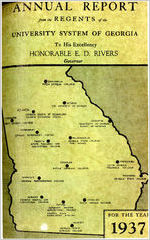
NUAL REPORT
from the REGE N TS of the
UNIVERSITY SYST EM OF GEORGIA
To His Excellency
HONORABLE E. D. RIVERS
Governor
DAHLONE-.A HOQJH (i.[O~ C.OLL4.
q .UHI!) T-IlE UN IVE ~ITY Of ~ED II.!!IA
-ATl.t.WTA-
GEO~G IA 5C~OOL Of TCUIIOL04Y ..l.TL.A NTA. E.'I.TfNSION C[IITE il
C OLL~,
EJr.PfRIM11T . Cf~oa,C,Ir\ fli,PfRIIo\EtiT 3 T,6.T IIIN
FORSYTH 5TA.Tf: TN:>\E.R 3 AIW AGR ICULTURAL COL LEGE.
UNII/ R.~ ITY Of GEO!tC.IA ~ C.l400L OF M E DIC I ItJ.
. /1\ILLEPCtf VI LLE GfORC.I b. STA.T. COLLEii .
'fOR. WOMEN
C.OC+IR.AN
/o\ IOOL 6f0R..C.I A
CO L. L.6~
AI'\EII_ICU:> G EOitCiiA 501/THWUTfR.II COLLEG E
. ST.O.TE:>~
::.OUTH 6EOR!d.O. TeACIIfR..S CO LL EC.~
.AL&...N '( G OR,IO I A ..01U'>41- .A.N~ 1\<>I!I CULTU~I<L COLLEGE
TIFTON
AI'>RAH A. M 1!4\LDW IN l61!1CULTU Q.A.L COLLEG-E
CO O.~Tl>.L Pl ..IN !.>.Pf: ll ll'l'f NT <5 TATI ON
DOUG L A S SOUTII GWR.G IA COLI. EGI!.
FOR TH E YEAF
I/AL 005T A
Gf.<)RGIA. STAT E WOM AN S ( OLLEC.!:
1937
Atlanta, Georgia January 31, 1938
To His Excellency, Honorable E. D. Rivers Governor of Georgia State Capitol Atlanta, Georgia My dear Governor Rivers:
I herewith submit to you the sixth annual report of the Regents of the University System of Georgia for the period ending December 31, 1937
This report includes a report from ChancellorS. V. Sanford about the University System for the same period.
1
MEMBERS OF THE BOARD OF REGKHTS O!IIVERSITY SYSTEM OF GEORGIA
DISTRICT
REGKITTS
ADDRESS
E:x officio E. D. Rivers Ex officio during tenn as Governor Atlanta
State at Large
Mar ion Smith Concurrent with tenn of Governor
Atlanta
State at Large
L. W. Robert~ Jr. March 25, 1937 - July 1, 1942
Atlanta
State at Large
T. Jack Lance March 25, 1937 - July 1, 1942
Young Harris
State at Large
State at Large
First
Second
Third
Fourt:h
J. Knox Gholston March Z5, 1937 - July 1, 1940
George F.ains March 25, 1937 - July 1, 1940
John G. Kennedy March 25, 1937 - July 1, 1939
John Monaghan July 1, 1936 - July 1, 1941
George c. Woodruff
July 1, 1937 - July 1, 1943
Cason J. Callaway January 1, 1932 - July 1, 1941
Comer Augusta SaV9.nnah Pelham Coluni>us LaGrange
Fi:rth Si:<th
Clark Rowell .July 1, 1937 - July 1, 1943
Miller S. Bell July 1, 1935 - July 1, 1941
Atlanta Milledgeville
Seventh
C. M. Milam July 1, 1935 - July 1, 1941
Cartersville
Eighth Ninth Tenth
John W. Bennett, Sr. July 1, 1937 - July 1, 1943
Sandy Beaver July 1, 1933 - July 1, 1939
Abit Nix July 1, 1937 - July 1, 1943
Waycross Gainesville Athens
Chairman Vice Chairman. Chancellor Secretary. Treasurer.
OFFICERS OF THE REGENTS
Marion Smith Miller S. Bell .S. V. Sanford .L. R. Siebert
w. W. Noyes
Office of the Regents of the University System ~ 330 State Capitol, Atlanta, Georgia
2
UNITS IN SYSTJ11
The University System is now composed of eighteen units.
The units, location, and heads are as followsz
...
LOCATION
INSTITUTION
PRESIDENT, DEAl!
AND/OR DIRECTOR
1. Albany
Georgia Nonnal and Agricu 1tural College
J. lo'. J:!olley, President
2. Americus 3. Athens
Georgia Southwestern College The University of Georgia
Peyton Jacob, President
Harmon w. Caldwell, President
4. Atlanta
Georgia School of Technology
H.... L. Brittain, President
5. Atlanta
Department of Adult Education Atlanta Extension Center, Evening College Division of General Exten-
~tion
Charles ~. Snelli~, Director George H. Sparks, Director J. Co Wardlaw, Director.
6. Augusta 7. Carrollton
University of Georgia -:;chool of Medicine
West Georgia College
G. Lombard Kelley, Dean
I. s. Ingram, President
8. Cochran 9. Dahlonega
Middle Georgia College North Georgia College
L. H. Browning, President
J. c. Rogers, President
10. Douglas
South Georgia College
J. H. Thrash, President
ll. Experiment
Georgia Experiment ~tation
H. P. Stuckey, Director
12. Forsyth
?tate Teachers and Agricultural
College
W. H. Hubbard, President
13. Milledgeville Georgia State College for Women
Guy H. Wells, President
14. Savannah
Georgia State College
Benjamin F. Hubert, President
15. Statesboro
South Georgia Teachers College M. S. Pittman, President
16. Tifton
Abraham Baldwin Agricultural College
George H. King, President
17. Tifton
Coastal Plain Experiment Station
S. H. Starr, Director
18. Valdosta.
Georgia State Womans College
Frank R. Reade, President
Four Year Senior Colleges The following constitute the senior or four year colleges: 1. The University of Georgia, Athens 2. Georgia School of Technology, Atlanta 3. Georgia State College for Women, Milledgeville 4. Georgia State Womans College, Valdosta 5. South Georgia Teachers College, Statesboro 6. University of Georgia School of Medicine, Augusta 7. Georgia State Collegs, Savannah
Junior Colleges The following are the junior colleges offering two years of college work - freshman and sophomore: 1. North Georgia College, Dahlonega 2. West Georgia College, Carrollton 3. Georgia Southwestern College, Americus 4. Middle Georgia College, Cochran 5. South Georgia College, Douglas 6. Abraham Baldwin Agricultural College, Tifton 7. Georgia Normal and Agricultural College, Albany 8. State Teachers and Agricultural College, Forsyth
Department of Adult Education This department is composed of the following divisions: 1. The Atlanta Extension Center (Evening College) 2. Division of General Extension
Experiment Stations The following are the experiment stations: l. Georgia Experiment Station, Experiment 2. Coastal Plain Experiment Station, Tifton 3. Engineering Experiment Station of the Georgia
School of Technology, Atlanta
4
...
Board Created by Act of Legislature
On August 28, 1931, Governor Richard B. Russell, Jr., approved a law passed ty the General Assembly of Georgia creating the Board of Regents of the University System of Georgia. This law placed the 25 branches of the University of Georgia under the control and management of the Board of Regents, consisting of twelve wembers. One rne~ber
was appointed from the State at large and one from
each Congressional District. The Governor was made an ex officio member. The eleven members are appointed by the Governor and confirmed by the Senate. The member from the State at large holds office concurrent with that of the Governor of the State.
Under the law creating the Board two members were appointed for a term ending July l, 1933; four were appointed for a term ending July l, 1935; and four were appointed for a term ending July 1, 1937. The term of office of their successors is for a period of six years.
In 1937 the General Assembly increased the membership of the Board by the addition of' !'our members. Today the Board is composed of sixteen members. The four new members are appointed from the State at large. Two were appointed for a term ending July l, 1940, and th6 other two for a term ending July l, 1942. Their successors will also hold office for a period of six years.
The name, address, and the term of office of each Regent are given on page 2 of this report.
Among the common powers of the Board stated in the 1933 Code of Georgia may be mentioned the following:
32-121. GENERAL POWERS OF BOARD. The Board of Re~ents shall have power: l, to make such
5
reasonable rules and regulations as are necessary for the performance of its duties; 2, to elect or appoint professors, educators, stewards, or any other officers necessary for-all of the schools in the University System, as may be authorized by the General Assembly, to discontinue or remove them as the good of the system or any of its ~chools or institution~ or stations may require, and to fix their compensations; 3, to establish all such schools of learning or art as may be useful to the State, and to organize the same in the way most likely to attain the ends desired; 4, to exercise any power usually granted to such corporation,
necessary to its usefulness, which is not in conflict with the Constitution and laws of t~is State. (Acts 1931, pp. 7, 24.)
32-127. AUTHORITY TO ESTABLISH REGULATIONS. REGENTS VESTED WITH POWERS, ETC., OF FORMER BOARDS. The Board of Regents may establish such rules and regulations for their own direction, as they may deem proper; may fix the term of office of their chairman, their vice chairman, and their secretary, and are vested with all of the powers, privileges, and rights vested in former boards of trustees of the University of Georgia, and all former boards of trustees or directors of its branches, named in section 32-103; and they are charged with all o!' the duties, obligations, and responsibilities incumbent upon and/or pertaining to said former boards (Acts l931, pp. 7, 23.)
32-128. POWERS, ETC., OF BOARDS OF TRUSTEES OF BRANCHES VESTED IN BO~RD OF REGENTS. All of the powers, duties, privileges, and rights heretofore by law vested in the boards of trustees or directors of the various institutions named in section 32-103 are hereby vested in the Board of Regents, and all laws now existing pertaining to the powers or duties of said separate boards of trustees or directors shall be applicable to the Board of Regents as successors to each of said
6
separate boards of trustees, except where repealed herein expressly or by implication. (Acts 1931, pp. 7, 26.)
Discontinued Institutions
In 1933 the Regents of the University System of Georgia were given authority by the General Assembly to consolidate or discontinue institutions, merge departments, abolish, or add degrees. Under authority of this provision the institutions located at Bowdon, Barnesville, Clarkesville, Madison, Monroe, and Powder Springs were discontinued. Under a law enacted in 1935 by the General Assembly the title to the property on which were located these institutions was transferred to the political subdivision of the respective location of the discontinued institution. The College of Agriculture and the State Teachers College in Athens were made departments of The University of Georgia.
The following is the name of the political subdivision holding titlG to this property:
Name of Di~continued Institution
Ga. Industrial College, Barnesville
Ninth District A. & M.
School, Clarkesville
Eighth District A. & M.
School, Madison
Georgia Vocational and Trades School, Monroe
Seventh District A. & M.
School, Powder Springs Bowdon State Normal and Industrial College, Bowdon
Grantee Mayor and Council of City of Barnesville Board of Education of Habersham County Board of Commissioners of Roads and Revenues of Morgan County Board of Education of Walton County Board of Education of Cobb County Mayor and Council of the Town of Bowdon
7
An Act of 1933 provided for the conveyance of all real estate and improvements theretofore owned by the trvstees o~ the Tenth Congressional District Agricultural and Industrial School, .at Granite Hill, Hancock County, Georgia, to Hancock County, such property to be controlled, managed, or disposed of by the county authorities having control of the county affairs of such county.
Another important law enacted in 1933 specifies that all appropriations made by the General Assembly shall be paid to the Regents of the University System of Georgia in a lump sum instead o,f making appropriations to the individual units. This law authorizes the Regents to allocate the sur paid among the institutions of the University System.
Buildings Completed in the University System
The following is a list of the buildings
which have been completed in the University System
during the year 1937. The construction of these
buildings has been financed with funds provided by
the Board of Regents and the Public Works Adminis-
tration of the United States on a basis of the
Regents furnishing 55 per cent and Public Words Ad-
ministration 45 per cent of the cost of construc-
tion.
Total Cost
Location
Type of Building
Project
of
Number Construction
Athens
Boys' Dorm.
1116-D
~ 46,808.47
Athens~< Athens~<
Agri .Ext .Bldg. 1116-D Girls' Dorm. 1116-D
78,317.04 102,449.63
Athens
Science Bldg. 1116-D
95,341.41
Albany
Girls' Dorm. 1312-D
34 '781.80
Americus
Boys' Dorm.
1113-D
32,355.37
constructed with Trust Funds and other funds at The University of Georgia.
8
Atlanta (Tech) Auditorium
1112-R
Augusta
Classroom Bldg.l276-D
Carrollton
Girls' Dorm. 1114-R
Carrollton
Library
11t'1-R
Cochran
Boys' Dorm.
1115-R
Cochran
Central Heat-
tng Plant
Dahlonega
Girls' Dorm. 1111-R
Douglas
Gym.-Aud.
1110-R
Forsyth
Girls' Dorm. 1109-R
Milledgeville Girls' Dorm. 1108-R
Statesboro
Boys' Dorm.
1107-R
Tifton
Boys' Dorm.
1106-D
Tifton
Dining Hall
1106-D
Valdosta
Girls' Dorm. 1105-R
92,910.79 79,875.75 36,517.67 13,363.03 26,829.03
50,048.33 32,998.74 27,605.27 87,394.20 85,271.80 40,692.77 16,676.18 61,763.08
Total
$ 1,042,080.36
Buildings Under Construction in University System
The following is a list of the buildings now under construction in the University System. Details are given of each of these buildings. Funds for the construction of these buildings were provided by the Board of Regents and the Federal Emergency Administration of Public Works on a basis of the Regents furnishing 55 per cent and Public Works Administration 45 per cent of the cost of construction.
Location Athens
Athens
CONTRACTS AWARDED
Type of
Amount of
Project
Building
Contract
1116-2-DS Classroom
Construction
1116-2-DS Excavation
of Classroom $194,532.95
1409
Dairy Products 113,465.00
9
Athens Atlanta
1410 1367
Atlanta
1404
Carrollton Cochran Dahlonega Milledgeville Millsdgeville .Milledgeville MilledgevtlJ.e States bore Statesboro Statesboro Statesboro Tifton
1412 1400 1405 1108 1345 1363 1408 1361 13fil 1399 1406 1357
Practice School 126,244.00
Mech. Dept.
Cl..a. ssroom
Civil Eng.
99,745.00
Dept. Classroom 115)662.00
School Bldg.
32,500.00
Dining Hall
25, 56.00
Dormitory
Gl,300.00
Physical Ed.
86,947.00
Girls' Dorm.
109,513.00
Music Bldg.
52,969.00
Practice School 94,750.00
Library
31,466.00
Waterworks Sys. 13,500.00
Dormitory
58,968.00
Practice School 79,700.00
Agricultural
Research Bldg. 56,320.00
Grand Total
$1,353,037.95
Application for Additional Buildings
The following is a list of the applications on file with the Public Wor1rs Admin is tra tion in Washington, D. C. These applications have baen approved by all the examining divisions. We hope that allotments of grants will be made by the Government at an early date. Funds for the construction of these buildings will also be provided by the Board of Regents and the Federal Einergency Administration of Public Works on a basis of the Regents furnishing 55 per cent and the Public Works
10
Administration 45 per cent of the cost of construetionc
or Project 'Type
Location
Number
Building
AI2I2roi2riatio11
Atls.nta('l'ech) 1112-2-R Aud.-Gym.
$111,000.00
Athens
1353
Classroom
117,600.00
Athens
1354
Girls' Dorm.
114,000.00
Athens
1355
Forestry
142,750.00
Dahlonega
1356
Aud.-Din. Hall
66,500.00
Americus
1358
Aud.-Gym.
52,500.00
Cochran
1359
Library
28,000.00
Dahlonega
1360
Library
27,000.00
Tifton
1365
Aud.-Gym.
53,000.00
Library
18,000.00
Carrollton 1366
Aud:ltorJum
27,500.00
Dining, Hall
22,500.00
Augusta
1403
Library
67,399.00
Americ1.:1_s
1401
Boys' Dorm.
50,000.00
Annex Dorm.
H> ,000.00
Athens
1398
Auditorium
303,502.00
Douglas
1411
Central Heating
Plant
30,000.00
Total
$1,241,251.00
Other Buildings Under Construction in the System
Works Progress Administration Buildings
With the generous assistance of the Works Progress Administration the new Evening College home is being renovated. This is the building located at 167 Luckie Street and was purchased by the Board on the sixth of October, 1936. It is a very large building and when all the contemplated improvements are made, it will serve admirably the requirements of this institution. The cost of the improvements will not exceed the total sum of $75,000. There is also being constructed under
11
this Department of the Federal Government a large Girls' Dormitory Building at the Georgia State College, Savannah, Geo~gia. T~e cost of this building will not exceed the total sum of $75,000.
A splendid swimming pool - bathhouse is now under construction at the Georgia State Womans College at Valdosta. When completed, this project will serve a long needed place in the program of tnia institution.
Appropriation
The following excerpts are from the 1937 Laws of the State of Georgia which gives the appropriation to the Regents of the University System of Georgia for the period indicated.
For the half year ending June 30, 1937:
Section 25: (a) For the operating cost
of the Regents and for
aid to the University
System
$666,666.66
(b) For lands, buildings, and equipment for the University System 433,333.34
Provided, that this item includes and is in lieu of $333,333.34 appropriated by Act approved March 28, 1935, which said Act is hereby repealed.
This appropriation has been paid in full. For each of the fiscal years ending June 30, 1938,
12
and June 30, 1939: Section 26: (a) For the operating cost
of the Regents a~d for
aid to the University
System $1,750,000.00
(b) For new buildings and
equipment
300,000.00
Pr0vided, that for the year ending June 30, 1939, the amount appropriated shall be $400,000 for buildings.
Provided, however, that the right to receive the amount appropriated for building purposes for the fiscal year 1939 may be transferred and assigned prior to the time when it is payable by the Board of Regents of the University System, at a discount of not more than 4 per cent per annum, if in the opinion of the Board of Regents by so discounting for cash the right to receive the said payment they will be the better able to obtain a supplementing of said building fund from the Federal Government or any department or agency thereof in connection with any plan or policy of said Federal Government to supplement funds for a building program. And the said Board of Regents, through such officers as they may direct, are authorized to execute such contract or other documents as may be necessary or appropriate for this purpose.
(c) For experimental pur-
poses in the treatment
and cultivation of shade
tobacco, and other types
of tobacco
$20,000.00
(d) For the operating cost of the State Soil Conservation Committee.
10,000.00
13
Financial Condition All the Units of tAe University System finished the fiscal year with all current bills paid in full and a cash balance on hand.
Insurance
All buildings inthe University System are covered not only with the insurance coverage as provided by SBction 91-403 of the 1933 Code of Georgia but also adequate insurance protection is maintained on all bu~ldings and contents in the University System.
Composite Enrollment
The following table gives the October, 1937 enrollment in the University Rystem and also the comparative enrollment in the University System from 1933 through 1937.
It is interesting to note that during this five year period the enrollment has increased 3,53'7 students.
14
ENROLU1ENT IN UNIVERSITY SVS1'EJ1
11.A11E OF INSTITUTION
Senior Institutions The Un1versity of Ga. Athens Georgia School of 'l:eohnolc..g;y, Atlanta. Atlanta Extension Center Univerai"t;y of Georgia School of Medicine, Augusta Ga. St. College for Women, l1illedgevi lle South Georgia Teachers Collegt', Statesboro Geo1gia State Womans College, Valdosta
FATL QUARTER, OCTOBER 15, 1937 Sp.or Fresh. Soph. Jr. Hr. Grad. Irr.
840
733 827 686
73 17
801 226
614 537 367
193 130
76
--30
5
540
48
38
30
34
-
5
589
356 243 171
--
4
191
143
91
74
-
3
115
78
48
43
-
22
TOTALS OCTOBER Total 1933 1934 l9i5b 1936 1937
3178 2101 2404 2724 2843 3178 2354 1666 1784 1871 2014 2354 1165 638 835 842 1105 1165
155 153 147 151 148 155 1363 1032 1160 1235 1279 1363
502 456 476 440 522 502 306 323 343 343 311 306
Totals 281C 2157 :2C6 1451 103 596
9023 6369 7149 7606 8222 9023
1-' C11
Junior Colleges Ga. So. Col. Americus West Ga. Col. Carrollton Middle Ga. Col. Cochran North Ga. Col. Dahlonega South Ga. Col. Douglas
1a2 173 220 264 197
132
118 122 161 :17
--------
-----
--
-------
-6
--3
314 219 277 336 311 314 296 232 266 270 303 296 345 293 267 286 346 345 415 210 268 303 344 416 314 205 203 204 259 314
Abraham Baldwin Agri. College, Tifton
195
-- - ll3
---
9
317
86 169 217 250 317
Totals 1221
763
-
-
-- 17
2001 1245 1450 1616 1813 2001
Negro Institutions
"
LTeorgia Nonnal & ~gri. College, Albany
83
- 50
-
2 E 1;~ ~ ~6! Collet?:;e 133 C\l
B:i. Sch. 12:_:1 ~
~~~
1~; ~ ~~~ ~
St. Teach. & Agri. College, Forsyth
35
37 -
-
College Hi. Sch.
72 93
"~ '
43 0 50 LQ 101 Q) 147 ~ 115 ~ 138 ~
64"' 75 ~
72"' 93 ~
Georgia State College Savannah
Irr. College 343 lQ 288 t:- 256 co 269 Ol 335 r-1 343 lQ
l6i
89
54
27
2 Hi. Sch. li3 ~ 83 ;:: 20 ~ 20 ~ 6 ~ 12 ~
Totals 279
186
54
27
2
548 421 407 473 508 548
Division of General** E:xtens ion, Atlanta
Enrolled from September~ 1936, to September, 1937- 3817 students
GRAND TOTALS *
4310 3106 1960 1478 103 615 11572 8035 9006 9695 10543 11572
*Includes Pre-Juniors~
t!(
**Not included in Grand Total.
***llit?::h School Students at Negro Institutions not included.
COMPARATIVE ENROLU1ENT INFORMATION OF THE VARIOUS UNITS IN THE UNIVERSITY SYSTEM - Sill1MER SCHOOLS 1937
Location
FIRST~
N8llle of Institution
Summer School
June
June
1936
1937
Athens
The University of Georgia 1517
1749
Atlanta
Georgia School of Technology 361
494
Atlanta
Atlanta Extension Center
207
265
Carrollton West Georgia College
212
217
Dahlonega North Georgia College
181
224
Milledgeville Georgia State College for
Women
864
l050
Statesboro South Ga. Teachers College 613
740
TO TAU!
3955
4739
Increase over 1936 - 784
Negro Institutions
Albany
Georgia Normal and Agri-
cultural College
318
411
Forsyth
Georgia State Teachers and
Agricultural College
194
419
Savannah
Georgia State College
325
444
TOTALS
837
1274
Increase over 1936 - 437
GRAND TOTALS
4792
6013
TOTAL INCREASE FIRST TERM - 1221
SECOND TERM
Summer School
August August
1936
1937
Athens
The University of Georgia
788
1096
Milledgeville Georgia State College for
Women
314
398
Statesboro South Ga. Teachers College 231
340
TOTALS
1333
1834
TOTAL INCREASE SECOND TERM - 501
16
Number of Students Graduating in University System
The following iqformatiq,p gives the graduates of the Senior and Junior colleges of the System in comparative form for the years 1936 and 1937.
NUI1BER OF GRADUATES IN THE UNIVERSITY SYSTE!l OF GEORGIA
Na.n:e of Institution
1 9 3 6
June
s. s. Total
M wM w
1 9 3 7
June
s. s.
M wM w
SENIOR COLLEGE GRADUATES The University of Georgia
Athens
Georgia School of Technolog;Jr, Atlanta Atlanta Extension Center Geor,(!;i.B. State College for Women, Milledgeville South Georgia Teachers College 1 Statesboro Georgia State Womans College, Valdosta University of Georgia School of Medicine, Augusta
263 214 81 104 662 336 197 109 103
257
257 232
52 46
98
1st 43
146 2nd 45 234
29 8 -1st 48 1~0 2nd 58
30 24
54 16 2tl
50
50
39
36
37 33
Totals 638 481 81 192 1392 646 422 109 209
Increase Tota.l or
Decrease
745
83
232 -25
37 -61
256
22
44 -10
39 -11
33 - 4 1386 - 6
.JUNIOR COLLEGE GRAJ)JATES Middle Georgia Colleg,e Cochran North Georgia Collef;6 Da..l-tlonega Sough Georgia College Douglas West Georgia College Carrollton Georgia Southwestern Collee;e, Americus Abraham Ba.ldwin Agricultural College, Tifton
Totals
39 25 39 22 29 24 18 32 43 95 47 22 215 220
64 47 36
83
19
67 50
71
53 26 27
53
14 67 20 42
13 83
16
138 32 69
101 -37
69 41 23
64 - 5
17 458 216 205 15 19 455 - 3
NEGRO INSTITUTIONS
Georgia Normal.& Agricultural
College, Albany**
29
State Teachers & Ar,ricultUral CoLlege, Forsyth**
4 ---
l'i-eorr:ia. State College
Savannah
15 21
46
36
26 73
27
12
12 1 12 27
15
38 18 19
39
Totals 29 54
11 95 29 67
41 139
43
G'R.AND TOTALS 88~; 755 89 220 1946 891 694 126 269 1980
M
"+*NUJ..Jber includes only graduates 0f Junior College *Senior College Graduates
Graduate Degrees
Since the creation of the University Syst e:n ~c;;; J.,e }Jas been a strong feeling that the System vv:, l l. : "lOt be a System unless courses were given in
+ -:: ~J:rr which would lead to the degree of Doct () ~ '~; +:- {:, of Philosophy. The Board has continuously f : "l '. hat those desiring a doctorate degree should
n; ''o L~e fOt'CC-J to leave this State in order thAt
17
they might obtain this degree. On July 16, 193'7, this Board authorized
The University of Georgia ~o award the Doctorate of Philosophy degree in accordance wi.th the following:
1. The Department of Zoology be authorized to accept students as candidates for the Doctor of Philosophy degree, beginning with the session of 193'7-38.
2. The Department of Chemistry be authorized to accept students for the Doctor of Philosophy in Chemistry degree beginning with the session of 1938-39.
3. The College of Education be authorized to begin immediately to accept students as candidates for the Doctor of Education degree, and to accept students for the Doctor of Philosophy degree in Education beginning with the session of 1938-39.
4. The program leading to the Ph. D. degree, the work centering around the "Life of Georgia and the Southeast," be placed in charge of Doctor Coulter and Doctor Wade, and that students be accepted for this degree beginning with the session of 193'7-38.
We believe one matter of great importance to the State of Georgia should be noted at.t.his point, namely: It is at the present time the definite policy of all educational systems in the United States to encourage the superior members of their teaching staffs to continue graduate work leading to doctors degrees. In common with the teachers in other states ambitious teachers throughout Georgia naturally and properly seek to continue this graduate work and to obtain the doctor's degree thus increasing their efficiency. It has, up to the present, been impossible for the graduate work leading to a doctors degree in education to be obtained in the State of Georgia. There have been two unfortunate results from this: first, it has greatly increased the cost and difficulty in the
18
way of teachers who wished to do this graduate work; and second, it was inevitable that some who went outside the State to complete their training by such graduate work wouldbe uffe~d positions in teaching systems outside the State and hence would be lost to educational work in the State. The Board feels certain that Georgia was losing many of its ablest and most desirable educators particularly among the younger group in whose hands the future of education in Georgia would rest. It seems to us essential, therefore, for The University of Georgia, without further delay to furnish this graduate training in this State. We are now doing so and we feel confident that the work the University is doing in this field is thoroughly satisfactory and creditable.
Establishment of School of Dentistry
The 1937 General Assembly of this State
by resolution requested the Board of Regents of the
University System of Georgia to establish a school
of dentistry in the University System whenever the
Board deems such an establishment necessary.
We report at this time that Chancellor
v. S.
~anford, Dean Q Lombard Kelly of the Univer-
sity of Georgia School of Medicine, and this Board
have given careful and painstaking consideration to
this request.
Our findings may be summarized as followsa
(a) There is a definite need for a first-
class dental school in the extreme southeast, since
four of the states surrounding Georgia do not have
a dental school.
(b) There is great need for improvement
in dental education throughout the United States as
well as in Georgia. There is no probability that
any foundation will donate funds to build, equip,
or maintain dental schools anywhere in the United
States.
19
(c) The dentists of Georgia outside of Atlanta and Augu~ta seem to favor the creation of a school of dentistry. as a pa~t of the University System of Georgia. About half of the dentists in Augusta are not favorable to the plan of creating such a dental school there, while it seems that Atlanta's dentists are somewhat divided.
(d) Dental Education throughout the country is in need of a r0naissance, but should Georgia, which already has one dental school, even though it is a proprietary institution, foot the bill for this revival in dental education for the entire extreme southeast?
(e) It is suggested that the University System of Georgia create a school of dental research in connection with the School of Medicine in Augusta and mark time until the propitious moment for the beginning instruction of dental students.
(f) It would cost about $300,000 to build and equip a dental college for the University System, and it would cost about $50,000 a year to maintain it. These figures are modest estimates.
It is obviously impossible for us to carry out the legislative suggestion of establishing a dental college witnout increased appropriations specially available for that purpose. We do not believe the General Assembly would wish us to establish a dental college unless we put i~ on the same high grade which is now being attained by all
work in the University System. We are a.lways anxious to carry out the legislative wishes in connection with the University System of this State, and we therefore, through the Governor, report this situation to the General Assembly for such instruction as they may deem it wise to give us. We wish, however, to emphasize the fact that if the General Assembly sees fit to instruct us to operate a dental college it is absolutely essential that $300,000 be appropriated to build and equip such college, and that maintenance appropriations be increased
20
$50,000 a year. To the best of our capacity we will carry out such instructions as may be given us.
Fcrestry
WHEREAS, The United States Forestry Service, the State Forestry Service, and the Agricultural Extension Service of The University of Georgia are now conducting a study of th6 effects of timber cutting by pulp mills in the Southern States; and
Wh~REAS, The School of Forestry of The University of Geor~ia desires to co-operate in this study which is now under way;
Upon motion of Regent Hains, seconded by Regent Bennett, and unanimously adopted, it was
RESOLVED, That the School of Forestry of The University of Georgia is requested to offer its facilities and the services of its staff to the a~encies now engaged in making the afo~ementioned study to the end that the School of Forestry may co-operate with the said agencies and participate in the study which is being made.
First Honor High School Graduates
As a matter of educatio~al policy we owe to ourselves and to the State to encourage our most promising students to enter college and to complete their education. Scholarships, fellowships, and similar aids and devices should be administered with regard for the kind of dividends they will pay. Our colleges should say to every boy and girl, poor in purse but rich in brain, the college offers its greatest opportunities. We owe a duty to all students, but a special duty to those most likely to become outstanding leaders. It is our duty to train them and to instill in them a public spirited attitude and a sense of social responsibility.
21
The Regents have granted a scholarship to the first honor graduate of each accredited nigh school of the state,.a schol~rship for one year equivalent to the matriculation fee of the unit involved. Each accredited high school is entitled to one scholarship and the responsibility is put on the superintendent or principal to certify the one person entitled to the scholarship from his school.
The following is the number of scholarships granted to students in the University System for the collegiate year 1937-38.
Number of First Honor Graduates Enrolled in the University System Fall Quarter, 1937
Institution
Number
Georgia Normal and Agricultural
College, Albany
6
Georgia Southwestern College
Americus
19
The University of Georgia
Athens
31
Georgia School of Technology
Atlanta
11
Atlanta Extension Center
None
The University of'Georgia Three years of college
School of Medicine, Augusta work are required
West Georgia College
Carrollton
15
Middle Georgia College
Cochran
10
Nor~ Georgia College
Dahlonega
9
South Georgia College
Douglas
2
State Teachers and Agricultural
College, Forsyth
4
22
Georgia State College for Women
Milledgeville Georgia State College
-
37
Savannah
5
South Georgia Teachers College
Statesboro
8
Abraham Baldwin Agricultural
College, Tifton
3
Geor~ia State Womans College
Valdosta
2
Total Honor Graduates in System 162
Use of Georgia Supplies in the University System
This Board is of the opinion that whenever possible the units of the University System should give encouragement to the use of supplies produced in Georgia.
Such a policy pursued in the University System will invariable reflect on the industrial and agricultural industry of our state. Realizing the importance of this obligation to the state, this Board on June 17, 1937, passed the following resolution:
RESOLVED, That the adminis~rative heads of the units of the University System shall give encouragement when practicable to the use of their respective institutions of supplies produced in the State of Georgia and that where prices, quality, and conditions are equal preference shall be given to supplies produced in this State.
The units of the University System have co-operated to the fullest extent in complying with this action of the Board.
In concluding this report the Board wishes to express with deepest sincerity its appreciation of the splendid loyalty and the able, efficient work of the Chancellor and the executive of
23
officers of the Board, and the heads and staffs of all institutions. We do not see how it would have been possible for a ~oard of-trustees to have received more devoted support than we have received, nor do we believe it would have been possible for the University System to have made the progress it has made except for the ability and enthusiasm of those whom we have indicated. The Board believes it is justified in saying that the experiment of placing the entire system of higher education in
Georgia under one board has now definitely justified itself. We are not claiming credit to ourselves as individuals but pointing out the success of the system inaugurated in Georgia by the Act of 1931 and supplemented in necessary respects by the Act of 1933.
Without further burdening this report with details, we call attention to the fact that the Board of Regents has operated and is operating with substantially less in maintenance Rppropriations than was appropriated in the aggregate to the higher institutions of learning before the Board of Regents took charge. This amount has been as much as a million dollars less actually received in one year than was being received by the former institutions. At the highest point our maintenance appropriation is nearly a half million less than the former amount spent for maintenance of higher ed~ cation.
w~ are today d~aling with approximately 40 per cent more students of college grade. We have all of our bills paid. While our Faculty salaries are inadequate we have, nevertheless, so far been able to maintain these staffs. While only a small part of the units of the University System were accredited in 1931 we now have all of our units accredited by the appropriate agencies.
We express our sincere appreciation of the splendid support now being given the University System by the Governor, the public officials
24
or this State, the General Pssembly, and the people of Georgia generally. With the continuation or this support, to which we look fo~ard confidently, the University System of Geo~gia will continue to advance and to render to the people or Georgia the educatio~al service which they should have. We shall continue to work in close harmony and cooperation with the public school system of the State, recognizing that there is only one educational task in Georgia, namely, that of furnishing proper educational facilities to the boys and girls of the State. We express our faith that the University System as now organized can go forward with its part of this task and that in the long run the benefit to the people of this State will be greater than any of us now realize.
Respectfully submitted, Regents or the University System of Georgia,
by Marion Smith, Chairman
25
..
Honorable Marion Smith, Chairman Regents of the University System of Georgia Atlanta, Georgia
Dear Chairman Smith:
I have the honor to transmit to you and through you to the Regents of the University System of Georgia my report as Chancellor for the year ending December 31, 1937. The reports of the Presidents, the Deans, the Directors, the Heads of Departments, and others covering the activities of the several units of the University System are on file in the office of the Regents and are available to those interested. The audit of the Regents office, of each institution, and of the Athletic Associations of the University of Georgia and of the Georgia School of Technology by the State Auditor is on file in the Regents Office and available for inspection. All funds, no matter from what sources derived: federal, state, endowments, board, room rent, admission fees to contest, student fees, are paid to the treasurer of the unit involved and audited by the State Auditor and published in his annual report.
1932 - 1938
The Reorganization Act became effective January 1, 1932. We have now come to the close of the first five years of the University System. A brief review may not be amiss at this time. The University of Georgia, out of which grew the Uni-
26
versity System, was chartered in 1785. Since that date education has been considered as a public function of the state. The Act creating the University clothed its trusfees with-power to create a system of public education in Georgia from the first grade through the graduate school of the University. During the century and a half which have elapsed since Georgia led the way in pioneering higher education at public expense, by chartering the first state university in the world, governmental subdivisions of our state, school districts, towns, cities, counties have largely assumed the responsibility of public education below the college level. By legislative action in 1937, the state now assumes financial responsibility for a minimum of seven months' school. This is a forward, progressive step.
From 1785 to 1932 the multiplication of the branches of the University continued so fast that it was not halted until there was fastened upon the state an educational monstrosity with twenty-six branches bearing the misnomer, the University of Georgia. Obviously reorganization was badly needed, imperative, in fact. To every thoughtful citizen, it was evident, that twenty-six institutions were not needed to educate the youth of the state, and this after all is the only thing that justifies the existence or maintenance of any institution. The multiplication of state supported higher institutions with duplication of effort reflected seriously on the quality of the work given. Such a system did not reflect credit on the educational system.
As one surveys the educational system prior to the reorganization, one sees more clearly and convincingly today, the necessity that existed to eliminate chaos and to bring order into our educational program; to prevent waste and inefficiency and to build a University System to meet the needs of our people. Let me repeat what I have many times said that the neople should be grateful to
.27
the General Assembly which liberated Georgia from her former educational bondage and made possible the University Syst~m in ke~ping with progress, with educational advancement, and with the needs of the new era.
The Regents
The Regents are charged with the responsibility of developing a system of higher education adequate for Georgia - an undertaking demanding wisdom and calling for an insight into the conditions of the fUture as well as those of the present moment. It can be truthfUlly and frankly said that no group has ever been more earnest or honest in their efforts to give the state a University System than the Regents. A reform in higher education was urgent, and the Regents early realized that a handto-mouth policy would not give t~~ people of the state the largest return on the~r investment in higher education. Good judgment, far-sightedness, statesmanship actuated their motives, for they are conscious of the fact that the state has.Jta_right to look to the Regents for a constructive, f~ard looking, and well integrated program of higher education. Unselfishly they have given much time to the work believing that the responsibilities of the University System are twofold: "One is to provide competent and adequate training in all those fields whose problems are basic to the welfare of a democratic society; and the other is to utilize its scientific resources to the utmost to create better living conditions and to create new wealth." The University System though only five years old has made and is making friends; it is serving the state. This is as it should be for the Regents believe that no state university system worthy of the name should hold itself aloof from the life of the people who make possible its existence.
28
Achievements. Briefly let me enumerate some of the outstanding achievements of the Regents during the past five years. The first achievement of the Regents was in securing lunds from the General Education Board for an educational s~rvey of the state supported higher institutions of learning. One of the first statements made by the Survey Commission was this: "The State of Georgia's program of higher education bears earmarks indicating that at times the ambitions of communities have superseded the broader interests of the State. The Survey Commission throughout its study of the questions involved has endeavored to look at the situation from the viewpoint of the state as a whole. Unless those who are responsible for voting the funds are able to rise above local issues and to look into the future with an eye singl'e to the needs of the state as a whole, Georgia can not hope for a program of higher education adequate for such a great state. The potentialities are great, but they will be fUlly ~ealized only if they are unselfishly developed." More and more the people of the state are coming to see the significance of these stataments.
Conditions which existed a quarter of a century ago do not exist today. "Under pioneer conditions, there is much to be said in favor of wide distribution of institutions of learning; but the improvement in means of transportation and communication that has taken place in the past generation makes it practicable for institutions to serve much wider areas than formerly. Furthermore, the expense of providing good institutions of higher learning has increased so greatly that it becomes imperative for a state with as limited financial resources as Georgia possesses to conserve them in every way practicable. The several institutions scattered over the state have so taxed the financial resources that even the stronger institutions have not been able to set the standards they should. The limited resources of the state and the
29
importance of providing more adequate financial support for plant, equipment, staff at each of the
... leading institutions .call for drastic action." The recommendations of the Survey Commission which are now well known to the Regents and to the people need not be enumerated in this report. Results have abundantly justified the wisdom of accepting the recommendations. So far as we can reasonably see we have reached the end of these adjustments and no further change of the character appears to be called for. Our efforts are now being given to consolidating, co-ordinating, and developing the University System along its present lines.
The second achievement of the Regents was the paying of the indebtedness inherited by them, January l, 1932, a debt a~ounting to $1,074,415.46. Investigations show that some of the debts, while not authorized were made in good faith. No criticism is intended of those who managed the institutions prior to the reorganization. They were able and good men. However, the Regents were charged with grave responsibilities, the most important of which were these two - balancing the budget and paying the debts. Both of these have been accomplished. Here may I add that on June 30, 1937, the end of the fiscal year, each institution closed the year with all salaries, all supplies, in fact, every account paid in full. I know of no finer trlbute I can pay to the Regents and the heads of the units. Permit me to add that the Chancellor and the Central Office have been hard boiled so far as granting any changes in the financial budgets approved by the Finance Committee and the Regents. Emergency cases always arise.
The third achievement of the Regents may oe designated as this: Adopting a system of modern rules and regulations, a system that has been commended by many other institutions and even by certain well-known education foundations. The responsibility is put on each head. He is responsible
30
for his unit. The Regents and the Chancellor have never gone over his head. Furthermore, nothing has
... been done or could be do.ne to make a real Univer-
sity System than this one rule: "No Regent is permitted to recommend anyone for a position in the
Faculty of any institution in the System." Contrary to what some may think, I affirm that so far as I know, this rule has never been violated, and I trust that it may never be.
The fourth achievement was legislative enactment recommended by the Regents making a lump sum appropriation to the Regents - not a legislative appropriation to each unit by the General Assembly as had heretofore been the case. With a lump sum appropriation to the Regents, the Regents then had the arbitrary power to consolidate institutions, to discontinue their operation, to merge departments; and to allocate the State appropriation in such a way and manner and in such amount or amounts among the units in the System as they deemed wise. Had not the General AssAmbly passed this particular act giving to the Regents a lump cum appropriation, there would today be no unified University System. There would still be animosity and rivalry, each appearing before the appropriations committee in behalf of his unit and not in the interest of the University System. Those who are familiar with past appropriations cannot help being impressed with the fairness with which the allocations have been made.
The fifth achievement of the Regents may be said to be this - accepting those two recommendations of the Survey Commission: creating a Superior Council consisting of the Chancellor and the heads of all units, and the University System Council, consisting of the Chancellor, the heads, the deans, the registrars, the treasurers, the chairmen of standing faculty committees, and chairmen of special committees authorized by the Council, and such other faculty members as each president may designate as delegates - a Council of approxi-
31
mately one-rirth or the entire faculty of the Uni-
versity System. Just a wor~ more a~ut the University
Council. It is a central agency for bringing the common problems of the several units of the System into rocus so that their solution might grow out of the uncovering of common inLerests and purposes. The function of the Council is not legislative, not administrative; its function is to explain common problema, to deliberate upon common purposes, and to recommend to the Chancellor and to the Regents specific proposals which merit action.
The exploratory function of the Council canvasses such problems as arise from consideration of curricula, the transrer of students rrom col~ege to college, and the examination of students for purposes of accrediting their standing with reference to professional specialization or vocational possibilities. In addition, questions relative to faculty tenure, retirement, qualifications, and research are matters which come specifically within the exploratory power of the Council. The Council is also a deliberative body, that is, through the medium of group conferences, it hears
the report or special committees whose task it has
been to inquire. into va.rlous matters described under the exploratory functions. These reports are debated at length, are modified in the light of individual and collective judgment, and are then committed to writing.
These written reports with recommendations are then submitted to the University System Council for acceptance, modification, or rejection. The actions of the Council are then gi\en to the Chancellor for review. The next step is for the Chancellor to submit the findings and recommendations to the Regents for acceptance or rejection.
It is thu~ evident that without this University System Council there could be no University System except in name, but not in fact. If the
32
Regents have erred at any time, it is largely due to failure of definite action on the part of the Council. Every member of the various Faculties looks forward to the meefing of the Council and considers it an honor to be designated as a delegate. Let me emphasize that the University System is the University of Georgia established at strategic centers and the Council is the meeting of the Faculty of one great, powerful institution. After all has been said, the fact remains that the University System is a unified system of State supported institutions of higher learning, economically administered by eliminating duplication of effort and waste of funds.
These four functions are essential to a University System: a single governing body (The Regents); a single executive office (the Chancellor's); a lump sum appropriation to the Regents to be allocated by them; and a University System Council composed of many delegates from each unit, both exploratory and deliberative in function.
The sixth achievement of the Regents was putting into operation the recommendations of Survey Commission - organization of each unit into two divisions - the junior division consisting of the freshmen and sophomore classes, and the senior division into the junior and senior classes. In this way the curricula of the junior division of the senior colleges corresponds to the curricula of the junior colleges. There are exceptions to this statement, exceptions due in large measure to rigid laws made by standardizing agencies. In other words, those students transferring from junior colleges may enter the school for which they are prepared - school of law, agriculture, education, arts, etc.
The seventh achievement of the Regents was in making early application for funds for a building program to the Public Works Administration in Washington. The Regents very fortunately had a survey made of the needs by an outstanding engineer-
33
ing company. This survey was made and later discussed by the heads of the units. It was then adopted by the Regen~s. Wit~ this report made by experts, it has made the work of the Regents, the Chancellor, the Building Committee easier so far as proper allocation of both federal and state funds in the repair of old buildings and in the construction of new buildings. The allocations have, therefore, been made on a scientific and technical knowledge.
To the General Assembly of 1935-36 for an appropriation of one million dollars for buildings and to the General Assembly of 1937-38 for an appropriation Gf seven hundred thousand dollars for buildings and an additional one hundred thousand rlollars for equipment, we owe a debt of lasting and enduring gratitude. These gifts were greatly enhanced in value by aid from the federal government, both th; Public Works Administration and the Works Progress Administration. These two federal agencies made possible funds equal to those appropriated by the S~ate. If the application still pending in Washington is granted, then it will be possible to complete the original building program of the University Sysc;em.
The eighth achievement of the Regents was in establishing a stable, unitorm salary schedule. This regulation has received much commendation on the part of administrative officers and Faculty members. It is another definite step in making an efficient unified system of education. By this regulation academic rank is determined, minimum salary and minimum qualifications clearly defined. Extra pay is likewise provided for those teaching in the summer schools or summer quarter. .rt is a regulation long needed, for it provided the essential incentive for increased scholarsr.-l.p and devotion to duty on the part of all Faculty members of the University System. The increase in the maintenance appropriation by the General Assembly of 1937-38 made it possible to make effective such a regulation during the collegiate year.
34
The ninth achievement of the Regents was the operation of the System on a cash basis during the period of reorganization and ~f depression. This fact becomes more significant when it is known that the State paid to the trustees during the three years prior to the reorganization an average of approximately $1,850,000 as against $1,275,000 since the reorganization. This fact becomes still more significant since the System is teaching 30 pe~ cent more students now than were taught at any time under the old system- an accomplishment without parallel in the nation.
With the large increase in enrollment and with the increase in Faculty personnel, it is essential that an increase in maintenance be made possible. A decrease in maintenance or failure to pay the appropriation in full, increases the cost to the student. It would be a serious step if anything should be done that would deter youth from taking advantage of the opportunities the University,System offers.
It is gratifying to report that the General Assembly of 1937-38 made a substantial increase in the maintenance appropriation in recognition of the excellent work being done by the Regents for education.
The tenth achievement of the Regents is in requesting funds from Educational Foundations for a complete survey of Negro education in Georgia, private, denominational, and State, and these funds have been granted. The Chairman of the Survey Committee is Dr. Walter Cocking, Dean of the College of Education, The University of Georgia.
These are some of the outstanding achievements during the past four years of the Regents. There are others I could recount. The objectives of the Regents have always been harmony, co-operation, efficiency, economy, and state-wide need. The Regents have determined that the University System shall follow the concept of a single institution for services to the State in the field of higher education.
35
. Athletics
The purpose of this reference to athletics is neither to commend nor to condemn intercollegiate sports, but to call the attention of the Regents and the people of the State to the unselfish service of Chairman Smith, in aiding the athletic associations of The University of Georgia and of the Georgia School of Technology to prevent the Federal Government taxing the governmental activities of a state or the governmental instrumentalities through which these activities are conducted.
Sometimes, I fear, we are not as appreciative as we should be of such fine, unselfish service as that rendered by Chairman Smith - a service that may eventually return to the two institutions a large sum of money that will be used for the enlargement of the program of physical education for all the students in the two units concerned.
Only by examining the Brief can one get any conception of the immense amount of work done by Chairman Smith. The title of the official document is: United States Circuit Court of Appeals, Fifth Circuit, No. 8466--W. E. Page, Collector of Internal Revenue, Appellant, versus Regents of the University System uf Georgia. Appellee: M. J. Yeomans, Attorney Ge~eral of Georgia, Marion Smith, Special Assistant Attorney General of Georgia, and M. R. Kilpatrick, Special Assistant Attorney General of Georgia.
In the "Syllabus of Argument," I wish to call attention to what Mr. Smith has to say on this topic: "Educators regard athletic contests as a sound part of the program of physical eciucation." "We believe that a fair summary of current thought among educators on this subject would be the following: The very rapid development of intercollegiate contests naturally brought with it a certain number of recognized evils. Those have to a large extent been eliminated: responsible faculty
36
control has been established; and adequate machinery is now functioning to preserve the useful character of such contests; to el~minate ip the main remaining evils, and to prevent their recurrence. The overwhelming conclusion among educators is that the inherent educational value of such contests, properly controlled, is great and should and will be preserved as a permanent part of the educational program of this country."
No unbiased person can deny that competitive sports have a desirable place in the American colleges, and yet not a dime ever appropriated by the Georgia General Assembly for maintenance has ever been used to promote or maintain athJetics. This statement, of course, is contrary to general belief. To substantiate the truth of this statement, one only has to examine che audit by the State Auditor.
Is physical education an essential part of the curriculum of our colleges? Read the published report of Ser"ral Crowder to ascertain the truth as to what a large per cent of Georgia boys was rejected for military services in the World War
because of physical disabilities which could have been remedied by proper instruction in a program of physical education both in the public sc'1ools and in the American colleges.
I am convinced that educators and thoughtful.citizens realize that the curricula in our colleges are not meeting the needs of the youth of today who are facing a changing order of things. It is essential to put emphasis on more than the intellectural development of youth for which maintenance funds are provided by the General Assembly. Both the moral and the physical development must be given serious attention. In the University System we are dependent on willing friends for contributions to support the Student Voluntary Religious Association and upon the general public who patronize intercollegiate contests for funds to carry forward a program of athletics for all our physical education.
37
Contributions to the State. Every dollar received by the athletic associations of The University of Georgia and of theaGeorgia School of Technology, in excess of maintenance, has been used to buy additional land, to build stadia, to provide playing fields for intramural sport, to purchase equipment for all phases of physical education, and other essential needs.
The athletic associations of The University of Georgia and of the Georgia School of Technology have bought land and contributed buildings amounting to $800,000, which have been presented to the State. This fact is conclusive evidence that these two athletic associations are not a liability but an asset of the Sta~e. These plants with the equipment make it possible for mor~ than five thousand students to have the advantage of physical education, a phase of education not yet provided by the State. Here let me add that both institutions conduct a program of intercollegiate sports and intramural sports. Intramural sports are largely for those who do not qualify for intercollegiate contests. Without the gate receipts for intercollegiate football, a program of physical education could not be promoted and maintained.
Let me conclude by again quoting from the argum~nt of Chairman Smith: "Life itself is the best educator. Hence American colleges today try to control and direct the extra curricula life of the college community along lines of educational value. The most important consideration is the inculcation of those social attitudes which are most desirable in after life. The extra curricula training of the college community includes all of those activities which are stimulated and directed by the responsible authorities and directed towards educational ends. This training includes literary societies, debates, glee clubs, dramatic clubs, college publications, religious organizations, athletic sports of all kinds, both intercollegiate and intramural, and many others. To appreciate
38
the true value of college sports from n eiucational standpoint they must be considered as merely a part of an entire program, b~t none the less an integral and important part of high and recognized educational importance."
In conclusion I wish to express to Chairman Smith and his associates the appreciation of educators and the friends of physical education, particularly the authorities of The University of Georgia and of the Georgia School of Technology, for his able and unselfish interest in these vital problems. It is gratifying to report that Chairman Smith won this case before the United States Circuit Court of Appeals, Fifth Circuit, New Orleans. I am informed that the federal authorities will carry the case to the Supreme Court of the United States, Washington, D. C.
REPORTS OF HEADS OF UNITS
Briefly let me give you some significant facts gathered from the annual reports of the Heads of Institutions on file in the Regents' Office.
The University of Georgia
The year which has just closed has, in the opinion of the officials of the University, been a most successful one. The expansion and improvement of the physical facilities of the University have contributed to the improvement of the standards of our work. New functions which have been assumed by the University make possible a more comprehensive program of service to citizens of the State. Both students and Faculty are manifesting a more intense interest in scholarly work. Problems of student discipline have practically disappeared. The f~eling on the campus is that the University is moving forward rapidly to take its place among the
39
country's most creditable institutions of higher learning.
That young.people ~the State want collegiate education and that they appreciate the type of training which the University offers are evidenced by the fact that our enrollment during the. session just ended was 255 or 8 per cent in excess of the enrollment of the preceding session. During
the l35-36 session, 2905 students registered in the University; during the 1936-37 session 3158 students registered. All schools in the University gained in enrollment with the exception of Arts and Sciences, Education, and Law. The largest gain in numbers was in the School of Agriculture with an increase of 156. Of the 3158 students registered during 1936-37, 1004 were women and 2154 were men.
The enrollment in our Summer School has continued to increase. During the summer of 1936 we had 1745 students; in the summer of 1937 the enrollment was 2089 of which number 416 were graduate students.
Figures contained in the Registrar's report show that the per capita cost of training students at the University last year was $211.79. Of this amount $80.68 came from State appropriations and the remaining $131.11 came from endowment income, student fees and miscellaneous receipts. It should be said that these figures are far below the national average and are lower than costs at any other state university in the Southeast according to statistics given at the recent meeting of the Southern University Conference.
In preparation for development of our graduate work, we are making every effort possible to acquire more material for our library. In rerecent months the University has purchased the
Telamon Cuyler collection of Georgianna. Dr. E. M.
Coulter of the History Department has found a great deal of valuable and interesting material in this collection. Dr. Coulter has assumed the task of collecting from the various court houses of the
40
State files of old newspapers. His efforts have been made much easier by reason of a resolution adopted at the last session of th~ General Assembly authorizing county officials to give these newspapers to the University. Allocations of funds for the purchase of books have been increased as much as possible. Those departments of the University which have been authorized to develop advanced graduate work are preparing to make rather extensive acquisitions with funds specially provided by the Regents for this purpose. If our present rate of progress can be continued I am confident that within a few years we shall have a collection of books, journals and other reading material of which we may be justly proud.
We are familiar with some of the efforts that are being made to improve the character of the scholastic work not only at this institution but throughout the University System. At the University study is being given to the organization of our curriculum as well as to the content of our courses. For several years the enrollment of the
College of Arts and Sciences has been dropping steadily. During the 1936-37 session - there was, for instance, a decrease of 152 as compared with the 1935-36 session. rrany members of our Faculty felt that too large a percentage of the students were going to Education, Commerce, Journalism, and other semi-professional schools. One strong reason for this seemed to be the fact that in the College of Arts and Sciences courses in Latin or Greek were required for a degree. This requirement was considerably modified and it is now possible for a student to substitute a certain type of study of modern languages for Latin or Greek. It appears that this modification has arrested the downward trend of enrollment in the College of Arts and Sciences. It is certain that the number registering in that college during the Fall Quarter of 1937 will be materially in excess of the number registered in the Fall of 1936.
41
We are greatly encouraged by the extent to which members of our Faculty are becoming interested in researcn studie;. Both in problems of pure science and in problems of making practical application of known principles, considerable work is being done. The development of advanced graduate work and the increased support for such work will promote the expansion of activities of this sort within the University. Much scholarly work has been done in the English and History Departments, particularly by Doctors ~dd Parks, John Wade, and Merton Coulter. Within the past year books or articles have come from the pen of each of these men.
We are becoming more and more conscious of the fact that we do not fully discharge our duties to our students by the offering of mere classroom instruction, however good that may be. The average student has many problems to meet other than those which grow out of his prescribed courses. Many students of good ability fail and leave college because they are unable to meet these outside problems or to adjust themselves to the environment in which they find themselves on a University campus. In order to assist such students we are continuing the development of our counselling and personnel work. Several members of the Faculty are giving a considerable portion of their time to the work of advising students and their labors have produced some gratifying results. We are undertaking, too, in a modest way, to assist students in finding their special interests and aptitudes so that they may more intelligently choose their life work. The choice of college courses is, to some
extent determined by the results of tests made under the direction of the Personnel Office and by conferences between students and their advisers.
It is desirable that the University keep in close touch with the citizens of the State. A close relationship between the University and those who support it and patronize it is mutually advan-
42
ta~eous. In order to give the people of the State a better understanding of the functions of the University and a greater appreciation of the value of its services, many member~ of our*Faculty have visited various sections of Georgia and have delivered addresses before thousands of people. Many of these visits have been arranged for through the Speakers Bureau which was recently established by the Chancellor and which functions through the Regents' Office in Atlanta. The value of this work in building good will for the University and the University System cannot be over-estimated. During the past year the University1 s Division of Publications has sponsored programs over Radio Station WSB on alternate Tuesdays. Through these programs we have been able to convey to radio listeners some impression of the activities which are carried on in various departments of the University. We have received many fine comments about these programs. The Division of Publications last year assumed full responsibility for the publication of the "University Items." The nature of this publication has been changed considerably and its primary function now is to convey information regarding the activities and achievements of the departments within tne University and also of individual members of the University staff. The reports which have come to us indicate that the readers of the ''University Items" find this one of the most interesting of college publications. Indeed, this monthly bulletin is serving to give to members of the University staff knowledge of the work and accomplishments of other members. This has brought about a closer understanding and a better spirit of unity among the University Faculty than has heretofore existed.
We believe that The University of Georgia has never been closer to the people of the State than it is at the. present time and that its opportunities for rendering constructive service has never been greater. The increased financial support which the University is receiving, its en-
43
larged physical plant, its larger Faculty, its unity of spirit and determined purpose hold great promise for the future. We are fully conscious of the fact that we have many ~eficiencies and we know that in practically every phase of our work there is room for much improvement. We are exceedingly hopeful, however, that the time is at hand when many of these deficiencies can be remedied and the Faculty is determined to do its part in bringing about a correction of such undesirable conditions as exist. We feel that we must constantly keep before the Regents, the members of the Legislature, and the people of the State the more pressing needs of the University. This feeling is prompted by no selfish motive but by the de~ire to build here in Athens an institution which will fulfill a vital need in the life of Georgia. We are confident that the State can find no better investment for a reasonable portion of its money than its public schools and University System.
Researeh Accomplispments
Byrd, Elan E., "The Intestinal Parasites Observed in Fecal Samples from 729 College Freshmen." Journal of Parasitolog~. April, 1937,
"A New Trematode Parasite, Renifer wardi n. sp., from the Watersnake, Natrix rhombifere. from Columbus, Mississippi." Journal of Parasitolo~y, 1936.
"A New Trematode Parasite from the Mud-Turtle, Kenosternon surbrubrum hippocrepis," Journal of Parasitology, 1936,
"Observations on the Trematode Ge~us Brach~coelium
Dujardin, 1845." Proceedings of the U, s. National
Museum, Spring 1937,
"The Trematode Parasites from a Red-Bellied Water Snake, Farancia abacura," Parasitology, 1937.
Chapman, P. W., Occupational Guidance, Turne~E. Smith Co., Atlanta, June, 1937.
Livestock Farming, Turner E. Smith Co., Atlanta, Oct. 1936.
44
Coulter, E. M., Parson Brownlow, N. C. Press. January, 1937.
Georgia's Disputed Ruins, N. C. Press, April, 1937.
.
...
Edwards, A. S., "Aetiology of Student Failures in The Univer-
sity of Georgia," Pamphlet, January, 1937.
McWhorter, Robert L. (Law) "Review of Chester G. Vernier's Parent and Child," Virginia Law Review.
McVaugh, Ruth Beall, "Exchange of Electrolytes Between Roots and Acid Solutions," Plant Physiology, April, 1937.
Parks, Edd W., "Exiles at Home," Sewanee Review, July-Sept. 1937.
"Early American Novels," Southwest Review, Winter, 1937.
"Review of Six Southern Novels, 11 Winter, 1937, Virginia Quarterly Review.
Travels with Abraham Lincoln. Black Ca. March, 1937.
Shinn, Henry A., "Legislative No-Man1 s Land," Current Histcry, January, 1937.
Wade, J. D., "Romance Permitted," (Review of Gone With the ~), Oct., 1936, Virginia Quarterly Review.
"Review of VanWyck Brooks' Flowering of New England," Spring, 1937, Southern Review.
Wrigh~on, W. H., A Philosopher's Love for Christ. William B. Eardmans Publishing Company, Grand Rapids, Michigan, May, 1937.
The Georgia School of Technology
The Georgia School of Technology began its work on October 7, 1888. We plan, therefore, to have our semi-centennial exercises next year. Ou~ campus consists of thirty buildings on approximately fifty acres of land near the heart of the City of Atlanta. For the first eight years we had only one course of study, }eading to the degree of Bachelor of Science in Mechanical Engineering. In
45
1896, there were added cou1ses in Electrical and Civil Engineering; in 1899, Textile Engineering; 1901, Chemical Engin~ering; 1908, Architecture; 1912, our Cooperative Plan in Engineering Courses; 1924, Ceramic Engineering, and 1930, Aeronautical Engineering; 1934 General Engineering and Industrial Management. Since 1922, we have added Graduate Work and give for this the degree of Master of Science in the particular course followed.
Our purpose may be concisely set forth in the definition found on the walls of the Library of the United Engineering Societies in New York City. It reads: "Engineering - the art of organizing and directing men and of controlling the forces and materials of nature for the benefit of the human race."
Including the Evening School of Applied Science and the Summer School, the total enrollment for the year was 2948 as compared with 2476 during the previous year. In our student body, thirty-six states and twelve foreign countries were represented. The scholastic record for the most part has been maintained at its usual high level. It has been necessary, however, to drop from the rolls 4 per cent. This seems reasonable and is necessary to maintain high standards. If the student is unable to keep up with his classes or fails to do so for any reason, he is wasting his time and his father's money, and should not be in college in the way of more industrious and competent classmates. The
student conduct has been unusually good throughout the year.
Aeronautics. The undergraduate, graduate, and research work have been carried on and progress has been made. Fourteen seniors received degrees. Six research projects have been in progress. The interior of the building should be repainted and additional equipment should be secured, if we are tokeep pace with the other institutions engaged in this particular field.
46
Architecture. This year marks the change from the four-year degree of Bachelor of Science in Architecture to the five~year de~ree, Bachelor of Architecture. The enrollment increased 26 per cent over the previous year.
Biology. This department meets an important need of Georgia by to-operating with the State Board of Health and the Federal authorities in making bacteriological examinations of water supplies, and in the conduct of an Annual Short School for Water and Sewerage Plant Operators. This is attended by managers and superintendents of waterworks systems throughout Georgia.
Ceramics. The staff has been unusually active during the year. Eight state departments have sought technical advice requiring investigation. A Junior Mineral Industries School was inaugurated in co-operation with the Rotary Clubs of Georgia and the Georgia Power Company last September and it is planned to continue this helpful work. There was a necided increase in enrollment over the previous year and anticipate more next year than ever before in this special field. Needed equipment is essential to make full contribution to the ceramic development of Georgia.
Chemistry and Chemical Engineering. The great need of this department is equipment to carry on the work in such a way as will enable the institution to compete with other Chemical Engineering Schools.
Civil Engineering. The members of this department have co-operated with the Federal, State, and City authorities in the testing of materials and with much service as consulting engineers. A short course of six two-hour lectures in the "Computation of Movements of High Building Frames" was given, and the attendance was good. New equipment is needed.
Electrical Engineering. The enrollment in this department has been less than normal. Indications are that this enrollment in this depart-
47
ment will return to normalcy. Forty-two received degrees and were placed at good salaries.
Engineering Drawint and Mechanics. Interest was created in this work when the department entered the National Drawing Competition sponsored by SPEE. Last year twenty scho?ls of high rank entered this competition and Tech students won three of the ten places awarded.
Textile Engineering. The enrollment of this department shows a total of 156. Besides the regular courses taught, there has been research in yarn manufacture and in the processing of domestic flax. Aiding in this work are the textile foundations and the cotton manufacturers of Georgia. More and more the mills of the State are responding to our wish that they may combine here for experiment and research work. The A. French Textile School has a reputation for sound training and will easily be regarded as the best textile educational center in the country, if properly supported.
Engineering Experiment Station. ~his station while in its infancy shows real progress. In active charge there is a Station Research staff of three of our professors, and twelve associates and assistant professors. Some of the research experiments in the textile field have attracted attention, and show much promise. Building and equipment are needed.
Evening School of Applied Science. Total enrollment 864, an increase of 38 per cent over that of last 7ear. The total number of firms represented was 236. Almost twice as many as last year. Much of this is due to improved economic conditions. We have had many requests from different groups for special courses, and we have been glad to co-operate and to give the desired work when possible. ~hese special classes are selfsustaining.
Equipment and Repairs. I recommend that we be a~lowed to purchase new equipment as follows: Textile $15,000; Mechanical Engineering $15,000;
48
Chemistry $10,000; Electrical $15,000; Civil $5,000; Aeronautical $5,000; Physics $5,000; Biology and Geology $5,000; Water tube boiler $40,000; Steam Turbo Generator $20,000; Synchrontus Motor Generator $2,500.
I realize thoroughly that the majority o~ these recommendations can not be met unless the Federal Government and the State together enable the Regents to secure more ~unds than we have ever had. We have out-grown our library ~acilities, and if another story could be added to the present structure, we could meet our present demands. The physics building needs repairing.
Gifts. As a whole, it is a pleasure to report that the year just ended has been marked by
progress in the various departments of the Georgia School o~ Technology, and I submit the report with the appreciation of the courtesy shown by the Chancellor and the Board of Regents.
During the year, one of our alumni, Mr. George W. Harrison, left to the school a bequest which will be $15,000 or $16,000 - according to the estimate made. A large number of our friends among the manufacturers and ~extile mill people have generously given us machines and apparatus to the amount o~ several thousand dollars within the year.
The Industrial Development Council. The Industrial Development Council for the University System was approved by the Regents. All of the laboratory and technical facilities of the Georgia School of Technology will be available to the University System and to the people and to those industries of the State desiring research work in the natural resources of Georgia.
The establishment of this Council makes it easier for the University System to work with Federal Bureaus, State Departments, County and Municipal Departments, corporations, individuals, trade associations, technical ~oundations, and industrial concerns with a view of determining the most important problems which may be solved by re-
49
search or survey investigations. Its purpose is to assist in the development of the industrial and agricultural interes-t of the!" State.
Publications. During the past year Professor A. D. Holland has had published a hanabook entitled "Boiler Plant Engineering."
Various members of our Faculty have contributed articles to the different scientific journals.
Publications
Sewell, W. E., "On the Modules of the Derivative of a Polynomial," Bulletin of the American Mathematical Society, Vol. 42, October, 1936, pgs. 699-701.
"Generalized Derivatives and Approximation by Polynomials," Transactions of the American Mathematical Society, Vol. 41, January, 1937, pgs. 84-123.
"Note on Degree of Approximation to an Integral by by Riemann Sums," American Mathematical Monthly, Vol. 44, March, 1~37, pgs. '155-150. In collaboration with J. L. Walsh.
"A Note on the Relatior1 Between Integral and Tchebycheff Approximation by Polynomials in the Complex Domain," Bulletin of the American Mathematical Society, Vol. 43, June, 1937, pgs. 425-431.
"Note on the Relation Between Continuity and Degree of PolJ~omial Approximation in the Complex Domain." Bulletin of the American Mathematical Society, Vol. 43, August, 1937, pgs. 557-563, In collaboration with J, L. Walsh.
"Degree of Approximation by Polynomaials." Proceedings of the National Academy of Sciences, Vol. 23, September, 1937, pgs. 491-493.
Ballou, D. H., "Functions Representable by Two Laplace Integral," Duke Mathematical Journal, December, 1936.
Steen, F. H,, "A Method for the Solution of Polynomial Equations," American Mathematical Monthly.
Sweigert, R. L., "Gas and Diesel Engine Governing," The Southern Power Journal, 1937.
50
Research - The following projects have been completed:
"U-i;ilization of Acetate. Rayon Was~e b;r a Cotton Hill Hethod."
"Suitability of Rosin as a Starting Haterial for the Prer,aration of Emulsifying Agents."
"Production of an X-Ray Equipment."
"Helicopter Static Thrust Analysis."
Several other projects on hand are being continued. About thirty members, among our graduates, are at present in the field of research, and we shall be able to be of greater service to the State when we secure a building for this work.
The following received their Ph. D. degrees withl~ the past year: Harold A. Bunger, University of Minnesota Gerald A. Rosselot, Ohio State University Henry Leitner Edwards, University of North Carolina. Others are at work for this distinction.
Georcia State Colle~e for Women
The enrollment for the year was 1243 in the refular session and 1050 in the first session of the summer school and 398 in the second session.
During the past year, there have been 765 different formal requests for teachers from the Placement Bureau. We have had reports on 150 teachers that we have placed directly and 87 others indirectly. Most of the placements have been within the State of Georgia, but many calls have come from other states.
The central activity of the Georgia State College for Women during the session just closed has been in inspiring scholarship and in working out a satisfactory personnel service. The Executive Committee has already adopted the recommenda-
51
tion of the summer meeting of the Council setting up minimum standards for residence requirements in the senior college. This wil~ do much to counteract a long-existing impression that ~lmost any kind of experience would qualify a student for a degree at the Georgia State College for Women.
Personnel. The personnel counselli:t1g work begun the previous year was carri~d on in a somewhat expanded scale last year. The personnel activity was directed towards meeting the needs of freshmen in two respects: emotional adjustment and curriculum selection. Much has been accomplished. However, all sorts of obstacles came up immediately. Probably the greatest handicap to the program was the inability of the Counselors and the personnel organization as a whole to advise students away from the usual routine with any degree of confidence in the procedure. We are trying to catch more wind in our sails before we attempt the procedure again. The outstanding handicap in the counselling program was the absence of any control.
The pulse of any college can be found in the spirit and loyalty and growth of its Faculty. I feel that no college can boast of a more loyal or enthusiastic group. The growth and progress of the Faculty are shown in the fact that thirty-three of the eighty-seven were away studying all or part of the year. Our chief desire, of course, is to give the young women of Georgia the best educational efficiency possible.
52
Addenda
. GEORGIA S. TATE COLLEGE FOR WOMEN
Publications
Taylor, Hoy. "A Day's Work of a College Dean," Peabody.Journal of Education and copies in Educational Digest.
Bolton, Euri Belle, Book Reviews in the American Journal of Psycholog:y; unpublished work on "The Measurement of Attitudes Towards Mathematics."
English, Mildred, Editor of Curriculum Page in G. E. A. Journal; working on series of readers (books 4, 5, 6) to be published this year; other studies on curriculum, etc.
Stokes, James, "Cytological Studies in the Myricaceae," doctor's dissertation, published in Botanical Gazette; research for later articles.
Wynn, W. T., "Readings in Georgia Literature."
Dawson, Edward, "Hawthorne's Knowledge and Use of New England History1 A Study of Sources."
Wells, Guy H., "Educational Changes Since 1900, 11 in G. E. A. Journal and also bulletin form; "The Contribution of Private Colleges to Public Education," in G. E. A. Journal.
Gilmer, Jane, "Some Aspects of the Ethical and Religious Thought of Thomas Jefferson."
Little, H. A., "Georgian Urges Laboratory Schools to Study Social Growth of Children," in The Nation's Schools, March, 1937; "This Training School is Progressive," in The School Executive, November, 1937.
Bason, Cecelia, "Study of the Homeland and Civilization in the Elementary Schools of Germany with Special Reference to the Education of Teachers," Bureau of Publications, Teachers College.
Phifer, Martha, One of collaborators in Schools for a Growing Democracy by James S. Tippet and others.
...
Georgia State Womans College
The e~rollment for the year was 349. This institution is a liberal arts college for women and offers a basic cultural education common to all such colieges throughout the country but modifies its special and elective offerings to suit the economic and spiritual needs of its day and generation, of its time and place. To this end the various curricula of the Georgia State Womans College are set up. A majority of its students are from South Georgia. After coll8ge they will become teachers, or business women, or social workers, or home makers, in rural communities or small towns. To fit a young woman to take her place in such a community and to become a force for its imP.rovement is the aim of the crllege.
In view of the increase in recent years, of the State and Federal agencies whose chief function is social welfare, the college has set up a curriculum of public welfare and social science. This program prepares students to enter immediately upon social work in Georgia and the South. It also includes pre-professional training for admission to recognized graduate schools of social service.
During the past three years, the College has been fortunate in having secured considerable assistance from State and Federal agencies.
At a cost of about $20,000 the State Highway Department laid a mile of concrete highways on the campus in the summer and fall of 1935. And in the spring of 1937 a State-Public Works Administration building was completed at a cost of $60,000. This building, which includes dormitory rooms for fifty girls, a recreation room, and an auditorium, was furnished throughout by the State for about six thousand dollars.
53
Through the offices of the FERA and WPA the pine woods flanking the campus have been cleaned out, and with the cooperation of Mr. R. J. Drexel, landscape architect for the City of Valdosta, do~ood, redbud, azaleas, and shrubbery have been planted in the woods and along the driveways.
In the winter of 1936, the ~orks Progress Ad""cinistration completed an open-air amphitheatre in the south pines. All jn all, WPA has expended several thousand dollars on the College gro~nds.
The most valuable contribuUon from the Federal government, however, has come in the form of student self-help positions which have been made available through the National Youth Administration. Awarded to students whose need .Ls established and
whose high school or college records are above avel"nc-e, these posl tions have enabled several hundred ["irls to continue an education whic:', without government assistance, would have ~;een denied them.
The Georgia Staie Womans College does not plan an ambitious profram of immediate expansion, but rather a gradual development over a period of years. With our present plant, we are able to care for from three hundred to three hundred und fifty students. It is our purpose to select and to encourage those students best fitted to profit by a college education and to offer them a sound and thorough course of undergraduate study.
An inventory of the College, including land, buildings, and equipment, shows a total valuation of about three quarter:~ of a million dollars. Recent repairs to and replacement of equipment, together with the installation of three automatic stokers, at a total cost of six thousand dollars, have put the physical rlant in generally good condition. However, the entire heating system, the refrigeration plant, cooking ranges, and other kitchen equipment need immediate and extensive repair and replacement.
Fortunately, our three dormitories, which house also the infirmary, the dining hall, and the
54
recreation room and auditorium, have been built with a view to reclaiming for dormitory rooms the space now occupied by department~ that eventually will be situated in outside buildings. When, therefore, an increased enrollment may demand it, the erection of a new dining hall-kitchen unit will enable us to provide living quarters for twentyfive or thirty additional students.
With the d5ning room-kitchen, the infirmary, and the auditor1um in separate buildings, there will be ample available dormitory space to make possible a total enrollment of five hundred. From the standpoint of efficiency and economy, and on account of the location and nature of the College, the administration does not at present look beyond that figure.
In the very near future, however, we shall need additional library space, as even now neither class room nor laboratory facilities are entirely adequate. The erection of an already proposed library buildi~g will bring at least temporary relief. We should look forward, alsc, and in the net too distant future, to a Ecience building, a music house, a Little Theatre, and a gymnasium.
Though much of this be the stuff that dreams are made on, many of the University System dreams of a very recent Yesterday already have become the realities of Today!
South Georgia Teachers College
The enrollment for the year was 537; and for the first session of the summer school 744; and for the second session 341. The student body is composed of representatives from all parts of the State. The number of students in the senior division is increasing each year.
The year has been one of such general and of such substantial progress along so many lines throughout the entire University System that there
55
is abundant cause for rejoicing. The Regents made possible a year ago a boys' dormitory and this year a dormitory for girls~ a labo~atory school a library, and waterworks. While the amount available for the library and the water system is not adequate for both, it is our hope that means may be had in some way to make both of these available. The development of the physical plant has been the most rapid and the most substantial of those made during any one year of its entire history.
Important and basic as are buildings and other physical equipment of a college, they are but prerequisites and incidental to instruction. The important part of the school is the Faculty and the character of instruction which it provides. South Georgia Teachers College has Leen fortunate throughout the past because of the character of the men and women who have served it as teachers. Much care has been exercised by the head of the college to continue the spirit of unselfish and devoted service; and at the same time raise constantly the level of scholarship of the Faculty.
Through the generosity of the Rosenwald Fund an extensive program in the preparation of supervisors of county schools has been made possible. Scholarships were made available for thirty persons. The appointees were selected by competitive examination. Interestingly enough though not intentionally, each of the thirty appointees come from a different county. These students will. complete their college degrees and will give particular emphasis to school supervision. Twenty of these students rank as college seniors and ten as juniors. This project is set up for a period of
two years, at the end of which time there will be fifty who will have had the required work.
The largest single advance of the year, not only for South Georgia Teachers College but for the entire University System, was established by the Regents of a salary schedule. This fixes academic rank, minimum qualifications, and minimum
56
salary schedules for the regular school session and extra pay for the summer service. This important step provides incentive for increased scholarship and devotion to duty on the part-of all Faculty members of the University System.
For the immediate future, the most conspicuous needs are of a material. character. Listed in the order of their urgency, they are: (l) residence for President; (2) art building; (3) completion of health building; and (4) stadium.
North Georgia College
North Georgia College, among the State's junior colleges, is unique in that it serves not merely a small or local area. Practically as many students come from Central and South Georgia as from the northern portions of the State. Since 1933, the total annual enrollment shows an increase of 66 per cent. The growing enrollment is most heartening, and at the same time distressing, emphasizing as it does the equipment poverty of this State unit.
Guidance. Enrollment statistics are a mockery unless the spirit of accomplishment prevails in the hearts and purposes of the students. Hoping to strengtheq scholarship, th~ Faculty has set up Freshman week - four days at the beginning of the fall quarter devoted to so-called orientation. Groups of 25 students, freshmen and sophomores, have been assigned to the various Faculty membeJs for contact and guidance work and counsel through the year; and in many instances much good has resulted. On the whole there seems to be more genuine student interest about scholarship matters than heretofore, but naturally this will not rise above tho progressive interest and untiring efforts of the individual instructors.
Military. In North Georgia College, the Regents have one of the eight colleges of the naLion that are classified hv the War Department as
57
"essentially military." Included also in this classification are Clemson, Citadel, Virginia Military Institute, and.Virgini~ Polytechnic Institute.
Campus Life. It is believed that the social life of the college has been encouragingly toned up during the year. 'l'echnically, North Georgia College has been co-educational since its early founding, but in actual practice during later years it probably could not have been so characterized. The fact that young women insist upon coming to the college in increasing numbers has made both possible and necessary a definite but sufficiently liberal social policy. This, at first, was reluctantly accepted by women and boy students alike, but auring the current year, this attitude has doubtlessly passed. The President believes it is now generally recognized that the vitality of a military program can be maintained in the presence of co-eds, and that the co-eds can, under guidance, develop social graciousness and refinement in the atmosphere of an otherwise "essentially military college."
Attendance. The 397 students of the regular nine month's session were drawn from 89 counties of Georgia and six other states: Alabama, Florida, New York, South Carolina, Tennessee, and the District of Columbia. The counties furnishing ten or more students are: Banks, DeKalb, Fulton, Franklin, Gwinnett, Hall, Lumpkin, Lowndes, Pickens, Stephens, and White. The 224 summer term students were drawn from 64 counties. The counties furnishing ten or more students are: Forsyth, Gwinnett, Lumpkin, and Pickens.
S.ignificant Facts. Church affiliation of students: Baptist 212; Methodist 137; Presbyterian 19; Christian 7; Episcopal 4; Church of God 2; Congregational l; Disciples of Christ l; Catholic 2; no preferences 13. The fact that only thirteen students indicated "no preference" lends support to a recently published nation-wide survey which concluded that college men and women are still interested in religion. Another interesting analysis
58
shows that the parents are engaged in forty-nine different occupations. The largest number of students come from the follo~ing: faiming 119; merchants 46; railroad 18; salesmen 16; postal employees 12; and teachers 16.
Needs. The College has grown rapidly from the smallest to the largest junior unit of the System, an enrollment now much surpassing at least one senior unit; yet admittedly it is the poorest equipped. The following are so urgently needed it is hoped the Regents will undertake to relieve what is actual distress: (l) dining hall-auditorium; (2) library; (3) gymnasium; (4) heating plant; (5) science building; (6) infirmary; (7) drill field; (8) girls' dormitory; (9) President's home.
West Georgia College
The enrollment for the regular session was 301, men 122, women 179; in the summer school 220, men 45, women 175; grand total 521.
The purpose of the West Georgia College is to bring within the reach of earnest young men and women of the State the advantages of a standardized state junior college, and to aid in the betterment of rural and urban life through the training of elementary teachers and future citizens. The College offers courses admitting successful graduates i1to the senior college division of the University System. In addition, the College offers a course of study for the training of elementary teachers which v~ill lead to the normal diploma. The College aims to turn back to the State a type of citizen who is straight-thinking in his views, active, industrious, and adaptable in his behavior. Effective leadership in all phases of life is desired.
Tho objectives of West Georgia College are: (l) to develop t~achers in service; (2) to develop prospective teachers; (3) to prepare indi-
59
viduals to do well the worthy things they must do; and (4) to give general education on the junior college level, or t~ give t~e regular, standardized freshman and sophomore courses.
Buildings. Two new buildings, a dormitory for women and a library, have been completed and furnished during the year, and a aew classroom building to be known as t~e Rural Arts Life building is now under construction and will be ready next September. This building will meet the urgent needs of this division of the University System.
Gifts. The Rosenwald Fund established two grants at West Georgia College: Rural Education Project, $10,000; and a scholarship fund of $1,000.
The Carnegie Foundation made a grant to the College library of $3,000.
Conclusion. Our Faculty is grateful for the effort of the Chancellor and the Regents to restore salaries. The public is 'university conscious.' Your efforts to tie up higher education with actual life situations is the reason for this attitude on the part of the public.
Publications. Various members of the Faculty are constantly making addresses in their respective fields to educational, civic, and social bodies.
Publications
Roberts, L. E., "The Political Careor of Joshua Hill, Georgia, Unionist," Georgia Historical Quarterly, March 1937 o
"Georgia Supreme Court in Ante-Bellum Times," School and follege, May, 1937.
Lang, Gaines B., "On Finite Systems of Linear Differential Equations of Infinite Order with Constant Coefficients," accepted by the Annals of Mathematics, Princeton, and will protably appear in 1938.
"Linear Mixed Systems of Infinite Order with Constant Coefficients," Address before Southeastern Section of the Mathemat:0al Association of America, Nashville, Tennessee, April 17, 1937.
60
Ingram, I. s., "The Junior College as a Teacher Training In-
stitution," School and College, April, 1937.
Watson, Gordon, "A Lord Among Wits," a...review of Richard P. Bond's edition of Chesterfield's works. South Atlantic Bulletin of the Modern Language Association, February, 1937.
Georgia Southwestern College
The enrollment for the year was as follows: boarders 189; day students 127; total 316. The enrollment of boarding students has reached the full capacity of the dormitories. Further growth in enrollment will be impossible until additional dormitory space is provided.
Occupation of 1937 Graduates. Teaching 39; in seniorunits 31; variously emuloyed 21; occupation unknown 6; and farming l; total 98.
Faculty Co-operation. The year was marked by a striking development in Faculty cooperation. The reorganization of the Faculty sjnce the change in administration has really not been comparative merely with the addition of a number of hlghly trained professors. The three years of work and study upon our common problems seems to have culminated during the session in the development within the staff of a more nearly unified point of view and more co-operative spirit.
Guidance Program. Georgia Southwestern College participated in the program of guidance of the University System. The work was under the direction of Dr. W. 0. Hampton. Our work consisted of giving several personality surveys and other tests in addition to the regular entrance tests. Case studies were made of student needs of abilities and about twenty cases were analyzed and their records filed. Cases were assigned to counselors and where the counselors did not function, the director of guidance made the case studies and filed the information for future reference.
Activities Program. Our activities pro-
61
gram, which is intended as a part of our guidance program, is under the general supervision of a special director, Dr . H. L. B.,?yd. Clubs representing the special interests of the various groups of students are organized, and each club is under the direct supervision of a Faculty sponsor. The sponsor acts as adviser only, and the work is planned and executed by the students themselves. Although each student is urged to take active part in some activity, membership in clubs is voluntary. Probably from 60 to 75 per cent of our student body take active part in some extra-curricular activity. The work varies with the interests of the various groups. Students who have special talent in music and who like to sing are organized into a glee club and are taught to sing. They present classic and semi-classic programs before the public from time to time and enter enthusiastically into the work. Those who are interested in becoming librarians or who have a special love for books join the Library Club. They plan and present programs along lines of their special interests. The International Relations Club studies problems of international interests and appeals to the more serious-minded and studious students. Other interests are represented in such clubs as: the Dramatic Club; Vocational Study Club; Home Economics Club; Physical Education Club; The Readers' Hour; The Writers' Club; and the Sou'wester, our college newspaper.
Teacher Training Program. Through the co-operation of the Board of Education of Sumter County and of Americus, Georgia Southwestern College is now able to carry forward a program of practice teaching upon a far sounder basis than ever before. It was agreed that the Furlow Grammar School in the city should be used for observation by students of methods. The schools of the county were to be used for practice teaching. Students were to be assigned to various schools for per~ods of one quarter eac~ and were gradually to be given entire control of a grade. This cadet
62
teaching was felt to be far superior to the usual type of practice teaching in a campus school, especially since one member of tbe teacher training staff, Dr. T. E. Smith, was assigned the duty of making periodic visits and supervising the work of the cadet teachers. Negotiations are now being entered into by the city and county boards of education which, if conslimated, will make available a complete elementary school adjacent to our campus to be placed under our control to serve as a demonstration and practice school. The terms of the proposal are that students of the Anthony High School just off the campus shall be transported to the Americus High School and the present Anthony High School be used as a ward school for elementary pupils in Southeast Americus and from the Anthony District. The two boards are to pay the salaries of the teachers in proportLon to the number of city and county pupils and the College is to name the teachers and furnish the supervision from its own staff.
Middle Georgia College
The attendance is as follows: men 209, women 106 - boarding students; men 17, women 47 day students; grand total 381. A further increase in students will mean another new dormitory, larger dining room, and more classrooms. The general atmosphere, spiritually and morally has been excellent. Our young men and women are being led to think clever thoughts and to live pure lives.
Scholarship. After all is done and said, students are in college to have their minds quickened, their talents brought out, and their lives enlarged. Unless the majority should make progress we feel that we are not going forward. The fact that 71 per cent of the grades was above 70 indicates a healthy condition.
Library. A college might well be judged
63
by its library. If the building is not suitable, the books out of date, the circulation low, the personnel inefficient - something is wrong with the enti:te college. Our progress is steady. It is the center of interest of the college. During the year the~e was a circulation of 45,650 reserve books and 3,977 non-reserve books.
Building Year. The entire System appreciates what has been done by the Regents and Chancellor in securing so many needed buildings. Every college was in dire need of physical plants worthy of the excellent work that it was doing. The central heating plant has given Middle Georgia College a just pride. It has remedied a dangerous situation. The new dormitory has met a real need. These last few years will be thought of as the building years.
Objectives. The definite aim of the college is to advance life in the community through the development of the individual. The secondary aims and objectives which tend to develop the primary objectives are:
A - Civic-Social. To train students to value health, clean living, and the proper appreciation of labor and leisure; and to work with them through these experiences deemed necessary to give confidence and ability in the performance of the civic and social responsibilities of their co~muni ties.
B - Semi-Professional. To prepare students for vocational efficiency in the semiprofessions through specific courses with emphasis on technical procedure in (a) Commerce, (b) Home Economics, and (c) Education.
C - College Preparatory. To give two years of college work organized as a pre-professional and academic equivalent to that given in the freshman and sophomore years in standard colleges and universities.
64
The Schoor of Medrbine
On account of the rather heavy mortality in the first two years and the increase in entrance requirements for advanced standing, the size of the first year class has been increased. The number accepted for several years past has been forty. In the 1937-38 session forty-eight freshmen were accepted. This has been made possible by the recent physical changes in the main academic building and by the increased accomodations in the new building.
A notable improvement in scholarship has resulted from the increase of the entrance requirements from two to three years of college work. The freshman class of 1936-37 session had thirty-one members to complete the year without a condition, whereas heretofore only about twenty have done so well. More than half the members of its class had college degrees on admission.
The management of the school is in the hands of the Dean and an executive committee as heretofore. The arrangement began April 1, 1936, whereby the hospital was placed under the management of the Dean of the School of Medicine and a business manager appointed by him has continued for some fifteen months and is apparently working out satisfactorily. This mode of management brings about the closest possible correlation of the affairs of the School of Medicine and the University Hospital and is of mutual advantage to the two institutions.
In June, 1937, Atlantic City, the Council on Medical Education and Hospitals of the American Medical Association dropped the public probation in the educational number of the Journal of the Association, so that for the first time in three years the name of the school appeared in the August, 1937,
65
educational number without an asterisk beside it. All of this means that the Schoo] of Medicine is a recognized and accPedited i~stitution. The Council still feels, however, that further improvements are in order. As a matter of fact, such advancements are even now under way.
An increased allocation from the Regents for 1937-38 session has made possible the employment of teachers for additional sub-departments in medicine and surp:ery (tuberculosis, psychiatry, neurology, and anesthesia). The addition of these teacher-s in these departments will add greatly to the efficiency and prestige of the school.
Research. Work on original investigation is carried on in all departments and the production is the greatest in the history uf the school. Three scientific exhibits at the meeting of the American Medical Association in Atlantic City, June, 1937, attracted favorable attention and one of them was awarded honorable mention. Two pieces of investigation now under way are being aided by grants from organizations fostering original research.
Lihrau. The library continues to be one of the weakest assets of the school and anything that can be done to lmprove its housing and increase the number of volumes anc journals should be done as early as possible. It is recommended that the Young fund, amounting to approximately eleven thousand dollars, be used for library improvement. This fund was a gift to the school ten or twelve years ago.
Public Health Nursing. The creation of a School of Public Health and Puhlic Health Nursing is very much to be desired and a new building to house it would be necessary. The matter should l.Je very carefully studied, for it is of paramount importance to the commonwealth.
Post Graduate Education. During the spring a post graduate coursb was given in gynecological endocrinology and the newer venereal dis-
66
eases. This course advertised in state and national journals and was featured by the lectures of Doctor Walter Schieler, Virector_of the Laboratories of the Frauenklinip of Vienna. The thi~ annual post graduate course of Negro physicians was held June, 1937, and was well attended. Certificates were awarded those who attended the entire two weeks. The course is deeply appreciated by the Negro physicians of the State.
Physical Examinations. Last September the students of the third and.the fourth year class participated in examinations of newly enrolled students in most of the units of the System. A special physical examination form adopted for four years' use, was prepared for the purpose of uniformity and conciseness. Favorable comments about this work were general and it is planned to continue it next fall.
Maintenance. The increase in maintenance recently granted by the Regents is deeply appreciated and will mean everything in the development of this school. This more liberal policy towards the School of Medicine should be extended in order to make it possible for the school better to serve the State as a whole and to do so in many different ways. Better co-ordination with the State Health Department has been previously recommended and it is believed that the creation of a school of Public Health would go far toward solving the health problems of the State.
The school authorities feel keenly the need of doing something more than graduating a class of medical students each year. It is their earnest desire to hold high the torch of research and to disseminate the newer things in medicine to the four corners of the State: they want the school of medicine to be looked to as a champion of a better and safer living conditions all over Georgia.
Buildings. On October 14, the dedicating exercises were held for the classroom building costing $100,000 at this institution. It was
67
named in honor of Doctor Louis A. Dugas, former member of the Facult! and on~ of the founders of the Medical College.
On June 2, 1937, the City of Augusta passed a bond issue of $200,000. The principal improvements in addition to general renovation will be the construction of an annex to increase the capacity of the Doughty Nurses Home, of a home for the interne staff, of a home for Negro nurses, for a new quarters for the X-ray Department and for clinical laboratory, 50 per cent increase in the size of the laundry and kitchen, enlargement of the boiler plant, and general renovation of the entire hospital.
Grants. While the prime object of the institution is to prepare Georgia men for the practice of medicine in Georgia, the Faculty members have engaged in many studies directed at an advance in knowledge in medical science. Four grants have been made by national organizations to members of the staff to further their investigations.
1. Committee on Research, American Medical Association, to Drs. Hamilton and Woodbury; $125 to aid in blood pressure studies.
2. Friedsam Foundation, New York, to Dr. Mettler: $600 for investigation of diseases of nervous system.
3. Committee on Research, American Medical Association, to Dr. Krafka: $370 for purchase of serigraph to test elongation in arotic strips.
4. Rockefeller Institute, New York, to Dr; Sydenstricher: technical aid in porphyrin determination in pelagra studies.
On the basis of the research program it is recommended as an objective that graduate work leading to the Ph.D. degree be instituted in all of the pro-clinical fields.
Recommendations Concerning Students. Because of the many insistent calls coming from the rural sections of the state in need of physicians, it is urged that the Regents devise some plan where-
68
by graduates may be required or persuaded to go into rural communities f?r a spe~ified length of time to practice. This might be accomplished by granting scholarships amounting to tuition fees and having students granted such scholarships sign contracts to engage in rural practice for a term of years.
It is strongly urged that a fifth or interne year be added to the curriculum, withhold'Lng the diploma a.nd degree of doc tor of medicine until after the successful completion of a year's internshir in a hospital aGceptable to the school of medicine. The degree of Bachelor of Medicine can be awarded at the completion of four years.
Status of School and Outlook. As long as the school has the support and moral backing of the Regents it is certain that no further trouble with the accrediting agencies can arise. A certain minimum of financial support is absolutely essential and besides that the accrediting agencies want to be assured that the authorities have the best interests of the institution at heart and will do everything in their power to aid and support it. Feeling that the school of medicine now has this backing, all that is necessary now is to make normal progress from year to year.
A greater participation in the maintenance of the University Hospital on the part of the State is very much to be desired and it is time for the State to subsidize beds in the hospital for the treatment of indigents from all parts of the commonwealth. Eventually a f:eneral State hospital should be built and conducted by the school of medicine. Much larger classes can be graduated and more physicians may be induced to engage in rural practice.
The affairs of the school are in the best condition in years and the outlook is very bright indeed. The fine co-operation of the Chancellor and Regents is deeply appreciated.
69
Publications
...
Andrew, W. "Nisal substance of the Purkinje cell."
Zeitschrift Zellforsch. 25z 58~ 604. 1936.
"Effects of fatigue due to muscular exercises on the Purkinje cells." Proc, Amer. Physiol. Soc, 49t 4. 1937.
Allen, L. H. "The peritoneal stomata." Anat. Rec, 67: 89103, 1936.
Allen, L. H., and E. Vogt, "A mechanism of lymphatic absorp-
tion with special reference to serous cavities." Proc.
Amer. Physiol. Soc. April, 1937, P 3-4.
----
"Lymphatic absorption in excised tissues." Proc. Amer, Physiol. Soc. April, 1937, p. 4,
Kelly, G, L., and E. B. Woods, "A Quantitative study of the Friedman Test for pregnancy," J, A. M, A. 108, 615-617. Feb. 20, 1937.
Mettler, Fred A., and C. C. Mettler, "A Simple method for the preparation of durable anatomical specimens." Anat, Rec. 65z 499-500. 1936,
Mettler, Fred, A., C. C. Mettler, and F. C. Story, "The celloidinnitro-cellulose technic," Stain Technology 11, 165. 1936.
"The dioxan paraffin technic." Stain Technolog.y 11, 166. 1936.
Mettler, C. C., "History of the University of Georgia School of liedicine," Phi Chi Quarterly 34: 1-29. 1937.
Mettler, Fred A., "The Anatomy department and the medical student." Phi Chi Quarterly 34: 53-57. 1937.
Ades, H. W., Fred Mettler, and E. A. Culler, "Distribution of acoustic pathways in the medical geniculate bodies," Proc, Amer. Physiol. Soc, 49: 1-2. 1937,
Culler, E. A., John Willman, and Fred A. Mettler, "Mapping the cochlea." Proc. Amer. Physiol. Soc. 49: 36. 1937.
Mettler, Fred A., and C. C. Mettler, "Description of the brain of a human cyclopian monster," Proc, Amer. Assoc. Anat. Rec. 67: 35. 1937.
70
Mettler, F'red A., and C. c. Mettler, "The Nervous system in
cyclopia." Anat. Rec. 68: 234-40. 1937.
Krafka, Joseph, Jr., "A histGry of medcine during colonial period in Ga." G. Hist. Quart. 20: 326. 1936.
"Teratoma, an explanation based on the organizer theory." Arch. Path. 21: 756-764, June, 1936.
"A new treatment for psoriasis." J. Lab. & Clin. Med. 21: 1147. August 1936.
w. Mulherin, A., and Joseph Krafka, Jr., "Intravascular
clotting in abandoned fetal channels." J. Ped. 9: 318322, Sept. 1936. (This paper was presented before the Amer. Ped. Soc. at Bolton Landing, New York in June.)
Goodwin, Thomas, Joseph Krafka, Jr., and Philip Mulherin: "Caterpillar bite." J. Me d. Association of Georgia, <:6: 157. April, 1936.
Krafka, Joseph, Jr.: "The mechanical factors in arteriosclerosis." Arch. Path. 23: 1-19. Januar~, 1937.
"Innoculation against smallpox in Georgia." J. Med. Asso. of Georgia, 26: 195-196. May, 1937.
"The Apothecary Cv.,,pany and the drug trade in Georgia." Southeastern drug journal. March, 1937.
"Skin prints." J. Lab. & Clin. J"'ed. 23: 72. October, 1937.
"Intratracheal thyroid." Annals of Surgery, 106: 457458. September, 1937.
"Practical aspects of human genetics in medicine." J. l'1ed. Asso. of Georgia, 26: 378-381. July, 1937.
Combs, J. c., "Motor and plates." Stain 'l'echnolop;y, 2: 147.
] 936.
"Genetic and environmental factors affecting the sexcombs of Drosophila. 11 Genetics. July 1937.
Andrew, Warren, "The Nissl substance of the Purkinje Cells in the mouse and rat from birth to senility." Zeitschr. f. Zellforsch. u. Micro. Anat. 25: 583-604. 1936.
Briggs, A. P., "Functional activity of renal ephthelium in certain types of nephritis." Archiv. Internal J"'ed. 60: 193-202, 66. August, 1937.
71
Hamilton, W. F., R. A. Woodbury, and H. To Harper, "Physiologic relationships between intrathoracic, intraspinal and arterial pressures." J. A. I"!. A. 107: 853-856. Sept. 12, 1936.
Hamilton, W. F., R. A. Woodbury, and E. B. Woods, "Relation between systemic and pulmonary blood pressures in the fetus." Amer. J. Physiol. 119: 216. 1937.
ncardio-vascular disease, clinico-patholoric conference." edited by Georgia H. Brawner, J. I"!ed. Assu. Georgia, 25: 250. July, 1936.
Fund, E. R., "The newer venereal diseases." (Editorial),
J. I"led. Asso. Georgia, 26: 82. Feb., 1937.
Fund. E. R., and R. B. Greenblatt, "The specific histology of
granuloma venereum," Arch. Path., 22: 224, Feb. 1937,
Fund, E. R., and I"!. B. Hatcher: "Tularemic r:J.eningitis." Ann, Int. I"led. 101 1390. March, 1937.
Fund, E. R., and R. B. Greenblatt, "Granuloma venereum of the cervix uteri. J. A. I"lo A., 108: 1401. April 24, 1937.
Wilcox, E. A., and R. B. Greenblatt, "Umbilical cancer." Am. J. Surg. 34: 116. Oct., 1936.
Greenblatt, R. B., and J. C. Wright, "The significance of fuse-spirillosis in genital lesions." Am. J. Syph., Gon. and Ven. Dis. 20: 654. Nov., 1936.
Greenblatt, R. B., V. P. Sydenstricker, and E., R. Fund, "The 4th and 5th venereal diseases." J. I"!. A. Georgia, 26: 16. Jan. 1937.
Sanderson. E. S., and R. B. Greenblatt, "The cultivation of hemophilus ducreyi and preparation of an Antigen for intracutaneous diagnosis of chancroidal infection." South. I"!ed. Jour. 30: 147. Feb 1937.
Rhodes, R. L. and R. B. GreenblattJ "Carcinome of gall bladder." South. I"!ed. Jour. 30: 315. March, 1937.
Greenblatt, R. B., and E. s. Sanderson, "Chancroidal vaccine."
J. Clin. Path. 7: 193. March, 1937o
"Diagnostic value of intradermal chancroidal test." Arch. of Derm. ru,d Syph. 36: 486. Sept., 1937.
72
Sanlerson, E. S., and R. B. Dienst, "Nicrosine to derr.onstrate
her,onema pallidum in syphilitic lesions." Am. J. Public
Health. 26: 910. 1936.
..
Dienst, R. B., E. S. Sanderson and R. B. Greenblatt, "The
inability to cultivate the virus of l;ymphogranuloma venroreum on chick membrane." Am. J. Syph, Gon. and Ven.
Dis. 21: 622. November, 1937.
Sydenstricker, V. P., E. S. Armstrong, C. J. Derrick, and
P. R. Kemp, "On the existence of an intrinsic deficiency in rellagra." Am. J. 1'1ed. Sc. 192: 1-8. July, 1936.
Sydenstricker, V. Po and W. J. Thomas, "Some factors in the etiolocy of pellagra." South. 1'1ed. J. 30: 14-18. Januar;r, 1937.
Sydenstricker, V. P. and E. S. Armstrong, "A review of four hundrtod forty cases of Pellagra." Arch. Int. 1'1ed. 59: 883-891. May, 1937.
Sydenstricker, V. P., "Pellagra." Editorial J. 1'1. A. Georgia. Ser:-t., 1936.
Burpee, C. l'1., "Acute empyema in infancy and childhood." ArcL. Pediate. 53: 449-465. 1936.
Akerman, Joseph, "Overstandardization and overcentralization." J. M. A. Georgia 26: 33. 1937.
11l'ieddlesome obstetrics." J. l'1. A. Geor~ 26: 132-134. 1937.
Torpin, Richard, "Circumcision, Simplified anatomic technique." A. J. Surg., n. s. 36: 172-173. 1937. (Special office surgery number.)
Frech, H. c., Jr., "A modification of the Visscher Bowman
Pregnancy test with a report of 513 observations."
Am. J. Obst. & Gynec. 33: 854-857. 1937.
73
Abraham Bald~in Agriultural College
The Abraham Baldwin Agricultural College enrolled during the 1936-37 term 272 students from 93 counties.
The Abraham Baldwin Agricultural College was founded for the primary purpose of preparing young men to become farmers and young women to become home-makers. This objective was set up in 1933. Since that time circumstances have forced the college to enlarge the scope of its objective. The demand for trained agricultural workers on the part of the Federal government has caused a large number of young men to turn toward these positions rather than to the farm, and the college, while holding to its original objective, is being used by many to secure two years training before going to a senior college. A resume of the graduating class of 1936 shows that of the 47 young men of that class, 27 are at the College of Agriculture, 14 are farming, l is a dairy manager, l manages a beef herd, 2 are teaching in rural communities and 2 are engaged in non-agricultural work,
Of the 22 young women completing their work in 1936, 5 are at senior colleges, 5 are teaching, 8 have ~eturned to their homes, and 4 are engaged in miscellaneous occupations.
One of the most striking points about the vocational choices of our men graduates is that only 2 out of 47 are engaged in non-agricultural or non-rural pursuits.
The curriculum followed is still that conceived to be the best for preparing a young man for farming. At the same time the theory is followed that the two years offered is as good as any that can be offered during the first two years for the.training of professional workers.
The college is starting during the year a number of short courses. The first short course
74
attempte~ was a cotton grading school. Sixteen men,
- most of them cotton buyers within a radius of fifty
miles, co tors were
mepmleptleodyedthefrotmhrethe. ewGeeekosrgciao
urse. InstrucCotton Growers
Co-operative Association and pronounced the course
one of the best they had attended.
The next course started November l, 1937,
and ran for six weeks. It was designed for young
men already engaged in farming and consisted of a
concentrated study of the agricultural enterprises
of the college and experiment station.
A short course specialist was employed in
September to carry on the short course program. It
is believed that the college, through its short
course program can be of greater service to the
State.
While much assistance has been rendered
by the Chancellor and Board of Regents in improving
the physical condition of the plant, there are
several outstanding needs. (l) The need for an
auditorium-gymnasium is pressing; (2) A central
heating plant for the 5 buildings; (3) A central
water system for both institutions; and (4) Other
minor physical improvements.
The administration feels that the college
has had a successful year. During the four years
of its existence the college has become firmly
established and is in a position to render more
service to the State.
Much has been done to improve the situa-
tion during the four years and the administration
is deeply grateful to the Chancellor and Board of
Regents for their interest and support.
75
South Georgi~ College
The enrollment for the year is 315. This is the largest attendance in the history of the institution. This was the first junior colle~e in Georgia. The physical plant has considerably increased in value during the past year. A new auditorium, a new gymnasium and swimming pool have been built; the corridors in the administration building have been worked over; the library he.s been enlarged. Practically every walk on the campus has been paved.
A department of COYl1J'l1erce has been added. This has proved a real asset to the institution. There is growing demand for this type of education.
The aim of this institution is to bring a liberal arts education through the junior college level to the largest possible number of boys and girls at a minimum cost, to prepare those who wish to pursue their studies fc.'.rther in the senior college, and to help those who cannot go to college to take their places in the social, economic, and religious world better prepared to perform the duties required of them.
Georia State College
This institution has made progress in every objective. The growth in the enrollment in the departments of Agriculture and Home Economics has been most gratifying. A few years ago it was difficult to enroll students in these departments. Today this condition has changed. Students are now planning their courses with a marked degree of interest in order that they may better serve their communities in their field of study after graduation.
76
The program of the college requires each student to elect some trade or industry including Home Economics and Agricylture t~ supplement the regular program of study. It is believed that this program should be continued.
During the year the agricultural department of the ins ti t~1 tion has undertaken in cooperation with State and Federal agencies various agricultural experiments with Sea Island cott0n, breeding and care of hogs, fertilizer, experiments with corn, oats, vegetable gardening and pasturing, end the propagation of plant and shrub, and many other forms of agriculture.
Tre architectural and building construction division of the college has prepared the plans and supervised the construction of all new buildings recently constructed at the college and those now under construction. This saving has amounted to approximately 6 per cent of the total cost of the construction of these buildings. This department also does all the repair work at the college.
The buildings completed and now under construction by the aid of the Works Progress Administration are: Morgan Hall, William G. Wilcox Physical Education Bui1ding, Agricultural Building, renovation of Walter B. Hill Hall, Girls' Dormitory. Had it not been for the generous aid of the Works Progress Administration of Georgia and special gifts from loyal friends, it would have been impossible to erect these badly needed buildings. The State's contribution has been small.
Approximately 90 per cent of the students trained at the college teach or lead in some field of activity. Consequently, the college places emphasis upon teaching in Agriculture, Home Eco~nmics, Trades and Industries, and the elementary schools. A Teacher Training School is maintained on the campus of the institution. Those students who p~an to teach are required to spend much time
77
in observing and doing practical teaching under the supervision of the Faculty of this department.
... During the. past five years, more gradu-
ates of the college have been placed in the public schools of Savannah than in the whole history of the college prior to this time. This indicates the confidence that the local authorities have in the type of teacher-training now being done at the college. Graduates of the college are also being sought in all sections of Georgia.
The Georgia State College has not been content to serve the resident students at the College. During the past year, there was conducted a summer school at the College, one at Louisville in Jefferson County, and another out in the country, 12 miles from Sparta, at what is known as the Log Cabin Community Center. The total enrollment for the combined sessions was 609 - the largest in the history of the College. At each one of these centers, a Faculty from the College directed the activities. The school at Louisville and at the Log Cabin Center in Hancock County emphasizes practical leadership in rural life.
Georgia Normal and Agricultural College
The year 1936 was a good one for this institution. A new dormitory for girls was added to our physical equipment and it is being occupied for the first time this fall. We are grateful, indeed, to the State for this gift to Negro women.
Our work, as you know, is the training of teachers for the public schools of the State. From its very incipiency in 1903, it has kept constantly in mind the matter of training teachers.
In 1917 the State took the institution
over forming a Normal, Agricultural & Industrial
College for the training of Negro teachers. The objective of the school is to train teachers, who themselves, will not only have a good training in
78
the trades and industries including Home Economics and Agriculture; but will transmit this training to others. How well this work has been done can best be judged by the schools that h:ve been taught and are being taught by the graduates of the institution. And, we invite an inspection of this work through the superintendents where our graduates are at work, and particularly here in southwest Georgia where the school is located.
During the past year we graduated from the Teacher Training, or Normal School Division 62 students, all of whom are employed in the public schools of the State.
We enrolled in our summer school 445, being just 31 more than the previous year. From this division we graduated during the year 24, making a total of 86 finishing the Normal Training course. This will compare favorably with the number of teachers graduated during the year from any other Negro college.
Under the leadership of Chancellor Sanford, the school is making steady progress in its mission and the outlook for the future is altogether bright.
State Teachers and Agricultural College, Forsyth
The objective of this college is to train teachers for the elementary schools of this State with special emphasis on the preparation of teachers for the rural communities.
With generous assistance from the General Education Board this institution endeavors to carry out this assignment on the exchange teacher plan. This plan makes it possible for the institution to give college instruction to regular teachers from the rural community for a period of three months and at the same time to offer actual teaching experience to the second year students for this same period. The experimental tGaching of the second year students is under the supervision of the col-
79
lege. This plan has proved to be most satisfactory in solving the present problems of several rural communities.
A splendid twenty-~ive room girls' dormitory was completed in February, 1937, at a cost of approximately $30,000. This building has now been equipped and is now in use.
The instruction now being offered in the new home economics and vocational education building is serving a long need in this field of education for the Negro youth of this State. The results so far are most satisfactory. It is well equipped in every detail and presents a model department for those to see who are interested in this type of education in this State.
Agricultural Extension Service
The purpose of the Agricultural Extension Service is to encourage a higher standard of living among all Georgia farm families through advocacy of a well-balanced, "live-at-home" farm program. Not only does the Extension Service help to work out the best agricultural practices, but it also goes into the field to demonstrate to farmers how such a program will be to their advantage.
This work is carried on by trained specialists through county agricultural and home demonstration agents in all of the State's 159 counties. These specialists travel a great deal of their time in contacting county agents and farmers and helping them to work out their various problems.
Tlw Extension Service program can best be portrayed by outlining briefly some of the accomplishments of the various extension specialists during 1937.
Agricultural E~gineering. The Extension Service agricultural engineers last year centered their efforts on giving advice and assistance in terracing, rural electrification, and building plans.
80
Eleven terracing schools were held in the
- State in which over 225 leaders were trained in
terracing. In
46
counties .associations
have
been
rormed to do terracing work.
There are some other associations, such
as some or the marketing and processing groups
which also operate terracing equipment. There are
still other County Committees which operate ter-
racing equipment, but do not have charters. All
together there are about 55 counties which have
committees or associations that are really trying
to do something about terracing.
More time was devoted to rural electri-
rication than ever berore, and, through the help
or utility companies and the Rural Electririca-
tion Administration, considerable progress was
made. Figures or the Edison Electric Institute
show that on June 30, 1936, 7,434 Georgia rarms
had electric power, while on the same date l~st
year, the number had jumped to 15,505 rarms, or
6.4 per cent or all rarms in the State. Thus,
8,071 Georgia rarms added electricity during the
year ending July 1.
Extension engineers last year revised
all or the county agents' Farm Building Plan books.
These books have been very popular, and errorts are
made to keep them up to date.
Cotton and Tobacco Work. Georgia made
great strides in the One-Variety cotton movement in
1937, and now leads all States or the Cotton belt
in this work. There are now 162 One-Variety cotton
communities in 74 Georgia counties. The 18,752
rarmers in these communities who planted 303,505
acres or cotton, produced 175,885 bales. This is a
substantial increase over 1936. In addition, much
good cotton was planted outside the One-Variety
communities as a direct result or the accomplish-
ments or the One-Variety rarmers.
Because Georgia's tobacco plants were
severely attacked by blue mold early in the season,
81
the 1937 tobacco crop was held to 79,500,000 pounds, as compared with 84,299,000 pounds in 1936. This year's crop brough~ $15,57Q.OOO, for an average of 19.58 cents per pound. The 1936 crop returned $17,670,000, an average of 20.96 cents per pound.
The Coastal Plain Experiment Station at Tifton reported during the year that it had discovered a satisfactory control measure for blue mold, and a State-wide educational campaign got
under way during the winter to acquaint tobacco farmers with the proper use of such measures. An Extension plant pathologist has recently been employed who will work with the county agents on this and other plant disease problems.
Some other items of interest are: The dairy specialists devoted considerable time and effort last year to herd and quality improvement, testing, and home dairying; the extension economists in f(l.rm management prepared an "Outlook Report for 193811 which dealt with the economic prospects for all of the principal crops and classes of livestock produced in the State; the Extension forester continued to lay stress on getting land owners forest-minded; a revival of interest in purebred breeding stock and approved sanitary measures of production were high lights of the swine industry in Georgia last year; the principal horticultural endeavors begun last year were along the lines of new vegetables; work and contact with the commercial peach and apple growers in the State; the Extension marketing specialists spent much time in attending and promoting fat cattle shows; the Extension pathologist gave much time to diseases of cotton seed, tobacco, small grain, sweet potatoes, Irish potatoes, peanuts, and tomatoes; the Extension poultry specialists aided the Georgia poultrymen and farmers engaged in the business, in improving the methods and equipment.
Home Demonstration. County home demonstration work showed decided development in organi-
82
zation, interest, and co-operation during the past year. Seven new counties were organized for home demonstration work for white peo~le and one for negroes, and all old counties kept their agents.
Subject matter specialists met co~nty home demonstration agents in small grcups for training in subject matter activities, in addition to a monthly meeting for the state staff and a quarterly meeting for county home agents.
The home demonstration department emphasized the farm family approach in its work last year. Increased enrollment of women and girls was noted in home demonstration activities, a new enthusiasm wa& shown, and prospects are fine forl938.
4-H Club Work. With another large enrollment, Georgia's 4-H clubs enjoyed one of their best years in history.
These three major proclems faced 4-H club leaders at the beginning of 1937.
1. Organization of an older group, 16 to 25 years of age, and printing of a publication to aid this group in their organization, programs, and projects.
2. Bringing in of brood mares for 4-H club boys of the older age group as a means of anchoring youth to the soil and giving dignity to the farm, as well as looking forward to the replacement of workstock, a chief need in Georgia.
3. Establishment of a College 4-H Club Home for girls attending The University of Georgia, making it possible, through this co-operative plan, for girls to reduce their livin.:; expenses by at least 50 per cent.
Considerable progress was made last year in each of these endeavors. Material was collected for the publication for the older group, and is ready for use in 1938. Another State 4-H Leadership conference was held in Athens during Au.gus t. It was attended by two boys and two girls from each county, all outstanding club members over 15 years of age.
83
As regards the third undertaking, the College 4-H Club Home has been in operation since the opening of the.school ~ear in September. Twenty-one students and a house-mother now live in the Club Home. All indications point to the continued success of this project.
General Projects. In addition to its usual work, the Extension Service last year sponsored a Livestock Development Special Train, in cooperation with the Atlantic Coast Line Railroad and the Coastal Plain Experiment Station. The special was operated through 20 South Georgia counties during the last week of August and the first week of September.
The train carried exhibits depicting approved methods of producing hogs, beef, and dairy cattle, poultry, and the various farm crops, as well as an exhibit on forestry. A total of 28,000 people visited the train in the 24 cities where it stopped for half a day.
The Extension Service in co-operation with the College and the Progressive Farmer during the year recognized four outstanding farmers as Master Farmers of Georgia. These men, J. C. Loughridge, of Murray County; John P. Duncan, of Brooks County; Martin M. Norman, of Hart County; and J. R. Miller, of Worth County, were honored at The University of Georgia's annual Farm and Home Week, sponsored jointly by the Extension Service and the College of Agriculture. This event was held in August.
In exerting a powerful influence during 1937 toward leading farm families to a betterbalanced agricultural program, the Extension Service received valuable assistance from the Soil
Conservation Service, the Farm Security Administration, the Agricultural Adjustment Administration, the Tennessee Valley Authority, and the Rural Electrification Administration.
84
.. Georgia Experiment Station
The Georgia Experiment Station has con-
tinued to expand its program or research during the
past yaar, and today reaches practically every im-
portant agricultural section or the State. Larger
numbers of farmers, county agents, and vocational teachers visited the main station at Experiment as well as various other locations in the State where experimental work is in progress.
Soil Conservation. Under the expanded
research program or the Soil Conservation Service,
it became apparent that the need existed for the
establishment or an adequate experiment station in
the Southern Piedmont to engage in soil and water
conservation investigations on a sufriciently broad
plan of attack and or adequate scope to supply ex-
perimental data for present and future regional use. Results rrom ~ rk at this new station will apply to about two million acres of land located in South Carolina, Georgia, and Alabama. The experimental area is located near Watkinsville. Seven rarms were purchased, totaling 981 acres. Occupancy was erfected January l, 1927.
It is intended that quite a comprehensive study of problems connected with regional soil and water conservation will be undertaken at this station. The investigations will be directed toward the development of several sound, complete conservative farming practices on fields and farms, rather than large watersheds. It is proposed to represent as many agronomic and horticultural uses and practices as facilities permit, and to include pasturage by farm animals under temporary and permanent pasture conditions.
Mountain Experiment Station. The community cannery erected in 1935 served approximately 500 familie.s, and 12,000 cans of beans, tomatoes, corn, and other products were prepared. In 1936
85
the plant served approximately the same number of families, with a total production of 14,000 cans.
Approximately 1, 500 at tended the 'annual farmers' meeting ana field aay on August 22, 1937. More than one hundred useful premiums contributed by merchants and others interested in agriculture were offered for best displays of fruits, vegetables, field crops, handwork, home cooking, livestock, etc. The quality and number of exhibits increases each year.
Forestry Nursery. The State Department of Natural Resources is co-operating with the Georgia Experiment. Station in operating a small forest nursery on lands of the Georgia Mountain Experiment Station. The principal nursery trees grown in this nursery in 1937 are 50,000 black locust and 150,000 loblolly pine. The trees are handled by the Department of Natural Resources.
Co-operative Pottery. The NYA boys helped in the construction of a pottery and kiln, which are now ready for use. In this work the Director of the State Engineering Experiment Station supplied plans and designs for the pottery, the State Geologist supplied information on deposits of clays and the Ceramics Division of the Tennessee Valley Authority made tests of some of the clays from local deposits. It is hoped that this pottery can be used in training young boys in Union and adjoining counties in the art of making pots, jugs, churns,
tableware, and other useful articles from the native clays.
Sorghum Cane and Syrup Making. The Tennessee Valley Authority co-operated with the Mountain Station in equipping and operating a sorghum syrup plant in connection with the community canning plant in 1936. Seventeen members of the Union County Farmers' Association f~rnished cane to the community sorghum plant from which 13,760 pounds, or approximately 1,376 gallons of uniform and standardized quality syrup were produced. A total of 6,400 pounds, or 640 gallons, were car-
86
ried home by the farmers for home use, and 7,300
pounds, or 730 gallons, were left in the pool to
be sold by the Associatton.
_
Georgia Coastal Plain Experiment Station
The Georgia Coastal Plain Experiment Station has been in operation for 17 years. It directly serves that portion of the State lying south of the fall line known as the Coastal Plains. Since its establishment the station has been working on problems in connection with the principal farm crops. This includes varietal adaptation,
introductions, fertilizer requirements, cultural practices, disease and insect control. During recent years it has featured work on livestock, pastures, and feed crops. Livestock production lags far behind crop production in Georgia. To bring about a better balance, it should be increased at least to the point of furnishing the livestock and livestock product requirements of our State. This calls for improving the native stock by breeding and at the same time developing improved pastures and providing an abundance of cheap feed. Recognizing this need for pasture grass research the Experiment Station, in co-operation with the United States Department of Agriculture, is introducing new strains of grasses, making trials to determine the palatibility and nutritive value of various plants and in doing breeding work to develop more resistance to disease and increased productivity.
Farmers. Each year many farmers visit the Experiment Station to study different phases of its works. Durinr, the past year groups of livestock growers from forty South Georgia counties accompanied by their county agents, inspected the livestock and pasture projects. Tobacco growers came from counties throughout the tobacco belt to get first hand information in controlling blue mold in plant beds.
87
Condition of Physical Equipment. The administration building and greenhouse are in reasonable state of re~airs. the other buildings on the property consisting of employees' cottages, barns, and out-houses need repairs and painting.
Three laboratories are maintained largely at U. s.
Government expense. The Regents purchased 552 acres at a cost of $19,332.60. Since its purchase its value has enhanced to practically double the amount paid for it.
Library and Publications. The library
consists almost entirely of U. s. Department of
Agriculture an~ State Experiment Station bulletins. It is hoped that finances will permit purchase of available reference books. The manuscript of the seventeenth annual report is now ready. A bulletin on ''Pastures for the Coastal Plains of Georgia" will be issued in a short time.
Needs of the Station. The immediate needs are; (a) Buildings, equipment, and fences, and (b) additional personnel. Outside of the administrative fore~, the Station has only four full time workers - agronomist, assistant agronomist, animal husbandman, and horticulturist. The U. S. Department of Agriculture has nine research workers placed at the Experiment Station on co-operative projects: two on tobacco investigation; one on corn breeding; two on forage crops and pastures; one on nematology; two on cotton insect control, and one on vegetable plant diseases. It is thus seen that the Experiment Station has only a skeleton organization. The greater part of its work consists of co-operative projects with the U. S. Department of Agriculture. The most urgent needs at this time are a chemist and an assistant horticulturist.
Some Recent Findings. Brief reference is made to some of the recent accomplishments of the Experiment Station: (1) Blue mold on tobacco plant beds; (2) fertilizer for tobacco; (3) fertilizer for cotton; (4) Sea Island cotton- weevil injury; (5) corn- weevil injury; (6) peanut breeding;
88
(7) oats - varieties; (8) pasture grasses (9) fertilizer for tomatoes; (10) cantaloupes; (11) tomato seeding diseases; (12) root knot~nematode control; (13) truck crop for tidewater section; (14) feeding velvet beans to steers; (15) cottons~ed meal vs. peanut meal as protein supplement; (16) grazing crop for hogs.
Greenhouse at Tifton. Recently friends of the Coastal Plain Experiment Station at Tifton contributed a tract of land to the Regents so that the United States Department of Agriculture might build and maintain a greenhouse for research work with tomatoes, pepper, eggplant, potatoes, and other similar plants. In the last several years the production of these plants has become one of the large agricultural industries of that section of the State. The plants are shipped in the early spring by express to the Eastern and Western markets.
Both the cost of the building and the maintenance of the project are borne by the United States Department of Agriculture. 'rhe research work will be done in co-operation with the Coastal Plain Experiment Station. The United States Department of Agriculture has assigned several welltrained scientists in plant pathology to carry forward this project. This research work and the findings of the scientists will be of profitable benefit to those now engaged in the production of plants.
Blue Mold. We are very happy to report that Directors. H. Starr and Dr. J, G. Gaines, Plant Pathologist, of the Coastal Plain Experiment Station, have found the method of controlling blue mold in tobacco plant beds. This discovery means a saving of approximately five million dollars yearly to the tobacco growers in Georgia.
Blue mold is caused by a fungus which attacks the leaves of seedlings in plant beds and often kills the entire plant. This fungus is so virulent and develops so rapidly that severely affected beds seem to have been dashed suddenly with scalding water.
89
The Coastal Plain Experiment Station recommends a spray treatment consisting of a mixture of red copper.oxide, ethane spreader, cottonseed oil and water. Additional directions are given in a bulle.tin issued by the Coastal Plain Experiment Station. This bulletin is available to those who will write to this Station and request a copy.
Experiments in Shade Tobacco. At the last session of the Georgia General Assembly funds were made available for research work on cigar wrapper tobacco in southwest Georgia. This crop is grown under shade and involves one of the most highly specialized types of farming in the State. It appears that certain soils in Decatur and Grady Counties, Georgia, and Gadsden County, Florida, are particularly adapted to shade tobacco. This is the oldest shade tobacco area in the United States and for years farmers in these counties have specialized in this crop. The only other shade tobacco growing area of any importance in the United States is in the Connecticut Valley.
The experiments to be conducted in this area will deal directly with the problems confronting the growers. Investigations in nutrition will be carried on in.an effort to determine the optimum fertilizer requirements of the plant and the effect of the various nutritional elements on the taste, burn and aroma of the cigar. Work will be done on the control of diseases, particularly the blue mold, a disease of the seed beds. Selections for improvement of strains of tobacco now in use and the production of pure seed will also be a part of the program.
One of the greatest problems confronting the growers is the necessity of changing locations frequently due to the root knot nematode. This involves quite an expenditure which makes it highly desirable that a root knot resistant plant be developed. Considerable effort will be made to develop such a plant.
90
All of the experimental work in the shade tobacco project will be carried on in Decatur County near Bainbridge on a three hundred acre tract of land recently leased forthis pu;pose. The experimental work will be under the direction of Director
s. H. Starr of the Coastal Plain Experiment Station
at Tifton. He has already selected a well-trained staff for this experimental work which is now well underway. The first planting will be made in the spring of 1938.
Atlanta Extension Center
The growth of the Atlanta Extension Center since becoming a service unit of the University System has been remarkable, and we are particularly proud not only that it continues to serve greater numbers each year, but that each year stronger Faculty members are added, the library greatly increased, and the equipment bettered in every respect. All this program has made the more than 1,500 students of the past year believe in the school, for its service to them. Such progress has been the driving force of the student body in their inducing such worthwhile patronage to the school.
The record of our students transferring to the University, or later seeking graduate degrees, is something the school officials like to relate to its own student body. Graduate deans of the larger universities now seek our students, because some of their records in graduate work have been so remarkable. Last year several of our transfers were honored at the University by Phi Beta Kappa, Beta Gamma Sigma, and Phi Kappa Phi.
This record made by our transfers is no more outstanding than that shown in the University Examiner's office on each comprehensive examination given to the entire student body of the University System. Much credit for this showing should be given our full-time teaching staff now heading our
91
several academic departments: Dr. Elmer Campbell, Dr. James E. Routh, Dr. Carl Mauelshagen, Dr. Joseph LeConte, Dr. Merle Nalker These teachers have for two years given not only a rich experience in teaching, but all the progressive yet sound training as found :Ln their own universities - University of Chicago, Johns Hopkins, Minnesota, North Carolina, and Harvard.
More than 200 prospective students have secured employment through the efforts of our personnel group. Most of these students have come to us either from junior colleges or from the University. In the case of those coming from the University and Georgia State College for Women the students were at the end of their ability to pay tuition. The job was secured in Atlanta and studies were continued. Many times the student makes enough money in Atlanta to return to the college of his choice without too much loss of time from college, and with a well founded consciousness the Chancellor and the Board of Regents have provided through the facilities of the Atlanta Extension Center, a real academic need.
Work has begun under the Works Progress Administration on the new Atlanta Extension Center on Luckie Street. With such a complete building the program so earnestly worked out by the Chancellor may continue more abundantly to serve and glorify the youth of Georgia in Atlanta, many of whom many of whom moved to the city in order to take advantage of the program as offered by the State at the Atlanta Extension Center.
92
Division of General Extension
The growing demand for and increasing emphasis upon various forms of adult education and community service through extension impose upon the State the responsibility of making provision for an adequate extramural program. It is earnestly requested that financial support for the work of this Division, in an amount equivalent to at least onehalf of its annual budget, be allocated by the Regents in the annual budget of the University System. This would enable the Division to bring the cost of instruction within reach of many who need it most and who are least able to pay at the present tuition rate, which is made necessary by the requirement that the Division be self-supporting, and would make possible the extension of the scope and variety of the University System's off-campus services throughout the State.
The Division of General Extension endeavors to co-operate with all the units of the University System in the organization of extension classes within the areas reasonably accessible to the respective units. The Division needs and would appreciate more active and enthusiastic co-operation upon the part of all members of the Faculties of all the institutions of the University System. There seems to be a tendency on the part of the administrations of several of the institutions to restrict extension teaching by members of their Faculties, whereas, probably both the institutions and the Faculty members, as well as the respective adjacent territories, would greatly profit by cooperation in the program of extension class instruction in communities within reasonable distances of their institutions.
College standards are fully maintained, and students doing extension work receive the same credit as resident students. One-fourth of the
93
credit required for a degree in an institution of the University System may be obtained through the Division of General Extension. Consideration might appropriately be given to a~ increase in the amount of degree credit a student may earn through extension; several leading institutions in the United States allow twice as much of the credit required for a degree to be earned by extension as is permitted in the University System of Georgia.
The Division has employed during the year five full-time representatives for the organization and instruction of extension classes. In addition to their own work, these officers make contacts and organize groups to be taught by members of the Faculties of the several urits of the University System.
Enrollment. Enrollments in the Division of General Extension for the ten-month period ended June 30, 1937, were as follows: Extension classes 2258; Correspondence classes (including 914 courses in process of completion on September l, 1936) 2301; Total number of courses pursued during tenmonth period - 4559.
These enrollments in extension classes and in correspondence courses represent registration of a total of 3,143 separate individual students. For correspondence alone there were enrolled 1,734 individual students (including 792 individuals in process of completing courses for which enrolled prior to September l, 1936); for extension class instruction there were registered 1,409 individual students. Most of these students were employed adults, principally teachers in service.
Audio-Visual Education. In September, 1936, the Division inaugurated an audio-visual aids extension service, through which educational motion picture films may be obtained at reasonable cost for use in classroom instruction and laboratory work. From November 30, 1936, to June 30, 1937, films provided by this Division were furnished to seventy-seven schools, with the total of 2,014
94
showings and an attendance of- 229,496. Copies of the first catalog of films issued by the Division are on file in the offic~s of th~ Chancellor and the Regents, and additional copies are available on request.
A large number of teaching films in Biology, Botany, Physics, Chemistry, Astronomy, Geography, Geology, the Social Sciences, Child Psychology, Teacher Training, Industry, Travel, etc, have been selected, and the first six months of actual operation of the audio-visual aids extension service of the Division have witnessed enthusiastic interest in and eager demand for suitable material in the visual field and extension of the application of this medium of instruction to classroom and laboratory procedures.
Plans for the year 1937-1938 include, in addition to the regular program of extension teaching ~nd audio-visual aids extension service:
(1) Post-graduate medical lectures and clinics for practicing physicians and graduate nurses in a number of communities throughout the State, conducted in previous years in co-operation with the State Department of Public Health and the Medical Colleges of the University System of Georgia and Emory University.
(2) Extension class instruction for credit toward a degree in Nursing Education, offered by The University of Georgia.
(3) Graduate instruction in Industrial Education in extension classes in Atlanta for teachers of Industrial Arts in the high schools of Atlanta and Fulton County.
(4) Supervised correspondence study for groups of high school students in various communities whose attendance at college has been postponed or interrupted.
(5) Correspondence instruction in Civilian Conservation Corps Camps.
(6) Provision of non-credit reading courses for Women's Clubs, Parent-Teacher groups,
95
and other local organizations. (7} Organization of community forums for
non-partisan discuasion of ~ublic affairs - social, economic, political.
(8) Promotion of adequate audio-visual aids extension service for all schools and colleges of the State.
Other extension activities and forms of community service, such as a library extension service, etc., should be promoted when circumstances are favorable.
The mute appeal of this large invisible student body, little known and less appreciated because unseen and unheard, unheralded by bands, glee clubs and colorful uniforms, not focusing public attention through various athletic contests and aggregations, less prominent socially because fraternities, sorities, dances, banquets, picnics, and commencements are wanting, not kept in the publiG eye by college.publications, is made vocal by the urgency of their need, the eagerness with which they work, and the genuine appreciation they manifest. On their behalf, I again appeal for more sympathetic appreciation, adequate support, and effective and enthusiastic co-operation upon the part of all administrative officers and members of the Faculties of the University System. With the recognition and official and professional support and co-operation which the work deserves, a broader and stronger extension program might be developed.
The Survey Courses
The program of the survey courses has eminently justified itself. Contemporary Georgia, to include the recent developments in education, agriculture, industry, and also to include sections on vocational opportunities by men qualified to prepare such statements, is being re-written. It is
not extravagant to say that no text in ~he Univer-
96
sity System has been so favorably received by students, educators, and citizens, nor aided so much in creating a desire for constructive legislation as Contemporary Georgia. I t was ~ritten from the viewpoint of 'know the truth and the truth will make you free '
The second survey course - Human Biology has contributed largely to a State consqiousness of health problems. As a result of five years experience only two problems now confront us. These are: Whether the social science course should be reduced from four to three, and whether the mathematicsscience group should be reduced from five to four courses. All five of the science courses will be retained in the curriculum of the junior division but the social science courses will be re-written so as to be limited to three, one of which will be Contemporary Georgia.
It is natural that each head of a department should feel that his department is more important tha~ any other. Hence, we frequently hear the statement that the sciences and the humanities have been stressed to the neglect of the fine arts. For example, we frequently hear that it is time for the program of teacher-training to be enriched by the inclusion of more study in the fine, the applied, and the practical arts.
Valuable as are the survey courses, it is a difficult problem to convince, for example, the Department of History that the courses in Social Progress are not courses in history, but in history, in economics, in industry, in sociology, in philosophy, and in the problem~ of today; and to convince the Department of English that the courses in the Humanities are only incidentally courses in English, but courses in music, painting, pottery, sculpture, etc. Slowly but surely such attitudes on the part of all departments are disappearing.
Opinion of Survey Courses. There are two methods of finding out the opinion of Faculty and students as to the value of the survey or any other
97
courses - by guessing or by scientific investigation. Mr. Beers, University System Examiner, made a thorough, comprehe~sive, i~artial study of the survey courses from the viewpoint of popularity, of difficulty, and of quality of these courses now in their fourth year. Balloting was done as part of the program of comprehensive examinations for sophomores.
To assure unbiased opinions, ballots were not signed. The popularity of the courses was established by the majority decision of sophomores to insist or to recommend that their brothers and sisters take the survey courses. Quality and dif-
ficulty were determined by a comparison of the survey with the non-survey courses. The largest number of votes cast on any one item was 1622 and the lowest was 1030. Majority opinion clearly ranked the survey courses as high in quality and more difficult.
The scientific test showed that Human Biology is the most popular with 80 per cent majority and Social Progress the least popular with a majority of only 51 per cent. The rank order in degree of favor with students: (l) Human Biology, (2) Contemporary Georgia, (3) Fundamental Mathematics, (4) Humanities, (5) Physical Science, (6) Social Progress. It is evident from the ballot that the survey courses in Social Progress as to popularity and as to rank need drastic revision. This revision is now nearly completed by an able committee from the Faculty of the University System.
The impartial balloting indicates convincingly that the survey courses are held to be superior in quality to the non-survey courses. Again Human Biol02'.Y leads with an 83 per cent majority and Social Progress stands at the end or lowest with a 60 per cent majority. The rank order on quality is as follows: (l) Human Biology, (2) Contemporary Georr,ia, (3) Humanities, (4) Mathematics, (5) Physical Science, and (6) Social Progress.
9b
The balloting further shows that the survey courses are felt to be more difficult than other courses. In effort and st~dy required Human Biology is first with a 91 per cent, and Contemporary Georgia is last with a 66 per cent majority. The
rank order is (1) Human Biology, (2) Physical Science, (3) Humanities, (4) Mathematics, (5) Social
Progress, and (6) Contemporary Georgia. The rank order for the courses as deter-
mined by the ballots of all sophomores can be taken as a counting on the courses themselves. Acceptance of this point of view assumes that there are no significant differences among the teaching groups as groups. It is therefore necessary toregard the teachers of Social Prugress as being just as efficient as the teachers of Human Biology. The assumption is probably justified in view of the fact that the teaching groups are so large the individual differences,within the groups offset each other and yield an average ability common to all.
The rank order of courses in popularity, quality, and difficulty may be regarded as not having been influenced by teachers, if the tota] poll is considered. This total furnished a standard as set by the sophomores of the entire University System. The influence of teaching is to some extent reflected when the rank order at any college is compared with the standard. Of course differences between the standard rank and the rank at any one college must not be accepted too literally. The differences in this standard itself are not statistically reliable except in intervals of two.
Faculty standards of grading to some extent should reflect Faculty opinion on the difficulty of survey courses. Again, grading in the survey courses does not vary greatly from teacher to teacher; but in the non-survey courses, variability often reaches extremes. Therefore average grades in the survey courses come close to deciding universal practice. Average grades in the non-
99
survey courses are decidedly of the hypothetical persuasion; they represent merely a statistical focusing of a widevariety*of practice. This is what is meant by these statements: At the junior college level, the number of students in the survey course receiving a grade of A or B is 25 per cent; in the non-survey courses is 44 per cent; the number in the survey courses receiving a grade of D or lower is 30 per cent, in the non-survey courses is 21 per cent.
Mr. Beers continued this investigation further and showed the variability of achievement in survey courses from college to college. It is not necessary to go into this phase of the problem, for my purpose was to carry to the Regents what survey courses needed revision and upon what basis this statement was made. Furthermore, it was my desire to present to you, based on scientific knowledge, how the various survey courses rank in quality, in popularity, and in difficulty as the result of examinations of 1622 sophomores in the University System and to indicate to you from student opinion that the survey courses rank higher in quality and in difficulty than the non-survey courses.
There is nothing more tragic in life than for those in the teaching profession, in intimate contact with the youth of a new era, to grow old, unable to adjust themselves to changed ideals and civilization. To them the survey courses represent superficial knowledge, simply because such texts are not as they studied and taught; but to the student of this day and generation, the survey courses meet the demands in a long range policy, in quality, and in scholarship, meaning by this last statement subjects far more difficult in the curriculum than the old non-survey courses. There are many teachers sixty years young, and many fifty years old. With rare exceptions our Faculties should be composed of young men no matter w11at may be their years. The Faculty member who cannot think in terms of today
100
or tomorrow should retire or be retired. As revealed by the survey courses, the
youth of today do not b~lieve t~re is nothing left for them to do and that this world is finished. They are convinced from these modern courses that the world they are entering is standing on the threshold of new achievements, new inventions, new discoveries, and new opportunities. They believe that just as the settlement of the country beyond the Mississippi was a pioneer period for their ancestors so today is a pioneer period for the youth of today - to repair the destruction of our ancestors of a century ago. Their studies convince them that this is the pioneer age of youth as the days of 1 49 were pioneer years for their ancestors.
Recently Dr. Robert G. Sproul, President of the University of California, said that "the great fault of the American universities today is too much specialization and not enough general cultural background, and that our present problem is the continual adjustment of our institutions to the needs of a new age." For four years the University System has been trying to accomplish these very ends through the survey courses, courses for general culture to meet the needs of the present constantly changing national life.
We are trying to give our students the necessary cultural background by the courses in the Humanities - an appreciation of the emotional satisfaction to be found in painting, sculpture, literature, or music - courses in the arts and humanities; by the courses in the natural sciences - an understandins of the natural phenomena of the universe and of the methods by which man moves towards the more complete control of nature; by courses in Social Progress - an understanding of man's place in the world yesterday and today; and by courses in the biolo~ical sciences - an understanding of the tiolor,ical basis for human nature and the scientific facts which underlie health in the individual.
101
It is in the field of human relations that each one of us steps out of his narrower role and becomes a citizen. Hum~ needs, education's obligation to society, is the philosophy of this plan.
Libraries
Much progress has been made in the library situation in the University System in the past three years. At several units new library buildings have been completed and at others the facilities have been enlarged. The library budget approved by the Regents exhibits an encouraging increase in the sums appropriated for books, magazines, supplies, and personnel. Especial notice should be taken of the improving library situation on the campus of the University. It is gratifying to report that the Carnegie Foundation made a grant of $3,000 to the West Georgia College for the purchase of books for that library.
The Chancellor appointed a conrrni ttee of four from the University System to study library conditions and make recommendations for improvement, to investigate and report the possibiltty of securing financial aid from the Education Foundations for libraries, and further to investigate the advantages inherent in the establishment of a unified library service for the University System.
To accomplish these things it is quite evident that a complete survey of the libraries' facilities should be made by an expert. It is believed that such a survey would not only supply the System with much needed knowledge and recommendations concerning its libraries but that it ought also to aid in securing substantial financial support for library expansion from outside sources.
On the question of a unified library service for the System, it is the opinion of the University System Council that:
102
1. In view of the distance separating the
- different units of the System it seems impractical
to establish tion for the
a li
bcroamrpi el est;e.l yo n
centr the
alized admi other hand,
nist the
r
a-
limited financial resources of the Board of Regents
demand a library program that will avoid needless
duplication of expenditures and services and also
produce a rapid improvement in the library situa-
tion; therefore a program of co-ordination of
library services and policies would seem to be in
harmony with these two requirements. Such a program,
however, cannot be developed without competent
leadership.
2. To accomplish these desirable ends a
Library Adviser of the University Libraries at-
tached to the Library of the University would go a
long way in solving the library situation. The ad-
viser can consult with the several libraries in the
System, make recommendations for the improvement
and co-ordination of administration and policies to
the Chancellor and Regents.
3. Such a Library Adviser would be able
to explore, in co-operation with the several units
of the System, the extent to which it may be advantageous to define the specific functions of each library and to adopt common policies of service and administration.
4. The Library Adviser might well take the initiative in the compilation of check lists of periodicals and research collections, in establishing union catalogues, in procuring subject catalogues of important libraries outside the state and in publishing quarterly reports on the acquisition of periodical files, research collections, and important books by the libraries of the System.
5. Such an adviser, if properly trained, should be able to give invaluable assistance to the libraries of the graduate school in the purchase of needed research materials.
6. The Council requests that such an adviser of the Libraries of the University System be appointed by the Board of Regents.
103
. An Appeal to Friends
No State university or university system can exist on State support alone. Even the most favored State universities find it necessary to ask for outside contributions to carry on their work. Certain projects must rest with loyal friends for support. After the project is under way and the people realize its value and its necessity, the State makes adequate appropriations for continuing the work. It is for this reason that institutions of higher learning make constant appeals for money from their friends and from foundations to begin a work of an educational nature that does not appeal to the Legislature. Past history proves conclusively that such gifts never deter State support, but on the other hand encourage the State to larger appropriations for carrying on every worth while project.
Conclusion
In presenting this report to the Regents I am profoundly impressed with the magnitude and importance of the work of the University System. It has become an institution of vast proportions. To the Regents, the Heads, the Faculty, the Central Office, the General Assembly, and friends who have been helpful, I desire to express deep appreciation and gratitude.
Respectfully submitted,
dP.d~ tf' Chancellor ..,
104