


- Collection:
- Georgia Government Publications
- Serial:
- Annual report / Georgia Department of Transportation.
- Title:
- Fiscal year 1992 annual report [1992]
- Creator:
- Georgia. Department of Transportation
- Contributor to Resource:
- Georgia. Department of Transportation
- Publisher:
- Atlanta, Ga. : Georgia. Department of Transportation
- Date of Original:
- 1992
- Subject:
- Georgia
- Location:
- United States, Georgia, 32.75042, -83.50018
- Medium:
- publications (documents)
- Type:
- Text
- Format:
- application/pdf
- Description:
- Fiscal year 1983-
Ceased with 2012 or 2013.
Title from cover.
Two reports may have been issued for 2013, one bearing this title and one bearing succeeding title: ... Investment report.
Latest issue consulted: 2012 (online surrogate); (Georgia Government Publications Database, viewed July 27, 2017). - External Identifiers:
- Call Number GA T700 .A1 1992
- Metadata URL:
- https://dlg.galileo.usg.edu/id:dlg_ggpd_y-ga-bt700-b-pa1-b1992
- Digital Object URL:
- https://dlg.galileo.usg.edu/do:dlg_ggpd_y-ga-bt700-b-pa1-b1992
- Language:
- eng
- Holding Institution:
- University of Georgia. Map and Government Information Library
- Rights:
-

Georgia Department of Transportation Annual Report Fiscal Year 1992
Transportation and Georgia: 75 Years of Growing Together
Annual"Report Fiscal Year 1992 July 1, 1991 to June 30, 1992
2 Transmittal Letter 3 Organizational Chart
Highlights 4 Historic Transportation Legislation
Helps Georgia, Nation Plan for Future 6 Roadway Designed to ~rovide
Traffic Freedom- the "PC!!k-Way"
8 Construction Projects Highlight Year of Success for DOT
10 Selected DOT District Construction Projects
12 Fiscal Year 1992 Expenditures
One
Transportation and Georgia: 75 Years of Growing Together
F or 75 years the Georgia Department of Transportation has worked to meet the mobility needs of the state's citizens and businesses alike by designing and constructing one of the most efficient transportation systems in the United States.
In 1916 when the state's legislature created the State Highway Commission, a precursor to today's DOT, the agency's responsibilities included just road construction and maintenance. Throughout its history, however, the Department has taken on more and more responsibility for Georgia's transportation interests and in effect moved Georgia from the horse and buggy era into the age of the automobile and later the airplane.
During these 75 years, the Georgia DOT became the state's largest public works entity involved in the construction, maintenance and rehabilitation for all modes of transportation in
Georgia, from highways to ports to airports to rails.
Today, with an annual budget of nearly one billion dollars, the work of the DOT has continued to have a positive impact on Georgia. Not only has the Department become a major economic generator in the state, but because of the dollars the DOT annually spends, jobs have been created and a host of business interests have entered the state for all of its advanced transportation modes.
In Fiscal Year 1992, the Department made plans to usher in the commuter rail age in Georgia while continuing to provide superior maintenance and transportation additions to our existing system, while protecting the state's environmental interests. The future promises to offer new challenges and more flexibility to develop all modes of transportation. The DOT is confident that with hard work, foresight and adequate funding Georgia will enter the 21st century as a leader in transportation and economic development.
T5Year Historical Time line
On August 16, the State LegislotiKe creates the first State lidlway Conmssion as outliled by the Fede10h\id Rocxl Act. The Corrrnission's budget for 1918totds $10,000.
The State lipoy Cormission becomes o Depm men! ood o new State lighwoy Boord is formed, c~ed of three pernotorio ~ntees.
The Gas lox law of 1921 is amended, significllllty increasing fmdng for rood pr~. Memwhie, the Depmment relocates from Atblto into its own bu~d ing in East Point.
1916
1919
1924
Two
1992: A Year for Reflection and a Look at the Future
T
hroughout Georgia's history, transportation has always been of critical importance to our state. In fact,
most of the state's towns and cities
were developed because of an area's proximity
to existing roads, rail lines or shipping lanes.
In 1916 much of Georgia's transportation development was somewhat haphazard, as there was no statewide plan for road construction and development. However in that year, the Georgia Department of Transportation, then named the State Highway Commission, took over the responsibility for the design and construction of our state's roadways - and Georgia has moved rapidly forward both economically and culturally ever since.
Whether designing highways, constructing bridges, providing aid to local airports or funding rail and harbor improvements, the Georgia OOT and its employees have worked throughout our 75-year history to give our state the best possible transportation system we can create and maintain for the tax dollars we spend each year.
This fiscal year the DOT took the first steps to bring commuter rail to Georgia by announcing the Department's Commuter Rail Study and initiating a consultant selection process to analyze Georgia's existing rail system. The study will among other things prioritize what commuter rail routes should be opened first in the state.
Additionally this year, the Department proceeded with the plans to construct The Freedom Parkway. And, with the passage of the Intermodal Surface Transportation Efficiency Act
this fiscal year, the DOT gained more freedom to spend federal dollars to develop modes of transportation other than highways.
During the year, we continued to promote economic
development to
communities in
Georgia through
the Governor's
Road
Improvement
Program, the
system
providing four-
lane highways to
areas of the state
in need of an
economic boost.
We also kept up
our efforts to maintain and upgrade the
Wayne Shackelford Georgia DOT Commissioner
state's existing transportation infrastructure in
roads, bridges, rail lines, ports and airports.
At the OOT, we are extremely proud of our accomplishments in Fiscal Year 1992 and for the 75 years of service we have provided to the state. For the future, we pledge to continue our efforts to produce and maintain a high-quality and efficient transportation system that will bring traveling ease and economic development to Georgia for many years to come.
Sincerely,
The H~hwuy Depcllment moves ogoin - t!Ws Hme
f into 0 new wldng bli~ on 0 site drectly OCIOSS hom the State C~ in Atlonto.
kl o mmrtk ~nee of events, Gov. Eugene Td-
modge orders the NoHonol Gucrd to seize control of
f f the lidlwuv Depatrmnt after olllJ<h.publidzed ~JKIIe with the lwuv Bocrd.
The Geneld AsserriXy, fodng o finmdol atsis, Irons
fers $2,000,000 in lidJwoy foods to pay salaries of
teachers ond sdloollxls mivers and pensions for Con-
federate veterans.
..
1931
1933
1935
Thr~e
I
Governor
I The People l
I I I State Transportation Board
J
L General Assembly
J
Engineering Services J
I
I
Commissioner
I
I
I
I I Secretary to the Board/ Executive Assistant
l
I
j_
I I State Highway Engineer
I J I Deputy Commissioner
Treasurer
I
I
I
I
I
I
I
Planning& Programming
I
Preconstruct ion
I
Construction
I
Operations
J
Adm inistratlon
I
Programming
Bridge & Structural Design
Construction
Maintenance
Audits& Fiscal Procedures
Personnel
lntermodal Programs
Environment/ Location
Contracts Administration
Traffic Engineering & Safety
General Accounting
Public Affairs
Planning
I
Planning Data Services
Urban Area Planning
Statewide Planning
Right-of-Way
Materials & Research
Road & Airport Design
Prequalification Group
Urban Design
Construction Claims
Utilities
General Support Services
Systems Development
Permits & Enforcement
Air Transportation
State Aid
District Offices
1. Gainesville 3. Thomaston 5. Jesup
7. Chamblee
2. Tennille 4. Tifton
6. Cartersville
The above Organizational Chart is current as of June 30, 1992.
In two acts of legislation on the some doy, !he General Assembly abolishes !hen recreates the State High'Mly Boord. By late March the Boord has three new members.
The Works Progress Adrrinistrofton initiated by President Franklin Roosevelt spends $14.4 million to as sist Georgia in constructing 3,201 miles of roods and over 300 bridges.
Aspedol outfit of the Maintenance Di.,;sion begins marking !he stole's primary roods with centerhnes and implemenftng no-passing zones. The state's first "traffic activated traffic signal" is implemented.
1937
1939
1940
Four
Historic Transportation Legislation Helps Georgia, Nation Plan for Future
W
hen President George Bush signed the Intennodal Surface Transportation Efficiency Act (ISTEA) in December
1991, it became the most significant
federal transportation legislation since 1956.
It was in 1956 that funding was first established for a long-envisioned network of interstate highways that much like ribbons of asphalt would tie the country together. In 1991, ISTEA challenged the country to stand back and look at 35 years worth of work and ask - "What can be done to better utilize the national transportation system we have in place?''
Specifically, ISTEA mandates that a national intennodal transportation system be developed which is economically efficient, environmentally sound and provides a foundation for the nation to compete in a global economy while moving goods and people in an energy-efficient manner.
At the Department, the ISTEA legislation has impacted virtually every phase of work. And though the effects of the 1991 Act have been and will continue to be widespread, three events during the fiscal year best represent how the written words of ISTEA are being implemented through the actions of the DOT.
Commuters Anxious for Rail Relief
One transportation alternative that received significant attention as a result of ISTEA was commuter rail. In April, the Department announced it would initiate a commuter rail study to determine the viability of a rail network for transporting people along 12 feeder lines to and from a multi-modal passenger facility in Atlanta's central business district.
Following up that announcement, the DOT held a June meeting where requests for proposals regarding the feasibility of commuter rail were solicited from consulting firms. tntimately, one
finn was to be selected to conduct the commuter rail study, the results of which should be a blueprint for future commuter rail development. Once the study began in Fiscal Year 1993, the DOT anticipated it would last 12 to 18 months.
Two Wheels or No Wheels Welcome
Among the many facets of ISTEA is a provision for developing and implementing bicycle and pedestrian facilities. For the DOT, revised urban and statewide planning provisions now require that bicycle and pedestrian facilities be considered in long-range planning.
In addition, as required by the 1991 Act, the Georgia DOT created a position of Bicycle/Pedestrian Coordinator to provide technical assistance when incorporating biking and walking paths into the state's overall transportation scheme.
As fiscal 1992 ended, the Department was actively involved in several projects featuring a bicycle and/or pedestrian component including The Freedom Parkway in Atlanta, U.S. 80 in Savannah and a bicycle facility in west Atlanta.
Advanced Traffic Management A Reality
Acknowledging that transportation alternatives will play important roles in the future, the DOT is still faced with managing current traffic patterns. With ISTEA in place though, Atlanta and other urban centers are now able to fund advanced traffic management systems and thus better manage traffic flow.
Synchronized traffic signals, enhanced signage, traffic monitoring devices and a central command center all came under consideration. In one instance, on Atlanta's Northside Drive, the city and state worked together on improvements as part of an overall traffic management plan for the opening of the multi-purpose Georgia Dome.
Federoklid h~hway funds are frozen as World Wor II begins. Only those Georgia rood projects deermd es-
f sential to !he war effort ore approved for construe lion.
Works Progress Administrolion funds ore drosticolly
cut and rood work in Georgia is suspended in aU but The Highway Deportment's R~ht-of-Way Division is
50 of the stole's counties. Stole H~hwoy Engineer aeoted. Ayear later, the Landscaping Division is ae-
f f for the Highway Deportment, M.L Shodburn, is on advisor to the War Deportment.
oted to supervise the design, construction ond
maintenance of roadsides.
.,.
1941
1942
1944
Five
With the signing of the ISTEA legislation, the face of transportation in Georgia was altered forever. ISTEA will provide the funds for the design and construction of a proposed multi-modal passenger facility in Atlanta linking commuter rail, bus and train service. Above is an artist's rendering of the facility.
W01k begins on on Atlooto express'Mly system, based on reconmendations mode by o Chicogo engineering firm. This head start gives Atlanta the disflnctioo of having o safe, modern high'Mly network years ahead of other Iorge dfles.
After being discussed f01 sewrol yeas, o notional ill" terstote system, o 41 ,OOGmle nei'Mlrk connecting 90 percent of the noflon'smajor dties and primary capitols, is approved; yet, no funding Is provided.
The Highway llep<Jtment puHhoses its first airplane and hkes ofuiHime ~lot, ushering in the age of oer iol photography f01 highway ~enning.
1946
1947
1952
Six
Roadway Designed to Provide Traffic Freedom- the "Park-Way"
A
n air of freedom swept through a three-mile section of land this year just minutes from Downtown Atlanta as the DOT completed the final design
plans for what promises to be a revolutionary
roadway in Georgia- The Freedom Parkway.
The Parkway's Road To Freedom
Originally dubbed The Presidential Parkway, in honor of the nearby Jimmy Carter Presidential Center, the road's design took on a new look this year as the DOT made numerous changes to the project. Many of the changes resulted from several years of negotiations between the DOT, neighborhood groups and local municipalities.
In the fall of 1991, the Department met with representatives from these groups to work out a compromise for the parkway's design. Ultimately, the three groups agreed to the Department's proposed changes to the parkway and the final design process was begun by DOT Urban Design engineers in the spring of 1992.
Designated as The Freedom Parkway in the final design plans, the City of Atlanta hopes to make the road part of a large national park between the Martin Luther King Jr. historic district and the Carter Center.
As the year ended, the DOT prepared to let the construction contract for the parkway in early Fiscal Year 1993. Meanwhile the road is scheduled for completion in August of 1994.
Designing a User Friendly Parkway
Borrowing some design aspects from the Blue Ridge Parkway- a scenic roadway that stretches from North Carolina into Virginia - the Department's design team stressed the concept of keeping the road in harmony with the natural flow of the land.
The Freedom Parkway will act as a connecting road between Downtown Atlanta and the Carter Center in Fulton County. Legs of the parkway will run north from the Carter Center to Ponce de Leon Avenue and east to Moreland Avenue. Earlier plans for The Presidential Parkway called for the road to go into DeKalb County past Moreland Avenue to Ponce de Leon Avenue through several historic neighborhoods. Also, the original parkway would have been similar to a limited access highway, but the revised route will be more like a surface street with a 35 mph speed limit and six traffic lights.
Another change from the original plans involves the removal of the Boulevard bridge. Rather than use the bridge, that would have spanned the parkway, a four-way intersection will be constructed at Boulevard to act as an entrance to the parkway and to help decrease the speed of vehicles entering the roadway.
Biking and walking paths have been added to the plans and will be built in the parkway's right-of-way. This addition will allow pedestrians and bikers the freedom to travel apart from automobile traffic. In another development, guardrails, traffic lights and sign backings will be painted black to blend in better with the parkway's natural environment and make these safety devices more aesthetically pleasing. Landscaping for the project will be similar to a park; however, final landscaping plans for the road are forthcoming.
This year, the DOT's efforts to develop a transportation corridor in metropolitan Atlanta met with much success through the design of The Freedom Parkway. When constructed the parkway not only promises to serve as a needed transportation connector, but also as a beautiful park-like area for intown neighborhoods and out-of-town visitors to enjoy.
Congress posses the Federal-Aid Highway Act of 1956 which ot long lost provides funding for the N(}tionol System of Interstate ond Defense Highways. With fonfore, Geo!gio opens its first leg of the Inter stole System, othree-mile section of H5, in 1958.
Georgia's ferry system dwindles to only four remaining in the stole. At one point in the 1930s the Highway Deportment operated neor~ 20 ferries, but modem roods ond bridges mode them obsolete.
Alarmed by the rising number of troffic-reloted deaths oaoss the U.S., Congress posses o joint resolution requiring every stole to hove o highway safety program in ~oce. The new safety programs were to be initiated by Jon. 1, 1968.
1956
1958
1965
Seven
During the year, the DOT completed the final design plans for The Freedom Parkway, a roadway designed to provide a needed transportation corridor from Downtown Atlanta to the east. The roadway also will have bike and walking paths along its right-of-way and will offer direct access to the Jimmy Carter Presidential Center shown above.
Federal legi~ation aeotes the Federal Highway Administration. The some legi~ation creates the U.S.
f Deportment of Transportation, to be<ome effective Aplil1, 1967.
Public heorings become o port of high'Miy ~anning
as the 1968 Federal-Aid Highway Act requires that
f t the 'economic, social and en.,;ronnnentol' effects of locating highways around urban communi~es be cortsidered.
The state motor fuel1ox, a primary source for highway funding, Is raised to seven and a half cents per
gallon.
.,
1966
1968
1969
Construction Projects Highlight Year of Success for DOT
D
uring Fiscal Year 1992, as in years past, construction projects managed by the Georgia DOT stood as tangible
proof of the Department's diligent
efforts to meet the transportation needs of the
state. Ever mindful of environmental and safety
concerns, dedicated Georgia DOT employees
worked to ensure that these construction projects
progressed according to schedule.
Construction Projects Completed
Numerous construction projects throughout the state were opened to traffic during this fiscal year. These projects included road widenings for additional lanes, bridge widenings, road resurfacing and many miles of shoulder paving as well as the construction of new routes and structures.
Two of the Department's premier projects completed in Fiscal Year 1992 were the two new span steel bridges located in Hall County. These bridges, which span Lake Lanier on State Route 53 and State Route 60, were opened to traffic on May 21, 1992. The construction of these bridges was unique in that it called for the deepest cofferdam construction ever done in the state's history. These cofferdams allowed bridge pilings to be driven into the lake floor in water up to 100 feet deep.
Construction Projects In Progress
As the state could begin to benefit from the construction projects completed during Fiscal Year 1992, hundreds of other construction projects statewide remained well under way. One major project nearing completion was the State Route 400 Extension in the metropolitan Atlanta area. Construction began on this project in Fiscal Year 1990 and is expected to be completed in the summer of 1993. The extension, designed as a six-lane toll highway, will extend
State Route 400 from Interstate 285 south to Interstate 85 near lindbergh Drive. A Metropolitan Atlanta Rapid Transit Authority rail line planned for the median of this highway is scheduled to open in 1996.
In other parts of the state, Governor's Road Improvement Program projects under construction included bypasses for Eastman, Eatonton, Waynesboro, Sylvania, Millen, Savannah, Bremen and Buchanan.
Safety and Environmental Concerns
With each construction project came the DOT's endeavor to ensure public safety. As testament to this endeavor, certainly the well-designed, well-constructed and efficiently maintained highways contributed significantly to the state's historically low traffic fatality rate in 1992. For the first time ever, the state's rate fell below two fatalities per 100 million miles of travel. Georgia also boasted the lowest traffic fatality rate among the country's nine southeastern states.
In addition to safety concerns, environmental concerns invariably factored into the DOT's construction projects. For example, three new red-cockaded woodpecker colony sites were created in Fiscal Year 1992 to replace a site which was impacted by the widening of U.S. 319 in Grady and Thomas counties. In Glynn and Mcintosh counties, the DOT worked to preserve two federally protected species, the manatee and the short nose sturgeon, during the removal of piers of the old U.S. 317bridge over the Altamaha River.
Additionally, successful wetland mitigation sites were created for various projects including the widening of U.S. 317 in Glynn County, Mansell Road in Fulton County and the West Statesboro Bypass in Bulloch County.
Under reorganization, the Georgia State High'Mly Deportment becomes the Georgia Deportrmnt of Trans portation. In December, on off-<ourse freighter roms
f the Sidney Lanier Bridge in Brunswi!k; ten Georgians die os o result of the occident.
Interstates 20, 75, 85 and 95 oil open in their en-
flrefles in Georgia, in what many refer to os Ge01
As on energy crisis grips the country, the national gio's 'Year of the Interstate.' Ayear later, ~16 is
f f speed limn for interstates and primary highways is reduced to 55 miles per hour.
finished, compleflng the state's 01iginol interstate
system.
~
1972
1974
1971
Nine
A red-cockaded woodpecker site was impacted during the widening of U.S. 319 in Grady and Thomas counties during the year. To IeMen the road's effect on this rare bird' environment, the DOT established three new woodpecker colonies in the area. Above, a consultant drills a hole in a tree to create an artificial nesting site for the bird.
Astotewide roil plm is prOib:ed wlich enOOies the
f DOT to assess which of the 2,600nile brlllch nil hnes ere most aiticd lo lhe state's needs.
Despite Ill ilaease in gas prk!s of neorfy 40 percent
to 091 o dolkr o !Pion, Gear~ confinue to rely
f ~. r . heavily on their automobiles. Georgia ronks among the top five sloles il the CIM'IIry In gas use per per
Interstate 185 Is ~ted and Georgia's secondkrgest dty, Columbus, is now Inked to the Interstate
system.
1978
1979
1980
Ten
Selected DOT District Construction Projects
District One
S.R. 365 Extension - 6.302 miles of grading, drainage, base and paving on the State Route 365 Extension beginning at State Route 115 near Clarkesville and extending to State Route 13 near Toccoa. Open to traffic on Sept. 4, 1991. Cost: $9.251 million
District Two
S.R. 812 - Grading, base and paving of 5.420 miles on State Route 812 (Madison Bypass) from Interstate 20/U.S. 441 to State Route 12/U.S. 441. Open to traffic on Dec. 17, 1991. Cost: $5.929 million
District Three
S.R. 11 U.S. 27- Widening of 5.97 miles on State Route 1/ U.S. 27 in Carroll County for additional lanes, including resurfacing, widening of a bridge over Buck Creek and construction of a bridge over CSX Railroad. Open to traffic on July 24, 1991. Cost: $8.069 million
District Four
S.R. 520/ U.S. 82- Widening and reconstruction of 1.120 miles on State Route 520/ U.S. 82 (Five Points Intersection) in Albany. Open to traffic on July 31, 1991. Cost: $3.449 million
S.R. 60 - Construction of 0.645 miles of bridge and approaches (as well as repairs to the right side bridge) on State Route 60 in Hall County to form a double bridge over Lake Lanier. Open to traffic on May 21, 1992. Cost: $7.117 million
S.R. 53 - Construction of 0.579 miles of bridges and approaches on State Route 53 in Hall County to form a double bridge over Lake Lanier. Open to traffic on May 21, 1992. Cost: $7.101 million
S.R. 41 U.S.l/ U.S. 78- Reconstruction of 0.260 miles on State Route 4/U.S. 1/U.S. 78 consisting of grading, widening and plant mix resurfacing and bridge widening in Richmond County. Open to traffic on Sept. 20, 1991. Cost: $4.290 million
S.R. 56 Spur- Widening and reconstruction of 3.397 miles on the State Route 56 Spur (Tobacco Road) in Richmond County. Remained under construction as of June 30, 1992. Contracted for: $4.079 million
S.R. 3/ U.S. 19- Widening of 6.002 miles on State Route 3/ U.S. 19 in Pike and Spalding counties for additional lanes, including resurfacing from southwest of McKinley Road to State Route 7/U.S. 41. Open to traffic on June 23,1992. Cost: $6.812 million
S.R. 1/ U.S. 27- Reconstruction of 0.813 miles on State Route 1/U.S. 27in Troup County including widening for additional lanes, resurfacing, realignment and changing of elevation. Also construction of a bridge over CSX Railroad. Open to traffic on July 2, 1991. Cost: $4.073 million
S.R. 38/ U.S. 84 - Four-laning of 2.973 miles on State Route 38/U.S. 84 from State Route 300 in Thomasville extending eastward toward Boston. Open to traffic on Nov. 6, 1991. Cost: $2.301 million
S.R. 94- Four-laning of 2.258 miles on State Route 94 (St. Augustine Road) in Valdosta from Industrial Boulevard to River Street. Open to traffic on July 16, 1991. Cost: $1.905 million
The State Transportation Board .,;gorously seeks to end 'bilkigging," the iHegol practice among private contractors of conspiring when bidding on goverrtment projects. UIHmotely, 21 contractors ore banned from bidding for periods of up to two years.
The DOT proposes a 2,50!Hnile system of 'economic development' highways to reach areas of Georgia not served by the current interstate system.
The speed limit is raised to 65 miles per hour on rural secons of Georgia's interstates.
1982
1984
1988
Eleven
District Five
S.R. 204 Spur- Reconstruction of 5.244 miles on the State Route 204 Spur in Chatham County. Open to traffic on Nov. 15, 1991. Cost: $10.615 million
S.R. 38/U.S. 84- Widening and resurfacing of 6.462 miles on State Route 38/U.S. 84 from Offerman to Patterson in Pierce County. Also construction of a concrete bridge culvert at Long Branch. "' Contracted for: 2.303 million
U.S. 1 - Reconstruction of 22.853 miles of U.S. 1 to provide four-lane capacity from a point below Waycross to Folkston. Remained under construction as of June 30, 1992.
"'Contracted for: $10.917 million
District Six
S.R. 1/ U.S. 27- Grading, base and paving of 5.256 miles on State Route 1/ U.S. 27 (Cedartown Bypass) in Polk County. Open to traffic on Dec. 11, 1991. Cost: $5.271 million
District Seven
1-75 - Widening and resurfacing of 7.291 miles on Interstate 75 beginning at Interstate 675 and extending to State Route 3. Open to traffic on July 22, 1991. Cost: $13.609 million
S.R. 1 Loop - Grading, base and paving of 2.573 miles on the State Route 1 Loop (East Rome Bypass), and construction of a double bridge over the Southem Railroad beginning at State Route 293 and extending to State Route 53. Open to traffic on Feb. 26, 1992. Cost: $5.147 million
S.R.ll U.S. 27- Grading, base and paving of 5.535 miles on State Route 1/ U.S. 27, including bridge construction, near Bremen. Remained under construction as of June 30, 1992. ,. Contracted for: $11.783 million
S.R. 138 - Construction of the State Route 138 Bypass beginning at U.S. 41 (Tara Boulevard) and extending to North McDonough Street. Open to traffic on April 2, 1992. Cost: $2.077 million
1-20- Reconstruction of 4.37 miles of Interstate 20 from Hill Street to a point south of Fayetteville Road; "'Contracted for: $49.352 million Reconstruction of 5.02 miles of 1-20 eastbound from Fayetteville Road to 1-285. ,. Contracted for: $31.421 million
"'Remained under construction as of June 30, 1992.
Statewide Construction Totals:
Contracts Awarded: 375 Contract Amount Awarded: $514.627 million Number of County Contracts: 667 County Contract Amount: $56.960 million
'Fleeing the Freeways,' the rmssive reconstruction of Atlanta's 127 miles of metropolitan interstates, ends. Total costS 1.4 biRion.
Adonia is selected to host the 1996 Summer Olym~c Gomes. The state's excellent transportation sys tern is widely regarded as having been on integral port of the city's winning bid.
An em comes to on end as the Talmadge Memorial
Bridge in Savannah Is dosed to traffic. The aging structure is re~oced by o toller, $70.9 million cobl~ stayed bridge.
1989
1990
1991
Twelve
Fiscal Year 1992 Expenditures (a1 ofJune Jo, 1992)
Personal Services . .. . . . . . .... .. . .. .... . . .... .. . . .. ... ... . .... . ....... .. .... .. ... . . 201,984,358.02 Regular Operating Expenses ....... ... .. .. .. .. . . .... . . . . ..... . . . ... .. .. ........ .. ... 50,185,498.72 Travel ... ... .. .. ... ... . ......... . ........ .. .... ... . . . .. . .. . . .... . ... .... . .... . .. .. . . 944,065.49 Motor Vehicle Purchases . . .. .... . . . . .. ... . .. .. . ... . ... .. . ... .... .... .... .. .. . . . . .. . .. . 892,331.48 Equipment . ..... .. ... . .... . . .... ...... . .. .... .. ...... .. ....... . ....... . . . .. .. .. .. ..6,132,764.26 Computer Charges . . . .. .... . . ... ... . .. .. . ... .... .... . . .. . ... . .... .. . . . .. ..... . .. . ...4,392,150.86 Real Estate Rentals ..... .. ....... .. . . ... . . . . . .. . . .. .. ... . . .. ... .... .... .. . ... .. .. ... .1,305,706.00 Telecommwlications .. ..... . .... ... . . . . .. . .. .. ..... .. .... .. ....... . ....... . .. ... . . . . 1,487,911.93 Per Diem, Fees and Contracts . .... . .. ....... ... .... .. .... .. . . ...... . .................10,259,860.74 Capital Outlay . ... . . .. .. ....... ..... ... . .. .. .. .... . ........ .. . . . . . .. .... . . .. .. ... 650,943,525.39 Capital Outlay - Airport Development .... .. ... . .. . . . .. . . . .. . . . .. . . . ... ... ... . . . ... .. ... 813,572.00 Capital Outlay - Airport Approach Aid/ Operational Improvements .. ... ... ... .. ... .. .. . ... 975,795.09 Mass Transit Grants .. .. .. .. . ... .. ... ... .. . . . .. . ... ... . . . . ... . . . ... . . .. . .. .. . . . . . . . ..8,017,034.70 Harbor Maintenance Payments . .... .. . .. ..... . ..... . ........ . ..... . ..... . ... . . . ...... . 817,039.69 Spoilage Area Acquisition, Oearing and Preparation . . . . . . . . . . . . . . . . . . . . . . . . . . . . . . . . . . . 2,983,598.02 Guaranteed Revenue Debt Common Reserve Fund . . . . . . . . . . . . . . . . . . . . . . . . . . . . . . . . . . . . . 9,600,000.00
Total Expenditures ............................................................... 951,735,212.39
DOT State Fund Appropriations As a Percent of Total State Fund Appropriations
Source: Budget Office 20% ..,....-----------------,
10% ----- - ---------------
Fiscal Year 1992 Distribution of Expenditures Capital Outlay Versus Operations Capital Outlay
Source: Budget Office
.-.
0% 1989
1990
1991
Fiscal Years
1992
68.40% Capital outlay
Employees
10,0 0 0 - , - - - - - - - - - - - - - - - - - - - - - - - - - - - . ,
9 ,000
9 ,110
Number of Employees Department of Transportation
Source: Personnel Office
8 ,000
7 ,000
6,509
6,286
6 ,000
6 ,017
5,000 4 ,591
4,000 -l..--,.------r-------,-------.-----,...----1
1960
1972
1980
1989
1992
FIScal Years
2800/$4800
Information in 75-Year Historical Time Line was taken from an unofficial history of the Department titled A History of the Georgia Dt>parlment of Transportation: 1916 - 1983, researched and compiled 1983.
State Transportation Board Members
Downing Musgrove Congressional District One W.P. Langdale Congressional District Two Sam M. Wellborn Congressional District lhree Charles W. McGrady . Congressional District Four Brad Hubbert, Chairman Congressional District Five M~ S. Goldin, Vice-Chairman Congressional District Six Johnny Gresham Congressional District Seven James L. Conner ~ongressional District Eight Steve Reynolds Congressional District Nine James L. Lester Congressional District Ten
Georgia Department of Transportation
Public Affairs Office No.2 Capitol Square, Room 114 Atlanta, Georgia 30334 (404) 656-5267
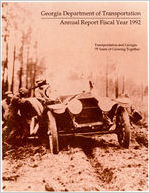
<;.over Photograph: A lac]< of quality roads often made early travel in Georgia a difficult task: In 1916, when the first State Highway Commission was formed, state leaders were looking to the future by making transportation a cornerstone on which Georgia could grow.