


- Collection:
- Georgia Government Publications
- Serial:
- ... Georgia data summary. Salmonellosis.
- Title:
- 2011 Georgia data summary: Salmonellosis [Oct. 2013]
- Creator:
- Georgia. Department of Public Health. Division of Health Protection. Epidemiology Section
- Contributor to Resource:
- Georgia. Department of Public Health. Division of Health Protection. Epidemiology Section
- Publisher:
- Atlanta, Ga. : Georgia. Department of Public Health. Division of Health Protection. Epidemiology Section
- Date of Original:
- 2013-10
- Subject:
- Georgia
- Location:
- United States, Georgia, 32.75042, -83.50018
- Medium:
- publications (documents)
- Type:
- Text
- Format:
- application/pdf
- Description:
- Call number continues GA C900.P8 S1 S2 2008, Author/Agency continues Georgia. Department of Community Health. Division of Public Health
- External Identifiers:
- Call Number GA P780.E65 S1 S2 2011
- Metadata URL:
- https://dlg.galileo.usg.edu/id:dlg_ggpd_y-ga-bp780-pe65-bs1-bs2-b2011
- Digital Object URL:
- https://dlg.galileo.usg.edu/do:dlg_ggpd_y-ga-bp780-pe65-bs1-bs2-b2011
- Language:
- eng
- Holding Institution:
- University of Georgia. Map and Government Information Library
- Rights:
-

~
2011 Georgia Data Summary
Sa 111onel osis
Georgia Department of Public Health
Salmonella Quick Fact: Salmonella is the most common bacterial foodborne infection in Georgia
OVERVIEW
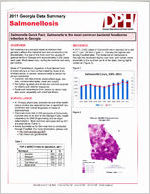
Salmonellosis is a zoonotic bacterial infection that generally affects the intestinal tract and occasionally the bloodstream . It is one of the most common causes of gastroenteritis in Georgia with approximately 2,000 cases each year. Most cases occur during the summer and early fall months .
INCIDENCE
In 2011 , 2,652 cases of Salmonella were reported , for a rate of 27.1 per 100,000 (Figure 1). This was the highest rate among FoodNet sites . The incidence of Salmonella in Georgia has increased slightly over time , with certain areas, especially in the southern parts of the state, having higher incidence (Figure 2).
Mode of Transmission : Ingestion in food derived from infected animals or food contaminated by feces of an infected animal or person ; environmental or person-toperson exposures.
Common vehicles include undercooked eggs, raw milk, contaminated water, meat and poultry.
Pet turtles , iguanas and chicks are common sources for infants and children exposures.
Fecal-oral transmission from person to person may also occur, especially with diarrheal illness.
SURVEILLANCE
All Georgia physicians, laboratories and other health care providers are required by law to report both labconfirmed and clinical diagnoses of cases of Salmonellosis.
There are more than 2,500 serotypes of Salmonella . Cultures should be sent to the Georgia Public Health Laboratory for DNA fingerprinting and serotype determination . Most common serotypes during 2011 are seen below (Table 1) .
Active Surveillance for Salmonellosis is conducted through FoodNet. For more information , please visit: ~ http://dph .georgia.gov/EIP ~ http://www.cdc.gov/foodnet/
Figure1.
Salmonella Cases, 2001-2011
3000 l
35
2500
..- 2000
1500
v r- 1--
30 25
20
15
1000 I
l500
10 5
0 T
--,
-, - ,- -,-
0
2001 2002 2003 2004 2005 2006 2007 2008 2009 2010 2011
Figure 2.
Rate per 100,000 of S almonell osis , Ge orgia , 2011
Table 1.
TOP 5 SEROTYPES IN GEORGIA, 2011
~
Serotype
#
%
1 Javiana
524 19.8
2 Newport
465 17.5
3 Enteritidis
225 8.5
4 Typhimurium
142 5.4
5 Muench en
112 4.2
Legend
Rate
Q OOOOO(o. , , .... S~;)4
- ,, ..u~n~ "'~~!'"'
- :>1~19$t'-~1l&tlltW . ,I)SIB\1:156767~, - 81Jifo104''~8~/
C .td Wi l t~ ~ ."13.' Crt nktlli"N "tOfl'ffl t~ ... t (ifi()I.,.()O!twQ(f>lllllollkl.,llr ..,Cijf"l.lO(rlo(;K9'tfiii"' C "'Ooloii'S, 'II-~IP.\ -'I
Georgia Department of Public Health - 2 Peachtree Street, NW- Atlanta, GA 30303 - (404) 657-2588- http://dph.georgia.gov
In 2011 , of the reported cases , 64% of cases were White, 19% of cases were Black, 11% of cases were unknown , 3% of cases were other, 2% of cases were multiracial , and 1% of cases were Asian (Figure 3) . Seven percent of cases were of Hispanic ethnicity. Consistent with the previously described epidemiology of Salmonella , in Georgia, most Salmonella infections occur among infants and young children , followed by elderly individuals (Figure 4) .
Figure 3.
Salmonella Cases by Race, 2011 BU>.C<GR
U'I KNOWN
AFR ICAN ERICAN
lY%
IV ULTIRACI AL 27(,
Figure 4.
Salmonella Cases with Known Age and Gender, 2011
400
300
200 100
0
<1
1 -~
5 -9 10-19 20-29 30-3 5 ~ 0--1 9 50-59 ~60
Outbreaks
In 2011 , we investigated 13 confirmed outbreaks of Salmonella . Reference the outbreak data summary for more information .
PREVENTION and SPECIAL PROJECTS
Food Preparation Tips
1. Always treat raw poultry, beef and pork as if they are contaminated and handle accordingly:
Wrap fresh meats in plastic bags at the market to prevent blood from dripping on other foods.
Refrigerate foods promptly; minimize holding time at room temperature .
Cutting boards and counters used for meat preparation should be washed immediately after use to prevent cross contamination with other foods.
Avoid eating raw or undercooked meats. Ensure that the correct internal cooking temperature is
reached , particularly when using a microwave. Make sure that the meat is no longer pink and that any juices run clear. 2. Avoid eating raw eggs or undercooking foods containing raw eggs. 3. Avoid consuming raw (unpasteurized) milk. For more information, visit: www.foodsafety.gov
Hand Washing
1. Encourage careful hand washing before and after food preparation . 2. Make sure children wash hands thoroughly , particularly if the children handle pets (especially reptiles and birds) . 3. Do not allow pet reptiles or birds to come in contact with infants, food , or food preparation surfaces .
Special Projects
Exploring additional sources of Salmonella through case-control studies.
Monitoring trends in Salmonella epidemiology over time.
Monitoring the development of antibiotic resistance .
IMPACT OF SALMONELLA
Hospitalizations and Deaths
Of the total 2,652 cases of Salmonella reported in 2011 , 728 (27%) individuals were hospitalized while an additional412 (16%) individuals were seen in the emergency room . In 2011 , there were 2 known deaths associated with Salmonella infections.
Date updated : October 2013 Visit http://dph .georgia.gov/epidemiology for more information about Salmonella Infections in Georgia.
Georgia Department of Public Health- 2 Peachtree Street, NW- Atlanta, GA 30303- (404) 657-2588- http://dph.georgia.gov