


- Collection:
- Georgia Government Publications
- Serial:
- ... Georgia data summary. Listeriosis.
- Title:
- 2011 Georgia data summary: Listeriosis [Nov. 2013]
- Creator:
- Georgia. Department of Public Health. Division of Health Protection. Epidemiology Section
- Contributor to Resource:
- Georgia. Department of Public Health. Division of Health Protection. Epidemiology Section
- Publisher:
- Atlanta, Ga. : Georgia. Department of Public Health. Division of Health Protection. Epidemiology Section
- Date of Original:
- 2013-11
- Subject:
- Georgia
- Location:
- United States, Georgia, 32.75042, -83.50018
- Medium:
- publications (documents)
- Type:
- Text
- Format:
- application/pdf
- Description:
- Call number continues GA C900.P8 S1 L5 2008, Author/Agency continues Georgia. Department of Community Health. Division of Public Health
- External Identifiers:
- Call Number GA P780.E65 S1 L5 2011
- Metadata URL:
- https://dlg.galileo.usg.edu/id:dlg_ggpd_y-ga-bp780-pe65-bs1-bl5-b2011
- Digital Object URL:
- https://dlg.galileo.usg.edu/do:dlg_ggpd_y-ga-bp780-pe65-bs1-bl5-b2011
- Language:
- eng
- Holding Institution:
- University of Georgia. Map and Government Information Library
- Rights:
-

2011 Georgia Data Summary
,
LISTE lOSIS
Listeria Quick Fact: Listeria can grow In refrigerated foods, under conditions that usually prevent bacterial growth.
OVERVIEW
Listeriosis is a serious infection caused by eating food contaminated with the bacterium Listeria monocytogenes. Most people do not develop listeriosis, even when exposed to the bacteria. L. monocytogenes is present in soil and water, and Listeria infections may be transmitted through contact with contaminated food items such as dairy products (especially unpasteurized) , deli meats, prepared salads, and raw fruits and vegetables. Symptoms can include diarrhea and vomiting . People who are pregnant or have immunocompromising conditions are more susceptible to severe Listeria infections such as meningitis. Listeriosis is 20 times more common in pregnant women than in the general population , and fetal loss or neonatal sepsis are its complications (1).
SURVEILLANCE
All Georgia physicians, laboratories and other health care providers are required by law to report both lab-confirmed and clinical diagnoses of cases of Listeriosis to the Georgia Department of Public Health (GDPH).
Laboratories submit isolates of positive Listeria cultures for additional testing-serotyping and Pulsed Field Gel Electrophoresis (PFGE) .
Outbreaks of Listeriosis among Hispanic women and their newborns associated with consumption of traditionally unpasteurized cheese products have been reported in Georgia and other states.
Public health staff interviews every Listeriosis case with a standardized CDC form to facilitate centralized data collection in the event of an outbreak.
Active Surveillance for Listeriosis is conducted through Food Net, a component of the Emerging Infections Program (EIP) . For more information , please visit: )> http://dph .georgia.gov/EIP )> http://www.cdc.gov/foodnet/
Figure 1.
Li steria Cases and Rate in GA, 2001-2011
40 35
30
... c., 25
~ 2)
. ... ~ 15
10
J 1\
I \/
/ ~ ----
~
0.35 0 0.3 ~
0.25 g
0.2 :
\.
0.15 ~ 0.1 ! 0.05 ~
0
200120G2 2003 2004 2005 20(}3200720082~09 20 1020 11
Year
DEMOGRAPHICS
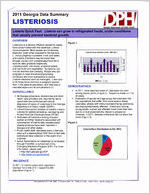
In 2011 , most reported cases of Listeriosis occurred among blacks (45%) (Figure 2) . Hispanics made up 11% of cases.
Evaluation of gender and age group demonstrates that the populations that suffer from more severe illness (neonates, elderly with immunocompromising conditions) are disproportiaonately affected . Historically among young adults, women are affected much more than men due to clinical presentations related to pregnancy. However, in 2011 , disease distribution did not show this trend (Figure 3) .
Figure 2.
Listeria Race Distribution in GA, 2011
INCIDENCE
In 2011 , 9 Listeria cases were reported in Georgia , for a rate of 0.1 cases/1 00,000 population (Figure 1).
Georgia Department of Public Health- 2 Peachtree Street, NW- Atlanta, GA 30303 - (404) 657-2588- http://dph.georgia.gov
f~y?:i~~~t1:}t~ ~~~~~~~~~~~~~~~~~~~~~~~~~~~~~~~~~~~~~~~~~~~~=,]
}::.-_:J,> Figure 3.
Figure 5.
. ~' , list eriosisGend er and Age Groups in GA, 2011
.B - - - - - - - - - - - -
J ~
1- - - - - - - - - - ---
1.') _ _ _ _ _ _ _ _ _ _ _..___
t-t:Mi\ll
Listeriosis Underlying Conditions, GA 2011
ASTHMA, EMPHYSEMA/
COPD
m
<1 1 <5 1- 10 - 18- JO - 40- 10 60 <10 <18 <)0 <40 <10 <60 Ace Group
IMPACT OF LISTERIA
Although Listeriosis is one of the least commonly reported types of food borne illness, it has the highest morbidity and mortality rate of Food Net pathogens. In 2011 , 9/9 cases were hospitalized.
In 2011 , there were no Listeriosis adult deaths reported , however, one fetal loss due to miscarriage was reported.
In 2011 , ADES investigated 2 cases of Listeriosis that had a matching PFGE pattern with that of a multi-state cluster.
UNDERLYING CONDITIONS AND TYPES OF INFECTION
Most patients had invasive disease (Listeria cultured from a normally sterile body site) (figure 4) . Other categories include bacteremia without focus and a case of septic abortion resulting in a fetal loss.
Many patients had a specific pre-disposing health condition (figure 5).
Figure 4.
Listeriosis Types of Infection, GA 2011
PREVENTION AND SPECIAL PROJECTS
Consumers should take general precautions when preparing food to wash raw vegetables , keep raw meats and seafood separate from produce and other ready to eat foods , and avoid unpasteurized dairy products. Persons with underlying illnesses like conditions requiring steroids or chemotherapy, HIV, or other illness affecting the immune system should avoid eating certain foods . Deli meats and hot dogs should be heated until steaming. Pregnant women should follow the same food safety precautions. These patients should not eat certain soft cheeses such as feta , brie, or Mexican-style cheeses unless they are clearly labeled as "pasteurized". Other foods to avoid are refrigerated smoked seafood and meat spreads such as pate. Physicians should consider Listeria testing when treating a pregnant patient with a "flulike" illnesses or gastroenteritis even if mildly ill (1 ). For more information visit http://www.foodsafety.gov .
The Listeria Initiative is a CDC enhanced surveillance system that collects reports of laboratory-confirmed cases of human listeriosis in the United States.
References: 1. Janakiraman V. Reviews in Obstetrics and Gynecology 2008 ;1:179-185.
Date updated : November 2013 Visit http://dph .georgia.gov/epidemiology for more information about Listeriosis in Georgia
Georgia Department of Public Health- 2 Peachtree Street, NW- Atlanta, GA 30303- (404) 657-2588- http://dph.georgia.gov