


- Collection:
- Georgia Government Publications
- Title:
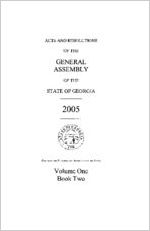
- Acts and resolutions of the General Assembly of the State of Georgia 2005, volume 1, book 2
- Creator:
- Georgia. General Assembly
- Contributor to Resource:
- Georgia. General Assembly
- Publisher:
- Atlanta, Ga. : Georgia. General Assembly
- Date of Original:
- 2005
- Subject:
- Georgia
- Location:
- United States, Georgia, 32.75042, -83.50018
- Medium:
- publications (documents)
- Type:
- Text
- Format:
- application/pdf
- Description:
- The 2005 Extraordinary Session of the General Assembly of Georgia is compiled with volume one, book one of the 2006 Georgia Laws: GA L407 2006 v.1 bk.1
- External Identifiers:
- Call Number GA L407 2005 v.1 bk.2
- Metadata URL:
- https://dlg.galileo.usg.edu/id:dlg_ggpd_y-ga-bl407-b2005-bv-p1-bbk-p2
- Digital Object URL:
- https://dlg.galileo.usg.edu/do:dlg_ggpd_y-ga-bl407-b2005-bv-p1-bbk-p2
- Language:
- eng
- Holding Institution:
- University of Georgia. Map and Government Information Library
- Rights:
-

ACTS AND RESOLUTIONS OF THE
GENERAL ASSEMBLY
OF THE
STATE OF GEORGIA
2005
COMPILED AND PUBLISHED BY AUTHORITY OF THE STATE
Volume One Book Two
COMPILER'S NOTE
General and Local Acts and Resolutions of the 2004 Extraordinary Session ofthe General Assembly of Georgia will be found in Volume I beginning at page ES3. The Extraordinary Session convened on May 3, 2004, and adjourned sine die on May 7, 2004. The proclamation ofthe Governor convening the General Assembly of Georgia in Special Session will be found on page ES1.
General Acts and Resolutions of the 2005 Regular Session of the General Assembly of Georgia will be found in Volume I beginning at page 1. Local and Special Acts and Resolutions will be found in Volume II beginning at page 3501. Home rule actions by counties, consolidated governments, and municipalities filed in the Office ofthe Secretary of State between May 1, 2004, and April 30, 2005, are printed in Volume II beginning at page 4165.
There are no numbered pages between page 1533, the last page of Volume I, and page 3501, the first page of Volume II. This allows both volumes to be prepared simultaneously. Volume I has been divided into two books because of the number of pages in the volume. Page numbers will run consecutively between the books in the volume.
Indexes; lists of Acts, Bills, and Resolutions and their Georgia Laws page numbers; material related to courts; population charts; lists ofmembers of the General Assembly; referendum results; the state auditor's report on funding of retirement bills; and the Governor's veto message are printed in Volume III. Indexes cover material in both Volumes I and II. The tabular indexes list matter by broad categories. The general index is a detailed alphabetical index by subject matter. When possible, general Acts have been indexed by reference to the titles of the Official Code of Georgia Annotated which they amend and the tabular index contains a list of Code sections which have been amended, enacted, or repealed.
Each Act and Resolution is preceded by a caption written by the compilers of the Georgia Laws solely to assist the reader in quickly determining the subject matter of the Act or Resolution. This caption includes the Act number assigned by the Governor and the House or Senate Bill or Resolution number which it was given when it was introduced in the General Assembly. These captions are not part ofthe Act or Resolution when they are enacted or adopted by the General Assembly. Each Act or Resolution which was signed by the Governor is followed by the approval date on which it was signed by the Governor.
GEORGIA LAWS 2005
TABLE OF CONTENTS
VOLUME ONE
2004 Extraordinary Session ....................................... ES I Acts and Resolutions ofGeneral Application .......................... .
VOLUME TWO
Acts and Resolutions ofLocal Application ........................... 350 I County and Consolidated Government Home Rule Actions .............. 4165 Municipal Home Rule Actions .................................... 4203
VOLUME THREE
Acts by Numbers-Page References ................................... IA Bills and Resolutions-Act Number References .......................... 5A Index-Tabular .................................................. 1OA Index-General .................................................. 37A Population of Georgia Counties-Alphabetically ....................... 126A Population of Georgia Counties-Numerically ......................... 133A Population of Municipalities-Alphabetically .......................... 138A Population of Municipalities-Numerically ........................... 145A Population of Judicial Circuits ..................................... 152A Georgia Senate Districts, Alphabetically by County .................... 156A Georgia Senators, Numerically by District ........................... 158A Georgia House Districts, Alphabetically by County .................... 161A Georgia Representatives, Numerically by District ..................... 163A Status of Referendum Elections .................................... 172A Vetoes by the Governor .......................................... 335A Legislative Services Committee and Staff ............................ 349A
798
GENERAL ACTS AND RESOLUTIONS, VOL. I
EDUCATION- PROGRAM WEIGHTS; FLEXIDILITY; STATE BOARD OF EDUCATION RULES; CHARTER SCHOOLS; OFFICE OF STUDENT ACHIEVEMENT;
QUALITY OF LEARNING INDICATORS; REPORT CARDS; FAILING SCHOOLS INTERVENTION; DRIVER'S LICENSE OF STUDENT.
No. 155 (Senate Bill No. 35).
AN ACT
To amend Chapter 2 of Title 20 ofthe Official Code of Georgia Annotated, relating to elementary and secondary education, so as to change program weights for funding purposes; to provide for the revision of certain provisions regarding education flexibility; to provide for the development of rules and regulations by the State Board of Education for specified information, including budget and expenditure information and site average class size by grade, to be provided by local boards of education to school councils and the general public; to change certain provisions relating to expenditure controls for the 2005-2006 school year; to change certain provisions regarding program weights; to revise legislative intent relative to charter schools; to add and revise definitions; to provide for charter petitions from a group of two or more local schools or local school systems; to repeal Code Section 20-2-2063.1, relating to exemption of charter schools from statutory and regulatory requirements; to provide that a charter school shall not be subject to the provisions of Title 20 and other regulations; to change certain provisions relating to operating requirements, control, and management; to change certain provisions relating to admission, enrollment, and withdrawal of students; to change certain provisions relating to the term and length of a charter; to change the provisions relating to the annual required report on the progress of the school; to revise and clarify certain provisions relating to funding for charter schools; to change certain provisions relating to purposes for which facilities funds may be used and upkeep of charter school property; to change certain provisions relating to the annual report to the General Assembly; to amend Chapter 14 of Title 20 of the Official Code of Georgia Annotated, relating to the education coordinating council, so as to change certain provisions relating to the duties of the office of student achievement; to change certain provisions relating to indicators of quality of learning in individual schools; to change certain provisions relating to school report cards; to change certain provisions relating to appropriate levels of intervention for fuiling schools; to change certain provisions relating to the Education Information Steering Committee; to amend Code Section 40-5-22, relating to persons not to be issued a driver's license, school attendance requirements, and driving training requirements, so as to provide for an additional exception to the school attendance requirements to obtain a driver's license for a minor pursuing a general educational development diploma; to change certain provisions relating to suspension of driver's licenses of minors; to provide for
GEORGIA LAWS 2005 SESSION
799
related matters; to provide an effective date; to repeal conflicting laws; and for other purposes.
BE IT ENACTED BY THE GENERAL ASSEMBLY OF GEORGIA:
SECTION 1. Chapter 2 of Title 20 of the Official Code of Georgia Annotated, relating to elementary and secondary education, is amended in Code Section 20-2-161, relating to the Quality Basic Education Formula, by striking subsection (b) in its entirety and inserting in lieu thereof the following:
'(b) As the cost of instructional programs varies depending upon the teacher-student ratios and specific services typically required to address the special needs of students enrolled, state authorized instructional programs shall have the following program weights and teacher-student ratios:
(I) Kindergarten program ................................ .
1.6422 weight
and 1 to 15
ratio
(2) Kindergarten early intervention program ................. .
2.0248 weight
and 1 to 11
ratio
(3) Primarygradesprogram(l-3) ......................... .
1.2775 weight
and 1 to 17
ratio
(4) Primary grades early intervention program (1-3) ........... .
1.7838 weight
and 1 to 11
ratio
(5) Upper elementary grades program (4-5) ................. .
1.0290 weight
and 1 to 23
ratio
800
GENERAL ACTS AND RESOLUTIONS, VOL. I
(6) Upper elementary grades early intervention program (4-5) ...
1.7774 weight and I to II ratio
(7) Middle grades program (6-8)
1.0 I34 weight
and I to 23
ratio
(8) Middle school program (6-8) as defined in Code Section 20-2-290 .............................................. .
1.1I64 weight
and I to 20
ratio
(9) High school general education program (9-I2) ............ .
1.0000 weight
and I to 23
ratio
(I 0) Vocational laboratory program (9-I2) .................. .
1.19I4 weight
and I to 20
ratio
(II) Program for persons with disabilities: Category I . . . . . . . . . . . . . . . . . . . . . . . . . . . . . . . . . . . . . . . . . . . . . .
2.3706 weight
and I to 8 ratio
(I2) Program for persons with disabilities: Category II . . . . . . . . . . . . . . . . . . . . . . . . . . . . . . . . . . . . . . . . . . . . .
2.7773 weight
and I to 6.5
ratio
GEORGIA LAWS 2005 SESSION
801
(13) Program for persons with disabilities: Category III ............................................ .
3.5356 weight
and 1 to 5 ratio
(14) Program for persons with disabilities: Category IV ........................................... .
5.7294 weight
and 1 to 3 ratio
(15) Program for persons with disabilities: CategoryV ............................................ .
2.4421 weight
and 1 to 8 ratio
(16) Program for intellectually gifted students: Category VI ........................................... .
1.6521 weight
and 1 to 12
ratio
(17) Remedial education program ......................... .
1.3031 weight
and 1 to 15
ratio
( 18) Alternative education program ........................ .
1.5871 weight
and 1 to 15
ratio
(19) English for speakers of other languages (ESOL) program ...
2.4948 weight
and 1 to 7 ratio'
802
GENERAL ACTS AND RESOLUTIONS, VOL. I
SECTION 2. Said chapter is further amended in Code Section 20-2-167, relating to funding for direct instructional, media center, and staff development costs, by adding a new subsection to the end of such Code section to read as follows:
'(e) No later than October 1, 2005 the State Board of Education shall develop rules and regulations requiring that each local board of education provide information as specified by the state board and which is not specifically made confidential by law, including school site budget and expenditure information and site average class size by grade, to members of the school council and the general public.'
SECTION 3. Said chapter is further amended by striking Code Section 20-2-167.1, relating to the application of Code Section 20-2-167 for the 2003-2004 and 2004-2005 school year, and inserting in lieu thereof the following:
'20-2-167.1. (a) For the purposes ofthe 2003-2004, 2004-2005, and 2005-2006 school years only, the following changes to Code Section 20-2-167 shall apply:
(1) Except as otherwise provided in paragraph (2) ofthis subsection, for each program identified in Code Section 20-2-161, each local school system shall spend 100 percent of funds designated for direct instructional costs on the direct instructional costs of such program on one or more of the programs identified in Code Section 20-2-161 at the system level, with no requirement that the school system spend any specific portion of such funds at the site where such funds were earned; (2) Direct instruction funds for the kindergarten early intervention program, the primary grades early intervention program, the upper elementary grades early intervention program, the remedial education program, and the alternative education program shall be expended on one or more of these programs at the system level, with no requirement that the school system spend any specific portion of such funds at the site where such funds were earned; (3) Each local school system shall spend 100 percent of the funds designated for media center costs for such costs at the system level, and 100 percent of the funds designated for media materials at the system level; (4) During the 2003-2004 school year, funds allocated for staff development may be spent for any program approved under the 'Quality Basic Education Act.' During the 2004-2005 and 2005-2006 school years, each school system shall spend 90 percent of funds allocated for professional development for such costs at the system level; and (5) Each local school system shall report to the Department of Education its budgets and expenditures in accordance with this Code section with expenditures based in the preceding school year for each school site as a part of its report in October for the FTE count and on March 15.
GEORGIA LAWS 2005 SESSION
803
(b) Except as otherwise provided by subsection (a) of this Code section, Code Section 20-2-167 shall apply during the 2003-2004, 2004-2005, and 2005-2006 school years. (c) No penalty shall apply fur failure to comply with expenditure controls set out in Code Section 20-2-167 that are contrary to this Code section, notwithstanding any law to the contrary, as long as the local school system complies with this Code section. (d) Nothing in this Code section shall be construed to repeal any other provision of Code Section 20-2-167 or this chapter, or to apply to any time period other than the three fiscal years beginning July 1, 2003, and ending June 30,2006. (e) This Code section shall be automatically repealed July 1, 2006.'
SECTION 4. Said chapter is further amended by striking subsections (i) and (k) of Code Section 20-2-182, relating to program weights, and inserting in lieu thereofthe following:
'(i) The State Board of Education shall adopt for each instructional program authorized pursuant to Part 3 of this article and the middle school program provided for in Code Section 20-2-290 the maximum number of students which may be taught by a teacher in an instructional period. The State Board of Education shall provide for a system average maximum class size that shall not exceed the funding class size by more than 20 percent for mathematics, science, social studies, or language arts classes, unless specifically authorized by the State Board of Education. The system average maximum class size for kindergarten and grades one through three shall not exceed 20 percent over the funding ratio except for art, music, or physical education classes; provided, further, that the system average maximum class size for special education, gifted, and English for speakers of other languages classes shall be set by the State Board of Education. For each instructional program, the maximum number of students who may be taught by a teacher in an instructional period shall not exceed the system average maximum class size for the program by more than two students; provided, however, that a system average maximum class size which results in a fractional full-time equivalent shall be rounded up to the nearest whole number. For a period not to exceed seven years, beginning with the 2000-2001 school year, local school systems shall be allowed to exceed the maximum class sizes set forth in this subsection in a manner consistent with State Board of Education rules and subsection (k) of this Code section. The State Board of Education shall lower the current maximum class sizes set by state board rules in effect for the 1999-2000 school year, beginning with the 2000-2001 school year, by an amount so that, beginning with the 2007-2008 school year, State Board of Education rules are in compliance with this subsection. An aide may be used in programs to increase class size as allowed by State Board of Education rule and subsection (k) of this Code section, except that beginning with the 2007-2008 school year, an aide shall not be used to increase the maximum class size in kindergarten or grades one through three. The maximum class size for the kindergarten and primary grades programs is defined as the number of students in a physical
804
GENERAL ACTS AND RESOLUTIONS, VOL. I
classroom. Maximum class sizes that result in a fractional full-time equivalent shall be rounded up to the nearest whole number as needed. The middle school program shall use the teacher-student ratio of the middle grades program for the purpose of this subsection. The number of students taught by a teacher at any time after the first 15 school days of a school year may not exceed the maximum such number unless authorization for a specific larger number is requested of the state board, along with the educational justification fur granting the requested exemption, and the state board has approved said request. The state board shall not reduce class sizes without the authorization of the General Assembly if this reduction necessitates added costs for facilities, personnel, and other program needs. Local boards of education may reduce class sizes, build additional facilities, and provide other resources at local cost if such actions are in the best interest of the local school systems' programs as determined by the local boards of education.' '(k) For the 2003-2004,2004-2005,2005-2006, and2006-2007 school years, the maximum class sizes set by the State Board of Education for the 2002-2003 school year shall apply for grades four through 12. For the 2003-2004, 2004-2005, 2005-2006, and 2006-2007 school years, the maximum class sizes set by the State Board of Education for the 2003-2004 school year shall apply to kindergarten and grades one through three, except that a kindergarten class may be increased to 20 students if a paraprofessional is present in addition to the certificated teacher. Except as otherwise provided in this subsection, other provisions of this Code section shall apply. This subsection shall not be construed to repeal any other provision of this Code section or this chapter, or to apply to any period of time other than the four fiscal years beginning July 1, 2003, and ending June 30, 2007. This subsection shall be automatically repealed July 1, 2007:
SECTION 5. Said chapter is further amended by striking Code Section 20-2-320, relating to the Education Information Steering Committee, identification of data to implement Quality Basic Education Program; State Data and Resource Center, and the state-wide comprehensive educational information network, and inserting in lieu thereof the following:
'20-2-320. (a) The Governor shall appoint a steering committee, which shall be named the Education Information Steering Committee, composed of representatives from the Department of Education, the Department of Technical and Adult Education, the Board of Regents of the University System of Georgia, the office of the Governor, the Office of Planning and Budget, the Department of Audits and Accounts, the Georgia Technology Authority, the Department of Early Care and Learning, the Professional Standards Commission, the Office of Student Achievement, the Georgia Public Telecommunications Commission, the Legislative Budget Office, and local school systems. The steering committee shall identify the data required to implement the Quality Basic Education
GEORGIA LAWS 2005 SESSION
805
Program on a fiscally sound basis and the data required to evaluate the effectiveness of the components of public education in Georgia. The steering committee shall identifY data that shall be required from local units of administration for the implementation of this article. Further, the steering committee shall develop a design for a state-wide comprehensive educational information system which will provide for the accurate, seamless, and timely flow of information from local and regional education agencies, units of the University System of Georgia, and technical schools and colleges to the state. The design shall include hardware, software, data, collection methods and times, training, maintenance, communications, security of data, and installation specifications and any other relevant specifications needed for the successful implementation of this system. The state-wide comprehensive educational information system shall not use a student's social security number or an employee's social security number in violation of state or federal law to identifY a student or employee. The steering committee shall present such recommendations to the Education Coordinating Council. Upon approval of the boards of the respective education agencies, such boards shall issue appropriate requests for proposals to implement a state-wide comprehensive educational information system, subject to appropriation by the General Assembly. The boards of the respective education agencies, at the direction of the Education Coordinating Council and working through the steering committee, shall initiate contracts with appropriate vendors and local units of administration for the procurement of services, purchase of hardware and software, and for any other purpose as directed by the Education Coordinating Council, consistent with appropriation by the General Assembly. (b) The State Board of Education, the Board of Technical and Adult Education, the Board of Regents of the University System of Georgia, and the Department of Early Care and Learning shall require an individual student record for each student enrolled which at a minimum includes the data specifications recommended by the steering committee and approved by the Education Coordinating Council. The Professional Standards Commission shall maintain an individual data record for each certificated person employed in a public school. (c) For the purpose of this article, authorized educational agencies shall be the Department of Education; the Department of Early Care and Learning; the Board of Regents ofthe University System of Georgia; the Department ofTechnical and Adult Education; the Education Coordinating Council; the Professional Standards Commission; the Office of Student Achievement; the education policy and research components of the office of the Governor; the Office of Planning and Budget; the Legislative Budget Office; the House Research Office; and the Senate Research Office. Any information collected over the state-wide comprehensive educational information system, including individual student records and individual personnel records, shall be accessible by authorized educational agencies, provided that any information which is planned for collection over the system but which is temporarily being collected by other
806
GENERAL ACTS AND RESOLUTIONS, VOL. I
means shall also be accessible by authorized educational agencies and provided, further, that adequate security provisions are employed to protect the privacy of individuals. All data maintained for this system shall be used for educational purposes only. In no case shall information be released by an authorized educational agency which would violate the privacy rights of any individual student or employee. Information released by an authorized educational agency in violation of the privacy rights of any individual student or employee shall subject the authorized educational agency to all penalties under applicable state and federal law. Any information collected over the state-wide comprehensive educational infOrmation system which is not stored in an individual student or personnel record format shall be made available to the Governor and the House and Senate Appropriations, Education, and Higher Education committees, except information otherwise prohibited by statute. Data which are included in an individual student record or individual personnel record format shall be extracted from such records and made available in nonindividual record furmat for use by the Governor, committees of the General Assembly, and agencies other than authorized educational agencies. (d) The Department of Education shall request sufficient funds annually for the operation, training of appropriate personnel, and maintenance and enhancements ofthe system. (e) In a phased approach, the state-wide comprehensive educational information system shall be fully completed subject to appropriation by the General Assembly for this purpose. During the phased implementation of the system, highest priority shall be given to the electronic transmission ofcomplete full-time equivalent counts, the uniform budgeting and accounting system, and complete salary data for each local school system. All pre-kindergarten programs, local units of administration for grades kindergarten through 12, technical schools and colleges, public libraries, public colleges and universities, and regional educational service agencies shall provide data as required by their respective boards and agencies. Notwithstanding any provision of this Code section to the contrary, no local school system shall earn funds under Code Section 20-2-186 for superintendents, assistant superintendents, or principals if the local unit of administration fails to comply with the provisions ofthis Code section. (f) Notwithstanding any other provision of law, the Department of Education is authorized to and shall obtain and provide to the Department of Public Safety, in a form to be agreed upon between the Department of Education and the Department of Public Safety, enrollment, attendance, and suspension information regarding minors 15 through I 7 years of age reported pursuant to Code Sections 20-2-690 and 20-2-697, to be used solely for the purposes set forth in subsection {a.l) ofCode Section 40-5-22.'
SECTION 6. Said chapter is further amended by striking Code Section 20-2-2061, relating to legislative intent, and inserting in lieu thereof the following:
GEORGIA LAWS 2005 SESSION
807
'20-2-2061. It is the intent of the General Assembly to increase student achievement through academic and organizational innovation by encouraging local school systems to utilize the flexibility of a performance based contract called a charter.'
SECTION 7. Said chapter is further amended in Code Section 20-2-2062, relating to definitions, by inserting new paragraphs (1.1) and (5.1) to read as follows:
'(1.1) 'Charter attendance zone' means all or any portion of the local school system in which the charter school is located and may include all or any portion of other local school systems if the charter school is jointly authorized pursuant to subsection (c) ofCode Section 20-2-2063.' '(5.1) 'High school cluster' means a high school and all of the middle and elementary schools which contain students who matriculate to such high school. The schools in a high school cluster may include charter schools, local schools, or a combination ofboth.'
SECTION 8. Said chapter is further amended in Code Section 20-2-2062, relating to definitions, by striking paragraphs (8), (9), and (l 0) and inserting in lieu thereof the following:
'(8) 'Local revenue' means local taxes budgeted for school purposes in excess of the local five mill share, combined with any applicable equalization grant and budgeted revenues from any of the following: investment earnings, unrestricted donations, and the sale of surplus property; but exclusive of revenue from bonds issued for capital projects, revenue to pay debt service on such bonds, local option sales tax for capital projects, and budgeted school food service program costs. Nothing in this paragraph shall be construed to prevent a local board from including a local charter school in projects specified in the ballot language of a local option sales tax or bond referendum. (9) 'Local school' means a public school in Georgia that is under the management and control of a local board. (1 0) 'Local school system' means the system of public schools established and maintained by a local board within its limits pursuant to Article VIII, Section V, Paragraph I of the Constitution.'
SECTION 9. Said chapter is further amended by striking Code Section 20-2-2063, relating to minimum requirements fur charter petitions, and inserting in lieu thereof the following:
'20-2-2063. (a) The State Board of Education shall promulgate rules, regulations, policies, and procedures to govern the contents of a charter petition (b) The State Board of Education shall establish rules, regulations, policies, and procedures to provide for the receipt of charter petitions from a group of two or more local schools as a single charter petitioner to convert to conversion charter
808
GENERAL ACTS AND RESOLUTIONS, VOL. I
school status. An existing conversion charter school may join as part of a group charter petition, and if such group charter petition is approved, the new charter shall supersede the conversion charter school's previous charter. A group charter petition may be comprised of all the schools in a high school cluster as such term is defined in Code Section 20-2-2062. (c) The State Board of Education shall establish rules, regulations, policies, and procedures to provide for charter petitions from two or more local school systems to jointly authorize a local charter school.'
SECTION 10. Said chapter is further amended by repealing in its entirety Code Section 20-2-2063.1, relating to exemption of charter schools from statutory and regulatory requirements.
SECTION 11. Said chapter is further amended by striking Code Section 20-2-2064.1, relating to review of charter by state board and charters for state chartered special schools, and inserting in lieu thereof the following:
'20-2-2064.1. (a) The state board shall approve the charter of a charter petitioner if the petition has been approved by the local board of the local school system in which the proposed charter school will be located and the state board finds that the petition complies with the rules, regulations, policies, and procedures promulgated in accordance with Code Section 20-2-2063 and the provisions of this title and is in the public interest. If the state board denies a petition, it must within 60 days specifically state the reasons for the denial, list all deficiencies with regard to Code Section 20-2-2063, and provide a written statement of the denial to the charter petitioner and to the local board. (b) No application for a state chartered special school may be made to the state board by a petitioner for a conversion charter school that has been denied by a local board. Upon denial of a petition for a start-up charter school by a local board and upon application to the state board by the petitioner, the state board shall approve the charter of a start-up charter petitioner for a state chartered special school if the state board finds that such petition meets the requirements set forth in Code Section 20-2-2063 and the provisions of this title, and is in the pub lie interest.'
SECTION 12. Said chapter is further amended by striking Code Section 20-2-2 065, relating to operating requirements, control, and management, and inserting in lieu thereof the following:
'20-2-2065. (a) Except as provided in this article or in a charter, a charter school shall not be subject to the provisions of this title or any state or local rule, regulation, policy, or procedure relating to schools within an applicable school system regardless of
GEORGIA LAWS 2005 SESSION
809
whether such rule, regulation, policy, or procedure is established by the local board, the state board, or the Department of Education; provided, however, that the state board may establish rules, regulations, policies, or procedures consistent with this article relating to charter schools. ht exchange for such a waiver, the charter school agrees to meet or exceed the performance based goals included in the charter and approved by the local board, including but not limited to raising student achievement. (b) In determining whether to approve a charter petition or renew an existing charter, the local board and state board shall ensure that a charter school shall be:
(l) A public, nonsectarian, nonreligious, nonprofit school that is not home based, provided that a charter school's nonprofit status shall not prevent the school from contracting for the services of a for profit entity; (2) Subject to the control and management of the local board of the local school system in which the charter school is located, as provided in the charter and in a manner consistent with the Constitution, if a local charter school; (3) Subject to the supervision ofthe state board, as provided in the charter and in a manner consistent with the Constitution, if a state chartered special school; (4) Organized and operated as a nonprofit corporation under the laws of this state; provided, however, that this paragraph shall not apply to any charter petitioner who is a local school, or state or local public entity; (5) Subject to all federal, state, and local rules, regulations, court orders, and statutes relating to civil rights; insurance; the protection of the physical health and safety of school students, employees, and visitors; conflicting interest transactions; and the prevention of unlawful conduct; (6) Subject to all laws relating to unlawful conduct in or near a public school; (7) Subject to an annual financial audit conducted by the state auditor, or if specified in the charter, by an independent certified public accountant licensed in this state; (8) Subject to the provisions of Part 3 of Article 2 of Chapter 14 of this title, and such provisions shall apply with respect to charter schools whose charters are granted or renewed on or after July 1, 2000; (9) Subject to all reporting requirements ofCode Section 20-2-160, subsection (e) of Code Section 20-2-161, Code Section 20-2-320, and Code Section 20-2-740; (l 0) Subject to the requirement that it shall not charge tuition or fees to its students except as may be authorized for local boards by Code Section 20-2-133; and ( 11) Subject to the provisions of Code Section 20-2-1050 requiring a brief period of quiet reflection:
SECTION 13. Said chapter is further amended in Code Section 20-2-2066, relating to admission, enrollment, and withdrawal of students, by striking paragraph (1) of subsection (a) and inserting in lieu thereof a new paragraph (I) of subsection (a) to read as follows:
810
GENERAL ACTS AND RESOLUTIONS, VOL. I
'(l)(A) A start-up charter school shall enroll any student who resides in the charter attendance zone as specified in the charter and who submits a timely application as specified in the charter unless the number of applications exceeds the capacity of a program, class, grade level, or building. In such case, all such applicants shall have an equal chance of being admitted through a random selection process unless otherwise prohibited by law; provided, however, that a start-up charter school may give enrollment preference to applicants in any one or more of the following categories in the order of priority specified in the charter:
(i) A sibling of a student enrolled in the start-up charter school; (ii) A sibling of a student enrolled in another local school designated in the charter; (iii) A student whose parent or guardian is a member of the governing board ofthe charter school or is a full-time teacher, professional, or other employee at the charter school; and (iv) Students matriculating from a local school designated in the charter; (B) A conversion charter school shall enroll any student who resides in the attendance zone specified in the charter and who submits a timely application as specified in the charter. If the number of applying students who reside in the attendance zone does not exceed the capacity as specified in the charter, additional students shall be enrolled based on a random selection process; provided however, that enrollment preferences may be given to applicants in any one or more of the following categories in the order of priority specified in the charter: (i) A sibling of a student enrolled in the charter school or in any school in the high school cluster; (ii) Students whose parent or guardian is a member of the governing board of the charter school or is a full-time teacher, professional, or other employee at the charter school; (iii) Students who were enrolled in the local school prior to its becoming a charter school; and (iv) Students who reside in the charter attendance zone specified in the charter; and'
SECTION 14. Said chapter is further amended by striking Code Section 20-2-2067.1, relating to amendment of terms of charter for charter school, initial term of charter, and annual report, and inserting in lieu thereof the following:
'20-2-2067 .1. (a) The terms of a charter for a local charter school may be amended during the term of the charter upon the approval ofthe local board, the state board, and the charter school. The terms of a charter for a state chartered special school may be amended during the term of the charter upon the approval ofthe state board and the charter school.
GEORGIA LAWS 2005 SESSION
811
(b) The initial term of a charter shall be for a minimum of five years, unless the petitioner shall request a shorter period of time, and shall not exceed ten years. The local board and the state board, in accordance with Code Section 20-2-2064.1 may renew a local charter, upon the request of the charter school, for the period of time specified in the request, not to exceed ten years. The state board may renew a state chartered special school, upon the request of the school, for the period of time specified in the request, not to exceed ten years. (c) A charter school shall submit an annual report outlining the previous year's progress to the authorizing local board or state board, as appropriate, to parents and guardians of students enrolled in the school, and to the Department of Education no later than October 1 of each year. The report shall contain, but is not limited to:
(1) An indication ofprogress towards the goals as included in the charter; (2) Academic data for the previous year, including state academic accountability data, such as standardized test scores and adequate yearly progress data; (3) Unaudited fmancial statements for the fiscal year ending on June 30, provided that audited statements will be forwarded to the local board and state board upon completion; (4) Updated contact information for the school and the administrator; (5) Proof ofcurrent nonprofit status, if applicable; and (6) Any other supplemental information that the charter school chooses to include or that the state board requests that demonstrates its success.'
SECTION 15. Said chapter is further amended by striking subsections (a) through (e) of Code Section 20-2-2068.1, relating to application of the Quality Basic Education Formula, grants, local tax revenue, and funds from local bonds, and inserting in lieu thereof the following:
'(a) A local charter school shall be included in the allotment of QBE formula earnings, applicable QBE grants, applicable nonQBE state grants, and applicable federal grants to the local school system in which the local charter school is located under Article 6 of this chapter. The local board and the state board shall treat a conversion charter school no less favorably than other local schools located within the applicable local school system unless otherwise provided by law. The local board and the state board shall treat a start-up charter school no less favorably than other local schools within the applicable local system with respect to the provision of funds for instruction and school administration and, where feasible, transportation, food services, and building programs. (b) QBE formula earnings, applicable QBE grants, applicable nonQBE state grants, and applicable federal grants earned by a local charter school shall be distributed to the local charter school by the local board; provided, however, that state equalization grant earnings shall be distributed as provided in subsection (c) of this Code section. QBE formula earnings shall include the salary portion of direct instructional costs, the adjustment fur training and experience, the
812
GENERAL ACTS AND RESOLUTIONS, VOL. I
nonsalary portion of direct instructional costs, and earnings for psychologists and school social workers, school administration, facility maintenance and operation, media centers, additional days of instruction in accordance with Code Section 20-2-184 .I, and staff development. The local charter school shall report enrolled students in a manner consistent with Code Section 20-2-160. (c) In addition to the earnings set out in subsection (b) ofthis Code section, local revenue shall be allocated to a local charter school on the same basis as for any local school in the local school system. In the case of a start-up charter school, local revenue earnings shall be calculated as follows:
(I) Determine the total amount of state and local five mill share funds earned by students enrolled in the local start-up charter school as calculated by the Quality Basic Education Formula pursuant to Part 4 of Article 6 of this chapter including any funds for psychologists and school social workers but excluding any system-wide funds for central administration and pupil transportation and excluding any categorical grants not applicable to the charter school; (2) Determine the total amount of state and local five mill share funds earned by all students in the public schools of the local school system, including any charter schools that receive local revenue, as calculated by the Quality Basic Education Formula but excluding categorical grants and other nonQBE formula grants; (3) Divide the amount obtained in paragraph (I) of this subsection by the amount obtained in paragraph (2) of this subsection; and (4) Multiply the quotient obtained in paragraph (3) of this subsection by the school system's local revenue. The product obtained in paragraph (4) of this subsection shall be the amount of local funds to be distributed to the local start-up charter school by the local board; provided, however, that nothing in this subsection shall preclude a charter petitioner and a local board of education from specifying in the charter a greater amount of local funds to be provided by the local board to the local start-up charter school if agreed upon by all parties to the charter. Local funds so earned shall be distributed to the local start-up charter school by the local board. Where feasible and where services are provided, funds for transportation, food service programs, and construction projects shall also be distributed to the local start-up charter school as earned. In all other fiscal matters, including applicable federal allotments, the local board shall treat the local start-up charter school no less favorably than other local schools located within the applicable school system and shall calculate and distribute the funding for the start-up charter school on the basis of its actual or projected enrollment in the current school year according to an enrollment counting procedure or projection method stipulated in the terms of the charter. (c.l) The adjustments in each program for training and experience used in calculating the start-up charter school's QBE formula earnings shall be calculated in the same manner as for any local school within the local school system; provided, however, that the adjustments in each program for training and experience used in calculating the start-up charter school's QBE formula earnings
GEORGIA LAWS 2005 SESSION
813
shall not be less than one-half of the comparable percentages for the local school system in which the charter school is located. (d) QBE formula earnings, applicable QBE grants, applicable nonQBE state grants, and applicable federal grants that are earned by a state chartered special school shall be distributed to the local board of the local school system in which the state chartered special school is located which shall distribute the same amount to the state chartered special school; provided, however, that a state chartered special school shall not be included in the calculation and distribution of the local school system's equalization grant unless the voters of the local school system have approved the use of revenue from local tax levies and funds from local bonded indebtedness to support the state chartered special school in accordance with subsection (e) of this Code section. If such approval has been given, state equalization grant earnings shall be earned for the state chartered special school and shall be distributed as provided in subsection (f) of this Code section. The local board shall not be responsible for the fiscal management, accounting, or oversight of the state chartered special school. The state chartered special school shall report enrolled students in a manner consistent with Code Section 20-2-160. Any data required to be reported by the state chartered special school shall be submitted directly by the school to the appropriate state agency. Where feasible, the state board shall treat a state chartered special school no less favorably than other public schools within the state with respect to the provision of funds for transportation and building programs. (e) The state board may require a local referendum of the qualified voters in the local school system in which the state chartered special school will be located. Such referendum shall be held at the next regularly scheduled general election or as may otherwise be authorized at an earlier date by the local board or boards of education affected. Such referendum shall be held for the purpose of deciding whether the local board of education shall provide funds from school tax levies to support such state chartered special school or incur bonded indebtedness to support such state chartered special school or both. The ballot question shall be approved by the state board."
SECTION 16. Said chapter is further amended in Code Section 20-2-2068.2, relating to facilities fund for charter schools, purposes for which funds may be used, upkeep of charter school property, and receipt of surplus from board of education, by striking subsections (c) and (e) and inserting in lieu thereof new subsections (c) and (e) to read as follows:
'(c) A charter school's governing body may use moneys from the facilities fund for the following purposes:
(1) Purchase of real property; (2) Construction of school facilities, including initial and additional equipment and furnishings; (3) Purchase, lease-purchase, or lease of permanent or relocatable school facilities;
814
GENERAL ACTS AND RESOLUTIONS, VOL. I
(4) Purchase of vehicles to transport students to and from the charter school; and (5) Renovation, repair, and maintenance of school facilities that the charter school owns or is purchasing through a lease-purchase or long-term lease of five years or longer.' '(e) Local boards are required to renovate, repair, and maintain the school facilities of charter schools in the district to the same extent as other public schools in the district if the local board owns the charter school facility, unless otherwise agreed upon by the petitioner and the local board in the charter.'
SECTION 17. Said chapter is further amended by striking Code Section 20-2-2070, relating to annual report to the general assembly; and inserting in lieu thereof the following:
'20-2-2070. The state board shall report to the General Assembly no later than December 31 of each year on the status of the charter school program.'
SECTION 18. Chapter 14 of Title 20 of the Official Code of Georgia Annotated, relating to the education coordinating council, is amended by striking subsection (a) of Code Section 20-14-26, relating to duties of the office of student achievement, and inserting in lieu thereof the following:
'(a) The office shall have the following duties: (1) To create a single state-wide accountability system, establish indicators of performance, rate schools and school systems, develop annual report cards for elementary, middle, and secondary schools, and fOrmulate a system of school awards and interventions. The State Board of Education shall approve a single accountability system for local schools and school systems that incorporates federal law, rules, and regulations relating to accountability; (2) To audit and inspect or cause to be audited or inspected for the purpose of verification, research, analysis, reporting, or fur other purposes related to the performance of its powers and duties as provided in this article and for the purposes of auditing pre-kindergarten, elementary, middle grades, and secondary education, postsecondary education, and education work force programs and schools, local school systems, institutes, colleges, universities, regional educational service agencies, and other public education programs and entities as defined by the council; (3) To serve as staffto the council; and (4) To exercise the powers and discharge duties of the council, as set forth in Code Section 20-14-8, under the supervision and oversight of the council.'
SECTION 19. Said chapter is further amended by striking subsections (a), (d), and (h) ofCode Section 20-14-33, relating to indicators of quality of!earning in individual schools, and inserting in their respective places the following:
GEORGIA LAWS 2005 SESSION
815
'(a) The office shall adopt and biennially review, and revise as necessary, indicators of the quality of learning by students in an individual school and school system.' '(d) The office shall establish individual school and school system ratings for each public school and school system in this state for annual academic performance on the assessment instruments required under Code Section 20-2-281.' '(h) The office shall annually review the performance of each school and school system on the indicators in subsection (b) of this Code section and determine whether a change in the school or school system rating status of the school or school system is warranted.'
SECTION 20. Said chapter is further amended by striking subsections (b) and (d) of Code Section 20-14-34, relating to school report cards, and inserting in their respective places the following:
'(b) The report card shall include the fullowing information, where applicable: (1) The individual school and school system ratings as provided for in subsection (d) ofCode Section 20-14-33; (2) The academic excellence indicators in subsection (b) of Code Section 20-14-33; (3) Teacher-student ratios; and (4) Administrative and instructional costs per student and other financial accounting information as may be required.'
'(d) The State Board of Education shall adopt rules requiring dissemination of appropriate student performance and school completion performance portions of school report cards annually to the parent, guardian, conservator, or other person having lawful control of each student at the school. On written request, the local school system shall provide a copy of a school report card to any other party. These reports shall be posted on the Office of Student Achievement website, the Department of Education website, and the existing website of such local school system.'
SECTION 21. Said chapter is further amended by striking subparagraph (D) of paragraph (6) of subsection (a) of Code Section 20-14-41, relating to appropriate levels of intervention for failing schools, and inserting in lieu thereof the following:
'(D) Mandate that the parents have the option to relocate the student to other public schools in the local school system to be chosen by the parents of the student from a list of available options provided by the local school system. The local school system shall provide transportation for students in Title I schools in accordance with the requirements of federal law. The local school system may provide transportation for students in non-Title I schools. In any year in which the General Assembly does not appropriate funds fur the provision of
816
GENERAL ACTS AND RESOLUTIONS, VOL. I
transportation to non-Title I students, the parent or guardian shall assume responsibility for the transportation of that student;
SECTION 22. Code Section 40-5-22 of the Official Code of Georgia Annotated, relating to persons not to be issued a driver's license, school attendance requirements, and driving training requirements, is amended by striking subsection (a.!) and inserting in lieu thereof the following:
'(a.I )(I) The department shall not issue an instruction permit or driver's license to a person who is younger than 18 years of age unless at the time such minor submits an application fur an instruction permit or driver's license the applicant presents acceptable proof that he or she has received a high school diploma, a general educational development (GED) diploma, a special diploma, or a certificate of high school completion, or has terminated his or her secondary education and is enrolled in a postsecondary school, is pursuing a general educational development (GED) diploma, or the records of the department indicate that said applicant:
(A) Is enrolled in and not under expulsion from a public or private school and has satisfied relevant attendance requirements as set forth in paragraph (2) of this subsection for a period of one academic year prior to application for an instruction permit or driver's license; or (B) Is enrolled in a home education program that satisfies the reporting requirements of all state laws governing such program. The department shall notify such minor of his or her ineligibility for an instruction permit or driver's license at the time of such application. (2) The department shall forthwith notifY by certified mail or statutory overnight delivery, return receipt requested, any minor issued an instruction permit or driver's license in accordance with this subsection other than a minor who has terminated his or her secondary education and is enrolled in a postsecondary school or who is pursuing a general education development (GED) diploma that such minor's instruction permit or driver's license is suspended subject to review as provided for in this subsection if the department receives notice pursuant to Code Section 20-2-701 that indicates that such minor: (A) Has dropped out of school without graduating and has remained out of school fur ten consecutive school days; (B) Has ten or more school days of unexcused absences in the current academic year or ten or more school days of unexcused absences in the previous academic year; or (C) Has been found in violation by a hearing officer, panel, or tribunal of one of the following offenses, has received a change in placement for committing one of the following offenses, or has waived his or her right to a hearing and pleaded guilty to one ofthe following offenses:
(i) Threatening, striking, or causing bodily harm to a teacher or other school personnel;
GEORGIA LAWS 2005 SESSION
817
(ii) Possession or sale of drugs or alcohol on school property or at a school sponsored event; (iii) Possession or use of a weapon on school property or at a school sponsored event. For purposes of this subparagraph, the term 'weapon' shall be defined in accordance with Code Section 16-11-127.1 but shall not include any part of an archeological or cultural exhibit brought to school in connection with a school project; (iv) Any sexual offense prohibited under Chapter 6 of Title 16; or (v) Causing substantial physical or visible bodily harm to or seriously disfiguring another person, including another student. Notice given by certified mail or statutory overnight delivery with return receipt requested mailed to the person's last known address shall be prima-facie evidence that such person received the required notice. Such notice shall include instructions to the minor to return immediately the instruction permit or driver's license to the department and information summarizing the minor's right to request an exemption from the provisions of this subsection. The minor so notified may request in writing a hearing within ten business days from the date of receipt of notice. Within 30 days after receiving a written request for a hearing, the department shall hold a hearing as provided for in Chapter 13 of Title 50, the 'Georgia Administrative Procedure Act.' After such hearing, the department shall sustain its order of suspension or rescind such order. The department shall be authorized to grant an exemption from the provisions of this subsection to a minor, upon such minor's petition, ifthere is clear and convincing evidence that the enforcement of the provisions of this subsection upon such minor would create an undue hardship upon the minor or the minor's family or if there is clear and convincing evidence that the enforcement of the provisions of this subsection would act as a detriment to the health or welfare of the minor. Appeal from such hearing shall be in accordance with said chapter. If no hearing is requested within the ten business days specified above, the right to a hearing shall have been waived and the instruction permit or driver's license of the minor shall remain suspended. The suspension provided for in this paragraph shall be for a period of one year or shall end upon the date of such minor's eighteenth birthday or upon receipt of satisfuctory proof that the minor is pursuing or has received a general educational development (GED) diploma, whichever comes first. (3) The State Board of Education and the commissioner of motor vehicle safety are authorized to promulgate rules and regulations to implement the provisions of this subsection. (4) The Department of Technical and Adult Education shall be responsible for compliance and noncompliance data for students pursuing a general education development (GED) diploma.'
818
GENERAL ACTS AND RESOLUTIONS, VOL. I
SECTION 23. This Act shall become effective on July 1, 2005.
SECTION 24. All laws and parts of laws in conflict with this Act are repealed.
Approved May 4, 2005.
CONSERVATION- STATE GOVERNMENT- ENVIRONMENTAL PROTECTION DIVISION; ENVIRONMENTAL ADVISORY COUNCIL; AIR QUALITY; STAYS.
No. 156 (Senate Bill No. 190).
AN ACT
To amend Title 12 of the Official Code of Georgia Annotated, relating to conservation and natural resources, so as to change certain provisions relating to the Environmental Protection Division, the Environmental Advisory Council, duties of the council, its members, and the director ofthe division, procedure fur aggrieved persons, and inspections; to provide that the filing of a petition in certain instances shall result in a limited stay of an order or action of the director; to provide time limits for administrative judicial decision making; to provide for exceptions; to change certain provisions relating to hearing and judicial review relative to air quality; to amend Code Section 50-13-19 of the Official Code of Georgia Annotated, relating to judicial review of contested cases, so as to provide that the filing of a petition in certain instances shall not result in a stay of a decision except under certain conditions; to provide for exceptions; to repeal conflicting laws; and for other purposes.
BE IT ENACTED BY THE GENERAL ASSEMBLY OF GEORGIA:
SECTION 1. Title 12 of the 0 fficial Code of Georgia Annotated, related to conservation and natural resources, is amended in Code Section 12-2-2, relating to the Environmental Protection Division, the Environmental Advisory Council, duties of the council, its members, and the director of the division, procedure for aggrieved persons, and inspections, by striking paragraph (2) of subsection (c) and inserting in lieu thereof the following:
'(2)(A) Any person who is aggrieved or adversely affected by any order or action of the director shall, upon petition to the director within 30 days after the issuance of such order or the taking of such action, have a right to a hearing before an administrative law judge of the Office of State
GEORGIA LAWS 2005 SESSION
819
Administrative Hearings assigned under Code Section 50-13-40 and acting in place of the Board of Natural Resources. The hearing before the administrative law judge shall be conducted in accordance with Chapter 13 of Title 50, the 'Georgia Administrative Procedure Act,' and the rules and regulations adopted by the board pursuant thereto. Any administrative law judge so assigned shall fully meet and qualify as to all applicable conflict of interest requirements provided for in Section 304(h)(2)(D) of the Federal Water Pollution Control Act of 1972, as amended, and the rules, regulations, and guidelines promulgated thereunder. (B) In any case involving the grant of a permit, permit amendment, or variance by the director, the filing of such a petition by a person to whom such order or action is not directed shall stay such order or action until such time as the hearing has been held and for ten days after the administrative law judge renders his or her decision on the matter. The petition shall be transmitted to the administrative law judge not more than seven days after the date offtling. The provisions of subsection (c) ofCode Section 50-13-41 notwithstanding, the hearing shall be held and the decision of the administrative law judge shall be rendered not later than 90 days after the date of the filing of the petition by such a person unless such period is extended for a time certain by order of the administrative law judge upon consent of all parties; in addition, the administrative law judge may extend the 90 day period for good cause shown for a period not to exceed an additional60 days. (C) The provisions of subparagraph (B) of this paragraph notwithstanding, in any case involving the grant of a permit, permit amendment, or variance by the director regarding water withdrawal for furm uses under Code Section 12-5-31 or Code Section 12-5-105, the filing of a petition under subparagraph (A) of this paragraph by any person to whom such order or action is not directed shall not stay such order or action. (D) The decision of the administrative law judge shall constitute the final decision of the board and any party to the hearing, including the director, shall have the right ofjudicial review thereof in accordance with Chapter 13 ofTitle 50.'
SECTION 2. Said title is further amended in Code Section 12-9-15, relating to hearing and judicial review relative to air quality, by designating the provisions of subsection (a) as paragraph (1) of said subsection and adding a new paragraph to read as follows:
'(2) The provisions of subparagraph (c)(2)(B) of Code Section 12-2-2 shall apply to proceedings under this Code section.'
820
GENERAL ACTS AND RESOLUTIONS, VOL. I
SECTION 3. Code Section 50-13-19 of the Official Code of Georgia Annotated, relating to judicial review of contested cases, is amended by striking subsection (d) and inserting in lieu thereof the following:
'(d)( 1) The filing of the petition for judicial review in superior court does not itself stay enforcement of the agency decision. Except as otherwise provided in this subsection, the agency may grant, or the reviewing court may order, a stay upon appropriate terms for good cause shown. (2) In cases involving the grant of a permit, permit amendment, or variance by the director of the Environmental Protection Division of the Department of Natural Resources in which the petition for judicial review in superior court was filed by any person to whom such contested order or action is not directed, a stay shall not be granted unless by order of the superior court upon motion for a temporary restraining order or interlocutory injunction in accordance with Code Section 9-11-65. (3) The provisions of paragraphs (1) and (2) of this subsection notwithstanding, in any case involving the grant of a permit, permit amendment, or variance by the director of the Environmental Protection Division of the Department ofNatural Resources regarding water withdrawal for farm uses under Code Section 12-5-31 or Code Section 12-5-1 05, no stay shall be authorized ifthe petition for judicial review in superior court was filed by any person to whom such order or action is not directed. (4) In contested cases involving a license to practice medicine or a license to practice dentistry in this state, a reviewing court may order a stay or an agency may grant a stay only if the court or agency makes a finding that the public health, safety, and welfare will not be harmed by the issuance of the stay:
SECTION 4. All laws and parts of laws in conflict with this Act are repealed.
Approved May 4, 2005.
CRIMES- FEMALE GENITAL MUTILATION.
No. 157 (House Bill No. 10).
AN ACT
To amend Article 2 of Chapter 5 of Title 16 of the Official Code of Georgia Annotated, relating to assault and battery, so as to provide for the crime of female genital mutilation; to provide for penalties; to provide for exceptions; to provide
GEORGIA LAWS 2005 SESSION
821
that certain statutory privileges shall not be available; to provide for applicability; to provide an effective date; to repeal conflicting laws; and for other purposes.
BE IT ENACTED BY THE GENERAL ASSEMBLY OF GEORGIA:
SECTION 1. Article 2 of Chapter 5 of Title 16 of the Official Code of Georgia Annotated, relating to assault and battery, is amended by adding a new Code Section 16-5-27 to read as follows:
'16-5-27 0 (a) Any person:
(1) Who knowingly circumcises, excises, or infibulates, in whole or in part, the labia majora, labia minora, or clitoris of a female under 18 years of age; (2) Who is a parent, guardian, or has immediate custody or contro 1of a female under 18 years of age and knowingly consents to or permits the circumcision, excision, or infibulation, in whole or in part, ofthe labia majora, labia minora, or clitoris of such female; or (3) Who knowingly removes or causes or permits the removal of a female under 18 years of age from this state for the purpose of circumcising, excising, or infibulating, in whole or in part, the labia majora, labia minora, or clitoris of such female shall be guilty of female genital mutilation. (b) A person convicted of female genital mutilation shall be punished by imprisonment for not less than five nor more than 20 years. (c) This Code section shall not apply to procedures performed by or under the direction of a physician, a registered professional nurse, a certified nurse midwife, or a licensed practical nurse licensed pursuant to Chapter 34 or 26, respectively, of Title 43 when necessary to preserve the physical health of the female. This Code section shall also not apply to any autopsy or limited dissection as defined by Code Section 45-16-21 which is conducted in accordance with Article 2 of Chapter 16 ofTitle 45. (d) Consent of the female under 18 years of age or the parent, guardian, or custodian of the female under 18 years of age shall not be a defense to the offense of female genital mutilation. Religion, ritual, custom, or standard practice shall not be a defense to the offense of female genital mutilation. (e) The statutory privileges provided by Chapter 9 of Title 24 shall not apply to proceedings in which one of the parties to the privilege is charged with a crime against a female under 18 years of age, but such person shall be compellable to give evidence only on the specific act for which the defendant is charged.'
SECTION 2. This Act shall become effective on July 1, 2005, and shall apply to all offenses committed on or after such date.
822
GENERAL ACTS AND RESOLUTIONS, VOL. I
SECTION 3. All laws and parts of laws in conflict with this Act are repealed.
Approved May 5, 2005.
HIGHWAYS- VEHICLE WEIGHT LIMITATIONS.
No. 158 (House Bill No. 279).
AN ACT
To amend Code Section 32-6-26 of the Official Code of Georgia Annotated, relating to weight of vehicle and load, so as to change certain provisions relating to weight limitations for certain types of vehicles; to provide for related matters; to repeal conflicting laws; and for other purposes.
BE IT ENACTED BY THE GENERAL ASSEMBLY OF GEORGIA:
SECTION 1. Code Section 32-6-26 of the Official Code of Georgia Annotated, relating to weight of vehicle and load, is amended by striking subsection (g) of said Code section and inserting in its place the following:
'(g)( 1) The weight limitations provided for in this Code section, except the limitation in subsections (f) and (h) of this Code section, may be exceeded on any public road within this state which is not a national highway, or when making a pickup or delivery on any public road of a county road system, without a permit only when the load on any single axle does not exceed 23,000 pounds, the load on any tandem axle does not exceed 46,000 pounds, and the maximum total gross weight of the vehicle and load does not exceed 80,000 pounds when:
(A) Hauling forest products from the forest where cut to the first point of marketing or processing; (B) Hauling live poultry or cotton from a farm to a processing plant; (C) Hauling feed from a feed mill to a furm; (D) Hauling granite, either block or sawed, or any other naturally occurring raw ore or mineral for further processing, from the quarry or stockpile area to a processing plant located in the same or an adjoining county; (E) Hauling solid waste or recovered materials from points of generation to a solid waste handling facility or other processing facility; or (F) Hauling concrete that is in a freshly mixed and unhardened state for delivery to a customer located in the same or an adjoining county. No lift axle may be used in computing the maximum total gross weight authorized for any vehicle or load under this paragraph.
GEORGIA LAWS 2005 SESSION
823
(2) A vehicle which is hauling the products listed in subparagraph (A), (B), or (C) of paragraph ( 1) of this subsection or which is hauling any other agricultural or farm product from a farm to the first point of marketing or processing shall be permitted a 5 percent variance from the weight limitations in paragraph ( 1) of this subsection within a 100 mile radius of the farm or point of origin. Any person who violates the load limitations provided for in this paragraph by exceeding the 5 percent variance shall be fmed on the basis of the weight limitations of paragraph (I) of this subsection and not on the basis of the variance allowed by this paragraph. (3) Any vehicle carrying a load as authorized in this subsection at night shall be equipped with lights clearly visible for a distance of not less than 300 feet from the front and rear ofthe vehicle.'
SECTION 2 Code Section 32-6-27 of the Official Code of Georgia Annotated, relating to imposition of fines related to violations of the load limitations, is amended by striking subsection (a) of said Code Section and inserting in its place the following:
'(a) Any person who violates the load limitation provisions of Code Section 32-6-26 shall be conclusively presumed to have damaged the public roads, including bridges, of this state by reason of such overloading and shall recompense the state for such damage in accordance with the following schedule:
(1) 5 per pound for all excess weight over the allowed weight limitations;'
SECTION 3. All laws and parts of laws in conflict with this Act are repealed.
Approved May 5, 2005.
SOCIAL SERVICES- GEORGIA LONG-TERM CARE PARTNERSHIP PROGRAM ACT; ENACT.
No. 159 (House Bill No. 643).
AN ACT
To amend Chapter 4 of Title 49 of the Official Code of Georgia Annotated, relating to pub lie assistance, so as to establish the Georgia Long-Term Care Partnership Program; to provide a short title; to provide definitions; to provide for the administration ofthe program; to provide for certain duties and responsibilities; to provide that certain assets ofpersons not be considered when certain determinations concerning eligibility for Medicaid assistance are made; to provide for criteria for asset disregard; to provide for reciprocal agreements with other states; to authorize the Department of Community Health and the Commissioner of Insurance to
824
GENERAL ACTS AND RESOLUTIONS, VOL. I
promulgate certain rules and regulations; to provide for certain contingencies; to provide an effective date; to repeal conflicting laws; and for other purposes.
BE IT ENACTED BY THE GENERAL ASSEMBLY OF GEORGIA:
SECTION 1. Chapter 4 of Title 49 of the Official Code of Georgia Annotated, relating to public assistance, is amended by adding a new Article 7A to read as follows:
'ARTICLE 7A
49-4-160. This article shall be known and may be cited as the 'Georgia Long-Term Care Partnership Program Act.'
49-4-161. As used in this article, the term:
(I) 'Asset disregard' means the total assets an individual owns and may retain upon application for the state Medicaid program and still qualify for benefits if the individual:
(A) Is a beneficiary of a Georgia Long-Term Care Partnership Program approved policy; and (B) Has exhausted the benefits of such policy or has diminished such assets below anticipated remaining policy benefits. (2) 'Department' means the Department of Community Health. (3) 'Georgia Long-Term Care Partnership Program approved policy' means a long-term care insurance policy that is approved by the Commissioner of Insurance and is provided through state approved long-term care insurers through the Georgia Long-Term Care Partnership Program. (4) 'State Medicaid program' means the medical assistance program established in this state under Title XIX of the federal Social Security Act.
49-4-162. (a) There is established the Georgia Long-Term Care Partnership Program which shall be administered by the Department of Community Health, with the assistance of the Commissioner of Insurance and the Department of Human Resources, and which shall be for the following purposes:
(1) To provide incentives for individuals to insure against the costs of providing for their long-term care needs; (2) To provide a mechanism for individuals to qualify for coverage ofthe cost of their long-term care needs under the state Medicaid program without first being required to substantially exhaust their resources; (3) To provide counseling services through the Division of Aging Services of the Department of Human Resources to individuals in planning of their long-term care needs; and
GEORGIA LAWS 2005 SESSION
825
(4) To alleviate the financial burden on the state's Medicaid program by encouraging the pursuit ofprivate initiatives. (b) Upon the exhaustion of benefits or upon the diminishment of assets below the anticipated remaining benefits under a Georgia Long-Term Care Partnership Program approved policy, certain assets of an individual, as provided in subsection (c) of this Code section, shall not be considered when determining any of the following: (1) Medicaid eligibility; (2) The amount of any Medicaid payment; and (3) Any subsequent recovery by the state of a payment for medical services. (c) The department shall amend the state Medicaid program to allow for asset disregard. The department shall provide for asset disregard by counting insurance benefits paid for covered services under the Georgia Long-Term Care Partnership Program for purchasers of a Georgia Long-Term Care Partnership Program approved policy toward asset disregard.
49-4-163 0 (a) An individual who is a beneficiary of a Georgia Long-Term Care Partnership Program approved policy is eligible for assistance under the state Medicaid program using asset disregard pursuant to the provisions of subsection (c) of Code Section 49-4-162. (b) If the Georgia Long-Term Care Partnership Program is discontinued, an individual who purchased a Georgia Long-Term Care Partnership Program approved policy prior to the date the program was discontinued shall be eligible to receive asset disregard. (c) The department may enter into reciprocal agreements with other states to extend the asset disregard to residents of the state who purchase long-term care policies in another state which has asset disregard provisions as established under this artie1e.
49-4-164. The department and the Commissioner oflnsurance are authorized to promulgate rules and regulations to implement and administer the provisions of this article.
49-4-165. (a) A long-term care insurance policy issued after the effective date of this article shall contain a summary notice to the consumer in plain language on the current law pertaining to asset disregard and asset tests. (b) The notice to the consumer under subsection (a) ofthis Code section shall be developed by the Commissioner oflnsurance.
49-4-166. The provisions of this article shall become effective 60 days after the effective date of the repeal of the restrictions to asset protection contained in the federal Omnibus Budget Reconciliation Act of 1993, Public Law 103-66, 107 Stat. 312.'
826
GENERAL ACTS AND RESOLUTIONS, VOL. I
SECTION 2. This Act shall become effective upon its approval by the Governor or upon its becoming law without such approval.
SECTION 3. All laws and parts of laws in conflict with this Act are repealed.
Approved May 5, 2005.
BANKING- FINANCIAL INSTITUTIONS; CREDIT UNIONS; THIRD-PARTY PAYMENT
SERVICES; MORTGAGE BROKERS.
No. 160 (Senate Bill No. 82).
AN ACT
To amend Chapter 1 of Title 7 of the Official Code of Georgia Annotated, relating to financial institutions, so as to supplement definitions relating to financial institutions; to define time parameters for meeting notices; to implement personnel policies; to promulgate regulations promoting parity with federal financial institutions; to prohibit certain persons from participating in financial institutions; to enumerate the department's powers as a receiver; to allow Georgia and federal courts access to financial information; to lengthen the time for closure of stock transfer books; to protect the shareholders during bank conversions, mergers, and consolidations; to enumerate filings required to form a credit union; to require notice to the department when articles are amended; to provide procedures for out-of-state credit unions; to enumerate the powers of credit unions; to provide for expulsion of members; to provide for dividends and interest payments; to provide for subsidiaries; to provide for mergers of credit unions; to provide for conversion of credit unions; to update the powers of central credit unions; to authorize third-party payment services; to update the financial requirements for licensure of mortgage brokers; to update licensure requirements for mortgage brokers; to provide for related matters; to provide an effective date; to repeal conflicting laws; and for other purposes.
BE IT ENACTED BY THE GENERAL ASSEMBLY OF GEORGIA:
SECTION 1. Chapter 1 ofTitle 7 of the Official Code of Georgia Annotated, relating to financial institutions, is amended by striking paragraph (32) in Code Section 7-1-4, relating to definitions regarding financial institutions, and inserting a new paragraph (31.1) to read as follows:
GEORGIA LAWS 2005 SESSION
827
'(31.1) 'Savings bank' means a state chartered bank that has powers no greater than a state bank as provided in this chapter but that may lend and invest in commercial loans in an aggregate amount that does not exceed 50 percent of its total assets. Such bank may elect, subject to department approval, or the department may require, that the savings bank comply with selected provisions of the Home Owners' Loan Act of 193 3 that in the judgment and discretion of the department would be consistent with the charter and purpose of the bank. For the purposes of this paragraph, the term 'commercial loan' means a loan for business, commercial, corporate, or agricultural purposes. (32) 'State savings and loan association' means a bank which pays interest on substantially all of its depositors' funds and the majority of whose loans are secured by first liens on or other security interest in residential real property or upon the security of its deposits.'
SECTION 2. Said chapter is further amended by striking paragraph (1) of Code Section 7-1-6, relating to notice requirements, and inserting in its place the following:
'(I) Any notice required to be given under this chapter may be delivered in person by first-class mail, or by telegram, charges prepaid, to the last known address of the person or corporation or to the registered office of the corporation. If the notice is sent by mail or by telegraph, it shall be deemed to have been given when deposited in the United States mail or with a telegraph office. If such notice is of a meeting, it shall specify the place, day, and hour of the meeting. Notice of a meeting of shareholders shall be given not less than ten nor more than 60 days before the meeting. Notice of a special meeting shall specify the general nature ofthe business to be transacted.'
SECTION 3. Said chapter is further amended by striking subsection (a) of Code Section 7-1-3 5, relating to appointment of a senior deputy commissioner and other personnel, and inserting in its place the following:
'(a) The commissioner shall appoint from time to time, with the right to discharge at will, a senior deputy commissioner of banking and finance. The commissioner may appoint additional deputy commissioners as needed. All deputy commissioners shall also be ex officio examiners. The commissioner may appoint such additional examiners and assistants as he or she may need to discharge in a proper manner the duties imposed upon the commissioner by law, subject to any applicable state laws or rules or regulations and within the limitations of the appropriation to the department as prescribed in this chapter. Hiring, promotion, and other personnel policies of the department shall be consistent with guidelines or directives of the state, shall be in writing, and shall be made available upon request to employees of the department.'
828
GENERAL ACTS AND RESOLUTIONS, VOL. I
SECTION 4. Said chapter is further amended by striking paragraph (2) of subsection (b) and subsections (c), (d), and (e) of Code Section 7-1-61, relating to promulgation of rules and regulations by the department, and inserting in their place the following:
'(2) The authority of any federally chartered bank, as the term 'bank' is defined in Code Section 7-1-621, operating pursuant to federal law, regulation, or authoritative pronouncement;' '(c) Rules and regulations promulgated by the department may provide for controls, registration, or restrictions reasonably necessary to: ( 1) Prevent unfuir or deceptive business practices which are prohibited under Code Section 10-1-393; (2) Prevent deceptive or misleading business practices by financial services providers which may occur by way of alternate delivery systems for the provision of financial products and services such as the Internet or other telecommunication capabilities; or (3) Prevent or control unfair or deceptive business practices which would operate to the detriment of any competing business or enterprise or to persons utilizing the services of any financial institution, its subsidiary, or affiliate. (d) All rules and regulations shall be promulgated in accordance with Chapter 13 of Title 50, the 'Georgia Administrative Procedure Act,' including the requirements for hearing as stated in that chapter. Regulations issued under this or other provisions of this chapter may make appropriate distinctions between types of financial institutions and may be amended, modified, or repealed from time to time. (e) To provide parity with other federally insured financial institutions, the commissioner may, by specific order directed to an individual financial institution or category of financial institutions, modify or amend the following qualifying or limiting requirements imposed on financial institutions by this chapter: ( 1) Collateral requirements and limits on the amount of obligations owing to it from any one person or corporation; (2) Loan to value or other limitations in lending; (3) Limitations on the amount of investments in stock or other capital securities of a corporation or other entity; (4) Limitations on the amount ofbank acceptances to be issued; and (5) If Georgia law has been determined to be federally preempted, other limitations or restrictions on financial institutions contained in this chapter. No such order will be issued unless the commissioner determines that such activity will not present undue safety and soundness risks to the financial institution or institutions involved. In making such a determination, the commissioner shall consider the fmancial condition and regulatory safety and soundness ratings of the institution or institutions affected and the ability of management to administer and supervise the activity. Any such order pursuant to this subsection will be available for public review:
GEORGIA LAWS 2005 SESSION
829
SECTION 5. Said chapter is further amended by striking Code Section 7-1-71, relating to removal of officers, directors, and employees of financial institutions, and inserting in its place the following:
'7-1-71. (a) The department, by order of the commissioner, shall have the right to require the immediate suspension from office of any director, officer, or employee of any fmancial institution and to prohibit any such person's participation in the affairs of any fmancial institution if the department fmds such person:
(1) To be dishonest, incompetent, or reckless in the management of the affairs of the fmancial institution; (2) To have persistently violated the laws ofthis state; (3) To have violated the lawful orders, regulations, or conditions of a written agreement of or with the department; (4) To have been indicted for any crime involving moral turpitude or breach of trust; (5) To have evidenced an inability to conduct his or her own financial affairs or the affairs of a company in which such individual owns a majority interest or has responsibility for financial matters, in a fiscally responsible, diligent, or lawful fashion; or (6) To have engaged in any unsafe or unsound practice in connection with any insured depository institution or to have demonstrated willful or continuing disregard for the safety and soundness of a financial institution. (b) A prohibition order, which prohibits an individual from participating in any capacity in the affairs of a financial institution, may be issued by the commissioner in connection with a suspension order issued under the authority of this Code section. Such prohibition order may provide that if an officer, director, or employee has been removed from office temporarily or permanently at a financial institution, he or she may also be prohibited from participating in any manner in the conduct of the affairs of any financial institution during the time the prohibition order is in effect. (c) The department shall serve written notice upon the party of its determination to suspend such person from office or prohibit such person from participating in the affairs of a financial institution pursuant to subsections (a) and (b) of this Code section. A suspension order or a prohibition order shall be effective upon such service and shall specify whether the suspension is temporary, the duration and terms of the suspension if temporary, or if it is permanent. The prohibition order shall be consistent in duration with the suspension order. (d) Any person suspended or prohibited under this Code section may request his or her reinstatement in writing delivered to the department within ten days of his or her suspension or prohibition. If such reinstatement is not requested, the director, officer, or employee shall be considered permanently removed and, if so ordered, permanently prohibited from participation in the affairs of any fmancial institution.
830
GENERAL ACTS AND RESOLUTIONS, VOL. I
(e) Upon request for reinstatement, the department shall conduct an internal review of the matter during which such person has the opportunity to state his or her case to the commissioner. The department shall deliver the findings ofthe hearing to such person. Ifthe person requests further review, the department may refer the matter to the state agency for administrative hearings under Chapter 13 of Title 50, the 'Georgia Administrative Procedure Act,' where a nonpublic hearing shall be held to review the department's decision. The fmal decision of the department shall be conclusive, except as it may be subject to judicial review under Code Section 7-1-90. (f) Any order issued pursuant to this Code section shall also be delivered to the fmancial institution with which the party was associated at the time such order was issued.'
SECTION 6. Said chapter is further amended by striking subsection (c) ofCode Section 7-1-151, relating to appointment of the department as a receiver, and inserting in its place the following:
'(c) In any proceeding fur the appointment of a receiver of an institution whose deposits or shares are insured by a public body of the United States, the court may upon the recommendation of the department (whether or not the department is a party) appoint said public body or its administrator as receiver. If said public body or its administrator accepts the appointment, it or he or she shall have all the rights, powers, and duties ofthe department as receiver under this chapter and all the rights, powers, and duties as conferred by other applicable law. The public body or its administrator may act as receiver without bond.'
SECTION 7. Said chapter is further amended by striking subparagraph (c)(2)(F) of Code Section 7-1-288, relating to corporate stock and securities, and inserting in its place the following:
'(F) A corporation or limited liability company engaged in functions or activities that the bank or trust company is authorized to carry on, including, but not limited to: conducting a safe-deposit business; holding real estate; acting as a financial planner or investment adviser; offering of a full range of investment products; promoting and facilitating international trade and commerce; and exercising powers incidental to financial activities as provided in paragraph ( 11) of Code Section 7-1-261; in addition to functions or activities which include exercising powers granted by department regulations or exercising powers determined by the commissioner to be financial in nature or incidental to the provision offmancial services, so long as these activities do not pose undue risk to the safety and soundness of the fmancial institution and are consistent with the objectives of this chapter as stated in Code Section 7-1-3; provided, however, unless the bank is exempt, nothing contained in this subparagraph shall relieve any such corporation or limited liability company from undertaking registration, licensing, or other
GEORGIA LAWS 2005 SESSION
831
qualification to engage in such functions or activities as may otherwise be required by law; and'.
SECTION 8. Said chapter is further amended by striking paragraph (2) of subsection (a) and subsection (c) of Code Section 7-1-360, relating to third-party claims to deposits, and inserting in their place the following:
'(2) Where the records of accounts or other customer records are requested through subpoena or other administrative process issued by a state, federal, or local administrative agency having competent jurisdiction over the depositor or other customer or where such records are requested pursuant to Georgia or federal law governing civil practice or procedure in conjunction with an ongoing civil action in a Georgia state or federal court of competent jurisdiction;' '(c) Each customer or depositor to whom notice ofan order, subpoena, or request for disclosure, examination, or production of records was lawfully given may, prior to the date specified therein for disclosure, examination, or production, file in the court issuing an order or subpoena for the records or in the Georgia or federal court where the civil matter is being heard or, in the absence of such a court, in the superior court of the county in which the financial institution is located a motion to quash the order, subpoena, or request or fur a protective order and shall serve such motion on the party requesting disclosure and the financial institution as may be otherwise provided by law for similar motions. Failure to file and serve such motion to quash or for protection shall constitute consent for all purposes to disclosure, production, or examination made pursuant to this Code section.'
SECTION 9. Said chapter is further amended by striking subsections (a) and (b) of Code Section 7-1-433, relating to the closure of stock transfer books, and inserting in their place the following:
'(a) For the purpose of determining shareholders entitled to notice of or to vote at any meeting of shareholders or any adjournment thereof, or entitled to receive payment of any dividend, or in order to make a determination of shareholders for any other proper purpose, the board of directors of a bank or trust company may provide that the stock transfer books shall be closed for a stated period not to exceed, in any case, 70 days. If the stock transfer books shall be closed for the purpose of determining shareholders entitled to notice of or to vote at a meeting of shareholders, such books shall be closed for at least ten days immediately preceding such meeting. (b) In lieu of closing the stock transfer books, the bylaws or, in the absence of an applicable bylaw, the board of directors may fix in advance a date as the record date for any such determination of shareholders, such date in any case to be not more than 70 days and, in case of a meeting of shareholders, not less than
832
GENERAL ACTS AND RESOLUTIONS, VOL. I
ten days prior to the date on which the particular action requiring such determination of shareholders is to be taken.'
SECTION 10. Said chapter is further amended by striking paragraph (1) of subsection (a) of Code Section 7-1-550, relating to conversions and mergers of state and national banks, and inserting in its place the fOllowing:
'(I) Compliance with the applicable laws of the United States, including any provisions thereof relating to approval of said conversion, merger, or consolidation by the shareholders and directors of the national bank and to dissenting rights of shareholders in such national bank, and compliance with any other requirements prescribed by the department to protect the shareholders or members or the safety and soundness of the institution;'.
SECTION 11. Said chapter is further amended by inserting new subsections (d) through (g) into Code Section 7-1-630, relating to organization of credit unions, to read as follows:
'(d) The subscriber shall file with the department a certificate from the Secretary of State attesting that the name of the proposed credit union has been reserved as authorized by Code Section 7-1-131. (e) The subscriber shall file with the department two copies of proposed bylaws setting forth the following:
( 1) The date of the annual meeting, the manner of conducting the same, the number ofmembers constituting a quorum and regulations as to voting, and the manner of notification of the meeting, which shall comply with Code Section 7-1-6, except that, if the credit union maintains an office and the board of directors so determines, notice of the annual meeting or of any special meeting may be given by posting such notice in a conspicuous place in the office of the credit union at least ten days prior to such meeting; (2) The number of directors, which must be not less than five, all of whom must be members, and their powers and duties, together with the duties of the officers elected by the board of directors; (3) The qualifications for membership of those coming within the initial common bond as required by this article; (4) The conditions under which shares may be issued, paid for, transferred, and withdrawn; deposits received and withdrawn; loans made and repaid; and funds otherwise invested; and (5) The charges which shall be made, if any, for failure to meet obligations punctually; whether or not the credit union shall have the power to borrow; the method of receipting for money; the manner of accumulating a reserve; the manner of determining and paying interest and dividends; and such other matters consistent with this article as may be requisite to the organization and operation of the proposed credit union. (f) The subscriber shall pay such fee as shall be established by regulation of the department to defray the cost of the investigation required by Code Section
GEORGIA LAWS 2005 SESSION
833
7-1-632, provided that the department shall not be required to set such fee if in its judgment the fee would discourage the organization of credit unions under this article. (g) The subscriber shall select at least five qualified persons who agree to serve on the board of directors. A signed agreement to serve in these capacities until the first annual meeting or until the election of their successors, whichever is later, shall be executed by those who so agree and filed with the department along with the proposed bylaws.'
SECTION 12. Said chapter is further amended by repealing Code Section 7-1-631, relating to documents to be filed when organizing a credit union, and designating said Code section as reserved as follows:
'7-1-631. Reserved.'
SECTION 13. Said chapter is further amended by striking subsection (b) of Code Section 7-1-632, relating to departmental approval of the incorporation of a credit union, and inserting in its place the following:
'(b) Ifthe department determines to its satisfaction that the proposed credit union meets the criteria set forth above, it shall, within 90 days from receipt of the articles and in compliance with Code Section 7-1-630, send a copy of the articles and written approval of the articles to the Secretary of State after making such changes in the articles or bylaws consistent with this article and with the consent of the subscribers that it deems appropriate. Such approval shall indicate any changes made to the articles including changes from the proposed field of membership. Ifthe department shall disapprove the articles, the procedures of subsection (b) of Code Section 7-1-63 5 shall be followed.'
SECTION 14. Said chapter is further amended by redesignating subsection (c) of Code Section 7-1-634, relating to amendment of articles and bylaws of a credit union, as subsection (e) and inserting new subsections (c) and (d) to read as follows:
'(c) The credit union may amend its bylaws to change its field of membership by adding additional groups of persons subject to the fOllowing conditions:
(I) Each new group must have a common bond that meets one of the descriptions in subsection (b) of Code Section 7-1-6 30; and (2) The credit union must pay such fee as may be established by the department to defray the cost of investigation. (d) The department shall grant or deny approval of a complete and accepted application to amend the bylaws within 90 days, subject to safety and soundness and other criteria established by the department for these applications.'
834
GENERAL ACTS AND RESOLUTIONS, VOL. I
SECTION 15. Said chapter is further amended by striking subsections (a) and (b) of Code Section 7-1-635, relating to department approval for amendments to articles or bylaws, and inserting in their place the following:
'(a) The department shall, in its discretion, approve or disapprove of proposed amendments to the articles or to the bylaws within 90 days after they are submitted by the credit union and within that time shall so advise the Secretary of State of any changes to the articles and inform the credit union in writing of its approval or disapproval. (b) If the department should disapprove any articles or proposed amendments to articles or bylaws, it shall state the reasons for its disapproval. The subscribers or credit union shall have reasonable time, not more than 90 days from the date of disapproval or such additional time as the department may allow, to correct any matters causing its disapproval. If such matter is corrected, the department shall then advise the Secretary of State and credit union in writing ofits approval of changes to the articles or the credit union alone in writing of its approval in the case of amendment ofthe bylaws.'
SECTION 16. Said chapter is further amended by striking paragraphs (2), (3), and (4) of subsection (a) of Code Section 7-1-63 5.1, relating to out-of-state credit unions, and inserting in their place the following:
'(2) Is financially solvent and operates in conformance with the laws and regulations of its charter jurisdiction (3) Has deposit insurance comparable to that required for credit unions chartered in this state.'
SECTION 17. Said chapter is further amended by striking Code Section 7-1-650, relating to powers of a credit union, in its entirety and inserting in its place the following:
'7-1-650. A credit union shall have, in addition to the powers common to all corporations under the laws ofthis state, the following powers:
( 1) It may receive funds from its members or other financial institutions in the form of shares and deposits on accounts or as evidenced by certificates of deposit issued by the credit union but shall not have the power to offer third-party payment services except as authorized under Code Section 7-1-670; (2) It may receive savings deposits from nonmembers in such manner as the bylaws may provide, but such deposits may not be subject to check and may not bear a greater rate of interest than the rate of interest paid to members for the same class of deposit; (3) It may make loans to members subject to approval by its credit committee or authorized employees pursuant to Code Section 7-1-65 8; (4) It may also invest, on the authority of its board of directors or by employees authorized by the board of directors, funds in the following manner:
GEORGIA LAWS 2005 SESSION
835
(A) In obligations ofthe United States, including bonds and securities upon which payment of principal and interest is fully guaranteed by the United States; obligations issued by banks for cooperatives, federal land banks, federal intermediate credit banks, federal home loan banks, the Federal Home Loan Bank Board, or any corporation designated in Section 846 of Title 31 of the United States Code as a wholly owned government corporation; or in obligations, participations, or other instruments of or issued by or fully guaranteed as to principal and interest by the Federal National Mortgage Association or the Government National Mortgage Association; (B) In general and direct obligations of the State of Georgia, its counties, districts, and municipalities which have been validated as provided by law, ifno more than 25 percent of the shares and deposits of a credit union shall be invested in the obligations ofany one such obligor; (C) In loans to other credit unions, provided the loans do not exceed 10 percent of the shares, deposits, and surplus of the investing credit union; (D) By depositing its funds in banks, building and loan associations, savings and loan associations, and other credit unions; by purchasing certificates of deposit and savings certificates which such financial institutions are authorized to issue; and by selling or purchasing federal or correspondent (daily) funds or loan participations through such financial institutions; subject to limitations prescribed in regulations issued by the department; and (E) In any other types of investments authorized by the department, including commercial paper, provided such investments shall not, in the aggregate, exceed 10 percent of the shares, deposits, and surplus of the investing credit union. In lieu of the foregoing limitation, any credit union may invest up to 15 percent of its equity capital as defined by the department in authorized investments issued by any single obligor; (5) It may borrow from any source, but the total of such borrowings shall at no time exceed 50 percent of paid-in shares, deposits, and surplus. The department may, notwithstanding the other provisions of this Code section, temporarily waive the requirements of this paragraph to permit an individual credit union to borrow for emergency purposes; (6) It may undertake with the approval ofthe department other activities which are not inconsistent with this chapter or regulations adopted pursuant thereto, including such powers as are afforded to federally chartered credit unions, either directly, through a subsidiary corporation, or in cooperation with other credit unions; provided, however, no such approval shall be granted unless the commissioner determines the activities do not present undue safety and soundness risks to the credit union involved; (7) It may organize and engage in business without having any stated amount of capital subscribed or paid in other than that derived from the subscribers' qualifying shares, may commence business with only such capital authorized and paid in as may be provided in its bylaws, and may provide for the payment and withdrawal thereof as and in the manner provided by its bylaws;
836
GENERAL ACTS AND RESOLUTIONS, VOL. I
(8) It may purchase, hold, and convey real estate for the following purposes only:
(A) Such real estate as shall be necessary for the convenient transaction of its business, subject to the prior approval of the department; (B) Such real estate as shall be conveyed to it in satisfaction of debt previously contracted in the course of its business; and (C) Such real estate as it shall purchase at sales under judgments, decrees, or mortgage foreclosures pursuant to mortgages or security deeds held by it; (9) No real estate acquired in the cases provided for by subparagraphs (B) and (C) of paragraph (8) of this Code section and no real estate which has ceased to be used as credit union premises shall be held for a longer period than five years, unless the time shall be extended by the department. Properties, other than real estate, which are acquired in satisfaction of debts previously contracted and which a credit union is not otherwise authorized to own shall be held for no longer than six months unless such time period is extended by the department. Disposition of such property may be financed by the credit union without the advance of additional funds irrespective of the purchasers' membership in the credit union and of ordinarily applicable collateral margin requirements; (10) It may provide through an amendment to its bylaws which shall be approved by two-thirds of its membership present and voting as otherwise provided in this part for the elimination or limitation of the personal liability of a director to the members in their capacity as shareholders of the credit union to the same extent as a bank or trust company operating under the provisions ofthis chapter.'
SECTION 18. Said chapter is further amended by designating the existing text of Code Section 7-1-653, relating to expulsion or withdrawal of members of a credit union, as subsection (a) and inserting a new subsection (b) to read as follows:
'(b) A member may be expelled for reasons defined in the bylaws by a two-thirds' vote of the l;JOard of directors. An expelled member may obtain reinstatement by an affirmative vote of the majority of the members voting at the next annual meeting ofthe credit union:
SECTION 19. Said chapter is further amended by striking paragraphs (1) and (6) of subsection (a) ofCode Section 7-1-656, relating to the duties ofthe board of directors of a credit union, and inserting in their place the following:
'(!) To act upon all applications for membership or approve the actions of an officer without loan granting authority, designated by the board of directors to approve applications for membership;' '( 6) To have charge of the investment of funds of the credit union other than loans to members within the restrictions imposed by statute or delegate
GEORGIA LAWS 2005 SESSION
837
investment authority to a qualified committee or officer as designated by the board of directors; and'.
SECTION 20. Said chapter is further amended by striking Code Section 7-1-660, relating to dividends and interest paid by a credit union, and inserting in its place the following:
'7-1-660. At such intervals and for such periods as the board of directors may authorize, dividends and interest from retained earnings may be declared at such rates as are determined by the board, provided that such dividends and interest shall not be paid until provision for the transfer to the allowance for loan losses has been made. Dividends or interest in excess of 100 percent of a credit union s net earnings before dividends shall be approved in writing by the department prior to payment, provided that an application from a credit union with net worth equal to or in excess of the requirements for a well-capitalized credit union, as defined by the National Credit Union Administration rules and regulations shall be deemed to be approved five business days after the receipt of the dividend approval form by the department unless the department notifies the credit union that the dividend is not approved within this period. The proposed dividend or interest may be paid after approval by the department upon its determination that such payment would be in the continued best interest of the credit union, would promote its stability, and would not impair its ability to repay its creditors other than its shareholders and depositors.'
SECTION 21. Said chapter is further amended by striking Code Section 7-1-663, relating to departmental regulations governing credit unions, and inserting in its place the following:
'7-1-663. Without limitation on the authority conferred by Article 1 of this chapter, the department is authorized to make such rules and regulations not inconsistent with this article and other applicable statutes governing the operation of credit unions as it may consider reasonable and proper for the protection of all funds invested. The department shall solicit comments from credit unions at least annually for recommended changes to the department's rules and regulations.'
SECTION 22. Said chapter is further amended by striking Code Section 7-1-665, relating to subsidiary offices of a credit union, and inserting in its place the following:
'7-1-665. A credit union shall not be prohibited from maintaining offices at locations other than its principal offices if the maintenance of such offices shall be reasonably necessary to furnish service to its membership. The establishment of additional offices shall be subject to the prior approval of the department upon application
838
GENERAL ACTS AND RESOLUTIONS, VOL. I
to it in such form as it may prescribe by regulation. Participation in shared branching networks does not constitute the establishment of additional offices under this Code section:
SECTION 23. Said chapter is further amended by striking subsection (a) ofCode Section 7-1-667, relating to credit union mergers, and inserting in its place the following:
'(a) A credit union may, with the approval of the department and in accordance with such uniform rules and regulations as it shall make and promulgate, be merged with another credit union under the articles of such credit union, upon any plan agreed upon by the majority of the board of each credit union joining the merger and approved by not less than two-thirds of the members of each credit union present and eligible to vote at meetings called for that purpose. The department may allow waiver of the member vote if in its judgment the merger is necessary to protect the safety and soundness of either or both credit unions. All property, property rights, and interests of the credit union so merging shall, upon merger, be transferred to and vested in the credit union under whose articles the merger is effected without deed, endorsement, or other instrument of transfer; and the debts and obligations of the credit union so merging shall be deemed to have been assumed by the credit union under whose articles the merger is effected; and thereafter the articles of the credit union so merging shall be void.'
SECTION 24. Said chapter is further amended by striking Code Section 7-1-668, relating to conversions of state and federal credit unions, and inserting in its place the following:
'7-1-668. (a) Any credit union operating in this state may convert into a federal chartered credit union, and any federal credit union may convert into a credit union organized under this chapter upon approval of the authority under whose supervision the converted credit union will operate and upon compliance with applicable federal laws as to a converted federal credit union and upon compliance with applicable state laws as to a converted credit union. In the case of a federal credit union converting to a state credit union, such converting credit union may keep its existing members at the time of conversion, but after conversion eligibility for membership in the converted credit union must comply with state law. If there are other areas of noncompliance with state law, the credit union must provide the department with a plan to bring those areas into compliance with Georgia law within a reasonable period, to be determined by the department.
(b) The procedure for obtaining such approval and effecting the conversions in the case of a credit union shall be as follows:
( 1) A meeting of the board of directors, either regular or special, shall be called for the purpose of voting on converting from a federal credit union to a credit union or from a credit union to a federal credit union. A majority of the
GEORGIA LAWS 2005 SESSION
839
board of directors shall adopt a resolution approving the contemplated conversion; (2) A meeting, either regular or special, of the shareholders shall then be called for voting on the proposed conversion. Notice of said meeting shall be given in the manner prescribed in Code Section 7-1-6 and shall include a statement indicating that the proposed conversion will be considered at the meeting. Proof of giving of the notice shall be by the affidavit of the president of the credit union. A majority of the members present at this meeting shall then approve the proposed conversion; (3) Within ten days after such approval of the conversion, the president or vice-president and treasurer shall file a verified copy of the resolution adopted by the board of directors with the state or federal authority under whose supervision the converting credit union is to operate. (c) Upon the written approval of the department for conversions to credit unions and with the written approval of the National Credit Union Administration for conversions to federal credit unions, the converting credit union shall then become a credit union under the laws of this state or the United States, as the case may be; and thereupon all assets shall become the property of the new credit union or federal credit union, as the case may be, subject to all existing liabilities, and every person who was a member of the converting credit union shall be a member in the new credit union or federal credit union. (d) Conversions by state chartered credit unions to financial institutions other than credit unions shall be effected by approval of the department and compliance with any other applicable law. Procedures provided in subsection (b) of this Code section shall be followed for obtaining approval and effecting such conversions, provided that two-thirds of the members voting shall be required to approve a proposed conversion. The department may prescribe other requirements in order to protect the rights ofmembers or the funds invested.'
SECTION 25. Said chapter is further amended by striking subsections (a) and (e) of Code Section 7-1-669, relating to a central credit union, and inserting in their place the following:
'(a) A 'central credit union' means a credit union which is organized to serve a field of membership which consists primarily of other credit unions operating pursuant to this chapter, any other state credit union law, or the Federal Credit Union Act. A central credit union may be organized and operated under this chapter and subject to all provisions of this chapter which are not inconsistent with this Code section. Such credit union shall use the word 'central' in its name." '(e) A central credit union may:
( 1) Make loans to other credit unions, but loans to any one credit union shall not exceed:
(A) For unsecured loans and lines of credit, excluding pass-through and guaranteed loans from the Central Liquidity Fund and the National Credit Union Share Insurance Fund, no more than 50 percent of capital; or
840
GENERAL ACTS AND RESOLUTIONS, VOL. I
(B) For secured loans and lines of credit, excluding those secured by shares or marketable securities and member reverse repurchase transactions, no more than 100 percent of capital. For the purposes of this paragraph, the defmition of capital shall be consistent with federal law and regulations. The department may utilize other definitions found in the National Credit Union Administration rules and regulations in interpreting this subsection; (2) Make loans to other members as specified in Code Section 7-1-658; (3) Purchase shares of and make deposits in other credit unions; (4) Obtain or acquire the assets and liabilities of any credit union which enters into liquidation; (5) Invest in and grant loans to associations of credit unions and to organizations chartered to provide service to credit unions; and (6) Borrow money and accept deposits from any source."
SECTION 26. Said chapter is further amended by redesignating existing subsection (d) of Code Section 7-1-670, relating to third-party payment services offered by credit unions, as subsection (e) and inserting a new subsection (d) to read as follows:
'(d) A credit union that is approved to offer third-party payment services may apply to the department to offer other services, such as check-cashing services, sale of money orders, or international remittances, which services are determined by the department to be safe, sound, convenient, and necessary and responsive to those consumers eligible for membership. The department may impose restrictions on these services if approved.'
SECTION 27. Said chapter is further amended in Code Section 7-1-680, relating to definitions applicable to sale of checks or money orders, by redesignating paragraphs (2) through (5) of subsection (a) as paragraphs (3) through (6), respectively, and by inserting a new paragraph (2) to read as follows:
'(2) 'Check holder' means a person who has purchased a check from a check seller or a person who has placed an order to transmit money with a money transmitter:
SECTION 28. Said chapter is further amended by striking subsection (c) of Code Section 7-1-683, relating to license applications and bonding, and inserting in its place the following:
'(c) As an option to the bond for check sellers, provided the department approves, in lieu of such corporate surety bond or bonds or of any portion of the principal thereof, the applicant may deposit with a bank or trust company located in this state, as such applicant may designate and the department may approve, certificates of deposit insured by a federal agency, bonds, notes, debentures, or other obligations of the United States or any agency or instrumentality thereof or guaranteed by the United States or of the State of Georgia or of a municipality,
GEORGIA LAWS 2005 SESSION
841
county, school district, or instrumentality of the State of Georgia or guaranteed by the state to an aggregate amount, based upon principal amount or market value, whichever is lower, ofnot less than the amount of the required corporate surety bond or portion thereof. These assets shall be held to secure the same obligations as would the surety bond; but the licensee shall be entitled to receive all interest thereon and shall have the right, with the approval of the department, to substitute other assets approved by this Code section for those deposited and shall be required to do so on written order ofthe department made for good cause shown; provided, however, if the licensee substitutes assets more than once during the license period the department may charge a fee for the processing of such substitution to be prescribed by regulations of the department. In the event of the failure or insolvency of such licensee, the assets, any proceeds therefrom, and the funds deposited pursuant to this Code section shall be applied to the payment in full of claims arising out of transactions in this state for the sale or issuance of checks. This subsection shall apply to check sellers only and not to money transmitters:
SECTION 29. Said chapter is further amended by striking paragraph (1 0) of Code Section 7-1-1000, relating to definitions applicable to mortgage lenders and brokers, and inserting in its place the following:
'(10) 'Misrepresent' means to make a false statement of a substantive fact. Misrepresent may also mean to intentionally engage in any conduct which leads to a false belief which is material to the transaction.'
SECTION 30. Said chapter is further amended by striking paragraph (1) of subsection (b) of Code Section 7-1-1003, relating to licensing mortgage lenders or mortgage brokers, and inserting in its place the fullowing:
'(1) The legal name and address of the applicant and, if the applicant is a partnership, association, corporation, or other business entity, of every member, officer, and director thereof;'.
SECTION 31. Said chapter is further amended by striking Code Section 7-1-100 3.2, relating to financial requirements fur licensing mortgage brokers, in its entirety and inserting in its place the following:
'7-1-1003.2. (a) Each licensed mortgage broker must provide the department with a bond. The bond for a mortgage broker shall be in the principal sum of $50,000.00 or such greater sum as the department may require and the bond shall meet the other requirements of subsection (c) of this Code section. (b) Except as otherwise provided in subsection (c) of this Code section, the department shall not license or register any mortgage lender unless the applicant or registrant provides the department with a bond. The bond for a mortgage
842
GENERAL ACTS AND RESOLUTIONS, VOL. I
lender shall be in the principal sum of$150,000.00 or such greater sum as the department may require and which bond shall meet the other requirements of subsection (c) of this Code section. (c) Bond requirements:
(1) The bond requirements for mortgage brokers and lenders are continuous in nature and must be maintained at all times as a condition oflicensure; and (2) The corporate surety bond shall be for a term and in a form satisfactory to the department, shall be issued by a bonding company or insurance company authorized to do business in this state and approved by the department, and shall run to the State of Georgia for the benefit of any person damaged by noncompliance of a licensee with this article, the 'Georgia Residential Mortgage Act,' or with any condition of such bond. Damages under the bond shall include moneys owed to the department for fees, fines, or penalties. Such bond shall be continuously maintained thereafter in full force. Such bond shall be conditioned upon the applicant or the licensee conducting his or her licensed business in conformity with this article and all applicable laws. (d) As an alternative to a bond, an applicant or a licensee may supply an irrevocable letter of credit from a federally insured financial institution in form and terms acceptable and payable to the department. (e) Any person including the department who may be damaged by noncompliance of a licensee with any condition of a bond or this article, the 'Georgia Residential Mortgage Act,' may proceed on such bond against the principal or surety thereon, or both, to recover damages.'
SECTION 32. Said chapter is further amended by striking subsections (a), (d), and (f) of Code Section 7-1-l 004, relating to investigations ofapplicants for licensure, and inserting in their place the following:
'(a) Upon receipt of an application for license, the department shall conduct such investigation as it deems necessary to determine that the applicant and the individuals who direct the affairs or establish policy for the applicant, including the officers, directors, or the equivalent, are of good character and ethical reputation; that the applicant and such persons meet the requirements of subsection (d) of this Code section; that the applicant and such persons demonstrate reasonable financial responsibility; that the applicant has reasonable policies and procedures to receive and process customer grievances and inquiries promptly and fairly; and that the applicant has and maintains a registered agent for service in this state.' '(d) The department may not issue or may revoke a license if it finds that the applicant or licensee, or any person who is a director, officer, partner, agent, employee, or ultimate equitable owner of I0 percent or more of the applicant or licensee or any individual who directs the affairs or establishes policy for the applicant or licensee, has been convicted of a felony involving moral turpitude in any jurisdiction or of a crime which, if committed within this state, would constitute a felony involving moral turpitude under the laws of this state. For the
GEORGIA LAWS 2005 SESSION
843
purposes of this article, a person shall be deemed to have been convicted of a crime if such person shall have pleaded guilty to a charge thereof before a court or federal magistrate or shall have been found guilty thereof by the decision or judgment of a court or federal magistrate or by the verdict of a jury, irrespective of the pronouncement of sentence or the suspension thereof, and regardless of whether first offender treatment without adjudication of guilt pursuant to the charge was entered, unless and until such plea of guilty, or such decision, judgment, or verdict, shall have been set aside, reversed, or otherwise abrogated by lawful judicial process or until probation, sentence, or both probation and sentence of a first offender have been successfully completed and documented or unless the person convicted of the crime shall have received a pardon therefor from the President of the United States or the governor or other pardoning authority in the jurisdiction where the conviction was had or shall have received an official certification or pardon granted by the State Board of Pardons and Paroles which removes the legal disabilities resulting from such conviction and restores civil and political rights in this state.' '(t) Every licensee and applicant shall be authorized and required to obtain background checks on covered employees. Such background checks shall be handled by the Georgia Crime Information Center pursuant to Code Section 35-3-34 and the rules and regulations ofthe Georgia Crime Infurmation Center. Licensees and applicants shall be responsible for any applicable fees charged by the center. An applicant or licensee may employ a person whose background must be checked and has 90 days from the initial date of hire to obtain satisfactory background data. This provision does not apply to directors, officers, partners, agents, or ultimate equitable owners of 10 percent or more or to persons who direct the company's affairs or establish policy, whose background must have been investigated through the department before taking office, beginning employment, or securing ownership. Upon receipt of information from the Georgia Crime Information Center that is incomplete or that indicates an employee has a criminal record in any state other than Georgia, the employer shall submit to the department two complete sets offmgerprints of such person, together with the applicable fees and any other required information. The department shall submit such fingerprints as provided in subsection (e) of this Code section.'
SECTION 33. Said chapter is further amended by striking subsection (a) of Code Section 7-1-1005, relating to renewals of licenses and registrations, and inserting in its place the following:
'(a) Except as otherwise specifically provided in this article, all licenses and registrations issued pursuant to this article shall expire on June 30 of each year and application for renewal shall be made annually on or before April l of each year.'
844
GENERAL ACTS AND RESOLUTIONS, VOL. I
SECTION 34. Said chapter is further amended by striking subsections (e) and (f) of Code Section 7-1-1006, relating to contents and posting of licenses, and inserting in their place the following:
'(e) Each licensee shall notifY the department in writing of any change in the address of the principal place ofbusiness or of any additional location ofbusiness in Georgia, any change in registered agent or registered office, any change of principal officer, director, contact person for consumer complaints, or ultimate equitable owner of 10 percent or more of any corporation or other entity licensed under this article, or of any material change in the licensee's financial statement. Notice of a change in address of the main office or an approved branch location shall be submitted no later than 15 days before the change is made. Notice of other changes must be received by the department no later than 30 business days after the change is effective. (f) No licensee shall open a new additional office in Georgia without prior approval of the department. Applications for such additional office shall be made in writing on a form prescribed by the department and shall be accompanied by payment of a $350.00 nonrefundable application fee. The application shall be approved unless the department finds that the applicant has not conducted business under this article efficiently, fairly, in the public interest, and in accordance with law. The application shall be deemed approved if notice to the contrary has not been mailed by the department to the applicant within 30 days of the date the application is received by the department.'
SECTION 35. Said chapter is further amended by striking paragraphs (1), (6), and (11) of Code Section 7-1-1013, relating to prohibited acts of mortgage lenders, and inserting in their place the following:
'( 1) Misrepresent the material facts, make false statements or promises, or submit false statements or documents likely to influence, persuade, or induce an applicant for a mortgage loan, a mortgagee, or a mortgagor to take a mortgage loan, or, through agents or otherwise, pursue a course of misrepresentation by use of fraudulent or unauthorized documents or other means to the department or anyone;' '(6) Engage in any transaction, practice, or course of business which is not in good faith or fair dealing, or which operates a fraud upon any person, in connection with the attempted or actual making of, purchase of, transfer of, or sale of any mortgage loan;' '( 11) Purposely withhold, delete, destroy, or alter information requested by an examiner of the department or make fulse statements or material misrepresentations to the department.'
SECTION 36. Said chapter is further amended by adding a new subsection (h) and by striking paragraph ( 1) of subsection (a) and subsection (d) of Code Section 7-1-101 7,
GEORGIA LAWS 2005 SESSION
845
relating to suspensions or revocations of licenses, and inserting in their place the
following: '(a)(l) The department may suspend or revoke an original or renewal license or registration on any ground on which it might refuse to issue an original license or registration or for a violation of any provision of this article or of Chapter 6A of this title or any rule or regulation issued under this article or under Chapter 6A of this title, including failure to provide fees on a timely basis, or for failure of the licensee or registrant to pay, within 30 days after it becomes final, a judgment recovered in any court within this state by a claimant or creditor in an action arising out of the licensee's or registrant's business in this state as a mortgage lender or mortgage broker or for violation of a final order previously issued by the department.'
'(d) A decision of the department denying a license or registration application, original or renewal, shall be conclusive, except that it may be subject to judicial review under Code Section 7-1 -90. A decision of the department suspending or revoking a license or registration shall be subject to judicial review in the same manner as a decision of the department to take possession of the assets and
business of a bank under Code Section 7-1-15 5:
'(h) Whenever the department initiates an administrative action against a current licensee, the department may pursue that action to its conclusion despite the filet that a licensee may withdraw its license or fail to renew it.'
SECTION 37. Said chapter is further amended by striking subsections (b) and (c) of Code Section 7-1-1018, relating to cease and desist orders, and inserting in their place the following:
'(b) Whenever a person shall fuil to comply with the terms of an order of the department which has been properly issued under the circumstances, the department, upon notice ofthree days to such person, may, through the Attorney General, petition the principal court for an order directing such person to obey the order of the department within the period of time as shall be fixed by the court. Upon the filing of such petition, the court shall allow a motion to show cause why it should not be granted. Whenever, after a hearing upon the merits or after failure of such person to appear when ordered, it shall appear that the order of the department was properly issued, the court shall grant the petition of the department. (c) Any person who violates the terms of any order issued pursuant to this Code section shall be liable for a civil penalty not to exceed $1,000.00. Each day during which the violation continues shall constitute a separate offense. In determining the amount of penalty, the department shall take into account the appropriateness of the penalty relative to the size of the financial resources of such person, the good faith efforts of such person to comply with the order, the gravity of the violation, the history of previous violations by such person, and such other fuctors or circumstances as shall have contributed to the violation. The department may at its discretion compromise, modify, or refund any penalty
846
GENERAL ACTS AND RESOLUTIONS, VOL. I
which is subject to imposition or has been imposed pursuant to this Code section. Any person assessed as provided in this subsection shall have the right to request a hearing into the matter within ten days after notification ofthe assessment has been served upon the person involved; otherwise, such penalty shall be fmal except as to judicial review as provided in Code Section 7-1-90.'
SECTION 38. This Act shall become effective upon its approval by the Governor or upon its becoming law without such approval.
SECTION 39. All laws and parts of laws in conflict with this Act are repealed.
Approved May 5, 2005.
COURTS- JUVENILE COURT SUPERVISION FEES; TRUANCY
INTERVENTION SERVICES.
No. 161 (Senate Bill No. 97).
AN ACT
To amend Chapter 11 of Title 15 of the Official Code of Georgia Annotated, relating to juvenile proceedings, so as to amend certain provisions relating to court supervision fees; to provide for related matters; to repeal conflicting laws; and for other purposes.
BE IT ENACTED BY THE GENERAL ASSEMBLY OF GEORGIA:
SECTION 1. Chapter 11 of Title 15 of the Official Code of Georgia Annotated, relating to juvenile proceedings, is amended by striking Code Section 15-11-71 ofthe Official Code of Georgia Annotated, relating to juvenile court supervision fees, and inserting a new Code section to read as follows:
'15-11-71. (a) The purpose of this Code section is to allow the juvenile courts of Georgia to collect supervision tees from those who are placed under the courts' formal or informal supervision in order that the court may use those fees to expand the provision of the following types of ancillary services:
( 1) Housing in nonsecure fucilities that meet the requirements of Code Section 15-11-48; (2) Educational services, tutorial services, or both;
GEORGIA LAWS 2005 SESSION
847
(3) Counseling and diagnostic testing; (4) Mediation; (5) Transportation to and from court ordered services; (6) Truancy intervention services; (7) Restitution programs; and (8) Job development or work experience programs. (b) The juvenile court may order each delinquent or unruly child who receives supervision under paragraph (2), (5), or (6) of subsection (a) of Code Section 15-11-66 or Code Section 15-11-67 or counsel and advice pursuant to Code Section 15-11-69 to pay: (1) An initial court supervision user's fee of not less than $10.00 nor more than $200.00; and (2) A court supervision user's fee of not less than $2.00 nor more than $30.00 for each month that the child receives supervision to the clerk ofthe court. The child and each parent, guardian, or legal custodian of the child may be jointly and severally liable for the payment of the fee and shall be subject to the enforcement procedure stated in subsection (b) of Code Section 15-11-8. The judge shall attempt to provide that any such fees shall be imposed on such terms and conditions as shall assure that the funds for the payment are from moneys earned by the child. All moneys collected by the clerk under this subsection shall be transferred to the county treasurer, or such other county official or employee who performs duties previously performed by said treasurer, who shall deposit the moneys into a county supplemental juvenile services fund. The governing authority of the county shall appropriate moneys from the county supplemental juvenile services fund to the juvenile court fOr the court's discretionary use in providing supplemental community based services described in subsection (a) of this Code section to offenders who are children. These funds shall be administered by the county and the court may draw upon them by submitting invoices to the county. The county supplemental juvenile services fund may be used only for these services. Any moneys remaining in the fund at the end of the county ftscal year shall not revert to any other fund but shall continue in the county supplemental juvenile services fund. The county supplemental juvenile services fund may not be used to replace other funding of services. (c) For the purpose of this Code section, the term 'guardian' or 'legal custodian' shall not be interpreted or construed to include the Department of Human Resources or the Department of Juvenile Justice.'
SECTION 2. All laws and parts of laws in conflict with this Act are repealed.
Approved May 5, 2005.
848
GENERAL ACTS AND RESOLUTIONS, VOL. I
CRIMES- GEORGIA RESIDENTIAL MORTGAGE FRAUD ACT.
No. 162 (Senate Bill No. I 00).
AN ACT
To amend Chapter 8 of Title 16 of the Official Code of Georgia Annotated, relating to offenses involving theft, so as to provide for the "Georgia Residential Mortgage Fraud Act"; to provide a short title; to provide for definitions; to define the criminal offense of residential mortgage fraud; to provide for venue; to provide penalties; to authorize district attorneys and the Attorney General to investigate and prosecute cases of residential mortgage fraud; to provide for the forfeiture of real and personal property; to amend Chapter 14 of Title 16 of the Official Code of Georgia Annotated, the "Georgia RICO (Racketeer Influenced and Corrupt Organizations) Act," so as to include residential mortgage fraud within the definition of racketeering activity; to provide for fmdings and a statement ofpurpose; to provide for related matters; to provide an effective date; to repeal conflicting laws; and for other purposes.
BE IT ENACTED BY THE GENERAL ASSEMBLY OF GEORGIA:
SECTION 1. The General Assembly finds and declares that fraud involving residential mortgages is at an all-time high in the United States and in Georgia. Mortgage lending institutions and borrowers have suffered hundreds of millions of dollars in losses due to residential mortgage fraud. Homeowners in neighborhoods plagued by mortgage fraud have. witnessed the deterioration of their neighborhoods. Fraudulently inflated property values in their neighborhoods have resulted in substantial increases in property taxes. The General Assembly therefore concludes that for the protection of the general public, and particularly for the protection of borrowers, homeowners, lending institutions, and the integrity of the mortgage lending process, the "Georgia Residential Mortgage Fraud Act" shall be enacted.
SECTION 2. Chapter 8 of Title 16 of the Official Code of Georgia Annotated, relating to offenses involving theft, is amended by adding a new Article 5 to read as follows:
'ARTICLE 5
16-8-100. This article shall be known and may be cited as the 'Georgia Residential Mortgage Fraud Act.'
GEORGIA LAWS 2005 SESSION
849
16-8-101. (1) 'Mortgage lending process' means the process through which a person seeks or obtains a residential mortgage loan including, but not limited to, solicitation, application, or origination, negotiation of terms, third-party provider services, underwriting, signing and closing, and funding of the loan. Documents involved in the mortgage lending process include, but are not limited to, uniform residential loan applications or other loan applications; appraisal reports: HUD-1 settlement statements; supporting personal documentation for loan applications such as W-2 forms, verifications of income and employment, bank statements, tax returns, and payroll stubs; and any required disclosures. (2) 'Pattern of residential mortgage fraud' means one or more misstatements, misrepresentations, or omissions made during the mortgage lending process that involve two or more residential properties, which have the same or similar intents, results, accomplices, victims, or methods of commission or otherwise are interrelated by distinguishing characteristics. (3) 'Person' means a natural person, corporation, company, limited liability company, partnership, trustee, association, or any other entity. (4) 'Residential mortgage loan' means a loan or agreement to extend credit made to a person, which loan is secured by a deed to secure debt, security deed, mortgage, security interest, deed of trust, or other document representing a security interest or lien upon any interest in one-to-four family residential property located in Georgia including the renewal or refinancing of any such loan.
16-8-102. A person commits the offense of residential mortgage fraud when, with the intent to defraud, such person:
(1) Knowingly makes any deliberate misstatement, misrepresentation, or omission during the mortgage lending process with the intention that it be relied on by a mortgage lender, borrower, or any other party to the mortgage lending process; (2) Knowingly uses or facilitates the use of any deliberate misstatement, misrepresentation, or omission, knowing the same to contain a misstatement, misrepresentation, or omission, during the mortgage lending process with the intention that it be relied on by a mortgage lender, borrower, or any other party to the mortgage lending process; (3) Receives any proceeds or any other funds in connection with a residential mortgage closing that such person knew resulted from a violation of paragraph (1) or (2) of this Code section; (4) Conspires to violate any of the provisions of paragraph (1), (2), or (3) of this Code section; or (5) Files or causes to be filed with the official registrar of deeds of any county of this state any document such person knows to contain a deliberate misstatement, misrepresentation, or omission.
850
GENERAL ACTS AND RESOLUTIONS, VOL. I
An offense of residential mortgage fraud shall not be predicated solely upon information lawfully disclosed under federal disclosure laws, regulations, and interpretations related to the mortgage lending process.
16-8-103. For the purpose of venue under this article, any violation of this article shall be considered to have been committed:
(1) In the county in which the residential property for which a mortgage loan is being sought is located; (2) In any county in which any act was performed in furtherance of the violation; (3) In any county in which any person alleged to have violated this article had control or possession of any proceeds of the violation; (4) If a closing occurred, in any county in which the closing occurred; or (5) In any county in which a document containing a deliberate misstatement, misrepresentation, or omission is filed with the official registrar of deeds.
16-8-104. District attorneys and the Attorney General shall have the authority to conduct the criminal investigation and prosecution of all cases of residential mortgage fraud under this article or under any other provision ofthis title.
16-8-105. (a) Any person violating this article shall be guilty of a felony and, upon conviction, shall be punished by imprisonment for not less than one year nor more than ten years, by a fine not to exceed $5,000 .00, or both. (b) If a violation of this article involves engaging or participating in a pattern of residential mortgage fraud or a conspiracy or endeavor to engage or participate in a pattern of residential mortgage fraud, said violation shall be punishable by imprisonment for not less than three years nor more than 20 years, by a fine not to exceed $100,000.00, or both. (c) Each residential property transaction subject to a violation of this article shall constitute a separate offense and shall not merge with any other crimes set forth in this title.
16-8-106. All real and personal property of every kind used or intended fur use in the course of, derived from, or realized through a violation of this article shall be subject to forfeiture to the state. Forfeiture shall be had by the same procedure set forth in Code Section 16-14-7. District attorneys and the Attorney General may commence forfeiture proceedings under this article.'
SECTION 3. Chapter 14 of Title 16 of the Official Code of Georgia Annotated, the "Georgia RICO (Racketeer Influenced and Corrupt Organizations) Act," is amended by
GEORGIA LAWS 2005 SESSION
851
striking divisions (9)(A)(xxxvii) and (9)(A)(xxxviii) of Code Section 16-14-3, relating to definitions of terms relating to racketeering activity, in their entirety and inserting in lieu thereof the following:
'(xxxvii) Code Section 33-1-9, relating to insurance fraud; (xxxviii) Code Section 16-17-2, relating to payday loans; or (xxxix) Code Section 16-8-1 02, relating to residential mortgage fraud.'
SECTION 4. This Act shall become effective upon its approval by the Governor or upon its becoming law without such approval.
SECTION 5. All laws and parts of laws in conflict with this Act are repealed.
Approved May 5, 2005.
COMMERCE-INFORMATION BROKERS; SECURITY BREACHES; CONSUMER NOTIFICATION.
No. 163 (Senate Bill No. 230).
AN ACT
To amend Chapter 1 of Title 10 of the Official Code of Georgia Annotated, relating to selling and other trade practices, so as to provide legislative findings; to provide definitions; to require information brokers to give notice to consumers of certain security breaches; to provide for related matters; to provide an effective date; to repeal conflicting laws; and for other purposes.
BE IT ENACTED BY THE GENERAL ASSEMBLY OF GEORGIA:
SECTION 1. Chapter 1 of Title 10 of the Official Code of Georgia Annotated, relating to selling and other trade practices, is amended by adding a new Article 34 to read as follows:
'ARTICLE 34
10-1-910. The General Assembly finds and declares as follows:
( 1) The privacy and fmancial security of individuals is increasingly at risk due to the ever more widespread collection of personal information by both the private and public sectors;
852
GENERAL ACTS AND RESOLUTIONS, VOL. I
(2) Credit card transactions, magazine subscriptions, real estate records, automobile registrations, consumer surveys, warranty registrations, credit reports, and Internet websites are all sources of personal information and form the source material for identity thieves; (3) Identity theft is one of the fastest growing crimes committed in this state. Criminals who steal personal information such as social security numbers use the information to open credit card accounts, write bad checks, buy cars, purchase property, and commit other financial crimes with other people's identities; (4) Implementation of technology security plans and security software as part of an infOrmation security policy may provide protection to consumers and the general public from identity thieves; (5) InfOrmation brokers should clearly define the standards for authorized users of its data so that a breach by an unauthorized user is easily identifiable; (6) Identity theft is costly to the marketplace and to consumers; and (7) Victims of identity theft must act quickly to minimize the damage; therefore, expeditious notification of unauthorized acquisition and possible misuse of a person's personal information is imperative.
10-1-911. As used in this article, the term:
( 1) 'Breach of the security of the system' means unauthorized acquisition of an individual's computerized data that compromises the security, confidentiality, or integrity of personal information of such individual maintained by an information broker. Good faith acquisition of personal information by an employee or agent of an information broker for the purposes of such information broker is not a breach of the security of the system, provided that the personal information is not used or subject to further unauthorized disclosure. (2) 'Information broker' means any person or entity who, for monetary fees or dues, engages in whole or in part in the business of collecting, assembling, evaluating, compiling, reporting, transmitting, transferring, or communicating information concerning individuals for the primary purpose of furnishing personal information to nonaffiliated third parties, but does not include any governmental agency whose records are maintained primarily for traffic safety, law enforcement, or licensing purposes. (3) 'Notice' means:
(A) Written notice; (B) Electronic notice, if the notice provided is consistent with the provisions regarding electronic records and signatures set forth in Section 7001 of Title 15 of the United States Code; or (C) Substitute notice, if the information broker demonstrates that the cost of providing notice would exceed $250,000.00, that the affected class of individuals to be notified exceeds 500,000, or that the information broker does not have sufficient contact information to provide written or electronic
GEORGIA LAWS 2005 SESSION
853
notice to such individuals. Substitute notice shall consist of all of the following:
(i) E-mail notice, if the information broker has an e-mail address for the individuals to be notified; (ii) Conspicuous posting of the notice on the information broker's website page, ifthe information broker maintains one; and (iii) Notification to major state-wide media. Notwithstanding any provision of this paragraph to the contrary, an information broker that maintains its own notification procedures as part of an information security policy for the treatment of personal information and is otherwise consistent with the timing requirements of this article shall be deemed to be in compliance with the notification requirements of this article if it notifies the individuals who are the subjects of the notice in accordance with its policies in the event ofa breach ofthe securityofthe system. (4) 'Person' means any individual, partnership, corporation, limited liability company, trust, estate, cooperative, association, or other entity. The term 'person' as used in this article shall not be construed to require duplicative reporting by any individual, corporation, trust, estate, cooperative, association, or other entity involved in the same transaction. (5) 'Personal information' means an individual's first name or first initial and last name in combination with any one or more of the following data elements, when either the name or the data elements are not encrypted or redacted: (A) Social security number; (B) Driver's license number or state identification card number; (C) Account number, credit card number, or debit card number, if circumstances exist wherein such a number could be used without additional identifying information, access codes, or passwords; (D) Account passwords or personal identification numbers or other access codes; or (E) Any of the items contained in subparagraphs (A) through (D) of this paragraph when not in connection with the individual's first name or first initial and last name, if the information compromised would be sufficient to perform or attempt to perform identity theft against the person whose information was compromised. The term 'personal information' does not include publicly available information that is lawfully made available to the general public from federal, state, or local government records.
10-1-912. (a) Any information broker that maintains computerized data that includes personal information of individuals shall give notice of any breach of the security of the system following discovery or notification of the breach in the security of the data to any resident of this state whose unencrypted personal information was, or is reasonably believed to have been, acquired by an unauthorized person. The notice shall be made in the most expedient time possible and without
854
GENERAL ACTS AND RESOLUTIONS, VOL. I
unreasonable delay, consistent with the legitimate needs of law enfOrcement, as provided in subsection (c) of this Code section, or with any measures necessary to determine the scope of the breach and restore the reasonable integrity, security, and confidentiality of the data system. (b) Any person or business that maintains computerized data on behalf of an information broker that includes personal information of individuals that the person or business does not own shall notify the information broker ofany breach of the security of the data immediately following discovery, if the personal information was, or is reasonably believed to have been, acquired by an unauthorized person. (c) The notification required by this Code section may be delayed if a law enforcement agency determines that the notification will compromise a criminal investigation. The notification required by this Code section shall be made after the law enforcement agency determines that it will not compromise the investigation. (d) In the event that an information broker discovers circumstances requiring notification pursuant to this Code section of more than I 0,000 residents of this state at one time, the information broker shall also notify, without unreasonable delay, all consumer reporting agencies that compile and maintain files on consumers on a nation-wide basis, as defined by 15 U.S.C. Section 168la, ofthe timing, distribution, and content ofthe notices.'
SECTION 2. This Act shall become effective upon its approval by the Governor or upon its becoming law without such approval.
SECTION 3. All laws and parts of laws in conflict with this Act are repealed.
Approved May 5, 2005.
MOTOR VEHICLES- CLASS C COMMERCIAL AND NONCOMMERCIAL LICENSE.
No. 164 (Senate Bill No. 273).
AN ACT
To amend Article 2 of Chapter 5 of Title 40 of the Official Code of Georgia Annotated, relating to issuance, expiration, and renewal of driver's licenses, so as to change the definition of a Class C license for commercial and noncommercial driver's licenses; to provide for related matters; to provide for an effective dateand for applicability; to repeal conflicting laws; and for other purposes.
GEORGIA LAWS 2005 SESSION
855
BE IT ENACTED BY THE GENERAL ASSEMBLY OF GEORGIA:
SECTION 1. Article 2 of Chapter 5 of Title 40 of the Official Code of Georgia Annotated, relating to issuance, expiration, and renewal of driver's licenses, is amended by striking subsection (c) of Code Section 40-5-23, relating to classes of noncommercial licenses, and inserting in its place the following:
'(c) The noncommercial classes of motor vehicles for which operators may be licensed shall be as follows:
Class A- Any combination of vehicles with a gross vehicle weight rating of 26,001 pounds or more, provided the gross vehicle weight rating of the vehicle or vehicles being towed is in excess of 10,000 pounds, and all vehicles included within Class Band Class C; Class B - Any single vehicle with a gross vehicle weight rating of 26,001 pounds or more, any such vehicle towing a vehicle with a gross vehicle weight rating not in excess ofl 0,000 pounds, and all vehicles included within Class C; Class C - Any single vehicle with a gross vehicle weight rating not in excess of 26,000 pounds, any such vehicle towing a vehicle with a gross vehicle weight rating not in excess of 10,000 pounds, any such vehicle towing a vehicle with a gross vehicle weight rating in excess of 10,000 pounds, provided that the combination of vehicles has a gross combined vehicle weight rating not in excess of 26,000 pounds, and any self-propelled or towed vehicle that is equipped to serve as temporary living quarters for recreational, camping, or travel purposes and is used solely as a family or personal conveyance; Class D- Provisional license applicable to noncommercial Class C vehicles for which an applicant desires a driver's license but is not presently licensed to drive; Class M - Motorcycles, motor driven cycles, and three-wheeled motorcycles; Class P - Instructional permit applicable to all types of vehicles for which an applicant desires a driver's license but is not presently licensed to drive. Any applicant for a Class A or Class B license must possess a valid Georgia driver's license for Class C vehicles. A license issued pursuant to this Code section shall not be a commercial driver's license:
SECTION 2. Article 7 of Chapter 5 of Title 40 of the Official Code of Georgia Annotated, relating to commercial driver's licenses, is amended by striking paragraph (3) of subsection (b) of Code Section 40-5-15 0, relating to contents and classifications of commercial driver's licenses, and inserting in its place the following:
'(3) Class C- Any single vehicle with a gross vehicle weight rating ofless than 26,001 pounds, any such vehicle towing a vehicle with a gross vehicle weight rating not in excess of 10,000 pounds, or any such vehicle towing a vehicle with a gross vehicle weight rating in excess of 10,000 pounds, provided that the combination of vehicles has a gross combined vehicle weight rating less than 26,001 pounds. This classification shall apply to vehicles designed
856
GENERAL ACTS AND RESOLUTIONS, VOL. I
to transport 16 or more passengers, including -the driver, and vehicles used in the transportation of hazardous materials which require the vehicles to be placarded under 49 C.F.R. Part 172, subpart F;'.
SECTION 3. This Act shall become effective on July 1, 2005, and will apply to offenses occurring on or after that date.
SECTION 4. All laws and parts of laws in conflict with this Act are repealed.
Approved May 5, 2005.
JUVENILE LAW COMMISSION; CREATE.
No. 165 (Senate Resolution No. 161).
A RESOLUTION
Creating the Juvenile Law Commission; and for other purposes.
WHEREAS, the safety and welfare of Georgia's persons and property would best be served by a juvenile justice system that fairly balances the needs of children with the needs of the community and those who have been victims of delinquent acts committed by children; and
WHEREAS, the safety and welfare of Georgia's children would be best served by a juvenile justice system that fairly balances the goals of family reunification and public safety with the physical and emotional well-being of the children; and
WHEREAS, the current Juvenile Code, Chapter 11 of Title 15 of the Official Code of Georgia Annotated, was enacted in 1971 based on the work and recommendations of the Delinquent Offender and Juvenile Court Study Commission created by House Resolution 621-1248 and approved on March 24, 1970 (Ga. L. 1970, p. 847); and
WHEREAS, the Juvenile Code has been amended numerous times since its enactment resulting in some provisions of the Code being confused and inconsistent; and
WHEREAS, juvenile court judges, child advocate attorneys, juvenile public defenders and attorneys who represent children, prosecuting attorneys, child welfare
GEORGIA LAWS 2005 SESSION
857
practitioners, law enforcement officials, and state policymakers have recognized that the existing Juvenile Code is in need of reorganization and reformation; and
WHEREAS, the Juvenile Law Committee of the Young Lawyers Division of the State Bar of Georgia has undertaken the project of rewriting the Juvenile Code; and
WHEREAS, the safety and welfare of the public and Georgia's children would be best served by a comprehensive, research based, best practices legal model that would simplifY and govern juvenile practice and procedure.
NOW, THEREFORE, BE IT RESOLVED BY THE GENERAL ASSEMBLY OF GEORGIA that there is created the Juvenile Law Commission to be composed of 25 members as follows:
(1) Three members of the Senate to be appointed by the Senate Committee on Assignments, one of whom shall be designated as the cochairperson; (2) Three members of the House of Representatives to be appointed by the Speaker of the House, one of whom shall be designated as the cochairperson; (3) The commissioner of the Department of Juvenile Justice or his or her designee; (4) The commissioner ofthe Department ofHuman Resources or his or her designee; (5) The director of the Children and Youth Coordinating Council or his or her designee; (6) A local school superintendent appointed by the State School Superintendent; (7) A juvenile court judge appointed by the Council of Juvenile Court Judges; (8) The Executive Director of the Council of Juvenile Court Judges or his or her designee; (9) A superior court judge who has served as a juvenile court judge appointed by the Council of Superior Court Judges of Georgia; (1 0) A criminal defense attorney who routinely defends juvenile offenders appointed by the Georgia Public Defender Standards Council; (11) The Child Advocate for the Protection of Children or his or her designee; (12) The chairperson of the Prosecuting Attorneys' Council of Georgia or his or her designee; (13) A prosecuting attorney who routinely prosecutes juvenile offenders appointed by the Prosecuting Attorneys' Council ofthe State of Georgia; (14) A special assistant attorney general appointed by the Attorney General; (15) Two members of the Juvenile Law Committee of the Young Lawyers Division of the State Bar of Georgia appointed by the Juvenile Law Committee of the Young Lawyers Division of the State Bar of Georgia; one member who has experience relating to child welfare and deprivation law; and one member who has experience relating to juvenile justice; (16) A sheriff appointed by the Governor; (17) A chief ofpolice appointed by the Governor;
858
GENERAL ACTS AND RESOLUTIONS, VOL. I
(18) Two members appointed by the Governor; and (19) The legislative chairperson of the Georgia Association of Criminal Defense Lawyers or his or her designee. The Governor shall also appoint two other persons who shall serve in an advisory capacity to the commission. Any vacancy on the commission shall be filled by appointment by the original appointing authority.
BE IT FURTHER RESOLVED that the commission shall study the conditions, needs, issues, and problems of the juvenile justice and child welfare system in Georgia. In conducting such study, the commission shall study juvenile law and procedures in Georgia and other states and shall elicit views from experts in the field of juvenile justice and child welfare. The commission shall examine recent court decisions affecting children and shall determine what revisions to the Code, if any, are necessary and desirable. The commission shall review the range of services or sanctions that are needed by the juvenile justice and child welfare system to best serve the needs of the community, families, and children.
The comm1sswn may appoint study committees composed of members of this commission as well as public officials and citizens who have expertise or particular interest in the various areas of the juvenile justice and child welfare system. The commission shall periodically review the progress of the study committees and establish a time frame fur the completion of the study committee's work. After a study committee has completed its work, it shall submit its report and recommendations to the commission.
The commission shall meet for the purpose of organizing and electing such officers as it deems advisable, determining a quorum, adopting procedures for operations, and attending to such other matters as it deems appropriate within 45 days of this resolution becoming law. The date, time, and place of the first meeting shall be determined by the Governor.
The Office of Legislative Counsel shall provide staff to the comm1ss10n. The commission may enter into agreements with other state agencies and public or private organizations, including the Juvenile Law Committee of the Young Lawyers Division of the State Bar of Georgia, for such additional staff or support as the commission may determine to be necessary.
The commission shall recommend to the Governor, the General Assembly, and the judiciary any action or legislation which the commission deems necessary or appropriate and shall oversee the implementation ofsuch recommendations.
The legislative members of the commission shall receive the allowances provided for in Code Section 28-1-8 of the Official Code of Georgia Annotated. Citizen members shall receive a daily expense allowance in the amount specified in subsection (b) of Code Section 45-7-21 of the Official Code of Georgia Annotated
GEORGIA LAWS 2005 SESSION
859
as well as the mileage or transportation allowance authorized fur state employees. Members of the commission who are state officials, other than legislative members, and state employees shall receive no compensation for their services on the commission. The funds necessary for the reimbursement of the expenses of state officials, other than legislative members, and state employees shall come from funds appropriated to or otherwise available to their respective departments. All other funds necessary to carry out the provisions of this resolution shall come from funds appropriated to the Senate and the House of Representatives. The expenses and allowances authorized by this resolution shall not be received by any member of the commission for more than five days unless additional days are authorized as provided by the rules of the Senate or the House of Representatives.
In the event the commission makes a report of its findings and recommendations, with suggestions for proposed legislation, if any, such report shall be made on or before December 31, 2005.
This resolution shall be repealed on December 31, 2005, and the commission and all study committees shall stand abolished on December 31, 2005.
Approved May 5, 2005.
ELECTIONS- LOCAL GOVERNMENT- PUBLIC OFFICERS- ETHICS AND CONFLICTS OF INTEREST.
No. 212 (House Bill No. 48).
AN ACT
To amend Chapter 5 of Title 21 and Titles 36 and 45 of the Official Code of Georgia Annotated, relating, respectively, to ethics in government, local government, and public officers, so as to provide for the comprehensive revision of provisions regarding ethics and conflicts of interest; to provide for and change certain definitions; to change certain provisions relative to declaration of policy; to change certain provisions relating to the Ethics Commission; to provide for the timely issuance of advisory opinions by the State Ethics Commission and other matters relative to advisory opinions; to change provisions relating to the State Ethics Commission including its administrative attachment to the Secretary of State s office; to change provisions relating to mailing complaints; to provide for rule making with regard to technical defects and the time frame for correction of technical defects in financial disclosure statements; to change certain provisions regarding connected organizations; to create certain restrictions on receipt or award of state contracts; to change certain provisions regarding contributions made to
860
GENERAL ACTS AND RESOLUTIONS, VOL. I
candidates and the location where certain reports are filed; to change provisions relating to contributions or expenditures other than through candidates or campaign committees and disclosure of extensions of credit; to change certain provisions regarding disclosure reports; to change certain provisions regarding electronic filing of reports; to change certain provisions relating to acceptance of campaign contributions during legislative sessions; to change certain provisions relating to maximum allowable contributions; to change certain provisions relating to accounting for and expenditure of campaign contributions; to change certain provisions relating to filing offmancial disclosure statements; to change provisions relating to filing by mail; to change certain provisions relating to lobbyist registration; to change provisions relating to lobbyist disclosure reports and the contents thereof and the definition of lobbyist; to create provisions relating to a lobbyist's eligibility for certain appointments; to provide for restrictions for lobbying activities for certain persons; to provide restrictions for lobbyists relating to contingency agreements; to provide for restrictions for lobbyists relating to presence on the floor of the House of Representatives and Senate; to correct cross-references; to create the Joint Legislative Ethics Committee; to provide for powers and duties of the committee; to provide for the initiation of complaints; to provide for anti-nepotism provisions; to provide for penalties; to provide for restrictions on the Governor's appointment power under certain circumstances; to provide for related matters; to provide for applicability; to provide for an effective date; to repeal conflicting laws; and for other purposes.
BE IT ENACTED BY THE GENERAL ASSEMBLY OF GEORGIA:
SECTION 1. Chapter 5 of Title 21 of the Official Code of Georgia Annotated, relating to ethics in government, is amended by striking Code Section 21-5-2, relating to declaration of policy, and inserting in lieu thereof the following:
'21-5-2. It is declared to be the policy of this state, in furtherance of its responsibility to protect the integrity of the democratic process and to ensure fair elections for constitutional offices; state offices; district attorneys; members of the Georgia House of Representatives and Georgia Senate; all constitutional judicial officers; and all county and municipal elected officials, to institute and establish a requirement of public disclosure of campaign contributions and expenditures relative to the seeking of such offices, to the recall of public officers holding elective office, and to the influencing ofvoter approval or rejection ofa proposed constitutional amendment, a state-wide referendum, or a proposed question which is to appear on the ballot in any county or municipal election. Further, it is the policy of this state that the state's public affairs will be best served by disclosures of significant private interests of public officers and officials which may influence the discharge of their public duties and responsibilities. The General Assembly further finds that it is for the public to determine whether significant private interests of public officers have influenced the state's public
GEORGIA LAWS 2005 SESSION
861
officers to the detriment of their public duties and responsibilities and, in order to make that determination and hold the public officers accountable, the public must have reasonable access to the disclosure of the significant private interests of the public officers of this state.'
SECTION 2. Said chapter is further amended by striking Code Section 21-5-3, relating to defmitions, and inserting in lieu thereof the following:
'21-5-3. As used in this chapter, the term:
(1) 'Business entity' means any corporation, sole proprietorship, partnership, limited partnership, limited liability company, limited liability partnership, professional corporation, enterprise, franchise, association, trust, joint venture, or other entity, whether profit or nonprofit. (2) 'Campaign committee' means the candidate, person, or committee which accepts contributions or makes expenditures designed to bring about the nomination or election of an individual to any elected office. The term 'campaign committee' also means any person or committee which accepts contributions or makes expenditures designed to bring about the recall of a public officer holding elective office or to oppose the recall of a public officer holding elective office or any person or any committee which accepts contributions or makes expenditures designed to bring about the approval or rejection by the voters of any proposed constitutional amendment, a state-wide referendum, or a proposed question which is to appear on the ballot in this state, or a county, or a municipal election in this state. (3) 'Campaign contribution disclosure report' means a report filed with the appropriate filing officer by a candidate or the chairperson or treasurer of a campaign committee setting forth all expenditures of $101.00 or more and all contributions of $101.00 or more, including contributions and expenditures of lesser amounts when the aggregate amount thereof by or to a person is $101.00 or more for the calendar year in which the report is filed. Such report shall also include the total amount of all individual contributions received or expenditures made ofless than $101.00 each. The first report required in the calendar year of the election shall contain all such expenditures made and all such contributions received by the candidate or the committee in prior years in support of the campaign in question. (4) 'Candidate' means an individual who seeks nomination for election or election to any public office, whether or not such an individual is elected; and a person shall be deemed to seek nomination or election if such person has taken necessary action under the laws of this state to qualify such person for nomination for election or election or has received any contributions or made any expenditures in pursuit of such nomination or election or has given such person's consent for such person's campaign committee to receive contributions or make expenditures with a view to bringing about such person's nomination for election or election to such office.
862
GENERAL ACTS AND RESOLUTIONS, VOL. I
(5) 'Commission' means the State Ethics Commission created under Code Section 21-5-4. (6) 'Connected organization' means any organization, including any business entity, labor organization, membership organization, or cooperative, which is not a political action committee, as defined in this Code section, but which, directly or indirectly, establishes or administers a political action committee or which provides more than 40 percent of the funds of the political action committee for a calendar year. (7) 'Contribution' means a gift, subscription, membership, loan, forgiveness of debt, advance or deposit of money or anything of value conveyed or transferred for the purpose of influencing the nomination for election or election of any person for office, bringing about the recall of a public officer holding elective office or opposing the recall of a public officer holding elective office, or the influencing of voter approval or rejection of a proposed constitutional amendment, a state-wide referendum, or a proposed question which is to appear on the ballot in this state, or a county, or a municipal election in this state. The term specifically shall not include the value of personal services performed by persons who serve without compensation from any source and on a voluntary basis. The term 'contribution' shall include other forms of payment made to candidates for office or who hold office when such fees and compensation made can be reasonably construed as a campaign contribution designed to encourage or influence a candidate or public officer holding elective office. The term 'contribution' shall also encompass transactions wherein a qualifying fee required ofthe candidate is furnished or paid by anyone other than the candidate. (8) 'Direct ownership interest' means the holding or possession of good legal or rightful title ofproperty or the holding or enjoyment of real or beneficial use of the property by any person and includes any interest owned or held by a spouse of such person if such interest is held jointly or as tenants in common between the person and spouse. (9) 'Election' means a primary election; run-off election, either primary or general; special election; or general election. The term 'election' also means a recall election. ( 10) 'Election cycle' means the period from the day following the date of an election or appointment of a person to elective public office through and including the date of the next such election of a person to the same public office and shall be construed and applied separately for each elective office. (11) 'Expenditure' means a purchase, payment, distribution, loan, advance, deposit, or any transfer of money or anything of value made for the purpose of influencing the nomination for election or election of any person, bringing about the recall of a public officer holding elective office or opposing the recall of a public officer holding elective office, or the influencing of voter approval or rejection of a proposed constitutional amendment, a state-wide referendum, or a proposed question which is to appear on the ballot in this state, or a county, or a municipal election in this state. The term specifically shall not
GEORGIA LAWS 2005 SESSION
863
include the value of personal services performed by persons who serve without compensation from any source and on a voluntary basis. The term 'expenditure' shall also include the payment of a qualifying fee for and in behalf of a candidate. (12) 'Fiduciary position' means any position imposing a duty to act primarily for the benefit of another person as an officer, director, manager, partner, guardian, or other designation of general responsibility of a business entity. (13) 'Filing officer' means that official who is designated in Code Section 21-5-34 to receive campaign contribution disclosure reports. (14) 'Gift' means any gratuitous transfer to a public officer, or any member of the family of the public officer or a loan of property or services which is not a contribution as defined in paragraph (7) of this Code section and which is in the amount of$1 0 l.OO or more. ( 15) 'Independent committee' means any committee, club, association, partnership, corporation, labor union, or other group of persons, other than a campaign committee, political party, or political action committee, which receives donations during a calendar year from persons who are members or supporters of the committee and which expends such funds either for the purpose of affecting the outcome of an election for any elected office or to advocate the election or defeat ofany particular candidate. ( 16) 'Intangible property' means property which is not real property and which is held for profit and includes stocks, bonds, interest in partnerships, choses in action, and other investments but shall not include any ownership interest in any public or private retirement or pension fund, account, or system and shall not include any ownership interest in any public or private life insurance contract or any benefit, value, or proceeds of such life insurance contract. (17) 'Member of the family' means a spouse and all dependent children. ( 18) 'Ordinary and necessary expenses' shall include, but shall not be limited to, expenditures made during the reporting period for office costs and rent, lodging, equipment, travel, advertising, postage, staff salaries, consultants, files storage, polling, special events, volunteers, reimbursements to volunteers, contributions to nonprofit organizations, and flowers for special occasions, which shall include, but are not limited to, birthdays and funerals, and all other expenditures contemplated in Code Section 21-5-33. (19) 'Person' means an individual, partnership, committee, association, corporation, limited liability company, limited liability partnership, trust, professional corporation, or other business entity recognized in the State of Georgia, labor organization, or any other organization or group of persons. (20) 'Political action committee' means:
(A) Any committee, club, association, partnership, corporation, labor union, or other group of persons which receives donations during a calendar year from persons who are members or supporters of the committee and which contributes funds to one or more candidates for public office or campaign committees of candidates for public office; and (B) A 'separate segregated fund' as defined in Code Section 21-5-40.
864
GENERAL ACTS AND RESOLUTIONS, VOL. I
Such term does not include a candidate campaign committee. (21) 'Public employee' means every person employed by the executive, legislative, or judicial branch of state government, or any department, board, bureau, agency, commission, or authority thereof. (22) 'Public officer' means:
(A) Every constitutional officer; (B) Every elected state official; (C) The executive head of every state department or agency, whether elected or appointed; (D) Each member of the General Assembly; (E) The executive director of each state board, commission, or authority and the members thereof; (F) Every elected county official and every elected member of a local board of education; and (G) Every elected municipal official.'
SECTION 3. Said chapter is further amended by striking subsection (b) of Code Section 21-5-4, relating to the Ethics Commission, and inserting in lieu thereof the following:
'(b) There is created the State Ethics Commission, with such duties and powers as are set forth in this chapter. The commission shall be a successor to the State Campaign and Financial Disclosure Commission in all matters pending before the State Campaign and Financial Disclosure Commission on March I, 19 87, and may continue to investigate, prosecute, and act upon all such matters. The commission shall be governed by five members appointed as follows: three members, not more than two of whom shall be from the same political party, shall be appointed by the Governor, two for terms of three years and one for a term of two years; one member shall be appointed by the Senate Committee on Assignments for a term of four years; and one member shall be appointed by the Speaker of the House of Representatives for a term of four years. The initial members shall take office on March 2, 1987. Upon the expiration of a member's term of office, a new member, appointed in the same manner as the member whose term of office expired as provided in this subsection, shall become a member of the commission and shall serve for a term of four years and until such member's successor is duly appointed and qualified. If a vacancy occurs in the membership of the commission, a new member shall be appointed to the unexpired term of office by the state official who appointed the vacating member. Members of the commission shall not serve for more than one complete term of office; provided, however, that the members of the State Campaign and Financial Disclosure Commission serving on March 1, 1987, shall be eligible for appointment as initial members of the State Ethics Commission.'
SECTION 4. Said chapter is further amended by striking Code Section 21-5-5, relating to operating expenses, and inserting in lieu thereofthe following:
GEORGIA LAWS 2005 SESSION
865
'21-5-5. The funds necessary to carry out this chapter shall come from the funds appropriated to and available to the State Ethics Commission and from any other available funds. The commission shall be a budget unit as defined in Part 1 of Article 4 of Chapter 12 of Title 45, the 'Budget Act'; provided, however, that the commission shall be assigned for administrative purposes only to the Secretary of State.'
SECTION 5. Said chapter is further amended by striking Code Section 21-5-6, relating to powers and duties ofthe commission, and inserting in lieu thereof the following:
'21-5-6. (a) The commission is vested with the following powers:
(1) To meet at such times and places as it may deem necessary; (2) To contract with other agencies, public or private, or persons as it deems necessary for the rendering and affording of such services, facilities, studies, and reports to the commission as will best assist it to carry out its duties and responsibilities; (3) To cooperate with and secure the cooperation of every department, agency, or instrumentality in the state government or its political subdivisions in the furtherance of the purposes ofthis chapter; (4) To employ an executive secretary and such additional staff as the commission deems necessary to carry out the powers delegated to the commission by this chapter; (5) To issue subpoenas to compel any person to appear, give sworn testimony, or produce documentary or other evidence; (6) To institute and prosecute actions in the superior courts, in its own name, seeking to enjoin or restrain any violation or threatened violation of this chapter; (7) To adopt in accordance with Chapter 13 of Title 50, the 'Georgia Administrative Procedure Act,' such rules and regulations as are necessary to carry out the purposes of this chapter; and (8) To do any and all things necessary or convenient to enable it to perfurm wholly and adequately its duties and to exercise the powers granted to it. (b) The commission shall have the following duties: (1) To prescribe forms to be used in complying with this chapter; (2) To prepare and publish a manual setting forth recommended uniform methods of accounting and reporting for use by persons required by this chapter to file statements and reports; (3) To accept and file any information voluntarily supplied that exceeds the requirements of this chapter; (4) To develop a filing, coding, and cross-indexing system consonant with the purposes ofthis chapter; (5) To adopt a retention standard for records of the commission in accordance with Article 5 of Chapter 18 of Title 50, the 'Georgia Records Act';
866
GENERAL ACTS AND RESOLUTIONS, VOL. I
(6) To prepare and publish such other reports and technical studies as in its judgment will tend to promote the purposes of this chapter; (7) To provide for public dissemination of such summaries and reports; (8) To determine whether the required statements and reports have been filed and, ifso, whether they conform to the requirements ofthis chapter; (9) To make investigations, subject to the limitations contained in Code Section 21-5-7.1, with respect to the statements and reports filed under this chapter and with respect to alleged failure to file any statements or reports required under this chapter and upon receipt of the written complaint of any person, verified under oath to the best information, knowledge, and belief by the person making such complaint with respect to an alleged violation of any provision of this chapter, provided that nothing in this Code section shall be construed to limit or encumber the right of the commission to initiate on probable cause an investigation on its own cognizance as it deems necessary to fulfill its obligations under this chapter;
(10)(A) To conduct a preliminary investigation, subject to the limitations contained in Code Section 21-5-7.1, of the merits of a written complaint by any person who believes that a violation of this chapter has occurred, verified under oath to the best information, knowledge, and belief by the person making such complaint. If there are found no reasonable grounds to believe that a violation has occurred, the complaint shall be dismissed, subject to being reopened upon discovery of additional evidence or relevant material. If the commission determines that there are such reasonable grounds to believe that a violation has occurred, it shall give notice by summoning the persons believed to have committed the violation to a hearing. The hearing shall be conducted in all respects in accordance with Chapter 13 of Title 50, the 'Georgia Administrative Procedure Act.' The commission may file a complaint charging violations of this chapter, and any person aggrieved by the final decision of the commission is entitled to judicial review in accordance with Chapter 13 of Title 50; provided, however, that nothing in this Code section shall be construed to limit or encumber the right of the commission to initiate on probable cause an investigation on its own cognizance as it deems necessary to fulfill its obligations under this chapter. (B) In any such preliminary investigation referenced in subparagraph (A) of this paragraph, until such time as the commission determines that there are reasonable grounds to believe that a violation has occurred, it shall not be necessary to give the notice by summons nor to conduct a hearing in accordance with Chapter 13 of Title 50, the 'Georgia Administrative Procedure Act'; (11) To report suspected violations oflaw to the appropriate law enforcement authority; (12) To investigate upon a written complaint any illegal use of public employees in a political campaign by any candidate;
GEORGIA LAWS 2005 SESSION
867
(13) To issue, upon written request, and publish written advisory opinions on the requirements of this chapter, based on a real or hypothetical set of circumstances; and each such written advisory opinion shall be issued within 60 days of the written request for the advisory opinion. The commission shall make all advisory opinions that were issued after January 9, 2006, publicly available for review and shall post these and all future opinions on the commission's website and the commission shall make all advisory opinions that were issued prior to January 9, 2006, publicly available for review and shall post these opinions on the commission's website. No liability shall be imposed under this chapter for any act or omission made in conformity with a written advisory opinion issued by the commission that is valid at the time of the act or omission; (14) To issue orders, after the completion of appropriate proceedings, directing compliance with this chapter or prohibiting the actual or threatened commission of any conduct constituting a violation, which order may include a provision requiring the violator:
(A) To cease and desist from committing further violations; (B) To make public complete statements, in corrected form, containing the information required by this chapter;
(C)(i) Except as provided in paragraph (2) of Code Section 21-5-7.1, to pay a civil penalty not to exceed $1,000.00 for each violation contained in any report required by this chapter or for each failure to comply with any other provision of this chapter or of any rule or regulation promulgated under this chapter; provided, however, that a civil penalty not to exceed $5,000.00 may be imposed for a second occurrence of a violation of the same provision and a civil penalty not to exceed $10,000.00 may be imposed for each third or subsequent occurrence of a violation of the same provision. For the purposes ofthe penalties imposed by this division, the same error, act, omission, or inaccurate entry shall be considered a single violation if the error, act, omission, or inaccurate entry appears multiple times on the same report or causes further errors, omissions, or inaccurate entries in that report or in any future reports or further violations in that report or in any future reports. (ii) A civil penalty shall not be assessed except after notice and hearing as provided by Chapter 13 of Title 50, the 'Georgia Administrative Procedure Act.' The amount of any civil penalty finally assessed shall be recoverable by a civil action brought in the name of the commission. All moneys recovered pursuant to this Code section shall be deposited in the state treasury. (iii) The Attorney General of this state shall, upon complaint by the commission, or may, upon the Attorney General's own initiative if after examination of the complaint and evidence the Attorney General believes a violation has occurred, bring an action in the superior court in the name of the commission for a temporary restraining order or other injunctive
868
GENERAL ACTS AND RESOLUTIONS, VOL. I
relief or for civil penalties for a violation of any provision of this chapter or any rule or regulation duly issued by the commission. (iv) Any action brought by the Attorney General to enforce civil penalties for a violation of the provisions of this chapter or of any rule or regulation duly issued by the commission or any order issued by the commission ordering compliance or to cease and desist from further violations shall be brought in the superior court of the county of the residence of the party against whom relief is sought. Service of process shall lie in any jurisdiction within the state. In such actions, the superior court inquiry will be limited to whether notice was given by the commission to the violator in compliance with the Constitution and the rules of procedure of Chapter 13 ofTitle 50, the 'Georgia Administrative Procedure Act.' Upon satisfaction that notice was given and a hearing was held pursuant to Chapter 13 of Title 50, the 'Georgia Administrative Procedure Act,' the superior court shall enfurce the orders of the commission and the civil penalties assessed under this chapter and the superior court shall not make independent inquiry as to whether the violations have occurred. (v) In any action brought by the Attorney General to enforce any of the provisions of this chapter or of any rule or regulation issued by the commission, the judgment, if in favor of the commission, shall provide that the defendant pay to the commission the costs, including reasonable attorneys' fees, incurred by the commission in the prosecution of such action. The commission shall make all such orders that were issued after January 9, 2006, publicly available for review and shall post these and all future orders on the commission's website and the commission shall make all advisory orders that were issued prior to January 9, 2006, publicly available for review and shall post these orders on the commissions website. Such orders shall serve as precedent for all future orders and opinions of the commission. (15) To make public its conclusion that a violation has occurred and the nature of such violation; ( 16) To petition the superior court within the county where the hearing was or is being conducted for the enforcement of any order issued in connection with such hearing; ( 17) To report to the General Assembly and the Governor at the close of each fiscal year concerning the action taken during that time, the names, salaries, and duties of all individuals employed, and the funds disbursed and to make such further report on the matters within its jurisdiction as may appear desirable; ( 18) To carry out the procedures, duties, and obligations relative to the commission set forth in this chapter; (19) On a quarterly basis, to prepare, update, and publish a report and post such report on its website, listing the name of each filer who has not filed the most recent campaign contribution disclosure report required by Code Sections 21-5-34 and 21-5-34.1, the fmancial disclosure statement required by Code
GEORGIA LAWS 2005 SESSION
869
Section 21-5-50, or the disclosure report required by Code Section 21-5-73 within 30 days of the date such report was due to be filed; (20) To publish overall lobbyist spending by category. Such categories shall include gifts, meals, entertainment, office supplies, lodging, equipment, advertising, travel, and postage; (21) To promulgate rules and regulations with respect to electronic filings; and (22) To provide and conduct semiannual training on the mechanics of electronic filing and registration.'
SECTION 6. Said chapter is further amended by striking Code Section 21-5-7, relating to initiation ofcomplaints, and inserting in lieu thereof the following:
'21-5-7. The commission shall not initiate any investigation or inquiry into any matter under its jurisdiction based upon the complaint of any person unless that person shall produce the same in writing and verify the same under oath to the best information, knowledge, and belief of such person, the falsification of which shall be punishable as false swearing under Code Section 16-10-71. The person against whom any complaint is made shall be furnished by hand delivery or statutory overnight delivery or mailed by certified mail, return receipt requested, a copy of the complaint by the commission within two business days. of the commission's receipt of such complaint and prior to any other public dissemination of such complaint. Nothing in this Code section, however, shall be construed to limit or encumber the right of the commission to initiate on probable cause an investigation on its own cognizance as it deems necessary to fulfill its obligations under this chapter."
SECTION 7. Said chapter is further amended by inserting a new Code Section 21-5-7.1 to follow Code Section 21-5-7 to read as follows:
'21-5-7.1. The commission shall adopt rules which shall provide that:
(1) Upon the commission's receipt of a complaint, a determination shall be made as to whether the complaint relates to a technical defect in a filing. For this purpose, a technical defect shall include, but not be limited to, a defect such as a failure to include a date or an incorrect date, a failure to include a contributor's occupation or an incorrect occupation, a failure to include an address or an incorrect address, a failure to include an employer or an incorrect employer, accounting errors, or any other similar defects; (2) When the commission determines that a complaint relates to a technical defect in a filing, the subject of the complaint shall be issued a notice of the technical defect by certified mail, return receipt requested, or statutory overnight delivery and shall be given a period of 30 calendar days from the receipt of the notice to correct the technical defect. During the 30 day period the complaint shall be considered as received by the commission but not yet
870
GENERAL ACTS AND RESOLUTIONS, VOL. I
filed with the commtsswn and shall not be considered a violation of this chapter. If during the 30 day period the technical defect is cured by an amended filing or otherwise, or if during the 30 day period the subject of the complaint demonstrates that there is no technical defect as alleged, the complaint shall be disposed of without filing or further proceedings and no penalty shall be imposed. If the subject of the complaint fails to respond to the notice of a technical defect, make an amended filing, or demonstrate that there is no technical defect as alleged by the thirty-first day, the commission shall impose and collect an administrative fee not to exceed $50.00 per technical defect. For the purposes of the penalties imposed by this paragraph, the same error or inaccurate entry shall be considered a single technical violation if the error or inaccurate entry appears multiple times on a single report or causes further errors or inaccurate entries in that report or in any future reports; (3) If the subject of the complaint does not pay the administrative fee required by paragraph (2) of this Code section, if any, and does not otherwise also comply with paragraph (2) of this Code section by the sixtieth day from the receipt of the notice of a technical defect, the commission shall conduct further investigation and the complaint may proceed further in accordance with the provisions of this chapter; and (4) When the commission determines in its discretion that best efforts have been made to complete a required filing, said filing shall be considered in compliance with this Code section and any complaint relative to said filing shall be dismissed.'
SECTION 8. Said chapter is further amended by striking Code Section 21-5-12, relating to connected organizations, and inserting in lieu thereof the following:
'21-5-12. (a) The name of each political action committee shall include the name of its connected organization. (b) The name of any separate segregated fund, as defined in Code Section 21-5-40, shall include the name of its connected organization.'
SECTION 9. Said chapter is further amended by inserting a new Code Section 21-5-13 to follow Code Section 21-5-12 to read as follows:
'21-5-13. Any action alleging a violation of this chapter shall be commenced within three years after the date of filing of the first report containing the alleged violation involving any person elected to serve for a term of two years, and any action alleging a violation of this chapter shall be commenced within five years after the date of filing of the first report containing the alleged violation involving any person elected to serve for a term of four years. For purposes of this Code section, an action shall be deemed to have commenced against a person only when either:
GEORGIA LAWS 2005 SESSION
871
(I) A complaint has been accepted by the commission in compliance with Code Section 21-5-7; or (2) The commission or Attorney General serves on such person a notice of summons or hearing, in accordance with Chapter 13 of Title 50, the 'Georgia Administrative Procedure Act,' that alleges that such person has violated this chapter.'
SECTION 10. Said chapter is further amended by striking Code Section 21-5-30, relating to contributions made to a candidate or a campaign committee or for the recall of a public officer, and inserting in lieu thereof the following:
'21-5-30. (a) Except as provided in subsection (e) of Code Section 21-5-34, no contributions to bring about the nomination or election of a candidate for any office shall be made or accepted except directly to a candidate or such candidate s campaign committee which is organized for the purpose of bringing about the nomination or election of any such candidate; and no contributions to bring about the recall of a public officer or to oppose the recall of a public officer or to bring about the approval or rejection by the voters of a proposed constitutional amendment, state-wide referendum, or proposed question at the state, municipal, or county level shall be made or accepted except directly by a campaign committee organized for that purpose. (b) Each candidate shall maintain records and file reports as required by this chapter or shall have a campaign committee for the purposes of maintaining records and filing reports as required by this chapter. Every campaign committee shall have a chairperson and a treasurer, except that the candidate may serve as the chairperson and treasurer. Before a campaign committee accepts contributions, the name and address of the chairperson and treasurer shall be filed with the commission. When a candidate has been elected to public office, the registration of that candidate's campaign committee with the commission shall remain in effect so long as the candidate remains in office until and unless the registration is canceled by the campaign committee or the candidate. The same person may serve as chairperson and treasurer. No contributions shall be accepted by or on behalf of the campaign committee at a time when there is a vacancy in the office of chairperson or treasurer of the campaign committee. (c) Contributions of money received pursuant to subsection (a) of this Code section shall be deposited in a campaign depository account opened and maintained by the candidate or the campaign committee. The account may be an interest-bearing account; provided, however, that any interest earned on such account shall be reported and may only be used for the purposes allowed for contributions under this chapter. Those who elect the separate accounting option as provided in Code Section 21-5-4 3 may also open, but are not required to open, a separate campaign depository account for each election for which contributions are accepted and allocated beyond their next upcoming election.
872
GENERAL ACTS AND RESOLUTIONS, VOL. I
(d) Unless otherwise reported individually, where separate contributions of less than $10 l.OO are knowingly received from a common source, such contributions shall be aggregated for reporting purposes. For purposes of fulfilling such aggregation requirement, members of the family, members of the same firm or partnership, or employees of the same person, as defined in paragraph (19) of Code Section 21-5-3, shall be considered to be a common source; provided, however, that the purchase of tickets for not more than $25.00 each and for or attendance at a fundraising event by members of the family, members of the same firm or partnership, or employees of the same person shall not be considered to be contributions from a common source except to the extent that tickets are purchased as a block. (e) The making and acceptance of anonymous contributions are prohibited. Any anonymous contributions received by a candidate or campaign committee shall be transmitted to the director of the Office of Treasury and Fiscal Services for deposit in the state treasury, and the fuct of such contribution and transmittal shall be reported to the commission. (f) A person acting on behalf of a public utility corporation regulated by the Public Service Commission shall not make, directly or indirectly, any contribution to a political campaign. This subsection shall not apply to motor carriers whose rates are not regulated by the Public Service Commission. Any person who knowingly violates this subsection with respect to a member of the Public Service Commission, a candidate for the Public Service Commission, or the campaign committee of a candidate for the Public Service Commission shall be guilty of a felony and shall be punished by imprisonment for not less than one nor more than five years or by a fine not to exceed $10,000.00, or both; and any person who knowingly violates this subsection with respect to any other public officer, a candidate for such other public office, or the campaign committee of a candidate for such other public office shall be guilty of a misdemeanor. (g) Neither a candidate who is not a public officer nor his or her campaign committee may lawfully accept a campaign contribution until the candidate has filed with the commission or appropriate local filing officer a declaration of intention to accept campaign contributions which shall include the name and address of the candidate and the names and addresses of his or her campaign committee officers, if any.'
SECTION 11. Said chapter is further amended by striking Code Section 21-5-31, relating to contributions or expenditures other than through candidate or committee and disclosure of extensions of credit, and inserting in lieu thereof the following:
'21-5-31. Reserved.'
SECTION 12. Said chapter is further amended by striking Code Section 21-5-34, relating to disclosure reports, and inserting in lieu thereof the following:
GEORGIA LAWS 2005 SESSION
873
'21-5-34. (a)(1)(A) The candidate or the chairperson or treasurer of each campaign committee organized to bring about the nomination or election of a candidate for any office except county and municipal offices or the General Assembly and the chairperson or treasurer of every campaign committee designed to bring about the recall of a public officer or to oppose the recall of a public officer or designed to bring about the approval or rejection by the voters of any proposed constitutional amendment, state-wide proposed question, or state-wide referendum shall sign and file with the commission the required campaign contribution disclosure reports. A candidate for membership in the General Assembly or the chairperson or treasurer of such candidate's campaign committee shall file such candidate's reports with the commission and a copy of such report with the election superintendent ofthe county of such candidate's residence. (B) The chairperson or treasurer of each independent committee as defined in Code Section 21-5-3 shall file the required disclosure reports with the commission. (2)(A) Any campaign committee which accepts contributions or makes expenditures designed to bring about the approval or rejection by the voters of any proposed question which is to appear on the ballot in this state, or a county, or a municipal election in this state shall file a campaign contribution disclosure report as prescribed by this chapter; provided, however, that such report shall only be required ifsuch campaign committee has received contributions which total more than $500.00 or if such campaign committee has made expenditures which total more than $500.00. All advertising pertaining to referendums shall identify the principal officer of such campaign committee by listing or stating the name and title of the principal officer. (B) If a campaign committee is required to file a report under subparagraph (A) of this paragraph, such report shall be filed with the election superintendent of the county in the case of a county election or with the municipal clerk in the case of a municipal election. Any such report shall be filed 15 days prior to the date ofthe election; and a final report shall be filed prior to December 3 1 of the year in which the election is held.
(3) A candidate for county office or the chairperson or treasurer of such candidate's campaign committee shall sign and file the required campaign contribution disclosure reports with the election superintendent in the respective county of election. (4) A candidate for municipal office or such candidate's campaign committee shall file the reports with the municipal clerk in the respective municipality of election or, if there is no clerk, with the chief executive officer of the municipality. (b)(1) All reports shall list the following:
(A) As to any contributions of $10 1.00 or more, its amount and date of receipt, the election for which the contribution has been accepted and
874
GENERAL ACTS AND RESOLUTIONS, VOL. I
allocated, along with the name and mailing address of the contributor, and, if the contributor is an individual, that individual's occupation and the name of his or her employer. Such contributions shall include, but shall not be limited to, the purchase of tickets for events such as dinners, luncheons, rallies, and similar fundraising events coordinated for the purpose of raising campaign contributions for the reporting person; (B) As to any expenditure of $101.00 or more, its amount and date of expenditure, the name and mailing address of the recipient receiving the expenditure, and, if that recipient is an individual, that individual's occupation and the name of his or her employer and the general purpose of the expenditure; (C) When a contribution consists of a loan, advance, or other extension of credit, the report shall also contain the name of the lending institution or party making the advance or extension of credit and the names, mailing addresses, occupations, and places of employment of all persons having any liability for repayment of the loan, advance, or extension of credit; and, if any such persons shall have a fiduciary relationship to the lending institution or party making the advance or extension of credit, the report shall specify such relationship; (D) Total contributions received and total expenditures made as follows:
(i) Contributions and expenditures shall be reported for the applicable reporting cycle; (ii) A reporting cycle shall commence on January I of the year in which an election is to be held for the public office to which a candidate seeks election and shall conclude:
(I) At the expiration of the term of office if such candidate is elected and does not seek reelection or election to some other office; (II) On December 31 of the year in which such election was held if such candidate is unsuccessful; or (III) If such candidate is successful and seeks reelection or seeks election to some other office the current reporting cycle shall end when the reporting cycle for reelection or for some other office begins; (iii) The first report of a reporting cycle shall list the net balance on hand brought forward from the previous reporting cycle, if any, and the total contributions received during the period covered by the report; (iv) Subsequent reports shall list the total contributions received during the period covered by the report and the cumulative total of contributions received during the reporting cycle; (v) The first report of a reporting cycle shall list the total expenditures made during the period covered by the report; (vi) Subsequent reports shall list the total expenditures made during the period covered by the report, the cumulative total of expenditures made during the reporting cycle, and net balance on hand; and (vii) If a public officer seeks reelection to the same public office, or if the public officer is a member of the General Assembly seeking reelection in
GEORGIA LAWS 2005 SESSION
875
another district as a result of redistricting, the net balance on hand at the end of the current reporting cycle shall be carried forward to the first report of the applicable new reporting cycle; and (E) The corporate, labor union, or other affiliation of any political action committee or independent committee making a contribution of $10 1.00 or more. (2) Each report shall be in such form as will allow for the separate identification of a contribution or contributions which are less than $10 1.00 but which become reportable due to the receipt of an additional contribution or contributions which when combined with such previously received contribution or contributions cumulatively equal or exceed $101.00. (c) Candidates or campaign committees which accept contributions, make expenditures designed to bring about the nomination or election of a candidate, or have flied a declaration of intention to accept campaign contributions pursuant to subsection (g) of Code Section 21-5-30 shall file campaign contribution disclosure reports in compliance with the following schedule: ( 1) In each nonelection year on June 30 and December 31; (2) In each year in which the candidate qualifies to run for public office: (A) On March 31, June 30, September 30, October 25, and December 31; (B) Six days before any run-off primary or election in which the candidate is listed on the ballot; and (C) During the period of time between the last report due prior to the date of any election for which the candidate is qualified and the date of such election, all contributions of$1,000.00 or more shall be reported within two business days of receipt to the location where the original disclosure report for such candidate or committee was filed and also reported on the next succeeding regularly scheduled campaign contribution disclosure report; (3) If the candidate is candidate in a special primary or special primary runoff, 15 days prior to the special primary and six days prior to the special primary runoff; and (4) Ifthe candidate is candidate in a special election or special election runoff, 15 days prior to the special election and six days prior to the special election runoff. All persons or entities required to file reports shall have a five-day grace period in filing the required reports, except that the grace period shall be two days for required reports prior to run-off primaries or run-off elections, and no grace period shall apply to contributions required to be reported within two business days. Except as provided for electronic filing, the mailing of such reports by United States mail with adequate postage affixed, within the required filing time as determined by the official United States postage date cancellation, shall be prima-facie evidence of filing but reports required to be filed within two business days ofa contribution shall also be reported by facsimile, electronic transmission, or otherwise within those two business days to the location where the original disclosure report for such candidate or committee was filed. A report or statement required to be filed by this Code section other than a report of
876
GENERAL ACTS AND RESOLUTIONS, VOL. I
contributions required to be reported within two business days shall be verified by the oath or affirmation of the person filing such report or statement taken before an officer authorized to administer oaths. Each report required in the calendar year of the election shall contain cumulative totals of all contributions which have been received and all expenditures which have been made in support of the campaign in question ~nd which are required, or previously have been required, to be reported. (d) In the event any candidate covered by this chapter has no opposition in either a primary or a general election and receives no contribution of $10 1.00 or more, such candidate shall only be required to make the initial and final report as required under this chapter. (e) Any person who makes contributions to, accepts contributions for, or makes expenditures on behalf of candidates, and any independent committee, shall file a registration with the commission in the same manner as is required of campaign committees prior to accepting or making contributions or expenditures. Such persons, other than independent committees, shall also file campaign contribution disclosure reports in the same places and at the same times as required of the candidates they are supporting, but such persons shall not be required to file copies of campaign contribution disclosure reports with local election superintendents as is required of candidates for membership in the General Assembly. The following persons shall be exempt from the foregoing registration and reporting requirements:
(1) Individuals making aggregate contributions of$25,000.00 or less directly to candidates or the candidates' campaign committees in one calendar year; (2) Persons other than individuals making aggregate contributions and expenditures to or on behalfof candidates of$25 ,000.00 or less in one calendar year; and (3) Contributors who make contributions to only one candidate during one calendar year. (f)(1) Any independent committee which accepts contributions or makes expenditures for the purpose of affecting the outcome of an election or advocates the election or defeat of any candidate shall file disclosure reports with the commission as follows:
(A) On the first day of each of the two calendar months preceding any such election; (B) Two weeks prior to the date of such election;. and (C) Within the two-week period prior to the date of such election the independent committee shall report within two business days any contributions or expenditure of more than $1 ,000.00. The independent committee shall file a final report prior to December 3 1 of the year in which the election is held and shall file supplemental reports on June 30 and December 31 of each year that such independent committee continues to accept contributions or make expenditures. (2) Reports filed by independent committees shall list the following:
GEORGIA LAWS 2005 SESSION
877
(A) The amount and date of receipt, along with the name, mailing address, occupation, and employer of any person making a contribution of $101.00 or more; (B) The name, mailing address, occupation, and employer of any person to whom an expenditure or provision of goods or services of the value of $101.00 or more is made and the amount, date, and general purpose thereof, including the name of the candidate or candidates, if any, on behalf of whom, or in support of or in opposition to whom, the expenditure or provision was made; (C) Total expenditures made as follows:
(i) Expenditures shall be reported for the applicable reporting year; (ii) The first report of a reporting year shall list the total expenditures made during the period covered by the report; and (iii) Subsequent reports shall list the total expenditures made during the period covered by the report, the cumulative total of expenditures made during the reporting year, and net balance on hand; and (D) The corporate, labor union, or other affiliation of any political action committee, candidate, campaign committee, or independent committee making a contribution of the value of$1 01.00 or more. (3) Whenever any independent committee makes an expenditure for the purpose of financing any communication intended to affect the outcome of an election, such communication shall clearly state that it has been financed by such independent committee. (g) Any campaign committee which accepts contributions or makes expenditures designed to bring about the recall ofa public officer or to oppose the recall of a public officer shall file campaign contribution disclosure reports with the commission as follows: (1) An initial report shall be flied within 15 days after the date when the official recall petition forms were issued to the sponsors; (2) A second report shall be filed 45 days after the filing of the initial report; (3) A third report shall be filed within 20 days after the election superintendent certifies legal sufficiency or insufficiency of a recall petition; (4) A final report shall be filed prior to December 31 ofthe year in which the recall election is held or, in any case where such recall election is not held, a fmal report shall be filed prior to December 31 of any year in which such campaign committee accepts such contributions or makes such expenditures; and (5) In the case of state officials or county officials, a copy of each of the reports shall also be filed with the election superintendent in the county of residence of the official sought to be recalled. In the case of municipal officials, a copy of the reports shall also be filed with the municipal clerk in the municipality of residence of the official sought to be recalled or, if there is no clerk, with the chief executive officer of the municipality.
878
GENERAL ACTS AND RESOLUTIONS, VOL. I
Each filing officer shall forward a copy of the reporting forms required by this Code section to each candidate or public officer holding elective office required to file such report within a reasonable time prior to each filing. (h) Any campaign committee which accepts contributions or makes expenditures designed to bring about the approval or rejection by the voters of a proposed constitutional amendment or a state-wide referendum shall file a campaign contribution disclosure report with the commission 75, 45, and 15 days prior to the date of the election and shall file a fmal report prior to December 31 of the year in which the election is held. (i) In any county in which the county board of elections does not maintain an office open to the public during normal business hours for five days a week, the reports required by this Code section shall be filed in the office of the judge of the probate court of that county.
(j)( 1) Any person elected to a public office who is required to fl.le campaign contribution disclosure reports pursuant to this article shall, upon leaving public office with excess contributions, be required to file supplemental campaign contribution disclosure reports on June 30 and December 31 of each year until such contributions are expended in a campaign for elective office or used as provided in subsection (b) of Code Section 21-5-33. (2) Any person who is an unsuccessful candidate in an election and who is required to file campaign contribution disclosure reports pursuant to this article shall for the remainder of the reporting cycle file such reports at the same times as a successful candidate and thereafter, upon having excess contributions from such campaign, be required to file a supplemental campaign contribution disclosure report no later than December 31 of each year until such contributions are expended in a campaign for elective office or used as provided in subsection (b) of Code Section 21-5-33. Any unsuccessful candidate in an election who is required to file campaign contribution disclosure reports pursuant to this article and who receives contributions following such election to retire debts incurred in such campaign for elective office shall be required to file a supplemental campaign contribution disclosure report no later than December 31 of each year until such unpaid expenditures from such campaign are satisfied. (k) Notwithstanding any other provision of this chapter to the contrary, soil and water conservation district supervisors elected pursuant to Article 2 of Chapter 6 of Title 2, the 'Soil and Water Conservation Districts Law,' shall not be required to file campaign contribution disclosure reports under this Code section. (l) In addition to other penalties provided under this chapter, an additional filing fee of $25.00 shall be imposed for each report that is filed late. In addition, a flling fee of$50.00 shall be imposed on the fifteenth day after the due date if the report has still not been filed; provided, however, a 15 day extension period shall be granted on the final report. (m) It shall be the duty of the commission or any other officer or body which receives for filing any disclosure report or statement or other document required to be filed under this chapter to maintain with the filed document a copy ofthe
GEORGIA LAWS 2005 SESSION
879
postal markings or statutory overnight delivery service markings ofany envelope, package, or wrapping in which the document was delivered for filing if mailed or sent after the date such filing was due. (n) Any disclosure report, statement, or other document required to be filed under this chapter which is in the possession of the Secretary of State shall be transferred to the commission.'
SECTION 13. Said chapter is further amended by striking Code Section 21-5-34.1, relating to filing campaign contribution disclosure reports electronically, and inserting in lieu thereof the following:
'21-5-34.1. (a) Candidates seeking election to constitutional offices, the Supreme Court, the Court of Appeals, and the Public Service Commission shall use electronic means to file their campaign contribution disclosure reports with the commission upon having raised or spent a minimum of$20,000.00 in an election cycle. Under that threshold, electronic filing is permitted and encouraged but not required. (b) Candidates seeking election to the General Assembly, superior courts, and the office of district attorney shall use electronic means to file their campaign contribution disclosure reports with the commission, as specified in Code Section 21-5-34, upon having raised or spent a minimum of $10,000.00 in an election cycle, but contributions and expenditures received or made prior to reaching such threshold need not be electronically filed if previously reported, except as cumulative totals. Under that threshold, electronic filing is permitted and encouraged but not required. (c) Candidates seeking election to county or municipal offices shall use electronic means to file their campaign contribution disclosure reports with the election superintendent of their county or the municipal clerk or chief executive officer of their municipality, as specified in Code Section 21-5-34, upon having raised or spent a minimum of $10,000.00 in an election cycle, but contributions and expenditures received or made prior to reaching such threshold need not be electronically filed if previously reported, except as cumulative totals. Under that threshold, electronic filing is permitted and encouraged but not required. (d) Political action committees, independent committees, and any persons otherwise required by this article to file campaign contribution disclosure reports shall use electronic means to file such reports with the commission upon having raised or spent $5,000.00 in a calendar year. Under that threshold, electronic filing is permitted and encouraged but not required. (e) When campaign contribution disclosure reports are filed electronically as provided in subsections (a) through (d) of this Code section, the filer shall only submit to the commission a notarized affidavit certifying that the electronic filing is correct by United States maW, with adequate postage affixed. (f) When campaign contribution disclosure reports are filed electronically, as provided in subsections (a) through (d) ofthis Code section, no paper copy of the report shall be filed.'
880
GENERAL ACTS AND RESOLUTIONS, VOL. I
SECTION 14. Said chapter is further amended by striking Code Section 21-5-35, relating to acceptance of contributions during legislative sessions, and inserting in lieu thereof the following:
'21-5-35. (a) No member of the General Assembly or that member" s campaign committee or public officer elected state wide or campaign committee of such public officer shall seek or accept a contribution or a pledge of a contribution to the member, the member" s campaign committee, or public officer elected state wide, or campaign committee ofsuch public officer during a legislative session. (b) Subsection (a) of this Code section shall not apply to:
(1) The receipt of a contribution which is returned with reasonable promptness to the donor or the donor" s agent; (2) The receipt and acceptance during a legislative session of a contribution consisting of proceeds from a dinner, luncheon, rally, or similar fundraising event held prior to the legislative session; (3) The receipt of a contribution by a political party consisting of the proceeds from a dinner, luncheon, rally, or similar fundraising event in which a member of the General Assembly or a public officer elected state wide participates; or (4) A judicial officer elected state wide or campaign committee of such judicial officer.'
SECTION 15. Said chapter is further amended by striking Code Section 21-5-40, relating to definitions applicable to campaign contributions, and inserting in lieu thereof the following:
'21-5-40. As used in this article, the term:
(1) 'Affiliated committees' means any two or more political committees (including a separate segregated fund) established, financed, maintained, or controlled by the same business entity, labor organization, person, or group of persons, including any parent, subsidiary, branch, division, department, or local unit thereof. (2) 'Aff"Iiiated corporation' means with respect to any business entity any other business entity related thereto: as a parent business entity; as a subsidiary business entity; as a sister business entity; by common ownership or control; or by control of one business entity by the other. (3) 'Business entity' shall have the same meaning as provided in Code Section 21-5-3. (4) 'Election year' shall be construed and applied separately for each elective office and means for each elective office the calendar year during which a regular or special election to fill such office itl.held. (4.1) 'Nonelection year' shall be construed and applied separately for each elective office and means for each elective office any calendar year during which there is no regular or special election to fill such office.
GEORGIA LAWS 2005 SESSION
881
(5) 'Person' means an individual. (6) 'Political committee' means: (A) any partnership, committee, club, association, organization, party caucus of the House of Representatives or the Senate, or similar entity (other than a business entity) or any other group of persons or entities which makes a contribution; or (B) any separate segregated fund. (6.1) 'Political party' means any political party as that term is defined in paragraph (25) of Code Section 21-2-2, as amended; provided, however, that for purposes of this article, local, state, and national committees shall be separate political parties. (6.2) 'Public office' means the office of each elected public officer as specified in paragraph (22) ofCode Section 21-5-3. (7) 'Separate segregated fund' means a fund which is established, administered, and used for political purposes by a business entity, labor organization, membership organization, or cooperative and to which the business entity, labor organization, membership organization, or cooperative solicits contributions.'
SECTION 16. Said chapter is further amended by striking Code Section 21-5-41, relating to maximum allowable contributions, and inserting in lieu thereof the following:
'21-5-41. (a) No person, corporation, political committee, or political party shall make, and no candidate or campaign committee shall receive from any such entity, contributions to any candidate for state-wide elected office which in the aggregate for an election cycle exceed:
(1) Five thousand dollars for a primary election; (2) Three thousand dollars for a primary run-off election; (3) Five thousand dollars for a general election; and (4) Three thousand dollars for a general election runoff. (b) No person, corporation, political committee, or political party shall make, and no candidate or campaign committee shall receive from any such entity, contributions to any candidate for the General Assembly or public office other than state-wide elected office which in the aggregate for an election cycle exceed: (1) Two thousand dollars for a primary election; (2) One thousand dollars for a primary run-off election; (3) Two thousand dollars for a general election; and (4) One thousand dollars for a general election runoff. (c) No business entity shall make any election contributions to any candidate which when aggregated with contributions to the same candidate for the same election from any affiliated corporations exceed the per election maximum allowable contribution limits for such candidate as specified in subsection (a) of this Code section.
882
GENERAL ACTS AND RESOLUTIONS, VOL. I
(d) Candidates and campaign committees may separately account for contributions pursuant to Code Section 21-5-43. Candidates and campaign committees not separately accounting for contributions pursuant to such Code section shall not accept contributions for any election in an election cycle prior to the conclusion of the immediately preceding election in such cycle; provided, however, that contributions may be accepted for a primary election at any time in the election cycle prior to and including the date of such primary election. Upon conclusion of each election, contributions remaining unexpended may be expended on succeeding elections in the election cycle, and contributions not exceeding the contribution limits of this Code section may continue to be accepted for repayment of campaign obligations incurred as a candidate in that election except as provided in subsection (h) ofthis Code section. (e) Candidates and campaign committees shall designate on their disclosure reports the election for which a contribution has been accepted. Any contribution not so designated shall be presumed to have been accepted for the election on or first following the date of the contribution. (f) A contribution by a partnership shall be deemed to have been made pro rata by the partners as individuals for purposes of this Code section, as well as by the partnership in toto unless the partnership by proper action under its partnership agreement otherwise directs allocation of the contribution among the partners. At such direction of the partnership, the contribution may be allocated in any proportion among the partners, including to one or some but not all. Such allocation shall be indicated on the face of any instrument constituting the contribution or on an accompanying document referencing such instrument. (g) The contribution limitations established by this Code section shall not apply to a loan or other contribution made to a campaign committee or candidate by the candidate or a member of the fumily of the candidate. (h) Any candidate or campaign committee who incurs loans on or after January 9, 2006, in connection with the candidate's campaign for election shall not repay, directly or indirectly, such loans from any contributions made to such candidate or any authorized committee of such candidate after the date of the election for which the loan was made to the extent that such loans exceed $250,000.00. (i) The contribution limits established by this Code section shall not apply to a bona fide loan made to a candidate or campaign committee by a state or federally chartered financial institution or a depository institution whose deposits are insured by the Federal Deposit Insurance Corporation if:
(1) Such loan is made in the normal course of business with the expectation on the part of all parties that such loan shall be repaid; and (2) Such loan is based on the credit worthiness of the candidate and the candidate is personally liable for the repayment ofthe loan. (j) The contribution limitations provided for in this Code section shall not include contributions or expenditures made by a political party in support of a party ticket or a group ofnamed candidates. (k) At the end of the election cycle applicable to each public office as to which campaign contributions are limited by this Code section and every fuur years for
GEORGIA LAWS 2005 SESSION
883
all other elections to which this Code section is applicable, the contribution limitations in this Code section shall be raised or lowered in increments of $100.00 by regulation of the State Ethics Commission pursuant to a determination by the commission of inflation or deflation during such cycle or four-year period, as determined by the Consumer Price Index published by the Bureau of Labor Statistics of the United States Department of Labor, and such limitations shall apply until next revised by the commission. The commission shall adopt rules and regulations for the implementation ofthis subsection.'
SECTION 17. Said chapter is further amended by striking subsection (a) of Code Section 21-5-43, relating to accounting for and expenditure of campaign contributions, and inserting in lieu thereofthe following:
'(a)(l) A candidate or campaign committee may separately account for contributions for each election in an election cycle for which contributions are accepted. If no contributions are accepted for an election, no corresponding accounting shall be required. Subject to the contribution limits of this chapter, contributions so separately accounted for may be accepted at any time in the election cycle. Upon the conclusion of each election, contributions not exceeding such limits may continue to be accepted fur repayment of campaign obligations incurred as a candidate in that election. (2) A candidate who wishes to accept contributions for more than one election at a time shall separately account for such campaign contributions and shall file an 'Option to Choose Separate Accounting' form with the commission prior to accepting contributions for any election other than the candidate's next upcoming election; provided, however, that a candidate shall only be required to file one such form which shall be utilized for all subsequent elections to the same elective office, regardless of whether an election occurs in a new election cycle. (3) A candidate who accepts contributions for more than one election at a time may allocate contributions received from a single contributor to any election in the election cycle, provided that the contributions shall not violate maximum allowable contribution limits for any election; provided, however, that in order to allocate contributions to a past election, the candidate shall have outstanding campaign debt from the previous election.'
SECTION 18. Said chapter is further amended by striking Code Section 21-5-5 0, relating to filing by public officers and filings by candidates for public office, and inserting in lieu thereof the following:
'21-5-50. (a)(1) Except as modified in subsection (c) of this Code section with respect to candidates for state-wide elected public office, each public officer, as defined in subparagraphs (A) through (E) of paragraph (22) of Code Section 21-5-3, shall file with the commission not before the first day of January nor
884
GENERAL ACTS AND RESOLUTIONS, VOL. I
later than July 1 of each year in which such public officer holds office other than the year in which an election is held for such public office, a financial disclosure statement for the preceding calendar year; and each person who qualifies as a candidate for election as a pub lie officer, as defined in subparagraphs (A) through (E) ofparagraph (22) of Code Section 21-5-3, shall file with the commission, no later than the fifteenth day following the date of qualifying as a candidate, a financial disclosure statement for the preceding calendar year. (2) Each public officer, as defined in subparagraph (F) of paragraph (22) of Code Section 21-5-3, shall file with the election superintendent of the county of election of such public officer, not before the first day of January nor later than July 1 of each year in which such public officer holds office other than the year in which an election is held for such public office, a financial disclosure statement for the preceding calendar year. Each person who qualifies as a candidate for election as a public officer, as defined in subparagraph (F) of paragraph (22) of Code Section 21-5-3, shall file with the election superintendent of the county of election, no later than the fifteenth day following the date of qualifying as a candidate, a fmancial disclosure statement for the preceding calendar year. (3) Each public officer, as defmed in subparagraph (G) of paragraph (22) of Code Section 21-5-3, shall file with the municipal clerk of the municipality of election or, if there is no clerk, with the chief executive officer of such municipality, not before the first day of January nor later than July 1 of each year in which such public officer holds office other than the year in which an election is held for such public office, a financial disclosure statement for the preceding calendar year. Each person who qualifies as a candidate for election as a public officer, as defined in subparagraph (G) of paragraph (22) of Code Section 21-5-3, shall file with the municipal clerk of the municipality of election or, if there is no clerk, with the chief executive officer of such municipality, no later than the fifteenth day following the date of qualifying as a candidate, a financial disclosure statement for the preceding calendar year. (4) The filing officer shall review each financial disclosure statement to determine that such statement is in compliance with the requirements of this chapter. (5) A public officer shall not, however, be required to file such a financial disclosure statement for the preceding calendar year in a year in which there occurs qualifying for election to succeed such public officer, if such public officer does not qualify for nomination for election to succeed himself or herself or for election to any other public office subject to this chapter. For purposes of this subsection, a public officer shall not be deemed to hold office in a year in which the public officer holds office for less than 15 days. (b) A financial disclosure statement shall be in the form specified by the commission and shall identify: (1) Each monetary fee or honorarium which is accepted by a public officer from speaking engagements, participation in seminars, discussion panels, or
GEORGIA LAWS 2005 SESSION
885
other activities which directly relate to the official duties of the public officer or the office of the public officer, with a statement identifYing the fee or honorarium accepted and the person from whom it was accepted; (2) All fiduciary positions held by the candidate for public office or the public officer, with a statement of the title of each such position, the name and address of the business entity, and the principal activity of the business entity; (3) The name, address, and principal activity of any business entity and the office held by and the duties of the candidate for public office or public officer within such business entity as of December 3 1 of the covered year in which such candidate or officer has a direct ownership interest which interest:
(A) Is more than 5 percent of the total interests in such business; or (B) Has. a net fair market value of more than $10,000.00; (4)(A) Each tract ofreal property in which the candidate for public office or public officer has a direct ownership interest as of December 31 of the covered year when that interest has a fuir market value in excess of $10,000.00. As used in this paragraph, the term 'fair market' value means the appraised value of the property fur ad valorem tax purposes. The disclosure shall contain the county and state, general description of the property, and whether the fuir market value is between (i) $10,000.00 and $100,000.00; (ii) $100,000.01 and $200,000.00; or (iii) more than $200,000.00; (B) Each tract of real property in which the candidate for public office's spouse or public officer's spouse has a direct ownership interest as of December 31 of the covered year when that interest has a fuir market value in excess of $10,000.00. The disclosure shall contain the county and state, general description of the property, and whether the fair market value is between (i) $10,000.00 and $1 00,000.00; (ii) $100,000.01 to $200,000.00; (iii) or more than $200,000.00; (5) The filer's occupation, employer, and the principal activity and address of such employer; (6) The filer's spouse's name, occupation, employer, and the principal activity and address of such employer; (7) The names of the filer's dependent children; (8) The name of any business or subsidiary thereof or investment, exclusive of the individual stocks and bonds in mutual funds, in which the filer, jointly or severally, owns a direct ownership interest which interest: (A) Is more than 5 percent of the total interests in such business or investment, exclusive of the individual stocks and bonds in mutual funds; or (B) Has a net fair market value of more than $10,000.00; (9) If the filer has actual knowledge of such ownership interest, the name of any business or subsidiary thereof or investment, exclusive of the individual stocks and bonds in mutual funds, in which the filer's spouse or dependent children, jointly or severally, own a direct ownership interest which interest: (A) Is more than 5 percent of the total interests in such business or investment, exclusive of the individual stocks and bonds in mutual funds; or
886
GENERAL ACTS AND RESOLUTIONS, VOL. I
(B) Has a net fair market value of more than $10,000.00 or in which the filer's spouse or any dependent child serves as an officer, director, equitable partner, or trustee; (10) All annual payments in excess of $20,000.00 received by the public officer or any business entity identified in paragraph (3) of this subsection from the state, any agency, department, commission, or authority created by the state, and authorized and exempted from disclosure under Code Section 45-10-25, and the agency, department, commission, or authority making the payments, and the general nature of the consideration rendered for the source of the payments; and ( 11) No form prescribed by the commission shall require more information or specify more than provided in the several paragraphs of this Code section with respect to what is required to be disclosed. (c)( 1) Each person who qualifies with a political party as a candidate for party nomination to a public office elected state wide (including an incumbent public officer elected state wide qualifying to succeed himself or herself) shall file with the commission, not later than seven days after so qualifYing, a financial disclosure statement. Each person who qualifies as a candidate for election to a public office elected state wide through a nomination petition or convention shall likewise file a financial disclosure statement not later than seven days after filing his or her notice of candidacy. Such financial disclosure statement shall comply with the requirements of subsections (a) and (b) of this Code section and shall in addition identify, for the preceding five calendar years:
(A) Each transaction or transactions which aggregate $9,000.00 or more in a calendar year in which the candidate (whether for himself or herself or on behalf of any business) or any business in which such candidate or any member of his or her family has a substantial interest or is an officer of such business has transacted business with the government of the State of Georgia, the government of any political subdivision ofthe State ofGeorgia, or any agency of any such government; and (B) Each transaction or transactions which aggregate $9,000.00 or more in a calendar year in which the candidate or any business in which such candidate or any member of his or her family has a substantial interest or is an officer of such business received any income of any nature from any person who was at the time of such receipt of income represented by a lobbyist registered with the commission pursuant to Article 4 of this chapter. (2) The financial disclosure statement required by paragraph (1) of this subsection shall include an itemized list of the transactions required to be reported, including the date of, dollar amount of, and parties to each such transaction. However, with respect to any transactions of a privileged nature only the total amount of such transactions shall be required to be reported, and names, dates, amounts of individual transactions, and other identifying data may be omitted; and for this purpose 'transactions of a privileged nature' shall include transactions between attorney and client, transactions between psychiatrist and patient, transactions between physician and patient, and any
GEORGIA LAWS 2005 SESSION
887
other transactions which are by law of a similar privileged and confidential nature. (3) The financial disclosure statement required by paragraph (1) of this subsection shall be accompanied by a financial statement of the candidate's fmancial affairs for the calendar year prior to the year in which the election is held and the first quarter of the calendar year in which the election is held. (4) As used in this subsection, the term:
(A) 'Agency' means any agency, authority, department, board, bureau, commission, committee, office, or instrumentality of the State of Georgia or any political subdivision ofthe State of Georgia. (B) 'Financial statement' means a statement of a candidates financial affairs in a form substantially equivalent to the short form financial statement required for bank directors under the rules of the Department ofBanking and Finance. (C) 'Person' and 'transact business' shall have the meanings specified in Code Section 45-10-20. (D) 'Substantial interest' means the direct or indirect ownership of I 0 percent or more of the assets or stock of any business. (5) Notwithstanding any other provisions of this subsection, if, due to a special election or otherwise, a person does not qualify as a candidate for nomination or election to public office until after the filing date otherwise applicable, such person shall make the filings required by this subsection within seven days after so qualifying. (d) Beginning January 9, 2006, all state-wide elected officials and members of the General Assembly shall file financial disclosure statements electronically. Prior to such date, electronic filing of financial disclosure statements by such persons is permitted and encouraged but not required. (e) Where the financial disclosure statements required by paragraph (I) of subsection (a) of this Code section are filed electronically, the public officer, as that term is defined in subparagraphs (A) through (E) of paragraph (22) of Code Section 21-5-3, shall file a notarized affidavit certifying that the electronic filing is correct and no paper copy of the financial disclosure statement shall be required to be filed. (f) Any disclosure report, statement, or other document required to be filed under this chapter which is in the possession of the Secretary of State shall be transferred to the commission.'
SECTION 19. Said chapter is further amended by striking Code Section 21-5-52, relating to filing by mail, and inserting in lieu thereof the following:
'21-5-52. (a) The mailing of the notarized financial disclosure affidavit by United States mail, with adequate postage affixed, within the required filing time as determined by the official United States postage date cancellation, shall be prima-facie proof of filing.
888
GENERAL ACTS AND RESOLUTIONS, VOL. I
(b) It shall be the duty of the commission or any other officer or body which receives for filing any document required to be filed under this chapter to maintain with the filed document a copy of the postal markings or statutory overnight delivery service markings of any envelope, package, or wrapping in which the document was delivered for filing if mailed or sent after the date such filing was due:
SECTION 20. Said chapter is further amended by striking Code Section 21-5-70, relating to defmitions, and inserting in lieu thereof the following:
'21-5-70. As used in this article, the term:
(1) 'Expenditure': (A) Means a purchase, payment, distribution, loan, advance, deposit, or conveyance of money or anything of value made for the purpose of influencing the actions of any public officer or public employee; (B) Includes any other form of payment when such can be reasonably construed as designed to encourage or influence a public officer; (C) Includes any gratuitous transfer, payment, subscription, advance, or deposit of money, services, or anything of value, unless consideration of equal or greater value is received; (D) Notwithstanding division (x) of subparagraph (E) of this paragraph, includes food or beverage consumed at a single meal or event by a public officer or public employee or a member of the fumily of such public officer or public employee; and (E) The term shall not include: (i) The value of personal services performed by persons who serve voluntarily without compensation from any source; (ii) A gift received from a member of the public officer's family; (iii) Legal compensation or expense reimbursement provided to public employees and to public officers in the performance of their duties; (iv) Promotional items generally distributed to the general public or to public officers and food and beverages produced in Georgia; (v) An award, plaque, certificate, memento, or similar item given in recognition of the recipient's civic, charitable, political, professional, or public service; (vi) Legitimate salary, benefits, fees, commissions, or expenses associated with a recipient's nonpublic business, employment, trade, or profession; (vii) Food, beverages, and registration at group events to which all members of an agency, as defined in paragraph (1) of subsection (a) of Code Section 21-5-30.2, are invited. An agency shall include the Georgia House of Representatives, the Georgia Senate, committees and subcommittees of such bodies, and the governing body of each political subdivision of this state;
GEORGIA LAWS 2005 SESSION
889
(viii) Campaign contributions or expenditures reported as required by Article 2 of this chapter; (ix) A commercially reasonable loan made in the ordinary course of business; or (x) Food, beverage, or expenses afforded public officers, members of their immediate families, or others that are associated with normal and customary business or social functions or activities. (2) 'Filed' means the delivery to the commission, as specified in this article, of a document that satisfies the requirements of this article. A document is considered delivered when it is electronically delivered to the commission or placed in the United States mail within the required filing time, properly addressed to the commission, as specified in this article, with adequate postage affixed. (3) 'Identifiable group of public officers' means a description that is specifically determinable by available public records. (4) 'Lobbying' means the activity of a lobbyist while acting in that capacity. (5) 'Lobbyist' means: (A) Any natural person who, for compensation, either individually or as an employee of another person, undertakes to promote or oppose the passage of any legislation by the General Assembly, or any committee thereof, or the approval or veto oflegislation by the Governor; (B) Any natural person who makes a total expenditure of more than $250.00 in a calendar year, not including the person's own travel, food, lodging expenses, or informational material to promote or oppose the passage of any legislation by the General Assembly, or any committee thereof; or the approval or veto oflegislation by the Governor; (C) Any natural person who as an employee of the executive branch or judicial branch of state government engages in any activity covered under subparagraph (A) of this paragraph; (D) Any natural person who, for compensation, either individually or as an employee of another person, undertakes to promote or oppose the passage of any ordinance or resolution by a public officer specified under . subparagraph (F) or (G) of paragraph (22) of Code Section 21-5-3, or any committee of such public officers, or the approval or veto of any such ordinance or resolution; (E) Any natural person who makes a total expenditure of more than $250.00 in a calendar year, not including the person's own travel, food, lodging expenses, or informational material to promote or oppose the passage of any ordinance or resolution by a public officer specified under subparagraph (F) or (G) of paragraph (22) of Code Section 21-5-3, or any committee of such public officers, or the approval or veto of any such ordinance or resolution; (F) Any natural person who as an employee of the executive branch or judicial branch of local government engages in any activity covered under subparagraph (D) of this paragraph;
890
GENERAL ACTS AND RESOLUTIONS, VOL. I
(G) Any natural person who, for compensation, either individually or as an employee of another person is hired specifically to undertake influencing a public officer or state agency in the selection of a vendor to supply any goods or services to any state agency but does not include any employee of the vender solely on the basis that such employee participates in soliciting a bid or in preparing a written bid, written proposal, or other document relating to a potential sale to a state agency; or (H) Any natural person who, for compensation, either individually or as an employee of another person, is hired specifically to undertake to promote or oppose the passage of any rule or regulation of any state agency. (6) 'Public officer' means those public officers specified under paragraph (22) of Code Section 21-5-3, except as otherwise provided in this article and also includes any public officer or employee who has any discretionary authority over, or is a member of a public body which has any discretionary authority over, the selection of a vendor to supply any goods or services to any state agency. (7) 'State agency' means any branch of state government, agency, authority, department, board, bureau, commission, council, corporation, entity, or instrumentality of the state but does not include a local political subdivision, such as a county, city, or local school district or an instrumentality of such a local political subdivision. (8) 'Vendor' means any person who sells to or contracts with any state agency for the provision ofany goods or services.'
SECTION 21. Said chapter is further amended by striking Code Section 21-5-71, relating to lobbyist registration requirements, including the application, supplemental registration, expiration, docket, fees, identification cards, public rosters, and exemptions, and inserting in lieu thereof the following:
'21-5-71. (a) No person shall engage in lobbying as defined by this article unless such person is registered with the commission as a lobbyist. The administration of this article is vested in the commission. (b) Each lobbyist shall file an application for registration with the commission. The application shall be verified by the applicant and shall contain:
(1) The applicant's name, address, and telephone number; (2) The name, address, and telephone number of the person or agency that employs, appoints, or authorizes the applicant to lobby on its behalf; (3) A statement of the general business or purpose of each person, firm, corporation, association, or agency the applicant represents; (4) If the applicant represents a membership group other than an agency or corporation, the general purpose and approximate number of members of the organization; (5) A statement signed by the person or agency employing, appointing, or authorizing the applicant to lobby on its behalf;
GEORGIA LAWS 2005 SESSION
891
(6) If the applicant is a lobbyist within the meaning of subparagraph (G) or (H) of paragraph (5) of Code Section 21-5-70, the name of the state agency or agencies before which the applicant engages in lobbying; and (7) A statement disclosing each individual or entity on whose behalf the applicant is registering if such individual or entity has agreed to pay him or her an amount exceeding $10,000.00 in a calendar year for lobbying activities. (c) The lobbyist shall, within seven days of any substantial or material change or addition, file a supplemental registration indicating such substantial or material change or addition to the registration prior to its expiration. Previously filed information may be incorporated by reference. Substantial or material changes or additions shall include, but are not limited to, the pertinent information concerning changes or additions to client and employment information required by paragraphs (2), (3), (4), (6), and (7) of subsection (b) of this Code section. (d) Each registration under this Code section shall expire on December 31 of each year. The commission may establish renewal procedures for those applicants desiring continuous registrations. Previously filed information may be incorporated by reference. (e) The commission shall provide a suitable public docket for registration under this Code section with appropriate indices and shall enter promptly therein the names of the lobbyists and the organizations they represent. (f)(1) Each person registering under this Code section shall pay the registration fees set forth in paragraph (2) of this subsection; provided, however, that a person who represents any state, county, municipal, or public agency, department, commission, or authority shall be exempted from payment of such registration fees and a person employed by an organization exempt from federal income taxation under Section 501 (c)(3) or 501 (c)(4) of the Internal Revenue Code, as that code is defined in Code Section 48-1-2, shall be exempted from payment of such registration fees except for payment of an initial registration fee of$25.00. (2) The commission shall collect the following fees:
(A) Annual lobbyist registration filed pursuant to this Code $200.00 section .............................................. .
(B) Lobbyist supplemental registration filed pursuant to this Code 10.00 section .............................................. .
(C) Each lobbyist identification card issued pursuant to this Code 5.00 section .............................................. .
(D) In addition to other penalties provided under this chapter, a filing fee of $50.00 shall be imposed for each report that is filed late. In addition, a filing fee of $25.00 shall be imposed on the fifteenth day after the due date if the report has still not been filed.
(g) As soon as practicable after registering any such person, the commission shall issue to such person an identification card which shall have printed thereon
892
GENERAL ACTS AND RESOLUTIONS, VOL. I
the name of the lobbyist, a color photograph of the lobbyist, and the person or agency such lobbyist represents, provided that, when any such person represents more than one entity, such identification card shall have printed thereon the name of the registered person and the word 'LOBBYIST.' Each lobbyist while engaged in lobbying at the capitol or in a government facility shall display said identification in a readily visible manner. (h) The commission shall regularly publish public rosters of lobbyists along with the respective persons, firms, corporations, associations, agencies, or governmental entities they represent. During sessions of the General Assembly, the commission shall weekly report to the Clerk ofthe House of Representatives, the Secretary of the Senate, and the Governor those persons who have registered as lobbyists since the convening of the General Assembly. The commission shall be authorized to charge a reasonable fee for providing copies of the roster to the public. (i) The registration provisions ofthis Code section shall not apply to:
(I) Any individual who expresses personal views, on that individual's own behalf; to any public officer; (2) Any person who appears before a public agency or governmental entity committee or hearing for the purpose of giving testimony when such person is not otherwise required to comply with the registration provisions of this Code section; (3) Any public employee ofan agency appearing before a governmental entity committee or hearing at the request of the governmental entity or any person who furnishes information upon the specific request of a governmental entity; (4) Any licensed attorney appearing on behalf of a client in any adversarial proceeding before an agency of this state; (5) Any person employed or appointed by a lobbyist registered pursuant to this Code section whose duties and activities do not include lobbying; (6) Elected public officers performing the official duties of their public office; and (7) Any public employee who performs services at the direction of a member of the General Assembly including, but not limited to, drafting petitions, bills, or resolutions; attending the taking of testimony; collating facts; preparing arguments and memorials and submitting them orally or in writing to a committee or member of the General Assembly; and other services of like character intended to reach the reason of the legislators.'
SECTION 22. Said chapter is further amended by striking Code Section 21-5-73, relating to disclosure reports, and inserting in lieu thereof the following:
'21-5-73. (a) Each lobbyist registered under this article shall file disclosure reports as provided for in this Code section. (b) A person who is a lobbyist pursuant to subparagraph (A), (B), or (C) of paragraph (5) of Code Section 21-5-70 shall file a monthly disclosure report,
GEORGIA LAWS 2005 SESSION
893
current through the end of the preceding month, on or before the fifth day of any month while the General Assembly is in session. (c) A person who is a lobbyist pursuant to subparagraph (D) or (E) of paragraph (5) of Code Section 21-5-70 shall:
(1) File a disclosure report, current through the end of the preceding month, on or before the fifth day of May, September, and January of each year instead of the reports required by subsections (b) and (d) of this Code section; and (2) File such report with the commission, file a copy of such report with the election superintendent of each county involved if the report contains any expenditures relating to county or county school district affairs, and file a copy of such report with the municipal clerk (or ifthere is no municipal clerk, with the chief executive officer of the municipality) of each municipality involved if the report contains any expenditures relating to municipal affairs or independent school district affairs. (d) A person who is a lobbyist pursuant to subparagraph (A), (B), (C), (F), (G), or (H) of paragraph (5) of Code Section 21-5-70 shall file a disclosure report, current through the end of the period ending on July 31 and December 31 of each year, on or before August 5 and January 5 of each year. (e) Reports filed by lobbyists shall be verified and shall include: (1) A description of all expenditures, as defined in Code Section 21-5-70, or the value thereof made by the lobbyist or employees of the lobbyist on behalf or for the benefit of a public officer. The description of each reported expenditure shall include:
(A) The name and title of the public officer or, if the expenditure is simultaneously incurred for an identifiable group of public officers the individual identification of whom would be impractical, a general description ofthat identifiable group; (B) The amount, date, and description of the expenditure and a summary of all spending classified by category. Such categories shall include gifts, meals, entertainment, lodging, equipment, advertising, travel, and postage; (C) The provisions of Code Section 21-5-70 notwithstanding, aggregate expenditures described in divisions (l)(E)(vii) and (l)(E)(x) of Code Section 21-5-70 incurred during the reporting period; provided, however, expenses for travel and for food, beverage, and lodging in connection therewith afforded a public officer shall be reported in the same manner as under subparagraphs (A), (B), and (D) of this paragraph; (D) If applicable, the number of the bill, resolution, ordinance, or regulation pending before the governmental entity in support of or opposition to which the expenditure was made; and (E) If applicable, the rule or regulation number or description of the rule or regulation pending before the state agency in support of or opposition to which the expenditure was made; (2) For those who are lobbyists within the meaning of subparagraph (G) of paragraph (5) of Code Section 21-5-70, the name of any vendor or vendors for which the lobbyist undertook to influence the awarding of a contract or
894
GENERAL ACTS AND RESOLUTIONS, VOL. I
contracts by any state agency together with a description of the contract or contracts and the monetary amount of the contract or contracts; and (3) For those who are lobbyists within the meaning of subparagraph (H) of paragraph (5) of Code Section 21-5-70, the name of the individual or entity for which the lobbyist undertook to influence the rule or regulation of a state agency. (f) The reports required by this article shall be in addition to any reports required under Code Section 45-1-6, relating to required reports by state vendors of gifts to public employees. Compliance with this Code section shall not excuse noncompliance with that Code section, and compliance with that Code section shall not excuse noncompliance with this Code section, notwithstanding the fact that in some cases the same information may be required to be disclosed under both Code sections:
SECTION 23. Said chapter is further amended by adding new Code Sections 21-5-74, 21-5-75, and 21-5-7 6 to follow Code Section 21-5-73 to read as follows:
'21-5-74. A lobbyist shall not be eligible for executive appointment to any board, authority, commission, or bureau created and established by the laws of this state which regulates the activities of a business, frrm, corporation, or agency that the lobbyist represented until one year after the expiration of the lobbyist's registration for that business, firm, corporation, or agency.
21-5-75. (a) Except as provided in subsection (b) of this Code section, on and after January 8, 2007, persons identified in subparagraphs (A) through (D) of paragraph (22) of Code Section 21-5-3 and the executive director of each state board, commission, or authority shall be prohibited from registering as a lobbyist or engaging in lobbying under this article for a period of one year after terminating such employment or leaving such office. (b) The lobbying prohibition contained in subsection (a) of this Code section shall not apply to persons who terminate such employment or leave such office but who remain employed in state government.
21-5-76. (a) No person, firm, corporation, or assoctahon shall retain or employ an attorney at law or an agent to aid or oppose legislation for compensation contingent, in whole or in part, upon the passage or defeat of any legislative measure or upon the receipt or award of any state contract. No attorney at law or agent shall be employed to aid or oppose legislation for compensation contingent, in whole or in part, upon the passage or defeat of any legislation or upon the receipt or award of any state contract. (b) It shall be unlawful for any person registered pursuant to the requirements of this article or for any other person, except as authorized by the rules of the
GEORGIA LAWS 2005 SESSION
895
House of Representatives or Senate, to be on the floor of either chamber of the General Assembly while the same is in session."
SECTION 24. Title 36 of the Official Code of Georgia Annotated, relating to local government, is amended by striking paragraph (2.1) of Code Section 36-67A-l, relating to definitions for conflicts of interest in zoning actions, and inserting in lieu thereof the following:
'(2.1) 'Campaign contribution' means a 'contribution' as defined in paragraph (7) of Code Section 21-5-3."
SECTION 25. Title 45 of the Official Code of Georgia Annotated, relating to public officers and employees, is amended by adding a new part to the end of Article 2 of Chapter 10, relating to conflicts of interest, to read as follows:
'Part 5
45-10-80. (a) A public officer, as defined in subparagraphs (A) through (E) of paragraph (22) of Code Section 21-5-3, is prohibited from advocating for or causing the advancement, appointment, employment, promotion, or transfer of a member of his or her family, as such term is defmed in Code Section 21-5-3, to an office or position to become a public employee, as defined in paragraph (3) of Code Section 45-1-4, that pays an annual salary of $10,000.00 or more or its equivalent. (b) Any person advanced, appointed, employed, promoted, or transferred in violation of this Code section shall not be entitled to any payment, salary, or benefits received for any position so illegally obtained; and any person who receives payment, salary, or benefits for a position obtained in violation of this Code section shall be required to reimburse the state for all amounts so received."
SECTION 26. Said title is further amended by adding another new part to the end of Article 2 of Chapter 10, relating to conflicts of interest, to read as follows:
'Part 6
45-10-90. As used in this part, the term:
(1) 'Committee' means the Joint Legislative Ethics Committee created under Code Section 45-10-91. (2) 'Member of the legislative branch of state government' means any person elected to the General Assembly and any person who, pursuant to a written or oral contract, is employed by the legislative branch of state government.
896
GENERAL ACTS AND RESOLUTIONS, VOL. I
(3) 'Speaker' means the Speaker of the House of Representatives.
45-10-91. (a) There is created the Joint Legislative Ethics Committee, with such duties and powers as are set forth in this part. The committee shall be a part of the legislative branch of state government. The committee shall be governed by ten members appointed as follows:
(!) Four members ofthe Senate, appointed by the President Pro Tempore of the Senate, two of whom shall be from the majority party and two of whom shall be from the minority party; (2) Four members of the House ofRepresentatives, appointed by the Speaker, two of whom shall be from the majority party and two of whom shall be from the minority party; (3) The Speaker; and (4) The President Pro Tempore of the Senate. The Speaker and the President Pro Tempore of the Senate shall be nonvoting members of the committee except as provided in subsection (e) of this Code section. (b) Each legislative member of the committee shall serve for a term of two years concurrent with the term of his or her office. If a vacancy occurs in the membership of the committee, a new member shall be appointed by the state official to the unexpired term of office. The new member shall be selected in the same manner as provided in subsection (a) of this Code section. (c) The President Pro Tempore of the Senate and Speaker shall serve as cochairpersons. The President Pro Tempore of the Senate shall preside in odd-numbered years and the Speaker shall preside in even-numbered years. (d) The members shall not be compensated for their services but they shall be reimbursed in an amount equal to the per diem received by the General Assembly for each day or portion thereof spent in serving as members of the committee. They shall be paid their necessary traveling expenses while engaged in the business ofthe committee. (e) Six members of the committee constitute a quorum for the transaction of business. The vote of at least a majority of the members present at any meeting at which a quorum is present is necessary for any action to be taken by the committee. If a decision of the committee results in a tie vote, the Speaker shall cast the vote to break the tie if the subject of the complaint is a member of the Senate or a Senate staff member and the President Pro Tempore of the Senate shall cast the vote to break the tie ifthe subject ofthe complaint is a member of the House of Representatives or a House of Representatives staff member. No vacancy in the membership of the committee impairs the right of a quorum to exercise all rights and perform all duties ofthe committee. (f) If a complaint is filed alleging a violation by one of the members of the committee, the committee member shall recuse himself or herself and a temporary replacement member of the committee shall be appointed for the
GEORGIA LAWS 2005 SESSION
897
recused member. The replacement member shall be selected in the same manner as provided for in subsection (a) of this Code section. (g) Meetings of the members of the committee shall be held at the call of the presiding cochairperson.
45-10-92. The funds necessary to carry out this part shall come from the funds appropriated to and available to the General Assembly and from any other available funds.
45-10-93. (a) The committee is vested with the following powers:
(1) To meet at such times and places as it may deem necessary; (2) To cooperate with and secure the cooperation of every department, agency, or instrumentality in the state government or its political subdivisions in the furtherance of the purposes of this part; (3) To employ an executive director and such additional staff as the committee deems necessary to carry out the powers delegated to the committee by this part; (4) To summons any person to appear, give sworn testimony, or produce documentary or other evidence; (5) To adopt such rules and regulations as are necessary to carry out the purposes of this part; and (6) To do any and all things necessary or convenient to enable it to perfurm wholly and adequately its duties and to exercise the powers granted to it. (b) The committee shall have the following duties: (1) To advise and assist the General Assembly in establishing rules and regulations relating to conflicts between the private interests of a member of the legislative branch of state government and the duties as such; (2) To receive and investigate all complaints alleging a violation ofthe rules and regulations established by the committee; (3) To prescribe forms to be used in complying with this part; (4) To adopt a retention standard for records ofthe committee; (5) To prepare and publish an annual report for the General Assembly summarizing the activities of the committee and recommending legislation that in its judgment will promote the purposes of this part;
(6)(A) To conduct an investigation of the merits of a written complaint by any person who believes that a violation of this part has occurred. If there are found no reasonable grounds to believe that a violation has occurred, the complaint shall be dismissed, subject to being reopened upon discovery of additional evidence or relevant material. If the committee determines that there are such reasonable grounds to believe that a violation has occurred, it shall give notice by summoning the persons believed to have committed the violation to a hearing. The committee may file a complaint charging violations of this part. Nothing in this Code section shall be construed to limit or encumber the right of the committee to initiate on probable cause an
898
GENERAL ACTS AND RESOLUTIONS, VOL. I
investigation on its own cognizance as it deems necessary to fulfill its obligations under this part; (B) In any such investigation referenced in subparagraph (A) of this paragraph, until such time as the committee determines that there are reasonable grounds to believe that a violation has occurred, it shall not be necessary to give the notice by summons nor to conduct a hearing; (7) To report suspected violations oflaw to the appropriate law enforcement authority; (8) With respect to matters involving the legislative branch of state government, to investigate upon a written complaint any illegal use of state employees in a political campaign by any candidate; (9) To issue, upon written request, written advisory opinions, based on a real or hypothetical set of circumstances. The committee shall make all advisory opinions publicly available for review. No liability shall be imposed for any act made in conformity with a written advisory opinion issued by the committee that is valid at the time of the act; and (10) With respect to punishment for violations by employees of the legislative branch of state government other than members of the General Assembly, the committee may order the violator to cease and desist from committing further violations and may issue employment related sanctions against such employee, including but not limited to reprimand, suspension, demotion, and termination; with respect to members of the General Assembly, the committee may make recommendations to the respective house of the type of punishment to be imposed. (c) The committee shall designate the place where members of the public may file papers or correspond with the committee and receive any form or instruction from the committee. The committee shall preserve all complaints, statements, and other documentation received or generated by the committee.
45-10-94. The committee shall not initiate any investigation or inquiry into any matter under its jurisdiction based upon the complaint of any person unless that person shall produce the same in writing and verify the same under oath to the best information, knowledge, and belief of such person, the falsification of which shall be punishable as false swearing under Code Section 16-l 0-71. The person against whom any complaint is made shall be furnished by hand delivery or statutory overnight delivery or mailed by certified mail, return receipt requested, a copy of the complaint by the committee within five business days of the committee's receipt of such complaint. Nothing contained in this Code section, however, shall be construed to limit or encumber the right of the committee to initiate on probable cause an investigation on its own cognizance as it deems necessary to fulfill its obligations under this part.'
GEORGIA LAWS 2005 SESSION
899
SECTION 27. Said title is further amended by adding a new Code Section 45-12-61 to follow Code Section 45-12-60 to read as follows:
'45-12-61. (a) As used in this Code section, the terms 'campaign committee,' 'contribution,' and 'expenditure' shall have the meanings set forth in Code Section 21-5-3. (b) No person shall be eligible for appointment to fill a vacancy on the Supreme Court, the Court of Appeals, the superior courts, or the state courts if such person has made a contribution to or expenditure on behalf of the Governor or the Governor's campaign committee either: (1) in the 30 day period preceding the vacancy, unless the person requests and is provided a refund of such contribution or reimbursement for such expenditure; or (2) on or after the date the vacancy occurs.
SECTION 28. The prov1s10ns of this Act shall not apply to any violation occurring prior to January 9, 2006.
SECTION 29. This Act shall become effective on January 9, 2006.
SECTION 30. All laws and parts of laws in conflict with this Act are repealed.
Approved May 5, 2005.
PUBUC OFFICERS -FRAUD, WASTE, AND ABUSE IN STATE PROGRAMS AND OPERATIONS.
No. 213 (House Bill No. 665).
AN ACT
To amend Chapter 1 of Title 45 of the Official Code of Georgia Annotated, relating to general provisions relating to public officers and employees, so as to change certain provisions relating to complaints or information regarding fraud, waste, and abuse in state programs and operations; to provide for related matters; to repeal conflicting laws; and for other purposes.
900
GENERAL ACTS AND RESOLUTIONS, VOL. I
BE IT ENACTED BY THE GENERAL ASSEMBLY OF GEORGIA:
SECTION 1. Chapter 1 of Title 45 of the Official Code of Georgia Annotated, relating to general provisions relating to public officers and employees, is amended by striking Code Section 45-1-4, relating to complaints or information regarding fraud, waste, and abuse in state programs and operations, and inserting in lieu thereof the following:
'45-1-4. (a) As used in this Code section, the term:
(1) 'Government agency' means any agency of federal, state, or local government charged with the enforcement oflaws, rules, or regulations. (2) 'Law, rule, or regulation' includes any federal, state, or local statute or ordinance or any rule or regulation adopted according to any federal, state, or local statute or ordinance. (3) 'Public employee' means any person who is employed by the executive, judicial, or legislative branch of the state or by any other department, board, bureau, commission, authority, or other agency of the state. (4) 'Public employer' means the executive, judicial, or legislative branch of the state or any other department, board, bureau, commission, authority, or other agency of the state which employs or appoints a public employee or public employees. (5) 'Retaliate' or 'retaliation' refers to the discharge, suspension, or demotion by a public employer of a public employee or any other adverse employment action taken by a public employer against a public employee in the terms or conditions of employment for disclosing a violation of or noncompliance with a law, rule, or regulation to either a supervisor or state agency. (6) 'Supervisor' means any individual:
(A) To whom a public employer has given authority to direct and control the work performance of the affected public employee; (B) To whom a public employer has given authority to take corrective action regarding a violation of or noncompliance with a law, rule, or regulation ofwhich the public employee complains; or (C) Who has been designated by a public employer to receive complaints regarding a violation of or noncompliance with a law, rule, or regulation. (b) A pub lie employer may receive and investigate complaints or information from any public employee concerning the possible existence of any activity constituting fraud, waste, and abuse in or relating to any state programs and operations under the jurisdiction ofsuch public employer. (c) Notwithstanding any other law to the contrary, such public employer shall not after receipt of a complaint or information from a public employee disclose the identity of the public employee without the written consent of such public employee, unless the public employer determines such disclosure is necessary and unavoidable during the cours.e ofthe investigation. In such event, the public employee shall be notified in writing at least seven days prior to such disclosure.
GEORGIA LAWS 2005 SESSION
901
(d)(l) No public employer shall make, adopt, or enforce any policy or practice preventing a public employee from disclosing a violation of or noncompliance with a law, rule, or regulation to either a supervisor or a government agency. (2) No public employer shall retaliate against a public employee for disclosing a violation of or noncompliance with a law, rule, or regulation to either a supervisor or a government agency, unless the disclosure was made with knowledge that the disclosure was false or with reckless disregard for its truth or falsity. (3) No public employer shall retaliate against a public employee for objecting to, or refusing to participate in, any activity, policy, or practice of the public employer that the public employee has reasonable cause to believe is in violation of or noncompliance with a law, rule, or regulation. (4) Paragraphs (1 ), (2), and (3) of this subsection shall not apply to policies or practices which implement, or to actions by public employers against public employees who violate, privilege or confidentiality obligations recognized by constitutional, statutory, or common law. (e)(l) A public employee who has been the object ofretaliation in violation of this Code section may institute a civil action in superior court for relief as set forth in paragraph (2) of this subsection within one year after discovering the retaliation or within three years after the retaliation, whichever is earlier. (2) In any action brought pursuant to this subsection, the court may order any or all of the following relief:
(A) An injunction restraining continued violation of this Code section; (B) Reinstatement of the employee to the same position held before the retaliation or to an equivalent position; (C) Reinstatement of full fringe benefits and seniority rights; (D) Compensation for lost wages, benefits, and other remuneration; and (E) Any other compensatory damages allowable at law. (f) A court may award reasonable attorney's fees, court costs, and expenses to a prevailing public employee.'
SECTION 2. All laws and parts of laws in conflict with this Act are repealed.
Approved May 5, 2005.
902
GENERAL ACTS AND RESOLUTIONS, VOL. I
HIGHWAYS- SOLICITED AND UNSOLICITED PUBUC-PRIVATE INITIATIVE PROPOSALS; BONDS.
No. 214 (Senate Bill No. 270).
AN ACT
To amend Article 4 of Chapter 2 of Title 32 of the Official Code of Georgia Annotated, relating to the general contracting powers of the Department of Transportation, so as to permit the acceptance of solicited as well as unsolicited proposals for public-private initiatives; to allow for the disclosure of nonproprietary matters from the unsolicited and solicited proposals in order to encourage competition; to provide for a payment and performance bond sufficient to protect the interest of the public; to extend the time for submission of competing proposals; to amend Part 1 of Article I of Chapter 10 of Title 32 of the Official Code of Georgia Annotated, relating to the Georgia Highway Authority generally, to provide for additional definitions and powers of the authority; to provide for related matters; to provide an effective date; to repeal conflicting laws; and for other purposes.
BE IT ENACTED BY THE GENERAL ASSEMBLY OF GEORGIA:
SECTION 1. Article 4 of Chapter 2 of Title 32 of the Official Code of Georgia Annotated, relating to the general contracting powers of the Department of Transportation, is amended by striking Code Section 32-2-78, relating to the definitions governing public-private initiatives, and inserting in its place the following:
'32-2-78. As used in this chapter, the term:
(1) 'Department' means the Georgia Department ofTransportation. (2) 'Evaluation Committee' means the one or more committees established for the purpose of evaluating and making a recommendation with respect to unsolicited proposals, solicited proposals, competing proposals, or comparable proposals as set forth in this chapter. The Evaluation Committee shall consist of a designee of the Governor, a designee with a background in finance to be named by the Governor, the commissioner of the Department of Transportation, the director ofthe State Road and Tollway Authority, and the director of the Georgia Regional Transportation Authority. The Evaluation Committee shall employ such experts as needed in the performance of its duties and charge the expenses incurred by it to such funds made available to the department for such purposes. (3) 'Letter of intent to negotiate' means the written statement of mutual intent by the department and the proposer for a public-private initiative to develop and implement a course of negotiation, within a substantive framework, which
GEORGIA LAWS 2005 SESSION
903
if successfully completed could lead to a binding contractual agreement to accomplish a proposed transportation system project. (4) 'Private contribution' means resources supplied by a private entity to accomplish all or any part of the work on a transportation system project, including funds, fmancing, income, revenue, cost sharing, technology, staff, materials, equipment, expertise, data, or engineering, construction, or maintenance services, or other items of value. To the extent that this definition may conflict with any federal law or regulation, for any project utilizing federal funds, the federal defmition shall supersede this paragraph. (5) 'Public-private initiative' means a nontraditional arrangement between the department and one or more private or public entities that provides for:
(A) Acceptance of a private contribution to a transportation system project or service in exchange for a public benefit concerning that project or service; (B) Sharing of resources and the means of providing transportation system projects or services; or (C) Cooperation in researching, developing, and implementing transportation system projects or services. (6) 'Solicited proposal' means a written proposal for a public-private initiative that is submitted by a private entity for the purpose of entering into an agreement with the department concerning a transportation system project in response to a formal solicitation or notification issued by the department. A solicited proposal may be made as a competing proposal or comparable proposal to an unsolicited proposal. (7) 'Transportation system' means the state transportation infrastructure and related systems, including highways, roadways and associated rights of way, bridges, tunnels, overpasses, ferries, airports, port facilities, vehicle parking facilities, park-and-ride lots, transit systems, transportation management systems, intelligent vehicle highway systems, or similar facilities used for the transportation ofpersons or goods, together with any other property, buildings, structures, parking areas, appurtenances, and facilities needed to operate such system, including any major transportation facility as defined by paragraph (3) of subsection (a) of Code Section 32-2-3, and any other fucility for other transportation purposes as defmed by paragraph ( 18) of Code Section 32-l-3. (8) 'Unsolicited proposal' means a written proposal for a public-private initiative that is submitted by a private entity for the purpose of entering into an agreement with the department concerning a transportation system project but that is not in response to a formal solicitation or request issued by the department.
SECTION 2. Said article is further amended by striking Code Section 32-2-79, relating to requirements for unsolicited proposals for public-private initiatives, and inserting in its place the following:
904
GENERAL ACTS AND RESOLUTIONS, VOL. I
'32-2-79. (a) The department may solicit upon prior notice to the Governor, receive, consider, evaluate, and accept an unsolicited or solicited proposal for a public-private initiative only ifthe proposal complies with all of the requirements of this Code section. (b) The department may consider an unsolicited proposal only ifthe proposal:
(1) Is unique and innovative in comparison with and is not substantially similar to other transportation system projects already in the state transportation improvement program within the department or, if it is similar to a project in the state transportation improvement program, that such project has not been fully funded by the department or any other entity as of the date the proposal is submitted. Unique or innovative features which may be considered by the department in evaluating such a proposal may include but not be limited to unique or innovative financing, construction, design, or other components as compared with other projects or as otherwise defined by department rules or regulations; (2) Is independently originated and developed by the proposer; and (3) Includes or is accompanied by:
(A) Such detail and information as the department may require by rule or regulation to assist in its evaluation of the proposal and to determine if the proposal benefits the public. Such information shall include a list of any proprietary information included in the proposal which the proposer considers protected trade secrets or other information exempted from disclosure under Code Section 50-18-70, et seq., except that the information shall also include an executive summary which at a minimum shall summarize the proposed transportation fucility or facilities, identify their proposed location, and provide any other additional information that may be required by the rules and regulations of the department. Such executive summary shall be subject to immediate disclosure to other interested competing proposers and the public; (B) An itemized, auditable listing of the costs associated with the development of the proposal; and (C) Such fees as may be required by the rules and regulations of the department fur submission of such proposals. (c) Paragraph (1) of subsection (b) of this Code section shall not be deemed to prohibit the department from encouraging the submission of unsolicited or solicited proposals that are well-developed and consistent with the department's general policy priorities by providing written or oral information to any person regarding the policy priorities or the requirements and procedures for submitting an unsolicited or solicited proposal. (d) If the unsolicited proposal does not comply with the requirements of subsection (b) of this Code section, the department shall return the proposal without further action. In taking such action, the department shall not disclose either the originality of the research or any proprietary information associated with the proposal to any other person or entity. If the unsolicited proposal
GEORGIA LAWS 2005 SESSION
905
complies with all the requirements of subsection (b) of this Code section, the department may further evaluate the proposal pursuant to this Code section. (e) Within 30 days of receipt of an unsolicited proposal that meets the requirements of subsection (b) of this Code section, the department shall provide public notice of the proposed project. This notice shall:
( 1) Be published in a newspaper of general circulation which is a legal organ and upon such electronic website providing for general public access as the department may develop for such purpose or in the same manner as publications providing notice as described in Code Section 32-2-65; (2) Be provided to any person or entity that expresses in writing to the department an interest in the subject matter of the proposal and to any member of the General Assembly whose House or Senate district would be affected by such proposal; (3) Outline the general nature and scope of the unsolicited proposal, including the location of the transportation system project and the work to be performed on the project; and (4) Specify the address to which any comparable proposal must be submitted. (t) Any person or entity who elects to submit a competing proposal for the proposed qualifYing project to the department shall submit a written letter of intent to do so by no later than 45 days after the department's initial publication of the notice accompanied by any fee that the department shall prescribe by guideline, rule, or regulation. Any letter of intent received by the department after the expiration of the 45 day period or without any fee required by the department shall not be valid, and any competing proposal submitted thereafter by a person or entity who has not submitted a timely letter of intent shall not be considered by the department and shall be returned to the person or entity who did not submit a letter of intent by the deadline. For those persons or entities who elect to submit a competing proposal and submit a timely letter of intent with the department, any such competing proposal shall be submitted to the department by no later than 135 days after the department's initial publication of the notice required by this Code section. Only those competing, compliant proposals submitted by such deadline shall be considered by the department. (g) Upon receipt of a proposal properly submitted in response to the notice described in subsection (e) of this Code section which fully meets the requirements of subsection (b) ofthis Code section, the department shall: (1) Determine, in its discretion, if any submitted proposal is comparable in nature and scope to the original proposal and whether it warrants further evaluation; (2) Evaluate the original proposal and any comparable proposal and make a recommendation to the Evaluation Committee on whether to move furward with a letter of intent to negotiate; and (3) Conduct good faith discussions and, if necessary, negotiations concerning each qualified proposal. (h) The department shall base its evaluation of the original proposal or comparable proposals on the following factors:
906
GENERAL ACTS AND RESOLUTIONS, VOL. I
(I) Unique and innovative methods, approaches, or concepts demonstrated by the proposal; (2) Scientific, technical, or socioeconomic merits of the proposal; (3) Potential contribution ofthe proposal to the department's mission; (4) Capabilities, related experience, facilities, or techniques ofthe proposer as described in the proposal or unique combinations of these qualities that are integral fuctors for achieving the proposal objectives; (5) Qualifications, capabilities, and experience of the proposed principal investigator, team leader, or key personnel who are critical in achieving the proposal objectives; and (6) Any other factors appropriate to a particular proposal. (i) Once the department has concluded its evaluation of the unsolicited proposal and any comparable proposals or a solicited proposal where applicable, the department shall transmit its findings and research to the Evaluation Committee for further review. Once the Evaluation Committee has concluded its review and makes its recommendation to the department, the department may execute a letter of intent to negotiate with the entity submitting the most desirable proposal as determined by the department's evaluation process. At least two weeks prior to approval of any project, the department shall present to the Governor and the House and Senate transportation committees a report with respect to the proposed letter of intent to negotiate. Such letter of intent to negotiate shall indicate the department's willingness to undertake a public-private initiative if, after public comment: (I) The department determines that the project is financially feasible and in the public interest; and (2) The department and the proposer can arrive at agreeable terms and conditions, including price of the project. (j) The department may execute a letter of intent to negotiate relating to an unsolicited proposal or conforming comparable proposal or a solicited proposal only if: (I) The proposal receives a favorable evaluation by the department and the Evaluation Committee; (2) The department makes a written determination based on facts and circumstances that the proposal is an acceptable basis for an agreement to obtain services from the entity making the proposal; and (3) The specific letter of intent to negotiate is specifically approved by affirmative vote ofthe State Transportation Board. (k) Once the letter of intent to negotiate is signed by the parties, prior to final contracting for any public-private initiative from the unsolicited or conforming comparable proposal or a solicited proposal, the department: (I) Should provide public notice that the department will receive public comment with respect to such proposal. The notice shall:
(A) Be published in a newspaper of general circulation and which is a legal organ, and upon such electronic website providing for general public access as the department may develop for such specific purpose, or in the same
GEORGIA LAWS 2005 SESSION
907
manner as publications providing notice as described in Code Section 32-2-65, or both, allowing at least 14 days and no more than 45 days for public comment to be submitted for consideration; (B) Be provided to any person or entity that expresses in writing to the department an interest in the subject matter of the proposal; (C) Outline the general nature and scope of the proposal, including the location of the transportation system project and the work to be performed on the project; and (D) Specify the address to which any public comment or requests for an executive summary must be submitted; and (2) In its discretion, may provide additional opportunity for public comment at a public meeting or meetings. In such event, notice of such meetings shall be provided in the same manner as described in paragraph (1) of this subsection. (1) In taking the actions required by subsections (e) and (k) of this Code section, the department shall not disclose either the originality of the research or any proprietary information associated with the proposal as listed by the proposer required by paragraph (3) of subsection (b) of this Code section. (m) Except as provided under subparagraph (b)(3)(A) of this Code section, the provisions of Code Sections 50-14-1 and 50-18-70 to the contrary notwithstanding, no proposal shall become a 'public record' nor be subject to disclosure as such until the unsolicited proposal, any comparable proposals, or any solicited proposals have been received and any competitive interviews specified in the solicitation process have been completed. At all times thereafter, the department shall not disclose trade secret or proprietary information, or both, specifically designated by the proposer as required by paragraph (3) of subsection (b) of this Code section which meets the definition of a trade secret under Code Section 50-18-70, et seq. Subject to the foregoing, all proposals submitted to the department shall become the property of the department and are subject to the Georgia Open Records Act. Proposers should familiarize themselves with the provisions of the Act to ensure that all documents identified as confidential will not be subject to disclosure under the Open Records Act; provided, however, that the department in consultation with the Department ofLaw shall make the final determination of whether or not the requested materials are exempt from disclosure. In the event that the department elects to disclose the requested material, it shall attempt to provide the proposer advance notice of its intent to disclose. (n) The power of eminent domain shall not be delegated to any private entity under any pub lie-private initiative commenced or proposed pursuant to this chapter. (o) The department or the department's designee has the authority to make the determination and take the actions required by this Code section. (p) If the department rejects or declines to accept an unsolicited proposal, but within a period of two years following the submission of such proposal the department contracts for a substantially similar project, the department shall
908
GENERAL ACTS AND RESOLUTIONS, VOL. I
reimburse the proposer of the unsolicited proposal for the auditable costs associated with the preparation and development of the proposal upon a request for reimbursement to the department. This provision shall not apply if the department accepts a confOrming comparable proposal through the procedures outlined in subsections (f) and (g) of this Code section:
SECTION 3. Said article is further amended by striking Code Section 32-2-80, relating to authority to contract with proposer for public-private initiative, and inserting in its place the following:
'32-2-80. (a) If the department follows the evaluation criteria set forth in Code Section 32-2-79 and if an unsolicited or solicited proposal contains all the information required by that Code section and the proposal is accepted by the department as demonstrated by the execution of a letter of intent to negotiate, upon completion of the public comment period, the department shall have the authority to contract with the proposer for a public-private initiative based upon the proposal without subjecting such contract to public bid as required by Code Section 32-2-64, 32-10-68, or 50-5-72. Such contracts shall be in compliance with all other applicable federal and state laws, including, but not limited to, Code Sections 13-10-40, 13-10-60, and 32-2-70, and each specific contract shall be specifically approved by affirmative vote ofthe State Transportation Board and concurrence by the Governor. (b) Any agreement entered into pursuant to this article may authorize funding to include tolls, fares, or other user fees and tax increments for use of the transportation facility that is the subject of the proposal. The department may take any action to obtain federal, state, or local assistance for a qualifYing project that serves the public purpose of this chapter and may enter into any contracts required to receive such assistance. Any funds received from the state or federal government or any agency or instrumentality thereof shall be subject to appropriation as provided by the Constitution and laws of this state. The department may determine that it serves the public purpose of this chapter for all or any portion of the costs of a qualifYing project to be paid, directly or indirectly, from the proceeds of a grant or loan made by the federal, state, or local government or any instrumentality thereof; including, but not limited to, the State Road and Tollway Authority and the Georgia Highway Authority. The department may agree to make grants or loans to the operator from time to time from amounts received from the federal, state, or local government or any agency or instrumentality, including, but not limited to, the State Road and Tollway Authority and the Georgia Highway Authority. (c) The department, in its sole discretion, may reject any unsolicited or solicited proposal at any time until a contract is signed with the entity submitting the proposal. In the event that an unsolicited proposal is rejected but the department subsequently proceeds with all or part of such proposal within a period of two years, the entity submitting the proposal shall be entitled to reimbursement of the
GEORGIA LAWS 2005 SESSION
909
costs of developing the unsolicited proposal as indicated in subsection (p) of Code Section 32-2-79; provided, however, that the department shall not be responsible for reimbursement of the costs of developing a solicited proposal.'
SECTION 4. Part 1 of Article 1 of Chapter 10 of Title 32 of the Official Code of Georgia Annotated, relating to the Georgia Highway Authority generally, is amended by striking paragraph (1 0) of Code Section 32-1 0-1, relating to the definitions governing the Georgia Highway Authority, and inserting in its place the following:
'(10) 'Project' means: (A) A continuous length or stretch of state road, including bridges thereon, as to which the authority has undertaken or agreed to undertake any action permitted by the terms of this article or as to which any such action has been completed by the authority; (B) A continuous length or stretch of county road, including bridges thereon, as to which the authority has undertaken or agreed to undertake any action permitted by the terms of this article or as to which any such action has been completed by the authority; (C) A continuous length or stretch of urban road, including bridges thereon, as to which the authority has undertaken or agreed to undertake any action permitted by the terms of this article or as to which any such action has been completed by the authority; (D) One or more bridges, as defined in paragraph (5) of this Code section, together with the approaches thereto, as defmed in paragraph (1) of this Code section; and (E) A project undertaken pursuant to a public-private initiative as authorized pursuant to Code Section 32-2-78.'
SECTION 5. Said part is further amended by striking paragraphs ( 10) and (11) of Code Section 32-10-4, relating to powers of the Georgia Highway Authority generally, and inserting in their place the following:
'(10) To do and perform all things necessary or convenient to carry out the powers conferred upon the authority by this article; (11) To prescribe rules and regulations as approved by the department for the operation of each project constructed under this article, including rules and regulations to ensure maximum use of each such project; and ( 12) To incorporate one or more nonprofit corporations as subsidiary corporations of the authority for the purpose of carrying out any of the powers of the authority and to accomplish any of the purposes of the authority. Any such subsidiary corporation shall be a nonprofit corporation, a body corporate and politic, and an instrumentality and public corporation of the state and shall exercise essential governmental functions. Any subsidiary corporations created pursuant to this power shall be created pursuant to Chapter 3 of Title 14, the 'Georgia Nonprofit Corporation Code,' and shall be filed with the
910
GENERAL ACTS AND RESOLUTIONS, VOL. I
Secretary of State, who shall be authorized to accept such filings. The commissioner and two individuals appointed by the members of the authority shall constitute the members of and shall serve as directors of any subsidiary corporation, and such appointment shall not constitute a conflict of interest, provided that the provisions of subsection (a) of Code Section 45-10-23 or any other law shall not prevent full-time employees of the authority or the Department of Transportation from serving as members ofthe governing board of such subsidiary corporation. Upon dissolution of any subsidiary corporation of the authority, any assets shall revert to the authority or to any successor to the authority or, failing such succession, to the state, provided that any toll collection or other tollway operations remain under the authority of the State Road and Tollway Authority. The authority shall not be liable for the debts, obligations, or bonds of any subsidiary corporation or for the actions or omissions to act of any subsidiary corporation unless the authority in writing expressly so consents.'
SECTION 6. This Act shall become effective upon its approval by the Governor or upon its becoming law without such approval.
SECTION 7. All laws and parts of laws in conflict with this Act are repealed.
Approved May 2, 2005.
CRIMINAL PROCEDURE- INDIGENT DEFENSE; ALTERNATNE DELNERY SYSTEMS.
No. 281 (House Bill No. 366).
AN ACT
To amend Chapter 12 of Title 17 of the Official Code of Georgia Annotated, relating to legal defense for indigents, so as to allow alternative delivery systems to opt out from having a public defender system under certain circumstances; to change provisions relating to alternative delivery systems; to provide for appeal; to change certain provisions relating to the Georgia Public Defender Standards Council development of standards; to provide for related matters; to provide for an effective date; to repeal conflicting laws; and for other purposes.
GEORGIA LAWS 2005 SESSION
911
BE IT ENACTED BY THE GENERAL ASSEMBLY OF GEORGIA:
SECTION 1. Chapter 12 of Title 17 of the Official Code of Georgia Annotated, relating to legal defense for indigents, is amended by striking Code Section 17-12-8, relating to approval by council for representation of indigents and development of standards, and inserting in lieu thereof the following:
'17-12-8. (a) The council shall approve the development and improvement of programs which provide legal representation to indigent persons and juveniles. (b) The council shall approve and implement programs, services, rules, policies, procedures, regulations, and standards as may be necessary to fulfill the purposes and provisions of this article and to comply with all applicable laws governing the rights of indigent persons accused of violations of criminal law. Standards shall include, but shall not be limited to, the following:
(1) Standards for maintaining and operating circuit defender offices, including requirements regarding qualifications, training, and size of the legal and supporting staff of such offices; (2) Standards prescribing minimum experience, training, and other qualifications for appointed counsel where a conflict of interest arises between the public defender and an indigent person; (3) Standards for assistant public defender and appointed counsel caseloads; (4) Standards for the performance of assistant public defenders and appointed counsel representing indigent persons; (5) Standards and procedures for the appointment of independent, competent, and efficient counsel for representation in both the trial and appellate courts of indigent persons whose cases present conflicts of interest; (6) Standards for providing and compensating experts, investigators, and other persons who provide services necessary for the effective representation of indigent persons; (7) Standards for qualifications and performance of counsel representing indigent persons in capital cases; (8) Standards for determining indigence and for assessing and collecting the costs oflegal representation and related services; (9) Standards for compensation of attorneys appointed to represent indigent persons under this article; (1 0) Standards for removing a circuit pub lie defender for cause pursuant to Code Section 17-12-20; ( 11) Standards for a uniform definition of a 'case' for purposes of determining caseload statistics; and (12) Standards for accepting contractual indigent defense representation. (c) The initial minimum standards promulgated by the council pursuant to this Code section and which are determined by the General Oversight Committee for the Georgia Public Defender Standards Council to have a fiscal impact shall be submitted by the council to the General Assembly at the regular session fur 2005
912
GENERAL ACTS AND RESOLUTIONS, VOL. I
and shall become effective only when ratified by joint resolution of the General Assembly and upon the approval of the resolution by the Governor or upon its becoming law without such approval. The power of the council to promulgate such initial minimum standards shall be deemed to be dependent upon such ratification; provided, however, the minimum standards promulgated by the council shall be utilized as a guideline prior to ratification. Any subsequent amendments or additions to the initial minimum standards promulgated by the council pursuant to this Code section and which are determined by the General Oversight Committee for the Georgia Public Defender Standards Council to have a fiscal impact shall be ratified at the next regular session of the General Assembly and shall become effective only when ratified by joint resolution of the General Assembly and upon the approval of the resolution by the Governor or upon its becoming law without such approval. (d) All standards that are promulgated by the council shall be publicly available for review and shall be posted on the council's website. Each standard shall identify the date upon which the standard took effect, and if the standard is subject to ratification by the General Assembly as provided by subsection (c) of this Code section, the status ofthe standard with respect to ratification.'
SECTION 2. Said chapter is further amended by striking Code Section 17-12-36, relating to alternative delivery systems, and inserting in lieu thereof the following:
'17-12-36. (a) The council may permit a judicial circuit composed of a single county to continue in effect an alternative delivery system to the one set forth in this article if:
( 1) The delivery system: (A) Has a full-time director and staff and had been fully operational for at least two years on July 1, 2003; or (B) Is administered by the county administrative office of the courts or the office of the court administrator of the superior court and had been fully operational for at least two years on July 1, 2003;
(2) The council, by majority vote of the entire council, determines that the delivery system meets or exceeds its standards, including, without limitation, caseload standards, as the council adopts; (3) The governing authority of the county comprising the judicial circuit enacts a resolution expressing its desire to continue its delivery system and transmits a copy of such resolution to the council not later than September 30, 2004; and (4) The governing authority of the county comprising the judicial circuit enacts a resolution agreeing to fully fund its delivery system. (b) A judicial circuit composed of a single county may request an alternative delivery system only one time; provided, however, that if such judicial circuit's request for an alternative delivery system was disapproved on or before December 31, 2004, such judicial circuit may make one further request on or
GEORGIA LAWS 2005 SESSION
913
before September 1, 2005. The council shall allow such judicial circuit to have a hearing on such judicial circuits request. (c) The council shall make a determination with regard to continuation of an alternative delivery system not later than December 1, 2005, and if the council determines that such judicial circuit's alternative delivery system does not meet the standards as established by the council, the council shall notify such judicial circuit of its deficiencies in writing and shall allow such judicial circuit an opportunity to cure such deficiencies. The council shall make a final determination with regard to continuation of an alternative delivery system on or before December 31, 2005. Initial and subsequent approvals of alternative delivery systems shall be by a majority vote of the entire council. (d) Any circuit whose alternative delivery system is disapproved at any time shall be governed by the provisions ofthis article other than this Code section. (e) In the event an alternative delivery system is approved, the council shall annually review the operation of such system and determine whether such system is meeting the standards as established by the council and is eligible to continue operating as an approved alternative delivery system. In the event the council determines that such system is not meeting the standards as established by the council, the council shall provide written notice to such system of the deficiencies and shall provide such system an opportunity to cure such deficiencies. (f) In the event an alternative delivery system is approved, it shall keep and maintain appropriate records, which shall include the number of persons represented; the offenses charged; the outcome of each case; the expenditures made in providing services; and any other information requested by the council. (g) In the event the council disapproves an alternative delivery system either in its initial application or annual review, such system may appeal such decision to the Supreme Court of Georgia under such rules and procedures as shall be prescribed by the Supreme Court.'
SECTION 3. This Act shall become effective upon its approval by the Governor or upon its becoming law without such approval.
SECTION 4. All laws and parts of laws in conflict with this Act are repealed.
Approved May 6, 2005.
914
GENERAL ACTS AND RESOLUTIONS, VOL. I
"LNING WILL WEEK" IN GEORGIA; DESIGNATE.
No. 307 (Senate Resolution No. 537).
A RESOLUTION
Designating the first week of April each year as "Living Will Week" in Georgia; and for other purposes.
WHEREAS, life-and-death situations confront thousands of persons within the State of Georgia each year due to life-threatening illness or injury; and
WHEREAS, personal and fumily values should determine the degree to which a person endures the burdens and hardships of medical treatment or application of life-sustaining procedures; and
WHEREAS, the preparation of a Living Will, also known as an Advance Directive, would advise family members, medical providers, and other persons of how an individual would want to be treated in certain crisis situations; and
WHEREAS, physicians, other health care providers, clergy, legal counsel, and family members should, or may, provide guidance and insight into determining the fmal wishes of a person when the Living Will is being prepared; and
WHEREAS, to avoid any legal or medical confusion due to the emotions from end of life decisions, it is in the best interest of all Georgians that each person over the age of 18 communicate his or her wishes by creating a Living Will; and
WHEREAS, the designation of the first week of April of each year as "Living Will Week" will give honor and respect to all persons as they make critical decisions about the end of their lives and allow death with dignity according to their own decisions.
NOW, THEREFORE, BE IT RESOLVED BY THE GENERAL ASSEMBLY OF GEORGIA that the first week of April of each year is designated as "Living Will Week" in Georgia and the members of this body encourage the citizens of Georgia to prepare a Living Will, also known as an Advance Directive, to assist family members, medical professionals, and others as they honor the final wishes of a person in a moment of crisis.
GEORGIA LAWS 2005 SESSION
915
BE IT FURTHER RESOLVED that the members of this body encourage medical, civic, educational, religious, and other nonprofit organizations to encourage individuals to prepare Living Wills to ensure that each person's wishes and rights are protected.
Approved May 9, 2005.
"MACK MATTINGLY HIGHWAY"; DEDICATE.
No. 308 (Senate Resolution No. 305).
A RESOLUTION
Recogmzmg Mack Mattingly for his many contributions to the State of Georgia and dedicating a portion of 1-95 in Glynn County as the "Mack Mattingly Highway"; and for other purposes.
WHEREAS, Mack Mattingly served the ctttzens of Georgia with diligence, dedication, and ability as a member of the United States Senate from 1981-1987; and
WHEREAS, he served as chair of the Georgia Republican Party from 1975 to 1977 and was a delegate and alternate delegate to Georgia and National Republican Conventions from 1964 through 2004; and
WHEREAS, he served as Assistant Secretary General for Defense Support at the North Atlantic Treaty Organization from 1987 to 1990 and as United States Ambassador to the Republic of the Seychelles in 1992-93; and
WHEREAS, Mack Mattingly has long been recognized by the citizens of this state for the vital role that he has played in leadership and his deep personal commitment to the welfure of the citizens of Georgia; and
WHEREAS, he has diligently and conscientiously devoted innumerable hours of his time, talents, and energy toward the betterment of his community and state as evidenced by his work as a successful businessman and entrepreneur and his involvement in the political process; and
WHEREAS, he is a resident of St. Simons Island in Glynn County.
NOW, THEREFORE, BE IT RESOLVED BY THE GENERAL ASSEMBLY OF GEORGIA that Mack Mattingly is recognized and commended for his many years
916
GENERAL ACTS AND RESOLUTIONS, VOL. I
of dedicated service to the Citizens of Georgia and the United States and that segment of I-95 in Glynn County which extends from the Camden County line north to US 17 at Exit 67 is dedicated as the "Mack Mattingly Highway."
BE IT FURTHER RESOLVED that the Department ofTransportation is authorized and directed to install and maintain appropriate signs designating the ''Mack Mattingly Highway."
BE IT FURTHER RESOLVED that the Secretary of the Senate is authorized and directed to transmit appropriate copies of this resolution to Mack Mattingly and to the Department of Transportation.
Approved May 9, 2005.
FALLEN TROOPERS MEMORIAL HIGHWAY; TROOPER RONNIE O'NEAL OVERPASS; DEDICATE.
No. 309 (Senate Resolution No. 304).
A RESOLUTION
Honoring the memory ofTrooper Ronnie O'Neal and Georgia's troopers who have died in the line of duty and dedicating the Fallen Troopers Memorial Highway and the Trooper Ronnie O'Neal Overpass; and for other purposes.
WHEREAS, Trooper Ronnie O'Neal served with pride, honor, and distinction as an officer of the Georgia State Patrol; and
WHEREAS, Trooper O'Neal was tragically killed in the line of duty on January l 0, 1984, while pursuing a fleeing vehicle on I-95; and
WHEREAS, he is remembered by his colleagues in the State Patrol as an outstanding officer who always conducted himself according to the highest standards and led by example; and
WHEREAS, he was a loving family man, devoted to his wife Meryl and daughters Beverly and Dawn; and
WHEREAS, there should be an appropriate lasting memorial to this heroic officer and all those troopers who have made the ultimate sacrifice in their devotion to serving and protecting the people of Georgia.
GEORGIA LAWS 2005 SESSION
917
NOW, THEREFORE, BE IT RESOLVED BY THE GENERAL ASSEMBLY OF GEORGIA that the portion of 1-95 in Liberty County from Exit 67 to Exit 76 is hereby dedicated as the Fallen Troopers Memorial Highway in honor of their distinguished legacy of service to the State of Georgia.
BE IT FURTHER RESOLVED that the overpass on 1-95 at mile point 70 is hereby dedicated the Trooper Ronnie O'Neal Overpass in honor of his life and his exemplary career of service to the citizens ofthis state.
BE IT FURTHER RESOLVED that the Department ofTransportation is authorized and directed to erect and maintain appropriate signs so dedicating the Fallen Troopers Memorial Highway and the Trooper Ronnie O'Neal Overpass.
BE IT FURTHER RESOLVED that the Secretary of the Senate is authorized and directed to transmit appropriate copies of this resolution to the fumily of Trooper Ronnie O'Neal and the Department of Transportation.
Approved May 9, 2005.
JOINT HOUSE AND SENATE EMERGING COMMUNICATIONS TECHNOLOGIES STUDY COMMITTEE; CREATE.
No. 310 (Senate Resolution No. 298).
A RESOLUTION
Creating the Joint House and Senate Emerging Communications Technologies Study Committee; and for other purposes.
WHEREAS, as the competitiveness of broadband, Voice Over Internet Protocol, and wireless services continues to increase; and
WHEREAS, these emerging technologies have prospered under a market based economy; and
WHEREAS, a favorable market for these emerging technologies in Georgia will aid economic development, help attract new jobs, and help secure existing jobs; and
WHEREAS, accordingly, investment in these emerging technologies should be encouraged and any disincentives to such investments resulting from unnecessary government regulation should be eliminated.
918
GENERAL ACTS AND RESOLUTIONS, VOL. I
NOW, THEREFORE, BE IT RESOLVED BY THE GENERAL ASSEMBLY that there is created the Joint House and Senate Emerging Communications Technologies Study Committee to be composed of three members of the House of Representatives to be appointed by the Speaker of the House ofRepresentatives and three members of the Senate to be appointed by the Senate Committee on Assignments. The Speaker of the House shall designate a member of the committee as cochairperson of the committee, and the Senate Committee on Assignments shall designate a member of the committee as cochairperson of the committee. The cochairpersons shall call all meetings of the committee. The cochairpersons may appoint an advisory committee composed of, but not limited to, representatives of incumbent telecommunications companies, competitive telecommunications companies (both facilities based and nonfacilities based), cable companies, Internet service providers, power companies, wireless companies, consumer groups, and the Public Service Commission.
BE IT FURTHER RESOLVED that the committee shall undertake a study of the emerging technologies of broadband, Voice Over Internet Protocol, and wireless service and will consider what role, if any, the Public Service Commission should play in the growth and development of these competitive services, including the effect of state regulation of these services on economic development, job growth, and capital investment in the State of Georgia. The committee shall develop and recommend legislation for the 2006 session which the committee deems necessary or appropriate to address such issues.
The committee may conduct such meetings at such places and at such times as it may deem necessary or convenient to enable it to exercise fully and effectively its powers, perform its duties, and accomplish the objectives and purposes of this resolution. The legislative members of interim legislative committees shall receive the allowances authorized for legislative members of interim legislative committees but shall receive the same for not more than five days unless additional days are authorized. The members of any advisory committee shall serve without compensation. The funds necessary to carry out the provisions of this resolution shall come from the funds appropriated to the House of Representatives and the Senate. In the event the committee makes a report of its fmdings and recommendations, such report shall be made on or before December 31, 2005. The committee shall be abolished on December 31, 2005.
Approved May 9, 2005.
GEORGIA LAWS 2005 SESSION
919
CERVICAL CANCER ELIMINATION TASK FORCE; CREATE.
No. 311 (Senate Resolution No. 294).
A RESOLUTION
Creating the Cervical Cancer Elimination Task Force; and for other purposes.
WHEREAS, following breast cancer, cervical cancer is the second most common cancer in women worldwide; and
WHEREAS, according to federal governmental statistics, cervical cancer is the third most common gynecological cancer among American women, with approximately 12,200 new cases diagnosed annually, 4,100 of which result in fatalities; and
WHEREAS, with regular and accurate screening, cervical cancer is highly preventable; widespread screening programs have helped to reduce death rates of women from cervical cancer, but women are still dying even with such advanced medical techniques and evaluative procedures; and
WHEREAS, cervical cancer cases in the United States are generally attributed to a lack of education, a reduction of access available to regular cervical cancer screening, and a lack of screening accuracy; and
WHEREAS, experience shows that increasing cervical cancer awareness among women, especially the underserved women within our state, significantly reduces the probability of mortality; and
WHEREAS, cervical cancer disproportionately affects minority women and women with lower incomes because they are less likely to have access to routine screening; and
WHEREAS, approximately half of all cervical cancer cases are in women who have never been screened, and 10 percent of cases are in women who have not been screened within the last five years; and
WHEREAS, the median age of cervical cancer patients at diagnosis is 47 years, the youngest median age for all female reproductive cancers; and
WHEREAS, new screening technologies, including FDA-approved testing for human papillomavirus, which is the cause of virtually all cervical cancers, offer new opportunities to finally eliminate this potentially deadly disease through early identification ofwomen at increased risk; and
920
GENERAL ACTS AND RESOLUTIONS, VOL. I
WHEREAS, leading medical organizations, including the American College of Obstetricians and Gynecologists, the American Cancer Society, and the Association of Reproductive Health Professionals, have recently updated their screening guidelines to include FDA-approved testing for the human papillomavirus; and
WHEREAS, women are entitled to proper cervical cancer information, so that they can be empowered to make informed health care decisions, and access to routine screening, including the most accurate methods available; and
WHEREAS, the members of this body recognize that through education and screening, women can lower their likelihood for developing cervical cancer, and that through early detection cervical cancer can be successfully treated after it develops.
NOW, THEREFORE, BE IT RESOLVED BY THE GENERAL ASSEMBLY OF GEORGIA:
SECTION 1. Effective July 1, 2005, the Cervical Cancer Elimination Task Force is established for the purpose of reviewing data regarding cervical cancer and human papillomavirus of women and recommending strategies and actions to reduce the costs and burden of cervical cancer in Georgia.
SECTION 2. (a) The task force shall be composed of nine members to be appointed as follows:
(1) The Director ofthe Division ofPublic Health ofthe Department ofHuman Resources or another representative, appointed by the Governor; (2) The Director of the Georgia Cancer Coalition or another representative, appointed by the Governor; (3) A board-certified, practicing gynecologist representing the Georgia Obstetric and Gynecologic Society, appointed by the Governor; (4) A board-certified oncologist, specializing in gynecological disorders, appointed by the Governor; (5) A representative from Georgia State University's Georgia Health Policy Center, appointed by the Governor; (6) Two members of the Georgia House of Representatives, appointed by the Speaker of the House of Representatives; and (7) Two members of the Georgia Senate, appointed by the President Pro Tempore ofthe Senate. (b) The Governor shall designate a member to serve as chairperson of the task force. The task force shall meet at the call of the chairperson. (c) Members of the task force shall serve without compensation.
GEORGIA LAWS 2005 SESSION
921
SECTION 3. The task force shall:
( 1) Review statistical and qualitative data regarding cervical cancer and human papillomavirus of women and the prevalence and burden of cervical cancer; (2) Receive and consider reports and testimony from individuals, county health departments, community-based organizations, and other public and private organizations state wide to learn more about their contributions to cervical cancer diagnosis, prevention, and treatment, as well as their ideas for improving the care of cervical cancer patients in this state; (3) Identify priority strategies and new technologies, including newly introduced vaccines, which are effective in preventing and controlling the risk of cervical cancer; (4) Provide recommendations to the Division of Public Health of the Georgia Department of Human Resources on public awareness issues relating to cervical cancer, such as the causes, personal risk factors, value of prevention, methods of prevention and treatment, early detection options, treatment costs, new technology, and education for health care practitioners; (5) Identify and examine existing programs, services, laws, and rules regarding the availability and coverage of treatment services for cervical cancer and current methods used to provide women with information regarding cervical cancer, access to regular screening, and options for increasing screening accuracy; and (6) Develop a comprehensive Cervical Cancer Prevention Plan and present recommendations to the Governor, the Director of the Georgia Cancer Coalition, the Commissioner of the Georgia Department of Human Resources, the Commissioner of the Georgia Department of Community Health, the President Pro Tempore of the Senate, and the Speaker of the House of Representatives.
SECTION 4. The task force shall present an interim report to: the Governor, the Director of the Georgia Cancer Coalition, the Commissioner of the Georgia Department of Human Resources, the Commissioner of the Georgia Department ofCommunity Health, the President Pro Tempore of the Senate, and the Speaker of the House of Representatives by January 1 , 2006, with a final report due on June 30, 2006. The task force shall stand abolished on June 30, 2006.
BE IT FURTHER RESOLVED that the Secretary ofthe Senate is authorized and directed to transmit appropriate copies of this resolution to the public and the press.
Approved May 9, 2005.
922
GENERAL ACTS AND RESOLUTIONS, VOL. I
J. G. MCCALMON HIGHWAY; DESIGNATE.
No. 312 (Senate Resolution No. 81).
A RESOLUTION
Dedicating the J. G. McCalmon Highway in honor of J. G. McCalmon; and for other purposes.
WHEREAS, J. G. McCalmon diligently and conscientiously devoted innumerable hours of his time, talents, and energy toward the betterment of Carroll County and the State of Georgia as evidenced dramatically by his service as a director of the Carroll County EMC beginning in 1961 and chairman beginning in 1980 until his death in 2004, by his service as a director of Oglethorpe Power Corporation, and by his work with many civic and business organizations in Carroll County; and
WHEREAS, J. G. McCalmon has a natural and logical connection to the geographic area in which is located the highway system to be dedicated in his honor; and
WHEREAS, it is fitting and proper that the outstanding accomplishments of J. G. McCalmon be recognized appropriately.
NOW, THEREFORE, BE IT RESOLVED BY THE GENERAL ASSEMBLY OF GEORGIA that State Highway 113 from its intersection with U.S. Highway 27 to the Carroll/Haralson county line be dedicated in honor of J. G. McCalmon as the J. G. McCalmon Highway.
BE IT FURTHER RESOLVED that the Department ofTransportation is authorized and directed to place and maintain appropriate markers dedicating the J. G. McCalmon Highway.
BE IT FURTHER RESOLVED that the Secretary of the Senate is authorized and dirto transmit an appropriate copy of this resolution to the Department of Transportation.
Approved May 9, 2005.
GEORGIA LAWS 2005 SESSION
923
STATE PROPERTY- EASEMENTS GRANTED.
No. 313 (Senate Resolution No. 80).
A RESOLUTION
Authorizing the granting ofnonexclusive easements for operation and maintenance of facilities, utilities and ingress and egress, in, on, over, under, upon, across, or through property owned by the State of Georgia in Baldwin, Banks, Burke, Chatham, Douglas, Fulton, and Newton counties, Georgia; to repeal conflicting laws; and for other purposes.
WHEREAS, the State of Georgia is the owner of certain real property located in Baldwin, Banks, Burke, Chatham, Douglas, Fulton, and Newton counties, Georgia; and
WHEREAS, the Alltel Communications, Victor M. Corral, Georgia Power, Chatham County, the City of Savannah, and 1998 Augustus Partners, LP, desire to operate and maintain facilities, utilities and ingress and egress in, on, over, under, upon, across, or through a portion of said property; and
WHEREAS, these facilities, utilities and ingress and egress in, on, over, under, upon, across, or through the above-described state property have been requested and/or approved by the Department of Juvenile Justice, the Department of Natural Resources, the Department of Defense, the Department of Human Resources, the Department of Corrections, the Department ofTechnical and Adult Education, and the Geo. L. Smith II Georgia World Congress Center with respect to property under the jurisdiction of their respective departments.
NOW, THEREFORE, BE IT RESOLVED AND ENACTED BY THE GENERAL ASSEMBLY OF GEORGIA:
ARTICLE I SECTION 1.
That the State of Georgia is the owner of the hereinafter described real property in Baldwin County, and the property is in the custody of the Department of Juvenile Justice, hereinafter referred to as the "easement area" and that, in all matters relating to the easement area, the State of Georgia is acting by and through its State Properties Commission.
SECTION 2. That the State of Georgia, acting by and through its State Properties Commission, may grant to Alltel Communications, or its successors and assigns, a nonexclusive
924
GENERAL ACTS AND RESOLUTIONS, VOL. I
easement for the operation and maintenance of a telecommunications equipment site in, on, over, under, upon, across, or through the easement area for the purposes of maintaining, repairing, replacing, inspecting and operating a telecommunications equipment site together with the right of ingress and egress over adjacent land of the State of Georgia as may be reasonably necessary to accomplish the aforesaid purposes. Said easement area is located in the City of Milledgeville, Baldwin County, Georgia, and on the grounds of the Bill E. Ireland Youth Development Campus and is more particularly described as follows:
"That portion and that portion only as shown in yellow on a plat of survey dated February 20, 2004, prepared by James R. McDougald and on file in the offices of the State Properties Commission" and may be more particularly described by a plat of survey prepared by a Georgia Registered Land Surveyor and presented to the State Properties Commission for approval.
SECTION 3. That the above-described premises shall be used solely for the purposes of installing, maintaining, repairing, replacing, inspecting, and operating said telecommunications equipment site.
SECTION 4. That Alltel Communications shall have the right to remove or cause to be removed from said easement area only such trees and bushes as may be reasonably necessary for the proper operation and maintenance of said telecommunications equipment site.
SECTION 5. That, after Alltel Telecommunications has put into use the telecommunications equipment site this easement is granted, a subsequent abandonment of the use thereof shall cause a reversion to the State of Georgia, or its successors and assigns, of all the rights, title, privileges, powers, and easement granted herein. Upon abandonment, Alltel Communications, or its successors and assigns, shall have the option of removing their facilities from the easement area or leaving the same in place, in which event the utility shall become the property of the State of Georgia or its successors and assigns.
SECTION 6. That no title shall be conveyed to Alltel Communications and, except as herein specifically granted to Alltel Communications, all rights, title, and interest in and to said easement area are reserved to the State of Georgia, which may make any use of said easement area not inconsistent with or detrimental to the rights, privileges, and interest granted to Alltel Communications.
GEORGIA LAWS 2005 SESSION
925
SECTION 7. That if the State of Georgia, acting by and through its State Properties Commission, determines that any or all of the facilities placed on the easement area should be removed or relocated to an alternate site on state owned land in order to avoid interference with the state's use or intended use of the easement area, it may grant a substantially equivalent nonexclusive easement to allow placement of the removed or relocated facilities across the alternate site, under such terms and conditions as the State Properties Commission shall in its discretion determine to be in the best interests of the State of Georgia, and Alltel Communications shall remove or relocate its facilities to the alternate easement area at its sole cost and expense, unless the State Properties Commission determines that the requested removal or relocation is to be for the sole benefit of the State of Georgia and approves payment by the State of Georgia of all or a portion of such actual cost and expense, not to exceed by 20 percent the amount of a written estimate provided by Alltel Communications. Upon written request, the State Properties Commission, in its sole discretion, may permit the relocation of the facilities to an alternate site on state owned land so long as the removal and relocation is paid by the party or parties requesting such removal at no cost and expense to the State of Georgia.
SECTION 8. That this resolution does not affect and is not intended to affect any rights, powers, interest, or liability of the Department of Transportation with respect to the state highway system, of a county with respect to the county road system,. or of a municipality with respect to the city street system. Grantee shall obtain any and all other required permits from the appropriate governmental agencies as are necessary for its lawful use of the easement area or public highway right of way and comply with all applicable state and federal environmental statutes in its use of the easement area.
SECTION 9. That the easement granted to Alltel Communications shall contain such other reasonable terms, conditions, and covenants as the State Properties Commission shall deem in the best interest of the State of Georgia and that the State Properties Commission is authorized to use a more accurate description ofthe easement area, so long as the description utilized by the State Properties Commission describes the same easement area herein granted.
SECTION 10. That the consideration for such easement shall be for the fair market value, but not less than $650.00 and such further consideration and provisions as the State Properties Commission may determine to be in the best interests of the State of Georgia.
926
GENERAL ACTS AND RESOLUTIONS, VOL. I
SECTION 11. That this grant of easement shall be recorded by the grantee in the Superior Court of Baldwin County and a recorded copy shall be forwarded to the State Properties Commission.
SECTION 12. That the authorization in this resolution to grant the above-described easement to Alltel Communications shall expire three years after the date that this resolution becomes effective.
SECTION 13. That the State Properties Commission is authorized and empowered to do all acts and things necessary and proper to effect the grant of the easement area.
ARTICLE II SECTION 14.
That the State of Georgia is the owner of the hereinafter described real property in Banks County, and the property is in the custody of the Department of Natural Resources, hereinafter referred to as the "easement area" and that, in all matters relating to the easement area, the State of Georgia is acting by and through its State Properties Commission.
SECTION 15. That the State of Georgia, acting by and through its State Properties Commission, may grant to Victor M. Corral, or his successors and assigns, a nonexclusive easement for the operation and maintenance of ingress and egress in, on, over, under, upon, across, or through the easement area for the purposes of maintaining, repairing, replacing, inspecting, and operating ingress and egress together with the right of ingress and egress over adjacent land of the State of Georgia as may be reasonably necessary to accomplish the aforesaid purposes. Said easement area is located in land lot 227 of the lOth district ofBanks County, Georgia, and is more particularly described as fullows:
"That portion and that portion only as shown in yellow on a plat of survey dated June 29, 2000, prepared by Samuel L. Duvald and on file in the offices of the State Properties Commission" and may be more particularly described by a plat of survey prepared by a Georgia Registered Land Surveyor and presented to the State Properties Commission for approval.
SECTION 16. . That the above-described premises shall be used solely for the purposes of installing, maintaining, repairing, replacing, inspecting, and operating said ingress and egress.
GEORGIA LAWS 2005 SESSION
927
SECTION 17. That Victor M. Corral shall have the right to remove or cause to be removed from said easement area only such trees and bushes as may be reasonably necessary for the proper operation and maintenance of said ingress and egress.
SECTION 18. That, after Victor M. Corral has put into use the ingress and egress for which this easement is granted, a subsequent abandonment of the use thereof shall cause a reversion to the State of Georgia, or its successors and assigns, of all the rights, title, privileges, powers, and easement granted herein. Upon abandonment, Victor M. Corral, or his successors and assigns, shall have the option of removing his facilities from the easement area or leaving the same in place, in which event the easement shall become the property of the State of Georgia or its successors and assigns.
SECTION 19. That no title shall be conveyed to Victor M. Corral and, except as herein specifically granted to Victor M. Corral, all rights, title, and interest in and to said easement area are reserved to the State of Georgia, which may make any use of said easement area not inconsistent with or detrimental to the rights, privileges, and interest granted to Victor M. Corral.
SECTION 20. That if the State of Georgia, acting by and through its State Properties Commission, determines that any or all of the facilities placed on the easement area should be removed or relocated to an alternate site on state owned land in order to avoid interference with the state's use or intended use ofthe easement area, it may grant a substantially equivalent nonexclusive easement to allow placement of the removed or relocated facilities across the alternate site, under such terms and conditions as the State Properties Commission shall in its discretion determine to be in the best interests of the State of Georgia, and Victor M. Corral shall remove or relocate its facilities to the alternate easement area at its sole cost and expense, unless the State Properties Commission determines that the requested removal or relocation is to be for the sole benefit of the State of Georgia and approves payment by the State of Georgia of all or a portion of such actual cost and expense, not to exceed by 20 percent the amount of a written estimate provided by Victor M. Corral. Upon written request, the State Properties Commission, in its sole discretion, may permit the relocation of the facilities to an alternate site on state owned land so long as the removal and relocation is paid by the party or parties requesting such removal at no cost expense to the State of Georgia.
SECTION 21. That this resolution does not affect and is not intended to affect any rights, powers, interest, or liability of the Department of Transportation with respect to the state highway system, of a county with respect to the county road system, or of a
928
GENERAL ACTS AND RESOLUTIONS, VOL. I
municipality with respect to the city street system. Grantee shall obtain any and all other required permits from the appropriate governmental agencies as are necessary for his lawful use of the easement area or public highway right of way and comply with all applicable state and federal environmental statutes in his use of the easement area.
SECTION 22. That the easement granted to Victor M. Corral shall contain such other reasonable terms, conditions, and covenants as the State Properties Commission shall deem in the best interest ofthe State of Georgia and that the State Properties Commission is authorized to use a more accurate description ofthe easement area, so long as the description utilized by the State Properties Commission describes the same easement area herein granted.
SECTION 23. That the consideration for such easement shall be for the fair market value, but not less than $650.00 and such further consideration and provisions as the State Properties Commission may determine to be in the best interests of the State of Georgia.
SECTION 24. That this grant of easement shall be recorded by the grantee in the Superior Court of Banks County and a recorded copy shall be forwarded to the State Properties Commission.
SECTION 25. That the authorization in this resolution to grant the above-described easement to Victor M. Corral shall expire three years after the date that this resolution becomes effective.
SECTION 26. That the State Properties Commission is authorized and empowered to do all acts and things necessary and proper to effect the grant ofthe easement area.
ARTICLE III SECTION 27.
That the State of Georgia is the owner of the hereinafter described real property in Burke County, and the property is in the custody of the Department of Defense, hereinafter referred to as the "easement area" and that, in all matters relating to the easement area, the State of Georgia is acting by and through its State Properties Commission.
GEORGIA LAWS 2005 SESSION
929
SECTION 28. That the State of Georgia, acting by and through its State Properties Commission, may grant to Georgia Power Company, or its successors and assigns, a nonexclusive easement for the construction, operation, and maintenance of an electrical distribution line in, on, over, under, upon, across, or through the easement area for the purposes of constructing, erecting, installing, maintaining, repairing, replacing, inspecting, and operating an electrical distribution line together with the right of ingress and egress over adjacent land of the State of Georgia as may be reasonably necessary to accomplish the aforesaid purposes. Said easement area is located in land lots 60 and 62 in the CityofWaynesboro, Burke County, Georgia, and is more particularly described as fullows:
"That portion and that portion only as shown marked in yellow on a drawing prepared by Georgia Power Company, and being DWE# 303011001324 and on file in the offices ofthe State Properties Commission" and may be more particularly described by a plat of survey prepared by a Georgia Registered Land Surveyor and presented to the State Properties Commission for approval.
SECTION 29. That the above-described premises shall be used solely for the purposes of planning, constructing, erecting, installing, maintaining, repairing, replacing, inspecting, and operating said electrical distribution line.
SECTION 30. That Georgia Power Company shall have the right to remove or cause to be removed from said easement area only such trees and bushes as may be reasonably necessary for the proper construction, operation, and maintenance of said electrical distribution line.
SECTION 31. That, after Georgia Power Company has put into use the electrical distribution line for which this easement is granted, a subsequent abandonment of the use thereof shall cause a reversion to the State of Georgia, or its successors and assigns, of all the rights, title, privileges, powers, and easement granted herein. Upon abandonment, Georgia Power Company, or its successors and assigns, shall have the option of removing its facilities from the easement area or leaving the same in place, in which event the facility shall become the property of the State of Georgia, or its successors and assigns.
SECTION 32. That no title shall be conveyed to Georgia Power Company, and, except as herein specifically granted to Georgia Power Company, all rights, title, and interest in and to said easement area are reserved to the State of Georgia, which may make any use of said easement area not inconsistent with or detrimental to the rights, privileges, and interest granted to Georgia Power Company.
930
GENERAL ACTS AND RESOLUTIONS, VOL. I
SECTION 33. That if the State of Georgia, acting by and through its State Properties Commission, determines that any or all of the facilities placed on the easement area should be removed or relocated to an alternate site on sate owned land in order to avoid interference with the state's use or intended use of the easement area, it may grant a substantially equivalent nonexclusive easement to allow placement of the removed or relocated facilities across the alternate site, under such terms and conditions as the State Properties Commission shall in its discretion determine to be in the best interests of the State of Georgia, and Georgia Power Company shall remove or relocate its facilities to the alternate easement area at its sole cost and expense, unless the State Properties Commission determines that the requested removal or relocation is to be for the sole benefit of the State of Georgia and approves payment by the State of Georgia of all or a portion of such actual cost and expense, not to exceed by 20 percent the amount of a written estimate provided by Georgia Power Company. Upon written request, the State Properties Commission, in its sole discretion, may permit the relocation of the facilities to an alternate site on state owned land so long as the removal and relocation is paid by the party or parties requesting such removal at no cost and expense to the State of Georgia.
SECTION 34. That this resolution does not affect and is not intended to affect any rights, powers, interest, or liability of the Department of Transportation with respect to the state highway system, of a county with respect to the county road system, or of a municipality with respect to the city street system. Grantee shall obtain any and all other required permits from the appropriate governmental agencies as are necessary for its lawful use of the easement area or public highway right of way and comply with all applicable state and federal environmental statutes in its use of the easement area.
SECTION 35. That the easement granted to Georgia Power Company shall contain such other reasonable terms, conditions, and covenants as the State Properties Commission shall deem in the best interest of the State of Georgia and that the State Properties Commission is authorized to use a more accurate description ofthe easement area, so long as the description utilized by the State Properties Commission describes the same easement area herein granted.
SECTION 36. That the consideration for such easement shall be $10.00 and such further consideration and provisions as the State Properties Commission may determine to be in the best interests ofthe State of Georgia.
GEORGIA LAWS 2005 SESSION
931
SECTION 37. That this grant of easement shall be recorded by the grantee in the Superior Court of Burke County and a recorded copy shall be forwarded to the State Properties Commission.
SECTION 38. That the authorization in this resolution to grant the above-described easement to Georgia Power Company shall expire three years after the date that this resolution becomes effective.
SECTION 39. That the State Properties Commission is authorized and empowered to do all acts and things necessary and proper to effect the grant of the easement area.
ARTICLE IV SECTION 40.
That the State of Georgia is the owner of the hereinafter described real property in Chatham County, and the property is in the custody of the Department of Human Resources, hereinafter referred to as the "easement area" and that, in all matters relating to the easement area, the State of Georgia is acting by and through its State Properties Commission.
SECTION 41. That the State of Georgia, acting by and through its State Properties Commission, may grant to Chatham County, or its successors and assigns, a nonexclusive easement for the construction, operation, and maintenance of a drainage facility on, over, under, upon, across, or through the easement area for the purposes of constructing, erecting, installing, maintaining, repairing, replacing, inspecting, and operating a drainage facility together with the right of ingress and egress over adjacent land of the State of Georgia as may be reasonably necessary to accomplish the aforesaid purposes. Said easement area is located in the 6th GMD of Chatham County, Georgia, and is more particularly described as fullows:
"Those portions and those portions only as shown in yellow on a Department of Transportation right of way map being sheets 11, 11 a and 16 of project NH-171-1 (4) prepared by Jordan, Jones and Goulding, dated January 7, 2000 and on file in the offices of the State Properties Commission" and may be more particularly described by a plat of survey prepared by a Georgia Registered Land Surveyor and presented to the State Properties Commission for approval.
SECTION 42. That the above-described premises shall be used solely for the purposes of planning, constructing, erecting, installing, maintaining, repairing, replacing, inspecting, and operating said drainage facility.
932
GENERAL ACTS AND RESOLUTIONS, VOL. I
SECTION 43. That Chatham County shall have the right to remove or cause to be removed from said easement area only such trees and bushes as may be reasonably necessary for the proper construction, operation, and maintenance of said drainage facility.
SECTION 44. That, after Chatham County puts into use the drainage facility for which this easement is granted, a subsequent abandonment of the use thereof shall cause a reversion to the State of Georgia, or its successors and assigns, of all the rights, title, privileges, powers, and easement granted herein. Upon abandonment, Chatham County, or its successors and assigns, shall have the option of removing its fucilities from the easement area or leaving the same in place, in which event the facility shall become the property of the State of Georgia or its successors and assigns.
SECTION 45. That no title shall be conveyed to Chatham County and, except as herein specifically granted to Chatham County, all rights, title, and interest in and to said easement area are reserved to the State of Georgia, which may make any use of said easement area not inconsistent with or detrimental to the rights, privileges, and interest granted to Chatham County.
SECTION 46. That this resolution does not affect and is not intended to affect any rights, powers, interest, or liability of the Department of Transportation with respect to the state highway system, of a county with respect to the county road system, or of a municipality with respect to the city street system. Grantee shall obtain any and all other required permits from the appropriate governmental agencies as are necessary for its lawful use of the easement area or public highway right of way and comply with all applicable state and federal environmental statutes in its use of the easement area.
SECTION 47. That ifthe State ofGeorgia, acting by and through its State Properties Commission, determines that any or all of the fucilities placed on the easement area should be removed or relocated to an alternate site on state owned land in order to avoid interference with the state's use or intended use of the easement area, it may grant a substantially equivalent nonexclusive easement to allow placement of the removed or relocated facilities across the alternate site, under such terms and conditions as the State Properties Commission shall in its discretion determine to be in the best interests of the State of Georgia, and Chatham County shall remove or relocate its facilities to the alternate easement area at its sole cost and expense, unless the State Properties Commission determines that the requested removal or relocation is to be for the sole benefit of the State of Georgia and approves payment by the State of Georgia of all or a portion of such actual cost and expense, not to
GEORGIA LAWS 2005 SESSION
933
exceed by 20 percent the amount of a written estimate provided by Chatham County. Upon written request, the State Properties Commission, in its sole discretion, may permit the relocation of the facilities to an alternate site on state owned land so long as the removal and relocation is paid by the party or parties requesting such removal at no cost and expense to the State of Georgia.
SECTION 48. That the easement granted to Chatham County shall contain such other reasonable terms, conditions, and covenants as the State Properties Commission shall deem in the best interests of the State of Georgia and that the State Properties Commission is authorized to use a more accurate description of the easement area, so long as the description utilized by the State Properties Commission describes the same easement area herein granted.
SECTION 49. That the consideration for such easement shall be $10.00 and such further consideration and provisions as the State Properties Commission may determine to be in the best interests ofthe State of Georgia.
SECTION 50. That this grant of easement shall be recorded by the grantee in the Superior Court of Chatham County and a recorded copy shall be forwarded to the State Properties Commission.
SECTION 51. That the authorization in this resolution to grant the above-described easement to Chatham County shall expire three years after the date that this resolution becomes effective.
SECTION 52. That the State Properties Commission is authorized and empowered to do all acts and things necessary and proper to effect the grant of the easement area.
ARTICLE V SECTION 53.
That the State of Georgia is the owner of the hereinafter described real property in Chatham County, and the property is in the custody of the State Properties Commission, hereinafter referred to as the "easement area" and that, in all matters relating to the easement area, the State of Georgia is acting by and through its State Properties Commission.
SECTION 54. That the State of Georgia, acting by and through its State Properties Commission, may grant to the City of Savannah, or its successors and assigns, a nonexclusive
934
GENERAL ACTS AND RESOLUTIONS, VOL. I
easement for the construction, operation, and maintenance of a sanitary sewer line in, on, over, under, upon, across, or through the easement area for the purposes of constructing, erecting, installing, maintaining, repairing, replacing, inspecting, and operating a sanitary sewer line together with the right of ingress and egress over adjacent land ofthe State ofGeorgia as maybe reasonably necessary to accomplish the aforesaid purposes. Said easement area is located in the 8th GMD of Chatham County, Georgia, and is more particularly described as follows:
"That portion and that portion only as shown highlighted in yellow on a plat of survey dated April 12, 2004 and revised May 12, 2004 prepared by Steve R. Waters and all being on file in the offices of the State Properties Commission" and may be more particularly described by a plat of survey prepared by a Georgia Registered Land Surveyor and presented to the State Properties Commission for approval.
SECTION 55. That the above-described premises shall be used solely for the purposes of planning, constructing, erecting, installing, maintaining, repairing, replacing, inspecting, and operating said sanitary sewer line.
SECTION 56. That the City of Savannah shall have the right to remove or cause to be removed from said easement area only such trees and bushes as may be reasonably necessary for the proper construction, operation, and maintenance of said sanitary sewer line.
SECTION 57. That, after the City of Savannah has put into use the sanitary sewer line for which this easement is granted, a subsequent abandonment of the use thereof shall cause a reversion to the State of Georgia, or its successors and assigns, of all the rights, title, privileges, powers, and easement granted herein. Upon abandonment, the City of Savannah, or its successors and assigns, shall have the option of removing its facilities from the easement area or leaving the same in place, in which event the facility shall become the property of the State of Georgia or its successors and assigns.
SECTION 58. That no title shall be conveyed to the City of Savannah, and, except as herein specifically granted to the City of Savannah, all rights, title, and interest in and to said easement area are reserved to the State of Georgia, which may make any use of said easement area not inconsistent with or detrimental to the rights, privileges, and interest granted to the City of Savannah.
SECTION 59. That this resolution does not affect and is not intended to affect any rights, powers, interest, or liability of the Department of Transportation with respect to the state highway system, of a county with respect to the county road system, or of a
GEORGIA LAWS 2005 SESSION
935
municipality with respect to the city street system. Grantee shall obtain any and all other required permits from the appropriate governmental agencies as are necessary for its lawful use of the easement area or public highway right of way and comply with all applicable state and federal environmental statutes in its use of the easement area.
SECTION 60. That if the State of Georgia, acting by and through its State Properties Commission, determines that any or all of the facilities placed on the easement area should be removed or relocated to an alternate site on state owned land in order to avoid interference with the state's use or intended use of the easement area, it may grant a substantially equivalent nonexclusive easement to allow placement of the removed or relocated facilities across the alternate site, under such terms and conditions as the State Properties Commission shall in its discretion determine to be in the best interests of the State of Georgia, and the City of Savannah shall remove or relocate its facilities to the alternate easement area at its sole cost and expense, unless the State Properties Commission determines that the requested removal or relocation is to be for the sole benefit of the State of Georgia and approves payment by the State of Georgia of all or a portion of such actual cost and expense, not to exceed by 20 percent the amount of a written estimate provided by the City of Savannah. Upon written request, the State Properties Commission, in its sole discretion, may permit the relocation ofthe facilities to an alternate site on state owned land so long as the removal and relocation is paid by the party or parties requesting such removal at no cost and expense to the State of Georgia.
SECTION 61. That the easement granted to the City of Savannah shall contain such other reasonable terms, conditions, and covenants as the State Properties Commission shall deem in the best interests of the State of Georgia and that the State Properties Commission is authorized to use a more accurate description of the easement area, so long as the description utilized by the State Properties Commission describes the same easement area herein granted.
SECTION 62. That the consideration for such easement shall be for $10.00 and such further consideration and provisions as the State Properties Commission may determine to be in the best interests ofthe State of Georgia.
SECTION 63. That this grant of easement shall be recorded by the grantee in the Superior Court of Chatham County and a recorded copy shall be forwarded to the State Properties Commission.
936
GENERAL ACTS AND RESOLUTIONS, VOL. I
SECTION 64. That the authorization in this resolution to grant the above-described easement to the City of Savannah shall expire three years after the date that this resolution becomes effective.
SECTION 65. That the State Properties Commission is authorized and empowered to do all acts and things necessary and proper to effect the grant of the easement area.
ARTICLE VI SECTION 66.
That the State of Georgia is the owner ofthe hereinafter described real property in Douglas County, and the property is in the custody of the Department of Technical and Adult Education, hereinafter referred to as the "easement area" and that, in all matters relating to the easement area, the State of Georgia is acting by and through its State Properties Commission.
SECTION 67. That the State of Georgia, acting by and through its State Properties Commission, may grant to Georgia Power Company, or its successors and assigns, a nonexclusive easement for the construction, operation, and maintenance of guy wires in, on, over, under, upon, across, or through the easement area for the purposes of constructing, erecting, installing, maintaining, repairing, replacing, inspecting, and operating guy wires together with the right of ingress and egress over adjacent land of the State of Georgia as may be reasonably necessary to accomplish the aforesaid purposes. Said easement area is located in land lot 49 of the 1st district 5th section in the City of Douglasville, Douglas County, Georgia, and is more particularly described as fullows:
"That portion and that portion only as shown in yellow on a drawing prepared by Georgia Power Company and showing dimension of 45 feet by 10 feet and on ftle in the offices ofthe State Properties Commission" and may be more particularly described by a plat of survey prepared by a Georgia Registered Land Surveyor and presented to the State Properties Commission for approval.
SECTION 68. That the above-described premises shall be used solely for the purposes of planning, constructing, erecting, installing, maintaining, repairing, replacing, inspecting, and operating said guy wires.
SECTION 69. That Georgia Power Company shall have the right to remove or cause to be removed from said easement area only such trees and bushes as may be reasonably necessary for the proper construction, operation, and maintenance of said guy wires.
GEORGIA LAWS 2005 SESSION
937
SECTION 70. That, after Georgia Power Company has put into use the guy wires for which this easement is granted, a subsequent abandonment of the use thereof shall cause a reversion to the State of Georgia, or its successors and assigns, of all the rights, tide, privileges, powers, and easement granted herein. Upon abandonment, Georgia Power Company, or its successors and assigns, shall have the option of removing its fucilities from the easement area or leaving the same in place, in which event the facility shall become the property of the State of Georgia or its successors and assigns.
SECTION 71. That no title shall be conveyed to Georgia Power Company, and, except as herein specifically granted to Georgia Power Company, all rights, title, and interest in and to said easement area are reserved to the State of Georgia, which may make any use of said easement area not inconsistent with or detrimental to the rights, privileges, and interest granted to Georgia Power Company.
SECTION 72. That this resolution does not affect and is not intended to affect any rights, powers, interest, or liability of the Department of Transportation with respect to the state highway system, of a county with respect to the county road system, or of a municipality with respect to the city street system. Grantee shall obtain any and all other required permits from the appropriate governmental agencies as are necessary for its lawful use of the easement area or public highway right of way and comply with all applicable state and federal environmental statutes in its use of the easement area.
SECTION 73. That if the State of Georgia, acting by and through its State Properties Commission, determines that any or all of the facilities placed on the easement area should be removed or relocated to an alternate site on state owned land in order to avoid interference with the state's use or intended use of the easement area, it may grant a substantially equivalent nonexclusive easement to allow placement of the removed or relocated facilities across the alternate site, under such terms and conditions as the State Properties Commission shall in its discretion determine to be in the best interests of the State of Georgia, and Georgia Power Company shall remove or relocate its fucilities to the alternate easement area at its sole cost and expense, unless the State Properties Commission determines that the requested removal or relocation is to be for the sole benefit of the State of Georgia and approves payment by the State of Georgia of all or a portion of such actual cost and expense, not to exceed by 20 percent the amount of a written estimate provided by Georgia Power Company. Upon written request, the State Properties Commission, in its sole discretion, may permit the relocation of the facilities to an alternate site on state owned land so long as the removal and relocation is paid by the party or parties requesting such removal at no cost and expense to the State of Georgia.
938
GENERAL ACTS AND RESOLUTIONS, VOL. I
SECTION 74. That the easement granted to Georgia Power Company shall contain such other reasonable terms, conditions, and covenants as the State Properties Commission shall deem in the best interest of the State of Georgia and that the State Properties Commission is authorized to use a more accurate description of the easement area, so long as the description utilized by the State Properties Commission describes the same easement area herein granted.
SECTION 75. That the consideration for such easement shall be $10.00 and such further consideration and provisions as the State Properties Commission may determine to be in the best interests ofthe State of Georgia.
SECTION 76. That this grant of easement shall be recorded by the grantee in the Superior Court of Douglas County and a recorded copy shall be forwarded to the State Properties Commission.
SECTION 77. That the authorization in this resolution to grant the above-described easement to Georgia Power Company shall expire three years after the date that this resolution becomes effective.
SECTION 78. That the State Properties Commission is authorized and empowered to do all acts and things necessary and proper to effect the grant of the easement area.
ARTICLE VII SECTION 79.
That the State of Georgia is the owner of the hereinafter described real property in Fulton County, and the property is in the custody of the Geo. L. Smith II Georgia World Congress Center, hereinafter referred to as the "easement area," and that, in all matters relating to the easement area, the State of Georgia is acting by and through its State Properties Commission.
SECTION 80. That the State of Georgia, acting by and through its State Properties Commission, may grant to Georgia Power Company, or its successors and assigns, a nonexclusive easement for the construction, operation, and maintenance of an overhead transmission line in, on, over, under, upon, across, or through the easement area for the purposes of constructing, erecting, installing, maintaining, repairing, replacing, inspecting, and operating an overhead transmission line together with the right of ingress and egress over adjacent land of the State of Georgia as may be reasonably necessary to accomplish the aforesaid purposes.
GEORGIA LAWS 2005 SESSION
939
Said easement area is located in Land Lot 82 of the 14th district, City of Atlanta, Fulton County, Georgia, and is more particularly described as fullows:
"That portion and that portion only as shown in yellow on a plat of survey entitled 'Northwest - Davis Street Transmission Line Property of State of Georgia,' prepared by Georgia Power Company, dated June 22, 2004, and on ftle in the offices of the State Properties Commission" and may be more particularly described by a plat of survey prepared by a Georgia Registered Land Surveyor and presented to the State Properties Commission for approval.
SECTION 81. That the above-described premises shall be used solely for the purposes of planning, constructing, erecting, installing, maintaining, repairing, replacing, inspecting, and operating said overhead transmission line.
SECTION 82. That Georgia Power Company shall have the right to remove or cause to be removed from said easement area only such trees and bushes as may be reasonably necessary for the proper construction, operation, and maintenance of said overhead transmission line.
SECTION 83. That, after Georgia Power Company has put into use the overhead transmission line for which this easement is granted, a subsequent abandonment of the use thereof shall cause a reversion to the State of Georgia, or its successors and assigns, of all the rights, title, privileges, powers, and easement granted herein. Upon abandonment, Georgia Power Company, or its successors and assigns, shall have the option of removing its fucilities from the easement area or leaving the same in place, in which event the facility shall become the property of the State of Georgia or its successors and assigns.
SECTION 84. That no title shall be conveyed to Georgia Power Company, and, except as herein specifically granted to Georgia Power Company, all rights, title, and interest in and to said easement area are reserved to the State of Georgia, which may make any use of said easement area not inconsistent with or detrimental to the rights, privileges, and interest granted to Georgia Power Company.
SECTION 85. That this resolution does not affect and is not intended to affect any rights, powers, interest, or liability of the Department of Transportation with respect to the state highway system of a county with respect to the county road system, or of a municipality with respect to the city street system. Grantee shall obtain any and all other required permits from the appropriate governmental agencies as are necessary for its lawful use of the easement area or public highway right of way and comply
940
GENERAL ACTS AND RESOLUTIONS, VOL. I
with all applicable state and federal environmental statutes in its use of the easement area.
SECTION 86. That if the State of Georgia, acting by and through its State Properties Commission, determines that any or all of the facilities placed on the easement area should be removed or relocated to an alternate site on state owned land in order to avoid interference with the state's use or intended use ofthe easement area, it may grant a substantially equivalent nonexclusive easement to allow placement of the removed or relocated facilities across the alternate site, under such terms and conditions as the State Properties Commission shall in its discretion determine to be in the best interests of the State of Georgia, and Georgia Power Company shall remove or relocate its facilities to the alternate easement area at its sole cost and expense, unless the State Properties Commission determines that the requested removal or relocation is to be for the sole benefit of the State of Georgia and approves payment by the State ofGeorgia ofall or a portion of such actual cost and expense, not to exceed by 20 percent the amount of a written estimate provided by Georgia Power Company. Upon written request, the State Properties Commission, in its sole discretion, may permit the relocation of the facilities to an alternate site on state owned land so long as the removal and relocation is paid by the party or parties requesting such removal at no cost and expense to the State of Georgia.
SECTION 87. That the easement granted to Georgia Power Company shall contain such other reasonable terms, conditions, and covenants as the State Properties Commission shall deem in the best interests of the State of Georgia and that the State Properties Commission is authorized to use a more accurate description of the easement area, so long as the description utilized by the State Properties Commission describes the same easement area herein granted.
SECTION 88. That the consideration for such easement shall be for the fair market value and such further consideration and provisions as the State Properties Commission may determine to be in the best interests ofthe State of Georgia.
SECTION 89. That this grant of easement shall be recorded by the grantee in the Superior Court of Fulton County and a recorded copy shall be forwarded to the State Properties Commission.
SECTION 90. That the authorization in this resolution to grant the above-described easement to Georgia Power Company shall expire three years after the date that this resolution becomes effective.
GEORGIA LAWS 2005 SESSION
941
SECTION 91. That the State Properties Commission is authorized and empowered to do all acts and things necessary and proper to effect the grant of the easement area.
ARTICLE VIII SECTION 92. That the State of Georgia is the owner of the hereinafter described real property in Newton County, and the property is in the custody of the Department of Technical and Adult Education, hereinafter referred to as the "easement area," and that, in all matters relating to the easement area, the State of Georgia is acting by and through its State Properties Commission.
SECTION 93. That the State of Georgia, acting by and through its State Properties Commission, may grant to 1998 Augustus Partners, L. P., or its successors and assigns, a nonexclusive easement for the construction, operation, and maintenance of a storm drain in, on, over, under, upon, across, or through the easement area for the purposes of constructing, erecting, installing, maintaining, repairing, replacing, inspecting, and operating a storm drain together with the right of ingress and egress over adjacent land of the State of Georgia as may be reasonably necessary to accomplish the aforesaid purposes. Said easement area are located in land lot 295 of the 9th district of Newton County, Georgia, and is more particularly described as follows:
"That portion and that portion only as shown marked in yellow on a plat of survey entitled '1998 Augustus Partners, L.P.' dated December 23, 2003, and prepared by Fred Wilson Long and being on file in the offices of the State Properties Commission" and may be more particularly described by a plat of survey prepared by a Georgia Registered Land Surveyor and presented to the State Properties Commission for approval.
SECTION 94. That the above-described premises shall be used solely for the purposes of planning, constructing, erecting, installing, maintaining, repairing, replacing, inspecting, and operating said storm drain.
SECTION 95. That 1998 Augustus Partners, L. P., shall have the right to remove or cause to be removed from said easement area only such trees and bushes as may be reasonably necessary for the proper construction, operation, and maintenance of said storm drain.
942
GENERAL ACTS AND RESOLUTIONS, VOL. I
SECTION 96. That, after 199 8 Augustus Partners, L. P., has put into use the storm drain for which this easement is granted, a subsequent abandonment of the use thereof shall cause a reversion to the State of Georgia, or its successors and assigns, of all the rights, title, privileges, powers, and easement granted herein. Upon abandonment, 1998 Augustus Partners, L. P., or its successors and assigns, shall have the option of removing its facilities from the easement area or leaving the same in place, in which event the facility shall become the property of the State of Georgia or its successors and assigns.
SECTION 97. That no title shall be conveyed to 1998 Augustus Partners, L. P., and, except as herein specifically granted to 1998 Augustus Partners L. P., all rights, title, and interest in and to said easement area are reserved to the State of Georgia, which may make any use of said easement area not inconsistent with or detrimental to the rights, privileges, and interest granted to 1998 Augustus Partners, L. P.
SECTION 98. That this resolution does not affect and is not intended to affect any rights, powers, interest, or liability of the Department of Transportation with respect to the state highway system, of a county with respect to the county road system, or of a municipality with respect to the city street system. Grantee shall obtain any and all other required permits from the appropriate governmental agencies as are necessary for its lawful use of the easement area or public highway right of way and comply with all applicable state and federal environmental statutes in its use of the easement area.
SECTION 99. That if the State of Georgia, acting by and through its State Properties Commission, determines that any or all of the facilities placed on the easement area should be removed or relocated to an alternate site on state owned land in order to avoid interference with the state's use or intended use of the easement area, it may grant a substantially equivalent nonexclusive easement to allow placement of the removed or relocated facilities across the alternate site, under such terms and conditions as the State Properties Commission shall in its discretion determine to be in the best interests of the State of Georgia, and 1998 Augustus Partners, L. P., shall remove or relocate its fucilities to the alternate easement area at its sole cost and expense, unless the State Properties Commission determines that the requested removal or relocation is to be for the sole benefit of the State of Georgia and approves payment by the State of Georgia of all or a portion of such actual cost and expense, not to exceed by 20 percent the amount of a written estimate provided by 1998 Augustus Partners, L. P. Upon written request, the State Properties Commission, in its sole discretion, may permit the relocation of the fucilities to an alternate site on state owned land so long as the removal and relocation is paid by
GEORGIA LAWS 2005 SESSION
943
the party or parties requesting such removal at no cost and expense to the State of Georgia.
SECTION 100. That the easement granted to 1998 Augustus Partners, L. P., shall contain such other reasonable terms, conditions, and covenants as the State Properties Commission shall deem in the best interests of the State of Georgia and that the State Properties Commission is authorized to use a more accurate description of the easement area, so long as the description utilized by the State Properties Commission describes the same easement area herein granted.
SECTION 101. That the consideration for such easement shall be for the fair market value, but not less than $650.00, and such further consideration and provisions as the State Properties Commission may determine to be in the best interests of the State of Georgia.
SECTION 102. That this grant of easement shall be recorded by the grantee in the Superior Court of Newton County and a recorded copy shall be forwarded to the State Properties Commission.
SECTION 103. That the authorization in this resolution to grant the above-described easement to 1998 Augustus Partners, L. P., shall expire three years after the date that this resolution becomes effective.
SECTION 104. That the State Properties Commission is authorized and empowered to do all acts and things necessary and proper to effect the grant of the easement area.
ARTICLE IX SECTION 105.
That the State of Georgia is the owner of the hereinafter described real property in Chatham County, and the property is in the custody of the Department ofNatural Resources, hereinafter referred to as the "easement area" and that, in all matters relating to the easement area, the State of Georgia is acting by and through its State Properties Commission.
SECTION 106. That the State of Georgia, acting by and through its State Properties Commission, may grant to the City of Savannah, Chatham County, or its successors and assigns, a nonexclusive easement for the construction, operation, and maintenance of a riverwalk dock facility in, on, over, under, upon, across, or through the easement
944
GENERAL ACTS AND RESOLUTIONS, VOL. I
area for the purpose of constructing, erecting, installing, maintaining, repairing, replacing, inspecting, and operating a riverwalk dock facility together with the right of ingress and egress over adjacent land of the State of Georgia as may be reasonably necessary to accomplish the aforesaid purposes. Said easement area is located in the 2nd GM District, City of Savannah, Chatham County, Georgia, and containing a total of3.28 acres and is more particularly described as:
"That portion and that portion only as shown marked in yellow on a plat of survey entitled 'Jurisdictional Lands of the Savannah River and the Village at Oglethorpe Landing, LLC' dated February 23, 2005 and prepared by Boyce L. Young, Georgia Registered Land Surveyor #2282 and being on file in the offices of the State Properties Commission," and may be more particularly described by a plat of survey prepared by a Georgia Registered Land Surveyor and presented to the State Properties Commission for approval.
SECTION 107. That the above-described premises shall be used solely for the purpose of planning, constructing, erecting, installing, maintaining, repairing, replacing, inspecting, and operating said riverwalk dock facility.
SECTION 108. That the City of Savannah shall have the right to remove or cause to be removed from said easement area only such trees and bushes as may be reasonably necessary for the proper construction, operation, and maintenance of said riverwalk dock facility.
SECTION 109. That, after the City of Savannah has put into use the riverwalk dock facility for which this easement is granted, a subsequent abandonment of the use thereof shall cause a reversion to the State of Georgia, or its successors and assigns, of all the rights, title, privileges, powers, and easement granted herein. Upon abandonment, the City of Savannah, or its successors and assigns, shall have the option of removing its fucilities from the easement area or leaving the same in place, in which event the facility shall become the property of the State of Georgia or its successors and assigns.
SECTION 110. That no title shall be conveyed to the City of Savannah and, except as herein specifically granted to the City of Savannah, all rights, title, and interest in and to said easement area is reserved to the State of Georgia, which may make any use of said easement area not inconsistent with or detrimental to the rights, privileges, and interest granted to the City of Savannah.
GEORGIA LAWS 2005 SESSION
945
SECTION 111. That this resolution does not affect and is not intended to affect any rights, powers, interest, or liability of the Department of Transportation with respect to the state highway system, of a county with respect to the county road system, or of a municipality with respect to the city street system. Grantee shall obtain any and all other required permits from the appropriate governmental agencies as are necessary for its lawful use of the easement area or public highway right of way and comply with all applicable state and federal environmental statutes in its use of the easement area.
SECTION 112. That ifthe State of Georgia, acting by and through its State Properties Commission, determines that any or all of the facilities placed on the easement area should be removed or relocated to an alternate site on state owned land in order to avoid interference with the state's use or intended use of the easement area, it may grant a substantially equivalent nonexclusive easement to allow placement of the removed or relocated facilities across the alternate site, under such terms and conditions as the State Properties Commission shall in its discretion determine to be in the best interests of the State of Georgia, and the City of Savannah shall remove or relocate its facilities to the alternate easement area at its sole cost and expense, unless the State Properties Commission determines that the requested removal or relocation is to be for the sole benefit of the State of Georgia and approves payment by the State of Georgia of all or a portion of such actual cost and expense, not to exceed by 20 percent the amount of a written estimate provided by the City of Savannah. Upon written request, the State Properties Commission, in its sole discretion, may permit the relocation of the facilities to an alternate site on state owned land so long as the removal and relocation is paid by the party or parties requesting such removal at no cost and expense to the State of Georgia.
SECTION 113. That the easement granted to the City of Savannah shall contain such other reasonable terms, conditions, and covenants as the State Properties Commission shall deem in the best interests of the State of Georgia and that the State Properties Commission is authorized to use a more accurate description of the easement area, so long as the description utilized by the State Properties Commission describes the same easement area herein granted.
SECTION 114. That the consideration for such easement shall be $10.00 and such further consideration and provisions as the State Properties Commission may determine to be in the best interests ofthe State of Georgia.
946
GENERAL ACTS AND RESOLUTIONS, VOL. I
SECTION 115. That this grant of easement shall be recorded by the grantee in the Superior Court of Chatham County and a recorded copy shall be forwarded to the State Properties Commission.
SECTION 116. That the authorization in this resolution to grant the above-described easement to the City of Savannah shall expire three years after the date that this resolution becomes effective.
SECTION 117. That the State Properties Commission is authorized and empowered to do all acts and things necessary and proper to effect the grant of easement area.
ARTICLE X SECTION 118.
That all laws or parts oflaws in conflict with this resolution are repealed.
Approved May 9, 2005.
JOINT "FUTURE OF FORESTRY" STUDY COMMITTEE; CREATE.
No. 315 (Senate Resolution No. 54).
A RESOLUTION
Creating the Joint "Future of Georgia Forestry" Study Committee; and fur other purposes.
WHEREAS, since 1920, the General Assembly has passed laws relating to furest products, forestry production, and forestry protection; and
WHEREAS, these laws and subsequent programs form a strong foundation for forest policy; and
WHEREAS, current stresses to Georgia's forest products markets mandate a reexamination of Georgia's forest policy in Georgia; and
GEORGIA LAWS 2005 SESSION
947
WHEREAS, forestry is the state's major land use which supports one of Georgia's leading industries in this state, creating 136,000 jobs and contributing a $20.2 billion economic impact in this state; and
WHEREAS, Georgia's 23.8 million acres of forest land occupy two-thirds of the state's total land area; and
WHEREAS, 23.8 million acres of Georgia's forest land, more than that of any other state, are available for commercial use, of which 72 percent is owned by private, nonindustrial landowners; and
WHEREAS, timber is the highest value crop in this state, and Georgia remains one of the top pulp and paper producers in the nation; and
WHEREAS, Georgia's forests are not only economically important, but also provide vital environmental and social benefits; and
WHEREAS, the Georgia Forestry Commission reports a marked decline in Georgia's forest industry from $30.5 billion in 2001 to $20.2 billion in 2003; and
WHEREAS, the Georgia Forestry Commission has cited the need to substantially improve the economic performance, research and development, and marketing of the wide range of products and other benefits derived from Georgia's forests; and
WHEREAS, in light of the above issues it is now time to prepare a comprehensive plan for Georgia to sustain and expand the benefits of Georgia's forest lands and forest products industries.
NOW, THEREFORE, BE IT RESOLVED BY THE GENERAL ASSEMBLY OF GEORGIA that there is created the Joint "Future of Georgia Forestry" Study Committee to be composed of 22 members, consisting of fuur members of the Senate to be appointed by the Committee on Assignments, one of whom shall be the chairperson of the Agriculture and Consumer Affairs Committee; four members of the House of Representatives to be appointed by the Speaker of the House of Representatives, one of whom shall be the chairperson of the Committee on Agriculture and Consumer Affuirs; and, as ex officio members, the chairperson of the Senate Natural Resources Committee and the chairperson of the House Committee on Natural Resources who shall be cochairpersons of the study committee. The Senate Committee on Assignments shall appoint four additional members, one each from the following: the University of Georgia Warnell School of Forest Resources Center for Forest Business, the Georgia Farm Bureau Federation, the Georgia Forestry Commission, and the Georgia Department of Agriculture. The Speaker of the House of Representatives shall appoint two additional members, one each from the following: the Georgia Forestry Association and the Georgia Agribusiness Council. The Governor shall appoint six members,
948
GENERAL ACTS AND RESOLUTIONS, VOL. I
one of whom shall be from the environmental community and one of whom shall be a county commissioner. Either chairperson may call meetings of the committee. Such appointments shall be made by May 15, 2005, with the first meeting of the study committee to occur by June 15, 2005.
BE IT FURTHER RESOLVED that the study committee may conduct such meetings at such times and places as it may deem necessary or convenient to enable it to exercise fully and effectively its powers, perform its duties, and accomplish the objectives and purposes of this resolution. The legislative members of the study committee shall receive the allowances authorized for legislative members of interim commitees but shall receive the same for not more than five days unless additional days are authorized. The funds necessary to carry out the provisions of this resolution shall come from funds appropriated to the Senate and House of Representatives. No allowance shall be paid for other members of the committee. The study committee shall make a report of its findings and recommendations, with suggestions for proposed legislation, if any, prior to December 1, 200 5. The study committee shall stand abolished on December 31, 2005.
Approved May 9, 2005.
30TH OBSERVANCE OF THE ENDING OF THE VIETNAM WAR; RECOGNIZE.
No. 316 (Senate Resolution No. 44).
A RESOLUTION
Commending all Vietnam Era Veterans and their families; to recognize May 4-8, 2005, as the 30th Observance of the Ending of the Vietnam War; and for other purposes.
WHEREAS, our nation's security continues to rely on patriotic men and women who put their personal lives on hold in order to place themselves in harm's way to protect the freedoms that all United States citizens cherish; and
WHEREAS, the Vietnam War was fought in Southeast Asia from August 5, 1964, until May 7, 1975, and must include the Advisory Role from July 1, 1958, until August 4, 1964; and
WHEREAS, Georgia has always provided its best and brightest sons and daughters to serve in this country's wars and during peace time in the Army, Marines, Navy, Air Force, Coast Guard, Reserves, and National Guard; and
GEORGIA LAWS 2005 SESSION
949
WHEREAS, Georgia contributed more than 228,000 of its men and women to serve during the Vietnam War and had 1,584 Georgians killed in action, 8,534 wounded in action, 21 held as prisoners of war, 35 still unaccounted for, and 15 whose remains have been repatriated; and
WHEREAS, Georgia dedicated its three figure statue to honor its Vietnam Veterans on November 11, 1988, followed by the dedication of the Georgia Vietnam Wall on October 30, 1997, listing 1,584 Georgians who died in that war; and
WHEREAS, Georgians understand that "FREEDOM IS NOT FREE" and that all generations have offered their youth to serve "in harm's way," thus embracing John 15: 13; and all of this state's Vietnam Era Veterans and their family members are to be highly commended for their service, sacrifice, and devotion to duty during a most trying time in America's history; and
WHEREAS, the Georgia Veterans Leadership Program, Inc., helped to coordinate the state memorials located at the Pete Wheeler Georgia War Veterans Memorial Plaza and will host a May 4-8, 2005, 30th Anniversary Observance of the Ending of the Vietnam War at the Georgia International Horse Park in Conyers, Georgia; and
WHEREAS, the selfless and heroic actions of these men and women stand as a shining tribute to the strength of human spirit and willpower, and it is abundantly fitting and proper that the outstanding accomplishments of these remarkable and distinguished Americans be recognized appropriately.
NOW, THEREFORE, BE IT RESOLVED BY THE GENERAL ASSEMBLY OF GEORGIA that the members of this body commend and honor all Vietnam Era Veterans and their efficient, effective, unselfish, and dedicated public service to the citizens of Georgia, America, Southeast Asia, and the world; go on record as recognizing that this generation of warriors did not lose in Vietnam, they simply were not allowed to win; heartily applaud their just and honorable duty; and extend to them their most profound and sincere appreciation for all members of the United States military who stand ever ready to lay the ultimate sacrifice upon the altar of freedom.
BE IT FURTHER RESOLVED that the period ofMay 4-8, 2005, is recognized as the 30th Observance of the Ending of the Vietnam War to further honor this courageous generation and their families.
Approved May 9, 2005.
950
GENERAL ACTS AND RESOLUTIONS, VOL. I
HIGHWAYS- DEPARTMENT OF TRANSPORTATION; DESIGN -BUILD
CONTRACTS.
No. 317 (House Bill No. 530).
AN ACT
To amend Article 4 of Chapter 2 of Title 32 of the Official Code of Georgia Annotated, relating to the Department of Transportation's power to contract, so as to revise the criteria for design-build contracts entered into by the department; to provide for related matters; to repeal conflicting laws; and for other purposes.
BE IT ENACTED BY THE GENERAL ASSEMBLY OF GEORGIA:
SECTION 1. Article 4 of Chapter 2 of Title 32 of the Official Code of Georgia Annotated, relating to the Department of Transportation's power to contract, is amended by striking subsections (b), (d), and (f) of Code Section 32-2-81, relating to criteria for design-build contracts, and inserting in their respective places the following:
'(b) The department may use the design-build procedure for buildings, bridges and approaches, rail corridors, and limited or controlled access projects or projects that may be constructed within existing rights of way where the scope of work can be clearly defined or when a significant savings in project delivery time can be attained: '(d) The department shall adopt by rule procedures for administering design-build contracts. Such procedures shall include, but not be limited to:
(1) Prequalification requirements; (2) Public advertisement procedures; (3) Scope of service requirements; (4) Letters of interest requirements; (5) Request for proposals. Requests for proposal shall include the applicable percentage to be applied to each evaluation criterion and the relative weight to be assigned to each; (6) Criteria for evaluating technical information and project costs; (7) Criteria for selection and award process, provided that the rules shall specify that the criteria for selection shall consist of the following minimum two components:
(A) A statement of qualifications from which the department will determine a list ofqualified firms for the project; and (B) From the list of qualified firms as provided in subparagraph (A) of this paragraph, a price proposal from each firm from which the department shall select the lowest qualified bidder; provided, however, that a proposal will only be considered nonresponsive if it does not contain all the information and level of detail requested in the request for proposal. A proposal shall not
GEORGIA LAWS 2005 SESSION
951
be deemed to be nonresponsive solely on the basis of minor irregularities in the proposal that do not directly affect the ability to fairly evaluate the merits of the proposal. Notwithstanding the requirements of Code Section 36-91-21, under no circumstances shall the department use a 'best and final offer' standard in awarding a contract. The department may provide for a stipulated fee to be awarded to the short list of qualified proposers who provide a responsive, successful proposal. In consideration for paying the stipulated fee, the department may use any ideas or information contained in the proposals in connection with the contract awarded for the project, or in connection with a subsequent procurement, without obligation to pay any additional compensation to the unsuccessful proposers; (8) Identification ofthose projects that the department believes are candidates for design-build contracting, with the understanding that in general this type of contract should have minimal right of way or utility issues which are unresolved; provided, however, the failure of the department to identify such projects does not prevent the department from using design-build contracting in extraordinary circumstances including emergency work, unscheduled projects, or where loss of funding might occur; and (9) Criteria for resolution of contract issues. The department may adopt a method for resolving issues and disputes through negotiations at the project level by the program manager up to and including a dispute review board procedure with final review by the commissioner or his or her designee. Regardless of the status or disposition of the issue or dispute, the design-builder and the department shall continue to perform their contractual responsibilities. The department shall have the authority to suspend or provide for the suspension of Section 108 of the department's standard specifications pending final resolution of such contract issues and disputes. This paragraph does not prevent an aggrieved party from seeking judicial review.' '(t) In contracting for design-build projects, the department shall be limited to contracting for no more than 15 percent of the total amount of construction projects awarded in the previous fiscal year.'
SECTION 2. All laws and parts of laws in conflict with this Act are repealed.
Approved May9, 2005.
952
GENERAL ACTS AND RESOLUTIONS, VOL. I
CRIMES- INTENT TO AVOID PAYMENT; WHEN INTENT INFERRED.
No. 318 (House Bill No. 236).
AN ACT
To amend Article 1 of Chapter 8 of Title 16 of the Official Code of Georgia Annotated, relating to theft, so as to provide for proof of intent to avoid payment under certain circumstances; to provide for exceptions; to provide for related matters; to repeal conflicting laws; and for other purposes.
BE IT ENACTED BY THE GENERAL ASSEMBLY OF GEORGIA:
SECTION 1. Article 1 of Chapter 8 of Title 16 of the Official Code of Georgia Annotated, relating to theft, is amended by inserting immediately following Code Section 16-8-5 a new Code section to read as follows:
'16-8-5.1. The trier of fact may infer that the accused intended to avoid payment due for the rental or lease of any personal property in any prosecution pursuant to Code Sections 16-8-2, relating to theft by taking, 16-8-3, relating to theft by deception, 16-8-4, relating to theft by conversion, or 16-8-5, relating to theft of services, if a person knowingly:
(1) Used false identification; (2) Provided false information on a written contract; (3) Made, drew, uttered, executed, or delivered an instrument for the payment of money on any bank or other depository in exchange for present consideration, knowing that it would not be honored by the drawee; (4) Abandoned any property at a location that is not the location agreed upon for return and that would not be reasonably known to the owner; (5) Returned any property to a location that would not reasonably be known to the owner without notifying the owner; or (6) Returned any property at a time beyond posted business hours of the owner. No person shall be convicted under Code Sections 16-8-2, relating to theft by taking, 16-8-3, relating to theft by deception, 16-8-4, relating to theft by conversion, or 16-8-5, relating to theft of services, where there was an agreement to delay payment for such property or services or the accused makes payment in full within two business days after returning the property or obtaining the services.'
GEORGIA LAWS 2005 SESSION
953
SECTION 2. All laws and parts of laws in conflict with this Act are repealed.
Approved May 9, 2005.
INSURANCE- WARRANTY SERVICE AGREEMENTS; SURETY BONDS.
No. 319 (House Bill No. 428).
AN ACT
To amend Chapter 7 of Title 33 of the Official Code of Georgia Annotated, relating to kinds of insurance, limits of risks, and reinsurance, so as to provide an exception to the category of property insurance for warranty service agreements for major appliances, utility systems, and roofing; to provide for surety bonds; to provide for identification of an insurer or surety insurer; to provide for cancellation; to require warranty agreements that are not insurance to so state; to provide for related matters; to repeal conflicting laws; and for other purposes.
BE IT ENACTED BY THE GENERAL ASSEMBLY OF GEORGIA:
SECTION 1. Chapter 7 of Title 33 of the Official Code of Georgia Annotated, relating to kinds of insurance, limits of risks, and reinsurance, is amended by striking in its entirety Code Section 33-7-6, relating to property insurance and exceptions thereto, and inserting in its place a new Code Section 33-7-6, to read as follows:
'33-7-6. (a) Property insurance is insurance on real or personal property of every kind and interest therein against loss or damage from any or all hazards or causes and against loss consequential upon such loss or damage other than noncontractual legal liability for any such loss or damage. Property insurance shall also include miscellaneous insurance as defined in paragraph (1 0) of Code Section 33-7-3, except as to any noncontractual liability coverage includable therein. (b) Property insurance also includes:
( 1) Any contract, agreement, or instrument whereby a person assumes the risk of and the expense or portion thereof for the mechanical breakdown or mechanical failure of a motor vehicle and shall include those agreements commonly known as vehicle service agreements or extended warranty agreements, if made by a person other than the motor vehicle manufacturer in exchange for a separately stated charge or the cost of the contract or contracts is included on a nonidentifiable basis in the cost of a motor vehicle sold in conjunction therewith, except that this provision shall not apply to an
954
GENERAL ACTS AND RESOLUTIONS, VOL. I
agreement underwritten by an insurer licensed to transact insurance in this state, either directly or through a reinsurance contract or, without regard to the requirement that the insurance cannot be obtained from an insurer authorized to do business in this state as required by Code Section 33-5-21, to an agreement underwritten by a surplus lines insurer which has not been rejected by the Commissioner for such purpose; (2) Any contract, agreement, or instrument whereby a person assumes the risk of and the expense or portion of such expense for the structural or mechanical breakdown, loss of, or damage to a one-family or two-family residential building structure or any part thereof from any cause, including loss of or damage to or loss of use of the building structure or major components thereof which are attached to and become a part of said structure, if made by a person other than the constructing contractor or manufacturer of the building structure or part thereof in exchange for a separately stated charge or the cost of the contract or contracts is included on a nonidentifiable basis in the cost of such building structure sold in conjunction therewith, except that this provision shall not apply to an agreement underwritten by an insurer licensed to transact insurance in this state, either directly or through a reinsurance contract or underwritten by a surplus line insurer approved by the Commissioner nor shall this provision apply to an agreement: (A) the performance of which is guaranteed by a surety bond executed by an authorized corporate surety insurer in favor of and approved by the Commissioner in an amount of not less than $1.5 million; provided further that a surety bond of an additional $100,000.00 shall be required for every additional $500,000.00 in written premium above $2 million in written premium. Any company relying upon one or more bonds pursuant to this subsection shall keep such bonds or equivalent coverage in place until the expiration of the contract, agreement, or instrument contemplated in this paragraph; or (B) notwithstanding with a duration of 13 months or less covering damage to or loss of use of the major appliances located in an existing or resold home where the performance of any covered repair is guaranteed by a surety bond executed by a corporate surety insurer authorized to offer surety insurance in this state in favor of the Commissioner and in an amount which in the discretion of the Commissioner will provide adequate protection to all the residents of this state who are covered by such agreements, provided that such amount shall not be less than $1 00,000.00; or (3) Any contract, agreement, or instrument, other than an agreement, contract, or instrument covered by paragraphs (1) and (2) of this subsection, whereby a person assumes the risk of and the expense or portion thereof for the cost of rep air or replacement of a product if such contract, agreement, or instrument is made by a person other than the manufacturer in exchange for a separately stated charge or the cost of the contract or contracts is included on a nonidentifiable basis in the cost of the product sold in conjunction therewith, except that this provision shall not apply to:
(A) An agreement underwritten by an insurer licensed to transact insurance in this state, either directly or through a reinsurance contract;
GEORGIA LAWS 2005 SESSION
955
(B) Any contract, agreement, or instrument relating to similar services furnished by any air carrier that provides interstate air transportation; (C) Any tire replacement contract, agreement, or instrument; (D) A contract, agreement, or instrument whereby a retailer in the business of selling consumer products or a wholly owned subsidiary of such retailer assumes the risk of and the expense or portion thereof for the cost of repair or replacement of consumer products where such contract, agreement, or instrument is guaranteed by a surety bond executed by a corporate surety insurer authorized to offer surety insurance in this state in favor of and approved by the Commissioner in an amount of not less than $100,000.00; or (E) Any contract, agreement, or instrument whereby any person assumes the risk of and the expense or portion of such expense for the breakdown, service, repair, or replacement due to normal wear and tear or structural or inherent defect to the major appliances, utility systems, and roofmg system of any one-family or two-family residential building structure in exchange for a separately stated consideration and does not otherwise provide direct or consequential coverage under a property contract defined in paragraph ( 1) or (2) of this subsection (b) or the introductory language of paragraph (3) of this subsection (b) and such contract, agreement, or instrument is guaranteed by a surety bond executed by a corporate surety insurer authorized to offer surety insurance in this state in fuvor of and approved by the Commissioner inanamountofnot less than $100,000.00. (c)(1) Any contract, agreement, or instrument, as regulated under paragraphs (1), (2), and (3) of subsection (b) ofthis Code section, shall state clearly and conspicuously in the contract the name and address of the insurer or surety which has guaranteed or underwritten the contract, agreement, or instrument, either directly or through a reinsurance contract. (2) In the event a regulated contract, agreement, or instrument is issued by a party other than an insurer so that the holder thereof, in the first instance, must make a claim or request for refund pursuant to paragraph (3) of this subsection against a party other than the insurer, the contract, agreement, or instrument shall provide that the holder shall be entitled to make a direct claim against the insurer upon the fuilure of the issuer to pay any claim or to refund the consideration paid by the holder for the con tract, agreement, or instrument within 60 days after proof ofloss has been filed with the issuer. (3) The regulated contract, agreement, or instrument shall be noncancelable by the issuer except for fraud, material misrepresentation, or failure to pay the consideration due therefor. The cancellation shall be in writing and shall conform to the requirements of Code Section 33-24-44. The holder may cancel at any time upon demand and surrender of the contract, agreement, or instrument whereupon the issuer shall refund the excess of the consideration paid for the contract, agreement, or instrument above the customary short rate for the expired term of the contract, agreement, or instrument.
956
GENERAL ACTS AND RESOLUTIONS, VOL. I
(4)
Any contract, agreement, or instrument exempt under
subparagraph (b )(3)(D) or (b)(3 )(E) of this Code section shall state clearly and
conspicuously substantially the following: 'This is not a contract of insurance.'
(d) The Commissioner shall have the power and authority to promulgate rules
and regulations regarding vehicle service agreements or extended warranty
agreements as described in paragraph (1) of subsection (b) of this Code section.
Such rules and regulations shall include filing requirements, disclosures for the
benefit of the agreement holder, record keeping, and procedures for public
complaints. Such rules and regulations shall also include the conditions under
which surplus lines insurers may be rejected for the purpose of underwriting
vehicle service agreements and extended warranty agreements.
(e)( 1) As used in this subsection, the term 'heavy equipment dealer' means a
person, firm, or corporation which is primarily engaged in the business of
selling, renting, leasing, and servicing heavy equipment, engines, power
generation equipment, and parts and attachments to such heavy equipment
which is primarily used for construction, industrial, maritime, mining,
agriculture, or similar purposes and who is not required to be licensed.
(2) The provisions of this Code section shall not apply to heavy equipment
dealers.'
SECTION 2. All laws and parts of laws in conflict with this Act are repealed.
Approved May 9, 2005.
PROFESSIONS- INDUSTRIAL HYGIENE, HEALTH, PHYSICS, AND SAFETY.
No. 320 (House Bill No. 353).
AN ACT
To amend Title 43 of the Official Code of Georgia Annotated, relating to professions and businesses, so as to provide legal recognition to the professions of industrial hygiene, health physics, and safety; to provide a short title; to provide for a statement of purpose; to provide for defmitions; to prohibit certain actions and conduct by individuals and entities; to regulate the use of certain terms and titles; to provide that no business entity shall identify, advertise, or represent itself as a provider of certain services unless they meet certain requirements; to provide that certain conduct shall be an unfair business practice; to provide that no entity of state or local government shall by rule or otherwise prohibit or restrict the practice of industrial hygiene, health physics, or safety by any qualified individual who
GEORGIA LAWS 2005 SESSION
957
complies with the provisions established by or pursuant to this chapter, except when authorized by state statute to regulate a specific activity that may include the practice of industrial hygiene, health physics, or safety; to provide for exceptions; to provide for penalties; to provide for other matters relative to the foregoing; to repeal conflicting laws; and for other purposes.
BE IT ENACTED BY THE GENERAL ASSEMBLY OF GEORGIA:
SECTION 1. Title 43 of the Official Code of Georgia Annotated, relating to professions and businesses, is amended by adding a new chapter to read as follows:
'CHAPTER 21 A
43-21A-l. This chapter shall be known and may be cited as the 'Industrial Hygiene, Health Physics, and Safety Profession Recognition and Title Protection Act.'
43-21A-2. (a) The purpose of this chapter is to provide legal recognition to the professions of industrial hygiene, health physics, and safety, as well as provide assurance to the public that individuals representing themselves as being involved in the professions of industrial hygiene, health physics, and safety have met minimum qualifications, thereby protecting the pub lie health and safety. (b) This chapter is also enacted for the purposes of:
( 1) Prohibiting an individual from representing that the individual is a certified associate industrial hygienist, certified health physicist, certified industrial hygienist, certified safety professional, construction health and safety technician, occupational health and safety technologist, or registered radiation protection technologist unless the individual meets certain qualifications; (2) Prohibiting a business entity from identifying, representing, or advertising itself as a provider of industrial hygiene, health physics, or safety services furnished by a certified associate industrial hygienist, certified health physicist, certified industrial hygienist, certified safety professional, construction health and safety technician, occupational health and safety technologist, or registered radiation protection technician unless the business entity meets certain qualifications; and (3) Providing or recognizing certain qualifications for individuals and business entities using certain titles or making certain representations relating to the provision of industrial hygiene, health physics, or safety services.
43-21A-3. As used in this chapter, the term:
(l) 'Accredited college or university' means a United States college or university that holds accreditation from one of the six regional accrediting
958
GENERAL ACTS AND RESOLUTIONS, VOL. I
bodies or the Distance Education and Training Council which are recognized by the Council on Higher Education and the U.S. Department of Education. A degree must be awarded during the time for which the institutional accreditation was issued. A college or university that is located outside of the United States will be considered on the basis of its accreditation status in the education system that has jurisdiction. (2) 'American Academy of Health Physics' means the nonprofit corporation established to improve the practice and educational standards of the profession of health physics through certification of individuals by the American Board of Health Physics which establishes education, experience, examination, and maintenance requirements fur certification and prepares, administers, and grades the certification examinations and issues certification to successful candidates. (3) 'American Board of Industrial Hygiene' means the nonprofit corporation established to improve the practice and educational standards of the profession of industrial hygiene by certifying individuals who meet its education, experience, examination, and maintenance requirements. (4) 'Board of Certified Safety Professionals' means the nonprofit corporation established to improve the practice and educational standards of the profession of safety by certifying individuals who meet its education, experience, examination, and maintenance requirements. (5) 'Certified associate industrial hygienist' means a person who has received the designation 'certified associate industrial hygienist' by the American Board of Industrial Hygiene and whose certification has not lapsed or been revoked. (6) 'Certified health physicist' means a person who has received the designation 'certified health physicist' by the American Board of Health Physics and whose certification has not lapsed or been revoked. (7) 'Certified industrial hygienist' means a person who has received the designation 'certified industrial hygienist' by the American Board oflndustrial Hygiene and whose certification has not lapsed or been revoked. (8) 'Certified safety professional' means a person who has been certified by the Board of Certified Safety Professionals and whose certification has not lapsed or been revoked. (9) 'Construction health and safety technician' means a person who, by virtue of education, experience, and examination, is recognized by the American Board of Industrial Hygiene and Board of Certified Safety Professionals Council on Certification of Health, Environmental and Safety Technologists. (10) 'Health physicist' means a person having education or experience equivalent to a baccalaureate or graduate degree from an accredited college or university in health physics, radiation safety, radiation protection, biology, chemistry, engineering, physics, or a closely related physical or biological science who, by virtue of special studies and training, has acquired competence in health physics. Such special studies and training must have been sufficient in such cognate sciences to provide the ability and competency to:
GEORGIA LAWS 2005 SESSION
959
(A) Anticipate and recognize the interactions ofradiation with matter and to understand the effects of radiation on animals, people, and the environment; (B) Evaluate, on the basis of training and experience and with the aid of quantitative measurement techniques, the magnitude ofradiological factors in terms of their ability to impair human and environmental health and well-being; and (C) Prescribe methods to prevent, eliminate, control, or reduce radiation exposure to workers, patients, the public, and the environment. (II) 'Health physics' means that science and art devoted to the anticipation, recognition, evaluation, and control of radioactive material releases and potential radiation hazards in or from the workplace that may cause impaired health and well-being or injury among workers and may also impact the general community and the environment. (I2) 'Industrial hygiene' means that science and practice devoted to the anticipation, recognition, evaluation, and control of those environmental factors and stresses arising in or from the workplace that may cause sickness, impaired health and well-being, or significant discomfort among workers and may also impact the general community. ( I3) 'Industrial hygiene certification organization' means an organization which has been in existence for at least five years and which has been established to improve the practice and educational standards of the profession of industrial hygiene by certifying individuals who meet its education, experience, and examination requirements. The organization shall be accredited by the National Commission ofCertifying Agencies, the Council of Engineering and Scientific Specialty Boards, or a nationally recognized accrediting body which uses certification criteria equal to or greater than that of the National Commission of Certifying Agencies or the Council of Engineering and Scientific Specialty Boards. The organization shall maintain criteria at least equivalent to that of the American Board oflndustrial Hygiene. (I4) 'Industrial hygienist' means a person having a baccalaureate or graduate degree from an accredited college or university in industrial hygiene, biology, chemistry, engineering, physics, or a closely related physical or biological science who, by virtue of special studies and training, has acquired competence in industrial hygiene. Such special studies and training must have been sufficient in such cognate sciences to provide the ability and competency to: (A) Anticipate and recognize the environmental factors and stresses associated with work and work operations and understand their effects on people and their well-being; (B) Evaluate, on the basis of training and experience and with the aid of quantitative measurement techniques, the magnitude of these factors and stresses in terms of their ability to impair human health and well-being; and (C) Prescribe methods to prevent, eliminate, control, or reduce such factors and stresses and their effects.
960
GENERAL ACTS AND RESOLUTIONS, VOL. I
( 15) 'National Registry of Radiation Protection Technologists' means the nonprofit corporation established to promote the education and training of radiation protection technologists and, by so doing, to promote and advance the science of health physics and to provide incentives and services to encourage personnel to maintain and expand radiation protection education and training. ( 16) 'Occupational health and safety technologist' means a person who, by virtue of special studies and training, has acquired proficiency in one or more areas of occupational health and safety recognized by the American Board of Industrial Hygiene and Board of Certified Safety Professionals Council on Certification ofHealth, Environmental and Safety Technologists. ( 17) 'Registered radiation protection technologist' means a person who has received the designation 'registered radiation protection technologist' from the National Registry of Radiation Protection Technologists, whose registration has not lapsed or been revoked, and who is engaged in providing protection to the radiation worker, the general public, and the environment from the effects of ionizing radiation. ( 18) 'Safety profession' means the science and art concerned with the preservation of human and material resources through the systematic application of principles drawn from such disciplines as engineering, education, psychology, physiology, enforcement, and management for anticipating, identifYing, and evaluating hazardous conditions and practices; developing hazard control designs, methods, procedures, and programs; implementing, administering, and advising others on hazard controls and hazard control programs; and measuring, auditing, and evaluating the effectiveness ofhazard controls and hazard control programs. (19) 'Safety profession certification organization' means an organization which has been in existence for at least five years and which has been established to improve the practice and educational standards of the safety profession by certifYing individuals who meet its education, experience, and examination requirements. The organization shall be accredited by the National Commission of Certifying Agencies, the Council of Engineering and Scientific Specialty Boards, or a nationally recognized accrediting body which uses certification criteria equal to or greater than that ofthe National Commission of Certifying Agencies or the Council of Engineering and Scientific Specialty Boards. The organization shall maintain criteria at least equivalent to that of the Board ofCertified Safety Professionals.
43-21A-4. (a) An individual shall meet the requirements and qualifications as set out in this chapter before such individual uses the title or represents himself or herself to the public as a certified associate industrial hygienist, certified health physicist, certified industrial hygienist, certified safety professional, construction health and safety technician, health physicist, industrial hygienist, occupational health and safety technologist, or registered radiation protection technologist.
GEORGIA LAWS 2005 SESSION
961
(b) An individual shall not use the title 'certified associate industrial hygienist,' the initials 'CAIH' or 'C.A.I.H.,' or any variation of those terms to identify, advertise, or represent, by any means of communication, that the individual provides industrial hygiene services as a certified associate industrial hygienist unless:
(1) The individual is designated as a certified associate industrial hygienist by the American Board of Industrial Hygiene; and (2) The certified associate industrial hygienist designation has not lapsed or been revoked. (c) An individual shall not use the title 'certified health physicist,' the initials 'CHP' or 'C.H.P.,' or any variation of those terms to identify, advertise, or represent, by any means of communication, that the individual provides health physics services as a certified health physicist unless: (1) The individual is designated as a certified health physicist by the American Board of Health Physics; and (2) The certified health physics designation has not lapsed or been revoked. (d) An individual shall not use the title 'certified industrial hygienist,' the initials 'CIH' or 'C.I.H.,' or any variation of those terms to identify, advertise, or represent, by any means of communication, that the individual provides industrial hygiene services as a certified industrial hygienist unless: ( 1) The individual is designated as a certified industrial hygienist by the American Board of Industrial Hygiene; and (2) The certified industrial hygienist designation has not lapsed or been revoked. (e) An individual shall not use the title 'certified safety professional,' the initials 'CSP' or 'C.S .P.,' or any variation of those terms to identify, advertise, or represent, by any means of communication, that the individual provides safety services as a certified safety professional unless: (1) The individual is designated as a certified safety professional by the Board of Certified Safety Professionals; and (2) The certified safety professional designation has not lapsed or been revoked. (f) An individual shall not use the title 'construction health and safety technician,' the initials 'CHST' or 'C.H.S.T.,' or any variation of those terms to identify, advertise, or represent, by any means of communication, that the individual provides industrial hygiene or safety services as a construction health and safety technician unless: (1) The individual is designated as a construction health and safety technician by the American Board of Industrial Hygiene and the Board of Certified Safety Professionals Council on Certification of Health, Environmental and Safety Technologists; and (2) The construction health and safety technician designation has not lapsed or been revoked. (g) An individual shall not use the title 'health physicist,' the initials 'HP' or 'H.P.,' or any variation of those terms to identify, advertise, or represent, by any
962
GENERAL ACTS AND RESOLUTIONS, VOL. I
means of communication, that the individual provides health physics services as a health physicist unless the individual meets the definition of health physicist as stated in this chapter. (h) An individual shall not use the title 'industrial hygienist,' the initials 'IH' or 'I.H.,' or any variation of those terms to identify, advertise, or represent, by any means of communication, that the individual provides industrial hygiene services as an industrial hygienist unless the individual meets the definition of industrial hygienist as stated in this chapter. (i) An individual shall not use the title 'occupational health and safety technologist,' the initials 'OHST' or 'O.H.S.T.,' or any variation of those terms to identify, advertise, or represent, by any means of communication, that the individual provides industrial hygiene or safety services as an occupational health and safety technologist unless:
(1) The individual is designated as an occupational health and safety technologist by the American Board of Industrial Hygiene and the Board of Certified Safety Professionals Council on Certification of Health, Environmental and Safety Technologists; and (2) The occupational health and safety technologist designation has not lapsed or been revoked. (j) An individual shall not use the title 'registered radiation protection technologist,' the initials 'RRPT' or 'R.R.P.T.,' or any variation ofthose terms to identify, advertise, or represent, by any means of communication, that the individual provides radiation protection services as a registered radiation protection technologist unless: (I) The individual is designated as a registered radiation protection technologist by the National Registry of Radiation Protection Technologists; and (2) The registered radiation protection technologist designation has not lapsed or been revoked.
43-21A-5. (a) A business entity shall not identify, advertise, or represent itself as a provider of industrial hygiene services furnished by certified associate industrial hygienists unless the industrial hygiene services are provided by or under the direct supervision of a certified associate industrial hygienist. (b) A business entity shall not identifY, advertise, or represent itself as a provider of health physics services furnished by certified health physicists unless the health physics services are provided by or under the direct supervision of a certified health physicist. (c) A business entity shall not identifY, advertise, or represent itself as a provider of industrial hygiene services furnished by certified industrial hygienists unless the industrial hygiene services are provided by or under the direct supervision of a certified industrial hygienist. (d) A business entity shall not identify, advertise, or represent itself as a provider of safety services furnished by certified safety professionals unless the safety
GEORGIA LAWS 2005 SESSION
963
services are provided by or under the direct supervision of a certified safety
professional. (e) A business entity shall not identify, advertise, or represent itself as a provider of industrial hygiene or safety services furnished by occupational health and safety technologists unless the industrial hygiene or safety services are provided by or under the direct supervision of an occupational health and safety technologist. (t) A business entity shall not identify, advertise, or represent itself as a provider of radiation protection services furnished by registered radiation protection technologists unless the radiation protection services are provided by or under the direct supervision of a registered radiation protection technologist. (g) A business entity shall not identify, advertise, or represent itself as a provider of industrial hygiene or safety services furnished by construction health and safety technicians unless the industrial hygiene or safety services are provided by or under the direct supervision of a construction health and safety technician.
43-21A-6. It is an unfair business practice for any person to represent himself or herself as a certified associate industrial hygienist, certified health physicist, certified industrial hygienist, certified safety professional, construction health and safety technician, health physicist, industrial hygienist, occupational health and safety technologist, or registered radiation protection technologist unless they comply with the requirements ofthis chapter.
43-21A-7. No entity of state or local government shall by rule or otherwise prohibit or restrict the practice of industrial hygiene, health physics, or safety by any qualified individual who complies with the provisions established by or pursuant to this chapter, except when authorized by state statute to regulate a specific activity that may include the practice of industrial hygiene, health physics, or safety.
43-21A-8. This chapter does not apply to:
( 1) A person employed as an apprentice under the supervision of a certified associate industrial hygienist, certified health physicist, certified industrial hygienist, certified safety professional, construction health and safety technician, occupational health and safety technologist, or registered radiation protection technologist; (2) A student studying industrial hygiene, health physics, or safety engaging in supervised activities related to industrial hygiene, health physics, or safety; (3) Any person legally regulated in this state under any other licensing Act or regulation and engaging in the activities permitted under his or her license, provided he or she does not represent himself or herself to the public as a certified associate industrial hygienist, certified health physicist, certified
964
GENERAL ACTS AND RESOLUTIONS, VOL. I
industrial hygienist, certified safety professional, construction health and safety technician, health physicist, industrial hygienist, occupational health and safety technologist, or registered radiation protection technologist; and (4) Individuals practicing within the scope of the meaning of industrial hygiene, health physics, or safety so long as the individual does not use the title or initials of or represent themselves to the public as a certified associate industrial hygienist, certified health physicist, certified industrial hygienist, certified safety professional, construction health and safety technician, health physicist, industrial hygienist, occupational health and safety technologist, or registered radiation protection technologist.
43-2lA-9. No person shall mislead or deceive anyone by the unauthorized use of any industrial hygiene, health physics, or safety certification mark that has been awarded by the U.S. Patent and Trademark Office.
43-2lA-10. Any person who violates this chapter shall be guilty of a misdemeanor and, upon conviction, shall be punished by a fine not exceeding $1,000.00:
SECTION 2. All laws and parts of laws in conflict with this Act are repealed.
Approved May9, 2005.
COURTS- APPALACHIAN, CHEROKEE, FLINT, GWINNETT, AND SOUTHERN JUDICIAL CIRCUITS; ADDITIONAL JUDGES.
No. 321 (House Bill No. 97).
AN ACT
To amend Code Section 15-6-2 of the Official Code of Georgia Annotated, relating to the number of judges of superior court, so as to provide for a third judge of the superior courts of the Appalachian Judicial Circuit, to provide for a fourth judge of the superior courts of the Cherokee Judicial Circuit, a third judge of the superior courts of the Flint Judicial Circuit, a ninth judge of the superior courts of the Gwinnett Judicial Circuit, and a fifth judge of the superior courts of the Southern Judicial Circuit; to provide for the appointment of such additional judges by the Governor; to provide for the election of successors to the judges initially appointed; to prescribe the powers of such judges; to prescribe the compensation, salary, and expense allowance of such judges to be paid by the State of Georgia and the
GEORGIA LAWS 2005 SESSION
965
counties comprising said circuits; to authorize the judges of such circuits to divide and allocate the work and duties thereof; to provide for the manner of impaneling jurors; to provide for an additional court reporter for such circuits; to authorize the governing authority of the counties that comprise such circuits to provide facilities, office space, supplies, equipment, and personnel for such judges; to declare inherent authority; to provide effective dates; to repeal conflicting laws; and for other purposes.
BE IT ENACTED BY THE GENERAL ASSEMBLY OF GEORGIA:
Part I SECTION 1-1.
Code Section 15-6-2 of the Official Code of Georgia Annotated, relating to the number of judges of superior courts, is amended by striking paragraphs (2.1 ), (9), (18), (20), and (35) and inserting in their place new paragraphs to read as follows:
'(2.1) Appalachian Circuit ...................................... 3' '(9) Cherokee Circuit . . . . . . . . . . . . . . . . . . . . . . . . . . . . . . . . . . . . . . . . . . 4' '(18) Flint Circuit . . . . . . . . . . . . . . . . . . . . . . . . . . . . . . . . . . . . . . . . . . . . . 3' '(20) Gwinnett Circuit . . . . . . . . . . . . . . . . . . . . . . . . . . . . . . . . . . . . . . . . . . 9' '(35) Southern Circuit .......................................... 5'
Part II SECTION 2-1.
One additional judge of the superior courts is added to the Appalachian Judicial Circuit, thereby increasing to three the number of judges of said circuit.
SECTION 2-2. Said additional judge shall be appointed by the Governor for a term beginning January 1, 2006, and continuing through December 31, 2006, and until his or her successor is elected and qualified; such judge shall take office on the date of his or her appointment by the Governor. His or her successor shall be elected in the manner provided by law for the election ofjudges of the superior courts of this state at the nonpartisan judicial election in 2006, for a term of four years beginning on January 1, 2007, and until his or her successor is elected and qualified. Future successors shall be elected at the nonpartisan judicial election each four years after such election for terms of four years and until their successors are elected and qualified. They shall take office on the first day of January following the.date of the election.
SECTION 2-3. The additional judge of the superior courts of the Appalachian Judicial Circuit of Georgia shall have and may exercise all powers, duties, dignity, jurisdiction, privileges, and immunities ofthe present judges of the superior courts of this state.
966
GENERAL ACTS AND RESOLUTIONS, VOL. I
Any of the judges of the Appalachian Judicial Circuit may preside over any cause, whether in their own or in other circuits, and perform any official act as judge thereof, including sitting on appellate courts as provided by law.
SECTION 2-4. The qualifications of such additional judge and his or her successors and his or her compensation, salary, and expense allowance from the State of Georgia and from the counties of the superior courts of the Appalachian Judicial Circuit shall be the same as are now provided by law for all other superior court judges. The provisions, if any, enacted for the supplementation by the counties of said circuit of the salary of the judges of the superior courts of the Appalachian Judicial Circuit shall also be applicable to the additional judge provided for by this Act.
SECTION 2-S. All writs and processes in the superior courts of the Appalachian Judicial Circuit shall be returnable to the terms of said superior courts as they are now fixed and provided by law, or as they may hereafter be fixed or determined by law, and all terms of said courts shall be held in the same manner as though there were but one judge, it being the intent and purpose of this Act to provide three judges equal in jurisdiction and authority to attend and perform the functions, powers, and duties of the judges of said superior courts and to direct and conduct all hearings and trials in said courts.
SECTION 2-6. Upon and after qualification of the additional judge of the superior court of the Appalachian Judicial Circuit, the three judges of said court may adopt, promulgate, amend, and enforce such rules of practice and procedure in consonance with the Constitution and laws of the State of Georgia as they deem suitable and proper for the effective transaction of the business ofthe court; and, in transacting the business of the court and in performing their duties and responsibilities, they shall share, divide, and allocate the work and duties to be performed by each. In the event of a disagreement among the judges in respect hereof, the majority shall rule, or failing a majority, the decision of the senior judge in point of service, who shall be known as the chiefjudge, shall be controlling.
SECTION 2-7. The drawing and impaneling of all jurors, whether grand, petit, or special, may be by any of the judges of the superior court of said circuit; and they, or any one of them, shall have full power and authority to draw and impanel jurors for service in said courts so as to have jurors for the trial of cases before any of said judges separately or before each of them at the same time.
GEORGIA LAWS 2005 SESSION
967
SECTION 2-8. The three judges of the Appalachian Judicial Circuit shall be authorized and empowered to appoint an additional court reporter for such circuit, whose compensation shall be as now or hereafter provided by law.
SECTION 2-9. All writs, processes, orders, subpoenas, and any other official paper issuing out of the superior courts of the Appalachian Judicial Circuit may bear teste in the name of any judge of the Appalachian Judicial Circuit, and when issued by and in the name of any judge of said circuit shall be fully valid and may be heard and determined before the same or any other judge of said circuit. Any judge of said circuit may preside over any case therein and perform any official act as judge thereof.
SECTION 2-10. Upon request of any judge of the circuit, the governing authorities of the counties comprising the Appalachian Judicial Circuit are authorized to furnish the judges of said circuit with suitable courtrooms and facilities, office space, telephones, furniture, office equipment, supplies, and such personnel as may be considered necessary by the court to the proper function of the court. All of the expenditures authorized in this Act are declared to be an expense of the court and payable out of the county treasury as such.
SECTION 2-11. Nothing in this Act shall be deemed to limit or restrict the inherent powers, duties, and responsibilities of superior court judges provided by the Constitution and statutes ofthe State of Georgia.
Part III SECTION 3-1.
One additional judge of the superior courts is added to the Cherokee Judicial Circuit, thereby increasing to four the number of judges of said circuit.
SECTION 3-2. Said additional judge shall be appointed by the Governor for a term beginning January 1, 2006, and continuing through December 31, 2006, and until a successor is elected and qualified. A successor shall be elected in the manner provided by law for the election of judges of the superior courts of this state at the nonpartisan judicial election in 2006, for a term of four years beginning on January 1, 2007, and until a successor is elected and qualified. Future successors shall be elected at the nonpartisan judicial election each fuur years after such election for terms of four years and until their successors are elected and qualified. They shall take office on the first day of January following the date of the election.
968
GENERAL ACTS AND RESOLUTIONS, VOL. I
SECTION 3-3. The additional judge of the superior courts of the Cherokee Judicial Circuit of Georgia shall have and may exercise all powers, duties, dignity, jurisdiction, privileges, and immunities of the present judges ofthe superior courts ofthis state. Any of the judges of the Cherokee Judicial Circuit may preside over any cause, whether in their own or in other circuits, and perform any official act as judge thereof, including sitting on appellate courts as provided by law.
SECTION 3-4. The qualifications of such additional judge and his or her successors shall be the same as are now provided by law for all other superior court judges and his or her compensation, salary, and expense allowance from the State of Georgia and from the counties comprising the Cherokee Judicial Circuit shall be the same as are now provided by law for the other superior court judges of such circuit. The provisions, if any, enacted for the supplementation by the counties of such circuit of the salary of the judges of the superior courts of the Cherokee Judicial Circuit shall also be applicable to the additional judge provided for by this Act.
SECTION 3-5. All writs and processes in the superior courts of the Cherokee Judicial Circuit shall be returnable to the terms of such superior courts as they are now fixed and provided by law, or as they may hereafter be fixed or determined by law, and all terms of such courts shall be held in the same manner as though there were but one judge, it being the intent and purpose of this Act to provide four judges equal in jurisdiction and authority to attend and perform the functions, powers, and duties of the judges of such superior courts and to direct and conduct all hearings and trials in such courts.
SECTION 3-6. Upon and after qualification of the additional judge of the superior court of the Cherokee Judicial Circuit, the four judges of such circuit may adopt, promulgate, amend, and enforce such rules of practice and procedure in consonance with the Constitution and laws of the State of Georgia as they deem suitable and proper for the effective transaction of the business of the court; and, in transacting the business of the court and in performing their duties and responsibilities, they shall share, divide, and allocate the work and duties to be performed by each. In the event of a disagreement among the judges in respect hereof, the decision ofthe senior judge in point of service, who shall be known as the chief judge, shall be controlling. The four judges of the superior courts of the Cherokee Judicial Circuit shall have and are clothed with full power, authority, and discretion to determine from time to time and term to term the manner of calling the dockets, fixing the calendars, and order of business in such courts. They may assign to one of such judges the hearing of trials by jury for a term and the hearing of all other matters not requiring a trial by jury to the other judges, and they may rotate such order of business at the next term. They may conduct trials by jury at the same time in the same county or otherwise
GEORGIA LAWS 2005 SESSION
969
within such circuit, or they may hear chambers business and motion business at the same time at any place within such circuit. They may provide in all respects for holding the superior courts of such circuit so as to fucilitate the hearing and determination of all the business of such courts at any time pending and ready for trial or hearing. In all such matters relating to the fixing, arranging for, and disposing of the business of such courts and making appointments as authorized by law where the judges thereof cannot agree or shall differ, the opinion or order of the chief judge as provided for in this Act shall control.
SECTION 3-7. The drawing and impaneling of all jurors, whether grand, petit, or special, may be by any of the judges of the superior court of such circuit; and they, or any one of them, shall have full power and authority to draw and impanel jurors for service in such courts so as to have jurors fur the trial of cases before any of such judges separately or before each ofthem at the same time.
SECTION 3-8. The four judges of the Cherokee Judicial Circuit shall be authorized and empowered to appoint an additional court reporter for such circuit, whose compensation shall be as now or hereafter provided by law.
SECTION 3-9. All writs, processes, orders, subpoenas, and any other official paper issuing out of the superior courts of the Cherokee Judicial Circuit may bear teste in the name of any judge of the Cherokee Judicial Circuit and, when issued by and in the name of any judge of such circuit, shall be fully valid and may be heard and determined before the same or any other judge of such circuit. Any judge of such circuit may preside over any case therein and perform any official act as judge thereof.
SECTION 3-10. Upon request of any judge of the circuit, the governing authorities of the counties comprising the Cherokee Judicial Circuit are authorized to furnish the judges of such circuit with suitable courtrooms and fucilities, office space, telephones, furniture, office equipment, supplies, and such personnel as may be considered necessary by the court to the proper function of the court. All of the expenditures authorized in this Act are declared to be an expense of the court and payable out of the county treasury as such.
SECTION 3-11. Nothing in this Act shall be deemed to limit or restrict the inherent powers, duties, and responsibilities of superior court judges provided by the Constitution and statutes ofthe State ofGeorgia.
970
GENERAL ACTS AND RESOLUTIONS, VOL. I
Part IV SECTION 4-1.
One additional judge of the superior courts is added to the Flint Judicial Circuit, thereby increasing to three the number ofjudges of said circuit.
SECTION 4-2. The additional judge provided for in this Act shall be appointed by the Governor for an initial term of office beginning on January 1, 2006, and ending on December 31, 2006, and until a successor is elected and qualified. A successor shall be elected in the manner provided by law for the election of judges of the superior courts of this state at the nonpartisan judicial election in 2006, for a term of four years beginning on the first day of January, 2007, and until a successor is elected and qualified. Future successors shall be elected at the nonpartisan judicial election each four years after such election for terms of four years and until their successors are elected and qualified. Successors shall take office on the first day of January following the date of their election.
SECTION 4-3. Every person who shall offer for nomination and election as one ofthe judges of the superior courts of the Flint Judicial Circuit of Georgia shall designate with the proper authority in all general elections the specific judgeship for which he or she is offering as a candidate by naming the incumbent judge whom he or she desires to succeed, and thereupon he or she shall be qualified, if otherwise qualified to offer as a candidate for said specific judgeship and no other. In the event there is no incumbent judge in the place for which such person desires to offer, the candidate shall qualify by announcing his or her intention to offer as a candidate for the office for which there is no incumbent.
SECTION 4-4. The additional judge of the superior courts of the Flint Judicial Circuit of Georgia shall have and may exercise all powers, duties, dignities, jurisdiction, privileges, and immunities ofthe present judges of the superior courts of this state. Any ofthe judges of said courts may preside over any cause, whether in their own or in other circuits, and perform any official act as judge thereof, including sitting on appellate courts as provided by law.
SECTION 4-5. The judge of said courts senior in length of continuous service as a superior court judge shall be the chief judge of the Flint Judicial Circuit. Such chief judge shall be responsible for the administration and the expeditious disposition of the business of the superior courts of said circuit, both civil and criminal, and shall have power to make such rules as he or she shall deem necessary or proper for such purpose but not in conflict with the general laws of this state, which rules, when approved by said chief judge and filed in the offices of each of the clerks of the superior courts
GEORGIA LAWS 2005 SESSION
971
of the counties comprising the Flint Judicial Circuit, shall be binding upon the other judge or judges of said circuit. The chief judge shall be vested with the power to make all appointments whenever the law provides for the superior court judge to make appointments. Such chiefjudge may by published rule, or from time to time by order, allocate the jurisdiction and powers of the superior courts of said circuit and the duties of the judges thereof; may assign to the other judges of said circuit such of the business of said circuit as the chiefjudge shall deem appropriate; may make and publish calendars, both civil and criminal; may require reports from the clerks of court of said circuit and from other judges of said circuit relative to business of the courts; and generally shall supervise and direct the disposition of all business, both civil and criminal, of said courts.
SECTION 4-6. (a) The compensation, salary, and expense allowance of said additional judge of the superior courts of the Flint Judicial Circuit shall be the same as that provided by the State of Georgia for other judges of the superior courts of Georgia. (b) Said additional judge shall receive a local salary supplement in the same amount heretofore prescribed by law for the other judges of the superior courts of the Flint Judicial Circuit; and such supplement shall be paid from funds of the counties comprising the Flint Judicial Circuit in the same proportions heretofore prescribed by law for the supplements of the other judges of the superior courts of the Flint Judicial Circuit.
SECTION 4-7. All writs, processes, orders, subpoenas, and other official papers issuing out ofthe superior courts of the Flint Judicial Circuit may bear teste in the name of any judge of said Flint Judicial Circuit. When issued by and in the name of any judge of said circuit, they shall be fully valid and may be determined before any judge in the regular course of business of said courts. Any judge of said courts may preside over any cause therein and perform any official act as judge thereof.
SECTION 4-8. The drawing and impaneling of all jurors, whether grand, petit, or special, may be by any of the judges of the superior courts of the circuit. Any of said judges shall have full power and authority to draw and impanel jurors for service in said courts so as to have jurors for the trial of cases before any of said judges separately or before each ofthem at the same time.
SECTION 4-9. The chief judge of the Flint Judicial Circuit shall be authorized to employ an additional court reporter for such duties and for such compensation as the chief judge sees fit up to and including, but not exceeding, the remuneration of the present court reporters of the Flint Judicial Circuit as the same is now fixed or may hereafter be fixed by law. In the employment of said court reporter, the additional judge shall have the right to select and approve the individual to fill said position,
972
GENERAL ACTS AND RESOLUTIONS, VOL. I
and said court reporter shall be assigned to the additional judge. However, the chief judge, under the provisions of Section 5 of this Act, shall be authorized to assign temporarily said court reporter to other duties in order to equalize the workload and when the business ofthe courts shall require the same.
SECTION 4-10. Upon request of the chief judge, the board of commissioners of each county comprising the Flint Judicial Circuit is authorized to furnish all judges of said courts with suitable courtrooms and facilities, office space, telephone, furniture, office equipment, supplies, and such personnel as may be considered necessary to the proper functioning of the courts. All ofthe expenditures authorized in this Act are declared to be an expense of the court and payable out of each county treasury as such.
SECTION 4-11. Nothing enumerated in this Act shall be deemed to limit or restrict the inherent powers, duties, and responsibilities of superior court judges provided by the Constitution and statutes ofthe State ofGeorgia.
PartY SECTION 5-l.
The additional judge of the superior court of the Gwinnett Judicial Circuit shall be appointed by the Governor for a term beginning January 1, 2006, and expiring December 31, 2006, and until a successor is elected and qualified. At the nonpartisan judicial election to be held in 2006, there shall be elected a successor to the first additional judge appointed as provided for above, and he or she shall take office on the first day of January, 2007, and serve for a term of office of four years and until a successor is duly elected and qualified. All subsequent successors to such judge shall be elected at the nonpartisan judicial election conducted in the year in which the term of office shall expire for a term of four years and until his or her successor is duly elected and qualified. Said elections shall be held and conducted as is now or may hereafter be provided by law for the election ofjudges of the superior courts of the State of Georgia.
SECTION 5-2. The additional judge of the superior court of the Gwinnett Judicial Circuit shall have and may exercise all powers, duties, dignities, jurisdiction, privileges, and immunities of the present judges of the superior courts of this state. Any of the judges of said court may preside over any cause, whether in their own or in other circuits, and perform any official act as judge thereof, including sitting on appellate courts as provided by law.
GEORGIA LAWS 2005 SESSION
973
SECTION 5-3. The compensation, salary, and contingent expense allowance of said additional judge of the superior court of the Gwinnett Judicial Circuit shall be the same as that of other judges of the superior courts of Georgia. The additional judge shall also be paid a county supplement by the county comprising said circuit in the same manner and to the same extent as the present superior court judges of said circuit are paid.
SECTION 5-4. All writs, processes, orders, subpoenas, and any other official paper issuing out of the superior court of the Gwinnett Judicial Circuit may bear teste in the name of any judge of said circuit and, when issued by and in the name of any of said judges of said circuit, shall be fully valid and may be held and determined before any judge of said circuit.
SECTION 5-5. Upon and after qualification of the additional judge of the superior court of the Gwinnett Judicial Circuit, the nine judges of said court shall be authorized to adopt, promulgate, amend, and enforce such rules of procedure in consonance with the Constitution and laws of the State of Georgia as they deem suitable and proper for the effective transaction of the business of the court; and, in transacting the business of the court and in performing their duties and responsibilities, they shall divide and allocate the work and duties to be performed by each. In the event of a disagreement between or among said judges affecting the duties and responsibilities of the judges of the superior court of the Gwinnett Judicial Circuit, the decision of the senior judge in term of current continuous, uninterrupted service shall be controlling.
SECTION 5-6. The judge of said court, senior in term of current continuous, uninterrupted service as a judge of the superior court, shall be the presiding judge of said court in whom shall be vested the power to make all appointments whenever the law provides for the superior court judge to make appointments, except as herein provided.
SECTION 5-7. The drawing and impaneling of all jurors, whether grand, petit, or special, may be by any of the judges of the superior court of said circuit; and any such judge of the superior court of said circuit shall have full power and authority to draw and impanel jurors for service in said court so as to have jurors for the trial of cases before each of said judges separately or before each ofthem at the same time.
SECTION 5-8. The nine judges of the superior court of the Gwinnett Judicial Circuit shall be authorized and empowered to employ an additional court reporter for such duties and for such compensation as such judges see fit, up to and including, but not
974
GENERAL ACTS AND RESOLUTIONS, VOL. I
exceeding, the remuneration of the present court reporters of the Gwinnett Judicial Circuit as the same is now fixed or may hereafter be fixed.
SECTION 5-9. The governing authority of the county comprising the Gwinnett Judicial Circuit is fully authorized and empowered to provide suitable courtrooms, jury rooms, and chambers for the nine judges of the superior court of the Gwinnett Judicial Circuit upon the recommendation of said judges.
Part VI SECTION 6-1.
One additional judge ofthe superior courts is added to the Southern Judicial Circuit, thereby increasing to five the number of judges of said circuit.
SECTION 6-2. Said additional judge shall be appointed by the Governor for a term beginning January I, 2006, and continuing through December 3 I, 2006, and until a successor is elected and qualified; such judge shall take office on the date of his or her appointment by the Governor. A successor shall be elected in the manner provided by law for the election of judges of the superior courts of this state at the nonpartisan judicial election in 2006, for a term offour years beginning on January I, 200 7, and until a successor is elected and qualified. Future successors shall be elected at the nonpartisan judicial election each four years after such election for terms of four years and until their successors are elected and qualified. They shall take office on the first day of January following the date of the election.
SECTION 6-3. The additional judge of the superior courts of the Southern Judicial Circuit of Georgia shall have and may exercise all powers, duties, dignity, jurisdiction, privileges, and immunities of the present judges of the superior courts of this state. Any of the judges of the Southern Judicial Circuit may preside over any cause, whether in their own or in other circuits, and perform any official act as judge thereof, including sitting on appellate courts as provided by law.
SECTION 6-4. The qualifications of such additional judge and his or her successors and his or her compensation, salary, and expense allowance from the State of Georgia and from the counties of the superior courts of the Southern Judicial Circuit shall be the same as are now provided by law for all other superior court judges. The provisions, if any, enacted for the supplementation by the counties of said circuit of the salary of the judges of the superior courts of the Southern Judicial Circuit shall also be applicable to the additional judge provided for by this Act.
GEORGIA LAWS 2005 SESSION
975
SECTION 6-5. All writs and processes in the superior courts of the Southern Judicial Circuit shall be returnable to the terms of said superior courts as they are now fixed and provided by law, or as they may hereafter be fixed or determined by law, and all terms of said courts shall be held in the same manner as though there were but one judge, it being the intent and purpose of this Act to provide five judges equal in jurisdiction and authority to attend and perform the functions, powers, and duties of the judges of said superior courts and to direct and conduct all hearings and trials in said courts.
SECTION 6-6. Upon and after qualification of the additional judge of the superior court of the Southern Judicial Circuit, the five judges of said court may adopt, promulgate, amend, and enforce such rules of practice and procedure in consonance with the Constitution and laws of the State of Georgia as they deem suitable and proper for the effective transaction ofthe business of the court; and, in transacting the business of the court and in performing their duties and responsibilities, they shall share, divide, and allocate the work and duties to be performed by each. In the event of a disagreement among the judges in respect hereof, the majority shall rule, or failing a majority, the decision of the senior judge in point of service, who shall be known as the chiefjudge, shall be controlling.
SECTION 6-7. The drawing and impaneling of all jurors, whether grand, petit, or special, may be by any of the judges of the superior court of said circuit; and they, or any one of them, shall have full power and authority to draw and impanel jurors for service in said courts so as to have jurors for the trial of cases before any of said judges separately or before each ofthem at the same time.
SECTION 6-8. The five judges ofthe Southern Judicial Circuit shall be authorized and empowered to appoint an additional court reporter for such circuit, whose compensation shall be as now or hereafter provided by law.
SECTION 6-9. All writs, processes, orders, subpoenas, and any other official paper issuing out of the superior courts of the Southern Judicial Circuit may bear teste in the name of any judge of the Southern Judicial Circuit, and when issued by and in the name of any judge of said circuit shall be fully valid and may be heard and determined before the same or any other judge of said circuit. Any judge of said circuit may preside over any case therein and perform any official act as judge thereof.
SECTION 6-10. Upon request of any judge of the circuit, the governing authorities of the counties comprising the Southern Judicial Circuit are authorized to furnish the judges of said
976
GENERAL ACTS AND RESOLUTIONS, VOL. I
circuit with suitable courtrooms and facilities, office space, telephones, furniture, office equipment, supplies, and such personnel as may be considered necessary by the court to the proper function of the court. All of the expenditures authorized in this Act are declared to be an expense of the court and payable out of the county treasury as such.
SECTION 6-11. Nothing in this Act shall be deemed to limit or restrict the inherent powers, duties, and responsibilities of superior court judges provided by the Constitution and statutes ofthe State of Georgia.
Part VII SECTION 7-1.
(a) For purposes of making the initial appointment of the judge to fill the superior court judgeships created by this Act, this Act shall become effective upon its approval by the Governor or its becoming law without such approval. (b) For all other purposes, this Act shall become effective January I, 2006.
SECTION 7-2. All laws and parts of laws in conflict with this Act are repealed.
Approved May9, 2005.
PUBLIC OFFICERS- PROGRAM BUDGETING; REVENUE SHORTFALL RESERVE; STRATEGIC
STATE PLANNING.
No. 322 (House Bill No. 509).
AN ACT
To amend Chapter 12 of Title 45 of the Official Code of Georgia Annotated, relating to the Governor, so as to provide for program budgeting; to provide for definitions; to change certain provisions regarding budget estimates; to change certain provisions regarding required reserve of certain appropriations; to provide for the comprehensive revision of provisions regarding the revenue shortfall reserve; to change certain provisions regarding the promotion of state development; to change certain provisions regarding policy documents with respect to strategic state planning; to provide an effective date; to repeal conflicting laws; and for other purposes.
GEORGIA LAWS 2005 SESSION
977
BE IT ENACTED BY THE GENERAL ASSEMBLY OF GEORGIA:
SECTION 1. Chapter 12 of Title 45 of the Official Code of Georgia Annotated, relating to the Governor, is amended by striking Code Section 45-12-71, relating to definitions regarding budgetary and financial affairs, and inserting in its place a new Code Section 45-12-71 to read as follows:
'45-12-71. As used in this part, the term:
(1) 'Annual operating budget' means the operating budget for each budget unit which details the appropriations passed by the General Assembly for that budget unit. (2) 'Appropriation' means an authorization by the General Assembly to a budget unit to expend, from public funds, a sum of money not in excess of the sum specified, for the purposes specified in the authorization and under the procedure described in this part. (3) 'Appropriation Act' means an Act of the General Assembly which authorizes the expenditure of state money. (4) 'Budget' means the complete fmancial plan for the fiscal year as proposed in the budget report and modified and adopted by appropriation and revenue Acts. (5) 'Budget allotment' means a process of authorizing the withdrawal of state funds from the treasury based on a determination that the budget allotment request is consistent with an approved work program. (6) 'Budget class' means one ofthe kinds of expenditures denoting a class of service or commodities purchased or properties acquired as specified in the classification of expenditures provided for in this part for use in expenditure accounting, in the making of budget estimates, and in the budget reports and budgets. (7) 'Budget estimate' means the statement with accompanying explanations, as provided in this part, in which a budget unit states its financial requirements and requests appropriations. (8) 'Budget message' means the required statement by the Governor to the General Assembly after its convening which gives a summary description of the Governor's proposed fmancial policies and plans contained in the budget report, together with recommendations for additional revenues, if any. (9) 'Budget report' and 'program budget report' mean recommendations of the Governor to the General Assembly as to financial plans and expenditures to be authorized and agency program information, with the accompanying statements and explanations provided for in this part. (10) 'Budget unit' means a department, institution, agency, or other unit of organization for which separate appropriations are made. (11) 'Core businesses' means broad policy areas that a budget unit was created to address. These are fundamental activities or groups of activities critical to the organization's overall mission.
978
GENERAL ACTS AND RESOLUTIONS, VOL. I
(12) 'Outcome measure' means quantitative and qualitative indicators by which the performance of a program can be assessed against adopted goals and objectives. ( 13) 'Program' means a discrete set of activities undertaken to carry out an agency's core businesses. (14) 'Strategic planning' means the process through which a preferred future direction and organizational mission are established and periodically updated in light of changing trends and issues and goals, objectives, and strategies are adopted and implemented to guide an organization toward that preferred future direction.'
SECTION 2. Said chapter is further amended by striking paragraph (2) of Code Section 45-12-73, relating to powers and duties ofthe Office ofPlanning and Budget, and inserting in its place a new paragraph (2) to read as follows:
'(2) Develop and implement a program budgeting system that relates funding to achievement of established goals and objectives, measures agency performance against attainment of planned outcomes, and provides for program evaluations for policy and funding determinations. Program evaluations may include cost benefit analyses, decision analyses, statistical analyses, comparisons with similar programs in other jurisdictions, relevant historical trends, and demographic factors and other useful techniques;'.
SECTION 3. Said chapter is further amended by striking subsection (a) of Code Section 45-12-78, relating to submission of annual budget estimates by heads of budget units, and inserting in its place a new subsection (a) to read as follows:
'(a) The head of each budget unit, other than the General Assembly and the judiciary, shall annually submit to the Office of Planning and Budget estimates of the financial requirements of the budget unit fur the next fiscal year, by the date set by the director of the Office of Planning and Budget, which shall be no earlier than August 1 of each year, on the forms and in the manner prescribed by the Office of Planning and Budget, with such explanatory data as is required by the Office of Planning and Budget. Such submission shall utilize such budget classes and be within such expenditure parameters as may be established by the Governor. The head of a budget unit also may submit such additional data as is helpful. The estimates so submitted shall bear the approval of the board or commission of each budget unit for which a board or commission is constituted.'
SECTION 4. Said chapter is further amended by striking Code Section 45-12-86, relating to required reserve of certain specified appropriations, and inserting in its place a new Code Section 45-12-86 to read as follows:
GEORGIA LAWS 2005 SESSION
979
'45-12-86. (a) The Governor, during the frrst six months of a fiscal year period in which the current revenue estimate on which appropriations are based is expected to exceed actual revenues, is authorized to require state agencies to reserve such appropriations as specified by the Governor for budget reductions to be recommended to the General Assembly at its next regular session. (b) The Governor, during any fiscal year by which the current revenue estimate or which appropriations are based is expected to exceed actual revenues, is authorized to withhold a percentage of agency allotment requests as necessary to maintain spending within actual revenues."
SECTION 5. Said chapter is further amended by striking Code Section 45-12-93, relating to the revenue shortfall reserve, and inserting in its place a new Code Section 45-12-93 to read as follows:
'45-12-93. (a) There shall be a reserve of state funds known as the 'Revenue Shortfall Reserve.' (b) The amount of all surplus in state funds existing as of the end of each fiscal year shall be reserved and added to the Revenue Shortfall Reserve. Funds in the Revenue Shortfall Reserve shall carry forward from fiscal year to fiscal year, without reverting to the general fund at the end of a fiscal year. The Revenue Shortfall Reserve shall be maintained, accumulated, appropriated, and otherwise disbursed only as provided in this Code section. (c) For each existing fiscal year, the General Assembly may appropriate from the Revenue Shortfall Reserve an amount up to 1 percent of the net revenue collections ofthe preceding fiscal year for funding increased K-12 needs. (d) The Governor may release for appropriation by the General Assembly a stated amount from funds in the Revenue Shortfall Reserve that are in excess of 4 percent of the net revenue of the preceding fiscal year. (e) As of the end of each fiscal year, an amount shall be released from the Revenue Shortfall Reserve to the general fund to cover any deficit by which total expenditures and contractual obligations of state funds authorized by appropriation exceed net revenue and other amounts in state funds made available for appropriation. (f) The combined Revenue Shortfall Reserve and the Midyear Adjustment Reserve existing on the effective date of this subsection shall become the Revenue Shortfall Reserve provided for in this Code section. (g) Any other provision of law notwithstanding, the General Assembly is authorized to appropriate $7 million for State Fiscal Year 2005 from the Revenue Shortfall Reserve. (h) The Revenue Shortfall Reserve shall not exceed 10 percent of the previous fiscal year's net revenue for any given fiscal year."
980
GENERAL ACTS AND RESOLUTIONS, VOL. I
SECTION 6. Said chapter is further amended by striking subsection (d) of Code Section 45-12-173, relating to promotion of state development, and inserting in its place a new subsection (d) to read as follows:
'(d) The Governor shall prepare and submit to the General Assembly a development program for the consideration and review of the General Assembly. A program budget report shall satisfY this requirement. The development program shall be submitted within five days after the organization of the General Assembly for review with the budget document.'
SECTION 7. Said chapter is further amended by striking subsection (b) of Code Section 45-12-177, relating to review and establishment of certain goals and policies, and inserting in its place a new subsection (b) to read as follows:
'(b) The Governor, through the Office of Planning and Budget, shall prepare an annual policy document to reflect the state strategic plan and address state-wide goals, objectives, and opportunities. A program budget report shall satisfY this requirement. Such policy document shall be transmitted to the General Assembly at the beginning of each legislative session beginning with the 2006 session.'
SECTION 8. This Act shall become effective upon its approval by the Governor or upon its becoming law without such approval.
SECTION 9. All laws and parts of laws in conflict with this Act are repealed.
Approved May 9, 2005.
LAW ENFORCEMENT-NATIONAL CRIMINAL HISTORY
BACKGROUND CHECKS.
No. 323 (House Bill No. 50).
AN ACT
To amend Article 2 of Chapter 3 of Title 35 of the Official Code of Georgia Annotated, relating to the Georgia Crime Information Center, so as to authorize the exchange of national criminal history background checks on providers of care to children, the elderly, and persons with disabilities, including, but not limited to, volunteers with youth sports organizations and other youth activities; to define
GEORGIA LAWS 2005 SESSION
981
terms; to provide for conformity with federal law; to provide for rules and regulations; to provide for fees; to provide for related matters; to provide for an effective date; to repeal conflicting laws; and fur other purposes.
BE IT ENACTED BY THE GENERAL ASSEMBLY OF GEORGIA:
SECTION 1. Article 2 of Chapter 3 of Title 35 of the Official Code of Georgia Annotated, relating to the Georgia Crime Information Center, is amended by adding a new Code Section 35-3-35.1 to read as follows:
'35-3-35.1. (a) It is the purpose of this Code section to authorize and facilitate, but not require, the exchange of national criminal history background checks with authorized agencies on behalf of qualified entities as authorized under federal law. (b) As used in this Code section, the term:
(1) 'Authorized agency' means any local government agency designated to report, receive, or disseminate information under the NCPA and the VCA. (2) 'Care' means the provision of care, treatment, education, training, instruction, supervision, or recreation to children, the elderly, or individuals with disabilities. (3) 'FBI' means the Federal Bureau of Investigation. (4) 'National criminal history background check' means a fingerprint based check of state and national criminal history files based on submission of a set of classifiable fingerprints and records fee. (5) 'NCPA' means the 'National Child Protection Act of 1993,' 42 U.S.C. Sections 3759, 5101 note, 5119, 5119(a) to 5119(c). (6) 'ORI' means an originating agency identifier. (7) 'Provider' means:
(A) A person who: (i) Is employed by or volunteers with a qualified entity; (ii) Owns or operates a qualified entity; or (iii) Has or may have unsupervised access to a person to whom the qualified entity provides care; and
(B) A person who: (i) Seeks to be employed by or volunteer with a qualified entity; (ii) Seeks to own or operate a qualified entity; or (iii) Seeks to have or may have unsupervised access to a person to whom the qualified entity provides care.
(8) 'Qualified entity' means a business or organization, whether public, private, for profit, not for profit, or voluntary, that provides care or care placement services, including a business or organization that licenses or certifies others to provide care or care placement services. (9) 'VCA' means the 'Volunteers for Children Act,' 42 U.S.C. Sections 5101 note, 5119(a) and 5119(b ).
982
GENERAL ACTS AND RESOLUTIONS, VOL. I
(c) An authorized agency is responsible for the designation of qualified entities within its local jurisdiction and for the submission of national criminal history background checks as authorized under the NCPA and the VCA. (d) An authorized agency, other than a criminal justice agency as defined in Code Section 35-3-30, must request an ORI from the FBI for the express purpose of submitting national criminal history background checks under this Code section. Requests shall be made in writing to the FBI through the center. (e) National criminal history background checks shall be submitted directly to the center for a state records check; fingerprint cards shall then be forwarded to the FBI for a national check. The responses from both the state and national criminal history background checks shall be returned to the authorized agency. (f) The authorized agency may provide directly to the qualified entity the state criminal history record provided as part of the national criminal history background check. (g) An authorized agency shall be responsible for review of the national criminal history record provided as part of the national criminal history background check to determine whether the provider has been convicted of or is under indictment for a crime that bears upon the provider's fitness to have responsibility for the safety and well-being of children, the elderly, or individuals with disabilities and to convey that determination to the qualified entity. (h) The qualified entity must obtain the fingerprints of the provider, communicate the fitness determination of the authorized agency to the provider, and notizy the provider of his or her right to challenge the accuracy and completeness of any information contained in the national criminal history background check. (i) Fees charged for a national criminal history background check shall be determined based on reasonable costs as allowed under federal law. G) The provisions of this Code section shall be supplementary to and not in place of any other law of this state which authorizes or requires background checks.'
SECTION 2. This Act shall become effective upon its approval by the Governor or upon its becoming law without such approval.
SECTION 3. All laws and parts of laws in conflict with this Act are repealed.
Approved May 9, 2005.
GEORGIA LAWS 2005 SESSION
983
REVENUE- SALES TAX HOLIDAY; EXTENSION.
No. 324 (House Bill No. 5).
AN ACT
To amend Code Section 48-8-3 of the Official Code of Georgia Annotated, relating to exemptions from state sales and use tax, so as to provide for an exemption with respect to the sale of certain school supplies, clothing, footwear, computers, and computer related accessories for a limited period of time; to provide an effective date; to repeal conflicting laws; and for other purposes.
BE IT ENACTED BY THE GENERAL ASSEMBLY OF GEORGIA:
SECTION 1. Code Section 48-8-3 of the Official Code of Georgia Annotated, relating to exemptions from state sales and use tax, is amended by striking subparagraph (A) of paragraph (75) and inserting in its place a new subparagraph (A), to read as follows:
(75)(A) The sale of any covered item. The exemption provided by this paragraph shall apply only to sales occurring during a period commencing at 12:01 A.M. on July 28, 2005, and concluding at 12:00 Midnight on July 31,2005.
SECTION 2. This Act shall become effective upon its approval by the Governor or upon its becoming law without such approval.
SECTION 3. All laws and parts of laws in conflict with this Act are repealed.
Approved May 9, 2005.
984
GENERAL ACTS AND RESOLUTIONS, VOL. I
PROFESSIONS- GEORGIA ATHLETIC AND ENTERTAINMENT COMMISSION; MARTIAL
ARTS; WRESTLING; UNARMED COMBAT UNLAWFUL; LICENSURE AND REGULATION.
No. 325 (Senate Bill No. 224).
AN ACT
To amend Chapter 4B of Title 43 of the Official Code of Georgia lXnnotated, relating to the Georgia Athletic and Entertainment Commission, so as to revise and clarifY definitions relative to the commission; to change a provision relating to the applicability of the chapter; to change a provision relating to the term of appointment for members of the commission; to provide that restrictions on members and employees of the commission apply to martial arts and wrestling in addition to boxing; to provide for the offense of promotion of unarmed combat; to provide for penalties; to revise provisions relating to taxation of promoters' gross receipts; to change a provision relating to service charges for tickets sold by an authorized ticket agent; to provide for the commission's authority relative to licensure of organizations that govern and authorize matches, contests, and exhibitions of martial arts and wrestling, licensure of promoters of martial arts matches, contests, and exhibitions, and permitting of such matches, contests, and exhibitions; to provide for fees and exceptions; to provide for requirements for such matches, contests, and exhibitions; to prohibit licensure in certain circumstances; to provide for exceptions; to prohibit certain practices and employment of any person or entity convicted of a felony or crime of moral turpitude; to prohibit employment of such a person or entity by certain organizations; to provide for penalties; to provide for fmes and for suspension, revocation, and denial of licenses and permits; to provide for exemptions; to provide for related matters; to repeal conflicting laws; and for other purposes.
BE IT ENACTED BY THE GENERAL ASSEMBLY OF GEORGIA:
SECTION 1. Chapter 4B of Title 43 of the Official Code of Georgia Annotated, relating to the Georgia Athletic and Entertainment Commission, is amended by striking Code Section 43-4B-1, relating to definitions relative to the commission, and inserting in lieu thereofthe following:
'43-4B-1. As used in this chapter, the term:
(1) 'Amateur,' when applied to a person engaged in boxing, wrestling, or a martial art, means a person who receives no compensation and engages in a match, contest, or exhibition of boxing, wrestling, or a martial art that is governed or authorized by:
GEORGIA LAWS 2005 SESSION
985
(A) U.S.A. Boxing; (B) The Georgia High School Athletic Association; (C) TheN ational Collegiate Athletic Association; (D) Amateur Athletic Union; (E) Golden Gloves; (F) Team Georgia Amateur Wrestling; (G) USA Wrestling; (H) National High School Coaches Association; (I) North American Sport Karate Association; (J) International Sport Kick Boxing/Karate Association; (K) World Kick Boxing Association; (L) United States Kick Boxing Association; (M) International Sport Combat Federation; (N) Professional Karate Commission; (0) International Kick Boxing Federation; or (P) The local affiliate of any organization listed in this paragraph. (2) 'Boxing match' means a contest between two individuals in which contestants score points in rounds of two or three minutes by striking with padded fists the head and upper torso of the opponent or by knocking the opponent down and rendering the opponent unconscious or incapable of continuing the contest by such blows, which contest is held in a square ring supervised by a referee and scored by three judges. (3) 'Boxing registry' means a registry created or designated pursuant to subsection (j) ofCode Section 43-4B-4. (3.1) 'Charitable organization' means an entity described by: (A) Section 50l(c)(3), Internal Revenue Code of 1986 (26 U.S.C. Section 501 (c)(3)); or (B) Section 170(c), Internal Revenue Code of 1986 (26 U.S.C. Section 170(c)). (4) 'Commission' means the Georgia Athletic and Entertainment Commission. (5) 'Exhibition' means a contest where the participants engage in the use of boxing, wrestling, or martial arts skills and techniques and where the objective is to display such skills and techniques without striving to win. (6) 'Face value' means the dollar value of a ticket or order, which value shall reflect the dollar amount that the customer is required to pay or, for complimentary tickets, would have been required to pay to purchase a ticket with equivalent seating priority in order to view the match, contest, exhibition, or entertainment event. A complimentary ticket shall not have a face value of $0.00. A complimentary ticket shall not have a face value of less than that of the least expensive ticket available for sale to the general public. Face value shall include any charges or fees, such as dinner, gratuity, parking, surcharges, or any other charges or fees which are charged to and must be paid by the customer in order to view the match, contest, exhibition, or entertainment event. It shall exclude any portion paid by the customer for federal, state, or local taxes.
986
GENERAL ACTS AND RESOLUTIONS, VOL. I
(7) 'Gross proceeds' means the total revenue received solely from the sale of tickets used or intended to be used by the audience physically attending any event required to be licensed under this chapter. (8) 'Gross receipts' means:
(A) The gross price charged for the sale or lease ofbroadcasting, television, pay per view, closed circuit, or motion picture rights without any deductions for commissions, brokerage fees, distribution fees, production fees, advertising, or other expenses or charges; (B) The face value of all tickets sold and complimentary tickets issued, provided, or given; and (C) The face value of any seats issued, provided, or given in exchange for advertising, sponsorships, or anything of value to the promotion of an event. (9) 'Local tax' means any occupation tax or other tax owed to a county or municipality in order to hold a match, contest, or exhibition or to carry on a business as a ticket broker within such county or municipality. (9.1) 'Kickboxing' means unarmed combat involving the use of striking techniques delivered with the upper and lower body and in which the competitors remain standing while striking. ( 10) 'Manager' means a person who under contract, agreement, or other arrangement with a boxer, undertakes to control or administer, directly or indirectly, a matter related to boxing on behalf of a boxer. Such term includes, but is not limited to, a person who functions as a booking agent, adviser, or consultant. (I 0.1) 'Martial art' means any form of unarmed combative sport or unarmed combative entertainment that allows contact striking, except boxing or wrestling. (I 0.2) 'Mixed martial arts' means unarmed combat involving the use of a combination of techniques from different disciplines of the martial arts, including but not limited to grappling, submission holds, and strikes with the upper and lower body. ( 11) 'Matchmaker' means a person who is employed by or associated with a promoter in the capacity of booking and arranging professional matches, contests, or exhibitions between opponents or who proposes professional matches, contests, or exhibitions and selects and arranges for the participants in such events and for whose activities in this regard the promoter is legally responsible. ( 11.1) 'Original purchaser for personal use' means a person who buys one or more tickets with the intention of using the ticket or tickets solely for the use of the purchaser or the purchaser's invitees, employees, and agents. An original purchaser who resells more than six tickets to the same athletic contest or entertainment event and who resells tickets to an athletic contest or entertainment event for more than 105 percent of their face value shall be rebuttably presumed to be engaging in the business of a ticket broker in any criminal prosecution or civil action, order, or penalty by the commission.
GEORGIA LAWS 2005 SESSION
987
(11.2) 'Patron boxing,' 'patron wrestling,' or 'patron martial arts' means boxing, wrestling, or martial arts that is not:
(A) Governed or authorized by any organization listed in paragraph (1) of this Code section; (B) Governed or authorized by an organization licensed by the commission in accordance with this chapter; (C) Governed or authorized by an organization exempted from licensure by the commission in accordance with this chapter; and (D) Licensed by the commission in accordance with Article 2 of this chapter. (11.3) 'Pay per view' means a telecast for which a fee is required in addition to any other fee paid by the viewer for any other services of the telecaster. (12) 'Person' means any individual, partnership, ftrm, association, corporation, or combination of individuals ofwhatever form or character. (13) 'Physician' means a doctor of medicine or other medical professional legally authorized by any state to practice medicine. (14) 'Professional' means a person who is participating or has participated in a match, contest, or exhibition which is not governed or authorized by one or more of the organizations listed in paragraph ( 1) of this Code section and: (A) Has received or competed for or is receiving or competing for any cash as a salary, purse, or prize for participating in any match, contest, or exhibition; (B) Is participating or has participated in any match, contest, or exhibition to which admission is granted upon payment of any ticket for admission or other evidence of the right of entry; (C) Is participating or has participated in any match, contest, or exhibition which is or was ftlmed, broadcast, or transmitted for viewing; or (D) Is participating or has participated in any match, contest, or exhibition which provides a commercial advantage by attracting persons to a particular place or promoting a commercial product or enterprise. (15) 'Professional match, contest, or exhibition' means a match, contest, or exhibition which is not governed or authorized by one or more of the organizations listed in paragraph (1) of this Code section and: (A) Rewards a participant with cash as a salary, purse, or prize for such participation; (B) Requires for admission payment of a ticket for admission or other evidence of the right of entry; (C) Is ftlmed, broadcast, or transmitted fur viewing; or (D) Provides a commercial advantage by attracting persons to a particular place or promoting a commercial product or enterprise. ( 16) 'Promoter' means the person primarily responsible for organizing, promoting, and producing a professional match, contest, or exhibition and who is legally responsible for the lawful conduct of such professional match, contest, or exhibition.
988
GENERAL ACTS AND RESOLUTIONS, VOL. I
(16.1) 'Promotion of unarmed combat' means the organization, promotion, production, publicizing, or arranging of, or provision of a venue for, a competition of unarmed combat by a person who receives some compensation or commercial benefit from such competition. (17) 'Purse' or 'ring earnings' means the financial guarantee or any other remuneration, or part thereof, for which professional boxers or wrestlers are participating in a match, contest, or exhibition and includes the boxer's or wrestler's share of any payment received for radio broadcasting, television, or motion picture rights. (17.1) 'Shidokan' means unarmed combat involving three separate, segregated rounds of which karate rules and techniques are exclusively used in one round, kickboxing rules and techniques are exclusively used in one round, and grappling rules and techniques are exclusively used in one round. ( 18) 'State' means any of the 50 states, Puerto Rico, the District of Columbia, and any territory or possession ofthe United States. (19) 'Ticket broker' means:
(A) Any person who is involved in the business of reselling tickets of admission to athletic contests, concerts, theater performances, amusements, exhibitions, or other entertainment events held in this state to which the general pub lie is admitted and who charges a premium in excess of the price of the ticket; or (B) Any person who has a permanent office or place of business in this state who is involved in the business of reselling tickets of admission to athletic contests, concerts, theater performances, amusements, exhibitions, or other entertainment events held inside or outside this state to which the general pub lie is admitted and who charges a premium in excess of the price of the ticket. The term ticket broker shall not include the owner, operator, lessee, or tenant of the property in which an athletic contest or entertainment event is being held or the sponsor of such a contest or event or the authorized ticket agent of such persons. (20)(A) 'Unarmed combat' means any form of competition between human beings or one or more human beings and one or more animals in which:
(i) One or more blows are struck which may reasonably be expected to inflict injury on a human being; and (ii) There is some compensation or commercial benefit arising from such competition, whether in the form of cash or noncash payment to the competitors or the person arranging the competition; the sale ofthe right to film, broadcast, transmit, or view the competition; or the use of the competition to attract persons to a particular location for some commercial advantage or to promote a commercial product or commercial enterprise. Such term also means any amateur kickboxing match in which the competitors are not wearing protective gear.
GEORGIA LAWS 2005 SESSION
989
(B) Unarmed combat shall include but shall not be limited to: tough man fights, bad man fights, nude boxing, nude wrestling, patron boxing, patron martial arts, and patron wrestling. (C) Unarmed combat shall not include:
(i) Professional boxing licensed in accordance with this chapter; (ii) Professional wrestling governed or authorized by an organization licensed or exempted from licensure in accordance with this chapter; (iii) Amateur boxing governed or authorized by an organization listed in paragraph (I) of this Code section; (iv) Amateur wrestling governed or authorized by an organization listed in paragraph ( 1) of this Code section; (v) Any competition displaying the skills of a single form of an Oriental sy~tem of unarmed combative sports or unarmed combative entertainment, including, but not limited to, kick boxing, karate, or full-contact karate, that is held pursuant to the rules of that form and governed or authorized by an organization licensed by the commission in accordance with Article 4 ofthis chapter; (vi) Shidokan when the competition is governed or authorized by an organization licensed by the commission in accordance with Article 4 of this chapter; or (vii) Mixed martial arts fighting when the competition is governed or authorized by an organization licensed by the commission in accordance with Article 4 ofthis chapter; or (viii) Other martial arts competitions, when governed or authorized by an organization licensed by the commission in accordance with Article 4 of this chapter. (21) 'Wrestling' means: (A) A staged performance of fighting and gymnastic skills and techniques by two or more human beings who are not required to use their best efforts in order to win and for which the winner may have been selected before the performance commences; or (B) A performance of fighting and gymnastic skills and techniques by two or more human beings.'
SECTION 2. Said chapter is further amended by striking Code Section 43-4B-2, relating to the application of the chapter, and inserting in lieu thereof the following:
'43-4B-2. (a) The provisions of this chapter shall not be construed to apply to any match, contest, or exhibition:
(1) In which the contestants are all amateurs; and (2) Which is governed or authorized by:
(A) U.S.A. Boxing; (B) The Georgia High School Athletic Association; (C) TheN ational Collegiate Athletic Association;
990
GENERAL ACTS AND RESOLUTIONS, VOL. I
(D) Amateur Athletic Union; (E) Golden Gloves; (F) Team Georgia Amateur Wrestling; (G) USA Wrestling; (H) National High School Coaches Association; (I) North American Sport Karate Association; (J) International Sport Kick Boxing/Karate Association; (K) World Kick Boxing Association; (L) United States Kick Boxing Association; (M) International Sport Combat Federation; (N) Professional Karate Commission; (0) International Kick Boxing Federation; or (P) The local affiliate ofany organization listed in this paragraph. (b) The provisions of this chapter shall not apply to any matches, contests, or exhibitions of professional wrestling or to a promoter or organization that promotes, organizes, or governs such matches, contests, or exhibitions where such promoter or organization is a corporation that, at the time of such matches, contests, or exhibitions: (1) Is registered under the federal Securities Exchange Act of 1934; and (2) Has total assets ofnot less than $25,000,000.00.'
SECTION 3. Said chapter is further amended in Code Section 43 -4B-3, relating to the membership of the Georgia Athletic and Entertainment Commission, the commission" s medical advisory panel, and reimbursement of members, by striking subsection (b) and inserting in lieu thereofthe following:
'(b) The commission shall be composed of five members appointed by the Governor. Each member of the commission shall be appointed for a term of four years and until his or her successor is appointed. Vacancies shall be filled for the unexpired terms under the same procedures and requirements as appointments for full terms:
SECTION 4. Said chapter is further amended by striking Code Section 43-4B-8, relating to prohibited activities for commission members, and inserting in lieu thereof the following:
'43-4B-8. No member or employee of the commission and no person who administers or enforces the provisions of this chapter or rules promulgated in accordance with this chapter may belong to, contract with, or receive any compensation from any person or organization who authorizes, arranges, or promotes professional matches, contests, or exhibitions of boxing, martial arts, or wrestling or who otherwise has a fmancial interest in any activity or licensee regulated by this commission. The term 'compensation' does not include funds held in escrow for
GEORGIA LAWS 2005 SESSION
991
payment to another person in connection with a professional match, contest, or exhibition ofboxing, martial arts, or wrestling.'
SECTION 5. Said chapter is further amended by striking Code Section 43-4B-20, relating to required reports from promoters, and inserting in lieu thereof the following:
'43-4B-20. (a) A promoter holding a match, contest, or exhibition of boxing shall, within three business days after the match, file with the commission a written report which includes the number of tickets sold, the amount of gross receipts, the amount of gross proceeds, and any other fucts the commission may require. Within ten days following the match, contest, or exhibition of boxing, the promoter shall remit to the commission a tax payment in the amount of 5 percent ofthe gross proceeds exclusive of any federal taxes. (b) A promoter who sells, transfers, or extends to another the rights to telecast by pay per view for viewing in this state, whether the telecast originates inside or outside this state, a match, contest, or exhibition of boxing that would be subject to regulation by the commission in accordance with this chapter if the match, contest, or exhibition were held in this state, shall, within three business days after the sale, transfer, or extension of such rights in whole or in part, file with the commission a written report that includes the gross price charged for the rights to telecast by pay per view, the number of tickets sold, the amount of gross receipts, and any other fucts the commission may require. (c) Any written report required to be filed with the commission under this Code section shall be postmarked within three business days after the conclusion of the match or telecast, if the telecast is later than the match, and an additional five days shall be allowed for mailing. (d) Each promoter subject to subsection (b) of this Code Section shall remit to the commission within ten days following a match, contest, or exhibition a tax payment in the amount of 5 percent of total gross receipts, as defined in subparagraph (A) of paragraph (8) of Code Section 43-4B -1, exclusive of any federal taxes, except that the tax payment derived from the gross price charged for the sale or lease of pay per view telecasting and motion picture rights shall not exceed $40,000.00 for any single event.
(e)( 1) Any promoter who willfully makes a false and fraudulent report under this Code section is guilty of perjury and, upon conviction, is subject to punishment as provided by law. Such penalty shall be in addition to any other penalties imposed by this chapter. (2) Any promoter who willfully fails, neglects, or refuses to make a report or to pay the taxes as prescribed or who refuses to allow the commission to examine the books, papers, and records of any promotion is guilty of a misdemeanor. (f) The commission shall remit all tax payments to the general treasury of the state.'
992
GENERAL ACTS AND RESOLUTIONS, VOL. I
SECTION 6. Said chapter is further amended in Code Section 43-4B-21, relating to penalties for violations relative to boxing and fighting, by inserting a new subsection to be designated subsection (d) to read as follows:
'(d) Promotion of unarmed combat, as defined in Code Section 43-4B-l, is a misdemeanor for the first offense; a high and aggravated misdemeanor for the second offense; and a felony for the third and subsequent offenses, punishable upon conviction by a fine not to exceed $10,000.00 or imprisonment not to exceed two years, or both such fine and imprisonment.'
SECTION 7. Said chapter is further amended by striking Code Section 43-4B-26, relating to requirements for ticket brokers, and inserting in its place the following:
'43-4B-26. In order to engage in the practice or business of a ticket broker a person shall be required to:
(1) Maintain a permanent office or place of business in this state, excluding a post office box, for the purpose of engaging in the business of a ticket broker; (2) Apply to the commission for a ticket broker's license on a form designated by the commission, pay an annual license fee of$500.00, and renew the license annually; (3) Pay any local tax required by a local government; and (4) Register for sales and use tax purposes pursuant to Article 1 of Chapter 8 ofTitle 48.'
SECTION 8. Said chapter is further amended by striking Code Section 43-4B-28, relating to ticket sales, disclosure requirements, resale restrictions, and refunds, and inserting in its place the following:
'43-4B-28. (a) The ticket broker shall be required to:
(1) Post at its established place ofbusiness the terms ofthe purchaser's right to cancel the purchase of a ticket from a ticket broker; (2) Disclose to the purchaser the refund policy ofthe ticket broker should an athletic contest or entertainment event be canceled; (3) Disclose to the purchaser in writing the difference between the face value of the ticket and the amount which the ticket broker is charging for such ticket; and (4) Sell tickets only at its permanent office, place of business, or through the Internet; provided, however, that delivery of one or more tickets after the transaction is completed to a place other than the ticket broker's office or place of business shall not violate this paragraph. (b)(l) A ticket broker shall be prohibited from employing any agent or employee for the purpose of making future purchases of tickets from the
GEORGIA LAWS 2005 SESSION
993
owner, operator, lessee, or tenant ofthe property on which an athletic contest or entertainment event is to be held. (2) Each ticket broker, including any affiliated group of ticket brokers, shall be prohibited from acquiring and reselling in excess of 1 percent of the total tickets allocated for any contest or event. (3) Unless otherwise provided in a written agreement between a ticket broker and the purchaser, a ticket broker shall be required to refund any payment received for the purchase of a ticket under this article if the purchaser returns the ticket and requests a cancellation of the sale thereof within 36 hours from the time of purchase of the ticket and if such return is made more than 72 hours preceding the athletic contest or entertainment event. (4) A ticket broker shall be required to refund any payment received for the purchase of a ticket under this article if the athletic contest or entertainment event is canceled and not rescheduled. (5) If a ticket broker guarantees in writing delivery of a ticket or tickets to an athletic contest or entertainment event as provided under this article to a purchaser and fails to complete such delivery, the ticket broker shall be required to provide within 15 days a full refund of any amount paid by the purchaser and, in addition, shall pay the purchaser a refund fee of three times the amount paid by the purchaser for each such ticket. (c)(l) For all venues which seat or admit less than 15,000 persons, a ticket broker and its employees, agents, and assigns are criminally prohibited from reselling or offering for resale any ticket within 1,500 feet from the venue where an event or contest is to be held or is being held. (2) For all venues which seat or admit 15,000 or more persons, a ticket broker and its employees, agents, and assigns are criminally prohibited from reselling or offering for resale any ticket within 2, 700 feet from the venue where an event or contest is to be held or is being held. (d) Any ticket broker offering to resell tickets to an athletic contest or entertainment event through any printed, broadcast, or Internet advertising shall include in such advertising the license number of such ticket broker offering such tickets for resale.'
SECTION 9. Said chapter is further amended by striking subsection (a) of Code Section 43-4B-29, relating to resale of tickets by an original purchaser for personal use, and inserting in lieu thereof the following:
'(a) No provision of this article or any other provision of law shall criminally prohibit any person who is the original purchaser for personal use of one or more tickets to an athletic contest or entertainment event covered under this article from reselling or offering for resale any of such tickets for any price, provided that such person does not sell or offer to sell such tickets within 2,700 feet of a venue which seats or admits 15,000 or more persons for such a contest or event or a public entrance to such a contest or event.'
994
GENERAL ACTS AND RESOLUTIONS, VOL. I
SECTION 10. Said chapter is further amended by inserting a new Code section to be designated Code Section 43-4B-29.1 to read as follows:
'43-4B-29.1. (a) Notwithstanding subsection (c) of Code Section 43-4B-28, and subsection (b) of Code Section 43-4B-30, no provision of this article or any other provision of law shall provide a criminal penalty for or prohibit the resale or offering for resale of a ticket or tickets to an athletic contest or entertainment event covered under this article by a ticket broker or a ticket broker's employees, agents, and assigns in a zone or zones within the area where such resale or offering for resale is prohibited by such subsections, if such activity is authorized by the organizer of the contest or event and the owner or operator of the venue where such contest or event is being held or to be held. (b) Notwithstanding subsection (a) of Code Section 43-4B-29 and subsection (b) of Code Section 43-4B-30, no provision of this article or any other provision of law shall provide a criminal penalty for or prohibit the resale or offering for resale of a ticket or tickets purchased by any person who is the original purchaser for personal use of such ticket or tickets to an athletic contest or entertainment event covered under this article in a zone or zones within the area where such resale or offering for resale is prohibited by such subsections, if such activity is authorized by the organizer of the contest or event and the owner or operator of the venue where such contest or event is being held or to be held.'
SECTION 11. Said chapter is further amended by striking Code Section 43-4B-30, relating to county and municipal ordinances, and inserting in its place the following:
'43-4B-30. (a) With regard to any single athletic contest or entertainment event which occurs no more often than once annually and with regard to any series of athletic contests which occur no more often than once annually and which occur within a time period not exceeding ten days, the municipal corporation in which such contest, event, or series of contests is to be held, or if the contest, event, or series of contests is to be held in an unincorporated area, the county of such unincorporated area, is authorized to enact by ordinance regulations governing ticket brokers for such contest, event, or series of contests which are more restrictive than the provisions of this article. (b) The municipal corporation in which an athletic contest or entertainment event is to be held, or if the contest or entertainment event is to be held in an unincorporated area, the county of such unincorporated area, is authorized to enact an ordinance prohibiting the resale or offering for resale of one or more tickets by a ticket broker or by a person who is the original purchaser for personal use of one or more tickets within 2,700 feet of a venue which seats or admits 15,000 or more persons.'
GEORGIA LAWS 2005 SESSION
995
SECTION 12. Said chapter is further amended by inserting a new article to be designated Article 4, to read as follows:
'ARTICLE 4
43-4B-50. (a) The commission shall have the sole authority to license organizations that govern and authorize matches, contests, and exhibitions of martial arts and wrestling and to exempt organizations from licensure in accordance with this article. The commission shall have the sole authority to permit and regulate matches, contests, and exhibitions of martial arts and wrestling. The commission shall have the sole authority to license promoters of matches, contests, and exhibitions of martial arts. The commission shall have the duty to safeguard the public health, to protect competitors, and to provide for competitive matches by requiring licensed organizations to abide by rules promulgated by the commission for basic minimum medical and safety requirements based on the nature of the activity and the anticipated level of physical conditioning and training of competitors. The commission shall have the authority to inquire as to a licensed organization's plans or arrangements fur compliance with such rules. The commission shall have the authority to require annual fees for licensure and a fee for each such match, contest, or exhibition or for each show and to penalize licensed organizations, licensed promoters, and the holders of match permits that violate the provisions of this article or rules of the commission promulgated in accordance with this article. (b) If requested by a licensed organization, the commission shall have the authority to provide direct oversight services, including but not limited to on-site inspectors, to a licensed organization for a fee negotiated between the commission and the licensed organization.
43-48-51. (a) Except as otherwise provided in subsection (c) of this Code section, the annual fee fur licensure of organizations subject to this article is $1 ,000.00. (b) As used in this subsection, the term 'show' includes all matches, contests, or exhibits held at the same venue on the same date and included in the same admission fee if an admission fee is charged. Except as otherwise provided in subsection (c) of this Code section, the maximum permit fee for each show authorized or governed by an organization licensed in accordance with this article is $250.00. The maximum permit fee for each match, contest, or exhibition that is not a component of a show and is authorized by an organization licensed in accordance with this article is $250.00, except as otherwise provided in subsection (c) of this Code section. Such fee shall be paid to the commission on or before the date of the match, contest, or exhibition. The commission may provide by rule for a refund of a portion of the fee if the match, contest, or exhibition is not held.
996
GENERAL ACTS AND RESOLUTIONS, VOL. I
(c) For organizations authorizing or governing matches, contests, or exhibitions of wrestling as defined in subparagraph (A) of paragraph (21) of Code Section 43-4B-l, the annual fee for licensure is $100.00. There shall be no permit fee for matches, contests, or exhibitions of wrestling as defmed in such subparagraph. Organizations subject to this subsection shall make reports to the commission in accordance with rules and regulations promulgated by the commission. (d) The annual fee for a promoter's license for promoters of martial arts matches, contests, or exhibitions shall be $500.00.
43-4B-52. (a) A licensed organization shall provide written notice to the commission of a match, contest, or exhibition authorized and governed by the organization no later than 15 days before the date of the match, contest, or exhibition. The licensed organization governing the match, contest, or exhibition shall provide information required by the commission relating to the contestants, venue, rules for the competition, and anticipated level of physical conditioning and training ofthe contestants. (b) A licensed organization shall, after a match, contest, or exhibition authorized and governed by the organization, file with the commission an affidavit that includes the number of tickets sold, the amount of gross receipts, the amount of sales tax to be paid to the Department of Revenue, and any other facts the commission may require. Such affidavit shall be postmarked within three business days after the conclusion of the match, contest, or exhibition.
43-4B-53. (a) Notwithstanding any other provision of this chapter or any other law to the contrary, no person or entity shall directly or indirectly engage in the practice of being a promoter of kick boxing, muay thai, Thai boxing, full-contact karate, mixed martial arts, shidokan, or martial arts matches, contests, exhibitions ofany type, or be employed or otherwise serve as a manager, matchmaker, or organizer for any person or entity engaged in the practice of being a promoter of kick boxing, muay thai, Thai boxing, full-contact karate, mixed martial arts, or martial arts matches, contests, or exhibitions of any type, who has been convicted of, has pleaded guilty to, has entered a plea of nolo contendere to, or has been found guilty of a felony or crime of moral turpitude under the laws of this state or any offense that, had it occurred within this state, would constitute a felony or crime of moral turpitude under the laws ofthis state for a period often years from the date of such conviction or plea. For purposes of this Code section, a conviction shall include but not be limited to disposition under Article 3 of Chapter 8 of Title 42. (b) Notwithstanding any other provision of this chapter or any other law to the contrary, no person or entity shall be retained, employed, or otherwise serve as a sanctioning, governing, licensing, authorizing, or ranking body or organization or act as an employee or representative thereof for any kick boxing, muay thai, full-contact karate, mixed martial arts, shidokan, or martial arts matches,
GEORGIA LAWS 2005 SESSION
997
contests, or exhibitions of any type promoted, managed, or organized in violation of subsection (a) of this Code section. (c) Notwithstanding any other provision of this chapter or any other law to the contrary, no sanctioning, governing, licensing, authorizing, or ranking body or organization for any kick boxing, muay thai, Thai boxing, full-contact karate, mixed martial arts, shidokan, or martial arts matches, contests, or exhibitions of any type shall employ, designate, or otherwise assign or utilize any person as a representative or official who has pleaded guilty to, has entered a plea of nolo contendere to, or has been found guilty of a felony or crime of moral turpitude under the laws of this state or any offense that, had it occurred within this state, would constitute a felony or crime of moral turpitude under the laws of this state for a period often years from the date of such conviction or plea. For purposes of this Code section, a conviction shall include but not be limited to disposition under Article 3 ofChapter 8 ofTitle 42. (d) The first violation of this Code section by any individual or entity shall constitute a misdemeanor of a high and aggravated nature. Any second and subsequent conviction under this Code section shall constitute a felony and shall be punished by imprisonment for not less than one nor more than five years.
43-4B-54. (a) The commission is authorized to suspend, revoke, or deny a license or renewal of a license of an organization or a promoter for violation of this article or rules of the commission promulgated in accordance with this article. The commission is authorized to fme a licensed organization or promoter for violation of this article or rules of the commission promulgated in accordance with this article. (b) The commission is authorized to suspend, revoke, or deny issuance of a permit for a show, match, contest, or exhibition issued in accordance with this article in the interest of the safety or health of the competitors or public, or fur violation of this article or rules of the commission promulgated in accordance with this article.
43-4B-55. (a) Subject to the restriction set forth in Code Section 43-4B-5 3, the commission is authorized to exempt organizations from the requirements of licensure and permitting when the commission, in its discretion, deems the matches, contests, and exhibitions authorized or governed by the organization present little or no danger to the health and safety of the competitors and the public. (b) In determining whether to exempt an organization from licensure and permitting requirements, the commission shall consider the following factors:
(1) Whether the organization requesting exemption has allowed any person who has ever pleaded guilty to, has entered a plea of nolo contendere to, or has been found guilty of a felony or crime of moral turpitude under the laws of this state or any offense that, had it occurred within this state, would constitute a felony or crime of moral turpitude under the laws of this state, within ten
998
GENERAL ACTS AND RESOLUTIONS, VOL. I
years of such conviction or plea, to act as a promoter for any match, contest, or exhibition that it has sanctioned, governed, licensed, or authorized or whether it has authorized, retained, employed, or otherwise allowed such a person to act or serve as its employee or representative in connection with any match that it has sanctioned, governed, licensed, or authorized. For purposes of this Code section, a conviction shall include but not be limited to adjudication under Article 3 of Chapter 8 of Title 42. Should the commission determine that a sanctioning organization has allowed, retained, employed, or otherwise authorized such a person to act in any of the aforementioned capacities, the organization shall not be exempted from the requirements of licensure. (2) Whether the matches, contests, and exhibitions are conducted in the course of teaching wrestling or a martial art and are closely supervised by well-trained teachers; (3) Whether an admission fee is charged for viewing the matches, contests, or exhibitions; (4) Whether the matches, contests, or exhibitions offer a commercial advantage to the organization; (5) Whether the matches, contests, or exhibitions are conducted in a manner to minimize the danger of injury; (6) Whether the commission's information about previous matches, contests, or exhibitions conducted by the organization indicates that the matches, contests, or exhibitions are likely to result in injury; and (7) Other factors deemed by the commission as indicia of danger to health or safety and set out in rules promulgated by the commission.'
SECTION 13. All laws and parts of laws in conflict with this Act are repealed.
Approved May 9, 2005.
INSURANCE- LIFE SETTLEMENTS ACT.
No. 326 (Senate Bill No. 217).
AN ACT
To amend Title 33 of the Official Code of Georgia Annotated, relating to insurance, so as to enact the "Life Settlements Act"; to provide a short title; to provide definitions; to provide for the protection of contractual and property rights of a life insurance policy owner to seek a life settlement; to establish consumer protections by providing for the regulation of a life settlement transaction; to provide for the
GEORGIA LAWS 2005 SESSION
999
licensing and regulation of a life settlement provider and others involved in a life settlement transaction; to provide for antifraud measures; to provide penalties for certain violations; to provide for related matters; to provide for severability; to provide an effective date; to repeal conflicting laws; and for other purposes.
BE IT ENACTED BY THE GENERAL ASSEMBLY OF GEORGIA:
SECTION 1. Title 33 of the Official Code of Georgia Annotated, relating to insurance, is amended by adding a new Chapter 59 to read as fullows:
'CHAPTER 59
33-59-l. This chapter shall be known and may be cited as the 'Life Settlements Act.'
33-59-2. As used in this chapter, the term:
(1) 'Advertising' means any written, electronic, or printed communication or any communication by means of recorded telephone messages or any communication transmitted on radio, television, the Internet, or similar communications media, including film strips, motion pictures, and videos, published, disseminated, circulated, or placed directly before the public in this state for the purpose of creating an interest in or inducing a person to sell, assign, devise, bequeath, or transfer the death benefit or ownership of a policy pursuant to a life settlement contract. (2) 'Business of life settlements' means an activity including, but not limited to, the offering, solicitation, negotiation, procurement, effectuation, purchasing, investing, financing, monitoring, tracking, underwriting, selling, transferring, assigning, pledging, hypothecating, or in any other manner involving, life settlement contracts. (3) 'Chronically ill' or 'having a chronic illness' means:
(A) Being unable to perform at least two activities of daily living including, but not limited to, eating, toileting, transferring, bathing, dressing, or continence; {B) Requiring substantial supervision to protect the individual from threats to health and safety due to severe cognitive impairment; or {C) Having a level of disability similar to that described in subparagraph {A) of this paragraph as determined by the Secretary of the United States Department ofHealth and Human Services. {4)(A) 'Financing entity' means an underwriter, placement agent, lender, purchaser of securities, purchaser of a policy or certificate from a life settlement provider, credit enhancer, or an entity that has a direct ownership in a policy that is the subject of a life settlement contract, but:
1000
GENERAL ACTS AND RESOLUTIONS, VOL. I
(i) Whose principal activity related to the transaction is providing funds to effect the life settlement or purchase of one or more purchased policies; and (ii) Who has an agreement in writing with one or more licensed life settlement providers to finance the acquisition of life settlement contracts or to provide stop-loss insurance. (B) 'Financing entity' does not include a nonaccredited investor. (5) 'Fraudulent life settlement act' includes: (A) Acts or omissions committed by a person who, knowingly or with intent to defraud, for the purpose of depriving another ofproperty or for pecuniary gain, commits, engages, or permits its employees or its agents to engage, in acts including: (i) Presenting, causing to be presented, or preparing with knowledge or belief that it will be presented to or by a life settlement provider, fmancing entity, insurer, insurance producer, or another person, false material information, or concealing material information, as part of, in support of, or concerning a fact material to one or more of the following:
(I) An application for the issuance of a life settlement contract or policy; (II) The underwriting of a life settlement contract or policy; (III) A claim for payment or benefit pursuant to a life settlement contract or policy; (N) Premiums paid on a policy; (V) Payments and changes in ownership or beneficiary made in accordance with the terms of a life settlement contract or policy; (VI) The reinstatement or conversion of a policy; (VII) In the solicitation, offer, effectuation, or sale of a life settlement contract or policy; (VIII) The issuance of written evidence of a life settlement contract or insurance; or (IX) A financing transaction; (ii) Employing any device, scheme, or artifice to defraud related to purchased policies; or (B) In the furtherance of a fraud or to prevent the detection of a fraud a person commits or permits its employees or its agents to commit any of the following acts: (i) Remove, conceal, alter, destroy, or sequester from the Commissioner the assets or records of a licensee or other person engaged in the business oflife settlements; (ii) Misrepresent or conceal the financial condition of a licensee, fmancing entity, insurer, or other person; (iii) Transact the business of life settlements in violation oflaws requiring a license, certificate of authority, or other legal authority for the transaction ofthe business of life settlements; or
GEORGIA LAWS 2005 SESSION
1001
(iv) File with the Commissioner or the chief insurance regulatory official of another jurisdiction a document containing fulse information or otherwise conceal information about a material fuct from the Commissioner; (C) Embezzlement, theft, misappropriation, or conversion of moneys, funds, premiums, credits, or other property of a life settlement provider, life insurance producer, insurer, insured, seller, policy owner, or another person engaged in the business oflife settlements or insurance; (D) Recklessly entering into, negotiating, or otherwise dealing in a life settlement contract, the subject of which is a policy that was obtained by presenting false information concerning a fuct material to the policy, or by concealing, for the purpose of misleading another, information concerning a fact material to the policy, where the seller or the seller's agent intended to defraud the insurance company that issued the policy. As used in this subparagraph, 'recklessly' means engaging in the conduct in conscious and clearly unjustifiable disregard of a substantial likelihood of the existence of the relevant facts or risks, this disregard involving a gross deviation from acceptable standards of conduct; or (E) Attempting to commit, assist, aid, or abet in the commission o:t; or conspiracy to commit, the acts or omissions specified in this paragraph. (6) 'Life insurance producer' means a person licensed as a resident or nonresident insurance producer pursuant to Chapter 23 of this title who has received qualification for life insurance coverage or a life line of coverage. (7) 'Life settlement contract' means a written agreement establishing the terms under which compensation or anything of value is paid, which compensation .or value is less than the expected death benefit of the policy, in return for the seller's assignment, transfer, sale, devise, or bequest of the death benefit or ownership of any portion of the policy. A life settlement contract also includes a contract for a loan or other financing transaction with a seller secured primarily by an individual or group life insurance policy, other than a loan by a life insurance company pursuant to the terms of the policy or a loan secured by the cash value of a policy. A life settlement contract includes an agreement with a seller to transfer ownership or change the beneficiary designation at a later date regardless of the date that compensation is paid to the seller. A life settlement contract does not mean a written agreement entered into between a seller and a person having an insurable interest in the insured's life. (8) 'Life settlement provider' means a person, other than a seller, who enters into or effectuates a life settlement contract. Life settlement provider does not include: (A) A bank, savings bank, savings and loan association, credit union, or other licensed lending institution that takes an assignment of a policy as collateral for a loan; (B) The issuer of a policy providing accelerated benefits pursuant to the policy;
1002
GENERAL ACTS AND RESOLUTIONS, VOL. I
(C) An authorized or eligible insurer that provides stop-loss coverage to a life settlement provider, financing entity, special purpose entity, or related provider trust; (D) A natural person who enters into or effectuates no more than one agreement in a calendar year for the transfer of policies for any value less than the expected death benefit; (E) A financing entity; (F) A special purpose entity; (G) A related provider trust; or (H) An accredited investor or qualified institutional buyer as defined, respectively, in Regulation D, Rule 501, or Rule 144A of the Federal Securities Act of 1933, as amended, and who purchases a purchased policy from a life settlement provider. (9) 'Person' means a natural person or a legal entity including, but not limited to, an individual, partnership, limited liability company, association, trust, or corporation. (10) 'Policy' means an individual or group policy, group certificate, contract, or arrangement of life insurance affecting the rights of a resident of this state or bearing a reasonable relation to this state, regardless of whether delivered or issued for delivery in this state. (II) 'Purchased policy' means a policy that has been acquired by a life settlement provider pursuant to a life settlement contract. (12) 'Related provider trust' means a titling trust or other trust established by a licensed life settlement provider or a financing entity for the sole purpose of holding the ownership or beneficial interest in purchased policies in connection with a fmancing transaction. The trust shall have a written agreement with the licensed life settlement provider under which the licensed life settlement provider is responsible for ensuring compliance with all statutory and regulatory requirements and under which the trust agrees to make all records and files related to life settlement transactions available to the Commissioner as if those records and files were maintained directly by the licensed life settlement provider. ( 13) 'Seller' means the owner of a policy who is a resident of this state who enters or seeks to enter into a life settlement contract. For the purposes of this chapter, a seller is not limited to an owner of a policy insuring the life of an individual with a terminal or chronic illness or condition except where specifically addressed. If there is more than one owner on a single policy and the owners are residents of different states, the transaction shall be governed by the law of the state in which the owner having the largest percentage ownership resides or, ifthe owners hold equal ownership, the state ofresidence of one owner agreed upon in writing by all owners. Seller does not include: (A) A licensee as provided by this chapter, including a life insurance producer;
GEORGIA LAWS 2005 SESSION
1003
(B) An accredited investor or qualified institutional buyer as defined, respectively, in Regulation D, Rule 501, or Rule 144A of the Federal Securities Act of 193 3, as amended; (C) A financing entity; (D) A special purpose entity; or (E) A related provider trust. (14) 'Special purpose entity' means a corporation, partnership, trust, limited liability company, or other similar entity formed only to provide either, directly or indirectly, access to institutional capital markets for a financing entity or licensed life settlement provider. ( 15) 'Terminally ill' or 'having a terminal illness' means having an illness or sickness that reasonably is expected to result in death in 24 months or less.
33-59-3. (a)(l) A person shall not negotiate life settlement contracts between a seller and one or more life settlement providers or otherwise act on behalf of a seller unless such person is a life insurance producer. (2) A life insurance producer, as defined in paragraph (1 0) of subsection (a) of Code Section 33-23-1, who has been licensed for at least one year, shall be permitted to negotiate, as defined in paragraph (11) of subsection (a) of Code Section 33-23-1, life settlement contracts between a seller residing in this state and one or more life settlement providers. For purposes of this Code section, the one-year requirement is deemed to be satisfied if such person has been licensed as a resident life insurance producer in his or her home state for at least one year. (3) Not later than 30 days from the first day of negotiating a life settlement on behalf of a seller, the life insurance producer shall notify the Commissioner of the activity on a form prescribed by the Commissioner and shall pay any applicable fees to be determined by the Commissioner. Notification shall include an acknowledgment by the life insurance producer that he or she operates in accordance with this chapter. (4) Irrespective of the manner in which the life insurance producer is compensated, a life insurance producer is deemed to represent only the seller and not the life settlement provider or any insurer, and the insurer that issued the seller's policy shall not be liable for any act or omission of the life insurance producer or the life settlement provider arising out of or in connection with the life settlement transaction, provided that the insurer shall remain liable for any of its own acts or omissions. (5) Notwithstanding paragraph (1) of this subsection, a person licensed as an attorney, certified public accountant, or financial planner accredited by a nationally recognized accreditation agency, who is retained to represent the seller, whose compensation is not paid directly or indirectly by the life settlement provider, may negotiate life settlement contracts without having to obtain a license as a life insurance producer.
1004
GENERAL ACTS AND RESOLUTIONS, VOL. I
(b )(1) A person may not operate as a life settlement provider without first obtaining a life settlement provider license from the insurance commissioner ofthe state ofresidence ofthe seller. (2) Application for a life settlement provider license shall be made to the Commissioner by the applicant on a form prescribed by the Commissioner, and an application shall be accompanied by the fees to be determined by the Commissioner. Applications for license under this Code section shall be approved or denied by the Commissioner within 60 calendar days following receipt of a completed application by the Commissioner. The Commissioner shall notify applicants that the application is complete. Applications for such license shall be deemed approved after such time if not disapproved. (3) A license may be renewed from year to year on the anniversary date upon payment of the annual renewal fees to be determined by the Commissioner. Failure to pay the fees by the renewal date shall result in the expiration of the license. (4) Notwithstanding paragraphs (2) and (3) of this subsection, the license and renewal fees for a life settlement provider license may not exceed that established for an insurer as provided in Code Section 33-8-1. (5) The applicant for a life settlement provider license shall provide information on forms prescribed by the Commissioner. The Commissioner has authority, at any time, to require the applicant to fully disclose the identity of all stockholders, partners, officers, members, and employees, except stockholders owning fewer than 5 percent of the shares of an applicant whose shares are publicly traded, and the Commissioner may refuse to issue a license in the name of a legal entity if not satisfied that any officer, employee, stockholder, partner, or member of it who may materially influence the app licanf s conduct meets the standards of this chapter. (6) A license issued to a legal entity authorizes all partners, officers, members, and designated employees to act as life settlement providers, as applicable, under the license, and all those persons shall be named in the application and any supplements to the application. (7) Upon the filing of an application and the payment ofthe license fee, the Commissioner shall make an investigation of each applicant for a license as a life settlement provider and issue a license if the Commissioner fmds that the applicant:
(A) Has provided a detailed plan of operation; (B) Is competent and trustworthy and intends to act in good :fuith in the capacity involved by the license for which he or she has applied; (C) Has a good business reputation and has had experience, training, or education so as to be qualified in the business for the license in which he or she has applied; (D) If a legal entity, provides a certificate of good standing from the state of its domicile; and (E) Has provided an antifraud plan that meets the requirements of this chapter.
GEORGIA LAWS 2005 SESSION
1005
(8) The Commissioner may not issue a license to a nonresident applicant unless a written designation of an agent for service of process is filed and maintained with the Commissioner or the applicant has filed with the Commissioner the applicant's written irrevocable consent that any action against the applicant may be commenced against the applicant by service of process on the Commissioner. (9) A life settlement provider shall provide to the Commissioner new or revised information about officers, stockholders of 10 percent or more, partners, directors, members, or designated employees within 30 days of the change.
33-59-4. (a) The Commissioner may refuse to issue, suspend, revoke, or refuse to renew the license of a life settlement provider if the Commissioner finds that:
(1) There was any material misrepresentation in the application for the license; (2) The licensee or any officer, partner, member, or key management personnel has been convicted of fraudulent or dishonest practices, is subject to a final administrative action, or is otherwise shown to be untrustworthy or incompetent; (3) The licensee demonstrates a pattern of unreasonable payments to sellers; (4) The licensee or any officer, partner, member, or key management personnel has been found guilty of, or has pleaded guilty or nolo contendere to, any felony, or to a misdemeanor involving fraud or moral turpitude, regardless of whether a judgment or conviction has been entered by the court; (5) The licensee has entered into any life settlement contract that has not been approved pursuant to this chapter; (6) The licensee has failed to honor contractual obligations set out in a life settlement contract; (7) The licensee no longer meets the requirements for initial licensure; (8) The licensee has assigned, transferred, or pfedged a purchased policy to a person other than a life settlement provider licensed in this state, an accredited investor or qualified institutional buyer as defined, respectively, in Regulation D, Rule 501, or Rule 144A of the Federal Securities Act of 1933, as amended, a fmancing entity, a special purpose entity, or a related provider trust; or (9) The applicant or licensee or any officer, partner, member, or key management personnel or any life producer has violated a provision of this chapter. (b) The Commissioner may suspend, revoke, or refuse to renew the license of a life insurance producer if the Commissioner finds that such life insurance producer has violated the provisions ofthis chapter. (c) If the Commissioner denies a license application or suspends, revokes, or refuses to renew the license of a life settlement provider or suspends, revokes, or refuses to renew a license of a life insurance producer pursuant to this chapter, the Commissioner shall conduct a hearing in accordance with Chapter 13 of Title 50.
1006
GENERAL ACTS AND RESOLUTIONS, VOL. I
33-59-5. A person may not use a life settlement contract or provide to a seller a disclosure statement form in this state unless filed with and approved by the Commissioner. Any life settlement contract form or disclosure form filed with the Commissioner shall be deemed approved if it has not been disapproved within 60 days of the filing. The Commissioner shall disapprove a life settlement contract form or disclosure statement form if, in the Commissioner's opinion, the contract or provisions contained in it are unreasonable, contrary to the interests ofthe public, or otherwise misleading or unfuir to the seller.
33-59-6. (a) Each life settlement provider shall file with the Commissioner by March first of each year an annual statement containing such information as the Commissioner prescribes by regulation. This information is limited to only those transactions where the seller is a resident of this state and does not include individual transaction data regarding the business of life settlements or data which compromises the privacy of personal, financial, and health information of the seller or insured. (b) Except as otherwise allowed or required by law, a life settlement provider, life insurance producer, information bureau, rating agency or company, or another person with actual knowledge of a ~eller or insured's identity may not disclose that identity as a seller or insured or the seller's or insured's fmancial or medical information to another person unless the disclosure is:
(I) Necessary to effect a life settlement contract between the seller and a life settlement provider and the seller or insured or both, as may be required, have provided prior written consent to the disclosure; (2) Provided in response to an investigation or examination by the Commissioner or another governmental officer or agency; (3) A term of or condition to the transfer of a policy by one life settlement provider to another life settlement provider; (4) Necessary to permit a financing entity, related provider trust, or special purpose entity to finance the purchase of policies by a life settlement provider and the seller and insured have provided prior written consent to the disclosure; (5) Necessary to allow the life settlement provider or their authorized representatives to make contacts for the purpose of determining health status; or (6) Required to purchase stop-loss coverage.
33-59-7. (a) Authority, scope, and scheduling ofexaminations.
(1) The Commissioner may conduct an examination under this chapter of a licensee as often as the Commissioner in his or her sole discretion deems appropriate. (2) For purposes of completing an examination of a licensee under this chapter, the Commissioner may examine or investigate any person, or the
GEORGIA LAWS 2005 SESSION
1007
business of any person, in so far as the examination or investigation is, in the sole discretion of the Commissioner, necessary or material to the examination ofthe licensee. (3) In lieu of an examination under this chapter of any foreign or alien licensee licensed in this state, the Commissioner may, at the Commissioner's discretion, accept an examination report on the licensee as prepared by the Commissioner for the licensee's state of domicile or port-of-entry state. (b) Record retention requirements. (1) A person required to be licensed by this chapter shall for five years retain copies of all:
(A) Proposed, offered, or executed contracts, underwriting documents, policy forms, and applications from the date of the proposal, offer, or execution ofthe contract, whichever is later; (B) All checks, drafts, or other evidence and documentation related to the payment, transfer, deposit, or release of funds from the date of the transaction; and (C) All other records and documents related to the requirements of this chapter. (2) This Code section does not relieve a person of the obligation to produce these documents to the Commissioner after the retention period has expired if the person has retained the documents. (3) Records required to be retained by this Code section shall be legible and complete and may be retained in paper, photograph, micro process, magnetic, mechanical, or electronic media or by any process that accurately reproduces or forms a durable medium for the reproduction of a record. (c) Conduct ofexaminations. ( 1) Upon determining that an examination should be conducted, the Commissioner shall issue an examination warrant appointing one or more examiners to perfurm the examination and instructing them as to the scope of the examination. In conducting the examination, the examiner shall observe those guidelines and procedures set forth in the Examiners' Handbook adopted by the National Association oflnsurance Commissioners. The Commissioner may also employ such other guidelines or procedures as the Commissioner may deem appropriate. (2) Every licensee or person from whom information is sought and its officers, directors, and agents shall provide to the examiners timely, convenient, and free access at all reasonable hours at its offices to all books, records, accounts, papers, documents, assets, and computer or other recordings relating to the property, assets, business, and affairs of the licensee being examined. The officers, directors, employees, and agents of the licensee or person shall facilitate the examination and aid in the examination so far as it is in their power to do so. The refusal of a licensee, by its officers, directors, employees, or agents, to submit to examination or to comply with any reasonable written request of the Commissioner shall be grounds for suspension or refusal of or nonrenewal of any license or authority held by the licensee to engage in the life
1008
GENERAL ACTS AND RESOLUTIONS, VOL. I
settlement business or other business subject to the Commissioner's jurisdiction. Any proceedings for suspension, revocation, or refusal of any license or authority shall be conducted pursuant to Code Section 33-2-24. (3) The Commissioner shall have the power to issue subpoenas, to administer oaths, and to examine under oath any person as to any matter pertinent to the examination. Upon the failure or refusal of a person to obey a subpoena, the Commissioner may petition a court of competent jurisdiction and, upon proper showing, the court may enter an order compelling the witness to appear and testify or produce documentary evidence. Failure to obey the court order shall be punishable as contempt of court. (4) When making an examination under this chapter, the Commissioner may retain attorneys, appraisers, independent actuaries, independent certified public accountants, or other professionals and specialists as examiners, the reasonable cost of which shall be borne by the licensee that is the subject of the examination. (5) Nothing contained in this chapter shall be construed to limit the Commissioner's authority to terminate or suspend an examination in order to pursue other legal or regulatory action pursuant to the insurance laws of this state. Findings of fact and conclusions made pursuant to any examination shall be prima-facie evidence in any legal or regulatory action. (6) Nothing contained in this chapter shall be construed to limit the Commissioner's authority to use and, if appropriate, to make public any final or preliminary examination report, any examiner or licensee work papers or other documents, or any other information discovered or developed during the course of any examination in the furtherance of any legal or regulatory action which the Commissioner may, in his or her sole discretion, deem appropriate. (7) The licensee shall pay the charges incurred in the examination, including the expenses of the Commissioner or his or her designee and the expenses and compensation of the Commissioner's examiners and assistants. If a licensee feels the fees assessed are unreasonable in relation to the examination performed, the licensee may appeal the assessments pursuant to Chapter 13 of Title 50. If no hearing is requested or if after a hearing and appeal process the licensee refuses or fails to pay, the Commissioner or his or her designee shall promptly institute a civil action to recover the expenses of examination against a licensee. (d) Examination reports. ( 1) Examination reports shall comprise only facts appearing upon the books, records, or other documents of the licensee, its agents, or other persons examined or as ascertained from the testimony of its officers or agents or other persons examined concerning its affairs and such conclusions and recommendations as the examiners find reasonably warranted from the facts. (2) No later than 60 days following completion of the examination, the examiner in charge shall file with the Commissioner a verified written report of examination under oath. Upon receipt of the verified report, the Commissioner shall transmit the report to the licensee examined, together with
GEORGIA LAWS 2005 SESSION
1009
a notice that shall afford the licensee examined a reasonable opportunity of not more than 30 days to make a written submission or rebuttal with respect to any matters contained in the examination report. (3) Within 30 days of the end of the period allowed for the receipt of written submissions or rebuttals, the Commissioner shall fully consider and review the report, together with any written submissions or rebuttals and any relevant portions of the examiner's work papers and enter an order:
(A) Adopting the examination report as filed or with modification or corrections. If the examination report reveals that the company is operating in violation of any law, rule, or prior order of the Commissioner, the Commissioner may order the company to take any action the Commissioner considers necessary and appropriate to cure the violation; (B) Rejecting the examination report with directions to the examiners to reopen the examination for purposes of obtaining additional data, documentation, or information and refiling; or (C) Calling for an investigatory hearing with no less than 20 days' notice to the company for purposes of obtaining additional documentation, data, information, and testimony. (4) All orders entered pursuant to this subsection shall be accompanied by fmdings and conclusions resulting from the Commissioner's consideration and review of the examination report, relevant examiner work papers, and any written submissions or rebuttals. Any order issued pursuant to subparagraph (A) ofparagraph (3) of this subsection shall be considered a final administrative decision and may be appealed pursuant to Chapter 13 of Title 50 and shall be served upon the company by certified mail or statutory overnight delivery, together with a copy of the adopted examination report. Within 30 days of the issuance of the adopted .report the company shall file affidavits executed by each of its directors stating under oath that they have received a copy of the adopted report and related orders. (5) Hearings conducted pursuant to this Code section shall be subject to the following requirements: (A) Any hearing conducted pursuant to this Code section by the Commissioner or the Commissioner's authohzed representative shall be conducted as a nonadversarial confidential investigatory proceeding as necessary for the resolution of any inconsistencies, discrepancies, or disputed issues apparent upon the fuce of the filed examination report or raised by or as a result of the Commissioner's review of relevant work papers or by the written submission or rebuttal of the company. Within 20 days of the conclusion of any hearing, the Commissioner shall enter an order pursuant to paragraph (3) of this subsection; (B) The Commissioner may not appoint an examiner as an authorized representative to conduct the hearing. The hearing shall proceed expeditiously with discovery by the company limited to the examiner's work papers which tend to substantiate any assertions set furth in any written submission or rebuttal. The Commissioner or the Commissioner's
1010
GENERAL ACTS AND RESOLUTIONS, VOL. I
representative may issue subpoenas for the attendance of any witnesses or the production of any documents considered relevant to the investigation whether under the control of the Commissioner, the company, or other persons. The documents produced shall be included in the record and testimony taken by the Commissioner or the Commissioner's representative shall be under oath and preserved for the record. Nothing contained in this Code section shall require the Commissioner to disclose any information or records which would indicate or show the existence or content of any investigation or activity of a criminal justice agency; and (C) The hearing shall proceed with the Commissioner or the Commissioner's representative posing questions to the persons subpoenaed. Thereafter, the company and the department may present testimony relevant to the investigation. Cross-examination may be conducted only by the Commissioner or the Commissioner's representative. The company and the Commissioner shall be permitted to make closing statements and may be represented by counsel oftheir choice. (6) In the event the Commissioner determines that regulatory action is appropriate as a result of an examination, the Commissioner may initiate any proceedings or actions provided by law. (e) Confidentiality of examination information. (I) Names and individual identification data fur all sellers shall be considered private and confidential infurmation and shall not be disclosed by the Commissioner, unless required by law. (2)(A) Except as otherwise provided in this chapter, all examination reports, working papers, recorded information, documents, and copies thereof produced by, obtained by, or disclosed to the Commissioner or any other person in the course of an examination made under this chapter or in the course of analysis or investigation by the Commissioner of the financial condition or market conduct of a licensee are:
(i) Confidential by law and privileged; (ii) Not subject to the provisions of Chapter 18 ofTitle 50; (iii) Not subject to subpoena; and (iv) Not subject to discovery or admissible in evidence in any private civil action. (B) The Commissioner is authorized to use the documents, materials, or other information in the furtherance of any regulatory or legal action brought as part of the Commissioner's official duties. (3) Documents, materials, or other information, including, but not limited to, all working papers, and copies thereof, in the possession or control of the National Association of Insurance Commissioners and its afftliates and subsidiaries are: (A) Confidential by law and privileged; (B) Not subject to subpoena; and (C) Not subject to discovery or admissible in evidence in any private civil action if they are:
GEORGIA LAWS 2005 SESSION
1011
(i) Created, produced, or obtained by or disclosed to the National Association oflnsurance Commissioners and its affiliates and subsidiaries in the course of assisting an examination made under this chapter or assisting an insurance commissioner in the analysis or investigation of the fmancial condition or market conduct of a licensee; or (ii) Disclosed to the National Association of Insurance Commissioners and its affiliates and subsidiaries under paragraph (5) of this subsection by the Commissioner. (4) For the purposes of paragraph (2) of this subsection, 'chapter' includes the law of another state or jurisdiction that is substantially similar to this chapter. (5) The Commissioner or any person that received the documents, material, or other information while acting under the authority of the Commissioner, including the National Association of Insurance Commissioners and its affiliates and subsidiaries, is permitted to testifY in any private civil action concerning any confidential documents, materials, or information subject to paragraph (1) of this subsection. (6) In order to assist in the performance of the Commissioner's duties, the Commissioner: (A) May share documents, materials, or other information, including the confidential and privileged documents, materials, or information subject to paragraph (1) of this subsection, with other state, federal, and international regulatory agencies, with the National Association of Insurance Commissioners and its affiliates and subsidiaries, and with state, federal, and international law enforcement authorities, provided that the recipient agrees to maintain the confidentiality and privileged status of the document, material, communication, or other information; (B) May receive documents, materials, communications, or information, including otherwise confidential and privileged documents, materials, or information, from the National Association of Insurance Commissioners and its affiliates and subsidiaries and from regulatory and law enforcement officials of other foreign or domestic jurisdictions and shall maintain as confidential or privileged any document, material, or information received with notice or the understanding that it is confidential or privileged under the laws of the jurisdiction that is the source of the document, material, or information; and (C) May enter into agreements governing sharing and use of information consistent with this subsection. (7) No waiver of any applicable privilege or claim of confidentiality in the documents, materials, or information shall occur as a result of disclosure to the Commissioner under this Code section or as a result of sharing as authorized in paragraph ( 5) of this subsection. (8) A privilege established under the law of any state or jurisdiction that is substantially similar to the privilege established under this subsection shall be available and enfurced in any proceeding in and in any court ofthis state.
1012
GENERAL ACTS AND RESOLUTIONS, VOL. I
(9) Nothing contained in this chapter shall prevent or be construed as prohibiting the Commissioner from disclosing the content of an examination report, preliminary examination report, or results, or any matter relating thereto, to the insurance commissioner of any other state or country or to law enforcement officials of this or any other state or agency of the federal government at any time or to the National Association of Insurance Commissioners, so long as such agency or office receiving the report or matters relating thereto agrees in writing to hold it confidential and in a manner consistent with this chapter. (f) Conflict of interest. (l) An examiner may not be appointed by the Commissioner ifthe examiner, either directly or indirectly, has a conflict of interest or is affiliated with the management of or owns a pecuniary interest in any person subject to examination under this chapter. This Code section shall not be construed to automatically preclude an examiner from being:
(A) A seller; (B) An insured in a purchased policy; or (C) A beneficiary in an insurance policy that is proposed to be the subject of a life settlement contract. (2) Notwithstanding the requirements of this subsection, the Commissioner may retain from time to time, on an individual basis, qualified actuaries, certified public accountants, or other similar individuals who are independently practicing their professions even though these persons may from time to time be similarly employed or retained by persons subject to examination under this chapter. (g) Cost ofexaminations. The expenses incurred in conducting any examination shall be paid by the licensee or applicant. (h) Immunity from liability. (I) No cause of action shall arise nor shall any liability be imposed against the Commissioner, the Commissioner's authorized representatives, or any examiner appointed by the Commissioner for any statements made or conduct performed in good faith while carrying out the provisions of this chapter. (2) No cause of action shall arise, nor shall any liability be imposed against any person, for the act of communicating or delivering information or data to the Commissioner or the Commissioner's authorized representative or examiner pursuant to an examination made under this chapter, if the act of communication or delivery was performed in good faith and without fraudulent intent or the intent to deceive. This paragraph does not abrogate or modify in any way any common law or statutory privilege or immunity heretofore enjoyed by any person identified in paragraph (1) of this subsection. (3) A person identified in paragraph (I) or (2) of this subsection shall be entitled to an award of attorney's fees and costs if he or she is the prevailing party in a civil cause of action for libel, slander, or any other relevant tort arising out of activities in carrying out the provisions of this chapter and the
GEORGIA LAWS 2005 SESSION
1013
party bringing the action was not substantially justified in doing so. For purposes of this paragraph a proceeding is 'substantially justified' if it had a reasonable basis in law or fact at the time that it was initiated. (i) Investigative authority of the commissioner. The Commissioner may investigate suspected fraudulent life settlement acts and persons engaged in the business oflife settlements.
33-59-8. (a) With each application for a life settlement contract, a life settlement provider or life insurance producer shall provide the seller with at least the following disclosures no later than the time the application for the life settlement contract is signed by all parties. The disclosures shall be provided in a separate document that is signed by the seller and the life settlement provider or life insurance producer and shall provide the following information:
(1) That there exist possible alternatives to a life settlement contract including any accelerated death benefits or policy loans offered under the seller's life insurance policy; (2) That some or all of the proceeds of the life settlement contract may be taxable under federal income tax and state franchise and income taxes and assistance may be sought from a professional tax adviser; (3) That proceeds of the life settlement contract may be subject to the claims of creditors; (4) That receipt of the proceeds of a life settlement contract may adversely affect the seller's eligibility for Medicaid or other government benefits or entitlements and advice may be obtained from the appropriate government agencies; (5) That the seller has the right to rescind a life settlement contract before the earlier of 30 calendar days after the date upon which the life settlement contract is executed by all parties or for 15 calendar days after the receipt of the life settlement proceeds by the seller. Rescission, if exercised by the seller, is effective only if both notice of the rescission is given and repayment of all proceeds and any premiums, loans, and loan interest to the life settlement provider is made within the rescission period. If the insured dies during the rescission period, the life settlement contract is deemed to have been rescinded, subject to repayment being made to the life settlement provider within the rescission period of all life settlement proceeds and any premiums, loans, and loan interest; (6) That funds shall be sent to the seller within three business days after the life settlement provider has received the insurer or group administrator's acknowledgment that ownership of the purchased policy has been transferred and the beneficiary has been designated; (7) That entering into a life settlement contract may cause other rights or benefits, including conversion rights and waiver ofpremium benefits that may exist under the policy, to be forfeited by the seller and assistance may be sought from a financial adviser;
1014
GENERAL ACTS AND RESOLUTIONS, VOL. I
(8) That the disclosure to a seller shall include distribution of a brochure, approved by the Commissioner, describing the process oflife settlements; (9) That the disclosure document shall contain the following language: 'All medical, financial, or personal information solicited or obtained by a life settlement provider or a life insurance producer about an insured, including the insured's identity or the identity of family members, a spouse, or a significant other, may be disclosed as necessary to effect the life settlement contract between the seller and the life settlement provider. If you are asked to provide this information, you will be asked to consent to the disclosure. The information may be provided to someone who buys the policy or provides funds for the purchase. You may be asked to renew your permission to share information every two years.'; and (I 0) That the insured may be contacted by either the life settlement provider or its authorized representative for the purpose of determining the insured's health status. This contact is limited to once every three months if the insured has a life expectancy of more than one year and no more than once each month if the insured has a life expectancy of one year or less. (b) A life settlement provider shall provide the seller with at least the following disclosures no later than the date the life settlement contract is signed by all parties. The disclosures shall be displayed conspicuously in the life settlement contract or in a separate document signed by the seller and the life settlement provider and provide the following information: (I) The affiliation, if any, between the life settlement provider and the issuer of the insurance policy to be acquired pursuant to a life settlement contract; (2) The name, address, and telephone number of the life settlement provider; (3) If a policy to be acquired pursuant to a life settlement contract has been issued as a joint policy or involves fumily riders or any coverage of a life other than the insured under the policy to be acquired pursuant to a life settlement contract, the seller shall be informed of the possible loss of coverage on the other lives under the policy and shall be advised to consult with his or her insurance producer or the insurer issuing the policy for advice on the proposed life settlement contract; (4) The dollar amount of the current death benefit payable to the life settlement provider under the policy. If known, the life settlement provider also shall disclose the availability of additional guaranteed insurance benefits, the dollar amount of accidental death and dismemberment benefits under the policy or certificate, and the life settlement provider's interest in those benefits; and (5) The name, business address, and telephone number of the independent third-party escrow agent and the fact that the seller may inspect or receive copies ofthe relevant escrow or trust agreements or documents. (c) If the life settlement provider transfers ownership or changes the beneficiary of the policy, the life settlement provider shall communicate the change in ownership or beneficiary to the insured within 20 days after the change.
GEORGIA LAWS 2005 SESSION
1015
33-59-9. (a)(l) A life settlement provider entering into a life settlement contract first shall obtain: (A) If the seller is the insured, a written statement from a licensed attending physician that the seller is of sound mind and under no constraint or undue influence to enter into a life settlement contract; and (B) A document in which the insured consents to the release ofhis or her medical records to a life settlement provider or insurance producer and, if the policy was issued less than two years from the date of application for a life settlement contract, to the insurance company that issued the policy. (2) The insurer shall respond to a request for verification of coverage submitted by a life settlement provider or life insurance producer not later than 30 calendar days from the date the request is received. The request for verification of coverage shall be made on a form approved by the Commissioner. The insurer shall complete and issue the verification of coverage or indicate in which respects it is unable to respond. In its response, the insurer shall indicate whether, based on the medical evidence and documents provided, the insurer intends to pursue an investigation at this time regarding the validity of the insurance contract or possible fraud and shall provide sufficient detail of all reasons for the investigation to the life settlement provider or the life insurance producer. (3) Before or at the time of execution of the life settlement contract, the life settlement provider shall obtain a witnessed document in which the seller consents to the life settlement contract, represents that the seller has a full and complete understanding of the life settlement contract, represents that the seller has a full and complete understanding of the benefits of the policy, acknowledges that the seller is entering into the life settlement contract freely and voluntarily, and, for persons with a terminal or chronic illness or condition, acknowledges that the insured has a terminal or chronic illness and that the terminal or chronic illness or condition was diagnosed after the policy was issued. (4) If a life insurance producer performs any of these activities required of the life settlement provider, the life settlement provider is deemed to have fulfilled the requirements of this Code section.
(b) Medical information solicited or obtained by a licensee is subject to the applicable provisions of state law relating to confidentiality of medical or protected health information. (c) A life settlement contract entered into in this state shall provide the seller with an unconditional right to rescind the contract before the earlier of 30 calendar days after the date upon which the life settlement contract is executed by all parties or 15 calendar days after the receipt of the life settlement proceeds by the seller. Rescission, if exercised by the seller, is effective only ifboth notice of the rescission is given and repayment of all proceeds and any premiums, loans, and loan interest to the life settlement provider is made within the rescission period. If the insured dies during the rescission period, the life settlement
1016
GENERAL ACTS AND RESOLUTIONS, VOL. I
contract shall be deemed to have been rescinded, subject to repayment of all life settlement proceeds and any premiums, loans, and loan interest to the life settlement provider. (d) The life settlement provider shall instruct the seller to send the executed documents required to effect the change in ownership, assignment, or change in beneficiary directly to the independent escrow agent. Within three business days after the date the escrow agent receives the documents or from the date the life settlement provider receives the documents, if the seller erroneously provides the documents directly to the life settlement provider, the life settlement provider shall pay or transfer the proceeds of the life settlement contract into an escrow or trust account maintained in a state or federally chartered fmancial institution whose deposits are insured by the Federal Deposit Insurance Corporation. Upon payment ofthe life settlement proceeds into the escrow account, the escrow agent shall deliver the original change in ownership, assignment, or change in beneficiary forms to the life settlement provider or related provider trust. Upon the escrow agent's receipt of the acknowledgment of the properly completed transfer of ownership, assignment, or designation of beneficiary from the insurance company, the escrow agent shall pay the life settlement proceeds to the seller. (e) Failure to tender consideration to the seller for the life settlement contract within the time disclosed renders the life settlement contract voidable by the seller for lack of consideration until the time consideration is tendered to and accepted by the seller. (f) A contact with the insured, for the purpose of determining the health status of the insured by the life settlement provider after the life settlement contract has been executed, may only be made by the licensed life settlement provider or its authorized representatives and is limited to once every three months for insureds with a life expectancy of more than one year and not more than once each month for insureds with a life expectancy of one year or less. The life settlement provider shall explain the procedure for these contacts at the time the life settlement contract is entered into. The limitations provided for in this subsection do not apply to a contact with an insured for reasons other than determining the insured's health status. A life settlement provider is responsible for the actions ofhis or her authorized representatives.
33-59-10. It is a violation of this chapter for a person to enter into a life settlement contract within a two-year period commencing with the date of issuance of the policy unless the seller certifies to the life settlement provider that one or more of the following conditions have been met within the two-year period:
(1) The policy was issued upon the seller's exercise of conversion rights arising out of a group or individual policy, provided the total of the time covered under the conversion policy plus the time covered under the prior policy is at least 24 months. The time covered under a group policy shall be
GEORGIA LAWS 2005 SESSION
1017
calculated without regard to a change in insurance carriers, provided the coverage has been continuous and under the same group sponsorship; or
(2)(A) The seller submits independent evidence to the life settlement provider that one or more of the following conditions have been met within the two-year period:
(i) The seller or insured is terminally or chronically ill; or (ii) The seller or insured disposes ofhis or her ownership interests in a closely held corporation, pursuant to the terms of a buyout or other similar agreement in effect at the time the insurance policy was initially issued. (B) Copies of the independent evidence described in paragraph (2) of this Code section and documents required in subsection (a) of Code Section 33-59-9 shall be submitted to the insurer when the life settlement provider submits a request to the insurer for verification of coverage. The copies shall be accompanied by a letter of attestation from the life settlement provider that the copies are true and correct copies of the documents received by the life settlement provider; (C) If the life settlement provider submits to the insurer a copy of independent evidence provided for in subparagraph (A) of paragraph (2) of this Code section when the life settlement provider submits a request to the insurer to effect the transfer of the policy to the life settlement provider, the copy is deemed to conclusively establish that the life settlement contract satisfies the requirements of this Code section and the insurer shall respond timely to the request.
33-59-11. (a) The purpose of this Code section is to provide a prospective seller with clear and unambiguous statements in the advertisement of a life settlement contract and to assure the clear, truthful, and adequate disclosure of the benefits, risks, limitations, and exclusions of a life settlement contract. This purpose is to be accomplished by the establishment of guidelines and standards of permissible and impermissible conduct in the advertising of a life settlement contract to assure that a product description is presented in a manner that prevents unfair, deceptive, or misleading advertising and is conducive to accurate presentation and description of a life settlement contract through the advertising media and material used by a licensee. (b) This Code section applies to an advertising of a life settlement contract or a related product or service intended for dissemination in this state, including Internet advertising viewed by a person located in this state. Where disclosure requirements are established pursuant to federal regulation, this Code section shall be interpreted so as to minimize or eliminate conflict with federal regulation wherever possible. (c) Each life settlement licensee shall establish and at all times maintain a system of control over the content, form, and method of dissemination of an advertisement of its contracts, products, and services. An advertisement regardless of by whom written, created, designed, or presented, is the
1018
GENERAL ACTS AND RESOLUTIONS, VOL. I
responsibility of the licensee, as well as the individual who created or presented the advertisement. A system of control by the licensee shall include regular routine notification, at least once a year, to agents and others authorized to disseminate advertisements of the requirements and procedures for approval before the use of an advertisement not furnished by the licensee. (d) An advertisement shall be truthful and not misleading in fact or by implication. The form and content of an advertisement of a life settlement contract shall be sufficiently complete and clear so as to avoid deception. It may not have the capacity or tendency to mislead or deceive. Whether an advertisement has the capacity or tendency to mislead or deceive shall be determined by the Commissioner from the overall impression that the advertisement may be reasonably expected to create upon a person of average education or intelligence within the segment of the public to which it is directed.
(e)( 1) The information required to be disclosed under this Code section may not be minimized, rendered obscure, or presented in an ambiguous fashion or intermingled with the text of the advertisement so as to be confusing or misleading. (2) An advertisement may not omit material information or use words, phrases, statements, references, or illustrations if the omission or use has the capacity, tendency, or effect of misleading or deceiving the public as to the nature or extent of any benefit, loss covered, or state or federal tax consequence. The fact that the life settlement contract offered is made available for inspection before consummation of the sale or an offer is made to refund the payment if the seller is not satisfied or that the life settlement contract includes a 'free look' period that satisfies or exceeds legal requirements does not remedy misleading statements. (3) An advertisement may not use the name or title of a life insurance company or a life insurance policy unless the advertisement has been approved by the insurer. (4) An advertisement may not state or imply that interest charged on an accelerated death benefit or a policy loan is unfair, inequitable, or in any manner an incorrect or improper practice. (5) The words 'free,' 'no cost,' 'without cost,' 'no additional cost,' 'at no extra cost,' or words of similar import may not be used with respect to a benefit or service unless true. An advertisement may specify the charge for a benefit or service or may state that a charge is included in the payment or use other appropriate language.
(6)(A) Any testimonial, appraisal, or analysis used in an advertisement shall:
(i) Be genuine; (ii) Represent the current opinion ofthe author; (iii) Be applicable to the life settlement contract, product, or service advertised, ifany; and
GEORGIA LAWS 2005 SESSION
1019
(iv) Be accurately reproduced with sufficient completeness to avoid misleading or deceiving prospective sellers as to the nature or scope of any testimonial, appraisal, analysis, or endorsement. (B) In using any testimonials, appraisals, or analyses, the life settlement licensee makes as its own all the statements contained in them, and the statements are subject to all the provisions ofthis Code section. (C) If the individual making a testimonial, appraisal, analysis, or an endorsement has a financial interest in the life settlement provider or related entity as a stockholder, director, officer, employee, or otherwise, or receives a benefit, directly or indirectly, other than required union scale wages, that fact shall be disclosed prominently in the advertisement. (D) An advertisement may not state or imply that a life settlement contract, benefit, or service has been approved or endorsed by a group of individuals, society, association, or other organization, unless that is the fact and unless any relationship between an organization and the licensee is disclosed. Ifthe entity making the endorsement or testimonial is owned, controlled, or managed by the licensee or receives payment or other consideration from the licensee for making an endorsement or testimonial, that fact shall be disclosed in the advertisement. (E) If an endorsement refers to benefits received under a life settlement contract, all pertinent information shall be retained for a period of five years after its use. (f) An advertisement may not contain statistical information unless it accurately reflects recent and relevant facts. The source of all statistics used in an advertisement shall be identified. (g) An advertisement may not disparage insurers, life settlement providers, insurance producers, policies, services, or methods of marketing. (h) The name of the life settlement licensee shall be identified clearly in all advertisements about the licensee or its life settlement contract, products, or services and, if any specific life settlement contract is advertised, the life settlement contract shall be identified either by form number or some other appropriate description. If an application is part of the advertisement, the name of the life settlement provider shall be shown on the application. (i) An advertisement may not use a trade name, group designation, name of the parent company of a licensee, name of a particular division of the licensee, service mark, slogan, symbol, or other device or reference without disclosing the name of the licensee, ifthe advertisement has the capacity or tendency to mislead or deceive as to the true identity of the licensee, or to create the impression that a company other than the licensee has any responsibility for the financial obligation under a life settlement contract. (j) An advertisement may not use any combination of words, symbols, or physical materials that by their content, phraseology, shape, color, or other characteristics are so similar to a combination of words, symbols, or physical materials used by a government program or agency or otherwise appear to be of
1020
GENERAL ACTS AND RESOLUTIONS, VOL. I
such a nature that they tend to mislead prospective sellers into be 1ieving that the solicitation is in some manner connected with a government program or agency. (k) An advertisement may state that a licensee is licensed in the state where the advertisement appears, provided it does not exaggerate that fact or suggest or imply that the competing licensee may not be so licensed. The advertisement may ask the audience to consult the licensee's website or contact the Department of Insurance to find out if that state requires licensing and, if so, whether the licensee or any other company is licensed. (l) An advertisement may not create the impression that the life settlement provider, its financial condition or status, the payment of its claims, or the merits, desirability, or advisability of its life settlement contracts are recommended or endorsed by any government entity. (m) The name of the actual licensee shall be stated in all of its advertisements. An advertisement may not use a trade name, any group designation, name of any affiliate or controlling entity of the licensee, service mark, slogan, symbol, or other device in a manner that has the capacity or tendency to mislead or deceive as to the true identity of the actual licensee or create the false impression that an affiliate or controlling entity has any responsibility for the fmancial obligation of the licensee. (n) An advertisement may not, directly or indirectly, create the impression that any division or agency of the state or ofthe United States government endorses, approves, or favors:
(1) A licensee or its business practices or methods of operation; (2) The merits, desirability, or advisability of a life settlement contract; (3) Any life settlement contract; or (4) Any policy or life insurance company. (o) Ifthe advertiser emphasizes the speed with which the life settlement contract occurs, the advertising shall disclose the average time frame from completed application to the date of offer and from acceptance of the offer to receipt of the funds by the seller. (p) If the advertising emphasizes the dollar amounts available to sellers, the advertising shall disclose the average purchase price as a percent of face value obtained by sellers contracting with the licensee during the past six months.
33-59-12. (a)(l) A person shall not commit a fraudulent life settlement act. (2) A person, knowingly or intentionally, shall not interfere with the enforcement of the provisions of this chapter or investigations of suspected or actual violations ofthis chapter. (3) A person in the business of life settlements, knowingly or intentionally, shall not permit a person convicted of a felony involving dishonesty or breach of trust to participate in the business oflife settlements. (b)(1) A life settlement contract and an application for a life settlement contract, regardless of the form of transmission, shall contain the following statement or a substantially similar statement:
GEORGIA LAWS 2005 SESSION
1021
'Any person who knowingly presents false information in an application for insurance or life settlement contract is guilty of a crime and, upon conviction, may be subject to fines or confinement in prison, or both.' (2) The lack of a statement as provided for in paragraph (1) of this subsection does not constitute a defense in any prosecution for a fraudulent life settlement act. (c)( 1) A person engaged in the business oflife settlements having knowledge or a reasonable belief that a fraudulent life settlement act is being, will be, or has been committed shall provide to the Commissioner the information required by and in a manner prescribed by the Commissioner. (2) Another person having knowledge or a reasonable belief that a fraudulent life settlement act is being, will be, or has been committed may provide to the Commissioner the information required by and in a manner prescribed by the Commissioner. (d)( 1) A civil liability may not be imposed on and a cause of action may not arise from a person's furnishing information concerning suspected, anticipated, or completed fraudulent life settlement acts or suspected or completed fraudulent insurance acts, ifthe information is provided to or received from: (A) The Commissioner or the Commissioner's employees, agents, or representatives; (B) Federal, state, or local law enforcement or regulatory officials or their employees, agents, or representatives; (C) A person involved in the prevention and detection of fraudulent life settlement acts or that person's agents, employees, or representatives; (D) The National Association of Insurance Commissioners, National Association of Securities Dealers, the North American Securities Administrators Association , or their employees, agents, or representatives or any other regulatory body overseeing life insurance or life settlement contracts; or (E) The insurer that issued the policy covering the life ofthe insured. (2) Paragraph (1) of this subsection does not apply to a statement made with actual malice. In an action brought against a person for filing a report or furnishing other information concerning a fraudulent life settlement act or a fraudulent insurance act, the party bringing the action shall plead specifically any allegation that paragraph (1) of this subsection does not apply because the person filing the report or furnishing the information did so with actual malice. (3) A person identified in paragraph (1) of this subsection is entitled to an award of attorney's fees and costs if he or she is the prevailing party in a civil cause of action for libel, slander, or another relevant tort arising out of activities in carrying out the provisions of this chapter and the party bringing the action was not substantiallyjustified in doing so. For purposes of this Code section, a proceeding is 'substantially justified' if it had a reasonable basis in law or fact at the time that it was initiated.
1022
GENERAL ACTS AND RESOLUTIONS, VOL. I
(4) This Code section does not abrogate or modify common law or statutory privileges or immunities enjoyed by a person described in paragraph (1) of this subsection. (5) Paragraph (1) ofthis subsection does not apply to a person's furnishing information concerning his or her own suspected, anticipated, or completed fraudulent life settlement acts or suspected, anticipated, or completed fraudulent insurance acts. (e)(l) The documents and evidence provided pursuant to subsection (d) of this Code section or obtained by the Commissioner in an investigation of suspected or actual fraudulent life settlement acts are privileged and confidential and are not a public record and are not subject to discovery or subpoena in a civil or criminal action. (2) Paragraph ( 1) of this subsection does not prohibit release by the Commissioner of documents and evidence obtained in an investigation of suspected or actual fraudulent life settlement acts:
(A) In administrative or judicial proceedings to enforce laws administered by the Commissioner; (B) To federal, state, or local law enforcement or regulatory agencies, to an organization established for the purpose of detecting and preventing fraudulent life settlement acts, or to the National Association of Insurance Commissioners; or (C) At the discretion ofthe Commissioner, to a person in the business oflife settlements that is aggrieved by a fraudulent life settlement act. (3) Release of documents and evidence provided by paragraph (2) of this subsection does not abrogate or modify the privilege granted in paragraph (1) of this subsection. (f) This chapter does not: ( 1) Preempt the authority or relieve the duty of other law enforcement or regulatory agencies to investigate, examine, and prosecute suspected violations oflaw; (2) Prevent or prohibit a person from disclosing voluntarily information concerning fraudulent life settlement acts to a law enforcement or regulatory agency other than the insurance department; or (3) Limit the powers granted elsewhere by the laws of this state to the Commissioner or an insurance fraud unit to investigate and examine possible violations oflaw and to take appropriate action against wrongdoers. (g) A life settlement provider shall adopt antifraud initiatives reasonably calculated to detect, assist in the prosecution of, and prevent fraudulent life settlement acts. The Commissioner may order or, if a licensee requests, may grant these modifications of the following required initiatives as necessary to ensure an effective antifraud program. The modifications may be more or less restrictive than the required initiatives so long as the modifications reasonably may be expected to accomplish the purpose of this Code section. Antifraud initiatives include:
GEORGIA LAWS 2005 SESSION
1023
(1) Fraud investigators, who may be a life settlement provider or employees or independent contractors of those life settlement providers; and (2) An antifraud plan that is submitted to the Commissioner. The antifraud plan shall include, but not be limited to, a description:
(A) Of the procedures for detecting and investigating possible fraudulent life settlement acts and procedures for resolving material inconsistencies between medical records and insurance applications; (B) Of the procedures for reporting possible fraudulent life settlement acts to the Commissioner; (C) Of the plan for antifraud education and training of underwriters and other personnel; and (D) A chart outlining the organizational arrangement of the antifraud personnel who are responsible for the investigation and reporting of possible fraudulent life settlement acts and investigating unresolved material inconsistencies between medical records and insurance applications. (3) Antifraud plans submitted to the Commissioner are privileged and confidential and are not a public record are not subject to discovery or subpoena in a civil or criminal action.
33-59-13. (a) In addition to the penalties and other enforcement provisions ofthis chapter, if a person violates the provisions of this chapter or any regulation implementing this chapter, the Commissioner may seek an injunction in a court of competent jurisdiction and may apply for temporary and permanent orders as the Commissioner determines are necessary to restrain the person from committing the violation. (b) A person damaged by the acts of a person in violation of this chapter may bring a civil action against the person committing the violation in a court of competent jurisdiction. (c) The Commissioner may issue, in accordance with Code Section 33-2-24, a cease and desist order upon a person that violates any provision of this chapter, any regulation or order adopted by the Commissioner, or any written agreement entered into with the Commissioner. (d) When the Commissioner finds that an activity in violation of this chapter presents an immediate danger to the public that requires an immediate final order, the Commissioner may issue an emergency cease and desist order reciting with particularity the filets underlying the findings. The emergency cease and desist order is effective immediately upon service of a copy of the order on the respondent and remains effective for 90 days. If the Commissioner begins nonemergency cease and desist proceedings, the emergency cease and desist order remains effective absent an order by a court of competent jurisdiction pursuant to Code Section 33-2-24. (e) In addition to the penalties and other enforcement provisions ofthis chapter, a person who violates this chapter is subject to civil penalties ofup to $25,000.00 for each violation. Imposition of civil penalties is pursuant to an order of the
1024
GENERAL ACTS AND RESOLUTIONS, VOL. I
Commissioner issued under Chapter 2 of this title. The Commissioner's order may require a person found to be in violation of this chapter to make restitution to a person aggrieved by violations of this chapter.
(f)(1) A person convicted of a violation of this chapter by a court of competent jurisdiction shall be ordered to pay restitution to a person aggrieved by the violation of this chapter. Restitution shall be ordered in addition to a fine or imprisonment but not in lieu of a fine or imprisonment. (2) A person who is convicted of a violation of this chapter may be sentenced based on the greater of the value of property, services, or other benefits wrongfully obtained or attempted to be obtained or the aggregate economic loss suffered by any person as a result of the violation. A person may be sentenced to:
(A) Imprisonment for not less than one nor more than 20 years or to payment of a fine of not more than $100,000.00, or both, if the value oflife settlement contract is more than $35,000.00; (B) Imprisonment for not less than one nor more than ten years or to payment of a fine of not more than $20,000.00, or both, if the value of life settlement contract is more than $2,500.00 but not more than $35,000.00; (C) Imprisonment for not less than one nor more than five years or to payment of a fine of not more than $10,000.00, or both, if the value of life settlement contract is more than $500.00 but not more than $2,500.00; or (D) Imprisonment for not less than one year nor more than three years or to payment of a fine of not more than $3,000.00, or both, if the value of life settlement contract is $500.00 or less. (3) A person convicted of a fraudulent life settlement act shall be ordered to pay restitution to a person aggrieved by the fraudulent life settlement act. Restitution shall be ordered in addition to a fine or imprisonment but not instead of a fine or imprisonment. (4) In a prosecution under this Code section, the value of a life settlement contract within a six-month period may be aggregated and the defendant charged accordingly in applying the provisions of this Code section. If two or more offenses are committed by the same person in two or more counties, the accused may be prosecuted in a county in which one of the offenses was committed for all of the offenses aggregated as provided by this Code section. The statute oflimitations shall not begin to run until the insurance company or law enforcement agency is aware of the fraud, but the prosecution may not be commenced later than seven years after the act has occurred.
33-59-14. A violation of this chapter shall be considered an unfuir trade practice under Chapter 6 of this title and subject to the penalties contained in that chapter.
33-59-15. The Commissioner shall have the authority to:
( 1) Promulgate rules and regulations implementing this chapter;
GEORGIA LAWS 2005 SESSION
1025
(2) Establish standards for evaluating reasonableness of payments under a life settlement contract for a person who is terminally or chronically ill. This authority includes, but is not limited to, regulation of discount rates used to determine the amount paid in exchange for assignment, transfer, sale, devise, or bequest of a benefit under a policy. A life settlement provider, where the insured is not terminally or chronically ill, shall pay an amount greater than the cash surrender value or accelerated death benefit then available; (3) Establish appropriate licensing requirements, fees, and standards for continued licensure for a life settlement provider and a fee for life insurance producers; (4) Require a bond or other mechanism for financial accountability for a life settlement provider; and (5) Adopt rules and regulations governing the relationship and responsibilities of an insurer and a life settlement provider, life insurance producer, and others in the business of life settlements during the period of consideration or effectuation of a life settlement contract.
33-59-16. Nothing in this chapter preempts or otherwise limits the provisions of Chapter 5 of Title 10, the 'Georgia Securities Act of 1973,' or any regulations, orders, policy statements, notices, bulletins, or other interpretations issued by or through the commissioner of securities or his or her designee acting pursuant to Chapter 5 of Title 10. Compliance with this chapter does not constitute compliance with any applicable provision of the Chapter 5 of Title 10 and any amendments thereto or any regulations, orders, policy statements, notices, bulletins, or other interpretations issued by or through the commissioner of securities or his or her designee acting pursuant to the Chapter 5 of Title 10.
33-59-17. A life settlement provider lawfully transacting business in this state may continue to do so pending approval or disapproval of the person's application for a license as long as the application is filed with the Commissioner not later than 30 days after publication by the Commissioner of an application form for licensure of these life settlement providers. If the publication of the application form is prior to the effective date ofthis chapter, then the filing of the application shall not be later than 30 days after the effective date ofthis chapter.
33-59-18. Notwithstanding the provisions ofthis chapter to the contrary, a person who has lawfully negotiated life settlement contracts between a seller and one or more life settlement provider for at least one year immediately prior to the effective date of this chapter may continue to negotiate life settlements in this state for a period of one year from the effective date of this chapter, provided that such person registers with the Commissioner on a furm prescribed by the Commissioner. Such registration form shall be published by the Commissioner not later than 30
1026
GENERAL ACTS AND RESOLUTIONS, VOL. I
days from the effective date of this chapter and shall require a person registering to evidence that he or she has lawfully negotiated life settlement contracts and include an acknowledgment by such person that he or she will operate in accordance with and comply with this chapter.'
SECTION 2. If any portion of this Act or any amendments thereto or its applicability to any person or circumstance is held invalid by a court, the remainder of this Act or its applicability to other persons or circumstances shall not be affected.
SECTION 3. This Act shall become effective on the 180 days following its approval by the Governor or its becoming law without such approval.
SECTION 4. All laws and parts of laws in conflict with this Act are repealed.
Approved May9, 2005.
MOTOR VEHICLES -LAW ENFORCEMENT AND EMERGENCY VEHICLES; RESTRICT BLUE LIGHTS.
No. 327 (Senate Bill No. 178).
AN ACT
To amend Part 5 of Article 1 of Chapter 8 of Title 40 of the Official Code of Georgia Annotated, relating to equipment of law enforcement and emergency vehicles, so as to provide for restrictions with respect to the use of blue lights; to provide for exceptions; to provide for criminal penalties; to provide for an effective date and applicability; to repeal conflicting laws; and for other purposes.
BE IT ENACTED BY THE GENERAL ASSEMBLY OF GEORGIA:
SECTION 1. Part 5 of Article 1 of Chapter 8 of Title 40 of the Official Code of Georgia Annotated, relating to equipment of law enforcement and emergency vehicles, is amended by striking Code Section 40-8-90, relating to restrictions on the use of flashing or revolving blue lights, and inserting in its place the following:
'40-8-90. (a)(l) Except as provided in this paragraph and subsection (b) of this Code section, it shall be unlawful for any person, firm, or corporation to operate any
GEORGIA LAWS 2005 SESSION
1027
motor vehicle equipped with or containing a device capable of producing any blue lights, whether flashing, blinking, revolving, or stationary, except:
(A) Motor vehicles owned or leased by any federal, state, or local law enforcement agency; (B) Motor vehicles with a permit granted by a state agency to bear such lights; or (C) Antique, hobby, and special interest vehicles, as defined in subsection (a) of Code Section 40-2-77, which may display a blue light or lights of up to one inch in diameter as part of any such vehicle's rear stop lamps, rear turning indicator, rear hazard lamps, and rear reflectors. (2) Any person who violates paragraph (I) of this subsection shall be guilty ofa misdemeanor. (b) The prohibition contained in subsection (a) of this Code section shall not apply to any elected sheriff who, pursuant to an agreement between the sheriff and the county governing authority, is using his or her personal motor vehicle in a law enforcement activity, provided such vehicle is marked as provided in Code Section 40-8-91. (c) It shall be unlawful for any person to use any motor vehicle equipped with flashing, blinking, revolving, or stationary blue lights in the commission of a felony, and, upon conviction of a violation of this subsection, the punishment shall be a fine of not less than $1,000.00 or imprisonment of not less than one year, or both.'
SECTION 2. This Act shall become effective on July 1, 2005, and shall be applied to offenses occurring on or after such date.
SECTION 3. All laws and parts of laws in conflict with this Act are repealed.
Approved May 9, 2005.
AGRICULTURE- PREEMPT LOCAL ORDINANCES REGARDING SEEDS.
No. 329 (Senate Bill No. 87).
AN ACT
To amend Article 2 of Chapter 11 of Title 2 of the Official Code of Georgia Annotated, the "Georgia Seed Law," so as to preempt certain local ordinances relating to seeds; to provide certain exemptions; to repeal conflicting laws; and fur other purposes.
1028
GENERAL ACTS AND RESOLUTIONS, VOL. I
BE IT ENACTED BY THE GENERAL ASSEMBLY OF GEORGIA:
SECTION 1. Article 2 of Chapter II of Title 2 of the Official Code of Georgia Annotated, the "Georgia Seed Law," is amended by adding a new Code section to read as follows:
'2-11-35. (a) No county, municipal corporation, consolidated government, or other political subdivision of this state shall adopt or continue in effect any ordinance, rule, regulation, or resolution regulating the labeling, packaging, sale, storage, transportation, distribution, notification ofuse, or use of seeds. (b) This Code section shall in no way prohibit or impair the legal right of any county, municipal corporation, consolidated government, or other political subdivision of this state to issue business licenses or to make zoning decisions.'
SECTION 2. All laws and parts of laws in conflict with this Act are repealed.
Approved May9, 2005.
CRIMES- CONTROLLED SUBSTANCES; DANGEROUS DRUGS.
No. 330 (Senate Bill No. 89).
AN ACT
To amend Chapter 13 of Title 16 of the Official Code of Georgia Annotated, relating to controlled substances, so as to change certain provisions relating to Schedule I controlled substances; to change certain provisions relating to the defmition of dangerous drug; to provide for exceptions; to provide an effective date; to repeal conflicting laws; and for other purposes.
BE IT ENACTED BY THE GENERAL ASSEMBLY OF GEORGIA:
SECTION 1. Chapter 13 of Title 16 of the Official Code of Georgia Annotated, relating to controlled substances, is amended in Code Section 16-13-25, relating to Schedule I controlled substances, by striking paragraph (9) and inserting in lieu thereof the following:
'(9) N-Benzylpiperazine (BZP); (10) 5-Methoxy-N,N-Diisopropyltryptamine (5-MeO-DIPT); (11) Alpha-Methyltryptamine (AMT).'
GEORGIA LAWS 2005 SESSION
1029
SECTION 2. Said chapter is further amended in Code Section 16-1 3-71, relating to the definition of dangerous drug, by inserting new paragraphs in subsection (b) to read as follows:
'(.045) Acamprostate;' '(69.5) Azacitidine;' '(97 .2) Bevacizumab;' '(160.165) Cetuximab;' '(193 .5) Cinacalet;' '(25 0.5) Desirudin;' '(325 .45) Duloxetine;' '(346.1) Erlotinib;' '(408.25) Gadobenate;' '(446.4) Human secretin;' '(474.45) Insulin glulisine;' '(512.6) Lanthanum;' '(638.4) Natalizumab;' '(663.1) Olmesartain;' '(663.4) Omega-3-acid;' '(665. 7) Ovine hyaluronidase;' '(692.54) Pemetrexed;' '(70 l.7) Pentetate zinc trisodium;' '(805 .5) Prussian blue;' '(842.15) Rifaximin; '(851.04) Saneromazile;' '(855 .6) Sertaconazole;' '(881.05) Solifenacin;' '(931.57) Telithromycin;' '(967 .l) Tinidazole; '(967 .55) Tiotropium;' '(1007.3) Trospium;.
SECTION 3. Said Code section is further amended in subsection (c) by striking paragraphs (9.5) and (23 .5) and inserting in lieu thereof the following:
'(9.5) Famotidine- when a single dosage unit is 20 mg. or less;' '(23.5) Ranitidine- when a single dosage unit is 150 mg. or less;'.
SECTION 4. This Act shall become effective upon its approval by the Governor or upon its becoming law without such approval.
SECTION 5. All laws and parts of laws in conflict with this Act are repealed.
Approved May 9, 2005.
1030
GENERAL ACTS AND RESOLUTIONS, VOL. I
AGRICULTURE- PREEMPT LOCAL ORDINANCES REGARDING FERTILIZER.
No. 331 (Senate Bill No. 88).
AN ACT
To amend Article 1 of Chapter 12 of Title 2 of the Official Code of Georgia Annotated, the "Georgia Fertilizer Act of 1997," so as to preempt certain local ordinances relating to fertilizer; to provide certain exemptions; to repeal conflicting laws; and for other purposes.
BE IT ENACTED BY THE GENERAL ASSEMBLY OF GEORGIA:
SECTION 1. Article 1 of Chapter 12 of Title 2 of the Official Code of Georgia Annotated, the "Georgia Fertilizer Act of 1997 ,"is amended by adding a new Code section to read as follows:
'2-12-22. (a) No county, municipal corporation, consolidated government, or other political subdivision of this state shall adopt or continue in effect any ordinance, rule, regulation, or resolution regulating the registration, labeling, packaging, sale, storage, transportation, distribution, use, or application offertilizer. (b) This Code section shall in no way prohibit or impair the legal right of any county, municipal corporation, consolidated government, or other political subdivision of this state to issue business licenses or to make zoning decisions.'
SECTION 2. All laws and parts of laws in conflict with this Act are repealed.
Approved May 9, 2005.
PROFESSIONS- CERTIFIED PUBLIC ACCOUNTANTS; DISCONTINUE REGISTERED DESIGNATION.
No. 332 (Senate Bill No. 55).
AN ACT
To amend Chapter 3 of Title 43 of the Official Code of Georgia Annotated, relating to accountants, so as to change the composition of the state board of accountancy; to repeal certain provisions relating to registered public accountants; to provide that
GEORGIA LAWS 2005 SESSION
1031
public accountants shall upon application be certificated as certified public accountants; to remove references to registered public accountants; to change certain provisions relating to use of titles and devices, false or fraudulent claims, and regulation of solicitation of employment; to amend Chapter 40 of Title 43 of the Official Code of Georgia Annotated, relating to real estate brokers and salespersons, so as to remove references to registered public accountants; to amend Article 13 of Chapter 1 of Title 7 of the Official Code of Georgia Annotated, relating to licensing of mortgage lenders and mortgage brokers, so as to remove references to registered public accountants; to amend Chapter 12 ofTitle 16 of the Official Code of Georgia Annotated, relating to offenses against health and morals, so as to remove references to registered public accountants; to provide for related matters; to provide an effective date; to repeal conflicting laws; and for other purposes.
BE IT ENACTED BY THE GENERAL ASSEMBLY OF GEORGIA:
SECTION 1. Chapter 3 of Title 43 of the Official Code of Georgia Annotated, relating to accountants, is amended by striking subsection (b) of Code Section 43-3-3, relating to the members of the State Board of Accountancy, and inserting in lieu thereof a new subsection (b) to read as follows:
'(b) The board shall consist of seven members, to be appointed by the Governor with the approval of the Senate. Each member of the board shall be a resident of this state. Six members of the board shall be certified public accountants, all of whom shall hold a permit to practice public accounting issued under Code Section 43-3-24. One member shall be appointed from the public at large and shall be a person to whom neither this state nor any other state has ever issued a certificate, registration, license, or permit to engage in the practice of public accounting. The person serving on the board on June 30, 2005, as a registered public accountant member of the board shall serve the remainder of the term to which such person was appointed as one of the certified public accountant members of the board.'
SECTION 2. Said chapter is further amended by striking Code Section 43-3-13, relating to requirements for certificate of "registered public accountant," and inserting in its place the following:
'43-3-13. Notwithstanding any other provision of this chapter, on and after July 1, 2005, each registered public accountant who holds a live permit and who is in good standing shall be certificated as a certified public accountant. On and after July 1, 2005, the board shall not consider any application for a certificate ofregistered public accountant.'
1032
GENERAL ACTS AND RESOLUTIONS, VOL. I
SECTION 3. Said chapter is further amended by repealing Code Section 43-3-14, relating to examinations for registered pub lie accountants, and inserting in its place the following:
'43-3-14. Reserved.'
SECTION 4. Said chapter is further amended by repealing Code Section 43-3-16, relating to certificate holder as "registered public accountant," and inserting in its place the following:
'43-3-16. Reserved.'
SECTION 5. Said chapter is further amended by repealing Code Section 43-3-18, relating to reciprocity for registered pub lie accountants, and inserting in its place the following:
'43-3-18. Reserved.'
SECTION 6. Said chapter is further amended by repealing Code Section 43-3-19, relating to persons holding registered public accountant certificates as of July I, 1977, and inserting in its place the following:
'43-3-19. Reserved.'
SECTION 7. Said chapter is further amended by striking subsection (b) of Code Section 43-3-21, relating to registration requirements for firms of public accountants or certified public accountants; by redesignating subsections (c), (d), and (e) as subsections (b), (c), and (d), respectively; and by striking subsection (a) and inserting in its place the following:
'(a) A firm practicing public accountancy in this state shall register with the board as a frrm of certified public accountants, provided it meets the following requirements:
(I) Each partner, member, or shareholder of the firm shall be a certified public accountant of some state in good standing; (2) The firm shall be in compliance with all requirements and provisions of state law governing the organizational furm of the firm; (3) The firm shall comply with all regulations pertaining to firms registered with the board; and (4) The resident manager of the office of the firm and each partner, member, or shareholder thereof personally engaged within this state in the practice of
GEORGIA LAWS 2005 SESSION
1033
public accountancy shall be a certified public accountant of this state in good standing.'
SECTION 8. Said chapter is further amended by striking subsection (a) and paragraph (1) of subsection (b) of Code Section 43-3-24, relating to issuance of permits to practice accountancy and issuance of temporary permits to nonresidents, and inserting in their place the following:
'(a) A permit to engage in the practice of public accountancy in this state shall be issued by the division director, at the direction of the board, to each person who is certificated as a certified public accountant under Code Sections 43-3-6 through 43-3-12 or registered as a foreign accountant under Code Section 43-3-20 who shall have furnished evidence, satisfactory to the board, of compliance with the requirements of Code Section 43-3-25, and to individuals and firms registered under Code Section 43-3-21, provided that such entities are maintained and registered as required under Code Sections 43-3-21 and 43-3-23. There shall be a biennial permit fee in an amount to be determined by the board.
'(1) An applicant for a temporary permit under this subsection shall show that he or she is duly licensed and authorized to practice as a certified public accountant or as a firm of certified public accountants or the equivalent in another state and shall give the name of each person who will be engaged in the practice of public accounting in this state in the performance of the professional engagement which is the subject of the application;'.
SECTION 9. Said chapter is further amended by striking subsection (a) of Code Section 43-3-25, relating to continuing professional education requirements, and inserting in its place the following:
'(a) Every application for renewal of a live permit by any individual who is and has been certificated as a certified public accountant or registered as a fureign accountant by this state for one year or more shall be accompanied or supported by such evidence as the board shall prescribe of satisfactory completion of continuing professional education as provided in this Code section, provided that the board may relax or suspend requirements of continuing professional education in instances where an applicant's health requires it or in instances of individual hardship.'
SECTION 10. Said chapter is further amended by striking the introductory language of subsection (a) of Code Section 43-3-28, relating to revocation, suspension, or refusal to renew certificate, registration, or permit and immunity, and inserting in its place the following:
'(a) After notice and hearing as provided in Code Section 43-3-30, the board may revoke or suspend any certification issued under Code Sections 43-3-6 through 43-3-12 or a registration issued under Code Section 43-3-20 or may
1034
GENERAL ACTS AND RESOLUTIONS, VOL. I
revoke, suspend, or refuse to renew any live permit or may censure the holder of any such permit for any cause which the board may deem sufficient, including, without limiting the generality of the foregoing, any one or any combination of the following causes:.
SECTION 11. Said chapter is further amended by striking subsections (c) and (d) of Code Section 43-3-3 5, relating to use of titles or devices, false or fraudulent claims, and regulation of solicitation of employment; by redesignating subsections (f), (g), (h), and (i) as subsections (d), (e), (f), and (g), respectively; and by striking subsection (e) and inserting in its place the following:
'(c) No individual, firm, or any other person or entity shall assume or use: (1) any title or designation likely to be confused with 'certified public accountant,' including, without limiting the generality of the foregoing, 'certified accountant,' 'enrolled accountant,' 'licensed accountant,' 'licensed public accountant,' or 'registered accountant'; or (2) any abbreviation likely to be confused with 'C.P.A.,' including, without limiting the generality of the foregoing, 'C.A.,' 'E.A.,' 'R.A.,' 'L.A.,' or 'L.P.A.,' provided that a foreign accountant registered under Code Section 43-3-20 who holds a live permit and all of whose offices in this state for the practice of public accountancy are maintained and registered as required under Code Sections 43-3-21 and 43-3-23 may use the title under which he or she is generally known in his or her country, followed by the name of the country from which he or she received his or her certificate, license, or degree.'
SECTION 12. Chapter 40 of Title 43 of the Official Code of Georgia Annotated, relating to real estate brokers and salespersons, is amended by striking paragraph ( 14) of subsection (a) of Code Section 43-40-29, relating to exceptions to operation of chapter, and inserting in its place the following:
'(14) A licensed certified public accountant acting solely as an incident to the practice of public accounting.'
SECTION 13. Article 13 of Chapter 1 of Title 7 of the Official Code of Georgia Annotated, relating to licensing of mortgage lenders and mortgage brokers, is amended by striking paragraph (2) of Code Section 7-1-1000, relating to defmitions, and inserting in its place the following:
'(2) 'Audited financial statement' means the product of the examination of financial statements in accordance with generally accepted auditing standards by an independent certified public accountant, which product consists of an opinion on the financial statements indicating their conformity with generally accepted accounting principles.'
GEORGIA LAWS 2005 SESSION
1035
SECTION 14. Chapter 12 of Title 16 of the Official Code of Georgia Annotated, relating to offenses against health and morals, is amended by striking subsection U) of Code Section 16-12-22.1, relating to raffles operated by nonprofit, tax-exempt organizations, and inserting in its place the following:
'(j) On or before April 15 of each year, every nonprofit, tax-exempt organization engaged in operating raffles shall file with the sheriff a report disclosing all receipts and expenditures relating to the operation ofraffies in the previous year. The report shall be in addition to all other reports required by law. The report shall be prepared and signed by a certified public accountant competent to prepare such a report and shall be deemed a public record subject to public inspection.'
SECTION 15. Said chapter is further amended by striking Code Section 16-12-59, relating to annual report to be filed with the director of the Georgia Bureau oflnvestigation by bingo game operators, and inserting in its place the following:
'16-12-59. On or before April 15 of each year, every nonprofit, tax-exempt organization engaged in operating bingo games shall file with the director a report disclosing all receipts and expenditures relating to the operation of bingo games in the previous year. The report shall be in addition to all other reports required by law. The report shall be prepared and signed by a certified public accountant competent to prepare such a report and shall be deemed a public record subject to public inspection.'
SECTION 16. This Act shall become effective on July 1, 2005.
SECTION 17. All laws and parts of laws in conflict with this Act are repealed.
Approved May9, 2005.
1036
GENERAL ACTS AND RESOLUTIONS, VOL. I
OFFICIAL CODE OF GEORGIAGENERAL ASSEMBLY MEMBERS; NOTIFICATION OF ANNUAL REPORTS,
BUDGETS, AND AUDITS.
No. 333 (Senate Bill No. 49).
AN ACT
To amend the Official Code of Georgia Annotated, so as to provide for notification to the members of the General Assembly of the availability of annual reports, budgets, and audits; to provide for related matters; to repeal conflicting laws; and for other purposes.
BE IT ENACTED BY THE GENERAL ASSEMBLY OF GEORGIA:
SECTION 1. Code Section 8-5-8 of the Official Code of Georgia Annotated, relating to the annual report relative to art in state buildings, is amended by striking said Code section in its entirety and inserting in its place the following:
'8-5-8. In consultation with the director of the Office of Planning and Budget, the council shall prepare an annual report relative to the art in state buildings program pursuant to this chapter. The council shall not be required to distribute copies of the annual report to the members of the General Assembly but shall notify the members of the availability of the annual report in the manner which it deems to be most effective and efficient. Such report may be submitted as part of a report on the activities and programs of the council.'
SECTION 2. Code Section 10-4-58 of the Official Code of Georgia Annotated, relating to the annual report of the state warehouse commissioner, is amended by striking said Code section in its entirety and inserting in its place the following:
'1 0-4-58. (a) The state warehouse commissioner shall make an annual report to the General Assembly, setting furth:
(1) Number and location of each warehouse where cotton has been received for storage by the state; (2) Cotton on storage and that delivered on presentation of receipts; and (3) Such further information as the commissioner may think would be of benefit to the public. (b) The state warehouse commissioner shall not be required to distribute copies of the annual report to the members of the General Assembly but shall notifY the members of the availability of the annual report in the manner which he or she deems to be most effective and efficient.'
GEORGIA LAWS 2005 SESSION
1037
SECTION 3. Code Section 10-10-7 of the Official Code of Georgia Annotated, relating to publishing of an annual report by the Advanced Technology Development Center, is amended by striking said Code section in its entirety and inserting in its place the following:
'10-10-7. The center, on behalf of the board, shall publish an annual report which shall be made available to the Governor, the General Assembly, the Department of Economic Development or any successor agency, the chairperson of the House Committee on Economic Development and Tourism, the chairperson of the Senate Economic Development and Tourism Committee, and the board setting forth in detail the operations and transactions conducted by it pursuant to this chapter. The annual report shall specifically account for the ways in which the needs, mission, and programs of the center described in this chapter have been carried out. The center shall distribute its annual report by such means that will make it widely available to those innovative enterprises of special importance to the Georgia economy. The center shall not be required to distribute copies of the annual report to the members of the General Assembly but shall notify the members of the availability of the annual report in the manner which it deems to be most effective and efficient.'
SECTION 4. Code Section 12-3-1 of the Official Code of Georgia Annotated, relating to the duties and powers of the Department of Natural Resources as to recreational policies and programs, is amended by striking paragraph (7) of subsection (a) of said Code section in its entirety and inserting in its place the following:
'(7) To submit an annual report of activities and recommendations to the Governor and to notify the General Assembly of the availability of the annual report in the manner which it deems to be most effective and efficient;'.
SECTION 5. Code Section 12-5-212 of the Official Code of Georgia Annotated, relating to the annual report relative to coastal waters, beaches, and sand dunes, is amended by striking said Code section in its entirety and inserting in its place the following:
'12-5-212. The department shall make an annual report to the General Assembly which shall include a report on all funds and properties received or disbursed under this part. The department shall not be required to distribute copies of the annual report to the members of the General Assembly but shall notify the members of the availability of the annual report in the manner which it deems to be most effective and efficient.'
SECTION 6. Code Section 12-5-287 of the Official Code of Georgia Annotated, relating to leasing of state owned marshland or water bottoms, is amended by striking
1038
GENERAL ACTS AND RESOLUTIONS, VOL. I
subsection (i) of said Code section in its entirety and inserting in its place the following:
'(i) The department shall make an annual report of its activities each calendar year to the General Assembly. The report shall include a summary of all applications received and leases granted, including length of terms, rentals, and locations. Copies of the annual report shall be provided to the director of the State Properties Commission, the chairperson of the House Natural Resources and Environment Committee, the chairperson of the House Committee on State Institutions and Property, the chairperson of the Senate Natural Resources Committee, and the chairperson of the Senate Committee on State and Local Governmental Operations. The department shall not be required to distribute copies of the annual report to the members of the General Assembly but shall notify the members of the availability of the annual report in the manner which it deems to be most effective and efficient.'
SECTION 7. Code Section 12-5-402 of the Official Code of Georgia Annotated, relating to powers and duties of the Department of Natural Resources with regard to the development of the Chattahoochee River Basin, is amended by striking paragraph (2) of subsection (b) of said Code section in its entirety and inserting in its place the following:
'(2) To submit an annual report of its activities under this part and recommendations to the Governor and to notifY the members of the General Assembly of the availability of the annual report and recommendations in the manner which it deems to be most effective and efficient.'
SECTION 8. Code Section 12-5-422 of the Official Code of Georgia Annotated, relating to powers and duties of the Department of Natural Resources with regard to the development of the Altamaha River Basin, is amended by striking paragraph (2) of subsection (b) of said Code section in its entirety and inserting in its place the following:
'(2) To submit an annual report of its activities under this part and recommendations to the Governor and to notify the members of the General Assembly of the availability of the annual report and recommendations in the manner which it deems to be most effective and efficient.'
SECTION 9. Code Section 12-6-139 of the Official Code of Georgia Annotated, relating to audit of accounts of the Herty Foundation, is amended by striking said Code section in its entirety and inserting in its place the following:
'12-6-139. It shall be the duty of the state auditor to audit the books and accounts of the foundation and to submit such audit to the Governor, who shall notify the
GEORGIA LAWS 2005 SESSION
1039
members of the General Assembly of the availability of the audit in the manner which he or she deems to be most effective and efficient.'
SECTION 10. Code Section 12-8-31 of the Official Code of Georgia Annotated, relating to the state solid waste management plan, is amended by striking the introductory language of subsection (d) of said Code section in its entirety and inserting in its place the following:
'(d) In monitoring and reporting on the implementation success of the state solid waste management plan required under this Code section, the Department of Community Affairs, with the cooperation of the division and the Georgia Environmental Facilities Authority, shall report annually to the Governor and the General Assembly on the status of solid waste management in Georgia. The Department of Community Affairs shall not be required to distribute copies of the annual report to the members of the General Assembly but shall notifY the members of the availability of the annual report in the manner which it deems to be most effective and efficient The annual report shall include but not be limited to:'.
SECTION 11. Code Section 12-8-33 of the Official Code of Georgia Annotated, relating to the Recycling Market Development Council, is amended by striking subsection (b) of said Code section in its entirety and inserting in its place the following:
'(b) The council shall meet as necessary and shall determine what actions, if any, are needed to facilitate the development and expansion of markets for recovered materials in Georgia and shall prepare an annual report with recommendations to the Governor and General Assembly. The council shall not be required to distribute copies of the annual report to the members of the General Assembly but shall notifY the members of the availability of the annual report in the manner which it deems to be most effective and efficient.'
SECTION 12. Code Section 15-9-101 of the Official Code of Georgia Annotated, relating to powers of the Probate Judges Training Council, bond of personnel employed by council and empowered to handle funds, and audits, is amended by striking subsection (c) of said Code section in its entirety and inserting in its place the following:
'(c) The training council shall establish such auditing procedures as may be required in connection with the handling of public funds. The state auditor is authorized and directed to make an annual audit of the acts and doings of the training council and to make a complete report of the same to the General Assembly. The state auditor shall not be required to distribute copies of the audit to the members of the General Assembly but shall notify the members of the availability of the audit in the manner which he or she deems to be most effective and efficient. The report shall disclose all moneys received by the training
1040
GENERAL ACTS AND RESOLUTIONS, VOL. I
council and all expenditures made by the training council, including administrative expense. He or she shall also make an audit of the affairs of the training council at any time required by a majority of the training council or the Governor ofthe state.'
SECTION 13. Code Section 15-18-44 of the Official Code of Georgia Annotated, relating to powers and duties of the Prosecuting Attorneys' Council, employees' bonds, audits, and that certain retired personnel are not to be compensated, is amended by striking subsection (c) of said Code section in its entirety and inserting in its place the following:
'(c) The council shall establish such auditing procedures as may be required in connection with the handling of public funds. The state auditor is authorized and directed to make an annual audit of the transactions of the council and to make a complete report ofthe same to the General Assembly. The state auditor shall not be required to distribute copies of the report to the members of the General Assembly but shall notify the members of the availability of the report in the manner which he or she deems to be most effective and efficient. The report shall disclose all moneys received by the council and all expenditures made by the council, including administrative expense. The state auditor shall also make an audit of the affairs of the council at any time when requested to do so by a majority of the council or by the Governor.'
SECTION 14. Code Section 20-2-740 of the Official Code of Georgia Annotated, relating to annual report by local boards of education regarding disciplinary and placement actions and annual study by Department of Education, is amended by striking subsection (c) of said Code section in its entirety and inserting in its place the following:
'(c) The Department of Education shall conduct a study for each school year based upon the statistical data filed by local boards pursuant to this Code section for the purpose of determining trends in discipline. The department shall also utilize existing demographic data on school personnel as needed to establish trends in discipline. Nothing in this Code section shall be construed to authorize the public release of personally identifiable information regarding students or school personnel. The department shall prepare a report for the General Assembly on the study annually and notify the members of the General Assembly of the availability of the report in the manner which it deems to be most effective and efficient.'
SECTION 15. Code Section 20-3-239 of the Official Code of Georgia Annotated, relating to annual audits and distribution of audit reports of the Georgia Student Finance Commission, is amended by striking said Code section in its entirety and inserting in its place the following:
GEORGIA LAWS 2005 SESSION
1041
'20-3-239. The state auditor shall make an annual fmancial audit of the books, accounts, and records of the commission. The state auditor shall maintain a copy of the audit report on file in his or her office, make copies of the report available for inspection by the general public, and furnish a copy of the report to the commission, to members of the board of commissioners, and to the Governor and shall notify the members of the General Assembly of the availability of the report in the manner which he or she deems to be most effective and efficient.'
SECTION 16. Code Section 20-3-268 of the Official Code of Georgia Annotated, relating to annual audits of the Georgia Higher Education Assistance Corporation and distribution of audit reports, is amended by striking said Code section in its entirety and inserting in its place the following:
'20-3-268. The state auditor shall make an annual financial audit of the books, accounts, and records of the corporation. The state auditor shall maintain a copy of the audit report on file in his or her office, make copies of the report available for inspection by the general public, and furnish a copy of the report to the corporation, to members of the board of directors of the corporation, and to the Governor and shall notify the members of the General Assembly of the availability of the report in the manner which he or she deems to be most effective and efficient.'
SECTION 17. Code Section 20-3-320 of the Official Code ofGeorgia Annotated, relating to audits of the Georgia Student Finance Authority and distribution of audit reports, is amended by striking said Code section in its entirety and inserting in its place the following:
'20-3-320. The state auditor shall make an annual financial audit of the books, accounts, and records of the authority. The state auditor shall maintain a copy of the audit report on file in his or her office, make copies of the report available for inspection by the general public, and furnish a copy ofthe report to the authority, to members of the board of directors of the authority, to the Governor, and to such other persons as may be required pursuant to Subpart 2 of this part and shall notify the members of the General Assembly of the availability of the report in the manner which he or she deems to be most effective and efficient. The authority is further authorized to have independent audits made of such books, accounts, and records of the authority as may be required pursuant to Subpart 2 of this part:
SECTION 18. Code Section 20-12-8 of the Official Code of Georgia Annotated, relating to annual reports by the board of regents regarding marine resources and oceanographic
1042
GENERAL ACTS AND RESOLUTIONS, VOL. I
studies, is amended by striking said Code section in its entirety and inserting in its place the following:
'20-12-8. The board of regents shall make an annual report to the General Assembly which shall include a report on all funds and properties received or disbursed under this chapter. The board of regents shall not be required to distribute copies of the annual report to the members of the General Assembly but shall notify the members of the availability of the report in the manner which it deems to be most effective and efficient:
SECTION 19. Code Section 20-14-2 7 of the Official Code of Georgia Annotated, relating to required reports and pub Iication format for the Office of Education Accountability, is amended by striking subsection (b) of said Code section in its entirety and inserting in its place the following:
'(b) Each report provided for in this Code section shall be published in a format that can be easily understood by parents and other members of the community who are not professional educators. Such reports shall be distributed to the Governor, Lieutenant Governor, the Speaker of the House of Representatives, the chairpersons of the Education and Higher Education committees of the Senate and House of Representatives, members of the state education governing boards or commissions, and members of the council. The office shall not be required to distribute copies of such reports to the members of the General Assembly but shall notifY the members of the availability of the reports in the manner which it deems to be most effective and efficient. In addition, such reports shall be posted on the website ofthe office:
SECTION 20. Code Section 20-14-28 of the Official Code of Georgia Annotated, relating to reporting on effect of nationally certified teachers on student performance, is amended by striking said Code section in its entirety and inserting in its place the following:
'20-14-28. When the state-wide comprehensive educational information system provided for in Code Section 20-2-320 becomes functional, the office shall conduct a longitudinal study of the effect of nationally certified teachers on student performance in Georgia. Thereafter, the office shall prepare an annual report addressing the question of whether nationally certified and Teacher Alternative Preparation Program teachers have improved student performance in Georgia. The office shall submit such report to the State Board of Education and shall notify the members of the General Assembly of the availability of such report in the manner which it deems to be most effective and efficient:
GEORGIA LAWS 2005 SESSION
1043
SECTION 21. Code Section 25-4-6 of the Official Code of Georgia Annotated, relating to the rneetings, quorum, and annual report of the Georgia Firefighter Standards and Training Council, is amended by striking paragraph (2) of said Code section in its entirety and inserting in its place the following:
'(2) The council shall make an annual report of its activities to the Governor and to the General Assembly and shall include in the report its recommendations for appropriate legislation. The council shall not be required to distribute copies of the annual report to the members of the General Assembly but shall notify the members of the availability of the report in the manner which it deems to be most effective and efficient.'
SECTION 22. Code Section 28-5-5 of the Official Code of Georgia Annotated, relating to the Budgetary Responsibility Oversight Committee, and members, duties, entities to cooperate with the committee, annual report, allowances, and performance audits, is amended by striking subsection (f) of said Code section in its entirety and inserting in its place the following:
'(f) The committee shall make an annual report of its activities and findings to the membership of the General Assembly and the Governor within one week of the convening of each regular session of the General Assembly. The chairperson of the committee shall prepare written executive summaries of such report prior to the adoption of the General Appropriations Act each year. The committee shall not be required to distribute copies of the annual report or the executive summaries to the members ofthe General Assembly but shall notifY the members of the availability of the materials in the manner which it deems to be most effective and efficient.'
SECTION 23. Code Section 28-5-24 of the Official Code of Georgia Annotated, relating to the annual reports of the fiscal affairs subcommittees, is amended by striking said Code section in its entirety and inserting in its place the following:
'28-5-24. The fiscal affairs subcommittees of the Senate and the House jointly shall make an annual report to the General Assembly of matters coming to their attention, together with such recommendations to improve the efficiency in the operation and management of the various departments, boards, bureaus, commissions, institutions, and other agencies of state government as they see fit. The subcommittees shall not be required to distribute copies of the annual report to the members of the General Assembly but shall notifY the members of the availability of the annual report in the manner which it deems to be most effective and efficient:
1044
GENERAL ACTS AND RESOLUTIONS, VOL. I
SECTION 24. Code Section 31-6-20 of the Official Code of Georgia Annotated, relating to the Health Strategies Council, is amended by striking subsection (h) of said Code section in its entirety and inserting in its place the following:
'(h) The council shall prepare an annual report to the board and the General Assembly which presents information and updates on the functions outlined in subsection (g) ofthis Code section. The annual report shall include information for Georgia s congressional delegation which highlights issues regarding federal laws and regulations influencing Medicaid and medicare, insurance and related tax laws, and long-term health care. The council shall not be required to distribute copies of the annual report to the members of the General Assembly but shall notify the members of the availability of the annual report in the manner which it deems to be most effective and efficient.'
SECTION 25. Code Section 33-2-8.1 of the Official Code of Georgia Annotated, relating to the preparation by the Commissioner oflnsurance of a supplemental report on property and casualty insurance, contents of the report, and request for information, is amended by striking subsection (b) of said Code section in its entirety and inserting in its place the following:
'(b) On July 1 of each year, the Commissioner, as a supplemental report to the annual report provided in Code Section 3 3-2-8, shall compile a report containing the information specified in this Code section. The Commissioner shall not be required to distribute copies of the supplemental report to the members of the General Assembly but shall notify the members of the availability of the supplemental report in the manner which he or she deems to be most effective and efficient.'
SECTION 26. Code Section 33-46-14 of the Official Code of Georgia Annotated, relating to the annual report to be issued by the Commissioner of Insurance regarding utilization review programs, is amended by striking said Code section in its entirety and inserting in its place the following:
'33-46-14. The Commissioner shall issue an annual report to the Governor and the General Assembly concerning the conduct of utilization review in this state. Such report shall include a description of utilization review programs and the services they provide, an analysis of complaints filed against private review agents by patients or providers, and an evaluation of the impact of utilization review programs on patient access to care. The Commissioner shall not be required to distribute copies of the annual report to the members of the General Assembly but shall notify the members of the availability of the report in the manner which he or she deems to be most effective and efficient."
GEORGIA LAWS 2005 SESSION
1045
SECTION 27. Code Section 37-2-33 of the Official Code of Georgia Annotated, relating to the duties of the state ombudsman for mental health, mental retardation, and substance abuse, is amended by striking paragraph (6) of said Code section in its entirety and inserting in its place the following:
'(6) Make an annual written report, documenting the types of complaints and problems reported by service recipients and others on their behalf and include recommendations concerning needed policy, regulatory, and legislative changes. The annual report shall be submitted to the Governor and General Assembly and other appropriate agencies and organizations and made available to the public. The state ombudsman shall not be required to distribute copies of the annual report to the members of the General Assembly but shall notify the members of the availability of the report in the manner which he or she deems to be most effective and efficient.'
SECTION 28. Code Section 38-4-11 of the Official Code of Georgia Annotated, relating to the commissioner of veterans service, annual reports, content, and recipients, is amended by striking said Code section in its entirety and inserting in its place the following:
'38-4-11. The commissioner of veterans service shall furni~h to the Governor, the members of the General Assembly, the Veterans Service Board, veterans' organizations, and the public generally an annual report with reference to claims presented on behalf of veterans of this state, concerning veterans aided under federal, state, or local legislation, and otherwise to report the activities and accomplishments of the Department of Veterans Service. The commissioner of veterans service shall not be required to distribute copies of the annual report to the members of the General Assembly but shall notify the members of the availability of the report in the manner which he or she deems to be most effective and efficient.'
SECTION 29. Code Section 45-6-4 of the Official Code of Georgia Annotated, relating to mailing of annual reports to General Assembly members, is amended by striking said Code section in its entirety and inserting in its place the following:
'45-6-4. (a) Each state agency, authority, office, board, department, or official directed by law to file or electing to file an annual report shall notify each member of the General Assembly in the manner which the reporting entity deems to be most effective and efficient that such report is available upon request on or before June 1 of each year, unless another date is provided for by law. (b) Each state agency, authority, office, board, department, or official directed by law to provide or electing to provide the members of the General Assembly with any annual report, budget, or audit other than those referred to in subsection (a) of this Code section shall not be required to distribute copies of such materials
1046
GENERAL ACTS AND RESOLUTIONS, VOL. I
to the members but shall notify the members of the availability of such materials in the manner which the reporting entity deems to be most effective and efficient. (c) Each state agency, authority, office, board, department, or official shall be required to furnish to any member of the General Assembly any such annual report, budget, or audit referred to in this Code section upon request of any member of the General Assembly.'
SECTION 30. Code Section 45-12-75.1 ofthe Official Code of Georgia Annotated, relating to the annual continuation budget report, is amended by striking subsection (c) of said Code section in its entirety and inserting in its place the following:
'(c) The committee shall prepare a list of all programs included in the continuation budget report for each department examined as well as actions recommended, if any, by the committee. Within one week of the convening of each regular session of the General Assembly, the committee shall notify the members of the availability of the list in the manner which it deems to be most effective and efficient.
SECTION 31. Code Section 45-20-1 of the Official Code of Georgia Annotated, relating to purposes and principles of the state merit system, is amended by striking paragraph (9) of subsection (c) of said Code section in its entirety and inserting in its place the following:
'(9) Audit agencies' processes as referred to in paragraph (8) of this subsection and report findings annually to the Governor and the General Assembly in conjunction with an annual report on the overall status of the state work force. The state merit system shall not be required to distribute copies of the fmdings or annual report referred to in this paragraph to the members of the General Assembly but shall notifY the members of the availability of the materials in the manner which it deems to be most effective and efficient;'.
SECTION 32. Code Section 45-20-11 of the Official Code of Georgia Annotated, relating to audits of the state merit system and reports of audit findings, is amended by striking said Code section in its entirety and inserting in its place the following:
'45-20-11. The state auditor shall perform periodic operational audits of the state merit system. Such audits shall also be performed at the request of the Governor, the commissioner, or the General Assembly. Reports of audit findings shall be filed with the board, the commissioner, and the Governor. The state auditor shall not be required to file copies ofthe audit findings with the members ofthe General Assembly but shall notify the members of the availability of audit findings in the manner which he or she deems to be most effective and efficient.'
GEORGIA LAWS 2005 SESSION
1047
SECTION 33. Code Section 47-11-26 of the Official Code of Georgia Annotated, relating to annual audit of the Board of Commissioners of the Judges of the Probate Courts Retirement Fund of Georgia and power of state auditor to conduct audit when he or she sees fit or at the request of the Governor, is amended by striking said Code section in its entirety and inserting in its place the following:
'47-11-26. The state auditor is authorized and directed to make an annual audit of the acts and doings ofthe board and to make a complete report of the same to the General Assembly in such detail as he or she may see fit The state auditor shall not be required to distribute copies of the report to the members of the General Assembly but shall notify the members of the availability of the report in the manner which he or she deems to be most effective and efficient. The state auditor shall also have the right to audit the affairs of the board and any of its employees at any time that he or she may see fit or at any time that he or she may be requested to do so by the board or by the Governor.'
SECTION 34. Code Section 47-14-26 of the Official Code of Georgia Annotated, relating to the duty of the state auditor to make an annual audit and report of the Board of Commissioners of the Superior Court Clerks' Retirement Fund of Georgia, audit upon request of the board or the Governor, and contents of the annual report, is amended by striking said Code section in its entirety and inserting in its place the following:
'47-14-26. The state auditor is authorized and directed to make an annual audit of the acts and doings of the board and to make a complete report of that audit to the General Assembly. The state auditor shall not be required to distribute copies of the report to the members of the General Assembly but shall notify the members of the availability of the report in the manner which he or she deems to be most effective and efficient. The report shall disclose all moneys received by the board and all its expenditures, including administrative expenses and payments made as annuities and benefits. The state auditor shall also make an audit of the affairs of the board at any time when requested by a majority of the board or the Governor.'
SECTION 35. Code Section 47-16-28 of the Official Code of Georgia Annotated, relating to duty of the state auditor to make an annual audit and report of the operations of the Board of Commissioners of the Sheriffs' Retirement Fund of Georgia, right ofthe state auditor to audit the affairs ofthe board, and contents ofthe annual report, is amended by striking said Code section in its entirety and inserting in its place the following:
1048
GENERAL ACTS AND RESOLUTIONS, VOL. I
'47-16-28. The state auditor is authorized and directed to make an annual audit of the operations of the board and to make a complete report ofthat audit to the General Assembly. The state auditor shall not be required to distribute copies of the report to the members of the General Assembly but shall notifY the members of the availability of the report in the manner which he or she deems to be most effective and efficient. The report shall disclose all moneys received by the board and all expenditures made by it, including administrative expenses and payments of benefits. The state auditor shall also have the right, in his or her discretion, to audit the affairs of the board at any time, and he or she may also audit the affairs of the board at any time, upon request of a majority of the members of the board.'
SECTION 36. Code Section 47-17-25 of the Official Code of Georgia Annotated, relating to the duty of the state auditor to make an annual audit and report of the Board of Commissioners of the Peace Officers' Annuity and Benefit Fund, audit upon request of the board, and contents of annual report, is amended by striking said Code section in its entirety and inserting in its place the following:
'47-17-25. The state auditor is authorized and directed to make an annual audit of the acts and doings of the board and to make a complete report of the same to the General Assembly. The state auditor shall not be required to distribute copies of the report to the members of the General Assembly but shall notify the members of the availability of the report in the manner which he or she deems to be most effective and efficient. The report shall disclose all moneys received by the board and all its expenditures including administrative expenses and payments made as annuities and benefits. The state auditor shall also make an audit of affairs of the board at any time he or she is requested to do so by a majority of the board.'
SECTION 37. Code Section 48-2-7 of the Official Code of Georgia Annotated, relating to powers and duties of the state revenue commissioner, is amended by striking paragraph (5) of subsection (a) of said Code section in its entirety and inserting in its place the following:
'(5) Submit to the Governor and to each regular session of the General Assembly an annual report of the conduct of his or her office. The commissioner shall not be required to distribute copies of the annual report to the members of the General Assembly but shall notifY the members of the availability of the annual report in the manner which he or she deems to be most effective and efficient. As the chief revenue official ofthe state, he or she shall advise the Governor and the General Assembly on all matters relating to revenue.'
GEORGIA LAWS 2005 SESSION
1049
SECTION 38. Code Section 49-3-3.1 of the Official Code of Georgia Annotated, relating to the annual report from the county director of the department of family and children services and appearance before legislative delegation, is amended by striking said Code section in its entirety and inserting in its place the following:
'49-3-3.1. (a) The county director of the department of family and children services of each county shall provide an annual report no later than December 31 of each year, beginning in the year 2000, to the county board, county commission, and the director of the Division of Family and Children Services. The county director of the department of family and children services of each county shall notify each member of the General Assembly whose legislative district includes any part of that county of the availability of the annual report but shall not be required to distribute copies of the annual report to the members. The report shall include the following information for the 12 month period ending June 30 of that year:
(I) The number of children for whom the county department has received a complaint of child abuse pursuant to Code Section 19-7-5; (2) General demographic data such as gender, race, and age regarding children specified in paragraph (I) of this subsection; (3) The number of children taken into county department custody; (4) The number of placements of children in county department custody by the type of placement; (5) The length of time in county department custody by the number of children; and (6) Any other information required by the director of the Division of Family and Children Services. (b) A majority of the legislative delegation whose members are required to receive notification pursuant to subsection (a) of this Code section shall be authorized to require the director of the department of family and children services of the county which provided that report to appear before that delegation and to answer questions regarding that report and other matters relating to issues ofchild abuse and child protective services.'
SECTION 39. Code Section 49-4-183 of the Official Code of Georgia Annotated, relating to administration of assistance program by department, promulgation of rules and regulations by board, and duties of the department, is amended by striking the introductory language of paragraph (3) of subsection (c) of said Code section in its entirety and inserting in its place the following:
'(3) Publish an annual report and such interim reports as may be necessary. The annual report and such interim reports shall be provided to the Governor and members of the General Assembly. The department shall not be required to distribute copies of the annual report or the interim reports to the members of the General Assembly but shall notify the members of the availability of the
1050
GENERAL ACTS AND RESOLUTIONS, VOL. I
reports in the manner which it deems to be most effective and efficient. The annual report and interim reports shall contain the following:.
SECTION 40. Code Section 49-5-153 of the Official Code of Georgia Annotated, relating to annual report of the Children and Youth Coordinating Council, is amended by striking said Code section in its entirety and inserting in its place the following:
'49-5-153. The council shall prepare an annual report on the progress of the community based programs of this state which shall include the most current institutional and out-of-home placement populations of children being served by the various departments of state government and which shall include comparative costs of all children-serving agencies. Such report shall be submitted to the Governor and the various state departments providing services to children. The council shall not be required to distribute copies of the annual report to the members of the General Assembly but shall notify the members of the availability of the report in the manner which it deems to be most effective and efficient.'
SECTION 41. Code Section 49-5-273 of the Official Code of Georgia Annotated, relating to creation of PeachCare, availability, eligibility, payment of premiums, and enrollment, is amended by striking subsection U) of said Code section in its entirety and inserting in its place the fOllowing:
'(j) The department shall publish an annual report, a copy of which shall be provided to the Governor setting forth the number ofparticipants in the program, the health services provided, the amount of money paid to providers, and other pertinent information with respect to the administration of the program. The department shall not be required to distribute copies of the annual report to the members of the General Assembly but shall notify the members of the availability of the report in the manner which it deems to be most effective and efficient.'
SECTION 42. Code Section 49-6-6 of the Official Code of Georgia Annotated, relating to annual report by the Department ofHuman Resources with regard to services for the aging, is amended by striking said Code section in its entirety and inserting in its place the following:
'49-6-6. It shall be the duty of the department to submit an annual report to the Governor and to notify the General Assembly of such report on or before January I of each year, setting forth the results of its studies, accomplishments, and recommendations, if any, for legislation. The department shall not be required to distribute copies of the annual report to the members of the General Assembly but shall notify the members of the availability of the report in the manner which it deems to be most effective and efficient.'
GEORGIA LAWS 2005 SESSION
1051
SECTION 43. Code Section 50-5-136 of the Official Code of Georgia Annotated, relating to powers and authority of the State Use Council, is amended by striking paragraph (6) of subsection (b) of said Code section in its entirety and inserting in its place the
following: '(6) To make an annual report to the Governor and the General Assembly concerning its activities under this part and the activities and contracts provided by the central nonprofit agency. The State Use Council shall not be required to distribute copies of the annual report to the members of the General Assembly but shall notify the members of the availability of the report in the manner which it deems to be most effective and efficient:
SECTION 44. Code Section 50-5-1 96 of the Official Code of Georgia Annotated, relating to the membership and powers and duties of the Distance Learning and Telemedicine Network Governing Board, is amended by striking subsection (f) of said Code section in its entirety and inserting in its place the following:
'(f) The governing board shall prepare and submit annually to the Governor and the General Assembly a report detailing its activities and operations for the prior year, to include but not be limited to information as to the number of applications received, the identities of the applicants, the identities of those applicants awarded funding, and the respective award amounts. The governing board shall not be required to distribute copies of the annual report to the members of the General Assembly but shall notify the members of the availability of the report in the manner which it deems to be most effective and efficient.'
SECTION 45. Code Section 50-12-48 of the Official Code of Georgia Annotated, relating to annual report of the Georgia State Games Commission, is amended by striking said Code section in its entirety and inserting in its place the following:
'50-12-48. The commission shall make an annual report of its activities to the Governor and to the General Assembly, with any recommendations which it may wish to make. The commission shall not be required to distribute copies of the annual report to the members of the General Assembly but shall notify the members of the availability of the report in the manner which it deems to be most effective and efficient.'
SECTION 46. Code Section 50-17-26 of the Official Code of Georgia Annotated, relating to evidence of indebtedness, accrual of interest, paying agent, executory contracts, audits, and legal services, is amended by striking subsection (g) of said Code section in its entirety and inserting in its place the following:
'(g) The commission, together with all funds established in connection with public debt, shall be audited no less frequently than annually by an independent
1052
GENERAL ACTS AND RESOLUTIONS, VOL. I
certified public accountant to be selected by a majority of the commissiOn. Copies of such audit shall be given to both houses of the General Assembly and shall be available upon request to interested parties, including, specifically but without limitation, the holders of evidences of indebtedness. The commission shall not be required to distribute copies of the audit to the members of the General Assembly but shall notify the members of the availability of the audit in the manner which it deems to be most effective and efficient.'
SECTION 47. Code Section 50-2 5-7 .l 0 of the Official Code of Georgia Annotated, relating to reports of the Georgia Technology Authority to be submitted to the director of the Office of Planning and Budget and the state auditor, is amended by striking said Code section in its entirety and inserting in its place the following:
'50-25-7 .l 0. The executive director shall submit to the director of the Office of Planning and Budget and the state auditor on an annual basis a report of all activity regarding technology and technology resources for each agency and the authority. The report shall accurately represent all financial details including current cash balances, line item detail on expenditures including systems development, personal services, and equipment from the previous fiscal year and anticipated expenditures for the upcoming fiscal year, projected year-end balance, depreciated value of capital equipment, and balances of reserve funds established for capital equipment, as well as a status report on personnel position changes including new technology related positions created and existing technology related positions eliminated. The authority spending reports shall comply with the state accounting system object codes.'
SECTION 48. Code Section 50-25-7.12 of the Official Code of Georgia Annotated, relating to the Georgia Technology Authority and development of a budgeting and accounting system, is amended by striking said Code section in its entirety and inserting in its place the following:
'50-25-7.12. The authority, the Office of Planning and Budget, and the state auditor shall jointly develop a system for budgeting and accounting of expenditures for technology resources. This system must integrate seamlessly with the technology portfolio management system. Annual reports regarding technology shall be coordinated by the authority with the Office of Planning and Budget and the state auditor and submitted to the Governor, General Assembly, and the board on or before October l of each year. The authority may adopt an accrual method of accounting. The authority shall not be required to distribute copies of the annual report to the members of the General Assembly but shall notify the members of the availability of the report in the manner which it deems to be most effective and efficient.'
GEORGIA LAWS 2005 SESSION
1053
SECTION 49. Code Section 50-26-15 of the Official Code of Georgia Annotated, relating to annual and periodic audits and reports of the Georgia Housing and Finance Authority, is amended by striking subsection (a) of said Code section in its entirety and inserting in its place the following:
'(a) The state auditor shall make an annual audit of the books, accounts, and records of the authority with respect to its receipts, disbursements, contracts, mortgages, leases, assignments, loans, and all other matters relating to its fmancial operations. The state auditor shall place the audit report on file in his or her office, make the report available for inspection by the general public, and shall submit a copy of the report to the General Assembly. The state auditor shall not be required to distribute copies of the audit to the members of the General Assembly but shall notify the members of the availability of the audit in the manner which he or she deems to be most effective and efficient.'
SECTION 50. Code Section 50-34-13 of the Official Code of Georgia Annotated, relating to annual and biannual audits and reports of the OneGeorgia Authority, is amended by striking subsection (a) of said Code section in its entirety and inserting in its place the following:
'(a) The state auditor or an independent public accountant retained by the authority shall make an annual audit of the books, accounts, and records of the authority with respect to its receipts, disbursements, contracts, leases, assignments, loans, and all other matters relating to its financial operations. The state auditor shall place the audit report on file in his or her office, make the report available for inspection by the general public, and submit a copy of the report to the General Assembly. The state auditor shall not be required to distribute copies of the audit to the members of the General Assembly but shall notify the members of the availability of the audit in the manner which he or she deems to be most effective and efficient.'
SECTION 51. All laws and parts of laws in conflict with this Act are repealed.
Approved May 9, 2005.
1054
GENERAL ACTS AND RESOLUTIONS, VOL. I
HOV LANES; USE BY HYBRID OR ALTERNATIVE FUELED VEHICLES.
No. 334 (House Resolution No. 14).
A RESOLUTION
Requesting that the United States Congress work to pass legislation allowing hybrid or alternative fueled passenger vehicles to use high occupancy vehicle (HOV) lanes; and for other purposes.
WHEREAS, the State of Georgia is striving to reduce air pollution in the state, particularly in the heavily congested metropolitan areas; and
WHEREAS, hybrid or alternative fueled vehicles produce much less air pollution than traditional fueled vehicles; and
WHEREAS, it will provide an incentive to citizens to purchase hybrid or alternative fueled vehicles if they are allowed to drive them in the HOV lanes in metropolitan areas; and
WHEREAS, the use of HOV lanes by these hybrid vehicles will increase their visibility and desirability while improving air quality in the state.
NOW, THEREFORE, BE IT RESOLVED BY THE GENERAL ASSEMBLY OF GEORGIA that this body requests the United States Congress pass legislation allowing hybrid or alternative fueled passenger vehicles to use established HOV lanes.
BE IT FURTHER RESOLVED that the Clerk of the House of Representatives is authorized and directed to transmit appropriate copies of this resolution to the President of the United States Senate, the Speaker of the United States House of Representatives, and each member of the Georgia Congressional delegation.
Approved May 9, 2005.
GEORGIA LAWS 2005 SESSION
1055
PAUL D. COVERDELL LEGISLATIVE OFFICE BUILDING; DESIGNATE.
No. 335 (House Resolution No. 47).
A RESOLUTION
paying tribute to the memory of a great Georgian, the late Paul D. Coverdell, and naming the Paul D. Coverdell Legislative Office Building in his honor; and for other purposes.
WHEREAS, Paul D. Coverdell was born in 1939 in Des Moines, Iowa, and his family traveled extensively before settling in Georgia; and
WHEREAS, Mr. Coverdell attended Georgia State University and transferred to the University ofMissouri where he received a B.S. in Journalism; and
WHEREAS, he served his country with valor and distinction as an officer in the United States Army in Okinawa, Taiwan, and Korea from 1962 to 1964; and
WHEREAS, he became a successful and highly respected businessman, founding the Coverdell & Company insurance marketing business with his father in 1965 and going on to serve as ChiefExecutive Officer of the firm; and
WHEREAS, Mr. Coverdell was elected to the Georgia Senate in 1970 and became a leader and beloved member of this General Assembly, serving as Senate Minority Leader from 1974 until his retirement from the Georgia Senate in 1989; and
WHEREAS, he served with great ability as Director ofthe Peace Corps from 1989 to 1991, making outstanding contributions to the worldwide mission of that organization; and
WHEREAS, he was elected to the United States Senate in 1992 and served in that body until his death in 2000, and he was widely recognized as one of the most effective, hard working, intelligent, and devoted members of the Senate; and
WHEREAS, Paul D. Coverdell has left an unblemished and unsurpassed record of all that is most exemplary in public service to state and country.
NOW, THEREFORE, BE IT RESOLVED BY THE GENERAL ASSEMBLY OF GEORGIA that this body hereby pays tribute to the memory of a great Georgian, the late Paul D. Coverdell.
1056
GENERAL ACTS AND RESOLUTIONS, VOL. I
BE IT FURTHER RESOLVED that the Legislative Office Building located adjacent to the Georgia State Capitol is hereby named the Paul D. Coverdell Legislative Office Building.
BE IT FURTHER RESOLVED that the Legislative Fiscal Officer, under direction of the Speaker of the House and the President Pro Tempore of the Senate, is authorized and directed to procure and provide for the placement of any and all signs and markings as may be determined appropriate by such officers to so designate the building.
BE IT FURTHER RESOLVED that the Clerk of the House is authorized and directed to transmit an appropriate copy of this resolution to the family of the late Paul D. Coverdell.
Approved May 9, 2005.
MARTHA K. GLAZE REGIONAL YOUTH DETENTION CENTER;
DESIGNATE.
No. 336 (House Resolution No. 48).
A RESOLUTION
Recognizing Honorable Martha K. Glaze and designating the Clayton Regional Youth Detention Center as the Martha K. Glaze Regional Youth Detention Center; and for other purposes.
WHEREAS, Honorable Martha K. Glaze served with distinction and ability for 22 years as the presiding judge of the Juvenile Court of the Clayton Judicial Circuit; and
WHEREAS, she retired in 1999 and has since been appointed senior judge serving the citizens of Clayton County and the State ofGeorgia; and
WHEREAS, she is a 1968 graduate ofJohn Marshall Law School and was admitted to practice in the same year; and
WHEREAS, she was appointed Judge of the Juvenile Court of Clayton County in 1977, and throughout her tenure on the bench she has earned a reputation as a dedicated advocate for children and youth in Georgia and throughout the United States; and
GEORGIA LAWS 2005 SESSION
1057
WHEREAS, her reputation as a child advocate throughout the State of Georgia and the United States, which resulted in her appointments to the Advisory Board of the Department of Children andY outh, the Commission on Family Courts of the State Bar of Georgia, the Judicial Advisory Council of the Department of Juvenile Justice, the Board of Trustees of the Institute of Continuing Legal Education, and the Board of Trustees of theN ational Council of Juvenile and Family Court Judges and her selection as President of the Georgia Council of Juvenile Court Judges and her service as a judicial advisor on the Committee on Family Violence of the National Council of Juvenile and Family Court Judges developing the Model Code on Domestic and Family Violence, merits the state's commendation; and
WHEREAS, she has been honored with the Champions of Character Award by the Georgia Department of Children and Youth Services, the Fairness Award for "Commendable and Consistent Demonstration" of fairness in "daily decisions and activities," and the highest recognition bestowed upon a judicial member of the National Council of Juvenile and Family Court Judges for meritorious service to Juvenile Courts of America; and
WHEREAS, she continues her service to children and youth in her retirement as senior judge, Chairperson of the Clayton Collaborative authority, member of the Board of Directors of the Georgia Court Appointed Special Advocates, Inc. (CASA), and member of the First Baptist Church ofJonesboro; and
WHEREAS, few Georgians have had a greater impact on the children and youth of this state than the Honorable Martha K. Glaze.
NOW, THEREFORE, BE IT RESOLVED BY THE GENERAL ASSEMBLY OF GEORGIA that the members of this body recognize and commend Honorable Martha K. Glaze for her lifetime of dedicated service to the State of Georgia and its citizens.
BE IT FURTHER RESOLVED that, in recognition of her lifetime of service, the Clayton County Regional Youth Detention Center located in Lovejoy, Clayton County, Georgia, and currently serving Clayton, Henry, and Fayette Counties as designated by the Georgia Department of Juvenile Justice, is hereinafter designated the "Martha K. Glaze Regional Youth Detention Center" and the Department of Juvenile Justice is authorized and directed to place and maintain appropriate signs so designating such facility.
BE IT FURTHER RESOLVED that the Clerk of the House of Representatives is authorized and directed to transmit appropriate copies of this resolution to Honorable Martha K. Glaze and to the Department of Juvenile Justice.
Approved May9, 2005.
1058
GENERAL ACTS AND RESOLUTIONS, VOL. I
JOINT AGRICULTURAL EDUCATION STUDY COMMITTEE; CREATE.
No. 337 (House Resolution No. 50).
A RESOLUTION
Creating the Joint Agricultural Education Study Committee; and fur other purposes.
WHEREAS, agriculture is Georgia's largest industry and Georgia's agribusiness sector contributes over $57 billion of annual economic output, which is about 16 percent of the state s total annual economic output; and
WHEREAS, a Georgia Agribusiness Council study has found that one in every five Georgians works in an agriculturally related sector of the state s economy; and
WHEREAS, there is a need to develop agricultural education instructional standards that are integrated within current academic content standards; and
WHEREAS, cross-curricula instruction at all grade levels will enhance student achievement in core academic subjects; and
WHEREAS, agricultural education of our young people in their middle and high school years plays an integral part in strengthening and enhancing the vital role of agriculture in our economy and way of life; and
WHEREAS, all students need to understand the following:
Grade Level 5 The importance of agriculture The role of science in agriculture The origin of food and fiber The technology related to agriculture
Grade Level 8 Society's standard ofliving in relation to agriculture How agricultural science has recognized various soil types Agriculture systems' use ofnatural and human resources The improvement of agricultural production through technology Career opportunities in agriculture
Grade Level 12 The importance of agriculture to society The influence of agricultural scienc.e on farming practices
GEORGIA LAWS 2005 SESSION
1059
The function ofthe components of the food/fiber system Efforts of efficiency in agriculture through technology Management practices in agricultural businesses Agricultural science and its influence on biotechnology Social, political, and economic factors that affect agriculture The relationship of research and development activities in agriculture; and
WHEREAS, the intent of this resolution is to provide direction to develop instructional strategies to teach the above standards and to integrate them into a broad range of academic subject areas, to provide a stronger career preparation program to meet the demands of a dynamic and competitive agriculture industry, and to provide for a better informed citizenry; and
WHEREAS, existing programs in this area, including among others the Young Farmer Program, food processing facilities, youth camps, extended day/year, and area teacher and industry certification, have done much to advance this cause but other improvements may be attainable; and
WHEREAS, there has been no formal study by the General Assembly in recent years of issues relating to agricultural education; and
WHEREAS, it would be of benefit to the General Assembly to promptly complete a study with respect to what improvements are needed and can be attained in this essential area, including a study with respect to the development ofnonmandatory instructional standards for the integration of agricultural education into elementary, middle, and secondary schools' programs of study fur public schools in Georgia and the development of a K-12 Agricultural Education Strategic Plan; and
WHEREAS, the study will provide direction and oversight for the development and implementation of an action plan for the delivery of agricultural education and its related programs.
NOW, THEREFORE, BE IT RESOLVED BY THE GENERAL ASSEMBLY OF GEORGIA that there is created the Joint Agricultural Education Study Committee to be composed of three members of the House of Representatives to be appointed by the Speaker of the House ofRepresentatives; three members of the Senate to be appointed by the Senate Committee on Assignments; one person knowledgeable in the area of agricultural education to be appointed by the Speaker of the House of Representatives; one person knowledgeable in the area of agricultural education to be appointed by the Senate Committee on Assignments; fuur persons knowledgeable in the area of agricultural education to be appointed by the Governor; and three persons knowledgeable in the area of agricultural education to be appointed by the State School Superintendent. The Speaker of the House of Representatives shall designate a member of the House and the Senate Committee on Assignments shall designate a member of the Senate who shall serve as
1060
GENERAL ACTS AND RESOLUTIONS, VOL. I
cochairpersons of the committee. The committee shall meet at the call of the cochairpersons.
BE IT FURTHER RESOLVED that the committee shall undertake a study of the conditions, needs, issues, and problems mentioned above or related thereto and recommend any actions or legislation which the committee deems necessary or appropriate. As a minimum the committee shall provide recommendations for the following:
1. A plan to provide for a state-wide Agriculture Learning Center Model to be developed at local levels; 2. Program-standard approval for all related appropriations, such as Young Farmer, extended day/year, youth camps, food processing, and area teacher and industry certification; 3. New program criteria available for funding; 4. Recommendations to the Governor and legislative bodies for appropriations and legislative acts to enhance the delivery of agricultural education; 5. The development and review of an annual report and evaluation for the agricultural education program.
BE IT FURTHER RESOLVED that the committee may conduct such meetings at such places and at such times as it may deem necessary or convenient to enable it to exercise fully and effectively its powers, perform its duties, and accomplish the objectives and purposes of this resolution. The legislative members of the committee shall receive the allowances authorized for legislative members of interim legislative committees but shall receive the same for not more than ten days unless additional days are authorized. The other members of the committee shall serve without compensation. The funds necessary to carry out the provisions of this resolution shall come from the funds appropriated to the House of Representatives and Senate.
BE IT FURTHER RESOLVED that the committee is directed to make a report of its findings and recommendations not later than the convening of the 2006 regular session, at which time the committee shall be dissolved.
Approved May 9, 2005.
GEORGIA LAWS 2005 SESSION
1061
REGIONAL DEVELOPMENT CENTERS; CERTIFIED DEVELOPMENT COMPANY;
OPERATING AREA; SBA PROGRAM SERVICES.
No. 338 (House Resolution No. 66).
A RESOLUTION
Providing that the Department ofCommunity Affairs may provide that the service area of any nonprofit corporation created by a regional development center and designated as a certified development company by the federal Small Business Administration may include all or part of the entire State of Georgia solely for the purpose of providing authorized program services in accordance with SBA regulations; to provide for procedures; to provide for the transmission of copies of this resolution; to provide for an effective date; and for other purposes.
WHEREAS, subparagraph (t)(l)(A) of Code Section 50-8-3 5 of the Official Code of Georgia Annotated authorizes each regional development center to create nonprofit corporations to administer federal or state revolving loan programs or loan packaging programs; and
WHEREAS, the Central Savannah River Area, Coastal Georgia, South Georgia, Middle Georgia, North Georgia, and Georgia Mountains Regional Development Centers have created and operated such nonprofit corporations, each of which has been designated as a certified development company by the federal Small Business Administration for the express purpose of delivering SBA program services; and
WHEREAS, under SBA regulation 13 CFR Part 120, pertaining to certified development companies, the minimum area of operations is the state in which the CDC is incorporated; and
WHEREAS, the regional development centers and their respective certified development companies desire to provide SBA program services to small businesses statewide for competitive purposes, as authorized by federal regulations; and
WHEREAS, in accordance with subsection (t) of Code Section 50-8-4 of the Official Code of Georgia Annotated, the Board of Community Affuirs has adopted procedures to provide for the state-wide provision of such services; and
WHEREAS, the board action delineating such boundary changes shall not be effective until approved by a joint resolution or Act of the General Assembly.
1062
GENERAL ACTS AND RESOLUTIONS, VOL. I
NOW, THEREFORE, BE IT RESOLVED BY THE GENERAL ASSEMBLY OF GEORGIA that each regional development center's board of directors may adopt a resolution or amend an existing resolution establishing the specific operating area for the certified development company it created to include areas within the state beyond the geographic boundaries of the regional development center.
BE IT FURTHER RESOLVED that a certified development company's articles of incorporation be amended to establish its area of operations consistent with such resolution by the regional development center's board ofdirectors.
BE IT FURTHER RESOLVED that, if so authorized by such resolution of the regional development center's board and the certified development company's articles of incorporation, the service area of any nonprofit corporation created by a regional development center and so designated as a certified development company by the federal Small Business Administration may include all or part of the entire State of Georgia solely for the purpose of providing authorized program services in accordance with SBA regulations.
BE IT FURTHER RESOLVED that the Clerk of the House of Representatives is authorized and directed to transmit copies of this resolution to the Department of Community Affairs and to each regional development center.
BE IT FURTHER RESOLVED that the provisions ofthis resolution shall become effective upon approval ofthe Governor.
Approved May 9, 2005.
DEWAYNEKING, USMC, MEMORIAL BRIDGE; DESIGNATE.
No. 339 (House Resolution No. 91).
A RESOLUTION
Honoring the life ofDeWayne King and designating the DeWayne King, USMC, Memorial Bridge; and for other purposes.
WHEREAS, DeWayne King was born in Douglas, Coffee County, Georgia, on June 28, 194 7, the beloved son of James C. and Ola M. King; and
WHEREAS, he courageously answered his country's call to defend freedom by joining the United States Marine Corps in 1967; and
GEORGIA LAWS 2005 SESSION
1063
WHEREAS, De Wayne King fought and died in Vietnam on Apri114, 1968, while engaged in action against hostile forces; and
WHEREAS, his selfless sacrifice for the sake of freedom halfway around the world represents all that is best about America and Americans; and
WHEREAS, the State of Georgia and Coffee County owe a debt of gratitude to this native son for the sacrifice ofhis young life.
NOW, THEREFORE, BE IT RESOLVED BY THE GENERAL ASSEMBLY OF GEORGIA that the bridge at Peterson Avenue and Madison Avenue over 20 Mile Creek in Coffee County, Georgia, is designated the DeWayne King, USMC, Memorial Bridge.
BE IT FURTHER RESOLVED that the Department ofTransportation is authorized and directed to erect and maintain appropriate signs designating said bridge.
BE IT FURTHER RESOLVED that the Clerk of the House of Representatives is authorized and directed to transmit appropriate copies of this resolution to the parents ofDeWayne King and the Department of Transportation.
Approved May 9, 2005.
JOINT HOUSE AND SENATE LNG AND NATURAL GAS INFRASTRUCTURE STUDY COMMITTEE; CREATE.
No. 340 (House Resolution No. 92).
A RESOLUTION
Creating the Joint House and Senate LNG and Natural Gas Infrastructure Study Committee; and fur other purposes.
WHEREAS, the demand for natural gas in the United States is forecast to increase significantly with all sectors of the economy, including residential, commercial, industria~ and power generation, contributing to the growth; and
WHEREAS, clean burning liquefied natural gas (LNG) will play an increasingly significant role in meeting that demand; and
WHEREAS, LNG facilities have historically been used to meet the peak demand for natural gas in Georgia on the coldest days of the year; and
1064
GENERAL ACTS AND RESOLUTIONS, VOL. I
WHEREAS, the majority of the natural gas supply serving Georgia throughout the year has been transported from the Gulfof Mexico; and
WHEREAS, imported LNG is becoming an economically viable natural gas supply option; and
WHEREAS, most imported LNG to the United States comes from Trinidad and Tobago, Qatar, Algeria, Nigeria, Australia, and Indonesia and is transported in large, modem tankers to one of four United States import terminals, including a facility at Elba Island, Georgia; and
WHEREAS, upon reaching its destination, imported LNG is turned back into a gas and sent out through natural gas pipelines as ordinary natural gas; and
WHEREAS, the availability of imported LNG to the Elba Island LNG facility off the coast of Georgia could provide additional supply reliability and supply diversity to Georgia; and
WHEREAS, increased diversity of natural gas supply to Georgia offsetting part of the need for Gulf of Mexico supply will help to stabilize or lower the price for natural gas and help to create a favorable energy market for Georgia consumers; and
WHEREAS, a favorable energy market in Georgia will aid economic development, help to attract new jobs to Georgia, and help to secure existing jobs; and
WHEREAS, for the full benefits of LNG to be realized in Georgia, additional investment in natural gas infrastructure, including pipelines, storage facilities, and additional LNG terminals or facilities, is required; and
WHEREAS, accordingly, such investment in LNG and the necessary natural gas infrastructure should be encouraged, and any disincentives to such investments contained in current statutes, existing rules or regulations, or policies should be eliminated.
NOW, THEREFORE, BE IT RESOLVED BY THE GENERAL ASSEMBLY that there is created the Joint House and Senate LNG and Natural Gas Infrastructure Study Committee to be composed of five members of the House of Representatives to be appointed by the Speaker of the House of Representatives and five members of the Senate to be appointed by the Senate Committee on Assignments. The Speaker of the House shall designate a member of the committee as cochairperson of the committee, and the Senate Committee on Assignments shall designate a member of the committee as cochairperson of the committee. The cochairpersons shall call all meetings of the committee. The cochairpersons may appoint one or more advisory committees composed ofnonmembers of the committee.
GEORGIA LAWS 2005 SESSION
1065
BE IT FURTHER RESOLVED that the committee shall undertake a study of the conditions, needs, issues, challenges, and opportunities mentioned above or related thereto and shall develop and recommend legislation which the committee deems necessary or appropriate to address such issues. The committee may conduct such meetings at such places and at such times as it may deem necessary or convenient to enable it to exercise fully and effectively its powers, perform its duties, and accomplish the objectives and purposes of this resolution. The legislative members of the committee shall receive the allowances authorized for legislative members of interim legislative committees but shall receive the same for not more than five days unless additional days are authorized. The members of any advisory committee shall serve without compensation. The funds necessary to carry out the provisions of this resolution shall come from the funds appropriated to the House of Representatives and the Senate. In the event the committee makes a report of its fmdings and recommendations, such report shall be made on or before December 31, 2005. The committee shall stand abolished on December 31, 2005.
Approved May 9, 2005.
JACK SHEAROUSE BRIDGE; DESIGNATE.
No. 341 (House Resolution No. 94).
A RESOLUTION
Honoring the memory of Jack William Shearouse and designating the Jack Shearouse Bridge in Chatham County; and for other purposes.
WHEREAS, Mr. Jack William Shearouse was a native of Pooler, Georgia, who attended Georgia Military College and Armstrong State College; and
WHEREAS, he served his country with honor and distinction in the United States Marine Corps and the United States Air Force; and
WHEREAS, he returned to his home community and became a well-known and successful member of the business community where he owned and operated Shearouse Lumber Company and was a rounding member of the Board of Directors of The Savannah Bank; and
WHEREAS, he served his community as Mayor of the City of Pooler for ten years and was a leader in securing many community improvements, including the construction of a new city hall, the establishment of a senior citizens' building, the
1066
GENERAL ACTS AND RESOLUTIONS, VOL. I
expansion of the fire department, the establishment ofthe Mighty Eighth Air Force Heritage Museum, and the construction of the Pooler Parkway; and
WHEREAS, he was a devoted family man, an admired and respected gentleman, a leading citizen of his community and the State of Georgia, and a friend to all who were privileged to know him.
NOW, THEREFORE, BE IT RESOLVED BY THE GENERAL ASSEMBLY OF GEORGIA that the Pooler Parkway bridge over U.S. Highway 80 in Pooler, Georgia, is hereby designated as the Jack Shearouse Bridge in honor of the memory of this distinguished Georgian.
BE IT FURTHER RESOLVED that the Department of Transportation is authorized and directed to erect and maintain appropriate signs so designating the bridge.
BE IT FURTHER RESOLVED that the Clerk of the House is authorized and directed to transmit an appropriate copy of this resolution to the fumily of Jack William Shearouse.
Approved May 9, 2005.
FEDERAL EXCISE TAX ON TELECOMMUNICATIONS;
URGE REPEAL.
No. 342 (House Resolution No. 113).
A RESOLUTION
Urging the United States Senators from the State of Georgia to support a repeal of the federal excise tax on telecommunications; and for other purposes.
WHEREAS, the federal excise tax on communications was enacted in 1898 for the purpose of funding the Spanish-American War; and
WHEREAS, the tax was introduced as a "temporary" luxury tax; and
WHEREAS, telephone service is no longer a luxury but rather a necessity for consumers of all income levels; and
WHEREAS, the federal excise tax is regressive, as low-income Americans pay a higher percentage of their income for telephone services than high-income Americans; and
GEORGIA LAWS 2005 SESSION
1067
WHEREAS, telecommunications services are the infrastructure upon which new technologies including the Internet depend, and, therefore, the telecommunications excise tax discourages expansion of both the telephone infrastructure and new technologies; and
WHEREAS, the federal excise tax on telecommunications flows into the general fund rather than being earmarked for a specific purpose; and
WHEREAS, both Houses of Congress passed a repeal of the federal excise tax on telecommunications in 2000, which was vetoed by President William Jefferson Clinton.
NOW, THEREFORE, BE IT RESOLVED BY THE GENERAL ASSEMBLY OF GEORGIA that the members of this body urge our United States Senators to support a repeal of the federal excise tax on telecommunications.
BE IT FURTHER RESOLVED that the Clerk of the House of Representatives is authorized and directed to transmit appropriate copies of this resolution to the United States Senators from the State of Georgia.
Approved May 9, 2005.
TEXTILE INDUSTRY SAFEGUARD PETITIONS; REQUEST APPROVAL.
No. 343 (House Resolution No. 142).
A RESOLUTION
Requesting that the Committee on the Implementation of Textile Agreements approve the safeguard petitions filed by the United States textile industry; and for other purposes.
WHEREAS, quotas on imported textile products expired on January 1, 2005; and
WHEREAS, the State of Georgia has 92,000 citizens employed in the textile industry, making it Georgia's largest manufacturing employer; and
WHEREAS, the People's Republic of China is a signatory to the rules set by the World Trade Organization governing fuir trade between sovereign nations and that set of rules allows for the implementation of textile-specific safeguards against imports from China on the basis of market disruption or threat thereof; and
1068
GENERAL ACTS AND RESOLUTIONS, VOL. I
WHEREAS, exporters oftextile products from the People's Republic ofChina have benefited from practices specifically prohibited by the World Trade Organization, including government subsidies, intellectual property piracy, tax rebates and currency manipulation; and
WHEREAS, these illegal and unfair practices have enabled Chinese producers to undercut world manufacturers with artificially low prices; and
WHEREAS, the American textile industry is the most innovative, efficient and productive in the world, well able to compete within the sphere of legitimate, lawful global trade; and
WHEREAS, the American textile industry is crucial to the defense of the nation, providing over 8,000 separate items to the Armed Forces of the United States, the ability to do so being immediately threatened by predatory Chinese trade practices; and
WHEREAS, the textile product categories for which quotas have already been lifted have been severely disrupted, with China's share of the U.S. import market for those nonquota products growing from less than 2 percent to more than 70 percent since the beginning of2002; and
WHEREAS, independent studies and polling from the United States importing and retailing community shows that China could capture from 50 to 90 percent total U.S. market share in textiles and apparel in short order unless the U.S. government imposes safeguards.
NOW, THEREFORE, BE IT RESOLVED BY THE GENERAL ASSEMBLY OF GEORGIA that the members of this body strongly urge and request the Committee on the Implementation ofTextile Agreements to enact the safeguard provisions on textile and apparel categories on the basis of threat of market disruption as petitioned by the American textile industry.
BE IT FURTHER RESOLVED that the Clerk of the House of Representatives is authorized and directed to transmit an appropriate copy of this resolution to the Committee on the Implementation of Textile Agreements and to the Georgia Congressional delegation.
Approved May 9, 2005.
GEORGIA LAWS 2005 SESSION
1069
STATE PROPERTY- PROPERTY CONVEYED.
No. 344 (House Resolution No. 166).
A RESOLUTION
Authorizing the conveyance of certain state owned real property located in Brantley County, Georgia; authorizing the conveyance of certain state owned real property located in Chatham County, Georgia; authorizing the conveyance of certain state owned real property located in Cherokee County, Georgia; authorizing the leasing of certain state owned property located in Fulton County, Georgia; authorizing the conveyance of certain state owned real property located in Fulton County, Georgia; authorizing the conveyance of certain state owned real property located in Jackson County, Georgia; authorizing the conveyance of certain state owned real property located in Meriwether County, Georgia; authorizing the conveyance of certain state owned real property located in Taliaferro County, Georgia; authorizing the conveyance of certain state owned property interest in Troup County, Georgia; authorizing the conveyance of certain state owned real property located in Union County, Georgia; authorizing the conveyance of certain state owned property located in Hamilton County, Tennessee; authorizing the conveyance of certain state owned property in Bartow County, Georgia; authorizing the conveyance of certain state owned property in Carroll County, Georgia; authorizing the conveyance of certain state owned property in Clarke County, Georgia; authorizing the conveyance of certain state owned property in Irwin County, Georgia; authorizing the leasing of certain state owned property in Rabun County, Georgia; authorizing the conveyance of certain state owned property in Chatham County, Georgia; authorizing the conveyance of certain state owned property in DeKalb County, Georgia; authorizing the conveyance of certain state owned property in Habersham County, Georgia; authorizing the conveyance of certain state owned property in Putnam County, Georgia; authorizing the conveyance of certain state owned property in Seminole County, Georgia; to repeal conflicting laws; and for other purposes.
WHEREAS: (1) The State of Georgia is the owner of two certain parcels of real property located in Brantley County, Georgia; (2) Said real property are all those tracts or parcels ofland lying and being in land lots 127 and 128 of the 9th district of Brantley County and containing a total of approximately 137.08 acres as shown on a plat of survey prepared by Everett Tomberlin, Georgia Registered Land Surveyor #2922, dated February 20, 2004, and being on file in the offices of the State Properties Commission, and may be more particularly described on a plat of survey prepared by a Georgia Registered Land Surveyor and presented to the State Properties Commission for approval;
1070
GENERAL ACTS AND RESOLUTIONS, VOL. I
(3) Said parcels are a portion of Dixon Memorial State Forest, now under the custody of the Georgia Forestry Commission; (4) The Axson Timber Company has agreed to convey five parcels containing a total of approximately I 02.8 acres constituting inholdings within Dixon Memorial State Forest in exchange for the above-described state owned parcels; (5) It has been determined that the value of the property to be conveyed to Axson Timber Company is greater than the value of the property to be acquired by the state and Axson Timber Company has agreed to compensate the state for the difference in values; (6) The Georgia Forestry Commission by Resolution dated August 11, 2004, recommended the exchange of the above-described properties; and
WHEREAS: (1) The State of Georgia is the owner of a certain parcel of real property located in Chatham County, Georgia; (2) Said real property is all that tract or parcel of land lying and being in the 8th GMD of Chatham County consisting of 1.619 acres as shown on a plat of survey dated March 7, 1997, and prepared by Lamar 0. Reddick, Georgia Registered Land Surveyor # 13 87, and being on file in the offices of the State Properties Commission, and may be more particularly described on a plat of survey prepared by a Georgia Registered Land Surveyor and presented to the State Properties Commission for approval; (3) Said property is under the custody of the Department of Technical and Adult Education and has been the location ofthe Quick Start program; (4) The Department of Technical and Adult Education has relocated its Savannah Quick Start program to the Savannah Tech Crossroads Building and no longer has a need for the above-described property; (5) It would be in the best interest of the State of Georgia to sell the above-described property by competitive bid; and
WHEREAS: (I) The State of Georgia is the owner of a certain parcel of real property located in Cherokee County, Georgia; (2) Said real property is all that tract or parcel of land lying and being in land lot 159 of the 14th district, 2nd section of Cherokee County, containing approximately 1.50 acres as described on that certain deed of conveyance to the State of Georgia being recorded as real property record number 004616 and being on file in the offices of the State Properties Commission and may be more particularly described on a plat of survey prepared by a Georgia Registered Land Surveyor and presented to the State Properties Commission for approval; (3) Said property is under the custody of the Department of Public Safety and was used as a state patrol post;
GEORGIA LAWS 2005 SESSION
1071
(4) The Department of Pub lie Safety has relocated the activities performed on the above-described property and has declared the property surplus; (5) The above-described property was conveyed to the state in 1962 by Cherokee County fur the consideration of$10.00 with the provision that if the property ever ceased being used as a state patrol post the property would revert; (6) Cherokee County is desirous of having the state convey its interest in the property back to the county; and
WHEREAS: (1) The State of Georgia is the owner of a certain parcel of real property located in Fulton County, Georgia; (2) Said real property is all that tract or parcel of land lying and being in land lot 22 of the 14th district of Fulton County, Georgia and containing 0.51 of one acre and is more particularly described on a plat of survey identified as tract "B" dated September 13, 2004, and prepared by Scott L. Reece, Georgia Registered Land Surveyor #264 8 and being on file in the offices of the State Properties Commission, and may be more particularly described on a plat of survey prepared by a Georgia Registered Land Surveyor and presented to the State Properties Commission for approval; (3) Said property is under the custody of the Department ofDefense and is a portion of the parking lot of the National Guard Armory located at Charlie Brown Airport; (4) Brown Jet Center, Inc., a subsidiary of Home Depot, Inc., is located adjacent to the above-mentioned National Guard Armory; (5) Brown Jet Center, Inc. is desirous of leasing the above-described 0.51 of one acre parcel of property or of effectuating the exchange of the above-described property for certain property owned by Fulton County adjoining the above mentioned National Guard Armory site in order to expand its fucilities; (6) The Department of Defense has reviewed the proposal by Brown Jet Center, Inc., and has declared the above-described property surplus to the needs of the department; and
WHEREAS: (1) The State of Georgia is the owner of a certain parcel of real property located in Fulton County, Georgia; (2) Said real property is all that tract or parcel of land lying and being in land lot 75 of the 14th District of Fulton County, Georgia containing 0.3 54 of one acre and being more particularly described on a plat of survey prepared by Perry E. McClung, Georgia Registered Land Surveyor #1541 dated June 1, 2000, and being on file in the offices of the State Properties Commission and may be more particularly described on a plat of survey prepared by a Georgia Registered Land Surveyor and presented to the State Properties Commission for approval;
I072
GENERAL ACTS AND RESOLUTIONS, VOL. I
(3) Said property was conveyed in error to the State of Georgia rather than the Georgia Department of Transportation by the City of Atlanta in I982 for use in a highway project; (4) Said property was sold by the Department of Transportation in I993 to Habitat for Humanity for a consideration of$7,000.00; (5) Habitat for Humanity is desirous of acquiring the State of Georgia's interest in the above-described property in order to remove the cloud from the title; (6) The Department of Transportation endorses the conveyance of the State of Georgia's interest in the above-described property to Habitat for Humanity; and
WHEREAS: (I) The State of Georgia is the owner of a certain parcel of real property located in Jackson County, Georgia; (2) Said real property is all that tract or parcel of land lying and being in the 245th GMD of Jackson County, Georgia and containing approximately I acre as described on that certain deed of conveyance from Jackson County to the State of Georgia being real property record #004448, and being on file in the offices of the State Properties Commission and may be more particularly described on a plat of survey prepared by a Georgia Registered Land Surveyor and presented to the State Properties Commission for approval; (3) Said property is the former location of the Georgia Forestry Commission Jackson County unit office; (4) The Georgia Forestry Commission has consolidated the activities of the above mentioned Jackson County unit office with the Barrow, Clarke, and Oconee County units and has declared the above-described property surplus to the needs of the commission; (5) The above-described property was conveyed to the state in I956 by Jackson County for a consideration of$I.OO; (6) The above-described property is surrounded on three sides by property owned by the Jackson County Board of Education and said Board of Education is desirous of acquiring the above-described property for public purpose; and
WHEREAS: (I) The State of Georgia is the owner of a certain parcel of real property located in Meriwether County, Georgia; (2) Said real property is all those tracts or parcels ofland lying and being in land lot 243 of the 2nd district of Meriwether County and containing approximately I.39 acres as shown on a plat of survey prepared by J. H. Smith, Georgia Registered Land Surveyor #777, dated June 2, I955, and also containing approximately I acre as shown on a plat of survey prepared by Clarence 0. Kilby, Georgia Registered Land Surveyor #I472, dated July 20, I978, all being on file in the offices of the State Properties Commission, and may be more particularly described on a plat of survey prepared by a Georgia
GEORGIA LAWS 2005 SESSION
1073
Registered Land Surveyor and presented to the State Properties Commission for approval; (3) Said property is the former location of the Department of Natural Resources Meriwether County regional office; (4) The Department of Natural Resources has consolidated certain of its locations and activities and has now closed the Meriwether County site and has declared the property surplus to the needs of the department; (5) The City of Manchester conveyed the above-described property to the state in 1973 for a consideration of$1.00; (6) The City of Manchester is desirous of acquiring the above-described property for public purposes; and
WHEREAS: (1) The State of Georgia is the owner of certain parcels of real property located in Taliaferro County, Georgia; (2) Said real property is all that tract or parcel of land lying and being in the 601 st GMD of Taliaferro County and containing approximately 1.15 acres as shown on a plat of survey entitled "Georgia Forestry Commission" as prepared by T. Larry Rachels, Georgia Registered Land Surveyor #1730, dated April 9, 19 81, and being on file in the offices of the State Properties Commission and may be more particularly described on a plat of survey prepared by a Georgia Registered Land Surveyor and presented to the State Properties Commission for approval; (3) Said property is the location of the Georgia Forestry Commission Taliaferro County unit; (4) The Georgia Forestry Commission no longer has a need fur the office unit at this location but will still require a tower site; (5) The Georgia Forestry Commission acquired the above-described property in 1982 from Melissa G. Walker and Lucy G. Hughes for a consideration of $1.00; (6) Taliaferro County is desirous of acquiring the above-described property for public purpose; and
WHEREAS: (1) The State of Georgia is the owner of a certain parcel of real property located in Troup County, Georgia; (2) Said real property is all that tract or parcel of land lying and being in land lots 201 and 202 of the 6th district of Troup County and containing approximately 2.62 acres as shown on a plat of survey prepared by J. Hugh Camp, Georgia Registered Land Surveyor #939, and dated December 27, 2004, and being on file in the offices of the State Properties Commission, and may be more particularly described on a plat of survey prepared by a Georgia Registered Land Surveyor and presented to the State Properties Commission for approval;
1074
GENERAL ACTS AND RESOLUTIONS, VOL. I
(3) Said property is a portion of Georgia State Patrol Post 2 located in the City of LaGrange which was acquired in 1973 from Troup County for a consideration of$1.00; (4) Said property contains a partially developed firing range which is currently unusable and abandoned; (5) Troup County is desirous of acquiring the above-described property in order to construct a firing range and training area to be used by both local and state law enforcement officers; (6) The Board of Public Safety at its December 9, 2004, meeting recommended the conveyance of the above-described property to Troup County for the construction of a firing range and training area; and
WHEREAS: (1) The State of Georgia is the owner of a certain parcel of real property located in Union County, Georgia; (2) Said real property is all that tract or parcel of land lying and being in land lot 302 of the 9th district 1st section of Union County and containing approximately 0.114 acres as shown on a plat of survey prepared by James L. Alexander, Georgia Registered Land Surveyor #265 3, dated February 16, 1999, and being on file in the offices ofthe State Properties Commission, and may be more particularly described on a plat of survey prepared by a Georgia Registered Land Surveyor and presented to the State Properties Commission for approval; (3) Said property is a portion of the campus of the Union County Satellite Center ofNorth Georgia Technical College; (4) The Department of Technical and Adult Education placed a 500 gallon, above-ground propane tank and pad at a location on the campus too close to the adjoining property owner, Union County, in violation of state code; (5) Union County has agreed to convey a 0.114 acre parcel adequate enough to bring the above-mentioned propane tank and pad within state code in exchange for the above-described state owned property; (6) The Department of Technical and Adult Education at its January 7, 1999, meeting approved the above-mentioned exchange; and
WHEREAS: (1) The State of Georgia is the owner of a certain parcel of real property located in Hamilton County, Tennessee; (2) Said real property is all that tract or parcel of land lying and being in the City of Chattanooga, Tennessee, and being a portion of the Western and Atlantic Railroad right-of-way and consists of parcel 1 and parcel 7 as shown on Western and Atlantic Railroad Valuation map V3/3 and V/4 and being on file in the offices of the State Properties Commission, and may be more particularly described on a plat of survey prepared by a Georgia Registered Land Surveyor and presented to the State Properties Commission for approval; (3) Said property is under the custody of the State Properties Commission;
GEORGIA LAWS 2005 SESSION
1075
(4) It has been determined that the above-described property is no longer needed for the operation of the Western and Atlantic Railroad and is therefore surplus to the needs of the State; and
WHEREAS: (1) The State of Georgia is the owner of a certain parcel of real property located in Bartow County, Georgia; (2) Said real property are all those tracts or parcels of land lying and being in land lots 604 and 605 of the 4th district, 3rd section of Bartow County and containing approximately 3.073 acres as shown on a plat of survey prepared by William C. Smith, Georgia Registered Land Surveyor# 1803, dated October 17, 2001 and being on file in the offices of the State Properties Commission, and may be more particularly described on a plat of survey prepared by a Georgia Registered Land Surveyor and presented to the State Properties Commission for approval; (3) Said property is a portion of the right ofway of the Western and Atlantic Railroad; (4) Said property is not within the lease limits of the Western and Atlantic Railroad right ofway currently leased to CSX Transportation; (5) Said property is currently leased by the State Properties Commission to United Minerals and Properties, Inc.; (6) United Minerals and Properties, Inc. is desirous of acquiring the property in order to make certain capital improvements; and
WHEREAS: (1) The State of Georgia is the owner of a certain parcel of real property located in Carroll County, Georgia; (2) Said real property is all that tract or parcel of land lying and being in land lot 218 of the 1Oth district of Carroll County and containing approximately 3.673 acres as shown on a plat of survey prepared by Timothy L. McGukin, Georgia Registered Land Surveyor #2289, dated January 12, 1989 and being on file in the offices of the State Properties Commission, and may be more particularly described on a plat of survey prepared by a Georgia Registered Land Surveyor and presented to the State Properties Commission for approval; (3) Said property is in the custody of the Department of Technical and Adult Education and is a portion of the Carrollton Campus of West Central Technical College; (4) The above-described property was valued at $75,000.00 in 1989 at which time the Carroll County Board of Education conveyed the property to the State ofGeorgia for a consideration of$1.00; (5) The above-described property has been appraised and a fair market value has been determined to be $1,150,000.00; (6) The Carroll County Judicial Complex adjoins the above-described property and the Carroll County Board of Commission is desirous of acquiring the property in order to expand their facilities;
1076
GENERAL ACTS AND RESOLUTIONS, VOL. I
(7) The Department of Technical and Adult Education, by letter dated February 7, 2005 recommended the conveyance of said property to the Carroll County Board ofCommissioners for a consideration of$1,075,000.00; and
WHEREAS: (I) The State of Georgia is the owner of a certain parcel of real property located in Clarke County, Georgia; (2) Said real property is all that tract or parcel of land lying and being in the 216th Georgia Militia District of Clarke County and containing approximately I. 72 acres as shown highlighted in orange on a drawing prepared by W. N ., Jr., W. E. Hudson Surveyors dated August 1948 and being on file in the offices of the State Properties Commission, and may be more particularly described on a plat of survey prepared by a Georgia Registered Land Surveyor and presented to the State Properties Commission for approval; (3) Said property is in the custody of the Department of Agriculture and was formerly in use as a farmers market; (4) The above-described property has been declared surplus for the Department of Agriculture; and
WHEREAS: (I) The State of Georgia is the owner of a certain parcel of real property located in Irwin County, Georgia; (2) Said real property is all that tract or parcel ofland containing 1.889 acres lying and being in original land lots 51 and/or 52 in the 5th land district of Irwin County, Georgia, described as BEGINNING at an established corner marked by an iron pen on the southwest right-of-way line of State Route No. 90 at or near the end of curve in said State Route 90, and running thence along said right-of-way line south 38 degrees east 266 feet; thence south 52 degrees west 273 feet; thence north 38 degrees west 300 feet; thence north 52 degrees east 273 feet to the point of beginning. All according to plat of survey of same made by Eddie L. Carter, Surveyor, dated February 15th 1960 and being on file in the offices of the State Properties Commission, and may be more particularly described on a plat of survey prepared by a Georgia Registered Land Surveyor and presented to the State Properties Commission for approval; (3) Said property is in the custody of the Department of Agriculture and was formerly in use as a sweet potato curing house; (4) The above-described property was conveyed to the State of Georgia on May 17, 1960 by the Board of Commissioners of Roads and Revenues for Irwin County for a consideration of$1.00; (5) The above-described property is no longer needed by the Department of Agriculture and the Commissioner has declared the property surplus; (6) The Board of Commissioners of Irwin County is desirous of acquiring the above-described property for the furtherance of public purpose; and
GEORGIA LAWS 2005 SESSION
1077
WHEREAS: (1) The State of Georgia is the owner of a certain parcel of real property located in Rabun County, Georgia; (2) Said real property is all that tract or parcel of land containing 0.0189 of one acre lying and being in land lot 66 of the 2nd district of Rabun County, Georgia, and is more particularly described highlighted in orange on a revised plat of survey dated April29, 1995 prepared by William F. Rolader, Georgia Registered Land Surveyor #2042 and being on file in the offices of the State Properties Commission, and may be more particularly described on a plat of survey prepared by a Georgia Registered Land Surveyor and presented to the State Properties Commission for approval; (3) Said property is in the custody of the Department ofNatural Resources and is a part of Black Rock Mountain State Park; (4) The above-described property has been leased by the State of Georgia to Currahee Paging since November 15, 1995 for a consideration of $650.00 annually; (5) Currahee Paging is desirous ofleasing the above-described property for a term of 10 years; (6) The Department ofNatural Resources has no objection to the leasing ofthe above-described property; and
WHEREAS: (1) The State of Georgia claims ownership of a certain parcel of real property located in Chatham County, Georgia; (2) Said real property is all that tract or parcel ofland containing 5.278 acres lying and being a portion of Hutchinson Island in Chatham County, Georgia, and is more particularly described as Parcell A on a plat of survey prepared by Dale E. Yawn, Georgia Registered Land Surveyor #2510, dated January 2, 2002, and being on file in the offices of the State Properties Commission, and may be more particularly described on a plat of survey prepared by a Georgia Registered Land Surveyor and presented to the State Properties Commission for approval; (3) Said property was formerly marshlands of the Back River on the northern side of Hutchinson Island and in the custody of the Department of Natural Resources; (4) The above-described property was filled by the Corps of Engineers in a previous construction project creating uplands of the above-described 5.278 acres; (5) Chatham County owns 11.942 acres adjoining the above-described 5.278 acre parcel and is desirous of acquiring the State of Georgia's interest in the above-described property in order to develop the site in conjunction with the County's property for public recreational or greenspace purposes; and
1078
GENERAL ACTS AND RESOLUTIONS, VOL. I
WHEREAS: (1) The State of Georgia claims ownership of a certain parcel of real property located in DeKalb County, Georgia; (2) Said real property is all that tract or parcel of land lying and being in Land Lot 29 ofthe 16th District ofDeKalb County, Georgia, being Lot 5 Block BB, Hidden Hills, Unit 9-A, as per plat recorded in Plat Book 71, Page 158, DeKalb County records, and may be more particularly described on a plat of survey prepared by a Georgia Registered Land Surveyor and presented to the State Properties Commission for approval; (3) Said real property was inadvertently conveyed to "State of Georgia DOAS Risk Management Services Division" by warranty deed dated September 14, 2004, recorded at Deed Book 16766, Page 353, DeKalb County records, in conjunction with the resolution of a workers' compensation claim (Claim No. 258-33-4975) by David Lee Smith, Jr., employee before the State Board of Worker's Compensation; (4) In order to implement the terms and conditions of that certain November 22, 2004, Partial Stipulation and Agreement on Housing between David Lee Smith, Jr., employee and the Department ofAdministrative Services, Servicing Agent for Cobb County Department of Family and Child Services, approved and made the order of the Board of Worker's Compensation on December 6, 2004, it is required that said real property be conveyed to David Lee Smith, Jr.; and
WHEREAS: (1) The State of Georgia is the owner of a certain parcel of real property located in Habersham County, Georgia; (2) Said real property is all that tract or parcel of land containing approximately 1 acre lying and being in Land Lot 83 of the 11th District of Habersham County, Georgia and being more particularly described on a plat of survey prepared by Kenyon L. Miller, Georgia Registered Land Surveyor #2595, dated February 16, 2005, and being on file in the offices of the State Properties Commission, and may be more particularly described on a plat of survey prepared by a Georgia Registered Land Surveyor and presented to the State Properties Commission for approval; (3) Said property is a portion of the campus of North Georgia Technical College in the City of Clarksville; (4) The campus ofNorth Georgia Technical College was conveyed to the State of Georgia in 1943 by the Habersham County Board of Education for a consideration of $1.00; (5) The City of Clarksville, Habersham County is desirous of acquiring the above-described 1 acre parcel in order to construct an elevated water storage tank to serve both the City of Clarksville and the campus of North Georgia Technical College; (6) The Department of Technical and Adult Education has no objection to the conveyance ofthe above-described property to the City of Clarksville; and
GEORGIA LAWS 2005 SESSION
1079
WHEREAS: (1) The State of Georgia is the owner of a certain parcel of real property located in Putnam County, Georgia; (2) Said real property is all that tract or parcel of land containing approximately 12013 acres lying and being in the City of Eatonton, Putnam County, Georgia and being more particularly described on a plat of survey prepared by G0 F0 Ellis, Georgia Registered Land Surveyor #931, dated December 28, 1955 and being on file in the offices of the State Properties Commission, and may be more particularly described on a plat of survey prepared by a Georgia Registered Land Surveyor and presented to the State Properties Commission for approval; (3) Said property is the site of Putnam State Prison and under the custody of the Department ofCorrections; (4) The above-described property was conveyed to the State of Georgia in 1956 by Putnam County for a consideration of$60,000o00; (5) The Department of Corrections has ceased activities at the above-described prison site and has declared the property surplus; (6) Putnam County is desirous of acquiring the property; (7) The Department of Corrections has no objection to the above-described property being conveyed to Putnam County; and
WHEREAS: ( 1) The State of Georgia is the owner of a certain parcel of real property located in Seminole County, Georgia; (2) Said real property is all that tract or parcel of land containing approximately 4067 acres lying and being in Land Lot 75 of the 14th District of Seminole County, Georgia and being more particularly described as that real property described in that certain deed dated December 15, 1949 and recorded as Secretary of State Deed Record Number 1170 less a parcel containing 2 acres and being described as Tract One and less a parcel containing 20969 acres being described as Tract Two both tracts being more particularly described on a plat of survey prepared by Earl Thursby, Land Surveyor, dated February 9, 1974, all being on file in the offices of the State Properties Commission, and may be more particularly described on a plat of survey prepared by a Georgia Registered Land Surveyor and presented to the State Properties Commission for approval; (3) Said property is under the custody of the Department of Agriculture and is operated as a State Farmers Market; (4) The above-described property was conveyed to the State of Georgia by the Board ofCommissioners of Roads and Revenues of Seminole County, Georgia on December 15, 1949 for a consideration of$1000; (5) The Department of Agriculture is consolidating its Farmers Market activities and has declared the above-described property surplus to the needs of the department;
1080
GENERAL ACTS AND RESOLUTIONS, VOL. I
(6) Seminole County is desirous of acquiring the above-described property for public purpose; (7) The Department of Agriculture has no objection to the conveyance of the above-described property to Seminole County.
NOW, THEREFORE, BE IT RESOLVED AND ENACTED BY THE GENERAL ASSEMBLY OF GEORGIA:
ARTICLE I SECTION 1.
That the State of Georgia is the owner of the above-described Brantley County real property and that in all matters relating to the conveyance of the real property the State of Georgia is acting by and through its State Properties Commission.
SECTION 2. That the above-described 13 7.08 acre tracts ofreal property may be conveyed to Axson Timber Company by the State of Georgia, acting by and through its State Properties Commission, in exchange for five parcels containing a total of I 02.87 owned by Axson Timber Company with the difference in values of the respective properties to be paid to the state by Axson Timber Company and such further consideration and provisions as the State Properties Commission shall in its discretion determine to be in the best interest of the State of Georgia.
SECTION 3. That the authorization in this resolution to exchange the above-described properties shall expire five years after the date that this resolution becomes effective.
SECTION 4. That the State Properties Commission is authorized and empowered to do all acts and things necessary and proper to effect such sale.
SECTION 5. That the deed of conveyance shall be recorded by the grantee in the Superior Court of Brantley County and a recorded copy shall be forwarded to the State Properties Commission.
SECTION 6. That custody of the above-described property shall remain in the Georgia Forestry Commission until the property is conveyed.
GEORGIA LAWS 2005 SESSION
1081
ARTICLE II SECTION 7.
That the State of Georgia is the owner of the above-described Chatham County real property and that in all matters relating to the conveyance of the real property the State of Georgia is acting by and through its State Properties Commission.
SECTION 8. That the above-described real property may be sold by competitive bid by the State of Georgia, acting by and through its State Properties Commission, for a consideration of not less than the fair market value as determined by the State Properties Commission to be in the best interest of the state and such further consideration and provisions as the State Properties Commission shall in its discretion determine to be in the best interest of the State of Georgia.
SECTION 9. That the authorization in this resolution to sell the above-described property by competitive bid shall expire five years after the date that this resolution becomes effective.
SECTION 10. That the State Properties Commission is authorized and empowered to do all acts and things necessary and proper to effect such sale.
SECTION 11. That the deed of conveyance shall be recorded by the grantee in the Superior Court of Chatham County and a recorded copy shall be forwarded to the State Properties Commission.
SECTION 12. That custody of the above-described property shall remain in the Department of Technical and Adult Education until the property is sold.
ARTICLE III SECTION 13.
That the State of Georgia is the owner of the above-described Cherokee County real property and that in all matters relating to the conveyance of the real property the State of Georgia is acting by and through its State Properties Commission.
SECTION 14. That the above-described real property may be conveyed by appropriate instrument by the State of Georgia, acting by and through the State Properties Commission, to Cherokee County for a consideration of $1.00, so long as the property is used for public purpose, and such further consideration and provisions as the State
1082
GENERAL ACTS AND RESOLUTIONS, VOL. I
Properties Commission shall in its discretion determine to be in the best interest of the State ofGeorgia.
SECTION 15. That the authorization in this resolution to convey the above-described property shall expire three years after the date that this resolution becomes effective.
SECTION 16. That the State Properties Commission is authorized and empowered to do all acts and things necessary and proper to effect such conveyance.
SECTION 17.
That the deed of conveyance shall be recorded by the grantee in the Superior Court
of Cherokee County and a recorded copy shall be forwarded to the State Properties
Commissi~n.
SECTION 18. That custody of the above-described property shall remain in the Department of Public Safety until the property is conveyed.
ARTICLE IV SECTION 19.
That the State of Georgia is the owner of the above-described Fulton County real property and that in all matters relating to the leasing of the real property the State of Georgia is acting by and through its State Properties Commission.
SECTION 20. That the above-described 0.51 of one acre parcel of property may be leased to Brown Jet Center, Inc. by the State of Georgia, acting by and through its State Properties Commission, for a consideration of the fair market value and for a term of ten years with four extensions of ten years each at lessee's option or the above-described 0.51 of one acre parcel ofproperty may be exchanged for a certain parcel of property containing approximately 0.772 of one acre owned by Fulton County adjoining the National Guard Armory located at Charlie Brown Airport in Fulton County, Georgia, and such further consideration and provisions as the State Properties Commission shall in its discretion determine to be in the best interest of the State of Georgia.
SECTION 21. That the authorization in this resolution to lease the above-described property shall expire three years after the date that this resolution becomes effective.
GEORGIA LAWS 2005 SESSION
1083
SECTION 22. That the State Properties Commission is authorized and empowered to do all acts and things necessary and proper to effect such lease.
SECTION 23. That the leasing instrument shall be recorded by the grantee in the Superior Court of Fulton County and a recorded copy shall be forwarded to the State Properties Commission.
SECTION 24. That custody of the above-described property shall remain in the Department of Defense until the property is leased.
ARTICLE V SECTION 25.
That the State of Georgia is the owner of the above-described Fulton County real property and that in all matters relating to the conveyance of the real property the State of Georgia is acting by and through its State Properties Commission.
SECTION 26. That the above-described property may be conveyed to Habitat for Humanity by the State of Georgia, acting by and through its State Properties Commission, for a consideration of $1.00, and such further consideration and provisions as the State Properties Commission shall in its discretion determine to be in the best interest of the State of Georgia.
SECTION 27. That the authorization in this resolution to convey the above-described property shall expire three years after the date that this resolution becomes effective.
SECTION 28. That the State Properties Commission is authorized and empowered to do all acts and things necessary and proper to effect such conveyance.
SECTION 29. That the deed of conveyance shall be recorded by the grantee in the Superior Court of Fulton County and a recorded copy shall be forwarded to the State Properties Commission.
1084
GENERAL ACTS AND RESOLUTIONS, VOL. I
ARTICLE VI SECTION 30.
That the State of Georgia is the owner of the above-described Jackson County real property and that in all matters relating to the conveyance of the real property interest the State of Georgia is acting by and through its State Properties Commission.
SECTION 31. That the above-described real property may be conveyed by appropriate instrument to the Jackson County Board of Education by the State of Georgia, acting by and through the State Properties Commission, for a consideration of $1.00, so long as the property is used for public purpose and such further consideration and provisions as the State Properties Commission shall in its discretion determine to be in the best interest ofthe State of Georgia.
SECTION 32. That the authorization in this resolution to convey the above-described property to the Jackson County Board of Education shall expire three years after the date that this resolution becomes effective.
SECTION 33. That the State Properties Commission is authorized and empowered to do all acts and things necessary and proper to effect such conveyance.
SECTION 34. That the deed of conveyance shall be recorded by the grantee in the Superior Court of Jackson County and a recorded copy shall be forwarded to the State Properties Commission.
SECTION 35. That custody of the property will remain in the Georgia Forestry Commission until the property is conveyed.
ARTICLE VII SECTION 36.
That the State of Georgia is the owner of the above-described Meriwether County real property and that in all matters relating to the conveyance of the real property interest the State of Georgia is acting by and through its State Properties Commission.
SECTION 37. That the above-described real property may be conveyed by appropriate instrument to the City of Manchester by the State of Georgia, acting by and through the State
GEORGIA LAWS 2005 SESSION
1085
properties Commission, for a consideration of $1.00, so long as the property is used for public purpose and such further consideration and provisions as the State properties Commission shall in its discretion determine to be in the best interest of the State of Georgia.
SECTION 38. That the authorization in this resolution to convey the above-described property to the City of Manchester shall expire three years after the date that this resolution becomes effective.
SECTION 39. That the State Properties Commission is authorized and empowered to do all acts and things necessary and proper to effect such conveyance.
SECTION 40. That the deed of conveyance shall be recorded by the grantee in the Superior Court of Meriwether County and a recorded copy shall be forwarded to the State Properties Commission.
SECTION 41. That custody of the above-described property shall remain in the Department of Natural Resources until the property is conveyed to the City of Manchester.
ARTICLE VIII SECTION 42.
That the State of Georgia is the owner of the above-described Taliaferro County real property and that in all matters relating to the conveyance of the real property interest the State of Georgia is acting by and through its State Properties Commission.
SECTION 43. That the above-described real property may be conveyed by appropriate instrument to Taliaferro County by the State of Georgia, acting by and through the State Properties Commission, for a consideration of$1.00, so long as the property is used for public purpose and such further consideration and provisions as the State Properties Commission shall in its discretion determine to be in the best interest of the State of Georgia.
SECTION 44. That the authorization in this resolution to convey the above-described property interest to Taliaferro County shall expire five years after the date that this resolution becomes effective.
1086
GENERAL ACTS AND RESOLUTIONS, VOL. I
SECTION 45. That the State Properties Commission is authorized and empowered to do all acts and things necessary and proper to effect such conveyance.
SECTION 46. That the deed of conveyance shall be recorded by the grantee in the Superior Court of Taliaferro County and a recorded copy shall be forwarded to the State Properties Commission.
SECTION 47. That custody of the above-described property shall remain in the Georgia Forestry Commission until the property is conveyed to Taliaferro County.
ARTICLE IX SECTION 48.
That the State of Georgia is the owner of the above-described Troup County real property and that in all matters relating to the conveyance of the real property the State of Georgia is acting by and through its State Properties Commission.
SECTION 49. That the above-described real property maybe conveyed by appropriate instrument to Troup County by the State of Georgia, acting by and through the State Properties Commission, for a consideration of $1.00, so long as the property is used for public purpose and such further consideration and provisions as the State Properties Commission shall in its discretion determine to be in the best interest of the State of Georgia.
SECTION 50. That the authorization in this resolution to convey the above-described property to Troup County shall expire three years after the date that this resolution becomes effective.
SECTION 51. That the State Properties Commission is authorized and empowered to do all acts and things necessary and proper to effect such conveyance.
SECTION 52. That the deed of conveyance shall be recorded by the grantee in the Superior Court of Troup County and a recorded copy shall be forwarded to the State Properties Commission.
SECTION 53. That custody of the above-described property shall remain in the Georgia Forestry Commission until the property is conveyed.
GEORGIA LAWS 2005 SESSION
1087
ARTICLE X SECTION 54.
That the State of Georgia is the owner of the above-described Union County real property and that in all matters relating to the conveyance of the real property the State of Georgia is acting by and through its State Properties Commission.
SECTION 55. That the above-described real property interest may be conveyed by appropriate instrument to Union County by the State of Georgia, acting by and through the State Properties Commission, for a consideration of $1. 00, so long as the property is used for public purpose and such further consideration and provisions as the State Properties Commission shall in its discretion determine to be in the best interest of the State of Georgia.
SECTION 56. That the authorization in this resolution to convey the above-described property interest to Union County shall expire three years after the date that this resolution becomes effective.
SECTION 57. That the State Properties Commission is authorized and empowered to do all acts and things necessary and proper to effect such conveyance.
SECTION 58. That the deed of conveyance shall be recorded by the grantee in the Superior Court of Union County and a recorded copy shall be forwarded to the State Properties Commission.
SECTION 59. That custody of the above-described property shall remain in the Department of Technical and Adult Education until the property is conveyed to Union County.
ARTICLE XI SECTION 60.
That the State of Georgia is the owner of the above-described Hamilton County, Tennessee, real property and that in all matters relating to the conveyance of the real property the State of Georgia is acting by and through its State Properties Commission.
SECTION 61. That the above-described real property may be sold by the State of Georgia, acting by and through the State Properties Commission, by competitive bid for a consideration of not less than the fair market value as determined by the State
1088
GENERAL ACTS AND RESOLUTIONS, VOL. I
Properties Commission, and such further consideration and provisions as the State Properties Commission shall in its discretion determine to be in the best interest of the State ofGeorgia.
SECTION 62. That the authorization in this resolution to sell the above-described property shall expire five years after the date that this resolution becomes effective.
SECTION 63. That the State Properties Commission is authorized and empowered to do all acts and things necessary and proper to effect such sale.
SECTION 64. That the deed of conveyance shall be recorded by the grantee in the Superior Court of Hamilton County, Tennessee, and a recorded copy shall be forwarded to the State Properties Commission.
SECTION 65. That custody of the above-described property shall remain in the State Properties Commission until the property is conveyed.
ARTICLE XII SECTION 66.
That the State of Georgia is the owner of the above-described Bartow County, real property and that in all matters relating to the conveyance of the real property the State of Georgia is acting by and through its State Properties Commission.
SECTION 67. That the above-described real property may be sold by the State ofGeorgia, acting by and through the State Properties Commission to United Minerals and Properties, Inc. for a consideration of not less than the fair market value and determined by the State Properties Commission to be in the best interest of the State of Georgia, and such further consideration and provisions as the State Properties Commission shall in its discretion determine to be in the best interests ofthe State of Georgia.
SECTION 68. That the authorization in this resolution to sell the above-described property shall expire five years after the date that this resolution becomes effective.
SECTION 69. That the State Properties Commission is authorized and empowered to do all acts and things necessary and proper to effect such conveyance.
GEORGIA LAWS 2005 SESSION
1089
SECTION 70. That the deed of conveyance shall be recorded by the grantee in the Superior Court of Bartow County and a recorded copy shall be forwarded to the State Properties Commission.
SECTION 71. That custody of the above-described property shall remain in the State Properties Commission until the property is conveyed.
ARTICLE XIII SECTION 72.
That the State of Georgia is the owner of the above-described Carroll County, real property and that in all matters relating to the conveyance of the real property the State of Georgia is acting by and through its State Properties Commission.
SECTION 73. That the above-described real property may be sold by the State of Georgia, acting by and through the State Properties Commission to the Carroll County Board of Commissioners for a consideration of $1,075,000 .00, and such further consideration and provisions as the State Properties Commission shall in its discretion determine to be in the best interests of the State of Georgia.
SECTION 74. That the authorization in this resolution to sell the above-described property shall expire five years after the date that this resolution becomes effective.
SECTION 75. That the State Properties Commission is authorized and empowered to do all acts and things necessary and proper to effect such conveyance.
SECTION 76. That the deed of conveyance shall be recorded by the grantee in the Superior Court of Carroll County and a recorded copy shall be forwarded to the State Properties Commission.
SECTION 77. That custody of the above-described property shall remain in the Department of Technical and Adult Education until the property is conveyed.
1090
GENERAL ACTS AND RESOLUTIONS, VOL. I
ARTICLE XIV SECTION 78.
That the State of Georgia is the owner of the above-described Clarke County, real property and that in all matters relating to the conveyance of the real property the State of Georgia is acting by and through its State Properties Commission.
SECTION 79. That the above-described real property may be sold by the State of Georgia, acting by and through the State Properties Commission by competitive bid for a consideration of not less than the fair market value as determined by the State Properties Commission to be in the best interest of the State of Georgia, and such further consideration and provisions as the State Properties Commission shall in its discretion determine to be in the best interests ofthe State of Georgia.
SECTION 80. That the authorization in this resolution to sell the above-described property shall expire three years after the date that this resolution becomes effective.
SECTION 81. That the State Properties Commission is authorized and empowered to do all acts and things necessary and proper to effect such conveyance.
SECTION 82. That the deed of conveyance shall be recorded by the grantee in the Superior Court of Clarke County and a recorded copy shall be forwarded to the State Properties Commission.
SECTION 83. That custody of the above-described property shall remain in the Department of Agriculture until the property is conveyed.
ARTICLE XV SECTION 84.
That the State of Georgia is the owner of the above-described Irwin County, real property and that in all matters relating to the conveyance ofthe real property the State of Georgia is acting by and through its State Properties Commission.
SECTION 85. That the above-described real property may be conveyed by the State of Georgia, acting by and through the State Properties Commission to Irwin County for a consideration of$1.00, so long as the property is used for public purpose, and such further consideration and provisions as the State Properties Commission shall in its discretion determine to be in the best interests of the State of Georgia.
GEORGIA LAWS 2005 SESSION
1091
SECTION 86. That the authorization in this resolution to sell the above-described property shall expire three years after the date that this resolution becomes effective.
SECTION 87. That the State Properties Commission is authorized and empowered to do all acts and things necessary and proper to effect such conveyance.
SECTION 88. That the deed of conveyance shall be recorded by the grantee in the Superior Court of Irwin County and a recorded copy shall be forwarded to the State Properties Commission.
SECTION 89. That custody of the above-described property shall remain in the Department of Agriculture until the property is conveyed.
ARTICLE XVI SECTION 90.
That the State of Georgia is the owner of the above-described Rabun County, real property and that in all matters relating to the leasing of the real property the State of Georgia is acting by and through its State Properties Commission.
SECTION 91. That the above-described real property may be leased by the State of Georgia, acting by and through the State Properties Commission to Currahee Paging for a term of I 0 years following the expiration of the lease entered into pursuant to said 1995 resolution, subject to the following conditions:
(1) The consideration for the lease shall be $650.00 per year payable in advance for the term of the lease; (2) Any sublease of said tower site or any sublease to locate additional equipment upon said tower or site shall first be approved by the State Properties Commission as to terms and conditions; and (3) Such other terms and conditions as determined by the State Properties Commission to be in the best interest of the State.
SECTION 92. That the authorization in this resolution to lease the above-described property shall expire three years after the date that this resolution becomes effective.
SECTION 93. That the State Properties Commission is authorized and empowered to do all acts and things necessary and proper to effect such conveyance.
1092
GENERAL ACTS AND RESOLUTIONS, VOL. I
SECTION 94. That the lease ofthe property shall be recorded by the grantee in the Superior Court of Rabun County and a recorded copy shall be forwarded to the State Properties Commission.
ARTICLE XVII SECTION 95.
That the State of Georgia is the owner of the above-described Chatham County real property and that in all matters relating to the conveyance of the real property the State of Georgia is acting by and through its State Properties Commission.
SECTION 96. That the above-described real property may be conveyed by the State of Georgia, acting by and through the State Properties Commission to Chatham County for a consideration of$1.00, so long as the property is used for public purpose; provided, however, that if Chatham County should determine the need to convey all or a portion of the above-described property to a public entity or to a private person, corporation or private entity, prior to such conveyance, the grantee and terms and conditions of said conveyance must first be approved by the State Properties Commission and all proceeds generated from the conveyance, less direct expenses incurred as a result of the conveyance, shall be remitted to the State Properties Commission and deposited in the treasury of the State of Georgia and such further consideration and provisions as the State Properties Commission shall in its discretion determine to be in the best interests ofthe State of Georgia.
SECTION 97. That the authorization in this resolution to sell the above-described property shall expire five years after the date that this resolution becomes effective.
SECTION 98. That the State Properties Commission is authorized and empowered to do all acts and things necessary and proper to effect such conveyance.
SECTION 99. That the deed of conveyance shall be recorded by the grantee in the Superior Court of Chatham County and a recorded copy shall be forwarded to the State Properties Commission.
SECTION 100. That custody of the above-described property shall remain in the Department of Natural Resources until the property is conveyed.
GEORGIA LAWS 2005 SESSION
1093
ARTICLE XVIII SECTION lOl.
That the State of Georgia is the owner of the above-described DeKalb County real property and that in all matters relating to the conveyance of the real property the State of Georgia is acting by and through its State Properties Commission.
SECTION 102. That the above-described real property may be conveyed by the State of Georgia, acting by and through the State Properties Commission to David Lee Smith, Jr. for a consideration of$1.00 and such further consideration and provisions as the State Properties Commission shall in its discretion determine to be in the best interests ofthe State of Georgia.
SECTION 103. That the authorization in this resolution to sell the above-described property shall expire three years after the date that this resolution becomes effective.
SECTION 104. That the State Properties Commission is authorized and empowered to do all acts and things necessary and proper to effect such conveyance.
SECTION 105. That the deed of conveyance shall be recorded by the grantee in the Superior Court of DeKalb County and a recorded copy shall be forwarded to the State Properties Commission.
ARTICLE XIX SECTION 106.
That the State of Georgia is the owner of the above-described Habersham County real property and that in all matters relating to the conveyance of the real property the State of Georgia is acting by and through its State Properties Commission.
SECTION 107. That the above-described real property may be conveyed by the State of Georgia, acting by and through the State Properties Commission to the City of Clarksville, Habersham County, for a consideration of$1.00, so long as the property is used fur public purpose and such further consideration and provisions as the State Properties Commission shall in its discretion determine to be in the best interests of the State of Georgia.
SECTION 108. That the authorization in this resolution to sell the above-described property shall expire three years after the date that this resolution becomes effective.
1094
GENERAL ACTS AND RESOLUTIONS, VOL. I
SECTION 109. That the State Properties Commission is authorized and empowered to do all acts and things necessary and proper to effect such conveyance.
SECTION 110. That the deed of conveyance shall be recorded by the grantee in the Superior Court of Habersham County and a recorded copy shall be forwarded to the State Properties Commission.
SECTION 111. That custody of the above-described property shall remain in the custody of the Department of Technical and Adult Education until the property is conveyed.
ARTICLE XX SECTION 112.
That the State of Georgia is the owner of the above-described Putnam County real property and that in all matters relating to the conveyance of the real property the State of Georgia is acting by and through its State Properties Commission.
SECTION 113. That the above-described real property may be conveyed by the State of Georgia, acting by and through the State Properties Commission to Putnam County, Georgia for a consideration of the fuir market value as determined by the State Properties Commission to be in the best interest of the State of Georgia and such further consideration and provisions as the State Properties Commission shall in its discretion determine to be in the best interests ofthe State of Georgia.
SECTION 114. That the authorization in this resolution to sell the above-described property shall expire five years after the date that this resolution becomes effective.
SECTION 115. That the State Properties Commission is authorized and empowered to do all acts and things necessary and proper to effect such conveyance.
SECTION 116. That the deed of conveyance shall be recorded by the grantee in the Superior Court of Putnam County and a recorded copy shall be forwarded to the State Properties Commission.
SECTION 117. That custody of the above-described property shall remain in the custody of the Department of Corrections until the property is conveyed.
GEORGIA LAWS 2005 SESSION
1095
ARTICLE XXI SECTION 118.
That the State of Georgia is the owner of the above-described Seminole County real property and that in all matters relating to the conveyance of the real property the State of Georgia is acting by and through its State Properties Commission.
SECTION 119. That the above-described real property may be conveyed by the State of Georgia, acting by and through the State Properties Commission to Seminole County, for a consideration of $1.00, so long as the property is used for public purpose and such further consideration and provisions as the State Properties Commission shall in its discretion determine to be in the best interests of the State of Georgia.
SECTION 120. That the authorization in this resolution to sell the above-described property shall expire three years after the date that this resolution becomes effective.
SECTION 121. That the State Properties Commission is authorized and empowered to do all acts and things necessary and proper to effect such conveyance.
SECTION 122. That the deed of conveyance shall be recorded by the grantee in the Superior Court of Seminole County and a recorded copy shall be forwarded to the State Properties Commission.
SECTION 123. That custody of the above-described property shall remain in the custody of the Department of Agriculture until the property is conveyed.
ARTICLE XXII SECTION 124.
That all laws and parts oflaws in conflict with this resolution are repealed.
Approved May 9, 2005.
1096
GENERAL ACTS AND RESOLUTIONS, VOL. I
BLUE STAR MEMORIAL HIGHWAY; PEMBROKE; DESIGNATE.
No. 345 (House Resolution No. 173).
A RESOLUTION
Designating a Blue Star Memorial Highway in Pembroke, Georgia; and for other purposes.
WHEREAS, the Blue Star Memorial Highway Program was created by the National Garden Clubs, Inc., in 1944 to establish roadside monuments honoring the men and women who have served in the Armed Forces of the United States of America; and
WHEREAS, the Garden Clubs of Georgia have adopted the Blue Star Memorial Highway Program as a suitable program; and
WHEREAS, the Pembroke Garden Club has determined that there is a need for a marker to honor the veterans of Pembroke and Bryan County; and
WHEREAS, the Pembroke Garden Club has unanimously voted to undertake the beautification ofthe roads in and around the city; and
WHEREAS, the Pembroke Garden Club has selected the southern and eastern edge ofU.S. Highway 280/State Route 30 at South College Street as the ideal location for a Blue Star Memorial Highway marker.
NOW, THEREFORE, BE IT RESOLVED BY THE GENERAL ASSEMBLY OF GEORGIA that U.S. Highway 280/State Route 30 from the eastern city limits of Pembroke to the western city limits (Bacon Street) be designated as a Blue Star Memorial Highway.
BE IT FURTHER RESOLVED thatthe Department ofTransportation is authorized and directed to place and maintain appropriate markers designating a Blue Star Memorial Highway.
BE IT FURTHER RESOLVED that the Clerk of the House of Representatives is authorized and directed to transmit an appropriate copy of this resolution to the Department of Transportation.
Approved May 9, 2005.
GEORGIA LAWS 2005 SESSION
1097
STATE PROPERTY- PROPERTY CONVEYED.
No. 346 (House Resolution No. 193).
A RESOLUTION
Authorizing the conveyance of certain state owned real property located in Hamilton County, Tennessee; to repeal conflicting laws; and for other purposes.
WHEREAS, the State of Georgia is the owner of a certain parcel of real property located in Hamilton County, Tennessee; and
WHEREAS, said real property is all that tract or parcel of land lying and being in "the City of Chattanooga, Tennessee, and being a portion of the Western and Atlantic Railroad right of way and consists of parcel 1 and parcel 7 as shown on Western and Atlantic Railroad Valuation map V3/3 and V3/4 and being on file in the offices of the State Properties Commission, and may be more particularly described on a plat of survey prepared by a Georgia Registered Land Surveyor and presented to the State Properties Commission for approval; and
WHEREAS, said property is under the custody of the State Properties Commission;
and
WHEREAS, it has been determined that the above-described property is no longer needed for the operation of the Western and Atlantic Railroad and is therefore surplus to the needs of the state.
NOW, THEREFORE, BE IT RESOLVED AND ENACTED BY THE GENERAL ASSEMBLY OF GEORGIA:
SECTION 1. That the State of Georgia is the owner of the above-described Hamilton County, Tennessee, real property and that in all matters relating to the conveyance of the real property the State of Georgia is acting by and through its State Properties Commission.
SECTION 2. That the above-described real property may be sold by the State of Georgia, acting by and through the State Properties Commission, by competitive bid for a consideration of not less than the fair market value as determined by the State Properties Commission, and such further consideration and provisions as the State Properties Commission shall in its discretion determine to be in the best interest of the State ofGeorgia.
1098
GENERAL ACTS AND RESOLUTIONS, VOL. I
SECTION 3. That the authorization in this resolution to sell the above-described property shall expire three years after the date that this resolution becomes effective.
SECTION 4. That the State Properties Commission is authorized and empowered to do all acts and things necessary and proper to effect such conveyance.
SECTION 5. That the deed of conveyance shall be recorded by the grantee in the Superior Court of Hamilton County, Tennessee, and a recorded copy shall be forwarded to the State Properties Commission.
SECTION 6. That all laws and parts oflaws in conflict with this resolution are repealed.
Approved May 9, 2005.
WENDELL W. THIGPEN MEMORIAL BRIDGE; DESIGNATE.
No. 347 (House Resolution No. 201).
A RESOLUTION
Designating the Wendell W. Thigpen Memorial Bridge; and for other purposes.
WHEREAS, Wendell W. Thigpen was a lifetime resident ofLumber City, Georgia; and
WHEREAS, Wendell grew up on the Little Ocmulgee River near where SR 19 crosses the river; he designed the bridge being named in his honor and the bridge is located only a few hundred feet from his home; and
WHEREAS, in 1960, Wendell was a freshman at Middle Georgia College when he became disabled following a diving accident and for the rest of his life he was partially paralyzed from the neck down; and
WHEREAS, during an extended rehabilitation program, he learned drafting skills and upon his release from rehabilitation he went to work with McGraw Laboratories in Milledgeville, Georgia; and
GEORGIA LAWS 2005 SESSION
1099
WHEREAS, for over 30 years, he was employed by the Georgia Department of Transportation in the District Design Engineer Shop in Jesup, Georgia; and
WHEREAS, when Wendell began his career at the Georgia Department of Transportation in 1972, all the work was done by hand and he adapted very quickly to the new computer technology and used it to the fullest during his long career; and
WHEREAS, he recently received the Commissioner's Achievement Award; and
WHEREAS, the State of Georgia lost a distinguished citizen with the passing of Wendell W. Thigpen.
NOW, THEREFORE, BE IT RESOLVED BY THE GENERAL ASSEMBLY OF GEORGIA that the bridge on SR 19 where it crosses the Little Ocmulgee River (bridge ID # 271-00019D-001.34 North; Serial# 271-0057-0) is designated the Wendell W. Thigpen Memorial Bridge.
BE IT FURTHER RESOLVED that the Department of Transportation is authorized and directed to erect and maintain appropriate signs designating such bridge.
BE IT FURTHER RESOLVED that the Clerk of the House of Representatives is authorized and directed to transmit appropriate copies of this resolution to the City Council of Lumber City and to the Department of Transportation.
Approved May 9, 2005.
A.L. STEPP INTERCHANGE; DESIGNATE.
No. 348 (House Resolution No. 231).
A RESOLUTION
Designating the A. L. Stepp Interchange; and for other purposes.
WHEREAS, on February 10, 2003, the State ofGeorgia lost one of its finest and most distinguished citizens with the tragic and untimely passing of A. L. Stepp; and
WHEREAS, this exceptional individual exhibited outstanding leadership and meticulous attention to detail in all of his life including his service as Chairman of the Fannin County Commission, as Chairman of the Fannin County Hospital Authority, as a member of the Fannin County Board of Education, as Mayor of
llOO
GENERAL ACTS AND RESOLUTIONS, VOL. I
McCaysville, as a member of the McCaysville City Council, and as a member of the McCaysville Board of Education; and
WHEREAS, his unparalleled organizational and leadership talents, his remarkable patience and diplomacy, his keen sense of vision, and his acute sensitivity to the needs of the citizens of his community and state earned him the respect and admiration ofhis colleagues and associates; and
WHEREAS, it is most appropriate to recognize the fine contributions made by this honorable man on behalf of his community and state and to pay tribute to him in perpetuity.
NOW, THEREFORE, BE IT RESOLVED BY THE GENERAL ASSEMBLY OF GEORGIA that the intersection of SR 5 and SR 515 in the City of Blue Ridge, Fannin County, is hereby designated the A. L. Stepp Interchange and the Department of Transportation is authorized and directed to erect and maintain signs so designating the interchange.
BE IT FURTHER RESOLVED that the Clerk of the House of Representatives is authorized and directed to transmit appropriate copies of this resolution to the Department ofTransportation and the familyofthe late A. L. Stepp.
Approved May 9, 2005.
STATE PROPERTY- PROPERTY CONVEYED.
No. 349 (House Resolution No. 239).
A RESOLUTION
Authorizing the conveyance of certain State owned real property located in Cobb County, Georgia; to repeal conflicting laws; and for other purposes.
WHEREAS, the State of Georgia is the owner of certain parcels of real property located in Cobb County, Georgia; and
WHEREAS, said real property are all those tracts or parcels of land lying and being in the 63rd land lot, 20th district, 2nd section of Cobb County and containing approximately 2.7 acres and shown as parcel 4 and parcel 6 on Western and Atlantic Railroad valuation map page V2/13 depicting the right of way from approximately milepost 30 to milepost 32, and on file in the offices of the State Properties Commission, and may be more particularly described on a plat of survey
GEORGIA LAWS 2005 SESSION
1101
prepared by a Georgia Registered Land Surveyor and presented to the State Properties Commission for approval; and
WHEREAS, said property is under the custody of the State Properties Commission and is a portion of the Western and Atlantic Railroad right of way leased to CSX Transportation; and
WHEREAS, it has been determined by the State Properties Commission that one or more entities may have encroached and built structures on the above described State owned property; and
WHEREAS, pursuant to the above mentioned lease agreement, CSX Transportation is to work jointly with the State Properties Commission to resolve the above-mentioned encroachment.
NOW, THEREFORE, BE IT RESOLVED AND ENACTED BY THE GENERAL ASSEMBLY OF GEORGIA:
SECTION 1. That the State of Georgia is the owner of the above described Cobb County real property and that in all matters relating to the resolving of an encroachment or encroachments on the real property the State of Georgia is acting by and through its State Properties Commission.
SECTION 2. That the above mentioned encroachment or encroachments to the real property have been conveyed to individual citizen homeowners and said encroachment or encroachments may be appropriately resolved by the conveyance of the property to an individual or individuals, entity or entities, or their successors and assigns upon terms, conditions, and consideration as determined by the State Properties Commission to be in the best interest of the State of Georgia.
SECTION 3. That the authorization in this resolution to resolve the above described property encroachment shall expire five years after the date that this resolution becomes effective.
SECTION 4. That the State Properties Commission is authorized and empowered to do all acts and things necessary and proper to effect the resolving of the encroachment or encroachments.
SECTION 5. That any deeds of conveyance relative to resolving the encroachment or encroachments shall be recorded by the Grantee or Grantees in the Superior Court
1102
GENERAL ACTS AND RESOLUTIONS, VOL. I
of Cobb County and a recorded copy shall be forwarded to the State Properties Commission.
SECTION 6. That all1aws and parts of laws in conflict with this resolution are repealed.
Approved May 9, 2005.
BRIDGES; INTERSECTIONS; BOULEVARDS; HIGHWAYS; DEDICATE.
No. 350 (House Resolution No. 269).
A RESOLUTION
Honoring the life of Charles Bradley Mullis and dedicating the Charles Bradley Mullis Memorial Bridge; dedicating the intersection of State Highway 515 and State Highway 53 as "Disabled American Veterans Intersection"; dedicating the Frank G. Harris Memorial Highway; honoring the memory of Reverend H. F. (Parson) Joyner and dedicating the North Bridge at East 2nd Avenue in Rome, Georgia, as the Parson H. F. Joyner Memorial Bridge; honoring the memory of Bradford Lee "Chip" Riddle, Jr., and dedicating the South Bridge at East 2nd Avenue in Rome, Georgia, as the Chip Riddle Memorial Bridge; dedicating a portion of US Highway 341 within the corporate limits of the City of McRae as Martin Luther King, Jr., Blvd.; dedicating a portion of US Highway 441 within the corporate limits of the City of McRae in honor of Mayor Johnny Bradfield; commending Roger Caudell and dedicating the "Roger Caudell Highway"; remembering the life of George Edward Bentley and honoring his memory by dedicating that portion of the GA 120 Loop in Marietta, Georgia, from the end of the Martin Luther King, Jr., designation to that portion crossing Black Jack Mountain Stables as the George Bentley Memorial Highway; commending James D. (Jim) McGee; dedicating the James D. (Jim) McGee Memorial Highway; and for other purposes.
PART I WHEREAS, Charles Bradley Mullis was born December 18, 1963, in Homerville, Georgia, and was the beloved son of June and Jimmy Mullis; and
WHEREAS, after several short stays in other places, in 1966 his family moved back to his childhood hometown ofAxson, Georgia; and
GEORGIA LAWS 2005 SESSION
1103
WHEREAS, Brad attended Pearson Elementary School, Atkinson County Junior High, and Atkinson County High School, and while in high school he played football, basketball, and track; and
WHEREAS, he was awarded the Academic Athlete award and the Coach's Award while in high school; and
WHEREAS, he furthered his education at the United States Air Force Academy prep School, and Valdosta State, before graduating from Georgia Tech with a degree in management with accounting concentration; and
WHEREAS, Brad went on to become a certified public accountant; and
WHEREAS, in his professional career he started as a senior auditor at Ernst & Young and ended up as a controller for Thompson, Ventulett, Stainback and Associates; and
WHEREAS, he was a member of the DeKalb County Georgia Tech Club, the American Institute of Certified Pub lie Accountants, the Georgia Society of Certified Public Accountants, and the Dunwoody United Methodist Church; and
WHEREAS, in his time off, Brad enjoyed fishing; he could spend hours enjoying the beauty of nature and would not be angry if he did not catch any fish because he enjoyed the experience; and
WHEREAS, he was a kind, loving man with many friends and he touched many lives, and his ability to get along with anyone while encouraging them to do their best were the benchmarks of his success.
NOW, THEREFORE, BE IT RESOLVED BY THE GENERAL ASSEMBLY OF GEORGIA that the bridge on US 82/SR 520 between Axson, Georgia, and the Atkinson County line is dedicated as the Charles Bradley Mullis Memorial Bridge.
BE IT FURTHER RESOLVED that the Department ofTransportation is authorized and directed to erect and maintain appropriate signs designating said bridge.
BE IT FURTHER RESOLVED that the Clerk of the House of Representatives is authorized and directed to transmit appropriate copies of this resolution to the parents of Charles Bradley Mullis and the Department of Transportation.
PART II WHEREAS, all Americans enjoy the benefits of living in a free country; and
WHEREAS, this freedom does not come without a price; and
1104
GENERAL ACTS AND RESOLUTIONS, VOL. I
WHEREAS, many men and women in the history of our nation have risen to the call and performed their duty to defend this country and our freedoms in times of conflict; and
WHEREAS, many of these gallant men and women have paid a high personal price in the defense of liberty with the loss of their sight, hearing, and mobility and with other disabilities; and
WHEREAS, proper recognition ofthe service and sacrifice of these brave men and women is most appropriate.
NOW, THEREFORE, BE IT RESOLVED BY THE GENERAL ASSEMBLY OF GEORGIA that the members of this body honor disabled American veterans, both living and deceased, and dedicate the intersection of State Highway 515 and State Highway 53 in Pickens County as "Disabled American Veterans Intersection."
BE IT FURTHER RESOLVED that the Department of Transportation is authorized and directed to erect and maintain appropriate signs so designating the intersection.
BE IT FURTHER RESOLVED that the Clerk of the House of Representatives is authorized and directed to transmit appropriate copies of this resolution to the Pickens Chapter #47 of the Disabled American Veterans and the Department of Transportation.
PART III WHEREAS, the substantial contributions ofMr. Frank G. Harris to the community and to the state significantly improved the quality of life for his fellow citizens; and
WHEREAS, he was born in Gilmer County, Georgia, on September 17, 1911, and married Julia Frances Morrow in 1933; and
WHEREAS, a deeply religious person, he was a member of the Faith United Methodist Church for over 65 years, serving as the Chairman of the Building Committee during the construction of the former church building and parsonage, as a certified lay speaker in the North Georgia Conference, and for four years on the Evangelism Board of the North Georgia Conference; and
WHEREAS, he received an honorary doctorate degree in Human Letters from Asbury College in 1990, served on the Board of Trustees of Asbury College fur 16 years, and established the Frank G. and Frances M. Harris Scholarship for Georgia students; and
WHEREAS, he was actively involved with the Indian Springs Holiness Camp, serving on the Board of Trustees for 42 years and as President for 24 years, during which time he supervised the building of five new buildings; and
GEORGIA LAWS 2005 SESSION
1105
WHEREAS, he demonstrated his commitment to education by serving for II years on the Cartersville School Board, serving as Chairman ofthe Board for ten years, during which time he integrated all schools peacefully; and
WHEREAS, in I96I, his fumily was voted Family of the Year for Cartersville and Bartow County and, in 1972, he received the Distinguished Service Award by the United States Committee for the United Nations; and
WHEREAS, he was the loving father of Fredric Alan, Joe Frank, and Glenda Chloe; and
WHEREAS, this fine gentleman and his exemplary public service will be remembered with honor throughout the State of Georgia.
NOW, THEREFORE, BE IT RESOLVED BY THE GENERAL ASSEMBLY OF GEORGIA that the portion of State Route 42 in Butts County from its intersection with State Route 87 to the entrance oflndian Springs State Park is dedicated as the Frank G. Harris Memorial Highway in remembrance of the public service of this distinguished Georgia citizen.
BE IT FURTHER RESOLVED that the Department of Transportation is authorized and directed to erect and maintain appropriate signs designating the highway.
BE IT FURTHER RESOLVED that the Clerk of the House of Representatives is authorized and directed to transmit an appropriate copy of this resolution to the Department of Transportation and to the fumily of the late Mr. Frank G. Harris.
PART IV WHEREAS, after coming to Georgia from his native Virginia in I904, Parson Joyner was employed for two years by the Seaboard Railroad, and then fur seven years he edited a weekly newspaper in Rockmart; and
WHEREAS, in 19I3, he answered the call to the ministry and went to the Louisville Seminary for three years; and
WHEREAS, Parson Joyner came to Rome, Georgia, in I9I6 and accepted a position at the Maple Street Baptist Church, which proved to be his first and last pastorate; and
WHEREAS, after seeing what was then the slums of Rome, he was inspired to a calling which he could not overlook; he set out to prove that the best way to fight juvenile delinquency was to give a child a ball instead of a rock; and
WHEREAS, in I920, he opened a community house which later became the home of Parson and Mrs. Joyner; and
1106
GENERAL ACTS AND RESOLUTIONS, VOL. I
WHEREAS, in November, 1920, the gymnasium was completed as part of the Maple Street Community Center; and
WHEREAS, for many years, the Maple Street gym was used by every basketball team from Atlanta to Chattanooga and was the headquarters for every major basketball tournament in the area; professional basketball teams from throughout the country presented exhibitions at the Maple Street gym; and
WHEREAS, in 1932, Parson Joyner resigned from the Maple Street Baptist Church in order to devote his energies full time to the Maple Street Community Center; and
WHEREAS, in 1932, the Maple Street Community Center became the first affiliate member of the Boys Club of America in Georgia; and
WHEREAS, Parson Joyner continues to live in the hearts and minds of adult men and women of old East Rome who spent their childhood at the Maple Street Community Center; and
WHEREAS, he had a tremendously positive influence upon the lives of countless young boys and girls in the Rome area, many of whom might have gone astray without his Christian ministering.
NOW, THEREFORE, BE IT RESOLVED BY THE GENERAL ASSEMBLY OF GEORGIA that the members of this body join in honoring the memory of a great Georgian, Reverend H. F. (Parson) Joyner, for his many contributions to the City ofRome and the State ofGeorgia.
BE IT FURTHER RESOLVED that the North Bridge at East 2nd Avenue in Rome, Georgia, is dedicated as the Parson H. F. Joyner Memorial Bridge; and the Department of Transportation is authorized and directed to place and maintain appropriate signs so designating the bridge.
BE IT FURTHER RESOLVED that the Clerk of the House of Representatives is authorized and directed to transmit appropriate copies of this resolution to the family of the late Reverend H. F. (Parson) Joyner and to the Department of Transportation.
PARTY WHEREAS, Chip Riddle was born in New London, Connecticut, on January 23, 1960, the son ofBradford L. Riddle, Sr., and Maureen Bradley Riddle; and
WHEREAS, he graduated from West Rome High School and attended Floyd College, Jacksonville State University, and The Harvard Business School and graduated from The Economic Development Academy; and
GEORGIA LAWS 2005 SESSION
1107
WHEREAS, Chip served on the Business Technology Association National Board ofDirectors and was a member and past president of the Georgia Office Machine Dealers; he served on the Board of Directors for the Georgia Home Furnishings Association from 1996 untill999; he was a member of the Floyd-Gordon County Development Authority, where he oversaw the Joint Industrial Park location in Floyd County; and he served two terms as chairman of the Greater Rome Convention and Visitors Bureau; and
WHEREAS, he worked to bring the 1996 Olympic Flag Ceremony to Rome; he was the recipient of the Dickie Starnes Memorial Award and served as president of the Rome Jaycees; he also received the community's Distinguished Service Award; and
WHEREAS, Chip served as chairman of the Rome Zoning Board of Appeals; was president of the Seven Hills Rotary Club, past president and past Heart Fund chairman for the Floyd County Heart Association, and past chairman of the Heart of the Community Board of Governors; was a member of the YMCA Board of Trustees, the Rome Sailing Club, and the Rome First United Methodist Church; and was a basketball coach for youth teams; and
WHEREAS, his best friend was his co-employee and his mentor, his father, Brad Riddle; and
WHEREAS, he leaves behind his loving wife, Kandis Drummond Riddle, a son, Bradford Lee Riddle III, and a daughter, Rebecca Brennen Riddle; parents, Maureen and Bradford L. Riddle, Sr.; a sister, Suzanne Riddle Knight; paternal grandmother, Vivian H. Riddle; and two sisters-in-law, Kim Drummond Evans and Kristi Drummond Duckworth; and
WHEREAS, Chip loved working, tinkering with tools, teaching and coaching basketball, Jimmy Buffet, and, most of all, sailing; and
WHEREAS, he was a true leader, a terrific father, husband, son, partner, and a great friend.
NOW, THEREFORE, BE IT RESOLVED BY THE GENERAL ASSEMBLY OF GEORGIA that the members of this body join in honoring the memory of a great Georgian, Bradford Lee "Chip" Riddle, Jr., for his many contributions to the City ofRome and the State ofGeorgia.
BE IT FURTHER RESOLVED that the South Bridge at East 2nd Avenue in Rome, Georgia, is dedicated as the Chip Riddle Memorial Bridge; and the Department of Transportation is authorized and directed to place and maintain appropriate signs so designating the bridge.
1108
GENERAL ACTS AND RESOLUTIONS, VOL. I
BE IT FURTHER RESOLVED that the Clerk of the House of Representatives is authorized and directed to transmit appropriate copies of this resolution to the family of the late Bradford Lee "Chip" Riddle, Jr., and the Department of Transportation.
PART VI WHEREAS, the late Dr. Martin Luther King, Jr., was a distinguished Georgian whose efforts to obtain a peaceful and just society earned aN obel Prize; and
WHEREAS, the mayor and council of the City of McRae have requested by unanimous vote that the General Assembly honor the late Dr. King by dedicating a portion of US Highway 341 within the corporate limits of that city in his name; and
WHEREAS, it is only fitting and proper that the life and memory of the late Dr. Martin Luther King be so honored as requested.
NOW, THEREFORE, BE IT RESOLVED BY THE GENERAL ASSEMBLY OF GEORGIA that the portion of South Railroad Street which is also US Highway 341 within the corporate limits of the City of McRae is dedicated as Martin Luther King, Jr., Blvd., and the Department of Transportation is authorized and directed to erect and maintain signs so identifying the highway.
BE IT FURTHER RESOLVED that the Secretary ofthe Senate is authorized and directed to transmit appropriate copies of this resolution to the Department of Transportation and the mayor and council of the City of McRae.
PART VII WHEREAS, the late Johnny Bradfield served with dedication and ability as a member of the city council of the City of McRae from 1970 until October, 1985, and as mayor from 19 86 through 1995; and
WHEREAS, he is remembered fondly by the citizens of McRae when they see the beautiful Bradford pear trees which he planted in the median of South Third Avenue; and
WHEREAS, the mayor and council of the City of McRae have requested that the General Assembly honor the late Mayor Johnny Bradfield by dedicating a portion of US Highway 441 within the corporate limits ofthat city in his name; and
WHEREAS, it is only fitting and proper that the life and memory of the late Honorable Johnny Bradfield be so honored as requested.
NOW, THEREFORE, BE IT RESOLVED BY THE GENERAL ASSEMBLY OF GEORGIA that the portion of South Third Avenue within the corporate limits of
GEORGIA LAWS 2005 SESSION
1109
the City of McRae which is also US Highway 441 and which goes to Telfair county High School is dedicated as the Mayor Johnny Bradfield Highway, and the Department of Transportation is authorized and directed to erect and maintain signs so identifYing the highway.
BE IT FURTHER RESOLVED that the Secretary of the Senate is authorized and directed to transmit appropriate copies of this resolution to the Department of Transportation, the mayor and council of the City of McRae, and the family of Honorable Johnny Bradfield.
PART VIII WHEREAS, Roger C. Caudell, a native of Banks County, entered the Army Air Force during World War II and served as a flight engineer on the B-29 Bomber and was a member of the fourth crew selected to deliver an atomic bomb upon Japan prior to its surrender; and
WHEREAS, he returned from serving our country to Stephens County and opened on West Currahee Street, now Georgia Highway 365, a grocery, hardware, and farm supply business which he and his family operated for more than 40 years; and
WHEREAS, during the same time he operated a poultry farm and resided beside the same highway; and
WHEREAS, during hard times, he extended credit on a handshake to many families for purchase of groceries, farm supplies, and gasoline and through his community activities became widely known and respected as a generous man who loved his customers and neighbors who lived beside the same road; and
WHEREAS, he served as a deacon of the First Baptist Church of Toccoa for more than 50 years and provided leadership which contributed substantially to the growth and expansion of his church; and
WHEREAS, he served as a trustee ofthe Stephens County Board of Education and served 15 years as a board member of the Stephens County Department of Family and Children Services; and
WHEREAS, he was instrumental in expanding the poultry industry in Stephens County and for a time was the largest poultry grower in the county; and
WHEREAS, after the sale of his hardware, grocery, and farm supply business, he joined his son in the construction of residential, commercial, and industrial properties, primarily in Stephens County, and .thereby added significantly to the tax base of his county; and
1110
GENERAL ACTS AND RESOLUTIONS, VOL. I
WHEREAS, he is highly respected and recognized as one of the foremost leaders in Northeast Georgia and continues, at age 81, to make significant contributions to his community; and
WHEREAS, it is altogether fitting and proper that the road on which he lived and which served as a connector to his neighbors and friends who experienced his lifelong influence as a generous and guiding leader of his community be dedicated in his honor as a tribute to the legacy of this man who loves his country, his community, and his church and who has set an example through his integrity and leadership for those many friends, neighbors, and recipients of his friendship and assistance.
NOW, THEREFORE, BE IT RESOLVED BY THE GENERAL ASSEMBLY OF GEORGIA that this body commends Roger Caudell for his service to his country, his state, and his community.
BE IT FURTHER RESOLVED that the portion of Georgia State Highway 365 extending east from the Jamieson Intersection to Lake Hartwell at the South Carolina boundary be dedicated as the "Roger Caudell Highway" and the Department of Transportation is authorized and directed to erect and maintain appropriate signs so dedicating the highway.
BE IT FURTHER RESOLVED that the Secretary of the Senate is authorized and directed to transmit appropriate copies of this resolution to Roger Caudell and the Department of Transportation.
PART IX WHEREAS, born in 1928, Mr. George Edward Bentley was a native of Marietta, Georgia; and
WHEREAS, as a youth, Mr. Bentley was named Cobb's Future Farmer ofthe Year, and he went on to become a successful and highly respected dairy furmer; and
WHEREAS, his love fur the 300 acres ofland on which he grew up and with which he refused to part was well known, and his story was featured as part of Home & Garden TV's "Homestead Holdouts" after he turned down a developer's $7.7 million offer for 52 acres; and
WHEREAS, he was also deeply dedicated to his community and served on the Cobb County Civil Service Board, the Hospital Authority of Cobb County, and the North Central Georgia Law Enforcement Academy Board; and
WHEREAS, he was not a man who garnered the spotlight, but as a man vitally interested in politics and the well-being of his community and his state, he was
GEORGIA LAWS 2005 SESSION
1111
actively involved behind the scenes of government as a friend and trusted adviser to many public officials; and
WHEREAS, Mr. Bentley will be remembered as one of Georgia's most distinguished and esteemed citizens.
NOW, THEREFORE, BE IT RESOLVED BY THE GENERAL ASSEMBLY OF GEORGIA that the members of this body join together to express their deepest regret at the passing of Mr. George Edward Bentley and extend their most sincere condolences to his family and the Cobb County community.
BE IT FURTHER RESOLVED that the portion ofthe GA 120 Loop in Marietta, Georgia, from the end of the Martin Luther King, Jr., designation to that portion crossing Black Jack Mountain Stables is dedicated as the George Bentley Memorial Highway, and the Department of Transportation is authorized and directed to place and maintain appropriate signs so designating the highway.
BE IT FURTHER RESOLVED that the Secretary of the Senate is authorized and directed to transmit an appropriate copy of this resolution to Mrs. June White Bentley and the Department of Transportation.
PART X WHEREAS, James D. (Jim) McGee was born in New Smyrna Beach, Florida, on August23, 1930;and
WHEREAS, he served his country with honor as an aviator in the United States Navy from 1951-1955; and
WHEREAS, he earned his bachelor's and master's degrees in civil engineering from the Georgia Institute of Technology; and
WHEREAS, he began his distinguished career in civil engineering with the Georgia Department of Transportation while still a student at the Georgia Institute of Technology; and
WHEREAS, during his 34 year career with the department, his service as a Senior Materials Test Engineer, State Highway Maintenance Engineer, Director of Administration in the Office of State Aid, and Director of Planning and Programming earned him the respect of his colleagues and furthered the department's mission of building safe and sustainable transportation infrastructure; and
WHEREAS, he became Deputy Commissioner of the Department in 1987, where he assisted the Commissioner with the overall management of a $1 billion transportation program for the State ofGeorgia; and
1112
GENERAL ACTS AND RESOLUTIONS, VOL. I
WHEREAS, as Deputy Commissioner he served as the department's legislative liaison, working closely with the Georgia House of Representatives and Georgia Senate in fashioning legislation on transportation issues beneficial to the citizens of the State of Georgia; and
WHEREAS, upon his retirement in 1989, James D. (Jim) McGee began a second career in consulting engineering as vice president and manager of the Transportation Group for Jordan, Jones & Goulding in Atlanta; and
WHEREAS, he co-founded McGee Partners, Inc., in 2002 serving as chairman of the board and chief executive officer; and
WHEREAS, throughout his engineering career, as both a public servant and private businessman, James D. (Jim) McGee had a keen sense of integrity and a commitment to quality and client satisfaction; and
WHEREAS, he was a devoted husband to his wife of 49 years, Eve; a loving father to daughter Kelley and sons James Michael (Mickey) and Davis Alan; and a proud grandfather of 11 grandchildren and one great-grandson; and
WHEREAS, in recognition and tribute to the exemplary public service ofJames D. (Jim) McGee, it is most fitting that the State of Georgia perpetuate his name in an appropriate fashion.
NOW, THEREFORE, BE IT RESOLVED BY THE GENERAL ASSEMBLY OF GEORGIA that the portion of U.S. Interstate Highway 85 from Flat Shoals Road to State Route 74 is dedicated as the James D. (Jim) McGee Memorial Highway.
BE IT FURTHER RESOLVED that the Department of Transportation is authorized and directed to place and maintain appropriate markers designating the James D. (Jim) McGee Memorial Highway.
BE IT FURTHER RESOLVED that the Secretary ofthe Senate is authorized and directed to transmit appropriate copies ofthis resolution to the family of James D. (Jim) McGee and to the Commissioner ofTransportation.
BE IT FURTHER RESOLVED that the portion of Georgia State Highway 155, AKA Flatshoals Parkway extending east from its intersection with I-285 to its intersection with Snapfinger Road, be dedicated as "Earl Paulk Parkway" and the Department of Transportation is authorized and directed to erect and maintain appropriate signs so dedicating the highway.
Approved May 9, 2005.
GEORGIA LAWS 2005 SESSION
1113
"BYRON HERBERT REECE MEMORIAL HIGHWAY"; DESIGNATE; "GEORGIA'S
APPALACHIAN POET/NOVELIST"; NAMED.
No. 351 (House Resolution No. 295).
A RESOLUTION
Honoring poet and novelist Byron Herbert Reece by dedicating a portion of U.S. Highway 129 as the "Byron Herbert Reece Memorial Highway" and by naming him "Georgia's Appalachian Poet/Novelist"; and for other purposes.
WHEREAS, Byron Herbert Reece produced an enduring body of poetry and fiction from the sounds and spirits of his North Georgia homeland; and
WHEREAS, his five volumes of verse draw deeply from the lyrical wellsprings of nature and the Bible, twin legacies of an upbringing in the agricultural uplands of Union County near Blairsville; and
WHEREAS, his two novels are remarkable regional portraits, one a mountain family drama of overland journey to Old Testament rhythms and the other a morality play of a small town lynching; and
WHEREAS, Reece was a bright and solitary schoolboy who graduated from Blairsville High School and grew up in such rural isolation that he never saw a car until he was over eight years old; and
WHEREAS, he attended Young Harris College and taught school intermittently between 193 5 and 1942 producing poem after poem while caring for his ill parents and managing the family farm; and
WHEREAS, he won the American Poet magazine's annual poetry award in 1943 and by 1952 had received a Pulitzer Prize nomination for his poetry, had been profiled in Newsweek magazine, and had been tendered a poet-in-residence position at UCLA; and
WHEREAS, he received the Georgia Writers Association literary achievement award five times and served as the poet-in-residence at both Young Harris College and Emory University; and
WHEREAS, a play inspired by his writings, "The Reach of Song," was declared the official drama ofthe State ofGeorgia in 1990; and
1114
GENERAL ACTS AND RESOLUTIONS, VOL. I
WHEREAS, despite enduring hardships, this remarkable man created a literary oeuvre which has reflected great honor on his beloved mountain community and the State ofGeorgia.
NOW, THEREFORE, BE IT RESOLVED BY THE GENERAL ASSEMBLY OF GEORGIA that the members of this body recognize the tremendous literary contributions to this state made by Byron Herbert Reece.
BE IT FURTHER RESOLVED that the portion of U.S. Highway 129 lying between the historic courthouse ofUnion County in Blairsville, Georgia, southward to the Union County line located at Neel's Gap on Blood Mountain shall be dedicated the "Byron Herbert Reece Memorial Highway," and the Department of Transportation is authorized and directed to place and maintain appropriate signs so dedicating the highway.
BE IT FURTHER RESOLVED that Byron Herbert Reece is hereby named "Georgia's Appalachian Poet/Novelist."
BE IT FURTHER RESOLVED that the Clerk of the House of Representatives is authorized and directed to transmit an appropriate copy of this resolution to the family of Byron Herbert Reece, the Byron Herbert Reece Society, and the Department of Transportation.
Approved May 9, 2005.
JOINT EARLY LEARNING INITIATNE COMMISSION; CREATE.
No. 352 (Senate Resolution No. 21).
A RESOLUTION
Creating the Joint Early Learning Initiative Commission; and for other purposes.
WHEREAS, quality early care and learning opportunities for all children, especially for at-risk children from birth to five years of age, are essential to improving school performance for Georgia students; and
WHEREAS, the state has invested lottery proceeds, state funds, and federal funds in the Office of School Readiness and Georgia's Pre-K Program, for a total of $360,959,969.00 in the 2004 budget adopted in the 2004 session; and
GEORGIA LAWS 2005 SESSION
1115
WHEREAS, there are proposals for delegation of authority and funding over certain federal early learning programs to the states; and
WHEREAS, a comprehensive review of early learning opportunities currently available that support health, social and emotional, cognitive and physical well being of children from birth to five years of age and recommendations for improvement of quality early care and learning opportunities would be helpful to the General Assembly in adopting education policies and appropriating funds for the most effective uses.
NOW, THEREFORE, BE IT RESOLVED BY THE GENERAL ASSEMBLY OF GEORGIA that there is created the Joint Early Learning Initiative Commission to be composed of 21 members, including four members of the House of Representatives to be appointed by the Speaker of the House of Representatives and four members of the Senate to be appointed by the Senate Committee on Assignments. The Governor shall appoint seven members, including one member with expertise relating to early care and learning programs, one parent with a child enrolled in a pre-kindergarten program, one parent with a child currently enrolled in Head Start or Early Head Start, one representative from the child care/early learning center community, one private provider pre-kindergarten instructor, one public school pre-kindergarten instructor, and one Head Start instructor. The Chancellor of the Board of Regents, the Commissioner of the Department of Technical Adult Education, the director of the Georgia Lottery Corporation, the director of the Georgia Student Finance Commission, the Georgia State School Superintendent or her designee, and the commissioner of Bright From the Start: Georgia Department of Early Care and Learning shall be ex-officio members of the commission. The Speaker of the House of Representatives shall designate a member of the House and the Senate Committee on Assignments shall designate a member of the Senate who shall serve as cochairpersons of the commission. The commission shall meet at the call ofthe cochairpersons.
BE IT FURTHER RESOLVED that the commission shall undertake a study of the following: issues relating to the anticipated action of the federal government in delegating authority relating to Head Start to the state; an examination of federal and state early learning programs to define efficiencies in each; options for combining federal and state programs if authority over federal funds and programs are delegated to the state; an investigation of early learning efforts statewide, including federal, state, and private programs to assess innovative approaches and to recommend effective practices; an investigation to develop and align early learning standards from birth to five years of age and from kindergarten through 12th grade, thus providing Georgia students with a seamless system of learning standards; investigate research that demonstrates that training and credentialing of early care and education teachers is critical to obtaining positive child outcomes and investigate and improve the professional development opportunities/system for early care and learning teachers by the creation of a statewide articulation
1116
GENERAL ACTS AND RESOLUTIONS, VOL. I
agreement between community-based, tech school and colleges and universities that support the professional development of Georgia's early care and education teachers; possible expansion of early learning programs for at-risk three-year-olds; the creation of a statewide data base system that ensures a measure of accountability across state programs; an economic impact study that measures and demonstrates the value of federal, state, and local investments made in quality early care and education programs in Georgia; and the impact of an early education income tax credit for families with incomes under 200 percent of the federally designated poverty level that would allow low-income families to afford early education options that wealthier fumilies can afford at institutions of their choice. The commission may recommend any actions or legislation which the commission deems necessary or appropriate. The commission may conduct such meetings at such places and at such times as it may deem necessary or convenient to enable it to exercise fully and effectively its powers, perform its duties, and accomplish the objectives and purposes of this resolution. The members of the commission shall receive the allowances authorized for legislative members of interim legislative committees but shall receive the same for not more than three days unless additional days are authorized. The funds necessary to carry out the provisions of this resolution shall come from the funds appropriated to the House of Representatives and Senate. The Carl Vinson Institute at the University of Georgia is authorized and directed to provide staff services to the commission. In the event the commission makes a report of its findings and recommendations, with suggestions for proposed legislation, if any, such report shall be made on or before December 31, 2006. The commission shall stand abolished on December 31, 2006.
Approved May 9, 2005.
JASPER PORT STUDY COMMITTEE; CREATE.
No. 353 (Senate Resolution No. 23).
A RESOLUTION
Creating the Jasper Port Study Committee; and for other purposes.
WHEREAS, the Port of Savannah was the site of the establishment of the Colony of Georgia; and
WHEREAS, the Savannah River is the navigable river that serves the Port of Savannah; and
GEORGIA LAWS 2005 SESSION
1117
WHEREAS, the State of South Carolina borders the northern side of the Savannah River; and
WHEREAS, Jasper County, South Carolina, borders the Savannah River on the north; and
WHEREAS, both the State of Georgia and the State of South Carolina have established port authorities to govern all port related activities in their states; and
WHEREAS, competition for shipping business has been a long accepted tradition between the Port of Savannah and the Port of Charleston; and
WHEREAS, both states are intent on supporting the future development of their respective ports; and
WHEREAS, both the State of Georgia and the State of South Carolina are dependent on the economic benefits derived from the activities of each respective
port authority; and
WHEREAS, the ever increasing size of ships is requiring both ports to continually deepen the respective rivers which serve their ports; and
WHEREAS, the environmental factors affected by such river deepening are becoming a major obstacle to be overcome by each port prior to deepening its respective port rivers; and
WHEREAS, there may be certain benefits to be realized by both states sharing information regarding a proposed port operation on both the north and south sides of the Savannah River; and
WHEREAS, it is in the best interest ofboth states to cooperate with each other's economic activities along their common border.
NOW, THEREFORE, BE IT RESOLVED BY THE GENERAL ASSEMBLY OF GEORGIA that there is created the Jasper Port Study Committee to be composed of three members of the Senate to be appointed by the Senate Committee on Assignments, three members of the House of Representatives to be appointed by the Speaker of the House of Representatives, and three citizens to be appointed by the Governor.
BE IT FURTHER RESOLVED that the committee shall undertake a study of the conditions, needs, issues, and problems mentioned above or related thereto for the purpose of recommending any legislation or other action the committee deems necessary or appropriate, including the need for the State of Georgia to maintain its obligation to the U.S. Army Corps of Engineers to provide an adequate spoil site.
1118
GENERAL ACTS AND RESOLUTIONS, VOL. I
The committee may conduct such meetings at such places and at such times as it may deem necessary or convenient to enable it to exercise fully and effectively its powers, perform its duties, and accomplish the objectives and purposes of this resolution. The legislative members of the committee shall receive the allowances provided for in Code Section 28-1-8 of the Official Code of Georgia Annotated. Citizen members shall receive a daily expense allowance in the amount specified in subsection (b) of Code Section 45-7-21 of the Official Code of Georgia Annotated as well as the mileage or transportation allowance authorized for state employees. All funds necessary to carry out the provisions of this resolution shall come from funds appropriated to the House of Representatives and the Senate. The expenses and allowances authorized by this resolution shall not be received by any member of the committee for more than five days unless additional days are authorized. In the event the committee makes a report of its findings and recommendations, with suggestions for proposed legislation, if any, such report shall be made on or before December 1, 2005. The committee shall stand abolish December 1, 2005.
Approved May 9, 2005.
PUBLIC UTILITIES- AUDIBLE UNIVERSAL INFORMATION ACCESS SERVICES.
No. 354 (House Bill No. 669).
AN ACT
To amend Part 1A of Article 2 of Chapter 5 of Title 46 of the Official Code of Georgia Annotated, relating to the telephone system for the physically impaired, so as to provide for the establishment of a state-wide telecommunication system capable of providing audible universal information access services to blind and print disabled citizens; to authorize the Public Service Commission to contract for the administration and operation of such system; to provide for the use of a portion of the monthly maintenance surcharge to be used to fund such system; to provide for immunity for the commission and for the providers of such system; to establish criteria for the selection of a service provider; to provide for eligibility guidelines and funding for the audible universal information access service; to set a date for the beginning operation of such system; to provide for related matters; to repeal conflicting laws; and for other purposes.
BE IT ENACTED BY THE GENERAL ASSEMBLY OF GEORGIA:
GEORGIA LAWS 2005 SESSION
1119
SECTION 1. 'art IA of Article 2 of Chapter 5 of Title 46 of the Official Code of Georgia .Anllotated, relating to the telephone system for the physically impaired, is amended by striking Code Section 46-5-30, relating to establishment, administration, and operation of state-wide dual party relay service, and inserting in its place the
following: '46-5-30. (a) The General Assembly finds and declares that it is in the public interest to provide basic telecommunication services to all citizens of this state who, because of physical impairments, particularly hearing and speech impairments, cannot otherwise communicate over the telephone. It is further in the public interest to take advantage of innovative technological uses of basic telecommunications services to allow for universal access to information by blind and otherwise print disabled citizens ofthis state. (b) The commission shall establish, implement, administer, and promote a state-wide single provider dual party relay service operating seven days per week, 24 hours per day, and contract fur the administration and operation of such relay service. The commission shall also establish, implement, administer, and promote a state-wide audible universal information access service operating seven days per week and 24 hours per day and shall contract for the administration and operation of such information access service. The commission shall further establish, implement, administer, and promote a telecommunications equipment distribution program and contract for the administration and operation of such program. (c) The commission shall require all local exchange telephone companies in this state, except those operated by telephone membership corporations, to impose a monthly maintenance surcharge on all residential and business local exchange access facilities. For the purpose of this subsection, 'exchange access facility' means the access from a particular telephone subscriber's premise to the telephone system of a local exchange telephone company. 'Exchange access facility' includes local exchange company provided access lines, private branch exchange trunks, and centrex network access registers, all as defined by tariffs of telephone companies as approved by the commission. The amount of the surcharge shall be determined by the commission based upon the amount of funding necessary to accomplish the purposes of this Code section and provide the services on an ongoing basis; however, in no case shall the amount exceed 20 per month. A maximum of$0.05 of this monthly surcharge per access line shall be utilized for a telecommunications equipment distribution program and a maximum of $0.0 I of this monthly surcharge per access line shall be utilized to fund an audible universal information access service. Ifthe projected cost of the operation of the relay service exceeds a monthly surcharge of $0.15 at any time, funding for the telecommunications equipment distribution program and the audible universal information access service will be reduced by the amount required to fully fund the relay service, under the existing cap of $0.20 for the period of time necessary. No additional fees other than the surcharge authorized
1120
GENERAL ACTS AND RESOLUTIONS, VOL. I
by this subsection shall be imposed on any user of such relay or information access service. The local exchange companies shall collect the surcharge from their customers and transfer the moneys collected to a special fund to be held separate from all other funds. The fund shall be used solely for the administration and operation of the relay service, the information access service, and the telecommunications equipment distribution program and shall not be imposed, collected, or expended for any other purpose. (d) The dual party relay system shall protect the privacy of persons to whom relay services are provided and shall require all operators to maintain the confidentiality of all telephone messages. The confidentiality and privacy of persons to whom relay services are provided will be protected by means of the following:
( 1) The relay center shall not maintain any form of permanent copies of messages relayed by their operators or allow the content oftelephone messages to be communicated to, or accessible to, nonstaffmembers; (2) Persons using the relay services shall not be required to provide any personal identifying information until the party they are calling is on the line, and shall only be required to identify themselves to the extent necessary to fulfill the purpose of their call; (3) Relay operators shall not leave messages with third parties unless instructed to do so by the person making the call; (4) Relay operators shall not intentionally alter a relayed conversation; and (5) Relay operators shall not refuse calls or limit the length of calls. (e) Neither the commission nor the providers of the dual party relay system service or the audible universal information access service nor, except in cases of willful misconduct, gross negligence, or bad faith, the employees of the providers of the dual party relay system service or the audible universal information access service shall be liable for any claims, actions, damages, or causes of action arising out of or resulting from the establishment, participation in, or operation of the dual party relay system service or the audible universal information access service. (f) The commission shall select the telecommunications carrier which will provide the relay system service and award the contract for this service to the offerer whose proposal is the most advantageous to the state, considering price, the interests of the hearing impaired and speech impaired community in having access to a high quality and technologically advanced telecommunication system, and all other factors listed in the commission's request for proposals. (f 1) The commission shall select the service provider which will provide and manage the audible universal information access service and shall award the contract for this service to the offerer whose proposal is the most advantageous to the state, considering price, the interests of the blind and print disabled community in having access to a high quality and technologically advanced interactive audible universal information access system, the maintenance of such system, the training provided on the use of such service, outreach efforts, and all other factors listed in the commission's request for proposals.
GEORGIA LAWS 2005 SESSION
1121
(g) The commission shall select a distribution agency to manage the telecommunications equipment distribution program and award the contract for this service to the offerer whose proposal is the most advantageous to the state, considering price, the interests of the hearing impaired and speech impaired community in obtaining appropriate and effective telecommunications equipment, the training of recipients on the use of telecommunication devices, outreach effurts, and all other factors listed in the commission's request for proposals. (h) The commission shall establish guidelines for eligibility for participation in the distribution program, taking into consideration a person s certified medical need and prohibiting distribution of telecommunications equipment to any person whose income exceeds 200 percent of the federal poverty level. The commission shall utilize appropriate external expertise, as necessary, to establish these guidelines, including contracting with public agencies or private entities. Funding for any such contracts will be covered by the $0.05 portion of the monthly surcharge utilized for the telecommunications equipment distribution program. (i) The commission shall establish eligibility guidelines for participation in the audible universal information access service, taking into account a person's certified medical need. The commission shall utilize appropriate external expertise, as necessary, to establish these guidelines, including contracting with public agencies or private entities. Funding for such contracts will be covered by the $0.01 portion of the monthly surcharge utilized for the audible universal information access service. (j) The commission shall establish a telecommunications equipment distribution program advisory committee to provide input on program operation and the types of equipment to be, and being, distributed by the program. The commission shall select the equipment to be distributed by the program and shall incorporate this selection into the commission's request for proposals for a distribution agency. (k) The commission shall provide that the dual party telephone relay telephone system shall be operational no later than July 1, 1991, that the telecommunications equipment distribution program shall be operational no later than March 31, 2003, and the audible universal information access service shall be operational no later than July 1, 2006."
SECTION 2. All laws and parts of laws in conflict with this Act are repealed.
Approved May 9, 2005.
1122
GENERAL ACTS AND RESOLUTIONS, VOL. I
MOTOR VEHICLES- DRIVERS' LICENSES; PROHIBIT FINGERPRINTING; RECORDS DESTRUCTION.
No. 355 (House Bill No. 577).
AN ACT
To amend Chapter 5 of Title 40 of the Official Code of Georgia Annotated, relating to motor vehicle drivers' licenses, so as to provide for destruction of certain fmgerprint records; to provide for certain disclosures; to prohibit the requirement of fingerprinting and similar identification of applicants for drivers' licenses and identification cards; to prescribe the type of documentation sufficient to obtain a temporary driver's license or permit or special identification card; to prohibit the requirement of fingerprinting and similar identification of applicants for identification cards issued to persons with disabilities; to provide for related matters; to provide an effective date; to repeal conflicting laws; and for other purposes.
BE IT ENACTED BY THE GENERAL ASSEMBLY OF GEORGIA:
SECTION 1. Chapter 5 of Title 40 of the Official Code of Georgia Annotated, relating to motor vehicle drivers' licenses, is amended by striking subsection (k) of Code Section 40-5-2, relating to keeping of records of applications for licenses and information on licenses, and inserting in its place the following:
'(k)(l) The department, pursuant to rules and regulations promulgated by the commissioner, may periodically review all records maintained pursuant to this Code section and shall correct those records which contain known improper, false, fraudulent, or invalid information. (2) Not later than 30 days after the effective date of this paragraph, the department shall destroy all records of fingerprints obtained on and after April 15, 1996, and prior to the effective date ofthis paragraph from applicants for drivers' licenses, identification cards, and identification cards for persons with disabilities issued by the department and shall compile and make available for pub lie inspection a list of all persons or entities to whom the department provided such fmgerprint records. Notwithstanding the provisions of this paragraph, fingerprint images electronically stored on existing drivers' licenses will be destroyed upon application for a renewal of the driver's license.'
SECTION 2. Said chapter is further amended by inserting immediately following Code Section 40-5-21 a new Code section to read as follows:
GEORGIA LAWS 2005 SESSION
1123
'40-5-21.1. (a) Notwithstanding any other provision of this title, an applicant who presents in person valid documentary evidence of:
(1) Admission to the United States in a valid, unexpired nonimmigrant status; (2) A pending or approved application for asylum in the United States; (3) Admission into the United States in refugee status; (4) An approved application for temporary protected status in the United States; (5) Approved deferred action status; or (6) Other federal documentation verified by the United States Department of Homeland Security to be valid documentary evidence of lawful presence in the United States under federal immigration law may be issued a temporary license, permit, or special identification card. Such temporary license, permit, or special identification card shall be valid only during the period of time of the applicant's authorized stay in the United States. (b) A drivers' license or identification card issued by any state or territory which, on or after July 1, 2006, authorized such driver's license or identification card to be issued to persons not lawfully present in the United States may not be accepted as evidence oflegal presence in the United States.'
SECTION 3. Said chapter is further amended by striking Code Section 40-5-28, relating to issuance of licenses and fingerprinting of applicants, and inserting in its place the following:
'40-5-28. The department shall, upon payment of the required fee, issue to every applicant qualifying therefur a driver's license indicating the type or general class of vehicles the licensee may drive, which license shall be upon a form prescribed by the department and which shall bear thereon a distinguishing number assigned to the licensee, a color photograph ofthe licensee, the licensee's full name, either a facsimile of the signature of the licensee or a space upon which the licensee shall write his or her usual signature with a pen and ink immediately upon receipt of the license, and such other information or identification as is required by the department. No license shall be valid until it has been so signed by the licensee. The department shall not require applicants to submit or otherwise obtain from applicants any fingerprints or any other biological characteristic or information which uniquely identifies an individual, including without limitation, deoxyribonucleic acid (DNA) and retinal scan identification characteristics but not including a photograph by any means upon application.'
SECTION 4. Said chapter is further amended by striking subsection (a) of Code Section 40-5-100, relating to issuance, contents, and possession of identification cards, and inserting in its place the following:
1124
GENERAL ACTS AND RESOLUTIONS, VOL. I
'(a) The department shall issue personal identification cards to all residents as defined in Code Section 40-5-1 who make application to the department in accordance with rules and regulations prescribed by the commissioner. Cards issued to applicants under 21 years of age shall contain the distinctive characteristics of drivers' licenses issued pursuant to Code Section 40-5-26. The identification card shall be similar in form but distinguishable in color from motor vehicle drivers' licenses and may contain a recent color photograph of the applicant and include the following information:
(1) Full legal name; (2) Address ofresidence; (3) Birth date; (4) Date identification card was issued; (5) Sex; (6) Height; (7) Weight; (8) Eye color; (9) Location where the identification card was issued; (10) Signature of person identified or facsimile thereof; and (11) Such other information or identification as required by the department; provided, however, that the department shall not require an applicant to submit or otherwise obtain from an applicant any fingerprints or any other biological characteristic or information which uniquely identifies an individual, including without limitation, deoxyribonucleic acid (DNA) and retinal scan identification characteristics but not including a photograph by any means upon application.'
SECTION 5. Said chapter is further amended by striking subsection (a) of Code Section 40-5-171, relating to issuance and contents of identification cards for persons with disabilities, and inserting in its place the following:
'(a) The department shall issue personal identification cards to persons with disabilities who make application to the department in accordance with rules and regulations prescribed by the commissioner. The identification card for persons with disabilities shall prominently display the international handicapped symbol and, in addition to any other information required by this article, may contain a recent color photograph of the applicant and the following information:
(1) Full legal name; (2) Address ofresidence; (3) Birth date; (4) Date identification card was issued; (5) Date identification card expires; (6) Sex; (7) Height; (8) Weight; (9) Eye color; (10) Location where the identification card was issued;
GEORGIA LAWS 2005 SESSION
II25
(II) Signature of person identified or facsimile thereof; and ( I2) Such other information as required by the department; provided, however, that the department shall not require an applicant to submit or otherwise obtain from an applicant any fingerprints or any other biological characteristic or information which uniquely identifies an individual, including without limitation, deoxyribonucleic acid (DNA) and retinal scan identification characteristics but not including a photograph by any means upon application.'
SECTION 6. This Act shall become effective on July I, 2006.
SECTION 7. All laws and parts of laws in conflict with this Act are repealed.
Approved May 9, 2005.
REVENUE- REPEAL CERTAIN BUSINESS ENTERPRISE INCOME TAX CREDITS;
ENTERTAINMENT INDUSTRY PRODUCTION INVESTMENT INCOME TAX CREDITS.
No. 356 (House Bill No. 539).
AN ACT
To amend Article 2 of Chapter 7 of Title 48 of the Official Code of Georgia Annotated, relating to the imposition, rate, and computation of income tax, so as to revise and change provisions regarding state income tax credits; to repeal certain business enterprise income tax credits based upon business growth; to provide for income tax credits fur certain entertainment industry production investments; to provide for a short title; to provide for definitions; to provide for procedures, conditions, and limitations; to provide for powers, duties, and authority of the state revenue commissioner, the Department of Revenue, and the Department of Economic Development; to provide fur applicability; to provide an effective date; to repeal conflicting laws; and for other purposes.
BE IT ENACTED BY THE GENERAL ASSEMBLY OF GEORGIA:
SECTION 1. Article 2 of Chapter 7 of Title 48 of the Official Code of Georgia Annotated, relating to the imposition, rate, and computation of income tax, is amended by striking Code Section 48-7 -40.I3, relating to business enterprise income tax credits
1126
GENERAL ACTS AND RESOLUTIONS, VOL. I
based upon business growth, and inserting in its place a new Code Section 48-7-40.13 to read as follows:
'48-7-40.13. Reserved.'
SECTION 2. Said article is further amended by adding a new Code section immediately following Code Section 48-7-40.25 to be designated Code Section 48-7-40.26 to read as follows:
'48-7 -40.26. (a) This Code section shall be known and may be cited as the 'Georgia Entertainment Industry Investment Act.' (b) As used in this Code section, the term:
(1) 'Afftliates' means those entities that are included in the production company's affiliated group as defined in Section 1504(a) of the Internal Revenue Code and all other entities that are directly or indirectly owned 50 percent or more by members of the affiliated group. (2) 'Base investment' means the aggregate funds actually invested and expended by a production company as production expenditures incurred in this state that are directly used in a state certified production or productions. (3) 'Multimarket commercial distribution' means commercial distribution which extends to markets outside the State of Georgia. (4) 'Production company' means a company primarily engaged in qualified production activities which have been approved by the Department of Economic Development. This term shall not mean or include any form of business owned, affiliated, or controlled, in whole or in part, by any company or person which is in default on any tax obligation of the state, or a loan made by the state or a loan guaranteed by the state. (5) 'Production expenditures' means preproduction, production, and postproduction expenditures incurred in this state that are directly used in a qualified production activity, including without limitation the fullowing: set construction and operation; wardrobes, make-up, accessories, and related services; costs associated with photography and sound synchronization, lighting, and related services and materials; editing and related services; rental of facilities and equipment; leasing of vehicles; costs of food and lodging; digital or tape editing, film processing, transfers of film to tape or digital format, sound mixing, computer graphics services, special effects services, and animation services; total aggregate payroll; airfare, if purchased through a Georgia based travel agency or travel company; insurance costs and bonding, if purchased through a Georgia based insurance agency; and other direct costs of producing the project in accordance with generally accepted entertainment industry practices. This term shall not include postproduction expenditures for marketing and distribution. (6) 'Qualified production activities' means the production of new film, video, or digital projects produced in this state and approved by the Department of
GEORGIA LAWS 2005 SESSION
1127
Economic Development, such as feature films, series, pilots, movies for television, commercial advertisements, music videos, interactive entertainment or sound recording projects used in feature films, series pilots, or movies for television. Such activities shall include projects recorded in this state, in whole or in part, in either short or long form, animation and music, fixed on a delivery system which includes without limitation film, videotape, computer disc, laser disc, and any element of the digital domain, from which the program is viewed or reproduced, and which is intended for multimarket commercial distribution via theaters, licensing for exhibition by individual television stations, groups of stations, networks, cable television stations, public broadcasting stations, corporations, live venues, the Internet, or any other channel of exhibition. Such term shall not include the production of television coverage ofnews and athletic events. (7) 'Resident' means an individual as designated pursuant to paragraph (1 0) of Code Section 48-7-1, as amended. (8) 'State certified production' means a production engaged in qualified production activities which have been approved by the Department of Economic Development in accordance with regulations promulgated pursuant to this Code section. (9) 'Tier' means a tier as designated pursuant to Code Section 48-7-40, as amended. (10) 'Total aggregate payroll' means the total sum expended by a production company on salaries paid to employees working within this state in a state certified production or productions. For purposes of this paragraph:
(A) With respect to a single employee, the portion of any salary which exceeds $500,000.00 for a single production shall not be included when calculating total aggregate payroll; and (B) All payments to a single employee and any legal entity in which the employee has any direct or indirect ownership interest shall be considered as having been paid to the employee and shall be aggregated regardless of the means of payment or distribution. (c) For any production company and its affiliates that invest in a state certified production approved by the Department of Economic Development and whose average annual total production expenditures in this state did not exceed $30 million for 2002, 2003, and 2004, there shall be allowed an income tax credit against the tax imposed under this article. The tax credit under this subsection shall be allowed if the base investment in this state equals or exceeds $500,000.00 for qualified production activities and shall be calculated as fullows: ( 1) The production company shall be allowed a tax credit equal to 9 percent of the base investment in this state; (2) If the base investment in this state is in a tier 1 or tier 2 county, the production company shall be allowed an additional tax credit equal to 3 percent of such base investment;
II28
GENERAL ACTS AND RESOLUTIONS, VOL. I
(3) If Georgia residents are employed in the production, the production company shall be allowed an additional tax credit equal to 3 percent ofthe total aggregate payroll of Georgia residents; and (4) Ifthe base investment in this state is in excess of$20 million for multiple television projects, the production company shall be allowed an additional tax credit equal to 2 percent of such base investment. (d) For any production company and its affiliates that invest in a state certified production approved by the Department of Economic Development and whose average annual total production expenditures in this state exceeded $30 million for 2002, 2003, and 2004, there shall be allowed an income tax credit against the tax imposed under this article. For purposes ofthis subsection, the excess base investment in this state is computed by taking the current year production expenditures in a state certified production and subtracting the average of the annual total production expenditures for 2002, 2003, and 2004. The tax credit shall be calculated as follows: (I) If the excess base investment in this state equals or exceeds $500,000.00, the production company and its affiliates shall be allowed a tax credit of 9 percent of such excess base investment; (2) An additional tax credit of 3 percent shall be allowed to the production company and its affiliates that qualify for and claim a credit under paragraph (I) of this subsection but only with respect to that portion of such production company's and affiliate s base investment that is the difference between the production expenditures in a state certified production in a tier I or tier 2 county in the current year and the average of the aggregate production expenditures made in those same counties for the years 2002, 2003, and 2004; (3) If Georgia residents are employed in the production, the production company and its affiliates shall be allowed an additional tax credit equal to 3 percent of the difference between the total aggregate payroll of Georgia residents, which is includable in the base investment in the current year, and the average of the aggregate payroll of Georgia residents for the years 2002, 2003, and 2004; and (4) If the excess base investment in this state is in excess of $20 million for multiple television projects, the production company and its affiliates shall be allowed an additional tax credit equal to 2 percent of the difference between the production expenditures in a state certified production for multiple television projects in the current year over the average of the production expenditures for multiple television projects for the years 2002, 2003, and 2004. (e)( I) Where the amount of such credit or credits exceeds the production company's liability for such taxes in a taxable year, the excess may be taken as a credit against such production company's quarterly or monthly payment under Code Section 48-7-I 03. Each employee whose employer receives credit against such production company's quarterly or monthly payment under Code Section 48-7 -I 03 shall receive credit against his or her income tax liability under Code Section 48-7-20 for the corresponding taxable year for the full
GEORGIA LAWS 2005 SESSION
1129
amount which would be credited against such liability prior to the application of the credit provided for in this subsection. Credits against quarterly or monthly payments under Code Section 48-7-103 and credits against liability under Code Section 48-7-20 established by this subsection shall not constitute income to the production company. (2) If a production company, or a production company and its affiliates, claim the credit authorized under Code Section 48-7-40,48-7-40.1,48-7-40.17, or 48-7-40.18, then the production company, or the production company and its affiliates, will only be allowed to claim the credit authorized under this Code section to the extent that the Georgia resident employees included in the credit calculation authorized under this Code section and taken by the production company, or the production company and its affiliates, on such tax return under this Code section have been permanently excluded from the credit authorized under Code Section 48-7-40,48-7-40.1,48-7-40.17, or 48-7-40.18. (f) Any tax credits with respect to a state certified production earned by a production company and previously claimed but not used by such production company against its income tax may be transferred or sold in whole or in part by such production company to another Georgia taxpayer, subject to the following conditions: ( 1) Such production company may make only a single transfer or sale of tax credits earned in a taxable year; however, the transfer or sale may involve one or more transferees; (2) Such production company shall submit to the Department of Economic Development and to the Department of Revenue a written notification of any transfer or sale of tax credits within 30 days after the transfer or sale of such tax credits. The notification shall include such production company's tax credit balance prior to transfer, the credit certificate number, the remaining balance after transfer, all tax identification numbers for each transferee, the date of transfer, the amount transferred, and any other information required by the Department ofEconomic Development or the Department ofRevenue; (3) Failure to comply with this subsection shall result in the disallowance of the tax credit until the production company is in full compliance; (4) The transfer or sale of this tax credit does not extend the time in which such tax credit can be used. The carry-forward period for tax credit that is transferred or sold shall begin on the date on which the tax credit was originally earned; (5) A transferee shall have only such rights to claim and use the tax credit that were available to such production company at the time of the transfer, except for the use of the credit in paragraph (1) of subsection (e) of this Code section. To the extent that such production company did not have rights to claim or use the tax credit at the time of the transfer, the Department of Revenue shall either disallow the tax credit claimed by the transferee or recapture the tax credit from the transferee. The transferee's recourse is against such production company; and
1130
GENERAL ACTS AND RESOLUTIONS, VOL. I
(6) The transferee must acquire the tax credits in this Code section for a minimum of 60 percent of the amount ofthe tax credits so transferred. (g) The credit granted under this Code section shall be subject to the following conditions and limitations: (I) The credit may be taken beginning with the taxable year in which the production company has met the investment requirement. For each year in which such production company either claims or transfers the credit, the production company shall attach a schedule to the production company's Georgia income tax return which will set forth the following information, as a minimum:
(A) A description of the qualified production activities, along with the certification from the Department of Economic Development; (B) A detailed listing of the employee names, social security numbers, and Georgia wages when salaries are included in the base investment; (C) The amount of tax credit claimed for the taxable year; (D) Any tax credit previously taken by the production company against Georgia income tax liabilities or the production company's quarterly or monthly payments under Code Section 48-7-103; (E) The amount oftax credit carried over from prior years; (F) The amount of tax credit utilized by the production company in the current taxable year; and (G) The amount oftax credit to be carried over to subsequent tax years; (2) In the initial year in which the production company claims the credit granted in this Code section, the production company shall include in the description of the qualified production activities required by subparagraph (A) of paragraph (l) of this subsection information which demonstrates that the activities included in the base investment or excess base investment equal or exceed $500,000.00 during such year; and (3) In no event shall the amount of the tax credit under this Code section for a taxable year exceed the production company's income tax liability. Any unused credit amount shall be allowed to be carried forward for five years from the close of the taxable year in which the investment occurred. No such credit shall be allowed the production company against prior years' tax liability. (h) The Department of Economic Development shall determine through the promulgation of rules and regulations what projects qualify for the tax credits authorized under this Code section. Certification shall be submitted to the state revenue commissioner. (i) The state revenue commissioner shall promulgate such rules and regulations as are necessary to implement and administer this Code section. (j) Any production company claiming, transferring, or selling the tax credit shall be required to reimburse the Department of Revenue for any department initiated audits relating to the tax credit. This subsection shall not apply to routine tax audits of a taxpayer which may include the review of the credit provided in this Code section.'
GEORGIA LAWS 2005 SESSION
1131
SECTION 3. (a) Except as provided in subsection (b) of this section, this Act shall become effective upon its approval by the Governor or upon its becoming law without such approval and shall be applicable to all taxable years beginning on or after January
1, 2005. (b) Section 1 of this Act shall become effective upon its approval by the Governor or upon its becoming law without such approval and shall be applicable to all taxable years beginning on or after January 1, 2006.
SECTION 4. All laws and parts of laws in conflict with this Act are repealed.
Approved May 9, 2005.
ANIMALS - DOG AND CAT STERILIZATION; INCOME
TAX CHECK OFF.
No. 357 (House Bill No. 452).
AN ACT
To amend Code Section 4-15-1 of the Official Code of Georgia Annotated, relating to the establishment of the dog and cat reproductive sterilization support program, so as to provide for donations to the Dog and Cat Sterilization Fund by taxpayers through voluntary contributions on each taxpayer's state income tax return; to provide for related matters; to repeal conflicting laws; and for other purposes.
BE IT ENACTED BY THE GENERAL ASSEMBLY OF GEORGIA:
SECTION 1. Code Section 4-15-1 of the Official Code of Georgia Annotated, relating to the establishment of the dog and cat reproductive sterilization support program, is amended by adding a new subsection (c) to read as follows:
'(c)(1) Unless an earlier date is deemed feasible and established by the Governor, each Georgia income tax return form for taxable years beginning on or after January 1, 2006, shall contain appropriate language, to be determined by the state revenue commissioner, offering the taxpayer the opportunity to contribute to the Dog and Cat Sterilization Fund established in subsection (a) of this Code section by either donating all or any part of any tax refund due, by authorizing a reduction in the refund check otherwise payable, or by contributing any amount over and above any amount of tax owed by adding that amount to the taxpayer's payment. The instructions accompanying the
1132
GENERAL ACTS AND RESOLUTIONS, VOL. I
income tax return form shall contain a description of the purposes for which this fund was established and the intended use of moneys received from the contributions. Each taxpayer required to file a state income tax return who desires to contribute to the Dog and Cat Sterilization Fund may designate such contribution as provided in this Code section on the appropriate income tax return form. (2) The Department of Revenue shall determine annually the total amount so contributed, shall withhold therefrom a reasonable amount for administering this voluntary contribution program, and shall transmit the balance to the Department of Agriculture for deposit in the Dog and Cat Sterilization Fund established in subsection (a) of this Code section; provided, however, the amount retained for administrative costs shall not exceed $50,000.00 per year. If, in any tax year, the administrative costs of the Department of Revenue for collecting contributions pursuant to this subsection exceed the sum of such contributions, the administrative costs which the Department of Revenue is authorized to withhold from such contributions shall not exceed the sum of such contributions.'
SECTION 2. All laws and parts of laws in conflict with this Act are repealed.
Approved May 9, 2005.
MOTOR VEHICLES- SALES TAX PAYMENT; PRECONDITION TO TITLING.
No. 358 (House Bill No. 364).
AN ACT
To amend Code Section 40-3-20 of the Official Code of Georgia Annotated, relating to applications for certificates of title for motor vehicles, so as to require proof of the payment of sales and use tax as a precondition to titling certain motor vehicles; to provide for related matters; to provide an effective date; to repeal conflicting laws; and fur other purposes.
BE IT ENACTED BY THE GENERAL ASSEMBLY OF GEORGIA:
SECTION 1. Code Section 40-3-20 of the Official Code of Georgia Annotated, relating to applications for certificates of title for motor vehicles, is amended by adding at the end thereof a new subsection (d) to read as follows:
GEORGIA LAWS 2005 SESSION
1133
'(d) No application for a certificate of title for a vehicle purchased outside the State of Georgia shall be accepted or processed unless the applicant shows, by a valid bill of sale or contract of purchase or by such other documentation satisfactory to the commissioner, that state and local sales and use tax has been paid or is not If state and local sales and use tax is owed on such vehicle but has not been paid, the local tag agent shall return the unprocessed application to the applicant informing him or her of the requirements of this Code section."
SECTION 2. This Act shall become effective on January 1, 2006.
SECTION 3. All laws and parts of laws in conflict with this Act are repealed.
Approved May 9, 2005.
STATE GOVERNMENT- POSTSECONDARY INSTITUTIONS AND FOUNDATIONS; DONORS; NONDISCLOSURE.
No. 359 (House Bill No. 340).
AN ACT
To amend Code Section 50-18-72 of the Official Code of Georgia Annotated, relating to when public disclosure of records is not required, so as to provide that records maintained by public postsecondary educational institutions in this state and associated foundations of such institutions that contain certain personal information concerning donors or potential donors to such institutions or foundations shall not be subject to disclosure; to provide definitions; to provide for related matters; to provide an effective date; to repeal conflicting laws; and for other purposes.
BE IT ENACTED BY THE GENERAL ASSEMBLY OF GEORGIA:
SECTION 1. Code Section 50-18-72 of the Official Code of Georgia Annotated, relating to when public disclosure of records is not required, is amended by striking the word "or" at the end of paragraph (16) of subsection (a), by striking the period at the end of paragraph (17) of subsection (a) and inserting in lieu thereof"; or", and by adding a new paragraph (18) to read as follows:
'(18) Records maintained by public postsecondary educational institutions in this state and associated foundations of such institutions that contain personal
1134
GENERAL ACTS AND RESOLUTIONS, VOL. I
information concerning donors or potential donors to such institutions or foundations; provided, however, that the name of any donor and the amount of donation made by such donor shall be subject to disclosure if such donor or any entity in which such donor has a substantial interest transacts business with the public postsecondary educational institution to which the donation is made within three years of the date of such donation. As used in this paragraph, the term 'transact business' means to sell or lease any personal property, real property, or services on behalf of oneself or on behalf of any third party as an agent, broker, dealer, or representative in an amount in excess of $10,000.00 in the aggregate in a calendar year and the term 'substantial interest' means the direct or indirect ownership of more than 25 percent of the assets or stock of an entity.'
SECTION 2. This Act shall become effective upon its approval by the Governor or upon its becoming law without such approval.
SECTION 3. All laws and parts of laws in conflict with this Act are repealed.
Approved May 9, 2005.
EDUCATION- GEORGIA HIGHER EDUCATION ASSISTANCE CORPORATION; GEORGIA
STUDENT FINANCE AUTHORITY; BONDS; COLLECTION OF UNPAID LOANS AND FUNDS; GEORGIA MEDICAL CENTER AUTHORITY; MEMBERS.
No. 360 (House Bill No. 298).
AN ACT
To amend provisions of the Official Code of Georgia Annotated, relating to education; to amend Article 7 of Chapter 3 of Title 20 of the Official Code of Georgia Annotated, relating to scholarships, grants, and loans, so as to allow the Georgia Higher Education Assistance Corporation and the Georgia Student Finance Authority to exercise powers possessed by private corporations performing similar functions; to increase the amount of bonds that the Georgia Student Finance Authority may issue; to provide the Georgia Student Finance Authority with collection tools to collect unpaid service cancelable loans that are in cash repayment status; to provide the Georgia Student Finance Commission with collection tools to collect unpaid HOPE scholarship and grant funds; to amend Chapter 15 of Title 20 of the Official Code of Georgia Annotated, relating to the Georgia Medical
GEORGIA LAWS 2005 SESSION
1135
Center Authority, so as to change certain provisions relating to establishment ofthe authority, appointment of members, terms of office, vacancies, removal from office, compensation, authority's existence, accountability of members, and assignment; to provide for related matters; to repeal conflicting laws; and for other purposes.
BE IT ENACTED BY THE GENERAL ASSEMBLY OF GEORGIA:
SECTION 1. Article 7 of Chapter 3 of Title 20 of the Official Code of Georgia Annotated, relating to scholarships, grants, and loans, is amended by striking subparagraph (JJ) of paragraph (1) of Code Section 20-3-266, relating to powers and duties of the Georgia Higher Education Assistance Corporation, and inserting in lieu thereof a new subparagraph (JJ) to read as follows:
'(JJ) To do any and all things necessary, desirable, convenient, or incidental for the accomplishment of the objectives of this chapter and to exercise any power usually possessed by private corporations performing similar functions which is not in conflict with the public purposes of the corporation or the Constitution and laws of this state, including, but not limited to:
(i) The power to retain accounting and other financial services; (ii) The power to purchase all kinds of insurance, including, without limitation, insurance against tort liability and against risks of damage to property; (iii) The power to indemnify and hold harmless any parties contracting with the corporation or its agents from damage to persons or property; and (iv) The power to act as a self-insurer with respect to any loss or liability and to create insurance reserves;.
SECTION 2. Said article is further amended by striking subparagraph (W) of paragraph (1) of Code Section 20-3-316, relating to the powers and duties of the Georgia Student Finance Authority, and inserting in lieu thereof a new subparagraph (W) to read as follows:
'(W) To do any and all things necessary, desirable, convenient, or incidental for the accomplishment of the objectives ofthis chapter and to exercise any power usually possessed by private corporations performing similar functions which is not in conflict with the public purposes of the authority or the Constitution and laws of this state, including, but not limited to:
(i) The power to retain accounting and other financial services; (ii) The power to purchase all kinds of insurance, including, without limitation, insurance against tort liability and against risks of damage to property; (iii) The power to indemnify and hold harmless any parties contracting with the authority or its agents from damage to persons or property; and (iv) The power to act as a self-insurer with respect to any loss or liability and to create insurance reserves; and'.
1136
GENERAL ACTS AND RESOLUTIONS, VOL. I
SECTION 3. Said article is further amended by striking subsection (a) ofCode Section 20-3-344, relating to issuance of bonds and notes of authority, and inserting in lieu thereof a new subsection (a) to read as follows:
'(a) The authority is authorized to provide for the issuance of bonds of the authority not to exceed $300 million aggregate principal amount outstanding at any one time excluding bonds issued to refund outstanding bonds of the authority to carry out and effectuate its purposes and powers under this subpart. In anticipation of the issuance of such bonds, the authority also is authorized to provide for the issuance of notes. Such bonds or notes may be issued at one time or from time to time, provided the aggregate principal amount of such bonds and notes outstanding at any one time shall not exceed the amount authorized by this subsection, excluding bonds or notes issued to refund outstanding bonds or notes of the authority. The principal of, premium, if any, and the interest on such bonds or notes shall be payable solely from the funds provided for in this subpart for such payment. Any such notes may be made payable from the proceeds of bonds or renewal notes, or in the event bond or renewal note proceeds are not available, such notes may be paid from revenues or assets available to the authority for this purpose under this subpart in accordance with resolutions or other agreements with holders of any outstanding bonds or other obligations of the authority. The bonds or notes of each issue shall be dated, shall bear interest at such rates, may be redeemable before maturity at the option of the authority at such price or prices as may be determined by the authority, and shall be under such other terms and conditions as may be determined by the authority. Notes shall mature at such time or times, not exceeding five years from their date or dates, and bonds shall mature at such time or times, not exceeding 40 years from their date or dates, as may be determined by the authority. The authority shall determine the form of such bonds or notes, including coupon form, registered form, registration as to principal only, or all of the foregoing forms, and shall determine the right of reconversion or interchange into other forms. The authority shall fix the denomination or denominations and the place or places of payment of principal and interest, which may be any bank or trust company within or outside the state. All such bonds shall be executed in the name of the authority by the chairperson and the secretary of authority and shall be sealed with the official seal of the authority or a facsimile thereof. Coupons shall be executed in the name of the authority by the chairperson of the authority. The facsimile signature of either the chairperson or the secretary of the authority may be imprinted in lieu of the manual signature if the authority so directs and the facsimile of the chairperson's signature shall be used on coupons. In case any officer whose signature or a facsimile of whose signature shall appear on any bonds or notes or coupons attached thereto shall cease to be such officer before the delivery thereof; his or her signature or facsimile signature shall nevertheless be valid and sufficient for all purposes as if he or she had remained in office until such delivery. The authority may also provide for the authentication ofthe bonds or notes by a trustee or fiscal agent. Prior to the preparation of definitive bonds,
GEORGIA LAWS 2005 SESSION
1137
the board of directors may issue interim receipts, interim certificates, or temporary bonds exchangeable for definitive bonds upon the issuance of the latter. The authority may also provide for the replacement of any bond which shall become mutilated or be destroyed or lost. Such revenue bonds may be issued without any other proceedings or the happening of any other conditions or things than those proceedings, conditions, and things which are specified or required by this part. Upon the approval of a resolution of the authority authorizing the sale of its bonds or notes, such bonds or notes may be sold in such manner, either at public or private sale, and for such price as the authority shall determine to be in the best interests of the authority and to effectuate best its purposes under this subpart:
SECTION 4. Said article is further amended by striking subsection (c) of Code Section 20-3-3 74, relating to service cancelable loan fund, and inserting in lieu thereof a new subsection (c) to read as follows:
'(c) All students receiving loans under this Code section shall execute, prior to the disbursement of any loan proceeds to or for the benefit of that student, a promissory note containing the terms and conditions of the service repayment and cash repayments. Except as prohibited by federal or other state laws, individuals that fail to fulfill the terms and conditions of cash repayment may, without judicial action, be subject to garnishment of their pay, loss of a professional license, offset of lottery winnings, and offset of a state tax refund in accordance with rules and regulations promulgated by the authority not inconsistent with the provisions of this part."
SECTION 5. Said article is further amended by striking subsection (b) of Code Section 20-3-519.11, relating to Georgia Student Finance Commission, and inserting in lieu thereof a new subsection (b) to read as follows:
'(b) Notwithstanding any provision of this part, the Georgia Student Finance Commission is authorized to promulgate rules and regulations restricting eligibility for the scholarships and grants described in this part or reducing the dollar amount ofscholarships and grants described in this part in accordance with the provisions ofCode Section 50-27-13. In addition to other remedies available at law and equity, the Georgia Student Finance Commission is authorized to enter into repayment agreements with students that owe refunds to the Georgia Student Finance Commission of any scholarship or grant described in this part. Except as prohibited by federal or other state laws, individuals that owe refunds and fail to enter into repayment agreements with the Georgia Student Finance Commission are, without judicial action, subject to garnishment of their pay, loss of a professional license, offset of lottery winnings, and offset of a state tax refund in accordance with rules and regulations promulgated by the Georgia Student Finance Commission not inconsistent with the provisions of this part. As used in this subsection, the term 'refund' shall mean scholarship and grant
1138
GENERAL ACTS AND RESOLUTIONS, VOL. I
amounts paid to or on behalf of students subsequently, in accordance with rules and regulations promulgated by the Georgia Student Finance Commission, determined to be ineligible to receive such funds.'
SECTION 6. Chapter 15 of Title 20 of the Official Code of Georgia Annotated, relating to the Georgia Medical Center Authority, is amended by striking Code Section 20-15-3, relating to establishment of the authority, appointment of members, terms of office, vacancies, removal from office, compensation, authority's existence, accountability of members, and assignment and inserting in lieu thereof the following:
'20-15-3. (a) There is created a body corporate and politic to be known as the Georgia Medical Center Authority which shall be deemed to be an instrumentality of the State of Georgia and a public corporation; and by that name, style, and title such body may contract and be contracted with, sue and be sued, implead and be impleaded, and complain and defend in all courts ofthis state. (b) The authority shall consist of seven members as follows:
(1) Those persons appointed to the authority prior to July 1, 2005, and serving for terms to expire in June, 2006, shall continue to serve for the remainder of the terms to which they were appointed;
(2)(A) In 2005 and quadrennially thereafter, the Governor shall appoint two members. (B) In 2006 and quadrennially thereafter, the Governor shall appoint three members; (3) In 2005 and quadrennially thereafter, the Senate Committee on Assignments shall appoint one member; and (4) In 2006 and quadrennially thereafter, the Speaker of the House of Representatives shall appoint one member. Except as otherwise provided by paragraph (1) of this subsection, members shall serve for terms of office of four years each and until the appointment and qualification of their respective successors. Any elected or appointed state, county, municipal, or school board official or employee, except members of the board of regents and officials and employees of the legislative or judicial branches of state government, are authorized to be appointed as members of the authority, and any person so appointed is authorized to serve as a member of the authority. (c) All successors shall be appointed in the same manner as original appointments. Members may be eligible fur reappointment. Vacancies in office shall be filled in the same manner as original appointments. An appointment to fill a vacancy shall be for the unexpired term. The authority shall elect its own officers. A majority of the membership of the authority shall constitute a quorum. No action shall be taken by the authority except in the presence of a quorum and upon approval ofa majorityofthose members present. No vacancy on the authority shall impair the right of the quorum to exercise all rights and
GEORGIA LAWS 2005 SESSION
1139
perform all duties of the authority. The authority shall otherwise provide for its own organization and conduct of business according to Robert's Rules of Order. (d) The Governor, after notice and opportunity for hearing, may remove from office any member of the authority for any of the following reasons:
(1) Inability or neglect to perform the duties required ofmembers; (2) Failure to attend, without prior approval of the chairperson of the authority, four consecutive regularly scheduled meetings of the authority; (3) Incompetence; or (4) Dishonest conduct. (e) The members of the authority shall receive a daily expense allowance and reimbursement for transportation costs as provided for in Code Section 45-7-21; and the members of the authority shall not receive any other compensation for their services as such. (f) The authority shall have perpetual existence. Any change in name or composition of the authority shall in no way affect the vested rights of any person under this chapter or impair the obligations of any contracts existing under this chapter. (g) The members of the authority shall be accountable in all respects as trustees. The authority shall keep suitable and proper books and records of all receipts, income, and expenditures of every kind and shall submit for inspection all the books, together with the proper statement of the authority's financial position, to the state auditor. (h) The authority is assigned to the Department of Economic Development for administrative purposes only.'
SECTION 7. All laws and parts of laws in conflict with this Act are repealed.
Approved May9, 2005.
STATE GOVERNMENT- STATE PROJECTS; INTERIOR DESIGNERS.
No. 361 (House Bill No. 155).
AN ACT
To amend Chapter 22 of Title 50 of the Official Code of Georgia Annotated, relating to managerial control over acquisition of professional services, so as to provide a statement of purpose and policy; to define a certain term; to change the maximum number of professionals considered for selection; to repeal a provision relating to the selection of a professional in certain state contracts; to require a
1140
GENERAL ACTS AND RESOLUTIONS, VOL. I
declaration by an interior designer in certain state contracts; to repeal conflicting laws; and for other purposes.
BE IT ENACTED BY THE GENERAL ASSEMBLY OF GEORGIA:
SECTION 1. Chapter 22 of Title 50 of the Official Code of Georgia Annotated, relating to managerial control over acquisition ofprofessional services, is amended by striking in its entirety Code Section 50-22-1, relating to purpose and policy, and inserting in lieu thereofthe following:
'50-22-1. The purpose of this chapter is to provide managerial contro I by the state over the acquisition of the professional services provided by architects, professional engineers, landscape architects, land surveyors, and interior designers. It is declared to be the policy of this state to announce publicly requirements for such professional services, to encourage all qualified persons to put themselves in a position to be considered for a contract, and to enter into contracts for such professional services on the basis of demonstrated competence and qualification for the types of professional services required at fair and reasonable fees.'
SECTION 2. Said chapter is further amended by striking in its entirety paragraph (4) of Code Section 50-22-2, relating to def'mitions, and inserting in lieu thereof the following:
'(4) 'Professional services' means those services within the scope of the following:
(A) The practice of architecture, as defined in paragraph (6) of Code Section 43-4-1; (B) The practice of registered interior design, as def'med in Code Section 43-4-30; (C) The practice of professional engineering, as defined in paragraph (11) ofCode Section 43-15-2; (D) The practice of land surveying, as defined in paragraph (6) of Code Section 43-15-2; or (E) The practice of landscape architecture, as defined in paragraph (3) of Code Section 43-23-1:
SECTION 3. Said chapter is further amended by striking in its entirety subsection (b) of Code Section 50-22-4, relating to submission of information to state agency by persons desiring to provide professional services and preliminary selections, and inserting in lieu thereofthe following:
'(b) For each proposed project for which professional services are required, the principal representative or his or her designee of the state agency for which the project is to be done shall evaluate statements of qualifications and performance data as required in the public notice provided for in Code Section 50-22-3 and
GEORGIA LAWS 2005 SESSION
1141
shall conduct discussions with not less than three persons regarding their qualifications, approaches to the project, abilities to furnish the required professional services, anticipated design concepts, and use of alternative methods of approach for furnishing the required professional services. The principal representative or his or her designee shall then select not less than three nor more than five persons deemed to be most highly qualified to perform the required professional services after considering, and based upon, such factors as the ability of professional personnel, past performance, willingness to meet time requirements, project location, office location, the professional's current and projected workloads, the professional's approach, quality control procedures, the volume of work previously awarded to the person by the state agency, and the extent to which said persons have and will involve minority subcontractors, with the object of effecting an equitable distribution of contracts among qualified persons as long as such distribution does not violate the principle of selection of the most highly qualified person. In selection, as mentioned in this Code section, persons who maintain an office in Georgia shall be given preference when qualifications appear to be equal.'
SECTION 4. Said chapter is further amended by striking in its entirety Code Section 50-22-5, relating to fmal selection of professional by other than contract negotiations, and inserting in lieu thereof the following:
'50-22-5. Reserved.'
SECTION 5. Said chapter is further amended by striking in their entirety subsections (a) and (d) of Code Section 50-22-6, relating to selection of professional through contract negotiations, contractual prohibition against contingent fees, and right to terminate contract, and inserting in lieu thereof, respectively, the following:
'(a) The principal representative or his or her designee shall rank in order not less than three nor more than five persons deemed most qualified to perform such professional services. The principal representative or his or her designee shall then negotiate a contract with the highest qualified person providing professional services for such services at compensation which the principal representative or his or her designee determines in writing to be fair and reasonable. In making such decision, the principal representative or his or her designee shall take into account the estimated value of the services to be rendered and the scope, complexity, and professional nature thereof: '(d) Each contract for professional services entered into by the principal representative shall contain a prohibition against contingent fees as follows: the architect, registered land surveyor, professional engineer, landscape architect, or interior designer, as applicable, warrants that he or she has not employed or retained any company or person, other than a bona fide employee working solely for him or her, to solicit or secure this contract and that he or she has not paid or
1142
GENERAL ACTS AND RESOLUTIONS, VOL. I
agreed to pay any person, company, corporation, individual, or firm, other than a bona fide employee working solely for him or her, any fee, commission, percentage, gift, or other consideration contingent upon or resulting from the award or the making of this contract.'
SECTION 6. All laws and parts of laws in conflict with this Act are repealed.
Approved May 9, 2005.
FIRE PROTECTION- UTILITY FACILITY PROTECTION; SEWER LATERALS; EXCAVATIONS.
No. 362 (Senate Bill No. 274).
AN ACT
To amend Chapter 9 of Title 25 of the Official Code of Georgia Annotated, the "Georgia Utility Facility Protection Act," so as to revise comprehensively provisions relating to utility facility protection; to add provisions regarding sewer laterals; to revise definitions; to revise provisions relating to design locate requests; to revise provisions relating to the utilities protection center; to provide for commencing excavation or blasting before the end of the waiting period in some circumstances; to revise provisions relating to costs of re-marking; to revise provisions relating to the responsibilities of excavators and facility owners or operators; to provide for responsibilities of sewer system owners or operators with regard to sewer laterals; to provide for immunity from liability in certain circumstances; to provide for attempted location of utility facilities and sewer laterals by excavators in certain circumstances; to provide fur installation of sewer laterals in a manner to make them locatable; to provide fur use of a locator; to provide for large projects; to provide for the standard of care for trenchless excavation; to revise provisions relating to emergency excavations; to authorize ordinances requiring bonds for excavators; to provide for calculation of damages in certain civil actions; to revise provisions relating to the advisory committee; to revise provisions relating to commission enforcement of the chapter; to restrict imposition of civil penalties on local governing authorities; to provide for recommendations regarding training in lieu ofpenalties; to provide for findings and offers of settlement; to provide for civil penalties; to provide for related matters; to repeal conflicting laws; and fur other purposes.
GEORGIA LAWS 2005 SESSION
1143
BE IT ENACTED BY THE GENERAL ASSEMBLY OF GEORGIA:
SECTION 1. Chapter 9 of Title 25 of the Official Code of Georgia Annotated, the "Georgia Utility Facility Protection Act," is amended by striking Code Section 25-9-2, relating to the purpose of the chapter, and inserting in lieu thereof the following: '25-9-2.
The purpose of this chapter is to protect the public from physical harm, prevent injury to persons and property, and prevent interruptions of utility service resulting from damage to utility facilities and sewer laterals caused by blasting or excavating operations by providing a method whereby the location of utility facilities and sewer laterals will be made known to persons planning to engage in blasting or excavating operations so that such persons may observe proper precautions with respect to such utility facilities and sewer laterals.'
SECTION 2. Said chapter is further amended by striking Code Section 25 -9-3, relating to defmitions relative to utility facility protection, and inserting in lieu thereof the following:
'25-9-3. As used in this chapter, the term:
( 1) 'Abandoned utility facility' means a utility facility taken out of service by a facility owner or operator on or after January 1, 2001. (2) 'Blasting' means any operation by which the level or grade of land is changed or by which earth, rock, buildings, structures, or other masses or materials are rended, torn, demolished, moved, or removed by the detonation of dynamite or any other explosive agent. (3) 'Business days' means Monday through Friday, excluding the following holidays: New Year's Day, Birthday of Dr. Martin Luther King, Jr., Memorial Day, Independence Day, Labor Day, Thanksgiving Day and the following Friday, Christmas Eve, and Christmas Day. Any such holiday that fulls on a Saturday shall be observed on the preceding Friday. Any such holiday that falls on a Sunday shall be observed on the following Monday. (4) 'Business hours' means the time from 7:00A.M. to 4:30 P.M. local time on business days. (5) 'Commission' means the Public Service Commission. (6) 'Corporation' means any corporation; municipal corporation; county; authority; joint-stock company; partnership; association; business trust; cooperative; organized group of persons, whether incorporated or not; or receiver or receivers or trustee or trustees of any of the foregoing. (7) 'Damage' means any impact or exposure that results in the need to repair a utility facility or sewer lateral due to the weakening or the partial or complete destruction of the facility or sewer lateral including, but not limited to, the protective coating, lateral support, cathodic protection, or the housing for the line, device, sewer lateral, or facility.
1144
GENERAL ACTS AND RESOLUTIONS, VOL. I
(8) 'Design locate request' means a communication to the utilities protection center in which a request for locating existing utility facilities for bidding, predesign, or advance planning purposes is made. A design locate request may not be used fur excavation purposes. (9) 'Designate' means to stake or mark on the surface ofthe tract or parcel of land the location of a utility facility or sewer lateral. ( 10) 'Emergency' means a sudden or unforeseen occurrence involving a clear and imminent danger to life, health, or property; the interruption of utility services; or repairs to transportation facilities that require immediate action. ( 11) 'Emergency notice' means a communication to the utilities protection center to alert the involved fucility owners or operators of the need to excavate due to an emergency that requires immediate excavation. (12) 'Excavating' means any operation by which the level or grade of land is changed or earth, rock, or other material below existing grade is moved and includes, without limitation, grading, trenching, digging, ditching, augering, scraping, directional boring, and pile driving. Such term, however, does not include routine road surface scraping maintenance. 'Excavating' shall not include pavement milling or pavement repair that does not exceed the depth of the existing pavement or 12 inches, whichever is less. The term shall not include other routine roadway maintenance activities carried out by road maintenance or railroad employees or contractors, provided that such activities occur entirely within the right of way of a public road, street, railroad, or highway of the state; are carried out with reasonable care so as to protect any utility facilities and sewer laterals placed in the right of way by permit; are carried out within the limits of any original excavation on the traveled way, shoulders, or drainage ditches of a public road, street, railroad, or highway, and do not exceed 18 inches in depth below the grade existing prior to such activities; and, if involving the replacement of existing structures, replace such structures in their previous locations and at their previous depth. 'Excavating' shall not include normal furming activities. ( 13) 'Excavator' means any person engaged in excavating or blasting as defmed in this Code section. (14) 'Extraordinary circumstances' means circumstances other than normal operating conditions which exist and make it impractical or impossible for a facility owner or operator to comply with the provisions of this chapter. Such extraordinary circumstances may include, but shall not be limited to, hurricanes, tornadoes, floods, ice and snow, and acts of God. (15) 'Facility owner or operator' means any person or entity with the sole exception of a homeowner who owns, operates, or controls the operation of a utility facility. ( 16) 'Horizontal directional drilling' or 'HDD' means a type of trenchless excavation that uses guidable boring equipment to excavate in an essentially horizontal plane without disturbing or with minimal disturbance to the ground surface.
GEORGIA LAWS 2005 SESSION
1145
( 17) 'Large project' means an excavation that involves more work to locate utility facilities than can reasonably be completed within the requirements of subsection (a) ofCode Section 25-9-7. ( 18) 'Local governing authority' means a county, municipality, or local authority created by or pursuant to general, local, or special Act of the General Assembly, or by the Constitution of the State of Georgia. The term also includes any local authority that is created or activated by an appropriate ordinance or resolution of the governing body of a county or municipality individually or jointly with other political subdivisions ofthis state. ( 19) 'Locate request' means a communication between an excavator and the utilities protection center in which a request for locating utility facilities, sewer laterals, or both is processed. (20) 'Locator' means a person who is acting on behalf of facility owners and operators in designating the location of the utility facilities and sewer laterals of such owners and operators. (21) 'Mechanized excavating equipment' means all equipment which is powered by any motor, engine, or hydraulic or pneumatic device and which is used for excavating. (22) 'Minimally intrusive excavation methods' means methods of excavation that minimize the potential for damage to utility facilities and sewer laterals. Examples include, but are not limited to, air entrainment/vacuum extraction systems and water jet/vacuum excavation systems operated by qualified personnel and careful hand tool usage and other methods as determined by the Pub lie Service Commission. The term does not include the use of trenchless excavation. (23) 'Permanent marker' means a visible indication of the approximate location of a utility facility or sewer lateral that can reasonably be expected to remain in position for the life of the facility. The term includes, but is not limited to, sewer cleanouts; water meter boxes; and etching, cutting, or attaching medallions or other industry accepted surface markers to curbing, pavement, or other similar visible fixed surfaces. All permanent markers other than sewer cleanouts, water meter boxes, or any other visible component of a utility facility that establish the exact location of the facility must be placed accurately in accordance with Code Section 25-9-9 and be located within the public right of way. Sewer cleanouts, water meter boxes, or any other visible component of a utility facility that establishes the exact location of the facility must be located within ten feet of the public right of way to be considered a permanent marker. (24) 'Person' means an individual, firm, joint venture, partnership, association, local governing authority, state, or other governmental unit, authority, department, agency, or a corporation and shall include any trustee, receiver, assignee, employee, agent, or personal representative thereof. (25) 'Positive response information system' or 'PRIS' means the automated information system operated and maintained by the utilities protection center at its location that allows excavators, locators, facility owners or operators, and
1146
GENERAL ACTS AND RESOLUTIONS, VOL. I
other affected parties to determine the status of a locate request or design locate request. (26) 'Service area' means a contiguous area or territory which encompasses the distribution system or network of utility facilities by means of which a facility owner or operator provides utility service. (27) 'Sewer lateral' means an individual customer service line which transports waste water from one or more building units to a utility owned sewer facility. (28) 'Sewer system owner or operator' means the owner or operator ofa sewer system. Sewer systems shall be considered to extend to the connection to the customer's facilities. (29) 'Traffic control devices' means all roadway or railroad signs, sign structures, or signals and all associated infrastructure on which the public relies for informational, regulatory, or warning messages concerning the public or railroad rights of way. (30) 'Traffic management system' means a network of traffic control devices, monitoring sensors, and personnel, with all associated communications and power services, including all system control and management centers. (31) 'Tolerance zone' means the width of the utility facility or sewer lateral plus 24 inches on either side of the outside edge of the utility facility or sewer lateral on a horizontal plane. (32) 'Trenchless excavation' means a method of excavation that uses boring equipment to excavate with minimal or no disturbance to the ground surface and includes horizontal directional drilling. (33) 'Unlocatable facility' means an underground facility that cannot be marked with reasonable accuracy using generally accepted techniques or equipment commonly used to designate utility facilities and sewer laterals. This term includes, but is not limited to, nonconductive utility facilities and sewer laterals and nonmetallic underground facilities that have no trace wires or records that indicate a specific location. (33) 'Utilities protection center' or 'UPC' means the corporation or other organization formed by facility owners or operators to provide a joint notification service for the purpose of receiving advance notification from persons planning to blast or excavate and distributing such notifications to its affected facility owner or operator members. (34) 'Utility facility' means an underground or submerged conductor, pipe, or structure used or installed for use in providing electric or communications service or in carrying, providing, or gathering gas, oil or oil products, sewage, waste water, storm drainage, or water or other liquids. All utility facilities shall be considered to extend up to the connection to the customer's facilities. The term does not include traffic control devices, traffic management systems, or sewer laterals.'
SECTION 3. Said chapter is further amended by striking Code Section 25-9-4, relating to design locate requests and responses, and inserting in lieu thereof the following:
GEORGIA LAWS 2005 SESSION
1147
'25-9-4. (a) Any person may submit a design locate request to the UPC. Such design locate request shall:
(1) Describe the tract or parcel ofland for which the design locate request has been submitted with sufficient particularity, as defined by policies developed and promulgated by the UPC, to enable the facility owner or operator to ascertain the precise tract or parcel ofland involved; and (2) State the name, address, and telephone number of the person who has submitted the design locate request, as well as the name, address, and telephone number of any other person authorized to review any records subject to inspection as provided in paragraph (3) of subsection (b) of this Code section. (b) Within ten working days after a design locate request has been submitted to the UPC for a proposed project, the facility owner or operator shall respond by one of the following methods: ( 1) Designate or cause to be designated by a locator in accordance with Code Section 25-9-9 the location of all utility facilities and sewer laterals within the area of the proposed excavation; (2) Provide to the person submitting the design locate request the best available description of all utility facilities and sewer laterals in the area of proposed excavation, which might include drawings of utility facilities and sewer laterals already built in the area, or other fucility records that are maintained by the fucility owner or operator; or (3) Allow the person submitting the design locate request or any other authorized person to inspect or copy the drawings or other records for all utility facilities and sewer laterals within the proposed area of excavation. (c) Upon responding using any of the methods provided in subsection (b) of this Code section, the facility owner or operator shall provide the response to the UPC in accordance with UPC procedures.'
SECTION 4. Said chapter is further amended by striking Code Section 25-9-5, relating to cooperation with the utilities protection center and the point of contact list, and inserting in lieu thereof the following:
'25-9-5. (a) Except as otherwise provided by subsection (b) of this Code section, all facility owners or operators operating or maintaining utility facilities within the state shall participate as members in and cooperate with the UPC. No duplicative center shall be established. The activities of the UPC shall be funded by all facility owners or operators. (b) Persons who install water and sewer facilities or who own such facilities until those facilities are accepted by a local governing authority or other entity are not required to participate as members of the UPC and shall not be considered facility owners or operators. All such persons shall install and maintain permanent markers, as defmed in Code Section 25-9-3, identifying all water and
1148
GENERAL ACTS AND RESOLUTIONS, VOL. I
sewer facilities at the time of the facility installation. Notwithstanding the above, all owners or operators of water and sewer facilities that provide service from such facilities are considered facility owners or operators and shall be members ofthe UPC. (c) The UPC shall maintain a list of the name, address, and telephone number of the office, department, or other source from or through which information respecting the location of utility facilities of its participating facility owners or operators may be obtained during business hours on business days:
SECTION 5. Said chapter is further amended by striking Code Section 25-9-6, relating to prerequisites to blasting or excavating and marking sites, and inserting in lieu thereof the following:
'25-9-6. (a) No person shall commence, perform, or engage in blasting or in excavating with mechanized excavating equipment on any tract or parcel of land in any county in this state unless and until the person planning the blasting or excavating has given 48 hours' notice by submitting a locate request to the UPC, beginning the next business day after such notice is provided, excluding hours during days other than business days. Any person performing excavation is responsible for being aware of all information timely entered into the PRIS prior to the commencement of excavation. If, prior to the expiration of the 48 hour waiting period, all identified facility owners or operators have responded to the locate request, and if all have indicated that their facilities are either not in conflict or have been marked, then the person planning to perform excavation or blasting shall be authorized to commence work, subject to the other requirements of this Code section, without waiting the full 48 hours. The 48 hours' notice shall not be required for excavating where minimally intrusive excavation methods are used exclusively. Any locate request received by the UPC after business hours shall be deemed to have been received by the UPC the next business day. Such locate request shall:
( 1) Describe the tract or parcel of!and upon which the blasting or excavation is to take place with sufficient particularity, as. defined by policies developed and promulgated by the UPC, to enable the facility owner or operator to ascertain the precise tract or parcel ofland involved; (2) State the name, address, and telephone number of the person who will engage in the blasting or excavating; (3) Describe the type of blasting or excavating to be engaged in by the person; and (4) Designate the date upon which the blasting or excavating will commence. (b) In the event the location upon which the blasting or excavating is to take place cannot be described with sufficient particularity to enable the facility owner or operator to ascertain the precise tract or parcel involved, the person proposing the bias ting or excavating shall mark the route or boundary of the site of the proposed blasting or excavating by means of white paint, white stakes, or white
GEORGIA LAWS 2005 SESSION
1149
flags if practical, or schedule an on-site meeting with the locator or facility owner or operator and inform the UPC, within a reasonable time, of the results of such meeting. (c) Except as otherwise provided in this subsection, notice given pursuant to subsection (a) of this Code section shall expire 21 calendar days following the date of such notice, and no blasting or excavating undertaken pursuant to this notice shall continue after such time has expired. In the event that the blasting or excavating which is the subject of the notice given pursuant to subsection (a) of this Code section will not be completed within 21 calendar days following the date of such notice, an additional notice must be given in accordance with subsection (a) of this Code section for the locate request to remain valid. (d) For emergencies, notice shall expire at 7:00A.M. three business days after the notification is made to the UPC. (e) Except for those persons submitting design locate requests, no person, including facility owners or operators, shall request marking of a site through the UPC unless excavating is scheduled to commence. In addition, no person shall make repeated requests for re-marking, unless the repeated request is required for excavating to continue or due to circumstances not reasonably within the control of such person. Any person who willfully fails to comply with this subsection shall be liable to the facility owner or operator for $100.00 or for actual costs, whichever is greater, for each repeated request for re-marking. (f) If, subsequent to giving the notice to the UPC required by subsection (a) of this Code section, a person planning excavating determines that such work will require blasting, then such person shall promptly so notify the UPC and shall refrain from any blasting until the facility owner or operator responds within 24 hours, excluding hours during days other than business days, following receipt by the UPC of such notice. (g) When a locate request is made in accordance with subsection (a) of this Code section, excavators other than the person planning the blasting or excavating may conduct such activity, provided that the person planning the blasting or excavating shall remain responsible for ensuring that any stakes or other markings placed in accordance with this chapter remain in place and reasonably visible until such blasting or excavating is completed; and provided, further, that such blasting or excavating is:
(1) Performed on the tract or parcel ofland identified in the locate request; (2) Performed by a person authorized by and having a contractual relationship with the person planning the blasting or excavating; (3) The type of blasting or excavating described in the locate request; and (4) Carried out in accordance with all other requirements of this chapter. (h) Facility owners or operators may bill an excavator their costs for any requests for re-marking other than for re-marks with no more than five individual addresses on a single locate request. Such costs shall be documented actual costs and shall not exceed $1 00.00 per re-mark request."
1150
GENERAL ACTS AND RESOLUTIONS, VOL. I
SECTION 6. Said chapter is further amended by striking Code Section 25-9-7, relating to determining whether utility facilities are present, information to be provided to the utilities protection center, noncompliance, future utility facilities, and abandoned utility facilities, and inserting in lieu thereof the following:
'25-9-7. (a)(l) Within 48 hours beginning the next business day after the business day following receipt by the UPC of the locate request filed in accordance with Code Section 25-9-6, excluding hours during days other than business days, each facility owner or operator shall determine whether or not utility facilities are located on the tract or parcel of land upon which the excavating or blasting is to occur. If utility facilities are determined to be present, the facility owner or operator shall designate, through stakes, flags, permanent markers, or other marks on the surface of the tract or parcel of land, the location of utility facilities. This subsection shall not apply to large projects. (2) Designation of the location of utility facilities through staking, flagging, permanent markers, or other marking shall be in accordance with the American Public Works Association (APWA) color code in place at the time the location of the utility facility is designated. Additional marking requirements beyond color code, if any, shall be prescribed by rules and regulations promulgated by the Public Service Commission. (3) A facility owner or operator is not required to mark its own facilities within 48 hours if the facility owner or operator or its agents are the only parties perfOrming the excavation; however, such facilities shall be designated prior to the actual start of excavation. (b)(I) Within 48 hours beginning the next business day after the business day following receipt by the UPC of the locate request filed in accordance with Code Section 25-9-6, excluding hours during days other than business days, each sewer system owner or operator shall determine whether or not sewer laterals are located or likely to be located on the tract or parcel of land upon which the excavating or blasting is to occur. Ifsewer laterals are determined to be present or likely to be present, then the sewer system owner or operator shall assist in designating sewer laterals up to the edge of the public right of way. Such assistance shall not constitute ownership or operation of the sewer lateral by the sewer system owner or operator. Good faith compliance with provisions of this subsection in response to a locate request shall constitute full compliance with this chapter, and no person shall be found liable to any party for damages or injuries as a result of performing in compliance with the requirements of this subsection. (2) To assist in designating sewer laterals, the sewer system owner or operator shall provide its best available information regarding the location ofthe sewer laterals to the excavator. This information shall be conveyed to the excavator in a manner that may include, but shall not be limited to, any one of the following methods:
GEORGIA LAWS 2005 SESSION
1151
(A) Marking the location of sewer laterals in accordance with subsection (a) of this section, provided that:
(i) Any sewer lateral designated using the best available information shall constitute a good faith attempt and shall be deemed to be in compliance with this subsection, provided that such mark represents only the best available information of the sewer system owner or operator and may not be accurate; and (ii) If a sewer lateral is unlocatable, a triangular green mark shall be placed at the sewer main pointing at the address in question to indicate the presence of an unlocatable sewer lateral; (B) Providing electronic copies of or delivering the records through facsimile or by other means to an agreed upon location within 48 hours beginning the next business day after the business day following receipt by the UPC of the locate request filed in accordance with Code Section 25-9-6, excluding hours during days other than business days; provided, however, that for local governing authorities that receive fewer than 50 locate requests annually, the local governing authority may designate the agreed upon location and communicate such designation to the excavator; (C) Arranging to meet the excavator on site to provide the best available information about the location ofthe sewer laterals; (D) Providing the records through other processes and to other locations approved by documented agreement between the excavator and the facility owner or operator; or (E) Any other reasonable means of conveyance approved by the commission after receiving recommendations from the advisory committee, provided that such means are equivalent to or exceed the provisions of subparagraph (A), (B), or (C) of this paragraph. (c) Each facility owner or operator, either upon determining that no utility facility or sewer lateral is present on the tract or parcel of land or upon completion of the designation of the location of any utility facilities or sewer laterals on the tract or parcel ofland as required by subsection (a) or (b) of this Code section, shall provide this information to the UPC in accordance with procedures developed by the UPC, which may include the use of the PRIS. In no event shall such notice be provided later than midnight of the second business day following receipt by the UPC of actual notice filed in accordance with Code Section 25-9-6. (d) In the event the facility owner or operator is unable to designate the location of the utility facilities or sewer laterals due to extraordinary circumstances, the facility owner or operator shall notify the UPC and provide an estimated completion date in accordance with procedures developed by the UPC, which may include the use ofthe PRIS. (e) If, at the end of the time period specified in subsections (a) and (b) of this Code section, any facility owner or operator has not complied with the requirements of subsections (a), (b), and (c) of this Code section, as applicable, the UPC shall issue a second request to each such facility owner or operator. If
1152
GENERAL ACTS AND RESOLUTIONS, VOL. I
the facility owner or operator does not respond to this additional request by 12:00 Noon of that business day, either by notifYing the UPC in accordance with procedures developed by the UPC that no utility facilities or sewer laterals are present on the tract or parcel of land, or by designating the location of such utility facilities or sewer laterals in accordance with the provisions of subsections (a) and (b) of this Code section, as applicable, then the person providing notice pursuant to Code Section 25-9-6 may proceed with the excavating or blasting, provided that there is no visible and obvious evidence of the presence of an unmarked utility facility or sewer lateral on the tract or parcel of land. Such person shall not be subject to any liability resulting from damage to the utility facility or sewer lateral as a result of the blasting or excavating, provided that such person complies with the requirements of Code Section 25-9-8. (f) Ifvisible and obvious evidence of the presence of an unmarked utility facility or sewer lateral does exist and the facility owner or operator either refuses to comply with subsections (a) through (d) of this Code section, as applicable, or is not a member of the UPC, then the excavator shall attempt to designate such facility or sewer lateral prior to excavating. The facility owner or operator shall be liable for the actual costs associated with the excavator designating such utility facilities and sewer laterals. Such costs shall not exceed $100.00 or documented actual costs, whichever is greater, for each locate request. (g) All utility facilities installed by facility owners or operators on or after January 1, 2001, shall be installed in a manner which will make them locatable using a generally accepted electronic locating method. All sewer laterals installed on or after January 1, 2006, shall be installed in a manner which will make them locatable by facility owners or operators using a generally accepted electronic locating method. In the event that an unlocatable utility facility or unlocatab le sewer lateral becomes exposed when the facility owner or operator is present or in the case of sewer laterals when the sewer utility owner or operator is present on or after January 1, 2006, such utility facility or sewer lateral shall be made locatable through the use of a permanent marker or an updating of permanent records. (h) Facility owners or operators shall either maintain recorded information concerning the location and other characteristics of abandoned utility facilities, maintain such abandoned utility facilities in a locatable manner, or remove such abandoned utility facilities. Facility owners or operators shall provide information on abandoned utility facilities, when possible, in response to a locate request or design locate request. When the presence of an abandoned facility within an excavation site is known, the facility owner or operator should attempt to locate and mark the abandoned facility or provide information to the excavator regarding such facilities. When located or exposed, all abandoned utility facilities and sewer laterals shall be treated as live utility facilities and sewer laterals. (i) Notwithstanding any other provision of law to the contrary, a facility owner or operator may use a locator to designate any or all utility facilities and sewer laterals. The use of a locator shall not relieve the facility owner or operator of
GEORGIA LAWS 2005 SESSION
1153
any responsibility under this chapter. However, by contract a facility owner or operator may be indemnified by a locator for any failure on the part of the locator to comply with the provisions of this chapter. (j) By January I, 2006, the advisory committee shall propose to the Public Service Commission rules and processes specific to the locating oflarge projects. These rules shall include, but shall not be limited to, the establishment of detailed processes. Such rules may also include changes in the time period allowed for a facility owner or operator to comply with the provisions of this chapter and to the time period for which designations are valid. The commission shall promulgate rules addressing this subsection no later than June 1, 2006.
(k)( I) Within 48 hours beginning the next business day after the business day following receipt by the UPC of the locate request filed in accordance with Code Section 25-9-6, excluding hours during days other than business days, each facility owner or operator shall determine whether or not unlocatable facilities other than sewer laterals are present. In the event that such facilities are determined to be present, the facility owner or operator shall exercise reasonable care in locating such facilities. The exercise of reasonable care shall require, at a minimum, the use of the best available information to designate the facilities and notification to the UPC of such attempted location. Placing markers or otherwise leaving evidence of locations of facilities is deemed to be an acceptable form of notification to the excavator or locator. (2) This subsection shall not apply to sewer laterals."
SECTION 7. Said chapter is further amended by striking Code Section 25-9-8, relating to the obligations of blasters and excavators with regard to utility facilities, and inserting in lieu thereof the following:
'25-9-8. (a) Persons engaged in blasting or in excavating with mechanized excavating equipment shall not strike, damage, injure, or loosen any utility facility or sewer lateral which has been staked, flagged, or marked in accordance with this chapter. (b) When excavating or blasting is to take place within the tolerance zone, the excavator shall exercise such reasonable care as may be necessary for the protection of the utility facility or sewer lateral, including permanent markers and paint placed to designate utility facilities. This protection shall include, but may not be limited to, hand digging, pot holing, soft digging, vacuum excavation methods, pneumatic hand tools, other mechanical methods with the approval of the facility owner or operator, or other generally accepted methods. For parallel type excavations, the existing facility shall be exposed at intervals as often as necessary to avoid damages. (c) When conducting trenchless excavation the excavator must exercise reasonable care, as described in subsection (b) of this Code section, and shall take additional care to attempt to prevent damage to utility facilities and sewer laterals. The recommendations of the HDD consortium applicable to the performance of trenchless excavation set out in the document 'Horizontal
1154
GENERAL ACTS AND RESOLUTIONS, VOL. I
Directional Drilling Good Practice Guidelines,' dated May, 2001, are adopted by reference as a part of this subsection to describe such additional care. The advisory committee may recommend to the commission more stringent criteria as it deems necessary to define additional care and the commission is authorized to adopt additional criteria to define additional care. (d) Any person engaged in blasting or in excavating with mechanized excavating equipment who strikes, damages, injures, or loosens any utility facility or sewer lateral, regardless of whether the utility facility or sewer lateral is marked, shall immediately cease such blasting or excavating and notify the UPC and the appropriate facility owner or operator, ifknown. Upon receiving notice from the excavator or the UPC, the facility owner or operator shall send personnel to the location as soon as possible to effect temporary or permanent repair of the damage. Until such time as the damage has been repaired, no person shall engage in excavating or blasting activities that may cause further damage to the utility facility or sewer lateral except as provided in Code Section 25-9-12.'
SECTION 8. Said chapter is further amended by striking subsection (a) of Code Section 25-9-9, relating to the degree of accuracy required in location information for utility facilities, and the effect on liability of inaccurate information, and inserting in lieu thereof the following:
'(a) For the purposes of this chapter, the location of utility facilities which is provided by a facility owner or operator in accordance with subsection (a) of Code Section 25-9-7 to any person must be accurate to within 24 inches measured horizontally from the outer edge of either side of such utility facilities. If any utility facility becomes damaged by an excavator due to the furnishing of inaccurate information as to its location by the facility owner or operator, such excavator shall not be subject to any liability resulting from damage to the utility facility as a result of the blasting or excavating, provided that such person complies with the requirements of Code Section 25-9-8 and there is no visible and obvious evidence to the excavator of the presence of a mismarked utility facility.'
SECTION 9. Said chapter is further amended by striking Code Section 25-9-12, relating to notice requirements for emergency evacuations, and inserting in lieu thereof the following:
'25-9-12. The notice requirements provided by Code Section 25-9-6 shall not be required of persons performing emergency excavations or excavation in extraordinary circumstances; provided, however, that any person who engages in an emergency excavation or excavation in extraordinary circumstances shall take all reasonable precautions to avoid or minimize damage to any existing utility facilities and sewer laterals; provided, further, that any person who engages in an emergency excavation or excavation in extraordinary circumstances shall give notice of the emergency excavation as soon as practical to the UPC. In giving such notice,
GEORGIA LAWS 2005 SESSION
1155
such person must specifically identify the dangerous condition involved. If it is later determined that the excavation did not qualify as an emergency excavation, all liabilities and penalties will accrue as ifno notice had been given:
SECTION 10. Said chapter is further amended by striking Code Section 25-9-13, relating to penalties for violations of the chapter, and inserting in lieu thereof the following:
'25-9-13. (a) Any person who violates the requirements of Code Section 25-9-6 and whose subsequent excavating or blasting damages utility facilities or sewer laterals shall be strictly liable for:
( 1) All costs incurred by the facility owner or operator in repairing or replacing its damaged facilities; and (2) Any injury or damage to persons or property resulting from damaging the utility facilities and sewer laterals. (b) Each local governing authority is authorized to require by ordinance any bonds on utility contractors or on persons performing excavation or blasting within the public right of way or any dedicated utility easement as it may determine to assure compliance with subsection (a) of this Code section. (c) Any person who violates the requirements of Code Section 25-9-6 and whose subsequent excavating orb lasting damages utility facilities or sewer laterals shall also indemnify the affected facility owner or operator against all claims or costs incurred, if any, for personal injury, property damage, or service interruptions resulting from damaging the utility facilities and sewer laterals. Such obligation to indemnify shall not apply to any county, city, town, or state agency to the extent permitted by law. In any civil action by a facility owner or operator to recover the costs of repairing or replacing facilities damaged through violation of Code Section 25-9-6 or 25-9-8, those costs shall be calculated utilizing generally accepted accounting principles. (d) In addition to the other provisions of this Code section, a professional licensing board shall be authorized to suspend or revoke any professional or occupational license, certificate, or registration issued to a person pursuant to Title 43 whenever such person violates the requirements of Code Section 25-9-6 or 25-9-8. (e) Subsections (a), (c), and (d) ofthis Code section shall not apply to anyperson who shall commence, perform, or engage in blasting or in excavating with mechanized equipment on any tract or parcel of land in any county in this state if the facility owner or operator to which notice was given respecting such blasting or excavating with mechanized equipment as prescribed in subsection (a) of Code Section 25-9-6 has failed to comply with Code Section 25-9-7 or has failed to become a member ofthe UPC as required by Code Section 25-9-5. (f) The commission shall enforce the provisions of this chapter. The commission may promulgate any rules and regulations necessary to implement the commission's authority to enforce this chapter.
1156
GENERAL ACTS AND RESOLUTIONS, VOL. I
(g)(l) The Governor shall appoint an advisory committee consisting of persons who are employees or officials of or who represent the interests of:
(A) One member to represent the Georgia Department of Transportation; (B) One member to represent water systems or water and sewer systems owned or operated by local governing authorities; (C) One member to represent the utilities protection center; (D) One member to represent water systems or water and sewer systems owned or operated by counties; (E) One member to represent water systems or water and sewer systems owned or operated by municipalities; (F) One member to represent the nonmunicipal electric industry; (G) Three members to represent excavators; (H) One member to represent locators; (I) One member to represent the nonmunicipal telecommunications industry; (J) One member to represent the nonmunicipal natural gas industry; (K) One member to represent municipal gas, electric, or telecommunications providers; and (L) The commission chairperson or such chairperson's designee. The commission chairperson or his or her designee shall serve as chairperson of the advisory committee and shall cast a vote only in the case of a tie. Persons appointed to the advisory committee shall have expert knowledge of this chapter and specific operations expertise with the subject matter encompassed by the provisions of this chapter. The new advisory committee shall be established within 60 days of the effective date ofthis subsection. (2) The advisory committee shall assist the commission in the enforcement of this chapter, make recommendations to the commission regarding rules and regulations, and perform duties to be assigned by the commission including, but not limited to, the review of reported violations of this chapter and the preparation of recommendations to the commission as to the appropriate penalties to impose on persons violating the provisions of this chapter. (3) The members ofthe advisory committee shall be immune, individually and jointly, from civil liability for any act or omission done or made in the performance of their duties while serving as members of such advisory committee, but only in the absence of willful misconduct. (h)(l) Commission enforcement of this chapter shall follow the procedures described in this subsection. Nothing in this subsection shall limit the authority of the commission delegated from the federal government and authorized in other state law. (2)(A) The commission is not authorized to impose civil penalties on any local governing authority except as provided in this paragraph. The commission may recommend training for local governing authorities in response to any probable or proven violation. On or after January 1, 2007, civil penalties may be recommended for or imposed on any local governing authority fur refusal to comply with the requirements of Code Section 25-9-7
GEORGIA LAWS 2005 SESSION
1157
or for other violations of Code Section 25-9-7 that result in injury to people, damage to property, or the interruption of utility service in the event that investigators find that a local governing authority has demonstrated a pattern of willful noncompliance. Civil penalties may be recommended or imposed on or after January 1, 2006, for violations of provisions of this chapter other than Code Section 25-9-7 in the event that investigators find that the severity of an excavation violation warrants civil penalties or that a local governing authority has demonstrated a pattern of willful noncompliance. Any such civil penalty shall be recommended or imposed in accordance with a tiered penalty structure designed fur local governing authorities. In the event that the investigators determine that a local governing authority has made a good faith effort to comply with this chapter, the investigators shall not recommend a civil penalty. For purposes of this subsection 'refusal to comply' means that a utility facility owner or operator does not respond in PRIS to a locate request, does not respond to a direct telephone call to locate their facilities, or other such direct refusal. Refusal to comply does not mean a case where the volume of requests or some other mitigating circumstance prevents the utility owner or operator from locating in accordance with Code Section 25-9-7. (B) No later than January 1, 2006, the advisory committee shall recommend to the commission for adoption a tiered penalty structure for local governing authorities. Such structure shall take into account the size, annual budget, gross receipts, number of utility connections and types of utilities within the territory of the local governing authority. Such penalty structure shall also take into account the number of locate tickets received annually by the local governing authority, the number of locate codes made annually to the local governing authority from the UPC, the number of utility customers whose service may have been interrupted by violations of this chapter, and the duration of such interruptions. Such penalty structure shall also consider the cost of compliance. The penalty structure shall establish for each tier the maximum penalty per violation and per 12 month period at a level to induce compliance with this chapter. Such maximum penalty shall not exceed $5,000.00 per violation or $50,000.00 per 12 month period for the highest tier. (3) If commission investigators fmd that a probable violation has occurred, they may recommend training in lieu of penalties to any person for any violation. The commission shall provide suggestions for corrective action to any person requesting such assistance. Commission investigators shall make recommended findings or offers of settlement to the respondent. (4) Any respondent may accept or disagree with the settlement recommended by the investigators. If the respondent disagrees with the recommended settlement, the respondent may dispute the settlement recommendation to the advisory committee. The advisory committee shall then render a recommendation either supporting the investigators' recommendation, rejecting the investigators' recommendation, or substituting its own
1158
GENERAL ACTS AND RESOLUTIONS, VOL. I
recommendation. With respect to an investigation of any probable violation committed by a local governing authority, any recommendation by the advisory committee shall be in accordance with the provisions ofparagraph (2) ofthis subsection. In its deliberations the advisory committee shall consider the gravityofthe violation or violations; the degree ofthe respondent's culpability; the respondent's history of prior offenses; and such other mitigating factors as may be appropriate. If the advisory committee determines that a respondent has made a good fuith effort to comply with this chapter, the committee shall not recommend civil penalties against the respondent. (5) If any respondent disagrees with the recommendation of the advisory committee, after notice and hearing by a hearing officer or administrative law judge, such officer or judge shall make recommendations to the commission regarding enforcement, including civil penalties. Any such recommendations relating to a local governing authority shall comply with the provisions of paragraph (2) of this subsection. The acceptance of the recommendations by the respondent at any point will stop further action by the investigators in that case. (6) When the respondent agrees with the advisory committee recommendation, the investigators shall present such agreement to the commission. The commission is then authorized to adopt the recommendation of the advisory committee regarding a civil penalty, or to reject such a recommendation. The commission is not authorized to impose a civil penalty greater than the civil penalty recommended by the advisory committee or to impose any civil penalty if the advisory committee does not recommend a civil penalty. (7) The commission may, by judgment entered after a hearing on notice duly served on any person not less than 30 days before the date of the hearing, impose a civil penalty not exceeding $1 0,000.00 for each violation, if it is proved that the person violated any of the provisions of this chapter as a result of a failure to exercise additional care in accordance with subsection (c) of Code Section 25-9-8 or reasonable care in accordance with other provisions of this chapter. Any such recommendations relating to a local governing authority shall comply with the provisions of paragraph (2) of this subsection. Any proceeding or civil penalty undertaken pursuant to this Code section shall neither prevent nor preempt the right of any party to obtain civil damages for personal injury or property damage in private causes of action except as otherwise provided in this chapter. (i) All civil penalties ordered by the commission and collected pursuant to this Code section shall be deposited in the general fund of the state treasury.'
SECTION 11. All laws and parts of laws in conflict with this Act are repealed.
Approved May 9, 2005.
GEORGIA LAWS 2005 SESSION
1159
GENERAL PROVISIONS- MOTOR VEHICLES- BILL ELLIOTT DAY; SPECIAL LICENSE PLATES FOR MEDAL OF HONOR, DISABLED, MOTORCYCLES, WOUNDED OFFICERS, ELKS, NASCAR, AND BICYCLISTS.
No. 363 (Senate Bill No. 168).
AN ACT
To amend Chapter 4 of Title 1 of the Official Code of Georgia Annotated, relating to holidays and observances, by designating an annual Bill Elliott Day in Georgia; to amend Article 3 of Chapter 2 of Title 40 of the Official Code of Georgia Annotated, relating to special license plates for certain persons and vehicles, so as to refine the method for administrative issuance of special license plates; to provide for allowing spouses of Medal of Honor winners to retain the special license plate; to restate conditions for issuance of disabled persons' license plates and decals; to create license plates for motorcycles honoring a recipient of the Purple Heart, honoring police officers wounded in the line of duty, commemorating the Benevolent and Protective Order of Elks, honoring emergency medical services personnel, promoting historic preservation efforts, and identifying licensed Georgia physicians; to add an inscription on license plates for veterans awarded the Purple Heart; to provide for special license plates bearing the National Association for Stock Car Auto Racing (NASCAR) logo and promoting specific drivers or general motorsports; to provide for special license plates to promote 'Share the Road' messages for motorists and bicyclists and to benefit programs related to such motorists and bicyclists; to support the Governor's Highway Safety Program; to provide for issuance, renewal, fees, licensing agreements, applications, transfers, and disposition of funds relative to such license plates; to provide for related matters; to provide for an effective date; to repeal conflicting laws; and for other purposes.
BE IT ENACTED BY THE GENERAL ASSEMBLY OF GEORGIA:
SECTION .1. Chapter 4 of Title 1 of the Official Code of Georgia Annotated, relating to holidays and observances, is amended by inserting a new Code Section 1-4-15, immediately following Code Section 1-4-14, relating to Home Education Week, to read as follows:
'1-4-15. (a) The General Assembly finds that a Georgia family's proud tradition ofracing began in Dawsonville, Georgia, under the tutelage and guiding hand of George Elliott. George's young son Bill began to demonstrate at an early age a natural skill and competitive racing instinct at Dixie Speedway in Woodstock, and in 1976, at the tender age of20, Bill Elliott entered his frrst Winston Cup race and
1160
GENERAL ACTS AND RESOLUTIONS, VOL. I
launched a career that would span decades. Awesome Bill from Dawsonville, a modest, unassuming, and unpretentious man, has become a household name in NASCAR racing and has been selected Most Popular Driver an unprecedented 16 times, Georgia Professional Athlete of the Year twice, National Motorsports Driver of the Year 14 times, and in 1998, was inducted into the Georgia Sports Hall of Fame. It is virtually impossible to list all of the honors and awards Million Dollar Bill has garnered over his incandescent career, but perhaps his most acclaimed accomplishment is his support, love, and respect from racing fans. He has given unstintingly of his time, talents, energy, and financial resources to numerous charities including the Special Olympics, the M.D. Anderson Cancer Center, and the Make-A-Wish Foundation and it is abundantly fitting and proper that this extraordinary Georgian be recognized in a special and lasting manner. (b) The members of the General Assembly commend Bill Elliott for his over 30 years of outstanding contributions to the sport of racing and designate October 8 of each year as Bill Elliott Day in Georgia:
SECTION 1. Article 3 of Chapter 2 of Title 40 of the Official Code of Georgia Annotated, relating to special license plates for certain persons and vehicles, is amended by striking Code Section 40-2-60.1, relating to administrative issuance of special license plates, and inserting in its place a new Code section to read as follows:
'40-2-60.1. (a) The General Assembly finds that during recent years prior to and including 2005 there have been proposed and enacted numerous laws providing for the issuance of special license plates for certain persons and vehicles. The General Assembly finds that there exists a need for a standardized administrative process to provide for the authorization of issuance of such special license plates and that the public interest will be best served by such a standardized administrative process. While recognizing that the legislature may not abridge its powers, the General Assembly declares that it is in the public interest of this state for future proposals for special license plates to be governed by the administrative process established by this Code section rather than by the legislative process, except in any case where resulting revenue is to be directed to any recipient other than the general fund of the state treasury in which instance the legislative process shall be followed.
(b)(I) The commissioner is authorized to adopt rules and regulations for the issuance of special license plates for groups of individuals and vehicles. Such rules and regulations shall provide that no such special license plate shall be issued except upon the application of at least 1,000 persons. The rules and regulations shall provide for the manner of such applications. The rules and regulations shall provide that upon receipt of the requisite number of applications, a special license plate may be issued as provided in this Code section. All special license plates shall have an application period oftwo years after the receipt of the initial application for the payment ofthe manufacturing
GEORGIA LAWS 2005 SESSION
1161
fee. After such time if the minimum number of applications is not met, the department shall not be required to continue to accept the manufacturing fee for that special license plate. (2) The department shall not be required to continue to manufacture any special license plate when the number of active registrations falls below 500 registrations at any time during the period provided for in subsection (b) of Code Section 40-2-31. Current registrants may continue to renew such special license plate during their annual registration period. The department may continue to issue such special license plates that it has in its inventory to assist in achieving the minimum number of registrations. If the special license plate falls below 500 active registrations at any time during the period provided for in subsection (b) of Code Section 40-2-31, the organization sponsoring the special license plate shall be required again to obtain 1,000 applications accompanied by the manufucturing fee. (3) The rules and regulations may provide for exceptions whereby a special plate will not be issued if the issuance of the plate would adversely affect pub lie safety. The rules and regulations shall provide for the design and manufacture of such special license plates and shall provide that such plates shall be readily recognizable as Georgia license plates through the adoption of a standard design containing a smaller space for the insertion of an appropriate logo or graphic identifying the special nature ofthe license plate. The logo or graphic shall be no larger than three inches by three inches and shall be placed to the left of the alphanumeric characters. The department shall not utilize any graphic that is copyrighted unless a sponsoring organization has secured for the state the authority to utilize the copyrighted design at no cost to the state and the sponsoring organization has agreed to hold the state harmless against any related claim of copyright violation or infringement. Subject to the foregoing provisions of this paragraph, the design of each special license plate shall be in the discretion of the commissioner. (c) Any resident motor vehicle owner desiring a special license plate provided for in this Code section shall submit to the commissioner a completed application form for such plate with a $25.00 manufacturing fee in addition to the regular motor vehicle registration fee. Upon complying with the motor vehicle registration and licensing laws and the rules and regulations authorized in this Code section, a resident motor vehicle owner shall be issued a special license plate ifthe issuance of such plate is otherwise authorized under this Code section. (d) Special license plates issued under this Code section shall be renewed annually with a revalidation decal, as provided in Code Section 40-2-31, upon payment of an additional $25.00 annual registration fee which fee shall be collected by the county tag agent at the time of collection of other registration fees and shall be remitted to the state as provided in Code Section 40-2-34. Special license plates issued under this Code section may be transferred between vehicles as provided in Code Section 40-2-80.
1162
GENERAL ACTS AND RESOLUTIONS, VOL. I
(e) The commissioner shall have the discretion to apply the provisions of this Code section to any special license plate provided for by any other law in existence on or becoming effective on January 1, 2006.'
SECTION 2. Said article is further amended by striking subsection (a) of Code Section 40-2-68, relating to special license plates for Medal of Honor winners, and inserting in its place the following:
'(a) Motor vehicle owners who have been awarded the Medal of Honor and who are residents of this state, upon complying with the motor vehicle laws relating to registration and licensing of motor vehicles, shall be issued two distinctive personalized license plates free of charge. Such license plates shall be fastened to both the front and the rear of the vehicle. Such license plates shall be transferred to another vehicle as provided in Code Section 40-2-80. In the event of the death ofthe person who received the special license plates pursuant to this Code section, upon complying with the motor vehicle laws relating to registration and licensing of motor vehicles, his or her surviving spouse may retain the special license plates and continue to display such plates on the vehicle.'
SECTION 3. Said article is further amended by striking Code Section 40-2-74, relating to special license plates for persons with disabilities, and inserting in its place the following:
'40-2-74. (a) Any owner of a private passenger motor vehicle who is a resident of Georgia, upon complying with the motor vehicle laws relating to registration, licensing, and payment of fees and upon submitting an affidavit of a practitioner of the healing arts stating that the owner or his or her spouse, child, or ward is a person with disabilities, as defined in paragraph (5) of Code Section 40-6-221, whose disability or incapacity can be expected to last fur more than 180 days and stating the specific disability that limits or impairs the ability to walk, shall be issued a specially designated disabled person's license plate from the commissioner. As used in this Code section, the term 'practitioner of the healing arts' means a person holding a license to practice medicine, podiatric medicine, or chiropractic issued pursuant to Article 2 of Chapter 34 of Title 43, Chapter 35 of Title 43, or Chapter 9 of Title 43, respectively. (b) A hearing impaired person otherwise qualified under this subsection shall be eligible to have issued to him or her a specially designated disabled person's license plate in accordance with this Code section. As used in this Code section, 'hearing impaired person' shall have the same meaning as defmed in Code Section 24-9-101, except that the term 'hearing impaired person' shall not include any person who is not qualified for a driver's license pursuant to Code Section 40-5-35, relating to reports by physicians and vision specialists in connection with the issuance or revocation of drivers' licenses, as now or hereafter amended. For purposes of this subsection, presentation of an identification card for persons
GEORGIA LAWS 2005 SESSION
1163
with disabilities issued pursuant to Article 8 of Chapter 5 of this title shall constitute proof of hearing impairment. (c) Upon complying with the motor vehicle laws relating to registration, licensing, and payment of fees and upon submission of proof of disability as provided in subsection (a) of this Code section, as applicable:
(1) Any resident person who is the joint owner of a motor vehicle with a disabled person as prescribed in this Code section shall be authorized to obtain such specialized plates for such jointly owned vehicle; and (2) Any resident motor vehicle owner who is the spouse, parent, or legal guardian of a person who is disabled as prescribed in this Code section shall be authorized to obtain such specialized plates for such vehicle. Upon the death of the disabled person or if the joint ownership of such vehicle ceases for any reason, the specialized license plate shall be canceled and the owner of such motor vehicle shall be issued a regular license plate for such vehicle. (d) The commissioner is directed to furnish such license plates as provided for in this Code section, which shall bear the official international wheelchair symbol or a reasonable facsimile thereof, or such other symbols as the commissioner may deem appropriate. (e) Any license plate issued pursuant to the provisions of this Code section shall be transferred to another vehicle as provided in Code Section 40-2-80. (f) Any person who is not a disabled person as prescribed in this Code section or a person otherwise entitled to obtain such special license plates and who willfully and falsely represents himself or herself as having the qualifications to obtain the special plates prescribed by this Code section shall be guilty of a misdemeanor. (g) Any practitioner of the healing arts who knowingly and willfully makes a false or misleading statement in his or her affidavit stating that an applicant is a disabled person as prescribed in this Code section shall be guilty of a misdemeanor. (h) Any person owning a vehicle bearing the special plates and not entitled to do so under this Code section shall be guilty of a misdemeanor:
SECTION 4. Said article is further amended by inserting a new Code Section 40-2-74.1 immediately following Code Section 40-2-74, relating to special license plates for persons with disabilities, to read as follows:
'40-2-74.1. (a) Any person meeting the requirements for a disabled person's license plate as provided for in Code Section 40-2-7 4 may obtain a special decal to be placed on any vehicle owned by such person in lieu of a disabled person's license plate. The cost of the decal shall be $5.00 and the county tag agent is authorized to retain a $1.00 processing fee.
(b)(1) The commissioner shall design a special disabled person's decal to be placed on the rear windshield of a private passenger vehicle.
1164
GENERAL ACTS AND RESOLUTIONS, VOL. I
(2) The special disabled person's decal shall be so constructed that it will adhere to the inside of the rear window of the vehicle and when removed will self-destruct. (3) The special disabled person's decal shall have a place to write the month and year of expiration and shall expire at the end of the month in the fourth year from the date of issue. (4) The decal shall be placed in the bottom left of the rear window so not to obscure the view of the driver to indicate that the owner has met the requirements to park in a parking space designated for a disabled person as provided for in Part 2 of Article 10 of Chapter 6 of this title. (c) Any person who is not a disabled person as prescribed in Code Section 40-2-74 and who willfully and falsely represents himself or herself as having the qualifications to obtain a special disabled person's decal shall be guilty of a misdemeanor. (d) Any person who acquires a special disabled person's decal who is not entitled to do so under this Code section shall be guilty of a misdemeanor.'
SECTION 5. Said article is further amended by striking Code Section 40-2-84, relating to license plates for veterans awarded the Purple Heart, and inserting in its place the following:
'40-2-84. (a) Motor vehicle or motorcycle owners who are veterans of the armed forces of the United States who have been awarded the Purple Heart citation shall be eligible to receive a special and distinctive vehicle license plate for a private passenger car, motorcycle, or truck used for personal transportation, provided that the requisite number of applications are received by the commissioner as provided in subsection (b) ofthis Code section. Such license plate shall be issued in compliance with the state motor vehicle laws relating to registration and licensing ofmotor vehicles as prescribed in Article 2 of this chapter. (b) A veteran who qualifies for the special and distinctive license plate pursuant to subsection (a) of this Code section shall make application therefor with the commissioner and include the requisite fee. Said applicant may apply for and be limited to not more than one free license plate at a time; provided, however, that upon payment of the regular license fee provided for in Code Section 40-2-151 and payment of the manufacturing fee provided for in this Code section, a veteran may obtain an additional such license plate. The commissioner shall retain all applications received for such special and distinctive license plate until a minimum of 250 applications have been received. After receipt of 250 applications for such distinctive license plate, the commissioner shall design a distinctive license plate as provided in subsection (c) of this Code section and issue the distinctive license plates to present and future qualifying applicants. If the commissioner does not receive the required minimum 250 applications no later than July 31 of the year preceding the year of issuance of such plates, the commissioner shall not accept any applications for nor issue such distinctive
GEORGIA LAWS 2005 SESSION
1165
license plates and all fees shall be refunded to applicants. The commissioner shall promulgate such rules and regulations as may be necessary to enfurce compliance with all state license laws relating to the use and operation of private passenger cars, motorcycles, and trucks before issuing these license plates in lieu of the regular Georgia license plates. The manufucturing fee for each additional special and distinctive license plate shall be $25.00. The commissioner is specifically authorized to promulgate all rules and regulations necessary to ensure compliance in instances where such vehicles have been transferred or sold. Except as provided in subsection (d) of this Code section, such plates shall be nontransferable. (c) The special and distinctive vehicle license plates shall be as prescribed in Article 2 of this chapter for private passenger cars, motorcycles, or trucks used for personal transportation. Additional words or symbols, in addition to the numbers and letters prescribed by law, shall be inscribed upon such license plates so as to identity distinctively the owner as a Purple Heart recipient. For any redesigned plates issued on or after January 1, 2006, such inscription shall include the designation 'Combat Wounded.' (d) The license plate issued pursuant to this Code section shall be transferred between vehicles as provided in Code Section 40-2-80. The spouse of a deceased veteran of the armed forces of the United States who was awarded the Purple Heart citation shall continue to be eligible to be issued a distinctive personalized license plate as provided in this Code section for any vehicle owned by such veteran ownership of which is transferred to the surviving spouse or for any other vehicle owned by such surviving spouse either at the time of the qualifYing veteran's death or acquired thereafter, so long as such person does not remarry. (e) For each additional special license plate issued under this Code section there shall be an additional $25.00 annual registration fee which ree shall be collected by the county tag agent at the time of collection of other registration fees and shall be remitted to the state as provided in Code Section 40-2-34.'
SECTION 6. Said article is further amended by adding new Code Sections 40-2-86.10 through 40-2-86.15 to read as follows:
'40-2-86.10. (a) Motor vehicle owners who are or formerly were police officers who were wounded in the line of duty as a police officer shall be eligible to receive a special and distinctive vehicle license plate for a private passenger car or truck used for personal transportation, provided that the requisite number of applications are received by the commissioner as provided in subsection (b) of this Code section. Such license plate shall be issued in compliance with the state motor vehicle laws relating to registration and licensing of motor vehicles as prescribed in Article 2 of this chapter. The commissioner shall be authorized to promulgate rules and regulations to determine the eligibility of such persons for such special and distinctive license plates.
1166
GENERAL ACTS AND RESOLUTIONS, VOL. I
(b) A person who qualifies for the special and distinctive license plate pursuant to subsection (a) of this Code section shall make application therefor with the commissioner and include the requisite fee. Said applicant, upon payment of the regular license fee provided for in Code Section 40-2-151 and payment of the manufacturing fee provided fur in this Code section, may apply fur and be limited to not more than one such special and distinctive license plate. The commissioner shall retain all applications received for such distinctive license plate until a minimum of 1,000 applications have been received. After receipt of 1,000 applications for such distinctive license plate, the commissioner shall design a distinctive license plate as provided in subsection (c) of this Code section and issue the distinctive license plates to present and future qualifying applicants. The distinctive license plate shall have an application period of two years after January 1, 2006, for payment of the manufacturing fee. After such time if the minimum number of applications is not met, the department shall not continue to accept the manufacturing fee, and all fees shall be refunded to applicants. The department shall not be required to continue to manufacture the distinctive license plate if the number of active registrations falls below 500 registrations at any time during the period as provided in subsection (b) of Code Section 40-2-31. A current registrant may continue to renew such special license plate during his or her annual registration period upon payment of an additional $25.00 annual special tag fee which fee shall be collected by the county tag agent at the time of collection of other registration fees and shall be remitted to the state as provided in Code Section 40-2-34. The department may continue to issue such special license plates that it has in its inventory to assist in achieving the minimum number of registrations. If the special license plate falls below 500 active registrations at any time during the period as provided in subsection (b) of Code Section 40-2-31, the department must receive 1,000 applications accompanied by the manufacturing fee to continue to manufacture the license plate. The commissioner shall promulgate such rules and regulations as may be necessary to enforce compliance with all state license laws relating to the use and operation of private passenger cars and trucks and boat trailers before issuing these license plates in lieu of the regular Georgia license plates. The manufacturing fee for each additional special and distinctive license plate shall be $25.00. The commissioner is specifically authorized to promulgate all rules and regulations necessary to ensure compliance in instances where such vehicles have been transferred or sold. Except as provided in subsection (d) ofthis Code section, such plates shall be nontransferable. (c) The special and distinctive vehicle license plates shall be as prescribed in Article 2 of this chapter for private passenger cars or trucks used for personal transportation. Additional words or symbols, in addition to the numbers and letters prescribed by law, shall be inscribed upon such license plates so as to identify distinctively the owner as a police officer who was wounded in the line of duty. (d) The license plate issued pursuant to this Code section shall be transferred between vehicles as provided in Code Section 40-2-80. The spouse of a person
GEORGIA LAWS 2005 SESSION
1167
who qualifies for such special and distinctive license plate under subsection (a) of this Code section shall continue to be eligible to be issued a distinctive personalized license plate as provided in this Code section for any vehicle owned by such person ownership of which is transferred to the surviving spouse or for any other vehicle owned by such surviving spouse either at the time of the qualifying person's death or acquired thereafter, so long as such person does not remarry. (e) For each special license plate issued under this Code section there shall be an additional $25.00 annual registration fee which fee shall be collected by the county tag agent at the time of collection of other registration fees and shall be remitted to the state as provided in Code Section 40-2-34. (t) For the purposes of this Code section, the term 'police officer' shall mean any law enforcement officer charged with the duty of enforcing the criminal laws and ordinances of this state, any other state, or the United States or of the counties or municipalities of this state or any other state who is employed by and compensated by the United States, the state, or any county or municipality of the state. The term shall include, but not be limited to, municipal police, county police, sheriffs, deputy sheriffs, wardens, guards, agents of the Georgia Bureau of Investigation, members of the uniform division of the Department of Pub lie Safety, agents and investigators of the State Forestry Commission, conservation rangers of the Department of Natural Resources, agents of the Department of Revenue, agents of the Federal Bureau of Investigation, agents of the federal Drug Enforcement Administration, and agents ofthe federal Secret Service.
40-2-86.11. (a) There shall be issued beginning in 2006 special and distinctive vehicle license plates commemorating the Benevolent and Protective Order of Elks for its contributions to Georgians through programs dedicated to our youth such as 'Hoop Shoot,' 'Soccer Shoot,' 'Drug Awareness and Prevention,' and youth scholarship contests; our veterans in local VA hospitals; the Elks major state project, 'Elks Aidmore Children's Center,' a home for disadvantaged youth of Georgia; and the many contributions made by local Elks lodges across the state, subject to the conditions set forth in this Code section. (b) The commissioner, in cooperation with the Benevolent and Protective Order of Elks, shall design special distinctive license plates to commemorate the Benevolent and Protective Order of Elks. The license plates must be of the same size as general issue motor vehicle license plates and shall include a unique design and identifying number, whereby the total number of characters does not exceed six. No two recipients shall receive identically numbered plates. The graphic on the special license plate shall be placed to the left of the alphanumeric characters and shall be no larger than three inches by three inches. Such design shall not provide space in which to indicate the name of the county of issuance. The organization may request the assignment of the first of 100 in a series of license plates upon payment of an additional initial registration fee of $25.00 for each license plate requested.
1168
GENERAL ACTS AND RESOLUTIONS, VOL. I
(c) Notwithstanding the foregoing provisions of this Code section, this Code section shall not be implemented until such time as the State of Georgia has, through a licensing agreement or otherwise and at no cost to the state, received such licenses or other permissions as may be required for the use of the Benevolent and Protective Order of Elks logo or as may otherwise be necessary or appropriate to implement this Code section. No royalty, license fee, or other moneys shall be paid to any organization or its licensor for the use by the state of such logo or design on license plates authorized by this Code section. The commissioner may charge rees, take other actions, and agree to or impose terms and conditions which might normally be envisioned in licensing and cross-licensing agreements fur the use of designs and similar intellectual property. Without limitation, the commissioner may agree to allow to others the exclusive or nonexclusive use of the design of the special license plate. The design of the special license plate, excepting only the Benevolent and Protective Order of Elks logo and any other part of the design owned by others and licensed to the state, shall be owned solely by the State of Georgia for its exclusive use and control, except as authorized by the commissioner. The commissioner may take such steps as may be necessary to give notice of and protect such right, including the copyright. However, such steps shall be cumulative of the ownership and exclusive use and control established by this subsection as a matter oflaw and no person shall reproduce or otherwise use such design, except as authorized by the commissioner. (d) Beginning in calendar year 2006, any Georgia resident who is the owner of a motor vehicle, except a vehicle registered under the International Registration Plan, upon complying with the motor vehicle laws relating to registration and licensing of motor vehicles and upon the payment of a manufacturing fee of $25.00 in addition to the regular motor vehicle registration fee shall be issued a license plate commemorating the Benevolent and Protective Order of Elks. Revalidation decals shall be issued for such license plates in the same manner as provided fur general issue license plates. (e) An applicant may request a license plate commemorating the Benevolent and Protective Order of Elks at any time during the applicant's registration period. If such a license plate is to replace a current valid license plate, such license plate shall be issued with appropriate decals attached. (f) No special license plate authorized pursuant to this Code section shall be issued except upon the receipt by the department of at least I ,000 applications. The special license plate shall have an application period of two years after January I, 2006, for payment of the manufacturing fee. After such time if the minimum number of applications is not met, the department shall not continue to accept the manufucturing fee, and all rees shall be refunded to applicants. (g) The department shall not be required to continue to manufacture the special license plate ifthe number of active registrations fulls below 500 registrations at any time during the period as provided in subsection (b) of Code Section 40-2-31. A current registrant may continue to renew such special license plate during his or her annual registration period upon payment of an additional $25.00 annual
GEORGIA LAWS 2005 SESSION
1169
special tag fee which fee shall be collected by the county tag agent at the time of collection of other registration fees and shall be remitted to the state as provided in Code Section 40-2-34. The department may continue to issue such special license plates that it has in its inventory to assist in achieving the minimum number of registrations. If the special license plate falls below 500 active registrations at any time during the period as provided in subsection (b) of Code Section 40-2-31, the department must receive 1,000 applications accompanied by the manufacturing fee to continue to manufacture the license plate. (h) Benevolent and Protective Order of Elks license plates shall be transferred from one vehicle to another vehicle in accordance with the provisions of Code Section 40-2-80. (i) Benevolent and Protective Order of Elks license plates shall be issued within 30 days of application once the requirements of this Code section have been met.
40-2-86.12. (a) The commissioner, in cooperation with licensed emergency services personnel in Georgia, and in order to promote and honor these individuals, shall design a special license plate to be issued displaying the National Highway Traffic Safety Administration's EMS Star of Life Symbol and the initials 'EMS.' The license plates must be of the same size as general issue motor vehicle license plates and shall include a unique design and identifying number, whereby the total number of characters does not exceed six. It shall not be a requirement that a county name decal shall be fixed and displayed on license plates issued under this Code section. (b) Notwithstanding the foregoing provisions of this Code section, this Code section shall not be implemented until such time as the State of Georgia has, through a licensing agreement or otherwise, received such licenses or other permissions as may be required to implement this Code section. The design of the initial edition of the emergency medical services license plates, as well as the design of subsequent editions and excepting only any part or parts of the designs owned by others and licensed to the state, shall be owned solely by the State of Georgia for its exclusive use and control, except as authorized by the commissioner. The commissioner may take such steps as may be necessary to give notice of and protect such right, including the copyright or copyrights. However, such steps shall be cumulative ofthe ownership and exclusive use and control established by this subsection as a matter of law, and no person shall reproduce or otherwise use such design or designs, except as authorized by the commissioner. (c) Beginning in calendar year 2006, any Georgia resident who is the owner of a motor vehicle, except a vehicle registered under the International Registration Plan, and provides proof of certification or licensure by the State of Georgia as an emergency medical technician, paramedic, or owner of a licensed ambulance service in the State of Georgia, upon complying with the motor vehicle laws relating to registration and licensing of motor vehicles and upon the payment of a fee of$25.00 in addition to the regular motor vehicle registration fee, shall be
1170
GENERAL ACTS AND RESOLUTIONS, VOL. I
issued an emergency medical services license plate. Special license plates issued under this Code section shall be renewed annually with a revalidation decal as provided in Code Section 40-2-31 upon payment of an additional $25.00 annual registration fee, which fee shall be collected by the county tag agent at the time of collection of other registration fees and remitted to the state as provided in Code Section 40-2-34. (d) A qualified applicant may request an emergency medical services license plate any time during the applicant's registration period. If such a license plate is to replace a current valid license plate, the emergency medical services license plate shall be issued with appropriate decals attached. (e) No special license plate authorized pursuant to this Code section shall be issued except upon the receipt of at least 1,000 applications. The special license plate shall have an application period of two years after January 1, 2006, for payment of the manufacturing fee. After such time if the minimum number of applications is not met, the department shall not continue to accept the manufacturing fee, and all fees shall be refunded to applicants. (f) The department shall not be required to continue to manufacture the special license plate if the number of active registrations falls below 500 registrations at any time during the period as provided in subsection (b) ofCode Section 40-2-31. A current registrant may continue to renew such special license plate during his or her annual registration period upon payment of an additional $25.00 annual special tag fee, which fee shall be collected by the county tag agent at the time of collection of other registration fees and shall be remitted to the state as provided in Code Section 40-2-34. The department may continue to issue such special license plates that it has in its inventory to assist in achieving the minimum number of registrations. If the special license plate falls below 500 active registrations at any time during the period as provided in subsection (b) of Code Section 40-2-31, manufacture of the license plates shall not be continued until the commissioner receives 1,000 applications. (g) Emergency medical services license plates shall be transferred from one vehicle to another vehicle in accordance with the provisions of Code Section 40-2-42. (h) Emergency medical services license plates shall be issued within 30 days of application.
40-2-86.13. (a) In order to promote and financially provide for historic preservation efforts in Georgia, there shall be issued beginning January 1, 2006, special license plates promoting such efforts. (b) The Division of Historic Preservation of the Department of Natural Resources shall design special distinctive license plates appropriate to promote historic preservation efforts in Georgia. Such license plates must be of the same size as general issue motor vehicle license plates and shall include a unique design and identifYing number, whereby the total characters do not exceed the sum of six. No two recipients shall receive identically numbered plates. Such
GEORGIA LAWS 2005 SESSION
1171
design shall not provide space in which to indicate the name of the county of issuance. (c) The design of the initial edition of the special historic preservation license plate, as well as the design of subsequent editions and excepting only any part or parts of the designs which may be owned by others and licensed to the state, shall be owned solely by the State of Georgia for its exclusive use and control, except as authorized by the commissioner. The commissioner may take such steps as may be necessary to give notice of and protect such right, including the copyright or copyrights. However, such steps shall be cumulative of the ownership and exclusive use and control established by this subsection as a matter of law, and no person shall reproduce or otherwise use such design or designs, except as authorized by the commissioner. (d) Beginning on January 1, 2006, any Georgia resident who is the owner of a motor vehicle, except a vehicle registered under the International Registration Plan, upon complying with the motor vehicle laws relating to registration and licensing of motor vehicles and upon the payment of a fee of not more than $25.00 in addition to the regular motor vehicle registration fue, may be issued a historic preservation license plate. Revalidation decals shall be issued for historic preservation license plates in the same manner as provided for general issue license plates upon complying with the motor vehicle laws relating to registration and licensing of motor vehicles and upon the payment of a fee ofnot more than $25 .00 in addition to the regular motor vehicle registration fee. (e) The funds derived from the sale and revalidation of historic preservation license plates, less a $1.00 processing fue, which shall be granted to county tag offices per plate sold, and less the actual manufacturing cost of the plates, shall be deposited in the general fund of the state treasury. As soon as practicable after December 31 of each year, the commissioner shall report the net amount derived from the sale of historic preservation license plates to the Office of Planning and Budget and the Division of Historic Preservation of the Department of Natural Resources. Subject to the appropriations process, it is the intent of the General Assembly that the General Assembly appropriate an amount equal to the net proceeds from the sale of such license plates to the Department of Natural Resources for use by the Historic Preservation Division to fund historic preservation programs in the state through the Georgia historic preservation grant program as otherwise authorized by law. (t) No special license plate authorized pursuant to this Code section shall be issued except upon the receipt by the department of at least 1,000 applications. The special license plate shall have an application period of two years after January 1, 2006, for payment of the manufacturing fee. After such time if the minimum number of applications is not met, the department shall not continue to accept the manufacturing fee, and all fees shall be refunded to applicants. (g) The department shall not be required to continue to manufacture the special license plate if the number of active registrations falls below 500 registrations at any time during the period as provided in subsection (b) of Code Section 40-2-31. A current registrant may continue to renew such special license plate during his
1172
GENERAL ACTS AND RESOLUTIONS, VOL. I
or her annual registration period upon payment of an additional $25.00 annual special tag fee which fee shall be collected by the county tag agent at the time of collection of other registration fees and shall be remitted to the state as provided in Code Section 40-2-34. The department may continue to issue such special license plates that it has in its inventory to assist in achieving the minimum number of registrations. If the special license plate falls below 500 active registrations at any time during the period as provided in subsection (b) of Code Section 40-2-31, the department must receive 1,000 applications accompanied by the manufacturing fee to continue to manufacture the license plate. (h) An applicant may request a historic preservation license plate any time during the applicant's registration period. If a historic preservation license plate is to replace a current valid license plate, the department shall issue the historic preservation license plate with appropriate decals attached. When an applicant requests a historic preservation license plate at the beginning ofthe registration period, the applicant shall pay the tax together with all applicable fees. (i) Historic preservation license plates shall be transferred from one vehicle to another vehicle in accordance with the provisions of Code Section 40-2-42. (j) Historic preservation license plates shall be issued within 30 days of application. (k) The Department of Natural Resources shall submit a report to the chairpersons of the Senate Natural Resources and the Environment Committee and House Natural Resources and Environment Committee detailing the receipt and expenditure of all appropriated funds and all funds received from the sale of historic preservation license plates as provided by this Code section to promote historic preservation. Such report shall be made not later than the second Monday of January of each year.
40-2-86.14. (a) There shall be issued beginning in 2006 special and distinctive vehicle license plates identifying licensed Georgia physicians, subject to the conditions set forth in this Code section. (b) The commissioner shall design special distinctive license plates identifying licensed Georgia physicians. The license plates must be of the same size as general issue motor vehicle license plates and shall include a unique design and identifying number, whereby the total number of characters does not exceed six. No two recipients shall receive identically numbered plates. The license plate will contain the words 'Licensed Georgia Physician' in the space normally containing the county of issuance. Such design shall not provide space in which to indicate the name of the county of issuance. The graphic on the special license plate shall be placed to the left of the alphanumeric characters and shall be no larger than three inches by three inches. (c) Notwithstanding the foregoing provisions of this Code section, this Code section shall not be implemented until such time as the State of Georgia has, through a licensing agreement or otherwise and at no cost to the state, received such licenses or other permissions as may be required for the use of any logo or
GEORGIA LAWS 2005 SESSION
1173
as may otherwise be necessary or appropriate to implement this Code section. No royalty, license fee, or other moneys shall be paid to any organization or its licensor for the use by the state of such logo or design on license plates authorized by this Code section. The commissioner may charge fees, take other actions, and agree to or impose terms and conditions which might normally be envisioned in licensing and cross-licensing agreements for the use of designs and similar intellectual property. Without limitation, the commissioner may agree to allow to others the exclusive or nonexclusive use of the design of the special license plate. The design of the special license plate, excepting only any part of the design owned by others and licensed to the state, shall be owned solely by the State of Georgia for its exclusive use and control, except as authorized by the commissioner. The commissioner may take such steps as may be necessary to give notice of and protect such right, including the copyright. However, such steps shall be cumulative of the ownership and exclusive use and control established by this subsection as a matter of law and no person shall reproduce or otherwise use such design, except as authorized by the commissioner. (d) Beginning in calendar year 2006, any qualified Georgia resident who shows proof that he or she is a licensed Georgia physician and is the owner of a motor vehicle, except a vehicle registered under the International Registration Plan, upon complying with the motor vehicle laws relating to registration and licensing of motor vehicles and upon the payment of a manufacturing fee of $25.00 in addition to the regular motor vehicle registration fee shall be issued a license plate identifying him or her as a licensed Georgia physician. Revalidation decals shall be issued for such license plates in the same manner as provided for general issue license plates. (e) An applicant may request a license plate identifying him or her as a licensed Georgia physician at any time during the applicant's registration period. If such a license plate is to replace a current valid license plate, such license plate shall be issued with appropriate decals attached. (f) No special license plate authorized pursuant to this Code section shall be issued except upon the receipt by the department of at least 1,000 applications. The special license plate shall have an application period of two years after January 1, 2006, for payment of the manufacturing fee. After such time if the minimum number of applications is not met, the department shall not continue to accept the manufacturing fee, and all fees shall be refunded to applicants. (g) The department shall not be required to continue to manufacture the special license plate if the number of active registrations falls below 500 registrations at any time during the period as provided in subsection (b) ofCode Section 40-2-31. A current registrant may continue to renew such special license plate during his or her annual registration period upon payment of an additional $25.00 annual special tag fee which fee shall be collected by the county tag agent at the time of collection of other registration fees and shall be remitted to the state as provided in Code Section 40-2-34. The department may continue to issue such special license plates that it has in its inventory to assist in achieving the minimum number of registrations. If the special license plate fulls below 500 active
1174
GENERAL ACTS AND RESOLUTIONS, VOL. I
registrations at any time during the period as provided in subsection (b) of Code Section 40-2-31, the department must receive 1,000 applications accompanied by the manufacturing fee to continue to manufacture the license plate. (h) License plates identifying licensed Georgia physicians shall be transferred from one vehicle to another vehicle in accordance with the provisions of Code Section 40-2-80. (i) License plates identifying licensed Georgia physicians shall be issued within 30 days of application once the requirements of this Code section have been met.
40-2-86.15. (a) In order to promote the Governor's Highway Safety Program, there shall be issued beginning January I, 2006, special license plates bearing the NASCAR logo with a specific driver or general motorsports theme, subject to the conditions set forth in this Code section. Also, in order to promote and provide for motorist and bicyclist safety and interaction education and awareness programs and media campaigns; adult and child bicycling safety training, workshops, and educational materials; assistance in forming local bicycle advisory committees; law enforcement education and implementation programs for policing by bicycle and policing to improve bicycling conditions; and 'share the road/yield to bicycles/bicyclists may use full lane' sign installations through the Governor's Highway Safety Program, there shall be issued beginning January 1, 2006, special license plates promoting and benefiting such efforts, which shall be known as the 'Share the Road' Motorists and Bicyclists special license plate. (b) Notwithstanding the provisions of Code Section 40-2-4, for the NASCAR plates, the supplier of the plates, as designated by NASCAR, in consultation with the commissioner shall design special distinctive license plates bearing the NASCAR logo with a specific driver or general motorsports theme. For the 'Share the Road' plates, the commissioner shall design a special distinctive license plate in conjunction with the Southern Bicycle League and Bicycle Ride Across Georgia appropriate to promote the message of motorists and bicyclists safely and courteously sharing the roadway. The license plates shall be of the same size as general issue motor vehicle license plates and shall include a unique design and identifYing number, whereby the total number of characters does not exceed six. No two recipients shall receive identically numbered plates. The graphic on the special license plates shall be placed to the left of the alphanumeric characters and shall be no larger than three inches by three inches. Such design shall not provide space in which to indicate the name of the county of issuance. (c) Notwithstanding the provisions of subsection (b) of this Code section, this Code section shall not be implemented until such time as the State of Georgia has, through a licensing agreement or otherwise, received any licenses or other permissions that may be required to implement this Code section. The design of the initial edition of the license plates, as well as the design of subsequent editions and excepting only any part or parts ofthe designs owned by others and licensed to the state, shall be owned solely by the State of Georgia for its
GEORGIA LAWS 2005 SESSION
1175
exclusive use and control, except as authorized by the comm1ss1oner. The commissioner may take such steps as may be necessary to give notice of and protect such right, including the copyright or copyrights. However, such steps shall be cumulative of the ownership and exclusive use and control established by this subsection as a matter oflaw, and no person shall reproduce or otherwise use such design or designs, except as authorized by the commissioner. (d) Beginning in calendar year 2006, any Georgia resident who is the owner of a motor vehicle, except a vehicle registered under the International Registration Plan, upon complying with the motor vehicle laws relating to registration and licensing of motor vehicles and upon the payment of a manufacturing fee of $25.00 in addition to the regular motor vehicle registration fee shall be issued a license plate promoting NASCAR or promoting bicycle safety and sharing the roadway. Revalidation decals shall be issued for such license plates in the same manner as provided for general issue license plates.
(e)( 1) From the additional $25 .00 fee charged for the issuance and renewal of the NASCAR license plates authorized under this Code section, $10.25 shall be used by the department for purchasing plates from the supplier ofthe plates, as designated byNASCAR, and royalty costs, and $14.75 shall be paid to the general fund of the state treasury with the intent of supporting the Governor's Highway Safety Program. From the additional $25.00 fee charged for the issuance of the 'Share the Road' license plates authorized under this Code section, subject to the general appropriations process, it is the intent of the General Assembly that all such funds shall be utilized by the Governor's Highway Safety Program to provide for motorist and bicyclist safety and interaction education and awareness programs and media campaigns; adult and child bicycling safety training, workshops, and educational materials; assistance in forming local bicycle advisory committees; law enforcement education and implementation programs for policing by bicycle and policing to improve bicycling conditions; and 'share the road/yield to bicycles/bicyclists may use full lane' sign installations. The Office of Highway Safety may enter into contractual agreements, as may be appropriate, to further such objectives. The Office of Highway Safety may provide said funds for use as local or minimum matching funds. The agency or organization ultimately making use of such funds shall periodically provide to the commissioner an audit of the use of the funds or other evidence of use of the funds satisfactory to the commissioner. Any audit performed under Chapter 6 of Title 50 shall meet this auditing requirement. If an audit demonstrates that the funds are not being used for the purposes set forth in this Code section or if the required audit or evidence is not provided to the commissioner, then the commissioner shall so notify the appropriations committees of the Senate and the House of Representatives. Any funds appropriated pursuant to this Code section shall not lapse. (2) Subject to the general appropriations process, it is the intent ofthe General Assembly in the enactment of this Code section that the funds dedicated by this subsection be made available for the ultimate use ofthe Governor's Highway
1176
GENERAL ACTS AND RESOLUTIONS, VOL. I
Safety Program administered by the Office of Highway Safety in the Department of Pub lie Safety. (f) An applicant may request a NASCAR or 'Share the Road' license plate any time during the applicant's registration period. If such a license plate is to replace a current valid license plate, the NASCAR or 'Share the Road' license plate shall be issued with appropriate decals attached. (g) No special license plate authorized pursuant to this Code section shall be issued except upon the receipt of at least 1,000 applications. The special license plates shall have an application period of two years after January I, 2006, for payment of the manufacturing fee. After such time if the minimum number of applications is not met, the department shall not continue to accept the manufacturing fee, and all fees shall be refunded to applicants. (h) The department shall not be required to continue to provide the special license plates if the number of active registrations falls below 500 registrations at any time during the period as provided in subsection (b) of Code Section 40-2-31. A current registrant may continue to renew such special license plate during his or her annual registration period upon payment of an additional $25.00 annual special tag fee, which fee shall be collected by the county tag agent at the time of collection of other registration fees and shall be remitted to the state as provided in Code Section 40-2-34. The department may continue to issue such special license plates that it has in its inventory to assist in achieving the minimum number of registrations. If the special license plate falls below 500 active registrations at any time during the period as provided in subsection (b) of Code Section 40-2-31, production of the license plates shall not be continued until the commissioner receives 1,000 applications. (i) NASCAR or 'Share the Road' license plates shall be transferred from one vehicle to another vehicle in accordance with the provisions of Code Section 40-2-80. (j) NASCAR or 'Share the Road' license plates shall be issued within 30 days of application once the requirements of this Code section have been met."
SECTION 7. This Act shall become effective on January l, 2006.
SECTION 8. All laws and parts of laws in conflict with this Act are repealed.
Approved May9, 2005.
GEORGIA LAWS 2005 SESSION
1177
TORTS- LIQUIFIED PETROLEUM GAS.
No. 364 (Senate Bill No. 139).
AN ACT
To amend Chapter 1 of Title 51 of the Official Code of Georgia Annotated, relating to general provisions for torts, so as to limit liability and damages in certain circumstances; to provide for limited liability for certain liquefied petroleum gas providers; to provide for an effective date and applicability; to repeal conflicting laws; and for other purposes.
BE IT ENACTED BY THE GENERAL ASSEMBLY OF GEORGIA:
SECTION 1. Chapter 1 of Title 51 of the Official Code of Georgia Annotated, relating to general provisions for torts, is amended by adding at the end thereof a new Code section, to be designated Code Section 51-1-51, to read as follows:
'51-1-51. (a) As used in this Code section, the term:
(1) 'Liquefied petroleum gas equipment' means a liquefied petroleum gas appliance or liquefied petroleum gas equipment. (2) 'Liquefied petroleum gas provider' means any person or entity engaged in the business of supplying, handling, transporting, or selling at retail liquefied petroleum gas in this state. (b) A liquefied petroleum gas provider shall be immune from civil liability if the proximate cause ofthe injury or damages was: (1) An alteration, modification, or repair ofliquefied petroleum gas equipment that could not have been discovered by the liquefied petroleum gas provider in the exercise of reasonable care; or (2) The use of liquefied petroleum gas equipment in a manner or for a purpose other than that for which the liquefied petroleum gas equipment was intended to be used or for which could reasonably have been foreseen, provided that the liquefied petroleum gas provider or the manufacturer of the liquefied petroleum gas equipment has taken reasonable steps to warn the ultimate consumer of the hazards associated with foreseeable misuses of the liquefied petroleum gas equipment. (c) Nothing in this Code section shall be construed as affecting, modifying, or eliminating the liability of a manufacturer of liquefied petroleum gas equipment or its employees or agents under any legal claim, including but not limited to product liability claims. (d) This Code section shall apply to any cause of action arising on or after July 1,2005.'
1178
GENERAL ACTS AND RESOLUTIONS, VOL. I
SECTION 2. This Act shall become effective on July I, 2005, and apply only to causes of action arising on or after July I, 2005. Any cause of action arising prior to July I, 2005, shall continue to be governed by the laws in effect at the time such cause of action arose.
SECTION 3. All laws and parts of laws in conflict with this Act are repealed.
Approved May 9, 2005.
CRIMES- RAPID RAIL STATION; INTERMODAL BUS STATION; VEHICLES; PROHIBITED SOLICITATIONS, SALES, AND DISTRIDUTIONS.
No. 365 (Senate Bill No. 129).
AN ACT
To amend Code Section 16-12-120 of the Official Code of Georgia Annotated, relating to conduct in public transit buses, rapid rail cars, and rapid rail or intermodal bus stations, so as to provide that it shall be unlawful to solicit money or sell goods or services for a fee to the operator or passengers of a public transit bus or rapid rail car within the confines of such vehicle or inside the paid area of a rapid rail or intermodal bus station; to provide that it shall be unlawful to distribute certain materials to the operator or passengers of a public transit bus or rapid rail car within the confines of such vehicle or within the paid area of any rapid rail station or intermodal bus station; to provide for penalties; to provide for related matters; to provide for applicability; to provide an effective date; to repeal conflicting laws; and for other purposes.
BE IT ENACTED BY THE GENERAL ASSEMBLY OF GEORGIA:
SECTION 1. Code Section 16-12-120 of the Official Code of Georgia Annotated, relating to conduct in public transit buses, rapid rail cars, and rapid rail or intermodal bus stations, is amended by inserting a new subsection (a. I) to read as follows:
'(a.l )(1) It shall be unlawful to solicit money or sell goods or services for a fee to the operator or passengers of a public transit bus or rapid rail car within the confines of such vehicle or within the paid areas of any rapid rail station or intermodal bus station without the express permission or grant of a concession by the public transportation authority or carrier.
GEORGIA LAWS 2005 SESSION
1179
(2) It shall be unlawful to deliver or distribute handbills or flyers of a commercial nature to the operator or passengers of a public transit bus or rapid rail car within the confines of such vehicle or within the paid area of any rapid rail station or intermodal bus station. (3) A person violating the provisions of this subsection shall be guilty of a misdemeanor and, upon conviction thereof, shall be punished by a fine of not less than $50.00 and not more than $100.00. Upon a second or subsequent conviction, a person shall be punished by a fine of not less than $100.00 and not more than $25 0.00 or by imprisonment for not more than ten days, or both.'
SECTION 2. This Act shall become effective on July 1, 2005, and shall apply to all offenses occurring on and after such date.
SECTION 3. All laws and parts of laws in conflict with this Act are repealed.
Approved May 9, 2005.
PROFESSIONS- RESIDENTIAL AND GENERAL CONTRACTORS; BOARD MEMBERS; EXAMINATIONS.
No. 366 (Senate Bill No. 124).
AN ACT
To amend Chapter 41 of Title 43 of the Official Code of Georgia Annotated, relating to residential and general contractors, so as to change the method of appointing certain members of the board; to provide for certain qualifications concerning licensing for board members; to provide for the time for appointing members of the board; to provide for the time for filing of applications for exemption from examination; to provide for the time for filing applications for certain licensing; to amend Section 2 of an Act approved May 14, 2004 (Ga. L. 2004, p. 78 6), so as to change the effective date of such Act; to provide for related matters; to provide an effective date; to repeal conflicting laws; and for other purposes.
BE IT ENACTED BY THE GENERAL ASSEMBLY OF GEORGIA:
SECTION 1. Chapter 41 of Title 43 of the Official Code of Georgia Annotated, relating to residential and general contractors, is amended by striking Code Section 43-41-3,
1180
GENERAL ACTS AND RESOLUTIONS, VOL. I
relating to creation of the State Licensing Board for Residential and General Contractors, and inserting in lieu thereof a new Code Section 43-41-3 to read as follows:
'43-41-3. (a) There is created the State Licensing Board for Residential and General Contractors consisting of 14 members appointed by the Governor for five-year terms. The board shall be assigned to the Secretary of State's office for administrative purposes and shall be under the jurisdiction of the division director and shall operate in accordance with and pursuant to the provisions of Chapter 1 of this title, as applicable. The board shall be comprised of two divisions: the residential contractor division, having jurisdiction of and authority over the two subcategories of residential contracting, residential-basic contractors and residential-light commercial contractors, and the general contractor division. Seven members shall be appointed and serve as members of the residential contractor division ofthe board and seven members shall be appointed and serve as members of the general contractor division of the board. Members shall serve until the expiration of their respective terms and until their successors are appointed and qualified. Vacancies occurring during a term shall be filled by appointment of the Governor for the remainder of the unexpired term and such replacement shall meet the requirements and criteria of selection of the person previously holding the vacant position. To be eligible to serve on the respective divisions of the board, each contractor member shall be and remain actively involved in the construction contracting business and shall have been so engaged for a period ofnot less than five consecutive years before the date of appointment in the particular contracting business, as a residential contractor or general contractor, corresponding to the division for which such person is appointed. Any contractor members whose term continues after or who are appointed to terms commencing two years from the date that this chapter becomes effective must also have been licensed and certified by the respective division ofthe board to operate as a contractor in the category to which the member is appointed. The position of any appointive member of the board who, during his or her term of appointment, shall cease to meet the qualifications for original appointment shall be immediately vacated. No member of the board shall be appointed to serve more than two full terms. (b) The residential contractor division shall consist of seven members and, except as otherwise expressly stated in this chapter, shall have jurisdiction of and authority over the practice of the two subcategories of residential contracting, residential-basic contractors and residential-light commercial contractors. Five members shall be residential contractors eligible for licensure under this chapter. Effective July 1 of the second year after this chapter becomes effective, all residential contractor members shall be required to be licensed under this chapter. At least two of the residential contractor members shall be qualified to perfurm residential-light commercial type projects; three shall be qualified and shall predominantly perform residential-basic type projects; one shall be a residential contractor whose business predominately involves remodeling projects; one shall
GEORGIA LAWS 2005 SESSION
1181
be a residential contractor who constructs at least an average of20 residences per year; and all must be geographically diverse. One member shall be a public building official and one member shall be a public member. The public member shall have no ties with the residential construction industry and shall represent the interests of the public at large. The initial member terms on the residential contractor division shall be staggered so that all terms do not expire simultaneously. Three members shall serve initial terms of five years, three members shall serve initial terms of four years, and one member shall serve an initial term of three years. The residential contractor division shall meet at least six times each year for the purpose of transacting such business as may properly come before it. (c) The general contractor division shall consist of seven members and, except as otherwise expressly stated in this chapter, shall have jurisdiction of and authority over the practice of general contracting. Five members shall be general contractors eligible for licensure under this chapter. Effective July 1 of the second year after this chapter becomes effective, all general contractor members shall be required to be licensed under this chapter. At least two of the general contractor members shall be small-volume builders with an annual contracting volume of less than $5 million and all of whom must be geographically diverse. One member shall be a currently licensed or registered architect or engineer and one member shall be a public building official. The initial member terms on the general contractor division shall be staggered so that all terms do not expire simultaneously. Three members, including at least two contractor members, shall serve initial terms of five years; three members, including at least two contractor members, shall serve initial terms of four years; and one member shall serve an initial term of three years. The general contractor division shall meet at least six times each year for the purpose of transacting such business as may properly come before it.'
SECTION 2. Said chapter is further amended by striking subsection (a) of Code Section 43-41-4, relating to appointment of members of the board, and inserting in lieu thereof a new subsection (a) to read as follows:
'(a) The initial members of the board shall be appointed no later than July 1 of the year in which this chapter becomes effective. The board shall meet within 30 days after its appointment at a time and place to be designated by the Governor and organize by electing a chairperson and a vice chairperson, each to serve for a one-year term:
SECTION 3. Said chapter is further amended by striking subsection (a) of Code Section 43-41-17, relating to effective date of licensing and sanctioning provisions, and inserting in lieu thereof a new subsection (a) to read as follows:
'(a) The licensing requirements imposed by this chapter and the sanctions and consequences relating thereto shall not become effective and enforceable until
1182
GENERAL ACTS AND RESOLUTIONS, VOL. I
two years after the effective date of this chapter. On and after such date, no person, whether an individual or a business organization, shall have the right to engage in the business of residential contracting or general contracting without a current, valid residential contractor license or general contractor license, respectively, issued by the division under this chapter or, in the case of a business organization, unless such business organization shall have a qualifYing agent as provided in this chapter holding such a current, valid residential contractor or general contractor license on behalf of such organization issued to such qualifying agent as provided in this chapter. Notwithstanding the foregoing, persons seeking licensure under this chapter and exemption from examination under paragraphs (1) and (2) of subsection (a) of Code Section 43-41-8 shall submit their applications, including all necessary proof of the basis of exemption from examination for such license, starting six months after the effective date of this chapter. The period for submission of such applications and requests for exemption from the examination requirements shall extend thereafter for a period of six months. Furthermore, notwithstanding the foregoing, any person seeking licensure under this chapter and exemption from examination under paragraph (3) of subsection (a) of Code Section 43-41-8 may submit his or her application, including all necessary proof of the basis of such exemption starting 12 months after the effective date ofthis chapter and continuing thereafter.'
SECTION 4. An Act approved May 14, 2004 (Ga. L. 2004, p. 786), is amended by striking Section 2 and inserting in lieu thereof a new Section 2 to read as fullows:
'SECTION 2. This Act shall become effective upon the approval of the Governor or upon its becoming law without such approval for the purposes of appointing members of the board and on July 1, 2005, for all other purposes.'
SECTION 5. This Act shall become effective upon approval of the Governor or upon its becoming law without such approval.
SECTION 6. All laws and parts of laws in conflict with this Act are repealed.
Approved May9, 2005.
GEORGIA LAWS 2005 SESSION
1183
COMMERCE- GIFT CERTIFICATES; STORE OR GENERAL USE GIFT CARDS.
No. 367 (Senate Bill No. 13).
AN ACT
To amend Code Section 10-1-393 of the Official Code of Georgia Annotated, relating to unfair or deceptive practices in consumer transactions, so as to provide a short title; to provide for definitions; to provide that the terms of gift certificates, store gift cards, and general use gift cards shall be disclosed at the time ofpurchase and through certain notifications; to provide for related matters; to provide an effective date; to provide for applicability; to repeal conflicting laws; and for other purposes.
BE IT ENACTED BY THE GENERAL ASSEMBLY OF GEORGIA:
SECTION 1. This Act shall be known and may be cited as the "Gift Card Integrity Act of 2005."
SECTION 2. Code Section 10-1-39 3 of the Official Code of Georgia Annotated, relating to unfair or deceptive practices in consumer transactions, is amended by striking the word "or" at the end of paragraph (31) of subsection (b), striking the period and inserting "; or" at the end of paragraph (32) of subsection (b), and adding a new paragraph (33) to subsection (b) to read as follows:
'(33)(A) For any person, firm, partnership, association, or corporation to issue a gift certificate, store gift card, or general use gift card without:
(i) Including the terms of the gift certificate, store gift card, or general use gift card in the packaging which accompanies the certificate or card at the time of purchase, as well as making such terms available upon request; and (ii) Conspicuously printing the expiration date, if applicable, on the certificate or card and conspicuously printing the amount of any dormancy or nonuse fees on:
(I) The certificate or card; or (II) A sticker afih:ed to the certificate or card. A gift certificate, store gift card, or general use gift card shall be valid in accordance with its terms in exchange for merchandise or services. (B) As used in this paragraph, the term: (i) 'General use gift card' means a plastic card or other electronic payment device which is usable at multiple, unaffiliated merchants or service providers; is issued in an amount which amount may or may not be, at the option of the issuer, increased in value or reloaded if requested by the
1184
GENERAL ACTS AND RESOLUTIONS, VOL. I
holder; is purchased or loaded on a prepaid basis by a consumer; and is honored upon presentation by merchants for goods or services. (ii) 'Gift certificate' means a written promise that is usable at a single merchant or an affiliated group of merchants that share the same name, mark, or logo; is issued in a specified amount and cannot be increased in value on the face thereof; is purchased on a prepaid basis by a consumer in exchange for payment; and is honored upon presentation for goods or services by such single merchant or affiliated group of merchants that share the same name, mark, or logo. (iii) 'Store gift card' means a plastic card or other electronic payment device which is usable at a single merchant or an affiliated group of merchants that share the same name, mark, or logo; is issued in a specified amount and may or may not be increased in value or reloaded; is purchased on a prepaid basis by a consumer in exchange for payment; and is honored upon presentation for goods or services by such single merchant or affiliated group of merchants that share the same name, mark, or logo.'
SECTION 3. This Act shall become effective on October 1, 2005, and shall apply to any gift certificates, store gift cards, or general use gift cards sold on or after such date.
SECTION 4. All laws and parts of laws in conflict with this Act are repealed.
Approved May 9, 2005.
CONSERVATION- CRIMES- HEALTHSMOKING IN PUBLIC PLACES; GEORGIA
SMOKEFREE AIR ACT OF 2005.
No. 368 (Senate Bill No. 90).
AN ACT
To amend Chapter 12 of Title 16 and Title 31 of the Official Code of Georgia Annotated, relating to offenses against public health and morals and to health, respectively, so as to provide comprehensive changes and additions to the prohibition on smoking in this state; to amend certain provisions relating to the prohibition against smoking in public places; to enact the "Georgia Smokefree Air Act of 2005"; to provide for definitions; to prohibit smoking in certain facilities and areas; to provide for exceptions; to provide that entire establishments, facilities, or outdoor areas shall be nonsmoking; to provide for posting of signs and removal of
GEORGIA LAWS 2005 SESSION
1185
ashtrays; to provide for an informational program; to provide for enforcement; to provide that this prohibition shall be cumulative to other general or local acts, rules, and regulations; to provide for statutory construction; to provide for related matters; to provide for effective dates; to repeal conflicting laws; and for other purposes.
BE IT ENACTED BY THE GENERAL ASSEMBLY OF GEORGIA:
SECTION 1. Chapter 12 of Title 16 of the Official Code of Georgia Annotated, relating to offenses against public health and morals, is amended by striking Code Section 16-12-2, relating to prohibited smoking in public places, and inserting in lieu thereof the following:
'16-12-2. (a) A person smoking tobacco in violation of Chapter 12A of Title 31 shall be guilty of a misdemeanor and, if convicted, shall be punished by a fine of not less than $100.00 nor more than $500.00. (b) This Code section shall be cumulative to and shall not prohibit the enactment of any other general and local laws, rules and regulations of state or local agencies, and local ordinances prohibiting smoking which are more restrictive than this Code section.'
SECTION 2. Title 31 of the 0 fficial Code of Georgia Annotated, relating to health, is amended by adding after Chapter 12 a new Chapter 12A to read as follows:
'CHAPTER 12A
31-12A-1. This chapter shall be known and may be cited as the "Georgia Smokefree Air Act of2005."
31-12A-2. As used in this chapter, the term:
(I) 'Bar' means an establishment that is devoted to the serving of alcoholic beverages for consumption by guests on the premises and in which the serving of food is only incidental to the consumption of those beverages, including, but not limited to, taverns, nightclubs, cocktail lounges, and cabarets. (2) 'Business' means any corporation, sole proprietorship, partnership, limited partnership, limited liability corporation, limited liability partnership, professional corporation, enterprise, franchise, association, trust, joint venture, or other entity, whether for profit or nonprofit. (3) 'Employee' means an individual who is employed by a business in consideration for direct or indirect monetary wages or profit. (4) 'Employer' means an individual or a business that employs one or more individuals.
1186
GENERAL ACTS AND RESOLUTIONS, VOL. I
(5) 'Enclosed area' means all space between a floor and ceiling that is enclosed on all sides by solid walls or windows, exclusive of doorways, which extend from the floor to the ceiling. (6) 'Health care fucility' means an office or institution providing care or treatment ofdiseases, whether physical, mental, or emotional, or other medical, physiological, or psychological conditions, including, but not limited to, hospitals, rehabilitation hospitals .or other clinics, including weight control clinics, homes for the chronically ill, laboratories, and offices of surgeons, chiropractors, physical therapists, physicians, dentists, and all specialists within these professions. This definition shall include all waiting rooms, hallways, private rooms, semiprivate rooms, and wards within health care facilities. This definition shall not include long-term care facilities as defined in paragraph (3) of Code Section 31-8-81. (7) 'Infiltrate' means to permeate an enclosed area by passing through its walls, ceilings, floors, windows, or ventilation systems to the extent that an individual can smell secondhand smoke. (8) 'Local governing authority' means a county or municipal corporation of the state. (9) 'Place of employment' means an enclosed area under the contro I of a pub lie or private employer that employees utilize during the course of employment, including, but not limited to, work areas, employee lounges, restrooms, conference rooms, meeting rooms, classrooms, employee cafeterias, and hallways. A private residence is not a place of employment unless it is used as a licensed child care, adult day-care, or health care facility. This term shall not include vehicles used in the course of employment. ( 10) 'Public place' means an enclosed area to which the public is invited or in which the public is permitted, including, but not limited to, banks, bars, educational facilities, health care fucilities, laundromats, public transportation facilities, reception areas, restaurants, retail food production and marketing establishments, retail service establishments, retail stores, shopping malls, sports arenas, theaters, and waiting rooms. A private residence is not a public place unless it is used as a licensed child care, adult day-care, or health care facility. ( 11) 'Restaurant' means an eating establishment, including, but not limited to, coffee shops, cafeterias, sandwich stands, and private and public school cafeterias, which gives or offers for sale food to the public, guests, or employees, as well as kitchens and catering facilities in which food is prepared on the premises for serving elsewhere. The term shall include a bar area within any restaurant. (12) 'Retail tobacco store' means a retail store utilized primarily for the sale of tobacco products and accessories and in which the sale of other products is merely incidental. ( 13) 'Secondhand smoke' means smoke emitted from lighted, smoldering, or burning tobacco when the person smoking is not inhaling, smoke emitted at the mouthpiece during puff drawing, and smoke exhaled by the person smoking.
GEORGIA LAWS 2005 SESSION
1187
(14) 'Service line' means an indoor line in which one or more persons are waiting for or receiving service of any kind, whether or not the service involves the exchange of money. (15) 'Shopping mall' means an enclosed pub lie walkway or hall area that serves to connect retail or professional establishments. (16) 'Smoking' means inhaling, exhaling, burning, or carrying any lighted tobacco product including cigarettes, cigars, and pipe tobacco. (17) 'Smoking area' means a separately designated enclosed room which need not be entered by an employee in order to conduct business that is designated as a smoking area and, when so designated as a smoking area, shall not be construed as to deprive employees of a nonsmoking lounge, waiting area, or break room. (18) 'Sports arena' means enclosed stadiums and enclosed sports pavilions, gymnasiums, health spas, boxing arenas, swimming pools, roller and ice rinks, bowling alleys, and other similar places where members of the general public assemble to engage in physical exercise, participate in athletic competition, or witness sports or other events.
31-12A-3. Smoking shall be prohibited in all enclosed facilities of, including buildings owned, leased, or operated by, the State of Georgia, its agencies and authorities, and any political subdivision of the state, municipal corporation, or local board or authority created by general, local; or special Act of the General Assembly or by ordinance or resolution of the governing body of a county or municipal corporation individually or jointly with other political subdivisions or municipalities ofthe state.
31-12A-4. Except as otherwise specifically authorized in Code Section 31-12A-6, smoking shall be prohibited in all enclosed public places in this state.
31-12A-5 . . (a) Except as otherwise specifically provided in Code Section 31-12A-6,
smoking shall be prohibited in all enclosed areas within places of employment, including, but not limited to, common work areas, auditoriums, classrooms, conference and meeting rooms, private offices, elevators, hallways, medical facilities, cafeterias, employee lounges, stairs, restrooms, and all other enclosed facilities. (b) Such prohibition on smoking shall be communicated to all current employees by July 1, 2005, and to each prospective employee upon their application fi:>r employment.
31-12A-6. (a) Notwithstanding any other provision of this chapter, the following areas shall be exempt from the provisions of Code Sections 31-12A-4 and 31-12A-5:
1188
GENERAL ACTS AND RESOLUTIONS, VOL. I
( 1) Private residences, except when used as a licensed child care, adult day-care, or health care facility; (2) Hotel and motel rooms that are rented to guests and are designated as smoking rooms; provided, however, that not more than 20 percent of rooms rented to guests in a hotel or motel may be so designated; (3) Retail tobacco stores, provided that secondhand smoke from such stores does not infiltrate into areas where smoking is prohibited under the provisions ofthis article; (4) Long-term care facilities as defmed in paragraph (3) of Code Section 31-8-81; (5) Outdoor areas ofplaces of employment; (6) Smoking areas in international airports, as designated by the airport operator; (7) All workplaces of any manufacturer, importer, or wholesaler of tobacco products, of any tobacco leaf dealer or processor, all tobacco storage facilities, and any other entity set forth in Code Section 10-13A-2; (8) Private and semiprivate rooms in health care facilities licensed under Title 31 that are occupied by one or more persons, all of whom have written authorization by their treating physician to smoke; (9) Bars and restaurants, as follows:
(A) All bars and restaurants to which access is denied to any person under the age of 18 and that do not employ any individual under the age of 18; or (B) Private rooms in restaurants and bars if such rooms are enclosed and have an air handling system independent from the main air handling system that serves all other areas of the building and all air within the private room is exhausted directly to the outside by an exhaust fan of sufficient size; (10) Convention facility meeting rooms and public and private assembly rooms contained within a convention facility not wholly or partially owned, leased, or operated by the State of Georgia, its agencies and authorities, or any political subdivision of the state, municipal corporation, or local board or authority created by general, local, or special Act of the General Assembly while these places are being used for private functions and where individuals under the age of 18 are prohibited from attending or working as an employee during the function; (11) Smoking areas designated by an employer which shall meet the following requirements: (A) The smoking area shall be located in a nonwork area where no employee, as part of his or her work responsibilities, shall be required to enter, except such work responsibilities shall not include custodial or maintenance work carried out in the smoking area when it is unoccupied; (B) Air handling systems from the smoking area shall be independent from the main air handling system that serves all other areas of the building and all air within the smoking area shall be exhausted directly to the outside by an exhaust fan of sufficient size and capacity for the smoking area and no air
GEORGIA LAWS 2005 SESSION
1189
from the smoking area shall be recirculated through or infiltrate other parts of the building; and (C) The smoking area shall be for the use of employees only. The exemption provided for in this paragraph shall not apply to restaurants and bars; and (12) Common work areas, conference and meeting rooms, and private offices in private places of employment, other than medical facilities, that are open to the general public by appointment only; except that smoking shall be prohibited in any public reception area of such place of employment. (13) Private clubs, military officer clubs and noncommissioned officer clubs. (b) In order to qualifY for exempt status under subsection (a) of this Code section, any area described in subsection (a) of this Code section, except for areas described in paragraph (l) of subsection (a) of this Code section, shall post conspicuously at every entrance a sign indicating that smoking is permitted.
31-12A-7. Notwithstanding any other prov1s10n of this chapter, an owner, operator, manager, or other person in control of an establishment, facility, or outdoor area may declare that entire establishment, fucility, or outdoor area as a nonsmoking place. Smoking shall be prohibited in any place in which a sign conforming to the requirements of subsection (a) of Code Section 31-12A-8 is posted.
31-12A-8. (a) 'No Smoking' signs or the international 'No Smoking' symbol consisting of a pictorial representation ofa burning cigarette enclosed in a red circle with a red bar across it may be clearly and conspicuously posted by the owner, operator, manager, or other person in control in every public place and place of employment where smoking is prohibited by this article. (b) All ashtrays shall be removed from any area where smoking is prohibited by this chapter by the owner, operator, manager, or other person in control of the area, unless such ashtray is permanently affiXed to an existing structure.
31-12A-9. The Department of Human Resources and the agency designated by each local governing authority in this state may engage in a continuing program to explain and clarify the purposes and requirements of this chapter to citizens affected by it and to guide owners, operators, and managers in their compliance with it. The program may include publication of a brochure for affected businesses and individuals explaining the provisions ofthis chapter.
31-12A-10. The Department of Human Resources and the county boards of health and their duly authorized agents are authorized and empowered to enforce compliance with this chapter and the rules and regulations adopted and promulgated under this chapter and, in connection therewith, to enter upon and inspect the premises of
1190
GENERAL ACTS AND RESOLUTIONS, VOL. I
any establishment or business at any reasonable time and in a reasonable manner, as provided in Article 2 of Chapter 5 of this title.
31-12A-ll. The county boards of health may annually request other governmental and educational agencies having facilities within the area of the local government to establish local operating procedures in cooperation and compliance with this chapter.
31-12A-12. This chapter shall be cumulative to and shall not prohibit the enactment of any other general or local laws, rules, and regulations of state or local governing authorities or local ordinances prohibiting smoking which are more restrictive than this chapter or are not in direct conflict with this chapter.
31-12A-13. (a) This chapter shall not be construed to permit smoking where it is otherwise restricted by other applicable laws. (b) Nothing in this chapter shall be construed as to repeal the provisions of Code Section 16-12-2. (c) This chapter shall be liberally construed so as to further its purposes.'
SECTION 3. This Act shall become effective upon its approval by the Governor or upon its becoming law without such approval only for purposes of promulgating rules and regulations; for all other purposes, this Act shall become effective on July 1, 2005.
SECTION 4. All laws and parts of laws in conflict with this Act are repealed.
Approved May 9, 2005.
HEALTH- CLINICAL LABORATORIES; TECHNICIANS; SUPERVISION.
No. 369 (Senate Bill No. 51).
AN ACT
To amend Code Section 31-22-1 of the Official Code of Georgia Annotated, relating to definitions relative to clinical laboratories, so as to provide for the degree of supervision of technicians in clinical laboratories; to provide for related matters; to repeal conflicting laws; and for other purposes.
GEORGIA LAWS 2005 SESSION
1191
BE IT ENACTED BY THE GENERAL ASSEMBLY OF GEORGIA:
SECTION 1. Code Section 31-22-1 of the Official Code of Georgia Annotated, relating to definitions relative to clinical laboratories, is amended by striking paragraph (7) and inserting in lieu thereof the following:
'(7) 'Technician' means any person other than the clinical laboratory director, supervisor, technologist, or trainee who functions under the supervision of a clinical laboratory director, supervisor, or technologist and performs only those clinical laboratory procedures which require limited skill and responsibility and a minimal exercise of independent judgment. The degree of supervision by the clinical laboratory director, supervisor, or technologist of a technician shall be determined by the director, supervisor, or technologist based on:
(A) The complexity of the procedure to be performed; (B) The training and capability of the technician; and (C) The demonstrated competence of the technician in the procedure being performed.'
SECTION 2. All laws and parts of laws in conflict with this Act are repealed.
Approved May 10, 2005.
PUBLIC UTILITIES -WIRELESS TELEPHONE SERVICE; DIRECTORY; SUBSCRIBER CONSENT.
No. 370 (Senate Bill No. 46).
AN ACT
To amend Part l of Article 2 of Chapter 5 of Title 46 of the Official Code of Georgia Annotated, relating to telephone service in general, so as to provide that suppliers of wireless telephone service providing directory information shall not include wireless service dialing numbers without the express consent of a subscriber; to provide for terms and conditions; to provide exceptions and authorize waivers; to prohibit provision of certain infOrmation to telemarketers under certain circumstances; to provide for civil enforcement and immunity from certain liability; to provide for related matters; to repeal conflicting laws; and for other purposes.
BE IT ENACTED BY THE GENERAL ASSEMBLY OF GEORGIA:
1192
GENERAL ACTS AND RESOLUTIONS, VOL. I
SECTION 1. Part I of Article 2 of Chapter 5 of Ti~le 46 of the Official Code of Georgia Annotated, relating to telephone service in general, is amended by adding at its end a new Code Section 46-5-28 to read as fullows:
'46-5-28. (a) As used in this Code section, the term:
(I) 'Service supplier' means a person or entity who provides wireless service to a telephone subscriber. (2) 'Traditional telephone directory' means a telephone directory, in any format, containing a majority of the landline telephone numbers for the given geographic coverage area for that directory. (3) 'Wireless service' means 'commercial mobile service' as defined under Section 332(D) of the Federal Telecommunications Act of 1996 (47 U.S.C. Section 157, et seq.), regulations of the Federal Communications Commission, and the Omnibus Budget Reconciliation Act of 1993 (P.L. 103-66) and includes real-time, two-way interconnected voice service which is provided over networks which utilize intelligent switching capability and offer seamless handoff to customers. The term does not include one-way signaling service, data transmission service, nonlocal radio access line service, or a private telecommunications service. (4) 'Wireless telephone database' means any collection of telephone numbers that identifies the names and telephone numbers of multiple subscribers of one or more service suppliers. (b) A service supplier or any direct or indirect aff'!liate or agent of a service supplier providing the name and dialing number of a subscriber for inclusion in any wireless telephone database which is or will be made publicly available shall not include the dialing number of any wireless service subscriber without first obtaining the express consent of that subscriber. The subscriber's consent shall meet all ofthe following requirements: (I) It shall be recorded in oral, electronic, or written form; (2) It shall be:
(A) A separate document that is not attached to any other document or if it is within another document shall be in a separate section of the document that includes the disclosure; (B) A separate screen or if it is within another screen shall be in a separate section of the screen that includes the disclosure; or (C) A sound recording of a discrete verbal confirmation; (3) It shall be unambiguous and conspicuously disclose that the subscriber is consenting to have the subscriber's dialing number sold or licensed as part of a publicly accessible wireless telephone database; and (4) The service supplier must disclose in an unambiguous and conspicuous manner to the wireless customer that upon consent: (A) the customer is agreeing to have his or her wireless number accessed by anyone who utilizes the wireless telephone database; and (B) if the customer has a rate plan that
GEORGIA LAWS 2005 SESSION
1193
charges the customer for usage, that calls received as a result, unsolicited or otherwise, will be applied against the subscriber's planned minutes. (c) A subscriber who provides express consent pursuant to sub section (b) of this Code section may revoke that consent at any time. A service supplier shall comply with the subscriber's request to opt out within a reasonable period of time, not to exceed 60 days. (d) A subscriber shall not be charged for making the choice to not be listed in a publicly accessible wireless telephone database. (e) This Code section does not apply to the provision of telephone numbers to the following parties for the purposes indicated; provided, however, that such parties shall use such telephone numbers solely for the purposes indicated and shall not transfer such telephone numbers to any third party: (1) Any law enforcement agency, fire protection agency, public health agency, public environmental health agency, city or county emergency services planning agency, or private for-profit agency operating under contract with, and at the direction of, one or more of these agencies, for the exclusive purpose of responding to a 911 call or communicating an imminent threat to life or property. This information or these records shall not be open to examination for any purpose not directly connected with the administration of the services specified in this paragraph; (2) A lawful process issued under state or federal law; (3) A service supplier providing service between service areas for the provision to the subscriber of telephone service between service areas, or third parties for the limited purpose of providing collection and billing services for the service supplier; (4) A service supplier to effectuate a subscriber's request to transfer the subscriber's assigned telephone number from the subscriber's existing service supplier to a new service supplier; (5) The commission; or (6) A traditional telephone directory publisher, for the purposes of publishing a directory in any format, so long as the information was published before the effective date ofthis Code section. (f) Subsequent to the effective date of this Code section, a traditional telephone directory publisher must obtain the wireless subscriber's recorded oral, electronic, or written consent for the wireless subscriber's name and wireless dialing number to be published in a traditional telephone directory. (g) No service supplier shall sell or otherwise provide a list ofwireless numbers to any telemarketer except that such numbers may be provided to a telemarketer aff'tliated with the service supplier for the sole purpose of facilitating communication by or on behalf of the service supplier as permitted under subparagraph (b)(3)(B) ofCode Section 46-5-27. (h) Every deliberate violation of this Code section is grounds fur a civil suit by the aggrieved subscriber against the service supplier responsible for the violation. (i) No service supplier shall be subject to criminal or civil liability for the release of customer information as authorized by this Code section.'
1194
GENERAL ACTS AND RESOLUTIONS, VOL. I
SECTION 2. All laws and parts of laws in conflict with this Act are repealed.
Approved May 10,2005.
HEALTH- RENAL DIALYSIS FACILITIES; ELIMINATE SUNSET OF LAWS.
No. 371 (Senate Bill No. 48).
AN ACT
To state a general intent to eliminate the future "sunset" of certain provisions relating to renal dialysis facilities; to provide that provisions of the Official Code of Georgia Annotated, relating to renal dialysis facilities which were in effect and applicable on January 1, 2005, shall remain in effect and applicable until and unless changed by future Act of the General Assembly; to amend an Act amending Title 31 of the Official Code of Georgia Annotated, relating to health, which Act was approved April 20, 2000 (Ga. L. 2000, p. 526), so as to repeal provisions ofsuch Act which provided for a future repeal or sunset of certain provisions; to amend Code Section 31-44-3 of the Official Code of Georgia Annotated, relating to adoption of rules, establishment of a council, and terms of councilmembers, so as to revise certain provisions relating to membership on the Renal Dialysis Advisory Council; to provide for related matters; to repeal conflicting laws; and fur other purposes.
BE IT ENACTED BY THE GENERAL ASSEMBLY OF GEORGIA:
SECTION 1. (a) It is the general intent of this Act to eliminate the future "sunset" of certain provisions relating to renal dialysis facilities. The following provisions of the Official Code of Georgia Annotated, which were in effect and applicable on January 1, 2005, shall remain in effect and applicable until and unless changed by future Act of the General Assembly:
(1) Code Section 31-44-1, relating to definitions; (2) Code Section 31-44-2, relating to fees; (3) Code Section 31-44-3, relating to adoption of rules and the establishment of the Renal Dialysis Advisory Council; (4) Code Section 31-44-4, relating to license requirement; (5) Code Section 31-44-5, relating to exceptions to licensing requirements; (6) Code Section 31-44-6, relating to application for license; fee; evidence of qualified staff; temporary provisional license; issuance of license; and renewability oflicense;
GEORGIA LAWS 2005 SESSION
1195
(7) Code Section 31-44-7, relating to minimum standards of rules; (8) Code Section 31-44-8, relating to qualifications ofemployees; (9) Code Section 31-44-9, relating to minimum standards for curricula, instructors, and training; (10) Code Section 31-44-10, relating to inspections; ( 11) Code Section 31-44-11, relating to authority of department to deal with violations of Chapter 44 of Title 31 or rules adopted thereunder; (12) Code Section 31-44-12, relating to deposit of collected penalties; (13) Code Section 31-44-13, relating to temporary management of facilities; (14) Code Section 31-44-14, relating to action to enjoin operation of facility; and (15) Code Section 31-44-15, relating to fee oftemporary manager. (b) The following provision oflaw is repealed: Section 4 of an Act amending Title 31 of the Official Code of Georgia Annotated, relating to health, approved April 20, 2000 (Ga. L. 2000, p. 526), which now repealed section would have provided for a future repeal or sunset of certain provisions relating to renal dialysis fucilities.
SECTION 2. Code Section 31-44-3 of the Official Code of Georgia Annotated, relating to adoption of rules, establishment of a council, and terms of councilmembers, is amended by striking subsection (b) and inserting in its place the following:
'(b) The department shall establish a Renal Dialysis Advisory Council to advise the department regarding licensing and inspection of end stage renal disease facilities. The council shall be composed of a minimum of 13 persons appointed by the board: one member recommended by the Dogwood Chapter of the American Nephrology Nurses Association; one member recommended by the Georgia Association of Kidney Patients; two physicians specializing in nephrology recommended by the Georgia Renal Physicians Association; one member recommended by the National Kidney Foundation of Georgia; two administrators of facilities certified as outpatient dialysis fucilities in Georgia; three members of the general public, two of whom shall be dialysis patients or family members of dialysis patients; one member representing technicians working in renal dialysis fucilities; one member representing social workers working in renal dialysis facilities; and one member representing dietitians working in renal dialysis fucilities.'
SECTION 3. All laws and parts of laws in conflict with this Act are repealed.
Approved May 10, 2005.
1196
GENERAL ACTS AND RESOLUTIONS, VOL. I
LAW ENFORCEMENT- CRIMINAL HISTORY BACKGROUND CHECKS.
No. 373 (Senate Bill No. 6).
AN ACT
To amend Article 2 of Chapter 3 of Title 35 of the Official Code of Georgia Annotated, relating to the Georgia Crime Information Center, so as to authorize the exchange of national criminal history background checks on providers of care to children, the elderly, and persons with disabilities, including, but not limited to, volunteers with youth sports organizations and other youth activities; to define terms; to provide for conformity with federal law; to provide for rules and regulations; to provide for fees; to provide for related matters; to provide for an effective date; to repeal conflicting laws; and for other purposes.
BE IT ENACTED BY THE GENERAL ASSEMBLY OF GEORGIA:
SECTION 1. Article 2 of Chapter 3 of Title 35 of the Official Code of Georgia Annotated, relating to the Georgia Crime Information Center, is amended by adding a new Code Section 35-3-34.2 to read as follows:
'35-3-34.2. (a) It is the purpose of this Code section to authorize and facilitate, but not require, the exchange of national criminal history background checks with authorized agencies on behalf of qualified entities as authorized under federal law. (b) As used in this Code section, the term:
(1) 'Authorized agency' means any local government agency designated to report, receive, or disseminate information under the NCPA and the VCA. (2) 'Care' means the provision of care, treatment, education, training, instruction, supervision, or recreation to children, the elderly, or individuals with disabilities. (3) 'FBI' means the Federal Bureau of Investigation. (4) 'National criminal history background check' means a fmgerprint based check of state and national criminal history files based on submission of a set of classifiable fingerprints and records fee. (5) 'NCPA' means the 'National Child Protection Act of 1993,' 42 U.S.C. Sections 3759, 5101 note, 5119, 5119(a) to 5119(c). (6) 'ORI' means an originating agency identifier. (7) 'Provider' means:
(A) A person who: (i) Is employed by or volunteers with a qualified entity; (ii) Owns or operates a qualified entity; or
GEORGIA LAWS 2005 SESSION
1197
(iii) Has or may have unsupervised access to a person to whom the qualified entity provides care; and (B) A person who: (i) Seeks to be employed by or volunteer with a qualified entity; (ii) Seeks to own or operate a qualified entity; or (iii) Seeks to have or may have unsupervised access to a person to whom the qualified entity provides care. (8) 'Qualified entity' means a business or organization, whether public, private, for profit, not for profit, or voluntary, that provides care or care placement services, including a business or organization that licenses or certifies others to provide care or care placement services. (9) 'VCA' means the 'Volunteers for Children Act,' 42 U .S.C. Sections 5101 note, 5119(a) and 5119(b). (c) An authorized agency is responsible for the designation of qualified entities within its local jurisdiction and for the submission of national criminal history background checks as authorized under the NCPA and the VCA. (d) An authorized agency, other than a criminal justice agency as defined in Code Section 35-3-30, must request an ORI from the FBI for the express purpose of submitting national criminal history background checks under this Code section. Requests shall be made in writing to the FBI through the center. (e) National criminal history background checks shall be submitted directly to the center for a state records check; fingerprint cards shall then be forwarded to the FBI for a national check. The responses from both the state and national criminal history background checks shall be returned to the authorized agency. (f) The authorized agency may provide directly to the qualified entity the state criminal history record provided as part of the national criminal history background check. (g) An authorized agency shall be responsible for review ofthe national criminal history record provided as part of the national criminal history background check to determine whether the provider has been convicted of or is under indictment for a crime that bears upon the provider's fitness to have responsibility for the safety and well-being of children, the elderly, or individuals with disabilities and to convey that determination to the qualified entity. (h) The qualified entity must obtain the fingerprints of the provider, communicate the fitness determination of the authorized agency to the provider, and notiJY the provider of his or her right to challenge the accuracy and completeness of any information contained in the national criminal history background check. (i) Fees charged for a national criminal history background check shall be determined based on reasonable costs as allowed under federal law. (j) The provisions of this Code section shall be supplementary to and not in place of any other law of this state which authorizes or requires background checks. (k) Any person, authorized agency, or qualified entity, or any person who is an employee of an authorized agency or qualified entity, shall not disseminate any
1198
GENERAL ACTS AND RESOLUTIONS, VOL. I
criminal history or any information concerning any criminal history except the determination of fitness which such person obtains pursuant to this Code section:
SECTION 2. This Act shall become effective upon its approval by the Governor or upon its becoming law without such approval.
SECTION 3. All laws and parts of laws in conflict with this Act are repealed.
Approved May 10, 2005.
CLARENCE HARRISON; COMPENSATE.
No. 374 (House Resolution No. 108).
A RESOLUTION
Compensating Mr. Clarence Harrison; and for other purposes.
WHEREAS, in the early morning hours of October 25, 1986, a woman was attacked as she walked to a bus stop in downtown Decatur, Georgia. The woman was grabbed from behind, struck on the head, and dragged to an unknown location where she was sexually assaulted. The woman was subsequently dragged to two other unknown locations and again sexually assaulted and her wrist watch was stolen; and
WHEREAS, physical evidence was collected from the victim, including 1he clothing that she was wearing and other evidence that was capable of showing DNA; and
WHEREAS, in June of 1987, Mr. Harrison was tried for rape, kidnapping, and robbery in DeKalb County, Georgia. Mr. Harrison maintained his innocence from his arrest on November 5, 1986, and throughout his trial, but the victim identified Mr. Harrison from a photographic line-up and a witness who lived in the neighborhood where the attack occurred identified Mr. Harrison as a man who had come to her door on the evening of the attack and circumstances suggested to her that he was the assailant; and
WHEREAS, Mr. Harrison was convicted and on June 26, 1987, he was sentenced to life in prison for rape and 20 years each for kidnapping and robbery to run consecutive to the life sentence; and
GEORGIA LAWS 2005 SESSION
1199
WHEREAS, in September 1998, Mr. Harrison sought DNA testing but the laboratory conducting the analysis was unable to produce results due to previous testing ofthe evidence; and
WHEREAS, despite being told that all of the evidence in his case had been destroyed, Mr. Harrison continued to try to prove his innocence. In 2004, with the consent of the DeKalb County District Attorney and Mr. Harrison's attorney, further DNA testing, which was not available in 1987, was performed, and the test concluded with 100 percent certainty that Mr. Harrison's DNA did not match the DNA from the semen obtained from the victim's rape kit and therefore he was not the perpetrator of the crimes for which he had been tried and convicted; and
WHEREAS, based on this new evidence, the 1986 indictment against Mr. Harrison was nol prossed on August 31, 2004; and
WHEREAS, Mr. Harrison was immediately released from custody after serving 17 years, nine months, and 26 days in prison; and
WHEREAS, during his imprisonment, Mr. Harrison was divorced by his wife and virtually prevented from seeing his two children throughout his incarceration; he missed the birth of his first grandchild; his mother and one sister died; and he suffered from medical conditions including a worsened back problem that causes him now to have to walk with a cane, migraine headaches for three years for which he received no treatment, and due to a delayed diagnosis of kidney cancer, he had to have a kidney removed; and
WHEREAS, Mr. Harrison has suffered loss of liberty, personal injury, lost wages, injury to reputation, emotional distress, and other damages as a result of his nearly 18 years of incarceration and expenses in trying to prove his innocence; and
WHEREAS, the conviction, incarceration, and subsequent loss ofliberty and other damages occurred through no fault or negligence on the part of Mr. Harrison, and it is only fitting and proper that he be compensated for his loss.
NOW, THEREFORE, BE IT RESOLVED BY THE GENERAL ASSEMBLY OF GEORGIA that the Department of Corrections is authorized and directed to pay the sum of $1 million to Mr. Clarence Harrison as compensation as provided above. Said sum shall be paid from funds appropriated to or available to the Department of Corrections and shall be in full and complete satisfaction of all claims against the state arising out of said occurrence. Said sum shall be paid in the form of an annuity over a 20 year period of time with an initial lump sum payment of $100,000.00.
Approved May 10, 2005.
1200
GENERAL ACTS AND RESOLUTIONS, VOL. I
LABOR- SUCCESSION OF EXPERIENCE TAX RATES; DEPARTMENT SUPPLEMENTAL APPROPRIATION; OBLIGATION AND EXPENDITURE.
No. 376 (House Bill No. 520).
AN ACT
To amend Chapter 8 of Title 34 of the Official Code of Georgia Annotated, relating to employment security, so as to provide a change to the definition of the term "employment"; to identifY certain business acquisitions with respect to which the succession of experience tax rates shall not be permitted and to impose civil and criminal penalties with regard thereto; to extend certain contribution rates and credits; to extend suspension of adjustments based upon the State-wide Reserve Ratio for the calendar year 2006 and to provide for a reduced adjustment in contribution rates through December 31, 2006; to continue provisions relating to administrative assessments; to provide for a change in the weekly benefit amount over a two-year period; to provide for the Department of Labor a supplemental appropriation, pursuant to and in accordance with the provisions of Code Section 34-8-81, relating to the creation and purposes of the Employment Security Administration Fund, and Code Section 34-8-85, relating to certain withdrawals from the Unemployment Trust Fund, of additional funds which are otherwise available to the Department ofLabor out of funds credited to and held in this state's account in the Unemployment Trust Fund by the Secretary of the Treasury of the United States pursuant to Section 903 of the Social Security Act, as amended, for the purpose of providing for the payment of expenses of administration of Chapter 8 ofTitle 34 ofthe Official Code of Georgia Annotated, the "Employment Security Law," as amended, including personal services and operating and other expenses incurred in the administration of said law, as well as for the procurement, through purchase or rental, either or both, of offices, lands, buildings or parts of buildings, fixtures, furnishings, equipment, technology, data, reports and studies, supplies, and the construction of buildings or parts of buildings suitable for use in this state by the Department of Labor, and for the payment of expenses incurred for the construction, maintenance, improvements, or repair of or alterations to such real or personal property; to authorize the Commissioner ofLabor to direct the obligation and expenditure of said funds and to employ workers, contract with persons, public and private agencies, corporations, and other entities, and to do all other things necessary to accomplish such purposes; to provide for related matters; to provide an effective date; to repeal conflicting laws; and for other purposes.
GEORGIA LAWS 2005 SESSION
1201
BE IT ENACTED BY THE GENERAL ASSEMBLY OF GEORGIA:
SECTION 1. Chapter 8 of Title 34 of the Official Code of Georgia Annotated, relating to employment security, is amended by striking the word "or" at the end of paragraph (15) and by striking the period and inserting ";or" at the end of paragraph (16) of subsection (n) of Code Section 34-8-35, relating to employment, and inserting at the end of said subsection a new paragraph (17) to read as follows:
'(17) Services performed for a common carrier of property by an individual consisting of the pickup, transportation, and delivery of property; provided that:
(A) The individual is free to accept or reject assignments from the common carrier; (B) Remuneration for the individual is on the basis of commissions or deliveries accomplished; (C) Such individual personally provides the vehicle used in the pickup, transportation, and delivery of the property; (D) Such individual has a written contract with the common carrier; (E) The written contract states expressly and prominently that the individual knows:
(i) Of the responsibility to pay estimated social security taxes and state and federal income taxes; (ii) That the social security tax the individual must pay is higher than the social security tax the individual would pay if he or she were an employee; and (iii) That the work is not covered by the unemployment compensation laws of Georgia; and (F) The written contract does not prohibit such individual from the pickup, transportation, or delivery of property fur more than one common carrier or any other person or entity.'
SECTION 2. Said chapter is further amended by striking in its entirety Code Section 34-8-151, relating to the rate of employer contributions, and inserting in lieu thereof the following:
'34-8-151. (a) For periods prior to Aprill, 1987, or after December 31,2011, each new or newly covered employer shall pay contributions at a rate of2.7 percent of wages paid by such employer with respect to employment during each calendar year until the employer is eligible for a rate calculation based on experience as defined in this chapter, except as provided in Code Sections 34-8-158 through 34-8-162. (b) For periods on or after April 1, 1987, but on or before December 31, 1999, each new or newly covered employer shall pay contributions at a rate of 2.64 percent of wages paid by such employer with respect to employment during each calendar year until the employer is eligible for a rate calculation based on
I202
GENERAL ACTS AND RESOLUTIONS, VOL. I
experience as defined in this chapter, except as provided in Code Sections 34-8-I58 through 34-8-I62. (c) For periods on or after January I, 2000, but on or before December 3I, 20 II each new or newly covered employer shall pay contributions at a rate of 2.62 percent of wages paid by such employer with respect to employment during each calendar year until the employer is eligible for a rate calculation based on experience as defined in this chapter, except as provided in Code Sections 34-8-I58, 34-8-I59, 34-8-I60, 34-8-I6I, and 34-8-I62.'
SECTION 3. Said chapter is further amended by striking in its entirety Code Section 34-8-I53, relating to the liability of succeeding employers and computation of rate of contributions, and inserting in lieu thereofthe following:
'34-8-I53. (a) Subject to the provisions of subsections (g) and (h) of this Code section, any corporation, partnership, individual, or other legal entity who acquires by purchase, merger, consolidation, or other means substantially all of the trade, business, or assets of any employer and who thereafter continues the acquired trade or business shall be deemed to be a successor to the employer from whom the trade or business was acquired. The successor shall acquire the experience rating record of the predecessor except as otherwise provided in this Code section or in the rules and regulations of the Department of Labor. Ifthe successor is not already an employer at the time of the acquisition, the rate of contributions applicable to the predecessor shall continue to be applicable to the successor; provided, however, if the existing rate of contributions of the predecessor exceeds the new employer rate as specified in Code Section 34- 8-I5I, the successor shall be assigned a new employer rate of contributions; in such event, the experience of the predecessor shall not be considered for purposes of rate calculations and the successor shall be otherwise treated as a new employer. (b) Subject to the provisions of subsections (g) and (h) of this Code section, if the successor is already an employer at the time of the acquisition, the rate of contributions applicable to the successor shall continue until the end of the quarter in which the acquisition occurred. The rate of contributions applicable to the successor beginning on the first day of the quarter following the acquisition will be determined by the combined experience of the predecessor and successor as of the applicable computation date; provided, however, the experience of the predecessor shall not be combined with that of the successor for purposes of rate calculation if the predecessor s rate of contributions immediately preceding the acquisition exceeded the rate already in effect for the successor; in such event, the experience of the predecessor shall not be considered for purposes of rate calculations unless this combination of experience results in a reduction of rates. (c) Subject to the provisions of subsections (g) and (h) of this Code section, any employing unit which acquires by any means any clearly identifiable or separable portion of the trade or business of an employer and is an employer at the time of the acquisition or becomes an employer within six months from the end of the
GEORGIA LAWS 2005 SESSION
1203
quarter in which the acquisition is made may be deemed to be a partial successor to the employer from whom the portion of the trade or business was acquired. A portion of the predecessor's experience rating records which are attributable to the portion of trade or the business which was acquired may be transferred to the successor. Mutual consent of both parties must be given to effectuate the partial transfer. The Commissioner shall prescribe by regulation the time frame for notification to the department of partial acquisitions and the method by which the portion of the experience rating record to be transferred will be determined. (d) Subject to the provisions of subsections (g) and (h) of this Code section, if the conditions of subsection (c) of this Code section are met and the partial successor is not already an employer at the time of the acquisition, the rate of contributions applicable to the predecessor shall be applicable to the successor. Future rates will be determined by combining the transferred portion of the predecessor's experience rating record with the successor's own experience rating record as ofthe applicable computation date. (e) Subject to the provisions of subsections (g) and (h) of this Code section, if the conditions of subsection (c) of this Code section are met and the partial successor is already an employer at the time of the acquisition, the rate of contributions applicable to the successor shall continue until the end of the quarter in which the acquisition occurred. The rate of contributions applicable to the successor beginning on the first day ofthe quarter following the acquisition will be determined by combining the transferred portion of the predecessor's experience rating record with the successor's own experience rating record as of the applicable computation date. (f) Nothing in this Code section shall be construed to affect liens which are created pursuant to Code Section 34-8-167. (g) Notwithstanding any other provision in this chapter to the contrary, effective July 1, 2006:
( 1) If an employer transfers its trade or business, or any portion thereof, to another employer and, at the time of the transfer, there is substantially common ownership, management, or control of the two employers then the rate of contributions attributable to the predecessor shall be transferred to the successor employer to whom such business is so transferred. The rates of contributions of both employers shall be recalculated and made effective immediately upon the date of the transfer of the trade or business. (2) Whenever the successor is not already an employer at the time of the acquisition, the unemployment experience of the acquired business shall not be transferred to the successor if the Commissioner determines that the successor acquired the business solely or primarily for the purpose of obtaining a lower rate of contribution. Instead, the successor shall be assigned the new employer rate under Code Section 34-8-151. In determining whether the trade or business was acquired solely or primarily for the purpose of obtaining a lower rate of contributions, the Commissioner shall use objective factors which may include the following:
1204
GENERAL ACTS AND RESOLUTIONS, VOL. I
(A) The cost of acquiring the trade or business; (B) Whether the successor actually continued the business enterprise of the acquired trade or business; (C) How long the acquired trade or business was continued; and (D) Whether or not a substantial number of new employees were hired for the performance of duties unrelated to the business activity conducted by the predecessor prior to acquisition. (h)(l) Any person who knowingly violates or attempts to violate subsection (g) or any other provision of this chapter related to determining the assignment of a rate of contributions or any person who knowingly advises another person in a manner that results in a violation of such provision shall be subject to the following penalties. (A) Ifthe person is an employer, then such employer shall be assigned the highest rate assignable under this chapter for the rate year during which such violation or attempted violation occurred and the three rate years immediately following that rate year; provided, however, that if:
(i) The person's business is already at the highest rate; or (ii) If the amount of increase in the rate of contributions for such person would be less than 2 percent for such year, then a penalty rate of contributions of 2 percent of taxable wages shall be imposed for such year; (B) If the person is not an employer, such person shall be subject to a civil money penalty of not more than $5,000.00 per violation. Any such fme collected shall be deposited in the penalty and interest account established under Code Section 34-8-92. (2) For the purposes of this Code section, the term 'knowingly' means having actual knowledge of or acting with deliberate ignorance or reckless disregard for the prohibited act or omission. (3) For the purposes of this Code section, the term 'violates or attempts to violate' includes, but is not limited to, intent to evade, misrepresentation, and willful nondisclosure. (4) For the purposes of this Code section, the term 'person' shall have the meaning given such term by Section 770l(a)(l) of the Internal Revenue Code of 1986, as amended. (5) For the purposes of this Code section and administration of the Employment Security Law, the terms 'trade, business, or assets' and 'trade or business' shall include: (A) The employer's work force or any part of the employer's work force; and (B) Any part of the employer's trade, business, or assets, whether or not clearly identifiable or separable within the meaning of subsection (c) ofthis Code section. Tax liability under Chapter 7 of Title 48 shall not be affected by the defmitions of 'trade, business, or assets' and 'trad~ or business' in this Code section.
GEORGIA LAWS 2005 SESSION
1205
(6) In addition to the penalty imposed by paragraph (1) of this subsection, any violation of this Code section may be prosecuted as a felony under Code Section 16-10-20. (7) The Commissioner shall establish procedures to identity the occurrence of any transfer or acquisition of a business that violates any provision of this Code section.'
SECTION 4. Said chapter is further amended by striking the introductory language to subsections (c) and (e) of Code Section 34-8-155, relating to benefit experience, and inserting in lieu thereof new introductory language to read as follows:
'(c) For the periods prior to April 1, 19 87, or after December 3 1, 2011, variations from the standard rate of contributions shall be determined in accordance with the following requirements:' '(e) For the periods on or after January 1, 2000, but on or before December 31, 2011, variations from the standard rate of contributions shall be determined in accordance with the following requirements:'.
SECTION 5. Said chapter is further amended by striking in its entirety subparagraph (B) of paragraph (4) of subsection (d) of Code Section 34-8-156, relating to State-wide Reserve Ratio, and inserting in lieu thereof the following:
'(B) Except for any year or portion of a year during which the provisions of paragraph (1) of subsection (f) of Code Section 34-8-155 apply, when the State-wide Reserve Ratio, as calculated above, is less than 1.7 percent, there shall be an overall increase in the rate, as of the computation date, for each employer whose rate is computed under a rate table in Code Section 34-8-155 in accordance with the following table:
Ifthe State-wide Reserve Ratio:
Equals or Exceeds
But Is Less Than
Overall Increase
1.5 percent
1.7 percent
25 percent
1.25 percent
1.5 percent
50 percent
0. 75 percent
1.25 percent
75 percent
Under 0.75 percent
100 percent
provided, however, that for the period of January 1 through December 31, 2006, the overall increase in the rate required under this subparagraph shall be suspended and the provisions of this subparagraph shall be null and void, except in the event the State-wide Reserve Ratio, as calculated above, is less than 1.00 percent, then the Commissioner of Labor shall have the option of
1206
GENERAL ACTS AND RESOLUTIONS, VOL. I
imposing an increase in the overall rate of up to 35 percent, as of the computation date, for each employer whose rate is computed under a rate table in Code Section 34-8-155:
SECTION 6. Said chapter is further amended by striking in its entirety Code Section 34-8-180, relating to an administrative assessment on all wages, and inserting in lieu thereof the following:
'34-8-180. (a) For the periods on or after April 1, 1987, but on or before January 1, 2000, there is created an administrative assessment of .06 percent to be assessed upon all wages, as defmed in Code Section 34-8-49, except wages of the following employers:
(1) Those employers who have elected to make payments in lieu of contributions as provided by Code Section 34-8-158 or who are liable for the payment of contributions as provided in said Code section; or (2) Those employers who, by application of the State-wide Reserve Ratio as provided in Code Section 34-8-156, have been assigned the minimum positive reserve rate or the maximum deficit reserve rate. (b) For the periods on or after January 1, 2000, but on or before December 31, 2011, there is created an administrative assessment of0.08 percent to be assessed upon all wages as defined in Code Section 34-8-49, except the wages of: (1) Those employers who have elected to make payments in lieu of contributions as provided by Code Section 34-8-15 8 or who are liable for the payment of contributions as provided in said Code section; or (2) Those employers who, by application of the State-wide Reserve Ratio as provided in Code Section 34-8-156, have been assigned the minimum positive reserve rate or the maximum deficit reserve rate. (c) Assessments pursuant to this Code section shall become due and shall be paid by each employer and must be reported on the employer's quarterly tax and wage report according to such rules and regulations as the Commissioner may prescribe. The assessments provided in this Code section shall not be deducted, in whole or in part, from the remuneration of individuals in the employ of the employer. Any deduction in violation of this subsection is unlawful.'
SECTION 7. Said chapter is further amended by striking in its entirety Code Section 34-8-181, relating to an additional administrative assessment for new or newly covered employers, and inserting in lieu thereof the following:
'34-8-181. (a) For the periods on or after April 1,1987, but on or before December 31, 1999, in addition to the rate paid under Code Section 34-8-151, each new or newly covered employer shall pay an administrative assessment of .06 percent of wages payable by it with respect to employment during each calendar year
GEORGIA LAWS 2005 SESSION
1207
until it is eligible for a rate calculation based on experience as defined in this chapter, except as provided in Code Section 34-8-158. (b) For the periods on or after January 1, 2000, but on or before December 31, 2011, in addition to the rate paid under Code Section 34-8-151, each new or newly covered employer shall pay an administrative assessment of 0.08 percent of wages payable by it with respect to employment during each calendar year until it is eligible for a rate calculation based on experience as defined in this chapter, except as provided in Code Section 34-8-158.'
SECTION 8. Said chapter is further amended by striking in its entirety Code Section 34-8-185, relating to the automatic repeal of Article 6, and inserting in lieu thereof the following:
'34-8-185. This article shall stand repealed in its entirety on December 31, 2011:
SECTION 9. Said chapter is further amended by striking in their entirety subsections (a), (b), and (c) of Code Section 34-8-193, relating to determination of the weekly benefit amount, and inserting in lieu thereof the following:
'(a) The weekly benefit amount of an individual's claim shall be that amount computed by dividing the two highest quarters of wages paid in the base period by 44. Any fraction of a dollar shall then be disregarded. Wages must have been paid in at least two quarters of the base period and total wages in the base period must equal or exceed 15 0 percent of the highest quarter base period wages. For claims that fail to establish entitlement due to failure to meet the 150 percent requirement, an alternative computation shall be made. In such event, the weekly benefit amount shall be computed by dividing the highest single quarter of base period wages paid by 22. Any fraction of a dollar shall then be disregarded. Under this alternative computation, wages must have been paid in at least two quarters of the base period and total base period wages must equal or exceed 40 times the weekly benefit amount. Regardless of the method of computation used, wages must have been paid for insured work, as defined in Code Section 34-8-41. (b) Weekly benefit amount entitlement as computed in this Code section shall be no less than $27.00 per week for benefit years beginning on or after July 1, 1983; provided, however, that for benefit years beginning on or after July 1, 1987, when the weekly benefit amount, as computed, would be more than $26.00 but less than $37.00, the individual's weekly benefit amount will be $37.00, and no weekly benefit amount shall be established for less than $37.00; provided, further, that for benefit years beginning on or after July 1, 1997, when the weekly benefit amount, as computed, would be more than $26.00 but less than $39.00, the individual's weekly benefit amount will be $39.00, and no weekly benefit amount shall be established for less than $39.00; provided, further, that for benefit years beginning on or after July 1, 2002, when the weekly benefit amount, as computed, would be more than $26.00 but less than $40.00, the
1208
GENERAL ACTS AND RESOLUTIONS, VOL. I
individual's weekly benefit amount will be $40.00, and no weekly benefit amount shall be established for less than $40.00; provided, further, that for benefit years beginning on or after July 1, 2005, when the weekly benefit amount, as computed, would be more than $26.00 but less than $42.00, the individual's weekly benefit amount will be $42.00, and no weekly benefit amount shall be established for less than $42.00. (c) Weekly benefit amount entitlement as computed in this Code section shall not exceed these amounts for the applicable time period:
(1) For claims filed on or after July 1, 1990, but before July I, 1994, the maximum weekly benefit amount shall not exceed $185 .00; (2) For claims filed on or after July I, 1994, but before July 1, 1995, the maximum weekly benefit amount shall not exceed $195.00; (3) For claims filed on or after July 1, 1995, but before July 1, 1996, the maximum weekly benefit amount shall not exceed $205 .00; (4) For claims filed on or after July I, 1996, but before July I, 1997, the maximum weekly benefit amount shall not exceed $215.00; (5) For claims filed on or after July I, 1997, but before July 1, 1998, the maximum weekly benefit amount shall not exceed $224.00; (6) For claims filed on or after July I, 1998, but before July 1, 1999, the maximum weekly benefit amount shall not exceed $244.00; (7) For claims filed on or after July 1, 1999, but before July 1, 2000, the maximum weekly benefit amount shall not exceed $264.00; (8) For claims filed on or after July 1, 2000, but before July 1, 2001, the maximum weekly benefit amount shall not exceed $274.00; (9) For claims filed on or after July 1, 2001, but before July 1, 2002, the maximum weekly benefit amount shall not exceed $284.00; (10) For claims filed on or after July 1, 2002, but before July 1, 2003, the maximum weekly benefit amount shall not exceed $295.00; (11) For claims filed on or after July 1, 2003, but before July 1, 2005, the maximum weekly benefit amount shall not exceed $300.00; (12) For claims filed on or after July 1, 2005, but before July 1, 2006, the maximum weekly benefit amount shall not exceed $31 0.00; and (13) For claims filed on or after July 1, 2006, the maximum weekly benefit amount shall not exceed $320.00.'
SECTION 9A. Said chapter is further amended by striking in its entirety division (iii) of subparagraph (B) of paragraph (2) of Code Section 34-8-194, relating to the grounds for disqualification of benefits, and inserting in lieu thereof the following:
'(iii) The discharge occurred because of absenteeism and the absences were caused by illness of the claimant or a family member, unless the claimant has without justification fuiled to notify the employer or the absence for such illness which led to discharge followed a series of absences, the majority of which were attributable to fault on the part of the claimant in direct violation of the employer's attendance policy and
GEORGIA LAWS 2005 SESSION
1209
regarding which the claimant has been advised in writing, prior to any of the absences, that unemployment benefits may be denied due to such violations of the employer's policy on attendance; provided, however, that no waiver of an employee s rights under the federal Family and Medical Leave Act of 1993, as amended, or any other applicable state or federal law shall be construed under this division;'.
SECTION 10. There is appropriated to the Department of Labor out of funds credited to and held in this state's account in the Unemployment Trust Fund by the Secretary of the Treasury of the United States pursuant to and in accordance with Section 903 of the Social Security Act, as amended, an additional amount of$1,642,647.11. Of said additional amount, the sum of $1,642,64 7.11 is authorized to be allocated for expenses incurred in the administration of Chapter 8 ofTitle 34 of the Official Code of Georgia Annotated, the "Employment Security Law" as amended, including personal services and operating and other expenses incurred in the administration of said law, as well as for the purchase or rental, either or both, of improvements, repairs, or alterations to and of offices, lands, buildings or parts of buildings, fixtures, furnishings, equipment, technology, data, reports and studies, supplies, and the construction of buildings or parts of buildings suitable for use in this state by the Department of Labor, and for the payment of expenses incurred for the acquisition, purchase, rental, construction, maintenance, improvements, repairs, or alterations of and to such real or personal property. Notwithstanding any other provision of this section, the amount appropriated in this Act shall not exceed the amount in the Unemployment Trust Fund, which may be obligated for expenditure for such purposes as provided in Code Section 34-8-85 of the Official Code of Georgia Annotated, relating to certajn withdrawals from the Unemployment Trust Fund, and the amount which may be obligated shall not exceed the limitations provided in Code Section 34-8-85 of the Official Code of Georgia Annotated, relating to certain withdrawals from the Unemployment Trust Fund; provided, however, that said additional funds shall not be obligated for expenditure, as provided in this Act, after the close of the two-year period which begins on the date of enactment of this Act.
SECTION lOA. The Commissioner of Labor is authorized, pursuant to and in accordance with Section 90 3 of the Social Security Act, as amended, to requisition, and to direct the obligation and expenditure for use in such locations in this state as the Commissioner fmds to be economical and desirable, such money as authorized in this Act and in Code Section 34-8-81 of the Official Code of Georgia Annotated, relating to the creation and purposes of the Employment Security Administration Fund, and Code Section 34-8-85 of the Official Code of Georgia Annotated, relating to certain withdrawals from the Unemployment Trust Fund, and, in the manner and for the purposes authorized in this Act, including personal services and operating and other expenses incurred in the administration of said laws, as well as for the procurement, through purchase or rental, either or both, of offices, lands,
1210
GENERAL ACTS AND RESOLUTIONS, VOL. I
buildings or parts ofbuildings, fixtures, furnishings, equipment, technology, data, reports and studies, supplies, and the construction ofbuildings or parts of buildings suitable for use by the Department of Labor, for the payment of expenses incurred for the construction, maintenance, improvements, or repair of or alterations to such real or personal property, to employ workers, contract with persons, public and private agencies, corporations, and other entities, to allocate any unexpended amounts appropriated by this Act, and to do all other things necessary to accomplish the purposes of this Act. The acquisition of any real or personal property and the expenditure of any funds appropriated by this Act shall be in accordance with this state's applicable laws existing on the effective date of this Act.
SECTION 11. This Act shall become effective upon its approval by the Governor or upon its becoming law without such approval.
SECTION 12. All laws and parts of laws in conflict with this Act are repealed.
Approved May 10, 2005.
INSURANCE- LABOR- DRUG FREE WORKPLACE; WORKERS' COMPENSATION; CERTAIN DISCOUNTS;
ELECTRONIC DOCUMENTS; CATASTROPHIC INJURY; TEMPORARY DISABILITY.
No. 378 (House Bill No. 327).
AN ACT
To amend Code Section 33-9-40.2 of the Official Code of Georgia Annotated, relating to workers' compensation insurance premium discount for insured with drug-free workplace program, so as to remove the existing eight-year limitation on the application of the discount; to amend Chapter 9 of Title 34 of the Official Code of Georgia Annotated, relating to workers' compensation, so as to authorize the State Board of Workers' Compensation to issue rules relating to the electronic submission and transmission of documents; to provide for schedule of hearings relating to determination of noncatastrophic injury status; to change a provision relating to the designation process for a catastrophic injury by creating a rebuttable presumption; to change the compensation for temporary total disability; to change the compensation for temporary partial disability; to provide for related matters; to repeal conflicting laws; and fur other purposes.
GEORGIA LAWS 2005 SESSION
1211
BE IT ENACTED BY THE GENERAL ASSEMBLY OF GEORGIA:
SECTION 1. Code Section 33-9-40.2 of the Official Code of Georgia Annotated, relating to workers' compensation insurance premium discount for insured with drug-free workplace program, is amended by striking subsection (b) and inserting in lieu thereof a new subsection (b) to read as follows:
'(b) The premium discount provided by this Code section shall be applied to an insured's policy of workers' compensation insurance pro rata as of the date the insured receives certification by the State Board of Workers' Compensation and shall continue fur as long as the insured maintains the certification as having a drug-free workplace; provided, however, an insurer shall not be required to credit the actual amount of the premium discount to the account of the insured until the fmal premium audit under such policy. Certification by an insured shall be required for each year in which such premium discount is granted:
SECTION 2. Chapter 9 of Title 34 of the 0 fficial Code of Georgia Annotated, relating to workers' compensation, is amended by striking Code Section 34-9-40, relating to creation of the State Board of Workers' Compensation, and inserting in lieu thereof a new Code Section 34-9-40 to read as follows:
'34-9-40. There is created and established within the executive branch a board to be known as the State Board of Workers' Compensation, composed of three members who shall be appointed by the Governor for a term of four years. Each member shall hold office until his or her successor shall have been appointed and qualified. An individual chosen to fill a vacancy shall be appointed only for the unexpired term of the member whom he or she shall succeed. The board shall have full authority, power, and the duty to promulgate policies, rules, and regulations for the administration ofthis chapter. The board may promulgate policies, rules, and regulations concerning the electronic submission to and transmission from the board of documents and filings. Additionally, the board shall have full authority to conduct training seminars for the purpose of educating various employers as to their liability regarding workers' compensation claims. Such seminars may be paid for by the board through funding provided from sources other than appropriations made by the General Assembly. Excess funds generated through seminars may be amended into the board's operating budget as approved by the Office of Planning and Budget. Excess funds generated through seminars not amended into the board's operating budget, as determined by the state auditor, shall lapse to the Office of Treasury and Fiscal Services:
SECTION 3. Said chapter is further amended by striking Code Section 34-9-60, relating to the rule-making and subpoena powers of the State Board of Workers' Compensation, and inserting in lieu thereof a new Code Section 34-9-60 to read as fullows:
1212
GENERAL ACTS AND RESOLUTIONS, VOL. I
'34-9-60. (a) The board may make rules, not inconsistent with this chapter, for carrying out this chapter. Processes and procedure under this chapter shall be as summary and simple as reasonably possible; provided, however, that, in any proceeding under this chapter where the parties are represented by counsel, the board may require, by rule or regulation, on forms provided by the board, the filing of statements of contentions and points of agreement. The board may promulgate policies, rules, and regulations concerning the electronic submission to and transmission from the board of documents and filings. The board, any member of the board, or any administrative law judge shall have the power for the purposes of this chapter to issue and enforce subpoenas, to administer or cause to have administered oaths, and to examine or cause to be examined such parts of the books and records of the parties to a proceeding as relate to questions in dispute. Article 2 of Chapter 10 of Title 24 shall govern the issuance and enforcement of subpoenas pursuant to this Code section, except that the board, any member of the board, or any administrative law judge shall carry out the functions of the court and the executive director shall carry out the functions of the clerk of the court. The board shall not, however, have the power to order imprisonment as a means of enforcing a subpoena. The board shall have the power to issue writs of fieri facias in order to collect fines imposed pursuant to this Code section and such writs may be enforced in the same manner as a similar writ issued by a superior court. (b) In addition to the enforcement procedures provided in subsection (a) of this Code section, the superior court of the county in which the hearing is held shall, on application of the board, any member of the board, or an administrative law judge, enforce by proper proceedings the attendance and testimony of witnesses and the production and examination ofbooks, papers, and records.'
SECTION 4. Said chapter is further amended by striking subsection (a) of Code Section 34-9-102, relating to a hearing before an administrative law judge, and inserting in lieu thereof a new subsection (a) to read as follows:
'(a) Notice of hearing. The hearing shall be held as soon as practicable; provided, however, no hearing shall be scheduled less than 30 days nor more than 90 days from the date of the hearing notice. With regard to any request for a determination of noncatastrophic status in accordance with subparagraph (g)(6)(B) of Code Section 34-9-200.1, no hearing shall be scheduled less than 90 days after the hearing is requested.
SECTION 5. Said chapter is further amended by striking subsection (g) of Code Section 34-9-200.1, relating to rehabilitation benefits, and inserting in lieu thereof a new subsection (g) to read as follows:
'(g) 'Catastrophic injury' means any injury which is one of the following: ( 1) Spinal cord injury involving severe paralysis of an arm, a leg, or the trunk;
GEORGIA LAWS 2005 SESSION
1213
(2) Amputation of an arm, a hand, a foot, or a leg involving the effective loss of use of that appendage; (3) Severe brain or closed head injury as evidenced by:
(A) Severe sensory or motor disturbances; (B) Severe communication disturbances; (C) Severe complex integrated disturbances of cerebral function; (D) Severe disturbances of consciousness; (E) Severe episodic neurological disorders; or (F) Other conditions at least as severe in nature as any condition provided in subparagraphs (A) through (E) of this paragraph; (4) Second or third degree burns over 25 percent of the body as a whole or third degree burns to 5 percent or more of the face or hands; (5) Total or industrial blindness; or (6)(A) Any other injury of a nature and severity that prevents the employee from being able to perform his or her prior work and any work available in substantial numbers within the national economy for which such employee is otherwise qualified; provided, however, ifthe injury has not already been accepted as a catastrophic injury by the employer and the authorized treating physician has released the employee to return to work with restrictions, there shall be a rebuttable presumption, during a period not to exceed 130 weeks from the date of injury, that the injury is not a catastrophic injury. During such period, in determining whether an injury is catastrophic, the board shall give consideration to all relevant factors including, but not limited to, the number of hours for which an employee has been released. A decision granting or denying disability income benefits under Title II or supplemental security income benefits under Title XVI of the Social Security Act shall be admissible in evidence and the board shall give the evidence the consideration and deference due under the circumstances regarding the issue of whether the injury is a catastrophic injury; provided, however, that no presumption shall be created by any decision granting or denying disability income benefits under Title II or supplemental security income benefits under Title XVI of the Social Security Act. (B) Once an employee who is designated as having a catastrophic injury under this subsection has reached the age of eligibility for retirement benefits as defined in 42 U.S.C. Section 416(1), as amended March 2, 2004, there shall arise a rebuttable presumption that the injury is no longer a catastrophic injury; provided, however, that this presumption shall not arise upon reaching early retirement age as defined in 42 U.S.C. Section 416(1 ), as amended March 2, 2004. When using this presumption, a determination that the injury is no longer catastrophic can only be made by the board after it has conducted an evidentiary hearing. The rehabilitation supplier appointed to a catastrophic injury case shall have the expertise which, in the judgment of the board, is necessary to provide rehabilitation services in such case:
1214
GENERAL ACTS AND RESOLUTIONS, VOL. I
SECTION 6. Said chapter is further amended in Code Section 34-9-200.1, relating to rehabilitation benefits, by inserting at the end thereof a new subsection (i) to read as follows:
'(i) Subsequent to either an employer's designating an employee's injury as catastrophic or a board determination as to the catastrophic or noncatastrophic nature of an employee's injury, either party may request a new determination, based on reasonable grounds, as to the catastrophic or noncatastrophic nature of the employee's injury.'
SECTION 7. Said chapter is further amended by striking Code Section 34-9-261, relating to compensation for total disability, and inserting in lieu thereof a new Code Section 34-9-261 to read as follows:
'34-9-261. While the disability to work resulting from an injury is temporarily total, the employer shall pay or cause to be paid to the employee a weekly benefit equal to two-thirds of the employee's average weekly wage but not more than $450.00 per week nor less than $45.00 per week, except that when the weekly wage is below $45.00 the employer shall pay a weekly benefit equal to the average weekly wage. The weekly benefit under this Code section shall be payable for a maximum period of 400 weeks from the date of injury; provided, however, in the event of a catastrophic injury as defmed in subsection (g) of Code Section 34-9-200.1, the weekly benefit under this Code section shall be paid until such time as the employee undergoes a change in condition for the better as provided in paragraph ( 1) of subsection (a) ofCode Section 34-9-1 04.'
SECTION 8. Said chapter is further amended by striking Code Section 34-9-262, reiating to compensation for temporary partial disability, and inserting in lieu thereof a new Code Section 34-9-262 to read as follows:
'34-9-262. Except as otherwise provided in Code Section 34-9-263, where the disability to work resulting from the injury is partial in character but temporary in quality, the employer shall pay or cause to be paid to the employee a weekly benefit equal to two-thirds of the difference between the average weekly wage before the injury and the average weekly wage the employee is able to earn thereafter, but not more than $300.00 per week for a period not exceeding 350 weeks from the date of injury.'
SECTION 9. All laws and parts of laws in conflict with this Act are repealed.
Approved May 10, 2005.
GEORGIA LAWS 2005 SESSION
1215
INSURANCE- COMMISSION ON THE GEORGIA HEALTH INSURANCE RISK POOL.
No. 379 (House Bill No. 320).
AN ACT
To amend Chapter 29A of Title 33 of the Official Code of Georgia Annotated, relating to individual health insurance coverage availability and assignment systems, so as to create the Commission on the Georgia Health Insurance Risk Pool; to provide for its membership, duties, and functions; to provide for related matters; to repeal conflicting laws; and for other purposes.
BE IT ENACTED BY THE GENERAL ASSEMBLY OF GEORGIA:
SECTION 1. Chapter 29A of Title 33 of the Official Code of Georgia Annotated,, relating to individual health insurance coverage availability and assignment systems, is amended by designating the existing text as Article I and adding a new Article 2 to read as follows:
"ARTICLE 2
33-29A-20. (a) As used in this article, the term:
(I) 'Commission' means the Commission on the Georgia Health Insurance Risk Pool. (2) 'Commissioner' means the Commissioner oflnsurance. (3) 'Eligible individual' has the same meaning as specified in Sections 2701 and 2741 of the federal Public Health Service Act, 42 U .S.C.A. Sections 300gg and 300gg-41. (4) 'Dependent' means a spouse or unmarried child under 18 years of age residing with the eligible individual or a child who is a full-time student according to paragraph (3) of subsection (a) of Code Section 33-29-2 or paragraph (4) ofCode Section 33-30-4. (5) 'Insured' means a resident who is eligible to receive benefits from the pool. (6) 'Insurer' means any entity authorized to write health insurance in this state. (7) 'Pool' means the Georgia Health Insurance Risk Pool. (8) 'Resident' means an individual who has legally domiciled in Georgia for a minimum of 90 days; who is legally domiciled in Georgia and eligible for enrollment in the pool as a result of the federal Health Insurance Portability and Accountability Act of 1996, P. L. I 04-191; or is eligible for federal Health Coverage Tax Credits.
1216
GENERAL ACTS AND RESOLUTIONS, VOL. I
(b) Any other term which is used in this article and which is also defined in Section 2791 of the federal Public Health Service Act, 42 U .S.C.A. Section 300gg-92, and not otherwise defined in this article shall have the same meaning specified in said Section 2791.
33-29A-21. (a) There is created the Commission on the Georgia Health Insurance Risk Pool, consisting of seven members appointed as provided in this Code section, to conduct a feasibility study and provide recommendations for establishment of the Georgia Health Insurance Risk Pool as an acceptable alternative mechanism, as contemplated by Section 2741 of the federal Public Health Service Act, 42 U.S .C .A. Section 300gg-41, for coverage for uninsurable individuals and persons eligible for federal Health Coverage Tax Credits. The commission shall exist for such time as needed to carry out its duties and powers, but not beyond June 30, 2006. (b) The Governor shall appoint one citizen of this state who is familiar with health insurance matters to serve as chairperson who shall not vote except to break a tie. The chairperson shall serve at the pleasure ofthe Governor. (c) The Senate Committee on Assignments shall appoint two members of the Senate and one citizen of this state who is familiar with health insurance matters to the commission. (d) The Speaker of the House of Representatives shall appoint two members of the House of Representatives and one citizen of this state who is familiar with health insurance matters to the commission. (e) The commission shall hold meetings at the call of the chairperson. A quorum shall be a majority of the members of the commission. (t) Any legislative members of the commission shall receive the allowances provided for in Code Section 28-1-8. Citizen members shall receive a daily expense allowance in the amount specified in subsection (b) of Code Section 45-7-21 and the same mileage or transportation allowance as authorized for state employees. Any members of the commission who are state officials, other than legislative members, or state employees shall receive no compensation for their services on the commission, but shall be reimbursed for expenses incurred in the performance of their duties as members of the commission in the same manner as they are reimbursed for expenses in their capacities as state officials or employees. Funds necessary for reimbursement of expenses of state officials, other than legislative members, and state employees shall come from funds appropriated to or otherwise available to their respective agencies or departments.
33-29A-22. (a) On or before December 15, 2005, the commtsston shall report to the Governor, the President of the Senate, and the Speaker of the House of Representatives on any recommendations for legislation and the results of an actuarial and feasibility study conducted by the commission to determine, without limitation, the following:
GEORGIA LAWS 2005 SESSION
1217
(1) The impact that the creation of the pool will have on the small and large group insurance markets and the individual market, on premiums paid by insureds, including an estimate of total anticipated savings for all purchasers ofhealth insurance in this state; (2) The number of individuals and dependents the pool could reasonably cover at various premium levels, along with cost estimates for such coverage; (3) An analysis of various sources of funding and a recommendation as to the best source of funding for the future anticipated deficits of the pool; and (4) The impact that eligibility of persons qualifying for federal health coverage tax credits will have on the pool. (b) The commission is authorized to: ( 1) Enter into contracts to carry out its powers and duties under this article; (2) Appoint appropriate legal, actuarial, and other committees that are necessary to provide technical assistance in carrying out the purposes of the commission; (3) Evaluate cost containment measures and risk reduction practices, along with opportunities for delivery of cost-effective health care services through the pool; and (4) Evaluate the feasibility of a list of medical conditions for which a person shall be eligible for pool coverage without applying for health insurance. (c) The commission shall have authority to evaluate and apply for grants and resources, public and private, for which it may qualify for executing its powers and duties under this article, including, but not limited to, start-up funds for state high risk pools under the federal Trade Act of 2002 or related legislation to extend such funding and funds as they are available for expansion of coverage to persons eligible for federal Health Coverage Tax Credits. (d) Not later than June 30, 2006, the commission shall make a final report to the Governor, the General Assembly, and the Commissioner with all of its findings and recommendations."
SECTION 2. All laws and parts of laws in conflict with this Act are repealed.
Approved May 10, 2005.
1218
GENERAL ACTS AND RESOLUTIONS, VOL. I
GAME AND FISH- DEER; OPEN SEASONS; BAG LIMITS.
No. 380 (House Bill No. 292).
AN ACT
To amend Code Section 27-3-15 of the Official Code of Georgia Annotated, relating to season and bag limits, promulgation of rules and regulations by the board, possession of more than bag limit, and reporting number of deer killed, so as to change certain provisions relating to closed seasons for deer; to change certain provisions relating to open seasons, bag limits, and antler restrictions for deer; to repeal conflicting laws; and fur other purposes.
BE IT ENACTED BY THE GENERAL ASSEMBLY OF GEORGIA:
SECTION 1. Code Section 27-3-15 of the Official Code of Georgia Annotated, relating to season and bag limits, promulgation of rules and regulations by the board, possession of more than bag limit, and reporting number of deer killed, is amended by striking paragraph (4) of subsection (a) and inserting in lieu thereof the following:
'(4) Deer
Jan. 16 - Sept. 7; except that the closed season may be Feb. 1 - Sept. 7 in those counties specified as having an extended archery-only open season in paragraph (4) of subsection (b) of this Code section
SECTION 2. Said Code section is further amended by striking paragraph (4) of subsection (b) and inserting in lieu thereof the following:
GEORGIA LAWS 2005 SESSION
1219
'(4) Deer
Sept. 8 -Jan. 15; except that there may be also an extended archery-only open season Jan. 1Jan. 31 in the counties of Clayton, Cobb, DeKalb, Forsyth, Fulton, Gwinnett, and Rockdale due to the extra need for herd reduction in that urban and suburban area of the state
The daily limit shall be ten antlerless deer and two antlered bucks. The season limit shall be ten antlerless deer and two antlered bucks. Only one antlered buck may have less than four points one inch or longer on one side of the antlers.
Up to two deer per managed hunt may be allowed on wildlife management areas without complying with the state-wide bag limit'
SECTION 3. All laws and parts of laws in conflict with this Act are repealed.
Approved May 10, 2005.
PENAL INSTITUTIONS- STATE BOARD OF PARDONS AND PAROLES; EMPLOYEES;
LAW ENFORCEMENT POWERS.
No. 381 (House Bill No. 289).
AN ACT
To amend Article 1 of Chapter 9 of Title 42 of the Official Code of Georgia Annotated, relating to general provisions fur pardons and paroles, so as to authorize the State Board of Pardons and Paroles to confer the powers of law enforcement officers on certain employees of the board to allow such employees to assist law enforcement, correctional, or homeland security officers; to provide for related matters; to provide an effective date; to repeal conflicting laws; and fur other purposes.
1220
GENERAL ACTS AND RESOLUTIONS, VOL. I
BE IT ENACTED BY THE GENERAL ASSEMBLY OF GEORGIA:
SECTION 1. Article 1 of Chapter 9 of Title 42 of the Official Code of Georgia Annotated, relating to general provisions for pardons and paroles, is amended by inserting a new Code section to be designated Code Section 42-9-9.1 to read as follows:
'42-9-9.1. (a) In order to assist in the preservation of peace, order, and security, governmental officials from law enforcement, correctional, or homeland security agencies of federal, state, or local governments may request assistance from the board. For the purpose of providing the requested assistance, a majority of the members of the board may confer all powers of a law enforcement officer of this state, including, but not limited to, the power to make arrests for violations of any of the criminal laws of this state, upon any person who is employed by the board and who is otherwise certified as a peace officer under the provisions of Chapter 8 of Title 35. (b) Before the board grants the powers of a law enforcement officer authorized in subsection (a) of this Code section, the board must find that extraordinary circumstances exist that necessitate additional law enforcement officers. (c) The time period for the law enforcement officer powers authorized in subsection (a) of this Code section shall be specified when the powers are bestowed, not to exceed 30 days. (d) While possessing the powers of a law enforcement officer authorized in subsection (a) of this Code section, the board employee shall be under the direction of the federal, state, or local government entity requesting assistance from the board:
SECTION 2. This Act shall become effective upon its approval by the Governor or upon its becoming law without such approval.
SECTION 3. All laws and parts of laws in conflict with this Act are repealed.
Approved May 10, 2005.
GEORGIA LAWS 2005 SESSION
1221
REVENUE- AIRCRAFT HELD IN INVENTORY; AD VALOREM EXEMPTION.
No. 382 (House Bill No. 211).
AN ACT
To amend Article 10 of Chapter 5 of Title 48 of the Official Code of Georgia Annotated, relating to the ad valorem taxation of motor vehicles and mobile homes, so as to provide that aircraft held in inventory for resale shall be exempt from taxation; to provide for definitions; to provide an effective date; to provide for applicability; to repeal conflicting laws; and for other purposes.
BE IT ENACTED BY THE GENERAL ASSEMBLY OF GEORGIA:
SECTION 1. Article 10 of Chapter 5 of Title 48 of the Official Code of Georgia Annotated, relating to the ad valorem taxation of motor vehicles and mobile homes, is amended by adding at the end thereof a new Part 6 to read as follows:
'Part 6
48-5-504.20. (a) As used in this Code section, the term:
(1) 'Aircraft' means any vehicle which is self-propelled and which is capable of flight. (2) 'Dealer' means any person who is engaged in the business of selling aircraft at retail. (b) Aircraft which is owned by a dealer and held in inventory for sale or resale shall constitute a separate classification of tangible property for ad valorem taxation purposes. The procedures prescribed in this chapter for returning aircraft for ad valorem taxation, determining the application rates for taxation, and collecting the ad valorem taxes imposed on aircraft do not apply to aircraft which is owned by a dealer and held in inventory for sale or resale. Such aircraft which is owned by a dealer and held in inventory for sale or resale shall not be returned for ad valorem taxation, shall not be taxed, and no taxes shall be collected on such aircraft until it is transferred and then otherwise, if at all, becomes subject to taxation as provided in this chapter.'
SECTION 2. This Act shall become effective on January 1, 2006, and shall be applicable to all taxable years beginning on or after that date.
I222
GENERAL ACTS AND RESOLUTIONS, VOL. I
SECTION 3. All laws and parts of laws in conflict with this Act are repealed.
Approved May I 0, 2005.
PENAL INSTITUTIONS- STATE GOVERNMENT- ENACT WORKING
AGAINST RECIDIVISM ACT.
No. 383 (House Bill No. 58).
AN ACT
To enact the "Working Against Recidivism Act"; to provide a short title and legislative fmdings; to amend Chapters 1, 5, and I 0 of Title 42 of the Official Code of Georgia Annotated, relating respectively to general provisions relative to penal institutions, state and county correctional institutions, and correctional industries, so as to authorize work programs employing inmates as voluntary, paid labor for privately owned profit-making employers producing goods, services, or goods and services for sale to public or private purchasers under certain circumstances; to provide for rules and regulations; to make such rules and regulations subject to Code Section 50-13-4, relating to procedural requirements for rules and legislative override; to provide for federal certification and state operation of such programs; to provide for compensation for state costs and use of state resources; to provide for compliance with federal law; to provide for determinations by the Georgia Department of Labor as to whether inmates would be displacing other workers, whether labor shortages exist, and the prevailing local wage for work to be done by inmates; to authorize the Georgia Correctional Industries Administration to use inmate labor to provide services; to provide for related matters; to provide for an effective date; to repeal conflicting laws; and for other purposes.
BE IT ENACTED BY THE GENERAL ASSEMBLY OF GEORGIA:
SECTION 1. This Act shall be known and may be cited as the ''Working Against Recidivism Act."
SECTION 2. The General Assembly finds and declares that:
(1) Many persons sentenced to confinement for criminal offenses commit additional criminal offenses after release from confinement, and such recidivism is a serious danger to public safety and a major source of expense to the state; (2) Under the appropriate conditions and limitations, work programs of voluntary labor by inmates of state and county correctional institutions for privately owned profit-making employers to produce goods, services, or goods
GEORGIA LAWS 2005 SESSION
1223
and services for sale to public or private purchasers provide substantial public benefits by:
(A) Providing job experience and skills to participating inmates; (B) Allowing participating inmates to accumulate savings available for their use when released from the correctional institution; (C) Lowering recidivism rates; (D) Generating taxes from inmate income; (E) Reducing the cost of incarceration by enabling participating inmates to pay room and board; and (F) Providing participating inmates income to pay fines, restitution, and family support; (3) Appropriate conditions and limitations for voluntary labor by inmates for such work programs include but are not limited to: (A) Assurance that inmates' work is voluntary; (B) Payment of inmates at wages at a rate not less than that paid for work of a similar nature in the locality in which the work is to be performed; (C) Provision of federal and state governmental benefits to participating inmates comparable to governmental benefits provided for similarly situated private sector workers; (D) Selection of participating inmates with careful attention to security issues; (E) Appropriate supervision of inmates during travel or employment outside the correctional institution; (F) Assurance that inmate labor will not result in the displacement of employed workers; be applied in skills, crafts, or trades in which there is a surplus of available gainful labor in the locality; or impair existing contracts for services; (G) Consultations with local private employers that may be economically impacted; and (H) Consultations with local labor union organizations and other local employee groups, especially those who have an interest in the trade or skill to be performed by the inmates; and (4) Requirements for the federal Prison Industry Enhancement Certification Program authorized by 18 U.S.C. Section 1761 and federal regulations are sufficient to ensure appropriate conditions and limitations in many areas of concern for programs of voluntary labor by inmates for privately owned profit-making employers to produce goods, services, or goods and services for sale to public and private purchasers.
SECTION 3. Chapter 1 of Title 42 of the Official Code of Georgia Annotated, relating to general provisions relative to penal institutions, is amended in Code Section 42-1-5, relating to use of inmates for private gain, by striking in its entirety subsection (d) and inserting in its place the following:
'(d) This Code section shall not apply to: (1) Work on private property because of natural disasters; (1.1) Work on private property as a form of victim compensation in accordance with Chapter 15A ofTitle 17;
1224
GENERAL ACTS AND RESOLUTIONS, VOL. I
(2) Work or other programs or releases which have the prior approval of the board or commissioner ofcorrections; (3) Community service work programs; (4) Work-release programs; or (5) Work programs authorized by Article 6 of Chapter 5 of this title.'
SECTION 4. Chapter 5 of Title 42 of the Official Code of Georgia Annotated, relating to state and county correctional institutions, is amended by inserting a new article to be designated Article 6 to read as follows:
'ARTICLE 6
42-5-120. (a) The board is authorized to issue and promulgate rules and regulations for programs of voluntary labor by inmates for privately owned profit-making employers to produce goods, services, or goods and services for sale to public and private purchasers. Such rules and regulations shall be designed to meet the published requirements of the Prison Industry Enhancement Certification Program authorized by 18 U.S.C. Section 1761 and federal regulations and to provide other appropriate conditions and limitations. Such rules and regulations may provide for administration and management of such work programs by the department. (b) The rules and regulations for the work programs authorized by this article shall include but not be limited to rules requiring:
(1) Assurance that inmates' work is voluntary and that there shall be no retribution against inmates who do not volunteer; (2) Payment of inmates at wages at a rate not less than that paid for work of a similar nature in the locality in which the work is to be performed; (3) Provision of federal and state governmental benefits to participating inmates comparable to governmental benefits provided for similarly situated private sector employees; (4) Selection of participating inmates with careful attention to security issues; (5) Appropriate supervision of inmates during travel and employment outside the correctional institution; (6) Assurance that inmate labor will not result in the displacement of employed workers; be applied in skills, crafts, or trades in which there is a surplus of available gainful labor in the locality; or impair existing contracts for services; (7) Consultations with local private businesses that may be economicallY impacted; (8) Consultations with local labor union organizations and other local employee groups, especially those who have an interest in the trade or skill to be performed by the inmates; and (9) Procedures for deductions from inmate wages for federal, state, and local taxes; reasonable charges for room and board; court-ordered child support and voluntary family support; and payments to the Georgia Crime VictimS Emergency Fund ofnot less than 5 percent nor greater than 20 percent ofgross
GEORGIA LAWS 2005 SESSION
1225
wages, in compliance with Prison Industry Enhancement Certification Program requirements. (b.1) Regulations relating to paragraphs (2) and (6) of subsection (b) of this Code section and relating to whether labor shortages exist shall be promulgated and issued jointly by the board and the Commissioner of Labor. (c) Notwithstanding the provision of Code Section 50-13-2 exempting the Board of Corrections from the definition of the term 'agency' and thus from the provisions ofChapter 13 of Title 50, the 'Georgia Administrative Procedure Act,' the rules and regulations promulgated in accordance with this Code section shall be subject to the provisions of Code Section 50-13-4, relating to procedural requirements for the adoption, amendment, or repeal of rules; the limitation on an action to contest rules; and legislative override of rules to which the members of the General Assembly object.
42-5-121. The commissioner shall seek certification under the federal Prison Industry Enhancement Certification Program authorized by 18 U.S.C. Section 1761 and federal regulations for programs of voluntary labor by inmates for privately owned profit-making employers to produce goods, services, or goods and services for sale to public or private purchasers. After receiving certification, the board shall operate one or more such programs.
42-5-122. Any program for voluntary labor by inmates created in accordance with this article shall not be subject to the provisions of Code Section 42-5-60 prohibiting hiring out inmates to private persons, corporations, and businesses conducted for profit; prohibiting sale of goods, wares, or merchandise manufactured, produced, or mined by inmates to private persons, firms, associations, and corporations; and limiting the amount of compensation for inmates.
42-5-123. The board shall ensure by rules or by contractual provisions that the privately owned profit-making employers compensate the department and the Georgia Correctional Industries Administration for any administrative costs or other costs incurred by the department or the administration for the operation of the program or programs. The board shall ensure by rules or by contractual provisions that the department and the administration are compensated for use of any employees of the department or the administration, use of any space owned by or under the control of the department or the administration, or use of any other resources of the department or the administration in the operation ofthe program or programs.
42-5-124. Following the issuance and promulgation of rules and regulations, the department is authorized to publicize the program and invite employers to participate. The department shall rely upon the Georgia Department of Labor for determining whether inmates would be displacing other workers, whether labor shortages exist, and the prevailing local wage fur work to be done by inmates. The Geol,'gia
1226
GENERAL ACTS AND RESOLUTIONS, VOL. I
Department of Labor is authorized to provide such determinations to the department.
42-5-125. (a) Every program involving employment of an imnate, convict, or prisoner by a business operated for profit to manufacture, produce, or mine goods, wares, or merchandise for transportation in interstate commerce or to provide services shall become a part of the programs authorized by this article and shall conform to the rules and regulations promulgated in accordance with this article. (b) This Code section shall not apply to programs for the production of agricultural commodities, parts for the repair of farm machinery, or goods, wares, or merchandise manufactured for use by not fur profit organizations, the federal government, the District of Columbia, or by any state or political subdivision of a state. (c) This Code section shall not apply to an inmate, convict, or prisoner serving a term of supervised release, as described in 18 U.S. C. Section 3583.'
SECTION 5. Chapter 10 of Title 42 of the Official Code of Georgia Annotated, relating to correctional industries, is amended by striking paragraphs (4) and (5) of Code Section 42-10-4, relating to the powers of the Georgia Correctional Industries Administration, and inserting in lieu thereof the following:
'(4) To have the same powers and authority possessed by the Department of Corrections in connection with the manufacture and sale of products and provision of services; (5) To utilize any and all inmates who may be made available for its corporate purposes by the Department of Corrections. The administration shall not be required to make any payment to the Department ofCorrections for-the use of such labor and shall not compensate inmates employed in any industry or performing services at any correctional institution, except as otherwise provided by Article 6 of Chapter 5 of this title;
SECTION 6. This Act shall become effective on July 1, 2005.
SECTION 7. All laws and parts of laws in conflict with this Act are repealed.
Approved May 10, 2005.
GEORGIA LAWS 2005 SESSION
1227
CONSERVATION- HAZARDOUS SITE REUSE AND REDEVELOPMENT.
No. 384 (Senate Bill No. 277).
AN ACT
To amend Article 9 of Chapter 8 of Title 12 of the Official Code of Georgia Annotated, the "Georgia Hazardous Site Reuse and Redevelopment Act," so as to change certain provisions relating to definitions; to change certain provisions relating to criteria for property to qualify for limitation of liability; to change certain provisions relating to exceptions to limitation of liability; to provide that certain persons who purchased property after July 1, 2002, and before July 1, 2005, shall be treated as prospective purchasers for purposes of said Act; to repeal conflicting laws; and for other purposes.
BE IT ENACTED BY THE GENERAL ASSEMBLY OF GEORGIA:
SECTION 1. Article 9 of Chapter 8 of Title 12 of the Official Code of Georgia Annotated, the "Georgia Hazardous Site Reuse and Redevelopment Act," is amended by striking Code Section 12-8-202, relating to definitions, and inserting in lieu thereof the following:
'12-8-202. (a) Unless otherwise provided in this article, the definition of all terms included in Code Sections 12-8-62 and 12-8-92 shall be applicable to this article. (b) As used in this article, the term:
(1) 'Certificate of compliance' means the certification of compliance with a corrective action plan required by Code Section 12-8-207. (2) 'Corrective action plan' means the corrective action plan required by Code Section 12-8-207. (3) 'Groundwater' means any subsurface water that is in a zone of saturation. (4) 'Hazardous site inventory' means the hazardous site inventory published by the division pursuant to Code Section 12-8-97. (4.1) 'Petroleum' means petroleum, including crude oil or any fraction thereof (including gasoline, gasohol, diesel fuel, fuel oils including #2 fuel oil, kerosene, or jet turbine fuel) that is liquid at standard conditions oftemperature and pressure (60 degrees Fahrenheit and 14.7 pounds per square inch absolute). (5) 'Preexisting release' means a release, as such term is defined in paragraph (11) of Code Section 12-8-92, which occurred prior to the prospective purchaser's application for a limitation of liability pursuant to this article. The term 'preexisting release' includes but is not limited to release of petroleum even if such release is from an underground storage tank system as defined in paragraph (18) ofCode Section 12-13-3. (6) 'Prospective purchaser' means a person who intends to purchase a property where there is a preexisting release. (7) 'Qualifying property' means a property which meets the criteria of Code Section 12-8-205 which a prospective purchaser intends to purchase and bring into compliance with the risk reduction standards.
1228
GENERAL ACTS AND RESOLUTIONS, VOL. I
(8) 'Risk reduction standards' means those standards promulgated by the board pursuant to Part 2 ofArticle 3 of this chapter. (9) 'Soil' means any unconsolidated earth material, together with any unconsolidated plant or animal matter or foreign material that has been incorporated into it, that either consists of or remains within, or comes to be deposited on, native soil or regolith. (1 0) 'Source material' means any preexisting release that acts or may likely act as a reservoir for continued releases to groundwater, soil, surface water, or air or act as a source for direct exposure.'
SECTION 2. Said article is further amended by striking Code Section 12-8-205, relating to criteria for property to qualify for limitation of liability, and inserting in lieu thereof the following:
'12-8-205. In order to be considered a qualifYing property for a limitation of liability as provided in Code Section 12-8-207, a property must meet the following criteria:
(1) The property must have a preexisting release; (2) Any lien filed under subsection (e) of Code Section 12-8-96 or subsection (b) of Code Section 12-13-12 against the property must be satisfied or settled and released by the director pursuant to Code Section 12-8-94 or Code Section 12-13-6, and satisfactory provision must have been made as determined by the director for the repayment to the division of any funds expended by the division from the federal Leaking Underground Storage Tank Trust Fund; (3) The property must not:
(A) Be listed on the federal National Priorities List pursuant to the federal Comprehensive Environmental Response, Compensation, and Liability Act, 42 U.S.C. Section 9601, et seq.; (B) Be currently undergoing response activities required by an order ofthe regional administrator of the federili Environmental Protection Agency issued pursuant to the provisions of such act; or (C) Be a hazardous waste facility as defined in Code Section 12-8-62; and (4) The property shall meet other criteria as may be established by the board as provided in this article and Article 3 of this chapter.'
SECTION 3. Said article is further amended by striking subsection (c) ofCode Section 12-8-208, relating to exceptions to limitation of liability, and inserting in lieu thereof the following:
'(c) The limitation of liability provided by this article shall be fully transferable to the heirs, assigns, successors in title, and designees of the person to whom such limitation of liability is granted; provided, however, that in no event shall the director's approval of a corrective action plan or concurrence with a certification of compliance operate to absolve from liability any party deemed to be a person who has contributed or is contributing to a release at the qualifying property; and provided, further, that a transfer of the title to the qualifYing property or any portion thereof from the prospective purchaser back to the owner of the property from which the subject property was purchased, any other party
GEORGIA LAWS 2005 SESSION
1229
deemed to be a person who has contributed or is contributing to a release at the property, or any person disqualified from obtaining a limitation of liability under Code Section 12-8-206 shall terminate any limitation of liability applicable to the transferor under this article.'
SECTION 4. Said article is further amended by adding a new Code section to read as follows:
'12-8-210. The provisions of this article applicable to prospective purchasers shall also apply to any person who purchased a property after July 1, 2002, and before July 1, 2005, where there was a preexisting release at the time of purchase, such purchaser did not cause or contribute to such preexisting release, and such purchaser applies for the limitation of liability provided by this article on or before January 1, 2006.'
SECTION 5. All laws and parts of laws in conflict with this Act are repealed.
Approved May 10, 2005.
INSURANCE- SMALL BUSINESS EMPLOYEE CHOICE OF BENEFITS HEALTH INSURANCE PLAN ACT.
No. 385 (Senate Bill No. 174).
AN ACT
To amend Title 33 of the Official Code of Georgia Annotated, relating to insurance, so as to enact the "Small Business Employee Choice ofBene:fits Health Insurance Plan Act"; to provide a short title; to provide for legislative intent; to provide definitions; to provide that insurers may offer certain employees and consumers a choice between a health benefit plan containing all state mandated health benefits and an alternative health benefit plan that does not contain all state mandated health benefits; to allow for employees and individuals to choose the plan best suited to such employee's and individual's needs and budget including supplemental policies; to provide exceptions; to provide fur certain notices; to repeal conflicting laws; and for other purposes.
BE IT ENACTED BY THE GENERAL ASSEMBLY OF GEORGIA:
SECTION 1. Title 33 of the Official Code of Georgia Annotated, relating to insurance, is amended by adding a new Chapter 59 to read as follows:
1230
GENERAL ACTS AND RESOLUTIONS, VOL. I
'CHAPTER 59
33-59-1. This chapter shall be known and may be cited as the 'Small Business Employee Choice of Benefits Health Insurance Plan Act.'
33-59-2. The General Assembly recognizes the need for employers and individuals in this state to have the opportunity to choose among group and individual health insurance plans that are more affordable and flexible than standard market policies of accident and sickness insurance and the need to increase the availability of health insurance coverage by authorizing the transaction of this type of plan or policy by accident and sickness insurers licensed to transact business in this state. This chapter shall require insurers which provide major medical coverage to offer policies that contain all state mandated health benefits as well as policies that contain the limited selection of state mandated health benefits set forth in Code Section 33-59-3; provided, however, that, on and after July 1, 2005, employees in group plans or individuals may choose pursuant to this chapter among new health insurance plans offered by insurers that either include all state mandated health benefits or include the limited state mandated health benefits set furth in Code Section 33-59-3.
33-59-3. As used in this chapter, the term:
(1) 'Alternative health benefit plan' means a group or individual health benefit plan that contains:
(A) Major medical benefits; (B) Standard provisions or rights required to be present in an individual, blanket, or group policy or contract for accident and sickness insurance pursuant to state law or regulations unrelated to specific health illnesses, injuries, or conditions of the insured, including, but not limited to, those related to continuation of coverage in Code Section 33-24-21.1, Code Section 33-24-21.2, paragraph (4) of Code Section 33-30-4, and paragraph (8) of subsection (b) of Code Section 33-30-6; entitlement to conversion privileges in Code Section 33-24-21.1; termination of coverage in Code Sections 33-24-21 and 33-24-28; and coverage of newly born or adopted children in Code Section 33-24-22; and (C) Coverage of testing for chlamydia in Code Section 31-17-4.1; coverage for complications of pregnancy in Code Section 33-24-24; coverage for general anesthesia and related hospital and outpatient facility charges for dental care for persons who are developmentally disabled, seven or younger, neurologically impaired, or suffering severe face or head trauma in Code Section 33-24-28 .4; surveillance tests for ovarian cancer in Code Section 33-24-56.2; colorectal cancer screening and testing in Code Section 33-24-56.3; coverage for hospital stays after delivery in Code Section 33-24-58.2; direct access to obstetricians and gynecologists in Code Section 33-24-59; treatment of dependent children with cancer in Code Section 33-24-59.1; coverage for equipment and self-management training for individuals with diabetes in Code Section 33-24-59.2; coverage for
GEORGIA LAWS 2005 SESSION
1231
prescribed female contraceptive drugs or devices in Code Section 33-24-59.6, provided that nothing contained in this paragraph shall be construed to require any insurance company to provide coverage for abortion; coverage for prescription inhalers in Code Section 33-24-59.8; coverage for autism in Code Section 33-24-59.1 0; coverage for mastectomy and lymph node dissection in Code Section 33-24-72; coverage for mammograms, pap smears, and screening for prostate cancer in Code Sections 33-29-3.2 and 33-30-4.2; provisions concerning mail-order pharmaceuticals in Code Section 33 -30-4.3; and coverage for child wellness exams in Code Sections 33-29-3.4 and33-30-4.5. (2) 'GlittUP' means any employer group of 50 employees or less. (3) 'Insurer' means any insurer or nonprofit organization authorized to sell accident and sickness policies, subscriber contracts, certificates, or agreements of any form under Chapters 15, 18, 19, 20, 21, 29, and 30 ofthis title.
33-59-4. (a) Notwithstanding any other provision oflaw and on and after July 1, 2005:
( 1) Any insurer authorized to transact business in this state offering group accident and sickness policies or contracts shall be required to offer, through a licensed agent or agency, a group health benefit plan that contains all state mandated health benefits and may offer a group alternative health benefit plan as defmed in this chapter; and (2) Any insurer authorized to transact business in this state offering individual accident and sickness policies or contracts shall be required to offer, through a licensed agent or agency, an individual health benefit plan that contains all state mandated health benefits and may offer an individual alternative health benefit plan as defined in this chapter. (b) On and after July 1, 2005, an employer who chooses to offer group health benefit plans to its employees shall offer to each eligible employee a group health benefit plan that contains all state mandated health benefits and may offer to each eligible employee a group alternative health benefit plan as defined in this chapter. (c) The provisions of Chapter 21 of this title shall not be deemed to prohibit licensees thereunder from selling the policies provided for in this Code section. (d) The purchase of an accident and sickness policy or contract under this Code section shall not preclude the purchaser from purchasing additional limited benefit insurance policies or contracts.
33-59-5. (a) In each sale of an alternative health benefit plan, the insurer shall provide to each proposed individual group member or individual policyholder a notice and an acknowledgment at the beginning of the application for the alternative health benefit plan containing the following language in boldface type:
'You have the option to choose this Small Business Employee Choice of Benefits Health Insurance Plan which does not provide all of the state mandated health benefits normally required in accident and sickness insurance policies in Georgia. This health benefits plan may provide a more affordable health insurance policy for you, although, at the same time, it may provide you with fewer health benefits than those normally included as state
1232
GENERAL ACTS AND RESOLUTIONS, VOL. I
mandated health benefits in policies in Georgia. If you choose this option, please consult with your insurance agent to discover which state mandated health benefits are excluded in this policy.' (b) An acknowledgment separate from the notice and application provided for in subsection (a) of this Code section shall be provided to and completed by each individual policyholder or individual group member. Such acknowledgment shall contain a comparison ofthe benefits contained in each ofthe health benefit plan options being offered to the individual policyholder or individual group member. The Commissioner shall promulgate such rules and regulations as he or she deems necessary to implement this subsection including rules and regulations concerning the furm and contents of such acknowledgllent. In the case of group health benefit plans being offered by an employer, a copy of the acknowledgment for each individual group member shall be maintained by the employer.
33-59-6. The Commissioner of Insurance may promulgate rules and regulations as necessary to implement the provisions of this chapter and specify the information to be contained on the forms supplied by insurers of these policies and contracts to individual group members and policyholders.'
SECTION 2. All laws and parts of laws in conflict with this Act are repealed.
Approved May 10, 2005.
PROFESSIONS -PHYSICIAN'S ASSISTANT; TEMPORARY PRACTICE AGREEMENT.
No. 386 (Senate Bill No. 173).
AN ACT
To amend Code Section 43-34-103 of the Official Code of Georgia Annotated, relating to application for physician's assistant and scope of duties, so as to authorize physician's assistants to enter into certain temporary practice agreements to provide services at certain facilities; to provide conditions and limitations on such temporary practice agreements; to provide for related matters; to repeal conflicting laws; and for other purposes.
BE IT ENACTED BY THE GENERAL ASSEMBLY OF GEORGIA:
SECTION 1. Code Section 43-34-103 of the Official Code of Georgia Annotated, relating to application for physician's assistant and scope of duties, is amended by adding a new subsection (h) to read as follows:
GEORGIA LAWS 2005 SESSION
1233
'(h) A physician and a physician's assistant may enter into a temporary practice agreement exempt from any filing fees with the board by which agreement the physician supervises the services provided by the physician's assistant to patients at a specific facility or program operated by any organization exempt from federal taxes pursuant to Section 50l(c)(3) of the federal Internal Revenue Code, provided that:
(1) Such services are provided primarily to financially disadvantaged patients; (2) Such services are free or at a charge to the patient based solely on the patient's ability to pay and provided, further, that such charges do not exceed the actual cost to the fucility or program; (3) The supervising physician and the physician's assistant voluntarily and gratuitously donate their services; (4) Prior to providing any patient services, a copy of the temporary practice agreement, signed by both the supervising physician and the physician's assistant, is on file at the facility or program and is sent to the board; (5) The temporary practice agreement is for a specified period of time, limits the services of the physician's assistant to those within the usual scope of practice of the supervising physician, and is signed by both the supervising physician and the physician's assistant prior to the physician's assistant providing patient services; and (6) The facility or program has notified the board of its intent to provide patient services and utilize licensed physicians and physician's assistants under the conditions set out in this subsection:
SECTION 2. All laws and parts of laws in conflict with this Act are repealed.
Approved May 10, 2005.
COMMERCE- RECREATIONAL VEHICLES; DEALERS.
No. 387 (Senate Bill No. 155).
AN ACT
To amend provlSlons of the Official Code of Georgia Annotated, relating to recreational vehicles; to amend Part 1 of Article 22 of Chapter 1 of Title 10 of the Official Code of Georgia Annotated, relating to general considerations regarding motor vehicle franchises, so as to exempt recreational vehicles from the defmition of motor vehicle; to amend Chapter 1 of Title 10 of the Official Code of Georgia Annotated, relating to selling and other trade practices, so as to provide for definitions; to provide purposes and policies to protect recreational vehicle dealers; to provide for sales areas; to provide for changing or terminating sales areas only for good cause; to provide for notice of termination or substantial change to a sales area; to provide for repurchase of inventories by the grantor or warrantor upon termination of a dealership; to provide that it is illegal for a grantor or warrantor to
I234
GENERAL ACTS AND RESOLUTIONS, VOL. I
coerce a dealer to purchase its parts or accessories; to provide that a grantor or warrantor must approve a sale of a dealership if the terms are reasonable; to provide for succession of the dealership to the dealer's named beneficiaries; to provide for warranty obligations; to provide for dispute resolution; to provide for applicability; to provide for related matters; to repeal conflicting laws; and for other purposes.
BE IT ENACTED BY THE GENERAL ASSEMBLY OF GEORGIA:
SECTION 1. Part I of Article 22 of Chapter I of Title I 0 of the Official Code of Georgia Annotated, relating to general considerations regarding motor vehicle franchises, is amended by striking paragraph (IO) of Code Section IO-I-622, relating to defmitions relative to motor vehicle franchises, and inserting in its place the following:
'(I 0) 'Motor vehicle' means every self-propelled vehicle intended primarily for use and operation on the public highways, except farm tractors and other machines and tools used in the production, harvesting, and care of farm products, construction equipment, and recreational vehicles as defined in paragraph (5) ofsubsection (a) ofCode Section IO-I-679.'
SECTION 2. Chapter I of Title I 0 of the Official Code of Georgia Annotated, relating to selling and other trade practices, is amended by inserting a new Article 22B to read as follows:
'ARTICLE 22B
I0-1-679. (a) As used in this article, the term:
(1) 'Community of interest' means a continuing financial interest between the grantor and the grantee in either the operation of the dealership business or the marketing of such goods or services. (2) 'Franchise' means an oral or written agreement for a definite or indefinite period of time in which a manufacturer grants to a recreational vehicle dealer permission to use a trade name, service mark, or related characteristic and in which there is a community of interest in the marketing of recreational vehicle products or services related thereto at wholesale or retail, whether by leasing, sale, or otherwise. (3) 'Grantor' means a person who grants a recreational vehicle dealership. (4) 'Person' means a natural person, partnership, joint venture, corporation, or other entity. (5) 'Recreational vehicle' means a vehicular type unit primarily designed as temporary living quarters for recreational, camping, or travel use which either has its own motive power or is mounted on or towed by another vehicle. The basic entities are as follows: travel trailer, camping trailer, truck camper, motor home, park trailer, and fifth wheel travel trailer. (6) 'Recreational vehicle dealer' or 'dealer' means a person who is a grantee of a recreational vehicle dealership situated in Georgia.
GEORGIA LAWS 2005 SESSION
1235
(7) 'Recreational vehicle dealership' means an established place of business engaged in the marketing of new recreational vehicle products or services related thereto at wholesale or retail, whether by leasing, sale, or otherwise, and which is marked by an appropriate permanent sign, a working telephone with a telephone number listed in the local phone directory, and which derives at least 75 percent of its revenue from the sale ofnew recreational vehicles and recreational vehicle related products and services. (8) 'Warrantor' means a person, firm, corporation, or business entity that gives a warranty in connection with a new recreational vehicle or parts, accessories, or components thereof. Such term does not include service contracts, mechanical or other insurance, or extended warranties sold for separate consideration by a dealer or other person not controlled by a manufucturer. (b) For purposes of this article when determining whether there is 'good cause' for a proposed action, the trier offact shall consider: ( 1) The volume of the affected dealer's business in the relevant market area; (2) The nature and extent of the dealer's investment in its business; (3) The adequacyofthe dealer's service facilities, equipment, parts, supplies, and personnel; (4) The effect of the proposed action on the community; (5) The extent and quality of the dealer's service under recreational vehicle warranties; and (6) The dealer's performance under the terms of its franchise agreement.
10-1-679.1. (a) This article shall be liberally construed and applied to promote its underlying remedial purposes and policies. (b) The underlying purposes and policies of this article are:
(1) To promote the compelling interest ofthe public in fuir business relations between recreational vehicle dealers and grantors and in the continuation of recreational vehicle dealerships on a fuir basis; (2) To protect recreational vehicle dealers against unfair treatment by grantors who inherently have superior economic power and superior bargaining power in the negotiations of recreational vehicle dealerships; (3) To provide recreational vehicle dealers with rights and remedies in addition to those existing by contract or common law; and (4) To govern all franchise agreements for recreational vehicle dealerships, including any renewals or amendments, to the full extent consistent with the Constitutions ofGeorgia and the United States. (c) The effect of this article may not be varied by contract or agreement. Any contract or agreement purporting to do so is void and unenforceable to that extent only.
10-1-679.2. The grantor shall designate in writing the area of sales responsibility assigned to a recreational vehicle dealer and shall not change such area nor establish another recreational vehicle dealer in the same area unless the grantor can show good cause for the addition ofthe new recreational vehicle dealer, including reasonable evidence that the market will support the establishment of a new dealership.
1236
GENERAL ACTS AND RESOLUTIONS, VOL. I
10-1-679.3. Sales of recreational vehicles by grantors or distributors shall be in accordance with published prices, charges, and terms of sale in effect at any given time.
10-1-679.4. No grantor, directly or through any officer, agent, or employee, may terminate, cancel, fail to renew, or substantially change the competitive circumstances, including the area of sales responsibility, of a recreational vehicle dealership agreement without good cause. The burden ofproving good cause shall be on the grantor.
10-1-679.5. (a) Except as provided in this Code section, a grantor shall provide a recreational vehicle dealer at least 120 days prior written notice of termination, cancellation, nonrenewal, or substantial change in competitive circumstances and shall provide that the recreational vehicle dealer has 120 days in "which to rectify any claimed deficiency. The notice shall state all the reasons for termination, cancellation, or nonrenewal and shall further state that if, within 30 days following the receipt of the grantor's notice, the recreational vehicle dealer provides to the grantor a written notice to cure all claimed deficiencies, the recreation vehicle dealer shall then have 120 days from the date of the notice to rectify such deficiencies. If the deficiency is rectified within 120 days, the notice shall be void. The notice provisions of this Code section shall not apply if the reason for termination, cancellation, or nonrenewal is insolvency, the occurrence of an assignment for the benefit of creditors, or bankruptcy. (b) The 120 days' notice shall be reduced to 30 days' notice ifthe grounds for termination, cancellation, or nonrenewal is due to:
(1) Conviction or pleas of nolo contendere to a felony of a recreational vehicle dealer or one of its principal owners; (2) The business operation of the recreational vehicle dealer has been abandoned or closed for ten consecutive days, unless the closing is due to an act of God, strike, or labor difficulty or other cause over which the dealer has no control; (3) The suspension, revocation, or refusal to renew the recreational vehicle dealer's license; or (4) A significant misrepresentation by the recreational dealer.
10-1-679.6. (a) If a recreational vehicle dealership franchise agreement is terminated, canceled, or not renewed by the grantor, the grantor, at the option of the recreational vehicle dealer, shall repurchase:
( 1) All new, untitled recreational vehicle inventory acquired from the manufacturer within 12 months prior to the effective date of the termination, cancellation, or nonrenewal which has not been materially altered or substantially damaged. The grantor shall reimburse the dealer for 100 percent of the net invoice cost of such inventory, including transportation, less applicable rebates and discounts to the dealer. (2) All functioning diagnostic equipment, special tools, other equipment and machinery, accessories and proprietary parts, and signage as were required to
GEORGIA LAWS 2005 SESSION
1237
meet the dealer's service responsibilities in accordance with manufacturer's guides and applicable customer service bulletins and signs sold under the recreational vehicle dealership agreement. (b) The manufacturer shall reimburse the dealer for I0 0 percent of the current net prices as published in the manufacturer's current price lists or catalogs on accessories and parts, including superseded parts, provided it was purchased by the dealer within five years before termination and can no longer be used in the normal course of the dealer's business, plus 5 percent of the current net price of all manufacturer's accessories and parts returned to compensate the dealer for handling, packing, and loading the parts, plus the cost of freight to return said parts. The grantor shall pay the dealer within 30 days of receipt of the returned items. This Code section shall apply only to merchandise with a name, trademark, labe1, or other mark on it which identifies the grantor or with proof of purchase from the grantor.
10-1-679.7. It shall be unlawful for any grantor, directly or through any officer, agent, or employee:
(I) To coerce, or attempt to coerce, any dealer to accept delivery of any parts or accessories or any other commodities which have not been ordered by such dealer; or (2) To coerce, or attempt to coerce, any dealer to enter into an agreement with such grantor or do any other act unfair to such dealer by threatening to cancel any recreational vehicle dealership franchise agreement existing between such grantor and such dealer.
10-1-679.8. It shall be unlawful for any grantor to prevent or refuse to approve the sale or transfer of the ownership of a recreational vehicle dealership by the sale of the business assets, stock transfer, or otherwise, or a change in executive management or principal operator of the dealership if the new owner, principal operator, or management is creditworthy, has not been convicted of a felony, and is properly licensed; the sale or transfer shall not result in a relocation of the business; and the sale or transfer is otherwise reasonable under the circumstances. The recreational vehicle dealer must give the manufacturer 30 days' written notice prior to the closing of such agreement. If the manufacturer rejects a proposed change or sale, the manufacturer shall give written notice of its reasons to the recreational vehicle dealer within 30 days after receipt of the dealer notification and complete documentation. If no such notice is given to the recreational vehicle dealer, the change or sale shall be deemed approved. The burden of proving that any sale or transfer is not reasonable shall be on the grantor.
10-1-679.9. (a) It shall be unlawful for any grantor to fail to provide a recreational vehicle dealer with an opportunity, at the time of signing a recreational vehicle dealership franchise agreement or at a reasonable time thereafter, to designate a member of his or her family as a successor to the dealership in the event of the death, incapacity, or retirement of the dealer. A dealer may from time to time during
1238
GENERAL ACTS AND RESOLUTIONS, VOL. I
the term of the franchise agreement change the beneficiary by providing a written notification to the manufacturer. (b) It shall be unlawful to prevent or refuse to honor the succession to a dealership by a fumily member of the deceased, incapacitated, or retired dealer unless the grantor has provided to the family member so designated written notice of its objections. The burden of proving that such transfer is not reasonable shall be on the grantor. (c) Grounds for objection shall be lack of creditworthiness, conviction of a felony, inability to obtain necessary and required licenses by the beneficiary, lack of required licenses, or other conditions which make such succession unreasonable under the circumstances, but the grantor shall bear the burden of proving the unreasonableness of such succession. No family member of the deceased, incapacitated, or retired dealer may succeed to a recreational vehicle dealership unless the succession to the recreational vehicle dealership will not involve, without the grantor's consent, a relocation ofthe business.
10-1-679.10. (a) Each grantor or warrantor, where applicable, shall specify in writing to each of its recreational vehicle dealers licensed in Georgia the dealer's obligation for preparation, delivery, and warranty service on its products; shall compensate the dealer for warranty service required ofthe dealer by the grantor or warrantor; and shall provide the dealer the schedule of compensation to be paid to such dealers for parts, work, and service in connection with warranty service and the time allowances for the performance of such work and service. In no event shall such schedule of compensation fail to include reasonable compensation for diagnostic work as well as repair service and labor. (b) Time allowances for the diagnosis and performance of warranty work and service shall be reasonable and adequate for the work to be performed. In the determination of what constitutes reasonable compensation under this Code section, the principal factors to be considered shall be the actual wage rates being paid by the dealer and the actual retail labor rates being charged by the dealer in the community in which the dealer is doing business. In no event shall such compensation of a dealer for warranty labor be less than the retail rates charged by the dealer for like service to retail customers for nonwarranty labor and repairs as long as such rates are reasonable. (c) A grantor or warrantor, where applicable, shall reimburse the dealer for warranty parts at actual wholesale costs plus a minimum 30 percent handling charge and the cost, if any, of freight to return warranty parts to the grantor or warrantor. Warranty audits of dealer records may be conducted by the grantor or warrantor, where applicable, on a reasonable basis. A grantor or warrantor, where applicable, must disapprove warranty claims in writing within 30 days of the date of submission by the dealer in the manner and form prescribed by the grantor or warrantor. Claims not specifically disapproved in writing within this 30 day period shall be construed to be approved and shall be paid within 45 days. (d) Dealer claims for warranty compensation shall not be denied except for good cause, such as performance of nonwarranty repairs, lack of material documentation, fraud, or misrepresentation. Claims for dealer compensation must be submitted within 45 days of completing the work. The dealer must notify the warrantor verbally or in writing if the dealer is unable to promptlY
GEORGIA LAWS 2005 SESSION
1239
perform material or repetitive warranty repairs. All claims shall be paid within 30 days of dealer submission or rejected in writing for stated reasons. (e) It shall be a violation of this article for any grantor or warrantor, where applicable, to:
(1) Fail to perform any of its warranty obligations with respect to a recreational vehicle and recreational vehicle components; (2) Fail to assume all responsibility for any liability resulting from structural or production defects; (3) Fail to include written notices of factory recalls to vehicle owners and dealers and the expected date by which necessary parts and equipment will be available to dealers for the correction of such defects. The grantor or warrantor, where applicable, may ship parts in quantity to the dealer to effect such campaign work, and if such parts are in excess of the dealer's requirements, the dealer may return unused parts to the grantor or warrantor for credit after completion of the campaign; (4) Fail to compensate any of its recreational vehicle dealers licensed in Georgia for repairs effected by such dealer of merchandise damaged in manufacture or transit to the dealer where the carrier is designated by the grantor, factory branch, distributor, or distributor branch; (5) Fail to compensate its recreational vehicle dealers licensed in this state for warranty parts, work, and service in accordance with the schedule of compensation provided the dealer pursuant to subsection (a) of this Code section if performed in a timely and competent manner, or for legal costs and expenses incurred by such dealers in connection with warranty obligations for which the grantor or warrantor, where applicable, is legally responsible or which the grantor or warrantor imposes upon the dealer; (6) Misrepresent in any way purchases of recreational vehicles that contain warranties with respect to the manufacture, performance, or design of the vehicles which are made by the dealer, either as warrantor or co-warrantor; or (7) Require the dealer to make warranties to customers in any manner related to the manufacture of a recreational vehicle. (t) Notwithstanding the terms of any agreement, it shall be a violation of this article for any grantor or warrantor, where applicable, to fail to indemnify and hold harmless its recreational vehicle dealers against any losses or damages arising out of claims, costs, judgments, and expenses, including reasonable attorney's fees, or suits relating to the manufacture, assembly, or design of recreational vehicles, parts, or accessories, or other functions by the grantor or warrantor beyond the control of the dealer, including, without limitation, the selection by the grantor or warrantor, where applicable, of parts or components for the recreational vehicle or any damages to merchandise occurring in transit to the dealer where the carrier is designated by the grantor or warrantor. The dealer shall give notice to the grantor or warrantor of pending suits in which allegations are made which come within this subsection whenever reasonably practicable to do so. Any recreational vehicle dealer franchise agreement issued to, amended, or renewed for recreational vehicles in Georgia on or after July 1, 2005, shall be deemed to incorporate provisions consistent with the requirements of this subsection. (g) On any new recreational vehicle, any uncorrected and significant damage, or any corrected damage exceeding 5 percent of the manufacturer's suggested
1240
GENERAL ACTS AND RESOLUTIONS, VOL. I
retail price or $500.00 or more in paint damage, must be disclosed to the dealer in writing prior to delivery. Factory mechanical repair and damage to glass, tires, and bumpers is excluded from disclosure when properly replaced by identical manufacturer's or distributor's original equipment or parts. (h) Whenever a new recreational vehicle is damaged in transit when the carrier or means of transportation is determined by the manufacturer or distributor or whenever a recreational vehicle is otherwise damaged prior to delivery to the recreational vehicle dealer or if a new recreational vehicle is found to have substantial box or chassis defects upon arrival at the recreational vehicle dealership, the dealer must notify the grantor or distributor of such damage or such defects within three business days from the date of delivery or within a reasonable amount of additional time or such time as specified in the recreational vehicle dealership franchise agreement and either:
(1) Request from the grantor, warrantor, or distributor authorization to replace the components, parts, and accessories damaged or otherwise correct the damage; or (2) Reject the vehicle within the three day grace period. If the dealer exercises the option to refuse delivery of the vehicle, the recreational vehicle grantor must immediately repurchase such vehicle. (i) Ifthe grantor, warrantor, or distributor refuses or fails to authorize repair of such damage within ten days after receipt of notification or if the dealer rejects a recreational vehicle because of damage, ownership of the new recreational vehicle shall revert to the grantor or distributor and the recreational vehicle dealer shall have no obligations, financial or otherwise, with respect to such recreational vehicle. U) It shall be a violation of this article for any recreational vehicle dealer to: (1) Fail to perform predelivery inspection functions, if required, in a competent and timely manner; (2) Fail to perform warranty service work, authorized by the vehicle warrantor, in a reasonably timely and competent manner on any transient customer's vehicle of the same line-make, whether sold by that dealer or not; (3) Intentionally misrepresent the terms of any warranty. (k) All grantors, warrantors, and distributors of recreational vehicle components shall be subject to the provisions ofthis article.
10-1-679.11. If any grantor or warrantor violates this article, a recreational vehicle dealer may bring an action against such grantor or warrantor in a court of competent jurisdiction in the county of the recreational vehicle dealer for damages sustained as a consequence of the grantor's or warrantor's violation, together with the actual costs of the action including reasonable attorney's fees, and the dealer also may be granted injunctive relief against unlawful termination, cancellation, nonrenewal, or substantial change of competitive circumstances and refusal to permit transfer of ownership in accordance with Code Sections 10-1-679.2 and 10-1-679.3.
10-1-679.12. In any action brought by a recreational vehicle dealer against a grantor or warrantor under this article, any violation of this article by the grantor or
GEORGIA LAWS 2005 SESSION
1241
warrantor shall be deemed an irreparable injury to the recreational vehicle dealer for determining if a temporary injunction should be issued.
10-1-679.13. It shall be unlawful for a grantor to establish a new recreational vehicle dealership unless the dealer meets the requirements and definitions provided in this article.
10-1-679.14. It shall be unlawful for any dealer to sell or distribute any new recreational vehicle in Georgia unless the dealer has a franchise dealership agreement with a grantor with the express right to sell or distribute recreational vehicles in Georgia and meets the requirements and definitions provided in this article. Any dealer who does not meet the requirements of this article may participate in events where recreational vehicles are exhibited or demonstrated and seminars are provided but shall be prohibited from contracting to sell or distribute recreational vehicles to the public. Notwithstanding the foregoing, this section shall not apply to the sale of recreational vehicles at events sponsored by a Georgia based recreational vehicle grantor with manufacturing facilities located in the state, where recreational vehicles are sold or contracted for by its franchised out-of-state recreational vehicle dealers.
10-1-679.15. Any person who violates the provisions of this article shall be guilty of a misdemeanor.'
SECTION 3. All laws and parts of laws in conflict with this Act are repealed.
Approved May 10, 2005.
CRIMES- GEORGIA COMPUTER SECURITY ACT OF 2005.
No. 389 (Senate Bill No. 127).
AN ACT
To amend Chapter 9 of Title 16 of the Official Code of Georgia Annotated, relating to forgery and fraudulent practices, so as to provide a short title; to provide definitions; to prohibit certain conduct with regard to computers and computer software; to provide for penalties for violations; to provide exceptions; to provide for certain civil remedies for violations; to provide for preemption; to provide for related matters; to provide an effective date; to repeal conflicting laws; and for other purposes.
1242
GENERAL ACTS AND RESOLUTIONS, VOL. I
BE IT ENACTED BY THE GENERAL ASSEMBLY OF GEORGIA:
SECTION 1. Chapter 9 of Title 16 of the 0 fficial Code of Georgia Annotated, relating to furgery and fraudulent practices, is amended by adding a new Article 9 to read as fullows:
'ARTICLE 9
16-9-150. This article shall be known and may be cited as the 'Georgia Computer Security Act of2005.'
16-9-151. As used in this chapter, the term:
(1) 'Advertisement' means a communication, the primary purpose of which is the commercial promotion of a commercial product or service, including content on an Internet website operated for a commercial purpose. (2) 'Authorized user,' with respect to a computer, means a person who owns or is authorized by the owner or lessee to use the computer. (3) 'Cause to be copied' means to distribute or transfer computer software or any component thereof. Such term shall not include providing:
(A) Transmission, routing, provision of intermediate temporary storage, or caching of software; (B) A storage medium, such as a compact disk, website, or computer server, through which the software was distributed by a third party; or (C) An information location tool, such as a directory, index, reference, pointer, or hypertext link, through which the user of the computer located the software. (4) 'Computer software' means a sequence of instructions written in any programming language that is executed on a computer. Such term shall not include a text or data file, a web page, or a data component of a web page that is not executable independently of the web page. (5) 'Computer virus' means a computer program or other set of instructions that is designed to degrade the performance of or disable a computer or computer network and is designed to have the ability to replicate itself on other computers or computer networks without the authorization of the owners of those computers or computer networks. (6) 'Consumer' means an individual who resides in this state and who uses the computer in question primarily for personal, family, or household purposes. (7) 'Damage' means any significant impairment to the integrity or availability of data, software, a system, or information. (8) 'Execute,' when used with respect to computer software, means the performance of the functions or the carrying out of the instructions of the computer software. (9) 'Intentionally deceptive' means any of the following: (A) By means of an intentionally and materially false or fraudulent statement; (B) By means of a statement or description that intentionally omits or misrepresents material information in order to deceive the consumer; or
GEORGIA LAWS 2005 SESSION
1243
(C) By means of an intentional and material failure to provide any notice to an authorized user regarding the download or installation of software in order to deceive the consumer. ( 10) 'Internet' means the global information system that is logically linked together by a globally unique address space based on the Internet Protocol or its subsequent extensions; that is able to support communications using the Transmission Control Protocol/Internet Protocol suite, its subsequent extensions, or other Internet Protocol compatible protocols; and that provides, uses, or makes accessible, either publicly or privately, high level services layered on the communications and related infrastructure described in this paragraph. (11) 'Person' means any individual, partnership, corporation, limited liability company, or other organization, or any combination thereof. (12) 'Personally identifiable information' means any of the following: (A) A first name or first initial in combination with a last name; (B) Credit or debit card numbers or other financial account numbers; (C) A password or personal identification number required to access an identified financial account; (D) A social security number; or (E) Any of the following information in a form that personally identifies an authorized user:
(i) Account balances; (ii) Overdraft history; (iii) Payment history; (iv) A history of websites visited; (v) A home address; (vi) A work address; or (vii) A record of a purchase or purchases.
16-9-152. (a) It shall be illegal fur a person or entity that is not an authorized user, as defined in Code Section 16-9-151, of a computer in this state to knowingly, willfully, or with conscious indifference or disregard cause computer software to be copied onto such computer and use the software to do any of the following:
(1) Modify, through intentionally deceptive means, any of the following settings related to the computer's ace ess to, or use of, the Internet:
(A) The page that appears when an authorized user launches an Internet browser or similar software program used to access and navigate the Internet; (B) The default provider or web proxy the authorized user uses to access or search the Internet; or (C) The authorized user's list of bookmarks used to access web pages; (2) Collect, through intentionally deceptive means, personally identifiable information that meets any of the following criteria: (A) It is collected through the use of a keystroke-logging function that records all keystrokes made by an authorized user who uses the computer and transfers that information from the computer to another person; (B) It includes all or substantially all of the websites visited by an authorized user, other than websites of the provider of the software, if the
1244
GENERAL ACTS AND RESOLUTIONS, VOL. I
computer software was installed in a manner designed to conceal from all authorized users of the computer the fact that the software is being installed; or (C) It is a data element described in subparagraph (B), (C), or (D) of paragraph (12) of Code Section 16-9-151, or in division (i) or (ii) of subparagraph (E) of paragraph (12) of Code Section 16-9-151, that is extracted from the consumer's or business entity's computer hard drive for a purpose wholly unrelated to any of the purposes of the software or service described to an authorized user; (3) Prevent, without the authorization of an authorized user, through intentionally deceptive means, an authorized user's reasonable efforts to block the installation of, or to disable, software, by causing software that the authorized user has properly removed or disabled to automatically reinstall or reactivate on the computer without the authorization of an authorized user; (4) Intentionally misrepresent that software will be uninstalled or disabled by an authorized user's action, with knowledge that the software will not be so uninstalled or disabled; or (5) Through intentionally deceptive means, remove, disable, or render inoperative security, antispyware, or antivirus software installed on the computer. (b) Nothing in this Code section shall apply to any monitoring ot; or interaction with, a user's Internet or other network connection or service, or a protected computer, by a telecommunications carrier, cable operator, computer hardware or software provider, or provider of information service or interactive computer service for network or computer security purposes, diagnostics, technical support, repair, network management, network maintenance, authorized updates of software or system firmware, authorized remote system management, or detection or prevention of the unauthorized use of or fraudulent or other illegal activities in connection with a network, service, or computer software, including scanning for and removing software proscribed under this article.
16-9-153. (a) It shall be illegal for a person or entity that is not an authorized user, as defined in Code Section 16-9-151, of a computer in this state to knowingly, willfully, or with conscious indifference or disregard cause computer software to be copied onto such computer and use the software to do any of the following:
( 1) Take control of the consumer's or business entity's computer by doing any of the following:
(A) Transmitting or relaying commercial electronic mail or a computer virus from the consumer's or business entity's computer, where the transmission or relaying is initiated by a person other than the authorized user and without the authorization of an authorized user; (B) Accessing or using the consumer's or business entity's modem or Internet service for the purpose of causing damage to the consumer's or business entity's computer or of causing an authorized user or a third party affected by such conduct to incur fmancial charges for a service that is not authorized by an authorized user; (C) Using the consumer's or business entity's computer as part of an activity performed by a group of computers for the purpose of causing
GEORGIA LAWS 2005 SESSION
1245
damage to another computer, including, but not limited to, launching a denial of service attack; or (D) Opening multiple, sequential, stand-alone advertisements in the consumer's or business entity's Internet browser without the authorization of an authorized user and with knowledge that a reasonable computer user cannot close the advertisements without turning off the computer or closing the consumer's or business entity's Internet browser; (2) Modify any of the following settings related to the computer's access to, or use of, the Internet: (A) An authorized user's security or other settings that protect information about the authorized user for the purpose of stealing personal information of an authorized user; or (B) The security settings ofthe computer for the purpose of causing damage to one or more computers; or (3) Prevent, without the authorization of an authorized user, an authorized user's reasonable efforts to block the installation of, or to disable, software, by doing any of the following: (A) Presenting the authorized user with an option to decline installation of software with knowledge that, when the option is selected by the authorized user, the installation nevertheless proceeds; or (B) Falsely representing that software has been disabled. (b) Nothing in this Code section shall apply to any monitoring of, or interaction with, a user's Internet or other network connection or service, or a protected computer, by a telecommunications carrier, cable operator, computer hardware or software provider, or provider of information service or interactive computer service for network or computer security purposes, diagnostics, technical support, repair, network management, network maintenance, authorized updates of software or system firmware, authorized remote system management, or detection or prevention of the unauthorized use of or fraudulent or other illegal activities in connection with a network, service, or computer software, including scanning for and removing software proscribed under this article.
16-9-154. (a) It shall be illegal for a person or entity that is not an authorized user, as defined in Code Section 16-9-151, of a computer in this state to do any of the following with regard to such computer:
( 1) Induce an authorized user to install a software component onto the computer by intentionally misrepresenting that installing software is necessary for security or privacy reasons or in order to open, view, or play a particular type of content; or (2) Deceptively causing the copying and execution on the computer of a computer software component with the intent of causing an authorized user to use the component in a way that violates any other provision of this Code section. (b) Nothing in this Code section shall apply to any monitoring of, or interaction with, a user's Internet or other network connection or service, or a protected computer, by a telecommunications carrier, cable operator, computer hardware or software provider, or provider of information service or interactive computer service for network or computer security purposes, diagnostics, technical support,
I246
GENERAL ACTS AND RESOLUTIONS, VOL. I
repair, network management, network maintenance, authorized updates of software or system firmware, authorized remote system management, or detection or prevention of the unauthorized use of or fraudulent or other illegal activities in connection with a network, service, or computer software, including scanning for and removing software proscribed under this article.
I6-9-I55. (a) Any person who violates the provisions of paragraph (2) of Code Section I6-9-I52, subparagraph (A), (B), or (C) of paragraph (I) of subsection (a) of Code Section I6-9-I53, or paragraph (2) of subsection (a) of Code Section I6-9-I53 shall be guilty of a felony and, upon conviction thereof; shall be sentenced to imprisonment for not less than one nor more than ten years or a fme of not more than $3 million, or both. (b) The Attorney General may bring a civil action against any person violating this article to enforce the penalties for the violation and may recover any or all of the following:
(I) A civil penalty of up to $IOO.OO per violation of this article, or up to $I 00,000.00 for a pattern or practice ofsuch violations; (2) Costs and reasonable attorney's fees; and (3) An order to enjoin the violation. (c) In the case of a violation of subparagraph (B) of paragraph (I) of subsection (a) of Code Section I6-9-I5 3 that causes a telecommunications carrier to incur costs for the origination, transport, or termination of a call triggered using the modem of a customer of such telecommunications carrier as a result of such violation, the telecommunications carrier may bring a civil action against the violator to recover any or all of the following: (I) The charges such carrier is obligated to pay to another carrier or to an information service provider as a result of the violation, including, but not limited to, charges for the origination, transport or termination of the call; (2) Costs of handling customer inquiries or complaints with respect to amounts billed for such calls; (3) Costs and reasonable attorney's fees; and (4) An order to enjoin the violation. (d) An Internet service provider or software company that expends resources in good faith assisting consumers or business entities harmed by a violation of this chapter, or a trademark owner whose mark is used to deceive consumers or business entities in violation of this chapter, may enforce the violation and may recover any or all of the following:
(!)(A) Statutory damages of not more than $100.00 per violation of this article, or up to $I million for a pattern or practice of such violations; (2) Costs and reasonable attorney's fees; and (3) An order to enjoin the violation.
16-9-156. (a) For the purposes ofthis Code section, the term 'employer' includes a business entity's officers, directors, parent corporation, subsidiaries, affiliates, and other corp orate entities under common ownership or control within a business enterprise. No employer maybe held criminally or civilly liable under this article as a result of any actions taken:
GEORGIA LAWS 2005 SESSION
1247
( 1) With respect to computer equipment used by its employees, contractors, subcontractors, agents, leased employees, or other staff which the employer owns, leases, or otherwise makes available or allows to be connected to the employer's network or other computer facilities; or (2) By employees, contractors, subcontractors, agents, leased employees, or other staff who misuse an employer's computer equipment for an illegal purpose without the employer's know ledge, consent, or approval. (b) No person shall be held criminally or civilly liable under this article when its protected computers have been used by unauthorized users to violate this article or other laws without such person's knowledge, consent, or approval. (c) A manufacturer or retailer of computer equipment shall not be liable under this Code section, criminally or civilly, to the extent that the manufacturer or retailer is providing third-party branded software that is installed on the computer equipment that the manufacturer or retailer is manufacturing or selling.
16-9-157. The General Assembly finds that this article is a matter of state-wide concern. This article supersedes and preempts all rules, regulations, codes, ordinances, and other laws adopted by any county, municipality, consolidated government, or other local governmental agency regarding spyware and notices to consumers from computer software providers regarding information collection:
SECTION 2. This Act shall become effective upon its approval by the Governor or upon its becoming law without such approval.
SECTION 3. All laws and parts of laws in conflict with this Act are repealed.
Approved May 10, 2005.
CONSERVATION- SOLID WASTE MANAGEMENT; PERMITS; INSPECTIONS; STATE GRANTS; TIRE AND YARD TRIMMING DISPOSAL.
No. 390 (Senate Bill No. 122).
AN ACT
To amend Part 1 of Article 2 of Chapter 8 of Title 12 of the Official Code of Georgia Annotated, relating to general provisions relative to solid waste management, so as to change certain provisions relating to general provisions relative to solid waste management; to change certain provisions relating to declaration of policy and legislative intent; to change certain provisions relating to definitions; to change certain provisions relating to permits for solid waste or special solid waste handling, disposal, or thermal treatment technology facilities and inspection of solid waste generators; to change certain provisions relating to
1248
GENERAL ACTS AND RESOLUTIONS, VOL. I
authorization for state grants; to change certain provisions relating to tire disposal restrictions; to change certain provisions relating to yard trimming disposal restrictions; to provide an effective date; to repeal conflicting laws; and for other purposes.
BE IT ENACTED BY THE GENERAL ASSEMBLY OF GEORGIA:
SECTION 1. Part I of Article 2 of Chapter 8 of Title 12 of the Official Code of Georgia Annotated, relating to general provisions relative to solid waste management, is amended by striking subsection (a) of Code Section 12-8-21, relating to declaration of policy and legislative intent, and inserting in lieu thereof the following:
"(a) It is declared to be the policy of the State of Georgia, in furtherance of its responsibility to protect the public health, safety, and well-being of its citizens and to protect and enhance the quality of its environment, to institute and maintain a comprehensive state-wide program for solid waste management and to prevent and abate litter, so as to assure that solid waste does not adversely affect the health, safety, and well-being of the public and that solid waste facilities, whether publicly or privately owned, do not degrade the quality of the environment by reason of their location, design, method of operation, or other means and which, to the extent feasible and practical, makes maximum utilization of the resources contained in solid waste."
SECTION 2. Said part is further amended by striking subsection (c) of Code Section 12-8-21, relating to declaration of policy and legislative intent, and inserting in lieu thereof the following:
'(c) It is the intent of the General Assembly that every effort be undertaken to reduce on a state-wide per capita basis the amount of municipal solid waste being received at disposal facilities."
SECTION 3. Said part is further amended in Code Section 12-8-22, relating to definitions, by inserting a new paragraph to read as follows:
"( 5.1) 'Construction or demolition waste' means waste building materials and rubble resulting from construction, remodeling, repair, or demolition operations on pavements, houses, commercial buildings, and other structures. Such waste includes but is not limited to waste containing asbestos, wood, bricks, metal, concrete, wallboard, paper, cardboard, and other nonputrescible wastes associated with construction and demolition activities which have a low potential for ground-water contamination. Inert waste landfill materials approved by the board for disposal in landfills permitted by rule and regulation are also included in this definition if disposed in a construction or demolition waste landfill."
SECTION 4. Said part is further amended by striking paragraph (12) of Code Section 12-8-22, relating to defmitions, and inserting in lieu thereof the following:
GEORGIA LAWS 2005 SESSION
1249
'(12) 'Hazardous constituent' means any substance listed as a hazardous constituent in regulations promulgated pursuant to the federal act by the administrator of the United States Environmental Protection Agency which are in force and effect on February 1, 2004, codified as Appendix VIII to 40 C.F.R. Part 261- Identification and Listing of Hazardous Waste."
SECTION 5. Said part is further amended in Code Section 12-8-22, relating to definitions, by inserting a new paragraph to read as follows:
'(15 .1) 'Litter' has the meaning provided by Code Section 16-7-42."
SECTION 6. Said part is further amended by striking paragraph (18) of Code Section 12-8-22, relating to defmitions, and inserting in lieu thereof the following:
'(18) 'Municipal solid waste' means al).y solid waste derived from households, including garbage, trash, and sanitary waste in septic tanks and means solid waste from single-family and multifamily residences, hotels and motels, bunkhouses, campgrounds, picnic grounds, and day use recreation areas. The term includes yard trimmings, construction or demolition waste, and commercial solid waste but does not include solid waste from mining, agricultural, or silvicultural operations or industrial processes or operations."
SECTION 7. Said part is further amended by striking paragraph (5) of subsection (e) of Code Section 12-8-24, relating to permits for solid waste or special solid waste handling, disposal, or thermal treatment technology facilities and inspection of solid waste generators, and inserting in lieu thereofthe following:
'(5) Modifications for vertical expansions issued under this Code section may be restricted in duration, but in no case shall be effective for municipal solid waste landfills not having liners and leachate collection systems, other than those landfills restricted to construction or demolition waste."
SECTION 8. Said part is further amended by striking subsection (c) of Code Section 12-8-37.1, relating to authorization for state grants, and inserting in lieu thereof the following:
'(c) The corpus of the solid waste trust fund established in Code Section 12-8-27.1 may be used to make grants and loans to cities and counties, any combination of cities and counties, authorities, state agencies, or the Georgia Recycling Market Development Council for the cleanup of solid waste disposal facilities, including those used for the disposal of scrap tires; fur the development and implementation of solid waste enforcement programs for the prevention and abatement of illegal dumping of solid waste, including without limitation the prevention and abatement of litter; for the funding of grants or loans, in accordance with procedures developed by the division; for the implementation of innovative technologies for the recycling and reuse of solid waste, including without limitation scrap tires; and fur educational and other efforts to promote waste reduction, recycling, and recycling market development.'
1250
GENERAL ACTS AND RESOLUTIONS, VOL. I
SECTION 9. Said part is further amended by striking paragraph (1) of subsection (c) of Code Section 12-8-4 0.1, relating to tire disposal restrictions, and inserting in lieu thereof the following:
'(c)(l) No person shall collect or transport scrap tires for the purpose of processing or disposal, process scrap tires, or purport to be in the business of collecting, transporting, or processing scrap tires unless the person has a scrap tire carrier or processor permit issued by the division. For purposes of this paragraph, the term 'process scrap tires' means any method, system, or other treatment designed to change the physical form, size, or chemical content of scrap tires fur beneficial use.'
SECTION 10. Said part is further amended by striking paragraph (3) of subsection (h) of Code Section 12-8-40.1, relating to tire disposal restrictions, and inserting in lieu thereof the following:
'(3) The tire fees authorized in this subsection shall cease to be collected on June 30, 2008. The director shall make an annual report to the House Committee on Natural Resources and the Environment and the Senate Natural Resources and Environment Committee regarding the status of the activities funded by the solid waste trust fund.'
SECTION 11. Said part is further amended by striking subsection (k) of Code Section 12-8-40.1, relating to tire disposal restrictions, and inserting in lieu thereof the following:
'(k) The director shall be authorized to order the cessation of operation of any scrap tire carrier or processor who is found not to be operating in compliance with this part or rules adopted pursuant to this part and the seizure of all property used in such unlawful operations; provided, however, that the scrap tire carrier or processor shall be afforded a hearing within 48 hours before an administrative law judge of the Department of Natural Resources upon such order of the director.'
SECTION 12. Said part is further amended by striking subsection (l) of Code Section 12-8-40.1, relating to tire disposal restrictions, and inserting in lieu thereof the following:
'(1)(1) A surety bond shall be provided to the director by a scrap tire carrier or processor prior to issuance of a permit for collecting or processing scrap tires to ensure compliance with the provisions of this part. (2) The bond required in this subsection shall be:
(A) Conditioned upon compliance with this part, any rules adopted pursuant to this part, and the carrier's or processor s permit; and (B) In such amount as determined by the director necessary to ensure compliance, but in any event not to exceed $25,000.00. (3) Such bond shall be payable to the director and issued by an insurance company authorized to issue such bonds in this state. (4) Upon a determination by the director that a scrap tire carrier or processor has failed to meet the provisions of this part, rules promulgated pursuant to this part, or its permit, the director may, after written notice of such failure:
GEORGIA LAWS 2005 SESSION
1251
(A) Forfeit or draw that amount of such bond that the director determines necessary to correct the violation; (B) Expend such amount for such purposes; and (C) Require the replacement ofthat amount of such bond forfeited or drawn upon. ( 5) Any moneys received by the director in accordance with paragraph (4) of this subsection shall be deposited into the solid waste trust fund established in Code Section 12-8-27.1.'
SECTION 13. Said part is further amended by striking subsection (a) of Code Section 12-8-40.2, relating to yard trimming disposal restrictions, and inserting in lieu thereof the following:
'(a) Each city, county, or solid waste management authority shall impose restrictions on yard trimmings which are generated in or may ultimately be disposed of in its area of jurisdiction. These restrictions shall include but are not limited to:
(1) A requirement that yard trimmings not be placed in or mixed with municipal solid waste, except at landfills restricted to construction or demolition waste; (2) A ban on the disposal of yard trimmings at municipal solid waste disposal facilities having liners and leachate collection systems or requiring vertical expansion within its jurisdiction; (3) A requirement that yard trimmings be sorted and stored for collection in such a manner as to facilitate collection, composting, or other handling; and (4) A requirement that yard trimmings be sorted and stockpiled or chipped, composted, used as mulch, or otherwise beneficially reused or recycled to the maximum extent feasible:
SECTION 14. This Act shall become effective upon its approval by the Governor or upon its becoming law without such approval.
SECTION 15. All laws and parts of laws in conflict with this Act are repealed.
Approved May 10, 2005.
PROFESSIONS- GEORGIA MASSAGE THERAPY PRACTICE ACT.
No. 391 (Senate Bill No. 110).
AN ACT
To amend Title 43 of the Official Code of Georgia Annotated, relating to regulation of professions and businesses, so as to add a new Chapter 24A regulating the
1252
GENERAL ACTS AND RESOLUTIONS, VOL. I
practice of massage therapy; to provide a short title; to provide legislative findings and intent; to provide for certain defmitions; to create the Georgia Board of Massage Therapy; to provide for membership on the board; to provide for meetings of the board; to provide for powers of the board; to provide for licensure of massage therapists; to provide for provisional permits; to provide for applications under oath; to provide for licensing examinations; to provide for requirements relating to a license; to provide for violations; to prohibit the unauthorized practice of massage therapy; to provide for disciplinary actions; to provide for administrative procedures; to provide for exceptions; to provide for continuing education requirements; to provide for cumulative remedies; to provide for other jurisdictions; to provide for taxation; to provide for related matters; to repeal conflicting laws; and for other purposes.
BE IT ENACTED BY THE GENERAL ASSEMBLY OF GEORGIA:
SECTION 1. Title 43 of the Official Code of Georgia Annotated, relating to regulation of professions and businesses, is amended by adding a new Chapter 24A to read as follows:
'CHAPTER 24A
43-24A-l. This chapter shall be known and may be cited as the 'Georgia Massage Therapy Practice Act.'
43-24A-2. The General Assembly acknowledges that the practice of massage therapy affects the public health, safety, and welfure. Massage therapists must have a knowledge of anatomy and physiology and an understanding of the relationship between the structure and function of the tissue being treated and the total function of the body. Massage is therapeutic and regulations are necessary to protect the public from unqualified practitioners. It is in the interest of the public to set standards of qualifications, education, training, and experience for those who seek to practice massage therapy; to promote high standards ofprofessional performance for those licensed to practice massage therapy; and to protect the public from unprofessional conduct by persons licensed to practice massage therapy.
43-24A-3. As used in this chapter, the term:
(1) 'Advertise' means, but is not limited to, the issuing of or causing to be distributed any card, sign, or other device or causing or permitting any sign or marking on or in any building or structure, or in any newspaper, magazine, or directory, or announcement on radio, or announcement or display on television, computer network, or electronic or telephonic medium. (2) 'Applicant' means any person seeking a license under this chapter. (3) 'Board' means the Georgia Board of Massage Therapy established by this chapter.
GEORGIA LAWS 2005 SESSION
1253
(4) 'Board recognized massage program' means an educational program which meets the standards for training and curriculum as set out by the board in its rules which are consistent with the Nonpublic Postsecondary Education Commission as provided in Code Section 20-3-250.4. (5) 'License' means a valid and current certificate ofregistration issued by the board. (6) 'Licensee' means any person holding a license. (7) 'Massage therapist' means a person who administers massage or massage therapy for compensation. (8) 'Massage therapy' means the application of a system of structured touch, pressure, movement, and holding to the soft tissue of the body in which the primary intent is to enhance or restore health and well-being. The term includes complementary methods, including without limitation the external application of water, superficial heat, superficial cold, lubricants, salt scrubs, or other topical preparations and the use of commercially available electromechanical devices which do not require the use of transcutaneous electrodes and which mimic or enhance the actions possible by the hands; the term also includes determining whether massage therapy is appropriate or contraindicated, or whether referral to another health care provider is appropriate. Massage therapy shall not include the use of ultrasound, fluidotherapy, laser, and other methods of deep thermal modalities. (9) 'Person' means a natural person only. (1 0) 'Provisionally permitted massage therapist' means a person issued a provisional permit under this chapter.
43-24A-4. (a) There is created the Georgia Board of Massage Therapy which shall consist of five members. The board shall be assigned to the Secretary of State's office for administrative purposes and shall be under the jurisdiction of the division director and shall operate in accordance with and pursuant to the provisions of Chapter 1 of this title, as applicable. (b) The Governor shall appoint, subject to confirmation by the Senate, all members of the board for initial terms of office beginning July 1, 2005. The Governor shall appoint two initial members of the board to serve for terms of two years and three initial members of the board, including the public member, to serve for terms of four years. After the initial terms specified in this subsection, members of the board shall take office on the first day of July immediately following the expired term of that office and shall serve for a term of four years and until their successors are appointed and qualified. Any person appointed to the board when the Senate is not in session may serve on the board without Senate confirmation until the Senate acts on that appointment. No member shall serve on the board for more than two full consecutive terms. Any vacancy due to death, resignation, removal, or otherwise shall be filled for the remainder of the unexpired term in the same manner as regular appointments. (c) All members of the board shall be reimbursed as provided for in subsection (f) of Code Section 43-1-2. (d) An appointee to the board shall qualify by taking an oath of office within 15 days from the date of his or her appointment. On presentation of the oath, the
1254
GENERAL ACTS AND RESOLUTIONS, VOL. I
Secretary of State shall issue a commission to each appointee as evidence of his or her authority to act as a member of the board.
43-24A-5. (a)(l) There shall be four professional members of the board who shall: (A) Be citizens of the United States and residents of this state for at least three years prior to the date of appointment; (B) Have been engaged in massage therapy practice for compensation for at least five years immediately preceding their appointment; and (C) Be eligible for licensure under this chapter. Effective July I, 2006, and thereafter, all professional members of the board shall be licensed under this chapter. (2) No more than one professional member of the board may be an owner of or affiliated with any massage school.
(b) There shall be one consumer member ofthe board who shall be appointed by the Governor from the public at large, shall be a citizen ofthe United States and resident of this state, and shall be a person to whom neither this state nor any other state or jurisdiction or organization has ever issued a certificate, registration, license, or permit to engage in the practice of massage therapy nor be an owner of or affiliated with any massage school. (c) The Governor, after notice and opportunity for hearing, may remove any member of the board for incompetence, neglect of duty, unprofessional conduct, conviction of a felony, fuilure to meet the qualifications of this chapter, or committing any act prohibited by this chapter.
43-24A-6. The board shall meet at least once each year at a time fixed by the board. At its annual meeting, the board shall elect from its members a chairperson, vice chairperson, and any other officers as deemed necessary who shall hold office for a term of one year. Additionally, the board may appoint such committees as it considers necessary to fulfill its duties. In addition to its annual meeting, the board may hold additional meetings at the call of the chairperson or at the request of any two members of the board or as approved by the division director.
43-24A-7. (a) The board shall have the power to:
(1) Examine and determine the qualifications and fitness of applicants for licenses to practice massage therapy in this state; (2) Issue, renew, refuse to renew, deny, suspend, or revoke licenses to practice massage therapy in this state or otherwise discipline licensed massage therapists; (3) Conduct investigations for the purpose of discovering violations of this chapter or grounds for disciplining persons licensed under this chapter; (4) Hold hearings on all matters properly brought before the board and, in conjunction therewith, to administer oaths, receive evidence, make the necessary determinations, and enter orders consistent with the findings. The board may designate one or more of its members as its hearing officer;
GEORGIA LAWS 2005 SESSION
1255
(5) Adopt, revise, and enforce rules concerning advertising by licensees including, but not limited to, rules to prohibit false, misleading, or deceptive practices; (6) Adopt an official seal; and (7) Bring proceedings to the courts for the enforcement of this chapter or any rules and regulations promulgated pursuant to this chapter. (b) In addition to the enumerated powers in subsection (a) of this Code section, the board has the authority to conduct its business pursuant to the provisions of Code Section 43-1-19 which is incorporated herein and made a part of this chapter by specific reference.
43-24A-8. (a) No person may practice massage therapy in this state who is not a licensed massage therapist or the holder of a valid provisional permit issued by the division director pursuant to this chapter. (b) Prior to July 1, 2007, any applicant for a license as a massage therapist must submit a completed application upon a form and in such manner as the board prescribes, accompanied by applicable fees, and evidence satisfactory to the board that:
(1) The applicant is at least 18 years of age; (2) The applicant is of good moral character. For purposes of this paragraph, 'good moral character' means professional integrity and a lack of any conviction for acts involving moral turpitude where the underlying conduct relates to the applicant's fitness to practice massage therapy; (3) The applicant agrees to provide the board with any and all information necessary to perform a criminal background check and expressly consents and authorizes the board or its representative to perform such a check; and (4) The applicant has met at least one of the following requirements:
(A) He or she has completed successfully a board recognized educational program with a minimum of 500 hours of course and clinical work; (B) He or she has passed satisfactorily the National Certification Examination for Therapeutic Massage and Bodywork, an equivalent test approved by the board, or an examination administered by another state or jurisdiction whose license requirements meet or exceed those ofthis state; (C) He or she meets the qualifications necessary to sit for the National Certification Examination for Therapeutic Massage and Bodywork or has substantially similar qualifications as determined by the board; (D) He or she holds a license as a massage therapist in another state or jurisdiction whose license requirements meet or exceed the licensing requirements ofthis state; (E) He or she has practiced massage therapy for at least ten hours per week on average for at least ten years prior to the date of application and has completed at least 100 hours of formal training in massage therapy as determined by the board; (F) He or she has practiced massage therapy for at least five years prior to the date of application and has completed a minimum of200 hours of formal training in massage therapy as determined by the board;
1256
GENERAL ACTS AND RESOLUTIONS, VOL. I
(G) He or she has, to the satisfaction of the board, training in another state or jurisdiction that meets or exceeds the requirements for licensing in this state; (H) He or she has been a member, as a massage therapist, for a period of one year prior to his or her application for licensure of a professional massage therapy association established before 2002 which holds its members to a published code of ethics; or (I) He or she has been legally practicing massage therapy in this state for compensation prior to July 1, 2005. (c) On and after July 1, 2007, any applicant for a license as a massage therapist must submit a completed application upon a form and in such manner as the board prescribes, accompanied by applicable fees, and evidence satisfactory to the board that: (1) The applicant is at least 18 years of age; (2) The applicant has a high school diploma or its recognized equivalent; (3) The applicant is a citizen of the United States or a permanent resident of the United States; (4) The applicant is of good moral character. For purposes of this paragraph, 'good moral character' means professional integrity and a lack of any conviction for acts involving moral turpitude where the underlying conduct relates to the applicant's fitness to practice massage therapy; (5) The applicant agrees to provide the board with any and all information necessary to perform a criminal background check and expressly consents and authorizes the board or its representative to perform such a check; (6) The applicant has completed successfully a board recognized educational program consisting of a minimum of 500 hours of course and clinical work; and (7) The applicant has passed satisfactorily the National Certification Examination for Therapeutic Massage and Bodywork, an equivalent test approved by the board, or an examination administered by another state or jurisdiction whose license requirements meet or exceed those of this state.
43-24A-9. (a) A provisional permit to practice as a provisionally permitted massage therapist may be issued for a two-year period by the board to the following applicants:
(1) An applicant licensed in another state with like or similar requirements for licensure; or (2) An applicant who is not the holder of any massage therapy license. (b) Such permit shall authorize the applicant to work under the supervision of a licensed massage therapist as provided by the board. (c) The applicant, by submitting an application for a provisional permit, agrees to provide the board with any and all information necessary to perform a criminal background check and expressly consents and authorizes the board or its representative to perform such a check. (d) Such provisional permit shall have the same force and effect as a permanent license until the time of its expiration. (e) The provisional permit shall expire on the same date as a permanent license that is issued to persons who have passed the examination.
GEORGIA LAWS 2005 SESSION
1257
43-24A-10. The board may require that all applications be made under oath.
43-24A-ll. (a) Examinations shall be administered to qualified applicants at least twice each calendar year. (b) Applicants may obtain their examination scores in accordance with such rules and regulations as the board may establish.
43-24A-l2. (a) Any applicant for a license by reciprocity as a massage therapist must submit a completed application upon a form and in such manner as the board prescribes, accompanied by applicable fees, and evidence satisfactory to the board that:
(l) The applicant is at least 18 years of age; (2) The applicant is of good moral character. For purposes of this paragraph, 'good moral character' means professional integrity and a lack of any conviction for acts involving moral turpitude where the underlying conduct relates to the applicant's fitness to practice massage therapy; (3) The applicant agrees to provide the board with any and all information necessary to perform a criminal background check and expressly consents and authorizes the board or its representative to perform such a check; and (4) The applicant is currently licensed as a massage therapist in another jurisdiction, state, or territory of the United States or foreign country which requires standards for licensure considered by the board to be equivalent to the requirements for licensure under this chapter.
43-24A-13. (a) Any applicant for a license by endorsement as a massage therapist must submit a completed application upon a form and in such manner as the board prescribes, accompanied by applicable fees, and evidence satisfactory to the board that:
(1) The applicant is at least 18 years of age; (2) The applicant is of good moral character. For purposes of this paragraph, 'good moral character' means professional integrity and a lack of any conviction for acts involving moral turpitude where the underlying conduct relates to the applicant's fitness to practice massage therapy; (3) The applicant agrees to provide the board with any and all information necessary to perform a criminal background check and expressly consents and authorizes the board or its representative to perform such a check; and (4) The applicant either:
(A) Is currently licensed as a massage therapist in another jurisdiction, state, or territory of the United States or foreign country which requires standards for licensure considered by the board to be equivalent to the requirements for licensure under this chapter; or (B) Has current certification by the National Certification Board fur Therapeutic Massage and Bodywork or an equivalent certification approved by the National Commission for CertifYing Agencies.
1258
GENERAL ACTS AND RESOLUTIONS, VOL. I
43-24A-14. (a) The licensee shall display the license certificate or a photocopy thereof in an appropriate and public manner at each location at which he or she practices. (b) All licenses shall expire biennially unless renewed. All applications for renewal of a license shall be filed with the division director prior to the expiration date, accompanied by the biennial renewal fee prescribed by the board and certifying that all current requirements ofcontinuing education as determined by the board have been fulfilled. The board shall provide for penalty fees for late registration. The failure to renew a license by the end of an established penalty period shall have the same effect as a revocation of said license, subject to reinstatement only after application and payment of the prescribed reinstatement fee within the time period established by the division director, provided that the applicant meets such requirements as the board may establish by rule. (c) The licensee shall inform the board of any change of address within 30 days. (d) Each person licensed under this chapter is responsible for renewing his or her license before the expiration date. (e) Under procedures and conditions established by the board, a licensee may request that his or her license be declared inactive. The licensee may apply for active status at any time and upon meeting the conditions set forth by the board shall be declared active.
43-24A-15. (a) It is a violation of this chapter for any person to advertise massage therapy services unless such services are provided by a person who holds a valid license under this chapter. (b) It shall be a violation ofthis chapter for any person to advertise:
(1) As a massage therapist unless the person holds a valid license under this chapter in the classification so advertised; or (2) Massage therapy services combined with escort or dating services or adult entertainment. (c) It shall be unlawful for a person or business entity or its employees, agents, or representatives to practice massage therapy or to use in connection with its name or business activity the terms 'massage,' 'massage therapy,' 'massage therapist,' 'massage practitioner,' or the letters 'M.T.,' 'L.M.T.,' or any other words, letters, abbreviations, or insignia indicating or implying directly or indirectly that massage therapy is provided or supplied unless such massage therapy is provided by a massage therapist licensed and practicing in accordance with this chapter.
43-24A-16. The practice of massage therapy is declared to be an activity affecting the public interest and involving the health, safety, and welfare of the public. Such practice by a person who is not licensed to practice in this state is declared to be a public nuisance, harmful to the public health, safety, and welfare. Any citizen of this state, the board, or the appropriate prosecuting attorney where such practice is carried on by such unlicensed person may, on behalf of the public, bring an action to restrain and enjoin such unlicensed practice in the superior court of the county where such unlicensed person resides or works. It shall not be necessary
GEORGIA LAWS 2005 SESSION
1259
in order to obtain an injunction under this Code section to allege or prove that there is no adequate remedy at law or to allege or prove any special injury.
43-24A-l7. The board shall take disciplinary action in accordance with the provisions of Chapter 1 of this title.
43-24A-18. Proceedings under this chapter shall be governed by Chapter 13 of Title 50, the 'Georgia Administrative Procedure Act.'
43-24A-19. Nothing in this chapter shall be construed to affect, restrict, or prevent the practice, services, or activities of:
(1) A person licensed, registered, or certified under any other chapter or article under Title 43 while engaged in the professional or trade practices properly conducted under authority of such other licensing laws, provided that such person shall not use the title of massage therapist; (2) A person pursuing a course of study leading to a degree or certificate as a massage therapist in an educational program recognized by the board, if such person is designated by title indicating student status and is fulfilling uncompensated work experiences required for the attainment of the degree or certificate; (3) A nonresident person rendering massage therapy up to 60 days during a 12 month period for treatment of a temporary sojourner only, provided that such nonresident massage therapist holds a license, registration, or certification from another state, jurisdiction, or country if the requirements as determined by the board for licensure are substantially equal to the requirements contained in this chapter or provided that such nonresident massage therapist is currently nationally certified in therapeutic massage and bodywork; (4) A person duly licensed, registered, or certified in another jurisdiction, state, territory, or a foreign country when incidentally in this state to provide service as part of an emergency response team working in conjunction with disaster relief officials or as part of a charity event with which he or she comes into the state; (5) A person who restricts his or her practice to the manipulation of the soft tissue of the human body to hands, feet, or ears who does not have the client disrobe and does not hold himself or herself out as a massage therapist; (6) A person who uses touch, words, and directed movement to deepen awareness of existing patterns of movement in the body as well as to suggest new possibilities of movement while engaged within the scope of practice of a profession with established standards and ethics, provided that his or her services are not designated or implied to be massage or massage therapy; (7) A person who uses touch and movement education to effect change in the structure of the body while engaged in the practice of structural integration, provided that he or she is a member of, or whose training would qualify for membership in, the International Association of Structural Integrators and provided that his or her services are not designated or implied to be massage or massage therapy;
1260
GENERAL ACTS AND RESOLUTIONS, VOL. I
(8) A person who uses touch to affect the energy systems, polarity, acupoints, or Qi meridians, also known as channels of energy, of the human body while engaged within the scope of practice ofa profession with established standards and ethics, provided that his or her services are not designated or implied to be massage or massage therapy; or (9) A person who was engaged in massage therapy practice prior to July I, 2005; provided, however, the prohibition of subsection (c) of Code Section 43-24A-15 shall apply to such a person on and after July I, 2007.
43-24A-20. The board shall establish continuing education requirements not to exceed 25 hours per biennium. The board shall by rule establish criteria for the approval of continuing education programs or courses. The programs or courses approved by the board may include correspondence courses that meet the criteria for continuing education courses.
43-24A-21. As cumulative to any other remedy or criminal prosecution, the board may file a proceeding in the name of the state seeking issuance of a restraining order, injunction, or writ of mandamus against any person who is or has been violating any ofthe provisions ofthis chapter or the lawful rules or orders of the board.
43-24A-22. This chapter shall not be construed to prohibit a county or municipality from enacting any regulation of persons not licensed pursuant to this chapter. No provision of any ordinance enacted by a municipality, county, or other jurisdiction that is in effect before July I, 2005, and that relates to the practice of massage therapy or requires licensure of a massage therapist may be enforced against a person who is issued a license by the board under this chapter.
43-24A-23. Notwithstanding any provision of law to the contrary, the act of a duly licensed massage therapist in performing a massage shall be deemed to be the act of a health care professional and shall not be subject to the collection of any form of state or local taxation regulations not also imposed on other professional health care activities.
43-24A-24. (a) Any person who practices massage therapy without a valid license in violation of this chapter, upon conviction thereof, shall be punished as provided in this Code section. (b) Each act of unlawful practice under this Code section shall constitute a distinct and separate offense. (c) Upon being convicted a first time under this Code section, such person shall be punished by a fine of not more than $500.00 for each offense. Upon being convicted a second or subsequent time under this Code section, such person shall be punished by a fme of not more than $1,000.00 for each offense, imprisonment for not more than 12 months, or both.'
GEORGIA LAWS 2005 SESSION
SECTION 2. This Act will become effective when funding is appropriated.
SECTION 3. All laws and parts of laws in conflict with this Act are repealed.
Approved May 10, 2005.
1261
CRIMES -VIDEO GAME RATING SYSTEM.
No. 392 (Senate Bill No. 106).
AN ACT
To amend Code Section 16-12-103 of the Official Code of Georgia Annotated, relating to selling, loaning, or distributing harmful material to minors, so as to defme a certain term; to provide that a video game retailer shall display a sign explaining each rating system which appears on a video game offered by such retailer; to provide a penalty; to repeal conflicting laws; and for other purposes.
BE IT ENACTED BY THE GENERAL ASSEMBLY OF GEORGIA:
SECTION 1. Code Section 16-12-103 of the Official Code of Georgia Annotated, relating to selling, loaning, or distributing harmful material to minors, is amended by inserting at the end thereof the following:
'(f)(l) As used in this subsection, the term: (A) 'Video game' means an object or device that stores recorded data or instructions, receives data or instructions generated by a person who uses it, and, by processing the data or instructions, creates an interactive game capable of being played, viewed, or experienced on or through a computer, gaming system, console, or other technology. (B) 'Video game retailer' means a person who sells or rents video games to the public.
(2) Every video game retailer shall post a sign providing information to consumers about any video game rating system which appears on a video game offered by such retailer. The sign shall be posted in a conspicuous place within the portion of the establishment dedicated to the display or advertisement of video games. Each video game retailer shall make available to consumers, upon request, written infOrmation explaining each such rating system. (3) A person violating the provisions of this subsection shall be punished with a civil fine in an amount not less than $250.00 and not more than $500.00 for each violation. Each day in violation of this subsection shall constitute a separate offense.'
1262
GENERAL ACTS AND RESOLUTIONS, VOL. I
SECTION 2. All laws and parts of laws in conflict with this Act are repealed.
Approved May 10,2005.
STATE GOVERNMENT-APPROPRIATIONS; SUPPLEMENTAL; S.F.Y. 2004-2005.
No. 395 (House Bill No. 84).
AN ACT
To amend an Act providing appropriations for the State Fiscal Year 2004-2005 known as the "General Appropriations Act", approved June 4, 2004 (Ga. L. 2004, p. 710), so as to change certain appropriations for the State Fiscal Year 2004-2005; to make language and other changes; to reallocate certain funds; to provide an effective date; to repeal conflicting laws; and for other purposes.
BE IT ENACTED BY THE GENERAL ASSEMBLY OF GEORGIA: Section 1.
An Act providing appropriations for the State Fiscal Year 2004-2005, as amended, known as the "General Appropriations Act" approved June 4, 2004 (Ga. L. 2004, p. 71 0), is further amended by striking everything following the enacting clause through Section 68, and by substituting in lieu thereofthe following:
That the sums of money hereinafter provided are appropriated for the State Fiscal Year beginning July 1, 2004, and ending June 30, 2005, as prescribed hereinafter for such fiscal year, from funds from the Federal Government and the General Funds of the State, including unappropriated surplus, reserves, new revenues, and a revenue estimate of $15,433 ,095 ,934 (excluding reserve funds, lottery receipts, tobacco fund receipts and brain and spinal injury trust fund receipts) for State Fiscal Year 2005.
PART I. LEGISLATIVE BRANCH
Section 1. General Assembly. State Funds Personal Services - Staff Personal Services -Elected Officials Regular Operating Expenses Travel- Staff Travel- Elected Officials Capital Outlay Per Diem Differential Equipment Computer Charges
Is 32 2854J58]
$ 17,878,402
$
5,265,355
$
2,642,726
$
85,000
$
1,500
$
0
$
0
$
679,058
$
9,950
GEORGIA LAWS 2005 SESSION
1263
Real Estate Rentals Telecommunications Per Diem and Fees -Staff Contracts -Staff Per Diem and Fees -Elected Officials Contracts -Elected Officials Photography Expense Reimbursement Account
Total Funds Budgeted State Funds Budgeted
$
7,000
$
546,420
$
157,234
$
104,000
$
3,018,027
$
712,686
$
95,000
$
1,652,000
$
$
Senate Program Budgets
Senate and Research Office Lt Governor's Office Secretary ofthe Senate's Office Senate Budget Office Total
Total Funds
$ 5,992,559 $
$
870,398 $
$ 1,175,715 $
$
569,599 $
Is 8,6o8,2nls
State Funds 5,992,559 870,398 1,175,715 569,599 8,608,2711
House Program Budgets House ofRepresentatives
Total Funds Is 16,o83,s2o Is
State Funds 16,083,520 I
Joint Program Budgets
Total Funds
State Funds
Legislative Counsel's Office
$ 2,580,036 $
2,580,036
Legislative Fiscal Office
$ 2,246,193 $
2,246,193
Ancillary Activities
$ 3,141,223 $
3,141,223
Budgetary Responsibility Oversight $
195,115 $
195,115
Committee
Total
....,$I '------=8=1,=6=2.Sc:.6=--'7'-"l.:::.s-----'8==16=2=,5=6-'-'71
For compensation, expenses, mileage, allowances, travel and benefits for members, officials, committees and employees of the General Assembly and each House thereof; for operating the offices of Lieutenant Governor and Speaker of the House of Representatives; for membership in the Council of State Governments, the National Conference of State Legislatures and the National Conference of Insurance Legislators and other legislative organizations, upon approval of the Legislative Services Committee; for membership in the Marine Fisheries Compact and other compacts, upon approval of the Legislative Services Committee; for the maintenance, repair, construction, reconstruction, furnishing and refurbishing of space and other facilities for the Legislative Branch; provided, however, before the Legislative Services Committee authorizes the reconstruction or renovation of legislative office space, committee rooms, or staff support service areas in any State-owned building other than the State Capitol, the committee shall measure the need for said space as compared to space requirements for full-time state agencies and departments and shall, prior to approval of renovation or reconstruction of legislative office space, consider the most efficient and functional building designs used for office space and related activities; for the Legislative Services Committee,
1264
GENERAL ACTS AND RESOLUTIONS, VOL. I
the Office of Legislative Counsel and for the Legislative Fiscal Office; for compiling, publishing and distributing the Acts of the General Assembly and the Journals of the Senate and the House of Representatives; for Code Revision; for equipment, supplies, furnishings, repairs, printing, services and other expenses of the Legislative Branch of Government; and for payments to Presidential Electors. The provisions of any other law to the contrary notwithstanding, such payments to Presidential Electors shall be paid from funds provided for the Legislative Branch of Government, and the payment and receipt of such allowances shall not be in violation of any law.
The Legislative Services Committee shall seek to determine ways to effect economies in the expenditure of funds appropriated to the Legislative Branch of Government. The Committee is hereby authorized to promulgate rules and regulations relative to the expenditure of funds appropriated to the Legislative Branch which may include that no such funds may be expended without prior approval of the Committee. The Committee shall also make a detailed study of all items and programs for which payments are made from funds appropriated to the Legislative Branch of Government with a view towards determining which are legitimate legislative expenses and which should be paid from other appropriations.
Section 2. Department of Audits. State Funds Personal Services Regular Operating Expenses Travel Motor Vehicle Purchases Equipment Real Estate Rentals Per Diem and Fees Contracts Computer Charges Telecommunications
Total Funds Budgeted State Funds Budgeted
28,193,4661 24,206,416
849,490 400,000
0 20,000 I, I06,000 176,000
0
PART II JUDICIAL BRANCH Section 3. Judicial Branch. State Funds Personal Services Other Operating Prosecuting Attorney's Council Judicial Administrative Districts Payment to Council of Superior Court Clerks Payment to Resource Center Payment to Georgia Public Defender Standards Council Total Funds Budgeted State Funds Budgeted
Is 16522281101]
$
16,468,418
$ 112,279,695
$
5,397,197
$
2,186,869
$
144,925
$
800,000
GEORGIA LAWS 2005 SESSION
1265
Judicial Branch Functional Budgets
Total Funds
State Funds
Supreme Court
$ 7,526,705 $
7,526,705
Court of Appeals
$ 11,889,673 $ 11,799,673
Superior Court- Judges
$ 50,431,872 $ 50,431,872
Superior Court- District Attorneys
$ 47,781,447 $ 46,014,401
Council ofJuvenile Court Judges
$ 1,410,096 $
1,410,096
Institute ofContinuing Judicial Education $ 1,126,382 $
1,126,382
Judicial Council
$ 16,356,425 $ 16,356,425
Judicial Qualifications Commission
$
253,951 $
253,951
Georgia Public Defender Standards Council $ 31,008,043 $ 29,808,043
Georgia Office Of Dispute Resolution
$
355,628 $
355,628
Council of Superior Court Clerks Total
,...:$:;__ _:1:...4:...4:..:.,9:...:2:..:5:.,.::$:...___ _..:1:..4..:42.:,9:.:2:.:.,5 I~S:_._1~6:..:::8:.z.::,2:.::::8~5,i.!;_l4.:....:7-'l~s-~1.::.:65::.t,2:.:2:.::8:.z.::,l~O~ll
Section 4. Department of Administrative Services. State Funds Personal Services Regular Operating Expenses Travel Motor Vehicle Purchases Equipment Self Insurance Trust Fund Computer Charges Real Estate Rentals Telecommunications Per Diem and Fees Contracts Rents and Maintenance Expense Direct Payments to Georgia Building
Authority for Capital Outlay Direct Payments to Georgia Building
Authority for Operations Materials for Resale Public Safety Officers Indemnity Fund Health Planning Review Board Operations Payments to Aviation Hall of Fame Payments to GolfHall ofFame Alternative Fuels Grant Payments to Georgia Technology Authority Removal ofHazardous Waste
Total Funds Budgeted State Funds Budgeted
Is 35255727901
$ 19,501,718
$
2,740,194
$
293,660
$
20,418
$
125,582
$ 132,900,000
$
4,164,991
$
1,129,002
$
393,740
$
1,002,436
$
1,783,435
$
0
$
0
612,556 3,245,600
0 60,473 35,590 60,500
0
1266
GENERAL ACTS AND RESOLUTIONS, VOL. I
Departmental Program Budgets
Total Funds
Administration
$ 5,741,742 $
Risk Management
$ 137,548,208 $
State Purchasing
$ 6,722,240 $
Fleet Management
$ 2,198,220 $
Space Management
$
371,055 $
Surplus Property
$ 2,017,271 $
Mail and Courier
$
983,555 $
US Post Office
$
162,659 $
Service Contract Management
$
134,316 $
Small and Minority Business Development $
907,453 $
Bulk Paper Sales
$ 2,682,946 $
Fiscal Services
$ 19,242,169 $
Administrative Hearings
$ 4,299,014 $
State Properties Commission
$
554,541 $
Office ofTreasury and Fiscal Services Total
$ 2,706,612 $
Is 186,272,001IS
State Funds 3,167,683 0 6,569,180 411,113 371,055 0 0 70,810 0 887,209 527,435 18,971,225 3,697,706 554,541 329,833 35,557,7901
Section 5. De2artment of Agriculture. State Funds Personal Services Regular Operating Expenses Travel Motor Vehicle Purchases Equipment Computer Charges Real Estate Rentals Telecommunications Per Diem and Fees Contracts Market Bulletin Postage Payments to Athens and Tifton Veterinary
Laboratories Poultry Veterinary Diagnostic Laboratories
in Canton, Dalton, Douglas, Oakwood, Statesboro, Carroll, Macon, Mitchell, and Monroe Veterinary Fees Indemnities Advertising Contract Renovation, Construction, Repairs and Maintenance Projects at Major and Minor Markets Capital Outlay
Is 35,801,5051
$ 31,795,106
$
3,850,488
$
1,043,708
$
0
$
291,598
$
664,341
$
1,188,343
$
363,509
$
33,500
$
1,341,998
$
566,619
$
3,189,678
$
2,889,986
$
142,000
$
10,000
$
425,000
$
653,000
$
0
GEORGIA LAWS 2005 SESSION
Contract- Federation of Southern
Cooperatives
$
Boll Weevil Eradication Program
$
Total Funds Budgeted
s
State Funds Budgeted
s
Departmental Program Budgets
Consumer Protection Marketing and Promotion Administration Total
Total Funds $ 33,856,636 $ $ 8,627,048 $ $ 6,002,240 $ Is 48,485,924IS
1267
State Funds 25,894,854
5,053,867 4,852,784 35,801,5051
Section 6. DeHartment of Banking and
Finance.
State Funds
~
Personal Services
$
Regular Operating Expenses
$
Travel
$
Motor Vehicle Purchases
$
Equipment
$
Computer Charges
$
Real Estate Rentals
$
Telecommunications
$
Per Diem and Fees
$
Contracts
$
Total Funds Budgeted
State Funds Budgeted
Departmental Program Budgets
Financial Institution Supervision Mortgage Supervision Chartering, Licensing and Applications/
Non-Mortgage Entities Consumer Assistance and Protection Administration Total
Total Funds $ 6,073,756 $ $ 1,740,512 $
$
310,441 $
$
384,393 $
$ 1,678,111 $
Is 102187J13k
102187Jl31 8,745,751 269,025 308,557 0 2,347 170,978 565,436 113,120 11,999 0
State Funds 6,073,756 1,740,512
310,441 384,393 1,678,111 102187J13I
Section 7. DeHartment of Community Affairs. State Funds Tobacco Funds Personal Services Regular Operating Expenses Travel Motor Vehicle Purchases
47 123 33
$
23,333,506
$
1,892,412
$
668,662
$
0
1268
GENERAL ACTS AND RESOLUTIONS, VOL. I
Equipment
$
Computer Charges
$
Real Estate Rentals
$
Telecommunications
$
Per Diem and Fees
$
Contracts
$
Contracts for Regional Planning and
Development
$
Local Assistance Grants
$
Appalachian Regional Commission
Assessment
$
HUD -Community Development Block Pass
thru Grants
$
Community Service Grants
$
Home Program
$
Local Development Fund
$
Payment to State Housing Trust Fund
$
Regional Economic Business Assistance
Grants- GHFA
$
Regional Economic Development Grants
$
Contracts for Homeless Assistance
$
HUD Section 8 Rental Assistance
$
GHFA- Georgia Cities Foundation
$
GHFA- Life Sciences Facilities Fund
$
Quality Growth Program
$
Payment to Georgia Environmental
Facilities Authority
$
Payments to Georgia Sports Hall ofFame
$
Georgia Regional Transportation Authority
$
One Georgia
$
Total Funds Budgeted
~
Tobacco Funds Budgeted
$
State Funds Budgeted
~
Departmental Program Budgets
Administration Homeownership Programs Rental Housing Programs Special Housing Initiatives Building Construction Coordinated Planning Federal Community and Economic Development Programs State Economic Development Programs State Community Development Programs Georgia Music Hall of Fame Environmental Education and Assistance
Total Funds
$ 4,142,175$
$ 4,014,155 $
$ 62,665,992 $
$ 3,951,209 $
$
446,404 $
$ 3,575,243 $
$ 38,201,865 $
$ 5,410,586 $
$ 1,167,790 $
$ 1,181,557 $
$
708,399 $
166,022 573,436 1,438,176 522,658 972,363 539,025
1,779,593 354,356
163,000
30,000,000 5,000,000 3,122,606 0 2,778,750
2,667,600 0 0
50,000,000 694,687
2,000,000 0
275,000 716,733 4,334,685 47,123,333 181,116,60~ 47,123,333 28,904,88i]
State Funds 1,643,402 0 3,122,606 2,778,750 274,682 3,575,243
1,216,511 5,398,699 1,167,790
752,935 708,399
GEORGIA LAWS 2005 SESSION
1269
Regional Services
$ 1,538,482 $
1,538,482
Data and Research
$
633,706 $
633,706
Pass- Thru
$
767,258 $
767,258
Georgia Environmental Facilities Authority $
275,000 $
275,000
Georgia Sports Hall ofFame
$
716,733 $
716,733
Georgia Regional Transportation Authority $ 4,334,685 $
4,334,685
One Georgia Tot a
l
l
'$$~-1_;_81.:.4.27,.=,.3..18.=.5..16,:.3..z6.,64~0~3:.$...ob~-....:7..:...46"-=7,0.,.:1:.22.::3..:8,,32=:134::3...,1
Section 8. De~artment of Communitl: Health. A. Budget Unit: State Funds - Medicaid Services Tobacco Funds Personal Services Regular Operating Expenses Travel Motor Vehicle Purchases
Equipment Computer Charges Real Estate Rentals Telecommunications Per Diem and Fees Contracts HMO Contracts Medicaid Benefits, Penalties and
Disallowances Audit Contracts Special Purpose Contracts Purchase of Service Contracts Grant in Aid to Counties Health Insurance Payments Medical Fair Loan Repayment Program Medical Scholarships Capitation Contracts for Family Practice
Residency Residency Capitation Grants Student Preceptorships Medical Student Capitation Mercer School of Medicine Grant Morehouse School ofMedicine Grant SREB Payments Pediatric Residency Capitation Preventive Medicine Capitation
Total Funds Budgeted Tobacco Funds Budgeted
State Funds Budgeted
$
32,418,706
$
7,897,760
$
286,359
$
0
$
79,120
$ 137,324,177
$
1,793,945
$
895,502
$
1,350,873
$ 109,246,438
$ 533,800,000
$ 5,828,078,719
$
1,097,500
$
0
$
183,244
$
544,826
$ 1,500,000,000
$
49,511
$
300,757
$
728,000
$
3,646,792
$
1,941,782
$
0
$
3,428,706
$
17,960,862
$
10,141,628
$
0
$
418,046
$
96,965
~ 81193171012181
$
53,116,681
ij 1,9031105,7441
1270
GENERAL ACTS AND RESOLUTIONS, VOL. I
Departmental Program Budgets
Medicaid State Health Benefit Plan Health Care Regulation and Licensing Health Care Access and Improvement Health Care Workforce Planning and
Development Administration State Medical Education Board Georgia Board for Physician Workforce Total
Total Funds $ 6,074,025,978 $ $ 2,050,946,015 $ $ 3,797,281 $ $ 3,759,666$
State Funds 1,866,868,226
33,956,708 3,480,585 3,115,776
$
0$
$ 21,708,670 $
$ 1,308,3 74 $
$ 38,164,234$
Is 8,193,710,218b
0 9,328,522 1,308,374 38,164,234 1,956,222,4251
B. Budget Unit: State Funds- Indigent Care Trust Fund Per Diem and Fees Contracts Benefits Payments to Nursing Homes Total Funds Budgeted Other Funds Federal Funds State Funds Budgeted
~ 109,857,4251
$
0
$
8,200,000
$ 360,067,504
$ 272,608,762
~ 640,876,2661
$ 148,828,880
$ 382,189,961
~ 109,857,4251
C. Budget Unit: State Funds- PeachCare for Kids
Tobacco Funds Personal Services Regular Operating Expenses Travel Motor Vehicle Purchases Equipment Computer Charges Real Estate Rentals Telecommunications Per Diem and Fees Contracts PeachCare Benefits, Penalties and
Disallowances Total Funds Budgeted
Tobacco Funds Budgeted State Funds Budgeted
$
$
$
$
$
$
$
$
$
0
$
10,304,101
$ 275,827,891
~ 286,720,42!]
$
4,970,705
~
74,759,35~
Section 9. Department of Corrections. State Funds- Administration, Institutions
and Probation Personal Services
~
891, 749,24]
$ 541 ,203,430
GEORGIA LAWS 2005 SESSION
1271
Regular Operating Expenses
$
Travel
$
Motor Vehicle Purchases
$
Equipment
$
Computer Charges
$
Real Estate Rentals
$
Telecommunications
$
Per Diem and Fees
$
Contracts
$
Capital Outlay
$
Utilities
$
Court Costs
$
County Subsidy
$
County Subsidy for Jails
$
County Workcamp Construction Grants
$
Central Repair Fund
$
Payments to Central State Hospital for
Meals
$
Payments to Central State Hospital for
Utilities
$
Payments to Public Safety for Meals
$
Inmate Release Fund
$
Health Services Purchases
$
University ofGeorgia- College of
Veterinary Medicine Contracts
$
Minor Construction Fund
$
Total Funds Budgeted
~
Indirect DOAS Funding
$
State Funds Budgeted
~
Departmental Program Budgets
Administration State Prisons Probation Supervision Health Food and Farm Operations Offender Management Private Prisons Transition Centers Probation Detention Centers Parole Revocation Centers Probation Diversion Centers Bainbridge PSATC Probation Boot Camps Total
Total Funds
$ 52,504,120 $ $ 420,572,274 $ $ 64,439,011$ $ 148,419,005 $ $ 13,444,942 $ $ 55,803,694 $ $ 71,470,468 $ $ 21,575,036 $ $ 41,965,660$ $ 3,894,640 $ $ 14,433,111$ $ 3,231,577 $ $ 5,163,846 $
Is 9162917~84 ~
57,373,951 1,521,452 412,720 2,550,374 5,211,166 7,690,886 6,793,332 67,637
74,381,622 0
26,914,847 1,300,000
37,726,400 11,882,282
0 0
4,268,025
1,627,150 577,160
1,450,000 133,515,006
449,944 0
916 1917 ~841 450,000
891 1749,2401
State Funds 50,218,120 411,404,486 64,439,011 139,954,796 13,213,217 55,803,694 71,470,468 21,575,036 40,422,991
3,834,992 11,244,419 3,203,788 4,964,222 891 2749J40I
1272
GENERAL ACTS AND RESOLUTIONS, VOL. I
Section 10. De~artment of Defense. State Funds Personal Services Regular Operating Expenses Travel Motor Vehicle Purchases Equipment Computer Charges Real Estate Rentals Telecommunications Per Diem and Fees Contracts Capital Outlay Capital Leases
Total Funds Budgeted State Funds Budgeted
$
7,965,274
$
17,588,478
$
24,245,519
$
90,875
$
0
$
$
$
$
$
$
$
$
Departmental Program Budgets
Readiness Civil Support Facilities Administration Total
Total Funds
$
462,902 $
$ 7,767,361 $
$ 33,802,959 $
$ 2,672,963 $
Is 442 7062185 ~
State Funds 462,902
2,956,475 2,110,817 2,435,080 72965J74I
Section 11. De~artment of Earl~ Care and LearninJ,!. State Funds Pre Kindergarten- Grants Pre Kindergarten - Personal Services Pre Kindergarten- Operations Personal Services Regular Operating Expenses Travel Motor Vehicle Purchases Equipment Real Estate Rentals Per Diem and Fees Contracts Computer Charges Telecommunications Utilities Capital Outlay Federal Programs Standards of Care
Total Funds Budgeted Lottery Funds Budgeted
State Funds Budgeted
IG
32175~761
$ 269,169,866
$
2,168,985
$
4,909,478
$
3,330,263
$
29,783
$
43,283
$
0
$
0
$
0
$
5,000
$
198,750
$
3,000
$
10,007
$
0
$
0
$
88,195,529
$
IG
891,055
368 2 954~9iJ
$ 276,248,3~
IG
321752976
GEORGIA LAWS 2005 SESSION
Departmental Program Budgets
Child Care Services Nutrition Pre-Kindergarten Program Quality Initiative Total
Total Funds
$ 3,620,086 $
$ 88,000,835 $
$ 276,463,932 $
$
870,146$
Is b 368,954,999
1273
State Funds 3,175,976 0 0 0 3,175,9761
Section 12. De~artment of Economic
Develo~ment.
State Funds Tobacco Funds
I
Personal Services
$
Regular Operating Expenses
$
Travel
$
Motor Vehicle Purchases
$
Equipment
$
Computer Charges
$
Real Estate Rentals
$
Telecommunications
$
Per Diem and Fees
$
Contracts
$
Local Welcome Center Contracts
$
Marketing
$
Waterway Development in Georgia
$
Georgia World Congress Center
$
Total Funds Budgeted
~
Tobacco Funds Budgeted
$
State Funds Budgeted
ij
Departmental Program Budgets
Administration
$
Recruitment, Expansion and Retention
$
Tourism Sales
$
Tourism Marketing and Promotion
$
Regional Existing Business/
Entrepreneurial Development
$
International Trade Development and Special
Projects
$
Export Assistance/Statewide Outreach
$
Office of Science and Technology Business
Development
$
Product Development
$
Communication, Policy and Research
Development
$
Film, Music and Video
$
Total Funds 4,043,836 $ 4,541,337 $ 2,295,581 $ 6,299,467 $
1,929,226$
1,080,295 $ 753,931 $
1,551,526 $ 994,860 $
1,086,574 $ 899,378 $
I 25~671~98!
12,111,235 1,228,173 564,656 0 15,597 376,336 198,884 402,305 15,000 1,569,044 238,070 8,952,681 0 0
25267129811 0
25267129811
State Funds 4,043,836 4,541,337 2,295,581 6,299,467
1,929,226
1,080,295 753,931
1,551,526 994,860
1,086,574 899,378
1274
GENERAL ACTS AND RESOLUTIONS, VOL. I
International Protocol Total
$
195,970 $
Is b 25,671.981
195,970 25,671,9811
Section 13. State Board of Education A. Budget Unit: State Funds- Department
of Education Tobacco Funds Operations: Personal Services Regular Operating Expenses Travel Motor Vehicle Purchases Equipment Real Estate Rentals Per Diem and Fees Contracts Computer Charges Telecommunications Utilities Capital Outlay QBE Formula Grants: Kindergarten/Grades 1 - 3 Grades 4- 8 Grades 9- 12 Limited English-Speaking Students Program Alternative Programs Vocational Education Laboratories Special Education Gifted Remedial Education Additional Instruction Staff Development and Professional
Development Media Indirect Cost Pupil Transportation Local Five Mill Share Mid-Term Adjustment Reserve Teacher Salary Schedule Adjustment Other Categorical Grants: Equalization Formula Sparsity Grants Special Education Low- Incidence Grants Non-QBE Grants: Student Achievement Grants Next Generation School Grants Youth Apprenticeship Grants High School Program - Agriculture Ed
t 61056~83164:1
$
45,748,450
$
7,831,097
$
1,570,996
$
0
$
219,497
$
1,193,504
$
4,832,437
$
22,654,923
$
13,021,306
$
815,976
$
771,396
$
0
$ 1'707,110,524
$ 1,564,815,699
$ 765,460,363
$
70,492,962
$
70,537,965
$ 202,846,671
$ 796,138,993
$ 192,300,693
$
22,033,782
$
47,742,553
$
31,135,509
$ 149,198,288
$ 922,876,443
$ 151,866,803
$ ( 1,263,578,713)
$ 105,870,069
$
85,056,285
$ 345,185,556
$
6,352,443
$
826,722
$
7,640,465
$
100,000
$
3,811,974
$
7,906,138
GEORGIA LAWS 2005 SESSION
1275
High School Program- Tech/Career Ed Payment ofFederal Funds to Board of
Technical and Adult Education Vocational Research and Curriculum Even Start Family Literacy Instructional Services for the Handicapped Retirement(H.B. 272andH.B. 1321) Tuition for the Multi-Handicapped PSAT School Lunch (Federal) School Lunch (State) Joint Evening Programs Education of Homeless ChildrenNouth Pay fur Performance Pre-School Handicapped Program Mentor Teachers Environmental Science Grants Advanced Placement Exams Serve America Program Charter Schools Refugee School Impact State and Local Education Improvement Health Insurance - Non-Cert. Personnel and
Retired Teachers Migrant Education (State) Regional Education Service Agencies Severely Emotionally Disturbed .Georgia Learning Resources System Special Education at State Institutions Byrd Honor Scholarships Character Education National Teacher Certification Health Insurance Adjustment Principal Supplements Class Size Reduction Grants For School Nurses Reading and Math Programs Student Testing Internet Access School Improvement Teams Communities in Schools Georgia Learning Connection Knowledge is Power Program Postsecondary Options Comprehensive School Reform Georgia Virtual School Title I-A Improving Basic Programs- LEA's Title I-B Reading First Title I-C Migrant Education
$
35,572,883
$
18,888,697
$
0
$
6,391,803
$ 259,777,567
$
5,508,750
$
1,658,859
$
719,129
$ 188,375,722
$
35,221,838
$
0
$
1,851,164
$
657,400
$
23,501,959
$
1,099,132
$
0
$
3,163,000
$
752,037
$
6,879,395
$
639,390
$
0
$ 107,826,070
$
267,535
$
11,183,730
$
65,852,330
$
5,117,573
$
3,556,873
$
1,212,000
$
0
$
9,228,679
$
0
$
5,361,125
$
0
$
30,000,000
$
28,115,683
$
18,368,090
$
3,644,339
$
11,636,228
$
1,320,623
$
0
$
0
$
0
$
17,222,647
$
500,000
$ 311,537,540
$
50,116,464
$
8,548,626
1276
GENERAL ACTS AND RESOLUTIONS, VOL. I
Title I-D Neglected and Delinquent Title II Math/Science Grant Title II-A Improving Teacher Quality Title II-D Enhancing Education Thru
Technology Title III-A English Language Title IV -A1, Safe and Drug Free Schools Title IV-B 21st Century Communication Title V Innovative Programs Title VI-A State Assessment Programs Title VI-B Rural and Low-Income Temporary QBE Reduction Austerity Adjustments
Total Funds Budgeted Indirect DOAS Services Funding
Tobacco Funds Budgeted State Funds Budgeted
$
2,000,255
$
4,212,377
$
72,520,695
$
19,170,536
$
10,629,204
$
9,386,637
$
27,235,252
$
7,410,479
$
9,704,191
$
6,946,366
$ (332,835, I 02)
$
0
~ 722102043 25391
$
0
$
0
~ 62056J832640I
Departmental Program Budgets
Central Office School Improvement Curriculum Testing Special Education State Schools Limited English Proficient StaffDevelopm ent Core K-12 Remedial Education Alternative Education Student Excellence Technology Career Education Agriculture Education Health and Nutrition Transportation and Facilities Data Collection and Technology Services School Leadership RES As Pass Through Funds Total
B. Budget Unit: Lottery for Education Computers in the Classroom Distance Learning - Satellite Dishes Post Secondary Options Educational Technology Centers Assistive Technology Applied Technology Labs
Total Funds
$ 10,928,672 $
$ 50,002,463 $
$ 93,095,203 $
$ 32,593,802 $
$ 367,247,030 $
$ 20,000,631 $
$ 11,200,380 $
$ 83,122,758 $
$ 5,901,435,400$
$
0$
$ 3,320,878 $
$ 2,603,743 $
$ 42,731,566$
$ 8,355,551 $
$ 257,745,074 $
$ 153,509,545 $
$ 23,382,471 $
$ 5,361,125 $
$ 11,183,730$
$ 132,223,517$
1s 7,2to,o43,539~
~ $ $ $ $ $ $
State Funds 9,094,458 14,361,768
33,391,148 22,498,626 88,100,710 19,032,646
0 10,602,063 5,500,443,006
0 1,320,623 1,391,743 15,534,051 7,454,774 35,421,953 153,509,545 14,346,851 5,361,125 11' 183,730 113,334,820 620 5 6 J 8 3 264:!]
]_]
0 0 0 0 0 0
GEORGIA LAWS 2005 SESSION
Financial and Management Equipment
$
Alternative Programs
$
Fort Discovery National Science Center
$
Capital Outlay
$
Learning Logic Sites
$
Student Information System
$
Total Funds Budgeted
Lottery Funds Budgeted
1277
0 0 0 0 0 0
Section 14. Employees' Retirement System. State Funds Personal Services Regular Operating Expenses Travel Motor Vehicle Purchases Equipment Computer Charges Real Estate Rentals Telecommunications Per Diem and Fees Contracts Georgia Military Pension Fund
Total Funds Budgeted State Funds Budgeted
Section 15. Forestry Commission. State Funds Personal Services Regular Operating Expenses Travel Motor Vehicle Purchases Equipment Computer Charges Real Estate Rentals Telecommunications Per Diem and Fees Contracts Ware County Grant Ware County Grant for Southern Forest
World Capital Outlay
Total Funds Budgeted State Funds Budgeted
890,6511
$
5,202,353
$
621,699
$
29,000
$
0
$
12,450
$
5,900,000
$
561,196
$
142,000
$
1,090,999
$
3,300,000
$
890,651
17,750j481 890 651
31,572,3091
$
28,194,750
$
5,526,404
$
111 ,3 11
$
662,772
$
1,690,311
$
357,000
$
11 ,518
$
687,240
$
9,500
$
498,260
$
88,500
1278
GENERAL ACTS AND RESOLUTIONS, VOL. I
Departmental Program Budgets
Reforestation Forest Protection Forest Management Administration Total
Total Funds $ 2,043,615 $ $ 28,589,332 $ $ 3,947,916 $ $ 3,256,703 $
Is 37,837,5661$
State Funds 2,624
25,712,721 2,768,416 3,088,548
31,572,3091
Section 16. Georgia Bureau of Investigation. State Funds Personal Services Regular Operating Expenses Travel Motor Vehicle Purchases Equipment Computer Charges Real Estate Rentals Telecommunications Per Diem and Fees Contracts Evidence Purchased Capital Outlay Crime Victims Assistance Program Criminal Justice Grants
Total Funds Budgeted State Funds Budgeted
~
60,650,0831
$
46,401,237
$
5,515,403
$
383,950
$
233,921
$
198,636
$
398,200
$
512,904
$
1,094,547
$
1,975,955
$
5,360,359
$
288,667
$
0
$
$
Departmental Program Budgets
Centralized Scientific Services Regional Forensic Services Criminal Justice Information Services Regional Investigative Services Special Operations Unit State Health Care Fraud Unit Georgia Information Sharing Analysis
Center Task Forces Criminal Justice Coordinating Council Administration Total
Tota1Funds
$ 13,946,149 $
$ 6,985,122 $
$ 10,021,496 $
$ 19,647,817$
$
675,326 $
$ 1,079,429 $
$
769,091 $
$ 1,144,097 $
$ 33,803,201 $
$ 6,075,422 $
6 Is 94,147,150
State Funds 13,946,149 6,985,122 10,021,496 19,647,817
675,326 1,079,429
769,091 1,144,097
306,134 6,075,422 60;650,08]
Section 17. Office of the Governor. State Funds Personal Services Regular Operating Expenses Travel
~
47:848.1W
$
20,793,563
$
1,483,807
$
349,075
GEORGIA LAWS 2005 SESSION
Motor Vehicle Purchases
$
Equipment
$
Computer Charges
$
Real Estate Rentals
$
Telecommunications
$
Per Diem and Fees
$
Contracts
$
Cost of Operations
$
Mansion Allowance
$
Governor's Emergency Fund
$
Intern Program Expenses
$
Art Grants of State Funds
$
Art Grants of Non-State Funds
$
Humanities Grant - State Funds
$
Art Acquisitions - State Funds
$
Grants to Local Systems
$
Grants -Local EMA
$
Grants - Other
$
Grants - Civil Air Patrol
$
Registrations
$
Troops to Teachers
$
Total Funds Budgeted
State Funds Budgeted
Departmental Program Budgets
Governor's Office
$
Georgia Commission on Equal Opportunity $
Office ofPlanning and Budget
Administration
$
Budget Management and Fiscal Policy
$
Planning and Evaluation
$
Research and Management
$
Attached Agency Administration
$
Georgia Council for the Arts
$
Office of Consumer Affairs
$
Office of Child Advocate
$
Professional Standards Commission
$
Georgia Emergency Management Agency $
Office of Education Accountability
$
Office ofthe Inspector General
$
Office of Homeland Security
$
Total
Is
Total Funds 18,210,104$
1,088,874 $
2,660,080 $ 2,291,534 $
911,506$ 2,389,671 $ 2,025,609 $ 4,718,893 $ 3,829,305 $
699,864 $ 6,256,034 $ 6,448,233 $ 1,381,960$
804,076 $ 611,273$
54 2 327 2016~
1279
0 50,911 1,005,827 1,044,450 533,681 2,683,179 3,015,287 4,498,627 40,000 13,312,882 358,595 3,374,509 274,194 254,499
0 0 1,085,000 0 57,000 0
State Funds 18,210,104
701,657
2,660,080 2,291,534
911,506 2,389,671 2,025,609 4,054,800 3,211,616
699,864 6,144,104 2,016,266 1' 115,960
804,076 611,273 47 2848 21201
1280
GENERAL ACTS AND RESOLUTIONS, VOL. I
Section 18. De.l!artment of Human Resources.
State Funds Tobacco Funds Brain and Spinal Trust Fund Personal Services Regular Operating Expenses Travel Motor Vehicle Purchases Equipment Computer Charges Real Estate Rentals Telecommunications Per Diem and Fees Contracts Utilities Postage Mental Health Operating Expenses Service Benefits fur Children Purchase of Service Contracts Payments to DCH-Medicaid Benefits Grants to County DFC S - Operations Special Purpose Contracts Grant-In-Aid to Counties Medical Benefits Children's Trust Fund Cash Benefits Major Maintenance and Construction Community Services Brain and Spinal Trust Fund Benefits
Total Funds Budgeted Indirect DOAS Services Funding
Tobacco Funds Budgeted Brain and Spinal Trust Fund
State Funds Budgeted
IG 1.312 932 710
IG 44 766104
Is
3 000,000
$ 465,034,410
$
86,552,723
$
5,015,014
$
200,000
$
706,000
$
51,668,572
$
13,133,753
$
17,896,433
$
13,513,205
$
49,215,118
$
9,511,801
$
4,666,689
$
60,236,718
$ 472,745,262
$ 151,116,918
$
38,560,297
$ 373,809,126
$
7,611,714
$ 147,722,380
$
6,311,047
$
7,261,544
$ 129,303,498
$
2,153,736
$ 465,190,582
$
2,750,840
~ 22581 1887238!]
$
5,620,100
$
44,766,104
$
3,000,000
~ 1,312z932271]]
Departmental Progrm Budgets
Child Support Establishment, Collection and
Enforcement
$
Community Care Services Program
$
Contracted Client Transportation Services $
Elder Abuse and Fraud Prevention
$
Fatherhood Initiative
$
Health Promotion and Disease Prevention
(Wellness)
$
Home and Community Based Services
Program
$
Post Adoption Services
$
Total Funds
68,606,255 $ 58,992,558 $ 25,068,801 $
100,133 $ 120,000 $
480,015 $
48,153,638 $ 2,808,630 $
State Fun.!!!
15,548,820 48,884,027
4,146,925 4,744 0
0
19,572,913 1,868,226
GEORGIA LAWS 2005 SESSION
1281
Pre-Adoption Services
$
Regulatory Compliance
$
Council on Aging
$
Brain and Spinal Injury Trust Fund Authority $
Governor's Council on Developmental
Disabilities
$
Family Connection Partnership
$
Adolescent Health and Youth Development $
Cancer Screening and Prevention
$
Children with Special Needs
$
Chronic Disease Reduction-Health
Promotion
$
Chronic Disease Treatment and Control
$
Emergency Preparedness/Bioterrorism
$
Epidemiology
$
High Risk Pregnant Women and Infants
$
HIV/AIDS
$
Immunization
$
Infunt and Child Health Services
$
Injury Prevention
$
Laboratory Services
$
Refugee Health Program
$
Sexually Transmitted Diseases Treatment
and Control
$
Tobacco Use Prevention
$
Tuberculosis Treatment and Control
$
Vital Records
$
Women, Infants and Children-Nutrition
(WIC)
$
Women's Health Services
$
Adoption Services and Supplements
$
Adult Protective Services
$
Child Care
$
Child Protective Services
$
Energy Assistance
$
Family Violence Services
$
Food Stamp Program
$
Independent and Transitional Living
Services
$
Medicaid Eligibility Determination
$
Out ofHome Care
$
Support for Needy Families
$
Refugee Resettlement
$
Children's Trust Fund Commission
$
Child Fatality Review Panel
$
Employment Services-MH/DD/AD
$
Community Services-Adult
$
Community Services-Child and Adolescent $
Outdoor Therapeutic Program
$
5,374,713 $ 31,994,875$
146,462 $ 3,000,000 $
2,271,780 $ 9,477,555 $ 13,101,765 $ 6,321,880 $ 30,933,014 $
1,515,586 $ 9,239,598 $ 2,566,602 $ 4,880,207 $ 5,055,227 $ 24,112,094$ 17,452,300 $ 20,814,641 $
255,988 $ 7,788,526 $ 4,227,866 $
6,498,192 $ 11,427,252 $ 8,842,446 $
2,211,602 $
84,956,963 $ 29,546,694 $ 49,586,425 $ 14,167,078 $ 194,491,698 $. 135,067,622 $
9,912,073 $ 4,400,161 $ 64,980,272 $
4,425,497 $ 57,330,683 $ 278,028,903 $ 225,110,860 $
3,679,539 $ 7,230,309 $
331,711$ 0$
390,797,182 $ 85,960,329 $ 4,172,448 $
3,502,357 22,696,961
146,462 3,000,000
24,040 9,202,555 3,319,923 6,321,880 20,885,283
1,515,586 8,028,721 2,566,602 4,520,967 4,925,227 17,250,377 8,782,878 14,854,496
143,983 7,518,526 4,111,722
4,222,605 11,427,252 7,243,485
1,930,820
0 9,492,144 27,766,909 7,740,461 57,362,030 54,354,049
734,817 4,116,097 22,803,761
590,587 25,470,603 147,298,946 76,594,292
495,971 7,230,309
331,711 0
301,071,310 69,901,697 3,231,756
1282
GENERAL ACTS AND RESOLUTIONS, VOL. I
State Hospital Facilities State Hospital Facilities-Other Care State Hospital Facilities-Special Care Substance Abuse Prevention TANF Services-MH/DD/AD Administration Total
$ 140,075,962 $
$ 170,917,028 $
$ 10,207,461 $
$ 11,123,173 $
$
0$
$ 171,547,108 $
Is 2,s81,887,38o6
116,462,734 74,268,516
4,653,957 557,367 0
90,000,427 1,360,698,814]
Section 19. Department oflnsurance.
State Funds
~
Personal Services
$
Regular Operating Expenses
$
Travel
$
Motor Vehicle Purchases
$
Equipment
$
Computer Charges
$
Real Estate Rentals
$
Telecommunications
$
Per Diem and Fees
$
Contracts
$
Health Care Utilization Review
$
Total Funds Budgeted
State Funds Budgeted
Departmental Program Budgets
Administration
$
Insurance Regulation
$
Industrial Loan
$
Fire Safety
$
Enforcement
$
Special Fraud
$
Total
Is
Section 20. Department of Juvenile Justice. State Funds Personal Services Regular Operating Expenses Travel Motor Vehicle Purchases Equipment Computer Charges Real Estate Rentals Telecommunications Per Diem and Fees Contracts Utilities Institutional Repairs and Maintenance
Total Funds 2,068,054 $ 5,338,458 $ 589,453 $ 5,847,557$ 713,465$ 2,653,761 $
17,210,7486
IS
$ $ $ $ $ $ $ $ $ $ $ $
16,174,2481 14,747,191
702,947 383,030
80,176 20,000 223,000 622,028 346,334 86,042
0
State Funds 2,068,054 5,338,458 589,453 4,811,057 713,465 2,653,761
16,174,248]
267,078,81~
171,074,373 15,366,557 2,056,460 304,110 811,441 3,559,344 4,194,319 2,330,722 4,248,627 4,164,309 3,468,763 382,600
GEORGIA LAWS 2005 SESSION
1283
Grants to County-Owned Detention Centers Service Benefits fur Children Purchase of Service Contracts Capital Outlay Juvenile Justice Reserve Children and Youth Grants Juvenile Justice Grants
Total Funds Budgeted State Funds Budgeted
0 74,326,067
0 0 0
Departmental Program Budgets
Total Funds
Administration
$ 23,557,002 $
Community Supervision
$ 40,278,443 $
Non-Secure Detention
$ 7,928,049 $
Non-Secure Commitment
$ 49,825,901 $
Secure Detention (RYDC's)
$ 80,784,214 $
Secure Commitment (YDC's)
$ 83,129,809 $
Children and Youth Coordinating Council $ 2,516,424 $
Total
k Is 288,019,842
State Funds 23,358,783 35,931,440
7,928,049 39,823,282 79,280,254 79,978,583
778,424 267,078,8151
Section 21. Department of Labor. A. Budget Unit: State Funds- Department of Labor Personal Services Regular Operating Expenses Travel Motor Vehicle Purchases Equipment Computer Charges Real Estate Rentals Telecommunications Per Diem and Fees Contracts Payments to State Treasury WIA Contracts
Total Funds Budgeted State Funds Budgeted
Departmental Program Budgets
Unemployment Services Workforce Development Safety Inspections Labor Market Information Commission On Women Administration Total
Total Funds
$ 45,410,438 $
$ 97,260,954 $
$ 2,680,417$
$ 2,885,453 $
$
93,172$
$ 14,275,557 $
k Is 162,605.991
State Funds 4,394,052 3,142,436 1,087,533 301,437 93,172 3,347,471 12,366,1011
1284
GENERAL ACTS AND RESOLUTIONS, VOL. I
B. Budget Unit: State Funds - Division of
Rehabllitation Personal Services Regular Operating Expenses Travel Motor Vehicle Purchases Equipment Computer Charges Real Estate Rentals Telecommunications Per Diem and Fees Contracts Major Maintenance and Construction Special Purpose Contracts Purchase of Service Contracts Case Services
Total Funds Budgeted Indirect DOAS Services Funding
State Funds Budgeted
& 25,966,6331
$
92,984,112
$
14,722,025
$
2,039,522
$
59,095
$
I ,093,190
$
2,137,122
$
6,303,584
$
2,987,642
$
7,314,026
$
3,524,303
$
350,000
$
1,145,188
$
12,758,949
$
41,304,191
~ 188,722~491
$
150,000
ij
25,966,6331
Divisional Program Budgets
Vocational Rehabilitation Business Enterprises Disability Adjudication Services Georgia Industries for the Blind Roosevelt Warm Springs Institute Administration Total
Total Funds $ 85,509,956 $ $ 1,642,361 $ $ 55,440,421 $ $ 11,776,668$ $ 30,280,865 $ $ 4,072,678 $
Is 188,722,949b
Section 22. Department of Law.
State Funds
i
Personal Services
$
Regular Operating Expenses
$
Travel
$
Motor Vehicle Purchases
$
Equipment
$
Computer Charges
$
Real Estate Rentals
$
Telecommunications
$
Per Diem and Fees
$
Contracts
$
Books fur State Library
$
Transfer Funds to Governor's Office
$
Total Funds Budgeted
State Funds Budgeted
State Funds 16,304,873
335,841 0
677,293 6,053,594 2,595,032 25,966,6331
13,310,8571 13,413,235
705,564 181,781
0 0 299,269 831,689 149,907 19,425,000 0 100,000 0
GEORGIA LAWS 2005 SESSION
Section 23. Merit S1:stem of Personnel
Administration.
State Funds
ij
Personal Services
$
Regular Operating Expenses
$
Travel
$
Equipment
$
Real Estate Rents
$
Per Diem and Fees
$
Contracts
$
Computer Charges
$
Telecommunications
$
Payments to State Treasury
$
Total Funds Budgeted
~
Federal Funds
$
Other Agency Funds
$
Agency Assessments
$
Deferred Compensation
$
State Funds Budgeted
ij
Departmental Program Budgets
Workforce Development Total Compensation and Rewards Recruitment and Statfmg Services Administration. Total
Total Funds $ 3,258,181 $ $ 5,102,705 $ $ 1,307,371 $ $ 3,907,530$
Is b 1325752787
Section 24. De~artment of Motor Vehicle
Safeh.
State Funds
ij
Personal Services
$
Regular Operating Expenses
$
Travel
$
Motor Vehicle Purchases
$
Equipment
$
Computer Charges
$
Real Estate Rentals
$
Telecommunications
$
Per Diem and Fees
$
Contracts
$
Capital Outlay
$
Motor Vehicle Tag Purchase
$
Post Repairs
$
Conviction Reports
$
Driver's License Processing
$
Postage
$
1285
ol
8,605,675 947,171 133,213 0 697,128 196,697 503,267
1,627,172 173,863 691,601
13257527871 0
1,188,890 11,457,403
929,494
ol
State Funds 0 0 0 0
ol
772292Jl21 55,468,703
6,980,949 480,435 327,223 338,032
12,461,537 2,730,422 2,443,575
329,835 1,315,346
0 2,000,000
0 329,824 2,990,324 750,000
1286
GENERAL ACTS AND RESOLUTIONS, VOL. I
Investment for Modernization
$
Total Funds Budgeted
IIi
Department of Transportation Permit
$
Funds
Indirect DOAS Funding
$
State Funds Budgeted
IIi
Departmental Program Budgets
Administration
$
License Issuance
$
Motorcycle Safety
$
Tag and Title Registration
$
Salvage Inspection
$
Commercial Vehicle and HOY Enforcement $
Total
Is
Total Funds 8,758,624 $
39,945,164 $ 0$
25,263,272 $ 1,638,290 $
13,340,855 $
fi 88 1946JOS
0 88 19 4 6 J o s l
7,196,898
1,960,000 771292Jt2l
State Fynds 8,758,624
38,965,164 0
24,283,272 1,638,290 3,646,962
771292J121
Section 25. Department of Natural Resources. State Funds Personal Services Regular Operating Expenses Travel Motor Vehicle Purchases Equipment Real Estate Rentals Per Diem and Fees Contracts Computer Charges Telecommunications Authority Lease Rentals Advertising and Promotion Cost of Material for Resale Capital Outlay:
New Construction Repairs and Maintenance Wildlife Management Area Land Acquisition Paving at State Parks and Historic Sites Grants: Land and Water Conservation Georgia Heritage 2000 Grants Wildlife Endowment Fund Contracts: Georgia State Games Commission Payments to Civil War Commission Hazardous Waste Trust Fund Solid Waste Trust Fund
~
94199SJt3l
$
83,168,887
$
15,129,631
$
844,126
$
310,000
$
1,237,365
$
3,374,242
$
1,207,381
$
6,063,842
$
621,000
$
1,313,190
$
0
$
689,910
$
1,293,300
$
635,734
$
3,314,750
$
982,330
$
0
$
800,000
$
129,276
$
1,780,000
$
75,000
$
0
$
5,095,077
$
0
GEORGIA LAWS 2005 SESSION
1287
Payments to Georgia Agricultural Exposition Authority
Payments to Southwest Georgia Railroad Excursion Authority
Payments to Mcintosh County Payments to Baker County Payments to Calhoun County Payments to Georgia Agrirama
Development Authority for operations Community Green Space Grants
Total Funds Budgeted Receipts from Jekyll Island State Park
Authority Receipts from Stone Mountain Memorial
Association Receipts from Lake Lanier Islands
Development Authority Receipts from North Georgia Mountain
Authority Indirect DOAS Funding State Funds Budgeted
$
1,594,360
$
383,468
$
100,000
$
31,000
$
24,000
$
818,963
$
0
~ 131201628321
$
940,190
$
0
$
1,331,931
$
1,434,982
$
200,000
~
942995,3131
Departmental Program Budgets
Administration Land Conservation Historic Preservation Parks and Historic Sites Coastal Resources Wildlife Resources Environmental Protection Pollution Prevention Assistance Georgia Games Commission Civil War Commission Total
Total Funds
$ 10,561,588 $
$ 410,213 $
$ 2,463,328 $
$ 37,334,313 $
$ 2,316,707 $
$ 36,272,957 $
$ 41,225,104 $
$
357,622 $
$
75,000 $
$
0$
b $ 131,016,832
State Funds 10,561,588
410,213 1,973,328 17,742,524 2,145,845 30,768,720 31,064,386
253,709 75,000 0
94,995,3131
Section 26. State Board of Pardons and Paroles. State Funds Personal Services Regular Operating Expenses Travel Motor Vehicle Purchases Equipment Computer Charges Real Estate Rentals Telecommunications Per Diem and Fees
IS
44225828311
$
36,174,798
$
1,333,825
$
331,800
$
0
$
291,500
$
591,200
$
2,764,792
$
969,433
$
1,035,175
1288
GENERAL ACTS AND RESOLUTIONS, VOL. I
Contracts County Jail Subsidy Health Services Purchases
Total Funds Budgeted State Funds Budgeted
Departmental Program Budgets
Administration Clemency Decision Parole Supervision Total
Total Funds $ 3,602,656 $ $ 9,668,395 $ $ 31,479,930$
Is fi 44,750,981
State Funds 3,602,656 9,668,395
30,987,780 44,258,8311
Section 27. Department of Public Safety.
A. Budget Unit: State Funds -Department
of Public Safety
~
Operations Budget:
Personal Services
$
Regular Operating Expenses
$
Travel
$
Motor Vehicle Purchases
$
Equipment
$
Computer Charges
$
Real Estate Rentals
$
Telecommunications
$
Per Diem and Fees
$
Contracts
$
State Patrol Posts Repairs and Maintenance
$
Capital Outlay
$
Conviction Reports
$
Total Funds Budgeted
~
Indirect DOAS Service Funding
$
State Funds Budgeted
$
Departmental Program Budgets
Administration
$
Field Offices and Services
$
Aviation
$
Specialized Collision Reconstruction Teams $
Troop J Specialty Unit
$
Multi-Jurisdictional Task Forces
$
Executive Security
$
Capitol Police
$
Excess Property
$
Total
I$
Total Funds 9,131,015 $
55,790,003 $ 2,229,016 $ 2,035,024 $ 2,194,228 $ 0$ 1,026,201 $ 3,151,435 $
{) ~ v ..,
fi ",'f_t:,.,.1.:,._/:L,u. ,"."7'.,Ill"
71,415,4871
62,668,817 7,940,850 81,145 1,484,986 308,028 654,000 107,695 1,673,059 154,772 174,333 309,237 0 0
752556~2!]
990,000 71,415,487
State Funds 8,141,015
55,790,003 2,229,016 2,035,024 2,194,228 0 I ,026,201 0 0
71,415,4rn
GEORGIA LAWS 2005 SESSION
1289
B. Budget Unit: State Funds- Units Attached for Administrative Purposes
Only Attached Units Budget: Personal Services Regular Operating Expenses Travel Motor Vehicle Purchases Equipment Computer Charges Real Estate Rentals Telecommunications Per Diem and Fees Contracts Highway Safety Grants Peace Officers Training Grants Capital Outlay
Total Funds Budgeted State Funds Budgeted
13,776,5311
10,338,733 2,549,403 103,284 20,000 62,808 288,767 343,318 295,528 229,817 620,622 2,525,200 1,200,061 0
18 577 541 13 776 531
Departmental Program Budgets
Total Funds
State Funds
Office of Highway Safety
$ 3,654,404 $
487,467
Georgia Peace Officers Standards and
Training
$ 2,093,777 $
2,093,777
Police Academy
$ 1,226,513 $
1,105,419
Fire Academy
$ 1,132,053 $
979,373
Georgia Firefighters Standards and Training
Council
$
470,634 $
470,634
Georgia Public Safety Training Facility ,...;$;....___;1;.;0..!..,0:.;0:.;0:,!,.:..16:.;0:...r-$--___..:;8.z..;,6::..:3;..:9.,2.,8:.;6:...;1:.,
Tot a l lL...$:!:---'1~8::..t:,5::..:7:...!.7.r::.S~4~11t!:.k_----'1~3~,7:....!.7~6,:t::5.:::..31~1
Section 28. Public School Employees' Retirement System. State Funds Payments to Employees' Retirement System Employer Contributions
Total Funds Budgeted State Funds Budgeted
1,420,6961 587,500 833,196
1 420 696 1 420 696
Section 29. Public Service Commission. State Funds Personal Services Regular Operating Expenses Travel Motor Vehicle Purchases Equipment
i
8212921041
$
6,597,257
$
250,711
$
86,876
$
0
$
50,300
1290
GENERAL ACTS AND RESOLUTIONS, VOL. I
Computer Charges Real Estate Rentals Telecommunications Per Diem and Fees Contracts
Total Funds Budgeted State Funds Budgeted
208,791 501,964 114,127 592,389
0
Departmental Program Budgets
Administration Utilities Regulation Program Utility Facilities Protection Georgia No Call Total
Total Funds
$ 1,124,307 $
$ 6,423,104 $
$
855,004 $
$
0$
Is h 8,402.415
State Funds 1,124,307 6,423,104 581,693 0 8,129,1041
Section 30. Board of Regents, University System of Georgia. A. Budget Unit: State Funds -Resident
Instruction Tobacco Funds Personal Services:
Educ., Gen., and Dept. Svcs Sponsored Operations Operating Expenses: Educ., Gen., and Dept. Svcs Sponsored Operations Special Funding Initiative Office ofMinority Business Enterprise Student Education Enrichment Program Forestry Research Research Consortium Capital Outlay
Total Funds Budgeted Departmental Income
Sponsored Income Other Funds
Indirect DOAS Services Funding Governor's Emergency Funds Tobacco Funds Budgeted State Funds Budgeted
1.48310261946
...
6,243,177
$ 1,873,059,737 $ 492,954,043
$ 524,391,280
$ 876,653,501
$
28,867,806
$
892,484
$
311,863
$
842,059
$
26,894,260
$
89,655,481
~ 32914~22251~
$ 119,162,490
$ 1,369,607,544
$ 933,442,857
$
3,039,500
$
0
$
6,243,177
~ 12483 2026294iJ
Departmental Program Budgets
Teaching Research Public Service Total
Total Funds $ 3,856,714,042$ $ 26,894,260 $ $ 30,914,212$
Is 3,914,522,5146
State FunJ!! 1,431,461,651
20,651,083 30.914_212 1,4832026:941
GEORGIA LAWS 2005 SESSION
1291
B. Budget Unit: State Funds- Regents Central Office and Other Organized Activities Tobacco Funds Personal Services: Educ., Gen., and Dept. Svcs Sponsored Operations Operating Expenses: Educ., Gen., and Dept. Svcs Sponsored Operations Agricultural Research Advanced Technology Development Center/Economic Development Institute Seed Capital Fund- ATDC Capital Outlay Center for Rehabilitation Technology SREB Payments Regents Opportunity Grants Rental Payments to Georgia Military
College Direct Payments to the Georgia Public
Telecommunications Commission for Operations Public Libraries Salaries and Operations Student Information System Georgia Medical College Health, Inc.
Total Funds Budgeted Departmental Income
Sponsored Income Other Funds
Indirect DOAS Services Funding Tobacco Funds Budgeted State Funds Budgeted
t 187,047,34:1
$ 123,682,808
$
79,952,811
$
49,427,879
$
44,049,678
$
2,490,753
$
21,934,618
$
0
$
0
$
7,360,074
$
493,379
$
0
$
2,831,338
$
17,295,253
$
30,341,533
$
0
$
31,761,251
~ 411 2621J7sl
$
7,462,163
$ 140,927,908
$
75,640,458
$
543,500
$
0
~ 187,o47J46I
Regents Central Office and Other Organized Activities
Marine Resources Extension Center
$
Skidaway Institute ofOceanography
$
Marine Institute
$
Georgia Tech Research Institute
$
Advanced Technology Development Center/
Economic Development Institute
$
Agricultural Experiment Station
$
Cooperative Extension Service
$
MCG - Hospitals and Clinics
$
Veterinary Medicine Experiment Station $
Veterinary Medicine Teaching Hospital
$
Georgia Radiation Therapy Center
$
Total Funds 2,623,840 $ 7,181,077 $ 1,708,495 $
137,395,242 $
21,934,618 $ 72,446,137 $ 54,664,795 $
193,500$ 3,132,219$ 7,170,899$ 3,625,810 $
State Funds 1,439,040 1,548,077 940,862 7,118,290
8,440,861 40,004,875 31,570,658
0 3,132,219
470,899 0
1292
GENERAL ACTS AND RESOLUTIONS, VOL. I
Athens and Tifton Veterinary Laboratories $
Regents Central Office
$
Public Libraries
$
State Data Center
$
Georgia Military College
$
GPTC
$
Total
I$
C. Budget Unit: State Funds- Georgia
Public Telecommunications Commission
Personal Services
Operating Expenses
General Programming
Distance Learning Programming
Total Funds Budgeted
Other Funds
State Funds Budgeted
4,694,697 $ 38,864,509 $ 35,858,946 $
0$ 2,831,338 $ 17,295,253$ 411,621,375b
ij
$ $ $ $ ~ $ ~
D. Budget Unit: Lottery for Education
~
Equipment, Technology and Construction
Trust Fund
$
Georgia Public Telecommunications
Commission
$
Internet Connection Initiative
$
Special Funding Initiatives
$
Research Consortium - Georgia Research
Alliance
$
Equipment - Public Libraries
$
Student Information System
$
Educational Technology Center
$
Total Funds Budgeted Lottery Funds Budgeted
I
40,727 38,864,509 33,349,738
0 2,831,338 17,295,253 187,047,346]
0) 12,855,534 14,593,732 4,070,278
0 31,519,5441 31,519,544
ol
ol
0
0 0 0
0 0 0 0
~
Section 31. Department of Revenue.
State Funds
Tobacco Funds
Personal Services
$
Regular Operating Expenses
$
Travel
$
Motor Vehicle Purchases
$
Equipment
$
Computer Charges
$
Real Estate Rentals
$
Telecommunications
$
Per Diem and Fees
$
Contracts
$
County Tax Officials/Retirement and FICA
$
Grants to Counties/Appraisal Staff
$
Postage
$
GEORGIA LAWS 2005 SESSION
Investment fur Modernization Homeowner Tax Relief Grants
Total Funds Budgeted Indirect DOAS Services Funding
Tobacco Funds State Funds Budgeted
Departmental Program Budgets
Administration Revenue Processing Tax Compliance Customer Service Industry Regulation Grants and Distribution State Board of Equalization Total
Total Funds
$ 6,096,719$
$ 29,801,064 $
$ 32,721,754 $
$ 11,602,456 $
$ 4,461 ,802 $
$ 429,217,268$
$
5,000$
Is 513,9o6,o631$
1293
2,120,536 420,437,228 513,906,0631
2,545,000 150,000
503,164,6291
State Funds 6,096,719
27,680,528 26,360,991
9,492,321 4,461,802 429,217,268
5,000 503,314,6291
Section 32. Secretary of State.
A. Budget Unit: State Funds- Secretary of
State
5
Personal Services
$
Regular Operating Expenses
$
Travel
$
Motor Vehicle Purchases
$
Equipment
$
Computer Charges
$
Real Estate Rentals
$
Telecommunications
$
Per Diem and Fees
$
Contracts
$
Election Expenses
$
Capital Outlay
$
Total Funds Budgeted
State Funds Budgeted
Departmental Program Budgets
Administration Archives and Records Capitol Education Center Corporations Securities Elections and Campaign Disclosures Drugs and Narcotics State Ethics Commission
Total Funds
$ 5,082,275 $
$ 6,623,366 $
$
405,553 $
$ 1,810,154$
$ 1,880,144$
$ 7,012,966$
$ 1,200,010$
$
722,293 $
322691J93I 18,246,634 4,864,478
357,621 0
53,035 2,913,063 4,464,296
888,163 157,314 1,446,804 364,335
0
State Funds 5,052,275 6,548,366 405,553 1,070,804 1,830,144 6,992,966 1,200,010 722,293
1294
GENERAL ACTS AND RESOLUTIONS, VOL. I
Professional Licensing Boards Holocaust Commission Total
$ 8,778,901 $
$
240,081 $
Is 33,755,743k
8,628,901 240,081
32,691,3931
B. Budget Unit: State Funds- Real Estate Commission Personal Services Regular Operating Expenses Travel Motor Vehicle Purchases Equipment Computer Charges Real Estate Rentals Telecommunications Per Diem and Fees Contracts
Total Funds Budgeted State Funds Budgeted
~
2264924091
$
1,723,866
$
185,000
$
47,000
$
0
$
12,500
$
165,123
$
183,512
$
82,376
$
250,032
$
0
Section 33. Soil and Water Conservation
Commission.
State Funds
~
Personal Services
$
Regular Operating Expenses
$
Travel
$
Motor Vehicle Purchases
$
Equipment
$
Computer Charges
$
Real Estate Rentals
$
Telecommunications
$
Per Diem and Fees
$
Contracts
$
County Conservation Grants
$
Total Funds Budgeted
State Funds Budgeted
Departmental Program Budgets
Conservation ofSoil and Water Resource $
Water Resource and Land Use Planning
$
Conservation of Agricultural Water Supplies $
Watershed Flood Control Dams
$
Administration
$
Total
Is
Total Funds 1,708,334 $ 1,102,116 $ 1,935,710 $ 26,626 $ 547,145 $ 523192931 k
2297729891 1,861,233 1,089,199
42,321 0
19,944 11,205 121,425 38,300 121,660 2,014,644
0
State Funds 1,134,929 1,035,116 234,173 26,626 547,145 229772982]
GEORGIA LAWS 2005 SESSION
Section 34. Student Finance Commission.
A. Budget Unit: State Funds - Student
Finance Commission
ij
Personal Services
$
Regular Operating Expenses
$
Travel
$
Motor Vehicle Purchases
$
Equipment
$
Computer Charges
$
Real Estate Rentals
$
Telecommunications
$
Per Diem and Fees
$
Contracts
$
Guaranteed Educational Loans
$
Tuition Equalization Grants
$
Law Enforcement Personnel Dependents'
Grants
$
North Georgia College ROTC Grants
$
Georgia MilitaryIN orth Georgia Military
Transfer Scholarship
$
Osteopathic Medical Loans
$
North Georgia College and State University
Military Scholarship
LEAP Program
Governor's Scholarship Program
Total Funds Budgeted
State Funds Budgeted
Departmental Program Budgets
Georgia Student Finance Authority
$
Georgia Nonpublic Postsecondary Education
Commission
$
Total
$
B. Budget Unit: Lottery for Education
HOPE Financial Aid- Tuition
HOPE Financial Aid- Books
HOPE Financial Aid- Fees
HOPE Joint Enrollment
Hope Scholarships -Private Colleges
Georgia Military College Scholarship
Public Safety Memorial Grant
Teacher Scholarships
Promise Scholarships
Promise IT Scholarships
Engineer Scholarships
Total Funds 37,493,230 $
632,569$ 38 125 799
$ $ $ $ $ $ $ $ $ $ $
1295
372605214~ 522,204 14,915 16,000 0 8,300 6,000 40,015 8,681 0 16,454
3,477,477 28,820,424
61,339 432,479
22,427 0
State Funds 36,972,577
304,320,460 55,896,225 70,657,003 6,000,000 45,388,740 770,477 255,850 5,332,698 5,855,278 374,590 760,000
1296
GENERAL ACTS AND RESOLUTIONS, VOL. I
Personal Services- HOPE Administration Operating Expenses- HOPE Administration
Total Funds Budgeted Lottery Funds Budgeted
Section 35. Teachers' Retirement System. State Funds Personal Services Regular Operating Expenses Travel Motor Vehicle Purchases Equipment Computer Charges Real Estate Rentals Telecommunications Per Diem and Fees Contracts COLA Local Systems Floor Fund Local Systems
T~~FundsBudg~ed
State Funds Budgeted
i
2,138,0001
$
14,125,720
$
825,344
$
76,500
$
0
$
25,000
$
7,300,000
$
723,975
$
220,000
$
523,000
$
0
$
$
Section 36. Department of Technical and Adult Education. A. Budget Unit: State Funds- Department
of Technical and Adult Education Personal Services Regular Operating Expenses Travel Motor Vehicle Purchases Equipment Real Estate Rentals Per Diem and Fees Contracts Computer Charges Telecommunications Capital Outlay Personal Services-Institutions Operating Expenses-Institutions Area School Program Adult Literacy Grants Regents Program Quick Start Program
Total Funds Budgeted State Funds Budgeted
i 297,052,0641
$
6,409,335
$
316,985
$
125,510
$
0
$
12,886
$
586,464
$
121,670
$
164,110
$
327,695
$
115,980
$
0
$
$
$
$
$
$
GEORGIA LAWS 2005 SESSION
1297
Departmental Program Budgets
Administration Technical Education Adult Literacy Education Economic Development Total
Total Funds $ 4,965,421 $ $ 335,938,234 $ $ 19,822,122 $ $ 12,073,404 $
Is b 372,799,181
B. Budget Unit: Lottery for Education
ij
Computer Laboratories and Satellite
Dishes-Adult Literacy
$
Capital Outlay
$
Capital Outlay- Technical Institute Satellite
Facilities
$
Equipment-Technical Institutes
$
Repairs and Renovations- Technical
Institutes
$
Total Funds Budgeted Lottery Funds Budgeted
I
State Funds 4,965,421
268,334,336 11,678,903 12,073,404
2 9 7 205210641
ol
0 0
0 0
0
:I
Section 3 7.
Department of
Transportation.
State Funds
Personal Services
Regular Operating Expenses
Travel
Motor Vehicle Purchases
Equipment
Computer Charges
Real Estate Rentals
Telecommunications
Per Diem and Fees
Contracts
Capital Outlay
Mass Transit Grants
Payments to the State Road and Tollway
Authority
Guaranteed Revenue Reserve Fund
Airport Aid Program
Harbor Maintenance
Total Funds Budgeted
State Funds Budgeted
ij 6o9~723J69I
$ 255,962,257
$
79,533,636
$
2,102,944
$
1,927,751
$
5,591,955
$
8,850,593
$
1,830,782
$
4,924,471
$
7,362,438
$
44,093,797
$ 1,129,313,034
$
20,534,243
80,106,737 0
Departmental Program Budgets Motor Fuel Tax Budget Maintain State Highway System Operate State Highway System
Total Funds $ 321,078,3 76 $ $ 45,567,426 $
State Funds 177,985,246
16,385,982
1298
GENERAL ACTS AND RESOLUTIONS, VOL. I
Construct and Improve State Highway System
Local Road Assistance Data Collection Administration Total
$ 1,046,000,727 $ $ 147,546,892 $ $ 5,503,825 $ $ 50,807,188 $
I$ 1,616,5o4,434b
274,813,339 83,262,071 1,496,071 39,439,444
593,382,153]
General Funds Budget Transit Aviation Air Transportation Rail Ports and Waterways Total
$ 21,598,034 $
$ 3,947,380 $
$ 1,913,591 $
$ 1,444,313 $
$
956,024 $
I$ 29,859,342 b
8,737,603 3,947,380 1,255,796 1,444,313
956,024 16,341,1161
Section 38. Department of Veterans Service. State Funds Personal Services Regular Operating Expenses Travel Motor Vehicle Purchases Equipment Computer Charges Real Estate Rentals Telecommunications Per Diem and Fees Contracts Operating Expense/Payments to Medical
College of Georgia Capital Outlay WWII Veterans Memorial Regular Operating Expenses for Projects
and Insurance Total Funds Budgeted State Funds Budgeted
Departmental Program Budgets
Veterans Benefits
$
Milledgeville Nursing Home
$
Augusta Nursing Home
$
Georgia Veterans Memorial Cemetery
$
Administration
$
Total
I$
i
$ $ $ $ $ $ $ $ $ $
$ $ $
Total Funds 5,468,863 $ 17,516,828$ 7,536,580 $ 290,738 $ 942,797 $
31,755,8o6b
21,023,1211 5,486,846 278,597 100,200 0 100,822 5,000 223,033 86,581 20,612 17,617,375
7,541,980 0 0
State Funds 5,066,063 10,291,693 4,431,830 290,738 942,797
21,023,1211
GEORGIA LAWS 2005 SESSION
Section 39. Workers' Compensation Board. State Funds Personal Services Regular Operating Expenses Travel Motor Vehicle Purchases Equipment Computer Charges Real Estate Rentals Telecommunications Per Diem and Fees Payments to State Treasury
Total Funds Budgeted State Funds Budgeted
Departmental Program Budgets
Administration Administer the Workers' Comp Law Total
Total Funds $ 5,919,813 $ $ 8,955,200 $
Is 14,875,013 h
1299
14,511,0131 9,721,149 470,115 140,600 0
State Funds 5,555,813 8,955,200
14,511,0131
Section 40. State of Georgia General Obligation Debt Sinking Fund. A. Budget Unit: State of Georgia General
Obligation Debt Sinking Fund State General Funds (Issued) Motor Fuel Tax Funds (Issued)
B. Budget Unit: State of Georgia General Obligation Debt Sinking Fund State General Funds (New) Motor Fuel Tax Funds (New)
$ 658,842,417 $ 135,000,000
~ 793,842,4171
$
85,669,065
$
26,100,000
~ 111276920651
Section 41. Provisions Relative to Section 3, Judicial Branch.
The appropriations in Section 3 (Judicial) of this Act are for the cost of operating the Supreme Court of the State of Georgia, including salaries and retirement contributions for Justices and the employees of the Court, including the cost of purchasing and distributing the reports (decisions) of the appellate courts to the Judges, District Attorneys, Clerks, and others as required by Code Section 50-18-31, and including Georgia's pro rata share for the operation of the National Center for State Courts; cost of operating the Court of Appeals of the State of Georgia, including salaries and retirement contributions for judges and employees of the Court; cost of operating the Superior Courts of the State of Georgia,
1300
GENERAL ACTS AND RESOLUTIONS, VOL. I
including the payment of Judges' salaries, the payment of mileage authorized by law and such other salaries and expenses as may be authorized by law; for the payment of salaries, mileage and other expenses as may be authorized by law for District Attorneys, Assistant District Attorneys and District Attorneys Emeritus; for the cost of staff'mg and operating the Prosecuting Attorneys' Council created by Code Section 15-18-40, the Sentence Review Panel created by Code Section 17-10-6, the Council of Superior Court Judges, and the Judicial Administrative Districts created by Code Section 15 -5-2, for the latter of which funds shall be allocated to the ten administrative districts by the Chairman of the Judicial Council; cost of operating the Council of Juvenile Court Judges created by Code Section 15-11-4; cost of staff'mg and operating the Institute of Continuing Judicial Education and the Georgia Magistrate Courts Training Council created by Code Section 15-1 0-132; cost of operating the Judicial Council of the State of Georgia, the Administrative Office of the Courts, the Board of Court Reporting of the Judicial Council, the Georgia Courts Automation Commission and the Office of Dispute Resolution, and for payments to the Council of Magistrate Court Judges, the Council ofProbate Court Judges and the Council of State Court Judges.
Section 42. Provisions Relative to Section 4, Department of Administrative Services.
Notwithstanding any provision of the law to the contrary, in managing any of the self-insurance funds or insurance programs which are the responsibility of the commissioner of administrative services, including but not limited to those established pursuant to OCGA 45-9-1 et.seq., 50-5-1 et.seq., 50-16-1 et.seq. and 50-21-20 et.seq., the commissioner of administrative services may, subject to the approval of the Office of Planning and Budget, transfer funds between any such self-insurance funds or insurance programs.
Section 43. Provisions Relative to Section 7, Department of Community Affairs.
Provided, that from the appropriation made above for "Local Assistance Grants", specific, mandatory appropriations pursuant to O.C.G.A. 50-8-8(a) are made as follows:
If a local assistance grant below incorrectly identifies the local government recipient for the stated purpose, then the intended recipient is the local government entity with responsibility for the purpose.
If a local assistance grant below states an ineligible purpose, the intended purpose is eligible activity of the stated recipient with substantially similar character.
Where a local assistance grant states that it is for the operation of a private program or a private entity, the intent is that the local government recipient contract for services of such a nature from the private entity.
GEORGIA LAWS 2005 SESSION
1301
If a local assistance grant states that it is for the purchase of property for a private entity or for the improvement of property of a private entity, the intent is that recipient contract for services of the private entity using the property
Recipient
Description
Amount
Warren County
Funding for indirect cost in Warren County
McDuffie County Funding for equalization in McDuffie County
Dekalb County
To correct FTE student count error
Board of Education
City of Milledgeville Funding for operating expenses for Silver
Haired Legislature
City of Columbus Funding for the Civil War Naval Museum in the
City of Columbus
$50,000 $100,000 $174,356 $5,000 $25,000
Section 44. Provisions Relative to Section 8, Department of Community Health.
There is hereby appropriated to the Department of Community Health a specific sum of money equal to all the provider fees paid to the Indigent Care Trust Fund created pursuant to Article 6A of Chapter 8 of Title 31. The sum of money is appropriated for payments to nursing homes pursuant to Article 6A.
It is the intent of this General Assembly that the employer contribution rate for the teachers health benefit plan for SFY 2005 shall not exceed 13.1 %.
It is the intent of this General Assembly that the employer contribution rate for the state employees health benefit plan for SFY 2005 shall not exceed 13.1 %.
Section 45.
Provisions Relative to Section 13, State Board of Education Department ofEducation.
The formula calculation for Quality Basic Education funding assumes a base unit cost of $2 ,380.31. In addition, all local school system allotments for Quality Basic Education shall be made in accordance with funds appropriated by this Act.
Section 46.
Provisions Relative to Section 17, Office of the Governor.
There is hereby appropriated to the Office ofthe Governor the sum of$400,000 of the moneys collected in accordance with O.C.G.A. Title 10, Chapter 1, Article 28. The sum of money is appropriated fur use by the Office of Consumer Affuirs for all the purposes for which such moneys may be appropriated pursuant to Article 28.
It is the intent of the General Assembly that of funds appropriated for the Governor's Emergency Fund, $9,700,000 is intended for relief in federally declared disasters.
1302
GENERAL ACTS AND RESOLUTIONS, VOL. I
Section 47. Provisions Relative to Section 18, Department of Human Resources.
The Department of Human Resources is authorized to calculate all Temporary Assistance for Needy Families benefit payments utilizing a factor of 66.0% of the standards of need; such payments shall be made from the date of certification and not from the date of application; and the following maximum benefits and maximum standards of need shall apply:
Number in Asst. Group
Standards of Need
Maximum Monthly Amount
$ 235
$ 155
2
356
235
3
424
280
4
500
330
5
573
378
6
621
410
7
672
444
8
713
470
9
751
496
10
804
530
11
860
568
Provided, the Department of Human Resources is authorized to make supplemental payments on these maximum monthly amounts up to the amount that is equal to the minimum hourly wage for clients who are enrolled in subsidized work experience and subsidized employment.
Provided, the Department of Human Resources is authorized to transfer funds between the Personal Services object class and the Per Diem, Fees and Contracts subobject class at each of the MH/MR/SA institutions as needed to insure coverage for physician, nursing, physical therapy, and speech and hearing therapy services. Such transfers shall not require prior budgetary approval.
Provided, that of the above appropriations relative to the treatment of Hemophilia and its complications, these funds may be used to provide treatment and care to the bleeding disorders community or to purchase insurance to provide this treatment and care, whichever is less.
GEORGIA LAWS 2005 SESSION
1303
Section 48.
Provisions Relative to Section 21, Department of Labor.
Provided, from funds known as Reed Act funds credited to and held in this state's account in the Unemployment Trust Fund by the United States Secretary of the Treasury pursuant to the "Job Creation and Worker Assistance Act of 2002" (P .L. 107-147) and Section 903 (d) of the Social Security Act, as amended, $49,339,507 is designated for administration of the unemployment compensation law and public employment offices, including workfurce infOrmation service delivery, technology, resources, and equipment to support employment, workforce staff training, studies and reports, buildings, fixtures, furnishings, and supplies. The amount hereby appropriated shall not exceed the limitations provided in Code Section 34-8-85 of the Official Code of Georgia Annotated, and shall be obligated and expended in accordance with Section 903 (d) (4) of the Social Security Act.
Provided further, that no funds shall be expended until approved by the Office of Planning and Budget.
Section 49.
Provisions Relative to Section 23,
Merit System of Personnel Administration.
The Department is authorized to assess no more than $147.00 per budgeted position for the cost of departmental operations and may roll forward any unexpended prior years Merit System Assessment balance to be expended in the current fiscal year.
Section SO. Provisions Relative to Section 25, Department of Natural Resources.
Provided, that to the extent State Parks and Historic Sites receipts are realized in excess of the amount of such funds contemplated in this Act, the Office of Planning and Budget is authorized to use up to 50 percent of the excess receipts to supplant State funds and the balance maybe amended into the budget of the Parks, Recreation and Historic Sites Division for the most critical needs of the Division. This provision shall not apply to revenues collected from a state parks parking pass implemented by the Department.
Section 51.
Provisions Relative to Section 31, Department of Revenue.
For purposes of homeowner tax relief grants to counties and local school districts, the eligible assessed value of each qualified homestead in the state shall be $10,000 for the taxable year beginning January 1, 2004.
1304
GENERAL ACTS AND RESOLUTIONS, VOL. I
Section 52.
Provisions Relative to Section 32, Secretary of State.
There is included in the Real Estate Rentals object class for the Secretary of State funding for a rental agreement with the Development Authority of Clayton County for the Department of Archives and History.
Section 53.
Provisions Relative to Section 35, Teachers' Retirement System.
It is the intent of the General Assembly that the employer contribution rate for the Teachers' Retirement System shall not exceed 9.24% for S.F.Y. 2005.
Section 54. Provisions Relative to Section 37, Department of Transportation.
For this and all future general appropriations acts, it is the intent of this General Assembly that the following provisions apply:
a.) In order to meet the requirements for projects on the Interstate System, the Office of Planning and Budget is hereby authorized and directed to give advanced budgetary authorization for letting and execution of Interstate Highway Contracts not to exceed the amount of Motor Fuel Tax Revenues actually paid into the Fiscal Division of the Department ofAdministrative Services.
b.) Objects for activities financed by Motor Fuel Tax Funds may be adjusted for additional appropriations or balances brought forward from previous years with prior approval by the Office of Planning and Budget.
c.) Interstate rehabilitation funds may be used for four-laning and passing lanes. Funds appropriated for on-system resurfacing, four-laning and passing lanes may be used to match additional Federal aid.
d.) The Fiscal Officers of the State are hereby directed as ofJuly 1st of each f"!Scal year to determine the collection of Motor Fuel Tax in the immediately preceding year less refunds, rebates and collection costs and enter this amount as being the appropriation payable in lieu of the Motor Fuel Tax Funds appropriated in Section 36 of this Bill, in the event such collections, less refunds, rebates and collection costs, exceed such Motor Fuel Tax Appropriation.
e.) Functions financed with General Fund appropriations shall be accounted, for separately and shall be in addition to appropriations of Motor Fuel Tax revenues required under Article III, Section IX, Paragraph VI, Subsection (b) of the State Constitution.
f.) Bus rental income may be retained to operate, maintain and upgrade department-owned buses, and air transportation service income may be retained to maintain and upgrade the quality of air transportation equipment.
GEORGIA LAWS 2005 SESSION
1305
Section 55.
In addition to all other appropriations for the State fiscal year ending June 30, 2005, there is hereby appropriated $3,600,000 for the purpose of providing funds for the operation of regional farmers' markets in the Department of Agriculture; and there is hereby appropriated $400,000 for the purpose of providing funds for the Weights and Measures, Warehouse Auditing Programs, Animal Protection Program and Feed Division; there is hereby appropriated $8,5 78,8 74 for the purpose of providing operating funds for the State physical health laboratories ($120,000) and for State mental health/mental retardation institutions ($8,458,874) in the Department ofHuman Resources; and there is hereby appropriated $10,000,000 for the purpose of providing funds for the operation of the Employment Service and Unemployment Insurance Programs in the Department of Labor. The Office of Planning and Budget is hereby authorized to transfer funds from this section to the appropriate departmental budgets in amounts equal to the departmental remittances to the Fiscal Division of the Department of Administrative Services from agency fund collections.
Section 56.
To the extent to which Federal funds become available in amounts in excess of those contemplated in this Appropriations Act, such excess Federal funds shall be applied as follows, whenever feasible:
First, to supplant State funds which have been appropriated to supplant Federal funds, which such supplanted State funds shall thereupon be removed from the annual operating budgets; and
Second, to further supplant State funds to the extent necessary to maintain the effective matching ratio experienced in the immediately preceding fiscal year, which such supplanted State funds shall thereupon be removed from the annual operating budgets.
The Office of Planning and Budget shall utilize its budgetary and fiscal authority so as to accomplish the above stated intent to the greatest degree feasible. At the end of this fiscal year, said Office of Planning and Budget shall provide written notice to the members of the Appropriations Committees of the Senate and House of Representatives of the instances of noncompliance with the stated intent of this Section.
A nonprofit contractor, as defined in Chapter 20 of Title 50, which contracts to receive any public funds appropriated in this Act shall comply with all provisions of Chapter 20 of Title 50 and shall, in addition, deposit copies of each filing required by Chapter 20 of Title 50 with the chairmen of the House and Senate Appropriations Committees at the same time as the filings required under Chapter 20 of Title 50. Any nonprofit entity which receives a grant of any public funds appropriated in this Act without entering into a contractual arrangement shall likewise, as a condition of such grant, comply with the provisions of Chapter 20 of Title 50 in the same manner as a state contractor and shall likewise file copies of
1306
GENERAL ACTS AND RESOLUTIONS, VOL. I
required filings with the chairmen of the House and Senate Appropriations Committees.
Section 57.
Each agency for which an appropriation is authorized herein shall maintain fmancial records in such a fashion as to enable the State Auditor to readily determine expenditures as contemplated in this Appropriations Act.
Section 58.
In addition to all other appropriations, there is hereby appropriated as needed, a specific sum of money equal to each refund authorized by law, which is required to make refund of taxes and other monies collected in error, farmer gasoline tax refund and any other refunds specifically authorized by law.
Section 59.
No State appropriations authorized under this Act shall be used to continue programs currently funded entirely with Federal funds.
Section 60.
In accordance with the requirements of Article IX, Section VI, ParagraphIa of the Constitution of the State of Georgia, as amended, there is hereby appropriated payable to each department, agency, or institution of the State sums sufficient to satisfy the payments required to be made in each year, under existing lease contracts between any department, agency, or institution of the State, and any authority created and activated at the time of the effective date of the aforesaid constitutional provision, as amended, or appropriated fur the State fiscal year addressed within this Act. If for any reason any of the sums herein provided under any other provision of this Act are insufficient to make the required payments in full, there shall be taken from other funds appropriated to the department, agency or institution involved, an amount sufficient to satisfy such deficiency in full and the lease payment constitutes a first charge on all such appropriations.
Section 61.
(a.) All expenditures and appropriations made and authorized under this Act shall be according to the programs and activities as specified in the Governor's recommendations contained in the Budget Report submitted to the General Assembly at the 2004 Regular Session, except as provided, however, the Director of the Budget is authorized to make internal transfers within a budget unit between objects, programs and activities subject to the conditions that no funds whatsoever shall be transferred for use in initiating or commencing any new program or activity not currently having an appropriation of State funds, nor which would require operating funds or capital outlay funds beyond the fiscal year to which this Appropriation Act applies; and provided, further, that no funds whatsoever shall be transferred between object classes without the prior approval of at least eleven
GEORGIA LAWS 2005 SESSION
1307
members of the Fiscal Affairs Subcommittees in a meeting called to consider said transfers. This Section shall apply to all funds of each budget unit from whatever source derived. The State Auditor shall make an annual report to the Appropriations Committees of the Senate and House of Representatives of all instances revealed in his audit in which the expenditures by object class of any department, bureau, board, commission, institution or other agency ofthis State are in violation of this Section or in violation of any amendments properly approved by the Director of the Budget.
(b.) (1.) For purposes of this Section, the term "common object classes" shall include only Personal Services, Regular Operating Expenses, Travel, Motor Vehicle Equipment Purchases, Postage, Equipment Purchases, Computer Charges, Real Estate Rentals and Telecommunications.
(b.) (2.) For each Budget Unit's common object classes in this Act, the appropriations shall be as follows: Expenditures of no more than 102% of the stated amount for each common object class are authorized. However, the total expenditure for the group may not exceed the sum of the stated amounts for the separate object classes of the group.
(b.) (3 .) It is the further intent of the General Assembly that this principle shall be applied as well when common object class amounts are properly amended in the administration of the annual operating budget.
Section 62.
Wherever in this Act the terms "Budget Unit Object Classes" or "Combined Object Classes For Section" are used, it shall mean that the object classification following such term shall apply to the total expenditures within the Budget Unit or combination of budget units within a designated section, respectively, and shall supersede the object classification shown in the Governor's Budget Report.
For budget units within the Legislative Branch, all transfers shall require prior approval of at least eight members of the Legislative Services Committee in a meeting of such Committee, except that no approval shall be required for transfers within the Senate Functional Budget or the House Functional Budget.
Section 63.
Provisions Relative to Section 40,
State of Georgia General Obligation Debt Sinking Fund.
With regard to the appropriations in Section 40 to the "State ofGeorgia General Obligation Debt Sinking Fund" for authorizing new debt, the maximum maturities, user agencies and user authorities, purposes, maximum principal amounts, and particular appropriations of highest annual debt service requirements of the new debt are specified as follows:
From the appropriation designated "State General Funds (New)", $14,087,040 is specifically appropriated for the purpose of financing educational facilities for county and independent school systems through the State Board of Education
1308
GENERAL ACTS AND RESOLUTIONS, VOL. I
through the issuance ofnot more than $161,920,000 in principal amount of General Obligation Debt, the instruments ofwhich shall have maturities not in excess of two hundred and forty months.
From the appropriation designated "State General Funds (New)", $2,984,330 is specifically appropriated for the purpose of financing educational facilities for county and independent school systems through the State Board of Education through the issuance ofnot more than $13,205,000 in principal amount of General Obligation Debt, the instruments of which shall have maturities not in excess of sixty months.
From the appropriation designated "State General Funds (New)," $224,870 is specifically appropriated for the purpose of financing projects and facilities fur the Department of Education, by means of the acquisition, construction, development, extension, enlargement, or improvement of land, waters, property, highways, buildings, structures, equipment or facilities, both real and personal, necessary or useful in connection therewith, through the issuance of not more than $995,000 in principal amount of General Obligation Debt, the instruments of which shall have maturities not in excess of sixty months.
From the appropriation designated "State General Funds (New)," $8,452,485 is specifically appropriated for the purpose of fmancing projects and facilities for the Board of Regents of the University System of Georgia, by means of the acquisition, construction, development, extension, enlargement, or improvement of land, waters, property, highways, buildings, structures, equipment or facilities, both real and personal, necessary or useful in connection therewith, through the issuance ofnot more than $97,155,000 7in principal amount of General Obligation Debt, the instruments of which shall have maturities not in excess of two hundred and forty months.
From the appropriation designated "State General Funds (New)," $5,729,820 is specifically appropriated for the purpose of financing projects and facilities fur the Board of Regents of the University System of Georgia, by means of the acquisition, construction, development, extension, enlargement, or improvement of land, waters, property, highways, buildings, structures, equipment or facilities, both real and personal, necessary or useful in connection therewith, through the issuance of not more than $65,860,000 in principal amount of General Obligation Debt, the instruments of which shall have maturities not in excess of two hundred and forty , months.
From the appropriation designated "State General Funds (New)," $4,785,000 is specifically appropriated fur the purpose of financing projects and facilities fur the Board of Regents of the University System of Georgia, by means of the acquisition, construction, development, extension, enlargement, or improvement of land, waters, property, highways, buildings, structures, equipment or facilities, both real and personal, necessary or useful in connection therewith, through the issuance of not more than $55,000,000 in principal amount of General Obligation Debt, the instruments of which shall have maturities not in excess of two hundred and forty months.
GEORGIA LAWS 2005 SESSION
1309
From the appropriation designated "State General Funds (New)," $78,300 is specifically appropriated for the purpose of financing projects and facilities for the Board of Regents of the University System of Georgia, by means of the acquisition, construction, development, extension, enlargement, or improvement ofland, waters, property, highways, buildings, structures, equipment or facilities, both real and personal, necessary or useful in connection therewith, through the issuance of not more than $900,000 in principal amount of General Obligation Debt, the instruments ofwhich shall have maturities not in excess of two hundred and forty months.
From the appropriation designated "State General Funds (New)," $421,950 is specifically appropriated for the purpose of financing projects and facilities for the Board of Regents ofthe University System of Georgia, by means ofthe acquisition, construction, development, extension, enlargement, or improvement of land, waters, property, highways, buildings, structures, equipment or facilities, both real and personal, necessary or useful in connection therewith, through the issuance of not more than $4,850,000 in principal amount of General Obligation Debt, the instruments of which shall have maturities not in excess of two hundred and forty months.
From the appropriation designated "State General Funds (New)," $4,452,200 is specifically appropriated for the purpose of fmancing projects and facilities for the Board of Regents of the University System of Georgia, by means of the acquisition, construction, development, extension, enlargement, or improvement of land, waters, property, highways, buildings, structures, equipment or facilities, both real and personal, necessary or useful in connection therewith, through the issuance of not more than $19,700,000 in principal amount of General Obligation Debt, the instruments ofwhich shall have maturities not in excess of sixty months.
From the appropriation designated "State General Funds (New)," $2,260,000 is specifically appropriated for the purpose of financing projects and facilities for the Department of Technical and Adult Education, by means of the acquisition, construction, development, extension, enlargement, or improvement ofland, waters, property, highways, buildings, structures, equipment or facilities, both real and personal, necessary or useful in connection therewith, through the issuance of not more than $10,000,000 in principal amount of General Obligation Debt, the instruments ofwhich shall have maturities not in excess of sixty months.
From the appropriation designated "State General Funds (New)," $420,360 is specifically appropriated for the purpose of financing projects and facilities for the Department of Technical and Adult Education, by means of the acquisition, construction, development, extension, enlargement, or improvement of land, waters, property, highways, buildings, structures, equipment or facilities, both real and personal, necessary or useful in connection therewith, through the issuance of not more than $1,860,000 in principal amount of General Obligation Debt, the instruments ofwhich shall have maturities not in excess of sixty months.
From the appropriation designated "State General Funds (New)," $2,260,000 is specifically appropriated for the purpose of financing projects and facilities for
1310
GENERAL ACTS AND RESOLUTIONS, VOL. I
the Department of Technical and Adult Education, by means of the acquisition, construction, development, extension, enlargement, or improvement ofland, waters, property, highways, buildings, structures, equipment or facilities, both real and personal, necessary or useful in connection therewith, through the issuance of not more than $10,000,000 in principal amount of General Obligation Debt, the instruments ofwhich shall have maturities not in excess of sixty months.
From the appropriation designated "State General Funds (New)," $1,695,000 is specifically appropriated for the purpose of financing projects and facilities for the Department of Technical and Adult Education, by means of the acquisition, construction, development, extension, enlargement, or improvement of land, waters, property, highways, buildings, structures, equipment or facilities, both real and personal, necessary or useful in connection therewith, through the issuance of not more than $7,500,000 in principal amount of General Obligation Debt, the instruments of which shall have maturities not in excess of sixty months.
From the appropriation designated "State General Funds (New)," $74,820 is specifically appropriated for the purpose of financing projects and facilities for the Department of Technical and Adult Education, by means of the acquisition, construction, development, extension, enlargement, or improvement ofland, waters, property, highways, buildings, structures, equipment or facilities, both real and personal, necessary or useful in connection therewith, through the issuance of not more than $860,000 in principal amount of General Obligation Debt, the instruments of which shall have maturities not in excess of two hundred and forty months.
From the appropriation designated "State General Funds (New)," $1,447,506 is specifically appropriated for the purpose of financing projects and facilities for the Department of Technical and Adult Education, by means of the acquisition, construction, development, extension, enlargement, or improvement ofland, waters, property, highways, buildings, structures, equipment or facilities, both real and personal, necessary or useful in connection therewith, through the issuance of not more than $16,63 8,000 in principal amount of General Obligation Debt, the instruments of which shall have maturities not in excess of two hundred and forty months.
From the appropriation designated "State General Funds (New)," $926,600 is specifically appropriated for the purpose of financing projects and facilities for the Georgia Forestry Commission, by means of the acquisition, construction, development, extension, enlargement, or improvement of land, waters, property, highways, buildings, structures, equipment or facilities, both real and personal, necessary or useful in connection therewith, through the issuance of not more than $4,100,000 in principal amount of General Obligation Debt, the instruments of which shall have maturities not in excess of sixty months.
From the appropriation designated "State General Funds (New)," $1,740,000 is specifically appropriated for the Georgia Environmental Facilities Authority for the purposes of financing loans to local government and local government entities for water or sewerage facilities or systems, through the issuance of not more thaD
GEORGIA LAWS 2005 SESSION
1311
$20,000,000 in principal amount of General Obligation Debt, the instruments of which shall have maturities not in excess of two hundred and forty months.
From the appropriation designated "State General Funds (New)," $2,453,400 is specifically appropriated for the purpose of financing projects and facilities for the Georgia Ports Authority, by means of the acquisition, construction, development, extension, enlargement, or improvement of land, waters, property, highways, buildings, structures, equipment or facilities, both real and personal, necessary or useful in connection therewith, through the issuance of not more than $28,200,000 in principal amount of General Obligation Debt, the instruments of which shall have maturities not in excess of two hundred and forty months.
From the appropriation designated "State General Funds (New)," $565,500 is specifically appropriated for the purpose of financing projects and facilities for the Georgia Ports Authority, by means of the acquisition, construction, development, extension, enlargement, or improvement of land, waters, property, highways, buildings, structures, equipment or facilities, both real and personal, necessary or useful in connection therewith, through the issuance of not more than $6,500,000 in principal amount of General Obligation Debt, the instruments of which shall have maturities not in excess of two hundred and forty months.
From the appropriation designated "State General Funds (New)," $1,252,800 is specifically appropriated for the purpose of financing projects and facilities for the Georgia Ports Authority, by means of the acquisition, construction, development, extension, enlargement, or improvement of land, waters, property, highways, buildings, structures, equipment or facilities, both real and personal, necessary or useful in connection therewith, through the issuance of not more than $14,400,000 in principal amount of General Obligation Debt, the instruments of which shall have maturities not in excess of two hundred and forty months.
From the appropriation designated "State General Funds (New)," $8,700,000 is specifically appropriated for the purpose of financing projects and facilities for the Department of Transportation, by means of the acquisition, construction, development, extension, enlargement, or improvement of land, waters, property, highways, buildings, structures, equipment or facilities, both real and personal, necessary or useful in connection therewith, through the issuance of not more than $100,000,000 in principal amount of General Obligation Debt, the instruments of which shall have maturities not in excess of two hundred and furty months.
From the appropriation designated "State General Funds (New)," $4,520,000 is specifically appropriated for the purpose of financing projects and facilities for the Department of Transportation, by means of the acquisition, construction, development, extension, enlargement, or improvement of land, waters, property, highways, buildings, structures, equipment or facilities, both real and personal, necessary or useful in connection therewith, through the issuance of not more than $20,000,000 in principal amount of General Obligation Debt, the instruments of which shall have maturities not in excess of sixty months.
1312
GENERAL ACTS AND RESOLUTIONS, VOL. I
From the appropriation designated "State General Funds (New)," $384,200 is specifically appropriated for the purpose of financing projects and facilities for the Department of Transportation, by means of the acquisition, construction, development, extension, enlargement, or improvement of land, waters, property, highways, buildings, structures, equipment or facilities, both real and personal, necessary or useful in connection therewith, through the issuance of not more than $1,700,000 in principal amount of General Obligation Debt, the instruments of which shall have maturities not in excess of sixty months.
From the appropriation designated "State General Funds (New)," $1,356,000 is specifically appropriated for the purpose of financing projects and facilities for the Department of Juvenile Justice, by means of the acquisition, construction, development, extension, enlargement, or improvement of land, waters, property, highways, buildings, structures, equipment or facilities, both real and personal, necessary or useful in connection therewith, through the issuance of not more than $6,000,000 in principal amount of General Obligation Debt, the instruments of which shall have maturities not in excess of sixty months.
From the appropriation designated "State General Funds (New)," $472,410 is specifically appropriated for the purpose of financing projects and facilities for the Department of Juvenile Justice, by means of the acquisition, construction, development, extension, enlargement, or improvement of land, waters, property, highways, buildings, structures, equipment or facilities, both real and personal, necessary or useful in connection therewith, through the issuance of not more than $5,430,000 in principal amount of General Obligation Debt, the instruments of which shall have maturities not in excess of two hundred and forty months.
From the appropriation designated "State General Funds (New)," $1,219,740 is specifically appropriated for the purpose of fmancing projects and facilities for the Department of Human Resources, by means of the acquisition, construction, development, extension, enlargement, or improvement of land, waters, property, highways, buildings, structures, equipment or facilities, both real and personal, necessary or useful in connection therewith, through the issuance of not more than $14,020,000 in principal amount of General Obligation Debt, the instruments of which shall have maturities not in excess of two hundred and forty months.
From the appropriation designated "State General Funds (New)," $205,660 is specifically appropriated for the purpose of financing projects and facilities for the Department of Human Resources, by means of the acquisition, construction, development, extension, enlargement, or improvement of land, waters, property, highways, buildings, structures, equipment or facilities, both real and personal, necessary or useful in connection therewith, through the issuance of not more than $910,000 in principal amount of General Obligation Debt, the instruments of which shall have maturities not in excess of sixty months.
From the appropriation designated "State General Funds (New)," $111,795 is specifically appropriated for the purpose of financing projects and facilities for the Department of Veterans Service, by means of the acquisition, construction, development, extension, enlargement, or improvement of land, waters, property,
GEORGIA LAWS 2005 SESSION
1313
highways, buildings, structures, equipment or facilities, both real and personal, necessary or useful in connection therewith, through the issuance of not more than $1,285,000 in principal amount of General Obligation Debt, the instruments of which shall have maturities not in excess of two hundred and forty months.
From the appropriation designated "State General Funds (New)," $198,040 is specifically appropriated for the purpose of financing projects and facilities for the Department of Corrections, by means of the acquisition, construction, development, extension, enlargement, or improvement of land, waters, property, highways, buildings, structures, equipment or facilities, both real and personal, necessary or useful in connection therewith, through the issuance of not more than $876,283 in principal amount of General Obligation Debt, the instruments of which shall have maturities not in excess of sixty months.
From the appropriation designated "State General Funds (New)," $1,786,530 is specifically appropriated for the purpose of financing projects and facilities for the Department of Corrections, by means of the acquisition, construction, development, extension, enlargement, or improvement of land, waters, property, highways, buildings, structures, equipment or facilities, both real and personal, necessary or useful in connection therewith, through the issuance of not more than $7,905,000 in principal amount of General Obligation Debt, the instruments of which shall have maturities not in excess of sixty months.
From the appropriation designated "State General Funds (New)," $1,376,340 is specifically appropriated for the purpose of financing projects and facilities for the Department of Corrections, by means of the acquisition, construction, development, extension, enlargement, or improvement of land, waters, property, highways, buildings, structures, equipment or facilities, both real and personal, necessary or useful in connection therewith, through the issuance of not more than $15,820,000 in principal amount of General Obligation Debt, the instruments of which shall have maturities not in excess of two hundred and forty months.
From the appropriation designated "State General Funds (New)," $174,000 is specifically appropriated for the purpose of financing projects and facilities for the Department of Defense, by means of the acquisition, construction, development, extension, enlargement, or improvement of land, waters, property, highways, buildings, structures, equipment or facilities, both real and personal, necessary or useful in connection therewith, through the issuance of not more than $2,000,000 in principal amount of General Obligation Debt, the instruments ofwhich shall have maturities not in excess oftwo hundred and furty months.
From the appropriation designated "State General Funds (New)," $33,900 is specifically appropriated for the purpose of financing projects and facilities for the Department of Agriculture, by means of the acquisition, construction, development, extension, enlargement, or improvement of land, waters, property, highways, buildings, structures, equipment or facilities, both real and personal, necessary or useful in connection therewith, through the issuance of not more than $15 0,000 in principal amount of General Obligation Debt, the instruments of which shall have maturities not in excess of sixty months.
1314
GENERAL ACTS AND RESOLUTIONS, VOL. I
From the appropriation designated "State General Funds (New)," $96,050 is specifically appropriated for the purpose of financing projects and facilities for the Department of Revenue, by means of the acquisition, construction, development, extension, enlargement, or improvement of land, waters, property, highways, buildings, structures, equipment or facilities, both real and personal, necessary or useful in connection therewith, through the issuance of not more than $425,000 in principal amount of General Obligation Debt, the instruments of which shall have maturities not in excess of sixty months.
From the appropriation designated "State General Funds (New)," $1,993,170 is specifically appropriated for the purpose of financing projects and facilities for the Georgia Building Authority, by means of the acquisition, construction, development, extension, enlargement, or improvement of land, waters, property, highways, buildings, structures, equipment or facilities, both real and personal, necessary or useful in connection therewith, through the issuance of not more than $22,910,000 in principal amount of General Obligation Debt, the instruments of which shall have maturities not in excess oftwo hundred and forty months.
From the appropriation designated "State General Funds (New)," $29,928 is specifically appropriated for the purpose of financing projects and facilities for the Department of Technical and Adult Education, by means of the acquisition, construction, development, extension, enlargement, or improvement ofland, waters, property, highways, buildings, structures, equipment or facilities, both real and personal, necessary or useful in connection therewith, through the issuance of not more than $344,000 in principal amount of General Obligation Debt, the instruments of which shall have maturities not in excess of two hundred and forty months.
From the appropriation designated "State General Funds (New)," $1,377,993 is specifically appropriated for the purpose of financing projects and facilities for the Department of Technical and Adult Education, by means of the acquisition, construction, development, extension, enlargement, or improvement ofland, waters, property, highways, buildings, structures, equipment or facilities, both real and personal, necessary or useful in connection therewith, through the issuance ofnot more than $15,839,000 in principal amount of General Obligation Debt, the instruments of which shall have maturities not in excess of two hundred and forty months.
From the appropriation designated "State General Funds (New)," $365,400 is specifically appropriated for the purpose of financing projects and facilities fur the Board of Regents, University System of Georgia, by means of the acquisition, construction, development, extension, enlargement, or improvement of land, waters, property, highways, buildings, structures, equipment or facilities, both real and personal, necessary or useful in connection therewith, through the issuance ofnot more than $4,200,000 in principal amount of General Obligation Debt, the instruments of which shall have maturities not in excess of two hundred and fort)' months.
GEORGIA LAWS 2005 SESSION
1315
From the appropriation designated "State General Funds (New)," $24,099 is specifically appropriated for the purpose of financing projects and facilities for the Board of Regents, University System of Georgia, by means of the acquisition, construction, development, extension, enlargement, or improvement ofland, waters, property, highways, buildings, structures, equipment or facilities, both real and personal, necessary or useful in connection therewith, through the issuance of not more than $277,000 in principal amount of General Obligation Debt, the instruments of which shall have maturities not in excess of two hundred and forty months.
From the appropriation designated "State General Funds (New)," $1,805,250 is specifically appropriated for the purpose of financing projects and facilities for the Board of Regents, University System of Georgia, by means of the acquisition, construction, development, extension, enlargement, or improvement of land, waters, property, highways, buildings, structures, equipment or facilities, both real and personal, necessary or useful in connection therewith, through the issuance of not more than $20,750,000 in principal amount of General Obligation Debt, the instruments of which shall have maturities not in excess of two hundred and forty months.
From the appropriation designated "State General Funds (New)," $17 4,000 is specifically appropriated to the Board of Regents of the University System of Georgia to provide public library facilities by grant to the governing board of the East Coweta County Public Library for that library, through the issuance of not more than $2,000,000 in principal amount of General Obligation Debt, the instruments of which shall have maturities not in excess of two hundred and forty months.
From the appropriation designated "State General Funds (New)," $174,000 is specifically appropriated to the Board of Regents of the University System of Georgia to provide public library fucilities by grant to the governing board of the Forsyth County Public Library for that library, through the issuance of not more than $2,000,000 in principal amount of General Obligation Debt, the instruments of which shall have maturities not in excess of two hundred and forty months.
From the appropriation designated "State General Funds (New)," $1,655,784 is specifically appropriated for the purpose of financing projects and facilities for the Department of Technical and Adult Education, by means of the acquisition, construction, development, extension, enlargement, or improvement of land, waters, property, highways, buildings, structures, equipment or facilities, both real and personal, necessary or useful in connection therewith, through the issuance of not more than $19,032,000 in principal amount of General Obligation Debt, the instruments of which shall have maturities not in excess of two hundred and forty months.
From the appropriation designated "State General Funds (New)," $31,640 is specifically appropriated for the purpose of financing projects and facilities for the Department of Agriculture by means of the acquisition, construction, development, extension, enlargement, or improvement of land, waters, property, highways,
1316
GENERAL ACTS AND RESOLUTIONS, VOL. I
buildings, structures, equipment or facilities, both real and personal, necessary or useful in connection therewith, through the issuance of not more than $140,000 in principal amount of General Obligation Debt, the instruments of which shall have maturities not in excess of sixty months.
From the appropriation designated "State General Funds (New)," $163,850 is specifically appropriated for the purpose of financing projects and facilities for the Department of Public Safety by means of the acquisition, construction, development, extension, enlargement, or improvement of land, waters, property, highways, buildings, structures, equipment or facilities, both real and personal, necessary or useful in connection therewith, through the issuance of not more than $725,000 in principal amount of General Obligation Debt, the instruments ofwhich shall have maturities not in excess of sixty months.
From the appropriation designated "State General Funds (New)," $73,080 is specifically appropriated to the Board of Regents of the University System of Georgia to provide public library facilities by grant to the governing board of the Bartow County Public Library for that library, through the issuance of not more than $840,000 in principal amount of General Obligation Debt, the instruments of which shall have maturities not in excess of two hundred and forty months.
From the appropriation designated "State General Funds (New)," $217,500 is specifically appropriated to the Board of Regents of the .University System of Georgia to provide public library facilities by grant to the governing board of the South Bibb County Public Library for that library, through the issuance of not more than $2,500,000 in principal amount of General Obligation Debt, the instruments of which shall have maturities not in excess of two hundred and forty months.
From the appropriation designated "State General Funds (New)," $174,000 is specifically appropriated for the purpose of financing projects and facilities for the Department of Agriculture by means of the acquisition, construction, development, extension, enlargement, or improvement of land, waters, property, highways, buildings, structures, equipment or facilities, both real and personal, necessary or useful in connection therewith, through the issuance of not more than $2,000,000 in principal amount of General Obligation Debt, the instruments ofwhich shall have maturities not in excess oftwo hundred and forty months.
From the appropriation designated "State General Funds (New)," $121,800 is specifically appropriated for the purpose of financing projects and facilities for the Department of Natural Resources by means of the acquisition, construction, development, extension, enlargement, or improvement of land, waters, property, highways, buildings, structures, equipment or facilities, both real and personal, necessary or useful in connection therewith, through the issuance of not more than $1,400,000 in principal amount of General Obligation Debt, the instruments of which shall have maturities not in excess of two hundred and for forty months.
From the appropriation designated "State General Funds (New)," $26,100,000 is specifically appropriated for the purpose of fmancing projects and facilities for the Department of Transportation, by means of the acquisition, construction,
GEORGIA LAWS 2005 SESSION
1317
development, extension, enlargement, or improvement of land, waters, property, highways, buildings, structures, equipment or facilities, both real and personal, necessary or useful in connection therewith, through the issuance of not more than $300,000,000 in principal amount of General Obligation Debt, the instruments of which shall have maturities not in excess of two hundred and forty months.
From the appropriation designated "State General Funds (New)," $92,220 is specifically appropriated for the purpose of_fmancing projects and facilities for the Board of Regents ofthe University System of Georgia by means ofthe acquisition, construction, development, extension, enlargement, or improvement of land, waters, property, highways, buildings, structures, equipment or facilities, both real and personal, necessary or useful in connection therewith, through the issuance of not more than $1,060,000 in principal amount of General Obligation Debt, the instruments of which shall have maturities not in excess of two hundred and forty months.
From the appropriation designated "State General Funds (New)," $69,165 is specifically appropriated for the purpose of financing projects and facilities for the Board ofRegents ofthe University System of Georgia by means of the acquisition, construction, development, extension, enlargement, or improvement of land, waters, property, highways, buildings, structures, equipment or facilities, both real and personal, necessary or useful in connection therewith, through the issuance of not more than $795,000 in principal amount of General Obligation Debt, the instruments of which shall have maturities not in excess of two hundred and forty months.
From the appropriation designated "State General Funds (New)," $235,770 is specifically appropriated for the purpose of fmancing projects and facilities for the Board of Regents of the University System of Georgia by means of the acquisition, construction, development, extension, enlargement, or improvement of!and, waters, property, highways, buildings, structures, equipment or facilities, both real and personal, necessary or useful in connection therewith, through the issuance of not more than $2,710,000 in principal amount of General Obligation Debt, the instruments of which shall have maturities not in excess of two hundred and forty months.
From the appropriation designated "State General Funds (New)," $141,810 is specifically appropriated for the purpose of financing projects and facilities for the Board of Regents ofthe University System of Georgia by means of the acquisition, construction, development, extension, enlargement, or improvement ofland, waters, property, highways, buildings, structures, equipment or facilities, both real and personal, necessary or useful in connection therewith, through the issuance of not more than $1,630,000 in principal amount of General Obligation Debt, the instruments of which shall have maturities not in excess of two hundred and forty months.
1318
GENERAL ACTS AND RESOLUTIONS, VOL. I
Section 64. Salary Adjustments.
The General Assembly has distributed and included in the agency appropriations listed above funding for the following purposes: 1.) To provide a general salary adjustment of 2%, not to exceed $1,600 per employee on an annual basis, for employees of the Judicial, Legislative and Executive branches, with the amount of the appropriation for this purpose calculated according to an effective date of January 1, 2005. The proposed salary adjustment for Executive branch employees will be in conformance 'with the compensation and performance management plans promulgated by the State Personnel Board or as otherwise provided by law. 2.) To provide for a cost-of-living adjustment of 2% for each state official whose salary is set by Code Sections 45-7-3, 45-7-4,45-7-20 and 45-7-21 and for discretionary increases of 2% for other department heads and officers whose salary is not set by statute. The amount of the appropriation for this purpose is calculated according to an effective date of January I, 2005. 3.) To provide a cost-of-living adjustment of 2% for members of the General Assembly. The amount of the appropriation for this purpose is calculated according to an effective date ofJanuary I, 2005. 4.) To provide for a 2% increase in the state base salary on the local teacher salary schedule of the State Board of Education. This proposed 2% salary improvement is in addition to the salary increases awarded to certificated personnel through normal progression on the teacher salary schedule of the State Board of Education. The amount of the appropriation fur this purpose is calculated according to an effective date of January 1, 2005. 5.) To provide for a 2% increase for local school bus drivers and lunchroom workers with the amount of the appropriation for this purpose calculated according to an effective date of July I, 2004. 6.) In lieu of all other numbered items, to provide a 2% funding level fur merit increases for Regents faculty and non-academic personnel, with the amount of the appropriation for this purpose calculated to commence with Spring semester, 2005, for Regents faculty and calculated to commence January I, 2005, for non-academic personnel. In lieu of all other numbered items, to provide a 2% salary increase for public librarians with the amount of the appropriation for this purpose calculated according to an effective date ofJanuary 1, 2005. 7.) In lieu of all other numbered items, to provide for a 2% salary increase for teachers with the Department of Technical and Adult Education with the amount ofthe appropriation for this purpose calculated according to an effective date of January I, 2005, and to provide for a 2% salary increase for support personnel, with the amount of the appropriation for this purpose calculated according to an effective date of January I, 2005. 8.) To provide for the addition of an L-6 longevity factor to the teacher salary schedule for Public School Teachers with 21 or more years of experience
with the amount of the appropriation for this purpose calculated according to an
effective dateofJanuary 1, 2005.
Section 65. TOTAL STATE FUND APPROPRIATIONS
State Fiscal Year 2005
ij 16,567.537,531]
Section 66.
GEORGIA LAWS 2005 SESSION
1319
This Act shall become effective upon its approval by the Governor or upon its becoming law without his approval.
Section 67.
All laws and parts of laws in conflict with this Act are repealed.
Section 2.
This Act shall become effective upon its approval by the Governor or upon its becoming law without his approval.
Section 3.
All laws and parts of laws in conflict with this Act are repealed.
Approved May 10, 2005.
STATE GOVERNMENT-APPROPRIATIONS; S.F.Y. 2005- 2006.
No. 396 (House Bill No. 85).
AN ACT
To make and provide appropriations for the State Fiscal Year beginning July 1, 2005, and ending June 30, 2006; to make and provide such appropriations for the operation of the State government, its departments, boards, bureaus, commissions, institutions, and other agencies, and for the university system, common schools, counties, municipalities, political subdivisions and for all other governmental activities, projects and undertakings authorized by law, and for all leases, contracts, agreements, and grants authorized by law; to provide for the control and administration of funds; to provide an effective date; to repeal conflicting laws; and for other purposes.
BE IT ENACTED BY THE GENERAL ASSEMBLY OF GEORGIA:
That the sums of money hereinafter provided are appropriated for the State Fiscal
Year beginning July 1, 2005, and ending June 30, 2006, as prescribed hereinafter
for such fiscal year:
Total Funds
$29,614,547,150
Non State Funds
$12,199,297,331
Federal Funds Not Specifically Identified
$2,285,936,317
Agency Funds
$1,722,123,934
1320
GENERAL ACTS AND RESOLUTIONS, VOL. I
Other Non-State Funds
$104,280,096
Temporary Assistance for Needy Families Block Grant
$314,722,471
Social Services Block Grant
$55,368,733
Child Care and Development Block Grant
$74,026,303
Foster Care Title IV-E
$66,740,935
Maternal and Child Health Services Block Grant
$17,348,033
Medical Assistance Program
$4,312,860,208
Preventive Health and Health Services Block Grant
$4,203,960
Block Grants for Community Mental Health Services
$12,840,422
Block Grants for Prevention and Treatment of Substance Abuse
$50,960,435
Federal Highway Administration Highway Planning and
Construction
$1 '1 00,000,000
Federal Transit Administration Capital Investment Grants
$12,858,431
Research Funds
$1,483,785,256
Indigent Care Trust Fund - Public Hospital Authorities
$148,828,880
State Children's Insurance Program
$182,173,412
Community Services Block Grant
$17,185,183
Low-Income Home Energy Assistance
$18,929,972
TANF - Block Grant Unobligated Balance
$160,821,854
TANF - Block Grant Transfer to Social Services Block Grant
$23,602,496
TANF - Block Grant Transfer to Child Care Development Fund
$29,700,000
State Funds
$17,415,249,819
Lottery Funds
$811,629,758
Tobacco Funds
$156,626,752
Motor Fuel Funds
$790,000,000
Other State Funds
$32,034,000
State General Funds
$15,624,959,309
Intra-State Government Transfers
$2,523,532,890
Health Insurance Payments
$1,977,178,195
Other Intra-State Government Transfers
$54,306,019
Retirement Payments
$36,195,366
Selflnsurance Trust Fund Payments
$132,900,000
Optional Medicaid Services Payments
$322,953,310
Section 1: Georgia Senate Total Funds Non State Funds State Funds
State General Funds Intra-State Government Transfers
$9,715,183
so
$9,715,183 $9,715,183
so
LIEUTENANT GOVERNOR'S OFFICE Total Funds State Funds State General Funds
$813,497 $813,497 $813,497
GEORGIA LAWS 2005 SESSION
1321
SECRETARY OF THE SENATE'S OFFICE Total Funds State Funds State General Funds
$1,212,412 $1,212,412 $1,212,412
SENATE Total Funds State Funds State General Funds
$6,689,602 $6,689,602 $6,689,602
SENATE BUDGET AND EVALUATION OFFICE
The purpose is to provide budget development and evaluation expertise to the
State Senate.
Total Funds
$999,672
State Funds
$999,672
State General Funds
$999,672
Section 2: Georgia House of Representatives Total Funds Non State Funds State Funds
State General Funds Intra-State Government Transfers
$17,216,615 $0
$17,216,615 $17,216,615
$0
HOUSE OF REPRESENTATIVES Total Funds State Funds State General Funds
$17,216,615 $17,216,615 $17,216,615
Section 3: Georgia General Assembly Joint Offices Total Funds Non State Funds State Funds
State General Funds Intra-State Government Transfers
$10,154,263 $0
$10,154,263 $10,154,263
$0
ANCILLARY ACTIVITIES
The purpose is to provide services for the legislative branch of government.
Total Funds
$4,933,862
State Funds
$4,933,862
State General Funds
$4,933,862
LEGISLATIVE FISCAL OFFICE
The purpose is to act as the bookkeeper-comptroller for the legislative branch
of government and maintain an account of legislative expenditures and
commitments.
Total Funds
$2,209,558
1322
GENERAL ACTS AND RESOLUTIONS, VOL. I
State Funds State General Funds
$2,209,558 $2,209,558
OFFICE OF LEGISLATIVE COUNSEL
The purpose is to provide bill-drafting services, advice and counsel for
members of the General Assembly.
Total Funds
$3,010,843
State Funds
$3,010,843
State General Funds
$3,010,843
Section 4: Audits and Accounts, Department of
Total Funds
$30,095,144
Non State Funds
$0
State Funds
$30,095,144
State General Funds
$30,095,144
Intra-State Government Transfers
$0
DEPARTMENTAL ADMINISTRATION
The purpose is to provide administrative support to all Department programs.
Total Funds
$1,596,639
State Funds
$1,596,639
State General Funds
$1,596,639
FINANCIAL AUDITS
The purpose is to conduct financial and compliance audits of state entities,
local boards of education, and healthcare providers that participate in the
State's Medicaid program; and review fmancial statements of local
governments and non-profit organizations.
Total Funds
$22,831,899
State Funds
$22,831,899
State General Funds
$22,831,899
INFORMATION SYSTEMS AUDITS
The purpose is to provide independent information systems audits, reviews,
and vulnerability assessments and to provide information systems audit
guidance and support to other operations within the Department.
Total Funds
$1,076,951
State Funds
$1,076,951
State General Funds
$1,076,951
LEGISLATIVE SERVICES
The purpose is to provide information on retirement system services,
promulgation of statewide policies and procedures and provide fiscal note
services.
Total Funds State Funds
$110,575 $110,575
State General Funds
$110,575
GEORGIA LAWS 2005 SESSION
1323
PERFORMANCE AUDITS
The purpose is to audit state programs to determine their efficiency,
effectiveness, economy of operations, and compliance with laws and rules.
Total Funds
$2,426,566
State Funds
$2,426,566
State General Funds
$2,426,566
STATEWIDE EQUALIZED ADJUSTED PROPERTY TAX DIGEST
The purpose is to establish an equalized adjusted property tax digest for each
county and for the State as a whole for use in allocating State funds for public
school systems.
Total Funds
$2,052,514
State Funds
$2,052,514
State General Funds
$2,052,514
Section 5: Appeals, Court of Total Funds Non State Funds
Agency Funds State Funds
State General Funds Intra-State Government Transfers
$12,627,586 $90,000 $90,000
$12,537,586 $12,537,586
$0
COURT OF APPEALS
The purpose of this court is to review and exercise appellate and certiorari
jurisdiction in all cases not reserved to the Supreme Court or conferred on
other courts by law.
Total Funds
$12,627,586
Non-State Funds
$90,000
Agency Funds
$90,000
State Funds
$12,537,586
State General Funds
$12,537,586
Section 6: Judicial Council Total Funds Non State Funds State Funds
State General Funds Intra-State Government Transfers
$13,176,292 $0
$13,176,292 $13,176,292
$0
GEORGIA OFFICE OF DISPUTE RESOLUTION
The purpose is to oversee the development of court-connected alternative
dispute resolution programs in Georgia.
Total Funds
$362,494
State Funds
$362,494
State General Funds
$362,494
1324
GENERAL ACTS AND RESOLUTIONS, VOL. I
INSTITUTE OF CONTINUING JUDICIAL EDUCATION
The purpose is to provide basic training and continuing education to elected
officials, court support personnel and volunteer agents of the State's judicial
branch.
Total Funds
$1,126,382
State Funds
$1,126,382
State General Funds
$1,126,382
JUDICIAL COUNCIL
The purpose is to consult with and assist judges, administrators, clerks of court,
and other officers and employees of the court pertaining to matters relating to
court administration.
Total Funds
$10,629,3 70
State Funds
$10,629,370
State General Funds
$10,629,370
JUDICIAL QUALIFICATIONS COMMISSION
The purpose is to discipline, remove, and cause involuntary retirement of
judges.
Total Funds
$258,046
State Funds
$258,046
State General Funds
$258,046
RESOURCE CENTER
The purpose of this program is to provide representation to all death penalty
sentenced inmates in habeas proceedings.
Total Funds
$800,000
State Funds
$800,000
State General Funds
$800,000
Section 7: Juvenile Courts Total Funds Non State Funds State Funds
State General Funds Intra-State Government Transfers
$6,233,940 $0
$6,233,940 $6,233,940
$0
COUNCIL OF JUVENILE COURT JUDGES
The Council of Juvenile Court Judges represents all the juvenile judges in
Georgia. Jurisdiction in cases involving children includes delinquencies, status
offenses, and deprivation.
Total Funds
$1,519,101
State Funds
$1,519,101
State General Funds
$1,519,101
GEORGIA LAWS 2005 SESSION
1325
GRANTS TO COUNTIES FOR JUVENILE COURT JUDGES
This program mandates payment of state funds to circuits to pay for juvenile
court judges salaries.
Total Funds
$4,714,839
State Funds
$4,714,839
State General Funds
$4,714,839
Section 8: Prosecuting Attorneys Total Funds Non State Funds
Agency Funds State Funds
State General Funds Intra-State Government Transfers
$51,157,751 $1,767,046 $1,767,046
$49,390,705 $49,390,705
$0
DISTRICT ATTORNEYS
The District Attorney represents the State of Georgia in the trial and appeal of
felony criminal cases in the Superior Court for the judicial circuit and
delinquency cases in the juvenile courts.
Total Funds
$45,692,494
Non-State Funds
$1,767,046
Agency Funds
$1,767,046
State Funds
$43,925,448
State General Funds
$43,925,448
PROSECUTING ATTORNEY'S COUNCIL
This program is charged with the responsibility of assisting Georgia's District
Attorneys and State Court Solicitors. T6tal FttHds State Funds State 0 eneral Fnnds
$5,465,257 Y' <
$5,465,257 ?- S" t~:ll (D
$5,465,257 ~ g_
Section 9: Public Defender Standards Council, Georgia Total Funds Non State Funds
Agency Funds State Funds
State General Funds Intra-State Government Transfers
$44,051,892 $1,972,832 $1,972,832
$42,079,060 $42,079,060
so
PUBLIC DEFENDER STANDARDS COUNCIL
The Standards Council provides administrative, fiscal, appellate, and
technology support to public defender offices including all training. The
Standards Council also represents persons charged with the death penalty after
January 1, 2005, and provides training, assistance and direct representation in
NGRI (Not Guilty by Reason oflnsanity) cases.
Total Funds
$11,167,007
1326
GENERAL ACTS AND RESOLUTIONS, VOL. I
Non-State Funds Agency Funds State Funds State General Funds
$559,797 $559,797 $10,607,210 $10,607,210
PUBLIC DEFENDERS
The purpose is to assure that adequate and effective legal representation is
provided, independently of political considerations or private interests, to
indigent persons who are entitled to representation under this chapter.
Total Funds
$32,884,885
Non-State Funds
$1,413,035
Agency Funds
$1,413,035
State Funds
$31,471,850
State General Funds
$31,4 71,850
Section 10: Superior Courts Total Funds Non State Funds State Funds
State General Funds Intra-State Government Transfers
$52,371,465 $0
$52,371,465 $52,371,465
$0
COUNCIL OF SUPERIOR COURT CLERKS
To assist superior court clerks throughout the state in the execution of their
duties, and to promote and assist in their training of the superior court clerks.
Total Funds
$144,925
State Funds
$144,925
State General Funds
$144,925
.,.,
g'Q
0
~0
... ell_
>II) .,.',
COUNCIL OF SUPERIOR COURT JUDGES
The purpose of the Council of Superior Court Judges is to further the
improvement of the superior court and the administration of justice through
leadership, trammg, policy development and budgetary and fiscal
administration.
Tt'ltltl Ft:mcl:!!
$882,869
State F nnds
$882,869
StMit, Au1u Ml Fund.<
4111119 RA-9
JUDICIAL ADMINISTRATIVE DISTRICTS
The purpose is to provide regional administrative support to the judges ofthe
superior court. This support includes managing budgets, policy, procedure, and
providing a liaison between local and state courts.
Total Funds
$2,253,718
State Funds
$2,253,718
State General Funds
$2,253,718
GEORGIA LAWS 2005 SESSION
1327
STATEWIDE FELONY AND JUVENILE DRUG COURTS
The purpose of this program is to reduce recidivism among nonviolent
substance abusing adult and juvenile offenders through intensive,
judicially-supervised case management. Funds for this program are used to
support Superior Court Judges' drug courts and other drug courts, through
cooperation with the Judicial Council.
Total Funds
$1,000,000
State Funds
$1,000,000
State General Funds
$1,000,000
SUPERIOR COURT JUDGES
The purpose is to be Georgia's general jurisdiction trial court and exercise
exclusive, constitutional authority over felony cases, divorce, equity and cases
regarding title to land.
Total Funds
$48,090,013
State Funds
$48,090,013
State General Funds
$48,090,013
Section 11: Supreme Court Total Funds Non State Funds State Funds
State General Funds Intra-State Government Transfers
$7,647,980 $0
$7,647,980 $7,647,980
$0
SUPREME COURT OF GEORGIA
The purpose is to be a court of review and exercise exclusive appellate
jurisdiction in all cases involving the construction of a treaty or of the
Constitution of the State of Georgia or of the United States and all cases in
which the constitutionality of a law, ordinance, or constitutional provision has
been drawn in question, and all cases of election contest.
Total Funds
$7,647,980
State Funds
$7,647,980
State General Funds
$7,647,980
Section 12: Accounting Office, State Total Funds Non State Funds State Funds
State General Funds Intra-State Government Transfers
Other Intra-State Government Payments
$10,579,683 $0
$1,723,889 $1,723,889 $8,855,794 $8,855,794
STATE ACCOUNTING OFFICE
The purpose is to support statewide People Soft financials and human capital
management, to provide the comprehensive annual financial report of Georgia,
and to create accounting procedures and policies for state agencies.
Total Funds
$10,579,683
1328
GENERAL ACTS AND RESOLUTIONS, VOL. I
State Funds State General Funds
Intra-State Government Transfers Other Intra-State Government Payments
$1,723,889 $1,723,889 $8,855,794 $8,855,794
Section 13: Administrative Services, Department of Total Funds Non State Funds
Agency Funds Other Non-State Funds
State Funds State General Funds
Intra-State Government Transfers Other Intra-State Government Payments Self Insurance Trust Fund Payments
$181,453,236 $16,056,799 $12,877,427 $3,179,372 $28,132,494 $28,132,494
$137,263,943 $4,363,943
$132,900,000
BULK PAPER SALES
The purpose is to reduce cost through aggregation of demand for paper in bulk
quantities.
Total Funds
$2,353,715
Non-State Funds
$2,353,715
Agency Funds
$2,353,715
DEPARTMENTAL ADMINISTRATION
The purpose is to provide administrative support to all department programs.
Total Funds
$5,544,369
Non-State Funds
$2,030,008
Agency Funds
$2,030,008
State Funds
$3,514,361
State General Funds
$3,514,361
FISCAL SERVICES
The purpose is to provide administrative functions, services, and equipment
necessary for the fulfillment of the responsibilities of the superior courts, to
provide pass-thru to appropriate authorities, and to act as administrative
managers ofattached agencies.
Total Funds
$307,228
Non-State Funds
$307,228
Agency Funds
$307,228
FLEET MANAGEMENT
The purpose is to reduce cost through centralized, appropriate, and
cost-effective management of the state's motor vehicle fleet.
Total Funds
$2,409,075
Non-State Funds
$2,409,075
GEORGIA LAWS 2005 SESSION
1329
Agency Funds Other Non-State Funds
$1,719,934 $689,141
MAIL AND COURIER
The purpose is to reduce cost through aggregation of demand for Capitol Hill
and metro area mail and package delivery services.
Total Funds
$1,281,259
Non-State Funds
$1,281,259
Agency Funds
$1,164,259
Other Non-State Funds
$117,000
RISK MANAGEMENT
The purpose is cost minimization and fuir treatment of citizens through
effective claims management.
Total Funds
$137,263,943
Intra-State Government Transfers
$137,263,943
Other Intra-State Government Payments
$4,363,943
Selflnsurance Trust Fund Payments
$132,900,000
SERVICE CONTRACT MANAGEMENT
The purpose is to provide customer cost avoidance fur service contracts
through aggregation of demand, ' competitive procurement, and contract
management.
Total Funds
$140,330
Non-State Funds
$140,330
Agency Funds
$140,330
SPACE MANAGEMENT
The purpose is to help state government meet its current need for office space
and plan for future needs as business goals and operations change.
Total Funds
$371,491
State Funds
$371,491
State General Funds
$371,491
STATE PURCHASING
The purpose is to reduce cost and provide fair and equitable access through
open, structured competitive procurement.
Total Funds
$18,791,672
Non-State Funds
$2,167,831
Agency Funds
$147,831
Other Non-State Funds
$2,020,000
State Funds
$16,623,841
State General Funds
$16,623,841
SURPLUS PROPERTY The purpose is to reduce cost through maximization of the useful life of state-owned equipment.
1330
GENERAL ACTS AND RESOLUTIONS, VOL. I
Total Funds Non-State Funds
Agency Funds
$1,885,035 $1,885,035 $1,885,035
U.S. POST OFFICE
The purpose is to provide convenient and cost-effective postal services to
agencies and individuals.
Total Funds
$160,593
Non-State Funds
$151,000
Agency Funds
$151,000
State Funds
$9,593
State General Funds
$9,593
PAYMENTS TO GEORGIA BUILDING AUTHORITY
The purpose is to purchase, erect, and maintain buildings and other facilities
to house agents and officials of the state government.
Total Funds
$2,331,288
State Funds
$2,331,288
State General Funds
$2,331,288
PAYMENTS TO GOLF HALL OF FAME AUTHORITY
The purpose is to construct and maintain a fucility and related attractions to
house the Georgia Golf Hall of Fame to honor those who by achievement or
service have made outstanding and lasting contributions to the sport of golf in
this state or elsewhere.
Total Funds
$58,685
State Funds
$58,685
State General Funds
$58,685
PAYMENTS TO GEORGIA TECHNOLOGY AUTHORITY
The purpose is to provide for procurement of technology resources, enterprise
management, and portfolio management as well as the centralized marketing,
provision, sale, and leasing, or execution of license agreements for access
online or in volume, of certain public information maintained in electronic
format to the public.
Total Funds
$750,000
Non-State Funds
$353,231
Other Non-State Funds
$353,231
State Funds
$396,769
State General Funds
$396,769
ADMINISTRATIVE HEARINGS, OFFICE OF STATE
The purpose is to provide an impartial, independent forum for resolving
disputes between the public and state agencies.
Total Funds
$4,318,825
Non-State Funds
$601,308
Agency Funds
$601,308
GEORGIA LAWS 2005 SESSION
1331
State Funds State General Funds
$3,717,517 $3,717,517
PROPERTIES COMMISSION, STATE
The purpose is to assure the taxpayers of Georgia that acquisitions and
dispositions of state property are carried out in an equitable, legal, ethical, and
efficient manner.
Total Funds
$558,553
State Funds
$558,553
State General Funds
$558,553
TREASURY AND FISCAL SERVICES, OFFICE OF
The purpose is to receive and keep safely all monies which shall from time to
time be paid to the treasury of this state, and to pay all warrants legally drawn
on the treasury.
Total Funds
$2,731,348
Non-State Funds
$2,376,779
Agency Funds
$2,376,779
State Funds
$354,569
State General Funds
$354,569
PAYMENTS TO AVIATION HALL OF FAME
The purpose is to promote and encourage the growth and public support of
aviation within the state by honoring those, living or dead, who by
extraordinary achievement or service have made outstanding and lasting
contributions to aviation in Georgia.
Total Funds
$50,000
State Funds
$50,000
State General Funds
$50,000
HEALTH PLANNING REVIEW BOARD The purpose is to review decisions made by hearing officers.
Total Funds State Funds
State General Funds
$60,473 $60,473 $60,473
HAZARDOUS MATERIALS, AGENCY FOR THE REMOVAL OF
The purpose is to establish and administer a program for the abatement and
removal of asbestos and other hazardous materials from premises of the state.
Total Funds
$85,354
State Funds
$85,354
State General Funds
$85,354
Section 14: Agriculture, Department of Total Funds Non State Funds
Federal Funds Not Specifically Identified
$49,605,178 $8,734,010 $7,027,377
1332
GENERAL ACTS AND RESOLUTIONS, VOL. I
Agency Funds Other Non-State Funds State Funds State General Funds Intra-State Government Transfers
$1,657,042 $49,591
$40,871,168 $40,871,168
$0
The Office of Planning and Budget is hereby authorized to transfer funds to the appropriate departmental programs in amounts equal to the departmental remittances to the Office of Treasury and Fiscal Services from agency fund collections.
ATHENS AND TIFTON VETERINARY LABORATORIES
The purpose is to ensure the safety of our food supply and the health of animals
(production, equine and companion) within the State ofGeorgia.
Total Funds
$3,271,132
State Funds
$3,271,132
State General Funds
$3,271,132
CONSUMER PROTECTION
The purpose is to prevent, control and eradicate certain infectious and
communicable diseases of livestock.
Total Funds
$28,301,945
Non-State Funds
$7,561,782
Agency Funds
$591,257
Federal Funds Not Specifically Identified
$6,970,525
State Funds
$20,740,163
State General Funds
$20,740,163
DEPARTMENTAL ADMINISTRATION
The purpose is to provide administrative support for all programs of the
department.
Total Funds
$6,266,053
Non-State Funds
$299,047
Agency Funds
$211,680
Other Non-State Funds
$49,591
Federal Funds Not Specifically Identified
$37,776
State Funds
$5,967,006
State General Funds
$5,967,006
MARKETING AND PROMOTION
The purpose is to expand sales of Georgia's commodities from growers by
promoting them domestically and internationally.
Total Funds
$8,731,062
Non-State Funds
$873,181
Agency Funds
$854,105
Federal Funds Not Specifically Identified
$19,076
GEORGIA LAWS 2005 SESSION
1333
State Funds State General Funds
$7,857,881 $7,857,881
POULTRY VETERINARY DIAGNOSTIC LABS
The purpose is to provide diagnostic and monitoring services to Georgia
poultry growers.
Total Funds
$3,034,986
State Funds
$3,034,986
State General Funds
$3,034,986
Section 15: Banking and Finance, Department of Total Funds Non State Funds State Funds
State General Funds Intra-State Government Transfers
$10,976,353 $0
$10,976,353 $10,976,353
$0
CHARTERING, LICENSING AND
APPLICATIONS/NON -MORTGAGE ENTITIES
The purpose is to provide efficient and flexible application, registration and
notification procedures for financial institutions that are in compliance with
applicable laws, regulations and department policies.
Total Funds
$495,504
State Funds
$495,504
State General Funds
$495,504
CONSUMER PROTECTION AND ASSISTANCE
The purpose is to assist consumers with problems encountered when dealing
with department-regulated entities.
Total Funds
$515,920
State Funds
$515,920
State General Funds
$515,920
DEPARTMENTAL ADMINISTRATION
The purpose is to provide administrative support to all department programs.
Total Funds
$1,645,199
State Funds
$1,645,199
State General Funds
$1,645,199
FINANCIAL INSTITUTION SUPERVISION
The purpose is to provide for safe and sound operation of Georgia
state-chartered financial institutions, and to protect the interests of the
depositors, creditors and shareholders of those institutions.
Total Funds
$6,581,431
State Funds
$6,581,431
State General Funds
$6,581,431
1334
GENERAL ACTS AND RESOLUTIONS, VOL. I
MORTGAGE SUPERVISION
The purpose is to protect consumers from unfair, deceptive or fraudulent
residential mortgage lending practices and enforce applicable laws and
regulations.
Total Funds
$1,738,299
State Funds
$1,738,299
State General Funds
$1,738,299
Section 16: Community Affairs, Department of Total Funds Non State Funds
Federal Funds Not Specifically Identified Agency Funds Other Non-State Funds State Funds Tobacco Funds State General Funds Intra-State Government Transfers
$186,619,085 $104,659,767
$93,566,048 $10,831,688
$262,031 $81,959,318 $47,123,333 $34,835,985
$0
If a local assistance grant incorrectly identifies the local government recipient for the stated purpose, then the intended recipient is the local government entity with responsibility for the purpose. If a local assistance grant states an ineligible purpose, the intended purpose is eligible activity of the stated recipient with substantially similar character. Where a local assistance grant states that it is for the operation of a private program or a private entity, the intent is that the local government recipient contract for services of such a nature from the private entity. If a local assistance grant states that it is for the purchase of property for a private entity or for the improvement of property of a private entity, the intent is that recipient contract for services of the private entity using the property.
BUILDING CONSTRUCTION
The purpose is to establish minimum building construction standards for all
new structures including mass-produced factory built (modular) buildings built
in the state.
Total Funds
$451,125
Non-State Funds
$171,722
Agency Funds
$171,722
State Funds
$279,403
State General Funds
$279,403
COORDINATED PLANNING
The purpose is to give communities the information, assistance, tools and
funding needed to successfully implement planning and quality growth
solutions to enhance and fulfill the requirements of Coordinated
Comprehensive Planning according to the Georgia Planning Act of 1989.
Total Funds
$3,834,160
State Funds
$3,834,160
State General Funds
$3,834,160
GEORGIA LAWS 2005 SESSION
1335
DEPARTMENTAL ADMINISTRATION
The purpose is to provide administrative support for all programs of the
department.
Total Funds
$4,742,899
Non-State Funds
$2,760,804
Agency Funds
$2,476,773
Other Non-State Funds
$262,031
Federal Funds Not Specifically Identified
$22,000
State Funds
$1,982,095
State General Funds
$1,982,095
ENVIRONMENTAL EDUCATION AND ASSISTANCE
The purpose is to provide technical assistance, resource tools, and public
education outreach resources.
Total Funds
$973,896
State Funds
$973,896
State General Funds
$973,896
FEDERAL COMMUNITY AND ECONOMIC DEVELOPMENT
PROGRAMS
The purpose is to administer incentive programs and education programs as
well as provide technical assistance in the area of economic development to
local governments, development authorities, and private for-profit entities.
Total Funds
$38,616,134
Non-State Funds
$36,985,354
Federal Funds Not Specifically Identified
$36,985,354
State Funds
$1,630,780
State General Funds
$1,630,780
HOME OWNERSHIP PROGRAMS
The purpose is to expand the supply of standard affOrdable housing through
rehabilitation, construction and provide home ownership opportunities for low
and moderate income individuals.
Total Funds
$4,014,155
Non-State Funds
$4,014,155
Agency Funds
$4,014,155
LOCAL ASSISTANCE GRANTS
The department shall make grants or loans to eligible recipients or qualified
local governments, which grants or loans are specified by amount, recipient,
and purpose in an appropriation to the department.
Total Funds
$3,881,066
State Funds
$3,881,066
State General Funds
$3,881,066
LAG#l
To provide funding to the City ofMilledgville for the Silver Haired Legislature
$5,000
1336
GENERAL ACTS AND RESOLUTIONS, VOL. I
LAG#2
To provide funding to the City of Columbus for the Civil War Naval Museum
Economic Development LAG# 3 To provide funding for emergency generator for the
water system in Crawford County LAG# 4 To provide funding to Pike County to join city and
county systems at HWY 341 waterline for economic development business park LAG#5 To provide funding to City of Lula for sewage treatment systems upgrade LAG#6 To provide funding to the City of Gainesville to renovate city storm drain LAG#7 To provide park and renovation funding in the City of St. Simons LAG#8 To provide funding for services for master development plan in Fannin County LAG#9 To provide funding to the City of Chickamauga for expansion to the public library LAG#10 To provide funding to the City of Harlem for Phase II of the sewer and waste pond repair LAG# 11 To provide funding for site work development in Columbia County Industrial Park LAG# 12 To provide funding to Columbia County library for technology improvements LAG# 13 To provide funding to Autrey Mill for historical restoration in Fulton County LAG# 14 To provide funding for services to the Official Transportation Museum in Duluth LAG# 15 To provide funding for services for the Gwinnett County Neighborhood Leadership Institute LAG# 16 To provide funding for engineering study plan for the Old Coweta County Courthouse LAG# 17 To provide funds for a match to Hall County for the Phase II Economic Development project LAG# 18 To provide funding for services in White County for the Appalachian Community Enterprises non-profit small business incubator LAG# 19 To provide funding for partial roof replacement for Historic Oconee County Arts Foundation LAG# 20 To provide funding for services in Warner Robbins for the Museum of Aviation LAG# 21 To provide funding for park renovations at Lake Tobosofkee in Bibb County LAG# 22 To provide funding for Hancock County for warehouse expansion at Saint Gobain
$30,000
$25,000
$300,000 $125,000 $100,000 $155,500
$50,000 $100,000 $138,000 $140,566 $300,000 $250,000 $350,000
$35,000 $35,000 $100,000
$50,000 $15,000 $35,000 $50,000 $150,000
GEORGIA LAWS 2005 SESSION
1337
LAG# 23 LAG# 24 LAG# 25
To provide funding to Dodge County for the Heart of Georgia Airport Authority To provide funding for services for the City of Newnan for Economic Development To provide funding to the City of Savannah for Battlefield Park youth facility construction
$7,500 $20,000 $30,000
Education Development LAG# 26 To provide funding for the Washington County
school system to compensate for one-time loss of motor vehicle ad valorem tax revenue due to a shift in collections policy. LAG# 27 To provide funding for improvements to the Loganville High School facility in Gwinett County LAG# 28 To provide funding for services to Forest Hills Elementary Community Coalition in DeKalb County LAG# 29 To provide funding for restoration of the Old School Auditorium for Lanier County LAG# 30 To provide funding for services to the City of Atlanta for Intergenerational Resource Center LAG# 31 To provide funds for a match to the City of Byromville for Vienna Elementary after school program LAG# 32 To provide funding for the Oglethorpe County Agriculture Education Center
$125,000 $50,000
$15,000 $50,000 $25,000
$2,000 $50,000
Human Services LAG# 33 To provide funding toN ortheast Cobb County to
expand senior center facility LAG# 34 To provide funding to refurbish Live Oak Child
Emergency Shelter in Carroll County LAG# 35 To provide funds to Hall County for Health
Access indigent care initiative LAG# 36 To provide funding to the City of Tennille for
renovations to the Police Department LAG# 37 To provide funding for frrehouse expansion in the
City ofAvery LAG# 38 To provide funding for the City of Damascus
for firehouse renovations LAG# 39 To provide funding for services for Our House in
Polk County LAG# 40 To provide funding for the Boys and Girls Club in
Polk County LAG# 41 To provide funding for services to Warner Robbins
for the Senior Citizen Center LAG# 42 To provide funding to Houston County for
assisting Drug Action Council
$272,000 $50,000 $50,000 $35,000 $20,000 $25,000 $25,000 $25,000 $15,000 $15,000
1338
GENERAL ACTS AND RESOLUTIONS, VOL. I
LAG# 43 LAG# 44 LAG# 45 LAG# 46 LAG# 47 LAG# 48 LAG# 49 LAG# 50
To provide funding to Emanuel County Volunteer Fire Department for equipment To provide funding to Candler County Volunteer Fire Department for equipment To provide funding to Johnson County Volunteer Fire Department for equipment To provide funding to Upson County for construction and start-up costs for Harbor House To provide funding for Mitchell County Fire Department To provide funding to the City of Savannah for the Association ofthe Blind To provide funding to the City of Savannah for the Cardiovascular Center To provide funding to the Augusta Burn Center for indigent care
$11,000 $10,000 $10,000 $100,000 $24,500 $15,000 $15,000 $250,000
PAYMENTS TO GEORGIA MEDICAL CENTER AUTHORITY
The purpose is to provide funds to the Georgia Medical Center Authority.
Total Funds
$250,000
State Funds
$250,000
State General Funds
$250,000
PAYMENTS TO THE STATE HOUSING TRUST FUND
The purpose is to provide temporary shelter, permanent housing, and essential
services to homeless individuals and households, and provide affordable
housing to persons with special needs.
Total Funds
$4,205,351
Non-State Funds
$1,172,459
Agency Funds
$1,172,459
State Funds
$3,032,892
State General Funds
$3,032,892
REGIONAL SERVICES
The purpose is to assist in the marketing, development, and implementation of
housing, community and economic development projects and services and to
award grants from the Local Development Fund.
Total Funds
$3,071,517
State Funds
$3,071,517
State General Funds
$3,071,517
RENTALHOU~NGPROGRAMS
The purpose is to provide affordable rental housing to very low, low, and moderate-income households by allocating federal and state housing tax credits on a competitive basis and by providing subsidized housing through the Housing Choice Program.
GEORGIA LAWS 2005 SESSION
1339
Total Funds Non-State Funds
Agency Funds Federal Funds Not Specifically Identified State Funds State General Funds
$62,831,215 $59,543,386
$2,996,579 $56,546,807
$3,287,829 $3,287,829
RESEARCH AND SURVEYS
The purpose is to conduct surveys and collect financial/management data from
local governments and authorities as directed by statute.
Total Funds
$665,422
State Funds
$665,422
State General Funds
$665,422
STATE COMMUNITY DEVELOPMENT PROGRAMS
The purpose is to assist Georgia cities, small towns and neighborhoods in the
development of their core commercial areas and champion new development opportunities for rural Georgia.
Total Funds
$1,690,051
State Funds
$1,690,051
State General Funds
$1,690,051
STATE ECONOMIC DEVELOPMENT PROGRAM
The purpose is to facilitate and stimulate economic activity, private investment,
and job creation by various means including making loans and grants.
Total Funds
$3,716,081
Non-StateFunds
$11,887
Federal Funds Not Specifically Identified
$11,887
State Funds
$3,704,194
State General Funds
$3,704,194
PAYMENTS TO GEORGIA ENVIRONMENTAL FACILITIES
AUTHORITY
The purpose is to provide funds for the Georgia Rural Water Association and
the Infrastructure Grant Program.
Total Funds
$700,000
State Funds
$700,000
State General Funds
$700,000
PAYMENTS TO GEORGIA MUSIC HALL OF FAME AUTHORITY
The purpose is to preserve Georgia's rich musical heritage.
Total Funds
$767,039
State Funds
$767,039
State General Funds
$767,039
1340
GENERAL ACTS AND RESOLUTIONS, VOL. I
PAYMENTS TO GEORGIA SPORTS HALL OF FAME AUTHORITY
The purpose is to preserve and interpret the history of sports in Georgia.
Total Funds
$725,060
State Funds
$725,060
State General Funds
$725,060
PAYMENTS TO GEORGIA REGIONAL TRANSPORTATION
AUTHORITY
The purpose is to improve Georgia's mobility, air quality, and land use
practices.
Total Funds
$4,360,581
State Funds
$4,360,581
State General Funds
$4,360,581
PAYMENTS TO ONEGEORGIA AUTHORITY The purpose is to provide funds for the One Georgia Authority.
Total Funds State Funds
Tobacco Funds
$47,123,333 $47,123,333 $47,123,333
Section 17: Community Health, Department of Total Funds Non State Funds
Federal Funds Not Specifically Identified Agency Funds Medical Assistance Program State Children's Insurance Program Indigent Care Trust Fund - Public Hospital Authorities State Funds Tobacco Funds State General Funds Intra-State Government Transfers Health Insurance Payments Optional Medicaid Service Payments
$9,350,909,388 $4,790,832,249
$0 $146,969,749 $4,312,860,208 $182,173,412 $148,828,880 $2,259,945,634
$58,087,386 $2,20 I ,858,248 $2,300,131,505 $1,977,178,195
$322,953,310
This paragraph applies to and only to the appropriations for the "MEDICAID: LOW-INCOME MEDICAID" and MEDICAID: AGED, BLIND, AND DISABLED" programs of the Department of Community Health. The appropriation
of a particular fund source for each program is the amount stated plus up to an
additional amount of 2 percent (2%) of the amount stated. However, if the additional authority is used, the appropriation of the same fund source for the other program to that agency is reduced in the same amount, such that the stated total in program appropriations from that fund source for the two programs is not exceeded. However, the additional amount must be from a fund source which is lawfullY available for the program to which it is added.
GEORGIA LAWS 2005 SESSION
1341
DEPARTMENTAL ADMINISTRATION AND PROGRAM SUPPORT
The purpose is to provide administrative support to all departmental programs.
Total Funds
$267,224,318
Non-State Funds
$186,467,368
Medical Assistance Program
$178,630,997
State Children's Insurance Program
$7,836,371
State Funds
$62,221,212
State General Funds
$62,221,212
Intra-State Government Transfers
$18,535,738
Health Insurance Payments
$17,295,727
Optional Medicaid Services Payments
$1,240,011
HEALTH CARE ACCESS AND IMPROVEMENT
The purpose is to improve the health, wellness and access to healthcare for
Georgians.
Total Funds
$6,400,244
Non-State Funds
$513,693
Medical Assistance Program
$513,693
State Funds
$5,786,551
State General Funds
$5,786,551
Intra-State Government Transfers
$100,000
Optional Medicaid Services Payments
$100,000
INDIGENT CARE TRUST FUND
The purpose is to expand Medicaid eligibility and services; support rural and
other healthcare providers, primarily hospitals, that serve the medically
indigent; and fund primary health care programs for medically indigent
Georgians.
Total Funds
$368,267,504
Non-State Funds
$368,267,504
Medical Assistance Program
$219,438,624
Indigent Care Trust Fund - Public Hospital Authorities $148,828,880
MEDICAID: AGED, BLIND, AND DISABLED
The purpose is to provide health care access primarily to elderly and disabled
individuals.
Total Funds
$3,586,371,934
Non-State Funds
$2,418,957,466
Agency Funds
$91,726,671
Medical Assistance Program
$2,327,230,795
State Funds
$1,167,414,468
Tobacco Funds
$2,143,025
State General Funds
$1,165,271,443
MEDICAID: LOW-INCOME MEDICAID The purpose is to provide healthcare access primarily to low-income individuals.
1342
GENERAL ACTS AND RESOLUTIONS, VOL. I
Total Funds Non-State Funds
Agency Funds Medical Assistance Program State Funds Tobacco Funds State General Funds Intra-State Government Transfers Optional Medicaid Services Payments
$2,631,014,671 $1,494,321,821
$55,243,078 $1,439,078,743
$815,079,551 $50,973,656
$764,105,895 $321,613,299 $321,613,299
NURSING HOME PROVIDER FEES
There is hereby appropriated to the Department of Community Health a
specific sum of money equal to all the provider fees paid to the Indigent Care
Trust Fund created pursuant to Article 6A of chapter 8 of Title 31. The sum of
money is appropriated for payments to nursing homes pursuant to Article 6A.
Total Funds
$248,196,640
Non-State Funds
$147,967,356
Medical Assistance Program
$147,967,356
State Funds
$100,229,284
State General Funds
$100,229,284
PEACHCARE
The purpose is to offer comprehensive health care to uninsured children living
in Georgia.
Total Funds
$241,496,714
Non-State Funds
$174,337,041
State Children's Insurance Program
$174,337,041
State Funds
$67,159,673
Tobacco Funds
$4,970,705
State General Funds
$62,188,968
STATE HEALTH BENEFIT PLAN
The purpose is to provide to state employees a healthcare benefit that is
competitive with other commercial benefit plans in quality of care, access to
providers and efficient management of provider fees. It is the intent of this
General Assembly that the employer contribution rate for the teachers' and
state employees' health benefit plan for SFY 2006 shall not exceed 14.30%.
Total Funds
$1,959,882,468
Intra-State Government Transfers
$1 ,959,882,468
Health Insurance Payments
$1,959,882,468
COMPOSITE BOARD OF MEDICAL EXAMINERS
The purpose of this program is to ensure quality health care by licensing
qualified applicants as physicians, physician's assistants, physician residents
in training, per fusionists, respiratory care professionals, acupuncturists and
auricular (ear) detoxification specialists.
Total Funds
$2,135,705
GEORGIA LAWS 2005 SESSION
1343
State Funds State General Funds
$2,135,705 $2,135,705
PHYSICIAN WORKFORCE, GEORGIA BOARD OF: BOARD
ADMINISTRATION
The purpose is to provide support services to the programs of the Georgia
Board ofPhysician Workforce.
Total Funds
$533,241
State Funds
$533,241
State General Funds
$533,241
PHYSICIAN WORKFORCE, GEORGIA BOARD OF: GRADUATE
MEDICAL EDUCATION
The purpose is to ensure an adequate supply of primary care and other needed
physician specialists through cost effective public/private partnerships with
Georgia's private medical schools.
Total Funds
$6,501,965
State Funds
$6,501,965
State General Funds
$6,501,965
PHYSICIAN WORKFORCE, GEORGIA BOARD OF: MERCER
SCHOOL OF MEDICINE GRANT
The purpose is to recruit and train students as physicians committed to the
primary healthcare needs ofunderserved Georgians.
Total Funds
$17,960,862
State Funds
$17,960,862
State General Funds
$17,960,862
PHYSICIAN WORKFORCE, GEORGIA BOARD OF: MOREHOUSE
SCHOOL OF MEDICINE GRANT
The purpose is to recruit and train students as physicians committed to the
primary healthcare needs ofunderserved Georgians.
Total Funds
$10,141,628
State Funds
$10,141,628
State General Funds
$10,141,628
PHYSICIAN WORKFORCE, GEORGIA BOARD OF:
UNDERGRADUATE MEDICAL EDUCATION
The purpose is to identify the physician workforce needs of Georgia
communities and to meet those needs through the support and development of
medical education programs.
Total Funds
$3,428,706
State Funds
$3,428,706
State General Funds
$3,428,706
1344
GENERAL ACTS AND RESOLUTIONS, VOL. I
MEDICAL EDUCATION BOARD, STATE
The purpose is to provide an adequate supply of physicians in rural areas ofthe
state; and to provide a program of aid to promising medical students.
Total Funds
$1,3 52,788
State Funds
$1,352,788
State General Funds
$1,352,788
Section 18: Corrections, Department of Total Funds Non State Funds
Federal Funds Not Specifically Identified Agency Funds State Funds State General Funds Intra-State Government Transfers Other Intra-State Government Payments
$958,801,358 $30,873,293 $9,616,943 $21,256,350
$927,228,065 $92 7,228,065
$700,000 $700,000
BAINBRIDGE PROBATION SUBSTANCE ABUSE TREATMENT
CENTER
The purpose is to provide a sanctioning option for probationers who require
more security and supervision than provided by regular community
supervision.
Total Funds
$3,254,462
Non-State Funds
$27,789
Agency Funds
$7,046
Federal Funds Not Specifically Identified
$20,743
State Funds
$3,226,673
State General Funds
$3,226,673
COMPENSATION PER GENERAL ASSEMBLY RESOLUTIONS
The purpose is to fund HR 108 of the 200 5 session.
Total Funds
$512,377
State Funds
$512,377
State General Funds
$512,377
COUNTY JAIL SUBSIDY
The purpose is to reimburse counties for the costs of incarcerating state
prisoners in their local facilities.
Total Funds
$12,154,999
Non-State Funds
$2,501,508
Federal Funds Not Specifically Identified
$2,501,508
State Funds
$9,653,491
State General Funds
$9,653,491
GEORGIA LAWS 2005 SESSION
1345
DEPARTMENTAL ADMINISTRATION
The purpose is to protect and serve the citizens of Georgia by providing an
effective and efficient department that administers a balanced correctional
system.
Total Funds
$54,848,017
Non-State Funds
$1,836,000
Federal Funds Not Specifically Identified
$1,836,000
State Funds
$53,012,017
State General Funds
$53,012,017
DETENTION CENTERS
The purpose is to provide a sanctioning option for probationers who require
more security or supervision than provided by regular community supervision
or a diversion center.
Total Funds
$4 7,166,724
Non-State Funds
$3,716,165
Agency Funds
$1,136,399
Federal Funds Not Specifically Identified
$2,579,766
State Funds
$43,450,559
State General Funds
$43,450,559
FOOD AND FARM OPERATIONS
The purpose is to raise crops and livestock, and produce dairy items used in
preparing meals for offenders.
Total Funds
$12,624,465
Non-State Funds
$216,725
Agency Funds
$194,725
Federal Funds Not Specifically Identified
$22,000
State Funds
$12,407,740
State General Funds
$12,407,740
HEALTH
The purpose is to provide the required constitutional level of health care to the
inmates of the correctional system in the most cost effective and humane
manner possible.
Total Funds
$160,007,352
Non-State Funds
$8,464,209
Agency Funds
$8,464,209
State Funds
$151,543,143
State General Funds
$151,543,143
OFFENDER MANAGEMENT
The purpose is to provide cost effective correctional services that ensures
public safety.
Total Funds
$44,118,606
State Funds
$44,118,606
State General Funds
$44,118,606
1346
GENERAL ACTS AND RESOLUTIONS, VOL. I
PAROLE REVOCATION CENTERS The purpose is to provide a sanction for parole violations.
Total Funds Non-State Funds
Agency Funds Federal Funds Not Specifically Identified State Funds State General Funds
$3,894,956 $59,648 $49,138 $10,510
$3,835,308 $3,835,308
PRIVATE PRISONS
The purpose is to provide cost effective correctional services that ensure public
safety.
Total Funds
$72,518,200
State Funds
$72,518,200
State General Funds
$72,518,200
PROBATION DIVERSION CENTERS
The purpose is to provide a residential sentencing option that allows offenders
to continue to work in the community while receiving close supervision from
corrections officials.
Total Funds
$16,172,848
Non-State Funds
$3,388,692
Agency Funds
$3,188,692
Federal Funds Not Specifically Identified
$200,000
State Funds
$12,784,156
State General Funds
$12,784,156
PROBATION SUPERVISION The purpose is to supervise probationers.
Total Funds State Funds
State General Funds
$68,632,697 $68,632,697 $68,632,697
STATE PRISONS
The purpose is to house violent or repeat criminals, or nonviolent inmates who
have exhausted all other forms of punishment.
Total Funds
$442,582,200
Non-State Funds
$10,662,557
Agency Funds
$8,216,141
Federal Funds Not Specifically Identified
$2,446,416
State Funds
$431,219,643
State General Funds
$431,219,643
Intra-State Government Transfers
$700,000
Other Intra-State Government Payments
$700,000
GEORGIA LAWS 2005 SESSION
1347
TRANSITIONAL CENTERS
The purpose is to provide "work release", allowing the inmate to obtain and
maintain a paying job in the community while requiring him or her to confurm
to the structure ofthe center.
Total Funds
$20,313,455
State Funds
$20,313,455
State General Funds
$20,313,455
Section 19: Defense, Department of Total Funds Non State Funds
Federal Funds Not Specifically Identified Agency Funds State Funds State General Funds Intra-State Government Transfers
$46,131,314
$37' 771,909 $35,265,153
$2,506,756 $8,359,405 $8,359,405
so
CIVIL SUPPORT
The purpose is to provide an all volunteer force to augment Georgia's
organized militia in the event of a federal force mobilization.
Total Funds
$9,024,617
Non-State Funds
$5,670,709
Federal Funds Not Specifically Identified
$5,670,709
State Funds
$3,353,908
State General Funds
$3,353,908
DEPARTMENTAL ADMINISTRATION
The purpose is to provide administration to the organized militia in the State
of Georgia.
Total Funds
$2,516,146
Non-State Funds
$240,924
Agency Funds
$138,791
Federal Funds Not Specifically Identified
$102,133
State Funds
$2,275,222
State General Funds
$2,275,222
FACILITIES MANAGEMENT
The purpose is to provide and maintain administrative, flight and training
facilities for the Georgia Air National Guard that enhance readiness and are
aesthetically pleasing within the community.
Total Funds
$34,114,775
Non-State Funds
$31,860,276
Agency Funds
$2,367,965
Federal Funds Not Specifically Identified
$29,492,311
State Funds
$2,254,499
State General Funds
$2,254,499
1348
GENERAL ACTS AND RESOLUTIONS, VOL. I
MILITARY READINESS
The purpose is to provide a trained and ready military air force that can be
activated and deployed at the direction of the President or the Governor to
insure the safety and well being of all citizens.
Total Funds
$475,776
State Funds
$475,776
State General Funds
$475,776
Section 20: Early Care and Learning, Department of Total Funds Non State Funds
Federal Funds Not Specifically Identified Agency Funds State Funds Lottery Funds State General Funds Intra-State Government Transfers Other Intra-State Government Payments
$383,868,470 $88,886,345 $88,865,436 $20,909
$294,111,979 $290,081,308
$4,030,671 $870,146 $870,146
CHILD CARE SERVICES
The purpose is to guide and assist child care learning facilities to provide safe,
healthy, quality child care so that children experience optimum opportunities
for learning and growth.
Total Funds
$4,700,578
Non-State Funds
$669,907
Federal Funds Not Specifically Identified
$669,907
State Funds
$4,030,671
State General Funds
$4,030,671
NUTRITION
The purpose is to ensure that eligible children and adults receive USDA
compliant meals.
Total Funds
$88,000,835
Non-State Funds
$88,000,835
Federal Funds Not Specifically Identified
$88,000,835
PRE-KINDERGARTEN PROGRAM
The purpose is to provide funding for providers who operate the Pre-K
program.
Total Funds
$290,296,911
Non-State Funds
$215,603
Agency Funds
$20,909
Federal Funds Not Specifically Identified
$194,694
State Funds
$290,081,308
Lottery Funds
$290,081,308
GEORGIA LAWS 2005 SESSION
1349
QUALITY INITIATIVES
The purpose is to explore new ideas and help implement innovative strategies
that focus on improving the quality of early education, child care, and nutrition
for Georgia's children and fumilies.
Total Funds
$870,146
Intra-State Government Trans furs
$870,146
Other Intra-State Government Payments
$870,146
Section 21: Economic Development, Department of Total Funds Non State Funds
Agency Funds State Funds
State General Funds Intra-State Government Transfers
$29,671,123 $20,244 $20,244
$29,650,879 $29,650,879
$0
BUSINESS RECRUITMENT AND EXPANSION
The purpose is to provide assistance to local communities and to the state to
recruit, retain, and expand businesses in Georgia.
Total Funds
$6,783,664
State Funds
$6,783,664
State General Funds
$6,783,664
DEPARTMENTAL ADMINISTRATION
The purpose is to influence, affect, and enhance economic development in
Georgia and provide information to people and companies to promote the state.
Total Funds
$6,213,661
State Funds
$6,213,661
State General Funds
$6,213,661
FILM, MUSIC, AND VIDEO
The purpose is to increase industry awareness of Georgia business
opportunities, infrastructure resources, and natural resources as it pertains to
the film, video, and music industry.
Total Funds
$1,012,337
State Funds
$1,012,337
State General Funds
$1,012,337
INTERNATIONAL RELATIONS AND TRADE
The purpose is to provide international trade opportunities through exports to
provide executive leadership for international relations and promote Georgia
products and companies to other nations.
Total Funds
$2,056,980
State Funds
$2,056,980
State General Funds
$2,056,980
1350
GENERAL ACTS AND RESOLUTIONS, VOL. I
OFFICE OF SCIENCE AND TECHNOLOGY BUSINESS
DEVELOPMENT
The purpose is to lead in the recruitment, growth, and marketing of the life
sciences and technology industries in Georgia.
Total Funds
$1,563,914
State Funds
$1,563,914
State General Funds
$1,563,914
SMALL AND MINORITY BUSINESS DEVELOPMENT
The purpose is to provide guidance and support to agencies in maximizing
access to state business opportunities for small and minority businesses.
Total Funds
$944,398
Non-State Funds
$20,244
Agency Funds
$20,244
State Funds
$924,154
State General Funds
$924,154
TOURISM
The purpose is to provide information to visitors about tourism opportunities
throughout the state and encourage tourism expenditures.
Total Funds
$11,096,169
State Funds
$11,096,169
State General Funds
$11,096,169
Section 22: Education, Department of Total Funds Non State Funds
Federal Funds Not Specifically Identified Other Non-State Funds State Funds State General Funds Intra-State Government Transfers
$7,593,338,019 $1,153,659,899 $1,111,268,592
$42,391,307 $6,439,678,120 $6,439,678,120
$0
The formula calculation for Quality Basic Education funding assumes a base unit cost of $2,425.97. In addition, all local school system allotments for Quality Basic Education shall be made in accordance with funds appropriated by this Act.
ACADEMIC COACH
The purpose of this program is to provide certificated public school teachers
who exhibit excellence in the classroom with salary supplements or bonuses
in exchange for mentoring other public school teachers.
Total Funds
$3,899,132
State Funds
$3,899,132
State General Funds
$3,899,132
GEORGIA LAWS 2005 SESSION
1351
AGRICULTURAL EDUCATION
The purpose is to provide students with competencies to make them aware of
the importance of the agricultural industry and develop skills to prepare them
for the world of work.
Total Funds
$7,999,999
Non-State Funds
$576,577
Other Non-State Funds
$450,000
Federal Funds Not Specifically Identified
$126,577
State Funds
$7,423,422
State General Funds
$7,423,422
CENTRAL OFFICE
The purpose is to act as a service oriented agency supporting local school
districts.
Total Funds
$78,258,130
Non-State Funds
$43,333,449
Other Non-State Funds
$6,899,025
Federal Funds Not Specifically Identified
$36,434,424
State Funds
$34,924,681
State General Funds
$34,924,681
CHARTER SCHOOLS
Georgia's Charter School program seeks to support and encourage development
and approval of charter public schools as one part of Georgia's overall school
improvement strategy.
Total Funds
$7,499,904
Non-State Funds
$6,729,711
Federal Funds Not Specifically Identified
$6,729,711
State Funds
$770,193
State General Funds
$770,193
COMMUNITIES IN SCHOOLS
Communities in Schools operates alternative education programs throughout
the state, bringing community resources into schools to help students stay in
school and prepare for life.
Total Funds
$1,320,623
State Funds
$1,320,623
State General Funds
$1,320,623
CURRICULUM DEVELOPMENT
The purpose is to provide a world-class curriculum that will drive both
instruction and assessment for Georgia's teachers and students.
Total Funds
$1,774,833
State Funds
$1,774,833
State General Funds
$1,774,833
1352
GENERAL ACTS AND RESOLUTIONS, VOL. I
FEDERAL PROGRAMS
Federal programs coordinates federally funded programs and allocates federal
funds to school systems.
Total Funds
$817,561,039
Non-State Funds
$817,561,039
Federal Funds Not Specifically Identified
$817,561,039
FOREIGN LANGUAGE
The foreign language program provides funds to elementary schools for foreign
language instruction.
Total Funds
$1,590,857
State Funds
$1,590,857
State General Funds
$1,590,857
GEORGIA LEARNING RESOURCES SYSTEM
The purpose of this program is to provide training and resources to educators
and parents of students with disabilities through a network of 17 centers around
the state.
Total Funds
$5,117,573
Non-State Funds
$5,117,573
Federal Funds Not Specifically Identified
$5,117,573
GEORGIA VIRTUAL SCHOOL
The purpose of this program is to provide students enrollment in state funded
courses via the Internet or in any other manner not involving on-site interaction
with a teacher.
Total Funds
$1,385,000
State Funds
$1,385,000
State General Funds
$1,385,000
GEORGIA YOUTH SCIENCE AND TECHNOLOGY
The purpose of this program is to increase interest and enthusiasm in science
and the technologies, particularly among elementary and middle school
teachers and students.
Total Funds
$689,203
State Funds
$689,203
State General Funds
$689,203
GOVERNOR~HONORSPROGRAM
The purpose ofthis program is to provide intellectually gifted and artistically
talented high school students challenging and enriching educational
opportunities not usually available during the regular school year.
Total Funds
$1,416,743
State Funds
$1,416,743
State General Funds
$1,416,743
GEORGIA LAWS 2005 SESSION
1353
INFORMATION TECHNOLOGY SERVICES
The purpose is primarily responsible for the collection and reporting of
accurate data through the development and maintenance of web-enabled
applications.
Total Funds
$7,496,550
State Funds
$7,496,550
State General Funds
$7,496,550
NATIONAL BOARD CERTIFICATION
National Board Certification is jointly administered between the Department
of Education and the Professional Standards Commission. The Department of
Education component provides the ten percent salary increase for national
board certified teachers (based on the state salary) to local systems.
Total Funds
$11,038,035
State Funds
$11,038,035
State General Funds
$11,038,035
NATIONAL SCIENCE CENTER AND FOUNDATION
The purpose of this program is to ignite and promote students' interest in
Mathematics and Sciences, to develop new ways to use technology in teaching,
and to deploy those methods in our schools.
Total Funds
$1,416,750
State Funds
$1,416,750
State General Funds
$1,416,750
NON QUALITY BASIC EDUCATION FORMULA GRANTS
The purpose of this program is to assure that sufficient funds are provided in
order for the State's public school students to receive an effective education.
Total Funds
$7,688,674
State Funds
$7,688,674
State General Funds
$7,688,674
NUTRITION
The purpose is to provide leadership, training, technical assistance, and
resources, so local program personnel can deliver meals that support nutritional
well-being and performance at school.
Total Funds
$224,393,314
Non-State Funds
$188,375,722
Federal Funds Not Specifically Identified
$188,375,722
State Funds
$36,017,592
State General Funds
$36,017,592
PRESCHOOL HANDICAPPED
The purpose of this program is to provide early intervention so students with
disabilities will enter schools with the skills to succeed.
Total Funds
$24,008,490
State Funds
$24,008,490
1354
GENERAL ACTS AND RESOLUTIONS, VOL. I
State General Funds
$24,008,490
PRINCIPAL SUPPLEMENTS
The purpose of the program is to provide supplements to principals, the amount
being determined by multiplying the amount per weighted full-time equivalent
count by the weighted full-time equivalent count for each school.
Total Funds
$5,361,125
State Funds
$5,361,125
State General Funds
$5,361,125
QUALITY BASIC EDUCATION EQUALIZATION
This program provides money to local school systems after assessing an equity
breakdown of the Local Five Mill Share Program in order to narrow the gap
(per pupil) between school systems.
Total Funds
$371,657,510
State Funds
$371,657,510
State General Funds
$371,657,510
QUALITY BASIC EDUCATION LOCAL FIVE MILL SHARE
The state will pay 80% ofQBE Formula funded costs and local school systems
are required to pay 20%. The Local Five Mill Share is a required local effort
and is based on five mills of tax on the equalized adjusted property tax digest.
Total Funds
($1,335,476,389)
State Funds
($1,335,476,389)
State General Funds
($1,335,476,389)
QUALITY BASIC EDUCATION PROGRAM
The purpose is to provide funds to school systems for the instruction of
students in grades K-12 to ensure that Georgia's K-12 students are
academically prepared for further education and the workplace.
Total Funds
$6,677,381,942
State Funds
$6,677,381,942
State General Funds
$6,677,381,942
REGIONAL EDUCATION SERVICE AGENCIES
The purpose is to provide Georgia's 16 Regional Education Service Agencies
with shared services to improve the effectiveness of educational programs and
services to local school systems.
Total Funds
$11,473,253
State Funds
$11,473,253
State General Funds
$11,473,253
SCHOOL IMPROVEMENT
The purpose is to design and implement a coherent and sustained statewide
system of support and process for improvement, providing local education
agencies and schools in Georgia with tools and resources as well as intensive
support for schools not making Adequate Yearly Progress.
Total Funds
$11,736,228
GEORGIA LAWS 2005 SESSION
1355
Non-State Funds Other Non-State Funds
State Funds State General Funds
$100,000 $100,000 $11,636,228 $11,636,228
SCHOOL NURSES
The purpose of this program is to provide appropriate health procedures to
allow students to remain in school and increase opportunities for academic
success.
Total Funds
$30,000,000
Non-State Funds
$30,000,000
Other Non-State Funds
$30,000,000
SEVERELY EMOTIONALLY DISTURBED
The purpose is to provide statewide services to parents and educators of
students with disabilities.
Total Funds
$72,408,795
Non-State Funds
$7,724,112
Federal Funds Not Specifically Identified
$7,724,112
State Funds
$64,684,683
State General Funds
$64,684,683
STATE INTERAGENCY TRANSFERS
The purpose is to provide health insurance to retired teachers and non certified
personnel and to pass through funding via a contract.
Total Funds
$270,480,390
Non-State Funds
$18,888,697
Federal Funds Not Specifically Identified
$18,888,697
State Funds
$251,591,693
State General Funds
$251,591,693
STATE READING AND MATH
The purpose of this program is to improve academic proficiency in reading and
math by funding research-based programs in grades K-3 and after-school
programs in grades 4-8.
Total Funds
$26,652,770
State Funds
$26,652,770
State General Funds
$26,652,770
STATE SCHOOLS
The purpose of the State Schools is to prepare sensory-impaired and
multi-disabled students to become productive citizens by providing a learning
environment addressing their academic, vocational, and social development.
Total Funds
$19,808,038
Non-State Funds
$932,715
Other Non-State Funds
$932,715
State Funds
$18,875,323
1356
GENERAL ACTS AND RESOLUTIONS, VOL. I
State General Funds
$18,875,323
TECHNOLOGY~AREEREDUCATION
The purpose is to equip students with academic, technical and leadership skills.
Total Funds
$39,872,754
Non-State Funds
$24,616,113
Other Non-State Funds
$4,009,567
Federal Funds Not Specifically Identified
$20,606,546
State Funds
$15,256,641
State General Funds
$15,256,641
TESTING
The purpose is to adopt a student assessment program consisting of
instruments, procedures, and policies necessary to implement the program.
Total Funds
$27,414,020
Non-State Funds
$9,704,191
Federal Funds Not Specifically Identified
$9,704,191
State Funds
$17,709,829
State General Funds
$17,709,829
TRANSPORTATION
This purpose of this program is to assist local school systems in their efforts to
provide safe and efficient transportation for students to and from school and
school related activities. Assistance is provided in the areas of driver training,
funding, equipment specifications and purchases.
Total Funds
$158,353,875
State Funds
$158,353,875
State General Funds
$158,353,875
TUITION FOR MULTI-HANDICAPPED
The purpose of this program is to provide funds to assist school systems that
have multi-handicapped students. These funds are intended to assist systems
in meeting the high cost of private residential placements and to provide a
continuum ofplacements fur such students as mandated by federal regulations.
Total Funds
$1,658,859
State Funds
$1,658,859
State General Funds
$1,658,859
Section 23: Employees' Retirement System of Georgia Total Funds Non State Funds
Other Non-State Funds State Funds
State General Funds Intra-State Government Transfers
Retirement Payments
$22,198,378 $228,749 $228,749
$5,112,647 $5,112,647 $16,856,982 $16,856,982
GEORGIA LAWS 2005 SESSION
1357
It is the intent of the General Assembly that the employer contribution rate for the Employees' Retirement System shall not exceed 10.41% for New Plan Employees and 5.66% for Old Plan Employees for State Fiscal Year 2005.
.e:~
H is the intent of the General Assembly that the cnrploycr contribntion fot Pnblic
School Ernployccs' Retirement System shall not exceed $23.35 per rnenrber for 0
State Fiscal Year 2665.
0
VI
GEORGIA MILITARY PENSION FUND
The purpose is to provide retirement allowances and other benefits for
members of the Georgia National Guard.
Total Funds
$890,651
State Funds
$890,651
State General Funds
$890,651
SYSTEM ADMINISTRATION
The purpose is to collect employee and employer contributions, invest the
accumulated funds, and disburse retirement benefits to members and
beneficiaries.
Total Funds
$17,085,731
Non-State Funds
$228,749
Other Non-State Funds
$228,749
Intra-State Government Transfers
$16,856,982
Retirement Payments
$16,856,982
PUBLIC SCHOOL EMPLOYEES RETIREMENT SYSTEM
The purpose is to account for the receipt of retirement contributions, to ensure
sound investing of system funds, and timely and accurate payment of
retirement benefits.
Total Funds
$4,221,996
State Funds
$4,221,996
State General Funds
$4,221,996
Section 24: Forestry Commission, State Total Funds Non State Funds
Federal Funds Not Specifically Identified Agency Funds State Funds State General Funds Intra-State Government Transfers
$38,202,402 $6,270,129 $822,000 $5,448,129
$31,932,273 $31,932,273
$0
COMMISSION ADMINISTRATION
The purpose is to administer work force needs, handle purchasing, accounts
receivable and payable, meet information technology needs, and provide
oversight that emphasizes customer values and process innovation.
Total Funds
$3,971,637
1358
GENERAL ACTS AND RESOLUTIONS, VOL. I
Non-State Funds Agency Funds State Funds State General Funds
$173,027 $173,027 $3,798,610 $3,798,610
FOREST MANAGEMENT
The purpose is to survey 20% of permanently established forest survey plots
annually to gather forest health and inventory data.
Total Funds
$3,804,212
Non-State Funds
$1,179,500
Agency Funds
$627,500
Federal Funds Not Specifically Identified
$552,000
State Funds
$2,624,712
State General Funds
$2,624,712
FOREST PROTECTION The purpose is to protect the public and forest resources.
Total Funds Non-State Funds
Agency Funds Federal Funds Not Specifically Identified State Funds State General Funds
$28,451,721 $2,876,611 $2,676,611 $200,000
$25,575,110 $25,575,110
TREE IMPROVEMENT
The purpose is to provide quality, forest tree planting stock to Georgia
landowners at reasonable prices without reliance on legislative appropriations.
Total Funds
$119,123
State Funds
$119,123
State General Funds
$119,123
TREE SEEDLING NURSERY
The purpose is to provide quality, forest tree planting stock to Georgia
landowners at reasonable prices without reliance on legislative appropriations.
Total Funds
$1,855,709
Non-State Funds
$2,040,991
Agency Funds
$1 ,970,991
Federal Funds Not Specifically Identified
$70,000
State Funds
($185,282)
State General Funds
($185,282)
Section 25: Governor, Office of the Tota1Funds Non State Funds
Federal Funds Not Specifically Identified Agency Funds Other Non-State Funds
$56,493,796 $6,493,772 $5,542,383 $890,545 $60,844
GEORGIA LAWS 2005 SESSION
1359
State Funds Tobacco Funds State General Funds
Intra-State Government Transfers
$50,000,024 $10,482,554 $39,517,470
$0
There is hereby appropriated to the Office of the Governor the sum of $400,000 of the moneys collected in accordance with O.C.G.A. Title 10, Chapter 1, Article 28. The sum of money is appropriated for use by the office of the Consumer Affairs for all the purposes for which such moneys may be appropriated pursuant to Article 28.
The Mansion allowance shall be $40,000.
CHILD ADVOCATE, OFFICE OF THE
The purpose is to provide independent oversight ofpersons, organizations, and
agencies responsible for the protection and well-being of children.
Total Funds
$716,356
State Funds
$716,356
State General Funds
$716,356
GOVERNOR~ EMERGENCY FUND
The purpose is to provide emergency funds to draw on when disasters create
extraordinary demands on government.
Total Funds
$3,469,576
State Funds
$3,469,576
State General Funds
$3,469,576
GOVERNOR'S OFFICE
The purpose is to provide numerous duties including, but not limited to:
granting commissions, appointments and vacancies, maintaining order, and
temporary transfer of institutions between departments or agencies.
Total Funds
$5,056,367
State Funds
$5,056,367
State General Funds
$5,056,367
OFFICE OF HOMELAND SECURITY
Per Executive Order, the purpose is to lead and direct the preparation,
employment and management of state resources to safeguard Georgia and its
citizens against threats or acts ofterrorism and natural disasters.
Total Funds
$592,905
State Funds
$592,905
State General Funds
$592,905
OFFICE OF THE STATE INSPECTOR GENERAL
Per Executive Order, the purpose is to foster and promote accountability and
integrity in state government by investigating and preventing fraud, waste and
abuse.
Total Funds
$791,432
1360
GENERAL ACTS AND RESOLUTIONS, VOL. I
State Funds State General Funds
$791,432 $791,432
EMERGENCY MANAGEMENT AGENCY, GEORGIA
The purpose is to provide a comprehensive and aggressive emergency
preparedness, response, and recovery program for the citizens of Georgia in
order to save lives, protect property, and reduce the effects ofdisasters.
Total Funds
$6,424,580
Non-State Funds
$4,435,412
Agency Funds
$307,856
Federal Funds Not Specifically Identified
$4,127,556
StateFunds
$1,989,168
State General Funds
$1,989,168
STUDENT ACHIEVEMENT, OFFICE OF
The purpose is to improve student achievement and school completion in
Georgia.
Total Funds
$1,401,864
Non-State Funds
$266,000
Federal Funds Not Specifically Identified
$266,000
State Funds
$1,135,864
State General Funds
$1' 135,864
EQUAL OPPORTUNITY, GEORGIA COMMISSION ON
The purpose is to enforce the Georgia Fair Employment Practices Act of 1978,
as amended, and the Fair Housing Act which makes it unlawful fur
discrimination against any individual.
Total Funds
$1,082,924
Non-State Funds
$387,217
Federal Funds Not Specifically Identified
$387,217
State Funds
$695,707
State General Funds
$695,707
CONSUMER AFFAIRS, GOVERNOR'S OFFICE OF
The Office of Consumer Affairs protects consumers and legitimate business
enterprises from unfair and deceptive business practices through the
enforcement of the Fair Business Practices Act and other related consumer
protection statutes.
Total Funds
$3,855,041
Non-State Funds
$567,689
Agency Funds
$567,689
State Funds
$3,287,352
State General Funds
$3,287,352
ARTS, GEORGIA COUNCIL FOR THE The purpose is to provide general operation support and project support grants for art organizations.
GEORGIA LAWS 2005 SESSION
1361
Total Funds Non-State Funds
Agency Funds Other Non-State Funds Federal Funds Not Specifically Identified State Funds State General Funds
$4,626,070 $725,524 $15,000 $60,844 $649,680
$3,900,546 $3,900,546
PROFESSIONAL STANDARDS COMMISSION, GEORGIA
The purpose is to direct the preparation, certification, professional discipline
and recruitment of educators in Georgia.
Total Funds
$6,691,770
Non-State Funds
$111,930
Federal Funds Not Specifically Identified
$111,930
State Funds
$6,579,840
State General Funds
$6,579,840
PAYMENTS TO THE GEORGIA CANCER COALITION
The purpose is to provide funds to the Cancer Coalition for ongoing research
and preventative measures.
Total Funds
$10,482,554
State Funds
$10,482,5 54
Tobacco Funds
$10,482,554
PLANNING AND BUDGET
ATTACHED AGENCY
ADMINISTRATION
The purpose is to provide administration services to various agencies.
Total Funds
$4,961,364
State Funds
$4,961,364
State General Funds
$4,961,364
PLANNING AND BUDGET- BUDGET MANAGEMENT AND FISCAL
POLICY
The purpose is to supply budgeting, policy management and revenue
forecasting for the Office of the Governor.
Total Funds
$2,331,824
State Funds
$2,331,824
State General Funds
$2,331,824
PLANNING AND BUDGET- OFFICE ADMINISTRATION
The purpose is to provide the governor with policymaking assistance in
determining strategic and tactical plans fur state agencies.
Total Funds
$1,521,238
State Funds
$1,521,238
State General Funds
$1,521,238
1362
GENERAL ACTS AND RESOLUTIONS, VOL. I
PLANNING AND BUDGET- PLANNING AND EVALUATION
The purpose is to provide capital budget planning and review and to provide
strategic and business planning services to the Office of the Governor.
Total Funds
$899,456
State Funds
$899,456
State General Funds
$899,456
PLANNING AND BUDGET- RESEARCH AND MANAGEMENT
The purpose is to provide policy and program research for the Office of the
Governor and to manage state Clearinghouse function and provide the Office
of Planning and Budget database and technical support.
Total Funds
$1,588,475
State Funds
$1,588,475
State General Funds
$1,588,475
Section 26: Human Resources, Department of
Total Funds
$2,799,962,234
Non State Funds
$1,427,684,282
Federal Funds Not Specifically Identified
$523,424,950
Agency Funds
$178,072,627
Other Non-State Funds
$20,557,762
Temporary Assistance fur Needy Families Block Grant
$314,722,471
Social Services Block Grant
$55,368,733
Child Care and Development Block Grant
$74,026,303
Foster Care Title IV-E
$66,740,935
Maternal/Child Health Services Block Grant
$17,348,033
Preventive Health Services Block
$4,203,960
Block Grants for Community Mental Health Services
$12,840,422
Block Grants for Prevention/Treatment of Substance Abuse
$50,960,435
Community Services Block Grant
$17,185,183
Low-Income Home Energy Assistance
$18,929,972
TANF- Block Grant Unobligated Balance
$20,000,000
TANF- Block Grant Transfers to Social Services Block Grant $23,602,496
TANF- Block Grant Transfers to Child Care Development Fund $29,700,000
State Funds
$1,372,277,952
Tobacco Funds
$35,033,479
Other State Funds
$3,000,000
State General Funds
$1,334,244,473
Intra-State Government Transfers
$0
All Temporary Assistance for Needy Families benefit payments are calculated utilizing a factor of 66.0% of the standards of need; such payments shall be made from the date of certification and not from the date of application; and the fullowing maximum benefits and maximum standards of need shall apply:
For an assistance group of one, the standards of need is $23 5, and the maximum monthly amount is $15 5.
GEORGIA LAWS 2005 SESSION
1363
For an assistance group of two, the standards of need is $356, and the maximum monthly amount is $23 5. For an assistance group of three, the standards of need is $424, and the maximum monthly amount is $280. For an assistance group of four, the standards of need is $500, and the maximum monthly amount is $330. For an assistance group of five, the standards of need is $573, and the maximum monthly amount is $378. For an assistance group of six, the standards of need is $62 1, and the maximum monthly amount is $410. For an assistance group of seven, the standards of need is $67 2, and the maximum monthly amount is $444. For an assistance group of eight, the standards of need is $713, and the Maximum monthly amount is $4 70. For an assistance group of nine, the standards of need is $751, and the maximum monthly amount is $496. For an assistance group of ten, the standards of need is $804, and the maximum monthly amount is $530. For an assistance group of eleven, the standards of need is $860, and the maximum monthly amount is $568.
Provided, the Department of Human Resources is authorized to make supplemental payments on these maximum monthly amounts up to the amount that is equal to the minimum hourly wage for clients who are enrolled in subsidized work experience and subsidized employment.
The Office of Planning and Budget is hereby authorized to transfer funds to the appropriate departmental programs in amounts equal to the departmental remittances to the Office of Treasury and Fiscal Services from agency fund collections.
ADOLESCENT HEALTH AND YOUTH DEVELOPMENT
The purpose is to prevent teenage pregnancy and out-of-wedlock births and
promote male responsibility.
Total Funds
$12,758,046
Non-State Funds
$9,807,473
Federal Funds Not Specifically Identified
$25,631
Temporary Assistance for Needy Families Block Grant
$8,738,374
Maternal and Child Health Services Block Grant
$1,043,468
State Funds
$2,950,573
State General Funds
$2,950,573
ADOPTION SERVICES AND SUPPLEMENTS
The purpose is to support and facilitate the permanent placement of children
in safe and stable homes by providing financial assistance and supportive
services.
Total Funds
$53,938,698
Non-State Funds
$26,119,516
Agency Funds
$561,732
1364
GENERAL ACTS AND RESOLUTIONS, VOL. I
Temporary Assistance for Needy Families Block Grant Foster Care Title IV-E State Funds State General Funds
$4,300,000 $21,257,784 $27,819,182 $27,819,182
ADULT PROTECTIVE SERVICES
The purpose is to protect disabled adults and elder persons who are not
residents of long term care facilities from situations of domestic abuse, neglect
and exploitation.
Total Funds
$14,599,295
Non-State Funds
$6,432,602
Federal Funds Not Specifically Identified
$4,178,063
Social Services Block Grant
$2,254,539
State Funds
$8,166,693
State General Funds
$8,166,693
CANCER SCREENING AND PREVENTION
The purpose is to reduce the morbidity and mortaiity from breast or cervical
cancer.
Total Funds
$6,261,931
State Funds
$6,261,931
Tobacco Funds
$2,725,113
State General Funds
$3,536,818
CHILD CARE AND PARENT SERVICES
The purpose is to permit low income families to be self-reliant while protecting
the safety and well-being of their children by ensuring access to child care.
Total Funds
$208,761,492
Non-State Funds
$147,139,203
Agency Funds
$832,728
Federal Funds Not Specifically Identified
$32,580,082
Temporary Assistance for Needy Families Block Grant $10,000,000
Social Services Block Grant
$90
Child Care and Development Block Grant
$74,026,303
Temporary Assistance for Needy Families Block Grant $29,700,000
Transfers to Child Care Development Fund
State Funds
$61 ,622,289
State General Funds
$61 ,622,289
CHILD FATALITY REVIEW PANEL
The purpose is to provide a confidential forum for local child fatality review
committees to determine manner and cause of death and if the death was
preventable.
Total Funds
$332,125
State Funds
$332,125
State General Funds
$332,125
GEORGIA LAWS 2005 SESSION
1365
CHILD PROTECTIVE SERVICES
The purpose of this statewide program investigates allegations of child abuse
and neglect; and provides services to protect the child and strengthen the
family.
Total Funds
$230,225,811
Non-State Funds
$170,200,928
Agency Funds
$13,490,604
Federal Funds Not Specifically Identified
$67,475,534
Temporary Assistance for Needy Families Block Grant $50,669,658
Social Services Block Grant
$5,018,743
Foster Care Title IV-E
$13,431,881
Temporary Assistance for Needy Families Block Grant $20, 114,508
Transfers to Social Services Block Grant
State Funds
$60,024,883
Tobacco Funds
$2,069,048
State General Funds
$57,955,835
CHILD SUPPORT ESTABLISHMENT COLLECTION AND
ENFORCEMENT
The purpose is to enforce parental responsibility by paying fmancial support.
Total Funds
$67,816,843
Non-State Funds
$52,308,171
Agency Funds
$9,060,828
Federal Funds Not Specifically Identified
$43,127,343
Social Services Block Grant
$120,000
State Funds
$15,508,672
State General Funds
$15,508,672
CHILDREN WITH SPECIAL NEEDS
The purpose is to promote the optimal functioning of infants and toddlers with
developmental delays or disabilities.
Total Funds
$31 ,323,524
Non-State Funds
$10,079,911
Federal Funds Not Specifically Identified
$2,733,706
Maternal and Child Health Services Block Grant
$7,292,025
Preventive Health and Health Services Block Grant
$54,180
State Funds
$21,243,613
State General Funds
$21,243,613
CHRONIC DISEASE REDUCTION- HEALTH PROMOTION
The purpose is to provide education and health promotion related to chronic
diseases.
Total Funds
$1,694,590
State Funds
$1,694,590
Tobacco Funds
$1,340,644
State General Funds
$353,946
1366
GENERAL ACTS AND RESOLUTIONS, VOL. I
CHRONIC DISEASE TREATMENT AND CONTROL
The purpose is to reduce the morbidity and mortality of cancer among
low-income uninsured or underinsured Georgians.
Total Funds
$9,323,489
Non-State Funds
$1,210,877
Preventive Health and Health Services Block Grant
$1,210,877
State Funds
$8,112,612
Tobacco Funds
$3,547,455
State General Funds
$4,565,157
COMMUNITY CARE SERVICES PROGRAM
The purpose is to provide Georgians who need nursing home level of care the
option of remaining in their own communities.
Total Funds
$60,353,006
Non-State Funds
$9,894,353
Federal Funds Not Specifically Identified
$9,894,353
State Funds
$50,458,653
Tobacco Funds
$4,191,806
State General Funds
$46,266,847
COMMUNITY SERVICES- ADULT
The purpose is to support adults with serious mental illness, developmental
disabilities and addictive diseases in gaining the skills to live independently in
the community while avoiding the need for hospitalization.
Total Funds
$425,319,704
Non-S tate Funds
$111 ,804,851
Federal Funds Not Specifically Identified
$17,873,979
Temporary Assistance fur Needy Families Block Grant $26,016,392
Social Services Block Grant
$30,636,459
Community Mental Health Services Block Grant
$7,474,598
Prevention and Treatment of Substance Abuse Block Grant $26,315,435
Temporary Assistance fur Needy Families Block Grant
$3,487,988
Transfers to Social Services Block Grant
State Funds
$313,514,853
Tobacco Funds
$10,255,138
State General Funds
$303,259,715
COMMUNITY SERVICES- CHILD AND ADOLESCENT
The purpose is to help children and adolescents with serious emotional
disturbances, developmental disabilities and addictive diseases participate in
everyday life in the community with fumily and friends to the fullest extent
possible by assisting them in gaining, keeping and improving community
living skills.
Total Funds
$100,487,731
Non-State Funds
$22,950,333
Federal Funds Not Specifically Identified
$3,131,597
Community Mental Health Services Block Grant
$5,365,824
GEORGIA LAWS 2005 SESSION
1367
Prevention and Treatment of Substance Abuse Block Grant $14,452,912
State Funds
$77,537,398
State General Funds
$77,5 37,3 98
CONTRACTED CLIENT TRANSPORTATION SERVICES
The purpose is to provide essential transportation services in a safe, efficient
and responsive manner.
Total Funds
$29,070,806
Non-State Funds
$24,898,482
Federal Funds Not Specifically Identified
$6,744,243
Temporary Assistance for Needy Families Block Grant
$8,467,213
Social Services Block Grant
$9,687,026
State Funds
$4,172,324
State General Funds
$4,172,324
DEPARTMENTAL ADMINISTRATION
The purpose is to provide administration and support for the Divisions and
Operating Office.
Total Funds
$168,449,048
Non-State Funds
$84,078,553
Agency Funds
$5,872,044
Federal Funds Not Specifically Identified
$67,960,097
Temporary Assistance for Needy Families Block Grant
$9,603,339
Social Services Block Grant
$265,446
Preventive Health and Health Services Block Grant
$31,070
Low-Income Home Energy Assistance
$346,557
State Funds
$84,370,495
Tobacco Funds
$331,340
State General Funds
$84,039,155
ELDER ABUSE AND FRAUD PREVENTION
The purpose is to heighten awareness of abuse of older individuals in
community settings and to provide or facilitate access to programs and services
for victims.
Total Funds
$100,133
Non-State Funds
$95,389
Federal Funds Not Specifically Identified
$95,389
State Funds
$4,744
State General Funds
$4,744
EMERGENCY PREPAREDNESS/BIOTERRORISM
The purpose is to prevent, detect, investigate, and respond to bioterrorism,
terrorism, and other public health emergencies.
Total Funds
$2,566,602
State Funds
$2,566,602
State General Funds
$2,566,602
1368
GENERAL ACTS AND RESOLUTIONS, VOL. I
ENERGY ASSISTANCE
The purpose is to assist low-income households in meeting their immediate
home energy needs.
Total Funds
$19,367,500
Non-State Funds
$18,623,684
Agency Funds
$40,269
Low-Income Home Energy Assistance
$18,583,415
State Funds
$743,816
State General Funds
$743,816
EPIDEMIOLOGY
The purpose is to monitor, investigate, and describe the burden of disease,
injury, and other events of public health concern in Georgia.
Total Funds
$5,077,992
Non-State Funds
$372,341
Federal Funds Not Specifically Identified
$175,591
Preventive Health and Health Services Block Grant
$196,750
State Funds
$4,705,651
Tobacco Funds
$115,637
State General Funds
$4,590,014
FAMILY CONNECTION
The purpose is to provide a statewide network of county collaboratives that
work to improve conditions for children and families.
Total Funds
$10,605,281
Non-State Funds
$1,475,000
Federal Funds Not Specifically Identified
$275,000
Temporary Assistance for Needy Families Block Grant
$1,200,000
State Funds
$9,130,281
State General Funds
$9,130,281
FAMILY VIOLENCE SERVICES
The purpose is to provide safe shelter and related services for victims of family
violence and their dependents.
Total Funds
$8,548,380
Non-State Funds
$3,849,430
Agency Funds Federal Funds Not Specifically Identified
$3,617 $122
Temporary Assistance for Needy Families Block Grant
$3,565,244
Foster Care Title IV-E
$280,447
State Funds
$4,698,950
State General Funds
$4,698,950
FOOD STAMP PROGRAM
The purpose is to promote the nutritional well being of Georgia's low-income
families and children.
Total Funds
$53,044,951
GEORGIA LAWS 2005 SESSION
1369
Non-State Funds Agency Funds Federal Funds Not Specifically Identified Foster Care Title IV-E State Funds State General Funds
$29,693,542 $2,125,153
$25,663,448 $1,904,941
$23,351,409 $23,351,409
HEALTH PROMOTION AND DISEASE PREVENTION (WELLNESS)
The purpose is to improve or maintain the functional ability and health status
of elderly Georgians.
Total Funds
$480,015
Non-State Funds
$480,015
Federal Funds Not Specifically Identified
$480,015
HIGH RISK PREGNANT WOMEN AND INFANTS
The purpose is to ensure that low income pregnant women receive
comprehensive, quality, prenatal services as early as possible in their
pregnancy.
Total Funds
$5,130,049
Non-State Funds
$130,000
Maternal and Child Health Services Block Grant
$130,000
State Funds
$5,000,049
State General Funds
$5,000,049
HIV/AIDS
The purpose is to provide treatment that addresses the unmet needs of
Georgians with HIV disease.
Total Funds
$24,881,339
Non-State Funds
$6,879,211
Federal Funds Not Specifically Identified
$6,795,345
Maternal and Child Health Services Block Grant
$83,866
State Funds
$18,002,128
Tobacco Funds
$1,226,667
State General Funds
$16,775,461
HOME AND COMMUNITY BASED SERVICES
The purpose is to support and assist older Georgians so that they may live in
their homes and communities.
Total Funds
$52,203,589
Non-State Funds
$29,077,234
Federal Funds Not Specifically Identified
$25,290,804
Social Services Block Grant
$3,786,430
State Funds
$23,126,355
Tobacco Funds
$3,808,586
State General Funds
$19,317,769
1370
GENERAL ACTS AND RESOLUTIONS, VOL. I
IMMUNIZATION
The purpose is to provide immunization, consultation, training, assessment,
vaccines and technical assistance.
Total Funds
$17,792,800
Non-State Funds
$8,769,874
Federal Funds Not Specifically Identified
$1,303,416
Maternal and Child Health Services Block Grant
$6,762,746
Preventive Health and Health Services Block Grant
$703,712
State Funds
$9,022,926
State General Funds
$9,022,926
INDEPENDENT AND TRANSITIONAL LIVING SERVICES
The purpose is to provide a systematic approach for transitioning eligible youth
in fuster care.
Total Funds
$4,444,938
Non-State Funds
$3,835,703
Agency Funds
$160,495
Federal Funds Not Specifically Identified
$1,593,827
Foster Care Title IV-E
$2,081,381
State Funds
$609,235
State General Funds
$609,235
INFANT AND CHILD HEALTH SERVICES
The purpose is to provide leadership and resources to communities to improve
the health and well being of infants and children and their families.
Total Funds
$22,447,459
Non-State Funds
$7,378,280
Agency Funds
$70,688
Federal Funds Not Specifically Identified
$5,567,508
Maternal and Child Health Services Block Grant
$1,3 70,688
Preventive Health and Health Services Block Grant
$369,396
State Funds
$15,069,179
Tobacco Funds
$2,000,000
State General Funds
$13,069,179
INJURY PREVENTION
The purpose is to reduce injury-related morbidity and mortality through
building injury surveillance systems to guide data-based decision making and
strategic planning, building coalitions.
Total Funds
$389,398
Non-State Funds
$112,005
Preventive Health and Health Services Block Grant
$112,005
State Funds
$277,393
State General Funds
$277,393
GEORGIA LAWS 2005 SESSION
1371
LABORATORY SERVICES
The purpose is to provide clinical and environmental testing necessary for
public health programs, to assist in controlling infectious diseases and to
identifY conditions such as metabolic diseases and disorders.
Total Funds
$10,876,056
Non-State Funds
$696,104
Agency Funds
$150,000
Federal Funds Not Specifically Identified
$546,104
State Funds
$10,179,952
State General Funds
$10,179,952
MEDICAID ELIGIBILITY DETERMINATION
The purpose is to promote access to health care for low income families,
children, and pregnant women.
Total Funds
$49,861,214
Non-State Funds
$24,3 77,800
Agency Funds
$1,709,341
Federal Funds Not Specifically Identified
$22,668,459
State Funds
$25,483,414
State General Funds
$25,483,414
OUT OF HOME CARE
The purpose is to provide safe and appropriate temporary substitute homes for
children.
Total Funds
$299,250,194
Non-State Funds
$151,128,716
Agency Funds
$32,925,589
Federal Funds Not Specifically Identified
$38,054,686
Temporary Assistance for Needy Families Block Grant $52,892,799
Social Services Block Grant
$3,600,000
Foster Care Title IV-E
$23,655,642
State Funds
$148,121,478
State General Funds
$148,121,478
OUTDOOR THERAPEUTIC PROGRAM
The purpose is to serve children and youth with behavioral and/or emotional
problems in therapeutic wilderness settings to promote positive changes in
behavior that results in improved functioning in daily life and strengthens
family or substitute family involvement and returns the child or adolescent to
the community.
Total Funds
$4,234,869
Non-State Funds
$940,692
Agency Funds
$937,587
Federal Funds Not Specifically Identified
$3,105
State Funds
$3,294,177
State General Funds
$3,294,177
1372
GENERAL ACTS AND RESOLUTIONS, VOL. I
POST ADOPTION SERVICES
The purpose is for clarification of adoption policies, procedures, and provide
support services to adopting families.
Total Funds
$2,821,150
Non-State Funds
$940,404
Foster Care Title IV-E
$940,404
State Funds
$1,880,746
State General Funds
$1,880,746
PRE-ADOPTION SERVICES
The purpose is to provide services that ensure the safe and appropriate
placement of adoptable children.
Total Funds
$5,391,629
Non-State Funds
$1,872,356
Foster Care Title IV-E
$1,872,356
State Funds
$3,519,273
State General Funds
$3,519,273
REFUGEE HEALTH PROGRAM
The purpose is to provide interpretation, outreach, information, and referrals
for refugees who need health care.
Total Funds
$3,775,026
Non-State Funds
$118,690
Federal Funds Not Specifically Identified
$118,690
State Funds
$3,656,336
State General Funds
$3,656,336
REFUGEE RESETTLEMENT
The purpose is to help refugees establish a new life that is founded on the
dignity of economic self-support.
Total Funds
$3,690,665
Non-State Funds
$3,184,005
Agency Funds
$80,538
Federal Funds Not Specifically Identified
$3,103,467
State Funds
$506,660
State General Funds
$506,660
REGULATORYCOMPUANCE
The purpose is to protect children receiving care outside of their own homes
in child-caring institutions, outdoor therapeutic programs, and child-placing
agencies through licensing activities and regular inspections.
Total Funds
$31,127,738
Non-State Funds
$8,740,615
Agency Funds
$515,075
Federal Funds Not Specifically Identified Maternal and Child Health Services Block Grant
$6,546,561 $194,703
Preventive Health and Health Services Block Grant
$1,484,276
GEORGIA LAWS 2005 SESSION
1373
State Funds State General Funds
$22,387,123 $22,387,123
SEXUALLY TRANSMITTED DISEASES TREATMENT AND
CONTROL
The purpose is to prevent and reduce the spread of sexually transmitted
diseases through education, case reporting, health screening, partner
notification, and treatment.
Total Funds
$6,777,489
Non-State Funds
$2,297,423
Federal Funds Not Specifically Identified
$2,297,423
State Funds
$4,480,066
State General Funds
$4,480,066
STATE HOSPITAL FACILITIES
The purpose is to provide services that enhance functioning of consumers,
including special therapies (speech, occupational therapy, physical therapy,
activity therapy), pharmacy, volunteer services, dental, x-ray, medical records,
housekeeping, laundry, lab, security, meal preparation, supplies, maintenance,
and the fire safety.
Total Funds
$72,986,460
Non-State Funds
$8,656,220
Agency Funds
$2,888,413
Other Non-State Funds
$47,283
Federal Funds Not Specifically Identified
$5,720,524
State Funds
$64,330,240
State General Funds
$64,330,240
STATE HOSPITAL FACILITIES- DIRECT CARE AND SUPPORT
SERVICES
The purpose is to provide facility support services and direct patient support
therapies.
Total Funds
$148,005,850
Non-State Funds
$53,557,052
Agency Funds
$49,057,399
Federal Funds Not Specifically Identified
$4,499,653
State Funds
$94,448,798
State General Funds
$94,448,798
STATE HOSPITAL FACILITIES -OTHER CARE
The purpose is to provide inpatient psychiatric evaluation and treatment with
an emphasis on stabilization and planning.
Total Funds
$93,785,550
Non-State Funds
$53,929,599
Agency Funds
$53,257,253
Other Non-State Funds
$510,479
Federal Funds Not Specifically Identified
$161,867
1374
GENERAL ACTS AND RESOLUTIONS, VOL. I
State Funds State General Funds
$39,855,951 $39,855,951
STATE HOSPITAL FACILITIES -SPECIALTY CARE
The purpose is to provide education and health promotion related to intentional
and unintentional injuries.
Total Funds
$3,057,285
Non-State Funds
$1,561,791
Agency Funds
$1,547,240
Federal Funds Not Specifically Identified
$14,551
State Funds
$1,495,494
State General Funds
$1,495,494
SUBSTANCE ABUSE PREVENTION
The purpose is to promote the health and well-being of children, youth,
families and communities through preventing the use and/or abuse of alcohol,
tobacco and drugs.
Total Funds
$12,182,090
Non-State Funds
$11,512,485
Federal Funds Not Specifically Identified
$320,397
Temporary Assistance for Needy Families Block Grant
$1,000,000
Prevention and Treatment of Substance Abuse Block Grant $10,192,088
State Funds
$669,605
State General Funds
$669,605
SUPPORT FOR NEEDY FAMILIES - ADMINISTRATION AND
FAMILY ASSISTANCE
The purpose is to supply block grants for temporary assistance for needy
families.
Total Funds
$70,896,751
Non-State Funds
$54,126,845
Agency Funds
$2,786,034
Federal Funds Not Specifically Identified Temporary Assistance fur Needy Families Block Grant
$20,548,436 $12,291,093
Foster Care Title IV-E
$1,316,099
Community Services Block Grant
$17,185,183
State Funds
$16,769,906
State General Funds
$16,769,906
SUPPORT FOR NEEDY FAMILIES- BASIC ASSISTANCE
The purpose is to supply block grants fur temporary assistance for needy
families.
Total Funds
$129,188,339
Non-State Funds
$114,788,339
Other Non-State Funds
$20,000,000
Temporary Assistance for Needy Families Block Grant $74,788,339
Temporary Assistance for Needy Families Block Grant $20,000,000
GEORGIA LAWS 2005 SESSION
1375
Unobligated Balance State Funds
State General Funds
$14,400,000 $14,400,000
SUPPORT FOR NEEDY FAMILIES- WORK ASSISTANCE
The purpose is to supply block grants for temporary assistance for needy
families.
Total Funds
$65,3 31 ,497
Non-State Funds
$39,331,497
Temporary Assistance fur Needy Families Block Grant $39,331,497
State Funds
$26,000,000
State General Funds
$26,000,000
TOBACCO USE PREVENTION
The purpose is to reduce the number of youth and adults who smoke, reduce
exposure to secondhand smoke, and decrease the occurrence oftobacco-related
illness through prevention initiatives.
Total Funds
$2,211,034
State Funds
$2,211,034
Tobacco Funds
$2,149,875
State General Funds
$61,159
TUBERCULOSIS TREATMENT AND CONTROL
The purpose of the Georgia Tuberculosis Program is to control transmission,
prevent illness and ensure treatment of disease due to tuberculosis.
Total Funds
$9,017,338
Non-S tate Funds
$1 ,613,061
Federal Funds Not Specifically Identified
$1,613,061
State Funds
$7,404,277
State General Funds
$7,404,277
VITAL RECORDS
The purpose of this program is to register, code, enter, and archive all vital
records and associated documents (birth, death, fetal death, induced
termination ofpregnancy, marriage).
Total Funds
$2,352,294
Non-State Funds
$288,204
Federal Funds Not Specifically Identified
$288,204
State Funds
$2,064,090
State General Funds
$2,064,090
WOMEN, INFANTS AND CHILDREN
The purpose is an adjunct to prenatal and postpartum care during critical
periods of growth.
Total Funds
$84,978,869
Non-State Funds
$84,978,869
Federal Funds Not Specifically Identified
$84,978,869
1376
GENERAL ACTS AND RESOLUTIONS, VOL. I
WOMEN'S HEALTH SERVICES
The purpose is to reduce unintended pregnancies and improve the health of
women, the partners, and infunts.
Total Funds
$28,008,811
Non-State Funds
$19,098,161
Federal Funds Not Specifically Identified
$6,727,407
Temporary Assistance for Needy Families Block Grant $11,858,523
Maternal and Child Health Services Block Grant
$470,537
Preventive Health and Health Services Block Grant
$41,694
State Funds
$8,910,650
State General Funds
$8,910,650
CHILDREN'S TRUST FUND COMMISSION
The purpose is to support the establishment of community-based educational
and service programs designed to reduce the occurrence of child abuse and
neglect.
Total Funds
$6,930,886
State Funds
$6,930,886
Tobacco Funds
$1,272,170
State General Funds
$5,658,716
DEVELOPMENTAL DISABILITIES, GOVERNOR'S COUNCIL ON
The purpose is to promote quality services and support for people with
developmental disabilities and their fumilies.
Total Funds
$2,277,634
Non-State Funds
$2,248,393
Federal Funds Not Specifically Identified
$2,248,393
State Funds
$29,241
State General Funds
$29,241
BRAIN AND SPINAL INJURY TRUST FUND
The purpose is to provide disbursements from the Trust Fund to offset the costs
of care and rehabilitative services to citizens of the state who have survived
brain or spinal cord injuries.
Total Funds
$3,000,000
State Funds
$3,000,000
Other State Funds
$3,000,000
COUNCIL ON AGING
The purpose is to assist older individuals, at-risk adults, persons with
disabilities, their fumilies and caregivers in achieving safe, healthy,
independent and self-reliant lives.
Total Funds
$148,951
State Funds
$148,951
State General Funds
$148,951
GEORGIA LAWS 2005 SESSION
1377
Section 27: Insurance, Department of Total Funds Non State Funds
Federal Funds Not Specifically Identified Agency Funds State Funds State General Funds Intra-State Government Transfers
$17,850,908 $1,036,500 $954,555 $81,945
$16,814,408 $16,814,408
$0
DEPARTMENTAL ADMINISTRATION
The purpose is to be responsible for protecting the rights of Georgia citizens
in insurance and industrial loan transactions and maintain a fire safe
environment.
Total Funds
$2,203,831
State Funds
$2,203,831
State General Funds
$2,203,831
ENFORCEMENT
The purpose is to provide legal advice and to initiate legal proceedings with
regard to enforcement of specific provisions of state law relating to insurance,
industrial loan, fire safety and fraud.
Total Funds
$767,482
State Funds
$767,482
State General Funds
$767,482
FIRE SAFETY
The purpose is to create a fire safe environment in the state that protects the
public from fire and limits the loss of life and property.
Total Funds
$5,991,673
Non-State Funds
$1,036,500
Agency Funds
$81,945
Federal Funds Not Specifically Identified
$954,555
State Funds
$4,955,173
State General Funds
$4,955,173
INDUSTRIAL LOAN
The purpose is to protect consumers by licensing, regulating and examining
fmance companies that provide consumer loans of$3,000 or less.
Total Funds
$688,827
State Funds
$688,827
State General Funds
$688,827
INSURANCE REGULATION
The purpose is to ensure that licensed insurance entities maintain solvency,
comply with state law and adopt rules, regulations, and standards.
Total Funds
$5,396,059
State Funds
$5,396,059
1378
GENERAL ACTS AND RESOLUTIONS, VOL. I
State General Funds
$5,396,059
SPECIAL FRAUD
The purpose is to identify and take appropriate action to deter insurance fraud.
Total Funds
$2,803,036
State Funds
$2,803,036
State General Funds
$2,803,036
Section 28: Investigation, Georgia Bureau of Total Funds Non State Funds
Federal Funds Not Specifically Identified Agency Funds State Funds State General Funds Intra-State Government Transfers
$96,965,076 $34,554,925 $29,883,487
$4,671,438 $62,410,1Si $62,410,151
$0
BUREAU ADMINISTRATION
The purpose is to provide the highest quality investigative, scientific,
information services, and resources for the purpose of maintaining law and
order and protecting life and property.
Total Funds
$9,870,707
Non-State Funds
$6,812
Federal Funds Not Specifically Identified
$6,812
State Funds
$9,863,895
State General Funds
$9,863,895
CENTRALIZED SCIENTIFIC SERVICES
The purpose is to provide analysis of illicit and licit drugs, unknown
substances, and fire debris evidence.
Total Funds
$12,460,701
State Funds
$12,460,701
State General Funds
$12,460,70 l
CRIMINAL JUSTICE INFORMATION SERVICES
The purpose is to provide fingerprint identification and processing of criminal
history source documents to create and update criminal history records.
Total Funds
$8,722,470
State Funds
$8,722,470
State General Funds
$8,722,470
GEORGIA INFORMATION SHARING AND ANALYSIS CENTER
The purpose is to assist all officials and agencies of the criminal justice system
in the fulfillment of their varied responsibilities on a statewide basis by
providing round-the-clock access to needed information.
Total Funds
$775,258
State Funds
$775,258
GEORGIA LAWS 2005 SESSION
1379
State General Funds
$775,258
REGIONAL FORENSIC SERVICES
The purpose is to provide pathology services to determine cause and manner
of death.
Total Funds
$7,040,106
State Funds
$7,040,106
State General Funds
$7,040,106
REGIONAL INVESTIGATIVE SERVICES
The purpose is to identify, collect, preserve, and process evidence located
during crime scene examinations.
Total Funds
$19,789,518
State Funds
$19,789,518
State General Funds
$19,789,518
SPECIAL OPERATIONS UNIT
Personnel respond on a statewide basis in order to render safe explosive
devices of all types. Members of the unit also assist in the identification, arrest
and prosecution of individuals.
Total Funds
$673,951
State Funds
$673,951
State General Funds
$673,951
STATE HEALTHCARE FRAUD UNIT
The purpose is to identify, arrest and prosecute providers of health care
services who defraud the Medicaid Program.
Total Funds
$1,092,276
State Funds
$1,092,276
State General Funds
$1,092,276
TASK FORCES
The purpose is to provide the GBI supervisory support to 12 federally funded
multi-jurisdictional drug task forces.
Total Funds
$1,173,347
State Funds
$1,173,347
State General Funds
$1,173,347
CRIMINAL JUSTICE COORDINATING COUNCIL
The purpose is to improve and coordinate criminal justice efforts throughout
Georgia, help create safe and secure communities, and to award grants from
the Local Law Enforcement and Firefighter Fund.
Total Funds
$35,366,742
Non-State Funds
$34,548,113
Agency Funds
$4,671,438
Federal Funds Not Specifically Identified
$29,876,675
State Funds
$818,629
1380
GENERAL ACTS AND RESOLUTIONS, VOL. I
State General Funds
$818,629 .
Section 29: Juvenile Justice, Department of Total Funds Non State Funds
Federal Funds Not Specifically Identified Agency Funds State Funds State General Funds Intra-State Government Transfers Other Intra-State Government Payments
$305,705,494 $20,941,027 $2,570,056 $18,370,971
$284,564,467 $284,564,467
$200,000 $200,000
COMMUNITY SUPERVISION
The purpose is to protect the public, hold youth accountable for their actions,
and assist youth in becoming law-abiding citizens.
Total Funds
$41,050,899
Non-State Funds
$4,347,003
Agency Funds
$4,347,003
State Funds
$36,703,896
State General Funds
$36,703,896
DEPARTMENTAL ADMINISTRATION
The purpose is to protect and serve the citizens of Georgia by holding youthful
offenders accountable for their actions through the delivery of effective
services in appropriate settings.
Total Funds
$25,769,483
Non-State Funds
$198,219
Agency Funds
$198,219
State Funds
$25,571,264
State General Funds
$25,571,264
NON-SECURE COMMITMENT
The purpose is to protect the public, hold youth accountable for their actions
and assist youth in becoming law-abiding citizens by providing non-hardware
secure community-based residential placement or services for committed
youth.
Total Funds
$49,296,263
Non-State Funds
$10,002,619
Agency Funds
$10,002,619
State Funds
$39,293,644
State General Funds
$39,293,644
NON-SECURE DETENTION
The purpose is to protect the public and hold youth accountable for their
actions by providing temporary, non-secure, community-based placements
and/or services for lower-risk youth.
Total Funds
$7,954,669
GEORGIA LAWS 2005 SESSION
1381
State Funds State General Funds
$7,954,669 $7,954,669
SECURE COMMITMENT (YDCS)
The purpose is to protect the public, hold youth accountable for their actions,
and assist juvenile offenders in becoming law-abiding citizens.
Total Funds
$88,945,239
Non-State Funds
$3,151,226
Agency Funds
$2,319,170
Federal Funds Not Specifically Identified
$832,056
State Funds
$85,594,013
State General Funds
$85,594,013
Intra-State Government Transfers
$200,000
Other Intra-State Government Payments
$200,000
SECURE DETENTION (RYDCS)
The purpose is to protect the public and hold youth accountable for their
actions by providing temporary, secure, safe care, and supervision of high-risk
youth.
Total Funds
$89,629,283
Non-State Funds
$1,503,960
Agency Funds
$1,503,960
State Funds
$88,125,323
State General Funds
$88,125,323
CHILDREN AND YOUTH COORDINATING COUNCIL
The purpose is to assist local communities in preventing and reducing juvenile
delinquency.
Total Funds
$3,059,658
Non-State Funds
$1,738,000
Federal Funds Not Specifically Identified
$1,738,000
State Funds
$1,321,658
State General Funds
$1,321,658
Section 30: Labor, Department of Total Funds Non State Funds
Federal Funds Not Specifically Identified Agency Funds State Funds State General Funds Intra-State Government Transfers
$354,639,446 $303,628,813 $260,744,594
$42,884,219 $51,010,633 $51,010,633
$0
Provided, from funds known as Reed Act funds credited to and held in this state's account in the Unemployment Trust Fund by the United States Secretary of the Treasury pursuant to the "Job Creation and Worker Assistance Act of2002" (P.L. 107-147) and Section 903 (d) ofthe Social Security Act, as amended, $49,339,507
1382
GENERAL ACTS AND RESOLUTIONS, VOL. I
is designated for administration of the unemployment compensation law and public employment offices, including workforce infOrmation service delivery, technology, resources, and equipment to support employment, workfurce staff training, studies and reports, buildings, fixtures, furnishings, and supplies. The amount hereby appropriated shall not exceed the limitations provided in Code Section 34-8-85 of the Official Code of Georgia Annotated, and shall be obligated and expended in accordance with Section 903 (d) (4) of the Social Security Act. Provided further, that no funds shall be expended until approved by the Office of Planning and Budget.
The Office of Planning and Budget is hereby authorized to transfer funds to the appropriate departmental programs in amounts equal to the departmental remittances to the Office of Treasury and Fiscal Services from agency fund collections.
BUSINESS ENTERPRISE PROGRAM
The purpose is to assist people who are blind in becoming successful
contributors to the state's economy.
Total Funds
$1,649,973
Non-State Funds
$1,310,253
Federal Funds Not Specifically Identified
$1,310,253
State Funds
$339,720
State General Funds
$339,720
DEPARTMENT OF LABOR ADMINISTRATION
The purpose is to work with public and private partners in building a
world-class workforce system that contributes to Georgia's economic
prosperity.
Total Funds
$14,440,631
Non-State Funds
$10,859,309
Federal Funds Not Specifically Identified
$10,859,309
State Funds
$3,581,322
State General Funds
$3,581,322
DISABILITY ADJUDICATION SECTION
The purpose is to efficiently process applications for federal disability
programs so that eligible Georgia citizens can obtain support.
Total Funds
$55,598,820
Non-State Funds
$55,598,820
Federal Funds Not Specifically Identified
$55,598,820
DIVISION OF REHABILITATION ADMINISTRATION
The purpose is to help people with disabilities to become fully productive
members of society by achieving independence and meaningful employment.
Total Funds
$4,030,904
Non-State Funds
$1,481,868
Federal Funds Not Specifically Identified
$1,481,868
State Funds
$2,549,036
GEORGIA LAWS 2005 SESSION
1383
State General Funds
$2,549,036
GEORGIA INDUSTRIES FOR THE BLIND
The purpose is to employ people who are blind in manufacturing and
packaging facilities in Bainbridge and Griffin.
Total Funds
$11,791,723
Non-State Funds
$11,099,375
Agency Funds
$11,099,375
State Funds
$692,348
State General Funds
$692,348
LABOR MARKET INFORMATION
The purpose is to collect, analyze, and publish a wide array of information
about the state's labor market.
Total Funds
$2,921,144
Non-State Funds
$2,249,873
Federal Funds Not Specifically Identified
$2,249,873
State Funds
$671,271
State General Funds
$671,271
ROOSEVELT WARM SPRINGS INSTITUTE
The purpose is to empower individuals with disabilities to achieve personal
independence.
Total Funds
$30,311,411
Non-State Funds
$24,169,628
Agency Funds
$18,077,411
Federal Funds Not Specifically Identified
$6,092,217
State Funds
$6,141,783
State General Funds
$6,141,783
SAFETY INSPECTIONS
The purpose is to promote and protect public safety, to provide training and
information on workplace exposure to hazardous chemicals, and to promote
industrial safety.
Total Funds
$2,832,554
Non-State Funds
$168,552
Federal Funds Not Specifically Identified
$168,552
State Funds
$2,664,002
State General Funds
$2,664,002
UNEMPLOYMENT INSURANCE
The purpose is to enhance Georgia's economic strength by collecting
unemployment insurance taxes from Georgia's employers and distributing
unemployment benefits to eligible claimants.
Total Funds
$46,666,872
Non-State Funds
$36,610,816
Federal Funds Not Specifically Identified
$36,610,816
1384
GENERAL ACTS AND RESOLUTIONS, VOL. I
State Funds State General Funds
$10,056,056 $10,056,056
VOCATIONAL REHABILITATION PROGRAM
The purpose is to assist people with disabilities so that they may go to work.
Total Funds
$86,044,134
Non-State Funds
$69,464,924
Agency Funds
$3,306,216
Federal Funds Not Specifically Identified
$66,158,708
State Funds
$16,579,210
State General Funds
$16,579,210
WORKFORCE DEVELOPMENT
The purpose is to assist employers and job seekers with job matching services
and to promote economic growth and development.
Total Funds
$98,258,108
Non-State Funds
$90,615,395
Agency Funds
$10,401,217
Federal Funds Not Specifically Identified
$80,214,178
State Funds
$7,642,713
State General Funds
$7,642,713
COMMISSION ON WOMEN
The purpose is to advance health, education, economic, social and legal status
ofwomen in Georgia.
Total Funds
$93,172
State Funds
$93,172
State General Funds
$93,172
Section 31: Law, Department of Total Funds Non State Funds State Funds
State General Funds Intra-State Government Transfers
Other Intra-State Government Payments
$35,461,015 $0
$13,659,592 $13,659,592 $21,801,423 $21,801,423
LAW, DEPARTMENT OF
The purpose is to serve the citizens of the State of Georgia by providing legal
representation of the highest quality to the agencies, officers and employees of
state government.
Total Funds
$35,461,015
State Funds
$13,659,592
State General Funds
$13,659,592
Intra-State Government Transfers
$21,801,423
Other Intra-State Government Payments
$21,801,423
GEORGIA LAWS 2005 SESSION
1385
Section 32: State Merit System of Personnel Administration Total Funds Non State Funds State Funds Intra-State Government Transfers
Other Intra-State Government Payments
$13,631,633 $0 $0
$13,631,633 $13,631,633
The Department is authorized to assess no more than $147.00 per budgeted position for the cost of departmental operations and may roll forward any unexpended prior years Merit System Assessment balance to be expended in the current fiscal year.
RECRUITMENT AND STAFFING SERVICES
The purpose is to provide a central point of contact for the general public.
Total Funds
$1,317,922
Intra-State Government Transfers
$1 ,317,922
Other Intra-State Government Payments
$1,317,922
SYSTEM ADMINISTRATION
The purpose is to provide administrative and technical support to the agency.
Total Funds
$4,081,054
Intra-State Government Transfers
$4,081,054
Other Intra-State Government Payments
$4,081,054
TOTAL COMPENSATION AND REWARDS
The purpose is to ensure fair and consistent employee compensation practices
across state agencies.
Total Funds
$5,031,196
Intra-State Government Transfers
$5,031,196
Other Intra-State Government Payments
$5,031,196
WORKFORCE DEVELOPMENT AND ALIGNMENT
The purpose is to provide continuous opportunities for state employees to grow
and develop professionally resulting in increased productivity for state
agencies and entities.
Total Funds
$3,201,461
Intra-State Government Transfers
$3,201,461
Other Intra-State Government Payments
$3,201,461
Section 33: Motor Vehicle Safety, Department of Total Funds Non State Funds
Federal Funds Not Specifically Identified Agency Funds Other Non-State Funds State Funds State General Funds Intra-State Government Transfers
$88,872,507 $10,611,577
$2,561,998 $7,196,898
$852,681 $78,260,930 $78,260,930
$0
1386
GENERAL ACTS AND RESOLUTIONS, VOL. I
COMMERCIAL VEHICLE AND HOV ENFORCEMENT
The purpose is to enforce high occupancy vehicle lane regulations and
commercial vehicles.
Total Funds
$13,688,255
Non-State Funds
$9,758,896
Agency Funds
$7,196,898
Federal Funds Not Specifically Identified
$2,561,998
State Funds
$3,929,359
State General Funds
$3,929,359
DEPARTMENTAL ADMINISTRATION
The purpose is for administration of license issuance, motor vehicle
registration, and commercial truck compliance.
Total Funds
$4,948,415
State Funds
$4,948,415
State General Funds
$4,948,415
LICENSE ISSUANCE
The purpose is for the issuance of Georgia drivers license renewals through
alternative methods.
Total Funds
$42,559,311
Non-State Funds
$200,000
Other Non-State Funds
$200,000
State Funds
$42,359,311
State General Funds
$42,359,311
MOTORCYCLE SAFETY The purpose is to maintain and improve motorcycle safety.
Tetttl Fttrtds State Fttnds
Sl3:1e Acuu3:1 F111nh
SALVAGE INSPECTION The purpose is for the inspection of rebuilt salvage vehicles.
Total Funds State Funds
State General Funds
< $166,666 t.A
b $166,666,!.. r.n ~
8. ~1AA AAA "1:1
t.A
$1,559,749 $1,559,749 $1,559,749
TAG AND TITLE REGISTRATION The purpose is to establish motor vehicle ownership.
Total Funds Non-State Funds
Other Non-State Funds State Funds
State General Funds
$26,016,777 $652,681 $652,681
$25,364,096 $25,364,096
GEORGIA LAWS 2005 SESSION
1387
Section 34: Natural Resources, Department of Total Funds Non State Funds
Federal Funds Not Specifically Identified Agency Funds State Funds State General Funds Intra-State Government Transfers Other Intra-State Government Payments
$194,199,329 $95,661,246 $72,827,264 $22,833,982 $98,464,233 $98,464,233 $73,850 $73,850
Provided, that to the extent State Parks and Historic Sites receipts are realized in excess of the amount of such funds contemplated in this Act, the Office ofPlanning and Budget is authorized to use up to 50 percent of the excess receipts to supplant State funds and the balance may be amended into the budget of the Parks, Recreation and Historic Sites Division for the most critical needs of the Division. This provision shall not apply to revenues collected from a state parks parking pass implemented by the Department.
The above appropriations reflect receipts from Lake Lanier Island Development Authority in an amount of$1 ,331 ,931 for year 16 of 20 years; last payment being made June 15th, 2010, Jekyll Island State Park Authority- $260,844 for year 17 of 20 years; last payment being made June 15th, 2009, Jekyll Island Convention Center and Golf Course - $585,638 for year 12 of 20 years; last payment being made June 15th, 2014 and North Georgia Mountains Authority- $1,434,982 for year 12 of20 years; last payment being made June 15th, 2014.
COASTAL RESOURCES
The purpose is to balance economic development in Georgia's coastal zone
with the preservation of natural, environmental, historic, archaeological, and
recreational resources for the benefit of Georgia's present and future
generations.
Total Funds
$2,493,982
Non-State Funds
$170,862
Federal Funds Not Specifically Identified
$170,862
State Funds
$2,323,120
State General Funds
$2,323,120
DEPARTMENTAL ADMINISTRATION
The purpose of the program is to provide administrative support for all
programs of the department.
Total Funds
$8,719,847
Non-State Funds
$53,814
Federal Funds Not Specifically Identified
$53,814
State Funds
$8,666,033
State General Funds
$8,666,033
1388
GENERAL ACTS AND RESOLUTIONS, VOL. I
ENVIRONMENTAL PROTECTION
The purpose is to help provide Georgia's citizens with clean air, clean water,
healthy lives and productive land by assuring compliance with environmental
laws and by assisting others to do their part for a better environment.
Total Funds
$86,317,486
Non-State Funds
$60, l 09,698
Agency Funds
$309,758
Federal Funds Not Specifically Identified
$59,799,940
State Funds
$26,207,788
State General Funds
$26,207,788
HAZARDOUS WASTE TRUST FUND Investigate and clean up abandoned hazardous sites.
Total Funds Non-State Funds
Federal Funds Not Specifically Identified State Funds
State General Funds
$7,673,850 $73,850 $73,850
$7,600,000 $7,600,000
HISTORIC PRESERVATION
The purpose is to identify, protect and preserve Georgia's historical sites for the
enjoyment ofpresent and future generations.
Total Funds
$2,449,060
Non-State Funds
$544,351
Federal Funds Not Specifically Identified
$544,351
State Funds
$1,904,709
State General Funds
$1,904,709
LAND CONSERVATION
The purpose is to provide a framework within which developed and rapidly
developing counties, and their municipalities, can preserve community green
space.
Total Funds
$415,605
State Funds
$415,605
State General Funds
$415,605
PARKS, RECREATION AND HISTORIC SITES
The purpose is to increase the public awareness of the opportunities at the state
parks and historic sites throughout Georgia.
Total Funds
$38,995,511
Non-State Funds
$21 ,506,940
Agency Funds
$18,635,848
Federal Funds Not Specifically Identified
$2,871,092
State Funds
$17,488,571
State General Funds
$17,488,571
GEORGIA LAWS 2005 SESSION
1389
POLLUTION PREVENTION ASSISTANCE
The purpose is to reduce pollution by providing non-regulatory assistance.
Total Funds
$677,763
Non-State Funds
$603,913
Agency Funds
$603,913
Intra-State Government Transfers
$73,850
Other Intra-State Government Payments
$73,850
SOLID WASTE TRUST FUND
Provides a funding source to administer the Scrap Tire Management Program,
enables emergency, preventative and corrective actions at solid waste disposal
facilities, and promotes statewide recycling and waste reduction programs.
Total Funds
$1,500,000
State Funds
$1,500,000
State General Funds
$1,500,000
WILDLIFE RESOURCES
The purpose is to regulate hunting, fishing, and the operation of watercraft in
Georgia, protect non-game and endangered wildlife, and maintain public
education and law enforcement programs.
Total Funds
$41,629,517
Non-State Funds
$12,265,605
Agency Funds
$2,952,250
Federal Funds Not Specifically Identified
$9,313,355
State Funds
$29,363,912
State General Funds
$29,363,912
PAYMENTS TO GEORGIA AGRICULTURAL EXPOSITION
AUTHORITY
The purpose is to showcase the state's agriculture and agribusiness, promote
the agricultural achievement of Georgia's young people, provide a center for
diverse activities, and stage and promote a statewide fair.
Total Funds
$1,601,868
State Funds
$1,601,868
State General Funds
$1,601,868
PAYMENTS TO GEORGIA AGRIRAMA DEVELOPMENT
AUTHORITY
The purpose is to collect, display, and preserve material culture of Georgia's
agriculture and rural history and present to general public and school groups.
Total Funds
$820,514
State Funds
$820,514
State General Funds
$820,514
CIVIL WAR COMMISSION The purpose is to coordinate planning, preservation, and promotion of structures, buildings, sites, and battlefields associated with the Civil War and
1390
GENERAL ACTS AND RESOLUTIONS, VOL. I
to acquire or provide funds for the acquisition of Civil War battlefields,
cemeteries and other historic properties associated with the Civil War.
Total Funds
$50,000
State Funds
$50,000
State General Funds
$50,000
GEORGIA STATE GAMES COMMISSION The purpose is to improve the physical fitness of Georgians.
Total Funds Non-State Funds
Agency Funds State Funds
State General Funds
$382,362 $332,213 $332,213
$50,149 $50,149
PAYMENTS TOLAKEALLATOONA PRESERVATION AUTHORITY
Total Funds
$100,000
State Funds
$100,000
State General Funds
$100,000
PAYMENTS TO SOUTHWEST GEORGIA RAILROAD EXCURSION
AUTHORITY
The purpose is to construct, fmance, operate, and develop a rail passenger
excursion project utilizing any state owned railway in Crisp and Sumter
counties and any nearby county which may be included within the service area.
Total Funds
$371,964
State Funds
$3 71 ,964
State General Funds
$371,964
Section 35: Pardons and Paroles, State Board of Total Funds Non State Funds
Federal Funds Not Specifically Identified Other Non-State Funds State Funds State General Funds Intra-State Government Transfers
$47,727,215 $100,000 $0 $100,000
$47,627,215 $47,627,215
$0
BOARD ADMINISTRATION The purpose is to provide administrative support for the agency.
Total Funds Non-State Funds
Other Non-State Funds State Funds
State General Funds
$4,426,255 $100,000 $100,000
$4,326,255 $4,326,255
GEORGIA LAWS 2005 SESSION
1391
CLEMENCY DECISIONS
The purpose is to investigate offenders when they enter the corrections system
and make determinations about offender eligibility for parole.
Total Funds
$9,769,111
State Funds
$9,769,111
State General Funds
$9,769,111
PAROLE SUPERVISION
The purpose is for transitioning offenders from prison back into the community
as productive, law abiding citizens.
Total Funds
$33,015,382
State Funds
$33,015,382
State General Funds
$33,015,382
VICTIM SERVICES
The purpose of this program is to provide notification to victims of changes in
offender status or placement, to conduct outreach and information gathering
from victim during clemency proceedings and generally to act as a liaison to
victims for the state corrections system.
Total Funds
$516,467
State Funds
$516,467
State General Funds
$516,467
Section 36: Public Safety, Department of Total Funds Non State Funds
Federal Funds Not Specifically Identified Agency Funds State Funds State General Funds Intra-State Government Transfers Other Intra-State Government Payments
$99,740,989 $4,801,010 $3,166,937 $1,634,073
$91,788,544 $91,788,544
$3,151,435 $3,151,435
AVIATION
The purpose is to provide air support to the Georgia State Patrol and other
state, federal, and local agencies improving public safety for the citizens of
Georgia.
Total Funds
$2,307,130
State Funds
$2,307,130
State General Funds
$2,307,130
CAPITOL POLICE SERVICES
The purpose is to protect life and property, prevent and detect criminal acts,
and enforce traffic regulations throughout the Capitol.
Total Funds
$3,151,435
Intra-State Government Transfers
$3,151,435
Other Intra-State Government Payments
$3,151,435
1392
GENERAL ACTS AND RESOLUTIONS, VOL. I
DEPARTMENTAL ADMINISTRATION
The purpose is to work cooperatively with all levels of government to provide
a safe environment for residents and visitors to our state.
Total Funds
$10,997,239
State Funds
$10,997,239
State General Funds
$10,997,239
EXECUTIVE SECURITY SERVICES
The purpose is to provide facility security for the Governor's Mansion and
personal security for the residents; and to provide continual security for the
Governor, the Lieutenant Governor, the Speaker of the House and their
families.
Total Funds
$1,050,978
State Funds
$1,050,978
State General Funds
$1,050,978
FIELD OFFICES AND SERVICES
The purpose of the Criminal Interdiction Unit represents an active statewide
commitment to reduce drug trafficking in the State of Georgia by networking
with other state, federal and local law enforcement agencies.
Total Funds
$59,086,195
State Funds
$59,086,195
State General Funds
$59,086,195
SPECIALIZED COLLISION RECONSTRUCTION TEAM
The purpose is to provide a means by which fatal crashes can be investigated
thoroughly by specially trained investigators and properly document evidence
in collisions to be used for successful court prosecution.
Total Funds
$2,150,997
State Funds
$2,150,997
State General Funds
$2,150,997
TROOP J SPECIALTY UNITS
Charged with the responsibility of supporting the Forensics Science Division
of the GBI by overseeing and maintaining the entire breath-alcohol prognim
for the State of Georgia.
Total Funds
$2,264,535
State Funds
$2,264,535
State General Funds
$2,264,535
HIGHWAY SAFETY, OFFICE OF
The purpose is to educate the public on highway safety issues and facilitate the
implementation of programs to reduce crashes, injuries and fatalities on
Georgia roadways.
Total Funds
$3,652,813
Non-State Funds
$3,166,937
Federal Funds Not Specifically Identified
$3,166,937
GEORGIA LAWS 2005 SESSION
1393
State Funds State General Funds
$485,876 $485,876
PEACE OFFICER STANDARDS AND TRAINING COUNCIL,
GEORGIA
The purpose is to provide the citizens of Georgia with qualified, professionally
trained, ethical and competent peace officers and criminal justice professionals.
Total Funds
$1,905,971
State Funds
$1,905,971
State General Funds
$1,905,971
FIREFIGHTER STANDARDS AND TRAINING COUNCIL, GEORGIA
The purpose is to provide minimum certification standards for all firefighters
and public safety professionals.
Total Funds
$551,565
State Funds
$551,565
State General Funds
$551,565
FIRE ACADEMY, GEORGIA The purpose is to provide professional training for firefighters.
Total Funds Non-State Funds
Agency Funds State Funds
State General Funds
$1,146,453 $152,680 $152,680 $993,773 $993,773
POLICE ACADEMY, GEORGIA
The purpose is to research, develop, and deliver the mandated 40 hour basic
coroner training and the 24 hour annual in-service training for all coroners and
deputy coroners.
Total Funds
$1,241,834
Non-State Funds
$121,094
Agency Funds
$121,094
State Funds
$1,120,740
State General Funds
$1,120,740
PUBLIC SAFETY TRAINING CENTER, GEORGIA
The department is charged with the development, delivery and facilitation of
training that results in professional and competent public safety services for the
people of Georgia.
Total Funds
$10,233,844
Non-State Funds
$1,360,299
Agency Funds
$1,360,299
State Funds
$8,873,545
State General Funds
$8,873,545
1394
GENERAL ACTS AND RESOLUTIONS, VOL. I
Section 37: Public Service Commission Total Funds Non State Funds
Federal Funds Not Specifically Identified State Funds
State General Funds Intra-State Government Transfers
$8,516,774 $273,311 $273,311
$8,243,463 $8,243,463
$0
COMMISSION ADMINISTRATION
The purpose is to assist the Commissioners and staff in achieving the agency's
goals.
Total Funds
$1,401,396
State Funds
$1,401,396
State General Funds
$1,401,396
FACILITY PROTECTION
The purpose of this is to provide for the protection of the buried utility facility
infrastructure within the State of Georgia.
Total Funds
$938,475
Non-State Funds
$273,311
Federal Funds Not Specifically Identified
$273,311
State Funds
$665,164
State General Funds
$665,164
UTILITIES REGULATION
The purpose is to regulate intrastate telecommunications, natural gas, and
electric utilities.
Total Funds
$6,176,903
State Funds
$6,176,903
State General Funds
$6,176,903
Section 38: Regents, University System of Georgia Total Funds Non State Funds
Agency Funds Other Non-State Funds Research Funds State Funds Tobacco Funds State General Funds Intra-State Government Transfers
$4,466,365,855 $2,664,050,711 $1' 166,241 '151
$14,024,304 $1,483,785,256 $1,802,315,144
$5,750,000 $1,796,565,144
$0
ADVANCED TECHNOLOGY DEVELOPMENT CENTER/ECONOMIC
DEVELOPMENT INSTITUTE
The purpose of this is to provide strategic business advice and connect its
member companies to the people and resources they need to succeed.
Total Funds
$22,346,381
GEORGIA LAWS 2005 SESSION
1395
Non-State Funds Agency Funds
State Funds State General Funds
$13,493,757 $13,493,757
$8,852,624 $8,852,624
AGRICULTURAL EXPERIMENT STATION
The purpose is to improve production, processing, new product development,
food safety, storage and marketing to increase profitability and global
competitiveness.
Total Funds
$70,923,128
Non-State Funds
$32,441,262
Agency Funds
$10,441,262
Research Funds
$22,000,000
State Funds
$38,481,866
State General Funds
$38,481,866
ATHENS AND TIFTON VETERINARY LABORATORIES
The purpose is to ensure the safety of our food supply and the health of animals
(production, equine and companion) within the State ofGeorgia.
Total Funds
$4,695,512
Non-State Funds
$4,653,970
Research Funds
$4,653,970
State Funds
$41,542
State General Funds
$41,542
CENTER FOR ASSISTIVE TECHNOLOGY AND ENVIRONMENTAL
ACCESS
The purpose is to provide research and development activities to target the
increase function and independence ofpersons with disabilities.
Total Funds
$7,685,074
Non-State Funds
$7,358,994
Other Non-State Funds
$7,358,994
State Funds
$326,080
State General Funds
$326,080
COOPERATIVE EXTENSION SERVICE
The purpose is to enhance the quality of life for Georgia's citizens through
service, learning and the adaptation of research based information.
Total Funds
$54,873,885
Non-S tate Funds
$23,094,13 7
Agency Funds
$10,094,137
Research Funds
$13,000,000
StateFunds
$31,779,748
State General Funds
$31,779,748
1396
GENERAL ACTS AND RESOLUTIONS, VOL. I
FORESTRY COOPERATIVE EXTENSION
The purpose of this program is to provide conservation and sustainable
management of forests and other natural resources and to put into practice
forestry and natural resources knowledge.
Total Funds
$632,486
State Funds
$632,486
State General Funds
$632,486
FORESTRY RESEARCH
The purpose of this program is to provide to sustain competitiveness of
Georgia's forest products industry and private land owners through research
and meet environmental goals of sustainable forestry initiative.
Total Funds
$3,011,535
State Funds
$3,011,535
State General Funds
$3,011,535
GEORGIA RADIATION THERAPY CENTER The purpose is to provide patient care and education.
Total Funds Non-State Funds
Other Non-State Funds
$3,625,810 $3,625,810 $3,625,810
GEORGIA TECH RESEARCH INSTITUTE
The purpose is to aid in the promotion of scientific, engineering, and industrial
research for the advancement of science, technology and education in Georgia.
Total Funds
$129,760,053
Non-State Funds
$122,917,958
Agency Funds
$53,807,216
Research Funds
$69,110,742
State Funds
$6,842,095
State General Funds
$6,842,095
MARINE INSTITUTE
The purpose is to understand the processes that affect the condition of the salt
marsh and coastline.
Total Funds
$1,690,798
Non-State Funds
$767,633
Agency Funds
$67,633
Research Funds
$700,000
State Funds
$923,165
State General Funds
$923,165
MARINE RESOURCES EXTENSION CENTER
The purpose is to transfer technology, provide training, and conduct applied
research.
Total Funds
$2,611,550
Non-State Funds
$1,184,800
GEORGIA LAWS 2005 SESSION
1397
Agency Funds Research Funds State Funds State General Funds
$584,800 $600,000 $1,426,750 $1,426,750
MEDICAL COLLEGE OF GEORGIA HOSPITAL AND CLINICS
The purpose is to care, teach, and refer clients.
Total Funds
$31,703,580
Non-State Funds
$193,500
Agency Funds
$193,500
State Funds
$31,510,080
State General Funds
$31,510,080
OFFICE OF MINORITY BUSINESS ENTERPRISE
The purpose of this program is to provide assistance in the mitigation of factors
that place minority businesses in a disadvantaged position.
Total Funds
$860,499
State Funds
$860,499
State General Funds
$860,499
PUBLIC LIBRARIES
The purpose is to provide library services for Georgians and to award grants
from the Public Library Fund.
Total Funds
$38,257,751
Non-State Funds
$2,509,208
Agency Funds
$2,509,208
State Funds
$35,748,543
State General Funds
$35,748,543
PUBLIC SERVICE/SPECIAL FUNDING INITIATIVES The purpose is to provide leadership, service, and education.
Total Funds State Funds
Tobacco Funds State General Funds
$29,821,275 $29,821,275
$5,000,000 $24,821,275
REGENTS CENTRAL OFFICE
The purpose is to provide administrative support to all colleges and universities
in the university system.
Total Funds
$7,264,505
State Funds
$7,264,505
State General Funds
$7,264,505
RESEARCH CONSORTIUM
The purpose is to conduct research to further industry in the State of Georgia.
Total Funds
$21,287,489
State Funds
$21,287,489
1398
GENERAL ACTS AND RESOLUTIONS, VOL. I
Tobacco Funds State General Funds
$750,000 $20,537,489
SKIDAWAY INSTITUTE OF OCEANOGRAPHY
The purpose is to provide a center of excellence in marine and ocean science
research, which expands the body of knowledge on marine environments.
Total Funds
$7,190,477
Non-State Funds
$5,633,000
Agency Funds
$1,520,000
Research Funds
$4,113,000
State Funds
$1,557,477
State General Funds
$1,557,477
STUDENT EDUCATION ENRICHMENT PROGRAM
The purpose of this program is to provide underrepresented Georgia residents
the opportunity to acquire educational experiences.
Total Funds
$304,035
State Funds
$304,035
State General Funds
$304,035
TEACHING
The purpose is to establish all such schools oflearning or art as may be useful
to the state and to organize them in the way most likely to attain the ends
desired.
Total Funds
$3,983,814,634
Non-State Funds
$2,425,252,391
Agency Funds
$1,052,605,347
Other Non-State Funds
$3,039,500
Research Funds
$1,369,607,544
State Funds
$1,558,562,243
State General Funds
$1,558,562,243
VETERINARY MEDICINE EXPERIMENT STATION
The purpose is to coordinate and conduct research on animal disease problems
of present and potential concern to Georgia's livestock and poultry industries.
Total Funds
$3,148,784
State Funds
$3,148,784
State General Funds
$3,148,784
VETERINARY MEDICINE TEACHING HOSPITAL
The purpose of the program is to provide state of the art capabilities in
diagnostic imaging, including MRI, CT scanning, nuclear scintigraphy, and
various methods of ultrasonography.
Total Funds
$7,178,173
Non-State Funds
$6,700,000
Agency Funds
$6,700,000
GEORGIA LAWS 2005 SESSION
1399
State Funds State General Funds
$478,173 $478,173
PAYMENTS TO GEORGIA MILITARY COLLEGE
The purpose is to provide quality basic education funding for the grades 6-12
middle school/high school.
Total Funds
$2,500,092
State Funds
$2,500,092
State General Funds
$2,500,092
PUBLIC TELECOMMUNICATIONS COMMISSION, GEORGIA
The purpose is to create, produce and distribute high quality programs and
services that educate, inform and entertain our audiences and enrich the quality
of their lives.
Total Funds
$31,178,349
Non-State Funds
$14,224,291
Agency Funds
$14,224,291
State Funds
$16,954,058
State General Funds
$16,954,058
Section 39: Revenue, Department of Total Funds Non State Funds
Agency Funds Other Non-State Funds State Funds Tobacco Funds State General Funds Intra-State Government Transfers
$520,925,914 $6,352,667 $5,925,898 $426,769
$514,573,247 $150,000
$514,423,24 7 $0
CUSTOMER SERVICE
The purpose is to assure that all state revenue collection activities proceed in
a manner consistent with promoting voluntary compliance and the Taxpayer
Bill of Rights.
Total Funds
$11,749,607
Non-State Funds
$2,110,135
Agency Funds
$2,110,135
State Funds
$9,639,472
State General Funds
$9,639,472
DEPARTMENTAL ADMINISTRATION
The purpose is to administer and enforce the tax laws of the State of Georgia
and provide general support services to the operating programs of the
Department of Revenue.
Total Funds
$3,858,865
State Funds
$3,858,865
State General Funds
$3,858,865
1400
GENERAL ACTS AND RESOLUTIONS, VOL. I
GRANTS AND DISTRIBUTION
The purpose is to administer, collect, and distribute all local sales taxes in
Georgia and to provide state retirement benefits to local tax officials and their
staffs.
Total Funds
$8,825,027
State Funds
$8,825,027
State General Funds
$8,825,027
HOMEOWNER TAX RELIEF GRANTS
For purposes of homeowner tax relief grants to counties and local school
districts, the eligible assessed value of each qualified homestead in the state
shall be $10,000 for the taxable year beginning January 1, 2005.
Total Funds
$432,290,501
State Funds
$432,290,501
State General Funds
$432,290,501
INDUSTRY REGULATION
The purpose is to provide regulation of the distribution, sale, and consumption
of alcoholic beverages, tobacco products and to ensure all coin operated
amusement machines are properly licensed and decaled.
Total Funds
$4,516,392
State Funds
$4,516,392
Tobacco Funds
$150,000
State General Funds
$4,366,392
REVENUE PROCESSING
The purpose is to ensure that all tax payments are received, credited, and
deposited according to sound business practices and the law, and to ensure that
all tax returns are reviewed and recorded to accurately update taxpayer
information.
Total Funds
$29,140,099
Non-State Funds
$426,769
Other Non-State Funds
$426,769
State Funds
$28,713,330
State General Funds
$28,713,330
STATE BOARD OF EQUALIZATION
The purpose is to examine the proposed assessments of each class of taxpayers
or property and the digest of proposed assessments as a whole to determine that
they are reasonably apportioned among the several tax jurisdictions and
reasonably uniform with the values set on other classes of property throughout
the state.
Total Funds
$5,000
State Funds
$5,000
State General Funds
$5,000
GEORGIA LAWS 2005 SESSION
1401
TAX COMPLIANCE
The purpose is to ensure that all taxpayers pay the correct amount of taxes
owed under the law.
Total Funds
$30,540,423
Non-State Funds
$3,815,763
Agency Funds
$3,815,763
State Funds
$26,724,660
State General Funds
$26,724,660
Section 40: Secretary of State Total Funds Non State Funds
Agency Funds Other Non-State Funds State Funds State General Funds Intra-State Government Transfers
$35,531,729 $1,493,584 $1,064,350 $429,234
$34,038,145 $34,03 8,145
$0
ARCHIVES AND RECORDS
The purpose is to assist State Agencies in adequately documenting their
activities, administering their records management programs, scheduling their
records and transferring their non-current records to the State Records Center.
Total Funds
$6,360,254
Non-State Funds
$504,234
Agency Funds
$75,000
Other Non-State Funds
$429,234
State Funds
$5,856,020
State General Funds
$5,856,020
CAPITOL EDUCATION CENTER
The purpose of the Capitol Education Center is to educate Georgians on the
importance of civic involvement, the functions of state government, and the
history of the State Capitol.
Total Funds
$151,672
State Funds
$151,672
State General Funds
$151,672
CORPORATIONS
The Corporations Division accepts and reviews filings made pursuant to the
above enumerated statutes. The division issues certifications of records on file
and provides general information to the public on approximately 590,000 filed
entities.
Total Funds
$2,052,284
Non-State Funds
$739,350
Agency Funds
$739,350
State Funds
$1,312,934
State General Funds
$1,312,934
1402
GENERAL ACTS AND RESOLUTIONS, VOL. I
ELECTIONS
The purpose is to administer all duties imposed upon the Secretary of State by
the above cited Georgia federal laws by providing all required filing and public
information services, performing all certification and commissioning duties
required by law and assisting candidates, local governments, and citizens in
interpreting and complying with all election, voter registration and financial
disclosure laws.
Total Funds
$5,671,597
Non-State Funds
$20,000
Agency Funds
$20,000
State Funds
$5,651,597
State General Funds
$5,651,597
OFFICE ADMINISTRATION
The purpose of the Administration Division is to provide administrative
support to the Office of Secretary of State and its attached agencies.
Total Funds
$4,672,318
Non-State Funds
$30,000
Agency Funds
$30,000
State Funds
$4,642,318
State General Funds
$4,642,318
PROFESSIONAL LICENSING BOARDS
The purpose is to protect the public health and welfare by supporting all
operations ofBoards which license professions.
Total Funds
$9,468,609
Non-State Funds
$150,000
Agency Funds
$150,000
State Funds
$9,318,609
State General Funds
$9,318,609
SECURITIES
The purpose is to provide for registration, compliance and enforcement ofthe
above provisions of the Georgia Codes, and to provide information to the
public regarding subjects of such codes.
Total Funds
$2,011,222
Non-State Funds
$50,000
Agency Funds
$50,000
State Funds
$1,961,222
State General Funds
$1,961,222
DRUGS AND NARCOTICS AGENCY, GEORGIA
The purpose is to protect the health, safety, and welfare of the general public
by providing an enforcement presence to oversee all laws and regulations
pertaining to controlled substances and dangerous drugs.
Total Funds
$1,288,769
State Funds
$1,288,769
GEORGIA LAWS 2005 SESSION
1403
State General Funds
$1,288,769
COMMISSION ON THE HOLOCAUST, GEORGIA
The purpose is to teach the lessons of the Holocaust to present and future
generations of Georgians in order to create an awareness of the enormity of the
crimes of prejudice and inhumanity and a vigilance to prevent their recurrence.
Total Funds
$245,915
State Funds
$245,915
State General Funds
$245,915
REAL ESTATE COMMISSION
The purpose is to administer the license law that regulates brokers,
salespersons, and community association managers.
Total Funds
$2,891,088
State Funds
$2,891,088
State General Funds
$2,891,088
STATE ETHICS COMMISSION
The purpose is to protect the integrity of the democratic process and to ensure
fair elections with the public disclosure of campaign financing and significant
private interests of public officers and candidates for public office.
Total Funds
$718,001
State Funds
$718,001
State General Funds
$718,001
Section 41: Soil and Water Conservation Commission Total Funds Non State Funds
Federal Funds Not Specifically Identified Agency Funds Other Non-State Funds State Funds State General Funds Intra-State Government Transfers
$6,048,313 $2,342,117
$476,405 $1,865,537
$175 $3,706,196 $3,706,196
$0
COMMISSION ADMINISTRATION
The purpose is to protect, conserve, and improve the soil and water resources
ofthe State ofGeorgia.
Total Funds
$583,273
Non-State Funds
$175
Other Non-State Funds
$175
State Funds
$583,098
State General Funds
$583,098
CONSERVATION OF AGRICULTURAL WATER SUPPLIES The purpose is to conserve the use of Georgia's ground and surface water by agricultural water users.
1404
GENERAL ACTS AND RESOLUTIONS, VOL. I
Total Funds Non-State Funds
Agency Funds State Funds
State General Funds
$1,928,869 $1,701,537 $1,701,537
$227,332 $227,332
CONSERVATION OF SOIL AND WATER RESOURCES
The purpose is to conserve Georgia's rich natural resources through voluntary
implementation of conservation best management practices on agricultural
lands.
Total Funds
$1,666,099
Non-State Funds
$573,405
Agency Funds
$164,000
Federal Funds Not Specifically Identified
$409,405
State Funds
$1,092,694
State General Funds
$1,092,694
U.S.D.A. FLOOD CONTROL WATERSHED STRUCTURES
The purpose is to provide flood retarding, water quality, recreation, and water
supply benefits to Georgia citizens.
Total Funds
$19,655
State Funds
$19,655
State General Funds
$19,655
WATER RESOURCES AND LAND USE PLANNING
The purpose is to improve the understanding of water use and to develop plans
that improve water management and efficiency.
Total Funds
$1,850,417
Non-State Funds
$67,000
Federal Funds Not Specifically Identified
$67,000
State Funds
$1,783,417
State General Funds
$1,783,417
Section 42: Student Finance Commission and Authority, Georgia
Total Funds
$560,009,290
Non State Funds
$520,653
Federal Funds Not Specifically Identified
$520,653
State Funds
$559,488,637
Lottery Funds
$521,548,450
State General Funds
$37,940,187
Intra-State Government Transfers
$0
ACCEL
The purpose is to allow students to pursue post-secondary study at approved
public and private post-secondary institutions, while receiving dual high school
and college credit for courses successfully completed.
Total Funds
$6,000,000
GEORGIA LAWS 2005 SESSION
1405
State Funds Lottery Funds
$6,000,000 $6,000,000
ENGINEER SCHOLARSHIP
The purpose is to provide forgivable loans to Georgia residents who are
engineering students at Mercer University (Macon campus) and retain those
students as engineers in the State.
Total Funds
$760,000
State Funds
$760,000
Lottery Funds
$760,000
GEORGIA MILITARY COLLEGE SCHOLARSHIP
The purpose is to provide outstanding students with a full scholarship to attend
Georgia Military College, thereby strengthening Georgia's National Guard with
their membership.
Total Funds
$770,477
State Funds
$770,477
Lottery Funds
$770,477
GOVERNOR~SCHOLARSHIPPROGRAM
The purpose is to recognize graduating Georgia High School seniors who are
a valedictorian or STAR student of their class by providing a scholarship to
attend an eligible post-secondary institution in Georgia.
Total Funds
$2,329,200
State Funds
$2,329,200
State General Funds
$2,329,200
GUARANTEED EDUCATIONAL LOANS
The purpose is to provide service cancelable loans to students enrolled in
critical fields of study, which include nursing, physical therapy and pharmacy.
Total Funds
$3,799,883
State Funds
$3,799,883
State General Funds
$3,799,883
HOPE ADMINISTRATION
The purpose is to provide scholarships that reward students with financial
assistance in degree, diploma, and certificate programs at eligible Georgia
public and private colleges and universities, and public technical colleges.
Total Funds
$5, lll ,697
State Funds
$5,111,697
LotteryFunds
$5,111,697
HOPE GED
The purpose is to award a $500 voucher once to each student receiving a
general educational development diploma awarded by the Georgia Department
of Technical and Adult Education.
Total Funds
$2,840,694
1406
GENERAL ACTS AND RESOLUTIONS, VOL. I
State Funds Lottery Funds
$2,840,694 $2,840,694
HOPE GRANT
The purpose is to provide grants to students seeking a diploma or certificate at
a public post-secondary institution.
Total Funds
$122,784,173
State Funds
$122,784,173
Lottery Funds
$122,784,173
HOPE SCHOLARSHIPS-PRIVATE SCHOOLS
The purpose is to provide merit scholarships to students seeking an associate
or baccalaureate degree at an eligible private post-secondary institution.
Total Funds
$45,751,850
State Funds
$45,751,850
LotteryFunds
$45,751,850
HOPE SCHOLARSHIPS- PUBLIC SCHOOLS
The purpose is to provide merit scholarships to students seeking an associate
or baccalaureate degree at an eligible public post-secondary institution.
Total Funds
$326,011,143
State Funds
$326,011,143
Lottery Funds
$326,011,143
LAW ENFORCEMENT DEPENDENTS GRANT
The purpose is to provide educational grant assistance to the children of
Georgia law enforcement officers, firefighters, and prison guards who were
permanently disabled or killed in the line of duty, to attend an eligible private
or public post secondary institution in Georgia.
Total Funds
$50,911
State Funds
$50,911
State General Funds
$50,911
LEVERAGING EDUCATIONAL ASSISTANCE PARTNERSHIP
PROGRAM
The purpose is to provide educational grant assistance to residents of Georgia
who demonstrate substantial financial need to attend eligible post-secondary
institutions in Georgia.
Total Funds
$1,487,410
Non-State Funds
$520,653
Federal Funds Not Specifically Identified
$520,653
State Funds
$966,757
State General Funds
$966,757
GEORGIA LAWS 2005 SESSION
1407
NORTH GEORGIA MILITARY SCHOLARSHIP GRANTS
The purpose is to provide outstanding students with a full scholarship to attend
North Georgia College and State University, thereby strengthening Georgia's
Army National Guard with their membership.
Total Funds
$683,951
State Funds
$683,951
State General Funds
$683,951
NORTH GEORGIA ROTC GRANTS
The purpose is to provide Georgia residents with non-repayable financial
assistance to attend North Georgia College and State University and to
participate in the Reserve Officers Training Corps program.
Total Funds
$432,479
State Funds
$432,479
State General Funds
$432,479
PROMISE II SCHOLARSHIP
The purpose is to assist paraprofessionals and instructional aides who worked
in Georgia public schools throughout the 1999-2000 school year, by providing
funds to assist with their educational expenses in the form of a
service-obligation scholarship.
Total Funds
$74,590
State Funds
$74,590
Lottery Funds
$74,590
PROMISE SCHOLARSHIP
The purpose is to provide forgivable loans to students in their junior and senior
year who aspire to be teachers in Georgia public schools.
Total Funds
$5,855,278
State Funds
$5,855,278
Lottery Funds
$5,855,278
PUBLIC MEMORIAL SAFETY GRANT
The purpose is to provide educational grant assistance to the children of
Georgia law enforcement officers, fire fighters, EMTs, correctional officers,
and prison guards who were permanently disabled or killed in the line of duty,
to attend a public post-secondary institution in the State of Georgia.
Total Funds
$255,850
State Funds
$255,850
Lottery Funds
$255,850
TEACHER SCHOLARSHIP
The purpose is to provide forgivable loans to teachers seeking advanced
education degrees in critical shortage fields of study.
Total Funds
$5,332,698
State Funds
$5,332,698
Lottery Funds
$5,332,698
1408
GENERAL ACTS AND RESOLUTIONS, VOL. I
TUITION EQUALIZATION GRANTS
The purpose is to promote the private segment of higher education in Georgia
by providing non-repayable grant aid to Georgia residents who attend eligible
private post-secondary institutions.
Total Funds
$29,031,802
State Funds
$29,031,802
State General Funds
$29,031,802
NONPUBLIC POSTSECONDARY EDUCATION COMMISSION
The purpose is to authorize private post-secondary schools in Georgia; provide
transcripts for students who attended schools that closed; resolve complaints.
Total Funds
$645,204
State Funds
$645,204
State General Funds
$645,204
Section 43: Teachers' Retirement System Total Funds Non State Funds State Funds
State General Funds Intra-State Government Transfers
Retirement Payments
$21,318,384 $0
$1,980,000 $1,980,000 $19,338,384 $19,338,384
It is the intent of the General Assembly that the employer contribution rate for the Teachers' Retirement System shall not exceed 9.24% fur S.F.Y. 2005.
FLOOR/COLA, LOCAL SYSTEM FUND
The purpose is to provide retirees from local retirement systems a minimum
allowance upon retirement and a post-retirement benefit adjustment whenever
such adjustment is granted to teachers who retired under the Teacher's
Retirement System.
Total Funds
$1,980,000
State Funds
$1,980,000
State General Funds
$1,980,000
SYSTEM ADMINISTRATION
The purpose is to provide all services to active members, including: service
purchases, refunds, retirement counseling, and new retirement processing.
Total Funds
$19,338,384
Intra-State Government Transfers
$19,338,384
Retirement Payments
$19,338,384
Section 44: Technical Education, Department of Total Funds Non State Funds
Federal Funds Not Specifically Identified Agency Funds
$396,324,918 $75,747,117 $19,814,459 $55,932,658
GEORGIA LAWS 2005 SESSION
1409
State Funds State General Funds
Intra-State Government Transfers
$320,577,801 $320,577,801
$0
ADULT LITERACY
The purpose is to enable every adult learner in Georgia to acquire the necessary
basic skills - reading, writing, computation, speaking, and listening - to
compete successfully in today's workplace, strengthen family foundations, and
exercise full citizenship.
Total Funds
$19,996,669
Non-State Funds
$8,143,219
Agency Funds
$1,121,886
Federal Funds Not Specifically Identified
$7,021,333
State Funds
$11,853,450
State General Funds
$11,853,450
DEPARTMENTAL ADMINISTRATION
The purpose is to contribute to the economic, educational, and community
development of Georgia by providing quality technical education, adult literacy
education, continuing education, and customized business and industry
workforce training to the citizens of Georgia.
Total Funds
$4,728,848
State Funds
$4,728,848
State General Funds
$4,728,848
QUICK START AND CUSTOMIZED SERVICES
The purpose is to provide a number of programs and services designed to assist
businesses and industries with their training needs.
Total Funds
$11,889,779
State Funds
$11,889,779
State General Funds
$11,889,779
TECHNICAL EDUCATION
The purpose is to provide quality technical education and special workforce
services. The primary role is to ensure that all programs and services excel in
meeting the individual's need for career success and the community's need fur
continued economic growth and development.
Total Funds
$359,709,622
Non-State Funds
$67,603,898
Agency Funds
$54,810,772
Federal Funds Not Specifically Identified
$12,793,126
State Funds
$292,105,724
State General Funds
$292,105,724
Section 45: Transportation, Department of Total Funds Non State Funds
$1,768,233,578 $1,149,375,178
1410
GENERAL ACTS AND RESOLUTIONS, VOL. I
Federal Funds Not Specifically Identified Agency Funds Other Non-State Funds Fed Highway Admin - Highway Planning Construction Fed Transit Admin- Capital Investment Grants State Funds Motor Fuel Funds State General Funds Intra-State Government Transfers Other Intra-State Government Payments
$6,000,000 $8,799,470 $21,717,277 $1, I 00,000,000 $12,858,431 $618,200,605 $604,380,000 $13,820,605
$657,795 $657,795
It is the intent of this General Assembly that the following provisions apply:
a.) In order to meet the requirements for projects on the Interstate System, the Office of Planning and Budget is hereby authorized and directed to give advanced budgetary authorization for letting and execution of Interstate Highway Contracts not to exceed the amount of Motor Fuel Tax Revenues actually paid into the Fiscal Division ofthe Department ofAdministrative Services.
b.) Programs financed by Motor Fuel Tax Funds may be adjusted for additional appropriations or balances brought forward from previous years with prior approval by the Office of Planning and Budget.
c.) Interstate rehabilitation funds may be used for four-laning and passing lanes. Funds appropriated for on-system resurfacing, four-laning and passing lanes may be used to match additional Federal aid.
d.) The Fiscal 0 fficers of the State are hereby directed as of July 1st of each fiscal year to determine the collection of Motor Fuel Tax in the immediately preceding year less refunds, rebates and collection costs and enter this amount as being the appropriation payable in lieu ofthe Motor Fuel Tax Funds appropriated in this Bill, in the event such collections, less refunds, rebates and collection costs, exceed such Motor Fuel Tax Appropriation.
e.) Functions financed with General Fund appropriations shall be accounted fur separately and shall be in addition to appropriations of Motor Fuel Tax revenues required under Article III, Section IX, Paragraph VI, Subsection (b) of the State Constitution.
f.) Bus rental income may be retained to operate, maintain and upgrade department-owned buses, and air transportation service income may be retained to maintain and upgrade the quality of air transportation equipment.
AIR TRANSPORTATION
The purpose is to provide transportation to state officials and companies
considering a move to Georgia and conducting aerial photography flights.
Total Funds
$2,012,623
State Funds
$1,3 54,828
GEORGIA LAWS 2005 SESSION
1411
State General Funds Intra-State Government Transfers
Other Intra-State Government Payments
$1,354,828 $657,795 $657,795
AIRPORT AID
The purpose is to support statewide economic development by providing the
infrastructure for a safe, efficient, and adequate air transportation system and
to award grants from the Airport Fund.
Total Funds
$11,459,409
Non-State Funds
$6,000,000
Federal Funds Not Specifically Identified
$6,000,000
State Funds
$5,459,409
State General Funds
$5,459,409
DATA COLLECTION, COMPLIANCE AND REPORTING
The purpose is to provide quality transportation data products in the
appropriate format within an acceptable timeframe that meets the needs of the
state's business partners.
Total Funds
$5,581,135
Non-State Funds
$4,013,605
Agency Funds
$62,257
Other Non-State Funds
$52,844
Federal Highway Administration Highway Planning
$3,898,504
and Construction
State Funds
$1,567,530
State Motor Fuel
$1,567,530
DEPARTMENTAL ADMINISTRATION
The purpose is to plan, construct, maintain, and improve the state's roads and
bridges; provide planning and financial support fur other modes of
transportation such as mass transit and airports; provide airport and air safety
planning; and provide air travel to state departments.
Total Funds
$52,901,044
Non-State Funds
$11,521,996
Agency Funds
$816,960
Other Non-State Funds
$1,393,081
Federal Highway Administration Highway Planning
$9,311,955
and Construction
State Funds
$41,379,048
State Motor Fuel
$41,279,048
State General Funds
$100,000
LOCAL ROAD ASSISTANCE
The purpose is for contracts with local governments to assist in the
construction and reconstruction of their road, bridge, and street systems.
Total Funds
$159,922,919
Non-State Funds
$71,157,997
1412
GENERAL ACTS AND RESOLUTIONS, VOL. I
Agency Funds Other Non-State Funds Federal Highway Administration Highway Planning and Construction State Funds State Motor Fuel
$677,243 $3,001,277 $67,479,477
$88,764,922 $88,764,922
PORTS AND WATERWAYS
The purpose is to maintain the navigability of the Atlantic Intracoastal
Waterway and Georgia's deep water ports to promote international trade.
Total Funds
$1,119,230
State Funds
$1,119,230
State General Funds
$1,119,230
RAIL
The purpose is to oversee the construction, financing, operation, and
development of rail passenger, freight service, and other public transportation
projects within and without the state of Georgia.
Total Funds
$657,658
State Funds
$657,658
State General Funds
$657,658
STATE HIGHWAY SYSTEM CONSTRUCTION AND
IMPROVEMENT
The purpose is to ensure a safe and efficient transportation system.
Total Funds
$1,080,409,721
Non-State Funds
$856,780,997
Agency Funds
$165,000
Other Non-State Funds
$10,404,488
Federal Highway Administration Highway Planning
$846,211,509
and Construction
State Funds
$223,628,724
State Motor Fuel
$223,628,724
STATE HIGHWAY SYSTEM MAINTENANCE
The purpose is to coordinate all statewide maintenance activities.
Total Funds
$335,754,789
Non-State Funds
$157,794,621
Agency Funds
$3,049,770
Other Non-State Funds
$6,286,801
Federal Highway Administration Highway Planning
$148,458,050
and Construction
State Funds
$177,960,168
State Motor Fuel
$177,960,168
GEORGIA LAWS 2005 SESSION
1413
STATE HIGHWAY SYSTEM OPERATIONS
The purpose is to ensure a safe and efficient transportation system statewide
by traffic engineering and traffic management.
Total Funds
$46,424,679
Non-State Funds
$29,245,531
Agency Funds
$4,026,240
Other Non-State Funds
$578,786
Federal Highway Administration Highway Planning and $24,640,505
Construction
State Funds
$17,179,148
State Motor Fuel
$17,179,148
TRANSIT
The purpose is to preserve and enhance the state's urban and rural public transit
programs by providing financial and technical assistance to Georgia's transit
systems.
Total Funds
$17,989,911
Non-State Funds
$12,860,431
Agency Funds
$2,000
Federal Transit Administration Capital Investment Grants $12,858,431
State Funds
$5,129,480
State General Funds
$5,129,480
PAYMENTS TO THE STATE ROAD AND TOLLWAY AUTHORITY
The purpose is to provide funds through State Road and Tollway Authority for
Bond Trustees for debt service payments on Guaranteed Revenue Bonds.
Total Funds
$54,000,460
State Funds
$54,000,460
State Motor Fuel
$54,000,460
Section 46: Veterans Service, Department of Total Funds Non State Funds
Federal Funds Not Specifically Identified State Funds
State General Funds Intra-State Government Transfers
$32,084,071 $10,743,716 $10,743,716 $21,340,355 $21,340,355
$0
DEPARTMENTAL ADMINISTRATION
The purpose is to coordinate, manage and supervise all aspects of department
operations to include fmancial, public information, personnel, accounting,
purchasing, supply, mail, records management, and information technology.
Total Funds
$755,909
Non-State Funds
$79,875
Federal Funds Not Specifically Identified
$79,875
State Funds
$676,034
State General Funds
$676,034
1414
GENERAL ACTS AND RESOLUTIONS, VOL. I
GEORGIA VETERANS MEMORIAL CEMETERY
The purpose is to provide for the internment of eligible Georgia Veterans who
served faithfully and honorably in the military service of our country.
Total Funds
$297,683
State Funds
$297,683
State General Funds
$297,683
GEORGIA WAR VETERANS NURSING HOME- AUGUSTA
The purpose is to provide skilled nursing care to aged and infirmed Georgia
Veterans; and to also serve as a teaching facility for the Medical College of
Georgia.
Total Funds
$7,541,980
Non-State Funds
$3,104,750
Federal Funds Not Specifically Identified
$3,104,750
State Funds
$4,437,230
State General Funds
$4,437,230
GEORGIA WAR VETERANS NURSING HOME- MILLEDGEVILLE
The purpose is to provide both skilled nursing and domiciliary care to aged and
infirmed Georgia war veterans.
Total Funds
$17,617,375
Non-State Funds
$7,225,135
Federal Funds Not Specifically Identified
$7,225,135
State Funds
$10,392,240
State General Funds
$10,392,240
VETERANS BENEFITS
The purpose is to serve Georgia's veterans, their dependents and survivors in
all matters pertaining to veterans benefits by informing the veterans and their
families about veterans benefits, and directly assisting and advising them in
securing the benefits to which they are entitled.
Total Funds
$5,871,124
Non-State Funds
$333,956
Federal Funds Not Specifically Identified
$333,956
State Funds
$5,537,168
State General Funds
$5,537,168
Section 47: Workers' Compensation, State Board of Total Funds Non State Funds
Agency Funds State Funds
State General Funds Intra-State Government Transfers
$15,937,280 $240,000 $240,000
$15,697,280 $15,697,280
$0
GEORGIA LAWS 2005 SESSION
1415
ADMINISTER THE WORKERS' COMPENSATION LAWS
The purpose is to provide exclusive remedy for resolution of disputes in the
Georgia Workers' Compensation law.
Total Funds
$9,366,793
State Funds
$9,366,793
State General Funds
$9,366,793
BOARD ADMINISTRATION
The purpose is to provide superior access to the Georgia Workers'
Compensation program for injured workers and employers in a manner that is
sensitive, responsive, and effective.
Total Funds
$6,570,487
Non-State Funds
$240,000
Agency Funds
$240,000
State Funds
$6,330,487
State General Funds
$6,330,487
Section 48: General Obligation Debt Sinking Fund Total Funds Non State Funds State Funds
Motor Fuel Funds State General Funds Intra-State Government Transfers
$937,910,340 $0
$937,910,340 $185,620,000 $752,290,340
$0
GENERAL OBLIGATION DEBT SINKING FUND- ISSUED
Total Funds
$749,590,893
State Funds
$749,590,893 -
State Motor Fuel
$155,000,000
State General Funds
$594,590,893
GENERAL OBLIGATION DEBT SINKING FUND- NEW
Total Funds
$83,712,589
State Funds
$83,712,589 ..
State Motor Fuel
$30,620,000
State General Funds
$53,092,589
BOND #1
From the appropriation designated "State General Funds (New)", $4,252,920 is specifically appropriated for the purpose of financing projects and facilities for the Board of Regents, University System of Georgia by means of the acquisition, construction, development, extension, enlargement, or improvement of land, waters, property, highways, buildings, structures, equipment or facilities, both real and personal, necessary or useful in connection therewith, through the issuance ofnot more than $50,630,000 in principal amount of General Obligation Debt, the instruments of which shall have maturities not in excess oftwo hundred and forty months.
1416
GENERAL ACTS AND RESOLUTIONS, VOL. I
BOND #2
From the appropriation designated "State General Funds (New)", $420,000 is specifically appropriated for the purpose of financing projects and facilities for the Board of Regents, University System of Georgia by means of the acquisition, construction, development, extension, enlargement, or improvement of land, waters, property, highways, buildings, structures, equipment or facilities, both real and personal, necessary or useful in connection therewith, through the issuance of not more than $5,000,000 in principal amount of General Obligation Debt, the instruments of which shall have maturities not in excess of two hundred and forty months.
BOND #3
From the appropnatwn designated "State General Funds (New)", $85,050 is specifically appropriated for the purpose of financing projects and facilities for the Board of Regents, University System of Georgia by means of the acquisition, construction, development, extension, enlargement, or improvement of land, waters, property, highways, buildings, structures, equipment or facilities, both real and personal, necessary or useful in connection therewith, through the issuance of not more than $1,012,500 in principal amount ofGeneral Obligation Debt, the instruments of which shall have maturities not in excess oftwo hundred and forty months.
BOND #4
From the appropriation designated "State General Funds (New)", $226,464 is specifically appropriated for the purpose of financing projects and facilities for the Board of Regents, University System of Georgia by means of the acquisition, construction, development, extension, enlargement, or improvement of land, waters, property, highways, buildings, structures, equipment or facilities, both real and personal, necessary or useful in connection therewith, through the issuance of not more than $2,696,000 in principal amount of General Obligation Debt, the instruments of which shall have maturities not in excess oftwo hundred and forty months.
BOND #5
From the appropriation designated "State General Funds (New)", $172,116 is specifically appropriated for the purpose of financing projects and facilities for the Board of Regents, University System of Georgia by means of the acquisition, construction, development, extension, enlargement, or improvement of land, waters, property, highways, buildings, structures, equipment or facilities, both real and personal, necessary or useful in connection therewith, through the issuance ofnot more than $2,049,000 in principal amount ofGeneral Obligation Debt, the instruments of which shall have maturities not in excess of two hundred and forty months.
BOND #6
From the appropnatwn designated "State General Funds (New)", $106,344 is specifically appropriated for the purpose of financing projects and facilities for the Board of Regents, University System of Georgia by means of the acquisition, construction, development, extension, enlargement, or improvement of land, waters, property,
GEORGIA LAWS 2005 SESSION
1417
highways, buildings, structures, equipment or facilities, both real and personal, necessary or useful in connection therewith, through the issuance of not more than $1,2 66,0 00 in principal amount of General Obligation Debt, the instruments of which shall have maturities not in excess of two hundred and forty months.
BOND #7
From the appropriation designated "State General Funds (New)", $348,075 is specifically appropriated for the purpose of financing projects and facilities for the Board of Regents, University System of Georgia by means of the acquisition, construction, development, extension, enlargement, or improvement of land, waters, property, highways, buildings, structures, equipment or facilities, both real and personal, necessary or useful in connection therewith, through the issuance of not more than $1,575,000 in principal amount of General Obligation Debt, the instruments of which shall have maturities not in excess of sixty months.
BOND #8
From the appropriation designated "State General Funds (New)", $176,800 is specifically appropriated for the purpose of financing projects and facilities fur the Board of Regents, University System of Georgia by means of the acquisition, construction, development, extension, enlargement, or improvement of land, waters, property, highways, buildings, structures, equipment or facilities, both real and personal, necessary or useful in connection therewith, through the issuance of not more than $800,000 in principal amount of General Obligation Debt, the instruments of which shall have maturities not in excess of sixty months.
BOND #9
From the appropriation designated "State General Funds (New)", $335,920 is specifically appropriated for the purpose of financing projects and facilities for the Board of Regents, University System of Georgia by means of the acquisition, construction, development, extension, enlargement, or improvement of land, waters, property, highways, building~, structures, equipment or facilities, both real and personal, necessary or useful in connection therewith, through the issuance of not more than $1,520,000 in principal amount of General Obligation Debt, the instruments of which shall have maturities not in excess of sixty months.
BOND #10
From the appropriation designated "State General Funds (New)", $546,000 is specifically appropriated for the purpose of financing projects and facilities fur the Board of Regents, University System of Georgia by means of the acquisition, construction, development, extension, enlargement, or improvement of land, waters, property, highways, buildings, structures, equipment or facilities, both real and personal, necessary or useful in connection therewith, through the issuance of not more than $6,500,000 in principal amount of General Obligation Debt, the instruments of which shall have maturities not in excess of two hundred and forty months.
1418
GENERAL ACTS AND RESOLUTIONS, VOL. I
BOND #11
From the appropriation designated "State General Funds (New)", $420,000 is specifically appropriated for the purpose of financing projects and facilities for the Board of Regents, University System of Georgia by means of the acquisition, construction, development, extension, enlargement, or improvement of land, waters, property, highways, buildings, structures, equipment or facilities, both real and personal, necessary or useful in connection therewith, through the issuance of not more than $5,000,000 in principal amount of General Obligation Debt, the instruments of which shall have maturities not in excess oftwo hundred and forty months.
BOND f!IH
$f 1ro9m2 3h6i e8 if5t]'propr.tf.!it.tton design!tted "State General Fttnds (l'~ e )"
'
5pect cally appropiiatcd fot th
". '
p6t OJCet5 and facilitie5 cotgia by mcan5 o
< .
CXIC1151011, enlarge
iolt th f the tO
c a
Boat .
drof
R
cqatst ron
'
cg te pHatp. ose .of financmg
c "u vu.:>
1..',"m"fvlOctlsl,tdCtyvCS1opptcmmcnot f
'f'
.,a. 1n.g1IWays,
~ pcuonal,
baildin ncec5s
gm5,eo5nb:
' ac
1tUtinte1nsp: tco'ivuct.Pmtnetuntvtofrlafa.cndn~'t:rw.eas
teu, , bo
t
p h
to te
pc al
tty,' and
o- ,
rn~
.
at y I asc a Ill connection thetc . 1 1
IS5aanec of 1101 Obligation D '
more t the
titan t
$2 298 888 ''
. m
.. pnncrpal
Wth, t amoant
noof6uegnh ct1hael
m.
exec55.
oftwco
0
,h td liid5 at 1'
aI nam.d:cf~inrtt5y
of wl.ictha51t rnontlu.
a11
v1
c
tnatatitics
not
Bmm #13 Ftont the appt optiation designated "State 6cnctal Fand5 (l'hw )",
'll.&ll(';AA
,;11
,;
<
.r,na~.
BOND #14
From the apptoptiation designated "State 6cnctal Fand5 (New)",
rn6 p$c64xrco1toc.j1erngc,s6rtr..aso8n8ab,nyid5enfm5Iacapcirclagieutie~5ftni5evaotflilytthtaeit:cpa.pBcrqoopaatt.tisdat.thco.odfnR'foecrgoertnmhtet5',ap1Hcalfltwvp.oCn5tc5,dtc.ot1vf cSflyion5patmncmccinnotg,f '1'
<
1n.g1tways, pet50llal,
1b1CaiClCd5iSnagt y5,,
e.,nb1:,ac0t1atncns,p ti5CU I .
tcoqva.xc.
l
mt eenntvtf vl ' ll
If"andr' w alets,
CllhC5, bot
propcrey, h teal and
.....
o0
VI
"1:18.
o t a ill cormceho tit 1
tssaanec ofnot nrore Obligation Debt the
titan
$4
988 '
'
88 8
.
tn
.u . CICWtt l, tlnoagh the ptmctpal a:tnoant of6encral
in
f ' m51tamcnt5 of which sl,"ll it n t r t
...xee55 o
two
1 dt d
nUl C
an d
fi
1)1
ty
lllOHths.
"'"ta atncs no
BOND # 15
From the appropriation designated "State General Funds (New)", $336,000 is specifically appropriated for the purpose of financing projects and facilities for the Board of Regents, University System of Georgia by means of the acquisition, construction, development, extension, enlargement, or improvement of land, waters, property,
GEORGIA LAWS 2005 SESSION
1419
highways, buildings, structures, equipment or facilities, both real and personal, necessary or useful in connection therewith, through the issuance of not more than $4,000,000 in principal amount of General Obligation Debt, the instruments of which shall have maturities not in excess of two hundred and forty months.
BOND IH6
From the appropriation de~ignated "State General: Fttnds (Ne~)", $426,666 i~ ~peeifically approptiated for the purpose of financing project~ and facilities fot the Board of Regents, Universiey Sy stern of Georgia by means of the acquisition, construction, development, extension, enlargement, or improvement of land, ~aters, property, highvvays, buildings, sttttctmes, equipment ot faeifities, both real and personal, necessary or use:d in connection there~ith, through the issuance ofnot more than $5,666,666 in principal amount ofGenetal Obligation Debt, the instruments of ~hich shall have matulities not in excess oftvvo hundted and :&nty months.
BOND #17
From the appropriation designated "State General Funds (New)", $420,000 is specifically appropriated for the purpose of financing projects and fucilities fur the Board of Regents, University System of Georgia by means of the acquisition, construction, development, extension, enlargement, or improvement of land, waters, property, highways, buildings, structures, equipment or fucilities, both real and personal, necessary or useful in connection therewith, through the issuance of not more than $5,000,000 in principal amount of General Obligation Debt, the instruments of which shall have maturities not in excess of two hundred and furty months.
BOND i18
Ftotn the apptopriation designated "State General Fttnds OkiV)", $67,266 is specifically appr updated for the pmpose of financing projects and facilities fOr the Boatd of Regents, University System of Georgia by means of the acquisition, construction, development, extension, enlargement, ot improvemCirt of land, vvatets, ptopert:y, highvvays, building~, ~l!ttctute~, equipment ot facilities, both real and pet~onal, necessaty 01 asefnl in connection therevvith, through the i~suance of not more than $866,666 in principal muoant of Genetal Obligation Debt, the instruments of vvhieh shall have matarities not in execs~ oftvvo hundred and fOrty months.
BOND #19
From the appropriation designated "State Genetal Fond~ (Nevv)", $426,666 i~ specifically approptiated fot the patpose of financing ptojeet~ and faeil:itie~ for the Board of Regent~, Univetsity Sy~tem of Geotgia by means of the acquisition, constrnetion, development, extension, enlatgement, or improventent of land, vvatets, ptopert:y, highvvays, buildings, sl!uetutes, equipment or facilities, both real and petsonal, necessary or asefnl in connection thetevvith, thtoagh the issuance ofnot rwte than $5,666,666 in principal mnount ofGenetal Obligation Debt, the instruments of vvhich shall have matarities not in excess oftvvo hundted and fOtty month~.
1420
GENERAL ACTS AND RESOLUTIONS, VOL. I
BOND #28
II'>
"g' j:l..,0o
.... CI:l,....,
>0
' II'>
From the appr opt iation designated "State General Fnnds (thw)", $416,648 is specifically appropriated fot the purpose of financing projects and facilities for the Board ofRegents, Uni~ersity System of Georgia by means of the aeqnisition, consh nction, de~elopment, extension, enlargemen~ or impro~ement of land, waters, property, highways, bnildings, sttnctntes, eqnipment or facilities, both real and personal, necessary or useful in connection therewith, tlnongh the issnance of not mote titan $4,968,888 in principal amonnt of General Obligation Debt, the instrnments of which shall han matnrities not
in UtLL~~ nff~nlmnrlrul and fi11lu nrrllrflr(.
nmm #21
II'>
"g' j:l..,0o
.... CI:l,....,
>0
' II'>
From the appropriation designated "State General Fnnds (tofew)", $243,688 is specifically appropriated for tire pnrpose of financing projects and facilities for the Board of Regents, University System of Georgia by means of the acqnisition, constrnction, development, extension, enlargernent, 01 impro~ement of land, waters, property, highways, bnildings, sttnctnres, eqnipment or facilities, both real and personal, necessary or useful in connection thetew ith, tlnongh the issuance of not more than $2,988,888 in principal amonnt of General Obligation Debt, the i:nstrnntents of which shaH have matmities not
in t":XLLs.< ofl~o hnutlred And fi11tv uwutlr.<.
BOND #22
From the appropriation designated "State General Funds (New)", $86,940 is specifically appropriated to the Board of Regents of the University System of Georgia to provide public library facilities by grant to the governing board of the Henry County McDonough Public Library for that library, through the issuance of not more than $1,035,000 in principal amount of General Obligation Debt, the instruments of which shall have maturities not in excess of two hundred and forty months.
BOND #23
From the appropriation designated "State General Funds (New)", $68,040 is specifically appropriated to the Board of Regents of the University System of Georgia to provide public library facilities by grant to the governing board of the Auburn Public Library fur that library, through the issuance of not more than $810,000 in principal amount of General Obligation Debt, the instruments of which shall have maturities not in excess oftwo hundred and forty months.
BOND #24
From the appropriation designated "State General Funds (New)", $148,260 is specifically appropriated to the Board of Regents of the University System of Georgia to provide public library facilities by grant to the governing board of the Tifton-Tift County Public Library for that library, through the issuance of not more than $1,7 65,000 in principal amount of General Obligation Debt, the instruments of which shall have maturities not in excess of two hundred and forty months.
GEORGIA LAWS 2005 SESSION
1421
BOND #25
From the appropriation designated "State General Funds (New)", $168,000 is specifically appropriated to the Board of Regents ofthe University System of Georgia to provide public library facilities by grant to the governing board of the Gilmer County Public Library for that library, through the issuance of not more than $2,000,000 in principal amount of General Obligation Debt, the instruments of which shall have maturities not in excess of two hundred and forty months.
BOND i+26
From the appropruttton designated "State General Funds (New)", $84,666 is specifically appropriated to the Board of Regents of the University System of Georgia to provide pnblie library facilities by grant to the governing board of the Hall Cot1Ilty Pnblie Library fur that library, throngh the issuance of not more than $1,666,666 in principal arnonnt of General Obligation Debt, the insbnments of which shall have rnatmities not in excess of two hundred and forty months.
BOND #27
From the appropnatwn designated "State General Funds (New)", $106,680 is specifically appropriated to the Board of Regents ofthe University System of Georgia to provide public library facilities by grant to the governing board of the Tyrone Public Library for that library, through the issuance of not more than $1,270,000 in principal amount of General Obligation Debt, the instruments of which shall have maturities not in excess oftwo hundred and forty months.
BOND #28
From the appropriation designated "State General Funds (New)", $1,657,500 is specifically appropriated for the purpose of financing projects and facilities for the Technical and Adult Education, Department of by means of the acqmsttlon, construction, development, extension, enlargement, or improvement of land, waters, property, highways, buildings, structures, equipment or facilities, both real and personal, necessary or useful in connection therewith, through the issuance of not more than $7,5 00,000 in principal amount of General Obligation Debt, the instruments of which shall have maturities not in excess of sixty months.
BOND #29
From the appropriation designated "State General Funds (New)", $53,340 is specifically appropriated for the purpose of financing projects and facilities for the Technical and Adult Education, Department of by means of the acquisition, construction, development, extension, enlargement, or improvement of land, waters, property, highways, buildings, structures, equipment or facilities, both real and personal, necessary or useful in connection therewith, through the issuance of not more than $63 5,000 in principal amount of General Obligation Debt, the instruments of which shall have maturities not in excess of two hundred and forty months.
1422
GENERAL ACTS AND RESOLUTIONS, VOL. I
BOND #30
From the appropriation designated "State General Funds (New)", $100,800 is specifically appropriated for the purpose of financing projects and facilities for the Technical and Adult Education, Department of by means of the acquisition, construction, development, extension, enlargement, or improvement of land, waters, property, highways, buildings, structures, equipment or facilities, both real and personal, necessary or useful in connection therewith, through the issuance of not more than $1,200,000 in principal amount of General Obligation Debt, the instruments of which shall have maturities not in excess of two hundred and forty months.
smm H3I
V\
"0
0
~P...o
.... !Zl_
:0>
0 V\
From the appf orn t.afton designated "State General Fttnds ~~ew )", $44,266 is specifically appropriated fof the pafpose of financing projects and facilities {l:,r the Technical and Adult Education, Department of by means of the acquisition, consttaction, development, extension, enlargement, Of imptovernent of land, wateiS, pwpe1ty, highways, buildings, stmctutes, equipment or facilities, both teal and personal, necessary Of useful in connection therewith, through the issuance of not more than $266,666 in principal amount of General Obligation Debt, the instraments of
wlid1 !(h:11l liAUt. liiAhiiili..:.~ 11ol i11 l':XLeH of.~ixlu lliiili!hs~
BOND #32
From the appropriation designated "State General Funds (New)", $537,600 is specifically appropriated for the purpose of financing projects and facilities for the Technical and Adult Education, Department of by means of the acquisition, construction, development, extension, enlargement, or improvement of land, waters, property, highways, buildings, structures, equipment or facilities, both real and personal, necessary or useful in connection therewith, through the issuance of not more than $6,400,000 in principal amount of General Obligation Debt, the instruments of which shall have maturities not in excess of two hundred and forty months.
BOND i1'33
V\
"~0P...0o
.... !Zl_
:>0
0
V\
Ffom the appfopria:tion designated "State General Funds Ethl'l )",
Dp$t1o5je' 9c6ts6 Ia.sndsp efcai.cfIiTct afrlelsy afoprprotlpriated for tlre parpose of fi .
~~ bmi. d"e"p>a1tt>trmne<nnt t
of ,x
b1e
Y means
ensr. on
0
Technical ddlancrng
f
"
tho
a<qaarnsrtr.oAnd lt
Ed -0<4h0. tr.
1
1
"""' ... t . , '"'''"''"'"'
.
, '""'""'"""'
ftheirlew;;i,th
b
ot'h;1'
r ye,
aI,n-a
d"
"' peiso
bnildllig; nal, ncces
,
r
a"c"t "'"'"
uu.S,
"eq'"a'r.pmofe
nt
or'
~ .;~" . . , wag 1 the iss
sary or asefttl ;
.
pnocopal '"'" t f
"'"" of unt n
"' wrtnOd<Dfi
oh;<b >boll bonn G<n<"l Ohl;got;on
thou $196,666 .;,
ve
matarities
not
I. rt
ex ess
"'
0 fcotwt,o th11eanidnIsetrduialnledntfsorotyf
BOND #34 From the appropnat1on designated "State General Funds (New)", $2,013,060 is specifically appropriated for the purpose of financing
GEORGIA LAWS 2005 SESSION
1423
projects and facilities for the Technical and Adult Education, Department of by means of the acquisition, construction, development, extension, enlargement, or improvement of land, waters, property, highways, buildings, structures, equipment or facilities, both real and personal, necessary or useful in connection therewith, through the issuance of not more than $23,965,000 in principal amount of General Obligati'on Debt, the instruments of which shall have maturities not in excess of two hundred and forty months.
BOND #35
From the appropnatwn designated "State General Funds (New)", $120,960 is specifically appropriated for the purpose of financing projects and facilities for the Technical and Adult Education, Department of by means of the acquisition, construction, development, extension, enlargement, or improvement of land, waters, property, highways, buildings, structures, equipment or facilities, both real and personal, necessary or useful in connection therewith, through the issuance of not more than $1,440,000 in principal amount of General Obligation Debt, the instruments of which shall have maturities not in excess of two hundred and forty months.
BOND #36
From the appropriation designated "State General Funds (New)", $255,780 is specifically appropriated for the purpose of financing projects and facilities for the Natural Resources, Department of by means of the acquisition, construction, development, extension, enlargement, or improvement of land, waters, property, highways, buildings, structures, equipment or facilities, both real and personal, necessary or useful in connection therewith, through the issuance of not more than $3,045,000 in principal amount of General Obligation Debt, the instruments of which shall have maturities not in excess of two hundred and forty months.
BOND #37
From the appropriation designated "State General Funds (New)", $640,900 is specifically appropriated for the purpose of financing projects and facilities for the State Forestry Commission by means of the acquisition, construction, development, extension, enlargement, or improvement of land, waters, property, highways, buildings, structures, equipment or facilities, both real and personal, necessary or useful in connection therewith, through the issuance of not more than $2,900,000 in principal amount of General Obligation Debt, the instruments of which shall have maturities not in excess of sixty months.
BOND #38
From the appropnatwn designated "State General Funds (New)", $84,000 is specifically appropriated for the purpose of financing projects and fucilities fur the State Forestry Commission by means of the acquisition, construction, development, extension, enlargement, or improvement of land, waters, property, highways, buildings,
1424
GENERAL ACTS AND RESOLUTIONS, VOL. I
structures, equipment or facilities, both real and personal, necessary or useful in connection therewith, through the issuance of not more than $1,000,000 in principal amount of General Obligation Debt, the instruments of which shall have maturities not in excess of two hundred and forty months.
BOND #39
From the appropriation designated "State General Funds (New)", $2,226,000 is specifically appropriated for the purpose of fmancing projects and facilities for the Georgia Ports Authority by means of the acquisition, construction, development, extension, enlargement, or improvement of land, waters, property, highways, buildings, structures, equipment or facilities, both real and personal, necessary or useful in connection therewith, through the issuance of not more than $26,5 00,000 in principal amount of General Obligation Debt, the instruments of which shall have maturities not in excess of two hundred and forty months.
BOND #40
From the appropriation designated "State General Funds (New)", $588,000 is specifically appropriated for the purpose of financing projects and facilities for the Georgia Ports Authority by means of the acquisition, construction, development, extension, enlargement, or improvement of land, waters, property, highways, buildings, structures, equipment or facilities, both real and personal, necessary or useful in connection therewith, through the issuance of not more than $7,000,000 in principal amount of General Obligation Debt, the instruments of which shall have maturities not in excess of two hundred and forty months.
BOND #41
From the appropriation designated "State General Funds (New)", $1,228,500 is specifically appropriated for the purpose of fmancing projects and facilities for the Georgia Ports Authority by means ofthe acquisition, construction, development, extension, enlargement, or improvement of land, waters, property, highways, buildings, structures, equipment or facilities, both real and personal, necessary or useful in connection therewith, through the issuance of not more than $14,625,000 in principal amount of General Obligation Debt, the instruments of which shall have maturities not in excess of two hundred and forty months.
BOND #42 From the appropriation designated "State General Funds (New)", $489,515 is specifically appropriated for the purpose of financing projects and facilities for the Georgia Ports Authority by means ofthe .acquisition, construction, development, extension, enlargement, or improvement of land, waters, property, highways, buildings, structures, equipment or facilities, both real and personal, necessary or useful in connection therewith, through the issuance of not more than $2,215,000 in principal amount ofGeneral Obligation Debt, the instruments of which shall have maturities not in excess of sixty months.
GEORGIA LAWS 2005 SESSION
1425
BOND #43
From the appropriation designated "State General Funds (New)", $552,500 is specifically appropriated for the purpose of financing projects and facilities for the Georgia Ports Authority by means of the acquisition, construction, development, extension, enlargement, or improvement of land, waters, property, highways, buildings, structures, equipment or facilities, both real and personal, necessary or useful in connection therewith, through the issuance of not more than $2,500,000 in principal amount of General Obligation Debt, the instruments of which shall have maturities not in excess of sixty months.
BOND #44
From the appropriation designated "State General Funds (New)", $446,880 is specifically appropriated for the purpose of financing projects and facilities for the Georgia Ports Authority by means of the acquisition, construction, development, extension, enlargement, or improvement of land, waters, property, highways, buildings, structures, equipment or facilities, both real and personal, necessary or useful in connection therewith, through the issuance of not more than $5,320,000 in principal amount of General Obligation Debt, the instruments of which shall have maturities not in excess of two hundred and forty months.
BOND #45
From the appropriation designated "State General Funds (New)", $7,039,200 is specifically appropriated for the purpose of financing projects and facilities for the Transportation, Department of by means of the acquisition, construction, development, extension, enlargement, or improvement of land, waters, property, highways, buildings, structures, equipment or facilities, both real and personal, necessary or useful in connection therewith, through the issuance of not more than $83,800,000 in principal amount of General Obligation Debt, the instruments of which shall have maturities not in excess of two hundred and forty months.
BOND #46
From the appropriation designated "State General Funds (New)", $543,480 is specifically appropriated for the purpose of financing projects and facilities for the Transportation, Department ofby means of the acquisition, construction, development, extension, enlargement, or improvement of land, waters, property, highways, buildings, structures, equipment or facilities, both real and personal, necessary or useful in connection therewith, through the issuance of not more than $6,4 70,000 in principal amount of General Obligation Debt, the instruments of which shall have maturities not in excess of two hundred and forty months.
BOND #47
From the appropriation designated "State Motor Fuel Funds (New)", $26, l 00,000 is specifically appropriated for the purpose of financing projects and facilities for the Transportation, Department ofby means of the acquisition, construction, development, extension, enlargement, or improvement of land, waters, property, highways, buildings,
1426
GENERAL ACTS AND RESOLUTIONS, VOL. I
structures, equipment or facilities, both real and personal, necessary or useful in connection therewith, through the issuance of not more than $300,000,000 in principal amount of General Obligation Debt, the instruments of which shall have maturities not in excess of two hundred and forty months.
BOND #48
From the appropriation designated "State Motor Fuel Funds (New)", $4,520,000 is specifically appropriated for the purpose of fmancing projects and facilities for the Transportation, Department of by means of the acquisition, construction, development, extension, enlargement, or improvement of land, waters, property, highways, buildings, structures, equipment or facilities, both real and personal, necessary or useful in connection therewith, through the issuance of not more than $20,000,000 in principal amount of General Obligation Debt, the instruments of which shall have maturities not in excess of sixty months.
BOND #49
From the appropriation designated "State General Funds (New)", $627,640 is specifically appropriated for the purpose of financing projects and facilities for the Juvenile Justice, Department of by means of the acquisition, construction, development, extension, enlargement, or improvement of land, waters, property, highways, buildings, structures, equipment or facilities, both real and personal, necessary or useful in connection therewith, through the issuance of not more than $2,840,000 in principal amount of General Obligation Debt, the instruments ofwhich shall have maturities not in excess of sixty months.
BOND #50
From the appropriation designated "State General Funds (New)", $30,940 is specifically appropriated for the purpose of financing projects and facilities for the Veterans Services, Department of by means of the acquisition, construction, development, extension, enlargement, or improvement of land, waters, property, highways, buildings, structures, equipment or facilities, both real and personal, necessary or useful in connection therewith, through the issuance of not more than $140,000 in principal amount of General Obligation Debt, the instruments of which shall have maturities not in excess of sixty months.
BOND #51
From the appropriation designated "State General Funds (New)", $15,4 70 is specifically appropriated for the purpose of fmancing projects and facilities for the Veterans Services, Department of by means of the acquisition, construction, development, extension, enlargement, or improvement of land, waters, property, highways, buildings, structures, equipment or facilities, both real and personal, necessary or useful in connection therewith, through the issuance of not more than $70,000 in principal amount of General Obligation Debt, the instruments of which shall have maturities not in excess of sixty months.
GEORGIA LAWS 2005 SESSION
1427
BOND #52
From the appropriation designated "State General Funds (New)", $25,415 is specifically appropriated for the purpose of financing projects and facilities for the Veterans Services, Department of by means of the acquisition, construction, development, extension, enlargement, or improvement of land, waters, property, highways, buildings, structures, equipment or facilities, both real and personal, necessary or useful in connection therewith, through the issuance of not more than $115,000 in principal amount of General Obligation Debt, the instruments of which shall have maturities not in excess of sixty months.
BOND #53
From the appropriation designated "State General Funds (New)", $8,840 is specifically appropriated for the purpose of financing projects and facilities for the Veterans Services, Department of by means of the acquisition, construction, development, extension, enlargement, or improvement of land, waters, property, highways, buildings, structures, equipment or facilities, both real and personal, necessary or useful in connection therewith, through the issuance of not more than $40,000 in principal amount of General Obligation Debt, the instruments ofwhich shall have maturities not in excess of sixty months.
BOND #54
From the appropriation designated "State General Funds (New)", $22,100 is specifically appropriated for the purpose of fmancing projects and facilities for the Veterans Services, Department of by means of the acquisition, construction, development, extension, enlargement, or improvement of land, waters, property, highways, buildings, structures, equipment or facilities, both real and personal, necessary or useful in connection therewith, through the issuance of not more than $100,000 in principal amount of General Obligation Debt, the instruments of which shall have maturities not in excess of sixty months.
BOND #55
From the appropriation designated "State General Funds (New)", $17,680 is specifically appropriated for the purpose of financing projects and facilities for the Veterans Services, Department of by means of the acquisition, construction, development, extension, enlargement, or improvement of land, waters, property, highways, buildings, structures, equipment or facilities, both real and personal, necessary or useful in connection therewith, through the issuance of not more than $80,000 in principal amount of General Obligation Debt, the instruments of which shall have maturities not in excess of sixty months.
BOND #56
From the appropriation designated "State General Funds (New)", $26,520 is specifically appropriated for the purpose of financing projects and facilities for the Veterans Services, Department of by means of the acquisition, construction, development, extension, enlargement, or improvement of land, waters, property, highways,
1428
GENERAL ACTS AND RESOLUTIONS, VOL. I
buildings, structures, equipment or facilities, both real and personal, necessary or useful in connection therewith, through the issuance of not more than $120,000 in principal amount of General Obligation Debt, the instruments ofwhich shall have maturities not in excess of sixty months.
BOND #57
From the appropnatwn designated "State General Funds (New)", $19,890 is specifically appropriated for the purpose of financing projects and facilities for the Veterans Services, Department of by means of the acquisition, construction, development, extension, enlargement, or improvement of land, waters, property, highways, buildings, structures, equipment or facilities, both real and personal, necessary or useful in connection therewith, through the issuance of not more than $90,000 in principal amount of General Obligation Debt, the instruments ofwhich shall have maturities not in excess of sixty months.
BOND #58
From the appropnatwn designated "State General Funds (New)", $230,945 is specifically appropriated for the purpose of financing projects and facilities for the Corrections, Department of by means of the acquisition, construction, development, extension, enlargement, or improvement of land, waters, property, highways, buildings, structures, equipment or facilities, both real and personal, necessary or useful in connection therewith, through the issuance of not more than $1,045,000 in principal amount of General Obligation Debt, the instruments of which shall have maturities not in excess of sixty months.
BOND #59
From the appropnatwn designated "State General Funds (New)", $168,000 is specifically appropriated for the purpose of financing projects and facilities for the Corrections, Department ofby means of the acquisition, construction, development, extension, enlargement, or improvement of land, waters, property, highways, buildings, structures, equipment or facilities, both real and personal, necessary or useful in connection therewith, through the issuance of not more than $2,000,000 in principal amount of General Obligation Debt, the instruments of which shall have maturities not in excess of two hundred and forty months.
BOND #60
From the appropnatwn designated "State General Funds (New)", $1,722,420 is specifically appropriated for the purpose of financing projects and facilities for the Corrections, Department of by means of the acquisition, construction, development, extension, enlargement, or improvement of land, waters, property, highways, buildings, structures, equipment or facilities, both real and personal, necessary or useful in connection therewith, through the issuance of not more than $20,505,000 in principal amount ofGeneral Obligation Debt, the instruments of which shall have maturities not in excess of two hundred and forty months.
GEORGIA LAWS 2005 SESSION
1429
BOND #61
From the appropriation designated "State General Funds (New)", $382,200 is specifically appropriated for the purpose of financing projects and facilities for the Corrections, Department of by means of the acquisition, construction, development, extension, enlargement, or improvement of land, waters, property, highways, buildings, structures, equipment or facilities, both real and personal, necessary or useful in connection therewith, through the issuance of not more than $4,550,000 in principal amount of General Obligation Debt, the instruments of which shall have maturities not in excess of two hundred and forty months.
BOND #62
From the appropriation designated "State General Funds (New)", $314,580 is specifically appropriated for the purpose of financing projects and facilities for the Corrections, Department ofby means of the acquisition, construction, development, extension, enlargement, or improvement of land, waters, property, highways, buildings, structures, equipment or facilities, both real and personal, necessary or useful in connection therewith, through the issuance of not more than $3,745,000 in principal amount of General Obligation Debt, the instruments of which shall have maturities not in excess of two hundred and forty months.
BOND #63 From the appropriation designated "State General Funds (New)", $151,620 is specifically appropriated for the purpose of financing projects and facilities for the Defense, Department of by means of the acquisition, construction, development, extension, enlargement, or improvement of land, waters, property, highways, buildings, structures, equipment or facilities, both real and personal, necessary or useful in connection therewith, through the issuance of not more than $1 ,805,000 in principal amount of General Obligation Debt, the instruments of which shall have maturities not in excess of two hundred and forty months.
BOND #64
From the appropriation designated "State General Funds (New)", $196,690 is specifically appropriated for the purpose of financing projects and facilities for the Public Safety, Department of by means of the acquisition, construction, development, extension, enlargement, or improvement of land, waters, property, highways, buildings, structures. equipment or facilities, both real and personal, necessary or useful in connection therewith, through the issuance of not more than $890,000 in principal amount of General Obligation Debt, the instruments of which shall have maturities not in excess of sixty months.
BOND #65
From the appropriation designated "State General Funds (New)", $7 5, 140 is specifically appropriated for the purpose of financing projects and facilities for the Georgia Bureau of Investigation by means of the acquisition, construction, development, extension, enlargement, or improvement of land, waters, property, highways,
1430
GENERAL ACTS AND RESOLUTIONS, VOL. I
buildings, structures, equipment or facilities, both real and personal, necessary or useful in connection therewith, through the issuance of not more than $340,000 in principal amount of General Obligation Debt, the instruments ofwhich shall have maturities not in excess of sixty months.
BOND #66
From the appropnat10n designated "State General Funds (New)", $294,000 is specifically appropriated for the Georgia Environmental Facilities Authority for the purposes of financing loans to local government and local government entities for water or sewerage facilities or systems, through the issuance ofnot more than$3,500,000 in principal amount of General Obligation Debt, the instruments of which shall have maturities not in excess of two hundred and forty months.
BOND #67
From the appropnatJ.on designated "State General Funds (New)", $322,660 is specifically appropriated for the purpose of financing projects and facilities for the Georgia Building Authority by means of the acquisition, construction, development, extension, enlargement, or improvement of land, waters, property, highways, buildings, structures, equipment or facilities, both real and personal, necessary or useful in connection therewith, through the issuance of not more than $1,460,000 in principal amount of General Obligation Debt, the instruments of which shall have maturities not in excess of sixty months.
BOND #68
From the appropnatJon designated "State General Funds (New)", $663,000 is specifically appropriated for the purpose of financing projects and facilities for the Revenue, Department of by means of the acquisition, construction, development, extension, enlargement, or improvement of land, waters, property, highways, buildings, structures, equipment or facilities, both real and personal, necessary or useful in connection therewith, through the issuance of not more than $3,000,000 in principal amount of General Obligation Debt, the instruments of which shall have maturities not in excess of sixty months.
BOND #69
From the appropnatton designated "State General Funds (New)", $2,169,115 is specifically appropriated for the purpose of financing educational facilities for county and independent school systems through the State Board of Education through the issuance of not more than$9,815,000 in principal amount ofGeneral Obligation Debt, the instruments of which shall have maturities not in excess of sixty months.
BOND #70
From the appropriation designated "State General Funds (New)", $520,800 is specifically appropriated for the purpose of financing educational facilities for county and independent school systems through the State Board of Education through the issuance of not
GEORGIA LAWS 2005 SESSION
1431
more than$6,200,000 in principal amount ofGenera1 Obligation Debt, the instruments of which shall have maturities not in excess of two hundred and forty months.
BOND #71
From the appropriation designated "State General Funds (New)", $18,060 is specifically appropriated for the purpose of financing educational facilities for county and independent school systems through the State Board of Education through the issuance of not more than$215,000 in principal amount of General Obligation Debt, the instruments of which shall have maturities not in excess of two hundred and forty months.
BOND #72
From the appropriation designated "State General Funds (New)", $3,214,260 is specifically appropriated for the purpose of financing educational facilities for county and independent school systems through the State Board of Education through the issuance of not more than$3 8,265 ,000 in principal amount of General Obligation Debt, the instruments of which shall have maturities not in excess of two hundred and forty months.
BOND #73
From the appropriation designated "State General Funds (New)", $5,310,060 is specifically appropriated for the purpose of financing educational facilities for county and independent school systems through the State Board of Education through the issuance of not more than$63,215,000 in principal amount of General Obligation Debt, the instruments of which shall have maturities not in excess of two hundred and forty months.
BOND #74
From the appropriation designated "State General Funds (New)", $627,480 is specifically appropriated for the purpose of financing educational facilities for county and independent school systems through the State Board of Education through the issuance of not more than$ 7,4 70,000 in principal amount of General Obligation Debt, the instruments of which shall have maturities not in excess of two hundred and forty months.
BOND #75
From the appropriation designated "State General Funds (New)", $728,280 is specifically appropriated for the purpose of financing educational facilities for county and independent school systems through the State Board of Education through the issuance of not more than$8,670,000 in principal amount ofGeneral Obligation Debt, the instruments of which shall have maturities not in excess of two hundred and forty months.
BOND #76
From the appropriation designated "State General Funds (New)", $4,3 68,000 is specifically appropriated for the Georgia Environmental Facilities Authority for the purposes of financing loans to local government and local government entities for water or sewerage
1432
GENERAL ACTS AND RESOLUTIONS, VOL. I
facilities or systems, through the issuance of not more than$52,000,000 in principal amount of General Obligation Debt, the instruments of which shall have maturities not in excess of two hundred and forty months.
DOtiD #77 From the appropriation de&ignated "State General Fund& (~iew)",
'1: 1 ,;~ AAA . " . 10 11 u
"" i . ~
~-
Vl
"0
0
~~0
-en .....
><1)
' Vl
the acquisition, constt action, de vcloptncnt, extension, cnlat gcntent,
'" i"""""' "" ool , f Lohl txo:olo oo """" olu hiolo:odouo luoiloli o
than $2,eee,eee in principal amount of General Obligation Debt, the
inshatnents of which shall have nratntities not in excess of two hundred and forty month&.
BOND #78
From the appropnat10n designated "State General Funds (New)", $924,000 is specifically appropriated for the purpose of financing projects and facilities for the Economic Development, Department of by means of the acquisition, construction, development, extension, enlargement, or improvement of land, waters, property, highways, buildings, structures, equipment or facilities, both real and personal, necessary or useful in connection therewith, through the issuance of not more than $11,000,000 in principal amount of General Obligation Debt, the instruments of which shall have maturities not in excess of two hundred and forty months.
GENERAL OBLIGATION DEBT SINKING FUND- NEW: AUTHORIZED
UNDER PREVIOUS APPROPRIATIONS ACTS
Total Funds
$104,606,858
State Funds
$104,606,858
State General Funds
$104,606,858
The following paragraph of Section 61 of the Amended General Appropriations Act for state fiscal year 2001-2002 (Ga. L. 2002, p. 11) is hereby repealed in its entirety:
From the appropriation designated "State General Funds (New)," $155,940 is specifically appropriated for the purpose of financing projects and facilities for the Department of Technical and Adult Education, by means of the acquisition, construction, development, extension, enlargement, or improvement of land, waters, property, highways, buildings, structures, equipment or facilities, both real and personal, necessary or useful in connection therewith, through the issuance ofnot more than $690,000 in principal amount of General Obligation Debt, the instruments of which shall have maturities not in excess of sixty months.
GEORGIA LAWS 2005 SESSION
1433
2 The following paragraph of Section 65 of the Amended General Appropriations Act for state fiscal year 2002-2003 (Ga. L. 2003, p. 29), which reads as follows:
"From the appropriation designated "State General Funds (New)," $60,900 is specifically appropriated for the purpose of financing projects and facilities for the Board of Regents of the University System of Georgia, by means of the acquisition, construction, development, extension, enlargement, or improvement of land, waters, property, highways, buildings, structures, equipment or facilities, both real and personal, necessary or useful in connection therewith, through the issuance of not more than $700,000 in principal amount of General Obligation Debt, the instruments of which shall have maturities not in excess of two hundred and forty months."
is hereby amended to read as follows:
"From the appropriation designated "State General Funds (New)," $24,304 is specifically appropriated for the purpose of financing projects and facilities for the Board of Regents of the University System of Georgia, by means of the acquisition, construction, development, extension, enlargement, or improvement of land, waters, property, highways, buildings, structures, equipment or facilities, both real and personal, necessary or useful in connection therewith, through the issuance of not more than $300,000 in principal amount of General Obligation Debt, the instruments of which shall have maturities not in excess of two hundred and forty months."
3 The following paragraph of the General Appropriations Act for state fiscal year 2004-2005 (Section 63 of Ga. L. 2004, p. 994, 1046, 1053 as carried forward in Section 63 of House Bill 84 of the 2005 Regular Session), which reads as follows:
"From the appropriation designated "State General Funds (New)," $1,377,993 is specifically appropriated for the purpose of financing projects and facilities for the Department of Technical and Adult Education, by means of the acquisition, construction, development, extension, enlargement, or improvement of land, waters, property, highways, buildings, structures, equipment or facilities, both real and personal, necessary or useful in connection therewith, through the issuance of not more than $15,839,000 in principal amount of General Obligation Debt, the instruments of which shall have maturities not in excess of two hundred and forty months."
is hereby amended to read as follows:
"From the appropriation designated "State General Funds (New)," $1,23 7,314 is specifically appropriated for the purpose of financing projects and facilities for the Department of Technical and Adult Education, by means of the acquisition, construction, development, extension, enlargement, or improvement of land, waters, property, highways, buildings, structures,
1434
GENERAL ACTS AND RESOLUTIONS, VOL. I
equipment or facilities, both real and personal, necessary or useful in connection therewith, through the issuance of not more than $14,222,000 in principal amount of General Obligation Debt, the instruments of which shall have maturities not in excess of two hundred and forty months."
4 The following paragraph ofthe General Appropriations Act for state fiscal year 2004-2005 (Section 63 of Ga. L. 2004, p. 994, 1046, l 054 as carried forward in Section 63 of House Bill 84 of the 2005 Regular Session), which reads as follows:
"From the appropriation designated "State General Funds (New)," $1 ,805,250 is specifically appropriated for the purpose of financing projects and filcilities for the Board of Regents of the University System of Georgia, by means of the acquisition, construction, development, extension, enlargement, or improvement of land, waters, property, highways, buildings, structures, equipment or facilities, both real and personal, necessary or useful in connection therewith, through the issuance of not more than $20,750,000 in principal amount of General Obligation Debt, the instruments of which shall have maturities not in excess of two hundred and forty months."
is hereby amended to read as follows:
"From the appropriation designated "State General Funds (New)," $1,305,000 is specifically appropriated for the purpose of financing projects and facilities for the Board of Regents of the University System of Georgia, by means of the acquisition, construction, development, extension, enlargement, or improvement of land, waters, property, highways, buildings, structures, equipment or facilities, both real and personal, necessary or useful in connection therewith, through the issuance of not more than $15,000,000 in principal amount of General Obligation Debt, the instruments of which shall have maturities not in excess of two hundred and forty months."
5 The following paragraph of the General Appropriations Act for state fiscal year 2004-2005 (Section 63 of Ga. L. 2004, p. 994, 1046, I053 as carried forward in Section 63 of House Bill 84 of the 2005 Regular Session), which reads as follows:
"From the appropriation designated "State General Funds (New)," $1,655,784 is specifically appropriated for the purpose of financing projects and fucilities for the Department of Technical and Adult Education, by means of the acquisition, construction, development, extension, enlargement, or improvement of land, waters, property, highways, buildings, structures, equipment or facilities, both real and personal, necessary or useful in connection therewith, through the issuance of not more than $19,03 2,000 in principal amount of General Obligation Debt, the instruments of which shall have maturities not in excess of two hundred and forty months."
is hereby amended to read as follows:
GEORGIA LAWS 2005 SESSION
1435
"From the appropriation designated "State General Funds (New)," $667,290 is specifically appropriated for the purpose of financing projects and fucilities for the Department of Technical and Adult Education, by means of the acquisition, construction, development, extension, enlargement, or improvement of land, waters, property, highways, buildings, structures, equipment or facilities, both real and personal, necessary or useful in connection therewith, through the issuance of not more than $7,670,000 in principal amount of General Obligation Debt, the instruments of which shall have maturities not in excess of two hundred and forty months."
Section 49.
From the appropriation designated "State General Funds (New): Authorized Under Previous Appropriations Acts," $4,510,000 is specifically appropriated for the Georgia State Financing and Investment Commission to acquire, construct, develop, extend, enlarge, or improve land, waters, property, highways, buildings, structures, equipment, or facilities of the state, its agencies, departments, institutions, and of those state authorities which were created and activated prior to November 8, 1960, through the issuance of not more than $50,000,000 in principal amount of General Obligation Debt, the instruments of which shall have maturities not in excess of two hundred and forty months.
Section 50. The following paragraph of the General Appropriations Act for state fiscal year 2004-2005 (Section 63 ofGa. L. 2004, pp. 994, 1046, 1050-1051, as carried forward in Section 63 of House Bill 84 of the 2005 Regular Session) is hereby repealed in its entirety:
From the appropriation designated "State General Funds (New)," $384,200 is specifically appropriated for the purpose of financing projects and facilities for the Department of Transportation, by means of the acquisition, construction, development, extension, enlargement, or improvement of land, waters, property, highways, buildings, structures, equipment or facilities, both real and personal, necessary or useful in connection therewith, through the issuance of not more than $1,700,000 in principal amount of General Obligation Debt, the instruments ofwhich shall have maturities not in excess of sixty months.
Section 51. The following paragraph ofthe Amended General Appropriations Act for state fiscal year 2004-2005 (House Bill 84 ofthe 2005 Regular Session) is hereby repealed in its entirety:
From the appropriation designated "State General Funds (New)," $198,040 is specifically appropriated for the purpose of financing projects and fucilities for the Department of Corrections, by means of the acquisition, construction, development, extension, enlargement, or improvement of land, waters, property, highways, buildings, structures, equipment or facilities, both real and personal, necessary or useful in connection therewith, through the issuance of
1436
GENERAL ACTS AND RESOLUTIONS, VOL. I
not more than $876,283 in principal amount of General Obligation Debt, the instruments ofwhich shall have maturities not in excess of sixty months.
Section 52. To the extent to which Federal Funds become available in amounts in excess of those contemplated in this Appropriations Act, such excess Federal funds shall be applied as follows, whenever feasible: First, to supplant State funds which have been appropriated to supplant Federal funds, which such supplanted State funds shall thereupon be removed from the annual operating budgets; and Second, to further supplant State funds to the extent necessary to maintain the effective matching ratio experienced in the immediately preceding fiscal year, which such supplanted State funds shall thereupon be removed from the annual operating budgets. The Office of Planning and Budget shall utilize its budgetary and fiscal authority so as to accomplish the above stated intent to the greatest degree feasible. At the end of this fiscal year, said Office of Planning and Budget shall provide written notice to the members of the Appropriations Committees of the Senate and House of Representatives ofthe instances of noncompliance with the stated intent ofthis Section.
Section 53. In addition to all other appropriations, there is hereby appropriated as needed, a specific sum of money equal to each refund authorized by law, which is required to make refund of taxes and other monies collected in error, farmer gasoline tax refund and any other refunds specifically authorized by law.
Section 54. No State appropriations authorized under this Act shall be used to continue programs currently funded entirely with Federal funds.
Section 55. In accordance with the requirements of Article IX, Section VI, ParagraphIa of the Constitution of the State of Georgia, as amended, there is hereby appropriated payable to each department, agency, or institution of the State sums sufficient to satisfY the payments required to be made in each year, under existing lease contracts between any department, agency, or institution of the State, and any authority created and activated at the time of the effective date of the aforesaid constitutional provision, as amended, or appropriated for the State fiscal year addressed within this Act. If for any reason any of the sums herein provided under any other provision of this Act are insufficient to make the required payments in full, there shall be taken from other funds appropriated to the department, agency or institution involved, an amount sufficient to satisfY such deficiency in full and the lease payment constitutes a first charge on all such appropriations.
Section 56. The provisions in this paragraph may be known collectively as "flex". When an agency receives appropriations of a particular fund source for more than one program, object or class, the appropriation of the particular fund source for
GEORGIA LAWS 2005 SESSION
1437
each program, object or class of the agency is the amount stated, and the program, object or class shall also be authorized the lesser of an additional $25 0,000 or two percent (2%) of the stated amount. However, if the additional authority is used, the appropriation of the same fund source for one or more of the other appropriations to that agency is reduced in the same amount, such that the stated total in appropriations from that fund source within the Section is not exceeded. However, the additional amount must be from a fund source which is lawfully available for the purpose to which it is added. This paragraph does not:
(1) apply to the appropriations for the "MEDICAID: LOW -INCOME MEDICAID" and "MEDICAID: AGED, BLIND, AND DISABLED" programs of the Department of Community Health; (2) permit an agency to include within its flex the appropriations for an agency attached to it for administrative purposes; (3) apply to appropriations for local assistance grants in which recipient, purpose and amount are specified under O.C.G.A. 50-8-8(a) or O.C.G.A. 28-5-121 (1).
Section 57. The General Assembly has distributed and included in the agency appropriations listed above State funds for the fOllowing purposes: 1.) To provide a general salary adjustment of 2% for officers and employees of the Judicial, Legislative and Executive branches, excluding those provided for separately in the numbered items below, with the amount of the appropriation for this purpose calculated according to an effective date of January 1, 2006. The proposed salary adjustment for Executive branch employees will be in conformance with the compensation and performance management plans promulgated by the State Personnel Board or as otherwise provided by law.
2.) To provide for the cost-of-living adjustment authorized by O.C.G.A. 45-7 -4(b), in the amount of 2% for each state officer whose salary is set by Code Sections 45-7 -4(a), except members of the General Assembly. The amount of the appropriation for this purpose is calculated according to an effective date ofJanuary 1, 2006.
3.) To provide for the cost-of-living adjustment authorized by O.C .G.A. 45-7-4(b), in the amount of2% for members of the General Assembly. The amount of the appropriation for this purpose is calculated according to an effective date of January 1, 2006, subject to further provisions of O.C .G.A. 45-7-4(b).
4.) To provide for a 2% increase in the state base salary on the local teacher salary schedule for the State Board of education. This proposed 2% salary improvement is in addition to the salary increases awarded to certificated personnel through normal progression on the teacher salary schedule for the State Board of Education. The amount of the appropriation for this purpose is calculated according to an effective date of September 1, 2005.
1438
GENERAL ACTS AND RESOLUTIONS, VOL. I
5.) To provide for a 2% increase for local school bus drivers and lunchroom workers with the amount of the appropriation for this purpose calculated according to an effective date ofJuly 1, 2005.
6.) To provide a 2% funding level for merit increases for Regents faculty and non-academic personnel, with the amount of the appropriation for this purpose calculated to commence with winter semester, 2006, for Regents faculty and calculated to commence January 1, 2006, for non-academic personnel.
7.) To provide a 2% salary increase for public librarians with the amount of the appropriation for this purpose calculated according to an effective date of January I, 2006.
8). To provide for a 2% salary increase for teachers with the Department of Technical and Adult Education with the amount of the appropriation for this purpose calculated according to an effective date of January 1, 2006, and to provide for a 2% salary increase for support personnel, with the amount of the appropriation for this purpose calculated according to an effective date of January I, 2006.
Section 58. This Act shall become effective upon its approval by the Governor or upon its becoming law without his approval.
Section 59. All laws and parts of laws in conflict with this act are repealed.
Approved May 10, 2005.
INSURANCE- SOCIAL SERVICES- QUALIFIED MANAGED CARE PLANS; PATIENT REVIEW; HEALTH MAINTENANCE ORGANIZATIONS; PEACH CARE.
No. 399 (Senate Bill No. 140).
AN ACT
To amend Chapter 20A of Title 33 of the Official Code of Georgia Annotated, relating to managed health care plans, so as to create the Joint Committee to Study Prescription Costs in State Funded Health Care Plans; to provide for its membership, operation, and duties; to provide for automatic repeal; to amend
GEORGIA LAWS 2005 SESSION
1439
Article 2 of Chapter 20A of Title 33 of the Official Code of Georgia Annotated, relating to the patient's right to independent review, so as to revise and add definitions; to change references to conform to revised and new terms; to amend Article 7 of Chapter 4 of Title 49 of the Official Code of Georgia Annotated, relating to medical assistance generally, so as to strike Code Section 49-4-156, which is reserved, and inserting a new Code Section 49-4-156 to provide that certain requirements shall not apply to health maintenance organizations which contract with the department of community health; to amend Article 13 of Chapter 5 of Title 49 of the Official Code of Georgia Annotated, relating to PeachCare for Kids, so as to provide for a definition; to change certain provisions relating to the creation of PeachCare, availability, eligibility, payment of premiums, and enrollment; to provide for related matters; to provide for an effective date; to repeal conflicting laws; and fur other purposes.
BE IT ENACTED BY THE GENERAL ASSEMBLY OF GEORGIA:
SECTION 1. Chapter 20A of Title 33 of the Official Code of Georgia Annotated, relating to managed health care plans, is amended by adding a new article to the end of such chapter to read as fullows:
'ARTICLE 4
33-20A-70. (a) There is created as a joint committee of the General Assembly the Joint Committee to Study Prescription Costs in State Funded Health Care Plans. The committee shall be composed of three members of the House of Representatives to be appointed by the Speaker of the House of Representatives and three members of the Senate to be appointed by the President Pro Tempore of the Senate. The members of the committee shall be appointed no later than May 1, 2005. The Speaker of the House of Representatives and the President Pro Tempore of the Senate shall each designate one of the members appointed to serve as cochairpersons of the committee. The committee shall meet at the call ofthe cochairpersons. (b) The committee may conduct such meetings at such places and at such times as it may deem necessary or convenient to enable it to exercise fully and effectively its powers, perform its duties, and accomplish the objectives and purposes of this Code section. (c) The committee shall study and review prior authorization, fOrmularies, and any other related issues with respect to coverage of prescription drugs under any state funded health care plans, including, but not limited to, plans and health care services offered, established, and provided pursuant to Article 1 of Chapter 18 of Title 45, Article 7 of Chapter 4 of Title 49, and Article 13 of Chapter 5 of Title 49. In the event the committee makes a report of its findings and
1440
GENERAL ACTS AND RESOLUTIONS, VOL. I
recommendations, with suggestions for proposed legislation, if any, such report shall be made on or befure December 31, 2005. (d) The Department of Community Health shall cooperate with the committee and its authorized personnel in order that the committee may efficiently and effectively carry out its duties. The Department of Community Health shall submit to the committee such reports and data as the committee shall reasonably require of said department in order that the committee may adequately inform itself. (e) The members of the committee shall receive the same expenses and allowances for their services on the committee as are authorized by law for members of interim legislative study committees. The expenses and allowances authorized by this subsection shall not be received by any member of the committee for more than five days unless additional days are authorized by the Speaker of the House of Representatives and the President Pro Tempore of the Senate. The funds necessary for the purposes of the committee shall come from the funds appropriated to and available to the legislative branch of government. (t) The committee shall stand abolished and this Code section shall be automatically repealed on December 31, 2005:
SECTION 2. Article 2 of Chapter 20A of Title 33 of the Official Code of Georgia Annotated, relating to the patient's right to independent review, is amended by striking such article in its entirety and inserting in lieu thereof a new Article 2 to read as follows:
'ARTICLE 2
33-20A-30. This article shall be known and may be cited as the 'Patient's Right to Independent Review Act.'
33-20A-31. As used in this article:
(1) 'Department' means the Department of Community Health established under Chapter SA ofTitle 31. (2) 'Eligible enrollee' means a person who:
(A) Is an enrollee or an eligible dependent of an enrollee of a managed care plan or was an enrollee or an eligible dependent of an enrollee of such plan at the time of the request for treatment; (B) Seeks a treatment which reasonably appears to be a covered service or benefit under the enrollee's evidence of coverage; provided, however, that this subparagraph shall not apply if the notice from a managed care plan of the outcome of the grievance procedure was that a treatment is experimental; and (C) Is not a Medicaid care management member.
GEORGIA LAWS 2005 SESSION
1441
(3) 'Grievance procedure' means the grievance procedure established pursuant to Code Section 33-20A-5. (4) 'Independent review organization' means any organization certified as such by the department under Code Section 33-20A-39. (5) 'Medicaid care management member' means a recipient of medical assistance, as that term is defined in paragraph (7) ofCode Section 49-4-141, and shall also include a child receiving health care benefits pursuant to Article 13 of Chapter 5 ofTitle 49. (6) 'Medical and scientific evidence' means:
(A) Peer reviewed scientific studies published in or accepted for publication by medical journals that meet nationally recognized requirements for scientific manuscripts and that submit most of their published articles for review by experts who are not part of the editorial staff; (B) Peer reviewed literature, biomedical compendia, and other medical literature that meet the criteria of the National Institutes ofHealth's National Library of Medicine for indexing in Index Medicus, Excerpta Medicus (EMBASE), Medline, and MEDLARS data base or Health Services Technology Assessment Research (HSTAR); (C) Medical journals recognized by the United States secretary ofhealth and human services, under Section 186l(t)(2) of the Social Security Act; (D) The following standard reference compendia: the American Hospital Formulary Service-Drug Information, the American Medical Association Drug Evaluation, the American Dental Association Accepted Dental Therapeutics, and the United States Pharmacopoeia-Drug Information; or (E) Findings, studies, or research conducted by or under the auspices of federal government agencies and nationally recognized federal research institutes including the Federal Agency for Health Care Policy and Research, National Institutes of Health, National Cancer Institute, National Academy of Sciences, the Centers for Medicare and Medicaid Services, and any national board recognized by the National Institutes of Health for the purpose of evaluating the medical value of health services. (7) 'Medical necessity,' 'medically necessary care,' or 'medically necessary and appropriate' means care based upon generally accepted medical practices in light of conditions at the time oftreatment which is: (A) Appropriate and consistent with the diagnosis and the omission of which could adversely affect or fail to improve the eligible enrollee's condition; (B) Compatible with the standards of acceptable medical practice in the United States; (C) Provided in a safe and appropriate setting given the nature of the diagnosis and the severity of the symptoms; (D) Not provided solely for the convenience of the eligible enrollee or the convenience ofthe health care provider or hospital; and
1442
GENERAL ACTS AND RESOLUTIONS, VOL. I
(E) Not primarily custodial care, unless custodial care is a covered service or benefit under the eligible enrollee's evidence of coverage. (8) 'Treatment' means a medical service, diagnosis, procedure, therapy, drug, or device. (9) Any term defined in Code Section 33-20A-3 shall have the meaning provided for that term in Code Section 33-20A-3 except that 'enrollee' shall include the enrollee's eligible dependents.
33-20A-32. An eligible enrollee shall be entitled to appeal to an independent review organization when:
( 1) The eligible enrollee has received notice of an adverse outcome pursuant to a grievance procedure or the managed care entity has not complied with the requirements of Code Section 33-2 OA-5 with regard to such procedure; or (2) A managed care entity determines that a proposed treatment is excluded as experimental under the managed care pIan, and all of the following criteria are met:
(A) The eligible enrollee has a terminal condition that, according to the treating physician, has a substantial probability of causing death within two years from the date of the request for independent review or the eligible enrollee's ability to regain or maintain maximum function, as determined by the treating physician, would be impaired by withholding the experimental treatment; (B) After exhaustion of standard treatment as provided by the evidence of coverage or a finding that such treatment would be of substantially lesser or of no benefit, the eligible enrollee's treating physician certifies that the eligible enrollee has a condition for which standard treatment would not be medically indicated fur the eligible enrollee or for which there is no standard treatment available under the evidence of coverage of the eligible enrollee more beneficial than the treatment proposed; (C) The eligible enrollee's treating physician has recommended and certified in writing treatment which is likely to be more beneficial to the eligible enrollee than any available standard treatment; (D) The eligible enrollee has requested a treatment as to which the eligible enrollee's treating physician, who is a licensed, board certified or board eligible physician qualified to practice in the area of medicine appropriate to treat the eligible enrollee's condition, has certified in writing that scientifically valid studies using accepted protocols, such as control group or double-blind testing, published in peer reviewed literature, demonstrate that the proposed treatment is likely to be more beneficial fur the eligible enrollee than available standard treatment; and (E) A specific treatment recommended would otherwise be included within the eligible enrollee's certificate of coverage, except for the determination
GEORGIA LAWS 2005 SESSION
1443
by the managed care entity that such treatment is experimental for a particular condition.
33-20A-33. Except where required pursuant to Code Section 51-1-49, a proposed treatment must require the expenditure of a minimum of $500.00 to qualify for independent review.
33-20A-34. (a) The parent or guardian of a minor who is an eligible enrollee may act on behalf of the minor in requesting independent review. The legal guardian or representative of an incapacitated eligible enrollee shall be authorized to act on behalf of the eligible enrollee in requesting independent review. Except as provided in Code Section 51-1-49, independent review may not be requested by persons other than the eligible enrollee or a person acting on behalf of the eligible enrollee as provided in this Code section. (b) A managed care entity shall be required to pay the full cost of applying for and obtaining the independent review. (c) The eligible enrollee and the managed care entity shall cooperate with the independent review organization to provide the information and documentation, including executing necessary releases for medical records, which are necessary for the independent review organization to make a determination ofthe claim.
33-20A-35. (a) In the event that the outcome of the grievance procedure under Code Section 33-20A-5 is adverse to the eligible enrollee, the managed care entity shall include with the written notice of the outcome of the grievance procedure a statement specifying that any request for independent review must be made to the department on forms developed by the department, and such forms shall be included with the notification. Such statement shall be in simple, clear language in boldface type which is larger and bolder than any other typeface which is in the notice and in at least 14 point typeface. (b) An eligible enrollee must submit the written request for independent review to the department. Instructions on how to request independent review shall be given to all eligible enrollees with the written notice required under this Code section together with instructions in simple, clear language as to what information, documentation, and procedure are required for independent review. (c) Up on receipt of a completed form requesting independent review as required by subsection (a) of this Code section, the department shall notify the eligible enrollee of receipt and assign the request to an independent review organization on a rotating basis according to the date the request is received. (d) Upon assigning a request for independent review to an independent review organization, the department shall provide written notification of the name and
1444
GENERAL ACTS AND RESOLUTIONS, VOL. I
address of the assigned organization to both the requesting eligible enrollee and the managed care entity. (e) No managed care entity may be certified by the Commissioner under Article 1 of this chapter unless the entity agrees to pay the costs of independent review to the independent review organization assigned by the department to conduct each review involving such entity's eligible enrollees.
33-20A-36. (a) Within three business days of receipt of notice from the department of assignment of the application for determination to an independent review organization, the managed care entity shall submit to that organization the following:
(1) Any information submitted to the managed care entity by the eligible enrollee in support of the eligible enrollee's grievance procedure filing; (2) A copy ofthe contract provisions or evidence ofcoverage ofthe managed care plan; and (3) Any other relevant documents or information used by the managed care entity in determining the outcome ofthe eligible enrollee's grievance. Upon request, the managed care entity shall provide a copy of all documents required by this subsection, except for any proprietary or privileged information, to the eligible enrollee. The eligible enrollee may provide the independent review organization with any additional information the eligible enrollee deems relevant. (b) The independent review organization shall request any additional information required for the review from the managed care entity and the eligible enrollee within five business days of receipt of the documentation required under this Code section. Any additional information requested by the independent review organization shall be submitted within five business days of receipt of the request, or an explanation of why the additional information is not being submitted shall be provided. (c) Additional infOrmation obtained from the eligible enrollee shall be transmitted to the managed care entity, which may determine that such additional information justifies a reconsideration of the outcome of the grievance procedure. A decision by the managed care entity to cover fully the treatment in question upon reconsideration using such additional information shall terminate independent review. (d) The expert reviewer of the independent review organization shall make a determination within 15 business days after expiration of all time limits set forth in this Code section, but such time limits may be extended or shortened by mutual agreement between the eligible enrollee and the managed care entity. The determination shall be in writing and state the basis of the reviewer's decision. A copy of the decision shall be delivered to the managed care entity, the eligible enrollee, and the department by at least first-class mail.
GEORGIA LAWS 2005 SESSION
1445
(e) The independent review organization's decision shall be based upon a review of the information and documentation submitted to it. (f) Information required or authorized to be provided pursuant to this Code section may be provided by facsimile transmission or other electronic transmission.
33-20A-37. (a) A decision of the independent review organization in favor of the eligible enrollee shall be final and binding on the managed care entity and the appropriate relief shall be provided without delay. A managed care entity bound by such decision of an independent review organization shall not be liable pursuant to Code Section 51-1-4 8 for abiding by such decision. Nothing in this Code section shall relieve the managed care entity from liability for damages proximately caused by its determination ofthe proposed treatment prior to such decision. (b) A determination by the independent review organization in favor of a managed care entity shall create a rebuttable presumption in any subsequent action that the managed care entity's prior determination was appropriate and shall constitute a medical record for purposes of Code Section 24-7-8. (c) In the event that, in the judgment of the treating health care provider, the health condition of the enrollee is such that following the provisions of Code Section 33 -20A-3 6 would jeopardize the life or health of the eligible enrollee or the eligible enrollee's ability to regain maximum function, as determined by the treating health care provider, an expedited review shall be available. The expedited review process shall encompass all elements enumerated in Code Sections 33-20A-36 and 33-20A-40; provided, however, that a decision by the expert reviewer shall be rendered within 72 hours after the expert reviewer's receipt ofall available requested documents.
33-20A-38. Neither an independent review organization nor its employees, agents, or contractors shall be liable for damages arising from determinations made pursuant to this article, unless an act or omission thereof is made in bad faith or through gross negligence, constitutes fraud or willful misconduct, or demonstrates malice, wantonness, oppression, or that entire want of care which would raise the presumption of conscious indifference to the consequences.
33-20A-39. (a) The department shall certifY independent review organizations that meet the requirements of this Code section and any regulations promulgated by the department consistent with this article. The department shall deem certified any independent review organization meeting standards developed for this purpose by an independent national accrediting organization. To qualify for certification, an independent review organization must show the fullowing:
1446
GENERAL ACTS AND RESOLUTIONS, VOL. I
(l) Expert reviewers assigned by the independent review organization must be physicians or other appropriate providers who meet the following minimum requirements:
(A) Are expert in the treatment of the medical condition at issue and are knowledgeable about the recommended treatment through actual clinical experience; (B) Hold a nonrestricted license issued by a state of the United States and, for physicians, a current certification by a recognized American medical specialty board in the area or areas appropriate to the subject ofreview; and (C) Have no history of disciplinary action or sanctions, including, but not limited to, loss of staff privileges or participation restriction, taken or pending by any hospital, government, or regulatory body; (2) The independent review organization shall not be a subsidiary of, nor in any way owned or controlled by, a health plan, a trade association of health plans, a managed care entity, or a professional association of health care providers; and (3) The independent review organization shall submit to the department the following information upon initial application for certification, and thereafter within 30 days of any change to any of the following infOrmation: (A) The names of all owners of more than 5 percent of any stock or options, ifa publicly held organization; (B) The names of all holders of bonds or notes in excess of$1 00,000.00, if any; (C) The names of all corporations and organizations that the independent review organization controls or is affiliated with, and the nature and extent of any ownership or control, including the affiliated organization's type of business; and (D) The names of all directors, officers, and executives of the independent review organization, as well as a statement regarding any relationships the directors, officers, and executives may have with any health care service plan, disability insurer, managed care entity or organization, provider group, or board or committee. (b) Neither the independent review organization nor any expert reviewer of the independent review organization may have any material professional, familial, or fmancial conflict ofinterest with any of the following: (1) A managed care plan or entity being reviewed; (2) Any officer, director, or management employee of a managed care plan which is being reviewed; (3) The physician, the physician's medical group, health care provider, or the independent practice association proposing a treatment under review; (4) The institution at which a proposed treatment would be provided; (5) The eligible enrollee or the eligible enrollee's representative; or (6) The development or manufacture ofthe treatment proposed for the eligible enrollee whose treatment is under review.
GEORGIA LAWS 2005 SESSION
1447
(c) As used in subsection (b) of this Code section, the term 'conflict of interest' shall not be interpreted to include a contract under which an academic medical center or other similar medical research center provides health care services to eligible enrollees of a managed care plan, except as subject to the requirement of paragraph (4) of subsection (b) ofthis Code section; affiliations which are limited to staff privileges at a health care facility; or an expert reviewer's participation as a contracting plan provider where the expert is affiliated with an academic medical center or other similar medical research center that is acting as an independent review organization under this article. An agreement to provide independent review for an eligible enrollee or managed care entity is not a conflict of interest under subsection (b) of this Code section. (d) The independent review organization shall have a quality assurance mechanism in place that ensures the timeliness and quality of the reviews, the qualifications and independence of the experts, and the confidentiality of medical records and review materials. (e) The department shall provide upon the request of any interested person a copy of all nonproprietary information filed with it pursuant to this article. The department shall provide at least quarterly a current list of certified independent review organizations to all managed care entities and to any interested persons.
33-20A-40. (a) For the purposes of this article, in making a determination as to whether a treatment is medically necessary and appropriate, the expert reviewer shall use the definition provided in paragraph (7) of Code Section 33-20A-31. (b) For the purposes of this article, in making a determination as to whether a treatment is experimental, the expert reviewer shall determine:
( 1) Whether such treatment has been approved by the federal Food and Drug Administration; or (2) Whether medical and scientific evidence demonstrates that the expected benefits of the proposed treatment would be greater than the benefits of any available standard treatment and that the adverse risks of the proposed treatment will not be substantially increased over those of standard treatments. For either determination, the expert reviewer shall apply prudent professional practices and shall assure that at least two documents of medical and scientific evidence support the decision.
33-20A-41. The department shall provide necessary rules and regulations for the implementation and operation of this article.
33-20A-42. Medicaid care management members shall, after first exhausting the grievance procedure of the managed care plan providing health care benefits pursuant to Article 7 of Chapter 4 of Title 49 or Article 13 of Chapter 5 of Title 49, be
1448
GENERAL ACTS AND RESOLUTIONS, VOL. I
afforded the fair hearing rights provided pursuant to Code Section 49-4-153 or the state plan provided for in Article 13 of Chapter 5 ofTitle 49.'
SECTION 3. Article 7 of Chapter 4 of Title 49 of the Official Code of Georgia Annotated, relating to medical assistance generally, is amended by striking Code Section 49-4-15 6, which is reserved, and inserting in lieu thereof a new Code Section 49-4-156 to read as follows:
'49-4-156. The provisions of Code Section 33-21-16 shall not apply to health maintenance organizations with respect to contracts entered into with the department for the furnishing of health care services to persons pursuant to this article.'
SECTION 4. Article 13 of Chapter 5 of Title 49 of the Official Code of Georgia Annotated, relating to PeachCare for Kids, is amended by striking Code Section 49-5-272, relating to defmitions, and inserting in lieu thereof the following:
'49-5-272. As used in this article, the term:
(1) 'Board' means the Board of Community Health. (2) 'Department' means the Department of Community Health. (3) 'Federal law' means Title XXI of the federal Social Security Act. (4) 'Medicaid' means medical assistance provided under Article 7 of Chapter 4 of this title, the 'Georgia Medical Assistance Act of 1977 .' (5) 'PeachCare' or 'program' means the PeachCare for Kids Program created by Code Section 49-5-273 .'
SECTION 5. Said article is further amended by striking subsections (g) through (o) of Code Section 49-5-273, relating to the creation of PeachCare, availability, eligibility, payment of premiums, and enrollment, and inserting in lieu thereof the following:
'(g) The department shall provide for outreach for the purpose of enrolling children in the program. Applications shall be accepted by mail or in person. All necessary and appropriate steps shall be taken to achieve administrative cost efficiency, reduce administrative barriers to application for and receipt ofservices under the program, verify eligibility for the program and enforce eligibility standards, and ensure that enrollment in the program does not substitute for coverage under a group health insurance plan. (h) Any health care provider who is enrolled in the Medicaid program shall be deemed to be enrolled in the program. (i) The department shall file a Title XXI plan to carry out the program with the United States Department of Health and Human Services Centers for Medicare and Medicaid Services. The department shall have the authority and flexibility to make such decisions as are necessary to secure approval of that plan consistent
GEORGIA LAWS 2005 SESSION
1449
with this article. The department shall provide a copy of the plan to the General Assembly. The department shall operate this program consistent with federal law. U) The department shall publish an annual report, copies of which shall be provided to the Governor and the General Assembly, setting forth the number of participants in the program, the health services provided, the amount of money paid to providers, and other pertinent information with respect to the administration ofthe program. (k) All state agencies shall cooperate with the department and its designated agents by providing requested information to assist in the administration of the program. (1) The department, through the Department of Administrative Services or any other appropriate entity, may contract for any or all of the following: the collection of premiums, processing of applications, verification of eligibility, outreach, data services, and evaluation, if such contracting achieves administrative or service cost efficiency. The department, and other state agencies as appropriate, shall provide necessary information to any entity which has contracted with the department for services related to the administration of the program upon request. For purposes of compliance with Code Section 34-8-125, a request by any entity which has contracted with the department for services related to the administration of the program shall be deemed to be a request by a responsible official ofthe department and considered to be a request by the department. (m) Nothing in this article shall be interpreted in a manner so as to preclude the department from contracting with licensed health maintenance organizations (HMO) or provider sponsored health care corporations (PSHCC) for coverage of program services and eligible children; provided, however, that such contracts shall require payment of premiums and copayments in a manner consistent with this article. The department may require enrollment in a health maintenance organization (HMO) or provider sponsored health care corporation (PSHCC) as a condition of receiving coverage under the program. (n) The Department of Education and local boards of education shall cooperate with and provide assistance to the department and its designated agents for the purposes ofidenti:tying and enrolling eligible children in the program:
SECTION 6. This Act shall become effective upon its approval by the Governor or upon its becoming law without such approval.
SECTION 7. All laws and parts of laws in conflict with this Act are repealed.
Approved May 10, 2005.
1450
GENERAL ACTS AND RESOLUTIONS, VOL. I
COURTS- CRIMES- HEALTH- ABORTION; NOTIFICATION; ENACT WOMAN'S RIGHT TO KNOW ACT.
No. 400 (House Bill No. 197).
AN ACT
To amend and revise provisions of the Official Code of Georgia Annotated relating to abortions; to amend Article 3 of Chapter 11 of Title 15 of the 0 fficial Code of Georgia Annotated, relating to parental notification, so as to define and redefme certain terms; to require certain types of identification to be presented in order for a physician to perform an abortion; to change provisions relating to required participation by or notice to parents, guardians, and others and court proceedings for waiver of such provisions; to amend Chapter 12 of Title 16 of the Official Code of Georgia Annotated, relating to offenses against health and morals, so as to provide that abortions must be performed in certain facilities and by certain persons; to provide for certain reports; to provide for certain forms; to provide for certain reports by the Department ofHuman Resources; to provide for penalties and remedies for fuilure .to provide such reports; to amend Title 31 of the Official Code of Georgia Annotated, relating to health, so as to enact the ''Woman's Right to Know Act"; to provide for a short title; to provide for definitions; to require that a female give her informed consent prior to an abortion; to require that certain information be provided to or made available to a female prior to an abortion; to require a written acknowledgment ofreceipt of such information; to provide for the preparation and availability of certain information; to provide for procedures in a medical emergency; to provide for reporting requirements and penalties for noncompliance; to provide for anonymity of certain persons in civil actions; to provide for related matters; to provide for severability; to provide for an effective date; to repeal conflicting laws; and for other purposes.
BE IT ENACTED BY THE GENERAL ASSEMBLY OF GEORGIA:
SECTION 1. Article 3 of Chapter 11 of Title 15 of the Official Code of Georgia Annotated, relating to parental notification, is amended by striking Code Section 15-11-111, relating to defmitions, and inserting in lieu thereof the following:
'15-11-111. As used in this article, the term:
(1) 'Abortion' means the use or prescription of any instrument, medicine, drug, or any other substance or device with the intent to terminate the pregnancy of a female known to be pregnant. The term 'abortion' shall not include the use or prescription of any instrument, medicine, drug, or any other substance or device employed solely to increase the probability of a live birth, to preserve
GEORGIA LAWS 2005 SESSION
1451
the life or health of the child after live birth, or to remove a dead unborn child who died as a result of a spontaneous abortion. The term 'abortion' also shall not include the prescription or use of contraceptives. (2) 'Proper identification' means any document issued by a governmental agency containing a description of the person, the person's photograph, or both, including, but not limited to, a driver's license, an identification card authorized under Code Sections 40-5-1 00 through 40-5-1 04 or similar identification card issued by another state, a military identification card, a passport, or an appropriate work authorization issued by the United States Immigration and Naturalization Service. (3) 'Unemancipated minor' means any person under the age of 18 who is not or has not been married or who is under the care, custody, and control of such person's parent or parents, guardian, or the juvenile court of competent jurisdiction."
SECTION 2. Said article is further amended by striking Code Section 15-11-112, relating to the notice of an abortion for an unemancipated minor, and inserting in lieu thereof the following:
'(a) No physician or other person shall perform an abortion upon an unemancipated minor under the age of 18 years unless:
( 1)(A) The minor seeking an abortion shall be accompanied by a parent or guardian who shall show proper identification and state that the parent or guardian is the lawful parent or guardian of the minor and that the parent or guardian has been notified that an abortion is to be performed on the minor; (B) The physician or the physician's qualified agent gives at least 24 hours' actual notice, in person or by telephone, to a parent or guardian of the pending abortion and the name and address of the place where the abortion is to be performed; provided, however, that, if the person so notified indicates that he or she has been previously informed that the minor was seeking an abortion or if the person so notified has not been previously informed and he or she clearly expresses that he or she does not wish to consult with the minor, then in either event the abortion may proceed in accordance with Chapter 9A of Title 31; or (C) The physician or a physician's qualified agent gives written notice of the pending abortion and the address ofthe place where the abortion is to be performed, sent by certified mail, return receipt requested with delivery confirmation, addressed to a parent or guardian at the usual place of abode of the parent or guardian. Unless proof of <}elivery is otherwise sooner established, such notice shall be deemed delivered 48 hours after mailing. The time of mailing shall be recorded by the physician or agent in the minor's file. The abortion may be performed 24 hours after the delivery of the notice; provided, however, that, if the person so notified certifies in writing that he or she has been previously informed that the minor was
1452
GENERAL ACTS AND RESOLUTIONS, VOL. I
seeking an abortion or if the person so notified has not been previously informed and he or she certifies in writing that he or she does not wish to consult with the minor, then in either event the abortion may proceed in accordance with Chapter 9A of Title 31; and (2) The minor signs a consent form stating that she consents, freely and without coercion, to the abortion. (b) If the unemancipated minorvar the physician or a physician's qualified agent, as the case may be, elects not to comply with any one of the requirements of subparagraph (a)(l)(A), (a)(1)(B), or (a)(1)(C) of this Code section, or if the parent or legal guardian of the minor cannot be located, the minor may petition, on the minor s own behalf or by next friend, any juvenile court in the state fur a waiver of such requirement pursuant to the procedures provided for in Code Section 15-11-114. The juvenile court shall assist the minor or next friend in preparing the petition and notices required pursuant to this Code section. Venue shall be lawful in any county, notwithstanding Code Section 15-11-29. (c) No abortion shall be performed unless the requirements of subparagraph (a)(1)(A), (a)(1)(B), or (a)(1)(C) of this Code section have been met or the minor has obtained a court order waiving such requirements.'
SECTION 3. Said article is further amended by striking subsection (c) of Code Section 15-11-114, relating to the conduct of the hearing and appeal, and inserting in lieu thereof the following:
'(c) The requirement of subparagraph (a)(1)(A), (a)(1)(B), or (a)(1)(C) of Code Section 15-11-112 shall be waived ifthe court finds either:
( 1) That the unemancipated minor is mature enough and well enough informed to make the abortion decision in consultation with her physician, independently of the wishes of such minor s parent or guardian; or (2) That the notice to a parent or, ifthe minor is subject to guardianship, the legal guardian pursuant to Code Section 15-11-112 would not be in the best interests of the minor:
SECTION 4. Chapter 12 of Title 16 of the Official Code of Georgia Annotated, relating to offenses against health and morals, is amended by striking subsection (b) of Code Section 16-12-141, relating to when abortion is legal, and inserting .in lieu thereof a new subsection (b) to read as follows:
'(b)(I) No abortion is authorized or shall be performed after the first trimester unless the abortion is performed in a licensed hospital, in a licensed ambulatory surgical center, or in a health facility licensed as an abortion facility by the Department ofHuman Resources. (2) An abortion shall only be performed by a physician licensed under Article 2 ofChapter 34 ofTitle 43.'
GEORGIA LAWS 2005 SESSION
1453
SECTION 5. Said chapter is further amended in Code Section 16-12-141.1, relating to disposal of aborted fetuses and reports, by adding new subsections (c), (d), (e), (f), (g), (h), and (i) to read as follows:
"(c) Within 90 days after the effective date of this subsection, the Department of Human Resources shall prepare a reporting form for physicians which shall include:
( 1) The number of females whose parent or guardian was provided the notice required in paragraph (1) of subsection (a) of Code Section 15-11-112 by the physician or such physician's agent; of that number, the number of notices provided personally under subparagraphs (a)(l)(A) and (a)(1)(B) of Code Section 15-11-112 and the number of notices provided by mail under subparagraph (a)(l)(C) of Code Section 15-11-112; and, of each of those numbers, the number of females who, to the best of the reporting physician's information and belief; went on to obtain the abortion; (2) The number of females upon whom the physician performed an abortion without providing to the parent or guardian of a minor the notice required by subsection (a) of Code Section 15-11-112; and of that number, the number of females for which subsection (b) of Code Section 15-11-112 and Code Section 15-11-116 were applicable; (3) The number of abortions performed upon a female by the physician after receiving judicial authorization pursuant to subsection (b) of Code Section 15-11-112 and Code Section 15-11-114; and (4) The same information described in paragraphs (l ), (2 ), and (3) of this subsection with respect to females for whom a guardian or conservator has been appointed. (d) The Department of Human Resources shall ensure that copies of the reporting forms described in subsection (c) of this Code section, together with a reprint of this Code section, are provided: ( 1) Within 120 days after the effective date of this subsection, to all health facilities licensed as an abortion fucility by the Department of Human Resources; (2) To each physician licensed or who subsequently becomes licensed to practice medicine in this state at the same time as official notification to that physician that the physician is so licensed; and (3) By December 1 of every year, other than the calendar year in which forms are distributed in accordance with paragraph ( 1) of this subsection, to all health facilities licensed as an abortion facility by the Department of Human Resources. (e) By February 28 of each year following a calendar year in any part of which this subsection was in effect, each physician who provided, or whose agent provided, the notice described in subsection (a) of Code Section 15-11-112 and any physician who knowingly performed an abortion upon a female or upon a female for whom a guardian or conservator had been appointed because of a
1454
GENERAL ACTS AND RESOLUTIONS, VOL. I
fmding of incompetency during the previous calendar year shall submit to the Department of Human Resources a copy of the form described in subsection (c) of this Code section with the requested data entered accurately and completely. (f) Reports that are submitted more than 30 days following the due date shall be subject to a late fee of $500.00 for that period and the same fee for each additional 30 day period or portion of a 30 day period in which they remain overdue. Any physician required to report in accordance with this Code section who submits an incomplete report or fails to submit a report for more than one year following the due date may, in an action brought by the Department of Human Resources, be directed by a court of competent jurisdiction to submit a complete report within a period stated by court order or be subject to sanctions for civil contempt. (g) By June 30 of each year, the Department of Human Resources shall issue a public report providing statistics for the previous calendar year compiled from all the reports covering that year submitted in accordance with this Code section for each of the items listed in subsection (c) of this Code section. The report shall also include statistics which shall be obtained by the Administrative Office of the Courts giving the total number of petitions or motions filed under subsection (b) of Code Section 15-11-112 and, of that number, the number in which the court appointed a guardian ad litem, the number in which the court appointed counsel, the number in which the judge issued an order authorizing an abortion without notification, the number in which the judge denied such an order, and, of the last, the number of denials from which an appeal was filed, the number of such appeals that resulted in the denials being affirmed, and the number of such appeals that resulted in reversals of such denials. Each report shall also provide the statistics for all previous calendar years for which such a public statistical report was required to be issued, adjusted to reflect any additional information from late or corrected reports. The Department of Human Resources shall ensure that none ofthe information included in the public reports could reasonably lead to the identification of any individual female or of any female for whom a guardian or conservator has been appointed. (h) The Department of Human Resources may by regulation alter the dates established by paragraph (3) of subsection (d) and subsections (e) and (g) ofthis Code section or consolidate the forms or reports to achieve administrative convenience or fiscal savings or to reduce the burden of reporting requirements so long as reporting forms are sent to all facilities licensed as an abortion facility by the Department of Human Resources at least once every year and the report described in subsection (g) of this Code section is issued at least once each year. (i) The Department of Human Resources shall ensure that the names and identities of the physicians filing reports under this Code section shall remain confidential. The names and identities of such physicians shall not be subject to Article 4 of Chapter 18 ofTitle 50."
GEORGIA LAWS 2005 SESSION
1455
SECTION 6. Title 31 of the Official Code of Georgia Annotated, relating to health, is amended by adding after Chapter 9 a new Chapter 9A to read as follows:
'CHAPTER 9A
31-9A-1. This chapter shall be known and may be cited as the 'Woman's Right to Know Act.'
31-9A-2. As used in this chapter, the term:
(1) 'Abortion' means the use or prescription ofany instrument, medicine, drug, or any other substance or device with the intent to terminate the pregnancy of a female known to be pregnant. The term 'abortion' shall not include the use or prescription of any instrument, medicine, drug, or any other substance or device employed solely to increase the probability of a live birth, to preserve the life or health of the child after live birth, or to remove a dead unborn child who died as the result of a spontaneous abortion. The term 'abortion' also shall not include the prescription or use of contraceptives. (2) 'Medical emergency' means any condition which, on the basis of the physician's good faith clinical judgment, so complicates the medical condition of a pregnant female as to necessitate the immediate abortion of her pregnancy to avert her death or for which a delay will create serious risk of substantial or irreversible impairment of a major bodily function. (3) 'Physician' means a person licensed to practice medicine under Article 2 of Chapter 34 ofTitle 43. (4) 'Probable gestational age of the unborn child' means the physician's best professional estimate of the probable gestational age of the unborn child at the time an abortion is to be performed. (5) 'Qualified agent' means the agent of the physician who is a patient educator, licensed psychologist, licensed social worker, licensed professional counselor, licensed physician's assistant, registered nurse, or physician. (6) 'Secure Internet website' means a website that is safeguarded from having its content altered other than by the commissioner of human resources. (7) 'Unborn child' or 'fetus' means a member of the species homo sapiens from fertilization until birth.
31-9A-3. No abortion shall be performed in this state except with the voluntary and informed consent of the fumale upon whom the abortion is to be performed. Notwithstanding any provision of law to the contrary, except in the case of a medical emergency, consent to an abortion is voluntary and informed if and only if:
1456
GENERAL ACTS AND RESOLUTIONS, VOL. I
(1) The female is told the following, by telephone or in person, by the physician who is to perform the abortion, by a qualified agent ofthe physician who is to perform the abortion, by a qualified agent of a referring physician, or by a referring physician, at least 24 hours before the abortion:
(A) The particular medical risks to the individual patient associated with the particular abortion procedure to be employed, when medically accurate; (B) The probable gestational age of the unborn child at the time the abortion would be performed; and (C) The medical risks associated with carrying the unborn child to term. The information required by this paragraph may be provided by telephone without conducting a physical examination or tests ofthe patient, in which case the information required to be provided may be based on facts supplied to the physician by the female and whatever other relevant information is reasonably available to the physician. Such information may not be provided by a tape recording but must be provided during a consultation in which the physician or a qualified agent ofthe physician is able to ask questions ofthe female and the female is able to ask questions of the physician or the physician's qualified agent. If in the medical judgment of the physician any physical examination, tests, or other information subsequently provided to the physician requires a revision of the information previously supplied to the patient, that revised information shall be communicated to the patient prior to the performance of the abortion. Nothing in this Code section may be construed to preclude provision of required information in a language understood by the patient through a translator; (2) The female is informed, by telephone or in person, by the physician who is to perfOrm the abortion, by a referring physician, or by a qualified agent of either physician at least 24 hours before the abortion: (A) That medical assistance benefits may be available for prenatal care, childbirth, and neonatal care; (B) That the father will be liable pursuant to subsection (a) of Code Section 19-7-49 to assist in the support ofher child; and (C) That she has the right to review the printed materials described in Code Section 31-9A-4 and that these materials are available on a state sponsored website at a stated website address. The physician or the physician's qualified agent shall orally inform the female that materials have been provided by the State of Georgia and that they describe the unborn child, list agencies that offer alternatives to abortion, and contain infOrmation on fetal pain. If the female chooses to view the materials other than on the website, they shall either be given to her at least 24 hours before the abortion or mailed to her at least 72 hours before the abortion by certified mail, restricted delivery to addressee. The information required by this paragraph may be provided by a tape recording if provision is made to record or otherwise register specifically
GEORGIA LAWS 2005 SESSION
1457
whether the female does or does not choose to review the printed materials other than on the website; (3) The female certifies in writing, prior to the abortion, that the information described in paragraphs (1) and (2) of this Code section has been furnished her and that she has been informed of her opportunity to review the information referred to in subparagraph (C) of paragraph (2) of this Code section; and (4) Prior to the performance of the abortion, the physician who is to perform the abortion or the physician's qualified agent receives a copy of the written certification prescribed by paragraph (3) of this Code section and retains it on file with the female's medical record for at least three years following the date of receipt.
31-9A-4. (a) Within 90 days after this chapter first becomes effective, the Department of Human Resources shall cause to be published in English and in each language which is the primary language of 2 percent or more of the state's population and shall cause to be available on the state website provided for in subsection (d) of this Code section the following printed materials in such a way as to ensure that the information is easily comprehensible:
(1) Geographically indexed materials designed to inform the female of public and private agencies and services available to assist a female through pregnancy, upon childbirth, and while the child is dependent, including adoption agencies, which shall include a comprehensive list of the agencies available, a description of the services they offer, and a description of the manner, including telephone numbers and website addresses, in which they might be contacted or, at the option of such department, printed materials including a toll-free, 24 hour telephone number which may be called to obtain, orally or by a tape recorded message tailored to the ZIP Code entered by the caller, such a list and description of agencies in the locality of the caller and of the services they offer; (2) Materials designed to inform the female of the probable anatomical and physiological characteristics of the unborn child at two-week gestational increments from the time when a female can be known to be pregnant to full term, including any relevant information on the possibility of the unborn child's survival and pictures representing the development of unborn children at two-week gestational increments, provided that any such pictures must contain the dimensions of the fetus and must be factually accurate for the stage of pregnancy depicted. The materials shall be objective, nonjudgmental, and designed to convey only factually accurate scientific information about the unborn child at the various gestational ages. The material shall also contain objective information describing the methods of abortion procedures commonly employed, the medical risks commonly associated with each such procedure, the possible detrimental psychological effects of abortion, and the medical risks commonly associated with carrying a child to term; and
1458
GENERAL ACTS AND RESOLUTIONS, VOL. I
(3) Materials with the fullowing statement concerning unborn children of 20 weeks' or more gestational age:
'By 20 weeks' gestation, the unborn child has the physical structures necessary to experience pain. There is evidence that by 20 weeks' gestation unborn children seek to evade certain stimuli in a manner which in an infimt or an adult would be interpreted to be a response to pain, Anesthesia is routinely administered to unborn children who are 20 weeks' gestational age or older who undergo prenatal surgery.' The materials shall be objective, nonjudgmental, and designed to convey only accurate scientific information about the unborn child at the various gestational ages. (b) The materials referred to in subsection (a) of this Code section shall be printed in a typeface large enough to be clearly legible. All pictures and print appearing on the website shall be clearly legible. All information and pictures shall be accessible with an industry standard browser, requiring no additional plug-ins. (c) The materials required under this Code section shall be available at no cost from the Department of Human Resources upon request and in a reasonably appropriate number to any person, facility, or hospital. (d) The Department of Human Resources shall develop and maintain a secure Internet website to provide the information described in this Code section. No information regarding who uses the website shall be collected or maintained. The Department of Human Resources shall monitor the website on a weekly basis to prevent and correct tampering.
31-9A-5. (a) When a medical emergency compels the performance of an abortion, the physician shall inform the female prior to the abortion, if medically reasonable and prudent, of the medical indications supporting the physician's judgment that an abortion is medically necessary to avert her death or that a 24 hour delay will create serious risk of substantial or irreversible impairment of a major bodily function. (b) Any physician who complies with subsection (a) of this Code section shall not be held civilly liable to a patient for failure to obtain informed consent to an abortion.
31-9A-6. (a) Within 90 days after this chapter first becomes effective, the Department of Human Resources shall prepare a reporting form for physicians performing abortions in a health facility licensed as an abortion facility by the Department of Human Resources containing a reprint of this chapter and listing:
(1) The number of females to whom the physician provided the information described in paragraph (1) of Code Section 31-9A-3; of that number, the number to whom the information was provided by telephone and the number
GEORGIA LAWS 2005 SESSION
1459
to whom the information was provided in person; and of each of those numbers, the number to whom the information was provided by a referring physician and the number to whom the information was provided by a physician who is to perform the abortion; (2) The number of females to whom the physician or a qualified agent of the physician provided the information described in paragraph (2) of Code Section 31-9A-3; of that number, the number to whom the information was provided by telephone and the number to whom the information was provided in person; of each of those numbers, the number to whom the information was provided by a referring physician and the number to whom the information was provided by a physician who is to perform the abortion; and of each of those numbers, the number to whom the information was provided by the physician and the number to whom the information was provided by a qualified agent of the physician; and (3) The number of females who availed themselves of the opportunity to obtain a copy of the printed information described in Code Section 31-9A-4, other than on the website, and the number who did not; and of each of those numbers, the number who, to the best of the reporting physician's information and belief, went on to obtain the abortion. (b) The Department of Human Resources shall ensure that copies of the reporting forms described in subsection (a) of this Code section are provided: (1) Within 120 days after this chapter first becomes effective, to all health facilities licensed as an abortion facility by the Department of Human Resources; (2) To each physician licensed or who subsequently becomes licensed to practice in this state, at the same time as official notification to that physician that the physician is so licensed; and (3) By December 1 of each year, other than the calendar year in which forms are distributed in accordance with paragraph (I) of this subsection, to all health facilities licensed as an abortion facility by the Department of Human Resources. (c) By February 28 of each year following a calendar year in any part of which this chapter was in effect, each physician who provided, or whose qualified agent provided, information to one or more females in accordance with Code Section 31-9A-3 during the previous calendar year shall submit to the Department of Human Resources a copy of the form described in subsection (a) of this Code section with the requested data entered accurately and completely. (d) Nothing in this Code section shall be construed to preclude the voluntary or required submission of other reports or forms regarding abortions. (e) Reports that are not submitted within a grace period of 30 days following the due date shall be subject to a late fee of$500.00 for that period and the same fee for each additional 30 day period or portion of a 30 day period the reports are overdue. Any physician required to submit a report in accordance with this Code section who submits an incomplete report or fails to submit a report for more than
1460
GENERAL ACTS AND RESOLUTIONS, VOL. I
one year following the due date may, in an action brought by the Department of Human Resources, be directed by a court of competent jurisdiction to submit a complete report within a period stated by court order or may be subject to sanctions for civil contempt. (f) By June 30 of each year, the Department of Human Resources shall issue a public report providing statistics for the previous calendar year compiled from all ofthe reports covering that year submitted in accordance with this Code section for each of the items listed in subsection (a) of this Code section. Each report shall also provide the statistics for all previous calendar years adjusted to reflect any additional information from late or corrected reports. The Department of Human Resources shall ensure that none ofthe information included in the public reports could reasonably lead to the identification of any individual who provided information in accordance with Code Section 31-9A-3 or 31-9A-4. (g) The Department of Human Resources may, by regulation, alter the dates established by subsection (c) or (e) of this Code section or paragraph (3) of subsection (b) of this Code section or may consolidate the forms or reports described in this Code section with other forms or reports for reasons including, but not limited to, achieving administrative convenience or fiscal savings or reducing the burden ofreporting requirements, so long as reporting forms are sent to all facilities licensed as an abortion facility by the Department of Human Resources at least once every year and the report described in subsection (f) of this Code section is issued at least once every year. (h) The Department of Human Resources shall ensure that the names and identities of the physicians filing reports under this chapter shall remain confidential. The names and identities of such physicians shall not be subject to Article 4 of Chapter 18 ofTitle 50.
31-9A-7. In any civil proceeding or action relating to this chapter or a breach of duty under this chapter, the court shall rule whether the anonymity of any female upon whom an abortion has been performed shall be preserved from public disclosure if she does not give her consent to such disclosure. The court, upon motion or sua sponte, shall make such a ruling and, upon determining that her anonymity should be preserved, shall issue orders to the parties, witnesses, and counsel and shall direct the sealing of the record and exclusion of individuals from courtrooms or hearing rooms to the extent necessary to safeguard her identity from public disclosure. Each such order shall be accompanied by specific written fmdings explaining why the anonymity of the female should be preserved from public disclosure, why the order is essential to that end, how the order is narrowly tailored to serve that interest, and why no reasonable less restrictive alternative exists. This Code section may not be construed to conceal the identity of the plaintiff or of witnesses from the defendant.
GEORGIA LAWS 2005 SESSION
1461
31-9A-8. If any one or more provisions, Code sections, subsections, sentences, clauses, phrases, or words of this chapter or the application thereof to any person or circumstance is found to be unconstitutional, the same is declared to be severable, and the balance of this chapter shall remain effective notwithstanding such unconstitutionality. The General Assembly declares that it would have enacted this chapter and each Code section, subsection, sentence, clause, phrase, or word thereof irrespective of the fuct that any one or more provisions, Code sections, subsections, sentences, clauses, phrases, or words would be declared unconstitutional.
SECTION 7. This Act shall become effective upon its approval by the Governor or upon its becoming law without such approval.
SECTION 8. All laws and parts of laws in conflict with this Act are repealed.
Approved May 10, 2005.
COURTS- MOTOR VEHICLES; GEORGIA DRIVER'S EDUCATION COMMISSION; JOSHUA'S LAW.
No. 401 (Senate Bill No. 226).
AN ACT
To amend Chapter 6 of Title 15 of the Official Code of Georgia Annotated, relating to superior courts, so as to update the priorities of distributions offmes; to amend Chapter 21 of Title 15 of the Official Code of Georgia Annotated, relating to payment and disposition of fines, so as to provide a short title; to create the Georgia Driver's Education Commission; to provide for the membership, appointment, terms, and duties of such commission; to provide for the ability of the commission to accept federal grants and funds and donations from other sources and the disposition of such funds; to provide for the imposition, collection, and disposition of certain additional fees for violation of certain criminal and traffic laws of this state; to provide for appropriations; to amend Article 2 of Chapter 5 of Title 40 of the Official Code of Georgia Annotated, relating to issuance, expiration, and renewal of drivers' licenses, so as to change the minimum age for the issuance of certain licenses and permits; to provide that a Class D license holder, during the second six-month period following issuance of such license, may transport only
1462
GENERAL ACTS AND RESOLUTIONS, VOL. I
one other passenger in the vehicle who is less than 21 years of age and is not a member of the driver's immediate family; to provide for revocation of minors permits and drivers' licenses upon requests by persons who signed and verified the minors' applications; to provide for issuance ofnew instruction permits and drivers' licenses following such revocations; to provide for a mandatory waiting period; to provide for insurance matters related to such revocations; to provide for related matters; to provide for effective dates and applicability; to repeal conflicting laws; and for other purposes.
WHEREAS, Joshua Brown, the son of Alan and LuGina Brown, was killed in a tragic automobile accident on July 9, 2003; and
WHEREAS, the death of this young man has underscored the need for a greater effort to train Georgia young people in how to drive; and
WHEREAS, the state should assist in getting more young people into these driver education and training programs.
NOW, THEREFORE, BE IT ENACTED BY THE GENERAL ASSEMBLY OF GEORGIA:
SECTION 1 Chapter 6 of Title 15 of the Official Code of Georgia Annotated, relating to superior courts, is amended by inserting a new paragraph (.1) in Code Section 15-6-95, relating to priorities of distributions of fines and forfeitures, to read as follows:
'(.1) The amount provided for in subsection (a) of Code Section 15-21-179;'
SECTION 2. Chapter 21 of Title 15 of the Official Code of Georgia Annotated, relating to payment and disposition of fines, is amended by adding a new Article 10 to read as follows:
'ARTICLE 10
15-21-170. This article shall be known and may be cited as 'Joshua's Law.'
15-21-171. As used in this article, the term 'commission' means the Georgia Driver's Education Commission created in Code Section 15-21-172.
GEORGIA LAWS 2005 SESSION
1463
15-21-172. There is established the Georgia Driver's Education Commission, which is assigned to the Department of Motor Vehicle Safety for administrative purposes only, as prescribed in Code Section 50-4-3.
15-21-173. (a) The Georgia Driver's Education Commission shall consist ofnine members who shall serve for terms of four years, except that with respect to the first members appointed, three members shall be appointed for a term of three years, three for a term of two years, and three for a term of one year. The State Board of Education shall appoint one member of the commission and the Department of Motor Vehicle Safety shall appoint two members of the commission . The director of the Governor's Office of Highway Safety shall appoint one member of the commission. The remaining four members of the commission shall be appointed by the Governor, two of whom shall be public school driver's education providers and the other two shall be private driver's education providers. The Governor shall also establish initial terms of office for all nine members of the commission within the limitations ofthis subsection. (b) In the event of death, resignation, disqualification, or removal for any reason of any member of the commission, the vacancy shall be filled in the same manner as the original appointment and the successor shall serve for the unexpired term. (c) Membership on the commission does not constitute a public office, and no member shall be disqualified from holding public office by reason of his or her membership. (d) The Governor shall designate a chairperson ofthe commission from among the members, which chairperson shall serve in that position at the pleasure of the Governor. The commission may elect such other officers and committees as it considers appropriate. (e) The commission, with the approval of the Governor, may employ such professional, technical, or clerical personnel as deemed necessary to carry out the purposes of this article.
15-21-174. Members of the commission shall serve without compensation but shall receive the same expense allowance per day as that received by a member of the General Assembly for each day such member of the commission is in attendance at a meeting of such commission, plus either reimbursement for actual transportation costs while traveling by public carrier or the same mileage allowance for use of a personal car in connection with such attendance as members of the General Assembly receive. Such expense and travel allowance shall be paid in lieu of any per diem, allowance, or other remuneration now received by any such member for such attendance.
1464
GENERAL ACTS AND RESOLUTIONS, VOL. I
15-21-175. (a) The commission shall do all ofthe following:
( 1) Meet at such times and places as it shall determine necessary or convenient to perform its duties. The commission shall also meet on the call of the chairperson or the Governor; (2) Maintain minutes of its meetings; (3) Adopt rules and regulations for the transaction of its business; (4) Accept applications for disbursements of available moneys; (5) Maintain records of all expenditures ofthe commission, funds received as gifts and donations, and disbursements made; and (6) Conform to the standards and requirements prescribed by the state auditor pursuant to Chapter 6 of Title 50. (b) The commission shall utilize existing state resources and staff of participating departments whenever practicable.
15-21-176. The commission may recommend to the Governor and the General Assembly changes in state programs, statutes, policies, budgets, and standards relating to the provision of driver education and training in this state, with the objective of maximizing participation in driver's education and training and accident reduction.
15-21-177. The commission may accept federal funds granted by Congress or executive order for the purposes of this article as well as gifts and donations from individuals, private organizations, or foundations. The acceptance and use of federal funds do not commit state funds and do not place an obligation upon the General Assembly to continue the purposes for which the federal funds are made available.
15-21-178. The commission may authorize the disbursement of available funds from moneys appropriated to the commission by the General Assembly for purposes of providing driver education and training to a person, entity, or program eligible pursuant to criteria to be set by the commission. Nothing in this Code section shall be construed to limit the authority of the Department of Motor Vehicle Safety under Chapter 13 of Title 43, 'The Driver Training School and Commercial Driver Training School License Act.'
15-21-179. (a) In every case in which any court in this state shall impose a fme or bond payment, which shall be construed to include costs, for any violation of the traffic laws of this state or for violations of ordinances of political subdivisions which
GEORGIA LAWS 2005 SESSION
1465
have adopted by reference the traffic laws of this state, there shall be imposed as an additional penalty a sum equal to 5 percent of the original fine. (b) Such sums shall be in addition to any amount required to be paid into any pension, annuity, or retirement fund under Title 47 or any other law and in addition to any other amounts provided for in this article. (c) This Code section shall be repealed in its entirety on June 30, 2008, unless extended by an Act of the General Assembly.
15-21-180. (a) The sums provided for in Code Section 15-21-179 shall be assessed and collected by the clerk or other court officer charged with the duty of collecting moneys from fines and shall be paid over by the last day of the following month to the Georgia Superior Court Clerks' Cooperative Authority for remittance to the Office of Treasury and Fiscal Services to be deposited into the general fund of the state treasury. (b) Any person whose duty it is to collect and remit the sums provided for in this article who refuses to so remit shall be guilty of a misdemeanor.
15-21-181. As soon as practicable after the end of each fiscal year, the Office of Treasury and Fiscal Services shall report the amount of funds received pursuant to Code Section 15-21-179 to the Office of Planning and Budget and the commission. It is the intent of the General Assembly that, subject to appropriation, an amount equal to such proceeds received from such fines in any fiscal year shall be made available during the following fiscal year to the commission for the purposes set forth in Code Section 15-21-178.'
SECTION 3. Article 2 of Chapter 5 of Title 40 of the Official Code of Georgia Annotated, relating to issuance, expiration, and renewal of drivers licenses, is amended by striking Code Section 40-5-22, relating to persons not to be licensed and minimum ages for licenses, and inserting in lieu thereof a new Code Section 40-5-22 to read as follows:
'40-5-22. (a) Except as otherwise provided in this Code section, the department shall not issue any Class C driver's license to any person who is under 18 years of age or Class M driver's license to any person who is under the age of 17 years, except that the department may, under subsection (a) of Code Section 40-5-24, issue a Class P instruction permit permitting the operation of a noncommercial Class C vehicle to any person who is at least 15 years of age, and may, under subsection (b) of Code Section 40-5-24, issue a Class D driver's license permitting the operation of a noncommercial Class C vehicle to any person who is at least 17 years of age. On and after January 1, 1985, the department shall not issue any driver's license to any person under 18 years of age unless such person presents
1466
GENERAL ACTS AND RESOLUTIONS, VOL. I
a certificate or other evidence acceptable to the department which indicates satisfactory completion of an alcohol and drug course as prescribed in subsection (b) of Code Section 20-2-142; provided, however, that a person under 18 years of age who becomes a resident of this state and who has in his or her immediate possession a valid license issued to him or her in another state or country shall not be required to take or complete the alcohol and drug course. The department shall not issue a driver's license or a Class P instruction permit for the operation of a Class A or B vehicle or any commercial driver's license to any person who is under the age of 18 years.
(a.l)(l) The department shall not issue an instruction permit or driver's license to a person who is younger than 18 years of age unless at the time such minor submits an application for an instruction permit or driver's license the applicant presents acceptable proof that he or she has received a high school diploma, a general educational development (GED) diploma, a special diploma, or a certificate of high school completion or has terminated his or her secondary education and is enrolled in a postsecondary school or the records of the department indicate that said applicant:
(A) Is enrolled in and not under suspension from a public or private school and has satisfied relevant attendance requirements as set forth in paragraph (2) ofthis subsection for a period of one academic year prior to application for an instruction permit or driver's license; or (B) Is enrolled in a home education program that satisfies the requirements ofall state laws governing such courses. The department shall notify such minor of his or her ineligibility for an instruction permit or driver's license at the time of such application. (2) The department shall forthwith notify by certified mail or statutory overnight delivery, return receipt requested, any minor issued an instruction permit or driver's license in accordance with this subsection other than a minor who has terminated his or her secondary education and is enrolled in a postsecondary school that such minor's instruction permit or driver's license is suspended subject to review as provided for in this subsection if the department receives notice pursuant to Code Section 20-2-701 that indicates that such minor: (A) Has dropped out of school without graduating and has remained out of school for ten consecutive school days; (B) Has more than ten school days of unexcused absences in any semester or combination of two consecutive quarters; or (C) Has been suspended from school for:
(i) Threatening, striking, or causing bodily harm to a teacher or other school personnel; (ii) Possession or sale of drugs or alcohol on school property; (iii) Possession or use of a weapon on school property. For purposes of this subparagraph, the term 'weapon' shall be defined in accordance with Code Section 16-11 -12 7.1 but shall not include any part of an
GEORGIA LAWS 2005 SESSION
1467
archeological or cultural exhibit brought to school in connection with a school project; (iv) Any sexual offense prohibited under Chapter 6 of Title 16; or (v) Causing substantial physical or visible bodily harm to or seriously disfiguring another person, including another student. Notice given by certified mail or statutory overnight delivery with return receipt requested mailed to the person's last known address shall be prima-facie evidence that such person received the required notice. Such notice shall include instructions to the minor to return immediately the instruction permit or driver's license to the department and information summarizing the minor's right to request an exemption from the provisions of this subsection. The minor so notified may request in writing a hearing within ten business days from the date of receipt of notice. Within 30 days after receiving a written request for a hearing, the department shall hold a hearing as provided for in Chapter 13 of Title 50, the 'Georgia Administrative Procedure Act.' After such hearing, the department shall sustain its order of suspension or rescind such order. The department shall be authorized to grant an exemption from the provisions of this subsection to a minor, upon such minor's petition, if there is clear and convincing evidence that the enforcement of the provisions of this subsection upon such minor would create an undue hardship upon the minor or the minor's family or if there is clear and convincing evidence that the enforcement of the provisions of this subsection would act as a detriment to the health or welfare of the minor. Appeal from such hearing shall be in accordance with said chapter. If no hearing is requested within the ten business days specified above, the right to a hearing shall have been waived and the instruction permit or driver's license of the minor shall remain suspended. The suspension provided for in this paragraph shall be for a period of one year or shall end upon the date of such minor's eighteenth birthday, whichever comes first. (3) The State Board of Education and the commissioner of motor vehicle safety are authorized to promulgate rules and regulations to implement the provisions of this subsection. (a.2)( 1) On and after January 1, 2002, the department shall not issue any initial Class D driver's license or, in the case of a person who has never been issued a Class D driver's license by the department or the equivalent thereof by any other jurisdiction, any initial Class C driver's license unless such person: (A) Is at least 16 years of age and has completed an approved driver education course in a licensed private or pub lie driver training school and in addition a cumulative total of at least 40 hours of other supervised driving experience including at least six hours at night, all of which is verified in writing signed before a person authorized to administer oaths by a parent or guardian of the applicant or by the applicant if such person is at least 18 years of age; or
1468
GENERAL ACTS AND RESOLUTIONS, VOL. I
(B) Is at least I 7 years of age and has completed a cumulative total of at least 40 hours of supervised driving experience including at least six hours at night, and the same is verified in writing signed before a person authorized to administer oaths by a parent or guardian of the applicant or by the applicant if such person is at least 18 years of age; provided, however, that a person 17 years of age or older who becomes a resident of this state, who meets all of the qualifications for issuance of a Class C license with the exception of the completion of an approved driver's training course and at least 40 hours of supervised driving experience as required by this subsection, and who has in his or her immediate possession a valid license equivalent to a Class C license issued to him or her in another state or country shall be entitled to receive a Class C license. (2) The commissioner shall by rule or regulation establish standards for approval of any driver education course for purposes of subparagraph (A) of paragraph (I) of this subsection, provided that such course shall be designed to educate young drivers about safe driving practices and the traffic laws of this state and to train young drivers in the safe operation of motor vehicles. (3) For purposes of supervised driving experience under paragraph (I) of this subsection, supervision shall be provided by a person at least 21 years of age who is licensed as a driver for a commercial or noncommercial Class C vehicle, who is fit and capable of exercising control over the vehicle, and who is occupying a seat beside the driver. (b) Notwithstanding the provisions of subsection (a) of this Code section, any person 14 years of age who has a parent or guardian who is medically incapable of being licensed to operate a motor vehicle due to visual impairment may apply for and, subject to the approval of the commissioner, may be issued a restricted noncommercial Class P instruction permit for the operation of a noncommercial Class C vehicle. Any person permitted pursuant to this subsection shall be accompanied by such visually impaired parent or guardian whenever operating a motor vehicle. (c) The department shall not issue any driver's license to nor renew the driver's license ofany person: (I) Whose license has been suspended during such suspension, or whose license has been revoked, except as otherwise provided in this chapter; (2) Whose license is currently under suspension or revocation in any other jurisdiction upon grounds which would authorize the suspension or revocation of a license under this chapter; ( 3) Who is a habitual user of a!coho I or any drug to a degree rendering him incapable ofsafely driving a motor vehicle; (4) Who has previously been adjudged to be affiicted with or suffering from any mental disability or disease and who has not at the time of application been restored to competency by the methods provided by law; (5) Who is required by this chapter to take an examination, unless such person shall have successfully passed such examination;
GEORGIA LAWS 2005 SESSION
1469
(6) Who the commissioner has good cause to believe would not, by reason of physical or mental disability, be able to operate a motor vehicle with safety upon the highway; or (7) Whose license issued by any other jurisdiction is suspended or revoked by such other jurisdiction during the period such license is suspended or revoked by such other jurisdiction.'
SECTION 4. Said article is further amended by striking Code Section 40-5-24, relating to instruction permits and graduated licensing, and inserting in lieu thereof a new Code Section40-5-24 to read as follows:
'40-5-24. (a)( 1) Any resident of this state who is at least 15 years of age rnay apply to the department for an instruction permit to operate a noncommercial Class C vehicle. The department shall, after the applicant has successfully passed all parts of the examination referred to in Code Section 40-5-27 other than the driving test, issue to the applicant an instruction permit which shall entitle the applicant, while having such permit in his or her immediate possession, to drive a Class C vehicle upon the public highways for a period of two years when accompanied by a person at least 21 years of age who is licensed as a driver for a commercial or noncommercial Class C vehicle, who is fit and capable of exercising control over the vehicle, and who is occupying a seat beside the driver. (2) A person who has been issued an instruction permit under this subsection and has never been issued a Class D driver's license under subsection (b) of this Code section will become eligible for a Class D driver's license under subsection (b) of this Code section only if such person is at least 17 years of age, has a valid instruction permit which is not under suspension, and, for a period of not less than 12 consecutive months prior to making application for a Class D driver's license, has not been convicted of a violation of Code Section 40-6-391, hit and run or leaving the scene of an accident in violation of Code Section 40-6-270, racing on highways or streets, using a motor vehicle in fleeing or attempting to elude an officer, reckless driving, or convicted of any offense for which four or more points are assessable under subsection (c) of Code Section 40-5-57; provided, however, that a person who is at least 16 years of age and meets all of the other qualifications of this paragraph except for age who has completed an approved driver education training course as provided in subsection (a.2) of Code Section 40-5-22 will be eligible for a Class D driver's license. (3) This subsection does not apply to instruction permits for the operation of motorcycles. (b)(1) Any resident of this state who is at least 17 years of age and who, for a period of at least 12 months, had a valid instruction permit issued under subsection (a) of this Code section may apply to the department for a Class D
1470
GENERAL ACTS AND RESOLUTIONS, VOL. I
driver's license to operate a noncommercial Class C vehicle if such resident has otherwise complied with all prerequisites for the issuance of such Class D driver's license as provided in subsection (a) ofthis Code section, provided that a resident at least 17 years of age who has at any age surrendered to the department a valid instruction permit or driver's license issued by another state or the District of Columbia or who has submitted to the department proof, to the satisfaction of the department, of a valid instruction permit or driver's license issued by another state or the District of Columbia may apply his or her driving record under such previously issued permit or driver's license toward meeting the eligibility requirements for a Class D driver's license the same as if such previously issued permit or driver's license were an instruction permit issued under subsection (a) of this Code section; provided, however, that a person who is at least 16 years of age and meets all of the other qualifications of this paragraph except for age who has completed an approved driver education training course as provided in subsection (a.2) of Code Section 40-5-22 may apply for a Class D driver's license. (2) The department shall, after all applicable requirements have been met, issue to the applicant a Class D driver's license which shall entitle the applicant, while having such license in his or her immediate possession, to drive a Class C vehicle upon the public highways of this state under the following conditions:
(A) Any Class D license holder shall not drive a Class C motor vehicle on the public roads, streets, or highways of this state between the hours of12:00 Midnight and 6:00 A.M. eastern standard time or eastern daylight time, whichever is applicable; and
(B)(i) Any Class D license holder shall not drive a Class C motor vehicle upon the public roads, streets, or highways ofthis state when more than three other passengers in the vehicle who are not members of the driver's immediate family are less than 21 years of age. (ii) During the six-month period immediately following issuance of such license, any Class D license holder shall not drive a Class C motor vehicle upon the public roads, streets, or highways of this state when any other passenger in the vehicle is not a member of the driver's immediate family. (iii) Notwithstanding the provisions of division (i) of this subparagraph, during the second six-month period immediately following issuance of such license, any Class D license holder shall not drive a Class C motor vehicle upon the public roads, streets, or highways of this state when more than one other passenger in the vehicle who is not a member of the driver's immediate family is less than 21 years of age; provided, however, that a Class D license holder shall not be charged with a violation of this paragraph alone but may be charged with violating this paragraph in addition to any other traffic offense. (3) A person who has been issued a Class D driver's license under this sub section and has never been issued a Class C driver's license under this
GEORGIA LAWS 2005 SESSION
1471
chapter will become eligible for a Class C driver's license under this chapter only if such person has a valid Class D driver's license which is not under suspension and, for a period of not less than 12 consecutive months prior to making application for a Class C driver's license, has not been convicted of a violation of Code Section 40-6-3 91, hit and run or leaving the scene of an accident in violation of Code Section 40-6-2 70, racing on highways or streets, using a motor vehicle in fleeing or attempting to elude an officer, reckless driving, or convicted of any offense for which four or more points are assessable under subsection (c) of Code Section 40-5-57 and is at least 18 years of age. (c) Any resident of this state who is at least 17 years of age may apply to the department for a noncommercial Class M motorcycle instruction permit. The department shall, after the applicant has successfully passed all parts of the examination other than the driving test, issue to the applicant an instruction permit which shall entitle the applicant, while having such permit in his or her immediate possession, to drive a motorcycle or a motor driven cycle upon the public highways for a period of six months; provided, however, that a person who is at least 16 years of age and meets all of the other qualifications of this subsection except for age who has completed an approved driver education training course as provided in subsection (a.2) of Code Section 40-5-22 may apply for a Class M motorcycle instruction permit. A motorcycle instruction permit shall not be valid when carrying passengers, on a limited access highway, or at night. (d) Any resident of this state who is at least 18 years of age may apply to the department for an instruction permit to operate noncommercial vehicles in Classes A and B. Such permits may be issued only to persons with valid commercial or noncommercial Class C licenses or persons who have passed all required tests for a commercial or noncommercial Class C license. The department shall, after the applicant has successfully passed all parts of the appropriate examination other than the skill and driving test, issue to the applicant an instruction permit which shall entitle the applicant, while having the permit in his or her immediate possession, to operate a vehicle of the appropriate noncommercial class upon the public highways for a period of 12 months when accompanied by a licensed driver, qualified in the vehicle being operated, who is fit and capable of exercising control over the vehicle, and who is occupying a seat beside the driver as an instructor. Prior to being issued a driver's license for Classes A and B, the applicant shall pass a knowledge and skill test for driving a Class A orB vehicle as provided by the commissioner. (e) The department shall issue a temporary driver's permit to an applicant for a driver's license permitting him or her to operate a specified type or class ofmotor vehicle while the department is completing its investigation and determination of all fucts relative to such applicant's eligibility to receive a driver's license. Such permit must be in his or her immediate possession while operating a motor vehicle, and it shall be invalid when the applicant's license has been issued or for good cause has been refused. Such permit shall be valid for no more than 45
1472
GENERAL ACTS AND RESOLUTIONS, VOL. I
days. When a license has been refused, the permit shall be returned to the department within ten days of receipt of written notice of refusal.'
SECTION 5. Said article is further amended in Code Section 40-5-26, relating to applications of minors for drivers licenses and distinctive licenses for persons under age 21, by striking subsection (a) and inserting in lieu thereofthe following:
'(a)(l) The application of any person under the age of 18 years for an instruction permit or driver's license shall be:
(A) Signed and verified by the father, mother, or guardian of the applicant before a person authorized to administer oaths or, in the event there is no parent or guardian, by another responsible adult; or (B) Signed and verified by a licensed driver training instructor before a person authorized to administer oaths when such instructor is acting as an agent for such purposes on behalf of the father, mother, or guardian of the applicant and such agency is evidenced by permission of such parent or guardian which has been granted in writing and signed and verified by such parent or guardian before a person authorized to administer oaths and on such form as shall be prescribed by rule or regulation of the department. (2)(A) A person who signed and verified a minor's successful application for an instruction permit or driver's license may subsequently during such minority request revocation of the minor's instruction permit or driver's license by written notice to the department on such form as specified thereby, signed and verified before a person authorized to administer oaths. If the request for revocation is submitted by a licensed driver training instructor acting as an agent on behalf of the father, mother, or guardian of the applicant, such agency must be evidenced by permission for the revocation of such parent or guardian which has been granted in writing and signed and verified by such parent or guardian before a person authorized to administer oaths. Upon receipt of such request and payment of a fee in an amount equivalent to that which was required for issuance of the instruction permit or driver's license, and after a mandatory three business day waiting period, during which the request for revocation may be withdrawn but the fee shall not be returned, the department shall revoke the minors instruction permit or driver's license. (B) A minor whose instruction permit or driver's license has been revoked under this paragraph shall not be eligible for issuance of another instruction permit or driver's license until he or she reaches 18 years of age, unless consent for issuance of an instruction permit or driver s license has been granted as provided by subparagraphs (A) and (B) of paragraph (1) of this subsection upon application of the minor made not sooner than three months after the effective date ofrevocation.
GEORGIA LAWS 2005 SESSION
1473
(C) The provisions of Code Section 40-5-62 shall not apply to a person whose instruction permit or driver's license has been revoked under this paragraph. (D) A revocation of a minor's instruction permit or driver's license under this paragraph shall not be deemed a revocation for purposes of any increase in insurance rates or cancellation of any policy of motor vehicle insurance for which the minor is not the sole named insured, but such a policy may be amended so as to remove such minor from the list of named insureds under such policy."
SECTION 6. The provisions of this Act shall not apply to or otherwise affect any valid license or instructional permit which has been issued to any person by this state and which is in effect on the ,effective date of this Act. On and after the effective date ofthis Act, no new license or instructional permit shall be issued except in compliance with the provisions of this Act.
SECTION 7. Section 2 of this Act shall become effective upon its approval by the Governor or upon its becoming law without such approval and shall apply to all traffic offenses committed on and after such date. The remaining sections of this Act shall become effective on January 1, 2007, subject to available funds.
SECTION 8. All laws and parts of laws in conflict with this Act are repealed.
Approved May 10, 2005.
HENRY MCNEAL TURNER TRIDUTE COMMISSION; CREATE.
No. 402 (Senate Resolution No. 88).
A RESOLUTION
Creating the Henry McNeal Turner Tribute Commission and authorizing the placement of a statue on the grounds of the state capitol building; creating the Joint Commission for Recognition ofPublic Servants; and for other purposes.
WHEREAS, Henry MeN eal Turner was born near Abbeville, South Carolina, in 1834 and was ordained to preach in 1853; and
1474
GENERAL ACTS AND RESOLUTIONS, VOL. I
WHEREAS, during the Civil War, he became the first African American to hold the position of chaplain in the U.S. Army, and after the war he was active in Georgia state politics and he served in the General Assembly; and
WHEREAS, when African Americans were expelled from the General Assembly in 1868, he delivered a rousing oratory in protest of their treatment; and
WHEREAS, he became the 12th A.M.E. Bishop in 1880, and for 12 years he served as chancellor of Morris Brown College, now Morris Brown University, and he donated land in Atlanta for the construction of a school for African American children; and
WHEREAS, it is only right that this great man in Georgia history be recognized.
NOW, THEREFORE, BE IT RESOLVED BY THE GENERAL ASSEMBLY OF GEORGIA:
SECTION 1. (a) There is created the Henry McNeal Turner Tribute Commission to be composed of II members selected as follows:
(l) Two members appointed by the Governor, with a chairperson and vice chairperson to be designated by the Governor from among these members; (2) Two members appointed by the President ofthe Senate; (3) One member appointed by the Georgia Senate Committee on Assignments and one member each to be appointed by the Georgia Senate Majority and Minority Leaders; and (4) Two members appointed by the Speaker of the Georgia House of Representatives and one member each to be appointed by the Majority and Minority Leaders ofthe Georgia House ofRepresentatives. (b) Membership on the commission shall not constitute the holding of a public office and the members of the commission shall serve without compensation. (c) The commission shall exist for an indefinite term as may be necessary to complete its work and shall be dissolved by resolution of the commission upon completion of its work.
SECTION 2. The commission is authorized to:
( l) Provide for the commissioning of a statue of Henry McNeal Turner, the same to be accomplished solely through voluntary contributions to the commission or such fund or funds as it may establish or designate fur such purpose; (2) Provide for the selection and design of an appropriate placement for such statue on or adjacent to the grounds of the Georgia state capitol building,
GEORGIA LAWS 2005 SESSION
1475
provided that the site selected and the design of the placement shall be approved by the State Properties Commission; (3) Solicit and accept gifts, donations, and grants in furtherance of its purposes; and (4) Work cooperatively with any private group, organization, association, or corporation having the same general purpose as the commission.
SECTION 3. Upon completion of the commission's work, the Governor shall be authorized to accept and provide for the dedication of a statue of Henry MeN eal Turner to be placed on or adjacent to the grounds ofthe state capitol building.
SECTION 4. The effectiveness of the provisions of Sections 1, 2, and 3 of this resolution shall be contingent upon the positive findings relative thereto of the Joint Commission for the Recognition of Public Servants as created under Section 5 of this resolution.
SECTION 5. (a) The General Assembly finds that:
(1) Over the years the General Assembly has recognized distinguished and deserving public servants through various means, including the commissioning and placement of statues and paintings; and (2) To date there has not been a consensus as to the best way to honor such persons, and the result has been inconsistent and diverse honors and memorials; and (3) The public would be well served if a commission were established to oversee the process of honoring our state s leaders and heroes in a predictable and dignified way so the public, and in particular our youth, can both remember those so honored and learn and take inspiration from their achievements, contributions, and sacrifices; and (b) There is created the Joint Commission for the Recognition of Public Servants to be composed of eight members as follows: one member appointed by the Governor, whose appointee shall be the chairperson; the director of the Georgia Capitol Museum; the director of the Georgia Building Authority; and the director of the Georgia Council for the Arts; additionally, two members shall be appointed by the Speaker of the House of Representatives, and two members shall be appointed by the Senate Committee on Assignments, with one member from each designated as co-vice chairperson. The commission shall undertake a study of the need for a permanent commission to establish methods for honoring distinguished and deserving public servants and shall make recommendations to that end. The commission may conduct such meetings at such places and at such times as it may deem necessary or convenient to enable it to exercise fully and effectively its powers, perform its duties, and accomplish the objectives and purposes of this resolution. The legislative members of the commission shall receive the allowances
1476
GENERAL ACTS AND RESOLUTIONS, VOL. I
authorized for legislative members of interim legislative committees but shall receive the same for not more than six days unless additional days are authorized. The funds necessary to carry out the provisions of this resolution shall come from the funds appropriated to the House of Representatives and Senate. The commission shall make a report of its findings and recommendations, with suggestions for proposed legislation, if any, to the Governor, the Speaker of the House of Representatives, and the Senate Committee on Assignments on or before December 1, 2005. The commission shall stand abolished on December 1, 2005.
Approved May 10, 2005.
MILITARY- VETERANS' HOMES; EXECUTIVE DIRECTORS.
No. 403 (House Bill No. 438).
AN ACT
To amend Code Section 38-4-2 of the Official Code of Georgia Annotated, relating to the powers of the Department of Veterans Service and the Veterans Service Board and the appointment of the administrator and director of the Georgia War Veterans Nursing Homes, so as to change the method of appointment of the executive directors of the veterans' homes; to repeal conflicting laws; and for other purposes.
BE IT ENACTED BY THE GENERAL ASSEMBLY OF GEORGIA:
SECTION 1. Code Section 38-4-2 of the Official Code of Georgia Annotated, relating to the powers of the Department of Veterans Service and the Veterans Service Board and the appointment of the administrator and director of the Georgia War Veterans Nursing Homes, is amended by striking in its entirety subsection (b) and inserting in lieu thereofthe following:
"(b)(l) The executive director ofthe Georgia War Veterans Nursing Home in Augusta, Georgia, shall be appointed by the commissioner of veterans service upon the recommendation of the president ofthe Medical College of Georgia, subject to the approval of the Veterans Service Board. (2) The executive director of the Georgia State War Veterans' Home in Milledgeville, Georgia, shall be appointed by the commissioner of veterans service upon the recommendation of the chief executive officer of the contractor operator of the home subject to the approval of the Veterans Service Board."
GEORGIA LAWS 2005 SESSION
SECTION 2. All laws and parts of laws in conflict with this Act are repealed.
Approved May 10, 2005.
1477
MOTOR VEHICLES- MILITARY SERVICE LICENSE PLATE.
No. 404 (Senate Bill No. 255).
AN ACT
To amend Article 3 of Chapter 2 of Title 40 of the Official Code of Georgia Annotated, relating to prestige license plates for motor vehicles, so as to provide for special license plates for :families with a member serving in the military; to provide for issuance, renewal, fees, licensing agreements, applications, and transfers relative to such license plates; to state legislative intent with respect to use of fees; to provide for related matters; to provide an effective date; to repeal conflicting laws; and for other purposes.
BE IT ENACTED BY THE GENERAL ASSEMBLY OF GEORGIA:
SECTION 1. Article 3 of Chapter 2 of Title 40 of the Official Code of Georgia Annotated, relating to prestige license plates for motor vehicles, is amended by adding a new Code Section 40-2-86.10 to read as follows:
'40-2-86.1 0. (a) There shall be issued beginning in 2006 special and distinctive vehicle license plates honoring :families with a member serving in the military, subject to the conditions set forth in this Code section. (b) The commissioner shall design special distinctive license plates to honor families with a member serving in the military. The license plates must be of the same size as general issue motor vehicle license plates and shall include a unique design and identifying number, whereby the total number of characters does not exceed six. No two recipients shall receive identically numbered plates. The license plate will contain the words 'Family Member Serving' in the space normally containing the county of issuance. Such design shall not provide space in which to indicate the name of the county of issuance. The graphic on the special license plate shall be placed to the left of the alphanumeric characters and shall be no larger than three inches by three inches. (c) Notwithstanding the foregoing provisions of this Code section, this Code section shall not be implemented until such time as the State of Georgia has,
1478
GENERAL ACTS AND RESOLUTIONS, VOL. I
through a licensing agreement or otherwise and at no cost to the state, received such licenses or other permissions as may be required for the use of any logo or as may otherwise be necessary or appropriate to implement this Code section. No royalty, license fee, or other moneys shall be paid to any organization or its licensor for the use by the state of such logo or design on license plates authorized by this Code section. The commissioner may charge fees, take other actions, and agree to or impose terms and conditions which might normally be envisioned in licensing and cross-licensing agreements for the use of designs and similar intellectual property. Without limitation, the commissioner may agree to allow to others the exclusive or nonexclusive use of the design of the special license plate. The design of the special license plate, excepting only any part of the design owned by others and licensed to the state, shall be owned solely by the State of Georgia for its exclusive use and control, except as authorized by the commissioner. The commissioner may take such steps as may be necessary to give notice of and protect such right, including the copyright. However, such steps shall be cumulative of the ownership and exclusive use and control established by this subsection as a matter of law and no person shall reproduce or otherwise use such design, except as authorized by the commissioner. (d) Beginning in calendar year 2006, any qualified Georgia resident who is the owner of a motor vehicle, except a vehicle registered under the International Registration Plan, upon complying with the motor vehicle laws relating to registration and licensing of motor vehicles and upon the payment of a manufacturing fee of$25 .00 in addition to the regular motor vehicle registration fee shall be issued a license plate honoring families with a member serving in the military. Revalidation decals shall be issued fur such license plates in the same manner as provided for general issue license plates. (e) An applicant may request a license plate identifying him or her as a person who has a family member serving in the military at any time during the applicant's registration period. If such a license plate is to replace a current valid license plate, such license plate shall be issued with appropriate decals attached. (f) No special license plate authorized pursuant to this Code section shall be issued except upon the receipt by the department of at least I ,000 applications. The special license plate shall have an application period of two years after July 1, 200 5, for payment of the manufacturing fee. After such time if the minimum number of applications is not met, the department shall not continue to accept the manufacturing fee, and all tees shall be refunded to applicants. (g) The department shall not be required to continue to manufacture the special license plate if the number of active registrations falls below 500 registrations at any time during the five-year period as provided in subsection (b) of Code Section 40-2-31. A current registrant may continue to renew such special license plate during his or her annual registration period upon payment of an additional $25.00 annual special tag fee which fee shall be collected by the county tag agent at the time of collection of other registration fees and shall be remitted to the state as provided in Code Section 40-2-34. The department may continue to issue such special license plates that it has in its inventory to assist in achieving the
GEORGIA LAWS 2005 SESSION
1479
minimum number of registrations. If the special license plate falls below 500 active registrations at any time during the five-year period as provided in subsection (b) of Code Section 40-2-31, the department must receive 1,000 applications accompanied by the manufacturing fee to continue to manufacture the license plate. (h) License plates honoring families with a member serving in the military shall be transferred from one vehicle to another vehicle in accordance with the provisions of Code Section 40-2-80. (i) License plates honoring families with a member serving in the military shall be issued within 30 days of application once the requirements of this Code section have been met. U) The funds derived from the sale of license plates honoring families with a member serving in the military, less a $1.00 processing fee, which shall be granted to county tag offices per plate sold, and less the actual manufacturing cost of the plates, shall be deposited in the general fund of the state treasury. As soon as practicable after December 31 of each year, the commissioner shall report the net amount derived from the sale of such license plates to the Office of Planning and Budget and the Department of Veterans Service. It is the intent of the General Assembly that the General Assembly appropriate an amount equal to the net proceeds from the sale of such license plates to the Department of Veterans Service for use by the National Guard Foundation in carrying out such programs and purposes as may be contractually agreed upon by the department and the foundation.'
SECTION 2. This Act shall become effective on July 1, 2005.
SECTION 3. All laws and parts of laws in conflict with this Act are repealed.
Approved May 10, 2005.
MILITARY- VETERANS CEMETERY INTERMENT; REQUIREMENTS.
No. 405 (House Bill No. 440).
AN ACT
To amend Code Section 38-4-70 of the Official Code of Georgia Annotated, relating to the establishment of cemeteries and eligibility for interment, so as to
1480
GENERAL ACTS AND RESOLUTIONS, VOL. I
remove the residency requirement for Georgia veterans eligible for interment in a veterans cemetery; to repeal conflicting laws; and for other purposes.
BE IT ENACTED BY THE GENERAL ASSEMBLY OF GEORGIA:
SECTION 1. Code Section 38-4-70 of the Official Code of Georgia Annotated, relating to the establishment of cemeteries and eligibility for interment, is amended by striking in its entirety subsection (b) and inserting in lieu thereof the following:
'(b) The Department of Veterans Service has the primary responsibility for verifying eligibility for interment in a Georgia veterans cemetery. Eligibility criteria for interment in a Georgia veterans cemetery is the same as required for interment in a national cemetery as provided by federal law and rules and regulations applicable thereto.'
SECTION 2. All laws and parts of laws in conflict with this Act are repealed.
Approved May 10,2005.
PROFESSIONS- VETERANS; EXEMPTION FROM OCCUPATION TAXES ORADMINISTRATNE OR REGULATORY FEES.
No. 406 (House Bill No. 442).
AN ACT
To amend Code Section 43-12-2 of the Official Code of Georgia Annotated, relating to qualifications for an exemption from occupation taxes, administrative fees, and regulatory fees, so as to provide for certain duties of the Department of Veterans Service; to repeal conflicting laws; and for other purposes.
BE IT ENACTED BY THE GENERAL ASSEMBLY OF GEORGIA:
SECTION 1. Code Section 43-12-2 of the Official Code of Georgia Annotated, relating to qualifications for an exemption from occupation taxes, administrative fees, and regulatory fees, is amended by striking in their entirety subsections (c) and (d) and inserting in lieu thereof the following:
'(c) A war veteran must furnish satisfactory proof that he or she has a physical disability which is disabling to the extent of 10 percent or more; that his or her
GEORGIA LAWS 2005 SESSION
1481
service in the armed forces of the United States was terminated under conditions other than dishonorable; and that his or her service or some part thereof was rendered during a war period as defined by an act of the Congress of the United States, approved March 20, 1933, entitled 'An Act to Maintain the Credit of the United States,' and commonly known as Public Law No.2, 73rd Congress; or that some part of his or her service was rendered on or after December 7, 1941, and before December 31, 1946; or that some part of his or her service was rendered on or after June 27, 1950, and before January 31, 1955; or that some part of his or her service was rendered on or after August 5, 1964, and before May 8, 1975. Proof of such 10 percent disability shall be established upon the written certificate of two physicians as to such disability, or by a letter or other written evidence from the United States Department of Veterans Affairs or the Department of Veterans Service stating the degree of disability, or by written evidence from the branch of the armed forces of the United States in which such veteran served. (d) A veteran of peace-time service in the United States armed forces must furnish proof that he or she has a physical disability to the extent of 25 percent or more incurred in the line of duty during the period of such service by a letter or other evidence from the United States Department of Veterans Affairs or the Department of Veterans Service stating the degree of disability or by written evidence from the branch of the armed forces of the United States in which such veteran served and that his or her service in the armed forces of the United States was terminated under conditions other than dishonorable.'
SECTION 2. All laws and parts of laws in conflict with this Act are repealed.
Approved May 10, 2005.
MOTOR VEHICLES -TROOP SUPPORT LICENSE PLATE.
No. 407 (Senate Bill No. 257).
AN ACT
To amend Article 3 of Chapter 2 of Title 40 of the Official Code of Georgia Annotated, relating to prestige license plates for motor vehicles, so as to provide for special license plates supporting Georgia troops; to provide for issuance, renewal, fees, licensing agreements, applications, and transfers relative to such license plates; to state legislative intent with respect to use of fees; to provide for related
1482
GENERAL ACTS AND RESOLUTIONS, VOL. I
matters; to provide an effective date; to repeal conflicting laws; and for other purposes.
BE IT ENACTED BY THE GENERAL ASSEMBLY OF GEORGIA:
SECTION 1. Article 3 of Chapter 2 of Title 40 of the Official Code of Georgia Annotated, relating to prestige license plates for motor vehicles, is amended by adding a new Code Section 40-2-86.10 to read as follows:
'40-2-86.1 0. (a) There shall be issued beginning in 2006 special and distinctive vehicle license plates identifying persons supporting Georgia troops subject to the conditions set forth in this Code section. (b) The commissioner shall design special distinctive license plates to identify persons who support Georgia troops. The license plates must be of the same size as general issue motor vehicle license plates and shall include a unique design and identifying number, whereby the total number of characters does not exceed six. No two recipients shall receive identically numbered plates. The license plate will contain the words 'Support Georgia Troops' in the space normally containing the county of issuance. Such design shall not provide space in which to indicate the name of the county of issuance. The graphic on the special license plate shall be placed to the left of the alphanumeric characters and shall be no larger than three inches by three inches. (c) Notwithstanding the foregoing provisions of this Code section, this Code section shall not be implemented until such time as the State of Georgia has, through a licensing agreement or otherwise and at no cost to the state, received such licenses or other permissions as may be required for the use of any logo or as may otherwise be necessary or appropriate to implement this Code section. No royalty, license fee, or other moneys shall be paid to any organization or its licensor for the use by the state of such logo or design on license plates authorized by this Code section. The commissioner may charge fees, take other actions, and agree to or impose terms and conditions which might normally be envisioned in licensing and cross-licensing agreements for the use of designs and similar intellectual property. Without limitation, the commissioner may agree to allow to others the exclusive or nonexclusive use of the design of the special license plate. The design of the special license plate, excepting only any part of the design owned by others and licensed to the state, shall be owned solely by the State of Georgia for its exclusive use and control, except as authorized by the commissioner. The commissioner may take such steps as may be necessary to give notice of and protect such right, including the copyright. However, such steps shall be cumulative of the ownership and exclusive use and control established by this subsection as a matter of law and no person shall reproduce or otherwise use such design, except as authorized by the commissioner.
GEORGIA LAWS 2005 SESSION
1483
(d) Beginning in calendar year 2006, any qualified Georgia resident who is the owner of a motor vehicle, except a vehicle registered under the International Registration Plan, upon complying with the motor vehicle laws relating to registration and licensing of motor vehicles and upon the payment of a manufacturing fee of$25 .00 in addition to the regular motor vehicle registration fee shall be issued a license plate identifying him or her as a person who supports Georgia troops. Revalidation decals shall be issued for such license plates in the same manner as provided for general issue license plates. (e) An applicant may request a license plate identifying him or her as a person who supports Georgia troops at any time during the applicant's registration period. If such a license plate is to replace a current valid license plate, such license plate shall be issued with appropriate decals attached. (f) No special license plate authorized pursuant to this Code section shall be issued except upon the receipt by the department of at least 1,000 applications. The special license plate shall have an application period of two years after July 1, 2005, for payment of the manufacturing fee. After such time if the minimum number of applications is not met, the department shall not continue to accept the manufacturing fee, and all fees shall be refunded to applicants. (g) The department shall not be required to continue to manufacture the special license plate if the number of active registrations falls below 500 registrations at any time during the five-year period as provided in subsection (b) of Code Section 40-2-31. A current registrant may continue to renew such special license plate during his or her annual registration period upon payment of an additional $25 .00 annual special tag fee which fee shall be collected by the county tag agent at the time of collection of other registration fees and shall be remitted to the state as provided in Code Section 40-2-34. The department may continue to issue such special license plates that it has in its inventory to assist in achieving the minimum number of registrations. If the special license plate falls below 500 active registrations at any time during the five-year period as provided in subsection (b) of Code Section 40-2-31, the department must receive 1,000 applications accompanied by the manufacturing fee to continue to manufacture the license plate. (h) License plates identifying persons who support Georgia troops shall be transferred from one vehicle to another vehicle in accordance with the provisions of Code Section 40-2-80. (i) License plates identifying persons who support Georgia troops shall be issued within 30 days of application once the requirements of this Code section have been met. (j) The funds derived from the sale of license plates identizying persons supporting Georgia troops, less a $1.00 processing fee, which shall be granted to county tag offices per plate sold, and less the actual manufacturing cost of the plates, shall be deposited in the general fund of the state treasury. As soon as practicable after December 31 of each year, the commissioner shall report the net amount derived from the sale of such license plates to the Office of Planning and Budget and the Department of Veterans Service. It is the intent of the General
1484
GENERAL ACTS AND RESOLUTIONS, VOL. I
Assembly that the General Assembly appropriate an amount equal to the net proceeds from the sale of such license plates to the Department of Veterans Service for use by the National Guard Foundation in carrying out such programs and purposes as may be contractually agreed upon by the department and the foundation.'
SECTION 2. This Act shall become effective on July 1, 200 5.
SECTION 3. All laws and parts of laws in conflict with this Act are repealed.
Approved May 10, 2005.
LOCAL GOVERNMENT-FEDERAL PROGRAM PARTICIPATION; CITIES
AND COUNTIES; USE OF FUNDS.
No. 409 (House Bill No. 186).
AN ACT
To amend Code Section 36-87-2 of the Official Code of Georgia Annotated, relating to the authority of counties and municipal corporations to participate in federal programs, so as to expand the purposes for which federal funds may be used by a county or municipal corporation; to repeal conflicting laws; and for other purposes.
BE IT ENACTED BY THE GENERAL ASSEMBLY OF GEORGIA:
SECTION 1. Code Section 36-87-2 of the Official Code of Georgia Annotated, relating to the authority of counties and municipal corporations to participate in federal programs, is amended by striking subsection (a) and inserting in lieu thereof a new subsection (a) to read as follows:
'(a) Each county and municipal corporation of the State of Georgia is authorized to participate in federal programs which provide federal grants and federal loans for such purposes including but not limited to housing, transportation, and water and waste-water treatment and distribution purposes. Supplementary to any existing authority granted by law, counties and municipal corporations shall be authorized to exercise the following powers:
(1) To expend revenues, but shall not impose any new form of taxation; and
GEORGIA LAWS 2005 SESSION
1485
(2) To contract: (A) With the United States, its departments and agencies; (B) With the State ofGeorgia, its departments, agencies, and authorities; (C) With regional development centers, political subdivisions ofthe state, and public authorities of such subdivisions; and (D) With private nonprofit entities organized for the purpose of providing services to persons of low and moderate income when such entities are exempt from federal income tax pursuant to Section 501 (c)(3) of the Internal Revenue Code ofl986
when the exercise of such powers is necessary to comply with the conditions established by federal law and federal regulations for eligibility for participation in such federal programs."
SECTION 2. All laws and parts of laws in conflict with this Act are repealed.
Approved May 10, 2005.
COURTS- DOMESTIC RELATIONS - PREMARITAL
EDUCATION.
No. 410 (House Bill No. 378).
AN ACT
To amend Article 3 of Chapter 9 of Title 15 of the Official Code of Georgia Annotated, relating to probate court costs and compensation, and Chapter 3 of Title 19 of the Official Code of Georgia Annotated, relating to marriage generally, so as to provide for premarital education; to provide for financial incentive to invest in premarital education; to provide for the requirements and elements of premarital education programs; to change provisions relating to the contents of the application for a marriage license; to provide for related matters; to repeal conflicting laws; and for other purposes.
BE IT ENACTED BY THE GENERAL ASSEMBLY OF GEORGIA:
SECTION 1. Article 3 of Chapter 9 of Title 15 of the Official Code of Georgia Annotated, relating to probate court costs and compensation, is amended by striking paragraph (14) of subsection (k) of Code Section 15-9-60, relating to costs, and inserting new paragraphs (14) and (14.1) to read as follows:
1486
GENERAL ACTS AND RESOLUTIONS, VOL. I
'(14) Application for marriage license ifthe applicants have completed premarital education pursuant to Code Section 19-3-30.1 ................ .
(14.1) Application for a marriage license if the applicants have not completed premarital education pursuant to Code Section 19-3-30.1 ............. .
No fee 35.00'
SECTION 2. Chapter 3 of Title 19 of the Official Code of Georgia Annotated, relating to marriage generally, is amended by adding a new Code section to read as fullows:
'19-3-30.1. (a) In applying for a marriage license, a man and woman who certify on the application for a marriage license that they have successfully completed a qualifying premarital education program shall not be charged a fee fur a marriage license. The premarital education shall include at least six hours of instruction involving marital issues, which may include but not be limited to conflict management, communication skills, financial responsibilities, child and parenting responsibilities, and extended family roles. The premarital education shall be completed within 12 months prior to the application for a marriage license and the couple shall undergo the premarital education together. The premarital education shall be performed by:
(I) A professional counselor, social worker, or marriage and family therapist who is licensed pursuant to Chapter I OA ofTitle 43; (2) A psychiatrist who is licensed as a physician pursuant to Chapter 34 of Title43; (3) A psychologist who is licensed pursuant to Chapter 39 of Title 43; or (4) An active member of the clergy when in the course ofhis or her service as clergy or his or her designee, including retired clergy, provided that a designee is trained and skilled in premarital education. (b) Each premarital education provider shall furnish each participant who completes the premarital education required by this Code section a certificate of completion.'
SECTION 3. Said chapter is further amended by striking subsection (a) of Code Section 19-3-33, relating to the application for the marriage license and its contents, and inserting in lieu thereofthe following:
'(a) A marriage license shall be issued on written application therefor, made by the persons seeking the license, verified by oath of the applicants. The application shall state that there is no legal impediment to the marriage and shall give the full present name of the proposed husband and the full present name of the proposed wife with their dates of birth, their present addresses, and the names
GEORGIA LAWS 2005 SESSION
1487
of the father and mother of each, if known. If the names of the futher or mother of either are unknown, the application shall so state. The application shall state that the persons seeking the license have or have not completed premarital education pursuant to Code Section 19-3-30.1. If the application states that the applicants seeking issuance of the license have completed premarital education, then the applicants shall submit a signed and dated certificate of completion issued by the premarital education provider."
SECTION 4. All laws and parts of laws in conflict with this Act are repealed.
Approved May 10, 2005.
GAME AND FISH- FISHING BY SPEARING, GRABBLING, NOODLING, OR BY HAND.
No. 411 (House Bill No. 301).
AN ACT
To amend Title 27 of the Official Code of Georgia Annotated, relating to game and fish, so as to change certain provisions relating to taking fish generally; to change certain provisions relating to spearing of fish; to authorize the taking of fish by grabbling, by noodling, or by hand under certain conditions; to provide penalties for violations; to repeal conflicting laws; and for other purposes.
BE IT ENACTED BY THE GENERAL ASSEMBLY OF GEORGIA:
SECTION 1. Title 27 of the Official Code of Georgia Annotated, relating to game and fish, is amended by striking subsection (a) of Code Section 27-4-5, relating to methods of taking fish generally, and inserting in lieu thereof a new subsection (a) to read as follows:
'(a) It shall be unlawful to fish for game fish, except American shad, hickory shad, flathead catfish, and channel catfish, by any means other than a pole and line. Except as otherwise provided, it shall be unlawful to take any fish in the fresh waters of this state by any method other than a pole and line, sport trotlines in accordance with Code Section 27-4-32, set hooks, jugs, bow and arrow in accordance with Code Section 27-4-34, spears in accordance with Code Section 27-4-33, bow nets as provided in Code Section 27-4-35, seines in accordance with Code Section 27-4-6, by hand in accordance with Code Section 27-4-37, and
1488
GENERAL ACTS AND RESOLUTIONS, VOL. I
as authorized in Code Section 27-4-91 with regard to commercial fresh-water fishing.'
SECTION 2. Said title is further amended by striking Code Section 27-4-3 3, relating to spearing of fish, and inserting in lieu thereof the following:
'27-4-33. (a) It shall be unlawful to spear game fish and all species of catfish in the fresh waters of this state except as provided in this Code section; provided, however, other species of nongame fish may be speared solely for the purpose of sport, provided the person engaged in the act of spearing is completely submerged. (b) 'Spearing' as used in this Code section shall be limited to the use of a spear or similar instrument that is held in the hand of the person using the same and the use of a weapon other than a firearm which propels or forces a projectile or similar device therefrom, to which a wire, rope, line, cord, or other means of recovering the projectile or similar device is attached, which wire, rope, line, cord, or other means is secured to the weapon or the person using the weapon. (c) It shall also be unlawful fur any person to engage in the spearing of fish in the fresh waters of this state without a resident or nonresident fishing license as provided in Code Section 27-2-23. (d) It shall be unlawful to use spears with poisonous or exploding heads. (e) It shall be unlawful to discharge spears into waters nearer than 150 feet to anyone engaged in any other means of recreation. (f) Any game fish, except channel catfish and flathead catfish taken under the provisions of subsection (g) ofthis Code section, with an open wound and in the possession of a person fishing with a spear shall be prima-facie evidence of taking and possessing fish illegally. (g) It shall be unlawful to take channel catfish and flathead catfish anywhere in the Savannah River, including its tributaries and impoundments within the Savannah River Basin, by means of spearing, except under the following conditions:
(I) The taking of channel catfish and flathead catfish in the Savannah River, including its tributaries and impoundments within the Savannah River Basin, by spear shall be legal at any time of the day and at night by the use of a light; and (2) All spears used pursuant to this subsection must be equipped with barbs or contain devices on the point to act as a harpoon for recovering fish and must be attached to the person using the spear or to the weapon by a rope, line, or cord sufficient fur recovering the spear and channel catfish or flathead catfish.'
SECTION 3. Said chapter is further amended by adding a new Code Section 27-4-37 to read as follows:
GEORGIA LAWS 2005 SESSION
1489
'27 -4-3 7. (a) It shall be unlawful to fish for game fish, catfish, and all other species offish in the freshwaters of the state by grabbling, noodling, or hand grabbing except as provided in this Code section. Flathead, channel, and blue catfish may be taken by hand without the aid of any device, hook, snare, net, or other artificial instrument and without the aid of any scuba equipment, air hose, or other artificial breathing apparatus between March 1 and July 15 of each year. (b) It shall be unlawful to alter any natural or manmade feature by placing boards, wire, barrels, buckets, or any device or obstruction in any stream or other body of water or to modify any log, hole, or other feature in an attempt to attract or capture fish by grabbling, noodling, or hand grabbing or to take fish by grabbling, noodling, or hand grabbing from such altered devices. It shall also be unlawful to raise any part of a natural or artificial device out of the water to aid in the hand capture of enclosed fish. (c) Any game fish, except channel and flathead catfish, taken in violation of the provisions of subsections (a) and (b) of this Code section, in the possession of a person grabbling, noodling, or hand grabbing fish shall be prima-facie evidence of taking and possessing fish illegally. (d) It shall be unlawful for any person to engage in the grabbling, noodling, or hand grabbing of flathead, channel, or blue catfish in the fresh waters of this state without a resident or nonresident fishing license as provided in Code Section 27-2-23.'
SECTION 4. All laws and parts of laws in conflict with this Act are repealed.
Approved May 10, 2005.
LABOR- SUBSEQUENT INJURY TRUST FUND; NO REIMBURSEMENT FOR INJURY AFTER JUNE 30,2006.
No. 412 (House Bill No. 200).
AN ACT
To amend Article 9 of Chapter 9 of Title 34 of the Official Code of Georgia Annotated, relating to the Subsequent Injury Trust Fund, so as to provide that the Subsequent Injury Trust Fund shall not reimburse a self-insured employer or an insurer for an injury occurring after June 30, 2006, for which a claim is made after June 30, 2006; to provide that the fund shall continue to reimburse self-insured
1490
GENERAL ACTS AND RESOLUTIONS, VOL. I
employers and insurers for claims made prior to June 30, 2006; to provide an effective date; to repeal conflicting laws; and for other purposes.
BE IT ENACTED BY THE GENERAL ASSEMBLY OF GEORGIA:
SECTION 1. Article 9 of Chapter 9 of Title 34 of the Official Code of Georgia Annotated, relating to the Subsequent Injury Trust Fund, is amended striking Code Section 34-9-368, relating to the dissolution of the Subsequent Injury Trust Fund, and inserting in lieu thereof the following:
'34-9-368. (a) The Subsequent Injury Trust Fund shall not reimburse a self-insured employer or an insurer for a subsequent injury for which a.claim is made for an injury occurring after June 30, 2006. The Subsequent Injury Trust Fund shall continue to reimburse self-insured employers or insurers for claims for injuries occurring on and prior to June 30, 2006, which qualify for reimbursement. (b) Self-insured employers and insurers shall continue to pay assessments pursuant to Code Section 34-9-358 to the extent necessary to fund claims for injuries occurring on and prior to June 30,2006. (c) Upon or in contemplation of the final payment of all claims filed for subsequent injuries for which claims are filed for injuries occurring on and prior to June 30, 20 06, the board of trustees shall adopt and implement resolutions providing for the final dissolution of the Subsequent Injury Trust Fund. Such resolutions shall become effective when all claims made for injuries occurring on and prior to June 30, 2006, have been fully paid or otherwise resolved and shall include provisions for:
(1) The termination ofassessments against insurers or self-insurers; (2) The pro rata refund of assessments previously collected and unexpended; (3) The termination of employment of the employees of the fund or the transfer of employment of any employees to any other state agency desiring to accept them; (4) A final accounting of the fmancial affairs of the fund; and (5) The transfer of the books, records, and property of the fund to the custody ofthe State Board ofWorkers' Compensation. Upon the completion of all matters provided for in such resolutions, but not later than December 31, 2020, the Subsequent Injury Trust Fund and the members of its board of trustees shall be discharged from their duties except for such personnel necessary to administer any remaining claims.'
SECTION 2. This Act shall become effective upon its approval by the Governor or upon its becoming law without such approval.
GEORGIA LAWS 2005 SESSION
1491
SECTION 3. All laws and parts of laws in conflict with this Act are repealed.
Approved May 10, 2005.
DOMESTIC RELATIONS- PATERNITY; LEGITIMATION.
No. 413 (Senate Bill No. 53).
AN ACT
To amend Article 2 of Chapter 7 of Title 19 of the Official Code of Georgia Annotated, relating to legitimacy, so as to provide for a father to legitimate his child by establishing paternity; to provide where petitions of legitimation shall be filed and served; to address the issues of custody and visitation in certain legitimation actions; to provide for legitimation by a voluntary acknowledgment of paternity in certain circumstances; to provide for related matters; to repeal conflicting laws; and for other purposes.
BE IT ENACTED BY THE GENERAL ASSEMBLY OF GEORGIA:
SECTION 1. Article 2 of Chapter 7 of Title 19 of the Official Code of Georgia Annotated, relating to legitimacy, is amended by striking Code Section 19-7-22, relating to petition for legitimation of child, notice to mother, court order, effuct, and intervention by futher, and inserting in lieu thereof the following:
'19-7-22. (a) A father of a child born out of wedlock may render his relationship with the child legitimate by petitioning the superior court of the county of the residence of the child's mother or other party having legal custody or guardianship of the child; provided, however, that if the mother or other party having legal custody or guardianship of the child resides outside the state or cannot, after due diligence, be found within the state, the petition may be filed in the county of the father's residence or the county of the child's residence. If a petition for the adoption of the child is pending, the father shall file the petition for legitimation in the county in which the adoption petition is filed. (b) The petition shall set forth the name, age, and sex of the child, the name of the mother, and, if the father desires the name ofthe child to be changed, the new name. If the mother is alive, she shall be named as a party and shall be served and provided an opportunity to be heard as in other civil actions under Chapter 11 of Title 9, the 'Georgia Civil Practice Act.'
1492
GENERAL ACTS AND RESOLUTIONS, VOL. I
(c) Upon the presentation and filing of the petition, the court may pass an order declaring the futher' s relationship with the child to be legitimate, and that the father and child shall be capable of inheriting from each other in the same manner as if born in lawful wedlock and specifying the name by which the child shall be known. (d) A legitimation petition may be filed, pursuant to paragraph (2) of subsection (e) of Code Section 15-11-28, in the juvenile court of the county in which a deprivation proceeding regarding the child is pending. (e) Except as provided by subsection (f) of this Code section, the court shall upon notice to the mother further establish such duty as the father may have to support the child, considering the facts and circumstances of the mother's obligation of support and the needs of the child as provided under Code Section 19-6-15. (f) After a petition for legitimation is granted, if a demand for a jury trial as to support has been properly filed by either parent, then the case shall be transferred from juvenile court to superior court for such jury trial. (f. I) The petition for legitimation may also include claims for visitation or custody. If such claims are raised in the legitimation action, the court may order, in addition to legitimation, visitation or custody based on the best interests of the child standard. In a case involving allegations of family violence, the provisions of paragraph (2) of subsection (a) of Code Section 19-9-1 shall also apply.
(g)(l) In any petition to establish paternity pursuant to paragraph (4) of subsection (a) of Code Section 19-7-43, the alleged futher's response may assert a third-party action for the legitimation of the child born out of wedlock. Upon the determination of paternity or if a voluntary acknowledgment of pa~ernity has been made and has not been rescinded pursuant to Code Section 19-7-46.1, the court or trier of fact as a matter of law and pursuant to the provisions of Code Section 19-7-51 may enter an order or decree legitimating a child born out of wedlock, provided that such is in the best interest of the child. Whenever a petition to establish the paternity of a child is brought by the Department of Human Resources, issues of name change, visitation, and custody shall not be determined by the court until such time as a separate petition is filed by one of the parents or by the legal guardian of the child, in accordance with Code Section 19-11-8; if the petition is brought by a party other than the Department of Human Resources or if the alleged futher seeks legitimation, the court may determine issues of name change, visitation, and custody in accordance with subsections (b) and (f.l) of this Code section. Custody of the child shall remain in the mother unless or until a court order is entered addressing the issue of custody. (2) In any voluntary acknowledgment of paternity which has been made and has not been rescinded pursuant to Code Section 19-7-46.1, when both the mother and father freely agree and consent, the child may be legitimated by the inclusion of a statement indicating a voluntary acknowledgment of legitimation.'
GEORGIA LAWS 2005 SESSION
SECTION 2. All laws and parts of laws in conflict with this Act are repealed.
Approved May 10, 2005.
1493
HEALTH- PROFESSIONS- STATE GOVERNMENT- HEALTH SHARE VOLUNTEERS IN MEDICINE ACT; OTHER
VOLUNTEERS IN CERTAIN MEDICAL PROFESSIONS; ACTIONS AND DAMAGES.
No. 414 (House Bill No. 166).
AN ACT
To amend Chapter 8 of Title 31 of the Official Code of Georgia Annotated, relating to the care and protection of indigent and elderly patients, so as to enact the "'Health Share' Volunteers in Medicine Act"; to provide for a short title; to provide for legislative findings; to provide for defmitions; to provide for the establishment of a program for health care services to low-income recipients; to provide for contracts between health care providers and governmental contractors; to provide for uncompensated health care services to low-income persons; to provide for notice requirements to patients; to provide for volunteers providing support services; to provide for applicability of benefits; to provide for a report on claim statistics; to provide for an annual report by the Department of Community Health to certain legislative officers; to provide for liability coverage for claims and defense of litigation; to provide for the establishment of rules and regulations; to provide for applicability; to amend Title 43 of the Official Code of Georgia Annotated, relating to professions and businesses, so as to revise certain provisions relating to the "Georgia Volunteers in Health Care Specialties Act"; to revise certain provisions relating to the "Georgia Volunteers in Dentistry Act"; to revise certain provisions relating to the "Georgia Volunteers in Medicine Health Care Act"; to amend Article 2 of Chapter 21 of Title 50 of the Official Code of Georgia Annotated, relating to state tort claims, so as to revise the definition of "state officer or employee"; to change certain provisions relating to trial of actions and limitations on amounts of damages; to provide for related matters; to provide for an effective date; to repeal conflicting laws; and for other purposes.
BE IT ENACTED BY THE GENERAL ASSEMBLY OF GEORGIA:
SECTION 1. Chapter 8 of Title 31 of the Official Code of Georgia Annotated, relating to the care and protection of indigent and elderly patients, is amended by adding at the end thereof a new Article 8 to read as fullows:
1494
GENERAL ACTS AND RESOLUTIONS, VOL. I
'ARTICLE 8
31-8-190. This article shall be known and may be cited as the "'Health Share" Volunteers in Medicine Act.'
31-8-191. The General Assembly finds that a significant proportion of the residents of this state who are uninsured or Medicaid recipients are unable to access needed health care because health care providers fear the increased risk of medical negligence liability. It is the intent of the General Assembly that access to medical care for indigent residents be improved by providing governmental protection to health care providers who offer free quality medical services to underserved populations of the state. Therefore, it is the intent of the General Assembly to ensure that health care professionals who contract to provide such services as agents of the state are provided sovereign immunity.
31-8-192. As used in this article, the term:
(1) 'Contract' means an agreement executed in compliance with this article between a health care provider and a governmental contractor. This contract shall allow the health care provider to deliver health care services to low-income recipients as an agent of the governmental contractor. The contract must be for volunteer, uncompensated services. Payments made to a health care provider from the Indigent Care Trust Fund shall not constitute compensation under this Article. (2) 'Department' means the Department of Community Health. (3) 'Governmental contractor' means the department or its designee or designees. (4) 'Health care provider' or 'provider' means:
(A) An ambulatory surgical center licensed under Article 1 of Chapter 7 of this title; (B) A hospital or nursing home licensed under Article 1 of Chapter 7 of this title; (C) A physician or physician assistant licensed under Article 2 of Chapter 34 ofTitle 43; (D) An osteopathic physician or osteopathic physician assistant licensed under Article 2 of Chapter 34 ofTitle 43; (E) A chiropractic physician licensed under Chapter 9 of Title 43; (F) A podiatric physician Hcensed under Chapter 35 of Title 43; (F.l) A physical therapist licensed under Chapter 33 ofTitle 43; (G) A registered nurse, nurse midwife, licensed practical nurse, or advanced registered nurse practitioner licensed or registered under Chapter 26 of Title
GEORGIA LAWS 2005 SESSION
1495
43 or any fucilitywhich employs nurses licensed or registered under Chapter 26 of Title 43 to supply all or part ofthe care delivered under this article; (H) A midwife certified under Chapter 26 of this title; (I) A health maintenance organization certificated under Chapter 2 1 of Title 33; (J) A professional association, professional corporation, limited liability company, limited liability partnership, or other entity which provides or has members which provide health care services; (K) Any other medical facility the primary purpose of which is to deliver human medical diagnostic services or which delivers nonsurgical human medical treatment and which includes an office maintained by a provider; (L) A dentist or dental hygienist licensed under Chapter 11 of Title 43; or (M) Any other health care professional, practitioner, provider, or facility under contract with a governmental contractor, including a student enrolled in an accredited program that prepares the student for licensure as any one of the professionals listed in subparagraphs (C) through (H) of this paragraph. The term includes any nonprofit corporation qualified as exempt from federal income taxation under Section 501 (c) of the Internal Revenue Code which delivers health care services provided by licensed professionals listed in this paragraph, any federally funded community health center, and any volunteer corporation or volunteer health care provider that delivers health care services. (5) 'Low-income' means: (A) A person who is Medicaid eligible under the laws of this state; (B) A person:
(i) Who is without health insurance; or (ii) Who has health insurance that does not cover the injury, illness, or condition fur which treatment is sought; and whose family income does not exceed 200 percent of the federal poverty level as defined annually by the federal Office of Management and Budget; (C) A person: (i) Who is without dental insurance; or (ii) Who has dental insurance that does not cover the injury, illness, or condition fur which treatment is sought; and whose family income does not exceed 200 percent of the federal poverty level as defined annually by the federal Office of Management and Budget; or (D) Any client or beneficiary of the department or the Department of Human Resources who voluntarily chooses to participate in a program offered or approved by the department or the Department of Human Resources and meets the program eligibility guidelines of the department or the Department ofHuman Resources. (6) 'Occasional-service volunteer' means a volunteer who provides one-time or occasional volunteer service.
1496
GENERAL ACTS AND RESOLUTIONS, VOL. I
(7) 'Regular-service volunteer' means a volunteer engaged in specific voluntary service activities on an ongoing or continuous basis. (8) 'Volunteer' means any person who, of his or her own free will, provides goods or services in support of or in assistance to the program of health care services provided pursuant to this article to any governmental contractor, with no monetary or material compensation. This term shall not include a health care provider.
31-8-193 0 (a) The department is authorized and directed to establish a program pursuant to this article to provide for health care services to low-income recipients. The department shall enter into contracts to effectuate the purposes of this article. The department shall make reasonable efforts to promote the program to ensure awareness and participation by low-income recipients. It is the intent of the General Assembly that this program be established as soon as is practicable after the effective date of this article and that the program be implemented state wide at the earliest possible date, subject to available funding. (b) A health care provider that executes a contract with a governmental contractor to deliver health care services on or after July 1, 2005, as an agent of the governmental contractor shall be considered a state officer or employee for purposes of Article 2 of Chapter 21 of Title 50, while acting within the scope of duties pursuant to the contract, if the contract complies with the requirements of this article and regardless of whether the individual treated is later found to be ineligible. A health care provider acting under the terms of a contract with a governmental contractor may not be named as a defendant in any action arising out of the medical care or treatment provided on or after July 1, 2005, pursuant to contracts entered into under this article. The contract must provide that:
(1) The right of dismissal or termination of any health care provider delivering services pursuant to the contract is retained by the governmental contractor; (2) The governmental contractor has access to the patient records of patients provided services pursuant to this article of any health care provider delivering services pursuant to the contract; (3) Adverse incidents and information on treatment outcomes, as defined by the department and in accordance with the rules and regulations of the Department of Human Resources, must be reported by any health care provider to the governmental contractor if such incidents and information pertain to a patient treated pursuant to the contract. If an incident involves a licensed professional or a licensed facility, the governmental contractor shall submit such incident reports to the appropriate department, agency, or board, which shall review each incident and determine whether it involves conduct by the licensee that is subject to disciplinary action. All patient medical records and any identifYing information contained in adverse incident reports and treatment outcomes which are obtained by governmental entities pursuant to this
GEORGIA LAWS 2005 SESSION
1497
paragraph are confidential and exempt from the provisions of Article 4 of Chapter 18 ofTitle 50; (4) The health care provider shall provide services to patients on a walk-in and referral basis, in accordance with the terms of the contract. The provider must accept all referred patients; provided, however, that the number of patients that must be accepted may be limited under the terms of the contract. (5) The health care provider shall not provide services to a patient unless such patient has received and signed the notice required in Code Section 31-8-194; provided, however, in cases of emergency care, the patient's legal representative shall be required to receive and sign the notice, or if such individual is unavailable, such patient shall receive and sign the notice within 48 hours after the patient has the mental capacity to consent to treatment. (6) Patient care and health care services shall be provided in accordance with the terms of the contract and with rules and regulations as established by the department pursuant to this article. Experimental procedures and clinically unproven procedures shall not be provided or performed pursuant to this article. The governmental contractor may reserve the right to approve through written protocols any specialty care services and hospitalization, except emergency care as provided for in paragraph (5) of this subsection. (7) The provider is subject to supervision and regular inspection by the governmental contractor. (c) In order to enter into a contract under this Code section, a health care provider shall: (1) Have a current valid Georgia health professional license; (2) Not be under probation or suspension by the applicable licensing board or intermediate sanction by the Centers for Medicare and Medicaid Services for medicare or Medicaid violations; and (3) Submit to a credentialing process to determine acceptability of participation. (d) The provider shall not subcontract for the provision of services under this chapter. (e) A contract entered into pursuant to this Code section shall be effective for all services provided by the health care provider pursuant to this chapter, without regard to when the services are performed.
31-8-194. The governmental contractor or the health care provider if designated in the contract must provide written notice to each patient or the patient's legal representative, receipt of which must be acknowledged in writing, that the provider is a state employee or officer for purposes of this article and that the exclusive remedy for injury or damage suffered as the result of any act or omission of a provider acting within the scope of duties pursuant to a contract is by commencement of an action pursuant to the provisions of Article 2 of Chapter 21 of Title 50 and that a remedy or remedies for injury or damage
1498
GENERAL ACTS AND RESOLUTIONS, VOL. I
suffered as the result of any act or omission of a provider acting outside the scope of duties shall be as provided for under general tort law or other applicable law.
31-8-195. (a) Every governmental contractor is authorized to recruit, train, and accept the services of volunteers, including regular-service volunteers and occasional-service volunteers in support of or in assistance to the program of health care services provided pursuant to this article to provide services, including but not limited to clerical, computer, and administrative support. (b) Prior to providing any services, a volunteer shall enter into a written agreement with the governmental contractor in a form as prescribed by the department. (c) Each governmental contractor utilizing the services of volunteers pursuant to this Code section shall:
( 1) Take such actions as are necessary to ensure that volunteers understand their duties and responsibilities; (2) Take such actions as are necessary to ensure that volunteers are made aware of and follow all applicable health and safety rules, regulations, and procedures; (3) Take such actions as are necessary to ensure that volunteers are provided appropriate oversight and guidance in the performance of their volunteer service; and (4) Ensure that each volunteer enters into a written agreement with the governmental contractor in accordance with subsection (b) of this Code section. (d) A volunteer shall be considered a state _employee or officer for purposes of Artie le 2 of Chapter 21 of Title 50 while performing services pursuant to and in accordance with this Code section.
31-8-196. Health care providers and volunteers recruited, trained, or accepted under this article shall not be subject to any provisions of the laws of this state relating to state employment, collective bargaining, hours of work, rates of compensation, leave time, or employee benefits. However, all health care providers and volunteers shall comply with applicable department or agency rules and regulations. Health care providers who are individuals and volunteers shall be considered as unpaid independent volunteers and shall not be entitled to unemployment compensation.
31-8-197. The Department of Administrative Services shall annually compile a report of all claims statistics which shall include the number and total of all claims pending and paid, and defense and handling costs associated with all claims brought against contract providers under this article. This report shall be forwarded to the
GEORGIA LAWS 2005 SESSION
1499
department and included in the annual report submitted to the General Assembly pursuant to Code Section 31-8-198.
31-8-198. Annually, the department shall report to the President ofthe Senate, the Speaker of the House of Representatives, the minority leaders of each house, and chairpersons of the House Health and Human Services Committee and the Senate Health and Human Services Committee, summarizing the efficacy of access and treatment outcomes with respect to providing health care services for low-income persons pursuant to this article.
31-8-199. The department shall be responsible for and shall pay such amounts as determined by the Department of Administrative Services for insurance premiums for liability coverage for the cost of claims and defense against litigation arising out of health care services delivered pursuant to this article. The department shall be responsible for submitting to the Department of Administrative Services all underwriting information requested by and all insurance premiums assessed by the Department ofAdministrative Services. The department shall annually report to the Department of Administrative Services the number and type of providers who have entered into a contract pursuant to this article.
31-8-200. The department shall adopt rules and regulations to administer this article in a manner consistent with its purpose to provide and facilitate access to appropriate, safe, and cost-effective health care services and to maintain health care quality. All providers and volunteers shall be subject to such rules and regulations. The rules may include services to be provided and authorized procedures.
31-8-201. This article applies to incidents occurring on or after July 1, 2005. Nothing in this article in any way reduces or limits the rights of the state or any of its agencies or subdivisions to any benefit currently provided under Article 2 of Chapter 21 ofTitle 50.8
SECTION 2. Title 43 of the Official Code of Georgia Annotated, relating to professions and businesses, is amended by striking Code Section 43-1-28, relating to volunteers in health care specialties, and inserting in lieu thereof the following:
8 43-1-28. (a) This Code section shall be known and may be cited as the 'Georgia Volunteers in Health Care Specialties Act.' (b) As used in this Code section, the term:
1500
GENERAL ACTS AND RESOLUTIONS, VOL. I
( 1) 'Health care board' means that professional licensing board which licenses a health care practitioner under this title. (2) 'Health care practitioner' means a chiropractor, registered professional nurse, podiatrist, optometrist, professional counselor, social worker, marriage and family therapist, occupational therapist, physical therapist, physician's assistant, licensed practical nurse, or certified nurse midwife. (3) 'Health care specialty' means the practice of chiropractic, nursing, podiatry, optometry, professional counseling, social work, marriage and family therapy, occupational therapy, physical therapy, physician assistance, or midwifery. (c) Notwithstanding any other provision oflaw, each health care board may issue a special license to qualifying health care practitioners whose health care specialty is licensed by that board under the terms and conditions set forth in this Code section. The special license may only be issued to a person who: (1) Is currently licensed to practice the applicable health care specialty in any health care specialty licensing jurisdiction in the United States and whose license is in good standing; or (2) Is retired from the practice of the health care specialty or, in the case of a physician's assistant, has an inactive license and is not currently engaged in such practice either full time or part time and has, prior to retirement or attaining inactive status, maintained full licensure in good standing in the applicable health care specialty licensing jurisdiction in the United States. (d) The special licensee shall be permitted to practice the health care specialty only in the noncompensated employ of public agencies or institutions, not for profit agencies, not for profit institutions, nonprofit corporations, or not for profit associations which provide health care specialty services only to indigent patients in areas which are underserved by that specialty or critical need population areas of the state, as determined by the board which licenses that specialty, or pursuant to Article 8 ofChapter 8 ofTitle 31. (e) The person applying for the special license under this Code section shall submit to the appropriate health care board a copy of his or her health care specialty degree, a copy of his or her health care specialty license in his or her current or previous licensing and regulating jurisdiction, and a notarized statement from the employing agency, institution, corporation, association, or health care program on a form prescribed by that board, whereby he or she agrees unequivocally not to receive compensation for any health care specialty services he or she may render while in possession of the special license. (f) Examinations by the health care board, any application fees, and all licensure and renewal fees may be waived for the holder of the special license under this Code section. (g) If, at the time application is made for the special license, the health care practitioner is not in compliance with the continuing education requirements established by the health care board for the applicable health care specialty, the health care practitioner shall be issued a nonrenewable temporary license to
GEORGIA LAWS 2005 SESSION
1501
practice for six months provided the applicant is otherwise qualified for such license.
(h)( 1) Except as provided for in paragraph (2) of this subsection, the liability of persons practicing a health care specialty under and in compliance with a special license issued under this Code section and the liability of their employers for such practice shall be governed by Code Section 51-1-29.1, except that a podiatrist engaged in such practice and an employer thereof shall have the same immunity from liability as provided other health care practitioners under Code Section 51-1-29.1. (2) The liability of persons practicing a health care specialty pursuant to Article 8 of Chapter 8 of Title 31 under and in compliance with a special license issued under this Code section and the liability of their employers for such practice shall be governed by the provisions ofsuch article. (i) This Code section, being in derogation of the common law, shall be strictly construed.'
SECTION 3. Said title is further amended by striking Code Section 43-11-52, relating to volunteers in dentistry, and inserting in lieu thereof the following:
'43-11-52. (a) This Code section shall be known and may be cited as the 'Georgia Volunteers in Dentistry and Dental Hygiene Act.' (b) Notwithstanding any other provision of law, the board may issue a special license to qualifying dentists and dental hygienists under the terms and conditions set forth in this Code section and pursuant to requirements which may be set forth in the rules and regulations of the board. The special license may only be issued to a person who is retired from the practice of dentistry or dental hygiene and not currently engaged in such practice either full time or part time and has, prior to retirement, maintained full licensure in good standing in dentistry or dental hygiene in any state. (c) The special licensee shall be permitted to practice dentistry or dental hygiene only in the noncompensated employ of public agencies or institutions, not for profit agencies, not for profit institutions, nonprofit corporations, or not for profit associations which provide dentistry or dental hygiene services only to indigent patients in areas which are underserved by dentists or dental hygienists or critical need population areas of the state, as determined by the board, or pursuant to Article 8 of Chapter 8 of Title 31. The practice of dental hygiene by a dental hygienist awarded a special license under this Code section shall be governed by Code Section 43-11-74. (d) The person applying for the special license under this Code section shall submit to the board a notarized statement from the employing agency, institution, corporation, association, or health care program on a form prescribed by the board, whereby he or she agrees unequivocally not to receive compensation for
1502
GENERAL ACTS AND RESOLUTIONS, VOL. I
any dentistry or dental hygiene services he or she may render while in possession ofthe special license. (e) The examination by the board, any application fees, and all licensure and renewal fees may be waived for the holder of the special license under this Code section. (f) If, at the time application is made for the special license, the dentist or dental hygienist is not in compliance with the continuing education requirements established by the board for dentists or dental hygienists in this state, the dentist or dental hygienist may be issued a nonrenewable temporary license to practice for six months provided the applicant is otherwise qualified for such license.
(g)( I) Except as provided for in paragraph ( 2) of this sub section, the liability of persons practicing dentistry or dental hygiene under and in compliance with a special license issued under this Code section and the liability of their employers for such practice shall be governed by Code Section 51-1-29.1. (2) The liability of persons practicing dentistry or dental hygiene pursuant to Article 8 of Chapter 8 of Title 31 under and in compliance with a special license issued under this Code section shall be governed by the provisions of such article. (h) This Code section, being in derogation of the common law, shall be strictly construed. (i) Application for a license under this Code section shall constitute consent for performance of a criminal background check. Each applicant who submits an application to the board for licensure agrees to provide the board with any and all information necessary to run a criminal background check, including but not limited to classifiable sets of fingerprints. The applicant shall be responsible for all fees associated with the performance of a background check."
SECTION 4. Said title is further amended by striking Code Section 43-34-45.1, relating to special licenses for volunteers, and inserting in lieu thereof the following:
"43-34-45.1. (a) This Code section shall be known and may be cited as the 'Georgia Volunteers in Medicine Health Care Act.' (b) Notwithstanding any other provision of law, the board may issue a special license to qualifying physicians under the terms and conditions set forth in this Code section. The special license may only be issued to a person who:
(I) Is currently licensed to practice medicine in any medical-licensing jurisdiction in the United States and whose license is in good standing; or (2) Is retired from the practice of medicine and not currently engaged in such practice either full time or part time and has, prior to retirement, maintained full licensure in good standing in any medical-licensing jurisdiction in the United States. (c) The special licensee shall be permitted to practice medicine only in the noncompensated employ of public agencies or institutions or not for profit
GEORGIA LAWS 2005 SESSION
1503
agencies, not for profit institutions, nonprofit corporations, or not for profit associations which provide medical services only to indigent patients in medically underserved or critical need population areas of the state, as determined by the board, or pursuant to Article 8 of Chapter 8 ofTitle 31. (d) The person applying for the special license under this Code section shall submit to the board a copy of his or her medical degree, a copy of his or her license in his or her current or previous licensing and regulating jurisdiction, and a notarized statement from the employing agency, institution, corporation, association, or health care program, on a form prescribed by the board, whereby he or she agrees unequivocally not to receive compensation for any medical services he or she may render while in possession of the special license. (e) The examination by the board, any application fees, and all licensure and renewal fees must be waived for the holder of the special license under this Code section and do not apply to such person. (f) If at the time application is made for the special license the physician is not in compliance with the continuing medical education requirements established by the board, the physician shall be issued a nonrenewable temporary license to practice for six months provided the applicant is otherwise qualified for such license.
(g)(l) Except as provided for in paragraph (2) of this subsection, the liability of persons practicing medicine under and in compliance with a special license issued under this Code section and the liability of their employers for such practice shall be governed by Code Section 51-1-29.1. (2) The liability of persons practicing medicine pursuant to Article 8 of Chapter 8 of Title 31 under and in compliance with a special license issued under this Code section and the liability of their employers shall be governed by the provisions of such article. (h) Nothing contained in this Code section shall be construed to authorize the holder of the special license provided for in this Code section to perform surgery or any surgical procedure. (i) This Code section, being in derogation of the common law, shall be strictly construed.'
SECTION 5. Article 2 of Chapter 2 1 of Title 50 of the Official Code of Georgia Annotated, relating to state tort claims, is amended in Code Section 50-21-22, relating to definitions, by striking paragraph (7) in its entirety and inserting in lieu thereof the following:
'(7) 'State officer or employee' means an officer or employee of the state, elected or appointed officials, law enforcement officers, and persons acting on behalf or in service of the state in any official capacity, whether with or without compensation, but the term does not include an independent contractor doing business with the state. The term state officer or employee also includes any natural person who is a member of a board, commission, committee, task
1504
GENERAL ACTS AND RESOLUTIONS, VOL. I
force, or similar body established to perform specific tasks or advisory functions, with or without compensation, for the state or a state government entity, and any natural person who is a volunteer participating as a volunteer, with or without compensation, in a structured volunteer program organized, controlled, and directed by a state government entity for the purposes of carrying out the functions of the state entity. This shall include any health care provider and any volunteer when providing services pursuant to Article 8 of Chapter 8 of Title 31. An employee shall also include foster parents and foster children. Except as otherwise provided for in this paragraph, the term shall not include a corporation whether for profit or not for profit, or any private firm, business proprietorship, company, trust, partnership, association, or other such private entity."
SECTION 6. Said article is further amended by striking Code Section 50-21-29, relating to trial of actions and limitations on amounts of damages, in its entirety and inserting in lieu thereofthe following:
'50-21-29. (a) Trial of tort actions against the state under this article shall be conducted by a judge with a jury; provided, however, the parties may agree that the same be tried by a judge without a jury.
(b)(1) Except as provided for in paragraph (2) of this subsection, in any action or claim for damages brought under the provisions of this article, no person shall recover a sum exceeding $1 million because of loss arising from a single occurrence, regardless of the number of state government entities involved; and the state's aggregate liability per occurrence shall not exceed $3 million. The existence of these caps on liability shall not be disclosed or suggested to the jury during the trial of any action brought under this article. (2) In any action or claim for damages brought under the provisions of this article pursuant to Article 8 of Chapter 8 of Title 31, any caps specified under Code Section 51-13-1, notwithstanding any applicability limitations specified in such Code section, shall serve as a total cap of all damages, regardless of the type of damages claimed; provided, however, that in no event shall the state's liability exceed the limits provided for in paragraph (1) of this subsection. The existence of this cap on liability shall not be disclosed or suggested to the jury during the trial of any action brought under this article.'
SECTION 7. This Act shall become effective only if funds are specifically appropriated for purposes of this Act in an appropriations Act making specific reference to this Act. This Act shall become effective when funds as appropriated become available for expenditure.
GEORGIA LAWS 2005 SESSION
SECTION 8. All laws and parts of laws in cont1ict with this Act are repealed.
Approved May 10, 2005.
1505
COURTS- COURT DIVISIONS; ALTERNATIVE RECORD STORAGE SYSTEMS; DIGITAL STORAGE AND RETRIEVAL.
No. 416 (House Bill No. 254).
AN ACT
To amend Title 15 of the Official Code of Georgia Annotated, relating to general provisions relative to courts, so as to establish certain court divisions and create an alternative system for storing copies of records for courts; to authorize the clerk of each superior court, state court, probate court, magistrate court, juvenile court, or municipal court to create and maintain digital copies of records, pleadings, orders, writs, process, or other documents submitted to or issued by the court in any criminal, quasi-criminal, juvenile, or civil proceeding or in any proceeding involving the enforcement of ordinances of local governments; to provide for requirements, practices, and procedures related to the digital storage and retrieval of such records; to provide for the destruction of the original copies of such documents; to provide for the payment of costs and expenses; to provide for exceptions; to provide for the alternative nature of the authority granted by this method of records management; to authorize the establishment of drug courts divisions within certain courts; to provide for assignment of certain felony and misdemeanor cases to a drug court division; to provide for jurisdiction; to provide for judges and their appointment, designation, and terms; to provide for district attorneys, public defenders, a clerk, probation officers, and other employees; to authorize agreements with other courts and agencies for the assignment of personnel to such court; to authorize judges to complete a planned program of instruction; to provide for powers and duties ofthe drug court division; to provide for expenses; to provide for admissibility of certain matters in certain proceedings; to provide for access to certain information and confidentiality; to provide for costs; to authorize the Family Court Division of the Superior Court of Fulton County in the Atlanta Judicial Circuit as a pilot project of limited duration; to provide for judges and their appointment, designation, and terms; to provide for district attorneys, public defenders, a clerk, probation officers, and other employees; to authorize agreements with other courts and agencies for the assignment of personnel to such court; to authorize the Attorney General to appoint attorneys to represent the Department of Human Resources in such court; to authorize the chief
1506
GENERAL ACTS AND RESOLUTIONS, VOL. I
judge of the Superior Court to require family court judges to complete a planned program of instruction; to provide for jurisdiction, authority, powers, and duties of the family court division; to provide for expenses; to provide for reports; to provide for automatic repeal; to provide for related matters; to repeal conflicting laws; and for other purposes.
BE IT ENACTED BY THE GENERAL ASSEMBLY OF GEORGIA:
SECTION 1. Title 15 of the Official Code of Georgia Annotated, relating to courts, is amended by striking Code Section 15 -1 -1 0, relating to removal of court records and storage thereof, and inserting in its place the following:
'15-1-10. (a) No records or papers of any court shall be removed out of the county, except in cases of invasion whereby the same may be endangered, by order of the court, or as otherwise provided in this Code section. (b) Notwithstanding any other provision of this Code section, such records may be stored in accordance with the provisions of subsection (b) of Code Section 15-6-86 or subsection (c) ofthis Code section. (c) With the prior written consent of the governing authority of the county or municipality and the prior written consent ofthe chief judge, judge of the probate court, or chief magistrate of the affected court, the clerk of each superior court, state court, probate court, magistrate court, juvenile court, or municipal court in this state is authorized, but not required, to create and maintain digital copies of records, pleadings, orders, writs, process, and other documents submitted to or issued by the court in criminal, quasi-criminal, juvenile, or civil proceedings or in any proceedings involving the enforcement of ordinances of local governments. All digital copies created pursuant to this subsection shall be accurate copies of the original documents and shall be stored and indexed in such manner as to be readily retrievable in the office of the clerk during normal business hours. It shall be the duty of the clerk to provide and maintain software and computers, readers, printers, and other necessary equipment in sufficient numbers to permit the retrieval, duplication, and printing of such digitally stored documents in a timely fashion when copies are requested. A copy of such digitally stored document retrieved by the clerk shall be admissible in all courts in the same manner as the original document. If a backup copy is created pursuant to the process prescribed by subsections (b), (c), and (d) of Code Section 15-6-62, the clerk is authorized to destroy the original document. This subsection shall not apply to documents or records which have been ordered sealed by the court nor to documents which are placed in evidence in a proceeding. The costs of creating and storing digital copies of documents and providing the necessary software and equipment to retrieve and reproduce such documents shall be paid from funds available for the operation of the court. The provisions of this subsection shall constitute an additional and alternative method of records
GEORGIA LAWS 2005 SESSION
1507
management and shall not supersede or repeal Code Section 15-6-62, 15-6-62.1, 15-6-86, or 15-6-87 ."
SECTION 2. Said title is further amended by adding a new Code section to the end ofthe chapter to read as follows:
"15-1-15. (a)(l) Any court that has jurisdiction over any criminal case which arises from the use, sale, possession, delivery, distribution, purchase, or manufacture of a controlled substance, noncontrolled substance, dangerous drug, or other drug may establish a drug court division to provide an alternative to the traditional judicial system for disposition of such cases. (2) In any case which arises from the use, addiction, dependency, sale, possession, delivery, distribution, purchase, or manufacture of a controlled substance, noncontrolled substance, dangerous drug, other drug, or is ancillary to such conduct and the defendant meets the eligibility criteria for the drug court division, the court may assign the case to the drug court division: (A) Prior to the entry of the sentence, if the prosecuting attorney consents; (B) As part of a sentence in a case; or (C) Upon consideration of a petition to revoke probation. (3) Each drug court division shall establish a planning group to develop a work plan. The planning group shall include the judges, prosecuting attorneys, public defenders, probation officers, and persons having expertise in the field of substance abuse. The work plan shall address the operational, coordination, resource, information management, and evaluation needs of the drug court division. The work plan shall include eligibility criteria for the drug court division. The drug court division shall combine judicial supervision, treatment of drug court division participants, and drug testing. (4) The Judicial Council of Georgia shall adopt standards for the drug court divisions. Each drug court division shall adopt standards that are consistent with the standards of the Judicial Council of Georgia. The standards are to serve as a flexible framework for developing effective drug court divisions and to provide a structure for conducting research and evaluation for program accountability. The standards are not intended to be a certification or regulatory checklist. (5) The court instituting the drug court division may request the prosecuting attorney for the jurisdiction to designate one or more prosecuting attorneys to serve in the drug court division and may request the public defender, if any, to designate one or more assistant public defenders to serve in the drug court division. (6) The clerk of the court instituting the drug court division or such clerk's designee shall serve as the clerk of the drug court division. (7) The court instituting the drug court division may request probation officers and ot!Jer employees of the court to perform duties for the drug court division.
1508
GENERAL ACTS AND RESOLUTIONS, VOL. I
Such employees shall perform duties as directed by the judges ofthe drug court division. (8) The court instituting the drug court division may enter into agreements with other courts and agencies for the assignment of personnel from other courts and agencies to the drug court division. (9) Expenses for salaries, equipment, services, and supplies incurred in implementing this Code section may be paid from state funds, funds of the county or political subdivision implementing such drug court division, federal grant funds, and funds from private donations. (b)(1) Each drug court division shall establish criteria which defme the successful completion of the drug court division program. (2) If the drug court division participant successfully completes the drug court division program prior to the entry ofjudgment, the case against the drug court division participant may be dismissed by the prosecuting attorney. (3) If the drug court division participant successfully completes the drug court division program as part ofa sentence imposed by the court, the sentence of the drug court division participant may be reduced or modified. (4) Any plea of guilty or nolo contendere entered pursuant to this Code section may not be withdrawn without the consent of the court. (c) Any statement made by a drug court division participant as part of participation in such court, or any report made by the staff of the court or program connected to the court, regarding a participant's substance usage shall not be admissible as evidence against the participant in any legal proceeding or prosecution; provided, however, if the participant violates the conditions of his or her participation in the program or is terminated from the drug court division, the reasons for the violation or termination may be considered in sanctioning, sentencing, or otherwise disposing ofthe participant's case. (d) Nothing contained in this Code section shall be construed to permit a judge to impose, modifY, or reduce a sentence below the minimum sentence required bylaw. (e) Notwithstanding any provision of law to the contrary, drug court division staff shall be provided, upon request, with access to all records relevant to the treatment of the drug court division participant from any state or local government agency. All such records and the contents thereof shall be treated as confidential, shall not be disclosed to any person outside of the drug court division, and shall not be subject to Article 4 of Chapter 18 of Title 50, relating to open records, or subject to subpoena, discovery, or introduction into evidence in any civil or criminal proceeding. Such records and the contents thereof shall be maintained by the drug court division and originating court in a confidential file not available to the public. (f) Any fees received by a drug court division from a drug court division participant as payment for substance abuse treatment and services shall not be considered as court costs or a fine.
GEORGIA LAWS 2005 SESSION
1509
(g) The court may have the authority to accept grants and donations and other proceeds from outside sources for the purpose of supporting the drug court division. Any such grants, donations, or proceeds shall be retained by the drug court division for expenses.'
SECTION 3. Said title is further amended by inserting a new chapter, to be designated as Chapter llA, to read as follows:
'CHAPTER 11 A
15-llA-1. There is hereby authorized a Family Court Division of the Superior Court of Fulton County in the Atlanta Judicial Circuit as a pilot project pursuant to authority granted by Article VI, Section I, Paragraph X of the Georgia Constitution.
15-llA-2. The Family Court Division of the Superior Court of Fulton County, sometimes referred to in this chapter as the family court division and the superior court, respectively, shall exist as a pilot project oflimited duration until July 1, 2010, and shall have the powers, rules of practice and procedure, and selection, qualifications, and terms of judges of the superior court and as duly adopted by the superior court for the family court division.
15-llA-3. (a) The chief judge of the superior court shall designate one or more judges of the superior court to sit as judges of the family court division for terms of up to three years and shall designate successors for terms of up to three years. In addition, the chief judge of the superior court may designate one or more judges of the superior court to sit as judges of the family court division on a standby basis for terms ofup to three years. (b) The chief judge of the superior court may require the family court division judges to complete a planned program of instruction in family law, psychology, family dynamics, child development, nonadversarial techniques, and working with diverse populations.
15-11 A-4. (a) The district attorney of the Atlanta Judicial Circuit is authorized to designate one or more assistant district attorneys to serve in the fumily court division. (b) The public defender of the Atlanta Judicial Circuit is authorized to designate one or more assistant public defenders to serve in the family court division. (c) The clerk of the superior court or such clerk's designee shall serve as the clerk of the family court division.
1510
GENERAL ACTS AND RESOLUTIONS, VOL. I
(d) The chief judge of the Atlanta Judicial Circuit shall designate probation officers and other employees of the Atlanta Judicial Circuit to perform duties for the family court division. Such employees shall perform duties as directed by the judges ofthe family court division. (e) The chief judge of the Atlanta Judicial Circuit may enter into agreements with other courts and agencies for the assignment of personnel from other courts or agencies to the Family Court Division of the Superior Court of Fulton County. (f) The Attorney General of Georgia may appoint attorneys to represent the Department of Human Resources in the Family Court Division of the Superior Court of Fulton County.
15-11A-5. (a) The family court division shall have the jurisdiction of the superior court and as provided in this Code Section. (b) When a petition or case is ftled in the superior court relating to divorce or where issues affecting children are involved, including, but not limited to, child support, child custody, visitation, child abuse, child molestation, domestic violence, legitimacy, paternity, adoption, abandonment, or contempt or modification relative to such cases, the chief judge of the superior court or an intake case manager designated by such chiefjudge may assign the case to the family court division. The Superior Court of Fulton County, State Court of Fulton County, Juvenile Court of Fulton County, Probate Court of Fulton County, Magistrate Court of Fulton County, and City of Atlanta Municipal Court are authorized to transfer ancillary cases related to the same family to the family court division. Such ancillary cases shall include but not be limited to any cases involving deprivation, delinquency involving behavioral issues, truancy, unruliness, abandonment, neglect, or termination ofparental rights cases pending in the Juvenile Court of Fulton County; cases involving domestic violence, abandonment, or child support enforcement cases pending in the State Court of Fulton County; adult or minor guardianship cases pending in the Probate Court of Fulton County; or domestic violence cases pending in the Magistrate Court of Fulton County or City of Atlanta Municipal Court. In addition, any child support enforcement case from the jurisdiction of the State of Georgia shall be considered an ancillary case subject to transfer to the family court division. Whenever a dispute arises between the family court division and another court in Fulton County as to whether a case is an ancillary case which should be transferred to the family court division, such case may be transferred to the family court division pursuant to an order for transfer issued by the chief judge of the Atlanta Judicial Circuit. (c) The judges ofthe fumilycourt division shall have the same authority, powers, and duties in the consideration and disposition of cases in the family court division as any judge of the Superior Court of Fulton County, State Court of Fulton County, Juvenile Court of Fulton County, Probate Court of Fulton County, Magistrate Court of Fulton County, or City of Atlanta Municipal Court.
GEORGIA LAWS 2005 SESSION
1511
15-IIA-6. Expenses for salaries, equipment, and supplies incurred in implementing this chapter shall be paid from state funds appropriated for such purpose and from the funds of Fulton County.
15-IIA-7. The Administrative Office of the Courts shall report annually regarding the activities of the Family Court Division of the Superior Court of Fulton County to the chief judge of the Atlanta Judicial Circuit, the Chief Justice of the Georgia Supreme Court, the Governor, the Lieutenant Governor, the Speaker of the House of Representatives, and the chairpersons of the Judiciary Committees of the House of Representatives and the Senate. The Administrative Office of the Courts shall prepare for the same judicial officers and elected officials a comprehensive report within 180 days following July 1, 2005, and within 180 days following July 1, 2009.
15-11A-8. This chapter shall become effective upon signature of the Governor or upon becoming law without his signature.
15-11A-9. This chapter shall be repealed in its entirety on July I, 2010:
SECTION 4. All laws and parts of laws in conflict with this Act are repealed.
Approved May 10, 2005.
EDUCATION -RYAN BOSLETBILL.
No. 417 (Senate Bill No. 272).
AN ACT
To amend Part 14 of Article 6 of Chapter 2 of Title 20 of the Official Code of Georgia Annotated, relating to specific programs in elementary and secondary education, so as to provide that the State Board of Education shall develop a school interscholastic extracurricular athletic policy that provides for the use of a single, comprehensive, preparticipation physical examination form; to provide for use of the form by schools and school systems; to provide for related matters; to repeal conflicting laws; and for other purposes.
1512
GENERAL ACTS AND RESOLUTIONS, VOL. I
BE IT ENACTED BY THE GENERAL ASSEMBLY OF GEORGIA:
SECTION 1. This Act shall be known and may be cited as the "Ryan Boslet Bill."
SECTION 2. Part 14 of Article 6 of Chapter 2 of Title 20 of the Official Code of Georgia Annotated, relating to specific programs in elementary and secondary education, is amended by adding a new Code Section 20-2-319 to read as follows:
'20-2-319 0 (a) The State Board of Education shall develop, with input from appropriate experts and organizations, a school interscholastic extracurricular athletic policy that provides for the use of a single, comprehensive, preparticipation physical examination form. (b) As used in this Code section, the term 'participation' means participation in sports try-outs and practices and actual interscholastic extracurricular sports competition. (c) When a school or school district has a policy which requires students who participate in extracurricular sports to have a physical examination prior to participation, the person conducting the physical examination shall use the State Board of Education approved form pursuant to subsection (d) of this Code section, provided that the form may at the option of the local board include additional elements. (d) The State Board of Education shall appoint an appropriate committee to make recommendations concerning the comprehensive, preparticipation physical examination form to be used for physical examinations referred to in this Code section. The committee may consult or work with appropriate voluntary organizations and shall give due consideration to the recommendations of the American Academy of Pediatrics on this subject. The final form shall be adopted and may from time to time be modified by rule by the State Board of Education.'
SECTION 3. All laws and parts of laws in conflict with this Act are repealed.
Approved May 10, 2005.
GEORGIA LAWS 2005 SESSION
1513
HEALTH- TUBERCULOSIS HOSPITALIZATION.
No. 418 (Senate Bill No. 56).
AN ACT
To amend Chapter 14 of Title 31 of the Official Code of Georgia Annotated, relating to hospitalization for tuberculosis, so as to revise a definition; to revise obsolete references; to revise certain provisions relative to confinement of patients committed for tuberculosis treatment; to revise certain provisions relative to continuation of confinement of patients committed for tuberculosis treatment; to provide for related matters; to repeal conflicting laws; and for other purposes.
BE IT ENACTED BY THE GENERAL ASSEMBLY OF GEORGIA:
SECTION 1. Chapter 12 of Title 31 of the Official Code of Georgia Annotated, relating to hospitalization for tuberculosis, is amended by striking such chapter in its entirety and inserting in lieu thereof the following:
'31-14-1. (a) As used in this chapter, the term 'active tuberculosis' means a diagnosis demonstrated by clinical, bacteriologic, or diagnostic imaging evidence, or a combination thereof. Persons who have been diagnosed as having active tuberculosis and have not completed a course of antituberculosis treatment are still considered to have active tuberculosis and may be infectious. (b) Active tuberculosis is declared to be dangerous to the public health.
31-14-2. When the county board of health or the Department of Human Resources has evidence that any person has active tuberculosis and is violating the rules and regulations promulgated by the department or the orders issued by the county board of health and thereby presents a substantial risk of exposing other persons to an imminent danger of infection, after having been directed by the county board of health or the department to comply with such rules, regulations, or orders, the county board of health or the department shall institute proceedings by petition for commitment, returnable to the superior court of the county wherein such person resides or, if such person is a nonresident or has no fixed place of abode, in the county wherein such person may be found. The petition executed under oath shall state the specific evidence supporting the allegations, that the evidence has existed within the preceding 30 days, that the person named therein has active tuberculosis and is violating the rules and regulations of the department or the orders of the county board of health and presents a substantial risk of exposing other persons to an imminent danger of infection, after having been directed by the county board of health or department to comply with such
1514
GENERAL ACTS AND RESOLUTIONS, VOL. I
rules, regulations, or orders, and that the public health requires commitment of the person named therein. The petition must be accompanied by a certificate of a physician stating that the physician knows or suspects that the person named therein may have active tuberculosis, the evidence which forms the basis of this opinion, and whether a full evaluation of the person is necessary.
31-14-3. (a) Immediately upon the filing of a petition pursuant to Code Section 31-14-2, the judge of the superior court shall set the matter for a full and fair hearing on the petition. Such hearing shall be held no sooner than seven days and no later than 12 days, excluding Saturdays, Sundays, and holidays, subsequent to the time of filing ofthe petition. The court shall serve personal notice of the hearing upon the person named in the petition and upon the petitioner. The notice required by this Code section shall include the time and place of the hearing; notice of the persons right to counsel, that the person may apply for court appointed counsel if the person cannot afford counsel, and that the court will appoint counsel unless the person indicates in writing that he or she does not wish to be represented by counsel; and notice that the person may waive his or her rights to a hearing under this Code section. A copy of the petition and physicians certificate filed under Code Section 31-14-2 shall be attached to the notice. The judge shall, where prayed for in the petition, provide for the examination of the person named therein by a physician licensed under Chapter 34 of Title 43, which examination shall include sputum examinations by a laboratory approved by the department and a recent chest X-ray of good diagnostic quality interpreted by a physician licensed to practice under Chapter 34 of Title 43, as a part of the order setting the matter for hearing; the order shall require the person or persons named therein to make such examination. Any X-ray and accompanying report or any written report as to a sputum examination shall be admissible as evidence without the necessity of the personal testimony of the person or persons making such examination and report. A physician may rely upon this evidence as the basis for the diagnosis of active tuberculosis and the defendant may offer opposing evidence on this issue by testimony or otherwise. All court costs incurred in proceedings under this chapter, including costs of examinations required by order of court but excluding any examinations procured by the person named in the petition, shall be borne by the county wherein the proceedings are brought. The fee to be paid to an attorney appointed under this Code section to represent a person who cannot afford counsel shall be paid by the county board of health instituting proceedings for commitment. (b) A full and fair hearing shall mean a proceeding before a hearing examiner under Code Section 31-14-8.1 or before the superior court in a proceeding under subsection (a) of this Code section. The hearing may be held in a regular court room or in an informal setting, in the discretion of the hearing examiner or the court, but the hearing shall be recorded electronically or by a qualified court reporter. The person named as defendant shall be provided with the opportunity for the assistance of counsel. If the defendant cannot afford counsel, the court
GEORGIA LAWS 2005 SESSION
1515
shall appoint counsel for the defendant or the hearing examiner shall request that the court appoint such counsel; provided, however, that the defendant shall have the right to refuse in writing appointment of counsel. Both parties shall have the right to confront and cross-examine witnesses, to offer evidence, and to subpoena witnesses. Both parties shall have the right to require testimony before the hearing examiner or in court in person or by deposition from any physician upon whose evaluation the decision of the hearing examiner or the court may rest. The hearing examiner and the court shall apply the rules of evidence applicable in civil cases, except as otherwise provided for in this chapter. The burden of proof shall be upon the party seeking commitment of the defendant. The standard of proof shall be by clear and convincing evidence. At the request of the defendant, the public may be excluded from the hearing. The defendant may waive his or her right to be present at the hearing. The reason for the action of the court or the hearing examiner in excluding the public or permitting the hearing to proceed in the defendant's absence shall be reflected in the record.
31-14-4. A copy of the petition and order shall be served on the person named in the petition. Any failure of such person to comply with the order or with the notice by the persons appointed therein to make examination shall be enfOrceable by attachment for contempt.
31-14-5. Where a danger exists that the person named in the petition may abscond or conceal himself or herself or where the person is conducting himself or herself so as to present a substantial risk of exposing other persons to an imminent danger of infection, the court may, as a part of the order made pursuant to Code Section 31-14-3, direct the sheriff or the sheriffs deputies to take such person into custody pending hearing and impose such confinement as will not endanger other persons. An affidavit shall be attached to the petition containing the specific filets supporting the need for custody pending hearing.
31-14-6. The person or persons appointed by the order to make the examination shall file a report thereof, in triplicate, in the court wherein the proceeding is pending. The clerk ofthe superior court shall forthwith make service of one copy on the agency instituting the proceeding and one copy on the party named as defendant therein and the defendant's attorney, which service shall be personal or by certified mail or statutory overnight delivery.
31-14-7. (a) Upon the hearing set in the order, ifthe court fmds that the person has active tuberculosis, is violating the rules and regulations promulgated by the department or the orders issued by the county board of health after having been directed by
1516
GENERAL ACTS AND RESOLUTIONS, VOL. I
the county board of health or the department to comply with such rules, regulations, or orders, presents a substantial risk of exposing other persons to an imminent danger of infection, and there is no less restrictive available alternative to involuntary treatment at a hospital or facility approved by the department for the care of tubercular patients, then the court shall issue an order committing the defendant to the custody of the sheriff of the county or the sheriffs deputies to be delivered to the designated hospital or facility, where the defendant shall be admitted for care and treatment not to exceed two years. If the court does not fmd that the above standards are met, then the court shall dismiss the petition and the defendant shall be released from custody if taken into custody pursuant to Code Section 31-14-5. The costs of transporting such person to the hospital or facility shall be paid out of county funds. (b) An order for commitment shall be subject to review at the instance of either party by appeal.
31-14-8. Upon commitment the patient shall be confined in a hospital or facility approved by the department for the care of tubercular patients for a period not to exceed two years unless, before the expiration of such two-year period, the designated responsible physician of the tuberculosis inpatient unit determines that the following conditions no longer exist:
(1) The patient has active tuberculosis; or (2) The patient has active tuberculosis and there is a substantial likelihood of future noncompliance with a proposed treatment plan which will predictably lead to the development of infectious drug-resistant tuberculosis. The likelihood of noncompliance must be based upon a history of noncompliance with treatment; provided, however, that short emergency leaves in the event of death or critical illness in the family or short therapeutic leaves may be granted under conditions which would not adversely afrect the public health and in accordance with rules and regulations established by the department.
31-14-8.1. (a) If it is necessary to continue confinement of a committed patient beyond a period of two years ordered by a court or hearing examiner or authorized under subsection (d) of this Code section, the designated responsible physician of the tuberculosis inpatient unit shall review and update the patient's treatment plan and shall prepare a report giving evidence of the necessity of such continued confinement. The report shall be prepared so as to allow sufficient time for the hearing authorized by this Code section to be conducted before the expiration of the two-year period of confinement. The report shall specify that, based upon clinical or X-ray evidence:
( 1) The patient is a person having active tuberculosis requiring continued commitment; or
GEORGIA LAWS 2005 SESSION
1517
(2) The patient is a person having active tuberculosis with a substantial likelihood of future noncompliance with a proposed treatment plan which will predictably lead to the development of infectious drug-resistant tuberculosis. The likelihood of noncompliance must be based upon a history of noncompliance with treatment. (b) Such report shall be filed in the patient's medical record. A copy of the report shall be personally served on the patient along with a statement that the patient may, within 15 days after service ofthe report, file a request for a hearing to be conducted in accordance with the procedure for contested cases under Chapter 13 of Title 50, the 'Georgia Administrative Procedure Act,' except as otherwise provided in this chapter, that the patient has a right to counsel at the hearing, that the patient may apply immediately to the superior court in the county where the committed patient is confmed to have counsel appointed if the patient cannot afford counsel, and that the court will appoint counsel for the patient unless the patient indicates in writing that he or she does not desire to be represented by counsel or has made his or her own arrangements for counsel. Payment for such court appointed representation shall be made by the department. The hearing may be continued as necessary to allow the appointment of counsel. (c) Ifa hearing is requested within 15 days of service ofthe report on the patient, the hearing examiner shall set a time and place for the hearing to be held within 15 days of the time the hearing examiner receives the request. The hearing examiner may set a hearing if a request is made later than 15 days after service of the report if good cause is shown for the delay in making the request. Notice of the hearing shall be personally served on the patient, the hospital or facility, and, when appropriate, on counsel for the patient. Such hearing shall be a full and fair hearing, as described in Code Section 31-14-3, before a hearing examiner. After such hearing, the hearing examiner may issue any order which the court is authorized to issue under Code Section 31-14-7. (d) If a hearing is not requested within 15 days of service of the report on the patient, the department shall be authorized to continue confinement of the patient for an additional period not to exceed six months.
31-14-8.2. Either party may appeal any order of the superior court or hearing examiner in a proceeding under this chapter. An order of the superior court may be appealed to the Court of Appeals and the Supreme Court as provided by law but shall be heard as expeditiously as possible. The appeal of an order of a hearing examiner shall be to the superior court of the county in which the proceeding was held. The review shall be conducted by the superior court without a jury and shall be confined to the record. The court, upon request, may hear oral argument and receive written briefs. The patient must pay his or her costs upon filing any appeal authorized under this Code section or must make an affidavit that he or she is unable to pay costs. The parties shall retain all rights of review of any order of the superior court, the Court of Appeals, and the Supreme Court, as
1518
GENERAL ACTS AND RESOLUTIONS, VOL. I
provided by law. The patient shall have a right to counsel on appeal or, if unable to afford counsel, shall have counsel appointed for the patient by the court. The appeal rights provided in this Code section are in addition to any other appeal rights which the parties may have.
31-14-9. (a) At any time after commitment and not more often than once every six months, the patient or any friend or relative having reason to believe that the patient no longer has active tuberculosis or that the patient's discharge will not endanger the public health may institute proceedings by petition in the superior court of the county wherein the confinement exists, whereupon the judge shall set the matter for a hearing to occur within 15 days requiring the person or persons to whose care the patient was committed, or their duly authorized agents, to show cause on a day certain why the patient should not be discharged. The judge shall also require that the patient be allowed the right to be examined prior to the hearing by a licensed physician of the patient's own choice and at the patient's own personal expense. Thereafter all proceedings shall be conducted in the same manner as are proceedings for commitment. (b) In addition to the above procedure for securing discharge, the patient or a friend or relative on behalf of such person may petition, as provided by law, for a writ of habeas corpus to question the cause and legality of detention and to request a court of competent jurisdiction to issue a writ for release, provided that a copy of the petition along with the proper certificate of service shall also be served upon the presiding judge of the court ordering such detention and upon the county board of health or the Department of Human Resources which initiated the petition for commitment pursuant to Code Section 31-14-2, which service shall be made by certified mail or statutory overnight delivery.
31-14-10. The county boards of health or their duly authorized agents shall, within their respective limits, enforce rules and regulations adopted by the department for the protection ofthe public against active tuberculosis.
31-14-11. Any person who leaves a hospital or facility approved by the department for the treatment of tuberculosis to which he or she has been committed by court order, without having been discharged by the medical staff of the tuberculosis inpatient unit or the community tuberculosis control unit, shall be taken into custody and returned thereto by the sheriff of any county where such person may be found, upon affidavit being filed with the sheriff by the designated responsible official of the hospital or facility to which such person has been committed.
GEORGIA LAWS 2005 SESSION
1519
31-14-12. No person having active tuberculosis who, in his or her home or other place, obeys the rules and regulations of the department and county boards of health for the control of active tuberculosis or who voluntarily accepts care in a hospital or facility operated for the care of tuberculosis, in his or her home, or in another place and who obeys the rules and regulations of the department and completes the prescribed course of therapy for the control of active tuberculosis shall be committed as prescribed in this chapter.
31-14-13. (a) In lieu of the petition fur commitment as authorized by Code Section 31-14-2, the county board of health or the department may petition the court for an order directing the person to comply with a plan of evaluation or outpatient treatment. The department may also petition the court for an order directing the parents, guardians, or custodians of persons under the age of 18 who have been exposed to tuberculosis to allow screening for tuberculosis by public health authorities or to provide evidence of such screening by a licensed physician. Proceedings, evidence, and hearings thereon will be in the same manner as with commitment petitions, and upon the hearing the court may dismiss the petition or order the person to comply with the screening, evaluation, or outpatient treatment plan. The court may also modify the plan prior to ordering compliance. (b) A petition for outpatient treatment as authorized by subsection (a) of this Code section may also be initiated by a county board of health or the department where a previously hospitalized, diagnosed, or committed patient's condition no longer requires hospitalization or commitment but where protection ofthe public health requires continued treatment on an outpatient basis of said patient. (c) Any person known or suspected to have tuberculosis who fails to comply with a plan of evaluation or outpatient treatment ordered pursuant to this Code section, or any parent, guardian, or custodian of a person under the age of 18 who fails to comply with screening ordered pursuant to this Code section or who aids or abets such failure may be punished as for contempt. Contempt proceedings may be initiated by the filing of a petition by the county board of health or by the department with the superior court of the county of the patient's residence or the county where the patient may be found if a nonresident or without a fixed place of abode.
31-14-14. Any physician, peace officer, attorney, or health official, or any hospital or facility official, agent, or other person employed by a private hospital or facility or at a hospital or facility operated by the state, by a political subdivision of the state, by a county board of health, or by a hospital authority created pursuant to Article 4 of Chapter 7 of Title 31, who acts in good faith in compliance with the admission and discharge provisions of this chapter shall be immune from civil or criminal liability for his or her actions in connection with the admission of a
1520
GENERAL ACTS AND RESOLUTIONS, VOL. I
patient to or the discharge of a patient from a hospital or facility approved by the department for the care of tubercular patients.'
SECTION 2. All laws and parts of laws in conflict with this Act are repealed.
Approved May 10, 2005.
DOMESTIC RELATIONS- UNREIMBURSED PUBLIC ASSISTANCE; WAIVER, REDUCTION,
OR NEGOTIATION OF PAYMENT.
No. 419 (Senate Bill No. 52).
AN ACT
To amend Code Section 19-11-5 of the Official Code of Georgia Annotated, relating to debt to state created by payment ofpublic assistance, so as to provide for the waiver, reduction, or negotiation of the payment of unreimbursed public assistance under certain circumstances; to provide for related matters; to repeal conflicting laws; and for other purposes.
BE IT ENACTED BY THE GENERAL ASSEMBLY OF GEORGIA:
SECTION 1. Code Section 19-11-5 of the Official Code of Georgia Annotated, relating to debt to state created by payment of public assistance, is amended by striking such Code section in its entirety and inserting in lieu thereof the following:
'19-11-5. (a) The payment of public assistance to or on behalf of a child creates a debt due and owing the state by the parent or parents responsible for the support of the child. The amount of the debt is the amount necessary to meet the total needs of the child or children and the person having custody, if included in the public assistance grant, as determined by the department in conformity with the federal Social Security Act; provided, however, that, where a court has ordered child support incident to a fmal divorce or in a criminal proceeding for nonsupport or where the responsible parent has entered into a legally enforceable and binding agreement, the debt created shall be equal to the amount set in such decree, order, hearing, or agreement. (b) The department, in accordance with rules established by the Board ofHuman Resources, shall be authorized to waive, reduce, or negotiate the payment of unreimbursed public assistance if it is determined that good cause for
GEORGIA LAWS 2005 SESSION
1521
nonpayment exists or that enforcement of the claim would result in substantial and unreasonable hardship to the parent or parents responsible for the support of the child against whom the claim exists. The rules established by the Board of Human Resources shall consider the ability of the responsible party to support the child or children during the period that public assistance was provided and the current history of regularity of payment by the responsible party. This subsection shall not apply to any court order or decree requiring the repayment of public assistance; however, the department is authorized to petition the court for consideration of a modification of an order or decree based on factors contained in this subsection and in the rules established by the Board of Human Resources relating to such unreimbursed public assistance:
SECTION 2. All laws and parts of laws in conflict with this Act are repealed.
Approved May 10, 2005.
NEW FOUR-YEAR COLLEGE; GWINNETT COUNTY; CREATION BY
BOARD OF REGENTS APPROVED.
No. 420 (Senate Resolution No. 33).
A RESOLUTION
Approving the creation of a new four-year college in Gwinnett County by the Board of Regents ofthe University System of Georgia; and for other purposes.
WHEREAS, Article VIII, Section IV, Paragraph I(b) of the Constitution of the State of Georgia grants to the Board of Regents of the University System of Georgia the exclusive authority to create new public colleges, junior colleges, and universities in the State of Georgia, subject to approval by majority vote in the House of Representatives and the Senate; and
WHEREAS, the University System of Georgia has established an entity known as the Gwinnett University Center, located in Lawrenceville, Georgia, as a consortium of the University of Georgia, Georgia Perimeter College, Southern Polytechnic State University, and the Medical College of Georgia; and
WHEREAS, the Gwinnett University Center offers both graduate and undergraduate courses, and with its aggressive growth has enrolled approximately 8,000 students in Fall2004, an increase of 124 percent over the past five years; and
1522
GENERAL ACTS AND RESOLUTIONS, VOL. I
WHEREAS, Gwinnett County's burgeoning population creates a demand for access, which the University System of Georgia wishes to provide, in that Gwinnett County has 676,000 residents and its population is expected to reach 1 million by 2020;and
WHEREAS, Gwinnett County has the largest school system in the state and already accounts for 10 percent of Georgia's economy; and
WHEREAS, the board of regents has determined that a four-year state college with its own leadership will better meet the higher education needs of the citizens of Gwinnett County and the surrounding area; and
WHEREAS, it has been deemed by the board of regents to be in the best interest of the state to create a free-standing four-year college in Gwinnett County as the 35th unit of the University System of Georgia near the location of the Gwinnett University Center; and
WHEREAS, Article VIII, Section IV, Paragraph I(b) of the Constitution provides that approval of both houses of the General Assembly is required for the creation of a new public college.
NOW, THEREFORE, BE IT RESOLVED BY THE GENERAL ASSEMBLY OF GEORGIA that, pursuant to Article VIII, Section IV, Paragraph I(b) of the Constitution of the State of Georgia, this body approves the creation of a new four-year college in Gwinnett County by the Board of Regents of the University System of Georgia.
BE IT FURTHER RESOLVED that the Secretary of the Senate is authorized and directed to transmit an appropriate copy of this resolution to the Board of Regents of the University System of Georgia.
Approved May 10, 2005.
GEORGIA LAWS 2005 SESSION
1523
REVENUE- HOTEL MOTEL TAX; BICYCLE OR PEDESTRIAN AREAS; NEW LEVY.
No. 421 (House Bill No. 374).
AN ACT
To amend Code Section 48-13-51 of the Official Code of Georgia Annotated, relating to county and municipal levies on public accommodations charges for promotion of tourism, conventions, and trade shows, so as to extend the time for the levy and collection of a tax for the purpose of construction and expansion of a system of bicycle or pedestrian greenways, trails, walkways, or any other combination thereof connecting a downtown historic or business district and surrounding areas under certain circumstances; to provide that certain counties may levy and collect such a tax at the rate of 5 percent; to provide that funds shall be expended in a certain way; to provide for requirements and limitations with respect thereto; to provide fur related matters; to provide an effective date; to repeal conflicting laws; and for other purposes.
BE IT ENACTED BY THE GENERAL ASSEMBLY OF GEORGIA:
SECTION 1. Code Section 48-13-51 of the Official Code of Georgia Annotated, relating to county and municipal levies on public accommodations charges for promotion of tourism, conventions, and trade shows, is amended by striking subparagraph (a)(l )(D) and inserting in its place a new subparagraph (D) to read as follows:
'(D) Except as provided in paragraphs (2.1), (3), (3.1), (3.2), (3.3), (3.4), (3.5), (3.7), (4), (4.1), (4.2), (4.3), (4.4), (4.5), (4.6), (4.7), (5), (5.1), (5.2), and (5.3) of this subsection, no tax levied pursuant to this Code section shall be levied or collected at a rate exceeding 3 percent of the charge to the public for the furnishings.'
SECTION 2. Said Code section is further amended by striking paragraph (2) of subsection (a) and inserting in its place a new paragraph (2) to read as follows:
'(2) A county or municipality levying a tax as provided in paragraph (1) of this subsection shall in each fiscal year beginning on or after July 1, 1987, expend for the purpose of promoting tourism, conventions, and trade shows a percentage of the total taxes collected under this Code section which is not less than the percentage of such tax collections expended for such purposes during the immediately preceding fiscal year. In addition, if during such immediately preceding fiscal year any portion of such tax receipts was expended for such purposes through a grant to or a contract or contracts with the state, a
I524
GENERAL ACTS AND RESOLUTIONS, VOL. I
department of state government, a state authority, or a private sector nonprofit organization, then in each fiscal year beginning on or after July I, I987, at least the same percentage shall be expended through a contract or contracts with one or more such entities fur the purpose of promoting tourism, conventions, and trade shows. The expenditure requirements of this paragraph shall cease to apply to a county or municipality which levies a tax at a rate in excess of 3 percent, as authorized under paragraphs (2.I), (3), (3.I), (3.2), (3.3), (3.4), (3 .5), (3. 7), (4), (4.I ), (4.2), (4.3), (4.4), (4.5), (4.6), (4. 7), (5), (5 .I), (5 .2), and (5.3) of this subsection; and in such case the expenditure requirements of such paragraph of this subsection pursuant to which such tax is levied shall apply instead.'
SECTION 3. Said Code section is further amended by striking paragraph (4) of subsection (a) and inserting in its place anew paragraph (4) to read as follows:
'(4) Notwithstanding any other provision of this subsection, a county (within the territorial limits of the special district located within the county) or municipality may levy a tax under this Code section at a rate of 6 percent. A county or municipality levying a tax pursuant to this paragraph shall expend (in each fiscal year during which the tax is collected under this paragraph (4)) an amount equal to at least 43 l /3 percent of the total taxes collected at the rate of 6 percent for the purpose of: (A) promoting tourism, conventions, and trade shows; (B) supporting a facility owned or operated by a state authority for convention and trade show purposes or any other similar or related purposes; (C) supporting a facility owned or operated by a local authority or local government for convention and trade show purposes or any other similar or related purposes, if a written agreement to provide such support was in effect on January l, I987, and if such facility is substantially completed and in operation prior to July I, I987; (D) supporting a fucility owned or operated by a local government or local authority for convention and trade show purposes or any other similar or related purposes if construction of such facility is funded or was funded prior to July I, I990, in whole or in part by a grant of state funds or is funded on or after July I, I990, in whole or substantially by an appropriation of state funds; (E) supporting a facility owned by a local government or local authority for convention and trade show purposes and any other similar or related purposes if construction of such facility is substantially funded or was substantially funded on or after February 28, I98 5, by a special county I percent sales and use tax authorized by Article 3 of Chapter 8 of this title, as amended, and such facility was substantially completed and in operation prior to December 31, 1993; or (F) for some combination of such purposes. Amounts so expended shall be expended only through a contract or contracts with the state, a department of state government, a state authority, a convention and visitors bureau authority created by local Act of the General Assembly for a municipality, or a private sector nonprofit organization, or through a contract or contracts with some combination of such entities, except
GEORGIA LAWS 2005 SESSION
1525
that amounts expended for purposes (C) and (D) may be so expended in any otherwise lawful manner. In addition to the amounts required to be expended above, a county or municipality levying a tax pursuant to this paragraph (4) shall further expend (in each fiscal year during which the tax is collected under this paragraph (4)) an amount equal to at least 1 percent of the total taxes collected at the rate of 6 percent for the purpose of supporting a museum of aviation and aviation hall of fame or an amount equal to at least 16 2/3 percent of the total taxes collected at the rate of 6 percent for the purpose of construction or expansion of either: (A) a facility owned or operated by a state authority for convention and trade show purposes or any other similar or related purposes; (B) a facility owned or operated by a local authority or local government for convention and trade show purposes or any other similar or related purposes, if such support is provided to a governmental entity with which the county or municipality levying the tax had in effect on January 1, 1987, a contractual agreement concerning governmental support of a convention and trade show facility; (C) a facility owned or operated for convention and trade show purposes, visitor welcome center purposes, or any other similar or related purposes by a convention and visitors bureau authority created by local Act of the General Assembly for a municipality; (D) a facility owned or operated for convention and trade show purposes or any other similar or related purposes by a coliseum and exhibit hall authority created by local Act of the General Assembly for a county and one or more municipalities therein; (E) a facility owned by a local government or local authority for convention and trade show purposes and any other similar or related purposes if construction of such facility is substantially funded or was substantially funded on or after February 28, 1985, by a special county 1 percent sales and use tax authorized by Article 3 of Chapter 8 of this title, as amended, and such facility was substantially completed and in operation prior to December 31, 1993; (F) a system of bicycle or pedestrian trails or walkways or both connecting a historic district within the levying county or municipality and surrounding areas (and with respect to this purpose (F) construction and expansion shall include acquisition and development), if not later than December 1, 1993, the county or municipality has adopted ordinances, resolutions, or contracts which: (i) designate such historic district; (ii) obligate the county or municipality to provide funds to promote tourism to a historic district owners and business association which qualifies as a private sector nonprofit organization under subparagraph (a)(8)(A) of this Code section and Section 501 (c)(6) of the Internal Revenue Code; (iii) provide a 'comprehensive plan' as provided fur in Chapters 70 and 71 of Title 36; (iv) provide a transportation plan as a component of such comprehensive plan; and (v) provide a recreation plan which is designed to identify recreation needs through the year 2000 and which includes provisions for such system of trails or walkways or both; provided that the authority to expend funds for such system of trails or walkways or both shall expire when all capital costs of the initial acquisition, construction, and development of such system as identified
I526
GENERAL ACTS AND RESOLUTIONS, VOL. I
in the relevant plan have been paid and in no event later than July I, 2002. Amounts so expended to meet such I6 2/3 percent expenditure requirement shall not be subject to the foregoing provisions of this paragraph requiring expenditure through a contract or contracts with certain entities; or (G) a system of bicycle or pedestrian greenways, trails, walkways, or any combination thereof connecting a downtown historic or business district within the levying county or municipality and surrounding areas (and with respect to this purpose (G) construction and expansion shall include acquisition and development), if not later than December 1, 2000, the county or municipality has adopted ordinances, resolutions, or contracts which: (i) designate such historic or downtown business district; (ii) obligate the county or municipality to provide funds to promote tourism to a downtown business district owners and business association or chamber of commerce which qualify as private sector nonprofit organizations under subparagraph (a)(8)(A) of this Code section and Section 501 (c)(6) of the Internal Revenue Code; (iii) provide a 'comprehensive plan' as provided for in Chapters 70 and 71 of Title 36; (iv) provide a transportation plan as a component of such comprehensive plan; and (v) provide a recreation plan as a component of such comprehensive plan which includes provisions for such system of trails or walkways or both; provided that the authority to expend funds for such system of trails or walkways or both shall expire when all capital costs of the initial acquisition, construction, and development of such system as identified in the relevant plan have been paid and in no event later than July I, 2025. Amounts so expended to meet such 16 2/3 percent expenditure requirement shall not be subject to the foregoing provisions of this paragraph requiring expenditure through a contract or contracts with certain entities.'
SECTION 4. Said Code section is further amended in subsection (a) by adding a new paragraph immediately following paragraph (5.2), to be designated paragraph (5.3), to read as follows:
'(5.3)(A) Notwithstanding the provisions ofparagraph (I) of this subsection, a county (within the territorial limits of the special district located within the county) and municipalities within such a county in which a convention and visitor's bureau authority has been created by local Act of the General Assembly which was in existence on July 1, 2005, and which authority is established specifically by such local Act as a permissible, but not exclusive, entity for the transfer of hotel and motel tax funds by the taxing entities of the county for which such authority was created may levy a tax under this Code section at a rate of 5 percent. (B) The provisions of paragraph (2) of this subsection relating to expenditures shall apply to this paragraph; provided, however, that a county or municipality levying a tax pursuant to this paragraph shall be authorized, but not required, to expend funds through a convention and visitor's bureau authority created by local Act of the General Assembly.'
GEORGIA LAWS 2005 SESSION
1527
SECTION 5. Said Code section is further amended by striking paragraph (6) of subsection (a) and inserting in its place a new paragraph (6) to read as follows:
'(6) At no time shall a county or municipality levy a tax under more than one paragraph of this subsection. Following the termination of a tax under paragraph (2.1), (3.1), (3.2), (3.3), (3.4), (3.5), (3.7), (4.1), (4.2), (4.3), (4.4), (4.5), (4.6), (4.7), (5), (5.1), (5.2), or (5.3) of this subsection, any county or municipality which has levied a tax pursuant to paragraph (2.1 ), (3 .1 ), (3 .2), (3.3), (3.4), (3.5), (3.7), (4.1), (4.2), (4.3), (4.4), (4.5), (4.6), (4.7), (5), (5.1), (5.2), or (5.3) ofthis subsection shall be authorized to levy a tax in the manner and at the rate authorized by either paragraph (1 ), paragraph (3), or paragraph (4) of this subsection but shall not thereafter be authorized to again levy a tax under paragraph (2.1), (3.1), (3.2), (3.3), (3.4), (3.5), (3.7), (4.1), (4.2), (4.3), (4.4), (4.5), (4.6), (4.7), (5), (5.1), (5.2), or (5.3) of this subsection.'
SECTION 6. Said Code section is further amended by striking paragraphs (9) and (10) of subsection (a) and inserting in their places new paragraphs (9) and (10) to read as follows:
'(9)(A) A county or municipality imposing a tax under paragraph (1), (2), (2.1), (3), (3.1), (3.2), (3.3), (3.4), (3.5), (3.7), (4), (4.1), (4.2), (4.3), (4.4), (4.5), (4.6), (4. 7), (5), (5.1 ), (5.2), or (5.3) of this subsection shall prior to the imposition ofthe tax (if the tax is imposed on or after July 1, 19 90) and prior to each fiscal year thereafter in which the tax is imposed adopt a budget plan specifying how the expenditure requirements of this Code section will be met. Prior to the adoption of such budget plan, the county or municipality shall obtain from the authorized entity with which it proposes to contract to meet the expenditure requirements of this Code section a budget for expenditures to be made by such organization; and such budget shall be made a part of the county or municipal budget plan.
(B)(i) The determination as to whether a county or municipality has complied with the expenditure requirements ofparagraph (2), (2.1), (3), (3.1), (3.2), (3.3), (3.4), (3.5), (3.7), (4), (4.1), (4.2), (4.3), (4.4), (4.5), (4.6), (4.7), (5), (5.1), (5.2), or (5.3) of this subsection shall be made for each fiscal year beginning on or after July 1, 1987, as of the end of each fiscal year, shall be prominently reflected in the audit required under Code Section 36-8 1-7, and shall disclose:
(I) The amount of funds expended or contractually committed for expenditure as provided in paragraph (2), (2.1), (3), (3.1), (3.2), (3.3), (3.4), (3.5), (3.7), (4), (4.1), (4.2), (4.3), (4.4), (4.5), (4.6), (4.7), (5), (5.1), (5.2), or (5.3) of this subsection, whichever is applicable, during the fiscal year; (II) The amount of tax receipts under this Code section during such fiscal year; and
1528
GENERAL ACTS AND RESOLUTIONS, VOL. I
(III) Expenditures as a percentage of tax receipts. (ii) A county or municipality contractually expending funds to meet the expenditure requirements ofparagraph (2), (2.1), (3), (3.1), (3.2), (3.3), (3 .4), (3 .5), (3.7), (4), (4.1 ), (4.2), (4.3 ), (4.4), (4.5), (4.6), (4. 7), (5), (5 .I), (5.2), or (5.3) of this subsection shall require the contracting party to provide audit verification that the contracting party makes use of such funds in confOrmity with the requirements of this subsection. If the audit required by Code Section 36-81-7 identifies noncompliance with the applicable expenditure requirements of this Code section, such noncompliance shall be reported in accordance with paragraph (2) of subsection (c) of Code Section 36-81-7. The state auditor shall report all instances of noncompliance with this subparagraph noted in the audit report to the Department of Community Affairs upon completion of the report review required by paragraph (2) of subsection (d) of Code Section 36-81-7. The state auditor shall furnish a copy of all documents submitted by the local government or the local government's auditor pertaining to noncompliance with this subparagraph to the Department of Revenue. The Department of Community Affairs shall submit a copy of such documents to the performance review board. (10) Nothing in this article shall be construed to limit the power of a county or municipality to expend more than the required amounts, or all, of the total taxes collected under this Code section for the purposes described in paragraph (2), (2.1), (3), (3.1),(3.2), (3.3), (3.4), (3.5), (3.7), (4),(4.1), (4.2), (4.3), (4.4), (4.5), (4.6), (4.7), (5), (5.1), (5.2), or (5.3) of this subsection.'
SECTION 7. This Act shall become effective upon its approval by the Governor or upon its becoming law without such approval.
SECTION 8. All laws and parts of laws in conflict with this Act are repealed.
Approved May 10, 2005.
GEORGIA LAWS 2005 SESSION
1529
CONSERVATION- SEPTIC TANK; DISPOSAL PERMITS.
No. 423 (House Bill No. 54).
AN ACT
To amend Code Section 12-8-41 of the Official Code of Georgia Annotated, relating to permits for land disposal of septic tank waste, so as to provide an exception to such Code section; to provide an effective date; to repeal conflicting laws; and for other purposes.
BE IT ENACTED BY THE GENERAL ASSEMBLY OF GEORGIA:
SECTION 1. Code Section 12-8-41 of the Official Code of Georgia Annotated, relating to permits for land disposal of septic tank waste, is amended by striking the Code section and inserting in lieu thereof a new Code Section 12-8-41 to read as follows:
'12-8-41. The department shall provide by rule or regulation for the regulation and permitting of any land disposal site that receives septic tank waste from more than one septic tank pumping and hauling business; provided, however, that no such permit shall be issued except on the written approval of the governing authority of each county in which such site is wholly or partially located; provided, further, that no such approval shall be required if such site was in operation as of July l, 2002. No such site which was not in operation on January l, 2002, shall receive septic tank waste on or after July l, 2002, unless a permit has been issued by the department.'
SECTION 2. This Act shall become effective upon its approval by the Governor or upon its becoming law without such approval.
SECTION 3. All laws and parts of laws in conflict with this Act are repealed.
Approved May 10, 2005.
RESOLUTIONS OF THE
GENERAL ASSEMBLY OF THE
STATE OF GEORGIA PROPOSING AMENDMENTS
TO THE CONSTITUTION
OF THE STATE OF GEORGIA
GEORGIA LAWS 2005 SESSION
1533
FISHING AND HUNTING; PRESERVATION; MANAGEMENT
FOR PUBLIC GOOD.
No. 314 (Senate Resolution No. 67).
A RESOLUTION
Proposing an amendment to the Constitution so as to provide that the tradition of fishing and hunting and the taking of fish and wildlife shall be preserved for the people and shall be managed by law and regulation for the public good; to provide for submission of this amendment for ratification or rejection; and for other purposes.
BE IT RESOLVED BY THE GENERAL ASSEMBLY OF GEORGIA:
SECTION 1. Article I, Section I of the Constitution is amended by renumbering Paragraph XXVIII as Paragraph XXIX and inserting a new Paragraph XXVIII to read as follows:
"Paragraph XXVIII. Fishing and hunting. The tradition of fishing and hunting and the taking of fish and wildlife shall be preserved for the people and shall be managed by law and regulation for the public good.
SECTION 2. The above proposed amendment to the Constitution shall be published and submitted as provided in Article X, Section I, Paragraph II of the Constitution. The ballot submitting the above proposed amendment shall have written or printed thereon the following:
"( ) YES ( ) NO
Shall the Constitution of Georgia be amended so as to provide that the tradition of fishing and hunting and the taking of fish and wildlife shall be preserved fur the people and shall be managed by law and regulation for the public good?"
All persons desiring to vote in favor ofratifYing the proposed amendment shall vote "Yes." All persons desiring to vote against ratifying the proposed amendment shall vote "No." If such amendment shall be ratified as provided in said Paragraph of the Constitution, it shall become a part ofthe Constitution of this state.
Compiler's Note - This resolution was not approved by the Governor. Such approval is not required fur proposed Constitutional Amendments by Article XII, Section I ofthe Constitution of the State of Georgia.