


- Collection:
- Georgia Government Publications
- Title:
- Opinions of the Attorney General 1970
- Creator:
- Georgia. Department of Law
- Publisher:
- Atlanta, Ga. : Attorney General
- Date of Original:
- 1970
- Subject:
- Attorneys general opinions--Georgia
- Location:
- United States, Georgia, 32.75042, -83.50018
- Medium:
- state government records
- Type:
- Text
- Format:
- application/pdf
- External Identifiers:
- Call Number GA L310 .S1 O6 1970
- Metadata URL:
- https://dlg.galileo.usg.edu/id:dlg_ggpd_y-ga-bl310-b-ps1-bo6-b1970
- Digital Object URL:
- https://dlg.galileo.usg.edu/do:dlg_ggpd_y-ga-bl310-b-ps1-bo6-b1970
- Holding Institution:
- University of Georgia. Map and Government Information Library
- Rights:
-

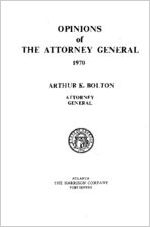
OPINIONS of
THE ATTORNEY GENERAL
1970
ARTHUR K. BOLTON
ATTORNEY GENERAL
ATLANTA THE HARRISON COMPANY
PUBLISHERS
TABLE OF CONTENTS OFFICIAL OPINIONS, 1970 ......................... .
POSITION PAPER RELATING TO THE GEORGIA COASTAL MARSHES ................... 279
PREFACE TO UNOFFICIAL OPINIONS .............. 281
DIGESTS OF UNOFFICIAL OPINIONS ............... 282
TABLE OF CONSTITUTIONAL PROVISIONS CITED ............................................ 361
TABLE OF GEORGIA LAWS CITED .................. 363
TABLE OF GEORGIA CODE ANNOTATED SECTIONS CITED . . . . . . . . . . . . . . . . . . . . . . . . . . . . . . . . . 383
INDEX .............................................. 405
ATTORNEYS GENERAL OF GEORGIA HENRY P. FARRER . . . . . . . . . . . . . . . . . . . . 1868-1872 N.J. HAMMOND . . . . . . . . . . . . . . . . . . . . . . 1872-1877
ROBERT N. ELY . . . . . . . . . . . . . . . . . . . . . 1877-1880
CLIFFORD L. ANDERSON . . . . . . . . . . . .
1880-1890
GEORGE N. LESTER . . . . . . . . . . . . . . . .
1890-1891
W. A. LITTLE . . . . . . . . .
1891-1892
1. M. TERRELL . . . . . . . .
1892-1902
BOYKIN WRIGHT ............ .
1902-1902
JOHN C. HART . . . . . . . . . .
1902-1910
HEWLETT A. HALL . . . .
1910-1911
THOMAS S. FELDER .. .
1911-1914
WARREN GRICE ......... .
1914-1915
CLIFFORD WALKER ...... .
1915-1920
R. A. DENNY . . . . . . GEORGE M. NAPIER . . . . . . LAWRENCE S. CAMP ... . M. 1. YEOMANS .. ELLIS G. ARNALL . GRADY HEAD ....... . EUGENE COOK .... . ARTHUR K. BOLTON ..
1920-1921 1921-1932 1932-1932 1933-1939 1939-1943 1943-1945 1945-1965 1965-
lll
ARTHUR K. BOLTON The Attorney General
" LEGAL STAFF OF DEPARTMENT OF LAW DURING
CALENDAR YEAR 1970
NAME
Bolton, Arthur K. Hill, Harold N., Jr. Beasley, Dorothy T. Bomar, Robert S. Brown, William B. Castellani, Robert J. Chambers, Richard L. Childers, William R., Jr. Coleman, J. Robert Crumbley, R. Alex, Jr. Davis, Wiley H. Evans, Alfred L., Jr. Evans, Larry H. Gordon, Marion 0. Harper, William L. Hinchey, John W. Jones, Carl C., III King, David L. G., Jr. Mallard, Wade V., Jr. McDonald, Louis F. Merrill, Charles B., Jr. Michael, H. Perry Napier, Elaine Nardone, A. Joseph, Jr. Odom, Donn L. Perry, James Lee Reeves, Robert S. Robins, Mathew Ruskaup, Larry D. Shell, Robert H. Sligh, John A., Jr. Stanton, Courtney Wilder Stokes, Arch Y. Sweeney, Timothy J. Talley, James B. Tripp, David A. Walden, John C.
TITLE
Attorney General Executive Assistant Attorney General Assistant Attorney General Assistant Attorney General Assistant Attorney General Assistant Attorney General Assistant Attorney General Assistant Attorney General Assistant Attorney General Assistant Attorney General Assistant Attorney General Assistant Attorney General Assistant Attorney General Assistant Attorney General Assistant Attorney General Assistant Attorney General Deputy Assistant Attorney General Deputy Assistant Attorney General Assistant Attorney General Assistant Attorney General Assistant Attorney General Assistant Attorney General Deputy Assistant Attorney General Assistant Attorney General Assistant Attorney General Assistant Attorney General Deputy Assistant Attorney General Assistant Attorney General Assistant Attorney General Assistant Attorney General Assistant Attorney General Assistant Attorney General Deputy Assistant Attorney General Assistant Attorney General Assistant Attorney General Deputy Assistant Attorney General Assistant Attorney General
v
FOREWORD It is the duty of the Attorney General, when required to do so by the Governor, to give his opinion in writing on any question oflaw connected with the interest of the State or with the duties of any of its departments. Ga. Code Ann. 40-1602 Par.l. To avoid requiring the Governor to endorse requests for opinions originating with the departments of the State, the Attorney General receives such requests directly from the department heads. Opinions rendered to the Governor and to the heads of departments are classified as "official opinions." In addition to "official opinions," the office of the Attorney General renders "unofficial opinions" to other state officers (e.g. legislators, district attorneys) and to county and municipal attorneys on questions involving the general laws of the State. Each "unofficial opinion" bears the following notation: "The views expressed herein are the completely unofficial views of the writer only, and should be considered as information only." In the interest of economy and in order to avoid confusion, the "Unofficial Opinions" have been digested and separated from the "Official Opinions." These digested opinions follow the "Official Opinions" herein, and are preceded by a Preface to Unofficial Opinions, more fully explaining the treatment of such opinions. The "Official Opinions" are serially numbered "70-1," "70-2," etc. The "Unofficial Opinion" numbers are preceded by the letter "U," Thus, "U70-1," "U70-2," etc., refer to "Unofficial Opinions."
Vl
OFFICIAL OPINIONS of
THE ATTORNEY GENERAL 1970
OPINION 70-1
To: Director, Georgia Department of Public Health
January 2, 1970
Re: Vital records; newspaper representatives should be allowed access to the Health Department's vital records files.
Please refer to your letter of December 4, 1969, wherein you request my official opinion as to whether the Georgia Department of Public Health should allow newspaper representatives access to the Department's vital records files, and, if so, whether a charge could be imposed to cover Departmental costs.
As you are probably aware, Ga. Code 88-1723, officially Codified from Ga. Laws 1964, pp. 499, 594, as amended, makes it " . . . unlawful for any person to permit inspection of, or disclose information contained in vital records, or to copy or issue a copy of all or part of any such record except as authorized by regulation or when so ordered by a superior court. ..." Ga. Code 88-1723(d) adds the proviso that " . . . the restrictions in this section shall not prohibit the official organ or newspaper of a county from publishing the names and addresses of births and deaths. . . ." While the above provisions seem to be clear in their intent, this office, after extensive research, questions the constitutionality of this Code Section.
Firstly, the Courts, if faced with this question, might well hold that to deny inspection of vital records to everyone except the official organ or newspaper of a county amounts to an arbitrary and unreasonable legislative classification. In the case of The Ledger-Enquirer Company v. Brown, 213 Ga. 538 (1957), an attack was made upon the constitutionality of an act making any corporation engaged in publishing newspapers, magazines or periodicals having circulation in more than one county in this State subject to suit in any county where that newspaper or publication was delivered regularly to fifty or more subscribers, in any action for damages arising in such county. The court in its decision noted that the legislature may, for purposes of legislation, classify and may legislate with respect to each classification. It noted, however, that the classification must be natural, reasonably related to the subject matter of the legislation, and must furnish some legitimate ground of differentiation. Applying these guidelines, the court held that there was obviously no reasonable basis for the classification there made and the act was therefore violative of Art. I, Sec. I, Par. II of the Constitution of Georgia, in that it denied the plaintiff the impartial and complete protection of the law. There have been numerous other cases in which the Georgia Supreme Court has declared unconstitutional
2
arbitrary and unreasonable legislative classifications. See Jenkins v. Manry, et a/., 216 Ga. 538 (1961); McAllister v. State, 220 Ga. 570 (1965); Hughes v. Reynolds, 223 Ga. 727 (1967).
Not only is Code Section 88-1723(d) subject to attack as being an arbitrary and unreasonable classification of newspapers, there is a distinct possibility that the entire Section constitutes an abridgment of freedom of speech and press. In the case of Providence Journal Co. v. McCoy, 94 F. Supp. 186 (1950), an ordinance was passed by a city council prohibiting any person from examining city records pertaining to tax cancellations or abatements without the city's express permission. A subsequent resolution, however, allowed one of the local newspapers access to such records. The court held that this action constituted a denial of equal protection and an abridgment of freedom of speech and press. As in the above cited Georgia cases, the court found no reasonable basis for restricting such examination and publication, and felt that the attempt to prohibit publication, especially where another competing newspaper was not prohibited, was unconstitutional and void.
Therefore, based upon the above decisions, it is my official opinion that access to the Department's vital records files should not be denied to newspaper representatives. To avoid administrative complications, however, it appears that either a regulation or policy statement should be formulated by the Department to provide for supervised inspections or publication of monthly listings of births and deaths in this State.
Turning now to your second question, it is my official opinion that the Department may prescribe fees to cover the cost of supervising such inspections or furnishing such lists. Ga. Code 88-1725 provides that "The Department shall prescribe the fees to be paid for copies and searches of certificates or records and for certified copies of certificates or records . . . ." Furthermore, Ga. Code Ann. 40-2702 provides for the charging of fees for the services of the Deputy who supervises the inspection of public records.
OPINION 70-2
To: Joint Secretary, State Examining Boards
January 2, 1970
Re: Realtor's contracts; reference in contract to real estate board where realtor is not member of such board.
This will acknowledge the recent inquiry from your office wherein a letter from a Macon realtor sought an explanation as to whether or not Rule 520-3-.08 of the Georgia Real Estate Commission precluded the use of the words "Macon Real Estate Board" in his sales contract form
3
where the realtor is not a member of the Macon Real Estate Board and where the reference to the Macon Real Estate Board is only to show that commissions will be paid pursuant to a schedule adopted by the Macon Real Estate Board.
Notwithstanding the fact that the realtor is in his first year of business and is thus in a "probationary" year insofar as membership on the Macon Real Estate Board is concerned, he is nevertheless still a licensed real estate broker or salesman and is, thus, bound to adhere to the laws of this state and to the rules and regulations of the Georgia Real Estate Commission.
However, the words, "Macon Real Estate Board," as the realtor uses them in his sales contract, in my opinion, do not intimate to the general public that the use of the phrase was to convey that the realtor was a member of the Macon Real Estate Board. Rather, the realtor appears to use the phrase only to show that commissions will be paid pursuant to a schedule adopted by another group, i.e., the Macon Real Estate Board.
Accordingly it is my official opinion that the realtor may use the phrase "Macon Real Estate Board" as he now uses it as the phrase does not purport to state that he is, in fact, a member of the Macon Real Estate Board.
OPINION 70-3
To: Director, State Highway Department
January 6, 1970
Re: Highways; exercise by railroad of rights under agreements with utilities as prerequisite to payment to railroad by State Highway Department.
This is in reply to a request from Mr. Roscoe C. Tate, State Highway Utilities Engineer, for a legal opinion as to the Highway Department's obligation to reimburse Seaboard Coast Line Railroad Company for work done on a construction project.
The Highway Department entered into a force account agreement with Atlantic Coast Line Railroad Company on Project SG-2120(1), Columbia County, covering the cost of a new railn>ad highway overhead bridge whereby a grade crossing was eliminated. The agreement covered estimated charges for handling wire line changes by railroad forces, consisting of roadways, labor, assisting Western Union, and communication expenses, consisting of materials, labor, engineering, and contingencies.
A controversy arose relative to reimbursement for work to be performed by Western Union in connection with the proposed construction. Western Union billed the Department for work done by
4
their forces ($4, 165.00), but payment was denied pursuant to an official opinion of the Attorney General dated January 16, 1962 [Op. Atty. Gen. 1962, p. 282]. By letter dated January 20, 1969, the Railroad requested payment for their bill submitted May 22, 1967 ($774.85), with the explanation that the billing covered expenses incurred by Western Union on this project and billed to the Railroad. Under these conditions, Mr. Tate asked whether it is legal for the Highway Department to reimburse Seaboard Coast Line Railroad Company for the bill submitted May 22, 1967. It appears that Western Union did the relocation work for itself and for the Railroad.
Since the force account agreement was executed, the Atlantic Coast Line Railroad Company and Seaboard Air Line Railroad Company have merged under the name of Seaboard Coast Line Railroad Company. Paragraph 10 of the force account agreement provides, in essence, that the agreement shall be binding upon the successors and assigns of the parties thereto. Therefore, Seaboard Coast Line Railroad Company would be considered as a valid party to the original agreement, and would be bound by all the covenants and conditions contained therein.
The original agreement between the Department and the Railroad provides in part:
". . . in the event it shall be necessary in connection with or incident to the work of constructing said bridge structure and approaches thereto, to make any changes in, or to remove or relocate any wire lines, pipelines, poles or other supports therefor, such changes in or removal or relocation of said facilities shall be handled by the Department directly with the owner or owners thereof and the cost of such changes will be included in the total cost of the project as provided in said preliminary estimate."
The subject of the agreement pertains to the elimination of a grade crossing with 10 per cent of the cost being borne by the Railroad and 90 per cent by the Federal Government. The preliminary estimate, which is attached to and made a part of the original agreement, contains certain charges for wire line changes by railroad forces assisting Western Union. A report by the auditing section of the Highway Department reveals that such communication lines were owned by the Railroad and were, by joint use agreement, installed on poles owned by Western Union. The bill dated May 22, 1967, includes only costs connected with relocation of the lines, and does not include any costs for pole relocation. The audit further revealed that the bill has been recorded and carried on the books of the Seaboard Coast Line Railroad Company as an account payable to Western Union.
5
Paragraph 5 of the original force account agreement provides, in part, that the bills for the relocation work done by the Railroad are ". . . to be prepared in accordance with the provisions of . . . PPM 30-3." This PPM specifies that the approval given by the Bureau of Public Roads of the agreement between the parties for the payment of the cost of adjusting the Railroad's own facilities is contingent upon the Railroad exercising its rights under its agreement with any utility occupying the right-of-way.
An agreement between Western Union Telegraph Company and Atlantic Coast Line Railroad dated July 1, 1932, covers the operations of Western Union on Railroad right-of-way, and sets forth the rights of the parties in detail. Paragraph 18 of the agreement provides:
"The Telegraph Company will also furnish at convenient points on the lines of railroad covered by this agreement, as and when necessary, all poles, telegraph crossarms, telegraph wire, insulators, and other telegraph material, and the necessary foremen and skilled labor, for the maintenance, relocation, removal, and reconstruction of all the lines of poles, telegraph crossarms, telegraph wires, conduit lines, and telegraph cable conductors belonging to either party hereto, and covered by this agreement. The Railroad Companies will furnish unskilled labor as defined in paragraphs 24 and 25 for said maintenance, relocation, removal, and reconstruction."
Therefore, if the wires and material included in the bill from Seaboard Coast Line Railroad apply only to telegraph crossarms, wires, etc., then the Highway Department should only reimburse the Railroad for the unskilled labor used in the relocation work. However, construing the remaining provisions of the agreement, if the wires and material used apply to wires other than strictly telegraph wires, it is my official opinion that the Highway Department should reimburse the Railroad for the entire amount of the bill submitted May 22, 1967 ($774.85).
After reaching the foregoing conclusion, we contacted Mr. Tate and he in turn contacted the Railroad. By letter dated December 29, 1969, the Railroad's attorney, Mr. Schlesinger, has stated in part as follows:
"The communication work covered by the bill in question actually was incurred through a subsequent agreement or understanding whereby Western Union prepared a cost estimate for relocating both its and the Railroad's facilities on this project. The pro rata share of relocating the Railroad's four telephone lines and proportionate share of cross-arms is all that this bill represents.
6
The bill in no way represents any expense incurred by Western Union in removing its own facilities.
* * * * *
"In other words, in my judgment, since were were entitled to reimbursement for relocating our facilities, this reimbursement should not be denied merely because we contracted with Western Union for them to perform our communication relocation in addition to theirs."
If your audit confirms that the $774.85 expense was incurred for the relocation of Railroad property (as opposed to Western Union property) then payment would be in order.
OPINION 70-4
To: Director, State Highway Department
January 7, 1970
Re: Highway contracts; independent contractor may not take advantage of any apparent error or omission in plans or specifications.
This is in reply to a recent letter from Mr. C. H. Breedlove, State Highway Construction Engineer, requesting an opinion on whether an independent contractor has, by apparently taking advantage of an error or omission, violated Articles 2.08(C) and 5.05(A) of the State Highway Department of Georgia Standard Specifications. Further if a violation has occurred, does the Highway Department have the right to obtain from the contractor an adjustment in price for the quantity involved in the violation.
The letter of Mr. Breedlove reveals that the State Highway Department of Georgia awarded a contract to perform certain highway construction work. Before any work had been performed or any work order issued, it was discovered that only thirty-five per cent (35%) of a bid item quantity was included in the proposal submitted to the Department by the prime contractor. An examination of the bids received for the particular project involved, as well as all other projects involved in the particular letting, revealed that in all probability the first three bidders on this particular project had detected the error and had at least doubled the normal bid price for the bid item in question. The other two bidders on this project reflected a bid price that was below the average bid on the remaining projects, which in most instances was for a lesser quantity. The item in question, Item 312-Bituminous Prime, did
7
not contain Item 216-Graded Aggregate Cement Stabilized Subbase Course, which is normally paid for on a square yard basis. This was an omission in the quantity of prime provided for bid purposes. Normally, all bituminous prime used on the project is lumped into one item of 312-Bituminous Prime, regardless of its use.
Mr. Breedlove requests an opinion on whether the Highway Department may:
"I. After the award of the contract and issuance of the work order, request from the Prime Contractor a supplemental agreement to reduce the price of the omitted portion of the item to a price that would be in line with the current prices being bid.
"2. If not able to enforce (l) on the Contractor, then provide another pay item to be identified by a name other than Bituminous Prime and used only for curing of Graded Aggregate Cement Stabilized Subbase Course.
"3. If no agreement can be reached by (I) or (2), instruct the Prime Contractor to perform this work by Force Account Agreement."
The particular contract in question was let under the 1966 Standard Specifications of the State Highway Department of Georgia, and, therefore, references to articles of the Standard Specifications in this opinion will refer to the 1966 set of Standard Specifications. Article 2.08(C) concerns the rejection of proposals, if the contractor submits a bid with unit prices which are obviously unbalanced. Considering the facts presented in the letter of Mr. Breedlove, it is apparent that this particular article would not apply to the situation at hand. It deals with the rejection of proposals and would not apply to a contract, such as the instant one, which has been awarded and properly executed by both the Highway Department and the contractor. Therefore, the contractor has not violated Article 2.08(C) of the Standard Specifications.
Article 5.05(A) provides as follows:
"A. Errors and Omissions: The Contractor shall take no advantage of any apparent error or omission in the plans or specifications; but if such error or omission does occur, the Engineer shall have the authority to make corrections and interpretations deemed necessary to fulfill the intent of the plans and specifications; nor shall such corrections or interpretations, if any, be construed as a waiver of any Contract provision."
In writing this opinion, this office makes no determination as to whether or not the contractor has taken advantage of an obvious error or
8
omission in the Plans and Specifications. The State Highway Engineer, pursuant to Article 5.01(A) is apparently the person to make this determination. Article 5.01(A) provides, in part, that:
"His [the State Highway Engineer's] decision shall be final on all questions related to the interpretation of the Specifications and the Plans and as to the acceptable fulfillment of the Contract by the Contractor." (Matter in brackets added.)
Therefore, it appears that the decision of the State Highway Engineer on all questions relating to the interpretation of the Plans and Specifications would be final. An exception to this construction is where, in a contract between a contractor and the State Highway Department, it is stipulated that a decision of the State Highway Engineer, upon any question connected with the execution of the contract should be final and conclusive, his decision upon any such question should be held binding upon the parties, in the absence of fraud, or such gross mistake as would necessarily imply bad faith, or a failure to exercise an honest judgment. State Highway Dep't v. MacDougald Construction Co., 189 Ga. 490 (1939).
Therefore, it is my opinion that if the State Highway Engineer makes a decision, not tainted by fraud or gross mistake as outlined in the McDougald case, that there was an apparent error or omission which was taken advantage of by the contractor in this instance, then the Standard Specifications would allow the State Highway Department to follow any one of the three methods mentioned in Mr. Breedlove's letter to correct and fulfill the intent of the Plans and Specifications. Article 4.03 provides for a supplemental agreement which is acceptable to both parties; provides for authority to make increases, decreases, or alterations in the contract; and, allows the engineer, in the absence of a supplemental agreement acceptable to both parties, to direct that the work be done by force account.
OPINION 70-5
To: Director, Georgia Forestry Commission
January 7, 1970
Re: Forest fire protection; participation by State in mutual aid programs.
This responds to your request for an opinion regarding the authority of the State, as a signatory of the Southeastern Forest Fire Protection Compact, to participate in a mutual aid program between that
9
organization and the Middle Atlantic States Forest Fire Protection Compact Commission.
Please be advised that the Regional Forest Fire Protection Compact Act, Ga. Code Ann. Ch. 43-9 (Ga. Laws 1953, Nov.-Dec. Sess., p. 49), proposes "mutual aid in fighting forest fires among the compacting States of the region and with States which are party to other regional forest fire protection compacts or agreements . . . ." Ga. Code Ann. 43-902. All State officers, bureaus and departments are specifically empowered to perform those functions necessary or incidental to the conduct of mutual aid programs undertaken pursuant to such agreements. See Ga. Code Ann. 43-913.
Based on the foregoing, it is my opinion that the State may participate in a mutual aid program as outlined above.
OPINION 70-6
To: Director, Georgia Natural Areas Council
January 9, 1970
Re: State property; effect of acquisition of land by Georgia Natural Areas Council.
This is in response to your letter of recent date wherein you ask whether there are any circumstances under which the Georgia Natural Areas Council can hold the title to land in Georgia.
The Georgia Natural Areas Cou cil (formerly the State Council for the Preservation of Natural Areas) was created by Ga. laws 1966, p. 330; (Ga. Code Ann. Ch. 43-12.) The duties, powers and authority given to the Council at its inception do not appear to create in the Council the ability to own land. Neither does the 1969 Amendment (Ga. Laws 1969, p. 750), which changed the Council's name and gave it certain additional powers, purport to allow the Council to hold real property titles. As you are probably aware, a state agency, board, bureau, etc., has only such powers as are expressly or by necessary implication conferred upon it by the legislature. See Bentley v. State Board of Medical Examiners of Georgia, 152 Ga. 836 (1921).
Another 1969 Act of the Georgia General Assembly, the Georgia Scenic Rivers Act of 1969, Ga. Laws 1969, p. 933 (Ga. Code Ann. Ch. 17-9), deserves mention at this point. This Act provides in Section 4 that the Council shall "recommend to the Governor and General Assembly rivers or sections of rivers to be considered for designation as Scenic Rivers"; then continues, specifying the necessary elements to be included in a special report of the Council which must accompany each Scenic River recommendation to the General Assembly and Governor.
10
However, the focal point of this opinion is provided by Section 5 of the Act (Ga. Code Ann. 17-905), which contains the following introductory clause:
"After designation of any river or section of a river as a Scenic River by the General Assembly pursuant to section 3 hereof:"
(Section 3 provides for the designation of a Georgia Scenic River System).
It may be helpful at this juncture to break down Section 5(b) of the Act (Ga. Code Ann. 17-905(b) in endeavoring to determine what the General Assembly meant, remembering that to attempt to ascertain the true intention of the legislature in the passage of a law is the cardinal rule of statutory construction. (See Gazan v. Henry, 183 Ga. 30 (1936).) Thus, we have the following:
"(b) The Council may acquire by purchase, gift, grant, bequest, devise, lease or otherwise fee title or any lesser interest in the land ...."
Applying two additonal rules of statutory construction-(!) that the ordinary signification be applied to all words except in certain instances inapplicable here (see Ga. Code Ann. 102-102(1)); and (2) that all the words of a statute are to be given due weight and meaning (see Falligant v. Barrow, 133 Ga. 87 (1909))-it is apparent that this portion of Section 5(b) gives the Council the ability to acquire title to land.
". . . lying within the authorized boundary of such river or section of river hereafter so designated as a Scenic River . . . ."
Again applying the above-mentioned rules of statutory construction, it seems that the ability of the Council to acquire title to land is limited by: (1) area-land lying within a certain authorized boundary of the designated Scenic River; and (2) time-only after the river has been designated by the General Assembly as Scenic. Since there is no statutory definition of authorized boundary, I am assuming the legislature intends to specify the authorized boundaries of a Scenic River for purposes of acquisition of scenic easements and delineation of the area within which the Council may strive toward the ends of preservation and perpetuity envisioned by the Scenic Rivers Act for each Scenic River.
" . . Any interest in land acquired by the Council pursuant to this Section shall be transferred to such governmental agency as the General Assembly may by Act direct." (Emphasis added.)
11
Again, giving each word in the Statute its due weight and meaning and ascribing to it its ordinary signification, as required by law, it appears that although the Council may acquire the title to land, it may not retain it. Without deciding whether the Council is such an Agency as contemplated by this portion of the Act in its reference to "governmental agency," it is clear that the words "shall be transferred" would not allow property titles to remain in the Council but rather, indicate that the title to land should pass through the Council and to some other state agency designated by the General Assembly. The Council would be merely a conduit through which the title passed.
Therefore, it is my official opinion that the Georgia Natural Areas Council may acquire the title to land lying within the authorized boundaries of a river or section of river previously designated by the General Assembly as a Scenic River pursuant to Ga. Laws 1969, p. 933, but upon acquisition, the title must be transferred to another State agency designated by the General Assembly.
Of course, as you know, this law could be amended by the General Assembly so as to provide for the retention of title to property by the Council. If the Council is at present desirous of this ability, the Georgia General Assembly would be the proper authority to approach with this request.
Assuming the acquisition is authorized by the General Assembly it would, of course, be subject to the State Properties Acquisition Law and would have to be acquired through the State Properties Acquisition Commission. See e.g., Ga. Laws 1965, pp. 396, 398 (Ga. Code Ann. 36-l04a(c)).
OPINION 70-7
To: Executive Secretary, Regents of the University System of Georgia
January 12, 1970
Re: Drugs; Federal agency as dealer.
This is in response to your request for an opinion in which you ask whether a professor at the Pharmacy School at the University of Georgia may lawfully obtain narcotic drugs for research purposes from the National Institute of Mental Health.
This Department is informed that the professor in question has been designated by the Dean of the School of Pharmacy as the individual in charge of a particular laboratory at that school. This Department is further informed that the Georgia State Board of Pharmacy has approved the laboratory in question as a proper repository for narcotic drugs.
12
The matter of narcotic drugs is governed by Ga. Laws, 1967, p. 296, officially codified by the legislature as Ga. Code Title 79A. A drug wholesaler may lawfully sell narcotic drugs "to a person in charge of a laboratory, but only for use in that laboratory for scientific and medical purposes." Ga. Code Ann. 79A-806(1)(d). The term "laboratory" includes "a laboratory approved by the State Board of Pharmacy as proper to be entrusted with the custody of narcotic drugs and the use of narcotic drugs for scientific and medical purposes and for the purposes of instruction." Ga. Code Ann. 79A-802(9). The word "sale" encompasses "barter, exchange, or gift." Ga. Code Ann. 79A802(10).
The National Institute of Mental Health is a part of the Public Health Service. An examination of the relevant statutes reveals that the Surgeon General is authorized to make grants to individuals such as the professor who has been designated as the person in charge of the laboratory in question. Moreover, the Surgeon General is authorized to make research facilities of the Public Health Service available to individuals such as the professor whose conduct precipitated your inquiry. 42 U.S.C.A. 241, 242, 242(a). In distributing narcotic drugs in Georgia, the National Institute of Mental Health engages in that activity as a drug wholesaler, as the term "wholesaler" includes "a person who supplies narcotic drugs that he himself has not produced nor prepared". Ga. Code Ann. 79A-802(6). A drug wholesaler must be licensed by the Georgia State Board of Pharmacy prior to engaging in the business of selling drugs. Ga. Code Ann. 79A-804. The National Institute of Mental Health does not possess a wholesaler's license. Thus, you desire to know whether the professor may lawfully obtain narcotic drugs from the National Institute of Mental Health.
Federal statutes relating to the Public Health Service and to the Surgeon General appear to authorize the distribution of narcotic drugs for research purposes. The United States Department of Justice has represented to you, in a letter dated December 3, 1969, that the National Institute of Mental Health "is the federal entity entrusted with the responsibility of furnishing marihuana to qualified researchers." A state may not require an employee of the United States Government to obtain a license to engage in an activity which is embraced within the scope of his employment. Johnson v. Maryland, 254 U.S. 51,65 L.Ed 126 (1920). It appears that all of the requisites for the lawful possession of narcotic drugs by the professor involved in this matter have been met, with the exception of obtaining the same from a licensed wholesaler. It is my opinion that the State of Georgia may not require the National Institute of Mental Health to obtain a license from the Georgia State Board of Pharmacy prior to engaging in the business of a drug wholesaler in Georgia. Therefore, it is my opinion that the professor may obtain
13
narcotic drugs for research purposes from the National Institute of Mental Health, notwithstanding the fact that the Institute is unlicensed to engage in the business of a drug wholesaler in Georgia.
OPINION 70-8
To: Director, Georgia Science and Technology Commission
January 12, 1970
Re: State contracts in excess of one year not enforceable.
This is in reply to your request for my opinion as to the liability of the Georgia Science and Technology Commission for rent and penalty payments under a certain lease of office space.
I understand the factual situation to be as follows. Effective May 1, 1966, your predecessor in office enteied into a lease agreement for a term of one year pertaining to office space to be utilized by the Commission. Paragraph 32 of the lease agreement provided that the lessee should have an option for an additional term offour years at the same monthly rental rate, provided that the option was exercised in writing at least sixty days prior to the expiration of the original term. The lease provided that upon exercise of the option the lessee would have the right to terminate the lease at the end of any ensuing year by giving sixty days notice in writing and by paying a "termination rental payment," in addition to the regular rental payment, which "termination" payment was to be in a lesser amount at the end of each year the lease continued.
On January 13, 1967, the option was exercised by the Commission. Thereafter, the Commission remained in possession of the premises and paid all rent due until October 31, 1969, when the premises were vacated. On August 21, 1969, the lessor had been notified in writing that Stateowned office space had become available to the Commission, and the Commission was preparing to vacate the leased premises. I understand that you have now received a statement from the lessor for rent covering a period subsequent to your vacation of the premises, together with a demand for payment of the "penalty payment" provided in the lease.
In Op. Atty. Gen. 1963-1965, p. 221, my predecessor, Honorable Eugene Cook, held that the State could not enter into a contract for a term of years with a public utility for the furnishing of micro-wave service. The contract concerned in that opinion also contained a reducing termination clause whereby in the event that the contract should be terminated prior to its expiration date, the State would be required to pay an amount which was to be determined by the number of years unfulfilled on the contract.
14
It was held in the opinion that the contract would constitute a debt of the State and would be void as being violative of Art. VII, Sec. Ill, Par. I of the Constitution of the State of Georgia (Ga. Code Ann. 2-5601 ), which declares all the purposes for which debts may be assumed by or on behalf of the State and prohibits the State from assuming any other debts.
It is my opinion that the four-year lease purportedly created by the exercise of the option in the present matter is also in excess of the debt authority under the Constitution and is therefore void. Thus, no liability on the part of the Commission could arise under the terms of the lease agreement itself. Following the expiration of the original one-year term the relationship between the Commission and the lessor became that of a tenancy at will. Appropriate notice of termination was given by the Commission, and all rent due for the actual period of occupancy has been paid.
The "termination rental payment" provided for in the lease was clearly not intended to constitute any portion of the rental rate, since upon expiration of the stated lease term no "termination rental payment" would have been due. This "termination" payment was actually in the nature of a penalty or liquidated damages specified in the event of premature termination of the agreement. But since the lease agreement was of no force or effect, the penalty provision is also unenforceable.
Therefore, it is my official opinion that the Commission is not liable for, and is not authorized to pay, the lessor's claim for the "termination rental payment" or for rental charges claimed to have accrued after October 31, 1969.
OPINION 70-9
To: Commissioner of Agriculture, State of Georgia
January 12, 1970
Re: Agricultural commodity commissions; election of officers as matter "pertaining to organization."
This is in reply to your letter dated December 19, 1969, in which you requested my official opinion as to the construction of Section lO(h) of the Georgia Agricultural Commodities Promotion Act (Ga. Laws 1969, p. 763 with regard to the authority of the Attorney General and the State Auditor to vote upon the election of officers.
The section in question, Ga. Code Ann. 5-2909(h), provides as follows:
"The Attorney General and the State Auditor as ex officio
15
members of each commission shall be entitled to vote on matters pertaining to the organization of each such commission and upon the selection and nomination of the appointive members of each commission. The two such ex officio members shall not be entitled to vote upon any matter pertaining to the policy provisions of the agricultural commodity nor shall they be entitled to vote upon the expenditure of any funds of the commission." (Emphasis added.)
In the construction of statutes the ordinary signification shall be applied to all words, except words of art, or words connected with a -particular trade or subject matter, when they shall have the signification attached to them by experts in such trade, or with reference to such subject matter. Ga. Code Ann. 102-102(1).
The word "organization" is not defined in the Act, nor do Ifind it to be a word of art or one connected with a particular trade or subject matter. Therefore, the ordinary signification of the word must be applied within the context of the Act.
Although the words "organize" and "organization" when used in reference to corporations generally have reference to the steps required to legally create such corporations, I do not believe that meaning is applicable within the context of the Act in question. In statutory construction it is necessary to look diligently for the intent of the General Assembly. I find that in the title of he Act, and again in Section 8 of said Act, Ga. Laws 1969, pp. 763, 769, the words "establishment" and "established" are employed with reference to the initial creation of Commodity Commissions.
The word "organization" is not employed in the Act with reference to the creation of commodity commissions, but is used in Section 10(h) of the Act to designate one area of voting authority possessed by the Attorney General and the State Auditor as ex officio members of each commission. In contradistinction to this grant of authority, the section specifically provides that these ex officio members shall not be entitled to vote upon matters pertaining to the policy provisions of the agricultural commodity nor shall they be entitled to vote upon the expenditure of any funds of such commission. Taken as a whole, the section clearly contemplates continuing voting authority and participation by these ex officio members during the life of each commission, but within a limited area.
The word "organization" is defined, inter alia, by Webster's New International Dictionary, Second Edition, as:
"State or manner of being organized; organic structure; purposive systematic arrangement; constitution.
* * *
"The executive structure of a business; the personnel of
16
management, with its several duties and places in administration; the various persons who conduct a business, considered as a unit."
I believe the above definition to be applicable to the word "organization" as used in the Act. I conclude that the intent of the limitation provided in Section lO(h) of the Act upon the voting authority of the Attorney General and the State Auditor was to insure that decisions as to policy concerning the affected commodity, and the expenditure of funds to implement such policy, would be determined by the vote of those members of the commission whose training and experience furnish them with a special expertise in that area. Matters pertaining to the executive structure of such commissions are not such as require special expertise concerning the affected commodity and are within the scope of "organization" of such commissions.
It is my official opinion that the election of officers is a matter "pertaining to the organization" of commodity commissions within the meaning of Section lO(h) of the Agricultural Commodities Promotion Act, and that the Attorney General and the State Auditor, as ex officio members of such commissions, are entitled to vote therein.
OPINION 70-10
To: Director, State Highway Department
January 13, 1970
Re: State publications; second class mailing privileges.
This is in reply to a letter of recent date from Mr. Emory C. Parrish, Executive Assistant Director of the State Highway Department, requesting my opinion on whether The Survey, the official monthly publication of the State Highway Department, is entitled to second class mailing privileges. As I understand the factual situation involved, The Survey is published monthly by the State Highway Department for distribution to its employees, certain State Officials and other members of the general public. There is no list of subscribers to this publication as such; and it is sent free of cost to certain persons designated to receive it. Under these circumstances, it is my opinion that this publication would not be entitled to second class mailing privileges.
Chapter 63 of Title 39, U .S.C.A., is the legislative enactment of what constitutes second class mail. Specifically, Section 4354 of Title 39, U.S.C.A., provides that a mailable periodical publication is entitled to be entered and mailed as second class mail if it, among other things, has
17
a legitimate list of subscribers. This phrase was construed in Myrick vs. United States, 319 F. 1, 4 (1st Cir. 1915), as follows:
"The phrase 'a legitimate list of subscribers' evidently means a list of subscriptions taken at more than a nominal price, and the price must have been paid, or the subscriber, or someone in his behalf, be under obligation to pay the agreed price; and that subscriptions taken at a nominal price, or without price, do not answer the requirements of the statute in this particular and cannot be counted in making up a legitimate list."
Furthermore, 39 U.S.C.A. Section 4354(c) further provides that:
"A periodical publication designed primarily for advertising purposes or for free circulation or for circulation at nominal rates is not entitled to be admitted as second class mail under this section."
This provision would seem to be conclusive upon your publication since there is no charge to the recipient of The Survey.
In reviewing the further provisions of Chapter 63 of Title 39, U.S.C.A., I find no statutory provision that would allow your publication to be entitled to the second class mailing privileges.
Please bear in mind that this opinion is rendered on the basis of the factual circumstances surrounding the publication of The Survey and it is to be strictly limited to this publication only. This opinion in no way reflects upon any other publication of the State Highway Department or of any other State agency.
OPINION 70-ll
To: Director, Merit System of Personnel Administration
January 19, 1970
Re: State employees; annual and sick leave.
This will acknowledge and thank you for your letter of recent date with which you enclosed memorandums #34 and #42 of the State Merit System, with a request that this office determine whether or not they are in conflict.
After careful examination of these memorandums, it is my belief that they are not conflicting. Memorandum #34 refers to an unofficial
18
opinion of Attorney General Eugene Cook rendered in 1964 which advises that:
" . . . a holiday established by statute should be recognized and not charged against annual leave even though the same is not proclaimed by the Governor, nor observed by the employees of the State at the request of the Governor while the General Assembly is in session."
Memorandum # 42 refers to my official opinion to you of May, 1969, stating, in essence:
". . . that a salaried employee of the State of Georgia, classified under the State Merit System, who has worked during a legal and public holiday and is separated or resigns before the Executive authorizes a compensatory nonwork day, is not entitled to an extra day's pay."
At first glance it would appear that the before-quoted portions of these two opinions may be at variance. It seems so because in one case a State employee appears to be "penalized" by working as directed on a statutorily designated but unproclaimed holiday (Memorandum #42) while in the other case (Memorandum #34) the employee ostensibly receives "credit" for the statutorily designated btit officially unproclaimed and unobserved holiday because it is not charged against him in the computation of his annual leave upon the termination of his employment. However, I do not feel there is any real conflict between the two.
The laws of Georgia designating public and legal holidays are contained in Ga. Laws 1943, pp. 331, 332; Ga. Laws 1945, pp. 123, 124; Ga. Laws 1968, p. 986. (See also Ga. Code Ann. 14-1809). While these statutes specify the legal and public holidays for the State of Georgia, I know of no authority providing that they must be followed and actually observed. With this in mind, it would be in order to turn to the rule in Paragraph B.206, Rules and Regulations of the State Personnel Board, the pertinent part of which states:
"Employees are charged with annual leave for absence only on days upon which they would otherwise work and receive pay. No charge is made against annual leave for absences on Sunday, Holidays, and non-work days established by State statute or by executive order or administrative order . . . . " (The rule in Paragraph B.308 is exactly the same as above except that the word "sick" is found in place of "annual" before the word "leave".)
19
Herein lies what I sense is the crux of our problem-the second sentence of these rules has generated the present slightly misleading aspects of the referenced memorandums when jointly considered. If one carried the second sentence of either to its logical, literal conclusion, it would appear to say that a state employee who chose to stay away from work or was sick on a statutorily designated holiday, upon which state employees were asked to work by the Governor, could not have this day charged against his annual or sick leave. Additionally, I am informed that certain state employees regularly work on Sunday with their "weekend" being composed of days ordinarily considered week days-e.g., Monday-Tuesday or Thursday- Friday. According to the considered portions of Rules B.206 and B.308, if one of these employees missed a Sunday (one of his regular work days), it could not be charted against his leave. I feel I can speak with accuracy in saying that neither of the foregoing hypotheticals was intended by the Board when it promulgated these Rules.
Therefore, to avoid confusion in these areas, it is my suggestion that the State Personnel Board drop this second sentence from Rule B.206 and Rule B.308 and allow the first portion of each to read as follows:
"Employees are charged with annual (or sick) leave for absence only on days upon which they would otherwise work and receive pay . . . ."
This would, I think, facilitate administration of this Rule and leave the charging of annual and sick leave to administrative decision and discretion bounded by a very simple yet adequate rule.
Therefore, it is my official opinion that while the subject memorandums are not conflicting, for the sake of clarity it would be advisable for your to offer to the State Personnel Board a change in Rules B.206 and B.308 deleting the second sentence in both.
OPINION 70-12
To: Commissioner of Labor
January 19, 1970
Re: Right-to-Work Law: The Georgia Right-to-Work Law does not protect employees covered by the federal Railway Labor Act.
You have forwarded with your request for my opinion a communication from employees of the Louisville & Nashville Railroad. Based on this correspondence and the document attached thereto it is my understanding that the Railroad entered into a collective-bargaining agreement with the Transportation-Communication Employees Union,
20
the first section of which sets forth a traditional union-shop provision. The employees have inquired of you, and you of me, whether such a provision is enforceable in the State of Georgia in light of Ga. Laws 1947, pp. 616-19 (Ga. Code Ann. 54-901 to 54-908).
The Railroad in question is a carrier as the same is defined by section 1 of the Railway Labor Act, 45 U.S.C. 151 (1965 Ed.). See Nashville, C. & St. L. Ry. v. Railway Employees' Dep't. AFL, 93 F.2d 340 (6th Cir. 1938), cert. denied 303 U.S. 649 (1939). In 1951 the Railway Labor Act was amended to incorporate what is presently codified as 45 U.S.C. 152, Eleventh (1965 Ed.). The effect of that amendment was to authorize union-shop agreements notwithstanding any State right-towork law. California v. Taylor, 353 U.S. 553 (1957). It is therefore my opinion that the union-shop agreement between the Railroad and the Union is enforceable within the State of Georgia.
OPINION 70-13
To: Director, State Board of Corrections
January 23, 1970
Re: Extradition; duty of demanding state to pay expenses.
By letter you advise me that you caused to be apprehended in the State of Florida an escaped fugitive from the Laurens County Public Works Camp. You further advise that this apprehension took place on August 26, 1969. While in the custody of the Florida officials and before extradition could be completed, the fugitive became ill and required hospitalization. When you realized the fugitive's severe medical involvement, your office decided against proceeding further with the extradition and an order for the release of the individual was sent to the Florida officials. In the interim, substantial expenses for physicians, hospitalization and special security guards were incurred. Prior to August 26, 1969, the Laurens County Public Works Camp had been disestablished.
You inquire as to whether it is the responsibility of the State Board of Corrections to pay the various expenses incurred by the Florida officials as a result of the fugitive's hospitalization. As you are aware, the interstate rendition of fugitives is largely a matter of federal law. North Carolina v. Bailey, 289 U.S. 412 (1943); Kuney v. State, (Fla.) 102 So. 547 (1924); Loper v. Dees, (Miss.) 49 So.2d 718 (1951). The federal constitutional provision compelling the interstate rendition of fugitives is enforced by 28 U.S.C. 3182, 18 U.S.C.A. 3182 (1969 Rev.). The appropriate demainding authority is by that section defined as "the executive authority of any State . . . ." and related, connected sections of federal statute provide that "all costs or expenses incurred in any
21
extradition proceeding in apprehending, securing, and transmitting a fugitive shall be paid by the demanding authority."
It is my opinion that the expenses involved and incurred by the subdivvision of the State of Florida were expenses attending the arrest anq delivery of the fugitive and are therefore payable by the demanding authority, i.e., the executive authority of this State.
As noted above, the fugitive in question was an escapee from a county work camp. The law of this State provides that:
"It shall be the responsibility of the governmental unit, subdivision or agency having the physical custody of a prisoner to maintain such prisoner, furnish him food, clothing, and any needed medical and hospital attention therefore, . . . and bearing all expenses relative to any escape and rec,apture, including the expenses of extradition." (Ga. Laws 1956, pp. 161, 171, Ga. Code Ann. 77309(e).
It is therefore my opinion that the ultimate responsibility for bearing the expenses incurred in the asylum state attending upon the arrest and delivery of the escaped fugitive rests with Laurens County. At the same time, the federal law makes no provision for treating a political subdivision of a State as a "demanding authority." Therefore, as a matter of controlling federal law, it is my opinion that there is an initial responsibility for the payment of the expenses incurred by the Florida subdivision on the executive authority of this State. Since your Department was the agency within the executive authority of this State initiating the extradition proceedings, it is my opinion that the expenses incurred are properly a charge against the State Board of Corrections. At the same time, it is my opinion tl:fat the Board is under an obligation to secure the indemnification of the funds which it was obligated to expend relative to the escape of a prisoner from the county having physical custody of the prisoner at the time of the escape. This, however, is an intrastate matter which does not affect the obligation of this State's executive authority to defray the political subdivision of the State of Florida for the expenses which were incurred by it attending upon the arrest and delivery of the escaped fugitive.
OPINION 70-14
To: Director, State Highway Department of Georgia
January 27, 1970
Re: Express dedication; effect of exception in deed.
This is in reply to your request by the letter of Mr. J. E. Brown, Right
22
of Way Engineer, for my official opinion on whether there has been an express dedication of an additional 25 feet to the Highway Department when a landowner excepts 75 feet for the existing right-of-way in his later deed of conveyance and prior to this conveyance the State Highway Department had owned only 50 feet for right-of-way purposes.
It is my official opinion that the extra 25 feet become the property of the State Highway Department by express dedication.
The factual situation out of which this question arose is as follows. In 1937, the State Highway Department obtained certain right-of-way deeds from owners of land bordering a road in a metropolitan county. Each of these right-of-way deeds conveyed to the State 100 feet of rightof-way measuring 50 feet on each side of the survey center line. Also, there was provided in each of these deeds a conveyance of an additional 25 feet on each side, totalling 50 feet, in the form of an easement for the purpose of landscaping, sloping, grading, smoothing, sodding and planting. Said easement contained the right to maintain, re-plant, rearrange and keep up such improvements. Thus, in essence the State Highway Department was granted a total of 150 feet to use for various purposes. Subsequent to these deeds, the original grantors conveyed away their property and either by an express provision in the chains of title there was excepted 150 feet for the right-of-way for the State Highway Department, or by a plat recorded as part of the chains of title, there was provided 150 feet for the right-of-way.
In order to more fully understand this situation, two of the separate chains of title will be traced in this opinion. The first deed was from A.M.S. to the State Highway Department, dated June 4, 1937, in which A.M.S. conveyed to the State Highway Department a 100 feet in width right-of-way in a certain described area. Also, the above-referred to 25 feet on each side were granted as an easement for the above-described purposes.
Subsequently, on December 12, 1941, A.M.S. conveyed the remainder of the land to W.M.S. with the following description:
"Commencing on the northwest side of the right of way of [name of street omitted] Drive at the northeast corner of the tract of land this day conveyed to his daughter, Mrs. M.S., and running thence in a northeasterly direction along the right of way of __ Drive 100 feet, thence running in a northwesterls direction. . . ."
On October 13, 1964, W.M.S. conveyed to L.E.B. and I.A.T. the same land with the description of this land as follows:
''Beginning at an iron pin found on the northwest side of [name of street omitted] Drive [the same having a right of way of 150 feet in
23
width] at a point located 664.4 feet northeasterly from a point where the northwest side of [the same street] intersects the northerly side of . . . ."
On June I, 1967, L.E.B. conveyed his interest in the above land to his co-tenant I.A.T., using the same description as used in the October 13, 1964 deed. On June 18, 1968, Mrs. I.A.T. conveyed to H.J.P. and S.E.S. the same land, using the same description as used in the deed dated October 13, 1964. On June 18, 1968, H.J.P. and S.E.S. conveyed to B.C.S. Inc. the same land, using the same description as was used in the October 13, 1964 deed.
The above-traced chain of title is an abstract of that property which is designated in your right-of-way files as Parcel 96. The abstract and chain of title for the parcel designated in your files as Parcel 113 is as follows: On June 3, 1937, G.W.H. conveyed a strip of land 100 feet in width, measuring 50 feet on each side, to the State Highway Department for right-of-way purposes. Also, this deed provided for the additional 25 feet on either side as an easement for the above-described improvements.
On March 25, 1955, E.I.H. and S.H.J., as Executrices of the Will of G.W.H., conveyed to C.A.A., T.D.D. and W.O.D. the remainder of their father's land which property is described as running along the right-of-way of the above-referred to road which was constructed pursuant to the previous grant. Also, there is a plat referred to in this deed but this plat is unrecorded.
On August 29, 1956, C.A.A., T.D.D. and W.O.D. conveyed to G.O. Corp. the parcel of land in question. This deed refers for its description to a plat which is recorded in the land records of the county in question at Plat Book 25, page 124. This plat indicates that for this highway there is a right-of-way of 75 feet, measured from the survey center line.
"A dedication to public use is when one being the owner of land consents, either expressly or by his actions, that it may be used by the public for a particular purpose." 8 E.G.L., Dedication, 2, p. 450; see also, Hames v. City of Marietta, 212 Ga. 331 (1956)...A dedication to public use is, however, not complete until two things appear; that is., an intention on the part of the owner to dedicate his property to the public use, and an acceptance on the part of the public of the property for such use . . . ."Atlantic Coast Line R.R. Co. v. Sweatman, 81 Ga. App. 269, 273 (1950); see also, Mayor & Council of Madison v. Booth, 53 Ga. 609 (1875); Parsons v. Trustees, 44 Ga. 529 (1871); Georgia R.R. & Banking Co. v. City ofAtlanta, 118 Ga. 486 (1903).
A dedication of land is either express or implied. See Harris v. Powell, 177 Ga. 15 (1933); Lowry v. Rosenfeld, 213 Ga. 60 (1957)...... There is no partiCular form of making a dedication. It may be done in writing, or by parol; or it may be inferred from acts, or implied in certain cases,
24
from long usage. A grant is not necessary to create it . . . ." See 8 E.G.L., Dedication, 8, p. 455; see also, Haslerig v. Watson, 205 Ga. 668, 679 (1949); Chatham Motorcycle Club v. Blount, 214 Ga. 770 (1959).
A succinct definition of express dedication is found in 26 C.J.S., Dedication, 14, which provides:
"A dedication is expressed where there is an express manifestation on the part of the owner of his purpose to devote the land to a particular public use, as, for instance, where the intent to dedicate is manifested by a deed, or by explicit, oral, or written declaration of the owner, manifesting the purpose to devote land to a public use."
It is my official opinion that, pursuant to the facts of the case at hand, there was an express dedication of the extra 25 feet to the State Highway Department when the original landowner conveyed his property and excepted 75 feet for the existing right-of~way.
This conclusion is reached by a comparison of the facts at hand to the factual situation in three various cases which presented the same legal question to the Supreme Court of Georgia. In the case of Atlanta & West Point R.R. Co. v. City of Atlanta, 156 Ga. 251 (1923), the court held that where a railroad company had agreed with the landowner to maintain a bridge over its right-of-way for street purposes whenever the city should extend the street, the city thereby acquired an easement for its street across the railroad right-of-way. The court held in this same case that where a dedication is made by a deed, the grantor, the grantee, and the public are parties to the transaction. Thus, the title to the land dedicated vests in the public for the uses named and on the conditions stated in the deed. Atlanta & West Point R.R. Co. v. City of Atlanta, supra, at p. 255.
Also, in the case of the Savannah, Albany & Gulf R.R. Co. v. Shields, 33 Ga. 601 (1863), the court held that where a developer of unimproved land lays out and dedicates a portion of this land as a street and lays off lots on said street with the express stipulation that the street on which the lots abutted "shall be kept open to its full dimensions for all time", then this was a dedication of the street to the city if the city government accepted the dedication.
Finally, in a case where an auctioneer at the sale of town lots declared that "certain lots would not be sold, but held as a public preserve" and these declarations were assented to by a committee of the City Council appointed to superintend thesale, the Supreme Court has held that this was a dedication when these statements were subsequently ratified by the Council. See Mayor & Council of Macon v. Franklin, 12 Ga. 239 (1852).
Analogizing the factual situation in the above question to the three
25
cases cited herein, and ap}'lying the principle as set forth in the Atlanta & West Po"int R.R. Co. case, supra, that where a dedication is made by deed the grantor, the grantee, and the public are parties to the transaction, it is concluded that there is an express dedication of the land in question.
Of course, the Department owns the 25-foot grading and landscaping easement whether or not there has been a dedication of the right-of-way.
This opinion is applicable to each of the parcels of land which you have described in your letter.
Furthermore, this opinion abrogates the unofficial opinion to your office, dated September 20, 1968, which dealt with a parcel of property involved in this project, since at that time this office did not have the information that is now before it. In effect, at that time there was no indication that the original grantors of this 75 feet had subsequently conveyed away this property and had excepted the entire 75 feet and acknowledged it as right-of-way. Also, there was no mention that the subsequent grantors, either by plats or by description in their own deeds, had excepted this 75 feet measured from the survey center line and had acknowledged it as the property of the State Highway Department.
OPINION 70-15
To: Director, State Highway Department of Georgia
January 30, 1970
Re: State property: Land acquired by sheriffs sale may be transferred to State Highway Department by executive order.
This is in reply to your request for my official opinion by your letter dated November 24, 1969, in which you inquired whether it would be necessary to request the Governor to execute a deed to the Highway Department for certain property which was purchased by the State Highway Department through a sheriffs sale, and the deed was made to the Governor of the State of Georgia and his successors in office.
It is my official opinion that it will not be necessary for your Department to request that the Governor prepare a deed conveying this property to your Department. However, it will be necessary for your Department to request the Governor to execute an executive order transferring the use of this property to your Department. I have taken the liberty of preparing a proposed executive order to be executed by the Governor and a letter from your office to the Govenor requesting his assistance in this matter.
It is my understanding that the factual situation out of which this request arose is as follows: This property was obtained as the result of a
26
sheriffs sale by virtue of an execution issued by the Superior Court of a certain county in favor of the State Highway Department. It is my understanding that the State Highway Department purchased this property at the sheriffs sale and that the sheriffs deed was made to Lester G. Maddox, Governor of the State of Georgia, and his successors in office. Your Department now desires to use this property in conjunction with adjacent property as a rest area.
The provisions of Ga. Code Ann. 91-501 authorize the Governor to buy property at all sheriffs sales when an execution is carried as a result of a levy on a fi.fa. held by the State or the Governor. The only limitation on this power is that the State's bids cannot be for more than the amount due the State upon such fi.fa.
Furthermore, Ga. Code Ann. 91-502 requires that the property so purchased shall be for the use of the State and the title thereto shall be made to the Governor and his successors in office. As you indicated in your request, your Department bid upon this property in contemplation of its use for rest area construction and re-vegetation projects.
From the factual situation set forth above, it is my opinion that this purchase was in conformance with the provisions of the above-referred to Code sections. It is also my opinion that, in order for your Department to proceed with the use of this property, it will now be necessary for the Governor to execute an executive order transferring the use of this property to your Department. This would not necessitate a formal deed to the State Highway Department since the Governor's executive order would be sufficient to authorize your Department to make use of this property.
OPINION 70-16
To: State Superintendent of Schools
January 30, 1970
Re: Education; the student honors program is limited to certain pupils in the public high schools of this State.
This responds to your letter of January 23, 1970, requesting my official opinion as to whether or not the "Governor's Honors Program" administered by the State Board of Education pursuant to Ga. Laws 1964, pp. 3, 45 (Ga. Code Ann. 32-651) may be opened to students attending private schools.
My answer must be in the negative. The powers of public officers and boards are limited to those defined by law. Ga. Code Ann. 89-903. Before a public officer can be required to pay out or be justified in paying out public funds, there must be ~ provision of law expressly providing or very clearly implying his right to do so. Freeney v.
27
Geoghegan, 177 Ga. 142(1) (1933). The statutory authorization for the student honors program expressly limits the participants to those pupils attending the "public high schools of this State". (Emphasis added). Hence, it necessarily follows that the program may not be extended to include students attending private schools.
OPINION 70-17
To: Information Officer, Department of Revenue
February 2, 1970
Re: Taxation of consular officials.
This is in reply to your request of January 28, 1970 concerning exemptions for the benefit of Consular officers from Panama. The laws of Georgia provide no exemptions from State taxation for the benefit of Consular officers or other foreign nationals. They are entitled to the same exemptions afforded any other nonresident of this State. See Op. Atty. Gen. 1962, p. 514.
The United States has in some cases granted exemptions fro taxation for Consular officers by Treaty. The United States has not, however, entered into such a Consular Convention with Panama; therefore, no special tax exemptions are available which would inure to the benefit of Panamanian Consular officials.
OPINION 70-18
To: Director, Surface Mined Land Use Board
February 5, 1970
Re: Surface mining; what securities meet bonding requirements; blanket bonding discussed.
By various letters you have requested my official opinions as to various aspects of the bonding provisions established by section 6(c) of the Georgia Surface Mining Act of 1968, Ga. Laws 1968, p. 9, 17; Ga. Code Ann. 43-1406(c). In the interests of economy, particularly with respect to promulgation and publication, I have combined my answers to these requests into one opinion.
Section 6(c) of the Act provides that "operators shall have the option of posting bond, government securities, cash or any combination thereof, on each mined area." Id. It is my understanding that an operator has attempted to post with you a United States coupon bond in
28
order to comply with the bonding prerequisite to licensing. You further indicate that at the same time the operator has requested that the interest coupons presently attached to the bond be returned.
It is my opinion that a coupon bond issued over the signature of the Secretary of the Treasury of the United States and representing an obligation of the United States of America is a government security within the meaning of the Act. Such bonds are always issued in bearer form. 31 CFR 306.2(b) (1969 Rev.). As bearer securities they are either payable on their face at maturity or call for redemption before maturity in accordance with their terms to "bearer," or both. 31 CFit 306.2(b)(j)(m) (1969 Rev.). Your attention is called to the fact that such securities are payable on their face value only on the date of maturity. (Certain issues of treasury bonds are redeemable at par value plus accrued interest upon the happening of certain events which appear to be outside the framework of the Board's business.) Otherwise, the value to which the operator's performance is secured is limited to the market value of the security at any particular time. In accepting such a security, the Board will be under an obligation to discount the face value of the bond with relation to the date of maturity sufficiently to justify as a matter of business judgment full-value coverage of the maximum liability thereby secured.
It is my opinion that all interest coupons due and payable on or before the date of licensing may be detached and returned to the operator. At the same time, the detaching of unmatured coupons as per your request would represent an impairment of the maturity redemption value of the security since, if any coupons are missing, the security will not be redeemed unless accompanied by a remittance in an amount equal to the face value of the missing coupons. 31 CFR 306.18 (1969 Rev.). Any coupons returned prior to maturity date would have to be deducted from the face value before discounting the value of the bond for the purpose of determining bonding coverage. The administrative complexities of the desired procedure should be obvious.
In another inquiry you inform me that various operators have indicated to you a desire to purchase and post certain time certificates issued by a national bank doing business in Georgia. It is my opinion that such certificates do not constitute an acceptable alternative under the bonding requirement of the Act since, as obligations of a banking corporation they are neither cash nor government securities. The fact that deposits of the issuing bank are covered by the Federal Deposit Insurance Corporation does not operate to convert the bank's obligations into obligations of the United States.
For much the same reasons, a cashier's check does not satisfy the requirements of section 6(c) of the Act iq that a cashier's check is a primary obligation of the bank upon which it is drawn. Bank ofStatham
29
v. Nat'/. Bank ofAthens, 143 Ga. 293 (1915); Wright v. Trust Company of Georgia, 108 Ga. App. 783 (1963). Being an obligation of the bank, it does not fall within the definition of "cash", which has been judicially determined to be "money or its equivalent usually ready money." Kerlin v. Young, 129 Ga. 95 (1924). "Money" is defined as lawful currency of the United States. Blount v. State, 76 Ga. 17 (1885).
In a further inquiry, you have requested that I advise you as to the "specific government securities which would be acceptable" under the Act. Unfortunately, there is no pat, all-inclusive/exclusive definition of the term "government securities." The inquiry is further complicated extensively by the vast number and variety of governmental agencies, both within and without the United States, issuing obligations of a security nature. These securities are issued both in registered and in bearer form, and registered securities are frequently subject to restraints on transferability. It is my opinion that any attempt to specify with particularity the types of securities which would meet the definition set out in the Act would be premature. The resolution of this issue is best left to a step-by-step development, since each attempt to post a security of a form not previously posted is going to require some analysis as to liquidity, validity and interest accumulation.
At another point, you have inquired whether the various provisions of the Surface Mining Act would be fulfilled if an operator posted a "blanket bond" satisfactory to the Board and adequate to reclaim affected lands, provided the bonds posted remained within the limitations specified by the Act. It is my opinion that there is nothing in the Act prohibiting a "blanket bond." At the same time, the purely administrative provisions relating to blanket bonding would have to be clearly and unambiguously enumerated by rules and regulations of the Board. Prior to enacting such rules and regulations, consideration must be given to the administrative burden that will be imposed on the Board by "blanket bonding." The potential for quasi-judicial contested cases over the issuance of licenses will be considerably enhanced by problems inherent in "blanket bonding." The Board will have to make a factual determination as to the amount of land, or percentage of land, reclaimed under an existing bond for the preceding licensing period prior to the issuance of a license for a new parcel of land to be affected.
In addition to the administrative burden which the proposed blanketbonding procedure will impose upon the licensing function, parties allegedly aggrieved by determinations of bonding coverage requiring additional bonding could conceivably have access to review the administrative action taken by the Board via the procedures set forth in the Georgia Administrative Procedure Act. Because of the foregoing, as your attorney, we could not recommend blanket bonds, but this determination is a policy matter within the discretion of the Board.
30
OPINION 70-19
To: State Revenue Commissioner
February 5, 1970
Re: Taxation of national banks by State.
This is in reply to your letter dated January 13, 1970, regarding the effect of P. L. 91-156, 83 Stat. 434, approved December 24, 1969, on state taxation of national banks.
As background, it should be remembered that state taxation of na tionaI banks has been governed by Section 5219 of the Revised Statutes for many years. Immediately prior to the enactment of P. L. 91156, Section 5219 permitted the states to tax the real property of national banks. In addition, it permitted the states to choose one of four other methods of taxation. They could tax a bank's shares; they could include the dividends from such shares in the income of the shareholders; they could tax the bank's net income; or they could impose a tax measured by net income.
Against this backdrop, Congress adopted P. L. 91-156, providing in Section 2 thereof that, effective January 1, 1972, Section 5219 shall be completely replaced by a new Section 5219 stating, in substance, that for purposes of any state or federal tax law, a national bank shall be treated as a bank organized and existing under the laws of the state or other jurisdiction within which its principal office is located. This is meant to be a permanent amendment to Section 5219.
Section 1, on the other hand, is intended as a temporary amendment, applying only to the period from December 24, 1969, to January 1, 1972. It adds two new subparagraphs, 5(a) and 5(b), to the present provisions of Section 5219. Subparagraph 5(a) relates to the taxation of national banks whose principal office is located in the taxing state, and subparagraph 5(b) relates to the taxation of national banks whose principal office is located outside the taxing state.
A bank having its principal office in the taxing state may be subjected to any tax which is imposed generally on a nondiscriminatory basis throughout that state (other than a tax on intangible personal property) in the same manner and to the same extent as a bank organized and existing under the laws of such state is subjected to such tax.
A bank not having its principal office in the taxing state may only be subjected to the following specified taxes, if they are imposed generally throughout the taxing state on a nondiscriminatory basis:
(1) Sales taxes and use taxes complementary thereto upon purchases, sales, and use within the taxing state.
(2) Taxes on real property or on the occupancy of real property located within the taxing state.
31
(3) Taxes (including documentary stamp taxes) on the execution, delivery, or recordation of documents within the taxing state.
(4) Taxes on tangible personal property (not including cash or currency) located within the taxing state.
(5) License, registration, transfer, excise, or other fees or taxes imposed on the ownership, use, or transfer of tangible personal property located within the taxing state.
Section 3(a) provides that, except as provided in Section 3(b), prior to January 1, 1972, no tax may be imposed on any class of banks under the authority of any state legislation in effect prior to the enactment of P. L. 91-156 unless (1) the tax was imposed on that class of banks prior to the enactment of P. L. 91-156, or (2) imposition of the tax is authorized by affirmative action of the state legislature after enactment of P. L. 91156. However, according to Sectign 3(b), the prohibition of Section 3(a) shall not apply to (1) any sales or use tax, (2) any tax (including a documentary stamp tax) on the execution, delivery or recordation of documents, or (3) any tax on tangible personal property (not including cash or currency) or for any license, registration, transfer, excise or other fee or tax imposed on the ownership, use or transfer of tangible personal property, imposed by a state which does not impose a tax, or an increased rate of tax, in lieu thereof.
Section 4, the concluding section of P. L. 91-156, requires that the Board of Governors of the Federal Reserve System make a study of the probable impact of the permanent amendment on the banking systems and the economy of the country and then report the result to Congress before December 31, 1970, together with the Board's recommendations, if any, for additional legislation that may be needed to reconcile the promotion of the economic efficiency of the banking systems of the country with the achievement of effectiveness and local autonomy in meeting the fiscal needs of the states and their political subdivisions.
From this, I am of the opinion that P. L. 91-156 reflects a basic change in Congressional policy with respect to the taxation of national banks brought about by the change in the nature and function of such banks since the adoption, in 1864, of the National Bank Act, 13 Stat. 111, from which R. S. 5219 was derived. Under its permanent provisions, national banks will be subject to being taxed by the states as any private corporation organized for the pecuniary gain of its shareholder~, providing state banks are taxed in a like manner. While the permanent provisions do not become effective until January 1, 1972, I am of the opinion that the temporary provisions, which became effective December 24, 1969, made national banks liable for Georgia sales and use taxes as of the latter date.
32
OPINION 70-20
To: Comptroller General and Insurance Commissioner
February 9, 1970
Re: Interest on insurance premiums.
Certain insurance agents desire to establish a billing program whereby they could charge late fees to an insured who has failed to pay his premium within thirty (30) days of its due date. Also, certain agents desire to charge service fees to an insured when the agent has allowed the insured to pay the premium in installments and where the usual interest payments have been charged over a short period of time, e.g., equal payments every two weeks for a two month period. You wish to know:
1. May an insurance agency charge an insured a late payment fee for a premium not paid when due?
2. May an insurance agency charge an insured service expenses for the type of installment program previously outlined?
3. Is there any limitation under the usury statutes, rating statutes or any other statutes of Georgia, on the amount of such charge?
All three of your questions can be answered at the same time. From the brief statement of facts you gave me, set out above, it appears that the "late payment fee" in question one and the ''service expenses" in question two are merely substitutes for interest charges. At the outset we must understand that there is no absolute right to interest independent of contract or statute. Best v. Maddox, 185 Ga. 78, 82 (1937); City of Atlanta v. Lunsford, 105 Ga. App. 247 (1962). Therefore, the Georgia law establishing the right to interest and its limits will determine the answers to your questions.
Where a rate of interest is not specified in writing, the legal rate is
seven per cent (7%) per year. Ga. Code Ann. 57-101. On accounts where the sum to be paid is fixed or certain, interest starts from the time the party is bound and liable to pay. Ga. Code Ann. 57-110; Guy v. Riley, 51 Ga. App. 404 (1935). I assume both of your examples fall in this category.
Unless these transactions fall within one of the numerous exceptions allowed by Georgia law, one may not charge any rate of interest greater than eight per cent (8%) per year by any contract, contrivance or device whatever. Ga. Code Ann. 57-101. I do not have sufficient information to determine whether these transactions would fit any of the
33
exceptions, but it is incumbent upon the party charging the interest to be sure he does not run afoul of the Georgia usury statutes.
OPINION 70-21
To: Director, State Highway Department of Georgia
February 16, 1970
Re: Highways; reimbursement not allowed to privately owned utilities for adjusting their facilities.
This is in reply to your letter of January 9, 1970, wherein your request an official opinion on the following question:
"Does the State highway department have authority to reimburse privately owned utilities whose facilities were installed prior to March 7, 1955, for the cost of adjusting their facilities within or from the rights-of-way of existing streets and roads necessitated by the construction of Interstate and limited-access expressway projects which cross such existing streets and roads?"
It is my understanding that the Department does not, and my opinion that the Department cannot legally, reimburse privately owned utilities for the cost of adjusting their facilities within or from public rights-ofway necessitated by projects other than interstate and limited-access expressways.
The official opinion dated January 23, 1967 (Op. Atty. Gen. 1967, p. 26) provided, inter alia, that the State Highway Department could not reimburse utilities for adjusting their facilities installed after March 7, 1955, on streets or roads crossed by interstate and limited-access highways. Since the opinion did not make an affirmative statement concerning the State's authority to reimburse privately-owned utilities whose facilities were installed on public rights-of-way prior to March 7, 1955, apparently further clarification is needed.
The reasoning used in my official opinion of January 23, 1967, is equally valid to the question at hand; that is, that the removal and relocation of such utility facilities is not necessary or usual to the construction of highways. Utility facilities are placed on the public highways purely for the convenience of the utility companies and serve no useful or desirable purpose for the highway itself, Mulkey v. Quillian, 213 Ga. 507, 510 (1957), particularly when the utility companies place their facilities on or within the rights-of-way of public highways and streets without any expense for the purchase of an easement, City of Macon v. Southern Bell T. & T. Co., 89 Ga. App. 252 (1953).
34
Therefore, It IS my official opm10n that the State Highway Department does not have the authority, and cannot reimburse privately owned utilities whose facilities were installed on public rights-of-way prior to or after March 7, 1955, for the cost of adjusting their facilities within or from the rights-of-way of existing streets and roads.
In order to clarify certain questions raised by this opinion, and previous opinions on this subject, the following determinations are made in order to help your Department in carrying out its operations:
(a) Where all relocation work under an agreement between the Highway Department and the utility was fully performed by the utility and paid for by the Highway Department prior to the date of the official opinion of January 23, 1967, the utility may retain such payment whether or not a portion or all of the adjusted utilities were installed on a public right-of-way. (See unofficial (Op. Att'y. Gen. 69-12) opinion dated January 7, 1969).
(b) Where a portion of the relocation work under an agreement between the Highway Department and the utility was performed by the utility and paid for by the Highway Department prior to the date of January 23, 1967, the utility may retain such payment whether or not a portion or all of the adjusted utilities were installed on a public right-of-way. (See unofficial opinion dated January 27, 1969.)* In agreements where costs are difficult to separate, the Department should make an engineering determination for the appropriate charge to the project cost to be paid after January 23, 1967.
(c) On the other hand, relocation work, whenever completed and whenever billed (insofar as it consisted of utilities installed on a public right-of-way), if not actually paid for prior to the opinion of January 23, 1967, cannot now legally be paid.
(d) If any payments have been made after January 23, 1967, contrary to the opinions of January 23, 1967, September 22, 1967, and this opinion, action should be taken by the Department to recover these funds.
The foregoing interpretation should not be construed to affect the reimbursement for the cost of relocation of facilities owned by political subdivisions, authorities, etc., which are covered under the 1961 Act of the General Assembly of Georgia, as amended in 1968 (Ga. L. 1961, p. 453; 1968, p. 345; Ga. Code Ann. 95-1509 through 95-1512).
* The original Opinion referred to January 27, 1969. This apparently was a stenographic
error and should have referred to Unofficial Opinion 69-12, dated January 7, 1969.
35
OPINION 70-22
To: Secretary of State
February 17, 1970
Re: securities; variable annuity contracts provided for by Ga. Code Ann. 56-1038 are exempt from the Georgia Securities Act.
You have requested my official opinion on whether variable annuity contracts provided for by the Georgia Insurance Code, Section 56-1038, as well as the agents selling these contracts, are exempt from the Georgia Securities Act.
In 1966, the Georgia Insurance Code was amended to authorize life insurance companies to establish separate investment accounts for the funding of pension, retirement and profit sharing plans providing benefits in fixed or variable dollar amounts if certain requirements were met. See Ga. Code Ann. 56-1038, added by Ga. Laws 1966, p. 57. For the purposes of this opinion, these agreements will be termed "group variable annuity contracts." At the 1969 Session of the General Assembly, the Georgia Insurance Code was again amended to authorize another type of variable annuity contract, one which did not contain the funding limitations of the 1966 contract. See Ga. Code Ann. 56-1040, added by Ga. Laws 1969, p. 723.
In 1969, the General Assembly also redefined the term "security" as used in the Georgia Securities Act to exempt
" ... any variable annuitycontract as provided for and regulated under the Georgia Insurance Code and issued by a life insurance company licensed to do business in the State of Georgia." (Emphasis supplied.) Ga. Laws 1969, p. 722 (Ga. Code Ann. 97102(i)).
Unquestionably, the group variable annuity contracts are "provided for" under the Georgia Insurance Code. Ga. Code Ann. 56-1038. I am advised that up to the present time the Insurance Commissioner has not adopted any regulations under the Georgia Administrative Procedure Act concerning these group contracts. The issue to decide is whether the words "regulated under" in the Securities Act mean supervision, control and actual regulation of these contracts without the necessity of adopting regulations or whether the Securities Act requires the adoption of regulations before a variable annuity contract will be exempt.
To regulate is to govern or direct or bring under the control of law. Webster's Third New International Dictionary (1961). There is no doubt that these group contracts are subject to the control and direction of the
36
Insurance Commissioner and he in fact is regulating them according to the quite strict standards set out in the Insurance Code. In my opinion, the words "regulated under" do not necessarily require the formal adoption of regulations under the Georgia Administrative Prucedure Act so long as the contracts are in fact being regulated under the Georgia Insurance Code.
Finally, I note that these group contracts must be issued by a life insurance company licensed to do business in the State of Georgia (Ga. Code Ann. 56-1038(g), 56-302), thus fulfilling the final requirement of the Georgia Securities Act.
It is therefor my opinion that the group variable annuity contracts provided for by Ga. Code 56-1038 fall within that class of variable annuity contracts exempted from the Georgia Securities Act by the 1969 amendment noted above and your question is answered in the affirmative.
OPINION 70-23
To: Director, State Highway Department of Georgia
February 20, 1970
Re: Highways; State Highway Department authorized to make payments required by Federal-aid Highway Act of 1968; retroactive payments.
This letter is written to you in response to your letter of February 3, 1970, requesting my opinion as to whether the Highway Relocation Assistance Act (Ga. Laws 1969, p. 495; Ga. Code Ann. 95-1514, et seq.), effective July 1, 1969, will permit retroactive relocation payments to August 23, 1968. It is my official opinion that the question you have posed should be answered in the affirmative.
The Highway Relocation Assistance Act provides in Section 3:
"The State Highway Department of Georgia is hereby designated the State agency authorized to make or approve the payments required by Chapter 5, Title 23, United States Code. . . ."
In an earlier opinion to Mr. J. E. Brown, Right of Way Engineer, dated July 11, 1969, we discussed thoroughly the provisions of both the State and Federal Acts pertaining to relocation assistance. In that opinion, it was noted that:
"Congress, in establishing this program of Highway Relocation Assistance, intended for all persons displaced after August 23,
37
1968, as a result of the construction of Federal-aid highways to receive the benefits of Chapter 5, Title 23, United States Code. It is also evident from a study of the Highway Relocation Assistance Act that the Georgia Legislature intended to comply with the requirements of Chapter 5, Title 23, United States Code."
Based upon the manifestations of the legislative intent, both State and Congressional, as noted more fully in the earlier opinion to Mr. Brown, it is my official opinion that the State Highway Department is authorized to make the payments required by Chapter 5, Title 23, United States Code, retroactive to the effective date of the Federal Act (August 23, 1968).
OPINION 70-24
To: Director, Department of Public Health
March 2, 1970
Re: Mentally ill persons; hospitalization procedure; pre-1970 adjudications of insanity to become void; restoration to sanity.
This will acknowledge your letter of January 9, 1970 whereby you requested an opinion on the following questions:
(1) Does an ordinary of a judicial admission county have jurisdiction under Ga. Code 88-506.4 of the new mental health law to conduct a hearing on the issue of an alleged patient's need for hospitalization?
(2) Is there any pr~cedure under the new law whereby a superintendent of a facility located in a judicial admission county can initiate proceedings for involuntary hospitalization of a voluntary patient?
(3) Will Ga. Code 88-508.7 in effect nullify all previous adjudications of insanity as of January 1, 1971?
(4) Under present law, can a person, formerly adjudged incompetent, bring any type of action for judicial restoration to sanity?
It will be noted that Ga. Code Ch. 88-5 was officially codified from Ga. Laws 1969, p. 505.
As to question (1): Under the medical admission provisions of Ga. Code 88-506.3, prior to transfer from an Evaluating Facility to a Treatment Facility an alleged patient has the right to file a petition
38
requesting a hearing on the issue of thepatient's need for hospitalization in the court of ordinary in the county of residence of the patient. Ga. Code 88-506.4 provides for such a hearing and states that if found to be mentally ill " . . . the Court shall order the patient to be transported, . . . to a Treatment Facility where he shall be admitted for care and treatment ...."
However, since Ga. Code 88-508.9 provides that the provisions of Ga. Code 88-507.2 - 88-507.3 shall constitute the sole method of hospitalization in judicial admission counties, the question arises as to whether an ordinary in a judicial admission county has jurisdiction to conduct a hearing under the medical admission provisions of Ga. Code 88-506.4. While a cursory examination of Ga. Code 88508.9 and Ga. Code 88-506.3-88-506.4 might appear to show conflicting sections of the Act, if at all possible, these ostensibly conflicting sections must be reconciled. In the case of Williams v. Bear's Den, Inc., 214 Ga. 240 (1958) the Court there said:
"Where there is an apparent conflict between different sections of the same Statute, the duty of the Court is to reconcile them if possible, so as to make them consistent and harmonious with one another."
Furthermore, the cardinal rule in the construction of legislaive enactments is to ascertain the true intention of the General Assembly in the passage of the law. It would certainly appear to have been the intention of the Legislature to guarantee every alleged patient the right to petition the court of ordinary in the county of his residence under Ga. Code 88-506.3- 88-506.4.
Therefore, bearing in mind the above stated principles of law, it is apparent that Ga. Code 88-508.9 and Ga. Code 88-506.3-88506.4 can be reconciled. Although the ordinary under Ga. Code 88506.4 will formulate the order directing the patient to be transported to a treatment facility, the method of hospitalization will necessarily be initiated in a medical admission county. The ordinary is acting onlyin a "quasi-appellate" capacity under Ga. Code 88-506.4. In effect, then, an order from an ordinary in a judicial admission county under Ga. Code 88-506.4 would not appear to amount to the hospitalization of the patient in that county. The county of hospitalization would be the county in which the action was iniated.
Therefore, it is my official opinion that an ordinary from a judicial admission county has jurisdiction under Ga. Code 88-506.4 to conduct a hearing on the issue of the patient's need for hospitalization.
As to question (2): Ga. Code section 88-503.3 authorizes a superintendent of a Treatment Facility to initiate proceedings for
39
involuntary hospitalization of a voluntary patient under Ga. Code 88-506.3. However, since Ga. Code 88-506.3 constitutes a portion of the medical admission provisions of the new law, the question arises as to how a superintendent of a facility located in a judicial admission county can initiate such proceedings.
From the above discussion, it is apparent that the superintendent of a facility located in a judicial admission county cannot initiate proceedings for involuntary hospitalization in that county under the medical admission provisions of Ga. Code 88-506.3. However, it appears that a superintendent can, prior to the time that the involuntary patient is discharged, file a petition in the court of ordinary asking for involuntary hospitalization of the patient under Ga. Code 88507.1- 88-507.3 (judicial hospitalization). Ga. Code 88-507.3(d) gives the ordinary authority at any time during the proceedings to order the sheriff to take the patient into custody, if deemed necessary for the protection of the patient, or others.
Therefore, based upon the above, it is my official opinion that a superintendent of a facility located in a judicial admission county can initiate proceedings for involuntary hospitalization of a voluntary patient under the judicial admission provisions of the new mental health law.
As to question (3): Ga. Code section 88-508.7 declares that all orders of hospitalization entered by the courts of ordinary prior to January 1, 1970, " . . . shall be null and void and of no effect" on and after January 1, 1971. Based upon the rule of statutory construction that a statute couched in plain, unambiguous and explicit language needs no interpretation, (See Central of Georgia Railroad Company v. Tucker, 99 Ga. App. 52 (1959)), it is my official opinion that all pre-1970 adjudications of insanity relating to hospitalization are null and void and of no effect after January l, 1971.
As to question (4): Presently there appears to be no statutory procedure for judicially restoring to sanity those persons without guardians who have been medically restored to mental health. Former Ga. Code 88-522, 88-523 dealing with said judicial restoration were repealed by the present Ga. Code Ch. 88-5.
Therefore, in the absence of any such statutory law, the question arises as to whether any court has inherent power to order a person restored to sanity. Although the jurisdiction to determine the question of restoration to sanity is usually governed by statute, (See 32 C.J., Insane Persons, (1923)), it has been held that a court of equity independent of statute has inherent power to determine whether or not a person has been restored to sanity. See Pfeiffer v. Pfeiffer, 118 P.2d 158 (1941); Contra, Bradford v. Ragsdale, eta!., 126 S.W.2d 327 (1939). While not directly on point, the Georgia Supreme Court has held that the jurisdiction of equity extends
40
to property rights of persons non compos mentis or lunatics and that such jurisdiction is broad and plenary. See Sangster v. Toledo Manufacturing Co., et a/., 193 Ga. 685 (1942); Dooley, et a/. v. Scoggins, 208 Ga. 200 (1951).
Therefore, based upon the above, it is my official opinion that in the absence of statute, a court of equitymight entertain a petition for judicial restoration to sanity.
OPINION 70-25
To: Director, Surface Mined Land Use Board
March 5, 1970
Re: Surface mining; mining of materials covered by natural surface waters.
By letter you have requested my opinion as to the applicability of the Surface Mining Act of 1968 to the mining of phosphates in the coastal areas, specifically the marshes and territorial waters, of this State.
Section 3(a) of the Surface Mining Act of 1968 defines surface mining to encompass mining "by removing the overburden lying above natural ileposits . . . and mining directly from the natural deposits thereby exposed . . . . " Ga. Laws 1968, pp. 9, 11; Ga. Code Ann. 431403(a). Section 3(d) of the Act defines overburden to include "all of the earth and other materials which lie above natural deposits . . . ."While there are other increments to both definitions, it is my understanding that the mechanics of such mining make the aforestated portions both material and controlling of the question posed.
It is my opinion that surface mining as defined by the relevant portions of the Act occurs where mining involves the removal of the earth and other materials lying above natural deposits so as to mine directly from the natural deposits thereby exposed. In other words the mining must be directly from exposed natural deposits and not indirectly through another medium. Therefore, the dredging or ocean mining of materials normally covered by natural surface water without diking and pumping so as to expose the natural deposits to direct removal cannot constitute surface mining as presently defined.
The law is less clear where an area normally covered by natural surface waters is diked and pumped so as to permit mining directly from exposed deposits. In such a case the question is whether the surface waters. are "other materials" so as to fall within the statutory definition of overburden. In the absence of controlling authority I must necessarily revert to the basic tool of construction that remedial legislative acts, such as the Surface Mining Act, should be liberally construed to advance
41
their protective purposes. Since such a liberal construction must necessarily favor the wider regulatory scope, it is my opinion that such surface waters can constitute overburden so as to bring the operation within the Act's coverage.
Nothing in this opinion should be taken to mean that the collection in a pit of subsurface waters or undrained rainfall will operate to remove such pit operations from coverage under the Act.
OPINION 70-26
To: Chairman, State Board of Pardons and Paroles
March 5, 1970
Re: Destruction of records by State Board of Pardons and Paroles.
This will acknowledge receipt of your letter in which you ask whether the Board's closed individual case files would ever be subject to being subpoenaed, and whether, if so, there is a statute of limitations on the initiation of actions against the Board. I understand that your inquiry is necessitated by the belief that the Board is not authorized to destroy its case files.
By statute, the Board is required to "preserve on file all documents on which it has acted in the granting of clemency, reprieve, pardon or parole. . . ." Ga. Laws 1943, pp. 185, 193, Ga. Code Ann. 77-522. This statute prohibits the Board, by implication, from ever destroying those documents on which it has acted in granting relief. However, there also exists a statute which allows the Board to procure the destruction of its records, through the ultimate agency of the Governor, if prescribed conditions are met. This is Ga. Laws 1943, p. 468 (Ga. Code Ann. 40-809, 40-810). Ga. Code Ann. 40-809 gives the Governor discretionary power "to order the destruction of records of any department of State", provided that "the officer charged by law with the custody of the same shall list and describe the said record and shall certify to the Secretary of State that the records sought to be destroyed are without historic value, are obsolete, are expensive to store and will serve no further useful purpose", and provided further that the Secretary of State and the Director of the Department of Archives and History concur with the Director of the subject department. Ga. Code Ann. 40-810 authorizes the Secretary of State and the Director of the Department of Archives and History to condition their certification with the requirement that microfilms be made of the records prior to their destruction. I am enclosing a copy of these code sections for your further reference.
It is my opinion that the Board may avail itself of the procedure
42
described in Ga. Code Ann. 40-809 and 40-810. This procedure is applicable to the records of "any department of State" and therefore is applicable to the records of the Board of Pardons and Paroles. Such a construction does not, however, dispense with the requirement of Ga. Code Ann. 77-522 that the Board preserve records of those cases in which it has granted relief. The two statutes are not in conflict and must be regarded as having concurrent validity. Section 77-522, by implication, prohibits the Board from destroying these documents. Sections 40-809 and 40-810 do not remove this prohibition; rather, they simply authorize the Board to request the Governor to destroy them. Until such time as the Governor does order their destruction the Board is under a continuing obligation to preserve them. This construction of the operation of these statutes is demanded by both the language employed and the accepted rule of statutory construction that two statutes dealing with the same general subject matter should, where possible, be construed so as to give them concurrent efficacy. Erwin v. Moore, 15 Ga. 361 (1854); Lewis v. City ofSmyrna, 214 Ga. 323 (1958).
I call to your attention the fact that all information received by the Board, with certain stated exceptions, is to be regarded as a confidential State secret under Ga. Laws 1953, Nov.-Dec. Sess., pp. 210, 211 (Ga. Code Ann. 77-533), the divulgence of which constitutes a misdemeanor (Ga. Code Ann. 77-9911).
It is therefore my further opinion that the Board must declassify, by a resolution passed at a duly-constituted session of the Board, all records which it seeks to have destroyed and which are not included in one of the statutory exceptions relating to records of the Board which are public documents. Ga. Code Ann. 77-533(b).
The procedure set forth in Ga. Code Ann. 40-809 and 40-810 would appear to provide a convenient method for disposing of the Board's dosed files. For this reason I have not responded directly to the two questions which you have posed.
OPINION 70-27
To: Chancellor, Regents of the University System of Georgia
March 5, 1970
Re: Education; sales by facility of University of Georgia to federal and State installations.
This is in response to your request for my opinion concerning whether the University Central Research Stores of the University of Georgia may sell supplies to the Southeast Water Laboratory of the Department of the Interior and the Southeastern Agricultural Research Laboratory
43
of the Department of Agriculture. In addition to these two Federal installations, the University Central Research Stores contemplates the sale of supplies to the Athens Area Vocational Technical School.
It is my understanding that the Central Research Stores sells technical and scientific research materials and supplies such as test tubes and chemicals to the various departments of the University and not directly to students. Central Research Stores is an activity of the University, and the purpose of the facility is to centralize the acquisition of technical and scientific supplies and to obviate the necessity of each department procuring supplies from various suppliers. Under the proposed plan to sell supplies to the Federal and State installations mentioned above, only items customarily kept in stock would be sold and the arrangment would be purely secondary and incidental to the primary purpose of the Central Research Stores-to provide materials vital to the function of several departments within the University.
The question of whether a State supported university may engage in enterprises which are partially commercial in nature generally depends on the facts of each case, with a strong consideration being whether the undertaking in question is within the scope of the powers granted to the university, either expressly or impliedly. 15 Am. Jur. 2d, Colleges and Universities, 9, pp. 593, 594.
Regents of the University System of Georgia is a public corporation which is empowered "to exercise any power usually granted to such corporation, necessary to its usefulness, which is not in conflict with the Constitution and laws of this State." Ga. Code Ann. 32-121(4) (Ga. Laws 1931, pp. 7, 24). Under this grant of authority, it has been held that the University Corporation may exercise any power necessary to its usefulness in the absence of a specific restraint imposed by law. State of Georgia v. Regents of the University System, 179 Ga. 210 (1934).
Under the very broad powers which have enured to the University Corporation through statute and judicial pronouncement, it has been established that Regents of the University System of Georgia can legally operate incidental businesses, such. as a laundry and dry cleaning service at reduced prices for the benefit of students, faculty members, and other persons connected with the institution. Villyard v. Regents of the University System, 204 Ga. 517 (1948). In addition, Regents can delegate its authority to run a laundry service to a private, non-profit corporation. Westbrook v. University of Georgia Athletic Association, 206 Ga. 667 (1950).
The fact that an authorized incidental business operated by a State supported college or university may also incidentally serve persons not connected with the institution has not been regarded as making the enterprise legally objectionable from the stanepoint of creating unfair competition. Fanning. et al. v. University of Minnesota, et al., 183
44
Minn. 222,236 N.W. 217 (1931); Batchel/or, eta/. v. Commonwealth ex rei. Rector and Visitors of University of Virginia, 176 Va. 109, 10 S.E.2d 529 (1940); Villyard v. Regents of the University System, supra.
In light of the foregoing authorities, it seems well settled that units in the University System of Georgia may operate incidental businesses, and it would appear that this authority extends to such incidental enterprises being patronized by persons other than students and faculty members of the institution. The Villyard case and the Westbrook case do not deal specifically with the selling of supplies or services to other governmental units, either State or Federal. But it is reasonable to assume, and it is my opinion, that the courts of this State would not find objectionable the University Central Research Stores' selling supplies to Federal and State installations so long as the primary purpose and justification for the enterprise is related to the operation of the University.
OPINION 70-28
To: Executive Director, Department of Industry and Trade
March 6, 1970
Re: Expenses of State departments; departments of State must not pay Georgia sales tax; reasonable tipping for services as permissible.
This responds to your request for an opinion regarding the utilization of credit cards by the Department of Industry and Trade. You advise that the Department has had credit cards issued to its name and distributed to certain employees, who then charge meals and accommodations while traveling directly to the Department. In connection with the use of these cards, you have asked:
1. May the Department pay sales tax charged by hotels, rental car agencies or restaurants?
2. May the Department pay tips for service in connection with the purchase of meals by employees?
3. Does the constitutional amendment permitting the Department to pay for "business meals and incidental expenses of bona fide industrial prospects" authorize the Department to pay for sales tax and service charges incurred in connection therewith?
In answer to your first question, Section 3(c)(2)(d) of the Georgia Retailers' and Consumers' Sales and Use Tax Act, Ga. Laws 1951, p. 360, as amended, Ga. Code Ann. 92-3403a(c)(2)(d), exempts sales to
45
the State of Georgia from the payment of the Georgia sales tax. Therefore, a sale made directly to the Department is immune, and the Department may not pay Georgia sales tax which has been erroneously imposed, see Freeney v. Geoghegan, 177 Ga. 142(1) (1933).
The foregoing pertains only to sales made in Georgia. Sales occurring in other states would, of course, be subject to foreign statutes which may or may not exempt sales made to sister states. Absent such statutory exemption, the Department, in my opinion, would be liable for payment of sales taxes imposed by other states.
Responding to your second question, I find that tips for service are invariably subject to taxation as income to the recipient. 10 ALR 2d 192. Conversely, reasonable tips for services in connection with meals while away from home in pursuit of business are deductible as travel expenses. IRS Pub. No. 17 (1969) p. 43. See generally Charles G. Gustafson, 3 T.C. 998 (1944) and IT 3728, 1945-46 Cum. Bull. p. 78. Deductions are not allowed for those amounts "which are lavish or extravagant under the circumstances". Int. Rev. Code of 1954, 162(a)(2).
In my opinion the payment of reasonable tips for services by the Department would not offend Art. VII, Sec. I, Par. II of the Georgia Constitution (Ga. Code Ann. 2-5402), which forbids the grant of a donation or a gratuity. Tipping lacks the essential element of a gift, which is the free bestowing of a gratuity without consideration. Roberts v. Commissioner, 176 F.2d 221 (9th Cir. 1949). In tipping, the financial advantage is conferred on the basis of a consideration which is related to service. Id. p. 225. It is, therefore, my opinion that reasonable tips for services are not gratuities and may be borne by the Department.
OPINION 70-29
To: Director, Surface Mined Land Use Board
March 9, 1970
Re: Surface mining; retention of funds by Surface Land Use Board without payment into State Treasury.
By letter you request my opinion as to the effect of section 5(h) of the Surface Mining Act of 1968, Ga. Laws 1968, pp. 9, 15, Ga. Code Ann. 43-1405(h). A pertinent portion of this section provides that "the Surface Mined Land Use Board shall have the power and duty both to accept monies that are available from government units and private organizations ...." Ibid.
Also enumerated among the Board's powers and duties is the "conduct [of] research studies on mined land uses." (Ga. Laws 1968, pp. 9, 15, Ga. Code Ann. 43-l405(j).
46
You were wondering whether if a mining company should desire to make available funds to the Board for specific research such funds would have to be turned into the State Treasury to be appropriated therefrom as provided by law.
Article VII, Section II, Paragraph III of the Constitution of 1945, Ga. Code Ann. 2-5503, provides that:
"All money collected from taxes, fees and assessments . . . shall be paid into the General Fund of the Statute Treasury. . . "
Since the monies involved in your inquiry do not constitute money collected froin taxes, fees and assessments under the authority of revenue statutes of this State, it is my opinion that they need not be paid into the General Fund of the State Treasury.
OPINION 70-30
To: Director, Surface Mined Land Use Board
March 9, 1970
Re: Surface mining; effect of Surface Mining Act upon lands mined prior to effective date.
You have requested that I reconsider my opinion of July 8, 1969 in which I held that lands previously affected by surface-mining operations prior to the effective date of the Surface Mining Act of 1968, Ga. Laws 1968, p. 9, Ga. Code Ann. 43-1401 et seq., which are subjected to additional excavation of minerals or deposition of spoilage are "affected lands" within the definition of section 3(c) of the Act. Ga. Laws 1968, pp. 9, 12 Ga. Code Ann .. 43-1403(c). I have carefully reviewed this opinion in the light of the Board's comments and it is my opinion that the interpretation as set forth was, and is, completely correct.
I cannot agree that the Act vests in your Board administrative power to flexibly define the term "affected lands" in given situations. I do not regard the word "or" appeari'ng in the definitive portion of the statute as vesting in the Board a right to select among the various clauses thereby connected. As I view the statute, it says that "affected land" is to be defined to include each clause separately within the definition and not any one of them at the discretion of the Board. There is no ambiguity in the definition which might give rise to an interpretive selectivity. The definition clearly and simply says that the concept of "affected land" shall include all of the situations enumerated in the definition.
Your attention is called to the fact that. the term "affected land" as utilized in the Act is a technical concept. Therefore, land which might be
47
commonly termed affected in the everyday sense of the word only falls within the technical concept if the affecting operations took place after the effective date of the Act. In other words, the Act was necessarily written upon a clean slate. The Act attempted to impose no obligation upon operators for lands affected in the everyday sense prior to the effective date of the Act. At the same time, this concept operates both ways, and the operator may not take advantage of prior, unregulated mining operations for which no liability accrues under the Act to escape a quantity of obligation imposed by the Act.
OPINION 70-31
To: Director, Surface Mined Land Use Board
March 9, 1970
Re: Surface mining; owner of land may not prevent reclamation by lessee-operator.
By letter you have requested my opinion in the case of a landowner who is insisting that the lessee-operator not reclaim lands affected and covered by the latter's mined-land use plan. It is my understanding that the lease between the landowner and the operator is silent as to reclamation; however, the operator is required by section 6(b) of the Surface Mining Act of 1968, Ga. Laws 1968, pp. 9, 16, Ga. Code Ann. 43-1406(b), to provide for reclamation of the leased affected land.
The Act has been reviewed in its entirety, and it is my opinion based upon this review that a lessor has no more right to dispense with the reclamation positively required by the Act than the lessee-operator. The Act constitutes a reasonable restriction upon the basic right to own and manage property as one may see fit interposed for the general welfare. The Act simply doe<s not give a landowner, whether operator or operator's lessor, the right to exempt affected land from the reclamation requirement. This is rlot a matter of contract. Rather, it arises as a result of a positive and clear expression of the General Assembly as to the future public policy of Georgia. Since a landowner could not engage in surface mining upon his own land without providing for reclamation, he may not prohibit his lessee from carrying out the reclamation provisions of the pertinent plan.
48
OPINION 70-32
To: Director, Department of Public Safety
March 10, 1970
Re: Railroads; train crews not required to remain at scene of collision involving only property damage.
By letter you request my opinion as to the legal necessity for railroad train crews to remain at the scene of a crossing incident until the investigating officer arrives. It is my understanding that members of the Uniformed Division have been requiring railroad train crews involved in crossing incidents resulting in property damage but no personal injuries to stop and remain at the scene of the incident pending investigation. It is my opinion that the laws of this State impose no such obligation or requirement on train crews so involved.
The requirement to stop at the scene of an incident resulting in property damage to an involved vehicle or fixed structures is established by sections 41-44 of the Uniform Act Regulating Traffic on Highways, Ga. Laws 1953, Nov. Sess., 556, 573-74, Ga. Code Ann. 68-1619 through 68-1622. The requirements are expressly related to ''the driver of any vehicle involved in an accident . . . ." Ibid.
Further, the Act defines the term "vehicle" to exclude devices "used exclusively upon stationary rails or tracks ...." Uniform Act Regulating Traffic on Highways, 2(a), Ga. Laws 1953, Nov. Sess., p. 556, 557, Ga. Code Ann. 68-1502(1)(a).
The Act further defines a railroad train as a device operated upon stationary rails. Act 7(a)(b), Ga. Laws 1953, Nov. Sess. 556, 559, Ga. Code Ann. 68-1502(6)(a)(b). By development, it is apparent that the requirement to stop at the scene of a motor-vehicle incident does not extend to railroad trains and their operating crews.
In reaching this opinion, I have given special consideration to Ga. Code 95-1809 (1933), as amended, Ga. Laws 1939, p. 224, Ga. Code Ann. 95-1809. Since the only requirement imposed upon the railroad companies by Georgia Code Chapter 95-18 relating to safe and unsafe railroad crossings is to erect and maintain to safe and unsafe railroad crossings, it is my opinion that this statutory provision does not absorb the stopping requirements of the Uniform Act Regulating Traffic on Highways so as to extend such requirements to cover railroad trains and their crews. The only traffic flow regulated by Chapter 95-18 is that of vehicles across unsafe railroad crossings and not that of trains across such crossings. My opinion would possibly be different if this particular portion of the Code imposed upon railroad ~rain operating crews various requirements relating to the operation of trains across unsafe railroad crossings.
49
OPINION 70-33
To: Director, Surface Mined Land Use Board
March 12, 1970
Re: Surface mining; the dredging of on-site fill materials in the construction of impoundments in the estuarian areas of this State does not constitute surface mining.
By letter you have requested my official opinion as to the applicability of the Surface Mining Act of 1968, Ga. Laws 1968, p. 9, Ga. Code Ann. 43-1401 et seq., to certain contemplated aquacultural operations in the foreshore area of this State's coastal zone. It is my understanding that these operations generally involve the construction of dikes and levees through dredging of fill materials from adjacent streams and on-site excavations. For various reasons hereinafter set forth, it is my opinion that such on-site construction will not constitute surface mining within the definition of the Surface Mining Act of 1968.
Section 3(a) of the Act, Ga. Laws 1968, pp. 9, 11, Ga. Code Ann. 43-1403(a), defines surface mining to mean "the mining of ores and mineral solids for sale or for processing or consumption in the regular operation of a business . . . ."
Your attention is invited to my opinion dated March 5, 1970 in which I indicated that I interpret the Act to have very limited applicability to the mining of materials normally covered by natural surface waters. Since any type dredging operation would normally fall within this factual area, this original opinion is necessarily controlling.
Secondly, you have advised me in other correspondence that the Surface Mined Land Use Board had administratively interpreted the definition of surface mining to exclude on-site grading and excavation preparatory to construction. It is my view based upon a reading of the entire Act that this administrative interpretation is completely sound in that such excavation and onsite preparation does not involve mining for sale, processing or consumption in the regular operation of a business.
You called my attention to a possible distinction in that the impoundments which the aquaculturalists contemplate will require periodic maintenance through the adding of additional fill material. It is my opinion that this periodic maintenance does not constitute o.c consumption in the regular operation of a business within the meaning of the statutory definition. consumption" has been judicially defined as the use of economic goods resulting in the diminution or destruction of their utilities. J. W. Meadors & Co. v. State, 89 Ga. App. 583 (1953). It is my opinion that the loss of fill material from the original levees and dikes through shifting, drifting and erosion would not constitute
50
consumption so as to render material the fact that these levees and dikes will be utilized as a fixed increment in the regular operation of the aquaculturalist's business.
This opinion must not be taken to indicate that the off-site mining of materials to be used in constructing and maintaining dikes and levees necessary to an aquacultural impoundment would not constitute surface mining within the meaning of the Act. Your attention is invited to my opinions to you dated May 7, 1969 and March 12, 1970 dealing with borrow pits and land-fill businesses.
OPINION 70-34
To: Director, State Board of Corrections
March 12, 1970
Re: Prisons and prisoners; juveniles; persons under seventeen years of age convicted of non-capital offenses should be committed to custody of Division of Children and Youth, rather than to Board of Corrections.
This is in reply to your letter dated February 20, 1970, in which you ask whether a fifteen year old prisoner who entered a plea of guilty to the offense of burglary on February 10, 1970, should be accepted for confinement in an institution operated by the State Board of Corrections.
Burglary is a non-capital felony. Ga. Code 26-1601, 26-401 (e), as officially codified in Ga. Laws 1968, p. 1249.
Ga. Code Ann. 27-2501 prescribes that the offense of burglary "shall be punished by imprisonment and labor in the penitentiary ...." A penitentiary "means any place where felony prisoners exclusively are confined at hard labor under the authority of any law of this State." Ga. Laws 1957, pp. 477, 482, Ga. Code Ann. 102-103. Any inmate sentenced to a term of penal servitude in an institution other than a jail is committed to the custodyof the Director of Corrections for placement in an institution operated by or under the jurisdiction of the State Board of Corrections. Ga. Laws 1956, pp. 161, 171, Ga. Code Ann. 77-309(b). By Ga. Laws 1969, pp. 996, 997 (Ga. Code Ann. 99-209(5)), the General Assembly amended an Act creating the Division for Children and Youth, which is a branch of the Department of Family and Children Services (Ga. Laws 1963, p. 81), so as to provide in material part that the Division for Children and Youth shall be the exclusive State agency "for the acceptance and incarceration of all misdemeanants and felons under the age of seventeen years. . . ." The foregoing amendment became effective January 1, 1970.
Ga. Code Ann. 27-2501 and Ga. Laws 1956, pp. 161, 171 (Ga.
51
Code Ann. 77-309(b)), requiring the service of felony sentences in institutions operated by or under the jurisdiction of the State Board of Corrections, are in irreconcilable conflict with the 1969 statute to the extent that the latter Act requires that all non-capital felony prisoners under the age of seventeen years be committed to the custody of the Division of Children and Youth.
While the repeal of a statute by implication is not favored, it occurs when a later Act "is clearly and indubitably contradictory of and contrary to the former Act, and the repugnancy is such that the two cannot be reconciled." Mayor & C. ofAthens v. Wansley, et at., 210 Ga. 174, 177 (1953). An existing statute is repealed by implication only to the extent of the irreconcilable conflict. Adams eta!., v. Cowart, eta/., 224 Ga. 210 (1968).
The repugnancy between the statutes discussed herein is clear and cannot be reconciled. It is my opinion that on and after January 1, 1970, no person under the age of seventeen years who has been convicted of a non-capital felony may be committed by the court directly to the custody of the Director of Corrections. Such persons should be committed to the custody of the Division for Children and Youth.
OPINION 70-35
To: Director, Surface Mined Land Use Board
March 12, 1970
Re: Surface mining; the operation of a "borrow pit" and other sand, top soil and fill dirt removal operations constitute surface mining.
Please refer to your letter of January 14, 1970, wherein you request my official opinion regarding whether "borrow pit" operations, and other operations whereby amounts of sand, top soil, and fill dirt are removed, constitute "surface mining" within the terms of the Georgia Surface Mining" within the terms of the Georgia Surface Mining Act of 1968, Ga. Laws 1968, p. 9, Ga. Code Ann. 43-1401 et seq. when such operations involve the sale of the material or its use in the regular course of a construction business (as in the case of "borrow pits").
Section 3(a) of the Act (Ga. Code Ann. 43-l403(a)) defines "Surface Mining", in pertinent part, as " . . . the mining of ores or mineral solids for sale or for processing or consumption in the regular operation of a business . . . by mining directly from deposits lying exposed in their natural state."
Please see my official opinion to you dated May 7, 1969, which states in part that "[a] landowner who retains continuous possession of [a]
52
borrow area and [who] sells minerals loaded therefrom by the vendee is engaged in surface mining" within the Act.
The fact that the owner of the property is the consumer of the removed minerals does not operate to remove such a borrow-area operation from the coverage of the act.
This opinion is limited to the normal dry-land borrow pits and should not be construed as covering dredging operations. Please see my opinion dated March 12, 1970. Further, this opinion should not be taken as an interpretation extending the Act's coverage to reach single-site
operations which involve merely a rearrangement of on-site minerals. It is my opinion that under Section 3(a) of the Georgia Surface
Mining Act of 1968 the above-described operations are within the definition of "Surface Mining" and therefore would require Surface Mining Licenses.
OPINION 70-36
To: State Treasurer
March 13, 1970
Re: Municipal corporations; distribution of state funds to cities on population basis for 1970-71 should allot one-half according to 1960 census and one-half according to 1970 census.
This is in response to your request for my opinion concerning grants to municipalities under Ga. Laws 1967, p. 889, as amended (Ga. Code Ann. 69-1602 thrliugh 69-1607). Grants under this Iaw are made on the basis of population, as determined by the United States decennial census of 1960 or any future such census. Ga. Laws 1967, pp. 889, 890, 2(e), as amended (Ga. Code Ann. 69-1603()). Your question is whether, in computing grants to municicipalities pursuant to this Act for the fiscal year 1970-71, you should follow the 1960 United States decennial census or whether the 1970 census should provide the basis for determining population.
Section 2 of Ga. Laws 1967, p. 889, as amended (Ga. Code Ann. 69-1603) provides that the State Treasurer shall distribute funds made available for the purpose by the General Assembly in accordance with a formula which is based upon the population of incorporated municipalities according to the United States decennial census of 1960 or any future such census. Section 4 of the Act (Ga. Code Ann. 691605) provides that each incorporated municipality shall submit to the State Treasurer a certificate containing specified information, and that the certificate shall constitute the basis upon which the State Treasurer shall make the distribution of funds. Under Section 5 of the Act (Ga. Code Ann. 69-1606), this certificate is to be filed prior to June 1st of
53
each year-in this instance, prior to June 1, 1970. Based on such certificate, the State Treasurer is directed to pay each municipality its respective grant of funds "for the immediately succeeding fiscal year beginning July 1 and ending June 30." Therefore, for those municipalities which file the proper certificate prior to June 1, 1970, the State Treasurer will pay to each municipality its respective share of appropriated funds for the fiscal year beginning July 1, 1970, and ending June 30, 1971.
It is my understanding that, although the law does not specifically set out a date on which the State Treasurer shall distribute the funds available, you have customarily made the appropriate computations and distributed the funds sometimes around the first of the fiscal year for which the grant is made.
The 1970 United States decennial census will be prepared by the Census Bureau during the calendar year 1970. The effective date of this census, for the purpose of making operative and of force any statutory law of Georgia, will be midnight, December 31, 1970. Ga. Laws 1963, p. 608 (Ga. Code Ann. 102-103).
Under the Georgia statute authorizing grants to municipalities based on population (Ga. Laws 1967, p. 889, et seq., as amended, Ga. Code Ann. 69-1602 through 69-1607), the grant of funds made on the basis of certificates filed prior to June 1, 1970, will be made for the fiscal year beginning July 1, 1970, and ending June 30, 1971. Under applicable Georgia law, the 1970 census will be effective for the second half of fiscal year 1970-71. The 1960 census will be effective, for the purpose of construing Georgia statutes, for the first half of fiscal year 1970-71.
Ga. Laws 1967, p. 889 et seq., as amended, (Ga. Code Ann. 691602 through 69-1607), which authorizes grants to municipalities, is silent on the question presented. It is obvious, however, that since the funds are paid for the fiscal year beginning July 1, 1970, and ending June 30, 1971, the effective United States census, for purposes of construing the law, will change after the first half of the fiscal year involved. Ga. Laws 1963, p. 608(Ga. Code Ann. 102-103).
Therefore, it appears that the only manner in which the State Treasurer can compute grants to municipalities for the fiscal year 197071 pursuant to the Act herein discussed is to make two separate computations and two separate payments of funds. After certificates have been filed prior to June 1, 1970, it is my opinion that one-half of available funds should be distributed to the respective municipalities based on population according to the 1960 decennial United States census. After the 1970 decennial United States census becomes effective for the purpose of affecting Georgia law (December 31, 1970), the State Treasurer should make computations based on the 1970 census, using the certificates which were filed prior to June 1, 1970, and distribute the remaining half of money appropriated for fiscal 1970-71.
54
Since the Georgia statute involved (Ga. Laws 1967, pp. 889 et seq. as amended, Ga. Code Ann. 69-1602 through 69-1607), does not specify a particular time for the State Treasurer to make the distribution of available funds, it is my opinion that, under the circumstances involved in the situation herein presented, the above solution of making two separate distributions is certainly not prohibited by the Georgia statute, and in fact is the only manner in which the State Treasurer can comply with the law.
It is suggested, however, that clarification by the General Assembly could resolve any question in the matter, and this course of action is urged if it should become practical.
OPINION 70-37
To: Governor, State of Georgia
March 13, 1970
Re: Department of Audits; object transfers to be recommended by Governor before legislative action.
You have requested my official opinion on the following questions:
1. Is the Department of Audits a part of the legislative branch or executive branch of government?
2. Do budget object transfers of the Department of Audits have to be "recommended" or "approved" by the Governor before they can be acted upon by the Fiscal Affairs Subcommittees?
To decide to which branch of government an officer or department belongs, one must look at the duties performed by that department. It has traditionally been held that the State Auditor and the Department of Audits are part of the executive branch of government. Tucker v. State, 218 Ind. 614, 35 N.E.2d 270 (1941); Clark v. Carter, 86 Okl. 126,209 P. 932 (1922); 81 C.J.S., States, 63; 49 Am. Jur., States, 55. The executive branch of government is charged with the execution and administration of the laws as written by the legislature and interpreted by the courts. Ga. Const., Art. V, Sec. I, Par. XI (Ga. Code Ann. 23011); 16 C.J.S., Constitutional Law, 167. The duties of the Georgia Department of Audits are similar to the traditional duties of a State department of audits and relate closely to the executive branch of government. See Ga. Code Chap. 40-18, esp. Ga. Code 40-1805,401807, 40-1812. It is therefore my official opinion that the Department of Audits is a part of the executive branch of State government.
In response to your second question, Georgia law states that the Fiscal Affairs Subcommittees of the General Assembly shall meet as one
55
committee at least quarterly or more often, "at the call of the Governor, for the purpose of reviewing and approving budget object transfers recommended by the Governor which shall not be made without the approval of at least eleven (11) members of such committees sitting jointly". (Emphasis supplied.) Ga. Laws 1967, pp. 722, 724, section 6 (Ga. Code Ann. 47-516).
I am not unmindful that Section 56 of the 1969-71 General Appropriations Act (Ga. Laws 1969, pp. 880, 924-925) contains some language which might indicate a conclusion other than the one reached in this opinion. However, after a careful reading of both laws and lengthy consideration of them, I am inclined to the opinion that the clear language of the 1967 Law creating the Fiscal Affairs Subcommittees negates any opposite construction of the 1969-71 Appropriations Act. This conclusion is supported by a review of previous General Appropriations Acts. While these Acts contained the same language as the present Section 56 of the 1969-71 Act, these previous Acts clearly required the approval of the Director of the Budget (the Governor) before the transfers could occur, except as to the legislative or judicial branches of government. Ga. Laws 1963, pp. 224, 249-250; Ga. Laws 1965, pp. 44,78-79. The only express purpose ofthe 1967 Subcommittee law, and its 1966 predecessor (Ga. Laws 1966, p. 293), was to create these Subcommittees and I can find no evidence of an intent to remove the transfer authority of the Governor as to budget object transfers within the executive branch. Thus, the construction I give in this opinion is consistent with prior history as well as the clear language of the 1967 Subcommittee law.
It is therefore my official opinion that budget object transfers of the Department of Audits must be recommended by the Governor before they can be acted upon by the Fiscal Affairs Subcommittees.
OPINION 70-38
To: State Auditor
March 18, 1970
Re: Teachers Retirement System; contributions by local boards of education.
This responds to the recent letter from Mr. George F. Armstrong, of your office, dated March 10, 1970, received by this office on March 11, 1970, enclosing the following Audit Reports of the State of Georgia Department of Audits:
1. City of Barnesville Board of Education, for year ended June 30, 1968, showing transmittal to the Governor on December 10, 1969.
56
2. City of Barnesville Board of Education, for year ended June 30, 1969 and two months ended August 31, 1969, showing transmittal to the Governor on December 10, 1969.
3. City of Barnesville Board of Education supplement to audit reports, showing transmittal to that board on January 15, 1970.
4. Dooly County Board of Education, for year ended June 30, 1968, showing transmittal to the Governor on December 30, 1969,
5. Dooly County Board of Education, for year ended June 30, 1969, showing transmittal to the Governor on December 31, 1969,
6. Oglethorpe County Board of Education, for year ended June 30, 1969, showing transmittal to the Governor on January 23, 1970.
You have asked my optmon on whether or not the Teachers' Retirement System of Georgia is entitled to recover from local boards of education the employer's contribution for their "locally paid teachers". The answer clearly is in the affirmative.
The amended Act (Ga. Laws 1943, p. 640, Ga. Code Ann. Ch. 32-29) governing the Teachers' Retirement System of Georgia provides without the slightest equivocation that the "cost for pensions" under the retirement system "based on the part of the earnable compensation of members not payable from State teachers' salary funds or from other funds of the State shall be borne by the employers having contributing members in their employ, and each employer having contributing members in its employ shall pay immediately such contributions to the board of trustees . . . . " Ga. Code Ann. 32-2921(2)(d). "Pay immediately" means at least "monthly remittance", Ga. Code Ann. 32-2921 (6), and a remedy is provided for nonpayment. Ga. Code Ann. 32-2921 (7). Payments must be properly budgeted by the employer. Ga. Code Ann. 32-2921 (4).
I am of the opinion that the cited provisions clearly impose upon local boards of education having contributing members in their employ, the obligation to pay to the Board of Trustees of the Teachers' Retirement System of Georgia that part of the "cost for pensions" under that retirement system based upon the part of the "earnable compensation" of members not payable from State teachers' salary funds or other funds of the State.
57
OPINION 70-39
To: Director, Department of Public Health
March 18, 1970
Re: Public health; administration of sums allocated from Governor's Emergency Fund by Department of Public Health.
Please refer to your letter of December 4, 1969, wherein you request my official opinion as to whether the Department of Public Health has the authority to administer an allocation from the Governor's Emergency Fund for the purpose of extending a county's water supply system. According to information enclosed with your request letter, said community faces a potential health hazard in that its soil conditions are not suitable for on-site home water supplies.
Ga. Laws 1962, pp. 17, 25 (Ga. Code Ann. 40-408) provides for the appropriation of the Governor's Emergency Fund and states the circumstances under which sums may be allocated to State agencies.
From the language of this law, we can see that monies from the Governor's Emergency Fund may only be allocated to State agencies. Furthermore, it appears that a State agency may expend an allocation from the Governor's Emergency Fund for any purpose consistent with the agency's enumerated powers for which no continuing State obligation is created.
With regard to your question, we refer to Ga. Laws 1964, p. 499, the Georgia Health Code, officially codified as Ga. Code Title 88. Here we find that Ga. Code Ann. 88-2618 designates the Board of Health of the State of Georgia as the State agency to administer financial aid from " ... public or nonprofit sources for purposes of water quality control or any other purposes relating to the furnishing of water to public or community water supply systems."
Since Ga. Code Ann. 88-2603 provides that the board's enumerated powers under Ga. Code Ann. Ch. 88-26 may be exercised by the board through duly authorized agents as it deems necessary and proper, it is my official opinion that under Ga. Code Ann. 88-2618, the Department may, with the board's approval, receive and expend an allocation from the Emergency Fund for the purpose of extending a county's water supply system to a community whose soil conditions are not suitable for on-site home water supplies.
58
OPINION 70--40
To: Chancellor, University System of Georgia
March 19, 1970
Re: Motor Vehicles; nonresident students must obtain Georgia automobile tags, but need not obtain Georgia drivers' licenses if duly licensed elsewhere.
The Board of Regents, through Henry G. Neal, Executive Secretary, has requested my opinion concerning whether the law requires nonresident students enrolled in institutions in the University System to secure Georgia automobile tags and drivers licenses.
As to license tags: The law requires that " . . . [e]very owner of a motor vehicle, trailer, tractor . . . or motorcycle shall, on or before the first day of April in each year . . ." register such vehicle with the State Revenue Commissioner and obtain a license tag. Ga. Code Ann. 68201, as amended (Ga. Laws 1927, pp. 226, 228, as amended). A nonresident of Georgia may use and operate a motor vehicle owned by him on the public streets and highways for a period of thirty days without having to register and obtain a license if he has complied with the vehicle registration laws of the State of his residence and displays the registration on the vehicle. Ga. Code Ann. 68-221; see Op. Atty. Gen. 1950-51, p. 195; Op. Atty. Gen. 1958-59, p. 211; Op. Atty. Gen. 195859, p. 208; Op. Atty. Gen. 1958-59, p. 21.
I am not aware of any provision of law which would exempt nonresident students from the general provisions concerning nonresidents discussed above. Therefore, it is my opinion that a nonresident student is required to register a vehicle owned or operated by him and obtain a license tag within thirty days from the time he enters the State of Georgia.
As to drivers licenses: The Act creating the Department of Public Safety (Ga. Laws 1937, pp. 322, et seq., as amended) provides that it is unlawful to operate a motor vehicle on the public roads or highways without first obtaining a drivers license. Ga. Laws 1937, pp. 322, 341, as amended (Ga. Code Ann. 92A-9904). However, Article IV, Section 1 of the 1937 Act exempted from the provisions of the Act, inter alia:
"(3) A nonresident of the State at least 16 years of age and who is the holder and possessor of a valid operator's or public chauffeur's license issued by the State of his domicile." Ga. Laws 1937, pp. 322, 341-2 (Ga. Code Ann. 92A-402).
By Ga. Laws 1961, pp. 136, 137, the General Assembly amended the
59
section of the 1937 Act which makes illegal the operation of a motor vehicle without a drivers license (Ga. Code Ann. 92A-9904) by adding
a provision granting former nonresidents a grace period within which to obtain a license after becoming residents of Georgia.
This provision, however, would apply only to persons who are new residents of Georgia and who establish legal domicile in this State. Therefore, such 1961 amendment would not be applicable to a nonresident student.
In view of this, it is my opinion that the exemption for nonresidents contained in Section 1, Article IV of Ga. Laws 1937, pp. 322, 341-2, as amended (Ga. Code Ann. 92A-402(3)) would be operative and applicable to a nonresident student enrolled in an institution in this State. I am aware of Rule 570-3-.08 of the Department of Public Safety which appears to indicate recognition of a valid foreign license of a nonresident for only 30 days. But the law, as herein discussed, contains no such limitation, and the Rule of the Department of Public Safety would be superseded by the law.
Therefore, it is my opinion that a nonresident student is not required to obtain a Georgia drivers license in order to operate a vehicle on the public roads and highways so long as the student is at least 16 years of age and is the holder and possessor of a valid operator's or public chauffeur's license issued by the State of his domicile.
OPINION 70--41
To: Assistant Treasurer State Employees Assurance Department
March 19, 1970
Re: Employees Retirement System; death benefits awarded to contingent beneficiary where member and primary beneficiary die simultaneously.
This responds to your letter of February 25, 1970, seeking my official opinion on the disposition of a certain member's death benefits.
Although we were not furnished with a copy of the insurance contract, Mr. Brown of your office stated in response to an inquiry that the right of the primary beneficiary is contingent upon his surviving the member and that the contract contains no provision respecting simultaneous death.
The member's death certificate did not indicate the interval between impact and death. The death certificate of the primary beneficiary recited "instant." These facts establish either that the primary beneficiary died before the member or at least that their deaths were simultaneous.
60
Based on the foregoing, it is my official opinion that the designated contingent beneficiary is entitled to receive the member's death benefits. See Ga. Laws 1966, pp. 606, 607. Ga. Code Ann. 113-2903.
OPINION 70-42
To: State Treasurer
March 19, 1970
Re: Corporations; State Treasurer should make statutory distribution of assets of liquidated corporation upon evidence satisfactory to him.
This responds to your letter of February 26, 1970, asking my legal opinion on the validity of Ga. Code Ann. 22-1324 and seeking my legal advice on the establishment of procedures to be followed by the State Treasurer in receiving and disbursing funds received under the section from certain corporate dissolutions.
I can detect no legal infirmities which would preclude this section from being operable and only suggest that in receiving and disbursing the funds that the Treasurer always should act pursuant to legal evidence, satisfactory to him, reciting all facts necessary under the section to entitle the applicant to deposit with or receive from the Treasurer the sum in question.
OPINION 70-43
To: Director, Surface Mined Land Use Board
March 20, 1970
Re: Surface mining; the Surface Mined Land Use Board is required to hold the performance security required by statute for a minimum period of at least three years from the date of licensing.
By letter you request my opinion as to the earliest date upon which the Surface Mined Land Use Board can release the obligations of principal and surety upon a performance bond posted by a surface mining operator pursuant to section 6(c) of the Surface Mining Act of 1968, Ga. Laws 1968, pp. 9, 17; Ga. Code Ann. 43-1406(c). You indicate that your request is based upon the assumption that in certain cases reclamation will be satisfactorily accomplished within the three-year period provided by the Act.
The section of the Act in question provides that the performance security posted "shall be held by the Board for a period of three years as provided herein above, at which time, . . . [it] shall be terminated or returned to the operator upon approval by the Board." The Act is not
61
clear as to when the three-year period begins to run. It is my view that the various provisions of section 6 of the Act are most completely harmonized and given fullest effect by reading this provision to have reference to the effective date of licensing of the operator in question to conduct surface-mining activities. This, however, does not appear with such clarity as to permit me to give an assured opinion to this effect.
Arguably, the three-year period to which this provision of the statute refers would be the date upon which reclamation was completed in the case of the individual operator. Legislative clarification would appear to be in order. In any event, the security must be held for a minimum period of at least three years from at least the date of licensing.
OPINION 70--44
To: State Planning and Community Affairs Officer, Bureau of State Planning and Community Affairs
March 20, 1970
Re: Housing; reimbursement of citizens serving on Governor's Committee on Housing to be made from Executive Department funds, not the Emergency Fund.
This is in response to your request for an opinion whether funds appropriated for the operating expenses of the Executive Department and the Governor's Emergency Fund may both be used to directly reimburse expenses incurred by private citizens who serve on the Governor's Committee on Housing in Georgia.
Persons employed by the Governor must be paid from money appropriated therefor or, if no appropriation has been made and the employment is indispensable, from the contingent funds. Ga. Code Ann. 40-312.
Section 14 of the current General Appropriations Act, Ga. Laws 1969, pp. 880, 887, specifies that special committee expenses are to be paid from funds appropriated for the operation of the Executive Department. It is, therefore, my opinion that reimbursement of the expenses of private citizens serving on the Governor's Committee on Housing in Georgia must be made directly from the operating expenses portion of the budget of the Executive Department, not the Emergency Fund.
62
OPINION 70-45
To: Director, State Merit System of Personnel Administration
March 23, 1970
Re: Workmen's Compensation Board; fixing of compensation; qualifications of members; practice of law.
You have written requesting my official opinion on the following questions in connection with recently enacted Senate Bill 312:
1. Can the Legislature delegate the responsibility of setting the salaries of the State Board of Workmen's Compensation to the State Personnel Board?
2. Is the language "All officials~ personnel and employees of the State Board of Workmen's Compensation" (contained in the Act) broad enough to cover the Board Members the selves?
3. Are the Members of the Board of Workmen's Compensation required, under the law, to be members ofthe Bar?
4. Are the Members of the Board and the Deputy Directors permitted to practice law while serving as Members or Deputy Directors of the Board?
As to question 1: The broad scope of the General Assembly's power to legislate is stated in Article III, Section VII, Paragraph XX of the Georgia Constitution (Ga. Code Ann. 2-1920).
The General Assembly created the State Board of Workmen's Compensation within the State Department of Labor in 1943. (See Ga. Laws 1943, pp. 167, 168; Ga. Code Ann. 54-108.) It was created to replace the Industrial Board established by Ga. Laws 1937, p. 230. During the same session the General Assembly created the State Merit System of Personnel Administration, including the State Personnel Board, to administer a merit system of employment covering many designated State employees. (See Ga. Laws 1943, p. 171; Ga. Code Ann. Ch. 40-22.) Senate Bill 312, passed during the 1970 session of the General Assembly, places the power to fix the salaries of the Members of the Workmen's Compensation Board, the Deputy Directors and the Secretary-Treasurer of the Board in the State Personnel Board. There appears to be no reason why the State Personnel Board cannot receive this salary-fixing power from the General Assembly. It is prohibited neither by the Merit System Laws nor the Board of Workmen's Compensation Laws, supra. It is not violative of the above-mentioned legislative power of the General Assembly and does not appear to fall
63
within the class of non-delegable legislative duties. (See Bohannon v. Duncan, 185 Ga. 840 (1938); Stephens v. Stewart, 118 Ga. App. 811 (1968); see generally, Ga. Digest, Constitutional Law, 59-66 (1969).)
As to question 2: Taking the word "official" in its ordinary context (as required in statutory interpretations by Ga. Code Ann. 102102(1)), I am inclined to the opinion that the General Assembly intended for the term (and hence the Act) to cover Members of the Board.
As to question 3: I am unaware of any statutory requirement that Members of the State Board of Workmen's Compensation be admitted to the practice of law in Georgia. (See Ga. Laws 1943, pp. 167-70; Ga. Code Ann. Ch. 54-1; Ga. Code Ann. 114-701, 114-702.) However, a recent resolution of the Board declares as a matter of policy that Deputy Directors and the Secretary-Treasurer, before appointment, be admitted to the practice of law for at least three years.
As to question 4: I am unaware of any prohibition against the practice of law by Members of the Board or Deputy Directors. (See Ga. Laws 1943, pp. 167-70; Ga. Code Ann. Ch. 54-1; Ga. Code Ann. 114-702.) However, let me point out again that a recent resolution of the Board declares their policy to be that "All officials, personnel and employees of the State Board of Workmen's Compensation shall devote his [sic] entire time to the duties of his [sic] office or employment, and shall not . . . be engaged in any occupation or business . . . interfering or inconsistent with his [sic] duties as such official, personnel or employee."
OPINION 70-46
To: Deputy State Budget Officer
March 23, 1970
Re: State officers; computation of extra compensation for four-year service periods.
This is in response to your request for my opinion concerning H. B. No. 1203 which was passed at the 1970 Session of the General Assembly. The bill provides that certain State officials shall receive, in addition to other compensation, the amount of $800 per annum "for each four years of State service. . . ." The bill further provides that this additional compensation is to be "figured at the beginning of each such period of service, up to a maximum of 20 years service."
Your question is whether the years of service should be computed as each four year period begins or after the four year period has been completed.
On the one hand, the provision that certain State officials shall be paid extra compensation "for each four years of State service" might, at first
64
impression, indicate that the period of service would have to be completed before there would be a four year period for which extra compensation could be paid. On the other hand, the provision that the extra compensation is to be ..figured at the beginning of each such period of service..."is clear in its terms.
In determining the meaning of language in a legislative Act, it is proper, and often necessary, to ..look dildgently for the intention of the General Assembly . . . ." Ga. Code Ann. 102-102(9); Wall v. Youmans eta/., 223 Ga. 191, 192 (1967). In addition, every part of a statute must be viewed in connection with the whole, so as to harmonize all its parts if practicable, and give a sensible and intelligent effect to each, for it is not to be presumed that the legislature intended any part of the statute to be without meaning. State Revenue Commission v. Alexander, 54 Ga. App. 295, 296 (1936).
Applying the above rules of statutory construction to H. B. No. 1203, it is apparent that the provision which directs the additional compensation to be figured at the beginning of each four year period of service would have no meaning at all if the four year period had to be completed before the extra compensation were added.
Therefore, it is my opinion that, for those State officials covered in H. B. No. 1203, an extra $800 per annum should be paid for each four year period of service, and such extra compensation should be paid starting at the beginning of each four year period.
OPINION 70--47
To: Director, State Merit System of Personnel Administration
March 23, 1970
Re: State employees; a female State employee who enlists in the U.S. Army is not entitled to automatic reinstatement to her former employment.
You have written requesting an opinion on a question stemming from the following set of facts: A female State employee under the Merit System resigned her job in 1966 stating she had voluntarily enlisted in the U.S. Army. She did not apply to the Merit System for military leave. This former employee has now returned and applied for reinstatement, contending that under the Rules and Regulations of the State Personnel Board and Section 9 of the Military Selective Service Act of 1967, as amended, she must be reemployed. You ask whether she is legally entitled to reemployment.
65
The Rules and Regulations of the State Personnel Board specify in Rule B.502 that military leave be extended only to persons "ordered to active duty in the Armed Forces of the United States." Rule B.503 extends reinstatement rights to all employees who qualify for and take military leave under B.502. While an unofficial opinion from this office in May, 1966, may have extended B.502 somewhat, it is obvious that neither the Rule nor the possible extension would apply to civilian women, who are not subject to conscription. (See Op. Atty Gen. 196566, p. 309; 50 U.S.C.A. App. 454 (1968).)
Additionally, Inherently implied in Rule B.502 is the requirement that a request for military leave be made prior to departure before an employee will be entitled to reemployment rights.
The contention is also made, however, that reemployment is mandatory under Section 9 of the Military Selective Service Act of 1967, as amended. The Act provides that certain employees, after enlisting and serving in the Armed Forces of the United States, be reinstated to their employment with all rights and benefits accruing thereto. (See 50 U.S.C.A. App. 459 (1968).) It states that employees of the United States Government, its Territories, possessions, or political subdivisions (not States), or the District of Columbia, or employees of private employers "shall . . . be restored to such position, or to a position of like seniority, status and pay . . . ." (Emphasis added.) However, it specifies that in the case of an employee of any State or political subdivision thereof, "it is declared to be the sense of the Congress that such person should . . . be restored to such position or to a position of like seniority, status and pay . . . . " (Emphasis added.) (See 50 U.S.C.A. App. 459 (1968).)
There is apparently no comprehensive definition of "sense of the Congress", but sense, in this context, is defined as "something that is felt or held as a sentiment, view or opinion-used chiefly of groups of persons (e.g., the sense of the meeting) . . . ." (See Webster's Third New International Dictionary 2067 (3rd Ed. 1961).) The above definition, coupled with the usual signification of the word should, leads me to the opinion that the portion of the Act referring to the State as an employer is precatory or recommendatory in nature. Additionally, two cases have held that the reemployment rights provision of the present Act's predecessor, the Selective Training and Setvice Act of 1940, 54 Stat. 885, 890-from which the present provision was lifted practically verbatim-does not apply to employees of states or municipal corporations. Newman v. McCullough, 46 S.E.2d 252, 254 (1948) (Supreme Court of South Carolina); Crowell v. Jackson Parish School Board, 28 So.2d 81, 83 (1946) (Court of Appeals of Louisiana, Second Circuit).
Therefore, it is my official opinion that a female State employee who
66
enlists in the U.S. Army is not entitled to automatic reinstatement to her former employment as a matter of law.
However, please remember that the above-mentioned Act does contain a supplication that the employee be reinstated. If her position or a position of like seniority, status and pay is or becomes available, and if she is still qualified to perform the required duties, it would be within your authority to reinstate her.
OPINION 70-48
To: Director, State Highway Department of Georgia
March 25, 1970
Re: Highways; where contractor bids lump sum for clearing and grubbing, he is entitled to increase only if plans are changed, not for error in original plan.
This is in reply to the letter of Mr. John M. Wilkerson, Assistant State Highway Engineer, requesting an opinion on whether a road contractor would be entitled to additional compensation under his contract.
It seems that a contract for the construction of a road contained an item in the proposal relating to clearing and grubbing of the roadway and bridge sites. The quantity of the item shown in the proposal was 36.978 acres. The actual area cleared and grubbed by the contractor was greater than 56 acres and, therefore, the contractor requests additional compensation for that area cleared over and above the 36.978 acres shown in the proposal.
The proposal in this contract provided for clearing and grubbing of the roadway and bridge sites to be bid on a lump sum basis. Section 100.10 of Vol. I of the 1956 Standard Specifications, the specifications under which this contract was let, provides as follows:
"METHOD OF MEASUREMENT: The area included in these Pay items is the entire area within the Right-of-Way lines for the entire length of the Project, . . . ."
Further, Article 100.10a provides as follows:
"a. Changes in Right-of- Way: If the area of the Right-of-Way is decreased below that shown on the Plans, the lump sum price for clearing and grubbing will be reduced in proportion to the decrease in area. If the area is increased, the lump sum price will be correspondingly increased in proportion to the increase in area." (Emphasis added.)
67
Therefore, for a contractor to be paid an additional sum for the item of clearing and grubbing in this case, it would appear that the actual area of the right-of-way must be increased. From the letter of Mr. Wilkerson and from the investigation made into this matter, it is apparent that the actual right-of-way which was to be cleared and grubbed was not changed. However, it is also apparent that the detailed estimate and proposal contained a human error in calculation when it showed 36.978 acres for clearing and grubbing when the actual area cleared and grubbed was gre~ter than 56 acres.
Therefore, in view of this error, Mr. Wilkerson requests an opinion as to whether or not the Highway Department is liable to the contractor for an increase in the lump sum price corresponding in proportion to the increase in area.
Article 2.06 of the Specifications provides as follows:
"EXAMINATION OF PLANS, SPECIFICATIONS, SPECIAL PROVISIONS, AND SITE OF WORK: The bidder is required to examine the site of The Work, and the Proposal, Plans, Specifications, and Contract Form for The Work, and it will be assumed that he has satisfied himself as to the conditions to be met, as to the character, kind and quantities of work to be done, and the materials to be furnished, and as to the requirements of these Specifications. No adjustments or compensations will be allowed for losses caused by failure to comply with the above requirements." (Emphasis added.)
From what has been stated hereinbefore, I am constrained to take the view, and it is my opinion, that the provision for adjustment in prices on a proportional basis, Article 100.10, would apply to a plan error in calculating the area specified for lump sum payment. The actual limits of clearing and grubbing shown on the plans have not been changed and further, it could be assumed that the contractor bid the lump sum amount based on what he saw on the ground and the limits of the project as required in Article 2.06. Additionally, it is apparent that the area not included in the computation in the proposal did not require clearing and grubbing comparable to the remainder of the project.
In view of the factors stated in this letter and the requirements of the Standard Specifications, it is my official opinion that the State Highway Department is not required to adjust the price of the pay item related to clearing and grubbing roadway and bridge sites.
68 OPINION 70-49
To: Director, State Board of Corrections
March 25, 1970
Re: Prisons and prisoners; a felony sentence should be computed as a felony except when the felony has been reduced to a misdemeanor.
By letter you have requested an official opinion as to the computation of felony sentences such as: 5 years, to serve 6 months and balance probated; 5 years, probated, and 12 months revoked. You wish to know if sentences such as these should be computed as felonies or misdemeanors.
It is our opinion that the conviction itself controls the question of whether the specific punishment is to be computed on the basis of its being a felony or a misdemeanor sentence. This is grounded on the fact that a prisoner is either a misdemeanant or a felon, dependent on the crime for which he was convicted.
The authority of the State Board of Corrections over inmates is based on their being "misdemeanor offenders" or "felony offenders." Ga. Laws 1956, pp. 161, 171; 1964, pp. 489, 490; 1968, p. 1399; 1969, p. 602 (Ga. Code Ann. 77-309). The good-time allowance statute also provides for computation on the basis of whether the person is a "misdemeanor prisoner" or a "felony prisoner." Ga. Laws 1956, pp. 161, 178; 1961, pp. 127, 128; 1964, pp. 495, 496; 1968, pp. 1399, 1404 (Ga. Code Ann. 77-320(b)).
The general statute on misdemeanors provides for 12 months as a maximum term of imprisonment. Ga. Laws 1964, p. 485 (Ga. Code Ann. 27-2506). There are no misdemeanors which could carry a 5year prison term, so that the 5-year examples you suggested could not be treated as misdemeanors and must have been imposed on convictions for felonies. Therefore, they must be treated as felonies, despite the fact that the actual term to be served is no more than a maximum misdemeanortype sentence. The controlling fact is that they were felony sentences.
This is consistent also with the permanent nature of the sentence, once pronounced. There is no authority for permitting a sentence to have a shifting quality, so that it could vacillate between misdemeanor and felony status at different times or for different purposes. If this were done, taking one of your examples, the 12-month revocation would have operated to change the sentence from a felony to a misdemeanor (for computation purposes), whereas prior to revocation the offender had been serving a 5-year felony sentence, albeit on probation. The bad conduct which resulted in revocation would effect a reduction of his sentence from felony to misdemeanor status and entitle him to four days good-time allowance for each month of the sentence served in prison instead of one month for the year.
69
The only exception to the rule that the conviction itself is determinative of the misdemeanor/ felony status of the sentence is statutory. Except for certain named felonies, the offense may be reduced from a felony to a misdemeanor when the punishment is being fixed. Ga. Laws 1895, p. 63 (Ga. Code Ann. 27-2501). In these cases, where the sentence itself contains such a reduction, it should be computed as a misdemeanor because those authorized to fix the sentence have elected to so treat it.
OPINION 70-50
WITHDRAWN
OPINION 70-51
To: Director, State Highway Department
March 27, 1970
Re: Highways; rewrite of specifications dealing with new testing program; privity of contract.
This is in reply to the letter of March 5, 1970, from Mr. Emory C. Parrish, Executive Assistant Director, requesting an opinion in conjunction with a new materials testing program to be implemented by State Highway Department. According to this letter, the pertinent facts are as follows:
1. The Highway Department intends to publish a list of approved asphalt producers. These producers will have a record of good quality control, and their material can generally be expected to meet the specifications. Also, each tanker is to be accompanied by a certificate of compliance on the attached form. The Highway Department will random sample material received on the project, and the producer will also send you samples representing his shipments. Test results from these samples will not be available until after material is used in the work. However, you desire to still retain the option of requiring correction by the Contractor if these samples fail.
2. Cement will be handled in almost the same manner as asphalt except a certificate will not be forwarded with each load. Instead, a one time warranty or guarantee will be taken from each producer carried on your approved list.
You state that in the case of both asphalt and cement the Contractors may use producers not on the approved list, but that you will, however,
70
require testing prior to incorporation into the work. You attached a proposed certificate of compliance for my review and asked for my comments concerning this program.
You then ask my opinion as to whether your present specifications are sufficient, and if not, how they should be modified. You state that Section 6 of the 1966 Standard Specifications relates to this question.
The answer to your inquiry is controlled by Ga. Laws 1949, p. 455, Ga. Code Ann. 3-108, dealing with parties to actions on contract.
There are numerous Georgia Appellate Court decisions construing this code section and thus affecting this problem. In the case of Stein Steel and Supply Co., Inc. v. Goode Construction Co., 83 Ga. App., 821 (1951 ), the court held:
" . . . . Before a person can sue another on a contract, it must appear that there existed privity of contract between the parties, and in the instant case that necessary element of privity did not exist between plaintiff and defendant . . . ."
See also in this connection: Mitchell v. Gifford and Company, 133 Ga., 823 (3) (1910); Taylor v. Taylor, 217 Ga., 20 (1961); Ludlam Construction Company v. Cummings, 34 Ga. App., 786 (1926); West End Tin Shop, Inc. v. Broyles and Broyles, Inc., 117 Ga. App. 11 (1967).
Applying the principles of law in these decisions, the Contractor would not be bound by the certificate of the producer unless provision is made for that contingency in the contract. The producer would not be liable to the State Highway Department for defective material because the provision of the certificate you forwarded with your letter is to the effect that he shall be liable to the Contractor.
I have taken the liberty of preparing, and am herewith enclosing, a suggestive special provision which, in my opinion, complies with the foregoing principles of law and thus may be incorporated in State Highway Construction Contracts.
OPINION 70-52
To: State Revenue Commissioner
March 27, 1970
Re: Documentary tax; upon enactment of P.L. 91-156, national banks became liable for the Georgia documentary tax.
Your letter of March 5, 1970, requested an opinion on the question of whether national banks are liable for the tax imposed by Ga. Laws 1967, p. 768 (Ga. Code Ann. 92-801 through 92-810), as amended, in view
71
of the recent amendment, P. L. 91-156, 83 Stat. 434, to the law governing state taxation of national banks, R.S. 5219 (26 U.S.C.A. 548).
You will recall that in my letter to you dated February 5, 1970, reviewing the provisions of P.L. 91-156, it was pointed out that Section 5219 of the Revised Statutes had been amended by P.L. 91-156 so that any general tax, except a tax on intangible personal property, imposed on a nondiscriminatory basis throughout the jurisdiction of a taxing state could be applied to a national bank having its principal office in the taxing state in the same manner and to the same extent that it is applied to state banks and that certain specified taxes, including a documentary tax, imposed generally and on a nondiscriminatory basis throughout a taxing state could be applied to a national bank not having its principal office in the taxing state.
It was further pointed out that Section 3(a) of P. L. 91-156 provides that, except as provided in Section 3(b), prior to January 1, 1972, no tax may be imposed on any class of banks under the authority of any state legislation in effect prior to the enactment of P.L. 91-156 unless (1) the tax was imposed on that class of banks prior to the adoption of P. L. 91156 or (2) imposition of the tax is authorized by affirmative action of the legislature after enactment of P.L. 91-156. However, the prohibition of Section 3(a) is made inapplicable, by Section 3(b), to a documentary tax imposed by a state which does not impose a tax, or an increased rate of tax, in lieu thereof.
With respect to Ga. Laws 1967, p. 788, it should be noted that it took effect immediately following the expiration of the federal tax on documents conveying interests in real estate, I.R.C. 1954, 4361 (26 U.S.C.A. 4361); that the language of its levying section, 1 (Ga. Code Ann. 92-801 ), is substantially the same as the language of the levying section of the federal statute, I.R.C. 1954, 4361 (26 U .S.C.A. 4361 ), evidencing an intent to levy the same type tax, a documentary tax; that its provisions apply generally and on a nondiscriminatory basis throughout Georgia; that there is nothing in its provisions that make it inapplicable to a document to which a national bank or a state bank is a party.
Furthermore, I have not found a tax, or an increased rate of tax, imposed by Georgia on national banks in lieu of the documentary tax.
Therefore, it is my official opinion, based on the foregoing, that with the enactment of P.L. 91-156, national banks, regardless of where their principal offices are located, became subject to the documentary tax imposed by Ga. Laws 1967, p. 788.
72
OPINION 70-53 To: Secretary of State
March 30, 1970
Re: Elections; qualifying fees.
The Governor recently approved an amendment to the Georgia Election Code, Act No. 1079 (H.B. No. 1304), which places the conduct of the primaries under the supervision of the ordinaries. The Act requires the Secretary of State to fix a qualifying fee to be paid by candidates for State and Federal offices, which fee "shall be five (5) percent of the annual salary of the office, if a salaried office. . . ." Ga. Code Ann. 34-l013(a)(2). You request my opinion on what should be included in computing the annual salary of the office, i.e., should you include any additional compensation paid for holding any ex-officio positions, any supplemental compensation paid by counties or other political entities, or any additional compensation allowed based on the length of service of the incumbent. You also wish to know as of what date the salary should be computed, that is, should you use the salary for the preceding year, the present year or the year in which the candidate will take office.
The Act states that the fee shall be "five (5) percent of the annual salary of the office." (Emphasis added.) Ga. Code Ann. 34l013(a)(2). I believe that this language indicates you should only include the salary which the law provides for the office directly involved and you need not include additional compensation paid for ex-officio positions held by the incumbent. On the problem of whether you should include any supplemental compensation paid by counties or other political entities, the Act is silent and gives no guidance in the matter. It will be extremely difficult to check each of Georgia's one-hundred and fifty-nine (159) counties to determine if any supplement was paid to any of the offices for which you must compute the fee, not to mention the myriad of other political entities possibly involved. Because of this practical reason and because the Act is silent on this matter, it is my opinion that you need not compute any supplements paid by political entities. If the General Assembly intended otherwise in the Act, it may clarify its language in a future session.
On the issue of whether you should include additional compensation allowed based on the length of service of the incumbent, the answer would depend upon the law which granted this additional compensation. As a general guide, I do not believe that this additional compensation should be included because it would necessarily vary depending upon the previous service of the successful candidate. However, if the law is written so that the additional compensation, or a part thereof, will be received by whoever holds the office, then I believe that this compensation should be included since it would be paid to any candidate
73
who was elected. For example, the first $800.00 referred to in the attached opinion dated March 23, 1970, shoeld be included.
The last question you asked involves as of what date the salary should be computed. The Act requires you to publish the fees not later than March 1 in any year in which the election is to be held (except that in the year 1970, the date shall be April 1). Ga. Code Ann. 34-1013(a)(1)(2). Again, the Act is not specific on the date which you should pick in selecting the salary, but practical considerations as well as the intention of the General Assembly should be examined. I can see no reason to select a preceding year for computing the salary. Since the Act requires the fee to be published no later than March 1, there is a strong possibility that if an increase in the salary for the next year were to be passed at the current session of the General Assembly, the Bill would not have been acted on by the Governor before the deadline for publishing the fees had passed. For this reason, I do not believe that it will be the best answer to use the year in which the candidate will take office. By eliminating the above two alternatives, I believe that you should select the salary for the present year in computing the qualifying fee, specifically the salary in effect on the date on which you are required to compute the fee. This would appear to be the most equitable date as well as the most practical and there is nothing in the Act which would indicate that the General Assembly intended otherwise.
OPINION 70-54
To: Director Merit System of Personnel Administration
March 31, 1970
Re: Merit System; transfer of accumulated leave upon change from one State job to another.
This is in response to your recent letter requesting an opinion on the following situation: An employee of the State Merit System resigned to accept a position with the Department of Family and Children Services. The Department will not accept the employee's accrued leave since the job change was not handled as a transfer in accordance with Rule 10 of the Rules and Regulations of the State Personnel Board. You ask whether the employee is entitled to have the accrued leave credited to her and accepted by the Department.
Regulation B, Section B.200, Par. B.208 of the Rules and Regulations of the State Personnel Board specifies:
"An employee who is transferred from one department to another shall be given credit by the appointing authority of the department
74
to which the employee transfers for unused annual leave accrued in his previous employment."
Paragraph B.304 of Section B.300 of this Regulation reads the same except that "sick" is substituted for "annual" before "leave".
I issued an opinion on March 23, 1966, which stated in essence that a person resigning from one job with the State to accept another job with the State should not be eligible to claim payment for accumulated leave as he or she would still be in State service. I am informed the State Personnel Board adopted the above regulations to take care of jobtransferring employees' accumulated leave in accordance with that opinion.
In view of the foregoing, I am inclined to the opinion that the State Personnel Board intended these regulations to be applicable to employees switching from one State job to another, regardless of whether the method of change was a technical transfer under their Rule 10.
OPINION 70-55
To: Director, State Highway Department of Georgia
April 3, 1970
Re: Traffic control devices; legal effect of official traffic control devices such as signs labeled MEN WORKING, WATCH FOR MOWERS, and SURVEY PARTY.
Your letter of March 23, 1970, requested my opinion as to the legal protection afforded persons working within highway construction or maintenance areas by official traffic control devices posted by Highway employees such as signs labeled MEN WORKING, WATCH FOR MOWERS, and SURVEY PARTY.
It is a law violation and punishable as a misdemeanor to disregard or disobey any official traffic control device. Ga. Laws 1953, Nov.-Dec. Sess., pp. 556, 565, 569 (Ga. Code Ann. 68-1610, 68-9926.) However, since signs such as MEN WORKING, WATCH FOR MOWERS, and SURVEY PARTY do not specifically require a reduction of speed or other definite affirmative action, the question is, "What affirmative action should or must a driver take upon viewing such a sign?"
Ga. Code Ann. 68-1626(a)(c) provides that drivers must exercise due care and drive their vehicles on streets or highways at no greater
75
speed than is reasonable and prudent under the conditions. Section (c) specifically provides:
"The driver of every vehicle shall, . . . drive at an appropriate reduced speed . . . when special hazard exists with respect to pedestrians or other traffic or by reason of ... highway conditions."
Clearly, the law requires drivers of vehicles to exercise due care when any traffic control device has been posted.
Failure to comply with the mandates of Ga. Code Ann. 68-1626 is a misdemeanor. Ga. Code Ann. 68-9926.
It is my opinion that these official traffic control signs, MEN WORKING, WATCH FOR MOWERS, and SURVEY PARTY afford the same legal protection that is afforded by other official traffic control devices.
OPINION 70-56
To: State Revenue Commissioner
April 3, 1970
Re: Intangible taxes; long term notes secured by real estate as subject to taxation when held by pension trusts.
The letter from Mr. Peyton S. Hawes of March 12, 1970 requested my opinion on several facets of the sections relating to long term notes secured by real estate in the Intangible Tax Act (Ga. Laws 1953, Nov.Dec. Sess., p. 379), as amended, hereinafter referred to as the 1953 Act. There has been only one pertinent amendment (Ga. Laws 1955, p. 288). The applicable provisions are found in Ga. Code Ann. 92-163 through 92-178.2.
From the letter, and the briefs of the Taxpayer, it would seem that the important questions to be decided are:
(1) Is the tax under consideration a "recording tax" or is it an "intangible property tax"?
(2) Is the $10,000 maximum tax provision( 92-164) of the tax under consideration applicable to a series of notes as well as a single note?
(3) Are pension trusts that are exempt from federal income tax under Section 165(a) of the Internal Revenue Code exempt from the tax under consideration?
(4) Is the tax under consideration unconstitutional?
76
As to question (1) the following language used by the State legislature in Section 18 of the 1953 Act, id. at 388, makes it clear that this is a property tax on long term notes secured by real estate and not a tax on the recording of mortgages, deeds to secure debt, purchase money deeds to secure debt, bonds for title, etc., securing notes which any part of the principal amount falls due more than three years from the date of execution.
"Notwithstanding any other provision of this Act to the contrary, it is the intention of the General Assembly of Georgia that long term notes secured by real estate shall be taxed. . . ."
The statute does provide for the collection of the tax at the time of recordation but there is no doubt that the subject of the tax is the intangible personal property, i.e., the long term note secured by real estate and not the recording of the security instrument.
As to question (2) it would seem clear from the following language used by the State legislature in the last sentence of Section 1 of the pertinent amendment to the 1953 Act (Ga. Laws 1955, p. 288 at 289), that it was not intended that the $10,000 maximum apply to a series of notes:
" . Provided, however,that the maximum amount of any such intangible property tax payable with respect to any single note when the security instrument is so recorded shall be ten thousand ($10,000.00) dollars tax." (Emphasis supplied).
This is especially true in light of the fact that prior to the above amendment the last sentence of Section 4 of the 1953 Act, id. at 383, 384, read:
"Provided, however, that the maximum amount of any such intangible property tax payable with respect to any instrument when so recorded shall be ten thousand ($10,000.00) dollars."
As to question (3) an examination of Section 1 of the 1953 Act, id. at 380, reveals that Subsection 1(a) imposes a tax on:
". . . all personal property classified for taxation as intangible property by . . . 'An Act to classify property for taxation,' (Ga. Laws 1937-38, Ex. Sess., p. 156) as amended."
Subsection 1(b) exempts:
" . . . any intangible personal property owned by a trust forming
77
a part of a pension, profit-sharing or stock bonus plan exempt from Federal income tax under Section 165(a) of the Federal Internal Revenue Code, . . ."
from the tax imposed by the foregoing, i.e., Subsection l(a). Subsection l(b) further exempts:
" . . . long term notes secured by real estate, as defined in Section 3 of this Act, . . ."
from the tax imposed by the foregoing, i.e., Subsection l(a). Section 3 of the 1953 Act, id. at 383, defines long term notes secured by real estate and Section 4 of the 1953 Act, id., imposes a tax at a specific rate on all long term notes secured by real estate. From the above it is clear that the State legislature has not in the 1953 Act or in any of its amendments, provided for any exemptions on long term notes secured by real estate. (Op. Att'y. Gen., 1963-65, p. 585). However, there are certain exemptions from the tax provided for in "an Act to carry into effect Paragraph IV of Section I of Article VII of the Constitution of this State," approved January 31, 1946 (Ga. Laws 1946, p. 12), as amended (Ga. Code Ann. 92-201) but this Act, as amended, does not provide for the exemption claimed by taxpayer. Contrary to the contention of the taxpayer (January 21, 1970, letter brief, pages 2, 3), prior to the 1953 Act there was no such exemption on any intangible property. As pointed out in the brief, exemptions from taxation on property are contained in Title VII, Section I, Paragraph IV of the State Constitution (Ga. Code Ann. 2-5404). While it is true that the State legislature passed the exemption claimed in 1950, the resolution and ratification of the Constitutional Amendment authorizing the State legislature to grant such an exemption did not take place until 1952, and an invalid statute cannot be cured by a subsequent constitutional authorization (Jamison v. City of Atlanta, 225 Ga. 51 (1969) and cases cited therein). The State legislature did not act on the constitutional authorization until it granted the exemption contained in Subsection I(b) as quoted above.
As to question (4) it seems that the main thrust of the taxpayer's contention is that the classifying of long term notes secured by real estate different from other intangible property is arbitrary, unreasonable and, therefore, unconstitutional. There is no merit to this contention. It is not unconstitutional for a State to make classification of property if the . classification rests on a real difference in the classes of property (Randolph v. Simpson, 410 F. 2d 1067 (5th Cir., 1969)). Also see Charleston Federal Savings and Loan Assoc. v. Alderson, 324 U.S. 182, 89 L. Ed. 857 (1945). Certainly a note secured by real estate is, in fact, different from an unsecured note or a note secured by personal property.
78
To illustrate, it is seriously doubted that the taxpayer here would have as eagerly accepted unsecured notes or notes secured by personal property as the notes secured by real estate. There is little or no question that a note secured by real estate offers greater security than those not so secured. Real property cannot be removed from the State and generally does not depreciate in the way or rate as personal property. There may be other distinctions, but the above should suffice.
Therefore, it is my opinion that sections relating to long term notes secured by real estate of the Intangible Tax Act (Ga. Laws 1953, Nov.Dec. Sess., p. 379), as amended, provides for an intangible property tax; that the $10,000 maximum tax provision applies only to a single note and not to a series of notes; that pension trusts exempt from federal income tax under Section 165(a) of the Internal Revenue Code are not exempt from the intangible property tax on long term notes secured by real estate and that the intangible property tax on long term notes secured by real estate is not unconstitutional.
OPINION 70-57
To: Chancellor, University System of Georgia
April 6, 1970
Re: University of Georgia; Purchase by Board of Regents of liability insurance to protect another party under contract.
The Board of Regents, through its Executive Secretary, Henry G. Neal, has requested my opinion concerning whether Regents may legally purchase and pay for liability insurance when same is a part of the consideration of an agreement between Regents and another party. Specifically, you have referred me to a provision in an agreement between Regents and a Railway Company in which Regents is given the right to use two field roads, and in consideration of such right, Regents has agreed to take out and deliver to the Railroad a public liability insurance policy to protect the Railroad against liability for damage or injury to person or property as a result of the use of the field road by Regents.
A prior opinion rendered by this office took the view that Regents enjoys sovereign immunity from suit in tort and that the contractual assumption of tort liability by Regents would therefore be ultra vires. Op. Atty. Gen. 1965-66, p. 527 (Op. 66-261); see also, Op. Atty. Gen. 1958-59, p. 393. On the question of purchasing liability insurance, Op. Att'y. Gen. 1967, p. 247 (Op. 67-190) held that the State Board of Education could not purchase liability ins~rance in connection with the transporting of surplus properties on its own trucks. The rationale of this
79
opinion was that, since the State's agency could not be sued in tort, the agency would not be authorized to expend funds for liability insurance because there was nothing against which it needed to protect.
The above opinions and authorities cited therein do not control the situation related in your request. In this instance, Regents agreed to purchase and deliver to the Railroad a public liability insurance policy as a portion of the consideration of the agreement. The public liability insurance policy clearly is to protect the railroad in the event of suit in tort, and not Regents. Therefore, the purchase of the insurance would not be illegal for the same reasons given in Op. Atty. Gen. 1967, p. 247 (Op. 67-190), and no indemnification is involved as was considered in Op. Atty. Gen. 1965-66, p. 527 (Op. 66-261).
In view of the foregoing, and in view of the very broad powers of the Regents, Ga. Code Ann. 32-121; State of Georgia v. Regents of the University System, 179 Ga. 210 (1934); Villyard v. Regents of University System, 204 Ga. 517 (1948), it is my opinion that Regents may legally purchase a policy of public liability insurance to protect another party when the purchase of such insurance is the consideration flowing from Regents in exchange for rights flowing to Regents under an agreement.
OPINION 70-58
To: Director, State Highway Department of Georgia
April 7, 1970
Re: Highways; there is no specified time limit governing trains blocking traffic at crossings on public highways.
This in in reply to a recent letter to Mr. A. d' Antignac, Field Division Engineer, Jesup, Georgia, requesting an opinion concerning the time limitations upon trains blocking crossings on public highways.
There are numerous cities which have passed ordinances relating to railroads blocking city streets. However, I can find no specific law regulating time limits at crossings on public highways.
this being the case, it is my opinion that a train would be allowed to hold up traffic at a railroad crossing for a "reasonable" period of time. The reasonable time would vary with circumstances encountered at each particular crossing where the blocking occurs.
If a railroad blocks a crossing on a public highway for an unreasonable period of time, then a possible- remedy would be an action to abate a public nuisance. A public nuisance has been defined in Ga. Code Ann. 72-102 as". . . one which damages all persons who come within the sphere of its operation, though it may vary in its effects on
80
individuals." For an action to lie against a railroad for the maintaining of a public nuisance, it must be shown that the particular act is an interference or annoyance to the public in the common use of public highways. Southeastern Pipeline Co. v. Garrett, 192 Ga. 817 (1941 ).
I trust that this opinion fully answers the inquiry of Mr. A. d 'Antignac.
OPINION 70-59
To: Superintendent of Banks
April 9, 1970
Re: Trust companies; Georgia law does not prohibit a State trust company from establishing a foreign branch office.
You request my official opinion on whether a State-chartered trust company can legally establish a branch office in Nassau, Bahamas. The branch will be used for developing new international business and not as a means of shifting loans or deposits from offices in the United States. The branch would enable the trust company to make Eurodollar-funded loans without incurring restrictions under the Federal Reserve Voluntary jforeign Credit Restraint Program, without reserve requirements on Eurodollar borrowing and without incurring liability for the Interest jequalization Tax. The branch would not be subject to Federal Reserve Regulations Q and D and it could accept Eurodollar-currency deposits for relending to credit-worthy borrowers. The borrowers would include large foreign corporations and government entities, foreign subsidiaries of United States companies and, to a limited extent, United States domestic companies. The branch would not engage in local retail banking and there would be no contact with the local public at the branch. Its quarters, staff and bookkeeping, at least in part, will be supplied under contract by another party.
The preliminary issue to determine is whether the limitations in Georgia branch banking law would apply to a State trust company seeking to establish an office in a foreign jurisdiction. After a review of the applicable statutes and consideration of numerous cases on the problem, I believe the primary purpose of branching limitations in Georgia law is to prevent the spread of State-wide banking in Georgia and to encourage local units of banking in the community. This concern would not extend to the establishment of an additional office in a foreign jurisdiction, so long as the foreign jurisdiction permits the office. See Ga. Laws 1960, pp. 67-68 (amending Ga. Code Ann. Ch. 13-2) and Ga. Laws 1970, p. 954 for the most recent expressions of legislative intent of the subject. This view is compatible with the mfijority opinion in the United States. Compare First National Bank of Logan, Utah v. Walker Bank &
81
Trust Company, 385 U.S. 252 (1966) with First National Bank in Plant City v. Dickinson, 38 U.S.L.W. 4027 (Dec. 9, 1969) and In Re Princeton Bank and Trust Co., 87 N.J. Super. 247, 208 A.2d 820 (1965). Hence, I do not believe the Georgia branching restrictions would apply to this situation, and I find no other authority which would prohibit the proposed branch.
We next consider whether a State banking institution has the power to establish a branch in a foreign jurisdiction as outlined above. Georgia law empowers a bank to exercise all incidental powers necessary to carry on the business of banking when approved by the Superintendent of Banks, provided that these incidental powers are not greater than the powers and activities permitted to national banks. Ga. Laws 1968, p. 1044 (officially codified as Ga. Code 13-1802). The question of whether or not the operation of a foreign branch is an incidental power necessary to carry on the business of banking is a decision which should be left to the Superintendent of Banks because of your particular expertise in and the knowledge of this area. However, I might point out that a Federal statute expressly authorizes national banks to establish foreign branches as proposed in the application before you. 12 U.S.C. Chap. 6 ( 601 et seq.) If I can assist you further in this regard, please let me know.
It is therefore my opinion that Georgia law does not prohibit a State trust company from establishing a foreign branch office as outlined in this opinion.
OPINION 70--{;0
To: Commissioner of Agriculture
April 10, 1970
Re: Food; beer, wine, and distilled spirits are "food" within the meaning of the Georgia Food Act.
This is in reply to your request for an opinion on the question of whether breweries, wineries, and distilleries are subject to the provisions of the Georgia Food Act (Ga. Code Ann. Ch. 42-3), pertaining to adulteration and misbranding of foods.
The answer to this question is determined by whether or not the products manufactured by such establishments come within the definition of "food" as defined in the Act. That term is defined in Ga. Laws 1956, p. 195 (Ga. Code Ann. 42-302(c)) as follows:
"The term 'food' means (1) articles used for food or drink for human consumption; (2) chewing gum; and (3) articles used for components of any such articles."
82
The definition of "food" contained in the Georgia Food Act is virtually identical to that contained in the Federal Food, Drug, and Costmetic Act at 21 U.S.C.A. 321(f). Shortly after passage of the Federal Act the Food and Drug Administration indicated in T.C. 224, April 11, 1940, that it considered wine, whiskey, and beer subject to the adulteration and misbranding provisions of the Federal Act. See 1 Toulmin, The Law of Food, Drugs, and Cosmetics 239 (2nd ed. 1963).
Condemnation of wines and distilled spirits under the adulteration and misbranding provisions of the Federal Act was upheld in United States v. 1,800.2625 Wine Gallons of D. Spirits, 121 F. Supp. 735 (W.O. Mo. 1954). Also see United States v. Sweet Valley Wine Co., 208 Fed. 85 (N.D. Ohio 1913), which held that wine was a "food" under the definition contained in the Federal Pure Food Act of 1906.
Although there is some authority to the effect that alcoholic beverages are not "food", see Bolivar v. Monnat, 248 N.Y.S. 722 (1931), I believe the interpretation accorded the Federal Food, Drug, and Cosmetic Act is the better reasoned view and is applicable to construction of the Georgia Food Act.
It is therefore my official opinion that beer, wine, and distilled spirits manufactured for beverage purposes are "food" within the meaning of the Georgia Food Act, and that establishments manufacturing such articles are subject to inspection by the Department of Agriculture for compliance with the sanitary requirements of said Act.
It is appropriate to note, however, that with regard to labeling of such products, and numerous other regulatory areas, laws administered by the State Revenue Commissioner, the Secretary of the Treasury, and the jfood and Drug Administration may supersede certain provisions of the Georgia Food Act.
Therefore, it is suggested that coordination, as appropriate, be made with these agencies with regard to actions involving the articles discussed herein, particularly in areas not pertaining to adulteration or sanitation. I am advised that the Food and Drug Administration is receptive to State action in this area with regard to sanitary inspection, and has indicated a willingness to cooperate so as to obtain the maximum benefits from State-Federal resources.
OPINION 70-61
To: Director, State Board of Corrections
April 10, 1970
Re: Indictments; procedure to establish copy of lost indictment.
Your letter of April 2, 1970, enclosed copies of the commitment papers of two convicts and requested an official opinion as to whether
83
you should in each case accept the Clerk's certification that the indictment is lost, in lieu of a certified copy of the actual indictment.
It is our opinion that such a certification does not meet the requirements of the law. Ga. Laws 1956, pp. 161, 171, as amended (Ga. Code Ann. 77-309), prescribes the steps to be taken to accomplish the Department's assumption of a newly-sentenced prisoner. Subsection (c) directs the Clerk of the sentencing court to "notify" the Director of Corrections of the sentence and send a complete history of the prisoner, which "shall include a certified copy of the indictment, accusations or both." Subsection (d) provides that "within a reasonable time thereafter, the Director . . . shall assign such prisoner to a correctional institution. . . ."
The assignment, and subsequent departmental custody, are to follow the Clerk's dispatch of the proper documents. Thus, the actions of the Department with respect to the prisoner are based on those documents. In a later challenge to the Warden's authority to maintain a prisoner in detention, for example, it is the indictment and sentence which evidence has rightful custody. Therefore, it is not merely a procedural step which may be modified by certification that a required ingredient in the transfer of the prisoner to the Department is lost. It is, instead, a substantive requirement.
If the certificate (and it is noted that the certificate does not even state what the contents of the indictment were) is deemed sufficient, then the statutory requirement is meaningless. The certificate would do no more than one which says an indictment was returned and a sentence imposed, without certifying the particulars. This, the Legislature obviously believed, would be too uncertain and illusory a proof on which the Department should base its lawful control over the person.
A remedy for the Clerk's dilemma in such cases lies in the statutes. The Ia w provides that "upon the loss of any original . . . bill of indictment . . . , a copy may be established instanter on motion." Ga. Code Ann. 63-201. Even if these office papers are lost and were not recorded, their existence and contents may be established by parol evidence. Saffold v. Banks, 69 Ga. 289(3-a) (1882); Benton v. Maddox, 52 Ga. App. 813 (1935); Teasley v. Nelson, 164 Ga. 242 (1927); Cleghorn v. Johnson, 69 Ga. 369(2) (1882).
Of course, if they had been set out or spread in the Clerk's books, a certified copy of the pertinent minutes would be sufficient. Ellis v. Clarke, 173 Ga. 618,619 (1931), Ga. Code Ann. 38-609. However, it appears from the documents forwarded to you that the indictments were not available by this method. Also, if the cases were appealed, the appellate court would have copies that could be established. Eagle and Phenix Mfg. Co. v. Bradford, 57 Ga. 249 (1876).
Although the statute provides that establishment can be done
84
"instanter," or instantly and forthwith, the cases have held that it is better to give notice to the interested parties. Eagle and Phenix Mfg. Co. v. Bradford, supra; Cleghorn v. Johnson, supra. Of course, the State should be a party to this proceeding, as the papers were lost in a State case. Buchanan v. Beckham, 18 Ga. 527 (1855).
The burden to proceed and correct the record, however, should be on_ the Clerk, who was unable to provide the documents required by law before the Department assumes jurisdiction.
OPINION 70-62
To: State Treasurer
April 13, 1970
Re: State grants to municipalities.
This is in response to your request for my opinion on the following questions:
(1) Would my opinion dated March 13, 1970, concerning the distribution of State Grants to Municipalities under Ga. Laws 1967, p. 889, as amended (Ga. Code Ann. 69-1602-69-1607) also apply to the distribution of State Grants to Municipalities under Ga. Laws 1965, p. 458, as amended (Ga. Code Ann. 69130 1-{}9-1306)?
(2) Would a municipality that could not qualify under the 1960 census for State Grants to Municipalities be entitled to qualify, if meeting all other requirements, under the 1970 census?
(3) If the answer to question number two (2) is in the affirmative, would such municipalities receive the full amount authorized by law or only a portion thereof?
Opinion As To Question I: In my opinion to you dated March lJ,
1970, it was stated that the State Treasurer, in distributing grants to municipalities pursuant to Ga. Laws 1967, p. 889, as amended (Ga. Code Ann. 69-1602-{}9-1607) for fiscal year 1970-71, should distribute one-half of funds appropriated on the basis of the 1960 United States decennial census and the remaining one-half on the basis of the 1970 census. Since the eligibility of municipalities to receive grants under Ga. Laws 1965, p. 458, as amended (Ga. Code Ann. 69-1301-{}91306) is dependent upon the "current United States decennial census" and based upon population "according to the United States decennial census of 1960 or any future such census", Ga. Laws 1965, pp. 458, 459, 460 (Ga. Code Ann. 69-1302 [d] and 69-1303), the view expressed in my opinion dated March 13, 1970, would apply to the duties of the State
85
Treasurer under the 1965 Act. Therefore, your first question is answered in the affirmative.
Opinion As To Question 2: My opinion to you dated March 13, 1970, indicated,that the 1970 United States census should be applied for the distribution of one-half of the appropriated funds for fiscal year 197071. Therefore, all incorporated municipalities appearing in the 1970 United States census would be eligible to share in the distribution of the second half of funds appropriated for fiscal year 1970-71 regardless of ahether they were eligible prior to that time. Therefore, your second question is also answered in the affirmative.
Opinion As To Question 3: The opinion as to question two (2) above indicates that municipalities which are not eligible for grants under the 1960 census but which will be eligible for grants under the 1970 census will be eligible to share in the distribution of the second half of funds appropriated for fiscal year 1970-71. Therefore, such municipalities will be authorized to receive their proportionate share under the formulae, which will be applied using the 1970 census to the remaining one-half of appropriated funds for fiscal year 1970-71.
Additional questions arise, however, because the formula for distributing the grant authorized by Ga. Laws 1965, pp. 458, 459 (Ga. Code Ann. 69-1302) provides, in effect, that eligible municipalities which come under the "subsection (b) grants" shall receive an amount equal to at least 5l10,000ths of the total sum available for grants. Further, the Law authorizing grants to municipalities for general purposes (Ga. Laws 1967, p. 889, as amended, Ga. Code Ann. 691603) provides, in effect, that regardless of the application of the formula, eligible municipalities shall not receive less than $500.00 per annum.
With reference to Ga. Laws 1965, p. 458, as amended (Ga. Code Ann. 69-1302), the "subsection (b) grants", and the provision which refers
to the 5I lO,OOOths amount, clearly refer to 5I lO,OOOths of "the total
sum available at any given time". Therefore, a municipality which did not qualify under the 1960 United States census, but which does qualify under the 1970 United States census, would receive, where applicable,
5I 1O,OOOths of the amount which is available for distribution under the
1970 United States census. As indicated in my earlier opinion dated March 13, 1970, this would be one-half of the total amount appropriated for fiscal year 1970-71.
With reference to Ga. Laws 1967, p. 889, as amended (Ga. Code Ann. 69-1603), a municipality which was not eligible under the 1960 United States census, but which is eligible under the 1970 United States census, should receive at least $250.00 regardless of the application of the formula. This is because such a municipality will be sharing only in funds for the second half of fiscal year 1970-71, and a minimum of
86
$250.00 will be in keeping with the scheme of the statute which places a minimum of $500.00 per annum.
OPINION 70---63
To: Director, State Highway Department of Georgia
April 14, 1970
Re: Highways; disposal of surplus property acquired under Act authorizing acquisition of highway rights-of-way in advance of need.
This is in reply to your inquiry of recent date requesting my opinion concerning various provisions of The Act to Authorize the Acquisition of Property for Management, Construction and Maintenance of Rightsof-way by the State Highway Department in Advance of Present Need (Ga. Laws 1969, p. 492; Ga. Code Ann. Ch. 95-29). In your letter you state that my opinion is requested in regard to three specific questions concerning this Act in order that the State Highway Department may govern its actions in the future disposition of surplus rights-of-way. In the interest of simplicity these questions will be treated separately and in the order in which they were presented, as follows:
Question l. "It is noted that the law refers specifically to land acquired by the exercise of eminent domain. Can the law be considered to also apply to land acquired amicably by deed?"
This question refers specifically to Section Seven of the above noted Act which provides in relevant part as follows:
" . . . the Department may sell such land at public sale; provided, that the original owner whose property had been so acquired by the exercise of eminent domain, of [or (sic)] his successor in interest, shall have the first right to purchase such property at a price not in excess of that finally paid under the exercise of the power of eminent domain."
I am of the opinion that the acquisition of property by deed by the State Highway Department is not an exercise of the power of eminent domain. See Atlanta, Knoxville and Northern Ry. Co. v. Barker, 105 Ga. 534, 535 (1898); City of Atlanta v. Jones, 135 Ga. 376 (3) (1910); and Thompkins v. Atlantic Coastline Railroad Co., 89 Ga. App. 171 (1953).
Question 2. "If the property owner indicates that he is willing to abrogate his rights under the law and pay the current fair market value for the return of the surplus rights-of-way, would the Department be within the law if it proceeded on this basis?"
87
As reflected in the quotation from Section Seven of the Act above, the General Assembly has established two methods of disposing of the property. The Department can sell the property to the original owner or his successor in interest at the specified price or it may be sold at public sale. It is thus obvious that the General Assembly in providing these two different methods of disposing of the property, anticipated that the original owner or his successor in interest might decline its first right to purchase the property. Thus I am of the opinion that if a bona fide offer is made to the original owner or his successor in interest to sell the property "at a price not in excess of that finally paid under the exercise of the power of eminent domain", and that offer is declined, then the Department would be within the Iaw if it proceeded to sell the property at public sale. (See answer to Question 3 below.)
Question 3. "If selling the surplus right-of-way to the former owner or his successor in title at the current fair market value is permissible as questioned in item 2 above, can this sale be consumated at the appraised fair market value as indicated under item 3 of Bureau of Public Roads PPM 80-5 or would it be necessary to have a public sale?"
I am of the opinion that a public sale of the property is required. As I have indicated to you in an earlier opinion dated June 24, 1969, concerning this same statutory provision:
"It is clear that the statute provides for negotiation only with the original owner or his successor in interest. Unless that person buys the property, it must be sold at public sale."
OPINION 70-64
To: Secretary of State
April 15, 1970
Re: Professsional corporations: freign professional corporations are not entitled to transact business in this State.
Your letter of March 27, 1970, requested an opinion on the question of whether or not a foreign professional corporation can qualify to transact business in this State.
In considering this question, it should be noted that the Georgia Professional Association Act (Ga. Laws 1961, pp. 404-413; Ga. Code Ann. Ch. 84-43), and the Georgia Professional Corporation Act (Ga. Laws 1970, p. 243) approved March 11, 1970, are part of a continuing effort on the part of professional groups to secure for their members the income tax benefits accorded corporate employees under the qualified pension, profit-sharing and stock bonus provisions of the Internal Revenue Code. To secure these advantages, professional practitioners
88
must practice their professions either as employees of professional corporations or as employees of professional associations possessing sufficient corporate characteristics to enable the associations to be taxed as corporations. See, e.g., U.S. v. Kintner, 216 F.2d 418 (9th Cir. 1954); U.S. v. Empey, 406 F.2d 157 (lOth Cir 1969); U.S. v. O'Neill, 410 F.2d 888 (6th Cir. 1969); U.S. v. Kurzner, 413 F.2d 97 (5th Cir. 1969); 4 A. L. R. 3rd 383.
The right of professionals to practice their professions through use of the corporate business form has not come easy, for traditionally, the practice of a profession, especially one of the so-called "learned professions", by a corporation has been prohibited by public policy. Fletcher, Cyclopedia of Corporation Law, 2523.1 (Perm. Ed.). Overcoming the tradition has been a slow process, fraught with many judicial battles between the professionals, on the one hand, and United States tax authorities, on the other.-4 A. L. R. 3rd 383.
The first discernable step away from this policy by Georgia came in 1961 with the adoption of the Georgia Professional Association Act, which clothes professionals organized under its provisions with some corporate characteristics. Its most recent step came at the 1970 session of the General Assembly, when the Georgia Professional Corporation Act was enacted. The latter expressly sanctions professional practice by corporations.
While it now seems clear that Georgia has altered its long standing policy toward professional practice, its policy was not clear in 1968, when the new Georgia Business Corporation Code (Ga. Laws 1968, pp. 565-731g Ga. Code Cbs. 22-1 through 22-18) was adopted. In this connection, it should be noted that Section 22-1401 of that Code prohibits the issuance to a foreign corporation of a certificate of authority to transact any business in this State which a corporation organized under the laws of this State is not permitted to transact. At that time the practice of a profession by a corporation organized under the laws of this State was not permitted. That meant that at that time a foreign professional corporation could not obtain a certificate.
The only thing that has happened since that time that may have altered the situation has been the adoption of the Professional Corporation Act. That Act, however, contains no express declaration on the subject, its purpose being the very narrow one of providing professionals with the means of obtaining the aforementioned, longsought, tax benefits. Moreover, it is not reasonable to attribute to the legislature an intent to deal by implication with a matter having such far-reaching social and economic importance as the multistate operations of professional corporations. In arriving at legislative intent, proper regard should be given to the old law, the evil and the remedy. Moore v. Baldwin County, 209 Ga. 541 (1953).
89
Therefore, considering the narrow purpose sought to be achieved by enactment of the Professional Corporation Act and the absence of any clear, unequivocal expression on the subject in either that Act or the Business Corporation Code, I am of the opinion that neither of these pieces of legislation, nor any other that I know of, entitles a foreign professional corporation to a certificate of authority to transact business in this State.
OPINION 70---65
To: Director, Division for Children and Youth
April 16, 1970
Re: Juvenile delinquents; acceptance and incarceration by Division for Children and Youth.
In your letter regarding the 1969 Amendment to the "Children and Youth Act" (Ga. Laws 1969, p. 996), you asked the following questions:
1. Are the provisions of this Act applicable to youth found to be guilty or convicted of a misdemeanor or felony in courts other than Superior or Juvenile Courts? (Such as criminal courts of certain counties or city courts).
2. What, if any, responsibility does the Division for Children and Youth have to accept for guidance and care youth who may have been committed or sentenced for a definite period of time (such as one year-four years)?
3. What, if any, responsibilitydoes the Division for Children and Youth have in a case where a court continues to sentence youth covered by this legislation to Georgia Board of Corrections (Alto) or other facilities?
4. Can a court where a youth has been found guilty change its order andjor sentence from one of commitment to the Division for Children and Youth to one sentencing such youth for a definite period of time to be served in a facility operated by the Board of Corrections?
5. Does the Division for Children and Youth have responsibility for requesting the committing court to review the case of a child previously committed after the expiration of one year from the date of commitment, or is this a matter entirely within the discretion of the committing court?
6. Since it can be anticipated that during the next one or two years before an additional facility can be constructed and begin
90
operation under the jurisdiction of the Division for Children and Youth, this Division will not have adequate facilities available to accept all commitments of youth, what procedures are to be followed in transferring youth committed to the Division to the State Department of Corrections? Is it then mandatory on the State Department of Corrections to accept the transfer of youth under these conditions?
7. In the event it becomes necessary to transfer youth previously committed to the Division to the Department of Corrections, is it necessary to secure a new type order or sentence from the court in which such youth was found guilty?
8. In the event a youth under seventeen years of age is tried jointly in a Superior Court or other court with a youth over seventeen years of age and both are found guilty by a jury, shall the presiding judge instruct the jury not to fix a definite period of sentence to be served by the youth under seventeen years of age and advise them that the Court will handle the commitment of such youth in a manner provided by law?
Accordingly, my opinions in response to these eight questions are as follows:
OPINION IN RESPONSE TO QUESTION 1: The 1969 Amendment (Ga. Laws 1969, p. 996, Ga. Code Ann. 99-209(a)(5)) has a very broad scope in its application to courts. It provides in Section 1:
" . . that those felons convicted of a capital felony shall only be sentenced into the custody of the State Department of Corrections. All other persons under the age of 17 years found to be guilty or convicted of a misdemeanor or felony, other than a capital felony by any court in Georgia shall be committed for an indefinite period time to the custody of the Division for Children and Youth of the State Department of Family and Children Services." (Emphasis supplied).
The 1969 Amendment, therefore, applies to "any court in Georgia"
with the requisite jurisdiction to try and convict persons under seventeen
years of age for the commission of a misdemeanor or felony.
OPINION IN. RESPONSE TO QUESTION 2: The 1969
Amendment became effective on January 1, 1970, and requires that all
persons committed to the Division under its provisions be "committed
for an indefinite period of time. . . ." Ga. Laws 1969, pp. 996, 997, 998
(Ga. Code Ann. 99-209(a)(5)).
91
Any responsibility of the Division for those persons committed to it for definite terms prior to January 1, 1970, would necessarily depend on the terms of each particular commitment order and the Division's general statutory authority to accept commitments under previous enactments. See, e.g., Ga. Laws 1963, pp. 81, 100, 105 (Ga. Code Ann. 99-211(c),(d),(e), 99-213).
OPINION IN RESPONSE TO QUESTIONS 3-4: Apparently, any court covered by the 1969 Amendment would have jurisdiction to transfer custody of a youth from the Division to the Board of Corrections for such term as the cour might see fit to impose. The Amendment provides, in pertinent part, as follows:
"Any final order of judgment by the court in the case of any such child shall be subject to such modification from time to time as the court may consider to be for the welfare of such child. No commitment of any child to any institution or other custodial agency shall deprive the court of jurisdiction to change the form of the commitment or transfer the custody of said child to some other institution or agency on such conditions as the court may see fit to impose. . . ." (Ga. Laws 1969, pp. 996, 997; section 2, Ga. Code Ann. 99-222).
Given this broad authority to transfer custody of a youth from the Division, it would probably be of little value for the Division to attempt to compel a court to commit the youth to the Division in the first instance. However, one of the stated purposes of the "Children And Youth Act" is to "prevent children and youth from becoming inmates of our prisons. . . ." Ga. Laws 1963, pp. 81, 82 (Ga. Code Ann. 99202). With this purpose in mind, it would seem advisable to call the 1969 Amendment to the attention of the committing court, in order to ensure against mistaken application of the law.
OPINION IN RESPONSE TO QUESTION 5: The pertinent provision of the 1969 Amendment provides as follows:
"After the expiration of one (1) year from the date of commitment, the committing court shall review the case and make such order with respect to the continued confinement or release of the child back to the committing court for further disposition as the court deems proper." (Section 2, Ga. Laws 1969, pp. 996, 997-98; Ga. Code Ann. 99-222) [Emphasis added].
Thus, the primary responsibility for a one-year case review under the 969 Amendment rests with the committing court. However, as a practical matter, the Division should notify the committing court of this responsibility.
92
OPINION IN RESPONSE TO QUESTION 6: The pertinent provision of the 1969 Amendment provides as follows:
" . . . Provided, however, in the event adequate facilities are not available, the Division for Children and Youth shall have the right to transfer youths committed to the Division under the provisions of this Act to the State Department of Corrections for incarceration in an appropriate facility designated by said Department of Corrections." (Ga. Laws 1969, pp. 996, 998, Section 3; Ga. Code Ann. 99-222 Ed. Note).
Thus, the State Department of Corrections would, under the 1969 Amendment, be bound to accept transfer of youths from the Division under these conditions.
The procedure to be followed in transferring youths to the Department of Corrections is left to the administrative discretion of the Division. Although a hearing prior to such transfers is not required by the Act, it would be advisable to afford the youth or his counsel an opportunity to be heard, in view of the expanding concepts of due processs now being accorded to juveniles. See, e.g., In re Gault, 387 U.S. 1, 18 L. Ed. 2d 527 (1967); Kent v. United States, 383 U.S. 541, 16 L. Ed. 2d 84 (1966). The only issue in such a hearing would be whether or not there were in fact "adequate facilities . . . available" within the Division for Children and Youth.
OPINION IN RESPONSE TO QUESTION 7: The 1969 Amendment seems to provide for a direct transfer of youths from the Division to the Department of Corrections without requirement of a new or amended order from the committing court. However, before any such transfer is made, the committing court should be notified by the Division. If a transfer hearing is to be held, the notice should also be filed with the committing court.
OPINION IN RESPONSE TO QUESTION 8: Although I see nothing intrinsically wrong with this procedure, a specific answer to this question cannot be given without knowing the constitutional and statutory authority of the particular court, the nature and degree of the crime committed and whether the juvenile has waived his right to be tried as an adult as provided by Ga. Laws 1968, pp. 1013, 1021 (Ga. Code Ann. ~4-2409(1)).
93
OPINION 70-66
To: Planning Officer, State Planning Bureau
April 20, 1970
Re: Executive orders; deployment of the Georgia Bureau of Investigation.
This opinion is in response to your letter of April 7, in which you pose various questions arising out of the contemplated organization of a special narcotics-enforcement squad by various law-enforcement agencies within a five-county metropolitan Atlanta area. You inform me that tentative planning is to include personnel of the Georgia Bureau of Investigation and you inquire whether the Executive Order of July 20, 1964, will serve to authorize participation by such personnel in assisting in the enforcement of narcotics and dangerous-drug laws as a part of this cooperative law-enforcement endeavor.
The Executive Order to which you have reference directs the Director of the Department of Public Safety to deploy as necessary members of the G.B. I. to detect and apprehend individuals violating the criminal Ia ws of this State in any county or municipality thereof. The order further directs that the G.B.I. members so deployed shall be authorized to make arrests in any county or municipality in this State. The Executive Order is duly signed by Governor Carl E. Sanders and has been filed with the Office of the Secretary of State.
My research indicates that the courts of this State have never ruled upon the question of whether the executive orders of a governor continue automatically in effect beyond the term of office of the governor who issues them. In the absence of clarifying and binding authority, it is my opinion that the courts should and would hold that the executive orders of a governor are effective beyond the expiration of the individual's term. A basic postulate embedded in our organic law is that the executive power is a continuing power, not broken by succession, a principle which serves to preserve the stability and integrity of constitutional government. State v. Brewster (W.Va.) 84 S.E.2d 231 (1954), Barrett v. Duff (Kan.) 217 P. 918 (1923). These decisions are well-reasoned and there is no authority to the contrary. In the absence of any significant differences between the organic structure of our State government and that of the States of Kansas and West Virginia, it is my opinion that a similar result would be reached in this State.
I have examined the Executive Order and it is my opinion that the directives therein contained are broadly stated and will sufficiently cover the contemplated service of G.B.I. personnel in the contemplated metropolitan law-enforcement organization.
You next inquire whether the arrest and police powers which such
94
G.B. I. personnel would possess by virtue of the Executive Order would logically extend to other members of the squad not members of the Department of Public Safety. The Executive Order in question is based upon an enactment from the General Assembly, Ga. Laws 1956, pp. 495-96, Ga. Code Ann. 92A-242, which provides "that upon request of . . . the Governor of this State, the Director of Public Safety . . . shall" direct members of the G.B.I. to render assistance in law enforcement. Further, the Executive Order in question is directed expressly to the Director of the Department of Public Safety and concerns the deployment and authorization only of members of the Georgia Bureau of Investigation. Therefore, it is my opinion that the Executive Order does not extend the arrest and police powers of officers other than the members of the G.B.I. deployed by the Director of the Department of Public Safety in response to the Order.
You indicate that you are concerned with the necessity of providing all members of the contemplated squad with arrest and police powers geographically coextensive with the area covered by the cooperative endeavor. You suggest two alternates. First, you suggest deputizing each squad member in all participating counties. Secondly, you suggest seeking a blanket Executive Order giving specific authority to the squad and its members to make arrests in all counties and municipalities within its area of jurisdiction. You ask my advice as to the feasibility of these alternatives. Upon a review of the powers of the Governor, it is my advice in planning for the establishment of this squad that, in the absence of special and further legislation, all members of the squad, other than deployed members of the G.B.I., be deputized in each of the counties covered by the squad.
OPINION 70~7
To: Supervisor of Purchases
April 20, 1970
Re: State property; disposal of airplane donated to University of Georgia and declared to be surplus.
You have been requested by the University of Georgia to sell an airplane which was donated to the University but has never been flown by the University and which has now been declared to be surplus property by the University, pursuant to an authorization received from the Board of Regents on March 17, 1970. You have requested my advice on whether you may legally sell this airplane and if so under what authority you should proceed.
Since the University received the airplane as a gift and the University has never made use of the airplane and the airplane is not required for the
95
conduct of business of the University, I do not believe that the airplane must be transferred to the State Department of Air Transportation. Ga. Laws 1968, pp. 130, 132, 133-134, sections 7 and 10 (Ga. Code Ann. 40-3007 and 40-30 10). Since the airplane has already been declared surplus property, I believe that you may proceed under the Act providing procedures to dispose of surplus State property to dispose of the property as authorized in that Act. Ga. Laws 1968, p. 1148 (Ga. Code Ann. 40-1941 and 40-1944). If you should encounter any difficulty in applying your usual procedures to the disposal of this airplane, please do not hesitate to call upon my office for assistance.
OPINION 70--68
To: Governor, State of Georgia
April 21, 1970
Re: Fiscal Affairs Subcommittees of General Assembly; transfer of funds.
You have requested my opinion on the foil owing questions:
1. Is the authority delegated to the Fiscal Affairs Subcommittees as set forth in Section 6 of Ga. Laws 1967, p. 722 (Ga. Code Ann. 47-511 through 47-517) a lawful delegation of power by the General Assembly?
2. In the event my opinion relative to Question 1 is in the affirmative, are the Fiscal Affairs Subcommittees authorized to transfer $20,000.00 of funds of the Department of Public Safety from the object class "operating expenses" to the object class "capital outlay" for the purpose of constructing a warehouse building at headquarters in Atlanta, Georgia, notwithstanding that no specific appropriation was made for this capital outlay?
In response to the first question, I have reviewed the authorities on the constitutional delegation of power and I can find nothing which would clearly invalidate the delegation of power contained in Section 6 of the Fiscal Affairs Subcommittees Act. Ga. Laws 1967, p. 722 (Ga. Code Ann. 47-511,etseq.).
In response to your second question, the Fiscal Affairs Subcommittees may not transfer any funds
" . . . for use in initiating or commencing any new program or activity not currently having an appropriations or which would require operating funds or capital outlay funds beyond the biennium in which such transfer is made." Ga. Laws 1967, p. 722, 724, section 6 (Ga. Code Ann. 47-516).
96
For the purposes of this opinion, I assume that the construction of the warehouse can be completed with the $20,000.00 to be transferred for that purpose or at least the construction will not require operating funds or capital outlay funds beyond this biennium. If this assumption is not correct, then the Subcommittees would not be authorized to transfer the funds.
The more difficult problem is whether construction of the warehouse is a "program or activity not currently having an appropriation." To decide this, we need to define the scope of the words "program or activity." The words are not specially defined in the Act creating the Subcommittees. "Activity" is commonly defined as a natural or normal function or operation, "program" means a plan or procedure, a schedule under which action may be taken towards a goal. Webster's Third New International Dictionary (1961 ). I assume the warehouse will be used to store material, equipment and supplies of the Department of Public Safety. If the activity of warehousing material, equipment and supplies currently has an appropriation in the Department of Public Safety's budget, then it is my opinion that construction of the warehouse in Atlanta would be part of that activity and would not be a new "program or activity not currently having an appropriation".
While my decision is not free from doubt because of the lack of guidelines in the law, I believe the result reached is the better-reasoned result and follows the intent of the General Assembly in this case. As you know, any transfer under this Act must be recommended by the Governor and approved by at least eleven (11) members of the two Fiscal Affairs Subcommittees sitting jointly for that purpose. Thus, the transfer is subject to stringent control in each instance. Ga. Laws 1967, p. 722, 724 (Ga. Code Ann. 47-516).
OPINION 70--69
To: Executive Secretary, Regents of the University System of Georgia
April 22, 1970
Re: University of Georgia; enforcement of criminal laws upon property under the jurisdiction of the Board of Regents.
Your recent letter asks the following questions:
1. Do campus security policemen have the authority to arrest? 2. Do campus policemen have search and seizure powers? 3. Over whom do we have arrest powers? 4. Over whom do we have search and seizure powers?
97
5. Do campus policemen have authority to stop demonstrations not authorized by the college administration?
6. In questions 1 through 5 what gives us specific authority to perform these acts?
7. If we arrest a suspect for probable cause, who sets bail bond or where is the place of incarceration and what authority authorizes this?
8. If the college police are faced with an immediate problem beyond their capabilities who do they call for assistance? City police, county sheriffs office or State police?
9. What authority if any do the city police have on the campus and what law gives them this authority, and what courts do they use if they make an arrest?
10. What authority if any does the Sheriff of Lowndes County have on this campus and what gives him this authority?
11. What authority if any do the State police have on campus and what gives them this authority?
12. What law or regulations give the campus police the right to enforce the campus traffic regulations and issue traffic tickets?
13. What authority gives the college and administration the right to collect traffic fines?
14. When an offense (felony or misdemeanor) has been committed on campus, who shall investigate the offense? If the campus police investigate, shall the investigation be complete, partial or preliminary?
15. If the campus police have the right to make an arrest and the subject resists, how much force and what kind may be used? How is this spelled out in the law?
Your questions are treated separately below. Question 1. Campus policemen and security personnel regularly
employed by the University System are authorized to make arrests for offenses committed upon property under the jurisdiction of the Board of Regents. Ga. Laws 1966, p. 370 (Ga. Code Ann. 32-168).
Question 2. Pursuant to a Ia wful arrest, a "peace officer may reasonably search the person arrested and the area within such person's immediate presence . . . ". Ga. Laws 1966, p. 567 (Ga. Code Ann. 27-301). A peace officer "is a person designated by public authority to keep the peace and arrest persons guilty or suspected of crime". Vandiver v. Endicott, 215 Ga. 250, 251 (1959). Campus policemen and security personnel are peace officers within the meaning
98
of Ga. Code Ann. 27-30 I and may employ the procedures authorized by that Code Section.
A search warrant may be obtained by "any officer of the State or its political subdivisions charged with the duty of ensorcing the criminal laws . . . ." Ga. Laws 1966, pp. 567, 568 (Ga. Code Ann. 27-303). Campus policemen and security personnel are officers of the State within the meaning of Ga. Code Ann. 27-303 and are thus authorized to execute the affidavits necessary for the procurement of a search warrant.
Question 3. Campus policemen and security personnel may arrest any person who has committed or is committing an offense against the criminal laws upon property under the jurisdiction of the Board of Regents. Ga. Laws 1966, p. 370 (Ga. Code Ann. 32-168).
Question 4. The arrest powers of campus police and security personnel are limited to those instances in which offenses have been committed upon property under the jurisdiction os the Board of Regents. It is assumed that campus policemen confine their general surveillance activities to property under the jurisdiction of the Board. Thus, in conducting a search without a warrant pursuant to a lawful arrest, the campus policeman may search the person of and area within the immediate control of any person over whom he has the authority to effect a lawful arrest.
A law enforcement officer may obtain a search warrant by showing that there is probable cause to believe "that a crime is being committed, or has been committed . . . ." Ga. Laws 1966, pp. 567, 568 (Ga. Code Ann. 27-303). As a campus policeman's authority is addressed to crimes committed upon land under the jurisdiction of the Board of Regents, search warrants must be confined to the territorial limits of the campus.
Question 5. Campus police and security personnel are authorized, pursuant to Ga. Laws 1966, p. 370 (Ga. Code Ann. 32-168), to intervene in demonstrations conducted on campuses when the activities of the demonstrators constitute offenses against the criminal laws. The foregoing comment is not intended to limit whatever authority, unknown to me, may be vested in campus policemen by the college administration to insure the proper observance of its policies and regulations.
Question 6. The authority to engage in the activities discussed in questions 1 through 5 is set out above.
Question 7. A person arrested by a campus policeman for violation of a State criminal law should be incarcerated in the county jail, as the sheriff is, by virtue of his office, the county jailer. Ga. Code 77-101. Whether the accused is to be admitted to bail and the amount thereof are matters which are addressed to the commitment court. Ga. Code, Ch. 27-4.
Question 8. When campus security personnel are unable to effectively
99
deal with a problem, they should contact the police jurisdiction selected by the Board of Regents.
Question 9. This office has previously determined that a municipal police officer may make arrests for offenses committed upon a college campus which is within the territorial limits of the municipality by which he is employed. See Op. Atty Gen. 1960-61, p. 580, and Op. Atty Gen. 1967, p. 450. Pursuant to Ga. Code 27-207, a city policeman is authorized to arrest for the commission of an offense within the territorial limits of a municipality if the offense is committed in his presence. Brooks. v. State, 114 Ga. 6 (1901 ), Porter v. State, 124 Ga. 297 (1905), Graham v. State, 143 Ga. 440 (1915), Faulkner v. State, 166 Ga. 645 (1928), Palmer v. State, 195 Ga. 661 (1943), and Mullis v. State, 196 Ga. 569 (1943).
An examination of the appellate decisions of this State indicates that Georgia appellate courts have not decided whether a municipal police officer has the authority to make an arrest on property owned by the State. Moreover, a voluminous amount of research has failed to reveal the existence of an appellate decision in any jurisdiction in this country treating this question. Arguably a municipal police officer would be unauthorized to enforce the criminal laws on property owned by the State because of the State's superior sovereign position and because of the investiture in the Governor of the right to generally supervise all preperty owned by the State. Ga. Code 91-402. However, until this question is presented to and ruled upon by the appellate courts of this State, I am inclined to believe that such phrases as "within the city limits" and "within the city", when used in connection with a municipal police officer's arrest powers, mean that the officer may make an arrest at any point within the physical confines of the city if the offense is committed in his presence. Although property owned by the United States government stands upon a somewhat different footing than property owned by the State of Georgia, the sole appellate decision in this country on this subject indicates that law enforcement officers other than those employed by the federal government may lawfully arrest a suspect pursuant to a warrant in a federal courthouse. Application of Finn, (Cal.) 356 P.2d 685 (1960).
The weight of authority from foreign jurisdictions is that a municipal police officer has no arrest power, in the absence of a statute, outside of the territorial confines of the city. Wilson v. Town of Mooresville, (N.C.) 22 S.E.2d 907 (1942), Karney v. Boyd, (Wis.) 203 N.W. 371 (1925), Banks v. Bradley, (Va.) 66 S.E.2d 526 (1951), State v. Elder, (Ohio) 120 N.E.2d 508 (1953), Boswell v. State, (Ala.) 19 So.2d 94 (1944), Zanks v. Fluckiger, (Conn.) 171 A.2d 86 (1961), Collins v. Florida, (Fla.) 143 So.2d 700 (1962), City of Advance v. Maryland Casualty Co., (Mo.) 302 S.W.2d 28 (1957), and State v. Hodgson, (Del.)
100
200 A.2d 569 (1964). Unfortunately, none of those cases indicate whether or not the phrase "within the city limits", or other similar phrases, includes property of a state lying within the geographical jurisdiction of the municipality. In the absence of a limitation created by statute or by judicial interpretation, it is my opinion that the arrest power is coextensive with the geographical jurisdiction of the municipality.
The authority of a municipal police officer to make an arrest upon property under the jurisdiction of the Board of Regents may be approached from an entirely different avenue. Assuming that the officer did not have the right, in his official capacity, to arrest on property under the jurisdiction of the Board, he could nevertheless arrest an offender in his private capacity as an individual citizen. Ga. Code Ann. 27-211.
Question 10. It is the duty of a sheriff to preserve the peace. In carrying out his duties "and acting as 'a conservator of the peace within his county', a sheriff has the right and duty to 'enforce the laws enacted for the protection of the lives, persons, property, health, and morals of the people' . . . ." Elder v. Camp, 193 Ga. 320, 323 (1942). You will observe that a sheriff has law enforcement powers "within his county". It is my opinion that a sheriffs law enforcement powers are coextensive with the territorial jurisdiction of his county.
Question 11. Members of the Uniform Division of the Department of Public Safety and members of the Georgia Bureau of Investigation are authorized to enforce the criminal laws on any property owned by the State or its Departments. Ga. Laws 1970, p. 577.
Question 12. The authority of a campus policeman to enforce campus traffic regulations is necessarily derived from the authority granted to the Board of Regents to regulate the University System. Ga. Code Ann. Ch. 32-1.
Question 13. The authority to collect traffic fines is derived from the general authority conferred upon the Board to regulate institutions and the Students therein. Ga. Code Ann. Ch. 32-1.
Question 14. A determination as to the police agency which is to investigate the commission of crimes is a matter which addresses itself to the administrative discretion of the Board of Regents. The extent of an investigation conducted by campus police is also a matter which addresses itself to the administrative discretion of your Department. Campus policemen must report the commission of a felony or the presence of an escaped convict to the appropriate civil authority. Ga. Code Ann. 26-2503 (officially codified from Ga. Law 1968, pp. 1249, 1312).
Question 15. The amount of force which may be employed in making an arrest is the amount of physical force actually necessary to effect the arrest. The amount of force which may be permissibly used naturally
101
varies from case to case and is determined by the individual circumstances surrounding the particular arrest.
OPINION 70-70
To: Executive Secretary, Georgia Agricultural Commodity Commission for Peanuts
April 22, 1970
Re: Agricultural Commodity Commission for Peanuts; ex officio member as chairman; effect of vacancies.
This is in reply to your request for my opinion on two questions pertaining to membership on the Agricultural Commodity Commission for Peanuts.
According to your letter, the pertinent facts are that the present chairman of the Commission, who was originally appointed to the Commission as a producer member, has recently been elected President of the Georgia Farm Bureau Federation. Since the President of the Georgia Farm Bureau Federation is automatically an ex officio member of the Commission pursuant to Section 10 of Ga. Laws 1969, p. 763 (Ga. Code Ann. Ch. 5-29), the Georgia Agricultural Commodities Promotion Act, the present Commission chairman now holds his office as an ex officio member rather than as a producer member. In addition, the resignation of the former President of the Georgia Farm Bureau Federation has left a vacancy on the Commission.
You have inquired as to: ( l) whether or not the present Commission chairman may continue to serve in that capacity, although he is now an ex officio member, and (2) whether the vacancy on the Commission has any effect on the legality of Commission operations.
The answer to your first question is found in Section 9 of the Act (Ga. Code Ann. 5-2908) which provides, inter alia, that: "Each such commission shall name its chairman and determine a quorum for the transaction of business."
There is no provision in the Act which requires the office of chairman to be held by a producer member, and it is my opinion that the present chairman may continue in that capacity even though he now is an ex officio member.
In answer to your second question, it is my opinion that so long as there remain sufficient members to provide a quorum, the operation of the Commission is not affected by a vacancy in its membership. There is nothing in the Agricultural Commodities Promotion Act to indicate otherwise, and, in the absence of specific statutory direction, it cannot be supposed that statutory boards and commissions are rendered inoperative until vacancies are billed as provided by law.
102
OPINION 70-71
To: Secretary of State
April 23, 1970
Re: Superior court clerks; procedure to fill vacancies.
You have requested my opinion on the computation of the six months provision contained in Ga. Code Ann. 24-2709, referring to how long an appointee to the office of Clerk of Superior Court can serve in case of a vacancy. The relevant portion is as follows:
"When a vacancy occurs, and it is not more than six months from the time the election can be appointed by said ordinary and held until the existing term will expire, . . . .'' Ga. Code 24-2709.
I believe that the above six months provision refers to the period of time starting from when an election can be held and ending with the date the existing term expires. When the election could be held would be determined by the provisions of the Georgia Election Code, Ga. Laws 1964, Extra. Sess., p. 26, officially codified in material part as Ga. Code Ann. 34-102, 34-806. Thus, if there is not more than six months time between the date when the election can be held and when the present term expires, then there is no need for a special election.
OPINION 70-72
To: Director, State Board of Corrections
April 23, 1970
Re: Prisons and prisoners; an inmate's sentence cannot be altered by a subsequent sentence of another superior court.
You have requested my official opinion as to what disposition should be made of an inmate by the State Board of Corrections under the following circumstances:
The inmate was convicted in the Superior Court of Fulton County for Larceny-from-the-House (two counts) and Forgery (four counts) on August 14, 1969, and sentenced to serve a total of three years with two years probated to follow. Said inmate was placed in the custody of the State Board of Corrections, which subsequently released him to Forsyth County to stand trial for other outstanding charges. On April 6, 1970, the inmate was adjudged insane by a jury in Forsyth County pursuant to a Special Plea of Insanity and
103
was ordered by the Superior Court of Forsyth County to be committed to Central State Hospital until he was declared competent to stand trial in that county.
In Georgia, the sentencing court is powerless to modify or alter a sentence after the term of court in which the sentence was entered has passed. Fowler v. Grimes, 198 Ga. 84, 93-94 (1944); Parks v. State, 206 Ga. 675 (1950). Likewise, a superior court would not have the power to change the existing valid sentence of another superior court by a subsequent decree. Ga. Code Ann. 27-2510 (Ga. Laws 1956, p. 161, 168; 1964, p. 494) provides that sentences from different courts shall be served concurrently, unless otherwise provided. jhowever, this provision would not enable a subsequent order of committal to breach the service of an existing sentence.
Therefore, it is my opinion that the Forsyth County order cannot interrupt the service of the Fulton County sentence for the above reasons. Furthermore, to allow otherwise would deprive the inmate of the opportunity to complete service of his Fulton County sentence until he was again returned to the custody of the State Board of Corrections.
By statute the Board of Corrections is provided with a procedure which could alleviate the strict application of the conclusion reached in this opinion. Under Ga. Code Ann. 77-310(d) (Ga. Laws 1956), pp. 161, 173; 1957, pp. 477, 479), the State Board of Corrections could transfer the inmate to Central State Hospital for treatment as a mentally diseased inmate. If he were declared sane prior to completion of the Fulton County sentence, the inmate could be returned to Forsyth County to stand trial. If the Fulton County sentence is completed prior to his release from the hospital, then the inmate could remain at the hospital pursuant to the Forsyth County order and be discharged from the custody of the State Board of Corrections.
OPINION 70-73
To: Supervisor of Purchases
April 24, 1970
Re: Employees of state; simultaneous workmen's compensation and retirement benefits.
Your letter of April 13, 1970, requested an opinion on the question of whether or not an employee can draw Workmen's Compensation benefits in addition to retirement benefits.
In a number of cases, the Georgia Courts have held that compensation benefits can be drawn in addition to such other benefits as might be available to the employee, and the employer will receive no credit. In
104
City Council of Augusta v. Young, 218 Ga. 346 (1962), the Supreme Court of Georgia held that a fireman in the City of Augusta could receive benefits from the city's pension plan as well as his Workmen's Compensation benefits and no credits would be allowed.
Therefore, it is my official opinion that an employee can draw Workmen's Compensation benefits in addition to retirement benefits, and the employer will receive no credit for such other benefits.
OPINION 70-74
To: Superintendent of Banks
April 30, 1970
Re: Credit unions; election of officers
You have requested our advice on the legality of an election of a director in a State credit union. At the election held by the membership of the credit union, three candidates were proposed for the post and a tally of the votes indicated that no candidate received a majority. The chairman of the meeting ruled that a plurality would elect the director and so no run-off election was held. However, the counsel for the credit union has advised that the by-laws of the credit union require a majority vote to elect a director and he has further advised that under the by-laws of the credit union the previous director holds office for the term for which he was elected and until his successor is properly elected and qualified. Since the previous director is available to continue service on the Board, the attorney for the credit union has concluded that the director should continue to serve until a successor is elected and qualified as required by the by-laws.
We agree with the advice and conclusions of the attorney for the credit union. The Georgia Code provides that the by-laws of a credit union control the procedures for electing officers, including directors. Ga. Code Ann. 25-102(a). Since apparently the election has been challenged by someone, and the election was conducted at variance with the by-laws of the credit union, the attorney for the credit union was correct in his advice that the hold-over would continue in office until a successor was elected and qualified.
OPINION 70-75
To: Executive Secretary, State Medical Education Board of Georgia
April 30, 1970
Re: Physicians; necessity for practice in community of specified population in order to receive credit on medical scholarship loan.
105
In a recent letter you asked whether two doctors with offices in Gainesville, Georgia, can claim credit against their outstanding scholarship loans under the Constitutional Amendment creating the State Medical Education Board. The answer will depend on where, in fact, they do conduct their practice and see their patients.
The Constitutional Amendment under which they contracted forgives one-fifth of a doctor's debt "for each year of practicing his profession in a community of 5,000 population or less . . . ." Georgia Constitution, jart. VII, Sec. I, Par. II (Ga. Laws 1951, pp. 861, 863, Ga. Code Ann. 2-5402(5); id., Ch. 32-30) [Emphasis supplied]. This population limit was increased to 10,000 or less by Constitutional Amendment No. 10, ratified November 5, 1968 (Ga. Laws 1968, pp. 1686, 1688). See Ga. Code Ann. 32-3005.
Therefore, if the doctors are actually seeing and treating patients in communities of 10,000 or less, the State Medical Education Board could possibly find compliance.
On the other hand, the Constitutional Amendment does not appear to cover a situation where a doctor merely serves patients from communities of 10,000 or less who must still journey to his office in another city or community. The letter from the doctor's attorney indicates that he would not consider Gainesville as a community of 10,000 or less.
I am sure that there are doctors in Atlanta who also serve patients from surrounding rural communities, yet no one would seriously contend that they fall within the "country doctor" category which is encouraged by the Medical Education Scholarship Loan Program.
OPINION 70-76
To: Executive Secretary, State Medical Education Board of Georgia
April 30, 1970
Re: Physicians; liability of estate of deceased medical scholarship recipient for unpaid loan.
In regard to your letter concerning a Medical Education Scholarship recipient who elected to repay in cash and subsequently died, I agree that his estate would probably be liable for the unpaid balance of the scholarship loan.The pertinent rule of contract law is that a financial obligation is not cancelled on the death of the debtor unless it is of a personal nature. See 17 Am. Jur. 2d, Contracts, 487; Harris v. Powers, 129 Ga. 74, 58 S.E. 1038 (1907).
Whatever might be the case when a doctor elects to repay his loan in
106
personal services, e.g., Unofficial Opinion of Assistant Attorney General, James H. Therrell (November 6, 1962), it is clear that the doctor in question has elected to repay in cash, and such a debt is not terminated by death.
OPINION 70-77
To: Director, State Highway Department of Georgia
May 1, 1970
Re: Highways; private use of air space over State highway rights-of-way by lease, sale or exchange.
This is in reply to the recent letter of Mr. Emory C. Parrish, Executive Assistant Director of the State Highway Department, in which he requests an opinion concerning the private use of air space over rights-ofway owned by the State Highway Department in fee simple absolute.
From the facts related in Mr. Parrish's letter, it appears that a private corporation owns land on both sides of a State route in one of the larger cities of Georgia. The corporation has a multi-story building existing and is considering the possible construction oe a similar building on the opposite side of the street, with the two buildings connected by overhead passageways which will span the street. Mr. Parrish requests this office to review this matter and to advise whether or not the Department may legally authorize construction of such passageways across and over the State right-of-way.
The construction of these overhead passageways will necessitate the use of the air space over the realty owned by the State Highway Department. Ga. Code Ann. 85-201, in defining realty, provides:
"The right of the owner of lands extends downward and upward indefinitely."
The State Highway Department may lease, sell or exchange property under the authority given to the Department in The Act to Authorize the Acquisition of Property for Management, Construction and Maintenance of Rights-of- Way by the State Highway Department in Advance of Present Need (Ga. Laws 1969, p. 492; Ga. Code Ann. Ch. 95-29). The terms and conditions under which property may be leased, sold or exchanged are provided in Section Seven of that Act, (Ga. Code Ann. 95-2907) as you are well aware.
107 OPINION 70-78
To: Executive Secretary, Regents of the University of Georgia
May 5, 1970
Re: University system; use of testamentary funds.
Pursuant to your request of April 17, 1970, the Will of Mrs. Lettie P. Evans has been reviewed to determine whether or not the funds given to the Georgia Institute of Technology under Item IX (2) (f) (a) may be used for the remodeling of the Dean of Students' House at the Georgia Institute of Technology.
The pertinent portion of the Will of Mrs. Evans, Item IX (2) (f) (a), provides as follows:
"(f) The remaining income from the residuary estate whall be distributed by the foundation as follows:
(a) Fifteen (15%) per cent to Georgia Institute of Technology, of Atlanta, Georgia. I recommend, but do not require, that the amounts received under this paragraph be accumulated for the purposes first of rebuilding the Joseph Brown Whitehead Hospital (named in honor of my late husband) and second of building a chapel, which may also serve as an auditorium, to be known as the Lettie Pate Evans Memorial Chapel."
The above-cited and applicable portion of the Will of Lettie Pate Evans does not set forth a restrictive covenant as to the use of said funds. Said clause merely recommends two projects for which said funds can be used. Upon telephone communication with Mr. E. I. Barnes, Comptroller, Georgia Institute of Technology, we have been notified that both of the suggested construction projects (rebuilding of Joseph Brown Whitehead Hospital and building of a chapel) have already been completed. In addition, more than adequate funds are presently available from the Lettie Pate Evans Estate in which to complete the proposed remodeling project of the Dean of Students' House at the Georgia Institute of Technology.
It is my opinion that inasmuch as there are no restrictive covenants or conditions present as to the use of said funds by the Georgia Institute of Technology that the proposed remodeling of the Dean of Students' House can be completed with the use of funds from the Lettie Pate Evans Fund.
108
OPINION 70-79
To: Director, Department of Mines, Mining and Geology
May 6, 1970
Re: Mining; mining companies can by appropriate conveyance obtain ownership of minerals in place.
By endorsement you inquire as to the applicable law governing ownership of minerals "in the ground." Specifically, you inquire whether a mining company can obtain actual ownership of such minerals as opposed to a simple right to mine such minerals.
The law in this State is clear that minerals in place are a part of the land, e.g. they are real estate. Rockefeller v. First Nat'/. Bank of Brunswick, 213 Ga. 493,503 (1957); LaRowe v. McGee, 171 Ga. 771,774-75 (1930); Wright v. Martin, 149 Ga. 777,782 (1919). As such, the ownership of minerals in place has all the attributes and incidents peculiar to the ownership of land. Rockefeller v. First Nat'/. Bank of Brunswick, supra.
The owner of the surface of land is prima facie owner of all minerals there beneath. Ga. Code Ann. 85-201 (1933), Ga. Code Ann. 85201 (1955 Rev.). See Vance v. Guy, (N.C.) 27 S.E.2d 117 (1943). This ownership, however, is severable. Rockefeller v. First Nat'/. Bank of Brunswick, supra; Vance v. Pritchard, (N.C.) 197 S.E. 182 (1938); Mountain Mission School, Inc. v. Buchannan Realty Corp., (Va.) 151 S.E.2d 403,407 (1966). When so severed, two distinct estates are created. Vance v. Guy, supra. Cf. Brown v. Mathis, 201 Ga. 740,744 (1947). Companies and persons engaged in mining operations are not precluded form obtaining ownership of both or either of these estates. Rockefeller v. First Nat'/. Bank of Brunswick, supra.
OPINION 70-80
To: Executive Secretary-Treasurer, Teachers' Retirement System of Georgia
May 8, 1970
Re: Teachers' retirement system; withdrawal of contributions.
Your letter of March 2, 1970, requested an opinion on the question of whether the amended Act governing the Teachers Retirement System of Georgia, Ga. Laws 1943, p. 640 (Ga. Code Ann. Ch. 32-29), authorizes a member to withdraw her contributions to the Retirement System upon entering as a teacher the employment of an employer operating a local retirement fund.
109
The amended Act governing the Retirement System contains provisions relating to members entering the employ of employers operating local retirement funds, G. Code Ann. 32-2922, and authorizing returns of member contributions .. If a member ceases to be a teacher other than by death or by retirement under this retirement system", Ga. Code Ann. 32-2905(7), but neither these nor any other sections seem to authorize return or withdrawal of contributions in the event a member enters as a teacher the employment of an employer operating a local retirement fund.
Therefore, it is my official opinion, based on the foregoing, that a member may not withdraw her contributions to the Retirement System upon entering as a teacher the employment of an employer operating a local retirement fund.
OPINION 70-81
To: Executive Director, Department of Industry and Trade
May 8, 1970
Re: Department of Industry and Trade; distribution of tourist attraction discount coupons.
Your letter of April29, 1970, requested an opinion on the question of whether or not the Department of Industry and Trade may print and distribute a booklet of coupons which would entitle the holder to discounts at various tourist attractions in the State.
According to your letter, all tourist attractions in Georgia would be invited to participate in this promotional campaign. Those wishing to do so would notify the Department as to the discount offered on admissions or other charges. The information would then be printed in the form of coupons redeemable at the respective attractions. The Department would incur no cost other than that incident to printing and free distribution to the public at Welcome Centers and other locations.
Generally, the Department is authorized to provide for free distribution of articles at Welcome Centers in such manner as is deemed to be in the best interest of promoting the tourist trade in the State. Ga. Code Ann. 40-2120, Ga. Laws 1960, p. 1097, as amended, particularly by Ga. Laws 1969, p. 611. However, this is not an unlimited right. As pointed out in Op. Atty. Gen. 1963-June 14, 1965, p. 558 and 1968, p. 162, the line of demarcation between legal and illegal distributions is drawn at the point where the element of gift or gratuity to the recipient outweighs the promotional message sought to be conveyed. If the element of gift is merely incidental to the dominant function and utility of the item in promoting the State, the expenditure is authorized.
110
Applying this rule to the present situation, it appears that the cost incurred by the Department will be far outweighed by the promotional utility to the State in promoting tourism.
Therefore, it is my official opinion, based on the foregoing, that the Department of Industry and Trade may print and distribute a booklet of coupons, entitling the holder to discounts at various tourist attractions in Georgia, in connection with the promotional campaign outlined above.
OPINION 70-82
To: Secretary-Treasurer, Georgia Firemen's Pension Fund
May 8, 1970
Re: Firemen's Pension Fund; return of contributions upon death of lateapplicant member.
YOUR LETTER OF April 17, 1970, requested an opinion on the question of whether or not the beneficiary of a deceased fireman is entitled to a return of interest as well as contributions paid at the time of his application for membership in the Firemen's Pension Fund.
According to your letter, the pertinent facts are that the subject fireman applied and was accepted for membership during the 1968 open enrollment period, paying to the Fund the contribution and interest required of a fireman who could have applied but did not apply for membership when the Fund was instituted, and that he died prior to eligibility for benefits.
The answer to your inquiry is contained in Ga. Laws 1955, p. 339, as amended by Ga. Laws 1962, p. 550 (Ga. Code Ann. 78-1016), which authorizes payment to the beneficiary of a fireman who dies prior to eligibility for benefits "the total amount of money paid into the fund by such deceased member". The narrow legal question posed is whether that refund should include interest paid by a fireman with an application made pursuant to Ga. Laws 1968, pp. 441, 444 (Ga. Code Ann. 781020), which opened membership to firemen who previously could have joined the Fund but failed to avail themselves of the opportunity.
Had the subject fireman joined the Fund in 1955, the interest earned by the Fund throughout the years on his periodic contributions would not have been "money paid into the fund by such deceased member" within the meaning of the return of contributions provisions of the amended Act and, hence, would not be payable to his beneficiary. The purpose of the interest required of an applicant for membership pursuant to the 1968 amendment was to defray (perhaps only partially) the loss of interest earned by the Fund due to the fact that the late applicant rather
111
than the Fund had the use of the required contributions over a period of years. No legislative intent can be inferred from the 1968 amendment or any other provision of the amended Act governing the Fund to allow the beneficiary of a late applicant for membership to receive pursuant to the 1962 refund amendment more than a return of contributions. Nash v. National Preferred Life Insurance Company, 222 Ga. 14, 21 (1966).
Therefore, it is my official opinion, based on the foregoing, that the amended Act governing the Georgia Firemen's Pension Fund does not authorize payment of interest on returns of contributions, including those contributions made by late applicants for membership pursuant to the 1968 open enrollment amendment.
OPINION 70-83
To: Associate Director, State Board of Corrections
May 11, 1970
Re: Prisons and prisoners; land use agreement between State Board of Corrections and county.
You have requested my official opinion as to whether Meriwether Prison Branch may enter into an agreement with Meriwether County whereby the County gives the prison a 14-acre corn allotment and allows the prison to farm 14 acres of County property, furnishing the fertilizer and equipment for gathering the crop; in return for which, the County is to receive Yz of the corn grown on these 14 acres and the remainder of the corn is to be consumed within the prison branch.
The General Assembly has provided that the State Board of Corrections shall make its prisons "as self-supporting as possible." Ga. Code Ann. 77-307(a) (Ga. Laws 1956, pp. 161,170; 1969, p. 598). In construing Ga. Code Ann. 77-318 (Ga. Laws 1956, pp. 161,177; 1957, pp. 477,480; 1968, p. 1092; 1968, pp. 1399, 1402). This office has previously ruled that prison labor may be used on private land where in consideration for such labor, the land is to be used rent free by a prison branch for a term of years, Op. Atty. Gen. 1958-59, p. 248, and that inmates may perform civic labor in and about a municipality in exchange for the use of an existing prison facility owned by the municipality (Op. Atty. Gen. 1963-65, p. 632), provided such prison labor is not used in a business conducted for profit.
Therefore, provided the corn received by the County is not used in a business conducted for profit, it is my official opinion that the State Board of Corrections may enter into such an agreement with Meriwether County.
112 OPINION 70-84
To: Director, State Highway Department of Georgia
May 12, 1970
Re: Highways; expenditure of State funds on a project (county contract) where the right-of-way for such project has been dedicated to the public.
This in in reply to a recent request from your Right-of-Way Engineer, Mr. J. E. Brown, requesting my opinion on whether or not State funds may be expended on a certain project in the form of a county contract inasmuch as the right-of-way for the project has been dedicated to the public use. As I understand the factual situation involved, the Highway Department will provide funds for the resurfacing of a certain public road and the county will undertake to perform all of the work.
My research has failed to uncover any express prohibition for the expendture of State funds in such a manner. Furthermore, I am of the opinion that State funds may in fact be expended on such a project in the form of a county contract where the right-of-way for such project has been dedicated to public use, and the county commissioners of this county have certified that the right-of-way has in fact been dedicated to such a use. See Ga. Laws 1950, p. 62, as amended (Ga. Code Ann. 951609 (j)).
It should be pointed out, however, that I am not undertaking to pass on the question of whether or not there has in fact been a dedication to such public use in this case, as insufficient facts have been presented upon which such an opinion could be rendered. It is assumed as a basis of this opinion that such a dedication in fact has taken place.
OPINION 70-85
To: Director, State Board of Corrections
May 12, 1970
Re: Criminal procedure; credit on sentence for time awaiting trial; prospective and retroactive construction of statutes discussed.
This Department has been asked to determine whether the provisions of House Bill No. 1067, 1970 Session (Ga. Laws 1970, p. 692) are applicable to sentences in existence prior to the effective date of the Act. The Act is effective July 1, 1970. See Ga. Laws 1968, p. 1364 (Ga. Code Ann. 102-111).
Section 1 of this bill provides that "Each criminal defendant convicted of a crime in this State shall be given full credit for each day
113
spent in confinement awaiting trial; such credit shall be applied toward the convicted defendant's sentence . . . ." Section 2 specifies that the provisions of Section 1 of the bill "shall apply to sentences for all crimes". Section 3 of this Act requires that the person having custody of the inmate prior to trial execute an affidavit specificying the number of days spent in jail awaiting trial. The custodian is required to "furnish such affidavit to the clerk of the court within five days after sentence is imposed ...".
Statutes prescribe for the future and usually do not have retrospective application. Ga. Code Ann. 102-104. Moreover, "unless a statute, either expressly or by necessary implication, shows that the General Assembly intended that it operate retroactively, it will be given only prospective application." Anthony v. Penn, 212 Ga. 292,293 (1956).
The retroactive application of a statute is not favored, as "it is the normal and usual function of legislation to discriminate between closed transactions and future ones . . .". Claridge Apartments Company v. Commissioner of Internal Revenue, 323 U.S. 141, 89 L.Ed 139,153 (1944). A statute is applicable to closed transactions only when the legislature specifically so provides or when the language of the Act requires that construction by manifestly necessary implication. Fullerton-Krueger Lumber Company v. Northern Pacific Railway Company, 266 U.S. 435, 69 L.Ed 367 (1925).
In a decision requiring prospective application of a statute relating to the computation and forfeiture of good time in the federal prison system-a result which denied a prisoner's release on habeas corpus-the United States Court of Appeals for the Fifth Circuit held that the question of prospective or retrospective application of a statute is a matter of legislative intent. The statutory rules of construction generally applicable in determining legislative intent are as follows: (1) a statute will not be given retroactive application when another construction is fairly permissible; (2) a statute operates prospectively unless it contains language expressly to the contrary; (3) a statute does not apply to cases which arose prior to its passage unless that intention is clearly declared; and (4) retroactive application is not favored except upon plain legislative mandate. Hiatt v. Hilliard, 180 F.2d 453 (5th Cir. 1950).
A careful examination of House Bill No. 1067 fails to indicate a legislative intent that the Act be applied to cases tried prior to the effective date of the Act. Moreover, Section 3 of the Act, in requiring that affidavits be furnished to the clerk of the court within five days of the date upon which the sentence is imposed, clearly indicates that the statute is not to be applied to cases long since closed. It is my opinion that House Bill No. 1067 is applicable to sentences imposed on and after July 1, 1970.
114 OPINION 70-86
To: State Superintendent of Schools
May 12, 1970
Re: Education; adjustments to teacher allotments under Minimum Foundation Program.
Your letter of April 21, 1970, requested an opinion on the question of whether, and if so, under what provisions of the Minimum Foundation Program of Education Act, the State Department of Education should utilize average daily attendance figures relating to pupils enrolled in summer quarters of year-round programs operated by local units pursuant to implementation of Section 27 of the Act for the purpose of determining adjustments to teacher allotments.
The answer to your inquiry is to be found from a review of several Sections of the Act. Ga. Laws 1964, p. 3; Ga. Code Ann. Ch. 32-6. The year-round operation of public schools pursuant to implementation of Section 27 will be distinguished from the extension of a regular school year term pursuant to Section 37. This opinion related to the former, although the latter will be mentioned in passing.
Summer quarter average daily attendance in a local unit operating under Section 27 may not initially be considered pursuant to the selfcontained provisions of Sections 11 and 12, since it is the average daily attendance "during the first four months of the preceding school year" which receives first attention. However, Sections 11 and 12 specifically refer to and operate in total context with Section 48, pursuant to which school years as well as first four month periods become factors of the formula. Sections 11 and 12 expressly declare that the average daily attendance figure for the first four months of the preceding school year shall be "adjusted as provided for in Section 48 of this Act". The question thus posed therefore is whether, and if so how, Sections 48 and 27 interact.
Section 27 provides, in relevant part, that upon implementation of a year-round program in a local unit "State funds shall be made available . . . for such purposes on the same basis and at the same ratio at which State funds were made available to the local unit during the preceding school year. . . ." A cursory reading of that provision might lead one to conclude that some sort of a freeze of State funds was intended or that, as would be the case under an extension of the school year term pursuant to Section 37, State funds were not to be provided for fourth or summer quarter programs. Such a construction not only would run contrary to the express language of Section 27 but would violate the basic legislative policy established by the Act. Section 27 expressly states that "State funds shall be made available . . . for such purposes", the
115
necessary antecedent of the words "such purposes" being the "operation of public schools on a year-round basis". Further, whereas the schooling contemplated by an extension of the school year pursuant to Section 37 would supplement the minimum program of education for which the Act provides financing (See Sections 2 and 10), the unquestionable purpose of Section 27 is to operate the minimum program in a more economical, efficient and effective manner.
Construing Sections 48 and 27 together, in light of their express language and the general legislative intent stated in Section 2, it would appear that a court should hold that the summer quarter average daily attendance figures of a local unit operating pursuant to Section 27 should be used under Section 48 for adjustments of teacher allocations.
Therefore, it is my official opinion, based on the foregoing, that the State Department of Education should consider under Section 48 for purposes of adjustments to teacher allotments the average daily attendance of pupils enrolled in the summer quarter of year-round programs operated by local units pursuant to implementation of Section 27 of that Act.
OPINION 70-87
To: Director, State Board of Corrections
May 13, 1970
Re: Criminal Procedure; sentence presumed to be correct; re-sentencing procedure under Witherspoon discussed.
This is in response to your request for an official opinion concerning whether or not the Board of Corrections may legally accept Curtis Brawner into the State Correctional System and confine him therein.
Curtis Brawner was indicted for murder. He pled not guilty and the case was tried to a jury. The jury returned a verdict of guilty without a recommendation of mercy. Pursuant to that verdict, Brawner was sentenced to death. The proceeding was conducted prior to Witherspoon v. Illinois, 391 U.S. 510, 20 L. Ed.2d 776 (1968).
This case has been in a constant state of litigation since 1965. In the latter part of 1968, Brawner sought habeas corpus relief in the Superior Court of Tattnall County. At the conclusion of an evidentiary hearing, the Court found that the trial jury which returned the verdict of guilty without a recommendation of mercy had not been qualified in accordance with the standards announced by the Witherspoon case. The judgment of the Tattnall Superior Court provides in part:
"This Court therefore finds that the Petitioner's conviction is valid, notwithstanding the nature in which the jury impaneled was
116
qualified. Further it is apparent that the sentence of death cannot be legally executed. This Court therefore directs that the question of punishment be resubmitted to the original trial court to a jury properly qualified in accordance with Witherspoon . . .". Brawner v. Smith, No. 5579 Tattnall Superior Court, January 21, 1969.
The foregoing judgment was affirmed on appeal. Brawner v. Smith, 225 Ga. 296 (1969), cert. denied, Nov. 17, 1969.
Brawner was thereupon returned to the trial court in which the conviction had been returned. The written judgment of the trial court dated March 20, 1970, reflects that Brawner was present in court with counsel and that
"Upon the recommendation of the District Attorney that a life sentence be imposed based on the jury's verdict, and after conferring with the District Attorney and counsel for defendant, this Court is of the opinion that said recommendation should be accepted. This Court is of the further opinion that the only issue remaining is the question of punishment. Since this Court is willing to impose the lesser of the two sentences, namely life imprisonment, it would appear to this Court that it would make a mockery of our courts to impanel a jury in Elbert Superior Court and, without allowing said jury to fully hear all of the facts of the case, direct the jury to go into the jury room and set the punishment in this case at life imprisonment, the lesser of the two punishments. On the other hand, if this Court is willing to accept the recommendation of the District Attorney and impose a sentence of life imprisonment on said defendant, Curtis Brawner, it would appear to this Court that there can be no possible valid reason why a jury should be impaneled to hear fully all of the facts over a period of several days at great expense to Elbert County and also subjecting all interested persons and family members to distressing emotional trauma which would necessarily accompany another full blown trial on the question of whether the jury verdict and sentence would be life or death, with the possibility that the jury might again by its verdict fix the penalty in said case at death by electrocution, contrary to the present recommendation of the District Attorney. For the above reasons and other reasons so obvious as not to need further elucidation, this Court is of the opinion that there can possibly be no valid and justifiable reason, in view of the facts set forth hereinabove, why this Court cannot proceed to sentence said defendant, Curtis Brawner, to a life imprisonment on the said District Attorney's recommendation, and for the further reason
117
that no objection is or has been interposed by counsel for the defendant, nor by the defendant himself, and there being no request by anyone that a jury be impaneled."
Thereupon, the Judge, without the intervention of a jury, sentenced Brawner to a term of life imprisonment to be served in the Georgia penal system.
You wish to know whether the life sentence has been properly imposed, thus requiring Brawner's incarceration in a facility operated by the Board of Corrections.
The statute under which this defendant was convicted of murder provides two forms of punishment. Firstly, the death penalty is provided for. Secondly, the defendant may be sentenced to life imprisonment. The imposition of a life sentence was authorized when the jury trying the case recommended the defendant to the mercy of the court or when the conviction was based solely on circumstantial evidence. Former Ga. Code Ann. 26-1005.
The jury which tried this case in 1965 did not recommend Brawner to the mercy of the Court. Manifestly, there is no jury recommendation of mercy now present in the case, as the court did not impanel a jury during the resentencing procedure conducted on March 20, 1970. This Department has represented the State in the innumerable actions instituted by this prisoner since May 18, 1966. Because of this representation, we are thoroughly familiar with the facts adduced at the 1965 murder trial. In all candor, it cannot be maintained that this conviction is based solely on circumstantial evidence.
In a case strikingly similar to the one at hand, the defendant had been convicted of murder by a jury which failed to recommend mercy. It was contended on an application for habeas corpus that the trial judge had authority to impose a life sentence. The full bench of the Supreme Court of Georgia, noting the absence of a jury recommendation and being cognizant that the conviction was not based solely upon circumstantial evidence, held that the trial judge had no authority to impose a life sentence. Fowler v. Grimes, 198 Ga. 84 (1944).
The significance attached to the statutory provisions authorizing the jury to recommend mercy has been amply demonstrated by the decisions of the Supreme Court. That it is a recommendation which may be made by the jury, and by the jury alone, appears unquestionable. Carter v. State, 204 Ga. 242 (1948) and Horne v. State, 211 Ga. 873 (1955). I believe that a recommendation of mercy from a district attorney cannot be equated, as a matter of law, with a jury recommendation. The court has never waivered in its insistence upon recommendations from the jury. For example, a plea of guilty to a capital felony is the equivalent of a verdict of guilty without a recommendation of mercy. In such cases,
118
prior to 1956, the only penalty authorized by law was death. Horne v. State, supra. After the Horne case was decided, the General Assembly provided that a trial judge could impose life imprisonment in a capital felony guilty plea case. Ga. Laws 1956, p. 737 (Ga. Code Ann. 272528).
When the Witherspoon case was decided, several death sentences were then pending in this State. It was apparent that the death penalty could not be inflicted. It was equally apparent that the State of Georgia had no existing procedure for imposing sentences to stand in the place of those struck down by Witherspoon. The first two cases to reach the Supreme Court of Georgia after the Witherspoon decision were Miller v. The State, 224 Ga. 627 (1968), a rape case, and Dixon v. The State, 224 Ga. 636 (1968), a murder case. In Miller and Dixon, the defendants had been found guilty and the juries had failed to recommend mercy. The cases were before the Court simultaneously, both being decided on September 24, 1968. In the Miller case, this Department took the position that the jury was properly qualified under the .Witherspoon decision. In the Dixon case, this Department suggested that the Court prescribe a resentencing procedure. Our suggestion was couched in the alternative. We submitted that the trial court could, upon remand, impose a sentence of life imprisonment. Our second alternative suggested that the issue of punishment be tried to and resolved by a new jury on remand. The full bench in the Dixon case ordered that the punishment issue be retried by a jury, citing its decision in the Miller case.
In the Miller case, the Court found that the jury had not been properly qualified. Noting that the statute punishing rape (Ga. Laws 1960, p. 266; former Ga. Code Ann. 26-1302) required the imposition of a death penalty unless the jury recommended mercy or fixed a punishment at a term of years, the Court held
"This law makes no provision for punishment other than death where the jury finds the defendant guilty of rape, unless the jury recommends mercy. Without a recommendation of mercy, the Cpurt has no authority to enter a sentence other than death." Miller v. The State, supra at 635. (Emphasis added).
The Court then reversed the sentence and ordered that the sentencing question be tried to a jury which would confine itself to a determination of whether the defendant should be recommended to the mercy of the court.
The Miller and Dixon cases establish the procedure for resentencing in Witherspoon cases. That procedure patently was not followed in the Brawner resentencing. The Miller case characterizes the resentencing procedure as a trial. It is apparent that the sentencing procedure was not
119
regarded as a trial prior to the Miller case. It is equally apparent that a trial judge could not, in the past, sentence a defendant to life imprisonment in the face of a guilty verdict without a jury recommendation unless the conviction was based exclusively on circumstantial evidence. What then, is the nature of this new bifurcated sentencing procedure? The court has characterized it as a trial. Miller v. State, supra.
A felony defendant does not have a right to waive jury trial and demand to be tried by the judge. However, in the case enunciating the foregoing principle, the court implies that the defendant may waive jury trial and be tried by the judge if the court consents to that procedure. Palmer v. State, 195 Ga. 661 (1943). In a comment relating to trial procedures developed in the various states, the United States Supreme Court, citing the Palmer case, observed that the trial of a felony case to the judge is totally contingent upon the Court's approval. Singer v. United States, 380 U.S. 24, 13 L. Ed.2d 630, 85 S. Ct. 783 (1965).
In Horne v. State, supra at 874, the Court stated that ..Where a murder case is not being tried by a jury, or a judge sitting as a jury, the law makes no provision for the punishment of life imprisonment . . . ." Having twice referred to the concept of trial by judge in capital felony cases (Palmer v. State, supra, and Horne v. State, supra), it is assumed that a superior court judge has such authority. Without a doubt, a superior court has exclusive jurisdiction in murder cases. Georgia Constitution, Art. VI, Section 4, Par. 1 (Ga. Code Ann. 2-3901).
Assuming that a superior court judge does in fact have the authority to try a capital felony case without the intervention of a jury, and that a defendant may waive jury trial in such cases (Ga. Code Ann. 102106), I assume that the parties in this case and the Court considered the resentencing procedure as a trial of the issues to the judge. Assuming that a superior court judge may try a felony case without the intervention of a jury, I further assume that he may perform all of the functions normally performed by a jury. That would include prescribing the sentence.
The language of the Supreme Court of Georgia is unequivocal in the Miller and Dixon cases to the effect that resentencing shall be tried to a jury. I assume, as I must, that the Court was fully cognizant of the ..trial by judge" concept alluded to in Palmer and Horne when the Miller and Dixon decisions were written. In the latter cases the Court, without doubt, knew that it was prescribing a new trial procedure. Frankly, I believe that the Court would have provided alternative procedures if it had intended that the trial judge have the authority to determine punishment without the intervention of a jury. That belief is fortified by the Court's out of hand rejection of this Department's suggestion of alternative resentencing procedures in the Dixon case. However, until the
120
Court has an opportunity to consider whether a trial judge may pass upon the question, sitting as a jury, I cannot furnish you an adequate answer. At best, I merely assume that the sentence is lawful and that Brawner should be incarcerated in the Georgia penal system in accordance with the provisions of the Order.
OPINION 70-88
To: Director, State Board of Corrections
Mayl4, 1970
Re: Prisons and prisoners; equipment manufactured by the Prison Industries Administration may be sold to hospitals constructed with Hill-Burton funds.
This is in response to your request for an opinion in which you ask whether equipment manufactured by prison labor may be sold by the Prison Industries Administration to hospitals constructed with HillBurton funds.
Prison made goods may not be sold in Georgia to private persons, firms, associations, or corporations. Ga. Laws 1968, p. 1011 (Ga. Code Ann. 77-904(d)); Ga. Laws 1956, pp. 161, 177, as amended (Ga. Code Ann. 77-318(b)). Not all hospitals upon which Hill-Burton funds have been spent are publicly owned. Stanturf v. Sipes, 224 F. Supp. 883 (W.O.. Mo. 1963); Simkins v. Moses H. Cone Memorial Hospital, 323 F.2d 959 (4th Cir. 1963). You could not be assured, therefore, that the mere presence of Hill-Burton financing brings the hospital into the category of vendees to whom you are authorized to sell pursuant to the statutes of this State.
Goods produced by the Prison Industries Administration may be sold to political subdivisions, public authorities, municipalities, and the agencies of State or local government. Ga. Laws 1968, p. 1011 (Ga. Code Ann. 77-904(d)); Ga. Laws 1956, pp. 161, 177, as amended (Ga. Code Ann. 77-318(b)). The Administration may sell its goods to hospitals owned or operated by any of the foregoing bodies. There has been created in each municipality and county a body known as the "Hospital Authority" which is a "public body corporate and politic . . . . " Ga. Laws 1964, pp. 499, 599 (Ga. Code Ann. 88-1803). Hospitals owned or operated by such "Hospital Authorities" are public authorities within the meaning of Ga. Laws 1968, p. 1011 (Ga. Code Ann. 77-904(d)) and Ga. Laws 1956, pp. 161, 177 (Ga. Code Ann. 77-318(b)) and may purchase goods manufactured by the Prison Industries Administration.
The Hill-Burton Act, 42 U.S.C.A. 291 et seq., does not necessarily preclude the use of prison made goods in institutions constructed with funds derived therefrom. Basically, the legislation is a scheme through
121
which federal funds are diffused into the construction and modernization of local health facilities. If the goods which the Prison Industries Administration produce are to be purchased by hospitals with current Hill-Burton financing, there are two areas which may be of interest to the purchaser. Grants under the Act are naturally approved by federal officials. The Act purports to authorize the Surgeon General of the United States to prescribe the standards of equipment in Hill-Burton hospitals. 42 U.S.C.A. 29lc(b). The extent to which this authority flows has not been determined judicially, nor have I attempted to determine its limitations as I am unapprised of the nature of equipment which is to be manufactured.
The second area of potential concern is the matter of wage rates. Upon the submission of papers for Hill- Burton financing, the applicant must provide
"reasonable assurance that all laborers and mechanics employed by contractors or subcontractors in the performance of construction or modernization on the project will be paid wages at rates not less than those prevailing on similar work in the locality, as determined by the Secretary of Labor . . . . " 42 U .S.C.A. 291e(5).
So long as the Prison Industries Administration remains exclusively in the position of a supplier of finished manufactured goods, with no labor being furnished at any hospital job site, it is my opinion that the wage scale set by the Georgia Prison Industries Administration would be irrelevant to the transaction.
A further area which may require thought is the matter of the percentage of financing available to a hospital through the Hill-Burton Act. Various percentages of the "federal share" of the cost of construction or modernization are prescribed by 42 U .S.C.A. 291o(l). If the cost of the goods manufactured by the Prison Industries Administration is underwritten in whole or in part by a federal grant, the impact, if any, of that financing upon the percentages of federal funds available to the hospital should be assessed.
OPINION 70-89
To: Director, State Board of Corrections
May 15, 1970
Re: Juvenile offenders; custody.
This is in response to your recent letter in which you ask whether two sixteen year old children should be accepted by your Department as
122
inmates in the Georgia prison system. Each of the boys was brought before a juvenile court upon petitions which alleged that each had committed various acts of burglary. Eanh case came on for hearing before the juvenile court on February 5, 1970. On that date, the juvenile court entered Orders directing that each child be "placed under the supervision and direction of the Georgia Department of Corrections for a period of four (4) years."
The Department of Corrections declined to accept these children as inmates in the Georgia prison system. Thereafter, the juvenile court informed your Department that each of the boys had been previously committed to the State traning school operated by the Division for Children and Youth of the State Department of Family and Children Services. The court then expressed the view that the Orders dated February 5, 1970, where modifications of previous commitments authorized by Ga. Laws 1969, p. 996. That Act prohibits the direct incarceration of any individual under the age of seventeen, other than capital felons, in institutions operated by or under the jurisdiction of the Board of Corrections. See my opinion to you dated March 12, 1970.
The proceedings in a juvenile court are not criminal and an adjudication of delinquency by that court is not a conviction of crime. Ga. Laws 1968, pp. 1013, 1026 (Ga. Code Ann. 24-2418). Among other remedies authorized for the care and custody of a delinquent child, the court may "commit the child to the custody or to the guardianship of a public or private institution or agency authorized to care for children . . . ." Ga. Laws 1968, pp. 1013, 1028 (Ga. Code Ann. 242421(1)(b)). The Division for Children and Youth of the State Department of Family and Children Services is specifically authorized to operate institutions providing for the care and custody of children. Ga. Laws 1963, pp. 81, 103 (Ga. Code Ann. 99-211(e)).
The State Board of Corrections is authorized to provide for and retain custody of persons who have been "convicted of any offense, misdemeanor or felony, and sentenced to serve time in any penal institution in this State . . . ." Ga. Laws 1968, p. 1399 (Ga. Code Ann. 77-309(b)).
A juvenile court is not authorized under any of the foregoing statutes to commit a child to the custody of the State Board of Corrections.
Georgia Laws 1969, p. 996 (Ga. Code Ann. 99-209(a)(5), 99-222) establishes a sentencing procedure which is applicable to those courts having jurisdiction to try misdemeanors and felonies as criminal offenses. Section 2 (Ga. Code Ann. 99-222) of that Act provides for the continuation of the court's jurisdiction and the modification of its Orders. The provision relating to the modification of Orders was obviously inserted to overcome the general prohibition against the modification of a sentence after the term of court in which the sentence is
123
imposed. Juvenile court judges already had that authority in dealing with individuals brought before such courts. Ga. Laws 1968, pp. 1013, 1031 (Ga. Code Ann. 24-2422). Ga. Laws 1969, p. 996 does not purport to amend the statutes relating to juvenile courts. It is my opinion that the 1969 legislation does not authorize a juvenile court judge to modify the judgments of his court, that authority having already been granted in 1968 in another Act.
The Division for Children and Youth is authorized to transfer custody of children sentenced under Ga. Laws 1969, p. 996 to the State Board of Corrections. That authority exists solely in those instances in which adequate facilities for the incarceration of a child are not available in the Division for Children and Youth. The limited authority of the Division for Children and Youth to transfer custody of juveniles to the State Board of Corrections does not transform the State Board of Corrections into an agency authorized to care for children within the meaning of Ga. Laws 1968, pp. 1013, 1028 (Ga. Code Ann. 24-242l(l)(b)).
In summary, it is my opinion that juveniles may not be committed directly to the custody of the State Board of Corrections by a juvenile court.
OPINION 70-90
To: President, Georgia State Board of Podiatry Examiners
May 15, 1970
Re: Podiatrists; interpretation of Georgia laws restricting advertising.
In your letter of April 14, 1970, to me requesting an official opinion with reference to Ga. Code Ann. 84-611 (Ga. Laws 1956, pp. 242, 246; 1958, pp. 174, 181 ), you requested my official opinion on the following questions:
(I) Can a podiatrist use any other type print in the telephone directory other than standard uniform print?
(2) Can a podiatrist use the services of a registry? For example, a listing in the Yellow Pages of the Telephone Book in the Atlanta area as "podiatrist exchanges," "podiatrist registry?"
(3) Can a practicing podiatrist use the name of a non-practicing podiatrist in connection with his active practice? For example, if a podiatrist sells his practice to another podiatrist, can the podiatrist who buys the other doctor's practice use his name in the telephone directory or other type of advertisement in connection with his practice? If so, for how long?
124
In compliance with your request I will set forth below my opinion as to each of the above-stated questions in the order in which you raised the same.
(1) Ga. Code Ann. 84-611 (Ga. Laws 1956, pp. 242, 246; 1958, pp. 174, 181) sets forth the statutory limitations on podiatrists on their use of advertising as follows:
"A podiatrist may advertise his practice to the public only by the listing of his name, professional title, address, telephone, and office hours on the doors and windows of his office (letters not more than three inches square); on professional cards and stationery, and in the personal and classified sections of telephone directories, all names being in alphabetical order and in standard size uniform print." (Emphasis added).
This Statute sets forth quite specifically that the telephone directory listing of podiatrists should be "in standard size uniform print." Therefore, it is my opinion that this Statute should be given a literal interpretation which would limit the type of print available for use by a podiatrist in his listing in a telephone directory to that of the standard size uniform print.
(2) It is my opinion that the proper use of a podiatrist telephone exchange or registry as a type of answering service for a practicing podiatrist would not be precluded by Ga. Code Ann. 84-611. If used as an answering service, the use of a registry or exchange by a podiatrist could not be construed as a method of advertising which would be prohibited by Ga. Code Ann. 84-611.
The improper use of a podiatrist telephone exchange or registry which results in a subtle form of advertising would be irec/uded by Ga. Code Ann. 84-611. An example of the misuse of such an exchange or registry would be where one or more podiatrists in a given area pay a fee to a so-called "exchange" or "registry" and use the same as a referral service. When an exchange or registry is used to refer prospective patients to only those podiatrists who have paid for such referral service-the exchange or registry is being used to advertise. This method of subtle advertising would be outside of the limitations prescribed for podiatrists by Ga. Code Ann. 84-611.
(3) The State of Georgia has the power to regulate or prohibit advertising by a physician or a dentist which is false, fraudulent, deceptive or misleading. Hughes v. State Board of Medical Examiners, 162 Ga. 246, 134 S.E. 42 (1926).
The purpose of statutory provisions or rules regulating advertising is to protect the profession against commerci!llized exploitation, to aid in maintaining a high standard of professional ethics, to eliminate "bait"
125
advertising as a means of competition, and to protect the public from deception and imposition." 70 C.J.S., Physicians and Surgeons, pp. 936-937, 32.
In my opinion it would be improper for a practicing podiatrist to use the name of a non-practicing podiatrist in connection with his active practice. The inclusion of the name of a non-practicing podiatrist in any advertisements used by a podiatrist in his practice would tend to intentionally mislead and deceive the public which would controvert the intention of Ga. Code Ann. 84-611 herein above discussed.
In summary, a strict construction should be given to Ga. Code Ann. 84-611 (Ga. Laws 1956, pp. 242, 246; 1958, pp. 174, 181) as to what types of advertising are permissible for the use of podiatrists in their practice of medicine.
OPINION 70-91
To: Director, Department of Defense
May 18, 1970
Re: Governor's Emergency Fund: an allocation from such fund may not be made directly to a political subdivision
Your letter of May 7, 1970, requested an opinion on the question of whether or not an allocation from the Governor's Emergency Fund may be made directly to a political subdivision for the purpose of constructing an Emergency Operation Center, a protected structure from which the local governing authority could conduct operations during an emergency.
The answer to your inquiry is contained in my opinions of January 31 and July 24, 1969, to Governor Maddox, copies attached, which explain
the use of the Emergency Fund and point out that it can only be used for allocations to State agencies.
Therefore, it is my official opinion, based on the foregoing, that an allocation from the Governor's Emergency Fund may not be made directly to a political subdivision.
OPINION 70-92
To: Director, State Highway Department
May 18, 1970
Re: Public property; loan of vehicles by State Highway Department to Georgia Tech for research purposes.
This is in reply to the letter of Mr. Leland S. Veal, State Highway Planning Engineer, requesting an opinion on a consignment agreement
126
between the State Highway Department of Georgia and the Georgia Institute of Technology.
It seems that the State Highway Department and the Georgia Institute of Technology have entered into a research agreement entitled "G.H.D. Research Project No. 6701-Wet Night Visibility Study." The Research Division of the State Highway Department has two vehicles which have been transferred to it by the Maintenance Division to be used for research. These vehicles have, for all intents and purposes, been declared surplus by the Maintenance Division and have been adapted and modified for use in the "Wet Night Visibility Study."
Mr. Veal submitted to our office three copies of a consignment agreement for the loan of the two vehicles to Georgia Tech. In his letter, Mr. Veal asked four questions concerning the agreement. These questions will be treated separately and in the order in which they were presented. They are set forth as follows:
"1. Is the consignment agreement in proper legal form?"
The agreement is proper as to form, except that the words "State Highway Department of Georgia" should be placed above the signature of the Director, who is the proper official to sign this document on behalf of the State Highway Department.
"2. Is it legal for the State Highway Department to lend its vehicles to Georgia Tech for use on a research study?"
I can find no legal prohibition against the State Highway Department lending its vehicles to the Georgia Institute of Technology to be used in this research project. Georgia Tech is undertaking this project on behalf of the State Highway Department, and the vehicles in question have been specifically adapted and modified for this particular use. Therefore, it is my official opinion that it is legal for the Highway Department to lend the vehicles to Georgia Tech in this instance.
"3. Does the consignment agreement, as presently written, provide adequate protection to the State Highway Department regarding liability and other pertinent matter? If not, what changes are needed?"
It is my official opinion that the consignment agreement, as presently constituted, does not provide adequate protection to the State Highway Department regarding the question of liability. The bailment relationship pursuant to the terms of the agreement, would be that of a naked deposit as defined by Ga. Code Ann. 12-301. This Section,
127
together with Ga. Code Ann. 12-302, would make Georgia Tech responsible for gross negligence for injury to the State vehicles in question. This term has been defined by the Court of Appeals of Georgia in the case of Tidwell v. Tidwell, 92 Ga. App. 54 (1955), as follows:
"Gross negligence is equivalent to failure to exercise even a slight degree of care. It is materially more want of care than constitutes simple inadvertence. It is an act or omission respecting legal duty of an aggravated character as distinguished from a mere failure to exercise ordinary care. It is very great negligence or the absence of slight diligence, or the want of even scant care."
The consignment agreement also contains language to the effect that the vehicles may be used by Georgia Tech in any way it sees fit within the uses and purposes for which the equipment has been designated by the agreement without increasing its responsibility beyond that of a naked depository. In view of these factors, I would suggest that the State Highway Department insert language in the consignment agreement making Georgia Tech responsible for ordinary care of these vehicles. If you desire the agreement to be changed in this manner, the members of my staff assigned to represent the Highway Department will be available to assist you in preparing the necessary changes.
"4. Can the State Highway Department legally execute this document; and if so, which official in the Department would be the proper one to sign this document?"
The answer to question Number 4 is in the affirmative. However, in accordance with my answer to question Number 3, I would not recommend that the Highway Department sign the consignment agreement in its present form. Also, as stated in the answer to question Number 1, you, as the Director of the State Highway Department, are the proper official to sign the agreement.
OPINION 70-93
To: Director, Department of Public Safety
May 19, 1970
Re: Drivers' licenses; courts have no authority to issue "temporary permits" to drive during suspension of license.
Your letter of May 8, 1970, requests an opinion on the question of whether those courts vested with legal authority to handle traffic cases
128
have legal authority to issue temporary driver's licenses or permits subsequent to their having suspended or revoked a driver's license.
According to the enclosure to your letter, the facts indicate that an individual's driving privilege was suspended in a municipal Recorder's Court, and subsequently the judge issued a "permit" to drive within the city limits of the municipality for "business purposes only."
Upon the conviction of a driver for violation of this State's traffic laws, a judge of a court having jurisdiction to try traffic offenses may suspend the license, or on the recommendation of the judge such suspension will be accomplished by the Director of the Department of Public Safety. Ga. Laws 1937, p. 322, as amended, Ga. Code Ann. 92A-9908. Reinstatement, however, can only be accomplished by the Director of the Department of Public Safety, the judge's authority being limited to recommending the action. Ga. Laws 1941, p. 277, as amended, Ga. Code Ann. 92A-427 .1. The issuance of a driver's license is, by statute, in the exclusive domain of the Department of Public Safety, and there exists no legal authority for issuance thereof other than that vested in its Director. Ga. Code Ann. 92A-401 through 92A-450. This restriction on the issuance of such licenses would apply to temporary permits and permits "for business purposes" as well. See Op. Atty. Gen. 1954-1956,pp. 586-7.
Therefore, it is my official opinion, based on the foregoing, that the courts of this State having jurisdiction to try traffic cases do not thereby have legal authority to issue any type of temporary driving permit.
OPINION 70-94
To: State Revenue Commissioner
May 20, 1970
Re: Sales and use taxes; when sale is consummated; transportation costs as includable in sales price.
This is in response to your request of April22, 1970, for an opinion as to the taxable nature of certain transactions under the Georgia Retailers' and Consumers' Sales and Use Tax Act, Ga. Laws 1951, p. 360, and as to whether transportation charges made by a seller are part of the sales price under that Act.
The transactions involved were described as follows. Under the first transaction, the purchaser from its place of business in Georgia ordered a truck chassis from a Georgia seller. The chassis was delivered by the seller at the purchaser's direction to the purchaser's supplier of truck bodies. The truck body supplier assembled the component body and chassis and delivered the completed truck to an out-of-state location of the purchaser.
129
Under the second transaction, the same purchaser orders a truck
chassis from a Georgia seller. The purchaser also ordered a truck body
from an out-of-state seller. Both components were delivered to a Georgia
assembler. The assembler returned the completed truck to the chassis
dealer who in turn delivered the completed unit to an out-of-state
location of the purchaser.
Under both transactions, the purchaser is billed for the chassis and for
the body by the respective sellers. The seller actually shipping the
completed truck out-of-state billed the purchaser for the delivery charge.
As to both transactions, your request is limited to the taxable nature of
. the transactions between the chassis dealer and the purchaser.
Under Section 3(B) of the Sales and Use Tax Act, a sale is defined as
"any transfer of title or possession or both, . ... in any manner . . . for
a consideration . . . ." Ga. Laws 1951,. p. 360, as amended; Ga. Code
Ann .. 92-3403a(B). If the sale takes place in Georgia, the sales tax
applies. Op. Atty. Gen., 1963-65, p. 67 (19~3); Undercofler v. Eastern
Air Lines, 221 Ga. 82~, 833 (1966),
.
.
I am of the opinion that, under the. facts of the first transaction, a sale
within the meaning. of Section 3(B) occurred in Georgia. The seller
completed his obligation with respect ot physical delivery of the chassis
by delivery to the person designated for receipt' by the purchaser. Under
the facts stated, a transfer of possession and, in the absence of a contrary
agreement, transfer of title occurred in Georgia. See Uniform
Commercial Code, Ga. Laws 1962, pp. 156, 200, officially codified as
Ga. Code Ann. 109A-2---401(2). Either is sufficient under Section
3(B) of the Act.
Similarly, under the facts of the second transaction, the seller
delivered the chassis to a person designated by the seller for receipt and
further dealing with the chassis. The seller, however, was required to
subsequently complete shipment to the out-of-state location. I am of the
opinion that absent other evidence to the contrary, the seller transferred
possession of the chassis to the purchaser's designee in Georgia and thus
the transaction is within Section 3(B). Neither the fact of the interstate
shipment which follows nor the sales contract terms negate the taxable
nature of the activity in Georgia.
Since under both transactions, the chassis was neither manufactured
nor assembled in Georgia, the exemption provided by Section
3(C)(2)(p), Ga. Code Ann. 92-3403a(C)(2)(p), does not apply.
The final aspect of your request relates to the inclusion in the sales
price of transportation charges under the following circumstances. A
retailer maintains in Georgia a main store and also branch operations. If
a customer orders from the retailer's catalogue merchadise for "pick-
up" at a branch other than the main store, the retailer adds and
separately states a charge for the retailer's delivery in his own vehicles to
130
the branch from the main store. Your question is whether the transportation charge is properly includable in the sales price for sales tax purposes.
The answer to your question is found in Section 3(E) of the Act, Ga. Code Ann. 92-3403a(E), which provides that sales price includes the total amount for which the property is sold ". . . including any services that are a part of the sale...." I am of the opinion that such transportation costs are properly included in the total amount for which the property is sold as services which are part of the sale. See Revenue Regulation 560-12-2.45(4), Official Compilation; Colonial Pipeline Company v. Undercofler, 115 Ga. App. 58 (1967). The transportation to the branch store by the retailer is an element of the marketability of his goods, and the charges made by him for that element are part of".. . the total amount for which tangible personal property [is] sold . . . ." Ga. Code Ann. 92-3403a(E). The customer buys a delivered product from the retailer.
The exemption provided in Ga. Code Ann. 92-3403a(C)(2)(j) applies solely to those charges made for transportation services by a carrier, not incident to a sale of goods by him, and does not exempt costs the seller incurs " ... that are a part of the sale...,"even though such charges are separately stated. See Colonial .Pipeline Company v. Undercofler, 115 Ga. App. 58, 63 (1967) (concurring opinion of Eberhardt, J.); Revenue Regulation 560-12-2.45(4).
OPINION 70-95
To: State Planning Officer, State Planning and Programming Bureau
May 21, 1970
Re: Planning commissions; The Atlanta Regional Metropolitan Planning Commission is not an "Area Planning and Development Commission."
Your letter of May 6, 1970, requested an opinion as to whether the Atlanta Regional Metropolitan Planning Commission is an "Area Planning and Development Commission" as defined by Ga. Laws 1970, p. 321.
Please be advised that the Act in question does not define "Area Planning and Development Commission." Although not providing a definition, the Act refers to the term in upper case letters, thus indicating that it is used in a proper and specific, rather than generic, sense.
Some insight may be gained from section 12, which authorizes a change in the boundaries of any Area Planning and Development Commission "subsequent to the establishment of [said] boundaries . . . pursuant to section 11 of this Act. . . ." Thus, it appears the General
131
Assembly intended that only a planning commission whose boundaries are established pursuant to section 11 of the Act would be considered an "Area Planning and Development Commission." (I express no opinion as to whether section ll is indeed adequate to provide a method for establishing such boundaries.) However, the boundaries of the Atlanta Regional Metropolitan Planning Commission were established under a prior statute, Ga. Laws 1960, p. 3102.
Therefore, it is my official opinion, based on the foregoing, that the Atlanta Regional Metropolitan Planning Commission is not an "Area Planning and Development Commission" as the term is used in Ga. Laws 1970, p. 321.
OPINION 70-96
To: Director, Department of Family and Children Services
May 22, 1970
Re: Contracts between Department of Family and Children Services and private institutions; use of Governor's emergency fund.
The former Director's letter dated May 8, 1970, requests my opinion on the following question:
"Is the Georgia Department of Family and Children Services authorized to receive approximatly $10,000 in funds to be allocated by the Governor of Georgia from his Contingency Fund and use such allocated funds for purpose of entering into a contract with the Wayne County Foundation School for Exceptional Children, Inc., to provide day care and other specialized services for mentally retarded children of which a large percentage can be classified as being dependent and neglected; assigning responsibility for seeing that such expenditures are used for purposes as indicated previously to the Division for Children and Youth of this Department?"
He stated further that the funds to be allocated by the Governor for this purpose would be used for expenditures occurring during Fiscal Year 1971.
The care of retarded, neglected or dependent children is consistent with the general benevolent functions delegated to the State Department of Family and Children Services and the Division for Children and Youth. See Ga. Laws 1957, pp. 368, 370; Ga. Laws 1963, pp. 81,82 (Ga. Code Ann. 99-128 and 99-202). Moreover, the State Department of Family and Children Services is authorized to "contract with private institutions for such activities" and to delegate supervision of private
132
institutional operations to another appropriate agency of the State, e.g., the Division for Children and Youth. Ga. Laws 1937, pp. 355, 361, 362 (Ga. Code Ann. 99-122 and 99-124).
The Governor's Emergency Fund may be used to supplement the nonbudgeted needs of State agencies, provided that such use does not create "a continuing obligation for the State." Ga. Laws 1962, pp. 17, 25 (Ga. Code Ann. 40-408).
Therefore, it is my opinion that the State Department of Family and Children Services may contract with the Wayne County Foundation School for Exceptional Children, Inc., for the purposes outlined above, assign responsibility for the supervision of this contract to the Division for Children and Youth and use funds allocated from the Governor's Emergency Fund for these purposes, provided that they do not create a continuing obligation for the State.
OPINION 70-97
To: Advisor, Georgia Youth Council
May 22, 1970
Re: Division of Children and Youth; application for grants for Georgia Youth Council.
Your letter dated May 12, 1970, requests my opinion on the authority of the Georgia Youth Council, created by Ga. Laws 1966, p. 601, to apply for federal or private foundation funds to be used to "carry on a project designed to obtain information and opinions from large numbers of young people." You state further that obtaining such funds would require the hiring of clerical staff to conduct studies and perform a coordination function.
The purpose of such a project seems to fall clearly within Section 3 of the Georgia Youth Council Act which provides "a method by which the youth of our State might voice their opinions and engage in planning programs to give them active participation in the affairs of State government." However, all programs and activities of the Georgia Youth Council are required to be channelled through and supervised by the Division for Children and Youth.
The Division for Children and Youth is authorized to apply for either federal or private grants which could be used for the specified purposes of the Georgia Youth Council. Ga. Laws 1963, p. 81 (Ga. Code Ann. 99-216,99-217 and 99-202).
Theref re, it seems that the General Assembly by creating the Georgia Youth Council intended for projects such as you outlined to be funded
133
and supervised by the Division for Children and Youth. It was also anticipated that any staff necessary to conduct these projects would also be provided by the Division.
OPINION 70-98
To: Director, State Highway Department of Georgia
May 26, 1970
Re: Airports; granting of permits of leases of airport facilities owned by the State Highway Department to private individuals.
This is in reply to a recent request from Mr. James D. McGee, State Highway Maintenance Engineer, for my opinion on whether or not the State Highway Department can lease property held by it for airport facilities to private citizens. As I understand the factual situation involved, the State Highway Department owns and maintains an airport in a certain county in Georgia and has been requested by one of the local citizens for a permit to erect a hangar upon the airport property.
The State Highway Department is given the authority and power to construct and maintain airports, landing fields, and air navigation facilities under the provisions of Ga. Code Ann. 11-301 (Ga. Laws 1965, p. 449). No authority is provided in that statute for the Highway Department to grant a lease or permit the use of these facilities by private individuals.
Under such a state of affairs it is recommended that the next session of the General Assembly be requested to amend this statute to provide for such a power.
I trust that the foregoing fully answers the request contained in Mr. McGee's letter and that the same will be of assistance to you in carrying out the duties of your office.
OPINION 70-99
To: State Revenue Commissioner
May 26, 1970
Re: Interest on unpaid ad valorem taxes.
Your letter of May 19, 1970 requested an opinion on the question of the proper interest rate to be collected on delinquent ad valorem taxes.
The General Assembly of Georgia amended Ga. Code Ann. 925001 relating to interest due on such taxes at the 1970 Session. Ga. Laws 1970, p. 446. Prior to this amendment the interest charged was set by law
134
at seven (7) percent per annum. This Code Section now provides that such taxes
". . . remaining unpaid on December 20th in each year shall bear interest at the highest legal rate provided by law, per annum. . . ."
and provides in addition thereto for a minimum interest payment of one dollar.
Your request calls for my official opinion concerning the meaning, as used in this amendment, of the term "highest legal rate."
Ga. Code Ann. 57-101 provides that the legal rate of interest shall be seven percentum per annum with a prohibition directed to persons and companies concerning rates in excess of eight percent per annum. The General Assembly has provided that the "legal maximum rate" shall be nine percent per annum where real property is given as security with certain exceptions authorizing a rate of interest in excess of nine percent. (Ga. Laws 1969, p. 33; Ga. Code Ann. 57-101.1). Corporations may under certain circumstances agree to pay such rate of interest as it may determine. (Ga. Laws 1961, p. 300; Ga. Code Ann. 57-118).
While it is not as clear as some enactments of the Legislature, it is my official opinion that state and county property taxes remaining unpaid on December 20, 1970 shall bear interest at nine percent per annum.
It is clear that the purpose of this 1970 amendment was to increase the interest charge on unpaid taxes. Therefore, the "highest legal rate" must be something other than the "legal rate" of seven percent provided for in Ga. Code Ann. 57-101.. The reference to eight percent is not, by its very language, directed against the State. The nine percent rate referred to with respect to real estate security is the highest legal rate specifically provided for in terms of a per annum charge and I am persuaded for the reasons cited above that this is the rate intended by the 1970 amendment as the "highest legal rate provided by law, per annum. "
OPINION 70-100
To: State Revenue Commissioner
May 27, 1970
Re: Sales and use taxes; exemption of industrial materials restricted to those which are product related.
This is in response to your request of April22, 1970, for an opinion as to whether certain chemicals used by a taxpayer engaged in the production of paper products are exempt from taxation as industrial materials under Section 3(C)(2) of the Sales and Use Tax Act. Ga. Laws
135
1951, p. 360, amended Ga. Laws 1953, p. 194; Ga. Code Ann. 923403a(C)(2).
One chemical, a water solution of a silicone release agent, is employed to lubricate the surface of a metal rolleer at the point it comes in contact with paper web in the process of "creping" the paper. The chemical solution is applied to the metal roller and is not applied to the paper. A small portion is absorbed by the paper web coming in contact with the roller.
The other chemical, a wire life extender, is applied to the Fourdrinier wire to minimize corrosion of the wire and to extend its useful life. Because the pulp comes in contact with the wire subsequent to the application of the chemical, a minute portion of the wire life extender is absorbed by the pulp. The chemical is not used for the purpose of including it in or coating it upon the pulp and the absorption is incidental. The chemical has no functional purpose in relation to the product itself.
Under Section 3(C)(2) of the Act, a material is not exempt unless its functional purpose in use is the processing, manufacture or conversion of the product itself. Such materials must, to be exempt, be purchased " ... for future processing ... into articles of tangible personal property for resale where such industrial materials become a component part of the finished product. .. ," or they must be purchased for the purpose of coating them upon or impregnating them ". . . into the product at any stage of its processing. . . ." (Emphasis supplied). If the functional purpose of the material is product related either as components or as coating or impregnating materials even though removed prior to sale, they are exempt. Hawes v. Bibb Manufacturing Co., 224 Ga. 141 (1968); cf. Smith Oil & Refining Co. v. Department of Finance, 371 Ill. 405, 21 N.E.2d 292 (1939); Granite City Steel Co. v. Department of Revenue, 30 Ill.2d 552, 198 N.E.2d 507 (1964). In Bibb Manufacturing Company, supra, the fiber conditioning or spray oils were used for the purposes of reducing dust produced by the fiber in processing and of improving the spinning and weaving characteristics of the fiber. Thus, the use there was product related and the oils were used for the purpose of increasing their content in or on the fibers. But use for some other and distinct purpose is not sufficient even though the material is incidentally absorbed or coated upon the product.
On the basis of the information submitted, I am of the opinion that the chemical wire lief extender is not exempt since it has no product related function; its purpose is for some other and distinct objective. It is not used for the purpose of increasing the content of the chemical in or on the paper, even temporarily. The information as to the silicone release agent, however, is insufficient on which to base an opinion.
136
OPINION 70-101
To: State Treasurer
May 28, 1970
Re: Judges of Superior Courts Emeritus; "widow's benefits."
Your letter of May 25, 1970, requested an opinion on the question of whether a Judge of the Superior Courts Emeritus is entitled to elect the optional "widow's benefits" available to Judges of the Superior Courts.
The answer to your inquiry is contained in Ga. Code Ann. 24260la. (Ga. Laws 1945, p. 362) and 24-2610a.l. (Ga. Laws 1968, p. 275;
1970, p. 249). The latter section extends optional "widow's benefits" to "any superior court judge" and the former section indicates that Judge of the Superior Courts Emeritus is an office separate and distinct from that of Judge of the Superior Courts. It is doubtful that the rule of liberal construction would lead the Supreme Court of Georgia to conclude that the phrase "any superior court judge" would include judges emeritus. In Burks v. Board of Trustees, 214 Ga. 251,254 (1958), the Court declined to construe the word "pensioner" to include persons who were eligible for but who were not receiving benefits. That case involved a "widow's benefits" provision of a firemen's pension fund.
Therefore, it is my official opinion, based on the foregoing, that the General Assembly probably did not intend to make available to Judges of the Superior Courts Emeritus the "widow's benefits" option available to Judges of the Superior Courts.
OPINION 70-102
To: Executive Secretary, Regents of the University System
May 29, 1970
Re: University System; use of testamentary funds of Medical College of Georgia for School of Dentistry.
Pursuant to your request of May 25, 1970, I have reviewed The Last Will And Testament and accompanying Trust Indenture of the late Mr. Bowdre Phinizy dated July 12, 1929. In these instruments Mr. Phinizy created a trust one-half of the proceeds of which under Paragraph 3 thereof was to go "in trust for the use, benefit and maintenance of the Medical College of Georgia, located in the City of Augusta, Georgia, as provided in Section 4 of the Act approved August 1, 1911 (Pub. Acts, pp. 154-158)." This trust fund was designated the L. H. Charbonnier Fund.
137
Paragraph 3 of the above-cited Trust Indenture expressly grants broad powers to the trustees as to the use of said funds, by providing:
"The trustee of said equal parts are hereby respectfully empowered, from time to time, to determine whether and to what extent the corpus thereof shall be encroached upon or consumed in carrying out the purposes of the trust respectively, or whether the income only shall be applied to such purposes; reserving the corpus as either a temporary or permanent endowment fund. In order to enable encroachment to be made, and for purposes of reinvestment, they are respectively authorized, from time to time, to sell, transfer and convey the whole or any part of their trust estates, or substitute a property, either publicly or privately, without the order of any Court."
At the date in which the Trust Indenture was executed by Mr. Phinizy, the Medical College of Georgia did not have a School of Dentistry. However, under the provisions of Ga. Laws 1911, pp. 154-58, as cited in the Trust Indenture, the Medical College of Georgia was recognized as the Medical Department of the University of Georgia. Inasmuch as the School of Dentistry for the State of Georgia was created as a dental college in conjunction with the Medical College of Georgia, the School of Dentistry is recognized as a part of the Medical College of Georgia.
From the above facts, it is my opinion that funds in the L. H. Charbonnier Fund can be used pursuant to the terms and procedures set out in the Trust Indenture for the rental of relocatable buildings for the temporary use of the School of Dentistry of the Medical College of Georgia.
OPINION 70-103
To: Director, Surface Mined Land Use Board
May 29, 1970
Re: Surface mining; no power in Board to seek injunction where adequate remedy at law exists.
By letter you inform me that certain persons engaged in surface mining in the State of Georgia have refused to complete the prerequisites for obtaining a license under the Surface Mining Act of 1968, Ga. Laws 1968, p. 9, Ga. Code Ann. 43-1401 et seq. You have requested my official opinion as to whether the Surface Mined Land Use Board has the power to bring restraining orders against such operators.
A restraining order, or temporary restraining order, is an injunctive decree designed and intended to maintain the status quo until the
138
interlocutory-injunctive procedure can be completed. Stark v. Waters, 214 Ga. 597, 599 (1958). See section 65, Civil Practice Act, Ga. Laws 1966, pp. 609, 665, 666, as amended; Ga. Code Ann. 81A-165 (1967 Rev.). The writ of injunction is a form of extraordinary, affirmative, equitable relief. Howard v. Warren, 206 Ga. 838 (1950). An injunctioln is a distinctly equitable remedy. Ibid.
Generally, a court of equity by writ of injunction will restrain any act which is illegal and for which no adequate remedy at law is provided. Waycross Military Ass'n. v. Hiers, 209 Ga. 812 (1953). Coupled to this principle is the statutory prohibition on equitable participation in the administration of the criminal law. Ga. Code 55-102 (1933); Ga. Code Ann. 55-102 (1961 Rev.). As a result violations of the criminal law will not be restrained, absent specific statutory provision to the contrary, either because of the express statutory prohibition or because the prosecution affords an adequate and ordinary legal remedy.
The only sanction provided by the Surface Mining Act of 1968 for unlicensed surface mining is the criminal penalty set forth in section 11 of the Act, Ga. Laws 1968, pp. 9, 18, Ga. Code Ann. 43-9910. Unlicensed surface mining is a criminal offense. The Act does not contain a specific injunctive provision of the type found in various statutes regulating the licensed occupations or the Georgia Securities Act of 1957, Ga. Laws 1957, pp. 134, 159, Ga. Code Ann. 97-113 (1968 Rev.). It is my opinion that the Board has not been authorized to invoke the aid of equity in restraining unlicensed surface mining.
You have specifically directed my attention to subsections (k) and (1) of section 5 of the Act, Ga. Laws 1968, p. 16, Ga. Code Ann. 431405(k), (1), as a potential source of power which might be utilized in restraint of unlicensed mining. Section 5(1) provides the Board with ..the powers and duties to exercise all incidental powers necessary to carry out the purposes" of the Act. Section 5(k) authorizes the Board to ..institute and prosecute all such court actions as may be necessary to obtain the enforcement of any order issued by the Board in carrying out the provisions" of the Act.
OPINION 70-104
To: Director, Division for Children and Youth, Department of Family and Children Services
June 3, 1970
Re: Division of Children and Youth; purchase of land from Fulton County.
139
Your letter dated May 8, 1970, requested my opinion on the following questions:
I. Does the Children's Division of the Department of Family and Children Services have authority to contract with Fulton County for the purchase or transfer of land to be used for the construction of a maximum security child detention center?
2. In the event the answer to the preceding question is in the affirmative, what further actions and procedures would be necessary to consummate the purchase of such property?
It is provided in Ga. Laws 1963, p. 81 (Ga. Code Ann. 99-213(f)) that the Division may use available funds to establish and operate" places for detention and diagnosis of all delinquent children committed to it. The Division is given authority to contract with county governments in Ga. Code Ann. 99-216. The following section of the same law empowers the Division to receive grants of real property, Ga. Code Ann. 99-217. See also Ga. Laws 1937, p. 355; 1946, p. 45 (Ga. Code Ann. 99-132, 99-132.1 ), vesting authority in the State Department of Family and Children Services to purchase land with State funds.
Therefore, the above provisions, coupled with the broad authority ..to perform such other duties as may be required under provisions of related statutes," Ga. Code Ann. 99-211(i), would, in my opinion, authorize the Division to contract with Fulton County for the purchase or transfer of land to be used for a maximum security center. However, such a purchase must be effectuated through the State Properties Acquisition Commission under the provisions of Ga. Laws 1965, p. 396 (Ga. Code Ann. ch. 36-1A). Furthermore, this assumes that the necessary funds will be available to the Division for this purpose.
The proper procedure for making such a purchase is for the Division to file an application with the State Properties Acquisition Commission. Applications are available in the Office of the State Auditor.
OPINION 70-105
To: Director, Division for Children and Youth, State Department of Family and Children Services
June 3, 1970
Re: Unlicensed operation of day-care center; Division for Children and Youth may not seek injunction unless remedies at law, including criminal remedies, are proved inadequate.
140
This opinion is in response to your Memorandum dated May 25, 1970. You noted that Ga. Laws 1963, pp. 81, 119, repealed Ga. Code 99-9902 and asked whether the Division may try to enjoin the unlicensed operation of a day-care center, even though such operation is punishable as a misdemeanor by Ga. Laws 1963, pp. 81, 116 (Ga. Code Ann. 99-214(q)).
The only means provided in the Children and Youth Act for prohibiting the unlicensed operation of a child welfare agency is prosecution for a misdemeanor under Ga. Code Ann. 99-214(q) and Ga. Code Ann. 99-9902. The Supreme Court of Georgia has held that when the unlicensed practice of a profession is made a misdemeanor, the violation cannot also be enjoined as a nuisance per se, unless specifically authorized by law. See Bentley v. State Board of Examiners, 152 Ga. 836, 840, 841 (1922); Dean v. State, 151 Ga. 371 (1921). This principle also applies to non-professional persons doing business without a license required by law. See discussion and authorities cited in my official opinion, Op. Atty. Gen. 70-103, dated May 29, 1970, to Mr. Sanford Darby which is enclosed for your information. The reason generally assigned to this doctrine is that prosecution for a misdemeanor is an adequate remedy at law which must be pursued before an equitable remedy, such as injunction. See Bentley, supra.
If the criminal remedy is bypassed without specific authority, a private or public nuisance must be proven for an injunction to lie. This requires a specific showing of "inconvenience or damage to any particular person or to the public or to any particular part of the public." Dean '!State, supra, at pp. 373, 374. For obvious reasons, this is always difficult to prove. If the criminal remedy proves inadequate, however, the alternative remedy of injunction is available. Waycross Military Assn. v. Hiers, 209 Ga. 812(5) (1953).
Your Memorandum also noted that Ga. Laws 1963, pp. 81, 119, repealed Ga. Code 99-9902. The Act repealed, however, was a Code of Georgia of 1933 provision relating to the placing of children and false statements or reports to the former Board of Control. The present provision, making it a misdemeanor to operate a child welfare agency without a license, was also enacted in 1963 by Ga. Laws 1963, pp. 81, 116, Section 16, and is now codified in Ga. Code Ann. 99-9902, in place of the repealed 1933 Code provision, as well as Ga. Code Ann. 99-214(q).
Therefore, it is my opinion that the Division, in the absence of specific injunctive authority, must first try to obtain a misdemeanor warrant to stop the unlicensed operation of a day-care center, and, if this proves futile or inadequate, may bring an action for equitable injunction.
141 OPINION 70-106
To: Director, State Merit System of Personnel Administration
June 4, 1970
Re: Assistant District Attorneys, eligibility for State Employees Health Insurance.
Your recent letter requested an opinion on the question of whether the Assistant District Attorneys authorized by Act 1298 ofthe 1970 Georgia General Assembly (Ga. Laws 1970, p. 716) would be eligible for inclusion under the State Employees Health Insurance Plan.
The laws creating the State Health Insurance Plan define a covered employee as "a person who works full-time for the State and receives his compensation in a direct payment from a department, agency, or institution of the State Government. . . ."See Ga. Laws 1961, p. 147, as amended, Ga. Code Ann. 89-1201. Act 1298 provides that the Assistant District Attorneys be paid from State funds, in equal monthly installments, by the State Treasurer, and provides further that they are prohibited from engaging in private law practice. Therefore, the Assistant District Attorney would be a full-time State employee receiving his compensation in a direct payment from State funds.
Based upon the foregoing, it is my opinion that such Assistant District Attorneys as are appointed pursuant to Act 1298 are eligible for inclusion under the State Employees Health Insurance Plan.
OPINION 70-107
To: Joint-Secretary, State Examining Boards
June 5, 1970
Re: Podiatrists, practice under the Professional Corporation Act.
Your letter of May 14, 1970, requested an opinion as to whether or not a recently formed corporation of podiatrists, incorporated under the new Georgia Professional Corporation Act, Ga. Laws 1970, p. 243, was in violation of the provisions of Ga. Laws 1956, pp. 242, 246 (Ga. Code Ann. 84-611) which places limitations on podiatrist advertising.
The limitations placed on podiatrist advertising by Ga. Code Ann. 84-611 are as follows:
"A podiatrist may advertise his practice to the public by the listing of his name, professional title, address, telephone, and office hours on the doors and windows of his office (in letters not more than
142
three inches square); on professional cards and stationary, and in the personal and classified sections of telephone directories, all names being in alphabetical order and in standard size uniform print."
Under Georgia's new Professional Corporation Act enacted by the last session of the General Assembly, Ga. Laws 1970, pp. 243-248, persons presently licensed to practice podiatry would lawfully be permitted to practice under the designation of a "Professional Corporation." Undoubtedly, the General Assembly in enacting Section 2(a) of the Professional Corporation Act intended the Act to permit podiatrists to practice their profession in a corporate form, notwithstanding any other provision oflaw to the contrary.
Inasmuch as Ga. Code Ann. 84-611 (Ga. Laws 1956, pp. 242, 246; 1958, pp. 174, 181) was intended to place specific limitations on advertising of podiatrists in their practicing of their profession and by the wording of that statute, it would appear that there is a conflict between the right of a podiatrist to be incorporated and to advertise as a corporation. However, to the extent that Ga. Code Ann. 84-611 is susceptible to the interpretation that it would prohibit an incorporated podiatry group under the Professional Corporation Act from advertising as a corporate body within the limited means and methods of advertising provided by the other provisions of Ga. Code Ann. 84-611, that portion of Ga. Code Ann. 84-611 would be repugnant to the Professional Corporation Act and would be repealed by implication. Inasmuch as the Professional Corporation Act is the subsequent statute and would therefore repeal by necessary implication such an inconsistent interpretation, the passage of the Professiional Corporation Act would permit incorporated podiatrists to advertise in their corporate name. Moore v. Baldwin County, 209 Ga. 541, 545 (1953); Mayor ofAthens v. Wansley, 210 Ga. 174, 177 (1953); Adcock v. State, 60 Ga. App. 207, 208 (1939).
The conclusion I have reached is further argumented by the language of Section 3 of the Professional Corporation Act, the pertinent portion of which provides:
"A person or a group of persons licensed to practice a profession in this State may elect to practice as a professional corporation by complying with the provisions of this Act, irrespective of any law now prohibiting the practice of the profession by corporations.... A professional corporation, and the shareholders of the corporation in their capacity as shareholders, shall enjoy the rights, privileges and immvnities and shall be subject to the obligation and liabilities of other corporations organized for
143
a profit under the Georgia Business Corporation Code and those of shareholders of such corporations except as changed, restricted, or enlarged by the provisions of this Act."
On the basis of what has been discussed above and in further compliance with an Unofficial Opinion from this office dated April 25, 1970, regarding the rights of dentists to incorporate under the Georgia Professional Corporation Act, I am of the opinion that the Georgia Professional Corporation Act authorizes members of the podiatry profession to incorporate and to practice podiatry in the corporate form. In addition, once properly incorporated, a podiatry corporation would be permitted to advertise by the use of its corporate name by the means and by the methods prescribed by Ga. Code Ann. 84-611.
OPINION 70-108
To: Director, Department of Public Safety
June 5, 1970
Re: Public property; revocable license to United States to erect radio tower on State lands.
This refers to your letter of May 19, 1970, and enclosures. You inquire whether or not the Department of Public Safety can legally authorize the United States, acting through the Department of the Army (Savannah District Corps of Engineers), to erect a radio tower on State owned real property occupied by the Georgia State Patrol in Sylvania, Screven County, Georgia. It is indicated that the Department of Public Safety shall have the right to use jointly with the United States a 300' radio tower which the latter proposes to erect at its expense.
In the absence of a constitutional or statutory provision providing otherwise, it is clear that the power to dispose of real property or any interest therein belonging to the State is vested solely in the legislature. Western Union Telegraph Company v. Western and Atlantic Railroad Company, 142 Ga. 532, 534 (1914). That is not to say, however, that the Department of Public Safety cannot grant a revocable license, i.e., a mere personal privilege, for the purpose mentioned, provided the same is accomplished through a written agreement under the terms of which the licensee expressly acknowledges and the agrees that the grant contained therein does not constitute a license coupled with an interest, or an easement, estate, or other interest in the real property of the State, and that notwithstanding improvements and investments made, expenses and harm incurred or encountered by the licensee, such license shall be subject to revocation, with or without cause, at the instance of the
144
licensor. See in that connection the opinion of my predecessor of October 5, 1953. Op. Atty. Gen., 1952-53, p. 504.
Upon notice that the Department desires to grant the United States such license, stating any specific terms and conditions required, I shall be happy to ascertain whether indeed there is a property problem between the State and Screven County, as is suggested by the file submitted to me. Once that problem, if any, is set straight, you will be furnished with a form of instrument containing proper contractual safeguards, whereunder the United States is granted a revocable license to erect the desired radio tower.
OPINION 70-109
To: Budget Officer, State Budget Bureau
June 5, 1970
Re: Education; transfer of funds.
Pursuant to your request of June 1, 1970, this office has researched the question you posed, whether or not the amount of $1,656,340 can be transferred from the "Authority Lease Rental Payments to G.E.A. (Schools) on Behalf of System" to the "Direct Payments to School Systems for Capital Outlay Purposes."
Inasmuch as there is an apparent surplus of $1,656,340 in the "Authority Lease Rental Payments to G.E.A. (Schools) on Behalf of System" which the Governor and the Fiscal Affairs Subcommittee have recommended be transferred to "Direct Payments to School Systems for Capital Outlay Purposes"-it is my opinion that this transfer may legally be made.
Inasmuch as all thirteen members of the Fiscal Affairs Subcommittee approved the Governor's requested transfer of the funds, the transfer of funds would be to an activity presently having an appropriation and such a transfer would not require a capital outlay of funds beyond the biennium in which such transfer is made-in my opinion the provisions of Ga. Code Ann. 47-516 (Ga. Laws 1967, pp. 722, 724) have been complied with. In addition, the State has met its obligation to meet its lease payment obligation which constitutes a first charge on all such appropriations under Ga. Constitution, Art. VII, Sec. VI, Par. I (Ga. Code Ann. 2-5901(a)).
For the purpose of this opinion, I assume that the construction of the classrooms can be completed with the $1,656,340 to be transferred for that purpose or at least the construction will not require operating funds or capital outlay funds beyond this bienniqm. If this assumption is not
145
correct, then the Subcommittees would not be authorized to transfer the funds. 1
OPINION 70-110
To: Director, State Highway Department of Georgia
June 9, 1970
Re: State Highway Department; installation and maintenance of flashing signals at grade crossing owned by United States.
This is in reply to your recent letter requesting an official opinion as to whether the Highway Department has the authority to enter into an agreement with a railroad company for installation and maintenance of signals at a grade crossing.
Your letter indicates that in connection with a project, the Highway Department has determined that signals will be required at a grade crossing of a railroad which serves a naval air station. The railroad is not operating as a common carrier but is owned and operated by the United States Government for the exclusive purpose of serving the Air Station. The commanding officer at the Air Station has agreed to the installation of the crossing with flashing light signals, but has indicated that the Government is not willing to agree to maintaining the signals after installation. You request an opinion as to whether or not the Highway Department has authority to enter into an agreement with Seaboard Coast Line Railroad Company to install the signals under a force account agreement and to allow Seaboard to maintain the signals for an agreed annual amount plus the actual cost of materials required for maintenance.
The Code Section applicable to the State Highway Department and automatic signalling devices is found in Ga. Code Ann. 95-1907 (Ga. Laws 1927, p. 304). This Section provides in part:
"Whenever in the judgment of the Department the installation of an automatic signalling device may be reasonably required at a grade crossing of a State road, ... , the Department ... , may require, by written order, the railroad or railroads involved to provide such automatic signalling device as may be appropriate. In any such case the expense of acquiring and installing such device shall be divided equally between the Department . . . and the railroad or railroads involved, but the railroad or railroads involved shall at its or their own expense maintain the same."
I. This final paragraph was added by supplemental opinion dated June 29, 1970.
146
Ga. Code Ann. 95-1901 (Ga. Laws 1927, p. 300) defines railroads as follows:
"All steam railroads and interurban electric or gasoline railways of more than 20 miles in length, which are operated as common carriers, but not including street railways operated in whole or in part within the corporate limits of a city or town, nor logging railroads not operated as common carriers." (Emphasis added.)
The railroad in question, not being a common carrier, would not fall within the definition outlined above. Also, the Department does not have authority to require the United States Government to participate in the installation and maintenance of the crossing signals in question.
As for the Department's right to contract with Seaboard to furnish the signals and maintenance, I am unaware of any statute or prohibition against such an agreement as outlined in your letter. The flashing lights and bells in this instance, according to the documentation provided, would certainly be required and would protect the traveling public.
Thus, it is my official opinion that the State Highway Department of Georgia may enter into an agreement with Seaboard Coast Line Railroad for installation and maintenance of the signals as outlined herein.
I trust that this opinion answers the question posed and will assist you in your duties as Director of the Highway Department.
OPINION 70-111
To: Director, State Board of Corrections
June 15, 1970
Re: Prisons and prisoners; incarceration of persons awaiting trial.
You have asked whether an individual who has been arrested and is awaiting disposition of a pending criminal charge but who is not then serving a sentence in the State correctional system may be incarcerated in an institution operated by the State Board of Corrections.
An individual against whom a criminal charge has been preferred is subject to confinement in the county jail maintained by the sheriff pending disposition of the case. Ga. Code Ann. Ch. 77-1. The State Board of Corrections is authorized to confine persons who have been finally convicted of criminal offenses and sentenced to serve terms of penal servitude in the State correctional system operated by the Board. Ga. Laws 1956, pp. 161, 171, as amended (Ga. Code Ann. 77-309).
An individual who is merely awaiting the disposition of a pending
147
criminal charge and who is not then serving a sentence in the State correctional system may not be incarcerated in an institution operated by the State Board ofCorrections.
OPINION 70-112
To: Chief Drug Inspector, Georgia State Board of Pharmacy
June 15, 1970
Re: Drug inspectors; seizure of prescriptions by law enforcement officers for use as evidence.
Pursuant to your request of May 25, 1970, this Department has researched the question you raised as to whether or not your "department or any other agency have the right or authority to seize a valid prescription and remove the same from a pharmacy for possible use as evidence in court or at a hearing?"
Under Ga. Code Ann. 79A-507 (Ga. Laws 1967, pp. 296, 316)
and 79A-807 (Ga. Laws 1967, pp. 296, 330), the proprietor of a
pharmacy is required to keep on file for a period of two years the prescriptions that are filled by that pharmacy. The purpose for this requirement, as set out in the above-stated statutes, is to make these prescriptions "readily accessible for inspection by any person lawfully engaged in the enforcement of this Chapter."
Under Ga. Code Ann. 79A-302 (Ga. Laws 1967, pp. 296, 307), the Chief Drug Inspector and the assistant drug inspectors for the Georgia State Board of Pharmacy are given the authority and the powers possessed by sheriffs to make arrest of any persons violating or charged with violating the provisions of Chapters 79A-8 ("Uniform Narcotic Drug Act"), 79A-7 ('Dangerous Drug Act") and 79A-9 ("Georgia Drug Abuse Control Act") of Title 79A of the Ga. Code Ann.
With the arrest powers of a sheriff, the Chief Drug Inspector or an assistant drug inspector for the Georgia State Board of Pharmacy under Ga. Code Ann. 24-2813(8) (Ga. Laws 1799, Cobb, 574, as amended) would have the authority, "To perform such other duties as are or may be imposed by law, or which necessarily appertain to his office." Therefore, the Chief Drug Inspector of the State Board of Pharmacy or one of his assistants would have the authority to make arrests for violations of the above-cited chapters of Title 79A Ga. Code Ann. and to search and seize evidence necessary for the presentation before courts of the State of Georgia or before the Georgia State Board of Pharmacy. However, having the powers of the sheriff does not grant to the Chief Drug Inspector or his assistants the authority to seize prescriptions from a pharmacy without having properly acquired a valid search warrant.
148
Although the office of sheriff carries with it the duty to preserve the peace and protect the lives, persons, property, health and morals of the people, a sheriff is not permitted to violate the constitutional guarantees against unlawful search and seizure. Elder v. Camp, 193 Ga. 320(5), 18 S.E.2d 622 (1942). Although Ga. Code Ann. 79A-905 (Ga. Laws 1967, pp. 296, 346) permits seizure of certain drugs, equipment or conveyances without having acquired a search warrant-this provision does not include the seizure of prescriptions. The improper search and seizure of prescriptions could result in their becoming inadmissible as evidence.
The protections against unreasonable searches and seizures are provided by the Fourth Amendment of the United States Constitution (Ga. Code Ann. 1-804) and by the Constitution of the State of Georgia, Art. I, Sec. I, Par. XVI (Ga. Code Ann. 2-116). In addition, protection against self incrimination is provided by the Fifth Amendment to the United States Constitution (Ga. Code Ann. 1805) and by the Constitution of the State of Georgia, Art. I, Sec. I, Par. VI (Ga. Code Ann. 2-106).
Under Ga. Code Ann. 27-303 (Ga. Laws 1966, pp. 567, 568), a judicial officer could issue a search warrant for the seizure of designated prescriptions which would constitute tangible evidence of the commission of the crime for which probable cause has been shown. Ga. Code Ann. 27-303 permits a search warrant to be issued to "any officer of the State or its political subdivisions charged with the duty of enforcing the criminal laws under oath or affirmation which states facts sufficient to show probable cause that a crime is being committed, . . ."
Based upon the above discussion of law, it is my opinion that any law enforcement official who has obtained a search warrant may lawfully search and seize prescriptions retained for inspection by a pharmacy as required by Georgia law.
OPINION 70-113
To: Commissioner of Securities
June 15, 1970
Re: Securities; registration of aliens as dealers, limited dealers, salesmen or limited salesmen.
By letter you have inquired as to whether an alien may qualify for registration pursuant to section 4 of the Georgia Securities Act of 1957, as amended. Ga. Laws 1957, pp. 134, 143; Ga. Code Ann. 97-105. You indicate that you are in receipt of an application for registration as a securities salesman made by an individual not a citizen of the United States.
149
Subsection (a) of section 4 of the Georgia Securities Act provides that ..application for registration of a dealer may be made by any person." Ga. Laws 1957, pp. 134, 143; Ga. Code 97-105(a). Subsection (b) of section 4 of the Act provides that ..application for registration as a salesman or a limited salesman may be made by any individual." Ga. Laws 1957, pp. 134, 143; Ga. Code Ann. 97-106(b).
My research has failed to reveal any general disqualification of aliens which would preclude their registration under licensing statutes, such as the Act. Section 79-303 of the Code of Georgia (1933) expressly provides:
"Aliens, the subjects of Governments at peace with the United States and this State, as long as their Governments remain at peace, shall be entitled to all of the rights of citizens of other States resident in this State. . . ."
The Act does not contain any provision similar to that in the statute formerly governing the State Board of Pharmacy Examiners prohibiting the issuance of licenses to aliens. See Ga. Laws 1939, p. 319 (presently repealed in material part). Absent such a provision, it is my opinion that citizenship is not a prerequisite to registration as a dealer, limited dealer, salesman or limited salesman under the Act.
OPINION 70-114
To: Chairman, State Board of Polygraph Examiners
June 17, 1970
Re: Polygraph examiners; examination and license fees; display of licenses.
In regard to your letter of May 20, 1970, below please find the answer to the two questions in which you requested the interpretation of certain sections of Georgia Polygraph Examiners Act, Ga. Laws 1968, pp. 1217, 1218 (Ga. Code Ann. Ch. 84-50).
The first question you posed was whether or not the $50 fee required to accompany the application for license under Ga. Code Ann. 84-5006 (Ga. Laws 1968, pp. 1217, 1220) is a separate fee from the $50 licensing fee required by Ga. Code Ann. 84-5008 (Ga. Laws 1968, pp. 1217, 1222)?
Ga. Code Ann. 84-5006 states quite specifically:
..Every person administering polygraph examinations must qualify individually for a license under this Chapter and shall file with the
150
Board through the Joint Secretary, State Examining Boards, a written application accompanied by a fee of $50 to cover costs. The fee shall not be returnable. . . ." (Emphasis added.)
As expressed in Ga. Code Ann. 84-5006, the purpose of the $50 fee is to "cover costs" of handling the application for license of the_ prespective polygraph examiner.
The licensing fee required under Ga. Code Ann. 84-5008 is the fee required for licensing as a polygraph examiner. This fee would become due only after the application for license had been received, checked, and the qualifications of the prospective polygraph examiner approved by the Board. Only upon the receipt of a properly-filled out application for license (to include the $50 fee) required by Ga. Code Ann. 84-5006 and a ruling by the Board on the qualifications of the prospective polygraph examiner as set forth by Ga. Code Ann. 84-5007 will the prospective polygraph examiner be entitled to be licensed to practice in this State. Upon satisfaction that the applicant meets the requirements established in Ga. Code Ann. 84-5007, the Board shall issue to the applicant a license to conduct polygraph examinations, Ga. Code Ann. 84-5009. However, to be entitled to be licensed to practice as a polygraph examiner, an additional $50 licensing fee required by Ga. Code Ann. 84-5008(a) will have to be paid. This latter fee is the statutory fee required for licensing of polygraph examiners.
The second question that you posed was: "Does the license examiner have to have a business and does it have to be in this State?
The qualifications for a person to qualify as a polygraph examiner are expressed in Ga. Code Ann. 84-5007 (Ga. Laws 1968, pp. 1217, 1221 ). This Code Section provides eight specific requirements which must be met for an applicant to be qualified as a polygraph examiner. There is no requirement of residency in this State or that the applicant have a business or contemplate a business in this State.
Ga. Code Ann. 84-5010(b) (Ga. Laws 1968, pp. 1217, 1223) provides:
"The license shall at all times be posted in a conspicuous place in the principal place of business of the licensee in this State."
This provision of the Georgia Polygraph Examiners Act requires that the license be "posted in a conspicuous place in the principal place of business of the licensee in this State." Therefore, if the licensee is to practice in this State, his license would have to be conspicuously posted in his principal place of business in this State. However, this provision of the Act should not be interpreted to mean that the licensee would have to have a principal place of business in this State in order to be a licensed polygraph examiner.
151
As currently worded, the Geeorgia Polygraph Examiners Act does not require that a licensed polygraph examiner have a principal place of business in this State to be licensed to practice in this State. Therefore, if a nonresident has properly filed his application and met the qualifications required under the Act, Ga. Code Ann. 84-5006, 845007, he could be licensed to practice as a polygraph examiner in this State regardless of whether or not his principal place of business is in this State or located in another State.
OPINION 70-115
To: Secretary of State
June 17, 1970
Re: Elections; listing of Candidates in special and general elections on same ballot; effective date of measure subject to referendum.
You have asked my official opinion on whether candidates for office in a special election which is to be held at the same time as the general election may be listed on the same ballot which lists the candidates in the general election. You also wish to know when a city charter is officially adopted, for purposes of computing time for qualifying for office, if the charter must first be approved in a referendum.
In response to your first question concerning placement on the general election ballots of special election candidates, I believe that Ga. Laws 1964, Ex. Sess., p. 26, officially codified in material part as Ga. Election Code 34-1102 and 34-1103 would allow both special election candidates and general election candidates to be listed on the same ballot so long as the candidates have qualified in accordance with the requirements of the Election Code and the elections are held on the same day. Of course, this answer assumes that all persons in that election district who will receive this ballot are eligible to vote in both the general and the special election. If this assumption is incorrect, then I do not believe that candidates for both elections could be listed on the same ballot. Ga. Code Ann. 34-1104.
In response to your second question concerning the time that a charter is officially adopted, I note that the local law setting up the referendum and charter commission requires that the Secretary of State, after receiving the certified returns from the Ordinary, must issue a proclamation showing and declaring the result of the election. Ga. Laws 1969,pp.3571,3578.
The charter, which was approved by the voters, provides that candidates for the various elected offices are authorized to qualify for a period of thirty days "following the adoption of this Charter ..." Charter, 9-100(2). The answer to your question, then, depends upon
152
the legal definition of "adoption." Is a charter "adopted" on the day of the referendum, the day the results are certified by the Ordinary or the day the results were declared by the Secretary of State?
We have been unable to locate any authority in Georgia which directly answers your question. See, however, Gainesville Midland Railway v. Jackson, 1 Ga. App. 632, 633, 57 S.E. 1007 (1907) for a discussion of when a constitutional amendment is "effective", and a decision that the "effective date" is the date of the proclamation announcing the result. The closest American authority we have found indicates that a measure is "adopted" when the result of the submission to the people is declared by the official agency charged with this duty. People v. Gardner, 45 N.Y. 812, 813 (Ct. App. 1871); Real v. People, 42 N.Y. 272, 282 (Ct. App. 1870). This re~ult is the more practical and logical answer since it is the date on which the process of ratification and approval has been completed, and it is a date easily susceptible to proof and available to the general public.
Therefore, although the matter is not free from doubt, l believe it is the better view that the adoption of a city charter, for purposes for computing time for qualifying for office, occurs when the result of the referendum is officially declared as required by law.
OPINION 70-116
To: Director, State Highway Department
June 18, 1970
Re: Eminent domain; date of taking as date of award.
This is in reply to Mr. J. E. Brown's letter of May 27, 1970, wherein he requests an opinion on the question of effective date of appraisals in the case of a Special Master's Hearing. In Mr. Brown's letter he asks the following question:
"In the case of a Special Master's Hearing, what should the effective date of appraisals, updated appraisals, and/or backup appraisals be?"
Mr. Brown is concerned with apparent inconsistent opinions of our appellate courts regarding this question.
The Supreme Court, in Woodside v. City of Atlanta, 214 Ga. 75 (1958), held that the award of a Board of Assessors, whether or not there had been any payment of the money into Court, constituted a taking within the meaning of the Constitution. In Gate City Terminal
153
Company v. Thrower, 136 Ga. 456, 464 (1911), the Court defined the time of taking as follows:
"The time at which the value of property taken for public purposes should be fixed is the time it is taken, or the right to take is complete. It cannot be taken until just and adequate compensation is first paid."
However, it must be crystal clear that these two decisions are conflicting. In the Woodside case, even though the Court held that the taking was complete when there had been an award, under provision of Ga. Code Ann. 36-602, no money had been paid into Court; but in the Thrower case, it was specifically held that the payment of the money constituted the taking.
Consideration of the case of Arnold v. State Highway Department, 116 Ga. App. 201 (1967), dealing with the Special Master Act, would seem to confirm the conclusion that the time of taking is not the date of the hearing before the Special Master, nor the date when the condemnation proceeding is filed, but is the date when the condemning body deposits the award of the Special Master into the Registry of the Court. However, the Woodside case, supra, was decided upon the Court's construction of the constitutional provision; while the Arnold case, supra, was decided upon the construction by the Court of Appeals of the statute involved.
In the case of The Housing Authority of City of Decatur v. Schroeder, 222 Ga. 417 (1966), the condemnation proceeding was filed on November 2, 1964. On page 419, the statement is made that "the record discloses that the petition of the condemnor alleged the date-of taking as November 25, 1964, or 23 days following the filing of the condemnation proceeding". During this 23 day period, there was a hearing before the Board of Assessors and the date of November 25, 1964, is the date when the money was actually paid into Court. This decision would seem to confirm the fact that the date of taking is that date when the condemnor pays the money either to the condemnee or into the Registry of the Court for his benefit.
However, the Schroeder case, supra, must be reconciled with the Woodside case, supra, since it did not overrule same, nor was the precise question presented in the Schroeder case. Based on the foregoing, I am of the opinion that the courts would probably hold that the date of taking under the Special Master Act (Ga. Laws 1957, p. 387, Ga. Code Ann. Ch. 36-6A), or under Ga. Code Ann. Cbs. 36-2 through 36-6 and 36-11, is the date of the special master's or assessor's Award.
I am well aware of the fact that it is always the policy of State Highway Department to undertake to acquire property by negotiation
154
prior to the filing of any condemnation proceeding, and for this purpose prior appraisals are made. Therefore, when condemnation is necessary under the Special Master Act, or under Chs. 36-2 through 36-6 and 36-11, I am of the opinion that the appraiser should be instructed to update his appraisal to the date of the hearing before the special master. This appraisal should contemplate that the amount of the award will be paid into Court by condemnor within ten days of such hearing by the special master, and this is the amount that the appraiser should be prepared to testify to if and when there is an appeal of the matter to a jury in the Superior Court by either party thereto. To be more specific, the original appraisal, made for the purpose of negotiation, may have been made six months or even a year prior to the hearing before the special master and the deposit of the money into Court, and should be updated to reflect the value of the property at the time of the hearing and the deposit of the money into Court.
OPINION 70-117
To: Executive Secretary-Treasurer, Teachers' Retirement System
June 19, 1970
Re: Teachers Retirement System; eligibility for membership by teachers in private schools.
Your letter of May 29, 1970, requested an opinion on the question of whether or not classroom teachers employed by Gordon Military College will be eligible for membership in the retirement system after September 1, 1970.
According to your letter, Gordon Military College will be an entirely private school, receiving no State or local tax funds,after September 1, 1970. Your apparent concern is whether or not the General Assembly intended by the enactment of Ga. Laws 1969, p. 227 (Ga. Code Ann. 32-2903(5)) to open the retirement system to classroom teachers employed by and teaching in a wholly private school.
The amended Act governing the retirement system provides that "The board of trustees shall determine in doubtful cases whether any person is a teacher, as [therein] defined. . . ." Ga~ Code Ann. 32-2901(5). Therefore, it would appear to me improper for the Attorney General, as legal advisor of the board of trustees (Ga. Laws 1943, pp. 640,655 (Ga. Code Ann. 32-2914), to make a final determination whether the subject persons are "teachers" within the meaning of amended Act. I shall point out, however, several legal principles which, in my opinion, should be given great weight by the board pf trustees in the resolving of this question.
155
The board of trustees should determine whether the subject person was "a teacher in both a public school and a private school system" on the effective date of the 1969 amendment. Since the 1969 Act contains no effective date provision, it became effective on July 1, 1969. Ga. Laws 1968, p. 1364, as amended by Ga. Laws 1969, p. 7 (Ga. Code Ann. 102-111).
Although school might not be in session at Gordon Military College on July 1, 1969, the General Assembly probably meant by the word "in" that the subject classroom teacher should be under contract with both the public school and the private school system. Therefore, it should be legally sufficient if the classroom teacher was under contract with "both" the public school system and the private school system on July 1, 1969.
It appears to me that the subject classroom teacher also should meet the definition of "teacher" as used generally throughout the amended Act, this opinion being based on at least two reasons. First, I do not believe that there exists sufficient inconsistency between the word "teacher" as used in the 1969 amendment and as defined in the amended Act (Ga. Code Ann. 32-2901(5)) to impel a court to conclude that the 1969 Act repealed by implication the requirement that a classroom teacher must be employed "not less than half time" in order to qualify as a "teacher" for purposes of membership in the retirement system. Nash v. National Preferred Life Insurance Company, 222 Ga. 14, 21 (1966). Second, the context of the 1969 amendment does not plainly require the word "teacher" as used therein to have a meaning different from that generally ascribed to the word as defined for use throughout the amended Act. Ga. Code Ann. 32-2901.
If an affirmative answer is forthcoming to the foregoing questions, inquiry should be made whether the subject person had been in that system (the private school system) for the five years immediately preciding July 1, 1969, and whether he was a member of the retirement system on July 1, 1969. Ga. Laws 1969, p. 227 (Ga. Code Ann. 322903(5).
If the answers to all the foregoing questions are in the affirmative, then the person is entitled, under the 1969 Act, to continue his membership in the retirement system "provided that the employer's contribution shall be paid by the system in which such person is teaching".
OPINION 70-118
To: Commissioner of Agriculture
June 19, 1970
Re: Georgia Agricultural Commodities Sales Promotion Act; status at date of Opinion.
156
This is in reply to your inquiry as to the status of litigation concerning the validity of the Georgia Agricultural Commodities Sales Promotion Act, Ga. Laws 1968, p. 1118 (Ga. Code Ann. Chapter 5-29A) and the extent to which said Act is presently enforceable.
As you know, the United States Court of Appeals for the Fifth Circuit recently held in Lewis v. Campbell, Civil No. 27242, April 14, 1970, 425 F.2d 77 (1970), that the Act, as applied to tobacco, invaded a field preempted by the Federal Tobacco Inspection Act, 7 U.S.C. 511-5llq. The Court reversed the judgment of the District Court in Lewis v. Campbell, 292 F.Supp. 961 (M.D. Ga. 1968), which had sustained the validity of the Act, and ordered the cause remanded for further proceedings.
Thereafter, the Court of Appeals granted a motion for a stay of mandate to be effective through June 11, 1970, pending the timely filing of an appeal. Our appeal from the judgment of the Court of Appeals was docketed in the United States Supreme Court on June 8, 1970, and the stay of mandate will remain in effect until the case is disposed of by the Supreme Court.
Therefore, the Georgia Agricultural Commodities Sales Promotion Act is presently in full force and effect, pending disposition of the above appeal and further order of the Court.
I will be pleased to advise you further should any legal questions arise pertaining to actual enforcement of the Act.
OPINION 70-119
To: Director, State Department of Family and Children Services
June 19, 1970
Re: Division for Children and Youth; contract with county for temporary care facilities.
Your letter, dated June 2, 1970, requested my opinion on the question whether the Division for Children and Youth may contract with Forsyth County, Georgia, to construct and equip a temporary care facility for youths, pending juvenile delinquency proceedings. You also stated that the project would be funded with $50,000 from the Governor's Emergency Fund.
The Division for Children and Youth is specifically authorized to establish and provide "shelter or detention care for children prior to examination and study pending court hearing," either through its own programs or the programs of county departments of family and children services. Ga. Laws 1963, pp. 81,100, Ga. Code Ann. 99-2ll(c)(2). See also Ga. Code Ann. 99-211 (d)(2), (3), authorizing regional group care
157
facilities for the purpose of shelter care or detention "prior to examination and study or pending hearing before juvenile court."
The Division is given authority to contract with county governments in Ga. Laws 1963, pp. 81,116, Ga. Code Ann. 99-216. See, regarding this point, my official opinion to the Director of the Division for Children and Youth, dated June 3, 1970, (Op. Atty. Gen. 70-104) which is enclosed for your information.
If this project is to be funded with $50,000 appropriated from the Governor's Emergency Fund, the use of such funds must not create "a continuing obligation for the State." Ga. Laws 1962, pp. 17,25, Ga. Code Ann. 40-408. Any continuing costs over the appropriation from the Governor's Fund would have to be covered in the regular budget of the Department or its Division for Children and Youth. With this proviso, it is my opinion that the Division for Children and Youth ofthe State Department of Family and Children Services may contract with Forsyth County, Georgia, to construct and equip a temporary care facility for youths, pending juvenile delinquency proceedings.
OPINION 70-120
To: Commissioner, Department of Labor
June 24, 1970
Re: Deductions from wages; necessity for consent of employee or garnishment proceeding.
This is in response to an inquiry from a New York City attorney forwarded to this Department by your office wherein the attorney asked if this State has a law prohibiting the withholding of money from an employee's wages as an offset against a claim by the employer of a shortage which the employee concedes.
l can find nothing in the existing law which would preclude the deduction from wages as an offset against a shortage where the employee authorizes such deduction; nor can I find any statute which would allow such a deduction without an employee's authorization. (Of course, a deduction without the employee's authorization may be made from wages if garnishment proceedings have been utilized. See Ga. Code Ann. Ch. 46-1.)
158 OPINION 70-121
To: Executive Secretary, State Medical Education Board of Georgia
June 24, 1970
Re: State Medical Education Board; scholarships to osteopathy students.
Your letter, dated June 15, 1970, requests my opinion on the question whether the State Medical Education Board has constitutional authority to grant scholarship loans to qualified applicants in the field of osteopathy.
The scope of the scholarship loan program administered by the State Medical Education Board is contained in a constitutional amendment, which provides in relevant part as follows:
"It shall be the duty of the board to receive and pass upon, allow or disallow all applications for loans or scholarships made by students who are bona fide citizens and residents of the State of Georgia and who desire to become doctors of medicine and who are acceptable for enrollment in a qualified four-year medical school." Ga. Constitution, Art. VII, Sec. I, Par. II, (Ga. Code Ann. 32-3005).
Thus, the primary qualifications for an acceptable applicant are:
(1) bona fide citizenship and residence in the State;
(2) desire to become a doctor of medicine; (3) acceptance for enrollment in a qualified four-year medical school.
Constitutional provisions are to be construed with the meaning which a man of ordinary prudence with average intelligence and information would give. Generally, the learned or technical meaning is not to be given to words appearing in a constitution. Epping v. Columbus, 117 Ga. 263, 268, 43 S.E. 803 (1903). With this rule of construction in mind, the words "doctor of medicine" and "four-year medical school" would imply in the popular mind a physician, licensed and qualified to practice medicine. This definition is consistent with the stated purpose of the scholarship loan program which is to supplement the cost of a four-year medical education "which will qualify applicants to become licensed, practicing physicians in the State of Georgia."Ga. Constitution, Art. VII, Sec. I, Par. II (Ga. Code Ann. 32-3005).
A "physician" has been defined by Georgia law as "an individual licensed to practice medicine in accordance with the provisions of
159
Chapter 84-9 of the Code of Georgia." Ga. Laws 1967, pp. 296,299, Ga. Code Ann. 79A-102(p). The now designated composite State Board of Medical Examiners" is the only Georgia authority that can license a physician to practice medicine. See Mabry v. State Board of Examiners, 190 Ga. 751,757, 10 S.E.2d 740 (1940).
Under the provisions of Ga. Code Chapter 84-9, a doctor of osteopathy (D.O.) may now be licensed to practice medicine in the State of Georgia by the Composite State Board of Medical Examiners. Ga. Code 84-907, as amended by Ga. Laws 1970, pp. 301, 306. This license is substantially the same license issued to a doctor of medicine (M.D.), and with an exception not pertinent here, legally qualifies its holder to practice all aspects of medicine. Ga. Code 84-915. The only difference is that the license shows the degree with the doctor has earned, D.O. or M.D. Ga. Code 84-907.2. Moreover, a professional school of osteopathy must meet the same standards and teach the same required subjects in ..medicine, surgery and obstetrics in all their branches" as a medical college, in order to be approved by the Composite State Board of Medical Examiners. Ga. Code 84-910.
This opinion recognizes that prior to the consolidation of the fields of osteopathy and medicine into one field of medicine by Ga. Laws 1970, p. 301 (Ga. Code Ann., Ch. 84-9), a doctor of osteopathy was not considered a ..physician" within the meaning of the Medical Practice Act. See Mabry v. State Board of Examiners, supra; also, Op. Atty. Gen., 1963-65, p. 624; Op. Atty. Gen., 1948-49, p. 329. Prior to March 16, 1970, osteopaths were licensed by the Board of Osteopathic Examiners under Ga. Code Chapter 84-12.
The field of osteopathy was originally limited to treatment of human afflictions by manipulating the body and nerve centers, particularly those along the spine, and otherwise was limited to non-drug and nonsurgical treatment. See 70 C.J.S., physicians and Surgeons," 1, p. 812. In recent years, however, osteopathy has developed into a medical science fully compatible with the traditional practice of medicine, including surgery, obstetrics and the prescription of drugs. See Op. Atty Gen., 1968, pp. 72, 77. This state of development of osteopathy was recognized in Georgia this year by the creation of the composite State Board of Medical Examiners," which consolidated the heretofore separate Boards of Osteopathic and Medical Examiners as well as these respective fields of practice. Ga. Laws 1970, p. 30 1.
For these reasons, I conclude: (1) that the constitutional amendment authorizing medical education scholarship loans encompasses an applicant who intends to become a physician, licensed to practice medicine in the State of Georgia; (2) that a doctor of osteopathy, graduated from an approved four-year school of osteopathy, may be licensed by the Composite State Board of Medical Examiners to practice
160
medicine in the State of Georgia; and, therefore, the State Medical Education Board may legally grant scholarships to qualified applicants in the field of osteopathy.
OPINION 70-122
To: Commissioner of Agriculture
June 24, 1970
Re: Agricultural Commodity Commissions; business not to be transacted by conducting telephone poll of members.
This is in reply to your letter of May 27, 1970, in which you requested my official opinion on the question of whether or not an Agricultural Commodity Commission organized under the provisions of Ga. Laws 1969, p. 763 (Ga. Code Ann. Ch. 5-29) may transact business by means of a telephone poll of Commission members. I understand that your question is directed toward a situation in which a motion pertaining to expenditure of Commission funds is made and voted upon by means of individual telephone calls.
The Georgia Agricultural Commodities Promotion Act, Ga. Laws 1969, p. 763, provides in Section 9, Ga. Code 5-2908 inter alia, that each Commission shall determine a quorum for the transaction of business. Your letter does not indicate whether or not the Commission concerned has specially determined a quorum, but in the absence of such action it is my opinion that Ga. Code Ann. 102-102(5) is applicable, which provides:
"A joint authority given to any number of persons, or officers, may be executed by a majority of them, unless it is otherwise declared."
The concept of a quorum, while eliminating the potentially disabling burden of requiring the presence of all members of a board or commission in order to transact business, also contemplates the presence of a minimal number of such officers. The established rule with respect to corporations is that the authority vested in the directors or trustees to manage the affairs of the corporation is vested in them not individually but as a board, and as a general rule they can act so as to bind the corporation only when they act as a board and at a legal meeting. See Monroe Mercantile Company v. Arnold, 108 Ga. 449,460 (1899).
Section 10(g) (Ga. Code Ann. 5-2909(g)) of the Agricultural Commodities Promotion Act provides that commissions created thereunder may exercise the powers and authority conferred by law upon corporations. It is my opinion that the general rule pertaining to actions
161
undertaken by corporate directors is also applicable to such commodity commissions.
In Nicholson v. Kingery, (Wyo.) 261 P. 122 (1927), it was argued that a quorum had been established at a corporate meeting by telephoning an absent director and recording his vote in the minutes. The court rejected that contention, saying:
"It is not the vote alone, of an absent director, that is necessary to constitute a legal meeting. It is not the opinion of a majority of the board of directors acting as individuals that constitutes the act of the corporation, but the vote of a majority in meeting assembled." 261 P. at 124 (Emphasis added.)
At least one state has enacted legislation specifically authorizing board or committee meetings by telephone conference calls. See Pa. Bus. Corp. Act, 13 P.S. 15-1008. Georgia has no comparable statute. Although Ga. Laws 1968, pp. 565, 638, officially codified as Ga. Code 22-710, provides for action by directors of a corporation without a meeting if written consent to the action is signed by all the directors and filed with the minutes, that statute does not authorize action based upon a vote by telephone.
It is therefore my official opinion that an Agricultural Commodity Commission may not transact business by conducting a telephone poll of Commission members.
OPINION 70-123
To: State Superintendent of Schools
June 26, 1970
Re: School bonds; disposal of interest earned on proceeds pending construction.
This is in reply to your letter concerning interest earned by local school boards from the investment of general obligation bond proceeds being held for construction purposes. You ask whether such interest must be credited to the Construction Fund Account and used for the purposes for which the bonds were issued or whether the interest may be credited to the Sinking Fund and used to retire the bonds.
The local school board holds the bond proceeds in trust for the particular purpose or purposes for which the bonds were voted and such proceeds may not be applied to some other purpose. Walker v. Wheeler, 210 Ga. 432 (1954). While there are apparently no cases specifically holding that the interest earned is a part of the bond proceeds, there are cases holding that other funds such as premiums received on the sale of
162
the bonds are a part of the proceeds. Bell v. Board of Education of Barren County School District, (Ky.) 343 S.W.2d 804, 808 (1961); City of Oakland v. Williams, (Calif.) 290 P. 1044 (1930); 15 E. McQuillin Mun. Corp., 43.68 at p. 606 (3rd Ed. 1970). For the same reasons it seems that interest earned on the bond proceeds should be considered a part of the bond proceeds. To allow such interest, which is a remuneration for the use of the proceeds, to be applied to an extraneous source would be tantamount to using the proceeds for purposes other than those approved by the voters.
If the school board determines that the purposes of the bond issue have been satisfied or provided for, any remaining funds, including the interest earned on the bond proceeds, may be placed in the Sinking Fund. Williams v. Ragsdale, 205 Ga. 274 (1949). See also City of Oakland v. Williams, (Calif.) 290 P. 1044, 1046 (1930).
Therefore, it is my official opinion that interest earned by a local school board on the investment of general obligation bond proceeds must first be credited to the Construction Fund Account and used for the purposes for which the bonds were issued. Such interest may, however, be placed in the Sinking Fund when the purposes of the bond issue have been satisfied or provided for.
OPINION .70-124
To: Secretary of State
June 29, 1970
Re: Elections; judgeships of City Court of Savannah and Municipal Court of Savannah as county offices for Election Code purposes.
You have requested my opinion on whether the offices of Judge of the City Court of Savannah and Judge of the Municipal Court of Savannah are county offices. You need this information in connection with qualifying for office under the Georgia Election Code since the body with whom a candidate qualifies depends upon whether the office is classified as a county or a state office. Ga. Laws 1964, Ex. Sess., p. 26, as amended by Ga. Laws 1970, pp. 347, 354, officially codified as Ga. Code Chapter 34-10.
To classify an office under the Georgia Election Code, one should look at the laws creating the office, the jurisdiction and duties of the office, the electors who vote on the office, the authority which provides the compensation for the office and other similar factors. In the cases under consideration, both Courts were created by local laws, both Courts have county-wide jurisdiction, both Judges are elected by the voters of Chatham County and both Judges are paid by the governing authority of Chatham County. See Code of the City of Savannah,
163
Georgia, 1958, and Cumulative Supplement (Michie City Publications Company, 1958) for a consolidation of the laws relating to the City Court of Savannah and see Ga. Laws 1969, p. 2857, for a consolidation of the laws relating to the Municipal Court of Savannah.
It is therefore my official opinion that for purposes of the Georgia Election Code, the offices of Judge of the City Court of Savannah and Judge of the Municipal Court of Savannah are county offices.
OPINION 70-125
To: Director, Department of Archives and History
July 6, 1970
Re: Superior Court clerks; microfilming of records.
This will acknowledge your letter wherein you posed certain problems concerning the construction of Ga. Code Ann. 24-2714(9) and 242747. More particularly, you have asked if the provisions of Ga. Code Ann. 24-2747 allows for the microfilming of instruments evidencing title to real property inasmuch as Ga. Code Ann. 24-2714(9) clearly excepts instruments evidencing title to real property from being kept or recorded by microfilm.
The apparent confusion in construing the aforementioned two Code Sections can be allayed when one considers the chronological history of the Sections.
Prior to 1957, the Clerk of the Superior Court was required to keep "well-bound books for recording all deeds, mortgages, etc.". Ga. Code 24-2714(9) (Code of 1933). In 1957, a new section was created which authorized the clerk to use "photostatic . . . or other photographic equipment, excluding micro-equipment in recording, copying ... of any and all instruments, records and proceedings or parts of same, of record or on file in said office." (Emphasis added.) Ga. Code Ann. 242747 (Ga. Laws 1957, p. 121). Clearly, then, the clerk was authorized to photostat or use other photographic equipment in recording all instruments and records in his court. However, in 1962, the General Assembly enacted a statute which authorized the clerk to record and rerecord any records "excepting only instruments evidencing the title to real property". Ga. Code Ann. 24-2714(9) (Ga. Laws 1962, p. 639). Additionally, in the same act (i.e., Ga. Laws 1962, p. 639), the General Assembly amended Ga. Code Ann. 24-2747 so as to allow the clerks to use micro-equipment in recording and copying all instruments and records in their court.
Accordingly, I conclude that what would seem to be a conflict between two stautes may clearly be resolved in favor of the proposition
164
that clerks of the superior court may microfilm and keep all instruments and records in their court ..excepting only instruments evidencing the title to real property". Should there still be any question as to whether or not the herein mentioned two Code Sections are in irreconcilable conflict, then such conflict must be resolved in favor of the later legislation, i.e., Ga. Laws 1962, p. 639, which excepts instruments evidencing the title to real property from being ..kept or re-recorded by microfilm". Ga. Code Ann. 24-2714(9). See Macon Railroad Company v. Gibson, 85 Ga. 1, 19-20 (1890) (.. [W]here there is an irreconcilable conflict between two statutes, the later of the two must prevail and the former give way.")
OPINION 70-126
To: Comptroller General and Insurance Commissioner
July 6, 1970
Re: Municipal corporations; liability for operation of amusement parks; safety and insurance requirements.
This is in response to a letter received from your office regarding certain information being sought by the city clerk of Savannah Beach, concerning amusement park operations. The city clerk seeks information (1) on the liability insurance limits his city should require for amusement park operators; (2) the safety standards his city should make amusement park operators adhere to; and (3) the requirements of those who are hired as operators, etc. In a separate letter, the city clerk also asked (1) what his city's responsibility would be; (2) what his city's liability would be; (3) what are the State regulations regarding fencing of rides; and (4) what are the regulations regarding paving and blacktopping of amusement park lots.
In response to the clerk's request, your office has mailed to him a copy of the Rules and Regulations for Fire Prevention, Inspection, and Licensing of carnivals and circuses (Rules of the Safety Fire Commissioner, Chapter 120-3-4). With the exception of that law found in Ga. Code Ann. Ch. 69-3 (..Powers, duties and liabilities in general [of municipal corporations]") and the cases cited therein, there is no State law which sets insurance limits, requires safety standards, sets out requirements of operators, requires fencing of rides, or requires paving and black-topping of amusement park lots. However, if the amusement park is itinerant in character then such park would be required to secure an insurance policy or bond in accordance with the provisions of Ga. Laws 1957, p. 406 (Ga. Code Ann. 81-224). Such policy or bond would afford coverage to the park for the extent of its stay within this
165
State and would be subject to any personal injury, death, or property damage claims.
The responsibility and liability of a municipality as its duty relates to amusement park operations is, of course, dependant upon the facts and circumstances. The clerk's letter did not set out any facts from which I can evaluate responsibility and liability but notwithstanding this, it would be inappropriate for this Department to pass upon a factual situation which ultimately may have to be litigated. It would be my suggestion that the clerk consider Ga. Code Ann. Ch. 69-3 and consult with his city attorney as each situation requiring a legal determination occurs.
OPINION 70-127
To: Director, State Board of Corrections
July 6, 1970
Re: Criminal procedure; method of showing time in jail awaiting trial.
This is in reply to your letter of June 26, 1970, in which you ask the following questions: (1) Whether the Board may grant an inmate credit for time spent in jail awaiting trial in the absence of an affidavit from his custodian; (2) Whether the Board is authorized to print, distribute, and require the use of a form which, when filled in, would specify the number of days an inmate spent in jail awaiting trial; and (3) Whether a form submitted meets the requirements of Ga. Laws 1970, p. 692.
Ga. Laws 1970, p. 692 requires that the custodian of an inmate make an affidavit specifying the number of days the inmate spent in jail awaiting trial. That affidavit must be filed with the clerk of the court in which the conviction is returned. The clerk is then required to transmit the affidavit to the Board of Corrections. The Act has a self-contained safeguard, in that credits for time spent in jail awaiting trial may be granted upon the affidavit of the custodian. It is my opinion that the Board would not be authorized to grant such credits in the absence of the custodian's affidavit.
The Board of Corrections may continue to receive sentences which specify the date upon which sentence computation is to commence. Those notations must be made by the Judge because of the provisions of Ga. Laws 1931, p. 165 (Ga. Code Ann. 27-2505), as amended. The provisions of the foregoing Code section do not, however, relate to time spent in jail prior to trial.
When a defendant's conviction becomes final, the clerk of the court is required to transmit to the Director of Corrections "a complete history of such person upon forms provided by the Director." That history
166
includes the indictment and sentence "'and such other information as the Director may require." Ga. Laws 1956, pp. 161, 171, as amended (Ga. Code Ann. 77-309(c)). It is my opinion that the Director of Corrections is authorized to devise and distribute such forms as may be necessary to implement the provisions of Ga. Laws 1970, p. 692. Moreover, the Director may require that data concerning the number of days an inmate spent in jail prior to trial be transmitted to the Board of Corrections upon forms approved and distributed by the Board.
The form submitted for my examination meets the requirement of the Act.
OPINION 70-128
To: Director, Division of Business Administration, State Department of Family and Children Services
July 10, 1970
Re: County departments of family and childrren services as agencies of the State.
Your letter, dated June 30, 1970, requests verification of the title of the Spalding County Department of Family and Children Services. You specifically asked whether the descriptive title, "Agency and Instrumentality of the State Department of Family and Children Services," is correct.
A "'county department of family and children services" is by statute established in each county of the State of Georgia. Ga. Laws 1937, P. 355 (Ga. Code Ann. 99-501). These county departments of family and children services are also designated as "'agents" or "'agencies" in the performance of all State welfare and children and youth activities in the county. Ga. Laws 1937, p. 355; 1963, p. 81 (Ga. Code Ann. 99-119; 99-209(b )).
Although I have found no statute which specifically describes a county department of family and children services as an "Agency and Instrumentality of the State Department of Family and Children Services," there is no apparent reason why a county department could not be accurately designated in this manner. Therefore, in my opinion, the Spalding County Department of Family and Children Services may accurately be described as "'An Agency and Instrumentality of the State Department of Family and Children Services."
167
OPINION 70-129
To: Joint Secretary, State Examining Boards
July 13, 1970
Re: Real estate brokers; failure to remove "exclusive" sign after expiration of listing.
This is in response to your letter which was accompanied by a letter from the Atlanta Real Estate Board which asked "If an exclusive listing has expired and the exclusive sign remains on the property, what recourse does an agent have when the first listing agent fails to advise him that his exclusive has expired and the second agent learns this fact later from the property owner?" Additionally, you asked "In the event a commission is involved, would it in any way be misrepresentation on the part of the first broker?"
The Georgia real estate law Ga. Laws 1925, p. 326, as amended (Ga. Code Ann. Ch. 84-14) and the Rules and Regulations enacted pursuant thereto do not explicitly resolve the question posed. The Rules of the jgeorgia Real Estate Commission require that "Negotiations concerning property which is listed with one broker exclusively, must be carried on with the listing broker and not with the owner." Rule 520-2-.01. Thus, if another broker seeks to cooperate with the listing broker on the sale of listed property and the listing broker does not advise the cooperating broker that the exclusive has expired, then perhaps such action by the listing broker may constitute "substantial misrepresentation," Ga. jcode Ann. 84-1417(a), or "a continued and flagrant course of misrepresentation . . . through advertising", Ga. Code Ann. 84417 (c). If the listing broker were to accept a portion of the commission from the cooperating broker after the exclusive has expired, then perhaps such action may "constitute dishonest dealing." Ga. Code Ann. 84417 (i). Additionally, there is a duty placed upon the broker by virtue of the provisions of Rule 520-6-.0l(d) and (u), the non-compliance of which could result in administrative sanctions against the broker.
Insufficient facts are known to me, however, to be able to set out a definitive ruling which would be applicable in most situations. I can only state that the facts set out above may constitute the basis for charges against the broker pursuant to Ga. Code Ann. Ch. 84-14. If you have reason to believe that the problem posed to me is a common one and one which should be regulated, this office would be pleased to assist you in the preparation of an appropriate rule regulating this activity.
168 OPINION 70-130
To: Joint Secretary, State Examining Boards
July 14, 1970
Re: Cosmetology; authority of Board where rules disobeyed.
This will acknowledge your recent letter which was accompanied by a letter from the Chairman of the Georgia State Board of Cosmetology aherein she asked what authority did the State Board of Cosmetology have to compel the owners of licensed cosmetology schools to furnish a written report to the Board showing a complete list of students in that school and the total number of hours which have been credited to each student as required by Rules of the Georgia State Board of Cosmetology, Rule 130-3-.08.
In creating the Georgia State Board of Cosmetology, the Georgia General Assembly did not grant to the Board the authority to compel adherence to the statutes and the Rules and Regulations of the Board. However, the Board was granted authority to revoke a school's license for failure to observe the requirements of the Board's Rules and Regulations. Ga. Laws 1963, p. 45 (Ga. Code Ann. 84-4405).
Enclosed are two (2) official opinions recently rendered by me. jalthough the factual situations posed to me were not exactly similar as that in your request, the conclusions in both my opinion of May 29, 1970, to Mr. Sanford Darby, and my opinion of June 3, 1970, to Mr. Wellborn R. Ellis (Op. Att'y Gen. 70-103, 70-105) are dictated by legal principles which are also applicable in this instance, i.e., in the absence of specific authority, the Board must rely upon those remedies granted to it.
OPINION 70-131
To: Director, State Board of Corrections
July 15, 1970
Re: Escape; the State Board of Corrections is not required to pay the cost of trying an escapee from the State Prison System.
This is in reply to your letter dated July 2, 1970, requesting my official opinion as to whether the cost of prosecuting an inmate of a State prison for escape must be paid by the State Board of Corrections.
According to Ga. Laws 1964, p. 462 (Ga. Code Ann. 77-401), the State Board of Corrections shall bear the expenses of the trial involving an inmate of the State Prison System charged with the violation of any criminal statute "provided the offense was committed by such inmate
169
within the confines of the State Prison or a branch of the State Prison System." The crime of escape is defined in Ga. Laws 1968, pp. 1249, 312, officially codified as Ga. Code 26-2501:
"A person commits escape when he: (a) having been convicted of a felony or misdemeanor, or of the violation of a municipal ordinance, intentionally escapes from lawful custody or from any place of lawful confinement. . . ."
No crime of escape has been committed by the inmate prior to his departure from custody, which would be a departure from the prison itself. Perry v. State, 63 Ga. 402 (1879), held that a prisoner is merely attempting to escape from custody until he actually escapes.
An examination of the statute shows that the General Assembly intended to provide for the payment of costs for the prosecution of crimes committed within a prison. Because the crime of escape is so closely tied to the physical confines of a prison, it may have been assumed that payments could be made for the prosecution of escapees. The statute is not, however, broad enough to permit that construction. Perhaps it would be appropriate to call the matter to the attention of the legislature at the next session.
On the basis of the foregoing, it is my opinion that the crime of escape could not be committed "within the confines of the State Prison", therefore, the State Board of Corrections is not required by the Iaws of jgeorgia to pay the cost of prosecuting an escapee from the State Prison System.
OPINION 70-132
To: Secretary of State
July 16, 1970
Re: Elections; designation of incumbents on primary ballots.
You intend to indicate the incumbents in the upcoming general primary by use of the word "incumbent" immediately following the name of any candidate who is the incumbent for the public office he holds. You have requested my opinion on whether the incumbent of the office should be designated on the official primary ballot (1) when the incumbent is not seeking the nomination of any political party, or (2) when the incumbent is seeking the nomination of another political party.
Ga. Laws 1964, Ex. Sess., p. 26, officially codified as Ga. Code Title 34, the Georgia Election Code provides:
". . . The incumbency of a candidate seeking party nomination
170
for public office he then holds shall be indicated on the ballots. . . ."Ga. Code 34-1102(c).
A guide to statutory construction is that the express mention of one thing implies the exclusion of others not mentioned. City of Macon v. awalker, 204 Ga. 810(2), 51 S.E.2d 633 (1949); Bailey v. Lumpkin, 1 Ga. 392, 403 (1846). By expressly mentioning when the incumbency of a candidate should be designated on the official primary ballots, we can presume that the General Assembly did not intend to indicate the incumbent in instances other than the instance expressly set out in the Georgia Election Code.
It is therefore my opinion that it is not necessary to designate the incumbent on a primary ballot if the incumbent is not a candidate in that party's primary for the office he holds and your question is answered in the negative.
OPINION 70-133
To: Director, State Board of Corrections
July 22, 1970
Re: Criminal procedure; courts may not commit convicted prisoners to mental hospital.
Your recent letter states that among the inmates sentenced to the State correctional system a minimum of two hundred per year have been committed directly to Central State Hospital for mental examinations. Typically, such sentences provide for transfer from Central State jhospital to the Board of Corrections if the inmate is found to be in good mental health. You have asked whether such inmates may be committed directly by the court to Central State Hospital.
Felony sentences must commit the inmate to the penitentiary. Ga. Code 27-2501, Ga. Laws 1964, p. 483 (Ga. Code Ann. 27-2502). The word "penitentiary" is defined as "any place where felony prisoners exclusively are confined at hard labor under the authority of any law of this State." Ga. Code 102-103. Misdemeanants, other than those committed directly to a county public works camp, must be committed to the State Board of Corrections to serve in such institution as the adirectory of Corrections may select. Ga. Laws 1964, p. 485 (Ga. Code Ann. 27-2506). Felons and misdemeants, other than those misdemeants sentenced to serve in a county facility pursuant to Ga. Code Ann. 27-2506(a), "shall be committed to the custody of the Director of Corrections, who, with the approval of the State Board of Corrections, shall designate the place of confinement where the sentence
171
shall be served . . . ." Ga. Laws 1968, p. 1399 (Ga. Code Ann. 77309(b).
Based upon the foregoing statutes, it is my opinion that all felons and misdemeants, other than those misdemeants falling in the category noted above, must be committed directly and exclusively to the State Board of jcorrections. Moreover, it is my opinion that only the Director of Corrections is authorized to prescribe the place of confinement. Therefore, so much of the language of a sentence committing an inmate to a term of penal servitude in the State prison system as purports to commit the inmate to Central State Hospital is surplusage and should not be relied upon by the officials of the hospital or the Board of Corrections as authority for the retention of custody of the inmate at the hospital. Under such circumstances, it would be appropriate for officials of the hospital to decline to accept custody of the inmate.
Undoubtedly, sentences committing inmates directly to Central State Hospital for mental examinations have been prompted by the compassion and humanitarian instincts of the court. The General Assembly has provided for the transfer, by the Board of Corrections, of mentally diseased inmates from the prison system to the Criminal Ward of Central State Hospital. Ga. Laws 1956, pp. 161, 173, as amended (Ga. Code Ann. 77-310(d)). Naturally, the Board of Corrections should transfer inmates coming into its custody to Central State Hospital when it appears that the services of that institution are required. There may be extremely rare instances in which an inmate is so violently reactive that immediate treatment at Central State Hospital is the only feasible course. Perhaps it would be possible for the Board of Corrections and the officials of the hospital to work out a satisfactory plan to be utilized in the isolated instances in which the inmate is violently reactive.
This opinion does not deal with nor affect commitments to Central State Hospital which result from special pleas of insanity or acquittals based upon mental irresponsibility at the time of the criminal transaction. Ga. Code 27-1502 and Ga. Laws 1952, p. 205 (Ga. Code Ann. 27-1503). Similarly, this opinion does not purport to deal with court ordered mental examinations which may be required, in certain counties, at the discretion of the court, after conviction and prior to the imposition of sentence pursuant to Ga. Laws 1950, p. 427.
OPINION 70-134
To: Governor of Georgia
July 22, 1970
Re: Governor's Emergency Fund; South Fulton Single Municipality Study Committee as recipient.
172
Pursuant to your recent request, this office has researched the questions you posed regarding the transfer of funds from the Governor's Emergency Fund to the Executive Department for the purpose of paying expenses of the South Fulton Single Municipality Study Committee which was created pursuant t() the provisions of Ga. Laws 1970, p. 2169, and which was not funded by the General Appropriations Act for 1970~ 71.
Based upon your inquiry and a research of the law, below please find the answers to the questions you posed in your inquiry: (l) In your first question you inquired as to whether or not you could transfer funds from the Governor's Emergency Fund to the Executive Department for the purpose of paying special committee expenses.
Pursuant to Ga. Laws 1962, pp. 17,25 (Ga. Code Ann. 40~408), the Governor's Emergency Fund was created to provide additional funds to meet the emergency needs of State agencies which were not ascertainable at the time of the submission of the budget report to the General Assembly or at the time of the enactment of the General Appropriations Act. That statutory provision provides the manner of allocation of such emergency fund as follows:
The head of the budget unit desiring an allotment of funds from the appropriation shall present such request to the Governor, in such form and with such explanation as he may require, and the Governor may allow or disallow the request at his discretion. No allotment shall be made from this appropriation for the purpose which creates a continuing obligation for the State.
Part III, Section 14 of the General Appropriations Act for 1970~71, Ga. Laws 1970, p. 32, provides the appropriation due the State agency designated as the Executive Department. Inasmuch as the Governor would be the head of that budget unit, the Governor could upon his own request have transferred from the Governor's Emergency Fund funds considered necessary by the Governor to meet the needs of "special committees" falling under the Executive Department as contemplated in the current General Appropriations Act. Provided, however, the transfer of funds does not create a continuing obligation for the State. (2) In your second question you inquired as to whether or not the South Fulton Single Municipality Study Committee can be considered a special committee.
The South Fulton Single Municipality Study Committee was created by Ga. Laws 1970, p. 2169, for the special purpose of conducting a study and drafting a plan for the merger of specified portions of Fulton County into a single municipality. This committee was created for this single purpose and is to operate only until their study is complete and the possible holding of a referendum if consolidation is recommended.
173
Pursuant to the terms of the resolution creating it, the South Fulton Single Municipality Study Committee "shall stand abolished" upon the meeting of the next session of the General Assembly of Georgia. Therefore, it is evident to me that this Committee is a "special committee" which was created for a single purpose and will have a limited existence.
Even though I have had no difficulty in classifying this Committee a "special committee," the question you pose as to whether or not this special committee falls under the Executive Department is not so readily discernible. Inasmuch as this Committee was created by a Resolution of the General Assembly to conduct the study contemplated therein and is partially composed of members of the General Assembly-it would appear that this committee has characteristics os a legislative committee. However, inasmuch as the remaining members of the committee are citizens residing in the areas to be affected by the Committee's action and were appointed by the Governor-it would appear that this Committee has characteristics of an Executive Committee. Therefore, this Committee appears to be a hybrid special committee and is not clearly discernible as either a legislative or an executive committee.
Inasmuch as the South Fulton Municipality Study Committee is not clearly identified as falling under either the judicial or legislative branches of government, it should be classified as falling under the Executive Branch of government. 67 C.J.S. Officers 3b. Therefore, it is my opinion that it may be classified and funded as a special committee under the Executive Department. (3) In your third question you inquired as to whether or not you are authorized to transfer funds from the Governor's Emergency Fund to the Executive Department to pay the expenses of a feasibility study to be made by the Committee.
Inasmuch as the South Fulton Single Municipality Study Committee may be considered a "special committee" of the Executive Department-you as Governor and head of the budget unit (Executive Department) may allocate funds from your Emergency Fund to meet the expenses of that Committee.
In compliance with Ga. Laws 1962, pp. 17, 25 (Ga. Code Ann. 40408), I recommend that you cause to be prepared a definite request for the amount of funds needed to meet the expenses of the proposed feasibility study by the South Fulton Single Municipality Study Committee, and any other possible expenses of that committee, prior to your allocation and transferral of said funds.
Inasmuch as certain members of the South Fulton Single Municipality Study Committee are members of the General Assembly, your attention is called to Ga. Laws 1967, pp. 39, 40 (Ga. Code Ann. 47-107) which provides for the compensation of members of the
174
General Assembly by the State Treasurer. The pertinent portion of that statute provides:
For each day's service within the State as a member of an interim committee created by or pursuant to a Resolution of either or both the Houses or as a member of a committee created by or pursuant to a statute or the Constitution, such member shall receive the sum of $25 per day as an expense allowance and a mileage allowance at the rate of 10 cents per mile or a travel allowance of actual transportation costs if traveling by public carrier.
Therefore, the expenses for the Committee members who are also members of the General Assembly of Georgia will be met by Ga. Laws 1967, pp. 39, 40. These General Assembly members would be ineligible to receive further compensation for their services on this Committee.
OPINION 70-135
To: Chairman, Ocean Science Center of the Atlantic Commission
July 23, 1970
Re: Transfer of funds from Ocean Science Center of the Atlantic to Skidaway Institute of Oceanography unauthorized, since latter has no appropriation.
Pursuant to your recent request, this Department has reviewed your request for an opinion as to whether or not $200,000.00 from the capital outlay budgeted for the Ocean Science Center of the Atlantic in the General Appropriations Act for 1970-71 could be transferred pursuant to your request to the Skidaway Institute of Oceanography, which was not funded for the current 1970-71 budget year.
Ga. Laws 1967, pp. 722, 724 (Ga. Code Ann. 47-516) provides:
"The fiscal affairs subcommittees shall meet jointly as one committee at least once each quarter, or oftener, at the call of the Governor for the purpose of reviewing and approving budget object transfers recommended by the Governor which shall not be made without the approval of as least 11 members of such committees sitting jointly: and Provided, further, that no funds whatsoever shall be transferred for use in initiating or commencing any new program or activity not currently having an appropriation or which would require operating funds or capital outlay funds beyond the biennium in which such transfer is made," (Emphasis added.)
175
The above-cited Code Section prohibits the transferring of funds to an activity not currently having an appropriation. Inasmuch as the Skidaway Institute of Oceanography does not currently have an appropriation in the General Appropriations Act for 1970-71, Ga. Laws 1970, p. 32, a budget object transfer contemplated in your letter would not be permitted.
In reviewing your contemplated transfer of funds to the Skidaway Institute of Oceanography, I have reviewed and continue to concur with a previous Official Opinion of mine to Dr. Jack P. Nix, State Superintendent of Schools, dated May 8, 1969 (Op. Atty. Gen. 69-201).
A pertinent portion of that Opinion concerning the transferring of funds under Ga. Laws 1967, pp. 722, 724, concluded: "Furthermore, the funds so transferred must be designated to programs or activities currently having an appropriation."
Even though the current factual circumstances differ somewhat from the circumstances upon which my May 8, 1969, Opinion was based-the fact remains that the Skidaway Institute of Oceanography was not funded by the General Assembly for the 1970-71 budget year. The decision of the General Assembly to leave the Skidaway Institute of Oceanography unfunded for the 1970-71 budget year cannot be circumvented, under the mandates of Ga. Laws 1967, pp. 722, 724, by the transfer of funds from one portion of the budget to another.
OPINION 70-136
To: Director, Georgia Surface Mined Land Use Board
July 24, 1970
Re: Surface mining; disabled veteran's license connot be issued for surface mining, which requires a regulatory license.
On July 17 you asked whether a disabled veteran may engage in mining activities subject to the regulation of the Surface Mined Land Use Board without first obtaining a license from the Board.
The licensing exemptions created for disabled veterans (Ga. Laws 1953, Nov. Sess., p. 431 (Ga. Code Ann. 84-2011)) do not apply to regulatory licenses. Campbell, Commissioner of Agriculture v. Williams, 215 Ga. 717 (1960). The Surface Mined Land Use Board is a regulatory agency. Ga. Laws 1968, p. 9 (Ga. Code Ann. Ch. 43-14). Licenses issued by the Board are "regulatory licenses" within the meaning of the Campbell case. Therefore, it is my opinion that the exemptions authorizing disabled veterans to engage in business activities without licenses do not apply to licenses issued by the Surface Mined Land Use Board.
176
OPINION 70-137
To: State Superintendent of Schools
July 27, 1970
Re: Public officers; simultaneous membership on county board of education and on federal Agricultural Stabilization and Conservation Committee prohibited.
You have requested my official opinion on whether there is any incompatibility between membership on a county board of education and membership on the United States Department of Agriculture's Agricultural Stabilization and Conservation Committee for Georgia (hereafter ASC State Committee).
Under Georgia law, persons holding any office of profit or trust under the government of the United States (other than that of postmaster and officers of the reserve corps of the United States Army, Navy or Marine Corps) are deemed ineligible to hold any civil office in Georgia. Ga. Code 89-101(4); Patten v. Miller, 190 Ga. 123, 8 S.E.2d 757 (1940).
Very generally, a position is an "office," within the meaning of statutes dealing with conflicts of interest, if it is created by law with duties cast on the incumbent which involve some portion of sovereign power and in the performance of which the public is concerned and which are continuing in their nature. P. Mechem, Public Offices and Officers, 3, 4, 5 (1890); 42 Am. Jur. Public Officers, 3-9, 12, 13, 31; 67 C.J.S. Officers 2.
The ASC State Committees were created by the Federal Soil Conservation and Domestic Allotment Act which states that in carrying out the provisions of the law, the Secretary of Agriculture is directed to utilize the services of the local and State committees. The Secretary of Agriculture is further required to adopt regulations relating to the exercise of the functions of the State committees and to the administration through the committees of the program under the Act. 16 U.S.C. 590h(b). Some of the duties of the ASC State Committees are providing information to the Secretary and Area Director with respect to the impact of decisions affecting farmers, soliciting their interest in understanding ASC programs, keeping farmers informed, hearing their appeals and complaints and taking appropriate action as a group, maintaining cooperative relationships with the agri-business community and carrying out other duties as determined by the Secretary and Administrator. (Information obtained from a job description prepared by the Area Director.) The ASC State Committee also performs numerous other public and governmental functions. See Gregory v. Freeman, 261 F. Supp. 362 (N.D. N.Y., 1966); U.S. v. Carroll, 212 F. Supp. 422 (W.O. Ark. 1962).
177
Based upon the above discussion, it is my conclusion that membership on an ASC State Committee is an "office" under Ga. Code Ann. 89101(4). It is now necessary to decide whether the office is an office or profit or trust under the government of the United States as indicated in that Code Section.
An "office of profit" is generally any office to which salary, compensation or fees are attached and the amount of the salary or compensation is not material. Moser v. Bd. of Commissioners of Howard County, 235 Md. 279, 201 A.2d 365 (1964); Baker v. Bd. of Crook County Commissioners, 9 Wyo. 51, 59 P. 797 (1900). My investigation indicates that membership on the ASC State Committee is accompanied by compensation which varies according to the amount of hours actually spent on work of the Committee.
An "office of trust" is an office requiring the exercise of discretion, skill and experience and integrity. It is not necessary that the officer have the handling of public money or the care of some pecuniary interest of the government. P. Mechem, Public Offices and Officers, 16 (1890); 67 C.J.S. Officers, 3.
Based upon the above, it is my further conclusion that membership on the ASC State Committee is an office of profit or trust under the government of the United States. If this is so, then a holder of this office would be prohibited from holding any civil office in Georgia by Ga. Code Ann. 89-101(4). There is no question that membership on a county board of education is a "civil office" under Georgia law. See Sheffield v. State School Authority, 208 Ga. 575, 584, 68 S.E.2d 590 (1952) for a discussion of the definition of a "civil office."
Based upon the foregoing authorities, it is my official opinion that membership on a ASC State Committee is an office of profit or trust under the government of the United States and within the meaning of Ga. Code Ann. 89-101 and a court would probably conclude that any person holding this office would be ineligible to hold any other civil office in Georgia.
OPINION 70-138
To: Director, State Highway Department
July 27, 1970
Re: Eminent domain; automatic dismissal of condemnation actions.
This is in reply to the recent letter from Mr. J. E. Brown, Right-ofWay Engineer, wherein he requested my opinion as to the effect of the new Civil Practice Act upon the State condemnation cases in regard to the dismissal of an action where no written order is taken for a period of five years.
178
As you know, the case of State Highway Department v. Noble, 220 Ga. 410 (1964), held that an appeal pending in the Superior Court from an award of assessors in a condemnation case, could not be dismissed under the five year limitation prescribed by Georgia Code Ann. 3-512 (Ga. Laws 1953, pp. 342, 343). The Civil Practice Act, Ga. Laws 1966, p. 609, purported to repeal 3-512 (See Ga. Code Ann. 81A-201(c)), but included a similar revision therein. Ga. Code Ann. 81A-14l(e). Subsequently, on April 14, 1967 the General Assembly approved a new version of 3-512 (Ga. Laws 1967, pp. 557, 558).
Although it is not certain which Code Section (3-512 or 81A-141 (e)) is controlling in condemnation proceedings, it is apparent that the intent of the General Assembly of Georgia in passing the revised version of 3512 was to expand the scope of the original provisions and to thereby overrule the Noble case. In Lovett v. Lovett, 225 Ga. 251 (1969),. while not directly in point, the Georgia Supreme Court relied on 3-512 and gave only passing reference to 81A-14l(e). The 1967 version of 3512 provides as follows:
"3-512. Dismissal of action where no order taken for five years. Any suit, action, or other proceeding filed in any of the courts of this State, in which no written order is taken for a period of five years, shall automatically stand dismissed with costs to be taxed against the party plaintiff. For the purposes of this section, an order of continuance will be deemed an order and the word 'proceedings' shall be held to include, but not be limited to, an appeal from an award of assessors or special master in a condemnation proceeding. Any proceeding which consists of an appeal from an award of assessors or special master in a condemnation proceeding, which is pending upon the effective date of this section, shall automatically stand dismissed five years from the date of the approval of this section, unless an order shall be taken therein as provided above."
No mention is made in the above-quoted section regarding the declaration of taking method of condemnation. The Civil Practice Act applies to all special statutory proceedings except to the extent that specific rules of practice and procedure in conflict therewith are expressly prescribed by law. (Ga. Code Ann. 81A-181.) Therefore, it is my conclusion and my opinion that the Civil Practice Act would be controlling in the declaration of taking method of condemnation, and that Section 3-512 is controlling in the appeal from an award of assessors or special master.
The two controlling Code Sections referred to hereinbefore have different dates of effectiveness. The Civil Practice Act, as provided in Ga. Code Ann. 81A-186, became effective on September 1, 1967, and
179
S 3-512 became effective on the date of approval of the section, April14,
1967. Thus, it is my opinion that condemnation proceedings pending on or before September 1, 1967, involving a declaration of taking in which no written order is taken for five years shall automatically stand dismissed on September 1, 1972. Condemnation proceeding pending on or before April 14, 1967, involving an appeal from an award of assessors or a special master's award in which no written order is taken for five years shall automatically stand dismissed on April 14, 1972.
OPINION 70-139
To: Revenue Commissioner
July 29, 1970
Re: Estate tax; interest to be charged on delinquent payments.
Your letter of July 15, 1970, requested an opinion as to the procedure which the Department of Revenue shall follow in regard to the accrual of interest on estate taxes not paid upon the due-date.
Ga. Code Ann. 92-8430, based upon Ga. Laws 1937-38, Ex. Sess., pp. 77, 92, provides that taxes are to be paid when the return is filed. Therefore, estate taxes would be overdue upon submission of a timely return unaccompanied by payment or upon failure to file a return within the time provided.
Ga. Code Ann. 92-8440 provides in part that in any instance in which a person fails to pay a tax when the same is due, heshall pay, in the absence of a specific statutory civil penalty for such failure, interest on the principal amount at the rate of seven per cent. per annum from the date the tax becomes delinquent, until the same is paid.
It is my official opinion that this Section controls, and that the unpaid tax would begin bearing interest at seven per cent. per annum from the date the return is filed or as of the last date provided for filing the return if no return was submitted. This interest would continue to accrue until settlement unless an execution is issued pursuant to Ga. Laws 1925, p. 63, as amended (Ga. Code Ann. 92-3404).
Amended returns are to be filed with the State Revenue Commissioner who shall assess against the estate any additional amount found to be due. Ga. Code Ann. 92-3401. Ga. Code Ann. 92-8434 provides that the Commissioner may determine and collect the amount of tax due if he ascertains that any return contains mistaken or false statements. This additional tax is to bear interest at the rate of one-half of one per cent. per month from the date the Commissioner notifies the taxpayer in writing of the amount due.
Therefore, it is my official opinion that an additional tax bears interest at one-half of one per cent. per month after notice unless an execution is issued pursuant to Ga. Code Ann. 92-3404.
180
Deferred tax payment bear interest at the rate of one-half of one per cent. per month from the due-date until the date of payment. Ga. Code Ann. 92-8430.
Ga. Code Ann. 92-5814 based upon Ga. Laws 1960, pp. 990, 991, authorizes the State Revenue Commissioner to waive collection of any interest due the State on unpaid taxes when the delay in payment was. attributable to the action or inaction of the Revenue Department.
Therefore, it is my official opinion that deferred payments on estate taxes bear interest at the rate of one-half of one per cent. per month unless lawfully waived by the Commissioner.
OPINION 70-140
To: Director, Georgia Department of Public Health July 31, 1970
Re: Licensing of clinical laboratories; interpretation of statute.
Please refer to your letter of July 1, 1970, wherein you request my official opinion as to the following questions:
(1) Does Section 1, subsection (d) of the recently enacted clinical laboratory licensing law, i.e., Ga. L. 1970, pp. 531-540 require the Department of Public Health, as part of its licensure and regulation of hospitals, to impose upon medical laboratories operated and maintained by hospitals the same standards of administration, performance, and operation as are imposed by this Act upon other medical laboratories?
(2) Ifthe answer to (1) above is no, and the Department failed to modify its hospital certification regulations, would hospital clinical laboratories be required to obtain licenses pursuant to the licensure law?
(3) Does Section 1, subsection (f) of the licensure law exempt those laboratories that are approved by the U.S. Social Security Administration to examine specimens for medicare (Title XVI II) beneficiaries in addition to those clinical laboratories licensed by the United States Government?
(4) Is implementation of the laboratory licensure law mandatory?!
I
(5) Does Section 4, subsection (e) of the licensure law require the Department to set up a licensure program for directors of clinical laboratories?
(6) If hospital laboratories are made exempt from the licensing
181
requirements of the law, would the fees received from nonexempt laboratories have to defray the costs of inspections, evaluations and investigations of both nonexempt and hospital laboratories?
(7) What is the legal significance of the provision of Section 8 of the licensure law requiring the appointment of a Clinical Laboratory, Blood Bank, and Tissue Bank Committee to advise the Board of Health on matters pertaining to the operation of clinical laboratories, blood banks and tissue banks ..required to be licensed pursuant to this Act" since apparently only clinical laboratories are to be licensed under said law.
As to question 1: Section 1, subsection (d) of the recently enacted clinical laboratory licensure law, i.e., Ga. Laws 1970, pp. 531-540, provides that said Act shall not apply to clinical laboratories operated by a licensed hospital "at any period of time during which the Department, as a part of its licensure and regulation of such hospital, imposes upon the medical laboratory involved, the same standards of administration, performance and operation as are imposed by this Act upon medical laboratories covered herein."
Clearly, the above language does not require the Department to revise its regulations governing hospital certification. Therefore, it is my official opinion that the decision as to the revision of such regulations is entirely within the discretion of the Board.
As to question 2: Based upon the plain meaning of the new licensure law, it is my official opinion that if the Department of Public Health failed to modify its hospital laboratories the same standards of operation under the licensure Iaw, licensing of hospitals would not constitute licensing of hospital laboratories and such laboratories would be required to obtain licenses pursuant to the laboratory licensure law.
As to question 3: Section 1, subsection (f) of the licensure law provides that the Act shall not apply to clinical laboratories ..licensed by the United States Government." The question arises as to whether this exemption applies to those hospitals approved by the U.S. Social Security Administration to examine specimens for Medicare beneficiaries.
It is my understanding that such approval is obtained through the State Health Department. Therefore, it is my official opinion that such approval would not amount to governmental licensing and that, consequently, such hospitals would be covered by the licensure law.
As to question 4: Section 3, subsection (a) of the licensure law provides that the Board ..shall promulgate rules and regulations for the implementation of this Act ..." (Emphasis added.)
Therefore, it is my official opinion that the Board of Health must implement said law.
182
As to question 5: Section 4, subsection (e) of the laboratory licensure law provides that "each clinical laboratory shall have a licensed director." Said section goes on to require that the director be a physician licensed to practice medicine and surgery, a dentist licensed to practice dentistry (where the clinical laboratory restricts its practice to dental pathology) or persons possessing degrees in biology, microbiology, and related fields (pursuant to rules and regulations promulgated by the Board).
The question arises as to whether the above language requires the Department to set up a licensure program for directors of clinical laboratories.
While the wording of the above subsection offers some question as to whether "licensed director" simply refers to a licensed physician or dentist serving as a director, it is my official opinion that the placing of the above-quoted language at the beginning of the subsection indicates a desire on the part of the Legislature to have such persons licensed as clinical directors. The remaining provisions oe said subsection enunciate certain qualifications needed for the position of Clinical Director.
As to question 6: Section 4, subsection (h) provides:
"The Board shall fix and publish, and from time to time revise, schedule of fees for applications and renewals. Such fees for clinical laboratory licenses shall be in amounts calculated to defray the costs of necessary inspections evaluations, and investigations related thereto." (Emphasis added.)
If the Department of Public Health modified its hospital certification regulations so as to impose upon hospital clinical laboratories the same standards of operation as are required under the laboratory licensure law, thereby exempting hospital laboratories from the licensing requirement, (see opinion and discussion as to Question 2), the question arises as to whether fees for laboratory licenses must be in amounts calculated to defray the costs of inspections, evaluations and investigations of both nonexempt and hospital laboratories.
Based upon the plain meaning of the above subsection, it is my official opinion that fees for laboratory licenses must not exceed those amounts calculated to defray the costs of inspecting, evaluating and investigating the nonexempt laboratories. Of course, all fees collected under the licensure law must be paid into the State treasury pursuant to Ga. Laws 1962, pp. 17, 31 (Ga. Code Ann. 40-423), and the licensing program must be financed out of funds made available to the Department by the General Assembly.
As to question 7: Section 8 of the laboratory licensure law requires the Board of Health to appoint a "Clinical Laboratory, Blood Bank and
183
1'issue Bank Committee" whose duty it is to advise the Department and Board on matters pertaining to the operation of clinical laboratories, blood banks and tissue banks "required to be licensed pursuant to this Act."
A reading of the entire Act will show that only clinical laboratories are to be licensed under this law. Therefore, it is my official opinion that the reference to blood banks and tissue banks in section 8 has no legal significance and can be treated as surplusage:
OPINION 70-141
To: Secretary of State
August 3, 1970
Re:. Corporations; political campaign contributions.
You have requested my opinion as to whether or not a corporation organized under the general corporate law of Georgia, or an officer or agent thereof, is prohibited from making a contribution to the political campaign of a candidate for public office, if such candidate during the campaign is notthen an officer of the State of Georgia.
Section 22-5105 of the Georgia Business Corporation Code provides as follows:
"It shall be illegal for any corporation incorporated under the laws of, or doing business in, this State, or any officer or agent thereof, to make or authorize, directly or indirectly, any contributions from corporate funds for the purpose of influencing the vote, judgment, or action of any officer of this State, legislative, executive or judicial." (Emphasis added.)
This code section was officially codified from Ga. Laws 1968, pp. 565, 818. Its predecessor was Ga. Code Ann. 22-724.
Under the circumstances, and applying the traditional rules of statutory construction, it is my opinion that your question should be answered in the negative. That is to say, in my opinion it is not illegal under Georgia law for a corporation organized under the general corporation act to make such political campaign contribution.
184 OPINION 70-142
To: Director, Department of Mines, Mining and Geology
August 5, 1970
Re: Percolating waters; use by landowner without liability to surrounding landowners.
This is in reply to your request for my official opinion concerning the rights of a landowner to the ground water under his land and the rights of surrounding landowners if one owner extracts such a volume of ground water so as to adversely affect the surrounding wells.
In your letter you state that with increased utilization of modern crop irrigation in Georgia instances have occurred in which heavy pumping of irrigation wells has resulted in lowering the ground water level in the surrounding area to such an extent that other landowners were required to deepen their wells in order to obtain sufficient water. I am keenly aware of this problem, and anticipate that it will become more serious in the near future as water demands increase.
Water is generally classified by the law as comprising four distinct classes: surface streams; surface waters; subterranean streams; and subsurface or percolating waters. Although hydrologists recognize that these classes are closely interrelated, your question primarily concerns the use of percolating waters and this opinion will be confined to that class.
Percolating waters are defined generally as, " ... those which ooze, seep, filter, or percolate through the ground under the surface without a definite channel, or in a course that is uncertain or unknown and not discoverable from the surface without excavation for that purpose." 56
Am. Jur., Waters, i 11 (1947).
In the United States, two doctrines with respect to the right to use percolating ground water have been developed. The English, or common law rule, permits a landowner to extract an unlimited amount of percolating water from his land without consideration of the harmful effect such use may have on the percolating water under other lands. Although this rule was once followed by a majority of the States, it has been severely criticized and has been repudiated in many jurisdictions. The second doctrine, known as the American, or reasonable use rule, limits the landowner's use of percolating waters to beneficial purposes having a reasonable relationship to the use of his overlying land.
The rule followed in Georgia is substantially similar to the English or common law doctrine. In Saddler v. Lee, 66 Ga. 45, 47 (1880), the Court stated:
"The use of surface water flowing regularly in well defined
185
banks, is about as well settled as any legal principal can be, and the current of authorities also seems to be about as well settled, that sub-surface water, which without any distinct channel, percolates in veins, oozes and filters from the land of one proprietor into that of another, gives the latter no rights thereto which the law can recognize."
Similarly, in Stoner v. Patten, 132 Ga. 178, 189 (1909), the Court said:
"The ownership of land extends indefinitely within the bounds of the earth, and the owner has the same exclusive proprietorship in the water which seeps through his soil and collects in the substrata, as in that water which falls from the clouds upon the roof of his house and is collected into a cistern, until the percolating water becomes a part of a well-defined stream."
The common law rule appears to have undergone only minor modification in Georgia, the significant exceptions being that malicious waste or interference with subsurface waters is actionable, Saint A mand v. Lehman, 120 Ga. 253 (1904), and artesian wells under certain circumstances are required to be capped when not in use, Ga. Laws 1969, pp. 669, 670 (Ga. Code Ann. 17-701).
It is therefore my opinion that, under Georgia law as it exists today, a landowner who, without malicious intent, extracts percolating ground water from his property does not incur liability to surrounding property owners for depletion or reduction of the water level in the surrounding area.
OPINION 70-143
To: Chief Drug Inspector, Georgia State Board of Pharmacy
August 5, 1970
Re: Use of word "Apothecary" in name of business.
Pursuant to your recent inquiry into the legality of the use of a business, which is not a pharmacy, of the business title "Apothecary Lounge" -please be advised that under Ga. Code Ann. 79A-518 (Ga. Laws 1967, pp. 296, 320), that such use would not be improper or unlawful.
Ga. Code Ann. 79A-518 prohibiting the use of the term "Apothecary" provides:
"It shall be unlawful for any person in connection with any place
186
of business or in any manner to take, use, or exhibit the title 'drug store,' 'pharmacy,' 'apothecary' or any combination of such titles or any title or designation of like import or other term to take the place of such title, unless such place of business is licensed as a 'pharmacy' under the terms of this Chapter."
In interpreting the above section, Ga. Code Ann. 79A-101 (Ga. Laws 1967, pp. 296, 298) is helpful in determining the intention of the legislature in adopting this law:
'This Title is enacted for the purpose of safeguarding the public
health, safety and welfare by controlling and regulating the
manufacture, production, distribution and use
f drugs, medicines,
114
poisons and other articles and devices used in the treatment of
illness, and by providing for the supervision and control of the
individuals concerned with the same. Although this Title is not
exhaustive of all laws on the subject-matter, it shall be liberally
construed so as to accomplish the foregoing objects."
Although the above statutory provisions have not been interpreted by the Georgia courts, substantially similar statutes from other states have been interpreted by their courts. These cases hold that the intention of such statutes is to prevent the creation of establishments, which are not pharmacies, which would tend to mislead the public into believing that they are pharmacies. Commonwealth v. Dimas, 170 Pa. Super 5, 84 A2d 218; State v. Collins, 61 NM 184, 297 P. 2d 325; People v. Bernstein, 237 App. Div. 270, 261 NYS 381; Pike v. Porter, 126 Mont. 482, 253 P. 2d 1055.
It is my opinion that the purpose of Ga. Code Ann. 79A-518 is to safeguard the public health, safety and welfare by preventing the creation of business establishments which would tend to mislead the public into believing they are pharmacies when in fact they are not. The use of a business being operated as a lounge of the business title "Apothecary Lounge" would not be of the nature to mislead the public into believing that this establishment was being operated as a pharmacy. Hypothetically, even though someone might believe that the establishment was a pharmacy at first impression, he would suffer nothing more than disappointment should he attempt to enter into such an establishment to purchase medicines, drugs or sundries.
It is my opinion that under the factual circumstances presented by you in your recent inquiry, the use of the term "Apothecary" would not be improper or precluded under Ga. Code Ann. 79A-518.
187 OPINION 70-144
To: Superintendent of Banks
August 6, 1970
Re: Banks and banking; political contributions by banks not authorized; such contributions not tax deductible even if permitted.
You have requested an Official Opinion from this office concerning the legality of contributions made by State banks to political parties and candidates for public office and whether such political contributions would qualify for a tax deduction under the Internal Revenue Code. Under applicable Georgia and federal law, both of these questions must be answered in the negative.
Ga. Code Ann. 13-1801, based upon Ga. Laws 1919, pp. 135, 188, grants to State banking corporations certain enumerated powers. In addition to these enumerated powers, Ga. Code jann. 13-1802, based upon Ga. Laws 1968, p. 1044, grants to State banking corporations the authority to exercise all incidental and necessary powers to carry on the business of banking. However, this Section explicitly states that the powers granted a State bank "shall not be greater than the powers and activities permitted to national banking associations under the laws of the United States." Title 18, U.S.C., Section 610 states:
"It is unlawful for any national bank, or any corporation organized by authority of any law of Congress, to make a contribution or expenditure in connection with any election to any political office, or in connection with any primary election or political convention of caucus held to select candidates for any political office, or for any corporation whatever, or any labor organization to make a contribution or expenditure in connection with any election at which Presidential and Vice Presidential electors or a Senator or Representative in, or a Delegate or Resident Commissioner to Congress are to be voted for, or in connection with any primary election or political convention or caucus held to select candidates for any of the foregoing offices, or for any candidate, political committee, or other person to accept or receive any contribution prohibited by this section." (Emphasis added.)
As Title 18, U .S.C., Section 610, prohibits national banks or any corporation organized under the laws of the United States from making any type of political contribution and Ga. Code Ann. 13-1802 limits the powers of State banking corporations to those powers which may be lawfully exercised by a national banking association, it is concluded that Georgia banking corporations may not make political contributions.
188
Even if the Georgia law permitted a banking corporation to make a political contribution, the Internal Revenue Code, 162(e)(2)(A), provides that no deduction from income shall be allowed for any contribution to a political party or candidate for public office.
OPINION 70-145
To: Director, Department of Public Safety
August 7, 1970
Re: State property; right of state agency to hold former employee's pay check when he wrongfully withholds state property.
Your recent letter requested an opinion on the question of whether the Department of Public Safety's Treasurer and Disbursing Officer can hold an employee's final pay check until all state-owned property possessed by that employee has been turned in to the Department. You inform that an employee left the Department retaining in his possession several items of State property which have never been returned.
While I can find no specific statutory authority granting to the Officer the power to hold this check, neither can I find a specific prohibition. There appears in this situation a compelling analogy to that part of the law of contracts which deals with the set-off of claims between parties to an action. The right of set-off is based on principles of right, justice and benevolence (People v. American Surety Co. of New York, 272 N.Y.S. 2, 241 App. Div. 199 (1934), affd 195 N.E. 212 (1935)) and is defined as:
" .. that right which exists between two parties, each of whom under an independent contract owes an ascertained amount to the other, to set off his respective debt by way of mutual deduction, so that in any action brought for the larger debt the residue only, after such deduction, shall be renovered." [See John Wills, Inc. v. Citizens Nat. Bank of Netcong, 125 N .J.L. 546, 16 A.2d 804 (1940).]
For example, should either your Department or this former State employee choose to bring legal action for the return of his alleged wrongfully-withheld property, the other could show the amount due him and by way of set-off the residue only, if both claims were found to be valid, would be awarded to one or the other. The statutory basis for setoffin Georgia may be found in Ga. Code Ann. Ch. 20-13.
Therefore, based upon the foregoing an~logy and rationale, it is my official opinion that the Treasurer and Disbursing Officer of the
189
Department of Public Safety can hold an employee's final pay check until all state-owned property possessed by that employee has been turned in to the Department.
OPINION 70-146
To: Safety Fire Commissioner
August 7, 1970
Re: Municipal corporations need not comply with Liquefied Petroleum Safety Act.
This will acknowledge your letter wherein you asked if that State Fire Marshal has authority to require a municipality to obtain a license for its liquefied petroleum plant in accordance with the licensing provisions of the "Liquefied Petroleum Safety Act of Georgia," Ga. Code Ann. Ch. 73-3 (Ga. Laws 1949, p. 1128, as amended).
Ga. Code Ann. 73-309 makes repeated reference to those who are required to obtain a license as being a "person, firm, or corporation." The statute makes no mention of "municipal corporations." Accordingly, consistent with the propostion of law that "general words of a statute will not include the government or affect its rights, unless that construction be clear and indisputable upon the text of the act. . . . The same rule applies to . . . counties . . . and municipalities." Op. Atty. Gen. 67-291; Georgia Public Service Commission v. City of Albany, 180 Ga. 355, 362-367 (1935s), it is my official opinion that the State Fire Marshal has no authority to require a municipality to obtain a license for its liquefied petroleum plant as may be required of others under the provisions of the Liquefied Petroleum Safety Act of Georgia. (See also, Ga. Code 102-109 and Lingo v. Harris, 73 Ga. 28, 30-31 (1884), in support of the proposition that municipal corporations are not bound by the passage of law unless named therein).
OPINION 70-147
To: Safety Fire Commissioner
August 7, 1970
Re: Public safety; requirement that service station provide supervision for dispensing gasoline.
This will acknowledge your letter wherein you asked what legal procedures were open to your office to enforce compliance with certain regulations enacted pursuant to Ga. Code Ann. Ch. 92A-7 (Ga. Laws 1949, p. 1057), and more particularly Ga. Code Ann. 92A-715 (Ga. Laws 1949, p. 1057, as amended).
190
Your letter indicates that a certain service station has two dispensers, each controlled by a "card" operating computer device. There is no attendant assigned to the station and dispensers are set to operate for two and one-half minutes activation by the cards which are issued to the station's customers. The customer dispenses his own gasoline by activating the pump with the card. The station is located on a corner lot with no fencing or other means to limit access to the property. The owner of the station has required each customer to sign a "contract" which designates the customer as an "operator" of the service station and the owner contends that this requirement satisfies Rule 120-3-11-.0S(m), which provides "No self service permitted: No person other than the service station owner, operator, or an authorized employee shall use or operate any motor fuel dispensing equipment at any service station."
Ga. Code Ann. 92A-715(c) authorizes the Safety Fire Commissioner to provide precautionary and protective techniques for the prevention of injury to persons or property from the storage, transportation and handling of highly flammable or hazardous substances. In accordance with this authority, your office adopted Rule 120-3-11-.0S(m).
I feel the "contract" violates the spirit and purpose of Rule 120-3-11.0S(m) and that such a contractual arrangement designating the customer as an ~operator" is a sham. The whole scheme of Ga. Code Ann. 92A-715 is to protect the public and it would be contrary to public policy to allow the provisions of the act to be abrogated by agreement. Bishop v. Act-O-Lane Gas Service Co., 91 Ga. App. 154, 164, 166 (1954). It is clear from the intent of the Rule that the term "operator" was meant to refer to one who has control of the premises, Lawrence v. Yamuchi, 50 Hawaii 293,439 P. 2d 669, 671 (1968), or to one who is actively and directly engaged in operating the business, Deep Vein Coal Co. v. Raney, 62 Ind. App. 608, 112 N.E. 392, 395 (1916). For purposes of this opinion, I concur in the view taken by the Illinois Appellate Court when it determined that the words "manager, proprietor, operator, or conductor" referred to those persons who regulate, direct, rule or govern, or who have the legal right or title whether in possession or not, or who have the conduct or direction of anything. People v. Boyden, 7 Ill. App. 2d 87, 129 N.E. 2d 37,41 (1955). The word "operator" in statutes regarding safety regulations generally refers to persons actively and directly engaged in an operation. Quist v. Duda, 159 Neb. 393, 67 N.W. 2d 481, 488 (1954). Applying the theory of statutory construction known as noscitur a sociis ("the meaning of a word is or may be known from the accompanying words") and with the guidance of the above court decisions, it is clear that the intent of the rule was to eliminate self service and that the term "operator" was not meant to be the person who is physically "pumping" gas but, rather, is the one
191
who controls and runs the business either for his benefit or for the benefit of another.
There are two legal procedures available to you to enforce compliance. They are: (1) utilization of the "notice to correct" provisions of Ga. Code Ann. 92A-724, 92A-725, 92A-726; or (2) criminal sanctions imposed by the appropriate court consistent with Ga. Laws 1949, pp. 1057, 1068 (Ga. Code Ann. 92A-9921).
Therefore, it is my official opinion that the failure of the hereinabove mentioned service station to provide supervision for the dispensing of gas is an apparent violation of Rule l20-3-11-.05(m) and that such violation is a misdemeanor and punishable accordingly, or may be corrected in conformity with the "notice" provisions mentioned above.
OPINION 70-148
To: State Superintendent of Schools
August 11, 1970
Re: Meetings of governmental bodies; absence of authority upon whether local board of education must permit tape recordings of meetings.
You recently requested my official opinion on the question of whether or not a local board of education must permit the tape recording of its meetings and, if so, what limitations, restrictions or procedures may be imposed.
I regret to inform you that rather extensive legal research has revealed an apparent absence of statutory law and a paucity of judicial precedent dealing with this question. The appellate courts that have been faced with the question seem to have approached it from the standpoint of the amount of disruption involved in producing the recording. See, for example, Davidson v. Common Council of the City of White Plains, 244 N.Y.S.2d 385,40 Misc.2d 1053 (1963); Nevens v. City ofChino, 44 Cal. Reptr. 50, 233 Cal. App. 775 (1965).
Under the circumstances, I am of the opinion that the best legal advice is to state that I am unable to formulate an opinion on the question.
OPINION 70-149
To: Director, State Board of Corrections
August 12, 1970
Re: Criminal procedure; sendence entered before remittitur of appellate court has been made judgment of trial court must not be executed.
192
This is in response to your oral request for an opinion in which you ask whether an inmate should be executed at the Georgia State Penitentiary on August 18, 1970, as specified in the sentence received by the Board of Corrections, when the order of execution was entered before the remittitur from the Supreme Court of Georgia was made the judgment of the superior court imposing the sentence.
The sentence was entered July 14, 1970. Records from the superior court clerk's office dated August 3, 1970, state that, "Remittitur of appellate court has not been made judgment of this court." You have advised me that your personal inquiry reveals that the remittitur has never been made the judgment of the superior court in which the sentence was passed.
Until such time as the remittitur from the Supreme Court of Georgia is made the judgment of the trial court, the case is not pending in the lower court. Helmly v. Schultz, 219 Ga. 594 (1964), by the full bench. As the case was not pending before the judge of the superior court at the time the order of execution was entered, it is my opinion that the death sentence imposed is void. Under there circumstances, neither the warden of the Georgia State Prison nor any person acting on his behalf is authorized to execute this inmate. THIS INMATE MUST NOT BE EXECUTED.
OPINION 70-150
To: President, State Board of Examiners of Psychologists
August 13, 1970
Re: Psychologists; persons appointed to Board of Examiners of Psychologists to be, themselves, licensed.
Your letter, dated May 27, 1970, requests my opinion on the question whether a person must be a licensed psychologist to be appointed a member of the State Board of Examiners of Psychologists.
Under the law in effect on the date of your letter, the State Board of Examiners of Psychologists consisted of three members. Ga. Laws 1951, pp. 408, 409 (Ga. Code Ann. 84-3102). (All references in this paragraph to Ga. Code Ann. Ch., 84-31 relate to that Chapter as it was prior to Ga. Laws 1970, p. 5 U). The one "academic" board member under this provision was clearly not required to be licensed. See Ga. Laws 1951, pp. 408, 409, 411 (Ga. Code Ann. 84-3102, 84-3103, 843106). The remaining two "applied" psychologist board members under the same 1951 law were required either to be "licensed applied psychologists or qualified for licensure." Ga. Laws 1951, pp. 408, 409 (Ga. Code Ann. 84-3102). If the disjunctive phrase, "or qualified for
193
licensure," is given effect as rules of statutory construction require, the conclusion must be that neither were the two "applied" pshchologist board members required under the 1951 law to actually hold a license, if they were otherwise "qualified for licensure" under the terms of the Act.
However, the Georgia law relative to qualifications of Board members was amended by Ga. Laws 1970, pp. 511, 512, which became effective on July I, 1970. The amended provision provides, in relevant part, as follows:
"There is hereby created a State Board of Examiners of Psychologists, . . . to consist of five members . . . . Members of the Board of Examiners shall be representative of psychologists licensed under the terms of this Act." Ga. Laws 1970, pp. 511,512 (Section 2) (Emphasis added.)
The 1970 law makes no distinction between "academic" and "applied" psychologists, and your question turns on the meaning of "representative" as used in the quoted section.
My opinion is that the 1970 law requires members appointed under it provisions to be licensed for the following reasons.
The word "representative" has no legal significance in itself and its meaning varies with its context. 77 C.J.S. "Representative," p. 262. The context in this instance appears to require that the "representative" be typical of the class of persons licensed under the terms of the Act. This construction is consistent with customary definitions of the word "repres~ntative." 77 C.J.S. "Representative," supra. For example, in civil court procedure, to be representative of a class requires membership in that class. F.R.C.P. 23(a); Palmer v. Thompson, 391 Fed.2d 324 (5th Cir. 1967). The class here consists of those persons licensed under the terms of the Act. Thus, the Board member, to be representative of the class must be a member thereof, or licensed.
The caption of the 1970 Act supports this construction. One of its stated purposes is "to change the qualfifcations of Board members." Ga. Laws 1970, p. 511. Since under the 1951 Act as discussed above the Board members were not required to hold a license, the requirement of licensure under the 1970 Act serves to fulfill the purpose of the caption.
For these reasons, it is my official opinion that members appointed to the State Board of Examiners of Psychologists under Ga. Laws 1970, p. 511, Section 2, must be licensed under the terms of the Act.
194 OPINION 70-151
To: Revenue Commissioner
August 13, 1970
Re: Taxation; failure to make return; when improvements subject to penalty.
Your letter of July 2, 1970, requested an opinion on three hypothetical questions concerning the penalty provisions of the recently enacted statute, Ga. Laws 1969, p. 960 (Ga. Code Ann. 92-6202.1).
The first question involved an owner of a four acre tract of land on which forty apartment units were located in 1969. This property was assessed in 1969 and a penalty added since no return was made in that year. Later in 1969, following the assessment, eight more apartments were constructed on the same tract of land. The question is what part of this property is subject to penalty if the owner does not make a return in 1970? The statute dealing with the applicability of a penalty for failure to make a return of one's property, Ga. Code Ann. 92-6202.1, states that such penalties would apply to "property on which improvements have been made since his previous return." Your information makes it evident that improvements have been made on this property since a return was last made or deemed to have been made. Based on the wording of the statute it is my opinion that the entire tract of land, including all improvements, is subject to penalties prescribed by statute. The reasoning for this conclusion is contained in the following portion of this opinion.
Seconjly, it was proposed that the same taxpayer owned, since 1968,
another tract of land separate from but adjacent to that mentioned above, and that in 1969 he constructed apartments on that land. No return was made on this property for 1970. Your inquiry concerned whether the land and the improvements would be subject to the penalty provisions, or would the penalty be only on the improvements? The improvements were made after his previous return was made or deemed to have been made, therefore, the property of the taxpayer would be subject to penalties. The statute (Ga. Code Ann. 92-6202.1) states the penalty shall apply to "property on which improvements have been made since the previous return." Clearly the land itself is what the improvements have been made upon. In Georgia improvements placed on realty become a part of the realty. Powell v. Harris, 39 Ga. App. 295 (1928). Therefore, it appears that both realty and improvements are subject to the penalty provisions for failure to make a return after making improvements.
In the third problem, an individual owns a fifty acre tract of land on which there were houses, one of which the owner lived in. A new house
195
was constructed on this property during 1969 but the owner made no tax return for 1970. You have asked for an opinion as to the portion of this property that is subject to penalty for failure to make a 1970 return. The statute in question (Ga. Code Ann. 92-6202.1) provides for the same solution as in the first hypothetical question. "Any penalty . . . shall apply only to . . . property on which improvements have been made since his previous return."
The statute in question provides for penalties as to the entire fifty acre tract of land including all improvements as such property was improved since last returned for taxation.
The above stated is my opinion on the three hypothetical questions dealing with the penalty provisions of Ga. Code Ann. 92-6202.1. I trust this will be of assistance in your future course of dealings.
OPINION 70-152
To: Director, Department of Public Safety
August 14, 1970
Re: Peace Officers Standards and Training Act; interpretation of statute.
You have recently requested my official opinion on the following questions:
"l. Will a peace officer who was employed as such prior to July I, 1970, be required to obtain certification under Ga. Law 1970, p. 208, the Georgia Peace Officers Standards and Training Act, if he should resign after July 1, 1970, and later be employed by another law enforcement agency of this State? "2. Does any person other than the designee of the Attorney General (provided for in the Act) have the authority to vote on matters before the Council if he is a designee of an appointed member of the Council? "3. Under the provisions of this Act, can a peace officer be employed prior to obtaining a high school diploma or its' equivalent or can he be employed with the understanding that he must obtain his high school diploma or the equivalent prior to being certified?"
My opinion on each of the questions posed is as follows: Question I. The Georgia Peace Officer Standards and Training Act contains an exemption for some law enforcement officers. "None of the provisions of this Act shall apply to peace officers presently employed by
196
law enforcement units in this State. . . . After the effective date of this Act, no peace officer may be permanently employed, except as otherwise provided in this Act, by any law enforcement unit without certification from the Council that the candidate has met the requirements provided for in this Act." Ga. Laws 1970, pp. 208, 214.
The Act became effective, by its own terms, on July 1, 1970. The provisions of a statute are viable on and after its effective date and "prescribe only for the future." Ga. Code Ann. 102-104. The rules of statutory construction require that the examiner "look diligently for the intention of the General Assembly . . . ." Ga. Code Ann. 102102(9). The Legislature's use of the phrase "presently employed" is indicative of an intent that the provision should not be given "retrospective operation." Ga. Code Ann. 102-104. Therefore, it is my opinion that an officer is exempted from the provisions of the Act if he was employed as a law enforcement officer on July 1, 1970.
Turning to the question of certification of an officer employed as such on July 1, 1970, who subsequently terminates that employment and seeks re-employment as a law enforcement officer, I observe "that all parts of a legislative enactment shall, if possible, be harmonized and so construed as to reconcile apparent conflicts and to give effect to the apparent intention of the law makers . . . ." Harris v. State, 221 Ga. 398, 402 (1965). The first sentence of Section 13 of the Act grants an exemption to "presently employed" officers. The last sentence of that section prohibits certain employment unless the officer is certified. Construing the provisions so as to give life to each, it is my opinion that the prohibition against employment without certification is applicable to officers who were not exempted from the provisions of the act. Therefore, it is my opinion that an officer employed on July 1, 1970, may terminate his employment and be re-employed as a law enforcement officer without the necessity of obtaining certification.
Question 2. Voting members of the Council are ..the Attorney General of Georgia or his designee," six individuals identified by other offices held, and six individuals appointed by the Governor. Ga. Laws 1970,pp.208,209.
"A public officer is, in a large sense, an agent, and falls within the general rule that an agent in whom is imposed trust and confidence, or who is required to exercise discretion or judgment, may not intrust the performance of his duties to another without the consent of his principal. .. ."In re Giles, 21 F.2d 536,537 (5th Cir. 1927).
The Supreme Court of this State has held that "The general rule is that an agent in whom is imposed trust and confidence, or who is required to exercise discretion or judgment, may not intrust the performance of his duties to another without the consent of his principal (the General Assembly); and since nearly all acts of agents involve
197
discretion, and their selection as agent ordinarily implies personal confidence in the agent chosen, it follows that one clothed with authority to act for a principal must ordinarily perform the act himself." Mobley v. Marlin, 166 Ga. 820, 822 (1928). While "membership on the council does not constitute public office" (Ga. Laws 1970, pp. 208, 210), the voting members of the Council are, nevertheless, agents within the meaning of the Giles and Mobley cases.
Voting on business before the Council necessarily involves the exercise of judgment or djscretion. Therefore, it is my opinion that an individual attending a Council meeting as the representative of a voting member may not vote upon business pending before the Council. In order to avoid the possibility of confusion, the Council is requested to bear in mind that the Attorney General was legislatively authorized to designate one person as a member of the Council. Pursuant to that authority, I designated Marion 0. Gordon, a member of my staff, as my designee to serve as a voting member of the Council.
Question 3. The Act requires that "any person employed or certified as a peace officer shall: . . . (c) Have a high school diploma or its recognized equivalent . . . ." Ga. Laws 1970, pp. 208, 212. When lawful engagement in an occupation is contingent upon possession of statutorily prescribed qualifications, the qualifications must be met prior to engaging in that occupation. Moore v. Robinson, 206 Ga. 27 (1949). Therefore, it is my opinion that an individual may not be employed as a police officer prior to obtaining a high school diploma or its equivalent. Similarly, he may not be employed as a peace officer with the understanding that he must obtain the high school diploma or its equivalent prior to being certified.
OPINION 70-153
To: Joint-Secretary, State Examining Boards
August 14, 1970
Re: Plumbers; extension of time for obtaining license as master or contracting plumber without examination.
You have requested my opinion on the question whether a 1970 amendment to Section 6 of the Plumbers Licensing Act applies to persons seeking licensure as a journeyman as well as a master or contracting plumber.
The 1970 amendment is a time extension of a "grandfather clause" in the original act and provides in relevant part as follows;
"On or before January 1, 1971, each individual who wishes to
198
qualify as a Master or Contracting Plumber shall make application to take the examination herein provided for, or, within the same period, shall furnish satisfactory evidence (such as a current business license or Journeyman or Master or Contractor certificate) to said Board that such individual has successfully and efficiently engaged in said vocation for a period of at least eighteen (18) months." (Emphasis added.) Ga. Laws 1970, p. 590 (Ga. Code Ann. 84-4706).
The underlined words of the quoted provision indicate the intention of the General Assembly to restrict the application of Section 6 to individuals wishing to qualify as a master or contracting plumber. Licensing may be accomplished under this section in two ways: (1) by examination; or (2) by satisfactory evidence of competence as shown by 18 months experience as a jounieyman or master plumber. But in both cases, the only license one can qualify for is a master or contracting plumber's license.
This restrictive construction of Section 6 is supported by reference to Section 14 of the original Act, Ga. Laws 1968, pp. 308, 313 (Ga. Code Ann. 84-4714), similarly providing for those "desiring to qualify as a Journeyman plumber."
Since there are only two classes of licenses issued by the State Board of Examiners of Plumbing Contractors, i.e., master or contracting and journeyman, and since there are, respectively, two corresponding "grandfather clauses" in Sections 6 and 14 of the Act, it is my official opinion that the 1970 amendment to Section 6 applies only to those persons wishing to qualify as a master or contracting plumber.
OPINION 70-154
To: President, Georgia State Board of Pharmacy
August 19, 1970
Re: Drug abuse; delegation of inspecting authority by Board of Pharmacy to officers other than employees of board.
Pursuant to your request of August 6, 1970, I have researched the question you posed as to whether or not the Board of Pharmacy has the authority to delegate powers under Ga. Code Ann. 79A-907(e)(2)(A) (Ga. Laws 1967, pp. 296, 349) to persons who are not employees of the Board of Pharmacy.
Ga. Code Ann. 79A-907(e)(2)(A), the pertinent provision of which you base your inquiry, provides:
"Every person required by paragraph (1) of this subsection to
199
prepare or obtain and keep records, . . . shall, upon request of an officer or employee designated by the State Board of Pharmacy, permit such officer or employee at reasonable times to have access to and copy such records. (Emphasis added.)
The portion of the above statute permitting inspection of certain records by "an officer or employee designated by the State Board of Pharmacy . . ." is somewhat ambiguous and is unfortunately not clarified by other sections of Ch. 79A-9. Therefore, the interpretation to be given to this Section will have to be determined by the use of statutory construction based upon the language used in this Section and in other sections ofthe pharmacy law.
It is an elementary rule of statutory construction that a statute must be construed in relation to other statuk!s of which it is a part in order to ascertain the legislative intent in reference to the whole system of laws of which the doubtful statute is a part. Ryen v. Commissioners of Chatham County, 203 Ga. 730, 731,48 S.E. 2d 86. Likewise, the wording used in the statute should be given substantial consideration when attempting to interpret what a statute means.
The interpretation to be given to the words "officer" and "or" are essential to the proper interpretation of Ga. Code Ann. 79A907(e)(2)(A). Unfortunately, the word "officer" is a term of vague and variable import, the meaning of which may depend upon circumstances under which it is used. Therefore, to determine the correct meaning of that "officer" in a particular instance, regard must be had to the subject matter with reference to which it is used and the intention of the user, as expressed by other words which he uses. State ex ref Brand v. Eversman, 155 Ohio St. 383, 99 N.E. 2d 169; State v. Kiichli, 53 Minn. 147, 155, 54 N.W. 1069; Bilger v. State, 63 Wash. 457, 116 P. 19,24. The second word of interest, "or" is usually used as the disjunctive conjunction indicating an alternative between two different things. Whitaker v. The State, II Ga. App. 208, 211, 75 S.E. 258.
In attempting to ascertain what the intention of the legislature was when it chose to use the word "officer" in Ga. Code Ann. 79A907(e)(2)(A), other related sections of Georgia's law governing pharmacists, pharmacies, and drugs were considered. Ga. Code Ann. 79A-820 (Ga. Laws 1967, pp. 296, 343) provides that the enforcement of Ch. 79A-8, the Uniform Narcotic Drug Act, is the duty of the "Georgia State Board of Pharmacy and all law enforcement officers in this State...." This provision in the Uniform Narcotic Drug Act provides the enforcement authority for the enforcement of the provisions of that Chapter. The fact that Ga. Code Ann. 79A-820 vests the enforcement power on both the State Board of Pharmacy and "all law enforcement officers of this State" is of interpretational significance.
200
This significance is due to the fact that part of the enforcement provisions of the Georgia Drug Abuse Control Act, a statute similar to the Uniform Narcotic Drug Act but controlling different drugs, is provided by the statutory provision in question, Ga. Code Ann. 79A907(e)(2)(A). Therefore, the overall intention of the legislature in the passage of Title 79A of Ga. Code Ann. (Ga. Laws 1967, p. 296, et seq.) should be determined.
Another statute which may be considered to determine the intention of the legislature is Ga. Code Ann. 79A-905(a) (Ga. Laws 1967, pp. 296, N
"(a) The following may be seized without a warrant by any law enforcement official or by a duly authorized agent of the State Board of Pharmacy or drug inspector appointed under the provision of Chapter 79A-3 whooever he has reasonable grounds to believe that they are:" (Emphasis added.)
Inasmuch as this provision is part of the Drug Abuse Control Act, its significance is especially noteworthy.
From the above, it is my opinion that the legislature intended in its language of Ga. Code Ann. 79A-907(e)(2)(A), "an officer or employee designated by the State Board of Pharmacy, to mean a law enforcement officer or employee of the State Board of Pharmacy. This does not mean, however, that all law enforcement officers would be entitled to be designated with such powers. The Board of Pharmacy under Ga. Code Ann. 79A-208 (Ga. Laws 1967, pp. 296, 304) has the authority to adopt rules and regulations regarding the qualifications, training, and number of such designated "officers."
Enclosed herein please find a photostatic copy of an unofficial opinion from this office, Op. Atty. Gen. 67-389, permitting the appointing of police officers as agents of the Board and certain restrictions on the appointment of the same.
OPINION 70-155
To: Director, Surface Mined Land Use Board
August 24, 1970
Re: Surface mining; criminal prosecutions of corporations.
By letter you ask my opinion as to the proper procedure for preferring criminal charges against a foreign corporation which has violated various provisions of the Surface Mining Act of 1968, Ga. Laws 1968, p. 9; Ga. Code Ann. 43-1401 et seq. It is my understanding that you view the activities carried out in the name of a Tennessee corporation as
201
constituting violations of the Act. You advise me that none of the normal corporate officials are present in the State of Georgia, the corporation's most responsible employee in this State being a quarry foreman. You further indicate that the corporation has designated the Secretary of State as their resident agent for service of process.
The susceptibility of corporations to the imposition of criminal liability is controlled and limited by statute. Ga. Laws 1968, pp. 1249, 1271, officially codified as Ga. Code 26-803 reads as follows:
"26-803. Criminal responsibility ofcorporations.(a) A corporation may be prosecuted for the act or omission constituting a crime if, but only if: "(I) The crime is defined by a statute which clearly indicates a legislative purpose to impose liability on a corporation, and an agent of the corporation performs the conduct which is an element of the crime while acting within the scope of his office or employment and in behalf of the corporation; or "(2) The commission of the crime is authorized, requested, commanded, performed, or recklessly tolerated by the board of directors or by a managerial official who is acting within the scope of his employment in behalf of the corporation. "(b) For the purposes of this section: "(1) 'Agent' means any director, officer, servant, employee, or other person who is authorized to act in behalf of the corporation. "(2) 'Managerial official' means an officer of the corporation, or any other agent who has a position of comparable authority for the formulation of corporate policy or the supervision of subordinate employees."
This provision is part of the Criminal Code of 1968 which became effective July 1, 1969. To date there has been no judicial construction of this particular provision.
It is my opinion that the courts will probably hold that the Surface Mining Act of 1968 does not indicate with sufficient clarity a legislative purpose to impose criminal liability on a corporation. Prior to the enactment of the Criminal Code of 1968, the criminal responsibility of corporations under Georgia law was a matter of judicial decision.
"[A] corporation, being responsible for the acts of its agents, is indictable and punishable just as a natural person would be for any unlawful act done by any of its servants as its agent and with its consent, if the act done by such servant in the conduct of the corporation's business is forbidden by law and its commission is punishable as a crime." Rose v. State, 4 Ga. App. 588, 610 (1908 ), rev'd. on other grounds, 133 Ga. 353 (1909 ).
202
Since the term "person" was elsewhere defined to include a corporation. Ga. Code 102-103, there was no specific limitation on corporate criminal responsibility prior to the 1968 criminal recodification.
The express purpose of the new provision is to limit corporate liability for crimes so as to avoid shareholder loss of assets because of the commission of crimes by corporate agents so far removed from the shareholders that they cannot reasonably be blamed for the particular agent's status and so far removed from the shareholders that no reasonable amount of diligence and attention to corporate affairs on the shareholders' part would be likely to have appreciable effect upon the acts of the particular agents, unless the legislature defines the crime committed so as to clearly indicate a legislative purpose to impose criminal liability on corporations. For examples of such clearly expressed legislative intention see Ga. Code 5-9929, 5-9930. Section 11 of the Surface Mining Act of 1968, Ga. Laws 1968, pp. 9, 18 (Ga. Code Ann. 43-9910) evinces no such clear intention.
It is therefore my opinion that corporations will be criminally responsible for acts or omissions constituting violations of the Surface Mining Act of 1968 if, but only if, the activities constituting the crime were authorized, requested, commanded, performed or recklessly tolerated by either the Board of Directors or by an officer or other agent of comparable authority acting within the scope of his authority in behalf of the corporation. The information supplied in your request for this opinion is insufficient to permit me to formulate an opinion as to whether the activities in question would arguably fall within the ambit of this paragraph.
You next inquire as to the procedure for obtaining jurisdiction of a corporate defendant in a criminal action charging a violation of the Surface Mining Act for which a corporation would be criminally responsible. It should be obvious that the normal procedure of charging affidavit, warrant, arrest and accusation is not particularly suited to such cases. I do not regard the resident agent as being susceptible to service of a criminal warrant upon the corporation for which he civilly acts. See Ga. Laws 1968, pp. 565, 583 (Ga. Code Ann: 22-403(a)(b)). None of the prerequisites specified by statute as applicable to criminal procedure of charging by accusation are available absent the arrest and commitment procedure. Ga. Code 27-704, as amended by Ga. Laws 1935, p. 116. It is my opinion that the only truly feasible method for charging corporations with crimes is through the return of an indictment by a grand jury.
As you can now see, criminal proceedings against a corporation are considerably more involved than similar charges against natural persons. Additional proofs are involved in he case of the corporation. In
203
addition, the normal procedures have been written with a view toward prosecutions of natural persons and there are no express alternatives in the case of artificial persons not subject to arrest and commitment. Thus, the procedural devices which may be utilized for charging offenses against a corporation are limited. As a general rule, the more workable solution is to prefer criminal charges against the natural person whose actions and omissions constitute the basis of the crime. In this regard, the law provides that:
"(a) Every person concerned in the commission of a crime is a party thereto and may be charged with and convicted of commission of the crime. "(b) A person is concerned in the commission of a crime only if he: (1) directly commits the crime; or (2) intentionally causes some other person to commit the crime under such circumstances that the other person is not guilty of any crime either in fact or because of legal incapacity; or (3) intentionally aids or abets in the commission of the crime; or (4) intentionally advises, encourages, hires, counsels or procures another to commit the crime." Ga. Code 26-801 as officially codified from Ga. Laws 1968, pp. 1249, 1271.
Thus, where a corporate agent has either committed the offense in all its elements and particulars or has intentionally aided or abetted his corporate principal in the commission of the crime in all its particulars and elements, he is a party to the offense and punishable as such.
OPINION 70-156
To: Director, State Board of Corrections
August 27, 1970
Re: Prisons and prisoners; development of industrial type programs such as furniture refinishing.
This is in reply to your recent letter in which you ask whether the statutes regulating your industrial programs are sufficiently broad to authorize the development of a service type industry, such as furniture refinishing.
The Board has a legislative mandate to make institutions in the penal system "as self-supporting as possible." Ga. Laws 1956, pp. 161,170 (Ga. Code Ann. 77-307(a)). Moreover, the Board is authorized to institute rehabilitation programs "which may include academic, industrial, mechanical, agricultural, and vocational training within the
204
confines of the prison." Ga. Laws 1968, pp. 1399, 1403 (Ga. Code Ann. 77-319(a)). Restrictions have been placed upon the sale of "goods, wares or merchandise, manufactured, produced, or mined wholly or in part, by the inmates of any prison . . . ."Ga. Laws 1956, pp. 161,177, as amended (Ga. Code Ann. 77-318(b)). After examining these statutes, it is apparent that the General Assembly contemplated commercial activity in the prison system. It is my opinion that the Board of Corrections is authorized to extend its commercial activities beyond the present purely manufacturing processes, so as to include the development of service type industrial programs such as furniture refinishing.
The Georgia Prison Industries Administration, a public corporation (Ga. Laws 1960, p. 880 (Ga. Code Ann. 77-902)), has "the same powers and authority possessed by the State Board of Corrections in connection with the manufacture and sale of products." Ga. Laws 1960, p. 880 (Ga. Code Ann. 77-904(d)). Thus, the Georgia Prison Industries Administration has been granted more restrictive powers which relate only to the manufacture and sale of products. It is doubtful that the word "manufacture" includes the operation of a service type industry. Therefore, it is my opinion that the Georgia Prison Industries Administration may not develop a service type industrial program such as furniture refinishing.
In summary, the Board of Corrections is authorized to develop service type industrial programs such as furniture refinishing, but such programs may not be developed by the Georgia Prison Industries Administration.
OPINION 70-157
To: Director, State Game and Fish Commission
August 27, 1970
Re: Game and Fish Commission; impounding of illegally parked vehicles.
Your recent letter requested an opinion on what could be done to prevent a person who uses a public boat launching ramp in Georgia from leaving an automobile parked on the ramp blocking it thereby preventing its use by others.
A review of the applicable statutes setting forth the powers of the State Game and Fish Commission of Georgia reveals no specific authority to pass a regulation prohibiting or curtailing this practice. Without the proper statutory authorization, the Game and Fish Commission could not by regulation make this practice punishable as a misdemeanor. See Glustrom v. State, 206 Ga. 734, 58 S.E.2d 534 (1950).
205
However, it is my understanding that the land upon which these public boat launching ramps are built is acquired by the State (usually by gift) and retained in fee simple. It would seem, then, that Ga. Laws 1968, pp. 321-22 (Ga. Code Ann. 85-203) would be applicable in the instant factual situation. This law provides as follows:
"Any person entitled to the possession of any parcel or space of real property shall have the right to remove, or cause to be removed, therefrom any vehicle parked thereon not authorized to be parked at the place where it is found and to store, or cause to be stored, such vehicle at the expense of the owner thereof, provided that there shall have been conspicuously posted on said real property notice that any vehicle parked thereon not authorized to be parked at the place where it is found may be removed at the expense of the owner of such vehicle and information as to where such vehicle can be recovered. The person removing and storing such vehicle shall have a lien against same for the expenses of such removal and storage. Such lien may be asserted and enforced and shall be entitled to the same priorities as that of special liens on personalty authorized by section 67-2003 of the Code of Georgia, as amended."
It would be my suggestion that you have appropriate signs fashioned in accordance with the above law notifying the public: (1) that any unauthorized vehicle parked on the ramp may be removed at the owner's expense, and (2) where the vehicle can be recovered. Any cars you remove pursuant to this law could be stored at the nearest Game and Fish Commission district office.
Therefore, it is my considered opinion that while the Game and Fish Commission cannot pass a regulation prohibiting the blocking of these ramps by motor vehicles and punishing the violators thereof, it may remove the vehicles in accordance with Ga. Laws 1968, pp. 321-22 (Ga. Code Ann. 85-203).
OPINION 70-158
To: Director, Department of Public Safety
August 27, 1970
Re: Criminal procedure; ex parte court order to Department of Public Safety to purge identification records as invalid.
This is in reply to your letter in which you ask whether the Department of Public Safety is bound by a court Order which provides that the
206
"Sheriff's Department do those things necessary to purge the identification records of the Georgia Bureau of Investigation and Federal Bureau of Investigation." The case in which this Order was entered was an ordinary criminal case which was dismissed at the preliminary hearing stage and to which the Department of Public Safety was not a party.
The Bureau of Investigation is required "to keep permanent files and records" of the information it receives regarding crime and criminals. Ga. Laws 1937, pp. 322,340, as amended (Ga. Code Ann. 92A-302). I know of no statute which authorizes any court in this State to order the destruction of criminal identification records maintained by the Bureau of Investigation. Moreover, your Department is not bound by Orders and judgments which would affect Departmental operations in cases in which the Departm((nt is not a party.
It is my opinioq that the Department of Public Safety is neither authorized nor required to destroy its criminal identification records pursuant to an Order entered in a case in which the Department was not a party litigant.
OPINION 70-159
To: Georgia State Board of Accountancy
September 2, 1970
Re: Certified public accountants; confidential communications.
Pursuant to your recent request, I have researched the question you posed as to "whether or not an accountant's knowledge or working papers are confidential or privileged communications."
Privileged accountant-client communications are specifically dealt with by Ga. Code Ann. 84-216 (Ga. Laws 1943, pp. 363, 368):
"Any communications to any practicing certified public accountant transmitted to such accountant in anticipation of, or pending, the employment of such accountant shall be treated as confidential and not disclosed nor divulged by said accountant in any proceedings of any nature whatsoever. This rule shall not exclude the accountant as a witness to any facts which may transpire in connection with his employment."
Ga. Code Ann. 84-216 unfortunately does not provide a clear solution to the question that you raised. The first sentence of that statute would appear to create an absolute accountant-client confidential communication's privilege. However, the se.cond sentence provides as an exclusion from the privilege the calling of an accountant as a witness "to
207
any facts which may transpire in connection with his employment." Unfortunately, there has been no judicial decision in this State resolving the apparent conflict between the first and last sentence of this statute.
From an exhaustive research of other state statutes regarding the accountant-client privilege-it was determined that there are a number of other states which have such statutes. However, none of these other statutes qualify or restrict the privilege granted by the statute.
Inasmuch as there has been no judicial interpretation of this statute, it will be necessary to resort to the principles of statutory construction to determine the intention of the legislature when they passed their statute. Where two provisions of an act are in irreconcilable conflict, the latter of the two will prevail for the latter is held to be the last expression of the legislative intention. Stansell v. Fowler, 113 Ga. App. 377, 380, 147 S.E.2d 793 (1966). Therefore, it is my opinion that under Ga. Code Ann. 84-216 that such communications are confidential but that an accountant may be called as a witness to testify to facts that transpire in connection with his employment as well as his being deposed of the same under Ga. Code Ann. 81A-126 through 81A-134. See, 38 A.L.R.2d 670.
OPINION 70-160
To: Commissioner of Agriculture, State of Georgia
September 4, 1970
Re: Concentrated commercial feeding stuff; labeling in accordance with recommendations of Association of American Feed Control Officials.
This is in reply to your request for my official opinion as to whether or not you may, by regulation, authorize group labeling of ingredients in commercial feeding stuffs.
Ga. Code Ann. 42-202, as amended by Ga. Laws 1960, pp. 970, 972, provides that each container of concentrated commercial feeding stuff shall have affixed thereto a statement showing, in addition to other specified information, "the name of each ingredient."
Your letter states that the American Association of Feed Control Officials has recommended group labeling of ingredients in commercial feeding stuffs, a method which permits use of a collective term for a group of ingredients all of which perform the same function. The recommendation of the Association is apparently intended to promote uniformity among states in labeling requirements, and several states have already adopted these recommended definitions.
I find no statutory or judicial definition in this State of the term "ingredient" as used in the statute in question. However, Ga. Code Ann.
208
42-202a, based upon Ga. Laws 1945, p. 213, requires manufacturers, mixers, jobbers, and distributors of commercial feeding stuff to register the same with the Commissioner of Agriculture prior to sale and to furnish, in addition to other information, the common names of the ingredients as defined by the American Association of Feed Control Officials.
The term "ingredient" is defined in Webster's New International Dictionary, Second Edition, as:
"That which enters into a compound, or is a component part of any combination or mixture; a constituent."
It is my opinion that the term "ingredient" as used in Ga. Code Ann. 42-202 cannot be construed as requiring the listing of ultimate constituents as ingredients, but rather was intended to inform the prospective purchaser of the common names of the components in the products in accordance with usual trade usage. The collective listing of ingredients which perform the same function is clearly in compliance with this construction.
Your attention is directed, however, to Ga. Code Ann. 42-207, based upon Ga. Laws 1966, pp. 92, 94 which provides that with respect to peanut meal feed, peanut-vine hay, peanut-stem meal and peanut skins, each such ingredient must be clearly shown on the tag or label attached to a bag or container of concentrated commercial feeding stuff.
It is my official opinion that you may by regulation authorize the group labeling of ingredients in concentrated commercial feeding stuffs, excepting only those ingredients specified above which must be specifically listed.
OPINION 70-161
To: State Coordinator of Highway Safety
September 9, 1970
Re: Board of Regents of University System of Georgia as "governmental unit" under Georgia's laws to qualify for federal grants under the National Highway Safety Act of 1966.
Pursuant to your recent request I have researched the question you posed as to whether or not the Regents of the University System of Georgia may be considered a "political subdivision" or "governmental unit" under Georgia law to qualify it for federal grants under Section 402 of the National Highway Safety Act of 1966,80 Stat. 731 (1966).
Under the Georgia Constitution, the government, control, and
209
management of the University System of Georgia and all of its institutions, consisting of 28 colleges and universities in the State of Georgia, is vested in the Board of Regents of the University System of Georgia. Georgia Constitution, Art. VIII, Sec. IV, Par. I. (Ga. Code Ann. 2-6701).
Although the term "political subdivision" is not defined by Georgia statute, it has been defined by court interpretation. In the case of Richmond County Hospital Authority v. McLain, 112 Ga. App. 209, 211, 144 S. E.2d 565 (1965) the court defined a political subdivision as one having the following characteristics: "Political geographic area, and power to tax and elect officials, are characteristics generally inherent in concept of political subdivision." In addition, that case held that a governmental agency is not a political subdivision unless recited to be so in pertinent constitutional or statutory instruments creating it. See also, Ray v. Cobb County Board of Education, 110 Ga. App. 258, 138 S.E.2d 392, 393 (1964). Inasmuch as the Board of Regents fails to meet this criteria, it is my opinion that the Board of Regents would not fall under the classification of a "political subdivision."
Even though the Board of Regents of the University System of Georgia should not be classified as a "political subdivision" of the State, it may nevertheless be designated as a "governmental unit" of the State of Georgia. I base my opinion that the Board of Regents may be classified as a "governmental unit" on the basis that the Board of Regents has been granted broad governmental powers to manage, control, and regulate the institutions of higher learning in the State of Georgia and in such management and control performs a governmental function. See, Ramsey v. Hamilton, 181 Ga. 365 (1935); Regents v. Blanton, 49 Ga. App. 602 (1934). Enclosed herein please find an Unofficial Opinion rendered from this office on September 7, 1960 (Op. Atty. Gen. 1960-61, p. 571) regarding some of the many powers vested in the Board of Regents of the University System of Georgia.
It is my opinion that the Board of Regents may be classified as a governmental unit of the State of Georgia for the purposes of funding under the National Highway Safety Act of 1966.
OPINION 70-162
To: Director, State Highway Department of Georgia
September 16, 1970
Re: State Highway Department; condemnation for scenic purposes.
By letter of recent date, you have requested my opinion on whether or not the State Highway Department can condemn interests in land for scenic purposes.
210
The power to acquire the fee simple or any lesser interest in land for scenic purposes has been granted to the State Highway Department. Ga. Laws 1967, p. 421, 422 (Ga. Code Ann. 95-1519). The Department may acquire these interests through gift, purchase, exchange, or condemnation. Ga. Laws 1967, p. 421,422 (Ga. Code Ann. 95-1520).
OPINION 70-163
To: Director, State Highway Department of Georgia
September 16, 1970
Re: Advertisement signs per se are personal property but under certain conditions may be considered as part of the realty.
This is in reply to your letter of recent date requesting my opinion on the question of whether advertisement signs are recognized under Georgia law as personal property or real property.
Advertisement signs per se are personal property as defined under Ga. Code Ann. 85-1701. That is, they are movable by their very nature, have value inherent in themselves, and are not included in the definition of realty under Ga. Code Ann. 85-201.
There are, however, circumstances under which an article of personalty will be considered as part of the realty. This occurs where the chattel is placed upon the realty with the intent that it remain permanently in that place, and thus, it is intended to pass with the realty when conveyed. When these conditions are met, the chattel becomes a fixture. See Ga. Code Ann. 85-105.
An enlightening discussion of this problem is contained in the case of Wolffv. Sampson, 123 Ga. 400,402 (1905), where the Supreme Court of Georgia held:
"Whether an article of personalty connected with or attached to realty becomes a part ofthe realty, and therefore such a fixture that it cannot be removed therefrom, depends upon the circumstances under which the article was placed upon the realty, the uses to which it is adapted, and the parties who are at issue as to whether such an article is realty or detachable personalty . "
OPINION 70-164
To: Supervisor of Purchases
September 16, 1970
Re: Purchase of automobile by State officer; Georgia law does not allow a district attorney to personally purchase a motor vehicle through the office of the State Supervisor of Purchases.
211
You have received a request from a district attorney of a judicial circuit requesting information on whether he would be allowed to purchase a motor vehicle through the office of the State Supervisor of Purchases since he is now a full time State employee. The automobile would be radio-equipped for contact with local law enforcement officials.
With certain exceptions not relevant here, State officials must furnish automobiles out of their own personal funds if an automobile is used in the performance of their official duties. Ga. Code Ann. 40-2003, as amended by Ga. Laws 1962, p. 710.
However, Georgia law expressly prohibits anyone, including employees or officials of the State of Georgia, from purchasing any merchadise, including motor vehicles, for personal or individual ownership through the office of the State Supervisor of Purchases. Ga. Laws 1939, pp. 160, 175 (Ga. Code Ann. 40-1936, 401937).
Georgia law provides that any merchadise purchased, directly or indirectly, through the office of the Supervisor of Purchases shall be and remain property of the State of Georgia until sold or disposed of according to law. Ga. Laws 1939, pp. 160, 175 (Ga. Code Ann. 40-1936). Recently, the General Assembly has amended the law to allow political subdivisions to purchase supplies, including motor vehicles, through the office of Supervisor of Purchases. However, it is quite clear that title to the motor vehicles vests in the political subdivision for whom the motor vehicle was purchased. (Ga. Laws 1968, p. 1352; Ga. Laws 1969, p. 940 (Ga. Code Ann. 40-1945 through 40-1948).
It is therefore my official opinion that Georgia law does not allow a district attorney to personally purchase a motor vehicle through the office of the Supervisor of Purchases.
OPINION 70-165
To: United States Congressman
September 18, 1970
Re: Proposed federal constitutional amendment prohibiting
discrimination on account of sex; probable effect upon existing laws.
This is in reply to your request for an official opinion regarding the effect of the following proposed amendment to the U. S. Constitution upon the laws of Georgia:
"Equality of rights under the law shall not be denied or abridged by
212
the United States or by any State on account of sex. . . ." H. J. Res. 264, January 16, 1969.
More specifically, you ask the effect of the proposed amendment upon the law requiring superior court approval before a married woman may deed land to her husband and the law that her separate estate is not subject to the debts of her husband.
Ga. Code Ann. 53-504, which required approval by the superior court of any deed of land by a wife to her husband, has been repealed. (See Ga. Laws 1950, p. 174.) Ga. Code Ann. 60-512, which required similar judicial approval of transfers of land between husband and wife, remained in effect until 1963 when it was also repealed. (See Ga. Laws 1963, p. 524.)
The Constitution of the State of Georgia states in Art. IV, Sec. V, Par. 1 (Ga. Code Ann. 2-2801) that the property of the wife acquired prior to and after her marriage "shall remain her separate property, and not be liable for the debts of her husband." A similar provision is set out in Ga. Laws 1866, pp. 146, 147 (Ga. Code Ann. 53-502), providing 'that the real and personal property of the wife "shall not be liable for the payment of any debt, default or contract of the husband." Also, a wife may not voluntarily bind any portion of her separate estate "composed of tangible personal property" by any contract of suretyship or by assumption of her husband's debts. (See Ga. Laws 1969, pp. 72-74; Ga. Code Ann. 53-503.)
The Constitution of the United States provides in Art. VI, Sec. 1, Par. 2, (Ga. Code Ann. 1-602) that:
This Constitution, and the Laws of the United States which shall be made in Pursuance thereof; and all Treaties made, or which shall be made, under the Authority of the United States, shall be the supreme Law of the Land; and the Judges in every State shall be bound thereby, any Thing in the Constitution or Laws of any State to the Contrary notwithstanding."
This constitutional provision clearly indicates that if a state law were to be found in conflict with this proposed amendment, the former would fall.
The proposed amendment is similar in language to the equal protection clause of the Fourteenth Amendment to the United States Constitution. In construing the equal protection clause, the courts have held that for a denial of equal protection there must be some showing that the persons or groups being treated differently are similarly situated and that their disparate treatment by the State is either without any rational bais or is based on some invidious factor. . . ." (See, e.g.,
213
Davis v. Georgia State Board of Education, eta/., 408 F.2d 1014 (5th Cir. 1969)). However, it is my thinking that the proposed amendment might go further than this in its application.
It is a fundamental rule of statutory construction that due weight and meaning should be given to every word in a statute. If the courts were to interpret this amendment as applying to only invidious, non-rational discrimination between the sexes, they would, in effect, be saying that the Congress meant nothing by this amendment. The Equal Protection clause of the Fourteenth Amendment, mentioned supra, already prohibits this. Surely it would not be the intention of the Congress to do a needless act.
Therefore, based on the foregoing, it is my considered opinion that the proposed amendment might affect all state laws which discriminate, even innocuously, between the sexes or deny or abridge any equality of rights between sexes for any reason whatsoever.
OPINION 70-166
To: Insurance Commissioner
September 22, 1970
Re: Hospital and medical service nonprofit corporations; revision of rates without approval of Insurance Commissioner.
This will acknowledge your letter to me wherein you asked if Ga. Laws 1960, p. 289, codified in pertinent part as Ga. Code Ann. 561710 and 56-1821, requiring the approval by the Insurance Commissioner of rates to be charged by hospital and medical service nonprofit corporations prior to beginning business, also requires the aforementioned corporations to obtain approval from the Commissioner for rate revisions.
The above Code Sections clearly require your approval of a plan of operation, etc., before the corporations may accept applications for membership or engage in business. Both Sections, however, are silent-as is the rest of the statute-on whether or not revisions of the aforementioned plans require approval from your office. Because the statute is so clear as to what is required prior to engaging in business, and because the statute is silent as to revisions, I can only conclude that it was not the intention of the General Assembly to require subsequent approval when a rate revision is contemplated. If the statute is clear and unambiguous, as this one seems to be, it should not be construed to mean other than what it declares. New Amsterdam Casualty Co. v. McFarley, 191 Ga. 334, 337 (1940).
Therefore, it is my official opinion that it is not necessary for hospital and medical service nonprofit corporations to obtain approval from your office for rate revisions.
214
OPINION 70-167
To: Governor of Georgia
September 25, 1970
Re: Boxing; regulation by municipality or county, rather than by State; inability of State to deny individual right to box because of criminal conviction.
You have requested my official opinion on whether there is any State official or agency which as any management or control over boxing events in the State of Georgia. You state that you have been advised by your Special Counsel that there is no law in the State of Georgia which would allow the Governor or any other State official to control such an exhibition and that exhibitions of such nature are controlled by local authorities.
After a search of the State law, I am unable to find any authority which authorizes any State official or agency to control or manage boxing events in Georgia. It is therefore my official opinion that your question must be answered in the negative.
You further wish to know if there are any officials or agencies of any local subdivisions which would have jurisdiction over the management and control of boxing events in their jurisdiction.
The governing authority of each municipality and county has the legislative power to adopt reasonable ordinances relating to its property, affairs and local government for which no provision has been made by general law and which are not inconsistent with the Constitution or any applicable charter provision. Section 3 of the Municipal Home Rule Act of 1965, Ga. Laws 1965, pp. 298, 299-302 (Ga. Code Ann. 69-1017); Georgia Constitution, Art. XV, Sec. 11-A, Par. I (Ga. Code Ann. 28402). Because of the absence of any contrary general law or constitutional provision, it is my opinion that the governing authority of the affected municipality or county would have the authority to control boxing events in its jurisdiction.
You also wish to know whether or not a particular individual could be prohibited from participating in a boxing event in the State either while a criminal conviction against him remains on appeal or in the event the criminal conviction against him is finally upheld. I am not aware of any State law which disqualifies a person from participating in a sporting event because of a pending criminal conviction or a final criminal conviction. In the absence of a specific statute on the question of participation in a boxing event and because there is no State law on the control of boxing events, I know of no way in which the State could prohibit the boxing event under these circumstances.
215 OPINION 70-168
To: Commissioner of Agriculture
September 25, 1970
Re: Agricultural Commodity Commission referendums; eligibility to vote.
This is in reply to a request from the Director, Commodities Promotion Division, for my opinion as to the proper method of determining eligibility to vote in an Agricultural Commodity Commission referendum.
The question presented concerns eligibility to vote in the case of a farm or orchard which is owned or operated by more than one person, such as a partnership, corporation, estate, or sharecropper arrangement.
The Georgia Agricultural Commodities Promotion Act, Ga. Laws 1969, p. 763, (Ga. Code Ann. 5-2914) provides that referendums conducted thereunder shall be determined upon the vote, in the manner prescribed, of "producers" of the affected commodity.
The term "producer" is defined in Section 4(b) of the Act (Ga. Code Ann. 5-2903(b)) as:
"'Producer' means any person engaged in this state in the business of producing, or causing to be produced for market, any agricultural commodity as herein defined." (Emphasis added.)
Assuming that all other requirements of the above section are met, the definition of the word "person" is determinative of eligibility to vote.
The term "person" is defined, in pertinent part, in Section 4 (g) of the Act (Ga. Code Ann. 5-2903(g) as follows:
'"Person' means an individual, firm, corporation, association or any other business unit, or any combination thereof. . . ."
Based upon the foregoing definitions, it is my opinion that the "business unit" engaged in the producing of an affected commodity is the appropriate criterion to apply in determining eligibility to vote in Commodity Commission referendums. Such business unit may be an individual, firm, partnership, corporation, share-cropper arrangement, or other combination, and would be entitled to cast one vote.
216
OPINION 70-169
To: Director, Department of Mines, Mining and Geology
September 28, 1970
Re: Telephone and telegraph companies; use of State-owned stream beds.
By letter you request my opinion as to the right of telephone and telegraph companies to lay their cables on State-owned navigable streambeds without securing prior permission, license or easement. It is my understanding that a telegraph company proposes to cross the Ocmulgee River near Jacksonville, Georgia, and in support of its plans is relying upon the statutory authorization contained in 104-205 of the Code of Georgia (1933). This statute provides in pertinent part that:
"Any telegraph or telephone company . . . shall have the right to construct, maintain, and operate telegraph or telephone lines, or both, upon, under, along, and over the public highways of this State, with the approval of the county or municipal authorities in charge of such highways; and, upon making due compensation, shall have the right to construct, maintain, and operate telegraph or telephone lines, or both, through or over any lands of this state. . . ."
It is my opinion that this statute does not authorize telegraph and telephone companies to utilize State-owned streambed properties without securing prior permission and making just compensation. Western and Atlantic R.R. v. Western Union Telegraph Co., 138 Ga. 420 (1912). See also Georgia Constitution of 1877, Art. VII, Sec. XVI, Par. I, Ga. Code 2-6401 (1933); Georgia Constitution of 1945, Art. VII, Sec. I, Par. II, (1), Ga. Code Ann. 2-5402.
OPINION 70-170
To: Director, State Highway Department
September 30, 1970
Re: Highways; Proposed contract of State Toll Bridge Authority with State of Alabama Toll Bridge Authority for the construction of a toll bridge.
This is in reply to aletter of recent date from Mr. Emory C. Parrish, Executive Assistant Director of the State Highway Department,
217
requesting my opinion on the question of whether or not there is any prohibition against the Georgia Toll Bridge Authority entering into a contract with the Alabama Toll Bridge Authority for the construction of a toll bridge.
The State Toll Bridge Authority was created by the State Toll Bridge Authority Act, Ga. Laws 1953, p. 302, et seq., as amended (Ga. Code Ann. Ch. 95-24). By that Act the Authority is given the following specified power:
"To make such contracts, leases, or conveyances as the legitimate and necessary purposes of this chapter shall require, including contracts for construction of projects: Provided that all contracts for the construction of projects shall be let by public competitive bid upon plans and specifications approved by the State Highway Department or its successors in office." (Ga. Code Ann. 95-2404 (5)).
The term "project" is defined under Ga. Code Ann. 95-2403 to include one or more bridges together with the approaches thereto; and the word "bridge" is defined to mean a structure erected in order to afford unrestricted vehicular passage over or under obstructions in the public highways of the State, or between the State and any neighboring State.
I am, therefore, of the opinion that the State Toll Bridge Authority may not contract with the Alabama Toll Bridge Authority for the latter to undertake the construction of a toll bridge, since contracts for construction of projects must be let by public competitive bid. I am, however, of the opinion that there is no prohibition against the State Toll Bridge Authority contracting with the Alabama Toll Bridge Authority for a cooperative effort in constructing a toll bridge. Under such a joint venture, the contract for the construction of the project would have to be let by public competitive bid and upon plans and specifications approved by the State Highway Department of Georgia.
OPINION 70-171
To: State Treasurer
October 6, 1970
Re: Municipal corporations; purposes for which use of grants from the State to municipalities may be used.
Pursuant to your request, this is to advise in general for what purposes the State's grants to municipalities may be used.
Briefly, there are two laws which provide for grants to the
218
municipalities of this State. They were enacted at the 1967 Session of the General Assembly and approved by the Governor on the same day; i.e., April21, 1967.
One of these laws is fou din Ga. Laws 1967, p. 882 (Ga. Code Ann. 69-1301). This law and the grant of funds thereunder shall be referred to hereafter as case number 1.
The other law is found in Ga. Laws 1967, p. 889 (Ga. Code Ann. 69-1602 through 69-1607). This law and the grant of funds thereunder shall be referred to hereafter as case number 2.
In the current Appropriations Act( 52, pp. 80, 81) (Ga. Laws 1970, pp. 32-36) the General Assembly appropriated for grants to municipalities, in accordance with the law authorizing such grants for 1970-71, the sum of $9,317,000.00 ( 52 A, p. 81). This appropriation, as I construe the law, is to be used for grants to municipalities under case number 1.
The 1970 Appropriations Act( 52 C, p. 81) appropriated for 197071 an additional sum of $4,200,000.00. This appropriation, as I construe the law, is to be used for grants to municipalities in accordance with case number 2.
As I understand from a conversation with your office, each of the municipalities receiving grants now receives two checks. One check represents a grant under case number 1, and the second check represents a grant under case number 2. In each case of a municipality in this State receiving grants, the check in the lesser amount represents a grant under case number 2, while the check in the greater amount represents a grant under case number 1.
The law for grants under case number 1 provides in part as follows:
" . . . such funds are hereby authorized to be granted to certain municipalities as provided for hereinafter and may be used by such municipalities for purchasing, constructing, improving, maintaining, and repairing capital outlay items. Any funds granted to municipalities pursuant to the aforesaid provision of the Constitution shall be used only for such purposes provided for in this section." (Emphasis supplied)
It is my interpretation that the term "capital outlay items," as used in this law, would include any expenditure in behalf of municipalities for long-term additions or betterments properly chargeable to a capital asset account.
Therefore, in summary, under case number 1 municipalities may expend the funds granted thereunder only for the purchase, construction, improvement, maintenance, and repair of capital outlay items.
219
The law enacted for the grants to municipalities under case number 2 provides in part as follows:
"It is hereby declared to be the purpose and intent of the General Assembly that State funds be made available to the governing bodies of certain incorporated municipalities of this State to be expended for any public purposes, except for the purpose of paying the salaries of elected municipal officers."
According to this law, it would seem that the municipalities may use the funds granted for any public purpose other than paying the salaries of elected municipal officers.
I call to your attention that these grants are funded by the current Appropriations Act and, therefore, a new Appropriations Act may render this opinion moot or obsolete. I further call to your attention that this opinion supersedes our unofficial opinion dated September 25, 1967 (Op. Atty. Gen. No. 67-342) on this same subject.
I trust that the information provided herein will be of benefit to you in carrying out the duties of your office.
OPINION 70-172
To: Secretary of State
October 8, 1970
Re: Intoxicating liquor; signatures to petition for liquor election.
Your letter of September 30, 1970, requested an opinion concerning 58-1003 of the Ga. Code Ann., as based upon Ga. Laws 1937-38, Ex. Sess., pp. 103, 105. This is the provision which outlines the requirements for a petition calling for a special election to determine whether or not distilled spirits may be sold within a county. Specifically you ask whether this law pertains to the total number of registered voters who were registered to vote at the previous general ejection or to the number of registered voters who were registered at that time and who are still registered.
Ga. Code Ann. 58-1003 provides with respect to the call of such an election:
"Upon a petition, signed by at least 35 per cent. of the registered voters qualified to vote at the general election immediately preceding the presentation of the petition, being filed with the ordinary of any county, he shall call a special election ..."
The Supreme Court of Georgia held in Sanders v. Mason, 197 Ga.
220
522, 528 (1944), that the signers of such a petition must have been registered qualified voters at the general election preceding the presentation of the petition. See also Glass v. The State, 75 Ga. App. 602 (1947), reversed on other grounds in Domin v. The State, 85 Ga. App. 676 (1952).
The petition must contain the signatures of not less than 35 per cent of the citizens who were qualified to vote in the preceding general election. Barrentine, eta/. v. Griner, Ordinary, 205 Ga. 830, 831, note 4 (1949).
Based on these authorities it is my opinion that Ga. Code Ann. 581003 requires the signatures of 35 per cent of the citizens who were registered to vote at the preceding general election.
OPINION 70-173
To: Executive Secretary, Regents of the University System of Georgia
October 9, 1970
Re: University of Georgia; construction of trust for education of North Georgia Mountain boys.
Pursuant to your request of September 29, 1970, I have reviewed the Will of Mrs. Aurora H. Hunt in an attempt to answer the question raised by you, " . . . as to whether it was Mrs. Hunt's intent that the trust fund be used for the education of mountain boys of North Georgia who may be enrolled not only at the University of Georgia, but at other institutions throughout the State."
The pertinent portions of Mrs. Hunt's Will are Items 5 and 22(c). Item 5 provides:
I will, devise and bequeath to the Trustees of the University of Georgia all the remaining lands of the Glades Property owned by me, with the exception of the one hundred acres given Roma Savage in Item 4 of this my Will, containing fifty-five hundred (5,500) acres, and located in Hall County, Georgia, near Brookton Station, to be used by them as a memorial to my beloved husband, JAMES H. HUNT. It is my wish that an industrial school be locat.ed thereon for the education of mountain boys of North Georgia, if the Trustees of the University of Georgia see fit and proper, but if not, then I desire that the proceeds from the sale of the lands be used as a loan fund for worthy North Georgia boys and known as the "James H. Hunt Loan Fund" and to be administered by the Trustees aforesaid.
221
Item 22(c) provides basically the same provisions as provided by the last sentence of Item 5 above.
Although the Court of Ordinary in the county in which the Will is probated is the appropriate authority to render a legal construction of a Will or a clause thereof, I will render an opinion on the questioned clauses of Mrs. Hunt's Will in the hopes that such an opinion will clarify the intent of Mrs. Hunt as viewed by this office. Hopefully, this will preclude the necessity for a court action to render such a construction.
In construing Mrs. Hunt's Will, her Will should be considered as a whole and read in light of the surrounding circumstances. Therefore, as much as circumstances will permit, her intention should not be determined by arbitrary conjecture. Aiken v. Aiken, 209 Ga. 819, 79 S.E.2d481 (1953).
Mrs. Hunt's Will gave certain property to the Trustees of the University of Georgia for the establishment of an industrial school for the education of mountain boys of North Georgia. Inasmuch as the Trustees of the University of Georgia chose not to establish such a school, under Mrs. Hunt's Will said property was left to the Trustees of the University of Georgia to create a loan fund for worthy North Georgia boys. Administration of this fund was given to the Trustees of the University of Georgia.
Unfortunately, Mrs. Hunt's Will does not elaborate upon whether or not worthy North Georgia boys attending other institutions of higher learning in this State, other than the University of Georgia, would have access to the loan fund for a loan. In my opinion, based upon the terms of the Will and the limited role played by the Trustees of the University of Georgia (limited to the management of the University of Georgia and its property) said funds were intended to be used for loans to worthy North Georgia boys attending the University of Georgia. To construe her Will in any other way would be, in my opinion, pure conjecture and in violation of the principles cited in Aiken v. Aiken, supra, above.
An important factor in construing Mrs. Hunt's Will is the fact that her Will was probated in 1927 which was four years prior to the reorganization of the Executive Branch of State government in 1931. By the Reorganization Act of 1931, the Trustees of the University of Georgia, as well as the trustees of the other universities and colleges designated as branches of the University of Georgia, were abolished and were replaced by the Regents of the University System of Georgia, Ga. Code Ann. 32-101, 32-115 (Ga. Laws 1931, pp. 7, 20, 26).
Under section 68 of the Reorganization Act (Ga. Laws 1931, pp. 7, 26), the several boards of trustees or directors of the branches of the University System of Georgia were abolished. It was not the intent of the Reorganization Act to repeal any of the laws creating the institutions comprising the University of Georgia or its branches. The stated purpose
222
of the Reorganization Act was "to abolish the separate Boards of Trustees or Directors of said institutions and place the management and control of said institutions in one Board with all the powers formerly vested in the several Boards of Trustees or Directors, except such powers and duties expressly or by implication repealed." Therefore, the effect of the Reorganization Act was merely to abolish the boards of trustees or directors of said institutions and establish in their place the Regents of the University System of Georgia, Ga. Code Ann. 32-115 (Ga. Laws 1931, pp. 7, 26).
The answer to your inquiry is controlled by Ga. Code Ann. 32-118 (Ga. Laws 1931, pp. 7, 21) which provides:
"Any trust fund or property, real, personal, or mixed, that may have been heretofore created by will or otherwise as a fund or gift or donation or devise to any board of trustees of any of the institutions herein before mentioned, or to any executor or trustee to and for the use, benefit or behoof of any such institution, shall not lapse by virtue of any of the provisions of this Chapter, but the same shall remain valid and of full force and effect, as such beneficial interest under any such deed of gift or will or other conveyance shall vest in said Board of Regents as trustee to and for the use, benefit, and behoof of the institution intended to be benefited by said gift, devise, or other conveyance in its favor .
. . ." (Emphasis added.)
Inasmuch as Items 5 and 22(c) of Mrs. Hunt's Will bequeathed to the Trustees of the University of Georgia the property in question to be used as directed in said Will, it is my opinion that under the provisien of Ga. Code Ann. 32-118 that said property remains for the interest of the institution for which it was intended prior to the Reorganization Act of 1931. It is therefore my opinion that such loan fund should be used at the University of Georgia to provide loan funds for worthy North Georgia boys attending that institution.
OPINION 70-174
To: Director, State Highway Department of Georgia
October 14, 1970
Re: Municipal corporations as political subdivisions; withdrawal of previous opinion.
In reviewing a portion of the Highway Laws Study, it has been brought to my attention that a 1959 Opinion of the Attorney General
223
dated June 15, 1959 (Op. Atty. Gen., 1958-59, p. 329), holds, in essence, that municipalities are not political subdivisions of the State of Georgia.
In reviewing the legal reasoning contained in this opinion, I find that, at this time, there is no legal basis for the reasoning contained therein. Although the term "political subdivision" is not defined by Georgia statute, it has been defined by a recent Court of Appeals decision.
In the case of Richmond County Hospital Authority v. McLain, 112 Ga. App. 209 (2) (1965), the court defined a political subdivision as one having the following characteristics: "Political geographic area, and power to tax and elect officials, are characteristics generally inherent in concept of political subdivision." Of course, a municipality would fit into this definition of a political subdivision.
Therefore, the official opinion of the Attorney General dated June 19, 1959, is hereby cancelled and withdrawn.
OPINION 70-175
To: State Budget Officer
October 14, 1970
Re: Budget Bureau; collection of information required by Ga. Laws 1970, p. 637, officially enacted as Code 40-419.1.
Pursuant to your request of September 23, 1970, I have reviewed and considered the question you posed:
"If the Governor, as Director of the Budget, instructs the Budget Bureau to collect from budget unit heads, the information required by Code Section 40-419.1 and to distribute such information to each member of the General Assembly at least 45 days prior to the convening date of the General Assembly and the Budget Bureau carries out such instructions, will the requirements of Code Section 40-419.1 be legally fulfilled."
Code Section 40-419.1 (Ga. Laws 1970, p. 637), an amendment to the Budget Act, provides:
"When any budget unit has plans to institute any new program, it shall be the duty of the head of such unit to furnish to each member of the General Assembly at least forty-five (45) days prior to the convening date of the General Assembly at which appropriations are to be sought to finance such program, with a description of the program, the purpose of such program, the reason or reasons for seeking to institute such program, the operating procedure of such program and any other information which would be helpful to the
224
members of the General Assembly in determining whether or not to appropriate funds therefor. The members shall be furnished with the projected cost of such program for at least each of the next five fiscal years."
The objective of this new Code Section is to provide members of the General Assembly with proposed new programs requiring appropriations in an effort to better inform each member of the General Assembly of such proposals prior to the convening of the General Assembly. It would appear that the method of accomplishing this, as stated in your question above, would be an appropriate procedure for meeting the requirements of Code Section 40-419.1. In addition, Iwould hope that the procedure stated in your question would provide a uniform and consistent procedure to the benefit of both the budget unit heads as well as to the members of the General Assembly.
It is my opinion that the Governor, as Director of the Budget, may instruct the Budget Bureau to collect from the budget unit heads the information required by Code Section 40-419.1 and to have such information distributed to each member of the General Assembly at least 45 days prior to the convening date of the General Assembly.
OPINION 70-176
To: Director, State Board of Corrections
October 16, 1970
Re: Criminal procedure; Board of Corrections to disregard directions by Courts that sentences be computed from given date where sentence imposed on or after July 1, 1970.
You have asked whether the Board of Corrections should compute sentences in cases not involving appeals and in which sentence is imposed on or after July 1, 1970, as of the date upon which the sentence was imposed or whether the Board should compute sentences in such cases as of a date specified in the sentence. Normally, such sentences impose a term of penal servitude and then provide that the sentence is to be computed as of a date specified therein which is invariably a date antecedent to the date upon which the sentence is imposed.
The Board of Corrections is required to release a prisoner at the expiration of his sentence. The Board is required to determine the expiration date of a sentence by deducting from the term of servitude imposed by the court certain credits known as statutory and extra good time allowances. Ga. Laws 1956, pp. 161, 178, as amended (Ga. Code Ann. 77-320.
In cases tried on and after July 1, 1970, the Board is required to
225
determine the expiration date of a sentence by granting credits, in addition to those relating to statutory and extra good time, for the number of days the inmate spent in jail awaiting trial. The pretrial credits are granted upon the basis of affidavits supplied by the inmate's custodian, as required by Ga. Laws 1970, p. 692. See also Op. Atty. Gen. to Robert J. Carter dated May 12, 1970, and July 6, 1970, (Nos. 70-85, 70-127).
For humanitarian reasons, many judges have adopted the practice of specifying in the sentence that the term of penal servitude is to be computed as of a fixed date antecedent to the date upon which the sentence is imposed. The fixed antecedent date has generally corresponded to the date upon which the inmate entered the jail and awaited trial without release on bond. This practice developed prior to the passage of the legislation which requires the Board of Corrections to grant an inmate credit for the time he spent in jail awaiting trial based upon the affidavit ofthejailer. Ga. Laws 1970, p. 692. Your question has been precipitated by the receipt of sentences imposed on and after July 1, 1970, in which the trial judge specified that the sentence computation was to commence on a date antecedent to the date upon which the sentence was imposed and in which you have also received the custodian's affidavit specifying the number of days the inmate spent in jail prior to trial.
The commencement date of a sentence is fixed by statute.
"It shall be the duty of the several judges, in the imposition of sentence for violation of the penal laws, to specify that the term of service under such sentence shall be computed as from the date of sentence, provided the defendant is confined in jail or otherwise incarcerated ..." Ga. Code Ann. 27-2505, as based upon Ga. Laws 1931, p. 165. (Emphasis added).
The foregoing provision relates to cases in which no appeal is taken. But, as I pointed out to you in my opinion of July 6, 1970, computation dates may be specified in sentences in cases involving appeals by virtue of other provisions of the foregoing statute.
I am mindful that the judges have specified computation dates antecedent to the date upon which the sentence is imposed. I am also mindful of the obligation imposed upon the Board of Corrections by the General Assembly to determine the release date of each prisoner committed to the penal system. Ga. Code Ann. 27-2505 requires that the judge specify that the sentence shall be computed as of the date it is imposed in those cases not involving appeals. That statute cannot be ignored. When a sentence contains a provision which is beyond the authority of the court to prescribe, the provision is "surplusage and
226
could have no force or effect." Mathis v. Scott, Warden, 199 Ga. 743, 747 (1945). In those cases in which a sentence contains a qualification not authorized by statute "Such words in such a sentence are of no legal force, and consequently should be ignored and the sentence executed just as if they did not appear therein." Daniel v. Persons, 137 Ga. 826, 829 (1912). See also Ray v. The State, 40 Ga. App. 145 (1929).
While I am extremely reluctant to advise the Board to disregard a specified computation date which has obviously been qetermined because of the mercy and kindness of the court, it is my opinion that the Board should disregard such fixed antecedent computation dates in those cases in which no appeal has been taken and in which sentence has been imposed on or after July 1, 1970.
OPINION 70-177
To: Director, Georgia Forestry Commission
October 20, 1970
Re: Garnishment; effect of revision by Ga. Laws 1970, p. 724, particularly as salaries of State employees are concerned.
This is in response to your recent request for an opinion as to the maximum amount of a State employee's take-home pay which may be subjected to garnishment in any pay period. Additionally, you have asked whether a parallel salary exemption exists with regard to amounts withheld in satisfaction of a Federal income tax lien under Chapter 64 of the Internal Revenue Code of 1954.
In answer to your first question, I will assume that the garnishment is consensual, for there is, in my opinion, no valid law under which the State can be compelled to act as garnishee. However, the amount subject to garnishment would be the same as in compulsory garnishments. Subsection (b) of Ga. Code Ann. 46-208 (Ga. Laws 1970, pp. 724, 725) provides that:
"[t]he maximum part of the aggregate disposable earnings of an individual for any work week which is subjected to garnishment may not exceed the lesser of:
(1) 25 per cent of his disposable earnings for that week, or
(2) the amount by which his disposable earnings for that week exceed thirty times the Federal minimum hourly wage prescribed by Section 6(a)(l) of the Fair Labor Standards Act of 1938, USC Title 29, Section 206(a) (1), in effect at the time the earnings are payable.
(c) In the case of earnings for a pay period other than a week, a
227
multiple of the Federal minimum hourly wage equivalent in effect to that set forth in paragraph (2) of subsection (b) of this section shall be used." (Emphasis added.)
"Disposable earnings" is defined as "that part of the earnings of an individual remaining after the deduction from those earnings of the amounts required by law to be withheld." Ga. Code 46-208(a).
The Federal minimum wage prescribed by Section 6(a)(l) of the Fair Labor Standards Act of 1938 is now $1.60 per hour. Therefore, in specific answer to your first question, the maximum amount which can be garnisheed from the salary of a State employee is 25 per cent of his "disposable earnings" for that week or the amount by which his "disposable earnings" exceed $48.00 ($1.60 x 30), whichever is less.
Responding to your second question, I am sure that you are aware a State agency is a "person" as defined by 6332 of the Internal Revenue Code of 1954 and is, therefore, subject to a notice of levy served upon it to seize the salary of an employee indebted for delinquent income taxes. Op. Atty. Gen. 69-464.
I find there is no specific percentage of a delinquent taxpayer's salary which is exempt from a Federal tax levy. Rather, the Federal statutes exempt certain types of property. While several property exemptions exist, very few relate to salary, and fewer still are applicable to the salary of a State employee.
Generally speaking, an exemption exists for any property which, at the time of levy, is "subject to an attachment or execution under any judicial process." Internal Revenue Code of 1954, 6332(a).
The only other portions of a State employee's salary which would be exempt from a Federal tax levy are amounts payable as workmen's compensation and so much of his salary as is necessary to comply with a judgment of a court of competent jurisdiction, entered prior to the date of levy, to contribute to the support of his minor children. /d. 6334(a)(7), (8).
OPINION 70-178
To: Chairman, Georgia Public Service Commission
October 22, 1970
Re: Contract motor carriers; the described "co-op messenger service" is a contract "motor carrier" within the meaning of Ga. Code Ann. 68-502(c) and under the jurisdiction of the Public Service Commission.
228
This IS m response to your request for an official opmwn on the question whether the operations of a certain "co-op messenger service" fall within the jurisdiction of the Georgia Public Service Commission under Ga. Code Ann. Ch. 68-5, as based upon Ga. Laws 1931, Ex. Sess., p. 99. Your letter and enclosures described the operations of this company as follows: (l) The co-op leases armored vehicles and hires drivers for the purpose of carrying money or other valuables of its members to their respective banks or to each other; (2) Each member pays an initial membership fee of $5.00 plus $3.00 per week for this service and membership is open to anyone willing to pay; (3) No banks are members of the co-op; (4) The armored trucks run four days per week over fixed routes in several counties of Northeast Georgia; (5) The co-op seeks to avoid the jurisdiction of the Commission by claiming that no invoices or bills are issued when the driver picks up a member's shipment and that each member considers the driver of the pick-up vehicle as his "agent"; (6) The co-op service also contends that because its operations are nonprofit and for the sole benefit of its members it is not a "for-hire" transportation service.
The Georgia Supreme Court has ruled that the operation of a nonprofit association very similar to that described above falls within the definition of a contract "motor carrier" under Ga. Code Ann. 68502(c). The Court held as follows:
"Any person undertaking to transport goods for compensation is a carrier. . . .In the shipment of the goods of its members from Columbus to Atlanta, the Association receives compensation; and whether the amount so paid by the member is called an 'assessment,' or a 'fee,' it is a charge for services rendered. The fact that the Association has no capital stock and is not engaged in making a profit, does not change the relationship between the Association and any of its members in the shipment of merchandise, the relation between them being the same as between the Association and a non-member shipping its goods from Atlanta to Columbus, to wit, that of shipper and carrier. A determination of the question of the legal relationship between the Association and its members is not made from what the charter says, but from what the Association is doing. As to whether the defendant is subject to the Motor Carrier Act, ownership of the commodities transported is not the sole test, but the primary test is whether the transportation is for compensation. The Association occupies the status of the carrier, and in transporting such goods it is not acting as an agent, in the popular sense of the term, of its members. Being engaged in the transporting of goods for compensation, the Association falls squarely within the provisions of the motor carrier
229
act." Southeast Shippers Association, Inc. v. Georgia Public Service Commission eta/., 211 Ga. 550,554 (1955).
Based on the holding of the Southeast Shippers Association case, quoted above, it is my opinion that the operations of the "co-op messenger service" you described are within the definition of a contract "motor carrier" in Ga. Code Ann. 68-502(c). Therefore, if this co-op is operating without a certificate of a public convenience and necessity issued by the Public Service Commission, it is operating illegally and is subject to the sanctions provided by Ga. Code Ann. Ch. 68-5 and any applicable penal provision.
Any assistance you may require in the handling of this case will be provided by this office.
OPINION 70-179
To: Director, Department of Public Safety
October 23, 1970
Re: Peace Officer Standards and Training Act; status of "deputized" persons; female officers.
This is in reply to your letter in which you ask (1) whether a person employed by a private police organization, such as a commercial or industrial security force, who has been "deputized" as a law enforcement officer is authorized or required to be certified as a peace officer, and (2) whether a policewoman employed full time by a governmental unit as a peace officer must be certified.
The Georgia Peace Officer Standards and Training Act is applicable to "any officer or member of a law enforcement unit employed full time by the Department of Public Safety, a municipality or a county, who has the power of arrest, and who is responsible for the enforcing of criminal laws of this State or its political subdivisions . . . ." Ga. Laws 1970, pp. 208, 209. A person employed by a private police force, though he may have been "deputized" by a governmental unit, is not a peace officer within the meaning of the 1970 legislation. It is my opinion that such persons are neither authorized nor required to obtain certification as peace officers.
The Georgia Peace Officer Standards and Training Act uses the pronoun "he" at various places when referring to peace officers. However, in the construction of a statute, "The masculine gender shall include the feminine . . . ." Ga. Code Ann. 102-102(3). It is my opinion that a policewoman who comes within the definition of a "peace officer," as set out above, must be certified as a peace officer.
230
OPINION 70-180
To: Comptroller General and Insurance Commissioner
October 26, 1970
Re: Insurance companies' "quality" requirements for investments by foreign insurers do not limit those investments to those specifically permitted domestic insurers.
You advise that a question has arisen concerning real estate investments in Georgia by foreign insurance companies licensed here.
The Georgia Insurance Code (Ga. Laws 1960, p. 289, Ga. Code Ann. Title 56) specifies certain requirements which must be met by Georgia domesticated insurance companies with respect to real estate investments. Ga. Code Ann. 56-1028 through 56-1031. As to foreign insurers, the Code provides:
"The investments of foreign and alien insurers shall be as permitted by the laws of their domicile but shall be of a quality substantially as high as those required under this Chapter for similar funds of like domestic insurers." (Emphasis added.) Ga. Code Ann. 56-1036(1).
You indicate that the question involved is whether the above "quality" clause of Ga. Code Ann. 56-1036 requires a foreign insurer to meet the same requirements imposed on a domestic insurer when investing in real estate in Georgia in order to be treated as an admitted asset by your office, although the requirement is not required by the insurer's State of domicile.
From reading the above Code Section, it is apparent that Georgia law sets two conditions for an investment by a foreign insurer to be treated as an admitted asset. First, the investment must be permitted by the laws of the insurer's domicile and second, the investment must be of a quality substantially as high as an investment required under Georgia law for similar funds of like domestic insurers.
The first condition, the law of the domicile, must be checked in each instance to first ascertain that the investment is permitted under that law. The second condition requires an interpretation of the clause "substantially as high" to determine whether or not the requirements are the same as those for a domestic insurer or whether the law allows some other standard.
For our purposes, the word "substantially" means "being that specified to a large degree or in the main." Webster's Third New International Dictionary (1961 ed~). The courts have held that when a
231
statute uses the word ..substantially", the idea meant to be conveyed by the statute is that some degree of elasticity will be accorded . ..Substantially" does not mean identical or the same, but rather means the same in substance or in the main. It is a relative term and should be interpreted in the context of each particular case. See Darlington v. Studebaker-Packard Corp., 191 F. Supp. 438, 439 (N.D. Ind. 1961); Smith v. The City of Fort Dodge, 160 N.W.2d 492, 497-498 (Iowa, 1968); Canada Dry Bottling Co. v. Board ofReview, 118 Utah 619, 223 P. 2d 586, 590 (1950).
Hence, when our statute uses the words ..substantially as high", the statute does not require the exactly same standards for a foreign insurer as would be required under Georgia law for a domestic insurer, but only investments which are the same to a large degree or in the main. A decision on what investments are substantially as high as those required for domestic insurers would be left to you and your office after reviewing the particular facts in each case applying your expertise in this area.
It is therefore my official opinion that the ..quality" clause of Ga. Code Ann. 56-1036 does not limit a foreign insurer's investments to only those investments specifically permitted for domestic insurers under Ga. Code Ann. 56-1028 through 56-1031.
If you should encounter any difficulty in applying the law to any particular factual situation, my office is always ready to assist you.
OPINION 70-181
To: Chairman, Georgia Peace Officer Standards and Training Council
October 26, 1970
Re: Peace Officer Standards and Training Act; status of persons with interrupted service; persons not employed full time.
This is in response to your letter in which you ask the following questions: (l) whether a policeman employed on or after July 1, 1970, whose term of service is interrupted must be certified within twelve months of the initial date of employment; (2) whether an auxiliary peace officer not certified within twelve months of his initial date of employment would have arrest powers thereafter; and (3) whether uncertified auxiliary policemen who were special deputies on July 1, 1970, would have arrest powers under the general law or only the power of arrest specially conferred upon emergency peace officers.
A peace officer initially employed on or after July 1, 1970, which is the effective date of the Georgia Peace Officer Standards and Training Act, is required to satisfactorily complete a basic training course ..within twelve (12) months of the date of his appointment as a peace officer
232
." Ga. Laws 1970, pp. 208, 213. The construction of a statute requires a diligent search for and implementation of the intention of the General Assembly. Ga. Code Ann. 102-102(9). In construing an Act, an interpretation which carries into effect and preserves the legislative intent should always be adopted rather than one which destroys the legislative purpose. Webb v. Echols, 211 Ga. 724 (1955). A legislative purpose to provide for and require the training of newly appointed peace officers is unmistakable. Therefore, it is my opinion that a peace officer initially employed on or after July 1, 1970, must satisfactorily complete the basic training requirements within twelve months of the date of his employment, even though his term of service may be interrupted by a period during which he is not employed as a peace officer. Any other construction would defeat the purpose of the Act, as a peace officer, if he were not required to complete his basic training within twelve months of the date of initial employment, could permanently defer that training by constantly and continuously interrupting his period of service. The Council may, however, for specified reasons and for "reasons deemed sufficient by the Council" grant an officer a three month extension for the purpose of completing the basic training requirements. Ga. Laws 1970, pp. 208, 213.
Your second question is addressed to the status of the auxiliary policeman. The phrase "auxiliary law enforcement officer" is not defined by statute or the case law and no standard for determining the meaning of that phrase has been supplied. Peace officers who are required to but do not comply with the provisions of the 1970 Act are denied the powers normally vested in a peace officer, including the power of arrest. Ga. Laws 1970, pp. 208,215.
A peace officer may not "be permanently employed, except as otherwise provided in this Act, by any law enforcement unit without certification from the Council . . . ." Ga. Laws 1970, pp. 208, 214. One of the exemptions envisioned by the phrase "except as otherwise provided in this Act, by any law enforcement unit without certification from the Council . . . ." Ga. Laws 1970, pp. 208, 214. One of the exemptions envisioned by the phrase "except as otherwise provided in this Act" is the grandfather clause applicable to peace officers presently employed as such on the effective date of the Act.
A peace officer, as defined by the Act, is "any officer or member of a law enforcement unit employed full time by the Department of Public Safety, a municipality or a county, who has the power of arrest, and who is responsible for the enforcing of criminal laws of this State or its political subdivisions . . . ." Ga. Laws 1970, pp. 208, 209. (Emphasis added.) Emergency law enforcement officers are specifically exempted from the Act and those officers are "peace officers who are employed or appointed to act as peace officers during an emergency or disaster, which
233
has been so declared by the Chief Executive Officer of the State or of a municipality or county, and whose status as a peace officer is intended to be temporary and for that limited purpose." Ga. Laws 1970, pp. 208, 215. For the purpose of this opinion, the phrase "auxiliary law enforcement officer" does not mean an "emergency peace officer", as defined by the Act. The inquiry is now focused upon a determination of whether an "auxiliary law enforcement officer" is a "peace officer", as that phrase is defined by the Act. Thus, it appears to be necessary to determine what the General Assembly meant by defining a "peace officer" as a person "employed full time". Ga. Laws 1970, pp. 208, 209.
Neither the phrase "employed full time" nor similar phrases have been legislatively or judicially defined in this State. However, full time employment generally means "the normal or standard period of labor per day or per week in the establishment where the workman is employed for the kind of work which he is hired to perform. It assumes that a certain number of hours, by contract or management policy, normally constitutes a day's work and that work for a certain number of days constitutes a week's work." G. H. Bass and Co. v. Maine Employment Security Commission, 250 A.2d 492, 496 (Maine 1969). In a case involving the employment of a deputy sheriff, full time employment was held to mean "the usual working day for the performance of the duties of the particular office." Grace v. County of Douglas, 134 N.W.2d 818, 821 (Neb. 1965). Thus, the phrase "full time employment" generally envisions work for the number of hours, days, or weeks customarily regarded as a standard work period in a pNticular occupational group. However, that phrase also includes an individual who does not necessarily work a fixed number of hours or days but who is required to be available for the performance of "his customary duties as the exigencies of his employment might demand". White v. Massachusetts Mutual Life Insurance Co., 157 So.2d 6,12 (Ala. 1963). See to the same effect Bakkensen v. John Hancock Mutual Life Insurance Co., 353 p.2d 558 (Ore. 1960). Thus, for example, a man employed in an occupational group having a customary eight hour day, but whose employment involves actual work for only a part of the eight hours a day and who is subject to call for the performance of duties, would be considered as a full time employee. In short, whether an auxiliary law enforcement officer is a full time employee is a question of fact which would have to be determined on the basis of the circumstances surrounding the individual employment. Generally, it should be safe to classify an officer who works one or two hours a day as a part time employee when such is clearly not the case. Grace v. County of Douglas, supra, involved the artificial classification of a deputy sheriff as a part time employee. It is my opinion that a law enforcement officer who is ot employeed to work throughout the work day customarily observed in the law enforcement
234
community and who is not required or considered to be available for work throughout that period and upon call is not a "peace officer" as that phrase is defined in the 1970 Act. Thus, under those conditions, the officer would not lose arrest powers because of noncompliance with the certification requirements of the Act.
The office of special deputy sheriff is created by a "population Act" which is of extremely limited application. A special deputy sheriff is legislatively authorized only to investigate matters relating to the collection of taxes. He is not charged with general law enforcement duties and does not possess the power of arrest by virtue of that office. Ga. Laws 1945, p. 1152. The duties and powers of special deputy sheriffs are fully explained in Op. Atty. Gen. 1969, p. 92 and Op. Atty. Gen. 1969, p. 169 [Op. Atty. Gen. 69-75, 69-131], copies of which are enclosed for your convenience. As a special deputy sheriff is not a peace officer within the meaning of that phrase, it is my opinion that an auxiliary policeman who is also a special deputy sheriff neither acquires nor loses status as a law enforcement officer by virtue of holding the office of special deputy sheriff.
OPINION 70-182
To: Governor of Georgia
October 30, 1970
Re: Fiscal Affairs Subcommittees; transfer of funds within Properties Control Commission.
You have requested my official opinion on whether the Fiscal Affairs Subcommittees have the authority to authorize the transfer of funds of the State Properties Control Commission from operating expenses to personal services for the purpose of creating two full-time positions and increasing the salary of the part-time coordinator. You indicate that this transfer is necessary since several bills and resolutions were passed at the last session of the General Assembly which impose additional duties upon the Commission and, for reasons of economy, the Commission now wishes to have more of its work done by its own personnel rather than using outside consultants.
As you know, these budget object transfers must be recommended by you and approved by the Fiscal Affairs Subcommittees sitting jointly. No transfer can be allowed which would either initiate any new program or activity not currently having an appropriation or which would require operating funds or capital outlay funds beyond the current biennium. Ga. Laws 1967, pp. 722, 724, 6 (Ga. Code Ann. 47-516); 1970 Amendment to the General Appropriations Act, Ga. Laws 1970, pp. 32, 83-84, 56.
235
The transfer in question would not commence any new program or activity since the positions to be funded by the transfer would be for the purpose of performing the same tasks that were previously performed by independent consultants. The new employees would be engaged in the same programs and activities as previously carried out by the Commission. See my previous Official Opinion [Op. Atty. Gen. 70-68) to you dated April 21, 1970, concerning the Fiscal Affairs Subcommittees for a definition of the term "program or activity".
As respects the second condition, I assume that when the positions are filled, no employment contract or relationship will be made which would require State funds beyond the current biennium. An employment arrangement of this type can be made by making no arrangement which provides otherwise. Ga. Code Ann. 66-101. Even if the positions are classified under the State Merit System of Personnel Administration, no position would be created requiring the expenditure of State funds beyond the current biennium since the Merit System law itself does not apply to persons dismissed due to curtailment in funds or reduction in staff. Ga. Laws 1943, pp. 171, 176, Section 4 (Ga. Code Ann. 402208).
Therefore, it is my official opinion that your question should be answered in the affirmative and that the Fiscal Affairs Subcommittees have the authority to authorize the transfer of funds of the State Properties Control Commission from operating expenses to personal services for the purpose of creating two full-time positions and increasing the salary of the part-time coordinator.
OPINION 70-183
To: Director, State Game and Fish Commission
November 3, 1970
Re: Coastal Marshlands Protection Act; definitions not subject to abstract construction without reference to subject-matter.
Your letter of October 28, 1970, requests an opinion on the question of whether one of the three grasses mentioned in Section 2(a) of the Coastal Marshlands Protection Act of 1970 (Ga. Laws 1970, pp. 939, 940) must grow on a particular tract in order for such tract to fall within the provisions of the Act.
"Coastal marshlands", as defined in Section 2(a) of the Act, " . . . means any marshland or salt marsh in the State of Georgia, within the estuarine area of the State. . . ." Section 102-102 of the Code of Georgia (1933), provides in pertinent part that "the ordinary
236
signification shall be applied to all words, except words of art, or words connected with a particular trade or subject matter, when they shall have the signification attached to them by experts in such trade, or with reference to such subject-matter."
It is my opinion that salt marsh and marshland constitutes a peculiar subject-matter which can only be defined by reference to the particular subject-matter involved. An examination of section 2(a) confirms my belief that the General Assembly so rerarded the terms, since further definition relates peculiarly to the subject-matter of salt marsh and marshland.
In light of the opinion I have just expressed, it is my view that any attempt to formulate in the abstract an all-inclusive/all-exclusive construction of the legislative language would be in violation of the approach taken by the General Assembly. It will therefore be necessary that I have before me for consideration sufficient data relative to a particular tract or parcel in question from which I can ascertain the existence or nonexistence of all legally relevant phenomenon including, but not limited to, the existence or nonexistence of the grass in question.
OPINION 70-184
To: Commissioner of Labor
November 4, 1970
Re: Minimum Wage Law; Georgia Commissioner of Labor as authorized and empowered to enforce.
This will acknowledge your recent letter to me wherein you asked for my interpretation of the responsibility, authority and trust charged to you as Commissioner of Labor under the provisions of the Georgia Minimum Wage Law (Ga. Laws 1970, p. 153).
Section 3 of the Georgia Minimum Wage Law clearly authorizes you to administer and enforce the law and to make such rules and regulations as are necessary for such administration. Previously granted to you is the authority to make all necessary inspections to see that all laws and rules pertaining to the Labor Department are effectively carried out. Ga. Code Ann. 54-122(b) (Ga. Laws 1937, p. 230, 237, as amended); Ga. Laws 1970, p. 153, 4. Every employer is required to maintain records reflecting the hours worked by each employee and the wages paid to him and the Commissioner is entitled to inspection of those records. Ga. Code Ann. 54-122(b) (Ga. Laws 1937, p. 230, 237, as amended); Ga. Code Ann. 54-133 (Ga. Laws 1937, p. 230, 242); Ga. Laws 1970, p. 153, 4. The failure of any party to comply with any law which is the duty of the Commissioner to enforce is subject to prosecution by the Attorney General or by the District Attorney, Ga. Code Ann. 54-134
237
(Ga. Laws 1937, p. 230, 242) and is subject to punishment upon conviction of being fined not less than $20.00 nor more than $200.00, or shall be imprisoned for not exceeding six months, or both fined and imprisoned for each such offense. Ga. Code Ann. 54-9909 (Ga. Laws 1937, p. 230, 243).
Therefore it is my official opinion that you have the responsibility, authority, and are empowered to enforce the provisions of the Georgia Minimum Wage Law.
OPINION 70-185
To: Director, Georgia Department of Public Health
November 5, 1970
Re: Macon-Bibb County Board of Health; enforcement of air pollution regulations.
Please refer to your letter of October 27, 1970, wherein you request my official opinion on the question of whether the Macon-Bibb County Board of Health can enforce the rules and regulations of the Georgia Department of Public Health and the laws of the State of Georgia in regard to the control of air pollution in that area.
The Macon- Bibb County Board of Health derives its authority from an amendment to Article XI, Section I, Paragraph VI, of the Constitution of the State of Georgia, proposed by Ga. Laws 1953 (Nov.Dec. Session), pp. 256-266, ratified November 2, 1954.
Section 2 of the 1953 amendment provides in relevant part as follows:
"'Paragraph The department, under the supervision and control of the board, shall have the power to: (1) administer and enforce in the City of Macon and in Bibb County health, sanitation, and plumbing rules and regulations enacted by authorized agencies of the . . . State of Georgia . . . ." (p. 260)
* * *
"'Paragraph Except as otherwise provided in this article, the statutes of the State of Georgia affecting health, sanitation, plumbing, and garbage collection and disposal regulations of the Board of Health of the State of Georgia, as those statutes and regulations shall exist at any particular time through amendments or new enactments, shall retain force and effect in Macon and Bibb County, and the Macon-Bibb County Board of Health is charged with enforcing them." (p. 262)
238
Based upon the above provisions, it is my official opinion that the Macon-Bibb County Board of Health has the authority to enforce the rules and regulations of the Georgia Department of Public Health and the laws of the State of Georgia in the control of air pollution in Macon and Bibb County.
OPINION 70-186
To: Director, Merit System of Personnel Administration
November 5, 1970
Re: State employees health insurance plan not applicable to Groveland Lake Development Authority.
Your recent letter requested an opinion on the question of whether employees of the Groveland Lake Development Authority are eligible to participate in the State Employees Health Insurance Plan.
The answer to your inquiry is contained in the law creating the Insurance Plan which reads, in pertinent part, as follows:
"The contract or contracts shall provide for health insurance for retiring State employees and their spouses and dependent children . . . and the board [State Personnel Board] may authorize the inclusion in the plan of the employees and retiring employees of State authorities covered by the Employees Retirement System of Georgia and their spousees and dependent children ...." (Bracketed matter and emphasis added.) [See Ga. Laws 1961, pp. 147, 150; Ga. Code Ann. 89-1207.]
The Groveland Lake Development Authority was created by the General Assembly in Ga. Laws 1969, pp. 572-581. I have reviewed this law and have spoken with the Executive Director of the Authority and am informed that it is not an authority covered by the Employees Retirement System of Georgia.
Therefore, it is my considered opinion, based on the foregoing, that employees of the Groveland Lake Development Authority are not presently eligible to participate in the State Employees Health Insurance Plan.
OPINION 70-187
To: Director, State Department of Family and Children Services
November 11, 1970
Re: Division for Children and Youth; acquisition of real property.
239
This letter is in response to your request for an official opinion on the following question:
Does the State Department of Family and Children Services or the Division for Children and Youth have authority to accept by conveyance improved real property from Clarke County, Georgia, and operate and maintain this property as a detention center for youthful offenders committed by courts in any Georgia county; if so, what procedure should be followed in effectuating this transaction?
In your letter of request with attachments, you provide the following additional information: (1) That financial responsibility for the purchase and construction of this detention facility is to be exclusively assumed by the Clarke County Commissioners of Roads and Revenues, either by the issuance and sale of general obligation bonds or a grant of federal funds. (2) After construction is completed in mid-1971, this facility will be transferred by conveyance to the State of Georgia to be operated and maintained by the Division for Children and Youth as a juvenile detention center with appropriated State funds. (3) The detention facility is to accept youthful offenders committed by courts from any Georgia county.
A large portion of the answer may be found in Ga. Laws 1963, p. 81, codified in material part as Ga. Code Ann. Chapter 99-2. It is provided in Ga. Code Ann. 99-213(f)(1) that the Division may use available funds to "establish and operate places for detention and diagnosis of all delinquent children committed to it." The Division is given authority to contract with county governments in Ga. Code Ann. 99-216. The following section of the same law empowers the Division to receive grants of real and personal property, Ga. Code Ann. 99-217. The Division, of course, may act through its Director, Ga. Code Ann. 99207.
Therefore, the above provisions, coupled with the broad authority "to perform such other duties as may be required under provisions of related statutes," Ga. Code Ann. 99-211 (i), would, in my opinion, authorize the Division to contract with Clarke County for the transfer of this improved real property to be used, operated and maintained by the Division as a juvenile detention center.
This transfer must be effectuated through the State Properties Acquisition Commission under the provisions of Ga. Laws 1965, p. 396 (Ga. Code Ann. Chapter 36-1A). The proper procedure for making such a conveyance is for the Division to file an application with the State Properties Acquisition Commission. Applications are available in the office of the State Auditor.
240
OPINION 70-188
To: Joint-Secretary, State Examining Boards
November 12, 1970
Re: Physicians and surgeons; licenses by reciprocity.
You have requested my opinion on the meaning and effect of Section 11 of Ga. Laws 1970, p. 301, amending the Medical Practice Act, particularly as codified in Ga. Code Ann. 84-914.
This Section provides for licensing by reciprocity upon the following conditions: As to professional school: (1) If the applicant graduated from a medical or osteopathic college prior to July 1, 1963, he must show that such college was approved by the Board as of the date of graduation. (2) If the applicant graduated from a medical or osteopathic college on or after July 1, 1963, he must show only that such college was approved by the Board on the date he applied for a Georgia license by reciprocity. As to internship: (1) If the applicant was licensed by the reciprocating state on or before January 1, 1967, no proof of internship is necessary. (2) If the applicant was licensed by the reciprocating state after January 1, 1967, 1 and he completed his internship on or after July 1, 1963, the internship program must have been approved by the Board on the date he applied for a Georgia license by reciprocity.
(3) If the applicant was licensed by the reciprocating state after January 1, 1967, and he completed his internship prior to July 1, 1963,
1. The date specified in Section 11 of the 1970 amendment is April 18, 1970, but since this would leave a gap unprovided for between January 1, 1967, and April 18, 1970, resort must be had to the whole Code Chapter for a reasonable meaning. Lucas v. Smith, 201 Ga. 834, 837, 41 S.E.2d 527 (1947). Ga. Laws 1939, p. 319; Ga. Code Ann. 84-926 requires that the standards of the reciprocating state be equivalent to those of this State unless otherwise provided by law. Since proof of internship in an approved institution is required of all Georgia applicants by Ga. Code Ann. 84-907, as amended by Ga. Laws 1966, p. 232; 1967, p. 826 it seems reasonable to assume that the General Assembly intended to require the same standards of those applicants who were licensed by a reciprocating state between January 1, 1970, and April 18, 1970, since this period of time would be otherwise unprovided for.
241
the internship program must have been approved by the Board on the date of completion, i.e., prior to July 1, 1963. (4) If the applicant was licensed by a reciprocating state after January 1, 1967, and the reciprocating state does not require an internship program, the Board, in its discretion, may waive the internship requirement if the applicant was actively engaged in the practice of medicine in such other state for at least two (2) years.
OPINION 70-189
To: Forest Administration, Georgia Forestry Commission
November 12, 1970
Re: Forestry Commission; gasoline purchases as exempt from federal Airport and Airway Revenue Act taxes.
This is in reply to your letter wherein you ask whether gasoline purchased by the State Forestry Commission for use in its aircraft is exempt from the three cents a gallon tax imposed by Section 202(a) of the "Airport and Airway Revenue Act of 1970" (U .S.C.A. 4041 (c)(2)).
26 U .S.C.A. 4055 provides as follows:
"Under regulations prescribed by the Secretary of his delegate, no tax shall be imposed under this chapter with respect to the sale of any article for the exclusive use of any State, 'Ferritory of the United States, or any political subdivision of any of the foregoing, or the District of Columbia, or with respect to the use by any of the foregoing of any liquid as a fuel."
Therefore, it is my opinion that gasoline purchased by the State Forestry Commission is exempt from the tax imposed by Section 202(a) of the "Airport and Airway Revenue Act of 1970" (U.S.C.A. 4041 (c)(2)).
You also inquired as to the procedure to use in claiming an exemption from such tax. The exemption certificate attached to your letter appears to be adequate except that it should contain a provision that the gasoline purchased is for the exclusive use of the State of Georgia and an agreement that if the gasoline is used otherwise than for such exclusive use that the tax will be paid. Enclosed is a copy of the regulation setting forth an acceptable form of the certificate (CCH Federal Excise Tax Rptr. ~406, Treas. Reg. 51 320.20). Although this regulation has not been amended since the adoption of the "Airport and Airway Revenue Act of 1970," it would seem to be applicable to the situation discussed herein.
242
OPINION 70-190
To: Director, Division for Children and Youth
November 16, 1970
Re: Adoption procedure; forwarding of final order to Department of Family and Children Services not changed by 1970 amendment.
You have requested an official opinion on the following question:
Whether Section 10 of Ga. Laws 1970, pp. 497, 506, repealed the provision in Ga. Code Ann. 74-417, formerly requiring the clerk of the superior court to forward a copy of a final order of adoption to the State Department of Family and Children Services?
Prior to the 1970 amendment cited above, the original law required the clerk of the superior court to forward a copy of the final order of adoption to the "State Department of Public Welfare," now the State Department of Family and Children Services, Ga. Laws 1941, pp. 300, 307, as amended by Ga. Laws 1951, pp. 679, 680 (Ga. Code Ann. 74417). The only stated purpose of the 1970 amendment was to change the clerk's fee for issuing a certificate of adoption to the adopting parents. There was no mention in the caption or otherwise of changing the forwarding requirement. However, in changing the fee provisions, the 1970 amendment also reenacted the forwarding requirement of the original section and named the "State Department of Health" instead of the State Department of Family and Children Services.
In construing legislation, the Georgia Supreme Court has held that where the real intent of the legislature is apparent, an obvious mistake in reference to a statute will be read and corrected. Humthlett v. Reeves, 211 Ga. 210(2), 85 S.E.2d 25 (1954). It appears that the reference to the "State Department of Health" was a legislative or clerical mistake, because the statutory provisions amended dealt exclusively with the former "State Department of Welfare." Even if it was the intent of the General Assembly to delete the reference "State Department of Public Welfare" and substitute the State Department of Health, this would be "matter different from what is expressed in the title" and probably invalid under Ga. Constitution, Art. III, Sec. VII, Par. VIII (Ga. Code Ann. 2-1908).
It is therefore my official opinion that Section 10 of Ga. Laws 1970, pp. 497, 506, did not effectively repeal or change the requirement of Ga. Code Ann. 74-417 that the clerks of the superior courts shall forward a copy of a final order of adoption, together with the original investigation report, to the State Department of Family and Children Services.
243
OPINION 70-191
To: State Revenue Commissioner
November 18, 1970
Re: Municipal corporations; taxation of gas facilities where city located in two counties.
This is in response to your letter of October 30, 1970, wherein you requested an opinion on the ad valorem taxability by Cobb County of property located in Cobb County and by Douglas County of property located in Douglas County of a gas facility owned and operated by the City of Austell.
The City of Austell is located in both Cobb and Douglas Counties. A portion of Art. VII, Sec. VII, Par. V of the Constitution of the State of Georgia of 1945 (Ga. Code Ann. 2-6005) reads:
" ... if municipalities, counties or political subdivisions shall purchase, construct, or operate such electric or gas utility plants from the proceeds of said revenue certificates, and extend their services beyond the limits of the county in which the municipality or political subdivision is located, then its services rendered and property located outside said county shall be subject to taxation as are privately owned and operated facilities." (Emphasis added.)
It would seem that as the property owned by a municipality or other political subdivision is public property (Walden v. Town of Whigham, 120 Ga. 646 (1904); Board of Trustees of the Gate City Guard v. City of Atlanta, 113 Ga. 883 (1901)), it is exempt from ad valorem taxation, Constitution of the State of Georgia 1945, Art. VII, Sec. I, Par. IV (Ga. Code Ann. 2-5404), Ga. Laws 1946, p. 12, as amended (Ga. Code Ann. 92-201). The above constitutional provision, among other things, imposes a tax on the property of the municipality or political subdivisions owned and operated facility located outside the county where the municipality or political subdivision is located. Taxing provisions are to be construed strictly so as to resolve doubt in favor of the taxpayer and the meaning of such provision is not to be extended by implication. Redwine v. United States Tobacco Co., 209 Ga. 725 (1953); Public-Lucas Theatres, Inc. v. City of Brunswick, 206 Ga. 206 (1949); Oxford v. Shuman, 106 Ga. App. 73 (1962); Oxford v. Chance, 104 Ga. App. 310 (1961).
Therefore, as the City of Austell is located in both Cobb and Douglas Counties, the property of the gas facility of the City of Austell located in Cobb County is not subject to ad valorem taxation by Cobb County and
244
the property of the gas facility of the City of Austell located in Douglas County is not subject to ad valorem taxation by Douglas County.
OPINION 70-192
To: Joint-Secretary, State Examining Boards
November 19, 1970
Re: Plumbers; individuals practicing as plumbers in counties or municipalities having no plumbing licensing laws are required to hold a State plumbing license after January 1, 1971.
You have asked for an official opinion on the following question:
Are individuals practicing as plumbers in counties or municipalities having no plumbing licensing laws required to hold a State plumbing license after January 1, 1971 (the date the "grandfather clause" expires)?
The pertinent provision of the plumbing licensing law provides as follows:
"Notwithstanding any provision of this Act to the contrary any person may engage in plumbing contracting, installation or repairing within any municipality or county, provided he meets the licensing qualifications required by such municipality or county. . . ."Ga. Laws 1968, pp. 308,315 (Ga. Code Ann. 84-4721).
This proviso is an exception to the general law which otherwise requires "all master, contracting, or journeyman plumbers in the State of Georgia" to qualify in accordance with the provisions of the Act. Ga. Laws 1968, pp. 308, 309 (Ga. Code Ann. 84-4704). The effect of this proviso is to exempt from State licensing requirements any person licensed by a county or municipality in which he is doing business as a plumber. However, if a plumber is licensed by the State Board, he is exempt from county or municipal licensing requirements, other than certain taxes and fees. Ga, Code Ann. 84-4721 (last sentence). Thus, the General Assembly has made provision for comprehensive licensing of plumbers either by the State Board or municipal or county authorities.
On the other hand, if the quoted proviso was interpreted to permit the practice of plumbing without a State license in "any municipality or county" having no licensing requirement, it would defeat the statutory purpose of providing for the licensing of "all . . . plumbers in the State
245
of Georgia." The courts in Georgia have held that a single statutory provision should not be construed so as to defeat the purpose of the entire legislative scheme of which it is a part. Board of Tax Assessors, Decatur County v. Catledge, 173 Ga. 656(3) (1931); Lucas v. Smith, 201 Ga. 834, 837 (1947). The courts have also taken the position that licensing laws such as the plumbing licensing Act, which are enacted for the protection of the public health, should be given a liberal construction so as to accomplish their beneficial objects. Eason v. Morrison, 181 Ga. 322, 324 (1935).
Therefore, it is my official opinion that the proviso, Ga. Laws 1968, pp. 308, 315 (Ga. Code Ann. 84-4721), exempts from State licensing requirements only those persons licensed by a county or municipality in which they are doing business as a plumber. Individuals practicing as plumbers in counties or municipalities having no plumbing licensing law are required to hold a State plumbing license after January 1, 1971, the date the "grandfather clause" expires.
OPINION 70-193
To: Joint-Secretary, State Examining Boards
November 19, 1970
Re: Plumbers; licensing; age of applicants; journeyman qualifying as master under grandfather clause.
You have requested an official opinion on the following two questions:
(l) Can an individual be licensed as a plumber by the State before he is 18 years old? (2) Can an individual holding a journeyman plumber certificate qualify for licensure by the State as a master plumber under the grandfather clause?
1. In response to the first question, there is no age requirement for licensing as a plumber by the State of Georgia. Therefore, the State Board of Examiners of Plumbing Contractors is not prohibited from licensing a person under 18 years of age, provided he meets all other statutory qualifications. It should be noted, however, that there may be other restrictions on the labor of a minor, e.g., the school truancy and child-labor laws.
2. The second question relates to pertinent provisions of the "grandfather clause" quoted as follows:
"On or before January 1, 1971, each individual who wishes to
246
qualify as a Master or Contracting Plumber . . . shall furnish satisfactory evidence (such as a current business license or Journeyman or Master or Contractor certificate) to said Board that such individual has successfully and efficiently engaged in said vocation for a period of at least eighteen (18) months. [Emphasis added.]
* * *
"The decision of the Board as to the qualifications of each said applicant shall be conclusive, in the absence of fraud." [Ga. Laws 1970, p. 590 (Ga. Code Ann. 84-4706)].
The intention of the General Assembly to permit a journeyman plumber to qualify as a master or contracting plumber under the abovequoted "grandfather clause" is strongly indicated by two provisions in the plumbers licensing law. First, the "grandfather clause" itself gives one specific example of "satisfactory evidence" of plumbing experience, i.e., a "journeyman" certificate. In construing the terms of a statute, all 'Words should be given due weight and meaning. Falligant v. Barrow, 133 Ga. 87, 92 (1909). Secondly, at least eighteen (18) months experience is required to qualify as a master or contracting plumber, whereas only six (6) months experience was required to qualify under the now expired "grandfather clause" for a journeyman's license. Ga. Laws 1968, pp. 308, 313 (Ga. Code Ann. 84-4714). This difference in experience requirements probably indicates the legislature's assumption that a journeyman having eighteen (18) as opposed to six (6) months experience could qualify as a master or contracting plumber under the "grandfather clause." This clause also adds that "the decision of the Board as to the qualifications of each said applicant shall be conclusive, in the absence of fraud."
Therefore, for these reasons, the above two questions are answered in the affirmative.
OPINION 70-194
To: Secretary-Treasurer, Georgia Firemen's Pension Fund
November 25, 1970
Re: Firemen's Pension Fund; return of contributions and interest received from ineligible applicant.
This responds to your recent letter asking what action should be taken by the Board of Trustees of the Georgia Firemen's Pension Fund in the event it should discover that one of the applicants for membership under
247
the 1968 open enrollment amendment was over 50 years of age and did not have the required 15 years of creditable service as a fireman or volunteer fireman.
According to your letter, the applicant's service had been with a volunteer fire department which did not become a Class 8 Department until1956. You state that he now is 63 years of age.
The Trustees are not precluded from now determining that the person was not qualified for membership under the 1968 open enrollment amendment. McCallum v. Almand, 213 Ga. 701, 705 (1957); Board of Commrs. v. Clay, 214 Ga. 70, 74 (1958). The 1968 open enrollment amendment specifically provides, in part, that "No fireman or volunteer fireman 50 years or older shall be eligible to apply for membership in the fund unless such fireman or volunteer fireman shall have at least 15 years of creditableservice as a fireman or volunteer fireman." Ga. Laws 1968, pp. 441, 445; Ga. Code Ann. 78-1020(4). Although the persons in question now may be qualified as "volunteer firemen" within the meaning of the amended Act (if they meet all statutory requirements), their service prior to 1956 with a fire department that was less than Class 8 should not be considered "creditable" under the 1968 amendment. Ga. Laws 1955, p. 339, as amended; Ga. Code Ann. 78-1001(2). The intent of the General Assembly in enacting the 1968 open enrollment amendment was to open the Fund again to those who previously could have joined but failed to join or those who joined and subsequently withdrew. Ga. Code Ann. 78-1020. If (as in this instance) the service would not have qualified the applicant for membership when the Fund first was instituted, or when he became employed by a fire department, it would not be "creditable" within the contemplation of the 1968 open enrollment amendment.
I am of the opinion, based upon the foregoing, that the Board of Trustees should return the contributions and interest received from a person if it subsequently is discovered that he did not qualify under the 1968 open enrollment amendment because he was over 50 years of age and did not have at least 15 years of creditable service.
OPINION 70-195
To: State Revenue Commissioner
November 25, 1970
Re: Motor vehicle license tags; five-year tags for all vehicles except those in excess of 24,000 pounds.
This is in response to your letter of October 28, 1970, wherein you requested an opinion on the following question:
"Effective January 1, 1971, should all license plates [including
248
special and distinctive license plates issued to members of the National Guard, disabled veterans, amateur radio station licensees, citizen band radio station licensees, members of the general assembly, foreign consuls, commanders of certain veterans' organizations and persons desiring special personalized prestige license plates] issued by the Department of Revenue be five (5) year license plates except the license plates issued for vehicles in excess of 24,000 pounds (as provided for under Ga. Laws 1969, pp. 266, 269)?"
Subdivision (g) of Section 3 of the above statute (Ga. Code Ann. 214(g)) authorizes the State Revenue Commissioner to provide rules and regulations whereby those persons obtaining special and distinctive license plates may use them upon and transfer them to motor vehicles other than the vehicle for which such plates were issued.
Therefore, it is my opinion that the legislature intended that, effective January 1, 1971, all classes and types of motor vehicle license plates issued by the Department of Revenue, except those issued to motor vehicles in excess of 24,000 pounds, should be five year license plates.
OPINION 70-196
To: State Treasurer
November 25, 1970
Re: Superior Court Judges Emeritus; responsibility for payments for services on the bench; "to read" portion of statute construed where inconsistent with formal enactment.
This responds to your letter of November 5, 1970, requesting an opinion on whether or not the State Treasurer currently is responsible for paying the expenses of Judges Emeritus of the Superior Courts serving as Judges of the Superior Courts.
As you are aware, Ga. Laws 1970, pp. 204, 207, provides, in relevant part, that Judges Emeritus of the Superior Courts shall receive while serving as judges of the superior courts their "actual expenses in an amount set by the governing authority of the county in which the judge emeritus serves, and mileage at the same rate as other State employees, for such service, which shall be paid by the governing authority of the county in which the judge emeritus serves...."
The essence of your question is whether or not the 1970 Act was effective to transfer from the State Treasurer to the governing authority of the county 'ill' which the judge serves the obligation to pay the sum set by the county authorities. Although language transferring this
249
obligation appears in the "to read as follows" portion of the Act, it does not appear in the first part of the section where the intention of the General Assembly is declared. The caption of the Act recites that one purpose is "to change the provision relating to the payment of expenses of judges emeritus," which seemingly obviates any constitutional question. The original version of H. B. No. 1206 obliged the State Treasurer to pay the sum set by the county authorities but the House Committee on Judiciary amended the bill in the '"to read as follows" portion only, striking the words "State Treasurer" and substituting in lieu thereof the words "governing authority of the county in which the judge emeritus serves."
Although the matter may not be entirely free from doubt, the appellate courts of this State have held that resort may be made to legislative journals to discover and give effect to the intention of the General Assembly. Atlanta Metallic Casket Co. v. Mosby Truck Service, Inc., 107 Ga.App. 677, 681(2) (1963). However, it can be stated with reasonable certainty that:
"When a statute or section of the Code to be amended is recited in the statute in its amended shape, and it is in express terms declared therein that when amended the old law shall read in a certain way, this declaration by the General Assembly, being the last expression of its intention as to what shall be the law of the State, absolutely controls where any conflict arises as to matter contained in this declaration of what the law shall be and what is set forth in the first part of the amending statute as declaratory of the legislative intention." Atlanta Metallic Casket Co. v. Mosby Truck Service, Inc., supra, at 680; Griffin v. Thomas, 120 Ga.App. 362, 364 (1969).
I am of the opinion, based upon the grounds stated, that the expenses set by the county authorities should be paid by the county authorities rather than by the State Treasurer.
OPINION 70-197
To: State Revenue Commissioner
November 27, 1970
Re: Intangibles taxes; stocks in foreign corporations are to be taxed at fair market value; state not bound by lower values fixed by restrictive agreements.
This is in reply to your letter dated November 9, 1970, requesting my opinion as to whether, for intangible property tax purposes, restricted
250
stock in a foreign corporation should have the same value as unrestricted stock in the same corporation. Your letter indicates that by "restricted stock" you mean stock that is subject to an agreement placing some type of restriction on the right to sell it.
Georgia Code Ann 92-117.2 imposes an intangible property tax on all stock in foreign corporations at the rate of $1 per $1000 of fair market value of such stock. Clearly, all stock, whether restricted or unrestricted, is subject to the tax, the amount of the tax being dependent upon the fair market value of the stock.
Ga. Code Ann. 92-5702 provides that ". . . 'fair market value,' when used in the tax laws, shall be held and deemed to mean what the property and subjects would bring at cash sale when sold in the manner in which such property and subjects are usually sold." (Emphasis added.)
Considering a question of valuing restricted stock, the Supreme Court of Ohio held that the best way of determining actual value is to examine sales made on the open market but pointed out that in the case of close corporations other methods must be used. The court stated with respect to the restrictions placed on stock:
... . . parties may not, by contract between themselves, set a valuation on their property which will bind the state in determining the valuation of the property for succession tax purposes...." In re Kennedy's Estate, 182 N.E.2d 624,627, 173 Ohio St. 379 (1962).
Generally property must be taxed in Georgia alike, by the same standard of valuation, equally with other property of the same class. If there is no distinction between certain shares of stock except the restriction placed on one block or group of such shares, they must all be valued alike. See in this connection O'Quinn v. Ellis, 224 Ga. 328 (1968).
Therefore, it is my official opinion, based on the foregoing, that the State is not bound by restrictions taxpayers place on the sale of their property in determining the fair market value of property for ad valorem tax purposes.
OPINION 70-198
To: Chairman, State Highway Board of Georgia
November 27, 1970
Re: Director of State Highway Department; election; necessity of performance of duties by Director, rather than by executive assistant.
251
Your letter of November 23, 1970, requested an opinion on the following questions:
I. For what term of office was Mr. Jim L. Gillis, Sr., elected Director of the State Highway Department? 2. What is the legal status of the Resolution adopted November 19, 1970, by the Highway Board of Emory G. Parrish authorizing him to carry on the duties of the Director of the State Highway Department? (Copy attached) 3. How shall the vacancy created by Mr. Gillis' resignation be filled according to Georgia law?
Upon information, the pertinent facts are as follows: The Facts
On the 19th day of November, 1970, Honorable Jim L. Gillis, Sr. was re-elected by the State Highway Board of Georgia to a new four-year term as Director of the State Highway Department of Georgia. For what term ofoffice was Mr. Gillis so elected?
The State Highway Department of Georgia and the State Highway Board were reorganized by Georgia Laws 1963, p. 3, et seq. The said Act introduced a new Section 4, and subparagraph (g) of that section (see Ga. Code Ann. 95-l602(f)) provided that the first Director should be named by the Governor, but that " . . . beginning in 1967 and in subsequent years, said Director shall be elected by a majority vote of the members of the Board present and voting, and shall serve for a term of four years and until his successor is elected by the Board and qualified; said Director shall be subject to removal by the Board for just cause, after reasonable notice, copy of charges, hearing and opportunity for the presentation of evidence."
Under authority of said Act, the Governor named Honorable Jim L. Gillis, Sr. as Director of the State Highway Department of Georgia, and this appointment expired on January I, 1967, as that was the limitation placed upon the authority of the Governor by said Act.
Subparagraph (c) of Section 4 of said Act provides that "The State Highway Board shall meet in regular session one day in each month, ...," and the State Highway Board established the third Thursday of each month as its meeting day. In consequence, in order that there might be no vacancy in the office of Director, the State Highway Board, as shown by its Minutes for December 15, 1966, took note of the fact that, beginning with January I, 1967, it was the duty of the State Highway Board to elect a Director, whose term of office would begin on January I, 1967, all as provided for by said subparagraph (g) of Section 4 of the 1963 Act. The said Resolution by the State Highway Board elected Honorable Jim L. Gillis, Sr. as Director of the State Highway Department of Georgia; and, as a matter of law, the term of office
252
necessarily began on January 1, 1967, for he served until that date under the appointment of the Governor, which the State Highway Board of Georgia had no authority to disturb.
It follows, therefore, that, except for his resignation as hereinafter discussed, the present term of office of Honorable Jim L. Gillis, Sr. would not have expired until December 31, 1970; and his authority, as Director, could not have been disturbed in any manner by the State Highway Board of Georgia, except under the provisions of the last phrase of said subparagraph (g) of Section 4 of the 1963 Act.
In consequence, it becomes absolutely clear that when the State Highway Board of Georgia, on the 19th day of November, 1970, reelected Mr. Gillis, that term of office would have extended from January 1, 1971, to December 31, 1974. However, immediately following his reelection as Director of the State Highway Department of Georgia, Mr. Gillis resigned, effective immediately. The State Highway Board passed a Resolution on said date of November 19, 1970, reluctantly accepting the resignation of Mr. Gillis, and reciting that "WHEREAS, it is necessary to carry on the duties and operation of the Department to name an official to perform the duties of a Director, and resolving that Emory C. Parrish be and he is hereby designated to carry on all duties of the Director required by law in his capacity as Executive Assistant Director of the State Highway Department of Georgia until a new Director can be duly and officially elected."
The Law and the Constitution The Director of the State Highway Department of Georgia is a constitutional officer, (Art. V, Sec. XI, Par. I, Ga. Code Ann. Supp., 2-3506). His powers and duties are defined by law, pursuant to the aforesaid constitutional provision. See Ga. Laws 1950, p. 62, as amended [Ga. Code Ann. 95-1602 (e); 95-1620 (b); 95-1621] and see also Ga. Laws 1961, p. 517 [ 36-1303 (6) Ga. Code Ann.]. The powers and duties of the Director of the State Highway Department have been confirmed by numerous decisions of our appellate courts, including State Highway Department v. Smith, 219 Ga. 800 (1964); State Highway Department v. Respess, 111 Ga. App. 421 (1965); and State Highway Department v. Respess, 111 Ga. App. 787 (1965). One of the most important functions of the Director is the exercise of the power of eminent domain under the provisions of Chapter 36-13 of the Code. This question has been tested many times in our courts. In State Highway Department v. McCurdy, 217 Ga. 731, at 735 (1962) the Supreme Court said that " ... the exercise of a legislative power delegated by the General Assembly must be in strict conformity with the Statute conferring the authority ...." The power of eminent domain is not vested in the State Highway Board, b\lt in the Director of the State Highway Department of Georgia (Ga. Laws 1963, p. 124). A recent case
253
confirmed this; holding, in effect, that the power of exercise of eminent domain is vested by law in the Director of the State Highway Department of Georgia, and that any effort by the State Highway Board to authorize him to exercise the power of eminent domain was meaningless. Pye v. State Highway Department of Georgia, 226 Ga. 389 (1970).
Applying the reasoning and logic of these decisions, it is obvious that there must be a Director of the State Highway Department, duly elected and qualified, in order to carry on certain functions of that department as its Chief Executive Officer.
The Status of Emory C. Parrish The title of the position of Mr. Parrish is "Executive Assistant Director of the State Highway Department of Georgia." The law makes no provision for any such office or title. As I understand it, the office of executive assistant was created by Mr. Gillis, in cooperation with the State Merit System, under authority vested in him by the General Assembly under Georgia Code Annotated, section 95-1621. It becomes clear, therefore, that Mr. Parrish was not and is not a public officer, and that the only powers he ever had, as Executive Assistant Director, are such powers as the Director could lawfully assign to him. It is no doubt true that the Director had authority to delegate to him certain administrative duties; however, under the law as hereinbefore cited, there were certain duties which only the Director could perform, including the power to sign Declarations of Necessity for Eminent Domain procedures under Chapter 36-13 of the Code, the signing of contracts and similar matters. Such functions could not be delegated by the Director to Mr. Parrish. The Resolution of the State Highway Board of November 19, 1970, does not purport to name Emory C. Parrish as the Director of the State Highway Department; nor even to name him as "Acting Director.'' This Resolution merely undertakes, while retaining Mr. Parrish as Executive Assistant, to authorize him to carry on the duties of the Director of the State Highway Department of Georgia. Does this constitute Mr. Parrish as a "de facto" Director of the State Highway Department of Georgia? I have researched the many decisions in respect to de facto officers, and have found one case directly in point. This is the case of Bedingfield v. First National Bank, 4 Ga. App. 197 (1908). In that case, the Court of Appeals defined a de facto officer as follows:
"An officer de facto is one who has the reputation of being the officer he assumes to be, and yet is not a good officer in law."
254
In the body of that opinion, the court held:
". . . This judge pro hac vice is only to be appointed in the manner provided by law, and any one selected to preside in the trial of a case, in the emergency created by the disqualification of the judge, must be appointed and selected in one of the modes prescribed by law. If this be not done, there is Judge; Consequently no court; and, as a sequence, there can be no judgment, and the entire proceeding is a nullity . . . ."
This case, in my opinion, states the true principles of law as related to the present situation. It will be remembered that the constitutional provision, as hereinbefore cited, Ga. Code Ann., 2-3506, supra, also provides that the General Assembly shall define by law the powers and duties of the State Highway Board. Subparagraph (g) of Sec. 4 of Ga. Laws 1963, at page 9, and subparagraph (f) of Ga. Code Ann., 951602, authorize the State Highway Board to elect a Director, beginning with January 1, 1967, and for a term of office of four years. This is the only specific authority which the State Highway Board possesses in respect to the Director, except the power of removal, and then only for just cause and after notice, hearing, and opportunity to present evidence. As in the Bedingfield case, supra, the matter is prescribed and defined by law, and any effort by the State Highway Board to designate an employee of the State Highway Department to discharge the duties of the Director is a nullity.
In Parrish, et a/. v. Town of Adel, 144 Ga. 242 (1915), the town charter provided for the appointment of three citizens who are freeholders by the town counsel as tax assessors. The town counsel appointed the tax assessors from their own body. The court said that such appointment was illegal and held further:
"Though the general rule is recognized to be that a person who enters into an office and undertakes to perform the duties thereof by virtue of an appointment or election, though ineligible to the office, may be an officer de facto, so as to render his acts valid as to third persons, yet where the commission or record evidencing the appointment shows on its face that the appointment is without legal authorization, the appointee is not an officer de facto, so as to make his acts legal." (Emphasis added.)
In the case of Jones v. Mills, Warden, 216 Ga. 616 (1961), the court held that "A State office can be created only by the Constitution or laws of this State." Following such ruling, the court held that, although Jones had been known as "Director of the Motor Fuel Tax Unit of the
255
Department of Revenue of the State of Georgia," no such office was provided for by law and, in consequence, Jones was not a public officer. Certainly, this ruling would apply with equal force to the alleged office of "Executive Assistant to the Director of the State Highway Department of Georgia," for no such office is provided for by law.
Conclusions A. When Mr. Gillis resigned on the 19th day of November, 1970, a vacancy was created in the office of Director of the State Highway Department of Georgia, not only for the present term, expiring on December 31, 1970, but for the ensuing term, beginning on January 1, 1971, and ending on December 31, 1974, for which term he had just been re-elected. B. Resulting from the resignation of Mr. Gillis and its acceptance, together with the unauthorized action of the Board in its Resolution of November 19, 1970, the State Highway Department of Georgia is now without a Director, and there is no person who is authorized to perform the many and varied duties of such Director. C. There being no Director to call a Special Session of the Board, as provided for by law, a majority of the Members of the State Highway Board can call themselves into Special Session for the purpose of electing a Director of the State Highway Department of Georgia, as is provided for also by Statute. D. How shall the vacancy be filled? Shall it be filled for the remainder of the present term of Mr. Gillis, which ends on December 31, 1970, or shall the Board undertake to elect a Director to serve both the unexpired term and the new term? I am unaware of any laws which fit this particular situation. In consequence, a process of reasoning and logic must be resorted to in order to answer these questions. Subparagraph (g) of Sec. 4 of Ga. Laws 1963, at page 9, contemplates that, beginning with January 1, 1967, the Board shall elect a Director for a term of office of four years, and that this action should be repeated each fourth year thereafter. The Director of the State Highway Department of Georgia is required by law to qualify by giving bond, et cetera, and Mr. Gillis had given no bond for the new term of office to which he was re-elected and beginning on January 1, 1971. It follows, therefore, that his resignation is applicable only to the term of office which he was serving on the 19th day of November, 1970, and which expires on the 31st day of December, 1970. I am of the opinion, therefore, that the State Highway Board of Georgia can convene itself into Special Session as provided by law, and has the authority to elect a Director to serve out the unexpired term of office which Mr. Gillis was serving on the 19th day of November, 1970, and expiring on the 31st day of December, 1970, who may serve until his successor is elected by the Board and qualified.
256
I am of the further opinion that, at some time between the present date and January 1, 1971, either at said Special Session or at the regular December Session of said Board, the Board has the authority to elect a Director for a four-year term, beginning on January 1, 1971, and ending on December 31, 1974. They have the authority to elect the same person, or different persons to each of these terms of office; to wit, the unexpired term and the new term.
I trust that this letter clearly answers your inquiries; however, if you or the Board desire further assistance of this office, please rest assured that my staff and I will be happy to render such legal advice and counsel as you may desire.
OPINION 70-199
To: Executive Assistant Director, State Highway Department
November 30, 1970
Re: Highways; expenditure of State Highway Funds for recreational and park facilities.
This is in reply to the letter of recent date from Mr. Lewis E. Parker, State Highway Urban Engineer, requesting my opinion concerning the expenditure of State Highway Department funds for recreational and park facilities in the proposed construction of Interstate Route 485. As I understand the factual situation involved, the proposed route of Interstate 485 will cross Orme Park which is owned by the City of Atlanta. The proposed plans call for a bridge to span the park and the State Highway Department desires to redevelop the portion of the park within the right-of-way and under the bridge in order to make it compatible with the changed conditions. The plans are to develop a basketball court, picnic tables and benches and a foot bridge across the creek, all within this right-of-way. These facilities would not be accessible to the travelling public using the highway but would be primarily for the benefit of the residents of the city using this park.
Two specific questions have been posed. My opinion regarding the same is as follows:
1. "Can the department include the construction of recreational and park facilities, such as those mentioned above, in our contract for the construction of Interstate Route 485 if the construction is financed with 90 percent Federal and 10 percent State funds irrespective of other consideration given the City for the property taken?"
I am of the opinion that these items of recreational and park facilities may not be the subject of the expenditure of State Highway funds as a part of the construction costs of Interstate Route 485. The 1960
257
Amendment to the Constitution of the State of Georgia of 1945, Article
VII, Section IX, Paragraph IV [Ga. Code Ann. 2-6204(b)],
appropriates "an amount equal to all money derived from motor fuel
taxes received by the State Treasurer . . . for all activities incident to
providing and maintaining an adequate system of public roads and
bridges in this State. . . ." I am of the opinion that these recreational
and park facilities are not activities incident to providing and
maintaining an adequate system of public roads and bridges.
It would appear, however, that perhaps these items could be the
subject of expendture of 100 percent Federal funds under Title 23 U. S.
Code Section 319. If these items were approved by the Department of
Transportation for an expenditure of Federal funds for landscape and
roadside development, then the State Highway Department is authorized
to acquire and improve strips of land for such purposes under the
provisions of Ga. Code Ann. 95-1519 (Ga. Laws 1967, pp. 421, 422).
2. "When the department acquires the property across the park
from the City, can the construction of recreational and park facilities be
done by the department in consideration for property taken?"
The answer to this question is again in the negative for the same
reasons as outlined above. It should be pointed out, however, that the
department can, of course, pay to the City of Atlanta just and adequate
compensation for the park property within the area of the required right-
of-way for Interstate 485 and the City could then in turn use those funds
for the construction of these recreational and park facilities.
OPINION 70-200
To: Coordinator of Highway Safety
December 3, 1970
Re: Hospital authorities; employment of private ambulance service.
This is in reply to your request for my official opinion on whether or not a Hospital Authority, which operates a regular ambulance service, may employ a private ambulance service on a per trip fee basis as a back up when the Hospital Authority's ambulances are not available to make such calls.
Enclosed herein please find a photostatic copy of an Opinion of mine dated July 9, 1968, in which it was concluded that the operation of an emergency ambulance service would be a necessary or usual adjunct of the operation of a Hospital Authority and would therefore come within the scope of the legislative definition of "all utilities and facilities deemed by the authority necessary or convenient for the efficient operation thereof." Op. Atty. Gen. 1968, p. 396 [No. 68-280].
As provided in Ga. Code Ann. 88-1805 (c) (Ga. Laws 1964, pp.
258
499, 601, as amended), every Hospital Authority is given the power, "To make and execute contracts and other instruments necessary to exercise the powers of the Authority." Under the provisions of Ga. Code Ann. 88-1819 (Ga. Laws 1964, pp. 499, 609), "This Chapter being necessary for the welfare of the citizens of the State, shall be liberally construed to effect the purposes hereof. .." (Emphasis added). Therefore, Hospital Authorities are given the expressed authority to contract and said contracts are to be construed liberally when for the benefit of the general public.
The question of whether or not a Hospital Authority may contract with a private ambulance service was resolved by the case of Macon Ambulance Service v. Snow Properties, Inc., 218 Ga. 262, 127 S.E.2d 598 (1962). That case in part held that a Hospital Authority may contract with a private ambulance service to provide ambulance services. Therefore, it is my opinion that such contracts are authorized by the Georgia Hospital Authorities Law, Ga. Laws 1964, p. 499 (Ga. Code Ann. Ch. 88-18) as construed by this office and by the Supreme Court of Georgia.
If a Hospital Authority should, in its discretion, decide to enter into such a contract-it is doubtful if a court would interfere with such a decision.
The Supreme Court of Georgia in the Macon Ambulance Service Case, supra, held, "A Board of a Municipality empowered to perform a particular act in its discretion will not be interfered with or controlled by the courts in its discretionary acts unless its discretion is manifestly abused, nor will the Court inquire into the details of the matter adopted to carry the matter into execution." See also Lawson v. City of Moultrie, 194 Ga. 699, 22 S. E.2d 592 (1942); Ashley v. City of Greensboro, 206 Ga. 800, 58 S.E.2d 815 (1950); Dyson v. Dixon, 219 Ga. 427, 134 S.E.2d 1 (1963).
From the above discussion of law concerning the question you tendered, I conclude that a hospital authority may enter into a contract with a private ambulance service, on a trip by trip basis, to provide for a back up ambulance service for the Authority.
OPINION 70-201
To: Chairman, State Board of Pardons and Paroles
December 3, 1970
Re: Prisons and prisoners; similarities between "parole" and "probation"; conditional release; Board not obligated to provide counsel at revocation proceedings.
259
This is in response to your recent letter in which you ask several questions related to the release of inmates and their return to the correctional system. Your questions and my opinion with respect to each will be stated separately.
Your first question asks whether inmates released by the Board on "probation" who are now categorized as "conditional releasees" by virtue of Woodall v. State, 122 Ga. App. 653 (1970), are entitled to the good time credits granted parolees or regular conditional releasees.
For background, the Board has in the past released inmates from the correctional system on Orders requiring the inmate to serve the remainder of his sentence on probation subject to the supervision of the judges of the superior courts and persons employed in the State probation system. The Court of Appeals in Woodall v. State, supra, has pointed out the distinction between probation, which is a judicial power, and relief granted by the State Board of Pardons and Paroles, the latter of which is an executive power.
Woodall v. State, supra, classifies inmates released on probation by the Board as "conditional releasees" and requires that the Board deal with them, insofar as supervision and revocation are concerned, in the same manner that cases involving parolees and regular "conditional releasees" are handled. For the purpose of this opinion, the term "regular conditional releasee" means the form of Order utilized by the Board in cases involving indeterminate sentences.
By classifying the Board's "probationers" as "conditional releasees," the Court of Appeals has, in my opinion, held that there is no legal distinction between an inmate released by the Board on "probation" and an inmate released by the Board on parole or regular conditional release.
The Board has been authorized to adopt rules providing for good time credits for inmates "serving their sentences on parole . . . ." Ga. Laws 1965, pp. 478, 481 (Ga. Code Ann. 77-520). As the court has placed a Board "probationer" on the same footing with a parolee or conditional releasee, it is my opinion that the Board's rules governing good time should be applied to such "probationers."
Your second question asks whether revocation jurisdiction is retained by the court during service of that portion of a sentence ordered by the court to be served on probation when the inmate has served a portion of the sentence in the penitentiary and the Board has remitted a portion of the penitentiary sentence to probation.
Under the Woodall case, the Board has jurisdiction to revoke "probation" granted by the Board. During that period in which the inmate is serving a portion of the sentence on probation ordered by the court, the court has jurisdiction of revocation proceedings. Ga. Laws 1956, pp. 27, 31, as amended (Ga. Code Ann. 27-2709).
260
Your third question asks whether, in revocation proceedings involving indigent inmates released on "probation" in situations similar to that in Woodall v. State, the Board should furnish legal counsel.
The Board is not obligated to provide legal counsel for indigents at parole revocation hearings. Bell v. Oswald, 305 F.Supp. 878 (U.S.D.C., S.D. N.Y. 1969); Lewis v. Rockefeller, 305 F.Supp. 258 (U.S.D.C., S.D. N.Y. 1969); Mason v. Field, 308 F.Supp. 205 (U.S.D.C., C.D. Cal. 1970); Bradshaw v. Parker, 307 F.Supp. 451 (U.S.D.C., M.D. Pa. 1969); Wilkerson v. Patterson, 303 F.Supp. 665 (U.S.D.C., Colo. 1969); Mead v. California Adult Authority, 415 F.2d 767 (9th Cir. 1969); Jones v. Rivers, 338 F.2d 862 (4th Cir. 1964); Paige v. Pennsylvania Board of Parole, 311 F.Supp. 940 (U.S.D.C., E.D. Pa. 1970).
Although the Board has referred to Woodall-type cases as probation, the status of the inmate is the same as that of a parolee or conditional releasee. Woodall v. State, supra. Therefore, it is my opinion that the Board is not obligated to furnish legal counsel to indigent "probationers" who appear before the Board in revocation proceedings.
Your fourth question asks whether a revocation hearing should be conducted by the Board if Mr. Woodall should be returned to the correctional system and cannot be so returned without a hearing.
If Mr. Woodall should be returned to the correctional system, but cannot be without a hearing, the hearing should be conducted by the Board. Woodall v. State, supra. In this connection, conviction of crime or a guilty plea authorizes the Board to revoke a parole without a hearing. Ga. Laws 1965, p. 478 (Ga. Code Ann. 77-519).
OPINION 70-202
To: Supervisor of Purchases
December 4, 1970
Re: Area planning and development commissions; not state agencies or political subdivisions; purchasing procedure.
For purposes of State law regulating the office of the State Supervisor of Purchases, you wish to know if an area planning and development commission is either a State agency or a local political subdivision.
Under State law, the Supervisor of Purchases has the duty and authority to purchase supplies, material and equipment for the various agencies of State government. Ga. Laws 1937, p. 503, as amended (Ga. Code Ann. 40-1902). The General Assembly has also authorized the Supervisor of Purchases to permit local political subdivisions, on an optional basis, to purchase their supplies through the office of the Supervisor of Purchases. Ga. Laws 1968, p. 1352, as amended by Ga. Laws 1969, p. 940 (Ga. Code Ann. 40-1945 through 40-1948).
261
The 1970 law reorganizing the State Planning and Programming Bureau sets forth the duties, powers and operation of the various area planning and development commissions (hereafter APDC). Ga. Laws 1970, pp. 321, 329-332, 11 through 17 (Ga. Code Ann. 40-2917 through 40-2923). The 1970 law authorizes each APDC to "utilize the services of the State Purchasing Department". Ga. Laws 1970, pp. 321, 330, 14(d) (Ga. Code Ann. 40-2920(d). You wish to know whether the 1970 law authorizes you to recognize these APDC's as having the same status as other State agencies or whether they have the same status as local politicai subdivisions or whether they should be treated in a different manner.
After a review of the 1970 law, it is my opinion that an APDC is neither a State agency nor a local political subdivision within the meaning of the statute regulating the office of Supervisor of Purchases. While I do not think it is necessary to go into the reasons for this conclusion at length, I believe that a review of the powers granted to the various APDC's will indicate that the General Assembly did not intend them to be an agency of State government or a local political subdivision. Ga. Laws 1970, pp. 321, 330, 14 (Ga. Code Ann. 402921 ); for a definition of a political subdivision, see Richmond County Hospital Authority v. McLain, 112 Ga. App. 209, 144 S.E.2d 565 (1965).
Since they are neither State agencies nor local political subdivisions, State law will not allow the Supervisor of Purchases to issue an official purchase order on their behalf. This is so because it is illegal for the Supervisor of Purchases to purchase any property through his office for the ownership of anyone other than the State of Gerogia, with the exception of local political subdivisions. Ga. Laws 1939, pp. 160, 175 (Ga. Code Ann. 40-1936, 40-1937, 40-1945 through 40-1948). However, short of issuing official purchase orders, I believe the intent of the General Assembly was to authorize these APDC's to use your office to obtain the best prices and terms available in the marketplace and it is my opinion that you may use the good graces of your office to assist these APDC's in any way possible, within the limits set out above.
A possible alternative would be for the local political subdivisions to purchase the necessary equipment, material or supplies through your office and then appropriate or loan the material, equipment or supplies to the APDC in their area. This transfer is apparently authorized under the 1970 law discussed earlier in this opinion. Ga. Laws 1970, pp. 321, 331, 16 (Ga. Code Ann. 40-2922).
It is therefore my official opinion that for purposes of State purchasing law, an area planning and development commission is neither a State agency nor a local political subdivision.
262
OPINION 70-203
To: Chief Counsel, Department of Transportation, Federal Highway Administration
December 7, 1970
Re: Highways; Authority of State Highway Department of Georgia to own, control and administer airspace above and below Federal-aid highway rights-of-way
You have requested my assistance in compiling and examining the authority which exists in Georgia for the State Highway Department to own, control and administer the airspace above and below Federal-aid highway rights-of-way. I understand that the Federal Highway Administration is in the process of developing policies and procedures relating to the use of such airspace in order to conserve the use of land and protect our environment.
You have requested my assistance in connection with four specific questions concerning the State Highway Department. These questions and appropriate citations are as follows:
I. "Does the State Highway Department own the airspace above and below highway rights-of-way acquired by condemnation?"
See Ga. Laws 1961, p. 517, Ga. Code Ann. Chapter 36-13 and in particular Code Ann. 36-1303 for the authority of the State Highway Department to condemn property in fee simple absolute. See also Ga. Code Ann. 85-201 which in defining reality provides:
"The right of the owners of lands extends downward and upward indefinitely."
2. "Does the State Highway Department own the airspace above and below highway rights-of-way acquired by purchase?"
See Ga. Code Ann. 85-201.
3. "Does the State Highway Department have authority to control the use of such airspace and to administer the use of such airspace?"
My research has failed to uncover any specific authority granted to the State Highway Department in this regard.
4. "Does the State Highway Department have authority to lease airspace above and below highway rights-of-way for nonhighway purposes?"
263
See in this regard the enclosed opinion (Op. Atty. Gen. 70-77) of the Attorney General dated May I, 1970, to Jim L. Gillis, Sr., Director, State Highway Department of Georgia; and see also Ga. Laws 1955, pp. 559, 561, Ga. Code Ann. 95-1702a which restricts the use of rights-of-way of limited access highways.
OPINION 70-204
To: State Revenue Commissioner
December 7, 1970
Re: Taxation; Payment of taxes by utilities in Bibb County.
This is in response to your letter of November 3, 1970, wherein you requested an opinion as to whether or not railroad and public utility companies assessed by you are required to pay ad valorem taxes in Macon, Bibb County, on or before November 15.
On November 3, 1964 (Ga. Laws 1964, p. 1067) a constitutional amendment was ratified which authorized the governing authorities of the City of Macon and Bibb County by joint resolution to merge and consolidate the taxing offices, officers and functions of Macon and Bibb County (Art. XI, Sec. I, Par. VI, of the Constitution of the State of Georgia; Ga. Code Ann. Local Amendments following 2-7806).
On May 6, 1970 said city and county governing authorities adopted a "joint ordinance" which, among other things, provided that "State and County taxes payable hereunder shall be final, due and payable on November 15 in such year. . . ."
The above constitutional amendment provides that by a joint resolution the respective governing authorities can specify and provide for the time, manner and method of return, collection, property assessment, notice of assessment, hearing, appeal, arbitration or review of property assessment, lien, priority of lien and collection of ad valorem taxes levied by the City of Macon, County of Bibb, and State of Georgia. The time of collection must mean the date such taxes are required to be paid.
The situation here differs from that dealt with in an unofficial opinion from this office dated July 28, 1965 (Op. Atty. Gen. June 15, 1965 to Dec. 31, 1966, Op. 65-24, p. 36) as there the authorization applied only to taxes returned to the respective city-county and here the authorization applies to all taxes levied by the city, county or State.
Therefore, it is my official opinion that railroad and public utility companies assessed by you are required to pay their ad valorem taxes in Macon, Bibb County, on or before November 15.
264
OPINION 70-205
To: Director, Office of Administration Georgia Department of Public Health
December 7, 1970
Re: Taxation; public property exempt; the Georgia Regional Hospital at Atlanta is not subject to DeKalb County property taxation.
This is in reply to your letter dated November 20, 1970, requesting my opinion as to whether the Georgia Regional Hospital at Atlanta, which is located in DeKalb County, is subject to DeKalb County property taxation. I understand that the hospital is operated, under a lease from the Georgia Building Authority (Hospital), by the Georgia Department of Public Health for the care and treatment of members of the general public who have mental, alcoholic and drug problems.
Unquestionably, the hospital is public property and, as such, it is exempt from all property taxation, whether it be state, county, or municipal taxation. Ga. Code Ann. 92-201. See also Sigmon v.
Brunswick Port Authority, 214 Ga. 332 (1958). In considering your question, I have examined the local constitutional
amendment authorizing DeKalb County to construct, operate and maintain storm sewers and street lights and to finance such construction, operation and maintenance by the levy of property taxes and special property assessments. Ga. Laws 1958, p. 485 (See Ga. Code Ann. 25701, "Local Amendments Under Former Section"). There is nothing in that amendment which does away with the property tax exemption enjoyed by public property owned by the state or its instrumentalities. If it were so construed, it would be a general rather than a local amendment and would be invalid, since it was not ratified in the manner in which general amendments must be ratified.
Therefore, it is my opinion that the Georgia Regional Hospital at Atlanta is not subject to DeKalb County property taxation.
OPINION 70-206
To: Director, Department of Family and Children Services
December 8, 1970
Re: Department of Family and Children Services; Contracts for disbursement of funds in advance of anticipated expenses.
You have requested an opinion on the question whether the Department of Family and Children Services may implement that part of a proposed contract with Georgia Indigents Legal Services, Inc.,
265
(GILS) which requires funds to be disbursed in advance of anticipated expenses. The contract clause in question provides as follows:
6. Disbursements. Said DFCS funds shall be disbursed in equal quarterly installments in advance of anticipated expenses as set forth in a proposed budget to be submitted to DFCS by the GILS administrator.
In answer to your question, I have found no provision of the Georgia Constitution or Laws which would prohibit the implementation of the above-quoted clause of the contract between the Department and GILS.
OPINION 70-207
To: Director, Division for Children and Youth
December 9, 1970
Re: Division for Children and Youth; parental consent prior to medical treatment for children in custody.
You have requested an opinion on the authority of the Division for Children and Youth to provide medical care for children in its custody with or without the consent of the child's natural parents. In addition, you raised the question of whether the Division may furnish medical care in emergency situations where parental consent cannot be secured.
The Division for Children and Youth is by statute (Ga. Laws 1963, p. 81, codified in material part as Ga. Code Ann. Chapter 99-2) specifically authorized and required to provide medical care to children over which it has legal custody. Ga. Code Ann. 99-21l(i); 99-203(1). However, this responsibility entailed by legal custody is expressly qualified to the extent that it shall be exercised "subject to the powers, rights, duties and responsibilities of the guardian . . . of the child or youth, and subject to any residual parental rights and responsibilities." Ga. Code Ann. 99203(1).
Generally speaking, parents have the primary duty to furnish the necessaries of life, including medical care, to their children. Evans v. Collier, 79 Ga. 315, 318 (1887); 39 Am. Jur. Parent and Child, 47, p. 672. It has also been recognized that this primary parental duty may continue even where legal custody of the child has been awarded to another person. See, e.g., Ga. Laws 1968, pp. 1013, 1031, Ga. Code Ann. 24-2426; Stubbs, Georgia Law of Children 129, p. 285; 39 Am. Jur., Parent and Child, 41, p. 651. Such a person, including the Division, would stand in loco parentis to the child and have a concurrent duty with the parents to provide maintenance and medical care. 39 Am.
266
Jur., Parent and Child 61; Ga. Code Ann. 99-203(1). Of course, the parental duty may be modified or abrogated by court order, e.g., severing the parental relationship. See Ga. Laws 1968, pp. 1013, 1032, Ga. Code Ann. 24-2427.
Assuming a continuing parental duty to provide medical care, it is ordinarily left to the parent to decide just what is necessary for the health of the child, so long as the parent exercises reasonably prudent judgment. 39 Am. Jur., Parent and Child 47, p. 673. Thus, the consent of the parent should generally be secured before surgery, dental work, blood extraction or other medical measures involving possible injury to the child are undertaken; otherwise, the law may afford no protection to those furnishing treatment in the absence of ratification by the parents. 39 Am. Jur., Parent and Child 47, p. 673.
In 1969, the "Children and Youth Act" was amended to provide that
medical, hospital, surgical and dental services authorized to be provided
by the Division may be provided on an emergency basis without securing
prior consent to the parents or legal guardian of a child under 21 years of
age. Ga. Laws 1969, p. 939 [Ga. Code Ann. 99-211(i)]. This specific
grant of unilateral authority by the General Assembly as to emergency care would under common rules of statutory construction indicate that the Division would not have such authority when an emergency situation does not exist. See City of Macon v. Walker, 204 Ga. 810(2) (1948), expressio unius est exc/usio a/terius. Also, if the Division had authority to provide ordinary medical treatment without parental consent, the 1969 amendment authorizing such treatment in emergency situations would not have been necessary. Therefore, I would advise that in all cases where practical, the Division secure the prior consent of the parents or guardian before providing medical treatment to a child over which it has custody. This consent may be obtained in advance of anticipated treatment by written statement of the father, the mother in the absence of the father, or the legal guardian. Such prior consent to medical treatment would not be necessary in those cases where all parental rights have been severed by court order or otherwise; where a court has made specific provision for the furnishing of medical care without parental consent; where parents have unreasonably refused to allow needed medical care; and in the emergency situations envisioned by the 1969 amendment referred to above.
OPINION 70-208
To: Comptroller General
December 11, 1970
Re: Insurance; "injury" as including both fatal and nonfatal injuries; exclusion not set forth as required by Code construed as provided in Code.
267
All statutory references herein are to Ga. Laws 1960, p. 289, officially codified as Ga. Code Title 56.
You have forwarded me a copy of an insurance policy and have requested my official opinion on several questions concerning the policy. The crux of the problem centers around the following exclusion set out in the policy:
"No benefits are payable under this policy because of injury for which compensation is payable under any Workmen's Compensation Law or any Employer's Liability Act."
You first ask whether the above exclusion would constitute unfair discrimination as defined by the Insurance Code since an identical premium is charged for a class which may or may not be covered by workmen's compensation at the time the insurance contract is entered into.
Unfair discrimination in the insurance field is prohibited in Georgia. Ga. Code 56-703. Unfair discrimination, for the purposes of enforcing the unfair trade practices section of the Georgia Insurance Code, is defined in Ga. Code 56-704(7). The aspect of the definition which concerns you prohibits the making or permitting of any unfair discrimination between individuals of the same class and of essentially the same hazard in the benefits payable under any policy or contract of accident or sickness insurance. Ga. Code 56-704(7)(b).
We have been unable to find any instance where this question has been decided by any court in the United States. The closest decision on point we have encountered is Wo/fv. Employers Mut. Liability Ins. Co., 40 F. Supp. 635 (D. Minn. 1941, appeal dismissed per stipulation, 122 F.2d, 720 (8th Cir. 1941 ). In that case the court held that although a restrictive endorsement contained in an insurance policy only applied to one person, the endorsement was not necessarily an illegal discrimination. The court reasoned that while some differences may exist in the rights of respective insureds under their insurance policies, this does not necessarily indicate the existence of unfair discrimination.
It is commonly agreed that the purpose of an unfair discrimination statute is to secure to all persons equality as to the burdens imposed as well as to the benefits derived by preventing discrimination in favor of certain individuals of the same class. In this manner, the prospective purchasers of insurance in the same class shall not be discriminated against by inducements being given to one which are not available to all. The statutes attempt to prohibit insurance agents from offering different terms to prospective buyers as inducements to insure. Appleman, Insurance Law and Practice, Sec. 7018; Couch on Insurance 20, Sec. 30:49.
268
A review of the case discussed above as well as the general works on insurance which discuss unfair discrimination indicates that the exclusion you have set out in your letter is probably not unfairly discriminatory under the Georgia law. However, because the matter has not been specifically passed on by Georgia courts and because under the law the Insurance Commissioner is the proper person to make final decisions in matters concerning unfair trade practices, I hesitate to unequivocally answer your question in the negative. It may be that a full hearing on this question would reveal additional factors such as the intent of the insurer and other conditions not apparent from your letter that would bring the exclusion within the area of unfair discrimination. However, based upon the information before us at this time, our legal research indicates that the exclusion is not necessarily unfairly discriminatory.
You have asked several other questions in the event our answer to your first question is in the negative. For the balance of this opinion, we will assume that our answer was in the negative and we will proceed to the remaining questions. You next wish to know whether the above exclusion would apply to accidental death benefits because the exclusion does not refer to a fatal injury. You point out that injury is defined in the insurance policy as follows:
"'Injury wherever used in this policy means bodily injury caused by an accident occurring anywhere in the world while this policy is in force and resulting directly and independently of all other causes in loss covered by this policy' ".
While the definition of injury set out above does not expressly include fatal injury or death, it is the overwhelming majority of opinion in the United States that the word "injury" includes death resulting from injuries and generally "injury" is a generic term which naturally includes injuries of both classes, fatal and nonfatal. See King v. Pate/lis, 181 Ga. 157, 181 S.E. 667 (1935); and see generally Words and Phrases, "Injury (Fatal Injury)" for a listing of the many courts which have reached the same conclusion.
The Georgia courts have held that where the provisions of an insurance contract are clear and free of ambiguity, the courts can afford them no construction save that which they clearly import. Hartford Accident and Indemnity Co. v. Hulsey, 220 Ga. 240, 138 S.E. 2d, 310 (1964); Great American Ins. Co. v. Lipe, 116 Ga. App. 169, 174, 156 S.E. 2d 490 (1967).
For these reasons, we believe that the terms of the exclusion apply to a fatal injury.
You then point out that the exclusion is not set forth either with
269
benefit provisions of the insurance policy or under an appropriate caption such as "exceptions" or "exceptions and reductions". In light of Ga. Code 56-3002(5), you wish my opinion on whether the exclusion is applicable.
The Code Section you point out provides that no policy of accident and sickness insurance shall be delivered in Georgia unless it meets certain requirements. One of the requirements is that exceptions and reductions of indemnity, with certain exceptions not relevant here, must either be included with the benefit provisions to which they apply or under an appropriate caption such as "exceptions" or "exceptions and reductions". In the specimen policy form you forwarded to us, the exclusion is not set forth as required by this section. For this reason, this exclusion does appear to be in violation of the Code Section cited above. For the effect of this violation, see Ga. Code 56-3014.
OPINION 70-209
To: Director, Department of Public Safety
December 11, 1970
Re: Peace Officer Standards and Training Act; certification of persons employed as peace officers on effective date.
Your recent letter asks whether the Georgia Peace Officer Standards and Training Council may certify law enforcement officers employed as such on the effective date of the Training Act as peace officers without regard to the physical or educational qualifications of the officer.
While law enforcement officers employed in that capacity on July 1, 1970, are exempted from the employment and educational standards, those officers may be certified as a peace officer if they so desire. Ga. Laws 1970, pp. 208, 214 (Ga. Code Ann. 92A-2113). Certification requires the successful completion of a training program in law enforcement techniques (Ga. Laws 1970, pp. 208, 213, Ga. Code Ann. 92A-2109) or, in the case of law enforcement officers employed in that capacity on July 1, 1970, successful completion of the basic training program or the Council's recognition of "equivalent instruction received by the peace officer before the effective date of this Act". Ga. Laws 1970, pp. 208, 214 (Ga. Code Ann. 92A-2113). However, in addition to completion of the training program related to law enforcement techniques, no law enforcement Officer may be certified by the Council as a peace officer unless he has "a high school diploma or its recognized equivalent" and has passed a medical examination which determines that he is "free from any physical, emotional, or mental conditions which might adversely affect his exercising the powers or duties of a peace officer." Ga. Laws 1970, pp. 208, 212, 213 (Ga. Code Ann.
270
92A-2108). The educational and medical prerequisites to certification apply to all law enforcement officers certified by the Council. That an officer is exempt from the requirements of the Act by virtue of his employment as a law enforcement officer on the effective date of the Act does not exempt him from meeting the certification requirements of the Act if he chooses to seek certification. Moreover, the Council may not certify officers who do not meet the certification requirements specified in the Act. Moore v. Robinson, 206 Ga. 27 (1949).
OPINION 70-210
To: Chairman, State Board of Pardons and Paroles
December 11, 1970
Re: Board of Pardons and Paroles may entitle or refer to its Orders by employing whatever caption it deems appropriate.
Your recent letter asks whether the Board of Pardons and Paroles may appropriately refer to an Order which paroles an inmate to a detainer as a "conditional transfer." I understand that an Order "paroling to a detainer" does not release the inmate into free society but transfers custody to another law enforcement jurisdiction for incarceration or trial. I further understand that the change in terminology is desired so that the connotation of release into free society, inherent in the words "parole" and "reprieve" will be minimized.
The Board has, except in specified instances, "the power to grant reprieves, pardons and paroles, to commute penalties, remove disabilities imposed by law, and may remit any part of a sentence for any offense against the State . . . ." Ga. Const., Art. V, I, Par. XI (Ga. Code Ann. 2-3011 ).
The nature of a legal document is determined from its contents and not from the title given it by the author for "There is no magic in mere nomenc1ature." Girtman v. Girtman, 191 Ga. 173, 180 (1940). See Trobridge v. Dominy, 92 Ga. App. 177 (1955). The Board may grant relief of the type specified in the Constitution and the statutes creating the Board. The legal effect of the Board's Orders will be determined by the contents rather than the title. Girtman v. Girtman, supra. Therefore, it is my opinion that the Board may entitle or refer to Orders authorized to be entered by the Constitution or statutes by employing whatever caption it deems appropriate. In this connection, it would not be necessary for the Board to employ such words as "reprieve," "pardon," "parole," "commutation", or "remission" in the caption of its Orders.
271
OPINION 70-211
To: Senator, 14th District Georgia General Assembly
December 14, 1970
Re: Drugs and druggists; receipt by pharmacist of prescriptions by telephone; delivery of prescriptions by mail.
This is to acknowledge receipt of your recent inquiry as to whether or not a pharmacist may receive prescriptions telephoned in to him from a nursing home, fill the same, and send the filled prescriptions to the nursing home by mail.
Upon a thorough research of Georgia's law governing pharmacists and the dispensing of drugs, please be advised that there is no law presently which precisely answers your question. Likewise, there have been no cases before the Georgia Courts to decide this precise issue. Therefore, my answer to you will be based upon a statutory construction of the Georgia laws that are provided as well as the Rules and Regulations adopted by the Georgia State Board of Pharmacy.
Enclosed herein please find a photostatic copy of a portion of the Georgia State Board of Pharmacy's Rules and Regulations. Regulation No. 480-7-.01(2)1 would prevent a nursing home from transmitting prescriptions to a pharmacy for filling and transmittal to the nursing home for delivery of the prescription to the patient and the collection of a
1. "(2) To prohibit the acceptance or receiving of prescriptions by any firm, partnership, corporation or business establishment, other than a Drug Store or Pharmacy as defined by Code Section 84-1301, for the purpose of forwarding to a Drug Store or Pharmacy to be filled and returned to the accepting, receiving or forwarding agency, which, in turn, delivers the filled prescription to the patient or agent of the patient and collects the charge therefor, no business establishments, other than those defined by Code Section 84-1301, shall engage in the practice of accepting and receiving prescriptions and forwarding same to a Drug Store or Pharmacy to be filled and returned to the forwarding agency, which, in turn, delivers the filled prescriptions to the patient or agent of the patient and collects the charge therefor. No attempt shall be made to eliminate the patient-pharmacist contact and prevent proper supervisory control over the dispensing of medicines essential to the proper practice of pharmacy. It is therefore a ruling of the Georgia State Board of Pharmacy that acceptance or receiving of prescriptions by any firm, partnership, corporation or business establishment other than a Drug Store or Pharmacy is detrimental to the health, safety and welfare of the people of the State of Georgia and that such practice is to be discontinued and prohibited. The Office of the Chief Drug Inspector of the State of Georgia is charged with the enforcement of the provisions of this Regulation.''
272
charge for the filled prescription. Therefore, if your inquiry is whether or not a nursing home may call in a prescription for filling and for transmittal to the nursing home for the benefit of a patient housed therein, then it is my opinion that this Rule and Regulation would prohibit such conduct. However, if the prescription is phoned in by a physician for filling and transmittal to the patient by way of mail-then a further development of the law will be necessary to answer this question.
Ga. Code Ann. 79A-102(r) (Ga. Laws, pp. 296, 299) provides a sufficiently broad definition of ..prescription" so as to permit a prescription to be ..transmitted by word of mouth, telephone or telegraph by a practitioner of the healing arts". (Emphasis added). With the exception of hard narcotics (class "A" narcotics), oral prescriptions properly given by a practitioner of the healing arts and properly received and transcribed by a registered pharmacist may be used in lieu of a written prescription if the provisions of the law pertaining thereto are complied with. See Ga. Code Ann. 79A-807, 79A-907(f) (Ga. Laws 1967, pp. 296, 330, 349). Therefore, for all but hard narcotics, a pharmacist may receive and dispense drugs pursuant to an oral prescription.
The next question to resolve is whether or not the dispensed medication may be delivered to the patient by way of mail. This question is currently not resolved by statute or by the Board's Rules and Regulations. Inasmuch as other means of delivery are currently being used for the delivery of drugs, i.e., the use of home delivery services of pharmacies, it is my opinion that the use of the mail to deliver dispensed drugs would not be currently improper under Georgia law. However, the question as to whether or not the mail may be used to deliver filled prescriptions to patients is a matter which may be regulated by the Georgia State Board of Pharmacy. In the future, the Board may adopt Rules and Regulations to prohibit the delivery of filled prescriptions by mail should it determine that such Rules and Regulations would be advisable for the health and safety of the citizens of Georgia. See Ga. Code Ann. 79A-208 (Ga. Laws 1967), pp. 296, 304).
OPINION 70-212
To: Director, State Merit System of Personnel Administration
December 16, 1970
Re: Department of Mines, Mining, and Geology; Director; appointment; status under merit system.
273
This is in response to your December 15 request for opinion. Ga. Laws 1937, p. 264 (Ga. Code Ann. 43-109) last amended by Ga. Laws 1949, p. 1079, provides that:
"The Governor shall appoint, by and with the advice and consent of the Senate, a Director of the Department of Mines, Mining, and Geology, . . . . Appointments, except to fill vacancies, shall be for terms of four years each. Such Directors shall serve for the terms for which they are appointed, and until their successors are appointed and qualified. All appointments hereunder shall be effective ad interim until the same shall be passed on by the Senate."
Code Ann. 40-2237, enacted in by Ga. Laws 1950, p. 322, last amended by Ga. Laws 1952, p. 468, provides that:
"All employees of the State Department of Mines, Mining and Geology, including the Director, who are on the payroll of said department on the effective date of this law, who shall be issued a certificate of satisfactory service by the Director of said department shall be given permanent status under the merit system."
Reading Code Section 40-2237 alone, it would appear that the Director would not be subject to quadrennial appointment by the Governor and approval by the Senate. This apparently has not been the practice. Dr. A.S. Furcron was reappointed Director in 1967 for a term ending December 31, 1970. Georgia Senate Journal, Regular Session, 1967, p. 1307.
Unless it be considered that Code Section 40-2237 repealed, by implication, the quoted provisions of Code Section 43-109, then both Code Sections must be construed together. Repeal by implication is not favored and Code Sections, apparently conflicting on their faces, are to be construed so as to give effect to each whenever reasonably possible. Moore v. Baldwin County, 209 Ga. 541, 545-546 (1953). It would be unreasonable to assume that by the passage of Code Section 40-2237, the General Assembly intended to make a department head a permanent employee of the State, not subject to appointment by the Governor with the approval of the Senate. On the other hand, the two laws can be reconciled so that Code Section 40-2237 would be applicable during the term of the Director and would afford him the benefits of the Merit System during each such term.
It is therefore my official opinion that the office of Director of the Department of Mines, Mining and Geology, remains subject to quadrennial appointment by the Governor, with the approval of the Senate, at such times as the Director's term expires.
274
OPINION 70-213
To: Director, Department of Archives and History
December 18, 1970
Re: Department of Archives and History; destruction of records; lack of statutory definition of "record."
This is in response to your inquiry wherein you asked certain questions concerning the use of the word "record" as it is used in Ga. Code Ann. 40-809 (Ga. Laws, 1960, p. 780) which provides for the destruction of State records.
You asked "What constitutes a 'record'. Would the term 'record' include any vital information being generated by an agency of government, whether or not it is recorded in any media."
Although there are occasions when one can look to a statute or case for guidance in determining a definition for some "records", such as "business record" ["Any writing or record, whether in the form of an ,entry in a book or otherwise, made as a memorandum or record of any act, transaction, occurance or event . . .",] Ga. Laws 1952, p. 177, Ga. Code Ann. 38-711; or "hospital records", see Martin v. Baldwin, 215 Ga. 293 (1959); or court "record", see Cloer v. Vulcan Electric Company, 113 Ga. App. 766 (1966), neither the General Assembly nor Georgia case law has provided a definition for the generic term "records" as used in Ga. Code Ann. 40-809.
Some states have judicially defined "record" or "records" thusly:
"A 'record' is a written memorial made by a public officer authorized by law to perform that function, the memorial being intended to serve as evidence of something written, said or done." Knights and Ladies of America v. Weber 101 Ill. App. 488 (1902). See also Owens v. Woolridge 22 Pa. County Ct. 237, 240 (1899); Nogueria v. State 123 Tex. Crim. 449, 59 S.W.2d 831 (1933).
Representative examples of the statutory definition of "record" or "records" are:
(1) "[A]ll books, papers, maps, photographs or other documentary materials, regardless of physical form or characteristics, made or received by any agency of the United States Government in pursuance of Federal law or in connection with the transaction of public business and preserved or appropriate for preservation by that agency or its legitimate successor as evidence of the organization, functions, policies,
275
decisions, procedures, operations, or other activities of the government or because of the informational value of the data contained therein. Library and museum material made or acquired and preserved solely for reference or exhibition purposes, extra copies of documents preserved only for convenience of reference, and stocks of publications and of processed documents are not included within the definition of the word records' as used in this act." United States Code, Title 44, 366 (.. Federal Records Disposal Act"). See also Colorado Ann. Code, Chapter 131, Art. 3, Archives; Ill. Ann. Statutes, Chapter 116, 43.5.
(2) ..As used in this' (State Records Management Act] record' or records' means all papers, maps, exhibits, magnetic or paper tapes, photographic films and prints, punched cards, and other documents produced, received, owned or used by an agency, regardless of physical form or characteristics. Library and museum materials made or acquired and preserved solely for reference or exhibition purposes, and stocks of publications and of processed documents are not included within the definition of the term record' or records' as used in this chapter." West Cal. Gov. Code 14741 (West 1954). See also W.Va. Code Ann. Art. 8, 5-8-3(b); Laws of S.D. (1967), Chap. 253, p. 341.
As there is no definition by statute or case law in this State of the word ..record" as you intended it in your inquiry, i.e., State records, I cannot state authoritatively what a record is as contemplated by Ga. Code Ann. 40-809. You may wish to consider promulgating a nile pursuant to the authority granted to the Secretary of State ..to adopt rules for the government of the [Department of Archives and History]", Ga. Code Ann. 40-804, so that all parties interested in determining what ..records" are encompassed by the statute may look to the rule for guidance.
You have also asked ..How inclusive is the term record' used in this law. Does this imply that no agency may destroy without the certification required in this act, any information in any media."
As stated above, I cannot state with absolute certainty what constitutes a ..record". I am persuaded to the view, however, that information recorded on microfilm, movie film, or on audio or video tape, all photography, and all inputs to computers, in addition to everything written or printed on paper could nevertheless be a ..record" if the definition of ..record" included the phrase ..regardless of physical form or characteristics" as is used in the Federal Records Disposal Act, supra.
I conclude, therefore, that there is no definition in this State, by statute or legislative act, of the term ..records" as it is meant to be used
276
in Ga. Code Ann. 40-809. I further conclude that in the absence of legislation defining the term, an appropriate rule by the Secretary of State defining the term would be effective in setting out guides to which one could resort before employing the methods of destruction set out in Ga. Code Ann. 40-809.
OPINION 70-214 To: Director, State Board of Corrections
December 18, 1970
Re: State Board of Corrections; permission to private corporation to publicize work done for Board.
By letter you request my opinion as to whether the State Board of Corrections may grant a private person permission to publicize work done by that person for the Board. Specifically, it is my understanding that IBM Corporation designed and installed at one of the institutions within the Georgia Correctional System certain information processing equipment incorporating unique and advanced design ideas and functions. The corporation desires to publicize this installation in advertising material to be prepared and sponsored solely by the private corporation. It is my understanding that the installation in question does not involve the external or internal security of the institution and that the contemplated article will not in any wise deal with specific inmates or inmate case-records.
I refer you to my unofficial opinion 68-506 of December 16, 1968, Op. Atty. Gen., 1968, pp. 739-41. In that opinion, I indicated the severe legal problems involved in any form of cooperative advertising. Therefore, it is my opinion that the State Board of Corrections may not directly or indirectly contribute to the cost of the publicity which the private corporation contemplates. Aside from this caveat, there is no law specifically forbidding the granting by the State Board of Corrections of the requested permission to publicize the installation in question.
OPINION 70-215
To: Director, State Highway Department
December 21, 1970
Re: Highways; purchase or condemnation of outdoor advertisement signs on property to be purchased by the State Highway Department.
This is in reply to an inquiry of recent date from Mr. Hal Rives, State Road Design Engineer, requesting my opinion concerning outdoor advertisement signs located on property to be purchased by the State
277
Highway Department. The specific information requested is whether the rights to such billboards can be purchased along with the right-of-way and the billboard removed immediately thereafter or whether the billboard must remain in place until the expiration of the lease. Additionally, inquiry is made into the effect of an "option to renew" clause on the property to be obtained.
For the purpose of this opinion it is assumed that there is no question as to the authority of the State Highway Department to expend its funds in this manner nor of the authority of the State Highway Department to purchase or condemn property for these purposes. This opinion is also strictly limited to those facts and questions presented for discussion.
As I have pointed out in an earlier opinion dated September 16, 1970, (Op. Atty Gen. 70-163) advertisement signs per se are personal property, but under certain circumstances can be considered as part of the realty. Assuming for the moment that they are personal property, then the outstanding interest in the sign, whether iri the form of leasehold, license or easement, would have to be condemned or purchased apart from the realty by the State Highway Department. The sign would then have to be removed by the owner when title to the realty passed to the State Highway Department.
If, on the other hand, appropriate circumstances exist whereupon the sign is considered a fixture and thus a part of the realty, then purchase or condemnation of the fee to the realty would pass title to the sign. The outstanding leasehold interest in the billboard would have to be condemned or purchased and compensation paid therefor. The sign could then be removed by the Highway Department when title to the realty passes.
The option to renew clause would have no effect other than as part of the compensation to be paid for the interest in the sign.
OPINION 70-216
To: Chairman, State Board of Pardons and Paroles
December 22, 1970
Re: Purchase by Board of Pardons and Paroles of two-way radio for use in a privately-owned automobile.
You advised that the State Board of Pardons and Paroles is considering the purchase with State funds of a two-way radio to be installed in the privately-owned automobile of the Board's Parole Transfer Supervisor. The supervisor's primary duty is transporting parole violators and it is thought that a two-way radio would serve both as a communication device and as added protection to the supervisor in case of violence or attempted escape on the part of a violator.
278
It is clearly understood that this radio equipment will be removed from the privately-owned automobile should the supervisor's services be terminated or prior to the sale of the auto. It is also clearly understood that the radio will remain State property.
You have requested our opinion on whether there is any law which might prohibit the Board from purchasing the radio as stated above.
We have not been able to find any law which would prohibit the purchase of a radio for use under the conditions stated above.
The use of the radio in a privately-owned automobile is necessitated by the State law which requires State officers and employees to furnish their own automobiles in the performance of their duties. Ga. Laws
1962, pp. 710, 71 L Ga. Code 40-2003. We would suggest that the two-
way radio be clearly and permanently labeled as property of the State of Georgia before it is installed in the private automobile. The primary purpose for this suggestion is to make absolutely certain that in the event a security interest or lien is filed on the automobile by a creditor of the owner of the automobile, the two-way radio will not be affected by the security interest. If it is clear that the debtor has no rights in the two-way radio, then no security interest can attach. Ga. Laws 1962, pp. 156, 391, Ga. Code l09A-9-204(l).
Based on the understanding and conditions set out above, it is our opinion that there is no law which prohibits the Board from purchasing a two-way radio for use in a privately owned automobile. My office stands ready to render any further assistance you may require in your deliberations on this question.
POSITION PAPER RELATING TO THE
GEORGIA COASTAL MARSHES
March 23, 1970
NOTE: This is a digest of a position paper on file in the office of the Attorney General. Copies of the complete paper may be obtained from such office at a nominal charge of one dollar ($1.00) each to cover photography and mailing. Check or money order should accompany the request.
There have been a number of recent proposals made by firms and individuals relative to the development of coastal marshlands. Since most of such proposals have been made upon the assumption of private ownership of such marshes, the Attorney General thinks it proper to assert the position of the State in this matter. In brief, it is that the marshlands of Georgia are not susceptible to private exploitation or conservation without regard to the common-law trust purposes to which these lands have long been dedicated.
Marshlands, like all lands within the British Empire, were originally the exclusive property of the Crown. The similarity between marshlands and other realty ends here, however, for while land above high-water mark was customarily granted to private owners, the sea, its arms, and lands subject to be covered by tides were of such great importance to the general public that it was considered that the Crown held them in common-law trust for the benefit of all subjects. See Shively v. Bowlby, 152 U.S. 1 (1893); Concord Mfg. Co. v. Robertson, 25 A. 718,720-727 (N.H. 1890). Under the English common law, the landward boundary of the trust property is prima facie the high-tide line.
After the American Revolution, the original States succeeded to Crown properties and also to the Crown's status as trustee, a status recognized by the Supreme Court of the United States. Martin v. Waddell, 41 U.S. 367 (1842). Such succession and status are also recognized by the Georgia courts. Young v. Harrison, 6 Ga. 130 (1849); Johnson v. State, 114 Ga. 790 (1902).
The question of navigability of waters does not address itself to the marshlands problem. By earlier English doctrine the matters of tide flow and of navigability were tightly interwoven, but this was because of a geographical coincidence: all navigable waters in England are subject to the tides, a situation which does not obtain in North America. The American Courts have recognized that tide flow and navigability are not to be confused. The Genessee Chief, 53 U.S. 443 (1851).
Ga. Code Ann. 85-1304, which provides that "The rights of the
279
280
owner of lands adjacent to navigable. streams extend to low-water mark in the bed of the stream" does not affect marshlands. Such Code Section, being in derogation of the common law, must be strictly construed, and a marshland is in no sense a "stream".
Ga. Laws 1902, p. 108 (Ga. Code Ann. 85-1307 through 85-1309) attempted to extend the boundaries of owners abutting tidal waters to the low-water mark. Such Act, however, was clearly unconstitutional as violative of Ga. Constitution 1877, Art. VII, Sec. XVI, Par. I (Ga. Code, 1933, 2-6401) forbidding legislative grants. For same provision, see Ga. Constitution 1945, Art. VII, Sec. I, Par. II (Ga. Code Ann. 25402 ,-r 1). The Constitution of 1945, Art. I, Sec. VI, Par. I (Ga. Code Ann. 2-601) purported to "confirm" the Act of 1902, but such confirmation is of little or no effect. In the first place, a statute void at its inception does not become valid because of subsequent constitutional action. In the second place, the 1945 constitutional provision does not, per se, contain any language constituting a grant of property, and even if such provision be construed as a grant to the General Assembly of power to enact legislation similar to that of 1902, such power has not been exercised. Even if sucsceptible to construction as an original grant of title, the constitutional provision was ineffective in that the language failed to express the donative, public intention with sufficient clarity to alert the electors that they were being called upon to vote a grant of public rights to private persons. See Goolsby v. Stephens, 155 Ga. 529, 540 (1923).
Even if Ga. Laws 1902, p. 108, be taken at face value, it is doubtful that the grants therein contained to the "beds of all tidewaters", to "land adjacent to navigable tidewaters" or to "land covered in whole or in part by navigable tidewater" are sufficiently definite to cover salt marshes, which are defined by the U.S. Naval Oceanographic Office Navigation Dictionary (2nd Ed. 1969) as "flat land periodically flooded by salt water". The same publication defines "tidewater" as "water affected by tides or sometimes that part of it which covers the tideland".
In the unlikely event that one should establish a title to marshland, such person could not use the property in such a way as to impede the public right of enjoyment thereof unless the grant to the marshland expresses a full relinquishment of all public rights.
PREFACE TO UNOFFICIAL OPINIONS
In addition to the "Official Opinions" published in the first part of this volume, the Attorney General renders "Unofficial Opinions" to state officers other than department heads (e.g., to legislators, district attorneys) and to county and municipal attorneys on questions involving the general laws of the State.
The "Unofficial Opinions" as published herein have been digested in order to save time to the reader and expense to the State. Every effort has been made to set forth in each digest all points of law and all citations of authority contained in the original opinion.
A complete copy of each Unofficial Opinion is on file in the Attorney General's office under a number corresponding with that of the digested opinion here published. Copies of such complete opinions may be obtained from the office of the Attorney General. A nominal charge of one dollar ($1.00) for each copy must be made to cover photography and mailing. Check or money order for this amount should accompany the request.
Each "Unofficial Opinion" bears the following notation: "The views expressed herein are the completely unofficial views of the writer only, and should be considered as information only."
281
DIGESTS OF UNOFFICIAL OPINIONS
UNOFFICIAL OPINION U70-1 (1/7/70)
Homestead exemption: Taxpayer, who is entitled to $4,000.00 homestead exemption under Constitution, Art. VII, Sec. I, Par. IV (Ga. Code Ann. 2-5404), owns residence assessed at only $2,930.00. He also owns personalty which, after all exemptions, has a taxable value of $300.00. Can he apply his homestead exemption to such personal property? No. The cited constitutional provision exempts only real property.
UNOFFICIAL OPINION U70-2 (1/7/70)
Income tax: Resident of Tennessee is federal employee supervised and paid beyond the State, but performs all services in Georgia. Is income from such services subject to Georgia income tax? Yes. Georgia imposes income tax upon "taxable nonresidents," which term would embrace the instant taxpayer. Ga. Code Ann. 92-3112(a), 92-30020). The impositon by a state of an income tax is not invalidated merely because the taxpayer is a federal employee. See Graves v. People ex rei. 0'Keefe, 306 U.S. 466, 83 L.Ed. 927, 59 S.Ct. 595 (1939). No question arises as to any attempt by the state to tax income earned outside of Georgia. Cf. Shaffer v. Carter, 252 U.S. 37, 64 L. Ed. 445,40 S.Ct. 221 (1920).
UNOFFICIAL OPINION U70-3 (1/9/70)
Homestead exemption: Taxpayer over 65 years of age states that he is entitled to $4,000.00 homestead tax exemption under Constitution, Art. VII, Sec. I, Par. IV (Ga. Code Ann. 2-5404). His dwelling is assessed at less than $4,000.00, but he owns an additional house occupied by his son. May he apply his homestead exemption to the second house? No. Such exemption can be applied to only one house. Ga. Code Ann. 92233(g).
UNOFFICIAL OPINION U70--4 (1/9/70)
Taxation by county; effect of Home Rule Amendment: County proposes to impose taxes in addition to those authorized by the basic
282
283
Constitution of 1945, and is considering the introduction of a constitutional amendment to effect this. Is such amendment necessary in the light of the Home Rule Amendment to the Constitution? That amendment was proposed by Ga. Laws 1965, p. 752, ratified November 8, 1966, thus being added to Constitution Art. XV (Ga. Code Ann. 2-8402 through 2-8406). Yes. The proposed amendment would be necessary. Ga. Code 2-8402(c)(4) expressly negatives the idea that the Home Rule Amendment may extend the taxing power of a county. See also Richmond County v. Richmond County Business Association, Inc., eta!., 225 Ga. 568 (1969).
UNOFFICIAL OPINION U70-5 (1/12/70)
County tax districts: Can county tax districts be established for the purpose of making improvements in such districts? Not in the absence of a constitutional amendment. The present Constitution, Art. VII., Sec. IV, Par. III (Ga. Code Ann. 2-5703) permits the General Assembly to allow county governing authorities to district a county to provide water, sewerage, garbage, electricity, gas or fire protection service. These are the exclusive purposes for which districts may be established under the general law.
UNOFFICIAL OPINION U70---6 (1/12/70)
Taxation by county; effect of Home Rule Amendment: County wishes to impose tax upon retail sales of beer. Can this be done? Not under present law. The taxing powers of counties are strictly -construed. See Pullman Co. v. Suttles, 187 Ga. 217, 220 (1938); Commissioners of Chatham County eta!. v. Savannah Electric & Power Co., eta!., 215 Ga. 636 (1960); Beasley v. DeKalb County, 210 Ga. 41,43 (1953). Ga. Laws 1951, pp. 360, 387 (Ga. Code Ann. 92-3446a), which provides that counties are not prohibited from imposing a tax on malt beverages is regarded as a disclaimer of preemption by the State, rather than as positive authority to impose such a tax. Note also that the Home Rule Amendment, Constitution, Art. XV (Ga. Code Ann. 2-8402 through 2-8406) at Ga. Code Ann. 2-8402(c)(4) expressly negatives the idea that the Home Rule Amendment extends the taxing power of counties. See also Richmond County v. Richmond County Business Associations, Inc., eta!., 225 Ga. 568 (1969).
284
UNOFFICIAL OPINION U70-7 (1/12/70)
Taxation by county; excise on soft drinks: Can a county impose a tax upon the sale of soft drinks? No. This is prohibited by Ga. Code Ann. 92-3446a. See also Op. Atty Gen. 1957, p. 190; City of Columbus v. Atlanta Cigar Company, Inc., 111 Ga. App. 774 (1965).
UNOFFICIAL OPINION U70-8 (1/13/70)
Education; domicile of child for school purposes: Can the domicile of a child for school purposes be altered by voluntary relinquishment of parental authority? Yes, if proper legal action has been taken or circumstances be present which secure to the person with whom the child is residing some legal obligation as to his welfare and education. See Op. Atty Gen. 1960-61, p. 142. Such circumstances may arise from voluntary relinquishment of parental authority under Ga. Code Ann. 74-108(1) and 79-404. See also Beavers v. Williams, 199 Ga. 113(2a) (1945). Ga. Code Ann. 32-937 provides for the gratuitous admission to the public schools of children residing within the school district. The word "residing" refers to domicile. See Edalgo v. Southern Railway Company, 129 Ga. 258, 266 (1907). The question as to whether a relinquishment of parental authority actually exists is one of fact.
UNOFFICIAL OPINION U70-9 (1/13/70)
Intangible taxes: How are demand notes classified for intangible tax purposes? For the purposes of classification for intangibles taxation of notes secured by real estate, a true demand note is always a short term note, and may be classified as such by a statement in the instrument to be filed that the note may fall due within three years from the date of the note or from the date of the instrument to be filed. On the other hand, if a maturity date is set out in the instrument to be filed, the note (regardless of its recitals) is not a demand note, and the tax collector or tax commissioner must classify the note by the date as set out. See Ga. Code 92-164, 92-166. Op. Atty Gen. 1952-53, p. 423 and Op. Atty Gen. 1954-56, p. 781 cited. Op. Atty Gen. 1952-53, p. 423, reaffirmed as correct view.
UNOFFICIAL OPINION U70-10 (1/14/70)
Taxation by county; property of servicemen: County wishes to impose ad valorem tax on mobile homes owned by nonresident
285
servicemen who are in this State in compliance with military orders. Can this be done? No. This is prohibitied by 514 of the Soldiers' and Sailors' Relief Act (50 U.S.C. App. 574). See Snapp v. Neal, 382 U.S. 397, 15 L.Ed. 2d 445,86 S.Ct. 485 (1966).
UNOFFICIAL OPINION U70-ll (1/16/70)
Witness fees: Must a county pay the $4 per diem witness fee to witnesses summoned in criminal cases, as well as to those summoned in civil cases? Yes. See Ga. Laws 1966, pp. 502, 503; Ga. Laws 1968, p. 434 [Ga. Code Ann. 38-801(d), (h)]. There appears to be no provision of law permitting the payment of such fees from the fine and forfeiture fund of the county since such fund is governed by Code Chapter 27-29, which provides for payments to certain officers, as distinguished from witnesses. The source of funds for witness fees would be from county taxes. See Ga. Laws 1946, p. 87 [Ga. Code Ann. 92-3701(5)]. See also Seaboard Air-Line Ry. v. Wright, Comptroller-General, 34 Ga. App. 88 (1925).
UNOFFICIAL OPINION U70-12 (1/16/70)
Elections: If a board of registrars learns from voters' certificates of changes of names or addresses of voters, may it change its records accordingly? Yes. The board has not only the right but apparently the duty to make such changes. See Ga. Laws 1964, Extra. Sess., p. 26 [Ga. Code Ann. 34-627, 34-631(d)]. Note that 34-631(d) requires that the board notify the elector of such change.
UNOFFICIAL OPINION U70-13 (1/19/70)
Taxation by county; industrial development: Can a county impose a tax for industrial development? Not in the absence of specifi~ legislation or constitutional amendment. The general purposes for cotmty taxation are set out in Constitution Art. VII, Sec. IV, Par. II (Ga. Code Ann. 2-5702). The taxing power is strictly construed. See Pullman Co. v. Suttles, 187 Ga. 217,220 (1938).
UNOFFICIAL OPINION U70-14 (1/21/70)
License of real estate broker: Corporation is performing administrative and management services for a cooperative. Among other
286
things, these services include the collection of monthly rental payments, and the corporation is occasionally involved in the sale or transfer of a membership unit from a dwelling member to a new member.Is it necessary that the corporation secure a license as a real estate broker? Yes. The corporation falls within the definition of a "real estate broker" set out in Ga. Code 84-1402, and should be licensed in accordance with 84-140 1.
UNOFFICIAL OPINION U70-15 (1/22/70)
Practical nurses: This opinion answers two questions relating to practical nurses:
(1) What does the law say with regard to the practical nurse being licensed? This matter is governed by Ga. Laws 1953, p. 333, found in Ga. Code Ann. as 84-1022 through 84-1032 and 84-9957. Ga. Code Ann. 84-1022 provides that qualified persons may secure licenses as "licensed practical nurses". Applications for licenses are to be made through the Joint-Secretary, State Examining Boards. Ga. Code Ann. 84-1027 prohibits unlicensed persons from using the titles "Licensed Practical Nurse" or "L.P.N." or from otherwise falsely indicating that they are licensed. Misdemeanor punishment for the violation of 84-1027 is prescribed by 84-9957. Note that what the law prohibits is not the engaging in the activities of a practical nurse without a license, but rather the false representation that one is licensed. (2) Can the Board of Examiners vary, by rule or regulation of its own, the licensing of a practical nurse? It can, under Ga. Code Ann. 84-1031, formulate and alter rules and regulations relating to the training of licensed practical nurses. The board cannot, however, change the statutory provisions as to qualifications of licensed practical nurses provided by Ga. Code Ann. 84-1022.
UNOFFICIAL OPINION U70-16 (1/26/70)
Consolidation of political subdivisions; abolition of public offices: By proposal of Ga. Laws 1968, p. 1508, ratified November 5, 1968, Constitution Art. XI, Sec. I, Par. VII, was so amended as to authorize the consolidation of governments of the City of Columbus and of Muscogee County. An enabling Act appears in Ga. Laws 1969, p. 3571. Does this enabling Act allow the incumbent commissioners of the city and of the county to remain in office until the end of their unexpired
287
terms? No. The enabling Act provides that the old governments of the county and city shall stand abolished upon the election and taking of office by the new county-wide governing authorities. This statute, being clear and unambiguous, needs no judicial construction. See Aldridge v. Federal Land Bank of Columbia, 203 Ga. 285, 46 S.E. 2d 578 (1948). Since the offices held by the incumbents were of statutory origin, the General Assembly could abolish them. Wilson v. Harris, 170 Ga. 800, 154 S.E. 388 (1930).
UNOFFICIAL OPINION U70-17 (1/29/70)
Commissions of tax collectors and tax receivers: Is a tax receiver entitled to commissions for collecting school taxes? No. Ga. Code Ann. 32-1106, which provides for payment of commissions on school taxes, applies to tax collectors and not to tax receivers. The provisions of Ga. Code Ann. 92-5301 and 92-5304, relating to commissions of tax receivers and tax collectors, apply to state and county taxes and not to school taxes. See also Op. Atty Gen. 1960-61, p. 562.
UNOFFICIAL OPINION U70-18 (1/29/70)
Licenses for billiard rooms: Does the state furnish forms for county billiard room licenses? If not, may a county prepare an application to be used? The state does not furnish such forms. Ga. Laws 1925, p. 286 (Ga. Code Chapter 84-16) governs billiard rooms. Code 84-1603 requires that application for licenses to operate such rooms be made to the county tax collector, and Ga. Code Ann. 84-1604 prescribes the subject matter for such application. No statute, however, sets out an actual form for the application, and it would be proper for the tax collector to formulate application blanks in accordance with the statute.
UNOFFICIAL OPINION U70-19 (1/30/70)
Municipal taxation: County tax collector has agreement with city within his county that he will collect city taxes. In making such collection is he bound by Ga. Laws 1968, pp. 358, 359 (Ga. Code Ann. 92-5703), which provides that property shall be assessed at 40 per cent of its value by any taxing jurisdiction "except any municipality"? No. The exception applies to municipalities, and he is obligated to collect any lawful city assessment. See generally Ga. Code Chapters 92-40 and 92-
41. See specifically 92-4001, 92-4101, 92-4102, 92-4104, and charter
of each individual city.
288
UNOFFICIAL OPINION U70-20 (1/30/70)
Intoxicating beverages: Applicant wishes to obtain retail liquor license, but is former wife of person who already has two such licenses. Does this render her ineligible? No. While Department of Revenue Rule 560-2-5-.02 prohibits a "person" from having more than two liquor licenses, and the same provision extends the definition of "person" to include others related to him within the first degree of consanguinity or affinity, a former wife is not so related. See 23 Am. Jur. 2d Descent and Distribution 45.
UNOFFICIAL OPINION U70-2l (2/2/70)
Mentally ill persons: What are the powers and duties of the ordinary with respect to allegedly mentally ill persons who prove to be uncooperative? This is governed by Ga. Laws 1969, p. 505 et seq., officially codified by the legislature as Ga. Code Chapter 88-5. The ordinary can order a peace officer to take such a person into custody only for the purpose of a medical or judicial determination that such person is in need of medical evaluation or treatment. See Ga. Code 88-504.1 through 88-507.3. According to Ga. Code 88-504.3, a peace officer in a medical-admissions county, (for definition see Code 88-508.9) may take a patient to a physician for emergency treatment if the patient is committing a penal offense, or is a danger to himself or others, or is threatening to commit suicide. The ordinary shall have the patient taken into custody only for the purposes of transportation to a state facility under the provisions of Code 88-502.14. For further provisions relating to such transportation, see Code 88-504.4, 88506.3, 88-506.4., and 88-506.8.
UNOFFICIAL OPINION U70-22 (2/4/70)
Agriculture; food inspection: What is the authority of Department of Agriculture inspectors with respect to pecans on display? Such authority is governed by Section 6 of the Georgia Food Act, Ga. Laws 1956, p. 195 (Ga. Code Ann. 42-306). Authority is given such inspectors to detain, to embargo, and under certain circumstances, to destroy adulterated food in the possession of any food establishment.
UNOFFICIAL OPINION U70-23 (2/5/70)
Rivers: Who owns the soil beneath the Chattahoochee River in Troup and Heard Counties? This is a navigable stream, and, assuming that the
289
title of an abutting owner is based upon a grant from the state made after 1863, the date of the first official Code, such owner would, under Code 85-1304, own to the low water mark. If such owner's chain of title goes back to a state grant prior to 1863, he may own to the middle of the river. See Florida Gravel Co. v. Capital City Sand & Gravel Co., 170 Ga. 855(1930). This latter possibility, however, is subject to certain modifications. If any of the landowner's precedessors in title have deeded the land only to the low water mark, this may have resulted in reservations of title. Further, even if the landholder owns to the middle of the river, he cann.ot do anything to hamper navigation. This question can be satisfactorily answered only by an examination of the title to each parcel of land involved.
UNOFFICIAL OPINION U70-24 (2/5/70)
Elections: (1) What constitutes a '"political party"? (2) What must one do to qualify as the candidate for Governor of a political party?
(1) '"Political party" is defined by Ga. Laws 1964, Extra Sess., pp. 26, 28 (Ga. Code 34-103(u)).
(2) One wishing to qualify as a candidate for Governor must comply with Ga. L. 1964, Extra Sess., p. 26 et seq., and particularly with that portion of the Act appearing in Ga. Code Chapter 34-10, as amended.
Attention is called to the fact that Code Title 34, the Georgia Election Code, is frequently amended, and the law current at the time of qualifying must be checked.
UNOFFICIAL OPINION U70-25 (2/5/70)
Securities: Promoter wishes to establish a franchise system utilizing a joint-adventure approach. Would evidence of investment in such a jointadventure constitute a security within the scope of Ga. Laws 1957, p. 134, the Georgia Securities Act (Ga. Code Ann. 97-101 et seq.)? Some doubt is expressed that a franchise system would come within the concept of a joint-adventure. In a joint-adventure there must be an equal right of each participant to control the conduct of each other participant. See Atlanta Metallic Casket Co. v. Southeastern Wholesale Furniture Co., 82 Ga. App. 353 (1950); Holland v. Boyett, 212 Ga. 458(1956). Further, it has been held that one of the characteristics of a jointadventure is that it is a cooperative enterprise pertaining to a single definite transaction. Clement A. Evans & Company, Inc. v. Waggoner, 197 Ga. 857(lc) (1944). Assuming that the proposed franchise system can constitute a joint-adventure, this would neither insure that it would be subject to regulation as a security, nor would it preclude it from
290
regulation. The Securities Act is concerned with substance, rather than with form. See Georgia Market Centers, Inc. v. Fortson, Commissioner, 225 Ga. 854(1969).
UNOFFICIAL OPINION U70-26 (2/9/70)
Municipal corporations: Is the city manager of Jesup, Georgia, a municipal employee or an officer? He is apparently an officer, rather than an employee, since the city charter as amended (See Ga. Laws 1955, p. 2858, 11) establishes him as the chief executive officer of the city and gives him broad executive powers. Further reference to ordinances on file with the city attorney is suggested.
UNOFFICIAL OPINION U70-27 (2/ 11/70)
Vending machines: Is it illegal for stamps or notices to be attached to cigarette vending machines stating that minors cannot purchase cigarettes? No. Even though the law prohibiting minors from purchasing cigarettes has been repealed, there is no law making it illegal for such signs to appear on the machines.
UNOFFICIAL OPINION U70-28 (2/ 12/70)
Public officers: A constitutional amendment has established a county police department in Ware County, and has transferred the law enforcement functions of the sheriff to such department. May the sheriff or his deputies become members of the police department so as to exercise the police power? No. Under Ga. Code 89-103, no person may hold at one time more than one county office except by special enactment of the legislature. A county policeman is a public officer. Goss v. Gordon County, 35 Ga. App. 325(1925). See Ga. Code 231401 and 23-1407 as to appointment, terms of office, and removal of such officers. It is doubtful that even a simple enactment of the legislature would permit such action by the sheriff and his deputies in the particular case of Ware County because of the constitutional amendment proposed by Ga. Laws 1968, p. 1880, rat~fied November 5, 1968. This proposal amended Constitution, Art. XI, Sec. I, Par. VI (Ga. Code Ann. 2-7806) so as to transfer the law enforcement duties of the sheriff to the police department in Ware County. No legal action could be taken by the legislature or the county authorities in contravention of the Constitution. See Constitution, Art. XII, Sec. I, Par. I and II (Ga. Code Ann. 2-8001, 2-8002).
291
UNOFFICIAL OPINION U70-29 (2/ 13/70)
Weapons: There appears to be no statute requiring a permit for the carrying of a tear-gas device.
UNOFFICIAL OPINION U70-30 (2/ 13/70)
Weapons: There is no apparent restriction against carrying an unloaded shotgun in a vehicle through this State. The statute relating to carrying weapons is found in Ga. Laws 1968, pp. 1249, 1323-1325 (Ga. Code 26-2901 through 26-2910).
UNOFFICIAL OPINION U70-31 (2/ 16/70)
License of auctioneer: There is no requirement as to a State license for an auctioneer, but local or municipal regulations should be checked. See Ga. Code 96-501.
UNOFFICIAL OPINION U70-32 (2/ 17/70)
Civil practice: This opinion is based upon two questions relating to civil practice and procedure: (1) Must a lawsuit be answered within the 30-day time limit placed by the Civil Practice Act or in accordance with a different time limit set by a preexisting local statute establishing a court? (2) What is the effect of the Civil Practice Act upon the automatic dismissal statute of such court?
(1) The Civil Court of Bibb County, the Court in question, is a court of record under Ga. Laws 1955, pp. 2552, 2558, 13. It is therefore subject to the Georgia Civil Practice Act, Ga. Laws 1966, p. 609 (Ga. Code Ann. Title 81A). See, especially, Ga. Code Ann. 81A-101. Section 12(a) of the Civil Practice Act (Ga. Code Ann. 81A-112(a)) requires that the answer to a complaint be filed within 30 days "unless otherwise provided by statute". The contrary special provisions of Ga. Laws 1955, p. 2552, govern, therefore, rather than the 30-day time limit. See Hines v. Wingo, 120 Ga. App. 614(1969).
(2) Ga. Laws 1964, p. 2381, provides that, in the Civil Court of Bibb County, if no order has been taken in a case for a period of 12 months, the case shall stand dismissed. A former general law, presently superseded in all courts governed by the Civil Practice Act, also provided for such automatic dismissal, but the period set was five years after failure to take an order. See Ga. Laws 1953 Nov.-Dec. Sess., 342, 343,
292
amended by Ga. Laws 1967, pp. 557,558 (Ga. Code Ann. 3-512). The Civil Practice Act, Ga. Laws 1966, p. 609 (Ga. Code Ann. 81A141(e)) also contains a five-year automatic dismissal provision. The Attorney General, however, would regard any attempt by him to resolve this conflict as premature in the absence of any judicial ruling. It is also possible that such an attempt by him might constitute an invasion of the judicial prerogative. See Constitution, Art. I, Sec. IV, Par. II (Ga. Code Ann. 2-402).
UNOFFICIAL OPINION U70-33 (2/20/70)
Public officers: A local law, Ga. Laws 1920, p. 636, 3, requires a candidate for the county commission of Upson County to be a resident of the district he seeks to represent. Is this law valid? Yes. There appears to be no holding to the contrary.
UNOFFICIAL OPINION U70-34 (2/24/70)
Taxation by county; public charities: A civic center is a nonprofit corporation which furnishes housing for the local Chamber of Commerce, the Rotary Club, and similar service organizations. The majority of such organizations pay for only kitchen, dining room, and meeting hall privileges, but three of them rent office space from the center. All receipts are used for maintenance and mortgage payments. Is such center such a public charity as to be exempt from city and county ad valorem taxes? No. It is not such a purely public charity as is contemplated by Ga. Laws 1943, p. 348, as amended (Ga. Code Ann. 92-201 ). Therefore, it does not fall within the rule of Peachtree on Peachtree Inn, Inc. v. Camp, 120 Ga. App. 403 (1969) and Central Board of Care ofJewish Aged, Inc. v. Henson, 120 Ga. App. 627 (1969).
UNOFFICIAL OPINION U70-35 (2/26/70)
Mentally ill persons: This opinion is in answer to questions relating to mental patients. All statutory authority herein cited relates to Ga. Code Chapter 88-5, which was officially enacted by Ga. Laws 1969, p. 505.
(1) Can an ordinary order the return of a patient on convalescent status to a treatment facility without authorization from the superintendent of such facility? No. Under Ga. Code 88-506.8, rehospitalization can be effected only upon application of the superintendent.
(2) When does convalescent status terminate? Six months after the
293
date of admission to the facility unless proper procedure for further hospitalization has been instituted. See Ga. Code 88-506.3, 88-506.4, stating the period of retention. Ga. Code 88-506.8 provides that convalescent status shall expire at the end of the retention period. This statute, being plain and unambiguous, needs no interpretation. See Central of Georgia Railway Company v. Tucker, 99 Ga. App. 52(1959).
UNOFFICIAL OPINION U70-36 (3/9/70)
County commissioners: County Commissioners may grant to a private corporation a permit to construct a sewer across a street dedicated to the county. This by reason of the plenary control over county matters granted them by Ga. L. 1922, pp. 82, 84 (Ga. Code Ann. 23-904), which also grants them powers formerly conferred upon ordinaries. As to such powers, see Ga. Code Ann., 23-701; Ga. Laws 1935, p. 110 (Ga. Code Ann. 91-602).
UNOFFICIAL OPINION U70-37 (3/9/70)
Securities; exemptions from registration: Regulation A, 17 C.F.R. 230.251 et seq., promulgated under the Federal Securities Act, particularly 15 U.S.C. 77c(b), exempts certain securities from full registration under that Act. Does this obviate the bonding requirement for such securities under Ga. Laws 1957, p. 134, 3(h) (Ga. Code Ann. 97-104(h))? No. The Georgia provision exempts only securities totally exempt from registration or fully registered. The federal regulation does not fully exempt affected securities from registration, but merely exempts them from full registration. See United States v. McGuire, 381 F.2d 306, 309 n.l (2nd Cir. 1967).
UNOFFICIAL OPINION U70-38 (3/9/70)
Sheriffs fees: Where a sheriff makes service in a suit filed in another county, his fee should be paid in advance. Ga. Laws 1968, p. 988 (Ga. Code Ann. 24-2823).
UNOFFICIAL OPINION U70-39 (3/ 10/70)
District attorneys: A district attorney (formerly solicitor general prior to Ga. Laws 1969, p. 929 (Ga. Code Ann. 24-2930)) should not serve
294
as a special master in a condemnation case. Ga. Laws 1968, p. 992 (Ga. Code Ann. 24-2922, 24-2927) places this officer on a salary basis and prohibits him from practicing law. Ga. Laws 1957, p. 387 (Ga. Code Ann. 36-606a) requires that such special master be an attorney, and the same law (Ga. Code Ann. 36-609a) fixes his compensation. It is therefore apparent that acting as a special master is practice of law as prohibited. On interpretation of statutes, see Ga. Code Ann. 102102(9); Wall v. Youmans, 223 Ga. 191, 192 (1967); Moore. v. Baldwin County, 209 Ga. 541, 545 (1953).
UNOFFICIAL OPINION U70-40 (3/11/70)
Traffic regulations; local ordinances similar to State law: Ga. Laws 1953, Nov.-Dec. Sess., pp. 556, 575, in material part (Ga. Code Ann. 68-1625}, prohibits driving under the influence of intoxicants or drugs. Ga. Laws 1955, p. 736, 737 (Ga. Code Ann. 68-1680) amended the Act of 1953 by providing that local authorities might enact and enforce ordinances upon the same subject matter as such 1953 statute, but restricted such power of local authorities to those in counties of 108,000 or over in population, according to the U.S. Census. May municipalities in counties with populations of less than 108,000 enact such ordinances? No. Such municipalities fall under the general rule, which prohibits local ordinances upon subjects covered by State law. See Ga. Constitution, Art. I, Sec. IV, Par. I (Ga. Code Ann. 2-401), prohibiting special laws upon subjects covered by general law. An ordinance is a special law. Giles v. Gibson, 208 Ga. 850 (1952). See also Jenkins v. Jones, 209 Ga. 758 (1953); Irwin v. Torbert and Geele v. Torbert, 204 Ga. 111 (1948); City of Atlanta v. Hudgins, 193 Ga. 618 (1942); Brinson v. City of Atlanta, 86 Ga. App. 34 (1952); Moore v. City of Tifton, 84 Ga. App. 280 (1951); Studstill v. Gary, 216 Ga. 268 (1960); Camron v. Cozburn, 118 Ga. App. 454 (1968). Hannah v. State, 97 Ga. App. 188 (1958) discusses 68-1680 at pages 193-194.
UNOFFICIAL OPINION U70-4l (3/13/70)
Taxation by county; tax digests: (1) The tax return of a property owner is separate from the tax digest prepared by the tax commissioner, and the invalidity of the digest has no effect on the validity of the tax payer's return. See Ga. Code Ann. Ch. 92-62; Ga. Code Ann. 926911, 92-6915, 92-6917.
(2) Personal property of a nonresident serviceman is subject to taxation only in the state of his residence. Snapp v. Neal, 382 U.S. 397 (1966).
295
UNOFFICIAL OPINION U70-42 (3/17/70)
Taxation by county; antique automobiles: Motor vehicles may be treated as a separate class of property for tax purposes. Ga. Constitution, Art. VII, Sec. I, Par. II I(Ga. Code Ann. 2-5403). Taxation must be uniform within this class. Under Ga. Laws 1966, pp. 517, 520 (Ga. Code Ann. 92-1510) the State Revenue Commissioner prepares annually a uniform valuation of motor vehicles. The case of C<Jlvard v. Ridley, 218 Ga. 490 (1962) indicates that the use of valuation lists may satisfy the need for uniformity, but the list currently used does not assign values for antique automobiles. Such vehicles, therefore, must be assessed at fair market value upon the best information obtainable by local officials.
UNOFFICIAL OPINION U70-43 (3/17/70)
District attorneys: Action under Uniform Reciprocal Enforcement of Support Act Act was commenced by solicitor general (now district attorney) while he was on fee basis, which, had he completed the handling of such action, would have entitled him to a fee under Ga. Laws 1958, p. 34 10 (Ga. Code Ann. 99-911a). Subsequently, however, Ga. Laws 1968, p. 992 (Ga. Code Ann. 24-2922) placed district attorneys on salary, which under 24-2924, would result in such fee being paid to the county. Further, the case was finally concluded by the successor-in-office of the district attorney who filed the action. What is the correct disposition of this fee? It should be paid to the county fiscal authority, since the filing district attorney did not handle the case to conclusion. See Ga. Code 102-102 (9) as to interpretation of statutes.
UNOFFICIAL OPINION U70-44 (3/18/70)
Justices of the peace: A justice of the peace is required to hold court and to maintain his office within his district. Ga. Code 24-601, 24903. He does not have jurisdiction of the person or of subject matter in any trial held outside such district. Block v. Henderson, 82 Ga. 23, 26 (1889).
UNOFFICIAL OPINION U70-45 (3/19/70)
Intoxicating beverages: Department of Revenue Rule 560-2-5-.02 prohibits a person from having more than two liquor licenses, and
296
extends this prohibition to others related to such person within the first degree of consanguinity or affinity. Does this affect the rights of brothers and sisters of such person to obtain licenses? No. Brothers and sisters are related within the second degree. Pyland v. Burns, 153 Ga. 529, 532 (1922).
UNOFFICIAL OPINION U70-46 (3/20/70)
Lotteries: A fishing derby is a contest of skill, and as such is not prohibited by the lottery law, Ga. Laws 1968, pp. 1259, 1317 (Ga. Code Ann. 26-2701 ), which penalizes distribution of prizes by chance, but permits awards in bona fide contests of skill.
UNOFFICIAL OPINION U70-47 (3/20/70)
Sales taxes: Rental charges mean the actual charges made for the leasing of tangible personal property without any deductions on account of the cost of materials used, service cost, or any other expenses, even though separately stated. See definition of "cost price", Ga. Laws 1951, p. 360 (Ga.' Code Ann. 92-3403a (F). See also Consolidated Distributors, Inc. v. City of Atlanta, 193 Ga. 853, 856 (1942).
UNOFFICIAL OPINION U70-48 (3/23/70)
Intoxicating beverages: Revenue Regulation 560-2-8-.11 prohibits the sale or free distribution of trade novelties designed to advertise or promote the sale or use of distilled spirits.
UNOFFICIAL OPINION U70-49 (3/23/70)
Intoxicating beverages: The sale of intoxicating liquors, including beer and wine, is a privilege in this State and the governing authorities issuing licenses for the same may revoke such licenses. Highnote v. Jones, Commissioner, 198 Ga. 56 (1944).
UNOFFICIAL OPINION U70-50 (3/23/70)
Weapons: It is unlawful, and punishable as a felony, for a private citizen to possess a machine gun in this State. Ga. Laws 1968, pp. 1249, 1324 (Ga. Code Ann. 26-2906).
297
UNOFFICIAL OPINION U70-51 (3/23/70)
Merit System: The employees of county health departments, including any employees conducting premarital syphilis examinations, are under the State Merit System of Personnel Administration. See Ga. Laws 1943, pp. 171, 172 (Ga. Code Ann. 40-220l(a), (b)). Note that subsection (b) of such Code section permits the Governor to place a department under the Merit System by executive order. County health departments were placed under the system by executive order dated May 7, 1943.
UNOFFICIAL OPINION U70-52 (3/24/70)
Intangible taxes: Notes not secured by real estate held by a nonresident and not connected with any business done in Georgia are not subject to ad valorem taxation in this state. Mere notice of promissory notes creating no lien on property is not subject to being recorded under Ga. Code 24-2714. As to what constitutes a lien, see In re Maher, 169 F. 997 (N.D.Ga. 1909); Commercial Bank v. Pharr, 75 Ga. App. 364 (1947). Since such notes are not connected with any business done in Georgia, they are not taxable under Ga. Laws 1937-38, Extra. Sess., pp. 156, 160 (Ga. Code Ann. 92-121) or under Ga. Laws 1953, Nov.-Dec. Sess., p. 379 (Ga. Code Ann. 92-161 through 92-184).
UNOFFICIAL OPINION U70-53 (3/25/70)
Coroners: There is no specific provision of law permitting a coroner to pronounce a subject dead. Note, however, that Ga. Laws 1964, pp. 499, 589, officially codified as Ga. Code 88-1715(c), refers to a certification of death by a physician or osteopath except where the Post Mortem Examination Act is in effect. Subsection (d) of the same Code section requires such certification by a "proper person" under the Post Mortem Examination Act. A reading of such Act (Ga. Laws 1953, p. 602, Ga. Code Ann. Chapter 21-2) indicates that a coroner would be such a "proper person".
UNOFFICIAL OPINION U70-54 (3/25/70)
Search warrants: The Mayor and Councilmen of the City of Monroe were, by Ga. Laws 1896, p. 212, 17, made ex-officio justices of the peace. Such Act also gave them certain enumerated powers as justices of
298
the peace, but did not specifically include the issuance of search warrants in such powers. The Act, however, did empower them to hold courts of inquiry. Ga. Laws 1941, p. 1675, 1676, in creating a recorder for the city, eliminated the power of the mayor and council to hold courts of inquiry. May they now issue search warrants? No. Under Ga. Laws 1966, pp. 567, 568 (Ga. Code Ann. 27-303) search warrants are to be issued by an officer authorized to hold a court of inquiry, a power now eliminated as to such mayor and council. The power to issue search warrants not having been specifically granted, it will not be implied. As to powers of mayors' courts, generally, see Williams v. Sewell, 121 Ga. 665 (1905).
UNOFFICIAL OPINION U70-55 (3/26/70)
Claims against the State: The State of Georgia has not waived sovereign immunity for tort claims arising from Air National Guard activities. The State does not carry liability insurance on vehicles operated by members ofthe National Guard.
UNOFFICIAL OPINION U70-56 (3/30/70)
Waters: The Water Quality Control Board may regulate sewage and wastewater systems constructed, installed or modified on or after July 1, 1964, the effective date of the Water Quality Control Act (Ga. Laws 1964, p. 416, Ga. Code Ann. Chapter 17-5). Where a local government's waste disposal system is subject to such regulations, the Water Quality Control Board can prohibit such governmental unit from increasing the volume or strength of its wastewater discharges without having first secured a permit from the board. See Ga. Code Ann. 17-510(2).
UNOFFICIAL OPINION U70-57 (3/30/70)
Motor vehicles: Where title to a vehicle is in a deceased person, and such person has died testate, the executor, in order to transfer the title, must present a certified copy of the will to the State Revenue Commissioner. On the other hand, if the former owner has died intestate, the administrator must present a copy of his letters of administration. Ga. Laws 1961, pp. 68, 80 (Ga. Code Ann. 68417a(d).
299
UNOFFICIAL OPINION U70-58(4/7/70)
Intangible taxes: Even though intangible tax has been paid upon a long term note secured by real estate, where such note is cancelled and a new note and security instrument are executed as to the same property by a new maker, such new note is subject to intangible tax. Ga. Laws 1953, Nov.-Dec. Sess., p. 379 (Ga. Code Ann. 92-164).
UNOFFICIAL OPINION U70-59 (4/7/70)
Municipal corporations: A city may not adopt an ordinance prohibiting glue sniffing, already denounced by a statute (Ga. Laws 1968, p. 1194, Ga. Code Ann. 92A-1801, 92A-1802, 92A-9930). Such an ordinance would violate Georgia Constitution, Art. I, Sec. IV, Par. I (Ga. Code Ann. 2-401), prohibiting special laws upon subjects covered by general law. A municipal ordinance is such a special law as would be prohibited. Giles v. Gibson, 208 Ga. 850, 851-852 (1952); Jenkins v. Jones, 209 Ga. 758, 759-760 (1953).
UNOFFICIAL OPINION U70-60 (4/7/70)
Public officers: A man may hold several offices unless expressly disqualified by the Constitution or laws. There is no apparent prohibition against one person's holding both the offices of Judge of the City Court of Pembroke and Ordinary of Bryan County. Ga. Code Ann. 79-205, 89-101(8).
UNOFFICIAL OPINION U70-61 (4/7/70)
Medical practice; sterilization of persons; abortion: Both husband and wife must submit written requests for the sterilization of either before it is legal. Ga. Laws 1966, p. 453 (Ga. Code Ann. 84-932). For similar provision effective after July 1, 1970, see Ga. Laws 1970, p. 683.
A physician is immune from civil liability for performing an abortion when the requirements of Ga. Laws 1968, pp. 1249, 1277, officially codified as Ga. Code 26-1202 (a) and (b), are met. This is assuming that no restraining order has been issued under subsection (c) ofthe same Code section.
300
UNOFFICIAL OPINION U70~2 (4/ 10/70)
Search warrants: The facts necessary to show probable cause for the issuance of a search warrant should be set forth in the affidavit upon which the warrant is issued. Ga. Laws 1966, pp. 567, 568 (Ga. Code Ann. 27-303). The case of Marshall v. State, 113 Ga. App. 143, 147 S.E. 2d 666 (1966), which may indicate a contrary rule, was decided prior to the approval of the above cited statute.
UNOFFICIAL OPINION U70~3 (4/ 14/70)
Sales taxes: The sale and delivery of an automobile in Georgia is subject to this state's sales tax, even though purchaser was a nonresident. Ga. Laws 1951, pp. 360, 362 (Ga. Code Ann. 92-3402a). See State Tax Commission of Utah v. Pacific States Cast Iron Pipe Co., 372 U.S. 605 (1963).
UNOFFICIAL OPINION U70~4 (4/ 14/70)
Sheriffs; compensation of deputies: Where compensation of deputy sheriff is fixed by local Act (Ga. Laws 1965, pp. 2291, 2293, amended by Ga. Laws 1967, pp. 2433, 2434), the county commissioners have no authority to increase it. Ga. Laws 1968, p. 447 (Ga. Code Ann. 233003) permits expenditures only for temporary personnel. The Home Rule Amendment, Ga. Constitution, Art. XV, Sec. 11-A, Par. I (Ga. Code Ann. 2-8402 (c) (1) ) expressly excludes compensation of personnel in county offices from matters in which county authorities have legislative power. As to whether a deputy sheriff is a county employee, see Employees Retirement System v. Lewis, 109 Ga. App. 476 (1964).
UNOFFICIAL OPINION U70~5 (4/15/70)
Adoption: The personal qualifications necessary in a person wishing to adopt a child are set out in Ga. Laws 1941, p. 300 (Ga. Code Ann. 74-402).
UNOFFICIAL OPINION U70~6 (4/ 16/70)
Motor vehicle financial responsibility: The operator or owner who is called upon to give security under the Financial Responsibility Law may
301
not give a property bond unless he, himself, is a property owner. Ga. Laws 1951, pp. 565,568, as amended (Ga. Code Ann. 92A-605 (d) (1), (4)).
UNOFFICIAL OPINION U70~7 (4/ 16/70)
Licenses for professional activities: Where a local government imposes a tax on professional activities, it may impose such tax upon those engaged in part time service, as well as upon those engaged in full time employment. Ga. Laws 1953, Jan.-Feb. Sess., p. 207; Ga. Laws 1969, p. 426 (Ga. Code Ann. 92-307, 92-308).
UNOFFICIAL OPINION U70~8 (4/ 16/70)
Adoption:The pre-adoption name of a child need not be shown on the final order of adoption, and where a child has no name given by the natural parents, a child-placing agency's appellation, "Baby Boy Smith" is a sufficient compliance with the statutory requirement that the name of the child appear on the petition for adoption. Ga. Laws 1941, pp. 300, 302 (Ga. Code Ann. ( 74-407). See also Op. Atty Gen. 67-3. On interpretation of statutes see Ga. Code Ann. 102-102(6); Pope eta/. v. U.S. Fidelity & Guaranty Co., 198 Ga. 304, 307, 31 S.E.2d 602 (1944).
UNOFFICIAL OPINION U70~9 (4/ 16/70)
Criminal procedure: The law does not require that verbatim transcripts be prepared and filed in misdemeanor cases. Ga. Laws 1965, pp. 18, 24, (Ga. Code Ann. 6-805) governs this matter. Subsection (a) of such Code section makes a transcript mandatory in felony cases. Subsection (b) makes a transcript in misdemeanor cases discretionary with the trial judge, and subsection (g) provides a method of appeal where the evidence is not reported. The holding in Griffin v. Illinois, 351 U.S. 12 (1956] does not require a contrary ruling, since the lack of a transcript in Griffin blocked the appeal, a circumstance which would not apply in a Georgia misdemeanor case.
UNOFFICIAL OPINION U70-70 (4/ 17j70)
Motor vehicle license tags: Prior to April 1, operator of motor vehicle mailed application for license tag together with postal money order.
302
Does this authorize the operation of the car without the new tag until April 15? No. The car may be legally operated with the old tag only for "a period of 15 days from the date of such remittance" - not for such period after April 1. Ga. Laws 1960, p. 943 (Ga. Code Ann 68-208).
UNOFFICIAL OPINION U70-71 (4/17/70)
Commissions of tax commissioner: A tax commissioner who was placed upon a strict salary basis under local Act effective January 1, 1969, is not entitled to commissions for the collection of back taxes, regardless of whether such taxes became due before or after his placement on such basis. The most recent expression of legislative intent governs. Clark v. Kaylor, 219 Ga. 256(1963). See Op. Atty Gen. 1967, p. 65 (No. 67-50); Op. Atty Gen. 1962, p. 569.
UNOFFICIAL OPINION U70-72 (4/17/70)
Taxation by county; wild land: "Wild land", is referred to in Code 92-6211. This term has been construed to mean that land which is located separate and apart from lands used by the owner and remaining in its natural state, unenclosed and unused. Unimproved woodland adjoining the farm of the owner is not "wild land." See Hopkins v. Roach, 127 Ga. 153, 154 (1906).
UNOFFICIAL OPINION U70-73 (4/17j70)
Support of dependents; illegitimate children: The duty of support under the Uniform Reciprocal Enforcement of Support Act does not appear to extend to an illegitimate child when the respondent, alleged to be the father, has never been adjudicated to be the father by a court of competent jurisdiction. Ga. Laws 1958, pp. 34, 35 (Ga. Code Ann. 99903a (6)(g).
UNOFFICIAL OPINION U70-74 (4/20/70)
Licenses for professions and occupations: A municipality may classify professions for the purpose of levying a license, occupational, or professional tax, provided the classification is reasonable and related to the objective for which it is made. There must be uniformity within the classes. Pharr Road Investment Company v. City of Atlanta, 224 Ga.
303
403 (1968); Pharr Road Investment Company v. City of Atlanta, 224 Ga. 752 (1968); Mayor, etc. of Savannah, eta/. v. Weed, eta/., 84 Ga. 683 (1890). As to authority of local governments, generally, to levy occupation taxes, see Ga. Laws 1969, pp. 426, 427 (Ga. Code Ann. 92307). As to authority of city of Dublin to levy such taxes, see Ga. Laws 1937, pp. 1771, 1799.
UNOFFICIAL OPINION U70-75 (4/23/70)
Elections; mentally ill persons: Ga. Laws 1969, pp. 505, 511, officially codified as Ga. Code 88-502.7, and providing for absentee registration and voting by patients in mental hospital facilities (defined by Ga. Code 88-501 (c)) does not create a new class of persons eligible for absentee registration under the Georgia Election Code (Ga. Laws 1964, Extra. Sess., pp. 26, 60, officially codified as Ga. Code 34-619). It merely provides such patients with a method of voting, assuming they are eligible to do so. There is no legislative intent apparent from such 1969 Act to amend the Election Code. See Ga. Constitution, Art. III, Sec. VII, Par. XVI (Ga. Code Ann. 2-1916). Note the distinction between absentee registration, provided for by Code 34-619, and absentee ballots, governed by Code Chapter 34-14.
UNOFFICIAL OPINION V 70-76 (4/23/70)
Municipal corporations: There appears to be no general law which would authorize municipal governing authorities to increase their own compensation during their terms of office, where this is prohibited by the city charter. Such right to make increases is expressly excluded from the home rule power granted in applicable statutes. See Ga. Laws 1962, pp. 140, 141 (Ga. Code Ann. 69-310 (a)(l) and Ga. Laws 1966, pp. 296,298 (Ga. Code Ann. 69-1018 (a)(l)).
UNOFFICIAL OPINION U70-77 (4/23/70)
Elections: A candidate for the last one-half of an unexpired term must pay the full qualification fee (five percent of annual salary), just as if he were running for a full term. Ga. Laws 1970, pp. 347, 366, officially codified as Ga. Code 34-1013. As to whether a district attorney could run at the same election for one-half of an unexpired term and for an additional full term: he could not. Both the Constitution and the statute
304
require that such officer be elected at the general election next preceding the expiration of the term. Ga. Constitution, Art. VI, Sec. XI, Par. I (Ga. Code Ann. 2-4601); Ga. Laws 1964, Extra. Sess., pp. 26, 79, officially codified as Ga. Code 34-802.
UNOFFICIAL OPINION U70-78 (4/28/70)
Criminal procedure; bail: A bondsman is authorized to surrender his principal to the appropriate sheriff or in open court. Ga. Laws 1943, p. 282 (Ga. Code Ann. 27-904). If the accused refuses to surrender, the bondsman can seize and hold him in order to make delivery. Coleman v. State, 121 Ga. 594, 597 (1905); Clark v. Gordon, Governor, 82 Ga. 613 (1889). The bondsman's rights, in the absence of statute, arise from the common law, and include broad powers of pursuit into another state, arrest, and detention. No process is needed, as the bondsman's powers arise, not from the powers of the state, but from the relationship of principal and bondsman. Taylor v. Taintor, 16 Wall. 366, 21 L.Ed. 287, 290 (1873); Fitzpatrick v. Williams, 46 F.2d 40 (5th Cir. 1931); United States v. Trumko, 189 F.Supp. 559 (U.S.D.C. E.D. Ark. W.D. 1960). See, further, State v. Lingerfelt, 14 S.E. 75 (N.C. 1891); Crain v. State, 90 P.2d (Okla. 1939); Golla v. State, 135 A.2d 137 (Del. 1957), cert. den., 2 L.Ed. 2d 539; McCaleb v. Peerless Insurance Company, 250 F. Supp. 512 (U.S.D.C., D. Neb. 1965).
UNOFFICIAL OPINION U70-79 (4/28/70)
Professional corporations; practice of dentistry: Members of the dental profession are authorized by the Georgia Professional Corporation Act to practice dentistry in the corporate form. Ga. Laws 1970, pp. 243, 244 ( 2(a),3). Contrary provisions of earlier Acts, such as Ga. Laws 1937, p. 627 (Ga. Code Ann. 84-724 (2)), are considered repealed by necessary implication insofar as they conflict with the later Act. See Moore v. Baldwin County, 209 Ga. 541, 545 (1953); Mayor of Athens v. Wansley, 210 Ga. 174, 177 (1953); Adcock v. State, 60 Ga. App. 207, 208 (1939).
UNOFFICIAL OPINION U70-80 (4/28/70)
Municipal corporations: A city may set up a retirement system for city employees without the necessity of amending the city charter. Ga. Laws 1962, pp. 140, 141 (Ga. Code Ann. 69-310(b)); Ga. Laws 1965, pp. 298, 303 (Ga. Code Ann. 69-1019).
305
UNOFFICIAL OPINION U70-81 (4j30j70)
Retail sales: Does a "county-wide buying club" constitute a retail outlet under state law so as to qualify as a "retail food store" for the purpose of redeeming federal food stamps? The authority to make this decision is in the United States Secretary of Agriculture. 7 U .S.C. 2017. The most nearly applicable state law upon the subject is found in Ga. Laws 1951, pp. 360, 363 as amended by Ga. Laws 1960, pp. 153, 156 (Ga. Code Ann. 92-3403a (K)), defining "retailer" for sales tax purposes.
UNOFFICIAL OPINION U70-82 (4/30/70)
Dr~ving while intoxicated; Implied Consent Law: Can the affidavit required as a basis for suspension of a driver's license for failure to comply with the Implied Consent Law be executed by an officer other than the arresting officer? No. The statute (Ga. Laws 1968, pp. 448, 452 (Ga. Code Ann. 68-1625.1)) consistently refers to the arresting officer as the law enforcement officer, and it is apparent that it is the arresting officer who must inform the operator of the consequences of his refusal to submit to the chemical test and who must make the affidavit concerning such refusal.
UNOFFICIAL OPINION U70-83 (4/30/70)
Criminal procedure; bail: Professional bondsmen are governed by Ga. Laws 1921, p. 243 (Ga. Code 27-502 through 27-507). This statute &ets up no qualifications for persons engaging in such business. Other statutes, however, provide for the approval of sureties by sheriffs or judicial officers. See Ga. Code 27-801, 27-901; Ga. Laws 1966, p. 428 (Ga. Code Ann. 27-902). Qualifications, such as solvency and reliability, may be inquired into before approval. Money collected on forfeited bonds is distributed in the same manner as insolvent costs are paid. Ga. Code 27-2912. After satisfaction of the insolvent costs, any surplus should be paid into the county treasury. Dade County v. Lyemance, 27 Ga. App. 420 (1921); Ga. Code 27-2902. As to whether a professional bondsman may make an arrest pursuant to a bench warrant: he may not. Ga. Code 27-801 indicates that a bench warrant
shall be executed by an officer. A warrant in the hands of a private
citizen confers no powers. Coleman v. State, 121 Ga. 594 (1905). A bondsman's powers are derived from his relationship with the principal, rather than from the state. Fitzpatrick v. Williams, 46 F.2d 40 (5th Cir.
306
1931); hence, he is not a public officer. As to the power, authority, and procedure for the seizure of a principal by a bondsman, see Unofficial Opinion U70-78, supra.
UNOFFICIAL OPINION U70-84 (5/4/70)
Prisons and prisoners: The use of a two-way communication system for monitoring all activity in a jail, the operation of such system being known to each prisoner, would not necessarily deprive a prisoner of constitutional rights, provided there is no interception of conversations between attorney and client. See Ga. Laws 1968, pp. 1249, 1328, officially codified as Ga. Code 26-3003, 26-3004.
UNOFFICIAL OPINION U70-85 (5/4/70)
Criminal procedure; control of funds due retirement systems: The trial judge is ultimately responsible for reducing a sentence to writing, even though this duty may be delegated to another officer. Ga. Code Ann. 24-104(4), 24-2908(11), 24-2715(18). In any event, the judge must sign the sentence. See Wright v. State, 75 Ga. App. 764 (1947); Clark v. State, 72 Ga. App. 603 (1945); Long v. Stanley, 200 Ga. 239 (1946); Op. Atty Gen. 1968, p. 202. Records of amounts due the Sheriffs Retirement Fund must be kept by the Clerk of the Court, or if there is no clerk, by the court itself. Ga. Laws 1968, pp. 1203, 1207 (Ga. Code Ann. 242810a). Records of amounts due the Peace Officers Annuity and Benefit Fund must be kept by the person or authority collecting the money. Ga. Laws 1950, pp. 50, 54 (Ga. Code Ann. 78-909). Normally, this person will be the clerk. Ga. Code 24-2720(2). Records of amounts due the Superior Court Clerks Retirement Fund must be kept by the collecting authority, i.e., the court. Ga. Laws 1952, pp. 238, 240 (Ga. Code Ann. 24-2739). Here again, this duty will usually be assigned to the clerk.
UNOFFICIA.L OPINION U70-86 (5/5/70)
Public officers: A member of the Augusta-Richmond County Board of Tax Assessors may not hold any other remunerative public office during the term to which he is elected. This is according to the local statute governing such board, Ga. Laws 1969, pp. 2514, 2515, 3,4. Such restriction continues to apply, even though such member resigns during his term. See Crovatt v. Mason, 101 Ga. 246(3), 28 S.E. 891
307
(1897). This local statute differs from the general law on the subject (Ga.L. 1961, p. 563, Ga. Code Ann. 92-6907), which renders board members ineligible to hold other offices only during the time they actually hold their offices as members.
UNOFFICIAL OPINION U70-87 (5/6/70)
Employees Retirement System: Employee contributions to the System must be made by the Court Reporter for the Supreme Court and Court of Appeals at the rate of five and one-half percent on the combined yearly compensation received from both Courts in excess of $4,200. Ga. Laws 1964, pp. 119, 120, as amended by Ga. Laws 1968, pp. 1356, 1358 (Ga. Code Ann. 40-2506(7)).
UNOFFICIAL OPINION U70-88 (5/6/70)
Securities: Georgia courts would probably hold that the securitiesregistration provisions of the Georgia Securities Act (Ga. Laws 1957, p. 134, Ga. Code Ann. Title 97) do not apply to transactions involving a Georgia issuer where no sale or offer to sell occurs within Georgia. See especially Ga. Code Ann. 97-104, 97-105. Note, however, that if activities described in 97-105 are carried on in Georgia, this could bring the transactions under our law. Civil liability is usually fixed by the law of the state where the contract is to be performed. See Fimian v. Guy F. Atkinson Co., 209 Ga. 113 (1952); Alropa Corporation v. Rossee, 86 F.2d 118 (5th Cir.l936).
UNOFFICIAL OPINION U70-89 (5/8/70)
Public officers: The general laws of this State do not preclude an employee of a planning commission created pursuant to Ga. Laws 1957, p. 420, as amended (Ga. Code Ann. 69-1201 et seq.) from being eligible for membership on a county board of education. See Ga. Laws 1914, p. 275, as amended, for local law creating the Glynn County Board of Education.
UNOFFICIAL OPINION U70-90 (5/8/70)
Municipal taxation: Generally, a city may impose such taxes as are provided for by its charter or by general law. For applicable provision in
308
charter of Folkston, see Ga. Laws 1931, p. 755, 32. The validity of a tax upon the business of chicken raising would have to be determined from a study of the ordinance in question considered in the light of restrictions upon municipal taxation of agricultural products, such as may be found in Ga. Laws 1957, p. 607 (Ga. Code Ann. 92-4108).
UNOFFICIAL OPINION U70-91 (5/11/70)
Contracts by county: A county board of education may be charged legal interest pursuant to the terms of a valid obligation. See Ga. Constitution, Art. VII, Sec. VII, Par. IV (Ga. Code Ann. 2-6004); Ga. Code 32-921 through 32-928. While it is possible that the above principle is applicable to the purchase of school busses, such purchase is subject to many restrictions which must be considered. See Op. Atty Gen. 65-33.
UNOFFICIAL OPINION U70-92 (5/12/70)
Effective date of legislation: Absent a different date specified in the Act, the effective date of a general Act approved on or after January first and before July first is the first day of July after its approval. Ga. Laws 1968, p. 1364 (Ga. Code Ann. 102-111). An Act relating, to fees of superior court clerks (Ga. Laws 1970, p. 497) appears to fall within this rule.
UNOFFICIAL OPINION U70-93 (5/ 12/70)
Courts; jurisdiction of city courts: Ga. Laws 1953, Nov. - Dec. Sess. p. 305 (Ga. Code Ann. 40-2524) and Ga. Laws 1962, pp. 54, 58 (Ga. Code Ann. 40-2533), relating to the placement of certain city courts (now "state courts") under the Employees Retirement System had no effect upon the jurisdiction of such courts. All language in such Acts relating to jurisdiction is merely parenthetical or descriptive, whereas a court of limited jurisdiction can claim only such jurisdiction as has been specifically granted. E. Tris Napier Co. v. Brown, 23 Ga. App. 212, 215 (1919). The titles to the Acts under discussion do not refer to jurisdiction, and such Acts could not be construed to affect jurisdiction without violating Ga. Const. Art. III, Sec. VII, Par. VIII (Ga. Code Ann. 2-1908). See Thomas v. Board of Commissioners of Chattooga County, 196 Ga. 10, 14 (1943). On city courts, generally, see Editorial Note preceding Ga. Code Ann. Chapter 24-22; Ga. Laws 1970, p. 679.
309
UNOFFICIAL OPINION U70-94 (5/15/70)
Exemptions from taxation: Two single family residences owned by a church, one of which is occupied rent free by the pastor as his residence, and the other of which is occupied rent free by the minister of education as his residence, are both exempt from ad valorem taxes. Ga. Laws 187879, p. 33, as amended (Ga. Code Ann. 92-201); Ga. Constitution, Art. VII, Section I, Par. IV (Ga. Code Ann. 2-5404).
UNOFFICIAL OPINION U70-95 (5/15/70)
Intoxicating beverages, sale on election days: No intoxicating beverages may be sold on election day within the area (precinct) in which the election is being held, nor within two miles thereof. Ga. Code 58609; Ga. Laws 1937-38, Extra. Sess., pp. 103, 123 (Ga. Code Ann. 581079); Ga. Laws 1064, Extra. Sess., pp. 26, 196, officially codified as Ga. Code 34-1937. Such two-mile restriction is figured from the boundaries of the election precinct, regardless of city or county borders. See Kaminsky v. State, 76 Ga. App. 505 (1948). A precinct is a geographical unit for voting purposes in which a single polling place is located. See Union Pac. Ry. Co. v. Cheyenne, 113 U.S. 516, 524, 5 Sup. Ct. 601, 604 (1884); People ex rei. Schwartz v. Fagerholm, 161 N.E.2d 20, 25 (Ill. 1959).
UNOFFICIAL OPINION U70-96 (5/15/70)
Municipal taxation: A municipal corporation may tax property having a tax situs within its corporate limits on January 1 of the tax year. Ga. Laws 1873, p. 42, as amended by Ga. Laws 1953, Nov. - Dec. Sess., pp. 168, 1969 (Ga. Code Ann. 92-5708); Ga. Laws 1913, p. 123 (Ga. Code Ann. 92-6202). Therefore, property annexed into a city on February 10, 1970 would not be subject to 1970 taxes. See Perteet v. Fricks, 9 Ga. App. 637, 639 (1910); City ofSt. Matthews v. Harrison, 369 S.W. 2d 7 (Ky.App. 1963); Texas City v. J. L. Martin Inv. Co., 222 S. W.2d 139 (Tex.App. 1949).
UNOFFICIAL OPINION U70-97 (5/18/70)
Sheriffs Retirement Fund: There appears to be no provision of law requiring that ..at least" a certain percentage of the fund be invested by the Board of Commissioners in any particular negotiable security. The
310
matter of investments of the assets of the Sheriffs Retirement Fund is governed by Ga. Laws 1963, pp. 630, 632 (Ga. Code Ann. 24-2805a).
UNOFFICIAL OPINION U70-98 (5/ 18/70)
Food; classification of eggs: Eggs sold at retail by a producer, including those sold directly to local customers, are subject to the classification requirements provided by Ga. Laws 1935, p. 364, as amended (Ga. Code Ann. 42-901, 42-906). See also Ga. Laws 1937, pp. 639, 642 (Ga. Code Ann. 42-915). Words in statutes are generally given their ordinary signification. Ga. Code 102-102.
UNOFFICIAL OPINION U70-99 (5/ 18/70)
Courts; election of officers: Change of name of courts from "city courts" to "state courts" (Ga. Laws 1970, p. 679) did not change the 'authority with which a candidate for an office in such court must qualify. Such a change, without change in jurisdiction, procedure, or salary provisions, would not change such an office from a county to a state office. As to the nature of city courts, see Welborne v. State, 114 Ga. 793,40 S.E. 857 (1902); Cone v. American Surety Co., 154 Ga. 841, 115 S. E. 481 (1923). If the name of the court is to be changed between the date of qualifying and the date of the election, the candidate should qualify for the office under the title as it will be after the election. See Ga. Laws 1970, pp. 347, 354, officially codified as Ga. Code 34-1002 (b), (d). In the interest of clarity, such candidate might designate the office by both the old and new name, but in any event, the new name should be stipulated.
UNOFFICIAL OPINION U70-100 (5/19/70)
Elections; primaries: In a primary a separate ballot for each political party is required. A voter may vote in only one political party primary. See Ga. Laws 1964, Extra. Sess., p. 26, et seq., officially codified as Ga. Code Title 34, particularly 34-624, 34-1104, 34-1206, 34-1220. A person who votes in a general primary of one party is not eligible to vote in the run-off primary of another party arising from that party's general primary. See Op. Atty Gen. 66-210. Ga. Laws 1970, pp. 347, 359, officially codified as Ga. Code 34-1008, is not in conflict with such other portions of the Election Code as 34-1303, 34-1310, and 341322, since 34-1008 provides for primaries to be conducted like
311
general elections "insofar as practicable", thus allowing for those instances where the general election and primary procedure must differ.
UNOFFICIAL OPINION U70-101 (5/19/70)
Elections; county commissioners: Absent a local law, there is no general law which would invalidate a requirement that county commissioners qualify for specific posts although they are voted on countywide.
UNOFFICIAL OPINION U70-102 (5/25/70)
Ordinaries; costs in misdemeanor cases: When a court of ordinary hears cases involving game and fish violations under Ga. Laws 1968, pp. 497, 522 (Ga. Code Ann. 45-547) or traffic cases under Ga. Laws 1937-38, Extra. Sess., p. 558 (Ga. Code Ann. 92A-501, 92A-502), costs should be assessed in accordance with Ga. Laws 1950, p. 140 (Ga. Code Ann. 24-1716). Note particularly divisions of this code section dealing with "Public Safety Patrol Trials" and "Miscellaneous". This is true, notwithstanding docketing costs permitted by Ga. Laws 1937-38, Extra. Sess., pp. 558, 560 (Ga. Code Ann. 92A-505), as referred to in Op. Atty Gen. 68-213. See also Sikes v. Charlton County, 103 Ga. App. 251 (1961).
UNOFFICIAL OPINION U70-103 (5/26/70)
Elections; eligibility of voters: The county board of registrars is the proper agency to determine eligibility to register and vote. See Ga. Laws 1964, Extra. Sess., p. 26 (Ga. Code 34-612, 34-613). Residence requirements for voting are determined by Ga. Code 34-632. Registration in another state by a service man stationed in such state for a special election wherein nonresidents of his category are permitted to register and vote under the laws of such state would not necessarily void his registration in Georgia.
UNOFFICIAL OPINION U70-104 (5/28/70)
Public property: A county may give an abandoned bridge to the State Parks Department, assuming the road served by such bridge has been abandoned according to Ga. Code 95-207. Such a bridge is in the
312
nature of a trade fixture, and is thus a part of the realty. Stewart County v. Holloway, 69 Ga. App. 344 (1943). See Ga. Code 85-105. Under these circumstances, the bridge could be disposed of as a gift to the State under Ga. Laws 1935, p. 110 (Ga. Code Ann. 91-602) or Ga. Code Ann. . 91-804. No public sale in accordance with Ga. Laws 1959, p. 325 (Ga. Code Ann. 91-804.1) would be necessary.
UNOFFICIAL OPPINION U70-105 (5/29/70)
Sheriffs fees: A sheriff who serves a justice of the peace suit ordinarily is entitled only to the same fees as are allowed a constable for the same service. However, the sheriff may receive the difference in the amount allowed constables and that allowed sheriffs if the fee is paid in advance by the party desiring the sheriffs service. Ga. Code 24-2818. See Op. Atty Gen., June, 1965 to December, 1966, pp. 101-102 (Opinion No. 6563).
UNOFFICIAL OPINION U70-106 (6/5/70)
Elections; designation of office sought: A candidate who seeks one of two or more public offices, each having the same title, must designate the specific office he is seeking by naming its incumbent or by giving some other appropriate designation. See Ga. Laws 1970, pp. 347, 369, officially codified as Ga. Code 34-1015.
UNOFFICIAL OPINION U70-107 (6/5/70)
Public employees; simultaneous employment by state and county: It is generally not illegal for one to be employed concurrently by both the state and a county, except as provided in Ga. Laws 1968, pp. 1249, 1309, officially codified as Ga. Code 26-2309, clause (c), prohibiting officers and employees of the executive branch of government from accepting employment in the legislative or judicial branches.
UNOFFICIAL OPINION U70-108 (6/8/70)
Marriage; minor applicants for license: A male applicant under 18 years of age is not entitled to be issued a marriage license, even with parental consent, unless he submits a physician's certificate as evidence that either the female he intends to marry is pregnant or that he and she
313
are parents of a living child born out of wedlock. Ga. Laws 1965, pp. 335, 340 (Ga. Code Ann. 53-206). Ga. Laws 1968, p. 382 (Ga. Code Ann. 53-204) does not change this, but merely delineates the procedure for obtaining parental consent in cases where it would be effective.
UNOFFICIAL OPINION U70-109 (6/8/70)
Coroners: A Coroner's jurisdiction appears to extend to cases of servicemen resulting from automobile accidents in the county. Ga. Laws 1953, pp. 602, 605 (Ga. Code Ann. 21-205) requires post mortem examinations and inquests in the casualty deaths of all persons, and subsection (l) (f) of such Code section exempts only deaths of servicemen resulting from disasters affecting armed forces aircraft.
UNOFFICIAL OPINION U70-110 (6/8/70)
Hospital authorities; eminent domain: A hospital authority may condemn land essential to its purposes under Ga. Code Chapters 36-2, 36-ll or under Ga. Laws 1957, p. 387 (Ga. Code Ann. Chapter 36-6A). This power is granted to such authorities by Ga. Laws 1964, pp. 499, 601, as amended (Ga. Code Ann. 88-1805 G)). While the case of Scarlett v. Georgia Ports Authority, 223 Ga. 417 (1967), indicates that, at the time condemnation proceedings were instituted in said case, a hospital authority may not have been a proper body to procede under Ga. Code Ann. Chapter 36-6A, subsequent legislation would seem to have superseded this rule. See Ga. Laws 1967, p. 825 (Ga. Code Ann. 36-60 l a), extending the coverage of Chapter 36-6A to all persons, firms, and corporations possessing the power of eminent domain.
UNOFFICIAL OPINION U70-111 (6/ 10/70)
Intangible taxes: Intangible property must be assessed at 100 percent of fair market value for ad valorem tax purposes, and not at 40 percent of fair market value as in the case of tangible property. Ga. Laws 1953, Nov. Sess., p. 379 (Ga. Code Ann. 92-161, 92-162, 92-164). The law relating to assessments at 40 percent of fair market value (Ga. Laws 1968, p. 358, Ga. Code Ann. 92-5703) relates only to tangible property. The case of Colvard v. Ridley, 218 Ga. 490 (1962); s.c., 219 Ga. 361 (1963), holding that assessments upon the same class of property must be uniform, does not affect the instant question, since in
314
that case only tangible property (i.e. personalty and realty, constituting one class) was involved. Intangible property is a different class from tangible property, and may be taxed differently under Ga. Constitution, Art. VII, Sec. I, Par. III (Ga. Code Ann. 2-5403). For procedure in collecting intangible taxes, see Ga. Laws 1937-38, Extra. Sess., p. 156 (Ga. Code Ann. 92-139, 92-140, 92-144).
UNOFFICIAL OPINION U70-112 (6/12/70)
Motor carriers; jurisdiction of Public Service Commission: A carrier which transports only its own goods and does not contract or hire itself out to transport goods owned by others is not under the jurisdiction of the Public Service Commission. Ga. Laws 1931, Extra. Sess., p. 99, as amended (Ga. Code Ann. 68-502(c)). See Op. Atty Gen. 1954-56, p. 484.
UNOFFICIAL OPINION U70-113 (6/ 16/70)
Motor vehicles; inspection: A criminal proceeding may be instituted for operating a vehicle with an expired certificate of annual inspection without first providing the offender an opportunity to have the vehicle inspected. Ga. Laws 1963, p. 333 (Ga. Code Ann. 68-1726.4, 689926). The motor vehicle inspection laws are contained in Ga. Laws 1963, p. 133; 1965, p. 188; and 1969, p. 271, codified as Ga. Code Ann. 68-1723 through 68-1726.6. Two distinct types of inspection are provided foe (1) Special inspections under 68-1723 through 68-1725 in accordance with which, an inspection may be ordered by the Department of Public Safety upon cause to believe that a vehicle is unsafe, and wherein a 30-day grace period after notice of defect is provided by 68-1724 and 68-1725; (2) regular annual inspections required by 68-1726 through 68-1726.6. The 30-day grace period provided by 68-1724 and 68-1725 relates only to special inspections, and has no application to annual inspections. As to jurisdiction of traffic offenses, see Op. Atty Gen. 1967, p. 205.
UNOFFICIAL OPINION U70-114 (6/17/70)
Public officers; simultaneous employment: There is no general law prohibiting a person from seeking both the office of a political party committeeman in a militia district and membership on a county advisory board to a county commissioner. Neither of these offices is
315
listed by Ga. Laws 1970, pp. 347, 368, officially codified as Ga. Code 34-1014, which prohibits running for certain offices simultaneously. In absence of contrary provisions of law, persons may hold more than one office. Ga. Code 89-101(8).
UNOFFICIAL OPINION U70-115 (6/18/70)
Tax returns; oath of taxpayer: Ga. Laws 1884-85, p. 28, as amended (Ga. Code 92-6216) provides for the oath of a taxpayer making a return, and Ga. Laws 1909, p. 72 (Ga. Code 92-6217) provides for the administration of this oath by the tax receiver. Since the form of the oath, as prescribed by 92-6216, requires that the taxpayer swear to the fair market value of the property returned, an oath which departs from this statutory form by allowing him to swear to the book value of his property is not authorized by law. "Market value" and "book value" are not synonymous. See Cates v. Cates, 217 Ga. 626, 628, 124 S.E.2d 375 (1962).
UNOFFICIAL OPINION U70-116 (6/ 19/70)
Public officers; conflict of interests: A city council may not employ one of its councilmen to perform a contract with the city. A contract which places a public officer in a conflict-of-interest position is absolutely void, even though the contract be fair and honestly executed. See Montgomery v. City of Atlanta, 162 Ga. 534, 134 S.E. 152 (1926); Mayor of Macon v. Huff, 60 Ga. 221 (1878); Welsch v. Wilson, 218 Ga. 843, 113 S.E. 2d 196 (1963); Twiggs v. Wingfield, 147 Ga. 790, 95 S.E. 711(1918). See also Ga. Laws 1968, pp. 1249, 1307, officially codified as Ga. Code 26-2306(b).
UNOFFICIAL OPINION U70-117 (6/24/70)
Constitutional amendments: A proposed constitutional amendment, if local in nature, must be published in full once each week for three consecutive weeks immediately preceding the election at which ratification is sought in each county to be affected. Ga. Constitution Art. XIII, Sec. I, Par. I (Ga. Code Ann. 2-8101). This publication is sufficient, and a proposed local constitutional amendment need not be published in accordance with Ga. Constitution Art. III, Sec. VII, Par. XV (Ga. Code Ann. 2-1915), which requires publication of notice of intention to ask local legislation. For an application of 2-1915, see Smith v. City Council ofAugusta, 203 Ga. 511,47 S.E. 2d 582 (1948).
316
UNOFFICIAL OPINION U70-ll8 (6/29/70)
Public officers; simultaneous employment: A deputy sheriff of a county, while off duty, can serve and arrest as a city policeman. There was no common-law inhibition against one person's holding two offices, provided they were not inconsistent with each other. Long v. Rose, 132 Ga. 288 (1909). Ga. Laws 1890-1, p. 102 (Ga. Code 89-103) prohibiting the holding of more than one county office does not apply here, since a city policeman is not a county officer, but is an officer of the municipality. See Marlow v. Savannah, 28 Ga. App. 368, 110 S.E. 923 (1922).
UNOFFICIAL OPINION U70-ll9 (6/29/70)
Municipal corporations; jurisdiction of Public Service Commission over utilities: The Public Service Commission does not have jurisdiction over municipally-owned gas utilities except to the extent that (1) they extend beyond the county in which the municipality is located, and (2) are financed by revenue anticipation obligations within the meaning of Ga. Constitution, Art. VII, Sec. VII, Par. V (Ga. Code Ann. 2-6005). Municipally-owned natural gas pipeline facilities are regulated by the Federal Government unless a state agency has equivalent jurisdiction. 49 U.S.C.A. 1671 et seq. The relevant State agency in Georgia is the Public Service Commission. See Op. Atty Gen. 1954-56, p. 500 and Op. Atty Gen. 1967, p. 406, construing the case of Georgia Public Service Commission v. City of Albany, 180 Ga. 355, 364 (1935) and Ga. Code 93-307, particularly as amended by Ga. Laws 1967, p. 650. As to the power of the General Assembly to regulate public utilities, see Ga. Constitution, Art. IV, Sec. I, Par. I (Ga. Code Ann. 2-2401).
UNOFFICIAL OPINION U70-120 (6/30/70)
Elections; special primaries and elections: A candidate in an election may not list his party affiliation on the ballot unless he has been nominated in a primary or unless he falls within certain statutory exceptions to this rule. Ga. Laws 1964, Extra. Sess., p. 26, amended by Ga. Laws 1970, p. 347, officially codified as Ga. Code 34-1004, 341314. Where a new elective office is created in a county too late for candidates to qualify for the general election, they may be voted upon in a special election. Compare subsections (h) and (ab) of Code 34-103. See also Ga. Code 34-1002, 34-1006. lt_is possible to hold a special primary at the same time as the general primary. Ga. Code 34-806,
317
34-1004,34-1008,34-1314. Candidates in special primaries must qualify at least 15 days prior to the date of such primaries. Ga. Code 34-1005 (b). All changes in election procedures must be checked with federal authorities. See 42 U .S.C. 1973 et seq.
UNOFFICIAL OPINION U70-121 (6/30/70)
Peace warrants; bonds to keep the peace: A bondsman is not relieved of his obligations under a peace bond after a breach of its terms, even though he returns the accused to the court, and such accused is committed to jail. The bondsman remains liable for any breach of the bond as long as it is in effect. While the peace warrant may be issued by a judicial officer authorized to hold a court of inquiry, it is returnable to the superior court, and can be finally disposed of only by the superior court - not by the magistrate. See Ga. Code Chapter 76-2, especially 76-202 for procedure. See also Levar v. State, 103 Ga. 42 (1897); Hall v. Browning, 71 Ga. App. 835, 840 (1944); Jones v. Talmadge, Governor, 72 Ga. App. 50(1945).
UNOFFICIAL OPINION U70-122 (6/30/70)
Taxation of malt beverages: An out-of-state brewer shipping beer into Georgia may, upon a proper showing, recover prepaid beer tax when the beer is damaged in transit prior to its first sale in Georgia. Under Ga. Laws 1935, p. 73, as amended (Ga. Code Ann. 58-705), the tax is imposed when the beer is sold. A sale means a transfer of property or title for a consideration. Howell v. State, 124 Ga. 698, 699 (1905). Risk of loss and title to goods generally pass at the same time. See Ga. Laws 1962, p. 156 (Ga. Code Ann. l09A-2--401 (2), l09A-2-509(1)). If no sale of the beer ever took place, it would appear that the collection of the tax was erroneous or illegal and subject to refund. Ga. Laws 1937-38, Extra. Sess., pp. 77, 94 (Ga. Code Ann. 92-8436(b)). See also, Syracuse Trust Co. v. Board of Supervisors, 258 App. Div. 17 (1939). It is apparent from the language of 92-8436(b) that any recovery would be by "the taxpayer from whom the tax was collected." See also Atlanta Americana Motor Hotel Corp. v. Undercofler, 222 Ga. 295, 299, 149 S.E.2d 692 (1966).
UNOFFICIAL OPINION U70-123 (7 /1/70)
Magazine advertising contests: Such contests are not per se illegal, but are illegal if they violate the lottery laws. See Ga. Laws 1968, pp. 1249,
318
1317, officially codified as Ga. Code Chapter 26-27, particularly 262701 (d). See also Op. Atty Gen. 68-442; U70-46.
UNOFFICIAL OPINION U70-124 (712170)
Municipal corporations; criminal jurisdiction of mayors and recorders: Mayors and recorders have only commitment jurisdiction as to violations of state statutes, such as that prohibiting possession of nontax-paid liquor. They have no jurisdiction to levy fines or otherwise punish such violations. Ga. Laws 1880-1, p. 176 (Ga. Code 27-423); Stembridge v. Wright, 32 Ga.App. 587, 124 S.E. 115 (1923).
UNOFFICIAL OPINION U70-125 (716170)
Motor vehicle license plates; compensation of local tag agents: Under Ga. Laws 1970, p. 728, the commission of the local tag agent shall be 50 cents for each license plate issued during the calendar year, but 25 cents of such commission, as to tags sold in excess of 4,000 during such period, shall become the property of the county. See Ga. Code Ann. 68246(b). As to tags transferred from one person to another, the fee paid shall be $1.00. The local tag agent shall retain 50 cents from each $1.00 collected, and all of such retained funds shall be paid into the county treasury. Ga. Laws 1970, p. 281. See Ga. Code Ann. 92-2906.
UNOFFICIAL OPINION U70-126 (7I 10170)
Georgia Minimum Wage Law; applicability: The Georgia Minimum Wage Law (Ga. Laws 1970, p. 153) does not exempt charitable foundations exempt from federal tax, nor does it exempt amusement and recreational establishments which are exempted under the Federal Fair Labor Standards Act.
UNOFFICIAL OPINION U70-127 (7I 10170)
Real estate brokers: Where a real estate brokerage corporation has an officer who is a duly licensed broker, it is not necessary that such broker sign all sales contracts. This duty may be delegated to an agent of the firm. Ga. Laws 1925, p. 325, as amended (Ga. Code Ann. Chapter 8414). See also Diversified Holding Corporation v. Clayton McLendon, Inc., 120 Ga. App. 455 (1969), wherein a brokerage contract on behalf of a corporation was signed by "a named person as its agent."
319
UNOFFICIAL OPINION U70-128 (7I 10110)
Elections; call of special primary by ordinary: While the Election Code does not specify the exact method of calling a special primary, the ordinary is the officer generally having jurisdiction of primaries, and he is the proper person to call a special primary. Ga. Laws 1964, Extra. Sess., p. 26, as amended by Ga. Laws 1970, p. 347, officially codified as Ga. Code 34-1004. See also Code 34-401(c), 34-1008, 34-1314.
UNOFFICIAL OPINION U70-129 (7I 10170)
Public officers; simultaneously holding two offices: An individual who is presently serving as county commissioner may seek and hold the additional office of State Representative. See Op. Atty Gen. 1963-65, p. 437.
UNOFFICIAL OPINION U70-130 (7I 12j70)
Superior court clerks; fees: Under Ga. Code 24-2720, as amended by Ga. Laws 1970, p. 497, the superior court clerk is entitled to a fee of $2.00 per page for recording deeds. He is not entitled to a further $1.00 fee for completing the certification of the deed, setting forth the filing time, date, deed book, and page. Acts providing specific fees are to be strictly construed. See Walker v. Shefta/1, 73 Ga. 806 (1884); McAlpin v. Chatham County, 26 Ga. App. 695 (1921); Owens v. Maddox, et at., 80 Ga. App. 867 (1950); Op. Atty Gen. 1960-61, p. 33.
UNOFFICIAL OPINION U70-131 (7I 13170)
Real estate brokers: A mortgage brokerage firm, acting as a "finder", and placing and forwarding loans, does not fall within the purview of the Real Estate Brokers Law (Ga. Laws 1925, p. 326, as amended, Ga. Code Ann. 84-1402) as to such activities. This is true notwithstanding that such firm may be owned by licensed real estate brokers, and would be subject to such law with respect to activities governed thereby. See Rules and Regulations of the Georgia Real Estate Commission, Rules 520-3-.03, 520-3-.06; Op. Atty Gen. 1950-51, p. 149.
320
UNOFFICIAL OPINION U70-132 (7I 14170)
Escheat: Where the owner of property dies intestate and there is a total failure of any heirs, the property may escheat to the State. Ga. Code 85-1101,85-1103,85-1105.
UNOFFICIAL OPINION U70-133 (7I 15170)
Motor vehicles; limitation as to width of load: Concrete pipes in eightfoot lengths, which, including joints, would have overall lengths of 100 inches, cannot be loaded across vehicles without violating Ga. Laws 1941, pp. 449, 450, as amended (Ga. Code Ann. 68-405), which permits loads of only 96 inches in width. Such pipes could not be regarded as "heavy equipment" so as to qualify for a special annual permit under Ga. Code Ann. 68-405(d) (4).
UNOFFICIAL OPINION U70-134 (7I 16170)
Prisons and prisoners; jurisdiction over misdemeanants in county jails or work camps: Misdemeanor prisoners confined in county installations under Ga. Laws 1964, p. 485 (Ga. Code Ann. 27-2506(a)) are under the jurisdiction of the county, and not the State Board of Corrections. Provisions such as those of Ga. Laws 1956, p. 161 (Ga. Code Ann. 77-307, governing rules and regulations of the penal system) and Ga. Laws 1968, p. 1399 (Ga. Code Ann. 77-319, providing for educational, religious, and recreational activities of inmates) relate to "state prisoners", rather than "county prisoners". The distinction between "state" and "county" prisoners continues in effect even though both may be confined in a county work camp under Ga. Code Ann. 77-312.
UNOFFICIAL OPINION U70-135 (7120170)
Mentally ill persons; capacity of certifying physician to sit upon lunacy commission: As to whether, under Ga. Laws 1964, p. 499, as amended by Ga. Laws 1969, p. 505, officially codified in material part as Ga. Code Chapters 49-6 and 88-5, a physician may both certify that a person is mentally ill, and also sit upon the commission to examine him: he may not. Commitment proceedings may be commenced by petition accompanied by a physician's certificate that the subject patient is mentally ill. Ga. Code 49-604(b), 88-507.2. The ordinary will then,
321
under Ga. Code 88-507.3, appoint a commission to hear evidence as to the patient's condition, but it will be noted that under subsection (b) of such Code section, the certifying physician must be a witness. To allow him to sit upon the Commission, therefore, would cause him to have to evaluate his own testimony. In the interpretation of a statute, "the construction must square with common sense and sound reasoning". Blalock v. State, 166 Ga. 465, 470 (1928).
UNOFFICIAL OPINION U70-136 (7/20/70)
Criminal procedure; bail in escape cases: Escape may be either a felony or a misdemeanor, depending upon the circumstances. Ga. Laws 1968, pp. 1249, 1312, officially codified as Ga. Code 26-2501. Assuming that release of one accused of escape does not interrupt the service of an existing sentence, the accused is entitled to be released on bail by the specific terms of Ga. Code 27-901, if the offense be a misdemeanor, and if a felony, he is entitled to bail either before or after indictment under Newsome v. Scott, 151 Ga. 639,645 (1921).
UNOFFICIAL OPINION U70-137 (7/21/70)
Political subdivisions; consolidation of governments: The General Assembly cannot consolidate the governments of a municipality and of a county without a referendum of the people affected. Ga. Constituion, Art. XI, Sec. I, Par. VII (Ga. Code Ann. 2-7807). A local amendment to the above constitutional provision, proposed by Ga. Laws 1968, p. 1787, ratified November 5, 1968, and applying only to the consolidation of governments within Richmond County, contains a requirement for a referendum after any authorized legislation is passed.
UNOFFICIAL OPINION U70-138 (7/22/70)
Conflicts of interest; member of county board of education as part owner of local telephone company: A member of a county board of education is prohibited from selling supplies or equipment to any such board. Ga. Laws 1943, pp. 273, 274 (Ga. Code Ann. 32-949). Generally, the policy of the law would extend this prohibition to services, as well as to supplies or equipment. See Op. Atty Gen. 1954-56, p. 186; id., p. 192; Op. Atty Gen. 65-80. On the other hand, such prohibition does not apply in the case of ownership of public utilities, such as telephone companies, where the service is essential, where it cannot be obtained from another source, and where rates are regulated by an
322
agency such as the Public Service Commission. See Op. Atty Gen. 195456, p. 188; Dials v. Blair, 144 W.Va. 764, 111 S.E.2d 17 (1959).
UNOFFICIAL OPINION U70-139 (7/22/70)
Taxation; interest on unpaid ad valorem taxes: Under Ga. Laws 1917, p. 197, as amended by Ga. Laws 1970, p. 446 (Ga. Code Ann. 925001 ), delinquent ad valorem taxes accrued interest at the rate of seven percent. until July 1, 1970, the effective date of the 1970 amendment. Upon that date such delinquent taxes began to accrue interest at the rate of nine percent. (on the basis of Ga. Laws 1969, p. 33 (Ga. Code Ann. 57-101.1)). See Op. Atty Gen. 70-99, dated May 26, 1970. The 1970 amendment was not retrospective, and does not affect interest already accrued on its effective date.
UNOFFICIAL OPINION U70-140 (7 /22j70)
Elections; withdrawal of candidate prior to primary but after qualifying deadline: This matter is controlled by Ga. Laws 1964, Extra. Sess., p. 26, as amended by Ga. Laws 1970, p. 347, officially codified in material part as Ga. Code Chapter 34-10. Here, a qualified candidate withdrew from a primary to accept another appointment after the qualifying deadline prescribed by Code 34-1005(b), but before the primary was held. Question: May the party re-open qualifications for candidates in such primary No. Code 34-1007 would have permitted re-opening had the candidate died, and 34-1003 would have provided a method of substituted nomination had he died or withdrawn after being nominated in the primary, but there appears to be no provision of law permitting a re-opening of qualifications under the given facts.
UNOFFICIAL OPINION U70-141 (7 /22/70)
Taxation; change in property valuation: Where county tax assessors make a change in property valuation and send out notice thereof in which a date for hearing is set more than 10 days after the mailing of the notice, such notice is not a notice of final assessment, but only of a proposed assessment. See Op. Atty Gen. 65-27, construing Ga. Code 92-6912; Gilmore v. Curry, 225 Ga. 483 (1969); Register v. Langdale, 226 Ga. 82 (1970).
323
UNOFFICIAL OPINION U70-142 (7/23/70)
Taxation; change in property valuation: Any notice of change of valuation by a county board of tax assessors, if mailed to a taxpayer, must be sent by registered or certified mail. Ga. Code 92-6911, as amended by Ga. Laws 1970, pp. 580, 581. Unless otherwise provided, a statute which becomes law after January 1, and before July 1, of a given year, is effective upon the first day of July following. Ga. Laws 1968, p. 1364 (Ga. Code Ann. 102-111 ).
UNOFFICIAL OPINION U70-143 (7 /24/70)
Home rule for counties; compensation of employees: Under the Home Rule Amendment, Ga. Constitution, Art. XV, Sec. II-A, Par. II (Ga. Code Ann. 2-8403) the salary of the clerk of the Toombs County commissioners may be raised. The procedure set forth in Art. XV, Sec. II-A, Par. I (Ga. Code Ann. 2-8402) must be followed. See Op. Atty Gen. 69-68.
UNOFFICIAL OPINION U70-144 (7/28/70)
Elections; questions with regard to elections of judges: (All references herein to Title 34, the Georgia Election Code, are to such Code as officially codified from Ga. Laws 1964, Extra. Sess., p. 26, as amended, particularly by Ga. Laws 1970, p. 347.)
(1) Where a superior court judge has died, and his successor is to be selected according to Ga. Constitution Art. VI, Sec. III, Par. III (Ga. Code Ann. 2-3803) and under Ga. Code 24-2604, is this a special election? Yes, see Ga. Code 34-103(ab).
(2) Do all provisions for special elections and special primaries apply? Yes.
(3) Who calls a special election for such judgeship? No call is necessary, since the election is provided for by Constitution and statute (Code 2-3803, 24-2604, supra).
(4) What procedure governs the special primary in such a case? Code 34-1005(b) governs qualification of candidates. Since the judicial circuit in question encompasses only one county, the ordinary may call the primary.
(5) Can the special primary and special election be held on September 9, 1970 and November 3, 1970, respectively? Yes. See "Opinions of the Attorney General Construing the Georgia Election Code", p. 15, Opinion E-17.
324
As to special election procedure for filling a vacancy of judge of the local state court, there is no specific date set by the Election Code for this matter. Where a local Act (Ga. Laws 1905, p. 351, 3) provides that such special election be held no sooner than 20 days and no later than 30 days after the call, and the Election Code ( 34-806) requires that at least 29 days intervene between the call and the election, such election must be held exactly 30 days after the call. In the absence of a law requiring the election to be held a specified number of days after the vacancy occurs, the special election could be called on August 23 and held September 23.
UNOFFICIAL OPINION U70-145 (7 /31/70)
North Georgia Mountains Authority; conduct of persons using recreation experiment stations: The North Georgia Mountains Authority can restrict or ban users of the Georgia Recreation Experiment Station from the facility should they violate reasonable and definite rules and regulations of the authority. Ga. Laws 1968, pp. 297, 300 (Ga. Code Ann. 99-3205(f), (1)). Construction of statutes must square with common sense and sound reasoning. Blalock v. State, 166 Ga. 465, 470 (1928).
UNOFFICIAL OPINION U70-146 (7 /31/70)
Criminal procedure; separate determinations of guilt and imposition of sentence: Ga. Laws 1970, p. 949, providing that the jury shall make separate determinations of guilt and an appropriate sentence in certain criminal cases, is applicable to cases tried on and after July I, 1970, without regard to the time the offense occurred. As to effective date of statutes, see Ga. Laws 1968, p. 1364 (Ga. Code Ann. 102-111). The doctrine forbidding retrospective application of statutes is limited to substantive rights, and not to remedy. Walker Electric Co. v. Walton, 203 Ga. 246, 249 (1948). Statutes directed only to the mode of trial may apply to offenses committed prior to their passage. Ga. Code 102-104.
UNOFFICIAL OPINION U70-147 (8/6/70)
Income tax; retirement payments not exempt: Retirement payments to former Federal Reserve Bank employees are not exempt from Georgia income tax. While Ga. Laws 1931, Extra. Sess., p. 30, as amended (Ga. Code Ann. 92-3107 (b) (1) exempts governmental pensions, a pension is distinguished from a retirement payment. A pension is a gratuity or
325
bounty in recognition of, but not in payment for past services, whereas a retirement payment is adjusted compensation for services rendered. Dewitt v. Richmond County, 192 Ga. 770, 775 (1941), citing Dickey v. Jackson, 181 Iowa 155 (165 N.W. 387) (1917). See also Op. Atty Gen. 1950-51, p. 375.
UNOFFICIAL OPINION U70-148 (8/7/70)
Marriage; necessity for witnesses at ceremony: No witnesses are required to be present at a marriage ceremony in order in order to make the marriage legal. In fact, the only requisites for marriage in Georgia are: (1) parties able to contract; (2) an actual contract; (3) consummation according to law. Ga. Code 53-101. The law refers to witnesses in relation to marriage in two instances: (1) Ga. Code 53201 provides that where the person performing the ceremony fails to return the license to the Ordinary, the marriage may be established by submitting the affidavits of two witnesses to the Ordinary; and (2) Ga. Code 53-202 requires that the application for a marriage license be supported by the affidavits of two witnesses. Neither of these provisions, however, actually requires the presence of witnesses at a ceremony. Georgia recognizes common-law marriage, and no ceremony is actually essential to the validity of the marriage. See Peacock v. Peacock, 196 Ga. 44, 26 S.E.2d 608 (1943).
UNOFFICIAL OPINION U70-149 (8/7j70)
Sovereign immunity: The State, acting through the General Assembly, can waive sovereign immunity of one class of political subdivisions, such as school boards, without waiving it for other subdivisions.
UNOFFICIAL OPINION U70-150 (8/7/70)
Taxation; ad valorem school taxes: A maximum millage for school taxes, generally, is established by Ga. Constitution, Art. VIII, Sec. XII, Par. I (Ga. Code Ann. 2-7501). On the other hand, Ga. Constitution, Art. VIII, Sec. X, Par. I (Ga. Code Ann. 2-7301), provides that school systems established prior to the Constitution of 1877 shall not be affected by the present Constitution. The Board of Education and Orphanage for Bibb County was created by Ga. Laws 1872, p. 388, and, therefore, 2-7501 does not apply to Bibb County. See Board of Public
326
Education and Orphanage for Bibb County v. State Board of Education, 190 Ga. 581 (1940). See, further, Op. Atty Gen. 1954-56, p. 180; Unofficial Opinion U70-164, dated August 26, 1970, infra.
UNOFFICIAL OPINION U70-151 (8/10/70)
Intoxicating liquor; sales by the drink (mixed drinks): Where a referendum as to the sale of mixed drinks, or liquor by the drink, has resulted in a negative vote, a second referendum may be held only after two years, and upon a petition therefore. Such second referendum cannot be held by direction of the governing authorities without a petition. Ga. Laws 1964, p. 771, amended by Ga. Laws 1969, pp. 11401143 (Ga. Code Ann. 58-1083). See City of Albany v. Bond, 224 Ga. 712 (1968) for interpretation prior to 1969 amendment. As to interpretation of remedial legislation, see Ga. Code 102-102(9).
UNOFFICIAL OPINION U70-152 (8/10/70)
Justices of the peace, bail procedure: If bail is tendered and accepted no regular commitment need be entered, but a simple memorandum of the fact of bail being taken shall be sufficient. Ga. Code 27-418. This memorandum should be entered on the warrant. Ga. Code 27-419. The warrant and all other papers (except the commitment) shall be forwarded to the Clerk of the Court having jurisdiction of the crime. Ga. Code 27-420. Note that such papers are to be turned over to the court-not to the jailer. Bail in capital cases may be set (only as a matter of discretion) by the judge of the superior court; in other cases it is set by the commiting court. Ga. Code 27-901. Under Ga. Code Ann. 27902, as amended by Ga. laws 1966, p. 428, sheriffs and constables may accept bail in misdemeanor cases, but there is no authority for such officers to set bail in felony cases. Since a justice of the peace cannot issue a special warrant for arrest returnable only to himself, it follows that he cannot order a commitment hearing where the arresting officer has purported to set bond himself. See Ga. Code 27-106,27-208. See also Ormond, Justice ofthe Peace v. Ball, 120 Ga. 916 (1904).
UNOFFICIAL OPINION U70-153 (8/11/70)
Employees of State; political activities restricted: There are two classes of State employees whose political activities are to some extent restricted: (1) Persons employed in an activity financed in whole or in
327
part by federal loans or grants. The activities of these persons are governed by the Federal Hatch Act, 5 U.S.C. 1501 et seq. (2) Employees under the State Merit System. Ga. Laws 1943, pp. 171, 173, amended by Ga. Laws 1960, pp. 1162, 1163 (Ga. Code Ann. 40-2207(b)) provides that the Merit System Council shall adopt rules restricting political activities of employees. This has been done in Merit System Council Rule 3, 3.100.
UNOFFICIAL OPINION U70-154 (8/ 12/70)
County commissioners; authority to audit accounts of district attorney: Since the ordinary sitting for county purposes has the power to audit the accounts of officers holding county money (Ga. Code 23701(7)), the same power exists in county commissioners whenever they become vested by statute with the "sitting-for-county-purposes" duties of the ordinary. For such statute relating to McDuffie County, see Ga. Laws 1955, p. 2331. A district attorney is such an officer as may come into possession of county funds. See Ga. Code 24-2908(7); Ga. Laws 1968, pp. 992, 993 (Ga. Code Ann. 24-2429). His accounts, therefore, are so auditable.
UNOFFICIAL OPINION U70-155 (8/ 12/70)
Elections; procedure respecting absentee ballots: (All references herein to Ga. Code Title 34, the Georgia Election Code, are to such title as officially codified from Ga. Laws 1964, Extra Sess., p. 26, as amended.) If an elector who has received an absentee ballot finds that he will be in the county on the day of the election, he should return the ballot to the registrars in time for cancellation before the election. It would not be proper to allow him to come to the registrars on election day, request the cancellation of his absentee ballot, and receive a regular ballot which he can cast. Ga. Code 34-1409. An absentee ballot can only be delivered personally to the elector or mailed to him. Ga. Code 34-1402(c), 341405. While persons other than the elector may, under Ga. Code 341402(a), make application for the ballot, this does not authorize the actual delivery to one other than the elector. It is not required that the absentee ballot be voted exclusively in the registrar's office. The methods for casting such ballots are set out in Ga. Code 34-1406.
328
UNOFFICIAL OPINION U70-156 (8/12/70)
Practical nurses; training requirements: Under sections 2 and 11 of Ga. Laws 1953, p. 333 (Ga. Code Ann. 84-1022, 84-1031) the Board of Examiners of Practical Nurses is authorized to promulgate the training requirements for such nurses. The requirement that practical nurses trained in hospitals receive a minimum of 600 hours class work and 800 hours practical experience during a 12-month period is statutory, and cannot be changed by the board. Ga. Laws 1953, pp. 333, 335; Ga. Laws 1967, pp. 593, 594 (Ga. Code Ann. 84-1028). A similar requirement relating to all practical nurses, however, is based upon a rule of the board (See Rules and Regulations of the State of Georgia, No. 400-4-.04(3), (4), (5)), and can, therefore, be changed at the board's discretion insofar as it relates to nurses not trained in hospitals. See, generally, Op. Atty Gen. U70-15, supra.
UNOFFICIAL OPINION U70-157 (8/ 13/70)
Taxation by county; uniformity of valuation: All property of the same class must be uniformly valuated. See O'Quinn v. Ellis, 224 Ga. 328 (1968). If such uniform valuation is not made, the taxpayer is entitled to arbitration. Ga. Code Ann. 92-6912, as amended by Ga. Laws 1958, p. 387; 1969, p. 942. See Op. Atty Gen. U70-141, supra.
UNOFFICIAL OPINION U70-158 (8/ 14/70)
Taxation by county; dual driven educational motor vehicles: Such vehicles, when furnished and assigned to the public schools, are State property, and, as such, are exempt from ad valorem taxes. Ga. Laws 1967, p. 603 (Ga. Code Ann. 92-1520).
UNOFFICIAL OPINION U70-159 (8/ 17/70)
State property; search for abandoned property or sunken vessels: There is no State agency presently authorized to grant individuals the right to search out and appropriate items imbedded in or attached to State-owned real property or to take sunken vessels and cargoes derelict and abandoned on State-owned waterbottoms. Ga. Laws 1945, pp. 352, 353 (Ga. Code Ann. 91-119, 91-120) authorizes the appropriation from such lands only of oil, gas, sulphur and other minerals. The title to abandoned property in or on State property is in the State. Groover v.
329
Tippins, 51 Ga. App. 47 (1935). A similar rule applies to vessels. State of Florida v. Massachusetts Co., 95 So.2d 902 (Fla. 1956), cert. den. 355 U.S. 881 (1957). Disposition of State-owned surplus property is governed by Ga. Laws 1968, p. 1148 (Ga. Code Ann. 40-1941 through 40-1944).
UNOFFICIAL OPINION U70-160 (8/18/70)
Justice courts; garnishment procedure: Ga. Code Ann. 46-105, as amended by Ga. Laws 1962, pp. 717, 718; 1964, p. 221, requires that in courts, other than justice courts, answer shall be filed not earlier than 30 nor later than 45 days after service of summons. On the other hand, Ga. Code Ann. 46-701, as amended by Ga. Laws 1970, pp. 724, 727, provides that in justice courts the answer shall be made at the term to which the garnishment is returnable. There is no conflict between these Code sections since they relate to different courts.
UNOFFICIAL OPINION U70-161 (8/ 18/70)
University of Georgia; legal status of branches: The Medical College of Georgia, as well as the other State institutions of higher learning, are subsidiaries of the University System, and are controlled by the Board of Regents. Since the Reorganization Act of 1931 (Ga. Laws 1931, p. 7), none of the branches of the University have operated under charters granted prior to such Act. Regents of the University System of Georgia v. Blanton, 49 Ga. App. 602 (1934). The Blanton case further held the Board of Regents to be an instrument of the State. As such, it is immune to suit in tort under the principle of sovereign immunity. The branches of the University are not entities subject to suit. Any contrary ruling in Medical College of Georgia v. Rushing, I Ga. App. 468 (1907) js no longer applicable, such decision having been rendered prior to the 1931 Reorganization Act.
UNOFFICIAL OPINION U70-162 (8/25/70)
Taxation of malt beverages: (This Opinion is based upon the same factual situation as Op. Atty Gen. U70-122, supra.) Georgia beer distributors do not have standing to sue for refund of beer tax paid on cans of beer subsequent to the transfer of title from the brewer to the distributor; however, the distributor may relinquish these damaged cans to the carrier for claims salvage regardless of whether the carrier has a
330
retail beer license. Such relinquishment to the carrier is a sale within the meaning of the general law. Howell v. State, 124 Ga. 698 (1905); Ga. Laws 1962, p. 156 (Ga. Code Ann. 109A-2-401(2)). While both the Rules and Regulations of the State of Georgia, 560-8-4-.10, and the statute, Ga. Laws 1950, p. 185 (Ga. Code Ann. 58-739.3), require that sales by distributors be restricted to sales to licensed retailers, such provisions would not apply to this case, provided the carrier does not resell the damaged cans of beer.
UNOFFICIAL OPINION U70-163 (8/25/70)
Tax collectors; compensation: Irwin County has no special law governing commissions of the tax collector, and, therefore, this matter is governed by the general law found in Ga. Code Ann. Chapter 92-53. Ga. Code 92-5301 tabulates the percentages to be paid the tax collector, but this section is modified by Ga. Laws 1937-38, Extra Sess., pp. 297, 298, as amended (Ga. Code Ann. 92-5304). This latter section provides in substance that the table in 92-5301 shall automatically apply to the first 90 per cent of the ad valorem net digests collected, and that the commission shall be 10 percent upon the excess collected. The county authorities may increase the compensation by reducing the basic figure from 90 to 80 percent. The above compensation does not apply to school taxes, on which the compensation is fixed at two and one-half percent. Ga. Laws 1946, pp. 206, 211 (Ga. Code Ann. 32-1106).
UNOFFICIAL OPINION U70-164 (8/26/70)
Public schools; systems chartered prior to 1877: Ga. Constitution, Art. VIII, Sec. X, Par. I (Ga. Code Ann. 2-7301) provides that school systems established prior to the adoption of the Constitution of 1877 shall not be affected by the Constitution of 1945. Such systems are:
City School Systems Columbus (Ga. Laws 1866, p. 174) Savannah (Ga. Laws 1866, p. 175)
Atlanta (Ga. Laws 1870, p. 481) Americus (Ga. Laws 1873, p. 109)
Griffin (Ga. Laws 1874, p. 213) County School Systems
Richmond (Ga. Laws 1872, p. 456) Bibb (Ga. Laws 1872, p. 388), and the
Appling Baldwin Berrien Bulloch Catoosa Charlton Clarke Clinch Coffee Colquitt Dade Dawson Dodge Dooly Echols Emanuel
331
following county systems, all of which
were chartered by Ga. Laws 1872, p. 490:
Fannin
Montgomery
Fayette
Oglethorpe
Gilmer
Paulding
Glynn
Pierce
Hart
Pulaski
Houston
Taliferro
Irwin
Tatnal
Laurens
Taylor
Lowndes
Telfair
Lumpkin
Thomas
Mcintosh
Union
Macon
Ware
Meriwether
White
Milton
Wilcox
Monroe
Worth
UNOFFICIAL OPINION U70-165 (8/27/70)
Elections; Election Code prevails over conflicting local laws: When determining voter registration cut-off dates, Ga. Code Title 34, the Election Code, officially codified from Ga. Laws 1964, Extra Sess., p. 26, as amended, prevails over conflicting charter provisions. Title 34 applies to all elections except municipal elections, which are governed by Title 34A. See Ga. Code 32-102. Voter registration cut-off dates in special primaries and special elections are provided by Ga. Code 34626. No special law may be enacted in any case for which provision has been made by general law. Ga. Constitution, Art. I, Sec. IV, Par. I (Ga. Code Ann. 2-401). See also Ga. Constitution Art. XII, Sec. I (Ga. Code Ann. Chapter 2-80).
UNOFFICIAL OPINION U70-166 (8/28/70)
Municipal corporations: In the absence of some specific legal prohibition, the residents of a city within a county may use the county sanitary landfill.
332
UNOFFICIAL OPINION U70-167 (8/31/70)
Eminent domain; escheat of funds paid into court: Where money paid into the registry of a court under a condemnation order remains unclaimed for many years, it may escheat to the State upon compliance by court officers with proper procedure. Ga. Code 36-601, relating to service upon unknown persons must be complied with. Before proceeding with the escheat, every effort must be made to locate the owner. A presumption of death arises from unexplained absence for seven years. Pfenning v. Life Insurance Company of Virginia, 60 Ga. App. 706 (1939); Ga. Code 38-118. As to duty to make inquiry at last known domicile, see Goode v. Tuggle, 52 Ga. App. 510 (1936). Procedure under escheat statute, see Ga. Code 85-1101 et seq., especially 85-1103, relating to notice. Payment of funds into county educational fund, see Ga. Code 24-2908(9). Limitation of actions for suit by heirs of deceased against educational fund, see Ga. Code 851106. It is suggested that either the clerk of the superior court or the district attorney qualify as administrator and escheator.
UNOFFICIAL OPINION U70-168 (8/31/70)
Criminal procedure; bail: In those cases in which a sheriff is authorized to accept bail, and in which the sureties have been approved by the sheriff of any Georgia county, the detaining sheriff must accept bail in reasonable amounts without regard to the residence of the approved sureties. Ga. Laws 1966, p. 428 (Ga. Code Ann. 27-902). Right to bail, see Ga. Code 27-901; Paulk, Sheriffv. Sexton, 203 Ga. 82 (1947). Right of accused in non-capital felony to bail at least twice, as matter of right, and not as matter of discretion, see Reid v. Perkerson, 207 Ga. 27, 29 (1950). Procedure where bond is forfeited and principal or sureties reside outside of county, see Ga. Code Ann. 27-906, as amended by Ga. Laws 1943, pp. 282, 283; 1953, p. 452.
UNOFFICIAL OPINION U70-169 (8/31/70)
Elections; absentee ballots: The Georgia Election Code requires an application for an absentee voter's ballot to contain information set out in the Code, but the same Code section also allows a county board of registrars to require additional information. Ga. Laws 1964, Extra Sess., pp. 26, 156, officially codified as Ga. Code 34-1402(a).
333
UNOFFICIAL OPINION U70-170 (8/31/70)
Employees of State; compensation upon contracting infectious hepatitis: Ga. Laws 1970, p. 737, officially codified as Ga. Code Chapter 88-24, became effective by operation of law on July 1, 1970. See Ga. Laws 1968, pp. 1364, 1365 (Ga. Code Ann. 102-111). Such Act of 1970 provides compensation for state employees who contract infectious hepatitis after its effective date, but, under Code 88-2408, is retrospective as to an employee who has contracted the disease earlier only if such employee has retired under the Employees Retirement Act, Ga. Laws 1949, p. 138, as amended, that is to say, in accordance with subsections (3) (c) and (4) (e) of Ga. Code Ann. 40-2505. An employee who has not so retired, and who contracted the disease on June 25, 1970, therefore, would not be compensable under Code 88-2401. On retrospective operation of laws, generally, see Ga. Code 102-104; Eibel v. Forrester, 194 Ga. 439 (1942).
UNOFFICIAL OPINION U70-171 (9/1/71)
Superior court clerks; fees: Ga. Laws 1970, p. 497, does not repeal Ga. Code 39-705, as amended by Ga. Laws 1950, p. 107, and a clerk who is on a salary basis must collect the indexing fee prescribed by that Code section. Any failure to collect such fee and make proper disposition of the money could subject the clerk to fine under Ga. Code 24-2721.
UNOFFICIAL OPINION U70-172 (9/3/70)
Exemptions from taxation; church property: A single family residence owned by a church is exempt from ad valorem taxes as long as no income is derived therefrom. The same rule applies where the church owns two or more residences. Ga. Constitution, Art. VII, Sec. I, Par. IV (Ga. Code Ann. 2-5404); Ga. Laws 1946, p. 12 (Ga. Code Ann. 92201).
UNOFFICIAL OPINION U70-173 (9/7/70)
Merger of school systems: The proper method of merging or consolidating a municipal independent school system with a county system is by local constitutional amendment.
334
UNOFFICIAL OPINION U70-174 (9/8/70)
Exemptions from taxation; new industries: County commissioners cannot exempt new businesses or industries from ad valorem taxation for a given period in order to induce them to move into the county. Even though the General Assembly has some authority to exempt certain property from taxation, only property specifically enumerated in Ga. Constitution, Art. VII, Sec. I, Par. IV (Ga. Code Ann. 2-5404) may be exempted. See Op. Atty Gen., 69-457.
UNOFFICIAL OPINION U70-175 (9/11/70)
Conflicts of interest; sales to state: Ga. Laws 1968, pp. 1249, 1307, officially codified as Ga. Code 26-2306 is too vague to give a specific answer to a question as to whether a member of a state agency may be an officer and stockholder in a corporation making sales to his agency. It is clear, however, that such person should not participate directly in the sale of goods to the State. See Op. Atty Gen. 69-444.
UNOFFICIAL OPINION U70-176 (9/11/70)
Criminal procedure; admissibility of FBI identification records: In pre-sentence hearings in felony cases under Ga. Laws 1970, p. 949, if FBI records are to be used, they must be certified and authenticated. Ga. Code 38-601 relates only to the certification of State and county records, and does not embrace federal records. The case law, however, clearly indicates that such records should be certified. See O'Connor v. United States, 11 Ga. App. 246(1)(1912); Daniel v. State, 11 Ga. App. 799, 800(2)(1912); Edmonds v. State, 201 Ga. 108 (1946); Williamson v. State, 217 Ga. 162, 164(4) (1961); Pressley v. State, 205 Ga. 197, 206(3) (1949), s.c., 207 Ga. 274 (1950); Me Veigh v. State, 205 Ga. 326, 341(2) (1949); Mach v. State, 109 Ga. App. 154 (2) (1964).
UNOFFICIA_L OPINION U70-177 (9/15/70)
Distress warrants; statute of limitations: A landlord may foreclose a lien for rent at any time within the period fixed by the statute of limitations. Jones v. Blackwelder, 16 Ga. App. 345, 349(1915). The obligation to pay rent is ordinarily an implied contract under Ga. Code 61-103. The right of action accrues as soon as the rent becomes due. See Ga. Code 61-401. A distress warrant, therefore, may be served
335
within four years from the accrual of the right of action under Ga. Code 3-711, and if the defendant removes from the State, the statute may be tolled during the period of his absence under Ga. Code 3-805.
UNOFFICIAL OPINION U70-178 (9/22/70)
Superior court clerks; fees under Uniform Commercial Code: Either the secured party or the debtor may file a termination statement under the Uniform Commercial Code (Ga. Laws 1962, pp. 156,417, officially codified as Ga. Code Ann. 109A-9-404). Whoever files it is obligated for the filing fee.
UNOFFICIAL OPINION U70-179 (9/24/70)
Insolvent cost fund; collection of fines: As to what officer is responsible for the preparation of the insolvent cost list - In Duer v. Thweatt, 39 Ga. 578(1869) insolvent cost demands of a clerk were presented for approval separately from the demands of other Court officials. On the other hand, in Banks County v. Stark, 212 Ga. 283(1956), a consolidated list reflecting claims by all officers was presented. Ga. Code 27-2905 provides in material part: "Any officer having a claim against said fund ... shall present to the judge of the superior court an itemized bill . . . ." Therefore, regardless of methods which may have been followed, it is the responsibility of each officer making a claim to prepare his demand.
As to who is authorized to collect fines in criminal cases - It has been indicated in Williams v. Mize, 72 Ga. 129 (1883) and Russell v. Tatum, 104 Ga. 332, 333(1898) that the sheriff has authority to collect a fine. The case of Long v. Collier, 154 Ga. 673, 674 (1922) seems to have assumed that it was the clerk's duty to collect fines. The cases of Pridgen v. James, 168 Ga. 770(1929) and Huffman v. Horton, 195 Ga. 117(1942) refer to the collection of fines as being the duty of the "Clerk or Sheriff'. The Court of Appeals in Abram v. Maples, 10 Ga. App. 137, 140(1911) refrained from holding squarely that the sheriff was the proper officer, but indicated that he was. Ga. Code 24-2908(7) makes it the duty of a district attorney "to collect all moneys arising from fines and forfeited recognizances". On the other hand, Ga. Code 24-2720(2) authorizes clerks of courts to receive the amount of costs due, and other sums whenever required to do so by law, or by order of the judge. Further, Ga. Laws 1949, pp. 1168, 1171 (Ga. Code Ann. 27-2918) provides for the distribution of funds "now in the posession of or hereafter coming into the possession of the solicitor of any court, or any
336
officer of any court, or any other person, as a part of the fine and forfeiture fund." As will appear from the above, the law is not sufficiently clear so as to designate any one officer as the sole proper recipient of fines.
UNOFFICIAL OPINION U70-180 (9/25/70)
Public schools; authority of officials to charge radio stations fees for broadcasting athletic events: No provision of Georgia law appears to deny to public school boards, superintendents, principals, athletic directors or coaches the power to charge radio stations fees for the privilege of broadcasting public school athletic events. The authority of an individual to make such a charge would depend upon the scope of his agency under his contract of employment.
UNOFFICIAL OPINION U70-181 (9/25/70)
Peace warrants; proc.edure where issued by justice court: (1) Is it legal to collect any costs at the time of writing the warrant? No. Not until the case has been passed on by the court to which returned. Levar v. State, 103 Ga. 42, 44 (1892). (2) What disposition is made of the $12.00 deposit required by Ga. Laws 1962, pp. 121, 122 (Ga. Code Ann. 76-201)? It is held in trust by the officer who issues the warrant pending the outcome of the case, at which time its return or disposition will be governed by the cost liability of the parties. (3) May a sheriff allow a defendant to post bond pursuant to a peace warrant, and thus waive the right to a hearing? No. See Dukes v. Dukes, 119 Ga. App. 842, 844(1969). (4) If the defendant is discharged for want of cause, who is liable for costs? The justice making up the bill of costs may, in his discretion, direct them to be paid by the prosecutor. Ga. Code 27-421. (5) If the defendant attempts to waive a hearing and makes bond, can the justice of the peace collect costs at that time? No. No costs are to be collected until proceedings are terminated in Superior Court. See Levar v. State; Dukes v. Dukes, supra. (6) Who has authority to assess costs? The cost bill is made up by the justice of the peace, but the superior court will actually tax them. Ga. Code 27-421. (7) When may a peace bond be terminated? In the Superior Court. See Ga. Code 76-204.
UNOFFICIAL OPINION U70-182 (9/28/70)
Elections; voting by mentally ill persons: Ga. Laws 1964, Extra. Sess., pp. 26, 62, officially codified as Ga. Code 34-621, requires the
337
ordinary to furnish lists of persons adjudicated idiots or insane so that voters lists may be purged. This provision was not repealed by the Health Code. Ga. Laws 1969, pp. 505, 511, officially codified as Ga. Code 88-502.7, provides for voting facilities for mental patients, but is restricted to those "eligible to vote". Ga. Constitution, Art. II, Sec. II, Par. I (Ga. Code Ann. 2-801) states that idiots and insane persons shall not be permitted to vote. As to whether persons for whom guardians are appointed under Ga. Laws 1969, pp. 505, 541 (Ga. Code Ann. 49-604) are eligible to vote: This depends upon the nature of the adjudication. The mere fact that a guardian has been appointed for a person does not deprive him of such rights of citizenship as he has capacity to enjoy. Ga. Code 79-209. On the other hand, if such person has actually been adjudicated an idiot or insane, he cannot vote, and should be purged. According to Ga. Code 102-103, "Lunatic, Insane, or Non compos mentis, each includes all persons of unsound mind." For further definitions, see Barlow v. Strange, 120 Ga. 1015, 1018 (1904), quoting Maddox v. Simmons, 31 Ga. 512, 527(1860).
UNOFFICIAL OPINION U70-183 (9/29/70)
Mentally ill persons; hospitalization: (All following Code references are to Ga. Laws 1969, p. 505, officially codified as Ga. Code Chapter 885). Since a voluntary patient at a State Hospital must be discharged within five days of his written request under Ga. Code 88-503.3, he may be picked up and returned to.the hospital by the hospital police if he leaves without making the request and without permission. A patient out of the hospital on a pass could be returned immediately by the hospital police if he became dangerous. A patient on convalescent status who became violent could not be picked up and returned by the hospital police, however, since a person on convalescent status can be hospitalized only after a further order by the ordinary. See Ga. Code 88-506.8. See also 88-502.14 as to transportation of patients.
UNOFFICIAL OPINION U70-184 (10/1/70)
Municipal elections; residence requirements: In order to vote in a municipal primary, one must be a resident of the municipality for 90 days next preceding the election. Ga. Laws 1968, pp. 885, 897, officially, codified as Ga. Code 34A-501(a). According to Ga. Code 34A-523, the rules for determining residence for municipal election purposes are the same as those under the general Election Code (See Ga. Laws 1964, Extra. Sess., pp. 26, 71, officially codified as Ga. Code 34-632).
338
Therefore, a resident of a city could be temporarily absent, or even forced away from his home by airport expansion, but if he has formed no intention to change his residence, he might still vote in the municipal primary.
UNOFFICIAL OPINION U70-185 (10/ 1/70)
DeKalb County School System: Nothing contained in the proposed "City-County of DeKalb" (Ga. Laws 1970, p. 1068) constitutional amendment purported to alter the status of the DeKalb County School System.
UNOFFICIAL OPINION U70-186 (10/1/70)
Exemptions from taxation; charitable property: Where nonprofit housing facilities are made available to members of the public whose incomes are insufficient to enable them to acquire adequate housing, such facilities may be charitable property, and exempt from ad valorem tax. The fact that some charge is made for accommodations will not alter this, provided no profit is made, and no income therefrom can inure to any private person. See Ga. Constitution, Art. VII, Sec. I, Par. IV (Ga. Code Ann. 2-5404); Peachtree on Peachtree Inn, Inc. v. Camp, 120 Ga. App. 403(1969).
UNOFFICIAL OPINION U70-187 (10/1/70)
Tax situs of personal property: The question of tax situs is usually a question of fact, rather than of law. Determination is to be made first by the tax administrators, and if the taxpayer disagrees, then in accordance with established judicial procedures. While the tax situs of personal property is usually where the owner resides, the tax situs of personal property used in a business is found within the jurisdiction where the business is located or domiciled. See St. Simons Transit Co. v. Mayor, etc. of Brunswick, 141 Ga. 477(1914); Lewis and Holmes Motor Freight Corp. v. City ofAtlanta, (95 Ga. 810( 1943). See also Op. A tty Gen., 65113, 68-19.
UNOFFICIAL OPINION U70-188 (10/2/70)
Municipal corporations; charter not terminated by nonuse: The charter of a municipal corporation is not terminated by a failure to
339
exercise its powers. See Brown v. City of Marietta, 220 Ga. 826(1965). Municipal elections are governed by the Georgia Municipal Election Code (Ga. Laws 1968, p. 885, officially codified as Ga. Code Title 34A) which takes precedence over any conflicting charter provision. See especially Ga. Code 34A-201. Where no other method is prescribed by law for the filling of a vacancy in office, the Governor will make the necessary appointments. See Ga. Constitution, Art. V, Sec. I, Par. XIII (Ga. Code Ann. 2-3013); Ga. Code 40-301. Upon the matters of organization and government of a municipal corporation, generally, see Ga. Laws 1965, p. 298, as amended by Ga. Laws 1966, p. 296(Ga. Code Ann. 69-1015 through 69-1020).
UNOFFICIAL OPINION U70-189 (10/5/70)
Purchase of motor vehicle by development authority: The Groveland Lake Development Authority can expend funds for the purchase or lease of an automobile for the use of the Executive Director. It is true that Ga. Laws 1933, p. 106, as amended (Ga. Code Ann. 40-2001, 40-2003) contain restrictions as to the obtaining and use of automobiles by State officials, but an authority is not the State, or a part of the State or an agency of the State. See Sheffield v. State School Authority, 208 Ga. 575(1952). Further, certain provisions of the creating Act, Ga. Laws 1969, pp. 572, 574-576, 5(b), (n), (p) appear to indicate that the instant authority does have power to obtain vehicles.
UNOFFICIAL OPINION U70-190 (10/6/70)
Municipal franchise to television antenna system: State law does not prohibit the grant of a franchise to a community antenna television system by a municipality under Ga. Laws 1962, pp. 140, 141 (Ga. Code Ann. 69-310(e)). Cable television is not regulated by the Georgia Public Service Commission.
UNOFFICIAL OPINION U70-191 (10/7/70)
Mentally ill persons; continued hospitalization: (References herein to Ga. Code Title 88, the Georgia Health Code, are to Ga. Laws 1969, p. 505, as officially codified in Code Chapter 88-5). According to Ga. Code 88-508.2, an ordinary on the fee system may draw a warrant on the county treasury in such amount as "actually necessary or requisite to defray the expense of proceedings" relating to the continued
340
hospitalization of the mentally ill under Ga. Code 88-506.6. Note that draft of county funds is contingent upon the inability of the estate of the patient or of those responsible for his support to defray the expenses.
UNOFFICIAL OPINION U70-192 (10/8/70)
Municipal corporations; fees for garbage collection: It would appear that the City of Macon has power to collect fees for garbage collection without a charter amendment, so long as the charge does not exceed the expense involved. See Mayor, etc. of Milledgeville v. Green, 221 Ga. 498(1965), reversing s.c., 112 Ga. App. 130(1965). The charter of Macon appears to bring it within the rule of this case. Moreover, if there is any doubt about the sufficiency of the present charter in this respect, this can be remedied without further legislation under the Home Rule Act, Ga. Laws 1965, p. 298, as amended by Ga. Laws 1966, p. 296 (Ga. Code Ann. 69-1015 through 69-1020; see especially 69-1017). A garbage collection fee apparently would not violate Ga. Code Ann. 69-1018(a) (4).
UNOFFICIAL OPINION U70-193 (10/9/70)
Landlord and tenant; proceedings against tenants holding over: A tenant holding over cannot be evicted until such time as the Court issues a writ of possession, which cannot be less than five nor more than twenty days after service in cases not litigated. Attention is called to substantial revision of dispossesory procedures by Ga. Laws 1970, p. 968. See Ga. Code Ann. 61-303 through 61-306, as rewritten by the 1970 Act.
UNOFFICIAL OPINION U70-194 (10/13/70)
Landlord and tenant; termination of tenancy at will: Sixty days notice from landlord to tenant is required to terminate a tenancy at will, regardless of the rent pay period. Ga. Laws 1962, pp. 463, 464 (Ga. Code Ann. 61-105). Where no time is specified for the termination of the tenancy, the law construes it to be a tenancy at will. Ga. Laws 1952, p. 201 (Ga. Code Ann. 61-104). No dispossessory warrant may be issued against a tenant at will prior to the expiration of the sixty-day notice period unless he is in default in the payment of rent. See Weed v. Lindsay and Morgan, 88 Ga. 686 (1891); Harrell v. Souter, 27 Ga. App. 531 (1921).
341
UNOFFICIAL OPINION U70-195 (10/14/70)
Elections; residence requirements: (All references herein to Ga. Code Title 34, the Georgia Election Code, are to Ga. Laws 1964, Extra. Sess., p. 26, as officially so codified.) A person is required to give his residence when he registers to vote. Ga. Code 34-609. If he knowingly gives a false .residence, he is guilty of a misdemeanor. Ga. Code 34-1902. According to Ga. Code 34-104(aa), the word "residence" means "domicile". Under Ga. Code 34-1316(c) no person shall vote at any polling place outside the district in which he resides except in accordance with 34-629 (persons in counties of less than 50,000 in population voting at the courthouse) or 34-1407 (depositing absentee ballots).
UNOFFICIAL OPINION U70-196 (10/14/70)
Traffic offenses; reports of convictions to Department of Public Safety: While it is true that Ga. Laws 1968, pp. 448, 455 (Ga. Code Ann. 68-1625 .l, 68-9927) requires reports to the Department of Public Safety of convictions and pleas of nolo contendere for second and subsequent convictions, only, under said law, that law relates primarily to driving under the influence of intoxicants. Ga. Laws 1968, p. 430 (Ga. Code Ann. 92A-443 through 92A-450) is a broader law, and requires reports to the Department of Public Safety of convictions, pleas of guilty, or of nolo contendere, in all moving traffic offenses. This would include first offenses relating to driving while intoxicated. Apparently the only action as to reports required by Ga. Laws 1968,448,455, that is not required by Ga. Laws 1968, p. 430, is that the second offenses described be reported "promptly". Note that the Act on p. 430 (Ga. Code Ann. 92A-448) does not require the report until "within 30 days of the last day of the month" in which conviction was had or plea taken.
UNOFFICIAL OPINION U70-197 (10/15/70)
Fines and forfeitures; use of funds: Funds from a bond forfeiture cannot be used to compensate a prosecuting witness in a bad check case. Such funds must be paid into the county treasury and administered in accordance with Ga. Code 27-2902, 27-2904, and 27-2905.
UNOFFICIAL OPINION U70-198 (10/15/70)
Homestead exemption: A home having a value of less than $4,000, which is owned and occupied by a 75-year-old person having an income
342
of less than $4,000 per year, is subject to city property tax, but is exempt from State and County property tax. All personal clothing and furniture owned by a taxpayer are exempted from all State, County, City and School District ad valorem tax in an amount not to exceed $300. See Ga. Constitution, Art. VII, Sec. I, par. IV (Ga. Code Ann. 2-5404).
UNOFFICIAL OPINION U70-199 (10/16/70)
Motor fuel tax; claim for refund: Ga. Code Ann. 92-1403(K)(1)(a) as amended by Ga. Laws 1952, p. 214, provides that an application for refund of motor fuel taxes thereunder be filed within six months from the date of purchase of the motor fuel with respect to which refund is claimed. This means that the claim must be in the hands of the Revenue Commissioner within the six-month period, and a mere placing of the claim in the mail within that period will not suffice. This is in accord with the same rule which applies in the case of filing claims with the State Board of Workmen's Compensation. See Chevrolet Parts Division, General Motors Corp. v. Harrell, 100 Ga. App. 280 (1959).
UNOFFICIAL OPINION U70-200 (10/19/70)
Superior court clerks.; fees: Under subsection (2) of Ga. Code 242715, the clerk must record all pleadings in a case, and subsections (5) and (7) of the same section relate to his being punished for contempt if he does not do the required recording. Ga. Code 24-2727 sets up fees for the recording of each pleading. Therefore, a clerk may collect the appropriate fee for all pleadings which have been filed and recorded prior to the dismissal of a case.
UNOFFICIAL OPINION U70-201 (10/20/70)
Counties; indebtedness: A county may issue warrants for legitimate current expenses even though the county has reached its limit as to temporary borrowing, provided the warrants are issued in anticipation of taxes levied or to be levied during the calendar year, and provided further, that the aggregate of such warrants, temporary loans, or other obligations for current expenses does not exceed the total anticipated revenue of the county for the calendar year. See Ga. Constitution Art. VII, Sec. VII, Par. IV (Ga. Code Ann. 2-6004); Ga. Laws 1963, p. 450 (Ga. Code Ann. 23-1716). For cases decided prior to the
343
adoption of the Constitution of 1945, but still applicable to some extent, see Butts County v. Jackson Banking Co., 129 Ga. 801 (1907); Marion County v. First National Bank of Gainesville, 193 Ga. 263 (1942).
UNOFFICIAL OPINION U70-202 (10/10/70)
Gambling devices: Electronic games which are not games of skill, and which are worthless except as games of chance, are gambling devices per se, and the ownership, manufacture, transfer commercially, or possession of such devices within this State is prohibited by Georgia Law. See Ga. Laws 1970, pp. 236, 240, officially codified as Ga. Code 26-2707; Davis v. State, 77 Ga. App. 541, 550 (1948).
UNOFFICIAL OPINION U70-203 (10/21/70)
County expenditures; publication of list of delinquent taxpayers: The board of commissioners of a county can spend public funds to publish a list of delinquent taxpayers in the local newspaper. As to statutory authority for publication of financial statements, see Ga. Laws 1952, p. 337 (Ga. Code Ann. 23-926).
UNOFFICIAL OPINION U70-204 (10/23/70)
Weapons; special deputy sheriffs carrying firearms: A special deputy sheriff is not authorized, by virtue of that office, to carry a firearm. The carrying of firearms is regulated by Ga. Laws 1968, p. 1249, the Criminal Code of Georgia, codified in material part in Ga. Code Chapter 26-29. Ga. Code 26-2901 and 26-2903 generally prohibit the carrying of a pistol without a license, but 26-2907 contains an exemption for peace officers. Special deputies, however, exist only as they may be created by local or population Acts, such as Ga. Laws 1945, p. 1152, and have only such functions and authority as are prescribed in the Act. They do not fall within the definition of "peace officer", as set out in Vandiver v. Endicott, 215 Ga. 250, 251 (1959): ". . . a person designated by public authority to keep the peace and arrest persons guilty or suspected of crime." See Op. Atty Gen. 69-75,69-131.
UNOFFICIAL OPINION U70-205 (10/28/70)
Traffic control devices; "Heavy Vehicle Prohibited" sign: Ga. Laws 1953, Nov. Sess., p. 556, regulates traffic on highways, and forms the
344
basis for the following cited Ga. Code Ann. sections. See Ga. Code Ann. 68-1504 for definitions. Obedience to traffic laws and to authorized control devices is mandatory. See Ga. Code Ann. 681609 through 68-1612, 68-9926. Note, however, that 68-1609 provides for the- adoption of a manual on uniform traffic control devices. The manual adopted requires the weight limit sign to specify the maximum. gross weight permitted. A sign reading merely "Heavy Vehicle Prohibited" would not comply, and would not furnish the basis for a prosecution. See Maxwell v. State, 97 Ga. App. 334, 339 (1958).
UNOFFICIAL OPINION U70-206 (11/2/70)
Local boards of education; power to defend actions against school officials and employees: Local school boards appear to have authority to use local funds to defend civil actions against school officials such as those against a football coach arising from the death or injury of a player. Such authority should be exercised only where the board, in its discretion, believes the school system and the interests of education will benefit. See, generally, 47 Am. Jur., Schools, 95; 78 C.J.S.. Schools and School Districts, 146; Op. Atty Gen. 1954-56, p. 183; 1957, p. 99. Any expenditure of money in this manner would have to be so closely connected with the operation of the schools as to be "for educational purposes." See Ga. Constitution, Art. VII, Sec. II, Par. I (2) [Ga. Code Ann. 2-5501(2)]; Wright v. Absalom, 224 Ga. 6 (1968). What constitutes "for educational purposes" has been rather strictly construed. See Op. Atty Gen. 67-182,68-197. On the other hand, see Op. Atty Gen. 1954-56, p. 245; 1957, p. 115; 1963-65, pp. 397, 547. The case of Hale v. Davies, 86 Ga. App. 126, 129 (1952) apparently regarded a high school football team as a legitimate part of a school's educational program, hence, the defense of the coach in a civil action would appear authorized.
UNOFFICIAL OPINION U70-207 (11/5/70)
Justices of the peace; warrants for arrest; traffic violations: Justices of the peace have authority to issue warrants for the arrest of persons violating penal laws. See Ga. Code 24-150l(a), 27-102. It follows that they can issue such warrants for criminal violations of game, fish, and traffic laws. Ga. Laws 1953, Nov. Sess. p. 556 (Ga. Code Ann. Chapters 68-15 through 68-17; 68-9926, 68-9927) is the Uniform Act Regulating Traffic on Highways. The Act of 1953, however, at p. 621 thereof, states that the Act shall not be construed as a comprehensive
345
enactment of all traffic laws, and, at p. 557 (Ga. Code Ann. 68-1606) permits local authorities to adopt additional traffic regulations. There are, therefore, traffic laws not covered by the 1953 Act. Note that Ga. Code Ann. 24-1601, as amended by Ga. Laws 1967, p. 469, sets fees for the justices of the peace for warrants issued under the Uniform Act Regulating Traffic different from those for warrants issued under the general penal laws.
UNOFFICIAL OPINION U70-208 (11/5/70)
Ad valorem taxes; liens: An ad valorem tax lien attaches to the property, and a mobile home would be no exception, Ga. Laws 1953, Nov. Sess. pp. 168, 169 (Ga. Code Ann. 92-5707); 1963, pp. 188, 189 (Ga. Code Ann. 109A-9-310). The lien follows the property even into the bands of a bona fide purchaser for value. Winn v. Butts, 127 Ga. 385 (1906); City of Leesburg v. Forrester, 59 Ga. App. 503 (1939). An attempted transfer of a mobile home to evade the tax would be void. Ga. Code 92-5710.
UNOFFICIAL OPINION U70-209 (11/5/70)
Tax commissioners; change of compensation during term of office: The General Assembly is authorized to provide for the compensation of county officers. Ga. Constitution, Art. XI, Sec. II, Par. II (Ga. Code Ann. 2-7902). The constitutional prohibition against reduction in salary of elective officers is applicable only to the elective officers provided for in the Constitution. Ga. Constitution, Art. III, Sec. XI, Par. I (Ga. Code Ann. 2-2301). The General Assembly may, therefore, change the compensation of a tax commissioner during his term of office. Laurens County v. Keen, 214 Ga. 32, 39 (1958); Barnett, Sheriff v. Boling, 214 Ga. 401 (1958); Houlihan v. Saussy, 206 Ga. 1 (1949).
UNOFFICIAL OPINION U70-210 (11/9/70)
Sheriff of Bleckley County; secretary: Ga. Laws 1970, p. 2714, enumerates several items of expenditure for the benefit of the office of Sheriff in Bleckley County. Nothing is said in this Act, however, about secretarial help, and the Act furnishes no authority for hiring a secretary. On the other hand, see Ga. Laws 1968, p. 447 (Ga. Code Ann. 23-3003) relating to the power of county governing authorities to hire personnel.
346
UNOFFICIAL OPINION U70-211 (11/10/70)
Arbitration of tax assessments: Disputed actions by county boards of tax assessors can be arbitrated in accordance with Ga. Code 92-6912, as amended by Ga. Laws 1958, p. 387; 1969, p. 942. The arbitrators must be freeholders, as was discussed in Op. Atty Gen. 68-265. Arbitrators must render their decision within ten days after appointment. Clarkson v. Hair, 207 Ga. 699, 702 (1951 ). See Vestel v. Edwards, 143 Ga. 368, 374 (1915) on the matter of delay in appointing an arbitrator. A refusal to proceed within the required time may be construed as an abandonment of the proceeding. Candler v. Gilbert, 180 Ga. 679, 682 (1935). It may well be that failure of the arbitrators to render a decision within ten days results in the affirmation of the assessment. Wade v. Turner, 146 Ga. 600 (1916); Ga. Laws 1913, pp. 123, 127, Section 6. See, however, Turner v. Wade, 254 U.S. 67, 41 S. Ct. 27, 65 L. Ed. 134 (1920). Probably because of the Turner case, this provision of the 1913 Act was omitted from the Code of I933, but, there being no subsequently enacted inconsistent language, it may still be the law. See Newcomb v. Niskey's Lake, Inc., 190 Ga. 565,569 (1940); City of Cochran v. Lanfair, 139 Ga. 249 (1912). The case of Turner v. Wade, supra, did not hold Section 6 of Ga. Laws 1913, p. 123 unconstitutional on its face. See McGregor v. Hogan, 263 U.S. 234,237,44 S. Ct. 50,68 L. Ed. 282 (1923).
UNOFFICIAL OPINION U70-212 (11/12/70)
Sheriffs fees; service in justice court: Sheriffs receive the same fees as constables where, under Ga. Code 24-2818, they "serve or execute all summonses, executions, or other processes issued from justices' courts." However, Acts providing for costs are to be strictly construed. Walker v. Shefta/1, 73 Ga. 806, 807 (1884). For this reason, the limitation on the fees of the sheriff set up by Code 24-2818 is limited to the specifically enumerated functions, or to functions which naturally fall within those enumerated. For instance, proceedings pursuant to peace warrants are treated as criminal cases. Dukes v. Dukes, 119 Ga. App. 842, 843 (1969). Serving a warrant is tantamount to execution of a process, and, therefore, service of a justice court warrant by the sheriff carries a constable's fee under Ga. Laws 1967, p. 610 (Ga. Code Ann. 24-820). On the other hand, if a sheriff performs other functions, even though a justice court be involved, his fee for such function will be that of a sheriff, rather than that of a constable. See Ga. Code 24-2822, 242823, 77-103. No fees can be collected for any function unless such fee is clearly prescribed by statute. Stamper v. State, II Ga. 643, 645 (1852);
347
Walton County v. Dean, 23 Ga. App. 97,99 (1918); Clark v. Clark, 137 Ga. 189, 190 (1911); Commissioners of Decatur County v. Cox, 65 Ga. 81 (1880).
UNOFFICIAL OPINION U70-213 (11/12/70)
Notaries public: A wife who is a notary may witness her husband's signature. Ga. Laws 1947, pp. 1109, 1111 (Ga. Code Ann. 71-108) providing for the authority of notaries public sets up no restriction as to witnessing the signature of a spouse, and a statute should not be construed to mean other than it declares. See New Amsterdam Casualty Co. v. McFarley, 191 Ga. 334, 337 (1940).
UNOFFICIAL OPINION U70-214 (11/18/70)
Licenses, liquor retailer's: Retailer's liquor license bonds are not cumulative, but cover a specific period of time. The surety may be liable up to the full amount of the bond for each specific period.
UNOFFICIAL OPINION U70-215 (11/18/70)
County boards of health; contracts: County boards of health have authority to make contracts and establish and accept fees for the purpose of providing home health care services, including the service of physical therapy, for the chronically ill and aged. Ga. Laws 1964, pp. 499, 513, as amended by Ga. Laws 1966, p. 380, and officially codified as Ga. Code 88-204(f). For federal definition of "home health care services" see Title XVII I of the Social Security Act, i.e., Public Law 8997 1861(m).
UNOFFICIAL OPINION U70-216 (11/19/70)
Superior court clerks; fees for processing alimony or support payments: Ga. Laws 1970, p. 497, amending Ga. Code 24-2727, and authorizing clerks of the superior court to charge a maximum fee of $1.25 for processing alimony or child support payments supersedes previously court-ordered fees for the same purpose, insofar as they are inconsistent. The Act of 1970 is presumed to be binding on all persons. Ga. Code 102-105; Franklin v. Harper, 205 Ga. 779, 790 (1949). Procedures of courts are generally subject to change by legislation.
348
Willis v. Fincher, 68 Ga. 444, 445 (1882). When the fees of the clerk are expressly provided by law, there are no fees except those that are so provided. Atlanta Title and Trust Co. v. Tidwell, 173 Ga. 499, 514 (1931).
UNOFFICIAL OPINION U70-217 (11/19/70)
Local hospital authorities; change in membership: The governing bodies of counties or of municipal corporations operating hospital authorities may, by resolution, change the membership in a hospital authority. This power is not spelled out in the statute, but is apparent from the language of Ga. Laws 1964, pp. 499, 599; 1965, p. 347, officially codified as Ga. Code 88-1803. This section requires a copy of any resolution changing membership to be filed with the State Department of Public Health, and provides for cooperation between governmental units where the hospital authority is jointly operated.
UNOFFICIAL OPINION U70-218 (11/19/70)
County treasurer; abolition of office: The General Assembly may abolish the office of county treasurer, and may consolidate the offices of tax receiver and tax collector into the office of tax commissioner. See Ga. Constitution Art. XI, Sec. I, Par. VI (Ga. Code Ann. 2-7806); Clark v. Kaylor, 219 Ga. 256 (1963). The constitutional provision permitting the abolition of the office of county treasurer assumes that the General Assembly may set up another way of handling county funds. McCall v. Wilkins, eta/. Commissioners, 145 Ga. 342, 346 (1916). It would appear that this may be accomplished by abolishing the office of county treasurer and by transferring the functions thereof to the tax commissioner.
UNOFFICIAL OPINION U70-219 (11/20/70)
State Constitution; methods of amendment: The method of amending the State Constitution is set out in Ga. Constitution, Art. XIII, Sec. I, Par. I, as revised by the proposal of Ga. Laws 1968, p. 1576, ratified, Nov. 5, 1968 (Ga. Code Ann. 2-8101). The last sentence of this paragraph provides that: "When more than one amendment is submitted at the same time, they shall be so submitted as to enable the electors to vote on each amendment separately, but this shall not apply to a proposal for a new constitution." This language does not appear to
349
forbid the submission of a new Constitution on an article-by-article basis, but merely permits it to be submitted as a unit as an exception to the rule providing generally for separation of amendments. For history and discussion of the adoption of the Constitution of 1945, see Wheeler v. Trustees of Fargo School Dist., 200 Ga. 323 (1946); McKnight v. City of Decatur, 200 Ga. 611 (1946); Fulton County v. Lockhart, 202 Ga. 878 (1947). Regardless of the methods so prescribed, there seems to be strong authority to the effect that the people, being sovereign, have authority at any time to adopt a new Constitution or to abrogate an old one, subject only to the restrictions of the Constitution of the United States. See Wheeler v. Trustees of Fargo School Dist., 200 Ga. 323, 331 (1946).
UNOFFICIAL OPINION U70-220 (11/20/70)
County boards of education; removal of member: A member of a county board of education who refuses to attend board meetings, who neglects his duties, and who refuses to resign, may be removed by the judge of the superior court on the address of two-thirds of the grand jury. Ga. Code 32-905 as based upon Ga. Laws 1919, pp. 288, 322.
UNOFFICIAL OPINION U70-22l (11/24/70)
Mentally ill persons; commitment: (All Ga. Code references herein are to Ga. Laws 1969, p. 505, as officially codified in Code Chapter 88-5.) A court of ordinary in a medical admissions county (for definition, see Ga. Code 88-508.9) has jurisdiction to conduct a hearing on the issue of an individual's need for mental evaluation if said individual is located within the county. There is no requirement of law that the individual be a resident of the county. See Ga. Code 88-505.2(b), 88-505.3.
UNOFFICIAL OPINION U70-222 (11/25/70)
Intangibles tax; basis upon long term note: A executes security deed and long term note in the amount of $20,000 to B, who records the deed and pays the intangibles tax. A subsequently conveys his equity to C, who executes to A a security deed, subject to the one on file, together with a long term note in the amount of $40,000. A does not pay off his note to B, but continues to make payments thereon. Question: Is the intangibles tax basis for the $40,000 note the face value of that note, or is it the difference betw~n the face value of said note and that of the $20,000 note? Answer: It is the face value of the $40,000 note. See Ga.
350
Laws 1953, Nov. Sess., pp. 379 (Ga. Code Ann. 92-164, 92-175); Op. Atty Gen. U 70-58. It is immaterial that the earlier note in the instant case was not cancelled, as was done in Op. Atty Gen. U 70-58. The second transaction herein described was still not such an "extension, transfer, assignment, modification or renewal" as is required by Ga. Code Ann. 92-175 to relieve the transaction from further tax.
UNOFFICIAL OPINION U70-223 (11/25/70)
Criminal procedure; conduct of recidivist trials: In a recidivist trial conducted on or after July 1, 1970, the effective date of Ga. Laws 1970, p. 949, it would appear that prior convictions should not be alleged in the indictment. There are recidivist statutes which are prior in date to the 1970 law. See Ga. Laws 1953, Nov. Sess., pp. 289, 290 (Ga. Code Ann. 27-2511 ), which applies to criminal cases, generally. See also Ga. Laws 1966, p. 555, which formerly applied to larceny of automobiles. The 1966 statute has now been replaced by Ga. Laws 1968, pp. 1249, 1295; 1969, pp. 857, 861, officially codified as Ga. Code 26-1814. Under these earlier statutes, the Supreme Court has held that allegation of prior offenses in the indictment is mandatory in order to impose the maximum penalty. Croker v. Smith, Warden, 225~ Ga. 529 (1969); Tribble v. State, 168 Ga. 699, 700(3) (1929). The Court of Appeals has held that such an allegation is authorized. Burke v. State, 116 Ga. App. 753 (1967). Note that Me Whorter v. State, 118 Ga. 55 (1903) was decided without reference to any recidivist statute. The 1970 statute provides that evidence in aggravation be made known to the defendant prior to the trial, which would apparently supersede the former requirement that he be informed by allegations in the indictment. It is difficult to determine when, in the absence of specific lanaugage, a statute is intended to supersede a pre-existing court established rule. See George v. American Control, Inc., 222 Ga. 512 (1966); Shoemake v. Whitlock, 226 Ga. 771 (1970). It would appear, however, that the legislative intent in the 1970 Act was to eliminate the requirement that former conviction be alleged. The bifurcated guilt-sentencing procedure should be applied in cases tried on or after July I, 1970, although the indictment was pending on that date. Statutes which merely effect changes of procedure apply to cases pending at the time of passage. Turman v. Mabry, 221 Ga. 153 (1965); Scott v. Oxford, 105 Ga. App. 301, 303 (1962). Otherwise where the change is substantive. Bauer International Corp. v. Cagles, Inc., 225 Ga. 684, 688 (1969).
351
UNOFFICIAL OPINION U70-224 (11/30/70)
Motor Vehicle Certificate of Title Act; effect of certificate issued upon stolen vehicle: (All Code references herein are to Ga. Laws 1961, p. 68, as codified in Ga. Code Ann. Chapter 68-4A.) The requirement as to application for certificate and information to be furnished is contained in Ga. Code Ann. 68-408a, as amended by Ga. Laws 1962, pp. 79, 83; 1964, pp. 436, 437. According to Ga. Code Ann. 68-409a, the Revenue Commissioner will check the information furnished against records on file in his office in accordance with Ga. Code Ann. 68410a. If the information furnished is false, the commissioner will deny the application under Ga. Code Ann. 68-413a. Even if the application is granted, the certificate is only prima facie evidence of title. See Ga. Code Ann. 68-411a(c). Therefore, the issuance of a certificate of title to another does not deprive the original owner of a stolen vehicle of his right to his property.
UNOFFICIAL OPINION U70-225 (12/1/70)
Water and sewerage authorities; contracts with counties: For Act creating authority in question, see Ga. Laws 1970, p. 2449. A county cannot make donations to a water and sewerage authority. Ga. Constitution Art. VII~ Sec. I, Par. II (1) (Ga. Code Ann. 2-5402(1)); Atlanta Chamber of Commerce v. McRae, 174 Ga. 590 (1932). On the other hand, the county can enter into contracts with such an authority. Ga. Constitution, Art. VII, Sec. VI, Par. I(a) (Ga. Code Ann. 25901(a)); Ga. Laws 1937, p. 761, as amended (Ga. Code Ann. Chapter 87-8, especially 87-802). See also Miller v. Head, 186 Ga. 694 (1938).
UNOFFICIAL OPINION U70-226 (12/1/70)
Constitutional amendments; effective date; prospective interpretation: The ratification of Ga. Constitution, Art. XII, Sec. I, Par. IV (Ga. Code Ann. 2-8104), as proposed by Ga. Laws 1970, p. 975, and providing for a general effective date for constitutional amendments of January 1 following ratification, is prospective. It does not, therefore, affect the effective dates of other amendments simultaneously ratified. The principles governing the construction of statutes are applicable to constitutional provisions. City of Valdosta v. Singleton, 197 Ga. 194 (1944). Laws look only to the future, and operate retrospectively only when plainly so intended. See Ga. Code 102-104; Bank of Norman Park v. Colquitt County, 169 Ga. 534 (1929).
352
UNOFFICIAL OPINION U70-227 (12/4/70)
Highways; operation of mobile vending trucks at rest areas prohibited: Ga. Laws 1956, pp. 615, 616; 1968, pp. 1053, 1054 (Ga. Code Ann. 95-610) prohibit the sale of any merchandise, produce, or other thing of value by one parked on a highway right-of-way. This would prohibit sales from mobile vending trucks parked in rest areas.
UNOFFICIAL OPINION U70-228 (12/7/70)
Criminal procedure; federal holdings relative to furnishing trial records to indigent prisoners: The case of Boykin v. Alabama, 395 U.S. 238,89 S.Ct. 1709,23 L.Ed.2d 274 (1969), holds that whenever guilty pleas are accepted, a complete record of the colloquy surrounding the plea must be preserved so as to show that all waivers involved were properly made. The date of the Boykin decision was June 2, 1969. It would presently appear that it will not be retroactively applied. In accepting a guilty plea, it is important that the record show that the plea is knowingly and understandingly entered, and that the accused has been informed of all his rights and knows the consequences of the plea. See Charles Wiggins v. S. Lamont Smith, No. 29918, U.S. Ct. of App., 5th Cir. (Nov. 30, 1970); Wade v. Wainwright, 420 F.2d 898, 900 (5th Cir. 1969). See also Knight v. Balcom, 363 F.2d 221 (5th Cir. 1966); Molignaro v. Dutton, 373 F.2d 729 (5th Cir. 1967). The Supreme Court has declined to decide whether the state must furnish an indigent prisoner the cost of a transcript to aid him in preparing a petition for collateral relief. Wade v. Wilson, 24 L.Ed.2d 470, 474 (1970). On the question of supplying the prisoner a transcript in a habeas corpus proceeding, see Bassett v. Smith, 26 L.Ed.2d 386 (1970); Long v. Iowa, 385 U.S. 192,87 S.Ct. 362, 17 L.Ed.2d 290 (1966). The right to apply for a writ of habeas corpus cannot be impinged upon by the imposition of financial conditions. Smith v. Bennett, 365 U.S. 708, 81 S.Ct. 895, 6 L.Ed.2d 39 (1961).
UNOFFICIAL OPINION U70-229 (12/8/70)
Nuisances; substandard buildings; procedure to abate: If substandard buildings in a town or city are alleged to be a nuisance, this may be determined in accordance with Ga. Code 72-401. This determination must be made subject to the due process provisions of State and federal Constitutions. City of Atlanta v. Aycock, 205 Ga. 441, 442(7) (1949). If a nuisance is found to exist, the court can order its abatement. City of
353
Atlanta v. Pazol, 95 Ga. App. 598, 600 (1957). Then, if the property owner fails to abate the nuisance, he may be bound over to a court having jurisdiction of misdemeanors under Ga. Code 72-9901. The municipality cannot itself demolish the offending buildings unless it condemns the property and compensates the owner. See Shaffer v. City ofAtlanta, 223 Ga. 249, 251 (1967).
UNOFFICIAL OPINION U70-230 (12/8/70)
Municipal corporations; traffic control beyond corporate limits: In the absence of an extension of the city limits or other legislation giving a city police jurisdiction beyond its borders, it can assert no such jurisdiction in traffic cases. Ga. Laws 1937-38, Extra. Sess., pp. 558, 561 (Ga. Code Ann. 92A-509). Ga. Laws 1953, Nov. Sess., p. 556, codified in material part at Ga. Code Ann. 68-1610, provides that traffic control devices on State highways are under the control of the State Highway Board. The same statute (Ga. Code Ann. 68-1611) permits municipalities to place control devices upon their own streets when said devices conform to state specifications.
UNOFFICIAL OPINION U70-231 (12/8/70)
Elections; county commissioners: There is no constitutional prohibition against electing one county commissioner each year, and this may be done if permitted by local or general Act of the General Assembly.
UNOFFICIAL OPINION U70-232 (12/9/70)
Superior court clerks; fees for recording papers filed in civil actions; status of depositions and interrogatories as to record: Ga. Code 242715(1) requires that the clerk keep a permanent record of all proceedings in civil cases. The purpose of this is so that there will be preserved a precise history of each case, including conclusions of law drawn by the proper officer. See DeKalb County v. Deason, 221 Ga. 237, 238 (1965), citing State v. Allen, 117 Ohio St. 470, 159 N.E. 591 (1927). The proceedings which are to be recorded are the declaration [now complaint], process, return of service and other official entries, the plea [and answer], the verdict, judgment, all interlocutory orders, and any motions and orders relating to new trial. See White v. The Newton Mfg. Co., 38 Ga. 587, 593 (1869); Cloer v. Vulcan Electric Co., 113 Ga. App. 766 (1966).
354
No permanent record is required for depositions and interrogatories. These are required to be filed with the clerk by Ga. Laws 1966, p. 609 (Ga. Code Ann. 81A-130(t), 81A-131(b)), but, being evidence, are not considered part of the permanent record of the trial court. Dyal v. Dyal, 223 Ga. 592, 593 (1967); Adams v. Morgan, 114 Ga. App. 180, 181 (1966). Ga. Laws 1970, p. 497 (Ga. Code Ann. 24-2727 does not provide either a filing or recording fee for depositions or interrogatories, and in the absence of clear authority, no fee can be charged. See Stamper v. State, 11 Ga. 643, 645 (1852); Walton County v. Dean, 23 Ga. App. 97, 99 (1918). The above relates to trial court filing matters, and has no applicability to the record on appeal.
Code 24-2727, provides a fee of $3.00 for filing and docketing suits (complaints or motions). As to further orders and papers required to be filed and recorded, but not specified as to fee, the fee, under this Code section is $1.50 per page.
By special legislation (Ga. Laws 1931, pp. 343, 347, 11) the clerk of the City Court of Lyons is entitled to the same fees as the clerk of the superior court.
UNOFFICIAL OPINION U70-233 (12/10/70)
Exemptions from taxation; Belgian consular officials: By treaty, 76 Stat. 776, 777 (1881) Belgian and United States consular officials in the Countries of each other enjoy a "most favored nation" reciprocal exemption and immunity status. Mexican consular officials in the United States are exempt from taxes. 57 Stat. 800 (1942). Therefore, assuming the Mexican exemption was not based upon any special consideration, the "most favored nation" clause exempts the Belgian officials from Georgia motor fuel taxes imposed by Ga. Laws, 1937, p. 167 (Ga. Ann. Chapter 92-14). See State v. Thoni Oil etc., Corp., 121 Ga. App. 454 (1970). The exemption of officials does not extend to consular employees, and the exemption would not apply to the officers in the absence of a treaty. See Op. Atty Gen. 67-112; W. Bishop, International Law 599 (1962).
UNOFFICIAL OPINION U70-234 (12/11/70)
Witness fees in justice courts: Ga. Laws 1966, p. 502, codified in material part as Ga. Code Ann. 38-801(d) makes no provision for witness fees in justice courts. Since former Ga. Code 38-1501, which was repealed and superseded by the 1966 Act, did make provision for witness fees in justice courts, it would appear that the legislative intent
355
was to eliminate them. Ga. Code Ann. 38-801(h), based upon Ga. Laws 1968, p. 434, provides fees for law enforcement officers attending courts with jurisdiction to enforce the penal laws. While a justice court has commitment jurisdiction, it has no jurisdiction to "enforce the penal laws." See Ga. Constitution, Art. VI, Sec. VII, Par. II (Ga. Code Ann. 2-4202). Attendance at a justice court commitment hearing does not entitle an officer to a fee. See Op. Atty Gen. 68-343.
UNOFFICIAL OPINION U70-235 (12/ll/70)
Sales and use taxes; computation where article sold has been previously taxed: As general principles of law: (1) Taxes imposed on the consumer at the time of sale may be excluded from sales price in computing sales and use taxes. State v. Thoni Oil, etc., Corp., 121 Ga. App. 454 (1970). If the dealer decides to collect the tax in this situation, however, he must remit it to the State. (2) Where taxes have been imposed on the article at an earlier event in the distribution of goods, and have merely been passed on to the consumer by an increase in price, this increase must be included in the price for the purpose of computing sales taxes. Undercofler v. Capital Automobile Company, 111 Ga. App. 709 (1965). Questions as to in which category certain specific state and federal taxes fall not answered, since litigation concerning such taxes was pending at time Opinion was rendered.
UNOFFICIAL OPINION U70-236 (12/21/10)
State employees; sales to State: An employee of the State Department of Family and Children Services may not contract to sell to the State any services when said sale would benefit or be likely to benefit, the employee. See Ga. Laws 1956, pp. 60, 61, section 1 (Ga. Code Ann. 89-913). This Code section prohibits sales to the State by any "fulltime appointive State official or employee". While there may be some doubt as to whether "full-time appointive" refers to both officials and employees, or whether only "officials" is modified, it would appear that the word "appointive" is here used in contrast with the word ''elective". See Op. Atty Gen. 68-499. It is, therefore, evident that the contemplated sale would be improper. Op. Atty Gen. 68-187.
UNOFFICIAL OPINION U70-237 (12/21/70)
Tax commissioner of Coffee County; compensation: According to the applicable local Act, Ga. Laws 1965, p. 2087, the salary paid the tax
356
commissiOner of Coffee County is not to be supplemented by commissions received from the sale of motor vehicle license plates. On the other hand, he is still entitled to the special commission applicable to property tax collections which exceed ninety percent of the total amount due. [See Ga. Laws 1937-38, Extra. Sess., p. 297, as amended, Ga. Code Ann. 92-5301, 92-5304.]
UNOFFICIAL OPINION U70-238 (12/21/70)
Prisons and prisoners; capacity of prisoner to sue and be sued: In Georgia, a prisoner has the capacity to sue and be sued. The Civil Practice Act, Ga. Laws 1966, p. 609 (Ga. Code Ann. 81-117 (b)) provides that the capacity of a person to sue or be sued shall be determined by the law of this State. Apparently there is no law which would limit this capacity of a prisoner, so it is evident that he retains it. This is true even though the statute of limitations, both as to contracts and as to torts, is tolled in his favor during imprisonment. See Ga. Code 3-801, 3-1005.
UNOFFICIAL OPINION U70-239 (12/21/70)
Administrative procedure; effect of abolition of administrative board upon rules and regulations thereof: The State Board of Eugenics was created by Ga. Laws 1937, p. 414. That creating statute was repealed by Ga. Laws 1970, pp. 683, 688, thereby abolishing the board. While this may not have had the technical effect of repealing rules and regulations promulgated by the former board, such rules and regulations existed only for the purpose of enforcing the creating Act. The repeal, therefore, left them nothing to operate upon, and it would be proper to delete them from the Official Compilation, Rules and Regulations of the State of Georgia.
UNOFFICIAL OPINION U70-240 (12/23/70)
Dead bodies; duties of medical examiner, peace officer in charge, and coroner: All Code sections referred to herein are based upon Ga. Laws 1953, p. 602, codified as Ga. Code Ann. Chapter 21-2. When a person has died under suspicious circumstances or from violence, and the body lies in a place inconvenient for holding a post mortem, the medical examiner and peace officer in charge have joint responsibility for ordering the removal of the body; in their absence, the coroner has this
357
authority. Ga. Code Ann. 21-207. Where, in accordance with Ga. Code Ann. 21-208, a coroner is notified of a violent or suspicious death, it is his duty to summon a medical examiner and peace officer. Ga. Code Ann. 21-209. The term '"medical examiner" is defined by Ga. Code Ann. 21-202(4). The medical examiner is appointed by the director of the State Crime Laboratory together with the Director of the Department of Public Health. This is done after conference with local officials, so it would appear that the coroner would be consulted. Ga. Code Ann. 21-203(2). The term '"peace officer in charge" is defined for the purposes of Ga. Code Ann. Chapter 21-2 by 21-202(5). There seems to be no provision of law which would authorize the coroner to demand that a particular peace officer be assigned to a case.
UNOFFICIAL OPINION U70-241 (12/29/70)
Physicians and surgeons; gratuitous practice at charitable institution by physicians licensed elsewhere, but not in Georgia: The question here is whether physicians with out-of-state licenses, but no Georgia licenses, who are practicing under the Public Health Service exemption of Ga. Laws 1970, pp. 301, 305 (Ga. Code Ann. 84-906), can gratuitously practice at a clinic operated by a church. States may define what constitutes practice of medicine within their boundaries. Blass v. Weigel, 85 F. Supp. 775 (D.C.N.J., 1949); 70 C.J.S. Physicians and Surgeons, 1, 3, pp. 815, 829. Some states hold that one is not practicing medicine unless compensation is accepted. Nighohossian v. Patterson, 253 P.2d 344, 347 (Ariz. 1953); Joyner v. State, 179 So. 573 (Miss. 1938). Other states take the position that diagnosis of disease, prescription of remedy, and treatment constitute the practice, regardless of compensation. Mayo v. State, 314 S.W.2d 834, 839 (Tex. 1957); People v. De Young, 38 N.E.2d 22, 25 (Ill. 1941); State v. Ramos, 232 So. 2d 381 (Fla. 1970).
Under Ga. Code Ann. 84-906, four actions constitute the practice of medicine: (1) "holding out" oneself to be a physician; or (2) prescribing treatment with intent to receive compensation; or (3) maintaining a professional office; or (4) attaching a title to one's name indicating a medical practitioner. These elements are joined by '"or," which is usually disjunctive. See Black's Law Dictionary (4th ed.). '"Or" should not be construed as '"and" where this would defeat the legislative intent. Ga. Paper Stock Cq. v. State Tax Board of Ga., 174 Ga. 816,819 (1932). It is, therefore, evident that Georgia regards any one of these four activities as practice of medicine, and that compensation is not a necessary element. Further, 84-906 permits gratuitous service in case of emergency. Applying the principle expressio unius est exclusio alterius
358
(See City of Macon v. Walker, 204 Ga. 810 (2) (1948)), this would prohibit service which is not of an emergency nature.
The case of Hathaway v. State, 14 Ga. App. 415 (1914) holding that charging a fee was necessary for prosecution of the crime of practicing without a license, was decided under the Code of 1910, P.C. 462, Civil Code 1683, wherein the language was substantially different from that of the present statute. The fact that practice is performed under the supervision of a licensed doctor is not sufficient to justify unlicensed practice. Magit v. Board of Medical Examiners. 366 P.2d 816, 820 (Calif. 1961); 70 C.J.S. Physicians and Surgeons, 10, p. 845.
Suggestions: Physicians in question might apply for reciprocity licenses under Ga. Laws 1970, pp. 301, 310 (Ga. Code Ann. 84-914). They may seek temporary licenses under Ga. Code 84-912. There is a possibility that legislation affecting this matter might be considered.
TABLES OF CONSTITUTIONAL PROVISIONS,
GEORGIA LAWS AND CODE SECTIONS
Table 1 Georgia Constitutional Provisions Table 2 Georgia Laws Table 3 Georgia Code Annotated Sections
361
TABLE 1 GEORGIA CONSTITUTIONAL PROVISIONS
PAGE Art. I, Sec. I, Par. II . . . . . . . . . . . . . . . . . . . . . . . . . . . . . . . . . . . . . 1 Art. I, Sec. I, Par. VI . . . . . . . . . . . . . . . . . . . . . . . . . . . . . . . . . . 148 Art. I, Sec. I, Par. XVI . . . . . . . . . . . . . . . . . . . . . . . . . . . . . . . . . 148 Art. I. Sec. IV, Par. I . . . . . . . . . . . . . . . . . . . . . . . . . 294, 299, 331 Art. I, Sec. VI, Par. I .................................. 280 Art. II, Sec. II, Par. I . . . . . . . . . . . . . . . . . . . . . . . . . . . . . . . . . . 337 Art. III, Sec. VII, Par. VIII ........................ 242, 308 Art. III, Sec. VII, Par. XV .............................. 315 Art. III, Sec. VII, Par. XVI ............................. 303 Art. III, Sec. VII, Par. XX ............................... 62 Art. III, Sec. XI, Par. I ................................. 345 Art. IV, Sec. I, Par. I .................................. 316 Art. IV, Sec. V, Par. I . . . . . . . . . . . . . . . . . . . . . . . . . . . . . . . . . . 212 Art. V, Sec. I, Par. XI .............................. 54, 270 Art. V, Sec. I, Par. XIII ................................ 339 Art. V, Sec. XI, Par. I .................................. 252 Art. VI, Sec. I, Par. II .................................. 212 Art. VI, Sec. III, Par. III ............................... 323 Art. VI, Sec. IV, Par. I ................................. 119 Art. VI, Sec. VII, Par. II ............................... 355 Art. VI, Sec. XI, Par. I ................................. 304 Art. VII, Sec. I, Par. II ............... 45, 105, 158, 216, 351 Art. VII, Sec. I, Par. III ........................... 295, 314 Art. VII, Sec. I, Par. IV ..... 243, 282, 309, 333, 334, 338, 342 Art. VII, Sec. II, Par. I ................................. 344 Art. VII, Sec. II, Par. III ................................ 46 Art. VII, Sec. IV, Par. II ............................... 285 Art. VII, Sec. IV, Par. III .............................. 283 Art. VII, Sec. VI, Par. I ....................... 144, 280, 351 Art. VII, Sec. VII, Par. IV . . . . . . . . . . . . . . . . . . . . . . . . . 308, 342 Art. VII, Sec. VII, Par. V . . . . . . . . . . . . . . . . . . . . . . . . . . 243, 316 Art. VII, Sec. IX, Par. IV . . . . . . . . . . . . . . . . . . . . . . . . . . . . . . . 257 Art. VII,Sec.XVI,Par.l .......................... 216,280 Art. VIII, Sec. IV, Par. I ............................... 209 Art. VIII, Sec. X, Par. I ........................... 325, 330 Art. VIII, Sec. XII, Par. I .............................. 325 Art. XI, Sec. I, Par. VI ................... 237, 263, 290, 348 Art. XI, Sec. I, Par. VII ........................... 286, 321
362
GEORGIA CONSTITUTIONAL PROVISIONS-CONTINUED
PAGE Art. XI, Sec. II, Par. II . . . . . . . . . . . . . . . . . . . . . . . . . . . . . . . . . 345 Art. XII, Sec. I . . . . . . . . . . . . . . . . . . . . . . . . . . . . . . . . . . . . . . . 331 Art. XII, Sec. I, Par. I ................................. 290 Art. XII, Sec. I, Par. II ................................. 290 Art. XII, Sec. I, Par. IV ................................ 351 Art. XIII, Sec. I, Par. I ............................ 315, 348 Art. XV, Sec. II-A, Par. I ..................... 214, 300, 323 Art. XV, Sec. II-A, Par. II .............................. 323
363
TABLE2 GEORGIA LAWS
YEAR OF ACT
PAGE NUMBER OF ACT
PAGE
1799
574 ........... ' ................................... 147
1866
146 ............................................... 212
1866
147 ............................................... 212
1866
174 ............................................... 330
175 . ' ............................................. 330
1870
481 ............................................... 330
1872
388 . . . . . . . . . . . . . . . . . . . . . . . . . . . . . . . . . . . . . . . . . . . 325, 330
456 ............................................... 330
490 ............................................... 331
1873
42 ................................................ 309
109 ............................................... 330
1874
213 ............................................... 330
1878 to 1879
33 ............ .................................... 309
1880 to 1881
176 ............................................... 318
1884 to 1885
28 ......... ; ...................................... 315
1890 to 1891
102 ............................................... 316
1895
63 ................................................. 69
1896
212 ............................................... 297
1902
108 ............................................... 280
1905
351 ............................................... 324
364
GEORGIA LAWS-Continued
YEAR OF ACT PAGE NUMBER OF ACT
PAGE
1909 72 ................................................ 315
1911 154 to 158 . . . . . . . . . . . . . . . . . . . . . . . . . . . . . . . . . . . . . . . . . . 137
1913 123 ........................................... 309, 346 127 ............................................... 346
1914 275 ............................................... 307
1917 197 ............................................... 322
1919 135 ............................................... 187 188 ............................................... 187 288 ........... -.................................... 349 322 ............................................... 349
1920 636 ............................................... 292
1921 243 ............................................... 305
1922 82 ................................................ 293 84 ................................................ 293
1925 63 ................................................ 179 286 ............................................... 287 325 ............................................... 318 326 ........................................... 167, 319
1927 226 ................................................ 58 228 ................................................ 58 300 ............................................... 146 304 ............................................... 145
1931 7 ..................................... 43, 221, 222, 329 20 ................................................ 221 21 ................................................ 222
365
GEORGIA LAWS-Continued YEAR OF ACT
PAGE NUMBER OF ACT
PAGE
1931
24 ................................................. 43
26 ............................................ 221, 222
165 . . . . . . . . . . . . . . . . . . . . . . . . . . . . . . . . . . . . . . . . . . . 165, 225
343 ............................................... 354
347 ............................................... 354
755 ............................................... 308
1931 Ex. Sess. 30 ................................................ 324
99 ............................................ 228, 314
1933
106 ............................................... 339
1935
73 ................................................ 317
110 . . . . . . . . . . . . . . . . . . . . . . . . . . . . . . . . . . . . . . . . . . . 293, 312
116 ............................................... 202
364 ............................................... 310
1937
167 ............................................... 354
230 . . . . . . . . . . . . . . . . . . . . . . . . . . . . . . . . . . . . . . . 62, 236, 237
237 ............................................... 236
242 ............................................... 237
243 ............................................... 237
264 ............................................... 273
322 . . . . . . . . . . . . . . . . . . . . . . . . . . . . . . . . . . . . 58, 59, 128, 206
340 ............................................... 206
341 ............................................. 58, 59
342 ............................................. 58, 59
355 . . . . . . . . . . . . . . . . . . . . . . . . . . . . . . . . . . . . . . 132, 139, 166
361 ............................................... 132
362 ............................................... 132
414 ............................................... 356
503 ............................................... 260
627 ............................ ................... 304
639 ................... . .......................... 310
642 ............................................... 310
761 ............................................... 351
1771 .............................................. 303
1799 .............................................. 303
366
GEORGIA LAWS-Continued
YEAR OF ACT PAGE NUMBER OF ACT
PAGE
1937-38 Ex. Sess.
77 . . . . . . . . . . . . . . . . . . . . . . . . . . . . . . . . . . . . . . . . . . . . 179, 317 92 ................................................ 179
94 317 103 ........................................... 219, 309 105 ............................................... 219 123 ............................................... 309 156 ....................................... 76, 297, 314 160 ............................................... 297 297 . . . . . . . . . . . . . . . . . . . . . . . . . . . . . . . . . . . . . . . . . . . 330, 356 298 ............................................... 330 558 ........................................... 311, 353 560 ............................................... 311 561 ............................................... 353 1939 160 ........................................... 211, 261 175 . . . . . . . . . . . . . . . . . . . . . . . . . . . . . . . . . . . . . . . . . . . 211' 261 224 ................................................ 48 319 ........................................... 149, 240 1941 277 . . . . . . . . . . . . . . . . . . . . . . . . . . . . . . . . . . . . . . . . . . . . . . . 128 300 ...................................... 242, 300, 301 302 ............................................... 301 307 ............................................... 242 449 ............................................... 320 450 ............................................... 320 1675 .............................................. 298 1676 .............................................. 298 1943 167 ................................................ 62 167 to 170 ........................................... 63 168 ................................................ 62 171 ................................... 62, 235, 297, 327 172 ............................................... 297 173 ............................................... 327 176 ............................................... 235
367
GEORGIA LAWS-Continued
YEAR OF ACT
PAGE NUMBER OF ACT
PAGE
1943
185 ................................................ 41
193 ................................................ 41
273 ............................................... 321
274 ............................................... 321
282 . . . . . . . . . . . . . . . . . . . . . . . . . . . . . . . . . . . . . . . . . . . 304, 332
283 ............................................... 332
331 . . . . . . . . . . . . . . . . . . . . . . . . . . . . . . . . . . . . . . . . . . . . . . . . 18
332 ................................................ 18
348 ............................................... 292
363 ............................................... 206
368 ............................................... 206
468 ................................................ 41
640 . . . . . . . . . . . . . . . . . . . . . . . . . . . . . . . . . . . . . . . 56, 108, 154
655 . . . . . . . . . . . . . . . . . . . . . . . . . . . . . . . . . . . . . . . . . . . . . . . 154
1945
123 . . . . . . . . . . . . . . . . . . . . . . . . . . . . . . . . . . . . . . . . . . . . . . . . 18
124 . . . . . . . . . . . . . . . . . . . . . . . . . . . . . . . . . . . . . . . . . . . . . . . . 18
213 ............................................... 208
352 ............................................... 328
353 ............................................... 328
362 ............................................... 136
1152 .......................................... 234, 343
1946
12 ........................................ 77, 243, 333
45 ................................................ 139
87 ................................................ 285
206 ............................................... 330
211 ............................................... 330
1947
616-619 ............................................. 20
1109 .............................................. 347
1111 . . . . . . . . . . . . . . . . . . . . . . . . . . . . . . . . . . . . . . . . . . . . . . 347
1949
138 ............................................... 333
455 ................................................ 70
1057 .......................................... 189, 191
1068 .............................................. 191
368
GEORGIA LAWS-Continued
YEAR OF ACT
PAGE NUMBER OF ACT
PAGE
1949
1079 .............................................. 273
1128 . . . . . . . . . . . . . . . . . . . . . . . . . . . . . . . . . . . . . . . . . . . . . . 189
1168 . . . . . . . . . . . . . . . . . . . . . . . . . . . . . . . . . . . . . . . . . . . . . . 335
1171 .............................................. 335
1950
50 ................................................ 306
54 ................................................ 306
62 . . . . . . . . . . . . . . . . . . . . . . . . . . . . . . . . . . . . . . . . . . . . 112, 252
107 ............................................... 333
140 ............................................... 311
174 ............................................... 212
185 ............................................... 330
322 ............................................... 273
427 . . . . . . . . . . . . . . . . . . . . . . . . . . . . . . . . . . . . . . . . . . . . . . . 171
1951
360 ................ 44, 128, 129, 135, 283, 296, 300, 305
362 ............................................... 300
363 ............................................... 305
387 ............................................... 283
408 ............................................... 192
409 ............................................... 192
565 ............................................... 301
568 ............................................... 301
679 ............................................... 242
680 ............................................... 242
861 ............................................... 105
863 ............................................... 105
1952 177 ............................................... 274 201 ............................................... 340 205 . . . . . . . . . . . . . . . . . . . . . . . . . . . . . . . . . . . . . . . . . . . . . . . 171 214 ............................................... 342 238 ............................................... 306 240 ............................................... 306 337 ............................................... 343 468 ............................................... 273
369
GEORGIA LAWS-Continued
YEAR OF ACT
PAGE NUMBER OF ACT
PAGE
1953
194 ............................................... 135
207 ............................................... 301
302 ............................................... 217
333 . . . . . . . . . . . . . . . . . . . . . . . . . . . . . . . . . . . . . . . . . . . 286, 328
335 ............................................... 328
342 ............................................... 178
343 ............................................... 178
452 ............................................... 332
602 . . . . . . . . . . . . . . . . . . . . . . . . . . . . . . . . . . . . . . 297' 313, 356
605 ............................................... 313
1953 Nov.-Dec. Sess.
49 .................................................. 9
168 . . . . . . . . . . . . . . . . . . . . . . . . . . . . . . . . . . . . . . . . . . . 309, 345
169 ............................................... 345
210 ................................................ 42
211 . . . . . . . . . . . . . . . . . . . . . . . . . . . . . . . . . . . . . . . . . . . . . . . . 42
256 ............................................... 237
266 ............................................... 237
289 .............................................. 350
290 ............................................... 350
305 .............................................. 308
342 ............................................... 291
343 ............................................... 291
379 ........................... 75, 78, 297, 299, 313, 350
431 ............................................... 175
556 ........................... 48, 74, 294, 343, 344, 353
557 ................................................ 48
559 ................................................ 48
565 ................................................ 74
569 ................................................ 74
573-574 ............................................. 48
575 ............................................... 294
1955
288 ............................................. 75, 76
289 ................ ; ............................... 76
339 . . . . . . . . . . . . . . . . . . . . . . . . . . . . . . . . . . . . . . . . . . . 110, 247
370 GEORGIA LAWS-Continued
YEAR OF ACT PAGE NUMBER OF ACT
PAGE
1955
559 ... ' ........................................... 263
561 ............................................... 263
736 ............................................... 294
737 ............................................... 294
2331 .............................................. 327
2552 .............................................. 291
2558 .............................................. 291
2858 .............................................. 290
1956
27 ................................................ 259
31 ................................................ 259
60 ................................................ 355
61 ................................................ 355
161 ....................... 21, 50, 68, 83, 103, 111, 120,
146, 166, 171, 203, 204, 224, 320
168 ............................................... 103
170 . . . . . . . . . . . . . . . . . . . . . . . : . . . . . . . . . . . . . . . . . . . Ill, 203
171 ............................. 21, 50, 68, 83, 146, 166
173 ................................-........... 103,171
177 ...................................... 111, 120, 204
178 ............................................ 68, 224
195 ............................................ 81, 288
242 ............................. 123, 124, 125, 141, 142
246 ............................. 123, 124, 125, 141, 142
495 ................................................ 94
496 ................................................ 94
615 ............................................... 352
616 ............................................... 352
737 . . . . . . . . . . . . . . . . . . . . . . . . . . . . . . . . . . . . . . . . . . . . . . . 118
1957
121 ............................................... 163
134 . . . . . . . . . . . . . . . . . . . . . . . . . 138, 148, 149, 289, 293, 307
143 . . . . . . . . . . . . . . . . . . . . . . . . . . . . . . . . . . . . . . . . . . . 148, .149
159 . . . . . . . . . . . . . . . . . . . . . . . . . . . . . . . . . . . . . . . . . . . . . . . 138
287 ............................................... 294
368 . . . . . . . . . . . . . . . . . . . . . . . . . . . . . . . . . . . . . . . . . . . . . . . 131
370 ............................................... 131
371 GEORGIA LAWS-Continued
YEAR OF ACT
PAGE NUMBER OF ACT
PAGE
1957
387 . . . . . . . . . . . . . . . . . . . . . . . . . . . . . . . . . . . . . . . . . . . 153, 313
406 ............................................... 164
420 ............................................... 307
477 . . . . . . . . . . . . . . . . . . . . . . . . . . . . . . . . . . . . . . . 50, 103, 111
479 ............................................... 103
480 . . . . . . . . . . . . . . . . . . . . . . . . . . . . . . . . . . . . . . . . . . . . . . . 111
482 ................................................ 50
607 ............................................... 308
1958
34 ............................................ 295, 302
35 ................................................ 302
174 .................................. 123, 124, 125, 142
181 . . . . . . . . . . . . . . . . . . . . . . . . . . . . . . . . . . 123, 124, 125, 142
387 . . . . . . . . . . . . . . . . . . . . . . . . . . . . . . . . . . . . . . . . . . . 328, 346
485 ............................................... 264
1959
325 ............................................... 312
1960
67 ................................................. 80
68 ................................................. 80
153 ............................................... 305
156 ............................................... 305
266 . . . . . . . . . . . . . . . . . . . . . . . . . . . . . . . . . . . . . . . . . . . . . . . 118
289 . . . . . . . . . . . . . . . . . . . . . . . . . . . . . . . . . . . . . . 213, 230, 267
780 ............................................... 274
880 ............................................... 204
943 ............................................... 302
970 ............................................... 207
972 ............................................... 207
990 ............................................... 180
991 ............................................... 180
1097 . . . . . . . . . . . . . . . . . . . . . . . . . . . . . . . . . . . . . . . . . . . . . . 109
1162 . . . . . . . . . . . . . . . . . . . . . . . . . . . . . . . . . . . . . . . . . . . . . . 327
1163 . . . . . . . . . . . . . . . . . . . . . . . . . . . . . . . . . . . . . . . . . . . . . . 327
3102 .............................................. 131
1961
68 ............................................ 298, 351
372 GEORGIA LAWS-Continued
YEAR OF ACT
PAGE NUMBER OF ACT
PAGE
1961
80 ................................................ 298
127 ................................................ 68
128 ................................................ 68
147 ........................................... 141, 238
150 ............................................... 238
300 ............................................... 134
404 to 413 ........................................... 87
517 ........................................... 252, 262
563 ............................................... 307
1962
17 ........................... 57, 132, 157, 172, 173, 182
25 ............................... 57, 132, 157, 172, 173
31 . . . . . . . . . . . . . . . . . . . . . . . . . . . . . . . . . . . . . . . . . . . . . . . . 182
54 ................................................ 308
58 ................................................ 308
79 ................................................ 351
83 . . . . . . . . . . . . . . . . . . . . . . . . . . . . . . . . . . . . . . . . . . . . . . . . 351
121 ............................................... 336
122 ................................................ 336
140 . . . . . . . . . . . . . . . . . . . . . . . . . . . . . . . . . . . . . . 303, 304, 339
141 ...................................... 303, 304, 339
156 ............................. 129, 278, 317, 330, 335
200 ............................................... 129
391 ............................................... 278
417 ............................................... 335
463 ............................................... 340
464 ............................................... 340
550 . . . . . . . . . . . . . . . . . . . . . . . . . . . . . . . . . . . . . . . . . . . . . . . 110
639 . . . . . . . . . . . . . . . . . . . . . . . . . . . . . . . . . . . . . . . . . . . . . . . 163
710 ........................................... 211, 278
711 ............................................... 278
717 ............................................... 329
718 ............................................... 329
1963
3 ................................................. 251
9 ............................................. 254, 255
45 . . . . . . . . . . . . . . . . . . . . . . . . . . . . . . . . . . . . . . . . . . . . . . . . 168
373 GEORGIA LAWS-Continued
YEAR OF ACT
PAGE NUMBER OF ACT
PAGE
1963
81 ........................... 50, 91, 122, 131, 132, 139,
140, 156, 157, 166, 239, 265
82 ............................................. 91, 131
100 ............................................ 91, 156
103 . . . . . . . . . . . . . . . . . . . . . . . . . . . . . . . . . . . . . . . . . . . . . . . 122
105 ................................................. 91
116 . . . . . . . . . . . . . . . . . . . . . . . . . . . . . . . . . . . . . . . . . . . 140, 157
119 . . . . . . . . . . . . . . . . . . . . . . . . . . . . . . . . . . . . . . . . . . . . . . . 140
124 ............................................... 252
133 ............................................... 314
188 ............................................... 345
189 ............................................... 345
224 ................................................ 55
249 ................................................ 55
250 ................................................ 55
333 ............................................... 314
450 ............................................... 342
524 ............................................... 212
608 ................................................ 53
630 ............................................... 310
632 ............................................... 310
1964
~
3 .............................................. 26, 114
45 ................................................. 26
119 ............................................... 307
120 ............................................... 307
221 ............................................... 329
416 ............................................... 298
436 ............................................... 351
437 ............................................... 351
462 . . . . . . . . . . . . . . . . . . . . . . . . . . . . . . . . . . . . . . . . . . . . . . . 168
483 ............................................... 170
485 . . . . . . . . . . . . . . . . . . . . . . . . . . . . . . . . . . . . . . . 68, 170, 320
489 ................................................ 68
490 ................................................ 68
494 ............................................... 103
495 ................................................ 68
374
GEORGIA LAWS-Continued
YEAR OF ACT PAGE NUMBER OF ACT
PAGE
1964
496
0
0
0
0
0
0
0
0
0
0
0
0
0
0
0
0
0
0
0
0
0
0
0
0
0
0
0
0
0
0
0
0
0
0
0
0
0
0
0
0
0
0
0
0
0
0
0
0
68
499 1, 57, 120, 257, 258, 0
0
0
0
0
0
0
0
0
0
0
0
0
0
0
0
0
0
0
0
0
0
0
0
0
0
0
0
0
0
0
0
297, 313, 320, 347, 348
513
0
0
0
0
0
0
0
0
0
0
0
0
0
0
0
0
0
0
0
0
0
0
0
0
0
0
0
0
0
0
0
0
0
0
0
0
0
0
0
0
0
0
0
0
0
0
0
347
589
0
0
0
0
0
0
0
0
0
0
0
0
0
0
0
0
0
0
0
0
0
0
0
0
0
0
0
0
0
0
0
0
0
0
0
0
0
0
0
0
0
0
0
0
0
0
0
297
594
0
0
0
0
0
0
0
0
0
0
0
0
0
0
0
0
0
0
0
0
0
0
0
0
0
0
0
0
0
0
0
0
0
0
0
0
0
0
0
0
0
0
0
0
0
0
0
0
0
1
599
0
0
0
0
0
0
0
0
0
0
0
0
0
0
0
0
0
0
0
0
0
0
0
0
0
0
0
0
0
0
0
0
0
0
0
0
0
0
0
0
0
0
0
120, 348
601
0
0
0
0
0
0
0
0
0
0
0
0
0
0
0
0
0
0
0
0
0
0
0
0
0
0
0
0
0
0
0
0
0
0
0
0
0
0
0
0
0
0
0
257, 313
609
0
0
0
0
0
0
0
0
0
0
0
0
0
0
0
0
0
0
0
0
0
0
0
0
0
0
0
0
0
0
0
0
0
0
0
0
0
0
0
0
0
0
0
0
0
0
0
258
771
0
0
0
0
0
0
0
0
0
0
0
0
0
0
0
0
0
0
0
0
0
0
0
0
0
0
0
0
0
0
0
0
0
0
0
0
0
0
0
0
0
0
0
0
0
0
0
326
1067
0 0
0 0
0
0
0
0
0
0
0
0
0 0
0
0
0
0
0
0
0
0
0
0
0
0
0
0
0
0
0
0
0
0
0
0
0
0
0
0
0
0
0
0
0
0
263
2381
0
0
0
0
0
0
0
0
0 0
0
0
0 0
0
0
0
0
0
0
0
0
0
0 0
0
0
0
0
0
0
0
0
0
0
0
0
0
0
0 0
0
0
0
0
0
291
1964 Ex. Sess.
26 0
0
0
0
0
0
0
102, 151' 162, 169, 285, 289, 303, 304, 309, 310,
311, 316, 319, 322, 323, 327, 331, 332, 336, 337, 341
28
0
0
0
0
0
0
0
0
0
0 0
0
0
0
0
0
0
0
0
0
0
0
0
0
0
0
0
0
0
0
0
0
0
0
0
0
0
0
0
0
0
0
0
0
0
0
0
0
60
0
0
0
0
0
0
0
0
0
0
0
0 0
0
0
0
0
0
0
0
0
0
0
0
0
0
0 0
0
0
0
0
0
0
0
0
0
0
0
0
0
0
0
0
0
0
0
0
62
0
0
0
0
0
0
0
0
0
0
0 0
0
0
0
0
0
0
0
0
0
0
0
0
0
0
0
0
0
0
0
0
0
0
0
0
0
0
0
0
0
0
0
0
0
0
0
0
71
0
0
0
0
0
0
0
0
0
0
0
0 0
0
0
0
0
0
0
0
0
0
0
0
0
0
0
0
0
0
0
0
0
0
0
0
0
0
0
0
0
0
0
0
0
0 0
0
79
0
0
0
0
0
0
0
0
0 0
0
0 0
0
0
0
0
0
0
0
0
0
0
0
0
0
0
0
0
0
0
0
0
0
0
0
0
0
0
0
0
0
0
0
0
0
0
0
156
0
0
0
0
0
0
0
0
0
0 0
0
0
0
0
0
0
0
0
0
0
0
0
0
0
0
0
0
0 0
0
0
0
0
0
0
0
0
0
0
0
0
0
0
0
0 0
196
0
0
0 0
0
0
0
0
0 0
0
0
0
0
0
0
0
0
0
0
0
0
0
0
0 0
0
0
0
0
0
0
0
0
0
0
0
0
0
0
0
0
0
0
0
0 0
1965
289 303 336 337 304 332 309
18
0
0
0
0
0
0
0
0
0
0
0 0
0
0
0
0
0
0
0
0
0
0
0
0
0
0 0
0
0
0
0
0
0
0
0 0
0
0
0
0
0
0
0
0
0
0
0 0
301
24
0
0
0
0
0
0
0
0
0
0
0
0
0
0
0
0
0
0
0
0
0
0
0
0
0
0
0
0
0
0
0
0
0
0
0
0
0
0
0
0
0
0
0
0
0
0 0
0
301
44
0 0
0
0
0
0
0
0
0
0 0
0
0
0
0
0
0
0
0
0
0
0
0
0
0
0 0
0
0
0
0
0
0
0
0
0
0
0
0
0
0
0
0
0
0
0
0 0
0
55
78
0
0
0
0
0
0
0
0
0
0 0
0
0
0
0
0
0
0
0
0
0
0
0
0
0
0 0
0
0
0
0
0
0
0
0
0
0
0
0
0
0
0
0
0
0
0 0
0
0
55
79
0
0
0
0
0
0
0
0
0
0
0
0
0
0
0
0
0
0
0
0
0
0
0
0
0
0
0
0
0
0
0
0
0
0
0
0
0
0
0
0
0
0
0
0
0
0
0
0
0
55
188
0
0
0
0
0
0
0
0
0
0
0
0
0
0 0
0
0
0
0
0
0
0
0
0
0
0
0
0
0
0
0
0
0
0
0
0
0
0
0
0
0
0
0
0
0 0
0
314
298 214, 304, 339, 340 0
0
0
0
0
0
0
0
0
0
0
0 0
0
0
0
0
0
0
0
0
0
0
0
0
0
0
0
0
0
0
0
0
0
299 to 302 . . . . . . . . . . . . . . . . . . . . . . . . . . . . . . . . . . . . . . . . . . 214
303
0
0
0
0
0
0
0
0
0
0
0
0
0
0
0
0
0
0
0
0
0
0
0
0
0
0
0
0
0
0
0
0
0
0
0
0
0
0
0
0
0
0
0
0
0
0
0
304
335
0
0
0
0
0
0
0
0
0
0
0
0
0
0
0
0
0
0
0
0
0
0
0
0
0
0
0
0
0
0
0
0
0
0
0
0
0
0
0
0
0
0
0
0
0
0
0
313
340
0
0
0
0
0
0
0
0
0
0
0
0
0
0
0
0
0
0
0
0
0
0
0
0
0
0
0
0
0
0
0
0
0
0
0
0
0
0
0
0
0
0
0
0
0
0
0
313
347
0
0
0
0
0
0
0
0
0
0
0
0
0
0
0
0
0
0
0
0
0
0
0
0
0
0
0
0
0
0
0
0
0
0
0
0
0
0
0
0
0
0
0
0
0
0
0
348
396
0
0
0
0
0
0
0
0
0
0
0
0
0
0
0
0
0
0
0
0
0
0
0
0
0
0
0
0
0
0
0
0
0
0
0
0
0
0
0
0
0
0
0
0
11, 139
398
0
0
0
0
0
0
0
0
0
0
0
0
0
0
0
0
0
0
0
0
0
0
0
0
0
0
0
0
0
0
0
0
0
0
0
0
0
0
0
0
0
0
0
0
0
0
0
0
11
375 GEORGIA LAWS-Continued
YEAR OF ACT PAGE NUMBER OF ACT
PAGE
1965 449 ............................................... 133
458 ............................................. 84, 85
459 ............................................. 84, 85
460 ................................................ 84
478 . . . . . . . . . . . . . . . . . . . . . . . . . . . . . . . . . . . . . . . . . . . 259, 260
481 ............................................... 259
752 ............................................... 283
2087 .............................................. 355
2291 .............................................. 300
2293 .............................................. 300
1966
57 ................................................. 35
92 ................................................ 208
94 ................................................ 208
232 ............................................... 240
293 ................................................ 55
296 . . . . . . . . . . . . . . . . . . . . . . . . . . . . . . . . . . . . . . 303, 339, 340
298 ............................................... 303
330 ................................................. 9
370 ............................................. 97, 98
380 ............................................... 347
428 . . . . . . . . . . . . . . . . . . . . . . . . . . . . . . . . . . . . . . 305, 326, 332
453 ............................................... 299
502 . . . . . . . . . . . . . . . . . . . . . . . . . . . . . . . . . . . . . . . . . . . 285, 354
503 ............................................... 285
517 ............................................... 295
520 ............................................... 295
555 ............................................... 350
567 ............................... 97, 98, 148, 298, 300
568 ................................... 98, 148, 298, 300
601 ............................................... 132
606 ................................................ 60
607 ................................................ 60
609 ......................... 118, 178, 291, 292, 354, 356
665 . . . . . . . . . . . . . . . . . . . . . . . . . . . . . . . . . . . . . . . . . . . . . . . 138
666 ............................................... 138
376 GEORGIA LAWS-Continued
YEAR OF ACT PAGE NUMBER OF ACT
PAGE
1967
39 ............................................ 173, 174
40 ............................................ 173, 174
296 .............................. 12, 147, 148, 159, 185,
186, 198, 199, 200, 272
298 . . . . . . . . . . . . . . . . . . . . . . . . . . . . . . . . . . . . . . . . . . . . . . . 186
299 .................... - . . . . . . . . . . . . . . . . . . . . . 159, 272
304 . . . . . . . . . . . . . . . . . . . . . . . . . . . . . . . . . . . . . . . . . . . 200, 272
307 ........................ - ...................... 147
316 ............................................... 147
320 . . . . . . . . . . . . . . . . . . . . . . . . . . . . . . . . . . . . . . . . . . . . . . . 185
330 ................... - ....................... 147, 272
343 . . . . . . . . . . . . . . . . . . . . . . . . . . . . . . . . . . . . . . . . . . . . . . . 199
346 . . . . . . . . . . . . . . . . . . . . . . . . . . . . . . . . . . . . . . . . . . . . . . . 148
349 . . . . . . . . . . . . . . . . . . . . . . . . . . . . . . . . . . . . . . . . . . . 198, 272
421 ........................................... 210, 257
422 ........................................... 210, 257
469 ............................................... 345
557 . . . . . . . . . . . . . . . . . . . . . . . . . . . . . . . . . . . . . . . . . . . 178, 292
558 . . . . . . . . . . . . . . . . . . . . . . . . . . . . . . . . . . . . . . . . . . . 178, 292
593 ............................................... 328
594 ............................................... 328
603 ............................................... 328
610 ............................................... 346
650 ................................................ 316
722 ....................... 55, 95, 96, 144, 174, 175, 234
724 . . . . . . . . . . . . . . . . . . . . . . . 55, 95, 96, 144, 174, 175, 234
768 ................................................ 70
788 ................................................ 71
825 ............................................... 313
826 .......... ..................................... 240
882 .................. - ............................ 218
889 . . . . . . . . . . . . . . . . . . . . . . . . . . . . . . 52, 53, 54, 84, 85, 218
890 ................................................ 52
1307 .............................................. 273
2433 .............................................. 300
2434 .............................................. 300
377 GEORGIA LAWS-Continued
YEAR OF ACT PAGE NUMBER OF ACT
PAGE
1968
9 ......................... 27, 40, 45, 46, 47, 49, 51, 60,
137, 138, 175, 200, 202
11 .............................................. 40, 49 12 ................................................. 46
15 ................................................. 45
16 ............................................. 47, 138
17 .............................................. 27, 60
18 . . . . . . . . . . . . . . . . . . . . . . . . . . . . . . . . . . . . . . . . . . . . 138, 202
130 ................................................ 95
132 ................................................ 95
133 ................................................ 95
134 ................................................ 95
275 ........ ' ..................................... 136
297 ............................................... 324
300 ............................................... 324
308 . . . . . . . . . . . . . . . . . . . . . . . . . . . . . . . . . . 198, 244, 245, 246
309 ............................................... 244
312 . . . . . . . . . . . . . . . . . . . . . . . . . . . . . . . . . . . . . . . . . . . . . . . 169
313 ........................................... 198, 246 315 ........................................... 244, 245
321 ............................................... 205
322 ............................................... 205
345 ................................................ 34
358 ........................................... 287, 313
359 ............................................... 287
382 ............................................... 313
430' ...... , ....................................... 341
434 . . . . . . . . . . . . . . . . . . . . . . . . . . . . . . . . . . . . . . . . . . . 285, 355
441 . . . . . . . . . . . . . . . . . . . . . . . . . . . . . . . . . . . . . . . . . . . 110, 247
444 ............................................... 110
445 ............................................... 247
447 ........................................... 300, 345
448 .. . . . . . . . . . . . . . . . . . . . . . . . . . . . . . . . . . . . . . . . . . 305, 341
452 ............................................... 305 455 ............................................... 341
497 ............................................... 311
378 GEORGIA LAWS-Continued
YEAR OF ACT
PAGE NUMBER OF ACT
PAGE
1968
522 ............................................... 311
565 ...................................... 161, 183, 202
565 to 731 ........................................... 88
583 ............................................... 202
638 ............................................... 161
818 ............................................... 183
885 . . . . . . . . . . . . . . . . . . . . . . . . . . . . . . . . . . . . . . . . . . . 337' 339
897 ............................................... 337
986 ................................................ 18
988 ............................................... 293
992 . . . . . . . . . . . . . . . . . . . . . . . . . . . . . . . . . . . . . . 294, 295, 327
993 ............................................... 327
lOll .............................................. 120
1013 ............................. 92, 122, 123, 265, 266
1021 ............................................... 92
1026 .............................................. 122
1028 . . . . . . . . . . . . . . . . . . . . . . . . . . . . . . . . . . . . . . . . . . 122, 123
1031 .............................................. 123
1032 .............................................. 266
1044 ........................................... 81, 187
1053 .............................................. 352
1054 .............................................. 352
1092 .............................................. 111
1118 . . . . . . . . . . . . . . . . . . . . . . . . . . . . . . . . . . . . . . . . . . . . . . 156
1148 . . . . . . . . . . . . . . . . . . . . . . . . . . . . . . . . . . . . . . . . . . . 95, 329
1194 .............................................. 299
1203 .............................................. 306
1207 .............................................. 306
1217 .......................................... 149, 150
1218 .............................................. 149
1220 .............................................. 149
1221 .............................................. 150
1222 .............................................. 149
1223 . . . . . . . . . . . . . . . . . . . . . . . . . . . . . . . . . . . . . . . . . . . . . . 150
1249 .......... 50, 100, 169, 201, 203, 291, 296, 299, 306,
312, 315, 317, 321, 334, 343, 350
1259 .............................................. 296
379 GEORGIA LAWS-Continued
YEAR OF ACT
PAGE NUMBER OF ACT
PAGE
1968
1271 .......................................... 201, 203
1277 .............................................. 299
1295 .............................................. 350
1307 .......................................... 315, 334
1309 .............................................. 312
1312 .......................................... 100, 321
1317 .......................................... 296, 317
1323 to 1325 . . . . . . . . . . . . . . . . . . . . . . . . . . . . . . . . . . . . . . . . 291
1324 .............................................. 296
1328 .............................................. 306
1352 .......................................... 211, 260
1356 .............................................. 307
1358 .............................................. 307
1364 . . . . . . . . . . . . . . . . . . . . . . . . 112, 155, 308, 323, 324, 333
1365 .............................................. 333
1399 ......................... 68, 111, 122, 171, 204, 320
1402 . . . . . . . . . . . . . . . . . . . . . . . . . . . . . . . . . . . . . . . . . . . . . . 111
1403 .............................................. 204
1404 ............................................... 68
1508 .............................................. 286
1576 .............................................. 348
1686 . . . . . . . . . . . . . . . . . . . . . . . . . . . . . . . . . . . . . . . . . . . . . . 105
1688 . . . . . . . . . . . . . . . . . . . . . . . . . . . . . . . . . . . . . . . . . . . . . . 105
1787 .............................................. 321
1931 .............................................. 265
1969
7 ................................................. 155
33 . . . . . . . . . . . . . . . . . . . . . . . . . . . . . . . . . . . . . . . . . . . . 134, 322
72 to 74 ............................................ 212
227 ........................................... 154, 155
266 ............................................... 248
271 ............................................... 314
426 ........................................... 301, 303
427 ............................................... 303
492 ............................................ 86, 106
495 ................................................ 36
505 ................ 37, 288, 292, 303, 320, 337, 339, 349
380 GEORGIA LAWS-Continued
YEAR OF ACT PAGE NUMBER OF ACT
PAGE
1969
511 ........................................... 303, 337
541 ............................................... 337
572 ............................................... 339
572 to 581 . . . . . . . . . . . . . . . . . . . . . . . . . . . . . . . . . . . . . . . . . . 238
574 to 576 . . . . . . . . . . . . . . . . . . . . . . . . . . . . . . . . . . . . . . . . . . 339
598 . . . . . . . . . . . . . . . . . . . . . . . . . . . . . . . . . . . . . . . . . . . . . . . 111
602 ................................................ 68
611 ............................................... 109
639 . . . . . . . . . . . . . . . . . . . . . . . . . . . . . . . . . . . . . . . . . . . . . . . 164
669 . . . . . . . . . . . . . . . . . . . . . . . . . . . . . . . . . . . . . . . . . . . . . . . 185
670 . . . . . . . . . . . . . . . . . . . . . . . . . . . . . . . . . . . . . . . . . . . . . . . 185
722 ................................................ 35
723 ................................................ 35
750 ................................................. 9
763 . . . . . . . . . . . . . . . . . . . . . . . . . . . . . . . . . . . . . . . 15, 160, 215
769 ................................................ 15
793 ............................................ 14, 101
857 ............................................... 350
861 ............................................... 350
880 ............................................. 55, 61
887 ................................................ 61
924 ................................................ 55
925 ................................................ 55
929 ............................................... 293
933 .............................................. 9, 10
939 ............................................... 266
940 ........................................... 211, 260
942 . . . . . . . . . . . . . . . . . . . . . . . . . . . . . . . . . . . . . . . . . . . 328, 346
960 ............................................... 194
996 ......................... 50, 89, 90, 91, 92, 122, 123
997 ......................................... 50, 90, 91
998 ......................................... 90, 91, 92
1140 to 1143 . . . . . . . . . . . . . . . . . . . . . . . . . . . . . . . . . . . . . . . . 326
2514 .............................................. 306
2515 .............................................. 306
2857 . . . . . . . . . . . . . . . . . . . . . . . . . . . . . . . . . . . . . . . . . . . . . . 163
3571 .......................................... 151, 286
381 GEORGIA LAWS-Continued
YEAR OF ACT
PAGE NUMBER OF ACT
PAGE
1969
3578 .............................................. 151
1970
32 ....................................... 172, 175, 234
32 to 36 ............................................ 218
83 ................................................ 234
84 ................................................ 234
153 . . . . . . . . . . . . . . . . . . . . . . . . . . . . . . . . . . . . . . . . . . . 236, 318
204 ............................................... 248
207 ............................................... 248
208 .................... 195, 196, 197, 229, 232, 233, 269
209 . . . . . . . . . . . . . . . . . . . . . . . . . . . . . . . . . . 196, 229, 232, 233
210 ............................................... 197
212 ........................................... 197, 269
213 ........................................... 232, 269
214 . . . . . . . . . . . . . . . . . . . . . . . . . . . . . . . . . . . . . . 196, 232, 269
215 . . . . . . . . . . . . . . . . . . . . . . . . . . . . . . . . . . . . . . . . . . . 232, 233
236 ............................................... 343
240 ............................................... 343
243 ....................................... 87, 141, 304
243 to 248 . . . . . . . . . . . . . . . . . . . . . . . . . . . . . . . . . . . . . . . . . . 142
244 ............................................... 304
249 ............................................... 136
281 . . . . . . . . . . . . . . . . . . . . . . . . . . . . . . . . . . . . . . . . . . . . . . . 318
301 ................ ; ................. 159, 240, 357, 358
305 ............................................... 357
306 . . . . . . . . . . . . . . . . . . . . . . . . . . . . . . . . . . . . . . . . . . . . . . . 159
310 ............................................... 358
321 ...................................... 130, 131, 261
329 to 332 .......................................... 261
330 ............................................... 261
331 ............................................... 261
347 ........... 162, 303, 310, 312, 315, 316, 319, 322, 323
354 . . . . . . . . . . . . . . . . . . . . . . . . . . . . . . . . . . . . . . . . . . . 162, 310
359 ............................................... 310
366 ............................................... 303
368 ............................................... 315
369 ............................................... 312
382 GEORGIA LAWS-Continued
YEAR OF ACT
PAGE NUMBER OF ACT
PAGE
1970
446 . . . . . . . . . . . . . . . . . . . . . . . . . . . . . . . . . . . . . . . . . . . 133, 322
497 ......................... 242, 308, 319, 333, 347, 354
506 ............................................... 242
511 ........................................... 192, 193
512 ............................................... 193
531 to 540 ..................................... 180, 181
577 ............................................... 100
580 ............................................... 323
581 ............................................... 323
590 . . . . . . . . . . . . . . . . . . . . . . . . . . . . . . . . . . . . . . . . . . . 198, 246
637 ............................................... 223
679 ........................................... 308, 310
683 . . . . . . . . . . . . . . . . . . . . . . . . . . . . . . . . . . . . . . . . . . . 299, 356
688 ............................................... 356
692 . . . . . . . . . . . . . . . . . . . . . . . . . . . . . . . . . . 112, 165, 166, 225
716 ............................................... 141
724 . . . . . . . . . . . . . . . . . . . . . . . . . . . . . . . . . . . . . . . . . . . 226, 329
725 ............................................... 226
727 ............................................... 329
728 ............................................... 318
737 ............................................... 333
939 ............................................... 235
940 ............................................... 235
949 . . . . . . . . . . . . . . . . . . . . . . . . . . . . . . . . . . . . . . 324, 334, 350
954 ................................................ 80
968 ............................................... 340
975 ............................................... 351
1068 .............................................. 338
2169 .............................................. 172
2449 .............................................. 351
2714 .............................................. 345
383
TABLE3 GEORGIA CODE ANNOTATED SECTIONS
CODE SECTIONS
PAGE
1-602 ................................................ 212
1-804 ................................................ 148
1-805 . . . . . . . . . . . . . . . . . . . . . . . . . . . . . . . . . . . . . . . . . . . . . . . . 148
2-106 ................................................ 148
2-116 ................................................ 148
2-401 ....................................... 294, 299, 331
2-601 ................................................ 280
2-801 ................................................ 337
2-1908 .......................................... 242, 308
2-1915 ............................................... 315
2-1916 ............................................... 303
2-1920 ................................................ 62
2-2301 ............................................... 345
2-2401 ............................................... 316
2-2801 ............................................... 212
2-3011 ........................................... 54, 270
2-3013 ............................................... 339
2-3506 ............................................... 254
2-3803 ............................................... 323
2-3901 . . . . . . . . . . . . . . . . . . . . . . . . . . . . . . . . . . . . . . . . . . . . . . . 119
2-4202 ............................................... 355
2-4601 ............................................... 304
2-5402 ............................. 45, 105, 216, 280, 351
2-5403 . . . . . . . . . . . . . . . . . . . . . . . . . . . . . . . . . . . . . . . . . . 295, 314
2-5404 .................... 77, 282, 309, 333, 334, 338, 342
2-5501 ............................................... 344
2-5503 ................................................ 46
2-5601 . . . . . . . . . . . . . . . . . . . . . . . . . . . . . . . . . . . . . . . . . . . . . . . . 14
2-5701 ............................................... 264
2-5702 .................................. ............. 285
2-5703 ............................................... 283
2-5901 .......................................... 144, 351
2-6004 .......................................... 308, 342
2-6005 .......................................... 243, 316
2-6204 ............................................... 257
2-6401 .......................................... 216, 280
2-6701 ............................................... 209
384 GEORGIA CODE ANNOTATED SECTIONS-Continued
CODE SECTIONS
PAGE
2-730 I . . . . . . . . . . . . . . . . . . . . . . . . . . . . . . . . . . . . . . . . . . 325, 330
2-7501 ............................................... 325
2-7806 . . . . . . . . . . . . . . . . . . . . . . . . . . . . . . . . . . . . . . 263, 290, 348
2-7807 ............................................... 321
2-7902 ............................................... 345
Ch. 2-80 . . . . . . . . . . . . . . . . . . . . . . . . . . . . . . . . . . . . . . . . . . . . . 331 2-8001 ............................................... 290
2-8002 ............................................... 290
2-8101 .......................................... 315, 348
2-8104 ............................................... 351
2-8402 ...................................... 214, 300, 323
2-8402 to 2-8406 . . . . . . . . . . . . . . . . . . . . . . . . . . . . . . . . . . . . . . 283 2-8403 ............................................... 323
3-108 ................................................. 70
3-512 ........................................... 178, 292
3-711 ................................................ 335
3-801 ................................................ 356 3-805 ................................................ 335
3-1005 ............................................... 356
Ch. 5-29 ......................................... 101, 160
5-2903 ............................................... 215
5-2908 . . . . . . . . . . . . . . . . . . . . . . . . . . . . . . . . . . . . . . . . . . 101, 160
5-2909 . . . . . . . . . . . . . . . . . . . . . . . . . . . . . . . . . . . . . . . . . . . 14, 160
5-2914 ............................................... 215
Ch. 5-29A ............................................ 156
5-9929 ............................................... 202
5-9930 ............................................... 202
6-805 ................................................ 301
11-301 ............................................... 133
12-301 ............................................... 126
12-302 . . . . . . . . . . . . . . . . . . . . . . . . . . . . . . . . . . . . . . . . . . . . . . . 127
Ch. 13-2 .............................................. 80
13-1801 .............................................. 187
13-1802 ............................................... 81
14-1809 ............................................... 18
Ch. 17-5 ............................................. 298
17-510 ............................................... 298
385 GEORGIA CODE ANNOTATED SECTIONS-Continued
CODE SECTIONS
PAGE
17-701 ............................................... 185
Ch. 17-9 ............................................... 9
17-905 . . . . . . . . . . . . . . . . . . . . . . . . . . . . . . . . . . . . . . . . . . . . . . . . 10
Ch. 20-13 ............................................ 188
Ch. 21-2 .................................... 297, 356, 357
21-202 ............................................... 357
21-203 ............................................... 357
21-205 ............................................... 313
21-207 ............................................... 357
21-208 ............................................... 357
21-209 ............................................... 357 Ch. 22-1 to 22-18 ....................................... 88
22-403 ............................................... 202
22-710 ............................................... 161
22-724 ............................................... 183
22-1324 ............................................... 60
Title 23 . . . . . . . . . . . . . . . . . . . . . . . . . . . . . . . . . . . . . . . . . . . . . . 257
23-701 .......................................... 293, 327
23-904 ............................................... 293
23-926 ............................................... 343
23-1401 . . . . . . . . . . . . . . . . . . . . . . . . . . . . . . . . . . . . . . . . . . . . . . 290
23-1407 . . . . . . . . . . . . . . . . . . . . . . . . . . . . . . . . . . . . . . . . . . . . . . 290
23-1716 .............................................. 342
23-3003 . . . . . . . . . . . . . . . . . . . . . . . . . . . . . . . . . . . . . . . . . 300, 345
24-104 ............................................... 306
24-601 ............................................... 295
24-820 ............................................... 346
24-903 ............................................... 295
24-1501 .............................................. 344
24-1601 .............................................. 345
24-1716 . . . . . . . . . . . . . . . . . . . . . . . . . . . . . . . . . . . . . . . . . . . . . . 3 11
Ch. 24-22 ............................................ 308
24-2409 ............................................... 92 24-2418 .............................................. 122
24-2421 . . . . . . . . . . . . . . . . . . . . . . . . . . . . . . . . . . . . . . . . . 122, 123
24-2422 .............................................. 123
24-2426 . . . . . . . . . . . . . . . . . . . . . . . . . . . . . . . . . . . . . . . . . . . . . . 265
386 GEORGIA CODE ANNOTATED SECTIONS-Continued
CODE SECTIONS
PAGE
24-2427 . . . . . . . . . . . . . . . . . . . . . . . . . . . . . . . . . . . . . . . . . . . . . . 266
24-2429 . . . . . . . . . . . . . . . . . . . . . . . . . . . . . . . . . . . . . . . . . . . . . . 327 24-2601 ............................................... 136
24-2604 . . . . . . . . . . . . . . . . . . . . . . . . . . . . . . . . . . . . . . . . . . . . . . 323
24-2610.1 ............................................ 136 24-2709 . . . . . . . . . . . . . . . . . . . . . . . . . . . . . . . . . . . . . . . . . . . . . . 102 24-2714 ..................................... 163, 164, 297
24-2715 ..................................... 306, 342, 353 24-2720 ..................................... 306, 319, 335
24-2721 . . . . . . . . . . . . . . . . . . . . . . . . . . . . . . . . . . . . . . . . . . . . . . 333 24-2727 ..................................... 342, 347, 354
24-2739 ............................... .' .............. 306 24-2747 . . . . . . . . . . . . . . . . . . . . . . . . . . . . . . . . . . . . . . . . . . . . . . 163 24-2805 . . . . . . . . . . . . . . . . . . . . . . . . . . . . . . . . . . . . . . . . . . . . . . 310 24-2810 . . . . . . . . . . . . . . . . . . . . . . . . . . . . . . . . . . . . . . . . . . . . . . 306 24-2813 .............................................. 147 24-2818 ......................................... 312, 346
24-2822 . . . . . . . . . . . . . . . . . . . . . . . . . . . . . . . . . . . . . . . . . . . . . . 346 24-2823 . . . . . . . . . . . . . . . . . . . . . . . . . . . . . . . . . . . . . . . . . 293, 346
24-2908 ................................ 306, 327, 332, 335
24-2922 . . . . . . . . . . . . . . . . . . . . . . . . . . . . . . . . . . . . . . . . . 294, 295
24-2924 . . . . . . . . . . . . . . . . . . . . . . . . . . . . . . . . . . . . . . . . . . . . . . 295 24-2927 . . . . . . . . . . . . . . . . . . . . . . . . . . . . . . . . . . . . . . . . . . . . . . 294 24-2930 . . . . . . . . . . . . . . . . . . . . . . . . . . . . . . . . . . . . . . . . . . . . . . 293 25-102 ................................................ 104 26-401 .................................................. 50 26-803 ............................................... 201 26-1005 .............................................. 117 26-1202 . . . . . . . . . . . . . . . . . . . . . . . . . . . . . . . . . . . . . . . . . . . . . . 299 26-1302 .............................................. 118 26-1601 ............................................... 50 26-1814 .............................................. 350 26-2306 . . . . . . . . . . . . . . . . . . . . . . . . . . . . . . . . . . . . . . . . . 315, 334 26-2309 . . . . . . . . . . . . . . . . . . . . . . . . . . . . . . . . . . . . . . . . . . . . . . 312
26-2501 ......................................... 169, 321 26-2503 . . . . . . . . . . . . . . . . . . . . . . . . . . . . . . . . . . . . . . . . . . . . . . 100
Ch. 26-27 ............................................ 318
387 GEORGIA CODE ANNOTATED SECTIONS-Continued
CODE SECTIONS
PAGE
26-2701 . . . . . . . . . . . . . . . . . . . . . . . . . . . . . . . . . . . . . . . . . 296, 318 26-2707 . . . . . . . . . . . . . . . . . . . . . . . . . . . . . . . . . . . . . . . . . . . . . . 343 Ch. 26-29 . . . . . . . . . . . . . . . . . . . . . . . . . . . . . . . . . . . . . . . . . . . . 343 26-2901 . . . . . . . . . . . . . . . . . . . . . . . . . . . . . . . . . . . . . . . . . . . . . . 343 26-2901 to 26~2910 .................................... 291 26-2903 . . . . . . . . . . . . . . . . . . . . . . . . . . . . . . . . . . . . . . . . . . . . . . 343 26-2906 . . . . . . . . . . . . . . . . . . . . . . . . . . . . . . . . . . . . . . . . . . . . . . 296 27-2907 . . . . . . . . . . . . . . . . . . . . . . . . . . . . . . . . . . . . . . . . . . . . . . 343 26-3003 . . . . . . . . . . . . . . . . . . . . . . . . . . . . . . . . . . . . . . . . . . . . . . 306 26-3004 . . . . . . . . . . . . . . . . . . . . . . . . . . . . . . . . . . . . . . . . . . . . . . 306 27-102 ............................................... 344 27-106 ............................................... 326 27-207 ................................................ 99 27-208 ............................................... 326 27-211 ............................................... 100 27-301 ............................................ 97, 98 27-303 .................................. 98, 148, 298, 300 Ch. 27-4 .............................................. 98 27-418 ............................................... 326 27-419 ............................................... 326 27-420 ............................................... 326 27-421 ............................................... 336 27-423 ............................................... 318 27-502 to 27-507 . . . . . . . . . . . . . . . . . . . . . . . . . . . . . . . . . . . . . . 305 27-704 ............................................... 202 27-801 ............................................... 305 27-901 ................................. 305, 321, 326, 332 27-902 ...................................... 305, 326, 332 27-904 ............................................... 304 27-906 .................................. ' ............ 332 27-1502 . . . . . . . . . . . . . . . . . . . . . . . . . . . . . . . . . . . . . . . . . . . . . . 171 27-1503 . . . . . . . . . . . . . . . . . . . . . . . . . . . . . . . . . . . . . . . . . . . . . . 171 27-2501 ....................................... 50, 69, 170 27-2502 . . . . . . . . . . . . . . . . . . . . . . . . . . . . . . . . . . . . . . . . . . . . . . 170 27-2505 . . . . . . . . . . . . . . . . . . . . . . . . . . . . . . . . . . . . . . . . . 165, 225 27-2506 . . . . . . . . . . . . . . . . . . . . . . . . . . . . . . . . . . . . . . 68, 170, 320 27-2510 . . . . . . . . . . . . . . . . . . . . . . . . . . . . . . . . . . . . . . . . . . . . . . 103
388 GEORGIA CODE ANNOTATED SECTIONS-Continued
CODE SECTIONS
PAGE
27-2511 . . . . . . . . . . . . . . . . . . . . . . . . . . . . . . . . . . . . . . . . . . . . . . 350 27-2528 .............................................. 118 27-2709 .............................................. 259 Ch. 27-29 . . . . . . . . . . . . . . . . . . . . . . . . . . . . . . . . . . . . . . . . . . . . 285 27-2902 .............................................. 341 27-2904 . . . . . . . . . . . . . . . . . . . . . . . . . . . . . . . . . . . . . . . . . . . . . . 341 27-2905 ......................................... 335, 341 27-2912 .............................................. 305 27-2918 .............................................. 335 Ch. 32-1 ............................................. 100 32-101 ............................................... 221 32-102 ............................................... 331 32-118 ............................................... 222 32-115 .......................................... 221, 222 32-121 ............................................ 43, 79 32-168 ............................................ 97, 98 Ch. 32-6 . . . . . . . . . . . . . . . . . . . . . . . . . . . . . . . . . . . . . . . . . . . . . 114 32-651 ................................................ 26 32-905 ............................................... 349 32-921 to 32-928 . . . . . . . . . . . . . . . . . . . . . . . . . . . . . . . . . . . . . . 308 32-937 ............................................... 284 32-949 ............................................... 321 32-1106 ......................................... 287, 330 Ch. 32-29 ......................................... 56, 108 32-2901 ......................................... 154, 155 32-2903 . . . . . . . . . . . . . . . . . . . . . . . . . . . . . . . . . . . . . . . . . 154, 155 32-2905 . . . . . . . . . . . . . . . . . . . . . . . . . . . . . . . . . . . . . . . . . . . . . . 109 32-2914 .............................................. 154 32-2921 ............................................... 56 32-2922 . . . . . . . . . . . . . . . . . . . . . . . . . . . . . . . . . . . . . . . . . . . . . . 109 Ch. 32-30 . . . . . . . . . . . . . . . . . . . . . . . . . . . . . . . . . . . . . . . . . . . . 105 32-3005 . . . . . . . . . . . . . . . . . . . . . . . . . . . . . . . . . . . . . . . . . 105, 158 Title 34 ....................... 169, 310, 323, 327, 331, 341 Ch. 34-10 ........................................ 162, 322 34-102 . . . . . . . . . . . . . . . . . . . . . . . . . . . . . . . . . . . . . . . . . . . . . . . 102 34-103 ...................................... 289, 316, 323 34-104 ............................................... 341
389 GEORGIA CODE ANNOTATED SECTIONS-Continued
CODE SECTIONS
PAGE
34-609 ............................................... 341
34-612 ............................................... 311
34-613 ............................................... 311
34-619 ............................................... 303
34-621 ............................................... 336
34-624 ............................................... 310
34-626 ................................................ 331
34-627 ............................................... 285
34-629 ............................................... 341
34-631 ............................................... 285
34-632 .......................................... 311, 337
34-802 ................................................ 304
34-806 . . . . . . . . . . . . . . . . . . . . . . . . . . . . . . . . . . . . . . 102, 316, 324
34-1002 . . . . . . . . . . . . . . . . . . . . . . . . . . . . . . . . . . . . . . . . . 310, 316
34-1003 .............................................. 322
34-1004 ..................................... 316, 317, 319
34-1005 ..................................... 317,322,323
34-1006 .............................................. 316
34-1007 .............................................. 322
34-1008 ..................................... 310, 317, 319
34-1013 ....................................... 72, 73, 303 34-1 0 14 . . . . . . . . . . . . . . . . . . . . . . . . . . . . . . . . . . . . . . . . . . . . . . 3 15 34-10 15 . . . . . . . . . . . . . . . . . . . . . . . . . . . . . . . . . . . . . . . . . . . . . . 3 12
34-1102 . . . . . . . . . . . . . . . . . . . . . . . . . . . . . . . . . . . . . . . . . 151, 170
34-1103 . . . . . . . . . . . . . . . . . . . . . . . . . . . . . . . . . . . . . . . . . . . . . . 151
34-1104 . . . . . . . . . . . . . . . . . . . . . . . . . . . . . . . . . . . . . . . . . 151 ' 3 10 34-1206 . . . . . . . . . . . . . . . . . . . . . . . . . . . . . . . . . . . . . . . . . . . . . . 310 34-1220 .............................................. 310
34-1303 . . . . . . . . . . . . . . . . . . . . . . . . . . . . . . . . . . . . . . . . . . . . . . 310
34-1310 . . . . . . . . . . . . . . . . . . . . . . . . . . . . . . . . . . . . . . . . . . . . . . 310
34-1314 ..................................... 316, 317, 319
34-1316 . . . . . . . . . . . . . . . . . . . . . . . . . . . . . . . . . . . . . . . . . . . . . . 341
34-1322 .............................................. 310
Ch. 34-14 . . . . . . . . . . . . . . . . . . . . . . . . . . . . . . . . . . . . . . . . . . . . 303
34-1402 ......................................... 327, 332
34-1405 .............................................. 327
34-1406 .............................................. 327
390 GEORGIA CODE ANNOTATED SECTIONS-Continued
CODE SECTIONS
PAGE
34-1407 .............................................. 341 34-1409 .............................................. 327
34-1902 .............................................. 341 34-1937 .............................................. 309
Title 34A ........................................ 331, 339 34A-201 ............................................. 339
34A~501 ............................................. 337 34A-523 ............................................. 337
Ch. 36-1 ......................................... 139, 239 36-104a ............................................... 11 Ch. 36-2 . . . . . . . . . . . . . . . . . . . . . . . . . . . . . . . . . . . . . . . . . . . . . 313
Chs. 36-2 to 36-6 . . . . . . . . . . . . . . . . . . . . . . . . . . . . . . . . . . 154, 153 36-601 .......................................... 313, 332
36-602 . . . . . . . . . . . . . . . . . . . . . . . . . . . . . . . . . . . . . . . . . . . . . . . 153 36-606 ............................................... 294
36-609 ............................................... 294
Ch. 36-6A . . . . . . . . . . . . . . . . . . . . . . . . . . . . . . . . . . . . . . . 153, 313
Ch. 36-11 ................................... 153, 154, 313
Ch. 36-13 ........................................ 253, 262 36-1303 . . . . . . . . . . . . . . . . . . . . . . . . . . . . . . . . . . . . . . . . . 252, 262
38-118 ............................................... 332 38-601 ............................................... 334
38-609 ................................................ 83
38-711 ............................................... 274 38-901 ...................................... 285, 354, 355 38-1501 .............................................. 354
39-705 ............................................... 333
40-301 ............................................... 339
40-312 ................................................ 61 40-319.1 ............................................. 223
40-408 ............................. 57, 132, 157, 172, 173 40-419.1 ............................................. 224
40-423 ............................................... 182 40-804 ............................................... 275
40-809 .............................. 41, 42, 274, 275, 276 40-810 ............................................ 41, 42
Ch. 40-18 ............................................. 54
391 GEORGIA CODE ANNOTATED SECTIONS-Continued
CODE SECTIONS
PAGE
40-1805 ............................................... 54
40-1807 ............................................... 54
40-1812 ............................................... 54 40-1902 . . . . . . . . . . . . . . . . . . . . . . . . . . . . . . . . . . . . . . . . . . . . . . 260
40-1936 211,261 40-1937 ......................................... 211, 261
40-1941 ............................................... 95
40-1941 to 40-1944 .................................... 329
40-1944 ............................................... 95
40-1945 to 40-1948 ........................... 211, 260, 261 40-2001 .............................................. 339
40-2003 . . . . . . . . . . . . . . . . . . . . . . . . . . . . . . . . . . . . . 211' 278, 339 40-2120 .............................................. 109
Ch. 40-22 . . . . . . . . . . . . . . . . . . . . . . . . . . . . . . . . . . . . . . . . . . . . . 62
40-2201 . . . . . . . . . . . . . . . . . . . . . . . . . . . . . . . . . . . . . . . . . . . . . . 297
40-2207 . . . . . . . . . . . . . . . . . . . . . . . . . . . . . . . . . . . . . . . . . . . . . . 327
40-2208 . . . . . . . . . . . . . . . . . . . . . . . . . . . . . . . . . . . . . . . . . . . . . . 235
40-2237 . . . . . . . . . . . . . . . . . . . . . . . . . . . . . . . . . . . . . . . . . . . . . . 273 40-2505 . . . . . . . . . . . . . . . . . . . . . . . . . . . . . . . . . . . . . . . . . . . . . . 333
40-2506 . . . . . . . . . . . . . . . . . . . . . . . . . . . . . . . . . . . . . . . . . . . . . . 307
40-2524 . . . . . . . . . . . . . . . . . . . . . . . . . . . . . . . . . . . . . . . . . . . . . . 308
40-2533 . . . . . . . . . . . . . . . . . . . . . . . . . . . . . . . . . . . . . . . . . . . . . . 308
40-2702 ................................................ 2 40-2917 to 40-2923 . . . . . . . . . . . . . . . . . . . . . . . . . . . . . . . . . . . . 261 40-2920 . . . . . . . . . . . . . . . . . . . . . . . . . . . . . . . . . . . . . . . . . . . . . . 261
40-2922 . . . . . . . . . . . . . . . . . . . . . . . . . . . . . . . . . . . . . . . . . . . . . . 261
40-3007 ............................................... 95
40-3010 ............................................... 95
42-202 . . . . . . . . . . . . . . . . . . . . . . . . . . . . . . . . . . . . . . . . . . 207' 208 42-207 ............................................... 208
Ch. 42-3 .............................................. 81
42-302 ................................................ 81
42-306 ............................................... 288
42-901 ............................................... 310
42-906 ............................................... 310 42-915 ............................................... 310
43-109 ............................................... 273
392 GEORGIA CODE ANNOTATED SECTIONS-Continued
CODE SECTIONS
PAGE
Ch. 43-9 ............................................... 9 43-902 ................................................. 9
43-913 ................................................. 9 Ch. 43-12 .............................................. 9
Ch.43-14 ............................................ 175 43-1401 .............................. 46, 49, 51, 137, 200
43-1403 .................................... 40, 46, 49, 51 43-1405 .......................................... 45, 138 43-1406 ........................................ 27, 47, 60 43-9910 ......................................... 138, 202
Title 44 . . . . . . . . . . . . . . . . . . . . . . . . . . . . . . . . . . . . . . . . . . . . . . 275 45-547 ............................................... 311 46-105 ............................................... 329 46-208 . . . . . . . . . . . . . . . . . . . . . . . . . . . . . . . . . . . . . . . . . . 226, 227 46-701 ............................................... 329 47-107 . . . . . . . . . . . . . . . . . . . . . . . . . . . . . . . . . . . . . . . . . . . . . . . 173 47-511 ................................................ 95 47-516 ........................... 55, 95, 96, 144, 174, 234
47-517 ................................................ 95 Ch. 49-6 ............................................. 320 49-604 . . . . . . . . . . . . . . . . . . . . . . . . . . . . . . . . . . . . . . . . . . 320, 337 53-101 ............................................... 325
53-201 ............................................... 325 53-202 ............................................... 325
53-204 ............................................... 313 53-206 ............................................... 313
53-502 ............................................... 212
53-503 ............................................... 212
53-504 ............................................... 212 Ch. 54-1 .............................................. 63
54-108 ................................................ 62
54-122 ............................................... 236
54-133 ............................................... 236 54-134 ............................................... 236
54-90 1 to 54-908 . . . . . . . . . . . . . . . . . . . . . . . . . . . . . . . . . . . . . . . 20 54-9909 . . . . . . . . . . . . . . . . . . . . . . . . . . . . . . . . . . . . . . . . . . . . . . 237
55-102 ............................................... 138
393 GEORGIA CODE ANNOTATED SECTIONS-Continued
CODE SECTIONS
PAGE
Title 56 . . . . . . . . . . . . . . . . . . . . . . . . . . . . . . . . . . . . . . . . . 230, 267
56-302 ................................................ 36
56-703 ............................................... 267
56-704 ............................................... 267
56-1028 to 56-1031 . . . . . . . . . . . . . . . . . . . . . . . . . . . . . . . . 230, 231
56-1036 .............................................. 231
56-1038 ........................................... 35, 36
56-1040 ............................................... 35
56-1710 . . . . . . . . . . . . . . . . . . . . . . . . . . . . . . . . . . . . . . . . . . . . . . 213 56-1821 .............................................. 213
56-3002 . . . . . . . . . . . . . . . . . . . . . . . . . . . . . . . . . . . . . . . . . . . . . . 269
56-3014 .............................................. 269
57-101 ........................................... 32, 134
57-101.1 ......................................... 134, 322
57-110 ................................................ 32 57-118 ............................................... 134
58-609 ............................................... 309
58-705 ............................................... 317
58-739.3 ............................................. 330
58-1003 .............................................. 219 58-1079 .............................................. 309
58-1083 .............................................. 326
60-512 ............................................... 212
61-103 ............................................... 334
61-104 ............................................... 340
61-105 ............................................... 340
61-303 to 61-306 ...................................... 340 61-401 ............................................... 334
63-201 ................................................ 83
66-101 ............................................... 235
67-2003 . . . . . . . . . . . . . . . . . . . . . . . . . . . . . . . . . . . . . . . . . . . . . . 205
68-201 ................................................ 58 68-208 ............................................... 302
68-221 ................................................ 58 68-246 ............................................... 318
68-405 ............................................... 320
68-408 ............................................... 351
394 GEORGIA CODE ANNOTATED SECTIONS-Continued
CODE SECTIONS
PAGE
68-409 ............................................... 351
Ch. 68-4A . . . . . . . . . . . . . . . . . . . . . . . . . . . . . . . . . . . . . . . . . . . . 351
68-410 ............................................... 351
68-411 ............................................... 351
68-413 ............................................... 351
68-417 ............................................... 298
Ch. 68-5 ......................................... 228, 229
68-502 ................................. 227, 228, 229, 314
Ch. 68-15 to Ch. 68-17 ................................. 344
68-1502 ............................................... 48
68-1504 .............................................. 344
68-1606 .............................................. 345
68-1609 to 68-1612 .................................... 344
68-1610 .......................................... 74, 353
68-1611 .............................................. 353 68-1619 to 68-1622 ..................................... 48
68-1625 ......................................... 294, 341
68-1625.1 ............................................ 305
68-1626 ........................................... 74, 75
68-1680 .............................................. 294
68-1723 to 68-1725 .................................... 314
68-1723 to 68-1723.6 . . . . . . . . . . . . . . . . . . . . . . . . . . . . . . . . . . . 314
68-1724 .............................................. 314
68-1725 .............................................. 314
68-1726 .............................................. 314
68-1726 to 68-1726.6 ................................... 314
68-9926 . . . . . . . . . . . . . . . . . . . . . . . . . . . . . . . . . . 74, 75, 314, 344
68-9927 . . . . . . . . . . . . . . . . . . . . . . . . . . . . . . . . . . . . . . . . . . . . . . 341
Ch. 69-3 . . . . . . . . . . . . . . . . . . . . . . . . . . . . . . . . . . . . . . . . . 164, 165
69-310 . . . . . . . . . . . . . . . . . . . . . . . . . . . . . . . . . . . . . . 303, 304, 339
69-1015 to 69-1020 ................................ 339, 340
69-1017 ......................................... 214, 340
69-1018 ......................................... 303, 340
69-1019 .............................................. 304
69-1201 .............................................. 307
69-130 1 . . . . . . . . . . . . . . . . . . . . . . . . . . . . . . . . . . . . . . . . . . . . . . 218
69-1301 to 69-1306 . . . . . . . . . . . . . . . . . . . . . . . . . . . . . . . . . . . . . 84
395 GEORGIA CODE ANNOTATED SECTIONS-Continued
CODE SECTIONS
PAGE
691302 ............................................... 85
691602 to 69-1607 ...................... 52, 53, 54, 84, 218
69-1603 ........................................... 52, 85
69-1605 ............................................... 52
69-1606 ............................................... 52
71-108 ............................................... 347
72-102 ................................................ 79
72-401 ............................................... 352
72-9901 .............................................. 353
Ch. 73-3 . . . . . . . . . . . . . . . . . . . . . . . . . . . . . . . . . . . . . . . . . . . . . 189
73-309 . . . . . . . . . . . . . . . . . . . . . . . . . . . . . . . . . . . . . . . . . . . . . . . 189
74-108 ............................................... 284
74-402 ............................................... 300
74-407 ............................................... 301
74-417 ............................................... 242
Ch. 76-2 ............................................. 317
76-201 ............................................... 336
76-202 ............................................... 317
76-204 ............................................... 336
Ch. 77-1 ............................................. 146
77-101 ................................................ 98
77-103 ............................................... 346
77-307 ...................................... Ill, 203, 320
77-309 ............................ 21, 50, 51, 68, 83, 122,
146, 166, 171
77-310 .......................................... 103, 171
77-312 ............................................... 320
77-318 ...................................... Ill, 120, 204
77-319 ............................................... 320
77-320 ........................................... 68, 224
77-401 . . . . . . . . . . . . . . . . . . . . . . . . . . . . . . . . . . . . . . . . . . . . . . . 168
77-519 ............................................... 260
77-520 ............................................... 259
77-522 ............................................ 41, 42
77-533 ................................................ 42
77-902 ............................................... 204
77-904 . . . . . . . . . . . . . . . . . . . . . . . . . . . . . . . . . . . . . . . . . . 120, 204
396 GEORGIA CODE ANNOTATED SECTIONS-Continued
CODE SECTIONS
PAGE
77-9911 00000000000000000000000000000000000000000000000 42 78-909 00000000000000000000000000000000000000000000000 306
78-1001 0000000000000000000000000000000000000000000000 247
78-1016 0000000000000000000000000000000000000000000000 110 78-1020 00000000000000000000000000000000000000000 110, 247
79-205 00000000000000000000000000000000000000000000000 299 79-209 00000000000000000000000000000000000000000000000 337 79-404 00000000000000000000000000000000000000000000000 284
Title 79A 000000000000000000000000000000000000 12, 147, 200
79A-101 000000000000000000000000000000000000000000000 186
79A-102 00000000000000000000000000000000000000000 159, 272
79A-208 00000000000000000000000000000000000000000 200, 272
Cho 79A-3 00000000000000000000000000000000000000000000 200 79A-302 000000000000000000000000000000000000000000000 147
79A-507 000000000000000000000000000000000000000000000 147
79A-518 00000000o00o00000000000000000000000000000 185, 186 Cho 79A-7 00000000000000000000000000000000000000000000 147
Cho 79A-8 00000000000000 0000000000000000000000000 147, 199 79A-802 0000000000000000000000000000. 00000000000000000 12 79A-804 0000000000000000000000000000000000000000000000 12
79A-806 0000000000000000000000000000000000000000000000 12 79A-807 00000000000000000000000000000000000000000 147, 272
79A-820 000000000000000000000000000000000000000000000 199 Cho 79A-9 000000000000000000000000000000000000000 147, 199
79A-905 00000000000000000000000000000000000000000 148, 200 79A-907 0000000000000000000000000000000 198, 199, 200, 272
Title 81 0000000000000000000000000000000000000000000000 291
81-117000ooooooooOOoooooooooooooooooooooooooooooooooo 356
81-224 00000000000000000000000000000000000000000000000 164
81A-101 000000000000000000000000000000000000000000000 291
81 A -112 000000000000000000000000000000000000000000000 291 81A-126 to 81A-134 00000000000000000000000000000000000 207
81A-130 0000oo00000000000000000000000o000000o00000000 354 81A-131 000000000000000000000000000000000000000000000 354
81A-141 00000000000000000000000000000000000000000 178, 292
81A-181 000000000000000 000000000000000000000000000000 178
81A-186 0000000000000000000000000000000000000 00000000 178
397 GEORGIA CODE ANNOTATED SECTIONS-Continued
CODE SECTIONS
PAGE
81A-201 ............................................. 178
84-216 .......................................... 206, 207
84-611 ........................ 123, 124, 125, 141, 142, 143
Ch. 84-9 . . . . . . . . . . . . . . . . . . . . . . . . . . . . . . . . . . . . . . . . . . . . . 159
84-906 ............................................... 357
84-907 . . . . . . . . . . . . . . . . . . . . . . . . . . . . . . . . . . . . . . . . . . 159' 240
84-907.2 . . . . . . . . . . . . . . . . . . . . . . . . . . . . . . . . . . . . . . . . . . . . . 159
84-910 ............................................... 159
84-912 ............................................... 358
84-914 .......................................... 240, 358
84-915 ............................................... 159
84-926 ............................................... 240
84-932 ............................................... 299
84-1022 .............................................. 328
84-1022 to 84-1032 .................................... 286
84-1027 .............................................. 286
84-1028 .............................................. 328
84-1031 ......................................... 286, 328
Ch. 84-12 ............................................ 159
84-1301 .............................................. 271
Ch. 84-14 . . . . . . . . . . . . . . . . . . . . . . . . . . . . . . . . . . . . . . . . 167, 318
84-1401 ............... . ............................. 286
84-1402 .................... ' .................... 286, 319
84-1417 .............................................. 167
Ch. 84-16 ............................... , ............ 287-
84-1603 .............................................. 287
84-1604 .............................................. 287
84-2011 .............................................. 175
Ch. 84-31 ............................................ 192
84-3102 .............................................. 192
84-3103 .............................................. 192
84-3106 .............................................. 192
Ch. 84-43 . . . . . . . . . . . . . . . . . . . . . . . . . . . . . . . . . . . . . . . . . . . . . 87
84-4405 . . . . . . . . . . . . . . . . . . . . . . . . . . . . . . . . . . . . . . . . . . . . . . 168
84-4704 . . . . . . . . . . . . . . . . . . . . . . . . . . . . . . . . . . . . . . . . . . . . . . 244
84-4706 . . . . . . . . . . . . . . . . . . . . . . . . . . . . . . . . . . . . . . . . . 198, 246
84-4714 . . . . . . . . . . . . . . . . . . . . . . . . . . . . . . . . . . . . . . . . . 198, 246
398 GEORGIA CODE ANNOTATED SECTIONS-Continued
CODE SECTIONS
PAGE
84-4721 . . . . . . . . . . . . . . . . . . . . . . . . . . . . . . . . . . . . . . . . . 244, 245
Ch. 84-50 . . . . . . . . . . . . . . . . . . . . . . . . . . . . . . . . . . . . . . . . . . . . 149
84-5006 ..................................... 149, 150, 151
84-5007 ......................................... 150, 151
84-5008 . . . . . . . . . . . . . . . . . . . . . . . . . . . . . . . . . . . . . . . . . 149, 150
84-5009 . . . . . . . . . . . . . . . . . . . . . . . . . . . . . . . . . . . . . . . . . . . . . . 150
84-5010 .............................................. 150
84-9957 . . . . . . . . . . . . . . . . . . . . . . . . . . . . . . . . . . . . . . . . . . . . . . 286
85-105 .......................................... 210, 312
85-201 . . . . . . . . . . . . . . . . . . . . . . . . . . . . . . . . . 106, 108, 210, 262
85-203 ............................................... 205
85-1101 . . . . . . . . . . . . . . . . . . . . . . . . . . . . . . . . . . . . . . . . . 320, 332
85-1103 . . . . . . . . . . . . . . . . . . . . . . . . . . . . . . . . . . . . . . . . . 320, 332
85-1105 .............................................. 320
85-1106 .............................................. 332
85-1304 ......................................... 279, 289
85-1307 to 85-1309 .................................... 280
85-1701 .............................................. 210
Ch. 87-8 ............................................. 351
87-802 ............................................... 351
Title 88 .......................................... 57, 339
88-204 ............................................... 347
Ch. 88-5 ............................ 37, 39, 288, 292, 320,
337, 339, 349
88-501 ................................................ 303
88-502.7 . . . . . . . . . . . . . . . . . . . . . . . . . . . . . . . . . . . . . . . . . 303, 337
88-502.14 . . . . . . . . . . . . . . . . . . . . . . . . . . . . . . . . . . . . . . . . 288, 337
88-503.3 . . . . . . . . . . . . . . . . . . . . . . . . . . . . . . . . . . . . . . . . . . 38, 337
88-504.1 to 88-507.3 . . . . . . . . . . . . . . . . . . . . . . . . . . . . . . . . . . . 288
88-504.4 . . . . . . . . . . . . . . . . . . . . . . . . . . . . . . . . . . . . . . . . . . . . . 288
88-505.2 . . . . . . . . . . . . . . . . . . . . . . . . . . . . . . . . . . . . . . . . . . . . . 349
88-505.3 . . . . . . . . . . . . . . . . . . . . . . . . . . . . . . . . . . . . . . . . . . . . . 349
88-506.3 . . . . . . . . . . . . . . . . . . . . . . . . . . . . . . . . . 38, 39, 288, 293
88-506.4 . . . . . . . . . . . . . . . . . . . . . . . . . . . . . . . . . 37' 38, 288, 293
88-506.6 . . . . . . . . . . . . . . . . . . . . . . . . . . . . . . . . . . . . . . . . . . . . . 340
88-506.8 . . . . . . . . . . . . . . . . . . . . . . . . . . . . . . . 288, 292, 293, 337
88-507.1 . . . . . . . . . . . . . . . . . . . . . . . . . . . . . . . . . . . . . . . . . . . . . . 39
399 GEORGIA CODE ANNOTATED SECTIONS-Continued
CODE SECTIONS
PAGE
88-507.2 ...................................... 38, 39, 320
88-507.3 ...................................... 38, 39, 321
88-508.2 . . . . . . . . . . . . . . . . . . . . . . . . . . . . . . . . . . . . . . . . . . . . . 339
88-508.7 ........................................... 37, 39
88-508.9 . . . . . . . . . . . . . . . . . . . . . . . . . . . . . . . . . . . . . 38, 288, 349
88-522 ................................................ 39
88-523 ................................................ 39
88-1715 .............................................. 297
88-1723 . . . . . . . . . . . . . . . . . . . . . . . . . . . . . . . . . . . . . . . . . . . . . 1, 2
88-1725 ................................................ 2
Ch. 88-18 ............................................ 258
88-1803 ......................................... 120, 348
88-1805 ......................................... 257, 313
Ch. 88-24 . . . . . . . . . . . . . . . . . . . . . . . . . . . . . . . . . . . . . . . . . . . . 333
88-2401 . . . . . . . . . . . . . . . . . . . . . . . . . . . . . . . . . . . . . . . . . . . . . . 333
88-2408 . . . . . . . . . . . . . . . . . . . . . . . . . . . . . . . . . . . . . . . . . . . . . . 333
Ch. 88-26 ............................................. 57
88-2603 ............................................... 57
88-2618 ............................................... 57
89-101 ................................. 176, 177, 299, 315
89-103 .......................................... 290, 316
89-913 ............................................... 355
89-1201 . . . . . . . . . . . . . . . . . . . . . . . . . . . . . . . . . . . . . . . . . . . . . . 141
89-1207 .............................................. 238
91-119 .................................. , ............ 328
91-120 ............................................... 329
91-402 . . . . . . . . . . . . . . . . . . . . . . . . . 0 99 91-501 ................................................ 26
91-502 ................................................ 26
91-602 .......................................... 293, 312
91-804 ............................................... 312
92-117.2 ............................................. 250
92-121 ............................................... 297
92-139 ............................................... 314
92-140 ............................................... 314
92-144 ............................................... 314
92-161 ............................................... 313
400 GEORGIA CODE ANNOTATED SECTIONS-Continued
CODE SECTIONS
PAGE
92-161 to 92-184 297 0
0
0
0
0
0
0
0
0
0
0
0
0
0
0
0
0
0
0
0
0
0
0
0
0
0
0
0
0
0
0
0
0
0
0
0
0
0
92-162
0
0
0
0
0
0
0
0
0
0
0
0
0
0
0
0
0
0
0
0
0
0
0
0
0
0
0
0
0
0
0
0
0
0
0
0
0
0
0
0
0
0
0
0
0
0
0
313
92-163 to 92-178.2 . 75 0
0
0
0
0
0
0
0
0
0
0
0
0
0
0
0
0
0
0
0
0
0
0
0
0
0
0
0
0
0
0
0
0
0
0
92-164 284, 299, 313, 350 0
0
0
0
0
0
0
0. 0
0
0
0
0
0
0
0
0.
0
0
0. 0
0
0
0
0
0
0
0
0
0
92-166
0
0
0
0
0. 0. 0
0
0
0
0
0
0
0
0
0
0
0
0
0
0
0
0
0
0
0
0
0
0
0
0
0
0
0
0
0 0
0
0
0
0
0
0
284
92-175
0
0
0
0. 0
0
0
0
0
0
0
0
0
0
0
0
0
0
0
0
0
0
0
0
0
0
0
0
0
0
0
0
0
0
0
0
0
0
0
0
0
0
0
0
0
0
350
92-201 77' 243, 264, 292, 309, 333 0. 0
0
0
0
0
0
0
0
0
0
0
0
0
0
0
0
0
0
0
0
0
92-233
0
0
0
0
0
0
0
0
0
0
0
0
0
0
0
0
0
0
0
0
0
0
0
0
0
0
0
0
0
0
0
0
0
0
0
0. 0
0
0
0
0
0
0
0
0
0
282
92-307
0
0
0
0
0
0
0
0
0
0
0
0
0
0
0
0
0
0
0
0
0
0
0
0
0
0
0
0
0
0. 0
0
0
0
0
0
0
0
0
301, 303
92-308
0
0
0
0
0
0
0
0
0
0
0
0
0
0
0
0
0. 0
0
0
0
0
0
0
0
0
0
0
0
0
0
0
0
0
0
0
0
0
0
0
0
0
0
0
0
0
301
92-801
0
0
0
0
0
0
0
0
0
0
0
0
0
0
0
0
0. 0
0
0
0
0
0
0
0
0
0
0
0
0
0
0
0
0
0
0
0
0
0
0
0
0
0 0
0
71
92-801 to 92-810 70 0
0
0
0
0
0
0
0
0
0
0
0
0
0
0
0
0
0
0
0
0
0
0
0
0
0
0
0
0
0
0
0
0
0
0
0
Ch. 92-14
0
0
0
0
0
0
0
0
0
0
0. 0
0
0 0
0
0
0
0
0
0
0
0
0
0
0
0
0
0
0
0
0
0
0
0
0
0
0
0
0
0
354
92-1403
0
0
0
0
0
0
0
0
0
0
0
0
0
0
0
0
0
0
0
0
0
0
0
0
0
0
0
0
0
0
0
0
0
0
0
0
0
0
0
0
0
0
0 0
342
92-1510
0
0
0
0
0
0
0
0
0
0. 0. 0
0
0
0
0
0
0
0
0
0
0
0
0
0
0
0
0
0
0
0
0
0
0
0
0
0
0
0
0
0
0
0
0
295
92-1520
0
0
0
0
0
0
0
0
0
0
0
0
0
0
0
0
0
0
0
0
0
0
0
0
0
0
0
0
0
0
0
0
0
0
0
0
0
0
0
0
0
0
0
328
92-2104
0
0
0
0
0
0
0
0
0
0
0
0
0
0
0
0
0
0
0
0
0
0
0
0
0
0
0
0
0
0
0
0
0
0
0
0
0
0
0
0
0
0
0
0
0
287
92-2906
0
0
0
0
0
0
0
0
0
0
0
0
0
0
0.
0
0
0
0
0
0
0
0
0. 0
0
0
0
0
0
0
0
0
0
0
0
0
0
0
0 0
0
0
0
318
92-3002
0
0
0
0
0
0
0
0
0
0
0
0
0 0
0
0
0
0
0 0
0
0
0
0
0
0
0
0
0
0
0
0
0
0
0
0
0
0
0
0
0
0
0
282
92-3107
0
0
0
0
0
0
0
0
0
0
0
0
0
0
0
0
0
0 0
0
0 0
0
0
0
0
0
0
0
0
0
0
0
0
0
0
0
0
0
0
0 0
0
0 0
324
92-3112
0
0
0
0
0
0
0
0
0
0
0
0
0
0
0
0
0
0
0 0
0
0
0
0
0
0
0
0
0
0
0
0
0
0
0
0
0
0
0
0
0 0
0
0
0
282
92-3401
0
0
0
0
0
0
0
0
0
0
0
0
0
0
0
0
0
0
0
0 0
0
0
0
0
0
0
0
0
0
0
0
0
0
0
0
0
0
0
0
0
0
0
0
179
92-3402
0
0
0
0
0
0
0
0
0
0
0
0
0
0
0
0
0
0
0
0
0
0
0
0
0
0
0
0
0
0
0
0
0
0
0
0
0
0
0
0
0
0
300
92-3403 44, 129, 130, 135, 296, 305 0
0
0
0
0
0
0
0
0
0
0
0
0
0
0
0
0
0
0
0
0
0
0
0
92-3404
0
0
0
0
0
0
0
0
0
0
0
0
0
0
0
0
0
0
0
0
0 0
0
0
0
0
0
0
0. 0
0
0
0
0
0
0
0
0
0
0
0
0
0
0
179
92-3446
0
0
0
0
0
0
0
0
0
0
0
0
0
0
0
0
0
0
0
0
0
0
0
0
0
0
0
0
0 0
0
0
0
0
0
0
0
283, 284
92-3701
0
0
0
0
0
0
0
0
0
0
0
0
0
0
0 0
0
0
0
0 0
0
0
0
0
0
0
0
0
0
0
0
0 0
0
0
0
0
0
0
0
0
0
285
Ch. 92-40
0
0
0
0
0
0
0
0
0
0
0
0
0
0
0
0
0
0
0
0
0
0
0
0
0
0
0
0
0
0
0
0
0
0
0
0
0
0
287
92-4001
0
0
0
0
0
0
0
0
0
0
0
0
0
0
0
0
0 0
0
0
0
0
0
0
0
0
0
0
0
0
0
0
0
0
0
0 0
0
0
0
0
0
287
Ch. 92-41
0
0
0
0
0
0
0
0
0. 0
0
0
0
0
0
0
0
0
0
0
0
0
0
0
0
0
0. 0. 0. 0
0
0
0
0
0
0
0
0
287
92-4101
0
0
0
0
0
0
0
0
0. 0
0
0
0
0
0
0
0
0
0
0
0
0. 0
0
0
0
0
0
0
0
0
0
0
0
0
0
0
0. 0.
0
0
0
287
92-4102
0. 0
0
0
0
0
0
0
0
0
0
0
0
0
0
0
0
0
0
0
0
0
0
0
0
0
0
0
0
0
0
0
0
0
0
0
0
0
0
0
0
0
0
0
0
287
92-4108
0
0
0
0
0
0
0
0
0
0
0
0
0
0
0
0
0
0
0
0
0
0
0
0
0
0
0
0
0
0
0
0
0
0
0
0
0
0
0
0
0
0
0
0
0
0
308
92-5001
0
0
0
0
0
0
0
0
0
0
0
0
0
0
0
0
0
0
0
0
0
0
0
0
0
0
0
0
0
0
0
0
0
0
0
0
0
133, 322
Ch. 92-53
0
0
0
0
0
_
0
0
0
0
0 0
0
0
0
0
0
0
0
0
0
0
0
0
0
0
0
0
0
0
0
0
0
0
0
0
0
0
0
330
92-5301 287, 330, 356 0
0
0
0
0
0
0
0
0
0
0
0. 0
0
0
0
0
0
0
0
0
0
0
0
0
0
0
0
0
0
0
0
0
0
0
0
92-5304 287' 330, 356 0
0
0
0
0
0
0
0
0
0
0
0
0
0
0
0
0
0
0
0
0
0
0
0
0
0
0
0
0
0
0
0
401 GEORGIA CODE ANNOTATED SECTIONS-Continued
CODE SECTIONS
PAGE
92-5702 . . . . . . . . . . . . . . . . . . . . . . . . . . . . . . . . . . . . . . . . . . . . . . 250
92-5703 . . . . . . . . . . . . . . . . . . . . . . . . . . . . . . . . . . . . . . . . . 287' 313
92-5707 . . . . . . . . . . . . . . . . . . . . . . . . . . . . . . . . . . . . . . . . . . . . . . 345 92-5708 . . . . . . . . . . . . . . . . . . . . . . . . . . . . . . . . . . . . . . . . . . . . . . 309
92-5710 . . . . . . . . . . . . . . . . . . . . . . . . . . . . . . . . . . . . . . . . . . . . . . 345
92-5814 . . . . . . . . . . . . . . . . . . . . . . . . . . . . . . . . . . . . . . . . . . . . . . 180
Ch. 92-62 . . . . . . . . . . . . . . . . . . . . . . . . . . . . . . . . . . . . . . . . . . . . 294 92-6202 . . . . . . . . . . . . . . . . . . . . . . . . . . . . . . . . . . . . . . . . . . . . . . 309 92-6202.1 . . . . . . . . . . . . . . . . . . . . . . . . . . . . . . . . . . . . . . . . 194, 195
92-6211 . . . . . . . . . . . . . . . . . . . . . . . . . . . . . . . . . . . . . . . . . . . . . . 302
92-6216 .............................................. 315
92-6217 .............................................. 315 92-6907 . . . . . . . . . . . . . . . . . . . . . . . . . . . . . . . . . . . . . . . . . . . . . . 307
92-6911 . . . . . . . . . . . . . . . . . . . . . . . . . . . . . . . . . . . . . . . . . 294, 323
92-6912 . . . . . . . . . . . . . . . . . . . . . . . . . . . . . . . . . . . . . . . . . 322, 346
92-6915 . . . . . . . . . . . . . . . . . . . . . . . . . . . . . . . . . . . . . . . . . . . . . . 294
92-6917 . . . . . . . . . . . . . . . . . . . . . . . . . . . . . . . . . . . . . . . . . . . . . . 294
92-8430 ......................................... 179, 180
92-8434 . . . . . . . . . . . . . . . . . . . . . . . . . . . . . . . . . . . . . . . . . . . . . . 179
92-8436 . . . . . . . . . . . . . . . . . . . . . . . . . . . . . . . . . . . . . . . . . . . . . . 317 92-8440 . . . . . . . . . . . . . . . . . . . . . . . . . . . . . . . . . . . . . . . . . . . . . . 179
92A-242 .............................................. 94 92A-302 ............................................. 206
92A401 to 92A-450 ................................... 128 92A~402 ........................................... 58, 59 92A~427.1 ............................................ 128 92A~443 to 92A450 . . . . . . . . . . . . . . . . . . . . . . . . . . . . . . . . . . . 341 92A~448 ............................................. 341 92A ~50 1 . . . . . . . . . . . . . . . . . . . . . . . . . . . . . . . . . . . . . . . . . . . . . 311
92A-502 . . . . . . . . . . . . . . . . . . . . . . . . . . . . . . . . . . . . . . . . . . . . . 311 92A~505 ............................................. 311 92A~509 ............................................. 353 92A~605 ............................................. 301 Ch. 92A.-7 ............................................ 189
92A-715 . . . . . . . . . . . . . . . . . . . . . . . . . . . . . . . . . . . . . . . . . 189, 190
92A-724 ............................................. 191
92A-725 ............................................. 191
402 GEORGIA CODE ANNOTATED SECTIONS-Continued
CODE SECTIONS
PAGE
92A-726 ............................................. 191 92A-1801 ............................................ 299
92A-1802 ............................................ 299 92A-2108 . . . . . . . . . . . . . . . . . . . . . . . . . . . . . . . . . . . . . . . . . . . . 270 92A-2109 . . . . . . . . . . . . . . . . . . . . . . . . . . . . . . . . . . . . . . . . . . . 269
92A-2113 ............................................ 269 92A-9904 . . . . . . . . . . . . . . . . . . . . . . . . . . . . . . . . . . . . . . . . . . 58, 59
92A-9908 . . . . . . . . . . . . . . . . . . . . . . . . . . . . . . . . . . . . . . . . . . . . 128 92A-9921 ............................................ 191
92A-9930 . . . . . . . . . . . . . . . . . . . . . . . . . . . . . . . . . . . . . . . . . . . . 299 93-307 ............................................... 316 95-207 ............................................... 311
95-610 ............................................... 352 95-1509 to 95-1512 ..................................... 34
95-1514 ............................................... 36 95-1519 .............................................. 257
95-1520 .............................................. 210
95:1602 ..................................... 251, 252, 254 95-1609 .............................................. 112 95-1620 .............................................. 252 95-1621 ......................................... 252, 253
95-1702 . . . . . . . . . . . . . . . . . . . . . . . . . . . . . . . . . . . . . . . . . . . . . . 263
Ch. 95-18 ............................................. 48 95-1809 ............................................... 48
95-1901 ............................................... 146 95-1907 .............................................. 145
Ch. 95-24 ............................................ 217 95-2403 .............................................. 217 95-2404 . . . . . . . . . . . . . . . . . . . . . . . . . . . . . . . . . . . . . . . . . . . . . . 217
Ch. 95-29 . . . . . . . . . . . . . . . . . . . . . . . . . . . . . . . . . . . . . . . . . 86, 106
95-2907 . . . . . . . . . . . . . . . . . . . . . . . . . . . . . . . . . . . . . . . . . . . . . . 106
96-501 ............................................... 291 Title 97 . . . . . . . . . . . . . . . . . . . . . . . . . . . . . . . . . . . . . . . . . . . . . . 307
97-101 ............................................... 289 97-102 ................................................ 35
97-104c\ o o 0 0 oo o ooo o oooo 293, 307 97-105 . . . . . . . . . . . . . . . . . . . . . . . . . . . . . . . . . . . . . . 148, 149, 307
403 GEORGIA CODE ANNOTATED SECTIONS-Continued
CODE SECTIONS
PAGE
97-106 ............................................... 149
97-113 . . . . . . . . . . . . . . . . . . . . . . . . . . . . . . . . . . . . . . . . . . . . . . . 138
99-119 ............................................... 166 99-122 ............................................... 132
99-124 ............................................... 132
99-128 ............................................... 131
99-132 . . . . . . . . . . . . . . . . . . . . . . . . . . . . . . . . . . . . . . . . . . . . . . . 139 99-132.1 ............................................. 139
Ch. 99-2 ......................................... 239, 265
99-202 ....................................... 91, 131, 132 99-203 . . . . . . . . . . . . . . . . . . . . . . . . . . . . . . . . . . . . . . . . . . 265, 266
99-207 ............................................... 239 99-209 . . . . . . . . . . . . . . . . . . . . . . . . . . . . . . . . . . . 50, 90, 122, 166
99-211 .................... 91, 122, 139, 156, 239, 265, 266
99-213 ....................................... 91, 139, 239
99-214 . . . . . . . . . . . . . . . . . . . . . . . . . . . . . . . . . . . . . . . . . . . . . . . 140 99-216 ................................. 132, 139, 157, 239
99-217 . . . . . . . . . . . . . . . . . . . . . . . . . . . . . . . . . . . . . . 132, 139' 239 99-222 ........................................ 91, 92, 122 99-501 ............................................... 166 99-903 ............................................... 302
99-911 ............................................... 295 99-3205 . . . . . . . . . . . . . . . . . . . . . . . . . . . . . . . . . . . . . . . . . . . . . . 324
99-9902 . . . . . . . . . . . . . . . . . . . . . . . . . . . . . . . . . . . . . . . . . . . . . . 140
102-102 ................. 10, 15, 63, 64, 160, 229, 232, 235, 294, 295, 301, 310, 326
102-103 . . . . . . . . . . . . . . . . . . . . . . . . . . . . . 50, 53, 170, 202, 337 102-104 ....................... : ... 113, 196, 324, 333, 351
102-105 .............................................. 347
102-106 .............................................. 119 102-109 . . . . . . . . . . . . . . . . . . . . . . . . . . . . . . . . . . . . . . . . . . . . . . 189
102-111 ....................... 112, 155, 308, 323, 324, 333
104-205 . . . . . . . . . . . . . . . . . . . . . . . . . . . . . . . . . . . . . . . . . . . . . . 216 109A-2 .......................................... 317, 330 109A-2 to 109A-401 . . . . . . . . . . . . . . . . . . . . . . . . . . . . . . . . . . . 129
109A-9-204 ......................................... 278 109A-9-310 ......................................... 345
404 GEORGIA CODE ANNOTATED SECTIONS-Continued
CODE SECTIONS
PAGE
109A-9---404
0
0
0
0
0
0
0
0
0
0
0
0
0
0
0
0
0
0
0
0
0
0
0
0
0
0
0
0
0
0
0
0
0
0
0
0
0
0
0
0
0
335
113-2903
0
0
0
0
0
0
0
0
0
0
0
0
0
0
0
0
0
0
0
0
0
0
0
0
0
0
0
0
0
0
0
0
0
0
0
0
0
0
0
0
0
0
0
0
0
0
60
114-701
0
0
0
0
0
0
0
0
0
0
0
0
0
0
0
0
0
0
0
0
0
0
0
0
0
0
0
0
0
0
0
0
0
0
0
0
0
0
0
0
0
0
0
0
0
0
0
63
114-702
0
0
0
0
0
0
0
0
0
0
0
0
0
0
0
0
0
0
0
0
0
0
0
0
0
0
0
0
0
0
0
0
0
0
0
0
0
0
0
0
0
0
0
0
0
0
0
63
405
INDEX
ABANDONED PROPERTY. Generally . . . . . . . . . . . . . . . . . . . . . . . . . . . . . . . . . . . . . . . . . . . . . . . . . 328 ABATEMENT. Substandard buildings ....................................... 352 ABORTION. Written requests for . . . . . . . . . . . . . . . . . . . . . . . . . . . . . . . . . . . . . . . . . 299 ACCOUNTANTS. Confidential communications . . . . . . . . . . . . . . . . . . . . . . . . . . . . . . . . . 206 ACTIONS. Prisoners, by and against . . . . . . . . . . . . . . . . . . . . . . . . . . . . . . . . . . . . . 356 School officials and employees, against, defending . . . . . . . . . . . . . . . . 344 AD VALOREM TAXES. See Taxation, County. Charities, exemptions . . . . . . . . . . . . . . . . . . . . . . . . . . . . . . . . . . . . . . . 338 Church property, exempt . . . . . . . . . . . . . . . . . . . . . . . . . . . . . . . . . . . . . 333 Church residences, exemptions . . . . . . . . . . . . . . . . . . . . . . . . . . . . . . . . 309 Driver education vehicles . . . . . . . . . . . . . . . . . . . . . . . . . . . . . . . . . . . . . 328 Homestead exemption . . . . . . . . . . . . . . . . . . . . . . . . . . . . . . . . . . . . . . . 341 Interest on unpaid ......................... : . . . . . . . . . . . . 133, 322 Liens ..................................................... 345 Mobile homes owned by nonresident servicemen . . . . . . . . . . . . . . . . . . 284 New industries, exemptions . . . . . . . . . . . . . . . . . . . . . . . . . . . . . . . . . . . 333 School taxes, maximum millage . . . . . . . . . . . . . . . . . . . . . . . . . . . . . . . 325 Situs ..................................................... 338 Utilities . . . . . . . . . . . . . . . . . . . . . . . . . . . . . . . . . . . . . . . . . . . . . . . . . . . 263 ADOPTION. Forwarding of final order to Department of
Family and Children Services ............................. 242 Name on petition ........................................... 301 Qualifications of person adopting child . . . . . . . . . . . . . . . . . . . . . . . . . 300 ADVERTISEMENTS. Constitutional amendments, proposed .......................... 315 Magazine advertising contests . . . . . . . . . . . . . . . . . . . . . . . . . . . . . . . . 317 Outdoor advertisement signs on property to be
purchased by Highway Department . . . . . . . . . . . . . . . . . . . . . . . . 276 Signs as part of realty . . . . . . . . . . . . . . . . . . . . . . . . . . . . . . . . . . . . . . . 210 AGRICULTURAL COMMODITIES COMMISSION. Business not to be transacted by conducting
telephone poll of members . . . . . . . . . . . . . . . . . . . . . . . . . . . . . . . . 160
406
INDEX
AGRICULTURAL COMMODITIES
PAGE
COMMISSION-Cont'd.
Referendums, eligibility to vote . . . . . . . . . . . . . . . . . . . . . . . . . . . . . . . 215
AGRICULTURAL COMMODITIES COMMISSION, GEORGIA.
Election of officers . . . . . . . . . . . . . . . . . . . . . . . . . . . . . . . . . . . . . . . . . . . 14
AGRICULTURAL COMMODITIES SALES PROMOTION ACT.
Status at date of Opinion . . . . . . . . . . . . . . . . . . . . . . . . . . . . . . . . . . . . . 155
AGRICULTURAL COMMODITY COMMISSION FOR PEANUTS.
Generally . . . . . . . . . . . . . . . . . . . . . . . . . . . . . . . . . . . . . . . . . . . . . . . . . 101
AGRICULTURAL STABILIZATION AND CONSERVATION COMMITTEE, FEDERAL.
Education board member also on . . . . . . . . . . . . . . . . . . . . . . . . . . . . . . 176 AGRICULTURE, DEPARTMENT OF. Food inspection ............................................ 288 AIR NATIONAL GUARD. State immunity for tort claims . . . . . . . . . . . . . . . . . . . . . . . . . . . . . . . . 298 AIR POLLUTION. Macon-Bibb County Board of Health, enforcement
of regulations .......................................... 237 AIR SPACE. Highways, over . . . . . . . . . . . . . . . . . . . . . . . . . . . . . . . . . . . . . . . . 106, 262
AIRPORTS. Granting of permits or leases of facilities owned
by Highway Department . . . . . . . . . . . . . . . . . . . . . . . . . . . . . . . . . 133 ALABAMA. Toll bridge with . . . . . . . . . . . . . . . . . . . . . . . . . . . . . . . . . . . . . . . . . . . . 216 ALIENS. Security dealers . . . . . . . . . . . . . . . . . . . . . . . . . . . . . . . . . . . . . . . . . . . . 148
AMBULANCES. Hospital authorities, employment of private
ambulance service . . . . . . . . . . . . . . . . . . . . . . . . . . . . . . . . . . . . . . 257
AMENDMENTS. Constitution-
Advertising . . . . . . . . . . . . . . . . . . . . . . . . . . . . . . . . . . . . . . . . . . . . . . 315 Effective date, prospective interpretation . . . . . . . . . . . . . . . . . . . . . . 351 Methods ................................................ 348 ANNUITIES. Variable annuity contracts .................................... 35 ANSWERS. Time limit . . . . . . . . . . . . . . . . . . . . . . . . . . . . . . . . . . . . . . . . . . . . . . . . . 291
INDEX
407
APOTHECARY.
PAGE
Use of name in business . . . . . . . . . . . . . . . . . . . . . . . . . . . . . . . . . . . . . . 185
ARBITRATION.
Tax assessments ............................................ 346
ARCHIVES AND HISTORY, DEPARTMENT OF.
Records, destruction of . . . . . . . . . . . . . . . . . . . . . . . . . . . . . . . . . . . . . . 274
AREA PLANNING AND DEVELOPMENT COMMISSIONS.
Purchasing procedure . . . . . . . . . . . . . . . . . . . . . . . . . . . . . . . . . . . . . . . 260
State agencies or political subdivisions, as not . . . . . . . . . . . . . . . . . . . . 260
ARREST.
Justices of the peace issuing warrants . . . . . . . . . . . . . . . . . . . . . . . . . . . 344
ASSESSMENTS.
Taxation, arbitration . . . . . . . . . . . . . . . . . . . . . . . . . . . . . . . . . . . . . . . . 346
ATLANTA REGIONAL METROPOLITAN PLANNING
COMMISSION.
Development commission, as not . . . . . . . . . . . . . . . . . . . . . . . . . . . . . . 130
AUCTIONS AND AUCTIONEERS.
License of auctioneer . . . . . . . . . . . . . . . . . . . . . . . . . . . . . . . . . . . . . . . . 291
AUDITS.
District attorneys, accounts of . . . . . . . . . . . . . . . . . . . . . . . . . . . . . . . . 327
AUDITS, DEPARTMENT OF.
Object transfers . . . . . . . . . . . . . . . . . . . . . . . . . . . . . . . . . . . . . . . . . . . . . 54
AUGUSTA-RICHMOND COUNTY BOARD OF TAX
ASSESSORS.
Holding of another office by member ........................... 306
BAIL.
Bondsman-
Qualifications, etc. . . . . . . . . . . . . . . . . . . . . . . . . . . . . . . . . . . . . . . . . 305
Surrendering principal . . . . . . . . . . . . . . . . . . . . . . . . . . . . . . . . . . . . . 304
Escape cases . . . . . . . . . . . . . . . . . . . . . . . . . . . . . . . . . . . . . . . . . . . . . . . 320
Justices of the peace . . . . . . . . . . . . . . . . . . . . . . . . . . . . . . . . . . . . . . . . . 326
Residence of sureties, acceptance of bail in reasonable
amounts without regard to . . . . . . . . . . . . . . . . . . . . . . . . . . . . . . . 332
BANKS AND BANKING.
Political contributions . . . . . . . . . . . . . . . . . . . . . . . . . . . . . . . . . . . . . . . 187
Taxation . . . . . . . . . . . . . . . . . . . . . . . . . . . . . . . . . . . . . . . . . . . . . . . 30, 70
BASTARDS.
Support of dependents . . . . . . . . . . . . . . . . . . . . . . . . . . . . . . . . . . . . . . . 302
BELGIAN CONSULAR OFFICIALS.
Tax exemption ............................................. 354
BIBB COUNTY.
Air pollution regulations, enforcement of . . . . . . . . . . . . . . . . . . . . . . . 237
408
INDEX
BIBB COUNTY-Coot'd.
PAGE
Utilities, payment of taxes by ................................. 263 BILLIARD ROOMS. Licenses . . . . . . . . . . . . . . . . . . . . . . . . . . . . . . . . . . . . . . . . . . . . . . . . . . . 287 BLECKLEY COUNTY. Sheriff, secretary for . . . . . . . . . . . . . . . . . . . . . . . . . . . . . . . . . . . . . . . . 345 BONDS. Bail bondsman-
Qualifications, etc. . . . . . . . . . . . . . . . . . . . . . . . . . . . . . . . . . . . . . . . . 305 Surrending principal . . . . . . . . . . . . . . . . . . . . . . . . . . . . . . . . . . . . . . 304 Forfeitures, use of........................................... 341 Peace, relief of bondsman's obligations . . . . . . . . . . . . . . . . . . . . . . . . . 317 School bonds, disposal of interest . . . . . . . . . . . . . . . . . . . . . . . . . . . . . . 161 Securities, requirements as to . . . . . . . . . . . . . . . . . . . . . . . . . . . . . . . . . 293 BOXING. Regulation by municipality or county rather than
by State . . . . . . . . . . . . . . . . . . . . . . . . . . . . . . . . . . . . . . . . . . . . . . . 214 BRIDGES. County giving abandoned bridge to State Parks
I>epartment . . . . . . . . . . . . . . . . . . . . . . . . . . . . . . . . . . . . . . . . . . . . 311 Toll bridge with Alabama .................................... 216 BROKERS. "Finder," mortgage brokerage firm acting as .................... 319 Real estate, licenses . . . . . . . . . . . . . . . . . . . . . . . . . . . . . . . . . . . . . . . . . 285 Signing real estate sales contracts, delegation of duty . . . . . . . . . . . . . . 318 BUDGET BUREAU. Collection of information required from
budget unit heads . . . . . . . . . . . . . . . . . . . . . . . . . . . . . . . . . . . . . . . 223 Transfer of funds . . . . . . . . . . . . . . . . . . . . . . . . . . . . . . . . . . . . . . . . . . . 144 BUILDINGS. Substandard, abatement . . . . . . . . . . . . . . . . . . . . . . . . . . . . . . . . . . . . . 352 CAMPAIGN CONTRIBUTIONS. Banks . . . . . . . . . . . . . . . . . . . . . . . . . . . . . . . . . . . . . . . . . . . . . . . . . . . . 187 Corporations . . . . . . . . . . . . . . . . . . . . . . . . . . . . . . . . . . . . . . . . . . . . . . 183 CERTIFIED PUBLIC ACCOUNTANTS. Confidential communications . . . . . . . . . . . . . . . . . . . . . . . . . . . . . . . . . 206 CHARITIES. Taxation. exemption from . . . . . . . . . . . . . . . . . . . . . . . . . . . . . . 292, 338 CHATTAHOOCHEE RIVER. Ownership of soil beneath . . . . . . . . . . . . . . . . . . . . . . . . . . . . . . . . . . . . 288
INDEX
409
CHILDREN AND YOUTH, DIVISION OF.
PAGE
Application for grants for Georgia Youth Council . . . . . . . . . . . . . . . . 132
Contract with county for temporary care facilities . . . . . . . . . . . . . . . . 156
Day care center unlicensed operation, seeking injunction against . . . . . . . . . . . . . . . . . . . . . . . . . . . . . . . . . . . . . . . 139
Medical treatment for children in custody, parental
consent prior to . . . . . . . . . . . . . . . . . . . . . . . . . . . . . . . . . . . . . . . . 265 Prisoners, custody of . . . . . . . . . . . . . . . . . . . . . . . . . . . . . . . . . 50, 89, 121 Purchase of land from Fulton County . . . . . . . . . . . . . . . . . . . . . . . . . . 138
Realty, acquisition of . . . . . . . . . . . . . . . . . . . . . . . . . . . . . . . . . . . . . . . . 238
CHURCHES. Ad valorem tax exemptions . . . . . . . . . . . . . . . . . . . . . . . . . . . . . . . . . . . 309
Taxation exemption . . . . . . . . . . . . . . . . . . . . . . . . . . . . . . . . . . . . . . . . . 333
CIGARETTE VENDING MACHINES.
Notices attached stating that minors are forbidden
to purchase . . . . . . . . . . . . . . . . . . . . . . . . . . . . . . . . . . . . . . . . . . . . 290
CITY COURTS.
Jurisdiction . . . . . . . . . . . . . . . . . . . . . . . . . . . . . . . . . . . . . . . . . . . . . . . . 308 CITY MANAGERS. Officers or employees . . . . . . . . . . . . . . . . . . . . . . . . . . . . . . . . . . . . . . . . 289
CIVIC CENTER. Taxation exemption . . . . . . . . . . . . . . . . . . . . . . . . . . . . . . . . . . . . . . . . . 292
CIVIL PRACTICE ACT. Answer, time for . . . . . . . . . . . . . . . . . . . . . . . . . . . . . . . . . . . . . . . . . . . . 291 Dismissal, automatic . . . . . . . . . . . . . . . . . . . . . . . . . . . . . . . . . . . . . . . . 291
CLINICAL LABORATORIES.
Licenses . . . . . . . . . . . . . . . . . . . . . . . . . . . . . . . . . . . . . . . . . . . . . . . . . . . 180
COASTAL MARSHES. Position paper relating to . . . . . . . . . . . . . . . . . . . . . . . . . . . . . . . . . . . . 279
COASTAL MARSHLANDS PROTECTION ACT.
Construction of terms . . . . . . . . . . . . . . . . . . . . . . . . . . . . . . . . . . . . . . . 235
COFFEE COUNTY. Tax commissioner, compensation .............................. 355
CONCENTRATED COMMERCIAL FEEDING STUFFS. Labels .................................................... 207
CONDEMNATION. District attorney serving as special master . . . . . . . . . . . . . . . . . . . . . . . 293 Highway Department, by, for scenic purposes .................... 209
Hospital authorities ......................................... 313
CONFIDENTIAL COMMUNICATIONS. Certified public accountants . . . . . . . . . . . . . . . . . . . . . . . . . . . . . . . . . . 206
410
INDEX
CONFLICT OF INTERESTS.
PAGE
Public officers .................................... 315, 321, 334
CONSOLIDATION.
See Merger.
Political subdivisions . . . . . . . . . . . . . . . . . . . . . . . . . . . . . . . . . . . 286, 320
CONSTITUTIONAL LAW.
Amendments-
Advertising . . . . . . . . . . . . . . . . . . . . . . . . . . . . . . . . . . . . . . . . . . . . . . 315
Effective date, prospective interpretation ... . . . . . . . . . . . . . . . . . . . 351
Methods ................................................ 348
Amendments to Constitution, effective date,
prospective interpretation . . . . . . . . . . . . . . . . . . . . . . . . . . . . . . . . 351
Sex, proposed federal constitutional amendment as
to discrimination on account of . . . . . . . . . . . . . . . . . . . . . . . . . . . 211
CONSULAR OFFICIALS.
Tax exemption . . . . . . . . . . . . . . . . . . . . . . . . . . . . . . . . . . . . . . . . . . . . . 354
Taxation of . . . . . . . . . . . . . . . . . . . . . . . . . . . . . . . . . . . . . . . . . . . . . . . . . 27
CONTESTS.
Magazine advertising contests . . . . . . . . . . . . . . . . . . . . . . . . . . . . . . . . 317
CONTRACT MOTOR CARRIERS.
Co-op messenger service . . . . . . . . . . . . . . . . . . . . . . . . . . . . . . . . . . . . . 227
CONTRACTS.
County health boards ........................................ 347
Public officers contracting with
public entity .................................. 315, 321, 334
Real estate sales, delegation of duty of signing
contracts . . . . . . . . . . . . . . . . . . . . . . . . . . . . . . . . . . . . . . . . . . . . . . 318
Realtors .................................................... 2
State, by, in excess of one year . . . . . . . . . . . . . . . . . . . . . . . . . . . . . . . . . 13
CONVICTION OF CRIME.
Boxing right denied for . . . . . . . . . . . . . . . . . . . . . . . . . . . . . . . . . . . . . . 214
Former, conduct of recidivist trials . . . . . . . . . . . . . . . . . . . . . . . . . . . . . 350
CO-OP MESSENGER SERVICE.
Contract motor carriers . . . . . . . . . . . . . . . . . . . . . . . . . . . . . . . . . . . . . . 227
CORONERS.
Death under suspicious circumstances, duties where . . . . . . . . . . . . . . . 356
Jurisdiction as to automobile accidents involving
servicemen ............................................ 313
Pronouncing a subject dead . . . . . . . . . . . . . . . . . . . . . . . . . . . . . . . . . . . 297
CORPORATIONS.
Dentistry, practice of . . . . . . . . . . . . . . . . . . . . . . . . . . . . . . . . . . . . . . . . 304
Foreign professional corporations, not entitled
to transact business in Georgia . . . . . . . . . . . . . . . . . . . . . . . . . . . . . 87
INDEX
411
CORPORATIONS-Cont'd.
PAGE
Liquidated, distribution of assets 60 0
0
0
0
0
0
0
0
0
0
0
0
0
0
0
0
0
0
0
0
0
0
0
0
0
0
0
0
0
0
0
Podiatrists
0
0
0
0
0
0
0
0
0
0
0
0
0
0
0
0
0
0
0
0
0
0
0
0
0
0
0
0
0
0
0
0
0
0
0
0
0
0
0
0
0
0
0
0
0
0
0
0
Political campaign contributions 0
0
0
0
0
0
0
0
0
0
0
0
0
0
0
0
0
0
0
0
0
0
0
0
0
0
0
141 183
Surface mining, criminal prosecutions 200 0
0
0
0
0
0
0
0
0
0
0
0
0
0
0
0
0
0
0
0
0
0
0
0
0
0
CORRECTIONS, STATE BOARD OF.
Escapees, costs of trying 168 0
0
0
0
0
0
0
0
0
0
0
0
0
0
0
0
0
0
0
0
0
0
0
0
0
0
0
0
0
0
0
0
0
0
0
0
0
Juvenile prisoners, custody of 50 0
0
0
0
0
0
0
0
0
0
0
0
0
0
0
0
0
0
0
0
0
0
0
0
0
0
0
0
0
0
0
0
0
0
Contracts-
Disbursement with county 111 0
0
0
0
0
0
0
0
0
0
0
0
0
0
0
0
0
0
0
0
0
0
0
0
0
0
0
0
0
0
0
0
0
0
Permission to private corporation to publicize work
done for
0
0
0
0
0
0
0
0
0
0
0
0
0
0
0
0
0
0
0
0
0
0
0
0
0
0
0
0
0
0
0
0
0
0
0
0
0
0
0
0
0
0
0
0
0
0
0
COSMETOLOGY.
276
Board's authority where rules disobeyed 0
0
0
0
0
0
0
0
0
0
0
0
0
0
0
0
0
0
0
0
0
0
0
0
168
COSTS.
Insolvent cost list 0
0
0
0
0
0
0
0
0
0
0
0
0
0
0
0
0
0
0
0
0
0
0
0
0
0
0
0
0
0
0
0
0
0
0
0
0
0
0
0
0
0
0
Misdemeanor cases 0
0
0
0
0
0
0 0
0
0
0
0
0
0
0
0
0
0
0
0
0
0
0
0
0
0
0
0
0
0
0
0
0
0
0
0
0
0
0
0
0
335 3 11
COUNTIES.
Bridge given to State Parks Department 0
0
0
0
0
0
0
0
0
0
0
0
0
0
0
0
0
0
0
0
0
0
0
0
Delinquent taxpayers, publication of list of 0 0 0 0 0 0 0 0 0 0 0 0 0 0 0 0 0 0 0 0 0 0
Employees also employed by State 0
0
0
0
0
0
0
0
0
0
0
0
0
0
0
0
0
0
0
0
0
0
0
0
0
0
0
0
Home rule
0
0
0
0
0
0
0
0
0
0 0
0
0
0
0
0
0 0
0
0
0
0
0
0
0
0
0
0
0
0
0
0
0
0
0
0
0
0
0
0
0
0
0
0
0
0
0
0
0
Indebtedness
0
0
0
0
0
0
0
0
0
0
0 0
0
0
0
0
0
0
0
0
0
0
0
0
0
0
0
0
0
0
0
0
0
0
0
0
0
0
0
0
0
0
0
0
0
0
0
Sanitary landfill, residents of city using 0
0
0
0
0
0
0
0
0
0
0
0
0
0
0
0
0
0
0
0
0
0
0
0
0
Tax districts
0
0
0
0
0
0
0
0
0
0
0
0
0
0
0
0
0
0
0
0
0
0
0
0
0
0
0
0
0
0
0
0
0
0
0
0
0
0
0
0
0
0
0
0
0
0
0
Treasurer, abolition of office 0
0
0
0
0
0
0
0
0
0
0
0
0
0
0
0
0
0
0
0
0
0
0
0
0
0
0
0
0
0
0
0
0
0
Water and sewerage authorities, contracts with 0 0 0 0 0 0 0 0 0 0 0 0 0 0 0 0 0 0 0
COUNTY COMMISSIONERS.
311 343 312 323 342 332 283 348 351
District attorney's accounts, auditing 0
0
0
0
0
0
0
0
0
0
0
0
0
0
0
0
0
0
0
0
0
0
0
0
0
0
Elections
0
0
0
0
0
0
0
0
0
0
0
0
0
0
0
0
0
0
0
0
0
0
0
0
0
0
0
0
0
0
0
0
0
0
0
0
0
0
0
0
0
0
0
0
0
0
0
0
0
0
Qualification for specific posts 0
0
0
0
0
0
0
0
0
0
0
0
0
0
0
0
0
0
0
0
0
0
0
0
0
0
0
0
Granting permit to private corporation to construct sewer
327 353 311
across street dedicated to county 293 0
0
0
0
0
0
0
0
0
0
0
0
0
0
0
0
0
0
0
0
0
0
0
0
0
0
0
COURTS.
Name changed, effect as to qualifying of candidates 0 0 0 0 0 0 0 0 0 0 0 0 0 0 0 310
CREDIT CARDS.
State department, use by 44 0
0
0
0
0
0
0
0
0
0
0
0
0
0
0
0
0
0
0
0
0
0
0
0
0
0
0
0
0
0
0
0
0
0
0
0
0
0
CREDIT UNIONS.
Election of officers 0
0
0
0
0
0
0
0
0
0
0
0
0
0
0
0
0
0
0
0
0
0
0
0
0
0
0
0
0
0
0
0
0
0
0
0
0
0
0
0
0
0
104
CRIMES AND PUNiSHMENT.
Surface mining corporations, criminal prosecutions 0 0 0 0 0 0 0 0 0 0 0 0 0 0 0 200
412
INDEX
CRIMINAL PROCEDURE.
PAGE
See Prisons and Prisoners.
Bail, see Bail.
F. B.l. identification records, admissibility . . . . . . . . . . . . . . . . . . . . 334
Incarceration of persons awaiting trial . . . . . . . . . . . . . . . . . . . . . . . . . . 146
Municipal officers, criminal jurisdiction of . . . . . . . . . . . . . . . . . . . . . . 318
Prior convictions, conduct of recidivist trials . . . . . . . . . . . . . . . . . . . . . 350
Recidivist trials, conduct of . . . . . . . . . . . . . . . . . . . . . . . . . . . . . . . . . . . 350
Records to indigent prisoners, federal holdings
relative to furnishing . . . . . . . . . . . . . . . . . . . . . . . . . . . . . . . . . . . . 352
Separate determinations of guilt and imposition of sentence . . . . . . . . 324
Transcripts in misdemeanor cases ............................. 301
DAY CARE CENTERS.
Unlicensed operation of .................. : . . . . . . . . . . . . . . . . . . . 139
DEAD BODIES.
Suspicious circumstances, death under, duties of medical
examiner, peace officer and coroner . . . . . . . . . . . . . . . . . . . . . . . . 356
DEATH.
Coroner pronouncing subject as dead . . . . . . . . . . . . . . . . . . . . . . . . . . . 297
DECEASED PERSONS.
Motor vehicle title transfer . . . . . . . . . . . . . . . . . . . . . . . . . . . . . . . . . . . 298
DEEDS.
Highway Department . . . . . . . . . . . . . . . . . . . . . . . . . . . . . . . . . . . . . . . . 21
DEKALB COUNTY.
Regional Hospital at Atlanta as not subject to
taxation . . . . . . . . . . . . . . . . . . . . . . . . . . . . . . . . . . . . . . . . . . . . . . . 264
School system, effect of proposed "City-County of
DeKalb" as to . . . . . . . . . . . . . . . . . . . . . . . . . . . . . . . . . . . . . . . . . 338
DELINQUENT TAXPAYERS.
Publication of list . . . . . . . . . . . . . . . . . . . . . . . . . . . . . . . . . . . . . . . . . . . 343
DENTISTS.
Corporate practice . . . . . . . . . . . . . . . . . . . . . . . . . . . . . . . . . . . . . . . . . . 304
DEPOSITIONS.
Record, status as to . . . . . . . . . . . . . . . . . . . . . . . . . . . . . . . . . . . . . . . . . 353
DEVELOPMENT AUTHORITIES.
Motor vehicle purchase by .................................... 339
DEVELOPMENT COMMISSIONS.
Area planning and development commissions,
purchasing procedure . . . . . . . . . . . . . . . . . . . . . . . . . . . . . . . . . . . . 260
Atlanta Regional Metropolitan Planning Commission
as not . . . . . . . . . . . . . . . . . . . . . . . . . . . . . . . . . . . . . . . . . . . . . . . . . 130
INDEX
413
DISABLED VETERANS.
PAGE
Surface mining license 0
0
0
0
0
0
0
0
0
0
0
0
0
0
0
0
0
0
0
0
0
0
0
0
0
0
0
0
0
0
0
0
0
0
0
0
0
0
0
DISMISSAL.
175
Automatic
0
0
0
0
0
0
0
0
0
0
0
0
0
0
0
0
0
0
0
0
0
0
0
0
0
0
0
0
0
0
0
0
0
0
0
0
0
0
0
0
0
0
0
0
0
0
0
0
0
DISTRESS WARRANTS.
Limitation of actions 0
0
0
0
0
0
0
0
0
0
0
0
0
0
0
0
0
0
0
0
0
0
0
0
0
0
0
0
0
0
0
0
0
0
0
0
0
0
0
0
DISTRICT ATTORNEYS.
Accounts of, county commissioners auditing 0 0 0 0 0 0 0 0 0 0 0 0 0 0 0 0 0 0 0 0 0
Assistant district attorneys, eligibility for
291 334 327
State employees health insurance 141 0
0
0
0
0
0
0
0
0
0
0
0
0
0
0
0
0
0
0
0
0
0
0
0
0
0
Fees where placed on salary 295 0
0
0
0
0
0
0
0
0
0
0
0
0
0
0
0
0
0
0
0
0
0
0
0
0
0
0
0
0
0
0
0
0
0
0
Motor vehicles, purchasing 210 0
0
0
0
0
0
0
0
0
0
0
0
0
0
0
0
0
0
0
0
0
0
0
0
0
0
0
0
0
0
0
0
0
0
0
Special master in condemnation case, serving as 0 0 0 0 0 0 0 0 0 0 0 0 0 0 0 0 0 0 293
DOCUMENTARY TAX.
Banks
0
0
0
0
0
0
0
0
0
0
0
0
0
0
0
0
0
0
0
0
0
0
0
0
0
0
0
0
0
0
0
0
0
0
0
0
0
0
0
0
0
0
0
0
0
0
0
0
0
0
0
0
0
70
DOMICILE.
School purposes, for 284 0
0
0
0
0
0
0
0
0
0
0
0
0
0
0
0
0
0
0
0
0
0
0
0
0
0
0
0
0
0
0
0
0
0
0
0
0
0
0
0
DRIVERS' LICENSES.
Nonresident students 58 0
0
0
0
0
0
0
0
0
0
0
0
0
0
0
0
0
0
0
0
0
0
0
0
0
0
0
0
0
0
0
0
0
0
0
0
0
0
0
0
0
Temporary permits to drive during suspension of,
no authority to issue 0
0
0
0
0
0
0
0
0
0
0
0
0
0
0
0
0
0
0
0
0
0
0
0
0
0
0
0
0
0
0
0
0
0
0
0
0
DRUG ABUSE.
Inspecting authority, delegation of 0
0
0
0
0
0
0
0
0
0
0
0
0
0
0
0
0
0
0
0
0
0
0
0
0
0
0
0
0
127 198
DRUG INSPECTORS.
Seizure of prescriptions by law enforcement officers
for use as evidence 0
0
0
0
0
0
0
0
0
0
0
0
0
0
0
0
0
0
0
0
0
0
0
0
0
0
0
0
0
0
0
0
0
0
0
0
0
0
147
DRUGGISTS.
See Pharmacists.
DRUGS.
University system 0
0
0
0
0
0
0
0
0
0
0
0
0
0
0
0
0
0
0
0
0
0
0
0
0
0
0
0
0
0
0
0
0
0
0
0
0
0
0
0
0
0
0
0
11
DRUNKEN DRIVING.
Implied consent law 305 0
0
0
0
0
0
0
0
0
0
0
0
0
0
0
0
0
0
0
0
0
0
0
0
0
0
0
0
0
0
0
0
0
0
0
0
0
0
0
0
0
EDUCATION.
See Schools, Public.
Honors program
0
0
0
0
0
0
0
0
0
0
0
0
0
0
0
0
0
0
0
0
0
0
0
0
0
0
0
0
0
0
0
0
0
0
0
0
0
0
0
0
0
0
0
0
26
Medical scholarship loan 104, 105 0
0
0
0
0
0
0
0
0
0
0
0
0
0
0
0
0
0
0
0
0
0
0
0
0
0
0
0
0
0
0
0
EDUCATION, COUNTY BOARDS OF.
Defending actions against school officials and
employees
0
0
0
0
0
0
0
0
0
0
0
0
0
0
0
0
0
0
0
0
0
0
0
0
0
0
0
0
0
0
0
0
0
0
0
0
0
0
0
0
0
0
0
0
Interest charged to 0
0
0
0
0
0
0
0
0
0
0
0
0
0
0
0
0
0
0
0
0
0
0
0
0
0
0
0
0
0
0
0
0
0
0
0
0
0
0
0
0
0
Member also on Federal Agricultural Stabilization and
Conservation Committee 0
0
0
0
0
0
0
0
0
0
0
0
0
0
0
0
0
0
0
0
0
0
0
0
0
0
0
0
0
0
0
0
0
344 308
176
414
INDEX
EDUCATION, COUNTY BOARDS OF-Cont'd.
PAGE
Planning commission member also on . . . . . . . . . . . . . . . . . . . . . . . . . . 307
Removal of member . . . . . . . . . . . . . . . . . . . . . . . . . . . . . . . . . . . . . . . . . 349
Tape recordings of meeting ................................... 191
EGGS.
Classification . . . . . . . . . . . . . . . . . . . . . . . . . . . . . . . . . . . . . . . . . . . . . . 310
ELECTIONS.
Absentee ballots, procedure as to . . . . . . . . . . . . . . . . . . . . . . . . . . 327, 332
Agricultural Commodities Commission officers . . . . . . . . . . . . . . . . . . . 14
Ballots-
Absentee, procedure as to . . . . . . . . . . . . . . . . . . . . . . . . . . . . . . 327, 332
Party affiliation designation on . . . . . . . . . . . . . . . . . . . . . . . . . . . . . . 316
Separate for each party in primary ........................... 310
Campaign contributions-
Banks .................................................. 187
Corporations . . . . . . . . . . . . . . . . . . . . . . . . . . . . . . . . . . . . . . . . . . . . 183
Candidates-
Designating specific office sought . . . . . . . . . . . . . . . . . . . . . . . . . . . . 312
Withdrawing prior to primary but after qualifying
deadline . . . . . . . . . . . . . . . . . . . . . . . . . . . . . . . . . . . . . . . . . . . . . 322
County commissioners ...................................... 353
Effective date of measure subject to referendum . . . . . . . . . . . . . . . . . . 151
Incumbents designated on primary ballots . . . . . . . . . . . . . . . . . . . . . . 169
Intoxicating beverages sold on election days . . . . . . . . . . . . . . . . . . . . . 309
Judges, of . . . . . . . . . . . . . . . . . . . . . . . . . . . . . . . . . . . . . . . . . . . . . . . . . 323
Liquor, signature to petition . . . . . . . . . . . . . . . . . . . . . . . . . . . . . . . . . . 219
Listing of candidates in special and general elections
on same ballot . . . . . . . . . . . . . . . . . . . . . . . . . . . . . . . . . . . . . . . . . 151
Local law conflicting with Election Code . . . . . . . . . . . . . . . . . . . . . . . . 331
Mentally ill persons-
Voters, as . . . . . . . . . . . . . . . . . . . . . . . . . . . . . . . . . . . . . . . . . . . . . . . 303 Voting by ............................................... 336
Municipal, residence requirements ............................. 337
Party affiliation designated on ballot only when candidate
nominated in primary or within statutory exceptions .......... 316
Political party, what constitutes . . . . . . . . . . . . . . . . . . . . . . . . . . . . . . . 289
Primaries-
Party, separate ballot for each .............................. 310
Special primary called by ordinary . . . . . . . . . . . . . . . . . . . . . . . . . . . 319
Registration, change of names or addresses . . . . . . . . . . . . . . . . . . . . . . 285
Qualification of candidates-
Effect of change of name of court . . . . . . . . . . . . . . . . . . . . . . . . . . . . 310
INDEX
415
ELECTIONS-Cont'd.
PAGE
Governor, for . . . . . . . . . . . . . . . . . . . . . . . . . . . . . . . . . . . . . . . . . . . 289
Specific posts, for . . . . . . . . . . . . . . . . . . . . . . . . . . . . . . . . . . . . . . . . . 311
Qualifying fees . . . . . . . . . . . . . . . . . . . . . . . . . . . . . . . . . . . . . . . . . . . . . . 72
Running for remaining part of unexpired term, where ............ 303
Registration of voters, eligibility . . . . . . . . . . . . . . . . . . . . . . . . . . . . . . 311
Residence requirements . . . . . . . . . . . . . . . . . . . . . . . . . . . . . . . . . . . . . . 341
EMERITUS POSITIONS.
Superior court judges ........................................ 248
Widows benefifs . . . . . . . . . . . . . . . . . . . . . . . . . . . . . . . . . . . . . . . . . . 136
EMINENT DOMAIN.
Automatic dismissal of proceedings . . . . . . . . . . . . . . . . . . . . . . . . . . . . 177
Dateoftakingasdateofaward ................................ 152
District attorney serving as special master . . . . . . . . . . . . . . . . . . . . . . . 293
Escheat of funds paid into court . . . . . . . . . . . . . . . . . . . . . . . . . . . . . . . 332
Hospital authorities ....................................... :. 313
EMPLOYEES OF STATE.
Infectious hepatitis, contracting . . . . . . . . . . . . . . . . . . . . . . . . . . . . . . . 333
Political activities restricted . . . . . . . . . . . . . . . . . . . . . . . . . . . . . . . . . . 326
Sales to State . . . . . . . . . . . . . . . . . . . . . . . . . . . . . . . . . . . . . . . . . . . . . . 355
EMPLOYEES RETIREMENT SYSTEM.
Contingent beneficiary . . . . . . . . . . . . . . . . . . . . . . . . . . . . . . . . . . . . . . . . 59
Court reporter, contributions by ............................... 307
ESCAPE.
Bail in escape cases . . . . . . . . . . . . . . . . . . . . . . . . . . . . . . . . . . . . . . . . . . 320
Cost of trying escapee . . . . . . . . . . . . . . . . . . . . . . . . . . . . . . . . . . . . . . . 168
ESCHEAT.
Eminent domain cases, money paid into court . . . . . . . . . . . . . . . . . . . . 332
Generally . . . . . . . . . . . . . . . . . . . . . . . . . . . . . . . . . . . . . . . . . . . . . . . . . 320
ESTATE TAXES.
Interest on delinquent payments . . . . . . . . . . . . . . . . . . . . . . . . . . . . . . . 179
EVICTION.
Tenant holding over ......................................... 340
EXECUTIVE ORDERS.
Deployment of Georgia Bureau of Investigation . . . . . . . . . . . . . . . . . . . 93
EXTRADITION.
Expenses, duty of demanding State to pay ........................ 20
FAMILY AND CHILDREN SERVICES, DEPARTMENT OF.
Adoption order, forwarding final order to Department ............ 242
Agencies of the State, as . . . . . . . . . . . . . . . . . . . . . . . . . . . . . . . . . . . . . 166
Contracts-
Disbursements of funds in advance of anticipated
expenses, for . . . . . . . . . . . . . . . . . . . . . . . . . . . . . . . . . . . . . . . . . . 264
416
INDEX
FAMILY AND CHILDREN SERVICES, DEPARTMENT OF-
Cont'd. Contracts-Coot' d.
PAGE
Private institutions, with . . . . . . . . . . . . . . . . . . . . . . . . . . . . . . . . . . . 131 FEDERAL BUREAU OF INVESTIGATION. Identification records, admissibility in criminal cases . . . . . . . . . . . . . 334 FEDERAL FOOD STAMPS. County-wide buying club redeeming . . . . . . . . . . . . . . . . . . . . . . . . . . . . 305 FEEDS. Concentrated commercial feeding stuffs, labels . . . . . . . . . . . . . . . . . . . 207 FEMALES. Peace officers . . . . . . . . . . . . . . . . . . . . . . . . . . . . . . . . . . . . . . . . . . . . . . 229 FINES. Collection of . . . . . . . . . . . . . . . . . . . . . . . . . . . . . . . . . . . . . . . . . . . . . . . 335 Use of funds ............................................... 341 FIREARMS. Machine guns, possession .................................... 296 Shotguns, carrying unloaded . . . . . . . . . . . . . . . . . . . . . . . . . . . . . . . . . . 291 Special deputy sheriff carrying . . . . . . . . . . . . . . . . . . . . . . . . . . . . . . . . 343 FIREMEN'S PENSION FUND. Ineligible applicant, return of contributions and interest
received from . . . . . . . . . . . . . . . . . . . . . . . . . . . . . . . . . . . . . . . . . . 246 Return of contributions upon death of late-applicant
member ............................................... 110 FIRES. Forest, mutual aid programs . . . . . . . . . . . . . . . . . . . . . . . . . . . . . . . . . . . . 8 FISHING DERBIES. Lotteries, as not . . . . . . . . . . . . . ... . . . . . . . . . . . . . . . . . . . . . . . . . . . . . 296 FOLKSTON, CITY OF. Chicken raising, tax on business of . . . . . . . . . . . . . . . . . . . . . . . . . . . . . 307 FOOD. Beer, wine and distilled spirits as within definition of ............... 81 Eggs, classification . . . . . . . . . . . . . . . . . . . . . . . . . . . . . . . . . . . . . . . . . . 310 Inspection of . . . . . . . . . . . . . . . . . . . . . . . . . . . . . . . . . . . . . . . . . . . . . . . 288 FOOD STAMPS, FEDERAL. County-wide buying club redeeming . . . . . . . . . . . . . . . . . . . . . . . . . . . . 305 FOREIGN CORPORATIONS. Stock in, intangibles taxes . . . . . . . . . . . . . . . . . . . . . . . . . . . . . . . . . . . . 249 FOREIGN INSURERS. Investments . . . . . . . . . . . . . . . . . . . . . . . . . . . . . . . . . . . . . . . . . . . . . . . . 230 FORESTRY COMMISSION, GEORGIA. Fire protection, mutual aid programs . . . . . . . . . . . . . . . . . . . . . . . . . . . . . 8
INDEX
417
FORESTRY COMMISSION, STATE.
PAGE
Gasoline purchases as exempt from federal Airport
and Airway Revenue Act taxes . . . . . . . . . . . . . . . . . . . . . . . . . . . . 241
FORFEITURES.
Use of .................................................... 341
FRANCHISES.
System utilizing joint-adventure approach ....................... 289
Television antenna system . . . . . . . . . . . . . . . . . . . . . . . . . . . . . . . . . . . . 339
GAMBLING DEVICES.
Electronic games . . . . . . . . . . . . . . . . . . . . . . . . . . . . . . . . . . . . . . . . . . . 343
GAME AND FISH COMMISSION, STATE.
Motor vehicles, impounding of illegally parked . . . . . . . . . . . . . . . . . . . 204
GARBAGE.
Collection fees . . . . . . . . . . . . . . . . . . . . . . . . . . . . . . . . . . . . . . . . . . . . . 340
GARNISHMENT.
Justice courts, procedure in . . . . . . . . . . . . . . . . . . . . . . . . . . . . . . . . . . . 329
Necessity of proceedings for deductions from wages . . . . . . . . . . . . . . . 157
State employees . . . . . . . . . . . . . . . . . . . . . . . . . . . . . . . . . . . . . . . . . . . . 226
GAS.
Municipal taxation of facilities . . . . . . . . . . . . . . . . . . . . . . . . . . . . . . . . 243
GENERAL ASSEMBLY.
Fiscal affairs subcommittees . . . . . . . . . . . . . . . . . . . . . . . . . . . . . . . . . . . 95
GEORGIA BUREAU OF INVESTIGATION.
Deployment of . . . . . . . . . . . . . . . . . . . . . . . . . . . . . . . . . . . . . . . . . . . . . . 93
GLUE SNIFFING.
Municipal ordinance as to .................................... 299
GOVERNOR.
Budget object transfers, recommending . . . . . . . . . . . . . . . . . . . . . . . . . . 54
Emergency funds-
Allocation directly to political subdivision . . . . . . . . . . . . . . . . . . . . 125
Family and Children Services, Department of . . . . . . . . . . . . . . . . . . 131
Health Department funds . . . . . . . . . . . . . . . . . . . . . . . . . . . . . . . . . . . 57
South Fulton Single Municipality Study Committee
as recipient . . . . . . . . . . . . . . . . . . . . . . . . . . . . . . . . . . . . . . . . . . 171
Housing, Committee on, reimbursement of citizens on . . . . . . . . . . . . . . 61
Qualification as candidate for . . . . . . . . . . . . . . . . . . . . . . . . . . . . . . . . . 289
GRANTS.
State to municipalities . . . . . . . . . . . . . . . . . . . . . . . . . . . . . . . . . . . . . . . 217
GROVELAND LAKE DEVELOPMENT AUTHORITY.
Employees health insurance . . . . . . . . . . . . . . . . . . . . . . . . . . . . . . . . . . 238
Motor vehicle purchase ...................................... 339
HEALTH, COUNTY BOARDS OF.
Contracts . . . . . . . . . . . . . . . . . . . . . . . . . . . . . . . . . . . . . . . . . . . . . . . . . 347
418
INDEX
HEALTH, DEPARTMENT OF PUBLIC.
PAGE
Governor's emergency fund, administration of
sums from . . . . . . . . . . . . . . . . . . . . . . . . . . . . . . . . . . . . . . . . . . . . . . 57
Vital records, newspaper representative allowed
access to . . . . . . . . . . . . . . . . . . . . . . . . . . . . . . . . . . . . . . . . . . . . . . . . 1
HEPATITIS.
State employee contracting . . . . . . . . . . . . . . . . . . . . . . . . . . . . . . . . . . . 333
HIGHWAY DEPARTMENT, STATE.
Airport facilities of, permits orleases . . . . . . . . . . . . . . . . . . . . . . . . . . . 133
Airspace above and below Federal-aid highway
rights-of-way, control, etc. of . . . . . . . . . . . . . . . . . . . . . . . . . . . . . 262
Clearing and grubbing, increase in compensation for ............... 66
Contracts, error or omission in plans or specifications . . . . . . . . . . . . . . . 6
Deeds, effect of exception in . . . . . . . . . . . . . . . . . . . . . . . . . . . . . . . . . . . 21
Director, election, etc. . . . . . . . . . . . . . . . . . . . . . . . . . . . . . . . . . . . . . . . 250
Expenditure of State funds on project where right-of-way
dedicated to public . . . . . . . . . . . . . . . . . . . . . . . . . . . . . . . . . . . . . . 112
Flashing signals at grade crossings owned by
United States . . . . . . . . . . . . . . . . . . . . . . . . . . . . . . . . . . . . . . . . . . 145
Loan of vehicles to Georgia Tech for research . . . . . . . . . . . . . . . . . . . . 125
Mailing privileges . . . . . . . . . . . . . . . . . . . . . . . . . . . . . . . . . . . . . . . . . . . . 16
Outdoor advertisement signs on property to be purchased,
purchase or condemnation of ............................. 276
Recreational and park facilities, expenditure of
funds for . . . . . . . . . . . . . . . . . . . . . . . . . . . . . . . . . . . . . . . . . . . . . . 256
Relocation assistance . . . . . . . . . . . . . . . . . . . . . . . . . . . . . . . . . . . . . . . . . 36
Scenic purposes, condemnation for . . . . . . . . . . . . . . . . . . . . . . . . . . . . 209
Sheriffs sale, lands acquired by . . . . . . . . . . . . . . . . . . . . . . . . . . . . . . . . 25
Surplus property, disposal of . . . . . . . . . . . . . . . . . . . . . . . . . . . . . . . . . . 86
Testing program, rewrite of specifications dealing
with ................................................... 69
HIGHWAYS.
Air space over, use of... . . . . . . . . . . . . . . . . . . . . . . . . . . . . . . . . . . . . . 106
National Highway Safety Act of 1966, grants under .............. 208
Reimbursement to utilities adjusting facilities . . . . . . . . . . . . . . . . . . . 33
Rest areas, operation of mobile vending trucks at . . . . . . . . . . . . . . . . 352
State Toll Bridge Authority contract with Alabama Toll
Bridge Authority for construction of toll bridge .............. 216
Trains blocking ............................................. 79
HOME RULE.
Counties . . . . . . . . . . . . . . . . . . . . . . . . . . . . . . . . . . . . . . . . . . . . . . . . . . 323
INDEX
419
HOME RULE-Cont'd.
PAGE
Taxation by county, effect as to ........................... 282, 283 HOMESTEAD EXEMPTIONS. Generally . . . ... . . . . . . . . . . . . . . . . . . . . . . . . . . . . . . . . . . . . . . . . . . . . 341 Personal property, application to .............................. 282 Second house, application to . . . . . . . . . . . . . . . . . . . . . . . . . . . . . . . . . . 282 HOSPITAL AND MEDICAL SERVICE NONPROFIT
CORPORATIONS. Rate revision without approval of Insurance
Commissioner ......................................... 213 HOSPITAL AUTHORITIES. Eminent domain . . . . . . . . . . . . . . . . . . . . . . . . . . . . . . . . . . . . . . . . . . . . 313
Membership, change in . . . . . . . . . . . . . . . . . . . . . . . . . . . . . . . . . . . . . . 348 Private ambulance service, employment of ...................... 257 HOUSING, GOVEROR'S COMMITTEE ON. Reimbursement of citizens on . . . . . . . . . . . . . . . . . . . . . . . . . . . . . . . . . . 61 ILLEGITIMATE CHILREN. Support of dependents . . . . . . . . . . . . . . . . . . . . . . . . . . . . . . . . . . . . . . . 302 IMMUNITIES.
Waiver of sovereign immunity ................................ 325 IMPLIED CONSENT. Drunken driving . . . . . . . . . . . . . . . . . . . . . . . . . . . . . . . . . . . . . . . . . . . . 305 INCOME TAXES. Campaign contributions . . . . . . . . . . . . . . . . . . . . . . . . . . . . . . . . . . . . . 187 Resident of another State performing services in
Georgia . . . . . . . . . . . . . . . . . . . . . . . . . . . . . . . . . . . . . . . . . . . . . . . 282 Retirement payments as not exempt . . . . . . . . . . . . . . . . . . . . . . . . . . . . 324 INDICTMENTS. Lost, procedure to establish copy . . . . . . . . . . . . . . . . . . . . . . . . . . . . . . . 82 INDUSTRIAL DEVELOPMENT. Taxation for . . . . . . . . . . . . . . . . . . . . . . . . . . . . . . . . . . . . . . . . . . . . . . . 285 INDUSTRY AND TRADE, DEPARTMENT OF. Credit cards, use of . . . . . . . . . . . . . . . . . . . . . . . . . . . . . . . . . . . . . . . . . . . 44
Tourist attraction discount coupons, distribution of . . . . . . . . . . . . . . . 109 INFANTS. Cigarette vending machines having notices stating minors
are forbidden to purchase . . . . . . . . . . . . . . . . . . . . . . . . . . . . . . . . 290 Prisons, custody of . . . . . . . . . . . . . . . . . . . . . . . . . . . . . . . . . . . 50, 89, 121 INFECTIOUS HEPATITIS. State employee contacting . . . . . . . . . . . . . . . . . . . . . . . . . . . . . . . . . . . . 333 INSANE PERSONS. See Mentally Ill Persons.
420
INDEX
INSOLVENT COST LIST.
PAGE
Generally . . . . . . . . . . . . . . . . . . . . . . . . . . . . . . . . . . . . . . . . . . . . . . . . . 335
INSPECTIONS.
Drug abuse . . . . . . . . . . . . . . . . . . . . . . . . . . . . . . . . . . . . . . . . . . . . . . . . 198
Food, of . . . . . . . . . . . . . . . . . . . . . . . . . . . . . . . . . . . . . . . . . . . . . . . . . . 288
INSURANCE.
Exclusion not set forth as required by Code construed
as provided in Code . . . . . . . . . . . . . . . . . . . . . . . . . . . . . . . . . . . . . 266
Injury as including both fatal and nonfatal injuries . . . . . . . . . . . . . . . . 266
Premiums, interest on . . . . . . . . . . . . . . . . . . . . . . . . . . . . . . . . . . . . . . . . 32
University System, liability insurance . . . . . . . . . . . . . . . . . . . . . . . . . . . 78
INSURANCE COMMISSIONER.
Hospital and medical service nonprofit corporation
revision of rates without approval of . . . . . . . . . . . . . . . . . . . . . . . 213
INSURERS.
Investments, foreign insurers . . . . . . . . . . . . . . . . . . . . . . . . . . . . . . . . . . 230
INTANGIBLE TAXES.
Assessment . . . . . . . . . . . . . . . . . . . . . . . . . . . . . . . . . . . . . . . . . . . . . . . . 313
Basis upon long term note . . . . . . . . . . . . . . . . . . . . . . . . . . . . . . . . . . . . 349
Demand notes . . . . . . . . . . . . . . . . . . . . . . . . . . . . . . . . . . . . . . . . . . . . . . 284
Long term notes . . . . . . . . . . . . . . . . . . . . . . . . . . . . . . . . . . . . . . . . . . . . . 76
Notes . . . . . . . . . . . . . . . . . . . . . . . . . . . . . . . . . . . . . . . . . . . . . . . . 297, 299
Stocks in foreign corporations . . . . . . . . . . . . . . . . . . . . . . . . . . . . . . . . 249
INTEREST.
Ad valorem taxes, unpaid . . . . . . . . . . . . . . . . . . . . . . . . . . . . . . . . 133, 322
Estate taxes, delinquent payments . . . . . . . . . . . . . . . . . . . . . . . . . . . . . 179
Insurance premiums, on . . . . . . . . . . . . . . . . . . . . . . . . . . . . . . . . . . . . . . 32
School bonds .............................................. 161
INTERROGATORIES.
Record, status as to . . . . . . . . . . . . . . . . . . . . . . . . . . . . . . . . . . . . . . . . . 353
INTOXICATING LIQUORS.
Election day, sold on ........................................ 309
Election, signatures to petition for ............................. 219
Food, as within definition of . . . . . . . . . . . . . . . . . . . . . . . . . . . . . . . . . . . 81
Licenses . . . . . . . . . . . . . . . . . . . . . . . . . . . . . . . . . . . . . . . . . . . . . . . . . . . 288
More than two, person having . . . . . . . . . . . . . . . . . . . . . . . . . . 288, 295
Retailer, for ............................................. 666
Revocation . . . . . . . . . . . . . . . . . . . . . . . . . . . . . . . . . . . . . . . . . . . . . . 296
Malt beverages, taxation ................................ 317, 329
Mixed drink sales ........................................... 326
Sale or free distribution of trade novelties for
advertising or promotional purposes . . . . . . . . . . . . . . . . . . . . . . . 296
INDEX
421
INTOXICATION.
PAGE
Driving under influence, implied consent . . . . . . . . . . . . . . . . . . . . . . . . 305
INVESTMENTS.
Insurers . . . . . . . . . . . . . . . . . . . . . . . . . . . . . . . . . . . . . . . . . . . . . . . . . . . 230
Retirement funds . . . . . . . . . . . . . . . . . . . . . . . . . . . . . . . . . . . . . . . . . . . 309
IRWIN COUNTY.
Tax collector, compensation . . . . . . . . . . . . . . . . . . . . . . . . . . . . . . . . . . 330
JOINT ADVENTURES.
Franchise system utilizing joint-adventure
approach . . . . . . . . . . . . . . . . . . . . . . . . . . . . . . . . . . . . . . . . . . . . . . 289
JUDGES.
Election of . . . . . . . . . . . . . . . . . . . . . . . . . . . . . . . . . . . . . . . . . . . . . . . . . 323
JUSTICES OF THE PEACE.
Bail procedure . . . . . . . . . . . . . . . . . . . . . . . . . . . . . . . . . . . . . . . . . . . . . 326
District, required to hold county and maintain
office within his district . . . . . . . . . . . . . . . . . . . . . . . . . . . . . . . . . . 295
Garnishment procedure . . . . . . . . . . . . . . . . . . . . . . . . . . . . . . . . . . . . . . 329
Peace warrants, procedure . . . . . . . . . . . . . . . . . . . . . . . . . . . . . . . . . . . . 336
Traffic violations . . . . . . . . . . . . . . . . . . . . . . . . . . . . . . . . . . . . . . . . . . . 344
Warrants for arrest ......................................... 344
Witness fees ............................................... 354
JURISDICTION.
City courts . . . . . . . . . . . . . . . . . . . . . . . . . . . . . . . . . . . . . . . . . . . . . . . . 308
LABELS.
Concentrated commercial feeding stuff . . . . . . . . . . . . . . . . . . . . . . . . . 207
LABOR.
Minimum Wage Law, applicability ............................ 318
Right-to-work law, as not protecting employees covered by
Federal Railway Labor Act . . . . . . . . . . . . . . . . . . . . . . . . . . . . . . . . 19
LABOR, COMMISSIONER OF.
Minimum Wage Law, enforcement of .......................... 236
LANDLORD AND TENANT.
Holding over, proceedings against tenants ....................... 340
Tenancy at will, termination of . . . . . . . . . . . . . . . . . . . . . . . . . . . . . . . . 340
LICENSES AND LICENSE TAXES.
See Particular subject of licenses.
Auctioneers . . . . . . . . . . . . . . . . . . . . . . . . . . . . . . . . . . . . . . . . . . . . . . . . 291
Billiard rooms . . . . . . . . . . . . . . . . . . . . . . . . . . . . . . . . . . . . . . . . . . . . . 287
Clinical laboratories . . . . . . . . . . . . . . . . . . . . . . . . . . . . . . . . . . . . . . . . 180
Intoxicating liquors . . . . . . . . . . . . . . . . . . . . . . . . . . . . . . . . . . . . . . . . . 288
More than two licenses, having . . . . . . . . . . . . . . . . . . . . . . . . . 288, 295
422
INDEX
LICENSES AND LICENSE TAXES-Cont'd. Intoxicating liquors-Cont'do
PAGE
Revocation
0
0
0
0
0
0
0
0
0
0
0
0
0
0
0
0
0
0
0
0
0
0
0
0
0
0
0
0
0
0
0
0
0
0
0
0
0
0
0
0
0
0
0
0
0
Liquor retailers 0
0
0
0
0
0
0
0
0
0
0
0
0
0
0
0
0
0
0
0
0
0
0
0
0
0
0
0
0
0
0
0
0
0
0
0
0
0
0
Occupations
0
0
0
0
0
0
0
0
0
0
0
0
0
0
0
0
0
0
0
0
0
0
0
0
0
296 347 302
Plumbers
0
0
0
0
0
0
0
0
0
0
0
0
0
0
0
0
0
0
0
0
0
0
0
0
0
0
0
197, 244
Practical nurses 0
0
0
0
0
0
0
0
0
0
0
0
0
0
0
0
0
0
0
0
0
0
0
0
0
0
0
0
0
0
0
0
286
Professional activities 301 0
0
0
0
0
0
0
0
0
0
0
0
0
0
0
0
0
0
0
0
0
0
0
0
Professions
0
0
0
0
0
0
0
0
0
0
0
0
0
0
0
0
0
0
0
0
0
0
0
0
0
0
0
0
0
0
0
0
0
0
Real estate brokers 0
0
0
0
0
0
0
0
0
0
0
0
0
0
0
0
0
0
0
0
0
0
0
0
0
0
0
0
0
0
0
0
0
0
302 285
LIENS.
Ad valorem taxes 0
0
0
0
0
0
0
0
0
0
0
0
0
0
0
0
0
0
0
0
0
0
0
0
0
0
345
LIMITATION OF ACTIONS.
Distress warrants ... 334 0
0
0
0
0
0
0
0
0
0
0
0
0
0
0
0
0
0
0
0
0
0
0
0
0
0
0
LIQUEFIED PETROLEUM SAFETY ACT.
Municipal corporation complying with 189 0
0
0
0
0
0
0
0
0
0
0
0
0
0
0
0
LOCAL LAWS.
Election Code, conflicting with . 331 0
0
0
0
0
0
0
0
0
0
0
0
0
0
0
0
0
0
0
LOST PAPERS.
Indictments, procedure to establish copy .. 0 0 0 0 0 0 0 0 0 0 0 0 0 0 0 0 0 82
LOTTERIES.
Fishing derby
0 0
0
0
0
0
0
0
0
0
0
0
0
0
0
0
0
0
0
0
0
0
0
0
0
0
0
296
Magazine advertising contests 317 0
0
0
0
0
0
0
0
0
0
0
0
0
0
0
0
0
0
0
0 0
0
LUNANCY COMMISSIONS.
Certifying physician sitting on 320 0
0
0
0
0
0
0
0
0
0
0
0
0
0
0
0
0
0
0
0
0
MACHINE GUNS.
Possession
0
0
0
0
0
0
0
0
0
0
0
0
0
0
0
0
0 0
0
0
0
0
0
0
0
0
0
0
0
0
0
0
0
0
0
0
0
MACON-BIBB COUNTY BOARD OF HEALTH.
296
Air pollution regulations, enforcement of 0 0 0 0 0 0 0 0 0 0 0 0 0 0 0 0 0 0 237
MAGAZINE ADVERTISING CONTESTS.
Lotteries
. 0
0
0
0
0
0
0
0
0
0
0
0
0
0
0
0
0
0
0
0
0
0
0
0
0
0
0
0
0
0
0
0
317
MAIL.
Prescriptions delivered by 271 0
0
0
0
0
0
0
0
0
0
0
0
0
0
0
0
0
0
0
State of Georgia publications 16 0
0
0
0
0
0
0
0
0
0
0
0
0
0
0
0
0
0
0
0
MALT BEVERAGES.
Taxation
0
0
0
0
0
0
0. 0
0
0
0
0. 0
0
0.
0
0
0
0
0
0
0
0
0. 0
0
0
317, 329
MARRIAGE.
Age of male applicants 0
0
0
0
0
0
0
0
0
0
0
0
0
0
0
0
0
0
0
0
0
0
0
0
0
0
0
Witnesses to ceremony 0
0
0
0
0
0
0
0
0
0
0
0
0
0
0
0
0
0
0
0
0
0
0
0
0
0
0
0
0
0
312 325
MARSHES.
Coastal marshes, position paper relating to ... 0 0 0 0 0 0 0 0 0 0 0 0 0 279
MEDICAL EDUCATION LOANS.
Osteopathy students 158 0
0
0
0
0
0
0
0
0
0
0
0
0
0
0
0
0
0
0
0
0
0
0
0
0
0
0
0
0
0
0
INDEX
423
MEDICAL EXAMINERS.
PAGE
Death under suspicious circumstances, duties where . . . . . . . . . . . . . . . 356
MENTALLY ILL PERSONS.
Certifying physician on lunacy commission . . . . . . . . . . . . . . . . . . . . . . 320
Commitment . . . . . . . . . . . . . . . . . . . . . . . . . . . . . . . . . . . . . . . . . . . . . . 349
Convalescent status, termination of . . . . . . . . . . . . . . . . . . . . . . . . . . . . 292
Elections, voting in . . . . . . . . . . . . . . . . . . . . . . . . . . . . . . . . . . . . . . . . . . 303
Hospitalization . . . . . . . . . . . . . . . . . . . . . . . . . . . . . . . . . . . . . . . . 337, 339
Hospitalization procedure ..................................... 37
Ordinary's powers as to . . . . . . . . . . . . . . . . . . . . . . . . . . . . . . . . . 288, 292
Voting by ................................................. 336
MERGER.
School systems . . . . . . . . . . . . . . . . . . . . . . . . . . . . . . . . . . . . . . . . . . . . . 333
See Consolidation.
MERIT SYSTEM.
Accumulated leave, transfer of . . . . . . . . . . . . . . . . . . . . . . . . . . . . . . . . . 73
Annual and sick leave . . . . . . . . . . . . . . . . . . . . . . . . . . . . . . . . . . . . . . . . 17
MERIT SYSTEM OF PERSONNEL ADMINISTRATION.
Premarital syphilis examinations, employees
conducting . . . . . . . . . . . . . . . . . . . . . . . . . . . . . . . . . . . . . . . . . . . . 297
MESSENGER SERVICE.
Contract motor carriers . . . . . . . . . . . . . . . . . . . . . . . . . . . . . . . . . . . . . . 227
MILITARY SERVICE.
Ad valorem tax on mobile homes owned by nonresident
servicemen . . . . . . . . . . . . . . . . . . . . . . . . . . . . . . . . . . . . . . . . . . . . 284
Coroners' jurisdiction as to automobile accidents
involving servicemen . . . . . . . . . . . . . . . . . . . . . . . . . . . . . . . . . . . . 313
MINES AND MINING.
See Surface Mining.
Ownership of minerals in place, obtaining . . . . . . . . . . . . . . . . . . . . . . . 108
MINES, MINING AND GEOLOGY, DEPARTMENT OF.
Director, appointment, merit system, etc........................ 272
MINIMUM WAGE LAW.
Applicability . . . . . . . . . . . . . . . . . . . . . . . . . . . . . . . . . . . . . . . . . . . . . . . 318
Enforcement of . . . . . . . . . . . . . . . . . . . . . . . . . . . . . . . . . . . . . . . . . . . . . 236
MISDEMEANORS.
Costs in cases before ordinaries . . . . . . . . . . . . . . . . . . . . . . . . . . . . . . . . 311
Jurisdiction over misdmeanants in county jails, etc. . . . . . . . . . . . . . . . 320
Transcripts in misdemeanor cases . . . . . . . . . . . . . . . . . . . . . . . . . . . . . 30 I
MOBILE HOMES.
Ad valorem taxes where owned by nonresident servicemen . . . . . . . . . . 284
424
INDEX
MONROE, CITY OF. Mayor and councilmen, issuance of search
PAGE
warrants by . . . . . . . . . . . . . . . . . . . . . . . . . . . . . . . . . . . . . . . . . . . . 297
MORTGAGE BROKERAGE FIRM.
"Finder," acting as ......................................... 319
MOTOR CARRIERS.
Jurisdiction of Public Service Commission . . . . . . . . . . . . . . . . . . . . . . 314
MOTOR FUEL TAX.
Refund, claim for . . . . . . . . . . . . . . . . . . . . . . . . . . . . . . . . . . . . . . . . . . . 342
MOTOR VEHICLE CERTIFICATE OF TITLE ACT.
Stolen vehicle, effect . . . . . . . . . . . . . . . . . . . . . . . . . . . . . . . . . . . . . . . . . 351
MOTOR VEHICLE FINANCIAL RESPONSIBILITY.
Property bond . . . . . . . . . . . . . . . . . . . . . . . . . . . . . . . . . . . . . . . . . . . . . 300
MOTOR VEHICLES.
Ad valorem taxes, see Ad Valorem Taxes; Taxation, County.
Antique automobiles, taxation by county . . . . . . . . . . . . . . . . . . . . . . . 295
Development authority, purchase by . . . . . . . . . . . . . . . . . . . . . . . . . . . 339 District attorney purchasing . . . . . . . . . . . . . . . . . . . . . . . . . . . . . . . . . . 210 Game and Fish Commission impounding illegally parked .......... 204
Inspect certificate expired, criminal proceedings where . . . . . . . . . . . . 314
License tags-
Compensation of local tag agents . . . . . . . . . . . . . . . . . . . . . . . . . . . . 318
Five-year tags except where in excess of certain weight . . . . . . . . . . . 247
Use of old tag ............................................ 301
State officer, purchase of automobile by . . . . . . . . . . . . . . . . . . . . . . . . 210
Stolen, effect of certificate of title issued upon . . . . . . . . . . . . . . . . . . . . 351
Tags, nonresident students . . . . . . . . . . . . . . . . . . . . . . . . . . . . . . . . . . . . 58
Title where owner deceased . . . . . . . . . . . . . . . . . . . . . . . . . . . . . . . . . . . 298
Width of load . . . . . . . . . . . . . . . . . . . . . . . . . . . . . . . . . . . . . . . . . . . . . . 320
MUNICIPAL CORPORATIONS.
Amusement parks, liability for operation, etc. . . . . . . . . . . . . . . . . . . . 164
Charter as not terminated by nonuse . . . . . . . . . . . . . . . . . . . . . . . . . . . 338
County sanitary landfill, residents of city using . . . . . . . . . . . . . . . . . . . 332
Criminal jurisdiction of mayors and recorders ................... 318
Elections, residence requirements . . . . . . . . . . . . . . . . . . . . . . . . . . . . . . 337
Franchise to television antenna system . . . . . . . . . . . . . . . . . . . . . . . . . . 339
Garbage collection fees . . . . . . . . . . . . . . . . . . . . . . . . . . . . . . . . . . . . . . 340
Gas facilities, taxation of . . . . . . . . . . . . . . . . . . . . . . . . . . . . . . . . . . . . . 243
Glue sniffing, adopting ordinance as to . . . . . . . . . . . . . . . . . . . . . . . . . 299
Liquefied Petroleum Safety Act, compliance with . . . . . . . . . . . . . . . . 189
Manager as officer or employee . . . . . . . . . . . . . . . . . . . . . . . . . . . . . . . 289
INDEX
425
MUNICIPAL CORPORATIONS-Cont'd.
PAGE
Mayors, criminal jurisdiction . . . . . . . . . . . . . . . . . . . . . . . . . . . . . . . . . 318
Officers increasing own compensation . . . . . . . . . . . . . . . . . . . . . . . . . . 303
Political subdivisions of State, as . . . . . . . . . . . . . . . . . . . . . . . . . . . . . . 222
Public Service Commission jurisdiction over municipally-
owned utilities . . . . . . . . . . . . . . . . . . . . . . . . . . . . . . . . . . . . . . . . . . 316
Recorders, criminal jurisdiction . . . . . . . . . . . . . . . . . . . . . . . . . . . . . . . 318
Retirement system set up without amending charter . . . . . . . . . . . . . . . 304
State funds, distribution of . . . . . . . . . . . . . . . . . . . . . . . . . . . . . . . . . . . . 52
State grants to . . . . . . . . . . . . . . . . . . . . . . . . . . . . . . . . . . . . . . . . . . 84, 217
Traffic control beyond corporate limits . . . . . . . . . . . . . . . . . . . . . . . . . 353
NARCOTICS.
University system ............... : . . . . . . . . . . . . . . . . . . . . . . . . . . . . 11
NATIONAL GUARD.
State immunity for tort claims . . . . . . . . . . . . . . . . . . . . . . . . . . . . . . . . 298
NATURAL AREAS COUNCIL.
Property, effect of acquisition . . . . . . . . . . . . . . . . . . . . . . . . . . . . . . . . . . . 9
NAVIGABLE WATERS.
Chattahoochee River, ownership of soil beneath .................. 288
NONRESIDENTS.
Foreign professional corporations . . . . . . . . . . . . . . . . . . . . . . . . . . . . . . 87
Students, motor vehicle tags and drivers' licenses . . . . . . . . . . . . . . . . . . 58
NORTH GEORGIA MOUNTAIN BOYS.
Trust for education of . . . . . . . . . . . . . . . . . . . . . . . . . . . . . . . . . . . . . . . 220
NORTH GEORGIA MOUNTAINS AUTHORITY.
Recreation experiment stations, conduct of persons
using ................................................. 324
NOTARIES PUBLIC.
Witnessing spouse's signature . . . . . . . . . . . . . . . . . . . . . . . . . . . . . . . . . 347
NOTES.
Intangible taxes ................................... 284, 297, 299
NOTICE.
Taxation, change in valuation . . . . . . . . . . . . . . . . . . . . . . . . . . . . 322, 323
NUISANCES.
Substandard buildings . . . . . . . . . . . . . . . . . . . . . . . . . . . . . . . . . . . . . . . 352
NURSES.
Practical nurses-
Licenses . . . . . . . . . . . . . . . . . . . . . . . . . . . . . . . . . . . . . . . . . . . . . . . . . 286
Training requirements . . . . . . . . . . . . . . . . . . . . . . . . . . . . . . . . . . . . . 328
OATHS.
Tax returns ................................................ 315
OCCUPATIONS.
Licenses . . . . . . . . . . . . . . . . . . . . . . . . . . . . . . . . . . . . . . . . . . . . . . . . . . . 302
426
INDEX
OCEAN SCIENCE CENTER OF THE ATLANTIC. Funds transfer to Skidaway Institute of
PAGE
Oceanography . . . . . . . . . . . . . . . . . . . . . . . . . . . . . . . . . . . . . . . . . 174
OFFICERS AND EMPLOYEES, PUBLIC.
City managers, officers or employees . . . . . . . . . . . . . . . . . . . . . . . . . . . 289
Compensation changed during term of office . . . . . . . . . . . . . . . . . . . . 345
Conflict of interests ................................ 315, 321, 334
Contracts by officers with public entity ................ 315, 321, 334
Extra compensation for, computation of . . . . . . . . . . . . . . . . . . . . . . . . . 63
Holding more than one office .................... 299, 306, 307, 319
Political party committeeman, officer also serving as .............. 314
ORDINARIES.
Costs in misdemeanor cases . . . . . . . . . . . . . . . . . . . . . . . . . . . . . . . . . . 311
Mentally ill persons, powers as to ......................... 288, 292
Special primaries, calling . . . . . . . . . . . . . . . . . . . . . . . . . . . . . . . . . . . . 319
OSTEOPATHY STUDENTS.
Scholarships to . . . . . . . . . . . . . . . . . . . . . . . . . . . . . . . . . . . . . . . . . . . . . 158
OUTDOOR ADVERTISEMENT SIGNS.
Property to be purchased by Highway Department, on,
condemnation or purchase ................................ 276
Simultaneous employment . . . . . . . . . . . . . . . . . . . . . . . . . . . . . . . . . . . 316
State and county, employment by both . . . . . . . . . . . . . . . . . . . . . . . . . 312
PARDONS AND PAROLES, STATE BOARD OF.
Orders, captions . . . . . . . . . . . . . . . . . . . . . . . . . . . . . . . . . . . . . . . . . . . 270
Records, destruction of . . . . . . . . . . . . . . . . . . . . . . . . . . . . . . . . . . . . . . . 41
Two-way radio for use in privately-owned
automobile, purchase of . . . . . . . . . . . . . . . . . . . . . . . . . . . . . . . . . 277
PARENT AND CHILD.
Adoption proceedings, forwarding of final order to
Department of Family and Children Services ................ 242
Consent for medical treatment for children in
custody of Division for Children and Youth . . . . . . . . . . . . . . . . . 265
PARKS.
Highway funds expended for facilities . . . . . . . . . . . . . . . . . . . . . . . . . . 256
PAROLE.
Probation, similarities . . . . . . . . . . . . . . . . . . . . . . . . . . . . . . . . . . . . . . . 258
PAUPERS.
Prisoners, furnishing records to . . . . . . . . . . . . . . . . . . . . . . . . . . . . . . . 352
PEACE BONDS.
Relief of bondsman's obligations . . . . . . . . . . . . . . . . . . . . . . . . . . . . . . 317
INDEX
~7
PEACE OFFICER STANDARDS AND TRAINING ACT.
PAGE
Certification of persons employed as peace
officers on effective date 0
0
0
0
0
0
0
0
0
0
0
0
0
0
0
0
0
0
0
0
0
0
0
0
0
0
0
0
0
0
0
0
0
0
Deputized persons 0
0
0
0
0
0
0
0
0
0
0
0
0
0
0
0
0
0
0
0
0
0
0
0
0
0
0
0
0
0
0
0
0
0
0
0
0
0
0
0
0
0
269 229
Female officers 0
0
0
0
0
0
0
0
0
0
0
0
0
0
0
0
0
0
0
0
0
0
0
0
0
0
0
0
0
0
0
0
0
0
0
0
0
0
0
0
0
0
0
0
0
Interpretation of law 0
0
0
0
0
0
0
0
0
0
0
0
0
0
0
0
0
0
0
0
0
0
0
0
0
0
0
0
0
0
0
0
0
0
0
0
0
0
0
0
229 195
Interrupted service, status of persons with
0
0
0
0
0
0
0
0
0
0
0
0
0
0
0
0
0
0
0
0
0
0
231
PEACE OFFICERS.
Death under suspicious circumstances, duties where 0 0 0 0 0 0 0 0 0 0 0 0 0 0 0 356
PEACE WARRANTS.
Justice courts, issuance in 336 0
0
0
0
0
0
0
0
0
0
0
0
0
0
0
0
0
0
0
0
0
0
0
0
0
0
0
0
0
0
0
0
0
0
0
0
PEANUTS.
Agricultural Commodity Commission for Peanuts 0 0 0 0 0 0 0 0 0 0 0 0 0 0 0 101
PERCOLATING WATERS.
Use
0
0
0
0
0
0 0
0
0
0
0
0
0
0
0
0 0
0
0
0
0
0
0
0
0
0
0
0
0
0
0
0
0
0
0
0
0
0
0
0
0
0
0
0
0
0
0
0
0
0
0
0
0
0
184
PERMITS.
Tear-gas device 0
0
0
0
0
0
0
0
0
0
0
0
0
0
0
0
0
0
0
0
0
0
0
0
0
0
0
0
0
0
0
0
0
0
0
0
0
0
0
0
0
0
0
0
0
291
PERSONAL PROPERTY.
Advertising signs 210 0
0
0
0
0
0
0
0
0
0
0
0
0
0
0
0
0
0
0
0
0
0
0
0
0
0
0
0
0
0
0
0
0
0
0
0
0
0
0
0
0
0
0
Homestead exemption applied to 282 0
0
0
0
0
0
0
0
0
0
0
0
0
0
0
0
0
0
0
0
0
0
0
0
0
0
0
0
0
0
PETITIONS.
Liquor election 0
0
0
0
0
0
0
0
0
0
0 0
0
0
0
0
0
0
0
0 0
0
0
0
0
0
0
0
0
0
0
0
0
0
0
0
0
0
0
0
0
0
0
0
0
219
PETROLEUM.
Municipal corporation complying with Liquefied
Petroleum Safety Act 189 0
0
0
0
0
0
0
0
0
0
0
0
0
0
0
0
0
0
0
0
0
0
0
0
0
0
0
0
0
0
0
0
0
0
0
0
PHARMACIES.
Apothecary, use of name in business 185 0
0
0
0
0
0
0
0
0
0
0
0
0
0
0
0
0
0
0
0
0
0
0
0
0
0
0)
PHARMACISTS.
Prescriptions received by telephone 271 0
0
0
0
0
0
0
0
0
0
0
0
0
0
0
0
0
0
0
0
0
0 0
0
0
0
0
0
PHYSICIANS AND SURGEONS.
Abortions
0
0
0
0
0
0
0
0
0
0
0
0
0
0
0
0
0
0
0
0
0
0
0
0
0
0
0
0
0
0
0
0
0
0
0
0
0
0
0
0
0
0
0
0
0
0
299
Gratuitious practice at charitable institutions by
physicians licensed elsewhere 0
0
0
0
0
0
0
0
0
0
0
0
0
0
0
0
0
0
0
0
0
0
0
0
0
0
0
0
0
Licenses by reciprocity 0
0
0
0
0
0
0
0
0
0
0
0
0
0
0
0
0
0
0
0
0
0
0
0
0
0
0
0
0
0
0
0
0
0
0
0
0
0
0
357 240
Medical scholarship loan-
Credit on
0
0
0
0
0
0
0
0
0
0
0
0
0
0
0
0
0
0
0
0
0
0
0
0
0
0
0
0
0
0
0
0
0
0
0
0
0
0
0
0
0
0
0
0
0
0
0
0
104
Liability of estate for 105 0
0
0
0
0
0
0
0
0
0
0
0
0
0
0
0
0
0
0
0
0
0
0
0
0
0
0
0
0
0
0
0
0
0
0
0
0
Sterilization of persons 299 0
0
0
0
0
0
0
0
0
0
0
0
0
0
0
0
0
0
0
0
0
0
0
0
0
0
0
0
0
0
0
0
0
0
0
0
0
PLANNING AND DEVELOPMENT COMMISSIONS, AREA.
Purchasing procedure 260 0
0
0
0
0
0
0
0
0
0
0
0
0
0
0
0
0
0
0
0
0
0
0
0
0
0
0
0
0
0
0
0
0
0
0
0
428
INDEX
PLANNING COMMISSIONS.
PAGE
Atlanta Regional Metropolitan Planning Commission
is not a development commission . . . . . . . . . . . . . . . . . . . . . . . . . . 130
Education board, member also on . . . . . . . . . . . . . . . . . . . . . . . . . . . . . 307
PLUMBERS.
Licenses . . . . . . . . . . . . . . . . . . . . . . . . . . . . . . . . . . . . . . . . . . . . . . 197, 244
Extension of time for obtaining license
without examination . . . . . . . . . . . . . . . . . . . . . . . . . . . . . . . . . . 197
PODIATRISTS.
Practice under Professional Corporation Act .................... 141
Advertisements . . . . . . . . . . . . . . . . . . . . . . . . . . . . . . . . . . . . . . . . . . . . . 123
POLICE OFFICERS.
Deputy sheriff also serving as policeman . . . . . . . . . . . . . . . . . . . . . . . . 3 16
POLITICAL ACTIVITIES.
State employees . . . . . . . . . . . . . . . . . . . . . . . . . . . . . . . . . . . . . . . . . . . . 326
POLITICAL PARTIES.
Ballots, separate . . . . . . . . . . . . . . . . . . . . . . . . . . . . . . . . . . . . . . . . . . . . 310
Committeeman also serving as public officer . . . . . . . . . . . . . . . . . . . . . 314
What constitutes . . . . . . . . . . . . . . . . . . . . . . . . . . . . . . . . . . . . . . . . . . . 289
POLITICAL SUBDIVISIONS OF STATE.
Consolidation . . . . . . . . . . . . . . . . . . . . . . . . . . . . . . . . . . . . . . . . . . . . . . 286
Governments, of .......................................... 320
Municipal corporations as .................................... 222
POLYGRAPH EXAMINERS.
Display of licenses . . . . . . . . . . . . . . . . . . . . . . . . . . . . . . . . . . . . . . . . . . 149
Examination and license fees . . . . . . . . . . . . . . . . . . . . . . . . . . . . . . . . . . 149
PRACTICAL NURSES.
Licenses . . . . . . . . . . . . . . . . . . . . . . . . . . . . . . . . . . . . . . . . . . . . . . . . . . . 286
Training requirements . . . . . . . . . . . . . . . . . . . . . . . . . . . . . . . . . . . . . . . 328
PRACTICE AND PROCEDURE.
Answer, time for . . . . . . . . . . . . . . . . . . . . . . . . . . . . . . . . . . . . . . . . . . . . 291
Dismissal, automatic . . . . . . . . . . . . . . . . . . . . . . . . . . . . . . . . . . . . . . . . 291
Mail, delivered by . . . . . . . . . . . . . . . . . . . . . . . . . . . . . . . . . . . . . . . . . . . 271
Telephone receipt by druggists . . . . . . . . . . . . . . . . . . . . . . . . . . . . . . . . 271
PRISON INDUSTRIES ADMINISTRATION.
Sale of equipment manufactured by . . . . . . . . . . . . . . . . . . . . . . . . . . . . 120
PRISONS AND PRISONERS.
Actions by and against . . . . . . . . . . . . . . . . . . . . . . . . . . . . . . . . . . . . . . 356
Computation of felony sentence . . . . . . . . . . . . . . . . . . . . . . . . . . . . . . . . 68
Conditional release . . . . . . . . . . . . . . . . . . . . . . . . . . . . . . . . . . . . . . . . . . 258
Industrial type programs, development of ....................... 203
INDEX
429
PRISONS AND PRISONERS-Cont'd.
PAGE
Jurisdiction over misdemeanants in county jails,
etc.................................................... 320
Juveniles, custody of . . . . . . . . . . . . . . . . . . . . . . . . . . . . . . . . . 50, 89, 121
Mental hospitals, courts committing to . . . . . . . . . . . . . . . . . . . . . . . . . 170
Parole and probation, similarities between . . . . . . . . . . . . . . . . . . . . . . 258
Persons awaiting trial, incarceration of . . . . . . . . . . . . . . . . . . . . . . . . . 146
Records furnished to indigent prisoners,
federal holdings as to . . . . . . . . . . . . . . . . . . . . . . . . . . . . . . . . . . . . 352
Sentences, see Sentence.
Sue and be sued, capacity to . . . . . . . . . . . . . . . . . . . . . . . . . . . . . . . . . . 356
Two-way communication system to monitor prisoners as
not depriving prisoner of constitutional rights . . . . . . . . . . . . . . . . 306
PROBATION.
Parole, similarities . . . . . . . . . . . . . . . . . . . . . . . . . . . . . . . . . . . . . . . . . . 258
PROFESSIONAL ACTIVITIES.
Licenses . . . . . . . . . . . . . . . . . . . . . . . . . . . . . . . . . . . . . . . . . . . . . . . . . . . 301
PROFESSIONS.
Licenses . . . . . . . . . . . . . . . . . . . . . . . . . . . . . . . . . . . . . . . . . . . . . . . . . . . 302
PROPERTIES CONTROL COMMISSION.
Transfer of funds within . . . . . . . . . . . . . . . . . . . . . . . . . . . . . . . . . . . . . 234
PROPERTY, PUBLIC.
Revocable license to United States to erect radio
tower on State lands . . . . . . . . . . . . . . . . . . . . . . . . . . . . . . . . . . . . . 143
PROPERTY, STATE.
Abandoned property . . . . . . . . . . . . . . . . . . . . . . . . . . . . . . . . . . . . . . . . 328
State employee wrongfully withholding . . . . . . . . . . . . . . . . . . . . . . . . . 188
Vessels, sunken . . . . . . . . . . . . . . . . . . . . . . . . . . . . . . . . . . . . . . . . . . . . . 328
PSYCHOLOGISTS.
Board of Examiners, qualifications of members of . . . . . . . . . . . . . . . . 192
PUBLIC OFFICES.
Abolition . . . . . . . . . . . . . . . . . . . . . . . . . . . . . . . . . . . . . . . . . . . . . . . . . 286
PUBLIC SERVICE COMMISSION.
Motor carriers, jurisdiction of . . . . . . . . . . . . . . . . . . . . . . . . . . . . . . . . . 314
Municipally-owned utilities, jurisdiction over . . . . . . . . . . . . . . . . . . . . 316
PURCHASES, STATE SUPERVISOR OF.
District attorney purchasing vehicle through office of . . . . . . . . . . . . . . 210
RAILROADS.
Collision involving only property damage, train
crews not required to remain at scene of . . . . . . . . . . . . . . . . . . . . . . 48
Crossings owned by United States, State Highway Department
installing and maintaining flashing signals at . . . . . . . . . . . . . . . . 145
430
INDEX
RAILROADS-Cont'd.
PAGE
Highways, trains blocking . . . . . . . . . . . . . . . . . . . . . . . . . . . . . . . . . . . . . 79
Rights-of-way, agreements with utility companies .................. 3
RAILWAY LABOR ACT.
Right-to-work law as not protecting employees
covered by . . . . . . . . . . . . . . . . . . . . . . . . . . . . . . . . . . . . . . . . . . . . . . 19
REAL ESTATE BROKERS.
"Exclusive" sign not removed after
expiration of listing . . . . . . . . . . . . . . . . . . . . . . . . . . . . . . . . . . . . . 167
Licenses . . . . . . . . . . . . . . . . . . . . . . . . . . . . . . . . . . . . . . . . . . . . . . . . . . . 285
Mortgage brokerage firm acting as "finder" .................... 319
Signing sales contracts, delegation of duty . . . . . . . . . . . . . . . . . . . . . . . 318
REAL PROPERTY.
Advertising signs . . . . . . . . . . . . . . . . . . . . . . . . . . . . . . . . . . . . . . . . . . . 210
Percolating waters . . . . . . . . . . . . . . . . . . . . . . . . . . . . . . . . . . . . . . . . . . 184
REALTORS.
Contracts . . . . . . . . . . . . . . . . . . . . . . . . . . . . . . . . . . . . . . . . . . . . . . . . . . . 2
RECIDIVIST TRIALS.
Conduct of . . . . . . . . . . . . . . . . . . . . . . . . . . . . . . . . . . . . . . . . . . . . . . . . 350
RECIPROCAL ENFORCEMENT OF SUPPORT ACT, UNIFORM.
Illegitimate children . . . . . . . . . . . . . . . . . . . . . . . . . . . . . . . . . . . . . . . . . 302
RECIPROCITY.
Physicians and surgeons, licenses . . . . . . . . . . . . . . . . . . . . . . . . . . . . . . 240
RECORDERS.
Criminal jurisdiction . . . . . . . . . . . . . . . . . . . . . . . . . . . . . . . . . . . . . . . . 318
RECORDS.
Depositions and interrogatories, status . . . . . . . . . . . . . . . . . . . . . . . . . 353
Education boards, tape recordings of meetings . . . . . . . . . . . . . . . . . . . 191
F.B.I., of, in criminal cases ................................... 334
Indigent prisoners, furnishing . . . . . . . . . . . . . . . . . . . . . . . . . . . . . . . . . 352
Lack of statutory definition . . . . . . . . . . . . . . . . . . . . . . . . . . . . . . . . . . . 274
RECREATION EXPERIMENT STATION.
Restriction or ban of users where rules violated . . . . . . . . . . . . . . . . . . . 324
RECREATIONAL FACILITIES.
Highway funds expended for . . . . . . . . . . . . . . . . . . . . . . . . . . . . . . . . . . 256
REFUNDS.
Motor fuel taxes . . . . . . . . . . . . . . . . . . . . . . . . . . . . . . . . . . . . . . . . . . . . 342
REGISTRATION.
Securities, exemptions . . . . . . . . . . . . . . . . . . . . . . . . . . . . . . . . . . . . . . . 293
RESIDENCE.
School purposes, for . . . . . . . . . . . . . . . . . . . . . . . . . . . . . . . . . . . . . . . . 284
INDEX
431
REST AREAS.
PAGE,
Highways, on, operation of mobile vending
trucks ................................................ 352
RETIREMENT.
Income tax, payments as not exempt from . . . . . . . . . . . . . . . . . . . . . . . 324
RETIREMENT FUNDS.
Investments . . . . . . . . . . . . . . . . . . . . . . . . . . . . . . . . . . . . . . . . . . . . . . . . 309
RETIREMENT SYSTEMS.
Funds, control of . . . . . . . . . . . . . . . . . . . . . . . . . . . . . . . . . . . . . . . . . . . 306
RETURNS.
Taxation, failure to make . . . . . . . . . . . . . . . . . . . . . . . . . . . . . . . . . . . . 194 RIGHT-TO-WORK.
Law as not protecting employees covered by Federal
Railway Labor Act ...................................... 19
SAFETY, DEPARTMENT OF PUBLIC.
Identification records, as parte court order to
purge as invalid . . . . . . . . . . . . . . . . . . . . . . . . . . . . . . . . . . . . . . . . . 205
Traffic convictions reported to . . . . . . . . . . . . . . . . . . . . . . . . . . . . . . . . 341
SALES.
Mixed drinks . . . . . . . . . . . . . . . . . . . . . . . . . . . . . . . . . . . . . . . . . . . . . . 326
Public officers contracting with public
entity ........................................ 315, 321, 334
SALES AND USE TAXES.
Automobile sold in Georgia to nonresident . . . . . . . . . . . . . . . . . . . . . . 300
Computation where article sold has been
previously taxed ........................................ 355
Exemption of industrial materials . . . . . . . . . . . . . . . . . . . . . . . . . . . . . 134
Rental charges . . . . . . . . . . . . . . . . . . . . . . . . . . . . . . . . . . . . . . . . . . . . . 296
SALES TAX.
State departments as not paying . . . . . . . . . . . . . . . . . . . . . . . . . . . . . . . . 44
Transportation costs as includable in sales price . . . . . . . . . . . . . . . . . . 128
When sale consummated ..................................... 128
SAVANNAH.
Judges of city court and municipal court,
elections . . . . . . . . . . . . . . . . . . . . . . . . . . . . . . . . . . . . . . . . . . . . . . 162
SCENIC PURPOSES.
Highway Department condemning for . . . . . . . . . . . . . . . . . . . . . . . . . . 209
SCHOOLS, PUBLIC.
Bonds, disposal of interest earned on proceeds
pending construction .................................... 161
Chartered prior to 1877 ...................................... 330
432
INDEX
SCHOOLS, PUBLIC-Cont'd.
PAGE
Defending actions against school officials and
employees . . . . . . . . . . . . . . . . . . . . . . . . . . . . . . . . . . . . . . . . . . . . . 344
Domicile of child ........................................... 284
Honors program ............................................ 26
Merger of systems .......................................... 333
Minimum Foundation Program, adjustments to
teacher allotments under . . . . . . . . . . . . . . . . . . . . . . . . . . . . . . . . . 114
Radio stations charged fees for broadcasting
athletic events . . . . . . . . . . . . . . . . . . . . . . . . . . . . . . . . . . . . . . . . . . 536
Taxes for, maximum millage .................................. 325
Transfer of funds . . . . . . . . . . . . . . . . . . . . . . . . . . . . . . . . . . . . . . . . . . . 144
SCIENCE AND TECHNOLOGY COMMISSION, GEORGIA.
Contracts in excess of one year . . . . . . . . . . . . . . . . . . . . . . . . . . . . . . . . . 13
SEARCHES AND SEIZURES.
Warrants, facts to show probable cause for issuance
to be in affidavit . . . . . . . . . . . . . . . . . . . . . . . . . . . . . . . . . . . . . . . . 300
Warrants issued by mayor and councilmen ...................... 297
SECURITIES.
Dealers, generally . . . . . . . . . . . . . . . . . . . . . . . . . . . . . . . . . . . . . . . . . . . 148
Exemptions from registration . . . . . . . . . . . . . . . . . . . . . . . . . . . . . . . . . 293
Franchise system utilizing joint-adventure
approach . . . . . . . . . . . . . . . . . . . . . . . . . . . . . . . . . . . . . . . . . . . . . . 289
Registration where no sale or offer to sell within
Georgia . . . . . . . . . . . . . . . . . . . . . . . . . . . . . . . . . . . . . . . . . . . . . . . 307
Variable annuity contracts . . . . . . . . . . . . . . . . . . . . . . . . . . . . . . . . . . . . 35
SENTENCE.
Altering . . . . . . . . . . . . . . . . . . . . . . . . . . . . . . . . . . . . . . . . . . . . . . . . . . . 102
Computation of . . . . . . . . . . . . . . . . . . . . . . . . . . . . . . . . . . . . . . . . . . . 224
Computation of felony sentence . . . . . . . . . . . . . . . . . . . . . . . . . . . . . . . 68
Credit for time awaiting trial . . . . . . . . . . . . . . . . . . . . . . . . . . . . . 112, 165
Entered before remittitur of appellate court has been
made judgment of trial court . . . . . . . . . . . . . . . . . . . . . . . . . . . . . . 191
Presumption of correctness . . . . . . . . . . . . . . . . . . . . . . . . . . . . . . . . . . . 115
Resentencing . . . . . . . . . . . . . . . . . . . . . . . . . . . . . . . . . . . . . . . . . . . . . . . 115
Separate determinations of guilt and imposition of
sentence ............................................... 324
Writing, reducing to ......................................... 306
SEWERAGE AUTHORITIES.
Counties, contracts with . . . . . . . . . . . . . . . . . . . . . . . . . . . . . . . . . . . . . 351
SEWERS.
Permit to private corporation to construction
across street dedicated to county . . . . . . . . . . . . . . . . . . . . . . . . . . . 293
INDEX
433
SEWERS-Cont'd.
PAGE
Water Quality Control Board, regulation ....................... 298 SEX.
Proposed federal constitutional amendment as to dis-
crimination on account of . . . . . . . . . . . . . . . . . . . . . . . . . . . . . . . . 211
SHERIFFS.
Compensation of deputies . . . . . . . . . . . . . . . . . . . . . . . . . . . . . . . . . . . . 300
Deputies, firearms carried by special deputies . . . . . . . . . . . . . . . . . . . . 343
Fees-
Advance where service in suit filed in
another county .............................. . . . . . . . . . 293
Serving justice of peace suit . . . . . . . . . . . . . . . . . . . . . . . . . . . . 312, 314
Policeman, deputy also serving as . . . . . . . . . . . . . . . . . . . . . . . . . . . . . . 316
Retirement fund-
Control of . . . . . . . . . . . . . . . . . . . . . . . . . . . . . . . . . . . . . . . . . . . . . . . 306
Investments . . . . . . . . . . . . . . . . . . . . . . . . . . . . . . . . . . . . . . . . . . . . . . 309
Secretaries for . . . . . . . . . . . . . . . . . . . . . . . . . . . . . . . . . . . . . . . . . . . . . . 345
SHERIFF'S SALES.
Highway Department, lands to ................................. 25
SHOTGUNS.
Carrying unloaded . . . . . . . . . . . . . . . . . . . . . . . . . . . . . . . . . . . . . . . . . . 291
SIGNATURES.
Liquor election, to petition for . . . . . . . . . . . . . . . . . . . . . . . . . . . . . . . . 219
SKIDAWAY INSTITUTE OF OCEANOGRAPHY.
Funds transfer from Ocean Science Center of the
Atlantic . . . . . . . . . . . . . . . . . . . . . . . . . . . . . . . . . . . . . . . . . . . . . . . 174
SOFT DRINKS.
Tax on .................................................... 284
SOUTH FULTON SINGLE MUNICIPALITY STUDY
COMMITTEE.
Governor's Emergency Fund, as recipient of . . . . . . . . . . . . . . . . . . . . . 171
SOVEREIGN IMMUNITY.
Waiver .................................................... 325
SPECIAL MASTERS.
District attorneys serving as . . . . . . . . . . . . . . . . . . . . . . . . . . . . . . . . . . 293
STATE OF GEORGIA.
Abandoned property . . . . . . . . . . . . . . . . . . . . . . . . . . . . . . . . . . . . . . . . 328
Contracts by, in excess of one year . . . . . . . . . . . . . . . . . . . . . . . . . . . . . . 13
Employees-
Annual and sick leave . . . . . . . . . . . . . . . . . . . . . . . . . . . . . . . . . . . . . . 17
County, also employed by . . . . . . . . . . . . . . . . . . . . . . . . . . . . . . . . . . 312
Females enlisting in Army, reinstatement to
employment . . . . . . . . . . . . . . . . . . . . . . . . . . . . . . . . . . . . . . . . . . 64
4~
INDEX
STATE OF GEORGIA-Cont'd.
PAGE
Employees-Cont 'd.
Garnishment . . . . . . . . . . . . . . . . . . . . . . . . . . . . . . . . . . . . . . . . . . . . . 226
Health insurance plan, Groveland Lake Development Authority employees . . . . . . . . . . . . . . . . . . . . . . . . . . . . . . . . . . 238
Merit system, see Merit System.
Property of State, wrongfully withholding . . . . . . . . . . . . . . . . . . . . . 188
Simultaneous workmen's compensation and retirement
benefits . . . . . . . . . . . . . . . . . . . . . . . . . . . . . . . . . . . . . . . . . . . . . 103
Expenses of State departments . . . . . . . . . . . . . . . . . . . . . . . . . . . . . . . . . 44 Immunity for tort claims arising from Air National
Guard activities . . . . . . . . . . . . . . . . . . . . . . . . . . . . . . . . . . . . . . . . 298 Infectious hepatitis, employees, contracting . . . . . . . . . . . . . . . . . . . . . 333 Motor vehicle purchase by State officer . . . . . . . . . . . . . . . . . . . . . . . . . 210
Municipalities, grants to . . . . . . . . . . . . . . . . . . . . . . . . . . . . . . . . . . . . . 217 Officers, see Officets and Employees, Public. Political activities of employees . . . . . . . . . . . . . . . . . . . . . . . . . . . . . . . 326 Property-
Loan for research . . . . . . . . . . . . . . . . . . . . . . . . . . . . . . . . . . . . . . . . . 125
Revocable license to United States to erect
radio tower . . . . . . . . . . . . . . . . . . . . . . . . . . . . . . . . . . . . . . . . . . 143 Sale to federal and State installations . . . . . . . . . . . . . . . . . . . . . . . . . . 42 Publications, mailing privileges . . . . . . . . . . . . . . . . . . . . . . . . . . . . . . . . 16
Sales tax as not payed by State departments ...................... 44
Sales to State by employees of State . . . . . . . . . . . . . . . . . . . . . . . . . . . . 355
Surplus property, disposal of . . . . . . . . . . . . . . . . . . . . . . . . . . . . . . . . . . 94 Vessels, sunken . . . . . . . . . . . . . . . . . . . . . . . . . . . . . . . . . . . . . . . . . . . . . 328 STATUTES.
Effective date . . . . . . . . . . . . . . . . . . . . . . . . . . . . . . . . . . . . . . . . . . . . . . 308
Local laws on subjects already covered by ....................... 299 STERILIZATION.
Persons, of . . . . . . . . . . . . . . . . . . . . . . . . . . . . . . . . . . . . . . . . . . . . . . . . 299 STOLEN MOTOR VEHICLES.
Certificate of title, effect . . . . . . . . . . . . . . . . . . . . . . . . . . . . . . . . . . . . . 351 SUPERIOR COURT CLERKS.
Fees ............................... 319, 333, 335, 342, 347, 353
Microfilming ofrecords . . . . . . . . . . . . . . . . . . . . . . . . . . . . . . . . . . . . . . 163 Vacancies, filJing . . . . . . . . . . . . . . . . . . . . . . . . . . . . . . . . . . . . . . . . . . . 102 SUPERIOR COURTS.
Judges, emeritus . . . . . . . . . . . . . . . . . . . . . . . . . . . . . . . . . . . . . . . . . . . . 248
Widows benefits . . . . . . . . . . . . . . . . . . . . . . . . . . . . . . . . . . . . . . . . . . 136 SUPPORT.
Illegitimate children ........................................ . 302
INDEX
435
SUPREME COURT AND COURT OF APPEALS REPORTER. PAGE Retirement system, contributions to . . . . . . . . . . . . . . . . . . . . . . . . . . . . 307 SURFACE MINING. Bonding requirements, what securities meet . . . . . . . . . . . . . . . . . . . . . . 27 Borrow pit, operation of . . . . . . . . . . . . . . . . . . . . . . . . . . . . . . . . . . . . . . 51 Criminal prosecutions of corporations . . . . . . . . . . . . . . . . . . . . . . . . . . 200 Disable veteran's license . . . . . . . . . . . . . . . . . . . . . . . . . . . . . . . . . . . . . 175 Dredging of on-site fill materials . . . . . . . . . . . . . . . . . . . . . . . . . . . . . . . . 49 Effect of law upon lands mined prior to effective date . . . . . . . . . . . . . . . 46 Funds retained by Surface Land Use Board . . . . . . . . . . . . . . . . . . . . . . 45 Injunction where adequate remedy at law, no power in
Board to seek . . . . . . . . . . . . . . . . . . . . . . . . . . . . . . . . . . . . . . . . . . 137 Owner of land not to prevent reclamation by
lessee-operator . . . . . . . . . . . . . . . . . . . . . . . . . . . . . . . . . . . . . . . . . . 47 Performance security, time for holding .......................... 60 Waters, mining of materials covered by natural
surface ................................................. 40 TAPE RECORDINGS. Education board meetings .................................... 191 TAX COLLECTORS. Commissioners of . . . . . . . . . . . . . . . . . . . . . . . . . . . . . . . . . . . . . . . . . . 287 Co.mpensation . . . . . . . . . . . . . . . . . . . . . . . . . . . . . . . . . . . . . . . . . . . . . 330 TAX COMMISSIONERS. Commissions . . . . . . . . . . . . . . . . . . . . . . . . . . . . . . . . . . . . . . . . . . . . . . 302 Compensation changed during term of office . . . . . . . . . . . . . . . . . . . . 345 TAX DIGESTS. Invalidity of, effect . . . . . . . . . . . . . . . . . . . . . . . . . . . . . . . . . . . . . . . . . . 294 TAX RECEIVERS. Commissions of . . . . . . . . . . . . . . . . . . . . . . . . . . . . . . . . . . . . . . . . . . . . 287 TAX RETURNS. Oath of taxpayer ........................................... 315 TAXATION. See Income Taxes; Intangible Taxes; Sales and Use Taxes. Arbitration of assessments . . . . . . . . . . . . . . . . . . . . . . . . . . . . . . . . . . . 346 Banks . . . . . . . . . . . . . . . . . . . . . . . . . . . . . . . . . . . . . . . . . . . . . . . . . . 30, 70 Belgian consular officials, exemption . . . . . . . . . . . . . . . . . . . . . . . . . . . 354 Consular officials . . . . . . . . . . . . . . . . . . . . . . . . . . . . . . . . . . . . . . . . . . . . 27 Gas facilities . . . . . . . . . . . . . . . . . . . . . . . . . . . . . . . . . . . . . . . . . . . . . . . 243 Interest on unpaid . . . . . . . . . . . . . . . . . . . . . . . . . . . . . . . . . . . . . . . . . . 133 Long term notes ............................................. 75 Malt beverages . . . . . . . . . . . . . . . . . . . . . . . . . . . . . . . . . . . . . . . . 317, 329
436
INDEX
TAXATION-Cont'd.
PAGE
Motor fuel tax, claim for refund . . . . . . . . . . . . . . . . . . . . . . . . . . . . . . . 342
Returns-
Effect of invalidity of tax digest as to . . . . . . . . . . . . . . . . . . . . . . . . . 294
Failure to make . . . . . . . . . . . . . . . . . . . . . . . . . . . . . . . . . . . . . . . . . . 194
TAXATION, COUNTY.
See Ad Valorem Taxes.
Antique automobiles . . . . . . . . . . . . . . . . . . . . . . . . . . . . . . . . . . . . . . . . 295
Change in property valuation . . . . . . . . . . . . . . . . . . . . . . . . . . . . . 322, 323
Civic center, exemption ...................................... 292
Delinquent taxpayers, publicaton of list . . . . . . . . . . . . . . . . . . . . . . . . . 343
Districts, county tax . . . . . . . . . . . . . . . . . . . . . . . . . . . . . . . . . . . . . . . . . 283
Home Rule Amendment, effect of ......................... 282, 283
Industrial development, for . . . . . . . . . . . . . . . . . . . . . . . . . . . . . . . . . . . 285
Regional Hospital at Atlanta as not subject to
DeKalb County property taxation ......................... 264
Soft drinks . . . . . . . . . . . . . . . . . . . . . . . . . . . . . . . . . . . . . . . . . . . . . . . . 284
'Valuation change . . . . . . . . . . . . . . . . . . . . . . . . . . . . . . . . . . . . . . 322, 323
Valuation, uniformity . . . . . . . . . . . . . . . . . . . . . . . . . . . . . . . . . . . . . . . 328
Wild land . . . . . . . . . . . . . . . . . . . . . . . . . . . . . . . . . . . . . . . . . . . . . . . . . 302
TAXATION, MUNICIPAL.
Assessment . . . . . . . . . . . . . . . . . . . . . . . . . . . . . . . . . . . . . . . . . . . . . . . . 287
Charter, provided by . . . . . . . . . . . . . . . . . . . . . . . . . . . . . . . . . . . . . . . . 307
Situs, time . . . . . . . . . . . . . . . . . . . . . . . . . . . . . . . . . . . . . . . . . . . . . . . . . 309
TEACHERS RETIREMENT SYSTEM.
Contributions by local boards . . . . . . . . . . . . . . . . . . . . . . . . . . . . . . . . . . 55
Private school teachers, eligibility of . . . . . . . . . . . . . . . . . . . . . . . . . . . 154
Withdrawal of contributions . . . . . . . . . . . . . . . . . . . . . . . . . . . . . . . . . . 108
TEAR-GAS DEVICE.
Permit for ................................................. 291
TELEPHONE.
Prescriptions received by druggists over . . . . . . . . . . . . . . . . . . . . . . . . . 271
TELEPHONE AND TELEGRAPH COMPANIES.
State-owned stream beds, use of . . . . . . . . . . . . . . . . . . . . . . . . . . . . . . . 216
TELEVISION ANTENNA SYSTEM.
Municipal franchise ......................................... 339
TIME.
Legislation effective . . . . . . . . . . . . . . . . . . . . . . . . . . . . . . . . . . . . . . . . . 308
TOLL BRIDGE AUTHORITY, STATE.
Contract with Alabama Toll Bridge Authority for
construction of toll bridge . . . . . . . . . . . . . . . . . . . . . . . . . . . . . . . . 216
TORTS.
State immunity . . . . . . . . . . . . . . . . . . . . . . . . . . . . . . . . . . . . . . . . . . . . . 298
INDEX
437
TOURIST ATTRACTION DISCOUNT COUPONS.
PAGE
Distribution of . . . . . . . . . . . . . . . . . . . . . . . . . . . . . . . . . . . . . . . . . . . . . 109
TRAFFIC CONTROL.
Municipal corporations, by, beyond corporate
limits ................................................. 353
TRAFFIC CONTROL DEVICES.
Effect of ................................................... 74
"Heavy Vehicle Prohibited" sign . . . . . . . . . . . . . . . . . . . . . . . . . . . . . . 343
TRAFFIC REGULATIONS.
Local ordinances similar to State law ........................... 294
TRAFFIC VIOLATIONS.
Justices of the peace, authority of . . . . . . . . . . . . . . . . . . . . . . . . . . . . . . 344
Reports of convictions to Department of Public
Safety ................................................ 341
TRAINS.
Highways, blocking . . . . . . . . . . . . . . . . . . . . . . . . . . . . . . . . . . . . . . . . . . 79
TREASURERS, COUNTY.
Abolition of office . . . . . . . . . . . . . . . . . . . . . . . . . . . . . . . . . . . . . . . . . . 348
TRUST COMPANIES.
Foreign branch offices ........................................ 80
UNIVERSITY SYSTEM OF GEORGIA.
Branches, legal status of . . . . . . . . . . . . . . . . . . . . . . . . . . . . . . . . . . . . . 329
Criminal law enforcement on property of . . . . . . . . . . . . . . . . . . . . . . . . 96
Drugs, Federal agency as dealer . . . . . . . . . . . . . . . . . . . . . . . . . . . . . . . . 11
Liability insurance, purchase of . . . . . . . . . . . . . . . . . . . . . . . . . . . . . . . . 78
National Highway Safety Act of 1966, grants under .............. 208
Property sold to federal and State installations . . . . . . . . . . . . . . . . . . . . 42
Surplus property, disposal of .................................. 94
Testamentary funds, use of............................... 107, 136
Trust for education of North Georgia mountain boys ............. 220
UPSON COUNTY.
Candidate for county commission, residence of . . . . . . . . . . . . . . . . . . . 292
UTILITIES.
Municipally-owned, Public Service Commission
jurisdiction over . . . . . . . . . . . . . . . . . . . . . . . . . . . . . . . . . . . . . . . . 316
Reimbursement to utilities adjusting facilities . . . . . . . . . . . . . . . . . . . . . 33
UTILITIES, PUBLIC.
Taxes, payment of . . . . . . . . . . . . . . . . . . . . . . . . . . . . . . . . . . . . . . . . . . 263
VENDING MACHINES.
Cigarettes, notices attached stating minors are
forbidden to purchase . . . . . . . . . . . . . . . . . . . . . . . . . . . . . . . . . . . 290
438
INDEX
VESSELS.
PAGE
Sunken ................................................... 328
VETERANS.
Surface mining license . . . . . . . . . . . . . . . . . . . . . . . . . . . . . . . . . . . . . . . 175
VITAL RECORDS.
Newspaper representative allowed access to . . . . . . . . . . . . . . . . . . . . . . . . 1
WAGES.
Deductions from . . . . . . . . . . . . . . . . . . . . . . . . . . . . . . . . . . . . . . . . . . . . 157
Minimum Wage Law-
Applicability . . . . . . . . . . . . . . . . . . . . . . . . . . . . . . . . . . . . . . . . . . . . . 318
Enforcement of ........................................... 236
WAIVER.
Sovereign immunity . . . . . . . . . . . . . . . . . . . . . . . . . . . . . . . . . . . . . . . . . 325
WARE COUNTY.
Sheriff or deputies as members of police department . . . . . . . . . . . . . . 290
WARRANTS.
Arrest, justices of the peace issuing . . . . . . . . . . . . . . . . . . . . . . . . . . . . . 344
Peace, see Peace Warrants.
Search, facts to show probable cause for issuance
to be in affidavit . . . . . . . . . . . . . . . . . . . . . . . . . . . . . . . . . . . . . . . . 300
WATER AND SEWERAGE AUTHORITIES.
Counties, contracts with . . . . . . . . . . . . . . . . . . . . . . . . . . . . . . . . . . . . . 351 WATER QUALITY CONTROL BOARD.
Sewage and wastewater systems, regulation . . . . . . . . . . . . . . . . . . . . . . 298
WATERS AND WATERCOURSES.
Chattahoochee River, ownership of soil beneath .................. 288
Percolating waters, use . . . . . . . . . . . . . . . . . . . . . . . . . . . . . . . . . . . . . . 184
WEAPONS.
Machine guns, possesson . . . . . . . . . . . . . . . . . . . . . . . . . . . . . . . . . . . . . 296
Shotguns, carrying unloaded . . . . . . . . . . . . . . . . . . . . . . . . . . . . . . . . . . 291
Special deputy sheriff carrying firearms . . . . . . . . . . . . . . . . . . . . . . . . . 343
Tear-gas device, permit for . . . . . . . . . . . . . . . . . . . . . . . . . . . . . . . . . . . 291
WILDLAND.
Taxation of ................................................ 302
WITNESSES.
Fees, criminal cases . . . . . . . . . . . . . . . . . . . . . . . . . . . . . . . . . . . . . . . . . 285
Justice courts, fees in . . . . . . . . . . . . . . . . . . . . . . . . . . . . . . . . . . . . . . . . 354
Marriage ceremony, necessity . . . . . . . . . . . . . . . . . . . . . . . . . . . . . . . . . 325
WORKMEN'S COMPENSATION.
Board members, compensation, qualifications,
practice of law .......................................... 62
Simultaneous retirement benefits . . . . . . . . . . . . . . . . . . . . . . . . . . . . . . 103
INDEX
439
YOUTH COUNCIL, GEORGIA.
PAGE
Application for grants for . . . . . . . . . . . . . . . . . . . . . . . . . . . . . . . . . . . . 132