


- Collection:
- Georgia Government Publications
- Serial:
- Georgia tobacco surveillance report.
- Title:
- 2008 Georgia program and data summary : tobacco use
- Creator:
- Georgia. Division of Public Health
- Contributor to Resource:
- Georgia. Division of Public Health.
- Publisher:
- Atlanta, GA. : Georgia Dept. of Human Resources, Division of Public Health
- Date of Original:
- 2008
- Subject:
- Tobacco use--Georgia
- Location:
- United States, Georgia, 32.75042, -83.50018
- Medium:
- state government records
- Type:
- Text
- Format:
- application/pdf
- Description:
- Title from PDF caption (GALILEO, viewed July 12, 2010)
- External Identifiers:
- Call Number GA H800.P8 S1 T64 2008
- Metadata URL:
- https://dlg.galileo.usg.edu/id:dlg_ggpd_y-ga-bh800-pp8-bs1-bt64-b2008-belec-p-btext
- Digital Object URL:
- https://dlg.galileo.usg.edu/do:dlg_ggpd_y-ga-bh800-pp8-bs1-bt64-b2008-belec-p-btext
- Language:
- eng
- Holding Institution:
- University of Georgia. Map and Government Information Library
- Rights:
-

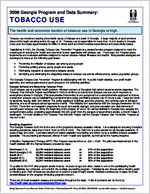
2008 Georgia Program and Data Summary:
TOBACCO USE
The health and economic burden of tobacco use in Georgia is high.
Tobacco use remains a leading preventable cause of disease and death in Georgia. A large majority of adult smokers (about 80%) begin smoking before the age of 18. Tobacco use is responsible for more than 10,000 deaths in Georgia every year and costs approximately $5 billion in direct adult and infant medical expenditures and productivity losses.
Established in 2000, the Georgia Tobacco Use Prevention Program is a comprehensive program designed to meet the overall goal of reducing the health and economic burden associated with tobacco use. Every year, the Program plans, implements and evaluates activities designed to reduce tobacco-related illnesses and deaths. Best practice strategies are developed to focus on the following goal areas:
Preventing the initiation of tobacco use among young people Promoting quitting among young people and adults Eliminating exposure to secondhand tobacco smoke Identifying and eliminating the disparities related to tobacco use and its effects among various population groups
The Georgia Tobacco Use Prevention Program is collaborating with the 18 public health districts, non-profit health agencies, and various partners and youth groups on the following activities:
Georgia Schools are Becoming Tobacco Free! Youth tobacco use is a public health problem. Nineteen percent of Georgia's high school students smoke cigarettes. The Tobacco Free Schools Project was initiated in 2005 to continue to reduce teen tobacco use and youth exposure to secondhand smoke in Georgia. This best practice intervention is one component of a comprehensive approach to reduce overall teen tobacco use by establishing a comprehensive policy prohibiting tobacco use 24 hours a day, 7 days per week , by students, faculty, staff, and visitors. The policy applies to buildings, grounds, property, and vehicles used to transport students, and at off-campus school-sponsored events. This initiative is in accordance with the Georgia Smokefree Air Act of 2005. Prevention and cessation programs for youth and adults, signage, and peer education are vital elements of reducing teen tobacco use. Since the beginning of the project, 32 out of 181 school districts in Georgia have adopted the comprehensive policy, protecting approximately 600,000 youth from the dangers of secondhand smoke, a known Class A carcinogen. For more details on the Tobacco Free Schools Project, call the Georgia Tobacco Use Prevention Program at 404-657-0792.
Smoking Cessation The Georgia Tobacco Quit Line is the core of the program's tobacco cessation efforts. It is a catalyst for reducing Georgia's smoking prevalence rates from 24% in 2004 to 20% in 2006. The Quit Line is a free service for all Georgia residents 13 years of age and older. It provides telephone-based cessation counseling and follow-up by a certified tobacco cessation specialist. The counseling services are offered in both English and Spanish, as well as for the hearing impaired.
A Nicotine Replacement Therapy (NRT) Pilot Program was launched on July 1, 2008. The pilot was implemented in five health districts with the highest tobacco prevalence rates:
Northwest (1-1) North Georgia (1-2) South (8-1) Coastal (9-1) Southeast (9-2)
95,722 resident tobacco users 55,664 resident tobacco users 39,199 resident tobacco users 81,855 resident tobacco users 56,847 resident tobacco users
or
27% of the population
or
24% of the population
or
25% of the population
or
25% of the population
or
26% of the population
To qualify for the NRT pilot program adults must be 18 years of age and older, reside in one of the participating health public districts, be uninsured, and enroll in the multiple counseling program. Participants can choose either nicotine patch or nicotine gum. Both choices are provided at no cost for a total of eight weeks. Medical overrides are in place for those contraindicated for the program (including pregnant women).
There are 63 local cessation classes and providers throughout the state. A list of providers can be found at http://health.state.ga.us/programs/tobacco/index.asp
Georgia Department of Human Resources, Division of Public Health 2 Peachtree Street, NW Atlanta, GA 30303 (404) 657-3103 ga-tobacco@dhr.state.ga.us http://health.state.ga.us
Tobacco use costs Georgia an estimated more than $5 billion every year.
DEATHS
Over 10,000 Georgians die every year from tobaccorelated illnesses that is one out of every six deaths in adult Georgians.
More adult males (6,500) than adult females (3,900) die from tobacco-related illnesses.
Among Georgia adults ages 35 and older, cancer accounts for 42% of all deaths due to smoking, while cardiovascular diseases and respiratory diseases account for 32% and 26% of all deaths due to smoking, respectively.
Adult smokers lose an average of 16 years of life compared to adult non-smokers.
Average annual number of deaths among adults ages 35 and older, Georgia, 2002-2006
Attributed to
smoking 17%
CVD* 32%
Cancer 42%
RD* 26%
Average annual deaths, all causes = 61,762
Average annual deaths attributed to smoking = 10,359
*CVD = Cardiovascular Diseases; RD= Respiratory Diseases
LUNG CANCER MORTALITY
Lung cancer accounts for 75% of all smoking-related cancer deaths in Georgia.
Lung cancer is the principal cause of cancer deaths for males and females.
BEHAVIORS: YOUTH
Approximately 23,000 (6%) middle school students and 81,000 (19%) high school students in Georgia smoke cigarettes.
Among middle school students, two in 26 boys and one in 20 girls are smokers.
Among high school students, one in five boys and one in six girls are smokers.
Approximately 18,000 (70%) middle school smokers and 41,000 (56%) high school smokers live with a smoker.
Approximately 97,000 (29%) middle school nonsmokers and 110,000 (31%) high school nonsmokers live with a smoker.
Approximately 1,400 (6%) middle school smokers and 24,000 (30%) high school smokers buy their cigarettes at gas stations or convenience stores.
Rate per 100,000
Percent
Average annual lung cancer incidence and mortality rates* by race and sex, Georgia,
2001-2005
In cidenc e
Mor tality
140 120
110 93
100
80
60
40
20
0
106 85
42 31
58 43
Black males
White males
Black
White
females females
*Rates are age-adjusted to the 2000 US standard population
Percent of cigarette smokers by school type and sex, Georgia, 2007
30
M ale
Female 21
20
17
10
8 5
0 Middle School
High School
Youth cigarette smokers are defined as those who have smoked at least one cigarette in the last 30 days. Georgia Department of Human Resources, Division of Public Health 2 Peachtree Street, NW Atlanta, GA 30303 (404) 657-3103 ga-tobacco@dhr.state.ga.us http://health.state.ga.us
BEHAVIORS: ADULTS
Approximately 1.3 million (19%) adults in Georgia smoke cigarettes.
21% of adult males and 18% of adult females are smokers.
Adults with less than a high school education are more likely than adults with a high school education or above to smoke cigarettes.
Counties in the northwest, south central, west central and southeast regions of the state have the highest adult smoking prevalence.
Percent
Percentage of adults who smoke, by education and sex, Georgia, 2007
50 39
40 31
30
20
10
Male Female
27 23
26 21
97
0
<HS
HS/GED Some College College Graduate
POLICY
A majority (81%) of adult Georgians do not allow smoking anywhere inside their homes.
Adults with at least a high school education are more likely than adults who did not graduate high school to not allow smoking inside their homes.
A majority (85%) of working adults indicate their worksite does not allow smoking at work.
Almost all (99%) public schools in Georgia have policies prohibiting tobacco use.
FINANCIAL IMPACT
$1.8 billion in healthcare costs among adults 18 years and older.
$3.4 billion in lost productivity costs among adults 35 years and older.
Percent
Percentage of adults who indicate having a policy that does not allow smoking, by location and sex, Georgia, 2006
Male Female
100
80 81
80
82 88
60
40
20
0
At home
At work
Adult cigarette smokers are defined as those who have smoked at least 100 cigarettes in their lifetime and are currently smoking. Georgia Department of Human Resources, Division of Public Health 2 Peachtree Street, NW Atlanta, GA 30303 (404) 657-3103 ga-tobacco@dhr.state.ga.us http://health.state.ga.us
QUITTING TAKES PRACTICE! The Georgia Tobacco Quit Line is available for all Georgians 13 years of age and older who want to quit using tobacco. To receive free counseling, support, and referral services call:
1-877-270-STOP (English)
1-877-2NO-FUME (Spanish)
1-877-777-6534 (Hearing Impaired)
www.livehealthygeorgia.org/quitLine/index.shtml
Georgia Smokefree Air Act of 2005
A smoke free public place must prohibit smoking twenty-four hours per day in any area that does not meet the requirements pertaining to enclosed areas and smoking areas as specified in the Act. For more information on the law, visit our web sites:
http://dhr.Georgia.gov/gasmokefreeair
www.livehealthygeorgia.org
Reduce your risk of developing chronic conditions and diseases.
Eat healthy. A healthy eating plan is one that emphasizes fruits, vegetables, whole grains, and fat-free or low-fat milk and milk products; includes lean meats, poultry, fish, beans, eggs, and nuts; and is low in saturated fats, trans fats, cholesterol, salt (sodium), and added sugars.
Be active. Participating in regular physical activity can help to reduce many risk factors associated with chronic diseases, including obesity and high blood pressure.
Be smoke free. Quitting smoking lowers the chance of having cancer, heart attack, or stroke and improves overall health and well-being, regardless how long a person has been smoking.
Get checked. Undergoing routine physical check-ups and screenings can prevent some chronic diseases and detect other chronic diseases earlier when treatment may be more effective.
Be positive. A positive attitude contributes to your overall well-being.
Following these guidelines can greatly reduce the chances of developing a chronic disease, leading to an improved quality of life and reduced healthcare costs. For more information, visit www.livehealthygeorgia.org.
Data sources: 1. 2007 Georgia Behavioral Risk Factor Surveillance System (BRFSS) (http://health.state.ga.us/epi/brfss/publications.asp ). 2. 2007 Georgia Youth Risk Behavior Survey (YRBS) (http://health.state.ga.us/epi/cdiee/studenthealth.asp). 3. 2006 Georgia Student Health Education Profile Survey (http://health.state.ga.us/epi/cdiee/policy.asp). 4. 2005 Georgia Youth Tobacco Survey (http://health.state.ga.us/epi/cdiee/tobaccouse.asp). 5. Georgia Vital Statistics, 2002-2006; CDC SAMMEC web application (http://apps.nccd.cdc.gov/sammec/ ). 6. Georgia Comprehensive Cancer Registry.
Date updated: October 2008 Publication number: DPH08/315HW Visit http://www.health.state.ga.us/epi/cdiee/tobaccouse.asp for more information about tobacco use in Georgia. Visit http://health.state.ga.us/programs/tobacco/index.asp for more information about the Georgia Tobacco Use Prevention Program.
Georgia Department of Human Resources, Division of Public Health 2 Peachtree Street, NW Atlanta, GA 30303 (404) 657-3103 ga-tobacco@dhr.state.ga.us http://health.state.ga.us