


- Collection:
- Georgia Government Publications
- Serial:
- Georgia data summary. Georgia Coverdell Acute Stroke Registry.
- Title:
- 2007 Georgia data summary. Georgia Coverdell acute stroke registry
- Creator:
- Georgia. Division of Public Health
- Contributor to Resource:
- Georgia. Division of Public Health.
Georgia. Department of Public Health. - Publisher:
- Atlanta, GA : Georgia Department of Human Resources, Division of Public Health, 2007
- Date of Original:
- 2007
- Subject:
- Cerebrovascular disease--Georgia
- Location:
- United States, Georgia, 32.75042, -83.50018
- Medium:
- state government records
- Type:
- Text
- Format:
- application/pdf
- Description:
- Title from caption
- External Identifiers:
- Call Number GA H800.P8 S1 S77 2007
- Metadata URL:
- https://dlg.galileo.usg.edu/id:dlg_ggpd_y-ga-bh800-pp8-bs1-bs77-b2007-belec-p-btext
- Digital Object URL:
- https://dlg.galileo.usg.edu/do:dlg_ggpd_y-ga-bh800-pp8-bs1-bs77-b2007-belec-p-btext
- Language:
- eng
- Holding Institution:
- University of Georgia. Map and Government Information Library
- Rights:
-

2007 Georgia Data Summary:
Georgia Coverdell Acute Stroke Registry
PROGRAM OVERVIEW
HOSPITAL SAMPLING AND PARTICIPATION
Funded by the Centers for Disease Control and Prevention (CDC) as part of the Paul Coverdell National Acute Stroke Registry.
Named in honor of the late Senator Paul Coverdell of Georgia who died of a massive stroke in 2000.
First established in 2001 as a prototype project involving 46 hospitals in Georgia.
Randomly selected hospitals invited to participate to represent state as a whole.
Volunteer hospitals also welcomed to participate.
49 currently participating hospitals, representing over half of stroke admissions in Georgia.
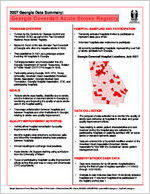
Georgia Coverdell Hospital Locations, July 2007
Full implementation and incorporation into the Georgia Department of Human Resources, Division of Public Health (DHR-DPH) began in 2005.
Partnership among Georgia DHR-DPH, Emory University, American Heart Association/American Stroke Association, Georgia Medical Care Foundation, Georgia Hospital Association, CDC, and participating hospitals.
GOALS
Reduce stroke case fatality, disability due to stroke, and the incidence of recurrent stroke in Georgia by monitoring and improving the quality of acute stroke care in the hospital setting.
Encourage collaboration between hospitals and between hospitals and other institutions in Georgia relating to stroke care quality improvement.
QUALITY IMPROVEMENT ACTIVITIES
Individualized hospital consultation by quality improvement directors.
Monthly registry-wide telephone conference calls and bimonthly newsletters sharing best practices between hospitals.
Annual meetings to exchange best practices.
Acute Stroke Life Support training using curriculum from the University of Miami.
Focus of participating hospitals' quality improvement efforts during first year was on deep vein thrombosis (DVT) prophylaxis.
DATA COLLECTION
The purpose of data collection is to monitor the quality of stroke care delivered at hospitals in the state and guide quality improvement efforts.
Data relating to stroke patient characteristics and care received during the hospital stay are collected by participating hospitals on patients admitted with an acute stroke or transient ischemic attack.
Data are entered into a Coverdell-modified version of the American Heart Association/American Stroke Association's "Get With the Guidelines" stroke patient management tool.
REGISTRY STROKE CASE DATA
Data were received for 5,132 stroke hospitalizations during the first full year of registry operation (11/1/2005 through 10/31/2006).
Analysis to date includes data from 19 randomly selected hospitals and 7 volunteer hospitals that participated in the registry during year 1.
Georgia Department of Human Resources, Division of Public Health 2 Peachtree Street, NW Atlanta, GA 30303 (404) 657-3103 ga-stroke@dhr.state.ga.us http://health.state.ga.us
QUALITY INDICATORS
Care received by patients is compared with a set of "Quality Indicators" that identify care processes that have been shown to be beneficial to stroke patients, and have been included in clinical recommendations.
Quality indicator calculations include identification of patients for whom a care process would have been recommended, and a determination of how many of those patients received the recommended care.
"Defect-free care": delivery of care meeting all quality indicators for which patient is eligible.
QUALITY INDICATOR PERCENTAGES*
Quality Indicator
Deep Vein Thombosis Prophylaxis (DVT) Dysphagia Screening Stroke Education Smoking Cessation Counseling or Treatment Lipid Profile Measurement Antithrombotic Medication Prescribed at Discharge Antithrombotic Medication Administered within 48 hours of Hospitalization Anticoagulation Prescribed for Atrial Fibrillation Rehabilitation Assessment Receipt of Tissue Plasminogen activator (tPA) Defect-Free Care
Overall Weighted % of Eligible Patients Receiving
Recommended Care (11/1/200510/31/2006)*
83% 79% 73% 86% 69% 96%
95%
70% 88%
37%
45%
QUALITY INDICATOR TRENDS (YEAR 1)
Trend in percentage of patients receiving DVT prophylaxis
Percentage
100 90 80 70 60 50 40 30 20 10 0 Nov Dec Jan Feb Mar Apr May Jun Jul Aug Sep Oct
2005
2006 Month
Trend in percentage of patients receiving defect-free care
Percentage
100 90 80 70 60 50 40 30 20 10 0 Nov Dec Jan Feb Mar Apr May Jun Jul Aug Sep Oct
2005
2006 Month
DEFINITIONS
Dysphagia: problems swallowing. Dysphagia is a
Stroke: brain tissue death- can be the result of a
potential complication of stroke that can lead to
thrombus (blocked artery) or a hemorrhage
pneumonia.
(ruptured artery) which prevents blood flow to the
Antithrombotic: medication administered to prevent
brain.
platelets or clotting factors in the blood from forming a
Transient ischemic attack: a temporary blockage of
blood clot.
cerebral blood flow, that causes a short-lived
Anticoagulation: administration of medications to prevent
neurological deficit.
clotting of the blood.
Deep Vein Thrombosis (DVT): "blood clot" located in Tissue plasminogen activator (tPA): a medication that
a large vein. DVT is a potential complication of
can be administered to some acute ischemic stroke
stroke.
patients to help reestablish blood supply to the brain.
ANALYSIS NOTES
*Overall Quality of Care in State: Analysis performed for randomly selected hospitals only (excluding volunteer hospitals) using weighted analysis to reflect sampling methodology and to partially account for hospital non-participation. Trends in Quality Indicator Data: Analysis included all hospitals participating during year 1 (selected and volunteer hospitals) and was an unweighted analysis.
Date updated: July 2007 Publication number: DPH07.105HW Visit http://health.state.ga.us/epi/cdiee/strokeregistry.asp for more information about the Georgia Coverdell Acute Stroke Registry.
Georgia Department of Human Resources, Division of Public Health 2 Peachtree Street, NW Atlanta, GA 30303 (404) 657-3103 ga-stroke@dhr.state.ga.us http://health.state.ga.us
Georgia Department of Human Resources, Division of Public Health 2 Peachtree Street, NW Atlanta, GA 30303 (404) 657-3103 ga-stroke@dhr.state.ga.us http://health.state.ga.us