


- Collection:
- Georgia Government Publications
- Serial:
- Georgia data summary. Obesity in children and youth.
- Title:
- 2007 Georgia data summary. Obesity in children and youth
- Creator:
- Georgia. Division of Public Health
- Contributor to Resource:
- Georgia. Department of Human Resources
- Publisher:
- Atlanta, GA : Georgia Department of Human Resources, Division of Public Health, 2007
- Date of Original:
- 2007
- Subject:
- Obesity in children--Georgia
Obesity in adolescence--Georgia - Location:
- United States, Georgia, 32.75042, -83.50018
- Medium:
- state government records
- Type:
- Text
- Format:
- application/pdf
- Description:
- Title from caption
"Obese children are more likely to become obese adults." - External Identifiers:
- Call Number GA H800.P8 S1 O2 2007
- Metadata URL:
- https://dlg.galileo.usg.edu/id:dlg_ggpd_y-ga-bh800-pp8-bs1-bo2-b2007-belec-p-btext
- Digital Object URL:
- https://dlg.galileo.usg.edu/do:dlg_ggpd_y-ga-bh800-pp8-bs1-bo2-b2007-belec-p-btext
- Language:
- eng
- Holding Institution:
- University of Georgia. Map and Government Information Library
- Rights:
-

2007 Georgia Data Summary:
OBESITY IN CHILDREN AND YOUTH
Obese children are more likely to become obese adults.
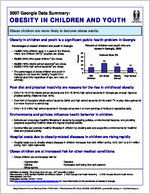
Obesity in children and youth is a significant public health problem in Georgia
Percentages of obese* children and youth in Georgia
14,000 (14%) children aged 2-4 years in the Women, Infant, and Children (WIC) program are obese.
28,000 (24%) third grade children are obese.
59,000 (16%) middle school students# are obese. 50,000 (12%) high school students# are obese.
The percentages of obese children and youth in Georgia do not meet the Healthy People 2010 national goal (5%) regardless of age, sex, race, or ethnicity.
Percent
Percent of children and youth who are obese in Georgia, 2005
50 National Goal: 5%
40
30
24
20
14
16
12
10
0
WIC
3rd Grade
Children
Middle High School School
Poor diet and physical inactivity are reasons for the rise in childhood obesity.
Only 7 in 10 (71%) middle school students and 6 in 10 (61%) high school students in Georgia get enough vigorous physical activity (National Goal: 85%).
Over half of Georgia's middle school students (55%) and high school students (51%) watch TV or play video games for 3 or more hours on a school day.
Only 1 in 5 (18%) high school students in Georgia consumes 5 or more servings of fruits and vegetables daily.
Environments and policies influence health behavior in children.
Schools can encourage healthful lifestyles in students by adopting policies, environmental features, and providing programs supporting healthful diets and regular physical activity.
Communities can promote healthful lifestyles in children by creating safe and supportive environments for healthful diets and physical activity.
Hospital costs due to obesity-related diseases in children are rising rapidly.
Hospital costs due to obesity-related diseases in children increased from $35 million during 1979-1981 to $127 million during 1997-1999 nationwide.
Obese children are at increased risk for other medical conditions.
Obese children are at increased risk for:
- Hypertension - Asthma - Sleep apnea
- Diabetes - Decreased well being (low self-esteem)
Definition of obesity: *Body Mass Index-for-age = 95th percentile or higher Data sources: 2005 Pediatric Nutrition Surveillance System 2005 Georgia Oral Health Screening # 2005 Georgia Student Health Survey Date updated: July 2007 Publication number: DPH07.115HW Visit http://www.health.state.ga.us/nutandpa/data.asp for more information on the prevalence of obesity in Georgia.
Georgia Department of Human Resources, Division of Public Health 2 Peachtree Street, NW Atlanta, GA 30303 (404) 657-3103 ga-obesity@dhr.state.ga.us http://health.state.ga.us