


- Collection:
- Georgia Government Publications
- Title:
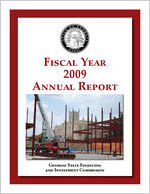
- Fiscal year 2009 annual report
- Creator:
- Georgia. State Financing and Investment Commission
- Contributor to Resource:
- Georgia. State Financing and Investment Commission
- Publisher:
- Atlanta, Ga. : Georgia. State Financing and Investment Commission
- Date of Original:
- 2009
- Subject:
- Georgia
- Location:
- United States, Georgia, 32.75042, -83.50018
- Medium:
- publications (documents)
- Type:
- Text
- Format:
- application/pdf
- Description:
- Began with fiscal year 2007.
Fiscal year 2007; title from pdf of cover (GALILEO, viewed July 8, 2008).
Fiscal year 2007, viewed July 8, 2008. - External Identifiers:
- Call Number GA F500 .A1 2009
- Metadata URL:
- https://dlg.galileo.usg.edu/id:dlg_ggpd_y-ga-bf500-b-pa1-b2009-belec-p-btext
- Digital Object URL:
- https://dlg.galileo.usg.edu/do:dlg_ggpd_y-ga-bf500-b-pa1-b2009-belec-p-btext
- Language:
- eng
- Holding Institution:
- University of Georgia. Map and Government Information Library
- Rights:
-

E
OF GEO NSTITUTI
S TAT CO
RGIA
ON
GSFIC
Fiscal Year 2009
Annual Report
Georgia State Financing and Investment Commission
Cover photograph: Georgia Military College in Milledgeville
Georgia State Financing & Investment Commission
Table of Contents
Commission Members . . . . . . . . . . 2 Mission & Core Values . . . . . . . . . 3 Year in Review. . . . . . . . . . . . . . . . . 4 Customer Service . . . . . . . . . . . . . 6 Project Highlights . . . . . . . . . . . . 7 ADA Coordinator's Office . . . 13 Financial Report . . . . . . . . . . . . . 14 Strategic Initiatives . . . . . . . . . 20
Henderson Library at Georgia Southern University in Statesboro Pag e 1
Georgia State Financing & Investment Commission
Commission Members
Governor Sonny Perdue
Chairman
Casey Cagle
Lt. Governor Vice-Chairman
Russell W. Hinton
State Auditor Secretary and Treasurer
Glenn Richardson
Speaker of the House of Representatives
Thurbert E. Baker
Attorney General
Tommy T. Irvin
Commissioner, Department of Agriculture
W. Daniel Ebersole
Director, Office of Treasury and Fiscal Services
Steve Stancil
Director, Construction Division Executive Secretary
Susan H. Ridley
Director, Financing and Investment Division
Pag e 2
Georgia State Financing & Investment Commission
Introduction
The Georgia State Financing and Investment Commission, created by Constitutional Amendment in 1972, is responsible for the proper application of proceeds from general obligation debt and the issuance of all public debt by the State. No agency or authority can incur debt or employ other financial or investment advisory counsel without Commission approval. The Commission consists of the Financing and Investment Division and the Construction Division.
The Financing and Investment Division is responsible for the issuance of general obligation bonds, the review of state authority debt financing, and the investment and accounting of all general obligation bond proceeds. Investment earnings support the operations of the Commission and enable the Division to retire state debt prior to maturity. The Division also prepares the State's Debt Management Plan and monitors agencies' expenditures of bond proceeds for compliance with federal tax regulations. In 2006, the legislature created the Georgia Higher Education Facilities Authority (GHEFA). GHEFA is administratively attached to
GSFIC and staffed by the Financing and Investment Division.
The Construction Division provides all the support services for the Commission and is responsible for disbursing bond proceeds and for managing capital outlay projects funded, all or in part, with bond proceeds.
The Construction Division also provides the following services for State Agencies:
ADA Compliance Assistance Procurement Services Construction Services
Mission & Core Values
The Georgia State Financing and Investment Commission core value is dedicated to continuous quality improvement in all of its activities. To that end, the Georgia State Financing and Investment Commission staff has adopted the following:
Mission
Building Georgia's future through excellence in financial and construction management services.
Core Values
Stewardship Excellence Leadership Fairness
Pag e 3
Georgia State Financing & Investment Commission
Year-In-Review
Core functions of the Georgia State Financing and Investment Commission include the issuance and management of state general obligation and state authority debt and providing construction management services for state capital improvement projects.
Financing and Investment Division
The Commission approved one competitive and two negotiated general obligation bond sales totaling $1.6 billion during Fiscal Year 2009. Nearly $725 million in revenue bonds were approved by GSFIC and issued by state authorities.
For the sixteenth straight year, Georgia earned AAA credit ratings on its general obligation debt from Moody's, Standard & Poor's, and Fitch. As one of only seven "natural triple-triples", the state commands very competitive prices and low overall borrowing costs. The State's debt management plan, developed and executed by GSFIC, is a critical component of demonstrating Georgia's conservative fiscal management to the investment community.
A major accomplishment for GSFIC this year was assisting the Georgia Higher Education Facilities Authority ("GHEFA") with its first-ever bond issue. GHEFA, created in 2006 by Senate Bill 562, is administratively attached to GSFIC and is authorized to issue up to $300,000,000 in revenue bonds to finance capital projects of any unit of the University System of Georgia or the Technical College System of Georgia. In Fiscal Year 2009, GHEFA issued $99.855 million in revenue bonds to finance eight different projects for seven institutions, all at units of the University System of Georgia. The projects are outlined in the following chart:
GHEFA Series 2008A Projects
Dalton State College - Parking Deck Darton College - Student Activity Center Fort Valley State University - Stadium and Student Center Gainesville State College - Parking Deck Georgia College & State University - Bookstore & Theatre Georgia State University - Student Housing Southern Polytechnic State University - Parking Deck Total
Budgeted Amounts
$7,240,000.00 $21,845,000.00 $20,030,000.00 $5,435,000.00
$8,385,000.00 $18,315,000.00 $18,605.000.00 $99,855,000.00
Contract Completion Date
August 26, 2009 March 25, 2010 October 28, 2009
July 19, 2009 February 28, 2010
July 31, 2009 October 28, 2009
Georgia College and State University's renovation of the old town theater in Milledgeville Pag e 4
Georgia State Financing & Investment Commission
Construction Division
The Commission's Construction Division focused
struction division launched a document imaging pro-
on employee retention and information technology ad-
cess in FY 2009. The process, which will be fully imple-
vances during FY 2009.
mented in FY 2010, requires all documents associated
A career banding system was introduced in the
with the Commission's operations to be stored and filed
construction services project management department.
in digital format. The digital imaging process allows for
The program created a four-tier
the elimination of duplicate files,
job family assistant project manager, project manager, senior
The digital imaging
reproduction costs and postage costs. While the storage system
project manager and project executive - that provides opportu-
process allows for the
will be centralized, the indexing, input and retrieval system
nity for advancement within GSFIC and encourages employees to develop skills and knowledge
elimination of duplicate files, reproduction costs
will be accessible via individual desktop computers. The system is in compliance with both the
in anticipation of internal job promotions. The program was
and postage costs.
Secretary of State's public records retention policies and the
created to reduce employee turn-
state's Open Records laws.
over in project management. The
Other operational accom-
high turnover rate experienced in previous years lead to
plishments in FY 2009 include an upgrade to Construc-
a reduction in management continuity for projects and
tion PeopleSoft software for the accounting department;
diminished customer satisfaction.
publication of an updated design process guide for de-
The ability for GSFIC project managers to effectively
sign professionals and customers; and development of
manage more than 125 projects was greatly enhanced in
a comprehensive marketing communications plan to
FY 2009 with the development of real-time project track-
increase external awareness of GSFIC. Procurement in-
ing and reporting. The reporting application, coined the
troduced a contractor evaluation program that will pro-
GSFIC Dashboard, provides accurate information on
vide contractor performance data which can be used for
project details, completion status, legal claims, procure-
qualifications based selection on future projects.
ment and warranty
activity and pay ap-
plications. As a team,
the staff reviews the
computer statistics
(Compstat) monthly.
By tracking, measur-
ing and reviewing
this information, the
department is able to
identify trends, chal-
lenges and successes.
To ensure full
and accurate records
of all activities and
decisions of the Com-
mission are main-
tained and retained
in accordance with
adopted guidelines
and rules, the con-
Georgia State University Science Park in downtown Atlanta
Pag e 5
Georgia State Financing & Investment Commission
Customer Service
Exceeding customer expectations and providing stellar customer service continue to be top priorities for the Georgia State Financing and Investment Commission. Two established goals for Fiscal Year 2009 were to launch a workplace satisfaction employee survey and provide community outreach and volunteer opportunities for staff.
In the fall of 2009, the Public Performance and Management Group at Georgia State University conducted a workplace satisfaction survey to determine employee perceptions of the quality of their workplace and overall employee satisfaction.
Understanding the perceptions of workplace quality and employee satisfaction have a direct impact on customer satisfaction; the results are good news for the organization.
Seventy-four percent of the GSFIC's 130 employees completed the anonymous online survey. The agency had a mean score of 93 percent overall satisfaction, compared to a mean score of all state agencies surveyed by GSU of 80 percent
Three of four respondents rated the quality of the workplace either a 4 or 5, with 5 being the highest possible score. Additionally, 73 percent of GSFIC employees stated their perceptions of customer service as a priority at GSFIC was very important, as compared to 49.6 percent of all state agencies surveyed.
The agency continued to engage all employees in the philosophy of customer service and continued the "Art of Exceptional Customer Service" program, designed by the state's Office of Customer Service. Additionally, all prospective employees are pre-screened for customer service skills and all new hires receive training on the goals of the Office of Customer Service: Georgia will be recognized as the best managed state; Georgia will have the best customer service of any state in the nation; and, Georgia state government will be known as a great place to work.
The State Property Officer recognized all GSFIC employees during Employee Appreciation Week and one employee was recognized with a special commendation for customer service from Governor Sonny Perdue.
During FY 2009, GSFIC provided employees an opportunity to support the local community. Organized work days with Habitat for Humanity were sponsored by the agency, as well as a successful summer clothing drive benefiting the Atlanta Day Shelter for Women and Children and the fall charitable contributions drive.
Customer service and employee engagement goals for FY2010 include 100 percent participation in the Art of Exceptional Customer Service, publication of the revised Team GSFIC Customer Service Principles manual and rollout of a new Rewards and Recognition Program. Additionally, employees will have volunteer opportunities, including partnerships with Habitat for Humanity, the Breast Cancer Walk and the Atlanta Day Shelter.
GSFIC employees at Habitat for Humanity project site
Pag e 6
Georgia State Financing & Investment Commission
Construction Division Fy 2009 Project Overview
Delivery Method
Design-Bid-Build CM/GC Design-Build Task Order Contract All
No. Projects
77
42 9 4 132
Design Contract
$20,713,964.32
68,753,829.59 7,621,237.00 74,000.00
$97,163,030.91
Construction Contract
$ 246,784,175.59
649,547,247.68 121,135,529.37
2,079,673.36 $1,019,546,626.00
Total Budget
$ 403,801,930.00 1,324,977,038.00
139,699,336.00 2,074,549.00
$1,870,552,853.00
Project Phase
Planning, Programming, Pre-Design Design Construction Close-out Total
No. Projects
11 39 45 37 132
Georgia Building Authority 20
GSFIC Managed Projects
Department of Education 11
Other 41
Board of Regents of the University System of Georgia
29
Other: 7 Department of Corrections 6 Department of Transportation 6 Georgia Bureau of Investigation 4 Department of Human Resources 3 Georgia World Congress Center 3 Department of Labor
Technical College System of Georgia 31
2 Georgia Agricultural Exposition Authority 2 Lake Lanier Islands 1 Georgia Forestry Commission 1 Georgia Emergency Management Agency 1 Georgia Military College 1 Georgia Public Library
1 Georgia Public Safety Training Center 1 Department of Natural Resources 1 Department of Economic Development 1 Georgia Department of Agriculture
Pag e 7
Georgia State Financing & Investment Commission
GSFIC Managed Construction Projects Completed in FY 2009
The construction division of Georgia State Financing and Investment Commission completed 33 projects in Fiscal Year 2009, including a library and technical center at North Georgia College and University, five state prison dormitories, three Department of Transportation buildings and several college classroom buildings. Construction contracts for these projects totaled more than $175 million.
Project
J-30 Georgia Southern University Library Board of Regents GDC-082A Headquarters Relocation to Tift College Campus Department of Corrections
SBE-019A FFA Covington Camp Department of Education GDC-084 Ware State Prison Dorm Department of Corrections
DOT-014 Routine Maintenance Facility Department of Transportation GDC-081 Valdosta State Prison Dorm Department of Corrections
GBA-0167A Executive Center Georgia Building Authority DTAE-104 Valdosta Technical College Classroom Building Technical College System of Georgia
GBA-150SC Agriculture Building Georgia Building Authority J-039 Parks Nursing/Health Science Renovation Board of Regents
Description
Renovation and expansion of the Henderson Library on the campus of GSU in Statesboro.
Size
Cost
234,000 sq ft $23,330,739.24
Renovation to the Rutland Student Center, construction of a new central energy plant and rebuilding infrastructure which will serve as part of the new Department of Corrections Training Facility.
Construction of a new cabin and shelled-out dry-in of a second cabin.
9,268 sq ft $11,454,677.04 4,500 sq ft $841,817.06
Construction of a housing facility at Ware State Prison in Waycross. The facility includes locking controls, closed circuit television, intercom and paging systems.
Construction of a maintenance facility including four vehicle bays, administrative areas and storage in Sterling.
Construction of a housing facility at Valdosta State Prison in Lowndes County. The facility includes locking controls, closed circuit television, intercom and paging systems.
An extensive waterpoofing project at the Governor's Mansion to prevent damage to the foundation and ballroom.
A new two-story classroom building and student center for Valdosta Technical College. The project includes classrooms, computer labs, media center, administrative space and a food service center. The building serves as the new front door for the college campus.
Repairs to the parking courtyard area to prevent leaks to the garage deck below.
23,500 sq ft $4,968,354.19 10,000 sq ft $1,752,642.79 23,500 sq ft $5,474,728.84
n/a $1,795,982.59 100,546 sq ft $14,082,656.96
n/a $295,578.10
Remodeling of the existing health sciences and Parks nursing buildings on the campus of Georgia College and State University in Milledgeville.
63,190 sq ft $9,001,748.88
Pag e 8
Georgia State Financing & Investment Commission
Project
J-042 Savannah State University Classroom Board of Regents
GBA-141B Cafeteria Renovation Phase II Georgia Building Authority
J-040 Health, Wellness and Lifelong Learning Center Board of Regents DTAE-210ASC Welding Technology Building Fit-Up Technical College System of Georgia DOT-048 Large Area District Office Department of Transportation GBA-0167B Kitchen Renovations Georgia Building Authority
GDC-080 Smith State Prison Dorm Department of Corrections
DHR-062A Remediation at Central State Hospital Department of Human Resources
SBE-010 Cafeteria Renovation Department of Education DOT-049 Large Area Office Department of Transportation J-015A Bainbridge College Modifications Board of Regents
LLI-009 Roadway Improvements Lake Lanier Islands Authority
Description
Construction of a two-story building that will house an applied research lab, observation lab and Africana studies exhibit area. Lecture space includes a single 100-seat room and two 40-seat rooms. There are four seminar rooms and 16 classrooms.
General renovation and upgrades of the Twin Towers Cafeteria, Capitol Commons, including build out of two new eateries, new carpeting and additional fixtures.
Construction of a multi-level health, wellness and life long learning center on the campus of University of West Georgia in Carrollton.
Interior construction including an air condition lab with storage areas, construction lab with storage areas, three classrooms, office space, work room and break area at Flint River Technical College.
Construction of a district office in Athens/ Clarke County.
Renovation of the 40-year-old kitchen at the Governor's mansion, including bringing the kitchen up to the current fire codes and upgrading equipment to meet efficiency standards.
Construction of a housing facility at Smith State Prison in Glennville. The facility includes locking controls, closed circuit television, intercom and paging systems.
Remediation of a 192-bed forensic psychiatric hospital for Central State Hospital in Milledgeville. Special systems include security intercom, closed circuit television, fire and duress alarms.
Update the cafeteria and kitchen equipment at the Atlanta Area School for the Deaf in Clarkston.
A single story building in Dublin containing open and private offices, a conference/classroom and support spaces.
Additions and renovations to the existing Charles H. Kirbo Center including a 500-seat auditorium, a 300-seat dining area, an associated kitchen expansion and new restrooms in Decatur County.
Road way improvement, including paving reclamation, curb and gutter, grading and excavation, utility relocation, paving and line striping on Lake Lanier.
Size
53,000 sq ft
n/a 8,150 sq ft 10,710 sq ft
8,000 sq ft n/a
23,500 sq ft 108,983 sq ft
600 sq ft 8,000 sq ft 33,865 sq ft
n/a
Cost
$12,184,977.00
$1,211,418.12 $25,261.018.64
$836,722.47
$976,993.17 $868,255.17 $4,961,209.06 $12,178,345.94
$508,362.95 $1,097,132.78 $8,412,012.69
$5,141,130.61
Pag e 9
Georgia State Financing & Investment Commission
Project
GDC-078 Macon State Prison Dorm Department of Corrections
DOT-053SC Rest Area Repairs Department of Transportation
SPE-008SC Covered Walkway State Board of Education GBI-027A Paving Project Georgia Bureau of Investigation SBE-012A Entry Gate State Board of Education SBE-012E Finishes Package State Board of Education
GBA-0146SC Facade Restorations Georgia Building Authority J-041 Library/Technology Center Board of Regents GBA-0155SC Ventilation Improvements Georgia Building Authority GDC-079 Dooly State Prison Dorm Department of Corrections
GBA-141 Water Main Replacement Georgia Building Authority
DTAE-103A Technical College System of Georgia
Description
Construction of a housing facility at Macon State Prison in Oglethorpe. The facility includes locking controls, closed circuit television, intercom and paging systems.
Repairs to the restroom facilities at the Monroe County Rest Area. The damage was the result of an automobile accident. Repairs focused on the women's restroom facility.
Construction of a walkway cover at the Georgia Academy for the Blind in Macon.
Paving at the Georgia Bureau of Investigation office in Conyers.
Entrance and exit gates, including card reader, for the Georgia School for the Deaf in Cave Spring.
Renovation work to the cafeteria and administrative buildings at Georgia School for the Deaf, including removal and replacement of select VCT, ceiling tile and light fixtures and supply and exhaust fans.
Repairs to the brick veneer of the Coverdell Legislative Office Building on Capitol Hill in Atlanta.
Multi-level library and information technology building for North Georgia College and State University in Dahlonega.
Improvements to the underground parking facility at 244 Washington Street on Capitol Hill in Atlanta.
Construction of a housing facility at Dooly State Prison in Unadilla. The facility includes locking controls, closed circuit television, intercom and paging systems.
Demolition of abandoned domestic hot and cold water piping in both the east and west towers of the James H. Sloppy Floyd Veterans Memorial Building on Capitol Hill in Atlanta. Installation of new domestic water lines and new booster pump.
Construction of an administration/classroom building and an industrial arts building at the Grady Center in Cairo.
Size
Cost
23,500 sq ft $4,705,757.21
n/a
$53,675
n/a $164,067.70
n/a
$33,579.52
n/a
$52,675.82
n/a $177,457.53
n/a $423,237.32
88,530 sq ft $18,304,112.04
n/a
$69,324
23,500 $4,975,198.95
n/a $1,000,001.67
10,446 sq ft $1,462,485.75
Pag e 1 0
Georgia State Financing & Investment Commission
Go Fish Georgia Center
Located on approximately 120 acres at the Georgia National Fairgrounds in Perry, the Go Fish Georgia Center is the cornerstone of a statewide effort to promote and enhance boating and fishing tourism, and to boost economic development in communities across the state. Slated for an FY 2010 completion, construction on the Go Fish Georgia Center began in September, 2008.
Go Fish Georgia Center in Perry
The 40,000-square-foot center will feature a 15,000-square-foot visitor's center that promotes fishing opportunities throughout the state, an on-site public fishing pond and a full functioning freshwater hatchery to enhance fish populations in the state's lakes, ponds and reservoirs. Additionally, the center will provide extensive educational experiences for visitors, fish and wildlife exhibits, state-of-the-art theaters and a nature trail.
The fish and wildlife exhibits will feature both interactive and live elements that depict natural habitats found in and around Georgia waterways. It will feature exhibits on rivers, reservoirs, trout streams, coastal waters and, of course, Montgomery Lake, where the world record largemouth bass was caught. There will be live habitat exhibits as well as a trophy fish display depicting Georgia's biggest and best catches.
Located just outside the center, a half-mile-long nature trail will mimic the natural habitats found throughout Georgia. Rich with plants and wildlife, the educational trail will house an open-air pavilion and seating areas perfect for large gatherings.
Bordered by the nature trail, the fishing pond will serve as the ultimate outdoor fishing experience for all visitors. While at the pond, visitors will have the opportunity to cast away and see what's biting. It's a great place for a child to enjoy a first fishing experience with the family.
The new state-of-the-art fish hatchery is an essential element of the center and will be open to the public. Existing state hatchery facilities are operating at maximum capacity and the new facility will allow for the production of additional forage fish to stock Georgia's waterways and increase sport fish growth rate. Research at this facility, which also will be open to the public, will ensure that fish stocked in Georgia waters are genetically superior.
Designed by Lyman Davidson Dooley, Inc., the $11 million project supports the Department of Natural Resources' aggressive green building program and will be LEED-certified. The general contractor for the project is Juneau Construction Company.
Pag e 1 1
Georgia State Financing & Investment Commission
Zach S. Henderson Library
Georgia Southern University celebrated the New Year with an expanded and renovated Zach S. Henderson Library. The $22.75 million project began in the summer of 2004 and opened its doors in time for the fall 2008 semester. A formal ribbon cutting was held at the Statesboro university in January, 2009.
The school's first library building opened in 1938 when Georgia Southern was known as Georgia Normal School. Before that opening, the library was housed in a small room in the administration building and in 1921 contained 1,000 books and 50 magazines and periodicals. The existing Henderson Library opened in 1976 and was originally built, according to the renovation architects, as a pre-cast concrete box.
The renovation and expansion which took place in two phases to ensure students didn't lose access to the library's holdings - dramatically changed the size, character and appearance of the original library, includ-
Atrium in the Zach S. Henderson Library
ing a dramatic three story atrium, a learning commons
area, floor to ceiling windows throughout, and a coffee
shop overlooking the original campus lakes. The library
has doubled its seating
capacity to nearly 2,000 seats and now features
The library
29 group study rooms. It is also the largest build-
has doubled
ing on the university's prominent east-west pedestrian corridor and
its seating capacity to
connects the historic buildings to the north
nearly 2,000
with the new buildings along the walkway.
The library at Geor-
seats and now features 29
gia Southern now houses more than 600,000
group study
books and bound periodicals, more than
rooms.
890,000 microform units,
almost 750,000 government documents and offers access
to more than 46,000 electronic journals. The library has
more than 300 hard-wired computers, 18 laptops avail-
able for loan and wireless access to the Internet through-
out the building.
One unique feature of the building is the Auto-
mated Retrieval Collection (ARC), which contains space
to store up to 800,000 items books, periodicals, docu-
ments - in 4,848 separate bins that are stacked 45 feet
high. While most of the library collection is shelved in
publicly-accessible stacks, the ARC
guarantees more than seven decades
worth of collection growth space with-
out having to reduce public seating or
storing materials outside of the library.
Designed by Cogdell & Mendrala
Architects and built by McKnight Con-
struction Company, the same contrac-
tors that completed the original build-
ing, the project was built on behalf the
Board of Regents of the University
System of Georgia.
State of the art library in Statesboro Pag e 1 2
Georgia State Financing & Investment Commission
State ADA Coordinator's Office
The State ADA Coordinator's Office provides comprehensive educational and technical support for state agencies so that those programs, services and activities operated by the State of Georgia are usable and accessible to everyone, to the greatest extent feasible. The office serves as a technical resource to state agencies for the Americans with Disabilities Act (ADA); operates the Statewide ADA Facility Improvements Program; conducts general and customized training on ADA topics for state agencies; and increases the visibility of the ADA to help more citizens understand the letter and spirit of the law.
State Facilities Improvement Program
This program was established to ensure that state owned facilities meet the ADA's "program access" mandate to provide equal access to these facilities for persons with disabilities. The Office follows the procedures outlined in the General Obligation Bond Proceeds Expenditure Policy and monitors the bond spend down to track the effectiveness of GSFIC's ADA bond spend down policy and procedure, with particular emphasis on the monitoring and reimbursement phase.
The Office works with state agencies to develop budget requests and to undertake ADA-related construction projects. These projects concern accessible entrances, primary function areas, restroom alterations, site modifications, automatic doors, curb cuts, ramps, pathway renovation, door modification, and other accessibility elements and features to meet the letter and spirit of the Americans with Disabilities Act. Separate and independent from this "program access" justification, the recommended structural modifications generally increase the overall usability and access to these facilities for everyone.
During Fiscal Year 2009, the Office and its agency partners completed 13 ADA projects at state colleges and universities, Veterans Service facilities, technical colleges, state parks and other state facilities. The construction cost for these projects was $597,526 and fully closes out ADA Bond 2006F, which totaled $1.6 million.
Training and Outreach
The Office works to proactively address ADA-related issues with state agencies through collaboration, training and technical support, utilizing the framework outlined in Title II of the ADA and its implementing regulations.
Highlights from FY 2009 include:
Mental Health Sign Language Interpreter Institute Collaboration Managed a 40-hour course designed to provide a sound basis for interpreters to work effectively in mental health settings as part of a professional team. The program included lectures, demonstrations, exercises, evaluation and discussion to develop knowledge, skills and resources to ensure that services are linguistically and culturally appropriate to educate stakeholders on accessibility-related code requirements and best practices when designing or constructing facilities for State of Georgia government agencies.
Best Practices in the Employment of Individuals with Disabilities Conducted a comprehensive survey -- with participation from the U.S. Equal Employment Opportunity Commission, ADA Policy Division -- to identify significant ADA law changes and to support state agency partners in identifying and implementing strategies that encourage the recruitment, hiring, retention and promotion of individuals with disabilities in state government; assist state agency partners in assessing their current ability to provide effective and reasonable workplace accommodations to individuals with disabilities; and, identify resources for different types of accommodations in the workplace.
New Website The ADA office launched a stand-alone website, www.ada.georgia.gov, designed to provide information about the ADA Coordinator's Office, including programs, services and resources.
Pag e 1 3
Georgia State Financing & Investment Commission
Financing and Investment Division Debt Issuance
General Obligation Bond Issuances - $1,600,600,000
Date Sold
6/12/2008 *
6/12/2008 * 2/4/2009 ^ 2/4/2009 ^ 5/28/2009 ^ 5/28/2009 ^ 5/28/2009 ^
Series
2008A 2008B 2009A 2009B 2009C 2009D 2009E
Final Maturity
7/1/2018
7/1/2028 1/1/2014 1/1/2029 5/1/2014 5/1/2029 7/1/2020
True Interest Cost
3.0212%
4.2698% 1.6124% 3.8856% 1.5440% 3.8054% 2.5585%
Issue Amount Lead Underwriter
$ 56,605,000 Lehman Brothers
465,885,000 Merrill Lynch & Co. 61,795,000 Merrill Lynch & Co. 552,055,000 Merrill Lynch & Co. 9,500,000 Merrill Lynch & Co. 305,030,00 Merrill Lynch & Co. 149,730,000 Merrill Lynch & Co.,
* Sold June 12, 2008 via competitive bid, but closed July 17, 2008. ^ Sold via negotiation to an underwriting syndicate managed by Merrill Lynch & Co.
Savannah State University classroom building
Authority Financings - $724,855,000
Authority
State Road and Tollway Authority Georgia Housing and Finance Authority Georgia Higher Education Facilities Authority
Amount Description
$ 600,000,000 GARVEE revenue bonds 25,000,000 Single family mortgage revenue bonds 99,855,000 Revenue bonds (USG Real Estate Foundation I, LLC Project)
Pag e 1 4
Georgia State Financing & Investment Commission
Buy Georgia Bonds
On February 2, 2009, the citizens of Georgia had the opportunity to invest in this great state by purchasing up to $613,850,000 State of Georgia General Obligation Bonds, Series 2009A and 2009B. The state's first ever negotiated "new money" bond sale gave retail investors the ability to buy Georgia bonds by placing orders on the day of the sale with their brokerage firms during a retail-only order period. Georgians were able to strengthen their individual investment portfolios with triple-A rated tax-exempt Georgia bonds while at the same time helping the State fund the construction of schools, roads, and other capital projects.
By expanding the investor base and increasing demand with the retail order period, the state was able to lock in an interest rate of 1.61% for the 2009A 5-year bonds, the lowest rate Georgia had secured in decades, and a competitive 3.89% for the 2009B 20-year bonds. This sale, completed in a single day, was primarily sold
to retail investors, reflecting solid demand for Georgia's gilt-edged bonds. As outlined below, $452 million in retail orders were received (73.6% of the total bond issue) with retail customers in Georgia accounting for 90% of these orders.
State of Georgia General Obligation Bonds - Series 2009A and 2009B
Georgia Retail Distribution
$0 - $500,000 $500,000 - $2,000,000 $2,000,000 - $5,000,000 $5,000,000 - $10,000,000 $10,000,000+
1,157 retail ticket orders were entered nationwide, totaling $452 million in par Approximately 90% (1,032 tickets) of the retail orders entered originated from Georgia zip codes,
totaling approximately $420 million in par The average retail order entered was for approximately $400,000
Pag e 1 5
Georgia State Financing & Investment Commission
Earnings
Interest earnings from the deposits and investment of bond proceeds during Fiscal Year 2009 were $72,643,507.17
per book. This was a decrease of $4,540,915.77 over FY 2008 mainly due to decreased interest rates during the year. At June 30, 2009, the Commission had the following deposits and investments:
Deposits and Investments
Pooled portfolio managed by the Office of Treasury and Fiscal Services Cash held for investment settlements U.S. Government Agency Obligations
Repurchase Agreements
Total
Maturities
1.9 year duration July 1, 2009
Fair Value
$ 440,776,317 1,207,269.673 74,526,000
$ 1,722,571,990
The portfolio, with an average yield of 1.29%, consists of Fixed Income Securities comprised of Agencies of the United States Government and Repurchase Agreements.
Annualized Annual Yield Capital Projects Fund Investment Portfolio
6% 5% 4% 3% 2% 1% 0%
FY 2005
FY 2006
FY 2007
FY 2008
FY 2009
Pag e 1 6
Georgia State Financing & Investment Commission
Early Retirement of Debt
From interest earnings available for the advance retirement of debt, the Financing and Investment Division made 48 purchases of State of Georgia General Obligation Bonds in the secondary market with a par value of $87,855,000. These early retirements of Bonds:
reduced the state's outstanding general obligation bond debt by 1.0%, will save the state $128,803,678 in future principal and interest appropriations and, reduced debt service in FY 2009, FY 2010, and FY 2011 by $2.6 million, $25.2 million, and $2.9 million,
respectively. GSFIC's early retirement program to-date has saved the State over $1.5 billion in future principal and interest appropriations.
Department of Corrections project at Tift College in Forsyth
FY 2009 Defeasance & Refunding
On May 28, 2009, the Commission legally defeased and retired early $26,125,000 of outstanding general obligation bonds due on July 1, 2009 by utilizing the premium received from the sale of the series 2009C and series 2009D bonds. On that same date, the Commission used the proceeds of the series 2009E bond issue to refund $153,335,000 of outstanding general obligation bonds at lower interest rates. The combination of these actions and the low overall interest costs on the state's new money general obligation bonds provided over $34 million in budgetary relief in FY 2009. The refunding will provide multi-year budget relief through FY 2021 by lowering the debt service payments from the original debt service schedule of the refunded bonds.
This refunding of bonds also will: save the State a total of $7,302,116.67 in future debt service appropriations and, reduce the debt service coming due in FY 2010 by $5,954,472.92.
Pag e 1 7
Georgia State Financing & Investment Commission
Variable Rate Bond Performance
During FY 2009, the average interest rate for the 2006H variable rate bond issue was approximately 1.71%. Together with the ongoing fees of approximately 0.12%, this equates to an effective rate of approximately 1.83%. When compared to the estimated fixed rate of 4.14% at which the bonds would have been issued in December 2006, the total interest payments savings for FY 2009 exceeded $7.6 million.
These results were achieved despite the severe market disruptions following the bankruptcy of Lehman Brothers, which caused interest rates to spike in September and October 2008, and also a rating downgrade of Dexia Credit Locale, the bank which provides the Standby Bond Purchase Agreement for the bonds. By midJanuary 2009, with general improvements in the credit markets and decreasing concern about Dexia Credit Locale, the weekly interest rate resets on the 2006H vari-
able rate bond issue had improved to within 20 basis points of the SIFMA index rate; by late May 2009, the 2006H bonds again were resetting at interest rates lower than the SIFMA index.
The following chart illustrates the comparison of both Georgia's weekly and cumulative rates to the Securities Industry and Financial Markets Association (SIFMA) index from issuance through FY 2009.
Georgia General Obligation Variable Rate Bonds
Comparison to SIFMA Index
Rate
Georgia General Obligation Variable Rate Bonds Comparison to SIFMA Index
8.00%
7.00%
6.00%
5.00%
4.00%
3.00%
2.00%
1.00%
0.00%
12/21/06 1/21/07 2/21/07 3/21/07 4/21/07 5/21/07 6/21/07 7/21/07 8/21/07 9/21/07
10/21/07 11/21/07 12/21/07 1/21/08 2/21/08 3/21/08 4/21/08 5/21/08 6/21/08 7/21/08 8/21/08 9/21/08 10/21/08 11/21/08 12/21/08 1/21/09 2/21/09 3/21/09 4/21/09 5/21/09 6/21/09
Georgia Weekly Rate SIFMA Index Georgia Cumulative Average SIFMA Cumulative Average
Pag e 1 8
Georgia State Financing & Investment Commission
Expenditure of Bond Proceeds
Federal arbitrage regulations require that the state "reasonably expects" to spend down proceeds of each bond series as follows:
Five percent within six months of issuance, Eighty-five percent within three years of issu-
ance; and Completion of projects and spending of funds
with "due diligence." These regulations are in place to: 1) minimize the benefits of investing tax-exempt bond proceeds at higher taxable rates, and 2) remove the incentive to issue more bonds than required for the projects, issue bonds earlier, or to leave bonds outstanding longer than necessary to carry out the governmental purpose of the bond issue. While in fiscal year 2009 all outstanding bond series were in compliance with the federal expenditure mile-
stones, many individual projects failed to comply. In order to ensure overall compliance for each bond series, GSFIC's General Obligation Bond Proceeds Expenditure Policy applies these expenditure requirements to individual projects. In addition, GSFIC requires that bond proceeds be exhausted within five years.
The Financing and Investment Division, in coordination with the Construction Division and state agencies and authorities, has procedures in place to monitor that these benchmarks are met at both the series and the project level. Both divisions are working with the respective agencies to spend down these remaining balances or return the proceeds for the purpose of retiring debt.
Summary of Agency Spend Down Compliance
Agency bond proceeds remaining after 5 years 15% or more of bond proceeds remaining after 3 years 95% or more of bond proceeds remaining after 6 months Total not in compliance with expenditure milestones Total number in compliance with all milestones
Number Number Amount of Bond
of
of
Proceeds
Agencies Projects Remaining
6
19
$ 5,135,757
7
35
41,815,211
10
38
83,765,519
14
92
130,716,487
10
1,412
$ 8,319,736,692
South Georgia Technical College in Americus
Future Farmers of America campsite in Covington
Pag e 1 9
Georgia State Financing & Investment Commission
Strategic Initiatives
The Georgia State Financing and Investment Commission is dedicated to hiring and retaining the most qualified employees. Work began last year on the development of a Career Management Institute for all Commission employees. The competencies for every position at GSFIC were identified along with career maps identifying job growth opportunities. In FY 2010, career development opportunities and learning strategies for all positions will be identified and the following year a learning management system allowing for easy access to continuing education will be implemented. The ultimate goal of the Career Management Institute is to provide employees with the tools and incentives to proactively manage their careers to the benefit of themselves and the agency.
To ensure the agency is prepared in the event of
strategic goals for the agency. The construction division
an emergency, the Information Technology Division is
will also conduct post occupancy surveys to measure
spearheading a Business Continuity and Disaster Re-
customer satisfaction after construction is complete and
covery Plan that will guide departmental planning and
develop a program to more accurately estimate design
programming in the event of a disaster. The plan will
and construction duration.
be based on the modeling tool provided by Georgia
The Quality Assurance division, in coordination
Technology Authority and will provide a method and
with the project managers, will provide expanded on-
operating procedure in the event of an interruption to
site oversight and reporting at all construction sites.
building access or IT infrastructure.
An electronic payment application will be devel-
Utilizing external software, IT will launch a web-
oped, allowing contractors and subcontractors to file
based time and leave tracking system for all employees.
monthly payment requests electronically rather than on
The system replaces the out-
paper. This method will re-
dated model of handwritten time sheets and leave request
The Information Technology
duce the paperwork generated and expedite the process.
forms. The legal division, in
Division is spearheading a
Additionally, there is no need to do math the software ap-
coordination with the Board of Regents and the Department of Law, will develop
Business Continuity and Disaster Recovery Plan that
plication will manage that. The electronic payment initiative is a great example of
a single contract for each delivery method for use by
will guide departmental
the Commission's dedication to providing "faster, friend-
GSFIC and the college system. The single contract should ameliorate the pro-
planning and programming in the event of a disaster.
lier and easier" customer service.
The Financing and In-
cess for contractors working
vestment Division is devel-
with both agencies on con-
oping a web-based bond and
struction projects. Legal Services also will work with
debt management system ("eBonds"). This application
procurement in the development of a standardized
will have the capability to track and report data on all
small construction contract.
bond issues including the appropriation bill/or bills
Procurement services will develop a Best Value Se-
authorizing the debt, all projects included in the bond
lection process, which will take both qualifications and
issue and outstanding debt and debt service informa-
price into consideration. Currently, there are processes
tion. Any capital project can be tracked through eB-
that take into account qualifications or price, but not a
onds from the time it is appropriated by the Legislature
combination of the two. This should result in competi-
and approved by the Governor through completion of
tive bidding among contractors while preserving the
the project. The system will allow agencies to request
important element of proven qualifications.
a preference for scheduling their capital projects for fu-
Construction Services will implement a measuring
ture bond sales and to access bond and project status
tool for the GSFIC dashboard to track on-time and on-
and spend-down milestones. Agencies will be able to
budget project completion. Improving on-time and on-
provide comments on eBonds for projects that have not
budget to a rate of 100 percent is one of the long-term
met spend-down milestones.
Pag e 2 0
Georgia State Financing & Investment Commission 270 Washington Street, Atlanta, Georgia 30334 404-463-5600 Fax 404-463-5611 w w w. g s f i c . g e o r g i a . g o v October 2009