


- Collection:
- Georgia Government Publications
- Serial:
- ... Georgia data summary. Shiga toxin producing E. coli (STEC).
- Title:
- 2008 Georgia data summary: Shiga Toxin Producing E. Coli (STEC) [2009]
- Creator:
- Georgia. Department of Community Health. Division of Public Health
- Contributor to Resource:
- Georgia. Department of Community Health. Division of Public Health
- Publisher:
- Atlanta, Ga. : Georgia. Department of Community Health. Division of Public Health
- Date of Original:
- 2009
- Subject:
- Georgia
- Location:
- United States, Georgia, 32.75042, -83.50018
- Medium:
- publications (documents)
- Type:
- Text
- Format:
- application/pdf
- Description:
- Call number continued by GA P780.E65 S1 S51 2011, Author/Agency continued by Georgia. Department of Public Health. Division of Health Protection. Epidemiology Section
- External Identifiers:
- Call Number GA C900.P8 S1 S51 2008
- Metadata URL:
- https://dlg.galileo.usg.edu/id:dlg_ggpd_y-ga-bc900-pp8-bs1-bs51-b2008-belec-p-btext
- Digital Object URL:
- https://dlg.galileo.usg.edu/do:dlg_ggpd_y-ga-bc900-pp8-bs1-bs51-b2008-belec-p-btext
- Language:
- eng
- Holding Institution:
- University of Georgia. Map and Government Information Library
- Rights:
-

2008 Georgia Data Summary
SShhiiggaa TTooxxiinn PPrroodduucciinngg E. coli ((SSTTEECC))
STEC Quick Fact: STEC infections are commonly associated with ground beef, but illnesses and outbreaks in recent years have occurred after eating fresh produce items.
Rates per 100,000
OVERVIEW
Shiga Toxin Producing E.coli (STEC) refers to a certain kind of E.coli bacteria that produces a toxin that often results in disease.
It is often characterized by bloody diarrhea, severe abdominal cramping, vomiting and sometimes fever.
The most common serogroup is O157. However, there are other serogroups including O26, O45, O103 and O111.
SURVEILLANCE
All Georgia physicians, laboratories and other health care providers are required by law to report both labconfirmed and clinical diagnoses of cases of STEC.
Cultures should be sent to the Georgia Public Health Laboratory for confirmation, serogroup determination, and DNA fingerprinting.
Figure 1. STEC Cases and Rate*
STEC Cases and Rates
Cases
100
1.2
90
80
1
70
0.8
60
50
0.6
40 0.4
30
20
0.2
10
0
0
1998 1999 2000 2001 2002 2003 2004 2005 2006 2007 2008
Ye a r
STEC
STEC Rates
*includes O157, non-O157 serogroups, and STEC positive cultures from which no bacteria was recovered
Figure 2. E.coli O157 Cases and Rate
E.coli O157 Cases and Rates
TOP SEROGROUPS IN GEORGIA, 2008
Serogroup
1 O157 2 O26 3 O103 4 O111 5 O145 6 O45
# %
44 68
7
11
6
9
3
5
2
3
2
3
Active Surveillance for Shiga Toxin Producing E.coli is conducted through FoodNet. For more information,
please visit:
http://health.state.ga.us/eip/
http://www.cdc.gov/foodnet/
INCIDENCE
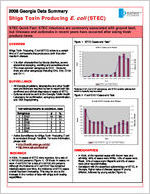
In 2008, 74 cases of STEC were reported, for a rate of 0.78/100,000 persons (Figure 1). Of those 74 cases, 44 were E.coli O157 for a rate of 0.46/100,000 persons. Although the incidence of E.coli O157 has remained relatively stable over time, the incidence of STEC cases overall has been increasing. This may be due to the increase in the number of labs with shiga-toxin testing capabilities.
Rates per 100,000
Cases
100
1.4
90 1.2
80
70
1
60
0.8
50
40
0.6
30
0.4
20 0.2
10
0
0
1998 1999 2000 2001 2002 2003 2004 2005 2006 2007 2008
Ye a r
E.coli O157:H7
E. coli O157 Rates
DEMOGRAPHICS
In 2008, of the reported cases with known race and ethnicity, 68% of cases were White, 13% of cases were Black, 10% of cases were Hispanic and 9% of cases were other race/ethnicities.
Consistent with the described epidemiology of STEC, in Georgia, higher rates of disease appear in young children, followed by young adults (Figure 4).
Figure 3.
2008 STEC Cases by Race
13%
10%
Black
Hispanic
Other
9%
White
68%
PREVENTION & RESEARCH
Food Preparation Tips 1. Always treat raw poultry, beef and pork as if they are contaminated and handle accordingly:
Wrap fresh meats in plastic bags at the market to prevent juices from dripping on other foods.
Refrigerate foods promptly; minimize holding time at room temperature.
Cutting boards and counters used for meat preparation should be washed immediately after use to prevent cross contamination with other foods.
Avoid eating raw or undercooked meats (internal cooking temperature for ground beef should be 160 degrees F).
2. Avoid consuming raw (unpasteurized) milk. 3. Thoroughly wash raw produce items before eating.
Figure 4.
All Reported Cases of STEC with Known Gender/Age Group, 2008
# of Cases
18 16 14 12 10 8 6 4 2 0
<1yr
1-5yr 6-10yr 11-17yr 18-59yr 60+yrs Age Group
Female Male
For more information, visit: www.foodsafety.gov
Hand Washing 1. Encourage careful hand washing before and after food preparation. 2. Always wash hands thoroughly after handling animals (pets, zoo, etc.) or feces of any kind.
FoodNet Projects Monitoring trends in STEC Epidemiology over time Surveying laboratories and clinicians about STEC diagnostics STEC interview studies in cooperation with the Centers for Disease Control and Prevention to evaluate risk factors for the development of HUS and to better characterize non-O157 STEC infections
IMPACT OF STEC
Hospitalizations & Deaths Of the total 74 cases of STEC in 2008, 32% of individuals were hospitalized, while an additional 14% of individuals were seen in the Emergency Room; 1 STEC patient died.
For more information:
http://health.state.ga.us/epi/foodborne
Outbreaks In 2008, one outbreak associated with ground beef served at a restaurant resulted in 8 cases of E. coli O157 and 4 cases of hemolytic uremic syndrome (HUS).