

- Collection:
- Georgia Government Publications
- Serial:
- Annual report / Georgia Department of Community Health.
- Title:
- Georgia Department of Community Health 2018 annual report
- Creator:
- Georgia. Department of Community Health
- Publisher:
- Atlanta, Ga. : Georgia. Department of Community Health
- Date of Original:
- 2018-06-30
- Subject:
- Georgia. Department of Community Health
Public health--United States--Georgia - Location:
- United States, Georgia, 32.75042, -83.50018
- Medium:
- reports
- Type:
- Text
- Format:
- application/pdf
- Description:
- Began with: 2000.
Report year ends June 30.
Description based on print version record.
Latest issue consulted: Fiscal year July 1, 2022/June 30, 2023 (Harvested on April 22, 2024 from dch.georgia.gov); (Georgia Government Publications database, viewed January 29, 2026. - External Identifiers:
- Call Number GA C900 .A1 2018
- Metadata URL:
- https://dlg.galileo.usg.edu/id:dlg_ggpd_y-ga-bc900-b-pa1-b2018-belec-p-btext
- Digital Object URL:
- https://dlg.galileo.usg.edu/do:dlg_ggpd_y-ga-bc900-b-pa1-b2018-belec-p-btext
- Language:
- eng
- Holding Institution:
- University of Georgia. Map and Government Information Library
- Rights:
-

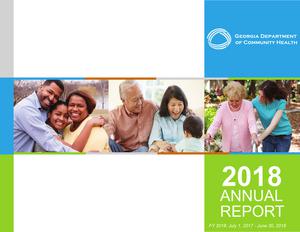
2018
ANNUAL REPORT
FY 2018: July 1, 2017 - June 30, 2018
TABLE OF CONTENTS FY 2018 ANNUAL REPORT
Introduction........................................ 1 Medical Assistance Plans................. 3 State Health Benefit Plan .................9 Healthcare Facility Regulation........13 Health Planning................................ 15 Financial Management.................... 17
Office of General Counsel.............. 19 Office of Information Technology.. 20 Office of Inspector General............ 22 Office of Public Affairs.................... 24 Office of Strategic Management .... 26 Office of Support Services ............ 27 Office of Human Resources .......... 28 State Office of Rural Health............ 29 Attached Agencies.......................... 30 Appendix.......................................... 31
The Big Health Care Picture and Georgia
1
ANNUAL REPORT FY 2018 Georgia Department of Community Health
Introduction
The Georgia Department of Community Health (DCH), designated as the state agency for Medicaid and PeachCare for Kids , provided access to health care for nearly 2 million Georgians. DCH also administered the State Health Benefit Plan (SHBP), providing health care coverage for 661,165 state employees, public school personnel, retirees and dependents as of June 2018. Combined, these two divisions provided health insurance coverage to approximately one in four people in the state, or more than 2.6 million Georgians. Highlights of major accomplishments included:
Medical Assistance Plans Division (MAP), in partnership with Medicaid stakeholders, implemented an Administrative Simplification Task Force. The goal of the ongoing Administrative Simplification Task Force was to reduce administrative burdens for Medicaid health care providers and members by identifying and streamlining processes to minimize and simplify duplicative processes. The division also began providing benefits for members under the age of 21 with Autism Spectrum Disorder Services (ASD). Adaptive Behavior Services were added as a benefit to assess and treat ASD.
Additional successes included: The successful issuance of a Request for Proposal (RFP) seeking a single qualified supplier to provide Electronic Visit Verification (EVV) services. EVV is an automated process for home health care and personal care services that electronically verifies the date and time of services provided, the type of services performed, the individual providing the service, the location where the service is provided, and the individual receiving the service.
EVV is expected to be implemented within the next two years, In accordance with the 21st Century Cures Act. The RFP was issued by the Department of Administrative Services (DOAS), on behalf of DCH.
New CMO contracts were successfully implemented with an effective date of July 1, 2017 (FY 2018). As part of its implementation, DCH added a fourth CMO, CareSource.
State Health Benefit Plan (SHBP) secured a new Pharmacy Benefit Manager (PBM) vendor, CVS Caremark. Additionally, SHBP continued to offer Health Reimbursement Arrangement (HRA) plan options (Gold HRA, Silver HRA and Bronze HRA), in addition to two statewide Health Maintenance Organization (HMO) plan options (offered through Blue Cross Blue Shield of Georgia and UnitedHealthcare); a Metro Atlanta Service Area (MASA) Regional HMO (offered through Kaiser Permanente); and a High Deductible Health Plan (HDHP) plan option (also offered through UnitedHealthcare). SHBP also partnered with Naturally Slim to offer a pilot weight loss program to 5,500 active members at no cost to the members. The pilot allowed participants the opportunity to receive support through online education sessions aimed at teaching mindfulness, stress reduction and healthy eating habits.
Georgia Department of Community Health ANNUAL REPORT FY 2018
Healthcare Facility Regulation Division (HFRD) implemented revised rules for Office of Inspector General Background Investigation Unit processed 1,587
Narcotic Treatment Programs (NTPs) that treat opioid addiction; also completed
criminal history records of DCH licensed facilities. The Office of Audits monitored
onsite surveys for all NTPs as required under a new state law.
and tracked Program Integrity recoveries which totaled $17.6 million. The
HFRD also received national recognition for implementing an incentive program that allowed employees to conduct facility inspections during nonbusiness hours. The program, known as Work on the Weekend (WOW), dramatically increased the timeliness of complaint investigations for the nursing home program. As a result of the success of WOW, HFRD received
Program Integrity Unit opened 537 cases and closed 434 cases. In FY 2018, Program Integrity recovered $17.6 million in overpayments. The Third Party Liability Unit (TPL) helped recover $37.6 million; an additional $1.9 million was recovered with the assistance of the Office of the Attorney General. The total TPL recoveries for FY 2018 was $39.5 million.
a national Best Practices Award from the Association of Health Facility
Office of Public Affairs responded to 330 media inquiries and 2,948
Survey Agencies (AHFSA) for improvements in the regulatory process.
constituents' concerns.
Concurrently, in FY 2018, HFRD received a National Quality, Safety and Oversight Achievement Award from the Centers for Medicare and Medicaid Services (CMS) for assisting more than 100 evacuees from the U.S. Virgin Islands and Puerto Rico in accessing health care services in Atlanta in the aftermath of Hurricane Maria.
Financial Management, Grants Administration successfully managed 95 active grants totaling $33,069,903.93 in state, federal and in-kind matching funds.
State Office of Rural Health administered state and federal funds totaling $16,781,260.
Office of Health Planning made health planning databases, population information, and health planning surveys available online. This accessibility improved the quality of information received from facilities as well as increased the timeliness of responses from approximately 75 percent in FY 2015 to approximately 91 percent in FY 2018. The Department was also able to obtain higher percentages of indigent and charity care commitment compliance from facilities as a result.
Office of Human Resources (OHR) replaced its manual, paper-based processes with the implementation of NEOGOV. The technology solution eliminated the paper requisition process for all Human Resources (HR) transactions, and enables the agency's HR team to immediately track the status of all requests. This automation has eliminated 14 days from the Time to Fill metric, allowing employees to be onboarded and in place to support programmatic needs more quickly.
Office of General Counsel Legal Section received 727 member and provider appeals. Contracts Administration generated approximately 255 contractual documents, including amendments. The Open Records section responded to 351 requests for records pursuant to the Georgia Open Records Act.
Office of Information Technology and Analytics selected a vendor and began implementation of the Enterprise Data Solution (EDS). The EDS will provide DCH with a modern, powerful data warehouse and analytical resource, and is expected to significantly enhance data-driven decision making for DCH and other stakeholders.
Additionally, OHR received the Champion of Learning Award, presented by the Association for Talent Development for successful implementation of Employee Learning Week, December 4-8, 2017. OHR was also selected as a finalist for the 2018 - When Work Works Award by Society for Human Resource Management. This award recognizes employers that successfully use effective workplace practices to meet business goals, promote employee success, and help develop positive workplace cultures.
Throughout this annual report for FY 2018, greater detail will be provided describing exactly what each Division does, pertinent charts and figures as well as notable accomplishments achieved throughout the year.
We are dedicated to A Healthy Georgia. 2
Medical Assistance
Plans
3
ANNUAL REPORT FY 2018 Georgia Department of Community Health
The Georgia Department of Community Health (DCH) serves as the single state agency for the administration of the Medicaid program under Title XIX of the Social Security Act, providing health care for children, pregnant women and people who are aged, blind or disabled (ABD). Medical Assistance Plans Division (MAP) oversaw the Georgia Medicaid programs and PeachCare for Kids (Georgia's Children's Health Insurance Program [CHIP] population). Medicaid and PeachCare for Kids members received services through either managed care (Georgia Families or Georgia Families 360SM) or fee-for-service arrangements. The MAP division provided management oversight of the Medicaid and PeachCare for Kids programs by:
Developing and implementing policies on allowable services and service delivery;
Administering the Georgia Families 360 managed care program for children in foster care, children receiving adoption assistance, and select youth in the juvenile justice system;
Overseeing member eligibility and enrollment into Medicaid and Peach Care for Kids, and enrollment into the Georgia Families Care Management Organizations (CMOs) and the Georgia Families 360 CMO;
Overseeing the seven programs offering Home- and Community-Based Services (HCBS) alternatives to long-term institutional care;
Collecting data and reporting the performance metrics for both the Fee-forService population and the managed care populations in Georgia Families and Georgia Families 360. The state used the Healthcare Effectiveness Data and Information Set (HEDIS) to measure performance on important dimensions of care and service;
Developing and implementing new programs in Medicaid and PeachCare for Kids promoting continuity of care, care coordination and enhanced health outcomes, such as the rapid cycle process improvement projects;
Controlling expenditures and overseeing all categories of service including capitation payments, pharmacy, inpatient hospital, outpatient hospital, nursing and long-term care facility and transportation;
Addressing member needs through Medicaid and PeachCare for Kids provider relations and claims resolution services;
Georgia Department of Community Health ANNUAL REPORT FY 2018
Evaluating opportunities to improve efficiency and effectiveness in Medicaid operations and implementing changes that streamline processes for providers and Medicaid and PeachCare for Kid members;
Managing the performance of four CMOs responsible for providing medical services under the Georgia Families and Georgia Families 360 programs to 1.3M + Medicaid and PeachCare for Kids members.
services. As part of its implementation efforts, DCH collaborated with stakeholders including providers, provider associations, managed care contractors, member advocates, and state agencies including, but not limited to, the Department of Behavioral Health and Developmental Disabilities, and the Department of Public Health. Since January 2018, Georgia Medicaid has enrolled more than 950 ASD benefit provider locations throughout the state. DCH will continue its efforts to increase the number of available autism providers.
Major Programs and/or Initiatives
Electronic Visit Verification (EVV). In accordance with the 21st Century Cures Act, the Department of Administrative Services (DOAS), on behalf
of the Department of Community Health (DCH), issued a Request for
Beyond the primary role of managing Medicaid, the division developed several
Proposals (RFPs) seeking a single qualified supplier to provide EVV
new and innovative programs that enhanced the effectiveness and efficiency
services. EVV is an automated process for home health care and personal
of health care services offered to members. Georgia Medicaid continued the
care services that electronically verifies the date and time, the type of
improvement of services through program enhancements as part of the
service performed, the individual providing the service, the location where
Medicaid Redesign Initiative. Medicaid Redesign began in FY 2011 and focused
the service is provided, and the individual receiving the service. EVV also
on improving the health of Medicaid members while also controlling the ever-
provides real-time information and verification to ensure no gaps in care
increasing expenditures of providing Medicaid services in Georgia. In FY 2018,
occur throughout the course of the member's service plan. Another EVV
the MAP division implemented the following:
goal is to reduce and eliminate fraud, waste, and abuse in home care
service delivery. As part of its implementation efforts, DCH collaborated
Administrative Simplification Task Force. DCH, in partnership with
with member advocacy groups, provider associations, and stakeholders
Medicaid stakeholders, implemented an Administrative Simplification
to ensure that a wide range of input and concerns were received and
Task Force. The goal of the Administrative Simplification Task Force was
addressed. DCH also began conducting public forums throughout the State
to reduce administrative burdens for Medicaid health care providers and
of Georgia during FY 2018 to educate the public, Medicaid and PeachCare
members by identifying and streamlining processes to eliminate duplication.
for Kids providers, and members. These forums will continue on into FY
Stakeholders include Medicaid and PeachCare for Kids providers,
2019. EVV is expected to be implemented in FY 2020.
provider associations, managed care contractors, state program
administrators, state agencies, and systems and policy experts. The task
Enhanced Centralized Prior Authorization Portal. DCH added ASD,
force meets monthly to discuss ways to streamline claims and provider
Orthotics and Prosthetics, and Hearing Aid services to the Centralized Prior
enrollment processes, to improve quality of care, and to eliminate
Authorization Portal. The Centralized Prior Authorization Portal allows
duplication, while ensuring the integrity of the Medicaid and PeachCare for
Medicaid and PeachCare for Kids providers to submit prior authorization
Kids program.
requests through one centralized location, instead of to each CMO. The
Centralized Prior Authorization Portal was implemented in 2013 and has
New Medicaid Autism Benefit. The Medicaid program began providing
continued to be enhanced with the addition of new services. In FY 2018,
benefits for members under the age of 21 with ASD. Adaptive Behavior
more than 400,000 requests for prior authorization were submitted through
Services were added as a benefit to assess and treat ASD. The new autism
the Centralized Prior Authorization Portal.
benefit is administered in accordance with the Early & Periodic Screening,
Diagnostic and Treatment regulations. To increase the number of
autism service providers, DCH obtained approval from the Centers for
Medicare and Medicaid Services (CMS) to begin enrolling Board Certified
Behavioral Analysts (BCBAs) as qualified health care professionals. In
addition to BCBAs, physicians and psychologists may also render ASD
Medicaid Assistance Plans 4
Georgia Department of Community Health ANNUAL REPORT FY 2018
New Care Management Organization (CMO) Contracts. DCH first
more restrictive benefit limitations on mental health and substance
implemented Georgia Families, the Medicaid managed care program for
use disorder (MH/SUD) benefits than on medical and surgical
Parent/ Caretaker with Children Medicaid (formerly Low Income Medicaid,
benefits. The CMOs must ensure that financial requirements (such as
or LIM), and PeachCare for Kids members in FY 2005. DCH released
co-pays and deductibles) and treatment limitations that apply to MH/SUD
an RFP for new services in FY 2015 and awarded the new contracts in FY
benefits are no more restrictive than the predominant requirements or
2016, with a start date of service in FY 2017. DCH conducted extensive
limitations applied to medical and surgical benefits.
implementation readiness review activities during FY 2017 with assistance
from partner agencies, including the Department of Behavioral Health an
Non-Emergency Medical Transportation (NEMT). Through the NEMT
Developmental Disabilities, the Department of Human Services,
program, DCH provided more than 3.7 million trips to Medicaid Members
the Department of Juvenile Justice, and the Department of Public Health.
across Georgia who had no other means of transportation in FY 2018.
The new CMO contracts were successfully implemented with an
NEMT modes of transit included ambulatory transport, wheelchair, stretcher,
effective date of July 1, 2017 (FY 2018). As part of its implementation, DCH
and utilization of public transport. NEMT services in Georgia are managed
partnered with Amerigroup, Peach State Health Plan and Wellcare of
by two Brokers under contract with DCH who sub-contract with more than
Georgia, and added a fourth CMO, CareSouce. DCH also partnered with
200 transportation providers and independent drivers. In addition, both
Amerigroup to administer managed care for foster care, adoption
Brokers have begun to utilize innovative ride share services. NEMT also
assistance, and juvenile justice members, known as Georgia Families 360.
stands ready to assist GEMA and DCH Healthcare Facility Regulation
Division in providing transport assistance for evacuations of vulnerable
New HCBS Settings Rule. CMS issued regulation in FY 2014 defining the
populations during a declared State of Emergency (including hurricane
characteristics and qualities of HCBS. The new regulations further defined
relocations).
both the characteristics and the qualities of the settings where services can
be delivered. The regulations required the state to develop a Statewide
Transition Plan (STP) describing how the state would assure compliance
with the new rules addressing requirements for services to be provided
in an integrated setting and in the most community-inclusive manner. All
HCBS providers must be certified as being in compliance by 2022.
Georgia's work toward compliance has included engagement of a statewide
task force, public meetings to solicit stakeholder input on the development
of the STP, and preparation of four waiver-specific Transition Plans.
Georgia's STP was formally submitted to CMS in May 2017 and received
initial approval. CMS has provided DCH with additional requirements to
include in the STP, and provided technical assistance on obtaining final
adoption. Based on CMS guidance, DCH is surveying all HCBS
providers, and providing HCBS providers with technical assistance if
needed. DCH will be submitting a final plan to CMS for approval in the first
quarter of calendar year 2019.
Mental Health Parity Regulations. CMS finalized a rule to strengthen access to mental health and substance use disorder services for individuals with Medicaid, Children's Health Insurance Program (CHIP), or Alternative Benefit Plan (ABP) coverage, similar to the requirements that were already in place for private health insurance plans. In summary, the rule requires that Medicaid, CHIP, and ABP Managed Care Plans not impose
Medical Assistance Plans 5
ANNUAL REPORT FY 2018 Georgia Department of Community Health
FY 2018 Table of Members and Expenditures
Measures
Medicaid1
Medicaid-ABD Medicaid-LIM PeachCare for Kids
Members Average2
1,967,334
517,240
1,426,306
124,181
Member Months
23,608,010
6,206,880
17,115,675
1,490,175
Net Payment
$5,880,556,511 $5,573,102,597 $307,453,914
$9,666,178
Providers3
107,091
82,088
84,263
35,711
Claims Paid
53,477,869
28,169,996
25,307,873
1,841,533
Capitation Amount
$4,030,912,952 $33,325,300 $3,997,587,652
$245,184,996
Total Payment4
$9,911,469,464 $5,606,427,897 $4,305,041,566
$254,851,174
Total Payment Per Member Per Month
$420
$903
$252
$177
Source: IBM Watson Health Analytics Advantage Suite, based on incurred dates July 2017 through June 2018, paid through August 2018. 1 Medicaid includes Medicaid ABD, Medicaid LIM and inmates, but excludes PeachCare for Kids. Members and expenditures for Inmate Aid Category Budget Group were assigned to ABD or LIM based on secondary aid category. Inmate members without ABD or LIM secondary aid category were included in the total Medicaid Members Average (23,788) and Member Months (285,455), but were not allocated to LIM nor ABD. 2 Members Average is the average number of members per month. 3 Unique count of providers used across the ABD and Inmate populations in total Medicaid column. Providers represents multiple locations for individual providers. 4 Total Payment includes Net Payment and Capitation Amounts and has been adjusted for claims incurred but not yet reported.
6 Medical Assistance Plans
ANNUAL REPORT FY 2018 Georgia Department of Community Health
Table of Historical Medicaid Members and Payments by Fiscal Year1
Fiscal Year
Average Members
Total Payments2
Payment Percent Change in Per Member Payment Per Member
2000 2001 2002 2003 2004 2005 2006
2007 2008 2009 2010 2011 2012 2013 2014 2015 2016 2017 2018
947,054 996,901 1,268,225 1,260,795 1,326,909 1,376,730 1,390,497
1,283,940 1,268,661 1,353,191 1,447,865 1,496,881 1,540,666 1,588,074 1,633,977 1,807,586 1,862,573 1,838,625 1,967,334
$3,482,779,560 $3,822,786,433 $4,461,972,245 $4,885,865,204 $6,039,465,103 $6,311,890,515 $6,280,193,139
$6,155,158,918 $6,371,942,440 $6,703,774,787 $6,954,116,861 $7,464,027,216 $7,813,851,582 $8,047,771,351 $8,451,360,734 $8,923,003,018 $9,257,891,787 $9,590,732,939 $9,911,469,464
$3,677 $3,835 $3,518 $3,875 $4,552 $4,585 $4,517
$4,794 $5,023 $4,954 $4,803 $4,986 $5,072 $5,068 $5,172 $4,936 $4,970 $5,216 $5,038
N/A 4.3% -8.3% 10.1% 17.5% 0.7% -1.5%
6.1% 4.8% -1.4% -3.0% 3.8% 1.7% -0.1% 2.1% -4.6% 0.7% 4.9% -3.4%
Source: IBM Watson Health Analytics Advantage Suite, based on incurred dates July 1999 through June 2018, paid through August 2018. 1 Medicaid includes Medicaid ABD, Medicaid LIM and Inmates and excludes PeachCare. 2 Total payments include Net Payment and Capitation Amounts and has been adjusted for claims incurred but not yet reported.
Medicaid Payments Distribution by Services Type: FY 2018
All Other Services 2.1%
Waiver Program S ervices 12.2%
Other Practitioner Services 0.7%
Emergency Transportation
0.4%
Equipment & Devices 0.8%
Pharmacy Services 8.9%
Capitation Payments 39.8%
Physician Services 3.5%
Hospital Services 16.1%
Mental Health Services 1.4%
Nursing Facility Services 13.5%
Maternal & Child Health Services 0.7%
7 Medicaid Assistance Plans
Georgia Department of Community Health ANNUAL REPORT FY 2018
Table of Historical PeachCare For Kids Members and Payments by Fiscal Year
Fiscal Year
Average Members
Total Payments2
Payment Percent Change in Per Member Payment Per Member
2000
8,503
$50,730,000
$5,966
--
2001
14,028
$115,931,116
$8,264
38.5%
2002
154,406
$170,916,516
$1,107
-86.6%
2003
180,953
$212,319,603
$1,173
6.0%
2004
200,562
$262,676,747
$1,310
11.6%
2005
208,185
$273,274,876
$1,313
0.2%
2006
238,330
$310,331,108
$1,302
-0.8%
2007
273,659
$432,157,786
$1,579
21.3%
2008
249,681
$345,678,006
$1,384
-12.3%
2009
205,548
$304,985,696
$1,484
7.2%
2010
202,527
$299,535,400
$1,479
-0.3%
2011
199,420
$316,597,618
$1,588
7.3%
2012
205,167
$337,832,456
$1,647
3.7%
2013
217,964
$398,513,422
$1,828
11.0%
2014
215,222
$418,500,964
$1,945
6.4%
2015
158,336
$302,361,213
$1,910
-1.8%
2016
127,928
$254,187,032
$1,987
4.2%
2017
130,295
$271,531,234
$2,084
4.9%
2018
124,181
$254,851,174
$2,052
-1.5%
Source: IBM Watson Health Analytics Advantage Suite, based on incurred dates July 1999 through June 2018, paid through August 2018.
1 Total payments include Net Payment and Capitation Amounts and has been adjusted for claims incurred but not yet reported.
PeachCare for Kids Payments Distribution by Service Type FY 2018
Equipment & Devices 0.1%
Pharmacy Services 0.6%
Emergency Transportation
0.03%
Other Practitioner Services 0.2%
All Other Services 0.04%
Capitation Payments 96.2%
Physician Services 0.4%
Hospital Services 1.7%
Mental Health Services 0.02%
Maternal & Child Health
Services 0.6%
Medical Assistance Plans 8
State Health Benefit Plan
9
ANNUAL REPORT FY 2018 Georgia Department of Community Health
The Georgia Deparment of Community Health (DCH) serves as the state administrator of health insurance coverage for state employees, teachers, school system employees and retirees who elected coverage (including annuitants and former employees on extended coverage), and covered dependents. This health coverage is known as the State Health Benefit Plan (SHBP).
SHBP is composed of three plans: the State Employees Plan, the Teachers Plan and the Public Schools Employees Plan. SHBP covered 661,165 lives as of June 2018.
SHBP is a self-insured, self-funded plan that pays benefits out of the premiums contributed from members (through monthly payroll deductions) and from monthly contributions from the employers that offer the SHBP (e.g., state agencies and public school systems).
SHBP also offers four fully-insured Medicare Advantage options (Standard and Premium offered by two vendors) for former employees who are continuing coverage and are enrolled at a minimum in Medicare Part B. Employer contributions and member premiums are used to purchase Medicare Advantage insurance.
In 2018, SHBP offered eligible active employees and eligible former employees under age 65 the choice of three Health Reimbursement Arrangement (HRA) plan options, Gold HRA, Silver HRA, and Bronze HRA; two statewide Health Maintenance Organization (HMO) plan options; one Metro Atlanta Service Area (MASA) Regional HMO plan option; and one High Deductible Health Plan (HDHP) plan option.
Structure of SHBP
Within the division, there are three primary operating units:
Clinical, Quality and Outcomes provides oversight of the vendors' performance of services for clinical programs including, but not limited to: utilization management; case management; disease management; behavioral health; wellness and pharmacy management, and the overall quality of these services.
Third-Party Administration/Communications oversees the third-party administrator vendors and the administration of each plan option. The unit also oversees communication of plan information to members.
Eligibility & Benefits Administration encompasses both Member Services and Employer Services. Employer Services assists participating employers with information and training on Plan coverage, billing, administering SHBP
Georgia Department of Community Health ANNUAL REPORT FY 2018
benefits for their eligible employees and development of job aids, training materials and presentations. Member Services assists members with all eligibility matters including questions related to the Plan Documents, terms and conditions, enrollment/web portal, Qualifying Events, premium billing, and appeals. Member Services is also responsible for oversight of the eligibility and enrollment vendor.
SHBP operates using a calendar year for its Plan Year.
Accomplishments
In 2018, SHBP implemented a new Pharmacy Benefit Manager vendor, CVS Caremark. SHBP continued to offer HRA plan options (Gold HRA, Silver HRA and Bronze HRA), in addition to two statewide HMO plan options (offered through Blue Cross and Blue Shield of Georgia and UnitedHealthcare); a MASA Regional HMO (offered through Kaiser Permanente); and a HDHP plan option (also offered through UnitedHealthcare). These plan options continued to provide expanded vendor and plan design choices for active employees and their dependents.
Additionally, SHBP continued to encourage health and wellness participation to its membership. To that end, SHBP offered wellness incentive offerings through the HRAs, Statewide HMOs and HDHP plan options via its wellness vendor, Sharecare. Members and their covered spouses were each able to earn up to 480 well-being incentive credits (up to 960 well-being incentive credits per household) by completing certain health actions; these credits could be used to reduce members' out-of-pocket costs for eligible medical and pharmacy expenses. Further, Kaiser Permanente provided wellness program incentives for members and their covered spouses, each of whom were able to earn a $500 gift card (up to $1000 per household) by completing certain health actions.
SHBP also partnered with Naturally Slim to offer a pilot weight loss program to 5,500 active members at no cost to the members. The pilot allowed participants the opportunity to receive support through online education sessions aimed at teaching mindfulness, stress reduction and healthy eating habits.
Preventative and Wellness Campaigns as of June 2018
Health Assessment/RealAge Completions Total completions for this time period were 85,481, of which 67,918 were completed by members; 17,295 were completed by spouses; and 268 were completed by dependents over 18.
Biometric Screenings Total onsite screening events completed for this time period were 306, with 36,973 onsite screening participants. Total Physician Screening Forms submitted during this time period was 50,788.
Challenges Go for 10 challenge had 2,244 members join. Stress Less Challenge had a total of 2,509 members join. Stop the Clock Steps gained 2,644 members.
Preventive Campaigns Breast Cancer Awareness 155,601 targeted Great American Smokeout 10,191 targeted Annual Physical 75,301 targeted Cervical Cancer 145,084 targeted Colorectal Cancer 131,776 targeted Women's Health 141,299 targeted
Onsite Activities
2018 Wellness Activities
Presentations
52
Onsite Meetings/Collateral Drops 55
Walking Maps
3
Benefit Fairs
48
Cooking Demos
47
Health Assessment/RealAge Test 30 Days
Biometric Screening Worksite
103
Events
Total
338
State Health Benefit Plan 10
Georgia Department of Community Health ANNUAL REPORT FY 2018
Table of Historical SHBP Members and Payments by Fiscal Year1
Fiscal Year
2001 2002 2003 2004 2005 2006 2007 2008 2009 2010 2011 2012 2013 2014 2015 2016 2017 2018
Members Average
647,466 663,944 615,167 627,636 642,553 647,581 664,251 684,346 695,484 691,410 686,776 677,393 648,242 625,719 625,559 632,692 645,122 658,356
Total Payments
Payment Per Member
$1,110,543,053 $1,212,072,547 $1,099,992,138 $1,378,907,068 $1,484,143,212 $1,881,122,239 $2,000,575,396 $2,187,836,485 $2,522,951,203 $2,647,862,985 $2,671,341,740 $2,759,640,257 $2,580,549,357 $2,956,753,454 $3,689,680,729 $3,689,680,729 $3,994,652,402 $4,423,191,514
$1,715 $1,826 $1,788 $2,197 $2,310 $2,905 $3,012 $3,197 $3,628 $3,830 $3,890 $4,074 $3,981 $4,725 $5,832 $5,832 $6,192 $6,719
% Change in Payment Per
Member
0.0% 6.4% -2.1% 22.9% 5.1% 25.8% 3.7% 6.1% 13.5% 5.6% 1.6% 4.7% -2.3% 18.7% 16.2% 6.2% 6.2% 8.5%
Source: IBM Watson Health Analytics Advantage Suite and DataProbe, based on incurred dates July 1999 through June 2018, paid through August 2018. 1 Total Payments includes Net Payments, Healthcare Reimbursement Amount, and Healthcare Incentive Amounts, adjusted for claims incurred but not yet reported, as well as Kaiser capitation payments. 2 Data for FY 2000 is not available.
SHBP Members Average by Plan Type FY 2018
HRA 46% 305,178
Medicare Advantage 18%
117,861
Tricare 535 <1%
HDHP 1%
6,498
HMO 35% 228,285
State Health Benefit Plan 11
ANNUAL REPORT FY 2018 Georgia Department of Community Health
FY 2018 State Health Benefit Plan Members Expenditures1
Measures
State Active State Retiree Teacher Active
Teacher Retiree
NonCert Active
NonCert Retiree
COBRA/ Surviving Spouse
Total SHBP
Members Average2 Member Months
100,881 1,210,567
51,126 613,517
259,865 3,118,378
85,750 1,029,002
123,230 1,478,754
34,107 409,282
3,398 40,770
658,356 7,900,270
Net Payment
$496,042,896 $480,674,049 $1,024,835,456 $760,072,488 $685,332,626 $317,826,772 $30,982,860 $3,795,767,147
Providers4 Claims Paid Capitation Amount Healthcare Reimbursement Amount
32,312 2,716,370 $35,942,807 $11,807,161
63,664 2,968,572 $3,110,661 $2,833,879
53,151 6,055,342 $68,604,929 $22,758,846
102,999 4,641,121 $3,584,676 $5,856,538
33,996 3,576,605 $42,983,303 $12,651,795
50,629 2,063,504 $1,694,062 $1,166,976
19,517 225,733 $67,072 $141,160
183,778 22,247,247 $155,987,510 $57,216,354
Total Payments3
$609,133,796 $521,610,298 $1,265,739,516 $821,409,006 $809,847,468 $346,448,229 $49,003,201 $4,423,191,514
Payments Per Member
$503
$850
$406
$798
$548
$846
$1,202
$560
Source: IBM Watson Health Analytics Advantage Suite and DataProbe, based on incurred dates July 2017 through June 2018, paid through August 2018.
1 The State Active group also includes the Contract Active group. The State Retiree group also includes the Contract Retiree group. The Teacher Active group also includes the County Government Active group. The COBRA group includes COBRA Continuees and Surviving Spouse/Dependents from each Employee Type Group.
2 Members Average reflects enrollment for the Fiscal Year, July 2017 through June 2018.
3 Total Payments includes Net Payment, Healthcare Reimbursement Amount. Healthcare Incentive Amount and Kaiser capitation payments (Kaiser capitation payments data provided by GA Department of Community Health) and has been ajdjusted for claims incurred but not yet reported.
4 The Total SHBP Provider count reflects a unique count across all SHBP populations (e.g, not additive across the SHBP population groups).
FY 2018 Table of State Health Benefit Plan Covered Lives1
Category
Members Average
Employee / Retiree
Dependent
State Employees - Active State Employees - Retired Teachers Active Teachers Retired School Service Personnel Active School Service Personnel Retired Contracts/Board Members
99,094 51,078 259,700 85,750 123,229 34,107 2,002
54,971 35,536 110,176 59,253 65,454 24,784 1,258
44,123 15,542 149,523 26,497 57,775 9,322
744
COBRA/Surviving Spouse
3,398
3,008
389
SHBP TOTAL
658,356
354,440
303,916
Source: IBM Watson Health Analytics Advantage Suite, based on incurred dates July 2017 through June 2018, paid through August 2018.
1Members Average reflects enrollment for the Fiscal Year, July 2017 through June 2018.
12 State Health Benefit Plan
Healthcare Facility Regulation
ANNUAL REPORT FY 2018 Georgia Department of Community Health
The Healthcare Facility Regulation Division (HFRD) of the Georgia Department of Community Health (DCH) served Georgia residents through the statewide oversight of health care facilities.
In FY 2018, HFRD inspected and licensed more than 20 types of health care facilities and services, such as hospitals, nursing homes, assisted living communities, personal care homes, drug abuse treatment programs and end stage renal disease facilities. The division certified various health care facilities to receive Medicaid and Medicare funds through contracts and agreements with the Centers for Medicare & Medicaid Services (CMS) and the Food and Drug Administration of the U.S. Department of Health and Human Services.
HFRD provided ongoing monitoring of licensed health care facilities to ensure compliance with rules promulgated by DCH. The division reviewed and issued decisions based on facility requests for waivers or variances to these rules. Furthermore, HFRD investigated reports of unlicensed facilities, complaints against licensed facilities, adverse events, and incidents reported by citizens and health care facilities.
Accomplishments
HFRD provided oversight to more than 24,000 facilities, providers and registrants in FY 2018;
HFRD issued 713 licenses for new health care businesses in Georgia, and conducted 2,890 inspections of existing facilities;
HFRD also responded to 2,799 complaints against health care facilities and reviewed 11,987 incident reports;
In November of 2017, HFRD implemented a new survey process for nursing homes pursuant to federal regulations and also implemented new requirements for emergency preparedness in all Medicare-certified facilities;
In January of 2018, HFRD launched an online process for the public to submit complaints against facilities for investigation as well as a process to enable health care facilities to submit incident reports online using a single form;
Between January and April of 2018, HFRD implemented revised rules for Narcotic Treatment Programs (NTPs) that treat opioid addiction and completed onsite surveys for all NTPs as required under a new state law;
13
ANNUAL REPORT FY 2018 Georgia Department of Community Health In April of 2018, HFRD received a National Quality, Safety and Oversight
Achievement Award from the CMS for assisting more than 100 evacuees from the U.S. Virgin Islands and Puerto Rico in accessing health care services in Atlanta in the aftermath of Hurricane Maria; HFRD received national recognition for implementing an incentive program that allowed employees to conduct facility inspections during nonbusiness hours. The program, known as Work on the Weekend (WOW), dramatically increased the timeliness of complaint investigations for the nursing home program. As a result of the success of WOW, HFRD also received a national Best Practices Award from the Association of Health Facility Survey Agencies for improvements in the regulatory process.
14 Healthcare Facility Regulation
Office of Health Planning
15
ANNUAL REPORT FY 2018 Georgia Department of Community Health
The Office of Health Planning (Health Planning) within the Georgia Department of Community Health (DCH) serves Georgia residents through the administration of the state's Certificate of Need (CON) program and Health Planning functions.
A CON is required before the offering of a statutorily defined new institutional health service by a health care facility. Health Planning reviews applications for CON issuance in accordance with the state health plan, relevant statutes, rules, and regulations. Health Planning also issues Letters of Determination, which provide guidance on the applicability of CON rules for proposed projects, and Letters of Non-Reviewability (LNR) for facilities or services not requiring prior review and approval pursuant to certain CON considerations.
Health Planning conducts annual surveys of CON-regulated facilities and providers to obtain utilization and financial data for state health planning forecasts and methodologies as well as the CON review process. The Office ensures compliance by health care facilities with indigent and charity care commitment percentages. Health Planning also conducts architectural plan reviews and site inspections for major renovations and construction projects in hospitals, nursing homes and ambulatory surgery centers.
Additionally, Health Planning administers the Patient's Right to Independent Review Program which provides members of health maintenance organizations and other managed care plans the right to appeal an insurer's decision denying coverage for medical services.
Accomplishments
During FY 2018, Health Planning received 82 CON applications, 77 requests for Letters of Non-Reviewability, and 231 requests for Letters of Determination. Health Planning prepared for and participated in the appeals of 3 matters during the fiscal year;
Health Planning sent 1,463 health planning surveys to regulated facilities and providers and received 1,331 responses, a 91 percent completion rate. Health Planning collected and deposited $1,777,762 into the Indigent and Charity Care Trust Fund from adjusted payments to offset shortfalls in indigent and charity care commitments;
Health Planning conducted 294 plan reviews and 145 inspections at facilities under construction. Total square feet of construction reviewed is estimated at 3.5 million sq.ft. and estimated costs are $1.03 billion. Staff traveled more than 12,000 miles across GA;
As administrator of the Patient's Right to Independent Review Program, Health Planning reviewed 44 requests for independent review.
ANNUAL REPORT FY 2018 Georgia Department of Community Health
16 Health Planning
ANNUAL REPORT FY 2018 Georgia Department of Community Health
In FY 2018, the Financial Management Division provided financial support to the Georgia Department of Community Health (DCH). Four sections performed the division's work: Financial and Accounting Services, the Budget Office, Reimbursement Services, and Procurement Services and Grants Administration.
Financial and Accounting Services
The Financial and Accounting Services section paid providers, vendors and employees, and processed federal, state and other fund source receipts. The section performed cash management analysis to ensure adequate funding for the agency. In addition, the section prepared annual financial statements and budgetary compliance reports, as well as financial reports that secured Medicaid, PeachCare for Kids and other federal funding. This section also includes Medicaid Benefits Recovery which is responsible for the collection of outstanding accounts receivable balances for Georgia Medicaid providers.
Financial Management
The Budget Office
The Budget Office developed, requested, maintained and monitored the DCH budget. During budget development, the Budget Office prepared budget and cash projections for Medicaid, PeachCare for Kids and State Health Benefit Plan (SHBP) programs. In addition, the Budget Office, supported by the Financial and Accounting Services section, ensured funding was available for departmental operations before liabilities were incurred. The Budget Office also has the SHBP Audit section which is responsible for the administrative and financial analysis of payments made to SHBP. Finally, the Budget Office provided analytical support on program and policy changes impacting Departmental Administration, Medicaid, PeachCare for Kids and SHBP.
Reimbursement Services
The Reimbursement Services section set payment rates for nursing homes, longterm care facilities, hospitals and non-institutional providers seeking reimbursement from the Medicaid and PeachCare for Kids programs. In addition, working with actuaries, the section determined Medicaid, PeachCare for Kids and Care Management Organization capitation rates. The section also was responsible for supplemental hospital, nursing home and physician payments through the federal Upper Payment Limit and Disproportionate Share Hospital (DSH) programs. Also in 2018, Reimbursement Services initiated significant changes to Hospital Inpatient
17
Georgia Department of Community Health ANNUAL REPORT FY 2018 reimbursement by establishing a Graduate Medical Education pool, and increasing funding for hospitals with Indirect Medical Education cost, as well as for hospitals that treat a high proportion of Medicaid recipients.
Procurement Services and Grants Administration
Procurement Services used strategic sourcing to procure quality goods and services at the lowest reasonable cost and at the best value to the agency. In FY 2018, Procurement Services managed six procurements through the award process totaling $1,191,405.59 through competitive bids. Procurement analyzed 357 forecasted purchases to identify services that must be either sourced through the competitive bidding process, determined exempt from competitive bidding or approved for renewal, extension, termination and/or substantive changes through the amendments of existing contracts. The total of these purchases was $488,317,532.86. Procurement Services reviewed 1,596 electronic requisitions for general purchases of goods and services totaling $11,181,040.25. A total number of 1,450 Purchase Orders were created to encumber funds for contracts, grants, and general purchases of goods and services valued at $652,001,270.51. Grants Administration successfully managed 95 active grants totaling $33,069,903.93 in state, federal and in-kind matching funds. In conjunction with DCH business owners, Grants Administration developed performance-based deliverables for all grant awards.
Financial Management 18
Office of General Counsel
19
ANNUAL REPORT FY 2018 Georgia Department of Community Health
In FY 2018, the Office of General Counsel provided legal guidance and support to the Commissioner, the Board of Community Health, and all divisions and offices of the department. The office prepared contracts; monitored proposed legislation; analyzed and researched healthcare policy issues and state and federal laws; provided support in various court cases; and reviewed or prepared policies, resolutions, rules and regulations for DCH. The office also monitored compliance with HIPAA Privacy and Security, provided regulatory compliance guidance, and administered the Georgia Open Records Act on the department's behalf. Through its Legal Services section, the office also handled administrative hearings before the Office of State Administrative Hearings and the internal Hearing Officer designated by the Commissioner. The office maintained a close working relationship with various governmental agencies, including, but not limited to, its sister agencies consisting of the Department of Behavioral Health and Developmental Disabilities (DBHDD), the Department of Human Services (DHS) and the Department of Public Health (DPH) to ensure an open line of communication supporting DCH's programs, goals and missions. Four primary sections in the office, along with other members of the office, assisted in the above efforts:
Legal Services
Contracts Administration
HIPAA Privacy & Security
Open Records
Accomplishments
The Legal Services section received 727 member and provider appeals.
The Contracts Administration section responded to the contract needs of every division and office in DCH. Contracts Administration coordinated with program staff, DCH leadership and vendors to generate 255 contractual documents, including amendments.
The HIPAA Privacy & Security section assisted with the "Refreshed and Ready" training program, during which DCH workers, including DCH employees and contractors, completed online training about targeted DCH policies and procedures. HIPAA Officer and Specialist engagement also included at minimum internal policy review, incident/breach review and reporting, and consultation about matters in which privacy and security issues were presented.
The Open Records section received and processed 351 requests for records pursuant to the Georgia Open Records Act.
Office of Information Technology
ANNUAL REPORT FY 2018 Georgia Department of Community Health
In FY 2018, the Office of Information Technology (OIT) was composed of the following business units:
The Medicaid Management Information System (MMIS) unit, which supported the various systems used for processing, collecting, analyzing, and reporting information needed for all Medicaid and PeachCare for Kids claim payment and processing functions.
The Office of Health Information and Analytics (OHIA), which supported DCH Decision Support and Business Intelligence systems and provided analytical and reporting services and expertise to DCH for the Medicaid, PeachCare for Kids and State Health Benefit Plan programs.
The Information Technology Infrastructure (ITI) unit, which provided enduser computing support and information technology oversight for the entire agency, DCH Help Desk support, and application and technical solution development for DCH business units through the Technical Solutions Team.
The Office of Information Security, which ensured information and technology security compliance for DCH systems and oversaw information security policies for the agency.
The Medicaid Information Technology Architecture (MITA) unit, which implemented Georgia's MITA initiative including the State Self-Assessment, Business Architecture, Information Architecture and the initiation of business process projects that will allow Georgia to mature along the MITA framework.
The Health Information Technology (Health IT or HIT) unit, which merged under OIT in September 2017, continued its mission to advance the use of health information technology throughout Georgia to reduce health care disparities, improve health outcomes, increase the efficiency of health care delivery, and reduce overall health care costs. Health IT also continued its administrative oversight of the Medicaid Promoting Interoperability (PI) Program (formerly the Medicaid EHR Incentive Program), including eligibility, registration and attestation for the distribution of incentive payments to eligible Medicaid providers. The 100 percent federally funded payments were made to eligible professionals, eligible hospitals and critical access hospitals that adopted, implemented, upgraded or demonstrated meaningful use (MU) of certified EHR technology to improve patient care and reduce health care disparities.
20
Georgia Department of Community Health ANNUAL REPORT FY 2018
Accomplishments
The Office of Health Information and Analytics selected a vendor and
Health IT successfully completed the fourth year of the National Testing
began implementation for the Enterprise Data Solution (EDS). The EDS
Experience and Functional Assessment Tools grant, and continued its
will provide the department with a modern, powerful data warehouse and
support of the Georgia Health Information Network, Georgia's statewide
analytical resource and is expected to significantly enhance data-driven
health information exchange and the State-Designated Entity. Additionally,
decision-making for DCH and other stakeholders.
the unit also administered the Functional Assessment Standardized Items
OIT continued planning for the MMIS transformation and re-procurement, the Medicaid Enterprise System Transformation (MEST) project. OIT partnered with the Georgia Tech Research Institute and the Georgia Technology Authority to plan and design an Integration Platform that will
and demonstrated the use of an electronic personal health record system to the Medicaid Community-Based Long-Term Services and Supports members and care team to enhance care-related decisions and improve health outcomes.
form the technical infrastructure and foundation for a modular, MITA-aligned
MMIS.
The MITA Business Architecture team developed a Medicaid Services Assessment Template for the MEST project. The template is used to collect and analyze information related to people, processes and technology for Medicaid services. The information collected will assist in the development and implementation of the modular, innovative, and interoperable system DCH is planning.
The MITA Information Architecture team implemented a DCH Enterprise Metadata Repository that enables cross-unit collaboration opportunities and better business-driven technology decisions. The Repository gives DCH the ability to identify opportunities for reuse of technology which will reduce cost and streamline production.
The IT Infrastructure Unit oversaw the successful migration from an analog to a digital voice-over-IP phone system for all staff at DCH's headquarters and the Technical Solutions Team developed solutions to provide automation including a web-based facility complaints portal for licensed health care facilities.
OIT team members assisted in the planning and strategy associated with procurement of an Electronic Visit Verification system for Medicaid home and community-based waiver and home health programs. Staff participated in the development of innovative technical and business requirements along with security-related requirements for the procurement.
Health IT noted that as of June 30, 2018, the Medicaid PI Program had paid nearly $300 million to Georgia healthcare providers since its inception in September 2011. The unit also provided concierge support for 11 public health districts to meet MU for the Medicaid PI Program. In addition, Health IT also successfully launched the Georgia Clinical Quality Measures System, commencing with 27 participating providers.
Information Technology 21
Office of Inspector General
22
ANNUAL REPORT FY 2018 Georgia Department of Community Health
The Office of Inspector General (OIG) is a major asset in safeguarding the integrity of the Georgia Department of Community (DCH) from risk internally and externally. Detecting fraud, waste and abuse is the office's clear charge. The OIG rigorously reviewed, investigated and audited Medicaid providers and recipients to uncover criminal conduct, administrative wrong doing, poor management practices and other fraud, waste, and abuse. The OIG also recovered the cost of medical expenditures from liable third parties when members were involved in a personal injury action. Additionally, the OIG provided department oversight and audit services.
In FY 2018, the office had seven units:
Background Investigations Unit (BIU) performs state criminal background investigations for DCH employment, contractors, and applicants for Purchasing Cards. Additionally, the BIU conducts state and federal background checks of owners, directors, and employees of various licensed health care facilities.
Data Integrity and Analysis Unit (DIAU) generates data reports and claim information to support provider and member analysis and audits/reviews for the OIG. DIAU also performs research analysis to support the detection of fraud, waste and abuse of Medicaid Programs and to support the Georgia Department of Law, Medicaid Fraud Control Unit (MFCU) and requests from the federal Health and Human Services, Office of Inspector General.
OIG Legal/SHBP Fraud Team (OL/SHBP) reviews legal correspondence, consults and represents the OIG at administrative hearings. The State Health Benefit Plan (SHBP) Fraud Team is responsible for oversight of fraud, waste and abuse within SHBP's health plans.
Office of Audits (OA) conducts internal operational and financial audits and reviews of DCH business units for compliance with department policies.
Program Integrity (PI) ensures that eligible Medicaid members have access to health care facilities and health care professionals to receive quality care. PI educates providers about compliance regulations in accordance with the policies and procedures established by state and federal guidelines. The core function of the unit is to guard against fraud, abuse and deliberate waste to ensure that taxpayer funds are used in a responsible manner.
Third-Party Liability (TPL) identifies, maintains and recovers third-party resources that are liable for the cost of medical expenditures of the Medicaid members.
Georgia Department of Community Health ANNUAL REPORT FY 2018
Special Investigations Unit/Internal Investigations (SIU/II) conducts provider and member investigations to ensure compliance with state and federal laws, and investigates allegations of misconduct by DCH employees, contractors and vendors.
Accomplishments
The BIU processed:
219 background checks for the Office of Human Resources
232 criminal background checks for Medicaid High Risk Provider
2,041 GCHEXS new applications were initiated
1,587 criminal background checks were reviewed for DCH's Healthcare Facility Regulation Division (HFRD) for licensed facilities. Of those, 1,567 satisfactory background check determinations were issued.
In May 2018, Governor Deal signed into law SB 406, which expanded the types of long-term care facilities in which direct access employees would be required to undergo a state and national background check. In addition, the legislation created a Caregivers Registry which would allow individuals caring for an elderly family member in their residence to check the employment status of a current or potential employee.
During FY 2018, the DIAU was successful in compiling 400 data requests which assisted in the identification of fraud, waste and abuse. Additionally, DIAU is continuing to identify improvements and test modifications on the Ad Hoc reporting system of the Medicaid Management Information System (MMIS). DIAU conducted data analysis reviews of 34 Qui-Tam cases representing a total of $628,855 for which the amount of recovery is to be determined.
In FY 2018, the OA monitored and tracked PI recoveries which totaled $17.6 million. The OA performed six operational and financial audits of various agency business units. The OA also provided financial data and/or advice when requested by the OIG or DCH staff. Additionally, the OA reviewed MMIS receipts data and facilitated Federal and DOAA external audits and/or data requests to ensure timely responses by DCH staff.
In FY 2018, the OL/SHBP opened 26 provider appeal cases and closed 22 through administrative hearings and settlement agreements. Because of these hearings and settlements, a total of $897,660 in overpayments were recovered by DCH.
In FY 2018, PI opened 537 cases and closed 434 cases. Seven fraud referrals
were made to the MFCU. In addition, the OIG continued to engage providers in informally resolving issues identified during PI reviews. The department has used discretion in reducing overpayments identified that are attributable to simple errors and do not affect the quality of care the member received. In FY 2018, PI recovered $17.6 million in overpayments.
For FY 2018, TPL opened 8,185 new cases, and closed/settled 9,892 new and previously existing cases. TPL also processed 2,012 applications resulting from the Health Insurance Premium Payment Program and Children's Health Insurance Program Reauthorization Act of which 1,671 applications were denied. For FY 2018, DCH recovered $37.6 million, and $1.9 million was recovered with the assistance of the Office of the Attorney General for total TPL recoveries of $39.5 million.
In FY 2018, SIU opened 543 Medicaid recipient and provider cases; 344 cases were closed which resulted in a cost savings of $201,838 for the State of Georgia. Thirty-one member cases were also presented to various District Attorneys for prosecution for allegations of fraud. These members were ordered to pay restitution, and were sentenced to probation resulting in a recoupment of $39,894. Twenty-seven Medicaid provider fraud referrals were sent to the MFCU for further investigation.
SIU also assisted HFRD with conducting investigations of unlicensed Personal Care Homes. For FY 2018, SIU assisted HFRD with conducting 100 investigations of unlicensed facilities.
Office of Inspector General 23
Office of Public Affairs
24
ANNUAL REPORT FY 2018 Georgia Department of Community Health
The Office of Public Affairs (OPA) (formerly The Office of Communications and Legislative Affairs) was the primary point of contact and outreach for all DCH internal and external communications, and all legislative activities with the Georgia General Assembly and the annual Legislative Session. The Office's three main programs include communications, legislative affairs and constituent services. The office handled all media and public relations for the department, responding to the department's diverse communications needs with tools like the DCH website, press releases, e-newsletters, social media channels, Intranet and more. Legislative Affairs staff served as the liaison to government officials, lobbyists, patient advocacy groups and healthrelated organizations to support departmental initiatives and programs. Constituent Services staff were customer service agents for the department, interacting daily with members, providers, legislators and others to help Georgians understand the Medicaid and State Health Benefit Plan (SHBP) programs, and the department's business functions as a whole. In FY 2018, DCH Constituent Services responded to and sought outcomes for 2,948 constituent inquiries.
During FY 2018, communications staff wrote and distributed seven news releases and advisories, and responded to more than 330 media inquiries. Media interest focused on Medicaid-related issues, inspection reports for (and the regulation of) various healthcare facilities, Certificate of Need updates, and SHBP.
Communications also increased its internal communications outreach to further gauge employee insights and attitudes throughout the agency. Grassroots efforts included:
Monthly "Coffee with Commissioner" meetings where interested staff (10-15/session) could actively engage in direct conversation with Commissioner Berry to share thoughts, challenges and ideas they may have.
Placing suggestion boxes on each floor for anonymous submission of ideas and/or concerns. The office also established an anonymous online submission process for staff located in other cities throughout Georgia.
Began the process of installing digital e-billboards on each floor as an additional method for communicating agency-wide news and updates.
OPA continued to produce several publications that have become vital resources for distributing department news and updates. This included 5 editions of DCH-i, (the agency's external newsletter), and 12 editions of DCHNOW, an internal monthly e-newsletter for DCH staff. In FY 2018, OPA sent numerous special email bulletins to stakeholders informing them of upcoming changes, deadlines and other important DCH news. DCH social media channels, including a Facebook page and a Twitter feed, communicated news and information to interested citizens. In addition, OPA launched a
Georgia Department of Community Health ANNUAL REPORT FY 2018 new DCH Intranet SharePoint site for greater user accessibility and ease of use. The Intranet site MyDCH currently houses staff announcements and other internal communications tools. The team also played a significant role in the development of the Electronic Visit Verification website. Lastly, OPA developed and launched a dedicated website for SHBP. The website was designed to help members navigate pertinent information about plans, rates and documents.
Public Affairs 25
The Office of Strategic Management
ANNUAL REPORT FY 2018 Georgia Department of Community Health
The Office of Strategic Management (OSM) has oversight of Vendor and Grantee Management and the Strategic Management unit. These administrative areas are charged with ensuring the agency is exercising its fiduciary responsibility with respect to its contracted agreements with vendors and grantees. Further, OSM collaborates with internal partners to identify and manage the agency's strategic initiatives to make certain we are operating effectively in furtherance of the agency's mission and goals.
The Strategic Management Unit
During FY 2018, the Strategic Management unit continued its management of the agency dashboard to monitor the implementation of 11 strategic objectives outlined in the FY 2018 FY 2020 Strategic Plan. This plan includes three agency-wide goals and more than 20 innovative strategies that support the achievement of these goals. The Strategic Management unit also coordinated the approval and submission of more than 100
Operations statewide performance measures for the agency and its attached agencies.
Additionally, the Strategic Management unit continued its critical assignment of reviewing agency-wide policies to ensure they contained the most updated and accurate information. Many of these policies address state or federal mandates, so it was imperative that these policies aligned with governing guidance.
The Office of Vendor Management
The Office of Vendor Management provides critical oversight of the agency's contracted vendors by providing continuous, effective assessments of the vendors' performance. During FY 2018, Vendor Management continued its efforts to provide enhanced monitoring of agency vendors through the issuance of Performance Assessment Reports which outline whether the vendor is compliant or non-compliant with its contractual obligations. Vendor Management issued more than 289 Performance Assessments with an average vendor compliance rating of 81.9 percent during the fiscal year.
26
The Office of Support Services
ANNUAL REPORT FY 2018 Georgia Department of Community Health
The Office of Support Services handles various functions for the Georgia Department of Community Health. The functions are as follows: mail services, asset management, business continuity/disaster recovery, facility/ space management, records management, fleet management, real estate leases, safety, and Support Services administrative and accounting functions. During FY 2018, Support Services completed more than 394 work order requests; submitted 35 Agency Transfer Requests which involved more than 1,050 pieces of Property via Asset Works/DOAS Surplus Property; metered 104,038 pieces of outgoing mail and sorted and delivered more than 300,000 pieces of incoming mail; administered 124 leases; transferred 61 boxes of records to the State Archives; processed one fleet purchase and inter-agency transfer; conducted 24 safety training sessions; processed 36 space action request (staff relocations); and completed 131 facility modifications and four division moves to support all the divisions and attached agencies of the department.
27
The Office of Human Resources
ANNUAL REPORT FY 2018 Georgia Department of Community Health
The Office of Human Resources (OHR) provides support to a workforce of just under 1,100 employees. OHR operates as strategic partners in meeting the talent management needs of DCH by supporting the agency's mission, vision, and core values through our most valuable resources our employees.
During FY 2018, the employee turnover rate for the department was 16 percent. There were 36 retirements which represented 24 percent of the 153 employees who left the department during FY 2018. The office on-boarded 115 new employees during FY 2018. To respond to increasing workforce and hiring demands across the agency, OHR replaced the manual, paper-based process with the implementation of NEOGOV. The technology solution eliminated the paper requisition process for all Human Resources (HR) transactions and enables all users to immediately track the status of all requests. This automation has eliminated fourteen days from the Time to Fill metric, allowing vacant positions to be filled at a faster pace.
OHR is committed to supporting the Commissioner's teamwork, communication, and customer service focus by developing and implementing innovative training methods and opportunities for employee growth and development. OHR is preparing the agency for approaching retirements through the implementation of talent management development strategies aimed at addressing the 22 percent retirement eligible employees within the next five years. The strategies include an enhanced onboarding and mentoring program, leadership training, and facilitation of knowledge transfer to staff through development sessions and documentation of processes.
28
ANNUAL REPORT FY 2018 Georgia Department of Community Health
The State Office of Rural Health
In FY 2018 the State Office of Rural Health (SORH) administered state and federal funding totaling $16,781,260. The SORH linked Georgia's 120 rural counties with state and federal resources to develop long-term solutions to address health care delivery issues and improve health status. The focus of funding continues to be initiatives to facilitate the work of the Rural Hospital Stabilization Committee to support rural hospitals in improving financial stability, increasing number of school-based telehealth sites, and identifying creative ways to make health care more accessible in Georgia's underserved rural and urban areas.
The SORH facilitated improved access to primary health care in all underserved areas of Georgia by using education, information, technology and collaboration among the multi-levels of health providers. Programs include Federally Qualified Health Center Start Up, Area Health Education Centers (AHEC), Health Professional Shortage Designations, J1 Visa Waiver Programs, the National Health Service Corps, Georgia Breast Cancer Tag Program, and Erlanger & GA Department of Public Safety (Camilla) Air Ambulance Projects as well as the Georgia Farmworker Health Program, Healthcare for the Homeless, Southeastern Firefighters Burn Foundation, and Georgia Charitable Care Network. Additional programs include Rural Swing Bed Education and Training for both critical access and prospective payment hospitals as well as the Georgia Rural Hospital External Peer Review Network, Patient Centered Medical Home Education and Training to support rural primary care physician practices to improve quality of care and patients' and providers' health care experiences.
Emergency Medical Services grant programs include the development of a tool kit to assist in transitioning to a Mobile Integrated Health Care model across the state. The Medicare Rural Hospital Flexibility and Small Rural Hospital Improvement Grant Programs are ongoing and have been in effect for many years to aid critical access and small rural hospitals.
29
Attached Agencies
30
ANNUAL REPORT FY 2018 Georgia Department of Community Health
The Georgia Boards of Pharmacy and Dentistry
The Georgia Board of Dentistry is responsible for the protection of the public's health through the regulation of the practice of dentistry and the enforcement of standards of practice. The Georgia Board of Dentistry issues licenses to qualified dentist and dental hygiene applicants, and identifies, investigates and sanctions those licensees who practice below the accepted standards of the profession (or without the necessary qualifications). It also distinguishes between safe and dangerous dental practices through its rules and policies.
The Georgia Board of Pharmacy regulates pharmacy personnel and pharmacy facilities in Georgia. The Georgia Board of Pharmacy reviews applications, administers examinations, licenses qualified pharmacists, pharmacy interns, pharmacy technicians and pharmacy facility applicants, and regulates the practice of licensees. Complaints are investigated through its affiliated agency, the Georgia Drugs and Narcotics Agency, and if warranted, disciplinary action may be taken by the Board.
Accomplishments
The Georgia Board of Pharmacy Board (Pharmacy Board) implemented a legislative mandate, effective July 1, 2017, that requires licensure for Durable Medical Equipment Suppliers. Currently, there are approximately 240 such facilities actively licensed. These collective efforts were designed to provide further protection of the health, safety and welfare of the citizens of Georgia. The Pharmacy Board is also partnering with the Office of the Attorney General for the Statewide Opioid Task Force. Additionally, in support of the aggressive efforts to address the opioid epidemic in Georgia, the Pharmacy Board has worked diligently with the Department of Public Health (DPH), to ensure that the Prescription Drug Monitoring Program (PDMP) has the most recent information regarding licensees in the state by providing weekly uploads of data. The Pharmacy Board also has representation on the PDMP Advisory Committee. The Pharmacy Board continues to make itself available to DPH as it works to address any challenges that arise relating to the Strategic National Stockpile.
In FY 2018, the Georgia Board of Dentistry Board (Dentistry Board) adopted rules regarding licensure requirements, supervision of dental hygienists, unprofessional conduct, complaints and dental assistants. Additionally, in support of the aggressive efforts to address the opioid epidemic in Georgia, the Dentistry Board has worked diligently with the Department of Public Health (DPH), to ensure that the Prescription Drug Monitoring Program (PDMP) has the most recent information regarding licensees in the state by providing weekly uploads of data. The Dentistry Board also has representation on the PDMP Advisory Committee. The Dentistry Board continues
Georgia Department of Community Health ANNUAL REPORT FY 2018
to work with DPH through mass communication regarding compliance with the PDMP requirement. It has raised compliance to 90 percent amongst its licensees.
Georgia Composite Medical Board is the agency that licenses physicians, physician assistants, respiratory care professionals, perfusionists, acupuncturists, orthotists, prosthetists, auricular (ear) detoxification specialists, residency training permits, cosmetic laser practitioners and pain management clinics. The Medical Board investigates complaints and disciplines those who violate The Medical Practice Act or other laws governing the professional behavior of its licensees.
Georgia Board for Physician Workforce (GBPW) strives to identify the physician workforce needs of Georgia communities and to meet those needs through the support and development of medical education programs.
Georgia Drugs and Narcotics Agency protects the health, safety and welfare of the public by ensuring all of the laws pertaining to pharmacy, dangerous drugs, and controlled substances are followed by both registrants and any others who handle or possess pharmaceuticals.
Appendix
Below is a list of the auxiliary charts and maps for the FY 2018 Department of Community Health Annual Report. To access the charts and maps, please visit to https://dch.georgia.gov/annual-reports.
MEDICAID MEMBERS AVERAGE BY COUNTY MAP MEDICAID NET PAYMENTS AND CAPITATION AMOUNT BY COUNTY MAP PEACHCARE FOR KIDS AVERAGE MEMBERS BY COUNTY PEACHCARE FOR KIDS NET PAYMENTS AND CAPITATION AMOUNTS
BY COUNTY MAP SOURCES OF REVENUE - INDIGENT CARE TRUST FUND SHBP AVERAGE MEMBERSHIP BY COUNTY SHBP PAYMENTS BY COUNTY
Attached Agencies 31