


- Collection:
- Georgia Government Publications
- Title:
- Traffic counts : frequently asked questions
- Creator:
- Georgia. Department of Transportation. Office of Transportation Data
- Publisher:
- Atlanta, Ga. : Georgia. Department of Transportation. Office of Transportation Data
- Date of Original:
- 2014-10-22
- Subject:
- Traffic monitoring--Georgia
Traffic flow--Georgia--Measurement
Traffic density--Georgia
Traffic patterns--Georgia - Location:
- United States, Georgia, 32.75042, -83.50018
- Medium:
- pamphlets
- Type:
- Text
- Format:
- application/pdf
- Description:
- FAQ on traffic counts.
- External Identifiers:
- Call Number GA T700.T73 M1 2014 T7
- Metadata URL:
- https://dlg.galileo.usg.edu/id:dlg_ggpd_s-ga-bt700-pt73-bm1-b2014-bt7-belec-p-btext
- Digital Object URL:
- https://dlg.galileo.usg.edu/do:dlg_ggpd_s-ga-bt700-pt73-bm1-b2014-bt7-belec-p-btext
- Language:
- eng
- Holding Institution:
- University of Georgia. Map and Government Information Library
- Rights:
-

On which streets/roads are traffic counts conducted Depending on the road type (Interstate State Route county road or city street) and location traffic is counted on selected roads every 1 to 6 years.
How are traffic counts conducted Traffic counts are collected at continuous count stations (CCS or permanent) short duration count stations (portable) and Weigh-In-Motion (WIM) stations.
A permanent traffic collection device assembly is installed at continuous count stations (CCS or permanent) and permanent WIM stations. The assembly contains a permanent traffic collection device installed beside the roadway and sensors installed in the roadway pavement.
A portable traffic collection device assembly is set up at short duration count stations (portable) and portable WIM stations. The assembly contains a portable traffic collection device set up beside the roadway and rubber tubes laid across the top of the roadway pavement.
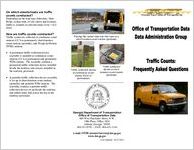
Placing the rubber tube over the road at a short duration count station (portable)
Traffic collection
Traffic collection device at continuous count station (CCS or
device at short duration count station
(portable)
permanent)
________________________________________
Georgia Department of Transportation Office of Transportation Data 600 West Peachtree Street N.W. 19th Floor Office 1934 Atlanta Georgia 30308
404-347-0701 FAX 404-631-1136
e-mail OTDCustomerService dot.ga.gov www.dot.ga.gov
Last Updated 10/22/2014
The Office of Transportation Data (OTD) at the Georgia Department of Transportation (GDOT) collects traffic data using various devices at short duration count stations (portable) continuous count stations (CCS or permanent) and Weigh-In-Motion (WIM) stations. The primary purpose of collecting this data is to support the annual Highway Performance Monitoring System (HPMS) report required by the Federal Highway Administration (FHWA) and support GDOT operations.
Short Duration Count Stations (Portable) Each year portable traffic collection devices are placed at approximately 9 000 short duration count stations throughout Georgia. For a 48-hour period these devices count and in some cases classify the traffic that passes by the station.
Continuous Count Stations (CCS or Permanent) Permanent traffic collection devices are installed at approximately 240 continuous count stations throughout Georgia. These devices count and classify traffic 7 days a week 24 hours a day 365 days a year. Every effort is made to collect the traffic counts during typical travel conditions and not on holidays or weekends.
Weigh-In-Motion (WIM) Stations Throughout Georgia portable traffic collection devices are placed at approximately 30 portable WIM stations annually and permanent traffic collection devices are installed at 15 permanent WIM stations. According to the Federal Highway Administration (FHWA) guidelines 10 of these stations must be on interstate highways. WIM technology is used to measure vehicle counts axle and gross weight vehicle classification and speed data. WIM data is used for pavement and capacity studies for enforcement and inspection purposes and for analysis of truck transport practices.
What is a traffic count Traffic counts represent the total volume of vehicles that pass by a traffic counting station in a typical 24-hour period. Traffic counts are conducted on a representative sample of State Routes county roads and city streets across Georgia.
What are traffic counts used for Traffic counts are used to study traffic patterns and flows for various purposes.
GDOT Planners and other officials use traffic count data to make informed decisions regarding the planning and designing of new roads upgrading existing roads and routing traffic such as truck routes.
The GDOT Office of Materials and Testing (OMAT) uses truck traffic percentages and AADT counts to develop factors that assess the deterioration of pavement as well as develop pavement design for road resurfacing projects.
The GDOT Office of Traffic Operations uses the AADT data to calculate crash rates and address safety issues.
The Federal Highway Administration (FHWA) requires every state to submit an annual Highway Performance Monitoring System (HPMS) report. Traffic count data is a critical component of this report with the complementary physical road characteristics and other road-related data. This report is used in the biennial report to Congress and to support Federal funding for State highway and road projects.
Why is a black tube stretched across the street The black rubber tube is part of the short duration count (portable) traffic collection device and is attached to the device. For 48 hours the device records the amount of traffic that crosses the rubber tube.
Why are traffic counts conducted The state and federal governments require traffic counts on various streets and roads in the state to
Calculate annual Vehicle Miles Traveled (VMT)
Identify peak travel hours on roads or within areas of study such as a city or county
Study vehicle movement
Determine funding needs and pavement types for road resurfacing
Evaluate road widening and improvement needs
Assess traffic light or sign needs due to traffic changes
Inform the National Household Travel Survey on driving habits
Analyze freight movement