


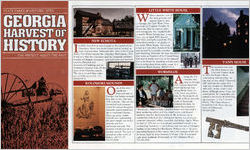
- Collection:
- Georgia Government Publications
- Title:
- Georgia harvest of history: the present meets the past [1976]
- Creator:
- Georgia. Department of Natural Resources. Parks and Historic Sites Division
- Contributor to Resource:
- Georgia. Department of Natural Resources. Parks and Historic Sites Division
- Publisher:
- Atlanta, Ga. : Georgia. Department of Natural Resources. Parks and Historic Sites Division
- Date of Original:
- 1976
- Subject:
- Georgia
- Location:
- United States, Georgia, 32.75042, -83.50018
- Medium:
- publications (documents)
- Type:
- Text
- Format:
- application/pdf
- External Identifiers:
- OCLC 1443767502
Call Number N200.P2 M1 1976 H3 - Metadata URL:
- https://dlg.galileo.usg.edu/id:dlg_ggpd_s-ga-bn200-pp2-bm1-b1976-bh3
- Digital Object URL:
- https://dlg.galileo.usg.edu/do:dlg_ggpd_s-ga-bn200-pp2-bm1-b1976-bh3
- Language:
- eng
- Holding Institution:
- University of Georgia. Map and Government Information Library
- Rights:
-

NEWECHOTA
'
I n 1825, New Echota was founded as the capitol of the Cherokees. Since t h at proud India n nation wanted its form of government fashioned after t hat of the United States, New Echota became the Cherokee Washington, D.C. It was here that the Cherokees used th e Sequoyah syllabary to print a bi-lingual newspaper, and held court and national councils. Restored and reconstructed buildings and an interpretive museum help tell the story of the Cherokee nation. The site is located three miles east of Calho un on Ga. 225. 404-62 9-8151.
KOLOMOKI MOUNDS .
0
ne of the most significant historical sites in
Georgia, the Indian mounds
here date to the 12th and
13th centuries. This was the
ceremoni al and eco nomic
cen ter for several thousand culturally sophisticated people in southwest Georgia.
There are seven Indian mounds here representing the great temple, two burial mo unds and fo ur ceremonial mounds. The museum is built over an excavated mound. The park is locat ed six miles north of Blakely, off U.S. 27. 9 12-723-5296.
LITTLE WHITE HOUSE.
W
ithout question, o ne of the most precious and popular h istoric sites
in Georgia, the Little White House
was built by President Franklin D.
Roosevelt. Here he came to relax
and reinvigorate his crippled body
at nearby Warm Springs and it was
here, t oo , in April 1945 , that he
died while posing fo r a portrait. T he
unfinished po rtrait is on display in
the Little White House. The house
is just as it was when Roosevelt lived
.and worked h ere- simple, exquisite
and charming. Although the man elected fo r
four terms as PresideRt of t he United States
had several stately mansions at his disposal,
t his is the home he cherished and planned to
live in at the close of his public career. It is
located in Warm Springs. 404-655-3511.
WORMSLOE
A mong the 114 co lonists who came to Georgia with General James Edward Ogletho rpe was . young Noble Jones. In 1736, Jo nes requested a lease for the property on the Isle of Hope, ten miles south of Savannah. Granted the lease, he named his plantation "Wormslow". Here he built a fortified home and cultivated a farm producing cotton and rice, raised cattle, and planted mulberry trees for the production of silk. Jones was an accomplished individual who, during his lifetime, was physician , carpenter, surveyor, soldier, constable and Indian Agent . When he died in I 775, h is so n h ad already established himself as an o utstanding statesman in the Colonies and was one of Georgia's lead ing vo ices during the Revolution. Perhaps one of the most interesting features of th is h istoric site is the remains of the tabby house , built by Jo nes between 1739 and 1745. It is located eight miles southeast of Savannah at 750 1 Skidaway Road. 9 12-352-2548.
T his mansion was once t he fi nest home in the Cherokee Nation . Built in 1804, the house reflects outstanding craftsmanship . A t one time, it was called "Diamond H ill" and was the center of a large and prospero us plantation with mills, ferries, taverns and slaves. A lthough James Vann was controversial , he is generally considered to be respo nsible for br inging education to the C herokee Nat ion. T he Vann House is located on U .S. 76 on the outskirts of C h atsworth . 404-695-2598.
FORT McALLISTER
T his historic earth fort played a key role in t he defense of Confederate Georgia during the C ivil War. A lthough it consistently wit hstood the attacks of the Union Navy, the fort's ultimate capture by Sherman 's troops hastened the South's defeat . With Fort McA llister taken, the Union Army had an open supply line from the sea and Savannah soon fell. Under the direction of the St ate , the earthworks and bombproofs have been restored to their condition during
1863-1864 and the museum and special programs provide a priceless scenario of the closing pages of the Civil War. Fort McAlllister is located 10 miles east of 1-95 on G eorgia 144. 912-727-2339.
In every area of the state are preserved reminders of the recent past from the ancient Etowah Indian Mounds to t he n ear h istory of the Little White House in Warm Springs. T he state is rich in special treasures, whether it be the monuments and memories of special events or the re-creation of life o n a Southern farm at the turn of the 19th century. All of it has been lovingly maintained in the public interest h y the Parks and Historic Sires Division of the Georgia Department of Natural Resources. Georgia- a bountiful Harvest of History.
I
A
FORT KING GEORGE
rchaeological excavations along t h e G eo rgia coast in the early 1950's confirmed the existence of a Spanish mission and Indian settlement on t his site during the
17t h century. Repeated raids by t he En glish and the Indians
forced the Sp an iards to retreat to Florida. In 1720, however , the
English decided to erect a fort at this location to offset the
potential threat from the French colonization along t he
Mississippi and overland to the
A ltamaha River. In May of 1721 ,
a garrison and fort were establi
ed here to protect th e Carolina
colonies under British rule. T h e
fort was a major bulwark of
defense for the region until
General Oglethorpe founded
Savannah in 1733. The museum
at the site contains an in for-
mative ch ronology of life in this
locale during th e In dian,
Span ish, Military
and Sawmilling
periods. It is
located in
Darien , just
east of U .S. 17.
9 12-437-4770.
Open 9 a.m.-5:00 p.m. Tues.-Sat.; 2 p.m.-5:30 p.m. Sun. Closed T hanksgiving & Christmas, Closed Mondays
l. DAHLONEGA 2. VANN HOUSE 3. ETOWAH 4. JARRELL PLANTATION 5. WORMSLOE 6. SUNBURY 7. HOFWYL-BROADFIELD 8. FORT KING GEORGE 9. FORT McALLISTER
10. UTILE WHITE HOUSE 11. LAPHAM-PATIERSON 12. TRAVELERS-REST 13. VETERANS MEMORIAL 14. TOOMBS HOUSE 15. NEW ECHOTA 16. KOLOMOKI MOUNDS 17. ST EPHENS MEMORIAL
"If anyone feels subjecced 10 discrimination on the basis of race, rolor, or national origin, they may file a complaint alleging discrimination with the Office far Equal Opportunity, U. S. Department of the Interior, WashinR<on, D . C. 20240. "
GEORGIA DEPARTMENT OF NATURAL RESOURCES
4 04 -656 -3 53 0
1-800-3GA-PARK in Ga.
1-800-SGA-PARK outside Ga.
T his largest and most significant Indian settlement in north Georgia was occupied from 700 to 1650 A.D. It was the home of chiefs and priests who directed all of the affairs of their nation from this site. There is evidence that several thousand Indians lived around the fortified town. The Indians were artisans, working with clay, copper, shells, flint and wood. It. has also been proven that they traded with other tribes from as far away as the Atlantic or Gulf of Mexico. One of the most popular historic sites in Georgia, it is located just outside of Cartersville. 404-382-2 704
A.H. STEPHENS MEMORIAL
Stephens, a d y n a m ic figure in 19th century Georgia politics and vice-president of the C onfederacy, made his home here at Liberty Hall from 1834-1883. Liberty Hall retains the character of Stephens in its simplicity as it preserves the appearance of the structure as reconstructed by Stephens in 1875. Adjacent to Liberty Hall is the C o nfederate Museum, containing numerous artifacts from the Civil War era and an audio-visual show which relates the story of the Confederacy. The site is located in Crawfordville on Ga. 22. 404-456-2221.
HOFWYL..BROADFIELD PLANTATION
O n a narrow fringe of land between the saltwater marshes and the pinelands, Hofwyl-Broadfield allows visitors to return to the era when great rice plantations flourished along the Altamaha delta. From the time William Brailsford acquired Broadfield in 1806, until Ophelia Dent's death in 1973, this land remained in the hands of one family. Rice culture thrived here until the Civil War, but the devastation of war, together with erosion and insufficient labor, eventually doomed the rice empire on the Ali:amaha. The family proved its resilience by converting the massive rice plantation into a dairy farm which served a large portion of the coastal southeastern part of the state. The dairy farm, owned and operated by the Dent sisters, flourished and prospered until 1942. Hofwyl-Broadfield is located on U.S. 17, 10 miles north of Brunswick. 912-264-9263.
ROBERT TOOMBS HOUSE
T
his historic site was the ho me of Robert Toomhs, secretary o( state o( the Confederacy and popularly known as the "Unreconstructed Rebel. " The home con-
tains some of the original furnishings of this
colorful Georgian who was a statesman and
a figure of folklore. Following the C ivil War,
Toombs refused Presidential pardon, and his
last major contribution came as the primary
architect of the G eorgia. constitution of
1877. A special attraction at the site is the
film, a documentary drama on Robert
Toombs. The house is in Washington,
Georgia. 404-678-2226.
GEORGIA VETERANS MEMORIAL
0
ne of the most unique military museums in the
country, Georgia Veterans
contains both indoor and out-
door displays . the indoor facili-
ty offers memorabilia from as
far back as the French and Indian War while the outdoor
display includes a plane, tanks
and artillery used by American armed forces during times of military combat. It is located nine miles west of Cordele. 9 12-273-2190
Miaiag ia
Deargia
P rior to the California Gold Rush of 1849, thousands of prospectors;
streamed into northeast Georgia
during the nation's first authentic
gold rush in 1832. But long
before, in 1540, Indians of the
are:1 told Spanish explorers the
precious o re could be found in
t he beautiful h ills of the region.
The Dahlonega Gold Museum
chronicles the days of early gold
fever and carries visitors up to modern times when gold from this
area was used to enrich the dome of the State Capitol in Atlanta.
The museum is in
404-864-2257.
SUNBURY
S unbury was once a thriving seaport and was a "Port of Entry" in I762. It is kn own , too, as the site where a British call for t he surrender of Fort Morris here during the Revolutionary War was answered by the Patriot retort, "Come and t ake it !" Indeed, brave Sunbury was the last town on the coast to fall in 1779. Still standin g is Fort Defiance, built during the War of 1812 to protect the Georgia coast. Currently
an audio-visual show and interesting and informative exhibits reveal what this area was like during the Revolutionary era. It is located in M idwa y, 10 miles east of I-95 and G a. 38. 912-884-5999.
LAPHAM..PATTERSON HOUSE
C onstructed originally as a winter haven or resort home, this historic site is a tribute to the glitter and glamour of the Victorian Era in America. Spared the ravages of the Civil War, Thomasville became a vacation retreat for the wealthy once the railroads were reopened. Because of its warm winter weather and mild dry climate so beneficial to invalids, Thomasville became a nationally-known resort, hosting the wellto-do from the north and midwest. This historic site is a reminder of those times when individual ingenuity, imagination
and init ia tive were the cornerstones of craftsmanship . The house was built for Charles W. Lapham of Chicago in 1884 and 1885. Ten years later Lapham sold it to James Larmon. In 1905 it was purchased by James G. Patterson, whose daughters lived in the house until the mid-40's. The floorplan and furnishings offer a nostalgic look into a lifestyle or a very special era of A merican h istory. The house is located at 626 North Dawson Street in Thomasville. 9 12-226-0405 .
JARRELL PLANTATION
T his
'
~ist~ric
Site IS a
symbol of the
courage and
tenacity of early
Geo rgians. Blake
Fitz Jarrell -mov-
ed h is family to
this area from
North Carolina
in 1820 and in 1840 his son
John built the first dwelling on what became know n as
Jarrell Plantation. Despite wars, depression, the boll weevil
and soil erosion, the Jarrell family remained and prospered
because of their self-sufficiency. T h e origin al house and
many of the outbuildings constructed over 140 years by t he
Jarrell family are still intact. The plantation is located off
Juliette Road, eight miles east of Forsyt h . It is closed on
Mondays, C h ristmas and T hanksgiving. 91 2-986-5172.
TRAVELERS REST
B uilt o n the southern end of the Unicoi T urnpike when the Cherokee Nation stood between Geo rgia and Tennessee, Travelers Rest hosted goldseekers bound for the mountains, adventurers, English travelers and such men as John C alhoun and Joseph E. Brown. Devereaux Jarrett, o ne of t he most prosperous men in H abersham County, added to the structure, operated it as a stagecoach inn and as the plantation home of many varied enterprises. The sense of t he north Georgia frontier, and the warmth of the Jarrett homeplace, still can be found at T ravelers Rest. It is located six miles east of T occoa on U.S. 123. 404-886-2256.