


- Collection:
- Georgia Government Publications
- Title:
- Prehistoric vertebrates of the Georgia Coastal Plain
- Creator:
- Hurst, Vernon J
- Publisher:
- Atlanta, Ga. : Dept. of Mines, Mining and Geology, Geological Survey
- Date of Original:
- 1957
- Subject:
- Vertebrates, Fossil--Georgia
- Location:
- United States, Georgia, 32.75042, -83.50018
- Medium:
- state government records
government records - Type:
- Text
- Format:
- application/pdf
- Description:
- "Reprint from Georgia Mineral Newsletter, v. 10, no. 3, autumn, 1957."
- External Identifiers:
- OCLC 17785340
NZ MMS ID 9910142523402931 - Metadata URL:
- https://dlg.galileo.usg.edu/id:dlg_ggpd_s-ga-bm500-pg4-bm1-b1957-bp7
- Digital Object URL:
- https://dlg.galileo.usg.edu/do:dlg_ggpd_s-ga-bm500-pg4-bm1-b1957-bp7
- Language:
- eng
- Extent:
- 19 p. : ill. ; 28 cm.
- Holding Institution:
- University of Georgia. Map and Government Information Library
- Rights:
-

Prehistoric Vertebrates of the Georgia Coastal Plain
by
Vernon J. Hurst
FOSSIL DISCOVERIES
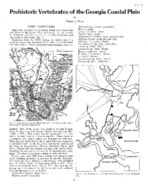
Important collections of vertebrate fossils have come from two places on the Coastal Plain of Georgia: (a) the vicinity of Brunswick (see Fig. 1); and (b) the area including, and just south of, Savannah (Fig. 2).
Brunswick Area. In 1838-9 during the construction of a canal to connect the Altamaha River with the Turtle River near Brunswick, the bones of several large mammals were un-
Mammut americanum (mastodon): Bison sp. indet. Cervus (?) indet. (deer) T apirus haysii (tapir) M egatherium mirabile (giant ground sloth) Mylodon harlani (giant ground sloth) Chelonia ( ?) couperi (turtle) Crocodylus (?) sp. indet. (crocodile) Lamna sp. indet. (shark) Galeocerdo sp. indet. (shark) Equus complicatus (horse) E. leidyi (=fraternus) (horse) E. littoralis (horse) Carcharodon sp. indet. (shark) Dasyatis sp. indet. (sting ray)
... <.+ L~r.tt;:;::;:o,..;,~-
Fro. 1. Location of the old Brunswick and Altamaha canal, where vertebrate fossils have been found.
earthed. Most of the bones were found in six-mile Swamp about 10 miles west of St. Simon's Island. Quoting from Hay (1923, p. 370), "The swamp has the appearance of a lake which has been filled with alluvial deposits. These consist of a compact clay, usually yellow and impregnated with iron. There are thin strataof soft, chalky marl and many fragments of petrified wood. At the bottom of this deposit were found the bones of Megatherium, Elephas, Mammut, Equus, and Bison. Beneath the clay stratum was sand with marine shells. Overlying the clay was a thin stratum of vegetable and sandy loam. The bones occurred at a depth of from 4-6 feet."
Several times since 1839 fossil remains have been brought up by dredging operations in and near Brunswick. Fragmentary bones and teeth obtained in this manner were identified
by J. W. Gidley (Veatch & Stephenson, 1911, p. 436). They
were re-examined by Hay (1923, p. 370) who gave the following list as inclusive of all the vertebrate fossils collected from the Brunswick area up to 1923 :
Castoroides ohioensis (giant beaver) Elephas columbi (elephant)
ROMERLVM~RBH-
Fm. 2. The location of vertebrate fossil discoveries in the Savannah area.
77
According to Hay, the femur described by Harlan ( 1842, page 189) as Chelonia couperi resembles more closely that of some edentate mammal. Also, the shark teeth believed by Gidley to represent Eocene and Miocene species might be younger, inasmuch as species of all three genera mentioned by Gidley are yet living on the Atlantic Coast.
Savannah Area. As early as 1823 teeth belonging to a 111egatherium were reported from Skidaway Island, near Savannah (Mitchell, p. 58). In 1824, more than 20 bones which apparently belong to the same animal were reported by William Couper. The bones were found at two places a half mile apart near the west end of the island, at low water level and where a bend in the Skidaway River had eroded the bank away. In 1846, Dr. Joseph Habersham (Hodgson's "Memoir on Megatherium", 1846, p. 25-30) published a list of the
species discovered on Skidaway Island up to that time. In 1849, Lyell (p. 313-314) gave an account of his visit to the locality and the species he found there. "The bones occur in a dark peaty soil or marsh mud" according to Lyell, "above which is a stratum, three or four feet thick, of sand, charged
with oxide of iron, and below them and beneath the seal level, occurs sand containing a great number of marine fossil shells, all belonging to species which still inhabit the neighboring coast." Hay ( 1923, p. 371) gave the following list as inclusive of all the vertebrate species found there:
Elephas columbi Mammut americanum Bison sp. indet. Equus leidyi (?)
Megatherium mirabile Mylodon harlani T errapene canaliculata
The box-tortoise Terrapene canaliculata ,was described by
Hay (1907, p. 850) from fragmentary materials sent to the
U. S. National Museum by Dr. J. P. Scriven of Savannah.
Whether the 1:emains were found on Skidaway Island or on
Whitemarsh Island is uncertain. From Heyner's Bridge, 7 miles south of Savannah, where
a road crosses White Bluff Creek, Lyell (1845, p. 163-164) described two species, Mammut americanum and Mylodon
harlani. During 1941 several hundred pounds of vertebrate fossils
were collected along the banks of the Casey Canal within Savannah city limits. Fifteen crates of them were shipped by Captain Garland Peyton, Director of the Georgia Geological
Survey, to the National Museum, Washington, D. C. No information on them has been obtained.
In 1954, Mr. John Olsen, Jr., found fossils in the sand and muck thrown up by a dredge working .the Inland Waterway at the Isle of Hope near Savannah. Mr. Olsen identified the remains of horse, elephant, shark, boar, a rodent, and a date palm seed (from Savannah Evening News, June 19, 1954).
Other Areas. Recent dredging in the Kingsland-St. Mary's area by the Western Contracting Corporation has uncovered numerous vertebrate bone fragments, horse teeth, and shark teeth, but a systematic collection and study of these materials
has not been made. Large bones of Pleistocene mammals have been found at
Whiteoak in Camden County. They occur near the Station, just above the level of high tide, in an olive-green, sandy clay which contains white limy concretions (Veatch & Stephenson, 1911, p. 437).
At Bony Bluff, in Echols County, 9 miles west of Fargo, large blackened bones and fragments of silicified wood can be found (Veatch & Stephenson, 1911, p. 445). The same authors report that the base of the Satilla formation at Stokes Ferry, 11 miles south of St. George, consists of pebbly sand in which are embedded fragments of bones and teeth. The fossiliferous layers at Bony Bluff and at Stokes Ferry are of Pliocene or
Pleistocene age.
Older Coastal Plain strata have yielded vertebrate remains. Teeth and bones of sharks, turtles, and dinosaurs have been found in Upper Cretaceous beds; remains of sharks, turtles, whale-like mammals, and a few other vertebrates have been found in strata of Eocene to Pliocene age. Several localities from which these vertebrates have been collected are given by Veatch and Stephenson (1911, p. 118, 126, 136, 138, 156, 158, 159, 179, 180, 185, 189, 192, 248, 255, 300, 340, 344, 355, 374). A discovery of Basilosaurus in 1950 is described in the "Georgia Mineral Newsletter", Vol. 5, No. 2, p. 54.
Numerous other vertebrate discoveries have been made of which there is no available record.
Too often fossils are discarded soon after discovery, or passed around as curiosities until damaged or lost. Many worthwhile discoveries have been effaced in this manner without ever having come to the attention of a trained observer.
It is a purpose of this paper to stimulate interest in vertebrate fossils and to urge that all finds be brought to the attention of someone who can record and preserve them. Finds in Georgia can be reported to the Department of Mines, Mining, and Geology, 19 Hunter Street, Atlanta, Georgia.
The following pages contain brief notes on a few of the major mammalian groups whose remains have been found, or might be found, in Georgia. For most of the animals the place and time of origin is indicated, their general physical appearance during habitation of the Southeast, and time of extinction.
In considering the immense spans of time involved in the evolutionary history of animals, the year is an impractical time
ERA..
PERIOD.
EPOCH
RECEHf
SUGE
Wb~onsin glacial
JYI>ES OF HUHAK fOSSILS
APPROX.AGE, lK YEARS ~:
Modern man
og::-:ai .
Sandia &
f--
11,000
J:~ Clovis man
~
15
I
u-0
N
0 z
uL.U
~
~
PLEISTOCEHE PLIOCENE. MloCEHE
Interglacial. {Sangamon]
Ne.,.nderthai
!llinplan gladal
Interglacial
{Y~~rmoulh)
Kansan glacial lnlerglllcia Aflonian Nebrashngladal
Heidelberg man -~t.hec_anlh~op.us Swnscombe man
250,000 to
,500,000
500,000 to ~
I,OOO,OOOQ:I
'ii
tJ
IJ)
Q
'
~
~ ca
Cl 0 ...I
$ca
.~
0
Q. Q.
$.
-17,000,000.
OLIGOCEHE
EOCEIIE
-1-u-::-:-+-----+--- PALEOCEIIE --L--------1- 58,000,000
0
CRETACEOUS
N
e0n.
L.U
'--:-2=;:._-'------...l.....------------+-- 215,000,00.0,
FIG. 3. The Geologic Time Scale from Cretaceous to Recent.
78
Fro. 4. Mastodon americanus. Very common in the Southeast during the Pleistocene.
unit. It is convenient to use, instead, the broad units of the Geologic Time Scale. These units permit as much accuracy as the records justify and at the same time afford an advantage in brevity.
The Geologic Time Scale from Cretaceous to Recent is reproduced in Fig. 3. To show the enormity of time involved, some equivalent ages are given in years, as determined by radioactivity methods.
PROBOSCIDEANS
The proboscidea originated in Africa during the Eocene. They spread northward to Europe and Asia in the lower Miocene, from Asia eastward to North America in the middle Miocene-, presumably by way of a land mass then connecting Asia and Alaska, and southward by way of Central America to South America in the late Pliocene.
The first proboscideans to reach North America in the Miocene were the mastodons. The true elephants did not arrive until the early part of the Pleistocene.
Mastodons. The mastodons were browsing rather than grazing animals. They therefore inhabited chiefly the forested regions and not the grassy plains.
Though dosdy related to the true elephants, they were quite different in appearance ('Fig. 4). Their legs were shorter, their heads lower and more flat. They rarely attained a height at the shoulder of 9;.,.~ feet. Like the true elephants, they had two tusks in the upper jaw; in addition, the males had a single small tusk (not exte-rnally visible) in the lower jaw. This tusk was a remnant of an earlier stage of develop-
ment when there were two tusks in the lower jaw as well as two in the upper. (Fig. 5).
The grinding teeth of mastodons are smaller and simpler than those of the true elephants (Fig. 6). They are made up of three or four high, transverse, enamel covered ridges, with no cement between.
The mastodons were covered with long, coarse, dun-colored hair, as found on several fossil carcasses. They existed until late in the Pleistocene and probably were known to the early Indians.
Elephants. Three species of true elephants lived in North America during the Pleistocene.
One of the best known of these is the mammoth, which inhabited the northern part of the continent. Despite its name, the mammoth was the smallest of the true elephants, with a shoulder height of about 9~ feet ..
The Imperial elephant (Elephas imperator) was the largest of the true elephants, attaining a height at the shoulder of 13~ feet. This elephant was a western form whose range extended from the Pacific Coast almost to Mississippi River, east of which it has not been found (Scott, 1924, p. 427). It vanished during the middle Pleistocene and was thus the first of the true elephants to become extinct.
The third species, the Columbia elephant (Parelephas Columbi), inhabited the Southeast and was very common in Florida and Georgia. Its range overlapped that of the mammoth along the northern border of the United States.
The Columbian elephant was closely related to the mammoth, and in some cases hardly distinguishable except for its larger size. It attained a shoulder height of 11 feet, thus
79
FIG. 5. Serridentinus, a four-tusked mastodon which inhabited the Southea~t during the Pliocene. After a painting by Charles R. Knight.
A
B
Fw. 6. A-Mastodon's molar, x Y4. B-True elephant's molar x I /5. Side vic~s (top) after Lucas, 1922, p. 160; crown views (bottom)
after Colbert, 1955, p. 412.
80
Fm. 7. Parelephas columbi. This elephant abounded m the Southeast during the Pleistocene, and was probably known by the early Indians.
rivaling the largest African elephants of the present. The head had a peculiar peaked appearance and was held high (Fig. 7). The tusks of old males tended to curve inwards and overlap at the tips.
The grinding teeth consist of several high enamel ridges each inclosing a body of dentine. Cement fills the valleys between the ridges and also covers the ridges so that, in unworn teeth, the ridges are not visible. In worn teeth, the enamel ridges have been truncated by attrition and the grinding surfaces are composed of alternating plates of cement, enamel, and dentine. Mastodon and elephant teeth are compared in Fig. 6.
EDENTATES
Gigantic edentates of the genera Megatherium, Mylodon, M egalonyx, Glyptodon and others, species related to the sloth and armadillo, lived along the southeastern coast of the United States and elsewhere.
Glyptodon. The glyptodon was a giant armor-clad relative of the armadillo. The bony armor on his body formed a solid carapace somewhat like that of the turtle. The length of the carapace was about 5 feet. In some genera, as Doedicurus, its length was over 10 feet. The tail was encased in concentric rings of bony armor. Some glyptodons had a massive club-like tail, 2-3 feet long, expanded at the end and fitted with huge horny spines, resembling a medieval mace (Fig. 8).
The glyptodons developed in South America, where they date back to the Paleocene. They spread to the Southeastern
part of the United States during the Pliocene, and became extinct during the Pleistocene.
Megatherium. The megatherium was a gigantic ground sloth, up to 18 feet long, which exceeded in size the largest rhinoceros (Fig. 9) .
The skeleton of the animal was heavy throughout. Its limbs were large and massive; some of the leg bones grew to enormous size. The femur, for example, was three times as thick as an elephant's. The feet were large and equipped with claws, which were probably used largely for digging. The skull was elongated. The teeth, though peg-like and restricted to the sides of the jaws, had grinding surfaces of triangular ridges and were well-fitted for powerful mastication. The animal probably subsisted to a large extent on the leaves and branches of trees and bushes. Although he weighed several tons, he was able to rear up against trees and feed. In walking, he seems to have borne his weight on the sides of the hind feet and the knuckles of the front feet. Judging from the size and massiveness of the bones, he was a slow-moving, clumsy animal of great strength.
The megatheria developed in South America. In the Pliocene they spread to North America where they were so successful that their bones are now among the commonest of Pleistocene mammalian fossils. The giant sloths persisted to within a few thousand years of the present and were likely contemporaneous with early man in both North and South America.
Other Ground Sloths. Two other genera of large ground sloths, Mylodon and Megalonyx, were contemporaneous with
FIG. 8.
"f~..::;.~
-::=....
- a ~-~-=-~.
\tf'IH.i. t I!..I~.I.I'IG . o..~pe. .
The glyptodon, a giant armor-clad rela.tive of the armadillo.
82
FIG. 9. The giant ground sloth Megatherium, comparable m size to a modern elephant.
83
Megatherium in the Southeast. Both resembled Megatherium in appearance, but were smaller.
ARTIODACTYLS
Peccaries. The first peccaries appeared in North America in the Oligocene period. They were similar to the pigs which developed in Eurasia at about the same time. Like the pigs, they lived in forests where they spent much time rooting in the ground for food. A common extinct species is shown in Fig. 10.
The peccaries spread to South America during late Pliocene. They inhabited all of southern United States and Central and South America during the Pleistocene. Many of them vanished toward the close of the Pleistocene, but they still survive from Texas south to Brazil.
Entelodonts. A member of the giant aberrant pigs, some of which grew to be 6 feet high at the shoulders, lived in Florida during the Miocene. These beasts had powerful, humped bodies and elongate knobby heads. Judging from the small brain-case, they were profoundly stupid, resembling in this respect the extinct titanotheres (Scott, 1924, p. 366). The entelodonts vanished from North America during the Miocene.
Their remains have not been reported from Georgia, but they doubtlessly lived here as they appear to have once inhabited the entire Atlantic seaboard.
FIG. 10. Platygonus, an extinct Pleistocene peccary. After a painting by Charles R. Knight.
Camels and Llamas. Camels and llamas are indigenous to North America. They were very abundant in the Great Plains region during early and middle Pleistocene. Though uncommon in forested regions, they did inhabit southeastern United States. The remains of several species have been found in Florida (Fig. 12).
FIG. 11. A common Pleistocene horse.
84
Fw. 12. Oxydactylus, a Miocene camel. Its remains are found m Florida, and probably are to be found in Georgia. Modified from a drawing by R. Bruce Horsfall.
Both camels and llamas vanished from North America in the late Pleistocene. The forms which had migrated to other continents during late Miocene and early Pliocene survived: the camels in Asia, the llamas and vicunas in South America.
Deer. The southern deer Odocoileus of the present extended back through the Pleistocene with little change. Another deer, Blastomeryx, probably the ancestor of Odocoileus, was common during the lower Pliocene and Miocene. Blastomeryx was considerably smaller than the existing deer and had no antlers. Instead, he possessed long, thin, curved, upper canine tusks, which set him apart from later species. Similar tusks are found on hornless deer in Asia, which use them as effective weapons in fighting.
Other Artiodactyls. Moose (Alee) and wapiti (Cervus) probably ranged through Georgia during one or more of the Pleistocene glacial stages.
Several species of Bison inhabited Georgia.. Bison latifrons, a giant early form, measured 6 feet across the horn~. Bison bison, the well-known species that roamed the Great Plains in vast numbers, was also abundant in Georgia. This bison withdrew from Georgia less than 350 years ago.
America are covered by short-brown hair; those inhabiting southern Asia and adjoining islands are covered by light colored hair. The young in both regions are marked by longitudinal light-colored stripes and spots (Fig. 14).
The tapirs are moderate-sized browsing animals that feed on leaves, shoots, and other soft vegetable tissues. In behavior they are nocturnal and shy. They generally frequent bodies of water which they use both for cooling themselves and as protection against enemies.
Rhinoceroses. One variety of rhinoceros (Caenopus or Diceratherium) lived in Florida during the Miocene, and two during the Pliocene (Teleoceras and Aphelops, Simpson, 1929, p. 238, 240). Teleoceras was a large, heavy-bodied shortlegged type, as in Fig. 15. Aphelops resembled more the modern forms, but was hornless. All the rhinoceroses vanished from the Western hemisphere during the Pliocene, Teleoceras and Aphelops in Florida being among the last survivors.
Although fossil remains have not yet been recognized in Georgia, these animals probably lived here and it is anticipated that their remains will eventually be found.
PERISSODACTYLS
Horses. Horses are native to North America, where their development has been traced in great detail from the lower Eocene to the present except for a short gap during the Pliocene.
All the known Pleistocene species (at least 10) belong to the genus Equus. E. leidyi (=fraternus), a small species, was especially common in the Southeast. Other southeastern horses were E. complicatits, and E. littoralis. (See Fig. 11).
Equus first appeared late in the Pliocene, when he was associated, at least in southeastern United States, with the last survivors of the three-toed horses which were prominent during the Miocene and early Pliocene.
Teeth are the most commonly found of horses remains. The pattern made by enamel and cement on the grinding surfaces of the molars and premolars can be used to distinguish the typical Miocene, Pliocene and Pleistocene horses (Fig. 13) . Teeth of the ancestral, 3-toed, Miocene horses have rather low crowns, little cemeni:, and the pattern made by the enamel ridges is relatively simple. The teeth of the 3-toed Pliocene horses are prismatic, high-crowned, and have much cement; the pattern made by the enamel ridges is more complicated, and on the inner side of the upper molars there is a ring of enamel that is not connected with the rest of the enamel pattern. The teeth of the one-toed Pleistocene horses are similar, but often larger, and the inner ring of enamel is connected to the rest of the pattern.
The entire horse population of the Americas was destroyed some 10,000 years ago. The horses which had previously migrated to Asia survived and were reintroduced to the Americas by the Spanish conquerors four centuries ago.
Tapirs. The history of the tapirs in North America is long, but not as well-known as that of many other animal families. Still, the tapirs were numerous during the Pleistocene in forested areas of the Southeast. They withdrew from North
America late in the Pleistocene.
The tapirs have been called "living fossils", having undergone relatively little change since their earliest appearance.
The most striking feature of present-day forms is the long flexible snout. The tapirs inhabiting Central and South
CARNIVORES
The bears are migrants from the Old World. They first appeared in North America during the Pleistocene. Two varieties were common in Georgia; the black bear and a larger "short faced" bear.
At least two species of wolves were present; one was the giant dire-wolf, Canis ayersi, which vanished towards the close of the Pleistocene. The other species became extinct less than 150 years ago.
Bobcats, cougars, lion-like cats, and saber-tooth tigers were widespread.
The most spectacular cat was perhaps the saber-tooth tiger, Smilodon (Fig. 17). Smilodon was massive, short tailed, rather short legged, and about the size of a modern lion. His upper canines were long dagger-like teeth and he was able to open his mouth wide. In attacking, he evidently struck down hard with the sabers, using a strong neck and the weight of his body to give power to the thrust.
The saber-toothed cats lived in the Southeast, as well as other parts of North America, during the Pliocene. They invaded South America in the early Pleistocene and became extinct near the close of the Pleistocene along with several animals on which they preyed.
APPEARANCE OF MAN IN NORTH AMERICA
The first human inhabitants of North America probably migrated here from Europe via Alaska, 20-30,000 years ago. The earliest remains yet found date back about 10,000 years ago (according to C14 methods) .
The extinction of most of the large Pleistocene mammals in North America seem to have occurred only 5-10,000 years ago (Flint, 1957, p. 468). During that time the mastodon, the mammoth, the Columbian elephant, the stag-moose, several cats, some of which were as large as lions, the giant beaver, all the camels, all the horses, all the ground sloths, all but one species of bison, the peccaries, the pronghorns, two genera of musk oxen, and several others vanished.
86
A
B
c
Fro. 13. Fossil horse teeth of Miocene, Pliocene & Pleistocene Age, Y2 natural size. A-Parahippus leonensis
from Thomas Farm, Gilchrist County, Florida, Lower Miocene Age. B-Neohipparion plicatile (Leidy) from Bone Valley formation, Pierce, Florida, Upper Miocene-Lower Pliocene Age. C-Equus leidyi (:::: fraternus)
from Brunswick, Glynn County, Georgia, Pleistocene Age.
87
FIG. 14. The tapir, a timid nocturnal animal which frequented the forests of the Southeast during the Pleistocene, and which still inhabits the jungles of Brazil.
FIG. 15. Teleoceras, a heavy-bodied rhinoceros from the Pliocene. Its remams have been found m Florida, and probably will be found m Georgia. After a painting by Charles R. Knight.
c.o
0
Fm. 16. Castoroides ohioensis Foster; the giant Pleistocene beaver as large as a black bear.
Fro. 17. Smilodon, the saber-tooth tiger.
I
i
i
.
i
i
MO
'-------, r--L----~------~--' -'------~t-----------1
i
i
.
i i
Ok\a:ha!tf City
i
i
OKLA
GULF
MEXICO
SeALE OF MILES
FIG. 18. Extent of the continental ice sheets (crosshatched) in eastern North America during the Pleistocene. (After Flint, 1957, p. 339.)
92
The gradual extinction of the large mammals began about the same time man first appeared on the continent. It has, therefore, been suggested that the destruction of many of the mammal groups was a direct consequence of aboriginal man's hunting activities.
THE PLEISTOCENE AND THE PRESENT
The Pleistocene was a time of climatic vicissitudes: periods of cold, when the northern part of the continent was buried under thick ice sheets, alternating with periods of mildness, when the climate was much like that of the present, or even warmer. These climatic changes caused shifts in the distribution of animals and plants. Increasing cold and southward extension of the ice sheets drove the flora and fauna to the south, while increasing warmth and retreat of the ice permitted a counter movement. During one period of cold, white spruce, larch and arbor vitae-typical northern conifersgrew as far south as Louisiana (Deevey, 1949, p. 1360); the wapiti inhabited Florida; and walrus ranged along the South Carolina-Georgia coast. During the periods of warmth, however, the forests of the Southeast contained tupelo, sweet-gum, magnolia, tulip-poplar, and other trees typical of a subtropical climate; and the wapiti and walrus were restricted to cooler climates farther north.
The extent of the continental ice sheets is shown in Fig. 18. Ice moved fartherest south during the Illinoian glacial stage.
At the end of the last great glaciation about 11,000 years ago, the world entered a period when mean annual temperatures exceeded those of the present (Deevey and Flint, 1957, p. 182). Several periods of warming and cooling followed, but none so extreme as during the Pleistocene. Cyclical climatic fluctuations ever since are indicated by tree growth ring studies and by archaeological evidence. During the last 250 years, which are covered by meteorological records, a number of trends toward higher and lower temperatures lasting several decades have been observed (Landsberg, 1949, p. 1438). Since 1900 there has been progressive warming, especially in latitudes above 40, attended by steady recession of glaciers in the polar regions.
The present climate of the Southeast varies little from that of the Pleistocene interglacial stages, and is only a few degrees warmer than it was during the glacial stages.
The existing plants are about the same in kind and appearance as those during the milder stages of the Pleistocene; only in distribution are notable differen~es found.
The variety <fnd abundance of animal life on the Georgia Coastal Plain during the Pleistocene was comparable to that of the big game region of present day Africa. Most of- the animals that now inhabit the region, or their immediate ancestors, were already present, in essentially the same form as now known. In addition, numerous other animals existed that are now extinct, or found only in other parts of the world. Among these may be mentioned elephants, mastodons, lions, saber-tooth tigers, giant ground sloths, giant armadillos, cam-
_els, horses, bison, tapirs, giant beavers (Fig. 16), dire wolves and peccaries.
Toward the close of the Pleistocene, more than half of these mammals became extinct. The survivors are relatively few in number and are generally smaller and less striking than those which perished. Rabbits, squirrels, rats, mice, small carnivores, one deer and etc., are examples of the survivors. The present fauna, then, is a depleted and colorless remnant of that which existed during the Pleistocene.
ACKNOWLEDGMENTS
Maurice McDonald made the drawings reproduced as Figures 4, 5, 7, 10, 11, 12, 14, 15, 16 and 18. Doryand Drake drew Figures 2, 6, 9 and 13. Claire Carpenter drew Figure 8. Harold Sprinkle drafted Figures 1 and 17.
Specimens for A and B of Figure 13 were kindly provided by Dr. Herman Gunter, Director of the Florida Geological Survey.
Most of the information in the paper was taken from the cited references, especially from Hay (1923), Scott (1937), Osborn (1910), Veatch & Stephenson (1911), Simpson (1929), and Flint (1927).
REFERENCES CITED
Colbert, Edwin H. (1955) Evolution of the vertebrates. John Wiley & Sons, Inc., N. Y.
Deevey, Edward S. (1949) Biogeography of the Pleistocene. Bull. Geol. Soc. Amer., Vol. 60, pp. 1315-1416. & Richard Foster Flint ( 195 7) Postglacial Hysithermal Interval, Science, Vol. 125, p. 182-184.
Flint, Richard Foster (1957) Glacial & Pleistocene Geology, John Wiley & Sons, Inc., New York.
Harlan, Richard ( 1842) Proc. Acad. Nat. Sci. Philadelphia, Vol. 1. Hay, Oliver P. (1923) The Pleistocene of North America and its
vertebrated animals from the states e<W>t of the Mississippi River and from the Canadian Provinces east of longitude 95 o. Published by Carnegie Institute of Washington. ----(1907) Bull. Amer. Museum Nat. Hist., Vol. XXIII. Landsberg, Helmut ( 1949) Climatology of the Pleistocene, Bull. Geol. Soc. Amer. Vol. 60, pp. 1437-1442. Lucas, Frederic A. (1922) Animals of the Past. Amer. Museum of Natural History Handbook Series No. 4. Lyell, Charles ( 1840) A second visit to the United States, Vol. 1, John Murray, Albermarle St., London. - - - - ( 1845) Travels in North America, Vol. 1. Mitchell, S. L. ( 1823) Amn. N. Y. Lye. Nat. Hist., Vol. 1. Osborn, H. F. ( 1910) The Age of Mammals -- The Macmillan Co., N.Y. Scott,'William B. (1937) A History of Land Mammals in the Western Hemisphere - The Macmillan Co., N. Y. ----(1924) A History of Land Mammals in the Western Hemisphere - The Macmillan Co., N. Y. Simpson, George Gaylord (1951) Fauna of South America - from Science in Progress, Yale Univ. Press. - - - - ( 1929) The extinct land mammals of Florida, Geol. Surv. of Fla. Twentieth Annual Report. Veatch, Otto, & Stephenson, Lloyd W. (1911) Geol. of the Coastal Plain of Georgia, Ga. Geol. Surv. Bull. 26.
93