


- Collection:
- Georgia Government Publications
- Title:
- Transcripts of meetings, 1977-1981, v. 10. Article VII
- Creator:
- Georgia. Select Committee on Constitutional Revision
- Publisher:
- [Atlanta, Ga.] : The Committee
- Date of Original:
- 1985
- Subject:
- Constitutional conventions--Georgia
Constitutional law--Georgia - Location:
- United States, Georgia, 32.75042, -83.50018
- Medium:
- state government records
- Type:
- Text
- Format:
- application/pdf
- External Identifiers:
- Call Number GA C675.C6 M1 1981 T7 V.10
- Metadata URL:
- https://dlg.galileo.usg.edu/id:dlg_ggpd_s-ga-bc675-pc6-bm1-b1981-bt7-bv-p10
- Digital Object URL:
- https://dlg.galileo.usg.edu/do:dlg_ggpd_s-ga-bc675-pc6-bm1-b1981-bt7-bv-p10
- Language:
- eng
- Extent:
- 22 v. ; 29 cm.
- Holding Institution:
- University of Georgia. Map and Government Information Library
- Rights:
-

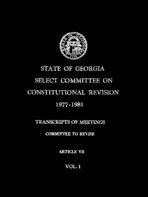
STATE OF GEORGIA SELECT COMMITTEE ON CONSTITUTIONAL REVISION
Transcripts of Meetings 1977-1981
COMMITTEE MEMBERS:
GEORGE BUSBEE GOVERNOR CHAIRMAN
ZELL MILLER LIEUTENANT GOVERNOR
THOMAS B. MURPHY SPEAKER. HOUSE OF REPRESENTATIVES
ROBERT H. JORDAN CHIEF JUSTICE. SUPREME COURT
J. KELLEY QUILLIAN CHIEF JUDGE. COURT OF APPEALS
MICHAEL J. BOWERS ATTORNEY GENERAL
MARCUS B. CALHOUN SENIOR JUDGE. SUPERIOR COURTS
SELECT COMMITTEE ON
CONSTITUTIONAL REVISION
ROOM 23H 47 TRINITY AVENUE ATLANTA. GEORGIA 30334
404/656-7158
COMMITTEES MEMBERS:
AL HOLLOWAY SENATE PRESIDENT PRO TEMPORE
JACK CONNELL SPEAKER PRO TEMPORE
ROY E. BARNES CHAIRMAN. SENATE JUDICIARY COMMIn:EE
WAYNE SNOW. JR. CHAIRMAN. HOUSE JUDICIARY COMMITTEE
FRANK H. EDWARDS SPECIAL COUNSEL
J. ROBIN HARRIS EXECUTIVE DIRECTOR
MELVIN B. HILL JR. ASSISTANT EXECUTIVE DIRECTOR
MEETINGS HELD ON CONSTITUTIONAL REVISION
COMMITTEE TO REVISE ARTICLE VII
COMMITTEE
Full Committee Full Committee Subcommittee Subcommittee Subcommittee Subcommittee Subcommittee Subcommittee Subcommittee Subcommittee Subcommittee Subcommittee Subcommittee Subcommittee Full Committee Subcommittee Full Committee
DATE
October 9, 1979 June 26, 1980 June 26, 1980 June 26, 1980 June 26, 1980 July 16, 1980 July 18, 1980 August 1, 1980 August 4, 1980 August 12, 1980 August 15, 1980 September 5, 1980 September 10, 1980 September 11, 1980 September 24, 1980 September 24, 1980 November 13, 1980
# OF PAGES
162 30 65 60 44 73 58 87 54 94 74
III
9 92 145 36 39
o o o
-..I
CO~R1ITTEE TO REVISE ARTICLE VII OF THE GEORGIA CONSTITUTIOn (TAXATION AND STATE DEBTS)
The transcript of the proceedings heard before the HONORABLE RANDOLPH W. TIIROHER, Chairman, commencing at approximately 10:00 o'clock a.m., Tuesday, October 9, 1979, in the Hays and Means Committee Room, State capitol Building, Atlanta, Georgia.
-000-
----~
BKAl';J)ENBLJ RG & HASTY
I
SClI:i'\: mle REPORTING 3715 COLONIAL IRi\/I, J)OUCLASVILLE. CFORCIA 30135
I
942-0482
I
DEPOSITION') . ARBITRA'lIOI"lS - COf\:Vb"lT\O;\JS - CONFERENCES
I
_______J
1-..-
,.
, _ _..
...
_
APPEARli.HCES:
c~mUTTEE HElmERS
RANDOLPH H. THROHER, Chairman H. J. BAR'l'ON LARRY BLOUNT REP. DON CASTLEBERRY REP. H.l\.UCUS COLLINS CHARLES L. DAVIS I. OvlEN FUNDERBURG REP. CHARLES HATCHER CONSTANCE HUNTER Kt:mlIT KEENUH SElJ. JH1HY LESTER JN1:ES IlAHTIU ADIT HASSEY DR. CHARLES HcDANIEL ROBERT L. NASH HILLIN! NIXON DR. GEORGE O'KELLEY HENRY ROBINSON H.E. STRICKLAND GEORGE WILLIAHSON CLl'.RA \ lEST
OTHERS PRESENT
CAN'l'ER BROHN VICKIE GREENBURG J. ROBIN HARRIS H.ICHAEL HENRY MELVIN :lILL DAVID L. Kl\lJI: JACK HORTON CYNTHIA NONIDEZ CHARLES TID\'VELL HALTEH HINGFIELD
i'AGE 2
I'A(~E 3
I NDE X 1. Introductory remarks Chairman Thrower
page 5
2. Roll call
David Kane
5
3. Comments:
a. Robin J. Harris
10
b. Senator Jimmy Lester
14
c. Representative Barcus Collins
15
4. Hist.orical Constitutional review -- Hr. Hingfield
16
'J 5. Research sources available -- Mr. Kane
25
6. Local amendment problem -- !'is. Nonidez
30
7. Georgia Tax Reform Commis~ion -- Hr. Borton
37
~. Edited restatement of Article VII -- Mr. Brown
41
9. Interrelationship of Article VII with other
Articles -- Hr. Kane
51
10. Use of legal porsonnel of Sutherland, Asbill
& Brennan -- Chairman Thrower
55
~l. Policy issues requiring attention
a. Speficity of detail b. Alternat1ves to local amendments
57 63
c. Authorizations and limitations on taxation
69
d. Taxation of intangibles
86
e. Exemptions
89
(i) Extent of delegation of authority
89
(ii) ~ypes currently allowed
(a) Homesteads
102
(b) Inventory goods
107
(c) Personel property
112
(d) Implements of trade of laborers
116
(e) DOMestic animals
117
(f) Pollution reducing facilities
123
(g) Solar energy facilities
124
(h) Religious property, etc.
131
(i) Disabled ve~erans' vehicles
134
(j) Farm products
134
(k) Pension trust property, etc.
135
(l) Subsidiary corporation stock
136
I N D E X(continued)
11. Policy issues requ1r1ng attention(continued)
e. Exemptions
.
(ii) Types currently allowed
(m) Honprofit hospitals, etc.
(n) Public property
(0) Exemptions by local amendm<mts
f. Limitations on State debt
g. Other issues which may be raised
12. Closing remarks -- Chairman Thrower
4
page
112
14~
145 148 1(;0 161
-000-
j
{) :i
!' ACE 5
CHAIR!'1AlI THROWER:
PRO C E E DIll G S
He can come to order and get our meeting started. I
want to \,relcome each of you here and look forward to
working closely with you over the next year and months that we will be engaged in this project. As you know, the~e are open meetings. All proceedings will be recorded and
transcribed and will be available to the public, so that
we do welcome any of the pUblic that is here, and we also have invitees whom you will hear at a later time.
I think we might -- most people are in. I think we
might now call the roll. As you may detect, we have a
little problem with my throat this morning, which has been plaguing me for several days, and I'm going to call on my
strong left arm here, David Kane, to do Joost of my
talking. Would you call the roll, David?
MR. KANE: Yes. Senator Al Hollaway?
(No response) Senator John Riley?
(No response)
Senator Jirrany Lester? SEN. LESTER:
lIere.
HR. KANE:
Representative Marcus Collins7 REP. COLLINS:
Here. HR. KANE:
Representative George Williamson? REP. WILLIAMSON:
Here. MR. KANE:
Representative Charles Hatcher? l" ~_ i REP. HA'l'CHER:
Here.
(\" ;', 6
, MR. NIXON: Here.
, MR. KANE: Representative Don Castleberry?
REP. CASTLEBERRY: Here.
::/ MR. KANE:
W.E. Strickland? MR. STRICKLAND:
Here. MR. KANE:
Charles L. Davis?
(No response) Henry Robinson?
H.R. ROBINSOU: Here.
MR. KAUE: Kermit Keenum?
HR. KEENUl1: Here.
MR. KANE: James R. Davis?
:'.., MR. DAVIS: Here.
,MR. KANE: Mrs. Martha True?
(No response) Charles Presley?
(No response) Abit Hassey?
: HR. HASSEY: Here.
MR. KAN:C: Robert nash?
MR. lU\.SH: Here.
1m. KANE:
PAGE 7
W.J. Barton?
MR. BARTON:
Here.
~ MR. KANE:
Owen Funderburg?
HR. FUNDERBURG:
Here.
l1R. KANE:
James Hartin?
MR. MARTIN:
Here.
HR. KANE:
Dr. George O'Kelley?
I-f DR. 0' KELLY:
<.::
IS
Here.
(,I
J(, ~ MR. KANE: ", Dr. Charles McDaniel?
I:, DR. McDANIEL:
Here.
2(1 'MR. KANE:
'i
Mrs. Constance Hunter?
MRS. HUNTE R:
"~
Here. 24 MR. KANE:
Edward Irons?
PAl; 8
PAGE 9
(HO response) Professor Larry Blount?
PROF'. BLOUNT: Here.
MR. KANE: Lyndon Hade?
(No response) Hrs. Clara Hest?
HRS. WEST: Here.
TIlE CHAI RI1AU : Now, I think I sent a membership list to each of you.
The list is complete except that one person I think that is on your list, Mrs. Mildred Burnette, has indicated that she will not be able to serve. She did not accept the! appointment.
As all of you know, our particular commission is to
work on Title VII, ann the revision of Title VII in the
Constitution is only one part of a total program. We are responsible to and report a Select Committee on Constitutional Revision, which will receive all the recommendations!, and the Chairman of that committee, J. Robin Harris, will give us our inaugural here this morning.and give us the big picture on what this program will be.
f.1r. Harris?
!
10
MR. HARRIS:
Mr. Chairman, the Chairman of that Commission happens
to be the Governor, and I'm just an employee. The
Governor, the Lieutenant-Governor, the Speaker of the
House and the Attorney General, the Chief Justice, the Chief
Judge of the Court of Appeals, the President Pro Tern of
the Senate and Speaker Pro Tern of the House and one or two
others make up that Commission.
As many of you know, the first major effort to do
1(!
something about the 1945 Constitution began in '63.
Georgia has the longest or probably the longest Constitution
ii
anywhere. It has over 8,000 amendments. There's no place
in the State of Georgia where you can go and pick up a
copy of the Georgia Constitution, including all the
amendments. It doesn't exist.
Some of us were involved in 1964 for slightly over
two months in trying to produce a revised document. That
.
was supposed to be done .in three weeks, and we strung it
,1" "
out long enough to capture the entire summer and go even
beyond the 4th of July.
21.
The next effort came in '69 with the Constitutio',;"l
Revision Commission that reported its work in about
December of '69, and the bill was introduced in the House,
.,
a resolution which passed the House and died for lack of
time in the Senate in 1970.
PAGE 11
The Governor has a high priority of getting Georgia a
new Constitution prior to his leaving office at the end.
of 1982, and the Select Committee also feels like it is
something that should be done for the benefit of the peopl~
of the State. The hope is to produce ultimately a documen~
that the citizens will look at and a person of reasonable
intelligence can read and dtermine what his rights are as
against the State.
I made the comment at one of the Committee meetings
.'
that the Constitution had a lot of trash in it that needed
to be gotten out, and somebody quickly responded that one
man's trash is another man's treasure. So that you will
be faced with this as you progress, the Select Committee
set a timetable. There are six articles they want to
have introduced in the 1980 session of the General
::,..;
Assembly, Articles I, II, III, IV, V and X. VI, VII, VIII
and IX they would like to have on the ballot in the
November election of 1982.
While it would be my hope that those Article
Cornrnittees could finish in time to submit their documents
to the General Assembly in '81, nonetheless if that's not
feasible, they can be furnished as late as January of
1982 or December of '81 to go in the 1982 session.
The Select Committee has permitted me to have a
staff of competent people who work full time with you and
;'
12
with the other Committees. Melvin Hill is the Assis~ant
Executive Director. Belvin is sitting right over there.
Vickie Greenburg, who is Staff Counsel. Hichael Henry,
who also serves on the Staff as Counsel. So that they
are free, they are there to render the assistance that
might be needed by you individually or as a Conmittee.
Hr. Chairman, what's beinq done can have a great
impact on this State, what you do and what. the other
Committees do, and hopefully we can wind up with a
document that doesn't have to be amended as in 1982 'de'll
have proposed 36 general amendments and 81 local amendments
to go on one ballot.
r~',.
So then the GoverIlor and th~ otller Members of t:hc
Select Committee and I appreciate very much your
willingness to undertake this tas}: and participate in \'!hat
I think is a worthwhile activity. Thank you.
THE CHAI R1>1AN :
Thank you. Robin, I misspoke. I should have
')
indicated that Mr. Harris was the Executive Director of
the Select Committee, not the Chairman, which of course
is the Governor.
I wonder if there are any questions that anyone has
of our general purposes and directives ,..,hila ''I'e have nr.
Harris here with us.
MH. HILL:
('-\GE 13
Hr. Chairman, I'd like to point out the reimbursement policy. The Select Committee has been authorized to rei1l1bursc all of you, as you may have already heard, for your per diem. They give you a per diem as \vell as your mileage expenses. So in order for us to be able to do that, we have to know what your total mileage is, and we would also like your social security number. So I'm just going to pass around a sheet. I'll send one in each direction. If you WOUld, please put that information on the sheet. If your name has been omi"':.t.(:(1 Ii:' 3(');'!;~ chanca, please just turn over the sheet and write your name and that information on the back. Okay?
Now, if you have any problems with reimbursement, we're going to do this once a month. So I'm not sure when \ve're going to be meeting again, but. if you find that a month passes and you haven't received a check, maybe you'll give us a call at the Select Conunittee, and lve'll try to take care of getting your reimbursement. THE CHl\IRHAN:
Hay I ask, Hel, does tha~'.:. cover Subconunit.tee rneetings~ MR. HILL:
Yes. Yes. Your per diem and your expense cover Subcommittee rnstings, and there's a telephone credit card number ...,hich is available for your use as well, and H.r. 'i'hrower put that information in the letter that he sent
;,
14
to you originally. I think that's it.
THE CHAIRHAH:
Okay. Any questions about the. ndmburse.1"1ent or the handling of that?
(No response)
The two Committees to which our recor.unendations will
go fron the Select Committee, the Committees of the Senate
and of the House having responsibility for tax matters,
and the Chairmen of those tvlO Committees fortunately are
on our Committee and a re here this li10rning. I'd lik(' to
hear from each of them.
')
SEN. LESTER:
First, Senator Jimmy Lester.
Thank you, Mr. Chairman. It's a real pleasure to be
here and to serve on this very important Committee. I
think out of all the Revision Committees, Robin, I think
:1,
we probably have one of the hardest jobs, because taxation
!I
is on the mind~ of every citizen of Georgia at the present
time, and as Jack Morton can tell you and several others
here that also serve with me on the Georgia Tax Reform Commission, it's a ve~J complicated, involved subject,
but I think with the talent that \ve havG here in this
room, I think we can get the job done.
I would like to say to you that if the staff of the
Georgia Tax Re~orm Commission can be of any assistance to
this Committee in furnishing data or furnishing the
information, that they will be happy to do so. We have Jack Morton here I see or Jack is going to be on the program a little bit fater. Jack is the Director of the Tax Reform Commission. We are hard at work at the present time. He have made a revision. He have made a study, I should say, of the tax laws of Georgia, and we're now in the process of formulating recommendations to the Georgia General Assembly in January. So if we can share any information with you, we will be happy to do so. THE CHAIRMAN:
That's fine. Hs're already working with your staff, as you know, and we'll be in close collaboration as we go along. Also the Chairman of the Ways and Means Committee in the House, Representative Barcus Collins. Mr. Chairman~ ". REP. COLLINS:
Thank you, It's a pleasure for me to be able to serve with you on this Committee too. I'd like to re-emphasize, as the Senator has, about our Tax Reform Commission and its staff, and when I look around this Committee, it looks like to me like it's sort of an enlarg~d Tax Reform Commission. I see some seven or eight members that I am serving on that Commission with, which I think is good.
Of course Robin mentioned something that I think needs to be called to all of our attention, and that's what
1',\ 1-_ 16
happened in '69. Now, if we're going to try to come out
of here with something, we've got to come out with
something that can be sold to both bodies, the House and
the Senate, and something the people will buy. If we
don't, we've wasted the taxpayers' money and \vasted a good
bit of our time. So my suggestion would be for us -to look
at this thing and look at it closely because there's u lot
of times that some of us might have some petty thing
that we would like to see changed in the Constitution,
and if we go to trying to rewrite it in its entirety and
come up with a new one, we might have problems with it when
it gets to the floor of the General Assembly.
Thank you, sir.
THE CHAI IU4AN :
Hell, it is important that we act ,.,ith a historical
perspective, keeping in mind the experiences of proposals
in past years, and also the development of our Constitution
over the years. Some of you are deeply steeped in this,
others not. I have asked Walter Wingfield, one of my
partners, to give us a brief review, if he would, of
.-::;
the Georgia Constitutional provisions ragarding taxation
and State debt before 1877 and then the 1877 Constitution
and its development up to date.
Walter?
MR. WINGFIELD:
('AGE 17
Thank you, I1r. Chairman. Randolph indicated it sort
of would be helpful to try to put -the matter in some
historical perspective by giving you at least a capsule
summary of how the Constitution of this state has
developed ove~he years as it relates to taxation and
public debt.
The early Constitutions of this State, those of 1777,
1789 and 1798, there was fairly regular rewriting
apparently in those days, but all of them contained really
no specific reference to taxation as such. They contained
very general language, which apparently gave the General
Assembly authority. For example, there was a 1789
provision that said simply the General Assembly shall
have the power to make all laws and ordinances which they
shall deem necessary and proper for the good of the State
and which shall not be repugnant to this Constitution,
period. Similar language was contained in the other
18th century Constitutions.
,
i
I
In 1861, when Georgia became a part of the Confederat~
I
States, the Constitution was rewritten again, and this
'!
occasion was the first reference to taxation as such. The
provision still was very ~oad and simple. The right of
taxation can be granted only by the people and shall be
exercised only to raise revenue for support of government,
to pay the public debt, to provide for the defense and for
-\', 18
such other purposes as are specified in the named powers. Again, very general provisions.
Similar language, very general language relating to
taxation was contained in the 1865 and 1868 Constitutions.
';
The big break with the past trend of very general
Constitutional language that gave a good deal of authority
to the Legislature came in 1877, and this is the reason
for this date. It's sort of a break point between the old
type Constitution and the type Constitution we have now.
1{)
The 1877 Constitution. is the genesis of our present
Article VII. It's really found in that Constitution. The
1877 approach was to place pretty specific and detailed
limitations on the General Assembly's authority with
:1
respect to the power to tax and pretty severe restrictions
i ')
on the authority of the State to incur debt of any kind.
1.u '"
0.
."<0
11
Now, this was -- I think it needs to be understood that these Constitutional provisions were really a reaction
to the fiscal mismanagement, the excesses or perceived
j ')
excesses of the Reconstruction era of State government.
In large part the Bullock administration, the administration
;"
of Governor Rufus Bullock in the late 1860's, early 1870's
was rife with a lot of fraud and fiscal mismanagement.
There were particularly apparenffy a lot of unauthorL:od
fraudulently issued State bonds that created a lot of
problems, and in particular, a number of bonds were issued
;'AGE 19
for essentially private purposes. The proceeds were used to construct railroads. There was even one instance in which the same railroad, the Cartersville and Van Hart, a
wOl~nown railroad line, got the proceeds of some State
bonds under illegal conditions where they were unauthorized and improperly issued. They didn't get the railroad built with those bonds. so they changed the name and came back again as the Cherokee Valley Railroad and got the proceeds of some more bonds. This is reported in Professor Saye's book on the history of the Georgia Constitution, and it is the sort of dealing that appears gave rise to the great concerns on the part of the Constitutional Convention in
":::'
1877 and a felt need to put some pretty severe restraints on the State and on the General Assembly's authority, both with respect to debt and with respect to taxation.
It was recognized at the time that this detail in a Constitution was contrary to at least traditional concepts of Constitutional draftsmanship, but it was felt important to put this in there in the nevl Constitution. The 1877 revision apparently was -- I mentioned that it was done by a Constitutional Convention, a representative body all over the State. Robert Toombs 'olaS quite influential in the development of the 1877 Constitution. He apparently seized the opportunity of a lot of confusion in the proceedings, in the debates to impose a lot of his own
personal views on the Constitutional provisions,
particularly relating to taxation. lIe had very, very
conservative views with State financial matters, and he
even -- it's been report.ed in a very interesting historical
footnote that when this'Constitutional Convention in 1877
used up its appropriation and was running out of money
and still hadn't finished its work.and had spent the
$25,000 it had been givel! ~:o rewri.':r the Constitution,
that General Toombs advanced another $20,000 of his own
1,)
money to get the Constitutional Convention's work complete.
,;
He was later reimbursed for this, but the basic approach
of the 1877 Constitution, which is still reflected in th~
document we have today --
THE CHAIRNAH:
1:;
That's a precedent, Robin, you might call to the
I p "z,
Governor's attention.
\ 'i MR. HARRIS:
i ~:
I will.
1() rom. WINGFIELD:
20
It imposed limits on the power of taxation. ~~
-":. -~
specifically enumerated purposes for which taxes could be
22
collected. This applies both to State and County taxes.
23
It generally prohibited the occurrence of any new State
24
,debt except for the defense purposes, to repay existing
:~
debt or up to $200,000 to supply casual deficiencies in
the revenue.
PACE 21
--1
I
There also was a provision for a sir~king fun4
;
to begin to fund the existing public debt. There had been: i
a lo\: of debt created of course in addition to the
problems with the Bullock administration. Dur~ng the Civi~
Har, there had been a lot of debt created, financing
the war effort. A bunch of this debt was repudiated.
Buch of the debts relating to the Bullock administration
was repudiated, but still there was a substantial amount
of debt outstanding in 1877.
lj
Between 1877 and 1945, Article VII was amended 188
'1
times, and mo.st of these were local amendments to take car~
of some particular local situation. There were some
genora1 amendments, about ten or 15 percent of the total,
some of them expanded the purposes for taxation over the
years. It became necessary, since you had enumerated
I,
purposes, to add new ones. For example, some of the
significant ones were in 1926 to permit expenditures for a
public highway system, in 1937 for welfare benefits,
1945 the advertisement and promotion of the state and its
resources, and in 1943 for the teacher's retirement
system. Also some of the amendments added further
restrictions. For example, the 1904 amendment that limited
the total tax levy or ad valorem taxes to five mils per
.,
dollar of taxation value. There were other amendments in
'37 to permit the classification of property to tangible
P/\(;/-:. 22
;!
and one or more classes of intangible property, the same
provision we now have, permitting the enactment of a
separate intangibles tax. There were a couple of
expansions of the State limits in very narrow circumstances
in 1926 to permit the State to borrow $3,500,000 to pay
the school teachers' salaries and in 1931 to permit the
assumption of some county incurred highway construction.
As best I can determine from reviewing the
Constitutional authorities, the State debt provisions,
lU
although very, very restrictive in the 1877 Constitution,
j1
were really not adhered to, at least in the late 19th and
early 20th centuries. There was often more debt
outstanding than the limits would have permitted, but
..,'
1 ..t
by the 19~0's, a more conservative approach had taken hold,
and the State had enjoyed more prosperity in the World War
II years than it had known since before the \'lar, and great
strides were made to reduce the State debt, so that by
1946 all the State bonds had been paid off. Of course
19
it's been mentioned that there was a Constitutional
revision in 1945. I was interested to learn that this
Constitution was the product of an appointed CoItlF.lission
similar to the present Commission and that Georgia was
the first state in the nation to adopt a new Constitution
by this mechanism, not using a Constitutional Convention,
but rather using an appointed Cornmission.
PAGE 23 The '45 revisions, in particular to Article VII, did not really make any significant substantive changes' in the document. It was primarily a revision of formulization. There continued to be numerous amendments to the Constitution in the period after 1945. Of course the further efforts to revise the Constitut~on
I
in 1963-64 and in 1969 have also already been referred to. Neither of them ultimately came to anything. The '63-64 Commission did report a new Constitution, which was apparently about half as long as the 1945 document, and it was approved by the General Assembly, but a three judge court enjoined it from being submitted to the voters i because the Legislature that had approved it was not properly apportioned. So it died that way.
Reference has already been made to the 1969 situation.! Thera has been a couple of significant developments since that date in the area of State debt. I mentioned that the State bonds were paid off by the mid-1940's when the State was in very good financial condition, but the authority system began to develop, which really constituted a means of circumventing the very severe limitations on State debt in the ~tate Constitution. This idea began with the State Hospital Authority in 1939, and the concept was that the State would really be creating a non-profit authority, which would be authorized to issue
!,-I,ib 24
its own bonds to finance construction of hospitals or
schools or whatever it might be, rural roads, and then
the authority would then lease it's property to the State
so that the lease payments would be what the bond holder.s
would look to for the payment of the bonds.
Now, in some cases this had to come not because the
facilities might not be revenue producing facilities as
such, it had to come from State appropriations, so that
you had a situation where the State was really being
looked to for the payment of these bonds, and yet it was
11
not formally incurring a debt because this kind of lease
I'
was not considered a debt of the State.
These authorities proliferated as a way of having
the State engage in financing indirectly throughout the
1950's, and in 1960 there were some amendments to the
'"'" "' (; t
Constitution to limit these lease authority appropriations
and to limit the extent to which new contracts could be
entered into; and finally in 1972 there was a major
revision of the State debt provisions, overhauling them
2n
completely, taking away the severe limitations that had
Jj
existed since 1877 and adding an authoritzation for the
State to issue general obligation bonds or to guarantee
revenue bonds. The total amount of debt outstanding was
being limited based on a percentage of the revenue of the
State for previous years. Debt service could not exceed
PAGE 25
15 percent of the previous year's revenue.
At the same time, the Georgia State Financing and
Investment Commission was created and given general
authority over the issuance of public debt and over the
investment of sinking fund monies that were required in
connection with the retirement of the public debt.
Finally in 1975-76, there was a non-substantive
revision of the Constitution, simply a reorganization of it
to some extent, an editorial revision of it, which was
approved as preparatory to the work of the present.
That's sort of a capsule summary of how the
Constitution has developed to date
., THE CHAIRl1AN:
Fine. Thank you, Walter. I think you also will be
interested in some of the resource sources, research
sources that we have available, and I have asked David
.c i I
Kane to review those, and then wehave some other staff
,.
"
comments that I think will be of interest to you on the
work being done in this area.
First, to cover what our research tools are or may
"
be, would you brief that for us, David?
MR. KAUE:
Yes, sir. Some of the personnel which are available
to the Committee have already been identified, but I'll
summarize what we have identified so far as being
available to the Cornmittee.
2
First of all, Helvin Hill, who is the Assistant
3
Executive Director of the Select Committee, and his staff
4
will be available to assist the Committee in any way they
can.
Secondly, two members of the staff of the Office of
7
Legislative Counsel have been assigned to attend the
meetings of this Committee and also to assist the
Committee. They are Canter Brown, Junior, who is here,
10
and Virlyn Slaton. Also from the ~ffice of Legislative
JI
Counsel, Cyrtthia"Nonidez has indicated that she will be
available also to assist us in any way possible. She
will be making some cownents later on today.
Senator Lester indicated that Jack Horton, who is
.;;:
15
the Executive Director of the Georgia Tax Reform Commission,
:~
Ii:
OJ 2~
()
<l
J7
has offered the assistance of his office to the Con~ittce, and Jack stepped out for a minute, but he will report
1.",
later on. He has indicated that they have been studying
19
State taxation from a statutory point of view and have
.~_U
accumulated a lot of background material which may be of
help to the Committee.
)1
Legal personnel at Sutherland, Asbill & Brennan, of
\-lhich Randolph and Halter are partners, has already been
':t
assisting the Committee somewhat through Randolph, and
,25
hopefully we will continue to provide assistance to the'
PAGE 27
Committee.
Finally, a source I found which may be of some help-
Jco the Committee and particularly from a hifit.oricaJ
11
f:c'>I)"J~point, is Dr. Albert Saye, \'lho is a retired professor
of political science at the University of Georgia, and who
has authored numerous books and articles on the Georgia
Constitution. I have spoken with him several times, and hJ
has always indicated that if we need .to call on" him for
any assistance, he \'1ould be glad to help us.
!I
There are several books and documents which may
provide some background data, information and historical
perspective in particular to the Commission. These
",f;H
'
primar1' documents are the records and reports of previous
Constitutional Commissions and Conventions, which have bee~
held in this State. I have been in touch with the. State
(I.
Archives and have in fact procured copies of the records
of the Constitutional Con~ission from 1943 to '45. This is an indexed set of minutes which provides some indicatio~
of how the deliberations went when the Constitution was
revised in 1945.
The State Archives has also told me that they have
available records of the 1964 Con~ission and reports of
various Con~ittees \lhich were published, and finally, this
is probably more of a historical document than anything
else, but there is a book by Samuel Small which is
entitled A Stenographic Report of ~ Proceedings of the
, 'i
Constitutional Convention ~ in Atlanta, 1877. This
may provide some historical background as to why some
provisions that are in Article VII are included.
In my work so far, I have identified some secondary
sources, which I have found extremely helpful. I have
already mentioned that Dr. Saye at the University of
Georgia has authored a number of books, and I will mention
')
a few of his. One is called A Constitutional History of,
Georgia, which was published in 1970. The second edition
:1
was published in 1970. A second book is a brief book
,i.
called The Handbook ~ ~ Constitutions of the united
States and Georgia, and this provides a summary of the
provisions of the Georgia Constitution in very concise
form.
, ~!
x.
:-
it::
k
On the history of state debt, a pamphlet was publisheq
by the Institute of Government at \~orgia by Donald
ii)
Escarraz entitled "A History of State Debt," and it
provides a r~gorous treatment of the history of the debt,
particularly on the development of the authorities.
An old hook which is helpful is McElreath ~ the
.
,
Constitution of Georgia, Annotated. I, don't know if there
are many copies available sinGe it was published in ,the
early 1900's.
Finally, as someone has already indicated, several
PAGE 29
other states have recently undergone Constitutional
revisions, and we are trying to obtain whatever documents
or reports of committees which may be helpful to this
Committee for review and study. In particular, Florida
has a new Constitution which was adopted in 1969, and NortH
Carolina has a new Constitution which was adopted in 1973.
Both of t.hese Constitutions, as they relate to Article VII I
of our Constitution -- in other words, the same subject
matter -- are very brief and may be used as some reference
point.
!J ~
Ct c
I;
, \)
I' .I
And finally we have a copy of a report of a Consti tutional Revision Comrni ttee for the state of Virginia and have reviewed it.
In summary, that's some of the sources available, at
least as far as docUIl'\ents go. I think the staff summary
is pretty complete, but you may find that these documents
may be helpful in gaining some understanding of the
background of Article VII now.
,t. THE CHAIRHAN:
Thank you, David. And we'll be calling others to
'1
your attention as they are developed. One of the certain
problems which we face on the Committee and I think the
other Constitutional Revision Committees are facing as
well, but probably particUlarly acute in taxation is
the matter of local arnen&nents, and I think Cynthia
, '.\i 'J'; 30
Uonidez from the Office of Legislative Counsel is one of the world's greatest living authorities on Georgia's local
.'
amendments, and will you share that with us now, Cynthia?
'I I'iS. NONIDEZ:
Yes, sir. I think probably everyone can hear me from here, and I'll just brief you on a particular project that the Office of Legislative Counsel is attempting to complete in the very near future, which hopefully ..Till be
of some assistance to your staff as the Committee begins
10
its study.
i1
Georgia is among a very unique set. I think there
are only four other states which allow this animal that
we call local Constitutional amendments, and consequently,
II
in looking at the whole goal of Constitutional revision
J5 ." :.':l
::>
16 r.:;' Z
C.
." 1'/
IX
front a two-fold angle of, one, trying to reduce the long ballot of amendments, the need for amendments in the future, amendments of a general nature. Of course a very
J8
serious study of our current provisions is made necessary,
19
but secondly, from this standpoint of the fact that
~o ;
Georgia's ,Constitution permits local exceptions or
21
exceptions to the general provisions, which apply only to
22
a particular local entity or political subdivision, this
also makes or gives rise to the need for your serious
24
examination of current provisions with a view towards
what is it about the rigidity or the nature of the
limitation which has created problems, i.e. 80 or 90
or however many local amendments, if it's on the part of'
local government to get out from under this particular or
that particular limitation. The 1945 Constitution carried
forward all of the local amendments to the 1877 Constituti~n. i He are currently trying to identify all of those
0)
amendments. We're going back to the Archives to really
look at the gubernatorial proclamations as to the results
of those elections. In addition, of course we have all
the amendments to the 1945 Constitution.
So what the Office of Legislative Counsel is trying
(;"
to complete is an identification of these local
amendments so that this Committee and the three other
Committees which are scheduled for completing their
revision by '82 will have this material to study, to
examine as you work over the language of the current
.,( ;r.
provisions in your Article, and we hope to pass this
on to Hel and his staff in the very near future.
i : THE CHAIlUWJ:
How are you finding these? What do you have to scan? !
MS. NONIDEZ:
The methodology is such that prior to, actually
prior to about the 1960 general election there is no
official docUMent that identifies the results of the
general election. That is capsuling or any kind of
reference to the particular proposed amendment and whether
or not it was ratified or rejected. So \-,hat we're having
to do is go back through the gubernatorial proclamations.
The Constitution has always, at least since 1877, since
we've had these local amendments required that the
6
Governor proclaim the results of the general election
balloting on these maendments to the Constitution. So
r;
we're going back to the Archives and pull these
q
proclamations from the executive minutes, and we're
to
tracing on back from there to the particular Georgia
z 1!
") -l,.
12 "
. (t~))(- ~',.:;:~.li''1 ~,~~ ~~
laws, so as to capsule in some 'way what this amendment spoke to in terms of the subject of the provision in issue.
'''','::-.:../ / '" ,~. THE CHAIRMAN:
<. J:
15 '"
So you're going back to l877?
h? MS. NONIDEZ:
..
, ]" r . .~::
Yes, sir.
18 THE CHAIRMAN:
1''\
And bringing the law forward?
20 MS. NONIDEZ:
2:
Yes, sir.
.) THE CHAIRHAN:
Did any exist before l877?
MS. NONIDEZ:
\(
Our current Constitution only recognizes those from
PAG}<~
33
1877 forward.
TIlE CllAI RMAN :
Forward?
HS. NONIDEZ:
Through the '45 and now the '76.
REP. COLLINS:
Hr. Chairman, I have a question.
THE CHAIRMAN:
Yes.
REP. COLLINS:
In generalities we're talking about local,
Constitutional amendments. I'm going to get on one now.
. \. \~ ,
."
For instance, homestead exemption. That's going'to effect ed).lcation. He' ve got an equalization_ fund that. we charge
16 3 ,"
out to the schools, based on the amount of wealth they have per child. to support this child in school. Now, when. a county comes in through a local Constitutional
amendment and raises that homestead exemption, then that
cuts the amount of wealth they've got to support that
student. I mean the amount of dollars they've got per
student, because you get. part of it off on homestead
cxemp-:'ions. So in reality \.,hen one county does it, it
raises the amount the other 158 counties that didn't do it
has to pay because their wealth didn't decrease as the one
did that it was put on. Now, that's sort of the way that I
-
.-1
works. So what you have when you get into a growing
area where they have pretty good income and they decide
that they want to give theirs the extra homestead
exemption, they'r pushing their tax back off on the poor
)
counties with a local Constitutiona1 amendment tha t ' s
o
affecting the other 158 counties.
'7 THE CHAIRHAN:
(~
Does anyone have any idea of hoy; l::e-"my of these arc
,
in existence?
10 HS. NONIDEZ:
Well, right now we think there is in the neighborhood
1.:' .,
in ten\lS of those that have been ratified, in the
(~,,:\;.S)Y)l(r<~i ~'2"!" "
neighborhood of 800.
~-:~// 11 THE CHAIRHAN:
ii
Do we know how many counties have special homestead
If> I; ..,
exemptions?
;;
~
17 MS. NONIDEZ:
];)
No, sir. I couldn't identify that for you right now.
]9 THE CHAIRMAU:
20
But you will have?
2.1 MS. l'JONIDEZ:
Yes, sir. In fact that is exactly \-lhat we hope to
be able to bring to the attention of ~he Committees, to
group them so that you will have some feel for the
provisions of the current Article VII which have given
PAGE 35
rise to local Constitutional amendments.
I,
,
"
:i
THE
CHAI RHAN :
Are there conditions that would seem to justify or
require a higher homestead exemption in one county than
in another? I; I, REP. COLLINS:
..,
I think if the auditor would check and see if the
homestead exemption -- in other words, if this wealth is
"
figured before or after homestead exemptions, it could
help to clarify this for us.
1; t'z-' Jl.1R. NIXON:
',)-
" I thought it was gross, but I'll check on it to make
1
VI
v
sure.
v.
4 ~ DI~. r'lcDl\.t~IEL:
.r<"
lI
I was under the impression gross, but undoubtedly
i(,l.
I'll bet you know.
:ii REP. COLLINS:
It;
Ho, I really don't, but I was under the impression
i'l
it was net.
:.'t,'-
HR. NIXON:
I'll find out at lunchtime.
'l'HE CHAIRI1AN:
Good. That would be interesting.
REP. COLLINS:
If it was gross, all you would he doing then is movin9
!
PA~;E
36
it off on the others in that county; it wouldn't be affecting the other 158 counties. : THE CHAIRMAN:
Yes.
REP. COLLINS:
If it's net, it will be affecting the other 158
'j
counties.
: MR. BROWN: Mr. Chairman, I might mention one thing in relation
to the number of local amendments relating to homestead
11 ~
exemptions. Although the present Article VII does provide
,.1
for homestead exemptions for county purposes, state
purposes and school purposes, there is no general
authority for any homestead exemption for municipal
15' c~ ',:: ';;'.;..
] f> O,:J:
0
,<
1 1,..:..:.;
, purposes. Every single municipal exemption in the State is granted by a local Constitutional amendment, and there are a good number of them, and in addition, there are some
1~
of them that purport by a local Constitutional amendment
19
for municipal purposes that purport to also increase the
20 r
exemption for State purposes in that municipality. Some
of them were voted on state~wide, and some of them were just voted on locally, but there's a tremendous mishmash
involved, but the great number of these amendments I think
24
you will find relatinq to homestead exemptions relate
to municipal amendments because the constitution does not
PAGE: 37
anticipate in any sense any general municipal homestead
exemption.
THE CHAIImAN:
Anything else with respect to the local amendments?
(No response)
Hell, Jack Morton has been referred to, and we've
been in touch with Jack, and it would be interesting to
hear from him a report on the Georgia Tax Reform
Commission.
MR. t<10 RTON : Thank you, Hr. Chairman.
I
I appreciate the opportunit~
to meet with you this morning, and since the Chairman
.'
and Vice-Chairman of my Commission both have volunteered
my services, let me hasten to reaffirm that.
'; . THE CHAIRMAN:
You've got that in the record. Jack.
MR. MORTON:
I do appreciate the magnitude of your task, first,
.1"'
from the perspective of being involved in a bureaucratic
administrative function for several years in dealing with
tax issues, and then for the past several months being
involved from a research and analytical standpoint with
the Tax Reform Commission, and you do indeed have a
significant task ahead of you.
Hhat I'tl like to do is give you a very brief summary
PAGE 38
of the work of our Commission and where we might stand,
particularly as it relates to the Constitutional revision.
As most of you no doubt know, particularly since a lot of
~i
you are on our Commission, we've been in existence for
about a year now in an active sense. We were cre~ted
by the 1978 session of the General Assembly, and we have
been geared up and active and actively involved since
about September of 1978. So we have been working for
a period of about a year, and our charge that was given
. , ~ .- \
to us when we were created is basically as Senator Lester
said, and that is to perform a comprehensive and in-depth
.-,'
study of our State and local tax structure as it exists
today, with an idea to insure that it is in fact equitable
and to make whatever recommendations are necessary to
achieve that position.
Hith respect to our work as it relates specifically
"',i.; ~"(
to Constitutional revision, we have not created any
specifi~ subcommittee or task force to deal specifically
with the Constitutional revision and Constitutional issues. This was done for a couple of reasons. First
-; 1
of all, we knew at the time \ve were creating our own work forces, task forces that you indeed would be coming along shortly. Secondly, we vlere somewhat I imited in the anount of time and the rESources that we had available to devote to particular issues and particular problems.
PAGE 39
COnSe(IUently, we have structured ourselves and our work
efforts more along tax issue or functional lines as
opposed to Constitutional versus statutory issues. \le
did hope that toward the end of our work we could in fact
create a reasonably small working group to at least do
some non-substantive editorial work with respect to the
Constitution.
x
To give you an idea of how we are structured, we are
creating basically six task forces and subcommittees which
'-
.0
have been actively working as such for a period of several
[i ~
,C2o
12 '~: ,~. >-
Iuonths. For example, we are working -- one of then is working specifically in the area of State revenue sources, one in the area of local government revenue sources, one
14
in the area of inter-governmental relations, that is the
'J
."
\.1
J
,~
J.
relationship betvleen the, federal Ijovernment and our local governments and our State government and our local
governments. One is working specifically in the area of
business tax issues as they may have crossed tax lines,
and one is specifically working in the area of property
\;
tax assessment and administration. The last one that was
_i
created is technical in nature. It is our tax incidents
and tax impact task force.
I think from this that you can see we are attempting
to \vork from functional perspectives, and I have, no doubt,
however, that several of our task forces will have specifi~
PAGE 40
i'
recommendations, suggestions on recommendations for possib~e
Constitutional change, and we are hopeful that you will
give those the proper consideration, as I'm sure you will.
Possible examples, and these are mere possibilities
of some of the areas that some of our task forces have
identified, but not yet solidified, most of you are no
doubt aware of the problems that were generated with
respect to the $75 million surplus that was desi~ned to
provide tax relief and some of the Constitutional problems
involved in getting that $75 million grant fund back to
~
1. 'l.
ultimately the taxpayer for whom it was intended. He have looked at property tax exemptions from a definitional
and clarification standpoint, and I noticed that you are
going to talk about some of these this afternoon. You
have already talked of some of the problems ,,-lith respect
to homestead exemptions and the number of local amendments
that are in place. Perhaps some definitional changes need i
to be nade with respect particularly to the elderly,
specialized homestead exemptions and perhaps even the
amount of the homestead exemption. These are merely some
of the things that perhaps our specific task forces will
be making recommendations on, and perhaps even as our
task forces complete their work in the next couple of
weeks and report back to our full Cornnlission, then the
full Commission might have additional recommendations for
PAGE 41
Constitutional change. tle have, our staff has generated
already some 15 or 18 informational or technical reports.
They are geared principally towards the tax issue areas,
and you will find Constitutional issues then interwoven
throughout those reports. They do give reasonable
(. ,
backgrounds with respect to most of our tax sources, both
for State government and for local governments. They are
certainly available to you, for either you and/or your
(,
staff, and I would be delighted to share them with you.
As I said at the beginning, I am very hopeful that
',"
7.
(,
perhaps we will be able to provide some assistance to this
I"
Committee, and I'm looking fonvard to doing that.
>-
"
o:..",nfl'O L.,l
you very much.
,
if ,- 'rUE CllAI RMAI1 :
Thank
Fine. Fine. Thank you, Jack.
1(, TIlE REPOR'l'ER:
Mr. Chairman, I need to change tapes.
TIlL CHAIRMAU:
'-
He can go off the record for this.
(Discussion off the record)
Are there any questions of Jack on his report with
respect to the Reform Commission?
(No response)
,i
I'm sure we'd be interested Hith your technical
papers, and ,ve might get a list and. circulate them. If
[,\to!
42
there are any members of the committee that would like a
.,
particular paper, they can write in, and we'll work together
I
to see that they are made available.
As indicated, Canter Drown, Junior, \vith the Office
.J
of Legislative Counsel, has been made available to work
with d~~committee, and he's already at work, and I'd like
7
for Canter to review what he is doing in the editing of
Art,:{.J.~?
the restatement of Title VII.
9 MR. BRmm:
I. iJ
':J 7.: I ! \-..
;Y.
Thank you, Hr. Chairman. If I might, for just a second for those of you \'1ho are not familiar with thE.
General Assenbly, I'd like to mention that the Office of
Legislative Counsel is the in-house law firm for the
General Assembly, and in any comprehensive sense, the
)
t
Office of Legislative Counsel is the primary staff agency
for the General Assembly, although o.u...f-- responsibilities
generally are legal in nature rather than research or
other types of resource staffing. In that capacity :: ".'("
buen assigned and work with Representative Collins as
Counsel to the Ways and Means Committee and Counsel to
Senator Lester and the Senate Banking, Finance and
Insurance Committee. Also in that capacity, Representativ,
I
Collins and Chairman Thrmver had asked our office and me
~f
in particular to prepare a draft editorial restatement of
Article VII.
FAGE 43
In the letter of request, it was stated that there we~e
three goals in mind for that statement; one, to provide
for better organizational structure in Article VII, to
use correct grammar and modern present tense English
wherever possible, and to delete material which would be
more appropriately handled as statute law rather than
Constitutional law.
In that regard, we have prepared an extremely
preliminary first draft, which we are now in the process
of again reviewing and which isn't quite ready for your
;.
use yet. It's our understanding though that the intent
t,
of this would be to provide you basically with a working
document which would take for granted the need to meet
J4
these three goals in 'any revised Article VII.
Hy boss, Mr. Edwards, has asked me to point out to
.....)
7.
'.',)
l I 7.
you, however, that of course the Office of Legislative
Counsel is a non-partisan agency and we're not pretending
I'
or desiring to attempt to make any basic decisions for
you in regard to what should be in the Constitution and
,'f)
what should not, but rather just to give you the'best
effort of our work and assisting you with your work. With that said, we will be happy to do whatever we can for you,
and we'll use our very limited resources in whatever,way
,,
,,'r
will be helpful to you.
THE CHAI ro,1AN :
Would you estimate to what extent your redrafting
reduces in size Article VII?
MR. BROvIN :
Yes, sir. The first preliminary redraft that I
mentioned re~uced the bulk of Article VII by about 54
percent. It's a little bit less than half of what we
started with in terms of number of words or pages.
It's our hope to present a case to you that further
drastic reductions in bulk in Article VII could be achieve4
\0
.?
'1:
~I
~
";:
without any ill effects to the State and its legal structu~e. Particularly I think this can be the case in the bonding
provisions, and David had already mentioned to you that
North Carolina and Florida have recently undergone
Constitutional revision.
By way of example, Florida has one column on one
OJ
j :', ~
page as its total State bonding Constitutional authority,
o"
z;
l1
,1'1
and we are hopeful that you ,,,ill take a look at that to
see whether you would feel that would be appropriate for
Georgia. If you did, we feel the size of Article VII
could be reduced without any major alteration in Georgia's
Constitutional structure to possibly 20 or 25 percent of
the present Article.
'THI: CHAIRMAN:
Well~ we will talk later in -the meeting about our
next date for our next meeting. What I would like to
PAGE 45
q--
I'
suggest. is, if we can get our calendars together, sometime
in early December. I was very impressed by the work that
Canter has done, and I would hope that beforo the next
meeting that we can work together towards this objective
and have in your hands a working document that does
represent a condensed condensation of the present
provision without any change of substance in thrnn. I
think to get into that early will be very useful.
Certainly we do not anticipate that we would try to meet
during the sessions of the Legislature, so I think it is
important to get that initiated, however, before the end
of the year.
.. ~~;'::.I',-:_"
>'
Are there questions or comments?
i
1" - MRS. HES T :
Yes.
Hr. Chairman, I'm very interested in the following
!', ;'
up of that idea. Under number' five in deal;ng .with availal:jlle
research resources, reference was made to the documents
by Florida and North Carolina and Virginia. I wonder
where is the source of their availability. Where may we
get sucll to read and to use? You referred to one just
there in Florida. Where may we get that?
MR. KANE:
Mr. Chairman, we have obtained a copy of the report
of the commission from Virginia. ~'le have not obtained
copies from Florida and North Carolina at this point.
PAGt; 46
However, I anticipate that we will be able to get these.
I'm t~Jing to develop the proper point to go to in each
state now to get these materials available.
MRS. WEST:
Thank you. (, MR. KANE:
And as soon as I do, they will be available.
MRS. WEST:
Thank you.
MR. BROWN:
Ij ~.
Hr. Chairman, just by \'1ay of direct response, we can
o
make available, we have the Florida Constitution in our
office, as well as copies of the Florida tax code. Just
.., ,.
\'
as a practical matter, we tend to use. Florida law a lot
<!
in improving the Georgia law. I do concidentally have a
~.
:,
:c .~
loll
copy of Florida's Article VII here, which I'll be happy to
D
i.
1i ~<.'
provide you after the meeting.
MRS. NEST:
19
Mr. Chairman, this is off the record, but I think
it's apropos. We have just come to a race of silver haire4
..:1
legislators down in the CSRA area, certainly the whole
State, but we too are patterning somewhat the activity
.') ,
~,
of the silver haired legislature in Georgia after the
":"1-
silver haired legislature in Florida. So it's interesting
that this has come up.
PROF. BLOUNT:
Mr. Chairman, I wonder if I might ask Mr. Brown what
criteria he considered as he went through the deletion of
things that really would be statutory in nature as
opposed to Constitutional, legislative as opposed to
Constitutional?
: MR. BROWN:
If I might mention to by way of explanation, two
things in my background that may mold my feelings about
'-
:0
what should be in a Constitution or what in a statute.
u Z
'.~j
I'm from Florida.
rJ.
w
I,:
':.-::
~l PROF.
BLOUNT:
,:~
I was going to ask you that.
': 't ;~ MR. BRO\VtJ:
And I worked for the Florida legislature at the time
Florida was undergoing its Constitutional revision, and
consequently my mind was warped tremendously by their
efforts.
PROF. BLOUNT:
~l)
We excuse you.
'" "
MR. BROWN:
Sir?
PROF. BLOUNT:
We excuse you. Go ahead.
In working with Representative Collins in his Ways
and Means Committee and Senator Lester and his Banking,
Finance and Insurance Committee, I have just completed a
4
major total rewriting of the Georgia public revenue code.
5
It was the intent of that revision to provide a complete,
but not substantive revision of the tax law, non-substanti~e
in the sense of any changes in the tax sense, but to t~J
to achieve the same goals as I've mentioned for this
provision. That has been enacted, and it will become
i i, \.!
effective January 1st, 1980.
Through that process, we have attempted wherever
.,
J ~'
possible to completely update the law, and consequently
a lot of my decisions in presenting this draft to you
:-
ladies and gentlemen is based upon what has resulted from
<"
I
i5 '"
that new revenue code as well.
l?
':">
Ifi 'z" w
I guess to boil down what I'm saying is my background
~~:i
Z
<.:
j7
':.L'
.~
and personal philosophy is that the least you have in the
JK
Constitution, probably the better, given the proper
j 'J
safeguards, and as also grown out of this structure in
2(,1
the general goals and procedures by which the Georgia
revenue code arises.
PROF. BLOUNT:
To follow that just one step further, maybe our
~.+ i
historian, your good partner, might speak to whether there
are any historical or political reasons of note why for
PA,GE 49
so long we've done it just the other way. It seems like
everything that is worthy of a statute status is in the.
Constitution.
MR. lUNGF IELD :
I think I have mentioned the only thing I have seen
on it is the 1877 Constitution, which was a dramatic
change in direction as far as draftsmanship and structure
and approach from the previous Constitutions, and a lot
of details relatnd to restrictions and limitations that
were being placed on the General Assembly, and this was a
reaction at the time to the immediately preceding
; ~l
Reconstruction Era with their perceived excesses. They
didn't want to leave it up to the General Assembly. 1.4 ~: PROF. BLOUNT:
i:) <.'}
Thank you.
,(; ;:,t.', MR. HINGFIELD:
If that's still valid, I don't know.
THE CHAIRHAH:
:q
Any other comments or questions?
REP. COLLINS:
Yes. I want to comment on that. I agree with that.
We in the General Assembly, every time we wanted to do
something and the Constitution restricts us from doing
that, naturally w don't like that particular part, but
those restrictions have protected the people of the State
PA(;E 50
a lot of times, and \..hen we go to taking some of these
restrictions off, I'd sure want us to look at them hard.
,
.>
Now, I'll be honest with you, because I think the
Constitution of the State of Georgia has done lots for
the people here with these restrictions, and I don't want
to see them all lifted. i THE CHAIRMAN:
Well, I think that these drafts will be very helpful.
REP. COLLINS:
)0
Right. I agree.
," ! THE CHAI ID-1AN :
In showing the language that is being considered for
deletion, the new language that is utilized, and certainlyi
lt >
~
the effort will be made in this draft to leave the basic
authorizations and restrictions there, but to remove a
h~ '<,J
great deal of the petty, petty detail that I think from a
"z,
!,
reading of it you \-!Quld probably agree was unnecessary and I
unduly directive, but in these drafts, there will be no
I'
conscious change of the basic restrictions that are now
found in the Constitution.
2J
There are tax provisions in other Articles of the
Constitution, some of which I believe we hope to have
before, scheduled to-be before the legislature at the
next session. I think we want to understand the
relationship of Article VII with those, and wherever
PAGE 51
,
I
harmonization is required, we want to provide for that.
I'll ask David to review that for us briefly.
MR. KANE:
Yes. As Mr. Thrower indicated, Article VII of the
Constitution is not the sole Article which deals with
taxation and the State debt. Article VII is entitled "Statie
Debt," but there are other provisions which relate to the
debt of other political subdivisions which may have an
l)
effect on Article VII nonetheless.
What I would like to do here is merely to identify
and make the members of the Committee aware of some of
the provisions in other Articles of the Constitution which:
may have an impact on Article VII as it is revised by
this Committee.
Jack Morton I think indirectly referred to one of
i Cl
.:~
'.4'
'""
these provisions, and this is in Article III, Section 8,
Paragraph 9. This provision prohibits the General
Assetu)ly from granting any donations or favors, donations
1.9
of gratuities in favor of any person. It's my under-
20
standing that has been something of a roadblock in
"
granting tax rebates to the citizens of Ge.orgia'and
possibly even a roadblock to tying grants to a political
subdivision to a re4uction in local taxation. So this
Committee should be aware of this provision in Article
III.
There is another provision in Article III, Section
10, Paragraph 7, which deals from taxes derived from
motor fuel, taxes on motor fuel. This provision requires
that money collected from motor fuel taxes be appropriated
in certain ways.
I,
Perhaps the Articles which have the most direct
relationship to Article VII, however, are Article VIII
and Article IX. Article VIII, Section 7 grants authority
to school districts to le~l taxes. Article IX is a very
[0
comphrensive Article dealing with counties and municipali-
,
".
ties. Article IX, Section 5 is a broad grant of taxing
o
"
i -, ;}
authority to the county governments, and Section 7 of
Article IX contains provisions dealing with limitations
on debts of counties and municipalities.
Finally, Article X, Section 1 provides for taxation
for the retirement system for teachers, so that this may
have some relationship to Article VII.
In view of the interrelationship of Article VII with
these provisions which I have identified, I have asked
Mel Hill at this point to at least make the staff aware
of the proceedings of these other committees, when they
\"1ill be held and what they will produce so that we can at
least monitor their activities and report to this
Committee on what they are doing.
At this point, only staff will be involved in
attending these meetings however.
PAGE 53
'----'---,
THE CHAIRMAN:
Have there been any thoughts expressed'in the study
groups that the several taxing authorities given in the
Constitution should be grouped under the one Article?
:) ~ HR. BROHN:
7
I'm not a\'lare of any.
: HR. NIXON:
Hr. Chairman, somebody has called me from Legislative
'j
Counsel that had to do with the Article over here, Article
III, Section 10, Paragraph 5, subsection 8, and they were
asking couldn't they just move that over to Section
couldn't they just strike that because it's covered in
j i ; ;.
Article VII. It has to do with the limitation about the
authorities.
'! HR. BRmiN:
I forgot \-lho it is that called me.
It wasn't me, but there is a duplication.
l' HR. NIXON:
-.
'l'here is a duplication there, if it has any relevance I
I
~';)
to it.
,.
.. J
THE CHAlru1AH:
But it would seem to me tha~ spreading it around
like this creates a problem of confusion and inconsistency.
and I think we might look at it to see whether it would
be feasible to group them all under one section.
PA.CE 54
MR. NIXON:
That seemed to be the idea, to strike this. tvould
it be all right to strike that particular section since
it's already covered in Article VII over there on bonds
in the State debt section?
THE CHAIRMAN:
7
tvell, we'll at least take a look at it.
8 MR. NIXON:
(,
I agree that it does personally.
!0 THE CHAI Rl"1AU :
"z
1t
Thank you for that comment.
Any other comments or
questions in that regard?
(No response)
Mr. Tidwell is here from the Governor's office. He're:
.:;
r
,.,
glad to have you with us. Do you have any comment,s or wordls
of advice for us today?
,r
::: MR. TIDWELL:
Other than to reiterate the Governor's interest in
j')
your deliberations, to re-emphasize the Governor has a
commitment to do whatever is necessary to try and bring
, ~) d
this revision project to fruition before he leaves office,
and this is the last of the seven Article Committees that
are meeting. I bring you no news to say that he is
".j
particularly interested in what this particular Committee
would do. It is the lifeblood of government and local
PAGE 55
government, and I will try and serve the function to keep
him advised of what you do, so that when the Chairman 6f
the Select Committee reviews the final work product of
-+
this Committee, there won't be that many surprises in
there, that he'll have some appreciation of why certain
decisions were made, and in connection with that, those
that have seen me in other Committees know I make a
~
general nuisance of myself by being here and trying to
'j
serve that function for the Governor.
i. 0 THE CHAI RMAN :
~ I ,-
Hell, we're certainly happy to have you. I can assurei
"o
you there will be no surprises.
,-
"l'
A' ',''tD L'
\'Vhat I would like for us to do as a matter of course
is when we discuss questions and where there seems to be
a consensus and we take a vote on an issue, I would like
{:I r;-; "
i6 IX 7'. wo
to have all 0 f those votes tentative with the propos.al to
be written up and presented in writing prior to a meeting
so that we will not act finally on any matters that are
to)
not first before you in writing before the meeting, and
of course as we go along, we can retain the privilege of
changing our minds until we put the final stamp on whatever
is produced.
Let me explain as to the next item on the
morning agenda, and I'm glad to see that we're ahead of
time and can go then into the afternoon agenda, if no one
__ __ - --~ _.._......
...
- . . .~
.~-
PAGE 56
objects, as I'm sure no one will . I understand that there
i
are funds available to employ staff for the Committee. It
was indicated that the Chairman of the Committee, where
he felt it needful and helpful, could utilize staff within
their own firms, those that. were lawyers. I am. I want
to be very careful in what we do, that we do it in a highl~
professional manner and that we do not create a decade
of litigation over the meaning of what we've done, and
this is going to take a lot of work with the staffs here
!O
that you've heard from related to the Capitol and also in
],
my office, and also I'm not sure of what the provisions
J .:.
are, the extent of it. I understand that what was
contemplated was some relatively modest standard per 'diem
or hourly rates in limited amounts, and to the extent
i 5 '0
"":'
t:
J C ,Z
'-'
that that is available and can properly be authorized, I'd
like to ask the Committee's approval to utilize Hr. Wingfield and Mr. Kane, principally Mr. Kane, to assist
1; (/-'
in our work.
! '/ SEN. LESTER:
So moved, Hr., Chairman.
MRS. WEST:
Second
.:: ( THE CHAIRMAU:
Is there any discussion?
(No response)
PAGE 57
All those in favor, let it be known by saying "aye." (Ayes)
Opposed? (No response)
And that will begin following the close of the day. Now, I thought it would be of interest to have more than
just an organization initial meeting, but while we're all
':..:
together to talk through some of the questions that we
might anticipate and might want to focus more fully upon
at a later time, simply to get on the table for consideratifn
!
at a later time matters that we will need to decide as we
move towards our proposals. The fact that some questions or some matters are listed here does not indicate that any change "lith respect to them need be made in the present Constitution. They are simply some things that we listed that we thought in running through we would find questions
that you would want to discuss at a later time.
So we might start off with item number 11 (a) '," which
"1
we've already discussed, thn degree of detail or specificitr
,.,:,
in the revised Article. That has already been commented
)1
upon, and there may be other thoughts that you have. Have
most of ,you had the opportunity of reading through the
Article VII?
'-I MRS. \VEST:
Yes.
. ~f
THE ClIAIRHAN:
Well, you see what we mean. Anybody that's read
through Article VII understands. Granted that we want to
<1-
be careful about the basic restrictions that are sort of
)
the girders for Article VII. Did anyone have a serious
/
\}
question about the desirability of limiting it or
condensing it substantially?
HR. BROWN:
c\ ,I
Mr. Chairman, I might mention somethinq with regard
to those of you who have read through Article VII. If
you come across a number of paragraphs that you can't make
heads or tails out of, it's okay. They're not supposed to
mean anything. There's an awful lot of obsolete material
that was a direct result of the Reconstruction Act of
:1",- ')
the Civil War that's still in the Constitution and really
i;, "'
has no substantive present application. ;'0 if you do come
across a number of provisions like that, I suppose they
served a purpose at one time, but really don't any more.
lCJ
HRS. WEST:
20
I agree wholeheartedly.
THE CHAIRMAN:
And some overlapping within the Section itself, which
raises ambiguities.
MR. BROWN:
Yes.
PAGE 59
I'
!I
J I! THE CIIAIRHAlJ:
I
Now, if as we are discussing now a substantial portion!
,
of the details were eliminated, what would be contemplated
.
<+
that would be sufficient to preserve that in the general
-'
law rather than in the statutory law so that immediate
6
implementation would not be required?
7, MR. BROl1H:
In terms of general Constitutional provisions, I
think that you will find that very little would need to be
It}
done. The new revenue code in a number of instances
(.';
Z
! 1 ~~
tracks present Constitutional authority almost verbatim,
and I think you would find that most of the detail which
would possibly be omitted is already in fact in the
, ..~
statute law, and other matters, other task forces
, ..... ,.;
pursuing Constitutional revision have adopted the idea
'.J
of at the same time that the proposed Article is approved
the General Assembly would be given a draft of proposed
statutory change which would become effective only upon
19
approval of the revised Article, so that you can
instantaneously have approval of the Article, the new
21
Article to the Constitution and the appropriate statutory
:;
changes. That has been utilized in some other states and
'1
is currently being considered for use by some of the other
task forces. I think the major area of problems in terms
I
of neeged statutory change you will find is based upon
I
!
..... __ .__ .. __ _ __
-.J
P1\ C;E 60
your decisions relative to local legislation.
THE CHAIRMAN:
But so far as general legislation, I guess I gather
from what you say we have three categories; one, we would
be striking material that is already in the general
I'
statute.
MR. BRO\'JN':
Yes, sir. ,,~ THE CHAI Rl4AN :
Taxing provisions. Two, we would be striking materia~
i; ~
that is obsolete and not needed at all.
MR. BROWN:
Yes, sir. i ,j ,. THE CHAI RMAH :
J"1 .... _
And then in some instances we might need legislation
16 ~
to pick up immediately what we are striking out?
o
z
'Ii MR. BROWN:
1.rn,
Yes, sir. And as I say, I think you will find, if
I
19 II
there is something that I can personally encourage you
20
all to look at, is this problem of local legislation. It'~I
~' ) 'l
just overwhelming in its complexity.
. TIlE CHAIRMAN:
That's the next question.
REP. CASTLEBERRY:
Mr. Chairman, I would like to ask if there are any
PAGE 61
population Constitutional amendments.
MR. BRO\-vN:
There are in the finance Article. The only ones
that I'm aware of are those which purported to amend the
finance Article of the 1877 Constitution, to authorize
pension systems in Atlanta and Fulton County. Those are
not presently in Article VII, because another Article
i
relative to retirement was created in the 1945 Constitutio~
!
and because they're assumed they're really not part of
that Article. There have been some amendments proposed,
r j ,-
.C
for instance, the finance package for the City of Atlanta
"
and Fulton County that were defeated at the polls last
year, in certain instances purported to be population
amen&nents for Article VII. If there are presently any
of those in there, there are very few. llost of them, what
j'.l
you had are local amendments that were voted on state-wide
a lot of times because incidentally they would affect
State revenues rather than a population act.
MRS. HUNTER:
.~ i,'
Hr. Chairman, my long experience in the League of
Women Voters and my recent association with other members ~-
I'm not a member of the Legislature, but with members of
.,
the Legislature on the Georgia Tax Reform Commission, has
neither confirmed nor denied my trust in the Legislature.
Hevertheless
and I appreciat~ what Harcus
The average voter, when considering a Constitutional
amendment, has very little information on which to decide
the issue, and when there are so many restrictive clauses
in the Constitution, then the amendments to the Constitutign
generally are very detailed and complicated. Often the
voter doesn't even know from reading the statement on the
ballot which way he would vote if he understood the issues.l
;<,
So I think this needs to be balanced with the fact that
in the past we may not have trusted the Legislature.
Nevertheless, unless the voter can find some way to be
informed, it's rather futile to leave all these major
decisions up to the voter. Issues that find their way
f
'"'
to the ballot should be fairly simple rather than complex.
The Legislature has the time presumably and the staff
",-
to go into these things whereas the voter rarely has that
opportunity.
l 7 ;,~ TIlE CHAIRl-1AIJ:
Well, I think it's pretty well recognized that the
l ,~
I
p~ople generally have lost patience with the detail that's
required, not required, but the detail that is provided
;:
with respect to Constitutional amendments, and they're at
the point of simply refusing to participate any mor~.
I>1RS. HUNTER:
That's another problem.
REP. CASTLEBERRY: li
PAGE 63
People have tended to have more t-~us~--;n the i'l~w-=-----l I
media than they do in the General Assembly. The news
media can defeat any Constitutional amendment they want
-I
to.
MRS. HUNTER:
That's the other danger.
THE CHAI RH1UJ :
Well, we can't deal directly with that I guess in
Article VII.
r1R. BROWN:
!j
Mr. Chairman, if I could just reiterate one more time --
:. THE CHAIRlvlAH:
How, Canter, do you contemplate -- we talked about
the local amendments, and out there somewhere there are
I'
no doubt dozens, maybe a multiple of many dozens involving
16
tax, some of which have been acted on\ state-wide and some
l/_
simply a local vote. We certainly 'Vlould have to have some I
,1,.' -
kind of clauses to take them into account, and I think
i_,
it will probably be a parallel and separate study to
find out first what we're dealing with and then to decide
\.,rhat we're going to do about it. If \"1e've qot exemptions, I
I don't know how many different counties will have I don't 1
know how many different exemptions and how that impacts
upon distribution of revenues~ So it's almost a separate
but parallel study that we'll have to make to qet a grasp
PA(;].: 64
of the local amendments.
MR. BRmm:
Hr. Chairman, if I might suggest something for your consideration, as you go through thp.se local amendments,
one thing -- and it's something I think you should keep
in mind -- is I think you do have the authority as a task
force to recommend inclusion in Article VII of a
prohibition on local amendments to that Article or to the
I .. ;
Constitution as a whole. It'sbeen mentioned that there
are only four states that do have such a creature, and so
,I
far as I know, in Georgia no one has actually contested
the legality of having local amendments to the Constitution.
! ..I ,.
1-'/'
I " . ~.
He've had local amendments upheld, but no one has ever gone to that issue directly.
The second thing is, by way of example, right now
there is an effort being undertaken to issue a new Code of
;"
Georgia. There is a Code Revision Commission upon which
some of you sit. In looking at the statutory equivalent
of these local Constitutional amendments, there are
20
literally thousands upon thousands of population acts,
which are exceptions to general law, that are now on the
books. Those population acts go back to, as far back as
1870. At last count the Code Revision staff had found
2i
some 13,000 of them. The Code Revision Commission has
decided to repeal all of those population acts unless
, Ii
lU
.J
'"
;"
< i',
r~}
::J
;~!
)
.:;
iii
65 -1
the affected local government specifically requests that they be included in ,,,riting in th8 ne,,, Code of Georqia." That problem, the volume there has developed because of exactly the same thing that happened '''hen we adopted the new Constitution. they've just grandfathered these things in.
I would like to suggest to you that of the 800 or so Constitutionalarnendments in Article VII, the bulk of them will either be obsolete and not desired to be maintained by the local governments affected or to be taken care of with some general authority permitting the General Assembly to accomplish it and by way of that, the possibility of some general authority to permit local homestead exemptions for municipal purposes.
I think the more work your Committee can do in rel)ealing these local amendments, the better off the Stat.e of Georgia will be. That's my personal feeling. In any event, I think you could consider a mechanism by which you would repeal all of thos(~ that aren't presently desired by the present effected governments, and I would like to encourage all of you. That's a great task to undertake of value to the State, and it's legal system would be forever grateful I guess. It's almost impossible I guess to tell what the tax law is with regard to any specific local government in the State of Georgia by
PAC!'; 66
I,
looking at the Constitution right now. It's an areC'
that desperately needs attention, and certainly you all
are in the position to give it that attention. /i 'THE CHAI R14AH :
Well, certainly we couldn't presume to suggest the
h
repeal of an amendment, a local am~ndment \vithout gett.ing
in touch with the communi ~:y (m(~ gctUnq their appraisal of
it I don't suppose.
MR. BROWN:
Jt:
I certainly meant to suggest that.
v <-
1j :;: REP. COLLINS: .:) o.
Canter, on a population act, if somebody were to
take them to court, how many of them would stand up?
MR. BROWN:
In terms of statute law, probably very few, if any.
~
One of the things that just as you don't want to repeal
something in the Constitution that local governments are
finding necessary, a lot of these local governments have
I CJ ,
no idea whatsoever that they're under a Constitutional
.2()
amendment from 1878. Even in terms of the statutes in
'I
doing the revenue code, there were some 178 population
acts affecting Lord knows 500 and some odd different local
governments in Georgia, most of whom didn't even know they
were affected. We only kept 21 of those acts in the
revenue code. All the rest were repealed, and I think you
PAGE 67
would have a similar finding in terms of these local
amendments, that most of the local governments have no .
idea that they are subject to them anyway, and if they
did find it out, would be grateful for anything you could
)
do to help them out.
() TIlE CIlAI RHAH :
II
..,
Well, in those instances, with respect to the code,
did you communicate with each effected community?
C) HR. BROWN:
:\1
Yes, sir. The Code Revision Commission has adopted
CO
1:
It
to-
substantially the same approach that Representative
"
Hatcher's Subcommittee did in drafting the revenue code.
It contacted each member of the General Assembly
I /~
",',"
concerning those provisions affecting his or her district.
-1
j' ~ THE CHAIRMAH:
c ::;
i 6 '~l
All right.
;'
,~' MR
'OJ;
BRO\iN:
'In addition to directly contacting state-wide
organizations representing local government officials,
,iJ '
and particularly in the larger counties and cities,
i
)'
directly with the city or county administration. You find I
1
the bulk of them are in a relatively few jurisdictions.
But kind of a cornphrensive approach, trying to get
everybody involved that is affected, and I think you'll
find that you'll have a great deal of cooperation from
PACE: 68
local governments and the members of the General Assembly.
The case of the revenue code certainly seemed to indicate
that.
J. THE CHAIRMAN:
"
Hell, I think we \vill have to set up a format for
6
operations in this area, and I think we'll have a little
7
time to do that while we're waiting on Cynthia to assemble
,'1,
the material we'll be working with.
q MR. HILL:
10
Hr. Chairman, this technique may be something the
,
'Z
Committee would want to consider at some point along the
Co c.'.
-.'
way, but that would be to continue those local amendments
c
that you felt should be continued, but continue them as
14 ,_ ,~,.,
<l
:r
,'..:..
:.,
;,<. 1",[1
statutory acts, and then allow the local delegations to change them by local legislation, but condition that local legislation on approval in a referendum so that you
could -- I'm not sure that we could accomplish a whole lot
that way, but it would at least get it out of the
19
Constitution and make it a local act subject to the
2U
approval of the people. So I'm not sure whether that's
a technique you're going to want to use, but it's something,
you know, you might want to consider.
THE CHAIRMAN:
,..,:."+'
We've certainly got to develop some techniques to
develop a flow here, but referring it to the legislative
__ .. _..JI
PACt~ 69
representatives from the effected area does seem like a
useful suggestion.
HR. BROWN:
The technique that was used, by way of example, was
if during a series of mailings over a period of time, any
single member of the General Assemhly or any single local
government official requested that it be retained, it was,
and it didn't require any unanimous consent or anything
else. If anybody that was in a responsible position
';)
" I ! ,-
0
c
~,
,I,'.,.'
;
locally or in the General Assembly wanted it retained, it was, and as I say, almost none of them were. Just the passage of time basically made them obsolete.
You'll find, for instance, in retirement, one of the purposes listed for taxation is to provide retirement
,~
benefits, and you're going to find scores in one way or
lJ
.-l:
X
:i,
another of local amendments authorizing local governments
to have retirement systems. They're just not needed in
that form any more even under the current Constitution
.\ ) TIlE CIIAIRHAN:
Any other comments or suggestions with respect to
the local amendments?
(Ho response)
Now, a broader one, authorizations for and limitation~ I ,
on taxation, sources and alnounts, purposes, classification~
I found it interesting that we have an extensive provision
with respect to property taxes, tangible and intangible,
and nothing at all as a matter of reference I don't
believe in the Constitution to income taxes. I discussed
this briefly with Representative Collins, \'lho had some.
interesting conunents I think to put that in historical
perspective.
REP. COLLIHS:
Well, we were discussing this earlier, and my thinkinq
'j
is when the State was formed some 200 years ago, the amoun~
1(;
of property a person had determined his income. \le've
~~,
'. 11
grown away from that in today's world. Your profession
determines your income more so than the amount of propertYi
and we've kept this ad valorem tax section in there over
a period of years because we've got to where it's easier
(S ~
to just keep abusing these people than to try to come up
with something that's fair for everybody else. You haven't
kept that in the proper perspective because a person can
have a profession that's not taxible at all practically
other than through his income tax, and he can make a
:;')
couple hundred thousand dollars a year, and another man
can have several hundred thousand or a million dollars
worth of property and still not have as much income as
.-.-'
the person does with his profession. So I think that
that particular section had been left in there, and I
think the reason most of us have been hesitant about trying
PAGE 71
to write something in on the income tax at all is becau~e
of the popularity. We're all scared to do what's right a
lot of times because we can't stand the heat
., _THE ClIAIRI1AN:
I think Most lawyers would go with any proposal that
(,
would assure them of that $200,000 you're talking about.
REP. COLLINS:
I thought all of you made more than that.
'} THE CHAIRMAN:
o
Hell, they'd like to.
1 ~ REP. COLLINS:
()
.o..,.;
You need to get a job with the State.
He pay all
these more than that.
-t ~ HR. KEENUM: v. I~ Mr. Chairman, from the public school angle, one major
,(
concern that I think is developing among administrators
c,.
and board members is, as Representative Collins is talking
II-,
about, we're faced at the local level with the only source
j ~-
of tax revenue being property taxes to finance education
at the local level, and that is becoming really unfeasible
)1
at this point and I think will become more so. The answer
to that I don't know. I raise this only as a concern
that if local governments, specifically school boards are
to have taxing power, there needs to be sources of revenue
other than property taxes available to them so that the
PAGE 72
inequities mentioned here can be reduced at least. r1m"l, to interject my own personal view, I don't think local
school systems could depend on more than 50 percent of
local revenue from property taxes. ~lhere the other comes
from is a matter of debate.
( : REP. COLLINS:
Well, today you depend a hundred percent on it.
MR. KEENUH:
That's right. Now it's a hundred percent.
10 HR. BRO~m:
i'
Mr. Chairman, one thing as an illustration of \olhat
happens when you start putting a lot of stuff in the
Constitution, schools are a perfect example. Article VIII
of the Constitution says that the county governing authori~y
shall levy a school tax based upon \-That' s set by the local
school board. That provision, which on its face would
purport just to authorize a tax, has been interpreted as
being a limitation on the General Assembly's authority to
authorize school districts to get any other kind of tax.
The more words you put in here, the gr~ater and more far
reaching the implications are.
Under the theory that a State Constitution serves
only as a limitation upon the authority of the General
Assembly, every word in there is not a grant of anything, it's a limitation. That's why in the Constitution there i~
i
PAGE 73
nothing about income tax. You don't necessarily have to
have anything in the Constitution about income tax to levy
one. As a ~atter of fact it's argued that if there is
nothing spoken to the General Assembly, the General Assembly has plenary authority in that area. So particularly with those of you who haven't worked over a
period of time with Constitutions, State Constit.utions aren't supposed to be grants of power; they are limitation~
upon power. Every court that gets a hold of a constitution
if)
interprets it that way or is supposed to.
11
i ','": REP.
COLLINS:
(
;,
1
,::;:"
I interpret this Article VIII, since you're talking
about it, Paragraph 1, Section 1, Paragraph 1 where. it
refers to the system of cornmon schools and free tuition,
r
15 .CJ
the provision of an adequate education for the citizens
.~ >,
1\" 7.
shall be the primary obligation of the State of Georgia,
"
the expense of which shall be provided for by taxation,
and if that ever describes what an adequate education is
and
provided
at
a
State
level,
and
50
p,:,;rccn
1 ..;
was
all
he
could use for his enrichment programs on ad valorem tax,
I think you would tax revision. I think that would be the
answer to the question we've been studying .:3 ,: REP. CASTLEBERRY:
..,
Uobody has got enough information to interpret what
"
adequate is though, have they?
,
___ J:
PAU~ 74
, REP. COLLINS:
No. We've got to see if we can find out what adequat~
is.
1 MR. NASH:
We know what funding is. It's hard to get a hold of.
" ! MR. STRICKLN1D: ;1 1 Mr. Chairman, I think along what Canter was talking
8
about, I think we're going to have to look to Alabama to
'}
see the dilemma and chaos that you get into when you're
1(\
talking about the specific monies, funding specific
J.
i!
services and that type thing.
'.'
.,
I.' '" ;.,1
Canter, have you kept up with the situation in
Alabama and their Constitutional revision? I know they've!
got a state of complete chaos over there.
o
,.
!-1R. BRmm:
;':H
l .. ;
.'J
7. <f
~7 ~
Many states have what they call earmarking or ~llocation of the proceeds of tax, and I assume what the
Commissioner is referring to, Alabama, for instance,
if)
allocates the proceeds of the State sales tax to
.:\!
education. As a result of that, the State education fund
has more money than it can spend, and the State itself
can hardly meet its bills.
Georgia in 1945 or prior to 1945 did have earmarking
of a good number of taxes. The '45 Constitution went
totally the opposite way and prohibited the allocation or
PAGE 75
earmarking of any funds. As far as I know, since then
there have only been threo exceptions; one, the motor fuel
taxes that Dave mentioned earlier. The seconi one is the
i
subsequent injury workers' compensation trust fund, and
the third is the allocation of the proceeds of the
insurance premium tax to the firemen's pension fund, but
7
other than that, Georgia has traditionally or since 1945
gone very much the opposite way that Alabama has. They
are in a tremendous dilemma over there about that.
\() TIlE CHAI RMAN :
"7.
\I
Any other questions or comments in this general area?
\'lere you suggesting with respect to fuel taxes, were you
proposing any consideration of any particular constitutiondl
provisions?
<t r
1:' ;', ~REP. COLLINS:
0<
3""
It!
e
7
I'd love to help you.
j7
"
:i;
MR.
KEENUM:
But I feel it's definitely a need for some work in
this area. We are limited strictly to the property taxes
in producing all revenue, and it's not, as Representative
Collins noted, it's not just for enrichment purposes.
)",1
There is a mandated local participation and many times
mandated local revenue that must be raised after each
General Assembly meets, and the only source of additional
revenue is property taxes at this time.
REP. COLLINS:
PACE. 76
)
tax, if your county has it.
II
,j liMR KEENUM:
That's right.
REP. COLLINS:
You can't share in revenue sharing if it has it. In
other words, yours is just strictly a hundred percent
ad valorem taxes to pay for school.
MR. KEENUM:
,z.1
11 /-:
It's property taxes, and with so much of the cost of
(>
1_
'" . l
.~
the State going to education -- and rightly so I might add ~-
we need to address that issue, because to complicate the
matter even more, people are looking at where their tax
dollars go, and so many property owners now do not have
children in public schools. So the attitude toward
financing adequately an educational program for children
is not going to be ~ith property taxes. So having sources
i'1 I
of revenue available on a' more direct participation
10 !i
appears to be part of the answer, but it's very complex.
THE CHAIRMAH:
You're right. Yes, sir.
'HR. NASIII
2,'+ i
This also reaches on further back. It's causing a
lot of revaluations of property in the State just in order
PAGE 77
to raise revenue, and in many cases, going above, by
factoring and all it's going above hundred percent value
on a lot of property, and this is certainly causing an
4
inequity among property owners within a county, not betwee~
counties but within a county, and the reason for it is in
order to raise taxes, you've just got to keep on raising the valuation above fair market value on property. This
is part of the cause of it.
MR. BROWN:
'-
10
Mr. Chairman, you may want to note that this is one
lz'J 1; ~
~y.
o
of those areas that, as you mentioned earlier, is going
to require coordination between more than one task force,
beoause educational finance is in Article VIII rather
than in Article VII.
,
;) t:,THE CHAIRMAlI:
J,:)
Article VII. That Committee is on the same time
schedule we are, is it not?
!8 liMR. BROWN:
J9
Yes, sir. I believe so.
THE CHAIRMAN:
21
So we will have time to coordinate, and I will talk
with the Chairman before our next meeting~ to see if in
our efforts we can maybe coordinate it and see what
direction they may be going in.
MR. tULLIAHSON:
:i i~
Hr. Chairman?
, THE CHAIRMAN:
Yes, sir?
i+ MR. WILLIAHSON:
:
I think that i t do~s need to be ~entioned that a grea~ I
deal of IGOney that goes into education is appropriated by
the General Assembly, and the General Assembly in the State:
of Georgia collects very little property tax. 110st of what
l)
we're appropriating for education is coming from the
IU
personal income tax and the sales tax, which I wouldn't
1-
want the impression to be that all public education is
funded out of property tax. I think it is generally true
on the local level, but in terms of overall education
,-+
dollars, that money also comes from the sales tax and the
,I.
income tax and the other taxes the State collects
3.OJ
JI) REP. COLLINS:
z"
,'" 1'1 a<:1::
To break it down into percentages, the State is
paying about 50 percent of the cost, the local governments
jtl
are paying about 40, and the federal government is paying
20
about 10. Those are just rough percentages, but your
local governments from property tax are paying in excess
of $600 million on the cost of education, and it's all
coming from property tax. There's no doubt to it, one
hundred percent.
THE CHAIRMAN:
PAGE 79
\1'ell, I think it would be useful to have that
distribution available. We'll pick that up and get it
to you and coordinate with the other Committee to see what
-I
direction it is contemplated.
MR. NASH:
Mr. Chairman, in figuring, in getting that informatio~,
I
7
I
I'd suggest they check on the county taxes the percent
of ad valorem taxes that is actually used for education
') IIiI
as compared to other funding from property taxes. I
:-
think you'll find that some 60 or 70 percent or soon the
", , r
average is spent for schools.
<>,
,~
~~t::
,.~ THE CHAIRMAN:
Well, I don't want us to get over to fully into
another Article, but I do think these two are pretty
j 5 ,~
'.:'$
lL
III
'\_1 ;..
:;,
closely related, and certainly this is a matter of serious concern over the State. ~le mentioned the inequality of
I: ~:
assessments within a particular county. That's bad enough
! \"
t"
but then as between the counties, I guess that matter is
wholly beyond our scope of Article VII, but does not that
produce a lot of inequality so far as the sharing of the
total load of the State of Georgia? As you say, some may
be assessed at more than fair market value, which is a
surprise. Property is going up so fast I didn't know
anybody was assessed above fair market value, but some are
much higher than others. I know t.hat.
PAGE 80
MR. NASH:
It's gone below the speculative market. THE CHAIRMAN:
Well, let's move on, if there are no further comments
on that general subject. I think we had scheduled a break
at this point for lunch. So unless the Committee has --
I think we would not want to stay through all the rest.
If we had just a few more to go, I'd say let's go on and
then adjourn, but I think if it meets with the wishes
10
of the Committee, perhaps we'd better br~ak for lunch and
,.'),
11
then come back and finish these up early this afternoon.
COLLINS:
Nhat time are we coming back?
::; THE CHAlffiWJ:
,)0
1I' Z
'"
,, -,
t
I.Y-
r;'
, I)
He'll reconvene at 1:30. (Hhereupon, the matter \V'as adjourned for lunch.)
-000-
19
I,
'i
20
")"t
"
PAGE 81
AFTERNOON S E S S ION
(1:30 p.m.)
THE Cm\IRMAU:
\~cll, we've suffered a slight attrition here during
,-
the luncheon hour, but maybe it will fill up, and perhaps
some had to go. Before we move on, let me check a couple
of matters. First, if anyone has COMe in since the roll
was called this morning at the opening, would you indicate
this so that we can be sure that we have everyone present?
(No response)
Now, as to a meeting in December which we discussed
esrlier this morning, I believe it was indicated that
the Tax Refonn Commission will be reporting on the 7th
of December, and that staff would be quite well occupied
at or about that time. Consequently I would suggest the
13th of December, if that were not conflicting there with
any occasion that would keep away any substantial number.
If not, let's make it at 10:00 o'clock Thursday morning
the 10th of December.
IS HR. HASSEY:
The 13th?
THE CHAIRHAU:
The 13th. 10:00 o'clock the morning of Thursday,
December 13th, and subject to confirming this date insofar
as the availability of the room.
MR. HILL:
PAl;}. 82
We'll take care of that. THE CHAIRHAN:
All right. So far as you know, it would be available? MR. HILL:
As far as I know. I'll check on it. If not, I'll let you knOttl what other room we would have.
r1RS. HUNTER: Do you anticipate an all day meeting?
rj 'TIlE CHAIRMAll:
Let us advise you on that. I thinJ: i-:: d<~pul(1: . ('L what
we have before us. I suppose it would suit everyone's convenience better to get it within two or three hours
in the morning, and we will do that.
14 ,~
Senator, we were just looking at 10:00 m., Thursday,
j') '~J
\.J Co':
December the 13th as the date for the next meeting.
\6 ,~" SEN. LESTER:
z,.
All right. Is that the second Tuesday?
: r; MRS. HUNTER:
No. The second Thursday.
SEN. LESTER:
"
Oh, Thursday. You said Thursday?
THE CHAIRHAN:
Yes, sir. We are proposing to set 10:00 a.m.
Thursday morning, December the 13th for the next meeting.
Is that clear so far?
PAGE 83
SEN. LESTER:
The only problem we've got, Hr. Chairman, with that
Jack? Jack Horton? Has he come in here? He will meet,
the Tax Reform Commission will probably meet on that
5
Wednesday and Thursday, the 12th and 13th. How about the
11th?
THE CHAIRMAN:
The 11th would be fine with me. I understood that
the Commission reports would be in on the 7th.
MR. HILL:
I)
t
J,' ,-
That's the Select Committee, the Select Committee
,,
i i.
on Constitutional Revision and the other Article
.;. . ~ ... " .~u JJ.j
,1
Conunittees
! J : THE CHAI R11AN :,
All right. The 11th. Where do we come down now?
,,' SEN. LESTER:
George Hilliamson just mentioned that the Legislative
Conference ends on Tuesday, on the 11th. I thought it
was the week before that, George.
MR. WILLIAMSON:
I think it's the 9th.
VOICE:
It is the 9th, Senator.
2.+ ,SEn. LESTER:
And you said you were trying to get it in before some
PAGE 84
report?
THE CHAIRMAN:
I've got the report of the Select Committee and the
other Constitutional Comrnittees that are winding up. I've
got the wrong report, but that's due, those are due on
the 7th. So I was keeping that earlier week because some
of the staff I'm sure --
" SEN. LESTER:
We'll meet after that. Jack Horton.
10 l1R. ~IORTON:
Yes, sir?
, -,'; SEN. LESTER:
(~i,3c),v'-'L--'!~'U-" ':
R~form Look at a calendar. The Tax Commission,
\ "\,--':::>/ -/./
J -+
Commission will meet on the 12th and 13th?
i) <) MR. HORTON:
Of November?
j' SEN. LESTER:
December.
20
Of December. That's our regular meeting day, yes.
=: 1 THE CHAIRHAN:
Now, what did we find on the 11th? Is there a
conflict there?
)4 !i MR. lHLLIAUSON:
That's the concluding day of the Legislative Conferenc~. _____.-J
PAGE 85
: MR. MASSEY: Ii
Will Friday work, Mr. Chairman?
THECHAIRHAU:
l
It would with me if others could tolerate it.
MRS. \'lEST:
It's better for me. I could not be here that
Thursday.
TIlE CHAIRMAN:
(1
Friday is better? Well then, if there are no conflicts
and no problems ''lith Friday, the 14th at 10:00 a.m.,
we'll move to that. Is that all right? Good.
I want to be fully democratic in this Committee.
f: MRS. vlEST:
:1
Good.
THE CHAIRHAN:
" ,)
At least in its early stages. And I asked earlier
if anyone had come in after the roll was called this
J;.
morning. I wanted to be sure that we got the names. I
think we tried to pick them up as they came in. We may not
have gotten everyone.
Now, the listing of items beginning at the bottom of
page 2 of the agenda with exemptions or with intangibles
doesn't mean everyone of them needs to be discussed, but
we do want to review those have related to them problems
that we want to have in mind that we have noted or that
PAGE 86
may occur to some of you.
Do we have anything on taxation of intangibles? Does
anyone have an eS,timate of the extent of compliance or
non-compliance, as the case may be?
REP. CASTLEBERRY:
I.,
Don't ask the Commissioner over there.
HR. STRICKLAND:
v1ell, the rates are so low that we don't get much
revenue. The rates are very low. I'm not sure what we
J
,....
, ')
have on compliance, but you're talking about a very, very low rate.
Hhat does it produce, Jack? About six, seven million
for county and local governments?
J + 'MR. HORTON:
"y I:
t.',
Annual returns are about seven and a half million
now.
MR. STRICKLAND:
Well, the State gets a quarter of a mil, which is
i'l
about $30,000 or something like that. It probably cost
,),
us about 300 to administer it.
THE CHAIRNAN:
I was going to ask you if you have a estimate of
your costs of doing it.
REP. CASTLEBERRY:
We just passed a law last year for $5 and under, no
return.
HR. STRICKLAND:
Three. It didn't get out. He put it in, but it
didn't get out.
HR. HORTON:
It died in conferEnce.
REP. CASTLEBERRY:
Between the two houses.
t.: HR. STRICKLAND:
;0
~,-
We did, Mr. Chairman, take some national data some
'-"i..
11 1-. ~, Q,
time, and I don't know how accurate that is. We're
u'"
talking about national histories about profiles of income
securities and that type thing, and trying to correlate
,.
a percentage for Georgia, based on a multiple of factors,
'"
1:
population, personal income and things like that, which
:t:-
>:
indicated that a fairly good percentage of the people
(
were complying, if the national data is correct. There's
a lot of ifs involved in that, but at least it didn't
look too bad at that time.
1,
I would say that compliance on that would probably
be equal to some of the others.
REP. CASTLEBERRY:
It's still a source of local revenue that in my
,-
t
personal opinion we don't need to do away with. It's a
source of ,local revenue that needs to be updated possibly
and try to enforce it more.
'! MR. NASH:
There's two million people that's just not filing on it
MR. STRICKLi\ND:
Well, you're talking about a dOllar a thousand on
stocks and ten cents a thousand on cash. Now, Jack Horton
knows better than I what sort of enforcement possibilities
that we have on stocks.
'0 MR .MORTON:
Vi
i1
\..i
'" i'~ (X_
;)
There's a fairly good enforcement on stocks and bonds that carries ,a dollar rate, but you have no
enforcement on the ten cents a thousand on cash and so
forth.
15 .~ MR. STRICKLAND:
",,t"
But ten cents a thousand, how nuch revenue are we
'talking about?
HR. HORTON:
On those items, not much.
20 MR. STRICKLAIW:
That's my point. Those rates are so low, particularly
on cash, that there couldn't be too much revenue.
MR. NASH:
That's where a lot of your inequity is. A lot of
people can have stocks and bonds at a low rate rather than
PAGE 89
having property and property at a high rate. So why would i
they want to own property in the first place?
MR. STRICKlJ\UD:
I was not going to discuss the equities or inequities i
of it.
MR. NASH:
I'm just saying it needs to be addressed.
REP. CASTLEBERRY:
I think you've got to if he is going to discuss it.
1() MR. ST RICKLAHD:
All we do is collect it. ) :~ REP. CASTLEBERRY:
That's a matter of opinion.
.lt,~ MR. STRICI<LAllD: <. I: Everything is a matter of opinion.
;:1
:" .~ REP. CASTLEBERRY:
!;.1
All right. I'm off
." ,THE CHAlmiAU: All right.
(No response)
i
Anything else with respect to intangibles~ i
Next is exemptions. First, we might review the
delegation of authority under the present Constitution to
the Legislature with respect to exemptions, the extent
to which the exemptions ~re mandated and the extent to
which they are permissive with the Legislature.
Do you want to review that for us, Dave?
MR. KANE:
As I recall, there are only two exemptions which are
mandated by the Constitution, and those relate to thE:
exeoption for disabled veterans' vehicles, who have a
certain type of license plate, and the second mandated
exemption is for certain crops, particularly harvested
agricu1tura1 products ".,hich have a planting to harvest.
cycle of twelve months or less, which are customarily
1(;
cured and aged for a period of one year after harvesting
! I, "'
and before manufacturing and which are held in the State
for oanufacturing and processing purposes.
The other exemptions provided in the Constitution
;1
allow the Genora1 Assembly to provide exemptions for
::
those properties, and of course it proposes certain limits
i:i :!i
on the extent of the exemption allowed. For instance,
'-::::.,
-~'.
;~'
)'7
on personal property -- ,,,ell, rather implements of trade
of manual laborers, there is a limitation of $300, and
there are various limitations on the homestead exemption
allowed, depending upon the age of the person claiming
',.
':"1
the exemption, whether he is a disabled veteran, and what
type of tax the homestead is exempt from.
THE CHAIRMAU:
ffild also you want to cover the exemptions from local
taxation. That's sort of in a third category I guess.
~r6n't there some mandated, further mandated exemptions
from local taxation that don't apply?
. HR. KANE:
,
There may be some in other Articles, but I don't believe
there are any in Article VII. It just extends the authority
of the Legislature to grant these, and I'll read them.
"Exemptions are granted to county and municipalities to
exempt certain types of facilities." You're right. The
solar energy systems may be exempt from county and
j(j
municipality taxation, ad valorem taxation.
i; i THE CHAI HHAH :
Under what conditions?
The Constitution provides that the governing authority; of any county or municipality may exempt from ad valorem taxation, including taxes levied for the State, county, municipal or school purposes, and then it lists the qualifying solar energy production facilities. That's an example. I don't intend to mean that that is the only type of exemption! which is permitted. THE CHAIRMAH:
Those have to be approved by referendum.
r1R. ROBIHSON:
By reso 1u,tion REP. CASTLEllERRY:
Solar energy doss not. HR. KANE:
REP. CASTLEBERRY:
Your freeport does. (, I THE ClIAIID1AN:
7
Some require a local referendum and some don't?
g REP. CASTLEBERRY:
Some pollution equipment is also exempt. Your solar
energy is just exempt through 1983. Five years on that.
,1
II: MR. KANE:
)
Well, the General Assembly has the authority to
exempt pollution reducing facilities as I read the
Constitution.
REP. CASTLEBERRY:
(~ I
:o)c
16 r.c
;.j
You can do it without a certificate or something like
1
! 7 "_
that.
:' THE ClIAIRHAN:
I')
Any comment on this particular pattern of granting
~(;,
exemptions before \ve get into specific exemptions?
It 'PROP. BLOUWl':
Did I understand you to say that we grant authority to municipalities to exempt certain functions or types of
properties from State taxation as we.ll as local and school district?
PAGE 93
!i H.R. KANE:
j
I was citing, I don't know if this is the only instanc~
in the Constitution where this occurs, but in exempting
,
solar energy systems, which are defined in the constitutiodal
provisions, the county can exempt its facilit.ies from taxesi
levied for State, county, municipal or school purposes.
This relates to exemptions from ad valorem taxation.
PROF. BLOUNT:
q
So the State has authorized the counties to forego
State revenue when it chooses to do so
.:)
J.:
1) ;: TIlE ClIAIRMAII:
c
,~,'
,:.:
ny Constitutional amendment.
:J PROF. BLOUTN:
ny Constitutional amendment
." HR. KAUE:
, ;\
This would appear to be so.
<.
~~
Q
MR.
STRICKLAND:
Is this local?
MR. NIXON:
Most of it is local.
MR. STRICKLAND:
It's local if you only give a quarter of a mil to the State.
PROF. BLOUNT:
But you have authorized them to forego or make a
-, decision for the State foregoing that one quarter of a mil.:
HR. STRICKLAND:
,I
It's a quarter of a mil universal.
,1 ~m. NIXON:
Right.
MR. STRICKLAND:
And of course you're talking of ad valorem. The
other type exemption is not in there. Like on solar
energy, ten year sunset clause, as you mentioned.
REP. CASTLEBERRY:
'J
I! .,,_
o
Five years
"-t:
MR. STRICKLAND:
Five?
REP. CASTLEBERRY:
Five. It expires in '83. if MR. MARTIN:
'86.
REP. CASTLEBERRY:
'86. So it's ten years. I had a substitute for
that that got beat. I'm still trying to get it.
)1
PROF. BLOUNT:
You can write it in here.
REP. CASTLEBERRY:
Mr. Chairman, one thing here I don't want anybody
\'ACE 95
that might be of interest to some of the other Committee
members, and that is this exemption of property of
religious, charitable and educational institutions. Now,
I'm not speaking of the church property itself, but I
think any time any organization owns income.producing
property, that certain types of income producing property,
particularly a church or charitable institution could
buy up lots of stuff around there and be exempt from taxes
=.'
and in a sense would be competing with private enterprise.
I::
<.
! I ,.:-,
..()
'j~ ;",1
Z
,~
Most churches I know that own property have been left and given residences and things like that that they rent and charge rent for that they pay no tax on, and they're income producing property. To what extent state-wide I
don't know. I just through I'd throw that out. Maybe
some of you would be thinking about it
.,.
.'
THE CHAIRHAU:
Nell, we do exempt endo~ments from the intangibles
tax, but you're talking about real property? !J REP. CASTLEBERRY:
I'm talking about real property. ~ J THE CllAIRHAH:
Or tangible property that is used commercially
rather than in connection with the charitable operation,
.'4
whatever it might be. Well, I think on these questions
you raise what \ve \vi11 undertake to do is sort of brief it
PAGL 96
so that we can let you know what is the present pattern with some clarity r hope, and then r think you can better
deal with the subjects. r think we have five or six pages
of exmlptions in the present Constitution in considerable
detail with possibly some overlapping.
HRS. HUNTER:
7
Hell, in the light of \vhat Canter said earlier this
morning, are permissive exemptions necessary in the
Constitution since the State has the authority to do
10
'z"
jJ .... .::: ()
.~
1'7. ~
,:~YJ((J,
,~
I
\
(. (~'. :':~:.\ J I\)
iC!~:,,!.'!!,
~r-
, "-/1/
whatever is not reserved in the federal or prohibited by the Constitution? We were discussing that some of the exemptions in the Constitution are merely permissive rather than mandated.
14 : HR. BRovm:
(
.- [ ~ .0 'x.
I
(y~
I I)
w:,
1-
.-:
-L
:~
But in terms of ad valorem property tax exemptions, the Constitution specifically provides that as excepted as provided in the~Constitution, all exemptions are void.
1,\
As long as that language is in there, you do need either
I (,
mandated or permissive authority to be granting exemptions
-,
,Z()
from ad valorem taxes, but that doesn't apply to any
,i
other tax.
.,. ~)
THE CHArmiAn:
Canter, we were reviewing before you came in the
different ways and manner by which exemptions are made
available, either mandated or permissive and some state-
FAGE 97
wide and some give authority to local jurisdictions. Do
you have any particular comment on that?
MR. BRmm:
Really the only thing is that I have a personal
preference for permissive language in the Constitution,
because of course a mandated exemption, you do need
another Constitutional amendment if you ever want to stop
granting that exemption, and let's face it. Times change.
As a matter of public policy, you might want to assist
or subsidize some segment of the economy for a period of
u
\; ."..
time and then things may change where really that sort of
I" ~~-''':~~I.Ii;'l
u
,.
1'~ .:;
subsidy or assistance isn't necessary any more. With a mandated exemption, you just cannot repeal that exemption. You would have to have a two-thirds vote of the meniliers of the General Assembly and approval of the
electorate. You just leave an awful lot more flexibility
in terms of meeting the issues and the tone of the times
and the needs of the times when you don't mandate the
Constitution.
THE CHAIRI1AH:
l; ~!
Do you find any rationale between those that happen
to have been mandated and those that happen to have been
made pennissive?
l>1R. BRovlN:
As you knmJ, by and large the exemptions that are
PACE 98
authorized in the Constitution are permissive. Host of
them come from that one long paragraph in terms of a numbel:1
of individual exemptions, and that's really a hold-over
from the Constitution of 1877 or '78, whatever it was.
Most of the rest, half of them that mandate I suspect were
hI
done that way just because whoever wrote it just ,-,Yrote
"shall" instead of "may." It's'surprising. I'm not saying
that all of them are that way. There are some that clearly
the intent I think of the authors was that it be granted
right then forever. I'm just suggesting to you that may
not always been good public policy, but I don't think you
i)
should necessarily assume that all of them -- or that it
was clear cut policy that they were to be permitted. It's
j :~
just a lot of times you'll find people ~sing "shall" and
v
"
,' "
using "may" interchangeably when in fact in the Constitutiqn
" ~,
they're not that at all. Host of them arG permissive,
~.)
and as I say, I certainly encourage you all to look towards'
the idea of making them all permissive, if you feel that's
a responsible position, so that you do give the General
20
Assembly the flexibility to adapt to change in circumstanc~s
)!
rather than mandating them permanently.
THE CHAIRMAN:
\vhat about -- do you have any comment on the
provisions to making exemptions available to the local
taxing authority?
.._.~
PAGE 99
BROHN:
Hell really -- let's see. lve 'va got -- there's the
freeport and solar. I'm not sure. I think Senator Lester
4
is the author of the freeport anendment, and I'm sure he
could convey what his intent was at the tir.1e. Solar I
think probably had much more of a political consideration
there, and not everybody wanted to have those exemptions
s'
granted, but they did feel like an area ought to have that
'J
flexibility, but I'd certainly defer to Senator Lester.
jf) SEN. LESTER:
Thank you, Canter. You're a great fellow. Well, of
course the freeport exemption was to encourage industry
to come in, particularly industries that had large
;1
inventories and your storage type industries, to come in
I) '"
and settle in a particular county. That was the sole
\.:'
!~
:;;)
; /) ~
purpose for it, and we thought that the lost revenue was
'"
more than made up by increased jobs and more homes, more
money being spent for groceries and so forth and so on.
i9
That was the sole purpose behind it.
20 MR. 13 ROHN :
.'1
Here there considerations about the difference between
just mandating it state~wide and having it on a local
option basis?
'.t ! SEI-J. LESTER:
l'Jell, we felt of course you're talking about county
revenue, and it should bf' left up to the voters in the
2
county to decide whether they wanted to defer that revenue
or not rather than on a state-wide basis.
4
BROHN:
I think you will find most of the exemptions that
have been granted in the last 30 or 40 or 50 years,
although they involve large amounts of money, really are
not substantial percentage-wise in terms of cuttinq local
,
revenues with the possible exceptions of some homestead
II
I'.!
exemptions. The freeport amendment is a substantial change
in many areas, a tremendous change, and has the eff"c" "0
,sId fting onto the homeowners and small businesses a good
part of local revenue, and that may have been a particular
1;
\
'-~
>-
t.;
<
T.
11
.",
.:..>
ii'
I ('Z
::,L~:
circumstance there that the change could be so large in given areas that it ought to be treated separately on a local option basis.
17 ~ THE'CHAIRMAH:
What was the date of that?
1')
r-lR. BROWN:
20
, 7.4 '76:
'.i. '1
LESTER:
canter, a lot of water has gone over the dam. , 76
I believe. I think it was '76.
REP. CASTLEBERRY:
\le started in '74. i _J
PAGE 101
SEN. LESTER:
Yeah. That's right. It took us a couple of years to
resolve it
..l THE CHAIRMAN:
~
We've got exemptions from intangibles.
I:
h loiRe BROl~l:
Again, you have intangible exemptions in the
\.
Constitution because it is an ad valorem tax, and we do
prohibit those exemptions unless they are specifically
tU
authorized in the Constitution, and intangibles because
C)
] i,;:
you can classify property with different rates. You can
o
make the rates so low on a given class of intangibles
that in fact you do grant exemptions
. I ~ HR. STRICKLAUD: Iv, <: :t: We just got through saying that.
;)
:~ MR. BROWN:
o
L
c
i
And again most exemptions for intangibles are
! ;.:
permissive. You've got to look for them there in the
middle of that big paragraph there.
One thing Representative Collins mentioned this
morning, let me -- the Tax Reform Commission has done
some work in this area as has the Revenue Department, and
that is the general shift in the forms of wealth which are
possessed within the State. If I'M being redundant, pleas~
stop me. A hundred years ago when we set out Constitutional
PAGE 102
tax policy, land was far and away the number one form of wealth in the State of Georgia. There was very little income beinq made and what stocks and bonds there were
4
really had been a fairly recent innovation in terms of
,
any magnitude, the railroad bonds I guess being the earliest
and biggest in Georgia. That's not the case now. I think i the Tax Refonn Commission studies will bear out that if no-tl
now, in the very near future both income and intangible
9
wealth will exceed the value of real wealth or wealth in
10
real property in Georgia, even though our whole
zI:)
:,
Constitutional framework is still geared to property,
c'
real property.
I know Mr. Collins and Senator Lester have been
! -,~
particularly sensitive to that in the last couple of
years in .trying to evalute the tax structure in light of
I:J ;r
."
I t~ I. ... ;
that change, but it is a change. Income and stocks and
W
bonds and cash are where the money is in the economy right
now, but our Constitution is still geared to a system of
value that is a hundred years old.
=~~ ; [I THE CHAIRMAN:
2!
All right. Any further comments along that line?
(No response)
Go to specifics. Homesteads. We talked about this
,I
to some extent already. Canter, do you have anything with
respect to that that hasn't been discussed earlier?
PAGE 103
MR. BRO\'lN:
In terms of any substantive impact, of course in the
Constitution any time you usc a dollar amount in a
Constitution, inflation just totally changes the character
s
of what you're doing ina very short amount of time, by
setting dollar limits in all the homestead exemption
provisions except for the schools. What your granting
to homesteaders is far less now than what was ever
contemplated when those things were originally passed.
!
I think the first $2,000 was in 1937, and as I recall the
2.
i, I
figures, that took about 40 percent of the assessed value
off the digests at the time. Of course $2,000 is
absolutely nothing now. So you may want to consider not
only the dollar amounts of the homestead exemption in the
Constitution, but whether there shoUld be a dollar amount
'. .1
1 1) Z
"Z
As I say, in the school exemptions there is no amount.
[I Of,
By statute it's been set up to $10,000, but inflation
just takes a terrible toll any time you put dollars in
the Constitution.
The. other thing is, as we mentioned earlier, there
,I
is no authority in the Constitution in a general sense
for municipal homestead exemptions, and you could take a
"~
big chunk of the local amendments out of the Constitution
simply by providing general authority to the General
Assembly to grant municipal homestead exemptions.
ClIAlIU1AU:
Subject to --
HR. BROWN:
You could conceivably subject to a referendum if
you prefer and want to have that same security that's there
now. The same thing could be applied to homestead
7
exemptions in excess of a dollar amount stated in the
Constitution for county purposes. We do have a goodly
'_.)
I
number of those. Again, there is no reason why, if you
1'.1
are going to put a dollar figure in the Constitution, you
couldn't authorize that to be increased subject to a local referendum or just increased, period.
THE CIIAIRMAU:
Or if we felt it advisable to put in a dollar
i 5 ,~
'":;f.
figure, would it be reasonable to provide at least that
-J
1(- ~ ~
that could be adjusted by the Legislature to reflect
CJ
7
"
inflation, in fact inflation or deflation?
J "(,
r-1R. BROWN:
1\;
There is, as many of you know, nationwide sort of
20
beginning -- I'm not sure it's a trend, but something
II
21 '
called tax indexing, which is when you take your basic
exemptions or standards deductions, things like that,
you index them for inflation. There nre a goodly number
'. ~
of states and other local taxing jurisdictions that do
that already, and it's certainly something that's been
PAGE 105
talked about a lot, and this is an example of that.
THE CHAIRMl\H:
Yes, sir.
MR. DAVIS:
Canter, I wonder in these places where this indexing
has been studied, how do they account for the difference
7
between one place that has revalued and one that hasn't?
:~
Are you talking about a generalized increase in exemptions
between different counties where one would and one
wouldn't and you would have a tremendous difference?
i J ~; 14R. BI~OmJ: :) '1~
Usually when it's been applied, it's been applied to
income taxes, to the basic deductions arid exemptions of
jJ ~
income taxes. Bear in mind that most states don't have
r"
these dollar limits in their Constitutions, so they don't '
fT.'
.:\ ?;
have to worry about that. To do anything, you'll kind of
;:
1. z.::
have to buck the historical trend in Georgia. So I'm sure i
!
many of you feel like the presumption is you have to have
some sort of dollar amount in there, and the.re \'lou1d be
some problems in applying the indexing idea to that, but
I think it's something you all could work out.
),
MR. DAVIS:
Have you seen any other State that had a percentage
figure of value of a homestead as opposed to a 2,OOO?
That in itself would almost take into' account inflation if
:'ACLG 106
everybody was keeping up with values. If it was a
percentage of value and the value went up, the exemption
goes up. Is that currently being done in any state that
4
you know of?
) HR. BROvlN:
t,
I don't knmv of any. Jack Horton? Hhere did Jack
go?
" HR. HORTON:
I don't know of any.
jn MR. BROHN:
I:
Right off the bat I don't know of any tax reason why
r)
you couldn't do that. There might be some other
considerations
.14 ,. MR. DAVIS:
.~"~ One other question.
If there \'1as such a thing as
;~
,....: :1
i;l.
If'
an increase in exemptions based on a dollar figure, does
('1
I" ~;;
the State or the General Assembly have the authority to
IS
mandate that the millage rate cannot simply be raised one
I')
to one to keep up with that?
20 HR. BROUN:
2f
Clearly in the constitution you can mandate whatever
you want on local governments. I think you will find
that the trend in the General Assembly -- and certainly
again I'm going to defer to all the Legislators in the
room
has been away from trying to mandate limitations o~
I
.._--~_. __._!
PAGE 107
local government. I think 'there's been a feeling that lot
of these local governments are having to struggle to be
able to adapt to changing economi,c circumstances,
particularly in urban areas that are declining and"
suburban areas that. are climbing so fast. In order to mee~ I
tho growth or to meet the prOblems inherent in not growing
has caused tremendous problems locally, and I think the
trend has been not to impose arbitrarj limitations on
local goverment, but to let the electoral process provide
that break. 1! i ~ THE CHl\IRHAl1:
o
u.
All right.
Anything else on homesteads?
('~':' , _ ~ [) '..>.I '.oJ
(No response) Inventory goods. Do we have any special problems?
Hell, \ie have discussed this. All right. Hith respect
to the freeport bill and with respect to certain
t ' co
agricultural products, anything else that we need on
that? REP. COLLINS:
Ue had the Revenue Department get us some figures up here once last year or the year before on the personal property that's on the books and perc~ntage of what \vas
being turned in, and at that time, it was closer than
anything else being turned in. In fact a few businesses in most instancE;s was really getting a free ride on their
rr------~-
inventory.
l'f\GE 108
-----1,
It seemed like to me it was 20 or 30 pE,rccnt
,)
of a hundred percent value was all that it \V'aS being turne4
in for, and it seems if our people back in the county
i
didn't have the staff and \',asn' t trainEd to get into
personal property other than the things that the Hevenue
Department sends down to then such as autor10biles and
tracl:.ors that the farmers have -- they're the two big
items that we're on 1rlln r1}'f',1 percent valuation. The rest
'I I
of the inventories was only on a small perc~nt of hundred
10
percent valuation.
:! '-: MR. BROl'1N:
One of the task forces of the Tax Reform Commission,
Representative Burress' subcommittee, has been looking
14 ,
generally into the question of personal property
assessment procedures, specifically on inventory, but on
all personal property. I think that they don't feel it's
necessarily a problem right now with the Constitutional
framm-lork on personal property assessnent \vith the
possible exception of being able to move to an annualized
20
average type assessment on inventories. The Constitution
now I think would probably require that it ought. to be
,;
valued at a certain date, January 1st. If you wanted to
permit the State to have sort of an average, perhaps a
quarterly or even a monthly average of inventory, and tax i
,
on the basis of that, that \vould require some Constitutionch
!'AGE 109
_- _. ---_.,,--.. ----,
'-
change I think, and it's something you may want to
I
I
consider, whether you want to nandate I'm not sure, but yo~
I
may find that it would be good to give the General
Assembly the flexibility to move to that if they felt they
needed to.
One of the areas, just generally on this homestead
exemption, but it applies to exemptions generally is I'd
really like to caution you all about writing the tax law in the Constitution as opposed to providing theflexibilit~
to let it be done by law, for instance. If you mandate
a greatly increase homestead exenption, the ef'fect on the
local revenues are going to be tremendous, particularly
where the schools are effected. Many of the urban
\
districts with their homestead exemptions are already
feeling this, but you kind of, when you do things like
that, you have to have a package, and really the only
place you've got the flexibility to do that is in the law
rather than in the Constitution where you have all these
different Articles you're looking at, and you need the
coordination.
, REP. COLLINS:
Of course you've got one other thing with your
homestead exemptions. I think if we ever get to the end
of this thing and do what's right, we've got to decide
what ad valor~~ taxes should pay for. \~e've got to decide
------,--"._--_ ..._-
I
~
PAt~E 110
if the schools is its responsibility, the fire department
is its responsibility. lie need to think what is the
responsibility of ad valorem taxes, and you know, my house
is what demands all, the services. I have to have the
schools built, you have to have the hospitals built,
you have to have1 the health department, you have to have
the sheriff's' office, you have to have fire protection and
everything for my house, but you only give me $2,000 off
on that, but I've got a tractor out there or an old cow
11
[0
out there and you're going to tax her and on her I get
I:' 7.
1]
nothing off. You're going to make her educat~on those
people's children, make her pay for the fire protection anq
all, and I think somewhere dmm the line we' va got to
decide what ad valorem taxes are supposed to pay.
,; .;, THE CHAIIDW1:
'.:l u:
:>
16 ~
Do you feel that this Committee needs to address that
I:..~
;:
<l ]: 0
subject?
I REP. COLLINS:
I've been feeling some Committee needs to address it
::'lJ '
for 20 years, and none has addressed it yet. So this
one suits me fine. " i! i'MR. BROWN:
As long as you leave the Constitutional framework
of the property tax for schools and the property tax is
the basic funding source for local governments, you've
_____ .
----0_-
_
PACE III
really answered his question without even looking at it.
By doing nothing, you are answering it, although possibly
not really in a ~anner that's relevant to our current
, I
.'
economic circumstances. ThcLans\ger to that que~tion is
in the Constitution. The question is whether you feel
h
that's a fair answer, by the way you allocate the authority
,
to tax, but it's there.
,(i
I~RS lIUl~TER:
(;
Hell, in a sense a homestead exemption was one of
lU
those archaic things. I think when everybody lived in
I;
their own home, I should say when everybody owned their
"oo.
own home, you wanted to exempt the home they lived in a
,,.
w
little bit from tax, but not income producing property
~
that they might mm, but that's not the pattern now anY'.,ay
because people rent their homes, never own a horne, have
.1
; h L,
,co
no advantage from this exemption.
C,
F
~ MR. BROV1N:
That ;is very true. You have, particularly in urban
I :i
areas, a marked change in the character of residence.
Really apartment living has become so prevalent in urban
areas that who you think you're helping may not always be
,"ho you really are.
Another thing. This is purely a self-interest thing
I'd like to suggest that you consider, and that is under
the present Constitutional authority, a bachelor can't get
PALE 112
a homestead exemption. You have to be the head of a
2
household. You have to have a wife or child. You may
want to consider whether or not it's unfair discrimination.
The argument is.of course that a bachelor doesn't have
any kids that he or she is sending to school that those
property taxes support and you g~ve the exemption to
people that do.
I THE CHAIRMAH:
rJ
Well, you would vouch for a single girl without
iii
children too.
"2
I! :;14R. BRO\1N:
,-)
"
:x
Oh, yes, sir.
I don't nean to be sexist.
Okay. Well, I'm not sure if \'1e can resolve all
"1
,~
'.')
--)
1(.
n <.
,<.j
I "I
"
'-'. .;;:
of these problems, but I think we should know what they are.
All right. The next listed item is personal property
J ,\\
Beyond what we've already covered, what do we encompass
J9
under personal property, Dave?
:, \~) MR. KANE:
,i
The Constitution provides that an exemption fron ad
,) I
<
valoreIU taxation is granted to versonal clothing, effects,
.._~ '
household furniture, furnishings, equipment, appliances
.,1
and other personal property used within the horne and not
, ,I held for sale, rental or other commercial use.
PAGE 113
REP. COLLIHS:
That's your diamond ring you're talking about,
isn't it?
.-
} i THE CHAIIDlAN:
Yes. It would encompass a diamond ring.
r-1H. KANE:
7
I suppose so.
THE CHAIRMAU:
Jewelry is.
r,m.. KAIm:
Yes. REP. CASTLEBERRY:
All that gold they've got now.
REP. COLLINS:
,~.,
1(> 1:
You could have a'$lO,OOO diamond ring and be exempt. If you've got it in real property, it would be a 40
percent valuation, and if the State average 30 mils,
you would be paying $120 a year, and on the diamond it's
1')
free. The diamond is making more money, going up for
.'i1 I
I'
you than the real property is
. lmS. HUNTER:
of course the intent of exempting that kind of
property is the difficulty of a&ainistration and assuring
equity. It's extremely difficult putting value on people's
personal things.
COLLINS:
It wouldn't be hard putting it on mine because I
..,
haven't got none
fiRS. HUNTER:
I can hardly see my diamond ring.
HR. BRmm:
You find a lot of feeling in the General Assembly at
times that exemption for personal property in fairly
recent. Hhat was it?
,-'l
.7
1j, :REP. COLLINS:
'72?
'74?
Somewhere.
i HR. HORTON:
'71 I think.
1:"\0 MR. BRO\VN:
C
!\
1--
A lot of people didn't think they \'lCrC exempting
jewelry out on West Paces Ferry when thoy voted for that.
A lot of feeling for the language there was that it was
more broadly written than it was explained, and by no
means are you necessarily limited to that exemptior as it
.l."j'
was granted. You will find states that, you know, in
trying to get at this same problem do exempt personal
clothing and furniture, but they don't exempt jewelry
simply because it is something that you can put a fairly
easily assessed value on, if you can find it, and it does
represent a great form of wealth, a tr~n6ndous loophole
i
in the property tax law, but there \-laS a tremendous probleml
i
on the assessnent of personal property.
THE CHAIRHAlJ:
Fortunately He' re not that familiar with the ext,ent
to which -- it is considered to be a great loophole.
PROF. BLOUNT:
Can we have a definition of loophole? You know I
(,
play "vi th that a lot. One man's loophole is another man's
somethi~g else, right?
u
~. HR. DROHN:
r..::
.'J
::
t ~~ c.:
:~,;
IIr. Collins \ViII tell you that the poor farmer dmm
in Hh.:.chell County who is livin9 in a $20,000 house with
.J
a poor piece of land is paying school taxes and county taxes
and city taxes and special district tax, that that nan is
not receiving the sarae loophole as somebody that has a
$20,000 diaI<10nd ring is receiving.
PROF. BLOLUT:
You nean bearing a fair share of thE. burden?
MR. BRmm:
Hell, they both represent wealth. They're fOrr:LS of
wealth. rrhere is some question as to y{hather you should
.;!.
tax it and assess it the same as the other forms. It
certainly is something you want to address one \'lay or
the other, but as llrs. Hunter pointed out, there \-TaS a
FAt j, 116
tremendous probleD, as Jack \vill tell ~/ou. Hs headed the
Property Tax Division for ciqht years. Pnople have
threatened to shoot assessors \/hen they COP.l. out to look
,1 1
at their house and see how Duch t.heir furniture is Harth.
A tremendous problem is there.
, HEP. COLLINS:
Canter, they could catch them sort of. He're running
rabi ts now, but it's sort of like it \vas when they comE
(;
out ,i.\l cmr /.'( '1m,::y and \>lere going to check everybody that
I!;
had a boat. So they put me down one., and I run up there
1i
to see the nan, tell him I didn't have a boat, and he
c.
L'
said, "Hell, ,-/e'll mark it off." I said, "Well, you kneVl
I didn't have one." And he said, "Hell, we put everybody
jej ,.
down because \vs knew all of you who didn't have one \>7ould
1; .,')
.come tell us." And if you're going to snt them all down
on $20,000 for jewelry, they're going to tell you if
th~y haven't got any.
!8 :I REP. CASTLEBERRY:
The, farmers left all their machines up there on the
20
day they cane looking; for t.hem, and they put all the
implements down in my name.
TIlE Clli\IHNAlJ:
Hell, that gets us to the next item, implm'lents of
trade of manual laborers.
BROWN:
PAGE 117
Her~ again you've got one of those dollar limitations
of $300. HhfJn they granted it, $300 ''las ''lorth an awful'
lot more than it is today, although it's important to me.
4 THE CHAIffi1AH:
All right. Domestic animals. You mentioned the poor
(1
old farmer and his cow being taxed.
7 REP. COLLIm;:
She's two years old, she's taxed.
HR. NASH:
.-
If she's 20 years old, she's taxed
'.'J
I] S MR. BROWN:
.',:..:.
,~
12 ::
There's an amendment on the ballot this last
November to exempt -- I think it said bovines and equines ...;I
1.,
cattle and horses from property tax, and it ,.,as overwhelmingly
<'
r
defeated.
'.c' :....:' :"1
iI, ,~"; H.R. NASH:
Well, wouldn't you expect it to be?
MR. BROHN:
Mr. Collins is here. I can't tell you which way I
voted onOit.
HR. NASH:
IF,
Less than four percent of the people out there own
them and 96 percent of the people out the,re don't mom any
.',j
of them. How would you expect the:,m to vote? It, was a
waste of paper and time to put that kind of amendment on
tax to a vote. rm. STRICKLAUD:
The question is are they paying now. MR. NASH:
Are th6y paying now? HR. STRICKLhlm:
PAC1: 118
HR. NASH:
I can assure you ours are.
j q REP. COLLI!'1S:
I)
tJ
SOQe of them are.
HR. NASH:
A few counties might be letting them by, but I can
11
assure you they're checking them mighty close right nmtl.
In fact, some of them today, a year ago was worth $150
and they had them on tax as more than that, and today the
same animal might be worth $500 and next year might be
back to $150 again. ] ,~-;. THE CHAIRHAN:
Well, what is the extent of the present exemption
for domestic animals?
\ ' MR. HILL:
...._,,
$300.
THE CHAIRMAN:
25
It's just up to $300?
MR. NASH:
PA(;Ic; 119
--, ------_. -
!
It's up to the county. Each county sets their own.
THE CHAIRHAN:
Okay.
UR. NASH:
Isn't it, Marcus?
I REP. COLLINS:
(nods affirmatively)
I REP. CASTLEBERRY:
1" \)
A $2,000 dog isn't exempt.
'D
] I 2: MR. NASH:
But they're not included
."""'.' REP. CASTLEBERRY:
I)
It's domestic.
~ "t'
~, MR BRmm:
.:J
.1 () ~ '~ c~ l
<l
; I' ~~
On the general idea of exemptions for property tax, you may want to consider, if you feel it not appropriate
1,<
,{)
to list all these exemptions in the Constitution, to
1()
authorize the General Assembly to grant exemptions, but
(I
only to grant them by affirmative vote of an extraordinary ,
'J,
majority of the members of the General Assembly. There
are states in which that is done. Take three-fifths or
three-quarters of all the people elected to the General
Assembly to approve an exemption like that. If you did
something like that, that would certainly make it more
P,\GE 120
"I
"
flexible, more easy to grant exemptions, but on the other
hand, you would have more protection than you would have
by giving plenary authority. It would give you a fall-back
if you didn't want it all in the Constitution.
HR. NASH:
(,
Hr. Chairman, I think this brings up the point that
this Committee ought to really look at not allo,,'ling through
the Constitution votes such as this on an amendment, I Mean
on exemptions and so forth by vote in such a manner that
you're so one-sided in the feeling of the people as to
II
whether you should have an exemption or not, and something
,:,,,":"Y~\ :.... , ,\.;
:lj I ,'--.-ij;..~J .. " 'j/'
"
li,ke this would ~ve to be done in some other manner other than putting it to a vote of the people, because so many of ther.l are not even involved with it. I'm sure they
L'i ,~,
l")
;;;<
10 ~
would \'"ish to have it taxed, and this is one thing all the way through just like your freeport ~hing. You can
17 "
vote it locally, and the idea sounds real good, but Nhen
you're taking, that tax off, you force the tax load back
on someone else, and I think that's one thing this
20
Committee should be sure, if they can, in some way in
the Constitution not to alloH where you can levy one; to
force the value of another source of taxes or exempt one
that would force another source of taxes to go up because
of that exemption. I don't know \-.rhether that can be done,
but that's what's happening. In most cases, it's a one-
PAGE 121
sided vote that causes this, even on a local option.
l3Rovm:
I
If I'm not mistaken, we raised about a billion dollars
7
[tJ
C' 2.
) 1 ,y ,',
a year on taxes on real property in Georgia, State and local. At" the srone time we're raising about a hillion, 600 million dollars in State sales and incone tax. All it takes to create an exemption to sales tax or income tax ! is a fair majority of the members of the General Assembly, i and yet there is no Constitutional protection there, even though it's 50 percent more in terms of impact on the State than the property tax as a whole, and yet there hasn't been much feeling expressed that there needs to be
a Constitutional restraint on exemption from those two
taxes. Again, it's just at a certain point the State and
j) J
."' 1 h "z"
.."..,
<. ~
~ -.' r,;:.
the Constitution might properly address the change in tax structure and the. change in law. Although it's very good to have Constitutional protection, it's again a recognitio~
of an economic system that existed a century ago and not
a recognition of the one we have today. "n i MR. STRICKLAND:
Hell, of course when this one ''las written, most of
the states didn't have a tax on property.
1~
; !'1R. BROlVN:
That's exactly right. But again the great concern you hear e;,pressed about the General Assembly authorizing
PACL 122
exemptions is not expressed concerning taxes that are by
far and away more important now than the property tax.
REP. COLLINS:
In '45 the sales tax didn't even exist
. HR. BRO\VN:
('
And the income tax only came in in '31.
MR. STRICKLAND:
Hell, you mentioned to me thE billion six and all,in
State taxes. We've got closer to three.
)1) HR. BROWN:
11
'i'hat' s right.
1"' ~) HR. STRICKLlUID:
Three billion. Over two and a half billion.
REP. COLLIHS:
They run fairly equal. All of them produce. about
a billion each.
i! :; MR. STRICKLAHD:
1M
Sales, income, then your other sales tax, motor fuel
taxes and everything else which totals on up above t.wo
and a half billion dollars. In fact we're collecting
revenue in the Revenue Department over about two and a
half billion, and that's about 95 percent of the total
on State taxes. Then you've got about a billion, 100
million I guess in local taxes altogether.
THE CHAIRMAN:
"
-.- - -l'_A.-G,. ":E,,-,-,1--2--3---cl
Well, we'll undertake to get this together perhaps
,
!i
with the assistance of your office and distribute to the
\ I
!
..\ I
membership so we'll have some idea of the distribution of
'I
'f
the tax burden and the sources of revenue as reference
c
material as we go along. It's been referred to a number
C,
of times in different connections, and I think it would be
"7
useful to see it.
\VeIl, let's move on to pollution reducing facilities.
It's a fairly recent amendment.
10 HR. KAHE:
<1
7',
[I ;-.
'o"
1--
constructed for the primary purpose of eliminating or
reducing air or water pollution. So this is a case where
roo. II 1.
by the Constitution the General Assembly is simply given
"t'"',
Z
permissive authority to do something in this area.
THE CHAIRMAN:
19
Is this an initial sales tax on the purchase of
,'J
equipment?
21 HR. KANE:
Hell, it grants the General Assembly th~ authority
to exempt them from any and all taxation. So that would
apparently include the initial sales tax.
HR. HARTIn:
PAGE 124
I think that .."hat happens to that is the definition of sale is changed in the revenue code, so that's where that exemption comes from. This particular one applits only to the ad valorem property tax. I may bf" r,listakcn, but I think there's a complementary exemption in t.he sales and use tax for that.
i THE ClIAIRBl\U:
All right. Any comments on that?
<)
(No response)
10
Solar energy?
V" '/:.
I J ~ HR. KANE:
~~,
""
il
lir. Chairman, wo discussed this earlier.
/bt:.):\:'li.t1~
((~u=;~~))r.'~~!' ~ THI:; CIIAIRHAU:
\,
-',~;"
Anything further?
<l X
I, .~) MR. BRot'lH:
lIr. Chairman, did you all suggest thE; sunsett.ing
aspects of this?
H~. STRICKLAND:
19
He did.
20 THE CHAIRMA.l1:
It was referred to, yes.
HR. BRmm:
It'S something you may want to consider with respect
'. .,, ,
to all exemptions, and particularly so if you decided to
permi t the. General Assembly 'vithout amendment. to th.E
PACE 125
Constitution to grant exemptions to property t,axes, but
it could apply to all ,exemptions from all taxes, is to
Jaandate the re-enactMent of those Gxsaptions on a periodic
interval. A tax exemption is a permanent subsidy, as we
now grant tlwm. You don't have to appropriate money every
year. You uon't have to do anything except just let it
i
be, and it goes on forever. There is some feeling beginni~g
to grow around the country I think for some type of
sunsettinrj prov 5_.'.:;ic'1!f-:. Generally now they're applied -to
,I ~ n <c ",1
,.'
sort of agencies that are created by the Legislature, but just as an example of that, to attack the exemption is something the Tax Reform Commission studying, and there seems to be a great deal of sentiment on the Conmission
,..
for a sunsetting provision in the Constitution on tax
v,
J.-
exemptions.
c':
rJ
it) THE CHAIRHAN:
<,:i
Of course the Legislature, if it's permissive, has
the authority.
MR. BROHU:
They do. 0 f course it, changes the game dramatically
:' I 'I
\vhen you have to re-enact something or it lapses as opposed
.> ,.
to having it go through the process to repeal it. It's
much more difficult to repeal a tax exemption than to
have to re-enact the same amendment. It really kind of
switches th~ weight, of the problem.
l'AG1<: 126
PROF. BLOUNT:
Mr. Chairman, that utilization of the sunset
provision ,"ould seen to me something in tho purview of
the General Assembly than a Constitutional provision. I
think you get yourself back into the business that you're
hI
trying to get out of when you start littering up the
Constitution with a lot of the sunset laws. I think to
8
the extent that it's desirable, the General Assembly
'}
already has the authority to do that.
HR. BROHN:
II
The problem of doing it by statute is that as soon
as you pass a statute requiring a sunset, you can pass
another statute exempting from it. As you gentlemen
know, the latest expression of the legislative intent
governs. So you just start exempting yourself from it,
and I think as a practical matter if you attempted
statutorily to sunset tax exemptions on a broad basis
that that's what would happen.
PROF. BLOUNT: Well, don't you think that even if that occurs,
you've got the collective wisdom of those persons that
,occupy those seats in the General Assembly and that's
exactly where those decisions should be made, good, bad
or indifferent? I don't knmv how we could anticipate
the future with such exactitll(}e that ''Ie could v_rite in
'-
PACE 127
relatively speaking and submit we're going to put something
I
i
to rest unless somebody res:urrects it. I think it's
'good. I know on the federal level Congress does it all
'1
the time with laws that impact income tax liability, but
it's special purpose limited duration legislation. I
Ii
think it's something \Ie should do more of in the. General
Assf'..mbly and stay totally away from as we ,.,ork on the
;,
Constitution.
q MR. BROvm: Ii
One other thing. You don't necessarily -- now, if
!:
you think in terms of the sunset provision, that
! >.>
provision doesn't necessarily have to set a number 0 f yearJ
for all exemptions. It could mandate that each act
creating an exemption specify the duration of it., so
that you could tailor it to the individual needs, but
,z
as you know, particularly those that have served in the
-~
General Asse~bly or those who do now, every year you can
get about eight to ten tax bills on the calendar in Doth
! ,.
houses of the General Assembly as a practical matter. The
calendars are so crowded you cannot as a practical matter go through and periodically review these tax exemptions, because even if it were agreed that it were proper to repeal them, as a practical matter you can't get them up for a vote, because there are so many of them. We're not talking about property tax. I'm talking about sales
PAC;!': 128
tax. I'B sure there's a good 40 exemptions from sales
tax.
MR. STRICKLAND:
Or more.
" HR. BROHH:
(, !
Or more.
Maybe 50.
H:'ve got numerous exemptions
from motor fuel taxes, from cigarette taxes, from Every
tax you could conceive of, and when you think of a
responsible program of periodic review of all tax
exemptions, you're talking about a minimum review of
]J '
maybe 30 to 50 exemptions per year, and to say that you
can responsibly look forward to getting that many bills
on the calendar in the House and Senate, even after a
careful mandated review, it just doesn't happen.
js
,~ o
PROF.
,BLOUNT:
',":t
1(, i~'
I'd rather
have them on the General Assembly
]7 ~
calendars than on the bal'lot as a Constitutional amendment.
!8
MR. BRmm:
l(J
In saying about sunsetting, I was really trying to
stress that if you desire to take the exemption process
.. j
,
out of the Constitution, that that type of provision dOBS
provide you an additional check and balance against the
unbridled authority of the Goneral Assembly to grant
24 !
exemptions. I was looking more at it as a protection for
people rather than as a grant of any sort of power.
HRS. lImITER:
PAGE 129
-------.-.- "1
Would it be, for instance, possible to say take ail
I
the prohibitions against eXJl\ptions out 0 f the Constitutiorl,
i
4
but require, say, an extraordinary vote to pass one in
the Legislature and require that there be a sunset
provision, not to specify what it may be,
MR. BROm~:
:<
Yes, ma'am. I think it might go a long way to
('
provide the check and balances. I sure do.
MR. HARTIN:
j] r"
c.
Hr. Chairman, I think there VlaS another reason for this particular sunset date, and that was that solar
energy until just recently \V'as a very, \ve11, was an
! S '}
;). '::J
l:' ""('
unheard of type adventure, and the thought I believe at the time this was enacted was that since there were no solar energy type heating facilities_ in existence, that
there would be no revenue lost, that this would be an
exemption during that time when solar energy \"as coming
on line as a source of energy. So I think that was an
additional considerat.ion when this particular sunset law
was added to the Constitution.
PROF. BLOUNT:
Hhereas the ohe for cotton and tobacco, which we
know will always be with us, is something you cou1d:write
with a little more permanence about.
!'..\(,E 130
REP. CASTLEBERRY: Some of them didn't want to exempt it at all.
3 PROF. BLOUNT: Solar energy?
ReP. CASTLLBERRY:
Yes.
:' HR. BRO\-JN:
It was very much of a political qUestion.
" REP. CASTLEBERRY:
lU
I \"Ias one of them. That's why I had five, but they
changed it to ten.
," .1.:. MR. BROHh':
One of the things, in looking at this exeMption asain,
1';
...t T
,:J
:.)
1(]
Q.l
Z
"
'" 7 j :::J
; ;'\
,(\
!U
!
';
I
J.
when you specify all the detail in the Constitution on the exemptions for pollution control equipment, I don't know if the Revenue Department is granting exemptions, but many businesses who use wood chips as a fuel now are claiming an exemption from sales tax and ostensibly from property tax on the wood chips because otherwise they would have dumped them in the river, and that ~"lould cause pollution. It sounds funny, but under the language, why
not? It's stopping pollution. Again, ovenvriting in
the. Const.itution is with you everywhere. It's like bad
breath.
MR. KANE:
PAGE 131
I don't understand why thp. Legislature can't deal
with that type of definitional probJ.em.
MR. BRO\'lN:
Hell, the document I think certainly should be
flexible enougn to allow the General Assembly to deal with
it, but it's not now. You can't even -- to give you the
best example that everybody loves to do, you cannot say
in granting homestead exemptions to senior citizens for
school purposes that you can pick up an application form
",lith the City Clerk or County Clerk because in the
Constitution it says where you pick up the form, at the
Tax Con~issioner's office.
'-
'~~'''''7' TilE ClIAIIU1AU:
It's just absurd.
: :1
"
.:T
: .>
~)
'.")
,':n':l 'i h
,-
" !
,x n
\1ell, I think we have some thoughtful comments there that we will find useful.
The next item, property of religious, charitable and educational institutions. He've had the comment
1
already about the income producing commercial property.
; ') 11R. BRONN:
"\
Hr. Chairman, did you discuss the recent Supreme
court case t\10 years ago? The Georgia Supreme Court a
year and a half ago decided that this exemption could
apply to vacant land as well as to any structure because
ostensibly vacant land used for non-commercial or used
for no purpose could be used for religious services. I
l'AGE 132
think it was a Cobb County casc. So the present
Constitutional authority has been interpreted to apply to just presumably any vacant land mvned by a church, as long as it can't be shown that there's a contrary non-religious use of the property, and in some areas of the State t',hat can have and does have a very tremendous impact. TH:C CHAlillmU:
But under present la"l, say, a commercial parking garage mvned in the city by a church or an educational
;I)
institution or some other charity would be taxed?
Yes, sir.
And not be exempt?
h dIR. BROWN:
,~, ,~ ') "f:
1(,
Yes, sir.
The problem comes, there are great
ji :t
restrictions on how by 1m,; or the Constitution He can
define \lhat a church is. Freedom of reliqion pretty
19
severely limits the authority of the General Assembly to
?li
meddle in religion, as it should, but a byproduct of that
is that it's so easy to found a church and then buy it
3,000 acres of property where you thlnk a shopping center
is going to go and go out there once E;very six r.lonths and
have a sunrise service, then that property is exempt fror:l
25
taxation in the State of Georgia under the present language
PAGE 133 .-----------1
of the Constitution, an,} I 110 ":L i,,1 it's proper for you
all to look and see if that is the type of exemption
that's intended there or if you prefer to hav~ some
stricter language if you wanted to grant that exemption.
MRS. HEST:
,
Do we have the facts in terms of a study of the abus~~
i
1
of such? I'm askinq really for information.
I
. MR. BROHN:
Jack 'vould have it if anybody does.
IL HR. Jl0RTON:
! 1 ,.... c
I didn't hear the question
rms. ''''; .:::
''lEST:
Do we have the facts in the case really is the
:1 ,-
question regarding the abuse of such privilc;qe by
religious institutions?
~,
( r1R. i-10RT011:
He do have the statutory requirement that the county
has got to list every piece of property that it declares
to be tax-exempt, and the statute further states that the
Revenue Cornmissioner is required to review that listinq
on an annual basis and provide information to the local
assessor on any piece of property 'vhich has been exnmpt
'vhich he thinks should not be Dxenpt, and My personal
impression ,",Quld be with respect to religious exemptions
that most of the abuse now is as a result, if you will, of
134
sort of a broadening of th~ attitude of the Supreme Court
"
in ruling that some of these vacant properties would
3
qualify.
HR. BRONll:
And that is a fairly recent phenomena. So really
my example is intended more as a speculative thing, that
under the exemption the iilustration I gave you I think
could happen and sooner or later will happen.
,TIlE CHAIRliAH:
j I.~
All right.
., . !
7-
I J ';: SEN. LESTER:
Disabled veterans' vehicles
That's the least we can do.
I ~
~ MRS. WEST:
~~
-""-'.'
Yes. You're right
.c 1j
~ THE CHAI RHAU :
1;,::;
:>
.1;\ ~;
We'll go to farm products.
<l
;'; SEN. LESTER:
We're talking about farm products?
j q REP. CASTLEBERRY:
::c
There's not enough exemptions.
21
WEST:
"
You must be a farmer.
THE CHAIRf.1AH:
All right. I think we've had comrocnts that we'll neeq
to reflect upon that have already been made in that regard.!
,_J
PAGE 135
Property owned by a trust forming part of a pension, profit
sharing or stock bonus plan. vfuen was this enacted? How
long has that been in the Constitution?
HR. BROWN:
That's fairly recent.
MR. HORTOU:
I really don' t knO\~.
MR. f'1l\RTIN:
I think the reference was to the Code prior, to the
.-
Internal Revenue Code of '54
'..J
11~: PROF. BLOU1IT: ~) a.
The '39 Code?
"l.
2; HR. HARTIN:
You remember the editorial revision? \'1e changed
the reference to the Code Sections, so there's no telling
how long that's been in there.
!I
MR. l~UE:
Hr. Chairman, I was curious if ther~ was any reason
jq
why the language didn't include subsequent provisions of
the Internal Revenue Code or something like that to take
'i
care of the necessary amendment if the Internal Revenue co~e
should change.
rm. BRm1N:
Either the language was amended th~s last year or
was intended to permit IRA accounts, qtocks and intangibles
____ ,. .__ . _ _
I _. -.1
held in the IRA.
PACE 136
HR. MARTIN:
And the editorial revision, it's my recollection
4
since the Section had already been repealed'that it
seemed the best ,wisdom to at least cite thn current law,
but I think that's a valid point. That's the problem with I
7
citing the Section of the Internal Revenue Code.
MR. KANE:
I think there's some other instances of that too
10
where there are cites of the Internal Revenue Code that
could be easily a~mended.
I;
BRmm:
Again, with this drastic change in direction that
....., .:
[
"1 " "';1 "::J Q',
J h 7-
C\ Z
,tc:
()..,
the Constitution of 1877 brought on us, the drafting procedures for writing the Constitution could just not have been very tight, and you tend to nimic what's already in there. It's the easiest ,'lay because people say, "Hell,
it worked out there." So you start out "lith what they
i ,) I
had, all this verbosity of a hundred y;ars ago, and, since
it's worked in tenns of being able to apply the law,
everybody has just mimiced it, and you find a lot of
that
.. ',
THE CHAIRHI\U:
All right. Certain stock of subsidiary corporations
owned by Georgia corporations.
l'\c;F, 137
HR. BROWN:
I think you'll find that's Coca-Cola.
THE ClIAIRl1AU:
It appeared to be a widespread problem, and whoever
had it got it taken care of I guess.
REP. C~STLEBERRY:
Hhat is that, Coke is life?
PROF. BLOUNT:
Co}:e adds life.
I : HR. BRmm:
,
,
The people \-7ho think thf':re are loopholes in the
,j
intangibles tax I think by and large thosn persons would
.,
appoint to the exemption of stock of domestic corporations
; 'J'
and subsidiaries.
: TIlE CHAIPJll\U:
Generally.
'MR. BROWN:
As the tvo largest loopholes. nost States that
i")
at.tempt to tax intangibles do not have exempt.ions such as
this. Is that a fair statement?
MR. IlORTON:
I think that's a fair statement, yes.
MRS. HUNTER:
You mean when the stakes are higher that the Legislature
does not grant this type exemption? Is that \.,hat you' re
saying? MR. BROUN:
llell, again a lot of people consider intangibles taxation to be nuisance taxation and quita justifiably so. The rates are so low it really doesn't produce much revenue for everybody. All the neighbors ar~ exempt, so you just tell the General Assembly, "If they're all exempt, vlhy shouldn't I be exempt?" The problem is do you \vant thE? State's tax structured to adapt to a VolOrld in which intangible wealth is, if not the major form of wealth, one of the top hlO or three types of wealth. If you do, the present Constitutional exemption provisions are just going to cripple any effort you undertake to change that. in my personal opinion. HR. STRICKLAND:
Do you have any estimates on \>lhat \le' re talking about insofar as Georgia owned securities? . Jack, have you done any stUdies on that? HR. HORTON:
Not in dollars, no. HR. STRICKLAND:
Okay. In other words you don't have what it. I11ight represent as a percentage of the tot,al, you know, of \vhat we're getting now? MR. HO RTON :
!'AGE 139 I don't really know, Bill. !-iR. BRO\'1N: Jack, if I'm not mistaken, Steve Vaughn prcs~ntcd some
figures like that at one of your task force rneet.ings.
HR. HORTON:
He only had an item of deposits from one bank, you
know, as opposed to stock.
IYlH.. STRICKLAHD:
I think it's important to the Committee. I know
.J
you think about something as a principle too, but. if we're
talking about a million dollars or ten or a hundred, I think it's important, and I'm just simply saying when we
get into the counties, it's good revenue, but they're
.1,
getting six, soven million dollars now in total, which
excludes Georgia stocks.
HR. Y-AIIC:
I1r. Chairman --
TIll: ClIAIRHAU:
Yes?
HR. KANE:
I just have a question. Hhy within the present
framework of this Constitution, why is this a Constitutional
problen? It SS61l1S to me it's a General AsseMbly problem,
since they are given the authority to classify property
and to set rates.
HR. HORTon:
I think this problem you're talking about now is.
HR. KANE:
Okay. To me it's come up several times so far.
MR. NASH:
It's still a political problem. As he said, the
wealth is in the other hand now. So it's a political
problin.
THE CHAIRMAU:
Id
I guess a Constitutional problem is that the
Constitution permits that element of distinction or
discrir.1ination, I suppose.
Next, non-profit hospitals and homes for the aged.
HR. BROUN:
Hr. Chairman, just one second before we go to t.hat
.(, ,t 'l'HE CHAIHHAll:
" Yes?
HR. BROHN:
The one exemption vie talked about, and the reason I
, bored you all with that long tirade is that it's a
mandated exemption of the Constitution.
THE CHAImiAlJ:
The SUbsidiary corporations?
MR. ERmiN:
Yes.
jl
" THE CHAImIAN:
PAGE 141
I noted it was a nandated provision.
NH. EROiIN:
It is a constitutional issue as o~)osed to statutory.
'NRo STRICKLAllD:
Well, I guess his question was should it be?
'HR. BROHN:
Oh, yes.
HR. STRICKLAUD:
)1
There's no question about that. It is, but ho
saying, you know, why. Am I correct?
': 1ill.. KANE:
No. By quostion was general. Realizing that this is
a big exmnption or one of the. big loopholes in the
intangibles tax now, aside froT.1that., I' r.1 not. sure: what
1\;
the loss in revenue is because. of this provision, but
if you look at ~hc classification of intangibles under
th6 gEne.ral provisions, it seens to me that the problem
of low income from the int~nCJibles now is because; of
classification and because of classification and because
of the rate structure.
1m. STRICKLAND:
That's right..
MR. l~AI1E:
That could be rGffiedicd at:thf: General Assm'1bly.
142
HR. STRICI~Ll.rJD:
I agrCG.
THE CHAIRI1'\.1I:
llcll, maybe I Taisundcrstood what you \lc.n;, sayinq. I,H" you indicating that.':his particular provision, (1), or an:, you "talking about. tht-c general --
I'm. ~~.l\NE:
I ILl ';:,:alking about thG goneraL rrIlE CHAIRH2\H:
exemption of securities of GGorqia corporations. Yes. I vloula think t:.hat (1) \V'ould b~:; a fairly narrow, I iredted eXGIilption.
TIR. Ki\NE:
Yes. 1 would too.
TIlE CHAIRH.lUJ:
All right. Non-profit hospitals and homes for tlw agGd. Do you have any problem there? (lJo response)
Public propert.y.
HH. 13HOlJlJ:
You had an inst.ancs where, a particular ins .,1,/, uhere Atlanta had bought. property in some sul'mrban counties, fores0~'in<J the possibility of using t.hat. property for an aJ.rpor".-l.- The General Assembly enacted a law authorizing the taxation of that property under c~rtain circumstances.
: \~ F 143 'l'hers is n. (lUestion as to \lheth~r under the cX8mp~ions for public property that typr. of taxation is p~rr1issihle, and it is an issu~ you may want to consi~~r. Is t)uhlic nro!w;rty GXOE1P': so long as it's 10catflc1 ui thin thcP. jurisdiction that, mmsthG propf';rty or are there o'":h~r limit.ations? Right now it's uncloar. THE CHAIR!1i\lI:
That's a good qup.stion.
rm. NASII:
Another queBt.ion n.long this linp riCJht her(". is hm1 much propert.y is ouned by tIE' ~)ta:'e in plac0.s like l'.tlanta? IImv docs it effect. the tax' digest by the State exempting all the Stat.8-mffled or puhlic mmed properties? It makes a tremendous difference in t.he tax burden. It.' s pushe.d over on to other prope.rt.:-' o\rmers. HR. STRICKLAIlD:
7\lon<; that line, I knm-1 I' vn had discussion ui t.h Fulton County tax officials, for example, abont.!"lrosion of the tax basin in this area by HARTl'. and the government buildings. It would be interest.ing really to know what \ve' re talkin(J about. HR~ HASH:
Some counties hav~ a lot of fec1erally owned lands and things likr:'that. ",herE" they really have nothing for then to -:'ax out there.
144
THE CHAImiAU:
As a practical matter, \'Them yOll move t.o federal,
you're really beyond the limits of the G~orgia Constitution. HR. NASH:
I realize that, but it's public lands. That's what
I'm speaking of. You erode your tax base, and it's sonething
that needs to be looked at.
MR. BROWN:
TherE'. is one example 0 f a governmE:ntal entity
providing some relief. The TVA provides payments in lieu
of taxes to some G60rgia counties, and the State of
Georgia provides payments in lieu of taxes to one Georgia
.\
\ '.c~ .. ~
county, based on the acres of St.ate park land
MR. BARTOH:
'rhe State Forest Service provides some.
THE CHAIRHAU:
Some with respect to defense facilities 'vhere t.here
are a number of personnel within an area.
MR. BRmm:
Inpacted areas. For (!ducation.
THE CHAIHIllI.lJ:
Hell, that is certainly beyond our scope, but I
don't know. Public property certainly has an ir'lpact.
Except for tl~ definition of public properties, that
would includE': property mmed by a city or county in
1'.\GE 145
another county -- I think that would be by a governmental
body outside its jurisdiction or that that would be
necessarily exempt could be a Constitutional question.
HR. BROHN:
It gets particularly complicated too and you want
to exercise your extreme caution in articulating any
change because the new actual airport for the City of
Atlanta is located in Clayton County, as many of you
know. It's not in Fulton County. So just a broad tax
policy of municipal land in a county other than where the
i
11 ,.
x
!
municipality is located can have some severe repercussions.
,'")
,01
;r
if loosely drawn.
z
~. TIlE CHAI RHAN :
;:1
1.
',E)
1() r:~
;::.1
,1
All right. Next, exemptions provided by local amendments. \'1e have discussed that. Is ther~ anything further on that that we need to discuss? (No respons;)
Then next is
I~ HR. NASH:
\;
Hr. Chairman, before you leave this, I notice you
were talking about farm products and all. I don't see in
here where it says anything about exemptions on equipm.ent
in industry and so forth like that. I think that should
be one that' G listed here. If a ne,'1 industry comes in
''lith preferential treatment of exemptions that are given
PACE 146
to them along with the freeport thing and all nakes
additional tax burden in the county or ""herever it takes
place. I don't see it listed on here any place, but. there are exemptions that are provided there.
THE CHArilliAN :
(:
Yc,s.
81m. LESTER:
Those are local Constitutional exemptions, aren't they?
MR. NASH:
I
Hell, some of them are, but they get them because the i
t!
State Constitution allows them.
MR. STRICKLAND:
You're talking about sales tax exemptions now?
Those aren't Constitutional.
, :, MR. NASH:
\
I know State tax, but even on ad valorem taxes on
some of it, they're getting exemptions for so many years
on county taxes, on the ad valorem taxes on new equipment
for industry going in and so forth. It's a tremendous
impact.
MR. KANE:
llr. Chairman, I think that illustratDs a point that's
probably made several tine.s, and 1'15. 110nidez is an Gxpert,
that the allowance of local amendments subverts a lot of
the provisions included in this Constitution, simply
,\CE 147
because they can outflank it.. At least it appars to ne that they could. HR. NASll:
That IS \V'hat I' m saying. ''Je need to look at thE.
possibility of one pushing something through on a local
deal that would cause the tax load to be shifted to
something else that is controlled by the Constitution.
HR. BROHN:
In all fairness to the people that got these local
I"
amendments passed, they had to do it. Part.s of the State
needed some flexibility that was' not in the Constitution
'j.~l,
\(f\.,j'\' " \.J '."
,.
that other parts of the State didn't, and it's doubtful if at the time they could have gotten that needed flexibility without the device of the local Constitutional
, ~"
z..;;\
;
..>(
amendment. It could be that if there hadn't been local amendments, the General Assembly would have been forced to approach it on a state-wide aspect earlier, but these
amenmaents in many cases have provided some desperately
needed flexibility.
SEN. LESTER:
Hell, can I t \'16 do without writing it in the
Constitution? Can't we provide a mechanism? I mean we
could provide another mechanism for local legislation to
be passed by referendum without writing all of them in
our Constitution.
(''\
148
HR. BRmVN:
Yes, sir. T think we could, and not only that., I
think with the time that's available to your task force,
4
if properly applied, that you could take care of all the
present exemptions that are needed through a mechanism
like that and prohibit any additional ones.
SEN. LESTER:
I think it's very important.
II THE CHAIRl-1AlJ:
to
I hope we can.
lj
SEN. LESTER:
Otherwise we're not going to accomplish anything.
THE CHAIRJ.iAU:
All right. The next is the State debt. We've got
ii,
some experts around here on the State debt.
i'.~; HR. STRICKLAND:
I'm an expert on personal debt.
1;, . THE CHAIRMAN:
I'm waiting for you two to speak up.
'J ; MR. STRICKLAUD:
\ve' re experts on personal debt.
THE CHAI RHAlJ :
Give us an appraisal of the efficiency of the
operations of the provisions and whether they seem a little
more detailed than necessary or substantial modifications
PACE 149
in substance that seem desired or what your views would .be
on this
. HR. NIXON:
Essentially it was brought out earlier this morning.
In the early 50's, late 40's and early 50's, they went
,)
to the authority type of debt. That was done away with
in the Constitutional amendment of 1972, which ''las the
general obligation debt law.at that stage. ,G.O. bonds
are much cheaper to sell than authority bonds by the way
1\.1
because you're pledging the full faith and credit of the
u
z
-
State government, and you are also pledging your taxes to
':.
"
payoff these bonds. These are the cheapest mechanism
for State governments or municipal governments that I know
of.to finance anything.
1:;"
There's a Georgia State Financing and Investment
,
::>
;(, .~
Conunission, which must approve the sale of the bonds.
2"
\7 ,
The Legislature must first approve any bonds, because they'
must make the appropriation to payoff th bonds. The
Finance and Investment Commission at the present time
is composed of the Governor, the Speaker of the House, the Lieutenant Governor, the Attorney General, commissione~
of Agriculture, Director of the Fiscal Division,
Department of Administrative Services, which is essentially
the State Treasury, and myself on that.
At the direction of the General Assembly, we will
PAGE 150
sell the State 1)onds in the amount that they so specify.
As it goes now, they have the projects and they enumerate
what vie sell the bonds for. The Commission more or less
just receives the bids on the 1)onds, opens them and sells
them to the lowest bidder. Hhen you really get davin to
it, the Gensral Ass6rably has to come up with th-e plan
for construction. He just sold the bonds to build the biliri
towers over here, as a good example of what State bonds
were sold for. Of course the authority bonds are being
H'
retired now as there are no more authority bonds being
I! ,-
issued, other than Georgia Residential Finance Authority,
J
i.
;<J
I
which the Supreme Court of Georgia ruled that those bonds, ,
,I
that the State can't bail them out under any circumstances~,
They have to stand on their own, but alIt-he o-ther
]:5 .',
authorities are defunct so to speak. They can't issue
16 "z.'
bonds or anything, and it's all G.O. bond debt now.
:.\
z.
1 i _.
If anybody has -- there was one provision in here.
I noticed that I think goes 1)ack to a long time ago. I
:I " :1
don't know what particular reason for it is now. I can
understand \'lIlac it. ';las J!l there for originally, but under
Article VII, Paragraph 9, the sale of State's property to
pay bonded debt. The' proceeds o~ the sale of ~lestern
Atlantic Railroad and any other property owned by the
',..,
State, whenever the General Assembly may authorize the
sale or any part thereof, shall be applied to the payment
1',\I;I< 151
of the bonded debt of the State. It shall not be used
" ,C
for any other purpose whatsoever so long as the State has
any bonded debt, provided that the proceeds of the sale of
the Western Atlantic Railroad shall be applied to the
payment of the bonds for which said railroad has been
mortgaged in preference to all other bonds.
tiel1 , there are no more H .A. Railroad bonds
outstanding. There's no particular need for this in the
'-,
Constitution now that I'm aware of. Particularly you're
Iii
pledging the full faith and credit of the State. On the
f,11
~~
!1 ~
sale of property, you just put it in a sinking fund. I
,)
don't know what that's doing particularly. I mean that's
i r------ <';l'il'lf4t(.. _
Ii'
,;,
just a thought. I can understand why they had it. I think it was really aimed at the Western to retire those
bonds, and they just added the provision on any other
"
I) ,
bonds in there when it was written. This comes from a long,
a
!
I
i~
Ir
time ago, Canter. I don't know when it got in here, but
I've been here 30 years, and it's been here all that time. '
i .) MR. BROHN:
:0
I'm under the impression it was a condition contained i
)J
in a bond contract with the State where the State
guaranteed the Western Atlantic Railroad.
MR. NIXON:
Yes. I think that's what it was.
MR. BROWN:
PAGE 152
i,I There are a number of these provisions in here.
Paragraph 8 in here is confederate bonds. It says we
can't pay confederate bonds. Federal law prohibits us
from paying them even if we wanted to. I think you'll find
5
that Paragraph 7, private and public monies, is really
a criminal statute, and it's not necessary for a
Constitutional provision. It's not even self-enforcing
other than it's just a qualification on office. You can
J
easily provide that by statute.
j iJ MR. NIXON:
:; "l "" >
Yes.
That was another one.
I think that one is
"VI?
I'
/~?--"'1\
(\'-"l',...-!~-a-~:-~,b:<.:"_J\~',>)<\JiI-"'~'''-''~(.."..~. MR.
covered already
BROWN:
in other places,
don't
you,
Canter?
Yes, sir. Clearly in statute.
;:; MR. NIXON:
j"i
It's covered in statute.
;.,'1
i.
]1" '"-i HR. BROWN:
J"
Throughout here you also find again in the law
19
establishing the State Financing and Investment Commission
a lot of administrative detail. Understand that the
21
State debt provision, as Mr. Nixon will tell you, was
written this way in 1972 as a transition from a completely
different way of financing State debt, and that's why
..'4
you've got all this detail, so everybody knew just how
")
we were going about it. \lell, it really doesn't apply any
PAGE 153
more. We've still got some bonds out, you know. Well,
we really don't. I think that we could change this in
the Constitution. This was done this way so that people
could see every step of the way how we were going to
change over, and they wouldn't be real concerned that the
I,
General Assembly is just going to have unbridled authority.,
MR. NIXON:
Well, what the General Assembly did and what the
()
people did when they voted on this, they guaranteed the
Ii
old departure debt. Really the authority bonds have the
'.:J
Z
1I I
first lien on the tax collections of the State. TheG.O.
'.'
bonds have the second lien. They're next in line, and
,~
..,,
they delighted the people who held the bonds because they
')-
il
<":
" \ 5 .::J
;'J
':.l .p
ih ~ I ...... .:. ~
I
went from AA to AAA overnight when the State did that, but that was the only way you could really handle it and guarantee these people they would get their money when they bought a bond
. MR. BROViN :
i
19
,.,-
There was some concern at the time that it be written I
so that, you know, every single step of the way was just
pointed out so everybody knew how this money was going
I')
to change hands. I think now that the State has had
some experience in issuing general obligation debt and
has had a very successful experience at it, that you just
aren't going to find the need for that type of detail, plus
PACE: 154
all these transitions really are just no longer relevant
at all. The current limitations of debt are, but all
3
that other stuff is just not. It's again a remnant of how
we did business prior to 1972.
MR. NIXON:
Hell, that's right. The authority was the only \vay
7
to finance something over a long time period. It was
really just a circumstance in the Constitution, but you
had to do something. I can understand that.
JiJ THE CHAIRMAU:
11 -
\vould it be well for the lawyers in the Attorney
General's office that work ~n bonding and the finance
area to work along with us so that there are no surprises
to the bonding fraternity?
i ~ "MR. NIXON:
:J
:"--)
i () .:.0
I 'would strongly suggest that.
"
<:
'7; THE CHAI RMAN :
U
I thought we would get that early and not have any
[')
last minute surprises
..10 MR. NIXON:
21
I know Perry Michael iS,head of that division. 1 1 m
sure you could call him and ask Hr. Hichael.
THE CHAIRf.1AN:
Perry Michael?
MR. NIXON:
PAGE 155
Perry Michael, yes.
THE CHAIRMAN:
All right.
MR. DRO\"lN:
And I hate to keep bringing up Florida, but this is
the last time.
SEN. LESTER:
We're going to send you back there.
9 MR. BROWN:
, (,
l.!
But in terms of what's necessary for a Const~tution,
11
Florida has even more restrictions on general obligation
:C',
~
Co
,~
]) "..
debt than Georgia does, but even with that, all of their
bonding provisions for State and local governments -- now,
J4 S,l
is .:.:
'x"
::J l'tl J. (I Z.
'C"\
Z
;'..I.'
';:(l
this is on State government. It runs about a column and a half in their Constitution, and the State of Florida issues far more debt, State and local, than Georgia ever will, and yet the bond market there feels no problem
whatsoever.
Ij MR. NIXON:
,?tJ
Well, of course the specific Section here is only
dealing with State debt now
.HR. BRO\'lN:
That's right.
MR. NIXON:
':;
In another Section you get the county debt.
p""- ._.__.- ..-
"
:~. ~R()WN.:.
_-
.
PAGE 156
I
And the Georgia Constitution in terms of debt is about:I
twice as long as what you're looking at. There are almost
4
the sarne provisions for local debt.
5 MR. NIXON:
Yeah.
II
..,
I MR. BROWN:
In talking about how much Florida had in the last
(j
ten years, experience has proved all they needed for
State and local is just a column and a half.
'....
:<.
1] ~ THE CHAIRMAN:
"o.
l.l~
c<
Okay.
~.
l-
7.
~'.' 'MR.
NIXON:
I agree this Section could be condensed quite a
15 ,'J
bit. There was a lot of specific direction. I understand
.,(.
;:;
"';l
16
why the direction was there at that time, but there
perhaps is no need for that specific direction any more.
I'm sure it could be, a good number of words could be
1~)
'deleted and it could be drawn down and say the same thing
really and say exactly the sarne thing. I'm not advocating
?1
changing it, because I think you've got a good law
concerning it, but I think you could say it in a lot less
words and say it the right way.
THE CHAIRMAN:
With no basic fundamental changes?
PAGE 157
MR. NIXON:
I'm not aware of any fundamental changes that need
j
to be made in it.
i) MR. BROWN:
~
I think the one difference that you would find is
G
whereas in 1972 there was a great deal of concern how this
thing was going to work, and a need to have it all in the
Constitution, and the seven years experience that we've
had with it, you're just not going to -- most people
.-
are going to say most of that can just be handled by law,
J
:.1 ~
because most of it is just procedural, a lot of it.
o.~..
L ; MR. NIXON:
~
\'Jell, it is.
;". MR. BRmm:
We can keep the substance and just really leave a srna~il
:~ 'Xz,: :~,
amount of this without changing the substantive guarantees.i
i:
<.
'1
<Y.
-" MR. NIXON:
wlell, I agree with that. You might want to keep the
H)
15 percent limitation.
MR. BROWN:
I'm not talking about any of the substantive
guarantees in there or limitations. I'm just talking aboutl
how we work it, how it's administratively handled, all
these old transition provisions that just aren't needed.
,MR. NIXON: I
1'.\(,1': 158
_. -- --. - -_.--. - -----------c
As it is now, under here, I know one problem that has
arisen. If you build schools under the G.O. bonds, you
can't deed. I mean they're not going to pay for it. If
the State says they're going to build them, they're going
~1
to build them. That's up to the General Assembly to
decide. If they desire to build school buildings, until
the last bond is paid off, title rests with the State.
You can't even give it to them if you want to. We can't
do it. There is a Section in here that you could change
10
just two or three words that would allow you to do that,
tj
if that's what people want to do. I'm not advocating it
one way or the other. I know that has been a problem to
some people.
THE CHAIRHAN:
1-
"
But in effecting further financing on the local level i--
:.:
1/~ 'J MR. MASSEY:
It keeps you from selling the school even if you're
not using it for school purposes under the present
1(
"
provisions.
MR. NIXON:
That" s right.
I,m. MASSEY:
He've got one like that in Gainesville that hasn't
been used fOL ten years, and there is no way to sell it
under the present Constitution.
PACE 159
HR. NIXON:
That's right. /Ne couldn't deed it over. The Stat'e cannot deed it over to the county or the city or to
whomever under the present law. THE CllAIRHAlJ:
I supp.ose here again we should work \'lith the Article IX Committee to deal with pretty much the same way on
duplicated language. Ij 'HR. NIXON:
That's right. As I pointed out earlier, the Article
j.
I I I SE'cction ()V(."l' ':h;:.:xC', 'Vlhich is a restriction of authori.ty
that is really restated in this section in Article VII over :
here. It really says exactly the same thing when you
: :1
read it. There's no use it being in both plac:es.
,~. MR. BRm-m:
",
How much longer do those lease contract.s run?
1m. HIXON:
Some of them run up to 2000. 2003 I think iR about
ij
the last one, something like that, 2001.
MR. BROHN:
In terms of beipg able to just reduce the, volume of
language in the Constitution, and again \ve Mentioned this ,
old authority thing time and again, I think you would find:
that a single sentence acknowledging and guaranteeing
those lease contracts as they existed on the effective data
160
of the new Article would completely cover what you had
to restate ten times throughout the Constitution, and
you've only got one sentence to be deleted after the year
4
2000 rather than eight or ten provisions.
MR. NIXON:
\'lell, that's perhaps true. Hell, you're an attorney,
as.is Mr. Thrower.
S MR. BROHN:
Hy boss questions that sometimes.
MR. NIXON:
I don't see any particular use myself, Canter, but
I'm not an attorney either.
1,1 >-
<
;r
I
,-
1
':"''1
~,
i (\ .7...,
c,'
CHAIRHAN: All right. Anything else" on that subject?
(No response)
Any other questions that need to be raised before
we conclude?
MR. STRICKLAND:
It's Friday the 14th. Did you get a time? Do you
have a time?
THE CHAIRMAN:
10:00 o'clock.
MR. STRICKLAND:
ijere?
THE CHAI:RMAN:
PAGE 161
In this room, and we'll try to wind up by 12:30,
1:00 o'clock. Since it is Friday and some will be wanting
to go home, we'll try to wind up before lunch.
\"lell, I thank you all for what I think has gotten
off to a good start. Anyone previously in doubt is
satisfied that we have some work to do and that it can no
doubt be constructive.
One of the members did not get any notices thr09Qh
the mail, and I don't know whether that was through
misdirection of mail or an erroneous address, but if
anyone else has had any difficulty of that sort, why be
sure to let me know. 'I assume everyone else has got
i:
proper notices.
Well, thank you for your time and attention and enjoy
I" 'C
the we~kend.
~
(Whereupon, the above-entitled matter was concluded.)
-000-
,I<.
C E R T I F I CAT E
GEORGIA
'I'
CLARKE COUNTY
,:1
I hereby certify that the foregoing transcript was
taken down, as stated in the caption, and the statements
and discussion thereto were reduced to typewriting by me
personally; that the foregoing pages 1 through 161,
inclusive, represent a true, correct and complete
PAGE 162 transcript of the matters discussed upon said hearing.
This the 16th day of October, 1979.
LEMMER (SEAL)
Na1iJ.ry ~Ul,,;,~, ~;
M1 Co_inion Expirlils June ! 9, 19U
"',
JI}
i! ?
is
'(\
TNDEX
Committee to Revise Article VII Full Committee Meeting Held on Oct. 9, 1979
FULL COMMITTEE MEETING (Procedural), 10-9-79
Proceeding. (Including Co-opting of Personnel.) pp. 5-9, 55-57
COMMENTS ON ARTICLE VII Robin J. Harris, pp. 10-14 Jimmy Lester, pp. 14-15 Marcus Collins, pp. 15-16
Georgia Constitution - Historical Perspective (Mr. Wingfield). pp. 16-25
Research Resources Available to Committee. pp. 25-29
Relevant Local Constitutional Amendments (Homestead Exemptions). pp. 29-37
Georgia Tax Reform Commission: Role in Constitutional Revision (Taxation Matters). pp. 37-41
Legislative Counsel Draft Editorial Restatement of Article VII. pp. 41-50
Tax Provisions in Other Articles Related to Article VII. pp. 50-54
ISSUES REQUIRING SPECIAL ATTENTION Specificity in Revised Article VII. pp. 57-61 Local Constitutional Amendments. pp. 61-69 Authorization for and Limitations on Taxation. Taxation of Intangibles. pp. 85-89
pp. 69-80
Exemptions Delegation of Authority. pp. 89-102 Homesteads. pp. 102-107 Inventor)' Goods. pp. 107-112 Personal Property. pp. 112-116 Implements of Trade of Laborers. pp.116-117 Domestic Animals. pp. 117-123 Pollution Reducing Facilities. pp. 123-124 Solar Energy Facilities. pp. 124-131 Property of Religious, Charitable, and Educational Institutions. pp. 131-134 Disabled Veterans' Vehicles. p. 134 Farm Products. p. 134 Pension Trust Property. pp. 134-136 Subsidiary Corporation Stock. pp. 136-142 Non-Profit Hospitals. p. 142 Public Property. pp. 142-145 Exemptions by Local Amendments. pp. 145-148 Limitations to State Debt. pp. 148-160
Scheduling of next meeting. pp. 80-85, 160-161
::
,1
7
lU
l ,~_
:r
7'.'
'.,1
I:
PAGE
STATE OF GEORGIA COMMITTEE TO REVISE ARTICLE VII
of the CONSTITUTION OF GEORGIA
Room 337-B State Capitol Atlanta, Georgia Thursday, June 26, 1980 10 :00 a.m.
PRESENT WERE:
COMMITTEE MEMBERS:
RANDOLPH THROWER, Chairman
SENATOR AL HOLLOWAY
1
MS. CONSTANCE HUNTER
KERMIT KEENUM
JACK IDRTON
SENATOR JIMMY LESTER
MS. CLARA WES T
LARRY BLOUNT
ROBERT L. NASH
JAMES DAVIS
DR. GEORGE O'KELLEY
REPRESENTATIVE MARCUS COLLINS
WILLIAM NIXON
CHARLES DAVIS
I. OWEN FUNDERB URG
SELECT COMMITTEE STAFF:
MELVIN HILL MI CHAEL HENRY MS. VICKIE GREENBERG ROBIN HARRIS
OFFICE OF LEGISLATIVE COUNSEL:
, ~,
CANDLER BROWN DR. CYNTHIA NONIDEZ
OTHERS:
JAY RICKETTS
ELDON BASCHAM
1.1
JACK MORTON
BOBBY LENIHAN
I ,.. I
ROB SUMNER
RICKY LANE
-----,
I
f'AGE
_.. 3._
PRO C E E DIN G S CHAIRMAN THROWER: Let me open the meeting and welcome each of you here. I certainly appreciate you coming, particularly on the first bright, sunny day welve had in some days. We have an agenda of the meeting which has been distributed. If you do not have one, why hold up your hand and weill see that you get one, which may help us get through the proceedings of this committee. We have other materials that you will want to see
1, ..
and I believe they are on the back of the table here on my
,'.'.-~
i"
Weill now ask Mel Hill to call the roll, and for the :.J
;;benefit of those that may not know everyone here l will you >'.just old up your hand when your name is called, so we can
')
;,help identify each other. Mel, would you call the roll for us. MR. HILL: Okay, Randolph Thrower. CHAIRMAN THROWER: Here.
'"
MR. HILL: W. J. Barton.
),
(No response.) MR. HILL: Larry Blount.
(No response.) MR. HILL: Representative Don Castleberry.
(No response.)
,
I
,
"j
'~l
1" ;
~:
"r
) ,C
..
:.:)
ih l
)_1'J'
MR. HILL: Representative Marcus Collins. REPRESENTATIVE COLLINS: Here. MR. HILL: Charles Davis. MR. DAVIS: Here. MR . HILL: Jim Davis. MR. .DAVIS : Here. MR. HILL: Mr. I Owen Funderburg.
(No response. ) MR. HILL: Representative Charles Hatcher.
(No response.) MR. HILL: Senator Al Holloway. SENATOR HOLLOWAY: Here. MR. HILL: Mrs. Constance Hunter. MRS. HUNTER: Here. MR HILL: Mr. Edward D. Irons.
(No response. ) MR. HILL: Mr. Kermit Keenum. MR. KEENUM: Here. MR. HILL: Senator Jimmy Lester. SENATOR LESTER: Here. MR. HILL: Mr. Jim Martin.
(No response. ) MR. HIL!.: Mr. Abit Massey.
(No response. ) MR. HILL: Dr. Charles McDaniel.
PAGE
(No response.)
MR. HILL: Mr. Robert Nash.
(No response.)
MR. HILL: Mr. William Nixon.
MR. N'IXON: Here.
MR. HILL: Dr. George L. O'Kelley.
7
DR. O'KELLEY: Here.
?-',
MR. HILL: Charles B. Pressley.
(No response.)
MR. HILL: Senator John Riley.
(No response.)
MR. HILL: Mr. Henry D. Robinson.
(No response.)
) .. ~
MR. HILL: Mr. W. E. Strickland.
(No response.)
MR. HILL: Ms. Martha True.
(No response.)
MR. HILL: Mr. Lyndon Wade.
(No response.)
.~ \.;
MR. HILL: Ms. Clara West.
(No response.)
MR. HILL: Representative George Williamson called
to say he couldn't attend today's meeting.
And I would introduce at this time, Mr. Chairman,
some of the staff that are here. .....-J
6
CHAIRMAN THROWER: If you would, please.
MR. HILL: The staff of the Select Committee that
.' are here in addition to myself are Ms. Vickie Greenberg and
<! Mr. Michael Henry, and of course, Mr. Harris, who will be
, speaking shortly, who is the Executive Director.
f1
And those that I know in the audience are also Mr.
Jay Ricketts with the Association of County Commissioners of
Georgia; Mr. Eldon Bascham, who is Legal Assistant to. the
State School Superintendent; Mr. Jack Morton, the Chairman or
II the Executive Director of the Tax Reform Commission; Mr.
7.
J. Candler Brown and Dr. Cynthia Nonidez of the Office of
.' Legislative Counsel.
1 1 11 ask the others that are here to introduce
.. themselves.
,, .: T.
CHAIRMAN THROWER:
Yes, if others who are here are
1< :, visitors and would introduce themselves, we I d be interested ~. in your interest in it.
MR. LENIHAN: Bobby Lenihan, State Revenue Department,
representing Commissioner Strickland.
"\i.
,~l. .!
CHAIRMAN THROWER: Good, appreciate you coming.
;I
MR. SUMNER: 1 1 m Rob Sumner, Georgia Farm Bureau. I
understood Mr. Nash would be here today and maybe he will, but
I will take notes for him.
,1
CHAIRMAN THROWER: Well we appreciate your being here.
I was looking to see whether he had -- there are a few who
PAGE 7
indicated that they -- yes, he indicated he would be here.
Ii
,
Jim Martin had indicated that he would be here, but
",
3 he was ill this morning and couldn't come. I might say that
we had a meeting of the subcommittee chairmen yesterday and
all committees were represented by the designated subcommittee
chairman or the vice chairman. He was there at that meeting 7 and expected to be here this morning.
Two or three others I believe may come in who had 'I indicated that they would be here.
The next item on the agenda is the approval of the
,~,'
;',
l: '; minutes of the previous meeting. It's interesting how these ,":.>", ~"~ things happen. We looked about for the minutes of the meeting
\-.
l:
tyesterday afternoon, of our first meeting. We've had so much
; material, soon we can begin to count it in feet rather than
1'"~~ '.~, inches, but while we h.ad a transcript of the meeting and we
'u
" :~ had a brief summary of the meeting, we did not have and had
1
j'.' ~, not distributed minutes of the meeting, but we will so that
before our next meeting you will have two sets of minutes to
'-
1') look at.
A lot has happened since our last meeting. As you
know, we had scheduled our second meeting to fall shortly
after the session of the legislature, the General Assembly.
By reason of events occurring there, the entire program was
held in suspense for a period, and I think that the Executive
Director of the Select Committee on Constitutional Revision can
8
bring us up to date on the total program.
Robin. MR. HARRIS: Mr. Chairman, as most of you probably
are aware, we took to the General Assembly at the last session
six new Articles. It was combined -- unfortunately had to be I., combined as a total document because of a quirk in the method
of approving Article-by-Article revision.
The House passed a relatively good document with
three or four judgment errors incorporated in it. It went to
10 the Senate and I think it sort of bogged down over there.
11 ~,. There were -- this is my own surmise and observation -- that '.10;
(~t(~~',., ~ J 7"~'there have been a lot of Constitutional Amendments passed by the Senate over a period of three or four years that sort of
t~t ~languished in the House and during the last two or three days
r.
1S ~of the session, the Senators sort of stacked on these
16 ~':-:'; Constitutional Amendments that had not received favorable
I,'
< c_
"treatment, and ultimately the document fell under its own
. weight. Which led me to the conclusion, of course, that when
the pink flamingoes grow up and become successful, they probably
buy statutes of Georgia Senators and put them in their yards.
(Laughter. ) ,,
SENATOR HOLLOWAY: Don't look at me, boy.
~- ,",
(Laughter. )
SENATOR HOLLOWAY: A bunch of lawyers screw up
anything.
MR. HARRIS:
The
Governor has
determined,
PAGE
--------
-9------,
I
subject to I
iapproval of the Select Committee who is meeting this coming
I
i
Monday, to move forward with the program, to have this next
1 session of the General Assembly create a sort of Super Select
) Committee comprised of members of the Senate and House Judiciary
II .Commi ttees and other leadership persons, to hold public
hearings on the results of what you produce and the other
:,~ Article Committees produce, in June-July-August and include q Constitutional revision in the call for a special session
which will probably come about in August or September of 1981,
11 ~for the purpose of reapportioning the General Assembly and the ::> "~"' congressional districts. The current plan, as I understand i t ,
L
~is to do those things in a special session and by doing this
"t ~;the Governor feels that he can devote a substantial amount of
I.') :,. ~ttention to the progress of a new Constitution through the
::J '!l
l~,General Assembly that he cannot otherwise do in a regular
j i 'session because of his pre-occupation with the budget and the
myriad number of legislative matters that come up in that forty
(,..'
day period.
But he appreciates your efforts and what you will do
and we would hope that you can finalize your work product by
November-December of this year, so that the whole thing can move
forward expeditiously and carefully and thoughtfully with
appropriate public input on the proposed document about a year
from now.
10 CHAIRMAN THROWER: Thank you, Robin. Are there any
questions?
-'
(No response.)
CHAIRMAN THROWER: Appreciate you coming and we will
) get about the task of doing this.
Jack Morton, the Executive Director of the Georgia -, Tax Reform Commission can bring us up to date on that project.
SENATOR HOLLOWAY: Mr. Chairman, one thing I would
l) like to mention --
](J
CHAIRMAN THROWER: Yes.
SENATOR HOLLOWAY: Robin, I think, mentioned August
:.;
roughly as the anticipated date of the special session.
MR. HARRIS: That's my understanding from the Governor
::- is that it will probably be August or September of 181.
14
SENATOR HOLLOWAY: The main thing we've got to
II, .~ watch, we've got to be sure that there's plenty of time for
t -,
I the reapportionment to get to Justice and back because we have
,.1\' got to take some action on i t the following year, and I
1') question whether that -- that's a rather late date, but we'll -"\) work that out.
21
MR. HARRIS: I'm not setting it, I was just told
that.
SENATOR HOLLOWAY: I understand.
CHAIRMAN THROWER: Jack.
MR. MORTON: Thank you, Mr. Chairman. I appreciate
PAGE 11
the opportunity to meet with you again this morning. I shall
be brief and attempt to do a couple of things this morning.
Number one, to give you an idea of some of the
things that the Tax Reform Commission recommended with
) respect to proposed legislation in the 1980 Seesion of the
" General Assembly and secondly, to give you an idea of the
direction that the Commission intends to take for the balance
x of this year.
)
There were some 32 general bills and resolutions
iii that were favorably enacted by the General Assembly in the
>
f 1: 1980 session relating to tax issues and tax policy. There
;.::; were probably over 200 bills and resolutions introduced. At
/~;?:'!:{1\
(~';\ '!""!O'j any rate, 17 of those implemented either partially or totally
<: ~_~;><,I
I
. ~ :. recommendations that the Tax Reform Commission made. We
r:
~ ourselves, in our package, introduced some 28 bills and 17
}of those were favorably approved by the General Assembly.
To give you a little further idea, the Commission
,made to the General Assembly some 65 or 70 recommendations.
Now not all of those were of the type that would naturally
evolve into either statute or proposed Constitutional
Amendments. About 42 or 45 were of a nature that you would suspect that immediate legislation would proceed, and the General Assembly adopted some 25 of those 42 to 45 recommend~,tions.
With respect to Constitutional proposals, which you
P,\Z' , 12
are most interested in certainly, there were only three or so :? three or four which passed. A couple of those were sort of 3 . evolved from the work that we had done.
4
The first instance, House Resolution 526, dealt
with the elderly homestead exemptions that are currently in
/, place, and this Resolution increases the income qualification
/ , threshhold for the elderly persons to qualify for these
exemptions.
House Resolution 563 is another proposed Constitutional
10 Amendment which proceeded from the recommendation which we
":i I'
II ~made, which would authorize county governments to tax
o.
.~/~"., . ~~\
i ~insurance premiums in the unincorporated areas of the count-. Senate Resolution 282 is another proposed Constitutional
q .. Amendment which proceeded somewhat from the work that we had
1) ~done, and i t authorizes the General Assembly to create a 16 .~" situation whereby the State Revenue Commissioner in his annual
t:\
17 ~Property Tax Digest Review can factor those digests by classes
of property as opposed to applying a single uniform percentage
increase in each county.
20
In addition to that, there will be some 65 proposed
local Constitutional Amendments relating to homestead
;.
exemptions on the November ballot. These will affect homestead .> exemption provisions in some 35 counties and 17 municipalities
if they're all ratified.
Also with respect to Constitutional proposals which
13
passed by the General Assembly, but which will give
') you an idea of some of the recommendations that the Commission
.1 made.
f
First of all, House Resolution 75 would have
) implemented a recommendation the Commission made to increase
(, by Constitution the state sales tax and then to require the
proceeds of that tax to be used for education purposes
~Jl throughout the state, for the reduction of property tax.
9
Senate Resolution 266 was a proposal that the
,o-_
[() Commission made which would authorize the General Assembly
I ! ~to be able to target funds that are set aside by the State
~\;fi'
:j for tax relief purposes. As you know and as you will proceed
(~3>2!~"''!o ~ through Article VII, the General Assembly is quite limited
--- "'~...._~,..../- //
., 6' now in that respect.
Senate Resolution 267 was another proposal evolving
:,
.1i
\",\ from a recommendation that the Commission made, which would
;: have provided a sunset for all tax exemptions that are
I"
statutorily granted. Those did not pass.
; ~I
Most of the recommendations that the Commission
.')
made, of major dollar import at least, to the 1980 Session
dealt with either the sales tax area, the income tax area or
the property tax area. For example, in the sales tax area,
,"
I have described to you our recommendation relating to
increasing the sales tax. In addition the Commission
recommended an exemption from sales tax for prescription drugs.
They recommended the imposition of a sales tax on casual sales
of automobiles, boats and, airplanes, and they recommended a
statutory sales tax bracket structure. That structure is now ,I established by regulation.
In the income tax area, the large money item was
a proposal of the Commission to gradually widen the personal
income tax brackets over a three-year period to account for
the effects of inflation over the past numbers of years.
With respect to property tax, there was one major
tel proposal which had a number of our recommendations in it,
:..:1
z:
II ~~ primarily efforts designed to clarify and improve the
-~,
~~r~~:L? .~ property tax assessment appeal process and to put in place , standardized and uniform procedures for the appraisal and
J4
> assessment of tangible personal property in our state. That
1:; .~.'
) was approved by the General Assembly but it was vetoed by
:':1
1 11)
I ..;
"::1
the
Governor.
J7 ;;
Other tax area -- other property tax recommendations
!>
including a recommendation to allow local governments for the
19
first time to levy the property tax on railroad rolling stock, 2U
I which is owned by railroad equipment car companies, not the
.~ i
railroads themselves, but railroad equipment car companies.
1)
And then finally a recommendation in the property tax area
,. I dealing with the State Revenue Commissioner's oversight
function and his factoring of county tax digests. That did not
pass.
..
'
PAGE
. .~._. _~-~--_ ...~--_.-l-S--.
In the general area I described to you, for example,
the proposal to target tax relief, to sunset exemptions; in
J addition, legislation was enacted to provide for minimum local
government financial management reporting procedures, which
would first of all require the local governments to do an
(. annual budget, perform an annual audit, and to submit a copy
of that audit to the state agency for review. In addition, ><, a proposal of the Commission to authorize local governments 9 to participate in a voluntary investment pool utilizing the
larger resources of the state to invest temporary idle funds 11 ':,was enacted.
Also, a proposal of the Commission to standardize and
uniform interest rates for all delinquent taxes was also
t,:
,approved. That interest rate was established at one percent
2per month, twelve percent per year.
The Commission for the balance of this year will be
'continuing to work in the income tax area. We have a rather
:major study that we're just beginning with , respect to severance l'l taxation in our state. There are a number of property tax
:1,'
questions that still remain to be resolved and we will be
continuing to work in that area.
-;.',
This perhaps will give you an idea of what the
!.,.,
Commission has done and its proposed work for the balance of ,,
"
;the year.
I do have, Mr. Chairman, a chart which take~~!-h~~_6~._QLJ
16 70 recommendations that the Commission made and then outlines
2 ii whether or not that proceeded into legislation and if so,
), whether or not it was favorably approved by the General
4 Assembly and the action that the Governor took with respect
5 to that. I shall be glad to make that available to the staff
() or the committee or any way you would like to use it.
7
If there are any question I'll be glad to answer
~ them. Otherwise, perhaps that will give you an idea of
what we've been doing.
IU
CHAIRMAN THROWER: Yes, that does give us a good
11 ~ insight and I'm sure we would like to have copies of that
:>
.,
1' \~ chart.
I~SV~
et,:
Are there any further comments or questions on the
14 .~ work of the Commission?
.j
! (" (~
~
()
1.
(No response.) Do you have the chart here? MR. MORTON: I can bring it back before you quit.
CHAIRMAN THROWER: That would be -- I think a
number of us would like to have them, and thank you very much.
:w
As you know, we have had some ongoing work in the--
with respect to the mysteries of the local amendments and how
many there were and when they came about and whether they are
dormant at the present time or being utilized, but the first
job was to identify what they were and Cindy has worked on this
Nonidez and if she would give us a report now we'd
appreciate it.
PA (;J~
17
DR. NONIDEZ: Beginning last summer, the Office of
3 i Legislative Counsel started to officially compile a listing
~ of all of the local amendments to the 1877 Constitution and
~ the amendments to the 1945. We have completed that primary
() i research of going back and looking at, examining all of the
7 :: official proclamations. I would hope that by the end of next
week we can provide :to. the staff of the Select Committee and
your staff a list of those that are applicable to the
'-
Ii) Taxation Article.
'..,:."
It
Through the years a number of those which -- a
i"' number of the local amendments which initially applied to the
TAx Article really applied to local government tax limitations
f.' 'and to the extent that your staff might also be interested in
15 ," knowing of those with the notion of at least understanding 'J
"
:(~ I perhaps or perhaps even having some suggestions to make to the ':'
'.
:i Article IX Committee, we will make those available to the
staff as well.
['i
The number of local amendments is indeed quite
staggering and continues to increase. In fact in November
.! while there will be 13 -- i t appears that there will be 13
general amendments, there will be some 128 local amendments
;. I affecting of course different jurisdictions.. So the problem
continues to grow and indeed I share I think the Committee's interest in trying to certainly examine those with a view towar~
i ,-'!.. . : ,
18
understanding what Article section and paragraph or set of
) paragraphs in Article VII have really been the stumbling block,
3 if you will, to local governments.
4
As to procedures that we might use to remove them
, or resolve them or perhaps turn them into statutory provisions
with an appropriate change in the general text, I think that
-; at this point probably the staff is going to meet to sit down
k and analyze them and try to come back to the committee with
'I some digesting of what they feel has in fact been the real
10 barrier, the problem with the general text, the limitations
that are currently expressed therein.
At the same time, many of these local amendments,
certainly those to the 1877 Constitution, I think we will
clearly find are at least surplus at this point and are really
.<":
1:
1r:: ':, of no effect because of various changes that have occurred
J
3::>
[(J through the years, both with the '45 document and with the
Cl
i '7 ~ amendments that have taken place.
1.',.
We will make that available to the staff.
Fl
CHAIRMAN THROWER: That will be helpful. I believe
20 the last time you spoke to us, you mentioned that there were
21 also amendments prior to 1877 that
DR. NONIDEZ: No, it's actually the 1877 amendments
23 which were carried forward by the 1945 Constitution. There ", .~ was express language --
CHAIRMAN THROWER: But we have no sea of unknown
n----
:1 amendments prior to l877?
PAGE 19
DR. ,NONIDEZ: That's correct.
CHAIRMAN THROWER: At our meeting of the committee
chairmen yesterday afternoon it was suggested that as soon as
your work is completed that we send out at least a preliminary
inquiry to the re~pective counties and cities, ask them to
-- ask them a few questions maybe on a form or something that
they could readily answer as to whether the particular
') provision is actively being utilized, maybe other questions
with respect to -- leading toward eventually finding out from
,'-
l! ~ them whether there's an interest in continuing th~rOVision.
i2 : But I assume that our subcommittees this afternoon will --
~)r'" ; ~~~"
..
or after this meeting will give attention to that. It may be
...._ , /
14 that you could spend a few minutes with that subcommittee, if
15
,"-0 you had
,.r.
the
time
it would be
helpful.
;J
,~
DR. NONIDEZ: Sure.
a
CHAIRMAN THROWER: Any other questions or comments
on that report?
1'!
(No response.)
CHAIRMAN THROWER: Several have come in since the 2! roll was called and we'd like to be sure and get your names
entered as being present.
Also, we may have some additional persons who are
not on the Committee who have an interest here we'd like to
recognize. I know Mr. Funderburg came in over here. If you'd I
. .--1
20 hold up your hand and identify the, first the members of the
2 Committee who have corne in since the roll was called.
3
MR. NASH: Bob Nash.
CHAIRMAN THROWER: Bob Nash.
MR. BLOUNT: Larry Blount.
CHAIRMAN THROWER: Professor Blount.
7
MS. WEST: Clara West has the information to be here
~ at 10: 30, am I wrong?
CHAIRMAN THROWER: Well you're half right and you're
10 half wrong and so are we. We have, I think the majority of
~)
7.
11 ~places where we entered it we indicated ten o'clock, but at
a
.J.
(~~) ~ L)eJone point my secretary made a mistake -- I'll blame it on her ."." since she's not here -- and put it 10: 30.
!.1 ~
MS. WEST: I feel better.
CHAIRMAN THROWER:
~
j() '~" they call it. Thank you.
That will be an excused whatever
1I ~
Then, visitors that are here that have an interest?
MR. LANE: Ricky Lane.
i9
CHAIRMAN THROWER: Are you here
~u I
MR. LANE: Georgia Farm Bureau.
CHAIRMAN THROWER: Good. For our visitors, if you
have a comment at any point, why we'd certainly be happy to
recognize you and we want to hear from you at any time and
get the benefit of your input.
We have circulated among the committee -- members of
PACE --2_.1__._-_.,
committee first our suggestions about subcommittee organization I
i
and appointment. We received some responses to the -- our'
ii
:
I
, suggestions, and we followed those and we have appointed now !
the several subcommittees and I think that has been distributed
5 among you. I will remind you that the first subcommittee is
on Section I, Power of Taxation and that Representative Don
,-
Castleberry is the Chairman and Professor Larry Blount is the
Vice Chairman. Mr. Castleberry could not be with us
yesterday and Larry Blount served in his place. That committee
10 will meet following the conclusion of this meeting in Room
l: l~ /~/ ~\..~/l~',A~,\
~Cb)))rY'''''''
"~~:==~~~'//
14
l~
t i1
401-A. Members of that committee are Senator John Riley, Dr.
'.L
>,~; George O'Kelley, Mr. W. J. Barton, Ms. Martha True, Henry
"
:~; Robinson, Abit Massey and Clara West. And of course those
:;:, v~. sitors here having an interest are invited to join whichever
,.'
l'
:;: subcommittee they might wish.
",
:J
~~.
The second subcommittee on Purposes and Methods
..
of Taxation, James Martin is the Chairman, Ms. Constance
Hunter is the Vice Chairman. They were both at the meeting
yesterday and both planned to be here today. Ms. Hunter is ~."\.I.~ here, Mr. Martin was i l l and could not be here. They will .'~ .l meet in Room 402 and the members of that committee are
Representative ,George Williamson, Mr. Robert L. Nash, Mr.
James R. Davis, Senator Al Holloway, Commissioner W. E.
Strickland, Mr. Lyndon Wade, Dr. Charles McDaniel.
And the third of our committees -- subcommittees is
on State Debt. This will meet in Room 337-B. The chairman
of that committee is Representative Marcus Collins. The
Vice Chairman is Charles L. Davis. They were both at our
4 subcommittee meeting yesterday and they are both here.
5 Members of the committee are Senator Jimmy Lester, Mr. Kermit
(, Keenum, I. W. Funderburg, Edward D. Irons, Charles D. Pressley,
7 : William Nixon, Representative Charles Hatcher.
;~
And the staff will divide themselves up among
') 'these several committees. Mr. Robin Harris has indicated that
10 the Select Committee, with its schedule, would like to have
'7"-
11 ~our final report by November or December, which means from ~ ~ ~this point forward we've got to move pretty briskly and use
tall of the time that we have. We will be working with the
'/,
:~subcommittees. I hope that the subcommittees will all have
}') '~fairly well completed drafts that the full committee can
III i.ll ~begin to work with as working drafts by September 15.
l
I will say to the subcommittees by the way that I
communicated with David Gambrell and Bob Smalley, the chairmen
Ie; respectively of the committees on Article VIII and Article
]0 IX, to raise with them the question as to whether there ought
.2 j
i
.to be an accumulation within the Tax -- within Article VII of
'.more of the taxation provisions. Their initial reaction was
that they were disinclined to do that and -- unless someone
else raises it or unless they re-examine it, we'll leave it
with that, but the subcommittees can take that into account
in any way they wish. We undertook,
just for
PAGE 23
--- ~ ~--
~---------l
I
I
examination and comment, to !
set forth for our subcommittees objectives and some suggested
plans of operation that are shown in the agenda. These are
not in concrete at all but are just suggestions thrown out
II for you to work with. I think we do want to have a constant
interchange among our several subcommittees so that we have
~ a harmonized approach to the problems. But we would think
that one of the important objectives would be consolidation,
iO simplification, clarification, reduction in size of this
! 1 ~-. entire Article VII. I think as we read through -- anyone
'U
.~~ reading through Article VII, I think it'll be clear that there
~ are many constitutional provisions that one would think
:;: would more properly be within the domain of the General
!') :~ Assembly to be modified in its wisdom from time to time
11\ ~ without the requirement of a constitutional amendment.
I;
As to what is done with the -- any provisions of
the Constitution that would be dropped by amendment, the ilJ suggestion was made at our first meeting that we could have a
11 ,
,) 1 general provision which would convert those into legislativ~ -,.~) provisions having the status of legislation subject to
modification by the General Assembly. Of course the eliminatiD~
of the use of local Constitutional amendments is a problem
.' ., . not peculiar to the Article VII, the tax Article, or the debt
provisions, but runs throughout the Constitution. The only
thing is that with respect to taxes, it has been probably
L the most popular use made of the local amendments. It does
~ constitute a kind of local referendum on certain tax
4 ,provisions and to eliminate local amendments does not
necessarily eliminate the us of local referenda and it may
be that that can be Constitutionally retained without having
7 to go through the amendment process.
I would propose at an early point we communicate
iwith the Tax Section of the Georgia Bar Association asking
10 them if they have any input, not expecting a great deal, but
.z"
IJ :at least to get them related in the hope of having their
~)
'-
~
(r~)) (~(iW~>
Ii.. ~ approval when we end up.
_
It has been suggested, and I think
t s ~~r----c-um -'-" .4 ~ . ~ , an essent~ al one, t h at b ond 1 awyers wh 0 are work"~ng w~ t h
J4 : our debt provisions be keyed in early and their input secured, .~
r.
[5 ,~and we would hope that their eventual approval would be
c:(.
:::>
Ih
<:::
,: obtained.
'',:-.i
7
<
,,:'t":
The members of the subcommittees I would hope
would concentrate on policy decisions and decisions with 19 respect to drafting and I think they can lead -- they will have 20 staff available to carry out their decisions with respect to
drafting. I don't want to inhibit anyone who is a natural
born drafter from drafting, but we do want to relieve the
subcommittees from unnecessarily taxing themselves on drafting.
At this point, I wonder if the officers of the
'Subcommittees have any comments that they would like to share
PACE 25
with the full committee before we break up and begin the
subcommittee meetings. First -- I don't believe Representative
Castleberry is here -- the Vice Chairman of the subcommi ttee
on Powers of Taxation, Professor Larry Blount of the law
school of the University of Georgia. Larry, do you have
MR. BLOUNT: I have no specific ones other than to
invite anyone who may be assigned to other subcommittees who
1\ may have an interest in Section I to feel at liberty to make
input, in whatever form they choose to in the matters that we
10 will be taking up directly in that subcommittee.
C)
i.
11 ~
CHAI RMAN THROWER: Thank you. The next subcommittee,
~
Cl.
"',J,:
~ Purposes and Methods of Taxation, Ms. Hunter. Connie, do
fz: you have any comments?
MS. HUNTER: Well that section deals basically with
[J OJ two things, enumerating -- or rather limiting things which
the State can tax and also the provision that funds have to be
.)
/
<:
c~ paid directly to the State treasury. Those are two policies
that really need to be addressed, whether you wish the I') General Assembly's powers to be limited by the Constitution
or whether a more general statement "tax for public purposes" -, .
would be sufficient. That's a policy decision that our
committee will work with as a whole. The other of course is
that although all the money is supposed to be paid in the
same fund, Mr. Collins says that they aren't always and so I
guess that desirability and feasibility of that issue also
26
: i ought to be addressed.
CHAIRMAN THROWER: And the subcommi ttee on State
3 Debt, Representative Collins. Marcus, do you have any
4 comments?
REPRESENTATIVE COLLINS: Yes, sir. This particular
6 'i section of the Constitution is the Georgia General Assembly
printing press that we talk so much about the federal
government going into debt each year printing their money.
Realizing that we might need debt service, we're going to have 10 to be particular to not to mess it up to where the bonding
companies would go out of reason with us or anything. I think
we can look at it and try to see if we can shorten it or
simplify it any.
CHAIRMAN THROWER: Thank you, sir.
n
:<c
. I' ~ ':..-..:
In moving rapidly down the agenda, I omitted one
:>
16
L"
w
important
item
and
that
is
discussion
of
the
source
of
our
n
Z
<
17 '":'l; additional research materials. Michael Henry who is a staff
li', attorney with the Select Committee on Constitutional Revision
19 was going to review source material for us.
20
MR. HENRY: At the request of the committee, of the
21 chairman, I prepared an analysis of the court decisions that
shed some light on the provisions of Article VII. In some
),
_.) instances I have provided a historical perspective of the 24- ! provisions and statutory implementation of some of the 25 provisions and then in one instance, the State Debt provision,
27 'I , I ''C'
J aUJ"
I provided a restatement for my own benefit because it was
,
; kind of difficult to read through the entire thing and try and
keep track with what it actually meant, so the restatement
-
mayor may not help you.
The material is back here and it's for the benefit
of the committee members and I presume the staff and the .~ visitors and there are several copies. If anyone needs one,
. feel free to pick one up . Hopefully it'll help you.
.j
CHAIRMAN THROWER: Do you have anything to expand on
;-
, that, Mel?
-,
JI >
.Co
>,.
MR. HILL: No.
CHAIRMAN THROWER: We've certainly gotten great
iassistance and cooperation from the several staffs available
~ and we do greatly appreciate that.
'..
r
15 ,," ~with the efficiency of it.
We have been impressed
If) ~
.'.:'1
Yesterday, we talked and reviewed calendars in order
.~
<
i,
to set a time for our next meeting of the full committee,
,'!
" which I thought should follow a few days after we have received
and distributed the reports and recommendations of the
several subcommittees and having in mind that we are asking
.2l
the subcommittees to give us their final drafts for circulation
at least by September 15th, we selected a date of September
24th, 1980. Is anyone aware of any conflicts that would make
that unacceptable?
(No response.)
28
CHAIRMAN THROWER: Hearing none, let's set our next
then at ten a.m., regardless of what I may hereafter
say, on September 24th, which is a Wednesday.
4
And I would like to suggest to the subcommittees
that they meet and again, following today's meeting, that they
(. meet again by August I and if you will let us know your
meetings, why we will want to have -- I think the several
staff will want to be there to assist in every way that we
can.
iO
We are moving through our agenda. Are there other
" 7.:.
II ~matters that need to take up before we break up into sub-
~~,
I:? :T
; committees?
~~f~"'" c:
REPReSENTATIVE COLLINS:
I want to ask you one thing,
---_.-..........
]4 : Mr. Chai rman . Is each one of the subcommittees going to notify
~each member of this committee where if they like they can
.,;
16 "~" attend the other subcommittee meetings, or not?
1-
< 1:' ;;
CHAIRMAN THROWER: I think that's a good suggestion.
I think that certainly all would be invited and I think it
\l)
, would be a good idea for the full committee and we will have 2') that practice of having the full committee notified of 21 subcommittee meetings.
MR. HARRIS: We'll do that.
CHAIRMAN THROWER: Good. And in that event we will
want to avoid conflicts of meetings . All right, anything --
. '~
, appreciate the suggestion. Anything further? Does each one of
PAGE 29
you know now what your committee is and where it's meeting
or shall I go back over that?
(No response.)
CHAIRMAN THROWER: Everyone seems to know, so we'll
declare this meeting adjourned. Thank you again very much.
6
(Whereupon, the meeting was adjourned at 10:52 a.m.)
..,
;~Z
"
1II
'-
(:1
j)
'~'-;
,'.'
, ..l
I .; c
.;,.-\i ,- 30
C E R T I FIe ATE
:2
I, Peggy J. Warren, CVR-CM, CCR A-171, do hereby
3 certify that the foregoing 29 pages of transcript represent
a true and accurate record of the events which transpired at
the time and place set out above.
Ji
v, <
1:
I:, " 1 -, lK
?O
.1
.)
INDEX Committee to Revise Article VII Full Committee Meeting Held on June 26, 1980
FULL COMMITTEE MEETING (Procedural), 6-26-80
Proceedings. pp. 3-10
COMMENTS ON SPECIFIC ISSUES 1. Mr. Jack Morton, Tax Reform Commission. pp. 10-16 2. Ms. Cindy Nonidez, Office of Legislative Counsel. pp. 17-19 (Local Constitutional Amendments)
APPOINTMENT OF SUBCOMMITTEES Section I: Power of Taxation (Don Castleberry, Chairman). p. 21 Section III: Purposes and Method of State Taxation, (James Martin, Chairman). p. 21 Section IV: State Debt, (Marcus Collins, Chairman). pp. 21-22
Chairman's Remarks on Subcommittee Assignments. pp. 22-26 Sources of Additional Research Materials (Relevant Court Cases). pp. 26-27 Agenda for Future Meetings. pp. 27-29
PAGE 1
2
STATE OF GEORGIA
3
COMMITTEE TO REVISE ARTICLE VII
4
OF THE
5
CONSTITUTION OF GEORGIA
6
7
8
9
10
"z
11 j:
o..Il..l..:
~ 12 ~
~F~ ! 14 t"'" :I: 15 ~ "Ill: ;;) 16 .~.. Q Z 17 l"li
SUBCOMMITTEE ON POWER OF TAXATION
18
19
20
21 Room 401-A State Capitol
22 Atlanta. Georgia
23 Thursday. June 26. 1980 11:10 a.m.
24
25
j j j j j j j j j j j j j j j
j
j j j j j j j j j j
PRESENT:
COMMITTEE MEMBERS:
VICE CHAIRMAN LARRY BLOUNT DR. GEORGE O'KELLEY MS. CLARA WEST MR. JIM DAVIS
ALSO PRESENT:
MELVIN B. HILL, JR. WALTER WINGFIELD JIM KITTRELL ED SUMNER ROB SUMNER FLORA DEVON JIM NEWMAN GLENN STRICKLAND MICHAEL HENRY
PAGE 2
PAGE 3
PRO C E E DIN G S
2
VICE CHAIRMAN BLOUNT: My name is Larry Blount , I
:
~-
3 am Vice Chairman of the Subcommittee on Section 1, Power of
4 Taxation.
5
Representative Castleberry was unable to be here
6 today, and I had learned yesterday that I would be chairing
7 the meeting today, and our task as I perceive it is to speak
8 to the content of Section I of Article VII which is generally
9 styled Power of Taxation.
10
I think we can be guided by the remarks that were
"z
11
I-
..'0"....
made earlier this morning by Mr. Thrower as' we define our
@ r l12 '" task which is what I hope to accomplish, that we will accomplish at this meeting to take a revision approach to
! 14 l-
Section I with a view toward consolidation, simplification
I:<Ir>
15 ~ or clarification and reduction in size of the text of that
"'";;;)
16 .Iz.I.I section, and that is one thing we can do that superficially
Q
Z
'" 17
<
III
at least is politically neutral, it might be lauded should we
18 be able to attain that goal.
19
There are some general considerations that we ought
20 to keep in mind as we approach our work as I see it. One
21 of the observations we should make as we reword and sentence
22 and paragraph the section is whether the language that is
23 embodied in Section I should legitimately be part of the
24 state constitution or whether it should have the status of
25 statute or not exist at all because it for one reason or
PAGE 4
another is obsolete.
2
To the extent that we find language that is really
3 not constitutional language but more statutory language, we
4 have to figure out or make some assessments about the extent
5 to which that language should be retained at least in some
6 form within the context of statute or some other rule or
7 regulatory form, which brings up the question what do you do
8 with language that is in the constitution that for one reason
9 or another you feel ought not be there.
10
1:1 Z
11 j:
..'o"....
~ 12 ~
@J~ 14 ~I ':z": 15 ~ 1:1 '~" 16 .~.. Q Z 17 :
In an earlier meeting there was some suggestion that such language could be relegated to the status of statute and done in a way as not to require readoption by the General Assembly, providing some general provision in the constitution itself that all of this language that we're excising shall be law and statute. That may be one approach.
Mr. Thrower commented yesterday he had not seen such a provision, so it might bepart of our task to fashion one if
18 we feel it is appropriate, at least recommend the language of
19 one.
20
A problem that will permeate this revision effort
21 clearly we must speak to in our subcommittee and in our
22 committee generally is the elimination of the use of local
23 constitutional amendments.
24
I just want to toss out before we go on to a formal
25 roll call and introductions a thought that you could
PAGE 5
consider. The question is whether any tax matters or matter
2 is appropriately the subject of a local amendment, the
3 proposition being that if the taxing power is vested in the
4 state should any local ameftdment mechanism be employed to
5 provide exemptions from tax, and that's not to say that not
6 everyone in the state votes on a local amendment, but we have
7 been reminded that in the General Assembly as a matter of
8 courtesy and protocol they're not scrutinized very much, one,
9 and secondly a local amendment dealing with taxes that
10 purports to be limited only to one county or one city is
l:I Z
11 i= going to have an indirect effect upon everyone else in the 'o.Q"...
~ 12 ~ state because to the extent of that: exemption the tax base
8Jr i for all tax purposes has been shrunk, which indirectly ! 14 increases the burden on everyone else, so just one question lU:z:I 15 .:l whether local amendment mechanism should be employed at all l:I '";;;) 16 ~ where taxes are concerned, and that is not a cause I am Q z 17 : trumpeting, it's just a question that I throw out for some
18 thought.
19
As a general proposition I think we ought to view
20 things from a policy perspective, we ought to consider the
21 question from the perspective of what ought to be as a matter
22 of policy the language and the function of Section I and
23 Article VII generally. The detail work we can take up to the
24 extent that the subcommittee desires; the drafting, additional
25 research, et cetera -- we are flanked by some very able
PAGE 6
staff assistants who have done tremendous work in this area
2 already and are willing to provide any information the we
3 might need, so that our work here will be considering what 4 ought to be in this constitution and why. The detail work,
s the language et cetera will be worked out as the process
6 continues.
7
I would like now to call the roll and get a real
8 feel for who is here.
9
Representative Castleberry is absent;
10
I am Larry Blount, I am here;
Senator John Riley is absent;
Dr. George O'Kelley is here;
Mr. W. J. Barton is absent;
Ms. Martha True is absent;
Mr. Henry Robinson is absent;
Mr. Abit Massey is absent;
Ms. Clara West is here;
18
Mr. James Davis is here.
19
Could I ask others present in the room to just give
20 names, not necessarily rank and serial number, but name and
21 function.
22
MR. ED SUMNER: I'm Ed Sumner, I'm attorney for the
23 Georgia Municipal Association.
24
MR. KITTRELL: Jim Kittrell, Seaboard Coastline
25 Railroad.
PAGE 7
MR. NEWMAN: 1 1m Jim Newman with Southern Bell Telephone.
MR. ROB SUMNER: Rob Sunmer, Georgia Farm Bureau. VICE CHAIRMAN BLOUNT: Feel free to interact with any questions or comments or observations that you want to share. Our proceedings will be very informal. I would like to call upon Melvin B. Hill to share any comments or observations that he has regarding the work of the subcommittee, please~ MR. HILL: Thank you, Larry. I think you did a very good job presenting the larger questions that the committee must deal with. We have attempted to distribute -- the staff has attempted to distribute materials to assist you in this work, and I would suggest that you would want to look at the earlier revision efforts that have occurred in 1970 particularly, because the 1970 version there was an analysis of how that proposed change compared with the 145 and then the 164 proposals, so I think that would be helpful, and they did in 1970 with the proposal they had before them, which I might add passed the House of Representatives, manage to reduce the length of this down quite a bit, and I would say all of the exemptions -- so much of this section relates to exemptions, and if we decide that the exemptions should continue to be listed specifically in the constitution as they are now
PAGE 8
certainly I would think much progress could be made in
2 shortening them and having them a much tighter document than
3 we have now.
4
I don't have any other general observations except
5 to say that we are available, the staff is available to do
6 research for you as directed, and it's up to the members of
7 the committee to try to let us know what kinds of research
8 materials they need.
9
VICE CHAIRMAN BLOUNT: Thanks, Mel.
10
z~ 11 i=
.'o0"...
~ 12 ~
~r~ 14 .~.. :'<z":l 15 ol) ~ '";;) 16 .~.. Q Z <l 17 ::;
The point made about the materials is a very good one. I have read the materials.
Did everyone else on the committee get copies of the materials? I don't have any extra copies now with me, but there may be some if anyone needs one .
MR. WINGFIELD: Certainly if anyone needs one, they can let us know and we'll get them for you .
VICE CHAIRMAN BLOUNT: Has everyone had an oppor-
18 tunity to walk through those materials?
19
l,'m personally not prepared to -- I'm resisting I
20 should say all of my professorial urges to to stand up and
21 give a lecture, and if I can invite your assistance in
22 helping me resist that maybe we can get through with this some
23 time this year, and be on to --
24
MRS. WEST: I think I need help. Evidently I
25 picked up a folder that did not include all the materials.
PAGE 9
I have received a constitution and this other document. but
2 if I could get my hands on one somewhere
3
VICE CHAIRMAN BLOUNT: You did not get the 1970
4 proposal?
5
MRS. WEST: I don't want to take yours.
6
VICE CHAIRMAN BLOUNT: I just want you to identify
7 it and see whether you hd gotten it.
8
MRS. WEST: I don't remember this.
9
VICE CHAIRMAN BLOUNT: There was also some corres-
10
~
CzI 11 ~
.'"o".".
12 ~
~r~ ! 14
~
'::"c
15 ~
CI
'":::l
16 .~..
Q
Z 17 ::;
pondence dated June 17. and the latest piece is June 25. You may _have gotten that this morning.
Jim. did you --? MR. DAVIS: I have it, MR, HILL: It was June 16th. MR. WINGFIELD: June the 16th was a letter that went out from Mr. Thrower to the committee members that had attached to it I believe this --
18
VICE CHAIRMAN BLOUNT: It's information about
19 proposed local amendments,
20
We will get a complete packet so that you can have
21 that.
22
Let's talk just a little bit about organization
23 and structure of the
24
DR. o'KELLEY: Larry, could I comment before we get
25 into that?
PAGE 10
VICE CHAIRMAN BLOUNT: Yes.
2
DR. Q'KELLEY: I'm sure that some of you may be
3 interested in why in the world I would be involved in this
4 subcommittee. I have had a long time commitment to it because
5 of my interest in property tax and more recently as a member
6 of the school board, so your statement and Mr. Hill's that
7 the co~ittee would be concerned primarily with clarification
8 and reduction in volume -- of course, I agree with this as
9 being very, very necessary, but I'm interested in some
10
I!I
Z
11
...oc~r:
Q.
~ 12 ~
~ri 14 .~..
'<"l
%
15
Ic!rI:
;:)
16 .~..
Qz
17 ~
substantive changes. When and where do we get to this? VICE CHAIRMAN BLOUNT: I didn't mean to preempt any
consideration of that or to suggest that while I'm in this chair you would be forbidden to discuss them.
When I said that the committee ought to be concerned with policy, what ought to be in Section I, that was my reference to the substantive policy considerations, and that I feel is inherent in the whole thing. This is not
18 a stylistic revision effort, although clearly that is one of
19 the focal points. That is not to preempt in my judgment as
20 best I can tell any substantive deliberation or the incorpora-
21 tion of any substantive aspects in our recommendations.
22
Yes, sir.
23
MR. STRICKLAND: I am Glenn Strickland, Georgia
24 Power.
25
VICE CHAIRMAN BLOUNT: With that let's turn -- and
PAGE 11
I labor from not having dialogue with Representative
2 Castleberry previously -- anything that occurs here today you
3 should not attribute to him to protect his reputation even if
4 I lose my own somewhere along the way.
5
My thinking is with respect to the work of the
6 committee in addition to defining exactly what it is we should
7 speak to some of the logistics, and I would suggest that we
8 have three meetings over the summer.
9
One, a kind of educfltional meeting at which we would
10
..CzJ
11 I-
"o..".
~ 12 ~
~r~ 14 ~ !:;r; ..15 CJ :> 16 .~.. Q Z 17 :;
invite persons more expert than ourselves to come in and share information that they have acquired or developed, possibly some of the peo~le that we listened to this morning who have been working in this process ongoing who could come in and speak to with a little direction from us matters of interest and concern to us.
Dr. O'Kelley suggested some areas of special interest from a policy and substantive perspective; we could identify
18 some of those and have people come in and speak to them
19 directly.
20
At that same meeting it would seem appropriate once
21 we have had some information exchange and identified some areaE
22 of special interest to assign some tasks for committee members
23 to perform, including editorial ~ork with the text as it
24 exists and some systematic development of recommendations
25 that people would like to have addressed.
PAGE 12
At a second meeting we could consider the work 2 products of subcommittee members and have some dialogue
3 regarding those and make some assessments of priorities at
4 that point.
5
During that second meeting some kind of final work
6 could be assigned in terms of pulling everything together and
7 preparing a working paper that would be circulated to all
8 subcommittee members for review and comment before we make
9 our report to the full committee.
10
It's about a three-step process that would involve
three meetings and some work and correspondence in between
each meeting.
Could I have some reactions to that? It's not the
format, that's one possible approach, The floor is open or
the table is open for other approaches as well.
Yes?
MRS, WEST: I just wanted to ask if you attended a
18 meeting on yesterday in reference to it.
19
VICE CHAIRMAN BLOUNT: Yes, I did attend. It was a
20 meeting of the chairmen and vice chairmen to kind of outline
21 a lot of this, to add some dialogue.
22
Any reactions to that approach?
23
MR. DAVIS: I think it sounds fine. I don't have
24 any objections to it personal.,
25
MRS. WEST: I think it would be helpful to me as we
PAGE 13
explore and study and look forward to coming out with
2 definite recommendations with substantive changes as may be
3 necessary.
4
VICE CHAIRMAN BLOUNT: I'm sure we all have some.
5 There are a lot of special interest representatives in the
6 room and on the committee, and it was desired that way. We
7 think everybody with an interest in this activity ought to be
8 represented, and as a management style I think everyone
9 affected by the decision ought to have some part in the
10
"z
11 i=
'o.l>"...
~ 12 ~
~r~! 14 ... ':"r 15 .:> ":'"> 16 .~.. Q Z 17 :
decision making process, so if we could use that format let's have a little dialogue now about meeting times.
I did not come prepared with a set of dates to suggest, although I'm sure that in your cooperative spirit had I done so you all would have said yes to that too
It would seem that we're working against a tentative deadline of August, or at least we're supposed to have had a meeting by August, we're supposed to have the report out by
18 the 15th of September. It would seem to me that we could
19 meet in July, August and September conveniently, or on a more
20 expedited basis if you thought that was appropriate.
21
For me the month of July is quite flexible, so that
22 almost at any point during that time, any week that month
23 I'm sure we could agree upon a date when we could come and
24 listen to some experts in our area and speak to questions or
25 situations that we have some interest in.
----------------------
PAGE 14
Before we leave today I would like to get some input
2 for issues or topics that you would like us to direct the
3 staff to tool up for.
4
I suspect th~t the first week of July should not be
5 considered due to the fact that we're near the last of June
6 and the Fourth presents a bang that I'm sure all of you are
7 preparing for now.
8
That following week might be a convenient time for
9 an initial meeting and information exchange. Is there any
10 problem with a meeting at some point during the week of July
11 "5z 7th through 11th?
e;1oG..o. MR. DAVIS: I won't be able to be here for the 2nd crthe 3rd. Would that be your first full week starting the
! 14 ... 6th, right?
'"
:r
15 ~
VICE CHAIRMAN BLOUNT: That's right.
"a:
~
16 ~
MR. DAVIS: That week and the week after I won't be
lz!l
17 = able to be here. so that again -- you know. don't cancel it
18 just on my account.
19
VICE CHAIRMAN BLOUNT: That's the kind of dialogue
20 we need.
21
MRS. WEST: I will be out of the country, I'll be in
22 Canada for a World Baptist Alliance that week, and I want to
23 be here the first meeting.
24
VICE CHAIRMAN BLOUNT: Okay. That precludes the
25 week of the 7th through 11th.
PAGE 15
Mel, your life is pretty congested during that first
2 couple of full weeks as well, isn't it?
3
MR. HILL: Well, that's the nature of the job. I
4 think we can make it at whatever meeting you schedule. I'd
5 say the week of the 14th or the week of the 21st would be
6 fine.
7
I would suggest that this committee shoot for the
8 end of August to begin to have its draft done and give them-
9 selves a cushion in September for final work, so I would say
10
CzI 11 i=
@;;'o..".... ! 14 ~ '" :I: 15 .:l CI :'"l 16 .~.. Q Z 17 :
you ought to have your three meetings, you know, one in July and then two in August, so that by the last week of August you have completed your work, so the first meeting then on either the week of the 14th or the 21st would be fine.
We already have a meeting scheduled for Wednesday and Thursday the week of the 14th. As I say, we can meet those dates if that is what the committee would like to do, but the 14th, 15th or 18th would be better for us.
18
VICE CHAIRMAN BLOUNT: Is that a good week for
19 everyone?
20
Jim, you're going to be away for a two-week period?
21
MR. DAVIS: No. The 18th is what, a Thursday?
22
VICE CHAIRMAN BLOUNT: A Friday.
23
MR. HILL: I know you probably don't like Friday
24 meetings.
25
VICE CHAIRMAN BLOUNT: Is there some reluctance for
PAGE 16
a Friday meeting?
2
MRS. WEST: We've got a job to do.
3
DR. o'KELLEY: I don't have a calendar with me.
4 I recall setting up a very important university meeting on
5 the 15th and I cannot be here.
6
VICE CHAIRMAN BLOUNT: Why don't we think in terms
7 of the 18th as the first meeting? Ten o'clock, is that
8 workable?
9
MR. HILL: Or earlier. It depends on where people
10
Czl 11 j:
Q.'o"...
@;i 14 ~ I:'<"rl 15 .:l Cl '";;;) 16 ~... Q Z <l 17 :
are coming ~rom. The earlier the better; ten may be the earliest we can go.
Is nine o'clock or nine-thirty too early? This is a committee member decision.
Are you local here in Atlanta? DR. O'KELLEY: Athens. MR. HILL: Mrs. West? MRS. WEST: Any time you say is all right, I'll work
18 toward it.
19
MR. DAVIS: I come from Macon, but I'll make it at
20 9: 30.
21
DR. o 'KELLEY: I can make it at 9:30.
22
MR. HILL: I'll try to get this same room as well.
23
VICE CHAIRMAN BLOUNT: We will notice everybody on
24 the full committee, and we'll have all of us covered as well.
25
All right, so 9:30. That takes care of the July
PAGE 17
meeting.
2
I think Mel's idea -about a couple of meetings in
3 August is good, and I don't know if you want to establish
4 a Friday tradition with this, but it has a way of preventing
5 breaking up the week for those of you who set your own
6 calendars which I suspect includes all of you, you may be a
7 little more at liberty on Friday afternoon than on a Monday
8 or Wednesday possibly, but if we could, to do it on August 1
9 would be a couple of weeks between the first meeting and the
10
"z
11 i=
."'o".".
9;1 ! 14 ... '-c"( :r 15 ~ "'"::l 16 .~.. oz -c( 17 :
second, and there's no reason to make it the first Friday, and I guess there's no reason not to.
Any thoughts, any problems with Friday? Theres' no commitment for that day. Do I provide some guidance? We'll just say August I? Shall we work it the same time?
What about the 22nd?
DR. o'KELLEY: It's good for me .
VICE CHAIRMAN BLOUNT: Okay, 8/22. 9:30 each time?
18
All right. So the three meetings will be July 18,
19 August 1 and August 22.
20
I mentioned earlier that our focal point ought to be
21 with respect to policy matters, and reading through Section I
22 you come across a lot of situations, and I've got my little
23 book here all marked up with language that could you could
24 quarrel whether it should be in the constitution or within
25 the body of the statutes or any place at all. I don,'t want
PAGE 18
to do that today, I don't think that we're of a mind -- I may
2 be wrong, and share with me your thinking if I am, if we are
3 prepared to argue about chapter and verse today, but I would
4 like for us to be in that mind.set the next time around
5 after having received some input from the experts we
6 referred to and the staff and identified some areas of
7 special interest which I want to do in just a moment,
8
Hopefully at our next meeting we can do a couple of
9 things, the first being to get some input, the second to
10 identify areas of work and make assignments of tasks, but I
would like just some general dialogue at this time regarding
areas of special interest.
You look through -- I think everyone was provided
with a kind of topical outline of the content of the several
sections and subsections -- I'm having a little difficulty
putting my hand on mine right now, but I think it came along
with correspondence dated May 12th. It's styled or headed
18 Proposed Subcommittee Structure for Article VII Committee,
19 Taxation and State Debt.
20
I invite yourneference there only because it lists
21 the topical subparts of Section I, Taxation a Sovereign Right,
22 Taxing Power Limited, Uniformity in Classification of
23 Property, and Exemptions from Taxation,
24
Maybe that will trigger some recall of matters of
25 particular interest, and we would like to note those at this
PAGE 19
time.
2
I suspect Paragraph IV, Exemptions from Taxation,
3 might provide plenty of room for dialogue.
4
Jim?
5
MR. DAVIS: I'll kick it off. This may seem
6 substantive now -- if it is, you stop me.
7
VICE CHAIRMAN BLOUNT: No, no, don't be apologetic
8 for being substantive. More of us should be substantive.
9
MR. DAVIS: I'll start with the uniformity section.
10
CzI 11 i=
'o.."....
~ 12 ~
@F~
! 14 IU:z:I
15 .:l
CI
'":::l
16 .~.. Q Z
17 :
There's been at least one major court decision which dO.lt witt factoring of county digests, which the Tax Reform Commission just this last year turned around and tried to get around, and the General Assembly did it, in Senate Resolution 282, because the Supreme Court case said that going back to this portion of the constitution that there was one class of property, one class of tangible property, that being all real estate and all personal property lumped together into one
18 class, and I think the effect of Senate Resolution 282 to
19 give the revenue commissioner the authority to factor a
20 digest by class is only an attempt to try to get around this
21 provision of the constitution.
22
I think -- it appeared to me the judge felt in that
23 court case I referred to -- and I can't quote the name of it,
24 but I think everyone --
25
VICE CHAIRMAN BLOUNT: It wasn't the Fulton County
PAGE 20
Lockhart?
2
MR. DAVIS: Yes, I think it was.
3
VICE CHAIRMAN BLOUNT: That's it.
4
MR. DAVIS: I have always had the impression that
5 the judge felt somewhat hindered or locked in because of this
6 provision, the wording of the classification of property,
7 and everyone you talk to seems to feel like or be leaning
8 towards real property and personal property for the purpose
9 of taxation are not really the same class of property from a
10 practical standpoint.
zCJ 11 j:
.loc.Lo.
@;I
Now, whether the judge or the legal side would agree to that if we went to talk about separating the classes of property -- I'm not talking about subclassification of real
! 14 ... property between residential and commercial, I'm'talking about '-" :I:
15 .:l the break between real property, land and building, and cCoJ ~
16 .~.. machinery' and equipment and invento:ry, but I think the v7ay the Q -Z
17 : constitution reads now the judge, a judge or an attorney has
18 no choice but to say that they are the same class, because it
19 very emphatically states they are in the constitution.
20
VICE CHAIRMAN BLOUNT: I guess the language you
21 speak to is Paragraph III which is at page 48 in your little
22 constitution--
23
MR. DAVIS: Paragraph I, I believe.
24
VICE CHAIRMAN BLOUNT: I'm sorry, it's
25
MR. DAVIS; Classes, all taxation shall be uniform
PAGE 21
upon the same class of --
2
VICE CHAIRMAN BLOUNT: I was just reading the title
3 of Paragraph III, Uniformity; Classification of Property,
4 and you're at the second sentence in there in the first
5 paragraph?
6
MR. DAVIS: It's "Classes of subjects for taxation
7 of property shall consist of tangible property," period, and
8 one more class of intangible personal property including
9 money, so the constitution says you have either intangible
10
CzI 11 i=
o0..>..:..:
~ 12 ~
~F~ ! 14 ... '<"l :I: 15 .:l CI 0>:: ::;) 16 .~.. Q Z <l 17 :
or tangible property which allows for one class for real and personal.
VICE CHAIRMAN BLOUNT: Did you read the last sentence there, "The General Assembly shall have the power to classify property including money for taxation, and to adopt different rates and different methods for different classes of such property"?
Now, the basic import of that sentence to me is I
18 think to do violence to the basic import of the sentence that
19 you just read which is the nature of our problem, ladies and
20 gentlemen.
21
MR. WINGFIELD: I believe that this last sentence
22 in that paragraph is, has been interpreted to permit
23 classification of intangible property into separate classes, 24 but not tangible prop~rty, and that's what Jim is referring to
25
VICE CHAIRMAN BLOUNT: That is the rub there.
PAGE 22
MR. WINGFIELD: That is the issue.
2
MR. DAVIS: That's the way I read that. I had read
3 the last paragraph thinking that gave you an out, to give the
4 General Assembly only for intangibles
5
MR. WINGFIELD: I don't think it does. I think
6 that's correct.
7
MR. DAVIS: The courts and the judges have always
8 referred back to the fact that it says one class of tangible
9 property, period, in the opening paragraph, and they're locked
10 in.
MR. WINGFIELD: It means that all real and personal property is one class for taxation in a particular jurisdiction has got to be uniform.
MR. DAVIS: From a practical standpoint it says like dogs and cats are different animals.
MR. WINGFIELD: That is an issue. VICE CHAIRMAN BLOUNT: We have identified that one.
18
DR. O'KELLEY: That is the issue which and
19 probably Jim and I may see this differently, but I have served
20 on the Tax Reform Commission since its beginning because of my
21 interest in this particular issue, and I do not know how it
22 should be addressed, but I consider it to be a very serious
23 matter and one I hope we address,
24
I think, Jim, from what I have understood in the Tax
25 Reform Commissbn it is that sentence which the courts have
PAGE 23
ruled is not a matter of legislation, it's a matter of
2 interpretation as I understand it, and I would certainly hope
3 as -- well, I began my interest in this as a property owner,
4 the assessment against different types of real property, and
5 I don't know, Larry, whether you want to get to this, but I
6 consider the concept of real property being the only measure
7 of wealth which is completely outmoded in this day and time,
8 and what this amounts to is is no taxes to amount to anything
9 are collected on intangible property in the state, and the
10
1:1 Z
11 j:
"..o....
~ 12 ~
~r~ ! 14 ~ '"<C( :z: 15 ~ 1:1 "~ 16 .~.. Q Z <C( 17 :
argument being it's because it's difficult to administer. Well, if we had not spent the billions of dollars to
come up with some kind of system of taxing real estate it would be just as difficult to do that.
VICE CHAIRMAN BLOUNT: That's right. DR. O'KELLEY: Now, as a member of a school board of education, this is just as serious because the school for loca support is limited to ad valorem taxes, and that means that
18 we have the property owners of the community continually
19 upset about this, and in my opinion there is no way to have
20 an adequate public school system in Georgia until we come up
21 with some better means of support. Now, I do not know where
22 you address this.
23
VICE CHAIRMAN BLOUNT: This is the place, this is
24 the time.
25
DR. 0' KELLEY: Then I hope we don I t worry about thesE
PAGE 24
little sentences but we address the issue, and I think it is
2 a major issue, and something must be done about it.
3
VICE CHAIRMAN BLOUNT: What I'm hearing are some of
4 - the symptoms and serious problems that stem from the non-
5 recognition I think of the fact that the wealth base in our
6 state has shifted from real property to other forms, the
7 corporation that is owned thro~gh possession of shares of
8 stock; also the fact that -- well, both the two you mentioned,
9 the distinction between tangibles and intantib1es, there's a
10 lot of wealth represented by inangibles, the financing of
\!I
Z
.11
~
...Ioll:
education is tied exclusvely to property, real property, and
on the shoulders of the owners of the property, it does not
e ; i respect the fact that income earned, income in our state
! 14 I-
represents a large obligation after taxes of wealth.
':"r
15 ~
DR. o'KELLEY: Well, as I understand it we saw data
\!I
Ill:
::;)
16 .~.. on this tax reform commission that intangible property in the
Q
Z
17 : state exceeds in value real property. Is this true, Jim?
18
MR. DAVIS: Probably. That's what I've heard too,
19 but then again even if you had the value on the books, the
20 rates, existing rates of taxation -- let's say you had $10
21 billion in the state of tangible property, $10 billion of
22 intangible property, and both of them were on the books at
23 a hundred percent of value, the amount of revenue realized
24 at the current rate of intangibles would not come close to
25 the amount of money raised currently on the tangible.
PAGE 25
DR. o 'KELLEY: That should be corrected.
2
MR. DAVIS: I want to know, is that a constitutional
3 issue. I'm somewhat you see, I'm somewhat -- I'm not an
4 attorney, and it "s taken me a while to just absorb somewhat
5 in my mind of what should be a constitutional issue. Maybe
6 I'll be absorbing it as long as we meet -- and what should be
7 a statute type thing.
8
CHAIRMAN MEREDITH: Yes.
9
MR. ED SUMNER: That is a statutory use I think
10 because there was a bill this year, I believe Representative
'z"
9 ; ;11 Ioc....r-..:
Bolston from Atlanta and Representative Mike Nichols had a bill, I c10Il,t know if they ever adopted it, they wanted to greatly increase the tangible tax rate, and I'm thinking they
! 14 might have put it in right at the very end of the session I':"r
15 .:l with no intent to really push 'it at the end of the session,
'"cr:
::l
16 .~.. and it would have greatly raised rates, the rates would have Q
Z
17 : been increased.
18
MR. DAVIS: I wasn't so much talking about the
19 rates. The rates themselves are not mentioned, so I'm sure
20 the rates themselves -- I don't think you could constituion-
21 ally lock the rate, so that has to be by statute, and I think
22 the General Assembly obviously has the authority by this
23 paragraph we just talked about to vary, I believe
24
MR. WINGFIELD: We have different kinds of
25 intangibles.
PAGE 26
MR. DAVIS: They have the authority to equate them
2 now I believe with the constitution.
3
MR. WINGFIELD: They're not equated now, they have
4 the power to.
5
MR. DAVIS: How do we talk about from a revision
6 standpoint, mandate the people who already have the power do
7 so?
8
DR. o'KELLEY: Let's approach it from this way;
9 The purposes for which taxes may be levied,
10
"z
11 l-
@;;..ot:..<.. ! 14 1;; :I: 15 .:l "t:< ::l 16 ~... Q Z 17 :
Now, can you defend levying taxes on real estate of 75-year-old people supporting public education, and they have no children in the schools, you see, so I would -- and I think they should, I think they have a responsibilty, but that's what they're saying and in increasing numbers, so somewhere in this constitution what funds should be directed to the support of public education should be addressed, and as I understand it now the only source of support for public
18 education at the local level is real property, is real
19 estate.
20
MR. DAVIS: Is that in VII, or is that outlined in
21 VIII?
22
MR, WINGFIELD: One of the other articles deals with
23 schools, education.
24
MR. DAVIS: Public education is under VIII, I
25 believe.
PAGE 27
DR. o'KELLEY: That'sWhat 1 1m afraid of, that any
2 time you attack a problem by a committee you will run into
3 this, one committee has
4
VICE CHAIRMAN BLOUNT: I don l t think we should
5 particularly at this stage of the game feel constrained by 6 the parameters of Section I because although that is our
7 focal point, our concerns of necessity must be on a broader
8 base, and however far we get beyond these legitimate para9 meters we'll have to come back to this to deal with it to the
10
Czl
11 o~..r:..r..:
~ 12 ~
~ri 14 ~ le-n :-z<: 15 ~ Cr:r:l ~ 16 ~... oz -< 17 :
extent we l re involved with taxes. MR. DAVIS: Let me make a suggestion. You Ire
talking about getting some expertise in here, and possibly we've got the expertise on the staff. Is it possible that one of the inputs we have next time is some report on it -I know you can't get it for every other state in the union other options available from a constitutional standpoint about funding of public education other than ad valorem?
18
I don l t know if that type of information is
19 available in concise form.
20
MR. HILL: That issue is really more directed to
21 the committee working on Article VIII, you know, and the
22 question that Randolph Thrower originally presented to the 23 other chairmen was that that should be brought over here and 24 this committee should work on it, and those committees felt
25 that that was theirs to worry with, so I think it is relevant
PAGE 28
to the work of this committee and I'd be happy to let you know
2 when that committee is meeting and see what they're doing on
3 it. but I think this -- you know, it's not really within the
4 ambit of your committee.
5
VICE CHAIRMAN BLOUNT: I think we ought to speak to
6 it as a concern. and I think Mel is right, we end up
7 preempting all the work of these other committees and sub-
8 committees. but I think at the very least we ought to be able
9 to put hands on some of the documents that are floating around
10 in these other committees. and I would like to request that
1:1 Z
11 I-
@;;.o~ a.
for Jim's benefit if not the general committee's, and in terms of divisinn of labor there may be something you want to follow up on as we make assignments at the end of the next
14
~
I-
meeting.
but if we could get some just summary of the issues
'"
:I:
15 o!) and the dialogue in that other area for whatever purpose it
1:1
~
.;;)
16 ~ would be helpful .
Q
Z
17 :
MR. DAVIS: Certainly, you know. the area of
18 uniformity certainly is under our ambit, and
19
VICE CHAIRMAN BLOUNT: If we could approa~h it from
20 that one
21
MR. DAVIS: If we talk about having some type of
22 report back to us on what's being done in other states from
23 a constitutional standpoint on classification of property --
24 maybe they've even got subclassifications -- I know they do
25 in many states where you have real property actually
PAGE 29
classified residential, et cetera, et cetera, but I am more
2 concerned about how we break down this real versus personal
3 issue, which, I think is the main thing that we're locked into
4 currently in the constitution.
5
VICE CHAIRMAN BLOUNT: That gets us back directly to
6 the legitimacy of making a distinction between real and
7 personal property, and I think that's --
8
MR. DAVIS: I want to address that personally.
9
DR. o'KELLEY: Jim, I'm just as interested in
10
Czl 11 ~
..'o"....
~ 12 ~
(@)r~ 14 ~ t'" :l: 15 .:> Cl ~ '" 16 .~.. az 17 :
addressing the same issue as it relates to tangible property, I think there's a question as to whether we should have one or mOlEclasees of tangible property.
MR. DAVIS: Are you referring as far as different rates of taxation?
MR. WINGFIELD: Of real estate for different kinds? MR. DAVIS: He said intangible . MR. O'KELLEY: Oh, tangible, You were talking about
18 intangible.
19
MR. DAVIS: I'm sorry, I misunderstood,
20
DR. O'KELLEY: Wait a minute now, You're saying,
21 you were differentiating between real estate and personal,
22
}fR. WINGFIELD: Tangible personal.
23
DR. O'KELLEY: The point is -- yeah, what I want is
24 shall consist of tangible property, that's one classification.
25
MR. DAVIS: That's the way it reads now,
PAGE 30
DR. O'KELLEY: And it continues right on, and one
2 or more classes of intangible. I cannot see why we should
3 have one or more classes of intangible. I cannot see why we
4 should have one or more classes of intangible without having
5 the same privilege with tangible, and delay the groundwork
6 so if at some future date we do reach the point where we're
7 willing to classify real estate that it be possible to do it.
8
MR. DAVIS: Of course we're probably saying the
9 same thing, it's just a matter of semantics. I'm saying one
10 or more classes of tangible property too, whether it's two as
~
"z
11 I-
in real and personal, and then five classes of real estate
'o"
"-
1M
12 ~
MR. WINGFIELD: That would be up to the legislature.
(@)r i
MR. DAVIS: But if you say one or more classes of
! 14 tangible property, that answers his desire and mine too.
I-
:'"r 15 ol)
DR. O'KELLEY: I think so if the lawyers can support
"'";;)
16 ~ us in this, because at the present time the legislature does 1M
17 gzQ not interpret it as within their province.
18
VICE CHAIRMAN BLOUNT: They're not at liberty to,
19 and that is one of the reasons why you have a couple of
20 paragraphs following this one that speak to specific classes
21 of tangib le property.
22
MR. DAVIS: Not tangible, intangible.
23
MR. WINGFIELD: There are two specific amendments
24 that were added to the paragraph to permit classification of
25 automobiles.
PAGE 31
VICE CHAIRMAN BLOUNT: That's right.
2
MR. WINGFIELD: And mobile homes, et cetera, and
3 that's --
4
VICE CHAIRMAN BLOUNT: They had to do that by
5 constitutional amendment because the General Assembly is not
6 at liberty to make classifications of tangible property.
7 We'll just identify the whole issue.
8
MR. DAVIS: Thank you. If nothing else happens, if
9 we end up trying to amend or change that portion of the
10
CzI 11 l-
lo..l..<..
~ ~\r~12 ~ ! 14 I':<"z:l 15 .:I CI ll< ;:) 16 .~.. Q Z <l 17 :
constitution to add the words one or more in front of tangible property I think it would satisfy
DR. O'KELLEY: Both of our concerns. MR. DAVIS: We wouldn't be saying -- I think it wouldapen up the General Assembly I'm assuming they would use their ultimate wisdom, givenfuat authority, to do it like we're talking about. VICE CHAIRMAN BLOUNT: Let me make one general
18 observation as maybe you begin to think just a few moments
19 about when we're going to take a break or how long this
20 meeting is going to go on, and too, exemptions which is
21 another whole can of worms.
22
The constitution, and I've been looking at this from
23 this perspective, why is it the constitution is in the shape
24 it's in, and I've found that it is as much a defense mechanism
25 for the benefit of the people against the General Assembly
PAGE 32
than anything else.
2
Maybe I shouldn't have put that so strongly, but
3 there is a lot of checks and balances and a lot of things
4 elevated to the status of constitution that ought to be
5 relegated to the status of statute, but our constitutional
6 because they don't want the General Assembly to have power 7 to speak to the issue.
8
Now, no one else has come out and said that in quite
9 those terms, at least for the record, but that's one of the
10
III Z
11 i=
@;;o..'..".. ! 14 ... ':"r 15 ~ III '":) 16 .~.. Q Z 17 :
issues we're working with, and Representative Marcus said, you know, you have to be very careful about what you take out and put in, and what you authorize anyone other than The People to do, and it's a general consideration we're working with as we go through .
Do you want to break for lunch and then spend maybe an hour right afterwards, or --? I feel we need to have just a little more direction so that we can set up an agenda for
18 our next meeting and I can report it to Representative
19 Castleberry some of the things we have done and get some
20 information out to you so that you can prepare for it next
21 time.
22
What's the pleasure of the body?
23
MR. DAVIS: That's fine with me.
24
VICE CHAIRMAN BLOUNT: Okay. Why don't we come back
25 at -- it's now 11:59 according to my clock -- why don't we say
PAGE 33
1:15.
2
All right. We won't make it any longer after that
3 than we have to. We will stop now.
4
(A luncheon recess was taken from 12:00 noon to
5 1: 30 p.m.)
6
AFTERNOON SESSION
7
VICE CHAIRMAN BLOUNT: We will recommence.
8
I asked Mr. Wingfield and Mr. Hill to collect their
9 thoughts regarding some issue sets that we might put on the
10 table for informational purposes that might invoke a little
11
Czl t:
recall
of matters
of
special
interest to you,
@;;'o.0".-. We got off to a good start this morning. We classified the classification issue within the context of
! 14 the constitutional mandate for uniformity, and I think one
~
:'<"rl
15 clear signal that we received was the issue of classification
Cl
'="> 16 .~.. of tangible property, that's one thing we'll speak to .
o
Z
<l
17 ~
Collaterally we noted a pretty broad based interest
18 in financing public education. I think we're going to handle
19 that indirectly and in a general sense, but to the extent that
20 it speaks to the uniformity of mandate we will deal with it
21 directly here.
22
Mel, do you have some issue sets that you might just
23 kind of toss out for our consideration? I think after we
24 catalogue those issue sets and devote a little dialogue to
25 what topics we would like to receive information on our task
PAGE 34
will be completed for the afternoon.
2
Okay.
3
MR. HILL: We were talking before everyone returned
4 amongst ourselves that the entire section seems to address
5 primarily property tax matters, and in this modern day and age
6 this is not the major source of state tax revenue, and so I
7 think an overall question would be to what extent this article
8 should continue to address ad valorem tax matters, number one.
9
Number two is should it address other tax matters
10 that are more subjects of state revenue in the modern day,
We did talk with the chairmen and vice chairmen of
the subcommittees, but I don't think we are proposing here to
incorporate Proposition 13 limitation or major kinds of
public initiative proposals that come forth in other states,
We may be -- as Dr. O'Kelley said this morning, the
substance is important, and that will be something to
consider, and if this committee should decide that should be
18 done it can, but at least Mr. Thrower's impression yesterday
19 was that it probably shouldn't necessarily with this effort
20 try to tackle every possible issue that has come up in other
21 states, but I would say there are these two things, number
22 one whether property tax should continue to be the focus of
23 this article and the major subject it deals with, and
24 secondly whether the other should be considered.
25
Of course, the major consideration in this article.
PAGE 35
I think the majority of the provisions in the sections,
2 Section I relate to exemptions, so the question with the
3 exemptions provisions is must they continue to be specified
4 and listed, delineated, or can they be dealt with more
S generally, and what manner of exempting property in the
6 future should be adopted.
7
I think there are some options there. We can
8 continue to have it only by constitutional amendment, or
9 you could allow the General Assembly to adopt these by an
10
..zCl
11 ...
.o.....
~ 12 ~
~F~! 14 .... <II J: ..15 ~ Cl ::> 16 .~.. Q Z 17 :
extraordinary majority of each house and approval by the Governor, or you could identify other methods by which the exceptions would be granted than amending the constitution, so that's another issue.
MR, WINGFIELD: Right now the way the thing is stated the General Assembly just simply cannot grant any kind of property tax amendment as I read it unless it is specifically authorized by the constitution, any kind of
18 property tax exemption.
19
That's not true of other kinds of taxes, income
20 tax, sales tax and so forth as long as it satisfies the
21 uniformity requirement, that it's not an unreasonable kind
22 of classification it's all right, but in the case of the
23 property tax it's got to be specifically authorized by the
24 constitution.
2S
I guess the issue is whether, or one issue is
PAGE 36
whether that ought to continue to be the situation or whether 2 the General Assembly ought to be given broader authority in 3 exemptions in the property tax area as well, and if they're 4 given that authority whether there still ought to be some
5 kind of special protection or restrictions on them such as
6 some kind of super-vote requirement.
7
I don't kncwwhat the answer is, but if you elimi-
8 nated this long enumeration -- it starts on page 48 of my
9 little document and the fine print goes all the way over to
10
I!I Z
.. 11 oic.=.r.:
@);~j ! 14 I':z": 15 .:> Ic!rI: ::> 16 .~.. Q Z 17 ::i
page 55 -- you would certainly have eliminated a lot of verbiage much of which is statutory in nature.
If you look at one thing, these things often involve dollar amounts, and with inflation they quickly are outmoded.
VICE CHAIRMAN BLOUNT: They become obsolete. MR. WINGFIELD: You've. got to go amend the constitution, or you've got to have special local amendments
18 to deal with this problem, and that is very awkward.
19
VICE CHAIRMAN BLOUNT: You could, I mean as a
20 matter of structural approach to allocating power do a general
21 grant of power regarding the exemptions with an extraordinary 22 vote requirement of 75 percent or something like that, any 23 number you wanted, and I think it would be appropriate 24 because many of these exemptions by definition impact the 25 tax base, and those are fiscal assessments that are made
PAGE 37
depending upon revenue needs and the facts and circumstances of the economy and other socioeconomic or political considerations, and I don't think we ought to answer those questions just as a general personal proposition for once and for all relatively speaking within the context of the constitution.
That's something that we could consider, and maybe we can invite a little input from the experts on the extent to which this is the norm or not the norm around the country, at least from a selected group of states. Okay.
MR. WINGFIELD: Another aspect of this whole exemption, it's got a lot of proviSbns, it's got a lot of very detailed material in it defining such things as what is a disabled veteran, and goes on for -- it's something, as a lawyer when I look at it it looks more like a regulation, not even a statute but a regulation which is one step below a statute in the table, so if your objective is simplification you could certainly be serving that I would think by some procedure on this.
VICE CHAIRMAN BLOUNT: It's a $64 proposition too because you're delegating a tremendous amount of authority and power, and there are those I think around the state who are quite comfortable with it the way it is, not so much in that there's an affirmative grant in that power of initiation or initiave in the people, but the fact that it is so
PAGE 38
difficult to change it and. you know. some peopl~ have grown
2 comfortable with it because at least it's serving. and once
3 they reach that level they want things certain. and so there
4 is more than just governmental efficiency and simplifaction
5 or reduction involved with a move like that. I think we
6 should be mindful of that as we go along.
7
MR. WINGFIELD: That's absolutely correct. and I
8 think another thing we have to be mindful of is if there were
9 any decision made to attempt to remove all the language of
10 the exemptions is that you would not want to let something
11
"z
i=
fall through a crack. and if exemptions are going to be
.'oa"....
~ 12 ~ preserved that you're not undertaking to decide what should be
@F~ exempt and what's not. You might want to consider some
! 14 ... procedure to preserve as statutory material for the future
ell
:<zt::
15 .: the exemptions that are in here now that are not aready
"'~"
16 ~... carried out by statute .
Qz
17 g
VICE CHAIRMAN BLOUNT: I think at a very minimum we
18 would have to do something with respect to preserving what
19 exists presently. because a lot of these amendments come to
20 us as local option types of. or local constitutional amend-
21 ments. and I quarreled a little bit about the legitimacy of 22 that approach to amending the constitution this morning. we
23 could speak to that. but let me develop the scenario about 24 this that is not my own but Marcus Collins kind of shared it 25 with us. and it troubled me a little bit because it seems
PAGE 39
that with respect to these local amendments to the
2 constitution, particularly in the tax area the process is
3 very inadequate at least as you look at General Assembly
4 participation.
5
Candidly stated, as a matter of protocol you don't
6 bother anybody' s local amendment, you know, unless --
7
MR. HILL: Para mutuel betting?
8
VICE CHAIRMAN BLOUNT:
unless it was clearly one
9 of the seven deadly sins, you know. If it was not within
10
'z"
11 ioc..=..r..:
~ 12 ~
~F~ ! 14 lV> :~z: 15 .:> '"cr: ::> 16 ~... Q Z ~ 17 :
that category, as a matter of protocol you just kind of let it go through and, you know, that is not the type of scrutiny that we expect or probably assume that's going on,
There is also the problem with uniformity as you add on all of these local amendments, you know, it becomes a quagmire and can end up in some very inequitable burden allocations, because if I exempt property from the tax base in Clarke County that does not reduce the burdens of
18 government which means that they must be absorbed out of
19 revenue generated from the tax base as it exists after I have
20 carved out my little part, and that's going on all around,
21
Representative Collins gave us the situation where
22 you could have two counties similarly situated with assessed
23 value of property adjacent to each other and one with a local
24 exemption, the other without one, and you could have one
25 county's burden of government shifted to this other county
PAGE 40
by virtue of the fact that one has it and the other doesn't,
2" and there's some question as to whether exemptions that
3 erode if you will the tax base should be permitted on a local
4 option basis.
5
MR. DAVIS: You mentioned a fact earlier, I don't
6 know if I'm missing it or not -- even if Marcus said so I'm
7 certainly not questioning his word, but I don't see where an
8 extra exemption between Bibb County and Crawford -- I don't
9 see how any of those loads could be shifted to Crawford
10
~
Czl 11 i=
'..o"....
12 ~
~ri ! 14 .... '<"C( :z:
IS .:.
Cl
'";;;) 16 .~..
oz
<C(
17 :
County. Within Bibb County you're shifting the load from
the people that are exempted to the other segment of the
community, but I don't see how --
MR. WINGFIELD: I think he was referring as I under-
stood it to a situation where it may have related
Do
you recall, Mel?
VICE CHAIRMAN BLOUNT: Paying for public buildings .
MR. WINGFIELD: Yeah, public buildings where it
18 would come out of the state funds.
19
VICE CHAIRMAN BLOUNT: After a certain level?
20
MR. WINGFIELD: Where it would come out of state
21 funds some way so that there was a shifting.
22
VICE CHAIRMAN BLOUNT: Where the local burden
23 reaches a certain point it triggers the influx of state funds,
24 you know, like with public buildings and other things.
25
MR. WINGFIELD: Indirectly it shifts it.
PAGE 41
VICE CHAIRMAN BLOUNT: It's very much indirectly,
2 but it's a point he made.
3
He said squarely in this statement yesterday taxes
4 is not a local matter and, you know, as a general proposition
5 we're talking about state level taxing powers, he felt that
6 it was illegitimate for any local amendment to impact the
7 tax base by way of exemption or whatever, it should be
8 exercised at the state level and in a very uniform way to
9 equitably distribute the burdens of government throughout.
10
Czl 11 i=
..o'.."..
~ 12 ~
~Fi ! 14 I'"<C( :a: 15 .:> Cl '";;;) 16 .~.. Q Z <C( 17 ::;
That's not something that I want to beat to death, but that is something we should be mindful of as we develop our approaches and our thinking.
MR. WINGFIELD: The big issue as Larry says is going to be what to do about the local amendments, I guess two things. Number one, should they be continued; number two, if you're not going to continue them isn't there some way to get this out of being a constitutional process where each
18 one of these things is an amendment to the constitution so
19 that we've got thousands of amendments that there's no
20 catalog of anywhere, we're trying to develop one, we've just
21 about gotten it, but it's taken over a year of work to do it.
22
MR. HILL: It's hard for me to see that anyone
23 would object, any city or county official would object if
24 there was authorization here for the General Assembly to
25 provide by local law for an exemption subject to a referendum.
PAGE 42
VICE CHAIRMAN BLOUNT: You could take the same
2 process that now impacts the constitution and relegate it to--
3
MR. WINGFIELD: At least get it out of being in the
4 constitution.
5
VICE CHAIRMAN BLOUNT: -- the Georgia Code
6 Annotated.
7
MR. HILL: To local legislation.
8
VICE CHAIRMAN BLOUNT: That's right.
9
MR. DAVIS: The constitution would have to give the
10 General Assembly that authority.
"z
11 i=
9 ; ;"...o l>.
MR. HILL: That's right, and that would be a dressed upversion I think --
VICE CHAIRMAN BLOUNT: That's the $64 rub because
14 ~ there are people who are not inclined to delegate that power
~
':-"<r
15 ~ and responsibility or authority rather to the General Assembly
"";;;)
16 .~..
MR. WINGFIELD: Of course you could provide for
D
Z
-< 17 :
some kind of subject to some local referendum.
18
MR. HILL: That's what I was suggesting. I mean if
19 we would even do that much and authorize the General Assembly
20 to provide by law,local law for an exemption maybe you ought
21 to put a cap on it, you might want to sayan exemption, but
22 then we get back to the dollar amount, and so that's a
23 problem, and then subject that local act to a referendum of
24 the people locally; it would be the exact same thing we have 25 now but it would not in fact encumber the constitution.
PAGE 43
VICE CHAIRMAN BLOUNT: I see that as something that
2 works across the board and not just limited, so it's clearly
3 important here to the extent that this proliferation of local
4 amendments began to serious erode the tax base.
5
Other issues that
6
MR. DAVIS: I want to go back and throw out my
7 comments on the dollar amount. Whatever we do, whether we
8 take it out of the constitutional requirement that it be
9 amended to change, just to guard against that possibility I
10
~
Czl 11 I-
o0<
l1.
12 ~~
~ri ! 14
lo-n <l: J:
15 ~
Cl 0< :::l
16 ~...
Cl
Z <l:
17 :
would like personally to recommend that you don't lock in dollar amounts in the constitution regardless of whether we get it out or not.
I think 2,000 has been there since -- when, Ed, '371 -- and if you look at that in relation to market value, average assessed market value, it's five to ten times out of kilter. Here's one that's even more ridiculous, the General Assembly shall exempt tools of manual labor and domestic
18 animals $300. You know, you look at what's happened to tools,
19 it's ridiculous to look at a document that's the constitution
20 of. the state and have a $300 value, that type of thing.
21
VICE CHAIRMAN BLOUNT: You can't speak to it in a
22 half step, because if you give it a dollar amount you've got
23 to give something or someone authority to prescribe them over
24 time to whatever is appropriate, which means that you've got
25 to delegate that function to somebody, most appropriately
PAGE 44
the General Assembly.
2
MR. ED SUMNER: One point. This kind of tied in
3 on this thing you discussed this morning on intangible taxes.
4 I think the intangible tax, property tax thing was passed or
5 they were tied together back in the thirties, and the idea
6 was that the intangible taxes would make up for the loss to
7 local government from the homestead exemption, and they did
8 that in 1930-whatever-it-was.
9
MR. WINGFIELD: '37.
10
I:J Z
11 j:
.'oQ"...
~ 12 ~
~J~ ! 14 lo-n :<rt 15 .:l I:J '~" 16 .~.. Q Z <t 17 ill
MR. ED SUMNER: '37, but it doesn't do it any more, but if you look at it there's something else to consider. You know, the reason they gave the homestead exemption of $2,000 back then was because at that point the intangibles offset it, and it's a far cry fromthat now.
MR. WINGFIELD: That illustrates the kind of problem you get into when you put dollar amounts, because that was something that was a fair offset back in 1937, but it may
18 not be at all today.
19
MR. ED SUMNER: There are local amendments and
20 other changes, and the local amendment to homestead exemption
21 may raise it to six, eight, whatever it might be, and there's
22 no corresponding increase in any intangibles, so it's a net
23 revenue loss at the local level.
24
MR. DAVIS: It's not really a local revenue loss,
25 the budget is still the same, it's just a shift.
PAGE 45
That budget is going to be the same, somebody is
2 going to pick up the tab other than whoever gets the extra
3 exemption.
4
Of course, I'm not against exemptions. I think the
5 whole idea, not necessarily the basic homestead but the
6 school tax exemption and disabled veterans and the aid and
7 income exemptions I think are well founded and I think should
8 remain, but I'm referring to those also by not having these
9 levels of dollars locked in the constitution when the economy
10 may continue to go up ten percent a year for the rest of our
lives.
MR. HILL: Of course, then the problem is what do we
tie the percentage to, or how do we phrase it? This problem
came up before in Article I when we were talking about not
a homestead exemption but an exemption from levy and sale
where they had a figure in the constitution of $1,500 and by
statute it had been raised to $5,000, but the constitution
18 said it shall be $1,500, there was some question whether they
19 could raise it, so what we did was we sat there and because
20 the constitution didn't get approved we still have that
21 problem. I hope this isn't being recorded, but the only way
22 we got around it was they shall be able to give an exemption
23 level of not less than 1,500 to open it up so they can do it
24 by statute. We couldn't find -- I mean that is exactly
25 what the committee decided, they didn't want a dollar amount
PAGE 46
in there, but we could not find a way to do it other than that
2 so while I agree with you in principle and I hope we can find
3 some way to do it here, I don't know how to do it yet, and
4 I haven't
5
MR. DAVIS: The constitution would have to or should
6 spell out a set procedure, how the General Assembly -- take
7 the dollar amount, the General Assembly has to have the
8 authority I think to work out a comprehensive logical method
9 to determine what that homestead and school tax and aged and
10 income amount should be on a yearly basis. I think it has to
be examined every year because the factors that determine
what it should be are going to change every year.
If you take it out of the constitution, somewhere
somebody has to have the authority to set that every year I
think, unless I'm basing this on --
MR. HILL: That is what would have to be done, but
I don't know --
18
MR. DAVIS: I don't see how you could spell out in
19 the constitution the methodology the General Assembly would
20 use like a formula, you can say take the average consumer
21 price index for the last five years and average it and add
22 that much to the homestead exemption, I don't think that
23 would -- you're not referring to that being in the
24 constitution?
25
MR. HILL: If you take out the dollar amount it
PAGE 47
.. _ - - - - - - - - - - ,
would seem to me you have to have some kind of a cap on it
2 or some kind of a --
3
VICE CHAIRMAN BLOUNT: If the constitution is going
4 to serve the function that it has historically you're going
5 to have to put a cap in there. That's one of the reasons
6 we've got so many of these provisions, the stop provisions,
7 you know "Do not pass go, do not collect $200," and that's
8 one of the functions that it serves.
9
I have seen situations where you have just a
10
Czl 11 j:
.oQ'."..
~ 12 ~
~r~ 14 ~ o<l:-nr 15 ol) Cl '":::l 16 .~.. Q Z 17 :<:i
sentence that says exemptions will be granted by the legislature, period. That's another one we've got to
MR. HILL: Even there we have another option I don't think anybody could object to -- now, this would be a fall-back provision to have exemptions may be provided by the General Assembly by law subject to referendum, even if it was a statewide referendum it would still just be a general law and not a constitutional provision.
18
Now, I'm not sure that we would want to do that.
19 I say it's a fall-back provision.
20
MR. WINGFIELD: That wouldn't solve one problem
21 that I guess I have felt was a problem about these various
22 amendments, that they show up on the ballot forcing people
23 to vote about things they don't understand, and they become
24 irritated with it, and in the last few years I think that
25 has been increasingly the case.
PAGE 48
MR. HILL: I say that's a fall-back position as a
2 matter of fact.
3
MR. WINGFIELD: Theres a lot of detailed little
4 exemptions, and they don't know what it's all about, and
5 whether it's a referendum or a constitutional amendment they
6 don't care.
7
Now, I don't know, I'm just throwing that out as an
8 observation.
9
MRS. WEST: I think I can agree wholeheartedly with
10 that point.
MR. WINGFIELD: That may be part of what we need.
MR. ED SUMNER: Maybe another fall-back provision
too, I think Professor Blount this morning said maybe you
ought to do it by law and require such things as by two-thirds
vote of the General Assembly, something more than a vote,
an extraordinary majority, he mentioned that this morning.
MR. WINGFIELD: Which gives some additional
18 protection to just slipping it through.
19
VICE CHAIRMAN BLOUNT: Even wi th the referendum
20 check, only with matters that have broad based attention or
21 significance would you seem to have the machinery gear up for 22 this referendum, and it too could be run through the General
Assembly for administration and setup. We'll take a look at 24 that.
25
We have got several guests with us this afternoon,
- - - - - - - ~ --------~~-~-----
PAGE 49
I think we've got Georgia Power represented, maybe the
2 railroads, the municipal association -- are there any
3 thoughts or comments that you would share to guide the
4 committee as we set some directions? Feel free.
5
MR. ROB SUMNER: Well, representing the Farm Bureau,
6 and Mr. Nash the president of our organization is on the
7 other subcommittee --
8
VICE CHAIRMAN BLOUNT: You feel youare adequately
9 represented?
10
z"
11 ~
.'oa."...
~ 12 ~
~F~ ! 14 ~ '<"l :I: 15 .:> ~ "'" 16 ~... Q Z <l 17 ~
MR. ROB SUMNER: Right. We have been interested in taxation for the last several years as far as the impact of the property tax on the landowner, and we feel about this situation of the wealth being not necessarily in the hands of the landowner but the intangibles and other things like that, so we would like to have input into those areas.
VICE CHAIRMAN BLOUNT: Do you have any data or studies that maybe kind of empirically demonstrate the impact
18 or incidence of the tax on farmers?
19
MR. ROB SUMNER: We haven't done our own studies,
20 we utilize the information of the Tax Reform Commission and
21 work with them in providing whatever input we can from our
22 members, and also the University of Georgia Ag School has done 23 some studies, but the Tax Reform Commission will any time now 24 come out with an analysis of the instance of property tax on
25 farmers by income groups, so they're supposed to be working
PAGE 50
on that. We have provided whatever information we can.
2
VICE CHAIRMAN BLOUNT: Now, a lot of the dialogue
3 that would really get you excited and say I want this as
4 opposed to that is the type of thing that we're trying to
5 push people towards the General Assembly with and away from
6 the constitution, so given the nature of our work here we're
7 going to be dealing with a lot of these specific issues, and
8 the logical follow-up question to your statement would be
9 what are some of these specific problem areas? All right.
10
zCI 11 i=
@;;'o..".... 14 ~ ~ ':"r 15 .:l CI '~" 16 .~.. Q Z 17 :
You see, we wouldn't want to have that dialogue here other than just for informational purposes because we don't plan to put that level of specificity or even propose that it be put into the constitution, but lwanted to know if there was some general industry situations that might be worthy of some note or recommendation as a policy matter at the constitutional level .
Any other comments or observations?
18
Any other issues that we might do a little leg work
19 on and pull together some information regarding for our next
20 meeting?
21
I ~t the feeling that we are --
22
MR. WINGFIELD: Jim, you mentioned before we
23 resumed our formal discussion, you were mentioning the
24 provisions of Paragraph II, specifically those dealing with
25 the bank share tax.
PAGE 51
MR. DAVIS: I'll repeat that, go over it again.
2
MR. WINGFIELD: It's an issue that maybe ought to be
3 addressed.
4
MR. DAVIS: In the latter part of that paragraph,
5 Paragraph II of Section I there is language stating that
6 until some other method permitted by the laws of the United
7 States for taxation of national banking associations or
8 corporations is enacted by the General Assembly for the
9 taxation of the shares of stock of banking corporations or
"-
10 other money capital companies, et cetera -- of course, that
'z"
11
I-
..I0l..l..:
also applies to savings and loans in the state today
12 Ill:
@rl
VICE CHAIRMAN BLOUNT: Where are you now? MR. DAVIS: Par~graph II of Section I.
14 ! I-
Basically what that just refers to, it sets --
'<"l
:t
15 .:l that's in there in the constitution to put a millage limit
'"Ill:
::l
16 .'z".. of five mills on the state's ability to tax banks, the banks
Q
Z
<l
17
Ill:
'"
pay the state five mills on the shares of their stock,
18 whereas every other type of tangible property pay a max of
19 one quarter mill.
20
As an indirect result of that, the fact that the
21 constiurion mentions the word taxation of the shares of stock
22 of banking corporations in my opinion pretty much locks the
23 General Assembly in, at this point into looking at the method 24 of taxation as only that, and let me go on and explain why I
25 bring this up.
PAGE 52
The Tax Reform Commission just this past year
2 looked into the possibility I think was the word -- Dr.
3 O'Kelley, you can correct me if I'm wrong -- I should say it
4 was discussed before the Tax Reform Commission the idea of
5 taxing banking corporations and savings and loans on the
6 same basis as every other corporation, they pay personal
7 property, corporate income tax, but right now the fact these
8 banks and S&Ls pay shares tax, they don't pay corporate income
9 tax, they don't pay intangibles, they don't pay personal
10 property tax, and if the Tax Reform Commission were to want
zCI
11 i= to proceed with this, which I believe they're going to 'o.Q"...
~ 12 ~ proceed with it this next year into the idea of possibly
~F~! taxing banks like any other corporation, I think it would 14 require a constitutional amendment right now by looking at lo.c-n J: 15 ~ the fact of the words I mentioned, the taxation of shares of CI '"::l 16 .~.. stock, so we might want to look at just changing the wording Qz 17 : of that to not preclude the use of the taxation of shares of
18 stock necessarily but not to be locked into that so that the
19 General Assembly upon the recommendation of the Tax Reform
20 Commission decides to maybe change it to tax them like any
21 other corporation it wouldn't require this to be changed
22 constitutionally by an amendment or by the people.
23
VICE CHAIRMAN BLOUNT: Anything else on that?
24 There is a related --
25
MR. HENRY: I think what you would have to do, I
PAGE 53
think -- in fact I know that came in in the same year that
2 the state levy on property taxes was decreased from five
3 mills to a quarter of a mill --
4
MR. DAVIS: On everything else.
5
MR. HENRY: Right. The state shifted the property
6 tax to the local governments and retained the quarter mill
7 for administrative purposes if I'm not wrong. That was
8 brought in -- at the point I don't think the federal govern~ 9 ment would allow the states to tax national banking
10
Czl 11 I-
'o0."....
~ 12 ~
~Ji ! 14 I'<:z"l:; 15 .:> Cl '~" 16 ~'" Q Z <l; 17 :
corporations, and as a matter of federal tax law whether we can now tax them as any other corporation --
MR. WINGFIELD: I believe you can. I'm not certain. This is something we really ought to get somebody to give us some insight into, but I think you can.
MR. HENRY: That would be the MR. WINGFIELD: If you can, then maybe this provision is really not needed any more.
18
MR. DAVIS; I think the five mill limit I guess
19 should still be left. I don't know, I guess it wouldn't
20 have -- If you take the shares tax off and tax them like
21 any other bank, I mean any other corporation, more than
22 likely it would be unconstitutional to tax them at five
23 mills to the state and every other corporation pay one
24 quarter of a mill.
25
MR. HENRY: You would distinguish in the form of
PAGE 54
property, you've got tangible, intangible and bank shares,
2 so that you take out the bank shares and they drop into the
3 category of intangible, you would have to amend your
4 intangible tax act, and then you would have -- local govern-
5 ments would be taxing the tangible and intangible property,
6 and from that fund the state would be getting their quarter
7 of a mill. The income, the revenue would be produced at the
8 local level.
9
The federal tax laws, certainly something I would
10 defer to the federal tax attorneys here, I'm not certain
whether, you know, if that in fact can be done.
MR. WINGFIELD: I believe there's been some
legislation in congress that permits it.
MR. DAVIS: Don't get me wrong. Even though I
personally am not a bank man or anti-bank man, I deal with
the administration of this bank share tax every year, and
it's the way the statutes are written but not the
18 constitution, it's very, very hard to administer.
19
VICE CHAIRMAN BLOUNT: But your point is that to
20 correct the language in the statute you may be limited by
21 the constitution. That's what we're taking a look at now.
22 We'll have to speak to that.
23
MR. WINGFIELD: This was something I wanted to bring
24 up because it seemed to me this was an area where the
25 committee might well want to get some additional information
PAGE 55
about what the current situation is.
2
VICE CHAIRMAN BLOUNT: There is another little
3 wrinkle that you can add onto this imposition of the tax on
4 the shares of banks. To the extent that the assets of the
5 bank include tax exempt securities you may have a problem in
6 assessing the tax on the full value. Now, that's from the
7 point of view of the bankers, and to me it's not a question
8 because I'm not a bank person or anti-bank person either,
9 it's just that that's something that came down the pike in
10
zCJ 11 ~
o.Q...
Q--12I~ 14 ~ ':<"rl 15 .:. CJ <.: ::l 16 ~ az <l 17 :
Montana that just overruled the statute that was similar to ours I think because it taxed something which by virtue of federal law was tax exempt, and that is not a constitutional problem, it's only a wrinkle as to this, but even dealing with that correctively if that's your point of view might be hampered by the language we're looking at now.
MR. DAVIS: One reason if that ever gets to Georgia, and I have already received all the bank returns locally,
18 the word is obviously out --
19
VICE CHAIRMAN BLOUNT: If they're filling them out
20 that way
21
MR. DAVIS;
on the Montana case, and I
22 perfectly expect it and I do expect it to be an issue in any
23 state that's using a bank shares taxation method that the
24 taxation of the bank shares, of the net worth of the banking
25 institution, if you include the entire net worth even after
PAGE 56
you subtract the statutory reductions that a part of that
2 remaining net worth is an indirect tax, the Montana case
3 said direct or indirect, and the word indirect is what
4 allows you to bring this in, it is an indirect tax on a
5 federal obligation, but until it comes to Georgia and you get
6 a court case on it it will not be binding I guess is the word.
7
With that anticipated problem in mind is one reason,
8 is just 'another reason why I think the sentiment is somewha.t
9 growing to change the method of taxation because if you do
10
"z
.. 11 I."o..
~ 12 ~
~r~ ! 14 lV> ~:z: 15 ~ "";;;) 16 .~.. Q Z ~ 17 :
limit it and throw out this federal obligation amount the tax base has Shrunk even further on bank shares, so it's a growing problem, it's only because of that, but I really think it's going to be an issue in the next session of the General Assembly.
I just hate for us to go through here and have them locked and unable to do anything,
MR. ED SUMNER: This is even worse on the bank
18 shares because even if it went to a corporate income tax
19 you still have the deduction for federal obligations and,
20 you know, the questions concerning how you -- and the Tax
21 Reform Commission has great material on this if you all are
22 looking for material. I don't know if Jim is aware of it.
23
One thing they came up with was as much as 55
24 percent or 45 percent tax reduction for the banks of what
25 they paid in 1978 if they were able to take all of the
PAGE 57
federal obligations out of their --
2
MR. DAVIS: I think they explored the possibility of
3 like an excise tax versus the corporate income tax.
4
MR. ED SUMNER: That's what a lot of states do.
5
MR. DAVIS: Which would not allow them to leave out
6 federal obligations.
7
MR. HENRY: I think another thing you may want to
8 ask is what is the e x act total amount of revenue produced by
9 this tax, and it must be listed as a state property tax, and
10 the state property tax is somewhere around .03 percent of
z~
11
I-
'o.."....
total revenue collected in the state, yet it's given a
~ 12 ~ constitutional niche, you know, and we're protecting it there
~r~ when it's such a minimal amount.
14 ~ l-
VICE CHAIRMAN BLOUNT: Another thing that when
V>
J:
15 .:l you're dealing with life at the constitutional level
~
'"::J
16 .~.. dialogue about the revenue effect should never come up, but
Q
Z
17 : given our present constitution you have to take those things
18 into account as you undo things that are there or what will
19 be the revenue affect. Here it's insignificant except
20 politically and psychologically. You know, you do something
21 thaterodes themx base further for the financial community, 22 it's going to put a lot of people up in arms if you work 23 gets labeled as banker relief work, it's going to get shot 24 down real quick, and I think although we are not limited in 25 our work by the political realities that exist we have to be
PAGE 58
mindful of them as we go.
2
Are there other areas that we could focus upon in
3 preparation for our next meeting?
4
MR. HENRY: One other thing, it's kind of related
5 to that, but the fact that you could increase the state sales
6 tax from three to four percent with a majority of the people
7 in the state house and that would create so much more revenue
8 and you can't even affect the bank shares tax which creates
9 such an infinitesmal amount of revenue, you can just double
10 the other revenue sources in the state -- I'm not saying the
sales tax should be restricted, I'm saying that I think they
should be given their proper perspective.
DR, O'KELLEY: The General Assembly has the authorit
to increase the sales tax from three to four percent now, but
of course the prevailing sentiment is to allocate that to
public education, but they have the authority as I understand
the law, they have the authority to do that for one year,
18 They cannot without public referendum establish this alloca-
19 tion more than one year and, therefore, it has to go to a
20 public vote, Is this correct?
21
VICE CHAIRMAN BLOUNT: I didn't recall the sunset
22 provision,
MR. HENRY: Are you speaking of earmarking?
24
DR. o'KELLEY: Yes.
25
MR. HENRY: They would have to have a constitutional
PAGE 59
amendment to earmark that fund.
2
MR. WINGFIELD: That's right, but that's another-
3 section.
4
MR. HENRY: There's nothing to say they couldn't
5 collect that other percentage and bring it in and allocate it
6 all for educational purposes or allocate none of it for
7 educational purposes; that wouldbe part of the budget
8 process as I understand the way it works anyway.
9
VICE CHAIRMAN BLOUNT: Then the sunset dimension
10
zC1
~
11 I-
.'"o."".
12 ~
~F~ ! 14
I-
'"
:J:
15 .:l
C1
'"::>
16 .~..
Q
Z 17 ::;
of it to the extent that it exists applies only to the designation of public education as the recipient of that one year --
DR. O'KELLEY: That's correct. VICE CHAIRMAN BLOUNT: The general authority to increase the sales tax is not limited or subject to any sunset. Okay. That's another practice that we ought to consider, I don't think it will impact our work directly, is
18 the use of sunset legislation in the tax area.
19
You know, we use tax laws to affect segments of the
20 economy, and it's based upon economic assessments that we've
21 made at that point in time, and what is happening at the
22 federal level a lot more is that they will pass a rule like
23 a depreciation rule or an investment credit rule, and they'll 24 say we'll let it work for two years or five years and we'll
25 let it self-destruct, and we're doing that with public
-_._-----
PAGE 60
agencies now and it's becoming vogue across the board.
2 I don't know if we can provide the General Assembly any of
3 that type of direction within the context of our work here,
4 but we might devote a little thought to it.
5
Anything further? Yes, sir.
6
MR. DAVIS: Let me just talk a minute about what he
7 mentioned, the fact you're limited on your bank shares
8 whereas you're not -- do I understand you to say that maybe
9 what we should address is to remove the mention of a cap on
10 millage for banks, I mean not necessarily just for banks
11
"z
j:
but
any
reference
to
those?
If you're not going to limit
.'o."....
@;I the salea tax, then why limit a property tax by constitution? Is that really the crux of what you-were saying?
! 14 ...
MR. HENRY: The gist of what I'm saying I think is
",
x
15 .:l the fact that, not that you should limit anything by millage
"'";;;) 16 ~... rate, but if you do remove this thing from the constitution
Q
Z
17 : then bank shares
number one, you wouldn't have to tax them
18 by bank shares, you would tax them on their property plus
19 their personal property and intangible property, minus the
20 exempt intangibles they have, tax them like any other
21 corporation, but you would have to change the constitution
22 to do that.
23
MR. DAVIS: You would only have to change it by
24 really just taking out that mention, because nowhere does it
25 specifically say how to tax the other corporations, really,
PAGE 61
in the constitution.
2
MR. HENRY; That's the state's right, inherent
3 power of taxation, exactly.
4
MR. DAVIS: So you could -- I don't know if we
5 could constitutionally change the method of taxing the banks
6 by simply removing that reference to taxing bank shares
7 because the General Assembly by statute I think -- at least
8 that's the way they were attempting to do it this last
9 session
10
"z
11 ~
.'o<".>..
~ 12 ~
~r~ 14 ~ ~ <II <C( :z: 15 .:;, "~ '" 16 .~.. Q Z <C( 17 :;
MR. HENRY; Absent a federal prohibition against taxing banks by a method other than bank shares I think the General Assembly could tax them if they so chose, if that was their policy decision to tax them as other corporations.
MR. DAVIS: They really can't do it now because it would be against the wording of the constitution.
MR. HENRY: Exactly . MR. WINGFIELD: The constitutional provision says
18 provided however that until some other method permitted by
19 the laws of the United States for the taxation of national
20 banking associations is enacted by the General Assembly.
21 In other words, until there is another method that is 22 allowable under federal law, and I think now other methods 23 are allowable under federal law, and until the General 24 Assembly adopts another method --
25
~m. HENRY: Perhaps this has been sunsetted already.
PAGE 62
MR. WINGFIELD: What I'm suggesting is it may not
2 even be needed.
3
MR. DAVIS: That's right,
4
VICE CHAIRMAN BLOUNT: I think that's the point you
5 made earlier too because it seems to leave open -- well, it's
6 a conditional grant of power to the General Assembly, and I
7 think the condition precedent has been satisfied.
8
MR. WINGFIELD: There is now a federal law
9
VICE CHAIRMAN BLOUNT: I think the record ought to
10
.z~
11 j:
o
0..
1M
@v
12 ~
~. _ /j';.J. ,~
! 14 I:'"r
.. 15 ~ ~
::l
16 ~ 1ozM
17 :
reflect that we have settled on one matter of reduction already, which means that this meeting is a success.
Anything else? We have traversed the very broad spectrum of issue sets. One clear one relates to the classification of tangible property, there is a prohibition against that presently and there is some concern whether that is a sound prohibition.
18
There was also a lot of dialogue we had related to
19 the fact that the locus of wealth has shifted from real
20 property to other forns of property ownership, intangibles, 21 income, et cetera, so that there has been a lot of dialogue 22 about proper allocation of the tax burden, and these are 23 assessments that are made on an ongoing basis if they're done 24 properly, which suggests that it's inappropriate to make that
2S II allocation of the tax burden within the context of the
PAGE 63
constitution.
2
MR. DAVIS: Let me mention something. We have done
3 a lot of talking about that. Is that really addressed in 4 Section I at all, the distribution between tangible and 5 intangible I mean?
6
How do we address in our working on this Section I
7 the issue just brought up? What are we looking for within
8
this document~
9
VICE CHAIRMAN BLOUNT: It speaks to our situation
10
Czl
~
11 I-
'o"
0w
12 ~
~ri ! 14
lo-n
:r
15 .:>
Cl
:':">
16 ~
Q z
17 :;
because as you consider allocating or reallocating the tax burden it speaks to an exercise of the tax
MR. DAVIS: Nowhere in here do I see there is an allocation of tax burden in Section I that I can see, that's what I'm saying. I don't see how we can solve the problem that is brought up. I think it is a problem.
VICE CHAIRMAN BLOUNT: Except by making a delegation of power to the General Assembly. A lot of these questions
18 or situations preempt any consideration by the General
19 Assembly because they don1t have the power. Now, that is the 20 thing we can speak to with respect to the taxing powers here,
21 is the possibility of some delegation of the taxing power
22 directly within the purview of the work of the General
23 Assembly. That is a question about where decisions ought to
24 be made, which I think is part of the scope of our work here.
25
Another aspect of our work I think clearly relates
PAGE 64
to literal revision, and in that connection I would like to
2 invite each of you to read Article VII and to read it
3 critically, and to characterize or categorize the language,
4 principally the language involving Section I as either
5 appropriate constintional language or something other than
6 that, statute or whatever.
7
Also as you read make note of language there that
8 may for one reason or another be obsolete or otherwise no
9 longer timely for our purposes today, and to note those in
10 a form that I can or the chairman of the subcommittee can
receive and circulate, and what I plan to do is to get with
Mel Hill and kind of reduce to the form of minutes the
dialogue that we have had here today and identify the issue
sets that we identified and circulate those to everyone for
reaction.
MR. HILL: Might I suggest, Larry, that for
purposes of the next meeting we have three topics that we
18 would consider, and we would talk with Jack Morton about
19 having someone come and address each of these three topics,
20 and we would prepare a brief decision agenda is the word we
21 use to describe the questions that we would want these people
22 to address, and I think the three topics would be classifica-
23 tion of tangible ~roperty, that issue that's arisen already,
24 the whole matter of exemptions is one other topic, and then
25 the bank shares provision as a third, and we will probably
PAGE 65
have three different people, or maybe it would be the same
2 person addressing those three, depending on who Jack
3 recommended, but then following that presentation the
4 committee could go through that list of questions itself and
5 try to decide how it comes down, and then based on those
6 decisions the drafting could begin.
7
VICE CHAIRMAN BOUNT: I think that's good.
8
Also in keeping with the methodology we suggested
9 this morning and everyone agreed to, once we this agenda
10
CzI
~
11 I-
'o"
".."..
12 ~
~J~ ! 14
I-
':<"z:l
15 .:l
CI
'"::;)
16 ~....
Q
Z <l
17 :
for decisions has been addressed there could be divisions of labor for members of the committee. Although it's not going to be a labor-intensive exercise, we would be guided by the input of committee members on certain areas of special interest.
Are there any other topics that we would add to these three?
Okay. Any other comments or observations, questions
18 complaints, even threats?
19
Meeting adjourned.
20
(Whereupon, at 2:20 p.m. the subcommittee meeting
21 was a:lj ourned . )
22
23
24
25
INDEX Committee to Revise Article VII Subcommittee Meeting Held on June 26, 1980
SUBCOMMITTEE MEETING (Procedural), 6-26-80
Proceedings, pp. 3-13
Section I: -Po-w-er-o-f Taxation
Paragraph I:
Taxation; limitations on grants of tax powers. p. 63
Paragraph II(b):
Taxing power limited. pp. 50-62
Paragraph III:
Uniformity; classification of property; assessment of agricultural land; utilities. pp. 19-32, 62
Section II: Exemptions from Ad Valorem Taxation
General Discussion, pp. 35-50 (Property tax, local constitutional amendments, homestead exemptions, etc.)
Scheduling of Future Meetings, pp. 13-17
[,A(~E
1
STATE OF GEORGIA
COMMITTEE TO REVISE ARTICLE VII of the
CONSTITUTION OF GEORGIA
Subcommittee on Section II, Purposes and Methods of Taxation
Room 401-A State Capitol Atlanta, Georgia
Thursday, June 26, 1980 11:10 a.m.
PRESENT WERE:
COMMITTEE MEMBERS:
MS. CONSTANCE HUNTER, VICE-CHAIRMAN MR. ROBERT L. NASH SENATOR AL HOLLOWAY MR. ELDON BASHAM (for DR. CHARLES McDANIEL)
SELECT COMMITTEE STAFF:
MR. MICHAEL HENRY MR. DAVID KANE
PRO C E E DIN G S VICE-CHAIRMAN HUNTER: We're ready to begin. The objectives of the Committee as outlined in the agenda today, with reference to our article . . . I think we need to discuss this concept of limitations on the General Assembly in the Constitution, pro-con. Also, I am understanding -- I believe it's Article IX, where the county purposes are enumerated -- is that right? ; MR. HENRY: Yes. VICE-CHAIRMAN HUNTER: They are considering -- I mean, what they do with that art~cle depends on what we decide. to do with this one. I think Mike can tell us more about that. And, as far as resources are concerned, I highly recommend to you, those who aren't familiar with these issues, Mike's article on the judicial interpretations of it. It'll give you some insight into how the words have been interpreted over the years. So, you have to be careful, the words that you put in these things, no matter what you intended in the first place. SENATOR HOLLOWAY: Now, which publication? Is that (indicating) what you're talking about? VICE-CHAIRMAN HUNTER: Yes, uh-huh. In fact, if you would like to take the time, I would be perfectly glad for you to go over our section -- not the whole thing. I also recommended to you, as far as looking at
4
the other sections when the Committee gets together.
I'm
not sure that's where you want to begin today, but
As far as the objectives are concerned.
4
Certainly, if we maintained the present . . what
do you call -- policy of the Constitution, we could simplify
h the language, clarify it, and remove some of the statutory
provisions. As Mr. Thrower said, it starts out fine and goes
downhill. The first few sections are relatively brief, and
then we get into some fairly lengthy ones in Section II. And
:/, those could be defined more succinctly in those necessary pro-
,'J
visions if they wish to be preserved to put into statute . .
, which is of course, really, the rest of what we're concerned
with.
14
Now, should we be viewing this article also with
respect to what causes local amendments to occur?
;1,
MR. HENRY: Your section, Section II, is not as
susceptible to local constitutional amendments as Section I
is, for the main reason that this tells the purposes for which 1'Ij' the State can exercise the power of taxation and for what
purposes the revenues collected by that exercise can be spent.
And it really doesn't lend itself to a local issue. In other
words, where a local constitutional amendment would arise, or
where the problem would arise where you have the need for one,
would be an area of the Constitution which would restrict a
local government's power of taxation, where fuey would have to
i '-\( ,I:': 5
amend the Constitution locally to provide for their own little
bailiwick to be able to do this; whereas, here, this is a
State purpose, the State can tax and spend for these purposes.
4 And you couldn't have a local constitutional amendment appli-
\ cable to the whole state.
VICE-CHAIRMAN HUNTER: Okay, so we don't have to be
concerned about that.
Would you like to go over your paper?
'I
MR. HENRY: I'll be very brief, and say that in this
Section II I found that the title is very misleading. It says
, "Purposes and Methods of Taxation," and there's really no
.' restrictions on the method contained in there but only restric~
I .< \')'< ~' tion on the purposes. Really, the only restriction on the
method of taxation is the uniformity clause which is provided
I' for in Section I.
Ii;
The purposes have been rather strictly construed,
in many instances. If you'll note, subparagraph 2 of Para-
graph I says IIfor educational purposes ll ; subparagraph 12 says I" IIfor school lunch purposes. 1I That was a direct result of a
court case which said that education is not eating. And, if
you'll look at --
"
SENATOR HOLLOWAY: It's surviving.
MR. HENRY: If you'll look at Number 13, it's also
a direct outgrowth of the strict construction given to the
phrase "for educational purposes" . . . because you have to
pay the salaries of personnel and extracurricular and inter-
., scholastic activities, including literary events and music;'
3 and, in fact, I think that provision, there will be an amend-
4 ment to Section XIII on the ballot this November to broaden it,
5 because of some either attorney general opinion or court case
I, which has limited even that provision.
So, these purposes have been rather strictly con-
(' strued, as I said. Paragraph II, on the promotion of agri-
f) cultural and other products, that is the result of a court
Iu case... and the need for constitutional amendment.
1'
The revenue to be paid into the general fund, Para-
j .~ graph III, is a limitation or prohibition against earmarking
,~.,,:.~Vftd\
"
r---" '.' I i"\ii\(.
'l L. ';~.'j\'j
/
\
/:'
".."....,
funds.
And that creates the problem where you have to have
constitutional amendments where you want to earmark funds,
1, such as the motor fuel tax, which is earmarked for
SENATOR HOLLOWAY: Where is that, in IX?
MR. HENRY: That's in III.
SENATOR HOLLOWAY: Three?
i')
MR. HENRY: So that creates a problem. You see,
~',U there's an exception to the earmarking contained in the very
21 paragraph, which allows you to provide -- take a certain fund
and use it for the providing of training for law enforcement
officers.
Grants to municipalities .
is a purpose for
which taxes can be spent. Industrial development commissions
L__ .
_
" .\(;1< 7
is another purpose for which taxes can be spent.
There's really no limitation in here on the method
of taxation. So, at least the title needs to be rectified
_) with the body of the section, if you do nothing else; you may
'; want to examine closely the purposes, determine whether they'r~
i) valid purposes. The whole Constitution, I think, has been
carried forward since 1877 and still retains the spirit of
, I
1-; 1877 throughout it, which was a'very limiting, very restricting
!I document on the General Assembly's ability to tax.
I ()
SENATOR HOLLOWAY: What I can't understand with
11 Number I . how a court could construe lunch-room purposes
and pay salaries of personnel; it doesn't make any sense to
me.
MR. HENRY: How they can limit it?
SENATOR HOLLOWAY: It says for support of State
;1 c government and the public institutions. And that's where the
lay mind really gets confused. I mean, salaries for education
and support of public institutions -- I don't know what the
devil it is.
". ' !
MR. HENRY: Um-hmm. Education being a public insti-
~ 1 tution.
Well, perhaps if we didn't have Number II there, the
court would feel comfortable in doing that. But, given the
fact that we have "for educational purposes" in the . . And
you have to --
MR. BASHAM: Pardon me.
:2
The argument was that the
in paying the
3 salaries of personnel and for the utilization of school facil-
4 , ities during extracurricular activities . . they are speaking
,; to the extracurricular activities of football, basketball --
SENATOR HOLLOWAY: I see.
MRo BASHAM: -- saying that that's not an education-
~ al expenditure nor a public institution. Therefore, the ex-
'j penditure was not authorized by the Constitution. I think
that's the way it works.
I:
VICE-CHAIRMAN HUNTER: If football isn't a public
:;[0));'-~"'''' ,.:.?V~1
1- _, institution in this state, I'd like to know what is. (Laughter.)
" ' .. ,,/,//
SENATOR HOLLOWAY: It's a pretty good vocation for
some people.
(Laughter.)
VICE-CHAIRMAN HUNTER: Actually, the IRS has recent-
ly ruled that receiving money from granting a license to broad-
cast the football games, for universities, is an exempt pur-
pose; it is related to their business -- to their exempt pur-
pose, which is educational. So, it depends on who's doing the
ruling.
I think Mr. Kane would like to speak to the issue
24
of whether or not it should just say for the support of State
government and public institutions and other public purposes.
MR. KANE: Well, I believe I was speaking with you 2 and Jim yesterday, and I -- I noticed in reviewing other con3 stitutions, particularly North Carolina which recently under1 went revision, and then again Florida which recently underwent
I
5 revision... As far as I can determine, Florida doesn't eveq
I
I
(, mention the purposes for which the state may exercise the taxa~ tion power. In that, I suppose they imply that they will
, exercise it for public purposes only. In other words, ther e o is no restriction.
In North Carolina, the purposes are stated in three _. words, or four words, "for public purposes only." And that
phrase is considered, I suppose, somewhat of a limit on the ability of the general assembly to give away money.
That represents the extreme, I believe, of what we presently have in the Constitution now.
As Mike indicated, this Constitution, and particular~ I ly Article VII, is still very strongly influenced by the Con-
stitution of 1877, when there was great concern about the e~cesses of the Reconstruction Era in government. And, to remedy that situation -- of course we no longer have that now but the limitations of purposes have carried forward. Whether it's necessary today, I think that this is the fundamental issue which this Committee has to address -- Subcommittee has to address.
And, at one extreme is the abbreviated phrase which
give the General Assembly broad powers to spend tax money and
2 gives them a great deal of flexibility, and does not require
3 a constitutional amendment as government develops and has new
J functions and purposes.
)
The 1970 revision kind of struck a middle ground,
i' which this Subcommittee should, I think, give some attention.
They recommended a phrase, or a draft, which would allow tax-
, ation for public purposes generally, "including but not limited
to" and then they listed the purposes which are listed in this
l:l Constitution today. That is one way of doing it.
!I
SENATOR HOLLOWAY: That was the political approach.
MR. KANE: Sir?
SENATOR HOLLOWAY: That was the political approach.
,. 1i'l,o' ......
MR. KANE: I suppose so.
I think there are also . . . depending upon what the
I;. ,~' obj ective is, whether to give the General Assembly greater
.'
t:' ""'1 flexibility, this may do it, this political approach. But I
think it also has a limiting function, in that any court 100k19 ing at a purpose which is not specifically enumerated in the 2u Constitution would look to the specifically-enumerated purpose~
and see if the unspecified is in the general nature of the
22 enumerated purposes. So it would be limiting to that extent,
23 I believe.
24
But I believe that is the issue the Subcommittee has
25
to look at.
MR. HENRY: I think there is a presumption there
) that you have to reverse if you want to do something like that.
~ And that is that unless it's spelled out in the Constitution
~ you can't do it. The courts have been very jealous of their
judicial prerogative to determine what a "public purpose" is;
( and when the General Assembly has attempted to do that, the
court has said, "We are the final determination of what a
.') 'public purpose' is not the General Assembly." I think that
presumption would have to be reversed in very clear, strong
language.
1;
Whether you want to do that or not, whether you want
.::l;-:.~V/(-.f\
l'
"
to continue the limitation on the General Assembly to spend
','.-.";,j))r'''o;"",, money that they've raised by taxation for certain purposes,
you know, is a policy decision with far-reaching implications,
and . . .
j1
SENATOR HOLLOWAY: It sure is.
MR. HENRY: I think that's the threshold question of:
this committee.
).,
,'!
VICE-CHAIRMAN HUNTER: One thing we must do before
we adjourn is to decide when we want to meet again. And I
would like to think that we would be working on that particu-
,, lar issue
SENATOR HOLLOWAY: That's one of the --
74
VICE-CHAIRMAN HUNTER:
because until we do that
we really are spinning our wheels.
I .\l.}. 12
Jim would like to meet as soon as possible, in
2 August, and Mike and I discussed either the
not the week
3 of the 4th, but either the week after or the week following
4 that . which would be .
Let me look at a calendar .
s the week beginning July 7th or the 14th.
{,
SENATOR HOLLOWAY: That 7th is a real bad week, be-
cause we've got the National Conference of State Legislators
in New York and, you know, that
. seven-thousand group is
coming here next year, so we're not only takihg - - ; we" re.; having
to take a lotof~staff and what not in preparation for getting
ready for next year, and.
about half of the General As-
sembly, it looks like, will be up there. The newspapers will
let you know.
(Laughter.)
VICE-CHAIRMAN HUNTER: Okay. Well, Jim --
SENATOR HOLLOWAY: But that is a bad week --
I'
VICE-CHAIRMAN HUNTER: Yeah. Okay, well --
SENATOR HOLLOWAY: J'i is going, and
because a lot of Frank's staff
VICE-CHAIRMAN HUNTER: Well, let's not make it any 2i later than the week of the 14th, if that can be done. Jim
preferred that we not meet on Tuesday or Thursday. How do you
feel about the other days of the week?
24
SENATOR HOLLOWAY: I'm open.
VICE-CHAIRMAN HUNTER: Bob?
MR. NASH: Well, that leaves Monday and Wednesday.
VICE-CHAIRMAN HUNTER: Yeah. Oh, Friday is my p~e-
ferred day, but nobody wants to meet on Friday. Nothing ever
4 gets done on Friday, so I'd just as soon meet.
SENATOR HOLLOWAY: Wednesday is okay with me.
VICE-CHAIRMAN HUNTER: Does Wednesday suit?
Mike?
MR. HENRY: I'm here all the time.
IU
"
';
i1
,,
/,;,~Y";l:"1\
,((LJ))t'~:c'" I?
VICE-CHAIRMAN HUNTER: That's the 16th. MR. KANE: (Nods head.) VICE-CHAIRMAN HUNTER: Okay, I will . . Will you notify the rest of the committee, or should
MR. HENRY: I will.
MR. KANE: Ms. Hunter, while you're doing some house-
L keeping chores, I think it may be a good idea to review the
7
memorandum that Mel gave to the chairmen yesterday as to how
the Subcommittee will utilize the staff, et cetera.
Il)
VICE-CHAIRMAN HUNTER: Mel would like us to schedule
all meetings through him, as far as finding a room .
.. 1
MR. HENRY: What time would be a good time on Wednes-
day?
VICE-CHAIRMAN HUNTER: Oh, I suppose I come farthest;
10:00 o'clock is fine with me
,. ~
,.- \
Did everybody get this (indicating)?
14 f'.-\/[-;
MR. KANE: No -- just the chairmen.
2
VICE-CHAIRMAN HUNTER: 'The staff of the Select Com-
.< mittee looks forward to working with you on the revision of
.; Article VII of the Georgia Constitution. We will do our best"
5 this is from Melvin Hill. "We will do our best to provide you
" with the staff support that you will require in conjunction
with the Office of Legislative Counsel and, to the extent pos-
sible, the Tax Reform Commission."
'"
Okay, the staff members from the Select Committee,
in addition to Mel Hill, are Michael Henry; Vickie Greenberg,
who was here today, at the meeting, this morning; Martha KnoK,
'.' administrative secretary; and it says that Mr. Henry has been
assigned primary responsibility for staff support to this com.l ..~ mittee from the Select Committee and also to this . . . sec-
tion.
And the members of the Office of Legislative Counsel
are Canner Brown, Verlyn Slaton, and Cynthia Nonidez.
And, of course, Jack gives staff support from the
Tax Commission .
... ')
And, Mr. David Kane of Southerland, Asbill & Brannen
will be Mr. Thrower's liaison to the subcommittees.
They would like all subcommittees to be held in the
Capitol Building here, and s~heduled through the Select Com-
24
mittee. And there will be at least one staff member and one
from the Office of Legislative Counsel in attendance at each
\l.!: 15
meeting.
And all meetings will be recorded and transcribed.
Okay, they sent out background material; and there
will be additional research undertaken .. and additional
materials provided as directed by each of the subcommittees.
So, if you would like to be thinking about what we
would like them to be doing for us, I would think, for starters,
some survey of what other state constitutions do with regard
to this particular threshold issue and the problems they may
II. or may not have encountered.
SENATOR HOLLOWAY: I'd like one other thing, too,
for the staff to consider. That is: If we reverse and should
go to verbage that would be permissive, for the General As-
sembly, rather than list everything and exclude all others,
I would like to have suggestions of that verbage . . . I mean,
for the State government or institution as may be defined by
the General Assembly, or whatever. I'm no attorney but.
We should have some specific suggestions, if we make that
policy decision to go that route. And if they would give that
some thought.
VICE-CHAIRMAN HUNTER: Would it be possible to have
some alternatives? -- that is, purely permissive, slightly
permissive . . .
SENATOR HOLLOWAY: Well, you get into . . .
VICE-CHAIRMAN HUNTER:
other kinds of safe-
_\\.1': 16
1 ' guards than the kinds we have.
SENATOR HOLLOWAY: Well, I was chairman of the
3 Article X Committee. And there was more garbage in it than you
4 could shake a stick at. All you have to do is flip back there
5 and read it. But, of course, for instance, we had a consti-
() tutional amendment that permitted a 65- or 62-year-old to
attend classes on a space-available basis. Well, that's beau-
tiful, that's great; but it's got no business being in the
Constitution of Georgia.
We had to hold that group's hand and say, "Look,
11 we're passing a statute to do it." We had to go to the fire-
men, whose pension plan was written in specifically. We co-
ordinated with each of those groups, and finally rewrote the
Constitution; and it passed the select committee in both 1,; houses without an amendment.
And it precluded the necessity of any local consti-
" tutional amendments. Now, you can't imagine how many hundreds
we've got which . . when they dotted an I in their pension
[9 plan, for instance, that's a constitutional amendment.
2fJ
We set up certain parameters that would address it-
.~ i self to general law which they'd have to all stay within ..
~)
a limited necessity.
But, the only way we did it was to get with every24 body involved, schoolteachers and what have you -- and they
25 I
were at our meetings. If you throw this thing at them in
I'ACE 17
January, with no input, you're dead before you start. And it
takes a lot of coordination with those groups.
When they see the light of day, I mean, there's no
problem to it. I mean, they realize that nobody in the General
) Assembly is going to . . . by statute, if we put it in a sta-
I, tute, take away the rights of a 65-year-old from going to class
on a space-available basis. And they realize that that sort
of thing should not in the Constitution of Georgia.
!_}
But you really do have to coordinate mighty close
with them to get it passed.
,
I'
I don't know how much hell the agricultural people
will raise if you try to take this language out of here, or
v the industrial people would raise. It's a very big question ,,'", whether it should or should not be in the Constitution.
~R. NASH: Well, you're saying to take it out of the
Constitution would give the Legislature more leeway to make
! ' this judgment rather than the Constitution restricting
SENATOR HOLLOWAY: That's right.
I(j
For instance, the group on educational scholarships;
we had medical scholarship, two-and-a-half pages of it, writ-
ten in the Constitution of Georgia. Which is absolutely ri-
diculous. But they thought they were secure, and they didn't
want to change it until we sat down with them and
Now,
2~j
it took a little doing, but they finally agreed to write it
.:> out and put -- And we, of course, introduced at the same time
I I statutory changes with a self-destruct in them, that if the
2 Constitution failed in the public adoption of it they wouid
3 all self-destruct and the Constitution remain the same.
4
I guess my emphasis is on the closeness we're going
5 to have to communicate with those people and let them know
b that we're working in that area, if we decide to go in that
area. We've sure got to have them sitting with us --
VICE-CHAIRMAN HUNTER: That's true.
\,
SENATOR HOLLOWAY:
if we're going to get into it.
I'm talking about the practical politics of passing
1 : this thing ... after your recommendations.
VICE-CHAIRMAN HUNTER: Well, certainly, should that
route we decide to go, that would be preservation of
1i~ ,..... the present provision by statute would be
SENATOR HOLLOWAY: What we did, we just lifted
,.
::.
1(, ,"'.;, everything in Article X back there and wrote a statute putting 17 ., it into law and passed it at the same time.
MR. HENRY: I think that could be done here, as well.
1'1
SENATOR HOLLOWAY: I think so.
:0
MR. HENRY: If you reverse that presumption, you
21 could take this, write it up in a statute, and introduce --
SENATOR HOLLOWAY: Have all those bills drawn up --
23
MR. HENRY: -- it simultaneously.
24
SENATOR-HOLLOWAY: -- say, "Look, we're going with
this, too, at the same time. And, if something should happen
to the constitutional article with the ratification at the
2 ' polls, you're still not hurt. Because this automatically self
3 destructs and you're still in the Constitution."
VICE-CHAIRMAN HUNTER: We will, of course, have
~ staff support for drafting purposes
SENATOR HOLLOWAY: Oh, yes.
VICE-CHAIRMAN HUNTER: -- rather than doing that
ourselves.
MR. HENRY: The legislative package will be drawn up i
if; between the Select Committee staff and the Office of Legisla-
tive Counsel. We will have to prepare the legislative package
" for any omission that you may want to make. And that's not a
.(
, concern of this committee; we'll do our best to make sure
nothing slips through the crack.
SENATOR HOLLOWAY: Well
MR. HENRY: But, generally, I think you could just
take this language and pair it in a bill.
SENATOR HOLLOWAY: Well, we want to be specific in
our recommendations to the Select Committee to the extent that
it's pretty well all spelled out. You mean, you're going to
put it together after we make . ? I don't quite follow
that.
';;"',J
MR o HENRY: Yes, sir. After the decision is made,
then we will determine what legislation needs to be enacted in
order to retain everything as it presently exists. Unless you i
want to make some type of substantive change; such as if you
~ wanted ,to delete for school lunch purposes, then we would not
3 put that
4
SENATOR HOLLOWAY: No, no, no.
s
MR. HENRY: -- in the -- I know that; but just as an
() example. Or any other purpose.
SENATOR HOLLOWAY: Well, of course, we could get
suggested changes in the statutory provisions from our input
with the people involved that might be acceptable to both of
10 us, see. Those are the things I would want to be sure . . .
-,: l,
. . Our staff scares me, sometimes. I love them, but .
A lot of politics in that, too.
VICE-CHAIRMAN HUNTER: Well, most of these very-
detailed sections are relatively new.
I"
SENATOR HOLLOWAY: Um-hmm.
::>
1(, '-
~
VICE-CHAIRMAN HUNTER: But that doesn't mean that
.. "7,.
I ,". there might not need to be some changes in them that --
IE
SENATOR HOLLOWAY: Sure.
19
VICE-CHAIRMAN HUNTER: And it would be good --
[,
20
SENATOR HOLLOWAY: Sure.
21
VICE-CHAIRMAN HUNTER:
to consult --
,) SENATOR HOLLOWAY: Sure.
-,,;
. . . VICE-CHAIRMAN HUNTER: -- with them to see what
24
SENATOR HOLLOWAY: Well, you take the change in the
!'c\.(,L 21
Georgia.
VICE-CHAIRMAN HUNTER: Yeah.
3
SENATOR HOLLOWAY: Well, that's absolutely r~dicu-
" lous. I mean, it actually helps them to -- And I can't see
S anywhere down the road where it would hurt them.
!';
VICE-CHAIRMAN HUNTER: No.
I'm glad you think that way.
I,
MR. NASH: Well, education will probably be one of
'J major ones we will have to watch on when we . . . and being
'In"
sure that
I think we've been limited more than
SENATOR. HOLLOWAY: I agree.
MR. NASH: helped by the Constitution. SENATOR HOLLOWAY: There's no doubt in my mind about;I
it. We could have cured many things over the last twenty
years I've been here with a little oid statute .. that
-:-'.,
~\
~Z everybody was for, but this kind of stuff precluded us ad-
dressing it, really.
,.",.
MR. KANE: Senator Holloway, you're referring
specifically to these enumerated purposes as having limited
the . .
SENATOR HOLLOWAY: Generally spea~ing -- Well, I
certainly think we ought to give consideration to -- and you
writing an article where if we wanted to add
wouldn't necessarily have to go the Constitution
i'.\\Ji, 22
Iir~ --
, by name without a lot of . and then say "and others" or
2 "not to exclude others" or some verbage in that area.
VICE-CHAIRMAN HUNTER: Well, that would be sort of
4 a middle ground, to say the General Assembly can --
5
SENATOR HOLLOWAY: Yeah.
VICE-CHAIRMAN HUNTER: -- provide, by law, for . . .
SENATOR HOLLOWAY: But not iimited to.
VICE-CHAIRMAN HUNTER: Well. . .
-/
SENATOR HOLLOWAY: Say these things are not limited
](J Now, I'm sure that was a political decision because of some
11, hell-raising by those people who were included.
~~",=:r'"" ~ ,~~,
U '/
VICE-CHAIRMAN HUNTER: It's better to include them
,::
in the circle ...
SENATOR HOLLOWAY: Yeah. Oh, sure. Well, you've
15 ~ got to be practical; we've got to consider something we can l( ~ get passed. We can sit up here and write the most beautiful
2.
Robin Harris did that, and he wrote the most beautiful consti-
lR tution you've ever seen as much chance of passing it as . . .
19 A gorgeous document.
VICE-CHAIRMAN HUNTER: Of course, there is an in-
herent problem with that: When you enumerate those purposes, 22 they're strictly construed . . . even though it says that it
is
24
25
SENATOR HOLLOWAY: Well, I don't know. VICE-CHAIRMAN HUNTER: -- not an exclusive list.
SENATOR HOLLOWAY: Well, I think if you said "not to
exclude any other purposes." I think that would cure that.
MR. HENRY: I'm not certain
SENATOR HOLLOWAY: That's for you all to decide.
MR. HENRY: I know, for instance, in Article IX you
have .. the General Assembly, the counties -- or local
governments -- in general, can tax . . for any public pur-
poses as defined by general law or by this Constitution, but
not limited to these following purposes. And the court, in a
u very recent case, said the General Assembly can tax for these
purposes, these thirteen, the counties can tax for these four-
, teen purposes. And, if the State cannot tax for a purpose
"'('I.,
IL..,))\h'C" ",.. which it attempts to delegate to a local government to tax for ':
"/ i
".--
jf they can't do it, either. So, you're really limited, even in
your delegation of taxing power to a local government, by these
'f " purposes, and by the purposes in Article IX. So . .
SENATOR HOLLOWAY: Well, that's the reason we wanted
you all to give some consideration to the language, if we
should go that route.
MR. HENRY: Right.
it
VICE-CHAIRMAN HUNTER: Well, isn't the legal pre-
sumption often that if you make a list like that that you in-
tended that to be the list, otherwise you woudn't have made it?
MR. HENRY: Right.
VICE-CHAIRMAN HUNTER: If you meant any purpose,
1",'\(,1;- 24
i then you wouldn't have to mention those few.
I'
SENATOR HOLLOWAY: I suggest that getting that passed
3 would be a chore.
4
VICE-CHAIRMAN'HUNTER: I agree.
:i
SENATOR HOLLOWAY: I really do.
VICE-CHAIRMAN HUNTER: I won't argue with that.
SENATOR HOLLOWAY: What we're doing is letting the
~: courts run our law instead of our elected officials. I'd
',j rather it be in the hands of elected officials any day of the
lie week . . twice on Sunday.
VICE-CHAIRMAN HUNTER: Okay, we have three things to
(I, ;<'
.~~;,ylid' .l... consider: the threshold question, which we discussed at
((r,=?!))~"'!c <, length; the title change, of course, needs to be considered;
',-_/
14
, and then the other section -- or, paragraph, that deals with
. . . "
"
I' the
Ih n;':.,
'd
SENATOR HOLLOWAY: Are there any Confederate widows
left yet?
IK
VICE-CHAIRMAN HUNTER: I wondered
1')
SENATOR HOLLOWAY: As I recall --
20
VICE-CHAIRMAN HUNTER: -- that, myself.
SENATOR HOLLOWAY:
we appropriated $15,000 for --
1 "'
MR. NASH: I think
23
VICE-CHAIRMAN HUNTER: There are a couple of child
24
brides of old men, I think.
SENATOR HOLLOWAY: -- figured that out mathematically,
and a soldier ninety years old would have had to marry a
sixteen-year-old girl or something.
3
VICE-CHAIRMAN HUNTER: Yeah. Well, I think there
4 is one.
)
MR. KANE: Ms. Hunter?
VICE-CHAIRMAN HUNTER: Yes?
MR. KANE: So far, then, in connection with the
purpose or, at least Paragraph I, you would like the staff
to conduct a survey to determine what other states have done; !
secondly, to propose some alternative language?
VICE-CHAIRMAN HUNTER: And I think, along with
;'
r,
\
ifl",""J) )('"'' "
~",
,J,!
Senator Holloway's suggestion, we need to that need to be .
MR. KANE: And identify. Okay.
identify the groups
VICE-CHAIRMAN HUNTER: . . . consulted or . .
MR. NASH: Mr. Henry, you made the statement that,
this local option thing, that we wouldn't be involved as much
in that? -- in this committee?
MR. HENRY: In the local amendments?
MR. NASH: Yeah.
MR. HENRY: Yes, sir. It doesn't really lend itself
to this particular section.
MR. NASH: Well, it doesn't lend it to it; but, in
...., .~
~
~
what Senator Holloway is saying there, much of that, if we
open it up to the Legislature, could -- it'd be statewide
!',\U: 26
1 ; rather than local legislation that they have to come up here
2 with and get approved. Maybe we could prevent so much of that.
3 being added to . . . by this committee. And, what he's saying,
4 :: that it'd be done on a statewide basis rather than a local . . .
5 each local group coming up here amending . . to get somethina
/; done.
MR. HENRY: Yes. That's a good point. It will have
f an effect on local amendments to that extent.
'-I
MR. NASH: Well, I mean, to me, I think it does.
J(J That's the reason why I was asking the question .
.,
11
MR. HENRY: Um-hmm. In other words, if the General
((~~~~,r-~'~~"" :~~~Ylt:1
J2 u Assembly can define what a "public purpose" is, then when
,.
i. someone from a county comes up and says, "We want to tax in
" -:'~~~,./
:4 .' order to grant funds to our development authority" -- which
\) ., would be a policy decision made by the General Assembly -,-;.:
.; (~
,)!!l
,
then they could say,
"Well,
yes,
you could do that," under
-;,
local legislation. Or, they could say, in a bill of statewide
application, that every county with a development authority I'} can tax in order to provide funds for their development author-
ity.
SENATOR HOLLOWAY: We've already done that.
22
MR. HENRY: By constitutional amendment . . . yes,
sir. Well, I just used that as an example. But ..
24
SENATOR HOLLOWAY: I introduced the first develop-
25
'L__~~_~_~__!i~t?ority bill in 1957, and . and we made a general
l'.\LE 27
constitutional amendment permitting the local governing body
~ to, within these parameters, set up certain things, instead
3 of having fifty-some local bills opening up
4
Local bills scare me to death, because nobody pays
,; any attention to them. Oh, Lord, I've seen some things done
h around this country with a local bill that you just wouldn't
believe.
MR. NASH: That's what I'm getting at, is if we can
write this where the Constitution gives the Legislature the
i(' right to do that without the local authorities having to come
. up here every time they want their own little nit....picking
.:)
done, I think we'd be a lot better off in this state.
SENATOR HOLLOWAY: I've always felt that local
bills raising exemptions are unconstitutional as the devil.
MR. NASH: And there are plenty of those.
;\ ~
SENATOR HOLLOWAY: Oh
MR. KANE: Sixty-five on the ballot this November.
VICE-CHAIRMAN HUNTER: Yeah.
SENATOR HOLLOWAY: I mean, because the State does
even though it's infinitesimal, it gets a portion of those
2l local monies. And for one county to have a $10,000 exemption
)',
and the other to have two, it's kind of ridiculous, to me,
from a legal point.
24
VICE-CHAIRMAN HUNTER: Well, Marcus made the point
yesterday that in Appling County, in particular, they're trying
to exempt everybody, regardless of age, $10,000 .
-"
SENATOR HOLLOWAY: Well, we've got a local --
3
VICE-CHAIRMAN HUNTER: . which means that the
4 !: paW& companies will be paying the electric bills. , I mean the J __
the property tax. That those people will not -- not be doing.
o And that goes to all rate payers.
SENATOR HOLLOWAY: Sure. We had one local bill pass
through I forget the old man's name -- he was in the House
') and highly regarded, and the thing slipped through there. He
1'J exempted all industry in his county. It's still on the books. :
I i Local bill.
1~~Y1:t..-1'
fI
)
',:
MR. NASH: It won't be, necessarily, the power com-
(~~~"OT'~ 3 panies; it'll be the landowners who'll be --
__ "-.
. .-'."
VICE-CHAIRMAN HUNTER: Well, rate payers.
MR. NASH:
paying the bill in --
l(.
.",~
VICE-CHAIRMAN HUNTER: Oh, rate payers pay the bills --
:7
4
I i ~ =' OJ
MR. NASH: It won't be the power
1R
VICE-CHAIRMAN HUNTER:
for --
i'l
MR. NASH:
companies.
20
VICE-CHAIRMAN HUNTER: No. He meant that they would
21 passed on.
'""--
MR. KANE: The power companies have to pay higher
23
taxes, and they would automatically get --
24
MR. NASH: So will property owners in excess of
2S
$10,000, too.
r:
MR o KANE: And the people in Macon would be paying
, higher--
VICE-CHAIRMAN HUNTER: Yeah.
MR. KANE: -- rate bills because of the increase in
property taxes that Georgia Power is paying out to the county,
A is the point.
MR. HENRY: Well, this committee --
MR. NASH: They can pass it on; we can't.
MR. HENRY:
may want to take their title and use
it, use methods, and say on a statewide basis or
. you
i; know, that you can't have .~]
In other words, say that all
1.' '.' tax laws have to be uniform throughout the state. Or .
I'm not down there in the trenches like you are, Senator, but --
SENATOR HOLLOWAY: Well, what scares me about a lot
'. of those things . one of these days we're going to have to
l~ : come to it, I'm afraid, but
Macon County is spending
about $6 a child for school and DeKalb County is spending $150
I believe. What kind of Constitution is that? -- when it's
.,
" the State's responsibility to ..
MR. NASH: That's right.
SENATOR HOLLOWAY: Some of these days we're going to
-, ..,
, have to face that.
MR. NASH: I wish it could be done when this is done.
It'd save a lot of problems.
SENATOR HOLLOWAY: I don't know where all the money i
!'.\Lt 30
would come from, though; if we have to bring all these other
2 counties up to, say, what DeKalb is putting out. There just
3 isn't that much money.
4
VICE-CHAIRMAN HUNTER: It's a fine idea to let a
5 local government decide what it's going to do for itself when
h you have no transfers of funds between governments.
7
SENATOR HOLLOWAY: That's right.
VICE-CHAIRMAN HUNTER: But when you introduce inter-
governmental transfers you change the ball game.
10
SENATOR HOLLOWAY: Well, of course, the minimum
foundation protects us from that to a great degree ... (inaudible).
Basically, I am a local-type guy; I like to leave anything to
the decision of local. . That doesn't necessarily have to
be uniform, from an equity standpoint.
IS ,.',)
MR. NASH: Weil, Senator, when you're bringing it
,:.,:
'OJ
1~}
r:.~
L
,~
all and putting
it
in one pot,
and start putting
it back out
.')
1I
,",:
(X',
it
leaves the local people from having the option of
.
.
I I'
SENATOR HOLLOWAY: Yeah.
19
MR. NASH: And that's where we're at.
20
SENATOR HOLLOWAY: Right. And it goes out in pecu-
21 liar ways, don't it?
22
MR. NASH: It sure does.
23
MR. HENRY: I think you could take the word "method";
24
and you could limit the methods of taxation, in whatever way
you want to, to solve the problems as you perceive them.
PAGE 31
SENATOR HOLLOWAY: How much overlap would that have
with any other article? There'd be a lot of it, I think.
MR. HENRY: Perhaps with Article IX on the . .
I think this would be a charge of this committee,
David; wouldn't you agree that they could properly take this
title and expand on it and reduce what you want to, and make
your recommendation? -- and then, at some later date, it would
have to be reconciled --
SENATOR HOLLOWAY: The Select Committee --
MR. HENRY: -- with other recommendations --
SENATOR HOLLOWAY: -- would have to homogenize it
somehow.
MR. NASH: I certainly think we should look at that
as a possibility, in this committee, myself.
VICE-CHAIRMAN HUNTER: Certainly we need to -- I'm
not at all clear, not having studied Article IX, how our work
affects them. This needs to be addressed, I think, at the
next meeting; there ought to be some covering of that.
SENATOR HOLLOWAY: Well, we've got to approach it,
I think, on the basis that we believe it's germane to this
article to put our ideas in it and let the Select Committee do
whatever homogenizing --
VICE-CHAIRMAN HUNTER: Oh, true.
SENATOR HOLLOWAY:
needed.
VICE-CHAIRMAN HUNTER: True. But, that's .
SENATOR HOLLOWAY: Because I think it's
VICE-CHAIRMAN HUNTER: Apparently what they do hinge~
on what we decide to do, so we need to know
SENATOR HOLLOWAY: Um-hmm. That could very well be. !
VICE-CHAIRMAN HUNTER: -- what . . . what those
actions might be.
MR. HENRY: I think --
VICE-CHAIRMAN HUNTER: Alternatives.
MR. HENRY: -- the threshold question, once you
answer it, will allow them to do what they would like to do as .. ,, as -- do almost the same thing, is allow the General Assembly
to determine what purposes local governments should be able to
tax for, and then omit their enumeration of purposes in their
article, and allow the General Assembly to come back with : .', legislation, perhaps parroting the purposes that they have
and let it be legislation, let it be legislatively enacted l i ' rather than in the Constitution, so that they don't -- They
have the same problem, and their local constitutional amend-
J'J ment problem is much more immediate there .
.,'1)
VICE-CHAIRMAN HUNTER: Oh, yes. Are they leaning
that direction, then, to --
MR. HENRY: I think
VICE-CHAIRMAN HUNTER: a more permissive
MR. HENRY: I think they would like to do that.
When I pointed out to them that they would have to correlate
PACE 33
with your article as to what you were going to do, then they -
they want us to draw two options. One would be assuming that
you did allow the General Assembly to determine what public
purposes. Assuming that, then they could do the same thing in
Article IX.
But if you intend to keep an enumeration of purposes
they will have to do the same thing.
SENATOR HOLLOWAY: I don't know why they would,
but .
VICE-CHAIRMAN HUNTER: Well . .
SENATOR HOLLOWAY: I don't know that that's a .
Well, they'd have to make a decision of whether or not to do'
~ it, but they sure wouldn't --
VICE-CHAIRMAN HUNTER: No.
SENATOR HOLLOWAY:
have to do it.
VICE-CHAIRMAN HUNTER: No.
SENATOR HOLLOWAY: I mean, because that's the pur-
poses of multiple committees and getting multiple ideas and
as long as it's germane to this article we're on, we
ought to make whatever recommendations we want to, without
VICE-CHAIRMAN HUNTER: Yeah.
SENATOR HOLLOWAY:
too much concern with what the
... J other committee does.
MR o HENRY: I'm just saying that the posture of the
courts right now --
SENATOR HOLLOWAY: I understand that.
MR. HENRY: If we could change their mind over there,
then --
SENATOR HOLLOWAY: If they decide to go one way and
we decide to go the other, it'd be up to the Select Committee
! to put the thing together and make the final recommendations. MRo HENRY: Oh, yes. You're completely independent
of that article. Yes, sir.
VICE-CHAIRMAN HUNTER: Okay, Paragraph II, Promotion
of Agricultural and Other Products, financing disposition of
.,, I funds. That particular paragraph is slightly different from
the others. I guess that's why it's a paragraph by itself.
So I think that needs to be looked at.
I would think that could be provided for by statute,
but . . .
SENATOR HOLLOWAY: You'd better go through a lot of
coordinating.
VICE-CHAIRMAN HUNTER: Yeah. You two fellows pro-
bably know a whole lot more about this than I do; I know I
,'(.
know zip. It's
MR. NASH: Well, that's one of those things that
needs to be done by the Legislature, and have to go --
.-, ,
VICE-CHAIRMAN HUNTER: Yeah.
MR. NASH: -- a constitutional amendment to get it
done. And it's got some restrictions in it that have been held_.
PA.GE 35
by the court as .
SENATOR HOLLOWAY: Well, that's
VICE-CHAIRMAN HUNTER: Um-hmm.
,f
MR. NASH: But it, the Legislature, had they had the
~ right to have done that without having to write it in the Con-
l stitution, it'd been much eas';ter.
VICE-CHAIRMAN HUNTER: Um-hmm. I'm sure it would.
And you can react to a dynamic situation through the
Legislature but you can't through the Constitution.
MR. NASH: And it would be just like any other
group: There would be a lot of fear if it'd come out of the
Constitution, that .
SENATOR HOLLOWAY: Of the ag folks that they'd be
getting urban-oriented Legislature. And, of course, that
ain't so. I'm chairman of the Reapportionment Committee, and
I find that largest metropolitan areas? -- in the state?
they're not keeping up with the state at all. Everyone of
the large ones have got to expand their geography to pick up
their necessary numbers.
MR. NASH: Well
SENATOR HOLLOWAY: The state is, on the whole, 12-
13-14 percent; Atlanta, Savannah, Augusta, everyone of them, -'i' 4 and 5 percent. Of course, the folks are going to the bed-
room --
VICE-CHAIRMAN HUNTER: Yeah.
SENATOR HOLLOWAY: -- communities, like Gwinnett is
doubling. Gwinnett had eighty-some thousand people; it's got
3 160,000 now.
MR. NASH: But, then, you have to put the overall
picture. They are metropolitan.
SENATOR HOLLOWAY: Well, I'll say this: I thought
we'd have a hell of a lot more liberals in the General Assembly
because of the urban areas; but if you think them bedroom com-
munities are liberal ... they ain't. I'll tell you that for
I.' sure. I don't think you're going to get the change in phi1-
osophy that I thought we would get seven-eight years ago, by
reason of reapportionment. I think, if anything, it's going
to get a little tighter.
VICE-CHAIRMAN HUNTER: Um-hmm.
SENATOR HOLLOWAY: Because your Cobb counties, and
I ~ . Gwinnett County folks, and Clayton County, they're ... pro-
bably they were, but you can't hardly live with them.
(Laughter.)
1;
MRo HENRY: This Paragraph II, if you'll notice, is
also permissive and it's not mandatory that the General Assem-
'I bly do this. Throughout it you have "may provide" -- "the
"'j
General Assembly may provide," "may create" authorities, "may"
do this, "may" do that .
.:'l
So, really, there's a constitutional protection in
that this provision allows the General Assembly to do what t~e
,',',.c[.: 37
want to do in this area without violating other constitutional
provision; but this statute, as it exists today, could be
amended, repealed, changed drastically, by the General Assem-
bly, if they decided to do that.
SENATOR HOLLOWAY: Well, nothing in Paragraph II is
self-enacting; so it's got to be a statute
MR. HENRY: Right.
VICE-CHAIRMAN HUNTER: Um-hmm.
SENATOR HOLLOWAY: . . implementing it, subsequent
statute to implement. And the way this is worded, the statute
can be changed.
MR. HENRY: Yes, sir.
VICE-CHAIRMAN HUNTER: So, there shouldn't be re-
sistance to changing this if we did a good job, because, in th~ I I
first place, it's been restrictive and, in the second place,
it's permissive rather than mandatory. So it's no protection
as far as
You could lose the program, anyway.
MRo NASH: Well, you'd have to . Yeah, you coul9
change it
amend the Constitution again to take it out,
as far as that goes.
. . . VICE-CHAIRMAN HUNTER: Well, what I mean is
making this statutory rather than a constitutional provision
would not .. would not put anything in any danger. That it
'.., .
...
isn't already in.
MR. NASH: No.
j
MRo HENRY: There is a --
MR. NASH: The only reason why it's in is because
of the interpretation and --
VICE-CHAIRMAN HUNTER: Yeah.
"
MR. NASH: -- taxation, even though it . . .
MR. HENRY: You'd have to retain the portions of it
that do cut across the constitutional grain, or cut across
~ other constitutional provisions. But, being permissive, if
you retain that, the General Assembly could still do it by law.
,.
j"
MR. KANE: Mike, do you have some provision in mind
that this was designed to overcome?
MR. HENRY: Well, it appears that
That case,
~:; I believe, was they were . . charging a fee, of certain
commodities, and not putting them into the general fund
and they were also not taxing commodities statewide; so I
think it would probably cut across both the earmarking prohi-
bition and the uniformity provision.
MR. NASH: Well, the reason why it came into test 1\) was the fact that it was compulsory for all of the commodity;
and it did have to go in and then be used -- be restricted as
to how it could be used at all. And, they had to amend it,
then, to get it accepted.
But I certainly
What you all don't -- Any way
we can help you as far as getting the background on that, we
will be glad to do it. We have plenty of background as to why,
I';\C}; 39
and how it had to be done, and comply in court. California
has a very similar law, if you want to look at it.
MR. HENRY: California does?
4
MR. NASH: Um-hmm.
VICE-CHAIRMAN HUNTER: Well, this does state that
there is no necessity for such funds to be placed in the state
treasury or appropriated, is that not --
MR. NASH: It's not put in the state treasury. It's
kept by the State, and then
SENATOR HOLLOWAY: Is thAt the Commodity Commission?
MR Q NASH: Yes, sir.
VICE-CHAIRMAN HUNTER: Um-hmm.
MR. NASH: And then it's used by the commissions.
'i
VICE-CHAIRMAN HUNTER: Um-hmm.
SENATOR HOLLOWAY: And you've got how many of them?
MR. NASH: Nine of them right now.
SENATOR HOLLOWAY: Nine?
MR. NASH: Um-hmm. And then the other commodity can
enact one by a vote of two-thirds majority, for protection of
or, 25 percent of
MRQ HENRY: There is a case which resulted in this
I'm pretty sure. In other words, they tried to do this by
statute, and then
MR Q NASH: Yeah.
MR Q HENRY: -- a case came up --
1';\( L 40
MR. NASH: Um-hmm.
- MR. HENRY: - and then, the very next year --
MR. NASH: Yeah.
,1
MR. HENRY: -- or, the next general election --
MR. NASH: It came back. It was declared unconsti-
() tutional, the original one; and they came back and amended it
to where it
SENATOR HOLLOWAY: I remember that.
VICE-CHAIRMAN HUNTER: Paragraph III, then, would
;U require that some such language would be included if there
were an enumeration of
If we just said "for State pur-
poses," and left that paragraph out, we would run into trouble
with Paragraph III, wouldn't we?
MR. NASH: Oh, yes; you couldn't. But that would be
true of some others when you go through, also . . . not just
on the agricultural.
VICE-CHAIRMAN HUNTER: Well, there's that one in
Paragraph III about the legal fees .
isn't there? Yeah.
Or, not legal fees but assessments .. penalties.
Which is a case of earmarking.
MR. HENRY: Yeah, that's it. That's another policy
decision that I think this committee has to address, whether
the earmarking prohibition is a good policy. Prohibition
against it. Which--
SENATOR HOLLOWAY: How many funds do we earmark now?
l'AGE 41
MR. HENRY: We've got the motor fuel tax; you've got
, this, the
SENATOR HOLLOWAY: That's all you need.
MR. HENRY: --provides for training. Then you
have
(Laughter.)
Then you have the . . this agricultural thing .
the paragraph above has it earmarked. That's all I can recall
SENATOR HOLLOWAY: The only difference is: The
State doesn't collect those funds. That's not exactly "ear-
marking."
MR o HENRY: The agricultural commodities -MR. NASH: Yeah. They have the responsibility of
collecting it.
SENATOR HOLLOWAY: Oh, they do?
MR. NASH: The Department of Agriculture does, as a
State agent.
MR. KANE: Mike, I was going to ask you what changes
1II
if any, the Article III committee made with respect to ear-
marking? I suppose fuel taxes.
MR. HENRY: That was a very delicate issue, as I
recall. I think they tried --
MR. NASH: To some people it was very important, I
imagine.
,
"
I
MR o HENRY: They tried to e~l?_and it to p\J.bJi,cJ:::t;C!I1_~_":'IJ
portation purposes rather than roads and bridges, and that met
with . . SENATOR HOLLOWAY: Well, I know this: We had some
4 very fine committees, that did some excellent work, and most " of them were chosen from people who didn't have too much
political pressure on them, and they did a great job. And
they came back to the Select Committee with it last year, and
you talk about it getting torn up politically. You couldn't Ii even recognize what they'd done. I mean, the influence had
just
when you get to that Select Committee, or the Legis-
lature
There are some folks that have to be reckoned
with. MR. HENRY: It came to the Senate floor in pretty
i'l good shape, I thought. But.
So as not to discourage this committee that every-
'- thing's going to be torn apart, it goes through a process . . . SENATOR HOLLOWAY: Yeah; but what date did it come
to the Senate floor?
MR. HENRY: Well, yes; that was about five days left
to go.
SENATOR HOLLOWAY: Five days left in the Legislature
., and they wanted to pass a constitutional
I wouldn't even
_..)
have looked at it. I wouldn't have even looked at it, much
less try to do something with it.
MR. HENRY: In any event, your policy decisio ns will:
PA.GE 43
be considered right on down the line as it goes from Select
Committee to Judi -- House Judi, to House floor, to Senate.
Judi, to Senate floor, and on down the line. So .
VICE-CHAIRMAN HUNTER: I'm not still -- I'm not
through fighting that battle. So, I'm perfectly willing to
to do it again; but .
I don't expect much success; but I
figure if it's done often enough maybe someday it'll work.
Is there anything in the way of staff material that
you want on this particular article for the . next meeting~
I
I mean this paragraph, III, before we move on. We got
paragraph on Grants and Municipalities and the Industrial
Development Commission .. are the remaining paragraphs.
Don't we make grants to counties, too?
MR. HENRY: For roads
VICE-CHAIRMAN HUNTER: That That's in some other 4I
MR. HENRY: . and bridges.
VICE-CHAIRMAN HUNTER: -- article. All right.
MR o HENRY: Huh?
)'1
III?
VICE-CHAIRMAN HUNTER: That is -- Would that be in
MR. HENRY: It may be in IX -- I'm not sure. But
the grants to municipalities are .
I don't think they're
provide .
VICE-CHAIRMAN HUNTER: (Inaudible.)
MR. HENRY: The purposes that you can make funds
(l "
available for a municipality to spend are not as restricted as
1 they are to counties --
VICE-CHAIRMAN HUNTER: (Inaudible.)
MR. HENRY: -- which is for roads and bridges.
And that's also not a delegable power. The General
Assembly can't grant the county the power of taxation in order
to grant funds for municipalities. That was an issue which
! arose recently and resolved.
SENATOR HOLLOWAY: (Inaudible) ... local option taxes.
MR. HENRY: Yes, sir.
VICE-CHAIRMAN HUNTER: Well, it seems to me, just
looking at this --
MR NASH: Well, that's.
14
VICE-CHAIRMAN HUNTER:
just that the organization
of this thing is a little . . . quack, because --
(Laughter.)
SENATOR HOLLOWAY: You're so kind.
(Laughter.)
]'1
VICE-CHAIRMAN HUNTER: II, IV, and V seem to me just
, :'~j ;' more of . I. And only III is really something different.
" But . . maybe I'm overlooking something.
What did you want to say?
MR. NASH: If there's any way we can get this
together, I think it is an important issue
. this munici-
pal versus county, and so forth like that, that someway in
PACE 45
-----, ',--i
here the Constitution needs to be to where the Legislature can i
make a decision on that, without allowing one to do something
,; that the others can't do, and things like that, because we
" have too many people now that are utilizing both county and
municipal and it's costing taxation both ways.
SENATOR HOLLOWAY: Um-hmm.
MR. NASH: So I think if there is some way that this
issue can (unintelligibie) . . rewrite a constitution here
be determined that the Legislature could have that
authority to get this straightened out, I think it should be
done.
SENATOR HOLLOWAY: Well, I think we've got two op-
fl' I
tions: Leave it like it is or add counties to it .
i
VICE-CHAIRMAN HUNTER: Um-hmm.
MR. NASH: Well, I think --
SENATOR HOLLOWAY: (Inaudible.)
VICE-CHAIRMAN HUNTER: Yeah.
MR. NASH: I think you should address it . . . if
it could be done.
VICE-CHAIRMAN HUNTER: Well, I think you're right.
If we continue to enumerate powers that that's something --
the inclusion of counties and . . . on the same footing would :1 be desirable. But those grant programs, one of them was just
designed to replace something else, wasn't it? --
SENATOR HOLLOWAY: Tell me something.
i'.\(;~', 46
VICE-CHAIRMAN HUNTER:
in 197--
SENATOR HOLLOWAY: I -- That occurred to me the
other day, that I wondered about. In Muscogee County, when
c\ they consolidated government, are they a city or a county? --
under the law?
MR. HENRY: You'd have to look at their charter.
They have both --
SENATOR HOLLOWAY: You see what I'm talking about,
now --
MR. HENRY: They have
VICE-CHAIRMAN HUNTER: Um-hmm.
SENATOR HOLLOWAY:
I mean
MR. HENRY: They have powers of the two; they have
combined powers. So
j ~'
SENATOR HOLLOWAY: Well, powers don't have anything
to do with this.
VICE-CHAIRMAN HUNTER: Um-hmm.
MR. HENRY: Well, I think they could be granted
funds.
SENATOR HOLLOWAY: You think so?
MR. HENRY: You would have to look at their charter,
but my understanding of it is -- and I haven't studied it, you
know, in that much detail -- but
SENATOR HOLLOWAY: In the home rules, the city is
generally a whole lot more exclusive and broader than for
t>AGE 47
counties. And, I just wondered whether it was considered a
county or a city.
MR. NASH: Well, that's the reason why I think it's
important that we perhaps look at this, because we're getting
more and more counties that are being covered up as cities.
And, as long as it stays like it is, we're going to restrict
them ever, perhaps, getting together and consolidating ...
their school systems and all of this; it's just quite involved
So, I think if we can address this issue it'd be a very one
that we look at.
VICE-CHAIRMAN HUNTER: Okay.
Do we need to discuss the Industrial Development
Commission section?
. before we go back to Paragraph III.
MR. NASH: I would --
VICE-CHAIRMAN HUNTER: Today? I mean, aren't we --
MR. NASH: Well, I don't mean
VICE-CHAIRMAN HUNTER: I know we do, but --
MR. NASH: -- discuss it; but I think we've got to
do some research work on it, because it's
VICE-CHAIRMAN HUNTER: Well, this is the --
MR. NASH:
it's getting --
VICE-CHAIRMAN HUNTER: -- time to say so.
MR. NASH: It's like all the rest of them; it's
getting so many exemptions and so many different things on it, i
so --
. ,;:. 48
VICE-CHAIRMAN HUNTER: Um-hmm. MR. NASH: And, there again, you've got county and 3 versus cities, involved in industrial development. One of them ~ can do one thing and tha other do something else. It's not right for the taxpayers to be supporting it in a city and then turn around and .the county not be able to do the same thing. I think there's problems in this area that needs to be SENATOR HOLLOWAY: Well, the purpose of this law originally -- I'm very familiar with it -- as a matter of fact, ;u I wrote the first . (inaudible) -- it was called the Payroll
-,
or
Development Authority. The whole purpose of it was to increase
But, since that time, we are financing warehouses
I .,~
I' -,.... under that thing . .
It's gone way off --
MR. NASH: That's right. And there's lots of exemp-
tions g~ with --
SENATOR HOLLOWAY: Warehouses
MR. NASH: -- (inaudible) --
SENATOR HOLLOWAY: -- (inaudible)
-THE COURT REPORTER: I can't get both of you at the
same time .
., ,
VICE-CHAIRMAN HOLLOWAY: One at a time.
-,.','
MR. HENRY: I think this Paragraph V gets around the
constitutional restriction of . . . that . . . the purpose of
loaning money, that is not a power for which the State can tax.
!'ACE 49
And this says that the General Assembly can provide for taxation in order to implement and carry out the pnrposes of this Commission, which is created to make loans to be secured by second mortgages. So, this is a loaning agency, I assume. The State cannot get into the loaning business. There's a case where they've created a loan board, but they created an independent authority where the authority issues revenue bonds and, from those bonds, they use that money to make loans, second mortgages. And the court said that the money that's being loaned is the money of the authority itself and not the
.'
money of the State.
So, this says that the General Assembly can tax in -. order to provide funds to make loans to this Indus trial De-
velopment Commission and would cut directly across and would ! . not be included in any of the other thirteen purposes. So, I
think that's the reason for this.
Whether this commission is still viable and is still
i
working, I don't -- I don't know the fact. But, certainly, if i
I
you want to continue the Development Commission they would hav~ \! to have this provision in the Constitution.
SENATOR HOLLOWAY: I'd like some background on why this paragraph is in here. It--
MR. NASH: I don't see why it's under this part, other than that it's taxing the people to --
SENATOR HOLLOWAY: Well, something
1,.1,1, 50
MR. NASH: -- to pay the bonds that are being sold
on this thing.
J
SENATOR HOLLOWAY: I don't know what the Industrial
4 Development Commission is. Does anybody?
MR. NASH: Not for sure.
MR. HENRY: Is that -- That's not --
VICE-CHAIRMAN HUNTER: (Inaudible.)
MR. HENRY: -- the small loan to
SENATOR HOLLOWAY: Well, I don't know whether it's
a mortgage loan group for homes, or . . . I don't think it's ; i that.
'"
(t::j))t"""," .
,r/
, ,I
"
MR. NASH: I think it's separate to homes and the one they amended this last year, to put agriculture under it.
SENATOR HOLLOWAY: Yeah. Yeah.
MR. NASH: That's a separate one, I think, from this
one. This is strictly on industrial, here, It may be working
on the same system -- I don't know. But .
1'1
SENATOR HOLLOWAY: Well, this doesn't apply to local
industrial . . .
MR. HENRY: No. No.
-'1
SENATOR HOLLOWAY:
authorities that they've
,.
..f set up, either. I just don't know exactly what this was de-
signed for, myself.
Can you all find out for us?
MR. HENRY: I can find out.
VICE-CHAIRMAN HUNTER: Yeah.
All right, well, it seems to me that for our next
meeting ~e need to be prepared to discuss the threshold
question, whether . . . to eliminate methods from the title or
add methods to the content . . and, our interest in .
in
Paragraph III, revenue to be paid i.nto the general fund .
and then, I suppose
on the theory that we would accept
a permissive thing, what parts of these enumerated things
would have to be ... constitutional rather than statutory.
Until we decide that issue, it seems a shame to spend a lot of
research time on . . . on the purposes here. Now, that
that is my thinking.
I'll ... open to suggestions.
(No response.)
l
~ .l
What you could provide us, without a lot of work,
would be helpful. But.
MR. NASH: Well, would it entail too much work if
the staff provided us, ahead of that meeting, their interpre-
tation of what each one of these possibly wouldreach into.
In other words, the agricultural part, what would have to be
done if it was taken out of the Constitution. This would give
us some background to work from.
VICE-CHAIRMAN HUNTER: Yeah.
MR. NASH: If it could be put in 80me kind of a . .
,'\1;, 52
some reform that we could look at.
MR. HENRY: If you took it out, under the present
.3 posture of this section, you can pretty well be sure that
4 you're taking away a purpose for which taxes can be spent. If
you want to change the posture of this section and state that '
for general public purposes .
(Shakes head.)
MR o NASH: In other words, what I'm saying: Can you write it in the Constitution where the Legislature can
tend to that? -- and still keep it in effect?
MR. HENRY: Write it in the Constitution?
MR. NASH: Write the Constitution in such a manner
that gives the authority to the Legislature, to handle this,
rather than writing it in the Constitution.
'<)
MR. HENRY: I think you could certainly try.
MR. BASHAM: Would any other section of the Consti-
tution impact on that? If you would say for public purposes
as determined by the General Assembly, would other sections of
the Constitution be prohibitive of that?
MR. HENRY: Well, the local government taxation
power, you'd impact that. You'd impact the gratuity section.
But, as long as you retain the gratuities prohibition, I don't
1 ' think the General Assembly could determine that a public pur-
-, ,,
pose was to grant to
MR. KANE: I think that the only effect of the other
provisions would be limiting to the extent that these provisions
are 'limiting.
PACE 53
MR o HENRY: Right. MR. KANE: Otherwise, you'd have a more open field.
,1
SENATOR HOLLOWAY: I think . . . Well, of course,
our Subcommittee is charged with this article. And we ought
to reflect our thinking, regardless of overlap. I do think
it might be well to go through the Constitution and note where
we have such overlaps. That's the information we would need -
at least be knowledgeable that it's there -- and what we do
with it, consider what effect it mayor may not have.
VICE-CHAIRMAN HUNTER: Well--
SENATOR HOLLOWAY: That wouldn't be too many areas, '
I don't think.
.+
VICE-CHAIRMAN HUNTER: Yeah. We -- We need to know
which of these enumerated powers are in there because of some
other section.
SENATOR HOLLOWAY: Um-hmm.
VICE-CHAIRMAN HUNTER: If at all. I mean, it may be
that that's not the case. But if they're in there because of
some other section, then our changing this will not make those
legal.
MR. HENRY: Um-hmm.
SENATOR HOLLOWAY: Well, the only thing it would do
'\ ~
,f is bring it to the attention of the Select Committee.
VICE-CHAIRMAN HUNTER: Um-hmm.
!','l.U' 54
SENATOR HOLLOWAY: But I do think in our delibera-
2 I tions we ought to know where we are involved in another sec-
1 tion; and I don't think it --
,j
VICE-CHAIRMAN HUNTER: Um-hrnm.
SENATOR HOLLOWAY:
would be too much problem to
look through the Constitution and find out where is germane-
ness in two separate articles.
MR. NASH: I think we would have to address every
bit of this one on one as to what we would do with it; once we
got the purpose of it and set up as to, really, what the Con-
stitution should have in it, then we'e going to have to deter-
mine each one of these what effect it would have on it and
whether it could be turned over to the General Assembly to
j,-! enact it or do away with it or whatever they wanted to so with i .:, it. So I don't think we can pass over anyone of these; I
think we're going to have to go to each one of them one on one
VICE-CHAIRMAN HUNTER: Um-hrnm.
MR. NASH: -- to really determine, once we decide
what --
VICE-CHAIRMAN HUNTER: Yeah.
li
MR. NASH:
how we want the Constitution --
VICE-CHAIRMAN HUNTER: Sure.
MR. NASH:
whether we want it --
VICE-CHAIRMAN HUNTER: Yeah.
MR. NASH:
to be restrictive or whether we want
i't\CE 55
to give the Legislature . . . the opportunity --
SENATOR HOLLOWAY: We'e got to recommend a lot of
statutory law if we
MR. NASH: That's right .
SENATOR HOLLOWAY:
. open that --
MR. NASH: We'e got to determine whether we'e going
to come back to amend the Constitution every time we'e going
to do something or whether we're going to --
VICE-CHAIRMAN HUNTER: Okay, what's a reasonable
amount of work to be expected to be done between now and the
14th or the 16th of July? We're talking about.
MR. HENRY: Can I ask Senator Holloway one question?
Assuming that we did reverse this presumption and
say the State can tax for all general purposes, as determined
by the General Assembly, do you think it would impede the
budget process, by having to go in and say, "We're going to
grant X amount of money to schools under . " and then have to
put "for educational purposes" -- spell out the: purpose that ,I; you're giving -- that you're spending this money? Do you
think it would impede the budget process, or does the budget
process pretty well know what they can do under the Constitu-
tion and they don't have to
SENATOR HOLLOWAY: I don't think that would be any
problem at all. Generally speaking, this money isn't appro-
priated
Any bill that authorizes appropriation money is
null and void or lays dormant until such money is appropriated,
in general, at least as far as I know. We have all kinds of
authorizations to appropriate money for this purpose and that
, purpose; I think we passed one for the teeth or the health or
something last year, but.
But
really, it lays
dormant until it's appropriated. I had a bill to put a sunset
provision of those . . . because it's just politics; you know,
you tell that schoolteacher, "Yeah, we'll go to -- to $2 for
'I a ceiling and .. " you know, up in the money, and you make them
happy and they go on off, but then they do it every year and
those things are still on the books, still unfunded, still
just a
a weapon, so to speak . . . continued . . . lobby~
VICE-CHAIRMAN HUNTER: Do you feel like you have
,,
}I" enough information now that you need to be working on for the
next meeting? I know we can't do all this. It's going to
i', have to be like frying an elephant, but . .
MR. KANE: Do you have any questions, Mike?
MR. HENRY: Mel had talked to Jack Morton this
morning, and we had thought that perhaps where the subcommit-
tees wanted it we could have someone come in and speak on a
particular issue, either from the Tax RefcirmuCQIiunission' or
outside the Tax Reform Commission.
SENATOR HOLLOWAY: Well, bear in mind we'e looking
for answers not problems. We'e got to
VICE-CHAIRMAN HUNTER: Yeah.
SENATOR HOLLOWAY:
..
find
somebody
PACE 57
~-- --~---------,
that's got i
some answers.
MR. HENRY: Well, that's --
.\
VICE-CHAIRMAN HUNTER: Well, John Keith had done
some work on the grants; if you want some background on muni-
cipal and county grants. He might be a resource there, if you
want to know more about that.
MR. NASH: Well, if someone has some answers for us
on this county-municipal situation . .
VICE-CHAIRMAN HUNTER: Um-hrom.
MR. NASH: . . . I think that's more important to us
the grants; we'e got to determine whether they're allowed to
have grants equally or otherwise.
-,
VICE-CHAIRMAN HUNTER: Um-hrom. MR. NASH: And I think this is what the Constitution :
C needs to do --
VICE-CHAIRMAN HUNTER: Yeah.
MR. NASH: -- is say whether or not they have a \1 right to do this, and then let the Legislature say whether
they should have a grant for it or not, is the way I look at
it. Is determine who has the right to be taxed and for what
purposes; and then how these taxmonies~dah'be used, I think,
has to come back to the elected officials. But, I think we've
tried to write it all in the Constitution, and it just doesn't
work that way. It keeps them from doing things that should be
!'\<,l; 58
done; likewise, it brings in monies that are used for other
purposes that probably the Legislature intended .
or, even
~ when it was written into the Constitution, was intended for
,i other purposes.
SENATOR HOLLOWAY: Well, I feel this way: It's a
different ball game now than it was some years back, with the
reapportionment laws have. I'm satisfied in my own mind now
the Legislature, the elected representatives from the multiple
geographical areas, is the only body to rewrite the Constitu-
tion of Georgia. There's a lot of constitutional conventions
and all that sort of thing; I just think that the only fair
body to rewrite the Constitution of Georgia is the Legislature
of Georgia. And I'm in favor of constitutional conventions
and the I was on the group that Carl Sanders appointed to
rewrite the courts throughout -- and accepted. But, having
served with some of those appointed bodies to write the Con1, "l: stitution, I'm firmly convinced now that the Legislature is
the one that should put the final stamp of approval to what is
submitted to the people. In my :OW,J1 mind .
MR. HENRY: I think one thing you may want to bear
,.
in mind -- and I hate to belabor the point, but -- the fact
that a state constitution is a limiting document and not a
, ,'
power-granting document. And so what you want to retain in
here is limitations which you wish to IDmpose on the General
Assembly. And there's really no reason to authorize them to
!'ACE 59
do something. They look to the Constitution for limitations,
not for authorizations; they have inherent power unless other-
wise limited. You know, that's such a well-known fact I alway
.1 hate to bring it up; but sometimes to keep, you know, when
people begin to discuss the Constitution they begin to think
in matters of, "Well, what do we want the General Assembly to
do?" I think you should reverse that and say, "What do we not
want the General Assembly to do?"
MR. NASH: Well, I think what's happened, though, is
in the Constitution now, it limited; but all we did is just !
said, "This is what we want to do," so we'd come back and writ~
it in the Constitution, instead of the General Assembly having:
an opportunity to enact what we did do in the Constitution.
And the people hold them responsible for making some of these
things rather than coming back and writing the Constitution;
most
of
the
people
that
vote~
on
an
amendment
of
the
I
Constitu- !
i
tion doesn't understand what they're even voting on in the
i
first place. Practically everyone of these that been put in
there, I'll bet the people that voted for it had no idea reall*
what was put in there. Because they weren't informed; there
was just a summary there, and it was written to either pass it
or defeat it, and that's the way it was accepted.
So I think the shorter we keep the Constitution, and --
and certainly limit their power to do certain things
but!
,
'''::',
don't limit it to the point we have to come back and amend the
Constitution every time the public feels like they need some-
, thing.
-'
SENATOR HOLLOWAY: Of course, that's the very phil-
. ~ osophical decision we' e got to make right off the bat. And,
based on changing what we'e doing. We'e got that decision to
make right off the bat. There's no law that says we can't
change .
(Inaudible.)
VICE-CHAIRMAN HUNTER: Well, that's our task. And
,) I think we can adjourn for today.
to
SENATOR HOLLOWAY: I so move.
!:
MR. NASH: Second.
(Whereupon, the meeting was adjourned at 12:20 p.m.)
-jgp-
~ .1
C E R T I F I CAT E I, J Gary Proctor, CCR No. B-259, do hereby certify that the foregoing 60 pages of transcript represent a true and accurate record of the events which transpired at the time and place set out above.
lq
1,
INDEX Committee to Revise Article VII Subcommittee Meeting Held on June 26, 1980
SUBCOMMITTEE MEETING (Procedural), 6-26-80
Section III: Purposes and Method of ~ Taxation
Proceedings, pp. 3-5
Paragraph I:
Taxation; purposes for which powers may be exercised. pp. 5-11, 15-34, 40-44, 51-56
Paragraph II:
Revenue to be paid into general fund. pp. 6, 34-40
Paragraph III:
Grants to counties and municipalities. pp. 43-47, 57-60
Industrial Development Commission - Deleted. pp. 47-50
Scheduling of Meetings. pp. 11-15
rr--- .... ' .. --- .. - . _ - _.._-~--_._...- - - - .
PAGE 1
,
- ,I
II
J
STATE OF GEORGIA
4
5
COMMITTEE TO REVISE ARTICLE VII
()
of the
7
0
CONSTITUTION OF GEORGIA
<)
i,,_
10 Subcommittee on State Debt
11 .'2.".:
'o"
o.
12 "~'
@/~,~I
t~_
u
:~
U! IlJ Z
~
a z
I7
,<,'
~,
I ,~
19 '
20
21
))
Room 337-B State Capitol Atlanta, Georgia
Thursday, June 26, 1980 11:05 a.m.
- - -------- ---------------------- --------- ---------- ---
PRESENT WERE:
PAGE 2
-~-- ----- -- -------_._-_.._------ -- ----.-_._---------.-----------,
2
SUBCOMMITTEE MEMBERS:
3
MARCUS COLLINS, CHAIRMAN
CHARLES DAVIS
4
OWEN FUNDERBURG
KERMIT KEENUM
SENATOR JIMMY LESTER
WILLIAM NIXON
(,
RANDOLPH THROWER
'7
I
SELECT COMMITTEE STAFF:
MS. VICKIE GREENBERG
') I
10
'z"
11 ~-
o
0w
12 :
~~~SY/!t~d'''. ~~14 ,_ -/, <\ 1: 15 :> I':' u: ::> 1() ~~ w a I
OFFICE OF LEGISLATIVE COUNSEL: DR. CYNTHIA NONIDEZ
OTHERS:
CANTER BROWN JACK MORTON
21 23
__ ......- .
PAGE 3
. _ - - - - _ .__. _ ... _..__._---,
I
PRO C E E DIN G S
MR. BROWN: The basis of my review of the debt in .
3 terms of the types of changes I feel y'all could make without
-f really making any substantive impact on the state debt
~ provisions are all included in the draft of an Article VII
(, revision which would have been mailed to you toward the end of
last year. That was never intended to be any final draft of an
I, article but just to show the types of changes that I felt and
some of the other members of our office thought ought to be
lil made without any major impact on the Finance Article in a
V)
Z
l! ;. substitute way.
::>
a.
~
I.! ~..~
u
CHAIRMAN COLLINS: Canter, since you do have a
..:..'6Vl? ~
((~L5)) f j..c!,-"'''' proposed draft or a working draft we want to call it instead
\ ......,
" ' 1/:'
'-~ ,~. of proposed. Before these committee members leave, could they
]) ~ come by your office and pick up a copy of it?
'.?
,c<
.
j f, .,-3" copy made?
r.,)
Have you got a
<
j. ~I
MR. BROWN: Yes, sir, we'll be delighted to do that
j> or to mail it to anyone, really whatever the committee pleases.
)i, I'm looking to see if I have one or two extra ones here that
W at least we might could have around the table. This is one. . ~~ ..-
.!l Let me just set it over here beginning at the bottom there.
Let me see if I can find --
::3
CHAIRMAN COLLINS: What time is our meeting going to
:>1- be on the 24th?
MR. NIXON: Ten o'clock.
MR. BROWN: If I could, Mr. Chairman, what I'd like
2 to do is just go through the debt provisions with you and
3 explain generally what they relate to and then to indicate to
4 you the types of changes that I feel could be made in a more or
5 less nonsubstantive way and I'd also like to attempt as much as
o : I'm able to identify to you what I think the more controversial
, issues which you'll be facing will be in each of those
x provisions.
CHAIRMAN COLLINS: That would be fine. Go right
10 ahead.
11 ~
MR. BROWN: Of course the debt provisions are found
o"
Q.
~
12 ~at Section III of Article VII. The first paragraph relates to
~ '0 I ~~ I":;''}.~~ ..
r~..'!D ~ the purposes for which debt may be incurred.
// I
~~
:;/'1
J4 ~.
As a general matter as we go through this debt
I.
,n
1': ,r<:,provision, I think you will find several series of overlapping
I (J ~ provisions. Th;i.s was done because the original provisions in
Q
z.
17 ~ the Constitution of 1877 were extremely conservative with
IX regard to state debt to the extent that as a practical matter
!Y it prohibited state debt other than for certain extremely
20 limited purposes. Over the years you'll see a gradual --
21 provisions that indicate a gradual loosening of that very
), conservative stricture until finally in the early 1970's we've
.?3 authorized the state to issue general obligation debt for
2~ certain purposes. When these series of changes were imposed
upon this article of the Constitution they were never really
PA(~E
5
reconciled and consequently I think you'll see as we go through here a good number of provisions that simply just become
obsolete because they have been superseded by this series
of changes over the last 100 years.
In the first paragraph I think the major change that
, "
you can make of a nonsubstantive nature is to simply reorganize
that provision where it's readable.
K
Some lawyer, who apparently was being paid by the
'i word, drafted this the best I can tell and really let himself
10 go.
'..:'
2:
It ;:: Yo ::> a
As you can see by the draft that is in front of some a possible reorganization of the
Essentially what this does is split it up into two
Actually, I gues~ it splits it up into three, four, It splits it up into a whole series of them.
Just to break out the various types of provisions that
-:'-
17 ~are located in this one broad paragraph, the first one that I )K propose to you is a general provision relating to purposes for
'9 which debt may be incurred which is the same as in the present--
.'0 This is the original provision back in the Constitution of 1877.
'As you can tell, it generally relates to why we can.borrow'1l\oney,
to repel invasion, to supply temporary state deficits under
certain circumstances and to issue general obli~ation debt for certain purposes, generally to acquire, construct, develop, ,..::, extend, enlarge, improve land, waters, properties, highways,
buildings, structures, equipment or facilities in the state.
It also authorized guaranteed revenue debt for certain purposes.
I've lumped all of those provisions into one paragraph in terms
d .of what we're authorizing.
I suggested to you the creation of a second paragraph
(0 then which would contain the limitations on the issuance of
debt for those purposes.
s
In a number of provisions in this section of Article
<) VII we define annual debt service requirements. Time and again
lO we state that these are such and such. I'm suggesting to you
'..:J Z
11 ; the creation of a single provision which would define the term c~-'
~annual debt service as related to the provisions in Article VII.
f-
~That's found in the draft that again some of you have in front
,. of you on page 31, line 14. This is ess~~tially the same
1:' '~language as is already mentioned, as I say, time and again
[(, ,~throughout this section of the Constitution.
c
1,
1.', ,"t: I'
I've gone on from there, as you can see, generally
I i~ just to track the language that's in this provision relating to J'! l1mitat;ions.
20
You'll see on page 32 at the bottom here's the first
_11' instance where I have omitted the language defining debt
, .)
services because it's already been defined in this draft on a
~.' previous page.
)I
I've tried to adopt here the rules of style which have
, been adopted by the Georgia Code Revision Commission for use in
PAGE 7
the new Code of Georgia of 1982. The Code Revision Commission
, ihas encouraged our office to already begin drafting everything
i!
we draft pursuant to those rules of style. In that regard we
"~ had 18 million dollars spelled out. We now just use the arabic
numerals. We are also attempting to eliminate provided
(, howevers, provided furthers, notwithstandings and to just
attempt to just reconcile the provisions using simple, plain
! English.
We've had a good deal of success in the General
tu Assembly in the last several years in encouraging this format,
-,
z
11 ~particularly Senator Lester and Mr. Collins have done that in
o
Q.
J~ ~"' their revision of the Revenue Code and the Alcoholic Beverage
i.'\)"\~~.":~'L\.~..ic:):1<.!\j/,--c-o-o-..","
~' Code,
~
both
of
which
have
just
been
done
in
the
last
year
or
two
I: ~ using these same guidelines of utilization of simple English
<i
1:
j ~ '~wherever possible.
'.~
'O"J
ii-I
(l
Z
."~'
Going through this same paragraph on page 33 of the
1
!' :; draft that I have shown you, again you'll see just an attempt
I ;.,~ : to delete language that really is just verbose. It doesn't
19 ,really have any substantive impact, I don't think. All of you, I
20 of course, would want to look very carefully and personally at 21 this language to assure yourself of that, but I think you'll see
that generally it just isn't necessary_
23
On page 33, there's language which again is still in
this large paragraph of the Constitution relating to the
authority of the General Assembly to levy taxes to retire publici
debt. The General Assembly has already authorized in Article
2 VII to levy these taxes and it just repeats here.
3
There's language at the bottom of page 33 that should
4 be -- shows stricken out relating to the use of sinking funds
) and I think, again, throughout this article -- this section of
6 the article you see language relating to sinking funds. The
7 19-- early '70's amendments to this article generally authorized
8 ! sinking funds to retire debt. So the repetition of these
9 references is unnecessary.
10
In Mr. Thrower's recommendations to you on types of
"TIl ~changes to adopt, he mentioned that the types of provisions
o
:>.
12 "~' which could more naturally be located in statutory law wherever
~ .. j,POSSible should be left to statutory. An example of this is
14 ~in these provisions on debt specifying what state offices
r"
15 ~certain debt payments are to be made to. State law does provide
:">"
16 ~that those payments had to be made to the Director of the Fiscal o z
17 ~<' Division and really, in my opinion, there's no reason for that
1~ ,type of thing to be in the Constitution as such. There are
19 other constitutional provisions which refer to where funds will
20 be paid, in any event, which is into the general fund. Again,
21 there are references allover page 34 tcsinking funds which I 22 believe you will find are generally authorized.
I've just gone through on page 35 of the draft again
24 I trying to take out language that was just redundant, you know,
I I
25 !, "No appropriations shall lapse It and "No appropriations shall
u
. ._....
-- -_.__ . ~
.~--- ~---.----- _-~.----._-
PAGE 9
be continued unless " and all this. I just think you'll
'1 find that it's really -- Just saying it once will nail the lid
3 on the coffin. You don't have to keep banging away at it.
On the bottom of page 36 of the draft you'll see a
Ii
s I; lot of language deleted here relating to the subordination of
I
(, !obligations. You see that type of language a9ain repeated time
7 and again throughout the debt provisions. A simple -- The
8 ilgeneral rewriting of this section, which would include a simple i
,
9 i provision relating to debt subrogation, I think, would take care;
10 of all of these various references to state debt and you'll see i
~,
z
II ~this eliminated in several occasions here. Again, this was
o,.
,(""VI
12 ~brought about by the nature in which this section of the
(~~);"~~ ~ConstitUtiOn was handed down to us. And that is, on a number of
\< .--"/'J
I
"-
14 ~occasions completely distinct and separate types of debt
:I:
15 ~provisions gradually becoming more liberal were superimposed
:'",
16 3upon one another rather than integrated into one another and a Z <
17 ~I think your efforts in terms of integrating those provisions
J8 [lcan eliminate provisions like that.
19
On page 37 of the draft we have again broken out a
20 specific type of provision which related to the prohibition of
21 .:certain types of contracts for the assumption of debt. This
" "
particular provision arose when the state did become more
),
_.) ,liberal in authorizing general obligation debt. A lot of the
language that was used to prohibit the assumption of certain "..,..l types of debt that were already on the books related more to
PAC" 10
transition into this new way of financing state debt. As you'll
2 'see on page 38 of the draft, we're talking about September 1st,
3 ! 1974, a full half page of text there. I think you'll find that
4 ! all of those transitions have been fully completed now and you
Ii
5 ,!i really won't need any language like that.
"
Again, we've got language on page 39 relating to
..,
I
funding debts. You'll find a single provision relating to
8 funding debts and sinking funds, I think, can take care of all
9 your references to that.
10
The language at the bottom of 39, again, I think
II
"z
~you'll
find
is
generally
language
that
was
used
in
the
o
"-
~
v
12 ~transition in the early '70's to general obligation finance.
@r~~
We finally made it to Paragraph II here. If I could
14 ~real quickly, just an overview again of what I'm suggesting you t;; J:
15 ~can do to Paragraph I without changing any of the substance of ~,
'::"> 16 "~the paragraph relating to state debt limitations. I think you
o z
17 ~will find a number of provisions that can be eliminated because
18 ! they duplicate one another. I think you can reorganize the
19 Iii text of the paragraph so that it's more easily understandable,
20 you can more easily find the substantive provisions you're
21 looking for and I think you can adopt the use of just simple
22 I English which will clarify the meaning a great deal. Yes, sir.
MR. NIXON: Can I ask you a question? Over there on 24 page 40, the provision has been struck on line 8 there which
says " the term of the funding or refunding issue shall not
PAGE 11
rr------~~--------------------------~--------------------------------------,
II
'
I il extend beyond the term of the original debt or obligation and 1
Ii
.2 i: the total interest on the funding n and so forth. I mean,
i
II
I!:i I'm a -- I wasn't a state auditor when this was passed and , ,
,I ,iessentially what it means is if you refund an issue under the
) old provisions we can't refund for any long than the term of th~
6 toriginal debt. In other words, we've got a loan of 20 year
7 bonds. We've gone five years. We can only issue then at that
is point in time a 15 year bond. Now you've struck that provision. 9 Now I don't know whether it's taken care of somewhere else or
10 whether the General Assembly intends -- wants to do that or not.:
-.!J
l:
11
,'"0".-,
MR. BROWN: Let me mention one thing again.
12
I/<f:,C.~,JV\~~f!\)r (~'!..
:Y.
~ to
apologize
to
y'all
for
being
-~-
~ Collins has a way of doing this
unprepared. for me
I really
I want
Mr.
....... __/
I
14 ~
MR. NIXON: I'm not questioning what you've done,
z
15 ~ Canter.
-':">
16 '.~,
o
MR. BROWN: I think this is one of the two provisions
Z
4:
1-: ''""we talked about late last year and I think we both agree that
18 ! they need particular scrutiny. I hadn't intended by this really
I
l~ : to say you just absolutely have to make this ch~nge and not tha~
20 : one. I was just trying to show the types of changes, I thought~
that you could do without even venturing into the substantive
conflict and I hadn't intended to inadvertently repeal a 23 substantive provision like that. I think it was just my JA , mistake.
MR. NIXON: I remember our conversation. I just
]';\(;[' 12
i:1 wanted to bring it to the attention that this is being done.
2 .!We didnlt want to strike it without understanding --
3
MR. BROWN: Please let me underscore again that in
4 terms of using this text as a basis for your discussions in
5 I terms of providing it to you for your own review, all lim trying
6 to do here is show you the types of changes and reorganizations
7 and deletions that I think should underlie your efforts and
s that can be done without reeking any damage upon the integrity
9 'of the debt provisions. I think there are some very
10 substantive and controversial issues you will want to face, but
~
"z II ~I really had not inteded to deal with those in this draft at
o
"-
~
12 ~all.
~r ~
CHAIRMAN COLLINS. When you qet throuqh with this
14 ~draft are you going to discuss those with us so we need to
<0:
1:
15 ~know what we need to think about?
':J ,:t:
:::>
3 ](J
MR. BROWN: Yes, sir.
oz
<
17 ~
CHAIRMAN COLLINS: Good.
IE
SENATOR LESTER: Do we have any more copies of this
19 i draft?
20
MR. BROWN: live got two copies of a clean text that
,,
.::! won't show the underlines and the strikethroughs. I would have
,) 'provided everybody copies, I just hadn't realized that lid be
making a presentation to y'all today.
CHAIRMAN COLLINS: I did put Canter on the spot
25 because we didn't have an agenda, we didn't have anything to
i-:_ _
~
~~_~
~
~._~
----------~-------------
PAGE 13
1 ~~~~~~~~~;~~r;~~;-~~~~~---~ knew he~d-done -~;~i~~;~--~~d I-f~~~
:: like maybe if this conunittee would like we would go through-
3 this and if we decide we want to use this for a working draft 4 to where we can begin to get the bonding companies and other 5 people that's interested to tell us what parts of it they think b they couldn't live with it would give all of us an opportunity
7 to have something to go to work with.
SENATOR LESTER: Well, we've got to start somewhere.
9
CHAIRMAN COLLINS: If we don't have a working draft
10 we won't know whether we can agree or whether we can or can't
<.:l
11 gmake these changes and this is more or less just something
oa.
w
12 ~being brought up for us to look at and we're going to decide
(,,,~~~'i-Fj__~}"J')/~0J~~. ~~~ today whether we want to use this as a working draft and if so,
\,'---//1
I
'--
14 ~ then do we want to contact the bonding companies and see if a
<l
:r:
15 ~working draft of this type -- what they would want changed,
,-'
:':".>
16 ~keep from affecting our bond rate and things of that nature.
az-
<i
17 ~
SENATOR LESTER: Mr. Chairman, if I may suggest, and
J~ ,i I agree with you, we've got to start with a working draft and
il
J9 I'm sure this -- Well, we can decide whether this is a good
20 lone and I think, of course, we all need a copy of it so that we
,I
21 i can read it and think about it and, like you say, contact the
)' : bonding companies, bonding lawyers, so forth and so on, so that
23 they will have input and provide us some of the expertise that
we need concerning the practicality of some of the provisions
and some of the changes we might want to make.
CHAIRMAN COLLINS: I wasn't trying to push this
2 particular piece and Canter, I don't think, is either.
3
MR. BROWN: No, sir.
4
CHAIRMAN COLLINS: It's just a matter of this being
5 a starting point for us and this is the only thing we had this
b morning that I knew about that we could get to really make a
7 little use of this morning's session to where we could direct
8 !Canter into what we'd like for him to do in helping us in that
,I
C) i! or whatever we wan t to do.
10
SENATOR LESTER: And then we can go back and take up
"z
11 ~the sections when there are proposed changes.
o
>.
w
@ r ~talte q~ 12 a'.
CHAIRMAN COLLINS' We're going to go back -- If we
this we're qoinq to back and qo throuqh it section by
14 ~section and have an opportunity to object to any of the changes,
~
J:
15 ~any suggested changes in the working draft too.
a'.
=>
16 .'Z" ,~
MR BROWN: Senator, please don't misunderstand that
Cl
z
17 ~ I'm here trying to be expert in state debt. I'm not by any
18 means. I have a little acquaintance with the constitutional
19 provisions, but I'm not trying to tell y'all I'm an expert.
20
I think the reason Mr. Collins wanted to use this
21 !this morning is that although justifiably on state debt
22 I think your committee is going to want to be extremely cautious
23 and careful, I think what he wanted to illustrate to you was
24 that even within that caution and that care, that you can make
2~ 'a qreat number of chanqes to improve the article even without
changing the substantive provisions.
PA(~E 15
- ------ - ----------~-
- ---------1
All I'm trying to do in
this very quick run-through of this draft that I've got is to
3 illustrate to you the types of changes that I think could be
-+ made, not specifically each change but the types that could be
made even with the subject that's as sensitive as the state
debt provisions of the Constitution and I think you'll see that -, you can in the end easily eliminate half the text just with
8 'these type changes.
')
CHAIRMAN COLLINS: Senator, some of the substantive
]0 changes that I could personally vote for, if we could get them
"r.
IJ ~through the General Assembly too.
o
"'-
~
12 ~
SENATOR LESTER: We'll direct our attention to those
(~~j1r""'" ~at ,~'fl!-l.(<1
~
the proper time.
'---~
14; ~
CHAIRMAN COLLINS: Yeah.
I
15 .:>
MR. BROWN: As soon as we leave this meeting I will I
!~')
:'":)
I
J() r~:!J make copies of this available to anybody in my office, plus I'll!I
z
1[;.~send all of you copies of it.
i
MR. KEENUM: We' '11 get copies reflecting the changes
19 : themselves?
MR. BROWN: Yes, sir, I sure will. There were two
II sets. ~-
__ I
Each member of the Article VII Task Force received this
22 ,complete draft, both the clean version and the striked and
23 I underlined draft at the end of the year. I would have had them I
24 Ihere today if I had been aware y'all were going to use them and
I certainly will provide them just as soon as I can today.
['A,;]: 16
- - . - - - - - rr---------~-----------------------------
--
I Ii
Paragraph II of the present Constitution relates to
Ii',I
2 II the pledge of the full faith and credit of the state to
II,i
3 ilvalidation of debt. As you can see in the draft, those of you II
I.
4 i!who can see it, I really haven't suggested much change in that
5 provision.
6
Paragraph III relates to the Georgia State Financing
7 Investment Commission. I think there you have an opportunity
1\
8 !Ito radically change the provision and permit it to be handled
9 by state law. I think in any event, as with all these
10 provisions, you're going to want to be extremely careful in
<z9
II ~how that's done, but I think it's possible that you could
o
o-
w
, 17~~ -~ I) ~eliminate the entire Paragraph
I @r~ ~ to the following: ","S provided
III with some by law, there
language shall be
similar a Georgia
~-
14 ~I State Financing and Investment Commission to be responsible for
'<
:I:
IS ~the issuance of all public debt and for the proper application
<9
'";;)
16 ~of the proceeds of the debt. The Commission shall have such oz <::
17 :;; additional duties as are specific by law." I'm not saying
18 ! that's magic by any means, but I think it will give you an
19 indication that a lot that is contained in this Paragraph III
20 relating to the commission could be handled by statute. Should
21 you decide not to follow that tact but rather to attempt just
22 to edit the present paragraph, on page 41 there you'll see I
23 . think even with that approach a great deal of the text can be
24 eliminated as either duplicative or as could be handled by
25 statute.
....
PAGE 17
p-_._--------------
-- _._-~-_.~--_.
_._--~---_.
-------
-_... _- -----_.__._._-"._'- -,---
--_._----------~---_._,
---,
I Ii
Aqain. when these provisions were written in it had I
2 I been attempted to be a self-activa~ing thing. They wanted the
ii
,I
3 i\commission to be created in the Constitution and get going. A
!i 4 !!great deal of it could have been handled by statute as you will
5 iI'[il see.
ii
Paragraph IV of the present Consititution prohibits
7 the use of state credit for essentially private interest. This
~ , is a provision that goes all the way back to the Asue Land
o :Frauds. Georgia has been extremely conservative in permitting
10 the General Assembly any leeway in making grants to private
"T-
Il ~ business or private individuals. This would be an area where
o
C>.
~ \ <."cp'Y~-!_.t:/J-)/,\-~,,!om1'!2!'
---
14
."~~.'
I t
r
think aditio
you nall
w y
ill want the Sta
t
to e
tu of
rn some Georgia
substantive attention, has been extremely
but
~I conservative in how it permitted the General Assembly to act in
<
1:
15 ~ that area.
<:t:
::>
16 ~
Paragraph V of the present Constitution relates to
Czl
<:
]7 ~construction. Of the previous four articles I think you'll fin~
19 that in a total rewrite of this section of the Constitution
19 you won't need this construction. This is the one that tells
1U you how to read those paragraphs relative to the rest of the
21 section. I think a careful draft of the whole section will
,)
,
iintergrate the provisions and you won't need a construction.
Paragraph VI of the present Constitution prohibits .>+ the state from assuming debts of local governments essentially.
That, again, is a very substantive type provision that I think
r....-~--------"_---~----__~-~~-_-
Ii
iiyou want to pay some attention
,i !i
------.--~---
to. Most
states
don't
have
that
2 !type provision, Georgia does. I guess to a certain extent, I
3 particularly during the Depression, it stood the state in good
4 stead, but it is an area of substantive interest to you. I have
5 proposed the elimination of a great deal of verbage relating to
6 : depression amendment to this paragraph relating to the assumption
7 !of indebtedness for highways. In checking with the Transpor-
8 tation Department, they don't feel that provision is any longer
9 ! needed.
10
Paragraph VIII of the present Constitution relates to
'z"
11 ~payment of -- Well, Paragraph VII makes a criminal penalty for
o
a.
'-'
@ ,,~.. ~ ~sv
12 iprofiting from the use of public money. Again, I think you will
find !:hat lends itself toward statutory treatment. It is
14 ~against the law by statute and I don't think you really need
<
T.
15 ~the criminal provisions in the Constitution.
'";:>
16 .~..
az
<:
17 ~ bonds.
Paragraph VIII prohibits the state from paying certain This is a hundred year old prOVision that I think is
18 , really outdated. It relates to Confederate bonds generally.
,
19 The federal law-prohibits the redemption of those bonds. In
20 any event, you don't need that in the State Consititution.
21
Paragraph IX authorizes the sale of certain state
22 I property. The proceeds of that property sold should go to
23 retire the debt. Essentially, this property is the Western
'.) and Atlantic Railroad. Again, I think you'll find that any 25 discretion that needs to be left could be left to the General
rr-------------------- ---------.-- ~--~._~_._---~-_._---
1 'I Assembly without much harm.
PAGE 19
2
CHAIRMAN COLLINS: I don't think we owe much on that
railroad now anyway, do we?
MR. BROWN: No, sir.
5
Paragraph X authorizes the creation of sinking funds.
6 I mentioned earlier due to the way the section is handed down
7 to us there are repetition of provisions relating to sinking
8 funds and this general provision, I think can handle the task,.
9 The last several sentences of that provision, however, I think
10 really could be handled by statute~ The first sentence that
z~
II ~I've omitted, I think, is just really verbage. After that,
o
Q.
w
12 ~I think the general law could provide for and does provide for
(~0 )r~'- ~ />..::'./c-.SlYl'~
;;;::
funds
in
which
public
--
places
where
public
funds
could
be
' ...>~-:/')
I
14 ~invested.andGeorgia has been relatively conservative even by
<
I
[5 ~"~, statute in what it permits local government and state government =>
16 ~to invest in and I think you could safely consider the a Z
[7 ~elimination of those.
MR. FUNDERBURG: Come again with that. This deals
19 ! with what now? Where money can be invested?
20
MR. BROWN: Where you can invest sinking funds.
21
MR. NIXON: As Canter said~ the state law already
22 ,provides what you can invest it in.
MR. BROWN: That's right. It would prohibit the
2J ,General Assembly from ...- theoretically from prohibiting certain
2:\ nonworthwhile investments, but I think as a practical matter
your risk there if fairly slim. The statutory law has been
2 ! extremely conservative in terms of what public funds can be
3 invested in in Georgia.
4'
I have suggested too in the draft the addition of
5 another paragraph to this section to avoid any question that
b the changes in your removing certain of these limitations by
7 the General Assembly's authority to act, but that in no way
8 could be interpreted as impairing the obligation of any of the
9 bonds that are already in existence. I don't think that it's
10 absolutely essential to have this paragraph, but I think that
:z.!,
II ~ it could reassure some skittish bond lawyers that you're not
o
"w-
12 ~attempting to in any way impair the bonds they've already
(~~) ~ ~S~V
;;:
~ ) ~ CI'"'''' . approved.
14 ~
So anyway, as a general matter I think you'll find
~
<
1:
15 ~in going through this that although there are a great number of
\:J
'::">
16 ~ substantive and possibly very controversial changes you'll want
Q
z <
17 ~to consider that as an underlying effort this subcommittee
Ig could eliminate a great deal of the language of this paragraph
19 without working any substantive impact in a real sense on the
20 constitutional framework of the state debt, that it can
21 j reorganize the provisions that are there which you decide to
Y) leave in in a coherent and understandable readily usable manner
and that you can adopt the use simple modern English and modern
24 ,I styles of grammer to make it further usable and understandable
25 without doing any damage to the Constitution.
PAGE 21
Ir----------------- ------------------------------------ ---------------- ----------------- ----._- -------------------l
'.
Mr. Chairman, again I'd like to apologize to you and I
1 i the subcommittee for not being better prepared, but I do think
I that through the use of a draft like this one, not necessarily
f i this one, that you can begin your work with some major
I
I
I
" improvements in the debt article and then go on to consideration
() of some more substantive changes. I do think, just in making
I! the types of nonsubstantive changes that I've discussed with
,I you, that you will have taken a great step forward in terms of
') i the status of the constitutional debt provisions. Thank you.
CHAIRMAN COLLINS: Canter, we appreciate your coming
''':)
Z
! 1 ~ and bringing this. We didn't have but an hour before lunch
.o".-,
I~ ~so we didn't want you prepared too well to use all our time up.
I\(\(.\~":'j.,l-"E.~..~."_--",/'}<1\.\~'\JIr-=~-
f-
3~
Now to the committee, any member of the committee kno~
--.., -".~/
14 ~of any other working draft around that we might want to look at
]', ~ before we decide which one we want to go to work on?
'::">
J6 ,'.~,
"z
,-,
< :~
this:
Then the next question I've got of the committee is Would you like to take this as a working draft for us
IX ito go through and for us to begin to see what we can find
i
J9 wrong with it or would you like for us to see if we can get
20 Ii another working draft prepared to work on?
21
SENATOR LESTER: So move, Mr. Chairman.
,)
CHAIRMAN COLLINS: You think we should go with it.
Is there any objections to us using this as a working draft?
(No response.)
CHAIRMAN COLLINS: If there's not then, Canter, you've.
['.\(;1: 22
If--------------~'----~--~----~--------
I already said you would get each member a copy of this
.:' I
MR. BROWN: If any member wants to come to our office
I,
3 [i! !today they can have one to take home with them and I'll mail
.:+ a copy --
') I
MR. FUNDERBURG: When will you mail it?
MR. BROWN: I'll mail it today.
CHAIRMAN COLLINS: Canter, be sure and make a note on
8
first page of it this is a working draft cause we don't want
anybody to think that we have okayed any part of this as our
10 work at this time
..,
z
11 ,...
'o"
MR. BROWN: Yes, sir.
"-
"'
@r~12 :
CHAIRMAN COLLINS: Does any committee member have
ianything they want to request canter to do on this working draft
i
14 ~or do we need to ask him or anyone to begin to contact the bond
':l
r
15 ~experts and to see what their objection is? Now we only have a
'::">
16
~short
a-z.
time
to
get
into
this
and
to
do
this
work
if
we're
going
<;,
17 gto have this back to the Full Committee in time.
MR. BROWN: Mr. Chairman, could I make a suggestion
for your consideration? Given the amount of time the deadline
you're working under, I think if you're going to consult with
some bond attorneys that you're going to need to do it in a 22 i somewhat formalized manner and I'd like to suggest the
possibility of you and Chairman Thrower attempting to appoint
24 an ad hoc committee representing the major bond firms to work
25 directly with your subcommittee in review of these materials and
,
lL--
.
.
~_~ __._.
._ . _.
_
PAGE 23
~me:~~n;-~:~ge-~~'~::~---s:""'~~~~-~::"'-~:~:-:~me'-~~~a~~~;---~~::~~;;~~~~-'--'
II
2 Ii'I individuals who are representing the bond industry and who
3 il could be on call to help the subcommittee.
Ii
CHAIRMAN COLLINS: I think we do need some experts in!
field because I'd hate for us to go through and us to have'
something that would cause them to up- 'the rates that we
7 !I have to pay on the bonds in the event the state were to sell th$'n.
"
MR. FUNDERBURG: Do we have the money to pay for that! I
kind of service?
10
CHAIRMAN COLLINS: What we look for is free service.
..::..SYlt.,4
"z
II -
:':">
MR. DAVIS: Free gratis. You don't have to worry
0-
12 ~"' about that. What probably might be
/('~-\'\ \<-- -:::> / \\ (\, ),;;;;JI,)JI' '1-~ 'V-~I
MR. KEE NUM: I'll ask someone f rom the GC-_loIU..'IJre11-
--
14; Mobley firm, John Mobley
...:
1:
I ~i ">
,~)
MR.. THROWER: I think we could get, Mr~ Chairman, a
u:
:>
It'J
'Z"
,~
subcommittee
of
people
like
that.
,;)
z
<
17 ''""'
CHAIRMAN COLLINS; You say three?
18 ii
MR. NIXON: We use three. We use King and ~pa1ding
.lU' i1 and Mobley and Gambrell and Sanders, the three ,-- one of those
20 three. Those are the oneS--He has the po~rtoappointthe 1awyersi.
CHAIRMAN COLLINS: Would those three be sufficient or I
do you think we might need some outside firms besides?
MR. DAVIS: I wouldn't exclude any of them. My
suggestion -- What my suggestion would be is to get Canter to
mail this to those firms that do provide bond counsel with the
PACE 24
n
1 I! idea that they give us written comments back or set a meeting
Ii
2
Ii
!I
time
where
we
would
meet
with
them_
Ii
3
CHAIRMAN COLLINS: Canter, do you have a list of
4 .! those firms?
5
MR. BROWN: Mr. Nixon, I suspect, does.
6
MR. NIXON: I know them, I've got addresses
7 downstairs.
8
MR. DAVIS: There's not many of them in the state.
I
9!
CHAIRMAN COLLINS: We'll follow up on that point.
10 Is there anything else?
"z
11 f-
MR. FUNDERBURG: When do we need their counsel? As
'oa".
l""-l
12 :we need -- There are two ways to go about this; one, that we
(~~~)~r ~~ can meet as a comnittee and work with this draft and then to
'-
14 ~submit what the committee has come up with to the counsel for
1-
'<
:I:
15 ~its evaluation or you could send the draft as it is, let them
l,,')
'":;)
16 3respond and then we would know what to stay away from as we
oz
17 :0:iimet.
18 ,
CHAIRMAN COLLINS: I think we're going to need their
19 iadvice as we make these decisions so I think they're going to
20 need this before we meet. Of course then after we take their
21 'advice naturally we can -- a majority can vote any way. We
22 I can make the mistake -- We can take it or leave it, but I think
2~ jWhen you go to thinking about your interest rates most of the
24 :ttme you're going to take their advice, but I think we would
25 need the advantage of that before we make a decision in these
L-
- ---------------.-. -- -- --..--.--.--.~------
r .-------,. ------ .---.----- I
-----.-.--~----,------~-.----~
PAGE 25
I II particular areas.
ii,i
2i
MR. KEENUM:
I think the suggestion made of mailing
J II them a copy of the working draft with the specific request that
I
4 : they review it and make any comments they want to before we get
5 I back together is going to be a time saver.
MR. DAVIS: I would hope those comments would be in
7 writing and would be distributed to the committee before the
8 meeting.
I
0) ,I
CHAIRMAN COLLINS: Well, we will request of Canter
10
MR. BROWN: Mr. Chairman, I think Dr. Nonidez has
,z-"
11 ~gotten copies of this for everybody.
<:>
o.
12 '~"'
CHAIRMAN COLLINS: If you could then, when you contact
(1(~'j(,\~'f::('Y1J)0r~~ ~~ these people ask them to give us their comments favorably or
,\:..'--- ----/ ///
,"I
14 ~unfavorably in writing if they don't mind so we'll be able to
<t
'X:
15 '~distribute them to the membership of this committee before they l? '":J
10 ~meet so they can have the advantage of it in making their minds az, <
17 g Up.
18
MR. BROWN: Mr. Chairman, I still think it could be
19 valuable to you as we discuss in some way formalize this
20 relationship with your subcommittee. The problems we run into, 21 as all of y'all who serve in the General Assembly know, you 1'1 'contact somebody in a firm and then two weeks later you didn't
contact somebody else and you get your signals crossed up. If
it could be formalized to the extent --
CHAIRMAN COLLINS: Alright. We've got three that the
PAC;L 26
1 state works with. Mr. Davis, how many do you have that you
I
2 I think we need?
I
I
3I
MR. DAVIS: You've got two here locally. You've got
I
4 I Parks, Patterson and you've got Bill Ease and Barry Phillips,
I
I
5 i gosh, the name won't come to me right now, Kilpatrick, Cody.
I
!
6I
CHAIRMAN COLLINS: Five firms would not be too many
7 I to have to work with on this. So if there's no objection I
8 think we should request them to advise us on this in an
9 lex officio manner or however you want to set them up, if it's
10 agreeable with Mr. Thrower, contact them for he and I and see
11
"z
~if
they will
serve
in an advisory capacity.
o
"w
12 ~
MR. BROWN:
~ ~ ~~ --," be deli9'hted.
If I could leave that to Mr. Thrower I'd
14 ~ !:;;
MR. THROWER: I would think, Mr. Chairman, that if we
J:
15 ~could get the names, and I think I know most of them, but I
"a:
::l
16 ~ think we can identify better who you're talking these
Q
z
17 ~gentlemen can identify better who does most of the work and get
18 a formal ad hoc committee of consultants who will agree to 19 IIIi take the responsibility and get a chairman of that consulting
20 group .so that they can do a little of the processing and meet
21 ito discuss their own suggestions.
II
)1 jl
CHAIRMAN COLLINS: And let the chairman report back to
,this committee?
24
MR. THROWER: Yes.
25
CHAIRMAN COLLINS: Will you -- If they'll furnish you
PAGE 27
n-----------~----------------------..--------------.--- -.-- - - - - - - . - - ----.- - - - - - - - - - ..------.--.---.------.--- - - - - - ,
i
the names then you will contact them and see if theylll serve !
on an ad hoc committee? MR. THROWER: In communication with you, yes.
CHAIRMAN COLLINS: Alright. MR. DAVIS: I think Mr. Nixon and I are ready to make a recommendation to you right now for the chair.man to be Pope McIntyre with King and Spalding. MR. THROWER: For the chairman? MR. NIXON: Pope knows more bond lawyers.
l~ i Would you agree with that, Bill? I
19 I
MR. NIXON: The one live dealt with in the Sanders
20 I firm is Jim Buckman.
I!ii
MR. BROWN: I don't want to disparage any of the
,,
I! lawyers, but I think you 111 find a very natural and
)' -j
understandable
tendency on the
part of
them to
be as
conser-
24 vative -- The more that I s in the Constitution the happier they
are generally.
I think you ought to realize that that doesn't
---- ._--_. ---- _-- -_._--_ __ _- -_._ ...
_._._---------~-~---_._-----_
..
. . - . _ - - - - ------~-_._._._-_
- - - - - - - _.
.. .. ..
---- I - _._~--,----~
t'AGL 28
rrl----------~-----------------
Inecessarily mean that it's required to be in the Constitution
!
,
2 lor that it's desirable from a state constitutional framework
3 Ithat it be in there as opposed to statutory law.
4
CHAIRMAN COLLINS: What you're really saying is they're
i
5 !like we are a lot of times, they hate to see it changed if it
I
6 !ain't broke?
7I
~R. BROWN: Yes, sir. But I do want to encourage you
I
i
8 ito fully utilize their talents, but just a note of caution
I
9 !that they may tend to be more conservative than even you
10 yourself.
"z
11 to:
MR. KEENUM: Stated another way, lawyers have a
o
0..
w
V
12 ~tendency to be wordy.
@r!
MR. BROWN: Yes, sir.
14 ;.
MR. DAVIS: Also Bernard Parks.
t-
~
<l
1:
15
MS. GREENBERG: Mr. Thrower, would you like the
"':">
16 '~" staff of the Select Committee to approach these people or would
oz
<
17 ~you like to take this task on yourself?
MR. THROWER: I think maybe I'd better. I'll be glad
19 !' to approach them. I'll do that on Monday.
20
CHAIRMAN COLLINS: Do we have any other suggestions
21 now of things that we might need to do while we're here today?
MR. KEENUM: Mr. Chairman, as a matter of just again
--,
--'
saving time, lim sure there are going to be areas that have
24 'substance that we need to look at in this and if there could be
25 some list of the items that need our attention both in reading and
li
.. ._~
- .----~~------ -....- - - - - - - . -- ---- -. - ---.- .- - . -.- -.----.---
PAGE 29
rereading possible changes and things we want to be very
2 careful about changing. I would personally not be offended
3 if someone would give me a list a ten items we need to be
4 I looking at. I may know two of those, but I might overlook
I
5 eight of them. Someone who is more familiar and deals with this
6 on a regular basis, if that's possible --
7
CHAIRMAN COLLINS: We can ask our Office of
8 Legislative Counsel to look into this and to make a list of
l) some of the major changes, some of the others that they think.
10
MR. KEENUM: We may not have to agree with them, it's
"z
11 ~ just
o
"-
~o:~}~~ ~ 1~~Y14
12 '~"
CHAIRMAN COLLINS: You have numbers of things, even
the percentage that the state can sell bonds. You might want
'-_/ 14 ~ to look at upper and lower end and it would be controversial.
~
J:
I
15 ~ There are several areas in here that could be real controversial!.
:'";;
16 ~ oz
canter, would you mind making up a --
17 ;;
MR. BROWN: I'll certainly try, Mr. Chairman. I
liS !would certainly welcome if any of the members of this
19 ISubconunittee want to --
20
CHAIRMAN COLLINS: Add to it?
2l
MR. BROWN: Alert me to anything that they're aware
22 of, I'd be most delighted. Again, please let me stress that
I am not here trying to tell you I'm an expert in state debt.
MR. THROWER: We might ask the bond lawyers to do
25
too for themselves and ourselves.
-- r r - - - - - - - - . ~ . ~ - - - - - - - - ~ - - - - - - - - - - - - - . - . - - . -
PAGE
------- ..'_._'-----.. ---_.,-+--_._- ...-_._,-" -
- - - - __ 0'_' --.
-------'-.---
30
Ii
MR. FUNDERBURG: You seem to feel that a great deal
Ii
2 of what is in the Constitution should be deferred to statutory
3 law?
4
MR. BROWN: Yes, sir, I do believe that.
5
MR. FUNDERBURG: I happen to be one that's not quite
G comfortable with that. I need to study. There may be an area
7 that we ought to have on that list. We have some good
K iilegislators and we have some not so good. Not you, Marcus.
')
CHAIRMAN COLLINS: I appreciate that.
10
MR. BROWN: The one thing I would suggest to you,
11 Cz~l and I think Vickie could probably provide you some very good
'o"
<l.
12 ~information, the trend nationwide, if I had to guess, I would
~ 1~'9r -~ - ~say
is
. toward a
much,
much
more
simplified
type
of
COnstitution
14 ~both in general and as relates to state debt procedures and t; <{
15 :~I: limitations. The complexities of bond finance is such that I
Cl
'O"J
lb ~ thinkJDOst states have opted to give more flexibility in
Czl
17 ~ dealing with that to their legislatures.
18
MR. FUNDERBURG: My problem is I live in Atlanta,
19 i 'thethei: there is ju.tification or not, there isa feeling in manypUbl:J.c
20 officials that there are inequities in the attitudes of the
21 State Legislature toward certain areas and I would hope that in our
"changing the Constitution we would not make that a more troubled
~~ iarea. I don't know whether there's justification or there
24 isn't, but I know there are allegations of that andIbOpe whatev~r
2:"
L we
do
__.
doesn't
come
~
down
.__.
as
a problem.
~
.-.---.-
u------- - - - - ... - - - - - - - _ . _ . . . ---- .. -._._~---
CHAIRMAN COLLINS:
PAGE 31
- - - - - - - - - - - \ .. ._--~----~-----~--~-_.I want to say something on that. :
Really, that feeling exists allover the state.
MR. DAVIS: And allover the country.
".''
CHAIRMAN COLLINS: Whether you're from rural Georgia
) :or from a metropolitan area. What brings a lot of that feeling
h on is where money is collected. For instance, your mayor and
7 ,one of your legislators here, when they were trying to pass the
8 local option sales tax, in trying to sell it admitted that
l) 40% of the money was paid from outside the county. But then on
j 0 the other hand, they go to saying well, we're not getting our
It
"7-
~part
back.
They claim that 40% is their part after it once
c
""-
12 "~' gets in the general treasury. Then rural Georgia feels like
:~~1r'''''' i. it s being mistreated cause they come up here and spend the
14 ~money, then they want to keep it up here after it's spent. So
x<:
IS ~it's allover. Georgia feels that way about federal monies, :'
::J
j () ~ New York feels that way by them because if you remember in your o z: <'
JI :i:Presidential preferential primary in New York they brought out
IK the fact about what a little bit per person was being spent in
In New York on rapid transit and how much was being spent in
:.':.1 Atlanta. So you've got that feeling allover. We're not going
2l to ever be satisfied. Of course I've got to say this about the I
Constitution. I love to fuss about the parts to it when it
keeps me from doing what I think needs to be done, but I will
admit that it has protected us probably as much as it has
2~hindered us in other ways. I've got a feeling like you, I want i . - - - - - - - - - - - - - . _ - - - - - - " -'-'-~----~-------' -- ---_._----_._----~----_.-,._--,----_... ~-_._._-_._ .. ,-----
I'ACL 32
to be particular when we do make these changes and make sure
2 that we're not opening up something we don't want to open up.
J
MR. DAVIS: I have some observations I'd like to
4 throw out for consideration. First, we've got some figures in
) , there, figures that quite often get out of date. We need to
(, relate it to something that is self-adjusting. Second, it's
7 true that the better you prescribe your procedures within the
R Constitution as to what you can and can't, do particularly in
9 the area of bonding the better that obligation is accepted on
10 Wall Street. So there are some things that I think perhaps we
~,
II ;zwant to stay in there that the draft is indicating would be
''="'
cl. w
(@;) ...", i12 ~taken out. Third, I think we're going to have to address the problem of authorities of proliferation and things of that type.
~-..-/
14 ~I TheY're really essential and all. We ought to have the right 1-~
15 ~1: mechanism to get them in at the lowest rate of interest. I '.;)
:':"1
16 ~think we're foolish if we don't address the problem of the cz
17 ~brighter cities and counties because if there is a failure that
18 . failure is a ruboff on the state just as much as it is that
19 I city or that county and there ought to be a prescribed
20 ,mechanism set up what's to be done and how it's to be done if
2i that should happen.
CHAIRMAN COLLINS: I think you're right. We had one
little bill this past year on cities and counties reporting
their operations in the state and since that time one city has
come up and has been shown where they were operating their city
PAGE 33
out of contingency funds set up to payoff the bonded
2 indebtedness and I don't won't to see us get into the shape
3 where some small city, large or whatever could be in debt a
4 few million dollars and it affect every other city and county
in the state. I think we owe it to them to give them that
i protection if we can.
7
MR. BROWN: Mr. Chairman, could I point out just a
8 : couple of things i~ response? One thing, certainly I'm not
9 Ii recommending that you limit the authority that this subcommittee
10 has, but I would point out to you that the provisions you're
/~)YJi:1.\
11 ~dealing with generally relate only to state debt. I'm not o o.
.'".), ~'~ " talking about local debt, that's in Article IX of the Georgia
(~~)/\~~~~ ~constitution. Generally, you're also not talking about powers
\"'':::=:>/ /I
'"
I
.1+ ~ of taxation other than to pay for bonded indebtedness in this
:<x:
15 ~particular provision. So really, to a large extent, as I
:':".>
:6 "~" understand the area of responsibility that you're dealing with
z
.~
~doesn't really touch directly on some of the concerns that
]X iyou've had. Also, I think you'll find that although there's
1
11) I clearly -- and I want to say this up front, there's no magic
.:U i in this draft I passed out to you. Again, it was just to
illustrate the type changes I felt you could make. I think
1
you'll see, however, that by and large the changes that I made
don't deal with substantive provisions. They deal more with
technical administrative provisions and also toward the
elimination of redundancies and obsolete provisions. I don't
think just because something is in the Constitution that you
2 ought to assume that it is a substantive provision. One of
3 the major reasons for the Georgia constitutional revision
~effort is that there's a lot of stuff in the Georgia
) Constitution that is not substantive, that is not current, is
6 ,'not vital, is not necessary and I think it would be a tragic
7 I mistake to feel like because the area of state debt is such a
g ': sensitive area that that provision in the Constitution is not
!
<) very much like all the other provisions and that is that'it's
10 just loaded with obsolete and useless material. And although
11 'z~" I think your concern is quite correct, I don't think any
o
"w"
12 ~constitutional J"evisioD effort would want to authorize one part
(~l--' ~ ~s~
~
of the state to hurt another one. I think you need to look
\4 ~ specifically at what you're dealing with in this article and
"<'
l:
15 this section and determine whether or not that is properly
"..:x>
16 ~included within the State Constitution or should more properly Czl <
17 ~be included in statutory law or shouldn't be included in
Ib either and I think you'll find that you're going to split out
\9 a great deal of what's in here under that type of critical
2U examination.
2\
CHAIRMAN COLLINS: Anything?
MR. FUNDERBURG: How does the work of this
23 subcommittee get coordinated with the work of the total
,2~ I subcommittee? How does this subcommittee's subcommittee get
25 coordinated in that sort of thing?
I'AGE 35
CHAIRMAN COLLINS: You're talking about the group
2 that's sitting here?
MR. FUNDERBURG: The group thatfs sitting here and
4 the group we're responsible to.
5
CHAIRMAN COLLINS: We're going to report back
6 hopefully September the 24th.
7
MR. THROWER: Fifteenth. Under the schedule we would
8 hope that each of the subcommittees would have a redraft of
9 ,its article for distribution to the others on or before
10 September 15th and we would then have a meeting to review these
(:J
Ii ~together -- begin to review on September 24th. In addition to o0: "-
~~/'"'''' i12 ~that, at the suggestion of Mr. Collins, all members of the larger committee will be notified of each subcommittee meeting
~-
14 : and there will be overlapping interests that many will have so
~.
'<
1S
t h a t :I:
.:>
that
will
provide
some
coordination
also.
16 3="",
CHAIRMAN COLLINS: This thing has got several steps
a z:
I! to <~>: take. Whatever this subcommittee -- In other words the
IS i! will of the majority will come out from this. It will be made ii
19 :1 back to your committee. Then the Article Committee will make
20 i its suggestion back to the big committee.
MR. THROWER: Select Committee.
11
CHAIRMAN COLLINS: Then the Select Committee will
23 'make its suggestion to the General Assembly. Then legislation
24 will be drafted and it's going to go through some committee in
2~ the House for them to go through. Then it's not through becaus~
;; it's going to go on the floor of the House and go through the
battles there or the Senate. Then it's going to revert to the
j other house and do the same thing. In other words, what comes
-+ from this will just be the first step. It will have several
) more steps to take before it's enacted. Well, it won't be
6 enacted in law until the people approve it or disapprove it.
7i
MR. FUNDERBURG: I understand that, but the next
!
8 I meeting of the subcommittee on taxation is September 24th?
9
MR. THROWER: September 24th.
10
CHAIRMAN COLLINS: The Full Committee.
Lz?
11 ....
,.'o"..
MR. FUNDERBURG: And he expects by that time -- The
@ r ij12 : Chairman expects by that time that we will have completed at least the initial draft that's supposed to come out of this
14 :>;-; committee which deals with debt?
<::
1:
15 .:>
CHAIRMAN COLLINS: Right.
'..,'J
:':">
16 .~..
MR. FUNDERBURG: Which doesn't give us much time
oz
17 ~
CHAIRMAN COLLINS: You're right and that's the
18 i reason I got Mr. Brown. I knew he had this already prepared
19 and that's the reason I asked him to stay here with us. In
20 I fact, I loaded him up with this after we adjourned awhile ago
21 and I do appreciate him coming in and giving us this information
because I didn't give him an opportunity to go back and relook
at what he had done several months ago. I called him in here
24 cold and asked him to go through this thing with us, but I do 25 feel like if we're going to do anything we've got to get
PAGE 37
started and do something in a hurry now.
2
MR. THROWER: May I add this too, Mr. Chairman, at
.\ this point, which might' have been stated generally? For the
benefit of those who follow in reviewing our proposals, whether
it's the Select Committee, the General Assembly or eventually
(, the courts, I think a commentary of comments on reasons for
the changes and what's intended by the changes would be quite
k helpful. This has been the practice in American law institutes
9 in its'efforts, the restatement of the law and of course those
]0 comments are quite valuable for years to come. I don't know
..,
z.
11 ~whether that practice is being followed by the other committees,
o
a.
12 ~"' but if not I think it would be a very useful and a great
.;..'9'U.(-1
~
~1~(.J.!('\~\'~~- ~i: time saver.
14 ~
MS. GREENBERG: That has been done in the past and is
!;;
-- r
15 .~., going to be followed and, in fact, we'll also have
:':">
16 z<Xl a'"
MR. THROWER: It's certainly not a new idea, but I
Z 4,
1'7 :iithink it ought to be uniform among all the committees if it is
18 to be done by any and I would think it would be important for
19
to be done. I can see in what we're doing
20 i
MR. BROWN: Mr. Chairman, following Chairman Thrower's
21 remarks, I think the amount and quantity of words or provisions
22 that y'all are dealing with is relatively limited so that it ", would clearly be feasible, I think, for you to have prepared as
_~:t a part of your ongoing effort a commentary on every single chang~
that you make against the present text and I would certainly
~---------------
II encourage you in an area_ that is as sensitive as state debt
2 Ii that if there's some question about why a change is being made
],
3 'IIi you might want to consider not making it at all. I think that I
4 you can substantiate every single improvement or correction or
5 i problem that you create with some sort of running commentary
that can be utilized. So I'd like to second Mr. Thrower's
7
MR. KEENUM: What are your plans after lunch for
this committee?
9
CHAIRMAN COLLINS: Unless somebody has something else,
10 I think we need to set a time that we can get back together and
<z.::l
11 ~give everybody an opportunity to go through this and see what o "-
:~ 12 ~ we can do at the next meeting toward going through and accepting,
t~r"" ~ rejecting or leaving it for further study.
If ;.
MR. FUNDERBURG: Do you think at the next meeting we
~;;
<;
1.
15 ~could have the representation of the counsel's group that we're
.'-:z?:
;;)
16 ~ talking about?
a
z
~
17 'ii
CHAIRMAN COLLINS: Mr. Thrower?
18
MR. THROWER: We would hope so. We'll try to get them
19 . stimulated.
20 !I
MR. FUNDERBURG: We're going to mail them copies of
this; I understand. They will have it in advance.
MR. THROWER: Weill try to stimulate them.
23
MS. GREENBERG: I just have two administrative things.
24 If any correspondence that you have, whether it's directed to
Canter or to the staff of the Select Committee Can we send
PAGE 39
that through our office? Any questions for Canter Brown or for
the staff or suggestions, send them through the staff of the
!: Select Committee and that address is at the top of most of your
c~ correspondence and also before you leave would you please fill
5 in your Social Security Number and your mileage so that we can
/) 'I reimburse you for your meeting here today?
-,
MR. FUNDERBURG: If you walked how do you --
MS. GREENBERG: Then we charge you for the exercise.
q
CHAIRMAN COLLINS: When would y'all like to try to
i () get back together again? That s the next thing because we're
..,
z
11 ~ going to have such a
o
o.
'~
I") u: 1.;;.. U
MR. DAVIS: Marcus, what I think you need to do is
(\;.~\ (~'(}.~..Y~l/J.d1~).-'!.!!~!'-"-
~u.
~:
consider
mailing
this
material
out
to
the
bond
counsel
and
you
<':..~. /
I
l,~ ~ need to have a report back from the bond counsel and that date
<:
1
15 ~ ought to be about a week or ten days prior to a meeting date of \!.)
10 3 the committee so that would give enough time then to take the a :1 <
17 ~ responses that we get and circulate it so the committee would
lK have a complete file they could work off of that date. I think
j') it's reasonable now, we've gotten into the latter part of June,
2U to look at a meeting in the latter part of July or the early
21 part of August.
MR. FUNDERBURG: It looks to me like if we don't get
one in the latter part of July we're going to have a problem
meeting the deadline for September 24th.
25
MR. BROWN: Mr. ChairmaR, in terms of mailing this to
[T-----------------------
II
'I
the
bond
lawyers we're
talking about,
I'll
mail
them whatever
2 you'd like, so if Mr. Thrower can tell me they've accepted work
3 on it -- I think as a matter of protocol that you would want me
4 to wait until he has had a chance to personally speak with them
5 and that would afford me a couple of days, if it's alright with
y'all, to go back through this draft and let me refamiliarize
7 myself with it and possibly correct some of my own errors if I
can find them before I mail them out.
9
MR. THROWER: I'm going out of town in just a little
10 while, I'll not be able to reach them until Monday.
z"
II feor-.
MR. BROWN: I can have it to them by middle or late week
'w"-
~t3~-~}r~!~ ~y
12 ,~next week.
i~
MR. THROWER:
i
I'll try to get it done and back to
14 ~ you on Monday.
I
15 .:,
MR. BROWN: Okay, that would be fine.
"':"'.
16 ~
CHAIRMAN COLLINS: What y'all are really telling us
Cl
Z
17
< ~
then
is
they
should
get
this
information by
Friday week,
the
18 4th. If we're going to ask them to report back to us we need
III to ask them to try to have a report back by some given time,
20 whether it's the 15th of JUly or the 20th or what. But if we're
21 going to meet in July we need to ask them to try to have us a
report back by the 15th and then mail it to all of this committee
and try to set your meeting one of the last two weeks of July 24 there in the event that we run into having to have another
25 meeting. We might want a few days to study some issues or
PAGE 41
something before we have the second meeting. So if we could
2 I ask them to try to have us something back on it by the 15th of
3 July then if we could set a meeting the week of the 21st or the
4 28th of July then it would give us an opportunity to meet if
5 we need to one more time or twice before we get into our
b September deal because if we meet and go through this thing
7 and have some suggested changes before we finally approve it
II I I' would love to have another meeting and all of us to be able 'I
9 to see exactly what we're approving or disapproving rather than
]() to go through it with the amendments and us not seeing what
1I ~: it's go ing to look like in the end. I'm not wanting to create
o
"-
~V~, 12 ~"' a bunch of meetings because I live probably farther from here
(t3)\.E'~D ~ than any of you and I sure don't want to come when I don't
'\>-~;J; ~
---
14 ~ have to, but do you agree that we need to try to meet the week
1:
15 ~of the 21st, on the 21st, 22nd, 23rd, 24th or 25th or the next
,,'
J
r.o
]6 3 week one, to where we could go through a procedure to give us ,)
L
<
17 ~ a little time to make sure that we're not making mistakes as we
I\'~ go through it?
19
MR. DAVIS: I suggest either the 22nd or the 29th as
:0 i a meeting date, a Tuesday.
21
CHAIRMAN COLLINS: Does anybody -- Senator, do you
,) have your calendar?
,, " MR. THROWER: May I suggest the 29th with the
;-+ expectation that getting this many people in July from a
standing start to do what we want them to do We can ask them
for the 15th and -- but there may well be a lag of a week there.
2.
MR. NIXON: I've got a conflict on the 22nd so the
, 29th would be fine with me.
4
SENATOR LESTER: Mr. Chairman, I'm probably not going
5 : to be able to participate in that meeting because I've got to
1
o : run the August 5th Democratic Primary and I have an election to
7 ! consider.
8
CHAIRMAN COLLINS: You don't think you could just
tell that fellow you're busy, to get out?
\0
SENATOR LESTER: I'd like to.
(:J
z
11 fo-
'o"
MR. FUNDERBURG: It's going to be a 10: 00 meeting? That
w"-
~r~~ I~S~
12 ~ makes a difference too.
:
CHAIRMAN COLLINS:
The time won't really bother me
14 ~ either way. If you'd like 10:00
r
15 ~
MR. FUNDERBURG: Morning is better for me.
1:J
'":;)
16 ~ owz
CHAIRMAN COLLINS: Ten o'clock will be fine with me.
17 ~ Senator, you're not going to be able to be here whether it's
18 the 29th
19
SENATOR LESTER: Anytime in that area because it's
20 !the week before the primary. I will communicate any views that l' 1
21 ! I have or changes or so forth to Canter Brown and he can express
them.
23
CHAIRMAN COLLINS: That will be fine. Does the 29th
suit everybody then?
25
MR. FUNDERBURG: Well, I'm going to see how I can
--~~-- ,---------,--- - - - -~,-------
,,~~-------~-- -- ~-~-~~--------------------~--------~------
PACI'; 43
- - - - - - - - - - - , ----- ~-~------------- -~-~-~~--------------------~- - - - - -
shift I have a meeting, but I might be able to handle it.
2
CHAIRMAN COLLINS: If it's agreeable then we'll set
3 : it for the 29th at 10:00.
4
MR. FUNDERBURG: I've got it tentatively set.
5
MR. NIXON: Mr. Thrower, a thought just crossed my
6
I
:
mind.
As a matter of protocol, it might not be bad to contact
I
7 Mr. Bolton because they do -- they go with us on the closing.
x Perry Michaels is not really very knowledgeable in the area --
in this area. You know Perry, don't you? It might be in the
10 interest of protocol.
'z"
CHAIRMAN COLLINS: We're adjourned.
(Whereupon, the meeting was adjourned at 12:08 p.m.)
15 .:>
'.:1
'":;:.1
iu ezn w C Z -<
17 '"~,
Ii<
19 I;
:U
21
11
23
.:A
"
~,-------~~------_.~-"
------_._---~----
CE RT I
FI
CAT E
I ',! 44
2
3
I, Peggy J. Warren, CVR-CM, CCR A-17l, do
4 hereby certify that the foregoing 43 pages of transcript
5 represent a true and accurate record of the events which
() transpired at the time and place set out above.
..,
I
8
!"i
Peggy J. Warren, CVR-CM, CCR A-17l
9 Ii
10
IZ"
11 ~
o'"
"-
(~\ ~:. ~.. ~~!--,--~..
-'"
14 '>-
<: .t
15 ,~
.:J
'=">
16 ~
~,
,)
z
~ -;
<
~
18
19
20
21
"INDEX
Committee to Revise Article VII Subcommittee Meeting Held on June 26, 1980
SUBCOMMITTEE MEETING, 6-26-80
Section IV: -St-at-e-D-eb-t
Proceedings, pp. 3-4
Paragraph I:
Purposes for which debt may be incurred. pp. 4-6
Paragraph II:
State general obligation debt and guaranteed revenue debt; limitations (annual debt service requirements). pp. 6-8, 10
Paragraph III:
State general obligation debt and guaranteed revenue debts; conditions upon issuance; sinking funds and reserve funds. pp. 8-9, 19-20
Paragraph IV:
Certain contracts prohibited. pp. 9-10
Paragraph V:
Refunding of debt. pp. 10-14
Paragraph VI:
Faith and credit of state pledged debt may be validated. p. 16
Paragraph VII:
Georgia State Financing and Investment Commission; duties. pp. 16-17
Paragraph VIII:
State aid forbidden. p. 1]
Paragraph IX:
Construction. p. 17
Paragraph X:
Assumption of debts forbidden; exceptions. pp. 17-18
*Profit ~ public money - deleted, to be provided by statute. p. 18
*Certain bonds not to be ,paid - deleted as obsolete. p. 18
*Sale of state's property ~~ bonded debt - deleted as obsolete. pp. 18-20
Paragraph XI:
Section not to unlawfully impair contra~ts or revise obligations previously voided. p. 20
General Discussion - bonding experts, etc. pp. '20-43
STATE OF GEORGIA COMMITTEE TO REVISE ARTICLE 7
OF THE CONSTITUTION OF GEORGIA
SECTION 2 SUBCOHHITTEE
Room 402 State Capitol Atlanta, Georgia 10:00 o'clock a.m. July 16, 1980
2
SUBCOH!'UTTEE MEMBERS PRESENT:
JANES F. l'IARTIN, Chairman CONSTANCE HUNTER, Vice-Chairman ELDON BASHN! (for Dr. Charles NcDaniel) ROBERT NASH
H.E. STRICKLAND
GEORGE ~nLLIA'1S0N
SUBCOHtHTTEE STAFF PRESENT:
HICHAEL HEnRY DAVID KANE
OTHERS PRESENT:
TOH BAUER TOH BOLLER CANTER BROUN ELMER GEORGE DAVID GODFREY ADP.oN HARDEN JOlIN KEYS JI1'1 KIDD JAY RICKETTS ED SUMNER
-000-
3
PRO C E E DIN G S MR. MARTIN: I'm Jim Martin, and I'm the Chairman of the Section 2 Subcommittee of the Article 7 Committee. We have present members of the committee, the Vice-Chairman, Mrs. Constance Hunter; representative of Dr. HcDaniels, Eldon Basham; and Mr. Strickland, the Revenue Commissioner; and the staff, we have David Kane and Hike Henry present. I guess our first order of business is to approve the minutes that Mike sent out from our last meeting. I apologize to the Committee that I was absent. I was sick on that day, and I promise I won't be sick on any more meetings, or try not to be. Bob Nash just came in, a member of the Subcommittee. Is there any discussion about the minutes from the last meeting? (No response) Depending on what results we get from this meeting, there may be a decision, in comparison, whether we need a chairman or not; looks like y'all covered a lot of ground. Is there a motion that we accept these minutes as written? HS. HUNTER: I so move. MR. KM~E: Second. MR. ~ARTIN: All in favor? (No response) HR. HARTIN: Passes, okay. The minutes have been
4 accepted.
I have an agenda for the meeting based on the minutes from the meeting on June the 26th. Mike went ahead and advised the people to appear and set a framework for this meeting that I think will be very productive. I'd like to propose this as the agenda for the meeting, and then if we have any additions or changes, we can make those before we get started.
John Keys, with the Georgia Tax Reform Commission, is here to talk to us about the what's called earmarking provision in Section 2 --that's Paragraph 3-- and to also give us some background information on Paragraph 4, dealing with grants to municipalities.
After that, Mr. Elmer George, with the Georgia Municipal Association, and Mr. Jay Ricketts, with the Association of County Commissioners of Georgia, have been asked to give us the benefit of their observations about the necessity for that provision and maybe some suggestions for changes or to keep the provision as it is.
After that, we could discuss some of the basic decisions that we need to make as a committee. Those would include a work plan for our meetings for the remainder of the summer. Some decisions about some of the provisions of Section 2 which are special-purpose provisions, the provision dealing with promotion of agricultural and other products, which is
5
Paragraph 2, the provision dealing with of course grants to municipalities, Paragraph 4, and the provision in Paragraph 5 dealing with the Industrial Development Commission, if we can make hopefully some tentative decision about whether we want to incorporate those in the provision that deals with the purposes of taxation. And finally, some decision on whether the title of this session is more appropriately Purposes of Taxation rather than Purposes and Methods of Taxation, since the research that Mr. Henry has done indicates --and on a fair reading of the section. it seems that methods is not really covered by the section.
Are there any changes to the agenda or any suggestions about other ways of proceeding?
(No response) Do I have a motion that we adopt the agenda for the
meeting? MR. STRICKL&~D: So move. MR. HUNTER: Second. t1R. MARTIN: All in favor say "aye."
(Chorus of ayes) MR. MARTIN: John. we're ready for you. then. MR. KEYS: Okay. You may regret inviting me after
you see all these papers I'm going to hand out. Don't be intimidated by the volume; it's not as bad as it may appear at first glance. There are three separate items. and I'll
6
kind of zip you through them and try to respond to any kind of questions that you may have.
Some of my comments will be personal observations, and then others will be-- I'll try to speak as a staff member of the Tax Reform Commission, try to address some of the positions that the commission has taken on some of these issues. I think the personal observations will stand out pretty much.
Does everybody have the three of these? MR. MARTIN: John, before you begin, could you maybe give us just a statement about the reason that it's important for us to hear what you're saying in terms of Section 2? MR. KEYS: Okay. MR. MARTIN: And also, if you're going to be referring to these written documents, could you for the purposes of the people who don't have copies of them maybe try to amplify on some of your comments so they won't be totally lost. MR. KEYS: Okay. There are extras here if people don't have them. I'm going to try to comment generally on the pros and the cons of earmarking, and if it's okay with the Committee, I'll not refer to specific language in our present Constitution. I'm just going to try to restrict it to pros and cons, generally the earmarking provisions that we do have in our state at present, and lead from there into a discussion of purposes of taxation, talk a little bit about fiscal relationships among
7 the state and local governments in our state, trends that have gone on, and possible alternatives for the future, given what's happening in Congress right now and throughout the country, but especially I think it's going to impact on our state, and what that means in terms of city and county grants in our state.
Generally, the arguments that are voiced in favor of earmarking by proponents of earmarking of revenues, constitutional or statutory, is that it will guarantee that certain programs are going to be funded regardless of what the Legislature or the Governor wants to do.
In just a real quick run-through of various state constitutional documents, Arkansas takes what appears to me to be the most extreme example of that. They provide in their 1874 constitution that every tax has to be imposed by law, and that each of those laws has to specify the purpose for which that tax is levied. So why the legislature even bothers to go through the appropriations process in that state is problematical.
Frequently, too, you'll see a bad tax, a tax on an evil thing, say for instance cigarette smoking or alcoholic beverage consumption, tied to a noble purpose: education something like that, health programs, things like that. That's also a "pro" argument.
You can also relate a given tax source to a specific function or program area: again, booze and tobacco taxes for
8
health programs, motor fuel taxes for highways, severance taxes for conservation purposes, and so forth.
The arguments against earmarking. I guess it's apparent that it greatly limits the Governor's as well as the Legislature's ability to set priorities, regardless of the source of revenue. It ties some programs to a revenue source that may not be responsive to needs. For instance, tobacco tax receipts in our state averaged 2.1 percent per year increases from '74 to '79. Now, obviously inflation in those years ran considerably higher. So if we had earmarked that revenue source for a given program area, it probably would not have been sufficient to cover inflation's impact.
Earmarking can be viewed-MR. MARTIN: John, can you hold just a second? MR. Y~YS: Yes, I better hand out-MR. MARTIN: George Williamson has just come in, a member of the Subcommittee. Representative Williamson, we are in the process of hearing a presentation from John about the pros and cons of earmarking, and that relates to Section 2, Paragraph 3, which is within our study. MR. WILLIAMSON: Thank you. ~1R. KEYS: Earmarking, then, can be viewed as a strict limitation on government. It obviously evidences a distrust by the people of the governor and the legislative
9
branch. It's also evidence, obviously too, of "special interests," and that's not meant in a pejorative sense; it ,s just the impact of special interests on the legislative branch to get in the constitutional document assurance that they will be assured of funding.
Earmarking in our state --Now I'd refer you to the first handout in that packet. This focuses on motor fuel taxes, because it's excerpts from a motor fuel tax report that will be coming out next month, I hope. I guess there are several instances in our Constitution, but motor fuel taxes stand out, especially given they are not just earmarked, they are automatically appropriated, and there's very lengthy language about what happens to motor fuel taxes.
Basically, prior to 1945 --and you may be familiar with this already, but I'll just kind of run you through it again. Prior to the 1945 revision of our state Constitution, there were a number of instances of earmarking in the state, and they are listed at the top of that first page. You can see that again the influence of evil-taxes~tied-to-nob1e purposes kind of comes out. For instance, under the wine law, 1937, the Legislature imposed license fees on wineries and wine dealers. Three percent were earmarked to the State Revenue Commission for collection purposes and enforcement, and the balance was to the state to be set apart and devoted to schools, or free textbooks to children.
10 Motor fuel tax laws --All of these are 1937 laws, as you can see. Motor fuel tax laws, six cents a gallon was levied, distributed to the state for highways, four cents; to counties for public roads, one cent; and to School District Equalization Fund, one cent. As a reaction to the earmarking provision, the limitation on legislative flexibility, the 1945 Constitution provided in the finance and tax article that there would be no earmarking, and the adoption of this language ended the practice of earmarking and required the assembly to appropriate from the state's general fund specific amounts for each fiscal year. Language was carried forward and exists in today's Constitution in Paragraph 7 --Article 3, Paragraph 7, Section 10 of our Constitution. In 1952, however, an exception was made to the present language that provided for earmarking of motor fuel and motor vehicle license taxes for the purposes of constructing state highways and also providing grants to counties for county road purposes. The 1960 amendment to the 1945 Constitution carried forward that language. It, however, did delete motor vehicle licenses, interestingly enough, and I don't know the history behind that as to why that happened. Perhaps it was a trade-off that occurred to al19w for that earmarking for highway purposes.
11
I was asked, too, to comment on the specifying of purposes of taxation, which is found in Article 7, Section.2, which 1--
MR. MARTIN: John, before we get into that, are there any questions from members of the Committee about John's presentation--
Is that all you're going to cover on earmarking at this point?
MR. KEYS: Yes. MR. MARTIN: Are there any questions from the staff or members of the Subcommittee about John's presentation? (No response) There is one piece of information that we may want to also consider, and I have raised this with Mike, that there is an Attorney General's opinion --and there may be a later one; the one I'm familiar with is Official Opinion 77-77-which lists the types of agency funds, or revenues that are received by agencies of state government, that are not required to be paid into the general fund. That's an area that we may also want to look into. He lists five different categories in his opinion. The first is gifts and grants received by an agency; the second is the proceeds of property sales; third is monies received from other agencies of the state; fourth is monies received by the judicial branch, which would include the state bar dues
12 and court reporters' fees; and the fifth is funds that an agency generates without specific statutory premise.
Do you have any comment about-- Has the Tax Reform Commission looked into those areas or thought about that?
MR. KEYS: No, sir. That kind of spills over into the appropriations area. And in the area of motor fuel taxes. it's very hard to separate the appropriation and expenditure because of that very lengthy language in the Constitution. But we try to steer clear of appropriations-related issues.
MR. l1ARTIN: The reason I asked that ques tion is. of course, our language in Paragraph 3 is, "All money collected for taxes, fees, and assessments for state purposes, as authorized by revenue measures enacted by the General Assembly, shall be paid into the general fund." This opinion indicates that those do not fall under that provision, and my concern as we develop our work is whether we need to specifically except agency funds and other types of funds, or whether that language is adequate to recognize the reality of existing practices of the state.
MR. KEYS: I really wouldn't feel comfortable talking about that. I'm not familiar with that opinion.
MS. HUNTER: Have those practices ever been tested? MR. ~1ARTIN: Commissioner Strickland, do you know? MR. STRICKLAND: I'm sorry, I didn't hear the question.
13 MS. HUNTER: Have those practices ever been tested in the courts? MR. STRICKLAND: I'm not aware of any test case. Of course, when we're talking about these exceptions, we're not talking about any tax, are we? MR. NASH: Your agricultural funds is considered a tax. MR. STRICKLAND: Is a license fee a tax? MR. NASH: That was the ruling back then. I don't have the specific language of it, but there was a ruling at one time that it was a form of tax, the reason why it had to come to the state, had to be collected by the state agency. It doesn't go into the general fund, specifically sets it apart, but I don't know the justification for it. But it would be one of them. MR. BASHAM: Gifts and grants aren't taxes, and oftentimes they have conditions on how they can be spent, when somebody gives something to the state. MS. HUNTER: I wouldn't think interagency funds would be taxes. They were originally taxes, but once they had passed through the agency they would cease to be taxes. MR. MARTIN: Canter Brown, with the legislative counsel's office, part of the staff, I think you have a -MR. BROWN: Jimmy, just on two points in the Attorney General's opinion. The Constitution in Article 3 specifically
14 appropriates for the purposes for which money is granted to the state, they are automatically appropriated, and just simply don't have to go through any appropriations process, much less go into the general fund. And also, of course, Article 9 authorizes state agencies to contract with each other for government services. Again, this would be considered an exception to the appropriations provision.
MR. MARTIN: Any other comments before John goes on to ...
(No response) Okay, John, would you continue. MR. KEYS: Okay. As I mentioned, I was asked to
talk about the provisions in Article 7, Section 2, which list the various purposes for which the state may expend monies. Just general personal observations, this would appear to fail to recognize the dynamics of government. What was a valid public purpose yesterday may not be today. Perhaps a year or so from now, the government may want to get into another area. lihat'll happen then. I guess. is if it's not listed. we've got to amend the Constitution and specify that purpose. Thus, it's obviously a limiting document again, limiting provision.
It can tend. too. to lead --and I would imagine that it has. I haven't researched the legal end of it, but I would imagine that it's led to rigid court interpretations. The court probably --perhaps has taken the position if it's not
15
listed, it's not valid, it's not legal. In summary, I guess, it reduces legislative and
gubernatorial flexibility to meet the changing public needs and demands. Instead of providing that perhaps language could be inserted in place of all that listing that taxation may be exercised for any public purpose as may be defined by general law, thus leaving it up to the General Assembly, the purposes for which the money may be spent, the General Assembly is locked in to amending the Constitution of Georgia to add new items as new public needs emerge.
It would appear, too, that the same principles would apply to a listing of government purposes which may be provided by local governments, which is set forth in Article 9 --And I know this is outside of the finance and tax article, but it would appear to spillover into the local government article as well-- Article 9, Section 4, Paragraph 2, and for county governments in Article 9, Section 5, Paragraph 2. Perhaps language may be inserted in place of those listings of public purposes that "public purposes as may be provided for or prohibited by law."
Now, in the ar~a of intergovernmental fiscal relationships --and this is the somewhat intimidating-looking second handout item
MR. MARTIN: Let's see if we have any questions about purposes. That's Section 2, Paragraph 1.
16 Do any members of the Committee have any questions of John about that discussion? (No response) What do you think our alternatives are? ~1R. KEYS: Personally, I'd say try to keep the Constitution a general document that's capable of adapting to changing needs, and I would suggest just knock out that whole listing, just say "public purpose." Now, again, there may have been court cases in the past that set forth some sort of a public purpose test in our state. I think other states have had that experience. But again, when you list a whole string of what is a valid governmental purpose for spending public monies, it limits the legislative and I guess gubernatorial flexibility. I'd say keep it general. }~. HUNTER: Mike had mentioned the last time the Constitution is a limited document, that's its sole purpose, because they have all those powers if you don't tell them they can't have them. But by this language, "for these purposes only," you do restrict what they can do, or there might be certain purposes you wanted to restrict them from that you might specify. I don't know what they would be, but there might be some, like gratuities and that kind of thing, if that language is in the Constitution. MR. KEYS: You may want to keep, as you mentioned, a restriction on pledging of government's credit for the benefit
17 of private individuals or corporations, use of the taxing power to benefit private people.
HR. MARTIN: Canter, go ahead. MR. BROWN: Jim, I was just going to suggest, as has already been mentioned: In terms of limitations upon expenditure of tax funds, generally the Constitution has addressed that in terms of limitations on appropriations, and they are sprinkled throughout the Constitution, particularly Article 3, but also in Articles 7, 8, and 9. But those limitations generally have been directed towards appropriations limitations as opposed to prohibitions on taxation for a particular purpose. MR. MARTIN: Mike, you may want to make a comment on that. As I read the research that you've done, you interpret this provision to be essentially a limitation on appropriations, too, don't you? MR. HENRY: The way I see it is that you're saying that you can tax for these purposes, but you're saying --in effect what you're saying is you can't spend tax revenues for anything but these purposes. MR. MARTIN: The case that you cited was the local option sales tax case. The difference in those two cases, the earlier one, which struck down the local option sales tax, and the one that upheld it was the distinction that the court drew between whether the Legislature had the authority to authorize a tax and whether it had the authority to authorize the
18 expenditure of those tax funds. Is that ...
MR. HENRY: Well, not really. That was more or less a delegation of the authority to tax local governments. It said they could not delegate any greater authority than they themselves had. And they said the purposes for which the state can tax are listed, and those are the purposes that it could delegate to the local government to tax for, or local government to tax for the purposes that are listed in its own selfexecuting power to tax.
MR. }~RTIN: ~~at's the name of the second case? MR. HENRY: Mangelly; City Council of Hephzibah vs. Mangelly. MR. MARTIN: That was the one that upheld it? MR. HENRY: That was the one that struck it down, but that's where that language comes from. ~1R. MARTIN: The second case that distinguished that, what was the name of that? MR. HENRY: Cooper vs. Board of Commissioners of Taylor County, or Taylor County vs. Cooper, one or the other. MR. MARTIN: I thought they had drawn a distinction in that case by saying that the Legislature could not authorize the county to use the money for municipal purposes, but that it could under the second version of the local option sales tax authorize the tax, and since it was being paid back it was a statewide tax. It did not want to follow this provision --
19 MR. HENRY: Well. it was a different tax. The tax that was struck down in Mange11y was a county tax. The tax that was upheld in Cooper was a special district city-county tax. which was a different animal. And the tax in Mange11y that was struck down was struck down --one reason was because the county was granting funds to municipalities. and although the state has the power to grant funds to municipalities. they don't have the power to delegate that authority to counties to grant funds to municipalities. In any event, my reading of ~his was if the purposes are not listed. then the state can't tax for that purpose. and the effect of that is that the state cannot spend money for any other purposes except those listed. Do you not agree with that, Canter? MR. BROWN: Well, in principle I do. The problem is that the list is misleading. Throughout the Constitution you find provisions authorizing either the appropriation of funds or the state to act in a given area. even in other articles provisions relating to authorization for taxation that really bear no relevance to the list. And that's the problem; it's just having that list itself is misleading, in terms of you look there and they list what we can do. In fact. if not. the entire Constitution time and again serves as an authorization for taxation. and it's been interpreted to be even when it doesn't specifically authorize a tax for that.
20
So there are far more general authorities or numerous authorities contained in the Constitution, even though as a practical matter that list is supposed to be authorization. It just doesn't serve that way all the time.
MR. HENRY: Well, like for instance you're talking about maybe some of these federal programs, relocation assistance or something like that, where it's specifically over in Article 1, where it would specifically say they can provide funds for relocation assistance, and they shall be able to exercise the power of taxation. therefore. So, in other words, this would be another purpose that may fit into this list in Article 7. And then. for instance, where I think you could imply that they could tax would be like for the power of eminent domain. The power to condemn land necessarily implies the power to tax and spend public funds to pay for the land that you condemn.
I agree that this is a misleading list, but I think the effect of the list is a limitation on the purposes for which the General Assembly can spend money that they've raised by tax revenues.
MR. MARTIN: Do any members of the Committee have any questions or observations?
MS. HUNTER: I don't know how much time you want to spend on it, if this is a thing we really need to stress. If you want to do it later, after we have the presentation--
21 MR. MARTIN: No, I think right now is probably ... Well, what's the will of the Committee? Do y'all want to come back to this, or do you want to continue to talk about it for a while? (Pause) MS. HUNTER: For the benefit of those who weren't here last time, the thing the three of us that were felt like the first thing we had to do was decide whether these purposes would be specified in this article or not. That is a major change, if the Constitution doesn't say and delegates all of this to the Legislature. That's a major change, and probably will excite some opposition that would have to be defused some way, understanding that these would all become statutory provisions; they wouldn't be dropped, it's just that they would not be in the Constitution. And of course that's one of the things we need to decide before we go on to consider what purposes and what language should be in there, because if we decide to delegate this authority to the Legislature and make it statutory, then that changes the rest of our work considerably. MR. }~RTIN: Without getting into the proposed work plan that hopefully we can adopt later on in the meeting, without adopting that, maybe one way to proceed is at our next meeting schedule that for a decision about what we're going to do with the provision in Paragraph 1 dealing with purposes of
22 taxation. If we're going to do that, and if that's what the Committee wants to do, then we probably need to let ~1ike know what questions we have that need to be looked into before we meet again to make that decision.
One question that I had is, what types of activities have been prevented from being done by the state because of Paragraph 1? What type legislation that has been proposed in recent years has been held unconstitutional or has not been passed because of conflict with this provision? That maybe gives us some insight into how it operates.
MR. BASHAM: Expenditures of funds for extracurricular activities in schools would be one, like football teams. l~ether it would be passed or not I couldn't say, but it certainly would be brought up. The Attorney General has said those kinds of expenditures are not authorized at the present time.
MR. BROWN: Jimmy, I think that's a good point. Generally there isn't a lot of litigation about whether the state can do it. Somebody asks the AG's opinion and he says no, or they ask for a legislative counsel's opinion and he says no, and then they have a constitutional amendment.
And I think that this is one of the big points in terms of what the Governor and Mr. Harris and others have said concerning the charge of the Constitutional Revision Commission, and that is to attempt to write the Constitution in a manner
23 which permits flexibility to government without the necessity of continually coming back and amending the Constitution. And I think you'll see that this list of purposes when it started out was relatively short, and beginning in the depression, when we picked up Social Security, and ever since, every time something comes up, the General Assembly has proposed an amendment and the voters have had to decide on issue by issue by excruciating issue through the years.
And I would like to suggest to you that this may be an ideal place in which to instill the spirit of the constitutional revision effort in your work; that this is one of those provisions of the Constitution which has been amended time and aeain. And it has been amended so often that it has now become so broad that in fact it really isn't serving as much of a limitation upon anything. This taken together with all the other provisions of the Constitution really pretty much allow the state to do everything it wants, except just give away money and property; there are other limitations and prohibitions on that. And I think a careful look by your Subcommittee will reveal that, and I do think you should give some serious consideration to just a general provision, and I think if you do you will find that that does not particularly broaden the authority of the General Assembly as existing under the present Constitution.
MR. BASHM1: I did talk with Dr. ~1cDanie1 about that
24
one point --we brought this up last time-- and he said he'd just as soon have it "for public purposes" or something like thatj sees no need to have the General Assembly's authority limited at all.
MR. MARTIN: Representative vJilliamson, do you have any observations about that in terms of the legislative process, the change that we're talking about?
HR. H'ILLIA\fSON: I tend to agree with what Canter said. I sort of feel that if it's a public enough purpose and the Constitution's holding us back, then here comes a constitutional amendment, and we'll get at it that way. I don't think the General Assembly has been stopped much on constitutional amendments; if we want to do it, we do it, and it just clutters up the ballot. So I support, you know, really a broad-based, public-purpose type expenditure, and let the General Assembly decide.
MR. STRICKLAND: I certainly agree with that. I think all we have to do is look at the history during the years to support that statement.
MR. MARTIN: David, I know you've done some research on this. Do you have any additional comments?
MR. ~~E: I've surveyed some other state constitutions, and I would say that overwhelmingly that the language adopted is for a broad approach, to allow the legislature great discretion as long as it has the expenditures for a
25
public purpose.
MR. BROWN: Jim, could I mention one other factor
that I think may weigh in the discussion, and that is that
Article 3 in the appropriations provision, which applies to
any expenditure of tax funds, requires that the purpose of
the appropriation be set by a previous law. l~atever the
General Assembly's authority is in terms of the purposes for
which taxes are levied, the actual expenditure of those tax
funds requires two laws to be passed, whatever the Constitution
says, unless the Constitution itself specifically appropriates
funds, such as motor fuel taxes. But it requires that a
separate law and a previous law be passed specifying the
purposes and the methods by which the appropriated funds are
to be spent, and a second law actually appropriating those
funds.
So even though you do have a general authority for
the General Assembly to set purposes, it's still going to
require in Article 3 that the General Assembly act twice before
any tax funds can be spent. We do have quite a check-and-
balance there.
lffi. MARTIN: At this point, it might be helpful to--
We're going to talk about an agenda after we hear from Mr.
George anc Jay and John. The suggestion is that at our next
meeting we make this decision, and that we ask for maybe some
information to be developed before that. It might be
26 appropriate to ask Mike to get with Canter and David to draw up some draft language for a general provision to get to us before our next meeting, and also some analysis of the types of things that we have not been able to do in the last five or six years because of this provision.
Would somebody on the Committee want to make that suggestion, or --
MS. HUNTER: Yes, I'd like to ask if you like this. Mike had done a long list of other provisions in the Constitution, other purposes that are stated in other articles actually broadening this, and maybe we could eliminate a whole lot of this as well as the verbiage in our own section. And if you'll look at that section, it started out as nice, short, single purposes, and they got longer and longer as time went on to make sure that they fit within the restrictions and everybody was covered. So you can see that it frequently is a problem.
MR. BROWN: Jim, concerning the idea of suggestions for language, a couple of weeks ago I attempted to send all the members of the Subcommittee a draft that had been prepared at the request of Mr. Thrower and Representative Collins, intended only to illustrate types of changes which could be made without really any major substantive impact, in my opinion. As a part of that, I did suggest some language for a general authorization. I've got some extra copies of this whole thing
27
here, if any of the members of the Committee would like it. But it's on Page 23 of the draft, and it's simply, in Paragraph 1, "Subject to the limitations otherwise contained in this Constitution or provided by law, the powers of taxation of the whole state may be exercised for public purposes as specified by law. 1I And although I don't think there's any magic in those words, necessarily, I do think that would give an illustration of the type of provision which could be adopted.
11R. ~~RTIN: Well, if it's okay with the Committee, what weIll do is we'll ask Mike to get with David and Canter and come up with some draft language that we can discuss at our next meeting. If you'd also look at-- make sure that that language covers the list that you have already done of other provisions of the Constitution that deal with purposes so it will cover all of these, and also some discussion about what this provision has done in the last five or six years to limit the power of the Legislature.
Any other information that we might need for our decision next time? Mr. Nash.
HR. NASH: As I get it, then, theylre going to attempt to draft words for us that would make a general statement that would allow the General Assembly, then, to have in effect
. --rather than going to these amendments to the Constitution,
that they would do it by General Assembly action. HR. HARTIN: That's what I understand. That will
28
make our decision at the next meeting whether to accept that language or to have another meeting and talk about which of these specific purposes to include and exclude.
John, could you-- Are there any other questions? MR. NASH: I have one other question. Should they do this, what would be the recourse, then, for those existing amendments to the Constitution here? How would they be handled? MR. HENRY: They would either be incorporated into statutes with a corresponding legislative package that we would present to the General Assembly at the time we presented this Constitution, would be --that's how they would be covered. MR. BROWN: I think what may end up happening, although it would certainly be preferable to pass a lot of bills, I know in Florida when the constitution was revised in 1967, they were faced with almost an identical problem, and they just included a provision in the new constitution that was labeled "schedule," and that "schedule" provision automatically created all the deleted language as statutory law, subject to amendment or repeal, unless it specifically conflicted with a provision in the new constitution. So there are mechanisms by which you can ensure that all of this is automatically written into law, even without the necessity of actually passing bills through the General Assembly.
r1R. NASH: Well, without something like that, then,
it'd be very difficult for us to put in such wordage in here
29
that would make it a general statement, unless you tie with it some way of getting in what's already in existence.
}ffi. BROWN: Well, as I say, other states have been faced with tha~, and they have found a handy mechanism in a single sentence in the constitution just automatically creating all this deleted language as statutory law.
MS. HUNTER: I think it would go to a general provision and the rest of this to be statutory. Our only concern then is, is there anything that we think ought to be deleted, even from statute. That would be the only thing we would be concerned with in that line, as far as these new any-way purposes.
MR. HENRY: You could make a recommendation to the General Assembly that you don't feel that, for instance, . there are any more Confederate widows out there, and you think that that provision may want to be deleted from the law when they get around to enacting it.
MR. BROi~N: Just in that regard: As of early this year, there were still two Confederate widows.
MR. KANE: Canter, these purposes are not se1fexecuting, so that there is in there legislation which would effectively adopt anything that's in here, so I don't see why you'd even need to have legislation carrying over these, say if we still wanted taxes--
MR. MARTIN: Can y'al1 just maybe work that out,
30
iron out that language, and make that a presentation to the Committee? That may be the best way to proceed.
Mr. Strickland? MR. STRICKLb~D: We're not saying that as a Committee that we would pass judgment on some amendments that have been adopted, whether it should or should not be in there. Did you mention-- Is that what you said? MS. HUNTER: That's what we could do if we tried to. MR. STRICKLAND: I think that goes a little bit beyond what we're supposed to be doing, doesn't it? I mean that's already been, you know, voted on by the people, hasn't it? MS. HUNTER: Some things may be obsolete, though. MR. MARTIN: As I understand our charge, it's to look at this section and come up with recommendations to the full Committee on Taxation and to the General Assembly. And to the extent, I guess, that we document our decision one way or the other, provide all the information about why we decided one way or the other, then the appropriate authorities who make those decisions will have that benefit. I understand what you're saying, ~1r. Strickland. We can run into a lot of problems if we get too radical in our changes. But I think we do have a responsibility to look at this article and exhaust the alternatives that are available. MR. WILLIAMSON: I think a problem that you run into
31 in terms of passing the new document is people on the floor of the House and the floor of the Senate that think that they had something before and they don't have that any more, it doesn't take but one or two sentences and you've lost that person's support for the whole document. And so I think it's very important that we make sure that whatever is in the Constitution now at least remain in statutory law as we change it, because a lot of people have strange ideas, and if you tinker with them, they get mad.
MR. MARTIN: Are there any more comments about that? I didn't even want to cut the discussion off, but I thought that y'all could probably work out that language, and we'll get the benefit of y'all's reflections at the next meeting.
Any other comments by Committee members or staff? (No response)
Let's go into the grants to municipalities, and Mr. George and Jay are here to comment after John gives a little background.
MR. KEYS: The second handout, although it's bulky and full of charts and numbers, isn't quite as intimidating as it may appear at first blush.
MR. STRICKLAND: Excuse me. Which one is the second one?
~1R. KEYS: It's called-- It's excerpts from a tax reform report --that one, I think, right there-- Georgia State
32
Local Fiscal Trends. All these charts will carry you through 1977, and
that reflects the fact that this is about a year and a half-from a report that's about a year and a half old. But I think it'll point out some trends that are important to keep in mind as you wade through the financing tax and perhaps local government articles as well.
Given the fact that government is intergovernmental in nature, you can't just look at the state in isolation from local governments. A number of programs are performed jointly by state and local governments. Local governments are faced very frequently with a number of mandates by the state that they have to fund out of their own tax sources, frequently.
~~at I wanted to do was kind of run you through these charts, which will give you a picture of some trends up through '77, and they're continuing to this day, and reversing in some degree, given the fact that, as I mentioned a little earlier, the federal government is under immense pressures to balance the budget. And I think that what will come of those pressures in Washington is drastic cutbacks in past history of federal assistance to state and local governments. We've already seen it in the case of revenue sharing, a very important source of revenue for state and local governments. It's in real danger, and perhaps won't be around three or four years, whatever the extension is on it at present.
33 But anyway, walking you through real quickly, in Table 1 you'll see a history of state and local government general and tax revenues. Now, general revenues are on the left part of that chart, tax revenues on the right. General revenues consist of tax revenues and intergovernmental transfers. Now, intergovernmental transfers, of course, are grants from the federal government and grants from state to local governments. Tax revenues, on the other hand, are what are called own-source revenues; in other words, what a government can do on its own, levy taxes. You'll see that state and local general revenues have increased by about 432 percent over the period '62 through '77, but remain distributed --and you'll see that in this percentage distribution, two columns over on the right-hand portion of that general revenue portion of the chart, and likewise over on that tax revenue side. They remain distributed among state and local governments in about the same manner. You can see that 51 percent of state-local revenues, state and local combined, again --being 51 percent of total state-local revenues being state, 49 percent being local revenues. Now, again, this is general revenues, which consists of tax revenues and intergovernmental revenues. However, when you look on the other side of that chart, tax revenues, those revenues that exclude intergovernmental transfers and service charges, a different pattern
34
emerges. First off, overall state and local tax revenues have increased at a lesser percentage than state and local general revenues. Additionally, the distribution between state and local governments is different over that history period. Local units have increased their percentage share --you'll have to flip over to that percentage-distribution side of that series of columns on tax revenue. Local units have increased their percentage share of tax revenues from about 35 percent in 1962 to about 38 percent in '77--that's that last column, all the way over-- while state tax revenues, on the other hand, have declined from about 65 percent down to 62 percent in '77.
Now. there are two primary reasons for these changed revenue patterns, these trends. First off. federal aid to state and local governments increased dramatically in that period. The 1960's, of course, saw the advent of the Great Society programs, where the feds were just pumping money down to state and local governments left and right.
The infusion of federal aid is especially evidenced at the local level. And I'll get you, if I could, to turn over to Table 2. Now, this breaks down-- That first table was state and local combined. This shows local government general revenues. General revenues, again, that would be intergovernmental transfers as well as tax revenues.
As seen in Table 2, federal intergovernmental aid to
35 local units increased by close to 2,000 percent, which sounds astronomical, but again, these dollars are not adjusted for inflation, so keep that in mind.
As may be seen in that table, federal aid increased 1,700 percent, and grew from 3.6 percent of total local revenues --and that'll be over on that right-hand side of that table, under "percentage distribution;" you've got the dollars over on the left, and then percentage that those dollars represent of total revenues.
You can see that in '62, prior to the Great Society programs and so on, about 3.6 percent of local general revenues was comprised of federal aid, increasing --these are all Georgia figures, too, I want to hasten to add; we're not looking at national, this is Georgia-- 3.6 percent up to 12 percent in '77.
At the state level, as can be seen in Table 3, the same table except this is state government, federal aid grew by 461 percent over that history period, and grew from 27.8 percent in 1962 to 30.8 percent of total state general revenues.
Thus, it's apparent that Georgia state and Georgia local governments have come to rely increasingly on federal revenues to a greater extent than in the past. In some cases, this is a natural, I think, political tendency. There's immense pressure to keep down property taxes, for instance, keep down taxes in general. If money is available, take it,
36
and I think that's evident by the figures.
And again, this points to an ominous picture for the
future as these federal monies get cut back. Everybody wants
the services, nobody wants the taxes. So it's going to be a real tough political situation, I think, at the state and local level, when folks want their services, don't want their taxes
increased, and the federal bucks ain't there. So that's
something that bodes, I think, an ominous picture for the
future.
Okay. Now, looking back-- if I can get you to flip
back to Table 2, state intergovernmental aid. Now, this is
where I'll kind of get --I hope, flow smoothly into state
assistance to local governments.
State intergovernmental aid to local governments,
while increasing --you can see on the percentage side, that's
Column 3 of that portion of the chart-- while increasing by 328 percent --I'm sorry, back over to the left side; that's
"state and other" in dollar figures, on the dollar side of the
chart-- increased from $202.1 million up to $864.7 million, a
328 percent increase. While increasing by 328 percent, it's
come to comprise a smaller portion of total local general revenues, and you can see that by looking over on that percent-
age distribution side of the chart. You can see that state
aid actually decreased from about 35 percent down to 26 percent
over that history period.
37 MR. MARTIN: tihat are you including in the term "loea] government?" MR. KEYS: That includes cities, counties, and schools. I'm glad you asked that. I should have prefaced my comments with that. Okay. State aid increased, as I mentioned, increased in aggregate dollars, but dropped as a percentage. Now, this is an interesting contrast, I think, to the average U.S. state and selected Southeastern states. And if I can get you now to flip over to Table 4, you'll see a little comparison. These are percentage figures for two years, the two at that time most recent years available. Percentage of total local general revenues from intergovernmental transfers. Now, what you'll see on this chart is --I guess I've included all Southeastern states and the U.S. average state. These are percentage figures of total local general revenues derived from federal transfers and derived from state transfers. Now, I want to caution you here, too, when you look at these figures, keep in mind that the state transfers are --they tend to be overstated, given the fact that a lot of the dollars that go to local units of government from the federal government pass through the state, so that would show up as a state transfer, so it tends to overstate the role of the state government. As you can see in this table, Georgia in 1977 ranked
38 last in terms of state aid as a percentage of total local revenues, and first in terms of federal aid as a percentage of total local revenues. Table 2 data again reinforces the fact that Georgia local units of government have come to rely increasingly on federal aid and less on state aid to help them meet their governmental service demands.
Not surprisingly, the bulk of our Georgia state intergovernmental aid is provided to school districts. $737 million of the total $864.7 million in 1977 went to school systems.
A comparison of Georgia state intergovernmental aid by recipient unit of government is provided for you in Table 5. That'll break out, again. Southeastern states and U.S. average --well. U.S. total dollars and State of Georgia and other Southeastern states total dollars, and then percentage figures by type of government: county, city. special districts, and schools. You can see from that table that Georgia places the overwhelming predominance of its state intergovernmental aid on school system support, and that's reflected in that last column over on that chart. And you can see that 85 percent of our state intergovernmental aid goes to school system support. compared to the average U.S. figure of 49 percent.
Now. 1 want to caution you again --1 hate throwing out all these caveats, but you have to when you're using data --the only data source that's available. which is the U.S.
39
Census Department. A lot of states, and especially Southeastern states, Tennessee, Virginia, and I think North Carolina, their school systems are part of city or county government. So, consequently, their aid to cities and counties will look a lot higher than it actually is. But I think it does kind of point out some trends, and I guess obviously it shows that the overwhelming priority of Georgia state government, in terms of its intergovernmental aid, is on school system support.
So I guess-- I hope it's obvious or apparent that federal aid has come to constitute a larger and larger source of revenue, especially at the local government level. And I think that, again, it points out that the future isn't going to look too bright if the federal funds start to dry up, and they're drying up on a daily basis. And I think you'll see more and more pressure on especially local governments to increase their taxes, and that means property taxes, that evil omen that folks do not like too much. And I think you'll see increasing, too, pressures by local governments to share state taxes with them, given the broader tax base of the state and so forth. And again, service demands aren't going to decrease; they'll probably remain constant or perhaps even increase, and folks don't want to pay those taxes, so something's got to give.
Now, turning over to IIandout No.3, real quickly, the basic types of grants that are provided to cities and
40
counties are kind of broken out for you on --well, it's Table 8, but it's actually the only table in that handout, second page. You can see that this is broken out for you also by type of government. Counties are the three columns on the left-hand portion of that table, cities are the two columns over on the right-hand side.
You can see that three separate grant programs provide funds to Georgia's counties. Now, I'll caution you here, too. This is again an excerpt from a motor fuel tax report, and I've restricted this to motor fuel taxes. There are other grants that go out to cities and counties through the appropriations process, but these are the basic, I would guess the bread-and-butter grants that go out to cities and counties. Three grant programs--
}fR. MARTIN: Just a second, John. You're saying that these grants are only motor fuel grants on this table?
lfR. KEYS: Yes, with the exception of the $2.6 million grant program to counties, which is, interestingly enough, based on road mileage, but it's for any public purpose. So it would seem to imply strongly that it's for road construction. That's that third column. And the city programs are for capital outlay. the $9.3 million program is for capital outlay, and the $4.2 million program is for any public purpose except for payment of municipal elected officials' salaries.
I put the city programs in there, though, because at
41 the inception of the $9.3 million program back in --'61 it passed, '62 was the first year of funding, it started as a municipal streets program. And I wanted to speak to that issue, because there are some alternatives that the Legislature may want to consider in that area; perhaps turn it back to a city streets program and fund it from motor fuel tax revenues, for infJtance.
Anyway, you can see that there are three separate programs to counties. One, instituted in 1945, provides $4.8 million divided among counties based on road mileage, and it's for road purposes, and that's in conformity with the existing constitutional language which restricts county grants for road purposes only.
Dollar distributions, you can see, have remained unchanged since 1945, interestingly, and the total amounts have not-- the distributions among the counties are set by statute; each county gets a given amount of money each year, set by law in 1945, and the total amounts have not been increased. Obviously, inflation has had a rather significant impact on that.
I refer in here to appendices. That's in the big report. If y'a11 would want to see the statutory language for that, I would be glad to provide it for you.
Beginning in 1951 --that's in that second column under "counties"-- $4.5 million was provided each year through
42
the appropriations act. I've been unable to find any statutory authorization for that. As best I can see it's determined, it's set each year in the appropriations act, and it's based on road mileage again.
The third basic county program is $2.6 million. which again, as I mentioned. is based on road mileage, but it's for any public purpose. I believe that's the language in there.
Okay. As regards municipalities. two basic programs are in effect. In 1960. the constitutional amendment was passed which you all are looking at right now. dealing with municipal grants. authorizing the state to provide money to cities. Under that language. the state provided a million dollars for. as I mentioned, a street program. That was later repealed. I don't know the specific reasons for that, but it was repealed. And in 1965. in place of that street construction and maintenance program, the Legislature authorized a population-based program for municipal capital outlay projects.
As you can see, that program too. like those county grant programs. has remained at the same funding level since its institution. Both of those programs have. That second program, as I mentioned, is for any public purpose except for payment of elected officials' salaries.
I kind of zipped you through that. but that is the basic, as I mentioned. bread-and-butter areas. There are other programs, as I mentioned. that are funded through the
43
appropriations act: a number of programs for county governments for health and welfare programs, for county contracts for road building, sewer and water grants, and so forth.
I would be glad to respond to any questions, comments, if I can.
~fR. MARTIN: Do we have any comments about how that discussion fits in with Paragraph 4?
~fuy is there a Paragraph 4 for municipalities and there's not Paragraph 4 language, similar language for counties and for school boards?
MR. KEYS: Well, school boards of course we do provide a lot of aid, I guess close to a billion dollars per year. I'm not familiar if there is a necessity for any language dealing with that, given the general statement that it's the primary obligation of the state to provide an educational system.
MR. BROl~l: Jim, Article 8 specifically authorizes the state to provide adequate education.
MR. MARTIN: Okay. And what about counties? Why aren't counties included in this?
MR. KEYS: That's a good question. The county grant programs are authorized under the legislative article in the motor fuel tax section, and that's that big, windy paragraph, and in the middle of that paragraph there's some language that says --after discussing what motor fuel taxes can be used for,
44
it says, "And for county grants for road and bridge construc-
tion purposes."
Consideration might be given to just a general
statement that the state may provide grants to COtmty govern-
ments for public purposes as may be defined by the General
Assembly, instead of locking in grants to cOtmties for road
building purposes.
~fR. ~ARTIN: Does the Committee have any questions?
MS. HUNTER: In anyone's opinion, does the gratuities
section prohibit the state from making grants to cotmties and
municipalities, or it has to be specifically authorized some-
how --
MR. BR01~: You may want to consider having the
language regarding grants to local governments transferred
to the appropriations division, and have it as an authority
to appropriate funds, particularly if you go to a general
public-purpose statement.
MR. MARTIN: Any other comments?
(No response)
We have Mr. Elmer George, with the Georgia Municipal
Association, and !1r. Jay Ricketts here at my request. I asked
them to come and give us some of their comments about that
section.
Mr. George, glad to have you, and I appreciate your
waiting for us to get through our other part of our agenda.
45
MR. GEORGE: tiro Chairman, lady and gentlemen. Ordinarily, I would have had Ed Sumner, our attorney, or Jerry Griffith, who is our legislative representative, over making this presentation. It just happens that I've been with the association now 23 years, and I represent a lot of history, I guess you might say, in some of the things. The question on how the provision on cities got in the Constitution as opposed to the provision on counties, I would like to plead guilty to the fact that the now Attorney General, when he was my representative, that legislation was drafted and presented and voted on in 1962, and when that was voted on, that year there were a lot more suggested constitutional amendments that died than at any time in recent history. And that constitutional amendment passed by the largest majority of any constitutional amendment that was passed that year. So with your permission, I'd like to make one or two general observations that's primarily based on history, and a suggestion. Now, first of all, I'd like to compliment the Committee. I have been very much impressed with the manner in which you're going about your responsibilities. And it's my feeling that any change in the approach to the Constitution, whether you use the limitations you have, that you can't do anything unless it's spelled in the Constitution, to a broader approach, is a very important step. And I recognize that in
46
most states that they do use the broad approach, eiving the General Assembly or the Legislature more responsibility in making determinations under the constitution of those things that need to be addressed, and particularly as change occurs. And frankly, I guess personally, I'm one of that particular school, because nothing stands still.
We are in an era of potential growth in this state at the moment, as part of the sun belt. ~~e're going to see more people coming into the area. We're goine to see more demands for public services than we have seen, even during the period following ilorld War II. It seems to me that whatever decisions that are made in the Constitution have effect in city and county government, and I'd like to submit that the provision that you're concerned with, or the provisions you're concerned with, naturally logically interface with say the provisions under consideration, Article 9, and then the article on taxation, general article on taxation.
No, this isn't the taxation ... MR. WILLIA}1S0N: Right, taxation. }ffi. GEORGE: Yes, the other ... At the moment, I happen to be sitting as a member of the advisory board to the Southern Growth Policies Board, and I'm on a subcommittee dealing with the future of cities; dealing with the future of children, Southern children; the future of the economy and energy and a variety of other things. And
47 those issues can't be disassociated from the authority that's granted in the Constitution and how the local governments and the state deal with those issues that are facing us in the future.
Bill Strickland knows and a lot of you know that we were over a period of years very much concerned with tax equalization, and I think the Seaboard case and a lot of other cases address those issues, and we could go on and on and on. But my concern, and I would plead with you to keep this in mind as you make important decisions, it seems to me we ought to look at intergovernmental systems.
Now, whether you can address this in the Constitution, recognizing that any proposed changes in the Constitution are going to impact, it seems to me we might be a little bit putting the cart before the horse as we mentioned in tax reform, as you're going to have tax reform and you're going to broaden the authority of cities and counties and state, or change those relationships; that we ought to know what we're doing, what we are doing, why we're doing it, what the cost effect is, before ~rle make those changes. And it's been the observation of the Tax Reform Commission, does not fully --John, if you're still here-- address some of those things.
So we have taken the position --we went to the Governor, and we asked him to set up a state balanced growth policy, broad-based, so that everybody who had a legitimate
interest in it, ,'lith sorae sort of bottoms-up procef;s, come Ll and take a good loo}', a t Y,7~lere we are, t,Jhere ',le' re GO in;'" , ",hat our resources are. That includes the ...7ho1e bit, not only the intergovernmental system. I think you beGin at the interGovernmental system to look at the roles, the basic roles of cities and counties.
Now, over the last few years, particularly since ~!orld r,Yar II, and particul,qrly since the one"l'1an-one-votc decision, you know, and subsequent to that the civil ri?hts suits, we have seen a distortion of the roles of cities and counties in this state and in the region and, to some extent, across the country, but particularly in this re~ion. There have been a number of influences brought to bear, and I'm sUGgesting to you that 'iV'hatever reallocation of federal or state resources to local governments that is consistent with the authority the cities and counties have is going to have a tremendous impact on the future of this state for many generations to come.
I, for one, would like to have a Bood, hard look at what the basic roles of cities are, what the basic roles of counties are. Do the cities really need authority to expand their borders under some legitimate process ,dth a mandate that they should do certain things as a condition to extending those borders, with a court overview to make durn sure they do?
Now, George, in your county, I'm not sure what could
49
ever get back of that. Maybe we need to have another approach. But we ought to look at the causes of effects of what in the heck we're doing, and try to make our cities and counties, let them coexist --instead of being counterproductive, they ought to be productive to the people who need the services, and this is not happening.
~e see another element --I mean the fact that we don't have that authority, such as North Carolina and a number of other states, has gotten us in bad shape in this state, to a point where I think Atlanta is going to lose some population. I think we do have a high incidence of impoverished people, a high percentage of welfare, high incidence of crime. All of these things are interrelated; you can't separate them out.
~ow, I'm not suggesting that we can deal with these issues in the article that you're concerned with. But I am saying that as you make decisions on grant of authority or restriction of authority that do impact in some of these areas, for 300dness sakes let's try to understand first of all what the cost effect or the service effect in the future of this state, how it's going to be affected.
I think the-- I agree with what John Keys said. There is going to be a conscious effort --and at the moment I subscribe to that-- of reducing the feder,al funds, the grant-in-aid programs for local government. And I say that in face of the fact for 16 years I was on the resolutions
50
committee of the National League of Cities and the ranking member,.working with a lot of people, and helped put some of those programs in place.
~'1e 've got to bring those resources back. \.,Te've got to expand the relationship of our cities and counties and our state government with those cities and counties. As you bring back, hopefully, the responsibility and authority and the tax resources, \Ve've got to make the right kind of judgments. And I think that in so doing that we almost ought to begin in addressing the relationship of our cities and counties and the state within the intergovernmental system.
So right now, until such time as-- We have requested a state department to get busy and look at the service needs of the people, identifying the kinds --what are service needs, describe them, and to understand why we do interpret these needs. What do we need in terms of water and sewage to sustain economic development and growth in the face of this energy~efficient growth process that we're going to see coming into the earth? How are we going to provide those resources and those services to accomodate the employment ratio that we need to do the things that we have the opportunity of doing, and at the same time --say this is our farm people. ~le I ve got to atfue same time look at the resources we have in our rural areas, including --and this is something we have distorted with our principles of tax allocation-- including land use,
51 water resources, a lot of other things.
Now, this is generalizing and getting off the subject quite a bit, but I'm saying that all of these things are affected. So until such time as we do look at the service needs, as we do identify what they are, looking at who is --what level of government and what government is rendering services and why, and what the cost effect is, it seems to me that our position is going to be maintain the authority we have under the provision on municipal governments, and we would be opposed to extending any more authority to counties until we understand what the intergovernmental effect, what the cost effect, what the effect is going to be on our land use, the water resources, and on our people. And that is a very general statement, but that is our position.
I would like to say that as the counties have been given --the counties were permitted, because the big cities needed the money so desperately at the federal level, the counties are authorized to participate in just about any program that the cities do, and the programs originally were conceived for cities where they had the problems of in-migration and a lot of other problems. The state in its investment policy in many cases contributes to this diffusion of responsibility and the overlapping and the resultant improper, in some cases, use of our land. The issue of double taxation, where the county officials double tax over the county area,
52
use the resources in specialized areas outside the city, is creating problems for us.
Now, I don't pretend to be smart enough to suggest to this committee how you address it. But I wanted you to understand why we take the position that we do; that we want to keep the city authority as it is, we'd like to restrict the county authority to where it is --and I say that, George, recognizing that the former, on mileage, s \1()(, not do one thing for your county down there, and maybe someway you ought to address the former.
So with that ... MR. }~RTIN: Thank you, Mr. George. Let me make sure I understand precisely what you're saying. Is it the position of the Municipal Association of Georgia that we should not change Paragraph 4, dealing with grants to municipalities? MR. GEORGE: Rip,ht. MR. MARTIN: Are there any questions from members of the Committee or staff? Or anybody else. After Mr. Ricketts has an opportunity to speak for the counties, we'll have anybody else who wants to speak to this particular provision, will have that opportunity. Mr. George, we thank you for being with us. A good number of the things that you've talk~d about I presume are being covered in Article 9. MR. GEORGE: Right.
53
NR. HARTIN: Connie, do you have some.thing? MS. HUNTER: Yes, just wanted to say provided that the Constitution permitted grants to municipalities, would you be satisfied if this detailed language were statutory rather than in the Constitution? HR. GEORGE: Well, as I understand that provision, this simply gives the Legislature the authority, the enabling authority to make such grants. MS. HUNTER: Provided the Constitution did give that enabling authority, that would be what you'd want, isn't it? MR. GEORGE: Right. And then I would like --If I might, Mr. Chairman, for your apologies, I'd like to qualify it. And if after we go through this exercise of looking at the roles of cities and counties, who's doing the services --and I'll have to admit that in some cases we'll have to make exceptions, because of conditions like we do have in DeKa1b County. But I think we ought to understand why; and if we are going to move toward consolidation, I think it ought to be a deliberate thing. It ought not to be because of bussing. It ought not to be because of double taxation. It ought to be because in the interest of the people it makes sense. And we would support that at that particular time. MR. MARTIN: Mr. George, the Municipal Association has no problem working with our staff on this provision -11R. GEORGE: None whatsoever.
MR. MARTIN: --as we study it, and ... HR. GEORGE: And I do apologize for that long dissertation; just had to get it out of my system. MR. MARTIN: That's fine. Any other questions from members of the Committee or staff? (No response) Mr. Jay Ricketts, with the Association of County Commissioners of Georgia, is here. Jay, do you have any comments to make on this?
1m. RICKETTS: Jimmy, Mike tried to get in touch with
me. I've been at Jekyll Island with the tax assessors meeting; I was sort of late this morning.
I think it goes without saying that the County Commissioners Association is interested in giving the General Assembly the maximum authority to make grants to counties. I think there is a technical question in this area, and that is just exactly what authority the General Assembly presently has. Obviously, the General Assembly has on occasion made grants to counties for any public purpose. I guess the question was raised, you know, does the General Assembly have clear authority to do that; if not, you know, how would that authority be approved by specific language changes.
I think if language were added along the line of ~vhat Canter talked about a while ago, it would seem to me,
55
anyway, that the General Assembly would have clear authority to make grants for whatever purposes.
HR. BROlVN: I would, in that regard-- I believe that caution would be the best policy there. "Grant" easily could be construed as a gratuity, and I think that you would want to be extremely careful in making sure that there was that authority to make that gift to local governments, even though you felt like by authorizing public purposes be specified by law, that would be included anyway. Because we do have a specific constitutional prohibition, and I think it very easily could be written as applying to those types of grants. So I think you would be wise to consider a specific provision authoriZing grants to whomever.
MR. }~RTIN: Is there a provision like that that gets around the-- or, as an exception to the gratuities provision for counties and for school boards?
HR. BROHN: There is for school boards. Article 8 specifically authorizes the expenditure of state funds for local school purposes. Article 9 specifically authorizes the expenditure of municipal funds for independent school system purposes.
There are several provisions which authorize grants to counties or imply they authorize grants to counties for specific purposes. For instance, the general one that has been travelled upon time and again is the grants for road and
56
bridge purposes, under Article 3, exceptions to the earmarking provision for motor fuel tax. There are some other ones; for instance, grants to county boards of health, under the general authority provided for health-related matters.
There is to my knowledge no specific authority to make general-purpose grants to counties, however, under the present Constitution.
HR. HENRY: Jim, I would think that to the extent that a county was performing an administrative function of the state that they would be authorized to make grants for that purpose.
MR. BROWN: Well, of course, as a practical matter under the present Constitution, what would happen is that the state would enter into a contract with the county to provide a specific service for the state. That is the method that's been selected to get around the absence of a permanent grant.
HR. HARTIN: Mr. Nash? MR. NASH: I'm getting kind of a mixed feeling here as to what we're fixing to look at. It looks to me like special interest groups are saying we've got to have our protection under the Constitution to get this grant for this and that, and purposes out there that are derived by individuals or groups that says "Okay, we've got to have a grant for this." But I think we're getting away from the purpose of who we tax and what we tax for. And I think this is the real
57 importance of this thing, is you can always find a way to spend tax monies, and the purpose is who you're going to tax to get that money from. And this is the thing that I think the Constitution has to address itself to, is who can be taxed and for what purposes they can be taxed for. You can find a thousand purposes, but you've got to have a source for the tax for filling that purpose.
And we just got through hearing here that the federal government is going to cut back on these things, and they had purposes for it, so they taxed for it. And now they're going to cut back or we're going to switch it, and this is what the Constitution is going to have to address. I mean this Committee is going to have to address, in my opinion, whether we're going to allow it; that we're going to say that you can tax for any kind of purpose that the Legislature wants.
So I think there's got to be some thought of limitation here, as to how far that we will allow the Constitution to go to leave it open to even the Legislature or the General Assembly to make this judgment out there. And if we leave it 8eneral, why everybody that has a purpose comes in and goes through the Legislature. So if you leave too much authority there, maybe you've opened the door too wide.
HR. HARTIN: Just a second, Jay. Let me see if any member of the Committee has any additional comment on that. Or Jay, you --
58 ~1R. RICKETTS: I just have one final comment I want to make, and that was I'm not sure that the legal authority of cities and counties with regard to services is within the domain of this particular subcommittee, but obviously the association doesn't agree with Hr. George's comments that there should be a diminishment of the legal service authority of counties. MR. ~~RTIN: That makes it easy for us, right? HR. BROHN: Jim, in response to Mr. Nash's comments, let me again mention to you that in a way, the Constitution in terms of purposes of taxation has the cart before the horse. All tax money, with certain relatively minor exceptions, goes into the state general fund. You can't earmark those taxes for any purpose, you can't even state the purpose for which it's levied, theoretically, in the bill authorizing the tax. It's really a holdover from the old days when you could earmark the funds. That list doesn't serve as a prohd.bitionon taxing anybody. It serves as a prohibition on appropriating money that has been raised by taxation. And I think legitimately if there are going to be restrictions on the use of taX funds, there are legitimately restrictions upon the power to appropriate funds, not on the power to tax. Because those funds, once it gets in the General Assembly, you cannot find where that money came from in the general funds. It's all in the
59
same pot. And I think that if you did feel that there needed
to be some limitation on the expenditure of these funds, legitimately that should be dealt with by the people considering appropriations powers and not taxation, because you cannot identify those funds to limit the purpose for which they're spent once they're in the general fund, in any event.
I would also like to again recommend to you, however, that the list of powers that's now authorized in the Constitution, when taken together, is so relatively broad, that by adopting a general provision, I don't think you're greatly expanding the current power of the General Assembly. But I do think that in terms of all the specific technical language that's written into the Constitution on these various authorities, you're giving more flexibility to the General Assembly to adapt step-by-step to changing times and of changing needs of the appropriations process. But I don't think as far as substantive grants of power you're really going to expand it that much.
Look at that list and look at the other articles of the Constitution. iVhat can you find that isn't authorized one way or another, except just making outright gifts; that's the big prohibition now. The other ones, the State is already authorized to act in just about any given nlajor subject area of public involvement. The question is will you permit the
60
General Assembly to technically adapt to changing circumstances within those broad grants of authority. I really think that's the issue y'a11 face. But again, I think you need to look at those powers. If you feel like they need to be restricted, have restrictions on the appropriations process and not on the taxation process.
MS. HUNTER: In other words, you're saying that a general statement, "for public purposes as provided by law," would be adequate for this article, and in the appropriations article anything, prohibitions on gratuities, and then on the other hand the permission of grants, too?
MR. BRmiN: I think in a logical arrangement of the Constitution and in a logical analysis of what the restrictions are in fact imposed upon, that restrictions or limitations are on the appropriations process, because all tax funds flow into the general revenue fund as a practical matter, and the purposes for which those funds are spent can't be isolated by the source of the tax.
MR. HARTIN: Are there any other comments? Mr. George. MR. GEORGE: I just want to agree with you, Hr. Chairman, and others who have expressed it. that I too agree that some of the things that we're concerned about addressing ourselves to, another subcommittee, but they are interrelated. And I think that at some point in time, probably we would come
61 to an agreement that probably there should be some general language that would be generally applicable. I simply raise the question as to whether or not we ought to do it at this particular point, until we get down to addressing some of the other things first, because it might be counterproductive to some of the problems that we already have.
11R. !1ARTIN: Jay Ricketts and Mr. George, we appreciate the comments both associations have given us.
Are there any other people here who have comments, not only on what we discussed concerning Paragraph 4, but also the general discussion that we had. And after this, we're going to make some decisions about our agenda and how we're going to proceed, so this may be an appropriate time for anybody else to make whatever comments you'd like to make.
(No response) Any members of the Committee have any questions or ...
(No response) Okay. The next thing that we have on our agenda-John, thank you for your presentation, too, very
helpful. --is a discussion of our work plan and how we're
going to start dealing with some of the issues that have already been raised. Does everybody have a copy of this proposed work plan for the Subcommittee?
(Distributing documents) I'm sorry I didn't make
62
enough copies for everybody. The purpose of this work plan is, as we've heard
now on two different meetings, general comments about the task that's ahead of us for this section, to make some judgments about how to divide that up, and based on this work plan make some decisions about meeting dates and how many days we want to meet, and things of that nature.
I've divided it, after having read it and gone over it with Mike and looked at the minutes from the last meeting, into three basic issues. The first issue is action on the provision stating the purposes of taxation. The second issue is action on the provision for payment of revenues into the general fund. And the third major area is action on the other specific provisions in Section 2, which are the ones dealing with the promotion of agricultural commodities, grants to municipalities, and the industrial development commissions provision.
Do y'all have any thoughts about it? Is that a fair division of the issues that are facing us with Section 2?
(No response) Silence is assent, I guess. Under the three different alternatives --we've got
some alternatives and some decisions to make, and the alternatives we can add others to, the Committee can expand this list. tty thought at this point is that we use this outline as a way
63 to schedule our work; that it would probably --and under the alternatives on the provision dealing with purposes of taxation, are a general statement, which we've already instructed our staff to begin working on, and secondly a specific statement, which would then involve decisions about whether we should just leave the list unchanged, whether we ought to add something, whether we ought to delete some provisions, and what provisions throughout the Constitution should also be incorporated in this list. Obviously, if we make a decision to go with a general statement, we don't need to do the work under the specific statement.
My proposal is that at our next meeting we make a decision about the general statement. I think that at this point it looks like the consensus of the Committee is moving in that direction. I had thought we might want to schedule a second meeting, if necessary, to talk about the specific issues if we don't decide at the next meeting about a general statement.
Then, under two, our options there are to clarify the current provision if we believe that's necessary to reflect current practices. For example, if there are things that are not being paid in the general fund under whatever authority, if we need to clarify the provision to include that exception, that's one alternative; the other is to add-- is to prohibit the earmarking of funds that are currently earmarked. And then
64
the other alternative maybe is to add other revenue sources into the provision that deals with payment of all revenues into the general fund.
And then the third would just be a matter of us deciding what we're going to do with the three specific provisions.
I see that dividing up into at least three days of work, maybe four. How do y'all-- What's your reaction to that?
HR. BROHN: Jim, if I might mention that should the Subcommittee decide to go with a general statement on powers of taxation, I think your Area No.3 there, the amount of work involved will be greatly reduced. Not totally, but primarily the reason these things are in the Constitution was as an exception to the powers list. There are some other things in there, but I think if you do go with the general statement you'll be able without any harm to delete almost all of the language.
MS. HUNTER: Well, in "A", that's the earmarking prohibition, also the tax on that orie, and something about the industrial development commission --
MR. HENRY: Yes, the industrial development commission. I did some research on that, and I haven't been able to find anything that exists that's called or that has been-- I found no legislation implementing that paragraph. I don't know, there's maybe someone here that would know different.
65 This creates an industrial development commission to make loans to be secured by second mortgages. I would imagine the reason it's in there, because the state is not generally in the loan business. But this, if implemented, would allow the state --and in fact, some people I talked with on the legislative council were not even aware that that was even in there.
Do you know anything about it, Canter? MR. BRO~~: I've got to be honest, I don't. I would point out, though, that it really doesn't relate to this article in the Constitution. There is a prohibition in Article 9 on the state loan and credit-- not Article 9; wherever it is, the state loaning its credit to any private businesses. That's what the exception is --would more logically belong as an exception to that provision. MS. HUNTER: The thing I ask, with reference to Item 1, it seems the consensus is for a general statement. I don't know Nr. \Jade's feelings or Senator Holloway's. I don't know if they felt that there were some things we needed to do in order to make that fly, but were leaning in that direction, too. However, if we would consider Items A through D, provided we didn't use a general statement, should we consider those with regard to what we would recommend would be statutory? Now, I believe Mr. Strickland did not think we needed to, but it seems to me if we would need to consider these as part of the Constitution, we ought to also make recommendations for
66
those items. MR. l'U~RTIN: You're sugges ting we maybe add an "E"
there to say what provisions can be made statutory under those specific statements?
MS. HUNTER: (Nods head affirmatively) HR. HARTIN: A recommendation has been made that we add to the alternative under specific statements that if we get that far in our deliberations that we think about if we're going to maintain a specific statement, what provisions can be made statutory as opposed to constitution or part of that section. t1R. BROWN: If I might in that regard, Jim, mention to the members of the Subcommittee that the draft that our office did send out shows the language which we feel could be struck without any violence, or at least that I do. And it may give you an indication of the types of deletions which could be made without harm. MS. HUNTER: Of course if it's included just automatically some way, doesn't seem a really important issue. MR. MARTIN: Okay. Are there any more comments about this work plan? (No response) For our planning purposes, we need to adopt this as the plan that we're going to operate under, and we can of course change it at our next meeting or as we go through. Is there a
67
motion that we adopt? NR. STRICKLAND: I'll move. MR. WILLIA}ISON: Second. HR. HARTIN: All in favor, say "aye."
(Chorus of ayes) MR. MARTIN: Okay. Now we need to decide about
three meeting dates, and we'll just follow the work plan in that order. We may want to deal with Part 3 at our next meeting, to make a decision about the general statement.
Does everybody have their calendar? !1ike, when do We have to have our final report in? MR. HENRY: I believe it was by that September 24th meeting, when the full Committee is going to meet again. HR. KA.~E: He'd like to have the drafts in by the 15th of September. MR. MARTIN: Does anybody want to suggest some dates? George, how is your calendar? I know you are ... MR. WILLIA}lS0N: I'd like to suggest that it not be on August the 28th. We can have it on election day, or November the 4th. (Private discussions around table) MR. !1ARTIN: Y' all are going to need some time to do the research we talked about. Looks like that begins, then, with the week of August the 4th as the first possible time. Is there a date during that week that we can get together for
68
our next meeting? Any preference on that? HR. NASH: August the 4th suits me all right. MR. ~~RTIN: Commissioner Strickland, is the 4th MR. STRICKLAND: Yes, Monday would be a good day,
August the 4th. HR. HARTIN: How about you, Representative Hilliamson? HR. \HLLIAHSON: That would be fine. MR. MARTIN: What time is a good time? MR. STRICKLAND: How about ten or earlier? MR. MARTIN: Why don't we do it at ten. MR. STRICKLAND: Same room? MR. HENRY: Probably it will be the same room. Ive'll
be getting a notice out. ~m. MARTIN: Now, we'll need to schedule two more
dates. What about the next week? Monday's taken on the next week for me. Is the next
week a bad week? MR. NASH: Tuesday or Wednesday of the next week
would work for me. MR. MARTIN: Twelfth or thirteenth1 HR. NASH: Yes. MR. HENRY: The thirteenth would be a bad staff day. MR. MARTIN: 1{hat about the twelfth? That's a
Tuesday. MR. WILLIAMSON: Fine.
69 MR. MARTIN: Okay, and then we need to schedule our last meeting, when we'll make all our things permanent, resolved. The week of the 18th is bad, is that-- let's see, the 12th. What about the week of the 25th? MR. HENRY: The 18th is fine with staff, as far as I can tell, that week. MR. STRICKLAND: The week of the 25th is bad for me. MR. NASH: I couldn't be here on the week of the 25th at all. MR. MARTIN: Can we say that preceding week, the 18th? That would mean meeting every week for one day. MR. NASH: The 21st would be about the earliest date I could be here for it, 20th or 21st. Probably the 21st would be the earliest date I could be here, myself, which would be on a Thursday. MR. BROvlN: You may find it will be possible to do your work in those first two meetings; take a longer period just to reflect on these things. MR. }1ARTIN: Well, let's just schedule the first two meetings, and then if we need to schedule more ... MR. STRICKLAND: I think that would be better. MR. 1~RTIN: Do we want to, before we adjourn, make a decision about the suggestion that Mike has made that we delete the word "methods" from the title of this section, so
70
that it's just the purposes of taxation, since the section doesn't deal at all --and I agree with Hike. That's your observation, and I don't see that that
MR. HENRY: That's my observation. Now, whether the Committee wants to develop some limitations on the methods, I think that would be within the ambit of your charge, given the fact that that's the title to the section.
MR. l1ARTIN: What's the preference of the Committee on that?
HR. NASH: I'd prefer we leave the word "methods" there until we arrive at how far we're going to go with this other, because there may be a reason that we have to leave the word "method" in there before we get through. Unless we have to make the decision now, I'd rather just leave it as is until we get down to the final draft. It'd be very simple; if we don't need it, we drop it out.
MR. ~1ARTIN: \fhat about the issue on grants to municipalities? Do we feel like we're in a position to make any decision today on that, or do y'a11 want to postpone that?
MS. HUNTER: \~at are the decisions we want on that? MR. HARTIN: I guess the options are to go with it, take it out, or to instruct the staff to do some more research on it, or to change it. MS. HUNTER: I think other than changing the language, if we could include that particular provision with some general
71
provision that would include the other kinds of grants that the state permitted. I think that would be the direction we'd
want to go.
MR. MARTIN: \{hy don't we instruct the staff on those
three provisions dealing with agricultural products, grants to municipalities, and industrial development commission, consider
that in developing your general language, and give us an alternative to maintaining those provisions, and we can decide that
at our next meeting--
MS. HUNTER: As far as intergovernmental transfers
are concerned, which is what we're talking about, the only
major source of revenue to local government is its property
tax. It's a very unpopular tax, and it's about bearing its
weight. The only other alternative is to give them some other
choice, which no one has really come up with, no really major
source; and the other alternative--
MR. STRICKLAND: How about local option sales tax?
We've got 68 percent of the people now living in local option--
MS. HUNTER: Okay. That's fine if-~m. NASH: It's still not an equalized tax. I don't care how you put on local option.
debate.
MR. WILLIA~fSON: Well, let's don't go into that.
MR. NASH: No, I don't want to get into that; I'll
avoid it. But I think that the people that are taxed should
72
be the ones that are using, making use of --You don't pay tax on other people except in general sales tax.
MR. STRICKLAND: You ought to be on the ~~RTA board with me.
MR. ~1ILLIA}1S0N: We need Bob's county represented on MARTA.
~1R. NASH: But this is one of the things that's causing the problems in this state, caused in every state, is people who don't pay taxes are demanding most of the services.
MR. KEYS: If I might, there's a big problem, too, in that when you have the state levying taxes for its purposes, locals doing the same for their purposes, you have a problem with mandates. The state legislature may decide that it's a necessary program to be performed and the local government is going to have to do it. And if you would preclude state assistance to local government, you'd have mandates coming down and no way to fund it except by local tax increases. So I think there may be a valid purpose for state assistance to local governments.
MR. l1ARTIN: John, will you work with Mike and David and Canter on this general language in that consideration?
MR. KEYS: Sure. MR. MARTIN: The final thing of those special-purpose articles or paragraphs that I'd like to ask the Committee for permission to do, I'd like to be able to write to bond counsel
73
and everybody I can think of about that provision dealing with industrial development commissions and see if it does exist and see if anybody wants it, and have a report back for the Subcommittee at our next meeting. Is that acceptable with the Committee?
(No response) Any other matters for us to discuss?
(No response) I appreciate y'a11 all coming. (Meeting adjourned.)
-000-
C E R T I F I CAT E
GE 0 RGI A
DEKALB COUNTY
The foregoing transcript of the proceedings was taken
before me as a Certified Court Reporter, and reduced to type-
writing by me personally; and I certify that it is a true,
correct, and complete transcript of the proceedings.
This 25th day of July, 1980.
., /' ..
I ;{':j. :21:i-,---
JoHN R. THO~tAS, CCR-B-240, CVR
Notary Public
My Commission expires 6/5/81.
INDEX Committee to Revise Article VII Subcommittee Meeting Held on July 16, 1980
SUBCOMMITTEE MEETING, 7-16-80
Section III: Purposes and Method of State Taxation
Proceedings, pp. 3-6
Presentation: Mr. John Keys, Tax Reform Commission on Earmarking. pp. 6-17
Paragraph I:
Taxation; purposes for which powers may be exercised. pp. 17-31 (also general discussion on limitations)
Paragraph III:
Grants to counties and municipalities. pp. 31-44
Mr. Elmer George, Georgia Municipal Association, City Growth. pp. 45-54 (Grants to Municipalities)
Mr. Jay Richetts, Association of County Commissioners. pp. 54-61 (Grants to Counties)
Scheduling of Meetings - Proposals. pp. 61-73
2
3
4 5
6
7
8 9
10
"z
11 j:
.'oa"..
~ 12 ~
~r~
!.14 I :r
15 .:.
Cl
..'";)
16 ~
a
Z 17 : 18
19
20
21
22 23
24
25
PAGE 1
STATE OF GEORGIA
SELECT COH~lITTEF. ON
CONSTITUTIONAL REVISION
COt~1ITTEE TO FEVISE ARTICLE VIr SUBCO~fr1ITTEE ON prn~ER OF TAXATION, ARTICLE VII
Room 40l(a) State Capitol Atlanta, Georgia July 18, 1980 Friday - 9:30 a.m.
PRESENT WERE:
2
C0l-1HITTEE HEl'1BERS:
3
Rep. Don Castleberry, Chairman
Mr. Larry Blount
4
Dr. George L. O'Kelley
5
SELECT CO~~1ITTEE STAFF:
6
Hr. Melvin Hill
Mr. Hike Henry
7
~s. Vickie Greenberg
8
OFFICE OF LEGISLATIVE COUNCIL:
9
Hr. Cantor Brown
10 Czl
11 ...
.'"o."".
@r21 ~ ~14 ... VI ~:r 15 ~ Cl '";;;) 16 ~ Cz ~ 17 :
18
19
TAX REFORH COMNISSION:
Hr. Steve Vaughn Dr. Jack M. Martin
OTHERS PRESENT:
Hr. David Kane Mr. Harold Williams Hr. Homer Brewer Mr. David Godfrey Mr. Steve Holley Ps. Gwendolyn Braun 1'1s. Lisa Gill l1r. Jim Ne,man Mr. Jim Kittrell Mr. Richard Bray
20
21
22
23
24
25
PAGE 2
P.-\GF 3 PRO C E E DIN G S
9:30 a.m. CHAIRMAN CASTLEBERRY: I believe this morning on our agenda we have with us two members of the Tax Reform Commission, the Executive Director and his Assistant; Mr. Jack Martin and Steve Vaughn. They have been asked to report to us on three areas. The first one classification of tangible property and exemptions and the bank shares provision. So, Jack, who's going to be first. MR. cTACK MARTIN: It probably depends on which way you want to go with us. CHAIRMAN CASTLEBERRY: It doesn't make any difference just whoever wants to go first. MR. MARTIN: We have done some work in these three areas and I think that is primarily why Mel asked us to provide some information for you and possibly even answer a couple of questions that you may have with respect to these three particular parts of the Article of the Constitution. Steve actually has actually done more work, more staff work, as far as the area of classification of property for property tax purposed. So he will tell you briefly what we've done. What we attempted to do was to look at the broad question with respect to alternative methods of,or alternative standards of property tax assessment, those standards being those other than the traditional fair market value concept. Consequently by look-
4 ing at those alternatives particularly as it applies to certain types of property we did get involved with the uniform provision of the Constitution, which is what you have before you for discussion.
So, Steve, if you want to -MR. VAUGHN: Okay. Basically we looked at the classification system as a tool which could be used (a) either to provide general property tax relief to certain types of property owners or (b) as a possible method to assist in the preservation of farm land and open land. Basically what we did, Was we tried to examine what classification systems were now in effect and how those classification systems evolved in the various states. We found that within recent years when states have shifted over from a uniform system, or shifted over from a legally uniform system to a classification system, that it has generally been in response to Judicial pressure of one form or another. In particular Arizona and Tennessee which had some problems in this area with respect to the Courts. We last year had someone who worked in Arizona during the time that they switched from a uniform to a classified system and they were strongly determined to try to find a classification system which generally upheld what the current system was illegally prior to the Court action. As a matter of fact they made, he indicated, they made over a hundred computer runs to try to determine what type of classification system would best uphold what was currently going on in
i'\CE 5
the state outside the legal realm. So what we have found is that,by and large,states were not actively pursuing classification as a viable alternative but it was more of a reaction to a Judicial crisis.
We tried to examine when we looked at classification in terms of tax relief or farm land preservation, we looked at it in relation to another tool which is used particularly ~or farm land preservation and that is the use of the use value system. We found significant differences in the impacts in which classification would have in rural areas versus what use value may have in rural areas.
Basically one thing we found that people talked about .with the classification system is that they want to somehow ad-
just the tax Durden among different types of property here in . the state or in the county. That residential property or farm
property should in the aggregate bear only a certain amount of the tax burden within that jurisdiction. So they will, they see classification as a way of implementing that in terms of shifting the burden through the assessment process. We have found what has happened or what can happen potentially is that, while there may be an initial shift, there are other factors which will determine in the long run whether or not that initial shift will continue to hold constant.
If I can I would just like to pass out one of the charts that we have had in our reports which shows some differ-
6 ences in what would happen if you had a shift due to classification and the property growth rates between different types of property remained constant were changed over time. And I think it is probably generally agreed upon that within the past ten to fifteen years the assessed value and the actual value of farm property has probably risen more so than anyother property as a class in the state. This is due to a number of reasons, but, nonetheless, I think there is general agreement that that has occurred.
If you look at the table this basically shows that in years by you have gone from a uniform system to a classified system. Let me just give you an idea of what it basically shows. As you can see in year zero through year four we're assuming that the four major types of property; residential, commercial, industrial, farm -- in the aggregate each contributed 25 percent to the assessed value in the jurisdiction whether it be in county or state. And in year five there was a classification system implemented which left commercial and industrial at 40 percent and changed residential to 25 percent of fair market value and then changed the farms to 20 percent of fair market value. What you can see in the first diagram is what would happen if you made that shift and the property growth rates held constant over a long period of time. For example you would assume then that the growth and the value of commercial, industrial, residential and farm each increased at about the same rate over
the next ten years, 5 percent or 10 percent or whatever you want to say. So you can see that there is actually indeed a shift and that that shift will remain permanent so long as those growth rates are stable. But as you can see in the second chart you have some differences there. You start out at year zero in each sector contributing 25 percent of the assessed value in the property. But instead of having stable growth rates as you see in Footnote 2, the growth rate is different by different types of property and we simply assume that residential growth rate was 8 percent annually, commercial and industrial growth rate was 5 percent annually and farm growth rate was 10 percent annually. As you can see what would happen is that from year zero to year four you've got a shifting in the aggregate burden of taxes from these different sectors. In year five you can see that the shift approaches the initial shift that was found in the top sector with the commercial and industrial segment occupying a greater or having a greater share of the tax burden; residential being in the middle and farm having the lowest tax burden. But look what happens during the ensuing ten years when you've got this differential growth rate. You can see that in year fifteen the farm and the industrial and the commercial sectors actually once again have the identical aggregate tax liability as they did in year zero and that in essence residential would then comprise a lower or have a lower tax liability in the aggregate. So you can see that if commercial, or if the
"
8
classification system is supposed to be done to shift the tax burden between different types of property you've got to examine the annual growth rates and you may indeed be forced to have a system which would have to be updated very frequently to maintain those same differences in the burdens,which the General Assembly or whoever originally designed or originally want it. In addition one of the other major reasons for classification is in essence a practical one to simply reduce the property owners' tax. They want to see an absolute reduction in that tax. In the long run you have to look at not only the growth in the values, but you also have to look at the millage rates. I think a number of people have indicated particularly with the millage rates that if you've got a jurisdiction which has -- let's say you're using a farm and a residential property to lower the assessment rates and that 90 percent of the property in that millage rate is residential and farm. Then what is going to happen is that the millage rate is going to be altered so that they have the same amount of revenue before classification and after and that the actual decline in property taxes will be extremely because they've got nowhere to shift it. The greatest potential for shifting and the greatest potential for reduction in the property owner's tax is in jurisdictions which has a small amount of eligible property relative to the amount of ineligible property. So again the classification system will have differential impacts in different jurisdictions depending upon
['AGE 9
the ratio of eligible property and non-eligible property.
In terms of looking at classification and use value
as a tool in farm land preservation, we found no major studies
which have been done in the last ten years indicate that tax
incentives alone have had any significant impact on long range
retention of farm land in agricultural use. There has been
studies that have shown that use values in classification in
some areas have resulted in sizeable decreases in property taxes
for certain types of property taxpayers. Particularly there
was a study which was done in New ~ersey with respect to use 'I ~c.., ~value over the last 1964 to 1974 just after the implementation
of use value, \vhich showed a substantial reduction in terms of
'J
~:anywhere between 50 and a 100 percent reduction in property
. taxes for those which were eligible for the preferential treat-
1-j " mente The study was not able to show that that in any way
contributed to the retention of farm land for productive use.
Basically we found that classification and use value have dif-
ferent impacts depending upon what the goal is in trying to en-
1\
act that type of legislation and that if you are going to look
at classification and use value you have to be aware of the
differential impacts in terms of what it can do to Urban fringe-
land and what it can do to heavily rural land in terms of the
goals you set forth. The staff report did not find that by the
classification and use value in and of themselves is going to
be valuable in the retention of farm land in the long run. We
did suggest that as a tax relief tool, if you are doing it sole-
ly for tax relief, that use value is probably more beneficial
to farm land as a tax relief measure than classification is as
a general rule.
If you look at the difference between urban and rural
farm land you will find in many cases that classification would
be more beneficial to heavily rural farm lands than it would to
urban fringe farm lands. This primarily results from the fact
that you've still got the developmental pressures on urban fringe
farm land that will keep that value going up. And that you
will have those growth rates over time being higher than you
would with use value.
Basically that's in a nutshell what we had found with
respect to those two areas. And I'd be happy to try to answer
any question with respect to classificatiori.
,.
CHAIRMAN CASTLEBERRY: Steve, did
I'm sure that
y'all used those studies at the University of Georgia has done II., for us over the last few years on this. You got some of those
didn't you?
MR. VAUGHN: Yes, sir. Let me see if I have any foot-
notes. There was one agr~cultural research did on the, "Affect
of Taxation and Land Use Controls on Agricultural Land Transfers
in the Urban Rural Fringe". There was another one. Mr. Logan
did, "The Analysis and Tax Burden for Commercial Farmers in
Georgia", as a Master's thesis and that information was present-
,1
PAGE 12
background, we felt that we could initially go into the income
I
tax records and identify those people that file Schedule F re-
turns for farmers, and that that would give us an idea of the
farmers, bonafied farmers, in the state. We couldn't find very many people who filed the Schedule F in the state. When we too~ random samples we found them significantly under represented
from what we had expected, and we had expected somewhere in the
neighborhood of perhaps ten to thirteen, and we found like one
or two percent. So, therefore, we had to go to a different
method and what we have done is to work with the farm organi-
-zations in the state to get a random selection of names from
their rolls and then search the property tax records in the
i 'r' \ \ '1. ~
~county. As well as to search out their individual tax returns,
i ".~ regardless of whether or not thet tiled the Schedule F. We have
i~ ~found we've had fairly good success with that in terms of look-
ing at the property tax records and finding that the people that
we have selected are people which by in large have generally
larger landholdings than the average person. We've found peo-
ple that supposedly are on their rolls that don't have any farm
land registered in their name, but that's a relatively minor
aspect and we are proceeding with that.
DR. O'~ELLEY: Now how many states, Steve, actually
have some kind of classification system in effect?
MR. VAUGHN: Nine or ten. Hassachusettes was the most
recent, and theirs I beleive went into effect this year.
PAGE 12
ed to us by Dr. Fred White last Summer.
2
CHAIRMAN CASTLEBERRY: Okay. Does anyone have any
3 question on the Classification and the Use Value?
4
DR. o'KELLEY: Yes. I would -- Steve, Dr. White's
5 study as done by Logan, we reviewed it but did we not dismiss
6 it largely because of the sampling procedure?
7
t~R. VAUGHN: Yes, sir. The sampling procedure was
8 what we considered to be dificient in terms of the fact that
9 there were very -- in a number of significant income catagories,
10 there was an inadequate amount of data to support the conclu-
11
"z
j:
.'0G".o.
sions
that
they
found.
12 '"
DR. o 'KELLEY: Many of us, and I ask you, do you not
e r l think there was sufficient information there to justify further
! 14 t- investigation along these lines instead of just dimsissing it? '<x"
15 olI
MR. VAUGHN: Yes, sir.
"'";:)
16 .zG..l
DR. o 'KELLEY: Now that's what I think, and if we're
az
17
<
'"Gl
going
to
spend
any money,
I'd
like
to
spend
it
doing
this
but
18 I think the study was valid. It could have been questioned, the
19 result could have been questioned and I would accept this, but
20 it was certainly indicative of a problem that merits further
21 investigation.
22
MR. VAUGHN: Yes, sir. As a matter of fact we have,
23 as you are well aware, with the Tax Reform Commission, we had a
24 tremendous number of problems trying to identify bona fide farm
25 ers. First, as yon are aware, just to give the Connnittee some
PAGE 13
DR. O'KELLEY: And how many have some system of land
use value?
MR. VAUGHN: About thirty-five.
DR. O'KELLEY: So more than fourty of the states have
,one or the other.
I,
MR. VAUGHN:
Yes, sir.
I
Now in some cases they actually'
have both.
DR. O'KELLEY: That's right. I meant one or the other ' ,) or both.
'0)
HR. VAUGHN: Right.
DR. O'KELLEY: How many states, other than Georgia, havei
'neither?
MR. VAUGHN: One.
, /,
DR. o 'KELLEY: Now I -- you see, you academicians
'bother me a little bit with this kind of approach, you see. 1 1 m
~a pragmatist, and uh, there's something wrong in this kind of
'system. I agree with your conclusion that the record would show
that in times of ei ther system keeping farm land in the hands of
,farmers over a long period of time, perhaps it doesnlt do that. ':1 As at least as clearly. But, there's a tendency in this direc-
tion, and I think there are changes under way in this country and
internationally where it is going to be very important for us to
maintain the productivity of our agricultural segment.
MR. VAUGHN: I don't think that anyone disagrees with
the fact that that's an important social society goal. The idea:
PAGE 14
is what types of things are you going to do with it. Are you going to attempt to put into effect a system, which has had a tremendous amount of study, and which shows that indeed if the goal is long range retention of farm land it does not occur? Or are you going to try to do something, that in essence attempts to better accomplish that goal? And with respect to that, there are probably two programs which have be in act within recent ~ years at an effort to get more than just the tax incentives, but to put together an integrated package that puts together not only tax incentives, but also things that contrubute to the ur,banization of land where you have water and sewer development. Where you have taking of farm land by eminent domaine. Where ~ \you have rules and regulations and ordinances which are passed . by transitional governments which make it more difficult for
'C
1. 'farmers to continue farming in that area. It's these kinds of things, in addition to the tax, which assist in the errosion of farm land in productive use. I would suspect that if -- but when that occurs it's going to be a twc way street apparently in these areas where the farmers, people who want it, are going to have to take some hardships in terms of some limi tations on their ability to turn to sell property at will, and their ability to manipulate the property, you know, and they may not be able to sell off twenty acres for a little subdivision development or
oj subdivide it into five acre plots because if vou've got these types of restrictions on the overall area, and farmers in some
.\
", \.,:~ ""~:1, ,(
PAGE 15
- - ----- -------- "_._--_._------~
areas have been willing to take some of these hardships. I'm I
"
not sure that that's neccessarily the case of Georgia, but I
think an integrated package is going to be more helpful, if
that's the goal.
DR. o 'KELLEY:
But that package to be tested and de-
I termined acceptable is a long time in the future. Is this --
MR. VAUGHN: To be imperically tested? As to what's
occuring now?
DR. O'KELLSY: Or how -- Or what merit it has as far a!:j
implementing by law, and in the meantime the property owners of.
o Georgia are one of the few states in the Union that will con-
..-J
"tinue under this antiquated system .
MR. VAUGHN: There are one or two, as I've said. l1is-
sissippi is the only other one which does not have a farm land ~retention program .
.~,
DR. O'KELLEY: Now I think this is something that --
:, I don't propose that this particular committee should attempt to
j, rectify that problem, but I would hope that if the reason it
hasn't been rectified this far, apparently is because of a quirk
. in the constitution, or was the reason. I'd say. Maybe quirk
is not the word, but partic~lar wording of the constitution.
I would think and hope, Mr. Chairman, that this committee would
look into that issue critically. It should be done.
CHAIRMAN CASTLEBERRY: I beleive that some of our prob-
lem is in the worging of the constitutionhow it is, as far as
PAGE 16 what we can do, but we've looked at this for the last ten years,
I and tried to come up with some way that we could do it fair.
We also have looked at" I don't know whether ya'll have dis-
cussed this on soil, the tl~ss of soil, types of soil that they
Ii " have in the state of Georgia, and the Soil and Water Conserva-
. tion people have told us that they like a few more years getting
all the counties sampled and classified as to the types of soil.
and we've looked at putting the value on soil -- the type of
soil it is, whether it's in south Georgia, Middle Georgia, or
10 north Georgia, then tax would be equal on that same type of soil
';"'.
,.
]1 and the improvements upon that soil then would be taxed differ-
/":;',?Vlt.,,~.
\{\(_(=~-\));r.""-,""
...,; '1-
~ ently, I think. One approach, eventually, we may look at that
;: would be equitable -- As far as, I think as far as farming is
concerned, and I'm serious about this, if something is not done
soon, especially with this hot, heat wave we've got here you're
not going to have any farmers left in the state of Georgia, and
I don't know what this committee could do about that cause we
can't get the rainmakers to come, but it's really a serious
situation with the tax they're having to pay on the land as we
all know to what they are getting off of it. My point use value
is that you couldn't take a farm that's g?t say thirty acres of
tobacco and two hundred acres of peanuts and put a use value on
what it produces, because there's not that much profit in it.
It's something that you said that we need to look at and see if
there's a way that we can't come up with some way to change it
PAGE 17
around to \\There vIe can probably be at the point to where we
2 could do something in the future.
3
MR. BROHN: Mr. Chairman.
4
CHAIRJvfAN CASTLEBERRY: Yes.
5
HR. BROWN: By way of clarification could I ask
6 Steve one question. Didn't I understand you to say that one
7 of the ma.ior points in a classification program is that over-
8 all it doesn't provide any tax relief; that in fact one classi
9 fication is given a preferential assesment and whatever falls
10 in the other classifications \vill bear an additional burden anc
"z
11 I-
e;1..'o"....
their tax \\Till go up. MR. VAUGHN: That's implicit in the classification
system if you assume that the revenue needs are going to be
! constant before classification and after classification.
14
I-
'~:"r 15 ol)
MR. BRO\.<TH: So would you say that it's fair to say
":':">
16 .~..
that the classification system provides a subsidy for people
Q
17
Z
g~
who
receive
preferential
assessments
and
those
classifications
18 of property that don't receive preferential assessments bear
the burden of that subsidy?
19
~lR. VAUGHN: It's definitely a shifting impact and
20
that's the whole emphasis on classification is that you are
21
shifting it among different types of property.
22
23
MR. BROWN: In a state like Georgia if you've got
24 such a tremendous amount of farm property where would you shif
25 ti1e burden in order to make up the lost taxes. ~']hat other
PAGE 18
classifications of property are there that can bear the
2 increase in taxes?
3
CHAIR}~N CASTLEBERRY: Utilities.
4
MR. VAUGHN: There are generally a number of categor-
5 ies depending upon how detailed you want to get them. If you
6 look at just the major ones you are talking abour residential,
7 industrial and commercial.
8
HR. HARTIN: Another thing that you need to be care-
9 ful of is that it is going to have obviously a very different
"
10 impact from county to county depending upon the mix and types
'z"
11 i=
.0.'."... 12 '"
@rel ..14 ! I:z: 15 .:I
'"'"::)
16 ...zIII Q
Z
'" 17 III
of property that are there. 11R. VAUGHN: That's right, the mix of property. HR. BRmJN:' Would it be f~r, to say that by and largE
if you shift the burden to commercial and irtdustrial property and ,utility property that all or a major portion of the cost of that increased burden will be passed on to the taxpayers in Georgia?
18
MR. VAUGHN: To a certain extent that is certainly
19 going to happen.
20
HR. BROVIN: If that's the case isn't it true that
21 presently you can deduct property taxes from your state and
22 Federal Income tax? Would you be able to deduct a pass througl
23 tax so in fact it theoretically could increase the tax rate
24 paid by everybody?
25
tiR. VAUGHN: It could theoretically could increase
the tax rate?
PAGE 19
2
HR . BROTtlN : In terms that you are not having your in-
,""
3 come tax benefits but you are payin~ an increase price of .
4 products as a result of higher prices paid by industry and
5 commerce.
6
HR. VAUGHN: In some instances that could occur.
7
DR. 0 'KELLEY: Well now this is a popular exercise in this
8 area but let's examine the other side of this issue. Now if
9 you make these changes, I think your right in this assumption.
10 This is the trend that would follow. But if you don't make
the change, Steve, then you continue the inequity that you
have at present and therefore, the people who are carrying
the burden most heavily ~dll not only continue, but it will in
crease with the passing of time; is this correct?
MR. VAUGHN: Well it depends on what you are talking
about in terms of an inequity. If you are saying that resi-
dential and farm property should only contribute a certain
18 amount to the overall property tax burden in any jurisdiction 19 say in County A. And if you find in the next five years that 20 their taxes are increasing faster than industrial and com21 mercial, then yes indeed you are talking about the inequity 22 that you have defined. But as a technical matter t.'1ere is no inequity 23 nO''J because you have strict uniformity. It's a question of 24 the fact that that property is increasing more rapidly than 25 other property. As a result the shifting is occurring. The
PAGE 20
question is whether or not you want to stop that evolutionary
2 or that natural trend.
3
DR. O'KELLEY: Yes, but I even question this. The
4 local school support is dependent entirely on property tax.
5 So this then ,lith the passage of time this problem becoT'1cs
6 even greater. It prohibits a movement of a portion of this tax
7 burden of the property o~nler to other elements of the cornmuni-
8 ty, who I think are equally responsible for the support of the
9 schools.
10
CHAIRHAN CASTLEBERRY: What would you do in the county
11
"z
j:
though where you don't have
the
other elements
to
shift
it
to?
.I0..I...:
12 II:
DR. o 'KELLEY: Well this is --
@rl
CHAIRMAN CASTLEBERRY: You knovJ, \Je do have counties
! 14 that don't have much commercial and industrial.
I-
O:zI:l 15 q
DR. o 'KELLEY: Well I would think they don't really
"a:
:;)
16 z.'.". have this problem. It is a question within the county as to
17
0z
II:
'"
hmv much taxes
they vJant
to
levy knm-ling
that
the taxes 'viII
18 have to be borne by the property ovmers in that county. There
19 is no other source of income.
<
20
CHAIB}~N CASTLEBERRY: You assume they have to have
21 the saITte amount of revenue or they'd just have to raise the
22 millage.
23
DR. o'KELLEY: That's right.
24
CllAIBJ'1AN CASTLEBERRY: And you'd be paying the same
25 so you still wouldn't be --
PAGE 21
DR. o 'KELLEY: Of course, then you get into some kind
2 -- as we have in the school business -- some kind of equaliza-
~-
3 tion procedure to -- and I don't know what problems that would
4 raise with people. Then also the issue of intangible tax, I
5 think, would enter into it. But of course. you are saying that
6 in some of those rural counties there is not that much intangib-
7 Ie property available to tax. Is that
8
CHArmfAN CASTLEBERRY: That's ripht.
9
DR. o 'KELLEY: -- I would guess that's right.
10
CHAIID1AN CASTLEBERRY: Canter?
"z
11 j:
~1R. BROWN: Mr. Chairman, I just wanted to point out
12
I0..l..l..:
Ill:
that in my
line of questioning I ,vasn' t
trying to
suggest
that
@ r l or didn't feel that homeowners and farmers were bearing an un-
! 14 fair burden of tax. I think what's happened is that over the
I-
15
':z":
.:I
last hundred years
when our
system of accumulating
of
county
16
"Ill:
;:)
Iz..I.I
wealth
has
changed
from
land
to
incomes
or
stocks
and
bonds
and
17
az
Ill: III
other
thing,
which
is what Dr.
Kelley \-las
pointing out,
from
18 everything that I have seen,the Tax Reform Commission has done
19 in other reports that the Hays and Mea.ns and the Bankinp; and
20 Finance and Insurance Committees have looked at it,the only
21 way to provide true relief from homeowners and farmers in prop-
22 erty taxes is to shift allay from property taxes; at least on
23 tangible property and to better utilize other forms of taxatior
24 so as to recognize their proper place in terms of ,;,yeal th in
25 our present day society and not hinder our tax structure by
PAGE 22
basing it on a system of wealth that's been outdated for fifty 0
2 seventy-five years. But I have never seen anything that has
3 shown me that if you adopt the classification or use value
4 system you are going to help out in the long run any farmers
5 or any homemmers in Georgia. And if anybody has seen any in-
6 formation that proves that I'd sure like to see it. And as I'm
7 sure Jack VJould point out to the commission, although they
8 certainly -- Tax Reform CoTTlt'1ission -- although it certainly
9 did not reject out of hand the idea of classification, declinec
'.~.
10 to adopt a classification recommendation as part of its recom-
III
11
Z j:
mendations
to
the
General
Assembly
for many
of
those
same
rea-
..'0."...
9 r !l12 '" sons.
CHAIrof~N CASTLE~ERRY: Anybody else on this line?
14 ... this subject? ~1mv, Jack, what have we got next?
On
':<z"C: 15 olI
MR. Y~RTIN: About two statements to sort of wrap that
III
'";;l 16 ...zIII
up perhaps.
As Canter said the Commission did fail to adopt
Q
Z
<C
'" 17 III
the recommendation with respect to general classification
of
18 tangible property, although there was some support for that
19 within the Commission itself. The question there -- well the
20 series of questions that the staff prepared with respect to
21 this particular Subcommittees 'work also talked about briefly
22 the need for continuing the authorization for classification
23 for motor vehicles and mobile homes and, of course, those
24 authorizations are there primarily so that the General Assembl'
25 could deal ':vi th the ques tion of allowing those property taxes
PAGE 23
to be collected as a part of the registration procedure and thereby utilize the previous year's tax rate as opposed to the current year's tax rate and because of the uniform provision those had to be done by Constitution. Also with respect to general authorization for classification of intangible property that has been in our Constitution for quite a number of years since '37 or so and that also is there originally designed not to offer any lower tax liability for intangible property but to insure that the property was properly taxed. But since the rates do differ that also is done by Constitution. Our Commission did look at the subject of intangible property and found that the theory of taxation of intangible property is a sound one. Although most states in the Union have now gotteTI away from intangible taxation, there are some eleven states including Georgia which still levy the intangible tax and a number of them that rely on it much more heavily than Georgia does. Our Commission recommended that that tax ought to be strengthened.
That sort of wraps up, I think, what we've done with respect to the general question of classification of property for tax purposes. We were also asked to comment somewhat with respect to taxation of bank shares. This also is an old provision and came about primarily because of Federal law restric tions. Our method of taxing banks dates back to the late 19208 and as I say it results from Federal Legislation which
PAGE 24
at that time restricted the manner in which states could assess 2 tax against national banks to one of four methods. One of the 3 four methods was the bank share tax method and that is the me4 thod that Geor~ia adopted. It is basically a property tax. It 5 is a tax assessed against the net worth of the financial insti 6 tution. That net worth assessed at forty percent becomes the 7 tax base and then the local governments merely levy their regu 8 lar millage rates against that base. For state tax purposes, 9 since the banks were to be exempt from state income tax and 10 from most other forms of state taxation. Constitutional autho
rization is there for the General Assembly to levy a five mill state tax against the value of the bank shares as opposed to the quarter of a mill state tax: rate on other tangible property.
In 1969 the Federal Government began to relax their restrictions so that basically the Federal Law now says that States are free essentially to levy taxes against the national banks in virtually any manner that does not discriminateagaDwt 18 the national banks. In 1973 Georgia did adopt legislation 19 which would have changed the method of taxing banks. It would 20 have repealed the bank share tax and substituted in its place 21 the levy of the state income tax, the levy of the intangible 22 tax and authorization ofr local governments to levy their 23 normal types of business license fees and so forth. Because 24 basically what we were doing was shifting from a local tax 25 to a state tax trhough the state income tax. There was a
PAGE 25
great deal of consternation because local governments were
2 going to have to give up this revenue. As a result in 1975-the
3 General Assembly repealed the 1973 Act and reinstituted the
4 old bank share method of taxation. So that our law remains
5 essentially as it was for many many years and that is that we
6 levy the bank share tax primarily as a local government reve-
7 nue source. The Commission began some work in this area last
8 Summer. We are still working in the area. The Commission
9 adopted a recommendation that the General Assembly ought to
10 give very careful consideration to changing the method of
I!I Z
11 ...
..'o.."..
@;j
taxing banks and tax them on an income base tax as opposed to the bank share method of taxation. They "tlere qui te concerned however once again with the need to protect as much as possiblE
! 14 ... this local source of revenue for counties and municipalities .
'-"
:I:
15 olI
So that as far as maintaining this provision in the Constitu-
I!I
'"::::l 16 ~...
tion, I think you probably 'i'lOuld 'imat to maintain this five mill
Q
-Z 17 ::
authorization in the Constitution until such time as the Gen-
18 eral Assembly might change the method of taxing banks. You
19 possibly might want to look at changing the wording, however,
20 even to -- even if you decide to maintain this. As the
21 Constitution now reads, "Provided, hOT..-Jever, until some other
22 method permitted by the laws of the United States for the tax-
nation of national banking associations is inacted by the Gen-
24 era1 Assembly or the taxation of the shares of such property
25 may be taxed at a rate of not exceeding five mills". Of course,
PAGE 26
the method that the Commission recommended and was a challge to
2 an income base tax. Consequently, you might want to consider
3 leaving out those words, "for the taxation of", so that the
4 language \.;ould then read, "provided that until some other
5 method permitted by the laws of the United States for the tax-
6 ation of national banking associations is inacted by the Gen-
7 eral Assembly the shares of stock of banking corporations and
8 so forth nay be taxed at a rate not exceeding five mills". If
9 there are any questions on that subject, I will be happy to try
10 to answer them.
HR. BLOUNT: Is there any prob lem 'tl7i th taxing the
net value of the shares of stock of a banking corporation when
part of that portfolio of assets includes securities that are
tax exempt under the Federal Internal Revenue Program?
MR. MARTIN: There may be and this is one reason, I
think, why. the Commission thought that this might be the propel
time to go ahead and change this method. There has been some
18 litigation in other states. There has been no litigation in
19 Georgia, but there vIas litigation in the Sta.te of Hontana and
20 the State Supreme Court in Montana held --
21
COURT P~PORTER: Excuse me, I need to change my tape.
22
1m. MARTIN: All right.
23
(Brief pause for tape change.)
24
MR. l'~RTIN: The State Supreme Court in Montana held
25 that the State could not levy a tax on that part of the net
PAGE 27
worth that was represented by holdings of Federal obligations
2 because the Federal Law exempts those. \fhether or not Georgia
3 would get the same sort of decision if that were litigated
4 ilere I'm not sure, but that is one of the problems that exist,
5 yes, sir.
6
MIKE HENRY: Jack, given the fact that if the National
7 Government does allow another -- other methods of taxation herE
8 for bankin8 associations, would that introductory language
9 there still be needed? I mean I understand that this form of
10 taxation is something different than your ad valorem property
~
11
Czl
~
taxes
to levy on tangible property,
but -- and that concept
12
'o."".-.
~
would
need
to
be
retained
if ';ve
were
going
to
continue
to
do
~r~ that, but that introductory language
14 ~
JACK ~~RTIN: I'm not sure you need that introductory
I-
15
':0"z:
.:I
language,
no.
Cl
~ '"
16 .~..
CHAIID1AN CASTLEBERRY: Any other questions on that?
Q
Z
0
17 :
(No response.)
18
CHAllUiAN CASTLEBERRY: Hho is going to talk on that
19 last one.
20
HR. MARTIN: The third one we need to look at, Hr.
21 Chairman, was the exemption -- Constitutional exemptions
22 and these are basically property tax exemptions that are spec-
n ified in the Constitution, or the authorizations for those ex-
24 emptions is specified in the Constitution. Some of them are -
25 the exemptions are specifically granted by Constitution. Some
28 of them merely authorize the General Assembly to grant the exemption. Approximately fifteen percent of the total taxable property in Georgia -- property which is exempt from taxation constitutes about fifteen percent of the total taxable property in Georgia. Some four point three billion dollars in assessed value is exempt from property taxation. Almost half of this is public property. The balance being religious property, charitable institutions, educational institutions, so forth. The Commission, as a part of it's work, looked at how our exemptions from property taxation compare with other states. Principally we looked at the Southeastern states, and generally they compare very favorably, that is most states exempt the same types of property. Nmv there are degrees of exemption, particularly in the area of religious property as to exactly what property is exempt, and what property is taxable, also in the area of educational property and certain other types of charitable properties as to where one state might exempt only part of that another state might exempt all of it. But basically as far as the broad catagories of the property tax exemptions that are bound in our Constitution most of the Southeastern states follow that same sort of listing, or that same -- those same sorts of exemption. Primarilly I think what the Commission looked at, although we made no recommendations in this area -- and I think one of the reasons being because we knew that you were going to be looking at the area --, was a
29
possible need for some clarification as opposed to very significant changes in philosophy, and so forth. For example there have been recent cases dealing with the religious exemption that, seemingly at least, have somewhat broadened that exemption. The Constitution limits the exemption for religious property to the place of worship and to single family residential property where no income is derived. To give you an idea what the court has done recently. They for examply have held in a case out of Columbus that a forty acre tract that was purchased by a church and nothing had been done in the way of development for some time, was exempt as a place of worship. The reason being that they had held some dedication services on the property, and that the Board of Assessors in the county was not able to show that the property was not used as a place of worship. The same sort of decision was rendered with respect to a track of land on the Chatahoochee River over here in Fulton County. There has been a number of questions with respect to the cemetary exemption, also, for example. What property is -- should .be exempt as a place of religious burial. In general the courts have held that so long as the property is dedicated for cemetary purposes that that constitutes the criteria. Whether or not it's a three-hundred acre tract that on which no development has occured or whether it's the tract on which the plots have actually been developed. Also there is, I think, some opportunity to eliminate a good bit ot statutory language
30 in the Constitution provision relating to exemptions. There
is a good bit of statutory language, for example, in the home-
stead exemption provisions, and there is a good bit of statu-
tory language in the Freeport property tax exemptions and this
possibly can be eliminated.
CHAIRMAN CASTLEBERRY: Anything else? Have you got a
question back there?
LARRY BLOUNT: Yes have you discerned any characteristics
of the types of exemptions that have been dubbed persuant to
.....
deligations through the General Assembly, as opposed to those
that are in the constitution?
JACK MARTIN: Yes, excuse me. We have looked at local
Constitutional Ammendments affecting exemptions. Primarilly in
the area of homestead exemptions, because that's where most of
them have occured. Steve has done that and I'll let Steve tell
you about that.
STEVE VAUGHN: Basically again, let me hand these out,
these are charts that would delineate these specific homes-
stead exemptions, local homestead exemptions, which have been
enacted, and which are being proposed to voters in the 1980
election. As Jack mentioned, the majority of local homestead
exemptions
the majority of local tax exemptions occur in the
homestead exemption area. There are some others. There are
some with respect to discounts on early payment of ad valorem
taxes. There is one or two exemptions with respect to historic
,',\,i
31
property. There are half a dozen exemptions, local exemptions,:
that with respect to development of the industrial property.
Some of these exemptions are quite large in the area of indus-
trial development. Some of them appear to have been directed
at one or two industries at the time they were enacted. Others
seem to be more general in nature and trying to entice all types of industry into that jurisdiction. Basically, what the
local Industrial Development exemption does, is that it for-
gives taxes generally for a certain period of time. Usually
five years, but those are some of the other ones other than the
local homestead exemption. We focused on this because it ap-
peared to be -- have the greatest amount of discrepency between
counties, and perhaps has the largest potential for problem for
concern down the road. Appendix -- uh their labeled appendixes (!'1), (b), (c), and (d), and appendixes (a) and (b) are those
existing local homestead exemptions. Appendix (a), the muni-
cipalities. Appendix (b), are the counties. Appendixes (c)and
(d) . are the proposal of the harestead exanptions for the mmicipalities. Those which have been passed by the General Assembly during
1979 and 1980 and will be bn the ballot in the 1980 general
clection. I can just breifly go through what -- in order that
you want to look at it more carefully later, let me go through
the columns to make sure that is clear to everybody. You can
see, second column is the year of initial ratification. That
shows when the voters ratified that particular ammendment for
PAGE 32
the first time. In some cases you will find that the exemptior 2 has been updated, generally increasing the exemption levels or 3 the income requirements. This simply shows the year of the 4 initial ratification for that particular type of exemption. 5 Whether it be a school exemption or a general exemption. The 6 amount of the exemption is fairly straiehtforward except in 7 some cases its got - MAX, $2,000. In those instances what 8 generally has occurred, is that the local governinf, authority 9 has been given some discretion insetting that limit up to 10 that maximum amount. For example with the city of Carrol ton
they can set it generally anywhere between zero and two thousand dollars. You will also find in the amount of the exemption where it may have -- it may say variable. If it does that then you will usually be -- it will be explained in a footnote as to ';J'hat that means. Taxes eligible for exemption -- basically four things; state taxes, state property taxes, municipal general taxes, school taxes, and then school and 18 general bonded indebtedness. I have lumped school and general 19 bonded indebtedness together because we found we didn't find 20 any instances "J'here only one or the other bonded indebtedness 21 was exempt at the local level. As you can see by and large 22 there are only -- there is only actually one jurisdiction 23 'tolhi-ch authorizes an exemption from state taxes at the local 24 level, and that is in Fulton County. The age requirements, 25 again fairly straightforward, except in some instances you will
PAGE 33
see where it will say, under sixty-five or under sixty-two, and
2 in that instance the ,;vording of the language actually limits
3 the exemption to people under a certain age. \.Jhich in one in-
4 stance, and perhaps in others has caused some problems. The
5 disability clause simply indicates whether or not that exemp-
6 tion says that its -- for example with the city of Ackworth
7 it generally reads something like, "those taxpayers age 62 or
8 over, or those taxpayers who are totally and permanently dis-
9 abled", and that all -- all that indicates is whether or not
10 that local exemptions allows for the same benefits for anybody
@;;11
"z
j:
'o.a"...
who
is
disabled
regardless
of
age.
The income requirements
in general -- generally they show the maximum income level.
For those who are particularly interested in ",hat level of
! 14 l-
income they are measuring,
each of those has a
footnote
explai~-
v>
<II
:l:
15 01) ing what the definition is in that case.
":'>"
16 ~...
The last column is subject to implementation by local
Q
Z
<II
17 ::; governing authority. It indicates whether or not they have
18 any discretionary powers to either set the exemption level or
19 set the income requirements. I think its generally those two
20 powers. Basically as you can see that there are a number of
21 them. If all of them are implemented or passed during the 198C
22 general elections we will have some roughly a hundred and
23 thirty different local homestead exemptions that will be in
24 effect in the state.
25
MR. BLOUNT: Steve, let me ask you do you feel that
PAGE 34
the local Amendment route -- well maybe say it this way --
2 Should the -- any Constitutional Amendment that impacts the
3 tax base be the subject matter of a local Amendment?
4
MR. VAUGHN: ~'Je wrestled "lith that question. I think
5 our initial reaction, to be quite candid, was that we'd like
6 to eliminate them all.
7
MR. BLOUNT: I appreciate that desire.
8
11R. VAUGHN: That was our initial reaction by saying
9 that the tax base is such an important and fundamental aspect
10 of government, that to do it in this manner with little or no
oversight doesn't seem to be a vJOrthvJhile way to go about it.
When you look at it more carefully I think that not only is it
politically impractical, but it may not even be actually de-
sirable. ~~at we have in this case is that we have a lot of
local exemptions which are supersedin~ what the state policy
has already stated and that is that the state has enacted cer-
tain levels of homestead of exemptions. That is state policy.
18 What is come in is that these local exemptions have then come
19 in and superseded it. I think you maybe have to differentiate
20 between two types of local exemptions. You have one exemption
21 like this which overrides already established state policy
22 and then you may have other exemptions which attempt to imple-
23 ment something in which the statutes or the Constitution is
24 actually silent on and you may find that may be, particularly
~ with respect to those, that may be a desirable aspect to leave
PAGE 35
that so that local governments are able to experiment on behalf
2 of the state for those things which the state has not given 3 any direction on.
4
What we have recommended is that all local exemptions
5 relating to taxes, and particularly the homestead exemptions,
6 be substantively reviewed by the General Assembly. Be feel
7 like the local courtesy rule in this case should not apply and
8 that they should be given greater scrutiny in the General
9 Assembly. We realize that that's a significant departure from
10 the local courtesy rule and that it perhaps opens up a lot of
11
zC1
j:
concerns
in the
future,
but
I
think \Ve
are
seriously concerned
@;;'.oG".o. that this is going to totally erode. It has the potential to totally erode many state policies. And if we are going to do
! 14 ... it in the area of homestead exemptions, you could do it in the
'"
15
:r ~
area of health policies,
you could do it in the area of crimin
C1
'";;;) 16 ~... al justice policies. Where you have all of this opening up to
Q
Z 17 ::;
a local exe~ption type of matter,
we didn't discuss
any other
18 than taxes, but I think that it does open up some area and ever
19 in the tax area you could open up some more.
20
MR. BLOUNT: Mr. Castleberry gave us a scenario earl-
21 ier about how the local Amendment activity in one county may
22 have the effect indirectly of increasing correligibly the bur-
23 dens of all other counties with respect to certain contingent
24 state obligations like to pay for buildings in counties and
25 to the extent that that activity is going on you have local
PAGE 36
activity that erodes the tax base for general tax purposes at
2 the state level and I'm pretty satisfied that to the extent
3 that that's goinf, on by local Amendments it should be stopped.
4
MR. VAUGHN: I think those kinds of contingent prob-
S lems are extremely important.
6
CHAIlU-iAN CASTLEBERRY: 1,Je' ve got one thing - - I be-
7 live I'm correct too -- that's in here we may need to look at
8 where ever it is on the homestead exemptions. A homestead is
9 defined as the house and all the land surrounding the house.
10 In some instances it may be applying over into something that
it doesn't need to be applying and we need to define probably
a homestead.
Canter.
MR. BROv.1N: Steve, let me ask you one question?
Assuming that the Committee did want to permit local homestead
exemptions, wouldn't it be possible to draw up a provision in
the Constitution authorizing that to be done without the
18 necessity of a Constitutional Amendment? Even if it was sub-
19 ject to the same safeguards of local referendum approval. Its
20 not necessary that this all be in the Constitution. That coulc
21 be handled in just in one sentence, couldn't it? Authorizing
22 it to be done say by a local Act subject to a referendum?
23
MR. VAUGHN: You could do it for local Act as well as
24 state exceptions.
2S
HR. HENRY: Steve, do you know to '\vhat extent some of
PAGE 37
these amendments are no longer necessary? In other words
2 where the Federal Homestead exemption has gro\Vll into a category
3 which \vould Make these inapplicable. In other words they woulc
4 claim they're state rather than they are local.
5
MR. VAUGHN: There are a few. There are not that
6 many, no. The reason being that all the municipal exemptions
7 would not be superseded at the present time.
8
MR. HENRY: Right.
9
MR. VAUGHN: And then for the county exemptions there
10 are a few. For example there are a couple which are going to
11
CzI
i=
be
on
the
ballot
nml
this
time,
\vhich
if
the
general
amendment
.'lo".l..
~._- I 12 '" i~ enacted, which was passed by the General Assembly raising t:e income level, there are two or three counties which are
! 14 going to have local amendments which are going to be exactly
15
!:;r;
.:
the
same as
the
state
amendment.
So there is duplication there
CI
:'"l 16 .~.. and there are some others which have been actually superseded
Q
17
Z ::i
or will
have
been
superseded when
the
Amendment
passes.
18
CHAIPJ1AN CASTLF.BERRY: A good many are going to be
19 less in the counties won't there?
20
MR. VAUGHN: There are some. But the question remains
21 as to whether or not it is actually superseding -- the local
22 amendment supersedes the state amendment or that it is the
23 greater of the two. I think there's some question with the
24 lcmguage. In SOTTle cases its absolutely clear that the local
25 exemption supersedes the state exemption under any circumstances.
PAGE 38
I mean if the state went up to a twenty thousand dollar home-
2 stead exemption, those folks in that jurisdiction would be
3 stuck with what they've got. That's a problem and it's going
4 to cause some problems.
5
MR. BROHN: Steve, l.JOuldn' t one of the advantages to
6 having the authority to have these local amendments granted by
7 a local lmv subject to referendum be that if you have a Con-
8 stitutional A.Tllendment, it can only be voted on in November every-
9 other year? But in the event a general .~endment was adopted
10 at a general election the folks could immediately come back the
III
11
Z j:
next
year
and
adjust
their
local
provisions?
'o"
Q,
@;III' MR. VAUGHN: Oh, certainly. I think that the question, certainly a positive question of this Committee I would think
! 14 is whether or not it is desirable to make it anymore easy to
!;;
15
%
~
enact
local
homestead exemptions
or
local
tax
exemptions.
Now
~
:;)
16 ~ obviously it does have to pass the General Assembly and it
II'
1:1
17
Z :::
does
have
to
be
voted
in
a
referendum
from
the
Constitutional
18 Amendment. The question is whether or not you want to do it
19 by local act. It depends on whether or not you want this type
20 of diversity to be allowed to exist. I think that's the im-
21 portant fundamental question which has to be answered.
22
HR. BRm-J"N: In your work in this area can you per-
23 ceive of the local governments in Georgia permitting their 10-
24 cal hOITlstead exemptions to be removed?
25
MR. VAUGHN: Not to be removed. I think they will
PAGE 39
probably -- as a practical matter there will be some room to
2 adjust the state exemption. So that as a practical matteryou
3 could have the number of local exemption no longer applicable
4 and then, you, limit the rest of them.
5
MR . BR01tJN : Didn't you say the overwhelming majority
6 of these were municipal amendments?
7
rm. VAUGHN: Probably about sixty percent.
8
MR. BROWN: And there is no state law authorizing
9 any local municipal homestead exemptions?
10
HR. VAUGHN: That's correct.
.'.
I:J
Z
11 j:
CHAIRMAN CASTLEBERRY: I'd have to think about your
o..'"....
@;i proposal by doing it by statute with local referendum on it. It \,yould make it mighty hard on the members of the General
! 14 Assembly in some instances \vhere when it comes up as a Cons-
I-
15
':":c
.:l
titutional
Amendment
people
have
time
to
look
at
it
and
cool
I:J
'::"> 16 .~.. off a little bit or warm up a little bit on it.
Q
17 gZ;
HR. VAUGHN: Canter, I do think that in any instance
18 whether it be by local Act or local Constitutional Amendment,
19 that it's got to be subject to review. I think it's critical
20 to having exemptions which are even going to be workable. I
21 think there was some discussion. For example there was a juris-
22 diction which had some problems betvleen a regular exemption and
23 an elderly exemption, which were going to cause the elderly to
24 miss out on some exemptions for at least the next two years.
25 There's is one exemption w'hich, if enacted, will probably
PAGE 40
eliminate between seventy-five and ninety percent of all resi2 dential property on the tax rolls.
3
CHAIR}~N CASTLEBERRY: It sure is.
4
HR. VAUGHN: There are a number of minor, if nothing
5 else,technical problems which I think with a little staff work
6 with a little review by substantive committee could be cleaned
7 up very easily.
8
MR. DROWN: An I correct in understanding though that
9 in the Governor's charge to the Constitutional Revision Com-
10 mission and its Subcommittees and that Mr. Harris' charge that
.11
"z
j:
one
of
the
main
objects
of
this
Constitutional
revision
effort
o.l..
~~: ~ W
V
:::n::e:::O::d :::: :: :::::::em::: :::::::::t:o:ot:::eG:::::1
! 14 Assembly to do these things by lmv rather than have to COll-
I-
-clI>
15
:J: .:l
tinually
add
provisions
to
the
Constitution?
"l
;;)
16 ~
HR. VAUGHN: I don't knmv. I would assume that that
Qz
17 : would probably be a desirable goal. I don't really know.
18
~1R. HENRY: I think you could probably retain your
19 extraordinary majority.
20
MR. VAUGHN: Oh, you keep that exact same conditions.
21 As a matter of fact by local Act it would be a little more dif-
22 ficult because you'd have to advertise it. Whereas you don't
23 have to advertize a Constitutional Amendment.
24
11R. HEtiRY: I think what I understood you to say was
25 the Tax Reforn COmP1ission would rather see more overvie\J rather
PAGE 41
than having them pass through as local courtesy so that some-
2 one could determine impact 'tvhether you have local Amendment or
3 local Act you're not going to have that overivew. So somehow
4 if you could work it into a general law type thing where you
5 would have to have where it wouldn't f!.0 through as local cour-
6 tesy or just exempt it from local courtesy and say it has to
7 go before the entire body. You knmv I think the problem of
8 overview is an important one to solve that.
9
~1R. BROWN: Isn't that question really, as he's say-
10
"z
11 ...
..'o"....
~ 12 ~
~r~! 14 ... '" :I: 15 ~ "'::"> 16 .~.. Q Z 17 :
ing, a question of the General Assembly's own policy toward creating legislation? It's not a really Constitu -- there's not really anything in the Constitution about local courtesy an~lay. And it seems to me that that's something if the General Assembly desired to do it simply could do. It doesn't need to pass a law. It doesn't need to do anything. It just does it. Really it doesn't seem fair to hamstring the Finance Article of the Constitution with all this surplus when in fact
18
the Constitution itself could preserve all the require~ents of
19 having these local Amendments adopted and yet permit it to be
20 done outside the Constitution.
21
CHAIRMAN CASTLEBERRY: It could be. All we'd have
22 to do is change the rules.
23
t1R. VAUGHN: That's right.
24
MR. BROHN: And again I think it's important just
25 bear in mind the Governor's charge and that was to vlherever
PAGE 42
possible without damaging the integrity of the Constitution
2 permit the General Assembly to do things by Rule and by Law,
3 which is, as far as I am aware, the entire ebb and flow of the
4 Constitutional Revisions processes in the other states for the
5 past thirty years.
6
CHAIID~N CASTLEBERRY: Are there any other questions
7 or comments on the exemptions that we want to discuss at this.
8 time?
9
MR. BROWN: Hr. Chairman, could I mention one thing
10 in that regard?
CHAIID1AN CASTLEBERRY: Yes.
MR. BROWN: Jack mentioned being able to eliminate an
awful lot of surplus language particularly so far as the work
of this Subcommittee goes in the language on granting exemp-
tions. Our office will mail to each member of your Subcommit-
tee within the past couple of weeks a proposal which is intend-
ed to highlight the types of organizational language changes
18 that you would make
19
CHAIID'IAN CASTLEBERRY: Excuse me just a minute. I \Vas
20 going to get to that next. So while you're on that I want you
21 to stand up and explain what you've done to this Corrrrnittee and
22 not just sit there.
23
HR. BLOUNT: He can have my seat, Hr. Chairman.
24
CHAIID,lAN CASTLEBERRY: He does better standing up.
25 He won't talk too long.
PAGE 43
HR. BROHN: That's right. Let me explain real quickly
2 how this came about. Representative Collins, who, as many of
3 you know, is the Chairman of the Hays and Beans Cmmnittee in 4 the House of Representatives and a member of this Task Force 5 and Mr. Thrower, the Chairman of the Task Force,have requested 6 me to prepare a draft which would illustrate for you the types
7 of organizational changes and language changes which could be 8 made in the Finance Article pursuant to the Governor's charge, 9 which would not hopefully reek any substantive havoc on the
10 protection on the Finance Article.
CzI
11 j:
The recommendation for review that we've made to you
..'o.".
\v8.s mailed out to you a week or two ago. I've got a number of
e ; j copies here if anybody \l1Ould like them.
! 14
CHAIRHAN CASTLEBERRY: Excuse me just a minute. You
I-
UI
15
%
~
might
tell
them that
this
is
the way we've done
the Revenue
CI
'::">
16 .~..
az 17 ::;
Code and the Alcohol and Tobacco Tax . MR. BROWN: Yes, sir. I think that particular was
18 Mr. Collins' impetus for requesting this draft. The Ways and
19 Means Committee in the House in cooperation \.lith the Senate
20 Banking Finance and Insurance Committee in the past three or
21 four years has undertaken and finalized a complete recodifica-
22 tion of all the State's Revenue Laws and Alcoholic Beverage 23 Laws. It was done in order to reorganize the laws for clarity,
24 to change the language, to make it as simple as possible and
25 to use clear modern present day simple English wherever possib
PAGE 4L~
le in the law. That's the basis for this draft essentially.
2 It's not intended to either make your decisions for you or to
3 venture far into any substantive areas, but simply to show you
4 the types of organizational changes that can be made without
5 any substantive affect, but which will make a much clearer and
6 more readable Finance Article in the Constitution. Particular-
7 ly as Jack Mentioned I think you ,Jill find in the exemption
8 provisions that a great deal of language that is included
9 presently in the Constitution could easily be handled by statu-
10 tory law. Host of that language you ,vill find marked through
11
"z
.i0c.=.o...:
in this
draft
and we've
adopted
the usage
in
the General
12 co: Assembly of underlining new language and striking out language
Q r l which is presently in the law, but which is to be dele.ted. You
!.. 14 want to be careful because in the organization of this Article
."
<I(
15
:I: olI
we have
switched
some
provisions
around
so
something you
find
"co:
;;)
16 z.G..l underlined may have been stricken somewhere else. So don't
0z
<I(
17
co:
Gl
just assume that it's necessarily new or that if it's stricken
18 out that it's necessarily gone forever. You will want to read
19 it all as an entirety. I would be happy either now or at any-
20 time you desire individually or as a p;roup to answer any ques-
21 tions you may have about this draft. As I say this has not
22 been adopted by anybody. You are not bound by it. You don't
23 even have to consider it if you don't want to, but it was just
24 prepared with the idea of providing for you an indication of
25 the chan~es you can make which we feel will improve the FinancE
PAGE 45
Article, but ~n1ich does not in any way venture upon your areas
2 of substantive concern. l\Tith that, ~1r. Chairman, I'd be happy
3 to answer any questions or to say make myself available to you
4 or anyone or more of you at your convenience to go over it or
5 answer questions.
6
CHAIR1~N CASTLEBERRY: Does anyone have any questions
7 they'd like to ask Canter?
8
DR. O'KELLEY: Canter, for the unitiated in legalese
9 or these -- do these changes change the substance of the doc-
10 ument in any way or is this just a clarification? There is
11
"z
i=
nothing
that
could be done
after
this
change
that
is
different
'o.."....
@;I from today and the same protection is provided? HR. BROWN: As far as the Section which you are con-
14 ~ sidering I don't believe that the recommendations that I have
I-
15
':<"r
~
made
to you or going
to make
any
substantive changes
in
the
"'":::I
16 .~..
Constitution Law and I want to point out a caveat here.
Any-
az
< 17 :;
body that's
-- and I
think that the professor would back me up
18 on this -- anybody that reviews the Georgia Court of Appeals
19 and Supreme Court cases on tax law realizes that any particula
20 time they are liable to decide any particular thing. It's ver
21 difficult to get any consistent meaning out of our Appellate
22 Court decisions in tax law. Consequently you know within tha
23 framework a deletion of a word might be used as something
24 to hang your l1at on, but as far as my understanding of what
25 changes this would bring about in the area you ladies and gent
PAGE 46
lemen are working in I don't believe it will. It will leave
2 to statute law more than is presently the case, but I think
3 you will find those matters dealt with are primarily adminis-
4 trative in nature and they really never should have been in
5 the Constitution to begin with.
6
Now I personally feel like that you can go a great
7 deal further than this draft does. I tried and Harvey Findley
8 in our office, who helped me prepare this draft, tried to be
9 as conservative as we felt we could be in order to illustrate
10 to you the types of changes. I personally would have gone a
Cz!I
11 i= lot further. As I say I think that in at least two major
"..0....
@ r12 !.".:!. areas that homestead exemptions, particularly local exemptions,
.zj.:.
u
could
be
handled
by
a
single
sentence
authorizing
it
to
be
14
'"I
~
done
extra-Constitutional.
And I think theoretically all ex-
'<"l
:J:
15 oll emptions in the Constitution could be handled that way. Now
.."tIC
;;)
16 .z.. whether that's desirable that's up to you.
.az
<l
17 tIC
it, but uh --
I'm not suggesting
18
DR. O'KELLEY: Along those lines, Canter, in an
.. ,
19 effort to maintain this organization and stay within the per-
20 emeter of the present document, would you accomplish more if
21 you threw this one aside and started over again? Did you un-
22 necessarily bind yourself trying to stay within the framework
23 of this one?
24
MR. BROHN: Yes, the present Constitution really, the
25 Finance Article just about doesn't have any framework. That's
PAGE 47
one of the problems with it then. It's really a mumbo jumbo.
2 It's been added to and superseded and revised and amended over
3 a period of a hundred years. Again if it had just been my
4 druthers I would have completely disregarded the present Con-
5 stitution. Host states' Finance Article is by far shorter than
6 the finished version I'm recommending to you here. There is
7 one state that the Finance Article is a single sentence, the
8 State of Vermont. The State of Florida for instance is three
9 quarters of a page, which also includes all the bonding pro-
10 visions. You know, it's really not needed but historically
\:I Z
11 j: in Georgia we have had a very elaborate Finance Article partly
...oco=
Go
9;1 as the result of certain supposed scandals during the reconstruction era and we were trying to present you with something
! 14 again to illustrate the types of changes that could be made I'-x"<
15 oll vJithin the framevJOrk that Georgia has worked under. If you \:I co= ::::>
16 .~.. desire to try and draft an entirely new provision we, of course, Q Z
17 :-:<; would be available at your request to assist you. We felt that
18 'vi thin our charge from Mr. Thrmver and Hr. Collins that we need-
19 ed to work based upon we have here.
20
MR. HENRY: Canter, in your opinion would a authori-
21 zation from the General Assembly to provide for exceptions by
22 law, would that run afoul of the gratuities prohibition in
23 Article three assuming the gratuities prohibition stays as it
24 is now?
25
HR. BROHN: I think if you had an express authorization
PAGE 48
to pass laws granting exemptions subject to certain limitations
2 just the general doctrine of Constitutional interpretation is
3 the specific would overrule the general. I can't see that the
4 Court would call that a gratuity at that point. You know,
5 assuming that it was otherwise Constitutional under the equal
6 protection.
7
HR. HENRY: Has it not been called a gratuity before
8 though?
9
HR. BROWN: Generally tax exemptions have not been
10 considered gratuities so long as the law under which the ex-
emption is granted was in force at the time the tax liability
arose. Because you really can't give something away until you
finally are certain that it is yours. And there wouldn't have
been ascertainment of that until the la\J -- until the tax inci-
dent arose.
CHAIRHAN CASTLEBERRY; Any other questions or comments
on this proposal that Legislative Counsel has presented?
18
DR. O'KELLEY: I wanted to pursue the question just a
19 little further with Canter. This idea of discarding this docu-
20 ment and starting from the beginning I think has a lot of
21 attractions. I would think we would come up with a clean
22 has anyone tried it?
23
l1R. BROWN: I'm not aware of anybody that has tried
24 it in this Article formerly. The other revision efforts in
25 the past twenty years have primarily just worked from what we
PAGE 49
have. As you rnir-ht expect as has been the case in Georgia law-
2 makers have been pretty conservative when they were dealing
3 with the tax law. There's an awful lot of Court decision, in-
4 terpretation, regulation based upon this long-standing document.
5 I think they've been hesitant just to abandon that. Again I
6 think for many reasons it could be desirable to do that but
7 there ,('I7ould be an awful lot of resistence I think to it.
8
DR. o 'KELLEY: Hut it could be substan -- if that
9 would -- you would come up with a substantial shorter document;
10 is ti1is true?
zCI 11 I-
HR. BRmV-N: Yes, sir. And I do believe that even if
..'o."....
@;i you work with the present Article that you can come up with a document substantially shorter than the recommendation that
! 14 \'I7e're making to you all without any reeking havoc upon the
I-
'<"l
15
:E: .:I
state.
For some reason we've just al\vays felt like everything
CI
16
'":::l .~..
needed
to
be
1;vritten
into
the
Constitution.
I think the exper-
Cl Z
17
<l
:
ience
of
other
states
in
the
last
thirty
years
has
shown
that
18 that is not desirable. In fact the trend is the opposite. I
19 think that if your work could substantially cut away from the
20 bulk of the Constitution and provide a much more flexible and
21 I.vorkable document.
22
CHAIRMAN CASTLEBERRY: Would the Committee like to ask
23 Legislative Council to pursue a rough draft on that and then
24 we could compare them and see which route we want to go or what
25 is the feeling of the Committee?
PAGE 50
HR. BROHN: Hr. Chairman, if \Je could, let me suggest one possibility to you and then
CHAIHHAN CASTLEBERRY: Sugp;est it to the Committee. HR. BROWN: You might \-Jant to have Mel and his staff provide you, if they haven't already, with copies of a representative sample of Finance Articles from other Constitutions. I know a couple of them have been passed out. I think you could get a broad sampling of the trend in other states that might help you decide. Again you want to think about the time limitations you are working with. It is my understanding that your report is due by September 15th; is that right? CHAIRMAN CASTLEBERRY: Yeah. HR. BROHN: You know, personally I feel like that an effort like you are already doing ought to be a one or two yea project rather than a two month one. I think you'd really be giving yourself an impossihle task to draft an entire mow Article between now and then. But as I say we'd be delighted to assis you in any way. MR. BLOUNT: We were hoping you would just pull the one out of your back pocket. MR. BROWN: Sure, Mr. Castleberry has urged me to be conservative. MR. BLOUNT: Mr. Chairman, may I ask him please? CHAIRMAN CASTLEBERRY: Yes, sir. HR. BLOUNT: In your opening remarks you mentioned
PAGE 51
something about alcoholic beverages but I didn't understand.
2 Does this in any vlay effect l330?
3
HR. BRatTN: No, sir. All I mentioned that ~,las in
4 the context that the principles which underlay this recommended 5 revision are the same as were utilized for the Alcoholic Bever-
6 age Code and the Revenue Code and that ,.;ras simplification and
7 reorganization declaring the use of modern English and that
8 type of thing.
9
As I say, Hr. Chairman, I'd be happy if any member of
10 the COITlJT1ittee vlants at any time to discuss this or anything
11
CzI
j:
else
to make myself
available.
e ; i'o..".... CHAIRl1AN CASTLEBERRY: Mr. Hill, '-lhat opinion do you have on the route we need to follow on this thing?
! 14 ...
HR. HILL: Hr. Chairman, we'd be happy to provide you
'"
15
:I: .:I
with
examples
from
other
State
Constitutions
of
Finance
Articl-
CI
16
'::"> .~..
es.
We have found in the past t~at this tends to be a question
Q
17
Z :
that comes up quickly in Committees
and we present
the material
18 and it's soon found not to be very relevant to their 'vvork. So
19 I mean vie -- David Kane had put together and 'Ie did send a
20 memo to all the Committees with provisions from the Finance
21 other Articles of about seven or eight other Constitutions witl
22 respect to classifications. We already have some information
23 from other states and we'd be glad to provide more. But my
24 ovm feeling \vould be that Canter feels that this draft 'vas
~ rather conservative in the kinds of things that could be elimi
PAGE 52
nated and my thought would be if we would give the Office of
2 Legislative Council an opportunity to take this draft and at-
3 tempt to reduce it even further based on their OvID sense of
4 what could be eliminated without doing damage to policy matters.
5 That perhaps would be the best next step or maybe both. I
6 mean we'd be happy to provide additional information on the
7 states and also have Office of Legislative Council take their 8 first conservative draft and perhaps draft one that's less con9 servative and then you'd have a good bit to work with you at
10 your next meeting.
"z
11 ~
CHAIPJ1AN CASTLEBERRY: I would like to have some in-
@;;..Iol..l..: fonnaticn from the other states on it so that He can be studying it and looking at it. But I also believe that my opinion
. 14 ~ of it is that \'le've got to sell the House and Senate on v-lhat-
I-
15
':<z":l
~
ever we
do
or
the
final
Task Force
Committee
does
and I'd have
"Ill:
;:)
16 ~... to say the more ,e 'i.. stay along this line the easier it's going
Q
Z
17
<l
::;
to be
to
sell.
That's just from my past experience in doing
18 things like that. It's just because we've got to sell the
19 House Hays and Heans Committee firs t and then the whole House
20 and then the Senate.
21
MR. HILL: Well as a matter of information we have not
22 found the other Article Committees to be starting from scratch.
23 vJe have found in most cases that they a.re taking 'v,hat we have
24 and atteMpting to modify. There is substantial revision under
25 way, but in no case have we completely eliminated the present
.I
PAGE 53
and started over.
2
CHAIRMAN CASTLEBERRY: I was goin?, to ask that ques-
3 tion if the other Subcommittees and all would do the same thin~
4 similar to this then it '''ould all be uniform. If we go one
5 route and they go another it wouldn't be uniform.
6
yp.s, sir.
7
HR. HENRY: Hr. Chairman, I'd like to point out also
8 that Hhen you start dealing "Jith other states uh --
9
COURT REPORTER: Would you excuse me I have to change
10 my tape first?
zc.:I 11 j:
e ; ;oc....r..:
HR. HENRY: Certainly. (Brief pause 'vhile reporter changed tapes.) HR. HENRY: You may think that they have language
! 14 vlhich you like Vlhich would fit the policy decisions \vhich your IU:z>:
15 ~ Committee makes and I think Canter would agree that in a lot a cc.r::I :::>
16 .~.. instances you really can't tell '''hat their structure of taxQ Z
17 : ation is without havinp.; the body of their Judicial opinion
18 that has construed that Constitutional provision. For instancl
19 in Florida they have half a page but we would need someone tha
20 would know how their Supreme Court has interpreted that. Be-
21 cause if \Je just whole scale knocked this out and put in
22 Florida's well the Georgia Supreme Court would sit over there
23 and they wouldn't know what to do. They would have to go back
24 to their previous opinions and modify them to take account of
25 this radical chan8e. So that -- the utility of other State
PAGE 5L~
Constitutions I think is in the language that you may want to
2 use once you adopt a policy decision to do something rather
3 than as a way that our Finance structure should be set up.
4
CHAIID1AN CASTLEBEP~Y: I agree with that. I feel that
5 the infoITuation that we get from other states would be useful
6 to us as far as. you know, it might be somethin~ we can use
7 and can't. Now I've been on these tax study committees about
8 eight years nov] and vJe get this information from these other
9 states and it just v1On't fit Georgia. But one day \'I7e might
10 luck up on one that vlOuld help us.
" 11
z
j:
MR. BROHN: MY.". Chairman, I'd like to point out t:lat
...oQC
II.
@;I since you've accused me in the past so often of trying to just wholesale pass Florida's tax law into Georgia I'm not recommen-
! 14 ... ding the adoption of the Florida Finance, although I do think
'~"
15. ~ it's a good one.
"QC
;;)
16 .~..
CHAIRHAN CASTLEBERRY: I don't know whether you all
iIll
Z
~
17 : know it or not but Canter wrote the Greenbelt Law in Florida.
18
Well what other general I mean is it agreeable witl
19 the Committee for Canter to take this back and try to go back
W over it and see what else that he can do to it to make it con-
21 form and cut it down a little bit and still be conservative?'
22
(No response.)
23
CHAIRMAN CASTLEBERRY: Canter,do you think you could
24 improve on this some?
25
~1R. BROWN: I'd be happy to try that, Hr. Chairman,
PAGE 55
and I -- what I'll do if it's alright with you is to in a num-
2 ber of instances prepare probably some alternatives for given
3 provisions for you to look at.
4
CHAIRHAN CASTLEBERRY: On separate sheets.
5
MR. BROWN: On separate sheets, yes, sir. I'll
6 footnote it.
7
CHAIFMAN CASTLEBERRY: We have to watch Canter.
8
HR. BROWN: But I 'Jill be happy to try and do that.
9 I'd certainly like to be able to work with the staff of your
10 Subcomittee while it's doing that.
CzI 11 ...
9 ; ;."o0."<.
CHAIR}iAN CASTLEBERRY: Oh, yes, sir, by all means. HR. BROWN: Preferably in St. Thomas. CHAIFl'iAN CASTLEBERRY: No, sir.
14 !...
Well is there any other comments any staff or any
':"r
15 oll committee or anybody wants to make?
CI 0<
=>
16 .~.. cz 17 :
(No response.) CHAIRMAN CASTLEBERRY: I would like to suggest and I
18 don't know whether it would be agreeable. I'm not trying to
19 say anyone way's right or anyone T,'JaY' S "Jrong, but the ~Jay
20 we did in taking these drafts that Legislative Council would
21 make on the Revenue Code and the Alcohol and Tobacco Laws, vJe
22 would take the original. One person would read and the other
23 follow here and that ''lay we would see what the changes were
24 made and we could ask questions and be sure that the changes
25 we wanted to make we could do it. They would make notes and
PAGE 56
come back with a new draft. Would you all like to follow that
2 procedure or just do it individually? Hmv do you think?
3
MR. BROWN: Mr. Chairman, in one way I can make it
4 a little easier for you than your task was with those other
5 two codes because I can provide you, as is the case with this
6 draft, with verbatim all the present language as well as the
7 reconnnended new. So even though you read it it can all be
8 right in front of everybody.
9
CHAIRl-'ll,\N CASTLEBERRY: \-!e I ve got an updated cOMputer
10 down there where we can do that haven't we?
11 ".zj.:,
MR. BROWN: Yes, sir. We've tried our best .
.o.....
@ ; j CHAIRl-fAN CASTLEBERRY: Would you like to folloVJ that procedure at our next meeting if you can have that?
! 14 t;;
HR. BRmm: When we send out this next draft or serie~
-xc
15
~
"..,
;:)
of them whatever it is,
I
caution you again if something is
16 ~...
zc
underlined,
don't
just assume that it is new there.
It may
17 ~ ";rell have been transferred from somev-lhere else and if some-
18 thing's struck out that you say, "'VJRit this is important!".
19 Please look through it to ascertain that it's not in fact in
20 there somewhere else.
21
CHAIB}1AN CASTLEBERRY: Well you have your notes --
22
HR. BRm.JN: Yes, sir.
23
CHAIRHAN CASTLEBERRY: -- as to what that is to ex-
24 plain it at the next meeting.
25
HR. BRmm: And I will certainly answer individual
PAGE 57
questions and go through it item by item with you, yes, sir.
2
CHAIID1AN CASTLEBERRY: Well is there anything else
3 anybody here knmrVs that we need to take up today?
4
(No response.)
5
CHAIRMAN CASTLEBERRY: If not then I don't -- let's
6 see the next meeting is
7
HR. HILL: The next meeting is scheduled two 'rVeeks
8 from today, Friday, August 1st, 9:30 in this same room.
9
CHAIm1AN CASTLEEERRY: Right. If Canter has this and
10 we get started on it T think if it's agreeable with the Com-
I:l Z
11 j:
..'o"....
@;I
mittee we're probably going to have too if everyone can. Because as we and we need to get at it.
to meet that afternoon say time is drawing nigh
! 14 ... ':z": 15 ~
I:l
'";;)
16 .~..
17 ogz;
So if there's nothinp, else I appreciate everyone being here and let's try to get all the rest of them here at the next meeting .
(Whereupon, the meetinr, was adjourned at 11:30 a.m.)
18
19
20
21
22
23
24
25
PAGE 58
C E R T I F I CAT E
2
3
I, Mary Lou Stokes, G.C.C.R #B-36l, do hereby certify
4 that the foregoing 57 pages of transcript represents a true
5 and accurate record of the events which transpired at the time
6 and place set out above.
7
8
9
10
"z
11 ..joa..::..
@;i ! 14 ... '" :I: 15 ~ "a: ;;;) 16 .~.. D Z 17 :
18
19
20
21
22
23 24
25
INDEX Committee to Revise Article VII Subcommittee Meeting Held on July 18, 1980
SUBCOMMITTEE MEETING, 7-18-80
Proceedings, pp. 3-4
Section I: -Po-w-er-o-f Taxation
Paragraph II:
Taxing power limited. pp. 22-27
(Taxing of bank shares)
Paragraph III:
Uniformity; classification of property; assessment of agricultural land; utilities. pp. 4-22
Section II: Exemptions From Ad Valorem Taxation
Paragraphs I:
Unauthorized tax exemptions void, and
II:
Exemptions from taxation of property. pp. 27-42 (Home-
stead exemptions)
Paragraph III:
Exemptions which may be authorized. pp. 43-50
2
3
4
5
6
7
8
9
10
" 11
z
j:
'.o.."....
~ @\r~12 ~
!... 14 I:z:
15 ~
"'":;)
16 .~..
Q
Z 17 ~
18
19
20
21
22
23
24
25
PAGE 1
STATE OF GEORGIA
SELECT CO~fr1ITTEE ON
CONSTITUTIONAL REVISION COHHITTEE TO REVISE ARTICLE VII
SECTION I SUBCO~1ITTEE ON TAXATION AND FINANCE
Room 40l(a) State Capitol Atlanta, Georgia Friday, August 1, 1980 9:47 a.m.
PRESENT WERE:
2
COHHITTEE HEHBERS:
3
4
5
6
7
8 9
10
"z
11 ~
.'o."....
@;I 14 ~ ~ ':"r 15 .:l ":':"> 16 .~.. cz 17 : 18
Representative Don Castleberry, Chairman Dr. George L. O'Kelley Prof. Larry Blount Mr. Abbit Hassey Mr. Henry D. Robinson
SELECT CO}~ITTEE STAFF:
Mr. Melvin Hill Mr. Mike Henry
OFFICE OF LEGISLATIVE COUNSEL:
Mr. Canter Bro\vu
TAX REFORM COMMISSION:
Hr. Jack Hartin
OTHERS PRESENT:
Mr. Glenn Strickland Mr. Harold Williams Hr. Jay Rickets Mr. David Kane Mr. David Godfrey Mr. Clint Sweezea Mr. Jim Kittrell Mr. Jim Newman Mr. Ken Jones
19
20
21
22
23
24
25
PAGE 2
PAGE 1
PRO C E E DIN G S
2
9:47 a.m.
3
CHAIRMAN CASTLEBERP-Y: Do you think, Hr. Hill, that
4 we might need to vJait a few minutes on
5
MR. HILL: I think not, Mr. Chairman. I would suppose
6 that a couple of people will be joining us, but we can bring
7 them up to date.
8
CHAIRMAN CASTLEBETTY: Okay, Canter.
9
HR. BR01rJN: Hr. Chairman, if I could I \vould like to
10 go all the ,Yay through this draft, of course, taking any ques-
1z:1 11 i=
.'"o".".
@;~
tions as we go. It is my intentionas I mentioned in the letter sending out this draft earlier this week to suggest to you that there are two major areas that are still within the abbr.e
! 14 t- viated version of the draft, which I feel were you so inclined '0"( :z:
15 o!) you could further reduce the size of the Section without harn1:1 '::">
16 .~.. ing the substance of it. I think both of those considerations Q
Z
0(
17 ~ though involve some political considerations that your Subcom-
18 mittee may want to weigh particularly carefully and that is ,,;Thy
19 I didn't attempt to change them in this draft.
20
SECTION I, PARAGRAPH I is the general prohibition on
21 the state granting away its power of taxation. As I think we
22 discussed at the last meeting the very earliest forerunner of 23 this provision was written into the Georgia Constitution as a
24 result of the Yazoo land frauds. It was then mightily beefed
25 up in the 1876 -- '77 Constitution? -- '76 Constitution as a
PAGE 4
result of a series of Court cases relative to grants of tax ex-
2 emptions contained in railroad and utility charters. The
3 Courts held that a grant of the power of taxation in several
4 railroad charters in the l830s constituted a permanent grant of
5 tax exemption in perpetuity and that any attempt by the state
6 to revoke that exemption vJOuld be an impairment of the obliga-
7 tion of the contract embodied within that corporate charter.
8
The General Assembly or the Constitutional Commission
9 in 1876 decided they didn't like that one bit and attempted twe
10 things with this rewritten PARAGRAPH 1. One vJasto just gen-
11
Czl i=
erally make
sure
that
the
state didn't
ever
do
that
again.
And
e ; j..'o."... I think you will see in this language in PARAGRAPH I that they not only nailed every nail into the lid of the coffin, but they
..14 ~ came back and sealed over some of them. I really think that I'"
:I:
15 ,:, they went much further than they needed to to accomplish their
1:1
'":)
16 ~... objective.
..Q
Z
They also added the SECOND PARAGRAPH which you will
17 : see in the struck-through and underlined copy relating to the
18 power to tax corporations. That paragraph was specifically
19 aimed at these exemptions that were granted in the railroad
20 charters. It was not felt, to the best of my understanding,
21 that PARAGRAPH ONE didn't cover it. It was that they wanted
22 to make clear that when they attempted to tax those railroads
23 that the Constitution specifically spoke to that question.
24 Well they turned around after this was approved and became the
25 Constitution and did attempt to tax those railroads. The Court
PAGE 5
said, "You cannot tax them" period. Now that question has beer
2 to the United States Supreme Court three or four times in the
3 last hundred years on that specific question; the latest I
4 think in 1949 and the Court in every instance has said that
5 those railroads cannot be taxed; at least so long as certain
6 conditions in the charters are met by the railroad. As far as
7 I know there are only two of these railroads left; the largest
8 one being the one right outside the door here from here to
9 Augusta.
10
This -- for the purpose -- the SECOND PARAGRAPH served
"
CzI
11 j:: specifically being aimed at those railroad exemptions. It did
.'0."....
12 '" not, the Supreme Court said it did not serve to revoke those
exemptions. I think, consequently, the deletion of that para-
9 r l! 14 ... graph which you will see embodied in this draft of mine does '<:"zl:: 15 .:l not harm the Constitution because to prohibit it in the future
CI
'::">
16
lD
Z
is
already
provided
in
the FIRST PARAGRAPH
and
the
Court
has
0
Z
<l:
17 '"lD said you can't go back and revoke what's already been granted
18 prior to the adoption of the Constitution in 1876.
19
So the SECOND PARAGRAPH really has no substantive
20 affect in my opinion. Now in the FIRST PARAGRAPH there is a
21 long clause that you \lill see is struck out. That clause is
22 what is knovffi as preparatory language. which means it really
23 is not a substantive provision of the Constitution. It's a
24 flowery introduction. Generally the trend in Constitutional
25 revision in the last fifteen to twenty-five years has been to
PAGE 6
to eliminate preparatory language from the Constitution. It has
2 been felt that since the purpose of the State Constitution is
3 to serve as a limitation on the Legislative powers of the
4 Legislature and the General Assembly; that preparatory languagE
5 serves no real purpose and in fact really only serves to con-
6 fuse the interpretation of the Constitution.
7
That language that I have struck there merely states
8 a truism. The right of taxation within the limits of the
9 Federal Constitution is the Sovereign right of the state wheth-
10 er the Constitution says so or not. I have left in, as you
11
"z
i=
will
note
though,
the
actual
limitation on gifts
or grants
or
'o"
e ; i"1M restraints in the right of taxation. That is the language that begins at line fifty on page one of the struck-through and
! 14 underlined draft saying that the state may not suspend or irre-
~
'"
15
:z:
.:l
vecobly
give.
I think that clearly states that we cannot per-
16
"'";;)
~
manently
grant
away
the
right
of
taxation.
And I think the two
1M
1:1
17
Z
:Ji
sentences
that
are
left
out
of
this
whole
large
PARAGRAPH
I
say
18 everything that it did before we began looking at it.
19
Are there any questions on that one provision?
20
(No response.)
21
MR. BROWN: Okay. PARAGRAPH TWO speaks to several
22 things. One is to the state's right to levy taxes on property.
23 Until the Constitution in 1945 the State was limited, as I re24 call, to five mills as a part of the Constitutional provision 25 process and some political decisions that were made about state
PAGE 7
taxation at that time the maximum revenue was reduced to one
2 quarter mill. That decision to leave in a quarter mill was
3 made so that the state would still have direct relationship to
4 ad valorem taxation for purposes of the State assuring that th 5 uniformity provisions of the Constitution were met. I have
6 changed, as you will notice, language that used to make an ex7 ception from that quarter mill requirement for repelling inva-
8 sions, supressing insurrections or defending the Gtate in time
9 of war. What I did there, the reason for that change is just
10 to modernize the language. Hhat I said was that -- I changed
11
"z
ioc..=..r..:
all
that
language
to
just say,
"except
for
defending
the
state
(~~);~i in an emergency". I think that really covers it in a couple fewer words and really a more modern usage. As a practical
! 14 .... matter I would really doubt the state, even in one of these mil-
OIl
oC(
15
:z:
01)
itary
emergencies,
would
ever resort
to
a
property
tax
to
pay
"cr:
::;)
16 .~.. for defending itself. Obviously since this language was orig-
zQ
17 ~ inally put in the Constitution the state has really switched
18 its taxing burden to sales and income taxes as well as luxury
19 and vice taxes. That's where the state gets its money now and
20 as a practical matter it would just take too long to raise it
21 from property taxes in an emergency in my opinion. So I have
22 expanded it somewhat to just relate to an emergency situations
23 rather than these specific invasions, insurrections, etcetra.
24
CHAIRMAN CASTLEBERRY: Who would determine the emer-
25 gency if there happened to be one?
PAGE 8
MR. BROWN: I believe it would be determined as pro-
2 vided by law or by presumably in a critical emergency situa-
3 tion by Executive Order of the Government.
4
HIKE HENRY: There's a statute on that, Civil Defense
5 Act. The Governor would declare it.
6
CHAIP~N CASTLEBERRY: I was going to bring that up.
7 We do have the Civid Defense Act, and the authority funded and
8 we'd take care of that. Any questions on that portion of PARA
9 GRAPH II?
'\
10
MIKE HENRY: Canter, you may want to poir-t out in
..11
CzI
j:
line 16
there
in
this
copy where you said,
"The annual
levy of
...0.....
12 state ad valorem taxes on tangible property rather than just
@rl the property.
..14 ~ t-
MR. BROWN: That's a good point and it would be appli-
<4(
.15
:I: 0:1
cable
in several provisions we will get
to.
Up until 1937 the
CI
;;;)
16 .Iz.I.I state did not discriminate in its tax policy bet\l1een tangible
..1:1
Z
17
<4( III
and intangible property.
In 1937 an exception to the classifi-
18 cation, unifo~ity classification, requirements was made to per-
19 mit intangibles to be taxed at different rate and by differen
20 methods than tangible property. However, at the time that the
21 Amendment was drafted to permit that and at both in the 1945
22 and the 1976 Constitutions other provisions which really relat-
~\
24 ed to take into account that we do in fact tax intangibles in
~.;; a (\iffpn'nt \'\t.'t':1od. This rrovision relating to the one q"!J.arter
ii
I
PAGE 9
mill relates to the taxation of tangible property and has been
2 so interpreted ever since intangibles have been taxed separate-
3 ly. I think you will see as we go through this Section that
4 several other provisions relate to tangible property taxation.
5 Consequently in this draft in the interest of clarity I have
6 written into it the fact that it does relate to tangible proper-
7 ty rather than all property so as to embody the decisions and
8 interpretations we've been living under now for forty years.
9
The present paragraph two also contains a kind of
10 special exception relating to the taxation of bank shares. It
11
CzI
j:
was
written
so
as
to
authorize
a
form of
taxation
that
I
think
e ; j'o..".... was already going on at the time this was put into the Constitution just to give it some Constitutional grounds and that
14 ~ was to tax bank shares in lieu of taxing the property of banks
t-
15
':z":
and
that
is
the
present method
of
taxing
bank
property
in
CI
'";:) 16 ~... Georgia. We do not tax their income and we do not tax their 17 goz property or their intangibles. He tax their bank shares.
18
CHAI~~N CASTLEBERRY: What we've been looking at.
19
HR. BROHN: However, the Tax Form Connnission as \lell
20 as other bodies are now reviewing that form of taxation due to
21 a number of Federal Court decisions particularly out West with
22 the efficacy of taxing the way we do has come into serious ques-
23 tion. I \Jouldn't be at all surprised personally to see a rec-
24 ommendation made to tax banks in the same manner as all other
25 businesses are taxed. That is to levy the income tax, the ad
PAGE 10
valorem tax, what have you on banks. However, until that time
2 I think it's probably still important to maintain the exceptio
3 in paragraph two. What I have done, though, is to try to sim-
4 plify the language and just say that "the quarter mill limita-
5 tion does not apply when in lieu of ad valorem taxation we tax
6 bank shares". NovJ I would really invite you to be particularl
7 careful with the way I've changed this to make sure that you
8 are satisfied in your own mind that that's all that it does.
9 That's vn1at I intended to do, was just simplify the languaf,e.
10 I feel that's all it does, but since this is a particularly
11
~
j:
sensitive point,
I
really would
invite
your most
careful
scrut-
'o..".... iny of that thing.
@;j
The other fe\J little changes down there at the end of
! 14 that paragraph you will see are just stylistic or changing
!;;
15
0x(
01)
thereofs
and whereofs
to be
clear
as
to what
it refers.
"'":::l
16 .~..
Were there any questions on that bank taxation?
Qz
17 ~
MR. MASSEY: You're talking about the state just the
18 five mills and when they don't assess the property. Now the
19 counties do assess those properties don't they?
20
}ffi. BROWN: No, sir. The bank share tax goes to 10-
21 cal governments. It is a source of local revenue.
22
MR. MASSEY: They do not tax on the buildings and the
value of the property?
24
MR. BROWN: Yeah, the real estate. I'm sorry.
25
HR. 11ASSEY: Okay. okay. The county does that on
PAGE 11
real estate but the state does not on the five mills.
2
HR. BROWN: As I pointed out this is -- the change
3 that I've made there on the struck-through and underlined copy
4 between lines 8 and 13 I would personally invite everybody here
5 to give that careful scrutiny because I do think that it may
6 need some improvement. I thought the old language was bad and
7 I just intended to improve it. But I think we could all give
8 it some more attention to make sure that's what happened.
9
MR. HENRY: Canter.
10
NR. BROWN: Yes.
"z
11 i=
o..'"....
HR. HENRY: Where in this paragraph you are saying
@;~ that the state is limited to this bank shares tax in lieu of an ad valorem taxation on the property, which y'all determined
! 14 ... they do make an advalorem tax return on their actual physical
':z":
15 .: plant.
'""
:;)
16 ~...
tiR. BROWN: Right .
Q
Z
17 :
MR. HENRY: Would this preclude the state from dele-
18 gating its authority to tax in this manner to the counties;
19 would it preclude the taxation by the counties of the physical
20 plant?
21
MR. BROWN: Well that's one of the questions I am say
22 ing that I think we all need to take a little bit longer to
23 look at. The ,Yay we tax banks as opposed to other things,
24 other businesses, is so complicated that I honestly don't feel
25 comfortable telling y' all that I believe this language does
PAGE 12
one thing and another. That's why I think everybody needs to
2 look at it and make sure that it's clear or what's intended by
3 the Subcommittee is clear. Now I just don't know enouf,h about
4 it to tell you.
5
CHAIP~ANCASTLEBERRY: Yes, sir.
6
MR. BLOUNT: I'm sorry for getting in late. I just
7 had a question about this. There's been some discussion about
8 it and last year a bill was put in to change banks to a state
9 income tax type of thing. \.<lould that be precluded by this? I
10 think it's something that we need to think about. Does this
11
"z
j:
mean
that
banks
can
only be
taxed
by
the
state
on
a
shares
type
..'o.."..
@;i tax because it's written in. MR. BROWN: No, if you will notice on the struck-
14 ~ through and underlined copy at line 16 it speaks that they may
t;;
15
:r
oll
be
taxed.
It doesn't require them to be so I think it would be
"'":;)
16 ~... at the discretion of the General Assembly.
Q
Z
17 l:i
HR. BLOUNT: Okay. Hay be taxed.
18
CHAIID1AN CASTLEBERRY: Canter did relate to that and
19 I think the members of this Subcommittee and the members of thE
20 Tax Reform Co~ission and the full Committee on Revision of
21 this Article is interested in probably trying to improve this
22 maybe a little bit and try to do something with it. I think
23 that at a future date benveen nmJ and then if you would allm'l1
24 it, I'd like to ask Jack if he would and could to come up with
25 some ideas and things on that for us that the Commission and
PAGE 13
all have been discussing.
2
Any other questions on that?
3
(No response.)
4
NR. BROWN: Okay, PARA.GRAPH III, the sub-paragraph (a),
5 this provision is one of the fundamental provisions of the
6 Georgia tax structure. It has been litigated over and argued
7 over and decided upon just time and time and time again and in
8 spite of all that nobody really khows what it means. The first
9 clause there in the present Constitution states, "All taxes
10 shall be levied under general laws. II Novl the Courts have held
11
"z
i=
as
far
back
as
the
l870s
that
that
does
not mean llhat
it
says.
o.'0".-.
@ ; j That in fact all do not have to be levied under general laws. It says the general applies to a law which is applicable gen-
! 14 erally within the jurisdiction levying the tax as opposed to a
I-
':<"r
15 .:I special law that would be applicable only within a certain arec
"'";;)
16 ~ within that jurisdiction or through a certain person or class
Q
z
< 17 :
of persons.
What I have attempted to do in PARAGRAPH III, and
18 again, this is one of those things that I think you need to pay
19 particularly careful attention to and scrutiny of. l've attemI-
20 ted to write into the Constitution what the Courts have said
21 this meant. And that is to change the language to state, "All
22 taxes shall be levied and collected under laws generally applicab
23 Ie yJithin the territorial limits of the authority levying the
24 tax" .
25
DR. o 'KELLEY: Now, Canter, does that mean that withir
PAGE 14
one jurisdiction they could have one set of procedures and
2 under another one an entirely different one? When you say gen
3 erally applicable within the territorial limits and the authori-
4 ty, does that mean Clarke County could have one interpretation
5 of this and Fulton County another?
6
HR. BROWN: No, it would -- you have to view the lang-
7 uage within the context of the requirement that a local law
8 cannot bear the terms of the general law. And we levy ad
9 valorem taxes under general laws now and that is the fact.
10
DR. MARTIN: That's because it's a state grant the
state is the territory.
MR. BROWN: Right. And the reason for that is that
the State levies an ad valorem tax of one quarter mill.
MR. t1ASSEY: So the state becomes the territory.
DR. a 'KELLEY: Well why do you make this distinction
between the original wording and then to change it to the cur-
rent few?
18
HR. BRO\-lN: As I say all I'm trying to do there and
19 again this is one of those provisions that I think you do need
20 to be particularly careful about changing, is to embody those
21 Court decisions which have said that it doesn't mean what it
22 seems to mean. As I'm saying the whole history of the deci-
23 sions on this Section are confusing, they're contradictory.
24 About the only thing they are united in is that they just say
25 that it doesn't mean what it seems to mean.
PAGE 15
DR. o'KELLEY: Well are you saying that the wording
2 "within the territorial limits of the authority levying the
3 tax", that this is the state?
4
MR. BROWN: For purposes of the Ad valorem tax that's
5 true.
6
CHAIRHAN CASTLEBERRY: By laws of the state.
7
DR. a 'KELLEY: Uhy not say the State then? Why say
8 all that? Are you --
9
HR. BROWN: Well there are other types of taxes for
10 instance municipal license taxes are levied pursuant to grants
11
"z
j:
of
power
in
corporate
and municipal
charters
and
are
levied
~
12 .'o~"".". only within the limits of the municipalities.
~F~! 14 all.
CHAIRMAN CASTLEBERRY: Professional and other tax and
~
'0"(
:z:
15 ~
MR. BRO~~l: Franchise fees and taxes for municipali-
"'";;;) 16 .~.. ties are levied pursuant to a grant power contained in the
oz
17
0(
:
Municipal
Charter up
until
well,as
of
the
present,wine
taxes
18 are levied by grant of authority contained in the Municipal
19 Charter, not by general law.
20
CJ:lAIR11AN CASTLEBERRY: Does the rest of that sentence,:
21 doesn't that kind of clarify that a little bit, "and shall be
22 uniform upon the same class of citizens."?
23
HR. BROWN: Right. Now as I say I'm not necessarily
M very happy with the language that I have put in here. I put i
25 here more in this instance as well as with the bank taxation t
PAGE 16
raise the issue to you that the language that's there now
2 doesn't mean what it seems to mean. It could be that you'll
3 decide just to leave it :exactly as it is now. Because noboby can
4 figure out what it means. I don't know the answer to that.
5 It could well be your decision. But I have suggested this
6 change for the point for the purpose of raising that issue to
7 you,that the present language of the Constitution is vague and
8 confusing and the Court decisions won't help you very much in
9 figuring out what it does mean, other than the fact that it
10 does not mean what it seems to mean.
"z
11 j:
CHAIro~~N CASTLEBERRY: Some of the Court decisions we
.00.0.:
II'
12 00: have had have been contradictory
9;1
HR. BROv.7N: Exactly.
14 ..~-..c..
15
% ol)
on it.
CHAIPJ1AN CASTLEBERRY:
in the last several years
"00:
:;)
16 zIII
HR. KANE: '\Tould that c.onflict with the provision
II'
1:1
-Zc
17 00: III
for providing tax service districts within counties?
18
11R. BROWN: No, because the service district is the --
19 includes the subdivision levying the tax.
.. ' 20
CHAIRMAN CASTLEBERRY: They are granted that right
21 under the --
22
11R. BRO\JN: Plus a specific authorization for service
23 districts would supersede a general requirement of uniformity
24 within the county for instance.
25
But now again I am not suggesting that this paragraph
-:~
PAGE 17
(a) by any means should be taken as a finished product, no
2 more than the provision relating to bank taxation. I changed
3 it more for the purpose of forcing the point of needing to look
4 at that. Because in the present Constitution it does not mean
5 what it says it means. 've don't necessarily know what it does
6 mean and it is a problem. It is a continuing source of liti-
7 gation that I think you do need to spend some time and thought
8 on in particular. I would point out here that I had struck on
9 line twenty-one on page two on the struck-through and under-
10 lined copy the 'tvords, "and for public purposes only". Section
CzI
@;;11
~
'o.."....
II
of Article
VII
with
respect
to
State
Taxes
and Article
IX
with respect to Local Taxation already requires that tax be
levied for public purposes. So that provision is redundant
! 14 I- so I just eliminated it.
'~ x"
15 .:l
I would also point out to you that the language which
CI
'";;;)
16 ~... requires taxation to be uniform upon the same class of subjects
cz
~
17 : within the territorial limits of the authority levying the tax,
18 I have eliminated the second mention of territorial limits
19 there. It could well be that you will decide to put that lang-
20 uage back in as being necessary. Just in looking at it I did
21 not see why it would be, but again you are dealing with a pro-
22 vision that may have meant something a hundred years ago to
23 the people that wrote it down, but we haven't been able to fig-
24 ure it out since then exactly. In any event I do raise that
25 paragraph as one of particular concern that you'll vJant to give
PAGE 18
your attention to.
2
CHAI~MAN CASTLEBERRY: Does anybody have any other
3 comments or notations? I think Canter has made it clear that
4 he wants some help on those two particular
5
t1R. BROWN: Yes, sir, I certainly do.
6
CHAIRMAN CASTLEBERRY: --paragraphs.
7
MR. BROWN: PARAGRAPH (b), the present Constitution
8 as vIe mentioned at the last meeting limits the classes, the
9 subjects of taxation. Really this related originally just to
ei
.'-:
10 the property tax and served to just have one property tax. All
I11 we were going to do was just tax all property, tangible and in
12 u tangible, real and personal, at the same rates and by the saMe
@ r l processes. Of course, as we mentioned earlier in 1937 we chang-
. 14!l;; ed that to permit taxation of intangible personal property
~
15 q separately from tangible property.
I~
16
'ihat PARAGRAPH (d) does is attempt to organize all
z
17 i the exceptions that we now have into one concise provision.
18 Let me walk you through that so you will feel comfortable that
19 that's what it does. The language that's struck on lines 20 thirty-one through thirty-three on page two, this again is the
21 struck-through and underlined copy. It reads, "The General 22 Assembly shall have the power to classify property including 23 money for taxation and to adopt different rates and different 24 methods for different classes of such property". That language
2S there was just to classify property. It really meant intanf,ib
PAGE 19
le property. I think you can assure yourself that that is re-
2 dundant of the immediately preceding sentence. Okay? Nowas
3 far as adopting different rates and everything, you will see
4 that we have added a Section at the end of this provision
5 generally authorizing for these exceptions, different rates and
6 methods. So that language will be put back in a little later
7 on. Somebody called me earlier in the week just very concern-
8 ed about that, but it's in there if you will just bear with me.
9 Okay, the language that is struck on lines three and four on
10 page three is one of these, "notwithstanding", businesses that
11
"z
j:
we won't
need
anymore
because we're
putting
it
all
in
there
at
..'o."...
@ ; j once and are amending it all at once. We are taking care of the need for having those sentences hopefully.
! 14
CHAIPJtT.AN CASTLEBERRY: Hold it just a second. (allow
I-
'<x"l
15 ol) ing for visitor to stop coughing.)
"'~"
16 .~..
HR. BROHN: Okay, the second one, again embodies ex-
Q
Z
<l
17 : ceptions to the general requirement that all property be class'-
18 fied as one class of property as the subject of taxation.
19 We've already exempted intangibles in one. Now two contains
20 the other ones that needed exempting. At present we exempt
21 motor vehicles and trailers, most mobile homes and utility
22 properties. Now those are the three differences, the three
23 other exceptions we have now. All of those three are included 24 in this PARAGRAPH TVJO. They begin down on line thirty-one.
25 The language that's struck up at the top of that page from
PAGE 20
lines five through seventeen deals with motor vehicles includ-
2 ing trailers. Now you will see that that is on line thirty~onE.
3 Okay?
4
The language that's struck from line eighteen through
5 line thirty deals with mobile homes. And you will see that's
6 included on lines thirty-two and thirty-three on page three ane
7 lines one and t~o on page four. Now there is a difference in
8 the language that I have used relating to mobile homes that I
9 would want to draw your attention to. The present language
10 makes an exception from the exception for mobile homes for
those mobile homes which qualify the owner thereof for the
homestead property tax exemption under Georgia Law. Now I
have changed that language to read, "which qualify the mmer
of the home for a homestead exemption from ad valorem taxation'
NOvJ I think that means exactly the same thing just using a
little bit simpler language, but it is different. Now again
the language that's struck from lines eleven through thirty
18 deals with different rates and methods and exception language.
19 We have already excepted them on the previous page and. you
20 will see on page four on lines eleven through thirteen that we
21 have authorized for all these exceptions that different rates,
22 methods and assessment dates can be authorized if provided by
23 law. All of these, of course, already provided for by law.
24 Now there is one additional exception which is in the present
25 Constitution and that relates to property owned by public
PAGE 21
utilities. Now for those of you who haven't worked a lot with
2 the different procedures that are utilized with public utili-
3 ties under current law the state, particularly the State P-evenue
4 Commissioner, assesses the property of public utilities. Now
5 public utilities can include some things you might not ordinari-
6 ly think of. I think most people think of the power company
7 or the phone company. Of course, it would also include tele-
8 graph companies and it would also include railroads ar~ utili-
9 ties for these purposes. So it's a broad sense public utility
10 that this provision has been interpretred to mean. I have left
11
"z
l-
in
there
language
about
different method
and
time
of
return
to
..'o."....
assessment, payment and collection of taxes with regard to
@ ; j public utilities properties. The reason is that the other ones
! 14 didn't relate to time of or method of returns and collection of
l-
15
U:z:I
~
the taxes.
I thought that was a little broader grant of auth-
16
"'";;;) .~..
ority
so
I
left
that
specifically related
to
public utilities
Q
17
Z
lli
so
that
it doesn't
change
them at
all
and
left
the other
three
18 exceptions with the same authority now as is now provided so
19 it is a little bit different there. But I did that in the in-
20 terest of making sure I wasn't substantively changing that pro-
21 vision. So what we've got there in that whole big sub-
22 paragraph (b) are all the classes of property for ad valorem
23 taxation. He've got one major class, 'vhich is all tangible
24 property. And we have exceptions from the general rule which
25 is the intangible property including money, for motor vehicles
PAGE 22
including trailers, for mobile homes other than ones that qual'-
2 fy the owner for homestead exempticns and for utility proper-
3 ties. Those are the same classes and exceptions that are in
4 the present Constitution. I hope all that has happened is tha
5 they are reorganized for clarity and consolidated to save some
6 space in the Constitution.
7
CHAIR}~N CASTLEBERRY: If we worked on that paragraph
8 (c) there a little bit and took out that part, "but not a grea -
9 er basis of value or a higher rate of taxation than the other
10 property", I think we could handle this situation.
~
11 t
o.A...
e.2i
DR. o 'KELLEY: That's what I was going to ask Canter.
(General laughter.)
DR. o 'KELLEY: \Vhy if -- and I don't understand your
14
~
I-
language,
of
course,
and except
that
please.
'~y ifyau've gone
'-"c
:r
15 .:J to the extent in paragraph three under uniformity to say,
CI
16 i.'z".. "and shall be uniform upon the same class of subject", then
zg
17 ~ why is it -- why do you go to this extent in this one to say
18 or to specify "or at a higher rate of taxation than other
19 properties."?
20
CHAI~~N CASTLEBERRY: Did you hear that?
21
MR. BROWN: ~es, sir.
22
There is a very real political reason that was put
23 in there.
24
DR. o 'KELLEY: Well you've said enough. I understand
25 it then.
PAGE 23
HR. BROHN: It wasn't a legal reason.
2
MR. HENRY: That's the way it presently is, I under-
.-
3 stand, is that they can't be taxed at a higher rate.
4
CHAIRMAN CASTLEBERRY: You certainly can't tax nothin~
5 at a lower rate either. So that's what, you know, we need to
6 \vork on that a little bit.
7
MR. IV\NE: Well I think Dr. O'Kelley's point was this
8 clause is taken care of by the uniform requirements so why do
9 you need it in there anyway.
10
DR. O'KELLEY: Just to make certain.
I!I
..Z
11 j:
MR. BROHN: Well--
....0....
12
}ffi. Y~NE: I guess so.
erl
MR. BROWN:
I don't believe it is.
14 ~ I':<z"l:
.15 .:I I!I
DR. o 'KELLEY: It's not?
HR. BROHN: I think it would be read as an exception
::>
16 III Z
to the uniformity requirement.
For instance we -- "le-;'; in~
..Qz
<l
17 III tangibles, Hhich presumably \'1ould be subject to the same
18 uniformity requirements clearly
19
CHAIRMAN CASTLEBERRY: Yeah, un hunh.
20
NR. BROV7N: -- are not taxed as if they had to be uni
21 form \l1i th other ad valorem taxes.
22
fffi. KANE: Canter, if you say that classes consists of
23 real property, that doesn't take care of this last clause for
24 taxing at a higher rate, if the property of public utilities
25 is real property?
PAGE 24
HR. BRm.rN: \.]ell it's -- of course, we're not really
2 dealing just with real property there. It's dealin8 in --
3 utilities -- we tax them by lumping everything together, their
4 real property, personal property, the value of the franchise
5 that they hold theoretically and just arrive at -- well the
6 way it's done is they arrive at a total value for the state of
7 that utility property and they allocate that value back to 10-
8 cal governments. It doesn't really relate to specific property
9 line here or there so much.
10
MR. KANE: So they could in fact be getting somewhat
11
zCI
~
of a break on intangibles which may be taxed to
someone else
@-:,..Io..I..I at a higher rate? HR. BROHN:
No their intangibles would be taxed the
! 14 same as other people's.
~
15 oll
HR. KANE: Well if you lump everything to -- Yeah,
CI III
16 z~... well the same as other people' intangibles, right.
Q
Z
<l
17 ::;
MR. BROWN: Okay, I misunderstood you.
18
MR. KANE: It's tangible property that's included --
19
MR. BROWN: Okay.
20
MR. KANE:
other than for the intangible value of
21 their franchise, which is included within the statewide assess
22 ment.
23
MR. BROWN: David, if that seems vague and confusing
24 to you believe me you are not alone. If you can figure out
2S how the State of Georgia assesses and taxes utilities you will
PAGE 25
the only one that I know of.
2
Jack ~artin has suggested something here, which,now
3 that he brings it up, seems eminently appropriate to me and
4 that is in fact for these other exceptions, mobile vehicles,
5 mobile homes, etc., we do in fact already have different times
6 of collection and methods of payment and he has suggested the
7 deletion of the language from paragraph 2(c) there relating to
8 public utilities, but using that same language as parasraph
9 three, which would in fact, as he has mentioned, just embody
10 what we're already doing and it would save you another line if
..,
z
11 j::: you wanted to.
..'o"....
@;I man.
}ffi. BLOUNT: I am going to ask a question, Mr. Chair1 1m sort of dense about this one. Hhy -- ~vhat is the
14 !... III -c(
:I:
15 0..1,) '"::l
16 .~.. Q
Z
-c(
17 :;
necessity for paragraph three? I know it's in the current Con stitution over here at page four. Isn't it redundant to thing~ you've said before?
~1R. BROWN: I feel like it probably is. You get into
18 one of those situations where people get real jittery when you
19 are, you know, taking out stuff that seems to clarify or make
20 clear and even though I do think it is redundant, I think it
21 is a minimum --
22
CHAlEU~N CASTLEBERRY: I think you could improve on i
23 by taking c, your paragraph c and you shorten your version and
24 you combine it with paragraph three probably and work on the
25 language on that and come up with something.
PAGE 26
HR. BROHN: Okay.
2
CHAIRMAN CASTLEBERRY: Anybody see any objection to
3 trying to combine that into a new paragraph three?
4
DR. a 'KELLEY: Paragraph t\vO, it specifies these but
5 it doesn't specify as to time they are to be paid and ordinari
6 ly your taxes are paid December the 20th, but on your motor
7 vehicles they are paid by April 1.
8
MR. BROWN: Yes, sir.
9
DR. O'KELLEY: So you need something in there to give
10 them a different of time.
~
11 ~ ~
CHAIRMAN CASTLEBERRY: Some counties collect it on a
1"M-
9.21 quarterly basis you know and things like that. You know, that is what all this is about. So you \vork on that and the other
. ...
I
14
>!;;
members
and
I
will work and
see
if we
can't
come up with
some-
<l:
::J:
15 oll thing different.
CI
:~:>
16 ~ o1M
MR. BROWN: Yes, sir. I'll do that.
Z
<l:
17 =
CHAIRHAN CASTLEBERRY: Make it a little easier
18
MR. BROWN: Okay.
19
CHAIR}~N CASTLEBERRY: -- understood.
20
MR. BROWN: SECTION II -- Okay, this gets into all thE
21 money. Paragaph one there is already in the Constitution. I
22 had -- this was another one that somebody called me about just
23 convinced I was voiding their tax exemption. This is found
24 now, if you will look in your struck-through and underlined
25 copy on page, way over here. This is -- let's see.
PAGE 27
CHAIRHAN CASTLEBERRY: About sixteen or seventeen
2 or somewhere.
3
MR. BROWN: Okay. On page twenty-one, lines thirty-
4 two and thirty-three of your struck-through and underlined
5 copy. This is now the last sentence in this long complicated
6 exemption provision. All that I have done is moved it up front
7 to make the point that unless you go by the Constitution you
8 can't grant an ad valorem tax exemption. Okay? That's all
9 that is, moving it from the end up to the front.
10
CHAIP~N CASTLEBERRY: Okay.
CzI 11 i=
'o.."....
@;i
HR. BROWN: Okay? CHAIRMAN CASTLEBERRY: Un hunh. MR. BROWN: Now again realizing that theoretically
! 14 a State Constitution is serves for the main purpose of being I':~z":
15 .:l a limitation upon the powers of the Legislature. So if you're CI '":::>
16 ~... going to make a broad limitation it seemed appropriate to put Q Z ~
17 : that limitation right up front and that's what I've done with
18 it. Okay.
19
Paragraph Two -- at the last meeting I handed out a
20 draft that had been sent to y'all previously which attempted
21 more or less just to edit the language that is currently in
22 the Constitution relating to exemptions from taxation. I 23 think it was primarily those provisions relating to exemptions
24 which y'all wanted me to try and reduce substantially. We
25 talked about a new method for permitting property tax exemp-
PAGE 28
tions and that was to get it out of the Constitution, but con-
2 tinue it being subject to the same general restrictions as are
3 applicable to Constitutional Amendment. Now that's what I
4 have attempted to do in a new draft of paragraph two. Let me
5 make one thing clear before everybody gets real excited. All,
6 under the draft I've handed out to you today, all of the ex-
7 emptions that are presently in the Constitution are continued
8 as exemptions. And nobody's exemptions -- if this was adopted
9 verbatim as I have given it -- would be taken away by adopting
-"0'
10 this new Constitution. In that regard let me point out to you
1z:1
11 i=
0..'.."..
9 r12 u'"
ii:
i
ii
14
'"I .>..-
'~"
15 olI
If
16 .:'z:."3.
..0z
17 '"
the language that is contained on the last page of paragraph five and that language reads as follows. "Property which is totally or partially exempt from ad valorem taxes -- __
CHAIR}~N CASTLEBERRY: Wait a minute, Canter, wait a minute. vJhat page are you on?
MR. BROWN: It's page twenty-two in the struck-througr and underlined draft or page seven in the other draft. Para-
18 graph five. Okay?
,":
19
"Property which is totally or partially exempt from
20 ad valorem taxation on the effective date of this Constitution
21 including but not limited to homestead property shall continue
22 to be so exempt until otherwise provided for by law". Okay,
23 now a conmrron misunderstanding is that the Constitution itself
24 exempts all this property from taxation, the present Constitu-
25 tion. That is not true. As far as I know there are only five
PAGE 29
exemptions for property tax granted in the Georgia Constitu-
2 tion. Three of those are homestead exemptions. One of those -~
3 is the exemptions of intangibles of domestic subsidiary corporc-
4 tions, which is a particular intangible exemption and the other
5 relates to the disabled veteran's exemption. All of the other
6 exemptions that are in the Constitution are permissive. The
7 General Assembly now has the authority either to grant them
8 or not to grant them. Okay? So where in this paragraph --
9
COURT REPORTER: I'm sorry I'll need to change the
10 tape.
.."z
11 I-
(Brief pause while reporter changed tapes.)
.0......
12
COURT REPORTER: Ready .
@rl
MR. BROHN: Right.
! 14
So in that new paragraph five that we just read where
I-
'<"C(
.15
:z:
olI
it
says,
"until
otherwise provided
for
by
law",
I
want
to make
":::l
16 z.I.I.I clear to you that the General Assembly under the present Con-
..Cl
Z
17
<C( III
stitution can otherwise provide by law,
so we
are not
changing
18 anything there. All the exemptions that are presently autho-
19 rized not only will be continued but will be continued subject
20 to the same requirement as is presently the case, and that is
21 that the General Assembly could do something by law if they
22 wanted to. Okay? Now within that -- with that understanding
23 Paragraph Two provides that in order to have a future ad
24 valorem tax exemption that would be after the effective date of
25 the new Constitution, what you would do instead of passing a
PAGE 30
Constitutional Amendment would be to pass an Act of the General
2 Assembly. You have to have a two thirds vote in both Houses
3 to pass that Act and that is the same requirement that is
4 presently applicable to proposed Constitutional Amendments.
5 Exactly the same vote would be required. This language in
6 Paragraph two would permit that bill to be introduced in
7 either the House or the Senate. Now that is an exception to
8 the general requirements for bills relating to taxation which
9 would have to be introduced in the House. However, the limi-
10 tation on the introduction of tax bills in the House is not
I!J
%
2 11 j::: applicable to Constitutional Amendments. They can presently III
@ ; I12 ~ be introduced in both the House and in the Senate. So the ~anguage allowing them to be introduced in the Senate does not
! 14 ~
change anything with regard to proposed property tax exemptionE
~
15 olI
li
That would leave it the same as
it presently is.
:II
16 ~
~
The provision then goes on to require a referendum
%
<l
17 :: before the exemption can be granted. The affect of having it
18 being approved as a referendum now would be the same. You've
19 just got to have a statewide vote to do it. So what you've go
20 is you've got the same vote required, it can be introduced in
21 either house, which is the same as is now required and it has
22 to be subject to a statewide referendum.
23
}1R. ALEXANDER: ~{hat if it's just a local application
24
MR. BROvlli: Okay, well let me get to that in my next
25 paragraph, Bill? Now what difference would there be here and
PAGE 31
why is that better than the way we do it now? Okay. well the
2 difference would be -- I want to make this clear to you because
,"-
3 I think it is important -- that under the present language that
4 I have suggested the Governor could veto a property tax exemp-
5 tion just like any other bill. So property tax exemptions
6 would be subject to the Governor's veto. Now in regard to that
7 I think that theoretically makes it a little bit more difficult
8 to get exemptions. It doesn't make it any easier. But you
9 would also, if for some reason you wanted to do this and didn't
10 want to have it subject to Governor's veto, you still could
11
"z
l-
have
a
Constitutional Amendment.
We can't prohibit you from
ll:
.0G.o.
12 ll: Amending the Constitution in the Constitution. So you can
@ l i always do that. But for almost any situation that I can think
! 14 of that might for instance come up that you can get a two
I-
OIl x
15 ~ thirds vote like this and subject to a statewide referendum
"ll:
;;;)
16 .Iz.I.I I think the possibility of the Governor vetoing it is relative-
Q
Z
17 ll: III
ly slight.
But you would have an alternative if you felt that
18 was important. Now why would this be a better procedure. The
,-
19 best way to explain that is to explain it in practical terms of
,;.,
20 everyday working for members of the General Assembly. And
21 those of you who work with the General Assembly I think will
22 find this to be true. I think Representative Castleberry will
23 know it to be true and that is the trend has been to mandate
24 exemptions in the Constitutions. In order to mandate exemp-
25 tions in the Constitutions you have to write all the details
PAGE 32
into the Constitution and you end up having page-long details of how this is going to be granted, where you wiil file your 3 application, how many days they've got to review it, just all 4 this miriad of details. But if you're going to grant exemp5 tions in the Constitution that's about the only way you can do 6 it. And if you don't believe that happens, look at the lang7 uage that's presently in there on homestead exemptions. We 8 even tell you where you go to file your applications. You kno'V\ 9 that's absurd. Those types of administrative details ought to be handled by law so that they can be changed by law. Now if that's the case you are headed a couple of ways. First of all you fulfill one of the goals of this Constitutional revisions process, which is to make the Constitution more flexible, be~ cause you will permit all these miriad of administrative details to be handled just by a law. I'd point out that the twothirds vote requirement and the referendum requirment only relate to the granting of the exemption. You could come back by 18 regular law and change the administrative process, the -- just 19 everything to do with the procedures involved just by a bill. 20 You wouldn't have to go back to the electorate and bother them 21 with these long lists of Constitutional Amendments relating to 22 minor procedural and administrative details. If you leave in 23 the Constitutional the necessity for a Constitutional Amend24 ment, however, the practical day-to-day reality is that the 25 legislator is going to want it all written into the Constitu-
PAGE 33
tion because he doesn't want to take the chance on coming hack
2 and havin~ to get a hill. .Now that has been my experience and
3 it's been my experience that the insistence on that in recent
4 years has become great rather than less. So I think what
5 you've got there, first of all you've got all of this out of
6 the Constitution. You've got the Constitution has established
7 a mechanism by which these exemptions can still be p:ranted sub-
8 ject to essentially the same liMitations as are now provided
9 on the granting of exemptions, but you permit all of the pro-
10 cedural and administrative matters to be handled by a simple
:\fl'"
11
IzII i=
bill
just
like
any
other
law.
I feel like you are greatly
0e....ll..:
~F~ @~12 ell:
ahead at that point in terms of the flexibility of your Constitution and you have not made it any easier to grant tax exemp-
! 14 tions.
t-
'"
:r
15 olI
Now, Bill asked a minute ago --
III
ell:
:::l
16 .'z"..
HR. HENRY: Canter, I have one question that would
17
Czl
ell:
'"
relate
to
the very
slight possibility of
the Governor wanting
18 to veto one of these.
19
HR. BROWN: Okay.
20
MR. HENRY: "~at -- at what point do you envision the
21 Governor could veto? Would it have to be prior to the refer-
22 enduro or
23
MR. BROWN: Oh, yes.
24
HR. HENRY: He couldn't veto it after a referendum?
25
MR. BROWN: Any bill, even though it has a referendum,
PAGE 34
has to be approved by the Governor or his veto overridden prior
2 to anything else happening ..
3
CHAIRMAN CASTLEBERRY: The same, the same time would
4 prevail as he has on all other laws.
5
r1R. BROWN: Now there is one other thing I'd like to
6 point out that a Constitutional Amendment can be submitted to
7 the electors only once every two years at the general election
8 held in every even numbered year. That's the only time it can
9 go up. The authorization or the requirement of a referendum
f;-.
10 here would permit it to be held at anytime as provided by law.
11 Now personally I think that makes it theoretically a little bit
more difficult to get the exemption passed. I'll be honest
with you about that. Because I think if you have ~ referenqum
at which there are one or two questions on the ballot as op-
15 posed to to a general election where you have long long ba110tE,
16 I think people are going to tend to spend more time in looking
17 at that particular question because there are in fact just
18 fewer questions. But that would be a difference in the present
19 Constitution. I think that referendum could be held at anytimE
':.,
20 the law, which provided for it to be held, specified. Now you
21 say well that's a tremendous change. Well in terms of practicE
22 in Georgia, it's really not. We have referendum on local bi11E
23 all the time now. I mean that's throughout Georgia. We have
24 every time there's a special election somewhere almost there's
25 a referendum. So in practice it really doesn't change it that
PAGE 35
much except as specifically applied to Constitutional Amend-
2 ments, property tax exemptions.
3
CHAIRHAN CASTLEBERRY: Canter, if we grant this as
4 you have it outlined here and giving the Governor the veto
5 power on a piece of legislation
6
HR. BROHN: Yes, sir.
7
CHAIID1AN CASTLEBERRY:
that has to be voted on at
8 a later date, we are p'iving up our right to the possibility of
9 overiding a veto. I think we need to -- you see if you --
10
HR. BROWN: Yes, sir.
I:l
Z
11 .ort..:=..r..:
CHAIID1AN CASTLEBERRY: --you know, we have gotten in
9 ; i the habit now in the first year of not taking up Constitutional Amendments because they can't be voted on until the following
! 14 year any\vay.
~
':"z:
15 oil
HR. BRm-JN: That's right.
Ir::rl: ::>
16 ~
CHAIRHAN CASTLEBERRY: And then you come back the
Q
17
z :
second year
and introduce 0ne and it passes and" the Governor
18 vetoes it then we're giving up our right to override his veto
19 now.
20
HR. BROWN: What you could do it's perfectly \vithin
21 your power to si~ply provide that laws that are subject to
22 referendum pursuant to that paragraph aren't subject to a Gov-
23 ernor' s veto.
24
CHAIRMAN CASTLEBERRY: I think it would need to be put
25 in there.
PAGE 36
MR. BROWN: You know, you can just add a line doing
2 that and then you would have essentially the same process as
3 a Constitutional Amendment. The only difference would be that
4 all. the administrative details and procedural matters could be
5 handled just by a regular bill not subject to extraordinary
6 majority or referendum and the referendum could be held at any
7 time the law specified as opposed to just once every two years.
8
CHAIRMAN CASTLEBERRY: You know, we had that in 1973,
9 I believe it was, \~len Carter vetoed all those homestead ex-
10 emptions.
HR. BRm~N: That's right.
CHAIRMAN CASTLEBERRY: We came back and everyone of
them was overridden. I think we need to bring that point out.
MR. BROWN: If you did decide to go by a procedure
similar to the one I suggested to you you can there would bE
no problem making or writing in that one line to exempt it froTI
the veto. And that would put it on the same basis as the pre-
18 sent Constitutional Amendments. For the purpose of doing what
19 you are doing it wouldn't change it at all.
20
CHAIRMAN CASTLEBERRY: Well I suggest we add that in
21 there and get it worked out so that we won't Eive up our right
22 to vote to override.
23
MR. BROWN: All right, exempt from the Governor's
24 veto.
25
Okay. Bill Alexander asked a minute how this would
';-1
PAGE 37
relate to local property tax exemptions. I have made
2 a provision in here that you will see in the struck-through anc
3 underlined on page four, lines twenty-eight through thirty-
4 three relating to local ho~estead exemptions. You face the
5 same problem and as far as property tax exemptions that is the
6 big category of local exemptions, homestead exemptions. There
7 must be a couple of hundred of them of one kind or another in
8 the present Constitution, something like that. I said you can
9 grant a local homestead exemption subject to a local law and
10 a referendum. Now that is somewhat different. I haven't re-
I:l
11
Z I-
quired a
two-thirds vote.
But as a practical matter a two-
.'o"".-.
@;I third vote is not required now. A General Assembly, as many of you know, most times operates under the principle of local
! 14 courtesy. That is on laws only affecting local governments if
I-
':<z"l:
15 011 a majority of the delegation representing that local government
I:l
'::"> 16 .~.. wants it the General Assembly passes it. The only time that I
Q
Z
<l
17 :
am aware of that that has really ever corne into question in
18 any substantive way was on some matters of annexation and some
19 alcohol beverage laws. But as a practical matter the local
20 courtesy rule is pretty ironclad. So you really don't have
21 a practical two-thirds requirement now on local exemptions.
22 So this in the way the General Assembly operates would make it
23 subject to the same requirements as a practical matter they
24 already are. You still make it subject to a referendum. Now
25 again you wouldn't have to have the referendum at the general
PAGE 38
election. You could have it anytime the local law authorizing
2 it provided. You also wouldn't have to have a referendum on
3 something just dealing with changing the administrative or
4 procedural details of the exemption. But yOll could grant it
5 outside the Constitution. But again let me point out as we
6 did to begin with if you went to this you are not repealing
7 any of the local homestead exemptions you've got now. That
8 Paragraph Five that we looked at, we're going to grandfather
9 all them in until they are changed by law, which they can al-
10 ready 1:?e done, most of them. This would only be the grant of
III %
11 j:
at:
2
III
12 at:
@ri
14 ~
I-
lit
~:z:
15 olI
..III
at:
;)
16 z
1M
Q
..Z
17
~
at:
a new exemption. Now you've still got left theoretically you could
have some other exemptions from taxation for instance. We've got some local Constitutional Amendments relating to preferential assessments for historical property, for urban renevJal property and just to be honestiwith you I couldn't think of a way that I thought would really have some integrity that you
18 could deal with all those in one provision.
19
CHAIRMAN CASTLEBERRY: \.Jell they're lumped in the
20 Paragraph Five, the last paragraph.
21
MR. BROWN: All the present ones,right. But I just -
22 I leave that up to y'all really if you can come up with some-
23 thing. They are just so disparite in vJhat they are now that
24 I just didn't know how to handle it without completely doing
25 away with the substantive blocks on getting property tax ex-
PAGE 39
emptions which the Constitution presently entails. It's just
2 so easy to pass a local bill, most local bills, that you really
3 could do just about anything once you opened it up, I think.
4
CHAIRMAN CASTLEBERRY: I've got a question that I
5 think is in line with this. The granting of exemptions to
6 religious and church properties now. I understand they are
7 getting grandfathered in and that would just be it wouldn't it?
8 How are we going to look at that?
9
MR. BROWN: Under the present Constitution the grant
10 of tax exemption to church property is a permissive authority.
11 "~ That exemption is not granted in the Constitution it is grant-
.'o.."... 12 '" ed by statute. It's been my opinion that the General Assembly
~\ i~ ~ r for instance assuming you particularly mean these court de-
! 14 cisions lately that seem to have expanded the exemption, it's
I..-.
~
15 ~ my opinion that the General Asse1'11bly right now could pass a
16 .~":'.>". law going back to what they thought it was to begin with. I
gzQ
17 don't think the Constitution mandates it. The Court would give
18 a presumption of correctness to a legislative interpretation
19 which would have to be overcome and they would give a reasonab-
20 Ie discretion to the General Assembly in making that interpre-
21 tation. I think if the General Assembly wanted to pass a law
22 now restricting what the Court has said that exemption relates
23 to, I personally believe that as long as it was done carefully
24 that the Court would uphold it.
25
CHAIRMAN CASTLEBERRY: Is that also true under by
PAGE 40
by statute by law and by the historical exception exemptions
2 and the -- what I'm tryin8 to say is do you think the General
3 Assembly now by law could pass something limiting a certain
4 amount of property could be owned by a municipality or some-
5 thing like that or something by law?
6
MR. BROWN: In terms of public property again that is
7 a permissive exemption. The Constitution does not grant an
8 exemption to public property.
9
CHAI&~N CASTLEBERRY: It's still by statute?
io
~R. BROWN: Yes, sir. As you will see in the next
i!
11
paragraph here there are only a few exemptions granted in the
er~ Constitution and that is a very common misconception. A lot of people think this whole long list is written in steel in
14 ~ their or concrete. It's not. It's subject to law now.
Ii
15 ~
me.
16
CHAIID1AN CASTLEBERRY: I know in years past -- excuse In years past I wasn't much interested in this old stuff
17 ~ but the older I get the more I get interested in it and I know
18 in some small communities you've got some folks out there work
19 ing getting all this stuff marked and then putting it on the
20 historical and just taking just house after house and property
21 after property off the tax books and shifting that over to
22 the other folks.
23
MR. BROWN: Well one of the things about the problem
24 you are mentioning is that you really can't address that. Our
25 Constitution is so restrictive now that I don't see how you
PAGE 41
can make it any tougher to get those things. The way to re-
2 strict it is for the General Assembly as a part of its procedu-
3 ral rules to provide that tax related bills and resolutions go
4 to the Tax Committee rather than the Local Affairs Connnittee.
5
CHAIR}~N CASTLEBERRY: We're working on that.
6
HR. BROWN: And that -- I honestly don't know any way
7 you can Plake the Constitution tougher on stuff like that. I
8 mean you've ?ot -- I guess you could make a statewide vote for
9 every single one, but it's the procedural handling of it in
10 the General Assembly that makes it relatively easy now.
Czl
... 11 oj: Go
@.2j .1/ 1 14 .>..'0"( :I: 15 ~ Cl ::l 16 .~.. oz 0( 17 :::
CHAIRHAN CASTLEBERRY: Yes, sir. t1R. KANE: My question to Canter concerns in the unlikely event an exemption were passed pursuant to this Legislative procedure and later it were determined that the exemption should be revoked, what would be the -- how would it be handled? MR. BROWN: As is presently the case you just pass
18 a law revoking it.
19
MR. YJ\NE: So the majority that passed the law could
20 revoke the exemption.
21
MR. BRO\oJ'N: And except fo r the four or five exemptiom
22 that are presently granted in the Constitution that is the
23 it is the same now. That there's not -- that,that doesn't
24 change it.
25
MR. KANE: But the General Assembly under this pro-
PAGE 42
cedure outlined in your draft could grant any type of exemptior 2 it desired? It would not be restricted by the per~issive pro3 visions of the present Constitution?
4
MR. BROWN: Right. Although their attempt to do
5 that would be subject to the same requirements and limitations
6 as are presently the case.
7
HR. KANE: Yeah, I understand that, but I'm say that
8 you say presently the rule is that it could be a permissive
9 exemption which is granted by a majority which is executed by
.j
'.
10 an act passed by the Legislature by a majority vote can nOvl be
11 rescinded or revoked by a similar vote, but under this new pro
cedure an exemption passed pursuant to a two-thirds majority and then referendum could likewise be revoked by a simple
majority? MR. BROWN: Right. And the reason that I had done
it that way is because that is in fact the present way it can
be done.
18
MR. KANE: But it's a little different in that if
19 a mandated examption for instance passed in the Constitution,
20 if for instance a legislator wanted to insure that his provi-
21 sion or exemption would not be later subject to revocation by
22 a majority in the General Assembly,he would go the Constitu-
23 tional route?
24
MR. BROWN: Right.
25
MR. KANE: He would then be protected from that
PAGE 43
eventuality. Okay.
2
HR. BROWN: He can still have that option. There is
3 no way as I mentioned earlier to prohibit somebody from offer-
4 ing a Constitutional Amendment on whatever they want to. Even
5 though you have a procedure to otherwise handle that type of
6 thing in the Constitution. I think though as a practical mat-
7 ter that the General Assembly in its leadership can encourage
8 people to go the new route. And I think once you get estab-
9 lished in that it would continue to be utilized. But you
. 10 can't -- there's no 't~ay to tell a member of the General Assemb -
Czl
11
i=
..'0.."..
ly he can't.
I tried that one time and it doesn't work.
@r l12 '"
CHAIRl1AN CASTLEBERRY: H'hat you in other 'tmrds have
reference to is I think is it's written into the Constitution
! 14 I-
on the Freeport tax how to go about repealing,
you know,
re-
III
::I:
15 0: pealing that and also on
Cl
'";:)
... 16 zIII
~1R. BROWN: Now you will notice too that on that one
Q
Z
'" 17 III particular thing, although I do want to have something to say
18 about it, that the Freeport is less substantially intact in
19 this draft. It takes up about a third to forty percent of thi~
20 draft we're working on.
21
CHAIRMAN CASTLEBERRY: You had to because of the
22 lengthy Constitutional Amendments that were passed.
23
MR. BROWN: Yes, sir.
24
Okay.
25
MR. HENRY: Canter?
PAGE 41+
MR. BROWN: Yeah.
2
NR. HENRY: The Governor would again have authority
3 to veto a local bill granting tax exemptions.
4
MR. BROWN: Well, I would assume you would want to
5 apply the same, if you want to exempt one from the Governor's vetc
6 you want to exempt them all. What I would suggest doing is
7 that on line -- on page five in this struck-through and under8 lined draft, lines one through four are the exception to the
9 requirement that these bills originate in the House, permitting
10 them to originate in the House or Senate, I would include just
in that provision that the laws subject to the requirement of
referendum as provided in this sub-paragraph shall not be
subject to the Governor's veto.
MR. HENRY: These bills would go through under local
courtesy assuming that rules were'nt changed and assuming that
you did want to have greater oversite wouldn't the Governor's
veto be a vehicle by which you could achieve that?
18
MR. BROWN: I guess theoretically it would. You know,
19 the Governor pretty much signs bills just like the General
20 Assembly passes them if the local delegation wants them.
21
CHAIIDiAN CASTLEBERRY: We've got a problem with that
22 paragraph, Canter, on that local legislation nine veto. We
23 are going to need to look at that good and see if we can't
24 come up \vi th it because there have been ins tances where a legi::-
25 lator would introduce one that would sail through and then fine
PAGE 45
some mistakes in it and then run down there and ask the Gov-
2 ernor to veto it. I mean I knml1 that's happened several t"imes.
3
HR. BROHN: Yeah.
4
CHAIRHAN CASTLEBERRY: l.]e made need to put and if,
5 and or some options in there that could be
6
MR. BRrn~N: Okay, yeah, well this is just a draft for
7 y'all to consider. None of y'all by any stretch of the imagina-
8 tion are cormnitted to this just because I --
9
MR. HENRY: Canter, can I ask just one more question?
10
MR. BROWN: -- give it to you. Sure Mike.
Czl 11 i=
..'o"....
@;i
11R. HENRY: I don't mean to beat a dead horse, but following up on what David said,and I'm not sure I understood this, if a legislator wanted to go by this process by a two-
! 14 thirds vote and the law was a mandatory exemption could that
I-
':<z"C:l
15 o!) mandatory exemption be repealed by a simple majority?
..Cl
'"
16 .~..
MR. BROHN: Hell, you can't have -- if you "tvrite it
Q
Z
<Cl
17 :;
in the statute you can't have anything but a mandatory exemp-
18 tion. You can't authorize the General Assembly by law to grant
19 an exemption. The General Assembly does grant exemptions by 20 law.
21
MR, HENRY: Okay.
22
MR. BROWN: If he is concerned that for some reason,
23 you know, the General Assembly may retire and they will come
24 back and repeal his exemption, he still has the alternative of 25 putting it in the Constitution if he's concerned. But the
PAGE 46
distinction between a pe~issive and a mandatory exemption does
2 not exist in statutory law.
3
MR. HENRY: Okav I understand it.
4
MR. BROr,.m,: The law i.tself either ~rants or doesn't
S grant. Okay?
6
CHAIRHAN CASTLEBERRY: He's still got -- I know one
7 example we had a few years back. I think it WaS down in Harris
8 County where a person 'vas elected and came up here and, you
9 know, passed one like that and didn't like it and he got beat
10 and he came back and the next man promised the people he would
do it and, he corrected it by that route. So I think it's stil
open on both ends.
pffi. BROWN: You know that's something that you rarely
see.
CHAIRMAN CASTLEBERKY: You don't hardly ever see it.
MR. BROWN: You know once you get a property tax
exemption passed it's very difficult to appeal it even if you
18 can do it by law. I mean it's a fight you just don't look
19
fO~Jard to making.
20
MR. HENKY: One more question. You say now procedur-
21 al and administrative matters can be handled by the simple
22 majority but that substantive matters, substantive parts --
23
MR. BROWN: The only thing under the language that I
24 have suggested that would be subject to the two thirds vote
2S requirement and the referendum requirement would be the actual
PAGE 47
grant of the exemption or increase of exemption whatever.
2
MR. HENRY: 1..Jhat if you 1;'lanted to say it was like a
3 circui t breaker type thing where you had it tied into an incomE
4 level and you wanted to come in and refine that income that is
5 done many many times in the local Amendments?
6
MR. BRm-JN: Well, now the circuit breaker relates to
7 income tax.
8
~m. HENRY: Well I'm sorry then.
9
MR. BROWN: It's not a property tax.
10
MR. HENRY: The property tax exemption was tied to
11
CzI
j:
a
specific
income
level
and you wanted
to come
in and redefine
@;;.oa.t.: 1M what income is to include Social Security benefits? HR. BROWN: I think it's a point you are granting a
! 14 new exemption to people that didn't get it before. I think at
I-
'~"
:I:
15 .:
that point you would have to have a new referendum, to a class
CI at:
;;;)
16 ~
of people that weren't getting it before.
But what, see you
1M
Q
Z
~
17 :
can take care of stuff like that.
If you are worried about
18 inflation for instance, you can write a cost of living factor
19 into your original. A lot of these problems are due to just
".--
20 horrible drafting. ~fuoever wrote them up just didn't think.
21 They didn't -- you know, they found one that somebody did in
22 1931 and just copied it literally. You just see that time
23 and again. We've even got people that -- you'll see an ex-
24 emption for Habersham County that they copied from Banks
25 County and it still relates to filing the affidavit with the
PAGE 48
Tax Commissioner of Banks County. You know, I mean there just
.'
~,-.:
2 isn't a lot of thought given sometimes to these things. And
3 again that is a reason for having a process by which you can
4 handle all this by a simple bill. Because you do need a lot
5 of times to come back and really you tend to alienate your
6 voters to ask them to have to vlOrry about stuff like that.
7
HR. HENRY: It's still going to be dependent on the
8 foresight of the particular legislator introducing the bill.
9
HR. BROVJN: Right.
10
MR. HILL: Following on Michael's question though,
11 Canter, do you think that the operative language here says,
"that unless the exemption is approved", so you think there's
any chance that the Court \vould construe that word, "the
exemption", more broadly to include administrative matters and
if so, if there is that possibility, should there be another
sentence added to specifically indicate that, of course these
administrative matters and purposes of filing, we could probab
18 ly identify the four or. five things we are talking about, but
19 those may be done by statute later. I mean we could actually
20
HR. BROWN: Yeah, well, Mel,if you will look in the
21 struck-through and underlined drafts on lines nine through
22 eleven that's exactly what I intended by that provision. That
23 is the standard language that's used in most Constitutions to
24 au thorize things to be done by law.
25
CHAIRHAN CASTLEBERRY: On page five, line nine, "the
PAGE 49
grant of any exemption from ad valorem taxation shall be sub-
2 ject to the conditions and limitations specified by law".
3
MR. BROWN: Right. That is the standard language
4 that's used.
5
MR. HENRY: m1ere's that?
6
MR. HILL: Next page.
7
CHAI~~N CASTLEBERRY: Do you think that takes care
8 of that, Mel?
9
MR. HILL: I want to think about it, Mr. Chairman.
10 I'm somewhat unsure as to whether that would authorize the
General Assembly then in the law to in fact require procedural
matters to corne back for another similar thing. In other words
I don't know whether we want to open it to this extent. This
allows the General Assembly in that law to require that any
changes of any kind must be subject to further Arnendment if
that would happen, so --
MR. BROWN: Wait, hold on. Say that again.
18
CHAIRMAN CASTLEBEP~Y: He says you open it up.
19
MR. BKOWN: If you said what I said I want to disagree
20 a 158%. It has been the traditional interpretation of the
21 Constitution that unless the Constitution specifically authori
22 zes the General Assembly on a statewide basis to require a
23 referendum for something it can't. That is not a lawful use
24 of tax money. The only authorization in here for a referendum
25 is on the grant of an exemption.
PAGE 50
CHAIRMAN CASTLEBERRY: \.;re' 11 think about it.
2
MR. BROWN: t1r. Chairman, all the language beginning
3 on line eleven on. page five and going through, all this
4 language that is struck out and all the way to page sixteen, 5 is the present by and large permissive language for tax ex6 emptions
7
Paragraph Five grandfathers all this into law. Just
8 because I've struck these out does not mean that they've 9 changed. They are grandfathered in by the Constitution. Now 10 as I have pointed out and you will see on line eleven on page
five, this says, "the General Assembly may by law", you see.
These are permissive. So just as they can by law do it now or not do it they will in the future be able to do it or not do it by law. This won't change that whatsoever. You've got --i
your exemption's in there now it's going to be in there under the new Constitution unless the General Assembly adopts a law
saying otherwise. But please understand that presently they
18 can adopt a law saying otherwise. It doesn't change that.
19 Okay .
..:
20
CHAIRMAN CASTLEBERRY: By striking all of this now,
21 Canter, is there any possibility that we are giving too broad
22
opening it up too broad? Too big? Are we being sure that
23 we are protecting the people in your opinion?
24
MR. BROWN: Yes, sir. Of course, as far as these
25 exemptions are concerned, you know, the power is already there
PAGE 51
for the General Assembly to do everything that they \vill be
2 able to do under this draft I've suggested. You know, they
3 can either grant them or knock down. The Court has permitted
4 us to come up with administrative and procedural things for
5 those that don't have them. For the present exemption I think
6 things are essentially just the same as they are now.
7
The new ones you still have the safeguard of the re-
8 quirement of the two-thirds vote and the referendum.
9
CHAIRMAN CASTLEBERRY: Well you are striking on, say
10 on page fifteen there, the homestead for your sixty-two years
CzI
11
j:
..'o"....
of age
and
the
income
six
thousand dollars.
@;I HR. BROWN: Okay, now we are putting back in some mandated exemptions.
! 14 I-
CHAIRMAN CASTLEBERRY: I know, but I want to be sure
'"
:I:
15 o!)
CI
that that,
the Constitutional Amendment that will be voted on
~ '"
16 .~.. Q
in November pertaining to these particular Sections as written
17 =Z will be taken care of if they pass or something under what we
18 are proposing.
19
MR. BROHN: Yes, sir. I understand what you are talk
20 ing about. The language in paragraph five with regard to ex-
21 ernptions in the Constitutions relate to those exemptions are
22 in effect on the day immediately preceding the day the new
23 Constitution takes place, which will be what, July 1st, 1983,
24 Hel?
25
CHAIRMAN CASTLEBERRY: If it passes.
PAGE 52
1
l1R. HILL: That's correct.
2
MR. BROWN: Okay. So all of these see ..'ill have al-
3 ready been a part of the Constitution by then and in fact ther
4 may be some new ones that are voted on in 1982. Well that
5 would speak to all of them that are in there as of June 30,
6 1983. He're gonna grandfather them all in.
7
CHAIID1AN CASTLEBERRY: I just want to be sure we are
8 going to take care of all of those and whatever goes on betweet.
9 now and then.
~ .'
10
MR. BROWN: Yes, sir. They are not hurt.
Now, as I mentioned a little earlier and now I am on
page sixteen, line seven and everything has been struck out
at that point, those exemptions. We do have several exemptions
that are not just authorized in the Constitution, but are man-
dated in the Constitution. Now because they were treated dif-
ferently I have treated them differently in this draft. I hav
not just grandfathered them in until otherwise provided by law.
18 I have written them into this draft of the Section. These ex19 emptions are the disab~ed motor vehicle or the disabled
W veteran's license plate. Now what I have done on that exemp-
21 tion though is to take out all the administrative matters and
22 permitted it to be done as provided by law. Now the present
23 exemption is on page twelve, lines thirty through thirty-three
24 and down to line twenty-three on page thirteen. It takes up
25 a whole page and it deals with, you know, exactly what you
PAGE 53
have to do to qualify and all this other stuff. NO\J I want to
2 point out that this will now be able to be handled by law."
3
CHAIRMAN CASTLEBERRY: Canter,--
4
MR. BROWN: But the mandate of the exemption is still
5 in the Constitution.
6
CHAIKMAN CASTLEBERRY: Okay. I understand. Your
7 paragraph five and what you have struck in here is what has
8 got this little old country boy confused. So I'm just going tc
9 hold it off awhile until you explain some more, but I can't
10 see how you can strike all this, these spelled out exemptions,
11
"z
i=
and
do
this.
Then, of course, I understand the voting on the
~
12
.."o.."..
~
Constitution.
I just want to be sure that we are not going to
~F~ have to come back and pass a general law to include something
! 14 we took out.
l-
o:zn: 15 0:1
MR. BROWN: Oh, well no. Let me say this first. I
16
:"""l
.~..
do
think
that
in several
instances
you will
have
to
do
that
Q
17
Z :
and I
think
that's
been anticipated not only with this
provi-
18 sion, but with the provisions all through the Constitution.
19 But it is also my understanding that that will be done prior
20 to the time the Constitution is adopted. I mean that will al-
21 ready be in place before this ever becomes effective. Of
22 course, contingent upon it becoming effective. So yeah, that
23 will all be handled. I should have mentioned that to begin
24 with. Also it's my understanding that some of the members of
25 the Constitutional Revision Commission and possibly their staff
PAGE 54
are considering the inclusion of a paragraph in the new Con-
2 stitution which itself would grandfather into law the language
3 deleted in the Constitution. Now Florida tried this ten years
4 ago and was very pleased \'I1ith the results. But there were
5 concerns \-lith, "Well you never know \vhat' 11 happen to the law",
6 and all that stuff. So the Constitution itself made all that
7 stuff statutory law.
8
CHAIRMAN CASTLEBERRY: I think that would be a good
9 safeguard for us to try to follow along that line because --
10
MR. BROWN: In terms of those of you who are concerned
about the deletion of some of this language, it's not just that
we'll just let it go until somebody gets around to handling it.
It's anticipated that it will all be written into statutory law
before this Constitution ever becomes effective. And that in
any event the Constitution itself may provide a safeguard in
the Constitution making it statutory law.
CHAIRMAN CASTLEBERRY: It's sort of contingent on
18 the cooperation of the members of the General Assembly.
19
11R. BROWN: Yes, sir, as is the adoption of the Con-
20 stitution itself.
21
MR. KANE: Canter, doesn't that mean that anything
22 then could be changed by statutory law -- I'm trying to follow
23 this out.
24
MR. BROWN: It doesn't mean that anything could.
25
MR. KANE: No, but I'm talking about --
PAGE 55
CHAIRMAN CASTLEBERRY: Certain thines can.
2
HR. KANE: -- certain things can be. The part that
3 you are saying in the Constitution, this paragraph, says that
4 any language omitted automatically becomes statutory law.
5
MR. BROWN: Right.
6
MR. KANE: Then that law could be changed through the
7 regular statutory process but not through a Constitutional
8 revision.
9
MR. BROWN: Un hunh, and what I've been pointing out
.-
10 is that for the bulk of what's in the part of the Constitution
1:1
Z
11 j:
this subcommittee is working with in fact that's already the
..'0."...
12 '" case. Because the great bulk of this relates to permissive
@ r l tax exemptions, you know, and that can already be dealt with
! 14 by law and it doesn't even need to be in the Constitution the I':"z:
15 ,l) way that it is. You can already either grant it or not grant 1:1 '":;:)
16 .zlD.. it. In a couple of matters that's not the case and those are Q Z
17 '"lD the mandated exemptions that we are into right now. So what
18 I think the affect is that while maintaining the substance and
19 authority that's in the present Constitution you are giving thE
20 General Assembly more felxibility in dealing with the details
21 of it.
22
CHAIRMAN CASTLEBERRY: Jack.
23
DR. t~RTIN: Let me ask Canter what I think y'all may
24 be trying to ask him?
25
CHAI~MAN CASTLEBERRY: Please sir?
PAGE 56
DR. MARTIN: It is true that much of this is nm..r
~ permissive and so the General Assembly can now by law either
3 grant or not grant the exemption. But it seems to me that what
4 they are trying to ask is also now, if this goes through as it
5 is, they can deal with the various definitional things such as
6 the Disabled Veterans Exemptions now lists the kinds of dis-
7 abilities.
8
MR. BROWN: That's right.
9
DR. MARTIN: They cannot now change those definitions
; ....
10 by statute because they are in the Constitution. Under this
e 11 "z: they could.
e - ~Change ".o.-.
12 ~
MR. BROWN: Well in some instances they could like
that definition that's true. In a number of instances
14 ~ that you will see throughout the Constitution it will say,
'z<"C:
15 ol) "until otherwise provided by law" it shall mean this. So there
i~
16 are instances where I believe language that does provide an i
17 = actual limitation on the power of the General Assembly now, for
18 instance in saying who a disabled veteran is, and you certainly
19 would want to be careful in looking at that language to make
20 sure that something that was deleted wasn't something that you
21 felt just ought to be in there as a limitation on the power of
22 the General Assembly.
23
CHAIR}~N CASTLEBERRY: In other words I think what it
24 was if we had voted on a Constitutional Amendment just granting
25 the exemption and not spelling out the -- how the eyesight and
PAGE 57
all that other and everything else what they were and whether
2 they could still change it by law. But now it's coming back,
3 we're still keeping the grant in the Constitution. We're
4 taking out the conditions that can be changed by law.
5
HR. BRmJN: Right and it does that. I will try and
6 make this clear. The deletion of all this language does give
7 more authority to the General Assembly and it does it, I hope,
8 within the framework that the Governor and Mr. Harris estab-
9 lished for the work of the Constitutional Revision Commission
10 and that was to create a more modern and flexible Constitution
11
"z
j:
so
that more
of
these
things
could be handled by
law.
Now
Io..l..l..:
@ ; j again you say well here is an example the license plates for disabled veterans. You say, "Well Lord the General Assembly
! 14 could give it to any disabled veteran then." Let's say they
l-
on
%:
15 ol) grossly abused their discretion and everybody that qualified
"Ill:
:::>
-.
16 .~.. as a disabled veteran got a free license plate. Is the posoz
17 ~ sible ha~ so great that you can't take the chance on letting
18 it be handled by law. I have tried in most instances in going
19 through here that if I felt that it was something that was
20 particularly sensitive to leave it in. But it is inconceivable
21 to me that the General Assembly is going to run amuck granting
22 free license plates, you know, to disabled veterans. It
23 doesn't seem like a real threat to the integrity of the state
24 and its Constitutional processes. So I had to leave language
25 that will give the General Assembly more flexibility and I
PAGE 58
would encourage all of you to be very careful in looking a.t
2 that language that I have deleted. It is my personal opinion
3 that the deletion of it isn't goin8 to harm the state and in
4 fact will just give the General Assembly more flexibility in
5 carrying the original intent of the authority. I hope so.
6
CHAIID1AN CASTLEBERRY: Canter, but if we decide and
7 think it's right to include the language --
8
MR. BROWN: Yes, sir.
9
CHAIP~N CASTLEBERRY: -- adopting the language here
10 as general law like it is, then that would be the safeguard
11 i~ to start off with?
!
8;:!
MR. BROWN: Right. Yes, sir. MR. HILL: Mr. Chairman, we would love to do that. 1
!i mean it would help us in many different places other than just
%
15 011
~
this Article, but we haven't reached a general agreement among
16 !II all the people involved that that can be done legally, that it
i17 '" would not run into problems. We are not sure you can just by
18 virtue of stating that you've created a statute that you have
19 done it. I mean Canter says Florida did it and evidently
20 didn't run into problems and so there is a precedent for it.
21 But we haven't decided yet and I don't think that you can
22 assume that that will be done. It is still under discussion.
23
CHAIRMAN CASTLEBERRY: I said if, you know, we decidc<
24 and found out that we could do it then that would take care of
25 the problem without having to 80 back and pass all these laws.
PAGE 59
MR. BROWN: Yes.
2
CHAIRHAN CASTLEBERRY: What bothers TIe is when we go
3 back and try to pass a law you've got sOMebody in one or the
4 other of the Houses that's going to want to Amend it to add
5 something else to it and then we get into trouble and we don't
6 get it, you see. If the route that you all are thinking about
7 going could be checked out and done and be
8
MR. BROWN: Now bear in mind that this draft is
9 predicated upon all the sta.tutory stuff being in place prior to
10 the thing being approved. And even given the problems of the
11
Czl
j:
legislative process
I
just don't see that's a real problem.
....oIll:
There are methods by which you can safeguard that from happen-
e;1 ing.
! 14
CHAIRMAN CASTLEBERRY: We,had real good success with
~
15
':z":
~
the Revenue Code and the Alcohol and Tobacco Laws and that by
Cl
Ill:
::>
16 .~.. assuring them that this had to be and just letting them know
17
oz :
we've
got
to
pass
it
just
like
it
is.
This is the way it's
18 got to be if you want to introduce a bill, do it.
19
MR. BROWN: Right.
20
HR. HILL: vIe foresee a legislative package probably
21 for each Article or perhaps all together that will have to be
22 considered at the same time because there's a lot of things
n that are being changed radically here --
24
CHAIRMAN CASTLEBERRY: That may be the right --
25
MR. HILL: -- so we would not vlant to make them
PAGE 60 statutory so that, but as Canter says we're going to have two 2 different sessions to work on it. We're going to have the 3 eighty-one session next year, which hopefully we will have the 4 -- we'll have the eighty-two session I mean which would follow 5 the special session at which the Constitution will be adopted. 6 So we will have the eighty-two general session and then we'll 7 have the eighty-three general session because the effective 8 date will not be until July 1 of '83. So we'll have two dif9 ferent sessions to try to develop all this statutory complimen 10 tary material.
CHAIRMAN CASTLEBERRY: That may be the same route as we use.
COURT REPORTER: Excuse me, I need to change my tape now.
(Brief pause while reporter changes tapes.) t1R. BROWN: The reason that the Revenue Code was done was to prepare for the revision of the Finance Article and 18 although it does not cover all of the language that's been 19 deleted I don't see any reason whY,every year we have an annual 20 revisor's bill to the Revenue Code for the purposes of cor21 recting errors and improving the administrations of it, why 22 that bill itself can't just deal with all this stuff. I mean 23 the concern about getting into statute although it's a real 24 one and certainly a valid one, I don't think it's a real big 25 one. Practice has just shown that the General Assembly will
PAGE 61
respect the integrity of something that needs to be done that
2 is not changing or radically altering the substance of the law.
3
CHAIR1'1AN CASTLEBERRY: Canter, one minor question.
4 Probably nothing applies, but do you know if every exemption
5 authorized by the Constitution has been granted by the General
6 Assembly?
7
MK. BROWN: Everyone on this list has been.
8
CHAIRMAN CASTLEBERRY: On 'the list has. Okay.
9
MR. BROWN: Yes. They are all in there. There is
10 a - -
"z
11 i=
CHAIR11AN CASTLEBERRY: The reason I asked the questior
..'o"....
9;1 because like if it was like domestic animals or something if it were authorized but not granted it could now be approved by
! 14 ... a majority of the General Assembly. But if this is changed
'x"
15 .:I it would then take two thirds.
"'";;;)
16 .~..
MR. BROWN: As far as
Q
Z
17 ::i
CHAIID1AN CASTLEBERRY: That's the only thing. There
18 could be a minor change there if anything has not been granted.
19
MR. BROWN: As far as this big long list of exemption~
20 in that big paragraph, which is the body of it, the Revenue
21 Code itself has the same paragraph. It's a little more "Jell
22 organized I hope, bu t i t I s the s arne thing.
23
CHAIR~N CASTLEBERRY: Where are we now?
24
MR. BROWN: We were on page 16 of the struck-through
25 and underlined draft.
PAGE 62
COURT REPORTER: Excuse me, could we close that door
2 I seem to be picking up a lot of conversation from out in the
3 hall.
4
MR. BROWN: In the middle of the page, page 16, this
5 is page three of the other draft. I hope that will give you
6 an idea about if you do decide to go with this
7
CHAIP1~N CASTLEBERRY: Or something similar.
8
MR. BROWN: Similar. Look at the vast difference.
9 You've gone from sixteen pag;es to three and you've still got
c:
10 everything you started with. It seems to me that you have an
11
":z
j:
opportunity
to make a great contribution to
the revision effort.
.'.0"....
12 u'" Line two is the present exemption dealing with harvested agri-
@ r ..ii: j: % cultural products . ~
14
I
..>....-
MR. HENRY: Canter, could I ask you one question on
<:rI
15 olI
the disabled motor vehicle?
My motor vehicle happens to be
~ "'"
16 I.%I..I
disabled at the present time,
but
Cl
%
<I
'" 17 III
MR. BROWN: It's not for disabled motor vehicles.
18
}~. HENRY: I know. You have the following propertieE
19 exempt from ad valorem taxation. Now in the present Constitu-
20 tion it says, "disabled veterans who is a citizen is hereby
21 granted an exemption for all ad valorem taxes for state,
22 county, municipal and school purposes". Do you -- will there
23 be any substantive change there. You are saying, "all ad
24 valorem taxation".
25
MR. BROWN: That's been interpreted to be all ad
PAGE 63
valorem taxation.
2
MR. HENRY: ~%at about for --
3
Ml<.. BH.OWN: He don't charge them any.
4
HR. HENRY:
bond purposes?
5
MR. BRm.JN: vJe don't charge them that.
6
HR. HENRY: I notice in some others you've
7
HR. BR01,.JN: The impact of this exemption relative to
8 the total ad valorem tax structure in Georgia is minimal.
9 There aren't that many veterans that have expen~ive automobiles
10 in Georgia. We do have some exemptions that make exceptions
11
"z
i=
..Iol..l..:
for
taxes
levied
through
entire
bonded
endebtedness.
@;~ We have others that are the same exemption for other places that don't. Generally all they've done is you had a
!.. 14 skittish bond la,Jyer that saw it before it got passed if it '~" :J:
15 ol) has it in it or else they just copied one that already had it
"Ill:
::>
16 .~.. in it . Most of the exemptions don't make enough of an impact Q
Z
~
17 : to matter. Now that was not true with the original homestead
18 exemption. The original homestead exemption was intended to
19 radically shift the burden of ad valorem taxation to business
20 property. It reduced the average tax burden about twenty-five
21 percent. Isn't that right?
22
DR. HARTIN: At that time probably more.
23
t1R. BRmvN: ProbablY twenty-five to say forty percent
24 It was a radical shift. It was intended to be. Of course,
25 inflation has really minimized that. That did contain languagE
PAGE 64
about bonds because clearly, you know, you could have impaired
2 the obligation of some of these bonds with that major a shift.
3 These other ones that are really minor exemptions relative to
4 the total tax burden in the state. They don't impair anybody' E
5 bond so by and large they just left that out.
6
CHAIRM..AN CASTLEBERRY: They're getting fewer and
7 fewer now.
8
MR. BROWN: It's too much of a hastle. It cost more
9 to go through the process of collecting taxes just for the
10 bonds than it does just to exempt them.
"%
11 ~ o
A.
12 ~
@rl
CHAIRMAN CASTLEBERRY: Lead on. MR. BROWN: Okay. Now having, again we mention again this preparatory
! 14 ~
language business and in paragraph three
(a)2,
there on line
:f
15 olI fourteen on page sixteen there was all this language about why
~
16
il
%
~
they were exempting these agricultural products and there may
%
17 ~ have been a very good political reason at the time that this
18 was drawn up to have that in there, but there is no legal
19 reason of which I am aware and I have deleted that language.
20 The same exemption is there. It's just that we've eliminated
21 the preamble to it.
22
CHAIPJ1AN CASTLEBERRY: Now wait a minute now. I've
got a question on that. This language was adopted in the
24 Constitution
25
MR. BROWN: Yes, sir.
PAGE 65
CHAIRMAN CASTLEBERRY: -- for the purpose I think as 2 you stated. It might not have been in there to begin with or 3 something. Anyway, but the language I know is the rule of the, 4 rule of the Department of Revenue, but go ahead -- I'll check 5 on it.
MR. BROWN: Okay.
7
HR. MASSEY: Hr. Chairman, I want to cormnent on this
8 before you leave. Are you through with the forrest products,
9 harvest section there?
10
MR. BROWN: Yes, sir.
"z
11 i=
.'oG."o.
MR. 11ASSEY: I wanted to mention to the rest of the
@;i Committee and the others the point that I mentioned briefly to you and the Chairman. If you would look on page six of the
! 14 I- big draft. the one that shows the changes, on line nineteen.
':"r
15
.:I
"'";;;)
That was
the original farm products
exemption in the Constitu-
16 .~.. tion that the General Assembly should further have power to
Q
Z
17 ::i exempt from taxation farm products including baled cotton
18 grown in this state and remaining in the hands of the producer
19 but not longer than the year next after their production. Now
20 it's my opinion that this may have been drawn originally just
21 to say, "exempt for taxation farm products". The reason I
22 say that is if you will look at the comma after,"baled cotton"
23 that is not in code section 92201 and it's not in the --
24
tiR. HENRY: That is a clerical mistake or something.
25
MR. MASSEY: Yes, and it's not in the 1945 Constitu-
PAGE 66
tion.
, 2
HR. HENRY: Righ t .
3
MR. HASSEY: . So it's a clerical mistake and there'
4 no committee action in the 1976 Constitution. So in my opin-
5 ion when this provision was drawn someone felt that, why would
6 you name baled cotton and not name other commodities. Someone
7 felt that baled cotton vlas not included so I think, "including
8 baled cotton" vlaS added with this other language relating to
9 baled cotton as it would without the comma. In other they
10 exempted farm products, authorized the exemption of farm
11 products and they authorized the exemption of baled cotton
grown in this state and remaining in the hands of the producer
The comma may cloud that interpretation and I think the comma
should come out now. Following up on that then that was
not broad enough to cover the tobacco situation that's in this
secti'on that Canter, just went over, the possibility of attract
ing a plant to Georgia came. I~ve, forgotten the year. Some-
18 body may remember, but to bring one industry into Georgia this
19 provision was drawn to expand on the farm products section,
20 but somebody and wisely so since it's a mandate at a higher
21 level, either who introduced it or whoever drafted it or some
22 combination, rather than amending the farm product part, which
23 basically it does, put it in the mandated section. So now we
24 are looking at the draft and what we're l-oking at is your
25 farm products language and I realize it's covered, Canter, but
PAGE 67
it's not specifically named in there though it's been in the
2 Constitution all these years, but the one special situation is
3 in there. I would like to see y'all, as I mentioned to you
4 earlier, I don't know whether you've had time to look at it,
5 but I would like to see you and the other professional folks
6 on the Committee think about the possibility of combining these
7 two Sections and mandating the farm products exemption that
8 has been in the Constitution, through all versions of the
9 Constitution and has been in the Code all through the years
10 and clear up this language. I don't know why baled cotton
CzI
11
i=
..'o.."..
needs
to be mentioned
if you're not
going
to
go
and name
the
9;1 other things. I think that could very easily be done in one Section and I would strongly recommend that we try to do that.
! 14 I'" :J:
15 .:I
CI
'":::l 16 .~..
Q
Z 17 :
CHAlro~N CASTLEBERRY: I can tell you about baled cotton. I can tell you about tobacco too in the paragraph. Baled cotton was included at a time when the government and people -- they were paying for storage of the cotton through
18 independent warehousing before they started doing a lot of
19 storing themselves and that got into something you know that
20 they didn't want to pay inventory on that cotton to farmers
21 that the warehouseman was storing for the farmers. So it was 22 grant -- it went through and got the exemption. That's the 23 reason that bale cotton is in there. And the addition to the 24 tobacco plant down here around Macon, somebody introduced a 25 bill just for that and it was just exactly what I mentioned
PAGE 68
while ago, somebody took that and added something they wanted
2 to it and got it by.
3
MR. BROWN: That's right.
4
CHAIID1AN CASTLEBERRY: So I think if it's possible
5 we can clear up the language without broadening anything that
6 probably needs clearing a little bit on those things. You
7 know, combine them or something like that. That's just a
8 little gist history behind it. I remember exactly and I can
9 name the men.
10
MR. MASSEY: I know the reason on the basis you did
the draft, Canter, and I know part of what you are talking
about there, Don, still I would hate to see us list the one
special situation item in there and not mention ,even though
it's covered,the farm product thing that is so important and
that has been in there forever.
MR. BROWN: One of the things that I'm going to do
and in a way I hate to since I think it flows in the opposite
18 direction from what my good friend Abbit is suggesting. ~fuen
19 we get to this draft one of the two areas that I am going to
20 suggest to you to consider for further elimination is the
21 Section or mandate exemptions,for reasons that I'd like to
22 wait until we get through to go over. But I think as you look
23 at what is mandated you realize that relative to what is per24 missive it's relatively insignificant and if those major ex-
25 emptions which are permissive in the Constitution can responsi
PAGE 69
bly be maintained statutorily as well as grandfathered into
2 statute or by this Constitution which this draft does do. I
3 don't personally see any real need for these that are mandated 4 to be in there. Now as we go through them I think you will
5 see why that's the case.
6
MR. ~~SSEY: And I want to argue that point with you
7 if this special slight addition to the big part of the farm
8 products las is in there then I think the whole thing should
9 be, but if you change the mandated things I won't argue against
10 that point. I just think these two provisions --
MR. BROWN: Well I agree with you totally about that.
It does.n't make any sense to treat one any differently than
the other.
t1R. KANE: Canter, I just wanted to echo what you just
said and I think that what process we are going through now is
merely -- well not merely, but taking what we have now without
making any fundamental policy and decisions about what we want
18 to do and I think that we need to make those fundamental de19 cisions about such things as mandate exeMptions. The entire
20 exemption process I really think we need -- the Sub-committee
21 really needs to address that and I think that was one of the
22 charges of the Sub-committee. It was to address the fundamenta~
23 policy issues which are contained in Section I.
24
CHAIRMAN CASTLEBERRY: I hope I stated earlier that
25 we will come back and address each of these issues. On a one
o
PAGE 70
on one basis instead of in general, but I -- and we will do
2 that.
3
HR. BROWN: Mr. Chairman, the other mandated exemp-
4 tions from tangible property tax right now are free of the
5 homestead exemptions. Now I want to point out to you that
6 there are two other statewide homestead exemptions that are
7 not mandated nOvl and those are the exemptions authorized from
8 school taxation for elderly people. They are permissive now.
9 In fact the amount of those exemptions is set now by law. The
10 amount of the exemption is not even set by Constitution. But
we do have three that I'd include here that are mandated. Now
the first one is just the standard statewide homestead exemp-
tion from state, county and school taxes. Now I would point
out to you that the mandated exemption is only twelve hundred
and fifty dollars. The Constitution presently provides that
you can't have more than two thousand dollars. This is of the
assessed value of property. So I have written in a mandated
18 exemption of not less than twelve hundred and fifty dollars
19 for homestead exemption there. I think theoretically if you
20 I.vanted to completely do it the way it is now it would have to
21 be not less than twelve fifty and not more than two thousand,
22 but since you are grandfathering in the two thousand exemption
23 we already have by paragraph five and since the grant of any
24 new exemption above two thousand dollars would have to be votec
25 on in" a referendum I think you are in the same position even
PAGE 71
though you don't have that written specifically into this and
2 that's why I left the two thousand out. But the mandated ex-
3 emption now in the Constitution is twelve hundred fifty dollar~,
4 okay?
5
t1R. HENRY: Canter, this couldn't be seen as a new
6 substantive authorization of the General Assembly?
7
CHAIRHAN CASTLEBERRY: I had that same thought.
8
MR. HENRY: I would think that the General Assembly
9 could say, "Yeah, l;vell we could do it under statute, but we
10 have this new power right here and we can go as high as we
.11 ;"z: want to".
e ; i.oa.... MR. BROWN: Well, you can go to twelve hundred and fifty dollars. You know -- again the Supreme Court and the
! 14 Court of Appeals aren't blind. You know, they can see that you
~
..15
':<z"l::
oll
you have
copied
language
from what's
already
there.
"::>
r don't --
16 .~..
MR. HENRY: Yeah .
o
Z
<l:
17 :;
t1R. BROWN: I have to admit -- I don't know, maybe
18 I'm just getting cynical, but every time you deal with anything
19 you either are supposed to assume that the Court, that every-
20 body on there is stump-dumb or either you are supposed to
21 assume that the General Assembly are a bunch of crooks. To me
22 that is just absurd. You know, they are viable, permanent co-
23 equal pertners in the government of the State of Georgia and if
24 you have to start off thinking that you can't rely on them to
25 see the barn door in front of their face, you might as well
PAGE 72
just not have a Constitution.
2
MR. BLOUNT: I think the point here though is that
3 for four more words or three words and a number you don't have
4 to make the assumption at all just by adding or more than two
5 thousand dollars.
6
MR. BROWN: Well as I say I'm going to come back and
7
MR. BLOUNT: And giving the wonderful job of reducing
8 sixteen to three I think we can afford four words.
9
MR. BROWN: You know, any of this you can clear up
10 this subject whatever y'all want to do. I'm just trying to
illustrate what I think you can do without any real problem.
And again I am going to come back in a minute and recommend
that you take this entire paragraph out anyway. 50--
CHAIID1AN CASTLEBERRY: I had the same thought vnlen
I read this thing over and then after I finally realized what
that last paragraph meant and as Mr. Blount said two is some-
thing to clarify to people, but as we get through this and 18 Canter gets through this, you know, we may want to or may not
19 to. I have, you know, gone through this thing about putting
20 the two thousand dollars back in there, but it really wouldn't
21 be necessary and that would be another broad way to go. So we
22 can decide just in a few minutes.
23
MR. BROWN: As I say one of the reasons I really
24 wanted to wait before I made that recommendation for your con-
25 sideration so that we could go ite~ by item so you could see
PAGE 73
what these things are that are mandated and in fact that there
2 is no reason to treat them differently from some of the pe"r-
3 missives.
4
Again we come in with the veterans. This is page
5 seventeen, line three. This is not a brand new exemption but
6 it was increased at the last general election up to twenty-
7 five thousand dollars for his home. Now again I have deleted
8 some of the language that would define what a disabled veteran
9 was. Now under paragraph five that language would be written
10 into law under the Constitution. But the General Assembly
11
"z
l-
could redefine
it by
law.
So that -- but this is the exemptior
@;;..oe<: ll. that is presently mandated again for disabled veterans. So
out of the five mandated tangible property tax exemptions that
! 14 are in the Georgia Constitution, two deal with disabled veterI'" :E:
15 0:1 ans; one for his car and one for his home. We have the state-
.."e<:
:::l
16 ~ wide two thousand homestead exemption. Three is the double
cz
17 : homestead exemption for persons sixty-five or older. Now you
18 will see down on line nineteen there on page seventeen, this"
19 is in the struck-through and underlined draft, that the ~t of
20 the income limitation there is retained at four thousand dol-
21 lars. Now there is a Constitutional Amendment on the ballot
22 this year which will raise that to eight thousand dollars and
23 I assume it will be approved. And, of course, this draft
24 would need to be altered as I'm sure is the case with the en-
25 tire Constitution subject to what's adopted this year. I have
PAGE 74
provided there on lines twenty-one through twenty-three as
2 you have already seen on the other exemptions that the admini-
3 stration of these things can be handled by law even though the)
4 are granted in the Constitution.
5
We do have one more category of exemptions that are ir
6 the present law and there are two exemptions that qualify unde!
7 this category, One is the Freeport law and the other is the
8 solar energy.
9
MR. BLOUNT: Let me ask a question before you start
10 on that, Canter.
~ 11 j:
ro..r..:..
@r!12 rr:
MR. BROWN: Yeah. MR. BLOUNT: Did you put back in the mandate tangible tax exemption or just leave it out?
an in-
! 14
MR. BROHN: I haven't. I want to get to that. I'll
t;
15 ~x~ point that out in just a second.
"rr:
;:)
16 .~..
HR. BLOUNT: Okay .
Cl
Z
~
17 :
MR. BROWN: The Freeport is the other exemption that
18 I want to suggest to you that you could radically change as
19 far as its Constitutional stance. It's a perfect example of
20 what I think unless you come up with a mechanism for permittin~
21 these things to be done outside the Constitution is what you
22 can expect more and more in the Constitution. There's page
23 after page after page of definitions and procedures and every-
24 thing else. Even in the draft that I have given you, which is
25 seven -- six and a half pages long, the Freeport exemption
PAGE 75
takes up two and a half of those pages. But relative to the
2 tax structure of the State of Georgia the Freeport is insigni-
3 ficant. Now it is not insignificant in terms of number of
4 dollars and I am not suggesting that, but relative to the
5 total tax burden on the taxpayers in this state it is insignif'-
6 cant, and yet it is taking up a third of this entire provision
7 in the Constitution. I have attempted in the draft that I
8 have given you as you will see to eliminate some of the lang-
9 uage in there, particularly definitions. I felt like that
10
CzI 11 j:
.'oD".o.. ~ 12 ~
~r~ ! 14 1;; :I: 15 0:1 CI '"::> 16 .~.. Q Z 17 :::
those definitions again could very responsibly be handled by law. The exemption is still granted or the authority to grant these exemptions is still in here, but I have eliminated the definitions assuming that they would be written into law prior to the effective date of this Constitution. I've also elimina ted some language that said that it could only be granted in twenty, forty, sixty, eighty and a hundred percent increments . Again I felt like the status at which the exemption could be
18 granted once you have already authorized the exemption or
19 mandated the exemption could be provided by law. \{hy shouldn't
20 you grant it at twenty-five if the law said. It didn't seem
21 like something that belonged in the Constitution.
22
CHAIID1AN CASTLEBERRY: I didn't think Freeport be-
23 longed in there' anyway.
24
MR. BROWN: Yeah, well that's another issue. Now
25 as I say even cutting out what I did out of that, which cut ou
PAGE 76
1 about a page of it, maybe a little bit more, you've still ~ot
2 a lot of language in there. It's different to one extent from
3 the other exemptions and it's important. It is a self-actuat~
4 ing authority for the grant of exemptions from taxation by
5 local governments and that's very different. The General
6 Assembly doesn't have to do anything now on Freeport and even
7 if yqu adopted my draft so far as the authority to grant the
8 exemptions they wouldn't have to do anything. Local governments
9 have that power subject to a referendum locally, but you may
10 well want to cast a very careful glance at whether or not you
! 11 \Vant to accord this particular exemption the priority of being ~
I 12 a third of the entire exemptions the power of taxation provi-
@ r l ~ion implys. It seems to me that you could authorize the g~ant " 14! of this power and probably require the referendum to be held ~ i 15 ~ and I think as a practical matter you would need to include I! 16 the limitations that's presently in there on not being able to
17 I have a referendum to repeal it for five years and if that
18 referendum proves repeal of it it can't become effective for
19 another five years. Ithink that's a safeguard that the indust-
20 ry people would probably insist upon. But other than that I
21 think you could take all that stuff out of there. But it is
22 a very sensitive issue and it is different from all the other
23 exemptions in the Constitution in that it grants power to local
24 governments directly to do this.
25
CHAI~~N CASTLEBERRY: We'll probably get some input
PAGE 77
on that from GMA and the County Commissioners.
2
MR. BROWN: I have tried to be relatively conserva-
3 tive in the editing that I did in it, but I just want you to
4 know that I think that the entire thing could be reduced to
5 three or four sentences and the state could still get along
6 and no local governments in the state would be hurt.
7
There is one additio~al exemption on the solor energy
8 equipment. I've edited it somewhat. It's found on page twent -
9 two, lines four through eleven. Now what I did in the first
10 draft that I' handed out to you the last time I edited it.
This time I just grandfathered it in. Now the reason that I
just grandfathered it in is this. It is automatically repeG~e
three years to the day after the new Constitution becomes
effective. I felt like for a three year period you could just
adopt it by reference and have an automatic repeal where it'll
just get it out of the Constitution as soon as that point is
reached. It saves you about a page in the Constitution and I 18 think it will serve perfectly well without, you know, actually
19 having to restate everything'in there again. And again that
20 exemption will only be viable for three years.
21
CHAIRMAN CASTLEBERRY: There's no way then after you
22 take it out of here it would be lumped up under this other and
23 then changed by statute or extended, would it under what you
24 say you're doing?
25
MR. BROWN: No, sir. Again I think where you have an
PAGE 78
express provision relative to something that that's going to
.. '
.,.\..
2 supersede any general. I think that exemption clearly under
3 the language I have suggested be repealed automatically July
4 1, '86.
5
CHAI~N CASTLEBERRY: That's another battle I lost.
6
MR. BROWN: Again as we went over it before, Paragrapr
7 five is the grandfather provision. That makes sure that all
8 of the exemptions that are in effect on June 30, 1983 are going
9 to still be in effect at midnight that night when this new
10 Constitution comes into effect.
11 "5z
CHAIro~N CASTLEBERRY: You briefly mentioned something
..o....
@-. . I ., ' 12 : back here awhile ago on these mandated exemptions nmv and say there was only three of them that you said --
! 14 l;; -e :I:
15 oll
III Ill:
:)
16 .~..
zQ
17 ~
MR. BROv.JN: Yes, sir. CHAIm-iAN CASTLEBERRY: And I can't find anything about the double homestead exemption on school taxes for the elderly . HR. BROv.7N: Okay. As I say
18
CHAI~N CASTLEBERRY: That never was a Constitutional
19 Amendment ?
20
MR. BROWN: -- that is now a permissive authority.
21 It is not required in the Constitution. It is not mandated.
22 And consequently --
23
CHAI~N CASTLEBERRY: You mean each local system can
24 do it or not do it?
25
!1R. BROWN: It's the --
PAGE 79
CHAIRMAN CASTLEBERRY: Revenue Department?
2
MR. BROi~~: -- the present Constitutional provision
3 authorizes the General Assembly to do it in its discretion
4 and it further authorizes the General Assembly to do it in any
5 amount it desires. There are no --
6
CHAIRMAN CASTLEBERRY: By statute?
7
MR. BROWN: By statute. And that exemption is present-
8 ly granted by statute although it would come under, of course,
9 the grandfather provision in Paragraph Five of this draft
10 until otherwise changed by law, but it is not presently man-
\:I
11
Z j:
dated
in
the
Constitution.
Now there -- as a matter of fact
..'o".. let me point this out again, other than those that are listed
@;I in Paragraph Three here, the three homestead exemptions, the
! 14 harvested agricultural products and the disabled veteran's cars
I-
15
'<x"l
olI
there
is
only one other exemption that
is mandated in the
\:I
16
'"::::l .~..
Constitution and
that
is
the
exemption from intangibles
tax
for
Q
Z
<l
17 ~
the stock of domestic subsidiary corporations.
I did not in-
18 clude that as a mandated exemption because it was the only
19 mandated intangibles tax exemption. I do want to point that
20 out to you though and be very clear about that. It would be
21 grandfathered in under paragraph five, but it could be repealed
22 by the General Assembly. Now that would be a major change. I
23 want to be clear. I didn't have any ulterior motives in doing
24 that except that it ~JaS the single mandatory exemption from in-
25 tangible taxes and it just -- it seemed to me if every other
PAGE 80
intangibles tax exemption we've got on the books could be
2 handled statutorily that one could. Which is again the same
3 train of thought that I would utilize in recommending to you
4 that you completely eliminate paragraph three of this draft.
5 To say that the -- as much as I personally feel disabled vet-
6 erans, all veterans,shoud be respected, I don't think that
7 carving out 'two exemptions for disabled veterans and one ex-
8 ception to a permissive exemption for farm products merit
9 special treatment in the Constitution. If religious property,
IQ if educational property, if public property can be exempted
by statute, it certainly seems to me that these five categorieE
of property ~an also be exempted by statute. Relative to the
total exemption authority the Constitution contains in a per-
missive way, these exemptions are really not very significant.
And I feel like that you could handle them all the same way anc
that is to grandfather them in under Par~graph Five or whateveI
it would become and then just permit them all to be handled
18 by statute.
19
CHAIRMAN CASTLEBERRY: Canter, I follow what you are
20 saying, and I want to bring up a point at this time when you
21 start talking about by statute. You know, we've had a problem
22 in the past with drafting legislation pertaining to things
23 granting outright power to the Department with rules and
24 regulations and we have had a lot of problems. And if we do
25 some of these things that you have suggested and come, back and
PAGE 81
can be changed and that paragraph that y'all -- we ~ry to get 2 y'all not to put in too many now, but you still do granting 3 rules and regulations you have to comes in there then we 4 are going to be back in a bind and a fight we've been in before 5 with some Department heads.
6
MR. BROWN: I'm not sure I follow you.
7
CHAIRMAN CASTLEBERRY: If we take these out of the
8 Constitution, which when they are in there -- in other words
9 this is it. If we take it out and put it under statute and
10 then somebody amends the bill and grants additional rules and
\:l Z
11 j: regulations to the Department head and he doesn't go by what
0.'."....
12 '" he thinks its intent is, which some don't, and we have to,
@ r l you know, get to it
14 .~..
MR. BROWN: Again I think that the issue that you're
'<:z"l:
15 olI raising isn't really a Constitutional issue.
\:l
'";;;)
16 .z'.".
CHAlro~N CASTLEBERRY: It's a people issue in my
Q
Z
17
<l
''""
instance.
18
11R. BROWN: But it's more appropriately dealt with
19 by the General Assembly's own procedures and by law enacted
20 pursuant to those. But the way we do exemptions now is horrib'-
21 Ie in terms of trying to figure out what we're doing and it
22 completely stymies any attempt to provide for. uniformity and 23 administration and procedure for these exemptions. In the 24 way they are drawn up, particularly the local exemptions, but
25 also the statewide ones. They are often tremendously ambiguous.
PAGE 82
They are often contradictory and every time you have time you
2 have to change a word that's in anyone of those things you
3 have to go back and amend the Constitution again, which just
4 really creates a problem. So I think that by creating a 5 mechanism for dealing with this by statute subject to appropri
6 ate safeguards that you are granting a great deal of flexibili-
7 ty in handling that problem and I think you are ahead of the
8 game as far as the Constitution goes.
9
CHAIRHAN CASTLEBERRY: Give me a good example.
\'.:
10
HR. BROWN: Nmv in terms of vlhat you mentioned though
11
"%
j:
involved with
the
actual
day
to
day
administration
of
an
ex-
0<
12
00..-. '"
emption who
do
you
apply
and
everything,
under what
procedures .
@ r l The General Assembly does have in place authority to review
14 .~~.. rules now.
<C
::I:
-" 15 III ;)
16 I.%.I.
CHAIRl1AN CASTLEBERRY: I'm familiar with that. MR. BROWN: Okay. \~ich incidentally you were the
0
17
% <C 0<
'"
co-author of,
the Three C Amendment,
that's
right.
Also the
18 General Assembly at anytime has the authority to pass a law to
19 countermand anything a Department does. So I think that there
20 is residual authority within the General Assembly if the mem-
21 bers of the General Assembly want to exercise to make sure that
22 those Departments administer it the way the law has intended
23 it to be administered. And I don't think there's anyway you
24 can deal with that particular issue in the Constitution as such.
25 You know, the administration.of it, whether they are administer-
PAGE 83
ing it based on what's here in the Constitution or what's in
.,
2 the law. It's the same problem and it's something the members
3 of the General Assembly are going to have to deal with on a
4 case by case basis in terms of overview and supervision. But
5 if you can get all of this out of the Constitution at least if
6 there are troubles with language that are causing problems witl
7 administration you can deal with that by statute. You don't
8 have to clutter up the Constitution and just redouble your
9 primary time. You can very carefully deal with it by law and
10 I think you will be far ahead of the game if you do have that
"z
11
i=
Io..l..l..:
flexibility.
@;I it.
CHAIRMAN CASTLEBERRY:
If we stay careful and watch
! 14
MR. BROWN: Yes, sir. You know, of course, that's
1;;
<:z:
15 01) true of any power the General Assembly has. It does require
"Ill:
:>
16 .~.. a responsibility on the part of the members. But I think ~t
Q
Z
<
17 : was seen and as you mentioned earlier with both the new Revenue
18 Code and with the Alcoholic Beverage Code the General Assembly
19 can recognize and act upon its responsibilities. There's no
20 historical tradition here that forbids that. Both of those 21 bills and all the revisers bills that have been enacted pur22 suant to them opened up the entire tax structure of the state 23 to any sort of legislative action they wanted to take and both 24 Houses of the General Assembly chose not to because they recog 25 nize their responsibility. And I don't feel like there's any
PAGE 84
reason you need to assume that they won't recognize the same
2 responsibility with the flexibility you are granting them under
3 the recommendations that I have made to you.
4
CHAIRMAN CASTLEBERRY: Thank you.
S
Any Committee Member want to add anything to this.
6
I think you got through. didn't you, Canter, down to
7 the end?
8
MR. BROWN: Yes, sir, as I say, of course,I'll be
9 happy to answer any questions or provide any information I can.
I would recommend that you do give some thought to possibly
eliminating the mandated exemptions and to vastly reducing the
Freeport. And certainly if you wanted me and your staff to
work in cooperation with the County Commissioner's Association
and the Municipal Association in drafting a possible revision
of the Freeport to eliminate some of that stuff, I'd be delight~
ed to do that as well.
CHAlmiAN CASTLEBERRY: Since Canter did a good job I
18 think of reducing this thing down and we didn't get it until 19 day before yesterday, we probably haven't had time to put the 20 study to it that we need to, you know,unless you think we do 21 need to -- You've got some points you want to start working on 22 it this this afternoon. If you have we can come back and work
23 on it. If not we might give ourselves a little more time to
24 look into it. What do you think about that?
2S
Dr. O'Kelley?
PAGE 85
DR. o 'KELLEY: Well I'm not prepared to argue the
2 specifics from my part.
3
CHAIRMAN CASTLEBERRY: I don't: think any of us are. Hm
4 about it, Professor Blount, Staff,any of you?
5
}ffi. BROWN: I'd really encourage you,Mr. Chairman,
6 to take some time.
7
CHAIR11AN CASTLEBERRY: I think 't.ve need to. That's
8 the reason I want to be sure that they was thinking the way
9 I was.
10
And the members of the Committee I would like to ask
11 "z~ you if we could change this next meeting on the 22nd either
..'o"....
~ ~\ri~ 12 '" to the 20th or the 15th. MR. BROlm,
We're fixing, --
! 14
CHAIR..MAN CASTLEBERRY: Excuse me, we're fixing to --
I-
'0"(
15 ~~ I'm on a special Worker's Comp Study Committee and we are fix-
"'":;)
16 ~ ing to hold ten public hearings and they have set these things
oz
17 : up on these dates that we've had this one meeting set up on.
18
MR. BROWN: Mr. Chairman, if I could the only, of
19 course, there's no reason y'all can't meet if I'm not here,
20 but in those two weeks that you mentioned the only day that I
21 would be. able to meet with you is on the 15th. I'll be gone
22 every other day those two weeks.
23
MR. HILL: That's better for us as well because we
24 have another meeting on the 20th. So the 15th, two weeks from
25 today would be better.
PAGE 86
CHAIRMAN CASTLEBERRY: Two weeks I think that would
2 give us plenty of time too to get into it and everybody else
3 too. So if you will let's change that from the 22nd and move
4 it up one week to the 15th.
5
MR. }~SSEY: Same time.
6
CHAIRMAN CASTLEBERRY: Same time. 9:30 and get start-
7 ed at 10:00. y'all come at. 9:30 and it'll be just right.
8
PROFESSOR BLOUNT: Mr. Chairman, given the last
9 connnent, I would apologize to the Committee for my tardiness
0-
10 this morning, but assure everyone that professional matters
i~
11 delayed my departure from Athens and not general recalcitrance,
I\-
lZ; ~
but I do apologize to all of those who were here on time.
~JI
CHAIRMAN CASTLEBERRY: You weren't the only one, Mr.
i! 14 Massey just did get here, and one or two more.
I15 011
But I think we have gone through this thing this
16 morning now and Canter has pointed out what we need and we
%
17 Ii can go back and we can give everybody else a chance now with
18 two weeks to look into it and we can come back and start
19 arguing the points at the next meeting on the 15th.
20
COURT REPORTER: Mr. Chairman, there are persons
21 that I do not having appearing on the record.
22
CHAIID1AN CASTLEBERRY: Yes, Ha' am. If you would
23 gentlemen.
24
(Whereupon, the meeting was adjourned at 11:51 a.m.)
25
PAGE 87
C E R T I F I CAT E
2
3
I, ~1ary Lou Stokes, GCCR #B-36l, do hereby certify
4 that the foregoing 86 pages of transcript represents a true
5 and accurate record of the events which transpired at the time
6 and place set out above.
7
8
9
10
I!I
.Z
11 j:
.2..
@;I ! 14 I':"z: .15 olI I!I
;;;)
16 .~.. cz 17 :
18
19
20
21
22
23
24
25
. INDEX Committee to Revise Article VII Subcommittee Meeting Held on Aug. 1, 1980
SUBCOMMITTEE MEETING, 8-1-80
Proceedings. p. 3
SECTION I: POWER OF TAXATION
Paragraph I: Taxation; limitations on grants of tax power. pp. 3-4, 5-6
Paragraph II: Taxing power limited. pp. 4-5, 6-13
Paragraph III: Uniformity; classification of property; assessment of agricultural land; utilities. pp. 13-26
SECTION II: EXEMPTIONS FROM AD VALOREM TAXATION
Paragraph I: Unauthorized tax exemptions void. pp. 26-27
"': Paragraph II: Exemptions from taxation
of property. pp. 27-75
Paragraph III: Exemptions which may be authorized locally. pp. 76-78
Paragraph IV: Current property tax exemptions preserved. pp. 78-84
.-
2 3
STATE OF GEORGIA
PAGE 1
4
COMMITTEE TO REVISE ARTICLE VII
5
6
of the
7
CONSTI'l'UTION OF GEORGIA
8
9
Subcommittee on Purposes of Taxation
......
10
"z
11 i=
..'o"....
@;j
! 14 I:zii: 15 oll
"'";:)
16 .~.. Q Z
17 :;:;
18
19
20
21
22
Room 402
State Capitol
23
Atlanta, Georgia
24
Monday, August 4, 1980
10:13 a.m.
25
PRESENT WERE:
2
SUBCOMMITTEE MEMBERS:
3
JAMES MARTIN, CHAIRMAN
CONSTANCE HUNTER, VICE-CHAIRMAN
4
ROBERT NASH
W. E. STRICKLAND
5
REPRESENTATIVE GEORGE WILLIAMSON
6
SELECT COMMITTEE STAFF:
7
MS. VICKIE GREENBERG
MIKE HENRY
8
MELVIN HILL
9
OFFICE OF LEGISLATIVE COUNSEL:
10
."
III
Z
11
12
i..==0=....
@rl
14 !
l-
ll>
:I:
15 .:I
=III
;)
16 .Iz.I.I
=az
17 III
CANDLER BROWN
OTHERS:
CHARLES TIDWELL DAVID KANE DAVID GODFREY KEN JONES ROBERT SUMNER SAM OTT
18
19
20
21
22
23
24
25
PAGE 2
:~.
1
PAGE 3
-PR-O--C-E-E-D-I-N--G -S
2
CHAIRMAN MARTIN: Can we go ahead and get started?
3 The court reporter needs to get everyone's name so she can
4 identify you when you speak.
5
I'm Jim Martin and I'm the Chairman of the
6 Subcommittee.
7
MR. HENRY: Mike Henry, I'm with the staff.
8
MR. NASH: Bob Nash, I'm with the Georgia Farm
9 Bureau.
10
MR. HILL: Melvin Hill with the staff.
MR. KANE: David Kane with the staff.
MS. HUNTER: Connie Hunter, member of the Committee.
MR. STRICKLAND: Bill Strickland, member of the
Committee.
MR. BROWN: Candler Brown, Office of Legislative
Counsel. MR. TIDWELL: Charlie Tidwell, Governor's Office.
18
MR. GODFREY: David Godfrey, Natural Resources.
19
MR. JONES: Ken Jones, Georgia Municipal Association.
20
MR. SUMNER: Rob Sumner, Georgia Farm Bureau.
21
CHAIRMAN MARTIN: Do we need to pause so you can
22 get those down?
23
THE REPORTER: No.
24
CHAIRMAN MARTIN: We're about ten minutes late in
25 starting, but hopefully this will be a short meeting. I was
PAGE 4
telling Mr. Nash and Mike earlier it will either be a short
2 meeting or a long meeting.
3
There are a couple of administrative details we
4 need to handle first. You have all received the minutes that
5 Mike prepared of our last meeting. Are there any changes to
6 those minutes? They were dated July 18th. Do you have a
7 motion they be approved?
8
MR. NASH: So move.
9
MR. STRICKLAND: Second.
10
CHAIRMAN MARTIN: All in favor say aye.
i"z
11
(Ayes. )
12 C"
CHAIRMAN MARTIN: I have a tentative agenda for the
9;-1 meeting we can go over and decide on and then proceed.
14 ~I
At our last meeting we left for this meeting the
15
!
.:I
difficulties
here
of
deciding
what
to
do
with
the
provision
16
:~:
I
in
Article
VII,
Section
II
that
deals
with
the
purposes
for
IzII
17 i which the power of taxation can be exercised by the State. As
18 I recollect from the last meeting, we had instructed the
19 staff to come up with some language that would be a general
20 statement authorizing the State to spend tax revenues for
21 public purposes and for y'all to -- for the staff to come back
22 with some recommendations for us. As I see it, that is our
23 first item on the agenda, to discuss that language. You have
24 a number of options in coming up with the general language
25 that we can discuss as part of that.
PAGE 5
Of course if the Subcommittee decides that a general
2 statement is something we have trouble with and we need to
~ .~
3 go into the specific list contained in the current
4 Constitution, purposes for which the power can be exercised,
5 we may have to stay here a little while longer.
6
There has been some helpful work done already by the
7 Tax Reform Commission and by the Select Committee on some
8 changes to that specific list, if we have to get into that.
9 That will be the first item I propose on the agenda.
10
The second would be then to give some directions to
11 5CzI pur staff about research and information that would be helpful
e -I.o.. 12 ~ to our decision at the next meeting which we'll deal with, the eanoarking of general revenue funds. which is the other major
! 14 issue before our subcommittee.
I-
'-"c
:I:
15 ~
Are there any changes to that or any suggestions
=CI
;;;)
16 ~ about other ways that we could proceed? Okay. We'll use that
Q
17
-zc :
format
then.
We can always change it as we get into it.
18
I have one other administrative matter. I think all
19 of y'all have received the written statement from the Georgia
20 Municipal Association concerning the remarks that Mr. Elmer
21 George made at our last Committee meeting. Has everyone
22 received that? I think it's a written restatement of what he
23 said in person and what we'll do is we'll have this statement
24 filed with the records of the commission.
25
Okay. Now we get to the hard part. How do y'all wan
PAGE 6
to proceed, Mike?
2
MR. HENRY: I'll introduce -- This is the staff
3 proposal of Article VII, Section II, Paragraph 1 for your
4 consideration pursuant to your request of the staff to draw
5 up some language.and'w.'ll be happy to explain it or answer
6 any questions on it.
7
CHAIRMAN MARTIN: live forgotten one thing. For the
8 benefit of giving credit to the people who have done research
9 for us and also maybe to refresh all our memories, we've
10 gotten -- we've received a number of documents and research
material concerning this issue. And with the danger of
misstating same of this stuff, we'd like to just state what
we have received and what we have before UB in the way of
information before we make our decision. Mike Henry did a
good bit of analysis of this entire article, a portion of
which dealt with this issue and as ! understand that research
based on the case law Brown versus Martin and in a couple of 18 the cases dealing with the local option sales tax, Blackman
19 versus Golia and, what's the other one, the City Council of
20 Augusta versus Mangelly,theseprinciples sort of developed.
21 one is that the State has the power of taxation and that that
22 power is only limited to the extent there's an express
23 limitation contained in the State Constitution. The ability
24 of the State, however, to spend the proceeds of that tax is
25 limited by the current Constitution. That limitation is that
PAGE 7
unless there is a specific grant of power in the State
2 Constitution or that the authority of the Legislature to spend
3 tax revenues generated from the taxation power is limited
4 expressly in the State Constitution. That list is contained --
5
There's a long list of specific purposes contained
6 in our section, but there are also a number of other provisions
7 in the Constitution where authority for the expenditure of
8 public funds is also contained. Mike has done some research
9 on that as well and has listed 47 other provisions in the
10 State Constitution that deal with the power of taxation.
11
"z
j:
Finally,
we have -- So
that's
-- As
I
understand
it,
that's
the
r@);1Io..l..l..: legal basis on which we're operating. Are there any -- Does the staff have any comments
~ 14! about that or
I-
III
<C
:I:
15 ~
MR. BROWN: Jim--
"Ill:
;;)
16 .~..
CHAIRMAN MARTI!'l: Alright
Czl
17 ~
MR. BROWN: As we discussed at the last meeting,
18 this list in the Constitution originated at a time when the
19 State, as part of its exercise of the power of taxation, had
20 to specify within the law levying the tax, the purpose for
21 which the tax was levied. Since the adoption of the
22 Constitution in 1945, the State has been doing in fact just
23 the opposite. We no longer specify the purpose for the tax
24 and in fact the tax money itself is placed in the general
25 revenue fund where for all intents and purposes it becomes
PAGE 8
indistinguishable from any other ta~ funds of the State.
;~,
2 There are some exceptions to that general rule>, but I think
3 it's -- as a matter of course it would be very difficult to
4 identify a particular tax fund. So really What bas happened
5 over time is that what had originally been a lfmitation on
6 the way you could exercise the power of taxation has really
7 become a limitation on the power of appropriation and as Jim
8 pointed out in the recent sales tax cases, has been
9 interpreted as a limitation on the power of appropriation.
10
It had been suggested to you at the last meeting
~h~t thia list, as well aa these other 40 some odd provisions
throughout the constitution really comprised an authority for
op*rat.ion to do just about anything that it wants. Now I don't think that would necessarily apply with respect to specific details of a given program, but t think there is authority generally contained throughout the Constitution to 18 Act in just About any area of governmental operation that the 19 State desires, that is with the caveat that the Constitution
20 does prohibit the State from granting gratuities except as
21 provided in the Constitution. The Constitution also limits 22 the State from owning stock of private corporations, lending 23 the State's credit to private corporations and really otherwise 24 interfering with the operation or contributing to the operation 25 ,of private enterprise.
PAGE 9
So within that context, I am suggesting to you,
2 and I think your staff joins with me, that this list in any
'{;
3 event doesn't belong in the'taxation article since it is not 4 a limitation on the power of taxing any more. It is a 5 limitation on appropriations. Then I'm suggesting to you that 6 in fact because these 47 grants of authority that are now 7 contained in the Constitution authorize the State to act in 8 so many different subject areas, other than with regard to 9 specific details of given programs, it doesn't really serve as
10 any complete limitation on the authority of the General
III
11
Z j:
Assembly to appropriate.
I think it really serves more as a
0..'."...
@ r l12 '" bottleneck in keeping the State from filling out the details of programs rather than prohibiting them from exercising the
! 14 ... power within the broad subject areas of those programs
.-
'"
%
15 oll
CHAIRMAN MARTIN: Thank you.
III
'";;) 16 .zC.D.
MR. BROWN: And one other thing with regard to the
Q
17
Z
'"CD
concern
about
giving
the
General
Assembly
unbridled
authority
18 to specify the purposes for which taxes may be raised. You've
19 still got limitations on gratuities, you've got limitation on
20 interfering or contributing to private enterprise and you
21 have the requirement in the appropriation section that all
22 appropriations have to be fixed by previous laws. So you have
23 a double requirement of passing two lawa . to appropriate any
24 money even if this change does broaden the General Assembly's
25 authority.
PAGE 10
CHAIRMAN MARTIN: Thank you, Candler, ~at's helpful.
2
In the final bit of information that. David and Mike
3 have put toge~er is an analysis of what other states --
4 similar provisions in other state constitutions on this
5 issue. To summarize that, we may be unique in the specificity
6 with which we list these powers in our Constitution.
7
Is that an accurate statement, Dave?
8
MR. KANE: Well, I think that would be at least an
9 overstatement. At this point I haven't looked at every
:-:~
10 Constitution, but those that I did look at, particular in the
I1J I Moutheastern region and some of the larger stat.es, we would be
e,':, ::::. ::U~ unique as
""t. lUdght, 1'ilat's
6' Ilur iliilli.
I mK>' 14
s going to present this language? DO any memberiii of th&
I:5': "I'.: SUbcommittee have questions at this point?
J6
(No response.)
J7
CHAIRMAN MARTIN: Who's goin~ to present the
18 language and explain" it?
f~'
19
MR. HENRY: I'll basically state we've provided that
2f> taxation over the whole state may be exercised for any lawful
21 purpose and tried to effectuate the grandfathering in oj a11
22 purposes for which this state could exercise the powers on
23 June 30, 1983, which would be the day before the effective
24 date of the new Constitution so that these powers that are
25 contairi.d -- These purposes that are contained in the
PAGE 11
Constitution at present would be -- would continue to be
2 purposes for which the State could spend money unless otherwisE 3 provided by law. I think that the unless otherwise provided
4 by law would allow them to come in and either expand or 5 retract from same of the purposes that are presently listed.
6 Also, I think you need to take into account that although
7 these purposes are listed for which taxes may be spent the
8 General Assembly could fail to fund any program which comes 9 within the ambit of these purposes at present so that you're
10 really not giving them that much more authority than they
\!1
11 5Z presently have by adding that language.
e;1..o....
CHAIRMAN MARTINs Mr. Strickland? MR. STRICKLAND: Maybe I I 11 get the answer later,
! 14 but if you're going to grandfather these things in then what
t;
:~z:
15 olI are we doing really?
Ca:l
;;)
16 .~..
MR. HENRY: Right
zQ
17 ~
MR. STRICKLAND: We're not adding to or deleting
18 from, are you?
19
MR. HENRY: Well, these would be, I think, envi.ionec:i
20 that it would be provided by law.
21
MR. STRICKLAND: By statute.
22
MR. HENRY: By statute. I think they would be
23 provided for in a statute. I agree with you, but in order to 24 make sure that nothing- happens, no adverse effect cQmes from
25 the adoption of a paragraph such as thi~we want to retain
PAGE 12
these provisions. I think it's the most politically feasible
2 way to do it.
3
MR. STRICKLAND: Still taking care of confederate
4 pensions.
5
MR. HENRY: I think there's one confederate widow
6 receiving a pension, is that right, Candler?
7
MR. BROWN: One or two, there are.
8
MR. STRICKLAND: Really?
9
CHAIRMAN MARTIN: It might be helpful at this point
10 to read the actual language into the record 80 that that will
11 5I be ---
!
@rI grap~ Excep~ ~hill 12 ~
MR HENRY: Staff proposal for Article VII, Section
n, l?..r ..
I 18.
as othlllrwU. l?rovid.a 1n
! 14 Constitution, the power of taxation over the whole state may
i
I taxa~iOll ~he s~a~e 15 oil be exercised for any lawful purpose. Any purpose for which
16 the power. of
over whole
could have been
17 I-< exerci.ed on June 30, 1983 shall continue to be a purpose for
18 which such powers may be exercised until otherwise provided by 19 law. n
20
CHAIRMAN MARTIN: Why don' t we continue the
21 discussion? Does anyone else on the Subcommittee have any
22 questions or observations about that language?
23
MR. NASH: Once these have been made a statute is
24 there then -- the General Assembly could come in and change
25 them one way or the other?
PAGE 13
MR. HENRY: Yes.
2
MR. NASH: The Constitution wouldn't restrict them
3 from coming in and doing any of those that's already been made 4 a statute rather than part of the Constitution?
5
MR. HENRY: They would then become --
6
MR. NASH: So there would be a difference there then?
7 Now they can not because it's part of the Constitution. Once
8 you do this then they could.
9
MS. GREENBERG: I think this would, as you say,
10 grandfather them into the Constitution. So wouldn't that
11
"z
j:
require
a
constitutional
amendment
to
repeal
any
purpose?
..Iol..l..:
MR. HENRY: It says until otherwise provided by law.
~\ ~ 12 The Constitution has authorized the law to cover this, to deal
~r~! 14 ... with this pUrPOse
':z":
15 ~
MR. BROWN: Mr. Chairman, I think in regard to the
"Ill:
;;)
16 .~.. point raised you have to again look at the fact that this
Q
Z
17 :i provision of the COnstitution is now read as a limitation
18 upon appropriations. As a limitation upon appropriations it 19 does not require appropriations for any of these purposes. In 20 fact, the General Assembly now could fail to appropriate for 21 any purpose specified in that list unless, of course, it is 22 contractually obligated for some reason. So the General 23 Assembly for all intents and purposes can void this provision
24 without any amendment to the Constitution or any part of it
25 by simply not appropriatin9 money. It would still have that
PAGE 14
authority under the new proposal. I would suggest to you that,
2 in faot, with regard to these speoific purposes you're not
.,
3 really changing the power of the General Assembly. They could
4 either carry out or not carry out these purposes now.
5
REPRESENTATIVE WILLIAMSON: Am I correct that the
6 second sentence is basically just comfort for anybody who
7 thinks that maybe their program is mentioned in the old
8 Constitution and won't be mentioned in the new Constitution?
9
MR. BROWN: Yes, sir.
:~:
I10
REPRESENTATIVE WILLIAMSON: But as a practical
11 iIllitt."'.... really prObably could do without the .""olld .eIltence
e."
I ~ 12 iJ
CHAIRMAN MARTIN: If I may just insert something
tW flU. Gil that and
tet the etaft re.pod to Uat. All %
.
! 14 understand the difficulty with the general language; it is
!IS making sure that in adopting a phrase like public purposes or
16 , Llvtut purpoae. we don't restrict powere that we alre4dy have
17 in the State Constitution sinoe we're dealing with two differen
18 tyPe of approaches to the problem. One is it speeific list'tlbic
., currently exists, the other general language. We're concerned,
20 at least I'm concerned as a member of this Suboommittee;that
21 not in adopting the short langUAge in the interest of
22 constitutional revision limit existing powers that we have and
23 cause some problems down the road. I think that is the issue 24 \hat really is before us.
25
There are a number of options that we have and this
-_ --- -_. --_ ...._- ..... .._--_._-_._---_._---------------~~.....-.-..
PAGE 15
is one. There have been several other approaches to this
2 problem that I've been able to see from the rearch. One is
3 to have a general statement and at the S5me time have a
4 state statute that would implement a statement the same as in
5 the State Constitution. Another is a -- which was done back
6 in 1970, was a general statement along within a list that said
7 that you could exercise the power for public purposes, that
8 those powers would include but not limited to the same list
9 and that would be, I think, Really, we would be -- As
10 Commissioner Strickland has already pointed out, we just
11
"z
j:
wouldn't
be
doing
our
job
if we
did
that.
Another option is
I..ol..l..:
@;i that:, kind of language. It seems to me the one issue thou9h that may be before us in adopting this language we do change
! 14 the Constitutional provisions. slightly and I think the to ':z":
15 ~ difference is this: If we were to say that you -- the public
"Ill:
:::>
16 ~... purposes included those purposes that were contained in the
azQ
17 Constitution in 1976, we would then in effect be locking those
18 provisions in the State Constitution. We'd be saying that
19 whatever other public purposes the~e are the ones that
20 currently exist are, in fact, public purposes. This language
21 says we would incorporate those public purposes in the
22 Constitution of '76, but we will allow the legislature
23 subsequently to delete or add -- to delete essentially from
24 that.. list since we're giving them the authority -- a broader
25 authority than is contained in the list. That may be a
PAGE 16
miss~a~emen~. I'd like the staff to help us with that if
2 that's a -- Is that the basis of the issue that's before us?
3
MR. HENRY: I think so. I think these purposes would
4 then become lawful legislative purposes once this is adopted
5 if it is adopted in the Constitution of 1983.
6
MS. HUNTER: I ~hink Vickie's ques~ion spoke to how
7 would the word provided by law be interpre~ed a~ the very end
8 of ~hat.
9
MR. HILL: And whether or no~ they could, in fac~,
10 eliminate one of the purposes that you have grandfathered in.
11 I I think in that .itua~ion they would have a hard ~ime by law
I12 eliminating a purpose, but why would they wan~ to? That's
@ r l kind 6f the whole thrust of your proposal is t.hat. what.ev$r i a. 14 I purpo8e the General Assembly should provide, exce~ IIS .- otherwise prescribed by the gratuity prohibit.ion or the other 16 prohibitions in the Constitution, whatever purpose they want I17 to indicate for a particular law well that will be valid so
18 ~hat -- You know, it seems to me i~'s not a practical problem.
19 The General Assembly is never going to want to draw back.
20 Even with the widows, I mean why would they want to in fact
21 eliminate ~hat as a purpose? It will just die of its own
22 accord.
23
MS. HUN'l'ER I They just don't fund it.
24
REPRESENTATIVE WILLLAMSON: I think Candler pointed
25 out we could do that now, we just don't fund it. We have the
PAGE 17
authority, but if we don't want to fund the confederate widows
2 there's nothinq in the Constitution that will make us fund"
3 the confederate widows.
4
CHAIRMAN MARTIN: Maybe Vickie or Mike or Candler,
5 y'all can answer that speoific question thouqh because I don't
6 read: it the way that Mel read it. The way I read that
7 statement is the statute by leqislature oould, in fact,
8 eliminate one of the powers we currently have in the State
9 Cons~itution. Is that an accurate readinq when it says -these
10 powers shall continue to be a purpose for which such powers
11 E"z may be exercised until otherwise provided by law"?
.o.....
~---!12 ~
MR. HENRY: You've qot to consider that you're
adopting an entirely new Constitution and you're providing en
! 14 !;; entirely new way of indicatinq purposes for which tax revenues :z:
15 oll can be spent and that's by law. These are continually
"or:
;;;)
16 ~ leqislative, lawful purposes that the state can spend its
az
<il
17 l:!i tax revenues on.
18
MR. HILL: But if they wanted to eliminate one,
19 could ,they?
20
MR. HENRY: I would think they would be able to
21 after the effective date of this Constitution, I would think
22 they could.
23
REPRESENTATIVE WILLIAMSON: But we could do it withoui
24 a constitutional amendment?
25
MR. HENRY: I would think so.
PAGE 18
MR. KANE: The next General Assembly could come back
2 and say we decided we want to put it back in.
3
REPRESENTATIVE WILLIAMSON: Or--
4
MR. KANE: That I 8 all within the framework of any
5 lawful purpose.
6
REPRESENTATIVE WILLIAMSON: Or they could come out
7 and Bay we don't have time to repeal that purpose so we just
8 won I t fund it in the appropriations bill. It I s got the same
9 effect.
10
MR. HENRY: Maybe I misstated. We I re not really
I 11 9randfathering theBe into the Constitution. Welre
I12 grandfathering the purposes into the framework of the purposes
@J7~ tor Which the State can spend money, not necessarily
i grandfatbering in a constitutional provision.
15 ..
MR. NASH: Then would the General Assembly have to
: Iaot on all those purposes in order to keep them into effect? MR. HENRY: No.
18
MR. NASH: For the first year?
19
MR. HENRY: I wouldn I t think so.
20
MR. BROWN: No.
21
MR. KANE: I would suggest, Mr. Chairman, that this
22 language is a short form of the 1970 Constitution language in
23 that it just provides security that any lawful purpoBe,includes
24 the purposes presently in the Constitution without listing
25 .ach one in seriatim.
PAGE 19
CHAIRMAN MARTIN: Let's continue the discussion.
2 I think this is helpful in terms of pointing out what the'
3 decisions are and then let's talk about the policy.
4
Are there any more questions about that last
5 sentence? Does everybody understand basically what's involved
6 with that?
7
MS. HUNTER: In the,past the general statute has
8 required the constitutional language. What we're changing
9 is so that the general statute no longer requires specific
'.~
..:, :~.'
10 constitutional language. That's really the big change, isn't
11
"z
j:
it?
Those laws that are. already on the book will continue
..'0"....
9 r l12 '" to be in .fo~ with this language whereas in the past they required a constitutional provision.
14 .~..
MR. HENRY: I would think the only time these
.-"
:z:
15 Q purposes ever came up was in litigation, but the General
"'"::;)
16 .IzD.. Assembly was not very -- probably doesn't even take into
III
-Z
17 '"ID account these purposes per se as purposes when they write the
18 appropriations act.
19
MS. HUNTER: Till they get in trouble.
20
MR. HENRY: Right.
21
MS. HUNTER: But it's obvious they have over the
22 years or they wouldn't have had all this.
23
MR. STRICKLAND: But you're saying that as otherwise
24 provided by law would be by virtue of not funding.
25
MR. BROWN: I'm suggesting that that is already the
PAGE 20
case, that if this in fact is a limitation on the power of
i appropriation by the State more than a limitation on the power
3 of taxation, which I do think is an accurate reading of the
4 court decisions, that the General Assembly now could hold any
5 of these purposes in effect simply by net appropriating money.
6 Under the new language the General Assembly could do exactly
7 the same thing. So to the extent of harming any of these
8 listed purposes, I don't think the General Assembly will have
9 any more power under the new language than they do under the
,,'
10 old. They just simply don't spend money on it.
!
I11
REPRESENTATIVE WILLIAMSON: That waS kind of my
@r:~ . , '. 12 u question. Are we going to be better off, are we going to be worse off or one sentence short if we took the la.~ sentence
~ out? Is there a fundamental differenee whether we have that
:I:
15 oS sentence in or whether we have that sentetlee out of the
::1 Constitution? CHAIRMAN MAR.TIN: Let me try and anSWer that and
18 then let the staff respond. I maybe didn't say this very
19 precisely before. The problem is -- The problem we have is
20 going to general language from specific lanquage and the
21 doncern is that the general language at least. include all the
22 things that are in the specific list and that's the purpose
23 of the second sentence is to make sure that the word lawful
24 purposes includes that specific list that's in the 1976
25 Constitution. Is that responsive to your question?
PAGE 21
REPRESENTATIVE WILLIAMSON: Yeah. Maybe I need to
2 ask Melvin. I'm sure that the other groups that are working
3 on other articles are running into the same problem. Are we 4 going to have to have this second sentence added throughout 5 the Constitution to protect these specific lists or is there
6 one place in the document that we can add it that would cover
7 all of the specifics that we want to continue to have added in
8 the COnstitution?
9
MR. HILL: There is a grandfather clause that we're
.'--
10 adding in many places, but I'm not sure that we would want to
1:1
11
Z
i=
pull
them all
out
and
put
them
in a
separate
place
because
~
..0.....
12 ~ everything is not being grandfathered in. It's very
@. I-I II selective and I would suggest at this point if you decide that
14 >- as a matter of policy for this committee and what you're
l-
U:zI:
15 .:I working with you want to be safe that you leave it here and
1:1
~
::l
16 .Gz..l if at some later point it is decided that we should try to
1:1
17
Z
~ Gl
handle
this
together
we'll
have
to
look
at
that
at
that
time.
18 But for now I wouldn't want to drop this language because of
19 the dangers that are possible, but I have another question.
20 Candler, will we have to -- Will a lawful purpose be implied
21 by virtue of the enactment of a law or will there have to be
22 a law which states that there shall be a public purpose for
23 which funds may be expended and then subsequently all general
24 laws would have to meet one of those?
25
MR. BROWN: Let me respond in two different ways to
PAGE 22 that question. The first is that if we didn't have all this 2 historical baggage in the Georgia Constitution, this legacy 3 of purpose of taxation, I don't think you'd need this 4 provision at all. I think the only reason it's in there is 5 to make clear that the State can continue to do whatever it 6 has been doing and to eliminate the need to amend the 7 Constitution in the future to do what it's going to do. So my 8 first thought is that I don't think you need this at all. 9 There has been a lot of concern expressed about well, we may be inadvertently closing up programs because the court might interpret that to be limited to the old historical sense of public purpose or whatever else. So in order to overcome that concern you do put in a statement that the General Assembly can decide what it spends its tax funds for. And in an abundance of concern, this last sentence to make clear that although -- It's a limitation on the power of taxation. You just don't need it at all because we could exercise the power 18 of taxation for any purposes. It's whether we can spend the 19 money once you've raised it. So if you can build any 20 substantive limitation in the Constitution I think it needs 21 to be a limitation on the power of appropriation and the only 22 reason in my opinion you need this provision at all, it's just 23 a safeguard within the context of historial continuity in the 24 Georgia Constitution, the right of the General Assembly to ~~ raise taxes, but you don't need it. It's just a precaution.
PAGE 23
CHAIRMAN MARTIN: That gets us into what Mr. Nash
2 Go ahead.
3
MR. NASH: Well, what my question is, he's talking
4 about just not funding some of these things would take care of
5 it. .There is some in here that the Legislature does not fund-.-
6 t.he General Assembly does not fund. They fund it otherwise.
7 For example, your commodities, they're not funded. It's
8 collect.ed and never goes into the general funds at all so it's
9 not budgeted.
10
MR. BROWN: Mr. Chairman, on that one point I'd like
11
"z
j:
'..0"....
to
point out
that the
commodities
provision
is
separate
from
12 '" this provision. The commodities are not included within
e r l ~aragraph 1. What is it, Paragraph 3?
14 ! lo-n
MR. TIDWELL: Two.
:I:
15 0
CHAIRMAN MARTIN: OUr intention is that if we
"'";;)
16 zC..D. resolve this general statement that same of the other
Q
Z
17 '"CD provisions in the section will fall into that and I think
18
MR. NASH: And it won't affect them?
19
CHAIRMAN MARTIN: Well, your point is well taken.
20 There are two parts. One is the earmarking of the special
21 fund for commodity commissions, the other is the use of those
22 funds for that purpose. One part of that would be covered,
23 I believe, under the general statement, that is the 24 authorization for the expenditure of those funds. One of my 25 thoughts is that at the next meeting the issue concerning the
PAGE 24
earmarking of funds for the commodity commission would be
2 discussed and finally the staff would have some recommendations
3 about those specific provisions that we could consider based
4 on our decision as to the general purposes and the earmarking
5 issues, but that's a point well taken that we need to be
6 concerned about this specific -- those other paragraphs in our
7 section.
8
MR. NASH: This'last sentence then would include
9 them in under the general statement, but then you would have
10 to tend to them some other way, is that correct?
MR. HENRY: It would deal with the earmarking when
we consider that issue.
MR. HILL: Candler, if I can go back agaip, so the
answer then to the question I was asking before is that no,
there is no need for a statute that specifies what the purposes
are because every purpose is lawful or it wouldn't have been
enacted?
18
MR. BROWN: 1 1m sorry, I changed your question on
19 you and I didn't really mean to do that. I think that if this
20 provision is read as is the present provision which is more
21 or les8 a limitation on the appropriations that it will be read
22 in light of the other requirement that appropriations be
23 fixed by prior laws and I think if that appropriation is fixed
24 by prior law it will be a lawful purpose for purposes of this
25 section. So I don I t think you I d have to have every law that
PAGE 25
you pass authorize a new program. We had a sentence say that
;.':
2 taxes can be raised for this purpose. I think if you fix it
.."~
3 in the same manner as is provided for a prior law to authorize
4 appropriations then in my personal opinion that would suffice
5 for this purpose and I had intended to use the word lawful to
6 denote that. That's why I chose that work.
7
MS. GREENBERG: Are these purposes ennumerated in
8 the statutes or are they strictly in the Constitution
9 presently, the purposes liste4?
10
MR. BROWN: They're not listed in the revenue code.
CzI
11 i=
..I0l..l..:
MS. GREENBERG: Then if they're not statutory this
@ r l12 Ill: second sentence appears to have no meaning unless you go back to the Constitution of '76.
14 .~.
MR. HENRY: They'd be part of the legislative
'~"
:I:
15 01) package.
CI Ill:
;:)
16 zC..D.
MS. GREENBERG: To statutorily enact it?
Q
Z
~
17 Ill: CD
CHAIRMAN MARTIN: Maybe I'm misunderstanding the
18 question, but I think the answer is no. I think that the
19 statement is there. What that statement does is it incorporates
20 into the concept of lawful purposes those purposes that are 21 listed in the COnstitution of 1976, whether or not there's
22 a subsequent statute or an existing statute. What that 23 language means is that when this is passed lawful purposes 24 include those specific purposes, not only the list in Section 25 two, but also the 47 other provisions where there's a lawful
PAGE 26
purpose provided in the State Constitution. Is that --
2
MR. BROWN: I agree with that, Jim. If you were
3 going to prohibit expenditure for one of these purposes by law
4 you would just say -- pass a bill that says the payment of
5 pensions for confederate widows shall not be a lawful purpose
6 for the exercise of powers of taxation of the whole state. You
7 wouldn't amend anything in the code, you don't need to. That
8 second sentence makes it -- authorizes it. It's just if you
9 intended to prohibit it that you would need to pass a bill.
10 Why you would ever do that I don't know.
CHAIRMAN MARTIN: That's an important statement
because when we get to the policy decision we may need to talk
about that.
Candler, what you're saying then is that a statute
could be passed after this provision is enacted which would
say tbi't<that item on the list in 1976 is no lonqer a public
purpose in Georgia?
18
MR. BRONN: I think that's true, but again I don't
19 see why you'd ever want to get to that unless some
20 unforeseen thing happened because you just simply wouldn't
21 appropriate money.
22
CHAIRMAN MARTIN: Alriqht. Are there any ot.her
23 questions about the specific languaqe?
24
MR. HILL: Yes. I'd like to hear some discussion
25 about lawful purpose rather than public purpose.
PAGE 27
CHAIRMAN MARTIN: What was the reason y'all used
2 the word lawful as opposed to public, is that your question?
3
MR. HILL: Yes. We have a disagreement about that.
4
CHAIRMAN MARTIN: Why did y'all use lawful as
5 opposed to public?
6
MR. HENRY: I'll make one general statement and then
7 I'll let Candler follow up on it. Public purpose would
8 certainly be more of a restriction on the General Assembly
9 to the extent that the courts would have a greater role in
".'..-
10 determining what a public purpose is rather than a lawful
11
"z
~
purpose.
I think once the legislation is passed that says this
'..o"....
@;i is a lawful purpose I think it would be a lawful purpose because it's provided by law. Public purpose has traditionally
! 14 been limited to very, very public purposes. In other words,
!;;
1::
15 q a lot of these provisions that are in here right now are in
"'":;)
16 ~... here because they're not public purposes and they were
Q
17
Z
::
amending
the
general
statement
that
taxes
would
be
spent
for
18 public purposes. Public purpose would certainly be a much
19 greater restriction than lawful purpose. That's a policy
20 decision you have to make.
21
MR. BROWN: I think that's true. If somebody is to
22 blame~ for the word lawful I think it's me. I did it
23 specifically to avoid the use of the term public purpose. The
24 reason I did that was that although it sounds very nice you're
25 limiting the state on any public purposes. That phrase doesn't
PAGE 28
mean what you necessarily think it means. In every state in
2 the union there is a series of litigation stretching from the
3 early 1800's defining public purpose and those decisions
4 define that within the concept of what the state governments
5 were doing in the mid 19th century. And state governments,
6 although they continue to do many of those things they did in
7 the mid 19th century, do many, many more things today. And
8 although I think tha sound of it is very good, the way it
9 had been interpreted limits it so severely that you might well
10 be hamstringing the state in the future unintentionally and
I 11 j: I don't think there's necessarily any magic about the word
I
12 !I! lawful and certainly I'm amenable to any good work there, but
@ r i public purpose has a problem. It means public purpose as the i! 14 court looked at public purpose in 1850 and I just don't 15 011 believe you want to limit the State of Georgia in 1980 to I16 i what states were doing in l850~= Letssay lawful -~ There's 17 a no magic there. I don't even think you need this provision
18 at all, but if you do choose to utilize this thing and you
19 don't like lawful, if you could come up with some other word
20 other than public I do think you'd be much better off.
21
CHAIRMAN MARTIN: Mel?
22
MR. HILL: The other side of this coin is, and I
23 think it's a policy matter -- We're just on different sides
24 of the policy question, but at least in the proposal for the
25 revision of Article III as it now stands there's a
PAGE 29
recommendation of the gratuities prohibition which has really
2 been the major limitation on the exercise of the powers of the
3 General Assembly to tax and spend. It's going to be modified
4 to allow for exceptions of that provision to be provided by
5 2/3 vote of each house and approval by the Governor as opposed
6 to referendum by the people for exception to the gratuities
7 prohibition. So to some extent under those circumstances that
8 recommendation is carried forward. I'm a little nervous about
9 the General Assembly having such carte blanche authority to
10 define what a purpose should be. So I agree with Candler, it
11 "~z would be a more severe limitation to state public purpose. I
o......
~--- I 12 ~ don't know that I agree with him that every decision that we would have on it would reflect the thinking of the 1850's. I
! 14 think the judges also live in a modern world and -- But I
l;;
:-z<:
15 Q would say that my own -- and Michael and I disagree with this,
"~
:;)
16 ~ my own feeling was that public purpose would be a better
IzII
17
-< :
statement
than
lawful.
18
CHAIRMAN MARTIN: But we're all in agreement that
19 lawful is a broader word than public?
20
MR. HILL: Yes.
21
MR. BROWN: Could I respond briefly to Mel?
22
CHAIRMAN MARTIN: Yes.
23
MR. BROWN: It seems to me that if this other article
24 committee has made a bad decision that is not grounds for this
25 subcommittee making a bad decision. This paragraph as
PAGE 30
interpreted by the Georgia Supreme Court and the Georgia Court
2 of Appeals is a limitation on appropriations. It's not a
3 limitation on how you can tax. Bear that in mind. If you want
4 to limit the spending of money put it in the appropriation
5 section; don't hamstring and confuse the right of exercising
6 the power of taxation. This is whether or not you can tax.
7 ~e state taxes and by and large it gets the revenue and putsi
8 in the general revenue fund and from there it appropriates.
9 We don't earmark any more except in certain very limited
10 exceptions. We don't permit the expenditure of funds outside
the appropriations process any more. You know, we don't
operate where we can reasonably limit the purposes of tax.
It's the expenditure you want to limit and if you want to
write in some harsher expenditures write them into the
appropriations provision, convince your folks the gratuities
shouldn't be lessened, but don't confuse the tax article while
you're doing it.
18
CHAIRMAN MARTIN: Okay. Thank you, Candler. Are
19 there any more questions about what the section means and then
20 we oan start talking about the policy involved?
21
MR. TIDWELL: John, I -- Jim, I do.
22
CHAIRMAN MARTIN: We have Mr. Charlie Tidwell with
23 the Governor's Office with us and we're glad to have him with
24 us.
25
MR. TIDWELL: Is what I'm hearing that the definition
PAGE 31
of lawful purpose is one that is or may be specified by law?
2 Is that what's been said here? That's what I -- I kind of
3 struggle with worrying about what the courts might try and
4 say what did they mean by lawful purpose. So if that's what
5 you mean, that's what you put it in here for, perhaps it would
6 be easier to take lawful purpose out and just -- If that's
7 the design of your language was that it is a purpose which
8 has been authorized by law then the courts won't have to
9 struggle.
10
MR. BROWN: For any purpose aUthorized by law.
"z
11 ~
MR. TIDWELL: Is that a correct definition of lawful
.o.....
@;i purpose? Is that what you mean, staff? I worry about it by saying well, are the courts. going to say well, the General
! 14 I- Assembly tried to tax lottery revenues. Well, that's not a ':z":
15 .:. lawful purpose because you can't have a lawful lottery. Are
"'";)
16 ~... they going to struglilJ,.ewith:.tha't,or are theY.90ingto ..trugg~e;with j st Q z
17 ~ lawful meaning something that has been authorized or sanctioned
18 by the enactment of a law1 And if that's what it means then
19 you get around that problem.
20
CHAIRMAN MARTIN: That's a good point, Charlie. Both
21 candler and I learned under Charlie and I think that's a good
22 observation. Does everyone understand that point that Mr.
23 Tidwell is making? If the purpose of the word lawful is to 24 say that if a statute is passed that authorizes the expenditure 25 of public funds then it's not in violation of this provision or
PAGE 32
that's the only legal authority that's necessary for the
2 expenditure of those funds then a better way of saying that
3 would be to say the power of taxation over the whole state
4 may be exercised for any purpose authorized by law.
5
MR. BROWN: Charlie, could I make one possible
6 suggestion? I do think youlre right. I don't think there's
7 any magic with saying lawful at all. What would you think if
8 it read the power of taxation over the whole state may be
9 exercised for any purpose for which the State may appropriate
.:~~
10 funds or may make appropriations? You already have the
11
i
j:
requirement that the
appropriation be
fixed
by
a
prior
law.
f
@r l12 =
CHAIRMAN MARTIN: Candler, can we hold onto,that
question just a moment? I think there may be an issue we need
! 14 to talk about as a subcommittee and that is we have a
li;
t 15 oll limitation and welre only concerned with Article VII, Section
III
16 I.%.. II and I understand Candler's theory about the appropriation,
III
17 :.%.. this being a limitation on appropriation. Unfortunatel~we
18 don't have the appropriation section to deal with. Certainly
19 if that change -- If it'sadecision made in the appropriation
20 section that would make this language that we adopt today
21 unnecessary or there would be some changes required I presume
22 there's a procedure to do that, isn't there, Mel, to sort of
23 consolidate?
24
MR. HILL: Yes. The Select Committee will make those
25 decisions.
PAGE 33
CHAIRMAN MARTIN: I would be reluctant to make
2 assumptions about the appropriation article in making our
3 decision today. I don't know what the rest of the SubcommitteE
4 believes, but I If we're going to make a decision I thought
5 we need to look at what we had and the research has been
6 presented to us and take some action and if there's a conflict
7 among the other committees that are working that that will
8 be resolved at some later date. That's my reaction to that
9 question.
10
MR. BROWN: If I could just for clarity, the present
Constitution already requires that appropirations be fixed by
prior law and in the appropriations section which was
recommended to the General Assembly this past session as part
of the revised constitution that provision was still there.
As far as I know there's not.been any attempt to remove that
,-
provision.
REPRESENTATIVE WILLIAMSON: If that provision was
18 removed would then the fact that we appropriated the money be
19 an authorization? If we move that section out of the
20 COnstitution would we need another law that says you can
21 authorize and appropriate money for this purpose and then have
22 to have it in the APpropriations Committee or if that section
23 was removed just put it in the Appropriations Committee bill 24 and that would be considered?
25
MR. BROWN: I think the experience of other states
PAGE 34
has been that there's no requirement of a prior law. They
".,
2 just appropriate any appropriations act, but I would like to
3 point out, and Charlie is here and I think will back me up on
4 this, the committee that worked on the appropriations section
5 left it'fora11 intents and purposes-exclctlythe same as it
6 presently is at the request of the Governor's Office and the
7 Attorney General.
8
MR. TIDWELL: That's true.
9
MR. BROWN: I don't know of any movement to change
10 that.
! 11 l-
MR. TIDWELL: We felt that it was so sensitive we
f...
12 Cii didn't want to disturb the balance of powers and it was left
9;-1 not even punctuation was corrected.
14
I
f;
CHAIRMAN MARTIN: Do we need any more information
'I" 15 011 before we start talking about what we're going to do?
.."a:
:I
16 Ii
MS. GREENBERG: One more question. Is there any
i 17 II necessity for the phrase "except as otherwise provided in this
18 Constitution"?
19
MR. TIDWELL: What are the others otherwise provided
20 for?
21
MR. BROWN: Gratuities prohibitions dealing with
22 corporations.
23
MS. GREENBERG: Look at the -- Wouldn't, the statament
24 of power of taxation of the whole state would be exercised for
25 any lawful purpose include any laws limiting such purposes in
PAGE 35
the Constitution on that statute?
2
'.f'
MR. BROWN: I think it would, Vickie. Bear in mind
3 my initial thought is you don't need this at all. You don't
4 need any of it, okay? The second thing is that all you need, 5 as you have pointed out, is that second clause in the first
6 sentence, but again as we were developing this a number of
7 people, both who were working with the subcommittee and who
8 are on the subcommittee, expressed some concern that it might
9 be read some other way and language was 'included in two place.,
10 that first except clause and then the second sentence to try,
\:l
11
Z j:
and
make
clear.
We were aware there were other limitations
Io..l..l..:
~--- !12 ~ in the Constitution and we were also aware that we wanted to make sure all the current purposes continued to be purposes.
14 .~.. So the section itself is there in an abundance of precaution
'"
15 ~:J: The except clause is there in an abundance of more precaution
\:l Ill:
;)
16 .~.. and the third sentence is there just to make sure all the nails Q z
17 : are in the coffin.
18
MR. TIDWELL: These other areas, Candler, do they
19 speak in the Constitution as a limitation on the power of
20 taxation?
21
MR. BROWN: They really don't, Charlie. It doesn't
22 even speak -- It says the state may not give grants, donate and
23 thatt.ype of thing.
24
MR. HENRY: I think that there',isaIllultitude of- Attorney
25 General opinions when people have written him and asked him if
PAGE 36
they could spend their money that they raised by taxation for
2 this purpose. Where he found it to be true he would say no
3 because that would be a gratuity, a grant of a gratuity. So
4 he has effectively said that it is a limitation on the power
5 of spending tax revenues of it.
6
MR. BROWN: But not raising the revenues, just
7 spending it.
8
CHAIRMAN MARTIN: Is there any other comment on the
9 issues or,Ime~on the information about what's contained in
10 this, Charles -- Sam?
11 ~
2
MR. OTT: Just one question about ~Ybe rea4ing this
@;j in the wrong light. Could someone possibly conc_ive the .~ept clause meaning the Constitution of this state lega11;es
14 ~ unlawful practice?
ti
J.
15 o!)
MR. BROWN:
iI
16 dealing with --
Hit me with that iSga,in.
All you're
= 17
MR. OTT: You have it making the statement that powe:r:
18 of taxation over the whole state may be exercised for any
19 lawful purpose, the modifying statement except as otherwise
20 provided in this Constitution.
21
MR. BROWN: Well, the question is are there pther
22 provisions in the Constitution that limit the power of
23 taxation by the State?
24
MR. OTT: Right.
25
MR. BROWN: It doesn't relate to are there other
PAGE 37
provisions.
2
MR. OTT: I was just wondering if anybody could read
3 it in that light depending on how your clause is modified.
4
CHAIRMAN MARTIN: Well, we certainly don't want
5 to authorize unlawful. We'd lose our jobs and go down in
6 enfamy if we did that.
7
Does anyone else have any information about the
8 proposed language? If it's alright with the subcommittee, if
9 there are any comments from any of the other people who are
10 representing different public organizations that ylall wan~ us to hear before we act on this now would probably be a good
time.
MS. HUNTER: You know, you could solve that problem
by saying the power of taxation over the whole state except as
otherwise provided in this Constitution may be exercised for
any lawful purpose. I think that takes care of that little --
MR. HENRY: This is more of a problem of style. I
18 think welve done this consistently throughout the Constitution, 19 in instances where we thought appropriate, put as otherwise 20 provided in the Constitution. I think it would go without
21 saying if therels a limitation in the Constitution that unless
22 you specifically provide that you can overcome that limitation
23 that the limitation exists and is effective.
24
25 public?
CHAIRMAN MARTIN: Are there any comments from the
PAGE 38
(No response.)
2
CHAIRMAN MARTIN: I think we understand and, Mel,
3 it's really helpful to have a staff that gives us all the
4 different alternatives and different theories on what this
5 language means, but I think the discussion has been very
6 helpful.
7
Are there any questions unanswered? And we'll go
8 into now talking about how the individual members of the
9 Subcommittee feel about some of this language.
10
(No response.)
CHAIRMAN MARTIN: Okay. Let's just go through it
phrase by phrase. First of all, let's make some decision that
we want to use this as a basis for our revision of that
paragraph. Is that the concensus of the Subcommittee that
we're going to work with this language?
(No response.)
CHAIRMAN MARTIN: Alright. That appears to be the
18 concensus.
19
The first sentence we've heard a good bit of
20 discussion about and I think the alternatives we have there are
21 whether to use the word public purpose or lawful purpose. It's
22 our understanding based on our staff input that the idea of 23 lawful p~ose is broader than the idea of public purpose
I
24 with the alternative being rather than saying lawful purpose 2S that we add a phrase that says "for any purpose authorized by
PAGE 39
law" and it's my assumption that that would be a statute
2 passed authorizing -- a statute that authorized expenditure
3 of law would be that kind of authorization, a statute
4 authorizing the .state to engage in a particular kind of
5 activity, for example.
6
REPRESENTATIVE WILLIAMSON: As long as the
7 COnstitution remains the way it is. I would think if that
8 sectionof the Constitution was changed, if we just
9 appropriated money, I would think that would be a lawful
10 purpose; if the General Assembly met and said we want to spend
1:1
11
Z
i=
$20
on whatever it
is
that that would be a
lawful purpose.
...'0"..
12 '"
CHAIRMAN MARTIN: I don't believe that it's our
@ r l intention thatyou have a separate statute that only says you
!.. 14 can spend money for this purpose before you can then pass
'-"c
15
:I: o:l
another
statute
authorizing
the
state
to
engage
in
that
purpose.
....1:1
:':">
16 z
Do we have any comments from the committee about that~
Q
.. 17
-Zc
'"
What's
your
pleasure
on
that
sentence?
Does anyone want to
18 make a proposal?
19
MR. BROWN: Mr. Chairman, could I just for the
20 committee's consideration, again with the context that this
21 provision as we presently read the whole paragraph is that
22 appropriations limitation and I'd like to s~ggest for your
23 consideration the same language that I mentioned earlier to Mr.
24 Tidwell and that is that the sentence read "the power of
25 taxation over the whole state may be exercised for any purpose
PAGE 40
for which the state may make appropriations".
2
CHAIRMAN MARTIN: Okay. That observation is
3 recorded.
4
MR. TIDWELL: Where would you look to to find that
5 though, Candler? You see, before you had a laundry list.
6
MR. BROWN: Well, you'll still be keeping the second
7 sentence and to make clear that those are purposes, but I think
8 you just look to the appropriations provision which says "you
9 can appropriate funds within the context of the Constitution
")
lQ for any purpose fixed by prior law" and that would require
.J-,I! ~l ~at a separate statute have already ~een en~cted and either 12 approved by the Governor or veto overriqden before yoU could 'llPropriate fundB and then I think u.e Qf t!1at lll!!91lflllO wq1!lll
\4 t ge~ u. Qut of this bind we're in on purposes of taxation becaus~
lSI' we used to specify purposes of taxation .nd permit us jus~ to
16 raile funds to fund the appropriations act and let the
l7 limitations be with the appropriations.
MR. HENRY: Canter, can I ask you one thing? I agree
l~ With you somewhat that none of this is needed, that it is 20 iqner~t unless you otherwise limit the General Assembly, but 21 in ~ffect when we say the power of taxation over the wnole 22 ~tate may be exercised what we're really saying is the General 23 A~,embly can appropriate money for these purposes. TO say what 24 you're saying we would be saying the General Assembly can
25 ~pp~opriate for any purpose for Which the state way ~ke
PAGE 41
appropriations. In effect, --
2
MR. BROWN: That is the effect, but the problem is
3 you're dealing with specific language presently in the
4 Constitution which itself does not properly deal or treat the
5 subject that it's trying to deal with. It's trying to treat
6 appropriations by limiting taxes and it just doesn't work that
7 way. The only way I think you can get out of that trap is to
8 have a sentence that the actual meaning really is. You can
9 appropriate for the things you can appropriate for, but you
10 have to do that by twisting out of this historical baggage in
11
"z
j:
the Constitution limiting
the
powers
of
taxation.
That's just
...IoI<
Go
gJ;~1 the way you have to do it. CHAIRMAN MARTIN: Thank you, Candler.
~ 14!
MS. HUNTER: I disagree with Candler.
That has a
lo-n
~
15
:I: oll
lot
of
unnecessary
language
given
that
we
don't
need
this
"II<
::>
16 .~.. section at all as long as we're going to provide for it. I
Q
Z
17
~
:::
am
really
much
more
inclined
to
say
the
exercise
for
any
18 purpose authorized by law which is the same thing that Candler
19 says but doesn't take quite as many words to do it.
20
CHAIRMAN MARTIN: Would you make that as a recommen-
21 dation so we have something before the Subcommittee?
22
MS. HUNTER: I move that the first sentence, Section
23 II, Paragraph 1, read "Except as otherwise provided in this
24 Constitution, the power of taxation over the whole state may
25 be exercised for any purpose authorized by lawn.
PAGE 42
CHAIRMAN MARTIN: Is there a second to that?
2
REPRESENTATIVE WILLIAMSON: Second.
3
CHAIRMAN MARTIN: Is there any discussion? Okay.
4 Let's vote on that then. All in favor of adopting that first
5 sentence of Article VII, Section II, Paragraph 1 say aye.
6
(Ayes.)
7
CHAIRMAN MARTIN: Okay. Let's go on to the second
8 sentence. We've heard a good bit of discussion about that.
9 It's my understanding that the purpose of that sentence is
10 to say that those, powers that existed in the Constitution in
III 1976, which would be that date, June 30, 1983, the day before
12 31 the effective date of our new Constitution, would be
@ l l preserved and that they would continue as a purpose authorized i14 1 I by law until authorized -- provided by law, until another IIS 011 statute would be passed. For purposes of discussion, if it's 16 alright with the Committee why don't we just assume that that
17 I sentence is a proposal before us in its entirety and then
18 have some discussion? Is that alright?
19
(No response.)
20
CHAIRMAN MARTIN: I have some problem with the last
21 phrase, "until otherwise provided by law", and I'll try to be
22 as concise as I can. A number of issues that are in that
23 list affect areas that are not necessarily politically 24 attractive areas for the Legislature to deal with. Those 25 include the school lunch program, public assistance benefits,
PAGE 43
a number of other programs where because of'-a, court decision
2 the state is prevented from engaging in a program, a
,~'
3 constitutional amendment voted on by the people had to be
4 passed and I'm concerned about taking that decision by the
5 people, voted on by the people in a referendum, and allowing
6 the Legislature by a simpl~majority to come back and change
7 that decision that was made for fear that some of the less
8 attractive programs may -- not given the current leadership
9 and direction of the state, but we can't be sure of what will
10 happen in the future. It might be in jeopardy and I believe
I!J
Z
11
j:
.0~ .....
that
since
we
have
defined
lawful purpose broadly, it's been
12 ~ our decision to do that, that we ought to assume as a
@Jr l subcommittee that that term~awful purpose authorized by lawn
! 14 would include those purposes contained in the Constitution of
I-
'"
:z;
15 011 1976 until another constitutional amendment is passed that
I!J
~
::;)
16 ...zIII would say no, we will not engage in, for example, the school
Czl
17
~ III
lunch
program or
Agricultural
Commodities
Commission,
but
the
18 operative legal device to change that decision would be another
19 constitutional amendment, another vote by the people. Now
20 that's my feeling about that provision.
21
Are there any other comments about this section?
22
REPRESENTATIVE WILLIAMSON: I'll make a short comment.
23 I think that the posture you would put the General Assembly 24 and the people of Georgia in is that if the purpose was an
25 unacceptable purpose to the General Assembly we would either
PAGE 44
try to do away with it, which would take a 2/3 vote and then
2 clutter up the ballot, or more probably we would just stop
3 funding it.
4
CHAIRMAN MARTIN: That's correct.
5
REPRESENTATIVE WILLIAMSON: So I don't know if it
6 makes a lot of difference one way or the other. I think the
7 results are going to basically be the same.
8
CHAIRMAN MARTIN: I agree with the observation that
9 the decision annually with the Legislature is what programs to
10 fund and how much and that's an appropriations decision that is
not really relative to this section given the problems of the
gratuities provision and the court decisions in the past.
I am concerned personally that we not do anything to step
back what decisions that have already been made by the voters,
that these are in fact pUblic purposes and not in violation of
the gratuities provision which essentially is the protection
that having this specific activity listed in this particular
18 paragraph provides. The Legislature has and will continue to
19 make the decision about how much money, if any, to spend for
20 these different programs. My concern is that that issue would
21 be distorted by a statute that would prohibit expenditure of
22 funds so the decision in the appropriation process would be
23 foreclosed. There would be no decision about that because the
24 answer would be no, we can't do that since there's a statute
25 that prohibits us from doing that.
PAGE 45
REPRESENTATIVE WILLIAMSON: I really can't see the
2 General Assembly doing that. I really can't see a governor
3 signing a bill that the General Assembly passes that in the
4 future you can't expend funds for this purpose. I know that
5 I realize more than I used to that we need flexibility. We're
6 in a rapidly changing world and nobody knows where we're going
7 to be five years from now or ten years from now.
8
MR. BROWN: Mr. Chairman, as the author, I guess, of
9 the suggested language here, I don't feel you would be doing
10 any harm whatsoever to the language by deleting tha~ un~il
11
"z
j:
otherwise provided by
la~
If you have any concern about it
.o.'."...
@;~ my recommendation would be to delete, just as Mr. Williamson said. The check is on whether or not the money is actually
! 14 ... spent and does no harm a~ all to have it authorized
'<"C
%
15 oll
MR. KANE: I think by doing that, Jim, it should
"'";:)
16 .~.. also alleviate any concerns you have since you're writing in
Q
Z
17
<l
:li
the Constitution -- this Constitution all the purposes that
18 are in the Constitution of '76 by this phrase. You just use
19 shorthand and not list them.
20
CHAIRMAN MARTIN: Are there any other comments and
21 discussion1 Mr. Hash?
22
MR. NASH: In all this exercise what are we going
23 to do in regards to just continuation of the amendments to the
24 Constitution for taxation purposes? Are we still going to be
25 doing the same thing year after year? If the Legislature comee
PAGE 46
1 up and they don't want to tackle it they say we'll put it in
2 an amendment to the Constitution and throw it out to the
3 voters.
4
CHAIRMAN MARTIN: That's a point well taken. I'll
5 try to answer it knowing that I've got people who will correct
6 me if I'm wrong and that really focuses the importance of this
7 decision today. The purpose here is to eliminate the necessity
8 to go back to the constitutional amendment route anytime it's
9 necessary in the wisdom of the Legislature and the Governor
a,
10 for the state to get involved in any particular activity. The
i~
11 purpose of this language is to say that where there's authority 12 by law that the General Assembly can then spend tax money for
1I ~ r that purpose. We won' t need to have a school lunchroom 14 constitutional amendment or a transportation for extra
15 ~ curricular activities as a constitutional amendment. So that
l~guage. 16. '" is the purpose of this
The second sentence deals
17 with those -- those part1cular powers that have already been
18 deoided by the people to be publio purposes or as we now oa11
19 it purposes authorized by law.
20
Does that answer your question or do you want to hear
21 that from someone else?
22
MR. NASH: Well, I just hope that it does this,
23 that the General Assembly can enaot these things, but say they
24 won't enact it and the Governor vetos it, then they come back
25 and put in a constitutional amendment.
PAGE 47
MR. STRICKLAND: You can't restrict the
2 Constitution to the extent the people don't have anything to
3 say about it.
4
MR. NASH: I know that, but I'm saying are we
5 eliminating that in doing this?
6
MR. HILL: You can't eliminate the right of people
7 to amend. What you're doing here is making it much easier for
8 the General Assembly to deal with this problem if they are
9 so inclined, but if any member wants to introduce an amendment 10 to the Constitution that says the exact same thing even they're
permitted to do that. MR. NASH: Well, are we also opening up to the
General Assembly where they can just be a freehearted General Assembly and give all kinds of funds out, just anything they want to appropriate?
MR. HILL: No, because of the gratuities prohibition and because of the other limitations. You wouldn't be opening 18 the door to anything. You're prohibited from giving donations 19 and gratuities.
20
MR. NASH: Well, I understand that. I'm talking abouc
21 taxation purposes could be public purposes alright, but
22 questionable.
23
MR. HILL: Well, this would allow them to determine
24 that those questionable purposes are, in fact, purposes that
25 public money can be spent for.
PAGE 48
REPRESENTATIVE WILLIAMSON: I think it's going to
2 be easier for the General Assembly to spend money on
3 different purposes. I don't think there's any question about
4 it and I don't think the General Assembly is going to have to
5 go back to the people as often, which I basically think may
6 be positive but, you know, you've got your check points
7 already in the system. You've got the Governor, you've got
8 the House, you've got the Senate. If those three groups can't 9 get together then it's not going to fly and I would like to 10 think and hope in the future we're going to have reasonable
people in all those bodies and we're going to have the media
involved and we're just not going to be able to throw moneyawa~
MR. NASH: But the next thing is they go to a
constitutional amendment.
CHAIRMAN MARTIN: But there's nothing we can do about
that.
MS. HUNTER: I think we could eliminate that last
18 line without doing any violence to what we have in mind doing
19 because the only thing that does if they don't want to fund
20 it they don't have to fund it. So that's the General Assembly's
21 power to deal with a situation without needing that and if the
22 people felt there should be some limitation on the General
23 Assembly then it probably should be constitutional.
24
REPRESENTATIVE WILLIAMSON: I think the only thing
25 is we're just going to guarantee to Jim that if somebody at
PAGE 49
some point in the future wants to restrict the General
2 Assembly from a program that we've already had that they're
3 going to have to pass a constitutional amendment to take away
4 the lunch program or any of these other laundry list of things
5 and I think it's much easier just to get 91 people say no, we
6 won't fund it in the appropriations process than it is to get
7 120 to put it on the ballot and take it out.
8
MS. HUNTER: In other words, the General Assembly
9 doesn't need the power to remove a purpose from the list, they
10 just simply don't fund it.
CzI 11 ~
REPRESENTATIVE WILL;IAMSON: The General Assembly
.'lo".L.
@;~ can do it with 91 votes, whereas to take it out forever and all times, I guess, would take 120 people.
! 14
MR. TIDWELL: In the House?
!:z;;: 15 q
REPRESENTATIVE WILLIAMSON: In the House.
CI
'";:)
16 ~...
CHAIRMAN ~TIN: Does anyone else have any
Q
17
Z :
Ms.
Hunter,
would
you
make
that
as
a
recommendation
that
we
18 delete that last phrase?
19
MS. HUNTER: I move that the second sentence read
20 "Any purpose for which the powers of taxation over the whole
21 state could have been exercised on June 30, 1983 shall continue
22 to be a purpose for which such powers may be exercised.",
23 period.
24
CHAIRMAN MARTIN: Is there any further discussion?
25 All in favor of that say aye.
PAGE 50
(Ayes. )
2
CHAIRMAN MARTIN: Well, great~ Now we don't have
3 to go through the long list.
4
We have now adopted both sentences that compose the
S entire Article VII, Section II, Paragraph 1 of our
6 recommendation to the Full Committee.
7
Okay. Now we're almost finished. We need to decide
8 what we're going to do about our next meeting which will deal
9 with earmarking. The proposal I'd like to make to the
10 Subcommittee is that we invite the Office of Planning and
Budget and Legislative Budget Office to come and explain to
us the importance of that provision. We have two specific
earmarking authorizations in the State Constitution and with
some trepidation I would like to request that as a
Subcommittee we have someone from the Department of
Transportation and someone from Workmen's Compensation
Worker's Compensation Board to appear at the Subcommittee and
18 explain what the relevance of our little section is to their
19 earmarking and then the staff make any recommendations about
20 the other provisions in our section that we need to deal with.
21
MR. HENRY-: The staff, if it's okay with the
22 Subcommittee, will seek to consolidate all these and put them
23 in their proper place for your consideration in the proposal.
24
MR. BROWN: In that regard you may want to note
2S there is at least one additional earmarking provision. There's
1
PAGE 51
an authority in the retirement article to earmark proceeds
2 for insurance premium tax for the benefit of the Fireman's. 3 Pension Fund.
4
CHAIRMAN MARTIN: I hate to call the Fireman's
5 Pension Fund in. Do we want to do that or do we want to get
6 someone from the retirement system, would that be helpful?
7
MR. BROWN: As far as I know, it's unique in terms
8 of retirement as far as a tax being dedicated to it, that
9 one.
10
CHAIRMAN MARTIN: I'd hate to have a fireman --
I:l
Z
11
...Ioa-:
"-
REPRESENTATIVE WILLIAMSON: Let me tell you they'd
~ 12 ~ be here.
@F~
MR. HENRY: Is that a local earmarking? Don't the
! 14 locals collect that insurance revenue?
I-
V:rI 15 .:J
MR. BROWN: The state bills it and it's paid to local
Ia::l
:;)
16 .~.. governments, but the state also levies the insurance premium oz
17 ~ taxes. It's the proceeds of that tax that is earmarked.for the
18 pension fund.
19
CHAIRMAN MARTIN: Mike, do you have a recommendation
20 about what we ought to do about that?
21
MR. HENRY: The merits and demerits of earmarking,
22 you can make a decision as to all of them.
23
CHAIRMAN MARTIN: What does the Subcommittee want
24 to do on that? What kind of information do you think we need
25 to have?
PAGE 52
MR. STRICKLAND: What are you having other people
2 for, like you said DOT to explain why they -- why you say
3 you're having those people?
4
REPRESENTATIVE WILLIAMSON: If you want me to save
5 you some time I think we all know why. They're going to all
6 come and tell you the same thing.
7
MR. STRICKLAND: That looks like a long meeting.
8
REPRESENTATIVE WILLIAMSON: Why don't we have a
9 public hearing and let you be chairman and the rest of us
10
MR. STRICKLAND: I guarantee you DOT can get a crowd
over here.
CHAIRMAN MARTIN: Is it the concensus we'll drop
DOT and Workmen's Compensation and just do and OPS and ~O?
MR. NASH: I think you should have someone here to
definitely enlighten us in every way as to why these funds would be earmarked. I think we all pretty well understand.
MR. STRICKLAND: Well, he's got people that can do
18 that.
19
MR. NASH: That's what I say.
20
CHAIRMAN MARTIN: Office of Planning and Budget
21 which is the Governor's bUdget arm and the Legislative Budget
22 Office which is the General Assembly's.
23
MS. HUNTER: The farm conunodity can also be -- Well,
24 the money never even gets to the general fund.
25
CHAIRMAN MARTIN: Mike, will y'a11 have some
PAGE 53
recommendation about those other sections based on our decision
2 today and our decision that we'll make next week about
3 earmarking?
4
MR. HENRY: Yes.
5
CHAIRMAN MARTIN: Okay. Is there any other matter?
6
MS. HUNTER: Now I'm not saying that it should. It
7 seems to be working very well the way it's doing.
8
CHAIRMAN MARTIN: Is there any other business to
9 come before the Subcommittee?
10
REPRESENTATIVE WILLIAMSON: When are we going to
meet again?
CHAIRMAN MARTIN: The 12th at 10:00. Thank you all for coming.
(Whereupon, the meeting was adjourned at 11:25 a.m.)
18 19 20 21
22
23 24 25
PAGE 54
C E R T I F I CAT E
2
I, Peggy J. Warren, CVR-CM, CCR A-l7l, do
3 hereby certify that the foregoing 53 pages of transcript 4 represent a true and accurate record of the events which 5 transpired at the time and place set out above.
6
7
8
9
10
III
11 ! II:
@;I.2.. 14 ~ i 15 oil I16 ! <C 17 iii
18
19
20
21
22
23
24
25
INDEX Committee to Revise Article VII Subcommittee Meeting Held on Aug. 4, 1980
SUBCOMMITTEE MEETING, 8-4-80
Section III: Purposes and Method of Taxation Proceedings, pp. 3-5 Paragraph I: Taxation; purposes for which power may be exercised. pp. 6-50
(All discussion centered around Purposes for Taxation, Paragraph I.)