


- Collection:
- Georgia Government Publications
- Title:
- Outdoors in Georgia, 1975 July
- Creator:
- Georgia. Department of Natural Resources
- Contributor to Resource:
- Georgia. Department of Natural Resources
- Publisher:
- Atlanta, Ga. : Georgia. Department of Natural Resources
- Date of Original:
- 1975-07
- Subject:
- Georgia
- Location:
- United States, Georgia, 32.75042, -83.50018
- Medium:
- publications (documents)
- Type:
- Text
- Format:
- application/pdf
- External Identifiers:
- Call Number GA N200 .P1 O9 1975/7
- Metadata URL:
- https://dlg.galileo.usg.edu/id:dlg_ggpd_i-ga-bn200-b-pp1-bo9-b1975-s7
- Digital Object URL:
- https://dlg.galileo.usg.edu/do:dlg_ggpd_i-ga-bn200-b-pp1-bo9-b1975-s7
- Language:
- eng
- Holding Institution:
- University of Georgia. Map and Government Information Library
- Rights:
-

DO NOT REMOVE
*
i
w * * l v B|#> ": .
-
X
v..
: '"'
d
'wr*
~
'"' #"-
r^f-
-
l^r"
hs=Z^ :
Northwest Scenes
'ff^-^*!r<V?^!?fflMM9!Bl
George Busbee
Governor
Joe D. Tanner
Commissioner
George T. Bagby
Deputy Commissioner
BOARD OF NATURAL RESOURCES
Leonard E. Foote Chairman
Waleska-- State at Large Donald J. Carter
Gainesville--9th District Mary Bailey Izard
Atlanta--5th District
Wade H. Coleman
Vice Chairman Valdosta-- State at Large
George P. Dillard Decatur--4th District Lloyd L. Summer, Jr.
Rome-- 7th District
Leo T. Barber, Jr. Secretary
Moultrie--2nd District Dr. Robert A. Collins, Jr.
Americus-- 3rd District J. Wimbric Walker
McRae-- 8th District
James Darby Vidalia-- 1st District
Leonard Bassford Augusta-- 10th District
Coastal District James A. Mankin Griffin--6th District
James D. Cone Decatur-- State at Large
A. Calhoun Todd, Jr.
-- Macon State at Large
DIVISION DIRECTORS
Earth and Water Division Sam M. Pickering, Jr., Director Parks and Historic Sites Division
Henry D. Struble, Director Environmental Protection Division
J. Leonard Ledbetter, Director Office of Planning and Research
Chuck Parrish, Director Public Relations and Information
David Cranshaw, Director
Dick Davis, Assistant Director
Game and Fish Division
Jack Crockford, Director Office of Administrative Services
James H. Piftman, Director
OutdOOrS ii> Georgia
July 1975
Volume 4
Number 7
FEATURES
Ellicott's Rock
Wayne Parker 2
Forgotten Fishing
Bill Morehead 7
Downriver on the Great Altamaha . Kerry Dawson 10
Saltwater Tackle
T. Craig Martin 18
Traveler's Rest
How Do We Know?
Go Public
Rebecca N. Marshall 21
Ron Odom 23
Joe Cullens 27
PHOTOGRAPHIC FEATURE
Northwest Georgia
Bill Morehead 14
REGULAR DEPARTMENTS
Book Reviews
31
Coming Next Month
33
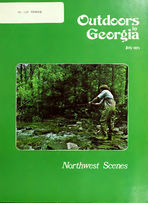
FRONT COVER: Bob Busby snapped this picture of a fisherman after the wily redeye bass on Armurchee Creek, in Walker County. BACK COVER: A small feeder stream to the mighty Chattooga River. Near Ellicott's Rock, this great photograph also came from the camera of Bob Busby.
MAGAZINE STAFF
Phone 656-3530
David Cranshaw
Publisher
Bill Morehead lii Carmichael T. Craig Martin Aaron Pass Joe Cullens Dick Davis
.... Managing Editor
Jones . . . Art Director Staff Writer
Wildlife Editor Staff Writer Staff Writer
Priscilla C. Powell .
Rebecca N. Marshall . . . Staff Writer
Jose Vinas
Artist
Bob Busby
Photo Editor
Edward Brock . . . Staff Photographer
Cathy Cardarelli . . Staff Photographer
Jim Ccuch
Staff Photogapher
. Circulation Manager
Outdoors in Georgia is the official monthly magazine of the Georgia Department of Natural Resources, published at the Department's offices, Room 713, 270 Washington Street, Atlanta, Georgia 30334. No advertising accepted. Subscriptions are $3 for one year or $6 for three years. Printed by Williams Printing Company, Atlanta, Georgia. Articles and photographs may be reprinted when proper credit given. Contributions are welcome, but the editors assume no responsibility or liability for loss or damage of articles, photographs, or illustrations. Second-class postage paid at Atlanta, Georgia. 35,000 copies printed at an approximate cost of $14,500. The Department of Natural Resources is an Equal Opportunity employer, and employs without regard to race, creed, color, sex, age, or national origin.
North by West
Some time ago we realized that, in covering outdoor activities in Georgia, we failed to give
an overview of the state's picturesque beauty.
We covered Tugaloo State Park, discussed the
great fishing in Lake Seminole, told of hunting
-- deer near Monticello, described the breathtaking
beauty of Wormsloe Plantation but we had
not given our readers a scenic tour of the four large areas of Georgia: the Northwestern Ridge and Valley Section, the Piedmont, the Appalachians, and the Coastal Plain.
The Ridge and Valley section of northwest
Georgia is our first offering. This rather special area houses some of the most beautiful scenery in the world: its long ridges run north into eastern Tennessee and south into northeastern Alabama; its valleys are fertile.
This was the residential home of the Cherokee. They traded away their hunting lands in the
-- Blue Ridge, ceded their hold on the Piedmont.
But this, the special lands of home these ridges
and valleys had to be taken from them by force.
As Georgia was the youngest colony, so the Ridge and Valley is the youngest part of modern Georgia. From 1733 to 1832 it was Cherokee country, and since 1832 it has belonged to many
different people.
Years ago, as a lawyer just beginning my
work in Paulding County, I came across a sur-
veyor's map of this county done in 1833. I kept the map for years without noticing what the surveyor had written on its corner. One day, my
eye caught these words,
". . . thousands of sparkling springs and
rivelets of purest freestone water, with
mineral resources undeveloped, of an open and productive soil adapted especially to the culture of the vine and fruits, cotton and corn, with mountainous hills and valleys, furnishing scenery most enchanting."
Since the time of the surveyor, how has this
land been affected? Does the homeland of the Cherokee still offer "scenery most enchanting"? In short, what is the Cherokee country we call
northwest Georgia? We hope you will under-
stand it better after reading the story on page 14.
-- X/h>^7^0'2fo>
July 19/s
Ellicotts
by Wayne Parker
I found it! . . . Just as I was giving up the search for Ellicott's Rock, a parting glance downward revealed a series of letters carefully chiseled in the sloping rock face I was standing on. Examining the inscription more clearly, I saw
LAT 35
A.D. 1813
N.C. + S.C.
Assuming that "LAT" must be an abbrevia-
tion for latitude, I thought I had probably found a survey marker. But when I read the last line, I realized that I was standing at the exact northeast corner of Georgia, with South Carolina to the east and North Carolina to the north.
Just below my feet the Chattooga River rushed
by, its waters marking the boundary of two
states.
Later, hiking south along the Chattooga to-
ward my evening campsite, I was elated because
I thought I had solved the mystery of Ellicott's
Rock. But who was Ellicott?
Photography by Bob Busby
When I resolved to find the answer, I little
realized that I was about to delve into a mystery that began with King George II and continues even today.
In 1732 King George issued the Georgia
Crown Charter and established Georgia's north-
ern boundary at the 35th degree of north lat-
itude. Unfortunately, the exact location of Latitude 35 has never been precisely determined.
North Carolina and Georgia have quarreled about it for more than 1 50 years.
In 1803 Georgia laid claim to a large portion
of what now is North Carolina. North Caro-
linians, dismayed by this affront, started a violent feud that turned the area into a haven for outlaws from both states.
Georgia and North Carolina decided to remedy this situation in 1807. Each appointed commissioners to jointly determine the validity of Georgia's claim. They quickly found that the 35th parallel was well to the south of Georgia's current boundary; they recommended that Geor-
Outdoors ip Georgia
gia abolish Walton County and that North Caro-
lina pardon those who had fought in the dispute. The Georgia legislature was not quite ready
to concede so easily, and Walton County con-
tinued to send elected representatives to the capital at Milledgeville.
The dispute continued, and in 1811 Georgia Governor Mitchell commissioned Major Andrew Ellicott to survey the state's northern
boundary. Ellicott, an officer during the Revolutionary War, was also a well-known surveyor.
He had worked on continuation of the Mason-
Dixon line, L'Enfant's plan for the city of Washington, and the boundary between the United States and Spanish Florida.
Ellicott traveled first to Milledgeville, then to
Augusta and on to Elberton, and it was a long,
-- tiring journey. He wrote in a letter, "From
Augusta to Elberton I had to walk on foot no horse or other conveyance being provided; and
from Elberton to the Commissioner's camp on
top of the Blue Ridge I had to walk at least one half of the way."
So began another disappointing episode in the search for Georgia's boundary.
Ellicott moved slowly through the mountains, carrying a heavy transit by wagon or hand. He
described part of his journey: "In going hence to the third position with the wagon, it was
necessary to make a circuit of at least 20 miles of which 14 was a path over steep ridges to the
top of one of the highest mountains in that
Below. The chiseled face of the rock Ellicott marked. One hundred and sixty-two years have failed to
erase the surveyor's craftsmanship.
Above. The famed Chattooga River as it flows near
Ellicott's Rock. A haven of trout and smallmouth bass,
it is a little-used fisherman's paradise.
Below. One of the many rivulet waterfalls which
feed icy streams into the Chattooga.
July 1975
Nestled in the corners of South Carolina, North Carolina and Georgia, the Chattooga River has carved its steep and sometimes treacherous valley from the very heart of the Appalachian Mountains.
country. Here again the aid of everyone was necessary to open the road by removing the obstructions, to make bridges, also to assist the horses up the hills by lifting at the wheels."
The mountain referred to is now known as
Ellicott's Mountain, just north of the South Carolina/North Carolina state line.
Ellicott had other difficulties as well. His sitings were hampered by Indian fires and smoke, and a severe earthquake struck on De-
cember 16. He wrote in his diary: "On the 25th
-- of December at sunrise after walking over sev-
eral ridges we began clearing away the timber
for the purpose of extending the prime vertical
west but the labour was so much more than we expected that we did not reach the river (the Chattooga). That day though we laboured until nearly dark after which we had to travel along
several craggy ridges and ascend the Chattooga
Mountain to our camp where we arrived at
9 o'clock in the evening without having taken any other nourishment than pure water after
4 o'clock in the morning. This was the severest day's labour I ever experienced having for want of a sufficient number of hands to carry an axe in one hand and the telescope of the transit in the other. The ridges being covered with dwarf locusts, briars, and thorn bushes not only tore
my clothes into tatters but our limbs and bodies
were lacerated. The blood trickled off the ends
of all my fingers. Nothing but well dressed buck-
skin is a sufficient guarantee for the body and its members in those mountains."
The next day, December 26, Ellicott reached
the eastern shore of the Chattooga and chiseled
a simple "NG" into the rocks by the river. This
mark designated the intersection of the river and
the 35 of parallel.
But the controversy over Ellicott's Rock did not end there. In 1813 North and South Caro-
lina appointed commissioners to establish their
mutual boundary. They marked a rock along the east bank of the Chattooga in 1813 and mapped a line east from that point.
Outdoors in Georgia
In 1819 Georgia and North Carolina tried to run the state line westward from the Chattooga. With some difficulty, they found what they believed to be Ellicott's rock and so designated it
on their maps. What they actually discovered
was the rock established by North and South Carolina; since that time its origin has been at-
tributed to Ellicott.
It was this rock that I found on my search for
Ellicott's Rock. The real Ellicott's Rock, redis-
covered in 1 965, is only a few feet away. Ellicott's marker is actually at latitude 35
00' ZVi" north. This amounts to an error of only 300 feet, a small deviation considering the terrain and equipment with which he operated.
Regardless of its origins, Ellicott's Rock is
important to Georgians because it represents wilderness area of national significance. In 1972 the Chattooga was declared a National Wild and Scenic River by Congress, and in January of this year President Ford signed into law an act preserving 3.600 acres of the region
as the Ellicott's Rock Wilderness Area. But Congress was just acknowledging what
many Georgians already knew. The Chattooga's 40-mile course from Ellicott's Rock to Lake
Tugaloo is unique: its Whitewater entices hundreds of rafters to explore its waters each sum-
mer. That demand is met in large part by three
commercial rafting operations which provide the equipment and guides for one- or two-day trips.
Others venture forth on their own to hike or camp along the banks of the Chattooga, and the Ellicott's Rock portion of the river attracts
fishermen to one of the best trout streams in Georgia.
But it is probably most important in another respect. There are few areas where nature still
functions without man's interference: the Chat-
tooga River is such a place.
When Andrew Ellicott reached into this country, his feelings may have been different. In his time, much of Georgia was wild and inaccessi-
ble, a thing to be conquered. Today, wilderness
has taken on a new meaning: it provides areas where man can interact with a world that is not
A of his own creation. world, as James Joyce
says, which is "happy, unheeded and near to the
# wild heart of life."
'
:
>*T /i
July 1975
3F .
****'
'JGitw
^vj T
1
-r
."X*.'
*4\
**
Forgotten Fishing
by Bill Morehead Photography by Bob Busby
It was at least ten thousand years ago, and probably more. Georgia in those days was not gripped tightly by a summer-dominated climate but was subject to the thrusts of long winters, where ice-covered streams and deep snows were common. In those days, it was as if North Dakota had come south to spend a long while
in Georgia. Slowly but surely the climate changed. First
noticed were the unseasonably warm spells during the winters. The spruce grouse noticed this, as did the lynx. The arrival of spring seemed a
little earlier each year. North Dakota was preparing to go back north, taking its flora and fauna with it.
But some of its flora and fauna remained
behind, unable (or unwilling) to move. Many
plants and animals died out, as laggards tend to do, but others adapted to the newer order of a warm, sunny Georgia. These, like the white pine, the balsam fir, and the smallmouth bass,
made a new way of life for themselves.
-- The warmer climate imposed itself on the
living creatures: change, adapt, or die those were the rules of the game. In the cook clear waters of the piedmont and northwest regions of Georgia, in the riffles and pools of hundreds of
warming streams, the brook trout died away, remaining only in the coolest of the mountain
streams. Further south, in the coastal plain, the
trout died away completely, leaving the smallmouth bass as a lonely remnant of the cold. Even as far south as Florida, the smallmouth
July 1975
struggled to survive.
-- In certain streams those cool enough to -- allow it the smallmouth continued to live with-
out change. In others, death occurred; but in still others, adaptive changes permitted survival.
Through centuries the warming climate extorted its price. For the smallmouth in the
warmer waters, the change was great. He was forced away from others of his species, until he no longer truly could be called a smallmouth. He
was something different. Still, the smallmouth-descendant clung to bits
of his ancestry. Not satisfied to adopt the habits
of his cousin, the largemouth, luxuriating in the
warm, murky depths of sluggish rivers, this newly-wrought fish clung to the rapid and frothy waters of his racial memory.
Through more tens of centuries, this smallmouth-descendant evolved even further. Today, Georgians call the result of these epic struggles for life the "redeye" or "coosa" bass and the
"Flint River shoal" bass.
Through the fishing furor of the past century, these two have become forgotten game fish. But perhaps forgotten is the wrong word, for they never have been too well known, even to the Indians. The recent development of these basses is a lively source of confusion. Having evolved only "yesterday", as it were, the redeye and the Flint are similar. Some experts consider them varieties of the same species, while others, per-
haps closer to the problem, say the Flint is distinctive enough to be a separate species.
Please turn page
That's academic, for the redeye and Flint bass both offer exciting fishing. In some places (particularly the Flint River in middle Georgia) it is
possible to float fish for these fighters. Usually,
though, wading small streams (much like trout fishing) is the manner of pursuit.
The clear, relatively unpolluted Flint River has a long growing season and is rich in insect life. For those reasons, the Flint variety grows larger here than anywhere else.
The redeye has very demanding environmen-
-- tal restrictions. Its native range, therefore,
since it derived from the smallmouth has been quite small. In general, it prefers cooler waters than the largemouth but warmer waters than
the trout. This fish has a clear preference for fast-flow-
ing streams with considerable aeration produced by water flowing over a rock-filled stream bed.
Like the smallmouth, the redeye prefers certain parts of these fast-flowing streams. Since it primarily is an insect feeder (although it will
take minnows and crayfish, among other
things), it lives in the parallel flow of the water and typically feeds in the turbulent flow.
Fishing for these bass, like fishing for small-
mouth and trout, is more productive when the
fisherman understands the nature of stream
flow. Casting into areas of high turbulence may
net a feeding fish or two, but the higher proba-
bility of success comes with stalking and casting into the quiet areas behind rocks, logs, or the deeper meander-cuts along the stream bank.
Almost any lure that will take a trout or
Outdoors ip Georgia
smallmouth will take redeyes. One of the most
successful lures is the small spinning-size spin-
ner, with or without a bucktail on the treble
hook. Fly fishing, with either dry flies or larger nymphs, is very profitable, especially in early spring. Small bass lures, particularly those that vibrate rapidly and feature offset treble hooks, are excellent for both smallmouth and redeyes. Bait fishing with worms, small minnows, etc., can be productive with redeyes.
Redeye fishing in a small stream demands cer-
tain things of the fisherman. Generally, he has
to leave his boat behind. Waders come in handy, but during the warmer spring months they can be left behind. Fishing for redeye usually means that the angler must park his car far from where he wants to fish. It means he has to wade up a stream's course, where he is likely to see the
antics of a kingfisher or the glide of a big horned owl. It means he is likely to spend lunchtime on the mossy side of some tremendous old tree that
foresters haven't cut down because it's too close to the stream bank. It means that he, alone or with a buddy, may enjoy the natural beauty that
once was everywhere in Georgia.
Finally, and best of all, it means that he may
encounter that spunky ice-age remnant of a
"time that was" and bring home a small trophy or two of that special fish known as the redeye
# bass.
Photograph by Aaron Pass Very close to the smallmouth bass, the redeye or "Coosa" differs from it by being smaller and having
less defined vertical stripes.
Below. One of the pleasures of stream fishing for
redeyes is wading the clear streams and not finding many other fishermen after the same sport.
July 1975
TW 1?u/eJi
by Kerry Dawson Photography by OIG Staff
ontitt Sua!/" yifrdiM/dita
Few rivers in the world can match
Georgia's Altamaha for an enjoyable river journey by canoe. Located in
the center of the coastal plain, the
river basin drains over a quarter of
the state's land surface. The drainage is so large that more fresh water flows into the Atlantic from the Altamaha than any other river in the southeastern United States.
Vast hardwood swamps growing
along the river cleanse it so thoroughly that these 120,000 square
acres of swamp, along just the Altamaha and not its tributaries, could serve as a sewage disposal network for a city of one million people!
As with most Georgia rivers, the word Altamaha comes from an Indian name for the river. The lower
Creeks called the river Altama,
which meant roughly "the way to Tama country". Tama was the leg-
endary Creek capital which flourished centuries ago and disappeared long before western civilization reached Georgia.
The first written accounts of a canoe trip on the Altamaha came from the American explorer William Bartram around the time of the American Revolution. Bartram wrote extensively of the wonders of the Altamaha and collected many
examples of its unique flora and fauna, including seeds of the beautiful tree Frcmklinia altamaha, which shortly afterwards became extinct in the wild. Bartram became enamored of the Altamaha wilderness, and his writings described such a paradise that almost the entire village of Auburn, Scotland, emigrated to the area. This incident was recorded in "The Deserted Village" by
Scottish poet Oliver Goldsmith, who
lamented the sudden departure of his folk from "the loveliest village of the plain" to the Altamaha, "through torrid tracts, with fainting steps they go, /where the wild Altama murmurs
10
Outdoors ii> Georgia
to their woe/far different there from all that charmed before".
For those who also are attracted by the lure of a southern swamp
wilderness, a canoe trip on the Alta-
maha is still as rewarding as then. You can imagine a few thousand years ago when giant mastadons, saber-toothed tigers, rhinoceros,
lions, and other prehistoric animals found their last refuge from the Ice
Age in the Altamaha swamps. Or the times of early settlement by Europeans, when the river divided
their lands to the north from Indian lands to the south, and early boat
pilots would yell "bow injun" rather than "bow right" for a turn. Or
even the era of the log raftsman
who lumbered the huge cypress of the Altamaha swamp. On the way home to Darien and the river delta
he sang songs like the following short ballad mentioned bv Braindard Cheney in his novel. River Rogue,
about the coastal logging days (New York: Houghton Mifflin, 1942).
Rope around my shoulder Auger in my hand And a little brown jug From Dari-an.
-- Most of us, however, just enjoy
the river for what it is today one of the few wilderness areas remaining in the eastern United States. Rich in wildlife and lush in vegetation,
it is full of the wonders that make this southern river swamp a prime
candidate for national wild and
scenic river status.
Many canoe trips can be taken
along the Altamaha. For real ad-
venturers with a lot of time, a oneto two-week trip can begin on the
Ocmulgee or Oconee River (the two
main rivers that converge to form the Altamaha) in north Georgia and finish at Darien on the coast. These
trips were common long ago, and
to keep their spirit alive, an annual
flotilla leaves Macon every spring
for a 355-mile trip downriver to Brunswick.
But for most people wishing to give the Altamaha a try for the first time, a simpler plan of action is recommended.
The Altamaha is a broad, flat-
water river without rapids but with a strong current that is slow-moving at this time of year. It is, therefore, a good start for those without a lot of experience.
Now, get a few friends together and somehow collect enough canoes to put an adult in the front and back of each one. If you don't own a canoe, call some boating supply stores around your area and ask
about possible sources for renting.
You'll need three paddles, with one
paddle tied firmly to the canoe in
case one or both of the others is
A lost.
broad, flat-water paddle in
the rear gives both increased speed
and ruddering. At least two cars with adequate
canoe racks are necessary to make the river shuttle successful. One car,
the canoes, and your equipment will
be left where the trip begins (put-in), and the other car will be left where your trip ends (take-out). Be sure
not to lose the keys to the take-out
car or you might have an unexpected
adventure!
Take along some good food, suntan lotion, a first-aid kit, some water-
proof containers for your camera
and watches, and insect repellent;
and leave some dry clothes in your
car.
The accompanying map shows
three possible trips, each taking a
day or less. The first trip begins at
Right. The Altamaha is a fast-
flowing but gentle stream, ideal for day-tripping by canoe. There are
many sandbars for stopping points, and many people use the larger
ones as camping sites. This is an ideal stream for group-trip canoeing.
July 1975
11
Above Lett. The foliage along the river is much the same as it was in
Bartram's time, except for the
lower canopy. Swamp areas extend
for thousands of feet on both
sides of the river.
Above. Fishing is both a way of life and a great sport along the Allamaha. Largemouth bass, bream, striped bass and shad abound.
Left. William Bartram used the Altamaha (as did most others) as a road into the interior wilds of colonial Georgia. His trail is marked along the river.
Paradise Park and goes 18 miles downriver to Altamaha Park. This trip is a full day and could take as long as twelve hours, with a few
stops for sight-seeing.
The second trip is a slightly shortened version of the first, in which
put-in is at Paradise Park, with a take-out 13 miles downriver at Fort Barrington Landing. With a few stops, this trip could be done in 8 to 10 hours.
12
Outdoors \t) Georgia
July 1975
LUDOWia
For beginners, the third trip has a put-in at Fort Barrington and a leisurely five mile trip to Altamaha Park. This should only take a few hours, with plenty of time for shopping and resting. Overnight camping is available at both Paradise Park and Altamaha Park for a $3.00 fee. It costs $1.00 to launch your canoe at Paradise Park. More information on trip conditions, camping, or cabins is available by calling Paradise Park (912) 427-6139 or Alta-
maha Park (912) 264-2342. The United States Geological Sur-
vey has older 15-minute quadrangles of this section of the Altamaha.
These are available through some sporting goods stores, engineering firms, or the Earth and Water Divi-
sion of DNR. Ask for the Ludowici
and Everett City quadrangles. County road maps (Wayne, Glynn, Long, and Mcintosh counties) can be obtained from the state Department of
Transportation.
If you're now ready to go, or at
least making plans, have a good trip and organize your plans well.
But remember, boating safety is the most important consideration in any canoe trip. Currents and undertows in any river sometimes exist hidden from the surface. Life jackets for each person are required by law and should only be removed when you are firmly on dry land.
If you're not quite convinced that you'll really enjoy such an adventure, keep in mind the following
words of William Bartram. They once inspired Scots to travel thousands of miles from their lovely village to a world that exists close to your own backyard:
"When wearied with working my
canoe, against the impetuous cur-
rent I resigned my bark to the
friendly current, reserving to myself
the controul of the helm. The winding banks of the river, and the high
projecting promonotories, unfolded fresh scenes of grandeur and sub-
limity. Thus secure and tranquil, and meditating on the marvellous
scenes of primitive nature, as yet
unmodified by the hand of man, I gently descended the peaceful
# stream."
13
a I iorthwest eorgta
by Bill Morehead
Photography by Bob Busby & Cathy Cardarelli
KN
gay ^Mg|^^fe. ; ' :
j
.
*
Outdoors ii? Georgia
[Between her rivers and beside
the sea,
Illy lllother-land! what fairer
land can he ?
These century-old feelings. drawn from Francis Ticknor's poem, Georgia, serve ivell to begin Outdoors in Georgia's first of five pictorial essays on our State.
Northwest Georgia is seen here as one travels west out of the rugged Cohuttas (1). At the border of the "older Appalachians", this view could have been the scene evoking Ticknor's line, "crown-imperial on her purple hills".
The raw, "hard scrabble" chert ridges lie between lush valleys (2). On Lookout Moun-
tain, bold sculpturing of the
earth renders scenes which could do justice to a western landscape (3). Here, at Cloudland State Park, a box canyon was gouged out of sandstones and limestones deposited when the Appalachians were young and Alp-like. The rawer forces of nature are tempered by green forest beauty, itself softened by the delicate blossoms
of laurel and rhododendron. A
visitor to this park can find himself with nature littlechanged from the time of the Cherokee (4).
The contrasts of nature's beauty to man's good works is
a simple journey in northwest
Georgia. Near Borne, the logstructured chapel of Berry Col-
lege sits before a cultured ver-
dant lawn (5). Nearby, this handsome building is more than matched by a field left to
nature and a day in May (6).
Horse country since at least
1832, the lush limestone valleys
grow the right grasses, permit-
ting thoroughbreds here to race the afternoon sun just as they do in Kentucky (7).
July 1975
&$&*
<-.. . .*.&
* p i*
.,#... -' ,-..,;*. ,
"Hard scrabble" is not the
sole property of the chert-
A ridge. private store now, this
building at Berryton ivas the "general store" of a cottonmill village. Workers were once paid in scrip redeemable only at the store. The meeting place of the village, it was the site of several grisly murders of the strife-torn past (8).
Outdoors ip Georgia
General stores are found
-- today, as ivell (9). Ballard's
Hardware Store at Menlo at
--the foot of Lookout Mountain harbors the potbelly stove and "sitting chairs" and daily awaits customers and conver-
sationalists alike. And you can
order anything from a mule-
collar to muslin.
Baseball is the sacred sport
of this area. Boys (10) prove their manhood on the diamond (in somebody's pasture) as they have done for more than
70 years.
-- Snaking logs by mule-power
has passed into history except in isolated places like the
northwest Georgia hills. At the saw mill, a good mule can still out-compete machines (11). Trucks are parked as if they were watching the mule work.
Northwest Georgia offers up her resources grudgingly. In Rockmart, Polk County, the mist of morning is coupled with
the mist of rock crushing (12) to help provide the needs of man. Coal, barite, slate and
other resources are mined in northwest Georgia.
Fog shrouds on Lookout Mountain greet a new day for
a sow and her pigs (13). Agriculture, mostly confined to tops of flat mountains and flatter
valleys (14), is a mainstay. Heirlooms of yesterday (15) rest in the barn as tractors do the work.
Northivest Georgia, the special place of the Cherokee (16) could have been on Ticknor's
mind as he wrote
cJhroats that sing ana wings
that flutter
Softly mid the balm ana bloom;
Sweeter sounds than lip can utter
uiath my heart for thee,
Illy home.
July 1975
Saltwater Tackle
by T. Craig Martin Photography by Jim Couch
"It don't matter what kind of tackle you use on a Firestone fish,"
the old man laughed as we broke my
line free from a 350-pound tire unit in the artificial reef offshore from Brunswick. "But if you want to enjoy any of the live critters down there, you'd better collect a rod, reel, and line that're right for the job.
"Now right don't necessarily mean
fancy brand names, and it don't just
mean that the rod has all its eyes and the reel will turn if you crank
hard enough. "Having the right gear means that
each piece works with the others, and that the whole shebang kind of fits the fish you're looking to catch.
"Take the feller I saw out here
just the other day. He had him a brand new fancy boat rod with roller
guides and all, and one of them 200 dollar tournament reels all filled with that glow-in-the-dark string, and he was as proud of that stuff as he
could be.
"But when he come by to show it off, I found out he had a little old 30-pound rod tied to an 80-pound
reel. It looked kind of like a canepole with a wagonwheel.
"That feller might catch fish, but he ain't going to have any fun doing it. If, that is, he don't break the rod trying to horse in the first thing that
strikes.
"Some tackle store sharpy saw him coming, and, since there weren't no 30-pound reels or 80-pound rods in stock, he sold him the most expensive of what he had.
"It was a good rod and a good reel, but they weren't what they call 'balanced'. That pore little rod
18
Outdoors ip Georgia
An array of saltwater gear. Rod and reel at bottom
are beejed-up fresh water designs balanced for 30-pound line. Upper two rigs are classic offshore outfits.
Properly balanced gear can often mean the difference between losing fish and landing a trophy bill fish.
looked as if it was going to break just trying to hold that reel; and the line, why it was near as big around
as the tip of his rod.
"Maybe someday that feller will figure out what happened to him, and then he'll buy himself a 30pound reel and line, or he'll get an 80-pound rod. That way he'll get the most out of each piece of the gear, and the whole thing will work for him instead of agin him.
"There's hardly any call for heavy tackle around here unless you got
the time and money to fish for mar-
lin or tuna or sharks all the time.
Most any other fish we got can be handled on a 30-pound gear.
"And that's the other part of hav-
ing the right tackle. Sure, you can use an 80-pound or 50-pound outfit on our dolphins and kings and barracuda, but you miss all the fun if you do.
"It'd be like tying a piece of anchor cable to the stern and trolling
with it: you could do it, but there'd be more excitement in getting your fish at the supermarket.
"A lot of these boys around here don't seem to care much about fishing, at least not as much as they like running their boats. They buy all
that heavy gear at the discount store,
then they come out here to see how much gas they can burn in a day.
"Round and round they go, never stopping, like their motors was stuck
in forward. I hear 'em talking about all their fish on the radio, but I can't
never tell when they got one on. "Me. I like light tackle. I troll 'til
I get a fish on, then I stop and fight him, not worrying about all the
others I'm missing. If it's a dolphin
or amberjack and his buddies come up to the boat, why I'll maybe throw
out a jig or plug on my 12,-pound
rig and settle in for an hour or so.
"Me and the old lady can only eat so much at a time, and I can get all
the frozen fish I want at the market. So I just keep what we can eat in a day or two and throw the rest back.
"It don't really matter how many fish I catch. I just care about how
# fair and square I fight 'em."
The "top of the line" in saltwater tackle is the "international" class reel. Only three companies in the world make them. These superb instruments are made to do one job very, very well.
July 1975
'School" king mackerel like this can be handled easily on gear ranging up to 30-pound. This one hit a trolled mullet.
19
20
Outdoors \t) Georgia
Traveler's 1$est
by Rebecca N. Marshall
Photography by Bob Busby
Imagine yourself a traveler in the early 1 800s.
As you journey through South Carolina and Georgia, riding on horseback or bumping along in a hot, crowded stagecoach, you're probably wishing yourself back home. Even a one-room cabin offers more comfort than a night on the
road.
If you're lucky enough to cross into Georgia near Toccoa, you'll probably stop for a night or more at Traveler's Rest.
The long, shaded front porch invites weary travelers to sit and rock away cool evenings.
And you can be sure that you'll be fed very well. One guest reported in 1837, "... I got an
excellent breakfast of coffee, ham, chicken, good bread and butter, honey and plenty of good new milk for a quarter of a dollar."
The meals all were prepared by slaves, who
did the cooking for family and guests in a basement kitchen, over a fire in the huge stone fireplace. The wooden stairs they climbed to the dining room are worn in the middle from the weight of feet trudging up and down, day after day, but they still are as sturdy as they were
then.
Today Traveler's Rest is an easy place to miss, but in its heyday in the 19th century, it was the
only lodging place in the area. Built in the early
1 800s, the house, also known as Jarrett's Manor,
served as stagecoach inn, trading post, tavern, and post office.
Guests slept upstairs on feather mattresses. The inn provided a few small private rooms, but
most travelers shared the common room, where
July 1975
21
they were squeezed in among as many men as would fit. (Women didn't do much traveling
back then, so the owners of the inn didn't worry
too much about accommodations for both
sexes.)
Two beds and a couple of washstands have survived and now occupy the common room.
These, like most of the furniture in Traveler's Rest, have been in the house for more than a
hundred years. Much of it was made on the site
by itinerant tradesmen and the Jarrett family. Traveler's Rest sits on land that once was
hunting ground for the Cherokee Indians. In
1 785 Major Jesse Walton, a Revolutionary War
soldier, acquired it as part of a land grant.
Walton was killed by Indians in 1789 and left
A the land to his wife and children. son-in-law
subsequently sold it to James Rutherford Wyly,
who sold it to Devereaux Jarrett in 1838. The inn was constructed in two sections: the
southern part is about ten years older than the
northern. Wyly probably built the earlier portion between 1816 and 1825, and Devereaux Jarrett
completed the construction.
Even though it was not all built at the same time, the inn was constructed entirely of long leaf yellow pine, and many boards in the house
are 10 to 12 inches wide. Traveler's Rest, once a thriving stagecoach
inn on a main thoroughfare through Georgia,
now is almost forgotten. 1-85 skirts it several miles to the east, and most people who travel
near it are local residents so used to seeing it that they take it for granted.
But it still beckons to the occasional passing
# traveler, inviting him to stay and rest awhile.
22
Outdoors ii? Georgia
How Do We Know?
by Ron Odom
Photography by Bob Busby
In the 1971-72 hunting season 33,348 deer were bagged. 122,342 resident quail hunters harvested 2,910,651 birds in 1970-71. Each duck brought to bag in '70-"71 cost the lucky waterfowler approximately $5. 1 1 . The average price of an opossum pelt in '71-'72 was 63tf.
How often have you read statistics
like these and wondered where they
came from? How do you know that
650,795 hunters bagged 3,427,129
doves during the three dove seasons
of 1971-72? Doves aren't tagged
did someone count them? If so, who
did, and how?
Please turn page
July 1975
23
The survey and analysis section of
the Game and Fish Division is re-
sponsible for conducting an annual wildlife harvest survey. This survey is based on statistical methods, and it attempts to determine the relative hunter participation and success over a given season. It is conducted by mail, with a standard question-
naire sent to a 5 percent random
sampling of resident license holders.
The questionnaire, which need not
be signed, allows the individual to
indicate which game animals he hunted and how well he did.
The questionnaire deals with eight "major" species of game. These are selected on the basis of number of participating hunters, amount of effort (hunter days), and size of har-
vest. The questionnaire asks for the season total of hunting days and
number of each species taken. When
the questionnaires are returned, the
results are compiled, programmed, key-punched, and verified by the survey and analysis section. These
data are then sent to the Institute of Statistics, North Carolina State University, where the statistical analysis is completed.
At this point the data are expanded to reflect statewide participation and harvest. This is a complex process in which the hunter success reported in the survey is expanded to reflect the success of the total number of hunters in the
state (which is known from the receipts of license sales). What results
is not an absolute accounting of each and every cottontail rabbit bagged by Georgia hunters, but a very accurate indication of the trends.
This is the type of information needed by wildlife managers to plan
proper management programs. It is
also used in planning subsequent legal hunting seasons to either increase or decrease the relative har-
vest on any species. The results of the survey also may augment data from other research programs to
present a clearer picture of wildlife
populations and the effects of hunt-
ing.
This harvest survey has been conducted every year since 1962, with
about 65% response, and it becomes
more useful every year. There are bound to be some errors each year, even though the best statistical methods are used. But with the accumulation of data and their use year after
year, mistakes iron themselves out, and valid data are collected.
The 1974-75 survey data are now being tabulated. The survey of the
1973-74 hunting season included 10,375 firearm license holders selected at random from the current file of 329,436 resident hunting and combination hunting and fishing license holders. In addition, a sample
of 721 resident bow and arrow li-
cense holders was selected from a
total file of 28,187 bow hunters.
Total resident firearm license sales (hunting and combination) increased
7.3% from the previous season, while resident bow and arrow license sales increased 14.4%.
Table 1 summarizes information received from all licensed resident firearms hunters (expanded) concerning total number of hunters, total days hunted, and total harvest, for eight major species of game.
Table 2 ranks these eight species according to the same three categories. Deer remained the most pop-
ular game species relative to total number of hunters and hunting effort.
The average deer hunter spent 8.7 days in the woods last season
looking for his whitetail, although an average of 39.3 days were spent
in the woods for each deer bagged. Doves topped the list in total
numbers harvested with an estimated harvest of 3,625,200 birds. The average dove hunter bagged 5 doves
per day.
The estimated harvest of 42,018 deer ranked 7th in terms of total numbers harvested.
24
Outdoors ii) Georgia
Data reported by resident bow
and arrow license holders are presented in Table 3. As would be expected, deer are the most important species in terms of numbers of hunters and hunting effort. Archers hunting deer averaged 8.3 days per
hunter, although each deer bagged
with a bow and arrow represented
179.4 hunter days in the woods. Table 4 compares deer hunting
results of resident firearms and archery hunters, revealing substantial differences. Approximately one
out of every 4.5 licensed firearms
hunters bagged a deer as compared to one out of every 21.7 archers!
Man days required to bag a deer with a bow and arrow were nearly
4!/2 times that required per deer for firearms hunters. Please turn page
July 1975
25
Table 1
Hunter Participation and Success in Georgia 1972-73
Major Game Species
Species
Number
of Hunters
Total
Days Hunted
Average Animals Number Days Harvested Per Hunter
Success Rate
Quail
115,861
916,140 2,694,354
7.9
2.9 quail per day
Rabbit
89,334 545,936 679,588
6.1
Dove
137,186 738,086 3,625,200
5.4
1.2 rabbit per day 5.0 dove per day
Turkey
8,177
32,843
1,907
4.0
17.2 days per turkey
Woodcock 6,984
35,187
29,446
5.0
1.2 days per woodcock
Squirrel 134,492 875,037 1,489,258
6.5
Deer
189,377 1,649,605
42,018
8.7
Duck
25,415 115,343 129,348
4.5
Marsh Hen 4,246
70,904 702,235
2.6
1.7 squirrel per day 39.3 days per deer 1.1 duck per day 6.4 marsh hen per day
= Total Resident License Holders 329,436
Table 2
Ranking of Major Game Species as Determined from
1972-73 Georgia Hunter Survey
Rank
Total
Number Hunters
Total
Days Hunted
Total Harvest
1st
Deer
Deer
Dove
2nd
Dove
Quail
Quail
3rd
Squirrel
Squirrel
Squirrel
4th
Quail
Dove
Rabbit
5th
Rabbit
Rabbit
Duck
6th
Duck
7th
Turkey
8th
Woodcock
9th
Marsh Hen
Duck Woodcock Turkey Marsh Hen
Marsh Hen Deer Woodcock Turkey
= Total License Sales 329,436 (Combination and Hunting Licenses)
Table 3
Expanded Values: 1972-73 Georgia Bow Hunter Survey Questionnaire Major Game Species
Species
Number
of Hunters
Total
Days Hunted
Average Animals Number Days Harvested Per Hunter
Success Rate
Deer Rabbit Squirrel
27,792
229,284
1,278
8.3
179.4 days per deer
1,903
9,249
4,282
4.9
2.2 days per rabbit
1,903
10,999
4,643
5.8
2.4 days per squirrel
= Total Resident Bow and Arrow License Sales 28,187
Table 4
1972-73 Deer Hunting Results Archery vs. Firearms
Based on Georgia Mail Surveys
Information Determined
Hunting Method Firearms Bow and Arrow
Total Deer Hunters
Percent of Licensed Hunters Hunting Deer
Number of Licensed Deer
Hunters Per Deer Harvested
Total Deer Hunting Effort (Days) Man-Days Effort Per Deer Harvested Man-Days Effort Per Deer Hunter Statewide Deer Harvest
189,377 57.4
4.5 1,649,605
39.3
8.7 42,018
27,792 98.6 21.7
229,284 179.4
8.3 1,278
26
Outdoors ip Georgia
Go Public
by Joe Cullens
Photography by Ed Brock
It's one of those lazy Saturday mornings, the kind that creep and crawl and just never seem to quite get moving. Sure, there's that back porch stoop that needs fixing, and
M"
the tool shed could use a coat of
paint. But the grass was mowed
yesterday afternoon and the garbage taken out last night.
Suddenly, a flurry of excitement that is your six-year-old son bursts into the den, draped with your mil-
dewed fishing creel, dragging his Grandpa's split bamboo fly rod, and peering from beneath the brim of your slightly over-sized fishing cap.
"Okay, I get the hint", you chuckle. Tackle box in hand, you slip out to the garage and get down a half-dozen or so dusty canes. Replacing the old line and hooks takes just a few minutes, and, after you've put them in the front seat and cautiously run them through the rear window and out towards the rear of the car, your vehicle looks like a mauled torn cat with half his whisk-
ers gone.
"C'mon, let's go fishing", you say.
When it's all said and done, what's
fishins; really about? Enjoyment . . .
right?"
On those sultry summer days,
when energy seems non-existent and the walls seem to close in, perhaps a little hiatus from the humdrum is just what we need. "All I want to do is catch a few fish and maybe . . . just maybe, relax a bit." Doubtless this thought has echoed through the minds of many of us after being nearly swamped by some careless boaters out for a joy ride in their 50
mile-per-hour speedboat.
The big reservoirs surround us with their yacht clubs and marinas, over-developed recreation areas crowded with sunseekers. Every cove and point seems covered with
dueling "bass masters".
But there are places you can go
28
Outdoors it) Georgia
July 1975
without fear of being run down in
your prime by a houseboat full of party goers: small lakes and ponds abound, but if you're not privy to either the locations or the owners you're pretty well out of luck.
Did you ever give thought to a public fishing area? "Oh, no, not one of those 'mudhole catch-out ponds' operated by the state?" you query.
But did you know that last year
alone, in the three public fishing
areas, more than 68,000 pounds of fish were caught by nearly 32,000 fishermen? That should tell you at least a couple of things. One, the
fish definitely are there, since the
total water area is only 195 acres.
Two, a great number of people take advantage of the nominal permit fee and enjoy themselves.
Channel catfish, largemouth bass, and bream are the fare in ponds ranging in size from 3 to 40 acres. Sound interesting? It just might be "your thing".
Arrowhead, Baldwin State Forest, and McDuffie Public Fishing Areas are operated by the Department of Natural Resources in the public interest to provide family-oriented rec-
reation. Any licensed Georgia fisherman from age 16 to 65 can buy a
permit for one dollar (it's free if you're under 16 and accompanied by an adult, or over 65 and have your honorary license).
Directions and rules, printed here for your convenience, are also found in the 1975-76 Guide to Georgia Fishing Regulations. This is available at most sporting goods stores, or from the Department of Natural Resources, Public Relations and Information Section, 270 Washington Street, S.W., Atlanta, Georgia 30334.
29
Public Fishing Areas
The following regulations apply
to all public fishing areas operated
by the Game and Fish Division of
the Department of Natural Re-
sources:
(a) Fishermen 16 to 65 must have a fishing permit in addition to their regular fishing license. Permits are available on the area at $1 per
day.
(b) Children under 16 mav fish
free, but must be accompanied by an
adult.
(c) Fishing hours are 30 min. before sunrise to 30 min. after sunset.
(d) Area managers determine which ponds will be open and post
notices accordingly.
(e) Fishermen are limited to three poles and lines, no other gear per-
mitted.
(f ) Only battery operated motors
allowed. No boats allowed at the
Arrowhead Public Fishing Area. (g) Camping allowed only in des-
ignated areas.
(h) No firearms or alcoholic bev-
erages allowed.
(i) No swimming allowed.
(j) Creel limits as posted on each
area.
(k) Open dates posted on each
area.
(1) No unattended fishing gear
permitted.
(m) Use of live fish for bait not
allowed unless posted.
McDuffie Fishing Area
The McDuffie Public Fishing Area consists of 15 ponds open as posted. The easily accessible ponds
are stocked with largemouth bass, bream, and channel catfish. Fisher-
men may use their own boats on the
lakes, but only with electric motors.
Directions from Augusta: Go to
Dearing, turn left at caution light and go 3 mi. to Iron Hill Church.
Turn right at church, go to wooden sign, turn left on dirt road, go .8 mi.
to checking station.
Directions from Thomson: Go
east on U.S. 278, 5.2 mi., bear right at large wooden sign on sharp curve and go 3.3 mi. on paved road to wooden sign. Turn right on dirt road and go .8 mi. to checking station.
Baldwin State Forest
Baldwin State Forest lakes are open as posted.
Directions from Milledgeville: Go
south on U.S. 441 about 4 mi. Lakes are on the left.
Arrowhead Public Fishing Area
Arrowhead Public Fishing Area consists of two ponds, one of which will be open as posted. The easily accessible ponds are stocked with channel catfish and some bass and
bream. No boats allowed.
Persons fishing at Arrowhead Public Fishing Area are required to
leave their fishing license with the
creel clerk who will return it when
the fisherman completes his fishing and has his catch recorded.
Directions from Rome: From traf-
fic light at Floyd Co. Hospital go 7 mi. north on Ga. 27 to Armuchee Post Office. Turn right and go 4.5 mi. to the Arrowhead Public Fishing Area.
Directions from Summerville: Go
south on Ga. 27 to Armuchee Post Office. Turn left and go 4.5 mi. to the Arrowhead Public Fishing Area.
Directions from Calhoun: Take Ga. 156 west 13 mi. to McKinney's Grocery Store. Turn right and go 1 mi. to the Arrowhead Public Fishing
Area.
30
Outdoors ip Georgia
BooH Reviews
W1LDFLOWERS OF THE SOUTHEASTERN UNITED
STATES
by William H. Duncan and Leonard
E. Foote, University of Georgia Press, 296 pp., $12.00 (hardbound )
How can you be objective about
a book that you like very much? That is the problem I faced when re-
viewing this book. According to the introduction,
Wildflowers is a field guide "... de-
signed to provide a ready means of identifying most of the wildflowers found in southern habitats and to
stimulate interest in their enjoyment, conservation, and management." In general, the authors confined their material to annual and perennial
herbs, excluding woody plants, ferns, and grasses. Photographs of 485
typical specimens illustrate repre-
sentative species.
Monotrapa Hypopithys
A short text accompanying each
photograph helps to identify that species and to show its relationship with nature and man. These often give information on one or more wildflowers closely resembling the one pictured, so that more than 1000 species can be identified by using this field guide.
Erigeron Philadelphicus
Emphasis is on the more visible and widespread species, but many uncommon ones are included. Some introduced wildflowers and strays from cultivated gardens which have become established are included,
along with flowering plants usually designated as weeds.
A short section describes some of
the diverse climates of the southeast. Habitats here support a variety of vegetation in temperate, mountain-
ous, subtropical, and prairie areas. Typical habitats from each physiographic province are described, and representative flowers are named.
The book is easy to use. One section offers tips on identification, and
a list of plants with unusual characteristics provides a natural beginning point for species identification.
A guide to species groups is com-
plete without being overpowering. Line drawings of vegetative, floral,
Gaillardia Pulchclla
and fruiting structures illustrate most of the features needed for a positive identification. The glossary provides supplementary information.
The section on conservation
should be required reading for every-
one. The authors discuss common
causes of endangered species, placing the blame primarily on destruc-
tion of habitat.
Common and scientific names are
given for each illustrated species, along with identifying features, abundance, ecological and geographical distribution, and flowering period. Special information on significant economic value (food, dye) or danger (poison) is included.
The photography is superb: all 485 photographs are in blooming color. The book is larger than the Peterson Field Guide Series, but still compact enough to pack, and the binding is sturdy enough to with-
stand field use.
Cirsium Carolinianum
Maps inside the covers, which
define the physiographic provinces
of the southeast, show areas in which
A the book is useful.
centimeter
scale printed along one edge is han-
dy reference, since all given meas-
urements are metric.
Dr. Duncan is Professor of botany
and Curator of the Herbarium at the
University of Georgia, where he has
taught since 1938. He has spent
more than 40 years and covered
more than 300,000 miles in his
studies of southeastern plants.
Mr. Foote is southeastern field
representative of the Wildlife Man-
agement Institute and Chairman of
the Board of Natural Resources. He
has long been noted for his outstand-
ing writing and photography in
natural history.
LSP
July 1975
31
THE NEW COMPLETE WALKER
by Colin Fletcher, Alfred A. Knopf,
432 pp. & Appendices, $8.95 (hard-
bound).
We called the first edition of this
classic "the book" for backpackers (OIG, March 1973). This "revised, enlarged and updated" second edition is no less indispensable.
Fletcher remains the same: an irascible, ironic, idiosyncratic commentator on the tools and techniques of walking in the wilderness. For example, he notes early in his discussion of food that some hikers
"seem to make each trip one long making of meals. At the other extreme lie those who, like me, were born British and therefore, as far as food goes, barbaric." And in a
footnote to this he claims that "hell has been described as a place in which the politicians are French, the policemen German, and the cooks British." Indeed.
On clothes, he begins,
The best dress for walking is nakedness. But our sad though fascinating world rarely offers the right and necessary combination of weather and privacy, and even when it does the Utopia never seems to last for very long. So you always, dammit, have to worry
about clothes.
He's not, to say the least, the usual hyper-serious technologist.
But he is an expert, a man who has
pushed solo backpacking to its lim-
its, so his arguments, no matter how
casually stated, must be taken
seriously.
Not always accepted, mind you: he*d be the first to hoot at anyone
-- taking his word or anyone else's,
-- for that matter -as unquestioned
gospel. His theme, restated throughout the book, essentially is "find out by trial and error what suits you."
Trial and error these days,
though, can be an expensive and frustrating method. Every general
-- merchandise store and, of course, -- every sporting goods dealer has at
least a few backpacks and sleeping bags hanging around. The variety seems endless, while sources of trustworthy advice are rare indeed.
Fletcher is about as trustworthy
a guide as could be found. He
hasn't used every type and form of
gear; but he admits that over and
over again. Instead of pretending an
all-encompassing expertise, he eval-
uates equipment based on his own
experience, pausing often to warn
readers that their needs may be quite
different than his.
He covers a lot of equipment
-- skipped in the early edition par-
ticularly food, stoves, and tents
and brings other areas up to date.
-- He also re-examines his stand on
several issues
fires, disposable
plastics, sanitation, "ecology" as an
-- ideology sometimes altering, some-
times reaffirming.
Anyone remotely interested in
backpacking or wilderness explora-
tion should own this volume, even
those who have the first edition. It's
hard to imagine a better book on
the subject.
TCM
FISHING FOR FUN
by Byron Dalrymple, Winchester Press, 246 pp., $8.95 (hardbound).
Most readers of outdoor magazines will probably have read some-
thing of Dalrymple's before: he's published about 2,500 articles over the past 30 years, and not a few books besides. This book offers 20 of those articles, loosely organized around the central theme stated in
the title.
-- Dalrymple is one of those guys
who loves to fish any time, any
place, any way, and for any species. Large or small, edible or inedible, beautiful or horrendous: if it swims, Dalrymple will fish for it. With
pleasure.
And that's what makes this book so delightful. The enthusiasm is in-
fectious; it should grab the most
hardened bass man or the most pure
trout angler, shaking each out of that
terrible specialist rut most anglers
seem to fall into.
Dalrymple fishes for fun, not for
bass or marlin or salmon or red-
breast or speckled trout. It's that
pleasure, that unadulterated joy, he
tries to rekindle for the rest of us in
this book.
TCM
THE OUTDOORSMAN'S MEDICAL GUIDE
by Alan E. Nourse, M.D., Harper &
Row, 135 pp., $3.95 (paperbound).
Although this book is subtitled
"Commonsense Advice and Essen-
tial Health Care for Campers,
Hikers, and Backpackers", it's useful
reading for anyone who ventures
-- into the outdoors. All of us hunters, fishermen,
-- kayakists, birdwatchers, skiers, boat-
ers face common dangers and
often must cope with similar injuries.
This little book offers simple and
clear instructions on what to do
(and, perhaps more important, what
not to do) after an accident.
It is slanted a bit toward those
who venture considerable distances
from medical aid, but the essential
first aid steps are the same whether
professional help can be found in
minutes or in days. And the preven-
tive measures (particularly against
heat and cold) apply equally well to
fishermen on a local lake and hunters
in remote Alaska.
This book really is not a detailed
guide for beginners, however. Most
outdoorsmen should supplement it with a Red Cross first aid course, or,
at the very least, a copy of the Red
Cross introductory text: Standard
& First Aid
Personal Safety. It's
available from county Red Cross
chapters for $1.95.
But for advice keyed to the spe-
cial needs of outdoorsmen, Nourse's
little book is ideal. The $3.95 will
be well spent.
TCM
32
Outdoors it? Georgia
Con?ip Next Moijtlj...
-- Oyster A Resource Crisis. The 75 years since
the turn of the century has seen a more than
75% drop in oyster production in Georgia. The
-- crop of today is little more than a reminder of
what used to be but that's changing! Jingle Davis writes of the comeback of the Georgia
oyster, and how the Department of Natural Re-
sources is helping this return. Photography by
Ron Powers.
-- Brown Trout A Terminal Disease. Bill More-
head says that golf, bridge and brown trout fishing are major obstacles to the civilization of mankind. Of these, Morehead says brown trout
fishing is the worst. He writes about his own
experience with this addiction, and has some choice remarks about other 'games' the English
invented.
-- Will-A-Way A Special Park. Connie Steele
writes of this very special state park near
-- Winder a place designed for the disabled and
their families. How does a blind man enjoy the
sun? How does a child with cerebral palsy go
swimming? How can a paraplegic hike a nature
A -- trail?
fascinating insight into this park
place set aside where the fragile can have fun.
PHOTOGRAPHIC FEATURE:
Jim Couch and other O.I.G. staff photog-
raphers have captured their impressions of 'Summer and the Coast.' These outstanding artists have put together a beautiful array of
pictorial moods and events of marshes, beaches, surf and the 'gold' in the golden isles.
Our magazine wants to serve all Georgians. Why not subscribe today? If you are a
-- subscriber send us the name of a person you'd like to see get our magazine. We'll send
a courtesy copy of Outdoors in Georgia along with a note saying that you took the time to be thoughtful. That's a lot of mileage for a post card!
Outdoors
I
;
ir> Georgia
i 7/75 Send check or money order to:
Outdoors in Georgia Magazine 270 Washington St., S.W. Atlanta, Ga. 30334
please allow 60 days for change of address or renewal
Check one
RENEWAL
Paste your last magazine address label into space indicated and mail with payment.
CHANGE OF ADDRESS
Paste recent magazine label into space indicated, show change on form and mail.
NEW SUBSCRIPTION
Fill out form at right and mail with payment.
GIFT SUBSCRIPTION Show recipient's name and address in form, indicate gift signature and mail with pay-
ment.
Attach recent mc gazine add 'ess label h ere for renewa 1, char 9 e of add ress, or inquiry.
Name
Add ress
City
State
Sign Gift Card 1 year $3.00
CHECK ONE:
2 years $5.00
Z p Code 3 years $6.00