


- Collection:
- Georgia Government Publications
- Title:
- Georgia outdoors, 1964 January
- Creator:
- Georgia. Game and Fish Commission
- Contributor to Resource:
- Georgia. Game and Fish Commission
- Publisher:
- Atlanta, Ga. : Georgia. Game and Fish Commission
- Date of Original:
- 1964-01
- Subject:
- Georgia
- Location:
- United States, Georgia, 32.75042, -83.50018
- Medium:
- publications (documents)
- Type:
- Text
- Format:
- application/pdf
- External Identifiers:
- Call Number GA G275 .P1 O9 1964 Jan.
- Metadata URL:
- https://dlg.galileo.usg.edu/id:dlg_ggpd_i-ga-bg275-b-pp1-bo9-b1964-bjan-p
- Digital Object URL:
- https://dlg.galileo.usg.edu/do:dlg_ggpd_i-ga-bg275-b-pp1-bo9-b1964-bjan-p
- Language:
- eng
- Holding Institution:
- University of Georgia. Map and Government Information Library
- Rights:
-

Published by the GEORGIA GAME d- FISH COMMISSION
M January^
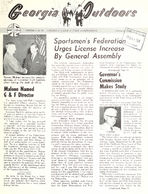
Rosser Malone accepts the congratulations of Governor Carl Sanders after taking the oath of office.
Malone Named
& G F Director
The State Game and Fish Commission
has appointed Albany attorney Rosser Malone as temporary Acting- Director of the Commission, with the approval of Governor Carl Sanders.
Governor Sanders said he called on the 57 year-old solicitor of the City Court of Albany to take over the department "as a personal favor to me."
"I fully realize that he has accepted this challenge at a personal sacrifice
to himself," said the Governor, who described Malone as "man enough to look a
fellow straight in the eye and tell you what he thinks."
A former member of the Commission
when it was organized in 1943, Malone is an ardent quail and dove hunter, as well as an enthusiastic salt water fisherman. He is a longtime member of both the Southwest Georgia Game and Fish Club and the Flint River Deer Club.
In accepting the appointment, Malone said that he would serve only until a permanent director is named by the Commission. Both Governor Sanders and the members of the Commission say they plan to announce the selection of the permanent director of the department after the adjournment of the current session of the General Assembly.
License Price
No state in the Union has a lower
priced hunting license than Georgia's, which also includes deer hunting privileges. Only Louisiana has a lower priced fishing license.
Sportsmen's Federati
Urges License Increase
By General Assembly
The Georgia Sportsmen's Federation has urged the current session of the General Assembly to increase the price of hunting and fishing licenses in Georgia.
The State-wide organization of Hunting and fishing clubs said that the State
Game and Fish Commission must have more money to do an adequate job of
wildlife conservation. The Federation noted in its request that Georgia's increasing population and trend toward urban living have placed a greater obligation than ever before on the Commission to expand opportunities for public hunting and fishing.
The resolution passed at the group's annual convention in Macon asked the General Assembly to set combined hunting and fishing licenses at not less than $5, with a hunting license of not less than $3 and a fishing license of $2 or more. The present corresponding rates of $3.25, $2.25, and $1.25 have remained virtually unchanged since 1955.
Malone Backs Request The Federation request was strongly
backed by Acting State Game and Fish
Commission Director Rosser Malone. In an address before the convention, Malone said his major effort as Director has been to restore public confidence in the Com-
mission and its many dedicated employees. With that confidence restored, Malone said, money is the next greatest
problem facing the department in meeting public demands for added services.
Malone assured sportsmen that their
money would be spent wisely by the men
of the present Commission, with the as-
sistance of the study now underway by
the Governor's Efficiency Commission.
Pointing to the Commissioners' own personal financial records, Malone called them "men of good, excellent business judgment. They will give you what you pay for, and if you will work with the members of the legislature and get the money for the department, I can assure you that you will be amazed and gratified with the results we can get," Malone told
the Federation. Other speakers included Jack Crock-
ford and Howard Zeller, the heads of both the Game Management and Fish-
eries Divisions of the Commission, who outlined their programs for future de-
velopment of public hunting and fishing, (Continued, Page 3)
Governor's
Commission
Makes Study
A distinguished team of 8 nationally
known consultants are winding up a comprehensive study of the organization and services of the State Game and Fish Commission.
At the request of Governor Carl Sanders and the Game and Fish Commission,
the Governor's Commission for Efficiency and
Improvement in State Government
initiated the
study, which is
similiar to earlier
examinations of
Uordon
the State Educa-
cation Depart-
men t and the
State penal system. The conservation consultants are led by
Seth Gordon, former head of the Penn-
sylvania Game Department for 20 years
and of the California Department of Fish
and Game for 7 and one half years. During a month of research, the Gor-
don team traveled more than a thousand miles over Georgia to interview a majority of the Commission's more than 200 employees in all parts of the State. Their report will include a review of present programs and recommendations for improvements in services of the Commission ranging from law enforcement and
hatchery operations to deer stocking and
public information.
Efficiency Commission Chairman William Bowdoin emphasizes that the group
is not conducting a "Gestapo investiga-
tion" of the Game and Fish Department,
and will not attempt to lay the blame for any shortcomings that might be dis-
continued. Page 3")
1
Managed Hunts
Hit Record High
Records went flying out the window on the State managed deer hunts this
season.
11,937 Georgia hunters bagged an all time high of 1,325 deer on the management areas during 6 days of hunting, with better than one hunter out of every 10 taking home the venison.
Here are the totals for each area:
Area
BUCK HUNT. NOV. 26-30. 1963
Beer
Hunters Suceess '
Lake' Russell _. Blue Ridge .. Cedar Creek Chattahoochee Lake Burton __ Chestatee _
- Johns Mt.
Clark Hill __
Warwoman Suwannoochee
TOTAL -
151 111 _. 104
85 59 - 54 43 - 44 11
4
~ 676
1,405 1.405 2,003
648 551 482 1,250 601 162
46
9,168
10.7 7.9 5.0
13.1 10.7 11.2
3.4 7.3 6.8 8.7
7.3
Lvg. Lbs.
86.1 103.5 117.0 100.2 107.4 107.8
95.0 78.3 126.8 (2 hogs)
ANY DEER HUNT, DEC. 2. 1963
Bucks
Does
Deer
Hunters
Lake Russell .60
170
(230)
797
Cedar Creek .41
5 I
(198)
'.ii.:.
Clark Hill -26
61
( 87)
240
Blue Ridge _ 40
43
( 83)
507
Chattahoochee 16
17
( 33)
[51
Chestatee
1
9
( 10)
X7
Warwoman 2 _ .
1
( 3)
22
TOTALS
186
(644)
28.9 20.5 30.3 16,4 21.9 11.5 13.6
Area
ARCHERY HUNT. NOV. 18-23. 1963
Deer
Hunters
% Success
Clark Hill ^
"
6
160
3.7
Blue Ridge
-
5
84
5.9
Lake Burton ..
39
0.0
TOTALS 7
11
283
3.8
Avg. Lbs. 51.2
Expensive Fish In 1961, the average Georgia fisherman spent approximately $4.82 on each day he fished, for a yearly average of $86.84, including $1.25 for his fishing license.
Hunters on the managed areas checked in 637 more deer this fall
than in 1962.
The McDuffie County area will be a veritable "fisherman's paradise," where an angler who isn't catching fish can try his luck in any one or all of the 16 heavily fertilized lakes, stocked under the careful supervision of Com-
mission biologists.
Commission Buys Hatcheries For Public Fishing Areas
Efforts of the State Game and Fish
Commission to provide Georgians with a Food place to fish have been accelerated with the purchase of two private fish
hatcheries for use as public fishing lakes.
Using money allocated by Governor Sanders from surplus state funds, the Commission has purchased the McGahee Hatchery near Augusta for almost $110,000 and the U. S. Minnow Hatchery at
Cordele for $40,000.
Under present plans, the chain of 16 lakes in McDuffie County west of Au-
erusta will be used primarily for public fishing, providing anglers from all over the State with the finest possible bass, bream, and catfish fishing in the highly
fertilized ponds. Under present plans, the McDuffie area will be opened to
public fishing in the spring of 1965, after stocking this winter.
The Cordele facility will be used primarily as a channel catfish hatchery, although a 40-acre lake on the property will be opened to public fishing. Access roads and camping areas for fishermen will be developed on both sites, pending the acquisition of funds to complete development of the two hatcheries.
Howard Zeller, Chief of the Commis-
sion's Fisheries Division, estimates that the 93 ponds at the Cordele hatchery are capable of producing more than one million channel catfish fingerlings a year, with adequate brood stock and high pond
fertilization.
The Commission also plans to initially rear some bass and bream fingerlings at Cordele, allowing partial closing and repair work to be carried out on the six
existing State fish hatcheries.
"We also plan to carry on some re-
search work here," Zeller says, while pointing out that some ponds in the Crisp County hatchery are already being used by Commission biologists for research projects on pond breeding of Flint River smallmouth bass, Florida coppernose bream and tropical tilapia, a fast growing warm-water forage fish.
Both Zeller and Acting Commission Director Rosser Malone hope to channel a major portion of any new funds obtained from increasing the price of fishing licenses into the establishment of Stateowned public fishing lakes, similar to the ones in McDuffie County, on strategic locations in every section of Georgia.
Kij
Most of the 93 ponds at the Cordele Hatchery are supplied with water from an unusually large spring.
How Georgia Stacks Up
In Hunting, Fishing Fees
FISHING LICENSE:
Ga. $1.25, Ala. $2.00, Fla. $2.00, S. C. $3.10, N. C. $4.00. National Average Fishing License: $2.77. Only Louisiana has a lower priced fishing license than Georgia's. Delaware and Mississippi's are the same as the Georgia fishing fee.
HUNTING LICENSE:
(Including deer) Ga. $2.25, Ala. $3.00, S. C. $4.25, N. C. $4.25, Fla. $7.50.
National Average Hunting License (small game only): $3.33 National Average Hunting License (including deer): $5.1,9 No state has a lower priced hunting license including deer hunting than Georgia's. Delaware and Vermont's are the same price. Only tl states have a lower per capita cost for hunting and fishing licenses than
Georgia.
INCOME:
Only 15 states had a lower income on license sales than Georgia, although 33 states sold less licenses and 33 have a lower population than Georgia's.
Georgia's income from license sales is approximately half the national average.
License Revenue
Not Sufficient
The sale of hunting: and fishing licenses hit an all time high in Georgia last year, according to the License Division of the
State Game and Fish Commission. However, at the same time, Commission
expenditures had to be met by $300,000 in tax money from the general fund, regardless of whether the taxpayer hunted and fished or not. This was the case in
spite of the fact that the 738,000 licenses
sold brought in more than $1,200,000. The additional funds for the Commission's operation came from half a million dollars of federal aid grants and more than $175,000 for motorboat registration fees, which are not obligated by law for Commission use.
While license sales have doubled in the past 10 years, so have Department expenditures as demands for more services by sportsmen have dictated. The Commission's present budget of approximately $2,300,000 has been strained to meet these demands, while providing additional funds to meet rising personnel and material costs.
The creation of new public hunting and fishing areas will spark needs for more license revenues, especially if Georgia is to keep pace with other states in providing large and small game public
shooting areas, channel catfish hatchery production, construction of boat launching ramps on rivers, especially in South Georgia, and the hiring of additional rangers.
EFFICIENCY STUDY
(Continued from Page 1)
covered on any individual. "This is a strictly impartial, objective study," Bow-
doin said.
Asked about the possibility of consoli-
dation of the Game and Fish Commission
with the State Forestry Commission or the State Parks Department, Bowdoin replied, "This is a study of the services of
the Game and Fish Department only. This
is not a study of consolidation or consolidations of departments," he said.
Highlights of the Gordon report are expected to include an evaluation of Georgia's ranking on a national scale in conservation efforts, detailing any needed changes in the financial support of the Commission, its administrative setup, and over-all policies and goals. Items under consideration include the creation of public hunting and fishing areas, landowner extension work, coastal sport and commercial fishing, and the adequacy of existing scientific and law enforcement personnel to carry out their assigned
tasks.
While most of the Gordon recommendations are expected to involve administrative functions of the Commission, some of its recommendations are expected to address themselves to the General Assembly, where they are expected to strongly influence any legislation, especially in view of the impressive background of the Gordon group, which includes the former heads of the wildlife conservation agencies in Alabama, California, Pennsylvania, and Virginia, along with two former presidents of the American Fisheries Association.
I urge each of you to enlist the support of your representatives in the Gen-
eral Assembly by personal contact, tele-
phone call, wire, or letter to back the
hunting and fishing license bill.
Using the recommendations of the Gov-
ernor's Efficiency Commission, I can as-
\\j?^^S I
sure you that this
money will be
. well spent, espec-
ially for setting
j
up new public
hunting and fish-
ing areas in all
portions of the
State.
In addition,
there is an im-
Malone
mediate need for
more biologists,
rangers, refuge managers, and hatchery
workers. We must replace worn-out and
obsolete equipment at 19G4 prices, while
meeting scheduled merit system salary
increases for the many able, dedicated
career employees of the Commission.
With the support of these conscientious
men, guided by the sound business experience of the 11 members of the Com-
mission, and backed by an aroused public,
I am confident you will be amazed and
gratified with the results this small con-
tribution by each of us will bring in
return.
nRosser ,M.al,one
Acting Director
FEDERATION
(Continued from Page 1) including new acquisitions of Stateowned public fishing lakes, lease of commercial forest land for public hunting areas, improved access to good existing hunting and fishing localities, expanded research into the problem of high wildlife populations, and increased conservation practice education for land owners. Both Crockford and Zeller pointed out that these goals can be met only with increased funds for the operation of the
Game and Fish Commission. More than 400 Georgia sportsmen at-
tended the annual convention, representing 66 clubs from throughout the State with a combined membership of more than 4500. In a busy weekend, the group heard noted wildlife conservation figures on both the State and National level, before passing 20 resolutions and recommendations for the guidance of state and national officials on wildlife conservation.
In addition to the license increase request, the Federation also asked that Georgia's saltwater fishermen be required
to buy a fishing license to enable the State to receive matching federal aid funds for development of commercial and sport fishing opportunities on the Georgia coast, as well as to finance patrolling by wildlife rangers.
Other recommendations included a call
for stricter enforcement of game and fish
laws by grand juries, setting of "any deer" hunts in over populated range areas, repeal of the Sunday hunting "Blue law," and passage of a stronger
anti-pollution law.
Ga.-Ala. Reach
River Agreement
Georgia duck hunters and fishermen won't have to buy an Alabama license to hunt and fish on the Alabama side of the Chattahoochee River this year.
Under the terms of the first reciprocal agreement on both hunting and fishing licenses worked out between the Georgia Game and Fish Commission and the Alabama Conservation Department, waterfowl hunters and fishermen from both
states may use their resident hunting
and fishing licenses on both sides of the invisible underwater boundary on the Chattahoochee and its impoundments, including the popular lakes of Seminole, George, Goat Rock, Oliver, and Bartletts Ferry.
The hunting license agreement applies only Uj duck and waterfowl hunters actually shooting from boats on the boundary river and its reservoirs. Hunters going on the soil of the opposite state to hunt other game birds or animals still must purchase a non-resident hunting
license.
The prior reciprocal agreement on fishing licenses was renewed and expanded to include all existing future impoundments on the Chattahoochee between Georgia and Alabama, and the mutual accord on fishing regulations was altered to conform with the existing Georgia regulations on bream limits and the use of trot lines.
Water Safety
Group Formed
Efforts to save lives on Georgia lakes and streams will soon be getting a boost from the Georgia Water Safety Congress, recently formed at a meeting on High Falls Lake south of Griffin.
State Game & Fish
Commission
401 STATE CAPITOL ATLANTA, GA 30303
In its first official act, the new Congress asked the State Game and Fish Commission to adopt a system of uniform waterway markers to protect swimming bsaches, marinas, and other areas
hazardous for motorboat operation.
The new offic-
ers of the group
are Bert Lusink,
Coast Guard
Auxiliary- Atlan-
ta, president;
Benjamin Byrd,
Jr., Chatham County Marine
Rescue Squadron,
Lusink
Sav., 1st v. p.;
Mel Little, Ameri-
can Red Cross, Macon, 2nd v. p.; Carl Bishop, Corps of Engineers, Atl., secretary; and Chief David Gould, Bruns-
wick, Game and Fish Commission repre-
sentative.
Organizations interested in water safety are urged to join the Congress at the earliest opportunity. Interested groups
may contact President Lusink at P. 0. Drawer 1734, Atl., 30301.
Motorboat
Registration
More than 4,000 Georgia motorboat owners who failed to renew their boat registration by January 1st have been given an extra month to save removing their old numbers from the bow of their
boat.
Boat owners who registered in 1961 are
covered by an extension on their three year permit, which must be renewed before using the boat again this year. Ordinarily, the un-renewed numbers" would be immediately issued to new applicants, forcing late-comers to attach a new number to their boat.
Application forms are available at all hunting and fishing license dealers.
Georgia Outdoors
Jim Morrison, Editor Sandra Johnson, Circulation
Chattahoochee
Trout Stocked
More than 1,300 adult size trout have been stocked in the Chattahoochee River
below Buford Dam as part of a Commis-
sion study of trout growth rates. Previous studies on the unusual man-
made trout stream created by the Corps of Engineer dam have shown that trout averaged about three-quarters of an inch in growth per month during the winter
months.
By stocking tagged fish ranging in size from one quarter to one and onehalf pounds, Commission biologists hope to determine what size trout can be
stocked in the river to give fishermen
the highest return, while at the same time keeping stocking costs to a minimum.
The trout-water portion of the Chatta-
hoochee below the Buford Dam to the
Highway 19 bridge near Roswell is closed
to fishing during the winter months, but fishermen are being urged to turn in any tags they recover next spring to the
State Game and Fish Commission. In the
meantime, Commission Director Rosser Malone has appealed to sportsmen in the area to help prevent illegal fishing during
the closed season.
Counting 25,000 eight inch rainbowtrout from the Commission's Summerville Hatchery and previous fingerling stockings since 1960, more than 300,000 rainbow, brook, and brown trout have been released in the Chattahoochee. Some of these fish have been caught weighing more than five pounds.
Although this section of the river once supported excellent bass and bream fishing, now only cold water trout are capable of survival in the 45 to 60 degree water flowing off the bottom of Lake
Lanier.
Seasons Close Georgia's quail and rabbit seasons end February 29, 1964.
SEC. 34.66. P. L. a R.
U S. POSTAGE PAID
ATLANTA. GA. PERMIT NO. 155
Managed Hunt Results: Pg. 2
A cqu I s i .,
...vision
The University Libraries
The University of Georgia
Athens, Ga.
n 0ot)ies
3 ElDfl 0M55M 0351