


- Collection:
- Georgia Government Publications
- Serial:
- Distracted driving (Atlanta, Ga.)
- Title:
- Distracted driving (Atlanta, Ga.), 2023
- Contributor to Resource:
- Georgia Governor's Office of Highway Safety, issuing body.
- Publisher:
- Atlanta, GA : Governor's Office of Highway Safety
- Date of Original:
- 2024-03
- Subject:
- Distracted driving--Georgia--Periodicals.
Distracted driving--Georgia--Statistics--Periodicals.
Traffic accidents--Georgia--Statistics--Periodicals.
Distracted driving.--fast--(OCoLC)fst00895568
Traffic accidents.--fast--(OCoLC)fst01153997
Georgia.--fast--(OCoLC)fst01204622
Georgia Government Documents--Serial - Location:
- United States, Georgia, 32.75042, -83.50018
- Medium:
- state government records
- Type:
- Text
- Format:
- application/pdf
- Description:
- 2019 has appendix available as separate document: Distracted drivers Georgia traffic safety facts.
2019 (harvested on July 9, 2021 from gahighwaysafety.org); title from PDF caption (Georgia Government Publications database, viewed June 22, 2023).
2019 Appendix (harvested on July 9, 2021 from gahighwaysafety.org); (Georgia Government Publications database, viewed June 22, 2023). - External Identifiers:
- Call Number GA H575.H51 S1 D5 2023
- Metadata URL:
- https://dlg.galileo.usg.edu/id:dlg_ggpd_1390717841-2024-03a
- Digital Object URL:
- https://dlg.galileo.usg.edu/do:dlg_ggpd_1390717841-2024-03a
- Language:
- eng
- Holding Institution:
- University of Georgia. Map and Government Information Library
- Rights:
-

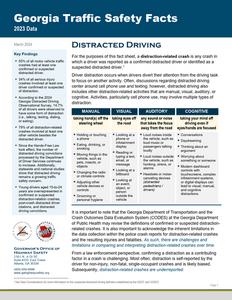
Georgia Traffic Safety Facts
2023 Data
March 2024
Key Findings
55% of all motor vehicle traffic crashes had at least one confirmed or suspected distracted driver.
34% of all serious injury crashes involved at least one driver confirmed or suspected of distraction.
According to the 2024 Georgia Distracted Driving Observational Survey, 14.7% of all drivers were observed to have some form of distraction (i.e., talking, texting, dialing, or eating).
79% of all distraction-related crashes involved at least one other vehicle besides the distracted driver.
Since the Hands-Free Law took effect, the number of distracted driving convictions processed by the Department of Driver Services continues to increase. Additionally, statewide and national studies show that distracted driving remains a growing traffic safety concern.
Young drivers aged 15-to-24 years are overrepresented in confirmed or suspected distraction-relation crashes, post-crash distracted driver citations, and distracted driving convictions.
Governor's Office of Highway Safety
2 M.L.K. Jr Dr SE Suite #370, East Tower Atlanta, GA 30334
(404) 656-6996 www.gahighwaysafety.org
Distracted Driving
For the purposes of this fact sheet, a distraction-related crash is any crash in which a driver was reported as a confirmed distracted driver or identified as a suspected distracted driver.1
Driver distraction occurs when drivers divert their attention from the driving task to focus on another activity. Often, discussions regarding distracted driving center around cell phone use and texting; however, distracted driving also includes other distraction-related activities that are manual, visual, auditory, or cognitive. Activities, particularly cell phone use, may involve multiple types of distraction.
MANUAL
VISUAL
AUDITORY
COGNITIVE
taking hand(s) off the taking eyes off any sound or noise taking your mind off
steering wheel
the road that takes the focus
driving even if
away from the road eyes/hands are focused
Holding or touching
a phone
Eating, drinking, or
smoking
Moving things in the
vehicle, such as pets, insects, or objects
Changing the radio
or climate controls
Adjusting other
vehicle devices or controls
Grooming or
personal hygiene
Looking at a
phone or infotainment display
Reading or
typing a text, email, or message
Looking at a
billboard
Looking at
an event, object, or person outside the vehicle
Loud noises inside
the vehicle, such as loud music or passengers talking loudly
Loud noises outside
the vehicle, such as honking, sirens, or alarms
Headsets or noise-
canceling devices (distracted pedestrians / drivers)
Conversations
Daydreaming
Thinking about an
argument
Worrying about
something or someone
Modern dashboard
controls with touchscreens, complex infotainment systems, or digital displays can lead to visual, manual, and cognitive distractions.
It is important to note that the Georgia Department of Transportation and the Crash Outcomes Data Evaluation System (CODES) at the Georgia Department of Public Health may revise the definitions of confirmed or suspected distractionrelated crashes. It is also important to acknowledge the inherent limitations in the data collection within the police crash reports for distraction-related crashes and the resulting injuries and fatalities. As such, there are challenges and limitations in comparing and interpreting distraction-related crashes over time.
From a law enforcement perspective, confirming a distraction as a contributing factor in a crash is challenging. Most often, distraction is self-reported by the driver for non-injury, non-fatal, single-occupant crashes and is likely biased. Subsequently, distraction-related crashes are underreported.
1 See Data Considerations for more information on the suspected-distracted driving definition established by the GDOT and CODES
Page 1
2024 Georgia Distracted Driving Observational Study
The Injury Prevention Research Center at Emory University conducted a roadside observational survey of driver distraction--nearly 23,000 observations across 400 sites within 20 Georgia counties between May and August 2024. According to the 2024 Georgia Distracted Driving Observational Survey2, 14.7% of all drivers exhibited some form of visible distraction while operating a motor vehicle (i.e., talking, texting, dialing, or eating). Between 2022 and 2024, an average of 17.0% of drivers were observed to have some form of distraction. This suggests that at any point in time or location on Georgia roadways during daytime hours, approximately 4 out of 20 drivers may be distracted. It's important to note that, unlike seatbelt observations, distracted driving observations represent snapshots in time and place, as drivers are not continuously distracted throughout their travel.
All Distractions
The statewide rate of distracted driving
decreased by a net 5 percentage points from 19.6% in 2023 to 14.7% in 2024 (Table 1).
Driver distraction is generally higher in Atlanta
Metropolitan Statistical Area (MSA) compared to other MSAs and non-MSA (rural) areas. Specifically, in 2024:
- 16.2% of drivers in the Atlanta MSA exhibited distraction.
- 11.2% of drivers in other MSAs exhibited distraction.
- 9.8% of drivers in non-MSA (rural) areas exhibited distraction.
Distracted driving decreased with increasing age
and was higher for women (17.2%) than for men (12.7%).
Distracted driving was higher on weekdays
(15.8%) than on weekends (11.3%). This was true for all types of distractions, including texting or dialing on hand-held devices.
Table 1. Percent of Georgia Distracted Drivers Observed by Metropolitan Statistical Area (MSA), 2022-2024
Georgia Region
2022 2023 2024 Average
Statewide 16.8% 19.6% 14.7% 17.0%
Atlanta MSA 17.6% 20.2% 16.2% 18.0%
Other MSA 13.5% 17.8% 11.2% 14.2%
Non-MSA 13.3% 19.3% 9.8%
14.1%
Source: 2022-2024 Observational Survey of Driver Distraction in Georgia
According to the Georgia Distracted Driving Observational Surveys, an average of 17.0% of drivers were observed to have some form of distraction between 2022 and 2024. In other words, about 4 out of 20 drivers at any time and location on Georgia roadways may be distracted.
Figure 1. Georgia Distracted Drivers Observed at Any Point in Time, 2022-2024
Red cars represent distracted drivers Source: 2022-2024 Observational Survey of Driver Distraction in Georgia
2 Rupp, Jonathan. 2024. "Statewide Rates of Driver Distraction: An Observational Survey of Driver Distraction in Georgia, 2024". The Injury Prevention Research Center at
Emory (IPRCE), Emory University: Atlanta, Georgia. Page 2
Distractions Involving Hand-Held Devices
Hand-held texting/dialing is the most frequent observed form of distraction in the 2024 Georgia Distracted Driving Observational Survey. The proportion of drivers observed talking or texting/dialing on a hand-held device in Georgia was higher than national observation data (6.6% in Georgia vs. 5.2% nationally3).
Similar to previous driver distraction observational studies, the rate of hand-held device distractions (talking or texting/dialing) was greater for drivers who were unbelted (11.2%) than those who were belted (6.3%).
According to the World Health Organization...
"Drivers using mobile phones are approximately 4 times more likely to be involved in a crash than drivers not using
a mobile phone. Using a phone while driving impacts the driver's reaction time (notably braking reaction time and reaction
to traffic signals). Using a phone also makes it difficult to maintain the correct lane and appropriate following distances.
Hands-free phones are not much safer than hand-held phone sets. Texting considerably increases the risk of a crash."4
Other Distracted Driving Studies
National Distracted Driving Report
As of July 2018, Georgia is one of a few states that banned the handheld use of cell phones and text messaging while driving. According to a Cambridge Mobile Telematics (CMT) study, distracted driving reduced after Georgia's Hands-Free Law was enacted on July 1, 2018. The study showed a 23.7% reduction after the first two weeks and a 17.9% reduction after the first three months the Georgia law took effect (CMT, 2020 ). Despite these immediate reductions in distracted driving after the law was enacted, other national studies (including crash data and attitudinal surveys) show that the change in driver behavior was not sustainable, especially with the growth of new technologies.
In-Vehicle Infotainment Systems
A study conducted by the AAA Foundation for Traffic Safety found that in-vehicle infotainment systems (modern integrated systems within motor vehicles that provide information, entertainment, and connectivity features) can cause additional distractions for drivers operating a motor vehicle. These systems create a medium to heavy cognitive load in drivers and need to be engineered to reduce that load on drivers. The activities of listening to audio, calling, texting, and navigation were studied in these systems and were found to cause a medium to heavy cognitive load for drivers. AAA found that in-vehicle infotainment created potentially unsafe distractions for all drivers, but particularly for older drivers. Older drivers (55 to 75 years of age) experience slower times to complete in-vehicle tasks while driving compared to younger drivers (25 to 40 years of age)-- 25 to 40 seconds versus 18 to 31 seconds, respectively.
3 National Center for Statistics and Analysis. (2024, January). Driver electronic device use in 2022 (Traffic Safety Facts Research Note. Report No. DOT HS 813 531). National Highway Traffic Safety Administration. Available online: https://crashstats.nhtsa.dot.gov/Api/Public/ViewPublication/813531 4 World Health Organization. (2023, December). Road traffic injuries: Fact sheet. WHO. https://www.who.int/news-room/fact-sheets/detail/road-traffic-injuries
Page 3
Distracted Drivers Involved in Motor Vehicle Traffic Crashes
In 2023, 55% of motor vehicle traffic crashes fit the criteria of having at least one confirmed or suspected distracted driver--a net 2-point percentage increase compared to 2022. This finding aligns with naturalistic driving studies that used video cameras and sensors installed in vehicles to determine driver risk factors seconds before a crash. According to a multi-state naturalistic study, 51.9% of all crashes involved distracted, non-impaired drivers.5
Among the drivers involved in motor vehicle traffic crashes, 2% were confirmed to be distracted, 35% were suspected of distraction6, and 20% were undistracted drivers involved in a distraction-related crash--the other 44% of drivers were not involved in distraction-related crashes. Most distraction-related crashes involved other vehicles --
79% of all distraction-related crashes involved at least one other vehicle besides that of the distracted driver.
21% of all distraction-related crashes were single-vehicle crashes that only involved the distracted driver's vehicle.
Furthermore, among all single-vehicle crashes, 58% involved a confirmed or suspected distracted driver. Among all multi-vehicle crashes, 54% involved at least one confirmed or suspected distracted driver.
Table 2. Percent of All Traffic Crashes that
were Distraction-Related, 2022-2023
Traffic Measure
2022 2023
Crashes
Distraction-Related Crashes
Confirmed distraction-related crashes
Suspected distraction-related crashes
53% 55% 4% 4%
49% 51%
Not distraction-related crashes
47% 45%
Drivers
Drivers involved in distractionrelated crashes
54% 56%
Confirmed distracted driver
2% 2%
Suspected distracted driver
Undistracted driver (in another vehicle)
Drivers not involved in distractionrelated crashes
Source: CODES 2022-2023
28% 24%
35% 20%
47% 44%
55%
of all Georgia motor vehicle traffic crashes had
at least one
confirmed or suspected
distracted driver
in 2023.
Distraction-Related Traffic Fatalities and Serious Injuries
According to FARS, 39 fatal crashes involved at least one confirmed distracted driver (2.5% of all fatal crashes) in 2023. In these confirmed distraction-related crashes, 44 fatalities occurred (2.6% of all traffic-related fatalities).
The true number of distraction-related fatal crashes and fatalities is likely underreported due to unknown contributing factors at the time of the crash. Table 3 shows the number and percent of confirmed distraction-related fatal crashes and traffic fatalities between 2019 and 2023.
Although it is challenging for law enforcement to determine whether distraction is a contributing factor in a fatal crash, the police crash report may be the only source available for this information. Therefore, the number of confirmed distractionrelated fatalities and serious injuries is usually underreported.
5 Dingus, T. A., Guo, F., Lee, S., Antin, J. F., Perez, M., Buchanan-King, M., & Hankey, J. (2016). Driver crash risk factors and prevalence evaluation using naturalistic driving data. Proceedings of the National Academy of Sciences, 113(10), 2636-2641. doi:10.1073/pnas.1513271113
6 See Data Considerations for more information on the suspected-distracted driving definition established by the GDOT and CODES Page 4
Table 3. Confirmed Distraction-Related Fatal Crashes and Traffic Fatalities, 2019-2023
Fatal Crashes
Fatalities
Year
Total Fatal Crashes
Confirmed Distraction-Related Total Traffic Confirmed Distraction-Related
Number
Percent
Fatalities
Number
Percent
2019
1,378
43
3.1%
1,492
43
2.9%
2020
1,522
55
3.6%
1,664
61
3.7%
2021
1,681
52
3.0%
1,809
58
3.2%
2022
1,678
74
4.4%
1,797
76
4.2%
2023
1,562
39
Source: FARS 2019-2023
2.5%
1,674
44
2.6%
In 2023, 34% of all serious injury7 crashes involved at least one driver confirmed or suspected of distraction. The number of serious injuries that involved a confirmed distracted driver decreased by 9%-- from 423 in 2022 to 383 in 2023.
Figure 2 shows the percent of fatal or serious injuries involving at least one confirmed distracted driver by person type in 2023.
51% were in the confirmed distracted driver's vehicle (represented by yellow in Figure 2). - 38% were distracted drivers themselves. - 13% were passengers of the distracted driver.
49% were occupants of other vehicles or non-motorists (represented by blue in Figure 2). - 35% were occupants of other vehicles not operated by the distracted driver. - 14% were non-motorists (i.e., pedestrians or bicyclists).
Figure 2. Percent of Persons Fatally or Seriously Injured in Confirmed DistractionRelated Crashes by Person Type, 2023
Distracted vehicle
Undistracted vehicle or non-motorists
Non-Motorists 14% (62)
Confirmed Distracted Drivers
38% (162)
Occupants of Other Vehicles
35% (148)
Passengers of Confirmed Distracted
Drivers 13% (55)
44 Fatal Injuries 383 Serious Injuries
Source: CODES 2023 Note: Undistracted vehicles were not reported to be confirmed distracted.
Eighty-two percent (82%) of confirmed distracted drivers involved in motor vehicle crashes did not have passenger occupants with them in the vehicle. Eighteen percent (18%) of confirmed distracted drivers had other passenger occupants riding with them.
7 Suspected serious injuries are reported by law enforcement and used when any injury, other than fatal injury, prevents the injured person from walking, driving, or normally
continuing the activities the person was capable of before the injury occurred. Page 5
Crash Characteristics
Rear-end collisions were the most common manner of collision involving confirmed distracted drivers across all roadway types (Figure 3). Rear-end collisions with confirmed distraction
represented more than half of all distractiondriving collisions on higher-capacity roadways-- interstates (64%), principal arterials (72%), and minor arterials (65%).
Sideswipe crashes in the same direction involving confirmed distracted drivers were more common on interstates (18%) than any other roadway function.
Local and collector roads have a higher proportion of confirmed distracted driving collisions with nonmotorized road users or single-vehicle crashes with objects (crashes that do not involve another motor vehicle in Figure 3).
Figure 3. Manner of Collision for Crashes Involving Confirmed Distracted Drivers by Roadway Classification, 2023
Head On
Sideswipe - Opposite Direction
Sideswipe - Same Direction
Angle
Not a Collision with a Motor Vehicle Rear End
100%
18%
80%
5%
13%
6% 12% 8%
4% 13% 13%
4% 14%
657%%% 17%
60%
27%
29%
40%
64%
72%
65%
20%
48% 35%
0%
Interstate Principal Arterials
Minor Collectors Arterial
Local
Source: Numetric Roadway Function Class 2023, CODES 2023
Table 4 on the next page highlights the distribution of distraction-related versus non-distraction-related crashes across different roadway classifications and regions in Georgia.
In the Atlanta region, more distraction-related crashes occur on principal arterial roads (29% of all distraction-related crashes) and interstates (25%). Notably, the proportion of distraction-related crashes on the Atlanta region interstates was higher than the proportion of non-distraction-related crashes (25% vs. 17%).
In other urban counties, distraction-related crashes and non-distraction-related crashes were most prevalent on principal arterials (38% and 35%, respectively). Interstates had a slightly higher percentage of distraction-related crashes (10%) compared to non-distraction-related (7%). The proportion of distraction-related crashes on minor arterials and local roads in the Atlanta region (27% and 11% respectively) was marginally less than non-distraction-related crashes (31% and 15%).
In rural counties, the pattern shifts notably. A greater percentage of distraction-related crashes occur on rural collectors (25%) compared to non-distraction-related crashes (22%).
Table 4. Percent Distribution of Distraction-Related and Non-Distraction-Related Motor Vehicle Traffic Crashes by Region and Roadway Classification, 2023
Roadway Classification
Interstate Principal Arterial Minor Arterial Collectors Local
Atlanta Region8
(11 counties)
Distraction- NonRelated Distraction
25%
17%
29%
28%
27%
31%
8%
9%
11%
15%
Other Urban Counties
(30 counties)
Distraction-
Non-
Related Distraction
10%
7%
38%
35%
28%
30%
11%
11%
13%
17%
Rural Counties
(118 counties)
Distraction- NonRelated Distraction
8%
7%
30%
30%
21%
22%
25%
22%
15%
18%
Statewide
DistractionRelated 18% 32% 27% 11% 12%
NonDistraction
12% 30% 30% 12% 16%
Total
100%
100%
100%
100%
100% 100%
100%
100%
*Total includes freeway/ramp roadway classifications. Note: Principal arterials include freeways and multilane highways (e.g., Buford Highway in DeKalb County and SR-520 & US-82 in Atkinson County). Minor arterials are other important multilane roadways that supplement the highways (e.g., Spring Street in Fulton County and SR-56 in Richmond County). Collector roads are roads that connect local roads and streets with arterials. Source: Numetric Roadway Function Class 2023 , CODES 2023
8 The Atlanta Region includes the ten counties that are defined by the Atlanta Regional Commission (ARC): Cherokee, Clayton, Cobb, DeKalb, Douglas, Fayette, Forsyth,
Fulton, Gwinnett, Henry, and Rockdale counties. In July 2021, Forsyth County officially joined ARC, becoming the 11th county member.
Page 6
Figure 4 shows the proportion of all motor vehicle crashes that were distraction-related by county and their deviation from the statewide percent of distraction-related crashes (55%). For additional information, see the Appendix for the percent of distraction-related crashes by county. Generally, there are lower proportions of distraction-related crashes among all crashes in the coastal plain and South Georgia region.
All eleven counties within the Atlanta
Region had a greater percentage of distraction-related crashes compared to the statewide percent.
Six out of 30 other urban counties and 23
out of 118 rural counties had a greater percentage of distraction-related crashes compared to the statewide percent.
The counties with the highest proportion
of distraction-related crashes are Crawford (68%) and Oconee (67%)-- which are classified as rural counties.
Figure 4. Percent of Distraction-Related Traffic Crashes and Deviation from the Statewide Percent by County, 2023
65-70% Distraction-Related Crashes 59-64% 52-58% -- statewide percent (55%) 46-51% 28-45%
Source: CODES 2023. Note: Counties that are light to dark teal have a lower percentage of distraction-related crashes compared to the statewide percent. Counties that are light to dark orange have a higher percentage of distraction-related crashes compared to the statewide percent.
Distracted Driver Convictions (Crash and Non-Crash)
On July 1, 2018, Georgia's Hands-Free Law (O.C.G.A. 40-6-241) furthered the "no texting while driving" law and made it illegal for drivers (including young drivers) to physically hold or support a wireless communications device while driving. Under this law, drivers can be cited and convicted for distracted driving that may or may not have resulted in a motor vehicle traffic crash. Amendments to the law also provided the point system for suspension or revocation of license for habitually negligent or dangerous drivers. While first-time offenders of Georgia's Hands-Free Law can be excused if they provide evidence that they have obtained a device that allows them to use hands-free communication technology, the increase in enforcement and convictions for distracted driving indicates a growing traffic safety concern. See the "Legal Perspective" section for more information regarding how the legal codes for distracted driving citations and convictions have changed over time in Georgia.
Page 7
Table 5 presents the number of distracted driver convictions (that may or may not have resulted in a motor vehicle traffic crash), licensed drivers, and distracted driver conviction rates from 2014 to 2023.
While the number of distracted driving convictions increased steadily over the 10year period, the number of convictions reported to DDS more than doubled from 2017 to 2018 (2.2 times) and from 2018 to 2019 (2.6 times). In 2023, the number of distracted driving convictions and rate per licensed drivers increased by 11% compared to 2022.
The COVID-19 response caused many Georgia courts to temporarily postpone court hearings, including traffic court, and many traffic safety law enforcement officers were reassigned to other critical and high-priority areas. Therefore, many distracted driving convictions may not have been reported to the Department of Driver Services.
Table 5. Distracted Driver Convictions, Licensed Drivers,
and Distracted Driver Conviction Rate, 2014-2023
Year
Distracted Driver
Convictions
Licensed Drivers
Distracted Driver Conviction Rate per 100,000 Licensed
Drivers
2014
5,837
7,099,538
82.2
2015
6,883
7,263,758
94.8
2016
9,148
7,337,619
124.7
2017
11,505
7,414,323
155.2
2018*
25,593
7,512,197
340.7
2019
65,625
7,616,176
861.7
2020**
31,173
7,891,390
395.0
2021
43,846
8,007,599
547.6
2022
49,280
8,341,774
599.2
2023
54,546
8,564,852
629.5
Note: Distracted driver convictions may or may not have resulted in a motor vehicle traffic crash. The distracted driver convictions are summarized by the year the violation occurred. License totals include individuals with permits/provisional licenses and unexpired, suspended licenses. *On July 1, 2018, Georgia's Hands-Free Law further expanded the "no texting while driving" law and made it illegal for drivers to have a phone in their hand or for a phone to touch any part of their body while driving. **The decrease in distracted driving convictions in Georgia in 2020 is primarily attributed to reduced traffic volumes and enforcement activities due to the COVID-19 pandemic. Source: DDS 2014-2023
Figure 5 shows the number of distracted driver convictions processed by DDS quarterly from 2017 to 2023. After the law took effect, the number of convictions processed by DDS increased 4.4 times during the first three years, from 3,260 distracted driver convictions in the second quarter of 2018 (July 2018) to 17,763 in the second quarter of 2019. However, the number of distracted driving convictions processed by DDS decreased significantly during the 2020 year during the COVID-19 public health emergency response in Georgia. The higher number of distracted driving convictions processed in the second quarter of 2021 suggests that the court reporting and processing may have returned to pre-pandemic norms.
Figure 5. Distracted Driver Convictions, 2017 2023
Governor declared a Public Health
State of Emergency for COVID-19
20,000 18,000
Georgia's Hands-Free Law Effective July 1, 2018
17,763
March 2020
18,330
16,000
14,387
14,000
12,000
10,000
8,000
6,000 2,756
4,000
6,727
2,000
Q1 Q2 Q3 Q4 Q1 Q2 Q3 Q4 Q1 Q2 Q3 Q4 Q1 Q2 Q3 Q4 Q1 Q2 Q3 Q4 Q1 Q2 Q3 Q4 Q1 Q2 Q3 Q4
2200117 7
22001188
2200119 9
22002200
2200221 1
2200222 2
2200223 3
Note: Distracted driver convictions may or may not have resulted in a motor vehicle traffic crash. The distracted driver convictions are summarized by the year DDS processed the conviction. Source: DDS 2017-2023 Distracted Driver Report by Process Month.
Page 8
Table 6 shows the counties with the highest number of distracted driving convictions processed by DDS and the rate of distracted driver convictions per 100,000 licensed drivers in 2023.
Gwinnett County has consistently had the highest number of distracted driving convictions compared to any other county. From 2011-2017 (before the Hands-Free Law), Gwinnett represented 26% of all distracted driving convictions across the state. In 2023, however, Gwinnett represented 11% of all distracted driving convictions reported across the state-- indicative of Gwinnett's consistent enforcement of distracted driving laws and other counties increasing their distracted driving enforcement. The top five counties with the greatest number of distracted convictions processed by DDS represented 29% of all distracted driving convictions (15,808 out of 54,546), and 154 Georgia counties represented 71% of all distracted driving convictions. In 2023, one county did not have any distracted driving convictions processed by DDS.
Of all drivers issued one or more citations involved in a motor vehicle traffic crash, nearly two out of every 100 drivers received a distracted driving citation. Table 7 shows the counties with the highest number of distracted driver citations issued after a motor vehicle traffic crash incident and the rate of distracted driver citations for every 1,000 distraction-related motor vehicle crashes in 2023. The five counties with the greatest number of distracted driving citations issued after a crash represented 32% of all distracted driving citations issued after a crash (1,396 out of 4,417) and 142 Georgia counties represented 68% of all distracted driving citations after a crash. In 2023, twelve counties did not have any distracted driving citations issued after a crash.
Table 6. Top Five Counties with the Highest Distracted Driver Convictions and Distracted Driver Conviction Rate, 2023
Number of Distracted Driver
Convictions
Distracted Driver Conviction Rate per 100,000 Licensed Drivers
Rank
County
Number Rank County
Rate
1 Gwinnett
6,241
1 Twiggs
3,329.5
2 Clayton
3,003
2 Banks
2,981.1
3 Henry
2,973
3 Liberty
2,631.7
4 Hall
2,035
4 Cook
2,519.1
5 Bartow
1,556
5 Clay
2,254.0
Note: The distracted driving violations presented in the table occurred in 2023 and may or may not have resulted in a motor vehicle traffic crash. While first-time offenders of Georgia's HandsFree Law can be excused if they provide evidence that they have obtained a device that allows them to use hands-free communication technology, the increase in enforcement and convictions for distracted driving indicates a growing traffic safety concern. Rates were calculated when the number of convictions in the county was greater than or equal to ten. Source: DDS 2023
See the "Additional Information" to access the Appendix for this document. The appendix includes the following information by county: Licensed drivers
Distracted driver citations issued after a motor vehicle traffic crash incident Convictions processed by the Department of Driver Services Percent and
rank of distraction-related motor vehicle crashes.
Table 7. Counties with the Highest Distracted Driver Citations Issued After a Motor Vehicle (MV) Traffic Crash and Distracted Driver Citation Rate, 2023
Number of Distracted Driver Citations Issued After a
MV Crash
Distracted Driver Citation Rate
per 1,000 Suspected or Confirmed
Distracted Driving Crashes
Rank County
Number Rank County
Rate
1 Fulton
390 1 Turner
197.7
2 Chatham
329 2 Grady
142.9
3 Gwinnett
243 3 Decatur
122.2
4 Cobb
235 4 Dade
100.8
5 Clayton
199 5 Tattnall
100.0
Source: CODES 2023 Note: Rates were calculated when the number of citations in the county was greater than or equal to ten. The resulting convictions for citations issued after a motor vehicle crash is not known.
Page 9
Distracted Drivers by Age Group
Young drivers aged 15-to-24 years are overrepresented in distracted driving incidents. Although young drivers represented 15% of all licensed drivers, they account for:
23% of crashes involving a suspected distracted driver. 25% of fatal crashes involving a confirmed distracted driver. 33% of post-crash distracted driver citations--the highest
among all age groups.
20% of distracted driving convictions.
According to the 2021 High School Youth Risk Behavior Surveillance System, 29% of Georgia
high school students texted or e-mailed while
driving a car or other vehicle during the 30 days before the survey9.
Drivers aged 25-to-34 years had the highest percentage of involvement in confirmed or suspected distracted-related crashes compared to other age groups (22%). This group also accounted for the highest distraction-related convictions (31%). Drivers aged 35-to-44 years had the highest percentage of confirmed distracted drivers involved in fatal crashes, compared to other age groups (32%).
Table 8. Licensed Drivers, Confirmed or Suspected Distracted Drivers Involved in Types of Motor Vehicle (MV) Crashes, Distracted Driver Citations Issued after a Motor Vehicle Crash, Distracted Driver Convictions by Age Group, 2023
Age Group
Licensed Drivers
Confirmed or Suspected Distracted Driver
Involved in a Crash
Confirmed Distracted
Driver Involved in a Fatal Crash*
Distracted Driver Citations Issued
Post-Crash
Distracted Driver Convictions
(Crash or Non-Crash)
15-24
15%
23%
25%
33%
20%
15-20
8%
12%
8%
18%
8%
21-24
7%
11%
18%
15%
12%
25-34
17%
24%
18%
27%
31%
35-44
17%
19%
28%
17%
23%
45-54
16%
15%
5%
11%
14%
55-64
15%
12%
15%
7%
9%
65+
21%
8%
8%
8%
4%
TOTAL 100%
100%
100%
100%
100%
Note: Distracted driver convictions may or may not have resulted in a motor vehicle traffic crash. Percents are calculated using records with known age over 15 years. * FARS 2023 data was not available during the time of reporting. Source: DDS 2023, CODES 2023
The Georgia Distracted Driving Observational Survey estimates the statewide prevalence of driver distraction during daylight hours. According to the 2023 survey, observed distracted driving decreases as age increases, with younger drivers exhibiting higher rates of distraction compared to older drivers. In 2023, 20% of drivers aged 16 to 24 years, 15% of drivers aged 25 to 69 years, and 7% of drivers 70 years and older were observed to be distracted while driving.
Figure 6. Observed Driver Distraction in Georgia by Age Group, 2024
20%
15%
7%
16-24
25-69
70+
Age Group (Years)
Source: 2024 Georgia Distracted Driving Observational Survey
The differences in the proportion of convictions processed by the Georgia Department of Driver Services (DDS) and the proportions of drivers observed to be distracted can be attributed to several factors. These factors may include differences in citation procedures, enforcement priorities, court processes, technological factors, legislative factors, and other systems of influence.
9 Source: 2021 CDC (The YRBS is conducted every two years among a representative group of Georgia public school students.)
Page 10
Legal Perspective
On July 1, 2018, Georgia's Hands-Free Law further expanded the "no texting while driving" law and made it illegal for drivers (including young drivers) to have a phone in their hand or for a phone to touch any part of their body while driving. This policy change provided greater specification for a distracted driving offense and clarification of the Hands-Free Law for law enforcement to further address distracted driving on Georgia roadways.
The number of convictions processed by DDS more than doubled from 2017 to 2018 (2.2 times) and from 2018 to 2019 (2.5 times).
The most common code used before the Hands-Free Law was O.C.G.A. 40-6-241 "Failure to exercise due care/careless driving."
After the Hands-Free Law became effective, O.C.G.A. 40-6-241(c) "Unlawful use of wireless device" is the most commonly used legal code in distracted driving convictions.
Table 9. Distracted Driver Convictions Reported to Department of Driver Services by Legal Code and Violation Year, 2019-2023
Convictions Codes
2019
2020**
2021
2022
2023
O.C.G.A. 40-6-241(b) Failure to exercise due care
4,802
2,170
4,092
5,818
6,698
O.C.G.A. 40-6-241(c) Unlawful use of wireless device
O.C.G.A. 40-6-241(d) Unlawful use of wireless device in Commercial Motor Vehicle
TOTAL
60,729 94
65,625
28,957 46
31,173
39,627 127
43,846
43,234
47,537
228
311
49,280
54,546
Source: Distracted Driver Convictions Reported to Department of Driver Services Summarized by Violation Year, 2019-2023 *On July 1, 2018, Georgia's Hands-Free Law (O.C.G.A. 40-6-241) went into effect. **Governor declared a Public Health State of Emergency for COVID-19 March 2020
Page 11
Data Definitions and Considerations:
The National Highway Traffic Safety Administration (NHTSA) defines confirmed distraction-related activities as anything that takes a driver's eyes off the road (visual distraction), mind off the road (cognitive distraction), or hands off the wheel (manual distraction).
Police crash reports are reviewed in a post hoc analysis by the Governor's Office of Highway Safety, Georgia Department of Public Health, and the Georgia Department of Transportation using a jointly developed definition of suspected distracted driving based on multiple factors. The imputation of suspected distracted drivers includes drivers that indicate emotional distress and evidence of driver inattention and distraction. The imputation removes driver contributing factors that include drug/alcohol impairment, sleepiness/drowsiness, aggressive/reckless driving, and speeding. The definition also excludes roadway and vehicle contributing factors. The CODES Analytical Reference Guide is available upon request.
A traffic crash is defined as an incident that involved one or more motor vehicles where at least one vehicle was in transport, and the crash originated on a public trafficway, such as a road or highway. Crashes that occurred on private property, including parking lots and driveways, are excluded.
Fatal crashes are defined as crashes that involve a motor vehicle traveling on a trafficway customarily open to the public and that resulted in the death of a motorist or a non-motorist within 30 days of the crash.
Suspected serious injuries are reported by law enforcement and used when any injury, other than fatal injury, prevents the injured person from walking, driving, or normally continuing the activities the person was capable of before the injury occurred.
The Department of Driver Services licensing database is a live database system and represents the information at a point-in-time on the date of extraction.
The Georgia's Hands-Free Law (House Bill 673 (O.C.G.A. 40-6-241)) of 2018 introduced new legal codes to enforce the "no texting while driving" law. Some Georgia counties may not have reported distracted driver convictions in 2019.
Additional Information:
Other general information on distracted driving may be accessed at:
https://dds.georgia.gov/distracte d-driver-data-reports
https://www.gahighwaysafety.org/ highway-safety/shsp/
Other fact sheets available at the Governor's Office of Highway Safety and Crash Outcomes Data Evaluation Systems (CODES) are Older Drivers, Young Drivers, Motorcycles, Non-Motorists (Pedestrians & Bicyclists), and Occupant Protection.
The suggested APA format citation for this document is:
Crash Outcomes Data Evaluation System. (2025, March). Distracted Drivers: 2023 data. (Georgia Traffic Safety Facts). Atlanta, GA: Governor's Office of Highway Safety.
References:
Rupp, Jonathan. 2024. "Statewide Rates of Driver Distraction: An Observational Survey of Driver Distraction in Georgia, 2024". The Injury Prevention Research Center at Emory (IPRCE), Emory University: Atlanta, Georgia.
World Health Organization. (2023). "Road Traffic Injuries" Available online: https://www.who.int/news-room/fact-sheets/detail/road-traffic-injuries
Dingus, T. A., Guo, F., Lee, S., Antin, J. F., Perez, M., Buchanan-King, M., & Hankey, J. (2016). Driver crash risk factors and prevalence evaluation using naturalistic driving data. Proceedings of the National Academy of Sciences, 113(10), 2636-2641. doi:10.1073/pnas.1513271113
National Center for Statistics and Analysis. (2024, January). Driver electronic device use in 2022 (Traffic Safety Facts Research Note. Report No. DOT HS 813 531). National Highway Traffic Safety Administration. Available online: https://crashstats.nhtsa.dot.gov/Api/Public/ViewPublication/813531
Cambridge Mobile Telematics (2022). "2022 US Distracted Driving Report." Available online: www.cmtelematics.com/the-2022-us-distracted-drivingreport.
Cambridge Mobile Telematics (2020). "The Harsh Realities of Phone Distraction." Available online: https://www.cmtelematics.com/phone_distraction_report/
American Automobile Association. (2019, July). Vehicle Infotainment Systems Especially Distracting to Older Drivers. AAA Newsroom. Available online: https://newsroom.aaa.com/2019/07/vehicle-infotainment-systemsespecially-distracting-older-drivers/
Page 12
Appendix
Distracted Drivers Georgia Traffic Safety Facts (2023)
This document is the appendix for the 2023 Distracted Drivers Georgia Traffic Safety Facts. Visit https://www.gahighwaysafety.org/georgia-traffic-safety-facts/ to access the full report.
Distracted Driver convictions are convictions processed at the Georgia Department of Driver Services. The total convictions include the following codes based on the county where the violation occurred.
O.C.G.A. 40-6-241(b) O.C.G.A. 40-6-241(c) O.C.G.A. 40-6-241(d)
Failure to exercise due care Unlawful use of wireless device Unlawful use of wireless device in CMV
Data Considerations: On July 1, 2018, Georgia's Hands-Free Law furthered the "no texting while driving" law and made it illegal for drivers
(including young drivers) to physically hold or support a wireless communications device while driving. Under Georgia's Hands-Free Law, drivers can be cited and convicted for distracted driving that may or may not have resulted in a motor vehicle traffic crash. While first-time offenders of Georgia's Hands-Free Law can be excused if they provide evidence that they have obtained a device that allows them to use hands-free communication technology, the increase in enforcement and convictions for distracted driving indicates a growing traffic safety concern. Gwinnett County has consistently had the highest number of distracted driving convictions compared to any other county. From 2011-2017 (prior to the Hands-Free Law), Gwinnett represented 11% of all distracted driving convictions across the state. Some Georgia counties may not have reported all or any distracted driver convictions in 2023.
Licensed Drivers, Citations Issued after Motor Vehicle Crash, Distracted Driving Convictions, and Percent Confirmed or Suspected Distracted Drivers (Distraction-Related) Involved in Motor Vehicle Crashes by County, 2023
County Name
STATEWIDE Appling Atkinson Bacon Baker Baldwin Banks Barrow Bartow Ben Hill Berrien Bibb Bleckley Brantley Brooks Bryan Bulloch Burke
Licensed Drivers
8,564,852 14,739 5,825 8,415 2,412 31,192 17,443 77,118 97,940 12,876 14,895
113,417 9,619
14,680 11,759 39,606 55,560 19,322
Distracted Driving
Convictions
54,546 49 50 17 --
306 520 241 1,556
51 151 246 159
26 <10 179 846 184
Distracted Driving Citations
Issued After a Crash
4,417
<10 <10 <10
-<10 <10
14 106 <10 <10 <10 <10 <10
10 17 89 18
MV Traffic Crashes
Percent DistractionRelated
Percent
Rank
Total Crashes
53%
383,633
51% 36% 53% 34% 59% 54% 53% 60% 50% 58% 54% 36% 48% 33% 55% 56% 56%
(72) (147)
(57) (154)
(16) (48) (53)
(9) (75) (21) (51) (148) (100) (156) (40) (37) (32)
489 128 319
53 1,716
581 2,969 4,178
412 452 6,331 177 202 248 1,342 2,835 630
Page 13
Licensed Drivers, Citations Issued after Motor Vehicle Crash, Distracted Driving Convictions, and Percent Confirmed or Suspected Distracted Drivers (Distraction-Related) Involved in Motor Vehicle Crashes by County, 2023 (con't)
County Name
Butts Calhoun Camden Candler Carroll Catoosa Charlton Chatham Chattahoochee Chattooga Cherokee Clarke Clay Clayton Clinch Cobb Coffee Colquitt Columbia Cook Coweta Crawford Crisp Dade Dawson Decatur Dekalb Dodge Dooly Dougherty Douglas Early Echols Effingham Elbert Emanuel Evans Fannin Fayette Floyd Forsyth Franklin
Licensed Drivers
21,661 3,441
45,797 8,569
103,317 56,860 7,923
230,472 4,867
20,085 231,849
80,889 2,307
209,072 4,959
606,706 30,476 34,408
132,612 14,013
128,165 10,665 15,684 14,285 28,680 21,613
552,188 14,336 7,353 62,245
116,729 8,285 2,604
59,002 17,105 17,637
8,037 24,443 107,168 79,250 214,039 20,576
Distracted Driving
Convictions
137 24
203 47
176 1,093
<10 1,379
13 <10 789 1,239
52 3,003
16 688 225 226 413 353 1,301
15 117 121 503
48 1,306
117 59
604 556
43 <10 193 141 164
39 201 1,440 868 579 389
Distracted Driving
Citations Issued After a Crash <10 <10 19 <10 62 112 <10 329 <10 <10 49 112 <10 199 <10 235 18 35 <10 16 90 <10 14 12 10 27 127 <10 15 39 61 <10 <10 12 <10 <10 <10 <10 44 43 40 16
MV Traffic Crashes
Percent DistractionRelated
46% 35% 48% 34% 54% 48% 46% 52% 44% 46% 58% 50% 61% 55% 34% 58% 46% 51% 54% 44% 59% 68% 45% 66% 59% 38% 59% 43% 44% 50% 52% 57% 52% 53% 43% 34% 52% 51% 62% 55% 59% 57%
(105) (150) (93) (155) (46) (97) (104) (65) (119) (102) (19) (77)
(8) (39) (151) (23) (106) (73) (44) (122) (12) (1) (115) (3) (13) (140) (15) (123) (121) (76) (59) (27) (64) (54) (125) (152) (58) (70) (7) (38) (14) (30)
Total Crashes
513 52
1,011 286
3,912 2,140
150 13,999
34 392 6,725 4,901
77 13,178
111 27,632
911 1,213 4,650
514 4,437
267 659 231 1,026 592 37,575 343 306 3,413 5,688 254
31 1,349
412 383 336 766 3,674 3,318 6,554 850
Page 14
Licensed Drivers, Citations Issued after Motor Vehicle Crash, Distracted Driving Convictions, and Percent Confirmed or Suspected Distracted Drivers (Distraction-Related) Involved in Motor Vehicle Crashes by County, 2023 (con't)
County Name
Fulton Gilmer Glascock Glynn Gordon Grady Greene Gwinnett Habersham Hall Hancock Haralson Harris Hart Heard Henry Houston Irwin Jackson Jasper Jeff Davis Jefferson Jenkins Johnson Jones Lamar Lanier Laurens Lee Liberty Lincoln Long Lowndes Lumpkin Macon Madison Marion McDuffie McIntosh Meriwether Miller Mitchell
Licensed Drivers
805,011 28,839 2,350 70,673 49,289 18,508 18,170
744,448 39,151
176,972 6,540
27,599 31,485 23,517 10,522 207,767 134,741
7,504 72,091 14,109 11,392 12,712
5,988 6,336 24,762 17,140 7,027 40,369 27,636 49,740 7,196 14,183 86,996 27,785 8,020 27,085 6,145 17,696 10,979 19,782 4,469 16,049
Distracted Driving
Convictions
1,326 132 --
1,538 493 177 <10
6,241 448
2,035 21 26
194 <10 <10 2,973 1,058
16 321 <10
73 65 44 86 159 49 14 441 446 1,309 -77 449 64 157 <10 86 61 31 388 <10 47
Distracted Driving
Citations Issued After a Crash 390 <10 -43 22 18 <10 243 26 106 -11 21 15 <10 68 33 <10 19 <10 -<10 <10 <10 <10 <10 <10 19 11 63 -<10 140 14 <10 <10 <10 <10 <10 <10 <10 10
MV Traffic Crashes
Percent DistractionRelated
56% 50% 49% 54% 45% 42% 49% 58% 51% 52% 34% 45% 57% 53% 56% 60% 57% 53% 49% 58% 39% 32% 40% 45% 58% 49% 41% 45% 62% 49% 35% 58% 49% 58% 32% 58% 45% 49% 48% 52% 32% 58%
(33) (81) (91) (50) (117) (129) (89) (17) (71) (63) (153) (114) (31) (55) (34) (10) (29) (56) (92) (18) (138) (159) (136) (110) (20) (88) (132) (109) (6) (85) (149) (22) (87) (26) (158) (25) (108) (86) (99) (61) (157) (24)
Total Crashes
52,997 827 43
2,557 1,809
562 557 33,334 1,227 8,099
50 710 495 913 198 10,088 3,255 251 2,562 328 257 194
91 97 665 467 116 1,415 600 1,747 31 246 3,585 695 155 689 77 649 126 297 102 494
Page 15
Licensed Drivers, Citations Issued after Motor Vehicle Crash, Distracted Driving Convictions, and Percent Confirmed or Suspected Distracted Drivers (Distraction-Related) Involved in Motor Vehicle Crashes by County, 2023 (con't)
County Name
Monroe Montgomery Morgan Murray Muscogee Newton Oconee Oglethorpe Paulding Peach Pickens Pierce Pike Polk Pulaski Putnam Quitman Rabun Randolph Richmond Rockdale Schley Screven Seminole Spalding Stephens Stewart Sumter Talbot Taliaferro Tattnall Taylor Telfair Terrell Thomas Tift Toombs Towns Treutlen Troup Turner Twiggs
Licensed Drivers
30,564 6,564
19,200 32,408 144,389 102,614 36,674 13,787 145,766 21,293 32,713 16,795 18,089 36,208
6,993 20,054
1,821 16,067
4,867 146,600
74,837 3,732
11,864 7,612
59,203 23,389
2,965 21,490
5,049 1,378 15,778 6,361 7,664 7,006 37,386 31,176 21,458 12,522 5,026 56,910 6,780 6,968
Distracted Driving
Convictions
291 28
150 215 102 768 139 195 876
77 33 22 128 72 81 71 <10 31 <10 281 708 <10 22 30 954 55 45 197 93 -98 57 95 80 151 423 254 43 <10 154 115 232
Distracted Driving
Citations Issued After a Crash <10 <10 <10 18 112 38 <10 <10 196 10 21 <10 <10 15 -<10 <10 <10 -29 25 <10 <10 <10 19 21 -19 <10 -11 <10 <10 <10 34 26 <10 <10 <10 47 17 <10
MV Traffic Crashes
Percent DistractionRelated
54% 63% 48% 45% 50% 56% 67% 43% 52% 45% 49% 36% 66% 43% 36% 40% 38% 51% 38% 56% 54% 37% 39% 47% 52% 43% 50% 41% 51% 41% 40% 57% 28% 36% 40% 42% 45% 55% 38% 52% 45% 51%
(47) (5) (96) (112) (80) (35) (2) (126) (66) (113) (84) (145) (4) (124) (146) (135) (140) (69) (139) (36) (45) (143) (137) (101) (60) (127) (78) (130) (68) (131) (134) (28) (160) (144) (133) (128) (107) (41) (140) (67) (118) (74)
Total Crashes
1,137 191 768 675
6,695 3,253 1,599
196 3,853 1,218
879 361 398 1,035
86 575
24 497
68 8,491 3,626
46 166 167 2,036 664
56 739 105 150 312 150
96 121 1,573 1,444 899 291 176 3,036 200 415
Page 16
Licensed Drivers, Citations Issued after Motor Vehicle Crash, Distracted Driving Convictions, and Percent Confirmed or Suspected Distracted Drivers (Distraction-Related) Involved in Motor Vehicle Crashes by County, 2023 (con't)
County Name
Union Upson Walker Walton Ware Warren Washington Wayne Webster Wheeler White Whitfield Wilcox Wilkes Wilkinson Worth
Licensed Drivers
25,416 23,769 56,557 91,412 27,320
4,374 15,379 24,129
2,001 3,934 26,337 81,116 5,705 8,039 7,576 15,805
Distracted Driving
Convictions
52 196 338 192
28 -77 92 26 15 283 869 -66 <10 100
Distracted Driving
Citations Issued After a Crash 11 18 29 14 <10 <10 <10 10 <10 -11 99 <10 --10
MV Traffic Crashes
Percent DistractionRelated
Total Crashes
53% 48% 45% 48% 49% 50% 48% 44% 45% 49% 46% 54% 52% 49% 55% 60%
(52) (98) (111) (95) (83) (78) (94) (120) (116) (90) (103) (49) (62) (82) (43) (11)
658 657 1,158 2,590 1,109 176 514 622
29 59 780 3,585 58 87 245 635
Page 17