


- Collection:
- Georgia Government Publications
- Serial:
- Annual report / Georgia State Board of Pardons and Paroles.
- Title:
- Annual report, fy 2022 / Georgia State Board of Pardons and Paroles.
- Creator:
- Georgia. State Board of Pardons and Paroles, creator.
- Publisher:
- Atlanta, Georgia : Georgia State Board of Pardons and Paroles
- Date of Original:
- 2022
- Subject:
- Georgia.--State Board of Pardons and Paroles--Periodicals.
Georgia.--State Board of Pardons and Paroles--fast--(OCoLC)fst00523740
Pardon--Georgia--Periodicals.
Parole--Georgia--Periodicals.
Pardon
Parole
Georgia
Georgia Government Documents--Serial - Location:
- United States, Georgia, 32.75042, -83.50018
- Medium:
- state government records
- Type:
- Text
- Format:
- application/pdf
- Description:
- Some issues may have also distinctive titles.
Description based on print version record.
Latest issue consulted: FY 2020 (Harvested on January 13, 2021 from pap.georgia.gov); (Georgia Government Publications database, viewed September 8, 2022). - External Identifiers:
- Metadata URL:
- https://dlg.galileo.usg.edu/id:dlg_ggpd_1176275308-2022
- Digital Object URL:
- https://dlg.galileo.usg.edu/do:dlg_ggpd_1176275308-2022
- Language:
- eng
- Holding Institution:
- University of Georgia. Map and Government Information Library
- Rights:
-

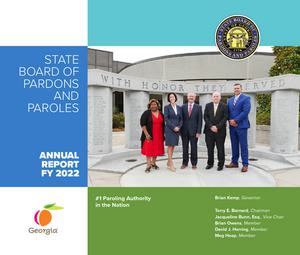
STATE BOARD OF PARDONS
AND PAROLES
ANNUAL REPORT FY 2022
#1 Paroling Authority in the Nation
Brian Kemp, Governor
Terry E. Barnard, Chairman Jacqueline Bunn, Esq., Vice Chair Brian Owens, Member David J. Herring, Member Meg Heap, Member
ANNUAL REPORT 2022
INSIDE
Mission, Vision, Values
2
Organizational Chart
3
FY 2022 Highlights
4
Chairman's Letter
9
The Five Member Parole Board
10
Parole Board Members
12
Executive Leadership
17
Executive Director's Letter
18
Clemency & Parole Consideration
19
Field Services
27
Georgia Office of Victim Services
31
Human Resources & Training
33
Budget & Fiscal Services
34
The Agency is guided by the 4E's
Engaging Stakeholders Educating the Community Encouraging Active Participation Enhancing Operations
We are enhancing public safety
OUR MISSION
To serve the citizens of Georgia by exercising the constitutional authority of executive clemency through informed decision-making, thereby ensuring public safety, protecting victims' rights, and providing offenders with opportunities for positive change.
OUR VISION
To be the nation's most effective and efficient executive clemency authority by: Making informed, scientific, data-driven clemency decisions based in
constitutional authority and guided by applicable state law Preparing offenders for positive change through the imposition of practical
and constructive pre and post release conditions Protecting the public and creating safer communities by holding accountable
those offenders who violate the conditions of release Ensuring crime victims have a voice in the post-conviction criminal justice
process Fostering partnerships and positive relationships with all stakeholders Engaging, educating, and encouraging the active participation of all
stakeholders in the clemency decision-making process Striving to be a continuously learning public safety organization
OUR VALUES
We value Ethics, Integrity, Equity and Innovation.
2 | Georgia Board of Pardons and Paroles
Organization
THE BOARD
Terry E. Barnard, Chairman Jacqueline Bunn, Esq., Vice Chair Brian Owens, Member David J. Herring, Member Meg Heap, Member
EXECUTIVE DIRECTOR Christopher L. Barnett
DEPUTY EXECUTIVE DIRECTOR Rita Rocker
LEGAL SERVICES La'Quandra Smith
COMMUNICATIONS Steve Hayes
BUDGET & FISCAL Kristen Kinney
HUMAN RESOURCES Eris McKennon
INTERNAL AFFAIRS & TRAINING Chris Kimner
MENTAL HEALTH & EAP
Connie Lerner
CLEMENCY DIRECTOR Crystal Moon
DEPUTY DIRECTOR
Kim PattonJohnson
CAU MANAGER
Crystal Moon
DEPUTY DIRECTOR Lisa Copeland
INVESTIGATIONS PARDON ADMIN.
HE'S GPEDS
VICTIM SERVICES DIRECTOR Rita Rocker
DEPUTY DIRECTOR Keir Chapple
FIELD SERVICES DIRECTOR
Felecia Holloway
DEPUTY DIRECTOR Alan Smith
VICTIM SERVICE SPECIALIST
PROGRAM COORDINATORS
GCIC INTERSTATE
ADMIN. STAFF
SCANNING/ IMAGING
DOM'S VIOLATIONS/ SANCTION EXTRADITIONS
pap.ga.gov | 3
ANNUAL REPORT 2022
Highlights from FY 2022
Chairman Barnard Serving 8th Term
State Board of Pardons and Paroles Chairman Terry Barnard is serving as chair of the Board for FY 2023 following action at the June 2022 monthly board meeting. Unprecedented in recent history of the Parole Board, the other members elected Chairman Barnard to an eighth term as chair. Following the completion of his current term as chair, Mr. Barnard will be the second longest serving chair in the agency's history. The first chair, Edward B. Everett, served almost ten years from 1943 to 1953.
At the June Meeting, the Board also voted to have Jacqueline Bunn continue the leadership role of vice chair. Ms. Bunn is serving a second one-year term as vice chair.
First Georgia Office of Victim Services Conference
The Georgia Office of Victim Services conducted the first training conference for the state's district attorneys, victim-witness assistance staff and other victim advocates. The training was conducted May 25th through the 27th of 2022 at Lake Lanier Islands. The event's goal was to enhance services to crime victims and ensure they are receiving services to which they are entitled. The Board and victim services staff provided information about the parole process, victim notifications and other state services and programs. The conference included comments from crime survivors who spoke about their experiences as crime victims. Agency leaders addressed the conference including Parole Board Chairman Terry Barnard, Vice Chair Jacqueline Bunn, Board Member David Herring, Department of Corrections Commissioner Tim Ward, Department of Community Supervision Field Operations Director Patrick Holsey, Georgia Bureau of Investigation Director Vic Reynolds, Criminal Justice Coordinating Council Executive Director Jay Neal, and Prosecuting Attorneys' Council of Georgia Executive Director Peter Skandalakis.
I continue to be humbled by the trust and confidence the members place in my leadership. Georgia citizens have an excellent clemency board. The decisions made are informed, scientific, and data driven. Our mission is to make decisions that contribute to public safety, which protect victims' rights and that provide offenders with opportunities for positive change. Georgia's Parole Board is a model for other states to follow."
State Board of Pardons and Paroles Chairman Terry Barnard
4 | Georgia Board of Pardons and Paroles
Board Members Again Meeting Face-to-Face with Crime Victims
For the first time since the pandemic, the Parole Board Members began meeting face-to-face with crime victims again. The Victim Impact Session is a new direction in victim engagement by the Board, where a Board Member meets with crime victims individually from a judicial circuit. The Board Member and Clemency staff travel to a specific area of the state and partner with the local district attorney to host meetings involving victims whose offender(s) are up for parole consideration by the Board now or will be in the near future. During the last quarter of the fiscal year, Victim Impact Sessions were conducted with Northeastern Judicial Circuit District Attorney Lee Darragh and with Brunswick Judicial Circuit District Attorney Keith Higgins. Board Member David Herring met with crime victims in Gainesville in April and Chairman Terry Barnard met with victims in Brunswick in June. During the Victim Impact Sessions, crime victims receive parole status information regarding the offender(s) in their cases and the victims provide critical information to the Board. Information provided by victims to the Board is added to the case files of offenders for the Parole Board Members to review at the time parole is considered.
The Board is committed to meeting directly with registered crime victims as a `measure-component' of an offender's review for parole as we have done previously on a larger scale. By conducting these smaller sessions with crime victims, we can spend more time discussing each case with the victims."
Chairman Terry Barnard
Victims need a voice in the parole process and those who were able to meet with Parole Board officials were provided that opportunity. I applaud the Board for collaborating with our Victim Advocates Office to set up these meetings, to listen to these crime victims, and inform them about the parole status of the offenders. The meetings were important to the victims."
District Attorney Keith Higgins
It is important that we have all available information regarding a case and the offender before we make parole decisions. The Victim Impact Sessions ensure a fully informed parole board."
Parole Board Member David Herring
continued
pap.ga.gov | 5
ANNUAL REPORT 2022
APAI Presentations
The State Board of Pardons and Paroles made presentations at the annual Association of Paroling Authorities International (APAI) conference in FY 2022. The presentations were made by the Board's Communications Office and the Field Services Division. The general session for all APAI attendees was titled, "The Media, Critical Incidents, and Stakeholder Engagement." Investigative print and broadcast reporters and agency information officers from Georgia and California discussed media relations with paroling authorities. A breakout session involved the Georgia Parole Board's Field Services personnel discussing methods of consistently overseeing and reaching decisions regarding supervision violations.
This year we were excited to showcase best practices from Georgia with two training opportunities for the APAI membership. I am proud of how we do business in Georgia and our training sessions we provided were received very well by those attending the conference this year. We provided effective strategies for engaging and educating stakeholders for the public to better understand how parole works and we explained how we are enhancing public safety through our decision-making process."
Chris Barnett, Executive Director of the State Board of Pardons and Paroles
6 | Georgia Board of Pardons and Paroles
Board Member Training
Georgia's five-member parole board remains a leader among paroling authorities worldwide. During FY 2022, to maintain that status and ensure public safety through informed decision making, members completed training delivered by the Center for Effective Public Policy and the Carl Vinson Institute of Government. Training focused on national trends, Georgia's inmate population, enhancing the Georgia Board's guidelines system and studies of parole decisions in other states.
Georgia's parole completion success percentage annually surpasses the national average. The Georgia success rate of 73% outpaced the overall national average of 63% according to Richard Stroker, Center for Effective Public Policy.
Monthly Parole Board Meetings
Increase Public Access
The State Board of Pardons and Paroles is engaging, educating, encouraging active participation, and enhancing operations. During the fiscal year, the Board moved two monthly operational meetings to other areas of the state to increase public access to the Board and to inform the public about the agency's operations and the parole process. The April meeting was held on the campus of Georgia Southern University in Statesboro and the June meeting took place at the Georgia Public Safety Training Center (GPSTC) in Forsyth. In addition to the public's attendance, criminal justice students and faculty were engaged at Georgia Southern University as each parole division provided information about operations.
As a public safety agency, we must stay informed regarding national trends and review the processes of other paroling authorities. Although most states operate differently, we must research ways to make our system more efficient and effective."
Chris Barnett, Executive Director of the State Board of Pardons and Paroles
Your Board is a leader among parole boards, among the best in the nation."
Richard Stroker, Senior Associate with the Center for Effective
Public Policy
As a paroling authority we will always look for information that can make our scientific, data driven decision-making system even better. We must continue to focus on enhancements that can result in more positive outcomes."
Parole Board Chairman Terry Barnard
"The focus of these monthly meetings is enhancing operations which results in improved public safety."
Chris Barnett, Executive Director of the State Board of Pardons and Paroles
papa.gpa.g.ga.ogvov || 7
ANNUAL REPORT 2022
Engaging, Educating, Encouraging Active Participation in the Parole Process and Enhancing Operations
As an agency, the State Board of Pardons and Paroles has operational guidelines which are the 4E's: Engaging Stakeholders, Educating the Community, Encouraging Active Participation in the Parole Process and Enhancing Operations. As a process, if achieved, public safety is then enhanced or improved for all Georgia communities. Again, in Fiscal Year 2022 (FY 2022), the agency was successful with its implementation of the operational 4E's.
Everyone is a stakeholder in the parole process. Therefore, the Board's leadership in FY 2022 continuously engaged, educated, and encouraged participation as parole officials met with and made presentations to Georgia's parole stakeholders. Those groups included the Georgia Sheriffs' Association, the Georgia Association of Chiefs of Police, the Prosecuting Attorneys' Council of Georgia, the Georgia Department of Corrections, the Georgia Department of Com-
munity Supervision, the Georgia Department of Juvenile Justice, the Georgia Bureau of Investigation, the Georgia Department of Public Safety, the Georgia Emergency Management and Homeland Security Agency, the Georgia Public Safety Training Center, the Georgia Gang Investigators Association, the Georgia Public Defender Council and the Georgia Association of Criminal Defense Lawyers.
8 | Georgia Board of Pardons and Paroles
Letter
FROM THE CHAIRMAN
To: The Honorable Brian Kemp, Governor, Members of the General Assembly, and Citizens of the state of Georgia
It has been my honor to serve on the State Board of Pardons and Paroles since 2010 and to serve as Chairman of this respected agency.
Fiscal Year 2022 was another very good year for the state of Georgia and
for the Georgia Parole Board. The five members of the Board continue to
serve the public by making scientific, informed, evidence-based parole
decisions. This Board is committed to enhancing public safety by exercising
the constitutional authority to grant executive clemency for offenders who have
prepared for reentry.
For FY22, the Board carefully considered almost 14,000 offenders for parole. The process involves setting a tentative parole month (TPM) in most cases, which is a future possible parole period for that offender. This means releases come a few years later in most cases which allows the offender to work toward successful reentry by completing the case plan which is created based on that individual's needs. Upon reviewing the case at TPM, the Board Members may also delay a possible release if the Board believes the offender is not ready to return to society.
The Board released 6,245 offenders in FY22 through the various clemency actions it has through the authority granted by our state constitution; powers and authority granted by Georgians through an amendment to the constitution nearly eighty years ago.
The Board's Clemency Division staff collect all available data on the offender and in most cases a recommendation is provided to the voting members once the Board's scientific guidelines are applied to the case. Again, for FY22, the Board's informed decision-making process resulted in a parole success rate of 73%, among the highest in the nation and again well above the estimated national parole success rate average.
Parole remains an effective method of reentry in Georgia. Offenders who prepare themselves by completing programming and completing their case plan identify themselves to the Parole Board as being "parole ready."
The informed decision-making process also involves input from stakeholders. Through our solicitationnotification process we reach thousands of stakeholders each year, both through statutory notifications and because of notifications we introduced to ensure that we have all necessary offender information. Stakeholders in the process include but are not limited to, crime victims, the courts including prosecutors and judges and law enforcement, as well as the offenders and their representatives. Read more about how we actively engage stakeholders in the parole decision making process in this report.
In FY22, the State Board of Pardons and Paroles again fulfilled its mission of serving our citizens by exercising the constitutional authority of executive clemency through informed decision-making, thereby ensuring public safety, protecting victims' rights, and providing offenders with opportunities for positive change.
Thank you for taking time to review this report and becoming a stakeholder in the parole process.
Sincerely,
Terry E. Barnard, Chairman, Chairman, State Board of Pardons and Paroles
pap.ga.gov | 9
ANNUAL REPORT 2022
The Five-Member Parole Board
FY22
51,243 Clemency votes 13,967 inmate cases
considered
73% of parolees successfully completed parole
10 | Georgia Board of Pardons and Paroles
The Georgia Constitution provides that Parole Board Members are to be appointed by the Governor to seven-year staggered terms, subject to confirmation by the State Senate. Board Members are full-time state employees from various professions including criminal justice and private business. In 1943, the Board was established through a constitutional amendment and consisted of three members. In 1973, as the prison population rose to 9,000, the Constitution was amended to increase the Board to five members. Today, with an inmate population at approximately 49,000, the Board still consists of five voting members. The Board is the sole authority in the state to make informed decisions regarding which state inmates should be paroled, thereby ensuring that the state's prison
beds are dedicated to the offenders who have committed the most serious crimes.
In Fiscal Year 2022 (FY22), through the Board's executive clemency authority, 6,245 offenders were released from prison to serve the remainder of their prison sentence on parole. Georgia's percentage of parolees successfully completing parole in FY22 was 73%. The national average was estimated to be approximately 57%. The Board's authority includes granting paroles, pardons, and commutations including death sentences. Deciding whether to grant an offender parole is the primary responsibility of the Board. Parole hearings are not held. However, each offender entering the Georgia prison system is interviewed by parole staff. The Board also actively solicits input and accepts pleas for and protests
against clemency throughout the consideration process. Information from community stakeholders, including victims, the public and criminal justice partners is considered by the Board. The Board Members have discretion to determine who receives clemency.
The total number of parole eligible offender cases considered by the Board Members during the fiscal year was 13,967. The Board's decision may be for the offender to receive a tentative parole month which is a future possible release from prison, an immediate release or parole may be denied. In most cases, if granted, the offender receives a tentative parole month (TPM) which is a future possible parole release. Please read more about the parole process in the Clemency section of this report.
Board Members are required to make many decisions regarding each parole case. Not only is a majority of three votes required to grant or deny parole, but other votes may also be required for each individual parole case. For example, the Board may add preconditions to parole which require each member to vote. In FY22, the five Board Members made a total of 51,243 votes. Again, the total represents all Board decisions requiring a vote and multiple votes or decisions for each offender case during the fiscal year.
Guidelines are applied to cases
In most cases, the Board's Parole Decision Guidelines Rating System is applied which includes a time-to-serve recommendation. Board Members review the comprehensive case file of each offender, and each member individually makes a parole decision. Although the guidelines are not applied to life sentence reviews, the Board maintains a comprehensive parole file in each case and the members review each case thoroughly before voting to grant or deny parole. The Board's decision process is evidence-based, scientific and data-driven.
Death Sentences
The review of death sentences is a responsibility of the State Board of Pardons and Paroles. The Board is the only entity in Georgia with the constitutional authority to commute a death sentence. The Governor does not have this authority in Georgia. Board Members conduct a clemency meeting for the condemned inmate after which they may commute a death sentence to life with or without the possibility of parole, issue a stay or deny clemency.
Monthly Board Meetings
The Board conducts monthly Parole Board Meetings at which policy changes are considered and operational updates are provided. Offender cases are not discussed, and parole decisions are not made at the monthly Board Meetings. Learn more about the clemency process beginning on page 19.
Constitution and History
Checks and Balances
Georgia's constitution provides for three branches of government to serve as checks and balances on the power of government over the offender. The legislative branch sets the minimum and maximum range of the prison sentence, the judicial branch sentences the offender within that range, and the State Board of Pardons and Paroles, as a part of the executive branch, manages the finite resource of state prison beds by considering eligible offenders and making parole grants in the interest of public safety.
History of Parole in Georgia
Parole came to Georgia in 1908 when the General Assembly voted to give the Prison Commission authority to implement a system of "parole or conditional pardons." Parole could be granted upon the approval of the full Commission and the
6,245
offenders released by parole from Georgia prisons in FY22
Governor. The Commission had power to issue warrants and arrest parole violators. In 1938, the Commission was given broader powers to grant paroles without the approval of the Governor and without limitation on its authority, "save the welfare of the State." However, the Commission remained hampered by a shortage of funds. Then in the early 1940s there were serious questions raised about the handling of pardons. The General Assembly passed legislation and it was signed into law in February of 1943, creating the State Board of Pardons and Paroles as an independent agency to administer executive clemency. In August of 1943, Georgia voters ratified, by a ratio of four and a half to one, a landmark amendment to the State Constitution establishing the State Board of Pardons and Paroles as an independent agency authorized to grant paroles, pardons, reprieves, commute sentences, including death sentences, and remove disabilities imposed by law.
pap.ga.gov | 11
ANNUAL REPORT 2022
PAROLE BOARD MEMBERS
Terry E. Barnard CHAIRMAN
Terry E. Barnard serves as Chairman of the State Board of Pardons and Paroles for Fiscal Year 2023. Mr. Barnard is serving an eighth one-year term as Chairman. Upon completion of the term on June 30, 2023, Chairman Barnard will be the second longest serving chairman in the Board's history.
As Parole Board Chairman, Mr. Barnard also serves on the Board of Community Supervision. The board has regulatory oversight of the Department of Community Supervision which is responsible for the supervision of felony offenders on probation and parole in Georgia.
Under Mr. Barnard's leadership as Parole Board Chairman, enhancements have been made to the parole consideration process. Enhancements include increased notifications to prosecutors and other stakeholders regarding pending Board decisions to solicit additional case information. Access to the Board Members and the decision-making process has increased for victims and the Board continues to revise its Parole Decision Guidelines Rating System to ensure best practices in parole decision-making. Mr. Barnard, a former State Representative, served nearly sixteen years in the Georgia House of Representatives. The Coastal Georgia lawmaker served as a member of several key House Committees, including the State Institutions and Property Committee, where he served as the Chairman for six years. In 1995-1996, Mr. Barnard guided through the Georgia House the framework for the State Sex Offender Registry and Sexual Offender Registration Review Board. Mr. Barnard's legislative experience and knowledge of the Georgia Department of Corrections continues to serve the Board and the citizens of Georgia. Mr. Barnard is a native of Tattnall County and lives in McIntosh County. He is a graduate of Atlantic Community College and has a strong background in business and more than eighteen years of experience in the financial industry. He is involved in a local Baptist Church and takes part in many community events and activities.
12 | Georgia Board of Pardons and Paroles
Jacqueline Bunn, Esq. VICE CHAIR
Jacqueline Bunn was elected to serve as Vice Chair of the Parole Board for FY 2023. Ms. Bunn was appointed to complete an unexpired term on the State Board of Pardons and Paroles in July of 2016, by Governor Deal. She was reappointed to a full seven-year term in December of 2016. In August of 2018, Ms. Bunn received an appointment to the Georgia Commission on Family Violence. The commission works to educate and raise awareness about family violence in Georgia and evaluates the need for additional state services. Ms. Bunn also serves as a member of the Criminal Justice Coordinating Council, serving as the Chair of the Victims Compensation Board. As Vice Chair of the Parole Board, Ms. Bunn also serves on the Board of Community Supervision. Ms. Bunn started her career with the state of Georgia in 1997, as an Assistant Attorney General in the Civil Rights Section for the Georgia Department of Law. She handled hundreds of cases involving the Department of Corrections and the State Board of Pardons and Paroles in state and federal courts, from the trial level through the appellate process, to the United States Supreme Court. From 2006 to 2013, she served as Deputy Director of the Legal Services Unit of the Georgia Department of Public Safety. In July of 2013, Ms. Bunn was appointed by Governor Deal to serve as the Executive Director of the Criminal Justice Coordinating Council (CJCC). Her extensive experience of Georgia's criminal justice system was a tremendous asset in this role and resulted in numerous government efficiencies and innovations for the agency. Ms. Bunn is a member of the Georgia Bar Association and the New Jersey Bar Association and currently serves on the State Bar of Georgia's Promoting Inclusion in the Profession Committee. In 2019, she received the Georgia Bar's Thomas R. Burnside, Jr. Excellence in Bar Leadership Award. In FY21, Ms. Bunn received the Marquis Who's Who "Albert Nelson Marquis Lifetime Achievement Award." Ms. Bunn is a member of the Georgia Association of Black Women Attorneys (GABWA). In 2021, Ms. Bunn received the GABWA Foundation's Barbara A. Harris Award for Service to the Community. During her presidential year, GABWA received the prestigious President's Cup, the highest award given to a local bar association by the State Bar. Ms. Bunn is also a member of the Henry Toll Fellowship Program Class of 2016. Ms. Bunn is a native Georgian. She completed both her undergraduate degree in broadcast journalism, with general honors, and her law degree on full academic scholarships from the University of Georgia. She is licensed to practice law in all state and federal courts in Georgia and New Jersey. She has worked in private law firms in Atlanta, Georgia, Westfield, New Jersey, and Princeton, New Jersey.
pap.ga.gov | 13
ANNUAL REPORT 2022
PAROLE BOARD MEMBERS CONTINUED
Brian Owens BOARD MEMBER
Brian Owens was appointed to the Board on February 1, 2015, by Governor Nathan Deal. He previously served three one-year terms as Vice Chairman of the Board. The former Commissioner of the Georgia Department of Corrections began his career as a parole officer in 1993. He was later promoted to assistant chief parole officer and chief parole officer. In 1999, Mr. Owens joined the Georgia Department of Corrections. He began his career at the department as Director of the Office of Planning and Analysis and was later promoted to Executive Assistant and then to Assistant Commissioner. On January 8, 2009, Mr. Owens was sworn in as Commissioner of the Georgia Department of Corrections by Governor Sonny Perdue. He was reappointed Commissioner by Governor Deal in January of 2011. Mr. Owens earned his bachelor's degree in Psychology from the University of Georgia.
14 | Georgia Board of Pardons and Paroles
David J. Herring BOARD MEMBER
David J. Herring was appointed to the State Board of Pardons and Paroles on August 1, 2018, by Governor Deal. Mr. Herring joined the Georgia Department of Public Safety in 1994 as a state trooper and has served the state of Georgia for over twenty-seven years. During his tenure with the Department of Public Safety, Mr. Herring served as team security for the University of Georgia Football Program, served as member of the state of Georgia S.W.A.T. Team and prior to his Board appointment, as a Lt. Colonel managing security details for the offices of Governor, Lt. Governor, Speaker of the House and Chief Justice.
Mr. Herring received the Governor's Public Safety Award for Heroism in 2001 and was recognized by the Gainesville Kiwanis Club as Trooper of the Year in 2004. He is a member of the 2014 Leadership Georgia Class. Mr. Herring graduated from the University of Mississippi in 1992 with a bachelor's degree in Public Administration. Mr. Herring and his wife reside in Hall County and are members of their local church.
pap.ga.gov | 15
ANNUAL REPORT 2022
PAROLE BOARD MEMBERS CONTINUED
Meg Heap
BOARD MEMBER
Meg Heap was appointed to the Parole Board by Governor Brian Kemp effective January 19, 2021. Mrs. Heap is the former District Attorney for Georgia's Eastern Judicial Circuit. Mrs. Heap began her career as a volunteer coordinator and victim advocate with the VictimWitness Assistance Program in the Savannah District Attorney's Office. The position ignited a lifelong passion of working with crime victims and senior citizens. After graduating from law school, Mrs. Heap went on to serve the Blue Ridge Judicial Circuit as an assistant district attorney where she prosecuted felonies in Superior and Juvenile Court and handled civil condemnation. In 1995, Mrs. Heap began work as an assistant district attorney in Chatham County handling State Court Division misdemeanor cases, moving to Superior Court and felony cases in 1997. At the end of 2005, she was assigned to elder and disabled adult abuse cases, becoming the first such prosecutor in the state. She served as chief assistant district attorney from 2009 to the fall of 2010 before briefly leaving the office for private practice. In 2012, Mrs. Heap was elected district attorney for the Eastern Judicial Circuit (Chatham County) where she served two terms. Mrs. Heap is the immediate past president of the District Attorneys' Association of Georgia and was named the 2019 District Attorney of the Year. She serves on the Georgia State Bar Code Revision Commission and the Georgia State Judicial Nominating Commission. She previously served on the Executive Committee for Duffie Stone, the 2019-2020 President of the National District Attorneys Association (NDAA) and served as the Chairman of the Best Practices Committee for the NDAA. Meg Heap is from Savannah and is a graduate of St. Vincent's Academy. She graduated Cum Laude with a Bachelor of Arts in Sociology from Georgia Southern University and obtained her Juris Doctorate from Mercer University.
16 | Georgia Board of Pardons and Paroles
EXECUTIVE LEADERSHIP
Christopher Barnett
Executive Director of the State Board of Pardons and Paroles
Executive Director Christopher Barnett was appointed to the position in August of 2015 after serving as Interim Director and guiding the Board through a significant reorganization as parole supervision transitioned to the new Department of Community Supervision. Director Barnett's focus remains on strengthening professional relationships with community stakeholders and criminal justice partners and he continues to inform Georgians about the parole consideration process. Director Barnett joined the Georgia Parole Board in 2003 as a parole officer in the Marietta Parole District. Promotions to senior parole officer, assistant chief parole officer, field operations officer, senior field operations officer and statewide program manager followed. In May of 2013, he was promoted to regional director, supervising all operations and parole districts within the Northeast Region. Mr. Barnett is a native of Hinesville, Georgia. He has a bachelor's degree in Criminal Justice and a Master of Public Administration from Georgia Southern University.
Rita Rocker
Deputy Executive Director Director, Georgia Office of Victim Services
Rita Rocker was appointed Deputy Executive Director on June 1, 2015. She has served as the Director of the Georgia Office of Victim Services since September of 2020. Ms. Rocker began her career in 1989 as an accounting clerk with the Engineering Unit of the Georgia Department of Corrections. She then worked in the Food & Farm Unit, before being promoted to unit manager of the Property/Inventory & Audits Unit. In 1997, Ms. Rocker transferred to the State Board of Pardons and Paroles as an operations auditor with responsibilities to examine each of the Board's primary operations identifying areas for improvement. Her success resulted in a promotion to unit manager. In 2010, she was promoted to Director of Government Relations, leading the Board through several legislative cycles as criminal justice reforms were implemented in Georgia. Ms. Rocker graduated from Georgia Southern University with a Bachelor of Business Administration in Finance. She later attended the Georgia Law Enforcement Command College at Columbus State University earning a Master of Public Administration.
pap.ga.gov | 17
ANNUAL REPORT 2022
Letter
FROM THE EXECUTIVE DIRECTOR
18 | Georgia Board of Pardons and Paroles
As Executive Director for the Georgia Board of Pardons and Paroles, I am deeply honored to lead the day-to-day operations of this agency. During Fiscal Year 2022 (FY22) we maintained our primary focus of keeping Georgia the number one state to live, work and raise a family. This focus is reflected in the agency's mission and the three pillars on which our operations stand; Ensuring public safety, Protecting victims' rights and Providing offenders with opportunities for positive change. These are the cornerstones of all we hope to achieve as an agency.
As we emerged from the COVID pandemic and entered the "New Normal," I stand proud of our agency! Our agency/people performed exceptionally well over the past few years. As many other states and Paroling authorities shutdown, the Georgia Board of Pardons and Paroles not only continued operations, but made significant enhancements to ensure every eligible individual was afforded appropriate executive clemency consideration regardless of the pandemic. However, as we transition into the new normal, we recognize the great value of direct personto-person contact with our stakeholders. During the fiscal year 2022 we engaged stakeholders across Georgia in the parole process and educated our communities so they could gain a true understanding of the consideration process. We encouraged active stakeholder participation in the process, which led to enhanced operations throughout our agency. These are our agency's operational 4E's and they have enhanced public safety for Georgians.
Seeking out new ways to engage stakeholders, both in person and virtually, is vital to public safety moving forward. For example, our Georgia Office of Victim Services implemented a new "Victim Impact Session" in FY22. This is a direct, in-person, private meeting between a Board Member, staff and the victim(s), hosted by a local
district attorney's office. These meetings are critical to the clemency consideration process and to the victim, many of whom have never been able to tell their story in person to someone who will make a decision in their case. I encourage everyone to read more about these sessions in the highlights and Georgia Office of Victim Services' sections of this report.
While engaging with victims is a critical portion of the clemency consideration process, a truly informed board must have access to information from all stakeholders. Therefore, FY22 saw parole staff, including Board Members engaging our law enforcement partners, prosecutors, judges, defense attorneys and advocates at all new levels. Additionally, we re-entered the corrections system speaking directly with inmates face-toface, all in an effort to ensure the Board has the most complete picture of an individual prior to any clemency consideration.
In FY22, our agency continued to be a learning agency, continually evaluating our people, processes, and technology; determining where improvement opportunities exist and moving quickly to enhance operations where possible.
As a public safety agency, we remain engaged with our partners in the fight against violent, sexual crimes and criminal street gangs in Georgia. The Board uses the latest scientific, Georgianormed, evidence-based, data driven information to make its decision and as the operational arm of the Board, we are here to serve.
The Georgia Board of Pardons and Paroles is and has long been recognized as the Nation's Leading Executive Clemency Authority and I am truly honored to serve as its Executive Director.
Sincerely,
Christopher L. Barnett
Executive Director, State Board of Pardons and Paroles
Clemency/Parole Consideration
In Georgia, clemency encompasses the parole decision making process. Clemency also pertains to the granting or denying of pardons and restoration of civil and political rights by the Parole Board. In Georgia, the Parole Board holds the sole constitutional authority to grant executive clemency to a condemned inmate. An inmate is not entitled to parole, however by law; most are eligible for consideration and therefore must be considered by the Parole Board. As a result of data driven parole decisions, Georgia's scientific parole consideration process keeps the public safe and assists the Department of Corrections in keeping the finite number of prison beds dedicated for the most serious offenders. The annual estimated cost avoidance to the state, due to offenders being under parole supervision as opposed to housing them in a state prison, was more than $376 million for FY22.
Parole Consideration and Decisions
Parole Board Members independently reach their decisions after reviewing a comprehensive electronic case file on the eligible offender. The file includes investigative reports, reports from the Department of Corrections, the offender's criminal history, circumstances of current offenses, information from the district attorney, victims, and other stakeholders. The Clemency Division provides a thorough assessment and a recommended number of months-to-serve based upon the application of the Parole Decision Guidelines Rating System, if applicable. (Information contained in the parole case file can be found on page 20 of this report.) Eligible inmates are automatically considered for parole. Three of the five board members must agree on a decision. In FY22, there were 16,175 offender files initiated
10,363 9,455 10,429 8,634 6,245
FY18-FY22
PAROLE RELEASES
FY18 FY19 FY20 FY21 FY22
Parole releases decreased during FY22, as prison admissions increased. During FY22, the Parole Board released 6,245 offenders from prison. This total represented 2,389 fewer parole board-initiated releases from the previous fiscal year.
for consideration by the Clemency Division. For more information about parole eligibility and the Parole Decision Guidelines Rating System visit: www.pap.georgia.gov.
GPEDS Electronic Case Management
The process of preparing a case for consideration by the Board is completed electronically in GPEDS (Georgia Parole Evidence-based Data System). GPEDS is effective and efficient allowing Board Members to access the offender's case material and make clemency decisions electronically. The Parole Board has eliminated the production of paper files and continues imaging remaining paper files.
The agency has completed the process of submitting life-sentenced inmate cases to the Board electronically. By eliminating paper files on these cases and submitting them electronically, the Clemency Division's process is more efficient.
Now all parole eligible inmate cases in Georgia may be voted electronically by the Board. GPEDS has significantly improved the agency's business processes. The electronic case file is established in GPEDS after the sentence package is electronically received from the Department of Corrections. Electronic notifications trigger actions moving the case toward a Board decision. GPEDS generates notifications to judges, prosecutors, and law enforcement regarding clemency actions pending on parole eligible offender cases. Notifications are also generated to wardens and inmates regarding Board decisions. For FY22, 42,290 notifications (all types) were generated by GPEDS. Please see additional information regarding statutory and other notifications made by the Board later in this report. There were 3,053 preconditions to parole imposed by the Board on inmates during the fiscal year.
The Parole Consideration Process
After the agency receives an offender's sentencing information electronically from the Department of Corrections, parole investigators collect details of conviction offenses, interview inmates for personal history statements and complete post sentence investigations. For cases requiring a Tentative Parole Month (TPM) decision, what is referred to as a guidelines case, hearing examiners review the information contained in the investigations conducted by parole investigators. To make equitable recommendations to the Board Members, hearing examiners process and prepare rating summaries utilizing the agency's Parole Decision Guidelines Rating System. Following the hearing examiner's review, the cases and recommendations are electronically forwarded to the Board Members for consideration. Board Members then individually consider each case
pap.ga.gov | 19
ANNUAL REPORT 2022
and vote electronically. The members may agree with the time-to-serve recommendation provided by the Parole Decision Guidelines Rating System, or they may deviate from the recommendation by increasing or decreasing the number of months to be served before parole is granted. The Board also has the authority to deny parole.
Parole Decision Guidelines Rating System
When considering parole for those offenders who will become statutorily eligible for parole consideration and who are serving less than a life sentence, the Board reviews a recommendation of months, or a percentage of the sentence, to serve. This recommendation is obtained from the Parole Decision Guidelines Rating System or the guidelines. The guidelines account for the severity of the crime and the offender's risk to reoffend. The offender's risk to reoffend is determined by weighted factors concerning the offender's criminal and social history that the Board has found to have value in predicting the probability of further criminal behavior.
Changes to the guidelines were approved by the Parole Board for fiscal year 2021. The Board increased the crime severity levels (CSL) for several offenses. Several offenses were raised from a level seven CSL to a level eight. Other CSL changes were made. The higher the crime severity level, the more serious the offense and the likely result is a recommendation for the offender to serve a longer period of time prior to parole. The guidelines take into account statewide sentencing averages and parole decisions by previous boards. More information regarding the Board's application of the current Parole Decision Guidelines Rating System can be found at https://pap.georgia.gov/parole-consideration/ parole-consideration-eligibility-guidelines.
20 | Georgia Board of Pardons and Paroles
WHAT INFORMATION IS CONSIDERED WHEN DETERMINING WHO GETS PAROLED?
In a guidelines case, the recommendation is derived from application of the Parole Decision Guidelines Rating System regarding the time the offender should serve prior to parole or if the offender should be denied parole and serve the entire prison sentence. The Board considers the recommendation and decides whether to agree. Because the Board has constitutional authority and discretion to determine parole, the following is information that may be in the parole file that the Board Members can consider when determining if an eligible inmate receives parole:
Aggravating circumstances Victim impact statements Prosecutor/judicial statements Legal investigations including details and circumstances of the crime(s) The parole guidelines recommendation, if applicable Inmate progress reports Inmate interviews Program completions/failures Prison conduct Inmate disciplinary reports Amount of the prison sentence served Inmate's mental health status and progress If probation is to be served after confinement Offender's age at the crime commit date
Prior parole considerations Number of prior arrests Number of prior felonies Prior revocations Prior incarcerations Personal history statement Parole release plan
Many documents in the parole file on the offender are public. They may include (if applicable to the offender) but are not limited to:
Sentencing documents Notifications to the offender regarding the Board's decision Notice of consideration for parole prior to serving onethird of the sentence (only if applicable) Notice of the final decision to parole Correspondence sent by the Board in response to an offender's correspondence or in response to correspondence sent on behalf of the offender Parole certificate Notice of the preliminary revocation hearing The preliminary hearing summary The waiver of the preliminary revocation hearing Notice of the final revocation hearing The waiver of the final revocation hearing
Revocation orders The public portion of the revocation hearing recording Court production orders Detainers Subpoenas Board arrest warrants The certificate of discharge from parole The pardon order Restoration of political and civil rights order Commutation order Board orders in death penalty cases
Documents protected by Georgia law from public disclosure include but are not limited to:
Victim correspondence The offender's medical information GCIC/NCIC reports The hearing examiner's executive summary of the offender's case The Board ballot The offender's residence plan verification Correspondence to the Board including from those opposing parole for the offender Parole investigations Pardon application Petition for commutation of a death sentence
Tentative Parole Months
(excludes inmates serving life with parole eligibility) After receiving the case from the hearing examiner, a Tentative Parole Month (TPM) is set when three of the five board members agree on a specific amount of time that the offender should serve before being granted parole. Inmates receive written notification of the Board's decision. The Tentative Parole Month or "tentative grant" can be rescinded at any time. The TPM is not a release date or a final parole release decision. An inmate's TPM status is available on the agency's website. The Inmate TPM Lookup (Offender/Inmate Parole Status) link is located on the home page at www.pap.georgia.gov.
Georgia Department of Corrections' Performance Incentive Credit (PIC) Program
The Georgia Department of Corrections operates an inmate Performance Incentive Credit (PIC) program. By completing rehabilitative programming while incarcerated, state inmates can work toward an earlier possible parole release. The Parole Board determines which parole eligible inmates who have earned PIC may be allowed an earlier release on parole. The PIC program prepares offenders for success after
release and assists the state in better utilization of prison beds at a cost savings to taxpayers. Inmates deemed eligible by the Department of Corrections for the PIC program may have their TPM (Tentative Parole Month) advanced a few months by completing educational, vocational, treatment programs and work details during their incarceration. The Parole Board Members have discretion to determine if an inmate who has earned PIC through program completions will
have his/her established TPM moved to an earlier date. If the Board grants earned PIC to an inmate, the TPM is updated and the process toward a final release decision continues. In FY22, the Parole Board members granted 30,313 PIC or PIC points to state inmates who had earned them by completing specific programming and work details. Each PIC point equals one month that a TPM can be changed to an earlier date.
FY18-FY22
PICs AWARDED
FY18
35,839
FY19
37,012
FY20
39,374
FY21
36,257
FY22
30,313
pap.ga.gov | 21
ANNUAL REPORT 2022
Final Review Process
As the TPM approaches, the hearing examiner will conduct a final review of the offender's case file. The final review determines if there is any reason a release date should not be set. Parole could be delayed or denied because of the offender not completing required programming, prison misconduct, or because of detainers, warrants or new sentences. A release date that is set can be rescinded at any time prior to the release.
Statutory and Board Notifications
The parole consideration process in Georgia allows for correspondence about the case to be sent to the Board at any time during the offender's incarceration up to the point of a parole release. The Board solicits information by sending notifications throughout the process to stakeholders including victims, judges, and prosecutors. Registered victims of a crime are given notification at the time
the Board is considering a parole release, allowing for a period for the victim to send the Board information about the case. (O.C.G.A. 17-17-13) Registered crime victims may also use an automated system to call and receive an offender status update. (Review GA-V.I.P. at https://pap.georgia.gov/victim-informationprogram-vip)
The state's prosecutors routinely provide information to the Board regarding cases. During the post-sentence investigation conducted by parole investigators, the judge and the district attorney can provide information and their view of the case.
To ensure the Board has current information about cases, the Board sends a notification to judges and district attorneys six months prior to specific offenders becoming parole eligible. This notification is sent regarding "serious felony" cases. The Board sends the "second solicitation/ notification" to the judge and district attorney
22 | Georgia Board of Pardons and Paroles
informing them that the Board is preparing the case for statutory parole consideration and is requesting information about the case. In FY22, 2,081 of these case notifications or second solicitations/notifications were sent to judges and prosecutors. These notifications are sent regarding offenders convicted of serious felonies. The offenses included in this notification process can be found at https://pap.georgia.gov/paroleconsideration/parole-process-georgia.
As a result of legislation enacted in 2017, the Parole Board notifies the district attorney if an offender convicted of a serious violent felony is being considered for parole release. The notification is made at a minimum of 90-days prior to the final decision to parole. Those serious violent felonies are murder, armed robbery, kidnapping, rape, aggravated child molestation, aggravated sodomy, and aggravated sexual battery. The Board, according to the statute, also gives the offender being considered an opportunity to submit information. The additional notification allows for another opportunity for the Parole Board Members to receive additional information or current community views regarding the possible parole for the offender. In FY22, the Board sent 90-day notifications in 168 cases. (O.C.G.A. 1710-6.1.) & (O.C.G.A. 42-9-43(c) (1))
Judges, district attorneys, sheriffs (of the county of residence prior to the arrest and the county of conviction) and registered victims also receive a 72-hour statutory notification that the offender is about to be paroled. The Board may receive information about the case during this period. (O.C.G.A. 42-9-47)
The Clemency Division, in addition, sends the 72-hour notification in "serious violent felony" cases to the district attorney and sheriff of the county where the offender is being released to, if different from the county of conviction.
If released on parole, parole certificates are forwarded to the clerks of court for each docket the inmate received parole.
Life Sentence Parole Considerations for inmates who are parole eligible according to state law
Inmates serving a life sentence are considered when they become eligible under Georgia law (see State Law and Life Sentences). Unlike other offenders, the Board's guidelines are not applied and a TPM is not the result of the Board's decision. The Board's decision is either to grant or deny parole. If parole is denied to an inmate serving life, the Board, by policy, will reconsider
State Law and Life Sentences
Since 1995, there have been two statutory changes pertaining to serious violent felonies that determine the minimum amount of the sentence to be served to become parole eligible for offenders sentenced to life with parole eligibility. If a crime considered to be a "seven deadly sins" offense was committed prior to 1995, the offender is eligible after seven years. Beginning in 1995, offenders committing these crimes became eligible after serving 14 years. If the crime is committed on/after July 1, 2006, the offender is eligible for parole after serving 30 years.
Lifers serving for a Serious Violent Felony Granted/Released in FY22 118 Total Lifers Considered for parole in FY22 - 1,884
118 Granted
1,884 Considered
FY 2022 Parole Decisions for Parole Eligible Inmates Serving Life Sentences
the case again at least once every eight years. The duration between considerations is a decision made by the Board. Inmates serving life who have been denied parole and have a scheduled reconsideration date may receive expedited parole reviews if the Board receives new information that warrants an earlier review. A parole eligible inmate serving a life sentence who receives a "grant" parole decision may be required to complete a Department of Corrections' work release program as a precondition to parole.
Life Sentence Time Served for Serious Violent Felonies Parole Eligible Offenders
Pardon Administration Unit
The Parole Board's pardon application and decision-making process includes thorough pardon investigations and provides the most comprehensive information available to assist the Board in making quality pardon decisions. A pardon does not expunge, remove, or erase crimes from a person's criminal record. A pardon is an order of official forgiveness and may be granted to individuals who have maintained a good reputation in their community and have remained crime free for a required period of years following the completion of their sentence(s), to include parole or probation.
The pardon process is continuously reviewed to ensure informed decisions are the result. The current application requires applicants to provide information including their version of criminal
AVG. TIME SERVED (years)
30
25
20
15
10
5
0 1973 2000 2010 2022
In 1973, life-sentenced inmates convicted of serious violent felonies served less than nine years in prison, on average, before being released from prison. By the year 2000, the average had increased to more than 15 years. By 2010, the average time served on a life sentence prior to a release was nearly 20 years and in FY 2022, the average time served was 28 years.
pap.ga.gov | 23
ANNUAL REPORT 2022
Pardons Granted FY22
1,184 Applications received
(all types pardons and RR)
Pardons granted without firearms being restored
124
Pardons granted with firearms being restored
288
Restorations of civil and political rights
116
Restorations of civil and political rights with firearms restored
17
Total applications granted (including applications filed in previous year)
545
offenses, justification for why they should be considered for a pardon, including a description of how they have contributed to their community. Applicants seeking a pardon for offenses requiring registration on Georgia's Sex Offender Registry must be crime free for ten years following the completion of all sentences, as opposed to five years for all other conviction types. As a part of the application process, these applicants must also provide a current copy of their most recent risk level evaluation as assigned by the Sexual Offender Registration Review Board (SORRB), provide a psychosexual evaluation, and submit to a disclosure polygraph.
A state law adopted in 2015 created a notification process informing registered victims and prosecutors, in specific cases, when an offender is seeking a pardon. This allows victims and prosecutors the opportunity to send the Board information about the case. The Parole Board
exceeds the statutory requirements and sends these notifications regarding all applications received. During FY22, the Parole Board sent 751 notifications to district attorneys regarding exoffenders applying for pardons.
In FY22, 1,184 pardon and restoration of rights applications were received and 545 were granted (all types). There were 207 fewer applications received during the fiscal year compared to the previous year.
Clemency (Parole and Criminal) Investigators
Parole investigators conduct and complete investigations collecting information about the offender's conviction offenses. The process includes interviewing inmates for personal history statements and completing post sentence inves-
tigations. Fifty-nine (59) investigators work in the Clemency Division. Thirty-eight (38) investigators are assigned to the field and predominantly complete post sentence investigations and profiles for all offenders sentenced by Georgia courts. Ten (10) investigators are assigned to work within the prisons to conduct personal history statements on inmates during the diagnostic process at which time they will interview inmates.
The Board has eleven (11) P.O.S.T. (Georgia Peace Officer Standards and Training Council) certified criminal investigators who conduct face-to-face interviews of inmates serving a life sentence with the possibility of parole and these investigators interview all former offenders who are applying for restoration of civil and political rights, a pardon, or a pardon with firearm restoration. These investigators utilize their experience
24 | Georgia Board of Pardons and Paroles
THE CRITICAL ANALYSIS UNIT'S RESPONSIBILITIES INCLUDE:
1 Managing the operational plan for the Clemency Division's intelligence functions, including the mission, goals, and objectives, as a guide to submitting cases to the Board.
2 Researching and analyzing data to develop forecasts, estimates and models to support recommendations.
3 Developing and coordinating proficiency training and audits in the various units within the Clemency Division to maintain effective and efficient operations.
and interviewing techniques to collect necessary information required by the Board Members to make decisions in these cases. In FY22, the clemency investigators completed 33,247 investigations for the Parole Board.
Critical Analysis Unit
The mission of the Critical Analysis Unit (CAU) is to investigate, prepare and submit specialized parole eligible cases to the Board for consideration and to support the operations of the Clemency Division through comprehensive audits, analysis and continuous training and development.
Analyzing, understanding, and providing information to the Board regarding crime trends and
criminal behaviors is important to the Board in order to make an informed decision regarding a release. CAU personnel are on call 24-hours a day, seven days a week, assisting the Clemency Division with operations and responses to critical incidents and major investigations involving parole eligible offenders housed in the Georgia Department of Corrections. This unit collaborates with the Georgia Department of Corrections regarding Security Threat Groups (STG), gang offenders, offenders with Immigration and Customs detainers and those offenders who are classified with medical requirements in order to provide Parole Board Members with critical case information prior to the parole decision.
The Clemency Division is tasked with preparing cases for the Board to consider. The first step in processing cases for consideration is referred to as initializing the case. This includes reviewing the sentencing package for completeness, determining consideration type, and requesting legal investigations. In FY22, 16,175 cases were initialized.
In FY22, the Board considered 13,967 cases for releases or future tentative parole months. 1,884 life sentenced cases 8,460 guideline cases 3,623 short sentence cases
CAU hearing examiners are tasked monthly to monitor final reviews. In FY22, 9,393 final reviews were completed.
CAU randomly audits cases to ensure accuracy before submitting the cases to the Board. For FY22, audits revealed the following: 99.6% Accuracy in rating on Risk Levels 97.3% Accuracy in rating on CSL (crime
severity levels) 13 cases were required to be resubmitted
to the Board following CAU audits.
FY22 CLEMENCY ACTIONS
Parole Certificates
4,666
Out-of-State Parole Orders
252
Conditional Transfers
759
Out-of-State Conditional Transfers
139
Supervised Reprieves
374
Out-of-State Supervised Reprieves
3
Commutations
0
Medical Reprieves
11
Out-of-State ICE Orders
41
Total Prison Releases by Parole
6,245
Total Discharges from Parole
6,354
Total Guidelines Decisions
8,460
Life Sentence Cases Denied
1,722
Life Sentence Cases Granted
162
(Total includes the 118 SVF life sentence cases)
Total Life Sentence Case Decisions
1,884
Restoration of Civil and Political Rights Granted 133
Pardon Grants
412
Total Pardons & Restorations Granted
545
pap.ga.gov | 25
ANNUAL REPORT 2022 26 | Georgia Board of Pardons and Paroles
PAROLE PROCESS PRE-DECISION
CONVICTION
Sentence computed
1 by DOC Offender Administration sent
to the Board
CASE "INITIALIZED"
2 Parole Eligibility Date (PED) set and legal investigations ordered
INVESTIGATIONS
Parole Investigator
3 Initial DA input is solicited at time the legal is written
for all offenses
6 MONTHS BEFORE PED
Secondary solicitation
4 notifications sent to DAs and judges for the most serious
violent and sexual offenders
PAROLE ELIGIBILITY
5 DATE OCGA 42.9.45(b) 42.9.46(1/3)
HEARING
6 EXAMINER Prepare case for Board consideration
7 BOARD CONSIDERATION
PAROLE PROCESS POST-DECISION
TENTATIVE
8 PAROLE MONTH ESTABLISHED
INMATE NOTIFIED
9 FIRST PER BOARD RULES
90-DAY
10 NOTIFICATION To DA if a "Serious Violent Felony"
VICTIMS NOTIFIED
11 Office of Victim Services registered victims notified
FINAL REVIEW
Institutional conduct,
12 program completion, new victim, DA, judge or
stakeholder input
VICTIMS & DA
13 Case reviews verifying
notification
72 HR NOTIFICATION
14 Pending release OCGA 42.9.41 & OCGA 42.9.44(a)
15 RELEASE
Field Services Division
The mission of the Field Services Division is to effectively and efficiently manage the processes related to Parole Violations, Commutations, and the Interstate Compact. The Field Services Division ensures that violations of parole conditions by offenders are quickly addressed. If necessary, the offender's parole is revoked, and the offender is returned to prison. In addition, if a parolee meets specific requirements, a request for commutation can be submitted to the Board. The district operations managers facilitate the revocation, commutation, and Interstate Compact processes for the Board. The Field Services Division comprises four units: the Scanning and Imaging Unit, the Warrant/GCIC Entry Unit, the Violations/Commutations Unit, and the Interstate Compact Unit.
FY22 Parole Population
During Fiscal Year 2022 (FY22), the population of offenders on parole under community supervision decreased from 19,828 on July 1, 2021, to
17,744 on June 30, 2022. The number of offenders discharged from parole was 6,354. The percentage of successful parole completion was 73% for the fiscal year. The cumulative number of offenders under parole supervision during the fiscal year was 26,566. Offenders released on parole are supervised by the Georgia Department of Community Supervision.
Parole Violations
The Parole Board enhances public safety by quickly responding to offenders who violate the conditions of their parole. Violations of parole consist of new criminal charges (felony and misdemeanor) and technical violations related to failing to follow the conditions of their parole. The offenders who violate the terms of their release may have their parole revoked and be returned to prison. When a violation occurs, the supervising officer generates a report detailing the delinquent behavior. Upon receipt of the report, the district operations manager conducts a thorough
case investigation to determine what action the Board should take in the best interest of public safety. The recommendation to the Board could be treatment referral up to revocation of parole.
Warrants/GCIC
State law authorizes the Parole Board Members to issue warrants for the arrest of alleged parole violators. Upon notification that an offender has violated the conditions of release, the district operations manager reviews the violations and the case history to determine if a Board Warrant should be issued to immediately place the offender into custody. In FY22, a total of 4,851 warrants were issued by the Parole Board. If the offender cannot be immediately located, the Parole Board Warrant is then placed in the Georgia Crime Information Center (GCIC) system or the National Crime Information Center (NCIC) system. Both systems are connected to the Criminal Justice Information System (CJIS) database that is used by law enforcement agencies for wanted
PAROLE COMPLETION RATES (National figures from Bureau of Justice Statistics)
80%
Georgia
70%
60%
U.S.A.
50%
40%
FY18
FY19
FY20
FY21
Estimated
FY22
pap.ga.gov | 27
ANNUAL REPORT 2022
person entry. In FY22, the GCIC Unit entered 3,091 warrants into the GCIC/NCIC system. By accessing the system, law enforcement agencies know if an offender should be taken into custody.
Revocations & Parole Revocation Hearings
During FY22, the Board revoked 1,825 parole violators returning the offenders to prison to serve their sentences in confinement. The number revoked decreased by 548 from the previous fiscal year. Of the FY22 total number of revocations, less than 1% of those revoked, were revoked based on technical violations which include, but not limited to; drug use, curfew violations, or failure to pay fines and fees. A revocation can occur during a parole revocation hearing, when the offender signs a waiver to a revocation hearing, or automatic revocation if the conditions exist according to O.C.G.A. 42-9-51. The appropriate recommendations and enforcement of intermediate sanctions, such as treatment referral, administrative hearings, electronic monitoring, GPS
PAROLE REVOCATIONS FY18-FY22
FY18
2,525
FY19
2,720
FY20
2,199
FY21
2,373
FY22
1,825
monitoring, day reporting centers and parole detention centers result in the low percentage of technical parole violators being revoked and returned to prison. The purpose of intermediate sanctions is to bring the offenders who are not a threat to public safety back into compliance with their parole conditions. Upon the establishment of probable cause, parole revocation hearings are held to address violations of parole. Parole
Board Members conducted 321 final revocation hearings during FY22. Each hearing is presided over by an individual Board Member who hears the evidence in the case and makes a recommendation to the full Board to either revoke parole and return the offender to prison or continue parole and community supervision. Most offenders facing parole revocation proceedings admit their parole violations and sign a waiver to be returned to prison eliminating a final hearing. The district operations managers are responsible for scheduling and managing the parole revocation hearing process. Parole revocation hearings are conducted from the Board's central office in Atlanta via video conferencing or in person at the Georgia Diagnostic and Classification Prison in Jackson. For video conference hearings, the offender, the officer of record and the Board Member may be in different locations. Use of this technology has reduced travel costs for all three agencies involved in the process, the Parole Board, the Department of Corrections, and the Department of Community Supervision.
28 | Georgia Board of Pardons and Paroles
Commutations
The State Board of Pardons and Paroles may grant other forms of clemency to meet special needs of the criminal justice system. The Parole Board has the authority to commute an offender's sentence to time served. This includes offenders serving parole. Offenders serving parole may petition to have their prison sentences commuted by the Board. Senate Bill 174, passed in 2017, included a provision requiring the Board to consider commuting the sentences of specific offenders serving a split sentence who have successfully completed twelve (12) consecutive months of parole supervision (O.C.G.A. 42-821). Under provisions of the legislation, offenders must have probation to serve following the prison portion of their sentence. The district operations managers conduct a thorough investigation of cases meeting the criteria for consideration by the Board. During FY 2022, the Parole Board considered 1,132 cases for commutation under SB174 and commuted sixteen (16) cases that met the strict criteria of the Board. Under SB174, the prison/parole portion of the sentence ends and the case transfers to probation supervision.
District Operations Managers
The district operations manager thoroughly investigates alleged parole violations and commutation requests and determines what appropriate actions are to be recommended to the Board in the interest of public safety. This may include that a Board Warrant be issued to take an offender into custody or a request for additional investigative information. The district operations managers are assigned to the ten (10) Judicial Districts in the state of Georgia and are an integral link between the Board and the Department of Community Supervision (DCS), as it relates to parole violators and commutations. District operations managers are P.O.S.T. certified officers and P.O.S.T. certified general and or firearm instruc-
tors. In addition to managing the parole violations, revocation, and commutation process, they provide training to other law enforcement and perform Board security and special law enforcement details. They are required to complete twenty (20) hours of P.O.S.T. training each year. The training includes weapons requalification.
Interstate Compact
The State Board of Pardons and Paroles, in FY22, was a member of the Interstate Commission for Adult Offender Supervision (ICAOS). ICAOS is responsible for creating and upholding the rules of the Commission. ICAOS comprises all fifty (50) states, the District of Columbia, Puerto Rico, and the United States Virgin Islands. The State Board of Pardons and Paroles' Interstate Compact Unit is responsible for processing the transfer of
all Georgia inmates paroled to an out-of-state residence. In addition, the unit responded to violations, conducted probable cause hearings, handled extraditions, and addressed victim issues relating to these cases. During FY22, the unit released 273 offenders to out-of-state supervision. As of June 30, 2022, there were 2,313 Georgia offenders under active parole supervision in Compact states and 1,484 other Compact state offenders on parole supervision in Georgia. Another responsibility of the unit is to release foreign national offenders to Immigration and Customs Enforcement (ICE) detainers. Via the ICE Rapid REPAT (Removal of Eligible Parolees Accepted for Transfer) Program, forty-three (43) foreign national offenders were released to ICE for deportation at an estimated cost avoidance of $7,904,267.91.
pap.ga.gov | 29
ANNUAL REPORT 2022
COST AVOIDANCE
The graph below for FY18-FY22 shows cost of incarceration versus cost of supervision, per day, for state of Georgia.
COST PER DAY
Incarceration
Parole
FY
18 $2.11
FY
19 $2.18
FY
20 $2.19
FY
21 $1.80
$61.00 $61.73 $61.73 $62.23*
FY
22 $2.22
$62.23*
* Most recent Ga. Dept. of Corrections' cost per day
FY22 Fiscal Year Cost Avoidance
$376 MILLION
The fiscal year cost avoidance is calculated based on the FY22 cost per day to incarcerate a state inmate in Georgia (*$62.23) compared to the community supervision cost per day ($2.22). In FY22, the annual cost avoidance to the prison system because of offenders serving their sentence on parole is calculated at more than $376 million.
FY21 $404 million FY20 $399 million FY19 $433 million FY18 $450 million
* Most recent Ga. Dept. of Corrections' cost per day
30 | Georgia Board of Pardons and Paroles
Scanning and Imaging
The Scanning and Imaging Unit has an integral role in the Parole Board's transition to a paperless environment. During FY22, 33,446 documents were scanned into the case management systems (Portal, GPEDS and TRIM system) utilized by the Board to make parole decisions. The unit images offender documents that are generated daily, to include correspondence, revocation documents and victim notifications. There were 327 active lifer offender parole files scanned and 4,930 archived files imaged during the fiscal year. There are approximately 148,991 archived files remaining to be imaged. Upon completion, all of the Parole Board's files will be accessible electronically.
New Direction Recovery Program
The New Direction Recovery Program located at the Treutlen Probation Detention Center is an intensive addiction program for parolees who are both higher risk and higher need offenders who were not successful in community-based treatment and supervision. The Parole Board utilizes the program as an alternative to revocation for some offenders. For FY22, thirty-six (36) parolees were referred to the program. As of June 30, 2022, forty-nine (49) parolees had graduated from the program during the fiscal year and were returned to parole supervision. Some graduates were enrolled during the previous fiscal year.
Georgia Office of Victim Services
The Georgia Office of Victim Services (GOVS) delivers post-conviction victim services in Georgia. The office is the service delivery source of post-conviction notifications for all registered crime victims in Georgia.
The Georgia Office of Victim Services (GOVS) ensures the registered crime victim's voice is heard throughout the parole process. Three state agencies are represented by the office. They are the State Board of Pardons and Paroles, the Department of Corrections, and the Department of Community Supervision. The office serves registered crime victims regarding offenders in prison or under community supervision and provides victims with updates pertaining to the parole status of the offender. Registered victims are notified if an offender is being considered for parole and if the offender is released from confinement. The office operates the Georgia Victim Information Program or GA-V.I.P. It is a 24-hour automated information system which provides crime victims and their families with access to information about the offender. The office corresponds with victims and receives information directly from crime victims. In FY22, 9,024 phone calls from victims were fielded by staff, 22,602 outgoing correspondences were sent to victims in response to concerns and 8,142 correspondences were received from victims and filed with the office.
Georgia Victim Information Program
- GA-V.I.P.
The Georgia Victim Information Program, GAV.I.P., is a 24-hour automated information system providing registered crime victims and/or their family members with access to information about
their offender. By completing a victim impact statement or crime victim notification request form, victims can be registered with GA-V.I.P. The forms can be completed online at www. pap. georgia.gov or forms can be requested by calling 404-651-6668 or 1-800-593-9474. Upon registering, victims are issued a PIN (Personal Identification Number). When accessing the system (1-800-593-9474), victims can learn the status of the offender. Also, through GA-V.I.P., registered victims receive information on a prison release after the inmate completes the court ordered term of incarceration (end of sentence), or if the inmate is placed on community supervision. For
GEORGIA OFFICE OF VICTIM SERVICES
FY22 BY THE NUMBERS
9,024
telephone calls handled
22,602
pieces of correspondence sent
8,142
pieces of correspondence received
pap.ga.gov | 31
ANNUAL REPORT 2022
FY22, there were 2,555 new GA-V.I.P. registrants and 3,271 phone calls from victims were logged into the system. The system made 2,033 calls to victims.
Victim Offender Dialogue
The Victim Offender Dialogue (VOD) program provides an opportunity for victims of violent crime to have a safe, structured, one-on-one meeting with the offender who committed the crime. The program allows the victim and offender to discuss the crime and its impact on the victim. VOD can only be initiated by the victim. Additionally, the offender must agree to participate, and must acknowledge his/her role in the crime and that he/she will not receive special consideration by the Board for participating. VOD requires a lengthy preparation process which involves both the victim and the offender working separately with a trained facilitator. In FY22, Victim Offender Dialogue sessions were paused due to the pandemic. Training of facilitators continued as staff from multiple agencies received VOD program training.
32 | Georgia Board of Pardons and Paroles
Victim Support Partners
Victim Support Partners (VSPs) is a statewide network of crime victims who are registered with the Georgia Office of Victim Services. This group consists of eleven (11) victim-volunteers who give their time to assist, guide, and comfort other crime victims during the post-conviction process. They also participate in community events involving the Georgia Office of Victim Services. This program was paused during FY22 because of the pandemic.
Victim Impact Sessions
Victim Impact Sessions (VIS) were implemented during FY 2022. These sessions allow victims whose offender is within twelve to eighteen months of parole consideration to discuss their case in a close-knit setting with a Board Member, a GOVS staff member, and a senior hearing examiner. By focusing on cases about to be reviewed by the Board, the Board is receiving more up to date and timely information from both the victim and the district attorney. In FY22, two Victim Impact Sessions were conducted, one in Gainesville and the other in Brunswick.
FY 2022 Victim-Centered Events
The Georgia Office of Victim Services (GOVS) capped another busy year with its first statewide training conference at Lake Lanier Islands in Buford, Georgia, in May of 2022. The training was specifically designed for district attorneys, assistant district attorneys, victim-witness assistance directors and victim advocates from across the state. Ensuring the highest quality service delivery to crime victims in Georgia was the goal of everyone involved. Those attending learned about the services offered by GOVS during the three-day conference.
During National Crime Victims' Rights Week in April, GOVS participated in several community events including a blood drive sponsored by MADD and a recognition ceremony held by Governor Brian Kemp.
In June, GOVS joined the Fulton County District Attorney's Office for the LGBTQ+ Crime Victims Vigil. The event included community stakeholders such as Atlanta Police Department, the Fulton County Sheriff's Office, and the Fulton County Victim Witness-Assistance Office.
Human Resources & Training
Full-time Employees . . . . . . . . . . . . . . . . . . . . . . . 170 Female . . . . . . . . . . . . . . . . . . . . . . . . . . . . . . . . . 145 Male . . . . . . . . . . . . . . . . . . . . . . . . . . . . . . . . . . . 25
Staff by race/ethnicity Asian 3 Black 94 White 73
Staff by age groups 20-29 15 30-39 35 40-49 49 50-59 48 60 Plus 23
Office of Training FY22
All agency employees must complete inservice training on an annual basis. Sworn staff must complete a minimum of 20 hours annually which includes mandatory firearms requalification, use of deadly force and De-escalation and Community Policing training. Non-sworn staff must complete a minimum of eight hours of training annually. Both sworn and non-sworn staff must complete Unlawful Harassment and Professionalism, and Ethics training each year as a part of their training hours and any other training as prescribed by law. In FY22, due to COVID-19 complications, most of the training delivered by the training office was via virtual media.
Training hours taken by staff
Sworn staff Non-sworn staff
3,870 907
Training hours delivered
641 by Parole Training Office
pap.ga.gov | 33
ANNUAL REPORT 2022
BUDGET
FY 2022 Expenditures by Object Class (Total Funds)
Personal Services 86.37%
Regular Operating Expenses 4.94% Motor Vehicles 0.42% Computer Charges 1.30% Real Estate Rentals 2.37% Telecommunications 0.91% Contracts 3.23% County Jail Subsidy 0.39% Equipment 0.07%
Personal Services Regular Operating Expenses
Motor Vehicles Computer Charges Real Estate Rentals Telecommunications
Contracts County Jail Subsidy
Equipment TOTAL EXPENDITURES FY22
$15,298,634 $875,779 $75,072 $230,517 $419,927 $160,493 $572,434 $68,745 $11,600
$17,713,201
FY22 Budget Highlights
Funds to provide a $5,000 pay increase for full-time, benefiteligible state employees to address agency recruitment and retention needs.
Funds to provide for a one-time salary adjustment to provide parity for all full-time, benefit-eligible state employees not directly state funded to address agency retention needs.
34 | Georgia Board of Pardons and Paroles
FY 2022 Budget & Expenditures by Program (Total Funds)
Program
FY 2022 Budget FY 2022 Expenditures % of Total Budget
Board Administration
$2,193,325.00
$2,149,354.54
12.32%
Clemency Decisions
$14,931,751.00
$14,919,374.22
83.87%
Victim Services
$678,895.00
$644,472.56
3.81%
Total Funds
17,803,971.00
17,713,201.32
100.00%
FY 2022 Expenditures by Fund Type (Total Funds)
Fund Type State Funds Federal Funds Other Funds Total Funds
FY 2022 $17,513,475.25
$149,083.50 $50,642.57 $17,713,201.32
pap.ga.gov | 35
STATE BOARD OF PARDONS AND PAROLES
ANNUAL REPORT FY 2022
| | 2 Martin Luther King, Jr. Drive, S.E. Suite 458, East Tower Atlanta, GA 30334-4909 404.657.9450 www.pap.georgia.gov