


- Collection:
- Agnes Scott College, McCain Library collections in the Internet Archive
- Title:
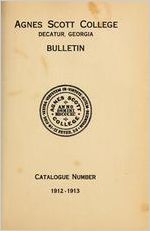
- Agnes Scott College Bulletin: 1912-1913
- Creator:
- Agnes Scott College
- Publisher:
- Agnes Scott College
- Date of Original:
- 1913
- Subject:
- Agnes Scott College--Curricula--Catalogs
Agnes Scott College--History
Women's colleges--Georgia--Decatur
Women--Education--Georgia--Decatur - Location:
- United States, Georgia, DeKalb County, Decatur, 33.77483, -84.29631
- Type:
- Text
- Format:
- application/pdf
text/plain - Description:
- Catalogue of Agnes Scott College.
- External Identifiers:
- Metadata URL:
- https://archive.org/details/agnesscott19121913agne
- Language:
- eng
- Holding Institution:
- McCain Library
- Rights:
-

SERIES to
NUMBER 2
AGNES SCOTT COLLEGE
DECATUR, GEORGIA
BULLETIN
Catalogue Number
1912-1913
ENTERED AS SECOND-CLASS MATTER AT THE POSTOFFICE. DECATUR. OA.
Agnes Scott College
DECATUR. GEORGIA
BULLETIN
\>>X *-*-^ .^r^
Catalogue Number
1912-1913
J. p.
BELL CQ
1 psc.
DESIGNERS/
PR1N;TER3^
LYNCHBURQ,
VA
AGNES SCOTT COLLEGE
PAGE 5
AGNES Scott academy
PAGE 133
GENERAL Index
PAGE 141
Agnes Scott College
BOARD OF TRUSTEES
S. M. Inman", Chairman Atlanta
F, H. Gaines Decatur
C. M. Candler Decatur
J. G. Patton Decatur
Geoege B. Scott Decatur
W. S. Kendrick Atlanta
J. K. Orr Atlanta
John J. Eagan Atlanta
L. C. Mandeville CarroUton, Ga.
D. H. Ogden Atlanta
K. G. Matheson Atlanta
H. K. Walker. Atlanta
EXECUTIVE AND ADVISORY COMMITTEE
C. M. Candler, Chairman;
S. M. Inman,
F. H. Gaines,
G. B. Scott.
Agnes Scott College
Agnes Scott College
CALENDAR
1913 September 16^ Dormitories open for reception of
Students.
September 17, 10 a. m., Session opens.
September 16-18, Classification of Students.
September 19, Class Exercises begin.
November 27, Thanksgiving Day.
December 18, 1 :20 p. m., to January 2, 8 a. m., Christ-
mas Recess.
1914 January 14, Intermediate Examinations begin.
January 24, Second Semester begins.
February 22, Colonel George W. Scott's Birthday.
March 28, 1 :20 p. m., to April 2, 8 a. m., Spring
Vacation.
April 26, Memorial Day.
May 13, Einal Examinations begin.
May 24, Baccalaureate Sermon.
May 26, Alumnae Day.
May 26, 8 :30 p. m.. Celebration of Literary Societies.
May 27, Commencement Day.
Opficees and Instkuctoes
OFFICERS OF GOVERNMENT AND
INSTRUCTION
1912-1913
(ARRANGED IN ORDER OF APPOINTMENT)
F. H. GAINES, D. D., LL. D.,
PRESIDENT.
NANNETTE HOPKINS,
DEAN.
M. LOUISE McKINNEY,
(Appointed 1891)
PROFESSOE OF ENGLISH.
H. B. AKBUCKLE, M. A., Ph. D.,
HAMPDEN-SIDNEY COLLEGE^ JOHNS HOPKINS UNIVERSITY,
(Appointed 1898)
PROFESSOR OF CHEMISTRY.
ANNA I. YOUNG, B. A.,
AGNES SCOTT COLLEGE,
(Appointed 1898)
PROFESSOR OF MATHEMATICS.
J. D. M. AKMISTEAD, Ph. D.,
WASHINGTON AND LEE UNIVBESITT,
(Appointed 1905)
PROFESSOR OF ENGLISH.
LILLIAN S. SMITH, A. M., Ph. D.,
SYEACUSE UNIVERSITY, CORNELL UNIVERSITY,
(Appointed 1905)
PROFESSOR OF LATIN AND GREEK.
Agnes Scott College
JOHN I. ARMSTEONG, M. A., B. D.,
HAMPDHN-SIDNBT COLLEGE, UNION THEOLOGICAL SEMINABY, VA.,
(Appointed 1906)
PEOFESSOE OF PHILOSOPHY AND BIBLE.
George W. Scott Memorial Foundation, Established by Citizens
of Decatur.
BERTHA E. TREBEIN", M. A.,
WELLESLEY COLLEGE, STUDENT UNIVEESITY OF BBBLIN, 1904-1906,
COLUMBIA UNIVEESITYj 1906-1907,
(Appointed 1907)
PEOFESSOE OF GEBMAN.
MARY L. CADY, M. A.,
EADCLIFFH, GEADUATE STUDENT BEYN MAWE COLLEGE, 1904-1906,
UNIVEESITY OF BEELIN, 1907,
(Appointed 1908)
PEOFESSOE OF HISTOEY, POLITICAL ECONOMY, AND SOCIOLOGY.
MARY FRANCES SWEET, M. D.,
SYEACUSE UNIVEESITY, NEW ENGLAND HOSPITAL, BOSTON,
(Appointed 1908)
EESIDENT PHYSICIAN, AND PEOFESSOE OF HYGIENE.
CHARLES P. OLIVIER, M. A., Ph. D.,
UNIVEESITY OF VIRGINIA,
(Appointed 1911)
PEOFESSOE OF PHYSICS AND ASTEONOMY.
GERTRUDE SEVIN, Ph. B.,
SYEACUSE UNIVEESITY,
(Appointed 1911)
PEOFESSOE OF BIOLOGY AND GEOLOGY.
CLARA WHORLEY HASLOCK, A. M.,
COLUMBIA UNIVEESITY,
(Appointed 1912)
PEOFESSOE OF HOME ECONOMICS.
*Leave of absence for special study.
Opficees and Insteuctoks
HELEN Legate, m. a.,
WELLESLBT COIiLEGB, UNIVEKSITT OF FABIS, 1909-1910,
(Appointed 1911)
PEOFESSOR OF EOMANCE LANGUAGES.
LESLIE SAWTELLE, A. B.,
SMITH COLLEGE, CERTIFICATE OF DEPAETMBNT OF HTGIBNE,
WELLESLBT COLLEGE,
(Appointed 1911)
PEOFESSOR OF PHYSICAL EDUCATION.
MAEY B. GUDE, Ph. B., Ph. M.,
UNIVEKSITT OF CHICAGO,
(Appointed 1911)
ADJUNCT PROFESSOR OF HISTORY, POLITICAL ECONOMY, AND SOCIOLOGY.
MARY E. MARKLEY, A. M.,
UESINUS COLLEGE, COLUMBIA UNIVBESITT,
(Appointed 1911)
ADJUNCT PROFESSOR OF ENGLISH.
EMILIE A. MEINHAEDT, M. A.,
EADCLIFFE COLLEGE, EESIDENT STUDENT THEEE TBAES IN FEANCB,
(Appointed 1911)
ACTING PEOFESSOR OF GERMAN.
MARGAEET ELLEN McCALLIE, B. A., Ph. B.,
AGNES SCOTT COLLEGE, UNIVEESITT OF CHICAGO, EEGISTBEED STUDENT
UNIVBESITT OF BBELIN AND UNIVBESITT OF HEIDBLBBEG,
STUDENT IN PAEIS,
(Appointed 1912)
ADJUNCT PROFESSOR OF GERMAN.
ALICE LUCILE ALEXANDER, B. A.,
AGNES SCOTT COLLEGE, CANDIDATE FOE M. A., COLUMBIA UNIVBESITT,
JUNE, 1913,
(Appointed for 1913-1914)
ADJUNCT PROFESSOR OF FRENCH.
KATHARINE TORRANCE, M. A.,
UNIVBESITT OF CHICAGO,
(Appointed for 1913-1914)
ADJUNCT PROFESSOR OF LATIN AND GREEK.
10 Agnes Scott College
ROSE A. NEWCOMB, B. A.,
SYRACUSE UNIVBKSITY,
(Appointed for 1913-1914)
ADJUNCT PKOFESSOR OF CHEMISTRY AND BIOU)GY.
JANIE WOOD MacGAUGHEY,
STUDENT ASSISTANT IN CHEMISTRY.
JOSEPH MACLEAN, Director,
(Appointed 1893)
PIANO, HARMONY, AND MUSICAL HISTORY.
LOUISE G. LEWIS,
(Appointed 1900)
AET AND ART HISTORY.
CLEMENTINE MacGREGOR,
(Appointed 1904)
PIANO, HARMONY, AND MUSICAL HISTORY.
CHRISTIAN W. DIECIOIANN,
(Appointed 1905)
PIANO.
LEWIS H. JOHNSON,
(Appointed 1910)
VOICE CULTURE.
ANNA E. HUNT,
(Appointed 1911)
VIOLIN.
LOUISE HEPP,
(Appointed 1912)
VOICE CULTURE.
ALICE MABEL SHEPARD,
(Appointed 1912)
ORGAN AND PIANO.
CAROLINE DUNCAN,
(Appointed 1912)
EXPRESSION.
Officeks and Instructoes 11
SARAH W. McCORD,
StrPEEINTENDENT OF PBACTICE.
BETH DUNCAN,
ASSISTANT SUPERINTENDENT OF PEACTICE.
LEILA E. REYNOLDS,
GRADDATB VICTORIA HOSPITAL, LONDON, ONTAEIO,
(Appointed 1912)
INTENDANT INFIBMAEY.
EDITH APPLEYARD,
(Appointed 1902)
MATRON.
EMMA E. MILLER,
(Appointed 1911)
ASSISTANT MATRON.
PHILO W. STURGES,
FRANCES CALHOUN,
(Appointed 1911)
HOUSEKEEPERS.
B. M. BACHMAN,
(Appointed 1906)
TREASURER.
JENNIE E. SMITH,
(Appointed 1909)
STENOGRAPHER.
R. B. CUNNINGHAM,
(Appointed 1911)
BUSINESS MANAGER.
MARION BUCHER,
(Appointed 1906)
LIBRARIAN.
MARY ENZOR,
ASSISTANT LIBRARIAN, 1911-1912.
12 Agnes Scott College
STANDING COMMITTEES OF THE FACULTY
Committee on Admission: Professor McKinney, Chair-
man; Professors Young and Markley.
Committee on Aockbdited Schools: Professor Armi-
stead. Chairman; Professors Armstrong and Young.
Committee on Libeaey: Professor Smith, Chairman;
Professors Cady and LeGate.
Committee on Liteeaey Societies: Professor Arm-
strong, Chairman; Professors Armistead, McKinney, and
Sevin.
Committee on Student Goveenment: Miss Hopkins,
Chairman; Professors Smith and McCallie.
Appointment Committee: Dr. Gaines, Chairman; Pro-
fessors Young and McKinney.
Committee on Cuekiculum: Professor Arbuckle, Chair-
man ; Professors Cady, Smith, Armstrong, and the President.
Joint Advisoey Committee (Faculty Members) : Miss
Hopkins, Chairman; Professors McKinney, Sweet, and
Smith.
Committee on Electives: Professor Armistead, Chair-
man; Professors Arbuckle and Cady.
Agnes Scott College 13
AGNES SCOTT COLLEGE
The purpose which has prevailed at Agnes Scott since its
foundation has been to offer the very best educational advan-
tages under positive Christian influences ^the training and
furnishing of the mind in a modern^, well-equipped college,
and at the same time the formation and development of
Christian character and ideals. Along with these ends, it is
constantly sought to cultivate true womanliness, a womanli-
ness which combines strength with gentleness and refinement.
It is thus the aim of the College to send out educated Chris-
tian women to be a power in blessing the world and glorifying
God.
The College was founded by Presbyterians, and hence its
moral standards and religious life conform as nearly as pos-
sible to those which obtain in that church. Special care,
however, is taken not to interfere in any way with the relig-
ious views or church preferences of students.
The College offers only the B. A. degree. There are, how-
ever, optional courses leading to this degree, thus giving the
opportunity for each student to elect a course most in accord
with her special talent and plans.
14 Agnes Scott College
ADMISSION OF STUDENTS
All correspondence in reference to admission of students
should be addressed to the President of the College.
Applicants for admission should not be under sixteen years
of age. Candidates for advanced standing should be of an
age corresponding to this rule. Exceptions are allowed for
satisfactory reasons.
Testimonials of good character from responsible persons
are required. Certificates of honorable dismission from the
last school attended must be presented.
A deposit of $10.00 is necessary for the reservation of
space, vrhich amount will be credited on bill- rendered at
beginning of session. This fee will be refunded, provided
the President is notified of change of plan before August 1st.
Application blanks will be furnished when requested.
For entrance requirements and for description of entrance
subjects, see helow.
For admission hy certificate, see page S3.
For entrance examinations, see page 35.
ENTRANCE SUBJECTS
Candidates for admission to the Freshman Class must pre-
sent fifteen units of preparatory work chosen as follows :
1. Twelve required units, including three units in Eng-
lish, three in Mathematics, three in Latin, one in History,
and two in French or German or Greek.
2. One elective unit in any one of the following subjects :
Latin, Mathematics, French, German, Greek, Physics, Chem-
istry.
Admission of Students 15
3, Two elective units from among the following subjects:
French, German, Greek, History, Botany, Zoology, Physi-
ology, Physiography,
In measuring the amount of work done by students, the
College accepts the valuation of a unit, as fixed by the Asso-
ciation of Colleges and Secondary Schools of the Southern
States, as follows:
"A unit represents a year's study in any subject in a
secondary school, constituting approximately a quarter of a
full year's work.
"This statement is designed to afford a standard of
measurement for the work done in secondary schools. It
takes the four-year high-school course as a basis, and assumes
that the length of the school year is from thirty-six to forty-
weeks ; that a period is from forty to sixty minutes in length,
and that the study is pursued for four or five periods a week ;
but, under ordinary circumstances, a satisfactory year's work
in any subject can not be accomplished in less than one
hundred and twenty sixty-minute hours or their equivalent.
Schools organized on any other than a four-year basis can,
nevertheless, estimate their work in terms of this unit."
It is understood that in choosing the elective units no re-
quired unit may be counted also as an elective unit, and also
that elective units may be counted only once.
The fourth unit in Latin and in Mathematics will be ac-
cepted for entrance only by examination, when the student
does not continue these subjects in College.
Both Physics and Chemistry when not offered for entrance
must be taken in College, and when both are offered for en-
trance, an advanced course in one or the other must be taken
in College.
16
Agnes Scott College
The entrance requirement work in French, German, and
Greek may be done in College after entrance but will not
count toward the degree.
For convenience of reference the subjects that are to be
used in making up the entrance requirements may be grouped
in tabular form as given below, the figure following each
subject in parentheses being the value of that subject in units.
KEQUIRED
ELECTIVE
*
Gbotxp a
Gboup B
12 UNITS BEQUIKED
1 UNIT TO BE CHOSEN
2 UNITS TO BE CHOSEN
English (3)
Latin (1)
French (2)
Mathematics (3)
Mathematics (1)
Spanish (2)
Latin (3)
French (1)
German (2)
History (1)
German ( 1 )
Greek" (2)
French
Greek (1)
History (l^^)
or
Physics (1)
Botany (%)
German
(2)
Chemistry (1)
Botany (1)
or
Zoology (%)
Greek
Zoology (1)
Physiology (%)
Physiography (i^)
Admission of Students l*?
DESCRIPTION OF ENTRANCE SUBJECTS
ENGLISH
English, three units. The College entrance requirements
of the ISTew England, Middle, and Southern States Associa-
tions of Colleges and Preparatory Schools constitute the en-
trance work in English.
The requirement in English has two branches, Ehetoric and
English Literature. The study of English should be con-
tinuous throughout four years of the high-school course.
I. Ehetoeic and Composition, one unit and a half. It
is hoped that at least one-half of the high-school course in
English will be devoted to the work in Composition and
Ehetoric, either as a separate study or in connection with the
work in literature, as it is a prime essential to success in any
branch of collegiate work that the student be able to express
herself, both orally and in writing, with correctness and clear-
ness. The subjects for examination in Composition will be
taken from the English Literature required for 1913-14.
The form of the examination will usually be the writing of
several paragraphs on each of several topics to be chosen by
the candidate from a number set before her in the examina-
tion paper in English Literature. The treatment of these
topics is designed to test the student's power of clear and ac-
curate expression, and will call for only a general knowledge
of the books.
To meet this requirement in Composition:
1. There should be practice in writing, the equivalent of
at least one theme a week during the four years of her pre-
paratory course. She must be able to spell, capitalize, and
18 Agnes Scott College
punctuate correctly; no candidate will be accepted whose
work is notably deficient in this respect. She must also have
a practical knowledge of English Grammar.
2. There should be a systematic study of Ehetoric. Par-
ticular attention should be given to the structure of the sen-
tence, paragraph, and whole composition.
The following books are recommended for study in prepara-
tion: In Ehetoric, Herrick and Damon's Composition and
Ehetoric; Scott and Denney's Composition- Ehetoric ;
Genung's Outlines of Ehetoric; Hill's Foundations of
Ehetoric; Brook and Hubbard's Ehetoric; Webster's English
Composition and Literature.
II. LiTEEATURE, One unit and a half.
1. Reading (1913, 1914). At least two selections must
be made from each of the following groups :
A. The Old Testament, comprising at least the chief
narrative episodes in Genesis, Exodus, Joshua, Judges,
Samuel, Kings, and Daniel, together with the books of Euth
and Esther; the Odyssey, with the omission, if desired, of
Books I, II, III, IV, V, XV, XVI, XVII; the Iliad, with
the omission, if desired, of Books XI, XIII, XIV, XV,
XVII, XXI; Virgil's ^neid. The Odyssey, Iliad, and
^neid should be read in English translations of recognized
literary excellence.
For any selection of this group a selection from any other
group may be substituted.
B. Shakespeare's Merchant of Venice, Midsummer
Night's Dream, As You Like It, Twelfth Night, Henry the
Fifth, Julius Cgesar.
C. Defoe's Eobinson Crusoe, Part I; Goldsmith's Vicar
of Wakefield; either Scott's Ivanhoe or Scott's Quentin
Admission of Students 19
Durward; Hawthorne's House of the Seven Gables; either
Dickens's David Copperfield, or A Tale of Two Cities;
Thackeray's Henry Esmond; Mrs. Gaskell's Cranford;
George Eliot's Silas Marner; Stevenson's Treasure Island.
D. Bunyan's Pilgrim's Progress, Part I; The Sir Eoger
de Coverley Papers in the Spectator; Franklin's Autobi-
ography (condensed) ; Irving's Sketch Book; Macaulay's
Lord Clive and Warren Hastings; Thackeray's English
Humorists; Parkman's Oregon Trail; Thoreau's Walden, or
Huxley's Autobiography and selections from Lay Sermons,
including the addresses on Improving Natural Knowledge,
A Liberal Education, and A Piece of Chalk; Stevenson's
Inland Voyage and Travels with a Donkey.
E. Palgrave's Golden Treasury (First Series), Books II
and III, with especial attention to Dryden, Collins, Gray,
Cowper, and Burns; Gray's Elegy in a Country Churchyard,
and Goldsmith's Deserted Village; Coleridge's Ancient
Mariner, and Lowell's The Vision of Sir Launfal; Scott's
The Lady of the Lake; Byron's Childe Harold, Canto IV,
and The Prison of Chillon; Palgrave's Golden Treasury
(First Series), Book IV, with especial attention to Words-
worth, Keats, and Shelley; Poe's Eaven, Longfellow's The
Courtship of Miles Standish, and Whittier's Snow Bound;
Macaulay's Lays of Ancient Eome, and Arnold's Sohrab and
Eustum; Tennyson's Gareth and Lynette, Lancelot and
Elaine, and The Passing of Arthur; Browning's Cavalier
Tunes, The Lost Leader, How They Brought the Good News
from Ghent to Aix, Home Thoughts from Abroad, Home
Thoughts from the Sea, Incident of the French Camp, Herve
Eiel, Pheidippides, My Last Duchess, Up at a Villa, Down
in the City.
2. Study and Practice (1913, 1914, 1915). This part of
the examination presupposes the thorough study of each of
20 Agnes Scott College
the works named below. The examination will be upon
subject-matter, form, and structure. This requirement
means that the student should have been trained to use
simple forms of narration, description, exposition, and argu-
ment in her own composition. In addition, the candidate
may be required to answer questions involving the essentials
of English grammar, and questions on the leading facts in
those periods of English literary history to which the pre-
scribed works belong. The books set for this part of the
examination will be :
Shakespeare's Macbeth; Milton's L' Allegro, II Penseroso,
and Comus; either Burke's Speech on Conciliation with
America, or both Washington's Farewell Address and Web-
ster's First Bunker Hill Oration; either Macaulay's Life
of Johnson, or Carlyle's Essay on Burns.
As additional evidence of preparation the candidate may
present an exercise book, properly certified by her instructor,
containing compositions or other written work.
It is taken for granted that the candidate will have learned
by heart passages from all the poems she has read.
LATIN
All students entering the degree course must present the
minor requirements in Latin and are advised to offer the
major requirement.
Minor Eequirement, three units. 1 or 2.
1. a, t, and c (as outlined below) admits to Course 0.
2. a, h, ^neid I-III, and one-half of the translation and
all the prose composition of c admits to Course 00.
Candidates are urged to offer Minor Requirement 1 rather
than 2.
Admission of Students 31
a. Latin Grammar, one unit. A tliorough knowledge of
all regular inflections, and the common irregular forms; the
simpler rules for composition and derivation of words; S3'ii-
tax of nouns and verbs; structure of sentences, with special
emphasis upon relative and conditional sentences, indirect
discourse, and the uses of the subjunctive.
&. CcBsar, one unit. Gallic War, I-IV, or an equivalent
amount of Latin selected from the following: Cgesar, Grallic
War, and Civil War, ISTepos, Lives. Latin composition.
c. Cicero, one unit. Seven orations, or six if the Manilian
be one. The orations preferred are the four against Cati-
line, for xirchias, and for the Manilian Law. For a part of
the orations, an equivalent amount of Sallust, Catiline or
Jugurthine War may be substituted. Latin composition.
Latin Composition. Those who receive credit for h and c
must be able to translate into correct Latin detached sen-
tences involving all regular inflections and all common ir-
regular forms, and illustrating the principal grammatical
constructions found in the prose authors read. To secure
such ability, the preparation must include a systematic study
of the main principles of Latin syntax, and one period a
week throughout each year should be devoted to prose.
Translation at Sight. Candidates must be able to trans-
late at sight passage of Latin suited in vocabulary, construc-
tion, and range of ideas to the preparation secured by the
reading indicated above.
Major Requirement, four units. a, h, and c of minor re-
quirement, and d (as outlined below). Admits to Latin 1.
d. 1. Virgil, one unit. ^Eneid, six books, or five books
of the ^neid and selections equivalent in amount to one
book of the ^neid from Ovid's Metamorphoses, or from the
22 Agnes Scott College
Eclogues. So much of prosody as is necessary for a correct
reading of the text by the quantitative method. Translation
of poetry at sight.
2. Latin Prose Composition. The writing of continuous
prose of moderate diflBculty based on Caesar and Cicero. The
work of this year should include a thorough review of the
principles taught in the previous years.
Note. All students, entering with four units of Latin
even from accredited schools, who do not wish to continue
Latin in College, are required to pass an examination on the
fourth entrance unit {d, 1 and 2.)
GREEK
Students may offer for entrance in Greek either the minor
or the major requirement. The minor requirement is counted
as two units, and presupposes a study of Greek during two
full years, five recitations a week. The major requirement
is counted as three units, and presupposes three years of
preparation, five recitations a week. The ground which
must be covered is as follows :
1. For the minor requirement
a. Grammar: Inflections, etymology and derivation of
words, syntax of nouns and verbs, and structure of the sen-
tence as treated in White's First Greek Book, or its equiva-
lent, must be thoroughly mastered. Constant attention
should be paid to translation from English into Greek.
h. Xenophon: Anabasis, three books. Special attention
should be paid to Greek syntax and to the use of good English
in translating. Thorough drill on translation from English
into Greek.
Admission of Students 33
2. For the major requirement
The student must have completed the minor requirement
as outlined above and in addition have read three books of
Homer's Iliad, or an equivalent amount in Homer's Odyssey.
Constant practice should be given in prose composition, in
translation at sight, and in Homeric forms and syntax.
FRENCH
MiNOK Eequirement (admitting to French 1), two units.
The preparation for this requirement should comprise :
1. A thorough knowledge of the rudiments of grammar,
including the essentials of syntax with mastery of the regular
verbs and of at least twenty-five irregular models.
2. Abundant exercises in prose composition.
3. Careful drill in pronunciation and practice in conver-
sation.
It is essential that the candidate acquire the ability to
follow a recitation conducted in French and to answer in
that language questions asked by the instructor.
4. The reading of at least three hundred duodecimo pages
of simple French from four authors.
Candidates are strongly urged to use Fraser and Squair's
French Grammar, of which Part I and the articles in Part
II relating to the use of the auxiliaries and the subjunctive
and conditional moods, as well as the inflection and synopsis
of the verbs, should be thoroughly mastered.
The texts suggested for reading are:
Fontaine: Douze Contes Nouveaux; Schultz: ha, Neuvaine
de Collette; Daudet: Trois Contes Choisis; Malot: Sans
24 Agnes Scott College
Famille; de la Brete: Men Oncle et Men Cure; Labiche-
Martin: Le Voyage de M. Perrichon; Guerber: Contes.
Note. If the time given to the preparation is less than
two years, with four or five recitations a week, an examina-
tion will be required even from students who present certifi-
cates from accredited schools.
Major Eequirement (admitting to Prench 3), three
units. To meet this requirement the candidate must present
the whole minor requirement and, in addition, the following:
1. A thorough knowledge of French grammar and syntax.
2. Ability to translate a connected passage of English of
moderate difficulty into French at sight.
3. Ability to read any ordinary French.
4. Ability to understand a lecture given in French and to
speak correctly in French on topics bearing on every-day life
as well as the ability to discuss the texts read.
5. The reading of at least seven hundred duodecimo pages
from as many as five authors.
The texts suggested are those found under French 1 in the
section of this catalogue entitled Course of Instruction. See
pages 62-65.
Students are admitted to French 2 by examination only.
SPANISH
Mince Eequirement (admitting to Spanish 1), two
units. Hill and Ford's Spanish Grammar in full, or the
equivalent in grammar and prose composition, and the read-
ing of at least three hundred duodecimo pages. The work
should comprise :
Admission of Students 25
1. A thorough knowledge of the rudiments of grammar,
including the conjugation of regular and irregular verbs,
the inflection of articles, nouns, adjectives, and pronouns,
and the elementary rules of syntax.
2. Exercises in prose composition.
3. Careful drill in pronunciation and practice in con-
versation.
4. Practice in translating Spanish into English and
English into Spanish.
5. Writing Spanish from dictation.
GERMAN
MiNOE Eequieement (admitting to German 1), two
units. Thomas's Practical German Grammar, Part I in full,
or the equivalent in grammar and prose composition; at
least ten stories of Guerber's Marchen und Erzahlungen,
Part I, used for memory work in the abundant idioms which
this text affords, and as a basis for conversation and oral
narration. The reading in addition of at least 150 pages of
prose from carefully graduated texts. This requirement in-
cludes careful drill in pronunciation and in reading German
aloud; the inflection of articles, nouns, adjectives, pronouns,
weak verbs and most of the strong verbs; the common uses
of the subjunctive and of modal auxiliaries, both in transla-
tion and prose; a considerable drill also in the less common
modal constructions and idioms; familiarity with the
functions of all the common prepositions, with the principles
of syntax and word-order; the memorizing of idioms of
daily life and of simple German poems; conversation; oral
narrative; reading at sight.
26 Agnes Scott College
Note. It is expected that this work will include five reci-
tations a week for a period of two years. If the work is
done in less time than this, admission even from accredited
schools will be by examination.
Major Eequieement (admitting to German 2), three
units. The full work as givto under the minor requirement.
In addition: (1) Thomas's Practical German Grammar,
Part II, in full; last half of Hervey's Supplementary Exer-
cises to Thomas's Grammar; or the equivalent of these two
books in grammar, prose composition, and syntax drill; (2)
practice in translating connected narrative into German, also
in free reproduction orally and in writing, based on texts read
and on Thomas and Hervey's German Eeader and Theme-
Book, or books similar in grade and in kind; (3) drill in
sight reading and in conversation; (4) the reading of at
least 500 pages of carefully graduated texts, one-half of
which should be chosen from the works of Lessing, Goethe
and Schiller; (5) memory work is emphasized, including
poems from Heine, Goethe, and Schiller, and the more
difficult conversation idioms.
Note. If the third unit of the major requirement is of-
fered in addition to the full entrance requirement in other
subjects, it may be counted toward the degree. It is under-
stood, however, that this third unit includes five recitations
a week for one year. Students presenting the major require-
ment will be admitted only by examination, which will in-
clude a test in conversation, since it is essential that students
of this grade be able to follow and to take part with com-
parative ease in a recitation conducted in German.
Third Language Requirement (admitting to second
semester of Elementary German), one unit. Thomas's
Admission of Students 27
Practical German Grrammar to Demonstratives, page 101. At
least five stories from Guerber's Marchen und Erzahlungen,
Part I, used as suggested above under minor requirement.
The reading in addition of Zschokke's Der zerbrochene Krug,
or twenty-five pages of prose of equal difficulty. This re-
quirement includes careful drill in pronunciation; the in-
flection of articles, nouns, and adjectives; comparison of
adjectives ; the formation and use of numerals ; personal and
possessive pronouns; principal parts and indicative mood of
the strong and weak verbs found in the grammar exercises
and in the stories from Marchen und Erzahlungen; function
of the common prepositions; principles of syntax and word-
order as illustrated both in translation and prose; the
memorizing of idioms of daily life as found in Guerber and
in the grammar colloquies; drill in the writing of prose
sentences and in simple, connected oral narration.
KoTE. See note to Elementary German in Courses of
Instruction.
MATHEMATICS
Minor Eequirement. Three units.
Algebra, two units. Factors, common divisors and multi-
ples, fractions, simple equations with applications to
problems, involution and evolution, theory of exponents,
surds and imaginaries, quadratic equations (including the
theory), systems involving quadratic and higher equations,
inequalities, ratio and proportion, variations, arithmetical
and geometrical progressions, binominal theorem for positive
integral exponents.
At least two years with daily recitations should be given
to Algebra. The use of graphical methods and illustrations,
particularly in connection with the solution of equations, is
required.
28 Agnes Scott College
Plane Geometry, one unit. The subject as presented by
any of the best text-books. Much attention must be paid to
original exercises.
At least one year with daily recitations should be given to
Geometry.
Eecent review of subjects studied early in the preparatory
course is urged.
Majoe Requikement, four units. To meet this require-
ment the candidate must present the work as given under
the minor requirement and in addition the following:
1. Solid and Spherical Geometry, including the text and
numerous original propositions and numerical problems.
2. Plane Trigonometry. This course should be preceded
by a short review course in Algebra.
Students not pursuing the subject of Mathematics in
College will be given credit for the above fourth unit only
by examination.
HISTORY
For entrance in History each of the following four subjects
is counted as one unit. Each unit represents the amount of
work which can be covered in five recitations per week during
one year, or in three recitations per week during two years.
a. Greek History to the Death of Alexander, and Eoman
History to 800 A. D. These may be offered together as one
unit, or either Greek History or Roman History may be of-
fered as one-half unit. In the latter case the subject pre-
sented must have been studied during five recitations per
week for a half year, or for an equivalent time.
It is strongly urged that every student offer Greek and
Eoman History for entrance.
Admission of Students 39
h. Mediaeval and Modern European History, from 800
A. D. to the present time.
c. English History.
d. American History.
Of these four units the student must offer one unit, and
may offer an additional one and one-half units. Note, how-
ever, that a half unit is possible only in Greek History or
Roman History.
The examinations will be based upon modern High School
text-books.
It is strongly recommended that the preparation in His-
tory include, besides the study of a text-book, parallel read-
ing, use of a notebook, taking of notes, and practice in the
filling in of outline maps.
A detailed statement of the most approved methods for
the teaching of History in secondary schools will be found
in two reports to the American Historical Association (Re-
port of the Committee of Seven on the Study of History in
Schools, and The Study of History in Secondary Schools,
both published by Macmillan), and in a publication of the
New England History Teachers' Association (History
Syllabus for Secondary Schools, published by Heath).
NATURAL SCIENCES
The student may offer one or two units from the five units
given below. Each should represent the work of one year
and should include a large amount of individual laboratory
work. This laboratory work should be directed by a com-
petent instructor and records made in a notebook, while
in the field or laboratory. The notebook, endorsed by the
instructor who supervised the work, must be presented before
the student can be admitted to examinations, or accepted on
certificate.
30 Agnes Scott College
1. Physics. The amount of work required is repre-
sented by such texts as Gage, Milliken and Gale, or Hoadley.
The laboratory work must include, at least, thirty-five
selected exercises. One unit.
2. Chemistry. This course covers General Inorganic
Chemistry, embracing a study of non-metals and metals.
Eemsen, Williams, McPherson, and Henderson are acceptable
texts. One unit.
3. Botany. This course should include the study of the
general laws of plant physiology, the fundamental principles
of plant morphology, the classification of the phanerogams,
and an investigation of the typical plants of the chief divi-
sions of the plant kingdom. The laboratory work must
occupy at least half of the time devoted to the study. The
work may be founded on such texts as Coulter, Bergen,
Stevens, or Leavitt. One unit.
4. Zoology. Eighteen types representing the principal
divisions of the animal kingdom should be studied and the
study of the living animal should always precede dissection.
The course embraces both Invertebrate and Vertebrate forms.
Such texts as Davenport or Herrick are recommended. One
unit.
5. Physiogeaphy. This course embraces: The prin-
ciples of Physiography as given in such texts as Davis, or
Tarr, field work through the course, the interpretation and
use of topographic maps and weather maps. One unit.
For the year 1913-14 the student will be permitted to offer
one-half unit in any of the following subjects. Each sub-
ject must be studied for five recitation periods per week for
eighteen weeks. The laboratory work is not so extended as
in the full units, but should represent at least one-third of
the time given to the study.
Admission of Students 31
1. Botany. The course may be based in Bergen's Ele-
ments of Botany, or Coulter's Plant Eelations, and should
include simpler experiments in seed germination and plant
anatomy; and an herbarium of twelve or more plants should
be presented. One-half unit.
2. Physical Geogeaphy, The subject should be studied
with the aid of the best texts, as G-ilbert and Brigham's,
Tarr's, Davis's. One-half unit.
3. Physiology. A course based upon Martin's Human
Body, or Foster and Shore. One-half unit.
ADMISSION OF CANDIDATES FOR THE DEGREE
All candidates for the degree must enter either by certifi-
cate or by examination. If the candidate seeks admission to
the Freshman class she must meet all entrance requirements
(p. 14) in order to be admitted without condition. For the
present, however, conditions will be allowed in three of the
fifteen units required for entrance, provided the condition in
any subject (except the entrance work in French, German,
or Greek, when it is done in College) shall not mean a whole
year's work, and provided also that not more than tivo of the
conditions are included in the nine units required in English,
Mathematics, and Latin. All conditions must be removed
before the student enters on the work of the Junior year.
ADMISSION OF IRREGULAR STUDENTS
Candidates for admission who do not wish to pursue a
course of study leading to the degree are admitted by exami-
nation or by certificate. These students must offer for
entrance twelve units chosen from the following list, the
number after each subject indicating the maximum number
32 Agnes Scott College
of units that may be offered in that subject: English 3,
Latin 4, Mathematics 4:, Greek 3, German 3, French 3,
History 214? Science 3. Of the twelve units required, five
must be chosen as follows : three in English and two in
Mathematics.
These students are required to take a minimum of fifteen
hours of recitation per week, which may include Music and
Art, but at least nine hours must be academic work.
Should they desire later to arrange their courses for the
degree, credit will be given them for work already done in
the College, but they must meet all of the entrance require-
ments of degree students.
ADMISSION OF SPECIAL STUDENTS
Candidates who have completed their collegiate education,
or who have some years prior to their application finished
their preparation for college and have been prevented from
continuing their education, are admitted without examination
to pursue studies not included among the entrance subjects.
Such students must be at least twenty years of age and must
show special fitness for the departments they desire to enter.
This arrangement for special students is designed specially
for teachers who desire to continue their studies in a college
well equipped with libraries and laboratories. These students
will not be permitted to change to the degree course unless
they meet the entrance requirements of degree students.
ADMISSION TO ADVANCED STANDING
A candidate may be admitted to any of the higher classes
on the following conditions :
1. That she stand examination on all the subjects em-
braced in the course of the B. A. degree below the class for
Admission of Students 33
which she applies. Credit will be given for any subject on
which candidate passes satisfactory examination, but applica-
tion for examination for advanced standing in any subject
must be made within two weeks of entrance.
2. When she comes from another institution of recognized
standing and desires to enter by certificate, she must present
detailed statement of work done, and, at the discretion of
the professor at the head of each department, may receive
credit for such work. Certificates must be presented from
the instructors in each department of the college from which
she comes, showing amount, character of the work, and time
given to it. Laboratory and notebooks must accompany
certificates of work done in Sciences and History.
3. The B. A. degree will not be conferred on any student
who has not done fifteen hours of work in residence for one
complete session immediately preceding graduation.
4. In every case the applicant must present certificate
signed by the president of the institution she last attended
showing that she has been honorably dismissed.
ADMISSION BY CERTIFICATE
Agnes Scott seeks the support, cooperation, and sympathy
of all worthy secondary schools, recognizing as the surest
basis for advancing the educational interests of the South
the perfect coordination of the college with the preparatory
school.
The following conditions governing the certificate privilege
should be carefully noted:
1. The privilege is granted to schools only, and not to
private instructors.
2. It is granted only on trial, and may be withdrawn at
any time if the work of the school is found to be unsatisfac-
34 Agnes Scott College
tory. Accredited schools are requested to send their cata-
logues and circulars of information to the College each year.
Changes in faculty or in methods of instruction may neces-
sitate the withdrawal of the privilege altogether or in part,
until such changes shall have heen shown to be advantageous.
3. In every instance the privilege is granted only in so
far as the duly signed certificate (made out on a blank fur-
nished by the College) shows the entrance work to have been
done satisfactorily, and the applicant to be able, in the prin-
cipal's opinion, to undertake college work with a reasonable
prospect of success.
4. Certificates will not be accepted for parts of a subject
completed by the applicant before entering the certifying
school ; nor for any work done on an entrance subject during
vacation; nor for any work done in less time than that
specified as necessary under Description of Entrance Subjects
(see page 14).
5. A certificate, in order to be valid, must be presented
within twelve months after the time of the applicant's gradu-
ation from the certifying school.
Subject to these conditions, the following classes of schools
are considered eligible for admission to the accredited list:
1. Schools which have sent to the College students, who,
having entered upon examination, have shown by their first
year's work that their preparation has been thorough and
their training consistent with the best methods.
2. Schools which have made formal application to the
Committee on Accredited Schools for admission to the list
(upon blanks furnished by the College for the purpose) and
which have been examined by the Committee and approved
as to faculty, courses, methods, and equipment.
Admission of Students 35
3. Schools which have been examined by any of the insti-
tutions belonging to the Association of Colleges and Pre-
paratory Schools of the Southern States and admitted to their
accredited list.
ADMISSION BY EXAMINATION
Examinations for admission are given in May and in
September. The examinations in May may be taken at the
time of the final examinations in the various preparatory
schools and the high schools of the South. The Association
of Colleges and Preparatory Schools of the Southern States
has instituted a system of uniform entrance examinations
which is designed to facilitate the admission of students. The
examination questions are prepared by committees from the
faculties of the colleges and schools and are to be set in place
of the final examinations in May on the dates assigned. It
is desired to stimulate the secondary schools, by setting uni-
form standards for them and by encouraging them to work
together. In order to make this system effective it is neces-
sary for all the schools to give the final examinations at the
same time.
Not all of the "Entrance Subjects" will be required of
any student for entrance. Those that are required and those
that are elective are designated both for candidates for the
degree and for irregular students. (See page 31.) The
scope of the work required in these entrance subjects accords
with the requirements for admission prescribed by the Asso-
ciation of Colleges and Preparatory Schools of the Southern
States.
THE EXAMINATIONS OFFERED IN SEPTEMBER
These examinations given by the faculty of the College
are without charge, provided they are taken according to the
36 Agnes Scott College
schedule given below. Any candidate applying for entrance
examinations after the times appointed for holding them will
be charged a fee of $5.00. All candidates expecting to take
examinations should arrive at the College by noon Tuesday,
September 16. The September schedule is as follows:
Thuesday, September 18.
Botany 10:00 A. M. to 11 :00 A. M.
Physiology 9 :00 A. m. to 10 :00 A. M.
History 9 :00 A. M. to 11 :00 a. m.
Greek 3 :00 p. m. to 5 :00 p. m.
German 3 :00 P. m. to 5 : 00 P. M.
French 3 :00 P. M. to 5 :00 P. M.
Zoology 3 :00 P. M. to 4:00 P. M.
Feidat, Septembee 19.
Chemistry 9 :00 A. M. to 11 :00 A. M.
Latin Prose, Cicero 9 :00 A. M. to 11 :00 A. M.
Caesar, Virgil 3 :00 P. M. to 5 :00 P. M.
Satueday, September 20.
Algebra 9 :00 A. M. to 11 :00 A. M.
Physiography 11 :00 A. m. to 12 :00 M.
Physics . . . .' 3:00 P. M. to 5:00 P. M.
Geometry 3 :00 P. m. to 5 :00 P. M.
Monday, September 22.
English 9 :00 A. M. to 11 :00 A. M.
CLASSIFICATION
The classification of all first-year students is in the hands
of the Committee on Admission. The classification of all
students after the first year is arranged by the Committee on
Electives. After a course has been agreed on between stu-
dent and Committee, no change will be allowed except by
the joint approval of the Committee and of the professors
whose departments would be involved in the proposed
change.
Admission of Students 37
The Committees will consider reasons for a change of
course on the part of a student, especially where these
reasons are concerned with the student's health. The best
interest of the student is in every case the determining factor.
New students must be definitely classified within two weeks
after entrance.
38 Agnes Scott College
DEGREE AND CERTIFICATES
BACHELOR'S DEGREE
The College will confer the Bachelor of Arts Degree upon
any student who satisfactorily completes the requirements
as given on pages 39-41. These requirements, embracing
sixty hours of recitation and two hours in Physical Education,
can not be taken in less than four years by students who
enter the Freshman class without condition. Students will
not be permitted to take more than seventeen hours of reci-
tation during one session.
The curriculum is based upon the principle that a college
degree should stand for broad and thorough attainments in
education. The B. A. course, therefore, is partly prescribed
and partly elective, and the electives are given under restric-
tions that will insure a broad and liberal course of study for
each year.
The degree will not be conferred upon any student who
has taken less than one session of resident work.
CERTIFICATES
A Certificate of Proficiency will be given to any student
who completes satisfactorily the certificate course in any
subject, and in addition presents by April 2d, just preceding
the completion of the course, a thesis of not less than two
thousand words, prepared under the direction of the professor
of the department.
CUERICULUM 39
CURRICULUM
THE GROUP SYSTEM
A fundamental principle of the curriculum is that of the
group S3^stem, which comes into operation in the choice of
elective courses. These are three groups:
I. The Language Literature Group.
II. The History Philosophy Group.
III. The Science Mathematics Group.
All the work of the Freshman year is required, but there
are four optional groups of studies which Freshmen may take,
as indicated below, the choice of the group to be taken being
determined partly by the student's preference and partly by
her preparatory work.
Sophomores must take prescribed courses in Bible, Biology,
and Language, as indicated below, in groups corresponding
to the groups of the Freshman year.
There is a required course in Bible for Juniors, and there
are required courses in Philosophy for Juniors and Seniors.
The student must choose elective courses sufficient to make
with her required courses sixty-two hours of work extending
through an entire year. Semester hours count as half-hours
in the requirement for the degree.
The following rules govern the choice of elective courses:
1. All elective courses after the Freshman year must be
chosen with the advice and consent of the Committee on
Electives.
2. Candidates for the degree will be required to take one
major course and two minor courses. The major course will
40 Agnes Scott College
represent one of the three groups in which the curriculum
is arranged. The minors must be chosen from the other two
groups, one from each. Two majors chosen from different
groups may be taken instead of the one major and two minors.
In ever}'^ case in which English is not chosen as the major
the candidate must, in addition to the two required minors,
take three hours of work in English. Likewise in every case
in which neither French nor German is chosen as the major
the candidate must, in addition to the two required minors,
take French or German through Course 2.
A major course is one which requires a minimum of nine
hours. Majors are offered in the following subjects : English,
French, German, Latin, History, Bible, Biology, Chemistry,
Physics, and Mathematics.
A minor course is one which requires a minimum of six
hours. Minors are offered in the following subjects : English
(consisting of three hours in addition to the six hours re-
quired), French (consisting of three hours in addition to the
six hours required as a second language), German (consist-
ing of three hours in addition to the six hours required as a
second language), Latin, Greek, History, Bible, Philosophy,
Biology, Chemistry, Physics, and Mathematics.
3. Majors must be agreed upon by students by the begin-
ning of the Junior year, and all elective courses must be
definitely determined upon by the beginning of the Senior
year.
4. Not more than six hours may be taken in one depart-
ment in any semester.
5. Students offering for entrance two languages other
than Latin must continue one of these two languages in the
Freshman year. Students offering for entrance Latin and
CUERICULUM 41
only one other language must continue that other language
in the Freshman year. This rule comes into operation in
the choice of the group of studies to be taken in the Fresh-
man year.
6. A second language must be continued in College
through Course 2, and if a third language offered for entrance
is taken in College it must be continued through Course 1.
7. One year of a foreign language may be counted in
making up the requirements for the degree only when that
language is the fourth language that the student has taken.
8. One-hour courses may be taken only in connection with
two-hour or three-hour courses in the same subject.
Every candidate for graduation must not only have com-
pleted the requisite number of hours, but also have attained
a grade as high as "C" on twenty hours (four being in the
Senior year), and a grade as high as "D" on ten hours (three
being in the Senior year), and a grade as high as "E" on
all the remaining hours required for the degree.
Three years' work in Physical Education is required of all
students, and counts two hours toward the degree.
Special arrangement will be made for those entering on
advanced standing.
4^2 Agnes Scott College
C_l M ~M CD cc f
-T^ ^
<^ .S
O 5 J3 -5
n^
<v
n3
(D
C3
o
o
<:;>
^M
_ "N
o
0)
CO
O
CI
O'-^-Po o -The oSLrC32;.bw
ujs^^d '-^ "*2 ^ ""a
3 :S 2 .. .g -s PI ss "^ '^ ^ '^
Oj
U
."oorrt (-1 dOoOS^cJ-t-^'-'
Li_o -H P ^P:u^j3
^" <*ods- ^ ^ >< be rri h^ tL
Sags I sS|i<ls'S
en rd ef-l ^ O I I
CP "^ 2 " I I
"S 3 cS OJ H H
O
o
CO
o
o
pi
CO
1
r2
7
CO
H
g
(D
IB
02
1^
CO
1
w
w
H
H
O
o
^
!z;
OQ
Exhibit of Coueses 43
>^_.o3 ^t>-,,_i _, m
I t|siss|s|.|||goB.|| ||.
Q
t>i ^
(^
p
is-g
o
fees
ca
O
W &H
c
^
-*->
05
>. i^
1
o q;
a
Histor
and
Mathe
1 1
O
OS
bn
s
!>i
T1
W
W
p_,
1 ,
as
m
fl
t>
'T!
to
^
t>i
p5
^~ lO
m
;>=. ^
^ ^'
?-.
.-^ ,-^ ,-^ I lO
, -' .2
>v,
CSHfe O OO (IhW tJ Ph^i
44 Agnes Scott College
^^ I lO -^
" i=l >
S T3 a^M
o
i!^
a oi iZi J-i "^
.2 3
<j3 ^
Jh^OJ^Jm "-^
_^W
m
f^ o OJ2;
d^
ommSoo!?; Ph I :^'h
'2 o oj
.CD 1^ a f
o _ ^ (D a m
VS* Ph ^ > ^H
^o
, ,_ O OJ o
-=1 - -=* -^
c3 2 I' &* F
ID
ft -^^--' ^ ' a^o M o^og^
, ^ ., .-^ ' - ^ ^o^
i2 fl^o.2
Conspectus of Courses
45
CONSPECTUS OF COURSES FOR
THE YEAR 1913-1914
Courses marked with one asterisk are offered for the first
semester only; those marked with two asterisks are offered
for the second semester only; those marked with three
asterisks are one-semester courses given for the present in
both semesters and may be taken in either semester; all
other courses are year-courses. The unenclosed figures refer
to the courses of instruction as announced by the departments
in the catalogue. The figures in parentheses after the name
of a course indicate the number of exercises per week or the
equivalent.
GROUP I. GROUP II. GROUP III.
Language Histoby Science
LlTEEATUEE PhILO SOPHY MATHEMATICS
English 1
*English 2
**EngIish 3
English 4
*Eglish 5
**English 6
**English 7
English 11
English 14
English 15
English 16
English 17
*English 18
**English 19
English 21
English 22
**English 23
German
German 1
German 2
*German 3a
** German 3b
German 4
German 5
(3)
(3)
(3)
(2)
(3)
(3)
(3)
(3)
(3)
(3)
(2)
(2)
(3)
(3)
(3)
(3)
(3)
(3)
(3)
(3)
(3)
(3)
(2)
(1)
Economics and
Sociology 1 (2)
Economics and
Sociology 2 (2)
Economics and
Sociology 3 (3)
Economics and
Sociology 4 (3)
Economics and
Sociology 5 (3)
Economics and
Sociology 6 (3)
(3)
History 1
History 2
History 3
History 4
History 5
History 6
History 7
*History 8
History 9
History 10
History 11
History 12
(3)
(2)
(1)
(2)
(3)
(3)
(2)
(2)
(3)
(3)
(2)
Astronomy 1
Astronomy 2
Biology lA
Biology IB
'Biology 2
Biology 3
Biology 4
Biology 5
Biology 6
Biology 7
Chemistry 1
Chemistry 2
*Chemistry 3
'Chemistry 4
Chemistry 5
Chemistry 6
Chemistry 7
Chemistry 8
* Chemistry 9
Geology 1
Geology 2
** Geology 3
Home
Economics 1
(3)
(2)
(2)
(2)
(3)
(3)
(3)
(2)
(1)
(2)
(3)
(3)
(3)
(3)
(3)
(2)
(3)
(3)
(2)
(3)
(3)
(3)
(3)
46
Agnes Scott College
GROUP ]
Language
[.
GROUP II.
History
GROUP III.
Science
LiTEEATXJEE
Philosophy
Mathematics
German 6
(2)
^History 13
(3)
*Home
German 7
(2)
**History 14
(3)
Economics 2
(3)
Greek
(3)
*Philosophy 1
(3)
Home
*Greek la
(3)
**Philosophy 2
(3)
Economics 3
(2)
**Greek lb
(3)
*Philosophy 3
(3)
***Home
*Greek 2a
(3)
**Philosophy 4
(3)
Economics 4
(3)
***Greek 2b
(3)
***Bible 1
(3)
Home
Greek 3
(3)
Bible 2
(2)
Economics 5
(3)
Greek 4
(2)
*Bible 3
(3)
**Home
*Latin la
(3)
**Bible 4
(3)
Economics 6
(3)
**Latin lb
(3)
Bible 5
(3)
**Home
*Latin 2a
(3)
*Bible 6
(3)
Economics 7
(3)
**Latin 2b
(3)
**Bible 7
(3)
***Mathematics 1
(3)
*Latin 3a
(3)
***Mathematics 2
(3)
**Latin 3b
(3)
Mathematics
*Latin 4a
(3)
3 and 4
(3)
**Latin 4b
(3)
*Mathematics 5
(3)
Latin 6
(2)
*Mathematics 6
(3)
Latin 7
(1)
**Mathematics 7
(3)
Latin 8
(1)
*Mathematics 8
(3)
Latin
(3)
Mathematics 9
(3)
Latin 00
(3)
**Mathe'tics 10
(3)
French
(3)
*Mathe'tics 11
(3)
French 1
(3)
**Mathe'tics 12
(3)
French 2
(3)
Physics 1
(3)
French 3
(3)
Physics 2
(3)
French 4
(3)
*Physics 3
(2)
French 5
(1)
**Physics 4
(2)
French 6
(2)
French 7
(2)
Spanish
(3)
Spanish 1
(3)
Also the Course in Physical Education and the Course in
Spoken English.
Note. In what follows concerning Courses of Instruc-
tion, if the name of the course is prefixed by one asterisk,
the course is a first semester course; if by two, the course
is a second semester course; if by three, the course is a one
semester course offered in both semesters; if by none, the
course is a full year course.
Schedule of Recitations
4T
SCHEDULE OF RECITATIONS
Geoup I. Wed. Fri. 8-9
German 3
Geology 1 & 2
Group II. Wed. Fri. 9 :20-10 :20
Sociology 1
Bible 2
Astronomy 2
Latin 7 or 8 (Wed.)
Art History 1 (Wed.)
Art History 2
Home Economics 5
Biology 3
Gkoup VI. T. Th. S. 8-9
English 18 Home Economics 2
Latin (T.) Mathematics 3 & 4
Latin 00 French 2A
German 2 History .". (T. Th.)
Historv 12 (T. Th.)
Chemistry 3 (Th. S.)
Geodp VII.-
English 14
German 6 (T. Th.) Chemistry 4 (T.)
-T. Th. S. 9:20-10:20
Astronomy 1
German 7 (S.)
Latin lA
English 7 & 22
Spanish 2
French OB
History 2
Home Economics 4
Mathematics 6 & 7
Biology 5 (T.)
Group III. Wed.
English 4
Latin 5 or 6
History 8
Chemistry 6
Hygiene 1 (Fri.)
Harmony (Wed. Fri.)
Fri. 10 :20-ll :20
Biology 4 (T. Th.)
Th.) French 4
Group VIII. T. Th. S. 10 :20-ll :20
English 11
English 17 (T
German 5 (S.)
German OB
Latin 3 or 4
History 1
Home Economics 1
Mathematics 1
Mathematics 9 & 10
Bible 5
History 8 & 9 (T. Th.)
Group IV. Mon. Wed. Fri. 11 :20-12 :20 Group IX. T. Th. S. 11 :20-12 :20
English 16 (Wed. Fri.) English 2_& 3 Latin (Th. S.)
English 21
French lA
German lA
Bible 1
Biology 2 (Wed. Fri.)
English lA
German IB
Latin IB
French IB
Bible 3 & 4
Biology 1 (T.
Mathematics 2
English 23
French 2B
History 6, 7,
Economics 5
Th.)
10, & 11
& 6
Group V. Mon. Wed. Fri. 12 :20-l :20 Group X. T. Th. S. 12 :20-l :20
English IB & C English 15 Greek
' ' ' English 5 & 6 History 4 (S.)
Bible 6 & 7
Chemistry 1
& 2 Economics 3 & 4
Physics 1
Music History 5 (T.)
Music History 6 (Th.)
Latin 2
French OA
Spanish 1
Philosophy 1
Chemistry 2
Mathematics 5 & 8
Physics 2 (Wed. Fri.)
German OA
Creels 2B
Economics 2
(Wed. Fri.)
Fresh. Gym. (Th.
Section 1
Greeli 1
3.)
Note. For full schedule see last page of catalogue,
following numbers indicate sections.
Capital letters
48 Agnes Scott College
COURSES OF INSTRUCTION
I. LANGUAGE-LITERATURE
ENGLISH
I.
LANGUAGE AND COMPOSITION
Pbofessob Abmistead. Adjunct Professob Maekley.
Miss Duncan.
1. Foundation Couese. English composition through-
out the year, based on the analysis in class of selected prose
models. Careful drill in the principles of formal rhetoric,
with constant writing. Word study. Parallel reading of
standard novels and essays of the nineteenth century with
written reports at stated intervals.
First Semester : The Paragraph, Narration. Daily themes.
Individual conferences.
Second Semester: The Whole Composition, Exposition,
Description. Weekly themes.
Three hours a week.
Note. In the second semester an additional hour, devoted
to Spoken English, will be required of all Freshmen, though
not counted towards the degree. The object of this training
is to give clearness of enunciation, and voice control and
modulation in reading aloud and speaking,
tRequired of Freshmen.
t Any student, in any department of the College, giving evidence
of inability to write correctly will be conditioned in English com-
position, even though this required course may have been successfully
Courses of Instruction 49
*2. Argumentation. A theoretical and practical study
of the subject. Analysis of questions, brief -drawing, oral and
written discussion.
Three hours a week, first semester.
Open to students who have completed Course 1.
**3. HiSTOEiCAL Survey of the English Language.
History of the language from its beginnings, with careful
analysis of selected prose of representative writers from the
fifteenth century to the present day.
Three hourse a week, second semester.
Open to students who have completed Course 1.
4. Advanced Composition. A practical course in the
writing of the short story and the essay, intended for students
who have shown special aptitude for writing, and who desire
further exercise in prose style. Constant writing is required,
and the effort is made, in class criticism and individual con-
ferences, to meet the needs and encourage the talent of each
student.
Tvsro hours a week.
Open to students who have completed Courses 1 and 2, or 1 and 11.
*5. Anglo-Saxon I. A study of Anglo-Saxon pho-
nology and grammatical forms, with as much reading of
West Saxon prose and poetry as the time and the capacities
of the class will permit. The literary history of the period
is given by lectures and by assigned parallel reading.
Three hours a week, first semester.
Open to students who have completed Courses 1 and 3, or 1 and 11.
**6. Anglo-Saxon II. Beowulf. An intensive reading
of the poem, both as a basis for the continuation of the
technical language work, and as a mirror of early Teutonic
life and thought.
Three hours a week, second semester.
Open to students who have completed Course 5.
50 Agnes Scott College
7. Eaely and Middle English. An inductive study of
the grammar of Middle English, based on the reading in
class of specimens of poetry and prose representative of the
period from 1154 to 1400. Principles of English etymology.
Parallel reading of the literary history.
Three hours a week, second semester.
Open to students who have completed Course 5.
<!
LITERATURE
Pbofessoe McKinney. Pkofessob Akmistead.
Adjunct Pbofessoe Maekley.
11. General Introduction to the Study of English
Literature. This course is conducted by lectures, giving
an account of movements, of tendencies, of men and books;
by careful study of masterpieces representative of different
periods, and by collateral reading. Frequent written reports
are required. This course is prerequisite to all the advanced
courses in literature.
First Semester : From the beginning of English Literature
to the Elizabethan Period.
Second Semester: From the Elizabethan Period to the
Victorian Period.
Three hours a week.
Open to students who have completed Course 1.
**13. History of Literary Criticism. A study of the
development, nature, and function of literary criticism.
Class discussions are supplemented by readings in the various
types of English critical literature, and by frequent papers
on topics assigned in connection with the readings.
Three hours a week, second semester.
Open to students who have completed Courses 1, 11, and at least
three additional hours of elective work in Literature. Course 12 will
not be given in 1913-14.
CouESES OF Instruction 51
13. English Essayists. A detailed and somewhat com-
prehensive study of Carlyle and Ruskin. One semester is
devoted to each of these writers, and some of the most
significant works of each are read.
Two hours a week.
Open to students who have completed Courses 1 and 11. Course
13 will not be given in 1913-14.
14. Shakespeare. The aim of this course is the study
of Shakespeare's development as a dramatist. The work is
more literary than technical. Most of the plays are read
rapidly and discussed in class. Six plays are studied closely
and critically.
Three hours a week.
Open to students who have completed Courses 1 and 11.
15. The English Drama (exclusive of Shakespeare).
In this course the history of the drama is traced from the
Miracle Play through the later Stuart Drama. A number
of representative plays are read and discussed in class.
Three hours a week.
Open to students who have completed Courses 1 and 11.
16. The Study of Prose Fiction. The intent of this
course is to give to the student, through lectures and parallel
reading, a comprehensive knowledge of the development of
the English novel, and also some insight into the methods
and purposes of the greater nineteenth century novelists.
Representative novels from Jane Austen to Stevenson are
analyzed in written reports and oral discussion.
Two hours a week.
Open to students who have completed Courses 1 and 11.
17. American Literature. Essentially a reading
course, covering representative work of the greater nineteenth
century writers. The chief literary movements are given by
52 Agnes Scott College
lectures and by assigned parallel reading. Written reports
bi-weekly.
Two hours a week.
Open to students who have completed Courses 1 and 11.
*18. Verse Forms. The theory of versification is fol-
lowed by the literary history of the various English verse
forms, and by the analysis of representative poems. Stand-
ards of poetic criticism.
Three hours a week, first semester.
Open to students who have completed Courses 1 and 11.
**19. The Lyric. A critical and literary study of the
nature and the development of the English lyric in its various
forms, from the Elizabethan period to the end of the nine-
teenth century.
Three hours a week, second semester.
Open to students who have completed Courses 1, 11, and 18.
**20. The Epic. A comprehensive view of the form and
spirit of epic poetry, based upon the careful reading of the
great epics in translation.
Three hours a week, second semester.
Open to students who have completed Courses 1, 11, and 18.
Not offered in 1913-14. Course 20 will alternate with Course 19.
21. Poetry of the Nineteenth Century. This course
includes a study of Coleridge, Scott, Wordsworth, Shelley,
Keats, Browning, Tennyson, and the Pre-Eaphaelites.
First Semester: The Eomantic Movement, as exemplified
in the work of Coleridge, Scott, Wordsworth, Shelley, and
Keats.
Second Semester: The Victorian Age, with especial
emphasis on Tennyson and Browning. There will also be
brief readings from the Pre-Eaphaelite poets.
Three hours a week throughout the year.
Open to students who have completed Courses 1 and 11.
CouESES OF Instruction 53
*22. Chaucer. The Canterbury Tales studied as litera-
ture. Lectures and assigned parallel readings illustrative of
the literary and social life of fourteenth-century England.
Class discussions. Written reports on selected topics.
Three hours a week, first semester.
Open to students who have completed Courses 1 and 11.
**23. The Arthurian Romances. The sources and
history of the Arthurian Eomances; their development from
the twelfth century through the fifteenth, with readings in
translation of some of the chronicles and early verse
romances; class readings in the modern versions of the
romances.
Three hours a week, for one semester.
Open to students who have completed Courses 1 and 11.
Major. A major course in English consists of not less
than twelve hours of work, including Courses 1, 11, and either
3 or 5.
Minor. A minor course consists of courses 1 and 11,
with three additional hours of elective work.
Certificate. To obtain a certificate in English, the stu-
dent must complete Courses 1, 11, 5, 6, 7, and any three of
the remaining courses. In addition she must prepare a paper
which shall give evidence of her ability to investigate and
discuss intelligently some subject chosen by her in consulta-
tion with the professors of the department. (See page 38.)
54 Agnes Scott College
GERMAN
Peofessoe Tbebein.
Adjunct Peofessoe McCallie.
0, Elementary German. The equivalent of the minor
requirement for entrance. For details see this requirement.
(First semester.) As outlined under third-language requirement
for entrance.
(Second semester.) Completion of Thomas's Practical German
Grammar, Part I; Hervey's Supplementary Exercises to Thomas's
Grammar (first half) ; Guerber's Marchen und Erzahlungen, Part I;
Storm's Immensee; Hillern's Hoher als die Kirche; selected lyrics.
Three hours a week throughout the year.
This course, to be counted toward the degree, must be followed by
Course I, unless it is taken as a fourth foreign language. It is ar-
ranged by semesters for the benefit of those who offer for admission
one unit of German as a third language. Such students are required
to pass an examination over the work they have done, if they do not
continue German in College. If the subject is continued, they are
required to review with the beginning class the work of the first
semester, receiving for this semester no credit toward the degree.
The work of the second semester will be credited for them with two
points toward the degree, if German is pursued consecutively
through Gterman 1.
1. Intermediate Course. More advanced work in
grammar, reproduction and prose composition. Translation;
Conversation, Sight-reading. For details see major require-
ment for admission.
Texts (first semester) : Thomas's Practical German Grammar,
Part II, sections on modal auxiliaries, passive voice, strong verbs
and prepositions, with corresponding prose from Hervey's Supple-
mentary Exercises to Thomas's Grammar; Freytag's Die Journal-
isten.
(Second semester) : Thomas's Grammar, Part II completed.
Prose based chiefly on reflexive and impersonal verbs, compound
verbs and the subjunctive; Schiller's Wilhelm Tell or Jungfrau von
Orleans, Balladen; Goethe's Hermann und Dorothea, selected lyrics;
Meyer's Gustav Adolfs Page.
Three hours a week throughout the year.
CouESES OF Instruction 55
Admission to this course is only by examination in case prepara-
tion is done outside of College in less than two years. This course
may not be counted toward the degree if taken to make up the re-
quired number of units for admission.
2. Eighteenth Century Classics. Character sketches
and abstracts in German. Reports on collateral reading.
Stud}^ of dramatic form. General historical background is
given in simple lectures in German, for which notebooks in
German are required.
Texts: Lessing's Minna von Barnhelm, Nathan der Weise;
Goethe's Iphigenie, Egmont; Schiller's Kabale und Liebe, Wallen-
stein.
Three hours a week throughout the year.
Open to those who have completed 1 or its equivalent. Admission
only by examination if the previous work is done outside of College.
3. Eapid Reading Course. Frequent reports on topics
suggested by the texts and on collateral reading. Lecture
notebooks in German.
*a. Romanticism. Survey in lectures of its develop-
ment, influence, and decline. Novalis's lyrics and Heinrick
von Ofterdingen; TiecFs Marchen and drama; selections
from representative critical works of the early school; Des
KJnaben Wunderhorn; Fouque's Undine; tales of E. T. A.
Hoffmann; tales and lyrics of Chamisso and Eichendorif ;.
lyrics of Heine.
Three hours a week, first semester.
**b. Drama of Kleist, Grillparzer and Hebbel.
Studied with reference to the classic period and to the
influence of Romanticism.
Three hours a week, second semester.
Open to those who have completed Course 2. 3a is a prerequisite
for 3b.
4. Poems of Goethe and Schiller. Studied with
reference to the lives of the poets.
56 Agnes Scott College
Two hours a week throughout the year.
Open to those who have completed Course 2.
5. Advanced Prose Composition. Eeview of gram-
mar principles. Brief survey of the history of the language.
One hour a week for the year.
Open to those who have completed Course 2.
6. Outline Study of German Literature. Special
emphasis on the pagan period, mediaeval epics, minnesong,
folksong, Luther, Hans Sachs, Klopstock, Herder, Wieland.
Extensive collateral reading supplemented by semi-weekly
reports in German.
Text-book: Kluge's Geschichte der Deutschen National-Literatur.
Reference work in Scherer and Vogt und Koch.
Two hours a week throughout the year.
Open by permission to those who have completed 3.
7. Goethe's Faust. Parts I and II. Brief study of the
Faust legend in literature. Interpretation of Goethe's Faust,
with the study of its growth in relation to the facts of his
life.
Text-book: Thomas's edition of Faust.
Two hours a week throughout the year.
Open to those who have completed 2.
A minor in German will consist of Courses 1, 2, and 3.
A major in German will consist of Courses 1, 3, 3, 5, and
one additional two-hour course.
Certificate. A certificate in German will be granted to
a student who has completed with credit Courses 1, 2, 3, 5,
6, and one additional two-hour course; who has presented a
satisfactory critical essay of two thousand words in German,
and has given evidence in class work and in special certificate-
examination of literary appreciation, and of ability to speak
and write German, to translate from English into German,
and to read fluently at sight.
Courses of Instruction 57
GREEK
Peofessob Smith.
Adjunct Peofessob Toeeai^ce.
0. Elementary. Beginner's Book (White), thoroughly
mastered. Xenophon's Anabasis, Book I.
Three hours a week throughout the year.
This course will be offered only if applied for by at least three
students. It may be counted toward the B. A. degree only if the
candidate has presented Latin and one modern language for entrance.
*la. Xenophon. Anabasis II, III, and IV. Grammar
and Prose Composition. Sight Translation.
Three hours a week, first semester.
**lb. Homer. Iliad I- VI. Selections. Forms, syntax,
and prosody. Sight Translation. Prose Composition.
Three hours a week, second semester.
Open to those who have completed 0, or who have offered the
minimum requirement for entrance.
*2a. Homer. Odyssey V-XII. Selections. Careful study
of Homeric style. Lyric Poetry. Selections. Development
of lyric poetry.
Three hours a week, first semester.
***2b. Plato. Apology, Crito, and selections from
Phsedo. Socrates, and the philosophy of Plato. Syntax.
Three hours a week, first or second semester.
Open to those who have completed 1, or who have offered the
maximum requirement for entrance.
3. Tragedy. ^^schylus's Prometheus Bound; Sophocles's
Antigone and (Edipus Tyrannus; Euripides's Iphigenia
among the Taurians. Origin and development of Creek
Drama.
Three hours a week throughout the year.
Open to those who have completed 1.
58 Agnes Scott College
4. New Testament Greek. (Westcott and Hort.)
Two hours a week throughout the year.
Open to those who have completed 0.
LATIN
Pbofessoe Smith.
Adjunct Professor Toeeance.
*la. CiGEEO. De Senectute, De Amicitia. Latin Com-
position. Translation at sight.
Three hours a week, first semester.
**lb. LiVY. Books I and XXI; Ovid, Selections from
the Metamorphoses. Latin Composition. Translation at
sight. Early Eoman institutions. Character of Hannibal.
Livy's style and his qualities as an historian.
Three hours a week, second semester.
Required of all Freshmen in Group A, and open to students who
have completed Courses or 00.
*2a. HoEACE, Odes and Epodes. Meters, style, themes,
mythology, contemporary history, and personality of the
author.
Three hours a week, first semester.
**2b. Teeence, Phoemio; Pliny, Lettees.^ Introduc-
tion to Eoman Comedy. Eoman life in the times of Domitian
and Trajan. Eemains at Pompeii.
Three hours a week, second semester.
Open to those who have completed Course 1.
*3a. Tacitus, Ageicola, Annals I-VI. The conquest
of Britain. The early empire. The characteristics and
development of Tacitus's style. His qualities as an historian.
Three hours a week, first semester.
**3b. Suetonius, Tiberius; Cicero, Letters. Com-
parison of Tacitus and Suetonius. Social and political life
CouKSEs OP Instruction 59
at the close of the republic. Character of Cicero, of Catiline,
and the Triumvirs. Lectures on the history of the chief
Eoman political institutions.
Three hours a week, second semester.
Open to those who have completed Course 2.
*4a. Virgil, Eclogues, Georgics, ^neid VII-XII. A
literary study of Virgil's works. History of the Eoman Epic.
Three hours a week, first semester.
**4b. Eoman Satire; Eome and the Private Life of
the Eomans. The origin and development of Eoman satire.
Selected satires of Horace and Juvenal, with study of other
Eoman satirists by lecture and special topics. Lectures,
illustrated by lantern slides, and readings on the remains of
ancient Eome, and on Eoman private life.
Three hours a week, second semester.
Open to those who have completed Course 2.
This course alternates with Course 3, and will not be offered in
1913-14.
5. Eoman Comedy. Terence, Andria, Adelphoe ;
Plautus, Captivi, Mostellaria, Mengechmi. The origin,
development, and characteristics of Eoman Comedy.
Two hours a week throughout the year.
Open to those who have completed Course 2.
6. Catullus; Eoman Elegy; Outline Study of Eoman
Literature. The study of the Art of Catullus. The rise,
development, and characteristics of the Eoman Elegy. Gen-
eral survey of Eoman Literature by lectures and readings.
Two hours a week throughout the year.
Open to those who have completed Course 2.
Course 6 alternates with Course 5, and will not be offered in
1913-14.
60 Agnes Scott College
7. Advanced Latin Peose Composition.
One hour a week throughout the year.
Open to those who have completed Course 1, and are taking either
a two- or a three-hour course in Latin. Kecommended to all who
intend to teach Latin.
8. Teachers' Training Course. Discussion of methods
of teaching paradigms, syntax, translation, and composition.
Pronunciation of Latin. Comprehensive view of the history
of the Latin subjunctive. Consideration of the books most
needed for the library of the teacher. Careful study of por-
tions of Cffisar's Gallic War and Cicero's Orations, with
reference to the points which should be emphasized in the
secondary school.
One hour a week throughout the year.
Open to Seniors, and by permission of the instructor, to others
who have taken three Latin courses in College, or are taking their
third course.
Courses 7 and 8 will not be given the same year.
0. Virgil, ^neid I-VI. Prose Composition.
Three hours a week throughout the year.
Required of all Freshmen who enter with minor requirement 1.
00. Cicero, Selected Orations; Virgil, ^neid,
Books IV- VI. Prose Composition.
Three hours a week throughout the year.
Required of all Freshmen who enter with the minor requirement 2.
Only one of the two courses, and 00, may be taken by any
student.
A minor in Latin consists of Courses 1 and 2.
A major in Latin consists of at least ten hours, which
must include Courses 1 and 2. The remaining hours may
be elected from the courses to which Course 2 is a prerequisite.
CouKSES OF Instkuction 61
Ceetificate. Courses 1, 2, and 3 or 4, and any two of
the remaining courses (except or 00), which represent
three hours' work throughout the year, are required ; in addi-
tion to this, the applicant must present an acceptable thesis
of not less than two thousand words on a subject approved
by the professor, and must pass an examination in advanced
prose composition at some time during the collegiate year,
at the close of which the certificate is conferred.
62 Agnes Scott College
ROMANCE LANGUAGES
FRENCH
Pbofessoe LeGate.
Adjunct Pbofessob Alexandee.
0. Elementaet Couese. The equivalent of the minor
requirement for entrance.
First Semester: The work for this semester includes:
Lessons I-XXVI in the grammar, the inflection of the model
regular verbs, and of the most usual irregular verbs (Part
II) ; conversation based on stories Guerber's Contes
(Part I) ; translation.
Text-books: Guerber, Contes et Lggendes (Part I) ; Malot, Sans
Famille; Fraser and Squair's Grammar.
Second Semester: Part I of the grammar is completed,
and, in addition. Articles 153-290 of Part II are studied;
the main principles only of the subjunctive mood being
treated in this course.
Text-books: Labiche-Martin, Le Voyage de Monsieur Perrichon;
Fontaine, Douze Contes Nouveaux; Daudet, Trois Contes; Fraser
and Squair's Grammar.
Three hours a week throughout the year.
Note. This course can be counted toward the degree only
if taken as a fourth language, or followed by Course 1.
1. Intermediate Course. Thorough drill in the use of
the language preparatory to the study of the literature. Con-
versation, abstracts, character sketches, prose composition,
short themes, more advanced work in grammar, translation,
sight reading, and dictation.
Text-books (first semester) : French short stories (BuflFum's col-
lection) ; Sandeau, Mademoiselle de la Seigliere; Feuillet, Le Koman
d'un Jeune Homme Pauvre; Fraser and Squair's Grammar.
COUESES OF Instkuction" 63
Text-books (second semester) : Maupassant and Coppee, Douze
Contes Choisis; Loti, Pecheur d'Islande; Pailleron, Le Monde oft Ton
s'ennuie; Lamartine, Jeanne D'Arc; selections from Malet's Histoire
de France; Frangois, Advanced Prose Composition.
ISToTE. Students are admitted to this course only by
examination, in case the work for preparation is done, out-
side of College, in less than two years.
Three hours a week.
2. Outline History of French Literature. The aim
of this course is to give the student some idea of the develop-
ment of French literature from the Eenaissance to the be-
ginning of the nineteenth century. Original themes are re-
quired as well as synopses and papers on topics suggested by
the texts. Collateral reading in various Histories of French
Literature.
Text-books: Pellissier, Prgcis de la Litterature Frangaise;
Eonsard; Malherbe; Corneille, Le Cid, Polyeucte; Racine, Iphigenie,
Andromaque, Athalie; Moli&re, L'Avare, Le Prgcieuses Ridicules;
Bossuet, Oraison Fungbre; La Fontaine, Fables; Madame de Svign,
Lettres; Madame de La Fayette, La Princesse de Cloves; Le Sage,
Gil Bias; Voltaire, Lettres, Zaire; Beaumarchais, Le Barbier de
Seville; Montesquieu, Lettres Persanes; J.- J. Rousseau, 6mile.
Three hours a week throughout the year.
Open to students who have completed the Elementary Course and
Course 1, or their equivalents. Admission by examination, if the
previous work is done outside of College.
3. Literary Movement in France During the First
Half of the Kineteenth Century. Eomanticism. The
works of the following authors are studied: J.-J. Eousseau,
Madame de Stael, Chateaubriand, Lamartine, Victor Hugo,
Alfred de Vigny, Alfred de Musset, Gautier, Stendhal,
Beranger, George Sand, Balzac, Merimee, and Michelet.
Collateral reading. Discussion in class. Eeports and essays.
Three hours a week throughout the year.
Open to students who have completed Course 2.
64 Agnes Scott College
Note. This course alternates with 4, and will not be
offered in 1913-1914.
4. Liteeaky Movement in Feance Dueing the Second
Half of the Nineteenth Centuey. The Eeaction against
Eomanticism. The Drama, the Novel, Poetry, and Literary
Criticism. Balzac, Zola, Eostand, Sardou, Eichepin,
Bourget, Loti, Bazin, Daudet, Flaubert, Eenan, Taine, Le
Comte de Lisle, Sully Prudhomme, Coppee, Lemaitre, and
others.
Open to students who have completed Course 2.
Three hours a week.
5. Advanced Geammae and Composition.
First Semester: Thorough review of the principles of
syntax. Translation from English into French.
Second Semester: Eeading and discussion of French
periodicals will give the student opportunity for practical
oral and written composition, as well as a knowledge of
French life of the day.
One hour a week throughout the year.
This course may only be taken in connection with one of the
Literature courses.
6. Geneeal Suevey of Feench Liteeatuee to the
End of the Sixteenth Centuey. History of French
Literature. Eeading from representative authors.
Two hours a week throughout the year.
This course will not be given in 1913-1914.
7. Ceitical Eeadings and Studies in Feench Deama.
Special study of Corneille, Eacine, and Moliere.
Two hours a week throughout the year.
Open to students who have completed Courses 3 or 4. By special
permission to those who have taken Course 2,
Courses 1, 2 and 3 or 4 constitute a minor.
Courses 1, 2, 3 or 4, 5, and at least two hours selected from any
courses to which 2 is a prerequisite.
CouESES OP Instruction 65
Certificate. In order to obtain this certificate the stu-
dent must present a thesis of not less than two thousand
words and must show by a final examination a general
knowledge of French Literature, and an adequate mastery
of the language. Eequired : Courses 1, 2, 3 or 4, 5, and at
least four hours selected from any courses to which 2 is a
prerequisite.
SPANISH
PSOFESSOE LeGaTE.
0. Grammar. Translation, sight-reading, composition,
conversation.
Text-books: Doce Cuentos Escogidos; Alarc6n, El Capita,
Veneno; Moratfn; El Sf de las Ninas; Cervantes, El Cautivo;
Bazan, Cuentos; Aza, Zaragueta. Hill and Ford, Elementary
Spanish Grammar; Ford, Spanish Prose Composition.
This course is open to all students except those taking French 1
or Elementary French.
Three hours a week throughout the year.
1. More advanced work in grammar and composition, con-
versation, translation. Papers on topics suggested by texts
read, and criticism. Study of Spanish history.
Text-books: Palacio Valdes, Jose; Valera, Pepita Jimenez;
Galdos, Doua Perfecta; Don Quijote (Selections) ; Lope de Vega, La
Estrella de Sevilla; Bazan, Pascual Lopez; Fernan Caballero, La
Gaviota; Echegaray, 0' Locura 0' Santidad; Pereda, Pedro Sanchez;
Altriquera, History; Ramsey, Grammar, Composition.
This course is open to students who have completed Course 1 or
the equivalent. Admission is only by examination, in case the work
for preparation is done outside of College in less than two years.
Three hours a week throughout the year.
66 Agnes Scott College
II. HISTORY-PHILOSOPHY
ECONOMICS AND SOCIOLOGY
Adjunct Professor Gude.
1. General Sociology. An introduction to the prin-
ciples of Sociology, and a study of such prohlems as the
family, organized charity, penology, and immigration. The
class will visit typical institutions in Atlanta.
Two hours a week throughout the year.
Not open to first year students.
2. Principles of Political Economy. A general
course in which the subject is treated under the divisions of
production, exchange, and distribution, with constant appli-
cation of theory to actual problems.
Two hours a week throughout the year.
*3. American Cities. A study of the modern city with
respect to physical conditions, public services, political, in-
dustrial, and social groupings.
Three hours a week, first semester.
Open to students who have completed Course 1 or 2.
**4. Labor Problems. ^The course includes history of
organized labor, trade-unionism, labor legislation.
Three hours a week, second semester.
Open to students who have completed Course 1 or 2.
*5. Socialism. A historical survey of the movement,
including Utopian, Christian, Academic, State, and Munici-
pal Socialism, with special emphasis upon the orthodox and
revised phases of Marxian or Scientific Socialism, and a re-
view of the methods and constructive proposals of Socialists
to-day in America and Europe.
CouESES OF Instruction 67
Three hours a week, first semester.
Open to students who have completed Course 2.
**6. Economic History of the United States.
Among the topics to be taken up are : Survey of colonial
industry, economic aspects of the Eevolution, early commerce
and manufacturing, development of the West, public land
system, internal improvements and growth of transportation
facilities, economic aspects of slavery and the negro problem,
immigration, the merchant marine, and the economic
problems of our insular possessions.
Three hours a week, second semester.
Open to students who have completed Course 2 and History 3.
HISTORY
Pbofessob Cady.
Adjunct Peofessor Gude.
***1. Medieval History, 800-1648. Outline Course.
This course begins with a rapid review of the background
of medieval civilization, and covers the most important
events from the time of Charlemagne through the era of the
Eeformation. As a course of training in the fundamentals
of historical study emphasis is laid upon the use of the
library, notebooks, and historical geography.
Three hours one semester; given in both semesters.
Required of Freshmen and must be taken as prerequisite for all
other courses in History.
Miss Cady.
**2. Modern History, 1648-1870. Outline Course.
This course continues the survey of European History through
the modern period to 1870.
Three hours a week, second semester.
Freshmen and Sophomores only may count this course toward
the degree.
Miss Cady.
68 Agnes Scott College
3. History of the United States. A general course
in which economic and social conditions are treated, as well
as constitutional development. The colonial period will be
covered in the first semester, the national period in the
second.
Two hours a week throughout the year.
Miss Gude.
4. American Government. This is planned as supple-
mentary to Course 3. One of its objects is the cultivation
of an intelligent interest in current events. Work will be
based upon some text in advanced civics, and current litera-
ture bearing upon American political problems will be
covered by students' class reports.
One hour a week throughout the year.
This course may be elected only in conjunction with a two- or
three-hour course in the department.
Miss Cadt.
5. English History. A general course in which the
main lines of political, social, economic, and constitutional
development are carefully studied. The first semester will
cover the mediseval period to 1509, and the second semester
the modern period.
Two hours a week throughout the year.
Miss Gude.
*6. European History, 1789-1870. A study of the most
important phases of the Eevolutionary and l^apoleonic eras,
the reconstruction of Europe, the development of nationalities,
and social and political conditions in England and upon the
Continent during this period.
Three hours a week, first semester.
Offered for 1913-1914. Courses 2 and 6 can not both be counted
toward the degree.
Miss Cady.
CouESES OF Instruction" 69
*7. CoNTEMPOEAET EuEOPE. A studj of European His-
tory since 1870, including colonial systems of the Great
Powers, and the extension of European political systems to
the East.
Three hours a week, first semester.
Alternates with Course 6; not offered for 1913-1914. Open to
Juniors or Seniors who have taken Course 2 or 6.
Miss Cady.
8. History of the United States : the South. This
course will include a brief survey of the original settlements,
the plantation system, movement of population westward,
divergence between eastern and western counties of seaboard
states, development of the Southwest, slavery controversy,
War, and Reconstruction.
Two hours a week, first semester.
Open to students who have completed Course 3.
Miss Gtjde.
**9. History of the United States : the West. This
course will include a study of the Old West, its exploration
and settlement, origin and organization of the public domain,
new states and their relation to the Union, in 1830; Erie
Canal, industrial development, settlement of California and
the Far West, conditions in 1860, disappearance of the
frontier.
Two hours a week, second semester.
Open to students who have completed Course 3.
Miss Gude,
**10. Greek History. A survey of the political history
of the Greek states, with some study of the manifold activities
of Greek civilization during the Hellenic period.
Three hours a week, second semester.
Alternates with Course 11; not offered for 1913-1914.
Miss Cady.
70 Agnes Scott College
11. EoMAN History. A study of the political and in-
stitutional development of the Eoman state, with especial
reference to the lasting influence of Eome upon later ages.
Three hours a week, second semester.
Offered for 1913-1914.
Miss Cady.
12. Comparative Government. A study of the govern-
mental systems of England, her self-governing dependencies,
France, Germany, Austria-Hungary, and Switzerland.
Two hours a week throughout the year.
Miss Cady.
*13. English Constitutional History. This course
studies the great charters and statutes by which the English
Constitution has developed, with especial attention to the
relations between Crown and Parliament, the development
of political parties, and the newer problems of Imperial
Federation.
Three hours a week, first semester.
Open to students who have completed Course 5.
Miss Cady.
**1'1. Constitutional History of the United States.
In this course only such phases of American History are
studied as bear directly upon the development of our form
of government. This is traced through the colonial period
to the formation of Confederation and Constitution, growth
of national parties, power of Supreme Court, states rights,
secession, and reconstruction.
Three hours a week, second semester.
Open to students who have completed Course 3.
Miss Gude.
A minor in History consists of six hours' work, which must
include Courses 1 and 3.
CouESES OF Instruction 71
A major in History consists of twelve hours' work, and
must include Courses 1, 3, 5, and 10 or 11. The remaining
hours may be elected freely, and may include Economics
1 and 2.
Ceetificate Coukse. A candidate for the Certificate in
History must have completed Courses 1, 3, 4, 5, and 10 or 11,
with additional courses to make up a total of thirteen hours'
work; these courses must include Economics 2, and may
include two of the following: Economics 3, -l, 5, and 6. In
addition the ability of the student in research will be tested
by a thesis of reasonable length, and her knowledge of the
general field of history by an extended written examination.
72 Agnes Scott College
PHILOSOPHY AND BIBLE
Professoe Abmsteong.
In Philosophy, Courses 1 and 2 are required for the de-
gree. Courses 3 and 4 are elective and open to students
who have completed Course 1, but both must be taken before
either may be counted toward the degree and together they
count three hours.
In Bible, Courses 1 and 2 are required for the degree.
Course 1 is given for the present in both semesters, the work
of the second semester being an exact repetition of the work
of the first semester. This arrangement is made for the con-
venience of students and to avoid the necessity of sectioning
the class. Courses 3, 4, and 5 are elective and open to stu-
dents who have completed Course 1. Both 3 and 4 must
be taken before either may be counted toward the degree,
and together they count three hours. Courses 6 and 7 are
elective and open to all students.
The College reserves the right to withdraw the offer of any
elective course in Philosophy or Bible not chosen by at least
five students.
PHILOSOPHY
*1. Psychology. The purpose of this course is to ac-
quaint students with the facts of consciousness, or with self
in relation to environment. A text-book is used and such
lectures as seem proper from time to time are given, but
students are required to do their own thinking and to analyze
and interpret their own mental activities.
Text-book: Calkins's A First Book in Psychology; with reference
reading.
Three hours a week, first semester.
Required of Juniors.
CouESEs OF Instruction 73
**2. Ethics. This course includes a study of the leading
theories of Ethics and of the extent of moral obligation, with
a view to distinguishing between the false and the true.
Man's free-agency, the authority and supremacy of con-
science, the character of God as the ultimate ground of right,
and the revelation of God in the Bible as the test of all
practical Ethics, are regarded as fundamentals.
Text-book: Valentine's Theoretical Ethics; with reference reading.
Three hours a week, second semester.
Required of Juniors or Seniors.
*3. Inteoduction to Philosophy, The purpose of this
course is to introduce students to the problems of Meta-
physics.
Text-book: Calkins's The Persistent Problems of Philosophy;
with reference reading.
Three hours a week, first semester.
Open to students who have completed Course 1.
**4. History of Philosophy. The purpose of this
course is to acquaint students with the progress of thought
in its more or less logical development and gradual advance
toward truth.
Text-book: Weber's History of Philosophy; with reference reading.
Three hours a week, second semester.
Open to students who have completed Course 1.
Note. Both the Courses 3 and 4 must be taken before
either may be counted toward the degree.
BIBLE
***1. The Life of Christ. The purpose of this course
is to help students to master the facts of this life as pre-
sented in the Bible itself. The work is based on a harmony
of the gospels.
74 Agnes Scott College
Text-books: Stevens and Burton's A Harmony of the Gospels,
Tarbell's In the Master's Country: A Geographical Manual of
Palestine; with reference reading.
Three hours a week for one semester, either the first or
the second, as the course is given for the present in
both semesters.
Required of Sophomores and open to all students.
2. The Old Testament. This course begins with a
brief study of the geography and chronology of the Old Testa-
ment, followed by a rapid survey of the contents of the
whole book, the purpose being to help the student to gain a
connected view of the whole, and that from the standpoint of
the book itself.
Text-books: Price's A Syllabus of Old Testament History; The
American Standard Revised Text of the Bible ; with reference reading.
Two hours a week throughout the year.
Required of Juniors or Seniors.
*3. The New Testament. This course will embrace the
study of the New Testament as a whole, especially that part
coming after the gospels and giving a record of the progress
of the Kingdom of God in the apostolic days.
Text-book: Burton's Records and Letters of the Apostolic Age;
with reference reading.
Three hours a week, first semester.
Open to students who have completed Course 1.
**4. The Chuech. The purpose of tliis course is to
give students a view of the history of the Church, a record of
the progress of the Kingdom of God since the days of the
Apostles, with some emphasis on present-day missionary work
of the Church.
Text-book: Moncrief's A Short History of the Christian Church;
with reference reading.
Three hours a week, second semester.
Open to students who have completed Course 1.
Note. Both the Courses 3 and 4 must be taken before
either may be counted toward the degree.
CouESES OF Insteuction 75
5. The Peophets. The purpose of this course is to
study the prophets of Israel, more especially the written
prophecies as given in the Bible, with considerable emphasis
on the Messianic prophecies.
Text-book: The American Standard Revised Text of the Bible;
with lectures, notes, and reference reading.
Three hours a week throughout the year.
Open to those who have completed Course 1, and who have taken
or are taking Course 2.
*6. The Histoey of the Bible. The purpose of this
course is to acquaint students with the interesting history of
the Bible as a book.
Text-book: Price's The Ancestry of Our English Bible; with
lectures, notes, and parallel and reference reading.
Ihree hours a week, first semester.
Open to all students.
**7. The Liteeatuee of the Bible. The purpose of
this course is to introduce students to the Bible as literature,
studying its contents as History, Poetry, Prophecy, Wisdom
Writings, etc.
Text-book: Moulton's The Literary Study of the Bible; with
reference reading and a reading of the Bible itself in the edition
called "The Modern Reader's Bible."
Three hours a week, second semester.
Open to all students.
A major in Bible consists of Courses 1 through 7.
A minor in Bible consists of any three hours in addition
to Courses 1 and 2.
A minor in Philosophy consists of Courses 1 through 4.
76 Agnes Scott Collegb
III. SCIENCE-MATHEMATICS
ASTRONOMY
Peofessoe Oliviee.
1. Desceiptive Astronomy. This course is devoted to
an extensive study of the Solar System and the Siderial
Universe, and to a brief study of the fundamental principles
and methods of Practical Astronomy. Part of the work of
the course will consist in familiarizing the student with the
constellations and the actual appearance of the more interest-
ing celestial objects. A 10 cm. telescope is available for this
latter purpose.
Three hours per week throughout the year.
Open to all Juniors and Seniors, and to such Sophomores as are
sufficiently prepared.
2, Practical and Theoretical Astronomy. This
course is designed to meet the needs of such students as have
completed Course 1 and desire a more comprehensive knowl-
edge of the subject. Especial emphasis will be laid on sub-
jects omitted or merely mentioned in Course 1, and, in gen-
eral, the course will be more mathematical in its nature. Its
completion will fully prepare a student for regular graduate
work in Astronomy in any university.
Recitations two hours per week throughout the year.
Value, two hours.
Open to Juniors and Seniors.
BIOLOGY
Peofessoe Sevin.
Adjunct Peofessoe JSTewcomb.
*1A. Physiology. This is a course in general principles
of physiology in which the chief purpose is to deal with
CouESES OP Insteuction 77
common physiological activities of the human body. The
anatomy treats of structure only in its relation to function.
Emphasis will be placed upon the physiology of digestion and
the study of balanced rations.
Lectures and recitations two hours a week, first semester.
Laboratory, one three-hour period per week.
Value, one and a half hours.
Open to all students.
**1B. Physiology (continued). A further consideration
of physiological processes.
Lectures and recitations two hours a week, second
semester.
Laboratory, one three-hour period per week.
Value, one and a half hours.
IB is not a necessary sequence of lA, but is open only to those
who have completed lA.
***2. General Biology. A course devoted to the study
of the general laws of life, the fundamental relationships of
living things, and the general biological problems which sus-
tain a more or less intimate relation to human culture and
progress. This course is a prerequisite to the subsequent
courses in zoology and botany.
Lectures two hours a week for one semester, first or
second.
Laboratory, one three-hour period per week.
Value, one and a half hours.
Required of Sophomores.
3. General Zoology. Lectures and laboratory work
devoted to the structure habits, and distribution of animal
life. In addition it is designed to prepare students to become
teachers of the subject.
Throughout the year; value, three hours.
Open to those who have had General Biology.
78 Agnes Scott College
4. General Botany. A course in botany similar in scope
and methods to the course in general zoology.
Throughout the year; value, three hours.
Open to those who have had General Biology.
5. Comparative Anatomy of Vertebrates. A course
in general zoology of vertebrate animals, with critical study
of a typical mammal.
Lectures, one hour per week throughout the year.
Laboratory, two three-hour periods.
Open to those who have had Courses 2 and 3.
*6. Microscopic Technique. A laboratory course in
microscropic technique.
Laboratory, two three-hour periods, first semester.
Value, one hour.
Open to those who have had Courses 2 and 3 or 4.
**7. Histology and Embryology. An introduction to
the study of histology and embryology.
Lectures, one hour per week during second semester.
Laboratory, two three-hour periods.
Open to those who have had Courses 2 and 3 or 4.
CHEMISTRY
Peofessoe Aebuckle. Miss MacGaughey.
Adjunct Peofessoe Newcomb.
1. General Chemistry. This course includes lectures,
recitations, and laboratory practice throughout the year.
During the first semester the principles of chemistry, as illus-
trated by the non-metals and their compounds, are studied,
and during the second semester the metals and their com-
pounds form the basis of the work.
The laboratory work embraces a number of quantitative
experiments and thus the student is taught the accuracy and
CouRSE-s OF Instruction 79
definiteness of chemical laws, while being trained in observa-
tion and in the manipulation of apparatus.
Recitations, two hours per week throughout the year.
Laboratory work, one period of three hours per week
throughout the year.
Value, three hours.
Required of all students who do not offer Chemistry for entrance.
All students are required to take this course or the corresponding
course in Physics in the Freshman year.
2. Advanced General Chemistry. Students who have
studied chemistry in the high school and have received credit
on this subject for entrance are offered this advanced course
in chemistry, which includes lectures, recitations, and labora-
tory work throughout the year. The principles of chemistry
already studied are reviewed and illustrated by more ex-
tended laboratory work in which the details of chemical re-
actions are studied. The laws and theories of chemistry are
discussed and emphasis is given to the preparation and puri-
fication of the useful salts of the metals. This course is
based upon one of the more advanced texts in inorganic
chemistry.
Recitations, three hours per week throughout the year.
Laboratory work, two periods of two consecutive hours
per week throughout the year.
Value, three hours.
Required of students in the Freshman year who have offered both
Chemistry and Physics for entrance and elect Chemistry for their
College course.
Open to Sophomores and Juniors who have offered Chemistry for
entrance and take Physics in the Freshman year.
*3. Organic Chemistry. This class studies the simpler
compounds of carbon of the aliphatic and the aromatic
series.
80 Agnes Scott College
The preparation of the important compounds of the dif-
ferent classes will be required in the laboratory.
First semester course.
Recitations, two hours per week during the first semester.
Laboratory work, one period of two consecutive hours per
week during the first semester.
Value, one and one-half hours.
Open to Freshmen who choose Freshman Group D, if they have
presented Chemistry for entrance. Open to Sophomores, Juniors or
Seniors.
***4. Qualitative Analysis. This course offers stu-
dents an opportunity to acquire a practical knowledge of
qualitative analysis. The work embraces the study of the
reactions of the principal bases and acids, their detection and
separation.
First and second semester course.
Recitations, one hour per week during first or second
semester.
Laboratory work, three periods of two consecutive hours
each during the first or second semester.
Value, one and one-half hours.
Open to Freshmen who choose Freshman Gix)up D, if they have
presented Chemistry for entrance. Open to Sophomores, Juniors and
Seniors.
5. Quantitative Analysis. A few of the most common
methods of gravimetric and volumetric analysis are selected
for study. The students are drilled in these methods, until
they are enabled to obtain fairly accurate results in the
analysis of minerals, foodstuffs, and other materials furnished
them.
Recitations, one hour per week throughout the year.
Laboratory work, three periods of two hours each per
week throughout the year.
Value, three hours.
Open to Juniors and Seniors.
COUKSES OF IlSrSTRUCTION 81
6. Household Chemistry. This course is founded on
lectures by the professor and is designed to show how chem-
istry may be put to very practical use in a woman's home.
Some of the topics discussed are household remedies,
poisons and their antidotes, the chemistry of cleaning, the
chemistry of sanitation, the chemistry of cooking, and the
chemistry of foods.
Laboratory work will be required throughout the course
and special emphasis will be given to the composition of foods,
adulterants, their detection and effects, and the changes
effected by cooking.
Recitations, two hours per week throughout the year.
Laboratory work, two hours per week throughout the
year.
Value, two hours.
Open to Sopliomores, Juniors or Seniors.
*7. Inorganic Preparations. This course is designed
to make the student familiar with the best methods of pre-
paring chemically pure salts and other reagents used in the
laboratory. It is essentially a laboratory course. First
semester course.
Laboratory work, eight hours per week during the first
semester.
Value, one and one-half hours.
Open to Juniors and Seniors.
**8. Organic Preparations. This is a general labora-
tory course on organic preparations founded on the books of
Levy and Gatterman. A reading knowledge of German is
necessary. Second semester course.
Laboratory work, eight hours per week during the second
semester.
Value, one and one-half hours.
Open to Juniors and Seniors.
82 Agnes Scott College
*9. Theoketical Chemistry. Lectures, recitations, and
reading. First semester course.
Recitations, two hours per week during the first semester.
Value, one hour.
Open to Juniors and Seniors.
A major in Chemistry will consist of Chemistry 1 or
Chemistry 2, together with Chemistry 3 and 4, and courses
sufficient to make up nine hours.
A minor in Chemistry will consist of Chemistry 1 or
Chemistry 2, together with any course or courses that will
make up not less than six hours.
GEOLOGY
Professoe Sevin.
*1. Dynamical Geology and Physiogeaphy. This
course deals with the forces that have shaped and are shaping
the earth's surface, such as weathering and erosion, glaciers,
volcanoes, and earthquakes. It also takes up the develop-
ment of land forms, the life histories of rivers and lakes, and
the formation of mountains. The course embraces recita-
tions, laboratory work, and field work. This course is not
counted toward degree until Geology 2 is taken.
Recitations, two hours a week during the first semester.
Laboratory, one three-hour period per week.
Value, one and one-half hours.
**2. Structueal and Histoeical Geology. A course
in general, structural, and historical geology. A study of the
life of the past, not only in a description of the animals that
have lived in various periods of the earth's history, but also
of the changes that took place in their structure and habits,
CouESEs OP Instruction 83
and as far as possible the causes that produced these changes,
Geology 1 is a prerequisite.
Recitations and lectures, two hours a week during the
second semester.
Laboratory, one three-hour period per week.
Value, one and one-half hours.
Open to students who have taken Course 1.
**3. MiNEKALOGT. An introductory course to the study
of minerals and rocks, without the aid of the blow-pipe or
chemicals. This course includes lectures and laboratory and
is especially designed for those who expect to teach natural
sciences in the secondary schools.
Second semester; value, one and one-half hours.
Open to those who have had Geology 1 and 2.
HOME ECONOMICS
Pbofessob Hasslock.
1. Food Products and Theie Preparation. ^This
course includes a general study of foods. The lectures deal
with the processes of preparing food for the market and the
nutrition and economical values of these foods.
The laboratory work includes the preparation and serving
of food.
Lectures and recitations, three hours a week, and two
laboratory periods of two hours each, throughout
the year.
Value, three hours.
Open to all students who have completed or are taking Chemistry 1.
*2. Foods and Food Values. This course presents the
fundamental principles of foods and their preparation.
Typical foods are studied from the standpoint of their
nutritive and economic value.
84 Agnes Scott College
The laboratory work is the practical demonstration of the
use of these foods.
Lectures and recitations, three hours a week, and two
laboratory periods of two hours each, first semester;
value, one and a half hours.
Open to all students who have completed or are taking Chemistry 1.
3. Household Chemistky. This course is designed to
show how chemistry may be put to practical use in a woman's
home.
Offered by the Chemistry Department.
Value, two hours. See Chemistry, Course 6.
***4. Household Sanitation. This course deals with
the conditions within and about the household which affect
the health of the occupants : Special points in construction,
surroundings, furnishings, and equipment of the home will
be studied. Eefrigeration, cleaning processes, disposal of
household wastes, and the relation of the house to the health
of the city will be considered.
Lectures, three hours a week, first or second semester.
Value, one and a half hours.
Open to Sophomores, Juniors or Seniors who have completed or
are taking Chemistry 1 or Physics 1.
5. NuTEiTiON AND DiETETics. In this course the funda-
mental principles of human nutrition are studied, as regards
the nutritive value of our common foods, the amount of
food required by man and how this requirement is affected by
climate, age, and occupation. Standard dietaries are planned
and the requirements for infants, children, and the sick are
considered.
Lectures and recitations, two hours a week, and one
laboratory period of three hours throughout the year.
Value, three hours.
Open to Juniors and Seniors who have completed Course 1 or
Course 2, and Chemistry 6.
Courses of Instruction 85
**6. Advanced Work in Foods. This course deals with
the scientific application of chemical and physical principles
to the preparation of food. Eecipes are studied and the com-
parative cost of food materials are considered.
Lectures, two hour a week, and two laboratory periods of
two hours each, second semester.
Value, one and a half hours.
Open to students who have completed Courses 1 or 2, Chemistry 6,
and Physics 1.
**7. A Course for Teachers. This course will consider
the Elementary and the Secondary School with reference to
the place of Domestic Science in its curriculum. Text-books
will be discussed and special attention will be given to the
question of equipment.
Lectures, three hours a week, second semester.
Value, one and a half hours.
Open to Seniors who have completed Courses 1, 3, 4, 5, and 6.
MATHEMATICS
Professor Young.
***1. Solid and Spherical Geometry. Much atten-
tion is given to original propositions and to numerical
problems.
Either semester, three hours a week.
Required of Freshmen who enter without the fourth vmit in
Mathematics.
***2. Plane Trigonometry. Preceded by a short
course in Algebra.
Either semester, three hours a week.
Required of Freshmen in Group D who enter without the fourth
unit in Mathematics, and optional for those of Groups A and B.
3 AND 4. Analytical Geometry. The straight line,
circle, parabola, ellipse, hyperbola, the general equation of
86 Agnes Scott College
the second degree, etc., and a brief course in Solid Ana-
lytical Geometry.
Through the year, three hours a week.
Open to students who have completed Courses 1 and 2.
*5. Advanced Algebra. Permutations and combina-
tions, graphical representation of complex numbers, series,
continued fractions, elements of the theory of equations,
determinants, etc. This course is supplementary to the
Algebra of Course 2.
First semester, three hours a week.
*6. Differential Calculus. Methods of differentia-
tion, expansion of functions into series, indeterminate forms,
brief study of maxima and minima, etc.
First semester, three hours a week.
Open to students who have completed 3 and 4.
**7. Integral Calculus. Derivation and application
of the fundamental formulas of integration, applications to
lengths of curves, areas, and volumes, etc.
Second semester, three hours a week.
Open to students who have completed 6.
*8. Advanced Calculus. A continuation of the work
of Courses 6 and 7.
First semester, three hours a week.
*9. Theory of Equations and Determinants. The
basis of the work of this course is Burnside and Panton's
Theory of Equations.
First semester, three hours a week.
Open to students who have completed 7.
Courses 8 and 9 are given in alternate years.
**10. Differential Equations. Methods of solution
of the simpler forms, with applications.
Second semester, three hours a week.
Open to students who have completed 7.
CouESES OF Instkuction 87
*11. History of Mathematics. This course is designed
to show the historical development of the science of Mathe-
matics algebra^ synthetic geometry, analytic geometry,
differential and integral calculus.
First semester, three hours a week.
Open to Juniors.
**12. Teachees' Couese, This course is intended for
those who are preparing to teach mathematics. Selected
topics of the subjects taught in secondary schools are studied,
high-school courses and text-books are examined, and much
stress is laid upon proper methods of presentation.
Second semester, three hours a week.
Courses 1 and 2, 3 and 4 satisfy the requirements of a
minor in Mathematics, while those of a major are satisfied
by 3 and 4, 6, 7, and any other three-hour semester course
except 12.
PHYSICS
Pbofessoe Olivier.
1. General Physics. This course includes a study of
Elementary Mechanics, Sound, Light, Heat, Electricity, and
Magnetism. A selected set of laboratory experiments forms
part of the regular work of the course.
Keeitations, two hours per week throughout the year.
Laboratory work, one period of three hours per week
throughout the year.
Value, three hours.
2. Advanced General Physics. This is a more ad-
vanced course than Physics 1, offered to students who have
completed Physics 1, and Mathematics 1 and 2, or equivalent
courses elsewhere.
A more advanced text will be used and the subject will be
treated somewhat more mathematically. The laboratory work
88 Agnes Scott College
will consist of a series of experiments, especially selected to
train the student in the accurate use of instruments and in
the methods of original investigation.
Recitations, two hours per week throughout the year.
Laboratory work, four hours per week.
Value, three hours.
Open to students who fulfil the requirements outlined above.
*3. Advanced Mechanics. This course is designed to
cover the subject of Mechanics from an advanced and mathe-
matical standpoint. It is offered during the first semester.
Recitations, two hours per week.
Laboratory work, four hours per week.
Value, two hours.
Open to students who have completed Physics 1, and had at least
the elements of Conic Sections.
**4. Theory of Light. This course is wholly devoted to
a study of Elementary Optics and Spectroscopy. It is offered
during the second semester.
Recitations, two hours per week.
Laboratory work, four hours per week.
Value, two hours.
Open to students who have completed Physics 1, and had at least
the elements of Calculus.
PHYSICAL EDUCATION
Dr. Sweet.
Miss Sawtelle.
The aim of this department is fourfold : ( 1 ) Hygienic ;
(2) Esthetic; (3) Corrective; (4) Eecreative.
The lecture course in Hygiene, given once a week during
the first semester, aims to teach the proper care of the body,
the means by which infectious diseases may be prevented,
and the principles of sanitation. The lectures will be illus-
trated by the use of lantern-slides.
Courses of Instruction 89
The Hygienic element aims to bring about increased
bodily vigor, and the healthy development of the individual.
The ^5^sthetic element is introduced by means of rhythmical
exercises, to gain bodily discipline, muscular coordination,
and to develop grace and the sense of rhythm.
The Corrective exercises aim to overcome bad habits of
posture, and to improve the carriage of the individual.
The Recreative element is introduced through games and
folk games.
Every student is given a careful physical examination, both
by the resident physician and the physical director on enter-
ing College. When it seems advisable the student is given
special light exercises in place of the regular gymnastic class
work. Cases requiring special corrective work will be referred
to the parents, and with their approval arangements will be
made for corrective gymnastics, for which there is an extra
charge.
1. Hygiene. Lectures, one hour per week for the first
semester. Required of all new students. One-half point
toward degree.
2. Gymnastics. Including marching, floor work, ap-
paratus work, and folk games. Required of all first-year
students. Two hours a week. One-half point toward degree.
3. Gymnastics. Continuation of the first year's work.
Required of all second-year students who have had 1. Two
hours a week. One-half point toward degree.
4. Gymnastics. Advanced work. Required of all third-
year students, and open to all fourtJi-year students. Two
hours a week. One-half point toward degree.
5. Special Gymnastics. Required of all those who are
unable to take the regular gymnasium work. Two hours a
week.
90 Agnes Scott College
6. Esthetic GtYmnastics. Ehythmical exercises to
music to develop grace and muscular coordination. Open to
members in any class.
7. Athletics. Basket-ball, tennis, volley-ball, baseball,
hockey, and swimming. These sports are managed by the
Athletic Association, with coaching by the physical director.
For the use of the swimming pool, and for swimming lessons
there is an additional fee.
Note. Courses 1, 2, 3, and 4 fulfil the Physical Education
requirement for the degree.
Courses of Instruction 91
MUSIC
Professoe Maclean. Mb. Dieckmann.
Mb. Johnson. Miss MacGregob. Miss Hunt.
Miss Hepp. Miss Shepard.
The Music Department offers through its various courses
in the theoretical and practical study of music, in connection
with studies in the College, adequate facilities to fit students
for a professional life, and also to provide for the study of
music as a part of general culture or an accomplishment.
The aim is to cultivate a more intelligent appreciation of
the art, to understand its structure and its rich and varied
literature, to know the history of its development, its place
in the general history of culture, and to develop the power
of interpretation.
Since no special line of study can be successful without a
broad foundation, students are urged not to undertake the
study of music exclusively, until they have acquired the
essential elements of a good general education.
With this end in view, the work of this school has been
rearranged, and courses are offered, so that regular College
students, working for a degree, may include music as a sec-
ondary study, with full credit for it, and special students of
music may avail themselves of the training offered in the
literary courses of the College.
93 Agnes Scott College
DEPARTMENT I.
THEORETICAL, HISTORICAL AND CRITICAL
1. Theory, intervals, scales, chords, rhythms, ear-train-
ing, analysis, and elementary harmony.
Required of all students.
No credit given towards degree.
One hour a week throughout the year.
2. Hakmony. Chords, their formation and progression.
Inversion, non-harmonic tones, suspension, modulation, har-
monic accompaniment to given melody, analysis, elementary
composition, elements of form.
For students who have completed Course 1 or its equivalent.
Two hours a week throughout the year.
3. Counterpoint. Fuller study of harmonic accom-
paniment, simple counterpoint in two, three and four parts;
imitation, chief forms in music, writing of preludes, songs,
etc.
For those who have finished Course 2.
Two hours a week throughout the year.
4. General History. Introductory course, covering the
entire field of musical development.
No credit given towards degree.
One hour a week throughout the year.
5. History. A rapid synopsis of its early stages, begin-
ning with more detailed attention about the time of Pales-
trina. Lectures, required readings.
One hour a week throughout the year.
CouESES OF Instruction 93
6a. History (continued). Detailed study of important
epochs; the development of the opera, oratorio and instru-
mental music through the classical period.
One hour a week throughout the first semester.
6b. History (continued). Special attention to the music
and masters of the Eomantic period ; Wagnerian Drama ;
modern music. Lectures with required readings.
One hour a week throughout the second semester.
Course 6 is open to those who have completed Coure 5.
7. Musical Appreciation. Designed to develop intelli-
gent listening and a discriminating taste.
Open to all students by permission. No technical skill necessary.
One hour a week throughout the year.
94 Agnes Scott Collbgb
DEPARTMENT 11.
PRACTICAL
8. Piano. General Course. Technique from funda-
mental to highest proficiency, including studies, pieces in
various styles.
Open to all students and adapted to individual proficiency.
9. Seveeal Special Coueses.
Open by permission to students of advanced technical ability, and
given privately and in classes.
a. Bach to Beethoven.
b. Music of the Eomantic period.
c. Scandinavian Music.
d. Modern Eussian Music.
e. American Composers and their Music.
10. Oegan. Only students who have had considerable
training on the piano and a fair knowledge of harmony
should undertake this course.
Two lessons a week.
It is the aim of the Organ Department to develop intelli-
gent organists for church and concert work.
A strong feature of the course is the "Church Organist's
Department.'"
From the beginning, pedal technic, registration and organ
touch go hand-in-hand, together with pedal studies, leading
to the modern writers and later to the great works of Bach.
Particular attention is given to hymn-playing, accompani-
ments for solo and choir, modulation, transposition and im-
provisation.
CouESES OF Instruction 95
Special stress is laid on the dignity of the church service,
and a careful selection of organ literature is made, suitable
for divine worship.
11. Violin. Technical training according to the most
approved modern methods. Sonatas, concertos, and concert-
pieces from the best writers for the instrument.
Two lessons a week.
12. Voice Culture. Proper placing of the voice, cor-
rect habits of breathing, enunciation, phrasing, etc., care-
ful development of tone with the study of songs judiciously
selected from standard and modem song-writers and the
great oratorios.
Two lessons a week.
13. Sight-Singing. This is taught in properly graded
classes. All students of voice culture are required to attend
them, and they are also open to all who have good voices.
14. Ensemble Work. Piano and violin pupils of suffi-
cient advancement have ample opportunity for ensemble play-
ing-
ADMISSION
Candidates for the B. A. Degree
a. Who wish to continue their study of music will be
given five hours' credit towards the degree upon the satisfac-
tory completion of Courses 2, 5, 6, and 7.
&. Those who wish also the Certificate in the School of
Music should devote an additional year to the College course.
c. Those who wish to take a limited amount of work in
music may do so upon permission of the Classification
Committee.
Students not candidates for the B. A. Degree who wish to
specialize in Music must meet the requirements for admis-
96 Agnes Scott College
sion of irregular students to the Freshman class in the Col-
lege, and must take the equivalent of fifteen hours of work
a week, one hour of music being equivalent to one hour of
recitation and three hours' practice on an instrument count-
ing as equivalent to one hour of recitation,
Ceetificates. The School of Music offers certificates in
Piano, Organ, Violin, and Voice, to students who are tech-
nically proficient, who give satisfactorily a public program,
subject to the approval of the Music Faculty, and who have
completed the following College courses :
1. All College courses offered by the Department of
Music.
2. Five hours of English, chosen by advice of the Depart-
ment of English.
3. German through Course 2.
4. French through Course 1.
Scholarships. Two scholarships are given; one in
piano-playing and one in voice culture. They are awarded on
Commencement Day to those students who have made the
best records in these departments for the year.
CouESES OF Instruction 97
ART
Miss Lewis.
The principle on whicli this department is conducted is to
maintain a high standard of efficiency in drawing and paint-
ing from objects and from life and to give the student an in-
telligent appreciation of the works of the masters both ancient
and modern.
Around this principle are grouped the various departments
of art education, giving in addition to technical training a
knowledge of the historical development of Art, theory of
design and color, and work both practical and theoretical in
the composition of pictures.
The regular Art course is divided into four classes:
A. Drawing from casts ; clay modeling.
B. Drawing from casts ; painting from still life.
C. Drawing from full-length figure; painting from still
life; outdoor sketching.
D. Drawing and painting from life; outdoor sketching;
exercises in composition.
Students can not enter an advanced class without standing
an examination on work preceding.
Opportunity in the way of excellent examples and thorough
instruction is offered those desiring to study the various lines
of decorative painting.
ART HISTORY
A. History of Architecture and Sculpture.
Text-book: Goodyear's History of Art.
One hour a week throughout the year.
B. History of Painting.
Text-book: Goodyear's History of Art.
One hour a week throughout the year.
98 Agnes Scott College
C. Theoey of Design.
Lecture Course accompanied by text-book.
One hour a week throughout the year.
D. Pictorial Composition and Appreciation op
Pictures.
One hour a week throughout the year.
All Art students are required to take the course in Art
History if so advised by the professor of that department.
The requirements & and c of the Music Department apply
also to Art students, Art taking the place of Music in their
course of study.
A certificate of proficiency will be given to students in the
Art Department who have finished satisfactorily the course as
prescribed and have in addition satisfactorily completed the
following College courses:
1. Six hours of English with advice of the Department
of English.
2. Four hours of History with advice of the Department
of History.
3. French through Course 2.
Art Scholarship. Tuition in the Art Department of the
College for the next session will be given to the student who
does the best work from cast or nature. No one can compete
for this scholarship who has not been a diligent student in
the Art Department for the entire session.
EXPRESSION
Miss Duncan.
The end sought through the study of this art is the har-
monious development of all the powers of being : mind, body,
and soul sharing equally in the results; to secure both the
CouESES OF Instruction 99
visible and invisible development of the personality; to
awaken, develop, and train the artistic instinct, that it may
find its highest expression; to render the course a potent
factor in the attainment of a broad, general culture.
The study of English is the basis for this course, the
technical training of voice and body being the means of
securing an adequate vocal interpretation of all forms of
prose and poetry.
A three years' course is offered :
First Year. Voice. Harmonic Training of Body for
Expressive Action. Eeadings from Lyric and Narrative
poetry. Arrangement of the Short Story for public reading.
Text-book: Foundations for Vocal Expression, Curry.
Second Year. Voice and Vocal Expression. Har-
monic Gymnastics. Pantomimic Training. Study of the
Monologues of Browning, Tennyson, and others. Arrange-
ment of the Novel for public reading. Studies from the
Drama.
Text-book: Lessons in Vocal Expression, Curry.
Third Year. Advanced Voice. Pantomimic Problems.
Harmonic Program reviewed. Fundamental steps in Voice
reviewed. Arrangement of readings from the Drama.
Shakespeare, Modern Drama.
Text-book: Mind and Voice, Curry.
SPOKEN ENGLISH
A coarse in Spoken English will be given for the purpose
of improving the speaking voice, for securing a correct use
of the sounds of the English language, and for the imi^rove-
ment of the articulation. Application of the principles will
be made through the vocal interpretation of literature.
Text-book: Little Classics for Oral English, Curry.
100 Agnes Scott College
GENERAL INFORMATION
LOCATION
The College is located in the town of Decatur, which is on
the Georgia railroad, six miles east of Atlanta. It is con-
nected with the city by two electric lines and steam cars.
The elevation of the town is 1,050 feet, the water freestone,
and the climate free from extremes of heat or cold.
HEALTH
All the natural conditions of good health are found here,
but since no locality, even under the best circumstances, is
exempt from sickness, Agnes Scott has made every prepara-
tion to prevent it and also to treat it if it comes.
The resident physician lectures to the student body on per-
sonal and sanitary hygiene, and uses every means known to
preventive medicine to ward off sickness. If sickness occurs
she is here on the grounds to render skilled attention. A
trained nurse, a graduate of one of the best hospitals, and
with much experience, has charge of the Infirmary under the
resident physician, and gives her entire time to looking after
those who need her care. No charge is made for use of In-
firmary, nor for services of the nurse in ordinary cases. All
medicines and extraordinary expenses incurred by the College
in contagious diseases, or during Christmas recess, must be
paid for by patrons.
BUILDINGS AND EQUIPMENT
AGNES SCOTT HALL
This building was completed in 1891. It is constructed of
brick, granite, and marble, is one hundred and ninety-two
Geneeal Information 101
feet long, fifty-four feet wide, and four stories high above
the basement. Parlors, oflQces, and classrooms occupy the
first floor; the second and third floors are taken up with
bedrooms, while the fourth floor is used for Music and Art.
The chambers are unusually large, arranged so as to admit
abundant sunlight, and in their construction especial atten-
tion was given to securing perfect ventilation. The furni-
ture and appointments are homelike and comfortable. While
luxury has not been studied, every convenience necessary for
health and comfort has been supplied.
Each floor is supplied with water, bath and toilet rooms,
and electric bells.
The sanitation has been arranged with the utmost care,
and is regularly inspected and kept in order.
REBEKAH SCOTT HALL
This building, completed in 1906, is a memorial to the late
Mrs. Eebekah Scott, wife of the late Colonel George W. Scott,
by whose muniflcent liberality the institution was founded.
It is constructed of brick with stone trimmings, and is one
hundred and seventy-nine by fifty feet, three stories, with a
wing running back eighty feet from the center. It contains
forty double rooms and eighteen single rooms. All the double
rooms have two large outside windows. The halls are wide,
with windows at each end. On the lower floor are chapel,
society halls, parlor, reception and sitting-rooms, and a
beautiful dining-room. The building is heated by steam,
lighted by electricity, and supplied with hot and cold water
and sanitary plumbing. A wide veranda runs the entire
length of the building in front, across one end and back to
the wing. It is connected with the main building by a
colonnade.
103 Agnes Scott College
jennie d. inman hall
This is a new residence hall, completed in 1911, one
hundred and seventy by fifty feet and three stories high. It
is built of faced brick and trimmed with Indiana limestone.
It contains thirty-eight double rooms and fifteen single rooms.
A wide veranda extends along the entire front. The building
faces west, thus insuring that every room will get sunlight
during the day. The ventilation, lighting, heating, and
plumbing are in accordance with the best modern methods.
This building is the gift of Mr. S. M. Inman, of Atlanta,
and is a memorial of his deceased wife, Mrs. Jennie D. Inman.
THE WHITE HOUSE
This is a two-story frame building with wide verandas on
three sides. It is equipped with every modern convenience,
steam heat, electric lights, sanitary plumbing, and hot and
cold water. It contains twelve bedrooms, all on the second
floor. The first floor has been rearranged and refitted to pro-
vide a commodious and beautiful dining-room for the resi-
dents of Inman Hall.
THE CARNEGIE LIBRARY
This building, completed in 1911, is the gift of Mr.
Andrew Carnegie. It is a two-story structure seventy-two
feet in length by fifty feet in width, constructed of faced
brick with massive trimmings of Indiana limestone. Besides
a lofty and spacious reading-room, librarian's offices, and
special study rooms, it has stack space for twenty thousand
volumes. It is heated by steam and lighted by electricity.
The College Library, occupying the new Carnegie building,
consists of over five thousand carefully selected volumes,
exclusive of pamphlets, etc. The most approved card index
system of cataloguing and the services of a trained librarian
render all books easily available to students. The reading-
Geneeal Information 103
rooms are supplied with the leading magazines, scientific,
literary, and educational, and with journals of music and art.
In addition to the general library, mention should be made
of the Scientific Library in Lowry Hall, and of the excellent
collections belonging to the two literary societies.
LOWRY HALL
This building, completed in 1911, is built of brick and
trimmed with Indiana limestone. It is one hundred by fifty
feet, and including the basement is four stories high. It has
steam heat, electric lights, and hot and cold water. An
adequate gas plant supplies the laboratories with heat. It
has been planned with special reference to providing lecture
rooms, store rooms, and laboratories for Chemistry, Physics,
Geology, and Biology. On the left side of the main entrance
is a bronze tablet with this inscription:
"This Science Hall is perpetually endowed by Eobert J.
and Emma C. Lowry in Memory of their Son William Mark-
ham Lowry, Anno Domini, 1910."
The Biological Department contains two laboratories, a
lecture room, a professor's office and library, a vivarium, a
photographic room, a storage room, and a museum. The
work of instruction and research commands the aid of suitable
apparatus, such as microscopes, microtomes, ovens, baths,
charts, and illustrative collections.
The Chemical Department is well supplied with chemicals
and chemical apparatus and the laboratories have every
modern convenience that could be desired. Besides a large
basement, there are five commodious laboratories, a lecture
room, a research laboratory, a professor's office, a library,
three storage rooms, and two balance rooms.
The Geological Department has the use of a lecture room
and laboratory, and a museum is being equipped and already
104 Agnes Scott College
a considerable number of fossils and mineralogical specimens
are on hand. This museum is of great value and interest to
the students in geology.
The Physics Department contains a large lecture room, a
professor's office and reference library, a dark room, two large
laboratories, and two store rooms. The equipment has been
largely increased during the past year and new apparatus will
be added before the beginning of next session.
THE GYMNASIUM
This is a three-story brick building. The gymnasium
proper with shower baths and lockers occupies the entire
ground floor,
THE ALUMNAE INFIRMARY
This is a well-built two-story frame house, located south
of Lowry Hall. The building has been arranged so that it is
admirably adapted to its purpose.
A bathroom with hot and cold water, and with sanitary
plumbing is conveniently located on each floor. The build-
ing is lighted by electricity, and electric call-bells connect
each room with the nurse's room. The rooms are large, well-
heated and lighted.
In recognition of their generosity and affectionate interest
in their Alma Mater, the Trustees have named the building
The Alumnffi Infirmary. Sickness may occur anywhere, and
parents will doubtless appreciate the importance of the In-
firmary.
HOME ECONOMICS BUILDING
The Home Economics Hall is well fitted with classrooms,
a store room, a laboratory, with individual equipment for
work in food preparation, home sanitation, nutrition, and
dietetics, and a dining-room, attractively furnished for the
proper serving of meals.
Geneeal Information 105
SCHOLARSHIPS AND PRIZES
SCHOLARSHIPS
The W. a, Mooee Scholaeship Fund. Under the will
of the late William A. Moore, a Euling Elder of the First
Presbyterian Church, of Atlanta, the College received, in
1892, a legacy of $5,000.
The will of Mr. Moore provides that "this sum shall be
held as a permanent fund or endowment for the education at
this College of worthy girls of Presbyterian parents who are
unable to provide a collegiate education for their daughters,"
the same to be permanently invested, and only the interest
used.
Scholarships under this fund are annually awarded as
directed in Mr. Moore's will.
The Alumna Scholaeship. The Alumnse have caught
the spirit of helpfulness which characterizes their Alma Mater
and have given $1,000 to endow a scholarship which is known
as the "Alumnae Scholarship." The annual income from this
endowment is $60.00.
Me. W. a. Speee, of Atlanta, has given $500.00 to the
general endowment fund as a memorial to his mother, Mrs.
Aurelia E. Speer.
The Collegiate Scholaeship. The College offers
tuition for the next session to the student, in any class below
Senior, who attains to the highest general proficiency. In
order to compete for this prize the student must pursue a
regular course. The scholarship is not transferable, and is
good only for the session immediately succeeding the one for
which it was awarded.
106 Agnes Scott College
PRIZES
English Peize. In order to stinmlate and encourage the
study of English a special prize is offered to the student in
the Junior or Senior class who presents the best essay on a
subject assigned by the professors of English, Conditions
under which the prize will be awarded are as follows :
1. The student must have a minimum of fifteen hours
a week.
2. The essay must show reasonable ability in style and
thought, and must not exceed two thousand words in length.
3. It must be original and accompanied by a certificate
to that effect signed by the writer.
4. It must be handed to the President by April 15th,
unsigned, but accompanied by certificate referred to above.
The Aueoea Peize. Dr. Thos. J. Farrar, formerly a
professor in this institution, offers an edition of the
"Southern Poets" as a prize for the best essay, poem, or
story accepted and published by The Aurora, the College
magazine, during the current year. For conditions governing
the award of this prize the professors of English should be
consulted.
The Lauea Candlee Medal. This medal is awarded to
the student of Sophomore, Junior, or Senior grade who makes
the highest average for the year in mathematics, provided
her work is of marked excellence. No student who has not
a minimum of fifteen hours will be allowed to contest.
FELLOWSHIPS
Two fellowships are awarded by the faculty annually to
members of the Senior class. These fellowships carry with
them remuneration amounting to the recipients' entire ex-
Geneeal Information 107
penses for one year, including tuition in any department of
the College in which they may elect to continue their work.
The following conditions should be noted:
1. All applications for fellowships must be in the hands
of the faculty on or before April 15th of each year.
2. The faculty reserves the right to claim two hours a
day of each fellow's time to be used in class-tutoring, private
tutoring, or laboratory assistance.
3. The faculty reserves the right to withhold one or both
of the fellowships in case the proper standard of general
excellence shall not have been attained by the applicants.
EXPENSES FOR THE COLLEGE YEAR
TUITION
Charge for tuition $110.00
This includes use of library and all subjects offered in the
curriculum except "Specials.''
BOARD
Charge for board $240.00
This charge covers room, heat, light, laundry (li/^ dozen
plain pieces) medical attendance of resident physician, and
services of trained nurse in ordinary non-contagious diseases.
Total charge for tuition, board and room, $350.
Payable on entrance in September, $190, remainder Janu-
ary 1st.
SPECIAL
Piano, Director $90.00
Piano, other teachers 75.00
Organ 80.00
Voice, including sight-reading 75.00
108 Agnes Scott College
Violin , 70.00
Art 70.00
Expression 70.00
Harmony, in classes 10,00
Theory, in classes 10.00
Use of organ for practice one hour daily 20.00
Pianos for practice one and one-half hours daily 10.00
Pianos for practice each extra hour 5.00
Laboratory fee, Chemistry, Biology, Physics, Home
Economics, each 7.50
Laboratory fee, in single semester courses in any science 5.00
Use of swimming pool (number of times limited) .... 10.00
Payable, half on entering, remainder January 1st.
NOTES
All who have engaged rooms prior to the opening of session
will be charged from beginning of the session.
The Laboratory fee is paid on entering classes in Chem-
istry, Biology, Home Economics, or Physics for entire session,
and will not be refunded. In addition a deposit of two dollars
is required of Chemistry students. This will be refunded at
the end of the session except so much as is necessary to pay
for breakage of returnable apparatus.
Eooms are either double or single. For double rooms, that
is for two occupants, there is no extra charge. For a single
room, occupied by choice, an extra charge of $25.00 is made
for the year.
No student will be received for less than a full term, or
the portion of the term remaining after entrance. The
professors are engaged and all arrangements made for the
scholastic year, and the College obligates itself to furnish the
advantages thus provided, for the session. The entering of
Genekal Information 109
a student is a corresponding obligation on the part of the
patron to continue her to the end of the session. In the event
of withdrawal on account of sicTcness the amount paid for
board and laundry in advance of date of leaving will be
refunded, but not amount paid for tuition.
Students who register for any Special and afterward decide
to discontinue it, must give notice to the bookkeeper of such
discontinuance within thirty days from date of registration.
Written permission must be secured from the Dean before
a student can drop any Special.
All letters on business or concerning the general manage-
ment of the College, or concerning any matter affecting the
welfare or interest of students should be addressed to the
President.
Letters concerning the life in the dormitories, or health,
or discipline should be addressed to the Dean.
'No DEDUCTION FOE ANY CAUSE VS^ILL BE ALLOV^ED STUDENTS
WITHDRAV7ING AFTER THE BEGINNING OF THE FOURTH
QUARTER.
All drafts, checks and money orders should be made pay-
able to Agnes Scott College. If remittance is by local check,
add twenty-five cents for exchange.
It is recommended that a deposit of $10.00 be made with
the bookkeeper to pay for books and stationery. These are
sold at the College at city prices for cash. Patrons must not
ask to have them charged and put on their bills, as no ac-
counts are opened on our books for charges of this kind.
It is hoped that parents will make only moderate allowance
to their daughters for spending money. When money is
deposited with the treasurer for students it is paid out on
their checks, and no other account is kept by the College
except cancelled checks.
110 Agnes Scott College
, The College will not advance money to students.
In cases of protracted sickness or contagious diseases parents
must provide a nurse at their own expense.
Patrons must pay for medicines and for consultations.
The College exercises every precaution to protect property
of students, but will not be responsible for losses of any kind.
For the accommodation of students and teachers the Col-
lege receives packages for them, and the utmost care is taken
to have these packages properly delivered to the owners, but
the College will not be responsible for any losses that may
occur,
DISCOUNTS
When two or or more boarding students are entered from
the same family, a discount of five per cent, is allowed on
total bills, except laboratory fees. When a student takes two
musics, or music and art, and the literary course, a discount
of ten per cent, on total bill will be given, except laboratory
fees.
A discount of $100 on tuition in the College will be made
to ministers regularly engaged in their calling who send their
daughters as boarding students. All other charges, including
branches under the head Special, will be at regular rates.
To ministers regularly engaged in their calling, who send
their daughters as day students, a discount of ten per cent,
will be given on tuition in the College. Branches under the
head Special at catalogue rates.
No DISCOUNT V7ILL BE ALLOWED EITHER BOAEDING OR DAT
STUDENTS EOR ABSENCE EEOM ANY CAUSE EXCEPT SICKNESS,
AND THAT ONLY WHEN THE ABSENCE IS FOR AS LONG A PERIOD
AS ONE MONTH.
Gbneeal Information 111
Parents must not expect to pay only for the time their
daughters are in actual attendance. ISTo student will be re-
ceived for less than a quarter, and then only by special
arrangement with the President.
No reduction will he made for holidays. Students not
returning after Christmas will he charged to end of term.
Students remaining during Christmas holidays will be
charged $6.00 per week for board.
FURNITURE
The College supplies the students' rooms with bedstead,
bureau, wardrobe, washstand, chairs, mattress, pillows, and
crockery. Each student should bring with her sheets,
blankets, counterpanes, pillow-cases (35 x 22), towels,
napkins, napkin-ring, teaspoon, and any articles, as rugs,
curtains, etc., of use or ornament desired for her room. The
bedclothing should be the size used for double or three-quarter
beds.
All articles, including trunks, must be plainly and durably
marked with the name of the owner. Failure to comply with
this requirement causes great inconvenience and sometimes
loss.
STUDENT AND ALUMNAE ORGANIZATIONS
STUDENT GOVERNMENT ASSOCIATION
This organization, based upon a charter granted by the
faculty, has for its purpose the ordering and control of the
dormitory life and of most other matters not strictly aca-
demic. Its membership includes all the students. The most
gratifying results have continually followed the increase of
opportunity and of responsibility thus given to the students,
especially in the development of self-restraint, consideration
for the majority, and the true cooperative spirit.
112 Agnes Scott College
young women's christian association
The object of the Young Women's Christian Association
is to develop spiritual life among the students. This organi-
zation works in various ways to promote right living, and is
a prominent factor for good in the College.
LITERARY SOCIETIES
Two literary societies contribute much to the social life and
literary attainment of the students, and are valuable as a
means of cultivating ease of manner and expression, of
fostering a taste for good literature, and of developing social
and literary gifts.
The Mnemosynean Society was organized in October, 1891,
and the Propylean in May, 1897.
These societies have beautiful and attractive halls in the
College. They meet every two weeks, and their programs
consist of readings, recitations, essays, debates, and music.
The societies are using their funds year by year in build-
ing up excellent libraries for the benefit of their members.
ATHLETIC ASSOCIATION
Athletic sports, not including the regular gymnastic classes,
are managed by the Athletic Association. Inter-class basket-
ball is the leading sport in the fall and winter months, while
the annual tennis tournament is the spring event. The new
athletic field recently acquired by the College affords ex-
cellent opportunities for outdoor basket-ball, tennis, and field
hockey. This field, situated conveniently to the gymnasium,
has been graded and put into good condition. It is to be
surrounded by a privet hedge, which will enhance its beauty
and at the same time insure privacy.
General Information 113
ALUMNAE ASSOCIATION
During the Commencement of 1895 the Agnes Scott
Alumnse Association was organized. The object of the Asso-
ciation is to strengthen the interest of those who have been
connected with the school, in each other and in the College,
to place them in a helpful relation toward it, and to arouse
and quicken the interest in Christian education.
The Association has established a loan fund, and begin-
ning with 1913-1914 will lend money to students who need
to borrow in order to complete their college course. Only
Juniors and Seniors and students who have not more than
two years of work to secure a certificate may borrow from
the fund. Not more than $150.00 will be lent to any student
in one year. No interest will be charged till one year after
the borrower has finished her college course. From that date
all unpaid loans or parts of loans will begin to draw interest
at six per cent, until paid.
Applications for loans should be made to the President
of the Association through the President of the College.
The officers of the Association are : Miss Mildred Thomson,
President; Miss Margaret E. McCallie, Vice-President;
Miss Fannie G. Mayson, Secretary; Miss Rusha VVe.^ley,
Treasurer.
STUDENT PUBLICATIONS
The students issue the following publications :
The Aurora. This is a monthly magazine devoted to the
development of literary effort among the students.
The Silhouette. This is the Annual published by the
student body. It is intended to give, in humorous and
artistic vein, a record of the student life for tlie current year.
114 Agnes Scott College
RELIGIOUS LIFE
Every effort is made to promote earnest and pronounced
religious life in the College. Students are requested to
select the church they desire to make their church home as
soon as practicable after arrival. Ordinarily this must be
the church of their parents. They are expected to attend
this church on Sunday morning. Attendance on daily morn-
ing prayers is required.
All resident students are enrolled in the Sabbath school
conducted in the College by resident professors, and the great
mass of them attend regularly.
The Young Women's Christian Association holds a service
in the chapel every Sunday evening and also conducts mis-
sion study classes. Evening prayers are conducted in the
chapel daily. The students have prayer-meetings of their
own. Besides there is a regular midweek prayer-meeting
conducted by visiting ministers.
SOCIAL LIFE
In various ways the social life of the College is brightened
and made happy. The two literary societies do much to
cultivate the social side by receptions, music, addresses, etc.
The different classes entertain each other, and the Y. W. C. A.
gives several receptions. The MacDowell Club contributes
much in a musical way, while the Dramatic Club gives plays
from time to time throughout the year.
APPOINTMENT COMMITTEE
The faculty has appointed a Committee with a view to
assisting Agnes Scott students in securing positions. All
of our graduates and other students who desire to teach are
invited to apply to this Committee for registration blanks,
fill them out and file with this Committee. Address, Miss
Anna Young, Secretary, Decatur, Ga.
Commencement Awaeds 1912 115
COMMENCEMENT AWARDS 1912
BACHELOR OF ARTS DEGREE
CoE^iELiA CooPEE, First Honor Atlanta, Ga.
Annie Chapin McLane, Second Honor Pensacola, Fla.
Antoinette Blackburn Atlanta, Ga.
Maby Chosswell Greenville, S. C.
Nellie Faegason Dawson, Ga.
Martha Hall Adel, Ga.
May Joe Lott Brunswick, Ga.
Maeie MacIntyre Atlanta, Ga.
Fannie G. Mayson Atlanta, Ga.
Janette Newton Gabbettville, Ga.
Ruth Slack LaGrange, Ga.
Caeol Steaens Atlanta, Ga.
DEPARTMENT CERTIFICATES
German: Susette Joeeg, Columbus, Ga.
Mathematics : Annie Webb, Louisville, Ky. ; Gebtbude McDowell,
Griffin, Ga.
Latin: Fannie G. Mayson, Atlanta, Ga.
Voice: GussiE O'Neal, Winder, Ga.
SCHOLARSHIPS
Collegiate: Janie W. MacGaughey, Atlanta, Ga.
Piano: Emma Jones, Decatur, Ga.
Voice: Isabel Noewood, Montgomery, Ala.
Art: Lucii^ QuiNN, Kirkwood, Ga.
PRIZES
The Laura Candler Medal in Mathematics: Essie Robebts,
Fairburn, Ga.
English Prize: Anna H. Colquitt, Savannah, Ga.
Aurora Prize: Hazel Pettingell, Toledo, Ohio.
Inter-Society Debate: Propjlean Literary Society.
116 Agnes Scott College
REGISTER OF STUDENTS
1912-1913
SENIOR CLASS.
Andeeson, Geace Mrs. A. A. Anderson Georgia
BoGACKi, Olivia C. Y. Bogacki Alabama
Candleb, Alue G John S. Candler Georgia
Clarke, Kate H Mrs. A. H. Clarke Alabama
Dukes, Frances E. T. Dukes Georgia
Enzoe, Maey F. L. Enzor Alabama
Joiner, Lily D. C. Joiner Georgia
Maness, Mary Louise J. C. Maness Georgia
Moss, Emma Pope H. B. Moss Georgia
MacGaughey, Janie Mrs. George B. MacGaughey. .Georgia
PiNKSTON, Eleanor W. L. Pinkston Georgia
Roberts, Margaret J. T. Roberts Georgia
Sloan, Lav alette K A. N. Sloan Tennessee
Smith, Florence Mrs. E. W. Smith Georgia
Smith, Helen A. G. Smith Florida
Towers, Laura Mel John Towers Alabama
JUNIOR CLASS.
Adams, Bertha J. A. Matheson Alabama
Blair, Lottie May S. O. Blair North Carolina
Blue, Ruth H. P. Blue Alabama
Beown, Helen C. V. Brown Tennessee
Brown, Mary R Mrs. J. R. Brown Arkansas
Clarke, Nell J. D. Clarke Georgia
CoBBS, Theodosia D. B. Cobbs Alabama
Hansell, Saeah C. P. Hansen Georgia
Hicks, Ruth G T. B. Hicks Georgia
Holmes, Mildred R. A. Holmes Georgia
Jackson, Charlotte James Jackson Alabama
Jenkins, Annie Tait Mrs. P. C. Jenkins Mississippi
I^nnedy, Kathleen M. S. Kennedy Tennessee
Miller, Linda R. J. Miller Georgia
Mc Arthur, Zollee C. Z. McArthur Georgia
Register op Students 117
McCoNNEXL, Ethel W. F. McConnell Georgia
McLarty, Annie Mrs. N. B. McLarty Georgia
McNuLTY, Louise F. M. McNulty Georgia
PiTTARD, Mary J. T. Pittard Georgia
Roberts, Essie W. T. Roberts Georgia
Rogers, Martha L. W. Rogers Georgia
Wells, Marguerite George H. Wells Georgia
SOPHOMORE CLASS.
Anderson, Beverly A. F. Anderson Virginia
Anderson, INIargaret Neal L. Anderson .... North Carolina
Black, Marion J. W. Black Alabama
BoMER, Cherry May E. J. Bomer Mississippi
Brenner, Martha A. H. Brenner Georgia
Briesenick, Gertrude R. E. Briesenick Georgia
Bryan, Annie Pope J. S. Bryan Georgia
Bryan, Mary J. A. Bryan Alabama
Carrere, Sallie Huger H. M. Carrere Georgia
CoFER, Ruth Mrs. M. J. Cofer Georgia
Elkins, Willie Mae O. H. Elkins Georgia
Geohegan, Grace C. J. Geohegan Alabama
Ham, Jessie P. J. Ham, Sr Alabama
Hamilton, Mary Evelyn ... .J. W. Hamilton Virginia
Hutcheson, LoxnsE Joseph Hutcheson Georgia
Hyer, Mary B R. L. Hyer Florida
IvELL, Mary Frances W. R. Kell Mississippi
Kelly, Annis R. E. Kelly Georgia
Kelly, Mary H. B. Kelly Georgia
King, Sallie Mai J. H. King Tennessee
Lambdin, Henrietta Mrs. A. M. Lambdin Georgia
LoTT, Maude J. J. Lott Georgia
Maddox, Lula M. W. Maddox Alabama
Morgan, Roberta J. F. Morgan Alabama
McGuiRE, Mildred Clyde . . . . W. B. McGuire North Carolina
Naive, Lucy C. C. Naive Tennessee
Parker, Catherine Mrs. Robert E. Parker Georgia
Reid, Grace C. S. Reid Georgia
Richardson. Kate A. S. Richardson Georgia
Schneider, Mart Helen . . . . F. C. Schneider Tennessee
118 Agjstes Scott College
Seymour, Ninuzza Wm. H. Seymour Alabama
Taylok, Edna J. J. Taylor Georgia
Wade, Maky C W. L. Wade Tennessee
West, Frances K. L. West Georgia
West, Maey J. W. West Georgia
FRESHMAN CLASS.
Allison, Helen C. A. Lowry Tennessee
Anderson, Lillian A. S. Anderson Georgia
Boyd, Lucile B. H. Boyd Alabama
Bbadshaw, Martha Caldwell Bradshaw Alabama
Beanham, Emmee Mrs. M. B. Moore Georgia
Briesenick, Clara R. E. Briesenick Georgia
Briggs, Corinne Mrs. Julia L. Briggs Georgia
Burke, Elizabeth E. W. Burke Georgia
Cameron, Annie J. Cameron Georgia
Carter, Lorine T. F. Carter Georgia
Christie, Susie S. R. Christie Georgia
Cooper, Laura Walter G. Cooper Georgia
Gumming, Marie Julien Gumming Georgia
Duncan, Frances Geo. W. Duncan Alabama
DuPre, Louise A. L. DuPre Alabama
Faucette, Louisa J. D. Faucette Tennessee
Finney, Lucile T. R. Finney Georgia
Fields, Margaret Miss Mollie Phillips Georgia
Fuller, Annie Mary Mrs. Geo. P. Fuller Georgia
Gay, Eloise T. B. Gay Georgia
Gaillard, Flora S. P. Gaillard Alabama
Glenn, Ora M D. L. Glenn North Carolina
GooDE, Evelyn B W. C. Goode Virginia
Gray, Ruby W. L. Gray Alabama
Gregory, Elizabeth A. P. Gregory Tennessee
Griffin, Florine H. C. Griffin Georgia
Harvison, Ray S. L. Muse Arkansas
Hood, Charis E. Lyman Hood Georgia
Horn, Mahota A. W. Horn North Carolina
Jones, Josie J. C. Jones Georgia
Johnson, Lillian A. J. Johnson Georgia
Kennon, Mary Will B. M. Kennon Georgia
Eegistee of Students 119
Lackey, Rebekah Mrs. Alexander Lackey .... Kentucky
LiNDAMOOD, Kathebine W. L. Lindamood Mississippi
McEachebn, Sue Ione J. A. McEachern Alabama
MacIntybe, Julie D. I. Maclntyre Georgia
McMillan, Genevieve B. F. McMillan North Carolina
McMuKBAY, LuLA H R. A. McMurray Georgia
MusTiN, DoEOTHY M. A. Mustin Georgia
My ATT, Alvice M. A. Myatt Alabama
Obebley, Louise R. Oberley Georgia
Phythian, Maegaret J. L. Phythian Kentucky
Powers, Eva S. J. Powers Georgia
Roberts, Malinda H. L. Roberts Georgia
RoDGEES, Madge W. H. Rodgers Tennessee
Rogers, Esther Samuel Rogers North Carolina
Rogers, Janie John A. Rogers Alabama
Ross, Martha C. E. Ross North Carolina
Waldeon, Magara W. B. Waldron Georgia
Watees, PEL&.RLE W. J. Waters Alabama
Weatherly, Alice Stone . . . W. H. Weatherly Alabama
Weekes, Clara W. H. Weekes Georgia
Whips, Clara E. W. Whips Alabama
Willett, Elizabeth J. J. Willett Alabama
Wilson, Louise L. W. Wilson Virginia
THIRD-YEAR IRREGULARS
Brown, Margaret C. V. Brown Tennessee
Duncan, Elizabeth Mrs. J. H. Duncan Georgia
Harris, Grace R. O. Harris Alabama
Kennedy, Katherine Mrs. Mamie Kennedy Tennessee
Minteb, Lidie J. A. Minter Alabama
Rogers, Hazel J. P. Rogers Alabama
SECOND- YEAR IRREGULARS
AsHCRAFT, Jean J. E. Ashcraft North Carolina
Bedinger, Mary Mrs. H. C. Bedinger Georgia
Brown, Elizabeth H. W. Brown Arkansas
BuLOiN, Elizabeth W. B. McGuire North Carolina
Fablky, Loeinda Mrs. H. G. Farley Alabama
Frierson, Evebette G. B. Frierson Alabama
120 Agnes Scott College
Ham, Ethel H. S. Ham Georgia
Habeis, Lucile R. P. Harris Arkansas
Heaton, Genevieve James Heaton Georgia
Hill, Rosa Mrs. L. M. Hill North Carolina
HousEE, Maegaeet C. J. Houser Alabama
Jones, Emma S. J. Jones Georgia
Lee, Vieginia G. S. Lee North Carolina
Meek, Mabel S. B. Meek Arkansas
MoNTGOMEEY, Annie G L. G. Montgomery Mississippi
McKay, Ethel J. J. McKay Georgia
Norwood, Isabel Joseph Norwood Alabama
Rawlings, Maey C. G. Rawlings Georgia
RoBEETS, Maey Glenn H. L. Roberts Georgia
Sadler, Almedia W. H. Sadler Alabama
Spence, Mary Hedleston . . . S. S. Spence Alabama
Summers, Katheeine C. 0. Summers Georgia
Sykes, Anna Mrs. Anna M. Sykes China
Wallace, Jean Mrs. Campbell Wallace Georgia
White, Lula W. Woods White Georgia
FIRST- YEAR IRREGULARS
Blue, Mynelle H. P. Blue Alabama
Bogle, Elizabeth H. A. Bogle Tennessee
Beixkley, Floeence Mrs. L. D. Brinkley Georgia
Brinkley, Rosa T. A. Brinkley Georgia
Brown, Helen R. H. Brown Georgia
Bruner, Pauline D. L. Bruner Tennessee
Buchanan, Alma Robert Buchanan Arkansas
Buchanan, Omah Robert Buchanan Arkansas
Byed, Paitline J. B. Byrd Alabama
Camp, Gladys Mrs. E. G. Camp Virginia
Day, Florence J. M. Day Georgia
Doe, Mildred E. M. Doe Georgia
DuNLAP, Louise W. B. Dunlap Texas
Ferguson, Maey C. H. Ferguson Georgia
Fisher, Aileen J. N. Fisher Tennessee
GuTHMAN, Allene S. Guthman Georgia
Harrison, Lucile W. E. Bostwick Georgia
Hart, Vivian H. S. Hart Arkansas
Kegister of Students 121
HooPEE, Christine F. A. Hooper Georgia
Jackson, Willie Belle Felix Jackson Texas
LowENHEiM, Claudia Lewis D. Phillips Georgia
Mayson, Annie J. L. Mayson Georgia
MoKKis, Fannie Mae S. F. Morris Georgia
McClxjee, Annie J. N. McClure Georgia
McDowell, Elizabeth E. S. McDowell Georgia
McGuiee, Louise W. B. McGuire North Carolina
McCallie, Hattie W. A. McCallie Tennessee
Pate, Kathleen T. A. Pate Georgia
Phabe, Ethel E. Z. Pharr Georgia
Pope, De Vaney M. Y. Pope Arkansas
Pope, Maey T. A. Pope Tennessee
Roane, Lewellyn Mrs. Belle Roane Georgia
RoBEBSON, Edith Frank H. Roberson Georgia
Robertson, Agnes J. P. Robertson Texas
Saye, Rosebud W. L. Saye Georgia
Schoen, Iema Isaac Schoen Georgia
Schofield, Feeda J. S. Schofield Georgia
Smith, Hallie A. M. Smith North Carolina
Strickland, Maby C. V. Strickland Georgia
Taylor, Elizabeth VV. B. Taylor North Carolina
Vinson, Lovenah Mrs. N. Vinson Georgia
Waddell, Ruth G. H. Waddell Georgia
Walkee, Elizabeth H. K. Walker Georgia
Weil, Edith Sigmund Weil Georgia'
Wilkerson, Bessie Care ... .J. L. Wilkerson Tennessee
Yeomans, Mary Julia M. J. Yeomans Georgia
SPECIAL STUDENTS.
King, Daisy Mrs. G. B. King Tennessee
Preston, Mary Florence S. R. Preston Georgia
Teeadwell, May Georgia
Tydings, Ellie B Florida
Resident students 168
Non-resident students 40
Total 208
122 Agnes Scott College
SUMMARY BY STATES
Georgia 106 Virginia 5
Alabama 38 Florida 4
Tennessee 20 Texas 3
North Carolina 14 Kentucky 2
x\rkansas 9 Mexico 1
Mississippi 5 South Carolina 1
208
MUSIC, ART, AND EXPRESSION.
Adams, Bertha J. A. Matheson Alabama
Alfoed, Nell, J. R. Alford Alabama
Allison, Helen C. A. Lowry Tennessee
Anderson, Beverly A. F. Anderson Virginia
AsiiCRAFT, Jean J. E. Ashcraf t North Carolina
Beatty, LILLL4.N E. D. Beattv Georgia
Beatty, Mildred E. D. Beatty Georgia
Bedinger, Mary H. C. Bedinger Georgia
Blair, Lottie May S. O. Blair North Carolina
Blue, Mynelle H. P. Blue Alabama
Bomer, Cherry E. J. Bomer Mississippi
Boyd, Lucile B. H. Boyd Alabama
Bradshaw, Martha Caldwell Bradshaw Alabama
Briesenick, Clara R. E. Briesenick Georgia
Brown, Elizabeth H. W. Brown Arkansas
Brown, Margaret C. V. Brown Tennessee
Bruner, Pauline D. L. Bruner Tennessee
Buchanan, Alma Robert Buchanan Arkansas
Buchanan, Omah Robert Buchanan Arkansas
Byrd, Pauline J. B. Byrd Alabama
Camp, Gladys Mrs. E. G. Camp Virginia
Carter, Lorine T. F. Carter Georgia
Christie, Susie S. R. Christie Georgia
CoBBS, Theodosia D. B. Cobbs Alabama
Gumming, Marie Julien Cumming Georgia
Cunningham, Adelaide Mrs. Susie E. Cunningham. .Georgia
Dance, Marjorie C. H. Dance Georgia
Davis, Esther C. J. Davis Florida
Eegistee of Students 123
Day, Florence J. M. Day Georgia
Dekle, Allie J. L. Dekle Georgia
Dukes, Frances E. T. Dukes Georgia
Duncan, Elizabeth Mrs. J. H. Duncan Georgia
DuNLAP, Louise W. B. Dunlap Texas
Fajbley, Loeinda Mrs. H. G. Farley Alabama
Ferguson, Maey C. H. Ferguson Georgia
Fisher, Aileen J. N. Fisher Tennessee
Freeman, Evelyn Andrew Gilruth Georgia
Friekson, Everette G. B. Frierson Alabama
Glenn, Annie Mae R. P. Glenn Georgia
Glenn, Ora D. L. Glenn North Carolina
Green, Eula H. H. Green Georgia
Green, Julia Emery Mrs. Kate Green Hess Georgia
GuTHMAN, Allene S. Guthmau Georgia
Ham, Ethel H. S. Ham Georgia
Harris, Grace R. O. Harris Alabama
Harris, Lucile R. P. Harris Arkansas
Hart, Vivian H. S. Hart Arkansas
Harwell, Loltise W. D. Harwell Georgia
Heaton, Genevieve James Heaton Georgia
Hendrix, Lucile W. R. Hendrix Georgia
Hicks, Ruth T. B. Hicks Georgia
Hill, Kathleen Mrs. Kathryn Hill Georgia
Hill, Rosa Mrs. L. M. Hill South Carolina
HousER, Margaret C. J. Houser Alabama
Hyer, Mary R. L. Hyer Florida
Jackson, Charlotte James Jackson Alabama
Jackson, Wilue Belle Felix Jackson Texas
Jones, Emma S. J. Jones Georgia
Jones, Josie J. C. Jones Georgia
Jones, Miriam R. L. Jones Georgia
Kennedy, Katherine Mrs. Mamie Kennedy Tennessee
Kennon, Mary Will B. M. Kennon Georgia
King, Hazel T. B. King Florida
King, Zowella T. B. King Florida
Lee, Virginia G. S. Lee North Carolina
LoTT, Maude J. J. Lott Georgia
Lowenheim, Claudia Lewis D. Phillips Georgia
134 Agnes Scott College
Maddox, Velma J. E. Maddox Georgia
JNIansfield, Lila I. C. Mansfield Tennessee
Mebane, Helen W. N. Mebane Virginia
Meek, Mabel S. B. Meek Arkansas
]\Iekkill, Helen J. E. Merrill Florida
Mitchell, Grace Wm. Mitchell Georgia
MoNTGOMEET, Annie L. G. Montgomery Mississippi
Moore, Maey Mrs. M. S. Moore Georgia
Morton, Blanche James J. Morton Missouri
Morris, Fannie Mae S. F. Morris Georgia
McCallie, Hattie W. A. McCallie Tennessee
McCoED, Sarah Tennessee
McCuRDY, Marie J. F. McCurdy Georgia
McDonald, Jennie Donald R. McDonald Georgia
McGuiee, Louise W. B. McGuire North Carolina
McI^Y, Ethel J. J. McKay Georgia
McKiNNON, Gladys L. T. McKinnon Georgia
Norwood, Isabel Joseph Norwood Alabama
Paeham, Lida A. W. Parham Georgia
Parrish, Ivatheyn W. B. Tanner Alabama
Pate, Kathleen T. A. Pate Georgia
Peaece, Marie J. W. Pearce Georgia
Phillips, Mary C. J. Phillips Florida
PiNKSTON, Eleanor W. L. Pinkston Georgia
Pittard, Mary J. T. Pittard Georgia
Pope, De Vaney M. Y. Pope Arkansas
Pope, Mary T. A. Pope Tennessee
Porter, Ruby Mrs. J. R. Porter Florida
Powers, Mamie D. J. Powers Georgia
QuiNN, LuciLE H. C. Quinn Georgia
Rawlings, Maey C. G. Rawlings Georgia
Reed, Helen J. P. Reed South Carolina
Richardson, Kate A. S. Richardson Georgia
RoBERSON, Edith Frank H. Roberson Georgia
Roberts, Essie W. T. Roberts Georgia
Roberts, Maey Glenn H. L. Roberts Georgia
RoGEES, Hazel J. P. Rogers Alabama
Sadler, Almedia W. H. Sadler Alabama
ScARBOEOUGH, LuciLE W. C. Scarborough Alabama
Eegister of Students 125
Seymour, Ninuzza W. H. Seymour Alabama
Shelor, Frances E. B. Shelor Georgia
Shepherd, Elizabeth M. L. Shepherd Georgia
Sloan, Lav alette A. N. Sloan Tennessee
Smith, Ellen Mrs. Sarah Smith Alabama
Smith, Hallie A. M. Smith North Carolina
Spence, Mary H S. S. Spence Alabama
Stanley, Maude H. M. Stanley Georgia
Stewart, Ethel J. T. Stewart Georgia
Stewart, Sarah J. T. Stewart Georgia
Summers, Katherine C. O. Summers Georgia
Sykes, Anna Mrs. Anna M. Sykes China
Taylor, Elizabeth W. B. Taylor North Carolina
Thomas, Gladys E. A. Thomas Florida
Thomas, Winnie E. A. Thomas Florida
Vogelbach, Florence R. W. Cameron Georgia
Wade, Mary C W. L. Wade Tennessee
Wallace, Jean Mrs. Campbell Wallace Georgia
Way, Maybelle J. B. Way Georgia
Way, Marie J. B. Way Georgia
Weathebly, Alice Stone . . . . W. H. Weatherly Alabama
Weekes, Mary Beall C. L. Weekes Georgia
WiLKERSON, Bessie Carb ... .J. L. Wilkerson Tennessee
Williams, Lucile D. J. Williams Georgia
WiLLiNGHAM, EvA Maie E. M. Willingham Georgia
Wood, Bessie Mrs. Delia Robinson Florida
Young, Maby J. E. Young South Carolina
Total 133
126 Agnes Scott College
'GRADUATES
Session 1893.
Scientific Course.
Maby Josephine Baenett (Mrs. A. V. Martin) Clinton, S. C.
Mart Mack (Mrs. Benjamin Ardrey) Fort Mill, S. C.
Session 1894.
Classical Course.
Maey Mel Neel (Mrs. W. J. Kendrick) Philippine Islands
Session 1895.
Classical Course.
Flobence Olivia McCobmick (Mrs. Waller) Bessemer, Ala.
Oera Hopkins Youngstown, Ohio.
Sallie Allen Watlington (Mrs. S. T. Barnett) Atlanta, Ga.
Winifred Quarterman Waycross, Ga.
Margaret F. Laing Atlanta, Ga.
Anna Irwin Young Agnes Scott College.
Session 1896.
Classical Course.
Martha Edwards Cardoza ( Mrs. Morris Vaughan ) . . . Roanoke, Va.
Mary Ethel Davis Decatur, Ga.
Olive Laing Atlanta, Ga.
Mary Ramsey Strickler Richmond, Va.
Leonora Augusta Edge (Mrs. T. L. Williams) .. .Buena Vista, Ga.
Session 1897.
Scientific Course.
Caroline Haygood (Mrs. Stephen Harris) Valdosta, Ga.
Lillie Wade Little Macon, Ga.
Cora Strong Normal and Industrial School, Greensboro, N. C.
*NoTE. This list is corrected to January 1, 1913, by the informa-
tion accessible to the College on that date. Some of the names and
addresses here given are no doubt incorrect. Any one who can help
correct inaccuracies is most earnestly requested to send information.
Graduates 127
Literary Course.
Julia Palmes Whitfield Monticello, Fla.
Session 1898.
Maey Eugenia Mandeville Carrollton, Ga.
Session 1899.
Normal Course.
LuciLE Alexander Atlanta, Ga.
Bernice Chivers (Mrs. Smith) Toombsboro, Ga.
Maky Elizabeth Jones Decatur, Ga.
Rosa Bell Knox Covington, Ga.
Emma Wesley Atlanta, Ga.
Classical Course.
Ruth Candler (Mrs. Hunter Pope) Macon, Ga.
Helen Lenox Mandeville ( Mrs. Chas. K. Henderson ) ,
Carrollton, Ga.
Mabel Eve Lawton (Mrs. Albert Shepherd) Columbus, Ga.
Nannie Winn New York.
ticientific Course.
Annie Jean Gash Brevard, N. C.
Session 1900.
Classical Course.
Margaret H. Booth Montgomery, Ala.
Mary Lucy Duncan (Mrs. George Howe) New York.
Normal Course.
Ethel Alexander ( Mrs. Lewis M. Gaines ) Atlanta, Ga.
Mary Barker Atlanta, Ga.
RusHA Wesley Atlanta, Ga.
Literary Course.
Jeannette Craig (Mrs. James Maynard) Knoxville, Tenn.
Jean Ramspeck (Mrs. W. Ross Harper),
143 West Phil. Ellena, Germantown, Pa.
128 Agnes Scott College
Session 1901.
Classical Course.
Addie Arnold Edgewood, Ga.
Martha Cobb Howard (Mrs. James O. Spear, Jr.), Charlotte, N. C.
Georgia Kyseb (Mrs. Lee Youngblood) Selma, Ala.
Session 1902.
Meta Barker Atlanta, Ga.
Annie Kirkpatrick Dowdell (Mrs. Will Turner) . . . .Newnan, Ga.
Margaret Bell Dunnington University of Va.
Anna May Stevens Atlanta, Ga.
Literary Course.
Laura Boardman Caldwell (Mrs. A. S. Edmunds),
Philadelphia, Pa.
Session 1903.
Classical Course.
Hattie Blackford (Mrs. H. J. Williams) Richmond, Va.
Marion Bucher Agnes Scott College.
Juliet Cox ( Mrs. C. Coleman ) San Antonio, Texas.
Eilleen Gobeb Marietta, Ga.
Audrey Turner (Mrs. M. C. Bennet) Camilla, Ga.
Emily Winn Korea.
Literary Course.
Grace Hardie Birmingham, Ala.
Session 1904.
Classical Course.
Jane Gregory Curry Memphis, Tenn.
Laura Eliza Candler (Mrs. Louis Wilds) Plant City, Fla.
Clifford Elizabeth Hunter. .1230 Amsterdam Ave., New York City.
Lois Johnson xltlanta, Ga.
Annie McNeill Shapard New York City.
Mattie Lucinda Tilly Decatur, Ga.
Literary Course.
Virginia Butler (Mrs. Fred Stone) Atlanta, Ga.
Martha Coleman Duncan Atlanta, Ga.
Kathleen Kirkpatrick Decatur, Ga.
Graduates 129
Session 1905.
Classical Course.
Emma Askew ( Mrs. Harry Clark ) Tallulah Falls, Ga.
LuLiE Morrow (Mrs. R. M. Croft) West Point, Ga.
Rebecca Robertson Nashville, Tenn.
Mary Thompson (Mrs. George P. Stevens) Houschoufu, China.
Literary Course.
Aurelle Brewer (Mrs. J. V. Stanley) Anadarko, Okla.
Martha Merrill (Mrs. H. C. Thompson) Thomasville, Ga.
Mabel McKowen Lindsay, La.
Sallie Stribling Walhalla, S. C.
Session 1906.
B. A. Course.
Annette Cbocheron Gadsden, Ala.
Ida Lee Hill Greenville, S. C.
Annie King Selma, Ala.
Ethel McDonald ( Mrs. Bryan Castello ) Cuthbert, Ga.
May McKowen (Mrs. Benjamin Taylor) Baton Rouge, La.
Literary Course.
Mary Kelly Valdosta, Ga.
Session 1907.
B. A. Course.
Saba Boals Wilmington, N. C.
Amelia Mustin George (Mrs. Charles Requarth) ..Charlotte, N. C.
Clyde Pettus New York.
Rachel A. Young Nile, Ga.
Literary Course.
Mary Elizabeth Cubry (Mrs. James Winn) Asheville, N. C.
Irene Foscxje (Mrs. Roy B. Patton) Livingston, Ala.
Session 1908.
B. A. Course.
Jeanette Brown Cordele, Ga.
Louise Shipp Chick McRae, Ga.
Elva Drake (Mrs. Wm. B. Drake, Jr.) Raleigh, N. C.
130 Agnes Scott College
Maud Babkee Hill Tignall, Ga.
Lola Pabham Atlanta, Ga.
LiLLiE Phillips (Mrs. Lamar Williamson) Monticello, Ark.
LizzABEL Saxon Cartersville, Ga.
Rose Wood Atlanta. Ga.
Literary Course.
IvATHEEiNE Dean (Mrs. Clifford W. Stewart) Opelika, Ala.
Chablotte Ramspeck (Mrs. Eugene Hardeman) Rome, Ga.
Session 1909.
B. A. Course.
Louise E. Davidson New York City.
Adalene Doetch Gadsden, Ala.
Eugenia Fulleb Ocala, Fla.
Lutie Pope Head Macon, Ga.
Veea Holley Ft. Gaines, Ga.
Ruth Mabion Cornelia, Ga.
Mabgabet E. McCallie Agnes Scott College.
Mec Young MacIntybe (Mrs. H. A. McAfee) Atlanta, Ga.
Adelaide Nelson Chicago, 111.
Ibene Newton Presbyterian College, Charlotte, N. C.
Mattie Newton Gabbettville, Ga.
Anne McIntosh Waddell Marietta, Ga.
Session 1910.
B. A. Course.
Jennie Eleanob Andeeson Decatur, Ga.
Floba Maele Ceo we Atlanta, Ga.
Fay Dlllabd New Orleans, La.
Emma Louise Eldbidge (Mrs. James Fergxison ).... Brunswick, Ga.
Gladys Fabeioe Chipley, Fla.
Eleanob Feiebson Columbia, Tenn.
Mattie Louise Huntee Quitman, Ga.
Clyde McDaniel Conyers, Ga.
Agnes Tinsley Nicolassen Clarksville, Tenn.
Lucy Maeie Reagan McDonough, Ga.
Annie Inez Smith Lexington, Ga.
MiLDBED Thomson Atlanta, Ga.
LiLA Evans Wiixiams Fayetteville, N. C.
Anna Iewin Young Atlanta, Ga.
Graduates 131
Session 1911.
B. A. Course.
LuciLE Alexander Atlanta, Ga.
Eleanor Coleman Colorado, Texas.
Adelaide Cunningham Decatur, Ga.
Julia DuPre Attalla, Ala.
Geraldine Hood Commerce, Ga.
Mary Wallace Kirk Tuscumbia, Ala.
Gladys Lee Covington. Ga.
Mary Leech Clarksville. Tenn.
Erma Montgomery Yazoo City, Miss.
Mary Lizzie Radford C'arrollton, Ga.
Charlotte Reynolds Waynesboro, Ga.
Julia Thompson Covington, Ga.
Louise Wells Augusta, Ga.
Theodosia Willingham Atlanta, Ga.
Session 1912.
B. A. Course.
Antoinette Milner Blackburn Atlanta, Ga.
Cornelia Elizabeth Cooper Atlanta, Ga.
Mary Sadler Crosswell Greenville, S. C.
Nellie Fargason Davrson, Ga.
Martha Hall (Mrs. J. S. Young) Ft. McPherson, Ga.
May Joe Lott Brunswick. Ga.
Marie Randolph MacIntyre Atlanta, Ga.
Annie Chapin McLane Pensacola, Fla.
Fannie Gertrude Mayson Atlanta, Ga.
Janette Newton Toceoa, Ga.
Ruth Slack LaGrange, Ga.
Carol Lakin Stearns (Mrs. H. B. Wey) Atlanta, Ga.
Agnes Scott Academy
DECATUR, GEORGIA
1905-1913
134 Agnes Scott Academy
ANNOUNCEMENT
Agnes Scott Academy was organized as a College Prepara-
tory School in 1905. In both faculty and student body it has
been separate and distinct from the College. It has had,
however, the same educational and religious ideals and stand-
ards as the College. It has achieved notable success in the
field of secondary education, having been accredited to Vassar,
Wellesley, Smith, Mount Holyoke, Agnes Scott College, and
Randolph-Macon, and also admitted to membership in the
"Association of Colleges and Preparatory Schools of the
Southern States."
In view of the growth of the College and its increasing-
demands the Board of Trustees decided to discontinue the
Academy at the expiration of the present session. This
announcement will be received with regret by many, but
under all the circumstances the Board, in its wisdom, acted
as stated above.
Faculty and Officers 135
FACULTY AND OFFICERS
1912-1913
ELLA YOUNG,
PRINCIPAL,
(Appointed 1906)
BIBLE.
CATHARINE TORRANCE, B. A., M. A.,
UNIVERSITY OF CHICAGO,
(Appointed 1909)
HOUSE PRINCIPAL, GREEK.
ANNE WINIFRED PHILLIPS, B. A.,
UNIVERSITY OF MISSISSIPPI,
(Appointed 1902)
LATIN.
LALEAH E. ALMON,
RESIDENT STUDENT IN LEIPSIC SIX TEARS,
(Appointed 1907)
FRENCH AND GERMAN.
ELLEN BAXTER ARMSTRONG,
(Appointed 1907)
ENGLISH.
RACHEL ALEPH YOUNG, B. A.,
AGNES SCOTT COLLEGE,
(Appointed 1907)
INSTRUCTOR IN LATIN AND MATHEMATICS.
LIZZABEL SAXON, B. A.,
AGNES SCOTT COLLEGE,
(Appointed 1909)
HISTORY, INSTRUCTOR IN MATHEMATICS.
EMMA MAY LANEY, B. A., M. A.,
MISSISSIPPI INDUSTRIAL INSTITUTE AND COLLEGE, COLUMBIA UNIVERSITY,
(Appointed 1912)
ENGLISH.
EMMA LOUISE PIERCE, B. A.,
MOUNT nOLYOKE COLLEGE,
(Appointed 1912)
MATHEMATICS.
EMMA BLANCHE STEELE, B. A.,
UNIVERSITY OF TORONTO,
(Appointed 1912)
REGISTRAR, ASSISTANT IN FRENCH.
136 Agnes ISoott Academy
REGISTER OF STUDENTS
1912-1913
Alexandee, Amelia Hooper Alexander Georgia
Alexandeb, Halme Hooper Alexander Georgia
Alfobd, Nell J. R. Alford Alabama
Avert, Vekna B. B. Avery Georgia
Baibd, Clendinen R. W. Baird Tilississippi
Babkee, Annie Louise P. M. Barker Kentucky
Beatty, Lillian E. D. Beatty Georgia
Beatty, Mildred E. D. Beatty Georgia
Bloom, Helene Lucille Henry Bloom Georgia
Bradshaw, Celeste Dr. Samuel Bradshaw fxeorgia
Beady, Elizabeth W. D. Brady Georgia
Buchanan, Lola Mrs. E. M. Buchanan Georgia
Camp, Helen G. A. Camp Georgia
Cowan, Marion Bbyson H. B. Cov^an Tennessee
Dance, Marjoeie C. H. Dance Georgia
Davis, Coeribel Edvi^in Davis Georgia
Davis, Esther C. J. Davis Florida
Dekle, Allie T. L. Dekle Georgia
Eakes, Maby Alice R. F. Eakes Georgia
EiSEMAN, Ebnestine Louis Eiseman Georgia
Evans, Elizabeth Col. W. P. Evans Georgia
Finney, Mary Robb T. R. Finney Georgia
Feeeman, Evelyn Mrs. Colette Myers Georgia
Gammon, Elizabeth S. R. Gammon Brazil
Gaedneb, Maegueeite J. B. Gardner Georgia
Glenn, Annie Mae Dr. R. P. Glenn Georgia
Glenn, Helen Mrs. C. G. Perry Alabama
Godbee, Fbances L. B. Godbee Georgia
Geeen, Eula H. H. Green Georgia
Geeen, Julia Emery Mrs. R. G. Hess Georgia
Geigg, Alice Mrs. C. G. Abercrombie. . . . Alabama
Hall, Mildeed Mrs. A. P. Hall Mississippi
Haepee, Dorothy Miss Edith Appleyard Georgia
Harwell, Louise W. D. Harwell Georgia
Hendeix, Lucile W. R. Hendrix Georgia
Hicks, Theodora T. A. Hicks Georgia
Hill, Kathleen Mrs. Kathryn Hill Georgia
Kegister of Students 137
Hooi'EE, Louise L. M. Hooper. . '. Alabama
Jones, Kathebine S. R. Jones Georgia
Jones, Miriam Lee R. L. Jones Georgia
Kellogg, Florence G. A. Kellogg Georgia
Kerr, Addie Willis T. S. Kerr Texas
King, Hazel T. B. King Florida
King, Zowella T. B. King Florida
Larmon, Hazel Hugh Larmon Tennessee
Lupo, Patsy E. D. Lupo Georgia
LuTZ, Elsie C. H. Lutz Florida
MacDonald, Jennie U. R. MacDonald Georgia
Maddox. Velma T. E. Maddox Georgia
Mansfield, Lila I. C. Mansfield Tennessee
Mebane, Helen W. N. Mebane Virginia
Medlix, Josephine S. M. Medlin Georgia
Meeeill, Helen J. E. Merrill Florida
^SIillee, Margaret W. M. Miller Georgia
MiNTEE, Marguerite J. A. Minter Alabama
Mitchell, Grace Wm. Mitchell Georgia
Moore, Maby Mrs. M. S. Moore Georgia
Morton, Blanche Mrs. J. A. Manley Georgia
McAllistee, Azlie T. W. McAllister Georgia
McCowEN, Bessie J. D. McCowen Georgia
McKinnon, Gladys L. T. McKinnon Georgia
McMillan, Marie N. C. McMillan Florida
McFheeson, Lois N. C. McPherson Georgia
McRee, Martha J. E. McRee Georgia
Pace, Julia W. W. Pace Georgia
Parkom, Lida A. W. Parkom Georgia
Pakrish, Kathryn Mrs. W. B. Tanner Alabama
Pearce, Marie J. W. Pearce Georgia
Phillips, Claire B. Z. Phillips Georgia
Phillips, Mary C. J. Phillips Florida
PoETEE, Ruby Mrs. J. R. Porter Florida
Powell, Maey J. S. Powell Philippine Islands
PowEES, MiMiE D. J. Powers Georgia
QuiNN, LuciLE H. C. Quinn Georgia
Reed, Helen J. P. Reed South Carolina
Richardson, Elizabeth A. S. Richardson Georgia
Ross. Hazel J. F. Ross North Carolina
138 Agnes Scott Academy
RusHiN, Mary Grey S. N. Rushin Georgia
Sams, Lula J. A. Sams Georgia
Shadburn, Celeste W. B. Shadburn Georgia
Shelor, Frances E. B. Shelor Georgia
Shepherd, Elizabeth L. M. Shepherd Alabama
Simpson, Isabelle J. J. Simpson Georgia
Simpson, Katherine Dr. C. A. Simpson Georgia
Smith, Ellen Mrs. Sarah Smith Alabama
Smith, Sarah Mrs. J. G. Addy Georgia
Stanley, Maude H. M. Stanley Georgia
Stevens, Marguerite Mrs. Ura Stevens Georgia
Stewart, Ethel J. T. SteAvart Georgia
Stewart, Sarah J. T. Stewart Georgia
Summerall, Nell Dr. W. B. Summerall Georgia
Tappan, Bessie C. A. Tappan Georgia
Theis, Ernestine R. F. Theis Georgia
Thomas, Gladys E. A. Thomas Florida
Thomas, Maria Virginia .... Mrs. E. H. Thomas Georgia
Thomas, Winnie E. A. Thomas Florida
Thompson, Louise H. C. Thompson Georgia
Thompson, Ruth D. C. Thompson Georgia
TuLLEB, Elizabeth Mrs. C. D. Tuller Georgia
VoGELBACH, FLORENCE R. W. Cameron Georgia
Ware, Ruth Mrs. A. S. Ware Tennessee
Warner, Elizabeth Ione . . . Miss E. Warner Georgia
Way, Anna Marie J. B. Way Georgia
Way, Sara May Belle J. B. Way Georgia
Weekes, Mary Beall C. L. Weekes Georgia
WiLBURN, Caroline C. B. Wilburn Georgia
Williams, Lucile Dr. D. J. Williams Georgia
Williamson, Ethel Mrs. J. L. Williamson Tennessee
WiLLiNGHAM, EvA Mae E. M. Willingham Georgia
Willingham, Kirby E. M. Willingham Georgia
Wilson, May Hall Manson Wilson Georgia
Wood, Bessie Louise Mrs. Delia Robertson Florida
Wright, Johnetta G. H. Wright Virginia
Young, Mamie Burnett J. E. Young South Carolina
Resident students 60
Non-resident students 54
114
Register of Students 139
SUMMARY BY STATES
Georgia 78 Texas 1
Florida 11 Virginia 1
Alabama 9 North Carolina 1
Tennessee 5 South Carolina 2
Mississippi 2 Brazil 1
Kentucky 2 Philippine Islands 1
114
GRADUATES
Session 1909.
Grace Anderson (Agnes Scott College) Decatur, Ga.
AixiE Candler ( Agnes Scott College ) Atlanta, Ga.
Saka Skinner ( Mrs. Linton Kelly Starr ) Atlanta, Ga.
Session 1910.
Bertha E. Adams ( Teacher, Riverdale ) Riverdale, Ga.
Julia Costen Red Level, Ala.
Ruth Erwin (Randolph-Macon College) Columbia, S. C.
Ethel McConnell ( Agnes Scott College ) Commerce, Ga.
Jean Robson Kirkwood, Ga.
Session 1911.
Berta David ( Teacher, Ingleside Public School ) Ingleside, Ga.
LuciLE Finney (Agnes Scott College) Decatur, Ga.
Genevieve Heaton ( Agnes Scott College ) Decatur, Ga.
Bertha Hudson Bolton. Ga.
Louise Hutcheson (Agnes Scott College) Decatur, Ga.
Susie Johnson Atlanta, Ga.
Annis Kelly (Agnes Scott College) Atlanta, Ga.
Kate Richardson (Agnes Scott College) Rayle, Ga.
FrancEvS West (Agnes Scott College) Atlanta, Ga.
Session 1912.
Constance Berry ( Smith College) Georgia
Emmee Branham (Agnes Scott College) Georgia
Ruth Duncan (Western College, Oxford, Ohio) Indiana
140 Agnes Scott Academy
Vivien Hart (Agnes Scott College) Arkansas
Elma Haewell ( Randolph-Macon Woman's College ) Georgia
India Hunt Georgia
Julie MacIntyre (Agnes Scott College) Georgia
Lxxla H. McMueey (Agnes Scott College) Georgia
Mabgaret Phythian (Agnes Scott College) Kentucky
Clara Weekes ( Agnes Scott College) Georgia
Total graduates 27
Total in college 19
Agnes Scott College 15
Randolph-Macon Woman's College. . 2
Western College 1
Smith College 1
MEMBERS OF GRADUATING CLASS FOR 1913
Amelia Alexander Georgia
Clendenin Baied Mississippi
LiXLiAN Beatty Georgia
Florence Kellogg Georgia
Azlie McAllister Georgia
Maey Powell Philippine Islands
Isabel Simpson Georgia
Ernestine Theis Georgia
Elizabeth Tuller Georgia
SUMMARY OF STUDENTS
College 202
School of Music, Art, Expression 133
Academy 114
449
Deduct names counted twice 122
327
General Index 141
GENERAL INDEX
AGNES SCOTT COLLEGE
PAGE
Admission of Students 14
Admission of Candidates for the Degree 31
Admission of Irregular Students 31
Admission to Advanced Standing 32
Admission of Special Students 32
Admission by Certificate 33
Admission by Examination 35
Agnes Scott College 13
Appointment Committee 114
Bachelor's Degree 38
Board of Trustees 4
Buildings and Equipment 100
Agnes Scott Hall 100
Rebekah Scott Hall 101
Jennie D. Inman Hall 102
The White House 102
The Carnegie Library 1 02
Lowry Hall 103
The Gymnasium 104
The Alumnae Infirmary 104
Home Economics Building 104
Calendar 6
Certificates 38
Classification 36
Commencement awards, 1912 115
Committees of the Faculty 12
Conspectus of Courses for 1913-1914 45
Courses of Instruction 48
English 48
German 54
Greek 57
Latin 58
142 Agnes Scott College
PAGE
French 62
Spanish 65
Economics and Sociology 66
History 67
Philosophy 72
Bible 73
Astronomy 76
Biology 76
Chemistry 78
Geology 82
Home Economics 83
Mathematics Sii
Physics 87
Physical Education 88
Music 91
Art 97
Expression 98
Spoken English 99
Curriculum 39
Degree and Certificates 38
Description of Entrance Subjects 17
English 17
Latin 20
Greek 22
French "io
Spanish 24
German 25
IMathematics 27
History 28
Natural Sciences 29
Discounts 110
Examinations Offered in September 35
Entrance Subjects 14
Executive and Advisory Committee 4
Exhibit of Courses 42
Expenses 107
Faculty 7
General Index 143
PAGE
Faculty Committees 12
Fellowships 106
Furniture Ill
General Information 100
Graduates 126
Group System 39
Healtli 100
Location 100
Officers of Government and Instruction 7
Organizations of Students and Alumnae Ill
Publications of Students 113
Religious Life 114
Register of Students 1912-1913 116
Schedule of Recitations 47
Scholarships and Prizes 105
Social Life 114
Standing Committees of the Faculty 12
Student and Alumnae Organizations Ill
Student Government Association Ill
Young Women's Christian Association 112
Literary Societies 112
Athletic Association 112
Alumnae Association 113
Student Publications 113
AGNES SCOTT ACADEMY
Announcement 134
Faculty 1912-1913 135
Graduates 1909-1913 139
Register of Students 1912-1913 136
5
%
j!
1 j
1
_ 1 _
Latin Spanish
__ Course
Ho
8-9 f
Days iourse
T. Th. S,
T.
Days
Hours
8-9
9-
9-9:20
7 or 8
9:20-
T. Th. S. 2
W.
T. Th. S.
9:20-10:20
10:2C,5or6
T. Th. S:
W. F.
10:20-11:20
. 1 B
11:2( ^
T. Th. S.
Th. S.
11:20-12:20
2
12:2$
M. W. F ^
M. W. F.
12:20-1:20
2:10-
2:10-3:10
3:10^
'
3:10-4:10
4:10-1
4:10-5:10
5:10-
5:10-6:10
7:30-
7:30-8:30
SCHEDULE OF RECITATIONS
Oourio Daya
Biology - OhoralBtry English Soos^ g"nl' Qeology
Courae Days
Days Course Bay;
Oourae Days
Physloal Training
Oourio Days
3-9:20 CHrel
9-9:20
,:Z0-1.:20
W.
'
T.Th.S.
=
W.R
.
V
"
T.
7 4 22
T. Tb. 8.
'
w.r.
OB
T.'rh.s.
?
T. Til.
=
Vih^-
^
'yh.S.
'7orS
T'r.,.s.
0-7
T.Th.S.
=
T. Th. S.
9:20.10:20
10 :1!1>-11;!I>
'
T. 'I'll.
"
W...
17
T. Th.
^
'l'.T..S.
iflB
T. Th. S.
io
T.T1.S.
^
T.Th.S.
>
.:
io"o
T. TL. S.
9-10
'r: Tb! s!
^
W. F.
10:2-:20
n..:.
=
Th.
i
M. W. IT.
T. Til. 9.
^ '
W. F.'
'""
M.
2*8
10
T. Th. S.
iL w.y.
D&O
T.Th.S.
jI
T.Th. s!
li
T.Th. s:
loVi}
T. Th. S.
'o"
^Th's"-
2
TTh.9.
11:2.-12:20
..^.^...
0.7
T. Til. S.
^
S.S'.
OS: 11
.L
tVs.
OA
M. W. P.
11 A
M. W. F.
. 2
T Th! s:
*
S.
2
M. W. F.
0.8
M. W. F.
T.
1.2
M. W. F.
1 A
Th. S.
i
w. fI'
',
JI. W. F.
.2:20.1:2.
...o
1 Lrib.
3 & i Lni).
W^.
1 iHii. k
3 Al:
V'
K2U1
-
ilissi
m.'fI'
1 l,Qh.
W. F
2:10-3:10
l:J(M:10
s,.
2.H,
s,.,,..
..
1.21..
Th.
s
= :,0
1.1
T.'l'h.
S...
2..in
S:.0-4:l.
i:l(U:10
2 Lull:
I
'l'&-
T.'
1.3U.
=,.h.
,V.
,:10-.:l.
5:l.10
^
W.F.
<l=l.-0:l.
r-
.-.,
TT.
7:3..S:30
CspitaJ letten following Dutabers Indicate sectloi
I.aburulory to be nrrangGd.