


- Collection:
- Georgia Government Publications
- Serial:
- Single audit report for the fiscal year ended ... / prepared by State Accounting Office and Georgia Department of Audits and Accounts.
- Title:
- Single audit report for the fiscal year ended June 30, 2014
- Creator:
- Georgia
- Contributor to Resource:
- Georgia. State Accounting Office
Georgia. Department of Audits and Accounts - Publisher:
- [Atlanta, Georgia] : State of Georgia
- Date of Original:
- 2013/2014
- Subject:
- Finance, Public--Georgia--Accounting--Statistics
Finance, Public--Georgia--Auditing--Statistics - Location:
- United States, Georgia, 32.75042, -83.50018
- Medium:
- audits
state government records - Type:
- Text
- Format:
- application/pdf
- Description:
- Description based on: Fiscal year ended June 30, 2014; title from PDF title page (Georgia Government Publications database, viewed January 29, 2016)
Latest issue consulted: Fiscal year ended June 30, 2014 (Georgia Government Publications database, viewed January 29, 2016) - External Identifiers:
- Call Number GA A800 .A18 2013-2014
- Metadata URL:
- https://dlg.galileo.usg.edu/id:dlg_ggpd_y-ga-ba800-b-pa18-b2013-h2014-belec-p-btext
- Digital Object URL:
- https://dlg.galileo.usg.edu/do:dlg_ggpd_y-ga-ba800-b-pa18-b2013-h2014-belec-p-btext
- Language:
- eng
- Extent:
- 1 online resource
- Holding Institution:
- University of Georgia. Map and Government Information Library
- Rights:
-

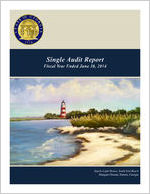
Sapelo Light House, South End Beach Margaret Durant, Darien, Georgia
The artwork on the cover and within this document was created by Georgia artists and has been selected to hang in the Office of the Governor as part of a rotating exhibit "The Art of Georgia". For more information about the exhibit, the artists and their work visit www.gaarts.org.
State of Georgia
NATHAN DEAL, GOVERNOR
Single Audit Report For the Fiscal Year Ended June 30, 2014
Prepared by State Accounting Office and Georgia Department of Audits and Accounts
February 27, 2015
The Honorable Nathan Deal Governor of Georgia
and Members of the General Assembly Citizens of the State of Georgia
We are honored to present the Single Audit Report of the State of Georgia for the fiscal year ended June 30, 2014. Organizational units comprising the State of Georgia reporting entity are listed in Appendix "A" of this report.
Federal laws and regulations require that the State undergo an annual audit in conformity with the Single Audit Act Amendments of 1996 and the U.S. Office of Management and Budget Circular A-l33, Audits of States, Local Governments, and Non-Profit organizations. Accordingly, the Single Audit Report of the State of Georgia discloses the results of the financial operations of the State of Georgia reporting entity, as well as its compliance with requirements applicable to federal financial assistance programs administered by the State.
This report is the culmination of extensive planning, coordination, cooperation, testing and evaluation, and we would like to express our appreciation to all those involved in its preparation and completion. We believe the results of this statewide audit provide valuable information to the State's decision makers and others interested in the activities of the State of Georgia.
Respectfully submitted,
Thomas Alan Skelton, CPA
Greg S. Griffin, CPA
State Accounting Officer
State Auditor
State of Georgia
Table of Contents For the Fiscal Year Ended June 30, 2014
Independent Auditor's Reports
Page No.
Report on Internal Control Over Financial Reporting and on Compliance and Other Matters Based on an Audit of Financial Statements Performed in Accordance With Government Auditing Standards ........................................................................ A-1
Report on Compliance for Each Major Federal Program; Report on Internal Control Over Compliance; and Report on Schedule of Expenditures of Federal Awards Required by OMB Circular A-133 ................................................. B-1
Schedule of Findings and Questioned Costs Section I - Summary of Auditor's Results ................................................................................................. C-3 Section II - Financial Statement Findings.................................................................................................. C-11 Section III - Federal Award Findings and Questioned Costs .................................................................... C-39
Schedule of Expenditures of Federal Awards Schedule of Expenditures of Federal Awards ............................................................................................ D-3 Notes to the Schedule of Expenditures of Federal Awards........................................................................ D-143
Summary Schedule of Prior Year Findings and Questioned Costs Schedule of Prior Year Findings and Questioned Costs ............................................................................ E-3
Appendix "A" Organizational Units Listing of Organizational Units Comprising the State of Georgia Reporting Entity ................................. AP3
Independent Auditor's Reports
Island Life Paula G. Williamson, Savannah, Georgia
GREG S. GRIFFIN
STATE AUDITOR
(404) 656-2174
DEPARTMENT OF AUDITS AND ACCOUNTS
270 Washington Street, S.W., Suite 1-156 Atlanta, Georgia 30334-8400
Report on Internal Control Over Financial Reporting and on Compliance and Other Matters Based on an Audit of Financial Statements Performed in Accordance With Government Auditing Standards
Independent Auditor's Report
The Honorable Nathan Deal, Governor of Georgia and
Members of the General Assembly of the State of Georgia
We have audited in accordance with auditing standards generally accepted in the United States of America and the standards applicable to financial audits contained in Government Auditing Standards issued by the Comptroller General of the United States, the financial statements of the governmental activities, the business-type activities, the aggregate discretely presented component units, each major fund, and the aggregate remaining fund information of the State of Georgia (State) as of and for the year ended June 30, 2014, and the related notes to the financial statements, which collectively comprise the State's basic financial statements, and have issued our report thereon dated December 31, 2014.
Our report includes a reference to other auditors who audited the financial statements of Department of Community Health, Employees' Retirement System of Georgia, Georgia College & State University Foundation, Georgia Environmental Finance Authority, Georgia State Financing and Investment Commission, Georgia Housing and Finance Authority, Kennesaw State University Foundation, Inc., Georgia Lottery Corporation, MCG Health System, Inc., Medical College of Georgia Foundation, Inc., Georgia Ports Authority, Teachers Retirement System of Georgia, Georgia Tech Athletic Association, Georgia Tech Facilities, Inc., Georgia Tech Foundation, Inc., Georgia Tech Research Corporation, University of Georgia Athletic Association, Inc., University of Georgia Foundation, Inc., University of Georgia Research Foundation, Inc. and University System of Georgia Foundation, Inc. as described in our report on the State's basic financial statements. The financial statements of Georgia College & State University Foundation, Kennesaw State University Foundation, Inc., Georgia Lottery Corporation, MCG Health System, Inc., Medical College of Georgia Foundation, Inc., Georgia Tech Athletic Association, Georgia Tech Facilities, Inc., Georgia Tech Foundation, Inc., University of Georgia Athletic Association, Inc., University of Georgia Foundation, Inc., and University System of Georgia Foundation, Inc. were not audited in accordance with Government Auditing Standards, and accordingly, this report does not include reporting on internal control over financial reporting or instances of reportable noncompliance associated with these organizational units of the State. This report includes our consideration of the results of other auditors' testing of internal control over financial reporting and compliance and other matters that are reported on separately by those other auditors. However, this report, insofar as it relates to the results of the other auditors, is based solely on the reports of the other auditors.
Internal Control Over Financial Reporting
In planning and performing our audit of the financial statements, we considered the State's internal control over financial reporting (internal control) to determine the audit procedures that are appropriate in the circumstances for the purpose of expressing our opinions on the financial statements, but not for the purpose of expressing an opinion on the effectiveness of the State's internal control. Accordingly, we do not express an opinion on the effectiveness of the State's internal control.
A deficiency in internal control exists when the design or operation of a control does not allow management or employees, in the normal course of performing their assigned functions, to prevent, or detect and correct, misstatements on a timely basis. A material weakness is a deficiency, or a combination of deficiencies, in internal control such that there is a reasonable possibility that a material misstatement of the entity's financial statements will not be prevented, or detected and corrected, on a timely basis. A significant deficiency is a deficiency, or a combination of deficiencies, in internal control that is less severe than a material weakness, yet important enough to merit attention by those charged with governance.
Our consideration of internal control was for the limited purpose described in the first paragraph of this section and was not designed to identify all deficiencies in internal control that might be material weaknesses or significant deficiencies and therefore, material weaknesses or significant deficiencies may exist that were not identified. Given these limitations, during our audit we and other auditors did not identify any deficiencies in internal control that we consider to be material weaknesses. We and the other auditors did identify certain deficiencies in internal control, described in the accompanying Schedule of Findings and Questioned Costs as findings 2014-054, 2014-055, 2014-056, 2014-057, 2014-058, 2014-059, 2014-060, 2014-061, 2014-062, 2014-063, 2014-064, 2014-065, and 2014-066, that we consider to be significant deficiencies.
Compliance and Other Matters
As part of obtaining reasonable assurance about whether the State's basic financial statements are free from material misstatement, we and other auditors performed tests of its compliance with certain provisions of laws, regulations, contracts, and grant agreements, noncompliance with which could have a direct and material effect on the determination of financial statement amounts. However, providing an opinion on compliance with those provisions was not an objective of our audit, and accordingly, we do not express such an opinion. The results of our tests and those of the other auditors disclosed no instances of noncompliance or other matters that are required to be reported under Government Auditing Standards.
We and other auditors noted certain matters that were reported to management of various organizational units of the State in separate letters.
State's Response to Findings
The State's response to the findings identified in our audit and in the reports of other auditors are described in the accompanying Schedule of Findings and Questioned Costs. The State's response was not subjected to the auditing procedures applied in the audit of the financial statements and, accordingly, we express no opinion on it.
Purpose of this Report
The purpose of this report is solely to describe the scope of our testing of internal control and compliance and the result of that testing, and not to provide an opinion on the effectiveness of the entity's internal control or on compliance. This report is an integral part of an audit performed in accordance with Government Auditing Standards in considering the entity's internal control and compliance. Accordingly, this communication is not suitable for any other purpose.
Respectfully submitted,
December 31, 2014
Greg S. Griffin State Auditor
A-2
GREG S. GRIFFIN
STATE AUDITOR
(404) 656-2174
DEPARTMENT OF AUDITS AND ACCOUNTS
270 Washington Street, S.W., Suite 1-156 Atlanta, Georgia 30334-8400
Report on Compliance for Each Major Federal Program; Report on Internal Control Over Compliance; and Report on Schedule of Expenditures of Federal Awards Required by OMB Circular A-133
Independent Auditor's Report
The Honorable Nathan Deal, Governor of Georgia and
Members of the General Assembly of the State of Georgia
Report on Compliance for Each Major Federal Program
We have audited the State of Georgia's (State's) compliance with the types of compliance requirements described in the OMB Circular A-133 Compliance Supplement that could have a direct and material effect on each of the State's major federal programs for the year ended June 30, 2014. The State's major federal programs are identified in the summary of auditor's results section of the accompanying Schedule of Findings and Questioned Costs.
Management's Responsibility
Management is responsible for compliance with the requirements of laws, regulations, contracts, and grants applicable to its federal programs.
Auditor's Responsibility
Our responsibility is to express an opinion on compliance for each of the State's major federal programs based on our audit of the types of compliance requirements referred to above.
As stated in our report on the basic financial statements, we did not audit the financial statements of Department of Community Health, Employees' Retirement System of Georgia, Georgia College & State University Foundation, Georgia Environmental Finance Authority, Georgia State Financing and Investment Commission, Georgia Housing and Finance Authority, Kennesaw State University Foundation, Inc., Georgia Lottery Corporation, MCG Health System, Inc., Medical College of Georgia Foundation, Inc., Georgia Ports Authority, Teachers Retirement System of Georgia, Georgia Tech Athletic Association, Georgia Tech Facilities, Inc., Georgia Tech Foundation, Inc., Georgia Tech Research Corporation, University of Georgia Athletic Association, Inc., University of Georgia Foundation, Inc., University of Georgia Research Foundation, Inc. and University System of Georgia Foundation, Inc., nor did we audit compliance for the major federal programs or percentages of these federal programs at the organizational units of the State identified in the following table. The financial statements of the above mentioned organizational units and the compliance for the federal programs identified in the following table were audited by other auditors whose reports, including reports on compliance and internal control over compliance, have been furnished to us. This report includes our consideration of the results of other auditors' testing of compliance and internal control over compliance that are reported on separately by those other auditors. However, this report, insofar as it relates to the results of the other auditors, is based solely on the reports of the other auditors.
State of Georgia Organizational Unit
CFDA Number1
Program or Cluster Title
% of Program or Cluster Audited by
Other Auditors
Georgia Housing and Finance Authority
14.239 Home Investment Partnerships Program
100%
Department of Community Affairs
Georgia Environmental Finance Authority
14.HVC 66.CWSR 66.DWSR
Housing Voucher Cluster Clean Water State Revolving Fund
Clu s ter Drinking Water State Revolving Fund
Clu s ter
100% 100% 100%
University of Georgia
84.SFA Student Financial Assistance Cluster
8%
Department of Community Health
93.767 93.791
Children's Health Insurance Program Money Follows the Person Rebalancing
Demo n s tratio n
100% 100%
93.MC Medicaid Cluster
100%
Georgia Institute of Technology
Georgia State University Research Foundation, Inc.
Georgia Tech Research Corporation
R&D Research and Development Cluster
92%
University of Georgia University of Georgia Research
Foundation, Inc.
Percent of the State's Total Expenditures of Federal Awards Audited by Other Auditors
The Medicaid Cluster comprises 32%, the Research and Development Cluster comprises 4%, the Children's Health Insurance program comprises 2%, and the other programs or clusters listed above comprise 1% or less of the State's total expenditures of federal awards.
1 The CFDA Number and Title of programs included within the respective clusters are identified in the Schedule of Expenditures of Federal Awards.
We conducted our audit of compliance in accordance with auditing standards generally accepted in the United States of America; the standards applicable to financial audits contained in Government Auditing Standards, issued by the Comptroller General of the United States; and OMB Circular A-133, Audits of States, Local Governments, and Non-Profit Organizations. Those standards and OMB Circular A-133 require that we plan and perform the audit to obtain reasonable assurance about whether noncompliance with the types of compliance requirements referred to above that could have a direct and material effect on a major federal program occurred. An audit includes examining, on a test basis, evidence about the State's compliance with those requirements and performing such other procedures as we considered necessary in the circumstances.
We believe that our audit provides a reasonable basis for our opinion on compliance for each major federal program. However, our audit does not provide a legal determination of the State's compliance.
Basis for Qualified Opinion on Workforce Investment Act Cluster, Low-Income Home Energy Assistance Program, Housing Voucher Cluster, Community Development Block Grants - State - Administered CDBG Cluster, and Highway Planning and Construction Cluster
As described in findings 2014-007, 2014-011, 2014-012, 2014-013, and 2014-019 in the accompanying Schedule of Findings and Questioned Costs, the State did not comply with requirements regarding the following:
B-2
Finding Numbe r
Compliance Requirement CFDA Number1
Program or Cluster Title
2014-007 Reporting
17.WIA Workforce Investment Act Cluster
2014-011 Subrecipient Monitoring
93.568 Low-Income Home Energy Assistance Program
2014-012 Eligibility
14.HVC Housing Voucher Cluster
2014-013 Reporting
14.CDBG Community Development Block Grants - State Administered CDBG Cluster
2014-019 Subrecipient Monitoring
20.HPCC Highway Planning and Construction Cluster
1 The CFDA Number and Title of programs included within the respective clusters are identified in the Schedule of Expenditures of Federal Awards.
Compliance with such requirements is necessary, in our opinion, for the State to comply with the requirements applicable to those programs.
Qualified Opinion on Workforce Investment Act Cluster, Low-Income Home Energy Assistance Program, Housing Voucher Cluster, Community Development Block Grants - State - Administered CDBG Cluster, and Highway Planning and Construction Cluster
In our opinion, except for the noncompliance described in the Basis for Qualified Opinion paragraph, the State complied, in all material respects, with the types of compliance requirements referred to above that could have a direct and material effect on the Workforce Investment Act Cluster, Low Income Home Energy Assistance Program, Housing Voucher Cluster, Community Development Block Grants, Highway Planning and Construction Cluster for the year ended June 30, 2014.
Unmodified Opinion on Each of the Other Major Federal Programs
In our opinion, based on our audit and the reports of other auditors, the State complied, in all material respects, with the types of compliance requirements referred to above that could have a direct and material effect on each of its other major federal programs identified in the summary of auditor's results section of the accompanying Schedule of Findings and Questioned Costs for the year ended June 30, 2014.
Other Matters
The results of our and other auditors' auditing procedures disclosed other instances of noncompliance, which are required to be reported in accordance with OMB Circular A-133 and which are described in the accompanying Schedule of Findings and Questioned Costs as findings 2014-001, 2014-002, 2014-003, 2014-004, 2014-005, 2014-006, 2014-008, 2014-009, 2014-010, 2014-014, 2014-015, 2014-017, 2014-018, 2014-020, 2014-021, 2014-023, 2014-024, 2014-026, 2014-027, 2014-028, 2014-029, 2014-030, 2014-031, 2014-033, 2014-034, 2014-036, 2014-038, 2014-039, 2014-040, 2014-042, 2014-044, 2014-046, 2014-048, 2014-050, and 2014-053. Our opinion on each major federal program is not modified with respect to these matters.
State's Response to Findings
The State's response to the noncompliance findings identified in our audit and in the reports of other auditors are described in the accompanying Schedule of Findings and Questioned Costs. The State's response was not subjected to the auditing procedures applied in the audit of compliance and, accordingly, we express no opinion on the response.
B-3
Report on Internal Control Over Compliance
Management of the State is responsible for establishing and maintaining effective internal control over compliance with the types of compliance requirements referred to above. In planning and performing our audit of compliance, we considered the State's internal control over compliance with the types of requirements that could have a direct and material effect on each major federal program to determine the auditing procedures that are appropriate in the circumstances for the purpose of expressing an opinion on compliance for each major federal program and to test and report on internal control over compliance in accordance with OMB Circular A-133, but not for the purpose of expressing an opinion on the effectiveness of internal control over compliance. Accordingly, we do not express an opinion on the effectiveness of the State's internal control over compliance.
Our consideration of internal control over compliance was for the limited purpose described in the preceding paragraph and was not designed to identify all deficiencies in internal control over compliance that might be material weaknesses or significant deficiencies and therefore, material weaknesses or significant deficiencies may exist that were not identified. However, as discussed below, we and other auditors identified certain deficiencies in internal control over compliance that we consider to be material weaknesses and significant deficiencies.
A deficiency in internal control over compliance exists when the design or operation of a control over compliance does not allow management or employees, in the normal course of performing their assigned functions, to prevent, or detect and correct, noncompliance with a type of compliance requirement of a federal program on a timely basis. A material weakness in internal control over compliance is a deficiency, or combination of deficiencies, in internal control over compliance, such that there is reasonable possibility that material noncompliance with a type of compliance requirement of a federal program will not be prevented, or detected and corrected, on a timely basis. We and other auditors consider the deficiencies in internal control over compliance described in the accompanying Schedule of Findings and Questioned Costs as findings 2014-006, 2014-007, 2014-011, 2014-013, 2014-018, 2014-019, 2014-035, 2014-036, 2014-047, and 2014-048 to be material weaknesses.
A significant deficiency in internal control over compliance is a deficiency, or a combination of deficiencies, in internal control over compliance with a type of compliance requirement of a federal program that is less severe than a material weakness in internal control over compliance, yet important enough to merit attention by those charged with governance. We and other auditors consider the deficiencies in internal control over compliance described in the accompanying Schedule of Findings and Questioned Costs as findings 2014-001, 2014-002, 2014-003, 2014-004, 2014-005, 2014-008, 2014-009, 2014-010, 2014-014, 2014-015, 2014-016, 2014-017, 2014-020, 2014-021, 2014-022, 2014-023, 2014-024, 2014-025, 2014-026, 2014-027, 2014-028, 2014-029, 2014-030, 2014-031, 2014-032, 2014-033, 2014-034, 2014-037, 2014-038, 2014-039, 2014-040, 2014-041, 2014-042, 2014-043, 2014-044, 2014-045, 2014-046, 2014-049, 2014-050, 2014-051, 2014-052, and 2014-053 to be significant deficiencies.
State's Response to Findings
The State's response to the internal control over compliance findings identified in our audit and in the reports of other auditors are described in the accompanying Schedule of Findings and Questioned Costs. The State's response was not subjected to the auditing procedures applied in the audit of compliance and, accordingly, we express no opinion on the response.
Purpose of This Report
The purpose of this report on internal control over compliance is solely to describe the scope of our testing of internal control over compliance and the results of that testing based on the requirements of OMB Circular A-133. Accordingly, this report is not suitable for any other purpose.
B-4
Report on Schedule of Expenditures of Federal Awards Required by OMB Circular A-133
We have audited the financial statements of the governmental activities, the business-type activities, the aggregate discretely presented component units, each major fund, and the aggregate remaining fund information of the State as of and for the year ended June 30, 2014, and the related notes to the financial statements, which collectively comprise the State's basic financial statements. We issued our report thereon dated December 31, 2014, which contained unmodified opinions on those financial statements. Our audit was conducted for the purpose of forming opinions on the financial statements that collectively comprise the State's basic financial statements. The accompanying Schedule of Expenditures of Federal Awards is presented for purposes of additional analysis as required by OMB Circular A-133 and is not a required part of the basic financial statements. Such information is the responsibility of management and was derived from and relates directly to the underlying accounting and other records used to prepare the basic financial statements. The information has been subjected to the auditing procedures applied by us and other auditors in the audit of the basic financial statements and certain additional procedures, including comparing and reconciling such information directly to the underlying accounting and other records used to prepare the basic financial statements or to the basic financial statements themselves, and other additional procedures in accordance with auditing standards generally accepted in the United State of America. In our opinion, based on our audit, the procedures performed as described above, and the reports of the other auditors, the Schedule of Expenditures of Federal Awards is fairly stated, in all material respects, in relation to the basic financial statements as a whole.
Respectfully submitted,
February 27, 2015
Greg S. Griffin State Auditor
B-5
Schedule of Findings and Questioned Costs
Driftwood Beach Sunrise George Hernandez, Cumming, Georgia
State of Georgia
Schedule of Findings and Questioned Costs Section I - Summary of Auditor's Results For the Fiscal Year Ended June 30, 2014
Financial Statements
Type of auditor's report issued: Governmental Activities; Business-Type Activities; Aggregate Discretely Presented Component Units; Major Governmental Funds: General Fund and General Obligation Bond Projects Fund; Major Enterprise Funds: Higher Education Fund, State Health Benefit Plan and Unemployment Compensation Fund and Aggregate Remaining Fund Information
Unmodified
Internal control over financial reporting:
Significant Deficiencies identified?
Yes
Significant Deficiencies evaluated as Material Weaknesses?
No
Noncompliance material to financial statements noted?
No
Federal Awards
Internal control over major programs:
Significant Deficiencies identified?
Yes
Significant Deficiencies evaluated as Material Weaknesses?
Yes
Type of auditor's report issued on compliance for major programs: Workforce Investment Act Cluster Low-Income Home Energy Assistance Program Housing Voucher Cluster Community Development Block Grants - State-Administered CDBG Cluster Highway Planning and Construction Cluster
Qualified Qualified Qualified Qualified Qualified
All other major programs
Unmodified
Any audit findings disclosed that are required to be reported in accordance with
Circular A-133, Section .510(a)?
Yes
Identification of Major Programs
Federal Grantor
Program or Cluster Title
U.S. Department of Agriculture
Child Nutrition Cluster Supplemental Nutrition Assistance Program Cluster
U.S. Department of Defense
U.S. Department of Housing and Urban
Development
National Guard Military Operations and Maintenance (O&M) Projects
Home Investment Partnerships Program Community Development Block Grants - State - Administered
CDBG Cluster Housing Voucher Cluster
CFDA No.1
12.401 14.239
C-3
State of Georgia
Schedule of Findings and Questioned Costs Section I - Summary of Auditor's Results For the Fiscal Year Ended June 30, 2014
Identification of Major Programs (continued)
Federal Grantor
Program or Cluster Title
CFDA No.1
U.S. Department of Labor
Unemployment Insurance Workforce Investment Act Cluster
17.225
U.S. Department of Transportation
Formula Grants for Rural Areas Highway Planning and Construction Cluster Federal Transit Cluster
20.509
U.S. Environmental Protection Agency
Clean Water State Revolving Fund Cluster Drinking Water State Revolving Fund Cluster
U.S. Department of Education
Title I Grants to Local Educational Agencies State Fiscal Stabilization Fund - Race-to-the-Top
Incentive Grants, Recovery Act Student Financial Assistance Cluster
84.010 84.395
U.S. Department of Health and Human Services
Low-Income Home Energy Assistance Foster Care - Title IV-E Social Services Block Grant Children's Health Insurance Program Money Follows the Person Rebalancing Demonstration Block Grants for Prevention and Treatment of Substance Abuse Temporary Assistance for Needy Families Cluster Medicaid Cluster
93.568 93.658 93.667 93.767 93.791 93.959
U.S. Department of Homeland Security
Homeland Security Grant Program
97.067
Various
Research and Development Cluster
1The CFDA Number and Title of programs included within the respective clusters are identified in the Schedule of Expenditures of Federal Awards.
Dollar threshold used to distinguish between Type A and Type B programs: Auditee Qualified as low-risk auditee?
$30,000,000 No
C-4
State of Georgia
Schedule of Findings and Questioned Costs Section I - Summary of Auditor's Results For the Fiscal Year Ended June 30, 2014
SUMMARY OF FINDINGS AND QUESTIONED COSTS
Financial Statement Findings Reported Under Government Auditing Standards
State Organizational Unit
Statewide
Department of Community Health1
Finding Number 2014-054 2014-055
2014-056
2014-057
Finding Title Controls over Financial Statement Preparation
Restatements of Prior Year Balances
Accounts Payable and Other Accruals Federal Receivables and Cash Management
Internal Control Impact
Significant Deficiency Significant Deficiency
Significant Deficiency
Significant Deficiency
Compliance Impact
None
None
Nonmaterial Noncompliance
Nonmaterial Noncompliance
Page No. C-13 C-15
C-17
C-19
Department of Human Services
2014-058
Insufficient Bank Reconciliation Procedures
Significant Deficiency
Department of Labor 2014-059 Negative Accounts Receivable
Department of Behavioral Health and Developmental
Disabilities
Board of Regents of the University
System of Georgia
2014-060
Inadequate Journal Entry Documentation
2014-061 2014-062
Deficiencies in Controls over Capital Assets
Deficiencies in Controls over Calculation of Benefits Payable
Significant Deficiency
Significant Deficiency
Significant Deficiency Significant Deficiency
Georgia Institute of Technology
2014-063
Inadequate Internal Controls over Research Labs
Significant Deficiency
Clayton State University
2014-064 Inadequate Accounting Controls
Significant Deficiency
Fort Valley State University
2014-065
Deficiencies in Controls over Financial Reporting
Significant Deficiency
Georgia College & State University
2014-066
Deficiencies in Controls over Capital Assets
Significant Deficiency
1 The audit of this organizational unit was performed in whole or in part by other auditors.
Nonmaterial Noncompliance
C-21
None
C-23
Nonmaterial Noncompliance
C-25
None None None None None None
C-27 C-29 C-31 C-33 C-35 C-37
C-5
State of Georgia
Schedule of Findings and Questioned Costs Section I - Summary of Auditor's Results For the Fiscal Year Ended June 30, 2014
SUMMARY OF FINDINGS AND QUESTIONED COSTS Findings Relating to Federal Awards
Federal Grantor
U.S. Department
of Agriculture
State Organizational
Unit
Department of Education
Finding Number
Finding Title
Noncompliance with 2014-001 FFATA Reporting
Requirements
Georgia State University Research
Foundation, Inc.1
Columbus State University
2014-021 2014-022 2014-023
Failure to Comply with Special Contract Terms and Conditions
Weaknesses in Logical Access IT General Controls
Overpayment of Student Financial Assistance
Internal Control Impact
Compliance Impact
Page No.
Significant Deficiency
Nonmaterial Noncompliance
C-41
Significant Nonmaterial C-80 Deficiency Noncompliance
Significant Deficiency
None
C-81
Significant Deficiency
Nonmaterial Noncompliance
C-82
U.S. Department of
Education
Fort Valley State University
2014-024 Return of Title IV Funds
Weaknesses in Logical 2014-025 Access IT General
Controls
2014-026 Excessive Cash Balances
2014-027
Overpayment of Student Financial Assistance
2014-028
Undocumented Cost of Attendance Budgets
Significant Deficiency
Significant Deficiency
Significant Deficiency Significant Deficiency
Significant Deficiency
Nonmaterial Noncompliance
None
Nonmaterial Noncompliance
Nonmaterial Noncompliance
Nonmaterial Noncompliance
C-84 C-86 C-87 C-88 C-90
Georgia Southern University
Savannah State University
Southern Polytechnic State
University
Failure to Comply with 2014-029 Federal Work-Study
Earmarking Requirements
2014-030 Return of Title IV Funds
2014-031 2014-032
Calculation of Title IV Refunds
Weaknesses in Logical Access IT General Controls
2014-033 Return of Title IV Funds
2014-034
Satisfactory Academic Progress Determinations
Significant Deficiency
Significant Deficiency Significant Deficiency
Significant Deficiency
Significant Deficiency
Significant Deficiency
Nonmaterial Noncompliance
Nonmaterial Noncompliance
Nonmaterial Noncompliance
None
Nonmaterial Noncompliance
Nonmaterial Noncompliance
C-91 C-92 C-94 C-95 C-96 C-98
C-6
State of Georgia
Schedule of Findings and Questioned Costs Section I - Summary of Auditor's Results For the Fiscal Year Ended June 30, 2014
SUMMARY OF FINDINGS AND QUESTIONED COSTS Findings Relating to Federal Awards (continued)
Federal Grantor
State Organizational
Unit
Bainbridge State College
Darton State College
Finding Number 2014-035 2014-036
2014-037
2014-038
Finding Title
Ineffective Logical Access Controls
Inadequate Controls over Enrollment Reporting Weaknesses in Logical Access IT General Controls Overpayment of Student Financial Assistance
2014-039 Verification Process
2014-040 Return of Title IV Funds
U.S. Department of
Education (continued)
Middle Georgia State College
South Georgia State College
2014-041 2014-042 2014-043 2014-044
Weaknesses in IT General Controls
Inadequate Control Procedures over Withdrawals
Weaknesses in Logical Access IT General Controls
Return of Title IV Funds
West Georgia Technical College
Columbus Technical College
2014-045 2014-046 2014-047
Weaknesses in Logical Access IT General Controls
Inadequate Control Procedures over Withdrawals
Ineffective Logical Access Controls
2014-048
Overpayment of Student Financial Assistance
Internal Control Impact Material Weakness Material Weakness
Significant Deficiency
Significant Deficiency Significant Deficiency Significant Deficiency Significant Deficiency
Significant Deficiency
Significant Deficiency
Significant Deficiency
Significant Deficiency
Significant Deficiency
Material Weakness
Material Weakness
Compliance Impact
Page No.
None
C-99
Nonmaterial Noncompliance
C-100
None
C-101
Nonmaterial Noncompliance
Nonmaterial Noncompliance
Nonmaterial Noncompliance
C-102 C-104 C-105
None
C-107
Nonmaterial Noncompliance
C-109
None
C-111
Nonmaterial Noncompliance
C-113
None
C-115
Nonmaterial Noncompliance
C-117
None
C-119
Nonmaterial Noncompliance
C-121
C-7
State of Georgia
Schedule of Findings and Questioned Costs Section I - Summary of Auditor's Results For the Fiscal Year Ended June 30, 2014
SUMMARY OF FINDINGS AND QUESTIONED COSTS Findings Relating to Federal Awards (continued)
Federal Grantor
U.S. Department of
Education (continued)
State Organizational
Unit
Lanier Technical College
Central Georgia Technical College
South Georgia Technical College
Finding Number
2014-049
Finding Title
Weaknesses in Logical Access IT General Controls
2014-050 Return of Title IV Funds
2014-051 2014-052
Weaknesses in Logical Access IT General Controls
Weaknesses in Logical Access IT General Controls
2014-053 Return of Title IV Funds
2014-002
Accounts Payable and Other Accruals
2014-003
Federal Receivables and Cash Management
U.S. Department of
Health and Human Services
Department of Community Health1
Department of Human Services
Department of Behavioral Health and Developmental
Disabilities Georgia State University Research Foundation, Inc.1
2014-004 2014-005 2014-006 2014-010 2014-011 2014-014 2014-015 2014-020
Documentation of Medicaid Provider Eligibility
Verification and Documentation of Medicaid Eligibility Surveys to Monitor Facility Compliance with Provider Health and Safety Standards
Noncompliance with FFATA Reporting Requirements
Inadequate Monitoring of Subrecipients
Inadequate FFATA Reporting Process
Inadequate Controls Over Subrecipient Notification of Federal Awards
Required Reports Not Filed or Not Submitted on Time
Internal Control Impact
Significant Deficiency
Significant Deficiency
Significant Deficiency
Significant Deficiency
Significant Deficiency Significant Deficiency
Significant Deficiency
Significant Deficiency
Significant Deficiency
Material Weakness
Significant Deficiency
Material Weakness Significant Deficiency
Significant Deficiency
Significant Deficiency
Compliance Impact
None
Nonmaterial Noncompliance
None
None
Nonmaterial Noncompliance
Nonmaterial Noncompliance
Nonmaterial Noncompliance
Nonmaterial Noncompliance
Nonmaterial Noncompliance
Nonmaterial Noncompliance
Nonmaterial Noncompliance
Material Noncompliance
Nonmaterial Noncompliance
Nonmaterial Noncompliance
Nonmaterial Noncompliance
Page No. C-123 C-124 C-126 C-127 C-129 C-43 C-44 C-45 C-47
C-49
C-57 C-59 C-64 C-66
C-78
C-8
State of Georgia
Schedule of Findings and Questioned Costs Section I - Summary of Auditor's Results For the Fiscal Year Ended June 30, 2014
SUMMARY OF FINDINGS AND QUESTIONED COSTS Findings Relating to Federal Awards (continued)
Federal Grantor
U.S. Department of Homeland
Security
State Organizational
Unit
Finding Number
Finding Title
Office of the Governor
2014-009
FFATA Reports Not Submitted Timely
Internal Control Impact
Significant Deficiency
U.S. Department of Housing and
Urban Development
Department of
Community Affairs1
2014-012
Incorrect Eligibility Determinations
2014-013
Incorrect Financial Data in CAPER Report
None
Material Weakness
U.S. Department of
Labor
Office of the Governor
2014-007 2014-008
Inaccurate Financial Reports
FFATA Subaward Reports Not Submitted
Material Weakness
Significant Deficiency
U.S. Department of Transportation
Department of Transportation
2014-016 2014-017 2014-018 2014-019
Inadequate Documentation of Certified Payroll Reviews
FFATA Reports Not Submitted Timely
Inadequate Internal Control over Special Reporting
Noncompliance with Subrecipient Monitoring Requirements
Significant Deficiency
Significant Deficiency
Material Weakness
Material Weakness
1 The audit of this organizational unit was performed in whole or in part by other auditors.
Compliance Impact
Nonmaterial Noncompliance
Material Noncompliance
Material Noncompliance
Material Noncompliance
Nonmaterial Noncompliance
None
Nonmaterial Noncompliance
Nonmaterial Noncompliance
Material Noncompliance
Page No. C-55
C-61 C-62 C-51 C-53 C-67 C-70 C-73
C-75
C-9
State of Georgia
Schedule of Findings and Questioned Costs Section I - Summary of Auditor's Results For the Fiscal Year Ended June 30, 2014
SUMMARY OF FINDINGS AND QUESTIONED COSTS Summary of Known Questioned Costs
Federal Grantor
State Organizational Unit
Finding Number
Program or Cluster Name
Known1 Questioned
Costs
Columbus State University
2014-023 2014-024
Student Financial Assistance Cluster Student Financial Assistance Cluster
$8,062 $14,559
Fort Valley State University
2014-027 2014-029 2014-030
Student Financial Assistance Cluster Student Financial Assistance Cluster Student Financial Assistance Cluster
$10,143 $8,088 $5,131
Savannah State University
2014-033
Student Financial Assistance Cluster
$13,601
2014-038
Student Financial Assistance Cluster
2,722
U.S. Department of
Education
Darton State College
Middle Georgia State College
South Georgia State College
West Georgia Technical College
Columbus Technical College
Lanier Technical College South Georgia Technical
College
2014-039 2014-040 2014-042
2014-044 2014-046 2014-048 2014-050 2014-053
Student Financial Assistance Cluster Student Financial Assistance Cluster Student Financial Assistance Cluster
Student Financial Assistance Cluster Student Financial Assistance Cluster Student Financial Assistance Cluster Student Financial Assistance Cluster Student Financial Assistance Cluster
$150 $2,974 $204,059
$1,498 $1,192 $7,025
$911 $1,749
Total Known Questioned Costs
$281,864
1 Circular A-133 defines questioned costs as costs that are questioned by the auditor because of an audit finding (1) that resulted from a violation or possible violation of a provision of a law, regulation, contract, grant, cooperative agreement, or other agreement or document governing the use of federal funds; (2) for which the costs, at the time of the audit, are not supported by adequate documentation; or (3) for which the costs incurred appear unreasonable and do not reflect the actions that a prudent person would take in the circumstances.
The findings above also describe any likely questioned costs in the accompanying Schedule of Findings and Questioned Costs. When evaluating the effect of questioned costs on the opinion on compliance, both known questioned costs and the best estimate of total costs questioned (likely questioned costs) are considered.
C-10
State of Georgia
Schedule of Findings and Questioned Costs Section II - Financial Statement Findings For the Fiscal Year Ended June 30, 2014
TABLE OF CONTENTS
ENTITY NUMBER1 STATE ORGANIZATIONAL UNIT
PAGE NUMBER
Statewide.......................................................................................................................... C-13
419
Department of Community Health ................................................................................... C-17
427
Department of Human Services......................................................................................... C-21
440
Department of Labor......................................................................................................... C-23
441
Department of Behavioral Health and Developmental Disabilities .................................... C-25
472
Board of Regents of the University System of Georgia...................................................... C-27
Colleges, Universities and Foundations
503
Georgia Institute of Technology ................................................................................... C-31
528
Clayton State University .............................................................................................. C-33
533
Fort Valley State University ......................................................................................... C-35
536
Georgia College & State University ............................................................................. C-37
This section presents findings related to the financial statements, including material weaknesses or significant deficiencies in internal control over financial reporting and noncompliance and other matters that are required to be reported in accordance with Government Auditing Standards. Financial statement findings are presented by State organizational unit and control category.
1The entity number represents the control number that was assigned to each organizational unit of the State Reporting Entity.
C-11
State of Georgia
Schedule of Findings and Questioned Costs Section II - Financial Statement Findings For the Fiscal Year Ended June 30, 2014
STATEWIDE FINDINGS
2014-054 Controls over Financial Statement Preparation
Control Category:
Internal Control Impact: Compliance Impact:
Accounting Controls (Overall) General Ledger Cash, Investments and Investment Related Activity Revenues and Receivables Expenses/Expenditures and Liabilities Equity and Financial Statement Reconciliation Financial Reporting and Disclosure Significant Deficiency None
The State Accounting Office (SAO) does not have adequate internal controls to prevent and detect errors in the financial information used to compile the financial statements, including note disclosures.
Criteria: SAO management is responsible for the preparation of the State's financial statements in accordance with generally accepted accounting principles (GAAP), as well as maintaining the policies and procedures regarding the financial accounting system (TeamWorks). SAO's internal controls over GAAP financial reporting should include policies and procedures to ensure information is obtained and communicated as part of the year-end reporting process. Internal controls should also include procedures to properly record transactions in TeamWorks.
Condition: Preparation of the Comprehensive Annual Financial Report (CAFR) involves obtaining year-end GAAP packages from entities included in the State reporting entity which are used to post journal entries. This practice, combined with the many sources of information and the extent of modification necessary to such information, results in a financial reporting process that continues to be highly complex and manual in nature, and therefore, susceptible to errors and delays. SAO and other State entities do not have adequate controls to prevent and detect errors in the financial information used to compile the financial statements. SAO is responsible for the statewide Accounting Policy Manual. Many sections have been developed and implemented; however, there are still areas that remain unaddressed.
During our review of the State's financial statements prepared by SAO, the following items were noted:
SAO does not have adequate year-end processes in place to ensure accurate financial reporting of accounts payable and receivable accruals. We examined documentation for expenditures charged subsequent to June 30, 2014 and noted 180 vouchers totaling $18.1 million that should have been recorded as obligations for fiscal year 2014. In addition, entries are not recorded to accrue receivables and the related allowance for uncollectibles at year-end resulting in the probability that accounts receivable, fund balance/net position, and revenues are misstated.
The Department of Transportation inaccurately recorded certain cash receipts and disbursements between opinion units. An adjustment of $284.2 million was proposed and recorded.
Interagency receivables and payables were misstated and improperly recorded in the financial statements. An adjustment of $24.6 million was proposed but not recorded.
C-13
State of Georgia
Schedule of Findings and Questioned Costs Section II - Financial Statement Findings For the Fiscal Year Ended June 30, 2014
The Endowment Note was incomplete and missing required disclosures. Our review revealed that the following required disclosures were missing: the amounts of net appreciation on investments of donor-restricted endowments that are available for authorization for expenditure, and how those amounts are reported in net position; the state law regarding the ability to spend net appreciation; and the policy for authorizing and spending investment income, such as a spending-rate or total-return policy. Certain details for significant entities were added to the note for Georgia Institute of Technology and the University of Georgia in the amounts of $7.3 million and $7.8 million, respectively.
Cause: SAO's review process did not include obtaining all relevant, significant information from each entity within the State reporting entity to ensure that all significant information was included in the financial statements and the required note disclosures. The timing and complexity in nature of the preparation process does not allow adequate time for analysis and review before submission to auditors and does not lend itself to complete, accurate financial statements.
Effect or Potential Effect: In the preparation of the CAFR, SAO may not prevent or detect financial statement misstatements and disclosure omissions in a timely manner. For the current year, multiple significant adjustments were needed and other misstatements were noted for the financial statements.
Recommendation: We recommend SAO, as part of internal control over the preparation of financial statements, enhance comprehensive preparation procedures to ensure that the financial statements are complete and accurate. The procedures should include requesting additional information from all entities as part of the year-end reporting packages to ensure completeness and accuracy of the financial statements and developing streamlined procedures that will require fewer manual processes. In addition, SAO should strengthen, complete and more fully develop the State's Accounting Policy Manual.
Views of Responsible Officials and Corrective Action Plans: SAO management agrees that our internal controls can be enhanced. More specifically, management intends to implement the following changes in the FY2015 reporting cycle to address specific items in this finding:
Create a new year-end form to collect information on unrecorded assets and liabilities.
Update year-end checklists to ensure the interagency receivable/payable item is addressed, and add steps to review unusual negative balances.
SAO will continue to hold semi-weekly CAFR training for its staff. Management will broaden the topics covered in these training sessions to include addressing areas of concern identified in this finding.
SAO will revisit the current plan for updating to the Accounting Policy Manual.
Implementation Date: December 31, 2015
Contact Person: Kris Martins, Director Statewide Accounting & Reporting Telephone: 404-463-1528; E-mail: kmartins@sao.ga.gov
C-14
State of Georgia
Schedule of Findings and Questioned Costs Section II - Financial Statement Findings For the Fiscal Year Ended June 30, 2014
2014-055 Restatements of Prior Year Balances
Control Category:
Internal Control Impact: Compliance Impact:
General Ledger Capital Assets Expenses/Expenditures and Liabilities Equity and Financial Statement Reconciliation Financial Reporting and Disclosure Significant Deficiency None
The State Accounting Office (SAO) reported several prior period adjustments totaling $856.2 million to correct prior year errors.
Criteria: The State is required to maintain a system of controls over the preparation of financial statements in accordance with generally accepted accounting principles (GAAP). State internal controls over GAAP financial reporting should include adequately trained personnel with the knowledge, skills and experience to prepare GAAP-based financial statements and include all disclosures as required by the Governmental Accounting Standards Board (GASB). In addition, internal controls over financial reporting should be designed to allow management or employees, in the normal course of performing their assigned functions, to prevent, or detect and correct, misstatements of the financial statements on a timely basis.
Condition: SAO identified and recorded several prior period adjustments to the State's financial statements. The need to adjust prior period financial statements shows that the prior period's financial reporting process had some deficiencies, which increased the risk that the current period's process could allow similar errors to occur without detection. We adjusted our audit procedures to address this increased risk and highlighted the prior period adjustments in our audit opinion.
The prior period adjustments corrected the following errors in prior year financial statements:
SAO reduced by $733.8 million the amount it had previously reported for construction in progress balances to remove an estimate of net capital assets at various entities relating to the implementation of GASB 34.
The remaining adjustments were recognized by State reporting entities primarily related to capital lease liabilities and capital assets.
Cause: In discussions with management, the significant restatement to construction in progress balances occurred due to the lack of sufficient documentation regarding the initial entry. Restatements by other reporting entities resulted from errors and adjustments discovered during the preparation of the current year financial statements.
Effect or Potential Effect: The need for prior period adjustments can raise uncertainties as to the reliability of the State's financial information being presented.
Recommendation: We recommend that SAO and other State entities strengthen their internal controls by conducting sufficient reviews of financial data or transactions that resulted in prior period adjustments to ensure the State prepares accurate financial statements for the current reporting period.
C-15
State of Georgia
Schedule of Findings and Questioned Costs Section II - Financial Statement Findings For the Fiscal Year Ended June 30, 2014
Views of Responsible Officials and Corrective Action Plans: SAO believes the adjustment recorded in FY2014 related to the construction in progress balances was an isolated incident. SAO places a high value on our review processes to ensure our financial statements are not materially misstated. In 2014, SAO placed additional emphasis on accurate preparation and review of CAFR conversion entries, and it was during this process that this item was discovered. For the remaining adjustments, as data from State organizations is the primary source of CAFR data, SAO will work with State organizations to ensure they are aware of the importance of providing accurate and timely information on their year-end forms packages. SAO will also consider providing additional communications and/or training to State organizations as needed for a particular form or area of concern that has historically caused recurring restatements. Implementation Date: December 31, 2015 Contact Person: Kris Martins, Director Statewide Accounting & Reporting Telephone: 404-463-1528; E-mail: kmartins@sao.ga.gov
C-16
State of Georgia
Schedule of Findings and Questioned Costs Section II - Financial Statement Findings For the Fiscal Year Ended June 30, 2014
DEPARTMENT OF COMMUNITY HEALTH1
2014-056 Accounts Payable and Other Accruals
Control Category: Internal Control Impact: Compliance Impact:
Expenses/Expenditures and Liabilities Significant Deficiency Nonmaterial Noncompliance
Criteria: The Department of Community Health's management is responsible for ensuring costs associated with payment obligations are recorded promptly when incurred, and reported accurately in the financial statements as well as in the schedule of expenditures of federal awards. An account payable exists when the Department of Community Health has benefited from the delivery of goods or services and the related obligation remains unsatisfied.
Condition: Management of the Department of Community Health provided us with a detail listing of liabilities supporting the accounts payable and other accruals reported by the Department of Community Health at June 30, 2014. As a result of our audit procedures, we identified certain obligations which were not included within the detail and therefore excluded from the reported balances of the Department of Community Health at year end.
Cause: The Department of Community Health did not adequately evaluate amounts paid in the months of September through October of 2014 to determine if they properly recorded a liability for the delivery of goods or services during fiscal year 2014. This appears to have occurred primarily due to miscommunication as to the scope of the requested detail.
Effect or Potential Effect: An adjustment of approximately $23.7 million was required to properly state accounts payable and other accruals as well as the related expense.
Recommendation: In an effort to ensure the Department of Community Health's reported obligations are always accurately stated, we recommend management implement a process which includes a system of controls intended to capture relevant information as to when an obligation has been incurred and when such an obligation has been satisfied via payment. The intended purpose of such controls is to identify liabilities which should be reflected in the Department of Community Health's accounts payable and other accruals. Additionally, we recommend the Department of Community Health establish written closing processes and provide training to employees that reinforces its accrual policies in order to ensure that liabilities are properly identified and recorded at the point of incurring the obligation.
Views of Responsible Officials and Corrective Action Plans: The Department of Community Health concurs with this finding.
The Department of Community Health acknowledges the deficiencies identified in promptly recording payments and accurately reporting obligations in the financial statements. The Department of Community Health will focus on the following areas to ensure this from reoccurring:
Review all invoices when received for the date services or goods were rendered.
1 The audit of this organizational unit was performed by other auditors.
C-17
State of Georgia
Schedule of Findings and Questioned Costs Section II - Financial Statement Findings For the Fiscal Year Ended June 30, 2014
Develop and implement procedures for supplying accrual information to the Federal Reporting Staff (FRS), to include notifying FRS when invoice is initially received.
Develop and implement procedures for year-end close to identify and properly record all relevant payment obligations, subsequent payments and all liabilities that should be included in accruals.
Provide training Contracts and Accounts Payable staff involved in the yearend close/accrual period on the financial statement preparation process as it relates to their respective area.
Review open encumbrances and communicate with the program areas to ensure the accurate and timely recording of obligations.
Place updated procedures in a centrally and easily accessible location for everyone's use.
C-18
State of Georgia
Schedule of Findings and Questioned Costs Section II - Financial Statement Findings For the Fiscal Year Ended June 30, 2014
2014-057 Federal Receivables and Cash Management
Control Category: Internal Control Impact: Compliance Impact:
Revenues and Receivables Significant Deficiency Nonmaterial Noncompliance
Criteria: The Department of Community Health's management is responsible for ensuring that receivables from the federal government and unearned federal award amounts are reported accurately in the financial statements and properly reconciled to supporting documentation.
Condition: Management of the Department of Community Health provided us with a reconciliation of federal receivables as initially reported in the June 30, 2014 financial statements. As a result of our audit procedures, we identified adjustments which needed to be made to the reconciliation, as well as adjustments necessary to properly state the June 30, 2014 reported balances.
Cause: Historically, management has not always drawn funds from federal grant awards based directly upon expenditures incurred. Over the course of several years, management of the Department of Community Health overdrew funds available from the Medicaid Administration portion of federal grant awards. While the Department of Community Health had adequate expenditures under the Medicaid Program Services (Benefits) portion of the federal award, the Centers for Medicaid and Medicare Services (CMS) does not allow funds drawn from the Medicaid Administration portion of the Department of Community Health's federal grant awards to be used to satisfy expenditures related to the Medicaid Program Services (Benefits) portion of its federal grant awards. The amount of overdrawn federal funds approximated $23 million and was not reflected in the Department of Community Health's federal unearned revenue.
Effect or Potential Effect: An adjustment of approximately $23 million was required to properly increase receivables and increase the Department of Community Health's federal unearned revenue. Additionally as a result of our procedures, an error in the financial statement journal entries was identified and management was required to reverse the entry in order to accurately state the Department of Community Health's federal receivable.
Management was able to reconcile, within an immaterial difference, the federal receivable balance reported in the Department of Community Health's financial statements; however, the Medicaid Program Services (Benefits) and Medicaid Administration funding sources within the reconciliation had variances of approximately ($13 million) and $17 million, respectively.
Recommendation: We understand management has now implemented procedures which base the drawdown request on federal funds directly to expenditures incurred. We further understand management has engaged an outside party to assist with the investigation and reconciliation of certain amounts historically drawn down from and applicable to federal awards. In addition to these measures, we recommend management:
Regularly reconcile federal draws and the related general ledger balances throughout the year and timely investigate and resolve any variances between funding source draws and the supporting expenditures (Medicaid Program Services and Medicaid Administration) identified during these reconciliations;
C-19
State of Georgia
Schedule of Findings and Questioned Costs Section II - Financial Statement Findings For the Fiscal Year Ended June 30, 2014
Closely monitor federal draws during the year for potential overdrawn funds in certain categories of expenditures. If any such variances are identified, management should consider whether any adjustments are needed to properly state the general ledger balances;
Implement a process which includes a careful review by an individual outside of the reconciliation process. The reviewer should carefully consider each component of the reconciliation to determine its reasonableness; and,
Establish written procedures documenting the reconciliation process and provide training to new employees performing this reconciliation. Such training should include an explanation of not only the procedures to be performed in the reconciliation, but the rationale for the inclusion or exclusion of certain items in the reconciliation.
Views of Responsible Officials and Corrective Action Plans: The Department of Community Health concurs with this finding. The Department of Community Health acknowledges that there have been deficiencies in the process of reconciling the receivables from the federal government and the following actions will be taken to improve the reconciliation process for the federal receivable account:
The Federal draws are currently reconciled on a weekly, monthly, and quarterly basis for the general ledger cash accounts and expense accounts. Any discrepancies between the expenditures from the general ledger and the amounts drawn by funding sources are addressed with the reconciliations. Beginning with FY2015, the receivables from the federal government will be reconciled and monitored on a monthly basis.
Reconciliations will be completed on a quarterly basis to identify any overdrawn or underdrawn expenditures. Reconciliations will occur to analyze the expenditures reported on the CMS 64 report to the actual expenditures drawn.
Management will review the federal receivable reconciliations on a monthly basis and will meet to discuss the reconciling items. Management will determine if any adjustments are needed to accurately state the general ledger balances.
The Department of Community Health will implement the policies and procedures for the federal reconciliations by December 31, 2014. The policies and procedures will be communicated to all financial services staff, and training will be provided to ensure that all staff understands the transaction flow for the federal receivable general ledger accounts.
C-20
State of Georgia
Schedule of Findings and Questioned Costs Section II - Financial Statement Findings For the Fiscal Year Ended June 30, 2014
DEPARTMENT OF HUMAN SERVICES
2014-058 Insufficient Bank Reconciliation Procedures
Control Category: Internal Control Impact: Compliance Impact: Repeat of Prior Year Findings:
Cash, Investments and Investment Related Activity Significant Deficiency Nonmaterial Noncompliance FS-427-13-04, FS-427-12-08
The Department of Human Services (Department) did not adequately reconcile various bank accounts.
Criteria: Under the statutory requirements of the State, the Department is responsible for establishing and maintaining internal control designed to provide reasonable assurance of compliance with applicable laws and regulations and statewide policies and procedures.
The statewide Bank Reconciliation Policy (CM-100008) and Check Escheatment Policy (CM-100006) establish requirements for performing bank reconciliations and escheating checks. The Bank Reconciliation Policy requires the Department to perform monthly reconciliations for all bank accounts and to investigate book reconciling items and record adjusting book entries within the same month bank reconciliations are completed. The policy also requires all cash related transactions to be recorded by fiscal year end. The Check Escheatment Policy requires the Department to escheat all stale dated checks over 180 days by entering a manual adjusting entry to debit the appropriate cash account and credit the Funds Held for Others - Checks Uncashed/Unclaimed liability account (262002).
Condition: As part of our review of the bank reconciliation process, we followed up on the Department's efforts to implement their corrective action plans for prior year findings FS-427-13-04 and FS-427-12-08. In these prior year findings, we reported that the Department did not adequately reconcile its bank accounts. In response to our recommendations to improve internal control over the bank reconciliation process, the Department developed new policies and procedures to provide detailed guidance on performing, documenting and reviewing monthly bank reconciliations. These new policies and procedures also require monthly meetings between Bank Reconciliation staff and Office of Financial Services staff to improve communication and timely resolution of book reconciling items.
Implementation of the new bank reconciliation policies and procedures began with the Operating account in May 2014. Full implementation of the policies and procedures on all other accounts did not occur until fiscal year (FY) 2015. Consequently, we continued to identify instances where bank accounts were not adequately reconciled during FY 2014.
We reviewed the bank reconciliations and supporting documentation, including bank statements, outstanding checklists, cash receipts and disbursements journals and general ledger reports, for the following accounts: Operating, Child Support Recovery (New), Payroll, Vital Records Refund, Public Assistance, Child Support Recovery (Old), Revenue Collections, WIC, Decentralized Trust Funds, and Vocational Rehabilitation. Our review revealed that the Department had not posted adjusting entries as of the fiscal year end for book reconciling items totaling $11,986,537 (for all accounts combined). The book reconciling items on the June 2014 bank reconciliations dated as far back as September 2009.
In addition, our review of the outstanding checklists revealed that the Department was not up to date on posting book entries to escheat stale dated checks over 180 days. The outstanding checklists for June 2014 included 11,448 checks, totaling to $1,564,495 (for all accounts combined), that were outstanding for more than 180 days. We did note, however, that the Department recorded a manual adjusting entry during the month of June to move over 1,600
C-21
State of Georgia
Schedule of Findings and Questioned Costs Section II - Financial Statement Findings For the Fiscal Year Ended June 30, 2014
uncashed checks over 180 days from the Operating account to the Funds Held for Others - Checks Uncashed/ Unclaimed liability account. Cause: The Department did not have sufficient bank reconciliation procedures in place during FY 2014. As previously discussed in the condition, the Department's corrective action plans were not fully implemented until FY 2015. In addition, the Department indicated that past staff turnover contributed to the buildup of old book reconciling items. Effect or Potential Effect: Insufficient bank reconciliation procedures increase the risk of misstatements in the financial statements, including misstatements due to fraud, and possible misappropriation of assets. Recommendation: We recommend the Department continue its efforts to improve internal control over the bank reconciliation process, make adjusting book entries to correct all outstanding book reconciling items, and escheat checks within the required timeframe. We also recommend the Department continue to monitor the performance and results of its new bank reconciliation procedures to ensure that they are operating effectively and being followed and documented by staff. Views of Responsible Officials and Corrective Action Plans: We concur with the finding. DHS has established a process to complete bank reconciliations and address current outstanding reconciling items in compliance with state policy. The on-going challenge continues to be the extensive research required to resolve and clear historical reconciling items. DHS will continue its efforts to research and cleanup historical reconciling items. As with bank reconciliations, a process is now in place to escheat checks outstanding for 180 days in compliance with State policy. The on-going challenge continues to be completing the process required to escheat checks outstanding from our historical outstanding items. Estimated Completion Date: December 31, 2014 Contact Person: Bill Zisek, Director, Office of Financial Services Telephone: 404-657-5605; E-mail: bill.zisek@dhs.ga.gov
C-22
State of Georgia
Schedule of Findings and Questioned Costs Section II - Financial Statement Findings For the Fiscal Year Ended June 30, 2014
DEPARTMENT OF LABOR
2014-059 Negative Accounts Receivable
Control Category:
Internal Control Impact: Compliance Impact: Repeat of Prior Year Finding:
Expenses/Expenditures and Liabilities Financial Reporting and Disclosure Equity and Financial Statement Reconciliations Significant Deficiency None FS-440-13-01
Negative accounts receivable shown on the general ledger of the Department of Labor (DOL) were incorrectly shown as deferred revenue on DOL's financial statements for fiscal year (FY) 2014.
Criteria: According to generally accepted accounting principles (GAAP), deferred revenue result from receiving money for goods or services which have not yet been delivered. According to the GAAP's principles for revenue recognition, deferred revenue should be recorded as a liability until the goods or services are delivered, at which time it is converted into revenue.
The State of Georgia Accounting Procedures Manual defines deferred revenue as federal and other revenues received in advance of being earned.
Condition: Negative accounts receivable balances of $6,186,508.92 were shown on DOL's financial statements for FY 2014 as deferred revenues. In addition, while revenues and expenditures of DOL were correct in total, amounts by program were misstated.
Cause: DOL records certain rental and other maintenance costs, technology costs, and printing costs in special allocation general ledger accounts and then allocates these costs to the applicable fund ledgers. After these intra-departmental cost allocations were made, reductions were made to the expenditures recorded in the special allocation accounts, which resulted in negative expenditure balances. These negative balances were not allocated to the applicable fund ledgers.
DOL then applied its standard revenue recognition process, which records revenues based on expenditures incurred. Because there were negative expenditures in the allocation ledgers, negative revenues and negative accounts receivable were recorded. DOL then classified the negative accounts receivable as deferred revenue on its FY 2014 financial statements.
Effect or Potential Effect: Because costs were not recorded, adjusted, and allocated correctly, deferred revenues were overstated on the FY 2014 financial statements.
Recommendation: We recommend DOL improve its internal controls over cost recording, adjusting, and allocating to ensure that costs are correctly recorded before allocation and that any necessary adjustments to costs are properly allocated. DOL should improve controls over its revenue recognition process to ensure that revenues are accrued and accounts receivable are recorded only in fund ledgers where revenues and expenditures should be recorded. In addition,
C-23
State of Georgia
Schedule of Findings and Questioned Costs Section II - Financial Statement Findings For the Fiscal Year Ended June 30, 2014
DOL should improve its controls over financial statement preparation to ensure that intra-departmental transactions are properly recorded and that financial statement balances are accurate. Views of Responsible Officials and Corrective Action Plans: We concur with the finding. The Department has implemented procedures to ensure that revenues are accrued and receivables recorded only in fund ledgers where revenues and expenditures are reported. In Fiscal year 2014, the Department was able to reduce this balance by 36%. Our plan was to fully eliminate this balance however critical team members and subject matter experts have been dedicated to the transition of the financial system to TeamWorks which has greatly limited our available human resources. Consequently, the department plans to reduce the balance of these accounts to zero by the close of federal fiscal year 2015. Estimated Completion Date: September 30, 2015 Contact Person: John Williams, Accounting Director Telephone: (404) 232-3577; E-mail: john.williams@gdol.ga.gov
C-24
State of Georgia
Schedule of Findings and Questioned Costs Section II - Financial Statement Findings For the Fiscal Year Ended June 30, 2014
DEPARTMENT OF BEHAVIORAL HEALTH AND DEVELOPMENTAL DISABILITIES
2014-060 Journal Entry Documentation and Subrecipient Monitoring
Control Category:
Internal Control Impact: Compliance Impact:
Accounting Controls (Overall) Expenses/Expenditures and Liabilities Significant Deficiency Nonmaterial Noncompliance
The Department of Behavioral Health and Developmental Disabilities (Department) made adjusting journal entries that could not be reconciled to the source documentation supporting the original transactions. Additionally, these journal entries resulted in noncompliance with certain Subrecipient Monitoring requirements.
Criteria: Under the statutory requirements of the State, the Department is responsible for establishing and maintaining internal control designed to provide reasonable assurance of compliance with applicable laws and regulations and statewide policies and procedures.
A joint policy on Journal Entry Documentation was issued by the Office of Planning and Budget and the State Accounting Office, policy number 4-8-1. This policy requires documentation to be maintained for all adjustments posted during a fiscal year (especially as a part of year-end closing procedures) that allows for the verification of the adjusted transaction to the source documentation supporting the original transaction. The documentation should include, but is not limited to, analysis identifying original deposit ID's, purchase orders, voucher ID's or other relevant identifying reference information and justification for the adjusting journal entry.
Further, the State's Accounting Policy Manual prescribes documentation requirements for all transactions. Under these requirements, transactions must be supported by documentation that is complete and accurate and must allow a transaction to be traced from the source documentation, through its processing, to the financial reports. These requirements apply to transactions entered directly into an accounting system, as well as those initially entered and processed in an organization subsystem that are transmitted through an automated interface. All documentation is required to be readily available for examination.
Condition: During our examination of documentation maintained by the Department for 54 journal entries, we found seven journal entries with inadequate documentation. These journal entries rerated a total of $30.8 million in expenditures between fund sources on the general ledger. While the documentation for each of the seven journal entries provided detail of expenditure transactions that were eligible to be rerated, the total for these transactions did not agree with the journal entry total. Consequently, the Department could not identify which specific transactions were being adjusted.
Additionally, we found that the Department did not notify its subrecipients of federal award information when adjusting journal entries were made that changed the funding source of their contacts from State to federal. During our examination, we identified a total of $9.3 million in State funded contract expenditures that were reallocated via journal entry to fund sources designated for the Social Service Block Grant (SSBG) program. Under these contracts, funds were passed through to subrecipients that provided social services to State residents.
As the pass-through entity, the Department is required to inform subrecipients of the federal award information (i.e., CFDA title and number; award name and number; and name of federal awarding agency) and applicable compliance requirements. The Department is also required to report the amount of federal funds passed through to
C-25
State of Georgia
Schedule of Findings and Questioned Costs Section II - Financial Statement Findings For the Fiscal Year Ended June 30, 2014
subrecipients in its Schedule of Expenditures of Federal Awards (SEFA). We found that the Department did not comply with these requirements when it reallocated contract expenditures between State and federal fund sources.
Cause: The Department did not fully adhere to its existing internal control procedures when documenting adjusting journal entries that reallocated expenditures between fund sources. In addition, the Department did not have policies and procedures in place to notify subrecipients of changes to the funding source of their contracts, including all applicable federal award information and compliance requirements, and to ensure that all federal funds passed through to subrecipients were reported in the SEFA.
Effect or Potential Effect: Inadequate journal entry documentation makes following transactions through the accounting system much more difficult and could increase the risk of fraud or material errors going undetected. Additionally, changing the funding source of contracts through journal entries without properly notifying subrecipients may result in federal funds being expended for unallowable purposes and subrecipients not properly administering federal programs and reporting all federal expenditures in their SEFA.
Recommendation: We recommend the Department improve controls over adjusting journal entries to ensure that adequate documentation is provided for each journal entry, including the original source documentation of each entry. Details and totals on supporting documentation must agree with the amounts on the journal entry. The Department should also establish procedures to limit the use of journal entries. Situations where adjusting journal entries are appropriate are to correct errors that are unusual in nature or to record transactions that cannot be recorded through other normal processing cycles.
Furthermore, we recommend the Department implement policies and procedures to ensure subrecipients are properly notified of any changes to their contracts and all applicable federal award information and compliance requirements. The Department should also review its procedures for reporting federal expenditures, and make changes, as needed, to ensure that all amounts passed-through to subrecipients are properly reported in the SEFA.
Views of Responsible Officials and Corrective Action Plans: The Department concurs with the audit finding. However, the Department believes that adequate controls are in place to ensure that the entire population of transactions from which the sampled transactions were selected, were in compliance with federal requirements, therefore mitigating the need to identify specific transactions to ensure compliance.
The Department will develop new procedures and practices which will allow us to identify, at the transaction level, those expenditures which have been re-rated through the use of adjusting journal entries, from state to federal funding.
The Department will develop policies, procedures and practices to address the federal and sub-recipient requirements when contract obligations/expenditures are reallocated from state to federal fund sources via adjusting journal entry.
Estimated Completion Date: June 30, 2015
Contact Person: Robert Dorr, CAE Telephone: 404-232-1637; E-mail: Robert.Dorr@dbhdd.ga.gov
C-26
State of Georgia
Schedule of Findings and Questioned Costs Section II - Financial Statement Findings For the Fiscal Year Ended June 30, 2014
BOARD OF REGENTS OF THE UNIVERSITY SYSTEM OF GEORGIA
2014-061 Deficiencies in Controls over Capital Assets
Control Category:
Internal Control Impact: Compliance Impact:
Capital Assets Financial Reporting and Disclosure Significant Deficiency None
Capital asset activity recorded by the University System Office contained significant errors and omissions.
Criteria: The Board of Regents' Business Procedures Manual Section 11.4 Mandatory Physical Equipment Inventory Requirements states in part, "All institutions within the University System of Georgia must conduct a mandatory physical equipment inventory annually. The results of this inventory will be updated into the equipment inventory systems utilized by the institution to satisfy state reporting requirements."
The University System Office should also maintain capital asset records in accordance with capitalization guidelines and instructions provided in Section 7 of the Board of Regents' Business Procedures Manual.
Further, a system of internal control over financial reporting does not stop at the general ledger. Management is responsible for implementing a system of internal control over the preparation of financial statements prepared in accordance with generally accepted accounting principles (GAAP).
Condition: The following deficiencies were noted during our review of capital assets and GAAP basis financial statements:
1. The University System of Georgia did not perform a complete physical inventory of equipment items during the fiscal year. A sample of 27 equipment items revealed the following deficiencies:
a. The asset location was not properly updated within the accounting system for 15 items.
b. Two items could not be located.
c. The asset tag was not properly attached to one item located during the sample.
2. A review of current year capital asset activity revealed that an administrative review and approval was not performed over several post-closing adjustments related to capital asset activity, which resulted in the following errors.
a. Proceeds from the sale of capital assets were inappropriately netted with purchases of capital assets on the Statement of Cash Flows in the amount of $2,113,650.
b. Georgia State Financing and Investment Commission activity of $124,849 was inappropriately included as purchases of capital assets on the Statement of Cash Flows.
c. Net capital assets of $2,945,607 were reported as current year additions. However, these items should have been recorded as capital assets in the prior year.
d. The University System Office made an adjustment of $2,461,068 in error which netted additions and deletions reported in Note 6 of the Notes to the Financial Statements.
C-27
State of Georgia
Schedule of Findings and Questioned Costs Section II - Financial Statement Findings For the Fiscal Year Ended June 30, 2014
Cause: In discussing these issues with University System Office management, deficiencies related to the physical inventory of equipment occurred as a result of turnover of personnel within Business Services. Errors related to post-closing adjusting entries, cash flows, and cut-off and completeness of activity were attributable to deficiencies in the design of the financial statement preparation process. Controls were not designed appropriately to ensure that the financial statements and post-closing adjusting entries were review by someone other than the preparer. Effect or Potential Effect: Failure to accurately record, maintain and monitor capital assets could result in potential misappropriation of assets. In addition, misrepresentation of the University System Office's financial position, results of operations and cash flows could occur. Recommendation: The University System Office should review the accounting controls and procedures currently in place, identify weaknesses, and design and implement procedures necessary to strengthen controls over the preparation of the financial statements and maintenance of capital asset records. This should include, but not be limited to, a physical inventory of equipment performed annually and an administrative review and approval of the financial statements and post-closing adjusting entries. Views of Responsible Officials and Corrective Action Plans: We concur with this finding. The University System Office acknowledges that sufficient controls and procedures were not in place for the preparation of the annual financial statements as related to capital assets due to transitions in personnel and related duties. The University System Office is currently reviewing and reassigning job duties to ensure that capital asset activity including additions, retirements and transfers are properly reflected on the financial statements. The University System Office is also researching methods to gain efficiencies in maintenance and performance of equipment inventory to ensure that annual physical equipment inventory is performed in a timely manner. Contact Person: Kristi Fuss, Controller Telephone: (404) 962-3224; E-mail: Kristi.Fuss@usg.edu
C-28
State of Georgia
Schedule of Findings and Questioned Costs Section II - Financial Statement Findings For the Fiscal Year Ended June 30, 2014
2014-062 Deficiencies in Controls over Calculation of Benefits Payable
Control Category: Internal Control Impact: Compliance Impact:
Expenses/Expenditures and Liabilities Significant Deficiency None
The University System Office improperly calculated the liability for claims that were incurred but not yet reported (IBNR).
Criteria: The University System Office management is responsible for designing internal control procedures for accumulating relevant, sufficient and reliable data on which to base estimates. There should be an adequate review of the sources of relevant factors, the development of assumptions, reasonableness of assumptions and resulting estimates, consideration of the need to use the work of specialists and consideration of changes in previously established methods to arrive at accounting estimates.
Condition: A review of the IBNR calculation revealed that an administrative review and approval was not performed related to the estimate, which resulted in the following errors.
1. A duplication of pharmacy claims and other mathematical errors occurred which resulted in an overstatement of benefits payable reported on the Statement of Net Position and Statement of Fiduciary Net Position of $4,511,289 and $5,691,124, respectively. Adjustments were made to the financial statements to correct this error.
2. The amounts included in the reconciliation of total estimated claims liabilities reported in Note 12 of the Notes to the Financial Statements were calculated incorrectly. Adjustments were made to the Note to the Financial Statements to correct this error.
Cause: In discussing these issues with University System Office management, these errors were attributable to deficiencies in the design of controls related to estimating the claims IBNR liability. Controls were not designed appropriately to ensure that the estimate was review by someone other than the preparer.
Effect or Potential Effect: Failure to accurately record the IBNR liability has resulted in significant misstatements to the financial statements for the University System Office.
Recommendation: The University System Office should review the accounting controls and procedures currently in place, identify weaknesses, and design and implement procedures necessary to strengthen controls over the calculation of the IBNR liability. This should include, but not be limited to, an administrative review and approval of the IBNR calculation.
C-29
State of Georgia
Schedule of Findings and Questioned Costs Section II - Financial Statement Findings For the Fiscal Year Ended June 30, 2014
Views of Responsible Officials and Corrective Action Plans: We concur with this finding. The University System Office is currently reviewing controls and procedures to ensure that activity reflected on the annual financial statements is properly calculated, recorded and reviewed. The University System Office is reassigning fiscal year accounting duties to ensure that a thorough review of the annual financial statements is performed by an accounting manager who is not involved in the development of the annual financial report. Contact Person: Kristi Fuss, Controller Telephone: (404) 962-3224; E-mail: Kristi.Fuss@usg.edu
C-30
State of Georgia
Schedule of Findings and Questioned Costs Section II - Financial Statement Findings For the Fiscal Year Ended June 30, 2014
GEORGIA INSTITUTE OF TECHNOLOGY
2014-063 Inadequate Internal Controls over Research Labs
Control Category: Internal Control Impact: Compliance Impact:
Accounting Controls (Overall) Significant Deficiency None
An internal audit over the Advanced Concepts Laboratory (ACL) within Georgia Tech Research Institute (GTRI) noted the intentional circumvention of established procedures and compliance with GTRI and Georgia Institute of Technology requirements.
Criteria: The Institute's management is responsible for designing, maintaining and monitoring procedures and requirements over the revenues and expenses associated with GTRI to provide reasonable assurance that transactions are valid and are in line with the Institute's objectives.
Condition: Several issues were noted associated with the ACL and GTRI within the internal audit, including the following:
The audit revealed that when purchasing concerns were raised regarding proper procedures or practices within the ACL and other GTRI labs, the accounting and finance staff were not supported by lab and/or senior GTRI management.
Some researchers claimed that purchases were for "classified" contracts to deter the audit, accounting and financial oversight.
Conflicts of Interest as prescribed by Institute policy 5.6.4 Disclosure of Real or Potential Conflicts of Interest were intentionally not disclosed by employees.
ACL was not following GTRI's policies for the use of overages resulting from Firm-Fixed Price contracts.
The Internal Audit findings noted that the majority (90%) of the unallowable cost on sponsored research occurred prior to the fiscal year ended June 30, 2014.
Questioned Cost: Total unallowable cost of $518,025 was discovered, which occurred during fiscal years 2009 through 2014. Total unallowable cost is considered immaterial to the financial statements.
Cause: In discussing these conditions with Institute personnel, they stated that there was an absence of appropriate support, tone and messaging related to compliance, contributing to an environment in which various "red flags" for malfeasance were not adequately addressed.
Effect: Without the requisite managerial support for satisfactory controls and procedures in place at GTRI, the Institute placed itself in a position where misappropriation of assets occurred.
Recommendation: At the time of issuance of the audit report, Institute management has implemented additional controls to further mitigate risk in the areas identified, including changes in reporting structures and multiple changes in personnel.
C-31
State of Georgia
Schedule of Findings and Questioned Costs Section II - Financial Statement Findings For the Fiscal Year Ended June 30, 2014
Views of Responsible Officials and Corrective Action Plans: Management concurs with this finding and recommendation. The issues noted were initially identified through the Institute's system of financial controls and principle-based accountability standards. Management has since engaged in an aggressive and proactive approach to improve processes related to the management and oversight of sponsored programs. Additional controls have been implemented to mitigate risk in the areas identified including the development of new policies, changes in reporting structures and multiple changes in personnel. Corrective actions noted in the internal audit report outline specific measures that are being implemented on schedule and as planned. Action steps related to the "Condition" noted herein will be completed by June 30, 2015. Contact Person: Dr. Jeffrey F. Scott, Senior Vice President for Administration and Finance Telephone: 404-385-3868; E-Mail: jeff.scott@business.gatech.edu
C-32
State of Georgia
Schedule of Findings and Questioned Costs Section II - Financial Statement Findings For the Fiscal Year Ended June 30, 2014
CLAYTON STATE UNIVERSITY
2014-064 Inadequate Accounting Controls
Control Category: Internal Control Impact: Compliance Impact:
Accounting Controls (Overall) Significant Deficiency None
The University failed to provide adequate documentation to support quarterly reconciliations of subsidiary modules.
Criteria: The University should reconcile subsidiary modules in accordance with guidelines and instructions provided in Section 1.7 of the Board of Regent's Business Procedure Manual.
Condition: The audit revealed inadequate documentation to support the quarterly reconciliation of the activity in the subsidiary modules of the financial account system as it relates to accounts payable and expense, accounts receivable and revenue, employee compensation, purchasing and encumbrances and asset management to the general ledger. As a result of the inadequate reconciliations, the following errors were noted:
1. Three deposits in transit items totaling $232,000 have been reported as reconciling items for six months or more.
2. Tuition and fees accounts receivable resulted in a credit balance of $375,885.
3. Restricted for expendable funds resulted in a deficit at year end.
Cause: In discussing this deficiency with Clayton State University, management indicated that the cause was attributed to several factors which included legacy processes, transition of key management personnel, system issues and limited exposure to Board of Regent's policy due to transition in staff.
Effect or Potential Effect: Failure to implement satisfactory accounting controls and procedures could cause internal reports to management generated from the general ledger to be inaccurate and misleading. In addition, the University could place itself in a position where potential misrepresentations of financial activities could occur.
Recommendation: The University should review the accounting controls and procedures currently in place, identify weaknesses, and design and implement procedures necessary to strengthen controls over the reconciliation of subsidiary modules.
Views of Responsible Officials and Corrective Action Plans: We agree and have implemented corrective measures to address these findings.
1. We have taken a proactive approach to identify the root causes related to the reconciliation between the sub-ledgers and the financial statements. Our initial review indicated errors with the batch process within our financial accounting system for open purchase order activity, encumbrance ledger and detail encumbrance ledger. We discovered mapping errors within financial system interface. We also identified prior year transactions in asset management that are causing reconciliation issues with net book value and
C-33
State of Georgia
Schedule of Findings and Questioned Costs Section II - Financial Statement Findings For the Fiscal Year Ended June 30, 2014
depreciation. We have an open ticket with Information Technology Services (ITS) at the Board of Regents of the University System of Georgia. We have been working internally and externally with ITS for over 4 months to address the reconciliation issues with the batch process and asset management. An internal team is currently addressing the mapping errors within financial system interface that were causing the reconciliation challenges. In addition, we will be reconciling all sub-ledgers quarterly to ensure compliance with Section 1.7 of the Board of Regent's Business Procedure Manual. 2. The bank reconciliation was an oversight, which we have corrected by implementing daily reconciliation, sign off and management review. 3. We implemented a new procedure to review, identify and correct any discrepancies for tuition and fees account receivable balances. 4. We have refilled a fulltime position and designated that person to review, identify and correct any deficits in the restricted funds as a major part of their duties.
C-34
State of Georgia
Schedule of Findings and Questioned Costs Section II - Financial Statement Findings For the Fiscal Year Ended June 30, 2014
FORT VALLEY STATE UNIVERSITY
2014-065 Deficiencies in Controls over Financial Reporting
Control Category: Internal Control Impact: Compliance Impact:
Financial Reporting and Disclosure Significant Deficiency None
The University's accounting procedures were insufficient to provide for adequate internal control over the preparation of the financial statements.
Criteria: A system of internal control over financial reporting does not stop at the general ledger. Management is responsible for implementing a system of internal control over the preparation of financial statements prepared in accordance with generally accepted accounting principles (GAAP). Additionally, the University is required to annually submit GAAP basis financial statements for inclusion in the State of Georgia's Comprehensive Annual Financial Report and the State of Georgia's Single Audit Report. In addition, the University is required to annually submit budget basis financial statements for inclusion in the State of Georgia's Budgetary Compliance Report.
Condition: Numerous errors were noted during our review of the University's GAAP basis financial statements, budget basis financial statements and Schedule of Expenditures of Federal Awards. Some of the errors are listed below:
1. The University's Statement of Cash Flows contained significant errors.
a. The University overstated the amount of purchases of capital assets by $890,525.
b. The University understated the amount of capital gifts and grants received by $697,472.
c. The University overstated the amount for payments to suppliers by $193,053.
d. The University erroneously included $476,294 as noncash gift of capital assets reducing proceeds of capital gifts and grants.
e. The University overstated the amount of operating income on the reconciliation of operating loss to net cash used by operating activities by $193,053.
2. The University could not provide a reconciled budget to GAAP statement.
3. The University understated net invested in capital assets by $439,228.
4. The University understated uncollectible accounts receivable by $259,070.
5. The University overstated interest payable by $592,993.
6. The University understated Federal accounts receivable by $365,702.
7. The University omitted $678,141 in bank balances from the deposit and investment note disclosure.
8. Additions to lease obligations reported in the University's long-term liabilities note disclosure were overstated by $390,153.
C-35
State of Georgia
Schedule of Findings and Questioned Costs Section II - Financial Statement Findings For the Fiscal Year Ended June 30, 2014
Cause: In discussing this deficiency with the University, management indicated that the cause was due to personnel changes within business and finance and the loss of one position in the accounting services office during fiscal year 2014. This caused a breakdown in the recording, approval and review of year-end journal entries and the preparation of financial statements. Effect of Potential Effect: Significant misstatements were included in the financial statements presented for review. In addition, the lack of controls and monitoring could impact the reporting of the University's financial position and results of operations. Recommendation: The University should review the accounting controls and procedures currently in place, identify weaknesses, and design and implement procedures necessary to strengthen controls over the preparation of the financial statements. Views of Responsible Officials and Corrective Action Plans: We concur with this finding. The University will review the accounting controls and procedures and make improvements to address identified weaknesses. The University will properly assign duties, as well as providing one-on-one training, to ensure personnel understand the processes relative to financial reporting. The University will conduct weekly meetings with personnel involved in the yearend closeout and financial reporting during the months of June and July to improve the financial reporting process. Contact Person: Lynn Hobbs, VP of Business and Finance Telephone: (478) 825-6374; Fax: (478) 825-1963; E-mail: hobbsl@fvsu.edu
C-36
State of Georgia
Schedule of Findings and Questioned Costs Section II - Financial Statement Findings For the Fiscal Year Ended June 30, 2014
GEORGIA COLLEGE & STATE UNIVERSITY
2014-066 Deficiencies in Controls over Capital Assets
Control Category: Internal Control Impact: Compliance Impact:
Capital Assets Significant Deficiency None
Capital asset activity recorded by the University contained significant errors and omissions.
Criteria: The University should maintain capital asset records in accordance with capitalization guidelines and instructions provided in Section 7 Capitalization of the Board of Regents' Business Procedures Manual.
Condition: The following deficiencies were noted relating to capital assets:
1. Capital asset subsidiary records were not reconciled to the capitals ledger.
2. Construction work-in progress was overstated due to the recording of contracts and retainage payable related to projects that were below the capitalization threshold.
3. Two pieces of equipment purchased during the year were not properly capitalized.
4. A review of small value property revealed one significant building that was not properly capitalized.
5. Renovation expenses were not properly capitalized at year-end.
Cause: Through discussion with management, breakdowns occurred in the reconciliation process which resulted in errors and omissions in capital assets not being detected and corrected in a timely manner.
Effect or Potential Effect: Failure to accurately record, maintain and monitor capital assets could result in potential misappropriation of assets and misrepresentation of the University's financial position and results of operations.
Recommendation: The University should establish appropriate procedures and controls to ensure that reconciliations are performed over capital assets, including reconciling subsidiary records and current year capital asset additions to expense.
Views of Responsible Officials and Corrective Action Plans: We concur with this finding.
The following corrective actions have already been implemented and/or will be implemented by the end of fiscal year 2015:
1. An annual reconciliation had been prepared of additions in the actuals ledger to the additions in the capitals ledger, although it was not a reconciliation of the complete capital asset accounting process (Asset Management [AM] module). Going forward, the Accounting Supervisor has begun to prepare a monthly reconciliation of the entire capital asset subsidiary system (AM module) to the capitals general ledger and of additions to the actuals general ledger. Furthermore, the Comptroller/Chief Accounting Officer will
C-37
State of Georgia
Schedule of Findings and Questioned Costs Section II - Financial Statement Findings For the Fiscal Year Ended June 30, 2014
review, approve and sign the monthly reconciliation. There will also be an annual reconciliation prepared at year-end to prove the reconciling of the systems for the entire fiscal year. The University will add this process to the year-end procedures.
2. The Accounting Supervisor and the Comptroller/Chief Accounting Officer of the University both will begin thoroughly reviewing all year-end journal entries that are made to the accounting records to ensure that the financial statements are in accordance with generally accepted accounting principles (GAAP) each fiscal year. The intention is that the additional reviews of the journal entries will ensure the correctness of them so that there are no further over/understatements of the financial statement amounts. The University will add this process to its year-end procedures.
3. Beginning in approximately July, 2014, the Property Coordinator in Materials Management/Purchasing department began reviewing and 'auditing' all e-Pro and GeorgiaFIRST Marketplace purchases that were over $3,000.00 to ensure that all items that should be capitalized (over $5,000.00) are properly recorded and tagged as such.
4. The Accounting Supervisor and the Comptroller/Chief Accounting Officer will begin doing a thorough review of items held in the SVP (Small Value Property) category in Asset Management at each year-end to ensure proper categorization of the assets. The University will add this process to the year-end procedures. In addition, due to improvements and developments through the years in GeorgiaFIRST PeopleSoft Financials system and reporting tools, older assets that were recorded incorrectly in the past due to limitations in accounts and the system can be categorized correctly now. As far as the particular item referred to in the finding, the Accounting Supervisor and Comptroller are currently doing extensive research with multiple State agencies to determine the appropriate value of the Old Governor's Mansion so that it can be properly valued in the "historical treasures" category of Capital Assets. This item will be properly valued and categorized in Capital Assets before the end of fiscal year 2015.
5. The Accounting Services Office, the Comptroller and the Facilities Planning offices will begin to collaborate more on all construction, renovation and/or restoration projects contracted on behalf of the University. Meetings between the offices will be held at regular intervals to discuss all ongoing projects. Additionally, the Accounting Services Office and the Comptroller plan to create a master Excel spreadsheet that will list all ongoing projects, their status, their capitalization consideration and justifications, and amounts paid out and remaining on each. This list will be continually updated by the Accounting Services staff and Facilities Planning staff in order to track all projects and ensure appropriate capitalization.
Contact Person: Candace Kobbe, Comptroller/Chief Accounting Officer Telephone: (478) 445-5651; Fax: (478) 445-0999; E-mail: Candace.kobbe@gcsu.edu
C-38
State of Georgia
Schedule of Findings and Questioned Costs Section III - Federal Award Findings and Questioned Costs For the Fiscal Year Ended June 30, 2014
ENTITY NUMBER1
414 419 422 427 428 441 484
5092 530 533 539 548 550 562 571 583 588
826 828 834 835 842
TABLE OF CONTENTS
STATE ORGANIZATIONAL UNIT
PAGE NUMBER
Department of Education ................................................................................................ C-41 Department of Community Health .................................................................................. C-43 Office of the Governor.................................................................................................... C-51 Department of Human Services....................................................................................... C-57 Department of Community Affairs.................................................................................. C-61 Department of Behavioral Health and Developmental Disabilities................................... C-64 Department of Transportation ......................................................................................... C-67 Colleges, Universities and Foundations
Georgia State University Research Foundation, Inc. ................................................... C-78 Columbus State University......................................................................................... C-81 Fort Valley State University ....................................................................................... C-86 Georgia Southern University ...................................................................................... C-94 Savannah State University.......................................................................................... C-95 Southern Polytechnic State University........................................................................ C-98 Bainbridge State College............................................................................................ C-99 Darton State College .................................................................................................. C-101 Middle Georgia State College .................................................................................... C-107 South Georgia State College....................................................................................... C-111 State Technical Colleges West Georgia Technical College ................................................................................ C-115 Columbus Technical College...................................................................................... C-119 Lanier Technical College ........................................................................................... C-123 Central Georgia Technical College............................................................................. C-126 South Georgia Technical College ............................................................................... C-127
This section presents federal award findings and questions costs. Findings are reported for material weaknesses or significant deficiencies in internal control over compliance and material noncompliance with the compliance requirements that have a direct and material effect on each of the State's major federal programs and for other findings and questioned costs that are required to be reported under Circular A-133, Section .510(a). Federal award findings are presented by State organizational unit, compliance requirement, and federal program.
1The entity number represents the control number that was assigned to each organizational unit of the State Reporting Entity.
C-39
State of Georgia
Schedule of Findings and Questioned Costs Section III - Federal Award Findings and Questioned Costs For the Fiscal Year Ended June 30, 2014
DEPARTMENT OF EDUCATION
2014-001 Noncompliance with FFATA Reporting Requirements
Compliance Requirement: Internal Control Impact: Compliance Impact: Federal Awarding Agency: CFDA Number and Title:
Federal Award Numbers:
Reporting Significant Deficiency Nonmaterial Noncompliance U.S. Department of Agriculture 10.553 - School Breakfast Program 10.555 - National School Lunch Program 14135GA324N1099, 14145GA324N1099 (Year: 2014)
The Department of Education (Department) did not comply with Federal Funding Accountability and Transparency Act (FFATA) reporting requirements for the School Breakfast Program and the National School Lunch Program.
Background Information: The School Breakfast Program and the National School Lunch Program are part of the Child Nutrition Cluster (CNC). These programs assist states in providing a nutritious nonprofit breakfast and lunch service for school children and encourage the domestic consumption of nutritious agricultural commodities. During fiscal year (FY) 2014, the Department expended approximately $692.5 million in CNC funds. The Department passed through all funds received to CNC subrecipients.
Criteria: As a recipient of federal awards, the Department is required to establish and maintain internal control designed to provide reasonable assurance of compliance with federal laws, regulations, and program compliance requirements, including the reporting requirements of FFATA.
FFATA was implemented by the federal government to increase transparency and the availability of public information related to federal spending. Under FFATA, the Department is required to report information on each sub-award or amendment of $25,000 or more in federal funds in the Federal Funding Accountability and Transparency Subaward Reporting System (FSRS). The subaward information must be submitted in FSRS by the end of the month following the month in which the subaward or amendment was made and must include the following key data elements: (1) subaward date, (2) the subrecipient's 9 digit Data Universal Numbering System (DUNS) number, (3) the amount of the subaward, (4) the date the subaward agreement was signed (Subaward Obligation/Action Date), and (5) the subaward number or other identifying number assigned by the state.
The FSRS performs Lookup/Validation checks on information in the FFATA reports. During this process, FSRS compares the FFATA report information to the information reported in the Dunn & Bradstreet (D&B) and the System for Award Management (SAM) databases. Any inconsistencies between the information entered in FSRS and the information maintained by D&B and SAM will cause the FFATA report submission to be rejected.
Condition: As part of our testing of FFATA reporting for CNC, we reviewed FFATA reports at FSRS.gov to verify the submission of subaward information for the 227 subrecipients that received CNC grant funds of $25,000 or more during FY 2014. During this review, we were not able to find FFATA reports for subawards granted to 10 CNC subrecipients due to discrepancies in the subrecipient information identified during the FSRS Lookup/Validation checks. The Department did not save or print the FSRS error log and could not provide any other documentation supporting its efforts to submit these reports or any attempts to have subrecipients assist in investigating and resolving the discrepancies.
C-41
State of Georgia
Schedule of Findings and Questioned Costs Section III - Federal Award Findings and Questioned Costs For the Fiscal Year Ended June 30, 2014
In addition, our testing of FFATA reports revealed that the subaward amounts reported to FSRS were not accurate. We found that the subaward amounts in the FFATA reports were less than the actual amounts that the Department provided to subrecipients during the fiscal year.
Cause: The Department did not identify subaward amounts in its CNC subaward agreements. The Department used an adjusted Payments Made and Due Report to enter subaward amounts in FSRS. In addition, the Department's procedures for FFATA reporting did not address the requirement to demonstrate a "good faith" effort to comply with the report submission process by retaining documentation such as e-mails or phone logs of communication with the awarding agency or General Services Administration (GSA) or computer screen shots that illustrate attempts to upload subaward information into FSRS.
Effect or Potential Effect: The submission of untimely or inaccurate FFATA reports in FSRS diminishes the federal government's ability to ensure transparency and accountability of federal spending. In addition, grant conditions allow the grantor to penalize the Department for noncompliance by suspending or terminating the award or withholding future awards.
Recommendations: We recommend the Department review its current process for identifying subaward information and implement changes, as needed, to ensure subaward amounts are identified in CNC subaward agreements and accurately reported to FSRS. We also recommend the Department take the following actions:
Continue to work with subrecipients to resolve inconsistencies between the information in the FFATA reports and the information reported in the D&B and SAM databases.
Implement policies and procedures to ensure that "good faith" efforts to comply with the submission process are adequately documented as described in the U.S. Office of Management and Budget Circular A-133 Compliance Supplement.
Views of Responsible Officials and Corrective Action Plans: We concur with the finding.
The GaDOE will review our procedures to ensure award amounts are identified in CNC subaward agreements and are accurately reported to FSRS.
Once awards are granted, the GaDOE will post what was paid the last year of complete data within the allotted time for reporting grant awards. If any DUNS numbers are not accepted in FSRS, the GaDOE will print the error log as documentation. The list of errors will be provided to the GaDOE Financial Review division for follow up. Once the DUNS numbers have been corrected, the GaDOE will resubmit the subawards. When the grant is closed out, the GaDOE will report the final awards for CNC to FSRS.
Estimated Completion Date: June 30, 2015
Contact Person: Randy Trowell, Director - GaDOE Finance Telephone: 404-656-2504; E-mail: rtrowell@doe.k12.ga.us
C-42
State of Georgia
Schedule of Findings and Questioned Costs Section III - Federal Award Findings and Questioned Costs For the Fiscal Year Ended June 30, 2014
DEPARTMENT OF COMMUNITY HEALTH1
2014-002 Accounts Payable and Other Accruals
Compliance Requirement: Internal Control Impact: Compliance Impact: Federal Awarding Agency: CFDA Number and Title:
Federal Award Number:
Activities Allowed or Unallowed Allowable Costs/Cost Principles Significant Deficiency Nonmaterial Noncompliance U.S. Department of Health and Human Services 93.767 - Children's Health Insurance Program 93.777 - State Survey and Certification of Health Care Providers and
Suppliers (Title XVIII) Medicare 93.778 - Medical Assistance Program (Medicaid: Title XIX) 05-1305GA5MAP, 05-1305GA5ADM, 05-1405GA5MAP 05-1405GA5ADM, 05-1305GABIPP, 05-1405GABIPP 05-1305GAINCT, 05-1405GAINCT, 05-1305GAIMPL 05-1405GAIMPL, 05-1305-GA-5002, 05-1305GA5021 05-1405GA5021 (Year: 2014)
Criteria: See Financial Audit Finding 2014-056.
Condition: See Financial Audit Finding 2014-056.
Cause: See Financial Audit Finding 2014-056.
Effect or Potential Effect: See Financial Audit Finding 2014-056.
Recommendation: See Financial Audit Finding 2014-056.
Views of Responsible Officials and Corrective Action Plans: See Financial Audit Finding 2014-056.
1 The audit of this organizational unit was performed by other auditors.
C-43
State of Georgia
Schedule of Findings and Questioned Costs Section III - Federal Award Findings and Questioned Costs For the Fiscal Year Ended June 30, 2014
2014-003 Federal Receivables and Cash Management
Compliance Requirement:
Cash Management
Internal Control Impact:
Significant Deficiency
Compliance Impact:
Nonmaterial Noncompliance
Federal Awarding Agency:
U.S. Department of Health and Human Services
CFDA Number and Title:
93.777 - State Survey and Certification of Health Care Providers and
Suppliers (Title XVIII) Medicare
93.778 - Medical Assistance Program (Medicaid: Title XIX)
Federal Award Number:
05-1305GA5MAP, 05-1305GA5ADM, 05-1405GA5MAP
05-1405GA5ADM, 05-1305GABIPP, 05-1405GABIPP
05-1305GAINCT, 05-1405GAINCT, 05-1305GAIMPL
05-1305-GA-5002, 05-1405GAIMPL (Year: 2014)
Criteria:
See Financial Audit Finding 2014-057.
Condition: See Financial Audit Finding 2014-057.
Cause: See Financial Audit Finding 2014-057.
Effect or Potential Effect: See Financial Audit Finding 2014-057.
Recommendation: See Financial Audit Finding 2014-057.
Views of Responsible Officials and Corrective Action Plans: See Financial Audit Finding 2014-057.
C-44
State of Georgia
Schedule of Findings and Questioned Costs Section III - Federal Award Findings and Questioned Costs For the Fiscal Year Ended June 30, 2014
2014-004 Documentation of Medicaid Provider Eligibility
Compliance Requirement: Internal Control Impact: Compliance Impact: Federal Awarding Agency: CFDA Number and Title:
Federal Award Number:
Eligibility Significant Deficiency Nonmaterial Noncompliance U.S. Department of Health and Human Services 93.777 - State Survey and Certification of Health Care Providers and
Suppliers (Title XVIII) Medicare 93.778 - Medical Assistance Program (Medicaid: Title XIX) 05-1305GA5MAP, 05-1305GA5ADM, 05-1405GA5MAP 05-1405GA5ADM, 05-1305GABIPP, 05-1405GABIPP 05-1305GAINCT, 05-1405GAINCT, 05-1305GAIMPL 05-1305-GA-5002, 05-1405GAIMPL (Year: 2014)
Criteria: The Department of Community Health is responsible for administering the State of Georgia's Medicaid program. The Medicaid program is overseen by the U.S. Department of Health and Human Services through the CMS. The Department of Community Health is responsible for determining that all providers meet prescribed eligibility requirements for participation in the Medicaid program including required provider disclosures and appropriate licensure. The Department of Community Health is also responsible for ensuring those requirements are appropriately documented.
Condition: During fieldwork we noted four provider files in a sample of 60 Medicaid providers whose eligibility was not properly documented as they did not contain a statement of participation.
Context: Without adherence to the Department of Community Health's policies and procedures to determine and document provider eligibility for participation in the Medicaid program, providers participating in the Medicaid program may not be eligible to provide services.
Cause: When the Department of Community Health changed the electronic storage system for provider enrollment documents, the documents were moved into the new system in an unindexed format. The unindexed format made it difficult to locate the documents supporting the eligibility for a specific provider as the information was no longer available in an easily searchable format.
Effect or Potential Effect: An indeterminate number of providers are inadequately documented as to eligibility for participation in the Medicaid program. The monetary effect is that federal Medicaid funds may be used to compensate service providers who are not eligible for participation in the Medicaid program.
Recommendation: The Department of Community Health should address the electronic document indexing issues and/or obtain updated appropriately indexed documentation to support the eligibility of all providers participating in the Medicaid program.
C-45
State of Georgia
Schedule of Findings and Questioned Costs Section III - Federal Award Findings and Questioned Costs For the Fiscal Year Ended June 30, 2014
Views of Responsible Officials and Corrective Action Plans: The Department of Community Health concurs with this finding. The Department of Community Health acknowledges the importance of ensuring all State and Federal requirements for provider eligibility documentation are followed properly. In the transition from the previous fiscal agent to the current fiscal agent, a significant number of provider enrollment documents were not converted due to an indexing issue. The prior contractor contends that all the documents were converted; however, the Department of Community Health and the current fiscal agent believe the documents were not available because of an indexing issue. The Department of Community Health management looked into having the current fiscal agent attempt to retrieve the documents; however, the cost was prohibitive. These documents include enrollment applications, licenses, power of attorney for payees, and statements of participation. The Department of Community Health is confident that all Medicaid providers have met the requirements for Medicaid provider participation. In April 2014, the Department of Community Health implemented Revalidation of Enrollment which is a requirement of the Affordable Care Act. Revalidation requires all providers tore-enroll every five years. As part of this process, the Department of Community Health requires all providers to submit an electronic enrollment application which incorporates a Statement of Participation as part of the application. Certain individual practitioners and facilities are also required to submit updated licensure information. The revalidation process began in April 2014, with those providers who have been enrolled the longest in Georgia Medicaid and working forward. The Department of Community Health expects to revalidate all providers by the end of calendar year 2017. All enrollment documentation for providers who were enrolled after November 1, 2010, can be found in the current Medicaid Management Information System (MMIS). Additionally, The Department of Community Health is taking a proactive approach in all future MMIS contracts to include language that requires that any and all documents that are in the current MMIS are converted into any new MMIS system. Any future contracts would include:
1. Add a requirement for user-friendly indexing of the documents; 2. Set a date before Go-Live for the documents to be available for the Department of Community Health
Provide Enrollment to test the indexing; and, 3. Define consequences of exceptions to a successful turnover of Provider Enrollment documents
C-46
State of Georgia
Schedule of Findings and Questioned Costs Section III - Federal Award Findings and Questioned Costs For the Fiscal Year Ended June 30, 2014
2014-005 Verification and Documentation of Medicaid Eligibility
Compliance Requirement: Internal Control Impact: Compliance Impact: Federal Awarding Agency: CFDA Number and Title:
Federal Award Number:
Repeat of Prior Year Finding:
Eligibility Significant Deficiency Nonmaterial Noncompliance U.S. Department of Health and Human Services 93.777 - State Survey and Certification of Health Care Providers and
Suppliers (Title XVIII) Medicare 93.778 - Medical Assistance Program (Medicaid: Title XIX) 05-1305GA5MAP, 05-1305GA5ADM, 05-1405GA5MAP 05-1405GA5ADM, 05-1305GABIPP, 05-1405GABIPP 05-1305GAINCT, 05-1405GAINCT, 05-1305GAIMPL 05-1305-GA-5002, 05-1405GAIMPL (Year: 2014) FA-419-13-01
Criteria: The Department of Community Health is responsible for administering the State of Georgia's Medicaid program. The Medicaid program is overseen by the U.S. Department of Health and Human Services through CMS. The Department of Community Health is responsible for determining that all recipients meet prescribed eligibility requirements and ensuring those requirements are appropriately documented.
Condition: This is a modification and a substantial repeat of finding FA-419-13-01 from the year ended June 30, 2013.
The Department of Community Health has contracted with the Department of Family and Children Services (DFCS) to provide enrollment and monitoring services for Medicaid members. During fieldwork we noted six recipient files in a sample of 60 Medicaid recipients whose eligibility was not properly documented. Those six files included the following documentation deficiencies:
a. One case file did not contain an expected form.
b. Two case files did not contain acceptable documentation verifying income.
c. Two case files did not contain acceptable documentation of verification of citizenship and/or proof of identity.
d. One case file did not contain acceptable documentation of social security number validation.
Context: Without adherence to the Department of Community Health's policies and procedures to determine and document Medicaid eligibility, members in the Medicaid program may not be eligible to receive benefits if documentation of their eligibility status is incomplete or inadequate.
Cause: The Department of Community Health does not have adequate controls in place to enforce findings in State Audit Reviews and Medicaid Quality Control (MEQC) reviews over DFCS to ensure that all CMS guidelines in regards to the documentation of a member's eligibility are properly followed.
C-47
State of Georgia
Schedule of Findings and Questioned Costs Section III - Federal Award Findings and Questioned Costs For the Fiscal Year Ended June 30, 2014
Effect or Potential Effect: An indeterminate number of participants are inadequately documented as to eligibility for Medicaid. The monetary effect is that federal Medicaid funds may be used to provide benefits for members who are not eligible for the program.
Recommendation: The Department of Community Health should improve their verification and documentation enforcement policy for Medicaid members and create more stringent controls over the eligibility process.
Views of Responsible Officials and Corrective Action Plans: The Department of Community Health concurs with this finding. The Department of Community Health acknowledges the importance of ensuring all state and federal requirements for member eligibility documentation are followed properly.
The Department of Community Health implemented a Program Improvement Plan (PIP) on March 12, 2010. The PIP requires DFCS to remedy areas of deficiencies such as proof of recertification of eligibility and missing applications and documentation. The Department of Community Health and DFCS management staff meets quarterly to discuss and review progress towards improving the deficiencies. The Department of Community Health MEQC staff read random selected cases at a volume of 400 per month. In addition, the MEQC staff review 100 closed cases and 150 newborn cases each review month. MEQC staff read 200 cases as part of CMS MEQC/Payment Error Rate Measurement (PERM) Pilot. The findings from these reviews are shared with DFCS for inclusion in their PIP planning, Corrective Action Plans (CAP) and field trainings.
With the Traditional MEQC Pilot and CMS MEQC/PERM Pilot, trends have been identified which include missing applications, recertification and verification. DFCS fully implemented a Document Imaging System (DIS) to maintain records electronically in December 2013. This has had a major impact on the amount of cases turned in for review. Even though cases are easier to locate electronically, MEQC found cases continue to be cited for errors or deficiencies for missing information in the system. With all six of the cases cited, the root cause of the error was missing information.
The Department of Community Health will require DFCS to create a corrective action plan for the items identified in the State Audit to include the following; Refresher Training for loading information in the DIS to ensure all eligibility documents are in the system before eligibility can be determined and a report run on all active Medicaid members over the age of one with no social security number, to ensure all members meet the enumeration requirement. The progress will be monitored by the DFCS state office and reported on at the quarterly PIP meeting.
C-48
State of Georgia
Schedule of Findings and Questioned Costs Section III - Federal Award Findings and Questioned Costs For the Fiscal Year Ended June 30, 2014
2014-006 Surveys to Monitor Facility Compliance with Provider Health and Safety Standards
Compliance Requirement: Internal Control Impact: Compliance Impact: Federal Awarding Agency: CFDA Number and Title:
Federal Award Number:
Repeat of Prior Year Finding:
Special Tests and Provisions Material Weakness Nonmaterial Noncompliance U.S. Department of Health and Human Services 93.777 - State Survey and Certification of Health Care Providers and
Suppliers (Title XVIII) Medicare 93.778 - Medical Assistance Program (Medicaid: Title XIX) 05-1305GA5MAP, 05-1305GA5ADM, 05-1405GA5MAP 05-1405GA5ADM, 05-1305GABIPP, 05-1405GABIPP 05-1305GAINCT, 05-1405GAINCT, 05-1305GAIMPL 05-1405GAIMPL, 05-1305-GA-5002 (Year: 2014) FA-419-13-04
Criteria: The Department of Community Health is responsible for administering the State of Georgia's Medicaid program. The Medicaid program is overseen by the U.S. Department of Health and Human Services through CMS. The Department of Community Health's Healthcare Facility Regulation Division (HFRD) functions as the State Survey Agency (SSA) for the State of Georgia to perform surveys (i.e. inspections) on behalf of CMS to determine whether providers meet the conditions of participation. The Social Security Act mandates the establishment of minimum health and safety standards that must be met by providers and suppliers participating in the Medicare and Medicaid programs.
The Department of Community Health is responsible for ensuring that providers meet prescribed health and safety standards for hospital, nursing facilities and Intermediate Care Facilities for individuals with Mental Retardation (ICFMR). In accordance with 42 CFR 488.308, the survey agency must conduct a standard survey of each skilled nursing facility and nursing facility, not later than 15 months after the last day of the previous standard survey and the statewide average interval between standard surveys must be 12 months or less.
Condition: This is a modification and substantial repeat of finding FA-419-13-04 from the year ended June 30, 2013.
During our review, we noted 28 nursing facilities out of a sample of 40 facilities for which more than 15 months had elapsed since the last standard inspection.
Context: The Department of Community Health has an obligation to ensure that providers meet prescribed health and safety standards. The Department performs this responsibility in part through conducting surveys in accordance with CMS guidelines.
Cause: Due to staff turnover and training issues, the Department of Community Health's HFRD did not complete surveys in accordance with CMS guidelines.
Effect or Potential Effect: The Department of Community Health's Healthcare Facility Regulation Division (HFRD) did not perform the surveys within the required timeframe.
C-49
State of Georgia
Schedule of Findings and Questioned Costs Section III - Federal Award Findings and Questioned Costs For the Fiscal Year Ended June 30, 2014
Recommendation: The Department of Community Health should improve their process for performing and completing surveys to ensure that surveys are completed in accordance with CMS guidelines in a timely manner. To accomplish this objective, it may be necessary for the Department to increase the number of trained and experienced staff.
Views of Responsible Officials and Corrective Action Plans: The Department of Community Health concurs with this finding.
HFRD has reviewed its historic performance and identified multiple challenges contributing to the decline in the survey interval, including the transition from its previous survey process to the Quality Indicator Survey (QIS), significant staff turnover, and a continued increase in immediate jeopardy (2-day priority) complaints.
The Department of Community Health has made a strong commitment to achieve compliance with CMS's requirements governing the survey interval and has initiated several actions to improve performance during state fiscal year 2015:
HFRD initiated a comprehensive performance improvement plan, which was most recently updated August 29, 2014, establishing a monthly monitoring tool that sets goals and verifies the actual number of trained surveyors, completed surveys and monthly averages between surveys. For a 13 month period, September 2014 September 2015, HFRD's monthly goals included (1) increasing the number of active QIS surveyors dedicated to performing standard surveys from 22 to 37 and (2) to complete 417 standard surveys. HFRD will work closely with CMS to monitor our improvement.
To achieve the goals noted above, HFRD will continue with the streamlined and continuous recruitment process to fill all remaining surveyor vacancies and fill new vacancies as quickly as possible. HFRD will also continue to ensure the training needs of the new surveyors are met by scheduling QIS classes.
Additionally, HFRD has submitted an amended budget request to the Office of Planning Budget to request funding for eight additional surveyor positions.
HFRD will actively monitor and track its progress through system tools. As the survey staff increases, the survey assignments will be adjusted to provide for timely deployment of survey teams. HFRD will utilize surveyors in the most optimal manner, including combining complaint investigations and standard surveys where possible.
The combination of efforts outlined above is forecasted to put HFRD in position to steadily improve the nursing home survey interval and achieve a 15.9 month survey interval by September 30, 2015. To ensure that our goals are achieved, close monitoring of our progress is necessary. Goals and achievements will be reviewed weekly by the Nursing Home Program Director who will report monthly to HFRD Executive Leadership. This close monitoring of our progress will allow us to identify potential issues and intervene quickly to ensure success.
C-50
State of Georgia
Schedule of Findings and Questioned Costs Section III - Federal Award Findings and Questioned Costs For the Fiscal Year Ended June 30, 2014
OFFICE OF THE GOVERNOR
2014-007 Inaccurate Financial Reports
Compliance Requirement: Internal Control Impact: Compliance Impact: Federal Awarding Agency: CFDA Number and Title:
Federal Award Number:
Repeat of Prior Year Finding:
Reporting Material Weakness Material Noncompliance U.S. Department of Labor 17.258 - WIA Adult Program 17.259 - WIA Youth Activities 17.278 - WIA Dislocated Worker Formula Grants AA-24087-1355-A-13 (Year: 2013), AA-21390-1155-A-13 (Year: 2011), AA-22930-1255-A-13 (Year: 2012) FA-422-13-03
The Governor's Office of Workforce Development (GOWD), an agency attached to the Office of the Governor, submitted inaccurate financial reports for the Workforce Investment Act (WIA) cluster program to the U.S. Department of Labor (US DOL).
Background Information: On July 1, 2014, GOWD became the Workforce Division of the Georgia Department of Economic Development (GDEcD). As of that date, responsibility for operations and management of the WIA programs was transferred from the Office of the Governor to GDEcD.
Criteria: As a recipient of federal awards, GOWD is required to establish and maintain internal control designed to provide reasonable assurance of compliance with federal laws, regulations, and program compliance requirements. For WIA cluster programs, financial reports known as ETA-9130 are required to be submitted to US DOL within 45 days after the end of the reporting quarter for each grant award received and for each WIA category. Effective internal controls should include procedures to ensure that the data reported in financial reports is accurate. In addition, US DOL's instructions to the ETA-9130 report require a designated authorized official, known as the Primary Contact person, in the grantee organization to certify the accuracy of the data.
Condition: As part of our review of financial reporting for the WIA Cluster programs, we followed up on GOWD's efforts to implement its corrective action plan for prior year finding FA-422-13-03. In this prior year finding, we reported that GOWD did not submit accurate ETA-9130 reports for 27 of the 72 reports filed for the quarters ending December 2012 and March 2013. For 23 of these 27 reports, the Federal share of Unliquidated Obligations did not include the unliquidated obligation balances for one or more subawards or contracts. These variances totaled approximately $10 million for December 2012 reports and approximately $9 million for March 2013 reports. For the remaining 4 reports, the Federal Share of Expenditures total reported did not tie to the accounting records. These variances approximated $388,000 and $267,000 for the December 2012 and March 2013 reports, respectively.
In response to our recommendation to implement additional controls over financial reporting, GOWD planned to update policies and procedures to reflect current state accounting policy to record liabilities and expenditures upon the execution of a contact or grant agreement as a means of ensuring that all financial obligations would be reported on the quarterly fillings. GOWD also planned to reconcile all liabilities and expenditures on the ETA-9130 report with the accounting records.
As part of our audit for fiscal year 2014, we examined all 72 of the ETA-9130 reports for the quarters ending December 2013 and March 2014. There were no variances between the reported Federal Share of Expenditures
C-51
State of Georgia
Schedule of Findings and Questioned Costs Section III - Federal Award Findings and Questioned Costs For the Fiscal Year Ended June 30, 2014
and the accounting records. However, for 23 of the 72 reports, the Federal Share of Unliquidated Obligations reported did not agree with the amounts in the accounting records. Variances totaling approximately $7.3 million were noted on 14 of the 36 December 2013 reports; variances on 9 of the 36 March 2014 reports were approximately $334,000. Cause: GOWD was not able to fully implement its plan to capture data related to unliquidated obligations due to the volume of previous errors. Effect or Potential Effect: Submitting inaccurate reports diminishes the federal government's ability to effectively monitor the WIA Cluster programs. Recommendation: As noted above, GDEcD assumed responsibility for the WIA Cluster programs on July 1, 2014. GDEcD should work with the Office of the Governor to obtain the information necessary to prepare accurate financial reports. We recommend that GDEcD review its existing policies and procedures to ensure that it has established and is maintaining internal controls related to compliance with federal laws, regulations, and program compliance reports. This review should specifically address requirements for preparing the ETA-9130 reports. In addition, GDEcD should ensure that personnel responsible for the ETA-9130 reports understand and comply with these requirements. Views of Responsible Officials and Corrective Action Plans: We concur with the finding. Since June 30th, 2014, GOWD has implemented additional policies and procedures to ensure that all POs are correctly reported in the TeamWorks Financial System and in the ETA9130 quarterly reports. All subrecipient grant amounts were confirmed using grant award and expenditure data prior to creating the POs in the new financial system at GDEcD. Additionally, POs are created for all subrecipients prior to the grant award being eligible for cash reimbursement to the vendor. No subrecipient may receive cash from GOWD unless there is a PO balance available for the requested cash. As of July 12, 2014, additional policies and procedures were in place to mitigate future occurrences of these issues. Estimated Completion Date: July 31, 2014 Contact Person: Danny Arflin, Accounting Director Telephone: (404) 463-1177; E-mail: danny.arflin@opb.state.ga.us
C-52
State of Georgia
Schedule of Findings and Questioned Costs Section III - Federal Award Findings and Questioned Costs For the Fiscal Year Ended June 30, 2014
2014-008 FFATA Subaward Reports Not Submitted
Compliance Requirement: Internal Control Impact: Compliance Impact: Federal Awarding Agency: CFDA Number and Title:
Federal Award Number: Repeat of Prior Year Finding:
Reporting Significant Deficiency Nonmaterial Noncompliance U.S. Department of Labor 17.258 - WIA Adult Program 17.278 - WIA Dislocated Worker Formula Grants AA-24087-13-55-A-13 (Year: 2013) FA-422-13-04
The Governor's Office of Workplace Development (GOWD), an agency attached to the Office of the Governor, did not comply with Federal Funding Accounting and Transparency Act (FFATA) reporting requirements for the Workforce Investment Act (WIA) cluster programs.
Background Information: The WIA Adult, Youth, and Dislocated Worker Formula Grant programs are part of the WIA cluster as defined by OMB Circular A-133. WIA cluster programs help prepare workers for good jobs through formula grants to States. Using a variety of methods, States provide employment and training services through a network of One-Stop Career Centers. The WIA Adult and Dislocated Worker programs provide core, intensive and training services, and help jobseekers achieve gainful employment. The WIA Adult program focuses more on low-skilled, low-income workers, whereas the Dislocated Worker program supports the reemployment of laid-off workers. The Youth program provides employment and educational services to eligible low-income youth, ages 14 to 21 that face barriers to employment. The program serves in-school as well as out-of-school youth, youth with disabilities and low literacy rates, and others who may require additional assistance to complete an educational program and acquire an industry recognized credential, or enter employment.
During fiscal year (FY) 2014, GOWD spent $69.3 million in WIA funds. GOWD passed through approximately $62.5 million in WIA funds to subrecipients.
On July 1, 2014, GOWD became the Workforce Division of the Georgia Department of Economic Development (GDEcD). As of that date, responsibility for operations and management of the WIA programs was transferred from Office of the Governor to GDEcD.
Criteria: As a recipient of federal awards, GOWD is required to establish and maintain internal control designed to provide reasonable assurance of compliance with federal laws, regulations, and program compliance requirements, including the reporting requirements of FFATA.
FFATA was implemented by the federal government to increase transparency and the availability of public information related to federal spending. Under FFATA, GOWD is required to report information on each subaward or amendment of $25,000 or more in federal funds in the Federal Funding Accountability and Transparency Sub-award Reporting System (FSRS). The subaward information must be submitted in FSRS by the end of the month following the month in which the subaward or amendment was made and must include the following key data elements: (1) subaward date, (2) the subrecipient's 9 digit Data Universal Numbering System (DUNS) number, (3) the amount of the subaward, (4) the date the subaward agreement was signed (Subaward Obligation/Action Date), and (5) the subaward number or other identifying number assigned by the state.
Condition: As part of our review of FFATA reporting for WIA programs, we followed up on GOWD's efforts to implement its corrective action plans for prior year finding FA-422-13-04. In this prior year finding, we reported that GOWD
C-53
State of Georgia
Schedule of Findings and Questioned Costs Section III - Federal Award Findings and Questioned Costs For the Fiscal Year Ended June 30, 2014
did not submit FFATA reports to FSRS within the required timeframe. In response to our recommendations to improve FFATA reporting oversight, GOWD developed procedures to file FFATA information on a timely basis, but did not follow up to ensure that the applicable reports were actually filed. Consequently, we continued to identify FFATA reports that were not submitted within the required timeframe during our testing of FY 2014 subawards.
We identified 104 WIA subawards that were subject to FFATA reporting requirements during FY 2014. These subawards totaled approximately $50.7 million. For each of these subawards, we compared the subaward agreements and information from the FSRS. We could not find information for 51 subawards in the FSRS. These 51 subawards that had not been submitted at the time of our testing totaled $24.1 million.
In addition, we tested the 53 reports that were submitted in FSRS to determine if the reports had been submitted within the required timeframe. These subawards totaled approximately $26.7 million. We found that FFATA reports for 6 of the 53 subawards were not submitted on time. Of the 6 late reports, all were submitted within 2 months of the due date.
Cause: GOWD was made aware of the FFATA reporting requirements in January 2014 as part of the 2013 Single Audit. This meant that timely FFATA reports were not completed for grants issued in July and October of 2013. In addition, while GOWD implemented a new policy for ensuring appropriate collection of data and federal reporting, it did not consistently apply the new policy and capture evidence of all steps in the policy during the rest of FY 2014.
Effect or Potential Effect: Not submitting all required FFATA reports diminishes the federal government's ability to ensure transparency and accountability of federal spending. In addition, grant conditions allow the grantor to penalize grantees for noncompliance by suspending or terminating the award or withholding future awards.
Recommendation: As noted above, GDEcD assumed responsibility for operating and managing the WIA programs on July 1, 2014. GDEcD should work with the Office of the Governor to obtain information necessary to accurately enter information required by FFATA into FSRS for the 51 subawards noted in this finding.
We recommend that GDEcD review its existing policies and procedures to ensure that it has established and is maintaining internal controls related to compliance with federal laws, regulations, and program compliance requirements. This review should specifically address reporting requirements of FFATA. In addition, GDEcD should ensure that personnel responsible for FFATA understand and comply with those requirements.
Views of Responsible Officials and Corrective Action Plans: We concur with the finding.
GOWD has implemented new policies and procedures as of July 1, 2014, to resolve all issues surrounding FFATA reporting. All FFATA reports are collected from subrecipients at the time they return their grant award to GOWD for execution. These are dated by GOWD upon return. They are also dated when they are submitted through fsrs.gov, and a monthly report is saved to document all grant awards that were reported during that month. These reports and the FFATA reporting documents collected from subrecipients are collected and saved by GOWD. This finding has been corrected as of July 1, 2014.
Estimated Completion Date: July 1, 2014
Contact Person: Danny Arflin, Accounting Director Telephone: (404) 463-1177; E-mail: danny.arflin@opb.state.ga.us
C-54
State of Georgia
Schedule of Findings and Questioned Costs Section III - Federal Award Findings and Questioned Costs For the Fiscal Year Ended June 30, 2014
2014-009 FFATA Reports Not Submitted Timely
Compliance Requirement: Internal Control Impact: Compliance Impact: Federal Awarding Agency: CFDA Number and Title: Federal Award Number:
Reporting Significant Deficiency Nonmaterial Noncompliance U.S Department of Homeland Security 97.067 - Homeland Security Grant EMW-2013-SS-00054 (Year: 2013), EMW-2012-SS-00063 (Year: 2012), EMW-2011-SS-00081 (Year: 2011)
The Georgia Emergency Management Agency (GEMA), an agency attached to the Office of the Governor, did not submit Federal Funding Accountability and Transparency Act (FFATA) reports within the required timeframe for the Homeland Security Grant (HSG) program.
Background Information: The HSG program is intended to improve and significantly enhance the ability of the Nation to prevent, deter, respond to and recover from, threats and incidents of terrorism and to enhance regional preparedness. HSG provides financial assistance to the States to support activities such as planning, the purchase of equipment items, training, and exercises to address critical resource gaps identified in the assessments and priorities outlined within each States' Homeland Security Strategy and Threat and Hazard Identification and Risk Assessment.
During fiscal year (FY) 2014, GEMA spent $32.8 million in HSG funds. GEMA passed through approximately $21.9 million in HSG funds to subrecipients.
Criteria: As a recipient of federal awards, GEMA is required to establish and maintain internal control designed to provide reasonable assurance of compliance with federal laws, regulations, and program compliance requirements, including the reporting requirements of FFATA.
FFATA was implemented by the federal government to increase transparency and the availability of public information related to federal spending. Under FFATA, GEMA is required to report information on each sub-award or amendment of $25,000 or more in federal funds in the Federal Funding Accountability and Transparency Subaward Reporting System (FSRS). The subaward information must be submitted in FSRS by the end of the month following the month in which the subaward or amendment was made and must include the following key data elements: (1) subaward date, (2) the subrecipient's 9 digit Data Universal Numbering System (DUNS) number, (3) the amount of the subaward, (4) the date the subaward agreement was signed (Subaward Obligation/Action Date), and (5) the subaward number or other identifying number assigned by the state.
Condition: As part of our review of FFATA reporting for the HSG program, we tested all 44 HSG subawards that were subject to FFATA reporting requirements during FY 2014. These subawards totaled approximately $10 million. We compared the obligation date for each subaward to the FFATA report submittal date to determine if the reports were submitted in FSRS within the required timeframe. We found that the FFATA reports for 36 of the 44 subawards were not submitted on time. Of the 36 late reports, 3 were submitted within 2 months of the due date; 23 were submitted between 3 and 6 months late; 10 were more than 6 months late.
Cause: GEMA had insufficient procedures for monitoring the status of reporting of applicable subawards in FSRS as required by the Federal Funding Accountability and Transparency Act. As a result, a prolonged vacancy in the position responsible for the reporting assignment caused the delay in filing the reports by the required deadlines.
C-55
State of Georgia
Schedule of Findings and Questioned Costs Section III - Federal Award Findings and Questioned Costs For the Fiscal Year Ended June 30, 2014
Effect or Potential Effect: Submitting untimely FFATA reports diminishes the federal government's ability to ensure transparency and accountability of federal spending. Grant conditions also allow the grantor to penalize GEMA for noncompliance by suspending or terminating the award or withholding future awards. Recommendation: We recommend GEMA implement sufficient internal controls, policies and procedures over the preparation and submission of FFATA reports for the HSG program to ensure that, regardless of personnel issues, all required reports are submitted within the required timeframe as prescribed by OMB requirements. Furthermore, GEMA should ensure that personnel responsible for FFATA reporting are aware of the information that is required to be reported for subawards in accordance with the FFATA. Views of Responsible Officials and Corrective Action Plans: We concur with the finding. The Georgia Emergency Management Agency had insufficient internal controls with regard to reporting applicable sub-awards in the Federal Sub-Award Reporting System as required by the Federal Funding Accountability and Transparency Act. Therefore, the filing of the reports were delayed during the period of vacancy for the position responsible for the reporting assignment causing noncompliance with the established deadlines. All of the required entries have been made in the FSRS, a Standard Operating Procedures document has been created. In addition, the Finance Division staff members have met with each of the other Divisions to notify them of the new FFATA Exhibit and updated procedures so that all applicable staff would be knowledgeable about the updates. Estimated Completion Date: February 27, 2015 Contact Person: Danny Arflin, Accounting Director Telephone: (404) 463-1177; E-mail: danny.arflin@opb.state.ga.us
C-56
State of Georgia
Schedule of Findings and Questioned Costs Section III - Federal Award Findings and Questioned Costs For the Fiscal Year Ended June 30, 2014
DEPARTMENT OF HUMAN SERVICES
2014-010 Noncompliance with FFATA Reporting Requirements
Compliance Requirement: Internal Control Impact: Compliance Impact: Federal Awarding Agency: CFDA Number and Title:
Federal Award Numbers: Repeat of Prior Year Findings:
Reporting Significant Deficiency Nonmaterial Noncompliance U.S. Department of Health and Human Services 93.558 Temporary Assistance for Needy Families 93.568 Low-Income Home Energy Assistance 93.667 Social Services Block Grant 2014G992342, 2014G992201, 2014G996115 FA-427-13-02, FA-427-12-08
The Department of Human Services (Department) did not comply with Federal Funding Accountability and Transparency Act (FFATA) reporting requirements for the Temporary Assistance for Needy Families (TANF) program, Low-Income Home Energy Assistance program (LIHEAP), and Social Services Block Grant (SSBG) program.
Background Information: The Department was awarded $330.7 million in TANF funds, $54.4 million in LIHEAP funds, and $49.6 million in SSBG funds during fiscal year (FY) 2014. TANF funds are used to provide assistance to low-income families with children so that the children can be cared for in their own homes or in the homes of relatives; LIHEAP funds are used to provide assistance to low-income households to meet the costs of home energy, and SSBG funds are used to provide social services that are best suited to the needs of state residents.
Criteria: As a recipient of federal awards, the Department is required to establish and maintain internal control designed to provide reasonable assurance of compliance with federal laws, regulations, and program compliance requirements, including the reporting requirements of FFATA.
FFATA was implemented by the federal government to increase transparency and the availability of public information related to federal spending. Under FFATA, the Department is required to report information on each sub-award or amendment of $25,000 or more in federal funds in the Federal Funding Accountability and Transparency Sub-award Reporting System (FSRS). The subaward information must be submitted in FSRS by the end of the month following the month in which the subaward or amendment was made and must include the following key data elements: (1) subaward date, (2) the subrecipient's 9 digit Data Universal Numbering System (DUNS) number, (3) the amount of the subaward, (4) the date the subaward agreement was signed (Subaward Obligation/Action Date), and (5) the subaward number or other identifying number assigned by the state.
Condition: As part of our review of FFATA reporting for TANF, LIHEAP and SSBG programs, we followed up on the Department's efforts to implement its corrective action plans for prior year findings FA-427-13-02 and FA-427-1208. In these prior year findings, we reported that the Department did not submit FFATA reports in FSRS within the required timeframe. In response to our recommendations to improve FFATA reporting oversight, the Department developed a new tracking spreadsheet to monitor reporting and established a new FFATA reporting process that centralizes the reporting responsibility within the Department's Office of Financial Services. This new reporting process and tracking spreadsheet, however, were not implemented until June 2014. Consequently, we continued to identify FFATA reports that were not submitted within the required timeframe during our testing of FY 2014 subawards.
C-57
State of Georgia
Schedule of Findings and Questioned Costs Section III - Federal Award Findings and Questioned Costs For the Fiscal Year Ended June 30, 2014
We identified 62 TANF subawards, 19 LIHEAP subawards, and 12 SSBG subawards that were subject to FFATA reporting requirements during FY 2014. We examined the subaward agreements and FFATA reports for a random sample of 40 TANF subawards, all 19 LIHEAP subawards, and all 12 SSBG subawards. These subawards totaled $22.1 million, $54.3 million, and $1.1 million, respectively. We compared the obligation date for each subaward to the FFATA report submittal date to determine if subaward information was reported in FSRS within the required timeframe. We found that the FFATA reports for 31 of the 40 TANF subawards, all 19 LIHEAP subawards, and all 12 SSBG subawards tested were submitted in FSRS between four to six months after their due dates.
In addition, our review of the FFATA reports for TANF subawards revealed that the Department did not report the correct Subaward Obligation/Action Dates in FSRS. We found that the Department reported the beginning date of the subaward period rather than the date the subaward agreement was signed. We also identified 12 instances where the Department did not report the correct TANF subaward amount in FSRS.
Cause: The Department did not have sufficient oversight of its FFATA reporting process throughout FY 2014 to ensure timely, accurate and complete reporting of all subaward information in FSRS. Prior to the implementation of the Department's new FFATA reporting process in June 2014, the responsibility for FFATA reporting within the Department was decentralized. The Department relied on program staff from various divisions to be responsible for reporting, without sufficient oversight.
Effect or Potential Effect: Submitting untimely, inaccurate or incomplete FFATA reports diminishes the federal government's ability to ensure transparency and accountability of federal spending. In addition, grant conditions allow the grantor to penalize the Department for noncompliance by suspending or terminating the award or withholding future awards.
Recommendation: We recommend the Department continue its efforts to improve internal control over FFATA reporting and monitor the performance and results of its new centralized FFATA reporting process. We also recommend the Department:
Ensure the new subaward tracking spreadsheet is properly maintained and includes all of the data elements that are required to be reported in FSRS, including subaward amounts.
Provide the necessary training for all personnel who oversee reporting and who document the accuracy and completion of FFATA reports.
Views of Responsible Officials and Corrective Action Plans: We concur with the finding.
DHS is continuing the process of centralized FFATA reporting for the Division of Family and Children Services. It also provides centralized oversight for the reporting for the Division of Aging Services, the Division of Child Support Services, and the Social Services Block Grant. As required, all sub-recipients have been reported for FY2015. Supporting documentation is available for any reporting which was delayed by extraordinary circumstances such as federal grant awards not being issued and system issues. The tracking spreadsheet now includes the sub-award dollar amounts.
Estimated Completion Date: January 10, 2015
Contact Person: Bill Zisek, Director, Office of Financial Services Telephone: 404-657-5605; E-mail: bill.zisek@dhs.ga.gov
C-58
State of Georgia
Schedule of Findings and Questioned Costs Section III - Federal Award Findings and Questioned Costs For the Fiscal Year Ended June 30, 2014
2014-011 Inadequate Monitoring of Subrecipients
Compliance Requirement: Internal Control Impact: Compliance Impact: Federal Awarding Agency: CFDA Number and Title: Federal Award Number:
Subrecipient Monitoring Material Weakness Material Noncompliance U.S. Department of Health and Human Services 93.568 Low-Income Home Energy Assistance 2014G992201 (Year: 2014), 2013G992201 (Year: 2013)
The Department of Hu