


- Collection:
- Agnes Scott College, McCain Library collections in the Internet Archive
- Title:
- Aurora (1899)
- Creator:
- Agnes Scott Institute
- Publisher:
- Agnes Scott Institute
- Date of Original:
- 1899
- Subject:
- Agnes Scott College--History
Women's colleges--Georgia--Decatur
Women--Education--Georgia--Decatur - Location:
- United States, Georgia, DeKalb County, Decatur, 33.77483, -84.29631
- Type:
- Text
- Format:
- application/pdf
text/plain - Description:
- Agnes Scott Institute yearbook for 1899. Agnes Scott Institute was renamed Agnes Scott College in 1906.
- External Identifiers:
- Metadata URL:
- https://archive.org/details/aurora189903agne
- Language:
- eng
- Holding Institution:
- McCain Library
- Rights:
-

,BYRD' ,
PRINTING
COMPANY
ATLANTA
/)
-^ 9 uLc^ C'X^-^^
cx^
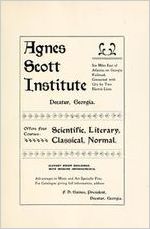
Hgnc9 ^2
8cott
Institute
Decatur^ Georgia*
Six Miles East of
Atlanta, on Georgia
Railroad,
Connected with
City by Two
Electric Lines .
Offers four Scientific, Literary,
Courses: /
w-^-i^-^-^ Classical^ JMormal
ELEGANT BRICK BUILDINGS,
WITH MODERN IMPROVEMENTS.
Advantages in Music and Art Specially Fine.
For Catalogue giving full information, address
f% T>. Gaines, president,
Decatur, Georgia.
M* Aw
ff\ " The First Store of the South. " (j;
(0
our
Business
is selling- high-grade Dfy
Goods, Garnets ana
Furniturem
Special attention is given
to goodness of quality in
everything we handle,
rather than to cheapness of
price. However, we see to
it that in every instance
where the style is the same,
the quality is as good and
the workmanship is as well
done, that our prices are as
low or lower than those
offered by the largest East-
ei'n houses. Our business is
general, but it we were to
name our specialties they
would be
Silks Laces
Tailor Suits Embroideries
Dress Goods White Goods
Ready-Made Lingerie
Imported Wash Goods
Attending to mail orders is also one of our specialties. We
gladly answer any question as to style or give samples of anything
that can be sampled. Our ilUistrated catalogue, which makes
shopping by mail easy, will be mailed for the asking.
Chambcrlin-Johnson-DuBose Co.
ATLANTA, GA.
^'^'^'-iS-^-'^-^-S.''^''.'^"m''S."S."S.'i"S''"m."m.''m.'^''S.''m^'
\l/
il/
Vl/
\)/
it/
\i/
il/
Digitized by the Internet Archive
in 2010 with funding from
Lyrasis IVIembers and Sloan Foundation
http://www.archive.org/details/aurora189903agne
REV. I-DWARU HAjniETT BAKNETT. D.D.
Ijxj
ifol m.
-^
TO
THE MEMORY OF
REVEREND EDWARD HAMMETT BARNETT, D. D.
ALr, That may be worthy in this book
IS FONDLY DEDICATED.
6588^
6ditor^s preface
IN OFFERING to the public a new Aurora our aim is not
to make it merely a catalogue, but rather a record of the
things said and done by the students. That the book has been
appreciated by the students and their friends is evinced by the
earnest support given it, and by its improved appearance from
year to year.
In compiling this book we have tried to do our best, and
though we can not expect to please everybody in ail things, we
feel that the reader w-ill be pleased ; and we hope that, if vou
criticise, you will be lenient with us, remembering that our class
put us forward. Without the able assistance of Miss Buck this
volume could hardly have been published, and the Editors can
never thank her enough for the services she has rendered them,
nor sufficiently express their indebtedness to her.
.\nd now, our work being done, we lay aside our labors
with regret that they are done, with joy that they are well done;
and in after years we will look back on this period of labor as
one of the happiest of our course, if we have made our readers
glad that the '99 AuROR.A. was issued.
Calendar. ^ 1898 '99,
-^n
"Mr
Board of 'Crustccs
George AV. Scott, . Decatur
F. H. Gaines Decatur
*E. H. Barnett Atlauta
Charees Murphy Caxdeer, Decatur
James G. PaTTOn Decatur
Therox H. Rice Atlanta
George B. Scott, Decatur
Milton A. CandeER Decatur
Organization of Board
Geo. W. Scott, President
Jas. G. Patton, Vice-President
F. H. Gaines, ... Secretar_v
Deceased. Succeeded by Mr. Sam Innian, of Atlanta.
The faculty
F. H. GAINES, D,D., President,
Bible Course and Ethics .
MISS NANNETTE HOPKINS, Lady Principai,,
Mathematics.
Miss M. Lui,a McKinney,
English Language and Literature.
Miss Nannie R. Massie,
French and History.
Miss Mary D. Sheppard,
Philosophy, Pedagogy and German.
H. B. Arbuckle, A.M , Ph.D. (Johns Hopkins),
Science.
Miss Maud Morrow, A.B. (Univ. Miss.),
Latin and Greek.
Miss Ann.\ I. Young,
Assistant in Mathematics.
Miss Libbie A. Alby,
Preparatory Department.
Miss Mattie E. Cook,
Preparatory Department.
Miss M. Melson, A.B. (Univ. Nashville),
Preparatory Department and Physical Culture.
Miss Clair Bidwell,
Primary Department .
Miss Shatteen Mitcheli,,
Elocution.
School of JMusic
Joseph Maclean, Director, Piano, Organ and Theory.
Miss Margaret Klebs, Voice Culture and Sight-Readino
*Miss Pauline Jennings, Piano and Musical History.
Miss Maud Powei,!,, Piano.
Miss Anna E. Hunt, Violin.
\Vm. O. Barnwell, Mandolin and Guitar.
School of Hrt
Miss Emm.\ G. Buck, Painting ana Dra-n-ins
W. S. Kendrick, M.D., Physician to Institute.
Mrs. E. P. Hull, Intendant of Infirmary.
Miss Rebecca Smith, Domestic Department.
Mr. W. D. Gilmore, Bookkeeper and Secretar)'.
Left on account of illnes.s. Her place filled bj' Prof. Theodore Saul.
13
The Gnglish Department
EVEN the superficial student seems to realize the necessity of some training
in English if she is to move in the better circles of society. As a conse-
quence the English classes are always full. In the English Department
at Agnes Scott such training is given as enables the student to talk
intelligently on the oft-recurring literarj' topics of the day. In the Freshman year
is begun a systematic study of the best English literature. The principles of
Rhetoric, discussed and illustrated in written exercises, form a part of the first year's
work. That this necessar}' frame-work may not become monotonous, it alternates
with a study of those two authors who never fail to appeal to young students
Irving and Scott ; and later is begun a careful study of the life and works of
Keats and of Tennyson ; nor is our own sweet Southern poet, Sidney Lanier,
forgotten, a collection of his poems, edited with an appreciative introduction and
notes by Morgan Calloway, forming an attractive part of the Freshman's work.
In the Sophomore year the study of Rhetoric is continued and completed,
special attention being directed to paragraph structure. The literary work of this
year carries the student back to the springtime of English Literature, to the age of
Chaucer through the period made brilliant by Spenser, Marlowe, Shakespeare to
the Puritan poet, Milton. A study of the men and women drawn by the world's
greatest character painter, and a discussion of the solution by this master mind of
world problems, form not the least inspiring and instructive part of the second
year's work.
The Junior year is devoted entirely to the study of the best English prose,
selections from Addison, Burke, De Quincy, Coleridge, Newman and Matthew
Arnold being studied with special refeience to style. As the study of each of these
stylists is completed, an essay discussing the style of the author is required. If
there be such a thing as conscious or unconscious influence from contact with great
minds manifested in their works, surely the Junior literary student can not escape
it. An instructive study from Arnold's Essays on Criticism occupies the last
month of the Junior year. A knowledge of real criticism, what it should be, its
spirit, and what it requires to be a true critic, is useful and necessary to all, but
especially to the college student who, as connected with college journalism, is too
often ready to " hurl philippics " at unoffending exchanges without discrimination.
Think you that the A. S I. literary student degenerates into a book-worm,
into a something resembling a pedant, from contact with the lore of these musty ( ? )
old authors? Abandon the thought. Our knowledge is not simply stored, it is
vitalized . Every effort is made to stimulate thought by means of such illustrious
examples. Nor is the student kept entirely in the past . A monthly discussion of
current literary news, an exchange of ideas about the best of the new books, and
monthly essays on questions of the day, keep us in touch with the outside world.
B}' means of these essays the student is made familiar with and initiated into the
intricacies of the various styles of writing. Especialh- are the wits sharpened and
the reasoning powers developed by frequent debates upon questions suggested by
our studies.
The last year's work is just what it should be the finishing touch, a com-
prehensive view of the whole. A note-book on English Literature used as a guide,
sending the student as it does to the be.st reference books on this subject, begins
with the dawn of this great literature and carries us through the intervening ages
to the Victorian epoch. The literature of each era is connected with its history,
and the characteristics of each period are brought into such prominence that
definite ideas of each period are formed ; and having mastered the important things,
the}' can easily be built into one compact whole. Special studies on the develop-
ment of the English Drama and on the Romantic Movement in poetry give a fuller
knowledge of two important epochs in English Literature.
Besides this S3'Stematic study of the history of English Literature, the Senior
year offers two elective subjects that prove not only interesting, but valuable. A
study of Anglo-Saxon, in which a grammar of the language is supplemented with
translations from Calderson and other old English writers, offers opportunities
invaluable to a thorough student of English. The other subject consists of a full
study of poetry, its forms, characteristics, but chiefly its philosophj'. This class
meets twice a week and is called the "Browning," selections from the poetr\- of
Browning forming a conspicuous part of the poetical selections that serve as
illustrative studies.
Plainly, a course like this, taught as it is, with a view not to cramming the
mind with facts, but to furnish it materials out of which it may build something
of its own, is a powerful stimulus to thought. That we may learn how a book
should be read and develop a taste for good reading, for each year is arranged a
pleasant course of reading consisting of works of fiction, biographies and the
essays of the best writers. Having thus caught a glimpse of the attractive fields
of literature, it is the object to inspire the student to use it as a sure foundation
upon which to build a more beautiful superstructure.
But life is uncertain; there are examinations (and they som' Ernies end dis-
astrously) that stand like a barrier between the student and the world for which
15
she is prepariiif;. Are we to wait until we take part in its affairs to use our ideas?
No, we use them as best we can to bring ourselves into prominence in the college
world through our publications, of which we have two a monthly magazine and
an annual, which it may be well to state, as it is not universally known, appears
once a year. Our magazine, the Mnemosynean, was so named because founded by
the Mnemosynean Literary Society, the first that existed at Agnes Scott. Now,
however, though it retains its original name, it is no longer controlled exclusively
by the M. L. S., but is the product of the combined efforts of the collegiate
students from among whom the editorial staff is chosen. The editors are usually
six in number and are commonly members of the Junior and Senior classes,
though this is by no means an invariable rule. Those students not directly con-
nected with the paper manifest their interest by frequent contributions.
Editorial, Local, Exchange, Alumnae and Literary departments all find a
place in the Mnemosynean, and while we realize and have been made to realize
that a little more poetry would make its pages more attractive, we note as an
encouraging sign that the occasional poetic inspirations of last year did not take
flight with tho.se maidens, favored of the muse, who are with us no longer, but
have tarried and become an epidemic which none but the most prosaic have
escaped. Unlike most such dreadful things, it has produced some good results by
which our magazine has profited. Through our exchanges we are enabled to keep
in touch with the college world and to profit b}' the stimulus which never fails
to come from success achieved in a kindred enterprise. Among our esteemed
e.xchanges are the Georgian, Hampden Sidney Magazine, Tennessee University'
Magazine, Mount Holyoke, Emory Phoenix, University of Virginia Magazine, The
Reveille, Tar Heel, Crimson and White, as well as others too nnmex'ous to mention.
But the literary excitement of the year to an A. S. I. girl is the AURORA.
From January until April ever%- magazine is ransacked for suitable subjects for pen
sketches, the covers and advertisement pages sometimes disappearing in the most
mvsterious manner; every bright idea, each original conception is saved for the
annual. And woe unto the careless student who doesn't set a seal upon her lips !
part of the annual's fun will surely be at her e.xpense. But this is as it should be.
What is an annual good for if it does not give a definite idea of our school life as
it really is a peep behind the scenes?
The editorial staff of the .\rROR-V is selected from the Junior and Senior
classes, four from the Senior and thiee from the Junior. Its object is to reflect
school life at Agnes Scott. To accomplish thii we call to our aid the photogra-
pher's art, pictures of the classes and the various clubs contributing largely to the
interest of the annual. Though onh- in the third year of its existence, the Aurora
is self-sustaining, thanks to the energetic work of the business managers. Here-
tofore, this financial success has, as one member of the Faculty has kindly
expressed it, "enabled the young ladies of the editorial staffs of the Mnemosynean
and Aurora to come as benefactors to their Alma Mater, and year by year to give
her some enduring gifts, which shall remain in her halls as memorials of their
success." With such appreciation, and with the kindly aid and advice offered by
the Faculty, wh^- may we not make our annual better and better from j'ear to year?
Memories of the Literary Department will always be pleasant ones to us
A. S. I. girls. It is only with pleasure and gratitude that we can remember that
four years' English course, with its perfect freedom from routine work, and under
the direction of one whose enthusiasm makes her an inspiration to her pupils ;
and in saying that in future work her guiding hand will be sadly missed, we feel
tliat we give voice to the sentiments of the whole class of '99.
In jVIemoriam
Died
in
Htlatita, Georgia, September 20tb, 1 898
Reverend Sdvourd Rairmiett Barnett, D.D.
pastor of the fnrst Presbyterian Church
of
Htlanta
and a Member of the Board of "Crustccs
of
Hgnes Scott Institute
OLD PRESBYTERIAN CHURCH. Built 1S25.
f)istory of the
Decatur preshyterian Church
THE Decatur Presbyterian Church is the oldest organization of the kind in
northern Georgia, and is the mother church of nian\' of the neighboring
congregations. From it have gone out the First Church of Atlanta, the
churches at Rock Spring, Acvvorth, JIarietta, Midway, Stone Mountain,
Lithonia and Kirkwood. The church was organized under the name of West-
minster Church, October 29th, 1S25, by Rev. John S. "Wilson, D.D. Dr. Wilson
was the first pastor of the church and held that position fifteen years, his place
being supplied at intervals by the Reverend Alexander Kirkpatrick. At the time
of the organization there were eight constituting members : Wm. and JIary Bryce ;
James and Mary Lemon, great-grandparents of Grace Baxter, a former student at
Agnes Scott ; Wm. Carson and his wife, Jane : Thomas Harris and Rebekah
Luckie. On Sunday, October 30th, 1S25, three elders were chosen by ballot and
the sacrament of the Lord's Supper was administered. This was the first com-
munion ser\-ice in Decatur. At this service tables were used, and before the
members might receive the sacrament they were required to secure from the elders
"tokens," small pieces of lead one inch square and one-fifth inch thick, as a sign
of their membership and good standing. Dr Thomas was the first presentor of
these tokens.
The first sen-ices of the newly organized church were held in a small frame
building erected where the cemetery now is. Shorth- after its organization the
name of the church was changed to the Decatur Presbyterian Church. In 1S26
the Presbytery of Hopewell held its fall session in Decatur, the assemlily gathering
in the academy arbor near where the people met for worship. During this meeting-
was held the first revival in Decatur, conducted by I>r. J. C. Styles, the evangeli.st.
Till 1830 there was no regular church building, services bein.g held in the iiiale
academy, and it was in this academy that the great revival under Dr. St\ les was
carried on. Other noted ministers who conducted revivals during the early history
of the church were Dr. Cunningham, Dr. Talmage, President of Oglethorpe I'ni-
versity, Dr. J. T. Leftwich, and Dr. Moses Waddell, President of Franklin College.
In 1827 there was an incorporation of trustees, and in the same year James D.
Shumate and his wife, Amelia, became members of the church, the first members
received on examination as to their religious experience.
Rev. Alexander Kirkpatrick, an Irishman educated in Scotland, served as
the first "stated suppl}-." He built the first manse, which is still standing and is
now known as the old McAllister place, served as pastor's supply, and taught
school in the academy.
In 1830 a portion of land was set apart for the purpose, and the first house of
worship built by the church was erected on the present site of the old church.
This structure was a frame building 40x60 feet. In 1S46 it was torn down and the
lumber carried to Marthasville, now the city of Atlanta, to be used for the erection
of store-houses. In the place of this the brick church now standing was built by
the architects, Daniel Killian and B. D. Shumate, at a total cost of |2,2oo.
In 185S Dr. Wilson left Decatur and became pastor of the First Church of
Atlanta. From that year till 1867 there was no regular pastor, but the pulpit was
supplied from time to time by Dr. James Patterson, Dr. John L. Rogers, Reverend
Thomas E. Smith, the first minister after the war, father of Bessie Smith, one of
the students at Agnes Scott in the present year, Jas. L. Kirkpatrick, Dr. De Witt
Burkhead, a noted divine from South Carolina, and Rev. M. D. Wood (iSyi).
From 1S72 to 18S7 Dr. Donald Frazier was pastor of the church.
Among the ministers sent out from the church are Rev. A. G. Johnson, T. F.
Montgomer)-, P. P. Winn, E. K. Winn, of Petersburg, Va., W. W. Brimm, of
Atlanta, Chalmers Frazier, son of Dr. Donald Frazier, D. J. Brimm, of Columbia
Theological Seminary . He was the son of W. W. Brimm, was named for an elder
of the church, Daniel Johnson, and was educated by the church.
The Sunday School of this church was organized June 19th, 1831, with
James Lemon as the first superintendent. He held that position till 1S39, when
Levi Willard, an elder of the church, was elected and remained superintendent till
1864. While the Federal army occupied the country in 1864 and till the close of
the war there was no regular superintendent. In 1865 Benjamin T. Hunter was
elected third superintendent, and was succeeded in 1867 by Wm. C. Moore, who
retained the position till his removal from Decatur. He was followed by Milton
A. Candler, then a deacon, afterwards an elder, who now holds the office. The
first teachers were James Lemon, Mrs. Olivia Clarke and Miss Rachel Calhoun.
In 1S87 the charge was left vacant by the de.ath of Dr. Frazier, and for a year
Mr. Hugh K. Walker ser\'ed as stated supply. In December, 18SS. Rev. F. H.
Gaines took the charge and retained it till 1896. In 1889 Dr. Gaines expressed his
desire and pra3'ed that a Christian school for girls be established in Decatur. As a
result of his prayers and efforts what afterward became the Agnes Scott Institute
was founded. A Presbyterian school for girls was established in a frame building,
now rolled away and used for a boarding house, which then stood on the present
site of the Institute, and the old Ansley house on the opposite side of the railroad
was used as a dormitory. In 1S91 the Agnes Scott Institute was dedicated and the
faculty of the Seminary was increased and transferred to the Institute.
In 1892 there was dedicated a new Presbyterian church, built on a site more
centrally located than the old one . For some time the erection of a new church
had been debated, and it was finally decided upon for several reasons, among which
was the proximit}' of the new site to the Institute and to the main part of the
congregation which had gradually settled at a distance from the old church .
The property of the old church was bought by the members, and a school for
boys was established in it. This school was incorporated as the Donald Frazier
High School, Ma}- 30th, 1S92. By a recent amendment of the charter of the school
two of the trustees must be appointed by the Synod of Georgia. Two are elected
by the session of the church, three represent the stockholders, two of these being
chosen by the Synod.
In 1S96 Dr. Gaines resigned his charge over the church to assume the presi-
dency of Agnes Scott Institute. Practically he had held this position since the
organization of the school, being president of the board of trustees and president
of the Institute in all except name. Rev. James G. Patton, of Henderson. Ky.,
then became pastor of the Presbyterian Church .
Senior Class
Colors
Red and White.
Officers
ANNIE GASH . President
BESSIE JONES, Vice-President
MABEL LAWTON, Secretary
Lucile Alexander,
Ruth Candler, .
Bernice Chivers,
Annie Gash,
Bessie Jones, .
Rosa Belle Knox,
Helen Mandeville,
Mabel Lawton, .
Emma Wesley,
Nannie Winn,
)VIcmbcrs
Normal,
Classical,
Normal,
Scientific,
Normal,
Normal,
Classical,
Classical,
Normal,
Classical,
Virginia
Georgia
Georgia
North Carolina
Georgia
Alabama
Georgia
South Carolina
Georgia
Alabama
fourth period
Che period of the Senior Ycur
from September, '98, to Commencement Day, '99
Outline
I GENERAL FEATURES.
II. PERIODS OF THE SENIOR VICAR.
III. DIVISIONS OF THE SENIORS.
IV. THE TEN SENIORS.
tucile Alexander Bessie Jones Helen Mandeville
Nannie Winn Bernice Chivers Rosa Belle Knox Emma Wesley
Mabel Lawton Annie Gash Ruth Candler
SENIOR CI<ASS.
)Vote9
I. GENERAL FEATURES.
1. The Opening of the Senior Year. This the first time the members
of this class ha%'e ever been Seniors. This year the beginning of the end, the
culmination of their course .
2. The Design of the Senior Year. To complete the four years course
and, in the end, win a diploma. However, each member of the class has a
different design. There were some members who designed to get through the
course as easily as possible ; they dropped out last year.
3. The Plan of the Senior Ye.ar, To do what is needful to secure a
diploma. This much-desired object is secured in different waj-s according to the
varying courses taken. Of the ten Seniors five take the Normal Course, four the
Classical, and one the Scientific.
II. PERIODS OF THli: SENIOR YEAR .
First Period From Hopkins' Moral Science to Dabney's Practical Phi-
losophy.
Second Period From Wordsworth to Browning.
Third Period From Gaines' "Notes" to Alexander's '"Evidences of
Christianity."
Fourth Period Well-Rounded.
III. DIVISIONS OF THE SENIORS.
The Seniors are divided into two main classes day-pupils and boarders.
The day-pupils are in the majority. Significance ?
IV. THE TEN SENIORS.
Names? Characteristics?
Cla9S of ^00
JMotto
' Tout bien oil rien.
Colors
Grav and Old Rose.
EVELYN RAMSPECK,
MARGARET BOOTH,
MARY LOU DUNCAN,
JEANNETTE CRAIG,
ETHEL ALEXANDER,
Officers
Ppesidext
Vice-President
Secretary
Treasurer
Historian
Ethel Alexander,
Margie Booth,
May Barker,
Jeannette Craig-,
Mary Lou Duncan,
Mattie Cobb Howard,
Mary Payne,
Evelyn Ramspeck,
Jean Ramspeck,
Hilda Schaefer,
Rusha Weslej', .
'Juniors
Normal
Classical,
Normal,
Musical, .
Musical,
Classical,
Normal,
Normal, .
Musical,
Musical, .
Normal,
Atlanta, Georgia,
Montgomery, Alabama
Decatur, Georgia
Yazoo City, Mississippi
Decatur, Georgia
Atlanta, Georgia
West Point, Mississippi
Decatur, Georgia
Decatur, Georgia
, Yazoo City, Mississippi
Lithonia, Georgia
-^ '^
f)istory of the
jfunior Class
Two YEARS AGO, as trembling
Freshmen, we crossed the
threshold of Agnes Scott, dulj'
impressed with our ignorance
and freshness, and heartlessh-
looked down upon bj' all those ahead of
us. Our mistakes were many, but the\-
were excused on the plea that we were
only Freshmen, and knew no better.
Alas ! how cutting this to the awakened
pride of the poor Fresh. ! But we were
not destined alwaj-s to be passed by un-
noticed, for our Fresh, year passed by at last, and we rose, with a sigh
of relief, to the position of Sophomore, one year older and many years
wiser.
Here we rested more secure from the attacks of Junior and Senior,
and were looked upon with a greater degree of respect and importance.
But even here we had the reputation of being ga}- Sophs., and our
character and influence was still not valued at its true worth. But
the trials and difficulties of our Soijhomore year are now things of the
past, and we have triumphed over all : even Snph. math, has not
thinned our ranks, and to-day, as exalted Juniors, we tread together
the rough and rugged steeps of learning, well aware that the goal for
which we are striving is reached ouh' by patient toil and perseverance.
Much to the surprise of everj-body (ourselves excepted) we are
able to boast of a poet among our ranks. Responding to her poetic
inspiration for the first time in December, her maiden effort met with
success (being published in the Jlnemosynean I and was hailed by her
class-mates as signs of the " gude time coming.'" Inspired by her
example, we have hopes of others of our number.
But whatever the talents of the members may be, here's to jou.
igoo !
34
Eveh-n Ramspeck Jeannette Craig Rusha Wesley Mary Karke
Ethel Alexander Jean Ramspeck Margaret Booth
Mar>- Payne Martha C. Howard Mary I,on Duncan Hilda Schaefer
JUNIOR CI,ASS.
Class of 'oi
IMotto
\"irtute ae labore.
Colors
Blue and White.
flower
Ragtjed-Robin.
Officers
AMANDA SANDERS CALDWELL,
MARY ROBERTA BUCHES., .
LILLIAN McGILL,
EVELY.Y NINENA TATE,
WILLIBERT DAVIS, .
LOULA McCLAIN, .
Presidknt
\'ich-Presipent
Secretary
Tre.^surer
Poet
Historian
jVIcmbcrs
Fannie Moore Burwcll. . Xorlh Colle<i-e St., Charlotte, X. C
Mar_v Roberta Buchcr. ...... Decatur, Ga
Daisy Eleanor Caldwell. . . S7 Richardson St., Atlanta, Ga
Amanda Sanders Caldwell, dth Ave. and Pine St., Pine Bluff, Ark
Mollie Scott Cohen, . . . IK. Bolton St., Savannah, Ga
Willibert Davis, ...... Bainbridye. Ga
Anna Grace Hannah. ...... Thomaston, (ia
Marian Clifford Hall. . . . 5(. E. Ellis St., Atlanta. Ga
3S
Maude Johnson, .
Mary Elizabeth Kirkpatrick,
Saedee Hull King-,
Georg-ia Mills Kevser,
Lillian McCJill, .
Loula McClain,
Chloe Louelle O'Neal.
Rose Kich,
Oiga Fleming Sobers,
Amy Seav,
Clara Mae Smith,
Anna May Stevens,
Evelyn Ninena Tate, .
Lucia Harriet Tarver,
Edith Svdnor Thomson,
. Decatur, (Ja
121 S. College St.. Montgomery, Ala
. 400 Third Ave., Rome, (in
Richmond, Ala
. Decatur, Ga
Yorkville, S. C
West Bainbridg-e, Ga
. 330 S. Pryor St., Atlanta, Ga
Bainbridge, Ga
Greensboro, Ala
Warrenton, Ga
. Poplar Springs, Ga
Tate, Ga
Selma, Ala
44<J N. Boulevard, Atlanta, Ga
Cbcorcm.
The class of igoi is a ^^staj-''
GIVEN : A star is a body with five well-formed points.
Let a point be a characteristic.
TO PROVE : Class of '01 ^--^ a star.
PROOF : Draw conclusions from achievements.
CASE I. In Gaines' Bible Notes
Sophs =^ to the task,
and Sophs, of '99 > all former Sophs.
The task -Courag-eousness.
. . Sophs. ^= Courag-eousness. ( 1 )
(Having been previously forewarned both by Seniors and
Juniors that nothing is so frightful as Gaines' Bible Notes.)
.. Sophs, have a point in their favor.
CASE II. In Wentworth's Geometry
Sophs. :^ " The orig-inals ".
Orig-inals^= Great mental abilit^y.
. . Sophs. Great mental ability. (2)
(Having solved the problems of Wentworth's Geometry.)
.'. Sophs, have this point in their favor.
CASE III. In Eng-lish
Sophs. = Miss McKenney's " Outlines "'.
Miss McKenney's " Outlines " = Perseverance.
.'. Sophs. ^ Perseverance. (3)
("Practice makes perfect.")
.. Sophs, have this point in their favor.
CASE IV. In Science
Sophs. = " Atomic Theory".
Solving "Atomic Theory " ^Prominence.
.. Sophs. = Prominence. (4)
(Having excelled Juniors, who never solved the mystery of
the "Atomic Theory.)
.. Sophs, have this point in their favor.
CASE V. In Languages
(a; In German
Sophs. ^Fondness for Stein's Exercises.
" >Both Seniors and Juniors.
(Stein being the bane of the lives of both Seniors and
Juniors.)
(b) In French
Sophs. ^" Literature".
" = Seniors.
(For Seniors, only, take French literature.)
. . Sophs. = Brilliancy. (5)
. . Sophs, have this point in their favor.
Then by adding 1, 2. o, 4, and 5, Sophs, have five points in
their favor,
and . . Sophomore Class ^ a star,
Q. E. D.
COR. 1. Class of 1901 is good.
(Ax. If good parts be added to good parts, the whole will
be good.)
.. Class of '(Jl is good.
(Combining the five good characteristics : courag'e, persever-
ance, mental ability, prominence and brilliancy, makes a good
class.)
COR. 2. Class of "01 being a "star" is the complement of A. S. I.
SCHOLIUM.
This corollary may also be written
Class of "01 being a "star" is the compliment to A. S. I.
REMARKS : This truth will be more clearlv demonstrated in TxH.
z5./<'Jyjt
Class ^02
JMotto
Vincit qui re vincit.
Colors
Red and Old Gold.
Officers
BELL DUNNINGTON, President
LUCY THOMPSON Vice-President
META BARKER Secretary
* Poet
* , Historian
JMcmbcrs
Estelle Anderson, Washington, Ga
Lottie Anderson, Cartersville, Ga
Mae Barr}-, Decatur, Ga
Meta Barker, Decatur, Ga
Marion Bucher, ....... Decatur, Ga
Mary Battey, Rome, Ga
Laura Caldwell, ... 87 Richardson St., Atlanta, Ga
Nettie Calhoun, ....... Atlanta, Ga
Carrie Calloway, ....... Madison, Ga
Lorine Colmery, ....... Virden, Miss
Sara Collier, . ....... Atlanta, Ga
*Not elected.
44
Juliet Cox, Decatur, Ga
Ethel Davant, Memphis, Tenn
Annie Kirk Dowdell, ...... Opelika, Ala
Bell Dunnington, ..... University of Virginia
Lucy Goetchius, ........ Rome, Ga
Ruth Harwell, Opelika, Ala
Alice Hager, Decatur, Ga
Alice Hocker, ........ Ocala, Fla
Annie Hervey, Water Valley, Miss
Ida Hervey, Water Valley, Miss
Eliza Hull, . . Savannah, Ga
Marietta Hurt, Memphis, Tenn
Mary Bynum Jarnigan, .... Mossy Creek, Tenn
Ruth Lewis, 248 Jackson St., Atlanta, Ga
Eulalie Lawton, Rose Hill, Columbus, Ga
Olivia Montgomery, Tallulah, La
Carrie Morisette, New Berne, Ala
Sallie George Oliver, ...... Dancy, Ala
Clyde Ponder, Opelika, Ala
Katherine Patty, . . . :A') Capitol Ave., Atlanta, Ga
Louise Rdgsdale, Decatur, Ga
Valeria Rankin, . . . 201 Capitol Ave., Atlanta, Ga
Daisy Strong, Walhalla, S. C
Lucy Thompson, Clear Water, Fla
Bessie Smith, Tallahassee, Fla
Henrietta Smith, . Decatur, Ga
Tenney Showalter, . . .... Dalton, Ga
'Qi>^'=sD
45
freshman Chronicle
SEPTEMBER 7th. Freshmen enter and are classified.
September 8th: Some fall back to sub- Freshdom, but
the world rolls on.
October 6th. Freshmen experience their first written lessons.
They don't like it.
November Sth : Freshmen get into trouble. This continues
throug'hout the year, and so need not be mentioned again in
the chronicle.
December 22t> : Freshmen leave for the holidays, but Agnes
Scott moves on in the same old way.
Januarv 3d: Freshman supposed to return to school. The
majority do not return until the 6th. Their marks consider-
ablv lowered by this.
January 16th : The Freshmen begin to take examinations. They
think thev are the only ones who have any work to do.
46
February 14th : The Freshmen receive valentines.
February 22d : Being- a holiday, the Freshmen walk in Decatur
alone. They play Senior.
February 23d : As a result of too much exercise the day before
and because of non-preparation of lessons the Freshmen do
not appear. The Institute mourns, but still wags on.
March 1st : The Freshmen write for the Aurora.
March 4th : Two Freshmen, one of whom is noted for her lazi-
ness and abstinence from study, refuse to write the class
history on account of "too much work " (grandiloquently).
The one specially mentioned above " came to Agnes Scott for
mathematics and Latin, etc., primarily; the Aurora is a
secondarv consideration."
March 4th to ISth : Though the Freshmen try to oppose it,
the world moves on.
(Continued till May 28th.)
Irregular and Special Courses
Thyrza Askew, ... . . Hig-bland Ave., Atlanta, Ga
Rosa Kingsberrj-, . . . 380 Peachtree St., Atlanta, Ga
Genie Thornton, ...... Talladega, Ala
Martha Ezra Robins, .... Lower Peachtree, Ala
Harriett Scales, ........ Atlanta, Ga
Mattie Wright, . . . .848 Greene St., Augusta, Ga
Sybil Bethel, . . . . . . . Key West, Fl a
Marie Goetchius, ........ Rome, Ga
48
65886
Semiquavers*
MUSIC Special, (at concert, laboriag- under a mistake)
"What a grand artist he is ! What a touch I There
is not a fault in his plaj-ing !"
Friend "Mj- dear, that is not the great artist. He
is ill and his place is filled by a lesser lig-ht."
Special, ("much chagrined) "Oh I Er I thought I detected
some faults."
Stranger "Last half hour I heard a lovely voice on the
music floor. Do you know whose it was? "
Aspiring Young Vocalist "Oh j-es, I was practicing my
vocal lesson then."
Professor, (as he comes within hearing distance of the prac-
tice floor) " 'Music is love in search of a word.' So ! Well, well,
all I can say is that it bids fair to find the word soon or exhaust
itself in trying for it."
'Che polymnia Club
Officers '98 and '99
MISS PAULINE JENNINGS,
MISS JEANNETTE CRAIG, .
MISS MARGARET POWELL,
President
Vice-President
Secretary and Treasurer
jMcmbers
Miss Gertrude Ausley,
Miss Fannie Burwell,
Miss Addie Boyd,
Mrs. Ed Barry,
Miss IMae Barry,
Miss Amanda Caldwell,
Miss Delle Carlton,
Miss Angie Cubbedg-e,
Miss MoUie Cohen,
Miss Mary Cook,
Miss Jeannette Craig",
Miss Mary Lu Duncan,
Miss Willibert Davis,
Miss Nannie Gilmore,
Miss Eulalie Gamble,
Miss Mary Bynum Jarnagin,
Miss Pauline Jennings,
Miss Saidee King,
Miss Margaret Klebs,
Miss Mary Kirkpatrick,
Miss Georgia Kyser,
Miss Mabel Lawton,
Miss Ethel Lawton,
Miss Carrie Morrisette,
Miss Loula McClain,
Mr. Maclean,
Miss Olivia Montgomery,
Miss Sallie George Oliver,
Miss Margaret Powell,
Miss Rose Perr}-,
Miss Madeline Routzahn,
Miss Lola Robinson,
Miss Jean Ramspeck,
Miss Daisy Strong,
Miss Olg-a Subers,
Miss Hilda Schaefer,
Miss Clara Smith,
Miss Mattie Wright,
Miss Edith Williams,
Miss Nellie Mandeviile,
Miss Harriett Scales.
Che History of the )VIusic Department
in the present '^car
THE world is full of melody, and the Music Department of
Ag-nes Scott is putting forth its best endeavors to swell the
volume of sound ; which effort, we hope, will be far reach-
ing- in its effects some day. I'here is no question of its
being far-reaching now in the sense of being heard by night or day
at a distance of from a quarter- to a half-mile, as the afflicted
auditory nerves of the public can testify. This, we fear, proves
that it has not exactly the charming effect of Orpheus' lyre upon
the woods andiforests. While we do not claim that the echoes in
our halls remind us at all times of "a forest full of delicious birds,'"
a considerate investigation, however, will show a more enlarged
and intelligent interest in the study of the history of music, which
constitute its first charms.
The year of '98 and '99 certainly dawned upon a greater Musi-
cal Department in our Institution. The introduction of a regular
course of study for those who wished to become students in the art,
is one of the new features of this department, and has found
earnest advocates in both teachers and students.
It is like "carrying flowers to Haymarket" to attempt further
praise of our most able and well-known Director, Mr. Maclean, but
it pleases us to add a fresh laurel leaf to his crown each year in
the recurrent accounts of our Music Department. He is not the
mere teacher, who is anxious only to justify his salary, but one
who has adopted a congenial life work, laboring with patience and
sympathy in the systematic building of the musical education of
his pupils. If his own thoughts could be interpreted just here,
they would probably read thus : Such quantity of endeavor granted
the Director, wliat has he a right to expect from pupils? The
answer is plain : At least a renewed effort to effect a sure and
steady progress. This repl}' may be somewhat embarrassing for
those who have all too often been overtaken in the forbidden
pleasure of playing tweedle-dum or tweedle-dee, or of whiling away
the practice hour, a time supposed to be spent in the serious and
earnest unraveling of those interminable puzzles. Bach Preludes
and Fugues or the like, in the delightful contemplation of Sousa,
truly the king of march-makers, but, alas, whose name too readily
suggests an echo of the appalling and transfixing phrase : "Five
demerits for that," when uttered by one in authority.
In the early part of our school year Miss Jennings, the able
assistant in this department, skillfully and charmingly conducted
her classes in harmony and history. But while congratulating
53
ourselves upon the smoothness of the course, ill-health compelled
Miss Jenning-s to resign, which fact occasioned not only sincere
regret, but a suspension of our work for a time. The monster,
"Grippe," no respecter of persons, for some weeks held sway as if
personified, and crowned himself general manager of the Music
Department, sending our Director and nearly all the assistants to
the Infirmary.
Miss Powell, our capable assistant and practice directress, and
Miss Hunt, our violin wizzard, were left alone in the Department,
and battling bravely against the odds of the epidemic, right
well maintained their reputation for faithful and successful
work.
After the long holiday the curtain rose again upon the Depart-
ment with the mise en seine somewhat changed. We entered the
harmony class-room as usual, but instead of our fair and cultured
Miss Jennings, we were for a moment transfixed in contemplating,
with almost Galatia amazement, the presence of a Man, stalwart
and striking ! Don't think, however, that this feeling was one of
horror ; far from it, for we were all pleasantly smiling upon the
new person before us. But our wonder was much stirred when the
preceptor's name was given as Mr. Saul. The name "Saul" was
quite familiar to many of us who were then well into the second
of those three famous volumes called "Gaines' Bible Notes",
which, bv the wav, are truly worth_y of the name the_y bear. We
at once concluded that the name Sa/t/ wa.'^ well adapted to this per-
son, for he was without any doubt- "head and shoulders" above
any one else who had come within those walls within the memory
of the oldest students. We next thought of the famous oratorio,
Saul, arranged by Handel, and straightway by association of ideas
inferred that the soul of this Saul must be filled with music and
harmony. So it was proven, and even more, for when his mighty
hand struck the opening chords of the morning- devotional exer-
cises, the entire assembv listening were held spell-bound for a
moment, and then burst into joyful song. Mr, Saul is quite recently
from Germany, and comes to us with the highest endorsements.
While his capacity for instruction is beyond all question, his
faculty for impressing many of his pupils with the scope of their
ignorance of music is equally marked. His criticisms are expressed
with a somewhat Deutsche accent, which always enhances their
value to the music student.
Our vocal class has a record well worth recording, and is under
the efficient direction of Miss Klebs from Germany. She possesses
a delightful voice, and frequently contributes charming numbers
to our musical programmes. She has distinguished herself for her
careful and painstaking method in the development of the vocal
talent of the Institute, and in many cases for the remarkable
results reached in voice training. Our vocalists themselves are
famous in these parts for their strength of lung, and their Ellen
Beech Yaw notes may be heard at some distance bej-ond the
campus by day or night. While all pupils have not been made
sweet philomels, not being equally endowed with the divine gift of
some, yet they have been stimulated with the enthusiasm which
comes from working under good instructors.
Besides our accomplished Director and his able staff, this
Department boasts a musical club, the Polymnia, composed of both
teachers and students. This most valuable addition was organized
in the year 1895, and has been steadily increasing in size and
importance. Its meetings are held once every fortnight, and are
very enjoyable affairs, affording those students affected with that
most calamitous of all afflictions, "stage-fright, "ample opportunity
of warding otf the effects fatal to any musical performance in
public. Often the best talent of Atlanta honors the club with a
delightful programme, and frequently attend our receptions given
at regular intervals during the year. Besides being a great advan-
tage in the ways just mentioned, the club aids in the aasthetic and
scientific study of the art. Each year the funds of the club are
devoted to the purpose of building up the musical librarj* of the
Institute. Many valuable works have already been accumulated
in the few years of its existence, and our hope is that time may
add to it many more.
The Polymnia of '98 and '99 has not held its meetings as regfu-
larly as heretofore, due to the many vicissitudes throuo^h which it
has passed since the first three months of the year. The illness
and final resig-nation of our president. Miss Jennings, virtually left
us without a head, a necessary part of every organization, this
principally causing the lack of system and regularity in the club.
Spring, however, revived the interest in musical affairs, an interest
which had been lying- dormant during the winter months, and
work was once more begun in earnest, even a more lively interest
being shown than before. A greater incentive to work has been
offered in the scholarships in the Music Department and in piano,
each of which is maintained by the Pol3'mnia Club.
As complimentary to the Music Department the students have
the privilege of hearing the best talent of Europe and America
that is offered the Atlanta public. Season tickets for the series of
concerts by famous artists during the winter months are procured
for the students, thus stimulating a taste for and interest in what
is highest and best in the art. During the past season opportunities
were given the music students at Agnes Scott which are seldom
presented to many more than once in a life-time. The two
events which stand out in bas-relief as more impressive than the
others of the season are, tirst, the concert of Madame Fannie
Bloomfield Zeisler, the greatest woman pianist, and, second, that
of her cousin and her equal in greatness, Moriz Rosenthal, called
very justly "the piano gymnast". There were many programs
in the series which deserve mention here as interesting and
instructive, but the laws regarding the space allotted to this
article forbid the continuance of this dissertation to so great an
extent.
In short, the advantages offered are the best, and the portals
of our Music Department are open wide to those who love the
divine art and wish to have its treasures revealed to them. We,
56
the music students, one and all, with a flourish of our caps, give
three glorious cheers for the Music Department of the Agnes Scott
Institute and, gladlj' sounding its praises, wish for it the largest
possible scope with only the variation of ever increasing sucess.
]VIcmbcrs
Olivia Montgomery
Madeline Routzahn
Mollie Cohen
Annie Hervev
Ida Hervey
Gertrude Ausley
Sallie Georg-e Oliyer
Georgia Kyser
Kthel Lawton
Missey Hull
Harriett Scales
Edna May
Sibyl Bethel
Miss Williams
Miss Kirkpatrick
Miss Snook
Miss Gilmore
DIKKCTUR'S JIUSIC KOIJ.M.
Officers
LOULA ilACLAIX,
*ESTELLE AXDERSOX,
CARRIE CALLOWAY, .
AXGIE CUBBEDGE, .
RUTH LEWIS,
President
Vice-President
Vice-President
Secretary
Treasurer
JMcmbcrs
*Marg-aret Allison
Lottie Anderson
Gertrude Ansley
E. G. Buck
*Delle Carlton
Lena Craig
Ethel Devant
Georgia Kyser
Edna Ma}-
Carrie Morrisette
Katherine Patty
Tennj Showalter
Loucia Taryer
Jennie Vereen
Hints
THE Class of '99, believing firmly in the power of unconscious influence
( having completed a thorough course in Ethics), feels that the future
representation of the A. S. I. Senior Classes rests largely upon them.
Rich in the knowledge that comes from that much praised school of
experience, we wish, to use the words of one of our number, ahvaj's esteemed, but
doubly so after April 8th :
" Before we make our final bow.
We want to tell the others how."
To Pedagogy Class Be ready for an3'thing, and when it comes don't seem sur-
prised.
Chemistry Class Never study the entire assigned lesson if it contains three or
more experiments, (or ojif if that requires peculiar conditions), but leave the
last part for next time.
French Cl.ass If in Conversation Circle you know nothing to saj', je repeated
several times with a smile will_ answer.
Ethics Cl.ass Be a heroine in the strife. (Special reference to Dabney).
Senior Arithmetic Do the thing that seems least probable ; always use the six
per cent, method.
.\LEx.\nder's "Evidences" Get a second-hand book and learn by heart the
parts marked.
History Cl.ass Read Green and Guizot for light ( ! ) summer reading ; this
knowledge will be available in senior history.
AsTRONOJiY Cl.ass Point your telescope, observe, correct, then correct them
correct your corrections. It might also be well to add, don't cherish false
hopes ; even the largest telescopes fail to reveal in all the universe so insignifi-
cant a thing as a man.
Editor-in-Chief 'oo Aurdr.a Make it better than the '99 if you dm.
N. B. Follow, not our footsteps, but our advice, and you will be famous.
[The above guaranteed to cure all cases of "the blues" (temporarily), all over-
exertion of the brain cells, and all bad consequences of too much mental labor.]
64
M
1
lo^i'^i ^k^ ^^^^^rt^^M^^^^^iH^^^^^^^m ^i^iH
^^^r K^^&^m' xSWi^^^f ^Hiil^^^^^^^^^^^^^^^^^l
HK.J
il^3iiB.^;^dii.k^. jr^" "L ^-^' .'.4&^^HHHI^^^^H.
G. Aiisley R. I.ewis C.Patty C.Morrisette J.Vt
L. Craig E.May G Kyser I,. Anderson G.Thornton
L. McLain C. Calloway A. Cubbedge Mi.ss Buck
LA BONNE HEURE CLUB.
Art Critic
Secretary
Critic
)VIcmbcrs
*Estel]e Anderson
Fannie Burnwell
Carrie Calloway
*Delle Carlton
Mollie Cohen
Mary Cook
Lena Craig-
Ang-ie Cubbedge
Marie Goetchius
Venetia Banner
Rosa Belle Knox
Georgia K^yser
Mary Kirkpatrick
Eulalie Lawton
Ruth Lewis
Edna May
Mary Payne
Ella Smith
Genie Thornton
Mattie Wriffht
67
y\)\ak? '
fG Wj/ l< ( ( V
IN September '98, we find that only five members of the Crow
Ouill Club have returned to carry on the excellent work done
b}- the last j'ear's gfirls, and to renew the interest in the Club,
which was so manifest in the previous term. But there are
many new g-irls in school, and so by the first meeting- we have
nearly twenty members enrolled, some with real artistic talent,
others it must be confessed with only the love and perseverance,
which, however, are both essential to this work.
Some of the first productions were marvelous, but our ever kind
and patient teacher only pointed out our mistakes, and then gave us
so much encourag-ement, that we resolved to do better "next time. "
This resolution was well carried out in most cases, and, by the
last of December, some really excellent work had been done as
Christmas presents. Picture frames figured largely, and were of
all kinds and descriptions daisies, wild roses, dog-wood blossoms
and also copies of the well-known "Gibson girl'", all figuring as
designs.
After the holidays work in the Crow Quill did not begin until
the seventeenth of Januar_y, but it was then that the real object of
the Crow Quill Club, that of contributing sketches to the Aurora,
was manifested.
Some of the girls did not return after Christmas, but as there
were several applications for membership, we soon had our former
number.
"Where there's a will there's a way" is certainly a very true
saying, and it was so in this case as is proven by the pen sketches
in this annual.
This is a good work and it should certainly be kept up, and the
endeavor made every year to improve, if possible, the sketches of
the year before. Saidee King, Secretary.
C. Calloway E. Gamble JI. Wright J. McPhaiil
G. Kyser R. Lewis G. Thornton F. Burwell JI. Cohen M. Cook
M. Goetchius A. Cubbedge V. Danner M. Payne E. May I,. Craig
CROWQUIIvI, CLUB.
JVIncmosyncan Literary Society
Officers
first Quarter
NELLIE MANDEVILLE, President
JEANNETTE CRAIG Vice-President
ELIZA HULL Secretary
ROSA BELLE KXOX Vice-Secretary
AMANDA CALDWELL, Treasurer
EZRA ROBINS Librarian
LENA CRAIG, Censor
Second Quarter
JEANNETTE CRAIG President
FANNIE BURWELL Vice-PrESIdenT
MATTIE WRIGHT, Secretary
MARIETTA HURT Vice-SecrETary
EZRA ROBINS, Treasurer
CARRIE MORRISETTE, Librarian
VENETIA DANNER Censor
Cbird Quarter
NELLIE MANDEVILLE President
MARY PAYNE, Vice-PresidenT
AMANDA CALDWELL Secretary
ROSA BELLE KNOX Vice-SecreTary
CARRIE CALLOWAY, Treasurer
MARY BATTEY Librarian
MATTIE WRIGHT, Censor
MNEMOSYNEAN I.ITERARV SOCIETY.
JMcmbcrs
Lottie Anderson
Mary Battey
Sibyl Bethel
Fannie Burwell
Delle Carlton
Sara Collier
Amanda Caldwell
Ang-ie Cubbedge
Jeanette Craig-
Lena Craig
Kthel Davant
Venetia Danner
Marie Goetchius
Lucy Goetchius
Eliza Hull
Saidee King-
Rosa Belle Knox
Nellie Mandeville
Carrie Morrisette
Mary Payne
Rose Perry
Ezra Robins
Lola Robinson
Marietta Hurt
Mattie Wright
Harriett Scales
Mollie Cohen
Amy Seay
Rosa Gammon
Janie Bowie
Ellen Penaman
Catherine Patty
Carrie Calloway
Margaret Allison
Maiden Heiskell
propylacan Literary Society
)Motto
'Virtus in Arduis''
Colors
Light Green and \\Tiite
Officers '9S-99
^irst Quarter
MABEL LAWTON President
HILDA SHAEFER Vice-President
LULA McCLAIN, . Secretary
LILLIAN McGILL, Vice-Secretary
NANNIE WINN, Treasurer
EULALIE LAWTON Censor
MRS. ARBUCKLE, Critic
Second Quarter
MARGARET BOOTH, President
DAISY STRONG, Vice-President
EVELYN TATE Secretary
ANNIE KIRK DOWDELL, Vice-Secretary
EULALIE LAWTON Treasurer
ALICE HOCKER Censor
MRS. ARBUCKLE . Critic
Chiri Quarter
NANNIE WINN President
BESSIE SMITH Vice-President
MABEL LAWTON . Secretary
MARY B. JARNAGIN Vice-SecreTary
GEORGIA KYSER ' Treasurer
ANNIE KIRK DOWDELL, Censor
MRS. ARBUCKLE, Critic
76
PROPYI^AEAN I^ITERARY SOCIETY.
jMcmbcrs
Mrs. Arbuckle
Gertrude Auslej
Marg-aret Booth
Mary Cook
Bell Dutming-ton
Annie Kirk Dowdell
Mrs. Gaines
Ethel Lawton
Eulalie Lawton
Mabel Lawton
Mary Bynum Jarnagin
Georgia Kyser
Louelle O'Neal
Edna May
Lillian McGill
Lula McClain
Hilda Schaefer
Bessie Smith
Clara Smith
Evelyn Tate
Nannie Winn
Daisy Strong
Alice Hocker
Wilibert Davis
Lucia Tarver
Annie Hervey
Ida Hervey
Olga Subeirs
79
Gertrude Ausley
Amanda Caldwell
Ang-ie Cubbedge
Carrie Morrisette
Carrie Calloway
Mary Battey
Valeria Rankin
^cx-^A '\^
rnagiii M. Payne C. Morrisette I,. Goetchius R. Gamii
G. Aiisley M. Booth M. Goetchius C. Calloway
A. Caldwell S. Bethel R. B. Knox M. Battey J. Bowie
S. Collier V. Rankin A. CubbeJge H. Scales
T, Showalter
TENNIS CI<U]
Htiti-Olalkiiig Club
" Foolery, sir, does walk about the orb like the sun.
Ouies ^rata est.
Sybil Bethel,
Annie Kirk,
Harriett Scales,
Jennie B. McPhaul,
Ethel Davant,
Angie Cubbedge,
Tenny Showalter,
"Rest and be thankful."
"Sink to rest.'
j "I intend to get a permanent
I excuse from walking-."
" Where is rest ? "
"The sad mechanic exercise."
( "' For cure on exercise depend.'
\ Then I'll have no cure."
,- "I hate to walk in winter,
I I hate to walk in fall,
\ I hate to walk at any time,
I I hate to walk at all."
83
Tenne}' Showalter
Mabel Ponder
Jennie Belle McPhaul
Georg'ia Kyser
Lena Craig"
Genie Thornton
Mollie Cohen
Carrie Morrisette
Anna Grace Hannah
Carrie Calloway
Ruth Lewis
Jennie Vereen
Clyde Ponder
Ruth Harwell
Madeline Routzan
Eula Gamble
Valeria Rankin
Angie Cubbedge
Marie Goetchius
L,- Craig E. Gamble G. Thornton M. Cohen C. Morrisette II. Ponder C. Calloway
R. l,ewis V. Rankin R. Perry G. Hannah T. Showalter J. McPhaul M. Goetchiiis
A.. Cubbedge C. Ponder M. Routzan
G. Kyser R. Harwell J. Vereen
BICYCI,E ci,ri
Christian Band
Officers 'pS-'pp
first Quarter
NANNIE WINN, President
MARY PAYNE, Vice-PrESIdenT
AMANDA CALDWELL, Secretary
MARTHA ROBINS Vice-Secretary
EULALIE LAWTON, Treasurer
Second Quarter
MABEL LAWTON President
DAISY STRONG Vice-PresidenT
MARY PAYNE, Secretary
EVELYN TATE, Vice-Secretary
MARGARET BOOTH Treasurer
Cbird Quarter
DAISY STRONG President
MARGARET BOOTH Vice-President
EVELYN TATE, Secretary
BELL DUNNINGTON, Vice-Secretary
BESSIE SMITH Treasurer
87
Kappa Chi Sorority
Organization Secret
JMcmbcrs
Sybil Bethel
Amanda Caldwell
Ang-ie Cubbedg-e
Kthel Davant
Fannie Burwell
Valeria Rankin
Nellie Mandeville
Mattie Wright
Rosa Belle Knox
Harriett Scales
Missey Hull
Sybil Bethel Mattie Wright Ethel Davatit Helen Mandeville Fannie Burwell
, Hull Rosa Belle Knox Angie Cubbedge Harriett Scales Amanda Caldwell Valeria Rankii
KAPPA CHI SORORITY.
Harriett and her studies.
Tenney and walking-..
Madeline Routzan and dancing.
Rosa Belle and science.
WiUibert and Edna.
Agnes Watson and the Infirmary.
Amy Seay and laziness.
Rabbi and botany.
The rain and the sun.
Delta Chapter
of
Iota phi phi Sorority
Missey Hull
Mattie Wright
Fannie Burwell
jMcmbcrs
Ethel Davant
Angle Cubbedge
Amanda Caldwell
AMANDA CALDWELL,
lATTIE WKIGHT
ANGIE CLTBBEDGE
IOTA PHI PHI SORORITY
'98 Bazaar
]Vctted $50.00
present Hmount
of f^und, 200.00
RemcmbcR
the
JVovembcR
'99
BazaaR
Prepare dainty knick-nacks and toothsome tit-bits for
donation.
No rest until SI, 000.00 has been secured.
^m n
^
'Cbc Hlumnae
Hope of Alma Mater's prosperit}'
The Alumnje.
Mirror of Alma Mater's principles
The AlumnEe.
Exemplars of Alma Mater's virtues
The Alumna;.
Crown of Alma Mater's efforts
The Alumnae.
Standard bearer of Alma Mater's colors
The Alumnae.
Defenders of Alma Mater's honor
The Alumna;.
Protectors of Alma Mater's fame
The Alumnae.
Herald's of Alma Mater's praise
The Alumna;.
Promoters of Alma Mater's interests
The Alumna;.
Succorers of Alma Mater's need
The Alumnae.
Perpetuators of Alma Mater's usefulness
The Alumnae.
96
In the Laboratory
In chem. and physics awful smells
On which in dread my mind e'er dwells,
Go floating round in all their glory
And permeate the laboratory.
I smell chlorine 'twill soon be gone,
And C2S quick passes on,
But H2S I've found will tarr}-,
And it, indeed, its own can carry.
In physics breath will soon give way.
In chem. if I were forced to stay,
I'd love and praise and thank him ever
Who from mj face my nose would sever.
97
jVrncmosyncan
published Monthly
editors - in - Chief :
EVELYN RAMSPECK, ANNIE GASH.
Business jVIanagers:
LOULA McCLAIN, ROSE RICH.
Gwbange editor:
MARY PAYNE.
Local editor:
MARGARET BOOTH.
Hlumnae editor:
MABEL LAWTON.
98
>Iary Payne I^iila McClaiii
Rose Rich Mabel I^awton Margaret Booth
Annie Gash Evelyn Ramspeck
MNEMOSYNEAN BOARD OF EDITORS
Dramatic Club
LENA CRAIG,
Playwright.
VENETIA BANNER,
Grand Impersonator of the High and Mighty.
MARIE GRESS,
" As Pure and Innocent as a Lily."
MARY COOK,
"Villain and Saint, by Turns.
MARY BANNER,
Adaptable to Almost Any Part.
DORA ANDERSON,
A Friend in Need is a Friend Indeed.
Hurora Board
6ditor - in - Chief.
HELEN LENNOX MANDEVILLE, .... Georgi.a..
President of the Christian Band, '96; President of M. L. S., '96;
Editor-in-Chief of 3Inem"Siinean, '97-'9S ; President of M. L. S ,
'97; Business Manager of Aurora, '97; Associate Editor of Aurora,
'98 ; Secretary and Treasurer of Polymnia, '97-'98 ; President of
M. L. S., '98; Editor-in-Chief of Aur>jra, '99; President of M. L.
S., '99; Senior Class Poet.
Business J^Ianager.
BERNICE CHIVERS, Georgia.
Member Propj-lsean Society b}- election; Vice-President Junior
Class, '98; Business Manager of Aurora, '99; Vice-President of
Sophomore Class, '97; Secretary of Senior Class, '99.
Hssistant Business jvianager.
MARV LOU DUNCAN, Georgi.\.
Member of Mnemosynean Society; Assistant Business Manager
of Aurora, '99; Secretary Junior Class, '99; Treasurer Sophomore
Class, '98.
Hssociate editors.
LUCILE ALEXANDER, Virginia.
JIathematics Medal, '97; Editor-in-Chief of Ilnemosynean , '98;
Mathematics Medal, '98; First President of Senior Class, '99;
Associate Editor of Aurora, '99.
MARG.\RET BOOTH, Alabama.
Secretary of Propytean, 97; Treasurer of Christian Band, '97 and
'98; Pres dent of PropylEean, '98; Vice-President of Christian
Band, '99; Vice-President of Junior Class, '97-'98; Local Editor of
3Inemosyiiean, 'gS-'gg; Associate Editor of Aurora, '99.
ROSA BELLE KNOX Georgia.
Secretary of Sophomore Class, '97; Historian of Junior Class, 'gS;
Senior Class Prophet, '99; Exchange Editor of Jlfiif)iO.(/Hean, '97-
'98; Business Manager of Aurora, 'gS; Corresponding Secretary
of M. L. S , 'gS and 'gg; Successor of Miss Caldwell as Local Ed-
itor of Mnemosynean, '97; Censor of M. L. S., 'gS.
MARY PAYNE, Alabama.
Secretary of M. L. S., 'gS; President of . A. E. Sorority, '98; Ex-
change Editor of Muemosynean, 'gS-'gg; Historian of Sophmore
Class, 'g8; Secretary of Christian Band, 'g8 and 'gg; Vice-President
of M. L. S., 'gg; Associate Editor of .\urora, '99.
LVCILE ALEX
^ELEV LEX>
LHIVEkS MARY LU DUI'
AURORA HOARD OF EDITORS
^^,^^.^'^' ^ V''^e51.\
PURPLE AND WHITE OF OUR ALMA MATER
Valse tempo
^^^^^^m
fc
i
^
f
^ -e
1st Soprano
^
JJJH ^IJj
rrrl i r
gifc
$
I. Oh, we'll for-get her nev-er To her our heads we'll
2d Soprano
BS^
JJ- JN ^IJJjj
2. Now those who may de-sire it May seek an-oth-er
^
JJ.J ' 4 J'JJ '^
3. We know we'll ne'er for-get her Our thoughts will ev-er
l'"'^'i!l'liil!.: -I ^ S
=3=3!
r r r'r'f
"r
^
-^' p?^
106
{^ \r^t rf.^rlr Ir g
A. S. I. shall live for
1^ p | jJ-,>NcL JUl id- 1 ^
But we can not
^
^ p i jj-j-u J i j jjj. i j gg
To the day when first we met her ;
Our hearts with
p
^
(y'j-iju- Li jM^-_ i -J' irrr
rih for the Pur. , ..... pie and White :
J:;3r
(f^j J-Jlj. I j jU; I .J- Irrr
rah for the Pur pie and White,
^
r'^^au b ju u i - i ^- '
rah for the Pur - pie and White ,
i
''*:^i'\iii \ ^.f^tiilii \ iii
)'""] J
*
(j."'r r l -' j.i l J^ JlJ- i .i J J. I j ^^
Ai -ma Ma- ter. Hur -rah for the Pur pie and White
j>"'^^ | Jj.jljJilj. I j J^ 1^
iE
Al -ma Ma -ler, Hur -rah for the Pur pie and White
|>^Mjljj,^ljjJ |
f- ^ r r*^ ^
f
^^
THE RED AND WHITE"
r^JUjjjIJjj^ ^
fl' ' .K fe
w
w
I A^if k
We love our dear old colors and we'll e'er to them be true, Lon
From Nine- ty- five to Nine-ty-iiine we've come on up the hill. Ou;
"\ "'i 'i^Uii ri^H'
^ j:^i* ^: ^ =f
M^
r-'J' l J Jj JIJ J.IJ1.I. ^~^'
-bout their wave. for that is just their due. We don't
pres -ent state ana glo -ry great we've worked^ for with a will, And
n-'i'-Vi" '^^i-'' ' r J
'Ttl iJi 4^ -i4ilin i -i li i ^
l"i- i i" j
(\>^ f ^ J i J
j J J I J J J J I J. ^J
$
for oth- er col-ors anrl all others we de-cline. The
with pride we praise our class from mom till late at night, The
i'i''iiii ' i^i^ i i^i^
109
(|>i J, j l J JJ,j l J. .rJ^il
best of all we think, vou k
those of Nine- ty-
class whose col-ors e'er shall be the dear old Red and White.
pi
i"i' i r i^ i j- Fl
irrn;
J ^ J
^^T-^ ^? ^ 7 7 -^f^^^?^ ^^^f
ChOU.U3.
r r l ^^^^'^Wr^ffJ^:^i^
Oh, we'll nev-er for-get our col-ors, Oh, we'll nev-er for-get our cla
y "^tf g p I * * |W < P 1 ( < (-I*
^
gg g r r IP
p Fm'PPiprp f
i
j/'^- l f/rrrl^^-^^ l J ^. J j l j
We'll al-ways love the Red and White What-ev-er comes to pass.
^j) ^ gjs I p p f p I F F
^
*=$
^P^^^^^^
'^Candler Street I^o-day
[Tune: " Auld Lang Syne."]
Should we forget these good old days,
And Candler Street as well ?
Should we forget the walks we take
In woodland and in dell ?
Chorus :
It's " Candler Street today, now, girls,
It's " Candler Street today."
If anything could drive us mad.
It's " Candler Street today."
On Candler Street we often walk.
To see the lovely view.
And there we never laugh and talk,
While strolling two by two.
On Candler Street the sights we see
Are few and far between,
But this, you know, will train the eye
And make the vision keen.
As down that street we strolling go,
No spring is in our tread ;
We walk with measured step and slow
With feet that feel like lead.
On Candler Street we've walked so muck
We know it all by heart,
We tired of it some years ago,
And wish to draw apart.
ALICE IS A STUDENT
[Tune : ' Charlie is My Darli
J'U U..FJ T' i | ^ r r .^
\^
S3
Oh ! Alice is a stu-dent,
I
i J J f n I' ^^^^
B
^^
Oh!; Al-ice is a stu-dent, A young Soph-o-more.
M*f J I JTrf-H'^r i<'f ^
te:
'Tvvas on a Wednes-day mom-ing, A year or two be-fore,
f. r i' n^ F r ^i-fy \{.^ J- J J
Wken Al-ice came to Ag-nes Scott, A young Soph-o-more.
j; J J i r- J I r f r J F
J:1 I J: i
Oh ! Al-ice is a stu-dent, A stu-dent, a stu-dent ;
i
J i J r n f^^
^
Oh ! Al-ice is
stu-dent. A. young Soph-o-more..
4 stanzas.
2. When she came out upon the car.
Her pulse beat forty-score ;
She said it scared lier nigh to death,
This young Sophomore.
Oh ! 'Alice, etc. Cho.
3. She'd much "gra^- matter" in her head,
.\nd sense enough for four ;
She came to fight for learning's might,
This young Sophomore.
Oh ! Alice, etc. Cho.
4. And now she's studied far and wide,
She's versed in ancient lore ;
She knows near all there is to learn.
This young Sophomore.
Oh ! Alice, etc. Cho.
Before we make our final bow,
And tear ourselves away,
We wish to tell the others how
We have enjoyed our stay.
We are the statelj* Seniors,
The class of '99,
The largest in the school's history,
Wise and famous and learned are we ;
We have our dip's and now are free.
The class of '99.
As Freshmen we of course worked hard,
And each exam, did pass ;
In pleasures, pranks and studies we
Excelled each former class.
"3
We were the frisk)' Freshmen,
The class of '99,
The largest in the school's hist'ry,
Fearfull}' frisky and funn)' were we,
Just as frisky as Freshmen could be.
The class of '99.
As Soph'mores we were at our posts.
As usual we " pulled thro' ",
We spent much time in work and much
In social pleasures too.
We were the giddy Soph'mores
The class of '99,
The largest in the school's hist'ry-,
Awfully gay and gidd}' were we.
Just as giddy as Soph's could be.
The class of '99.
As Juniors we were well employed.
Had little time to shirk,
We eagerly, successfull)-
Did our allotted work.
We were important Juniors
The class of '99,
The largest in the schools hist'ry.
Important and studious there were we,
As important as Juniors could be
The class of '99.
Our Senior year was full of joy,
And quickly it passed by.
We had upheld the dignity
Of dear old A. S. I.
We were dignified Seniors
The class of '99.
The largest in the school's history.
Grave and dignified then were we,
As dignified then were we.
As dignified as Seniors could be.
The class of '99.
114
Since all our exam's ate over, we
Will soon tell you farewell,
Four happy years we here have passed
And anxious are to tell
That we are happy Seniors
The class of 'gg.
The largest in the school's history,
As happy as graduates ever can be,
We have our dip's and now are free.
The class of '99.
FOR THE DAYS THAT ARE GONE
4^ /J l ii-r"ii^!J ^'l ^ J%;JUil3
quick fly-ing, And
. dying, My heart's ev-er ~ sigh-ing, For the
^S
^d'Jrnr i ij-ijj
s^
^
p
--.n j l - i jj l djfflr ^^
days that are gone Though rude time should
Friends meet a-gain nev-er. I'll ;
ZZHHISI
^
[) J^j] iJ j^-[^rjl i
i-ber tliem ev-er, For the days that :
m
=e
'Tis sadly I'm thinking,
In dreams I am sinking,
From mem'ry's fount drinking
For the days that re gone.
And now I am learning
That with my thoughts turning
M}' heart's ever burning
For the days that are gone.
JVinctceti f)undrcd
[Tune: "John Brown's Body."]
Nineteen hundred, we're the girls of naught\'
naught,
Never in trouble, except when we're caught,
Alwaj-s learning exactly- what we ought,
We're the.ricn de si'vle class.
Chorus.
Glor}-, glor}-, 1900,
Glorj-, glor5', 1900,
Glory, glor}-, 1900,
To the fin de si'xh class.
Nineteen hundred, 'tis true we are but few,
Alwaj'S agreeing and never in a stew,
Never doing anj'thing that we will have to rue,
We're the fin de siede class. C'Ao.
Nineteen hundred, oh, how the days will go,
May, 1900, will be here before we know
Tout Men on rien is our motto
We're the fin de siede class. Ch(i.
Let us drink to nineteen hundred, let us hope we
all ma}- pass
That an A. S. I. diploma will be for each one in
the class.
That all the nineteen hundred girls may graduate
en masse
We're the fin di: siide class. Cho.
junior Class Song
[Tune: "The Battle-cr}- of Freedom."]
We are jolly, jolly Juniors, girls, we are full of fun,
We are the class of nineteen-hundred ;
While ninety -nine has only ten we boast of ten and one.
We are the class of nineteen-hundred.
Chorus :
Nineteen-hundred forever, hurrah, girls, hurrah !
Down vnth red and white, up rose and gray ;
We will bear away honors, girls, j-ou know, j'ou know.
We are the class of nineteen-hundred.
We will finish up "Trig" and with the Seniors quit "Chem."
We are the class of nineteen-hundred.
We've buried "Soph." troubles and have sung a funeral h3-mn,
We are the class of nineteen-hundred. Cho.
We never use a "pon}-" nor a "jack" to do pur work,
Raise a shout for nineteen-hundred !
About our examinations no cheatings ever lui-k,
Hurrah ! Three cheers for nineteen-hundred ! Cho.
One more examination and our Junior work is done,
For we're the class of nineteen-hundred ;
Then our song will be "Hurrah," for our Senior days have come !
Hvirrah ! Three cheers for nineteen-hundred ! Clio.
Instructive Information
Recently Compiled
Designed for the Clse of HU
THAT being, yonder, is a Senior, whose mien is characterized
by haughty dignity and stateliness. This mien is caused
in part by a thorough sense of their own importance and
in part to the literature to which they confine themselves-
Seniors delight only in Dabney's Practical Philosophy, Hopkins'
Moral Science, Alexander's Evidences of Christianity, and sub-
jects of kindred nature. This is also the cause of the settled gloom
upon their faces which you may observe while you are yet at a
distance. Their chief duty is to represent the dormitory floors
during study-hall, and by their frequent strolls to keep Agnes
Scott continually before the minds of the inhabitants of Decatur.
Seniors have no recollection whatever of their Freshman days and
only vaguelj' remember Sophomoredom. The lower classmen cannot
listen to the Seniors with impunity. Once a careless little Fresh-
man gave heed to the speech of the Seniors. She was advertised
for, but has never been heard from.
The Seniors are very careful about their deportment.
That person in the distance is a Junior. Juniors are closely
akin to Seniors but are less haughty and stately, and consequently
are regarded with less respect. Juniors devote most of their
time to envying the Seniors. They give up to the Seniors in
every way. It is also their duty to prepare an annual spring ban-
quet to the Seniors, at which they are to make themselves as
inconspicuous as possible. The Juniors are expected to take all
the burdens from the Seniors and to make their paths as smooth
as possible. The favorite song- of the Junior is:
' ' I want to be a Senior,
And with the Seniors stand,
With mien of stately dignity.
And face and manners bland,"
The Juniors should be treated with almost as much respect as
the Seniors.
That playful creature yonder is a Sophomore. Sophomores
think the}- know it all. Nobody ag-rees with them. No one ever
respects the Sophomores. Sophomores spend their time in planning-
schemes to make people realize their importance. They also spend
much time in silly amusements, such as making- chocolates and
singling- popular songs. The}' always gfet into trouble on Hallow-
e'en and April Fool's.
Sophomores are not allowed on the brick walk.
You will probabh' see many children walking- around arm in
arm. Those are Freshmen. They are by far the greatest in
number, but are of too little importance to receive much attention.
Freshmen have been known to sing aspiringlv:
"Where, oh, where are the little Freshmen?
Where, oh, where are the little Freshmen?
Where, oh, where are the little Freshmen ?
Safe in the Sophomore class."
Freshmen receive little attention from an}- one and are of no
trouble to any one but themselves.
That harmonious sound which you have just heard is a bell.
These are rung every half hour, and every other one causes a
change in recitation classes. These are a most prominent feature
of our life. Four minutes are given after the ringing of the bells
to allow classes to assemble, but it is "common" to take less than
eight minutes to go from one class to another.
Do not pay any attention to what you now see. That is only
a man, a porter probably, or a professor, or the telegraph boy. In
any case it is of no importance.
This which you now observe is a grasshopper, exclusively
worshipped and revered by the science classes. These insects may
be found at any time in the laboratory- rooms.
Now I will reward your interest and attention by a sigfht of
the brick walk. This is the most popular resort. There are some
interesting- facts connected with it: fifteen strolls up and down
it constitute a mile walk; the car track and the brick walk end
very near tog^ether; the car stops at the terminus for five minutes;
the brick walk is most popular just before and after dinner and
supper, and immediately after church. Below is gfiven a poem
which every one should know:
I like to watch the Seniors,
I like to hear them talk,
I like to see them strolling.
Upon the old brick walk.
They're full of mirth and gayness,
Thev seem to like to tease,
They're verj' far above us,
The3-'re ver}- hard to please.
If ever I'm a Senior,
I want to be like these ;
I'll patronize the brick walk,
It's blessings I will sieze.
Amen Corner East end, 2nd floor.
Pig-eon's Roost West end, 2nd floor.
Best Restaurant R. Lewis", 2nd floor, room 49. (See ad. in
back of book).
"YeOlde Book Shop" Window sill in English room.
Most Popular Promenade Brick walk.
Tennis Court A fictitious walk on the west side of the Insti-
tutemuch preferred to Candler street.
Hopkins' Avenue 2nd floor leading to room 59. Easily found
on account of well worn path.
Room 59 The Confessional.
The Office Mr. Gilmore's dwelling-.
Telephone In the office, generally out of fix when not in use.
Room 93 or 100 Where the Siamese twins may be found.
Saint's Rest Room 72.
The Most Sociable Room in School Mattie, Fannie and
Amanda's.
The 3rd Floor Reception Rooms The trunks just outside
rooms 93, 94, 95 and 96.
The Most Popular Swing The one over by the Patillo's.
The Local Editor's Room 96, 3rd floor. (Visitors are warned
not to stop).
The General Meeting- Place The English room.
Agnes Scott Parlors Where the Teacher's Art Club meets.
The Chapel 1st floor, a place where it's always cold.
The Side Gate Leads out to car track. (Warning be care-
ful about crossing the track).
The Laboratory' A place where most off'ensive smells are
manufactured and where "everything is lacking."
Decatur Where Agnes Scott is.
That is it's name as given above,
It's called " Directory ".
But all are changed so much, j-ou see,
It nnVht be named " Correctorv ".
" Might}'."
"Can't you be more specific?"
"Too bad!"
"You old sweet thing-."
"Miss Hopkins would like to speak to the j'oung- ladies for a
few minutes after prayers."
" For you must be a lover of the Lord ! "
" Pestallozzi I "
Failure of Dr. Arbuckle's science classes.
"De Pontibus I "
"Get a holt of."
Herr Saul's jokes.
Miss McKinney searching- for "The Marble Faun.'
Emma Wesley's allusions to Horace Mann.
Rosa Belle's and Marg^ie's vocal productions.
" Eminently ! ''
I hope the class will do better on examinations
" Oh, you horrid thing ! "
"Old Scheele."
"That's curious ! "
Miss McKinnej-'s miscalling names.
" Rig-ht wonderful ! "
Dr. Arbuckle on the needs of the laboratory.
"You may put your outlines on the board."
Lill and Ethel !
Nannie and Mable.
Dr. Arbuckle's intimations as to his age.
Dr. Gaines' pet descriptive adjective.
Harriet and Sybil's "confabs."
" Exams ! "
"The death-ag-ony of the Institute of Yvedrew." (For any
information consult members of Senior normal class or refer to The
Life and Works of Pistalozzi !)
Rabbi's yarns and Hilda's yawns.
Sybil's complaints.
"You dun no, do you?"
The Little Bay !
The demand for nickles at recess.
" Somebody has my heart."
Bernice's plaid skirt.
Bessie's timidit)-.
" The bull dog on the bank and the bull frog- in the pool," etc.
(song).
Marv Bvnum and Belle.
Miss Hopkins' pet expression of grief !
The big- table in the library !
Rabbi's Tuesday and Thursday cry, "I'm gfoing- to stop Bible
to-day."
' So ! "
Characteristics ? Sig-nilicance ? For explanation see Dr.
Gaines' Bible students.
The Atomic Theory !
Ethel's and May's jokes.
" The infirmities of the musical faculty."
Harriett's interrogations!
" The law of conditioning- and conditioned."
" Essays."
" Now if we just had a board."
Information Volunteered
To New Comers: The president of the Institution is not
Miss Agnes Scott.
To Seniors: It is not well to boast too much; there is a dis-
ease called the "big- head."
To THE Inexperiexced: Dr. Gaines is not so terrible as he
is painted.
Missie: You can make jour pompadour higher and hair
stiffer by using paste or electric starch.
To Freshjien: The Juniors are supposed to be the best
friends of the Freshmen.
Madeline. You may obtain poetry, 10 c. per foot from Miss
Adora Anderson, dealer in Sonnets, Elegies, Dactylic Hexameter,
Spencerian Stanza and Alexandrian. Sold also by the yard and
mile. It is not g-ood for tbe brain, however, to memorize and re-
peat so much of it.
Lottie: Your voice, you say, is weak. A most efiicacious
remedy would be for you to remain for at least six weeks in the
same room with Harriett and not fail to answer fully every one of
her questions.
Rosa Belle; We think it very injurious to your mind and
body to study trig-onometry so diligently. You should give some
one else a chance for the medal.
Mattie: You ask of the proprietry of entertaining more than
ten young gentlemen in the parlor at one time. This is an ex-
ceedingly difficult question to decide, when such a popular young
lady, as your note implies you are, is concerned. The young gen-
tlemen must suffer this time ; eight seems to us an elegant suffi-
ciency.
Mattie Cobb: It is very distracting to the mind to be so in
love with a teacher as not to be able to recite to her. This is a
very singular case, we cannot advise you.
Ezra: The grind editor has consented not to grind you and
Lucy together.
To Freshmen: When you arrive at Agnes Scott be sure and
have ready answers to the following questions :
What course are you taking ?
What floor do you live on ?
Where are you from ?
Have you been home-sick ?
Do you take Dr. Gaines' Bible ?
Miss Melson: No, we will not grind you on sleeping. Ever}--
one knows you like to sleep.
Olivia: You ask about the Spring Styles. We refer you to
Mademoiselle Lewis, Modiste.
Ethel: Your a's may be broadened by a little more practice.
Valeria: The Blue-back Speller will better 3-our orthogra-
Margaret: We refer vou to Miss Duncan's "Notes on Pro-
priety," page 30, Chapter V.
Sallie George: Reed and Kellogg's Grammar would be an
excellent aid.
Marie: Some other expression than " darlingest, " might be
appropriate at times.
Willibert: It is hard to decide between the two, but it is
better to love them both alike, than one more than the other.
Harriett: Tt is not good taste to ask so many questions. It
is also boring aud troublesome to your friends or those who may be
around you.
Sibyl: We can think of no remedy for fickleness ; only will
power and true devotion would be the slightest aid toward curing
YOU of this sad affliction.
Vexetia: The only advice we can give you is, that you
should imitate more closely your younger sister Mary.
Carrie: It is not just the thing to tease and then not be able
to stand being teased.
130
^hat Sir jVIousc Saw
"Crackers and Ham!
Kcf-Flip '. Ker-FIam !
We like olives
Crackers and ham ! "
" Ah, mercy on me ! What are these girls doing- nozv ? " said
Sir Mouse, despairing^lj, cowering back in his hole in the wall be-
hind the register.
"They're at it again! Why can't they be quiet?"
' Third Floor ! Third floor .'
No more '. No more !
We are tlie best!
Not like the rest ! "
" Well, I'm just obliged to see what the racket is about.
Here goes (courageoush-). It's some of those third floor girls, I
know; I heard 'em yell, and besides they are always making a ter-
rible noise." Sir Mouse crept timorously up through the wall to
the radiator, and after making sure that he could not be seen,
sought its friendly shadow in a spot where he could have a clear
and unobstructed view of the whole room. In the room might be
seen about forty girls. They were sitting on the floor, on the bed,
perched on its foot, on the tables, trunks, chairs, and one fair
maiden adorned the top of the book-case between a marble bust of
Beethoven and a stack of German books.
" Did I hear some one say salad? They must be eating some-
thing. That's the reason they are making so much noise and look
so contented."
They became quieter and fixed their attention on a tall girl sit-
ting on the table. She said something rapidly and counted, " One,
two, three."
"Rah: Rah! Rah!
Ri! Ri: Ri!
Vive la .' Vive la .'
A. S. I. "
Sir Mouse scampered back to his hole in a manner totally un-
becoming- his dignity.
"Why on earth do they shout those terrible things 1 Well, I
intend to watch and see what they say and do. Why, there's
another g-irl coming in ! Look ! She's raking those silver toilet
articles aside with one sweep and now she's sitting on the bureau.
What's that she's saj'ing ? "
" Girls, throw me some drumsticks and a half dozen beaten
biscuits."
In obedience to her demand, articles of food began to fly to-
wards her and she seemed to be besieged, but she caught them all
deftly and then settled herself to besiege them.
"Ah-h ! I see," squeaked Sir Mouse. " It's a feast. One of
those girls has just received a box from home and has invited the
others in to help her eat. What did that girl on the book-case
say ? "
"Margaret, let us have some more croquettes."
" Whv, look at that girl. Her name is Margaret. She's div-
ing under the bed. She must be a mouse, too. Whj' here she
comes out again dragging a box with her. What makes those
other girls jump after it so. I see. It's full of croquettes. Now,
they are pitching them up to the girl on the book-case. Just look !
That Margaret has disappeared under the bed again. She has
pushed out another box. Look at the nuts and fruits. What are
those girls in the window seat giggling about ? Oh, they have
stolen all the chicken salad and the others do not know it. Why
is that girl on the book-case kicking her heels against it so ? She
is trying to make the girls be quiet so she can make a speech and
the girls on the foot of the bed are pitching beaten biscuit at her.
Look ! one hit her on the head, but she didn't mind that for she
has stuck one biscuit in her mouth and is throwing- the other back.
See that girl ! She fell off the foot of the bed she was laughing-
so. I wonder if she hurt herself. No, the girls on the floor
caught her. What is that ? Oh dear! what are they doing ?
They have pulled one of the girls off the window seat and she
brought every sofa pillow on there to the floor with her. They
found out she had the chicken salad. Now they are singing.
Listen."
" Said the tom-cat to the owl,
What will you have to drink ?
Why, since you are so very kind,
I'll take a bottle of ink.''
" Now it's ' On the Wabash. ' Look at that girl on the bureau.
She is trying to eat a croquette and sing, ' He certainl}- was good
to me,' at the same time. Those girls on the bed are throwing
pillows at her. Look at those girls lying on the floor with their
heads on top of each other. Listen at them starting another
song."
" It rained all day the night I left,
The weather it was dry.
The sun so hot I froze to death,
Susannah, don't you cry."
" Oh dear I Oh dear, dear ! What is that awful sound. Why,
they are all getting up to go. What's that the}- saj' ? Whistle ?
Why, yes, I remember. There they go, singing, " Good night,
ladies." In fifteen minutes the lights will be out and then I'll
bring my family up. By daylight there won't be a crumb on the
floor."
Hurora Board JVIcctincf
Time: 3 p. m., Tuesday.
Place: Knglish Recitation Room.
{E)itcr associate editors ami hitsiiicss managers.)
Editor in Chief, (^her head bozved over her book,) murmuring
snatches from Dabney, {looking tip in titter surprise) : Oh, this is
the Board Meeting- !
Miss K ox, astounded: Great g-oodness, j-ou were not ex-
pecting- us ? My mince pie I ! My precious mince pie ! 1 I To
think I only got one bite.
Miss B th: The sign was on the bulletin board. I
rushed frantically from the dining-room as the three o'clock bell
rang. Didn't wait for desert. And they had mince pie
Editor in Chief, rapping on the table sternly: We will have
the report from the business managers.
Miss Ch e s: Our discouragements are overwhelming.
Geo. Muse, Clothier, refuses to advertise with us, as we can not
patronize him.
Miss A x nd k : But, he must remember, we now
have four gentlemen in the faculty.
Miss D ne n: Mellin's Food Company agrees to adver-
tise, but insists on paying- in Mellin's Food.
Miss R YX : Horrors, what could we do with it ?
Miss B TH : Why it will be the very easiest thing in
the world to dispose of, owing to the numerous additions to our
nursery.
Miss D xe x : The butter man also is to pay us in butter.
Miss P YN : We can use every bit of it at our table. I'm
sure Miss B. and Miss M. would buy the last pound of it.
Editor in Chief: Have we decided on the buckram cover ?
Miss Ch ER : With the rising sun on it ?
Miss B TH ; For pit}- sakes, what is that for ?
Miss A XND r: AuROR.A, of course.
Miss P YX : I'll refer you to Mrs. aw Rorer for that.
134
Editor in Chief, soloiinlv: The associate editors must g-et
grinds on every one possible, g'irls and facultj', the Aukoka Board
excepted
Miss K ox, {intcrntpl/iig): Of course.
]Miss P YN : I have a proposition to put before the board :
Miss M. E. R. informs me that if her picture be allowed to go into
Junior instead of the Sophomore Class, she will buy six annuals.
Miss K ox: I move the proposition be accepted.
Miss Ch v s : We are sadly in need of funds.
^Misses D ce n, P yn and B th in chorus: The
Juniors move it be put to a vote.
Editor in Chief, after vote is cast : Miss M. E. R's. picture
will remain in the Sophomore Class.
Miss Al x n r :
" Sopliomore thou was't,
Sophomore thou art,
Sophomore thou ever shalt be."
Grind Editor, i)i despair: My life is one horrid grind. This
morning I had several of the best jokes I ever had, and no less
than three girls have mysteriously taken me off today to sav, "Oh,
I promised so and so to keep that joke on her out of the Aurora,"
and of course I must smile broadly and say, "The pleasure's all
mine."
Miss B th : That's nothing to what I have been through.
I read my ckc-f d' oeiivre to my room-mate and she asked if my
little brother wrote it.
Miss Al an r : A poem has been handed me, signed
H. S., which in my opin
Miss K ox, as usual interrupting : I move that Miss
Sc a le be prohibited from writing poetry for the Aurora.
Editor in Chief, rapping on the desk: Miss Al x de
has the floor.
Miss K ox, irrelevantly : And may also have the door, for
there goes the 3:30 bell and I must go to pen-sketching.
Miss Al an er : There is my car.
Editor in Chief, sighing: My music time.
Misses P yn and B th : Oh, horrors, there's the
walking bell !
{Board noisily dispenses.)
135
Sundays at Hgncs Scott
SUNDAYS at Agnes Scott
differ from the other days of
the week as much as summer
from winter. There is not a
g-irl in the Institute who does not
welcome the Sabbath day with its
rest and quiet, its lack of half hour
bells, its freedom from the work and
interruption of the week ; who does
not lay aside her books on Saturdaj-
nig-ht with a sigh of relief and pleas-
ure in anticipation of the day of rest between her and renewed
work. At half-past seven on Sundays the rising bell ring-s and
the house awakes. At eight, breakfast is served, and after
breakfast the interval till nine o'clock is filled in different ways
b}- different girls. Some go to their rooms and arrange them
for the day; some walk on the campus or sit beneath the shade of
the trees, chatting or looking over the Sabbath lessons; some go to
the library to prepare special topics for the lesson; some gather in
chapel and practice gospel hymns. At
nine the bell rings for Sunday-School,
which is held in the chapel of the
Institute. During the h}-mns, readings
and praj'ers, the girls sit in the chapel
arranged according to classes, and at
class time go to different recitation
rooms for the lessons. After the lessons
they assemble in chapel again for the
last hymn, and then disperse to their
136
rooms to prepare for church. At a quarter before eleven the bell for
church is rungf, the roll is called in the first floor hall, and the
household g-oes to church. The attendance is in g-eneral upon the
Presbyterian church in Decatur, though members of other denomi-
nations frequently attend their own churches, and, when they
wish it, the girls may g-o, only two at at a time, tmless on special
occasions, to church in Atlanta. After church the brick walk is
largely patronized and the benches on the campus, some of the
girls, however, seeking- the coolness of the galleries or the retire-
ment of the library or their own rooms.
At half-past one comes dinner, the best of the week, and Sun-
day dinner is not lightly to be reg-arded. From the end of dinner
till three o'clock the girls are variousl}' occupied, and from three
to four is meditation hour. Perhaps this period was given that
name in lieu of a better, yet it is essentially a meditation hour to
some. And how welcome it is in a life of interruptions to have one
hour absolutely free from disturbances, to be used as the will and
conscience dictate. By rule the house is quiet during this time, so
there is nothing to disturb the calmness. This is the time which
may be specially used for the long, heart-relieving letters home,
and for other things too sweet and sacred to tell or write of. To
many of the girls who are growing into womanhood here this med-
itation hour has proved a blessing indeed.
At half past five supper is served and from ten minutes past
six till seven the meeting of the Christian Band is held. The girls
are not urged by rule to attend these meetings, yet most of them do
so and take part in them. After Christian Band the girls may
attend evening services at the Decatur churches, though they are
not required to do so as in the morning. More often, however, a
group of girls gather around one of the pianos in the chapel and
there practice our Sunda}' songs. At nine o'clock, the whistle
blows, and at half-past nine the building is dark.
This, almost a bare outline with but meagre details, repre-
sents Sunday at Agnes Scott, according to external affairs. Think
of the hearts and souls of the girls who spend their Sundays here
and you will g-et a better idea of what goes on beneath. The mem-
ories of Sundays spent here may last a life-time and be far-reaching
in their effects.
The lengthy halls of Agnes Scott
Familiar are to each,
We'll never know how dear to us.
Till the}' are out of reach.
='^^
138
On
Themselves stuck the Senior Class.
Miss Morrow's face a pleasant smile, g-enerallj.
Sunda}' nig-ht regular excitement.
Dr. Arbuckle's brow a worried frown during examination
period.
The table every Sunda}- oranges for dessert.
The track of wrong-doers Miss Hopkins.
A jack a ride to perfect recitations.
The Aurora rule book "Don't make fun of the Faculty; they
don't like it."
On Mabel Lawton's table her lamp; no room for anything else.
Any subject essays.
The bulletin board general information.
The office table the latest magazines, for a week.
The wardrobe door rules. These, read with the proper accent
and energy will cultivate the voice and entertain an audience.
One's mind tomorrow's recitations.
The lamps hanging in the hall "Please knock on the door
of at o'clock in the morning."
The room doors frequently "Please don't knock.''
The brick walk promenaders.
The infirmary door "No admission to visitors.''
The window sill in the English room lost books.
The Brick Olalk
We promenade by day, by night,
At eve, by early morning light,
Beneath the sun, beneath the moon.
From Autumn days 'till first of June,
When darkness all the world obscures
And charm of Summer night allures.
Upon the old brick walk.
We never think of counting hours.
The very bricks seem turned to flowers.
While there the world seems ever young,
And not a girl that has not sung
Our college songs of man and maid,
As up and down we promenade
Upon the old brick walk.
It's there we walk from day to dav.
The Seniors grave and Freshmen gaj-,
Letters are read and schemes are planned.
While arm in arm, and hand in hand
The girls are strolling to and fro,
And up and down they ever go,
Upon the old brick walk.
When girlish days have passed us by.
And womanhood is drawing nigh,
If mem'r}' turn with motion fleet.
The io3-s of former days to greet.
Though we forget a once known book.
We'll all recall the strolls we took
Upon the old brick walk.
THE BRICK WAI.K.
Senior Decisions
<< lELEN, wait! Where are you g-oing-?"
I I And Helen Davenport, who was hurrying- across the
I I campus to the main building, slackened her pace to al-
low her friend to reach her. Her fellow-Senior came
swiftly toward her, thej' clasped each other around the waist, fell
into step, and went on tog-ether chatting-. They strolled past
several groups, in one the girls Ij'ing comfortably on the g-rass,
in others about fifteen sitting- on one bench, and others in the
swings. One group hailed them gail}' and asked them to stop,
but they smilingly shook their heads and passed on followed b}'
the gaze of the girls.
"That's a reg-ular Damon and Pythias affair," said a Sopho-
more who was sitting- on the gfrass with her back against a tree.
"It's of long- duration, too," responded a Junior. "They've
been here together four years and their friendship began in their
first Freshman term.
" It's a strange friendship to me," said another Junior. " They
are such opposites, but they have been classmates and firm friends
ever since I came. They have both changed materially since the
time when I first knew them; then they were Sophomores, and a
more reckless, madder two I never saw."
"Did those two Seniors ever get into trouble ?" asked a Fresh-
man in amazement. "Why, they are so dignified iioxc!"
"It's the weight of their experience upon them," said a sister
Sophomore, tickling the ear of the first speaker with a blade of
grass. "You'll be that way yourself. Sue, three years from now."
"Never!" said Sue emphatically, turning over and calmly
laying her head in her friend's lap. "I'd rather be gay and giddy."
""Yes; and lie on the grass and watch the cars come .n," said
a Sophomore who was strumming on a guitar.
Meanwhile, the two friends walked on together, nodding to
other girls as they passed, unconscious of the interest with which
they were regarded, for the friendship of these two Seniors was
looked upon as a curious fact.
"Helen, have you written that essay on Browning-'s Ideals of
Poetry ?"
"Not yet, Alice. I was just going- over to the library to work
on it. I have my material all selected."
"Fortunate girl ! I have not even thought about mine."
Then, as the strains of a two-step reached them, "Are you going
to the dance in the gym. tomorrow night ? You know the girls ex-
pect you to lead it, don't you?"
"Yes, but I can't possibly go. It seems to me that m}- work
is piling up steadily, and the more I do, the more I have to do."
"To him that hath shall be given," laug-hed Alice. "But
don't work yourself to death, dear. Well, here are the steps.
Good bye, I must go to the chorus class."
And the two friends separated, one going to the library and
the other making her way to the chapel. When Helen went in
she found the library deserted save for one solitary Sophomore,
who sat on the floor before the history-reference book-case, sur-
rounded by a heap of books, and with a worried frown on her
brow. She responded to Helen's "Good evening," and then said
imploringly, "Won't you tell me where to look up the Reform
Laws? I have a special topic for Monday." And Helen, smiling at
the recollection of her own Sophomore "special topics," obligingly
gave the references, much to the gratitude of the girl on the floor;
then collecting her own reference books she seated herself at one
of the small tables and began to write briskly, not heeding the
gaze of the admiring Sophomore who regarded enviously the su-
perior attainments of the upper classman. For almost two hours
she wrote steadily, and then glancing over the last closely written
pages, with a sigh of satisfaction, she gathered them up and
started on up to her own room.
The five o'clock mail had just come in and on the table she
found a letter from her father. To prevent interruptions she
stuck a "Don't knock" on the door with a smile at its pricked ap-
pearance, telling a tale of the signs of the past, and throwing her-
self in her reclining chair she leaned back among the pillows to
read her letter. " My dear daughter," it read, " I am much grati-
fied at your expressed wish to go to college, and I desire to say that
you have my full consent and approval. I have often wondered if
you would be satisfied with a preparatory course, even thoug'h it
should be as higfh as the one you are now taking, and I am g-lad to
find that you are not. I see that you have not yet made up your
mind, and I trust that you will soon decide, for I especially desire
that you should have a college course.'' The letter went on for
several pages and finalh' ended, "Your loving Father," but Helen
pondered especially over the opening lines.
As she was lying back thinking she heard a chorus of gay
voices call from beneath her window, "Helen! Helen ! " At first
she paid no attention to them, but as the call continued she rose
with a half shrug of impatience and went to the window. She
leaned out and looking down saw a group of Seniors below her.
"Helen ! " they cried when they saw her, "Come on ! We are
going over in town to Bates'. There is a monkey over there and
Bates has sent word that he has some chocolate cream for sale.
Come on ! Oh, do come on ! " as they saw her hesitate.
"Can't do it this afternoon, girls; too busy. There are attrac-
tions superior to monkeys and even to chocolate cream."
"If you don't come down, Helen, I'll come up and get you,"
threatened merry Alice Graham, shaking her fist up at the window.
"The world will wag on even if you don't know your ethics for
your next recitation."
Still Helen shook her head. "Well, watch out then!" And
amidst screams of laughter a great bunch of roses came flying
up towards her. Up, up it came, actually to the third floor, and,
with great credit co the thrower, sailed in her window.
"I know there's a pebble in that," said Helen, as she sat
down on the floor to dodge it, and then catching it up, she appeared
at the window again and waved it at the departing girls as they
went off, waving back at her and singing, "Shall Candler Street
e'er be forgot ? " She watched them as they left the gates of the
campus and crossed the railroad, still sing-ing, and then sat down
to think again. From her desk she took another letter just
received that morning.
"My darling Helen," this one ran. "You can make me even
more happy than I am now by promising to become my wife next
spring."
Tap ! tap ! at the door.
"Come!" called Helen, wondering who dared knock over her
sign. "Come in," as another Senior appeared.
"Have you an eng-agement for nine o'clock this evening-,
Helen ? "
"No," inquiringly.
"Then suppose we try at the Greek roots together then."
"Very well, I shall be glad to study with you. I'll be in my
room at that time." And as the door closed she turned back to
her letter.
"You cannot know, Helen, how anxiously I have waited for
your decision. You will finish your course in May, and in a year
from that time will you not become my wife ? Make your decis-
ion as soon as you can and make it for that time."
Here Helen made a sudden movement, and then her hands
dropped nervelessly in her lap. The books on the table near her
came to the floor with a crash, but she did not heed them. She
leaned forward, staring in front of her with unseeing eyes. She
thought rapidly. Tomorrow was full of work for her. She was
swamped by another essay, and extra work and special topics
poured in upon her like a flood. She must go to town in the
afternoon, attend to some business, see the dressmaker, take
her book in to study on the car, and then come back to study after
midnight. How should she ever get her work done ? Yes, she
must decide this matter immediately. She could not let it
weigh on her and distract her attention. She would sum up the
case.
She loved her lover. That she knew. She had engaged her-
self to him without her father's consent or knowledge, but she
knew his consent to her marriage would be freely granted. She
was nineteen j-ears old ; would be nearly twenty "next spring;"
it would take her two years to finish her college course. She
loved her lover now, but she thought that under the distracting
influences of college life, she would soon cease to do so. Still she
sat leaning forward, thinking as the twilight of the spring even-
ing came on. From her window she could see the lights beginning
to twinkle in the village below; she could hear the voices of the
girls on the campus ; she heard her class-mates singing on the
brick walk. Up to her floated.
" Where, oh where are the grave old Seniors ?
Where, oh where are the grave old Seniors?
Where, oh where are the grave old Seniors ?
Safe in the wide, wide world."
146
She loved her father. It was his wish that she should go to
college. She, herself, wished to go, but she could not make up
her mind she loved her lover, now.
And as she sat there, the sound of the supper bell, coming up
from below, broke into her reverie. "Next spring ! Well, I love
him. I cannot disappoint him."
And turning to her desk, she took up her pen and wrote:
^'My Dear Father:
I have, at length, decided to go to college next fall."
Zhc Bulletin Board
What is it marked with bruise and dent,
Whose face is pricked witli pins so bent
They make it look all torn and rent ?
The bulletin board.
What is it we must contemplate ?
What is it truly seals our fate,
Which we're referred to soon and late ?
The bulletin board.
What sometimes makes us turn awa}^,
And then again can send a ray
Of sunshine on a gloomj' daj' ?
The bulletin board.
What is it in the first floor hall
Which darklj- gazes on us all ?
What seems to beckon and to call ?
The bulletin board.
What speaks to us of work each day ?
What bj- its face these words does say,
" In science there's a matinee " ?
The bulletin board.
What has the most expressive face
Of any seen by human race ?
What has a lack of gentle grace ?
The bulletin board
What is it pasted up and down
With notices of " Lost " and " Found,"
With signs which draw the girls around ?
The bulletin board.
What makes announcements gaj- and grave?
And what can toil and labor save,
But vet our paths with hardships pave ?
The bulletin board.
Revision of the faculty
SCHOOL OF ENGLISH.
Professor of English Grammar and Rhetoric,
MISS HILDA SCHAEFER.
In this department particular attention and considerable time
are devoted to Siyle. Pupils required to consult frequently the
following- authorities :
' Dart de la Mode," "Bon Ton," "Delineator,'' etc.
Professor of English Language and Literature,
MISS ADELIA EVELYN RAMSPECK.
Principles of correct writing- inculcated by weaklv themes.
Pupils also encouraged to try their hand at verse. Rh3'thm
carefully explained, special consideration being devoted to this
particular phase ; loga-(rithm). Blank verse not acceptable.
SCHOOL OF SCIENCE.
Professor of the "Ologies, "
(Including Chromology, Ap(e)ology, Angelology, Etc., Etc.,)
MISS EULALIE LAWTON AND HER ASSOCIATES.
In the study of Zoology it is essential that each pupil spend
all her spare moments in trying to keep an amoeba still long
enough to count its arms.
Grasshoppers always at the disposal of students.
Professor of Chemistry and Physics,
MISS NANNIE WINN.
Off and on during the term, eminently great lecturers address
the class on the foundation principles of science. The following
may be expected :
"The Validity of the Atomic Theory," by Prof. Mary E.
Barker.
"The Hydrostatic Paradox," b}' Prof. Mary Elizabeth Jones.
149
Professor of (G) Astroxomv,
illSS ETHEL ALEXANDER.
Fort(nightly) lessons. Text, "The Dixie Cook-Book."
SCHOOL OF THE BIBLE.
RABBI EZRA ROBINS.
SCHOOL OF MATHEMATICS.
Professor of the Higher Branches,
MISS ROSA BELLE KNOX,
Pupils well grounded in the art of "working sums" with a
view to aiding them in the comprehension of "chemical reactions."
No text-book used. All instruction given orally and in exercises
on the black board.
Lecturer: Prof. Imogene Julia Killian. Subject, "The
Crooked Line."
SCHOOL OF PHILOSOPHY.
ALICE LUCILE ALEX.\NDER, Ph. D.
This course occupies two years the work of the first being
the "Outline Study of Man," as a condition for that of the
second, viz., "The Law of Love."
Dr. Thvrza Askew instructs in the methods of attaining the
greatest efficiency of the tongue as a necessary qualification for
the recitation of Dabney's "Practical Philosophy."
SCHOOL OF PEDAGOGY.
Ped.agogue,
MISS EJIMA LAURA WESLEY.
Specific instructions given in "How to be a school-teacher in
case of matrimonial disappointment."
SCHOOL OF LANGUAGES.
Greek Miss Helen Lennox Mamleville, Tutor. Text-book,
Tanglewood Tales."
150
Latin ]Miss Martha Cobb Howard. " Pliny's (old) Letters"
deciphered, commented upon and g-iggled at b3' both teachers and
pupils.
French Miss Marj' Lu Duncan. Special course designed for
those expecting to visit Paris in 1900.
SCHOOL OF HISTORY.
MISS RUTH MURPHEY CANDLER.
This course of instruction embraces the history of civilization
from its inception to its fin:;l i:)verthrow. Names, dates, details
insisted upon.
SCHOOL OF MUSIC.
Voice Culture and the Art of Singixg,
MISS MABEL LAWTON .
Exercises for gaining control of the tongue and soft palate
and proper methods of blending tones of different pitch. Artistic
delivery a specialty.
Harmony Miss Margaret Booth, Instructor; Miss Rosa Belle
Knox, Assistant Instructor,
Harmonic accompaniment to give melody.
Duets "Last Night as I Ate Ham and Chicken," etc. ; " The
Bull-Dog on the Fence, and the Bull-Frog in the Pool," etc.
MUSICAL SCIENCE.
MISS JEANNETTE CRAIG.
Before entering at once into this science pupils are taught to
distinguish readily and appreciate the "phenomena of sound," e. g.
"Gentle taps" at 12:59 p. m. from the technique of Herr Saul.
KEOUISITES FOR CERTIFICATES.
1. Total abandonment of stage fright.
2. Ability to read by sight and sing by heart.
3. Ability to reach three octaves above middle C without
standing on tip-toes and making faces at the audience.
First Honor awarded student who, on commencement morning-,
most impressively and pathetically renders one of the following-
selections :
"There is Rest for the Weary," or " Good-bye, M}- Honey, I'm
Gone."
SCHOOL OF ART.
Drawing (sighs and spirogyra specialties),
MISS SIBYL BETHEL.
Painting (Agnes Scott in glowing colors),
MISS RUSHA -WESLEY.
(Re)Modei<inG (any old thing),
MISS MARY PAYNE.
Sketching (?) (for the Aurora),
MISS HELEN LENNOX MANDEVILLE.
N. B. Besides Miss Bethel's department in drawing- there is
a special course desig-ned, and under the control of Miss Annie
Jean Gash, for those "who never could draw and know they never
can."
MISCELLANIES.
Professor of Elocution,
MISS MABEL LAWTON.
Reading- "cow expresiione.^^
Director of Gymnastics,
MISS ADDIE FLOYD ARNOLD.
Pupils taught to assume dig-nified, but easy and g-raceful
carriag-e.
Professors of Penmanship,
PERPENdicui<ar Styi,e miss ANNIE JEAN GASH.
Hieroglyphics F. H. GAINES, D. D.
Hn Hgnes Scott Romance
I.
POP SIS S S ! a naughty little exclamation, and Mar-
garet was speedily, not to say gracefully, deposited upon
the roadside not, alas, the convenient, grassy roadside of
fiction, which is always ready to receive the heroine as
she falls from runaway horses, etc. ; but the very rockiest, dustiest
and most uncomfortable one that even our common-place old
Georgia can furnish. She picked herself up slowly, just in time
to see the last girl vanish around the corner, and then realized
she was five miles from home, with a knee "which she knew was
broken," a very much shaken-up feeling, and last but not least
by any means, my friends a scratched face. It didn't take long,
however, for the bewilderment produced by her sudden fall to
change into dismay as my bummed-up heroine thought on her
various troubles. Yes, she was a goose. She might have known
better than to try these horrid roads in such dusty weather. She
knew Miss Bidwell would forget all about her there were so
many girls and she might have to stay here all night she was
hot and then the pathos of her situation so overcame her that
she forgot her dignity as a Senior, forgot her usual scorn of "cry
babies," the little red cap with its white '99 sank upon her knees,
and in a moment Margeret was sobbing in a most approved and
desperate manner.
Now those tears should only have added to her charms, her
mussed hair been vastly becoming, etc., so that when the hero
appeared on the scene all his senses would be paralyzed by her
pathetic yet dazzling beauty ; but truth compels me to state that
the spectacle that meet Rausson Collier's eye, as in answer to his
embarrassed " Er r, I beg your pardon," Margaret raised her
head, was not very prepossessing. A pair of dusty hands had not
improved the scratched face, and the combination of these two
with "weeps," was, to say the least cf ii, not becoming' to Mar-
g-aret's style of beauty.
But she wasn't one bit embarrassed, and as Rausson said after-
ward, he thought she would have hugged him then and there if he
hadn't backed away. However this may be, there was undoubted
joy in her face that shone through dirt and all as she exclaimed :
"Oh, I never was so glad to see an3-one in mj' life, and will you
please take me home at once ?" her voice so full of relief and sat-
isfaction that the grave face of that young man was constrained to
break into a smile. "I'll do the best I can," he answered, "but
you'll have to tell me where 3'ou live. Do you guess you could ride
home? I thought you might be hurt from "
Gloom ag"ain settled over the dust-begrimed face. "No," she
admitted." I can't. I forg-ot for the minute, but I hurt my knee
sprained it, I'm afraid and oh, me ! Miss Hopkins will never be-
lieve it wasn't all arranged. What shall I do ?"
"Well, I'll fix your wheel first,'' said Rausson, " and then we'll
see what can be done," and forthwith set to work to mend the
puncture, as tho' glad to escape this very talkative young person,
who now sat and watched him from under her long, brown lashes.
It was a more attractive sight than he had seen, I must confess. A
tall, strong, grave-looking young fellow in a brown bicycle suit
a young man who, to all appearances, was decidedly embarrassed,
and her decision was: "He looks like an athlete and a preacher,
too. He's evidently shy, but awfully good-looking. Oh, I know
he's one of the theological students from Emory that's just it.
And he's going up to Atlanta on his wheel.'" Everything fitted in
so nicely and Margaret concluded that, as a "preacher," he
needed drawing out, so she at once commenced that operation ; but
just as she was about to say something Rausson finished his task
and came toward her, and said in the same rather hesitating' voice :
"Suppose j-ou try to stand up. Then, if you are not hurt too
badl}-, and can mount your wheel, I think I can push you. And,
er er your face is " here he broke off, and tendered a clean
handkerchief.
"Poor fellow," thought Margaret. "He's scared to death.
Oh, I must be a fright !" and the humor of the situation so over"
came her that she gave vent to the merriest and most unexpected
little giggle imaginable. This was almost the straw that broke
the camel's back, and with a queer little choke, Rausson turned
abruptl_y awaj to hide the laug-h he so longed to have. But he
conquered his risibles in a moment, and when he looked down at
Marg-aret again, he decided that she wouldn't be half bad-looking
if her face was clean. She had dimples and Rausson had a de-
cided weakness for dimples. She apologized for her unseemly
mirth in a frank little wa}-, that made the young fellow's impres-
sion deepen.
"You must excuse me, but somehow all seemed so funny I just
couldn't help it." (She had such a cute way of looking up at a
fellow.) "And to think only yesterday I was mourning over the
monotony of life. But I guess this is just a little too much variety,'
as her knee gave a twinge. "Theie's a spring right down here,''
he said, "and we'll see if you can get that far, and what the pros-
pects are to get )-ou home." Again, that contagious little laugh,
as Margaret thought again of her face. He went on : "I'm Raus-
son Collier, from ." He paused again, and she thinking it
from embarrassment, tried to help him out.
"Oh, yes, you are one of the ^ikeologicals'' from Emory, aren't
you? I knew it !" (triumphantly.) Again, it seemed as if Raus-
son was to depart this life by strangulation, but, with difficulty,
he saved himself and resumed his grave smile. "How did you
manage to guess it ?" he exclaimed in wondering admiration.
"Only it's the University, not Emory."
Then he helped her up, and slowly they started toward the
spring, which, after many squeals from Maigaret, was finally
reached, and where, with the aid of the handkerchief, her face,
plus the scratches, looked quite natural. When she looked up at
Rausson for his approval, that young man thought again: "She's
not half bad looking."
Another series of movements, squeals from Margaret, encour-
agement from him, and at last she was safe in her saddle and
trundled about half a mile to where the road crossed the car line,
and where they soon took a car.
Thus far our our little heroine had chatted quite gaily, but the
pain in her knee was rapidly growing worse, and when the car
stopped at the Institute gate she was suffering a good deal. As
the tall, strong fellow looked down at the pale little face and
wrinkled forehead, he didn't wait for the conductor, but gently
took her up in his arms and walked briskly toward the house.
Margaret's first feeling was one of resentment, and then the
thought that no exertion was necessary on her part made her for-
get all else in a sense of utter relief.
It was well that the two arrived when they did, for all at the
Institute was confusion. Margaret had been missed only about ten
minutes before, and Miss Bidwell, the teacher who had her in
charge, was rapidly verging toward insanity. Miss Hopkins, the
principal, was trotting up and down the halls in a most distracting
manner trying to find out when the missing one had been seen
last, by whom, etc., etc., while the girls, in excited groups, dis-
cussed the matter and made wild conjectures about her fate. She
had been kidnapped, had run away, etc., etc., were among the
most plausible of the guesses, and, indeed, the only thing not
thought of was just what had happened. Patsy, Margaret's room-
mate, was well-nigh dissolved in tears. She was sure "her dear
child was killed and only that morning she had fussed awfully
because Margaret had forgotten to hang up her clothes. Yes, it
was all judgment for her cruel behavior" and just then Rausson
appeared on the back porch. Patsy screamed, and it was several
minutes before the harrassed little principal could succeed in dis-
entangling Margaret from her violent embraces and getting from
Rausson, who was all mixed up in the melee, a clear idea of what
had happened. But at last things were straightened out and that
young man was allowed to take his departure, vowing that the
next time he saw a girl on the roadside he would ride straight by.
II.
"Well, old fellow, what luck?" "What did Dr. Candler
say?" "Did you meet with any encouragement?" and a few
more remarks of a like nature greeted Mr. Collier as he walked
into the Athletic Club at the Aragon a short while after eight
o'clock. "We've been crazy for you to get back " "What in
the mischief are you talking about?" and then Rausson remem-
bered that, as a member of the Athletic Association, he had been
appointed to go down to Oxford and see what spirit he couid stir
up among the Emory boys. "Oh yes," he continued. " Well, won't
you just hold up till I get some of this dust off? Then I've more
than a plenty to tell you," and with these words he disappeared
into the room beyond.
156
After awhile he rejoined them, and throwing- himself lazily into
the nearest chair, began. ' ' Well, as far as my visit to Emory is con-
cerned, I migfht as well have stayed here. The boys didn't enthuse
worth a hardly and the few who did were promptly squelched by
Shorty I was myself. Had one talk with him in which I was
requested in gentle language to mind my own biz', and pretty soon
after left that patriarchal city. Had a fair run up, and my ad-
venture" Here he told what my reader has already heard, not
omitting a ridiculous sketch of Margaret, weeping and dust-be-
grimed, but forgetting to mention the thrill that went over him
when the little figure lay, faint and helpless, in his arms. "Well,"
he said, in answer to the many questions that poured out upon
him, "she wasn't exactly pretty, tho' there was something 'taking'
about her. Had awfully cute dimples, but she was hopelessly
young and innocent. Talked to me as if I was her grand-father
and, by Jove, fellows, she thought I was a preacher ," but he got
no further for his remarks were drowned in the heart}- chorus of
laughter that followed. "Wasn't it rich ! Collier, the biggest
athlete at the U. of G., the most consummate flirt in the State an
all-around good fellow a preacher."
"What did j'ou say her name was?" asked Jack Dorsey who
sat on the table. "Don't know," it was written on an envelope
in his pocket "Margaret something or other. At least that's
what they all yelled when I took her in." "Well," observed Jack,
"if she's much like a Margaret I know, she's not so innocent."
And then after a little more chaff the talk drifted to the pig-headed
Emory boys and like topics.
But several of Mr. Collier's cards and a list of instructions
were left at Nunnally' s and the West Vieza Floral Company before
the crowd left for Athens the next day, and inferences desired may
be drawn.
III.
"Are there any chocolates left?" "Isn't this perfectly delic-
ious?" "Oh, you darling child, we're so glad to see you again,"
"Hasn't he treated you royally," "Flowers and candy every other
day you lucky thing."
Margaret was holding court. The sprain proved rather a
serious affair and this was the first time since the event that the
gfirls were allowed to see her. They were all making' the most of
it, and Rausson, as the source of the candy, was the topic of con-
versation. "He's certainly the nicest fellow I ever met; its awful
he's a preacher " said Margaret as she blissf ull_y nibbled at a choc-
olate almond. "What did you say his name is?" asked Patsy-
"Rausson Collier; isn't it lovely?" answered Margaret. Here
Patsy rolled off the bed where she was perched, and on reaching
the floor fairly howled. "Why, Patsy, what on earth's the mat-
ter?" was the general cry, but all they could get from her was she
had thought of something funny.
"I'm going to invite him to the reception," continued Marga-
ret. "He said he would be in Atlanta about the 15th of November
and I know he'll stay over for it." But the talk which followed
was not particularly interesting, neither does it bear upon our
story, so we'll '"let that pass."
That night a letter addressed in Patsy's dashing hand to
Mil. JOHX DORSEY,
ATHENS. GA.
was slipped into the mail box just outside the office.
John Dorse_y sat in his room about 24 hours later chuckling
over a letter which lay open before him. An extract will give you
some idea of its contents. "And now, my dear old Jack, please
let's keep quiet and we can make a rich thing out of it. You know
from experience if you will remember that summer at Kate's
what a perfect little Satan Margaret is, and I know also from
experience what an outrageous flirt Rausson is, and each thinks
the other a regular cherub. I wonder what will happen ? Some-
thing unusual I know with those two concerned. Only don't let
him find out." And just here Mr. Dorsey's chuckle changed into
something- more audible as be turned to bis calculus.
158
IV.
The usual decorating- has been done, the usual "Oh what a
g-org-eous frock!" "You look too sweet for anything-" said, and
as the 8:30 car comes around the curve, the "Reception Committee"
proceeds slowly down the stairs to the parlors.
It is a ver}- different little girl, who now stands carelessly
leaning against the door, dressed all in white, awaiting- the first
guests, from the one who sat on the roadside that dusty afternoon
some two months before, for Margaret is looking her best tonight,
and down in the bottom of her heart she has a satisfied knowledge
of this very same fact, as she plans the entire undoing of a certain
tall, grave young man. But her face, with its determined little
mouth, dimples, and sweet, brown eyes, looks quite innocent of
anything of the kind. The acquaintance begun under such shock-
ing circumstances had not been dropped as probably the strict
decorum demanded, for as Margaret said, "common politeness
demanded that she thank Mr. Collier for his candy and flowers,"
and oh well, Rausson was not unresponsive. They were to meet
again tonight, and, it must be confessed, the latter was just a wee
bit anxious to see again the "sweet but hopelessly young and silly
little girl."
Margaret started as " I beg pardon, but I was told this is Miss
Carter," broke into her reverie, and a tall, handsome fellow in a
most irreproachable dress suit was holding out his hand. I'hen
for one brief moment they stared at one another. Could this ador-
able little creature be the dust-begrimed baby he had rescued,
thought he, and "Oh, but he's good looking; I never would have
known him ! " thought she, and then she broke out in that con-
tagious little laugh that brought all her dimples into play. From
that moment all strangeness vanished, and they were soon talking
like old friends, laughing over the funny adventure and beginning
of their acquaintance. Margaret always talked well, but tonight
she was at her best, for the handsome gray eyes looked down at
her in a most approving manner. The fact that she was evidently
wanted by a good many other fellows didn't tend to lessen Raus-
son's opinion of her, an-d, taking it altogether, he didn't have
half a bad time.
So the reception passed off, as about all of tliem do, in a very
short time it seemed to every one except the unhappy young- man
who was "stuck" behind the door with a young- woman whose
vocabulary consisted in "yes" and "no." Good-byes were said in
answer to the imperative call of the whistle, and at last the girls
were upstairs "talking it over." "Oh, Patsy," said Marg-aret, as
she stood before that young- lady having- her dress unfastened, "I
never had such a good time before in my life, and he is the dear-
est, sweetest fellow in the world. I felt so ashamed and frivolous
all the time I was with him ; he is so earnest and good, and yet
Oh, but he's grand. I almost believe I'm in love with him, and
Patsy, I'm sure he likes me." Fortunate Patsy that Margaret's
back was turned just here, but she made no answer as Margaret
went on. "What in the world was the matter with you and Jack
Dorsey ? Honestly, I didn't glance at you a single time that 3'ou
were not laughing at something, and when I talked to him, he was
the hatefullest thing I ever saw. Made all sorts of blind allusions
about 'the biter getting bitten' and a lot more foolishness. What
was it?" "Oh, nothing much," answered Miss Patsj', her mouth
full of pins and making a mental resolution to correct Mr. D.'s
volubility in her next letter. "We were both on a big tear, that's
all," and she straightway turned the subject, a fact that Margaret
would have noticed had she not been so busily engaged in finding
something hidden among the tiny ruffles at her neck. At last she
succeeded, and before Patsy's eyes she held the daintiest little Phi
Delta Theta pin imaginable. " It's all my own," she remarked bliss-
fully, and then listened in a half dreamy way to her room-mate's
moralizing on the sin of receiving valuable presents from strangers.
Rausson was not as talkative as usual that night going home.
He sat and stared vacantly out of the window while Jack Dorsey
tried in vain to make him give his opinion of Patsy as compared to
Margaret. At last he broke out, "Hang it all, old man, I feel
like a dog, talking about that adorable little girl as I did. Why,
I went there with the intention of making love to her until her
little head was in a whirl, and all that sort of stuff. I could kick
myself. She's as innocent and sweet as an angel and I'll be
jiggered if she don't think I'm a saint. Jack, she's g-ot me. I
don't mind telling 3'ou, and I don't want her to find out the truth ! ''
Wheels within wheels ! Mr. Dorsey's feelings just at present
were too complicated for my pen to attempt a description. He
stared blankly at his chum. To think that Collier, the invulner-
able, should have toppled off at the touch of a g-irl who was a
"most considerable " flirt, the very type of a g-irl he had so often
expressed his opinion of in no gentle terms ! Mr. Dorsey was now
prepared to believe anything-.
Patsy was duly notified of Rausson's "sentiments." Other-
wise, matters went on as usual.
V.
The great day has at last come, and Auburn and the University
of Georgia are battling manfully on the "gridiron." Excitement
has reached its highest pitch, for the game is almost ended, and if
Georgia can make one more touchdown the game is hers. Up, up
goes the ball down it comes once more a grand scrimmage the
usual pile of waving legs and arms then from among the strug-
gling, squirming mass creeps a strong little fellow in a black
sweater, who starts toward the Georgia goal. Collier has the
ball! .' I .' A thousand shrieks and yells go up into the clear, cold
air as he breaks into a sweeping trot, followed by the pack.
From their seats in the grand stand the Agnes Scott girls
have a splendid view of the field, and Margaret, her cheeks a vivid
crimson, watches the flying figure until it seems as if she can bear
it no longer. Will he never reach the goal ! See ! there is one
swift young Auburn player who has nearly reached him a great
silence has fallen over all. The Auburn man makes one grand
spurt stumbles falls and Collier makes the goal ! !
"Ha, ha, Old Georgia,
Rush that ball, push that ball," etc.,
rings out the Mascot's clear voice, and then
" Ga ! Ga ! Ga ! Ga ! ! Collier ! Collier !
Rah ! Rah ! Rah ! Rah ! ''
fairly rends the air. Red and black ribbons wave wildly all is
shouting and confusion for has not U. of G. won the annual
Auburn-Georgia game ?
Dusty, hot and "bum" as he looks, Rausson pushes his way,
surrounded b}- his jubilant friends, to where the A. S. I. girls must
i6i
pass and somehow the radiant little face that looks up into his is
more than all the yells and cong-ratulatlons of the rest put
together.
And that night, after the lights were out at the Institute,
Margaret made a confession to her chum, at which the unfeeling
girl only laughed. Can my reader guess what it might be ?
VI.
The Christmas holidays came and went. So likewise did
Easter, and now it was close upon May. The Institute grounds
and the warm, bright weather made the idlers stray out of doors
all they could. But our little heroine did not belong to this class
any more, for as Patsy wrote John "I don't know what in the
world is the matter with Margaret, for. Jack, she works like a
Trojan. Gets frequent letters from Rausson and doesn't talk about
him at all, which I regard as a bad sign. It's awful. She thinks
he's good and all that sort of thing, and I do believe it's for his
sake she's settled down so. And I know he's fooling my precious
child. Why did you ever get me in this mess ? (forgetting that she
was the one to propose it). I want to 'fess up and tell her every-
thing, but I'm simply scared to. She'll never forgive me. What
will happen when they find out?" which despondent view of the
case made even that easy-going Mr. Dorsey just a little uneasy.
Strange to say, Margaret had not yet discovered the truth about
Rausson. She still thought him a theological student tho' she
knew he was quite an athlete there was nothing incongruous in
the two and to him she was the innocent yet lovable child he had
picked up on the roadside that dusty September afternoon.
Were they in earnest or not? What would they say when they
found out? These were the questions that were prominent in Mr.
Dorsey's and Patsy's thoughts just now.
That night Rausson said "I tell 3'ou what, Jack, I can't stand
this any longer. I honestly love that little girl, love her better
than anything in the world, and tomorrow I'm going to run up to
Atlanta, own up the whole blamed business and ask her to marry
me. I know we are young, but I think she likes me, and if this
outrageous Oh hang it all!" And he relapsed into gloomy
silence from which all John's encouragement couldn't rouse him.
When the the telegram announcing that he was coming was
handed to Margaret she walked over to the window and looked
gravely out at the car track for some time, and then turning to
Patsy she said: "I'm going to tell him all about it, dear. How
very different the real me is from the one he knows, and how little
I deserve all the nice things he thinks about me." And she turned
again to the window leaving the panic stricken Patsy to murmur,
" Holy Moses ! what must I do ? To tell or not to tell : that is the
question. Oh, poor little me ! " Tomorrow he was coming, but
many things could happen before tomorrow. "The best laid
schemes o' mice and men gang aft a-gley," and so it was after all
only a case of histor}' repeating itself.
On the evening mail Miss Margaret Carter received a letter
which contained, among other interesting items, this: " By the
way, I hear that you and Rausson Collier are rushing matters, and
if you weren't such a cool hand I would tell you to be careful. But
I reckon you can take care of yourself, especially as you, of course,
have heard all about him. He certainly is the most outrageous
flirt I ever met, but I don't blame jou for liking him; those awfully
bad fellows always are fascinating," etc., etc., about two pages
more in the same strain. Margaret just couldn't take it in. She
read it over and over, but the same conclusion, "Kate must be
crazy" was always reached. Surely /wr Rausson could not be this
one. "But of course Patsy could tell her it was all a big joke.
Why hadn't she thought of it before ? Patsy had known him for a
long time." So the letter was handed to Miss Patsy with a care-
less "Have you ever heard this version before?" Now was the
time, and with a desperate "Yes I have,'' Patsj- blurted out the
' whole story; how Rausson wasn't a bit good, but how he really
loved her, etc. When she had finished Margaret looked at her
chum with quiet scorn. "And you stood still and watched me
make a fool of myself. I hope you and Mr. Dorsey have enjoyed
it," she said, and then turned toward her trunk,
#******#*
Rausson and a friend, Maurice Bush, were walking slowly
toward the campus on the very same afternoon that Margaret's
letter arrived. Maurice had not been in school for three years
and the two were talking over old times. "By the wa^-, old man,"
said Maurice suddenly, "I've just heard that you and little Miss
Carter are loving each other to beat the band. She certainly is a
163
little case. Gave me the worst shake up I ever had, and as for
Jack Dorsey, well I believe he took it even harder than I did. She's
such a sweet, innocent lookingf little trick, too; you never could
suspect anything. I'm half in love with her yet." Rausson stared
at his companion in utter amazememt. " Wh3',"he said, "it can't
be the same one. Jack doesn't know her at all well, and she's not a
bit flirt}'." "They must be stuffings you, for Jack told me himself,
and Miss Margaret always was dead in earnest ; the only trouble
was you were not the only one. There were always a good many
others. I had her photo burnt into my watch when I loved her
last summer." He opened it suddenly, and Rausson looked down
into the sweet brown eyes of his darling.
Having expressed his opinion very forcibly, and in terms more
expressive than polite, Rausson sat down to think it all over.
Assuredly she wasn't the only one fooled and the tale would get
out on him. He was an idiot, that was no joke. The very idea of
letting a pair of brown eyes so completely do him up. He was
ashamed to own it but he loved her yet even tho' but the melan-
choly thoughts about girls in general and one in particular haven't
much to do with our narrative.
The next day two missives crossed each other. One a dainty'
blue envelope, flanked by a great package and addressed in a dash-
ing, girlish hand the other with a Theta crest on one corner.
The contents were as follows :
Mr. Collier I beg to be released from 1113- engagement with 3-ou Sat. night.
I return your letters and pictures, and will ^-ou kindly send mine b}' return mail.
Yours sincerely,
Margaret Carter.
Miss Carter Owing to an unforeseen event, I find I shall be unable to be
with 3-ou Saturday evening. Please accept mj- sincere regrets.
Yours truly,
Rausson Collier.
*********
And did they ever make up, or did they die of broken hearts ?
My dear reader, this being a true story, you must not expect me to
give it to you " a la fiction." They did neither. Only Rausson
gets angry every time any one asks him how he and Miss Carter
are progressing, and when Margaret came down to Commencement
she merely bowed coldly and arranged her ruffles so the K. A. pin
she wore could be plainly seen.
164
Jack Dorsey says he g-ot the worst of the whole affair. " First,
IRausson bummed me up, and then Miss Margaret wrote me such
a scorcher that it took me two weeks to stand up straight under
the burden of mj'' crimes ; and then Patsy, who ought to have stuck
to me, blessed me out for making a mess of the whole thing."
And Mr. Dorsey leaned his head against the wall and thought on
the vanity of all thinafs earthly.
165
Science jVIatinee
In the afternoon, promptly at the 2:30 bell,
Our regular Chemistry matinees are held ;
Where a tragedy' heavy is played with the gases
By the ignorance dark of the Chemistry [(c)l]asses.
' Work quickly as possible, don't lose any time,
Decide what you'll do while I'm slacking this lime."
The doctor looked up with a quite heav}' frown.
As he wiped on his coat from his hands a deep brown.
' To make nitric oxide some copper I need,"
Said the student who knew not to what it would lead.
Too much nitric acid so soon did the work.
In the flash, thought the pupil, the devil must lurk.
In his haste, the preceptor overturns a bell jar ;
To the rescue ! and quick ! ere his desk it should mar.
With the flash safely under the water, he rests,
Then smiled a bland smile and his students addressed :
' A university student did just such a trick
And got it all over him enough to make him sick.
Now this really happened, and tho' ' right remarkable,'
The man was ' right advanced, ' taking science course double. ' '
Ere the story was finished, a giggle from the rear
Put a stop to it suddenly and brought the teacher near
To where R and her chum had pretended to have made
Some oxygen, but they were " swapping reception trades."
' Did you use mercuric oxide ? Well, yes, it is true
' Old Scheele ' used that but something else'll do.
As that is expensive Just look ! don't you know
That water's going to ' suck back ' if you are ever that slow ? "
' Oh, get me something, quick ! for the oxygen makes."
To meet the demand, student quietly takes
Nearest vessel of glass, from the which she must cleanse
Sun-dry grasshopper legs which were pulled by their friends(?)
166
In the meantime, some hydrogen bubbles are blown,
And when lighted, the nervous girl clearly has shown
That a Chemical Laboratory never was meant
For the student to whom steady nerves never were lent.
' Now the fact of it is," said the Professor with a smile,
' That came ' mighty near ' blowing that saucer a mile.
Now I just want to say, on this incident for a base.
If anything should blow up, why^wst keep your place ! "
On approaching the first " N. O. student " just then,
He discovered the flash ' mighty near ' over again ;
And remarking that acid was a ' provoking thing, '
He proceeds then to tell whence the brown fumes spring.
' Don't you see that the brown fumes are really N. O^. ?
Oxygen N. O. ' gets a holt of ' and changes its hue."
And had there been anything to give up its place.
He'd have said it was ' just knocked out,' by the oxygen base.
II.
With all the havoc that can be made.
Retorts, burettes, test tubes all smashed.
The hands of students must be stayed
To wash what on the glass was dashed
And make reparation.
For all desolation.
With face on which there dawns a smile
Because the calm must follow the storm,
Teacher sits at ease, and all the while
Looks on as all the students warm.
Make reparation
For all desolation.
He does not rest his voice not he !
But constant tells them not to cease.
There's need of care which all can see.
Till comes the car town girls to release
From making reparation
For all desolation.
III.
With fingers burned and dresses spotted,
The girls go up to weep.
With minds made up their tasks allotted
Not to perform but sleep.
167
with tired step and startled stare
The town girls wend their way,
With inind made up no more to dare
The dangers of the dark.
Mama is pacing up the floor,
She fears her lambs will stra}-.
She'll ne'er believe in anj' more
A Scieiice ilutinee.
What is it that, with dim red eyes.
The Junior covets and for which sighs
When she at ten the long stair climbs?
A lamp.
What is it that the Sophomore bold
Loves and dearly longs to hold
And for it W'Ould lier life have sold ?
A lamp.
What is it that the Freshman gay
E3'es, and deepl}- longs she may
On it make some fudge some da}' ?
A lamp.
Short r)istory of Our JVIid-wcck
prayer jVIceting
One cannot fully know of our life in g-eneral without know-
ing- a little about this, which has become one of the most profit-
able and pleasant of all our privileges here. When the
first catalogue of this school appeared, it said not a word
of any such meeting- as the prayer meeting, and for a
good reason. There was no such thing at that time.
But it was not long before the necessity for such an
organization became evident. At first, and this at a
suggestion from Miss Field, a small band gathered
in No. 78, on the third floor, then Miss McKinney's and
Miss Shipman's rooms, where were held quiet and sweet
little services, with no set leader or program, but it was
only a gathering together of those souls that felt the
need of such mid-week services. Soon, however, the
crowd grew too large to be comfortable in this small
room, and the place of meeting was changed to the
library rooms on the second floor. Here
the good influence was more far reaching v^ ,^
in its effects, for it was now possible for
a much larger company to assemble.
The influence of these meetings began
to be felt perceptibly within the school,
and the meetings became better and bet-
ter attended. Soon the plan of having a
leader and following a given program
was adopted, and then they became
interestino- indeed. When the library
was moved down on the first floor, the change of location produced
no effect upon this loyal band, but here they were wont to meet in
enjoyable service until even this space became too small to hold all
those who wished to attend.
So next we find it held in the study hall. Here at last was
room enoug-h for all, and what a blessing these meetings have
proved to some of us who have attended regularly. There we have
our organ, purchased for this special use, and as we gather each
week to commune together, it adds much to the sweetness of the ser-
vice. Now we have regular programs, and are led sometimes by one
of our own number, but more frequently by a teacher. It affords a
chance for religious development which has proved a great source
of blessing to many of us in after life. "We are a little company
among ourselves," and each is free to take part as she is requested
or as the spirit moves her. To those to whom this mid-week ser-
vice has been so much benefit, it maj- be of interest to know how it
has grown and "increased in favor with God and man."
IX THE I,ABORATORY
Bubbles
Lucia : ''Oh, yes, I told jou I doted on him. Don't 3'ou see
how love has preyed like a worm upon my damask cheek."
Ethel : "I wish there was air in here ! "
Valeria: "Well, I'm a millionair(e)."
Miss Y. : " Xozv, class, what is a quadrantal triangle ? "
Rosa Belle (confidently): "Oh, I know. Its one which
has four right angles."
A. : "What is the composition of water?"
A Pupil : "Nitrogen and Hi/'rogen."
Angie : " Oh, I hate to use the past tense ending in ' /. ' ''
MissEY : " Well, how do you like those ending in coffee? "
Mattie W. : "Oh, Miss Masse_y, I met the cutest boy and
I'm just dead in love with him, and (with a blush) I know he fell
in love with me too."
R. B. (in the laboratory) : "You see. Dr. Arbuckle, we are
awfully handicapped."
"Yes," answers Rusha, who is struggling with some refrac-
tory corks, "but not handy-chaps^
Mattie (despondentlj') : "Well, I don't see what lean do
about it. I'm sure I can't keep all the boys from falling in love
with me." ,.^t???
There's something in Geometry,
There's something in Biology ;
But through the course I'll not have passed
'Till I at length have quite amassed
A store of old Psychology.
The Life and LcttcrsC*) of Scottstitute
IT is my mournful and depressing- task to give, for the benefit of
those who come after me, a brief sketch of one who is no
more of one whom we all loved, and the mention of whose
decease even now brings tears [of joy] to the ej-es of many.
In the fall of '97 a small kitten, black, thin and innocent,
arrived at the back door of Agnes Scott Institute, to be immedi-
ately taken into the heart and and engine house of kind Mr,
Davis, our night watchman, and shortly afterward christened
"Scottstitute" by the girls. He grew rapidly in both health and
stature likewise in iappetite and soon the fear that we might lose
him died away. In accordance with the spirit of the Institute, he
became deeply religious. Not a prayer-meeting would he miss
always the small, black figure sat solemnly b}' MissH.'s skirt or
prowled around, biting the heels of naughty girls. Shortly after
his arrival he constituted himself Miss H.'s assistant, and the
wrong doers were constantly confronted with a small but reproach-
ful cat. So matters went for some time, until one day he discov-
eredah, woful day ! that he was possessed of a voice such a
voice a clear, high tenor. And Scottstitute was proud of it.
With it his fall began.
Around the Institute runs a brick walk, and here it was he
took his nightly strolls and raised his voice in song. Ere long
other felines joined him, and when the moon shone brightly, strange
sounds floated upward sounds of revelry mixed with discord. One
morning Scottstitute came in with a wicked look in one e^-e and the
other closed up. Alas! all knew what it meant. Soon he grew
negligent about chapel and prayer-meeting, and then his downfall
was rapid. He listened to no advice or tender words, and when
the end came no one was surprised. It happened in March
of '98, and was the result of an attack bv the Pattillo cat ; but
Owing to the illegibility of Scottstitute's liaml writing his " letters " will have
to be omitted
in spite of all his faults we loved him, and many sad faces showed
how his death was felt. As we g"azed upon his dilapidated form,
split ear, broken tail and bunged-up eye for the last time, all wept.
No more do we hear his sweet voice leading- the others. The moon
shines just as brightly as it used to, but the Pattillo cat has it all
his own way, and the meetings take place in his back yard. Only
an occasional strain brings back what we used to have constantly,
and we sigh at the remembrance. As I remarked, before Scottsti-
tute is dead. May he never have a successor.
Senior Sketches
<< ISN'T it awful?" "It is dreadful!" "I think so, too!"
"I never heard of anything- so sad ! "
"Why, what is the matter, gfirls ? What is so dread-
ful ? " asked Ethel Bainbridg-e, as she heard these and
similar expressions from the g^roup of Seniors she was approaching.
"Matter enough," one of them replied. " Edith is not coming
back to take her Senior year."
"Well, I wondered wh}- she did not come in Friday with the
rest of us. But, girls, it's impossible ! Last Commencement she
confidently expected to return. What does it mean ? "
" Why, Dr. Gaines has just received a letter from Edith saying-
that her mother is dang-erously ill, not expected to live, and that
Edith will not return. She wants her books, desk and all her other
belongings she left here during the summer shipped to her imme-
diately."
"What shall we do?" cried Ethel. " We shall miss her so
much. Oh, poor child ! how sorry I am for her."
" We all are, but what can we do? "
" Miss Margie ! " called a man's voice.
"What is it? Why, girls. Dr. Gaines is calling me. What
can he want ? " And Marg-ie Brewster sped away to the steps
whereon stood Dr. Gaines beckoning to her. The g"irls watched
eagerly, and with surprise saw him say a few words to her at which
her face visibly brig-htened, and then hand her a yellow envelope.
" It's a telegram," said some one, and they watched with renewed
interest. They saw her draw out the telegram from the already
opened envelope, read it, thank Dr. Gaines heartily, and then run
down the steps toward them waving the paper in her hand. "Tel-
egram from Edith's father," she cried. "Dr. Gaines has just re-
ceived it. He saw us from the ofi&ce window, and felt sure we were
discussing Edith, so he let us know immediately."
"Read it! Read it ! "
" It's the best news possible. Edith will reach Decatur at four
this afternoon. Her mother much better."
177
"Hurrah! Hurrah!" "Oh, I am so g-lad! "
"Wait, girls, I have a scheme," cried Ethel. "It's an hour
till four now. Let's all walk down the Consolidated track to East
End, board the car there, and come back with Edith. I'm sure she'll
come on the car, for there is no train at four."
"That's a g-ood idea. Come on." And the entire group
rushed up to their rooms after hats and gloves. In a few minutes
they were down in the first hall again, and started out to the car
track.
In the meantime, Edith had come out on the Georgia road from
Atlanta, and when she reached the station at Decatur was disap-
pointed to find no one there to meet her. "Surely Dr. Gaines
showed them the telegram," she thought. "I don't believe they
-wanted to see me. I am sorry I came," and she was feeling very bitter
as she started on up to the Institute. The Seniors had just reached
the car track at the head of Ansley street when Margie Brewster
dropped her glove, and as she rose after picking it up, she hap-
pened to look in an opposite direction and saw a figure which she
thought she recognized coming up the street. "Girls, look ! Look
jonder ! " she cried, "Isn't it ? Yes, it is! It's Edith," and
^he started rapidly down the street followed b}' the others. Edith
was almost torn to pieces by the crowd ; her grip, umbrella and
purse were taken from her as by bandits, and she was overwhelmed
-with questions and exclamations, and "You, darling, how pale you
look!" when to the astonishment of every one she broke down
utterly and began to cry. "Edith, Edith, what is the matter?" all
asked at once, and it was some time before she could say brokenly:
"When I reached the station and found no one there, I thought you
girls did not want to see me, and " but she got no further,
for they all pressed around and all told at once how they had
started out to meet her.
And Edith wrote her father that night that she was perfectly
happy because her mother was so much better, and the girls really
"hadn't forgotten her."
It was Saturday morning, and the nine o'clock mail had just
come in. Ethel Bainbridge sat alone in her room reading her let-
ters and pondering over one of them more than was her wont over
anything. She was fair to look at, this young Senior, as she sat in
the large arm chair, her slender figure outlined plainl}- against its
178
dark back, her hair piled high upon her head and parted in the
middle, and the letter held up before her. Her expression was
more thoughtful than usual this morning-, for though a good, Ethel
was by no means a hard student, and she maintained her class
standing with just as little exertion on her part as possible. She
was forever making up her mind to study harder, and she intended
to go to college after she had finished her preparatory course, but
somehow she had always found it so easy to slip along, making the
pass-mark and at times distinctions without any great effort, that
her ambition was almost lost. But this letter she had received had
aroused a train of thought deeper than she >vas accustomed to
have. It was from a very dear friend, proposing that she leave
Agnes Scott to travel with her.
"Your father does not obi'ect," said the letter, "and we shall
have a g-lorious time. We shall spend most of the winter in Wash-
ington, then go to Old Point Comfort, and spend the rest of the
time in Richmond, if father does not decide to go to New York.
Now don't refuse me, Ethel; 3'ou can't, because I know how lightly
you regard school matters. Look on this as a sort of 'last request,'
for you know I am to be married next May, so this is the last oppor-
tunity we shall have for just such a trip. Write me at once about
your decision, though I know what it will be, and then begin to
pack, for father wants to start as soon as possible. "
And so Ethel thought on the matter, and the more she thought
the less inclined was she to accept the proposition. Besides the
phrase, "how lightly you regard school matters," stung her, and
she determined to show her friend that she was not such a wishy-
washy 3-oung lady as the words seemed to imply. But should she
go ? She had only herself to consult, for her father had alwaj's
allowed her to have her own way, desiring only that she should en-
joy life. He was devoted to his business, and had paid little
attention to his daughter's course of education, beyond seeing, as
she sometimes bitterly thought, that she did not "grow up in ignor-
ance. " He regarded with amusement her scheme of going to college,
and took her "aims" rather as jokes. Small wonder, then, that she
had little incentive to active work ! But should she go? This was
her final year at Agnes Scott, and she had determined to go to college
next fall. If she took this trip she knew she would give up all
idea of going to college.
And as she sat there, through the open window came the voices
of her classmates singing to "Scots, Wha Hae."
" Girls, who all through right and wrong,
Agnes Scott have loved so long,
Join with us in lively song,
Of our victor}'.
Now's the day and now's the hour.
Take at once your hard earned power,
Not a cloud doth o'er us lower,
Graduates to be. ' '
"Just listen to that!" sighed Ethel. "I can'l leave it all. I
have made up my mind to stay here and study."
"Ethel I Ethel!" from the campus. "Come down here and
bring your lexicon and let's read that Tacitus for Monday."
180
"All rig-ht, Rosa," called Ethel, happy in her decision, and
dropping- her letters, she seized her Latin books and disappeared
down the stairs.
* * * * ie * * *
Marg-ie Brewster sat in a corner of the long-, comfortable, old
sofa in her room on the second floor, leaning back ag-aint the sofa
pillows studying Anglo-Saxon. She was reading the T/ie AJfredian
Boethius and was becoming much interested, and pleased at her
rapid progress. So absorbed was she that she scarcely' noticed her
room-mate's decidedly breezy entrance, and answered in a rather
abstracted way the questions put to her. Finally a sofa pillow
came flying through the air accompanied with the words, "Wake
up, stupid, and let that old dry thing alone. Don't you want me to
tell you about the car ride ? "
"What car ride, Mabel ?" asked Margie, skillfully dodging
the pillow.
"Why, we have chartered a car and are going for a moonlight
ride tonight; leave here at seven o'clock and return at ten. We
are going to Atlanta, around the nine-mile circle, stop at Nun-
naily's, and have a good time generally. You are going of course.
Say you are pleased."
"I aw pleased, and I'll go; but oh, dear! I had put aside an
exercise to prepare at that time."
"Well, do as I am doing, and put in all your spare time today
instead of wasting it talking. I am going to dress for dinner now
and, young lady, don't you speak to me while I am doing it," and
dropping her Greek grammar upon her glove box on the dresser,
Mabel took her stand before the mirror and killed two birds with
one stone by arranging her hair and reviewing Greek verbs at the
same time. Then catching up her grammar she left the room with
a hasty "Auf Wiedersehen " to Margie. Margie, left alone, went
to work with redoubled vigor on Monday's recitations, thinking
with a smile of the unexpected ride at night. Soon she was aroused
by the sound of voices outside her door, and though at first she
hardly heeded them, they gradually grew so troublesome that she
closed her book to get up and shut the transom, when she heard
words that made her forget all else. Forgetting the fact that the
conversation was not meant for her to hear, she leaned forward to
hear more. What followed forced all the color from her face, her
book fell from her lap open upon the floor, and she clasped her
i8i
hands in an agfony of apprehension as she heard the disconnected
words, "Marg-ie," "telegram," "father," "dead," " poor child ! "
What was she hearing ? Could it be true ? Her father had been
ill for several days, but she had not dreamed that the illness was
serious. Could this torture be for her ? Forgotten were all the
reasonings of Senior philosophy; she dimly remembered having
been reading the Boethius, and what was it about a car ride ? AU
these thoughts passed swiftly through her mind, and still she
leaned forward trying to hear. Then the door opened and
Mabel said afterwards that she would never forget the picture
she saw when she and Mary entered. There sat Margie, their
own dear Margie, the idol of the class, looking as if she had re-
ceived her death sentence. The light summer dress, with its deep
Spanish flounce, her hair pompadoured and arranged low on her
head, her whole lovely appearance, seemed strangely out of keep-
ingf with the awful look of terror on the white face, usually so
pretty with its delicate color. Mabel took all the blame on her-
self ; she knew Marg-ie's father was ill, and she oug-ht to have
known better than to discuss such a subject where Marg-ie could
hear without understanding. It was strang-e how everything- had
fitted in. They were speaking- of a story they had read in one of the
mag-azines in the library something- about a girl whose father's
death was announced to her by telegram and just as Mary had
said, "Poor child," referring to the girl in the story, Mabel had
said they would go in and ask Margie's opinion about the story.
Margie was so weakened that for a while she could do nothing but
sob, and Mabel was most remorseful. Things were soon straight-
ened out, however, and that night on the car ride Margie was her
same merry self and the life of the party.
183
Give Gs Hnother Brick ^alk
[ Tune : " Answer " ] .
Would you but give to us one more brick walk,
You'd see our faces wondrous glad and bright,
It is the one thing we would ask of you,
For our delight, for our delight.
[Tune: " Hominy Corn " ].
Give us another brick walk.
Give us another brick walk.
We'd like it, love it.
Want it, need it.
Give us another brick walk.
Orator (becoming- excited): "The advaritag-es you young
ladies have are far above those of many. You are surrounded by
the best influences ; you are amongf men and women of the greatest
refinement and intelligence ; jou have possibilities for tremendous
moral, mental and physical development; you," etc., etc. (see
memory of past experiences) . ' ' What else do you want or need ? "
Voice from rear : " Another brick walk."
This is to certify that I, D G , do hereby promise to
the students of Agnes Scott to give to them another brick walk.
In token whereof, I have this day set my hand and affixed my
seal.
Signed: D G , [lawful seal.]
Witness: , [lawful seal.]
185
Hlpbabct of Hgncs Scott proverbs
Hbsent thee from felicity.
Be sure not to giggle on the car Miss Hopkins will find it out
sure.
Care once killed a cat.
Don't ask Dr. Arbuckle his age It's impolite and anj- way he'U
tell you.
Gnjo}' yourself to the fullest extent, but
f^lirt neither with conductors nor non-conductors.
Get all the help you can in "Trig."
Dandle the rules with care You might break them.
Increase 3'our s/'g/is by falling in love.
Jeopardize your life for your studies Reward will surely come.
Keep quiet in the library If Miss Hopkins doesn't catch you Miss
McKinney will.
L-earn to be more " specific" D. G. desires it.
]^lake 100 in Science You will be third on Dr. Arbuckle's list.
^ever lose your temper Without it you will be analogous to a no
count pair of curling tongs.
Oft expectation fails and 7)ios^ oft, but
Petition D. G. for a holiday He likes it.
Qualify your descriptions with ^' einiiienllv-'''
Read your letters in class but don't get too interested Miss McK.
might call on you.
Sulphuretted hydrogen inhaled freel}' is an excellent head-ache
remedy,
Cry it !
Qse ''^